To the Great Plains and Illinois I Go, in Search of Crazy Horse, Sitting Bull, Abraham Lincoln, and Other American Histories

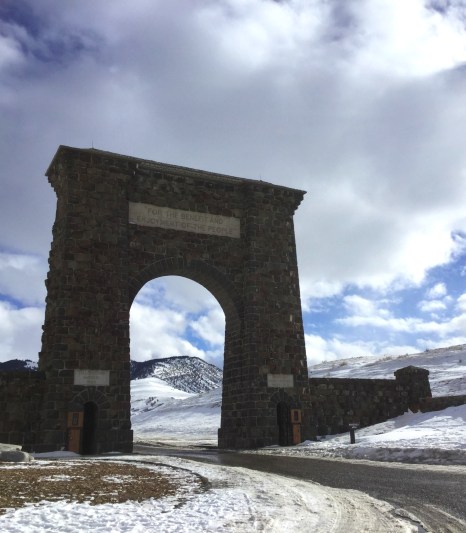
Roosevelt Arch at the North Entrance of Yellowstone National Park. Photo: January 2017 by Amy Cools

Hello, friends of Ordinary Philosophy!

From time to time, I take a trip to some corner of the globe, to explore the lives and ideas of great thinkers in the places where they lived and worked. For this series, I follow in the footsteps of thinkers who are no longer alive, since those who are still telling their own stories. But those who are no longer alive in the body live on in the ideas that they pass on, and in the example they provide for us to follow.

I’m pleased and excited to announce my seventh philosophical-historical adventure: an almost three-week road trip through the Great Plains and on to Illinois. I’ll fly from Chicago to Scotland on August 9th: I’ll be pursuing a master’s degree in the history of ideas at the University of Edinburgh starting this fall. In the meantime, I’m overjoyed to have this window of time to explore parts of my country which I’ve never seen, and to learn as much as I can along the way.

During this journey, I’ll explore Yellowstone and the history of National Parks in America (it’s been a great NP year for me!); I’ll travel throughout the Great Plains following the history of Crazy Horse, Sitting Bull, the Lakota and their and other Native Americans’ encounters with white invaders in the 1800’s and beyond; I’ll visit Springfield, Peoria, and Chicago following Abraham Lincoln, Robert Ingersoll, uniquely American forms of art and architecture, and other topics. I’ll also make many more stops and detours along the way.

Patrons of this series: Ervin Epstein MD, Liz and Russ Eagle, Tracy Runyon, Genessa Kealoha, the Cools-Ramsden family, and Shannon Harrod Reyes ~ With warmest gratitude, thank you!

Road Trip Through Indian Country to Chicago, En Route to Edinburgh
Bitterroot Mountains and the Lewis and Clark Wendover Ridge Hike
Lewis & Clark Caverns, Yellowstone National Park, and Our Public Lands
Little Bighorn Battlefield National Monument, Day 1
Little Bighorn Battlefield National Monument, Day 2
The Black Hills – Mt Rushmore, Black Elk Peak, and Crazy Horse Memorial
Standing Rock Reservation: In Search of Sitting Bull, I Find Sakakawea, Too – Part 1
Standing Rock Reservation: In Search of Sitting Bull, I Find Sakakawea, Too – Part 2
My Great Year for National Parks, Monuments, and Forests
Wounded Knee, Pine Ridge Reservation, South Dakota
Fort Robinson, Nebraska, in Search of Crazy Horse
Knox College, Galesburg, Illinois – Abraham Lincoln and Stephen Douglas Debate
Peoria, Illinois, In Search of Robert G. Ingersoll, Frederick Douglass, And Abraham Lincoln, Part 1
Peoria, Illinois, In Search of Robert G. Ingersoll, Frederick Douglass, And Abraham Lincoln, Part 2
Peoria, Illinois, In Search of Robert G. Ingersoll, Frederick Douglass, And Abraham Lincoln, Part 3

Athens and Springfield, Illinois, Part 1, In Search of Abraham Lincoln
Photobook: Marker and Train Station Where Abraham Lincoln’s Body Returned to Springfield, Illinois, May 3rd, 1865
Springfield, Illinois, In Search of Abraham Lincoln, Part 2
Springfield, Illinois, In Search of Abraham Lincoln, Part 3
Springfield, Illinois, In Search of Abraham Lincoln, Part 4
Springfield, Illinois, In Search of Abraham Lincoln, Part 5
New Salem, In Search of Abraham Lincoln
Hannibal and Florida, Missouri, in Search of Mark Twain
Chicago’s Union Stockyards Gate

And associated articles

Happy Birthday, Walt Whitman!
The Love of Possession Is a Disease With Them
Happy Birthday, Robert Ingersoll!
The Friendship of Robert G. Ingersoll and Walt Whitman

Ordinary Philosophy and its Traveling Philosophy / History of Ideas series is a labor of love and ad-free, supported by patrons and readers like you. Please offer your support today!

Happy Birthday, Ida B. Wells!

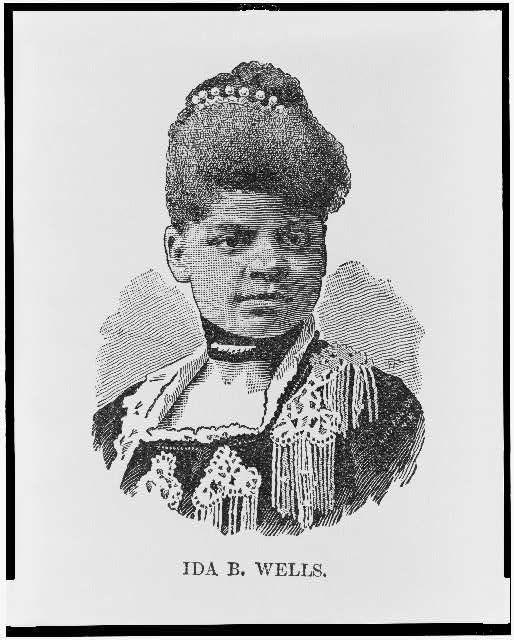
Ida B. Wells, head-and-shoulders portrait, published, 1891, Image retrieved from the Library of Congress LC-USZ62-107756, public domainIn the course of my journey following the life of Frederick Douglass last year, I was so glad to have the opportunity to visit the place in New York City where he may have first met the great Ida B. Wells. It was late 1892, and this fiery young newspaperwoman had published her very controversial piece of investigative journalism in the New York Age on June 25, 1892. It was expanded and published as a pamphlet later that year as Southern Horrors: Lynch Law in All Its Phases.

Many people at that time thought of lynching as an unfortunate and somewhat rare excess of race-hatred by frustrated Southern whites. And many more saw it as a lawless but not entirely unjustified species of vengeance against black men who had raped white women. But Wells would change all that. In early 1892, three of Wells’ friends were lynched after a dispute between themselves and white owners of a rival business. She was outraged, and began an investigation of the practice and history of lynching as a whole.

When Wells wrote Southern Horrors, she had already been an activist and writer for black rights for many years. In 1884, she resisted being forced out of the first class train car into the ‘colored car’; she later sued the train company, won the first suit, then lost on appeal. This incident (which echoes Douglass’ train protest in 1841) led to many other lawsuits, articles, and activism against anti-black laws and social practices. In 1892, her investigation of lynching revealed to Wells that lynching was far from just vengeance for rape, it was inflicted for petty crimes, supposed insubordination or impertinence, drunkenness, competition, and so on. She discovered that lynchings were not all that rare, either, and came to the conclusion that they consisted a form of social control, a replacement for the terrorism of the slave system.

Douglass was inspired and energized by Wells’ writing and anti-lynching work, and wrote a letter praising Southern Horrors as an introduction. He visited her in New York City where she was living for a little while as a writer for and part owner of the New York Age, which was (probably) published at the site I visited in Harlem. I visited a second site associated with Wells two days after my New York visit: she delivered one of her hard-hitting speeches in her speaking tour following the publication of Southern Horrors at Tremont Temple in Boston on Feb 13th, 1893.

Education was another driving force in her life. Her first job was as a teacher at age 14, and she taught for many years, over time supplementing her teaching with journalism, writing and editing for the Evening Star, The Living Way, and the Free Speech and Headlight. Another of her most controversial, consciousness-raising articles was published in 1891 in the Free Speech about the conditions in black schools: the poor quality of the buildings which housed them, and of the education and morals of the teachers and school boards who administered them. She was not fired outright, but the school refused to hire her for the next school year. She then went on to work full-time for the newspaper, promoting the Free Speech from city to city and writing articles along the way, until the Free Speech‘s offices and printing press were destroyed by angry whites after the publication of her ‘Lynch Law’ piece. Adversity only served to strengthen Wells’ resolve, each attack causing her to re-double her efforts on behalf of her people.

Wells went on to have a long and distinguished career in writing, investigative journalism, and activism for black rights and women’s suffrage. She worked with Frederick Douglass and W.E.B. DuBois, toured the United States and Europe as a speaker and activist, founded Chicago’s Alpha Suffrage Club, served as secretary of the National Afro-American Council, founded and became the first president of the Negro Fellowship League, and helped found the National Association for the Advancement of Colored People (NAACP), among many other things.

For a long time, Wells thought of marriage and romantic relationships as oppressive, where women were expected to defer to men and flatter their vanity. But one day, she met a man who must have made her feel very differently, an attorney, writer, and fellow advocate for black rights named Ferdinand Barnett. She married him and they raised four children.

Please follow the links below to learn more about Ida B. Wells. If I manage to accomplish the tiniest fraction of what she did in my own life, I would consider myself a great success.

Ordinary Philosophy and its Traveling Philosophy / History of Ideas series is a labor of love and ad-free, supported by patrons and readers like you. Please offer your support today!

~~~~~~~~~~~~~~~~~~~~~~~~

Sources and inspiration:

Ida B. Wells-Barnett‘, episode 25 of the History Chicks podcast by Beckett Graham and Susan Vollenweider.

Ida B. Wells-Barnett‘. Encyclopædia Britannica. Encyclopædia Britannica Online.

McBride, Jennifer. ‘Ida B. Wells: Crusade for Justice‘. From Webster University’s website.

McNally, Deborah. ‘Barnett, Ferdinand Lee (1858-1936)‘, in BlackPast.org

Steptoe, Tyina. ‘Barnett, Ida Wells (1862-1931)’, in BlackPast.org

Wells, Ida. B. Crusade for Justice: The Autobiography of Ida B. Wells. Ed. Alfred Duster. Chicago, University of Chicago Press, 1970.

Wells, Ida. B. Southern Horrors: Lynch Law in All Its Phases, 1892, via Project Gutenberg

Wikipedia contributors. ‘Ida B. Wells‘. In Wikipedia, The Free Encyclopedia.

Wintz, Paul Finkelman, Cary D. Encyclopedia of the Harlem Renaissance: K-Y. 2004.

Happy Birthday, Henry David Thoreau!

Replica of Thoreau's cabin near Walden Pond, Rhythmic Quietude, Creative Commons BY-SA 3.0 via Wikimedia Commons, cropped

Replica of Thoreau’s cabin near Walden Pond

Henry David Thoreau is the American philosopher and writer best known for two books, On Walden Pond and Civil Disobedience.

The first is about simplifying your life so as to find what it’s really all about, the second promotes breaking the law in protest when the state does wrong (think Martin Luther King in the Birmingham jail). Walden tells of Thoreau’s experiences and observations living a simple life in a cabin for two years, where he seeks to clear his mind of the encumbrances and distractions of life in society and focus on immersion in nature and the life of the mind. Civil Disobedience is an essay prompted by Thoreau’s refusal to pay taxes in protest of slavery and of America’s starting a war to seize land from the Mexican government.

Here’s a list of resources, short but sweet, to introduce you to his life and work if you haven’t been already or would like a refresher. Not all are complimentary, but that’s good: we learn much from the debate over his ideas, too.

Henry David Thoreau‘, from American Transcendentalism Web

Henry David Thoreau‘. In Wikipedia, The Free Encyclopedia.

Popova, Maria. ‘Happy Birthday, Thoreau: The Beloved Philosopher on How to Use Civil Disobedience to Advance Justice‘ and ‘The Spirit of Sauntering: Thoreau on the Art of Walking and the Perils of a Sedentary Lifestyle‘ in Brainpickings.org

Schultz, Kathryn. ‘Pond Scum: Henry David Thoreau’s Moral Myopia.’ The New Yorker, Oct 19th 2015.

The Thoreau Reader: Annotated works of Henry David Thoreau – Three complete books and four essays, annotated copies of Walden and Civil Disobedience, and more…

West, Stephen. Henry David Thoreau. Episode 83 of Philosophize This podcast

Ordinary Philosophy and its Traveling Philosophy / History of Ideas series is a labor of love and ad-free, supported by patrons and readers like you. Please offer your support today!

Frederick Douglass’ Fourth of July Speech at Rochester, NY’s Old Corinthian Hall, 1852

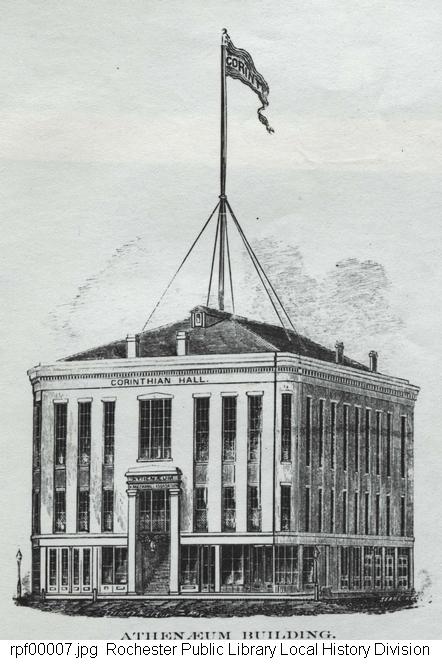
Drawing of Corinthian Hall, image credit Rochester Public Library Local History Division (note it's also called The Atheaneum in the subtitle)

Drawing of Corinthian Hall, image credit Rochester Public Library Local History Division (note that it’s still titled The Athenaeum)

Excerpt from Frederick Douglass Rochester NY Sites, Day 1 published May 23, 2016

I head east on Main… to the site of the old Corinthian Hall, which, according to a couple of sources, was near the end of Corinthian Street behind the Reynolds Arcade, where the parking garage is now. Originally called The Athenaeum, as were so many public halls of the time, it was renamed Corinthian Hall after the style of the classical columns on its stage, and the building was widely famed for its beauty. Corinthian Street was also renamed, and most internet sources I find say it was originally named Exchange Place.  However, I discover that these two pieces of received internet wisdom appear to be a bit off. Poring over old maps in Rochester Library’s online images database, I find one published in 1851, two years after the hall was built in 1849. For one, I find that while the street was named Exchange Place before it was named Corinthian, it was named Work Street at the time the hall was built. Secondly, I find that it was not actually under the parking garage at the end of the street. It was actually directly across from the back entrance of the Reynolds Arcade, where a parking lot and a glassy midcentury office building now stand. The 1851 map was a little behind the times: Corinthian Hall and Exchange Place had already received their new names in 1850, but the map retains their original designations.

Douglass spoke frequently at what he referred to as ‘the beautiful Corinthian Hall’ in the 1850’s. In fact, he  ‘lectured [there] every Sunday evening during an entire winter’ as he wrote in his Life and Times. He delivered a speech here on Aug 21, 1852 at the Fugitive Slave Convention, in opposition to the Fugitive Slave Act. Then in July 1853, Douglass presided over the National Convention of Colored Men in Rochester, which became a center for the antislavery movement; his biographer Philip S. Foner called this convention ‘the most important’. This is where the pressing problem of lack of unification between various factions of the antislavery movement were identified and discussed, as well as the relative lack of black leadership. Though this Rochester convention still failed to bring about a unified black political movement, like the previous one in Troy discussed in an earlier account, it sent a powerful message that all black Americans had a powerful champion in Douglass.

Corinthian St, north of Main, around the site of old Corinthian Hall

The rear of the Reynolds Arcade facing onto Corinthian St, north of Main, across from the site of old Corinthian Hall

View from west end of Corinthian St, showing site of old Corinthian Hall at right where the glassy midcentury building now stands, photo 2016 by Paige Sloan

View from west end of Corinthian St, showing site of old Corinthian Hall at right where the glassy midcentury building now stands, photo 2016 courtesy of Paige Sloan. Note the Corinthian columns on the First National Bank of Rochester-Old Monroe County Savings Bank Building, built in 1924, in the rear of the photo.

But the single most important Douglass moment in this hall happened on July 5, 1852, when he delivered his powerful ‘What to the Slave is the Fourth of July?‘ speech for the first time. He delivered it on the 5th instead of the 4th, he said, because the latter was a day of mourning for himself and his people. This speech was Douglass’ Gettysburg Address, his Second Inaugural, his ‘To Be or Not to Be?’, where his powers of oratory and his eloquence were in full force. The speech is long, opening with a reflection on the history of the United States’ founding and its promise of renewed freedom for all. Then he pours out his lament:

‘I am not included within the pale of this glorious anniversary! Your high independence only reveals the immeasurable distance between us. The blessings in which you, this day, rejoice, are not enjoyed in common. — The rich inheritance of justice, liberty, prosperity and independence, bequeathed by your fathers, is shared by you, not by me. The sunlight that brought life and healing to you, has brought stripes and death to me. This Fourth [of] July is yours, not mine. You may rejoice, I must mourn….

What, to the American slave, is your 4th of July? I answer: a day that reveals to him, more than all other days in the year, the gross injustice and cruelty to which he is the constant victim. To him, your celebration is a sham; your boasted liberty, an unholy license; your national greatness, swelling vanity; your sounds of rejoicing are empty and heartless; your denunciations of tyrants, brass fronted impudence; your shouts of liberty and equality, hollow mockery; your prayers and hymns, your sermons and thanksgivings, with all your religious parade, and solemnity, are, to him, mere bombast, fraud, deception, impiety, and hypocrisy — a thin veil to cover up crimes which would disgrace a nation of savages. There is not a nation on the earth guilty of practices, more shocking and bloody, than are the people of these United States, at this very hour.’

If what he had to say that day didn’t make people ashamed to celebrate liberty for themselves while denying it to others, no words could.

* Read the full story of this day following the life and ideas of Frederick Douglass here

Ordinary Philosophy and its Traveling Philosophy / History of Ideas series is a labor of love and ad-free, supported by patrons and readers like you. Please offer your support today!

~~~~~~~~~~~~~~~~~~~~~~~~~~~~~~

Sources and Inspiration

33. Corinthian Hall / Academy of Music‘, The Freethought Trail website

Corinthian Hall (venue)‘, under ‘Charter Inductees’, Rochester Music Hall of Fame website

Cornell, Silas, ‘Map of the City of Rochester‘, 1863. From Rochester Library Digital Collections, Monroe County Library System website.

Douglass, Frederick. Autobiographies (includes Narrative…, My Freedom and my Bondage, and Life and Times). With notes by Henry Louis Gates, Jr. Volume compilation by Literary Classics of the United States. New York: Penguin Books, 1994.

Douglass, Frederick. “What to the Slave Is the Fourth of July?”, July 5, 1852. Teaching American History (website)

The Era of Academies in Monroe County‘, From Rochester Library Digital Collections, Monroe County Library System website.

First National Bank of Rochester-Old Monroe County Savings Bank Building. In Wikipedia, The Free Encyclopedia.

Foner, Philip S. The Life and Writings of Frederick Douglass, Vol. 1-4. New York: International Publishers, 1950.

McFeely, William. Frederick Douglass. New York: W.W. Norton & Company, 1991.

McKelvey, Blake. ‘Historic Antecedents from the Crossroads Project‘. From the Rochester History Journal, Oct 1864, Vol. 26, No. 4.

The Love of Possession is a Disease With Them

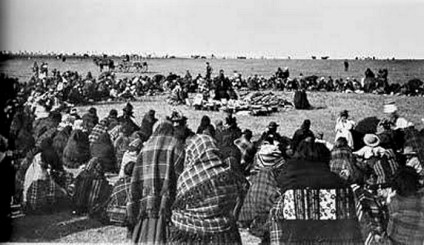
Lakota giveaway ceremony, photo origin unknown

In my recent readings in the history of the Lakota and other native peoples of America’s Great Plains, I’ve been struck by descriptions of their giveaway ceremonies. They remind me of another practice I had learned of before, and which I believe is more generally familiar: the potlatch, a related custom practiced by Native Americans of the Northwest. Potlatches generally came with strict expectations of giving the gifts away again promptly, and then some. These exchanges cemented power relations and were often aggressively competitive; they’re better understood as tactical, sociopolitical transactions rather than simple acts of generosity.

Lakota giveaway ceremonies, however, are much more altruistic in the sense that we commonly understand the term. The gifts are given freely with no expectation of payback; in fact, the resulting impoverishment itself is a badge of honor. That’s why I chose a quote by Sitting Bull, the great Hunkpapa Lakota chief, to introduce this essay. He once illustrated the contrast between Lakota and white attitudes towards property by telling how his poverty aroused the admiration of his people, rather than the disdain most white people feel toward such a state. To those who share Sitting Bull’s impression of the invaders of his homeland, the driving need to amass and own material goods can be a sign of spiritual poverty.

Today’s United States, like those nations most similar to her in culture and economy, is very much not characterized by that less-is-more spirit. This is nothing new. The United States and Canadian governments’ historical prohibitions on giveaway ceremonies in vanquished tribes indicate that Sitting Bull’s characterization of white culture describes something that’s been around for quite a while. These governments viewed giveaway ceremonies as a challenge to the enthusiasm for a market-driven type of productive cooperation they wished to instill in the nations they conquered. These and other Western societies (derived from Europe) had been centered around the production, acquisition, accumulation, and display of goods particularly since the industrial age. This is reflected in our values, our mores, our politics, our language, our cultural attitudes, the ways we celebrate holidays and major life events, and even, increasingly, our religious and spiritual practices.

The free market system, a new style of trade characterized by Adam Smith as that best for improving lives of all human beings most efficiently, has indeed instilled many good practices and attitudes. For example, we’re less likely to see other nations and cultures as enemies when we cultivate relationships as trading partners; we see the effects of this change in international relations and in the relative peacefulness of the modern world to those which practiced the old feudal and mercantilist systems. We also see that more people throughout the world now live longer, more comfortable lives than ever before, as the market incentivizes and drives innovation to respond more efficiently to demand. But there have always been downsides to free markets too. Think of the slave trade; trade wars; colonialism; invasion and confiscation of indigenous lands; the immiseration of working people in squalid industrial towns and dismal factories; price- and wage-fixing by trusts and monopolies; and vast inequalities in wealth and in chances of success are but a few examples. Such practices and inefficiencies are not merely excesses or abuses perpetrated by a few bad actors: they are regular and expected outcomes of a system whose purpose is to maximize profit and come out ahead of everyone else.

And now, we see that market values have pervaded all levels of our consciousness, our self-conception of who we are and how we should best inhabit our world. As philosopher Michael Sandel describes it, we have gone from having a market economy to being a market society. The way we live, think, and feel is pervaded by consumerism. We’ve become buyers and sellers to the extent that we have become products ourselves, marketed and commodified, valued in work and in life insofar as we present ourselves the right way, are seen in the right places, wear the right brands and styles, drive the right cars, and use the right products.

And this has led us to a new problem, one unimaginable to John Locke, Adam Smith, and others who developed the theories about property rights and the benefits of open markets that we take for granted today. Human societies were relatively small then, and the uninhabited regions and untapped resources of the world seemed vast, even endless by comparison. It’s very different today. The population of the world has grown so large, our technological ability to produce goods from raw materials so varied, efficient, and prolific, and our ingrained habits of making, amassing, and consuming voraciously is leading us to a crisis of mass waste, pollution, and climate change.

The pollution problem can be seen as the modern corollary of Thomas Malthus’ 1798 theory that human reproduction would inevitably outstrip food production, leading to mass impoverishment. Though Malthus’ ideas had long gone out of fashion with advancements in agricultural technology and the widespread use of birth control, he’s enjoying a bit of a comeback. However long technology can stave off many of the ill effects of exponential population growth, the earth’s habitable surface and ability to produce what we need to survive (let alone to live well) is finite nonetheless. This is also true of our atmosphere’s ability to absorb the off-gassing of our industries without changing our biosphere’s ability to sustain the life it gave rise to. Over the centuries and decades, concerns about human impact on the natural world and its life-sustaining resources swing from optimism that we can and will create new technology and social practices that will solve everything, to worry that we won’t be sufficiently motivated or innovative in time to stave off the destruction of our own habitat.

In my years past working at a recycling and salvage operation, I observed a part of the massive flow of waste we generate, much of it perfectly good stuff we just throw away. The sheer volume of it all haunts me still. Photo of Amy Cools by Stephen Loewinsohn for the East Bay Express

Beginning with Rachel Carson’s 1962 book Silent Springenvironmental consciousness is becoming ever more pervasive across the political spectrum. But it seems that ecological responsibility is still an ideal that has not yet changed our behavior except in a few token ways. Even progressive, self-consciously ‘green’ micro-cultures, such as that of the San Francisco Bay Area where I live, generally consume and discard on a very large scale. There’s a strong market here for innovations in green products such as compostable and reusable utensils and packaging, recycled fiber and bamboo clothing, energy-efficient technology, and more. Some of this technology replaces other arrays of products such as CDs, books, ledgers, pens and pencils, camera film, landline telephones, and so on, and could in time reduce the amount of stuff made. Yet new generations and styles of products replace the old ones almost as often and quickly as they are introduced, and the things which the new products replace in turn become trash. And in the case of technology, particularly toxic trash. There are recycling programs, to be sure, but they don’t keep up with the volume of discards, and the recycling process itself can be toxic. And the compostable packaging which cocoons every fashionable new product and every new gadget adds to the deluge. Take-out meal services and ready-to-make meals in a box are ever-increasing in popularity, every breakfast, lunch, and dinner wrapped in a soon-to-be-wad-of-trash. Newly ubiquitous reusable shopping bags and thinly-walled plastic bottles do little in the face of this accelerating volume of throwaway goods and conveniently, disposably-packaged everything.

What does all this mean on a planet now so dominated by humans, materialistic, energetic, intelligent, creative, productive, and exponentially-reproductive?

It does seem that our love of possession is a disease with us, not just in the moral and spiritual sense that Sitting Bull refers to. It’s become something palpable, something we see before our eyes, that we breathe in, that we swim among. It shares characteristics of cancer, growing, proliferating, invading at an accelerating rate, which we still likewise seem powerless to stop. And the gases from the production and decay of all this stuff is changing the climate from the one that gave rise to the evolution of, and now sustains and nurtures, the plants and animals that give us life.

So what do we do? How do we divert or change this deeply ingrained cultural habit, this seemingly unstoppable force that we’ve unleashed?

I think about that other thing Sitting Bull said, about his people respecting him not because he owned many things in the way valued by white people, but because he kept little for himself. How, then, if we shift our values? How if we began to regard the need to compulsively and conspicuously consume stuff as crass, as burdensome, as uncool, as unenlightened, even as pitiable?

This isn’t necessarily as unlikely or even as unimaginable as it might seem. We often take for granted that our love and pursuit of stuff is an immutable trait of the human psyche. Yet, that’s not the case, as evidenced by cultural and spiritual mores that differ widely; we can look to the surprise and disgust of Sitting Bull and his people when encountering the white invaders’ greed for gold, land, and buffalo hides. There is an idea from Japanese culture, mottainai, which has deep roots and is growing again in popularity. This complex and hard-to-translate idea includes a reverence for objects and the value of frugality, both of which preclude the wasteful, polluting consumerist practices of modern market societies. And there are many more cultural and spiritual traditions of long standing in which the possession of more goods than needed is considered a negative.

Asceticism is an extreme variety of this less-is more value, an ancient tradition in which one seeks to reach the highest levels of spiritual perfection by divesting themselves of all or most material goods and comforts. There is also the culture of the traveler and world citizen, those who own little since having too many things to haul around gets in the way of opportunities for adventure. There is also a modern fad, admittedly a rather niche conceit of those with higher incomes, of living in tiny, design-heavy, super-efficient homes, reducing one’s personal possessions to the most utilitarian minimum.

However, these ways of life, admired and admirable as they can be, are not workable for most people. Except for asceticism, they are also unaffordable for most people, and none of these work for those who have families to care for, or those who are elderly or disabled, and so on. What of the least wealthy among us, those who must opt for the cheaper products regardless of whether they’ll wear out and become trash sooner? And what about the joy of shopping for stuff, new and novel things that relieve the monotony and stress of an ordinary working life? Even in this realm of life, however, we do have an awareness that the short-term fun of buying stuff can lead to long-term unhappiness. For example, the extremes of material consumption, hoarding and compulsive shopping, are widely considered destructive and unhealthy, if not forms of mental illness. Expanding this sense of the unhealthiness of having too much stuff can be gradually extended to include things that we might sorta like at first but realize we won’t use much or care about for long. Over time, we can acculturate ourselves to less but higher quality things, and better yet, to value publicly owned goods more highly: parks, museums, public beaches, public buildings, and hopefully in the future, more community- and government- owned public amusement centers such as skating rinks, gyms, arcades, and so on.

Sitting Bull and his family, 1881

And while it might seem too difficult to inculcate the value of less-is-more, we can remember that many deeply-ingrained cultural values and habits have been purposely and quickly shifted. The right of gay people to marry and enjoy other equal benefits of society are now generally taken for granted when only two decades ago legal gay marriage was unimaginable to most. Smoking is widely considered unhealthy and a public nuisance, through just a few decades of education, public awareness campaigns, and taxation. Bullying, racist and sexist slurs, discriminatory practices, and many, many other bad habits, once so culturally pervasive, are no longer respectable.

While shopping and owning a lot of stuff might not seem to be habits as bad as any of the above, I believe that we’ll soon recognize that it might be. Now that there are so many of us in the world, we can no longer consider ourselves as morally responsible beings only as individuals when it comes to the health of our environment. With well over seven billion people on the earth increasing exponentially, we are now responsible to each other in the ways our actions contribute to the aggregate effects. Let’s make the effects of our presence on the earth not resemble those of a disease. Let’s instead make it more aligned with mottainai by treating the earth as the most precious object there is; more akin to the role of earth-steward as the God of Genesis called on his human creation to be; more akin to Sitting Bull and his generous less-is-more spirit. Our physical and spiritual health and our very lives depend upon it.

*Listen to the podcast version here or on Google Play, or subscribe on iTunes

~~~~~~~~~~~~~~~~~~~~~~

Sources and Inspiration

Auxier, Randall. ‘Indian Givers‘, Nov 15th, 2013. Radically Empirical blog

Blaisdell. Robert (ed.) Great Speeches by Native Americans. NY: Dover, 2000.

Bruchac, Joseph. ‘Sacred Giving, Sacred Receiving‘, June 20, 2016, Parabola

Cole, Douglas and Ira Chaikin. An Iron Hand upon the People: The Law Against the Potlatch on the Northwest CoastVancouver: Douglas & Mclntyre, 1990 (PDF download)

Her Many Horses, Emil. ‘A Song for the Horse Nation: Remembering Lakota Ways‘. From A Song for the Horse Nation, edited by George P. Horse Capture (A’aninin) and Emil Her Many Horses

Jackson, Joe. Black Elk: The Life of an American Visionary. New York: Farrar, Straus, and Giroux, 2016.

Mottainai: a Philosophy of Waste‘. August, 2015. Interview and discussion with Kevin Taylor by Joe Gelonesi for The Philosopher’s Zone, a podcast of Radio National, Australia.

Pettipas, Katherine. Severing the Ties that Bind: Government Repression of Indigenous Religious Ceremonies on the Prairies. Winnepeg: University of Manitoba Press, 1994.

Rachel Carson, American Experience by PBS, April 18th, 2010

Roth, Christopher E. ‘Goods, Names, and Selves: Rethinking the Tsimshian Potlatch‘, American Ethnologist, Vol. 29, No. 1 (Feb., 2002), pp. 123-150

Sandel, Michael. What Money Can’t Buy: The Moral Limits of Markets. New York: Farrar, Straus and Giroux, 2012.

Sitting Bull‘. Encyclopædia Britannica, April 21, 2017

Thomas Malthus‘. Encyclopædia Britannica.

Happy Birthday, Aimé Césaire!

Aimé Fernand David Césaire, photo credit manomerci.comAimé-Fernand-David Césaire was a poet, playwright, philosopher, and politician from Martinique. In his long life (1913-2008), Césaire accomplished much in each of these roles, a rare feat as they rarely coincide in one person!

In turn mayor of Fort-de-France, deputy to the French National Assembly for Martinique, and President of the Regional Council of Martinique, this prolific writer and intellectual was also co-founder of Négritude, a ‘literary movement of the 1930s, ’40s, and ’50s that began among French-speaking African and Caribbean writers living in Paris as a protest against French colonial rule and the policy of assimilation.’ (Encyclopædia Britannica). The Stanford Encyclopedia of Philosophy describes Négritude as ‘the self-affirmation of black peoples, or the affirmation of the values of civilization of something defined as “the black world” as an answer to the question “what are we in this white world?”’. The term was chosen so as to be provocative, a way of re-claiming the word nègre, which had become a racial slur, while simultaneously shocking those who heard or read it into paying attention. Through his philosophy, political writing, and especially his poetry and plays, the world pays attention still.

Learn more about the great Aimé Césaire through the resources below; an excellent place to start is with Meredith Goldsmith’s article from The Poetry Foundation.

Ordinary Philosophy and its Traveling Philosophy / History of Ideas series is a labor of love and ad-free, supported by patrons and readers like you. Please offer your support today!

~~~~~~~~~~~~~~~~~~~~~~~~

Sources and inspiration:

Aime Cesaire‘. In Encyclopædia Britannica.

Chidi, Sylvia Lovina. The Greatest Black Achievers in History, chapter 1

Diagne, Souleymane Bachir, ‘Négritude‘. In The Stanford Encyclopedia of Philosophy

Goldsmith, Meredith. ‘Aimé Fernand Césaire‘, 1913–2008. In The Poetry Foundation

Happy Birthday, W.V.O. Quine!

WVO Quine on the Bluenose II in Halifax, Nova Scotia, photo courtesy of Douglas Quine (cropped)

WVO Quine on the Bluenose II in Halifax, Nova Scotia, photo courtesy of Douglas Quine

The emphases in my own education in philosophy were Ethics, Politics, and Law, so I didn’t spend as much time studying Willard Van Orman Quine’s great contributions to philosophy as I would like. However, if my focus was Mathematical Logic, Epistemology, Philosophy of Language, or Philosophy of Science, I would have spent a lot of time with the prodigious output of his remarkable intelligence. But one of his important observations is brought up in introductory philosophy classes generally, an epistemological (having to do with knowledge) quandary: Given that science continuously makes new discoveries, sometimes in the process overturning and replacing earlier theories, how can we ever say that we actually know anything about the world? Science relies on the fact that all theories are subject to revision, expansion, and being proved wrong. Does this mean, then, there’s no such thing as knowledge, since, in theory, anything we claim to know may be disproved by later discoveries?

For Quine, there is no dividing line between science and philosophy; they are interconnected ways of discovering and understanding the world. As the Stanford Encyclopedia of Philosophy puts it, Quine ‘denies that there is a distinctively philosophical standpoint, which might, for example, allow philosophical reflection to prescribe standards to science as a whole. He holds that all of our attempts at knowledge are subject to those standards of evidence and justification which are most explicitly displayed, and most successfully implemented, in the natural sciences. This applies to philosophy as well as to other branches of knowledge.’ The Internet Encyclopedia of Philosophy says further, ‘…Quine often appeals to [Otto] Neurath’s metaphor of science as a boat, where changes need to be made piece by piece while we stay afloat, and not when docked at port. He further emphasizes that both the philosopher and scientist are in the same boat (1960, 3; 1981, 72, 178). The Quinean philosopher then begins from within the ongoing system of knowledge provided by science, and proceeds to use science in order to understand science. …his use of the term “science” applies quite broadly referring not simply to the ‘hard’ or natural sciences, but also including psychology, economics, sociology, and even history (Quine 1995, 19; also see Quine 1997). But a more substantive reason centers on his view that all knowledge strives to provide a true understanding of the world and is then responsive to observation as the ultimate test of its claims…’

Oh, and he played the mandolin and piano, and learned a lot of languages just so he could deliver his lectures in the native language of the audience. Whatta guy!

Learn more about the great W.V.O. Quine:

W. V. Quine, Philosopher Who Analyzed Language and Reality, Dies at 92 – by Christopher Lehmann-Haupt for The New York Times, Dec 29, 2000

Willard Van Orman Quine – by Peter Hylton for The Stanford Encyclopedia of Philosophy

Willard Van Orman Quine: Philosophy of Science – by Robert Sinclair for The Internet Encyclopedia of Philosophy

Willard Van Orman Quine, 1908-2000: Philosopher and Mathematician – Website by Douglas B. Quine, W.V.O. Quine’s son

Willard Van Orman Quine – by Luke Mastin for The Basics of Philosophy: A huge subject broken down into manageable chunks

Willard Van Orman Quine – In Wikipedia, The Free Encyclopedia.

Ordinary Philosophy and its Traveling Philosophy / History of Ideas series is a labor of love and ad-free, supported by patrons and readers like you. Please offer your support today!

Road Trip Through Indian Country to Chicago, En Route to Edinburgh

Amy on a road trip to Death Valley, 2009

Hello, friends of Ordinary Philosophy!

I’m planning a cross-country road trip before I leave the US for Scotland and grad school. I’ll be traveling across the northern half of the United States, through Indian country and then Peoria, Springfield, & Chicago. I’ll spread this itinerary over a few more days if I can, & would love to hear your suggestions for more interesting historical and cultural sites to visit along this general route. I’ll be writing for Ordinary Philosophy all the while about what I see and learn.

I’m doing this all on the cheap AND I love to meet new people. If you have friends or family along this route that would be willing to host an itinerant writer and indie scholar, I would be grateful for your introduction! In thanks, I’ll write a dedicated piece on any subject of my kind hosts’ choice for O.P.

Here’s my itinerary thus far:

Days 1-4: Spokane, WA (family)
Day 5, 6, & 7: Yellowstone
Day 8: Little Bighorn National Monument
Day 9: Standing Rock
Day 10: Fort Yates – Sitting Bull sites
Day 11: Black Hills National Forest: Mt Rushmore, Crazy Horse Memorial, Black Elk Peak
Day 12: Wounded Knee Memorial, Fort Robinson – Crazy Horse sites
Day 13 – 14: Peoria, IL
Day 15: Springfield, IL
Days 16 – 18: Chicago
Day 19: fly to Edinburgh!

Ordinary Philosophy and its Traveling Philosophy / History of Ideas series is a labor of love and ad-free, supported by patrons and readers like you. Please offer your support today!

Happy Birthday, Blaise Pascal!

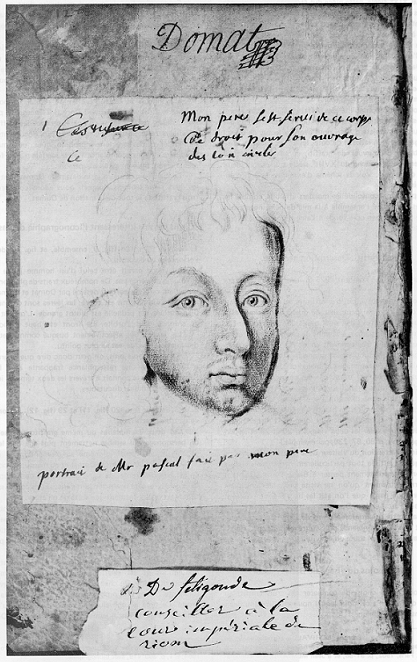
Blaise Pascal, crayon drawing by Jean Domat, c. 1649, in the Bibliothèque Nationale, Paris

Blaise Pascal, born on June 19th, 1623 in Auvergne, France, was a mathematician, philosopher, physicist, scientist, theologian, inventor, and writer.

This polymath was so talented in so many areas that any one of them could have kept his memory and influence alive to this day. Steven West writes in Philosophize This that we could ‘feel completely inadequate when we learn that he invented the calculator (yes, the calculator) at age 18.’ David Simpson writes in The Internet Encyclopedia of Philosophy, ‘In mathematics, he was an early pioneer in the fields of game theory and probability theory. In philosophy, he was an early pioneer in existentialism. As a writer on theology and religion, he was a defender of Christianity.’ Jean Orcibal and Lucien Jerphagnon write for Encyclopædia Britannica, ‘He laid the foundation for the modern theory of probabilities, formulated what came to be known as Pascal’s principle of pressure, and propagated a religious doctrine that taught the experience of God through the heart rather than through reason.’

Pascal’s Wager is probably his best-known idea, keeping his name alive in popular culture as well as among scholars. The argument can be summarized thusly: You can believe in God, or not believe in God. When it comes to the effect of the state of your belief on your possible eternal afterlife, if you don’t believe in God, you may very well be damned for all eternity. But if you do believe in God, you may achieve salvation. When it comes to the effect of your state of belief on your life here on Earth, whether or not you believe in God, your life will not be affected hugely. We’re all constrained as a matter of course by cultural expectations and codes of behavior, after all. The religious constraints we might find inconvenient and even tedious sometimes don’t, generally, significantly burden your life more than any others, while the practice of religion can add a great deal of meaning and satisfaction to life. Since we stand to gain much more than we might lose, all in all, it’s the most logical and therefore best bet to believe in God.

Now Pascal is an extremely intelligent man, and he knows belief is something you can’t just flip on like a light switch. That’s why he advises that the prudent person will choose to believe in God for the reasons described above and then behave as if they believed it. With enough acts of piety, religious study, and time among other virtuous and true believers, they are bound to end up believers themselves. This is very insightful psychologically: it accords well with what we now know about how the brain works, and his ‘fake it till you make it’ belief formation process is very like modern cognitive behavior therapy. Enact the change you wish to see in your mind, and your mind will follow, or to use modern terminology in common use, your brain will be ‘rewired’.

I’ve heard many people object to Pascal’s Wager on the grounds that they think religion does have too many negative effects to accept that the wager in favor of God-belief is a good bet. To ignore what your reason tells you about how unlikely it is that anything exists outside of the natural world, and that contradictions within and among the scriptures of the world indicate that none of them are divinely inspired, and so on, makes you a traitor to reason and critical thinking and science. It undermines your ability to perceive and understand the real world on its own terms. And betraying your own powers of reason, so that you can feel safe about an afterlife that no-one can demonstrate happens anyway, infantilizes you by subjugating your critical thinking to your superstitious fears.

I don’t buy the first objection anymore, though I once found it convincing. After all, few are better at reasoning and critical thinking than Pascal. His formidable powers of reason don’t appear undermined in any serious way overall considering his incredible lifetime achievements in mathematics, physics, logic, practical invention, and science. Choosing to believe in God clearly doesn’t seem to hamper his intellect one bit.

I still object to the Wager, but on these grounds: I think Pascal, unjustifiably, assumes too much when constructing his argument in the first place. Why, for example, bet on the idea that God would even be pleased by and liable to reward belief in him, even if eventually sincere, when it originates in this sort of self-serving calculation? Why not assume instead that God, if he exists, would reward honesty itself, whether in believers or nonbelievers, so long as their state of belief results from good faith efforts to seek truth? This seems, to me, more in line with the inclinations of the creator of a rational, ordered universe, the ultimate expression of reason, which in turn requires fearless, honest inquiry if it’s to be known, understood, and appreciated in the fullest way possible.

But this wager is just one relatively minor result of Pascal’s exploration of this fascinating world, and given his pioneering inquiries in the areas that would later be known as probability theory and game theory, it’s not surprising that, in brainstorming, he came up with this possible solution to the problems of belief vs. reason. And whether or not he got it right, it’s long captured the public imagination and really does make us think, as he’s done exquisitely during, and throughout the centuries after, his all-too-short life.

Learn more about the great Blaise Pascal:

Blaise Pascal – by Desmond Clarke for The Stanford Encyclopedia of Philosophy

Blaise Pascal (1623–1662) – by David Simpson for the Internet Encyclopedia of Philosophy 

Blaise Pascal: French Philosopher and Scientist – by Jean Orcibal and Lucien Jerphagnon for Encyclopædia Britannica

Pascal’s Wager and – +EV your way to success!! – by Steven West, Philosophize This!

Ordinary Philosophy and its Traveling Philosophy / History of Ideas series is a labor of love and ad-free, supported by patrons and readers like you. Please offer your support today!

Women in the World of Frederick Douglass by Leigh Fought

Women in the World of Frederick Douglass by Leigh Fought, at the San Francisco Public Library

I just finished this book about Frederick Douglass by scholar Leigh Fought. I’m at the library right now, about to turn it back in, and have that feeling of afterglow which follows reading a fascinating story while gaining much deeper understanding of a subject that’s long inspired me.

Not only did I get to know the character and work of Douglass much better, his struggles, triumphs, mistakes, virtues, flaws, and motivations, I learned about the ways in which women shaped his life and ideas and made his work possible. I had uncovered pieces of this larger story when following his life and ideas last year, but Fought’s work tells this larger story fully and compellingly and then some. This not only a book about these personalities and how they met, fell in love, collaborated, clashed, helped, betrayed, and so on, but it’s about the real human side behind the various social movements Douglass and the women in his life were a part of. And for many, still a part of, through their memory and influence. It’s about the antislavery movement, the women’s rights movement, the suffrage movements, the worker’s rights movement, the Civil War, the formation of the Republican Party as a free soil, pro-Union party and its after-war (what I consider) devolution into the economy-above-all party, and many other potent movements shaping and reshaping American society.

I very highly recommend this book, and think you’ll love it as I do.

Enjoy!

Ordinary Philosophy and its Traveling Philosophy / History of Ideas series is a labor of love and ad-free, supported by patrons and readers like you. Please offer your support today!