Frederick Douglass’s Birthplace, Maryland’s Eastern Shore Sites Part 1

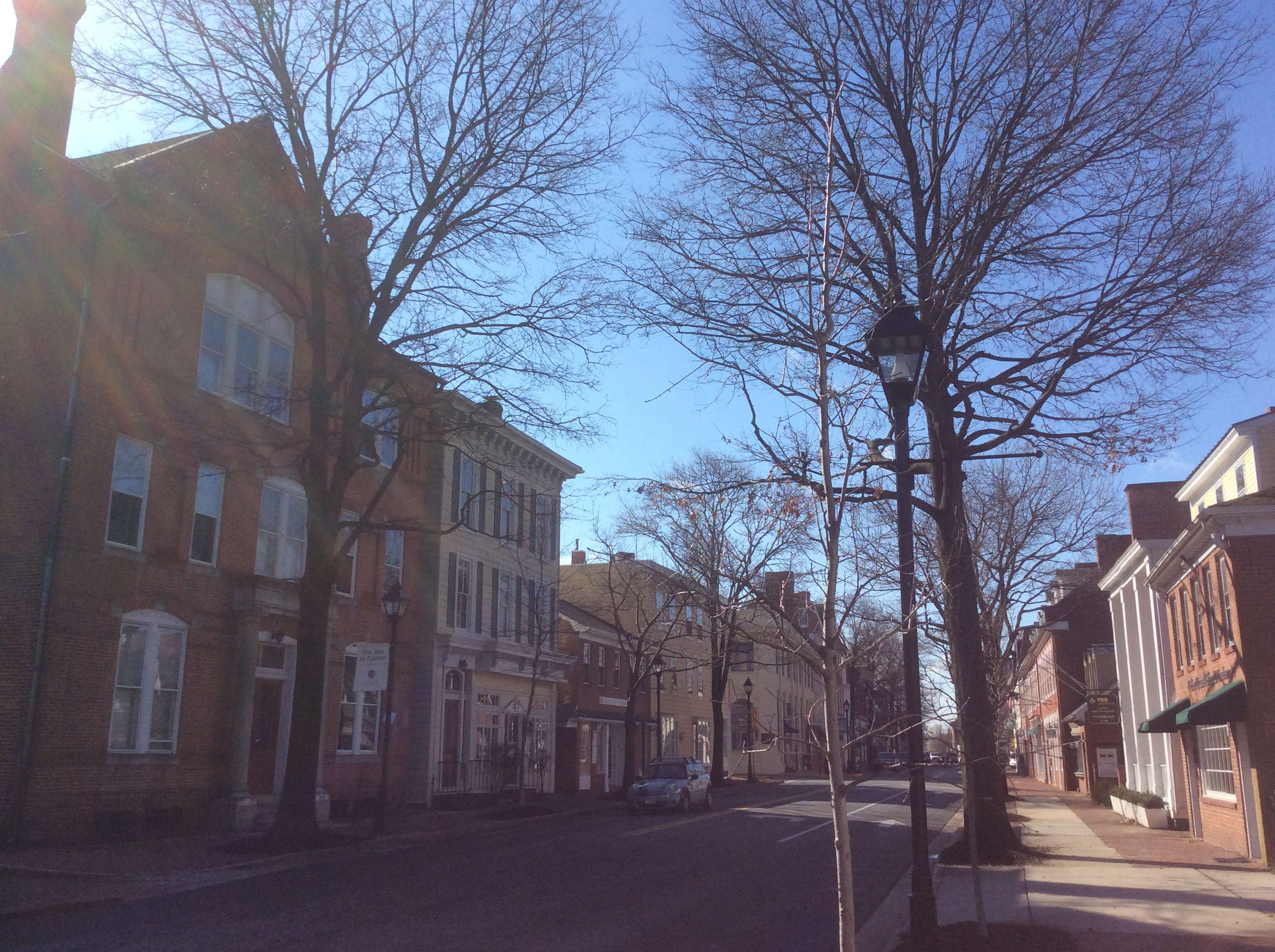
Easton, MD on a bright spring morning in March

Easton, MD on a bright spring morning in March

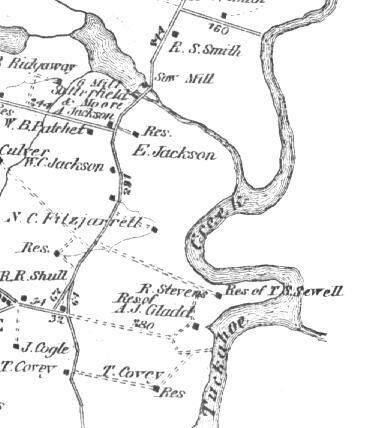
Frederick Douglass Birthplace Map 3

Second day, Monday March 21st

I wake up early and make my way to Maryland’s east shore, looking forward to a beautiful day in the country. It’s windy and very cold, but clear and sunny. I head for downtown Easton: the route from there to my first destination is easiest to follow for a non-local like me. And I can use all the help I can get: this will be the first site I visit in any of my history travels where I will rely both on maps that predate the turn of the 20th century and natural landmarks to locate it.

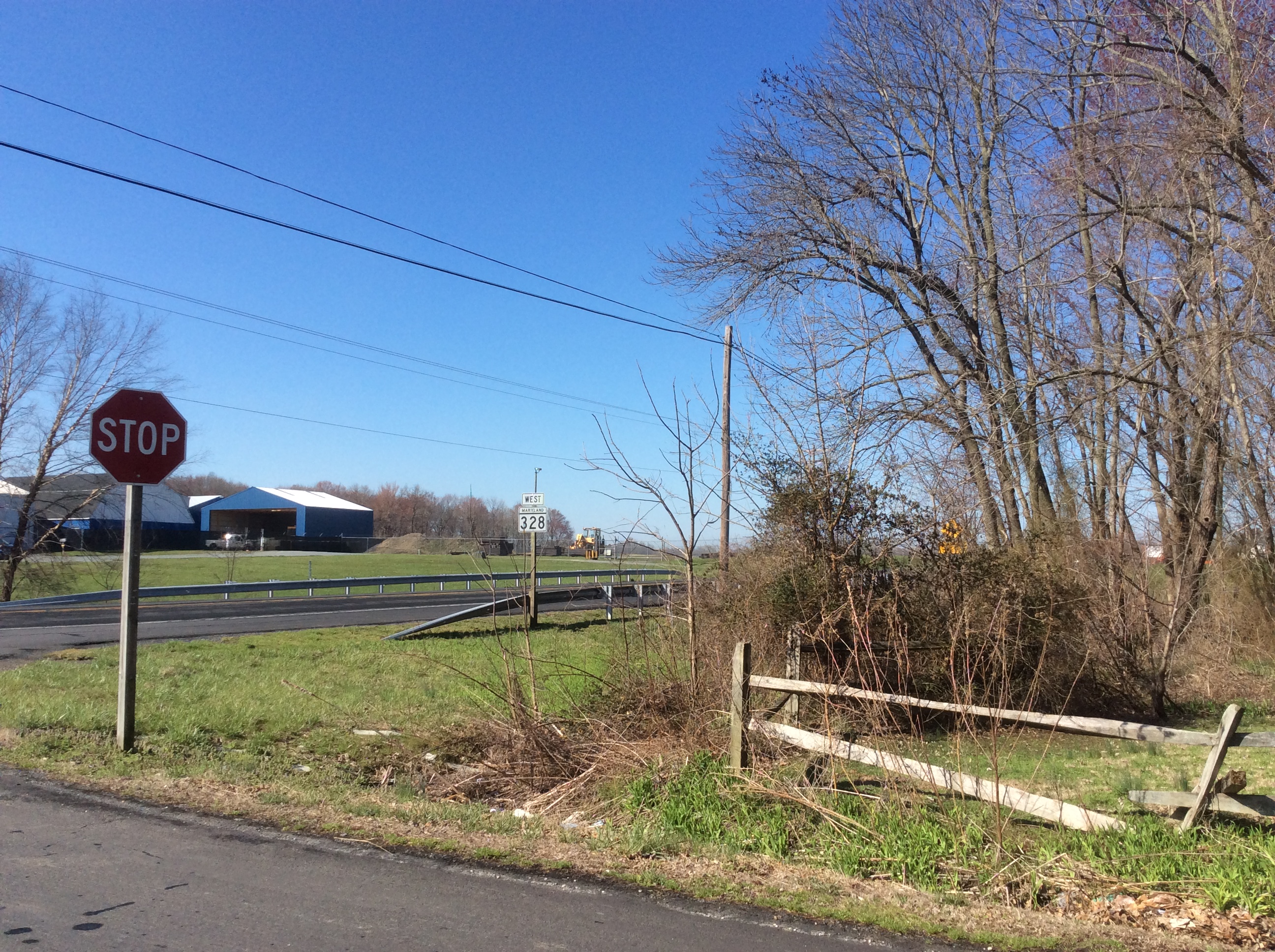
Just a few blocks into downtown Easton, I turn left on highway 328, which is Goldsborough Street where it starts /ends at Washington Street (Highway 565) in Easton, running only east from here. After about 7 or 8 miles, I turn left onto Lewiston Road.

Looking back on Highway 328 from Lewiston Rd, Easton MD

Looking back on Highway 328 from Lewiston Rd, Easton MD

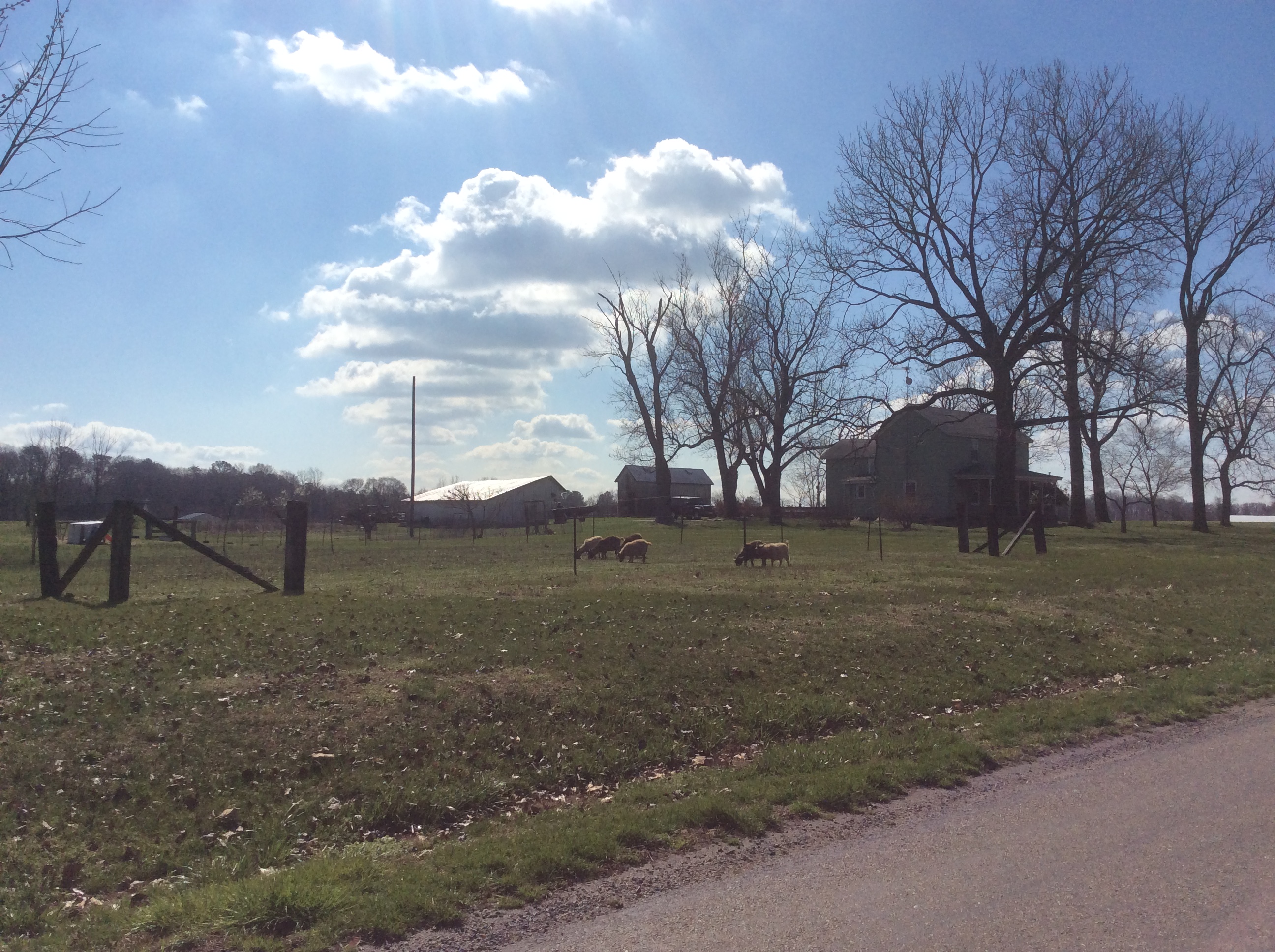
I decide it would be a good idea to check with local people before I start looking for the next landmark, a crossroads called Tapper’s Corner: generally, it’s best to confer with the experts when you want to do something right. The lady I ask at the business at the corner, Bullock Construction, says go 2 or 3 miles, but the lady who gave me directions from the porch of her home down the street says go further. She lives right here, so I go with her recommendation.

Sheep at a farm on Lewiston Rd en route to Tapper's Corner

Sheep at a farm on Lewiston Rd en route to Tapper’s Corner

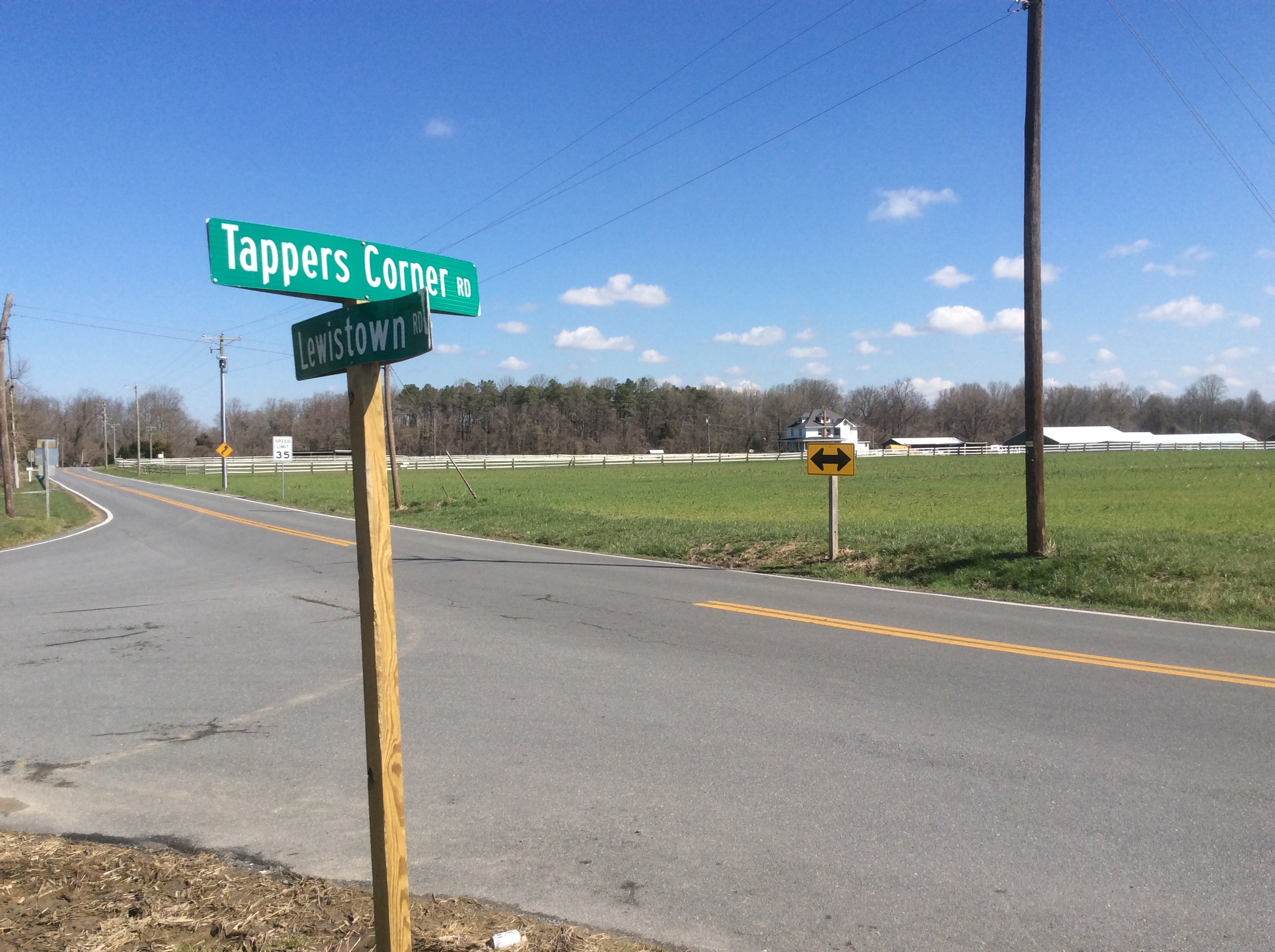
It ends up about 5 (oh so pretty) miles to Tapper’s Corner Rd, also know as Highway 303, a road that t-bones off Lewiston to my left.

Tapper's Corner off Lewiston Rd, with the Aaron Anthony old Holme Hill Farm site at the right

Tapper’s Corner off Lewiston Rd, with the Aaron Anthony old Holme Hill Farm site at the right

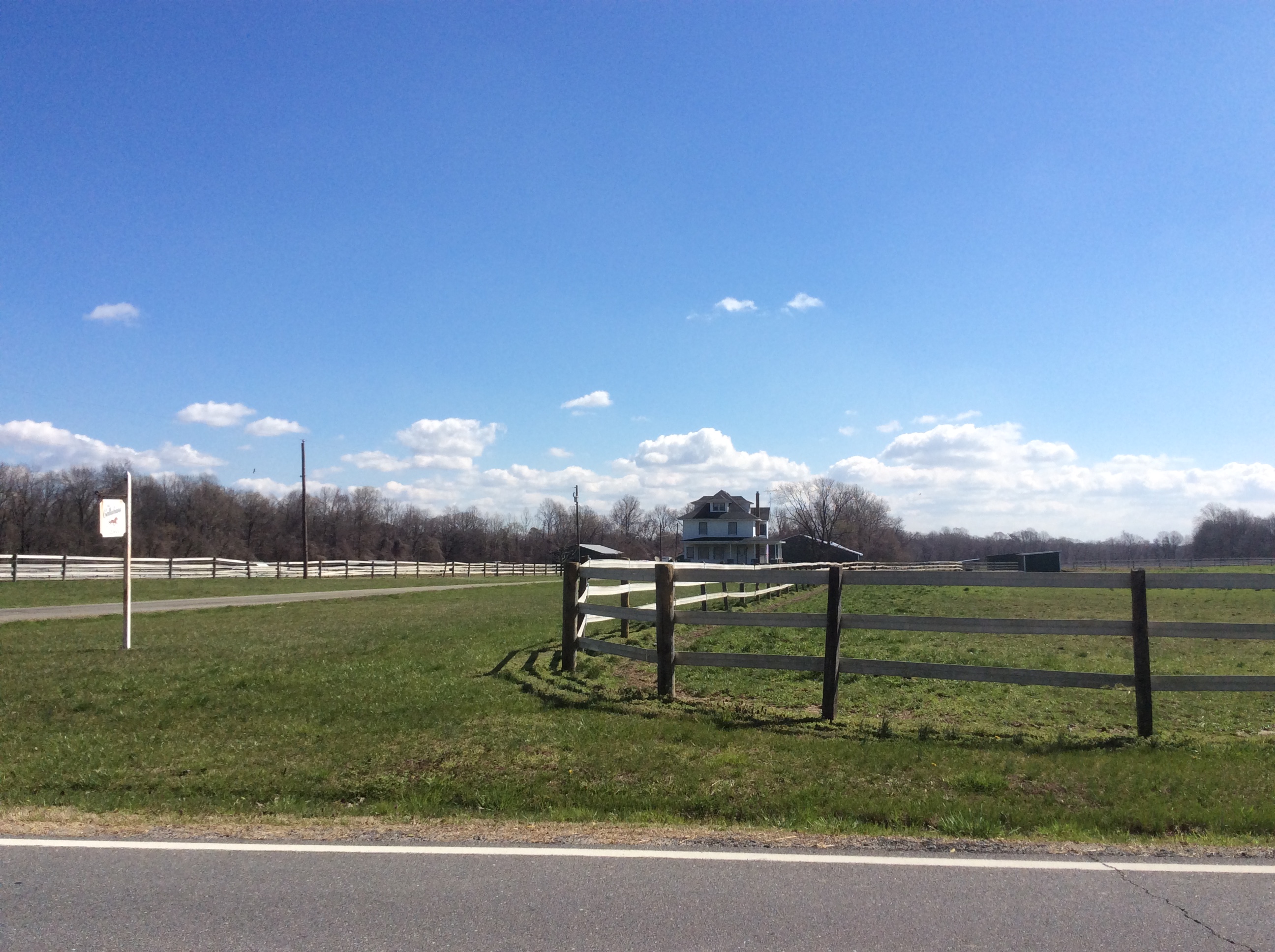
At my right I see, facing forward toward Queen Anne’s County, a big white house with white roofed green barns. According to my sources, this is the site of Aaron Anthony’s old Holme Hill Farm.

Aaron Anthony's farm, later Ebenezer Jackson's, now horse farm, Easton MD

Aaron Anthony’s farm, later Ebenezer Jackson’s, now horse farm, Easton MD

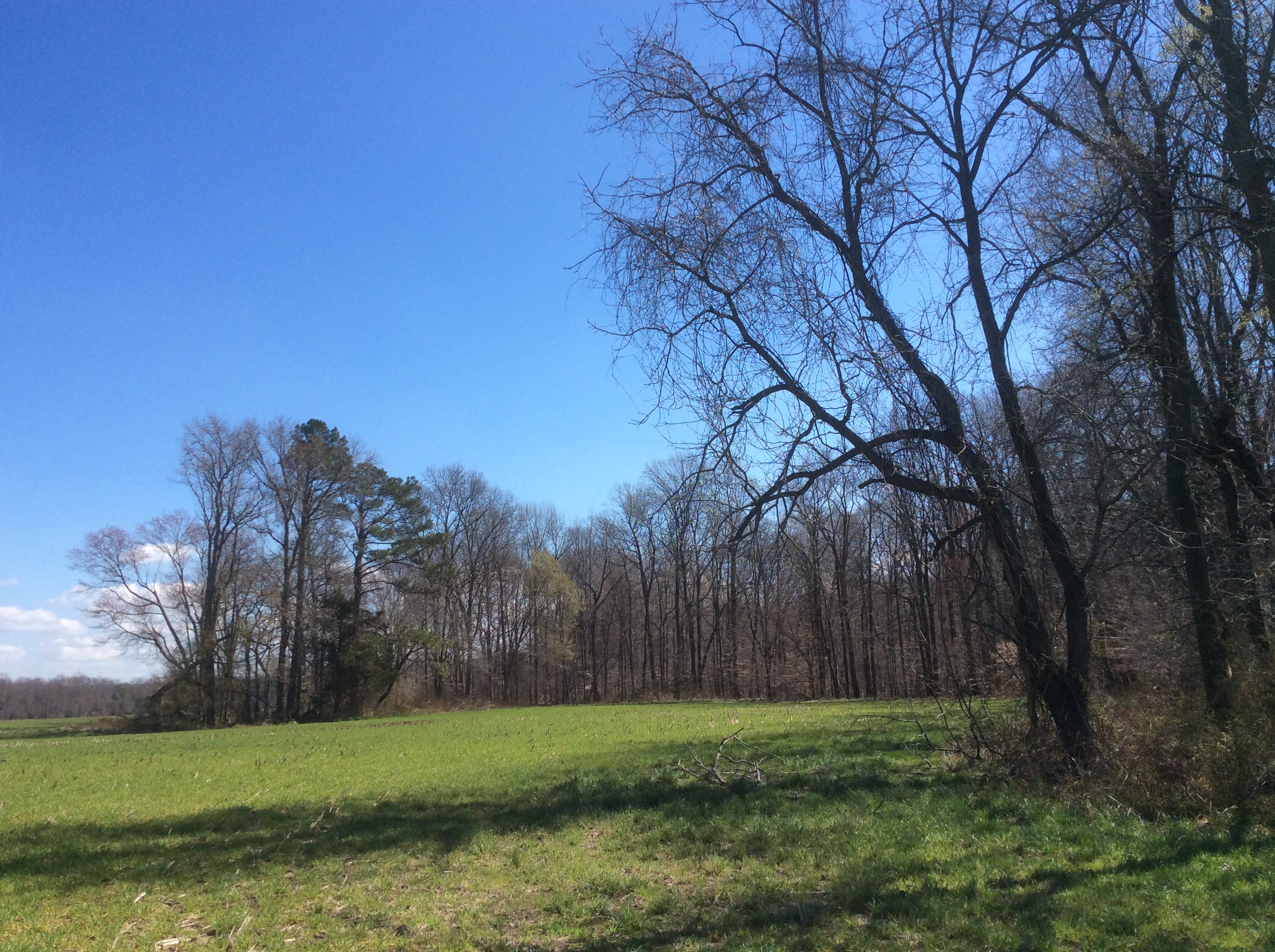
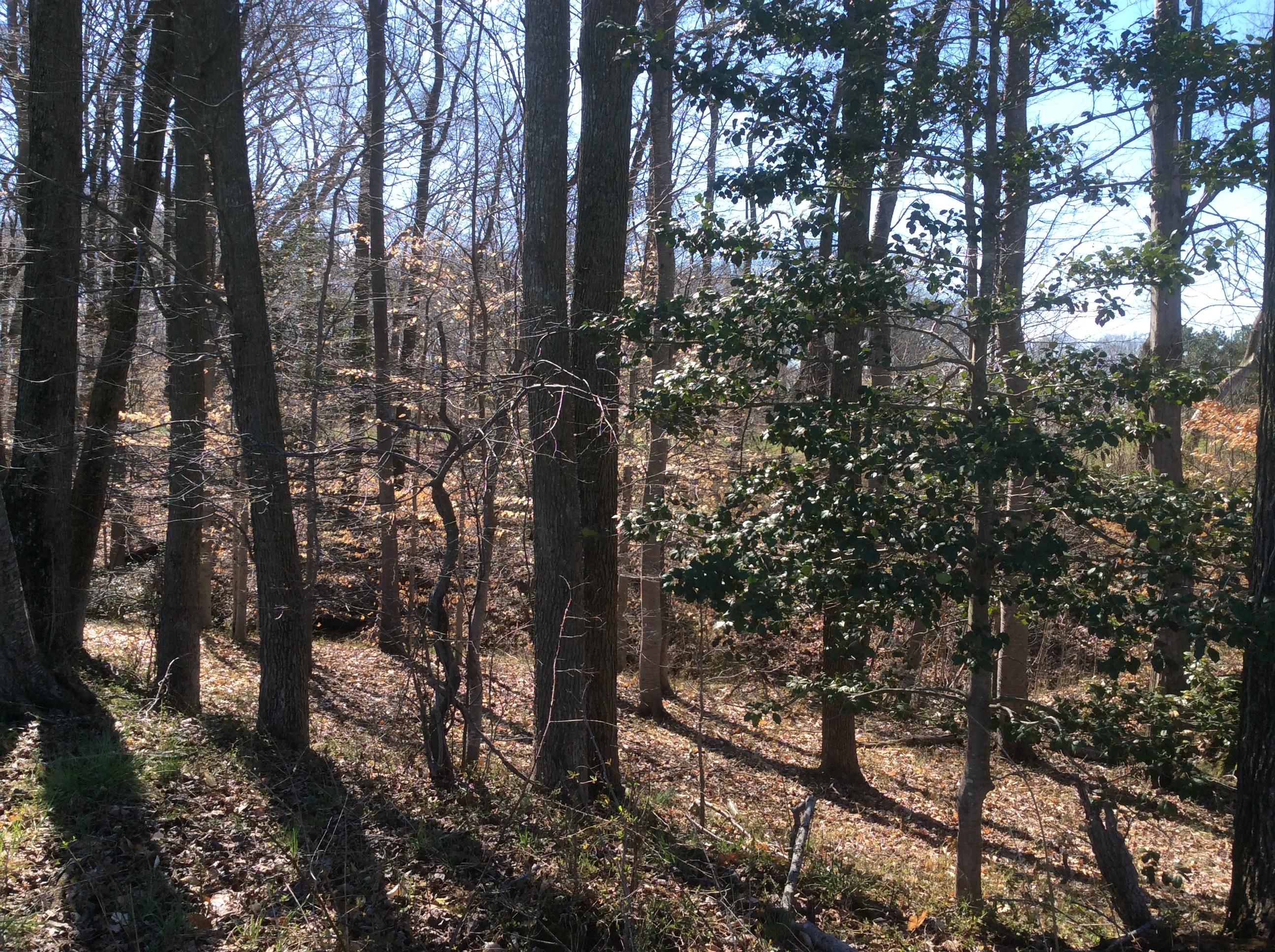
To my right and a little behind me, in the big green field with the trees behind it lining the Tuckahoe creek, is where Douglass was born in 1818, in a little long-vanished cabin. It was called Aunt Bettie’s lot, located between the road, a little ravine called Kentucky, and the Anthony farm, behind which runs the little mill stream into the pond where little Frederick went fishing.

Ravine, Woods & Field at Frederick Douglass's birthplace between Tapper's Corner & the Tuckahoe

Ravine, woods, and field at Frederick Douglass’s birthplace between Tapper’s Corner and the Tuckahoe

I want to stand on the very spot where the cabin stood, as near as I can determine it to be. I turn around, go back and park along the road at the lone little pull-out spot available on that side. The rest of the road is has a drainage ditch running the full length on either side. The little pull-out area at the side of the road is a little clue that there’s something special here: it’s at the same field where the cabin was and the ravine is. I cross the big green field, a plowed-under grassy cornfield, toward the ravine. I follow where it veers to the left, towards the one green tree among the gray winter branches along the curving ravine. When Douglass returned in 1878 to find his birthplace, he looked for a big cedar tree that he remembered from his childhood ‘a little deeper in the woods, near the edge of the ravine’. I draw closer to the green and discover it’s actually three trees: two pines and another tree, tucked in among the pines and other trees, shorter than them with darker needles. I jump up and pull off a little chunk of greenery: yes, it’s cedar. I get a chill.

The ravine among the woods next to Frederick Douglass' birthplace

The woods along Kentucky Ravine next to Frederick Douglass’ birthplace

Perhaps it’s the very same cedar tree that led Douglass, or perhaps, it’s an offspring of that tree. It seems too much of a coincidence that there would be one lone but unrelated cedar tree right here by the ravine as he described. Either way, I feel very emotional, very moved. I tend to develop a sense of love and concern for the people whose lives I follow and am solicitous of their memory, and these mementos of their lives help bring their stories closer to me. I hope this account makes you feel the same, and will help you more easily make this same pilgrimage one day.

*Listen to the podcast version here or on iTunes

~ Ordinary Philosophy and its Traveling Philosophy / History of Ideas series is a labor of love and is ad-free, entirely supported by patrons and readers like you. Please offer your support today!

~~~~~~~~~~~~~~~~~~~~~~

Sources and Inspiration:

Note: A wonderful source for finding Frederick Douglass’ birthplace, complete with maps and her research process, is my youngest yet: the author, Amanda Barker, did this research project and report in the 1990’s for her 7th grade honors class. Wherever you are, thank you, Amanda!

Aaron Anthony’s Holme Hill Farm‘. ChoptankRiverHeritage.org

Barker, Amanda. ‘The Search for Frederick Douglass’ Birthplace‘. The Eastern Shore Guide 

Douglass, Frederick. Autobiographies (includes Narrative…, My Bondage and my Freedom, and Life and Times). With notes by Henry Louis Gates, Jr. Volume compilation by Literary Classics of the United States. New York: Penguin Books, 1994.

Douglass, Frederick. The Life and Times of Frederick Douglass. Re-published 1993, Avenal, New York: Gramercy Books, Library of Freedom series.

Douglass, Frederick. My Bondage and My Freedom: 1855 Edition with a new introduction. Re-published 1969, New York: Dover Publications, Inc.

Foner, Philip S. The Life and Writings of Frederick Douglass, Vol. 1-4. New York: International Publishers, 1950.

Frederick Douglass Heritage: The Official Website. Website of the University of Massachusetts History Club

Holland, Jesse. Black Men Built the Capitol: Discovering African-American History In …, Part 3. Connecticut: Globe Pequot Press: North Carolina 2007

Holmes Hill Farm‘. Sankofa’s Slavery Data Collection, at Rootsweb.ancestry.com (Sankofa is an avatar of Dr. David Anderson of Nazareth College in Rochester, this may be coincidental)

McFeely, William. Frederick Douglass. New York: W.W. Norton & Company, 1991.

Frederick Douglass Baltimore Sites

Home where Amy 's host family lives in Garrison, MD, in a post-Civil War freedman's settlement, photo March 2016 by Amy Cools

Home where my host family lives in Garrison, MD, in a post-Civil War freedman’s settlement

First day, Sunday, March 20th

So here I am on the East Coast, commencing my Frederick Douglass history of ideas travel adventure in earnest! I’m thrilled and know I’ll learn and see a lot since I have so many sites I plan to visit already and know I’ll discover more as I go along.

I wake up still undecided whether to begin my Douglass explorations on the East Shore of Maryland or in Baltimore proper. I was leaning toward the Shore to keep my account more chronologically aligned with Douglass’s life, but inclement weather, the Maryland Historical Society’s open hours, a lost document, and a bit of oversleeping decided for me: a delayed start made it best to keep today’s journeys closer to home away from home. So, Baltimore it is!
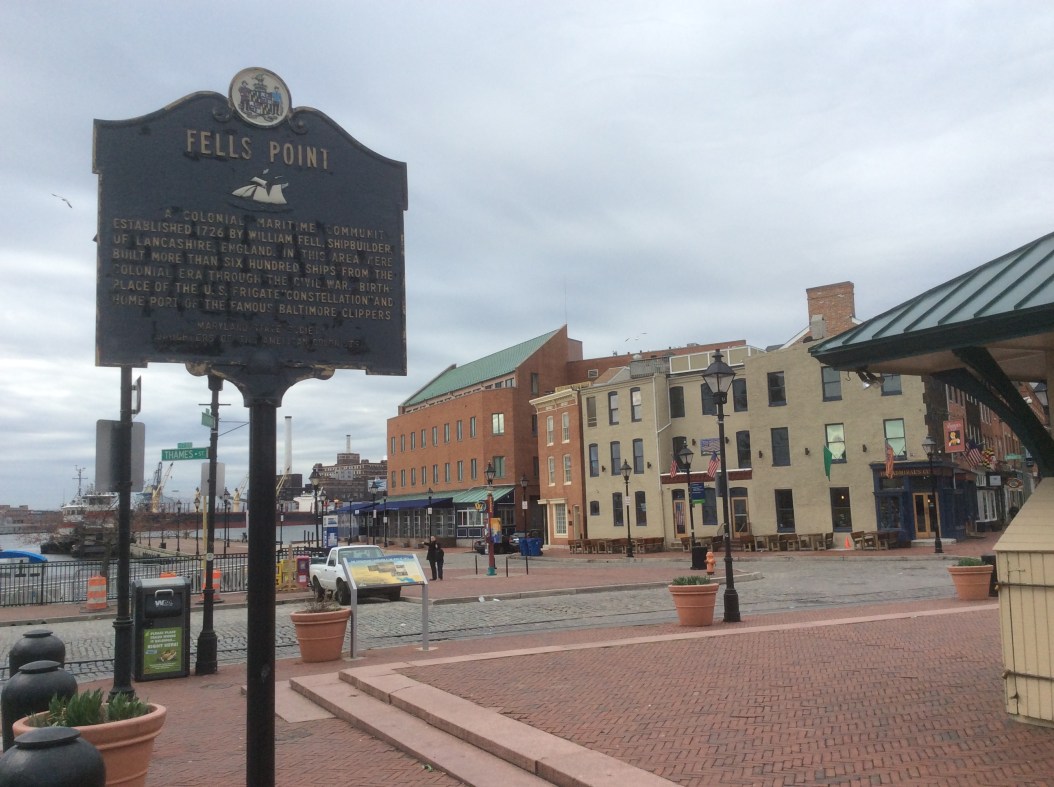
Fell's Point, Baltimore MD, photo March 2016 by Amy Cools

Fell’s Point, Baltimore, Maryland

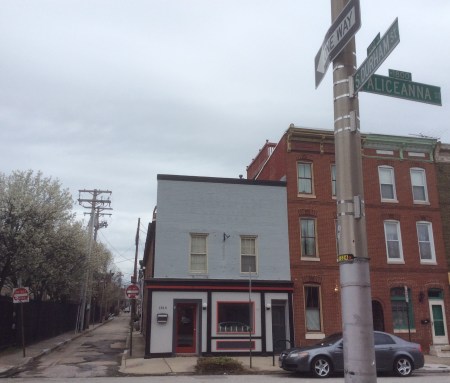
Aliceanna and Durham Streets, Baltimore, Maryland March 2016, photo by Amy Cools

Aliceanna and Durham Streets, Baltimore, Maryland

In a very important way, it’s actually fitting to begin with Douglass’ life here in Baltimore, centered in the waterfront district of Fell’s Point, since this is where Frederick Douglass had one of the most formative experiences of his life.

It happened in a ‘spare, narrow house at the corner of an alley’, Happy Alley, off Alliceanna Street at S. Durham. This was Douglass’s first home with the Hugh Auld family, composed of shipbuilder Hugh, his wife Sophia, and their little son Tommy. Frederick Bailey, who adopted the last name Douglass after fleeing slavery, was a child of just seven or eight himself, was imported from the plantation to be Tommy’s companion and body servant.

There used to be a sign marking this street corner as a Frederick Douglass historical site, but it’s disappeared (you can see the two silvery clamps still strapped under the street name signs). Perhaps people in the neighborhood were tired of being bothered by tourists asking where the exact house is. I have no shame, so I bother a young man with my inquiries. He doesn’t happen to know about that historical tidbit but is interested to hear the story; he happens to pass me by again a little while later, pulls over, and asks for the website so he can check in later and see what I find out, so I know he isn’t just being polite; he certainly is very kind.

Site of Frederick Douglass' home with the Aulds at Aliceanna and S. Durham, Fell's Point, Baltimore, MD, photo March 2016 by Amy Cools

Site of Frederick Douglass’ home with the Aulds at Aliceanna and S. Durham, Fell’s Point, Baltimore, MD

And another nice person, a woman entering her home in the very new-looking building on the southeast corner of Alliceanna and S. Durham does know, however, and confirms that building below, as far as she knows, stands on the very site of the old Auld house. She, for one, hopes the sign will go back up.

So back to that formative experience: Sophia Auld thought it would be a good idea to teach Frederick how to read since he was companion and body servant to the young son of the household and could thus aid in his education. But when Hugh came into the room and saw her teaching Frederick his letters, he stopped her, telling her in his hearing that ‘[he] should know nothing but how to obey his master …if you teach [him] how to read, there will be no keeping him. It would forever unfit him to be a slave…’ As Douglass later recalled, this is the moment he realized the full inhumanity of the slave system, and knew exactly what he needed to do. No enforced ignorance for him!
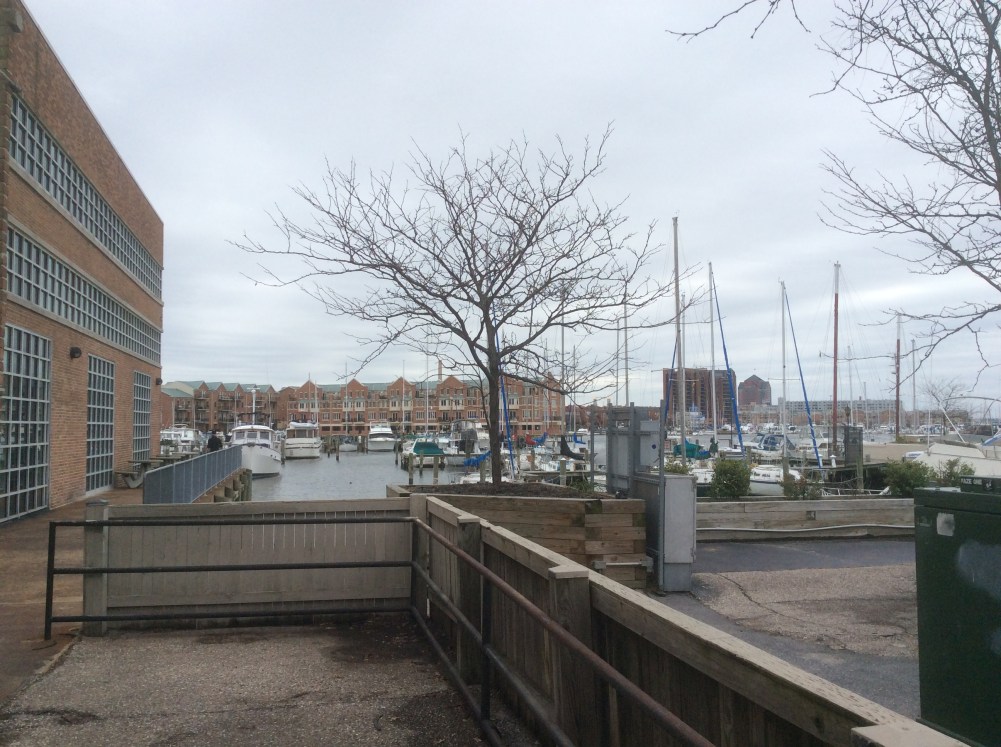
Lancaster St, end where Gardiner's and Meacham's shipyards used to be, Fell's Point, Baltimore MD, photo 2016 by Amy Cools

Lancaster St, end where Gardiner’s and Beacham’s shipyards used to be, Fell’s Point, Baltimore MD

Then I head down to the end of Lancaster St, about where Frederick worked at James Beacham’s shipyard in 1826, close to William Gardiner’s shipyard where he received more advanced training, upon returning to Baltimore in 1836 after three years back on the East Shore. He had another formative experience at Gardiner’s which I’ll tell you about shortly. Frederick worked on many shipyards and became a skilled caulker over time, earning him enough wages that Hugh was willing to let him keep some, unaware Frederick was saving up to start a new life as a free man one day.
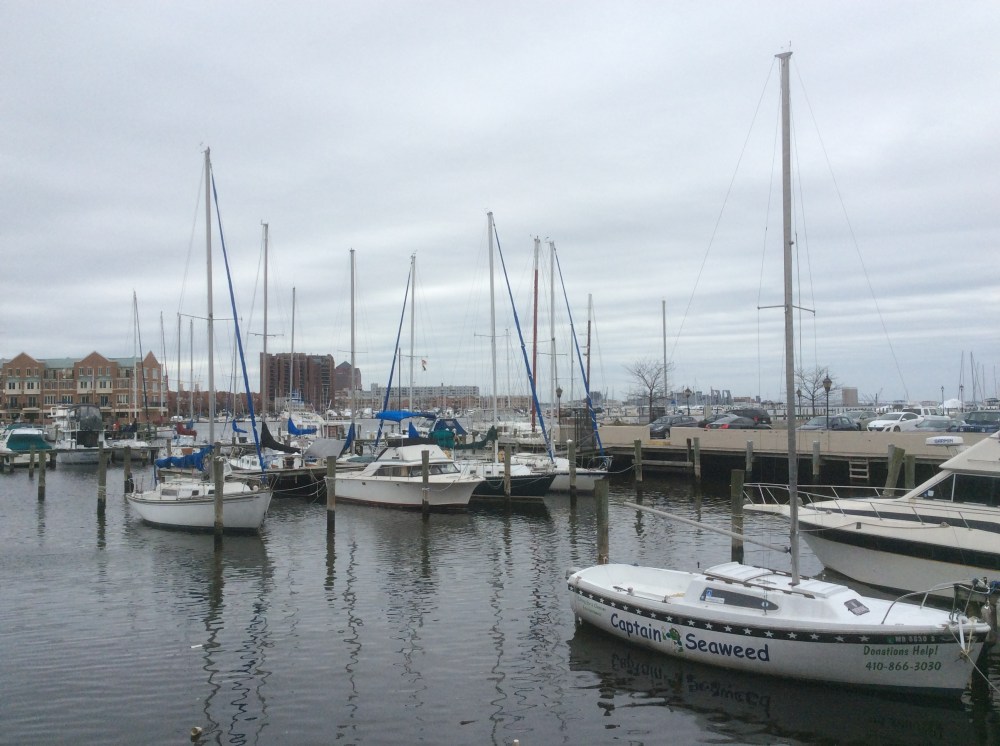
Boats docked at end of Lancaster and Thames Streets, Fell's Point, Photo 2016 Amy Cools

Boats docked at end of Lancaster and Thames Streets, Fell’s Point

I head west on Thames St. At number 12 or 13, Frederick purchased the first book he ever owned at Nathaniel Knight’s shop at 28 Thames St, The Columbian Orator. The buildings are numbered very differently now, and at the time I write this post, I’ve yet to find an early atlas with street addresses. Fell’s Point is clearly a moneyed area, and large sections of Thames St has been built over with luxury condos, especially on the waterfront side. The other side of the street retains more of its older buildings, and all is very well kept and very charming.
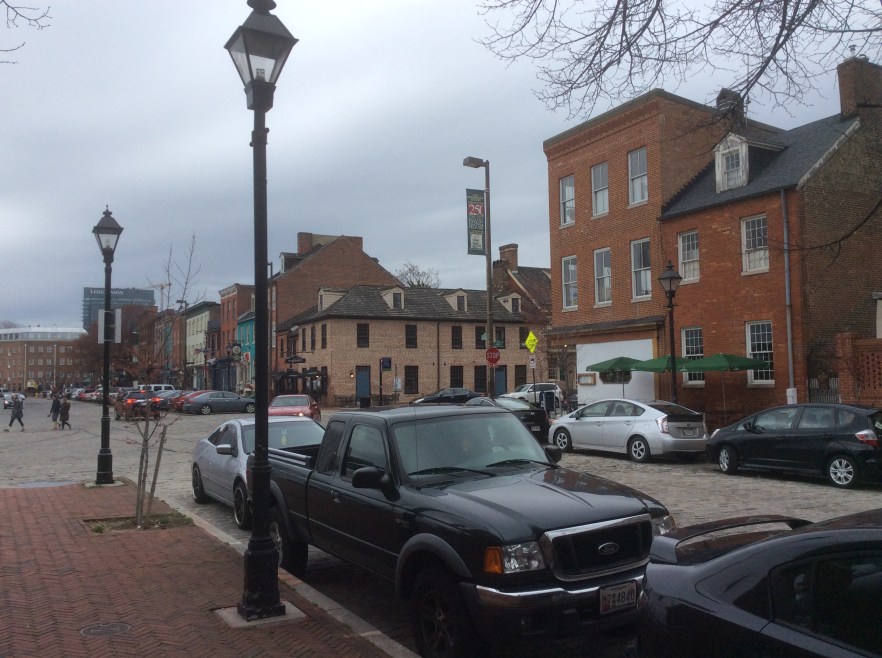
A view of Thames St, Fell's Point, Baltimore MD, photo 2016 Amy Cools

A view of Thames St, Fell’s Point, Baltimore MD

I continue on to the very end of Thames St, heading west to the Frederick Douglass-Isaac Myers Maritime Park and Museum.
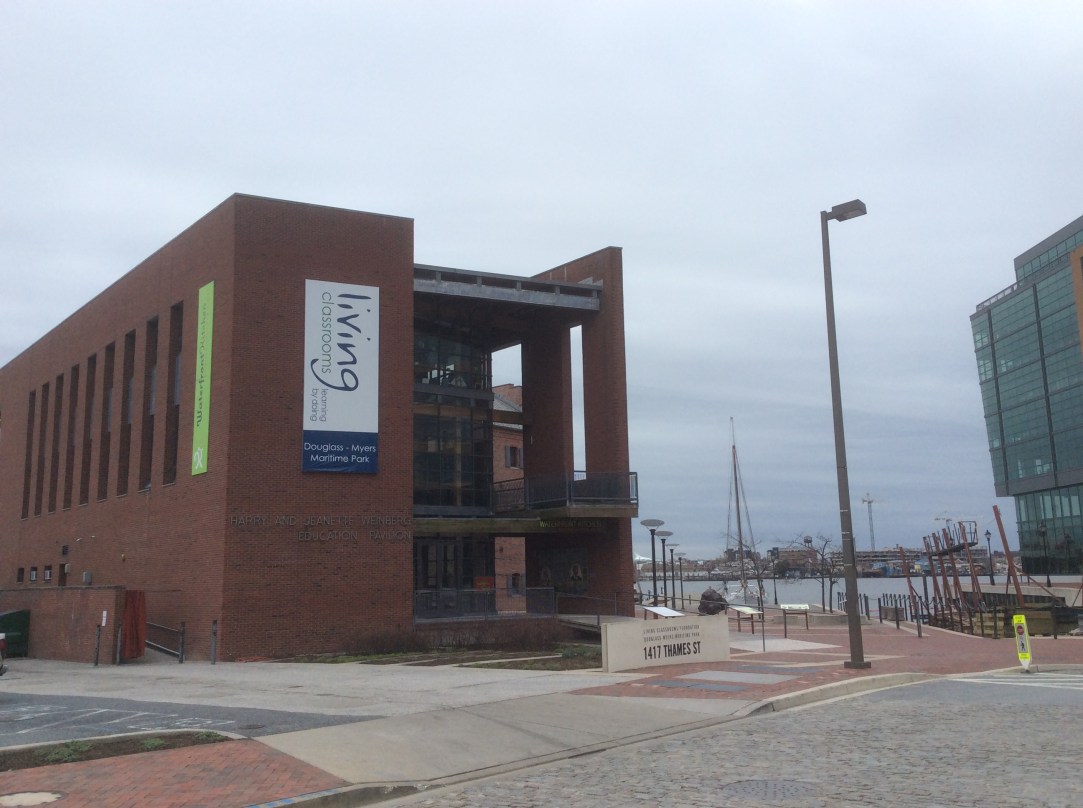
Frederick Douglass-Isaac Myers Maritime Park and Museum Fell's Pt, photo 2016 by Amy Cools

Frederick Douglass-Isaac Myers Maritime Park and Museum, Fell’s Point
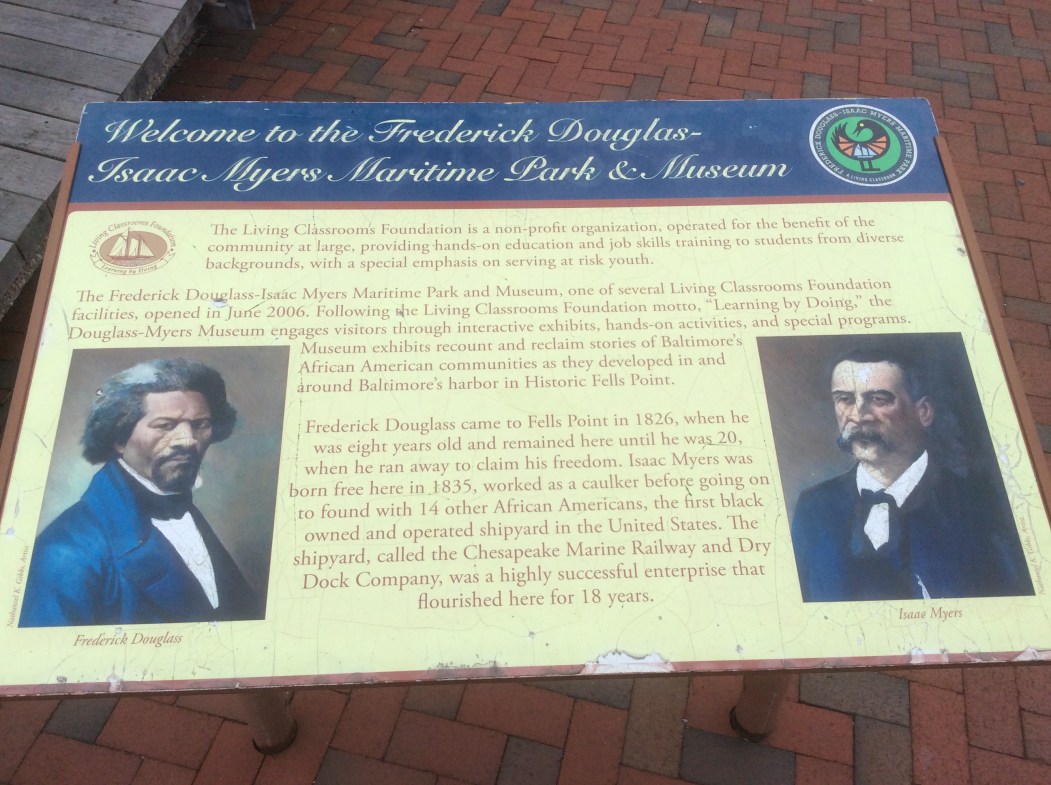
Frederick Douglass-Isaac Myers Maritime Museum Sign, Fell's Pt, photo 2016 by Amy Cools

Frederick Douglass-Isaac Myers Maritime Museum Sign, Fell’s Point

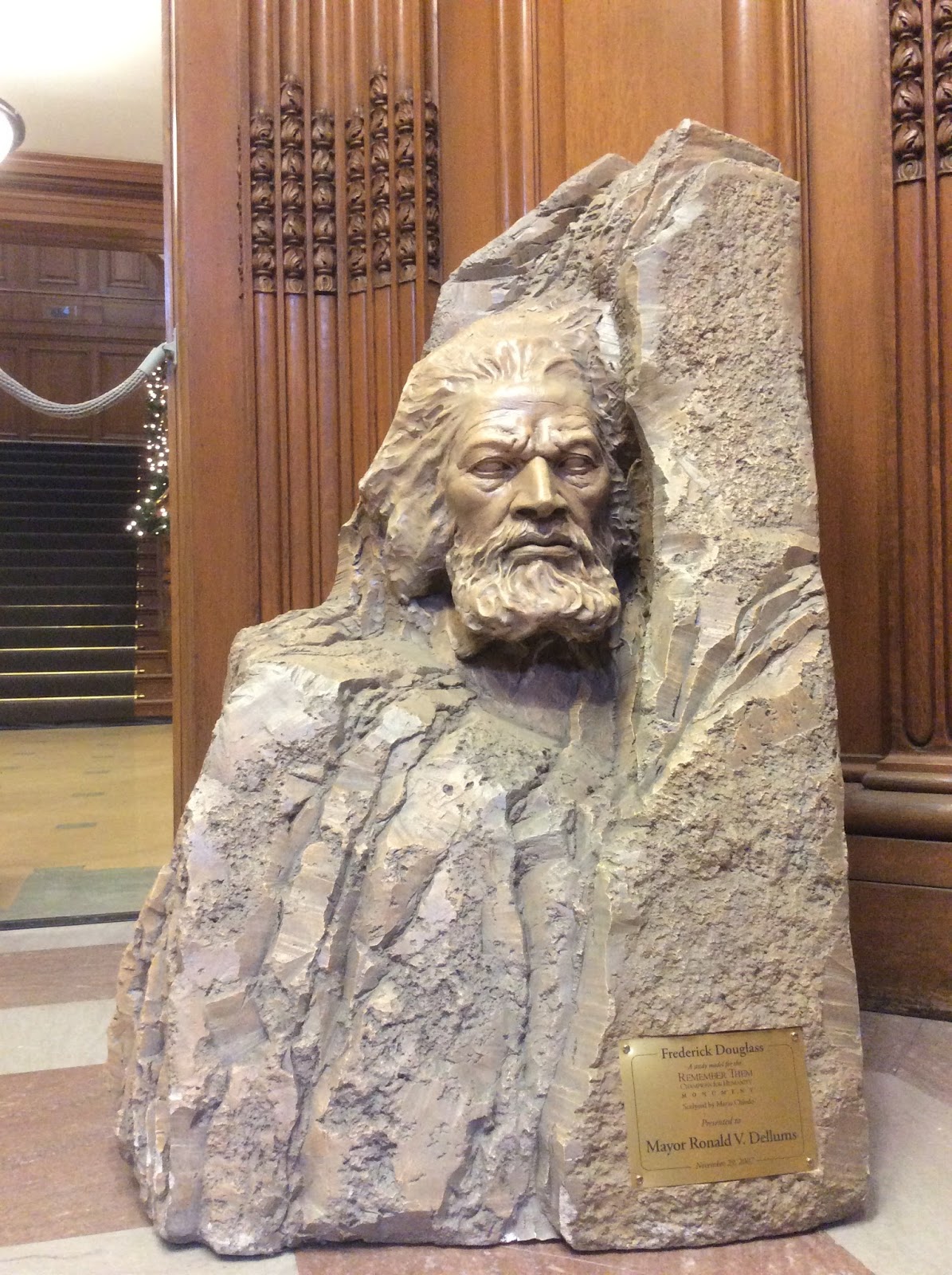
The sculpture I find here of his head, though striking, looks a little odd just sitting on the ground as it is; I find myself instinctively looking around for the body it fell off of. Perhaps they’ll give it a new setting at some point.
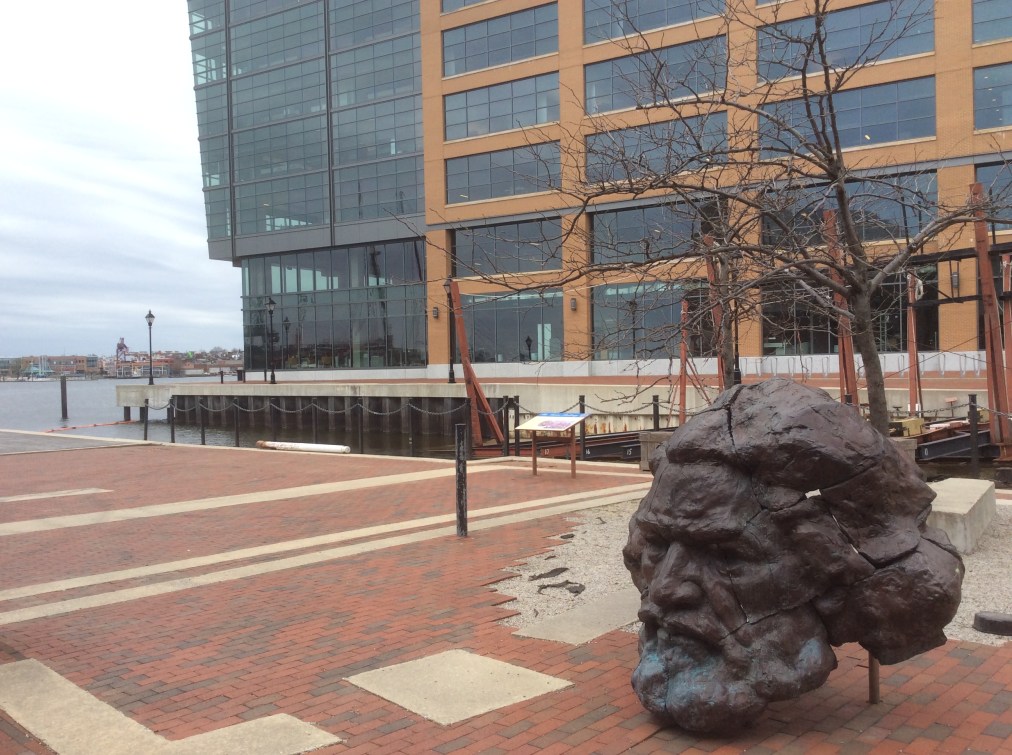
Frederick Douglass sculpture at Maritime Park Fell's Pt, photo 1, 2016 by Amy Cools

Frederick Douglass sculpture at Maritime Park Fell’s Point
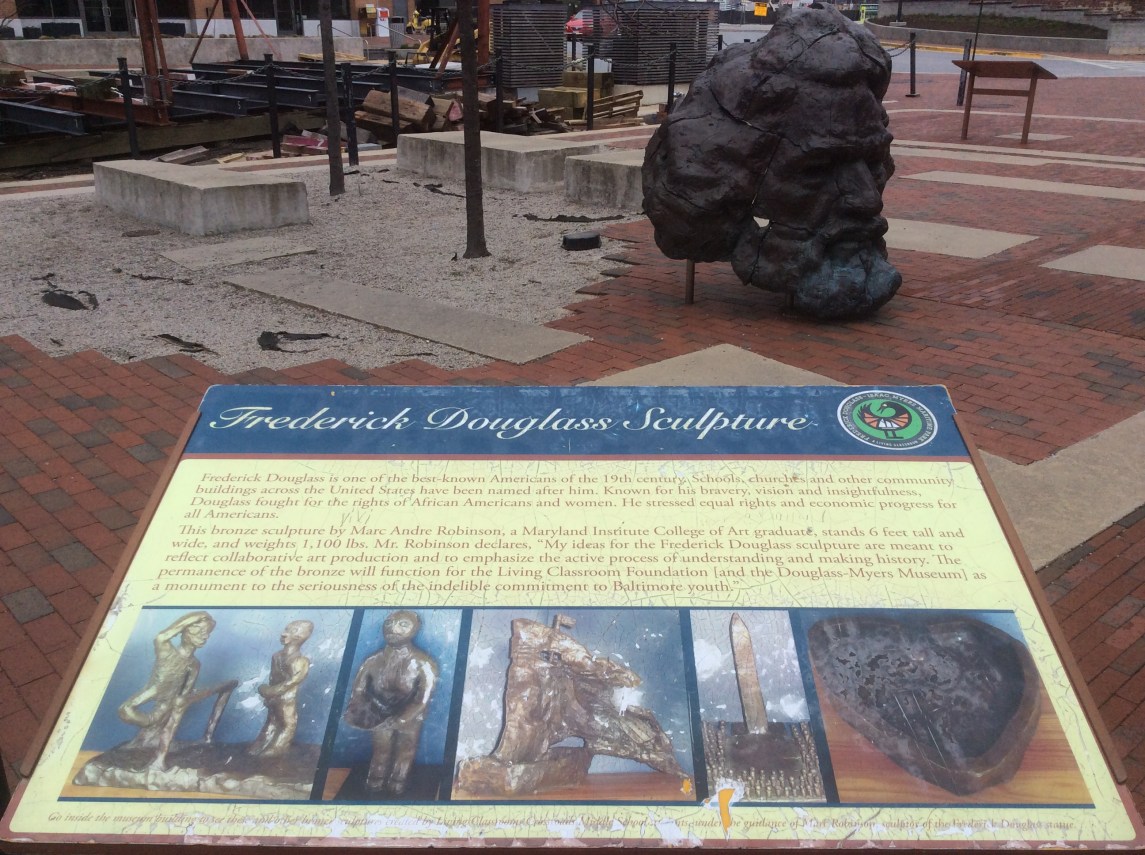
Frederick Douglass sculpture at Maritime Park Fell's Pt, photo 2, 2016 by Amy Cools

Frederick Douglass sculpture at Maritime Park, with sign

Then I head right, around to Philpot St, where Frederick also lived with the Auld family (they moved around the Fell’s Point neighborhood a few times). The Maritime Park Museum actually faces onto it at least as much as it does onto Thames. Here, little Frederick obtained the help of his playmates to build on the fragmentary education he had received from Sophia and really learn to read. Some neighborhood boys helped him out, and though he never named them in his narrative for fear they’ll be criticized for this, he thanked them anonymously.
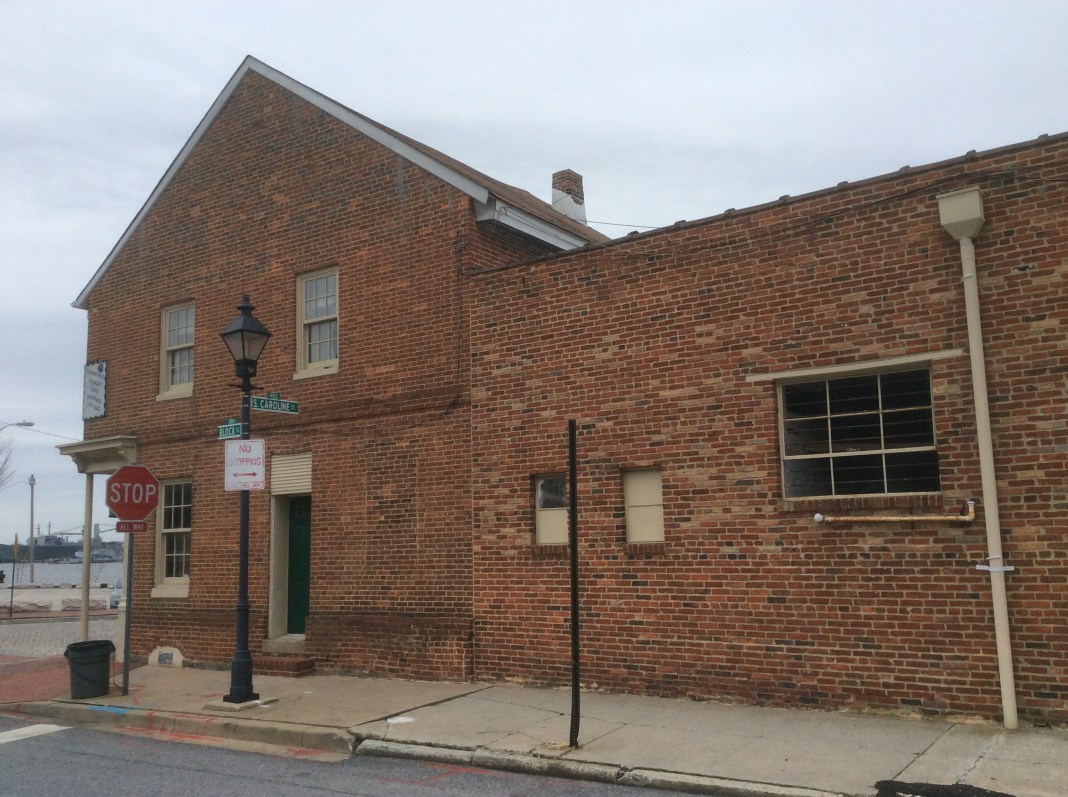
S Caroline and Block St corner by Philpot St, Fell's Point, photo 2016 Amy Cools

Corner of S. Caroline and Block St by Philpot St, Fell’s Point

The little loop of a street which remains that’s still called Philpot St on Google Maps, though there are no identifying street signs, is at the west end of Thames behind Block and S. Caroline. It curves around to where the Maritime Museum and Park overlook the harbor, and you can see Domino Sugars factory in the background across the water. The area where the Auld house was, and perhaps where Frederick played and read with his friends at Durgin and Bailey’s shipyard, is now flattened, with all signs that there ever was a street here, let alone a neighborhood, obliterated and under new construction.

Then I backtrack a little on Thames towards Bond St. If you look closely, you can see this view of Bond St is at Shakespeare St; Frederick grew to love William Shakespeare.
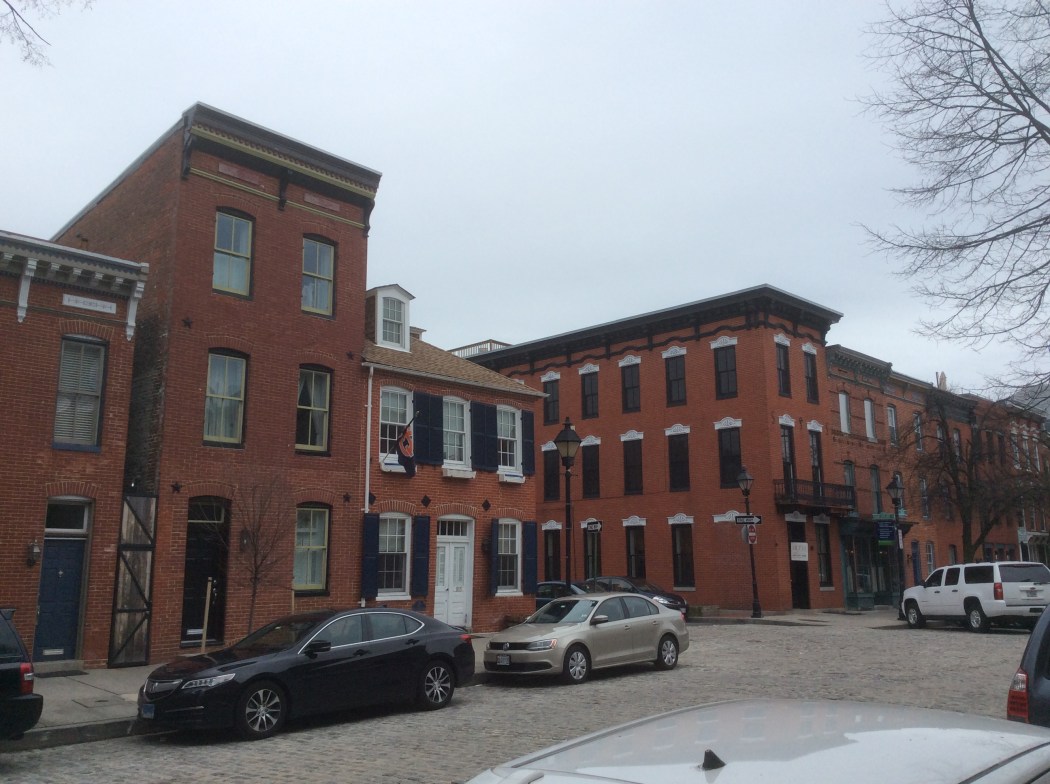
Bond St at Shakespeare, Fell's Point, Baltimore MD, photo 20156 by Amy Cools

Bond St at Shakespeare St, Fell’s Point

The occasion which took Frederick to Bond St, and which takes me here next too, was a sad one. Since he had become a skilled caulker at Gardiner’s shipyard, his work was very much in demand, especially as an enslaved black man who commanded lower wages than skilled white workers. Baltimore’s shipyards employed many skilled black workers on its busy waterfront, paying them all lower wages, and the white workers felt deeply resentful at this threat to their livelihood. So one day, when Frederick was perhaps sixteen, he was severely beaten by four of his coworkers. Auld was very angry, both because, as Frederick believed, he was genuinely concerned about his well-being and considered what they had done cruel and unjust, and, of course, he did not want his prized source of income to lose his ability to work. So he accompanied Frederick to magistrate William Watson’s office on Bond St. Again, as of this date, I can find no specific street address; when and if I do, I’ll let you know.

But to Auld’s chagrin, Watson refused to arrest the men or do anything about the crime at all: although the evidence a crime had been committed was presented in Frederick’s own battered face, only a white man’s testimony was legally admissible. The indignity and injustice of this were yet more striking evidence for Frederick that slavery was a great evil, strengthening his conviction that he must find a way to gain his freedom.

Then back up Bond to Aliceanna again, to grab a snack and better wifi connectivity at Cafe Latte’da, a punk rock-y comfy little hole in the wall coffee shop. It’s right around the corner from Jimmy’s Restaurant and Fountain Service on S. Broadway, where I had begun with a delicious breakfast of tater tots topped with pulled pork and cole slaw. If you’re like me and love comfy, well-established eateries with down to earth food and atmosphere, I recommend these two.
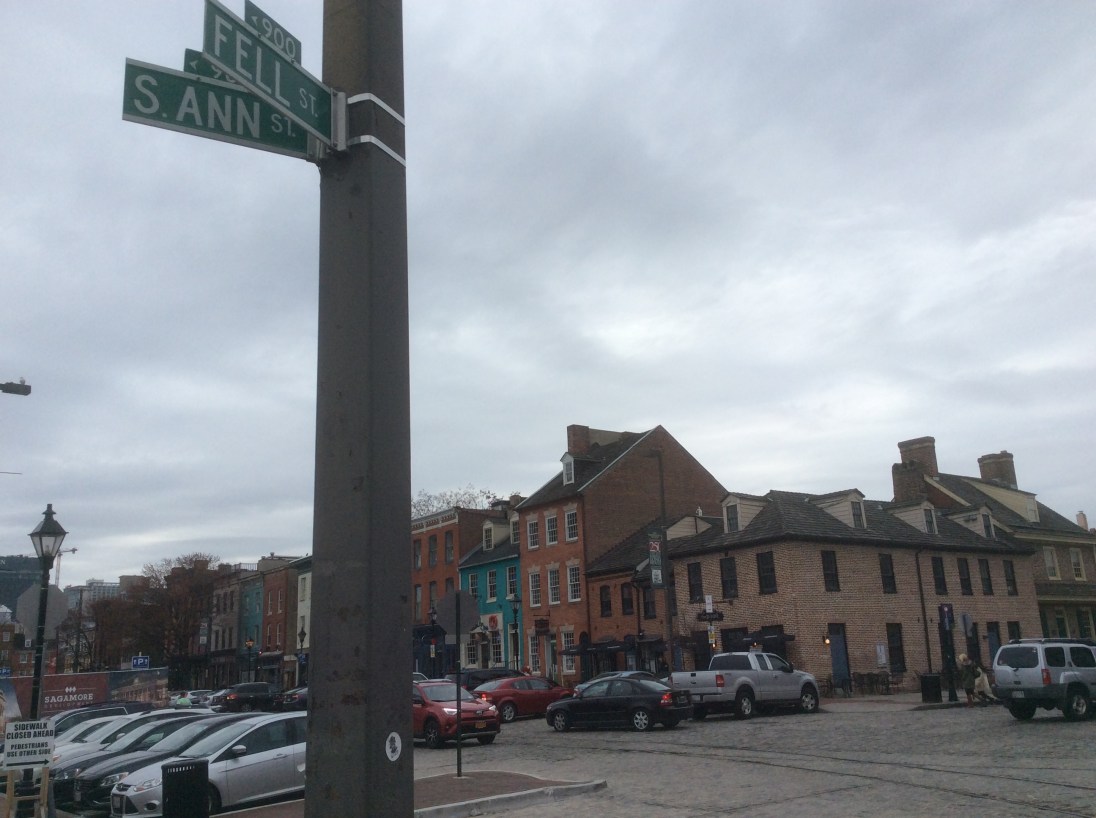
Fell St at Thames and Ann, Fell's Point, Baltimore Md, photo 2016 by Amy Cools

Fell St at Thames and Ann, Fell’s Point, Baltimore MD

Then back to Fell St at Thames and Ann, which I had overlooked on my first go-round, but it’s no problem since the waterfront part of Fell’s Point is pretty small and very walkable. Frederick lived on Fell’s St with Hugh Auld when he returned to his service in Baltimore in late 1836. Again, Douglass gave no address in his memoirs. Hugh thought he’d be less likely to try to escape if he had more interesting employment in an environment which better suited him, enjoying more independence through retaining part of his wages and eventually, living in a place of his own. At this point, Frederick had become an expert caulker and could command much better wages despite his race and status as a slave. When Frederick did live on his own for awhile, there was an episode where Frederick didn’t return from a weekend outing to the Fell St house in time, and Auld was enraged. He threatened to take away the independence he had granted Frederick up to this point and to make him move back home.
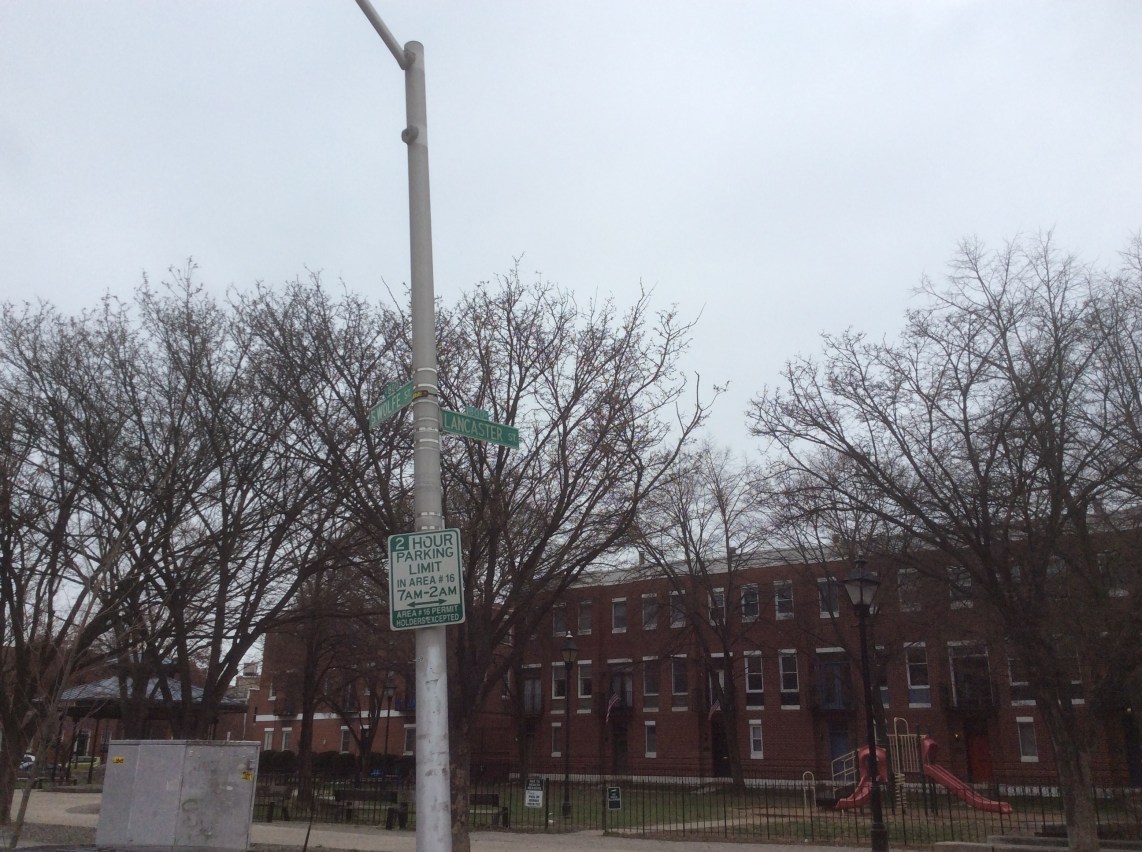
Thames St Park bordered also by Lancaster and Wolfe, Fell's Pt, photo 2016 by Amy Cools

Thames St Park bordered also by Lancaster and Wolfe, Fell’s Point

Since I’m back near the east end of Thames, I go back towards the end of Wolfe Street since I had found another secondary resource, a Baltimore Sun article, on my coffee break. I’m looking again for the site of Gardiner’s shipyard where he was beaten by his co-workers.  According to the article, ‘William and George Gardiner’s shipyard [was] on the north-east corner of Lancaster and Wolfe Streets’. It’s not at the water’s edge now; the waterline at Fell’s Point has been changed quite a bit in many places over the years as it’s been filled in and built over. Beacham’s, as I described earlier, would have been nearby, around the corner to the north. There’s this little park called Thames St Park, bordered also by Wolfe and Lancaster; perhaps this is the site of one or part of both of those shipyards.
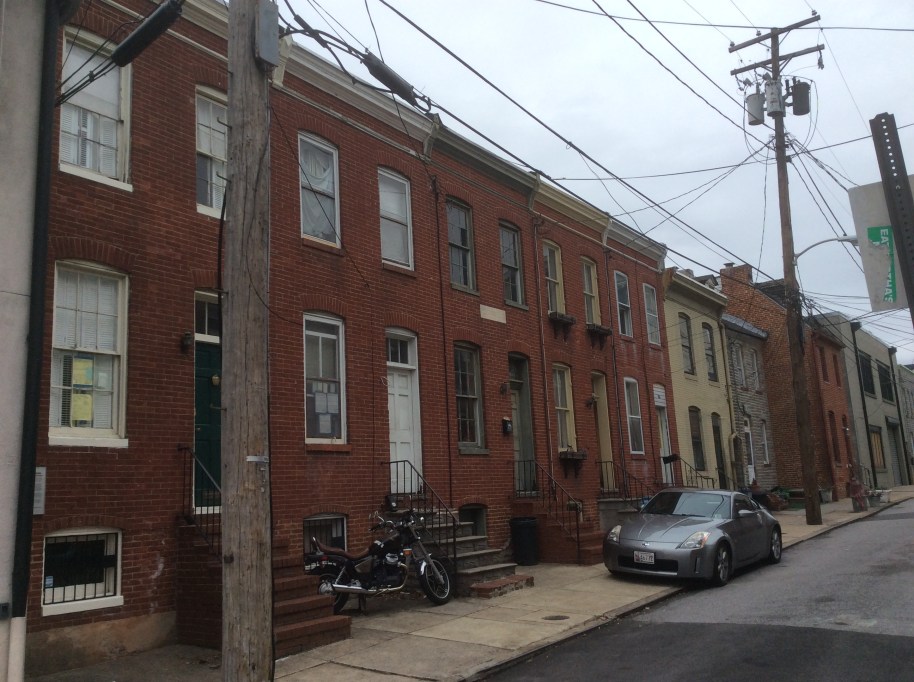
Douglass Place, 500 block of Dallas St, Fell's Point Baltimore MD, photo 2016 by Amy Cools

Douglass Place, 500 block of Dallas St, Fell’s Point Baltimore MD
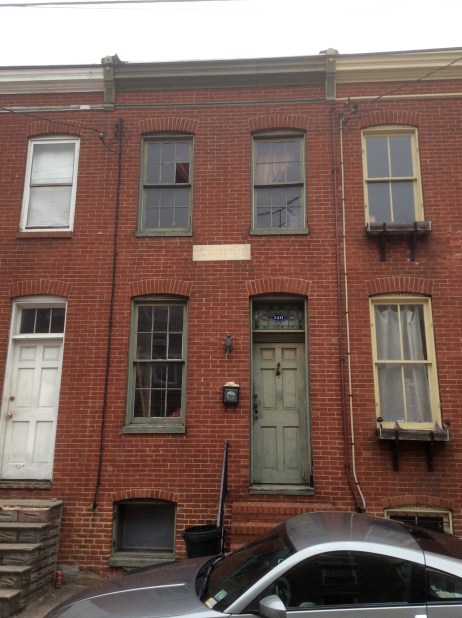
Douglass Place with engraved marker, Fell's Point Baltimore MD, photo 2016 Amy Cools

Douglass Place with engraved marker, Fell’s Point

Next, I head for a site associated with Douglass many years later in his life. I walk north on S. Durham St, passing Douglass’ first home site with the Aulds again, then left (west) on Aliceanna towards S. Dallas St. I find that the stretch of Dallas between me and the 500 block of Dallas near Fleet St where I’m headed is built over, so I go back up Bond to go around. I find what I’m looking for: a little row of brick houses, where an engraved cream stone in the larger of the red brick buildings confirms this is indeed ‘Douglass Place’. Douglass built these in the early 1890’s as quality, affordable rental housing for black residents.
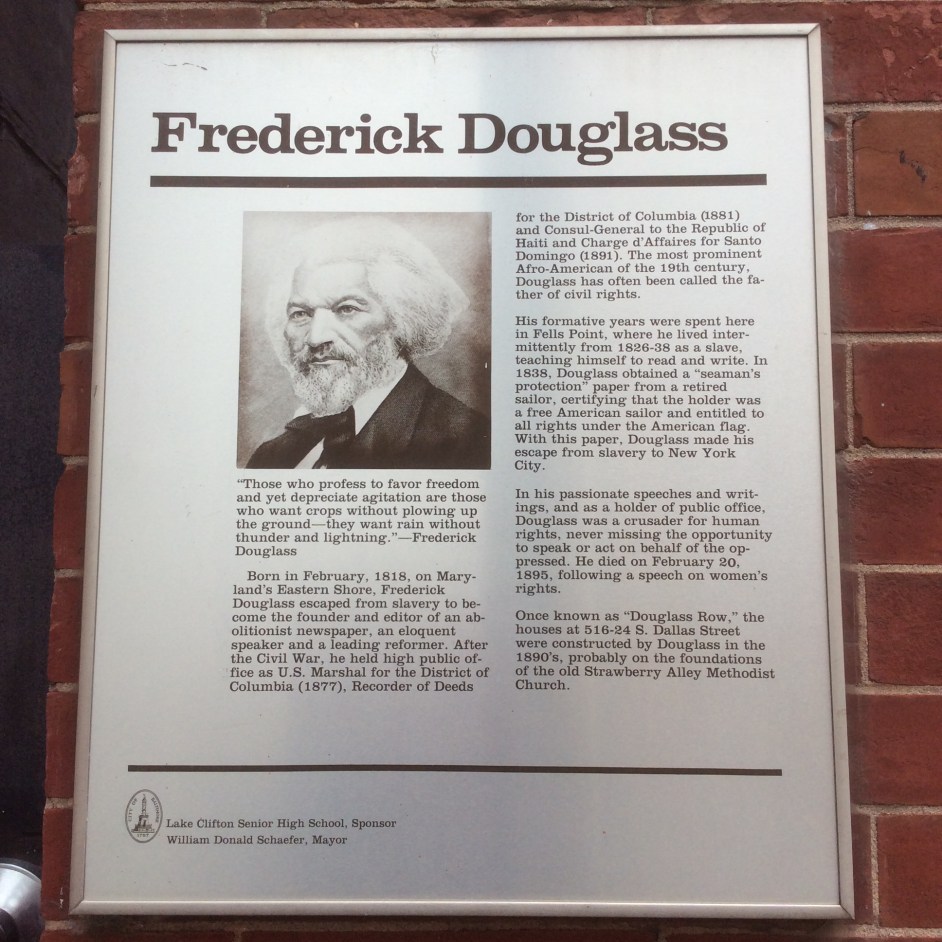
Historical Plaque at Douglass Place, Fell's Pt Baltimore, photo 2016 by Amy Cools

Historical Plaque at Douglass Place, Fell’s Pt

Billie Holliday house at 219 Durham St, Fell's Point, Baltimore MD, photo 2016 Amy Cools

Billie Holliday house at 219 Durham St, Fell’s Point

On my way out from Fell’s Point proper, I decide to swing by a site only very tangentially linked to Douglass. The lady who confirmed the location of the Aliceanna St house directed me to a home where Billie Holiday grew up at 219 Durham St. I love Billie Holiday, as I’m sure you do too, so I’m thrilled to make this discovery. Holiday, as you remember, sang ‘Strange Fruit’, a stark and haunting song about lynching that was very controversial when she recorded it in the late 1930’s but well loved, and her performance of this song is among the very best. Douglass became an activist in his later years against lynching…. more on that in a future post.
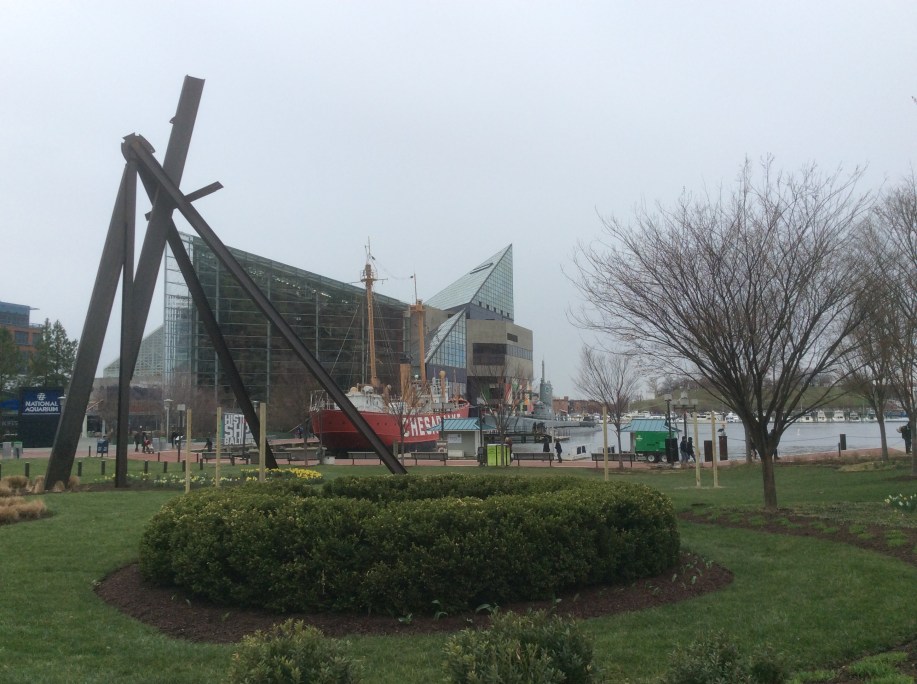
The Wharf formerly known as Smith's, Inner Harbor, Baltimore MD, 2016 by Amy Cools

The Wharf, formerly known as Smith’s Wharf, at the end of Gay St, Inner Harbor, Baltimore MD

Then I head towards the Inner Harbor, west towards downtown, to the wharf which used to be called Smith’s Wharf. It’s described in an old document as located at the south end of Gay St. ‘run[ning] north and south, from the east side of Gay St dock…’, now at Pratt, assuming that where the water meets the shore has not changed dramatically, though it’s not really a safe assumption. It’s just that I mostly have the current shoreline to follow, with atlases from young Frederick’s time so scarce.
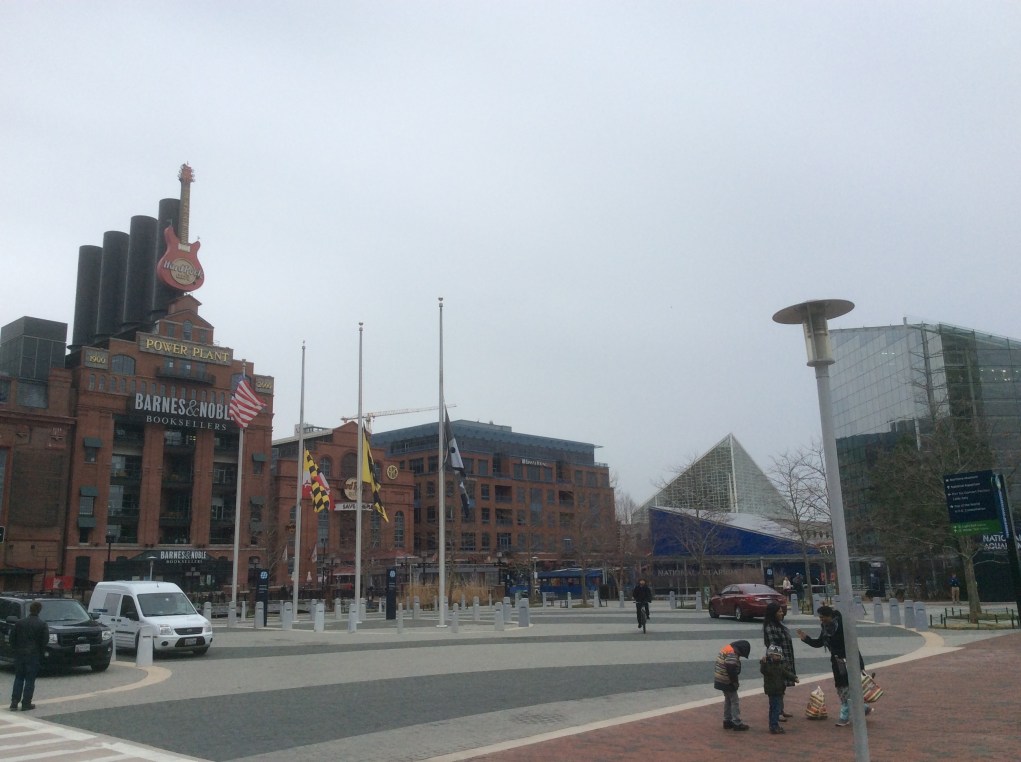
Wharf at Gay and Pratt, formerly Smith's, Inner Harbor, Baltimore MD, photo 2016 Amy Cools

Wharf at Gay and Pratt, formerly Smith’s, Inner Harbor, Baltimore MD

This is where little Frederick first arrived in Baltimore, diverted from his likely destiny as a plantation slave to a better one working in the city, though this was no guarantee of better treatment. Though city slaves often enjoyed a better standard of living in the city, Douglass tells of slaves in neighboring homes in Fell’s Point who were treated very cruelly. But on that day in the mid-1820’s, as Frederick watched the city shore draw near, he was thrilled at the prospect of a new and easier life than that of his deprived, if somewhat carefree, childhood as a plantation orphan.
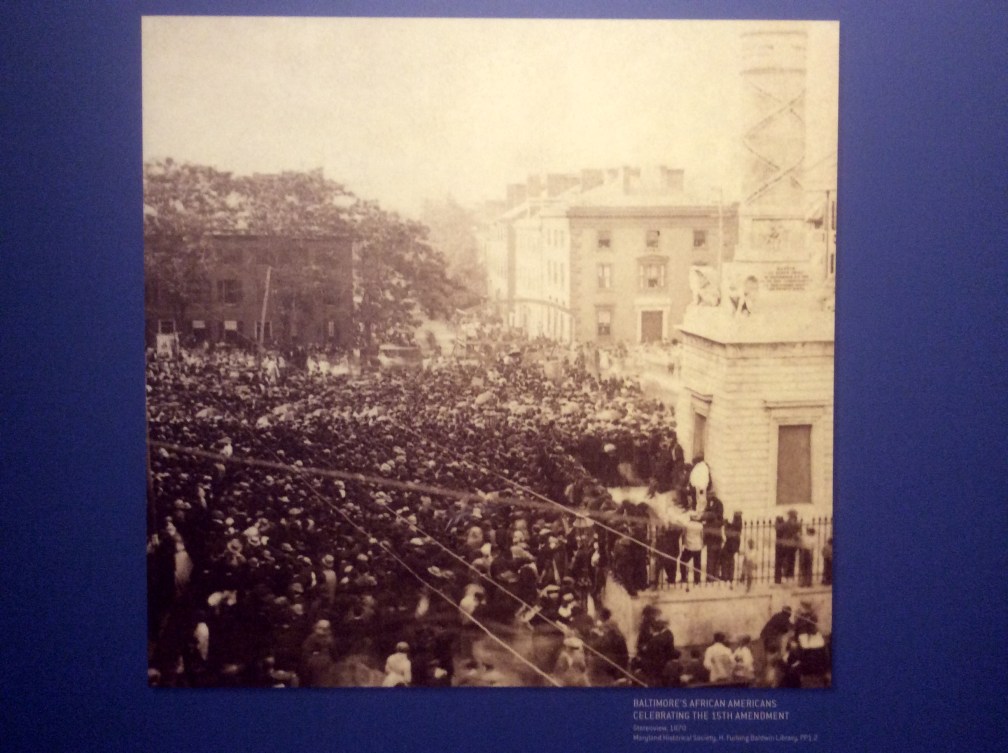
Maryland Historical Society, Celebrating the 15th Amendment, photo 2016 by Amy Cools

Maryland Historical Society Museum, Celebrating the 15th Amendment Plaque in the Civil War Exhibit

Then to my last stop, the Maryland Historical Society downtown, to see what they have on Douglass. I don’t find much, as the library is closed, though the museum is open. I am excited, however, to find a plaque with a photo of an event I want to discover a location for but haven’t yet. In 1870, Douglass gave a speech before a crowd of about 10,000 people in Baltimore in celebration of the passage of the 15th Amendment, and as it turns out, the celebratory parade ends at, and the celebrations culminate, at the War of 1812 memorial tower called the Battle Monument at E. Fayette and N. Calvert; you can see its column to the right. As luck would have it, an unsuccessful search for another site (I’ll tell you about it in the next post) happens to take me to thus very same place; when going through and studying my photos afterward, I’m excited to make this discovery! Here’s the site today; as you can see, it looks very different, except for the Monument itself.
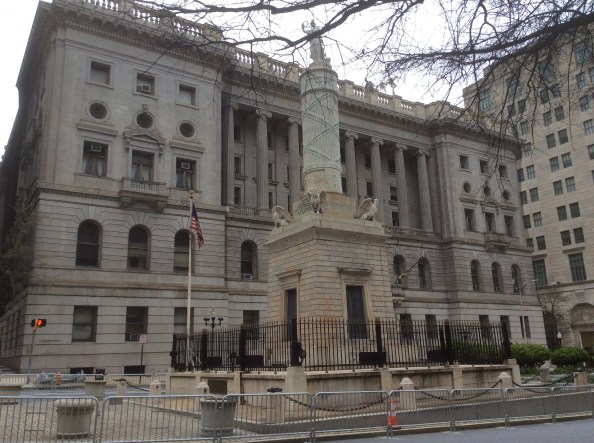
Battle Monument at E. Fayette and N. Calvert, Baltimore MD, photo 2016 by Amy Cools

Battle Monument at E. Fayette and N. Calvert, Baltimore MD

So ends my first day of following the life of Frederick Douglass on the East Coast, and it’s been a thrilling one. Coming up next: a day on the East Shore of Maryland, his birthplace and towns where he spent much of his early life. Stay tuned!

*Listen to the podcast version here or on iTunes

~ Ordinary Philosophy and its Traveling Philosophy / History of Ideas series is a labor of love and is ad-free, supported by patrons and readers like you. Please offer your support today!

~~~~~~~~~~~~~~~~~~~~~~

Sources and Inspiration:

Battle Monument‘. In Wikipedia, The Free Enclyclopedia. Encyclopedia.

Douglass, Frederick. The Life and Times of Frederick Douglass. Re-published 1993, Avenal, New York: Gramercy Books, Library of Freedom series.

Douglass, Frederick. My Bondage and My Freedom: 1855 Edition with a new introduction. Re-published 1969, New York: Dover Publications, Inc.

Douglass Terrace – Dallas Street North of Fleet Street’. BaltimoreMD. com

Eastern District‘. Baltimore City Police History.com

Foner, Philip S. The Life and Writings of Frederick Douglass, Vol. 1-4. New York: International Publishers, 1950.

Historical Sign Marking Where Frederick Douglass Lived as a Slave in Fells Point at Durham & Aliceanna‘. (photo) What I Saw Riding My Bike Around Today blog

Kelly, Jacques. ‘2 Neighborhoods Show City’s Gems of Black History‘. Feb 19, 1993, The Baltimore Sun website

Lakin, James. The Baltimore Directory and Register, for 1814-15. Baltimore: J.C. O’Reilly.

McFeely, William. Frederick Douglass. New York: W.W. Norton & Company, 1991.

Papenfuse, Edward. ‘Recreating Lost Neighborhoods: The House on Ann Street, Fells Point, Baltimore City, Maryland‘. Reflections by a Maryland Archivist blog

Separate is Not Equal: Brown vs. Board of Education‘. The National Museum of American History website, by the Smithsonian

Shopes, Linda. ‘Fells Point: A Close-up Look At Baltimore’s Oldest Working-class Community’. Nov 24, 1991. The Baltimore Sun website

Troy, Davis. ‘The Story of the 15th Amendment in Maryland‘. Maryland.gov

New Podcast Episode: Frederick Douglass on the Constitution

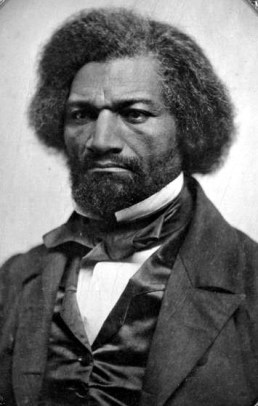
Frederick Douglass Ambrotype, 1856 by an unknown photographer, image public domain via Wikimedia CommonsListen to this podcast episode here or subscribe on iTunes

Early on his career as an abolitionist speaker and activist, Frederick Douglass is a dedicated Garrisonian: anti-violence, anti-voting, anti-Union, and anti-Constitution…

[But] by the early 1850’s, the abolitionist par excellence had come to disagree with Garrison, father of American radical abolitionism, and to agree with Lincoln, proponent of preserving the Union at all costs and of the gradual phasing out of slavery.

So how does Douglass come to make what seems such a counterintuitive change in his views on the Constitution and on the role of violence, voting, and the Union in bringing an end to slavery?… Read the original essay here

Ordinary Philosophy and its Traveling Philosophy / History of Ideas series is a labor of love and is ad-free, entirely supported by patrons and readers like you. Please offer your support today!

Frederick Douglass the Pragmatist

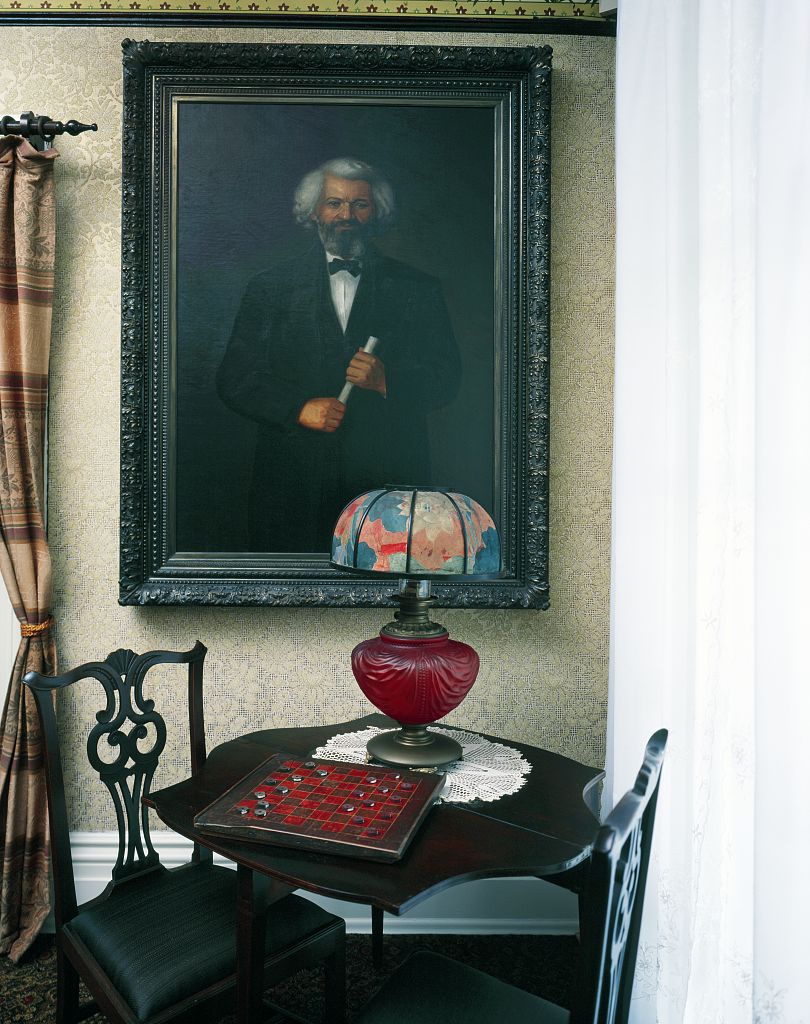
Frederick Douglass House Parlor, Washington, D.C.

Douglas is a fiery orator, an uncompromising abolitionist and proponent of universal human rights, and even an advocate of using violence if the cause is just, the harms too great, and other means prove ineffective (more on that in an upcoming piece). He criticizes those who ‘shamefully abandon their principles’. And very often, when he encounters discrimination in a hotel, restaurant, or other public place, he reports the incident to the local press.

Yet for all his energetic activism, uncompromising rhetoric, and devotion to principle, Douglass is also a pragmatist, in matters large and small.

To be sure, many of his activist tactics are as idealistic, and plainly appear so, as they are as practical. Douglass’ reports of discrimination, for example, fire up public support for the cause of equal rights by arousing a storm of protest and in turn, raising consciousness and providing examples for use in the political arena.

He’s a pragmatist when it comes to making a living as well: after a decades-long successful career lecturing and publishing, a house fire and an attempt to rescue the Freedman’s Bank from collapse leave Douglass’ finances in disarray. So he takes to the lecture circuit again full time in the 1870’s. In the pre-Civil War era, he makes his living doing what he believes in most: lecturing, debating, and arguing for abolishing slavery and expanding human rights. But in the post-Civil War era, he finds that morals, politics, and rights issues are no longer such profitable topics. So he goes ahead and lectures on the profitable ones, so long as it he can make the talks instructive and wholesome, and link them to more important issues. ‘People want to be amused as well as instructed’ he writes.

He’s a pragmatist when it comes to tactics and the importance of crafting an image. For example, Douglass considers photography a very important, modern tool for engendering mass support through empathy: if people can see and recognize the face of the person behind the ideas, and of one who is a member of a suffering and oppressed people, people will feel the visceral need for change. So, he takes care to become one of the most photographed men in American history.

Douglass’ practicality holds sway in larger issues too. He does not hesitate to change tactics or switch allegiances between organizations or parties if he thinks it would help the cause in the long run. In fact, he is convinced that true, unswerving, uncompromising allegiance to the cause itself requires a reformer to use whatever means necessary, so long as they are not morally wrong, even if they are imperfect or less inspiring or exciting to others than the more uncompromising choice. He has been criticized throughout the years for splitting with the Garrisonians, for siding with Captain John Fremont against Abraham Lincoln in the latter’s recall of Fremont’s emancipation proclamation in Missouri early in the war, for refusing to support or join in on the raid on Harper’s Ferry (though he supports John Brown’s ideas about the validity of armed resistance in general), for evading arrest and possible execution for charges of co-conspiracy in the Harper’s Ferry raid by fleeing to Canada, and for abandoning the Radical Abolitionist Party in favor of the newly formed Republican Party. His critics contend that his practice of often siding with moderate tactics and candidates reveal a lack of commitment and moral courage.

Yet he defends all of these practical choices on the grounds that commitment to the tactics or politics in and of themselves are actually a distraction, since the practice of committing to the ‘pure’ choice in the short run is often an impediment to achieving the ultimate goal in the long run. For example, if he throws his support behind his friend and hero Gerit Smith, uncompromising political candidate of the Radical Abolitionist Party, instead of Abraham Lincoln, the Republican candidate who ran on the more moderate goal of preventing the spread of slavery to the new states, he might be more admired as an uncompromising leader. But he understands what a risky move this would be. The Radical Abolitionists had little chance of winning, but the Republican Party was off to a very successful start, losing its first presidential campaign by a relatively small margin. Since the moderate goals of the Republican Party had a good chance of realization while those of the Radical Abolitionists little to none, Douglass sides with the former. The stakes are simply too high for Douglass to risk losing at this point, even if the risk appears nobler.

In sum, Douglass argues that the truly committed reformer is free to choose the more modest, practical, sure-bet option over the less apparently compromising, more radical option when it appears to be more effective in the long run. That’s because true faithfulness to the mission does not require appearing an effective reformer, it requires actually being as effective as possible. No small part of Douglass’ greatness as an activist and as a person is his willingness to forgo short-term public approval or personal glory in favor of acting in the long-term best interests of his cause. And it appears that history not only validates him as an astute tactician, but as a heroic figure, in part because in hindsight we can more easily recognize the wisdom, integrity, and strength in his pragmatism.

Ordinary Philosophy and its Traveling Philosophy / History of Ideas series is a labor of love and is ad-free, entirely supported by patrons and readers like you. Please offer your support today!

~~~~~~~~~~~~~~~~~~~~~

Sources and inspiration:

Blassingame, J. (Ed.). The Frederick Douglass Papers, Series One: Speeches, Debates, and Interviews. 4 volumes, and The Frederick Douglass Papers, Series 2: Autobiographical Writings. 3 volumes. New Haven and London: Yale University Press, 1979-1999
Douglass, Frederick. Autobiographies, with notes by Henry Louis Gates, Jr. Volume compilation by Literary Classics of the United States. New York: Penguin Books, 1994.

Douglass, Frederick. My Bondage and My Freedom: 1855 Edition with a new introduction.. Re-published 1969, New York: Dover Publications, Inc.

Foner, Philip S. The Life and Writings of Frederick Douglass, Vol. 1-4. New York: International Publishers, 1950.

Varon, Elizabeth. ‘Most photographed man of his era: Frederick Douglass’, the Washington Post, Jan 29, 2016. https://www.washingtonpost.com/opinions/most-photographed-man-of-his-era-frederick-dou

Fundraising Campaign for Frederick Douglass’ Traveling Philosophy / History of Ideas Series

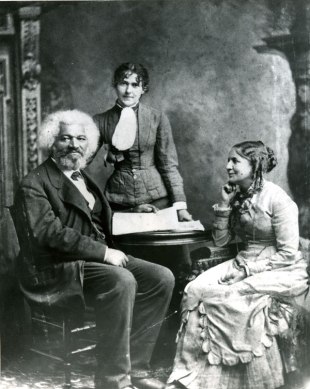
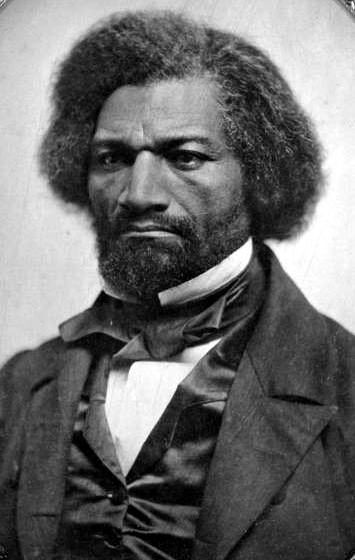
Frederick Douglass with his second wife Helen Pitts and her sister Eva, public domain via Wikimedia CommonsAs you may know, dear readers, I’m embarking on the travel portion of my fifth philosophical-historical themed adventure in mid to late March. I’m off to Baltimore, MD, New York, Washington DC, and other East Coast sites to follow in the footsteps of Frederick Douglass.
Ordinary Philosophy and its Traveling Philosophy / History of Ideas series is a labor of love and ad-free, supported by patrons and readers like you.

Every single bit helps, from $1 on up: directly through your contribution, and indirectly by inspiring confidence and enthusiasm in others who see the support already given.

As always, I count on you to help me accomplish what I do here; thanks to all who have contributed in the past, and thanks in advance to all who contribute in the future!

What the Frederick Douglass Traveling Philosophy / History of Ideas Series project will produce:
– A series of essays on the ideas of Frederick Douglass, how they relate to his time and ours
– A series of travel accounts of sites associated with Douglass’ life and ideas throughout the East Coast. I’ll be seeking insights into how the places informed the man, and vice versa. These will double as historical-philosophical investigations to bring Douglass to life in the mind of the reader, and as inspiration for other traveling history enthusiasts
– A series of downloadable walking tours to accompany the travel series: just subscribe and download in iTunes, and you’ll have your own travel guides to East Coast places I travel to for this series
– Free educational resources: supplementary teaching materials on the life and ideas of Douglass
– And if all goes as planned, a book!

Budget: In the interests of transparency and so you know exactly where your hard-earned, generously donated funds go, here’s the breakdown:

Primary Goal: $2,500 – To cover airfare, lodging, ground transportation, and advertising for Frederick Douglass’ Traveling Philosophy / History of Ideas series
– Airfare: to DC or NYC about $500 (w/taxes and fees)
– Car Rental: average $28 / day = $392
– Lodging: average $50 per night, will be staying with friends some nights = $700
– Parking / Fuel / Public Transportation: average $25 per day = $350
Subtotal = $1,942

Any amount I’ve saved on the above costs or amount collected in excess will be spent on paid advertising (Facebook, Google Adwords, Bing, Pinterest, etc, even a radio spot if funds allow!), which will be listed here, so that the total spent comes to $2,500. (I also advertise in a wide array of free venues)

Secondary Goal: $1,500 – Monthly wages
This year, O.P. is making a big push to include an expanded and more in depth history of ideas travel series, more regularly published podcast with downloadable history of ideas travel guides, interviews with fascinating people, scholarship and educational materials, more great guest posts, and so much more! To accomplish all this, O.P. will need to pay its own expenses and if possible, wages, so I can throw spend less time at other occupations, throwing myself into O.P. with all the heart, time, and energy I long to dedicate to this project.

Please visit the Subscribe, Submit, and Support page to help me fund this project.

I thank you in advance, from the bottom of my heart, for any support you can offer

Sincerely,

Amy Cools


Frederick Douglass on the Constitution

Frederick Douglass Ambrotype, 1856 by an unknown photographer, image public domain via Wikimedia CommonsEarly on his career as an abolitionist speaker and activist, Frederick Douglass is a dedicated Garrisonian: anti-violence, anti-voting, anti-Union, and anti-Constitution.

In the early 1840’s, Douglass joins a revitalized abolitionist movement largely shaped by the views of William Lloyd Garrison. Since the early 1930’s, Garrison espouses a particular set of moral and political beliefs, radical for his time, which he promotes in his influential anti-slavery paper The Liberator. He believes in total non-violence, violence being a tactic of the slaveowners and their corrupt government protectors, not of good God-fearing people who have moral truth on their side. He believes that since voting implies that a government that legalizes slavery is legitimate, true abolitionists must abstain. He believes that the continued Union of the States, Abraham Lincoln’s sacred cause, was not only impossible, but undesirable: it involved the North, directly and indirectly, in the evil of slavery. Since the South was hell-bent on preserving that unnatural and therefore illegal institution, the South should go, and good riddance. And all of these are tied to Garrison’s view of the Constitution: it’s an ultimately pro-slavery, anti-human rights document, and therefore not worthy of obedience or respect.

For many years, Douglass fully agrees with Garrison. But over time, as a result of his conversations and debates with abolitionists who interpret the Constitution differently, and of his own study, experience, and thought in the first four years of publishing his own paper The North Star, Douglass changes his mind. By the early 1850’s, the abolitionist par excellence had come to disagree with Garrison, father of American radical abolitionism, and to agree with Lincoln, proponent of preserving the Union at all costs and of the gradual phasing out of slavery.

So how does Douglass come to make what seems such a counterintuitive change in his views on the Constitution and on the role of violence, voting, and the Union in bringing an end to slavery?

Some of the reasons for Douglass’ evolution are pragmatic; his pragmatist side becomes more pronounced with time and experience (more on this in another piece). For one, he comes to believe that violence is not only unavoidable at times, but sometimes necessary (more on this in another piece as well).

Douglass also becomes convinced that abstaining from politics is just suicide by degrees for the abolitionist movement, since it cedes political power to slaveowners and their supporters. Abstaining from voting in protest, as Garrison calls for, actually works against the project of obtaining greater political rights for black people. (As with celebrity comedian-guru Russell Brand’s anti-voting campaign today; the idea of abstaining from the vote in protest is neither new nor, in my opinion, any more effective now than it was then.) As Douglass points out, however motivated some people are to do the right thing by their fellow citizens, there will always be plenty of others motivated by greed, moral laziness in going along with the status quo, and the drive for power and domination over others. Political clout, gained through voting in those who represent their views, is one of the very few ways in which black people can finally obtain and protect their equal legal rights. And not only that: voting is one of the most practical yet powerful ways black people can demonstrate their full citizenship to those who might be inclined to doubt it. Other than getting an education and fighting in the war for emancipation, Douglass argues that it’s the most important way to undermine ugly stereotypes, prevalent in his day, of black people as lazy, uninformed, and fit only to have their lives run by others. (These stereotypes are, by the way, so ugly that it’s painful just to write them down, but confronting the ugliness head-on drives home the dire necessity of getting rid of them once and for all.)Constitution of the United States, first page of the original, provided by the National Archives and Records Administration, public domain via Wikimedia Commons

But voting’s not enough to ensure that black people obtain the political power necessary to enhance and preserve their rights. For the abolitionist revolution to succeed, the Union must be preserved at all costs, and in the process, it must be recreated as the unified, true haven of freedom it’s meant to be. Douglass believes it’s the responsibility of the free states to liberate the enslaved people of the Southern states, and to extend and enforce guarantees of human rights for all inhabitants of all states.

Why? Because the Preamble of the Constitution tells us that’s what it’s for.

But how does Douglass justify this interpretation when it’s still a matter of such contention that he’s watching his country tear itself in two over it?

To understand the Constitution, it can help somewhat to consider the history that led to its creation and the ideas and intentions of those who wrote it; but to fully understand its true meaning and purpose, Douglass believes, we must always interpret all of its parts in the context of its preamble:

We the People of the United States, in Order to form a more perfect Union, establish Justice, insure domestic Tranquility, provide for the common defence, promote the general Welfare, and secure the Blessings of Liberty to ourselves and our Posterity, do ordain and establish this Constitution for the United States of America.’

The preamble is the key to any valid interpretation of the Constitution because it tells us, in plain, direct, and eloquent language, why the Constitution is written, who it’s written for, and who is bound to obey it. Any interpretation inconsistent with the Preamble reveals that either the Constitution itself is illogical, inconsistent and therefore invalid, or it shows that it’s the interpreter’s reasoning that’s illogical, inconsistent and therefore failing in understanding. Garrisonians agree with the first; Douglass agrees with the second.

So what to do with such parts of the Constitution as the three-fifths clause, which reads:

Representatives and direct Taxes shall be apportioned among the several States which  may be included within this Union, according to their respective Numbers, which shall be determined by adding to the whole Number of free Persons, including those bound to Service for a Term of Years, and excluding Indians not taxed, three fifths of all other Persons‘?. (Art. I, Sec. 2, Cl 3.)

Doesn’t it imply that all those bound to service, which in Douglass’ time almost exclusively applies to black slaves, only count as three-fifths-person, and ergo, are not fully human? While Douglass grants that this clause is deeply problematic, he no longer agrees that it’s actually an endorsement of slavery.

There are two cases which can be argued when it comes to the effects of the three fifths clause: that it gives extra 3/5th’s representative powers to slaveowners, or that it takes away 2/5th’s; that point’s debatable. As Douglass points out, the clause actually appears to be a concession of a point that slaveowners didn’t really want to make but felt forced to if they wanted to increase their political power: that slaves are persons. If they’re not, it would make no more sense to include them at all for purposes of representation than it would to include cows, chickens, or farm implements. But even this grudging concession of personhood is conceivably debatable.

But while the effects of the three fifth clause may help indicate what use it’s been used for, they don’t tell us what it really means or what its true purpose is. So how do we successfully go about determining its meaning?

How about original intent? Since the expressed beliefs and opinions of the Constitution’s authors vary so widely on the matter of slavery, this won’t help us to decide the matter either. Douglass bases his original interpretation of the Constitution as a pro-slavery document on the basis of intent, but as we’ve seen, he changes his mind.

Well, then, how about strict constructionism? This won’t help us either. The terms used are so broad that it’s hard to tell what they literally and finally mean, or to prove outside of the historical context that they refer to the American brand of slavery at all. The three fifths clause never says anything about permanent bondage or race-based slavery. (In fact, the phrase ‘term of years’ seems to imply that there’s a beginning and end to the servitude in question that’s determined by something other than birth and death, but it doesn’t exclude the latter.)

So which interpretation of the three-fifths clause is most consistent with the preamble? Not the idea that those bound to service are anything other than persons or citizens, since the right to representation is only accorded to citizens, which, in turn, are necessarily persons. Nor is the idea that those bound to service are part-person or part-citizen: there’s nothing in the language of the clause nor of the rest of the Constitution that recognizes there’s such things as part-persons or part-citizens. Douglass points out that ‘…the Constitution knows of only two classes [of people]: Firstly, citizens, and secondly, aliens’. Constitutionally, all persons born in the United States are citizens by definition, and all others aliens; of course. the latter are still persons. So the ‘three-fifths’ clause can’t be referring to the completeness of individual persons; as we can see by the language itself, it specifically applies to the total number of persons for the purpose of apportionment only.

Free Stephens, Henry Louis 1824-1882 artist, Public Domain via Library of CongressIt’s clear, then, what the three-fifths clause says about persons and implies about citizens, but what does it really say about slavery?

In a word, nothing. At least, not directly. As Douglass reminds us, the word ‘slave’ and its derivatives never appear in the Constitution at all. It does mention people ‘bound to service for a term of years’ but as we’ve already considered, this is unspecific, never mentions race, nor implies that bondage to servitude is ever anything other than limited.

There is one reading of the three fifths clause that I think is most consistent with the Preamble and with Douglass’ view of proper Constitutional interpretation. Given that the Constitution is concerned with Union, and Justice, and Tranquility, and the common defense, and the general Welfare, and Liberty, the three-fifths compromise was the best the founders could do at the time, given the intransigence of the slaveowners coupled with the young country’s need for their inclusion in the Union, to make the country large and strong enough to bring as much liberty as possible to as many people as possible. Bringing an end to slavery, Douglass believes, is the next necessary step for accomplishing the goals laid out in the Preamble as well as in the Declaration of Independence: to finally stamp out that liberty-destroying institution which had so undermined the general welfare, strength, and tranquility of the Union from its very beginning.

To return to the twin issues of personhood and citizenship in Douglass’ America: in a speech in 1854, Douglass says ‘In the State of New York where I live, I am a citizen and legal voter, and may therefore be presumed to be a citizen of the United States’. Just three short years later, in the infamous Scott vs. Sandford, a.k.a. the Dred Scott decision, the Supreme Court ruled that Douglass and all his fellow black people are not citizens at all. While Douglass explains  in his speech’… [the]  Constitution knows no man by the color of his skin’, the infamous Dred Scott decision of 1857 upended decades of common practice and legal precedent since the founding of the nation, where free black people throughout the United States had enjoyed legal, if not social, equality. However, as Douglass correctly observes, skin color is never mentioned in the Constitution as a precondition for citizenship, only place of birth and status of naturalization.

According to his biographer Philip Foner, Douglass becomes the most advanced and most informed thinker in Constitutional law, and the political and legal theory that informs it, than any of his fellow prominent abolitionists. Douglass believes, in the end, that the Garrisonian abolitionists are making the same mistake as the slaveowners: they fail to interpret the Constitution rightly, on its own terms and as a unified legal document unparalleled and unprecedented in its full establishment of human liberty. From the Garrisonians onward, those of us who likewise interpret the Constitution as protecting the rights of some without protecting others, or who likewise fail to understand its true significance, its true potential, and its true power to bring the blessings of liberty to all, just don’t get the Constitution.

*Listen to the podcast version here or on iTunes

Ordinary Philosophy and its Traveling Philosophy / History of Ideas series is a labor of love and ad-free, supported by patrons and readers like you. Please offer your support today!

~ Also published at Darrow, a forum for ideas and culture

~~~~~~~~~~~~~~~~~~~~~~~

Sources and Inspiration:

Blassingame, J. (Ed.). The Frederick Douglass Papers, Series One: Speeches, Debates, and Interviews. 4 volumes, and The Frederick Douglass Papers, Series 2: Autobiographical Writings. 3 volumes. New Haven and London: Yale University Press, 1979-1999
Douglass, Frederick. Autobiographies, with notes by Henry Louis Gates, Jr. Volume compilation by Literary Classics of the United States. New York: Penguin Books, 1994.

Douglass, Frederick. The Heroic Slave: A Cultural and Critical Edition. Eds Robert S. Levine, John Stauffer, and John McKivigan. Hew Haven: Yale University Press, 2015.

Douglass, Frederick. My Bondage and My Freedom: 1855 Edition with a new introduction.. Re-published 1969, New York: Dover Publications, Inc.

Foner, Philip S. The Life and Writings of Frederick Douglass, Vol. 1-4. New York: International Publishers, 1950.

Landmark Cases: Scott vs. Sandford (The Dred Scott Decision), A C-Span Original TV Series, 2015  http://landmarkcases.c-span.org/Case/2/Scott-V-Sandford

Frederick Douglass on Faith and Doubt

Frederick Douglass c. 1855, image Public Domain

In his lifetime and to this day, Frederick Douglass is a hero to the religious and non-religious,to believers and skeptics alike, each claiming him as a champion and exemplar of their values. Why the discrepancy? In his speeches, letters, and published work, Douglass reveals himself as both believer and doubter, a man of deep Christian faith who experiences a great deal of religious skepticism throughout his life.

Douglass is a self-professed believer in God and a Christian, yet he’s a vocal critic of most Christian denominations of his day, especially those of the United States. As a young man, Douglass struggles with religious doubts as he observes, time after time, that the most pious slaveowners are the most cruel. His master Thomas Auld, Edward Covey the slave-breaker, Reverend Daniel Weedon and the neighboring Hamiltons in Baltimore, among others, routinely and mercilessly whipped and abused their slaves, often to the point of great injury and near death, all justifying their behavior through Bible passages. In his second autobiography My Bondage and My Freedom, Douglass writes: ‘…The religion of the south…is a mere covering for the most horrid crimes…. Were I again to be reduced to the condition of a slave, next to that calamity, I should regard …being the slave of a religious slaveholder, the greatest that could befall me’ (159). In fact, he discovers to his surprise that the most decent master he ever had, William Freeman, was the only one without religion.

In his early days as an abolitionist activist and speaker, his accounts of his youthful doubts occasioned by his bad experiences with religious people cause many to accuse him of irreligion. But over time, he makes it clear that’s not religion itself he hates, it’s what he considers ‘false religion’. And no religion is as false as that which endorses slavery, which, first and foremost in Douglass’s time, was the Christian denominations of the American south.

But Douglass’s condemnation of American Christianity only begins with the southern churches; it by no means ends there. He calls on his fellow black people to leave any church, shaking the dust off their feet as they go, if their pastors or fellow parishioners subject them to indignity or unequal treatment. If anyone is segregated into balconies or back rows, or required to wait to receive communion after other colors or classes of parishioners, or their pastors preach against resistance to slavery, or the church in any other way indicates that black people are not deserving of the exact same respect, in degree and kind, as fellow children of God, then their church is revealed as just another peddler of false, corrupted religion. And all of these betrayals of the true Christianity, as Douglass perceives it, were as nearly pervasive in the northern churches as in the south.

Douglass believes that these practices, disrespectful of certain of God’s children, are not only unjust; they’re blasphemous because they’re direct attacks on the goodness and true nature of God. That’s because Douglass perceives the true God as not only ‘the God of Israel, Isaac, and Jacob’, but more broadly, the God of the oppressed. He sees this theme, this common thread, linking the plundered and oppressed desert tribes of Biblical Canaan (not mentioning that they did some plundering of their own) to those in his day who are suffering, reviled, and denied their natural rights: black people, women, the Irish, the abolitionists. Time and time again, Douglass relies on his interpretation of God as the God of the oppressed to show how the fugitive, the disenfranchised, the famine-starved left to die by their own governments, the righteous, reviled, and steadfast opposer of slavery and defender of the downtrodden, are actually those closest to him, are those who understand and share in his true nature.

But Douglass’s faith also appears at least as naturally derived as it is scripturally revealed. That’s because Douglass uses nature as a litmus test to reveal the truth and integrity of religion. Since by nature all people need and take joy in food and drink, physical and spiritual comfort, love, and beauty whatever their color, sex, or place of origin, and all people suffer alike from cold, hunger, thirst, cruelty, and neglect, and all people are just as capable of improvement through education and moral edification, then all people share the same nature, possess the same dignity, and have the same rights. Scripture may appear to allow for bigotry, unequal treatment, and bad behavior and even require it, but nature is observable and incontestable. So, if an interpretation of scripture seems to allow or require one to treat any of their fellow human beings as less than equally beloved, equally valuable children of the one God, that interpretation is certainly wrong since it violates the natural God-authored order of things.

In the end, Douglass relies on Jesus himself to tell us how to recognize true faith in true religion: ‘Wherefore by their fruits ye shall know them’ (Matthew 7:20). It’s not whether or not one professes belief in a religion, or can quote passages of scripture or the work of theologians, that reveals the worth and nature of faith. Douglass believes that true religion (which for Douglass, is true Christianity), always reveals itself by how well its adherents defend and promote justice and the equal dignity of all human persons. Conversely, if a religion commands or even permits injustice, it must be false. Where you find kindness and justice, there you find faith, and nowhere else.

It’s not the outward form or classification which indicates the true tree of religion to Douglass, it’s the sweetness and wholesomeness revealed in the fruit of true faith.

*Listen to the podcast version here or on iTunes

*Ordinary Philosophy and its Traveling Philosophy / History of Ideas series is a labor of love and is ad-free, supported by patrons and readers like you. Please offer your support today!

~~~~~~~~~~~~~~~~~~~~~~~~~~~~

Sources and Inspiration:

Douglass, Frederick. The Heroic Slave: A Cultural and Critical Edition. Eds Robert S. Levine, John Stauffer, and John McKivigan. Hew Haven: Yale University Press, 2015.

Douglass, Frederick. My Bondage and My Freedom: 1855 Edition with a new introduction.. Re-published 1969, New York: Dover Publications, Inc.

Foner, Philip S. The Life and Writings of Frederick Douglass, Vol. 1-4. New York: International Publishers, 1950.

Traveling Philosophy Series: Frederick Douglass Edition, Prologue, Oakland, CA

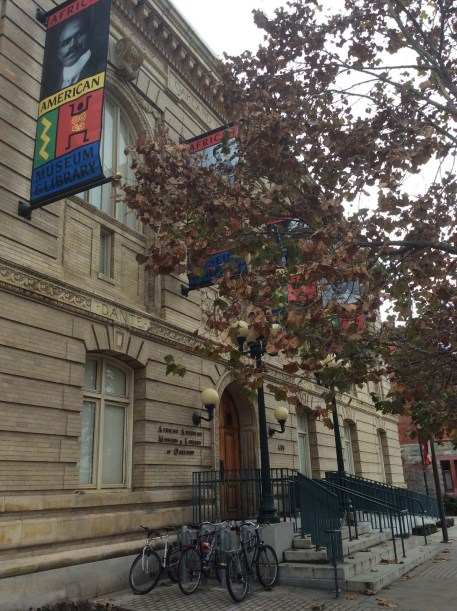
African American Museum and Library, Oakland, CA

Frederick Douglass’s Traveling Philosophy series will begin in earnest when I arrive on the East Coast. But behind every Traveling Philosophy series is research, and I have some excellent resources here where I live in Oakland, California. It’s still a little up in the air as when I’ll actually be able to make it to the East Coast for a long enough period to cover the ground I’d like to, since I intend this series to be the most comprehensive I’ve done yet. So, I’ve decided to do something a little different this time, to start the account of my journey with my discoveries and thoughts on the acts and ideas of Douglass I encounter while researching his life.

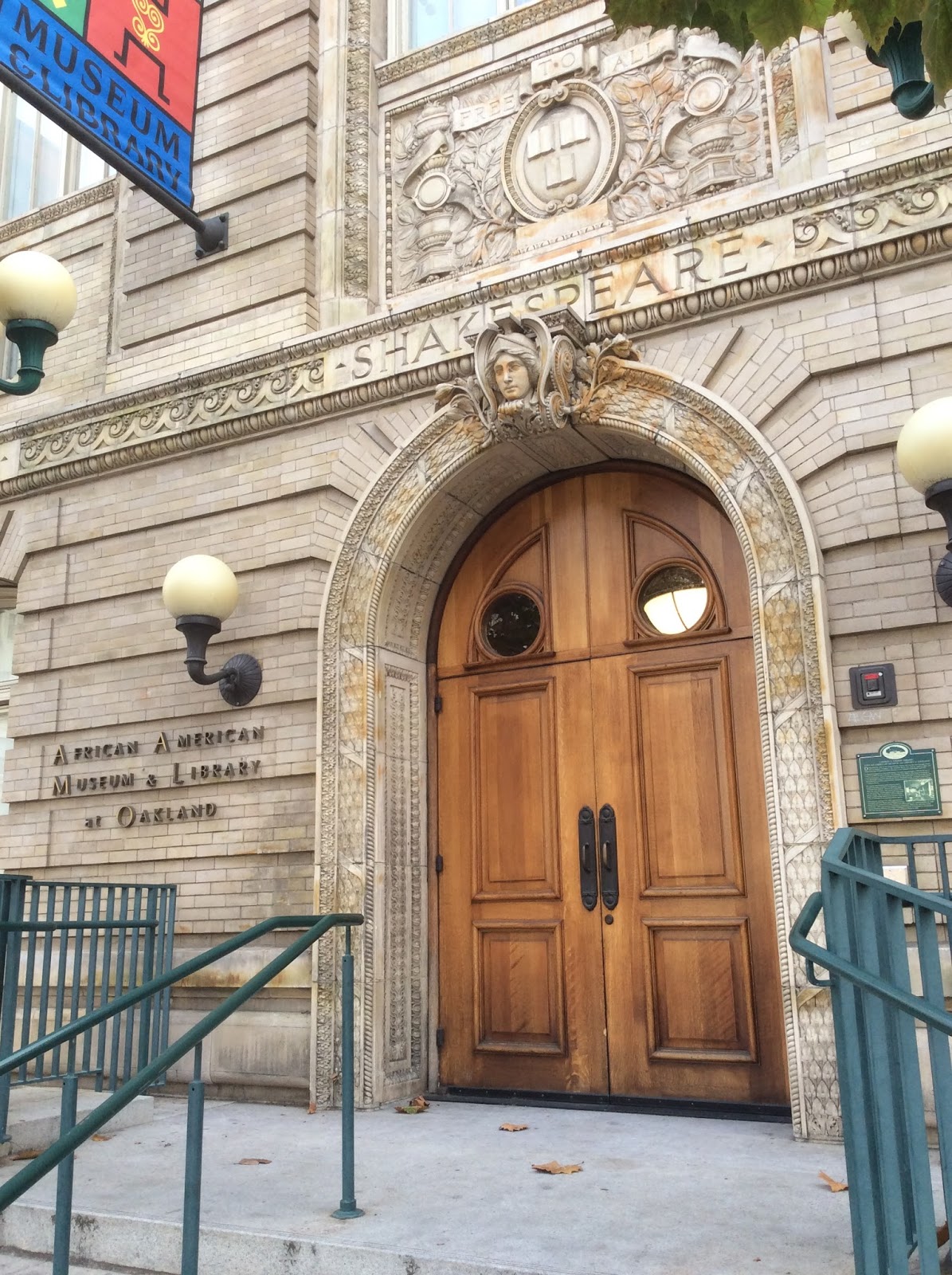
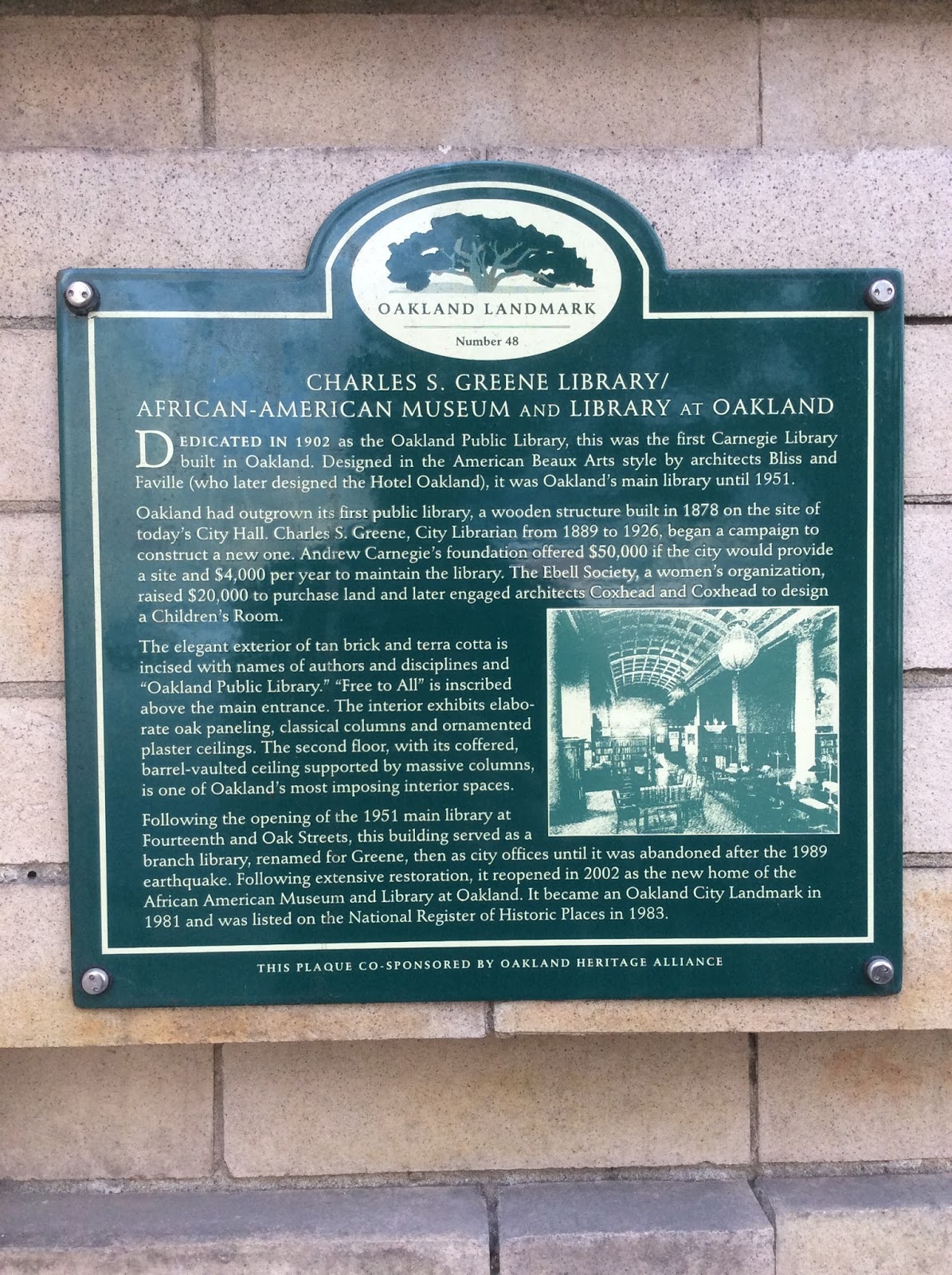
For the last several weeks, I’ve been gathering materials at my local library branch, the main branch near beautiful Lake Merritt on 14th St. But for many happy afternoons this early December, I’m on the other side of downtown, still on 14th St, in my new favorite study space, the lovely African American Museum and Library in Oakland.The AAMLO is a local Beaux Arts gem, the original main library building from 1902 until it moved to its current much larger location in the early 1950’s. (See the photo, right, of the museum’s green plaque for a brief history of the library and museum; you can click on the image to enlarge it for ease of reading, if you like.)

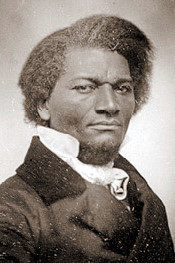
Sculpture of Frederick Douglass, AAMLO

The AAMLO is a new discovery for me this December, and as I enter, I’m greeted, to my delight, with a handsome (if rather stern) sculpture of the hero of my series. It’s this effigy of Douglass, in fact, which inspires me to just jump right in and start his Traveling Philosophy series here in Oakland.

So I’ll begin, as I mentioned, with stories and reflections on his life and work. My trip to the East Coast, tentatively planned for late winter / early spring, and the stories of that journey will be followed by a second series of essays inspired by my discoveries in the course of my travels. I hope you enjoy this new format, and as always, welcome any feedback you wish to offer!

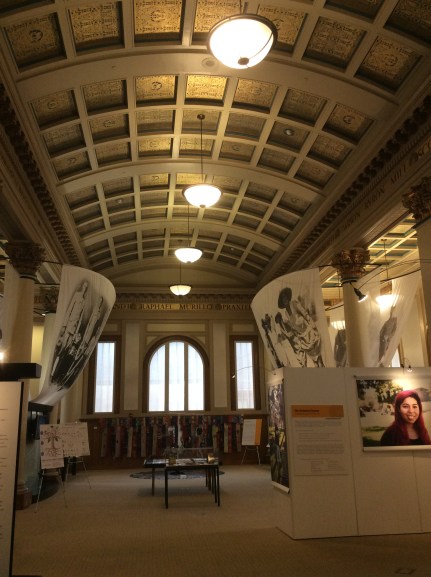
An interior view of AAMLO

AAMLO is a reference library only, so all materials I use must stay here. That’s perfectly fine with me, it’s such a lovely place to work, and lucky for me, it’s quite close by to where I live and work. Since I’ll be returning here a lot, I pick a quiet, cozy corner, and get to work…

One afternoon, after reading and making notes for quite some time, I feel the need to stretch my legs and rest my tired eyes. I go upstairs to the museum, a long gallery which runs the length of the building and which used to be the main reading room.

Crowning the main stairway which leads to this upper gallery, there’s a huge collage of great figures in African American history. It just so happens that the image of Douglass is under the name of Spinoza, among the list of names of great thinkers of the past which embellishes the frieze. Cool. Baruch Spinoza is next on my list of great thinkers to follow, but that’s a story for another time. I’d bet they’d have the most fascinating conversations, though, if they could speak the same language. Though they were very different in their histories, their particular beliefs, and their personalities, yet they were both lovers of reason, and they both lived authentically, true to their beliefs, models of intellectual integrity as they refused to obey the unjust rules of the societies they lived in.

An interior view of AAMLO, Oakland, CA, 2015 Amy Cools

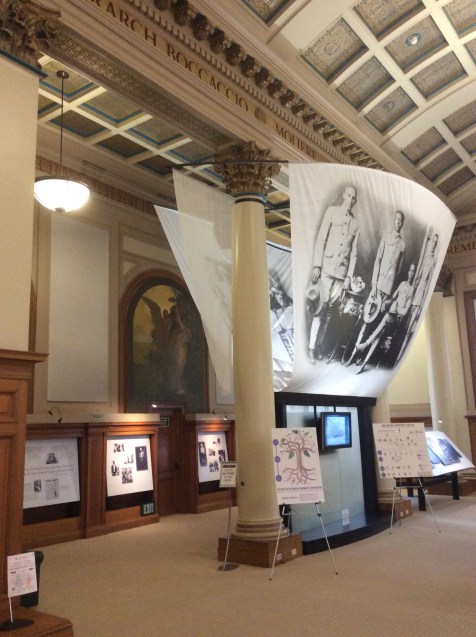
A view of AAMLO’s main gallery on the upper floor

The museum tells the story of the African American people who did so much to make Oakland the vibrant and diverse city it is today, and how America’s legacy of laws and practices both helped and harmed the African American community here and throughout California. The African American community in Oakland grew by leaps and bounds throughout the 1900’s, much of it made up of refugees from the Old South, and through hard work, came to make up a significant proportion of its thriving middle class. Oakland’s economy centered around its busy port and manufactures, and as the work dried up after the stock market crash of 1929, it was no surprise that the economic woes hit African Americans the hardest: when jobs become more scarce, it was not the favored demographics that suffer from it most, as you may expect: Oakland’s working black population lost well over a third of their jobs.

Douglass himself experienced job discrimination in his time working on the Maryland docks as a caulker, hired out as a wage earner in the Baltimore shipyards for his master before he escaped to freedom. In his Narrative, Douglass relates the story of a severe beating he received at the hands of white shipbuilders who resented the competition of low-paid black labor, both slave and free. Douglass was driven from his job by violence; in 20th-century Oakland, it was a combination of job discrimination, rules and laws which prevented black people from joining or forming unions, and differential treatment by law enforcement. Not everything had changed since Douglass’s day.

A view of an exhibit in AAMLO's main gallery, upper floor, AAMLO, 2015 Amy Cools

A view of an exhibit in AAMLO’s main gallery

So as black Oaklanders suffered many of the worst effects of the economic downturn, the ills of poverty hit black communities the hardest, and harsh, unjust policing practices and drug policies exacerbated the problems that they may have been meant to alleviate. Many, however, passionately believe that there was no honest intent to help, just to oppress and destroy the black community. Whatever the case may be, the desperation of so many of Oakland’s black people makes it no wonder that the Black Panther Party was founded here in Oakland in the 1960’s. Then as now, a strong cultural tradition of racial justice activism and civic unrest flourished, sometimes, as again to be expected in an environment where so many felt disenfranchised and disrespected, to excess.

If he were alive to witness it, Douglass may have disapproved of many of the Black Panther Party’s militant tactics, but like the B.P.P. and Malcolm X after him, he came to believe that some kind of armed resistance may be necessary to achieve liberty and full equality for black people, and that if violent resistance was necessary to change the laws, it was just, given the depth of oppression and injustice black people suffered. He was, for example, an admirer of John Brown, a passionate abolitionist who unsuccessfully tried to start an armed slave rebellion and was hanged for treason as a result.

What Douglass thought about whether or not it’s right to use violence in the cause of furthering human rights, and if so, how much, against whom, and when, is a big topic, one for another essay in this series. Stay tuned!about whether or not it’s right to use violence in the cause of furthering human rights, and if so, how much, against whom, and when, is a big topic, one for another essay in this series. Stay tuned!

* Listen to the podcast version of this piece here or on iTunes

* Follow in the footsteps of Frederick Douglass with me… 

Ordinary Philosophy and its Traveling Philosophy / History of Ideas series is a labor of love and ad-free, supported by patrons and readers like you. Please offer your support today!

~~~~~~~~~~~~~~~~~~~~~~~~~

Sources and Inspiration

Douglass, Frederick. Narrative of the Life of Frederick Douglass. Originally published in Boston by the Anti-Slavery Office, May 1st, 1845.

From Oakland to Maryland, New York, and Massachusetts I Go, in Search of Frederick Douglass

Hello, friends of Ordinary Philosophy!

From time to time, I take a trip to some corner of the globe, to explore the lives and ideas of great thinkers in the places where they lived and worked. For this series, I follow in the footsteps of thinkers who are no longer alive, since those who are still telling their own stories. But those who are no longer alive in the body live on in the ideas that they pass on, and in the example they provide for us to follow.

I’m pleased and excited to announce my fifth philosophical-historical themed adventure, beginning with research and study in Oakland, CA, then off to Baltimore, MD, New York, Washington DC, and other East Coast sites to follow in the footsteps of Frederick Douglass.

Frederick Douglass’s life story is inspiring and humbling in the strength, character, and dazzling intellect he reveals, rising to such greatness in the midst of such adversity. Born a slave on the eastern shore of Maryland in the early 1800’s, he was an autodidact, having overheard his master say that learning to read leads to learning to think, rendering a slave too independent-minded to submit to domination by another. Hearing this, young Frederick knew what he had to do. Attaining literacy and learning a skilled trade gave him the wherewithal to escape to New York City in 1838 at about 20 years of age. A few years later, as a result of an impromptu but impassioned and eloquent speech about the hardships of a life enslaved, he was recruited as a public speaker for the abolitionist cause. He spent the rest of his life as an activist for all manner of human rights causes, from the abolition of slavery to universal suffrage to women’s rights and beyond.

Douglass is an especially compelling subject for a historian-philosopher; observing the true nature and ramifications of slavery led him to think deeply about the most essential questions in human life, which, in turn, spurred him on to a life of thought and action on behalf of oppressed peoples. In these roles, Douglass had a heavy influence on American thought and on the course of American history. He asked, and answered: What does it mean to be a person? What does it mean to be a person of faith? What are rights, and why are we entitled to them? What is dignity, and does possessing it entail that we have certain obligations to ourselves and others? Given the frailties and strengths of human nature, how can we best live together and form just societies? What do the Constitution, its Bill of Rights, and the Declaration of Independence really say about slavery, equality, and other human rights issues?

So I’ll begin my tale here in my home city of Oakland, CA, where I begin my research and exploration into Douglass’s life and ideas, then off to the east coast of the United States I’ll go, from March 19th thru April 2nd! There, I’ll visit landmarks associated with his life, places where he lived and died, worked, thought, wrote, studied, and rested, to see for myself how the places informed the man, and vice versa.

~ Listen to the podcast version of this series intro here or on iTunes

Here is the story of Frederick Douglass as I discover him:
Traveling Philosophy Series: Frederick Douglass Edition, Prologue, Oakland, CA
Frederick Douglass on Faith and Doubt
Frederick Douglass on the Constitution
Frederick Douglass the Pragmatist
Frederick Douglass Baltimore Sites
Frederick Douglass’s Birthplace, Maryland’s Eastern Shore Sites Part 1
Frederick Douglass, Easton and St. Michaels, Maryland’s Eastern Shore Sites Part 2
Frederick Douglass Havre de Grace and Philadelphia Sites
Frederick Douglass New York City Sites
Frederick Douglass New Bedford, Massachusetts Sites
Frederick Douglass Boston Sites
Frederick Douglass Lynn, Massachusetts Sites
Frederick Douglass Lynn Sites, Part 2: Historical Society & Hutchinson Scrapbook
Frederick Douglass Albany, Troy, and Syracuse NY Sites
Interview with Leigh Fought on Anna and Frederick Douglass
Frederick Douglass Rochester NY Sites, Day 1
Frederick Douglass, Rochester NY Sites Day 2
Interview with Ken Morris, Anti-Slavery Activist & Descendant of Frederick Douglass
Frederick Douglass Seneca Falls, Canandaigua, Honeoye, and Mt Hope Cemetery Sites
Frederick Douglass Chambersburg and Gettysburg PA Sites
Frederick Douglass Washington DC Sites, Day 1, Part 1
Frederick Douglass Washington DC Sites, Day 1, Part 2
Frederick Douglass Washington DC Sites, Last Day

More about Frederick Douglass:

Peoria, Illinois, In Search of Robert G. Ingersoll, Frederick Douglass, And Abraham Lincoln, Part 1
Peoria, Illinois, In Search of Robert G. Ingersoll, Frederick Douglass, And Abraham Lincoln, Part 2
Peoria, Illinois, in Search of Robert G. Ingersoll, Frederick Douglass, and Abraham Lincoln, Part 3
Photobook: Frederick Douglass and Edinburgh, Old and New
O.P. Recommends: ‘A Man’s a Man for a’ That: Frederick Douglass in Scotland’ by Andrea Baker for BBC Radio 4
Say What? Frederick Douglass on Originalist Interpretations of the United States Constitution
O.P. Recommends: Frederick Douglass’ Drunk History Episode
Say What? Frederick Douglass on Race Relations
Citizenship, Belonging, and the Experiences of Amero-Africans in West Africa: An Analysis of William Innes’ Early History of Liberia

Ordinary Philosophy and its Traveling Philosophy / History of Ideas series is a labor of love and ad-free, supported by patrons and readers like you. Please offer your support today!

Patrons of the Frederick Douglass series: RH Kennerly, Elizabeth Lenz, Alex Levin, Cory Argonti Cools, Bryan Kilgore, Michael Burke, Gaia So, Veronica Ruedrich, Blair Miller, Alex Black, Devin Cecil-Wishing, Roxanne and Fred Smalkin and family, and Jim Callahan and Nerissa Callahan-Stiles and family. ~ With warmest gratitude, thank you!

On Free Speech and Political Correctness: A Response to Lindy West

In reading a recent op-ed in The Guardian, ‘‘Political Correctness’ Doesn’t Hinder Free Speech – It Expands It’ by Lindy West, I was initially intensely annoyed.

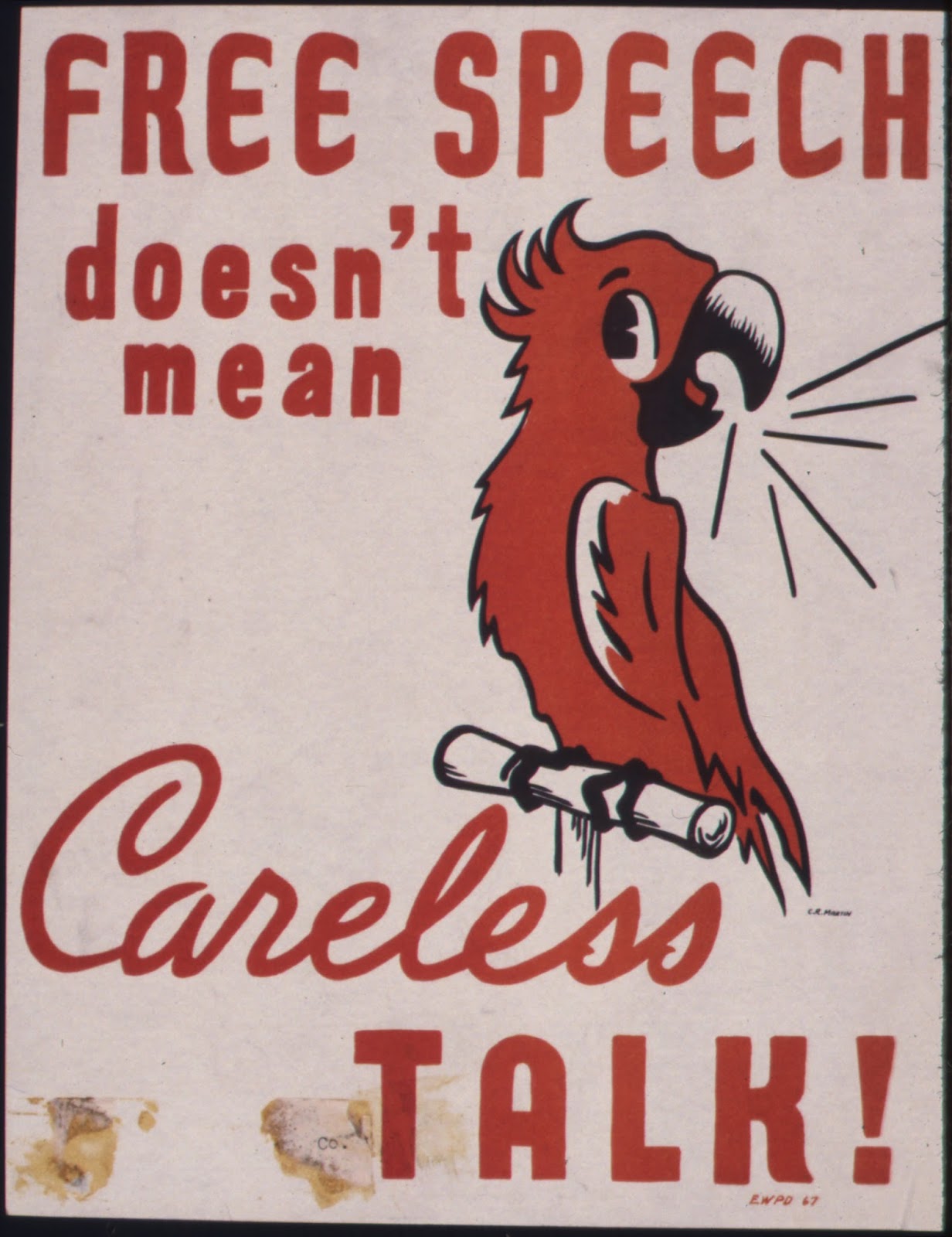
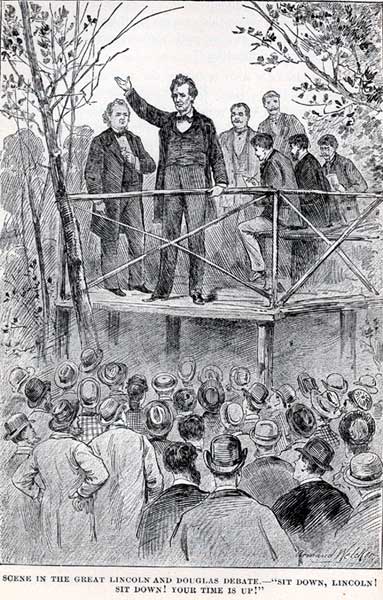
Free speech, political correctness, and whether the two necessarily conflict are hot topics of debate at the moment, as they perennially are in this nation of ours. The right to freely express ourselves is foundational, among the first rights specified in our Constitution’s Bill of Rights, yet the full enjoyment of this right in our country was hard-won. It was only several decades ago that one could be prosecuted under the obscenity laws of the time for informing people about birth control and the workings of their own reproductive systems, for example, or for expressing certain political views (we now recall McCarthyism with a shudder). With a few exceptions mostly relating to public safety, any infringement of our right to free speech still has the power to make us fearful of that old, tried-and-true, oft-used method of social and political oppression.

My first impression of West’s piece was that it was yet another misguided liberal misapplying traditionally liberal values to make a perhaps well-intentioned, but ultimately illiberal argument.

When I re-read the piece, more slowly this time, I was still annoyed and in overall disagreement, but found myself at least sympathizing with some of her arguments, and in full agreement with others. As West points out, when people routinely hear derogatory, discriminatory, or insensitive remarks, even if relatively minor or unintentional, it can and does undermine their sense of confidence, dignity, and worth over time. And there are many groups in this country, such as black people, Jewish people, gay people, and religious minorities among others, who have had to deal with these slights as they struggle to get by in a historically racist, intolerant, and zenophobic country. It is incumbent on all of us, as West points out, to realize that the things we say have an effect other people, and therefore we should govern our tongues responsibly. We should strive to remain courteous and respectful in our speech, especially towards those who have suffered, and still do suffer, these slights and insults the most. And we should definitely call each other out when we are cruel, rude, or careless enough to use offensive language gratuitously.

Yet when it came to the central argument of her piece, the ‘silencing’ argument, she lost me. And when she went from disagreeing with to railing against Jonathan Chait, a columnist with New York Magazine who explains why he thinks free speech is being threatened on college campuses, to the extent that she accuses him, no, downright slanders him, of ‘imply[ing] that black Americans being shot in the streets by agents of the state are the real puppetmasters of an authoritarian regime’, she really lost me.

When West equates expressing disagreement with ‘silencing’, she makes me doubt that she has enough respect for the immense value of free speech, or grasps the true horror and dire ramifications of actual attempts to ‘silence’ it. She gives many example of what she considers ‘silencing tactics’: ‘white students parading around campus in blackface’, ‘telling rape victims that they’re “coddled”’, and ‘teaching marginalised people that their concerns will always be imperiously dismissed, always subordinated to some decontextualised free-speech absolutism’.

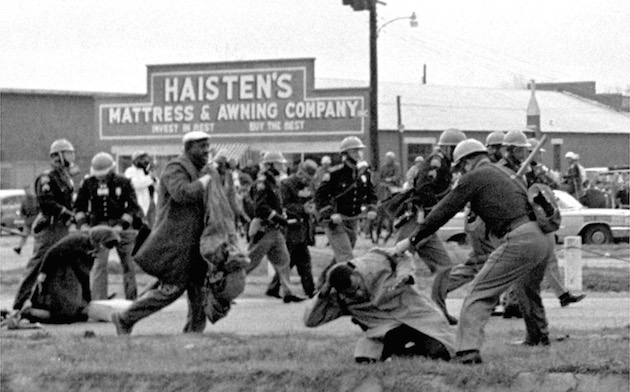
I just don’t agree that these things can be reasonably construed as ‘silencing’, not unless we stretch the meaning of the world out so broadly that it loses shape and force. Laws and regulations which threaten expulsion, arrest, and prosecution for expressing unpopular ideas are ‘silencing’ people. Police driving civil rights protesters from the streets with clubs, dogs, and fire hoses are ‘silencing’ people; the Cuban and North Korean governments’ imprisonment of political dissenters are ‘silencing’ people; issuing fatwas against Salman Rushdie and Ayaan Hirsi Ali are ‘silencing’ people; shooting Medgar Evers for his human rights activism and stabbing atheist bloggers and filmmaker Theo Van Gogh to death for their religious dissent are ‘silencing’ people. There’s a very real sense in which applying the term ‘silencing’ to any use of insensitive, politically incorrect, and offensive speech sounds like indulgent grandstanding that minimizes the horror of what people suffer when they are really being silenced. In that sense, the over-application of the term ‘silencing’ can be offensive in itself.

First, of course students putting on blackface for a Halloween party are doing the wrong thing; they are idiotically out of touch at best, or are behaving disgustingly, insultingly, even cruelly assholish at worst. Sometimes these sorts of behaviors, especially by bullies, may discourage some people from speaking out. But charging these misguided students with ‘silencing’ people? Since when? I’ve heard volumes of speech, free speech, vigorously criticizing this bad behavior, properly shaming people who are ignorant or jerkish enough to indulge in it. Second, I’m not sure if rape victims are generally accused of being “coddled” so I don’t know exactly what she’s referring to; I really hope she’s not equating this with any open discussion of rape without a ‘trigger warning’ preceding it. While some believe trigger warnings are appropriate in some circumstances, showing appropriate regard for the feelings of someone known to be wounded by past events, others believe that trigger warnings are intellectually insulting, implying that others are not strong or capable enough for open, honest, and challenging discussions of important issues. Third, reasoned debate over whether regulating forms of speech many people find offensive really promotes greater understanding and protects human rights is not the same thing as ‘imperially dismissing marginalized people’. And lastly, I don’t find that proponents of unfettered free speech routinely ‘decontextualize’ it either; rather, their arguments usually focus on the historical fact that suppression of free speech has always been a favored tool of social and political oppression (a very specific and important context) and therefore, we must protect this right at nearly all costs, even if people are sometimes offended and inconvenienced as a result.

When re-reading West’s article, a striking counterexample to her argument that political correctness expands free speech came to mind. As I write this, I’m also in the process of researching the life and thought of Frederick Douglass, the former slave who became one of America’s greatest antislavery activists and orators (this is for an upcoming O.P. Traveling Philosophy / History of Ideas series, stay tuned!). In his autobiographies, Douglass recounts the episode that he credits with setting the course of his life. When he was a child, his mistress thought it would be a good idea to teach him how to read, since he was companion and body servant to the young son of the household, and could thus aid in his education. When her husband came into the room and saw what she was doing, he stopped her, telling her in Frederick’s hearing, that ‘[he] should know nothing but how to obey his master …if you teach [him] how to read, there will be no keeping him. It would forever unfit him to be a slave…’ As Douglass tells it, this is the moment he realized the full inhumanity of the slave system, and learned exactly what he needed to do. Knowledge equals freedom, so he must learn to read and educate himself, at all costs. And not only does slavery inflict physical suffering and the loss of every kind of personal liberty, its most dehumanizing element is its reliance on forced ignorance, so that even the mind is completely subjected. In the end, it was precisely because Douglass heard his slaveowner express that cruel, offensive, and inhumane idea that he learned the truth and became the great man he was. And like Douglass, we must observe the effects of evil and hear its arguments if we are to combat it.

Of course, the flip side is true too: people free to express bad ideas influence and convince others to believe them. But, repressing speech rarely stops this: it just drives the ideas underground, to be shared in secret, shielded from the healthy and corrective criticism of public discourse. And as we can see from our vibrant history of ever-increasing freedom of speech, bad ideas that are subjected to vigorous and open public debate are refuted and ultimately rejected, one by one. While I think that bad ideas will always remain with us, I have much, much more faith that the market of ideas will weed out bad ones than repression will, again, as history has shown us. Name me one oppressive institution that has not been ultimately overthrown because of the power of speech, because people chose to liberate themselves through dissent, to offer better arguments than those of their ideological opponents and to back up them up with action, and I’ll gladly reconsider.

Unlike the case with guns, the only one who can defeat someone with a bad argument is someone with a better one. Only when speech is unfettered can it reveal its true power to liberate us from the grasp of bad ideas. The good ideas of Frederick Douglass ultimately triumphed over the bad ideas of Stephen Douglas, pro-slavery advocate whose series of heated exchanges with Abraham Lincoln were dubbed The Great Debate, because Douglass spoke out on the evils of slavery though it was contrary to mores and laws of his time. Likewise, we must rely on ourselves and on one another to overcome bad ideas by speaking out, as Erika Christakis recommends in the email that started the Yale free speech controversy, and not by co-opting the power of governing bodies to silence our ideological opponents for us.

*Listen to the podcast version here or on iTunes

*This piece is also published at Darrow

~~~~~~~~~~~~~~~~~~~~~~
Sources and inspiration:
Douglass, Frederick. ‘My Bondage and My Freedom.’, Mineola, NY: Dover, 1969, originally published 1855. https://books.google.com/books?id=b4aQY9jPkm0C&dq=My+Bondage+and+My+Freedom
West, Lindy. ‘Political correctness’ doesn’t hinder free speech – it expands it’. The Guardian, Nov 15th, 2015. http://www.theguardian.com/commentisfree/2015/nov/15/political-correctness-free-speech-racism