Welcome to the new Ordinary Philosophy!

Ordinary Philosophy, Writing a letter *oil on panel *39 x 29.5 cm *signed b.c.: GTB *ca. 1655, assemblage by Amy Cools 2015Greetings to all,

On this New Year’s Day, which also happens to be my birthday and therefore, personally, doubly a day of new beginnings, I’m looking forward to a more expansive, more energetic future for Ordinary Philosophy!

What is Ordinary Philosophy?

It’s a series of explorations founded on the belief that philosophy is an eminently useful endeavor as well as a fascinating and beautiful one, and that citizen philosophers and academic philosophers alike share in making it so. A citizen philosopher myself, I found that my experiences as an avid reader, an artist, a working person, an entrepreneur, a student, and a writer filled my mind constantly with questions and new ideas, spurring me ever on in the search for answers. As I’ve always been a restless and hungry thinker, I fell in love with philosophy, especially, practical philosophy and the history of ideas.

What is Ordinary Philosophy’s mission?

It’s always been to share this love of philosophy and the history of ideas with you. In my explorations, I’ve encountered the most fascinating, innovative, and beautiful ideas from the curious, thoughtful, questing, and inventive world out there, from academic philosophy to science to history to current events to politics to the arts and so, so much more; so much more, in fact, that I can’t possibly process it all on my own.

So here at O.P.’s new home, I’ve broadened the mission.

While there have been occasional guest posts, there will be much more of an emphasis on providing a forum for many more voices at O.P., representing views from all walks of life. O.P. will also publish many more reviews, recommendations, and links directing readers to the great ideas proliferating out there that may be of special interest to O.P.’s audience.

The Traveling Philosophy / History of Ideas series will also expand. Each series will become more in-depth, with more detailed explorations of the life and ideas of each subject and more resources for further exploration and study. The podcast will expand in tandem: new audio recordings of longer pieces published in O.P. for those of you on the go who enjoy the ideas found here but don’t always have the time to sit down and read. As time goes by, I plan to expand the podcast as well to include interviews and a series of downloadable travel guides to accompany the History of Ideas series.

To better accomplish this expanded mission, I’ve moved O.P. here to its new platform: easier to read, use, and share. So if you love great ideas and the pieces you encounter here, please support O.P.’s expanded mission by sharing as widely as you can.

Lastly, dear readers, I appeal to you: Ordinary Philosophy is a labor of love, and depends entirely on your support. I’m determined to keep O.P. ad-free, but can’t do it without you. All financial contributions will be credited by name (unless anonymity is expressly preferred, of course!) on each project funded by their donations, and welcomed with deepest gratitude. Please support Ordinary Philosophy today!

Yours,

Amy Cools, founder and editor of Ordinary Philosophy

*Listen to the podcast version here or on iTunes

Traveling Philosophy Series: Frederick Douglass Edition, Prologue, Oakland, CA

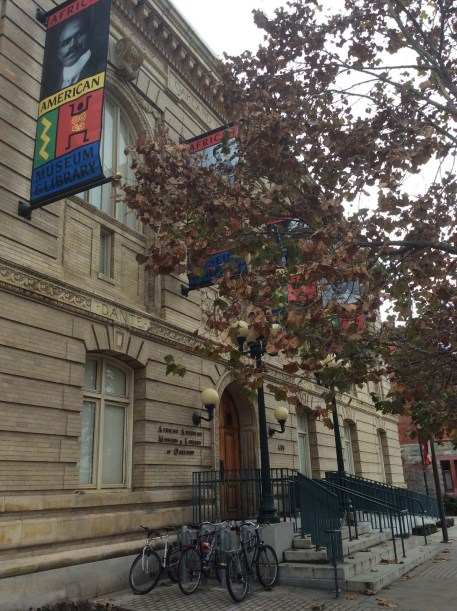
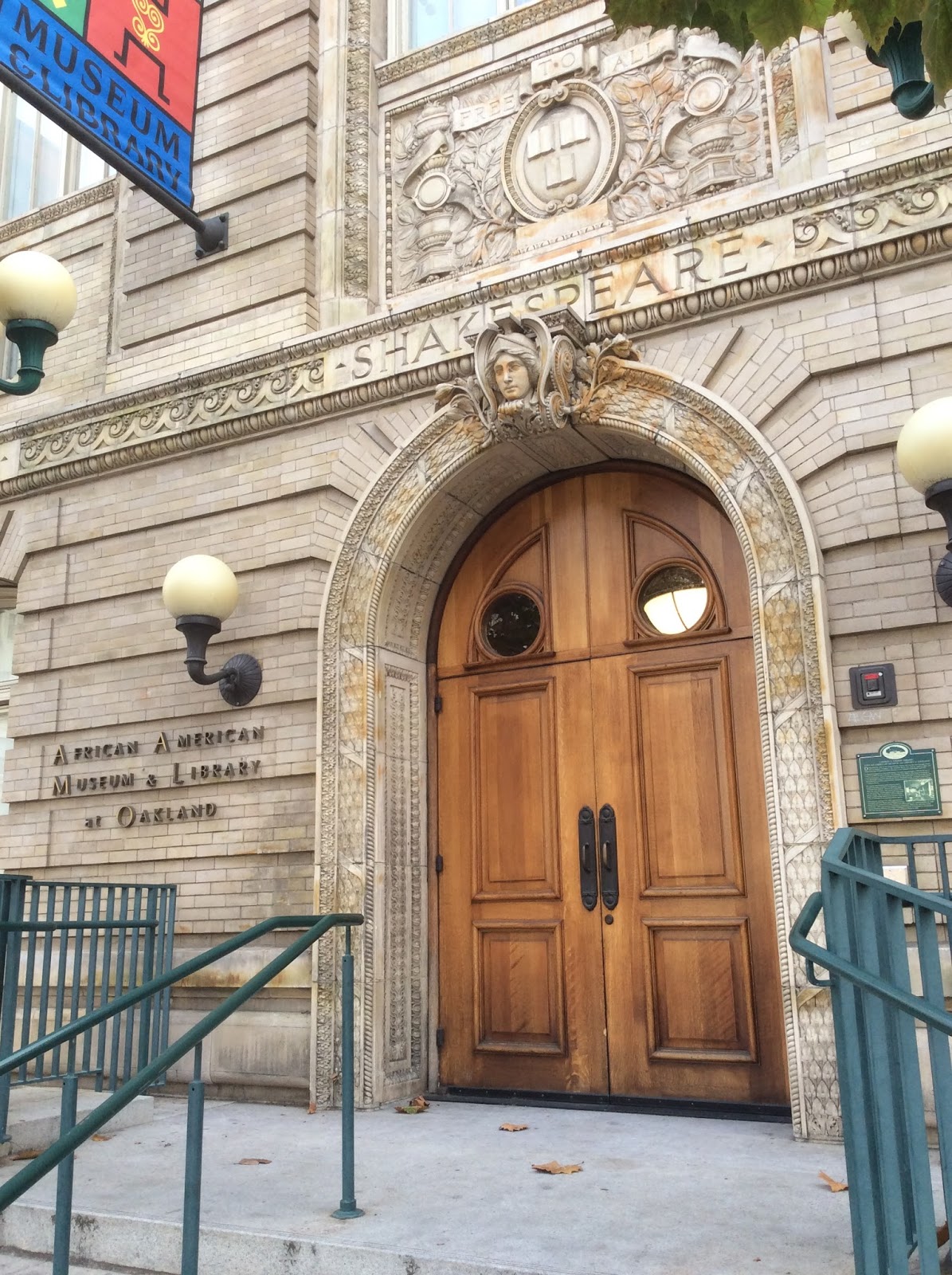
African American Museum and Library, Oakland, CA

Frederick Douglass’s Traveling Philosophy series will begin in earnest when I arrive on the East Coast. But behind every Traveling Philosophy series is research, and I have some excellent resources here where I live in Oakland, California. It’s still a little up in the air as when I’ll actually be able to make it to the East Coast for a long enough period to cover the ground I’d like to, since I intend this series to be the most comprehensive I’ve done yet. So, I’ve decided to do something a little different this time, to start the account of my journey with my discoveries and thoughts on the acts and ideas of Douglass I encounter while researching his life.

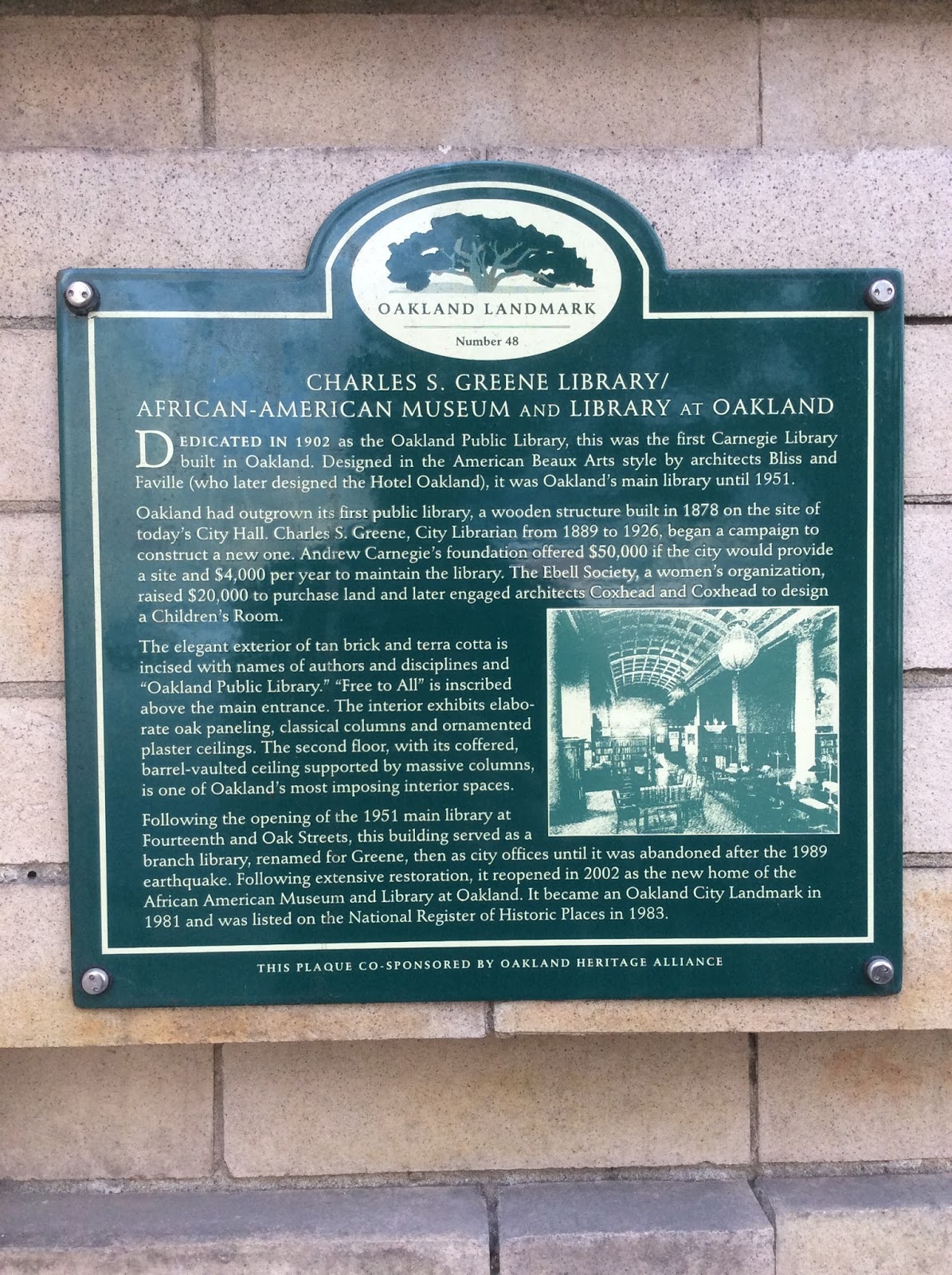
For the last several weeks, I’ve been gathering materials at my local library branch, the main branch near beautiful Lake Merritt on 14th St. But for many happy afternoons this early December, I’m on the other side of downtown, still on 14th St, in my new favorite study space, the lovely African American Museum and Library in Oakland.The AAMLO is a local Beaux Arts gem, the original main library building from 1902 until it moved to its current much larger location in the early 1950’s. (See the photo, right, of the museum’s green plaque for a brief history of the library and museum; you can click on the image to enlarge it for ease of reading, if you like.)

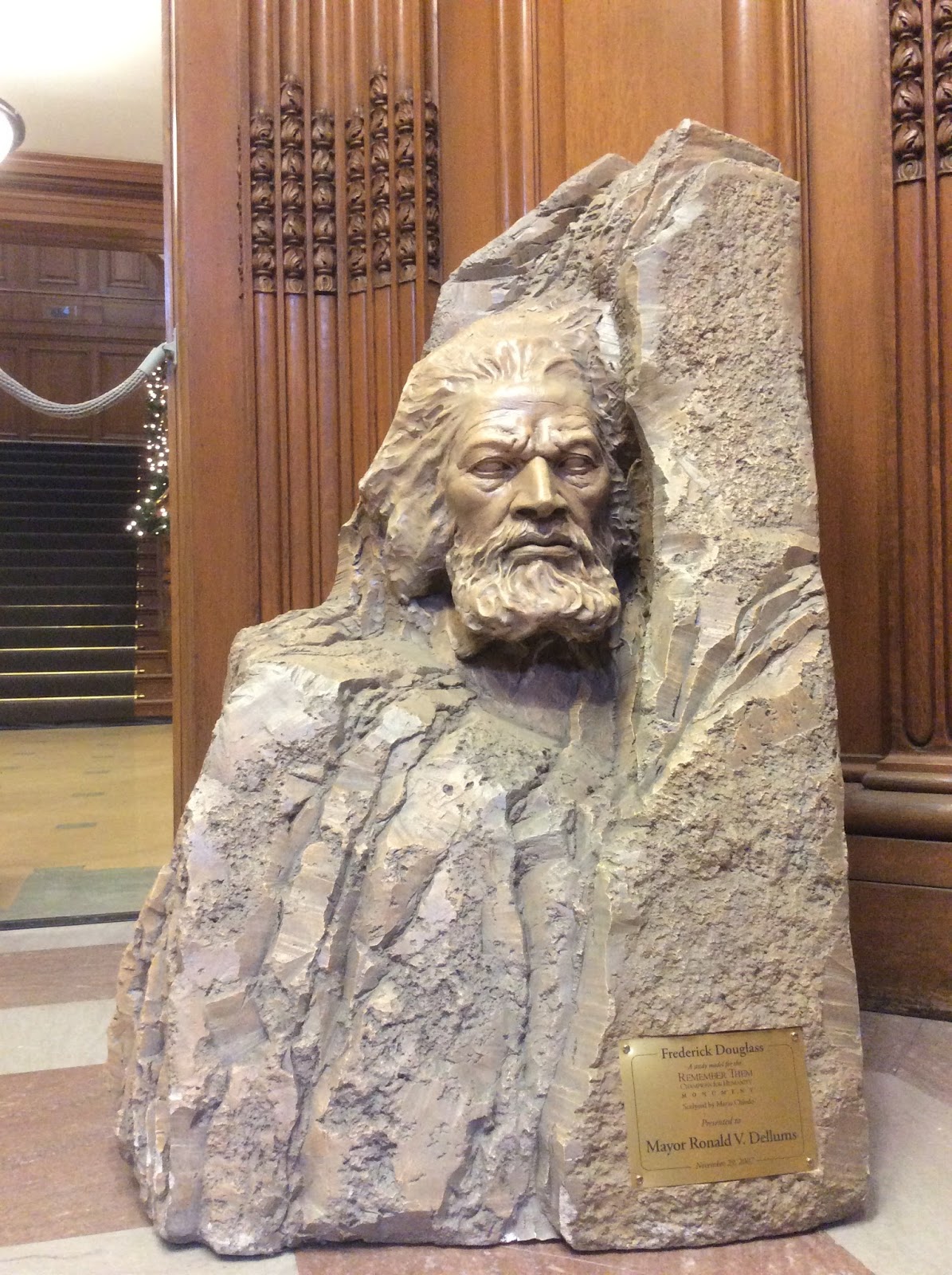
Sculpture of Frederick Douglass, AAMLO

The AAMLO is a new discovery for me this December, and as I enter, I’m greeted, to my delight, with a handsome (if rather stern) sculpture of the hero of my series. It’s this effigy of Douglass, in fact, which inspires me to just jump right in and start his Traveling Philosophy series here in Oakland.

So I’ll begin, as I mentioned, with stories and reflections on his life and work. My trip to the East Coast, tentatively planned for late winter / early spring, and the stories of that journey will be followed by a second series of essays inspired by my discoveries in the course of my travels. I hope you enjoy this new format, and as always, welcome any feedback you wish to offer!

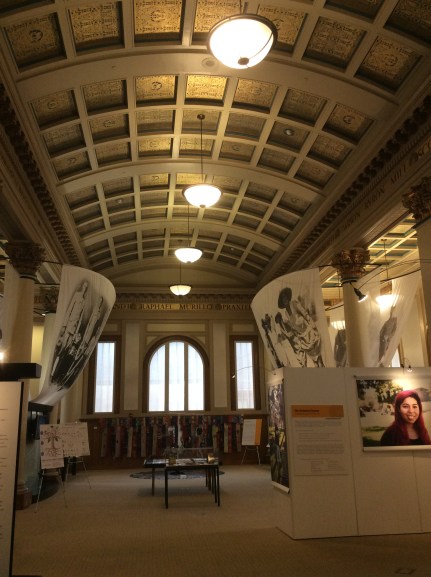
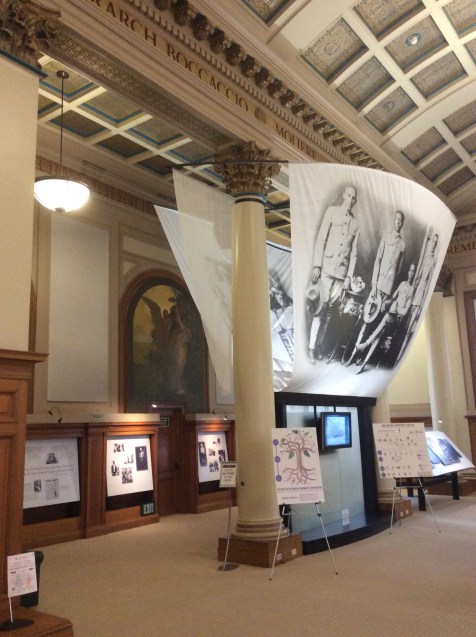
An interior view of AAMLO

AAMLO is a reference library only, so all materials I use must stay here. That’s perfectly fine with me, it’s such a lovely place to work, and lucky for me, it’s quite close by to where I live and work. Since I’ll be returning here a lot, I pick a quiet, cozy corner, and get to work…

One afternoon, after reading and making notes for quite some time, I feel the need to stretch my legs and rest my tired eyes. I go upstairs to the museum, a long gallery which runs the length of the building and which used to be the main reading room.

Crowning the main stairway which leads to this upper gallery, there’s a huge collage of great figures in African American history. It just so happens that the image of Douglass is under the name of Spinoza, among the list of names of great thinkers of the past which embellishes the frieze. Cool. Baruch Spinoza is next on my list of great thinkers to follow, but that’s a story for another time. I’d bet they’d have the most fascinating conversations, though, if they could speak the same language. Though they were very different in their histories, their particular beliefs, and their personalities, yet they were both lovers of reason, and they both lived authentically, true to their beliefs, models of intellectual integrity as they refused to obey the unjust rules of the societies they lived in.

An interior view of AAMLO, Oakland, CA, 2015 Amy Cools

A view of AAMLO’s main gallery on the upper floor

The museum tells the story of the African American people who did so much to make Oakland the vibrant and diverse city it is today, and how America’s legacy of laws and practices both helped and harmed the African American community here and throughout California. The African American community in Oakland grew by leaps and bounds throughout the 1900’s, much of it made up of refugees from the Old South, and through hard work, came to make up a significant proportion of its thriving middle class. Oakland’s economy centered around its busy port and manufactures, and as the work dried up after the stock market crash of 1929, it was no surprise that the economic woes hit African Americans the hardest: when jobs become more scarce, it was not the favored demographics that suffer from it most, as you may expect: Oakland’s working black population lost well over a third of their jobs.

Douglass himself experienced job discrimination in his time working on the Maryland docks as a caulker, hired out as a wage earner in the Baltimore shipyards for his master before he escaped to freedom. In his Narrative, Douglass relates the story of a severe beating he received at the hands of white shipbuilders who resented the competition of low-paid black labor, both slave and free. Douglass was driven from his job by violence; in 20th-century Oakland, it was a combination of job discrimination, rules and laws which prevented black people from joining or forming unions, and differential treatment by law enforcement. Not everything had changed since Douglass’s day.

A view of an exhibit in AAMLO's main gallery, upper floor, AAMLO, 2015 Amy Cools

A view of an exhibit in AAMLO’s main gallery

So as black Oaklanders suffered many of the worst effects of the economic downturn, the ills of poverty hit black communities the hardest, and harsh, unjust policing practices and drug policies exacerbated the problems that they may have been meant to alleviate. Many, however, passionately believe that there was no honest intent to help, just to oppress and destroy the black community. Whatever the case may be, the desperation of so many of Oakland’s black people makes it no wonder that the Black Panther Party was founded here in Oakland in the 1960’s. Then as now, a strong cultural tradition of racial justice activism and civic unrest flourished, sometimes, as again to be expected in an environment where so many felt disenfranchised and disrespected, to excess.

If he were alive to witness it, Douglass may have disapproved of many of the Black Panther Party’s militant tactics, but like the B.P.P. and Malcolm X after him, he came to believe that some kind of armed resistance may be necessary to achieve liberty and full equality for black people, and that if violent resistance was necessary to change the laws, it was just, given the depth of oppression and injustice black people suffered. He was, for example, an admirer of John Brown, a passionate abolitionist who unsuccessfully tried to start an armed slave rebellion and was hanged for treason as a result.

What Douglass thought about whether or not it’s right to use violence in the cause of furthering human rights, and if so, how much, against whom, and when, is a big topic, one for another essay in this series. Stay tuned!about whether or not it’s right to use violence in the cause of furthering human rights, and if so, how much, against whom, and when, is a big topic, one for another essay in this series. Stay tuned!

* Listen to the podcast version of this piece here or on iTunes

* Follow in the footsteps of Frederick Douglass with me… 

Ordinary Philosophy and its Traveling Philosophy / History of Ideas series is a labor of love and ad-free, supported by patrons and readers like you. Please offer your support today!

~~~~~~~~~~~~~~~~~~~~~~~~~

Sources and Inspiration

Douglass, Frederick. Narrative of the Life of Frederick Douglass. Originally published in Boston by the Anti-Slavery Office, May 1st, 1845.

O.P. Recommends: Bettany Hughes on Three Intellectual Giants of the Ancient World and Their Practical Wisdom

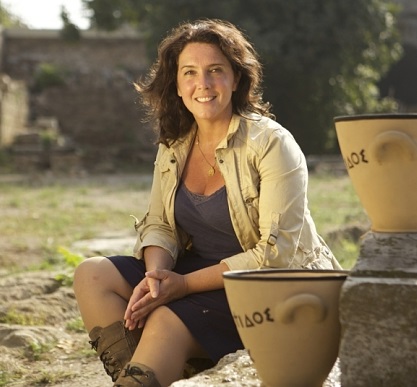
I’ve been listening to this wonderful new series by the always delightful historian and documentarian Bettany Hughes, as she delves into the origins of philosophy.

She tells us the story of three ancient thinkers who remain among the world’s most influential: the Buddha, Socrates, and Confucius. These men, who all lived within one hundred years of each other, formulated their groundbreaking philosophies at a time when new technologies in food production, housing, and travel allowed human beings, for the first time, to form sophisticated, specialized societies. This enabled people to spend a lot less time devoted to mere subsistence and to divert much of their energies into the arts, into thought, and into figuring out how the world works. It also made people ready and able to think of life as something they could improve and control, not merely subject to the whims of nature and of capricious, mysterious gods.

Hughes is not only enamored with these three great thinkers because they are fascinating in their own right, but because she thinks of philosophy as I do: a deeply practical pursuit, in which we puzzle out how to go about living as good a life as we possibly can, as individuals and as societies. As I’ve heard her say, we need to bring philosophy back to the street where it began, where Buddha, Socrates, and Confucius first confronted the world with their ideas, and where it also belongs.

Check out the series, which originally aired on the BBC, here:
https://www.youtube.com/watch?v=MCv20Z1q7eI
https://www.youtube.com/watch?v=N2cI9LfKKqo
https://www.youtube.com/watch?v=_zfENJlVz-g

Second Day in Paris Following Thomas Paine, Mary Wollstonecraft, and Thomas Jefferson, Part 1

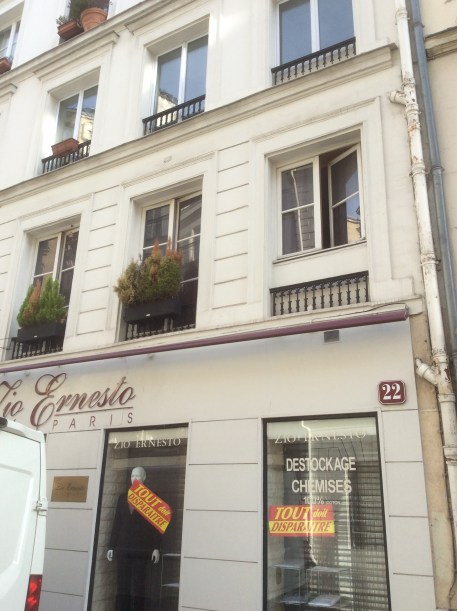
22 rue Meslay, Paris. Mary Wollstonecraft may have lived here at Aline Filliettaz’s house from December 1792 through June 1793. See update to the search for the Filliataz house

Monday, August 10th, 2015

I get up at a decent hour, though of course not too early: I discovered early on when I began to travel in earnest that proper rest is essential for clear thinking, map-reading capabilities, and the good humor necessary for enjoying the day.

Since there’s such a huge number of sites to visit on my itinerary, I’ve decided to visit them in an order determined not by subject nor in any kind of chronological order, but by proximity to one another, so I can better cover them all.

I make my way from my temporary digs on Boulevard Voltaire up toward Republique, then make a soft left and head for 22 rue Meslée (now called the rue Meslay). Mary Wollstonecraft lived here at her friend Aline Filliettaz’s house from December 1792 through June of 1793, shortly after arriving in Paris. Wollstonecraft was full of hope for the Revolution and longed to be a part of it, and thought that the humanitarian and egalitarian Enlightenment principles she espoused were more likely to take hold there before they would in her home country of England, as they had (to an extent) in America. By the time she arrived in Paris, she was a self-made woman, a governess and schoolmarm who had become the bestselling author of two progressive and highly influential books, A Vindication of the Rights of Men, 1790 (a scathing rebuttal to Edmund Burke’s Reflections on the Revolution in France) and A Vindication of the Rights of Woman, 1792.

In fact, her Rights of Men was published the year before Paine’s Rights of Man, which was also a response to Burke, but Paine’s became the most famous by far. However, Wollstonecraft held her own with Rights of Woman, as it’s now widely considered the founding work of modern feminism. Wollstonecraft was lonely and blue when she first lived at this house, since her hosts were away and the servants behaved haughtily and uncooperatively towards her, but she soon cheered up when she began to get out more and hang out with her expatriate friends and their Parisian social circle. (More on that soon.)
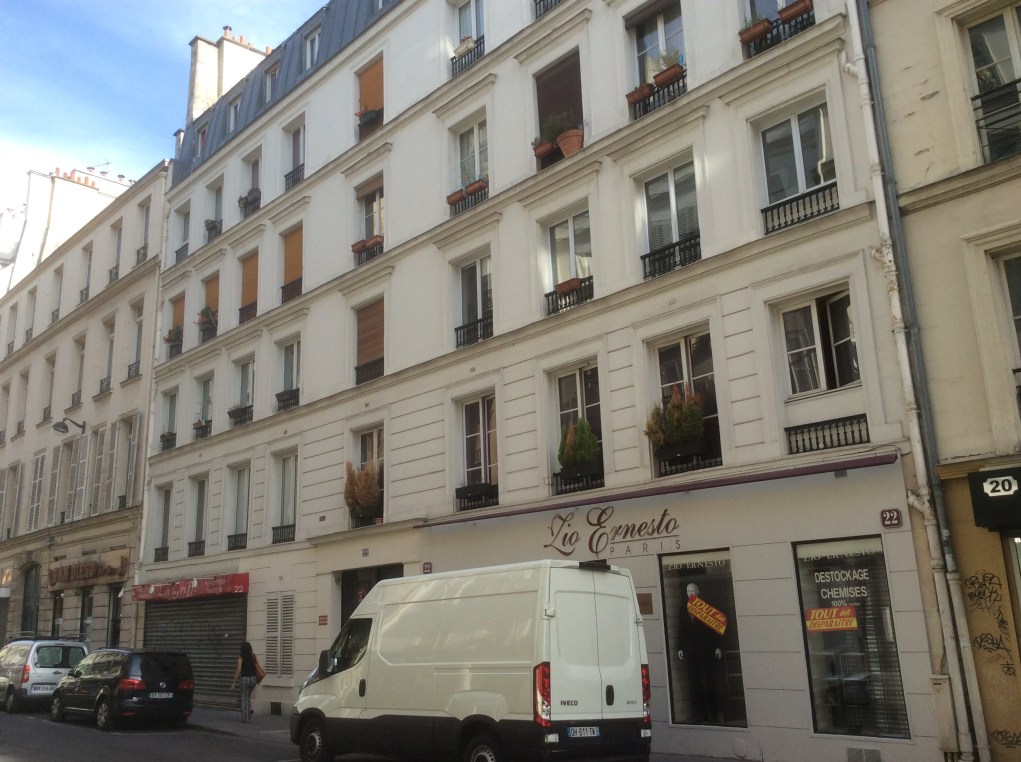
Building where 22 rue Meslay is now located in Paris, France

The Fillattaz house is on a little side street in the Marais district, near the medieval Temple where the royal family was held during the French Revolution, before the King was guillotined in December of 1793 and Marie Antoinette was sent to the Concierge. Wollstonecraft wrote in her account of this period in her life that she saw the King being taken from the Temple prison to his trial at the Hôtel de Ville, where the Convention Nationale was held, from her window at this house. See update to the search for the Filliataz house

By the way, it’s important to make this point at the beginning: as is the case with all private residences and some other sites I visit during this tour, unless I can find a clear indicator of the history of the building (in accounts I have access to, on plaques, on cornerstones, etc), it’s very possible that I may not have found the exact location, especially if it’s not a public building with a clearly documented history. Many of my sources list an address without specifying whether it’s the modern address or the historical one and numbers change over time, and some streets are re-routed or disappear entirely, as do many of the original buildings, and records are not always consistently kept or may have been lost in the intervening years. Since my subjects were all here well over two centuries ago, it’s likely that at least a few of these locations are approximate, rather than the exact sites, despite my best efforts to discover them. This is especially true of Mary Wollstonecraft since she’s the only one of my subjects who never held public office or had any government appointments.
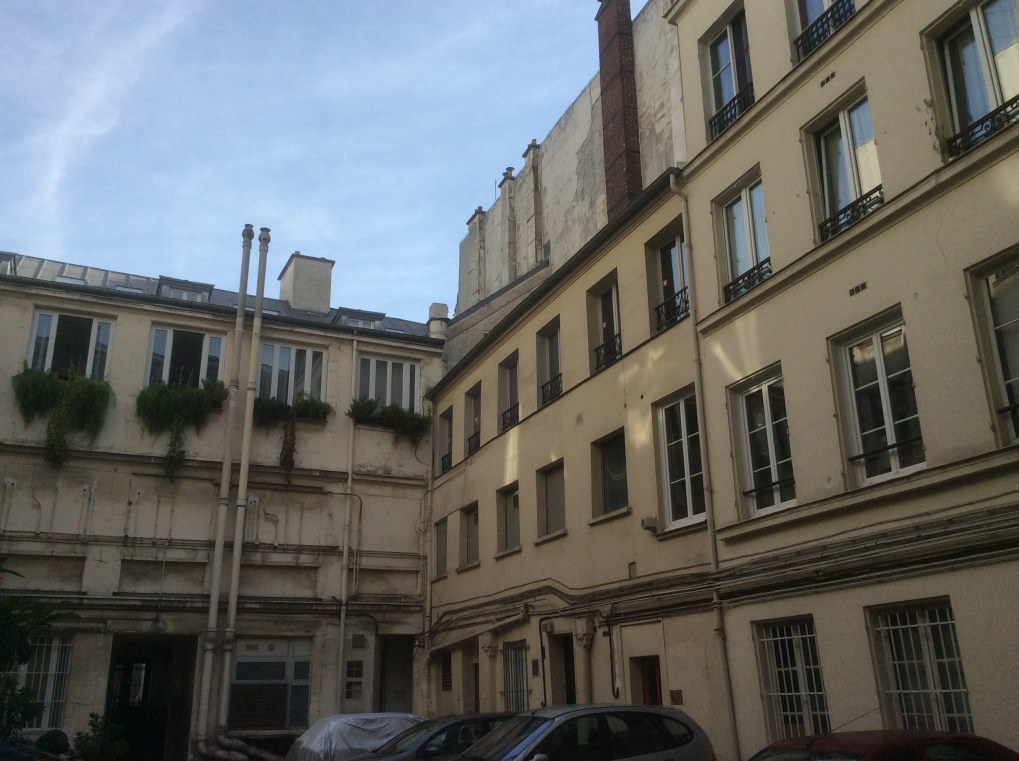
Courtyard behind 22 rue Meslay

63 rue Faubourg St-Denis, Paris, France. It’s the right address but not actually the site of Paine’s once-time residence, since the address had changed since his time. You can the story of how I find the true site here.

For example, poking around for historical details of the rue Meslay, I found that George Sands was born on that same street, and the address was 15 in her time, 46 now. I didn’t find any info as to whether Wollstonecraft’s 22 address is the new one, old one, or just that same address in different sources, but since she described seeing the King’s carriage pass by her window on the way to trial, it may be that the Filliettaz house was further up the street, in a taller building or at a higher elevation, so that she could see as far over as Boulevard Saint-Martin, the next street over and the route he would taken. But another source describes the house as having six stories, and the house now at 22 matches this description.

If I have time, I might swing back over there for further explorations since the place I’m staying now and the place I’ll be staying when I return to Paris (I’ll be joining my husband Bryan tomorrow for a quick family visit to Berlin, then to Saint Quentin en Yvellines where he’ll commence the Paris-Brest-Paris cycling event) are not too far away.
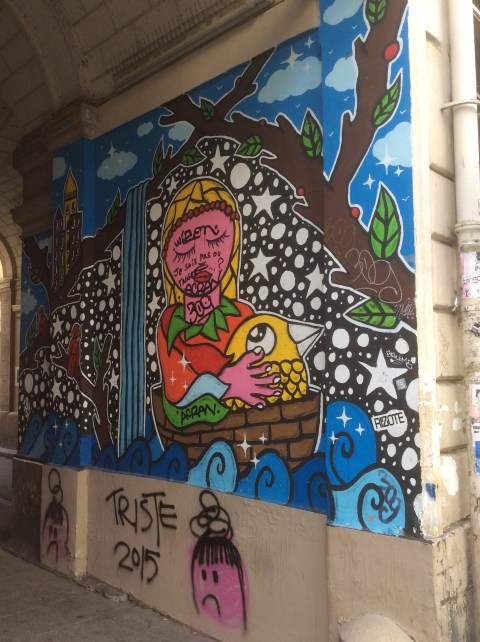
A mural on a wall on rue Faubourg St-Denis

Next, I head for 63 rue Faubourg St-Denis, at rue des Petits Ecuries, where Thomas Paine moved in 1793 to share the ground floor of a ‘mansion farmhouse’ with six friends. Paine wrote in glowing terms of the lifestyle there, and they had farm animals and grew fruits and vegetables, as that area was still pretty rural, and they would romp in the garden to take their minds off the tumult and violence in Paris. He was living here when he, with a committee of nine others, drafted a new constitution for France, though this one was unsuccessful: the Girondin faction which Paine worked with were moderates, while the radical Jacobins were gaining power and, over time, took over the Revolution entirely, instituting the Reign of Terror. (See update on the search for the rue Faubourg Saint-Denis house).

It’s unlikely that any part of the building that stands here now is original, either in whole or in part, given Paine’s description of it, and the current address may not the same as the historical one [this turns out to be the case]. The only fruits and vegetables to be obtained here now are from the colorful produce shops that line this now urban, rough-around-the-edges but vibrant and colorful part of the city. I think this neighborhood is wonderful, and it reminds me in many ways of the Mission district of San Francisco before it became mostly taken over by hipsters and tech people.
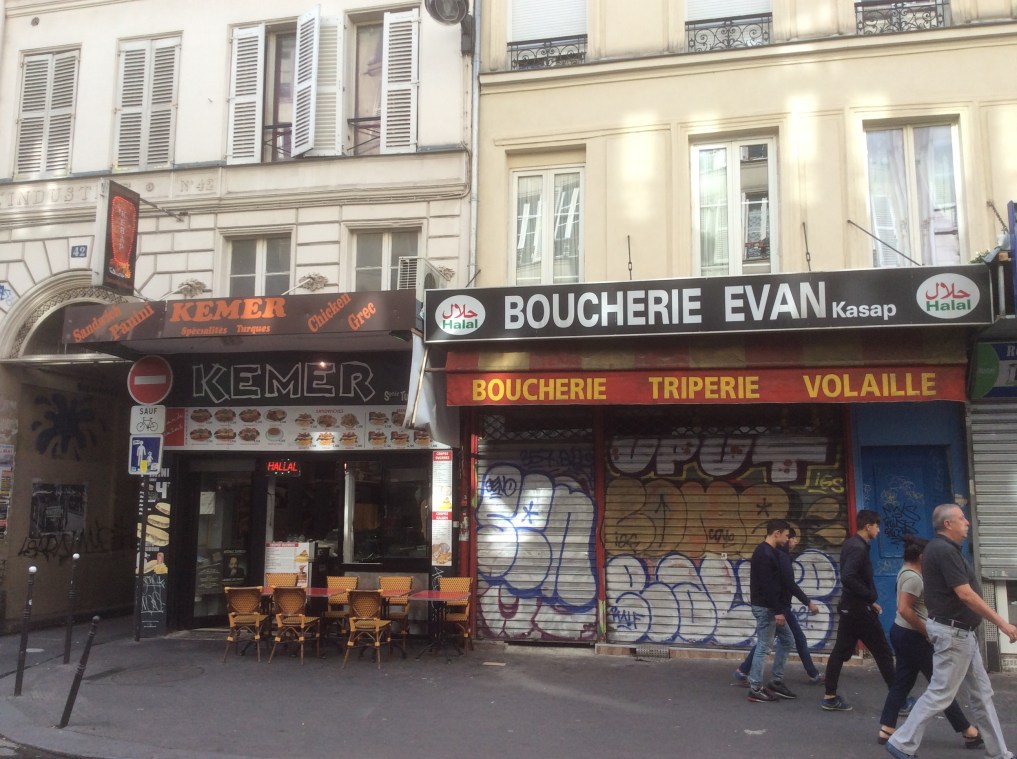
A view of rue Faubourg St-Denis
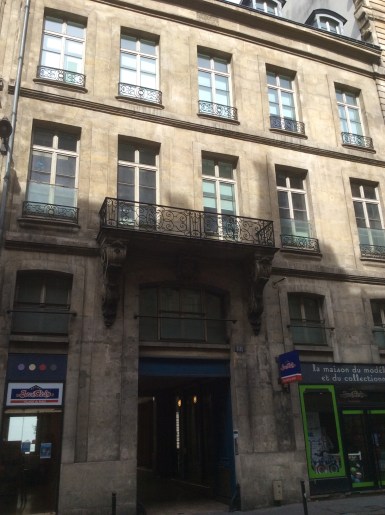
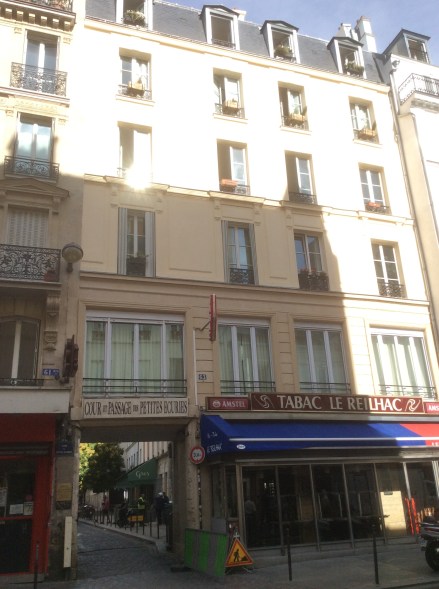
At 101 rue de Richelieu, Paris, France.

Next, I head down to rue de Richelieu in search of the place where Thomas Paine moved in with James Monroe’s family in November 1794. Monroe had finally secured Paine’s release from his eight-month imprisonment at the Luxembourg (I’ll return to this subject after I’ve visited that palace-turned-prison-turned-Senate house). Paine lived with the Monroes for about 2 years, not all of them here, since they moved more than once. At the time of his release, they lived at 101 rue de Richelieu, which begins at Bd. Montmarte where it meets Bd. Poissonere, in the 2nd Arrondissement.

At 101, I find a classy place, fit for an honored foreign dignitary, with a lovely courtyard with a lovely arched entryway, updated with a modern reflecting pool. Again, I’ll return to this street soon for further explorations, which will be easier next time since I’m now getting very familiar with this corner of Paris, and as I find more source material with which to confirm whether the numbers have changed. (See update to the search for the Monroe house on rue de Richelieu.)
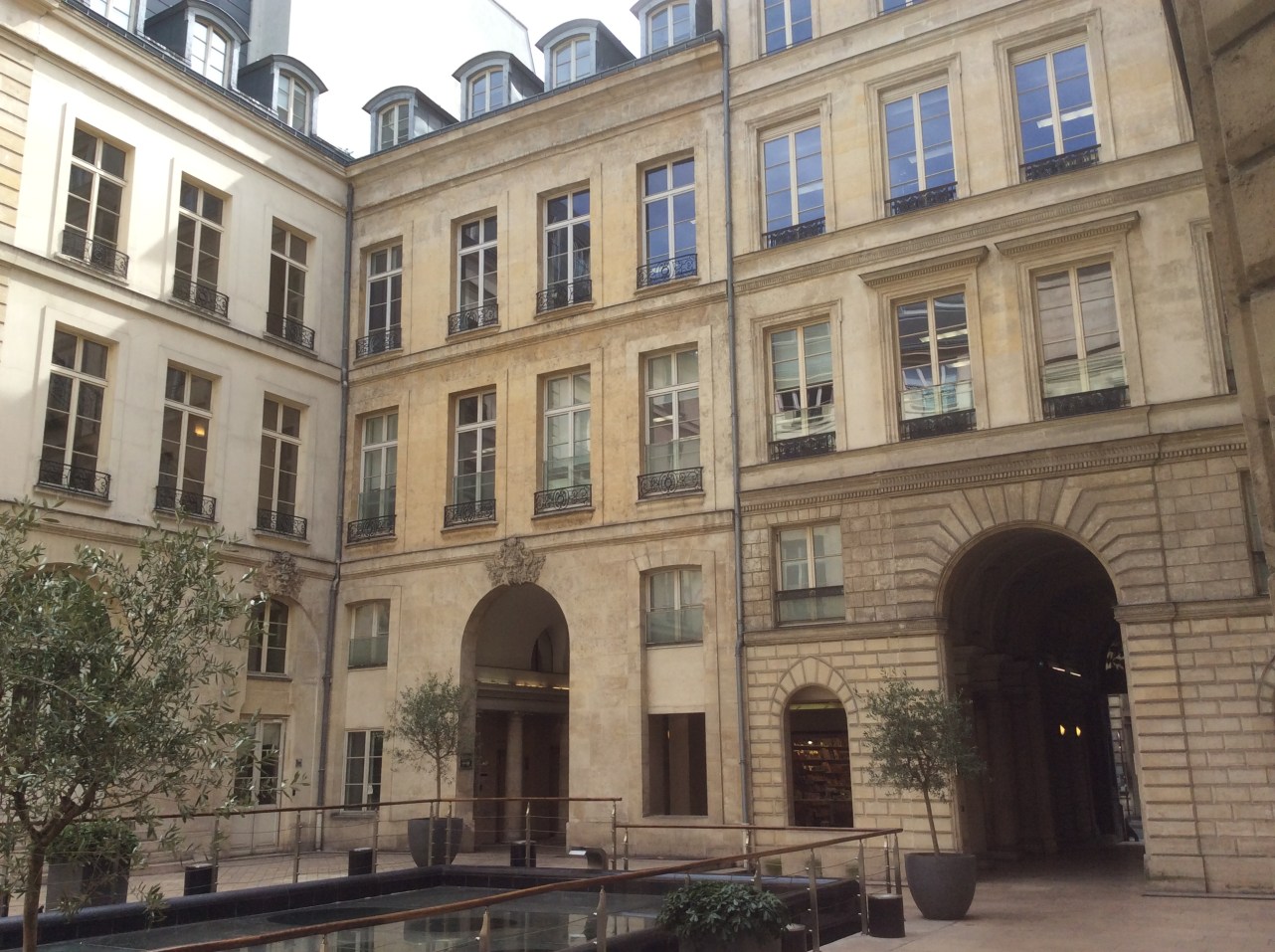
Courtyard at 101 rue de Richelieu
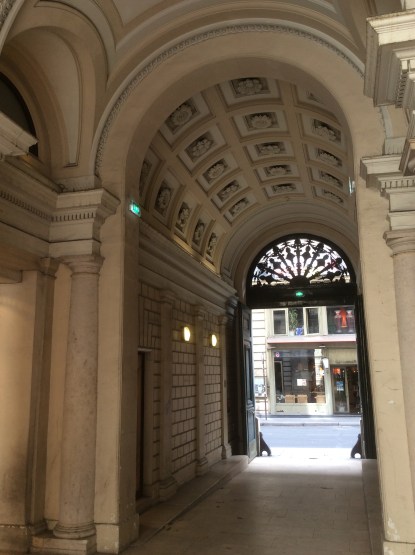
An entryway to 101 rue de Richelieu

When Paine was released from prison, he was broken down in health and spirits: he had nearly died from typhus, and he had an open ulcer on his side that wouldn’t heal. He had also felt that his American friends in high places had deserted him, not doing what they could to rescue him from his predicament. He was especially upset with Gouverneur Morris, the ambassador (then ‘Minister Plenipotentiary’) to France at the time, and with president George Washington. Morris was the primary author of the preamble to the United States Constitution as well as many of its other sections and he was an able statesman, but the French government lacked confidence in him; he was recalled after they repeatedly requested he be replaced by another. From their writings, it appears that Paine and Morris alternately liked, respected, and loathed one another. Morris often writes very sarcastically about Paine, and though I’m quite the Paine fan-girl, I find some of his remarks very funny and witty, though others are just plain bitchy and catty.

While Paine did offer valuable assistance to Monroe (Morris’ replacement) in his role as the new American ambassador, Paine was at this time also, as an aftereffect of his imprisonment and disillusionment with the French Revolution, given to depression, anger, and paranoia, and as a result of all of these, binge drinking. He was to acquire a reputation as an alcoholic, but since these accusations came almost entirely from his political enemies during and after his lifetime, this characterization is suspect. His friends and colleagues describe him as a social drinker, wont to make merry in the evenings and engage in enthusiastic discussions about politics, science, and philosophical topics as long as anyone was willing.

I next head north to rue Taitbout and turn left on rue de la Victoire, and go to the grand house at 60 rue de la Victoire, which was 6 rue Chantereine in Paine’s time, in the 9th Arrondissement.
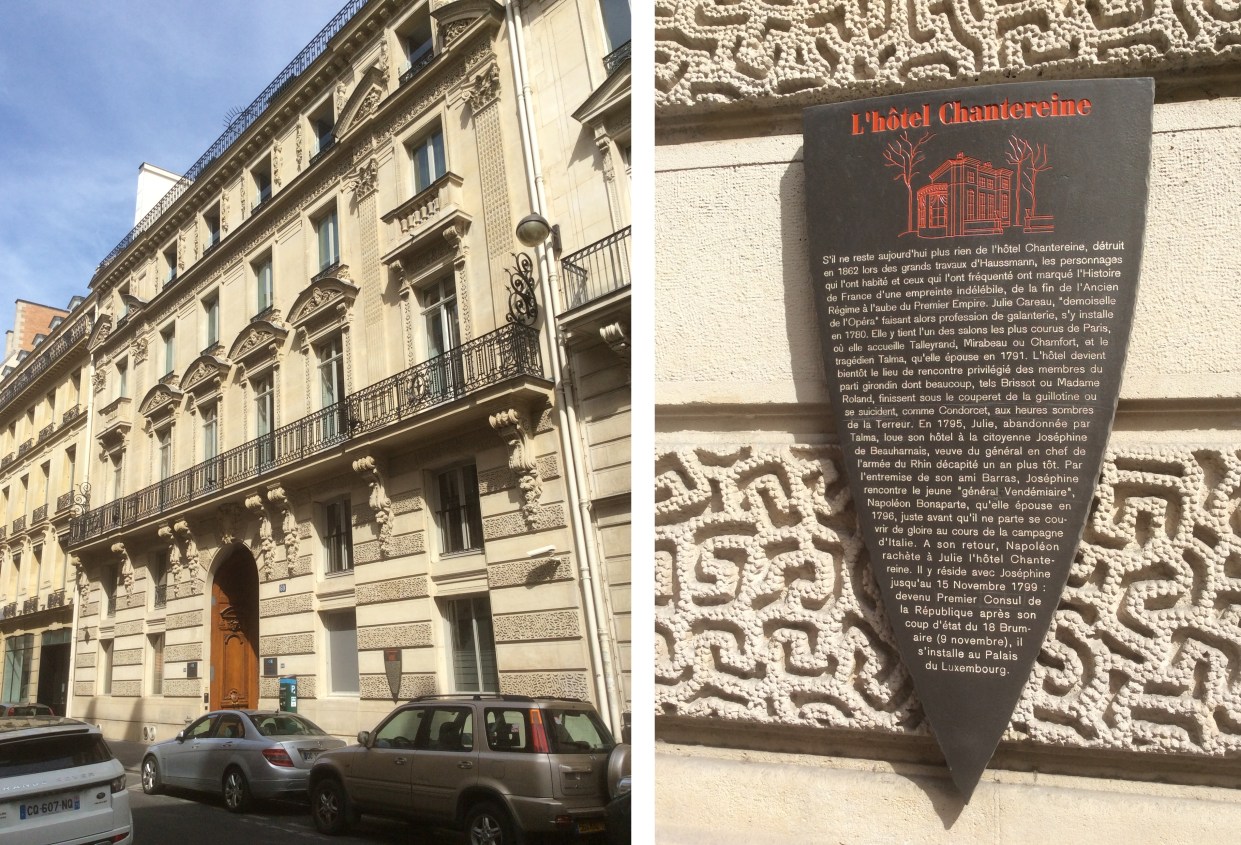
60 rue de la Victoire, once 6 Rue Chantereine, former Home of Napoleon and Josephine Bonaparte

It was likely in this house that Paine attended a party thrown by Julie and Francois-Joseph Talma in October 1792. The house was owned by Mrs. Talma, formerly Louise-Julie Carreau, and she held a famous salon here. Her husband was a well-known actor and passionate Revolutionary, friends with Jacques-Louis David (who, I was surprised to discover was among those who voted in favor of executing the King) and Napoleon Bonaparte, who moved into this house in 1796 with his new wife Josephine). Like Paine and Wollstonecraft, the Talmas were Girondinist in their sympathies, yet there was a ruckus between Paine and other attendees of the party, many of whom had begun to turn on this once-beloved muse and author of two revolutions.
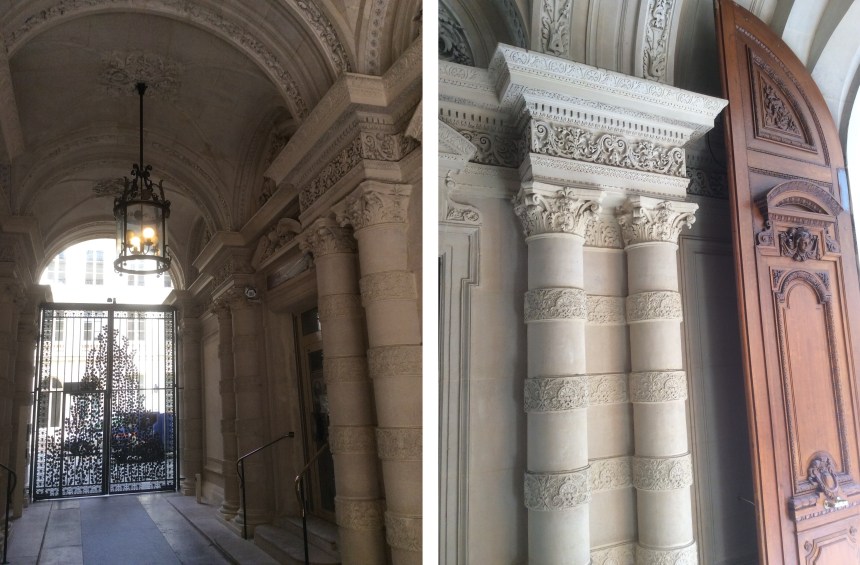
Two Details of 60 rue de la Victoire, former Home of Napoleon and Josephine Bonaparte

The history of the French Revolution is, among other things, a prime example of how people, even as they see themselves pursuing the same lofty goals and are members of the same political party, just can’t seem to avoid petty infighting. This sort of thing undermines so many important projects, and as we see all too often, petty disagreements can devolve to self-righteousness and even blind radicalism over time. French culture, in that era especially, placed a high value on ‘sensibility’, valuing the free expressions of both raw and cultivated emotions. As we have also seen in the French Revolution, unbridled passion was very often allowed to trump reason. To Paine’s dismay, he watched the beloved Enlightenment campaign for rational democratic government, that he served so enthusiastically and so well, turn into a bloody campaign of vengeance and terror.
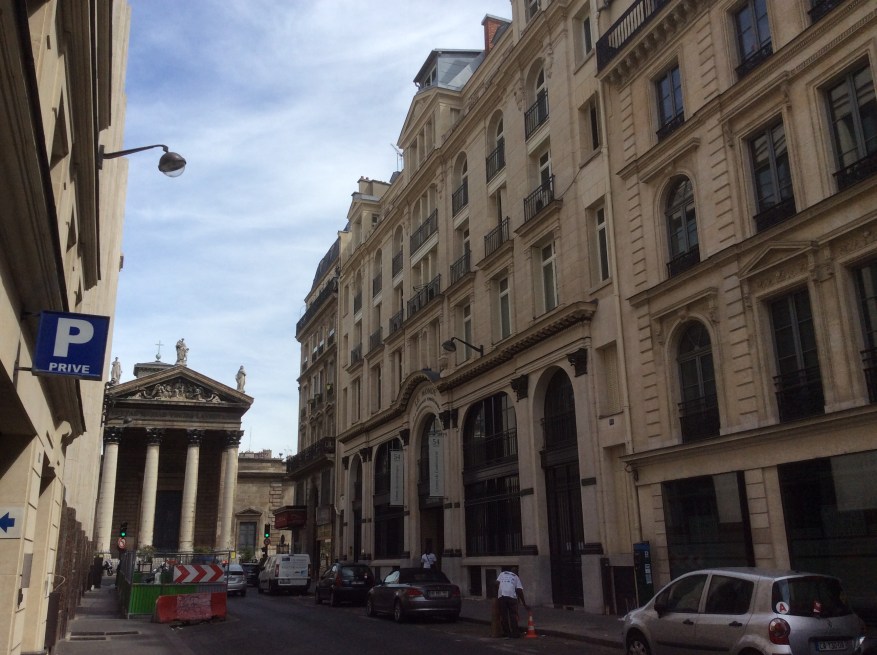
View of Église Notre-Dame de Lorette from Rue Lafitte, Paris, France
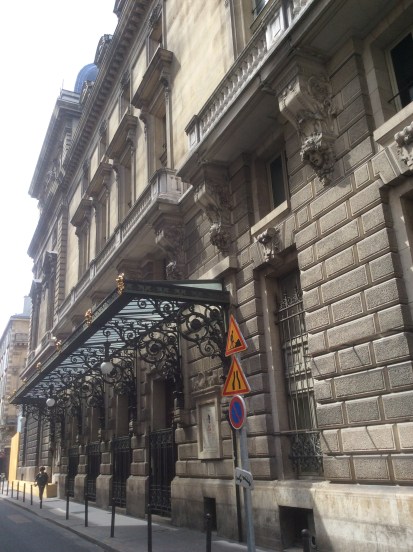
Side view of Opera Comique, Formerly Theatre Des Italiens

It was very near this place that Thomas Jefferson moved for awhile, eight years earlier in October 1784, on the cul-de-sac (impasse) Taitbout off rue La Fayette near rue St Georges. He signed a long-term lease at Hotel Landron, also called Hotel Taitbout, but only ended up living here for about one year. I explore this area very thoroughly, peeking into every courtyard, driveway, and byway I can find, but a hotel by this name is nowhere to be found so far as I can see. (By the way, ‘hotel’ wasn’t used in the same sense as we use it today: It could refer to a grand house or a large public building.) This area is very near where I’ll be staying next week, so I’ll return if I find more leads, and I’m looking ever more forward to doing so, it’s such a beautiful neighborhood.

Jefferson was an avid patron of the arts, and attended the theatre often while living in Paris to see plays and musical performances. He often went to the Theatre des Italiens, very near his Taitbout place on Boulevard des Italiens. There is no theatre today with that name, but I find Opera Comique in just about the right place. Could this be the same building? The building appears to be of the right vintage. I look into it, and sure enough, it is! It’s in the process of getting a facelift and a good cleaning, but the side entrance is in good repair and attractive with its lovely cast iron lacy canopy.
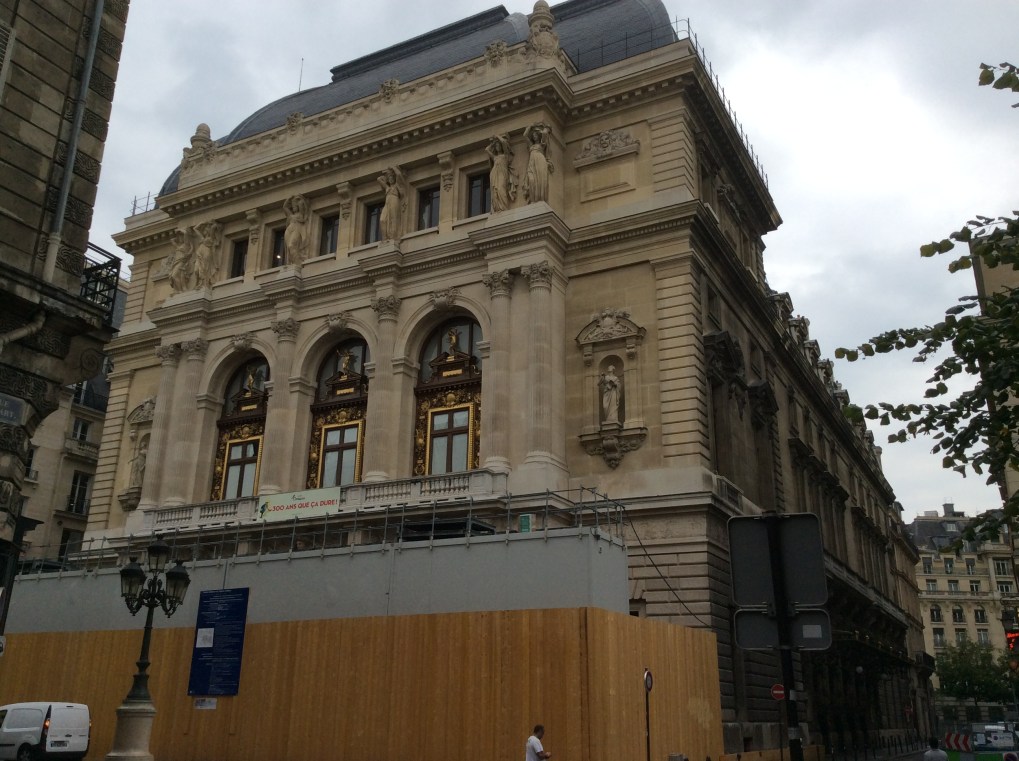
Opera Comique, formerly Theatre Des Italiens, Paris, France, under repair

I still have many sites I’ll be visiting throughout the course of the day, so I’ll take a break here.

To be continued in Part 2:  >>>

~~~~~~~~~~~~~~~~~~~~~~~~~~~

Sources and inspiration:

Adams, William Howard. The Paris Years of Thomas Jefferson. New Haven/London: Yale University Press, 1997.

Bell, David. ‘5 Myths About the French Revolution‘, New York Post, Jul 9th, 2015.

Gordon, Lyndall. Vindication:  A Life of Mary Wollstonecraft. New York: Harper Collins, 2006.http://www.harpercollins.com/9780060957742/vindication

Grossman, Ira. ‘The House on the Rue de la Victoire
Jacobs, Diane. Her Own Woman: The Life of Mary Wollstonecraft. New York: Simon & Schuster, 2001.

Jacoby, Susan. Freethinkers: A History of American Secularism. New York: Owl Books, 2004.

Nelson, Craig. Thomas Paine: Enlightenment, Revolution, and the Birth of Modern Nations. New York: Viking Penguin, 2006.

Todd, Janet. Mary Wollstonecraft: A Revolutionary Life. New York: Columbia University Press, 2000

Tomalin, Claire. The Life and Death of Mary Wollstonecraft. London: Weidenfield & Nicholson, 1974.’

French Revolution.’ Wikipedia, The Free Encyclopedia., Jul. 17 2015.

Williamson, Audrey. Thomas Paine: His Life, Work, and Times. New York: St. Martin’s Press, 1973.

First Day in Paris Following Thomas Paine, Mary Wollstonecraft, and Thomas Jefferson

My first rented room in Paris, France, following Paine, Wollstonecraft, and Jefferson

Sunday, August 9th, 2015

I arrive at Charles De Gaulle airport on Sunday afternoon, fairly well rested for once. Usually, I don’t sleep well on planes, and stumble off the walkway groggy and stupified. This time I slept about two thirds of the way through the 10 1/2 hour flight …not well, mind you, but much better than nothing. I attribute it to the ibuprofen tablets I took shortly before boarding, making the cramped quarters less painful to sleep in: my travel tip of the day! It was great to arrive and feel competent to navigate the trains, find my destination, and go out and start enjoying myself without delay.

At about 6pm, I meet my host Aurelia at 46 Rue Voltaire, a couple blocks down from Oberkampf station, in the 11th Arrondissement. She is sweet and helpful, and a practiced Airbnb-er: she has a series of photos on her iPhone at the ready so she can show me how to navigate the passageways, six flights of stairs, and unmarked doors to reach my mini apartment. The place is tiny, with the loft bed over the desk, the toilet tucked into a cubbyhole beside the shower, and the whole place the size of a small bedroom. On the whole, it suits me just fine, since it’s clean, private, and in a great neighborhood at a cheap price, but being somewhat tall and not used to these close quarters, I whack my head often.

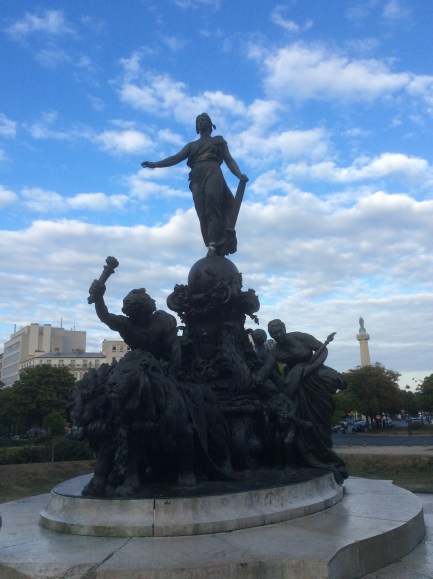
Triomphe de la République, the sculpture at the Place de la Nation

I decide not to dive right in my historical adventures, but to take an aimless walk around instead, to get my bearings, wake up a little more, and re-immerse myself in this city which I last visited seven years ago on honeymoon. Right away, I find myself feeling a little wistful, feels odd to be here without Bryan. He’ll be joining me in a couple of days, so I console myself and head out.

I walk down Boulevard Voltaire in search of something better to eat than airplane food, which takes me awhile: most places are closed (usual in late July to mid-August, as my host informs me), until I get closer to Place de la Nation, which is is getting busier as the night crowd are starting to emerge. I find a boulangerie, where I pick up a butter croissant and another sweet one for tomorrow’s breakfast. I admire the sculpture, then turn up Boulevard Diderot, sit down for an Edelweiss (lightly tart beer), a couple of smokes (an old habit I like to indulge myself in on special occasions) and a little people-watching. It’s a lovely warm evening.

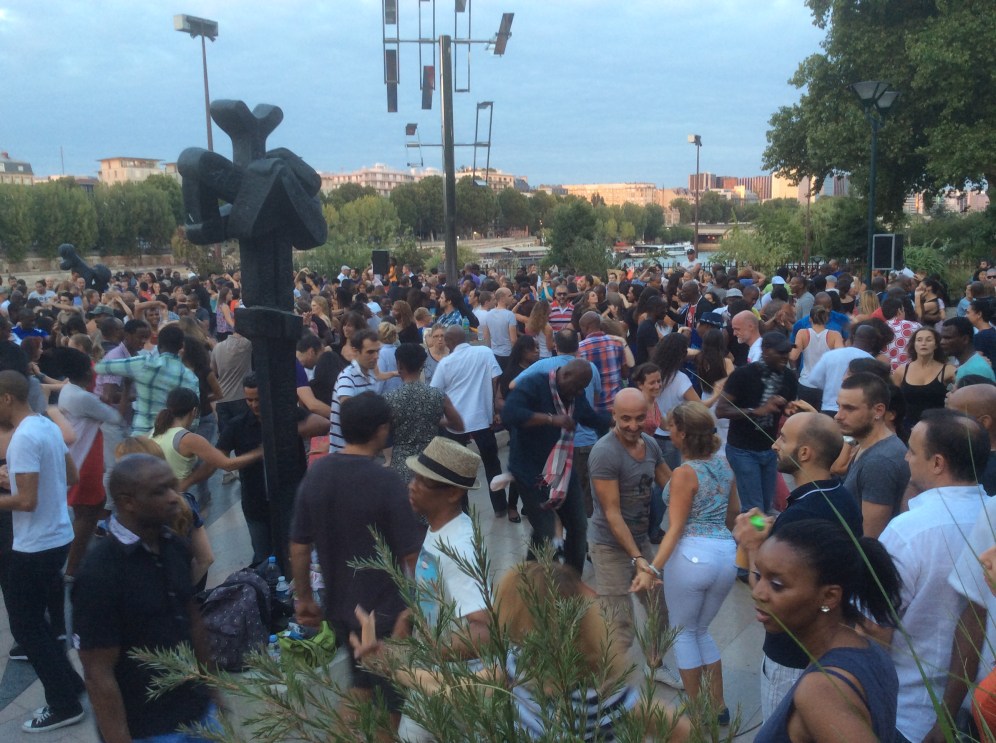
Latin dancers at the Quai St-Bernard along the Seine, Paris, France

I continue on towards the Seine, cross the Pont d’Austerlitz, and walk east along the river. In the park and sculpture garden on Quai St-Bernard, I happen upon masses of people dancing on three dance floors: the first was dedicated to the foxtrot, the other two to Latin dancing. One was huge, must have been well over a hundred people dancing until the sweat was dripping, ringed by crowds of spectators. I dare not join in the dancing: I can’t seem to learn steps to save my life, last time I took a dance class I caught the teacher apologizing to my assigned dance partner, probably for the bruises I pounded into his feet with my own.

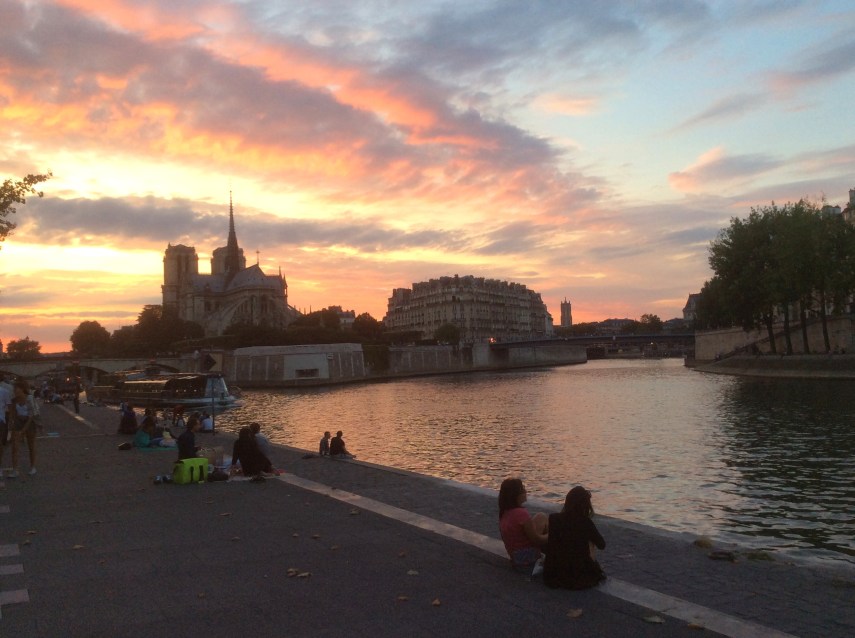
The sunset is pink, orange, and gold against the blue sky and above the silver Seine as I pass by Notre Dame.

Gazing at the Île de la Cité from the Left Bank of Paris, France

On the bridge to the Île de la Cité, there was another crowd clapping and cheering for three performers, two on roller skates and one on rollerblades. In turn, they speed-skate up a ramp and over a crossbar set very high in the air, perhaps 15 feet or so.

As I’m reminded constantly on my evening stroll, Paris, like our Washington D.C., has not forgotten its nation’s Revolution. Its heroes and events are memorialized in the names of street after boulevard after avenue, in monument after statue after city square: Rue La Fayette, Place de la Bastille, Place de la Republique. So are its philosophes: along with Voltaire and Diderot, there’s Jean Jacque Rousseau, Montesquieu… even our own Thomas Jefferson is an honorary member of this elite company: his larger-than-life bronze sculpture adorns the Left Bank of the Seine.

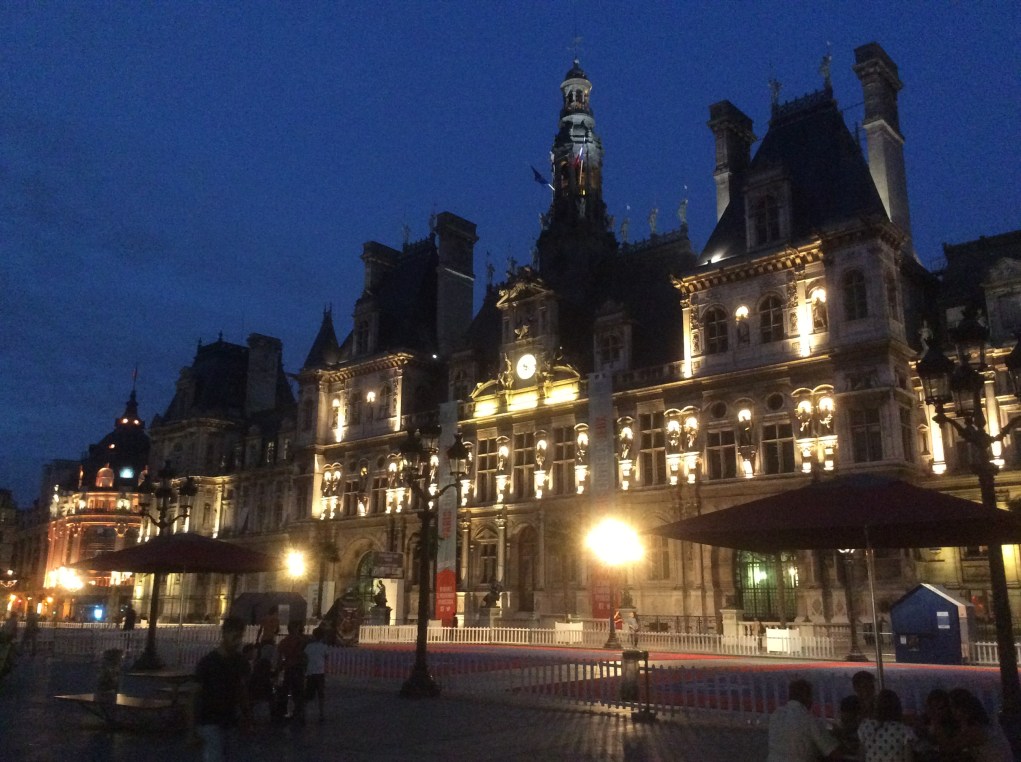
Hôtel de Ville, Paris, France, on the right bank of the Seine

Other than some of the street names and monuments, my evening stroll took me by only one site
associated with a subject of my trip: the Hôtel de Ville, which has several connections with the life of Thomas Paine. It’s a very grand building, and looks both lovely and impressive all lit up at night, but it’s not the original building of Paine’s time. That one was burned down in another French revolution in 1871, in the same round of anti-monarchical arsonists that claimed the Tuileries palace and nearly claimed the Louvre.

I walk around the building to see if one of the statues in its many niches was Paine, but I can’t find one. It’s pretty dark out, though; the statues I see whose caption I can see in the half-light are all Frenchmen. However, Paine was a celebrity in France following his publication of Common Sense, which offered a comprehensive philosophical defense for the rightness of the cause for American Revolution, and again when he wrote The Rights of Man. His arguments resonated with many of the French people, who felt themselves chafing under a rigid hierarchical structure and high taxation maintained and imposed by an unchallengeable monarchy, aristocracy, and clergy. So it was at the Hotel de Ville on August 26, 1790 that the Paris Commune voted to make Paine an honorary citizen. When he returned to Paris in September of 1792, he was elected to the French National Convention; no matter that he couldn’t really speak French, one who so eloquently speaks for human freedom and dignity speak to all. So though he might be properly honored by a sculptural portrait here, so far as I can find out, he has none among the niches.

More to come soon: my next day in Paris is entirely dedicated to following in the footsteps of Thomas Paine, Mary Wollstonecraft, and Thomas Jefferson. Stay tuned!  > Second Day, Part 1
~~~~~~~~~~~~~~~~~~~~~~~~~~~

Sources and inspiration:

Adams, William Howard. The Paris Years of Thomas Jefferson. New Haven/London: Yale University Press, 1997.

Bell, David. ‘5 Myths About the French Revolution‘, New York Post, Jul 9th, 2015.

French Revolution.’ Wikipedia, The Free Encyclopedia.

Gordon, Lyndall. Vindication:  A Life of Mary WollstonecraftNew York: Harper Collins, 2006.

Jacobs, Diane. Her Own Woman: The Life of Mary Wollstonecraft. New York: Simon & Schuster, 2001.

Jacoby, Susan. Freethinkers: A History of American Secularism. New York: Owl Books, 2004.

Nelson, Craig. Thomas Paine: Enlightenment, Revolution, and the Birth of Modern Nations. New York: Viking Penguin, 2006.

Todd, Janet. Mary Wollstonecraft: A Revolutionary Life. New York: Columbia University Press, 2000

Tomalin, Claire. The Life and Death of Mary Wollstonecraft. London: Weidenfield & Nicholson, 1974.

Williamson, Audrey. Thomas Paine: His Life, Work, and Times. New York: St. Martin’s Press, 1973.
To Paris, France I Go, In Search of Revolution-Era Thomas Paine, Mary Wollstonecraft, and Thomas Jefferson

Hello, friends of Ordinary Philosophy!

From time to time, I take a trip to some corner of the globe, to explore the lives and ideas of great thinkers in the places where they lived and worked. For this series, I follow in the footsteps of thinkers who are no longer alive, since those who are still telling their own stories. But those who are no longer alive in the body live on in the ideas that they pass on, and in the example they provide for us to follow.

I’m pleased and excited to announce my fourth philosophical-historical themed adventure, this time in Paris, France to follow in the footsteps of Thomas Paine, Mary Wollstonecraft, and Thomas Jefferson at the time of the French Revolution.

The French Revolution, following on the heels of the American Revolution, inspired and horrified many. The financial crisis, caused by over-expenditures in recent wars (including assistance to the Americans) and food shortages, caused by a series of crop failures, led to an uprising mostly of professionals and merchants, joined later by members of the laboring classes. The movement for reform called for disestablishment of the monarchy, who entangled the nation in wars and continued to spend lavishly in times of want, and for ending the special privileges of the aristocracy and clergy, whose tax exemptions often placed the heaviest financial burden on those who could least afford it.

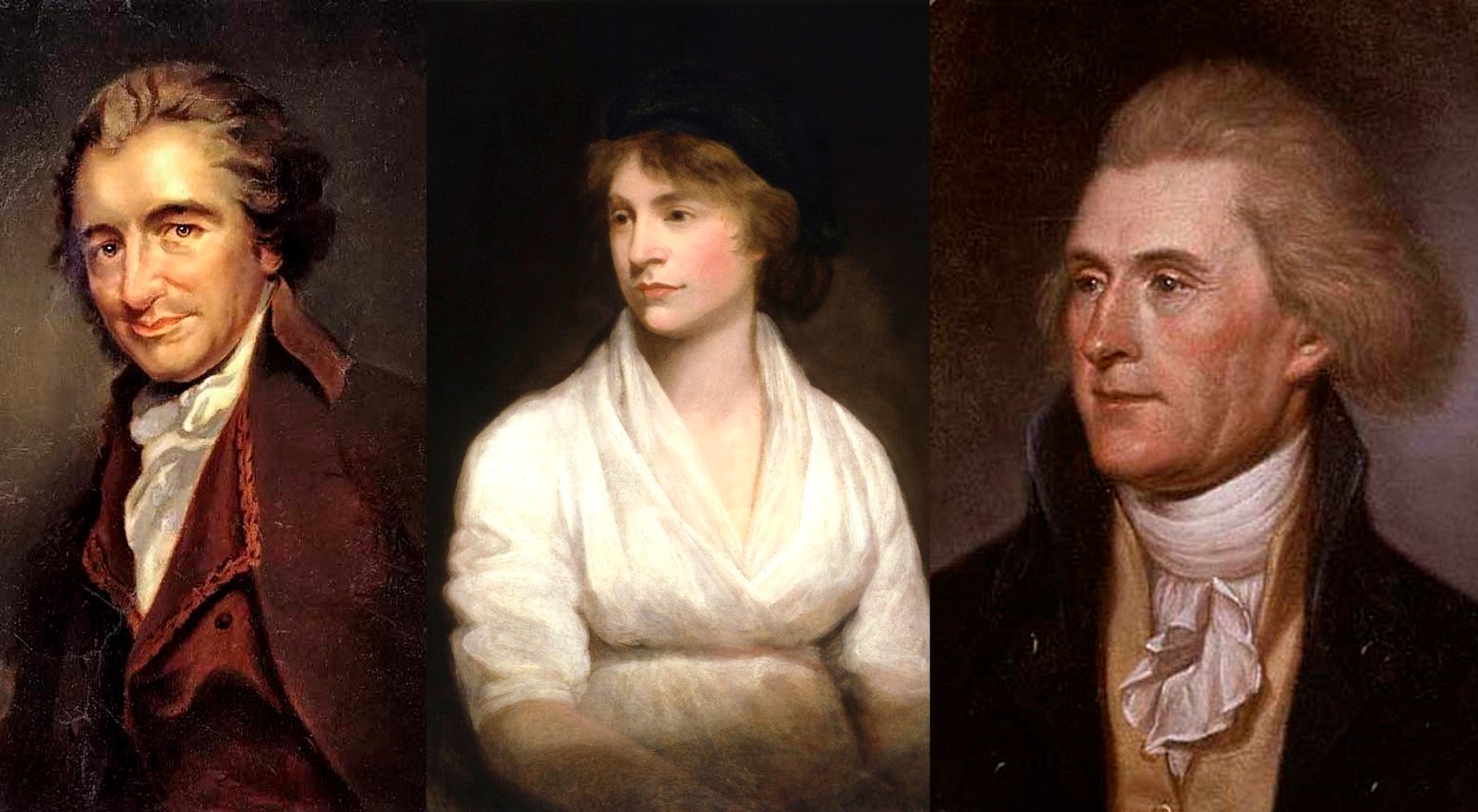
Thomas Paine, Mary Wollstonecraft, and Thomas Jefferson were three Enlightenment thinkers whose work is central in the intellectual legacy of modern human rights movements, and who were heavily influenced by the French Revolution. Paine, a British-born corset-maker who became involved in local politics and reform movements in his native country, in America, and in France, set down his political theory and freethought philosophy in Common Sense, The Rights of Man, and The Age of Reason. Mary Wollstonecraft, who was also born in England and also moved to Paris to take part in the revolutionary activism taking place there, followed Paine’s The Rights of Man with her Vindication of the Rights of Woman, now considered the founding work of the modern feminist movement. Thomas Jefferson, founding father of the United States and eventual President, was an American statesman living in Paris as the events leading up to the French Revolution unfolded, and continued to defend its core democratic values, if not all its tactics, even as it devolved to the bloody Terror.

So off to the Paris I go! There, from August 9th through the 21st, I’ll visit landmarks associated with their lives at this time, and see how the events that occurred at that time in the places where they lived, worked, died, thought, wrote, studied, rested, and played contributed to their thought during and after the Revolution.

~ Thank you, Ronnie Ruedrich and Mark Sloan, for your generous support

Here’s the story of the trip and related essays about these three thinkers and their ideas:

Thomas Jefferson Sites, Part 1: Washington, D.C., First Day

First day, Sunday April 19th:

I get a late start on my first day. But that’s okay: I’ve long since made it my policy to get my rest at the beginning of a trip because three things happen when I’m sleep-deprived: 1) I’m cranky and don’t enjoy myself fully 2) It’s much harder to take in everything and remember it, and 3) I lose my sense of direction and ability to read maps. Since I need to have my good spirits and my thinking, remembering, and map-reading capabilities intact for the purposes of this trip, I sleep in. I get a late start on my first day. But that’s okay: I’ve long since made it my policy to get my rest at the beginning of a trip because three things happen when I’m sleep-deprived: 1) I’m cranky and don’t enjoy myself fully 2) It’s much harder to take in everything and remember it, and 3) I lose my sense of direction and ability to read maps. Since I need to have my good spirits and my thinking, remembering, and map-reading capabilities intact for the purposes of this trip, I sleep in.

When I finally get a move on, I head over to the Mall, and start with:

 
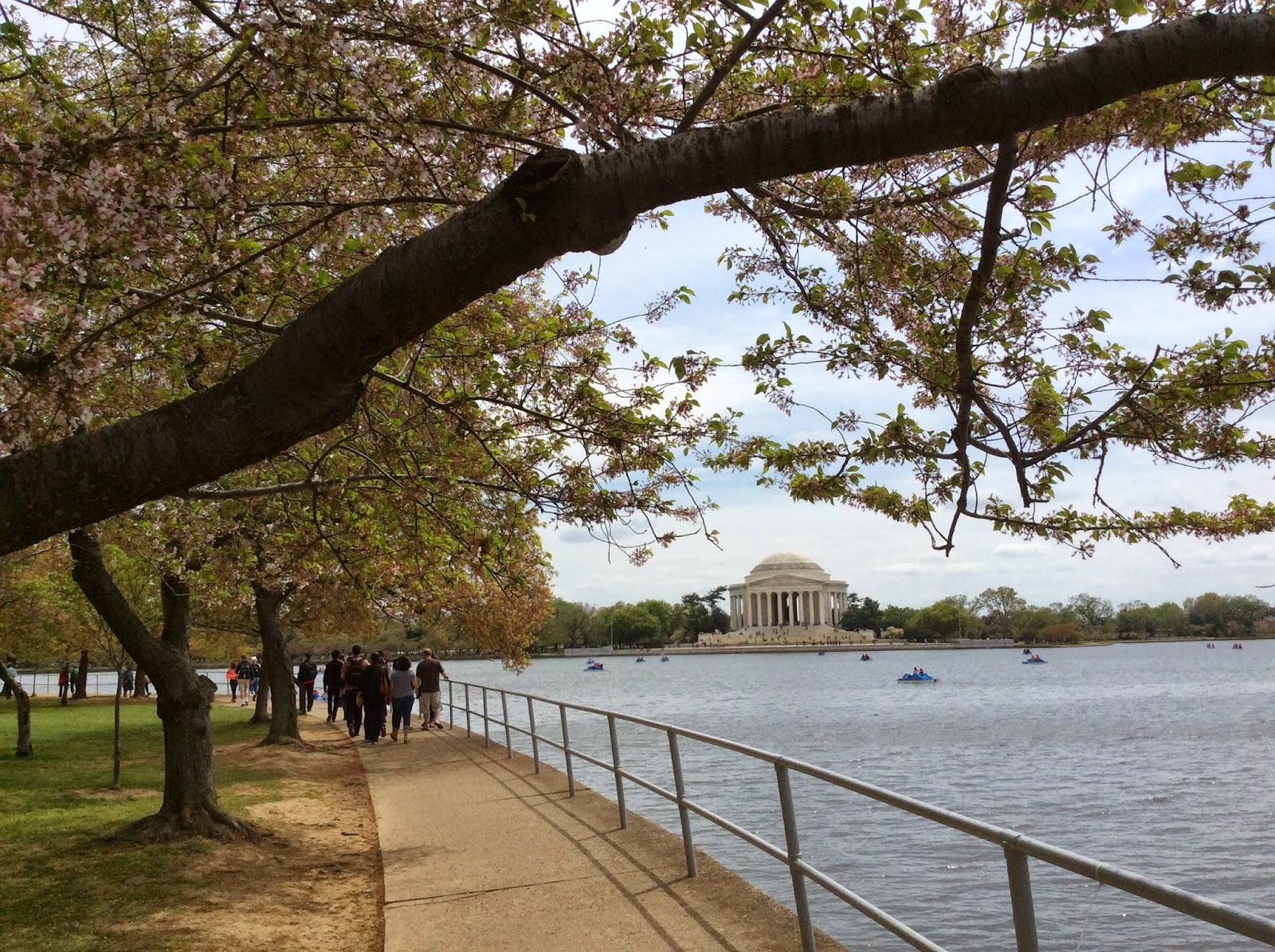
– The Jefferson Memorial 
It’s neoclassical in design, inspired by the ancient Greek and Roman architecture that Jefferson loved. It’s also tall, well-appointed, classy, and full of memorable quotes… like the man himself. He would also appreciate its open-air design, its setting among trees and on the water: he was quite the outdoorsman, as studious and writerly as he was. And he would love to see the crowds that visit the site continuously, people from all walks of life, admiring the building and the grounds, resting on the steps, discussing the thoughts expressed on the walls.

Jefferson would probably have protested the idea of setting up such a grand monument to himself, something so close to a shrine or a temple; he described himself as a modest man. But it’s also clear, despite his protestations to the contrary, that he enjoyed being admired, that he sought love and approval from others. I think he’d look on this monument with secret pride and gratification, and would praise its hospitable openness to the public, as available to them as he made himself and the White House during the years of his presidency, and its edification to the people’s sense of beauty and the intellect.

I visit the museum beneath the memorial, which gives an overview of his life, times, and ideas. Jefferson was born at Shadwell in Albemarle County, Virginia in 1743, his father a successful planter, his mother from a well-connected, wealthy family. Jefferson was educated at home by tutors and at boarding schools as a youth, and studied law at William and Mary College. He entered public life early, elected to Virginia’s House of Burgesses at age 25. His tenure as a public servant lasted over 40 years, from congressman to minister to France to Secretary of State to President. All the while, he was a farmer, amateur scientist, inventor, architect, writer, philosopher, and whatever else captured his imagination, more details of which will come up in later posts.

As I leave Jefferson’s memorial, I waver in deciding where to go next: do I abandon the Mall and go immediately in search of other sites associated with Jefferson’s life, or do I continue on my way? It’s really a beautiful day, a bit windy, perhaps, but it’s fairly warm and there’s still some cherry blossoms left on the trees and wildflowers scattered all around the Mall’s park grounds.

I decide do something a little different this time: I usually stick to writing about the sites more or less directly related to the people I’m writing about, be it sites they visited themselves or sites created by others in their memory. But it occurs to me that I’m surrounded by memorials to people who, in addition to carrying out their own vision, carried out something of Jefferson’s vision as well. Nearly all American civic and moral leaders since Jefferson’s time reference his ideas when promoting their own, and cite his authority in carrying out their political missions. That’s to be expected: none of the members of our nation’s founding generation addressed so many matters of public concern, wrote or helped to write so many of its founding documents, explained the philosophy behind our form of government and our bill of rights so throughly, helped formulate the political structure of our government, and personally lived out our promises, our strengths, our contradictions, and our weaknesses as a nation as Thomas Jefferson, with the possible exception of James Madison and John Adams.

And no others were as widely influential, and who, while a de facto aristocrat, was more of a man of the people than Jefferson, with the possible exception of… (and who, by the way, laid the cornerstone of the Jefferson Memorial…)

Franklin Delano Roosevelt Memorial

…FDR!A year or so ago, I first listened to an utterly fascinating episode of the Thomas Jefferson Hour discussing how Jeffersonian ideals may only be realizable by non-Jeffersonian means. It’s a radio show and podcast by Jefferson scholar and historian Clay Jenkinson (one of my all-time favorite podcasts, I’ve listened to every one that I could get ahold of at least once, often two or three times, except the ones about gardening, since I have no yard and hence, no garden). I recently went back and listened to again. It’s a discussion on Jefferson’s letters to Madison, and one in particular, after he had spent some years in Paris before the French Revolution. Jefferson discussed the dangerous political situation in France that resulted from a long history of a powerful and wealthy few systematically gobbling up most of the nation’s wealth and political power for themselves, leaving the majority of the population destitute. It was only a matter of time, Jefferson pointed out, before the people could take no more, and would inevitably rise up violently against their oppressors.

It’s always been the case that there will be some portion of a nation’s population that lack sufficient humanity, that are greedy and rapacious, and their thirst for power and hunger for wealth will drive them to spend their lives getting as much as they can, regardless of how many others they must harm to get it. Others might not be so purposeful in their predations, but their shortsighted efforts to increase their own personal gains without a though for the welfare of others, or a blind faith that the market will alwasy correct itself, often lead to the same harmful results. Because of this, Jefferson explains, it might very well be necessary for society to engage in some sort of redistribution of wealth.

Given Jefferson’s background as a passionate promoter of states’ rights and his fear of a too-powerful central government, this might come as a surprise to the modern reader, as it was to me when I first heard Jenkinson’s podcast on the subject, and read the letter for myself. But Jefferson was a believer in John Locke’s theory of natural rights, as Jenkinson explains, and in particular, in his theory of property rights. Our primary property right is the right of subsistence, to have enough to provide for one’s own needs, to preserve the health of one’s body and of mind. Our secondary property rights allows for the accumulation of wealth beyond that needed to maintain a happy and healthy existence, but we may only take advantage of secondary property rights if they do not infringe on the primary property rights of others.

This is the key point of property rights that many overlook today, especially those who select from Jefferson’s writings, especially his early writings before the evidence of the dysfunctional and unraveling French society tempered his views, to support their ideas about small government and absolute rights of property and contract. But Franklin Delano Roosevelt, like his progressive cousin Theodore Roosevelt, realized that the pursuit of personal gain without respect for to the primary property rights of others led to a society that systematically placed Jefferson’s ideals of a self-sufficient, educated, free citizenry out of the reach of too many people. Teddy Roosevelt, initially a more strait-laced conservative, had toured the slums of New York City, and had seen for himself how the ruthless, unrestrained pursuit of profit led to the impoverishment, sickness, and death of so many people, rendered easily exploitable by circumstance. In response, he changed his mind about the extent of rights of contract and made some reforms. Spurred on by the Great Depression, FDR carried forward the progressive vision of his cousin and overhauled the whole system, enlarging the government so it would work better for the ordinary citizen in the way Jefferson had hoped a small government would.

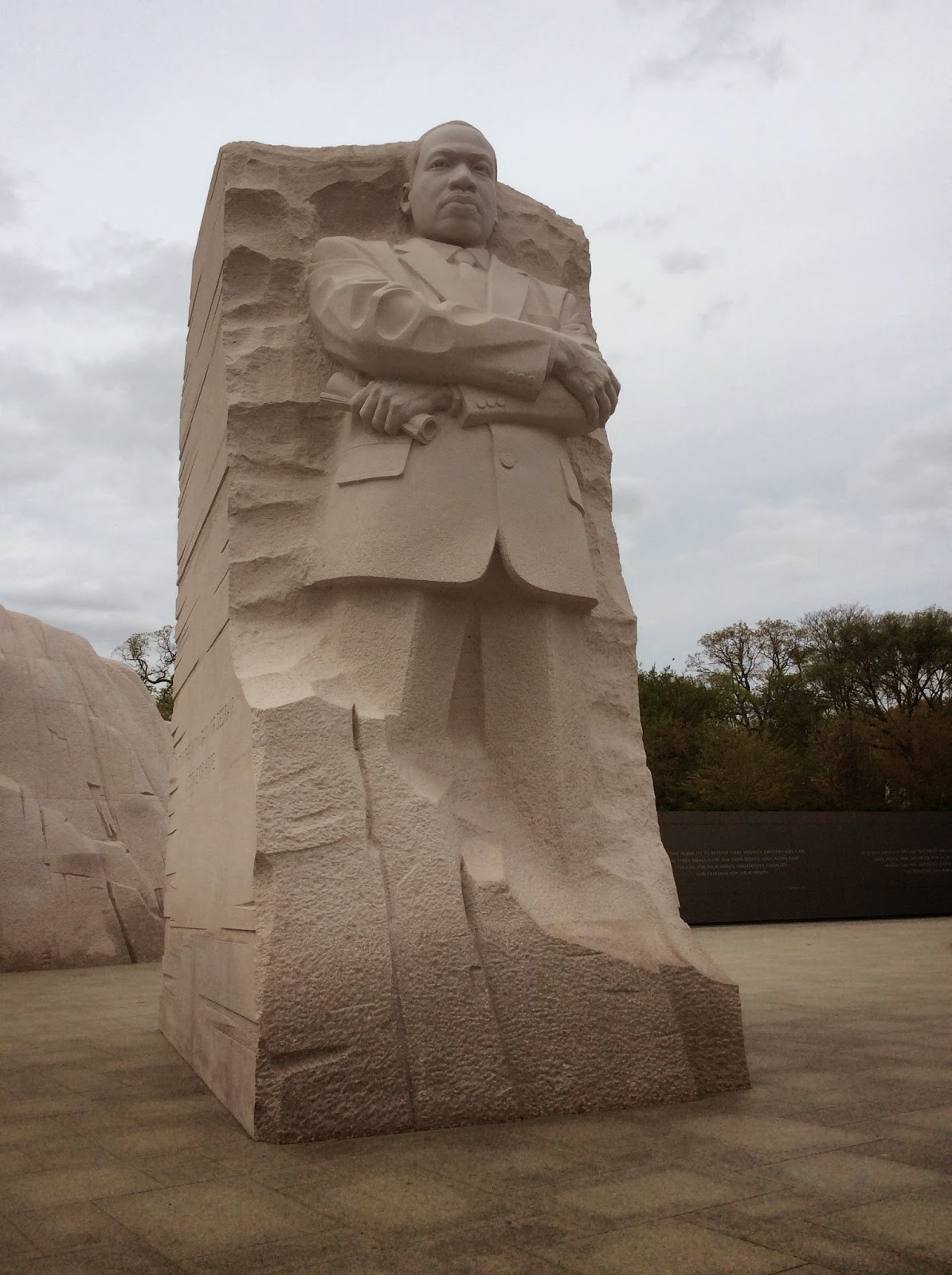
– Martin Luther King Jr Memorial

MLK was quite the wordsmith; besides revealing extraordinary personal bravery in the face of repeated and threatened imprisonment as well as death threats, he had a way, like Jefferson, of putting things.There are many of his memorable quotes engraved on the walls surrounding his memorial. One that’s not engraved on his memorial (but I think should be) is the one that links most directly to Jefferson and that stands out in both succinctness and explanatory power: his analogy of the promissory note from his great ‘I Have a Dream Speech’ of 1963.

At the time they were written and first put into action, the Declaration of Independence and the Constitution increased the liberty of very few people. In severing themselves from Great Britain, the leaders of our new country mostly secured more rights for themselves and those like them: landowners, lawyers, merchants, and so on. The ordinary colonist lived more or less the same life just after the Constitution was ratified as before. Most free men could not vote since they were not property owners and/or were not fully literate, and no women or slaves at all could vote. Same for members of some religious minorities; this situation was one of the first political injustices to be reformed. Taxes went to a new set of leaders almost as far removed from the reality of most Americans as before. In other words, ‘taxation without representation’ was still the rule rather than the exception in the newly United States of America.

As MLK pointed out, the promissory note promising ‘liberty and justice for all’ remained unpaid: for black people, for other ethnic and racial minorities, for women, for working people. He revealed, in an eloquent and moving way (aided by his experience as a preacher), how the words of the Declaration of Independence rang hollow since ‘all …are created equal’ was not manifested in law, attitudes, and practice in the lives of far too many American people.

While he reviled and wrote and fought against slavery as a young lawyer and politician, giving up the fight after years of unsuccessful opposition to (and I add, hypocritically enjoying the benefits of) of what he called the ‘abominable crime’ of slavery, Jefferson also believed the races could not live together in peace and friendship. MLK dreamed otherwise.

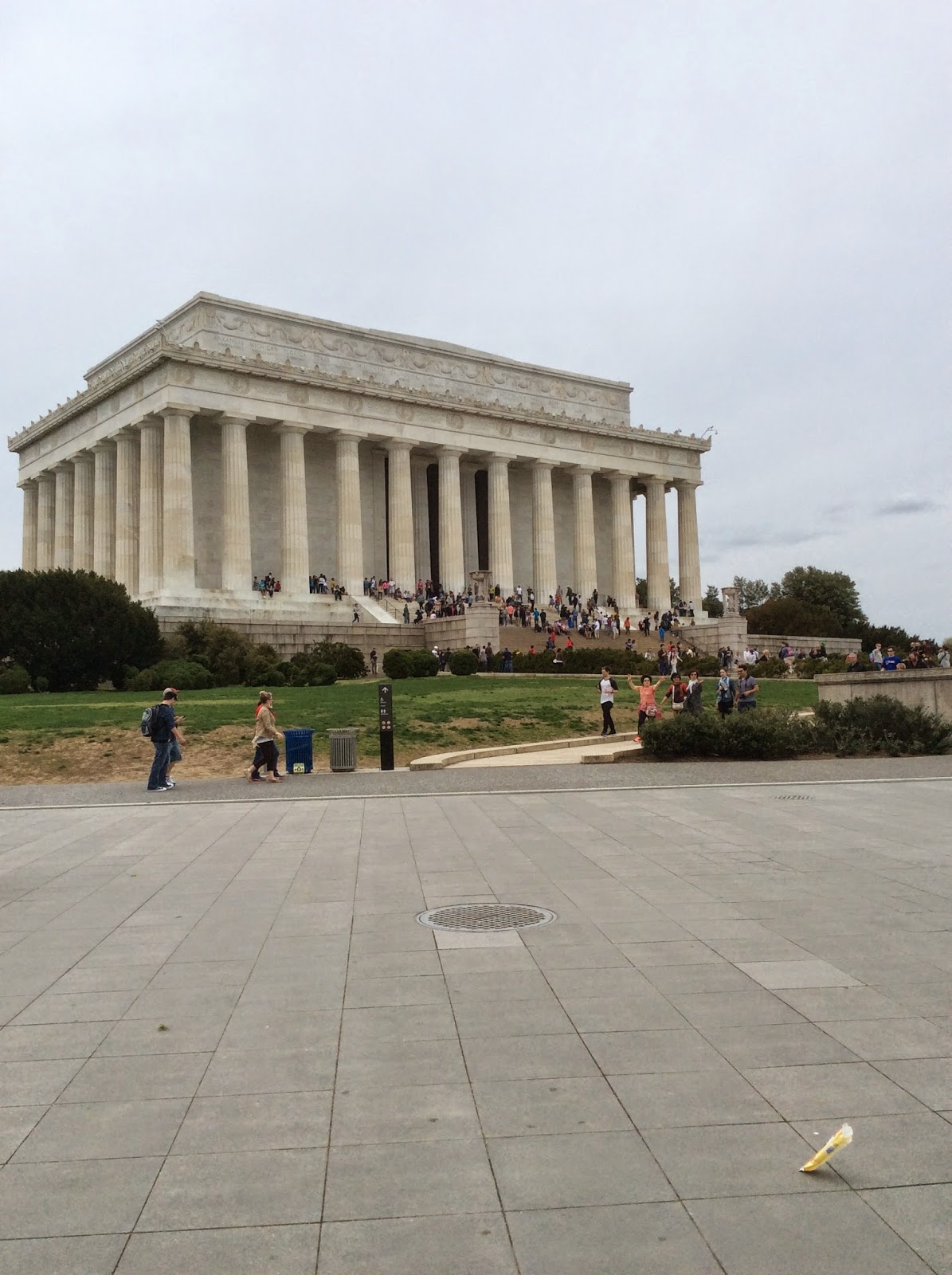
 Lincoln Memorial

Lincoln, unlike Jefferson, was a man brought up in poverty, and had little formal education in his youth. Like Jefferson, he was largely self-motivated and self-taught in his advanced education, and like Jefferson, hated slavery as a young man and spoke passionately and eloquently against it, only to waffle on the issue in his later years somewhat for reasons of personal bias, and even more for political reasons. Fortunately, yet again unlike Jefferson, he came back around, and did what Jefferson had hoped and predicted future generations would do.
The violence of the Civil War was as horrific as were the centuries of slavery that proceeded it; while it’s debatable whether it could have been averted or that it was the inevitable outcome of the discrepancy between the practice of slavery, the political and moral theory informing our founding documents, and the individual human longing for freedom, Lincoln, like MLK, recognized the societal moral debt that remained unpaid, using the rhetoric of blood redemption in the words of his second inaugural address, immortalized on the right wall of his memorial: ‘…shall [the Civil War] continue, until all the wealth piled by the bond-men’s two hundred and fifty years of unrequited toil shall be sunk, and until every drop of blood drawn with the lash, shall be paid by another drawn by the sword, as was said three thousand years ago, so still it must be said “the judgments of the Lord, are true and righteous altogether.”

And as Jefferson pointed out in his letters referring to the bloody Revolution in France, it would be unrealistic to expect that the struggle for freedom against such a deeply entrenched, cruel, and oppressive institution would be pleasant or easy. Jefferson famously wrote ‘The tree of liberty must be refreshed from time to time with the blood of patriots and tyrants. It is its natural manure.’ I hope he’s wrong when it comes to the future, though he was not wrong about the revolutions of his own time and about the worsening effects of slavery on society. There’s an excellent book I often refer to, Steven Pinker’s The Better Angels of Our Nature (a phrase borrowed from Lincoln) which, as the book’s subtitle Why Violence Has Declined suggests, indicate that, among other things, the free(ish) market world economy, the scientific and human rights revolutions, and the advances in communications are making the world a much more peaceful place than it ever has been. Perhaps these advances will give many more of us the potential to become as informed, as cosmopolitan, and as courteous as Jefferson himself.

I had come to the end of my tour of the memorials.
Between visiting the MLK and Lincoln Memorials, I had swung around to the left to see if I could stop by what is now know as Theodore Roosevelt Island, known in Jefferson’s time as Analostan. He used to visit his friend John Mason, who had a farm and mansion there. The 66 connects it to the mainland, and there’s a footpath on the bridge.

It was a blustery walk, to say the least, and I discovered that footpath reaches across, but not down to, the island. I’ll return to visit another time. But looking back, I could plainly see TJ’s memorial between the trees.My Uncle Bob, who lives in nearby Fall’s Church, Virginia, picked me up to take me on a little driving tour and then to dinner. I’m fond of my Uncle Bob, tall, handsome (a common trait of the Cools’), courteous, old-fashioned in his sensibilities and speech, seemingly grave and imposing with his deep and slightly thick voice (I was a little scared of him as a child, funny to think of that now!), but with an enthusiasm that would rival any small child’s when it comes to seeing something beautiful or discussing a subject he loves. He has a good sense of humor.
On our way around the Mall, we passed by the corner of C and New Jersey Streets, where Conrad and McMunn’s boarding house was. Jefferson lived there for a while when he was Vice President, but the building no longer stands. I check it off my list. The rest of the evening is devoted to non-Jeffersonian-themed touring and dinner.

To be continued….

*Listen to the podcast edition here or on iTunes

~~~~~~~~~~~~~~~~~~~~~~~~~~~~~~~~~

Sources and Inspiration: 

Jacoby, Susan. Freethinkers: A History of American Secularism. New York: Owl Books, 2004.
http://us.macmillan.com/freethinkers/susanjacoby

Jenkinson, Clay. The Thomas Jefferson Hour. Podcast.
http://www.jeffersonhour.com/listen.html

King, Martin Luther, Jr. ‘I Have A Dream’ Speech, 1963.
http://www.ushistory.org/documents/i-have-a-dream.htm

Meacham, Jon. Thomas Jefferson: The Art of Power. New York: Random House, 2012.
http://www.jonmeacham.com/books/thomas-jefferson-the-art-of-power/

‘Timeline of Jefferson’s Life’. Monticello.org. Website of the Thomas Jefferson Foundation.
http://www.monticello.org/site/jefferson/timeline-jeffersons-life

‘Washington, D.C.: Sites Associated with Thomas Jefferson’. Monticello.org. Wiki, Thomas Jefferson Foundation.

http://wiki.monticello.org/mediawiki/index.php/Washington,_D.C.
 

Traveling Philosophy Series, Thomas Jefferson Edition: Prologue

As I sit here in the airport terminal in Salt Lake City, waiting for one of my connecting flights to DC, I sleepily munch on French fries and watch the crowd go by. My ever-generous darling awoke with me at three thirty this morning to drive me to the airport, and though I’m almost too tired to think, I can’t sleep either, as is usually the case at the beginning of a trip (I can usually sleep on the way home).

So as I’m watching the crowd, I’ve got Thomas Jefferson in the back of my mind, as I’ve been immersing myself in biographies, lectures, discussions, and author’s talks about his life and thought over the last couple of weeks. On the first leg of my trip, I had just been re-reading the first chapters of Susan Jacoby’s marvelous Freethinkers: A History of American Secularism, in which Jefferson’s Enlightenment philosophy, his Deism, and his efforts to enshrine a robust conception of human rights and separation of church and state in state and federal law play a large role.

A strong belief in the basic natural goodness and perfectibility of humankind underlie Jefferson’s view of human nature and his political philosophy. In the airport, I see those traits personified which would justify Jefferson’s faith in humanity if they were as universal as he hoped. I see cooperation, courtesy, patience, and friendliness abound: people chat freely with others they just met; others stand in line and in crowded aisles with forbearance, and courteously let others go ahead of them, or step around them with a smile, if they are burdened with children or slowed by age or disability; still others helpfully pick up a bag or a scarf dropped by a fellow passenger in a hurry to get their things so as not to delay others. I just saw a man give up the standby seat he had just won to the woman who had forfeited it, who was on the verge of tears because she arrived mere moments before her flight was due to take off.

I also see a wide diversity of race, culture, and creed represented in the crowd peacefully assembled here, cooperating seamlessly with one another, which the slaveowning-yet-abolitionist-yet-repatriationist Jefferson thought impossible (more on these contradictions in a later piece). He didn’t think, for one thing, that people of different races could live harmoniously in one place, not to mention his dim view of women’s ability to fully engage in public life and the professional world! I see an elderly woman murmur fervent prayers in a low voice to an image of a Hindu saint (I think) perched on the bag in her lap, with no-one protesting or even batting an eye; I see a black woman with a cross prominently displayed on her bosom accept instructions from the woman of apparent Middle Eastern descent at the podium, and then share pleasantries with her; I see a young white apparently Mormon man praising the sweet looks and winning personality of the child of Indian parents across the aisle, comparing her virtues to those of his own children at home; I sit next to two women, smelling of stale smoke, missing a few teeth, and wearing cheap clothes, happy, chatting, and smiling about the adventure they’re embarking on, without any show of feeling out of place next to the obviously much wealthier woman sitting next to them on the other side (and who, in turn, shows no sign of noticing or even caring about ‘rubbing shoulders’ with those of a different economic class). I see a young female pilot stride confidently down the aisle, a young boy gazing at her admiringly.

This airport, right now, in so many ways, is the America of Jefferson’s dreams, in some ways realizing his rather idealistic view of human nature, and in many more ways surpassing it. I wish he could see it right now, to relish this justification of his hopes for what his country could be, and to learn that human nature is capable of being even better than he thought possible. But when I think about all that’s going on in the world right now, I know we still have a long way to go. For now, I’m not going to dwell on that. I’m just going to enjoy this microcosm of human goodness I find myself in right now.

*Listen to the podcast version here or on iTunes

Welcome to the Podcast Edition of Ordinary Philosophy!

Hello dear readers, and welcome to the
podcast version of Ordinary Philosophy!

You can listen to the podcast here, on Google Play, or subscribe in iTunes.

Like many of you, I’m a big fan of podcasts, mostly because my life is very busy. One day in the future, I hope to have a lot more time to do each task one at a time, to really be present, as they say, as I wash the dishes, straighten the house, do the laundry, and perform all those other tasks that take up time, but not much thought.

But at this time in my life, between my day jobs, my creative projects, and spending time with friends and family (which I don’t do enough of these days, sadly), I don’t have enough time to keep up the world of ideas as nearly much as I’d like to by sitting down and reading. Instead, I keep myself informed and increase my education by listening to lots of podcasts: discussions with my favorite authors and thinkers, audio renditions of books and essays, debates, recordings of classes on my favorite subjects, and so on. I listen to these podcasts while doing those aforementioned chores, and let me tell you: as one who is not fond at all of household chores like doing the dishes and washing the floor, the podcast is a marvelous invention: they transform boring chore time into great opportunities for learning and exploration. I’m also an avid hiker, and it’s a wonderful thing to be able to immerse myself in some fascinating ideas or discussion as I immerse myself in the beauties of nature.

To begin with, this podcast will simply consist of audio recordings of my Ordinary Philosophy pieces. Over time, I may add commentary and who knows, perhaps interviews and discussions with guests. We’ll see how it goes. In the meantime, here’s Ordinary Philosophy in audio form: I hope you find it interesting and enjoyable!

… And here’s episode 2: Is the Market Really the Most Democratic Way to Determine Wages?
Originally published as an essay Feb 6th, 2014

To Edinburgh I Go, In Search of David Hume

Hello, friends of Ordinary Philosophy! I’m pleased and excited to announce my upcoming adventure: my first philosophical-historical themed adventure, and my first trip to Edinburgh, Scotland!

Here’s my plan:

I’m taking a series of trips to places around the world, where I explore the lives and ideas of great thinkers in the places where they lived and worked. I’ll follow in the footsteps of thinkers who are no longer alive, since those who are still telling their own stories. But those who are no longer alive in the body live on in the ideas that they pass on, and in the example they provide for us to follow.

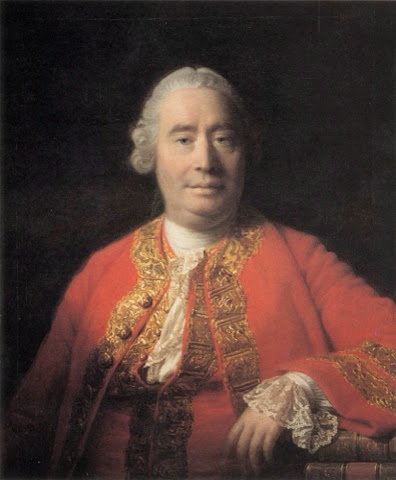
I’ve decided to start with the philosopher I most admire as a person as well as a thinker, the great David Hume. He was not only revered for the brilliance of his ideas and his honesty in presenting them, but also as a premier example of a genial, generous, great-hearted person; so much so, in fact, that one of his closest friends nicknamed him ‘Saint David’.

Hume is often described as the greatest philosopher to write in English and among the greatest philosophers of all time, period. He was a central figure in the Scottish Enlightenment, and a profoundly influential empiricist and moral philosopher

So off to beautiful Edinburgh I go! There, I’ll visit the places where he worked, thought, wrote, studied, and rested. I’ll be traveling there in the first two weeks of May, and will be writing throughout the trip. I’ll be writing in this blog not only about his ideas, but about what I can discover about his everyday life, and whatever feeling of his time and place I manage to uncover in my time there.

If you have any questions for me to answer while I’m there, or pictures you’d like me to take for you, or any information you have that could help me with this project, I’d love to hear from you!

~~~~~~~~~~~~~~~~~~~~~~~

Here are my essays on Hume as I discover him in my travels, in (roughly) chronological order:

First Day in Old Edinburgh: Hume Sites and Monuments
Hume’s New Scene of Thought, and, It’s Good to Be Able to Say ‘I Don’t Know’
Hume Sites and Monuments, Part 2
The Consolations of Philosophy, and A Death Free from Fear
Scotticisms
Happy 303rd Birthday, David Hume!
Cycling Through Edinburgh, First Time
The Debate Over Government and Freedom
The Tale of the Magic Toe – Superstition? Or What?
Hume Sites and Monuments, Part 3
Water of Leith
Last Day in Edinburgh, May 13th, 2014
Hume, Aristotle, and Guns
and a memory quilt I created for my 2014 Edinburgh trip: A Hill and a Wall in Edinburgh, 2015, 102″ x 69″
Chirnside and Ninewells, Scottish Borders, Childhood and Summer Home of David Hume

Ordinary Philosophy and its Traveling Philosophy / History of Ideas series is a labor of love and ad-free, supported by patrons and readers like you. Please offer your support today!