What Ordinary Philosophy’s All About: Clarifying the Vision

People in a Public Square, Image Creative Commons via PixabayIt’s been an especially busy few weeks for me: studying, researching, writing, planning for my upcoming traveling philosophy journey and for the expanded future of Ordinary Philosophy. This year so far, I’ve had the great good fortune to meet some inspiring new people: passionate, thinking, active, and creative. I’ve also gotten to know others better as well, and am opening new doors and making new contacts every day. Our conversations have been inspiring me to think more clearly and deeply about my vision for Ordinary Philosophy, about my hopes, dreams, and goals, and about the wonderful people who will work with me to accomplish them in the future.

So I’ve just been looking over my introductory statement about Ordinary Philosophy, and thought it needed some clarifying and expanding. Here’s my vision as it stands now, best as I can describe it, and it’s beautiful to me. I hope it is to you too!

~~~~~~~~~~~~~~~~~~~~~~~~~~~~~~

Ordinary Philosophy is founded on the belief that philosophy is an eminently useful endeavor as well as a fascinating and beautiful one, and that citizen philosophers and academic philosophers alike share in making it so.

So why the name Ordinary Philosophy?

The ‘Ordinary’ in Ordinary Philosophy means: Philosophy is not only pursued behind the walls of academia.

It’s an ordinary activity, something we can do regularly whatever our education, background, or profession, from our homes, workplaces, studies, public spaces, and universities. It’s applicable to ordinary life, since it’s about solving the problems we all encounter in the quest to pursue a good, happy, and meaningful one.

It’s about seeking answers to the ‘big questions’ we ask ourselves all the time: ‘What’s the right thing to do?’ ‘What’s a meaningful life, and how can I make mine so?’ ‘What’s the truth of the matter, what does truth mean anyway, and how do I know when I’ve found it?’ ‘What does it mean to have rights?’ ‘How did reality come to be as it is?’, and so on.

It’s also just as much about the ordinary, day-to-day questions: ‘Should I take this job, and will it help fulfill my highest aspirations?’ ‘It is wrong to put my interests first this time, even if it will harm someone else?’ ‘What’s the difference between just talking about other people and malicious gossip?’ ‘Why should I go out of my way to vote?’

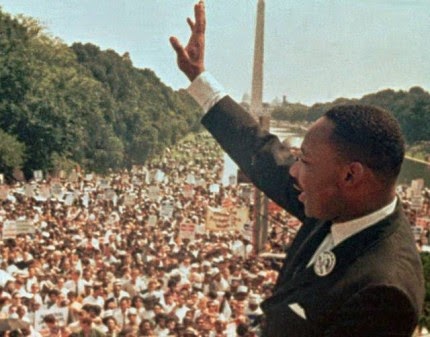
And in the end, it’s about living philosophy, about philosophy in the public square, and the stories and histories of philosophy as it is realized, personified, lived out by activists, artists, scholars, educators, communicators, leaders, engaged citizens, and everyone else who loves what’s just, what’s beautiful, and what’s true.

All of this is philosophy.

~ Amy Cools, founder and editor of Ordinary Philosophy

It’s Hard to be Anti-Muslim When You’re Stuck with the Old Testament

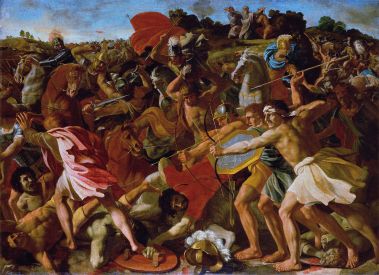
Poussin Nicolas - The Victory of Joshua over the Amalekites, copy, Public Domain via Wikimedia CommonsThere’s a lot of anti-Muslim sentiment in this country and in many other parts of the world these days: if you don’t look too deeply into history, or at how denominations of Islam differ from each other, or what the political situations are the Muslim world right now, it’s not hard to see why. The bare fact is: the majority of ideologically driven terrorists in the world today are Muslim.

As many are quick to point out, that’s not always been the case: Christians have targeted Jews, heretics, and dissenters for centuries, burning books, homes, entire towns, and people at the stake. Christians defended slavery and racism, and the Klu Klux Klan and the White League’s belief in Jesus did nothing to stop them from beating and lynching; in fact, they may have felt themselves holy warriors of their race, avenging angels of sorts.

But wait a minute! comes the protest. Christians don’t do that anymore: they’ve seen the light and mended their ways. They’ve pondered, learned from their mistakes, and have reformed, which is the whole point of religion, isn’t it?

Well, this is true: not many terrorists are Christian anymore, and the few who are left, such as abortion protesters gone off the deep end, are generally not defended by their coreligionists. And yes, reflection and self-correction are laudable features of religion. As is the effort to realize the love of God in the world, for those who worship the God of love.

But Christians have a problem: the legitimacy of Christ as the Messiah, foretold by the prophets according to the New Testament, is derived from the Old. And the God of the Old Testament is not a God of love, but a God of jealousy and vengeance. At least, for everyone who already worshiped other Gods, or liked to keep their genitals intact thank-you-very-much, or people other than the Israelites if they just so happened to already live where God subsequently decided the Israelites should settle instead.

So as you may expect, as it has always been when adherents of a new religion convinced of their own uniqueness and infallibility sweep in and take over, slash-burn-rape-kill was the order of the day. The Old Testament, other than a few lovely poetic and wisdom-y books and chapters (Song of Songs, Ecclesiastes) is really chock-full of the most God-awful violence and cruelty you can imagine, inspired, condoned, and expressly ordered by the same God Christians worship today.

While his son Jesus is called the Prince of Peace, and his teachings are relatively peaceful (though not entirely), the legacy he inherited of the Father was made plain in the centuries of religious wars and persecutions carried out in his name. But slowly, slowly, sloooooowwwwly, Christianity was reformed, and rejected many of its nastier and more violent aspects, keeping the friendly parts and interpreting away the rest. Or, I think rather, it was forced to do so by the Enlightenment and other humanistic movements in order to stay relevant. Today’s Christians do generally behave very well, and are charitable, peaceful, and tolerant for the most part.

Only thing is, there’s that pesky Old Testament, that Tarantino-like gorefest without the redeeming quality of being tongue-in-cheek. And the Old Testament is so very full of all that awful stuff that’s nearly identical, if not worse, than the most violent stuff found in the Q’uran that inspires and ‘justifies’ Islamist terrorism.

So now that Christianity has undergone that reformation crucial for a future of peaceful enlightenment, what of that Old Testament? Can any of us, of any belief, believe in a future where even those committed to peace can’t let go of the violent relics of the past because they’re foundational myths? Perhaps, perhaps not; we can’t even give up the gun-nut interpretation of the Second Amendment. But until the Christians can give up their violent scriptures, they can’t be taken totally seriously when they demand Muslims give up theirs. And their kids, like me with my Christian upbringing, will continue to think the adults are crazy for telling us to be good while believing in the Old Testament, though sadly some of them will get all too used to those bloody ideas, and learn to believe in them too.

Ordinary Philosophy and its Traveling Philosophy / History of Ideas series is a labor of love and ad-free, supported by patrons and readers like you. Please offer your support today!


Sex, Gender, Surgery, and Freedom

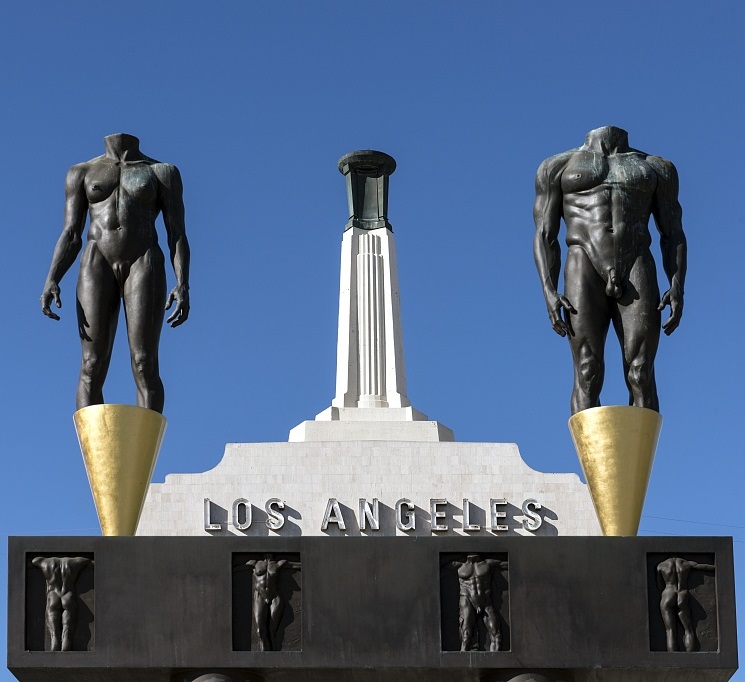
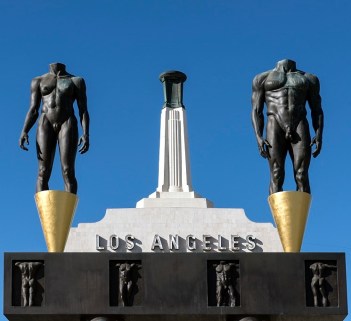
The Olympic Gateway arch and male and female statues at the entrance to the Los Angeles Memorial Coliseum, Los Angeles, California by Robert Graham, public domain via Library of CongressI believe that people should be free to express their tastes, preferences, and personalities without legal limits if little or no harm is done to others by doing so. Not including mere hurt feelings, however: if it did, no one would be free to do much of anything.

Likewise, I believe we have positive moral obligations to respect each other and ourselves, and to do so, we should work to free ourselves from harmful biases and distastes based on cultural, racial, religious, and gender stereotypes and narrow standards of beauty.

But when a popular social practice seems to promote one of these principles while betraying the other, it can be difficult to decide whether it’s right or wrong, good or bad.

Take plastic surgery, Botox injections, and other body-altering elective procedures done for non-reconstructive, ‘vanity’ purposes. I’ve dubbed them cosmetic medical interventions. Last year, I examined the benefits and impacts of these, both personal and social. Many, even most, would consider opting for one of these cosmetic treatments  anything from harmless vanity to helpful in boosting self-esteem, and most would consider it a purely personal matter and no-one else’s business. Yet I found that the social acceptance and increasing prevalence of cosmetic medical interventions can have significant impacts that affect a whole culture. While I didn’t find sufficient justification for banning most of them or even for claiming they’re immoral across the board, I believe I presented evidence and arguments sufficient to show they can cause harm, especially in the aggregate. While cosmetic medical interventions can and do make some individuals happy in particular circumstances, they can present health risks, be disfiguring, become psychologically addictive, and perpetuate gender stereotypes, ageism, racism, classism, and other mindsets that erode respect and tolerance.

And as my examination progressed, an uneasy realization kept nagging at me. Many of my questions and concerns about cosmetic medical interventions could apply, for the same or similar reasons, to sex reassignment surgery. I decided not to include it in that discussion because it’s embraced by so many as an important way to achieve fulfillment, acceptance, and equality for traditionally marginalized transgender people, making it a politically ‘hot’ and delicate issue warranting its own careful examination.

Then not too long ago, I heard this story on NPR about one of two twin boys, self-identified as a girl since the age of three, who became the young woman she identifies as today through sex reassignment surgery. Nicole’s story, while fascinating in its own right, struck me at the moment because of the terminology used: gender reassignment surgery.

That got me to thinking a lot about the issue again. Hmm, I thought, ‘gender reassignment surgery’, that’s a new way of putting it… but wait a minute: isn’t there a glaring assumption, even some contradictions, contained in that phrase?

For one thing, haven’t critics of traditional, binary gender roles been arguing that gender is neither dichotomic nor fixed? That gender is a set of attributes culturally or personally assigned according to sex, transmitted through social practice and the enforcement of norms? If so, how can gender, not just sex, be surgically altered? Sex can be reassigned to a certain extent: physical appearance can be surgically altered to match the general appearance of persons of the opposite biological sex, though we can’t transplant or build functioning reproductive organs (as of yet, anyway). And gender can be reassigned through self-identification, mental state, legal status, social acceptance, and many other means.

But how can gender be surgically reassigned, unless we accept the assumption that gender is tied to sex and an accompanying set of particular physical attributes?
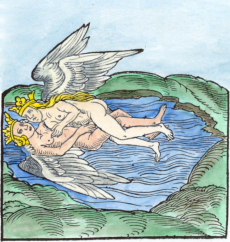
Illustration of fermentation in the Rosarium philosophorum, Frankfurt, 1550, public domain via Wikimedia Commons

I recognize that calling it ‘gender reassignment surgery’ is motivated by progressive values. Besides the regressive assumption I perceive in the term, it’s also forward-thinking in its attempt to reflect the best science available about transgender people, and a sympathetic recognition of the difficulties they experience in binary-gendered societies. The term hints at part of what science shows us: the experience of gender is at least partly biological in origin. However, gender is not, as the term also indicates, inextricably linked to how closely one’s physical appearance correlates with the general appearance of males and females. Science reveals that the feeling of belonging to a particular gender is generally correlated with sex, as biologist and neuroscientist Robert Sapolsky explains; however, it’s more complicated than that. We now have the capability of studying the brains of people who seek sex reassignment surgery because they feel their gender doesn’t match the body they’re born with. When transgender people like Nicole from the NPR story, who just know from a very young age that they really belong to a different gender than others perceive, we can actually see that their brains are physically different from the average person whose gender and sex fit the more common binary system. For example, the brain of a young male-sexed person who has felt female for years can look, in some regions, more like the average brain of a female than of a male. And the tenuous link between sex and gender for many people doesn’t end there: physical expression of sex can be ambiguous, with some bodies having genitalia with both male and female characteristics, or not identifiably either, whatever the gender.

Therefore, the phrase ‘gender reassignment surgery’ misses the boat in reflecting the science of transgender experience and its biological origins. But it’s also regressive insofar as it contradicts that valuable, hard-won insight that gender is also cultural. The larger question of who we want to be, as it relates to gender, isn’t determined by the appearance of our bodies and whether that appearance matches one sex or another: it’s also determined by how other people treat us based on the appearance of our bodies and how we present ourselves. And the way other people treat us has as more to do more to do with culturally instilled values and expectations than with strictly biological instincts.

So the NPR story led me to expand my initial questions and concerns arising from my examination of cosmetic medical interventions: is sex reassignment surgery also such a good thing on the whole, for society and for individuals? And to add: might it do more to reinforce gender stereotypes and the notion that our physical appearance determines our fate, than it enhances our freedom and long term sense of self-worth and happiness?

The evidence regarding the latter is very limited, since sex reassignment surgery hasn’t been done on a large scale for very long. There’s a(n) (in)famous study from Sweden from a few years ago that found that rates of suicide and psychiatric disorders were higher in those that received sex reassignment surgery and hormone therapy. People of every political persuasion drew wildly different conclusions from this, generally to fit their already held convictions: either that the higher rates of suicide and psychiatric disorder only reveal the stigma that transgender people face, not that transgender people are mentally ill or sex reassignment surgery is bad, or, that the higher rates of undesirable outcomes reveal that sex reassignment surgery is an invasive, painful, and harmful mistreatment of what’s really a cultural and psychological problem.
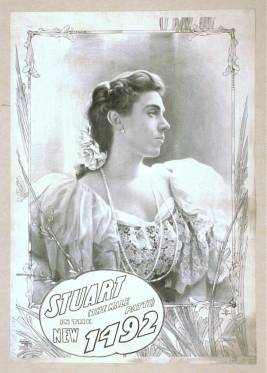
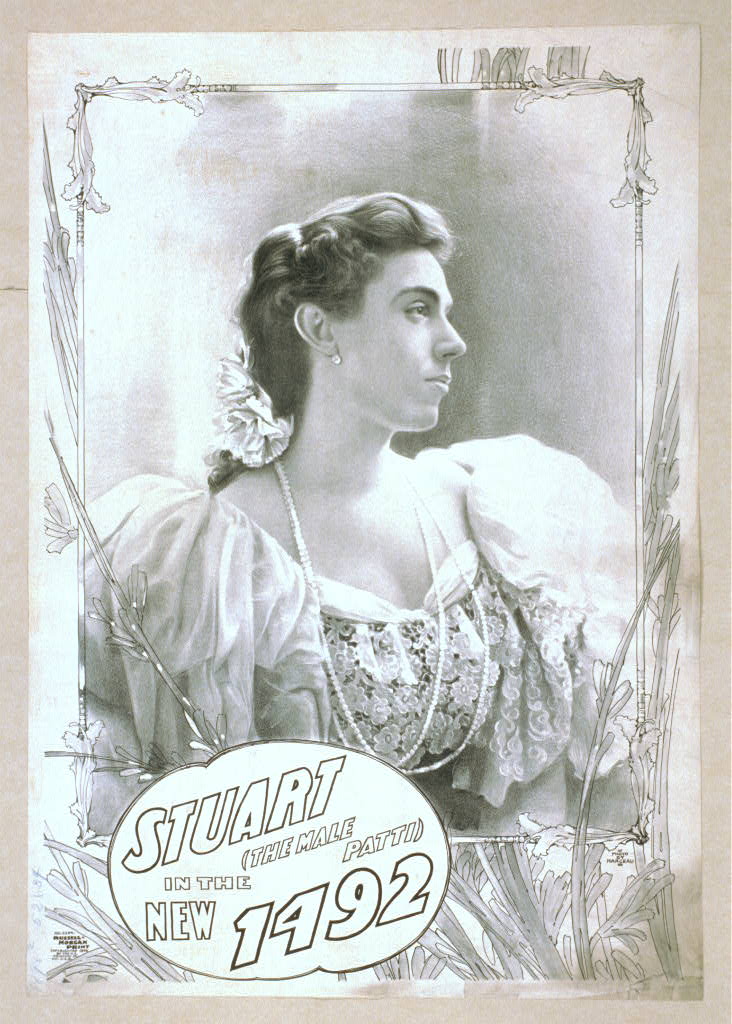
Stuart (the male Patti) in the new 1492, Cin., U.S.A. U.S. Printing Co., c 1898, public domain via Library of CongressI don’t believe it’s hard for most of us to accept that many opt for cosmetic medical interventions because they feel driven to it by pervasive ageism, sexism, and gender stereotypes. If you’re convinced that you’re too ‘old’, ‘wrinkled’, ‘fat’ ‘flat-chested’, or otherwise don’t match cultural standards of what a beautiful and successful person looks like, than you feel you need surgery in order to be accepted, to succeed, and to be admired. Sometimes, opting for cosmetic medical interventions helps to achieve these goals in come circumstances. In similar ways, some may feel the need for sex reassignment surgery because they’ve been told throughout their life, regardless of how they feel about themselves and what their preferences are, that they can’t wear a dress or makeup, be tough, be cute, play rough, take a leadership role, be forthright and assertive, pursue their real interests, or otherwise express their true personalities because they look like a boy or a girl. And sometimes for these transgender people, sex reassignment surgery helps them to express who they feel they really are, because their new appearance changes the way others perceive them and expect them to act.

Does this mean that we need to accept that sex reassignment surgery, or cosmetic medical intervention for that matter, is the best way to help us achieve the freedom to be who we want to be? Does it help instill in us the values of respect and tolerance for others and for ourselves, regardless of physical appearance? Is it really the key to breaking down gender stereotypes and increasing the freedom to be who we really are?

I have some questions and some doubts.

Don’t get me wrong: I believe that our newfound willingness to accept that people have the right to present or alter themselves as they see fit, and to recognize that their reasons for doing so may be good or at least understandable, is a good thing: it shows we’ve become more generous, our imaginations have broadened, and we’ve become more solicitous of other people’s interest in seeking their own happiness than we are concerned with whether their actions conform to our own moral or religious standards. I’m not exploring this issue because I doubt that society is moving towards increased tolerance, respect for diversity, and commitment to increasing human freedom; in fact, I believe that we’ve generally progressed a lot on all of these fronts, and will continue to do so. I’m exploring it because I’m doubtful that sex reassignment surgery is the best solution overall or in the long term to furthering these excellent ends, for the individual and for society.

For one thing, sex reassignment surgery seems to reinforce the idea that we need to look a certain way in order to be a certain way. In fact, it’s very name, like NPR’s term gender reassignment surgery, concedes this. Do we ‘feel like a man’, but ‘look like a woman’? Then to match our own and other’s ideas of what ‘feeling like a man’ should look like, we alter our body: remove the breasts, add a penis, and take hormones to deepen the voice, broaden the shoulders, and increase body hair. Or vice versa.

But why must we concede that changing the way our bodies look is the best way to resolve the disparity between how we look and what we and others expect of ourselves because of it? Sex reassignment surgery and the term gender reassignment surgery seem to concede too much to this assumption, to the point of people feeling that the radical step of extensive cosmetic surgery, with all its associated risks of infection, scarring, and other side effects, is necessary for them to be happy in their own skin. It’s also very expensive, and available mostly to the relatively wealthy and to those willing or able to get into debt, which, like cosmetic medical interventions, adds a classist element, making gender-as-sex expression the privilege of the few. It seems to me that sex reassignment surgery can serve to reinforce the notion that gender is strictly binary because of the way it conforms our bodies to it. So while the overall goal of sex reassignment surgery might be to break down rigid, narrow cultural perceptions of the link between sex and gender, it seems to act more as a concession to them.

Pin-up photo of Hedy Lamarr for the May 7, 1943 issue of Yank, the Army Weekly, public domain via Wikimedia Commons

I’m also not so sure about the real freedom of choice that many feel they have when they opt for sex reassignment surgery. Since most of us treat others quite differently according to their perceived gender, for those who feel like they belong to another gender than people perceive them as, the disparity can grow intolerable over time. Thus, sex reassignment surgery can appear to be their only viable alternative. Imagine being treated all the time like a different person than you know you are, and you can imagine the frustration. Perhaps you are an intellectual by inclination, but your family doesn’t fully educate you as a child or encourage an academic career for you as an adult because of their religious conviction that only men are the God-appointed thinkers and leaders of church and home. Perhaps your curvy figure and heart-shaped face lead people to treat you as if you are little more than a ‘bimbo’, a ‘sex kitten’, or on the make (I’m thinking of the brilliant and lovely Hedy Lamarr, actress and inventor). Perhaps you are a biological woman who likes to wear short hair and comfortable, practical, and sturdy ‘masculine’ clothing, who find makeup and ‘feminine’ clothing binding and unsuited to your personality and lifestyle, and you find yourself unable to go about your daily business without people treating you as if you’re not a ‘real woman’ (whatever THAT means!) or as if you are ‘asexual’ or ‘hate men’.

I can imagine these situations, and I’ve experienced some version of all of these myself in my own life. For transgender people, the disparity is more pronounced, and the need for a lasting solution more urgent. In this sense, I not only appreciate the perceived necessity for a solution like sex reassignment surgery, but am deeply sympathetic as well.

Yet the problem here, again, is similar to that I’ve addressed when considering cosmetic medical interventions: while we might be happier as individuals or in the short term by surgically or chemically altering our appearance, is it really a good long-term solution to the underlying problem? Mightn’t we actually be prolonging it by perpetuating and strengthening sex and gender stereotypes through sex reassignment surgery, as we’ve considered? Is it really a good thing to allow ourselves too much leeway by accepting, out of hand, that surgically altering our bodies to fit society’s standards is better than the option of training ourselves and each other to learn to be comfortable with, and even love and appreciate, the bodies nature has given us? It seems that the latter is actually more conducive to creating a world where racism, ageism, and rigid binary sex and gender codes lose their hold on our imagination and moral sense, and a sustainable solution at that, available to rich and poor alike.

Acceptance of the practice of sex reassignment surgery may be a necessary step, even if a flawed one, on the way to creating a society that not only tolerates, but values, increasing diversity in cultural- and self-expression. I don’t believe for a moment that any individual person who opts to have sex reassignment wants to impose their ideas about gender on anyone else; they’re seeking to be true to themselves the best way they know how. And sometimes, for some people, it does the trick. That’s why, like with cosmetic medical intervention, I’m loathe to make the claim that we should ban sex reassignment surgery for consenting adults. But the social outcome of the practice in the aggregate, as it becomes an institution, may undermine the very good it’s trying to do. Whatever the intention, sex reassignment surgery leaves physical scars just as it can social and psychological ones, as our unreadiness, our inability, our unwillingness, or our refusal to accept ourselves and each other as we really are is carved into the very bodies of transgender people.

Perhaps the liberty to choose sex reassignment surgery is what we need right now to break old habits and attain the freedom to be who we know ourselves to be. I hope that this, in turn, will become the freedom from having to change our bodies to coincide with our own and other people’s preconceptions on sex and gender.

Ordinary Philosophy and its Traveling Philosophy / History of Ideas series is a labor of love and ad-free, supported by patrons and readers like you. Please offer your support today!

~~~~~~~~~~~~~~~~~~~~~~

Sources and inspiration:

‘Becoming Nicole’ Recounts One Family’s Acceptance Of A Transgender Child’. NPR: National Public Radio. Oct 20, 2015 http://www.npr.org/sections/health-shots/2015/10/19/449937765/becoming-nicole-recounts-one-familys-acceptance-of-their-transgender-child

Dhejne, Cecilia et al. ‘Long-Term Follow-Up of Transsexual Persons Undergoing Sex Reassignment Surgery: Cohort Study in Sweden’. Feb 22, 2011
http://www.ncbi.nlm.nih.gov/pmc/articles/PMC3043071/

Glicksman, Eve. ‘Transgender Today: Throughout History, Transgender People Have Been Misunderstood and Seldom Studied. That’s Beginning to Change.’ American Psychological Association. April 2013. http://www.apa.org/monitor/2013/04/transgender.aspx

Sapolsky, Robert. ‘Caitlyn Jenner and Our Cognitive Dissonance’
http://nautil.us/issue/28/2050/caitlyn-jenner-and-our-cognitive-dissonance

Celebrating Frederick Douglass in the Month of His Birth and Death

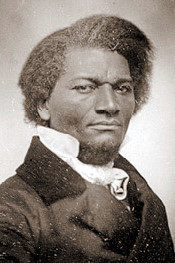
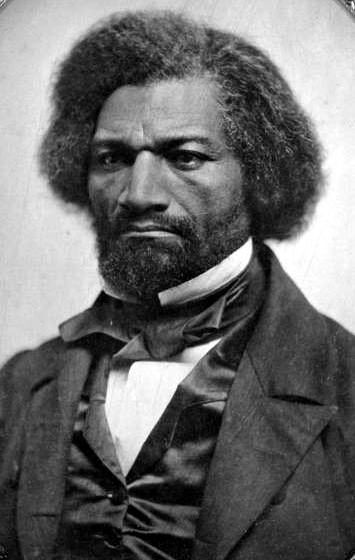
Frederick Douglass c. 1855, image Public DomainFrederick Douglass was born 198 years ago, as nearly as could be determined, on an unknown day in February 1818, based on an entry in the slave ledger of his first master who may have also been his father; Douglass hears reports throughout his young life that his father was certainly a white man, but who exactly it was is left unsaid. Aaron Anthony’s slave Harriet Bailey was Douglass’s mother, and she died when little Frederick was only about seven years old. Anthony’s daughter Lucretia married Thomas Auld, and upon Anthony’s death, she inherited young Frederick.

From such inauspicious beginnings, a ragged orphan enslaved on a plantation with prospects of little but a life of hard work and enforced ignorance, Douglass becomes one of the world’s most famous and well-respected people. His strong native intelligence and courage allows him to take the fullest advantage of every opportunity that comes his way, to his own credit and to the benefit of us all. After a long and illustrious career as an activist, writer, intellectual, and statesman, he dies on February 20th 1895 and leaves behind a legacy rivaled by few in American history.

I salute your memory, Mr. Douglass; my series on your life and ideas is my little tribute to you. Thanks for all you’ve done for your own people and for the whole human race!

I chose this day to commemorate his life and his death here at Ordinary Philosophy in advance of upcoming events in DC: the National Park Service will host a 2-day birthday celebration for Frederick Douglass on February 12th and 13th, 2016 at his home Cedar Hill and nearby sites in Anacostia and DC. Please visit the NPS website for more information.

Ordinary Philosophy and its Traveling Philosophy / History of Ideas series is a labor of love and ad-free, supported by patrons and readers like you. Please offer your support today!

Communitarianism, Writ Large

Amy M Cools's avatarOrdinary Philosophy

I listened to Bill Moyers’ discussion with Michelle Alexander recently, about her book The New Jim Crow and her activism against the over-incarceration of black people here in the US. Something she said really struck me, as it relates to a problem I’ve been mulling over for some time. She said:

I realize that as well-intentioned as all that work was, it was leading me to a place of relatively narrow thinking… If I care about a young man serving, you know, 25 years to life for a minor drug crime… If I care about him and care about his humanity, ought I not also care equally about a young woman who’s facing deportation back to a country she hardly knows and had lived in only as a child and can barely speak the language? And ought I not be as equally concerned about her fate as well? Ought…

View original post 1,483 more words

Fundraising Campaign for Frederick Douglass’ Traveling Philosophy / History of Ideas Series

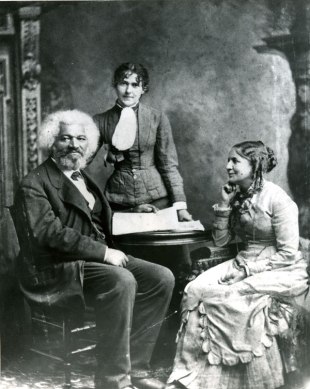
Frederick Douglass with his second wife Helen Pitts and her sister Eva, public domain via Wikimedia CommonsAs you may know, dear readers, I’m embarking on the travel portion of my fifth philosophical-historical themed adventure in mid to late March. I’m off to Baltimore, MD, New York, Washington DC, and other East Coast sites to follow in the footsteps of Frederick Douglass.
Ordinary Philosophy and its Traveling Philosophy / History of Ideas series is a labor of love and ad-free, supported by patrons and readers like you.

Every single bit helps, from $1 on up: directly through your contribution, and indirectly by inspiring confidence and enthusiasm in others who see the support already given.

As always, I count on you to help me accomplish what I do here; thanks to all who have contributed in the past, and thanks in advance to all who contribute in the future!

What the Frederick Douglass Traveling Philosophy / History of Ideas Series project will produce:
– A series of essays on the ideas of Frederick Douglass, how they relate to his time and ours
– A series of travel accounts of sites associated with Douglass’ life and ideas throughout the East Coast. I’ll be seeking insights into how the places informed the man, and vice versa. These will double as historical-philosophical investigations to bring Douglass to life in the mind of the reader, and as inspiration for other traveling history enthusiasts
– A series of downloadable walking tours to accompany the travel series: just subscribe and download in iTunes, and you’ll have your own travel guides to East Coast places I travel to for this series
– Free educational resources: supplementary teaching materials on the life and ideas of Douglass
– And if all goes as planned, a book!

Budget: In the interests of transparency and so you know exactly where your hard-earned, generously donated funds go, here’s the breakdown:

Primary Goal: $2,500 – To cover airfare, lodging, ground transportation, and advertising for Frederick Douglass’ Traveling Philosophy / History of Ideas series
– Airfare: to DC or NYC about $500 (w/taxes and fees)
– Car Rental: average $28 / day = $392
– Lodging: average $50 per night, will be staying with friends some nights = $700
– Parking / Fuel / Public Transportation: average $25 per day = $350
Subtotal = $1,942

Any amount I’ve saved on the above costs or amount collected in excess will be spent on paid advertising (Facebook, Google Adwords, Bing, Pinterest, etc, even a radio spot if funds allow!), which will be listed here, so that the total spent comes to $2,500. (I also advertise in a wide array of free venues)

Secondary Goal: $1,500 – Monthly wages
This year, O.P. is making a big push to include an expanded and more in depth history of ideas travel series, more regularly published podcast with downloadable history of ideas travel guides, interviews with fascinating people, scholarship and educational materials, more great guest posts, and so much more! To accomplish all this, O.P. will need to pay its own expenses and if possible, wages, so I can throw spend less time at other occupations, throwing myself into O.P. with all the heart, time, and energy I long to dedicate to this project.

Please visit the Subscribe, Submit, and Support page to help me fund this project.

I thank you in advance, from the bottom of my heart, for any support you can offer

Sincerely,

Amy Cools


What Is Happening to the Word ‘Beautiful’? by Tanya Newton

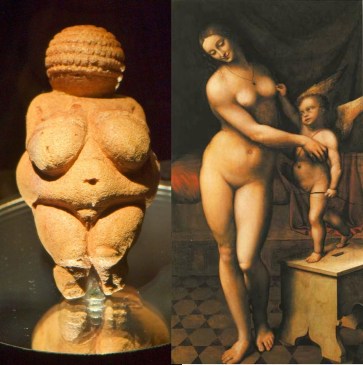
e993b-two2bvenuses2b-2bvenus2bof2bwillendorf2band2bvenus2band2bcupid2bby2bgiampietrino2c2bcopy2bafter2blost2bleda2band2bthe2bswan2bby2bleonardo2bda2bvinci2c2bboth2bpublic2bd‘Beautiful’ has always been a battleground in feminist discussions of representation. While it may seem counterintuitive to argue that we should consider more women as beautiful while also arguing that a woman’s capabilities are worth more than her appearance, tackling the rigid definition of beautiful has been important for intersectional feminism. A traditionally beautiful woman is white; women of colour are more likely to be sexualised instead. A beautiful woman is also normally able-bodied. She usually does not appear to be economically below the middle-class, something that is subtly but pervasively inherent in our ideas of the ideal body shape (too slender for manual labour) and the current trend of tanning (demonstrating leisure time and disposable income). A beautiful woman often also has long hair, a delicate face, and big eyes; she is vulnerable, not strong. So renegotiating this limited meaning of beautiful is a powerful act. Great progress has made with it, which should be cause for optimism. However, recent redefinitions are more troubling than empowering.
Beautiful is being used more and more often to denote a woman’s entire identity. Popular Urban Dictionary entries for beautiful state:

Beautiful is a woman who has a distinctive personality, one who can laugh at anything, including themselves, who is especially kind and caring to others. She is a woman who above all else knows the value of having fun, and not taking life too seriously. She is a woman that you can trust and count on to brighten your day. She is a woman who can inexplicably make you feel really good just by being around her, and yet brings such great sadness when she is gone.  (10,257 positive votes)

Your smile makes you pretty, your body makes you sexy, only your mind makes you beautiful (5,019 positive votes)

The description of anyone who is true to themself (3,272 positive votes)

Yes, it’s Urban Dictionary, but Urban Dictionary is not the only place this idea surfaces. A Buzzfeed video uploaded by Ashly Perez shows women stating that pretty is about “validation” from society, it is taught to young girls, and it is constructed by the media. I’m sure most feminists wouldn’t disagree. However, the video continues to say that beauty is different. “It is something that comes from the inside out: a combination of who I am and what I bring to the table”, one woman says. “I feel most beautiful when I’m using my mind and when I’m around my friends,” another adds. Beauty is made to mean personality. Perhaps this is why Dove’s latest marketing campaign makes women choose to label themselves as either “beautiful” or “average”—not average-looking. Perhaps Dove’s intention is to say that if your personality or capabilities are above average, you are beautiful.

However, beautiful already has a meaning and that meaning can’t simply be erased. It refers primarily to appearance, not identity. The number one definition in the Oxford Dictionary is: “Pleasing the senses or mind aesthetically”. Merriam Webster’s top definition is: “The quality of being physically attractive”. If these definitions were not true, and beauty instead referred to a person’s personality, then the trope beauty is bad wouldn’t exist and men could be called beautiful. Yet Cersei Lannister’s greatest weapon remains her beauty while calling a man beautiful remains an insult.

So Dove’s video, no matter what the intentions are, cannot tell women that if they are above average they are beautiful. Beautiful will not allow itself to be used that way; its meaning of ‘physically attractive’ always twists the message. Dove’s video actually tells women that if they are not beautiful, they are average: their intelligence, their capabilities, and their personality are not as relevant to their identity than their appearance. This video is more problematic than empowering. Buzzfeed’s video links being beautiful to being liked and loved, and while by “beautiful” Buzzfeed means being happy and sociable, we know that being physically attractive really does mean being more loved. Again, using the word beautiful subverts Buzzfeed’s message.

In fact, even if we were able to somehow strip beautiful of its current definition and redefine it to refer to a person’s attitudes and likeability instead of their appearance, that would damage the progress that intersectional feminism has already made. As discussed, beauty’s definition is under contention, and the meaning is slowly broadening. This is too important an accomplishment to discard. Beauty as appearance is a mainstream acknowledgement of visibility and measurement of value. To acknowledge that women of colour, trans women, disabled women, and less wealthy women are beautiful is to say that society considers them equal in appearance to white, able-bodied, cis, affluent women. Beauty meaning identity, on the other hand, does not do this. Stating that the category of beautiful that women have struggled to be included in still does not mean they are considered capable of being physically attractive by mainstream society, but that it’s irrelevant because their friends like them, is a regression.

Buzzfeed’s argument that women should be encouraged to measure their worth by more than their appearance is admirable. Dove’s advocacy of self-confidence is also applaudable. Yet beautiful is the wrong word to adopt to signify a person’s value and self-confidence; it is already laden with too much meaning.

After studying English Language and Literature at King’s College London, Tanya Newton moved to Japan where she teaches English. She loves to read and write, and loves tea almost as much. She is strongly interested in cultures and social structures. (Bio credit: Darrow)

This article was originally published on Darrow. Read the original article.

Ordinary Philosophy and its Traveling Philosophy / History of Ideas series is a labor of love and ad-free, supported by patrons and readers like you. Please offer your support today!

Frederick Douglass on the Constitution

Frederick Douglass Ambrotype, 1856 by an unknown photographer, image public domain via Wikimedia CommonsEarly on his career as an abolitionist speaker and activist, Frederick Douglass is a dedicated Garrisonian: anti-violence, anti-voting, anti-Union, and anti-Constitution.

In the early 1840’s, Douglass joins a revitalized abolitionist movement largely shaped by the views of William Lloyd Garrison. Since the early 1930’s, Garrison espouses a particular set of moral and political beliefs, radical for his time, which he promotes in his influential anti-slavery paper The Liberator. He believes in total non-violence, violence being a tactic of the slaveowners and their corrupt government protectors, not of good God-fearing people who have moral truth on their side. He believes that since voting implies that a government that legalizes slavery is legitimate, true abolitionists must abstain. He believes that the continued Union of the States, Abraham Lincoln’s sacred cause, was not only impossible, but undesirable: it involved the North, directly and indirectly, in the evil of slavery. Since the South was hell-bent on preserving that unnatural and therefore illegal institution, the South should go, and good riddance. And all of these are tied to Garrison’s view of the Constitution: it’s an ultimately pro-slavery, anti-human rights document, and therefore not worthy of obedience or respect.

For many years, Douglass fully agrees with Garrison. But over time, as a result of his conversations and debates with abolitionists who interpret the Constitution differently, and of his own study, experience, and thought in the first four years of publishing his own paper The North Star, Douglass changes his mind. By the early 1850’s, the abolitionist par excellence had come to disagree with Garrison, father of American radical abolitionism, and to agree with Lincoln, proponent of preserving the Union at all costs and of the gradual phasing out of slavery.

So how does Douglass come to make what seems such a counterintuitive change in his views on the Constitution and on the role of violence, voting, and the Union in bringing an end to slavery?

Some of the reasons for Douglass’ evolution are pragmatic; his pragmatist side becomes more pronounced with time and experience (more on this in another piece). For one, he comes to believe that violence is not only unavoidable at times, but sometimes necessary (more on this in another piece as well).

Douglass also becomes convinced that abstaining from politics is just suicide by degrees for the abolitionist movement, since it cedes political power to slaveowners and their supporters. Abstaining from voting in protest, as Garrison calls for, actually works against the project of obtaining greater political rights for black people. (As with celebrity comedian-guru Russell Brand’s anti-voting campaign today; the idea of abstaining from the vote in protest is neither new nor, in my opinion, any more effective now than it was then.) As Douglass points out, however motivated some people are to do the right thing by their fellow citizens, there will always be plenty of others motivated by greed, moral laziness in going along with the status quo, and the drive for power and domination over others. Political clout, gained through voting in those who represent their views, is one of the very few ways in which black people can finally obtain and protect their equal legal rights. And not only that: voting is one of the most practical yet powerful ways black people can demonstrate their full citizenship to those who might be inclined to doubt it. Other than getting an education and fighting in the war for emancipation, Douglass argues that it’s the most important way to undermine ugly stereotypes, prevalent in his day, of black people as lazy, uninformed, and fit only to have their lives run by others. (These stereotypes are, by the way, so ugly that it’s painful just to write them down, but confronting the ugliness head-on drives home the dire necessity of getting rid of them once and for all.)Constitution of the United States, first page of the original, provided by the National Archives and Records Administration, public domain via Wikimedia Commons

But voting’s not enough to ensure that black people obtain the political power necessary to enhance and preserve their rights. For the abolitionist revolution to succeed, the Union must be preserved at all costs, and in the process, it must be recreated as the unified, true haven of freedom it’s meant to be. Douglass believes it’s the responsibility of the free states to liberate the enslaved people of the Southern states, and to extend and enforce guarantees of human rights for all inhabitants of all states.

Why? Because the Preamble of the Constitution tells us that’s what it’s for.

But how does Douglass justify this interpretation when it’s still a matter of such contention that he’s watching his country tear itself in two over it?

To understand the Constitution, it can help somewhat to consider the history that led to its creation and the ideas and intentions of those who wrote it; but to fully understand its true meaning and purpose, Douglass believes, we must always interpret all of its parts in the context of its preamble:

We the People of the United States, in Order to form a more perfect Union, establish Justice, insure domestic Tranquility, provide for the common defence, promote the general Welfare, and secure the Blessings of Liberty to ourselves and our Posterity, do ordain and establish this Constitution for the United States of America.’

The preamble is the key to any valid interpretation of the Constitution because it tells us, in plain, direct, and eloquent language, why the Constitution is written, who it’s written for, and who is bound to obey it. Any interpretation inconsistent with the Preamble reveals that either the Constitution itself is illogical, inconsistent and therefore invalid, or it shows that it’s the interpreter’s reasoning that’s illogical, inconsistent and therefore failing in understanding. Garrisonians agree with the first; Douglass agrees with the second.

So what to do with such parts of the Constitution as the three-fifths clause, which reads:

Representatives and direct Taxes shall be apportioned among the several States which  may be included within this Union, according to their respective Numbers, which shall be determined by adding to the whole Number of free Persons, including those bound to Service for a Term of Years, and excluding Indians not taxed, three fifths of all other Persons‘?. (Art. I, Sec. 2, Cl 3.)

Doesn’t it imply that all those bound to service, which in Douglass’ time almost exclusively applies to black slaves, only count as three-fifths-person, and ergo, are not fully human? While Douglass grants that this clause is deeply problematic, he no longer agrees that it’s actually an endorsement of slavery.

There are two cases which can be argued when it comes to the effects of the three fifths clause: that it gives extra 3/5th’s representative powers to slaveowners, or that it takes away 2/5th’s; that point’s debatable. As Douglass points out, the clause actually appears to be a concession of a point that slaveowners didn’t really want to make but felt forced to if they wanted to increase their political power: that slaves are persons. If they’re not, it would make no more sense to include them at all for purposes of representation than it would to include cows, chickens, or farm implements. But even this grudging concession of personhood is conceivably debatable.

But while the effects of the three fifth clause may help indicate what use it’s been used for, they don’t tell us what it really means or what its true purpose is. So how do we successfully go about determining its meaning?

How about original intent? Since the expressed beliefs and opinions of the Constitution’s authors vary so widely on the matter of slavery, this won’t help us to decide the matter either. Douglass bases his original interpretation of the Constitution as a pro-slavery document on the basis of intent, but as we’ve seen, he changes his mind.

Well, then, how about strict constructionism? This won’t help us either. The terms used are so broad that it’s hard to tell what they literally and finally mean, or to prove outside of the historical context that they refer to the American brand of slavery at all. The three fifths clause never says anything about permanent bondage or race-based slavery. (In fact, the phrase ‘term of years’ seems to imply that there’s a beginning and end to the servitude in question that’s determined by something other than birth and death, but it doesn’t exclude the latter.)

So which interpretation of the three-fifths clause is most consistent with the preamble? Not the idea that those bound to service are anything other than persons or citizens, since the right to representation is only accorded to citizens, which, in turn, are necessarily persons. Nor is the idea that those bound to service are part-person or part-citizen: there’s nothing in the language of the clause nor of the rest of the Constitution that recognizes there’s such things as part-persons or part-citizens. Douglass points out that ‘…the Constitution knows of only two classes [of people]: Firstly, citizens, and secondly, aliens’. Constitutionally, all persons born in the United States are citizens by definition, and all others aliens; of course. the latter are still persons. So the ‘three-fifths’ clause can’t be referring to the completeness of individual persons; as we can see by the language itself, it specifically applies to the total number of persons for the purpose of apportionment only.

Free Stephens, Henry Louis 1824-1882 artist, Public Domain via Library of CongressIt’s clear, then, what the three-fifths clause says about persons and implies about citizens, but what does it really say about slavery?

In a word, nothing. At least, not directly. As Douglass reminds us, the word ‘slave’ and its derivatives never appear in the Constitution at all. It does mention people ‘bound to service for a term of years’ but as we’ve already considered, this is unspecific, never mentions race, nor implies that bondage to servitude is ever anything other than limited.

There is one reading of the three fifths clause that I think is most consistent with the Preamble and with Douglass’ view of proper Constitutional interpretation. Given that the Constitution is concerned with Union, and Justice, and Tranquility, and the common defense, and the general Welfare, and Liberty, the three-fifths compromise was the best the founders could do at the time, given the intransigence of the slaveowners coupled with the young country’s need for their inclusion in the Union, to make the country large and strong enough to bring as much liberty as possible to as many people as possible. Bringing an end to slavery, Douglass believes, is the next necessary step for accomplishing the goals laid out in the Preamble as well as in the Declaration of Independence: to finally stamp out that liberty-destroying institution which had so undermined the general welfare, strength, and tranquility of the Union from its very beginning.

To return to the twin issues of personhood and citizenship in Douglass’ America: in a speech in 1854, Douglass says ‘In the State of New York where I live, I am a citizen and legal voter, and may therefore be presumed to be a citizen of the United States’. Just three short years later, in the infamous Scott vs. Sandford, a.k.a. the Dred Scott decision, the Supreme Court ruled that Douglass and all his fellow black people are not citizens at all. While Douglass explains  in his speech’… [the]  Constitution knows no man by the color of his skin’, the infamous Dred Scott decision of 1857 upended decades of common practice and legal precedent since the founding of the nation, where free black people throughout the United States had enjoyed legal, if not social, equality. However, as Douglass correctly observes, skin color is never mentioned in the Constitution as a precondition for citizenship, only place of birth and status of naturalization.

According to his biographer Philip Foner, Douglass becomes the most advanced and most informed thinker in Constitutional law, and the political and legal theory that informs it, than any of his fellow prominent abolitionists. Douglass believes, in the end, that the Garrisonian abolitionists are making the same mistake as the slaveowners: they fail to interpret the Constitution rightly, on its own terms and as a unified legal document unparalleled and unprecedented in its full establishment of human liberty. From the Garrisonians onward, those of us who likewise interpret the Constitution as protecting the rights of some without protecting others, or who likewise fail to understand its true significance, its true potential, and its true power to bring the blessings of liberty to all, just don’t get the Constitution.

*Listen to the podcast version here or on iTunes

Ordinary Philosophy and its Traveling Philosophy / History of Ideas series is a labor of love and ad-free, supported by patrons and readers like you. Please offer your support today!

~ Also published at Darrow, a forum for ideas and culture

~~~~~~~~~~~~~~~~~~~~~~~

Sources and Inspiration:

Blassingame, J. (Ed.). The Frederick Douglass Papers, Series One: Speeches, Debates, and Interviews. 4 volumes, and The Frederick Douglass Papers, Series 2: Autobiographical Writings. 3 volumes. New Haven and London: Yale University Press, 1979-1999

Douglass, Frederick. Autobiographies, with notes by Henry Louis Gates, Jr. Volume compilation by Literary Classics of the United States. New York: Penguin Books, 1994.

Douglass, Frederick. The Heroic Slave: A Cultural and Critical Edition. Eds Robert S. Levine, John Stauffer, and John McKivigan. Hew Haven: Yale University Press, 2015.

Douglass, Frederick. My Bondage and My Freedom: 1855 Edition with a new introduction.. Re-published 1969, New York: Dover Publications, Inc.

Foner, Philip S. The Life and Writings of Frederick Douglass, Vol. 1-4. New York: International Publishers, 1950.

Landmark Cases: Scott vs. Sandford (The Dred Scott Decision), A C-Span Original TV Series, 2015  http://landmarkcases.c-span.org/Case/2/Scott-V-Sandford

O.P. Recommends: Landmark Cases / Injustices, Two Great Works on the Supreme Court

This last couple of weeks or so, I’ve been packing in a lot more learning about the Supreme Court, and is it ever fascinating.
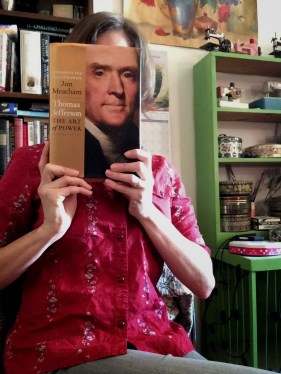
It began when I stumbled on Landmark Cases last month, a C-Span series about 12 Supreme Court cases chosen because they had a dramatic impact on the legal landscape in United States history, and because they likewise had a significant impact on the Court itself, as precedent and on its perceived legitimacy, for good or ill. It can be found as a video series online, but I’ve been listening to the podcast version.
http://landmarkcases.c-span.org/

As I was listening, the discussions reminded me of a book I had heard about a little while ago but had forgotten to read, a book about the Supreme Court’s worst failures, terrible decisions that undermined its legitimacy and had a negative impact on the lives of people for years to come. It’s called Injustices: The Supreme Court’s History of Comforting the Comfortable and Afflicting the Afflicted, by Ian Millhiser. So, I went and picked it up, and just as with the Landmark Cases Series, I’ve been finding it difficult to tear myself away.

Both the Landmark Cases series and Injustices reveal that though sometimes the Supreme Court has been the bulwark against congressional, state, and individual encroachments of freedom, it has also too often betrayed the public trust. While we remember and celebrate such cases as Brown vs. Board of EducationGriswold v. Connecticut, and Obergefell v. Hodges, which brought the blessings of liberty to more of the American people than ever before, we sometimes forget how extensive the history of freedom-crushing Supreme Court decisions really is. The Dred Scott case, Lochner vs. New York, Korematsu vs. United States, and Citizens United v. FEC, for example, allowed employers to exploit desperate workers by cornering the market, fixing wages, and creating terrible working conditions with health-destroying long hours; permitted the government to imprison innocent citizens and allow the looting of their property based on no other consideration than race; and enabled the wealthy few to effectively buy up elections. Millhiser’s view of the Supreme Court’s historical tendency to value states and property rights over civil rights and the public interest is summarized here: ‘If American government truly derives its legitimacy from the consent of the governed, then [the] agenda [of the hardline conservatives] that is so often and so soundly rejected at the polls must not be implemented by one unelected branch of government when there is no constitutional basis to do so.’ (pp 184-85).

The Supreme Court’s conservative justices, joined at times by their otherwise more liberal-minded colleagues, all too often decided their cases according to the view that the Constitution only prescribes and limits federal action, and was not intended to do likewise with state or individual action. But as many other Supreme Court justices observed, especially in its civil rights phase throughout the latter half of the twentieth century, this reading of the Constitution renders it impotent (FDR’s terminology in his second inaugural address) to extend the protections of the Bill of Rights to citizens in almost all arenas of life.

After all, most of one’s life is not spent interacting directly with the federal government or its institutions, but in homes, shops, public squares, workplaces, and so on. If the state, or an employer, or a county sheriff, or a bus driver, or a neighbor, or any other non-federal institution or person uses their liberty to oppress another individual, then the latter can’t actually enjoy the freedoms that the Bill of Rights guarantees*. And surely the founders of our nation didn’t intend the Bill of Rights, demanded as a condition of the Constitution’s passage, to be powerless to protect individual freedoms in most circumstances. This is the principle which drives the more liberal Supreme Court Justices, Millhiser, and commentators on the Landmark Cases series to agree that strict constructionist, hyper-conservative, elitist, and commerce-centric justices have historically imposed opinions on the public that do not serve their interests as idealized in the Bill of Rights, and allowed the the powerful and wealthy few to claim the right to do as they like while trampling the liberties of everyone else. Since the Constitution derives its legitimacy from ‘we the people’, then we the people, in our institutions and as individuals, should be likewise bound by the Bill of Rights.

At times, I think that Milhiser champions too strongly the general principle that unelected judges should get out of the way and allow elected representatives to legislate as their constituents demand. After all, as so many of Milhiser’s examples indicate, legislators historically have been all too happy, too often, to make laws that favor some while trampling the rights of others. The potential value of an unelected judiciary to balance the power of an elected legislature is, I think, revealed more clearly in the Landmark Cases discussions. After all, the will of the majority often runs contrary to the national project laid out in the Preamble of the Constitution and the Bill of Rights, to protect and promote the rights of everyone, especially those in the minority who need protection the most. However, as author Jeffrey Toobin points out in his endorsement of the book, Millhiser’s book does an excellent job of balancing the good history of good Supreme Court jurisprudence with the bad.

Listen to the podcast version here or on iTunes

*For more on the distinction between liberty and freedom, please see my essay Freedom, Liberty, and the Inevitable Interconnectedness of Human Life

Ordinary Philosophy and its Traveling Philosophy / History of Ideas series is a labor of love and ad-free, supported by patrons and readers like you. Please offer your support today!

~~~~~~~~~~~~~~~~~~~~~~~

Sources and inspiration:

Landmark Cases: A C-Span Original TV Series, 2015
http://landmarkcases.c-span.org

Millhider, Ian. Injustices: The Supreme Court’s History of Comforting the Comfortable and Afflicting the Afflicted. New York: Nation Books, 2015.

“One Third of a Nation”: FDR’s Second Inaugural Address, published at History Matters website. http://historymatters.gmu.edu/d/5105/

Interview with Clay Jenkinson as Thomas Jefferson, Jan 16th 2016

I’m ple6759b-amy2band2bjeffersonased to announce that the 33rd episode of the podcast is a super special one, as it’s Ordinary Philosophy’s first interview, and my distinguished guest is Clay Jenkinson, humanities scholar, author, and creator of the Thomas Jefferson Hour radio show and blog.

I’m a long time listener of the show; in fact, I believe I’ve listened to just about every single episode, many of them more than once, and relied on Clay’s work to inform my own, especially in the two Traveling Philosophy / History of Ideas series I did following the life and ideas of Thomas Jefferson.

I highly, highly recommend you give the Thomas Jefferson Hour a listen, you can find it at www.jeffersonhour.com, along with many other resources on the life and ideas of Jefferson, and Clay’s other work in the humanities.

You can find the accounts of my two series on Jefferson, as part of the Traveling Philosophy / History of Ideas series, here and here.

I interview Clay here in character as Thomas Jefferson, as he does on the Thomas Jefferson Hour, discussing various issues as Jefferson himself might have viewed them, informed by Clay’s extensive scholarship on his life and expressed views.

I hope you enjoy our discussion as much as I did!

You can also subscribe to the Ordinary Philosophy and Thomas Jefferson Hour podcasts on iTunes.

*Thank you, Shane and David, for your help and technical support

Ordinary Philosophy and its Traveling Philosophy / History of Ideas series is a labor of love and is ad-free, entirely supported by patrons and readers like you. Please offer your support today!