Is it Ethical to Use Data from Nazi Medical Experiments? by Lynn Gillam

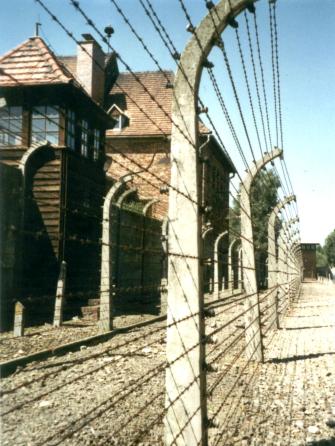
Birkenau (Nazi concentration camp where medical experiments were performed on prisoners) by Scotch Mist - Own work - creative commons license, via Wikimedia CommonsDuring World War II, Nazi doctors had unfettered access to human beings they could use in medical experiments in any way they chose. In one way, these experiments were just another form of mass torture and murder so our moral judgement of them is clear.

But they also pose an uncomfortable moral challenge: what if some of the medical experiments yielded scientifically sound data that could be put to good use? Would it be justifiable to use that knowledge?

Using data

It’s tempting to deflect the question by saying the data are useless – that the bad behaviour must have produced bad science, so we don’t even have to think about it. But there is no inevitable link between the two because science is not a moral endeavour. If scientific data is too poor to use, it’s because of poor study design and analysis, not because of the bad moral character of the scientist. And in fact, some of the data from Nazi experiments is scientifically sound enough to be useful.

The hypothermia experiments in which people were immersed in ice water until they became unconscious (and many died), for instance, established the rate of cooling of humans in cold water and provided information about when re-warming might be successful. Data from the Nazi experiments was cited in scientific papers from the 1950s to the 1980s, but with no indication of its nature.

The original source appears as a paper by Leo Alexander, published in Combined Intelligence Objectives Subcommittee Files. This is an unusual type of publication to be mentioned in a scientific journal, and it’s unclear that it comes from the trial of Nazi doctors at Nurmemberg.

In the late 1980s, US researcher Robert Pozos argued the Nazi hypothermia data was critical to improving methods of reviving people rescued from freezing water after boat accidents, but the New England Journal of Medicine rejected his proposal to publish the data openly.

Use of data generated by the Nazis from the deadly phosgene gas experiments has also been considered, and rejected by the US Environmental Protection Agency, even though it could have helped save lives of those accidentally exposed.

A tricky conundrum

So should the results of Nazi experiments ever be taken up and used? A simple utilitarian response would look to the obvious consequences. If good can come to people now and in the future from using the data, then its use is surely justified. After all, no further harm can be done to those who died.

But a more sophisticated utilitarian would think about the indirect and subtle consequences. Perhaps family members of those who were experimented on would be distressed to know the data was being used. And their distress might outweigh the good that could be done. Or perhaps using the data would send the message that the experiments weren’t so bad after all, and even encourage morally blinkered doctors to do in their own unethical experiments.

Of course, these bad consequences could be avoided simply be making sure the data is used in secret, never entering the published academic literature. But recommending deception to solve a moral problem is clearly problematic in itself.

The trouble is that focusing on the consequences – whether good or bad – of using Nazi data, misses an important point: there’s a principle at stake here. Even if some good could come of using the data, it would just not be right to use it. It would somehow deny or downplay the evil of what was done in the experiments that generated them.

This is a common sentiment, but if it is to hold ethical weight we need to be able to spell it out and give it a solid foundation. A little reflection shows that, as a society, we don’t have an absolute objection to deriving some good out of something bad or wrong. Murder victims sometimes become organ donors, for instance, but there is no concern that is inappropriate.

Paying our debt

So how to decide when it’s all right to derive some good from a wrongdoing? I think the answer lies in considering what society owes ethically to the victims of a wrongdoing. The ongoing investigations into institutional child sexual abuse in a number of Western countries have brought this question sharply into focus.

The wrongs done to victims of abuse are over but that’s not the end of the matter. Victims are ethically owed many things: recognition that what was done to them was indeed wrong, a credible indication that the society takes this seriously, an effort to identify, apprehend and punish the perpetrators, and compensation for their ongoing suffering and disadvantage. But beyond this, we have an obligation not to forget, and not to whitewash.

Victims of Nazi medical experiments are owed these same things. If society’s obligations to them have broadly been met through the Nuremberg trials and the ongoing global abhorrence of the awful things done to people in World War II, then it might be ethically possible to use the data if it could lead to some good.

But this must only be done with absolute openness about the source of the data, and clear condemnation of the way it was obtained. Citation of the Nazi hypothermia data in the medical and scientific literature from the 1950s to the 1980s gives no hint at all about of what is being referred to, and so falls ethically short.

Click here to read more articles in The Conversation’s series On Human Experiments.The Conversation

Lynn Gillam, Academic Director/ Clinical Ethicist, Children’s Bioethics Centre at the Royal Children’s Hospital, and Associate Professor in Health Ethics at the Centre for Health and Society, University of Melbourne

This article was originally published on The Conversation. Read the original article.

O.P. Recommends: Like the Oscars, #PhilosophySoWhite

School of Athens by Raphael [Public domain], via Wikimedia Commons (cropped)Eric Schwitzgebel, who authors the The Splintered Mind blog (a favorite of mine), recently co-wrote this excellent opinion piece about philosophy’s lack of diversity.

Like Hollywood, Schwitzgebel and Myisha Cherry find that there’s a set of preconceptions which underlie the way work is chosen and promoted which, in turn, virtually guarantees philosophy will remain non-diverse. Hollywood has its own set; for academic philosophy, the glorification of obscurantism is a primary factor. Schwitzgebel and Cherry write: ‘We admire philosophers whose central arguments are nearly impossible to understand, or who speak in paradoxes, who accept seemingly bizarre views, or who display dazzling skill with formal logical structures of no practical significance. Kant and Hegel are better loved than understood.’ Seeming smart, the authors explain, has long been confused by too many academics with being smart.

The piece goes on to show how this obscurantism has become the traditional province of white male academics, and is integral to keeping the field of philosophy so exclusionary, and to most people, so irrelevant.

This, of course, would be sad news for Ordinary Philosophy, dedicated as it is to philosophy in the public square, if it were news. But it’s not news, and that’s one of the main reasons O.P. exists. Philosophy should be, like good government, of, by, and for the people. While specialization is key to the development and exploration of complex ideas, obscurantism and jargon, despite assumptions to the contrary, are not necessary to that project. In fact, they accomplish little except ensuring that philosophy is tedious and unpleasant to read, that philosophers end up talking to nearly no-one but each other, and that the field as a whole ends up remaining oh-so-white, oh-so-male, and to most, oh-so-irrelevant.

Ordinary Philosophy and its Traveling Philosophy / History of Ideas series is a labor of love and is ad-free, entirely supported by patrons and readers like you. Please offer your support today!

New Podcast Episode: Communitarianism, Writ Large

Listen to this podcast episode here or subscribe on iTunes

I listened to Bill Moyers’ discussion with Michelle Alexander recently, about her book The New Jim Crow and her activism against the over-incarceration of black people here in the US. Something she said really struck me, as it relates to a problem I’ve been mulling over for some time. She said:

‘…I realize that as well-intentioned as all that work was, it was leading me to a place of relatively narrow thinking… Ought I not care equally for all? And that really was Dr. King’s insistence at the end of his life….’

Alexander’s reflection on her own work illustrates our need not only to grow more expansive in our thinking in order to achieve a more just society not just locally, but globally: we need to witness and internalize the sufferings faced by other human beings who are not like us in appearance and culture, so that our instincts for empathy and for justice expand as well… Read original essay here

Ordinary Philosophy and its Traveling Philosophy / History of Ideas series is a labor of love and is ad-free, entirely supported by patrons and readers like you. Please offer your support today!


Happy Birthday, Rosa Luxemburg!

Rosa Luxemburg, By unknown photographer around 1895-1900 [Public domain], via Wikimedia CommonsRosa Luxemburg, Mar 5 1871 – Jan 15 1919, is the great Marxist theorist, writer, economist, revolutionist, anti-war and anti-capital-punishment activist, and philosopher who was murdered during the German Revolution of 1918–1919.

Though she’s an anti-war activist, Luxemburg is also critical of the idea that a just society can be brought about by incremental reforms through established political systems. If she were to be involved in the 2016 Democratic primary race between Hillary Clinton and Bernie Sanders, she would very likely back Bernie, with his more revolutionary style and rhetoric: she’s sharply critical of the Social Democratic Party of Germany, to which she belongs (in its left wing) for favoring a Hillary-style reformist approach. However, her internationalism takes Marxist thinking beyond the point where leading Marxists of her day had progressed, with their focus on unique formulations of Marxist political theory tailored to their own particular national identities and histories. She would likely find fault, then, with Bernie’s protectionism.

Luxemburg’s other great contribution to Marxist thought is her theory about the accumulation of capital. Since capitalism’s primary fuel is constant and ever-increasing consumption, she thinks it’s a mechanism for the ultimate destruction of our material capabilities to sustain ourselves, starting with the ecosystems on which indigenous people, the poor, and the working class depend. Here as well, her progressive thinking takes her far beyond Marx himself, and her concerns in this timely issue makes her as relevant now as ever.

Read more about the brilliant and fearless Luxemburg:

‘Who’s Who – Rosa Luxemburg’ at First World War.com

‘The Dialectic of the Spatial Determination of Capital: Rosa Luxemburg’s Accumulation of Capital Reconsidered’ by Peter Hudis

The Crisis of German Social Democracy (The Junius Pamphlet) by Rosa Luxemburg, 1915

‘Rosa Luxemburg’, from Wikipedia, the free encyclopedia

Ordinary Philosophy and its Traveling Philosophy / History of Ideas series is a labor of love and is ad-free, entirely supported by patrons and readers like you. Please offer your support today!

O.P. Recommends: Arthur I. Miller on the Convergence of Science and Art

In this fascinating interview, Neil Denny talks to Arthur I. Miller, historian and philosopher of science, about the progress of science and art, how they merged in the 20th century and continue to do so today. As Miller says, ‘… at the beginning of the 20th century, scientists were beginning to think like artists and artists were beginning to think like scientists.’ But this was not a new development even then; as Miller points out, great creative minds like Leonardo da Vinci ‘thought there was no distinction between art, science, and technology.’

The idea that science and art share a close relationship makes sense to me: they’re both ways of interpreting the world so that it makes sense to us; they open up our imaginations to new ways of seeing and change our perspectives by revealing deeper worlds, from the subatomic to the galactic; and great breakthroughs in science happen not only as the result of painstaking observation and experiment, but in great flashes of creative, visionary brilliance. Listen to the podcast discussion here

Ordinary Philosophy and its Traveling Philosophy / History of Ideas series is a labor of love and is ad-free, entirely supported by patrons and readers like you. Please offer your support today!

New Podcast Episode: Frederick Douglass on the Constitution

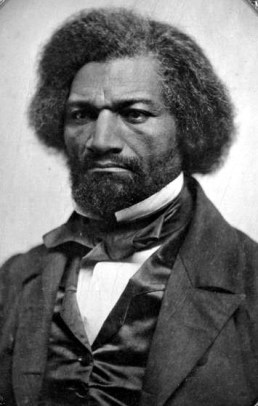
Frederick Douglass Ambrotype, 1856 by an unknown photographer, image public domain via Wikimedia CommonsListen to this podcast episode here or subscribe on iTunes

Early on his career as an abolitionist speaker and activist, Frederick Douglass is a dedicated Garrisonian: anti-violence, anti-voting, anti-Union, and anti-Constitution…

[But] by the early 1850’s, the abolitionist par excellence had come to disagree with Garrison, father of American radical abolitionism, and to agree with Lincoln, proponent of preserving the Union at all costs and of the gradual phasing out of slavery.

So how does Douglass come to make what seems such a counterintuitive change in his views on the Constitution and on the role of violence, voting, and the Union in bringing an end to slavery?… Read the original essay here

Ordinary Philosophy and its Traveling Philosophy / History of Ideas series is a labor of love and is ad-free, entirely supported by patrons and readers like you. Please offer your support today!

Junkyard Idealism

Greater Adjutant (Leptoptilos dubius) on a garbage dump in Guwahati, Assam in March 2007, by Yathin sk, Public Domain via Wikimedia CommonsIn a letter to a friend recently, I was reminiscing about my years working in a salvage and recycling yard. It was founded by an idealistic and action-oriented sociologist right near the edge of the local dump’s garbage pit, now grown to a fairly large operation that employs about forty people. I loved and miss the work: it was dirty, physically demanding, creative, and full of the thrill of treasure hunting, as founder Dan Knapp, my fellow salvagers, and I made all manner of discarded things available for use again. We diverted truckloads upon truckloads of things from the landfill every day, and dug among boxes and bags of trash and pulled out everything recyclable or reusable we could find. We rescued all manner of interesting artifacts; one box of ephemera we sold made it into an episode of PBS’s History Detectives. Being a lover of history, I was thrilled at the discovery and wondered how many other interesting and significant relics we snatched from the dump’s gaping mouth.

I wore steel toed boots and thick battered work gloves and grimy jeans, and scrubbed the filth off old household goods, lifted stoves and tables and dressers and machinery and rugs and other heavy things (I grew very strong there, and learned how to maximize the available leverage in my body), and delicately repaired jewelry, pottery, art, and so on. One of my favorite photos anyone’s ever taken of me illustrates an East Bay Express article from several years ago, where you will find me sitting on one of a row of recycled toilets. We helped young artists and first-time homeowners and collectors and independent businesspeople and seekers of antiquities find interesting and useful things; we also bargained, negotiated, and wrangled with hustlers, hoarders, slumlords, and thieves. While the work was hard and pretty nasty sometimes, it could also be great fun and deeply satisfying, and the comradery we shared was delightful, sometimes intense. Many lasting friendships emerged from this place, including my marriage.

Amy Cools works at Urban Ore, where you can find all manner of household goods, by Stephen Loewinsohn for the East Bay Express

Amy Cools works at Urban Ore, where you can find all manner of household goods, by Stephen Loewinsohn for the East Bay Express

My reminiscing was triggered by a podcast discussion I’d just heard about Thomas Jefferson’s disappointed idealism when so many of his fellow Americans flouted the Embargo Acts of his administration. Jefferson wanted to avoid getting drawn in to the war between Britain and France happening at the time, and to protest the unfair treatment of the newly formed United States as a free and equal trading partner. He also wanted to demonstrate to the world ‘that there are peaceful alternatives to war’, such as withdrawing from trade in protest. Unfortunately, the public would not put up with the resulting deprivation of luxuries and money-making opportunities resulting from the general embargo, and it failed.

The embargo episode discussion reminded me of the idealism of the salvage yard, of its founder and those of us that believed that the work (and some still do!) was mostly about doing our bit to counteract the wasteful and polluting consumer habits of our American culture. We hoped and believed, like Jefferson, that the capacity of ordinary citizens to do the right thing would come through, and we could curb and redirect our acquisitory habits if necessary. Yet, like Jefferson, many of us found ourselves disappointed at the way our fellow citizens would fail to live up to our idealism. Even in the Bay Area, known for its ‘green’ culture, our community still manages to consume so voraciously and produce so much trash, that our operation could hardly seem to make a dent in it, though we recycled, literally, tons of stuff every day. When our team in place at the dump would salvage from the trash pile about to be bulldozed into the pit, we’d find enormous quantities of recyclable and salvageable things thrown carelessly into the garbage, even though there’s a comprehensive local infrastructure for salvage and recycling. Everywhere in this country, even here in this liberal bubble, we still seem to be contributing far too much towards rendering the earth and its atmosphere more inhospitable to life as we know it, because we just can’t seem to find a way to help ourselves.

Now, of course, there’s no way around the fact that waste is one of the byproducts of living, especially for long-lived, intelligent, creative creatures like human beings. And some of the waste seems acceptable: clothes worn out and outgrown; machines which no longer work but contain usable parts; recyclable packaging like glass bottles and tin cans; worn-out books, textiles, and parts; obsolete technology; and so on. But lots of the waste appears just gratuitous: gimmicky toys and games; faddy decor; cheap, poorly constructed clothing and other stuff manufactured for short-term use; trinkets and impulse buy gifts that few like to keep but many buy out of a sense of social obligation or an addiction to shopping; and so on. To this day, when I walk into a department or gift shop I perceive mostly thinly disguised, soon-to-be trash.

We really did believe, as again so many of us still do, that this salvage work has significance, that it’s a part of a general movement, slow-moving as it may be, towards a greener, less wasteful, more environmentally caring way of living in the world. The mission and the work both fit in with and raise local consciousness, and lots of people bring their discards to salvage from, glad to see that much of it would not become trash after all. And the business continues to be a well-known and beloved local institution, warts and all.

I still hope, with my old friends and former colleagues, that the people of the United States and of the world will make more than symbolic changes to better protect our world from the ravages of our mining, agriculture, production, and consumption, and live up to our idealism a little better than the American people of Jefferson’s day. Those disposable grocery bags do little to help if we’re still buying and throwing away at such high rates, cheap clothing, discarded water bottles when clean water is flowing from our taps, boxes from nightly takeout, overly-packaged goods, most kinds of plastics, and generally more stuff than we need. Many are more optimistic than I am about how far we’ve come and where we’re going when it comes to waste, pollution, and the capabilities and effectiveness of modern recycling programs. My husband points out that the efficiency of the Oakland transfer station, which uses well-calibrated equipment to effectively separate out recyclables from trash, and the advanced capabilities of carpet recyclers, who have taken out the guesswork of sorting by compatible fiber content with sensors which can detect it, demonstrate real social progress at least when it comes to waste. And one of my great friends is a techie who closely follows technology news, those just coming out, in development, and still in the working-theory stage. If he’s right, new technologies will resolve most or all of our pollution problems, of both production and disposal, in the relatively near future, so long as we manage to fund, make, and use them before we’ve pushed our human-nurturing environment over the brink of collapse.

I really hope my husband and my tech friend are right. Perhaps we won’t ultimately solve the problem through economic self-control, just as in the days of the embargo. Perhaps technology is the only workable solution. But until we’ve invented our way out of the mess we’re making of the world, we need to keep putting our junkyard idealism to work.

Ordinary Philosophy and its Traveling Philosophy / History of Ideas series is a labor of love and is ad-free, entirely supported by patrons and readers like you. Please offer your support today!

~~~~~~~~~~~~~~~~~~~~~~~~~~~~~~~~~~~~~~~~

Sources and inspiration:

Jenkinson, Clay. ‘Crockett Middle School‘, episode 1169  of the Thomas Jefferson Hour, Feb 21, 2016.

‘Urban Ore: About Us’ business website page

Related Ordinary Philosophy pieces:

Activism is Not Enough: As Long As We Keep Shopping and Don’t Vote, It’s Our Fault Too! Dec 13, 2014 by Amy Cools

Logos‘, Jul 27, 2015 by Amy Cools

New Podcast Episode: O.P. Recommends: Landmark Cases and Injustices, Two Great Works on the Supreme Court

Listen to the podcast episode here  or subscribe on iTunes

This last couple of weeks or so, I’ve been packing in a lot more learning about the Supreme Court, and is it ever fascinating.
It began when I stumbled on Landmark Cases last month, a C-Span series about 12 Supreme Court cases chosen because they had a dramatic impact on the legal landscape in United States history, and because they likewise had a significant impact on the Court itself, as precedent and on its perceived legitimacy, for good or ill….  Read the original essay here

Ordinary Philosophy and its Traveling Philosophy / History of Ideas series is a labor of love and is ad-free, entirely supported by patrons and readers like you. Please offer your support today!

Frederick Douglass the Pragmatist

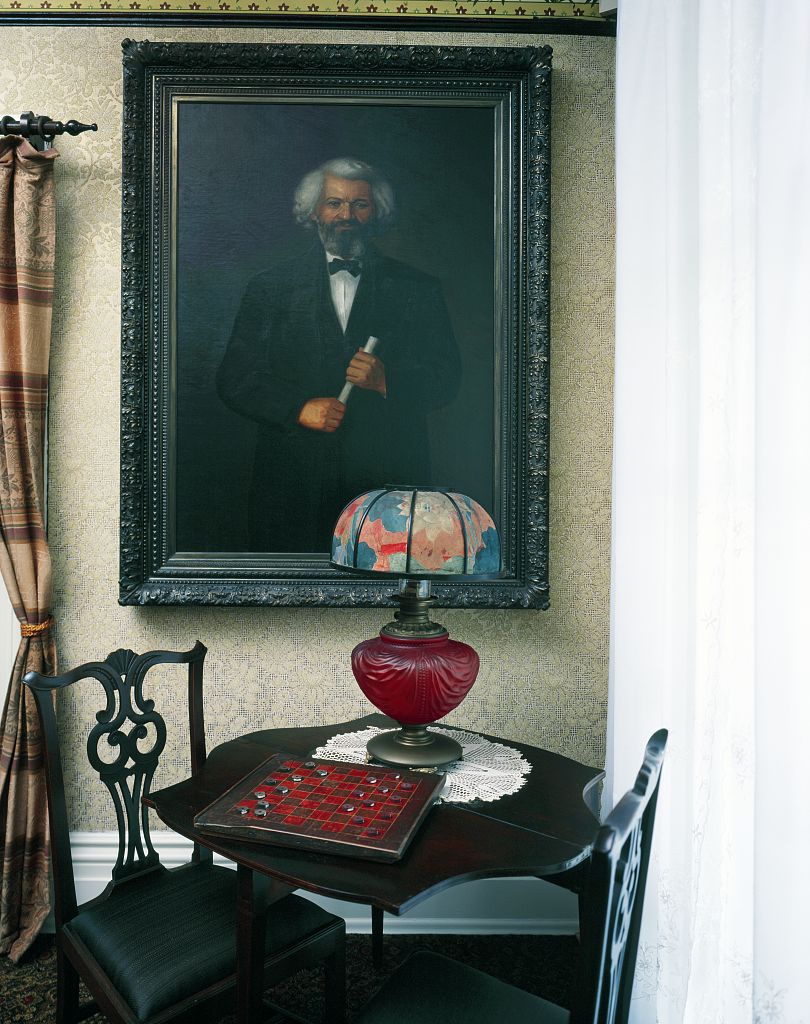
Frederick Douglass House Parlor, Washington, D.C.

Douglas is a fiery orator, an uncompromising abolitionist and proponent of universal human rights, and even an advocate of using violence if the cause is just, the harms too great, and other means prove ineffective (more on that in an upcoming piece). He criticizes those who ‘shamefully abandon their principles’. And very often, when he encounters discrimination in a hotel, restaurant, or other public place, he reports the incident to the local press.

Yet for all his energetic activism, uncompromising rhetoric, and devotion to principle, Douglass is also a pragmatist, in matters large and small.

To be sure, many of his activist tactics are as idealistic, and plainly appear so, as they are as practical. Douglass’ reports of discrimination, for example, fire up public support for the cause of equal rights by arousing a storm of protest and in turn, raising consciousness and providing examples for use in the political arena.

He’s a pragmatist when it comes to making a living as well: after a decades-long successful career lecturing and publishing, a house fire and an attempt to rescue the Freedman’s Bank from collapse leave Douglass’ finances in disarray. So he takes to the lecture circuit again full time in the 1870’s. In the pre-Civil War era, he makes his living doing what he believes in most: lecturing, debating, and arguing for abolishing slavery and expanding human rights. But in the post-Civil War era, he finds that morals, politics, and rights issues are no longer such profitable topics. So he goes ahead and lectures on the profitable ones, so long as it he can make the talks instructive and wholesome, and link them to more important issues. ‘People want to be amused as well as instructed’ he writes.

He’s a pragmatist when it comes to tactics and the importance of crafting an image. For example, Douglass considers photography a very important, modern tool for engendering mass support through empathy: if people can see and recognize the face of the person behind the ideas, and of one who is a member of a suffering and oppressed people, people will feel the visceral need for change. So, he takes care to become one of the most photographed men in American history.

Douglass’ practicality holds sway in larger issues too. He does not hesitate to change tactics or switch allegiances between organizations or parties if he thinks it would help the cause in the long run. In fact, he is convinced that true, unswerving, uncompromising allegiance to the cause itself requires a reformer to use whatever means necessary, so long as they are not morally wrong, even if they are imperfect or less inspiring or exciting to others than the more uncompromising choice. He has been criticized throughout the years for splitting with the Garrisonians, for siding with Captain John Fremont against Abraham Lincoln in the latter’s recall of Fremont’s emancipation proclamation in Missouri early in the war, for refusing to support or join in on the raid on Harper’s Ferry (though he supports John Brown’s ideas about the validity of armed resistance in general), for evading arrest and possible execution for charges of co-conspiracy in the Harper’s Ferry raid by fleeing to Canada, and for abandoning the Radical Abolitionist Party in favor of the newly formed Republican Party. His critics contend that his practice of often siding with moderate tactics and candidates reveal a lack of commitment and moral courage.

Yet he defends all of these practical choices on the grounds that commitment to the tactics or politics in and of themselves are actually a distraction, since the practice of committing to the ‘pure’ choice in the short run is often an impediment to achieving the ultimate goal in the long run. For example, if he throws his support behind his friend and hero Gerit Smith, uncompromising political candidate of the Radical Abolitionist Party, instead of Abraham Lincoln, the Republican candidate who ran on the more moderate goal of preventing the spread of slavery to the new states, he might be more admired as an uncompromising leader. But he understands what a risky move this would be. The Radical Abolitionists had little chance of winning, but the Republican Party was off to a very successful start, losing its first presidential campaign by a relatively small margin. Since the moderate goals of the Republican Party had a good chance of realization while those of the Radical Abolitionists little to none, Douglass sides with the former. The stakes are simply too high for Douglass to risk losing at this point, even if the risk appears nobler.

In sum, Douglass argues that the truly committed reformer is free to choose the more modest, practical, sure-bet option over the less apparently compromising, more radical option when it appears to be more effective in the long run. That’s because true faithfulness to the mission does not require appearing an effective reformer, it requires actually being as effective as possible. No small part of Douglass’ greatness as an activist and as a person is his willingness to forgo short-term public approval or personal glory in favor of acting in the long-term best interests of his cause. And it appears that history not only validates him as an astute tactician, but as a heroic figure, in part because in hindsight we can more easily recognize the wisdom, integrity, and strength in his pragmatism.

Ordinary Philosophy and its Traveling Philosophy / History of Ideas series is a labor of love and is ad-free, entirely supported by patrons and readers like you. Please offer your support today!

~~~~~~~~~~~~~~~~~~~~~

Sources and inspiration:

Blassingame, J. (Ed.). The Frederick Douglass Papers, Series One: Speeches, Debates, and Interviews. 4 volumes, and The Frederick Douglass Papers, Series 2: Autobiographical Writings. 3 volumes. New Haven and London: Yale University Press, 1979-1999
Douglass, Frederick. Autobiographies, with notes by Henry Louis Gates, Jr. Volume compilation by Literary Classics of the United States. New York: Penguin Books, 1994.

Douglass, Frederick. My Bondage and My Freedom: 1855 Edition with a new introduction.. Re-published 1969, New York: Dover Publications, Inc.

Foner, Philip S. The Life and Writings of Frederick Douglass, Vol. 1-4. New York: International Publishers, 1950.

Varon, Elizabeth. ‘Most photographed man of his era: Frederick Douglass’, the Washington Post, Jan 29, 2016. https://www.washingtonpost.com/opinions/most-photographed-man-of-his-era-frederick-dou

Happy Birthday, John Rawls!

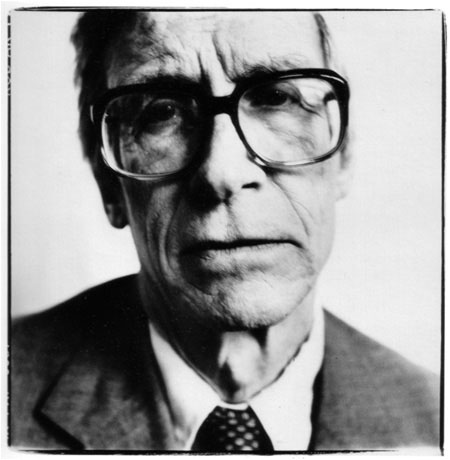
John Rawls, image via BBC's Will and Testament blogJohn Rawls, Feb 21, 1921 – Nov 24, 2002, is the great moral theorist who thinks of justice as fairness.

Among his greatest contributions is the thought experiment called ‘the veil of ignorance’. It’s a beautifully simple method for helping to design a just society: imagine you’re to be placed into society with no idea what you would be: rich, poor, or middle-class; tall or short; intelligent or not; of which gender; outgoing or shy; of which race; employed or not and at what kind of job; and so on.

Given that you have no idea what your roles in life will be, what cultural practices, laws, policies, governmental system, economic system, and so on, would you put into place? Remember, behind that veil of ignorance, you’ll have to decide what kind of society benefits everyone the most, since you could end up being anyone. If you were really in that situation, imagine just how fair you’d be. Perhaps, as Rawls imagines, we’d all be far better off if that was really how the world works.

~~~~~~~~~~~~~~~~~~~~~~~~~~~~~~~~~~~~

Further reading:

Stanford Encyclopedia of Philosophy: John Rawls

John Rawls’ A Theory of Justice (book preview)

Ordinary Philosophy pieces featuring John Rawls:

Communitarianism, Writ Large

Sources, Influences, Shout-Outs, and all that Good Stuff