Interview with Clay Jenkinson as Thomas Jefferson, Jan 16th 2016

I’m ple6759b-amy2band2bjeffersonased to announce that the 33rd episode of the podcast is a super special one, as it’s Ordinary Philosophy’s first interview, and my distinguished guest is Clay Jenkinson, humanities scholar, author, and creator of the Thomas Jefferson Hour radio show and blog.

I’m a long time listener of the show; in fact, I believe I’ve listened to just about every single episode, many of them more than once, and relied on Clay’s work to inform my own, especially in the two Traveling Philosophy / History of Ideas series I did following the life and ideas of Thomas Jefferson.

I highly, highly recommend you give the Thomas Jefferson Hour a listen, you can find it at www.jeffersonhour.com, along with many other resources on the life and ideas of Jefferson, and Clay’s other work in the humanities.

You can find the accounts of my two series on Jefferson, as part of the Traveling Philosophy / History of Ideas series, here and here.

I interview Clay here in character as Thomas Jefferson, as he does on the Thomas Jefferson Hour, discussing various issues as Jefferson himself might have viewed them, informed by Clay’s extensive scholarship on his life and expressed views.

I hope you enjoy our discussion as much as I did!

You can also subscribe to the Ordinary Philosophy and Thomas Jefferson Hour podcasts on iTunes.

*Thank you, Shane and David, for your help and technical support

Ordinary Philosophy and its Traveling Philosophy / History of Ideas series is a labor of love and is ad-free, entirely supported by patrons and readers like you. Please offer your support today!

Why We Need Citizen Philosophers

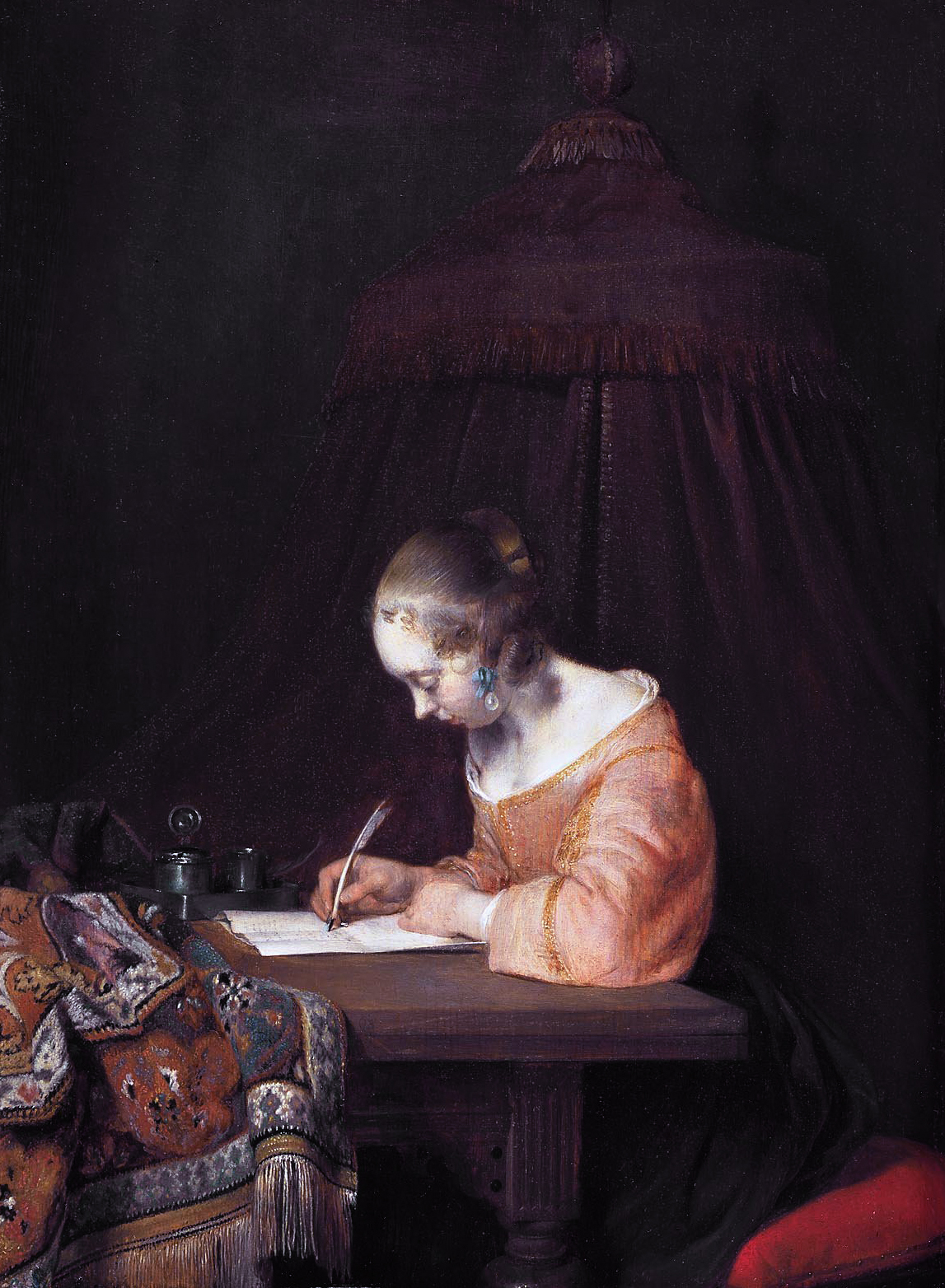
Writing a letter *oil on panel *39 x 29.5 cm *signed b.c.: GTB *ca. 1655I am a citizen philosopher, and very likely, so are you.

So what is citizen philosophy, why is it a useful concept, and what is its role in the world?

Let’s begin by considering what we mean by philosophy, generally speaking. For a long time, philosophy has been considered an almost exclusively academic pursuit, so highly specialized that only a very few experts can properly be called philosophers. As Eric Schwitzgebel points out, this is a relatively new development. In the Western world, it traces its origins to classical Greece; each region of the world has its own history of philosophy or its analogue, from Egypt to China to the Americas. As with all fields of inquiry, philosophy has branched out and specialized until much of it would be barely comprehensible to its first practitioners. Indeed, almost all fields of inquiry we know today started out as a branch of philosophy: mathematics, logic, science, medicine, theology, you name it.

But Philosophy, or ‘love of wisdom’, began in the home, the workplace, the market square, and the street corner with curious, intelligent people who, newly enjoying the luxury of free time accorded by advances in food-acquisition technologies, began to ponder on the whys and hows of the natural world and of the human experience. These people weren’t originally chosen or designated by some authority as the ‘thinkers’ as opposed to everyone else, the ‘doers’; instead, philosophy originated, grew, and specialized organically. We, as a species, began to ask and answer ever more complex questions about how to best live in the world as members of societies, what’s going on within our own minds and why, what are our roles in the universe, and what it all means… including the question ‘what is meaning?’. Over time, certain individuals came to be recognized as particularly adept at asking and answering these important questions, and came to be considered specialists and authorities in their fields of inquiry. But philosophy, broadly construed, remained a pursuit of many more people than that.Panthéon, Temple of Reason, Paris, France, Photo 2015 by Amy Cools

Philosophy has been demystified by re-entering popular culture, to a significant extent. There’s an ever-growing audience for popular philosophy books, articles, magazines, podcasts, and blogs. The term itself has also been re-broadened, so to speak. ‘Philosophy’ has taken on many new shades of meaning as it’s used to refer to a particular view of life, or aesthetic taste, or set of aspirations, or working theory of knowledge, or organization method, or substitution for the loaded term ‘spiritual’ …even a brand of skin care products (this one disgusts me somewhat, as it offends my aesthetic taste and sense of the ‘sacred’ by capitalizing on public respect for one of my most beloved, to me non-commodifiable things). Some of its newfound popularity is the result of advancing secularization accompanied by the desire to retain transcendence and meaning; some is the result of our newly data-centric lives brought to us by the word wide web, creating the need to make sense of the deluge of new information available to us; some is the result of the blending, annexing, and clashing of cultures in a world now widely and intimately connected through advanced media technologies and ease of travel, creating the need to find ways of communicating and living together in a world of new complexities. It’s all happening so fast that each of us is experiencing the urgency to make sense of it all right away, in a way that is practicable in our own communities and subcultures, and in a way each of us can understand and readily communicate.

In short, philosophy is enjoying a comeback in the public square. What I’m calling citizen philosophers are those who ask and answer questions there, about the nature of the universe and how to make sense of our experiences of it, who are not necessarily engaged in professional or academic philosophy. While citizen philosophers tend to spend a significant amount of time engaged in such inquiry and are motivated to educate themselves widely and systematically, many find academic philosophy too arcane and obscure to help the rest of us navigate our increasingly complex lives.

I, for one, love academic philosophy. I am continuously in awe of the work these men and women do, devoting their lives to hard study, to asking the most challenging questions, and to deep examination of the most nuanced and complex problems. This body of work is breathtaking in its scope, beautiful in the elegance of its arguments and solutions, satisfying in its wit and cleverness, fascinating in its intensive scholarship, and indispensable in its ability to help us figure out why and how to make a better world. I find it highly enjoyable and fulfilling, as well as challenging and frustrating, to grasp and wrangle with the work of academic philosophers. To be sure, academic philosophy has had its share of what David Hume calls sophistry and illusion, fit only to be consigned to the flames, and what Harry Frankfort more succinctly calls ‘bullshit’. But philosophy is not alone in this: science has had its phrenology and eugenics, medicine its humours and bloodletting, theology its justification for slavery and pogroms, and so on. Like these other disciplines, academic philosophy has some wonderfully effective built-in self-correctors, and continues to be an essential, I think preeminent, field of inquiry.

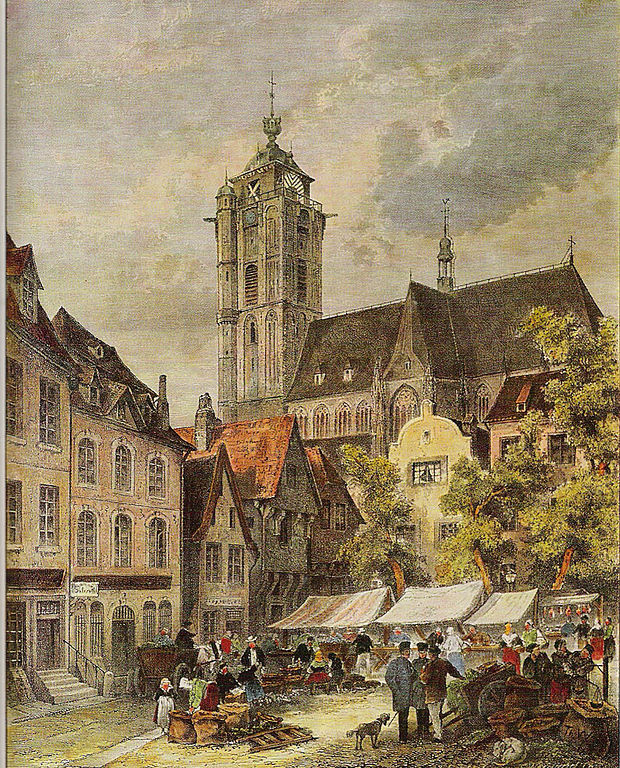
Marketplace in Duisburg by Theodor Weber, 1850, Public Domain via Wikimedia CommonsBut many of the most important and interesting questions don’t come down on us from on high, so to speak, originating from academia and revealed, as if a sort of holy writ, to the rest of us. In fact, most of the questions and problems we all wrangle with still originate in the public square, in the home, workplace, classroom, hospital, church, courtroom, political assembly, and so on. They bubble up from the challenges and uncertainties of our daily lives, are filtered through conversation and the arts, are swept up in social, legal, and political movements and institutions, and carried into the pool of academic philosophy, where they are further clarified and distilled in treatises, lectures, books, and so on.

And these questions don’t only originate with the public at large, we offer our first answers there. The answers range from fragmentary to nuanced, from intuitive to considered, from repetitions of received wisdom to original, from off-the-cuff to well-informed, by people from all walks of life with their own areas of expertise and unique capabilities of understanding born of particular experience. These citizen philosophers are on the first line of discovery and inquiry, and so called because they don’t participate in this process as a profession, but as a matter of personal interest and as a member of society at large, not subject to the demands and constraints of academic philosophy. Of course, the category of citizen philosopher does not exclude academic philosophers, because of course they, too, participate in the same process of question-creation and question-answering in the course of their everyday lives, separate from their academic pursuits.

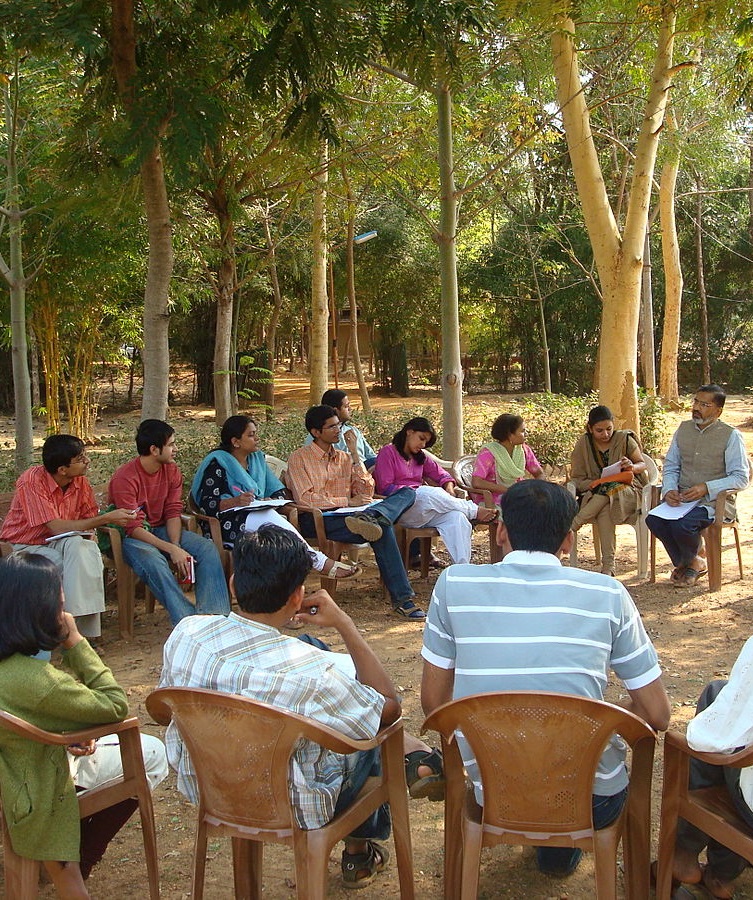
It’s the very lack of the demands and constraints of academic philosophy that gives citizen philosophy an important role to play in public life. The world as it is offers so many varieties of human experience, so many ways of seeing the world, so many challenges that academic philosophers, like the rest of us, never have the opportunity to confront directly. Yet the scope of academic philosophy, at least potentially, is as broad as the possibilities of human (even, perhaps nonhuman?) experience. So how can it be that academic philosophers can possibly access enough information to ask and answer all the important questions that could be addressed? It may be, if academic philosophers were endowed with immense powers of comprehension and imagination that would enable them to take all the information available in the world, to truly understand what it’s like to be a coal miner in China, a cardiologist experiencing a heart attack firsthand, a one and a half year old who just created their first sentence, a person with frontal lobe epilepsy experiencing a supernatural vision, or a terrorist who became so after their entire family was killed by a bomb, and then conceive of all of the social, epistemic, metaphysical, political, and every other sort of question that may arise from these experience. (À la the mythical Mary in Frank Jackson’s black and white room.) But of course, this is impossible, as even the most intelligent and informed human mind has its limits. Sometimes, raw data is the fodder of academic philosophical inquiry. But most often, it’s the questions, moral precepts, stories, works of art, aphorisms, dogmas, memories, narratives, and all other products of the human mind, already having undergone a first round of questioning and examination, that academic philosophers take up as topics of inquiry. Group discussion in the camps of Nirman (cropped), by Abhijeet Safai, Public Domain via Wikimedia Commons

I, for one, am glad to see philosophy ever more present in the public square. That’s because I perceive philosophy as the great quest for understanding that academic and citizen philosophers all engage in, and as I see it, each gives something of immeasurable and irreplaceable value to the other. We need only recall some philosophical forays that have failed, from hairsplitting quibbles of scholasticism to navelgazing-verging-on-masturbatory obscurantisms of postmodernism, to recognize that academic philosophy benefits enormously by maintaining a robust discourse with the broader human community of activists, artists, reporters, bloggers, protesters, discussion groups, and of all others who care enough to question.  The discipline and expertise of academic philosophers, and the broader set of experiences, challenges, and opportunities for new questions and unique ways of understanding of the larger community of citizen philosophers each serve to keep the other more honest, more challenged, and more informed, in the great world conversation we’re all having.

*Listen to the podcast version here or on iTunes

Ordinary Philosophy and its Traveling Philosophy / History of Ideas series is a labor of love and is ad-free, supported by patrons and readers like you. Please offer your support today!

Self-Soothing by Way of Erasing the Complexity of Human History, by Clay Jenkinson

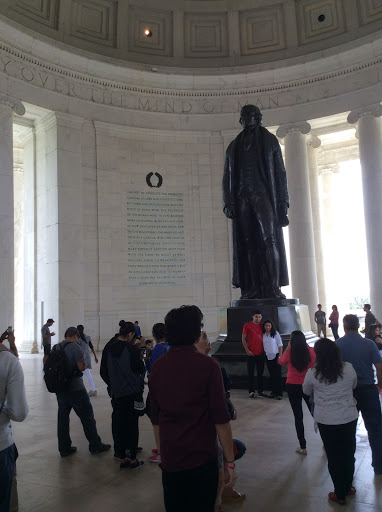
Statue of Thomas Jefferson at his Memorial in Washington D.C., photo 2015 by Amy Cools My beloved mentor in the humanities, Everett C. Albers, taught me the most important of all lessons: “Judgement is easy, understanding is hard.”

You probably have been following the recent spasm of righteousness on some of our college campuses. Some students wish to erase all traces of Woodrow Wilson at Princeton University, because he was a racist who undid what little integration his predecessors had managed in the federal government; because he was a sexist, who actively worked against women’s suffrage. Some students wish to have statues of Thomas Jefferson removed from the campus of the University of Missouri, because he was a racist, a slaveholder, and a sexual predator (if you read the Sally Hemings story in the darkest possible way). Some students at Oxford University wish to erase all traces of Cecil Rhodes, after whom Rhodesia was named, because he was a racist and an imperialist.

And so on.

It is true, by our standards as exemplars of perfect enlightenment, these men were all racists and indeed apartheidists. I have a close connection with two of them: Jefferson, whom I have been studying for thirty years, and Rhodes, whose scholarship I freely accepted back in 1976, and under whose financial legacy I studied for four wonderful years at Oxford University. I know the life and achievement of Woodrow Wilson less well, but I have read a handful of books about him over the years.

I regard this growing trend of purification rituals as wrong-headed and misguided for a number of reasons. I’ll list them as briefly as possible.

1. What will they say of us? Sometimes I try to anticipate what the righteous ones of the future will say about us? I met a petrochemical engineer a number of years ago. We talked for several hours about oil as a miracle carbon. I asked her what the epitaph of Western Civilization would be. She said. “They burned oil.” This morning I’m wearing shoes, socks, boxers, trousers, and a shirt, not one item of which was made in the United States. If I could trade each item of clothing back to the factory of its manufacture, I doubt that I would sleep well tonight. I’m with Jesus, John 8:7, “let him who is without sin cast the first stone.”

2. The whole man theory. As Jefferson wisely explained to his daughter Martha (see above), every human being is a mixed bag: enlightenment and blind prejudice, generosity and narcissism, benevolence and malevolence, good day and bad day, clarity and blind spot, outstanding in some ways, deplorable in others. Think of Lance Armstrong, Bill Cosby, Benito Mussolini, Bill Clinton, Mother Teresa, Margaret Thatcher, for example. In selecting our culture heroes, we have to assess the whole life and the entire achievement.

Jefferson was a racist and a slaveholder. These factors should weigh heavily in any rational assessment of his life and character. But we must also place in the balance his magnificent labors as a benefactor of humankind: decimal coinage, the rectangular survey grid system, separation of church and state, the University of Virginia, the organizational principle of the Library of Congress, the Louisiana Purchase, the design for the Capitol at Richmond, VA, fundamental work in paleontology, the Declaration of Independence, and the software of the American dream.

For all of his faults–and they do not begin and end with slavery–is Jefferson, in the final analysis, a benefactor or a degrader of humankind? On balance, how shall we evaluate him? Looking at his whole 83 years, his mass of writings, his range of practical achievements, his acts of greatness and his weakest moments, how shall we finally assess him?

3. Hamlet’s view. When the aging courtier Polonius tells Hamlet he will treat the visiting theater group “according to their desert,” Hamlet responds passionately: “God’s bodykins, man, much better! Use every man after his desert, and who should ‘scape whipping.” — Precisely. Where does this erasure of the past, more reminiscent of Stalin’s USSR and Orwell’s 1984 than of an enlightened democracy, end exactly? George Washington was a slaveholder. Lincoln had race views that would get him razed from Mount Rushmore by the narrowly righteous. Elizabeth Cady Stanton said remarkably ugly things about African-Americans when black men got the vote but white women did not in the wake of the Civil War. Franklin Roosevelt was an adulterer. Theodore Roosevelt was at times a warmonger. His views on American Indians are so dark at times that one hates even to read them in a scholarly arena. John F. Kennedy, LBJ, Ronald Reagan, Eisenhower, Bill Clinton, (where does this list end?) broke their marriage vows. Martin Luther King was a womanizer and he plagiarized his doctoral dissertation. Bill Clinton and George W. Bush evaded military service during the Vietnam War. Presidents Obama, Clinton, and GW Bush smoked dope. JFK dropped acid in the White House!

The only political figure I know who seems to have passed the righteous test in full purity is Jimmy Carter. That alone should give us pause. Where does this wave of righteous expurgation end?

4. ‘Tis better to wrestle than erase. My mentor Ev Albers believed that the duty of the humanities scholar is to examine and explore, to try to put any text or historical act or individual in its context, to try to understand how things shook out as they did and not otherwise. The duty of the humanist is to explore the past for its complexity, richness, unresolvedness, nuance, paradox, and problematic nature, and not to engage in the lazy enterprise of making glib judgments. Judgement is easy, understanding difficult. It does no good to portray Jefferson as a lover of liberty who unfortunately was born into a world of slavery, but who treated his slaves well and tried to change the world of Virginia and the United States to the extent that he could; and equally it does no good to portray Jefferson as a contemptible hypocrite who talked the language of liberty and equality, but who was quite content to breed slaves for the marketplace, and who dismissed African-Americans as physically and mentally inferior. One could make either argument plausibly enough, for there is a huge and not always consistent body of evidence in Jefferson writings and actions.

But surely we gain more by wrestling with the paradoxes in Jefferson’s life, illuminating, clarifying, teasing out nuance, attempting to understand his own (changing) thinking about race and slavery, his own strategy for preserving his reputation as an apostle of liberty while buying and selling human beings, who, as he freely acknowledged, “did him no injury.” After spending thirty years thinking and writing about Jefferson, I am not at all sure I understand his relationship to race and slavery. I’m not done trying. But I refuse simply to condemn him before I fully understand him.

We cannot understand ourselves if we do not understand the unresolved and perhaps unresolvable complexities of our heritage. Jefferson’s greatest biographers have said that the contradictions and unresolved principles in his life (1743-1826) are also the contradictions and unresolved issues in the American experiment. To understand ourselves, we must try to understand him. To judge him in a simplistic and self-satisfying way, means that we are short-circuiting our attempts to understand ourselves.

It would be insane, I think, to refuse to name an elementary school Martin Luther King, Jr., because he broke his marriage vows, or plagiarized his dissertation. It would be equally insane to remove Jefferson’s statue from the campus of the University of Virginia or the University of Missouri or William & Mary. Much better to use the “offending” icons as a text to discuss, debate, wrestle with, maybe even throw eggs at on occasion. But to remove those statues because Jefferson has disappointed us, US!, is to lose an opportunity for a very serious conversation about the dynamics that produced the America of 2016.

The Culture of Outrage represents a very dreary path in our pursuit of happiness and justice. In my view, on the whole, all things considered, Thomas Jefferson (as well as Woodrow Wilson, though I’m not quite as sure about Cecil Rhodes) must be seen as a net benefactor of humankind. But I would not remove a statue of Jesse Helms, George Wallace, or for that matter Pitchfork Ben Tillman from its pedestal. Better to deliberate and debate, perhaps at the top of our lungs, than to erase that which we think we have transcended.

– Clay S. Jenkinson is the author, educator, and scholar who created The Thomas Jefferson Hour, and is a sought-after historical impersonator, speaker, and media commentator, providing a deep but playful context to today’s events. (Bio credit: The Thomas Jefferson Hour, edited by A.C.) To discover more about Clay and his work, please visit http://jeffersonhour.com/

~~~~~~~~~~~~~~~~~~~~~~~~~~~~~~~~~

Further Reading:

» American Sphinx: The Character of Thomas Jefferson, by Joseph Ellis
» Thomas Jefferson: America’s Paradoxical Patriot, by Alf Mapp, Jr.

Welcome to the new Ordinary Philosophy!

Ordinary Philosophy, Writing a letter *oil on panel *39 x 29.5 cm *signed b.c.: GTB *ca. 1655, assemblage by Amy Cools 2015Greetings to all,

On this New Year’s Day, which also happens to be my birthday and therefore, personally, doubly a day of new beginnings, I’m looking forward to a more expansive, more energetic future for Ordinary Philosophy!

What is Ordinary Philosophy?

It’s a series of explorations founded on the belief that philosophy is an eminently useful endeavor as well as a fascinating and beautiful one, and that citizen philosophers and academic philosophers alike share in making it so. A citizen philosopher myself, I found that my experiences as an avid reader, an artist, a working person, an entrepreneur, a student, and a writer filled my mind constantly with questions and new ideas, spurring me ever on in the search for answers. As I’ve always been a restless and hungry thinker, I fell in love with philosophy, especially, practical philosophy and the history of ideas.

What is Ordinary Philosophy’s mission?

It’s always been to share this love of philosophy and the history of ideas with you. In my explorations, I’ve encountered the most fascinating, innovative, and beautiful ideas from the curious, thoughtful, questing, and inventive world out there, from academic philosophy to science to history to current events to politics to the arts and so, so much more; so much more, in fact, that I can’t possibly process it all on my own.

So here at O.P.’s new home, I’ve broadened the mission.

While there have been occasional guest posts, there will be much more of an emphasis on providing a forum for many more voices at O.P., representing views from all walks of life. O.P. will also publish many more reviews, recommendations, and links directing readers to the great ideas proliferating out there that may be of special interest to O.P.’s audience.

The Traveling Philosophy / History of Ideas series will also expand. Each series will become more in-depth, with more detailed explorations of the life and ideas of each subject and more resources for further exploration and study. The podcast will expand in tandem: new audio recordings of longer pieces published in O.P. for those of you on the go who enjoy the ideas found here but don’t always have the time to sit down and read. As time goes by, I plan to expand the podcast as well to include interviews and a series of downloadable travel guides to accompany the History of Ideas series.

To better accomplish this expanded mission, I’ve moved O.P. here to its new platform: easier to read, use, and share. So if you love great ideas and the pieces you encounter here, please support O.P.’s expanded mission by sharing as widely as you can.

Lastly, dear readers, I appeal to you: Ordinary Philosophy is a labor of love, and depends entirely on your support. I’m determined to keep O.P. ad-free, but can’t do it without you. All financial contributions will be credited by name (unless anonymity is expressly preferred, of course!) on each project funded by their donations, and welcomed with deepest gratitude. Please support Ordinary Philosophy today!

Yours,

Amy Cools, founder and editor of Ordinary Philosophy

*Listen to the podcast version here or on iTunes

Traveling Philosophy Series: Frederick Douglass Edition, Prologue, Oakland, CA

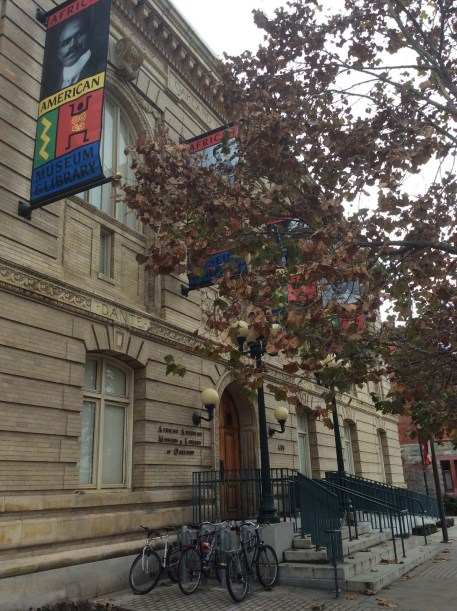
African American Museum and Library, Oakland, CA

Frederick Douglass’s Traveling Philosophy series will begin in earnest when I arrive on the East Coast. But behind every Traveling Philosophy series is research, and I have some excellent resources here where I live in Oakland, California. It’s still a little up in the air as when I’ll actually be able to make it to the East Coast for a long enough period to cover the ground I’d like to, since I intend this series to be the most comprehensive I’ve done yet. So, I’ve decided to do something a little different this time, to start the account of my journey with my discoveries and thoughts on the acts and ideas of Douglass I encounter while researching his life.

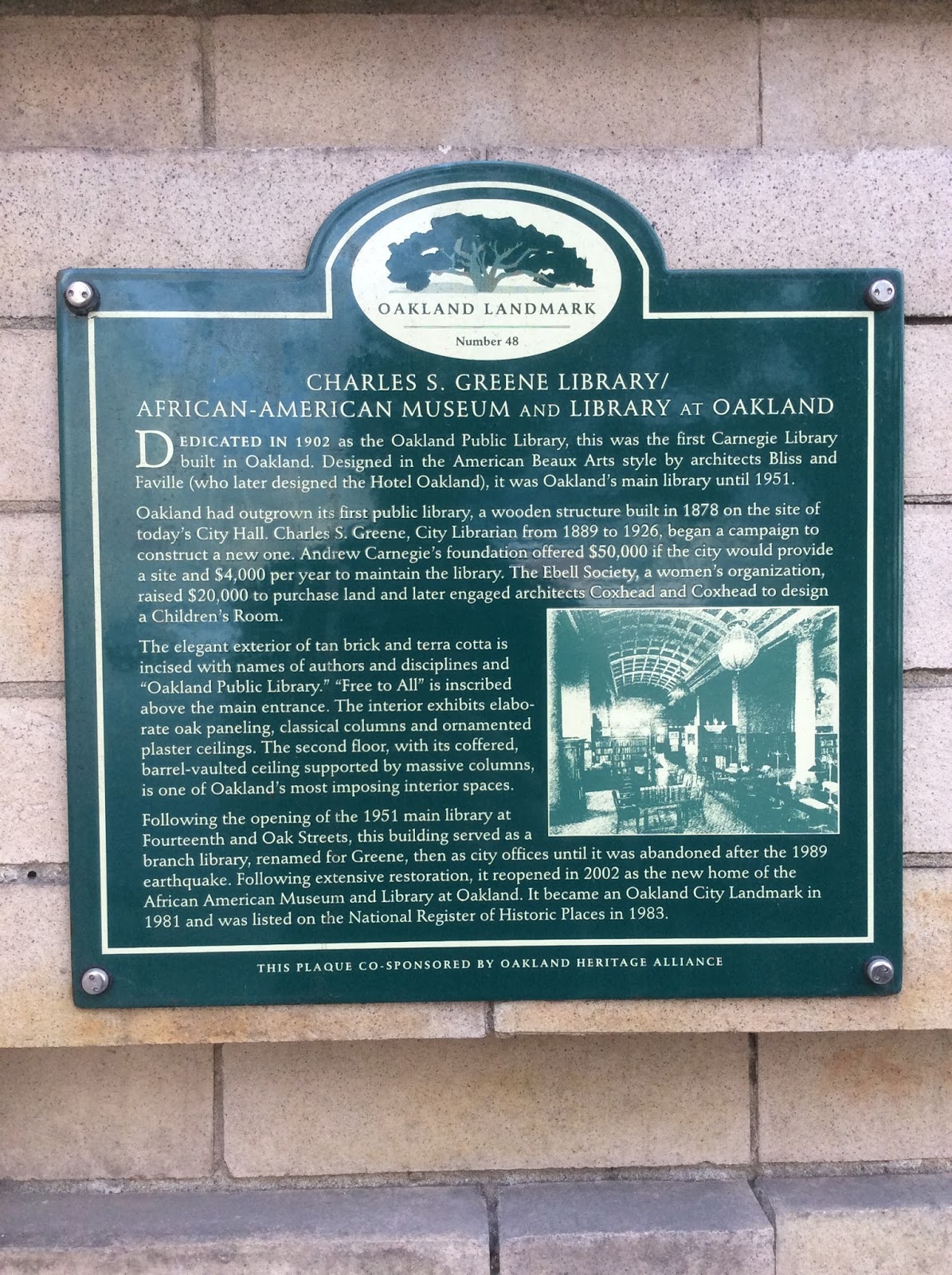
For the last several weeks, I’ve been gathering materials at my local library branch, the main branch near beautiful Lake Merritt on 14th St. But for many happy afternoons this early December, I’m on the other side of downtown, still on 14th St, in my new favorite study space, the lovely African American Museum and Library in Oakland.The AAMLO is a local Beaux Arts gem, the original main library building from 1902 until it moved to its current much larger location in the early 1950’s. (See the photo, right, of the museum’s green plaque for a brief history of the library and museum; you can click on the image to enlarge it for ease of reading, if you like.)

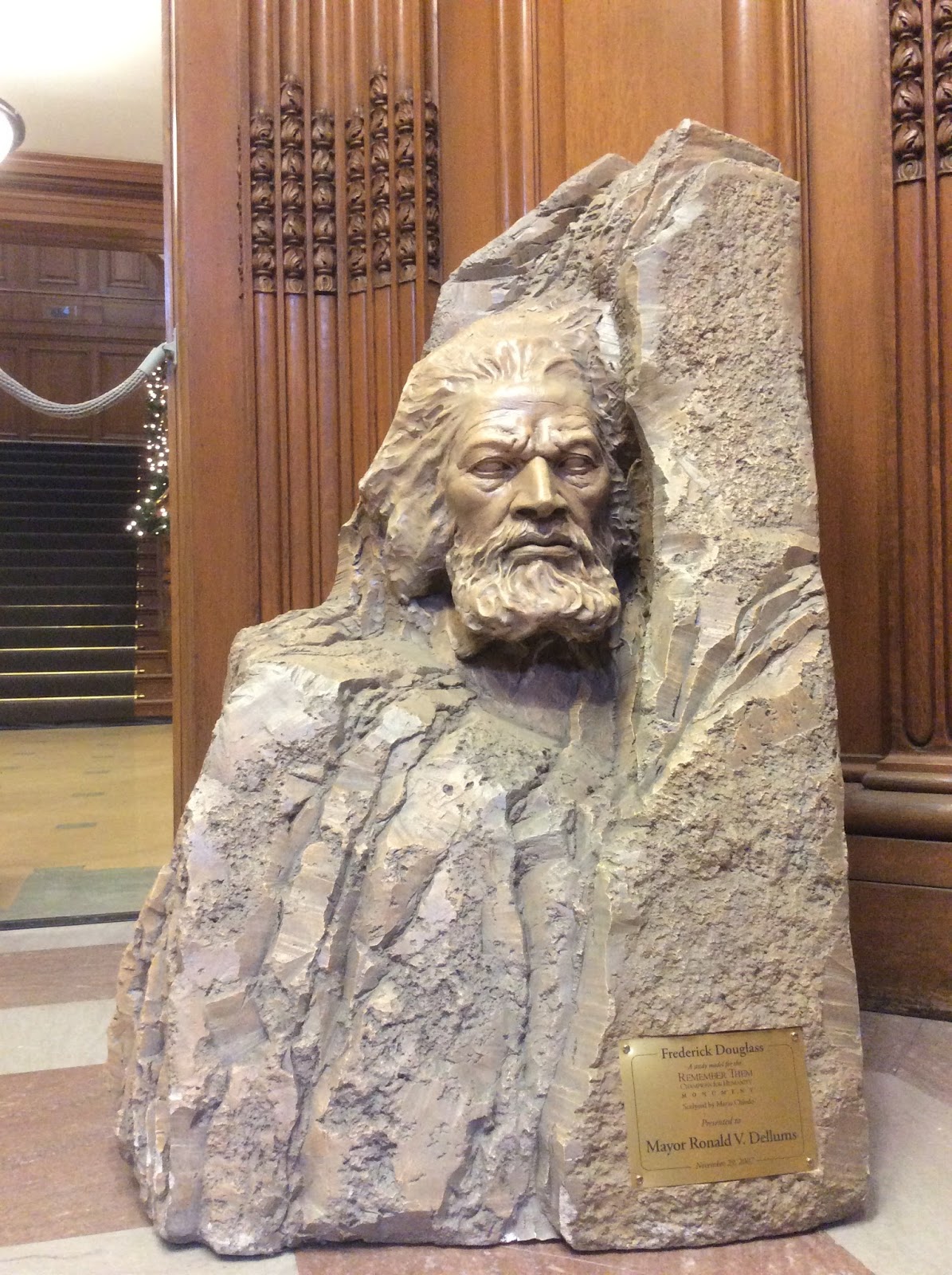
Sculpture of Frederick Douglass, AAMLO

The AAMLO is a new discovery for me this December, and as I enter, I’m greeted, to my delight, with a handsome (if rather stern) sculpture of the hero of my series. It’s this effigy of Douglass, in fact, which inspires me to just jump right in and start his Traveling Philosophy series here in Oakland.

So I’ll begin, as I mentioned, with stories and reflections on his life and work. My trip to the East Coast, tentatively planned for late winter / early spring, and the stories of that journey will be followed by a second series of essays inspired by my discoveries in the course of my travels. I hope you enjoy this new format, and as always, welcome any feedback you wish to offer!

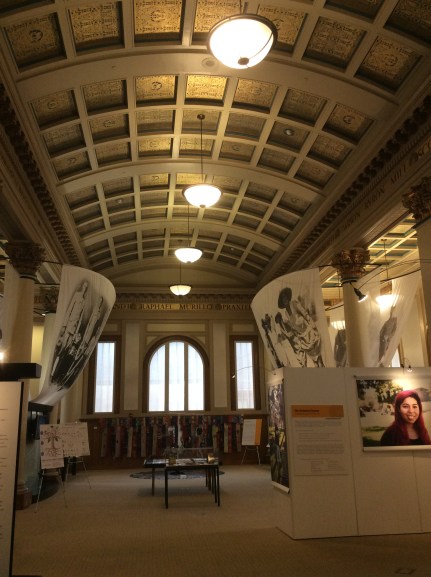
An interior view of AAMLO

AAMLO is a reference library only, so all materials I use must stay here. That’s perfectly fine with me, it’s such a lovely place to work, and lucky for me, it’s quite close by to where I live and work. Since I’ll be returning here a lot, I pick a quiet, cozy corner, and get to work…

One afternoon, after reading and making notes for quite some time, I feel the need to stretch my legs and rest my tired eyes. I go upstairs to the museum, a long gallery which runs the length of the building and which used to be the main reading room.

Crowning the main stairway which leads to this upper gallery, there’s a huge collage of great figures in African American history. It just so happens that the image of Douglass is under the name of Spinoza, among the list of names of great thinkers of the past which embellishes the frieze. Cool. Baruch Spinoza is next on my list of great thinkers to follow, but that’s a story for another time. I’d bet they’d have the most fascinating conversations, though, if they could speak the same language. Though they were very different in their histories, their particular beliefs, and their personalities, yet they were both lovers of reason, and they both lived authentically, true to their beliefs, models of intellectual integrity as they refused to obey the unjust rules of the societies they lived in.

An interior view of AAMLO, Oakland, CA, 2015 Amy Cools

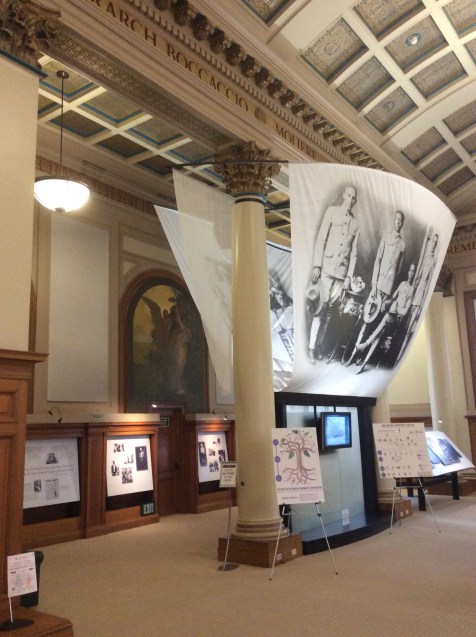
A view of AAMLO’s main gallery on the upper floor

The museum tells the story of the African American people who did so much to make Oakland the vibrant and diverse city it is today, and how America’s legacy of laws and practices both helped and harmed the African American community here and throughout California. The African American community in Oakland grew by leaps and bounds throughout the 1900’s, much of it made up of refugees from the Old South, and through hard work, came to make up a significant proportion of its thriving middle class. Oakland’s economy centered around its busy port and manufactures, and as the work dried up after the stock market crash of 1929, it was no surprise that the economic woes hit African Americans the hardest: when jobs become more scarce, it was not the favored demographics that suffer from it most, as you may expect: Oakland’s working black population lost well over a third of their jobs.

Douglass himself experienced job discrimination in his time working on the Maryland docks as a caulker, hired out as a wage earner in the Baltimore shipyards for his master before he escaped to freedom. In his Narrative, Douglass relates the story of a severe beating he received at the hands of white shipbuilders who resented the competition of low-paid black labor, both slave and free. Douglass was driven from his job by violence; in 20th-century Oakland, it was a combination of job discrimination, rules and laws which prevented black people from joining or forming unions, and differential treatment by law enforcement. Not everything had changed since Douglass’s day.

A view of an exhibit in AAMLO's main gallery, upper floor, AAMLO, 2015 Amy Cools

A view of an exhibit in AAMLO’s main gallery

So as black Oaklanders suffered many of the worst effects of the economic downturn, the ills of poverty hit black communities the hardest, and harsh, unjust policing practices and drug policies exacerbated the problems that they may have been meant to alleviate. Many, however, passionately believe that there was no honest intent to help, just to oppress and destroy the black community. Whatever the case may be, the desperation of so many of Oakland’s black people makes it no wonder that the Black Panther Party was founded here in Oakland in the 1960’s. Then as now, a strong cultural tradition of racial justice activism and civic unrest flourished, sometimes, as again to be expected in an environment where so many felt disenfranchised and disrespected, to excess.

If he were alive to witness it, Douglass may have disapproved of many of the Black Panther Party’s militant tactics, but like the B.P.P. and Malcolm X after him, he came to believe that some kind of armed resistance may be necessary to achieve liberty and full equality for black people, and that if violent resistance was necessary to change the laws, it was just, given the depth of oppression and injustice black people suffered. He was, for example, an admirer of John Brown, a passionate abolitionist who unsuccessfully tried to start an armed slave rebellion and was hanged for treason as a result.

What Douglass thought about whether or not it’s right to use violence in the cause of furthering human rights, and if so, how much, against whom, and when, is a big topic, one for another essay in this series. Stay tuned!about whether or not it’s right to use violence in the cause of furthering human rights, and if so, how much, against whom, and when, is a big topic, one for another essay in this series. Stay tuned!

* Listen to the podcast version of this piece here or on iTunes

* Follow in the footsteps of Frederick Douglass with me… 

Ordinary Philosophy and its Traveling Philosophy / History of Ideas series is a labor of love and ad-free, supported by patrons and readers like you. Please offer your support today!

~~~~~~~~~~~~~~~~~~~~~~~~~

Sources and Inspiration

Douglass, Frederick. Narrative of the Life of Frederick Douglass. Originally published in Boston by the Anti-Slavery Office, May 1st, 1845.

From Oakland to Maryland, New York, and Massachusetts I Go, in Search of Frederick Douglass

Hello, friends of Ordinary Philosophy!

From time to time, I take a trip to some corner of the globe, to explore the lives and ideas of great thinkers in the places where they lived and worked. For this series, I follow in the footsteps of thinkers who are no longer alive, since those who are still telling their own stories. But those who are no longer alive in the body live on in the ideas that they pass on, and in the example they provide for us to follow.

I’m pleased and excited to announce my fifth philosophical-historical themed adventure, beginning with research and study in Oakland, CA, then off to Baltimore, MD, New York, Washington DC, and other East Coast sites to follow in the footsteps of Frederick Douglass.

Frederick Douglass’s life story is inspiring and humbling in the strength, character, and dazzling intellect he reveals, rising to such greatness in the midst of such adversity. Born a slave on the eastern shore of Maryland in the early 1800’s, he was an autodidact, having overheard his master say that learning to read leads to learning to think, rendering a slave too independent-minded to submit to domination by another. Hearing this, young Frederick knew what he had to do. Attaining literacy and learning a skilled trade gave him the wherewithal to escape to New York City in 1838 at about 20 years of age. A few years later, as a result of an impromptu but impassioned and eloquent speech about the hardships of a life enslaved, he was recruited as a public speaker for the abolitionist cause. He spent the rest of his life as an activist for all manner of human rights causes, from the abolition of slavery to universal suffrage to women’s rights and beyond.

Douglass is an especially compelling subject for a historian-philosopher; observing the true nature and ramifications of slavery led him to think deeply about the most essential questions in human life, which, in turn, spurred him on to a life of thought and action on behalf of oppressed peoples. In these roles, Douglass had a heavy influence on American thought and on the course of American history. He asked, and answered: What does it mean to be a person? What does it mean to be a person of faith? What are rights, and why are we entitled to them? What is dignity, and does possessing it entail that we have certain obligations to ourselves and others? Given the frailties and strengths of human nature, how can we best live together and form just societies? What do the Constitution, its Bill of Rights, and the Declaration of Independence really say about slavery, equality, and other human rights issues?

So I’ll begin my tale here in my home city of Oakland, CA, where I begin my research and exploration into Douglass’s life and ideas, then off to the east coast of the United States I’ll go, from March 19th thru April 2nd! There, I’ll visit landmarks associated with his life, places where he lived and died, worked, thought, wrote, studied, and rested, to see for myself how the places informed the man, and vice versa.

~ Listen to the podcast version of this series intro here or on iTunes

Here is the story of Frederick Douglass as I discover him:
Traveling Philosophy Series: Frederick Douglass Edition, Prologue, Oakland, CA
Frederick Douglass on Faith and Doubt
Frederick Douglass on the Constitution
Frederick Douglass the Pragmatist
Frederick Douglass Baltimore Sites
Frederick Douglass’s Birthplace, Maryland’s Eastern Shore Sites Part 1
Frederick Douglass, Easton and St. Michaels, Maryland’s Eastern Shore Sites Part 2
Frederick Douglass Havre de Grace and Philadelphia Sites
Frederick Douglass New York City Sites
Frederick Douglass New Bedford, Massachusetts Sites
Frederick Douglass Boston Sites
Frederick Douglass Lynn, Massachusetts Sites
Frederick Douglass Lynn Sites, Part 2: Historical Society & Hutchinson Scrapbook
Frederick Douglass Albany, Troy, and Syracuse NY Sites
Interview with Leigh Fought on Anna and Frederick Douglass
Frederick Douglass Rochester NY Sites, Day 1
Frederick Douglass, Rochester NY Sites Day 2
Interview with Ken Morris, Anti-Slavery Activist & Descendant of Frederick Douglass
Frederick Douglass Seneca Falls, Canandaigua, Honeoye, and Mt Hope Cemetery Sites
Frederick Douglass Chambersburg and Gettysburg PA Sites
Frederick Douglass Washington DC Sites, Day 1, Part 1
Frederick Douglass Washington DC Sites, Day 1, Part 2
Frederick Douglass Washington DC Sites, Last Day

More about Frederick Douglass:

Peoria, Illinois, In Search of Robert G. Ingersoll, Frederick Douglass, And Abraham Lincoln, Part 1
Peoria, Illinois, In Search of Robert G. Ingersoll, Frederick Douglass, And Abraham Lincoln, Part 2
Peoria, Illinois, in Search of Robert G. Ingersoll, Frederick Douglass, and Abraham Lincoln, Part 3
Photobook: Frederick Douglass and Edinburgh, Old and New
O.P. Recommends: ‘A Man’s a Man for a’ That: Frederick Douglass in Scotland’ by Andrea Baker for BBC Radio 4
Say What? Frederick Douglass on Originalist Interpretations of the United States Constitution
O.P. Recommends: Frederick Douglass’ Drunk History Episode
Say What? Frederick Douglass on Race Relations
Citizenship, Belonging, and the Experiences of Amero-Africans in West Africa: An Analysis of William Innes’ Early History of Liberia

Ordinary Philosophy and its Traveling Philosophy / History of Ideas series is a labor of love and ad-free, supported by patrons and readers like you. Please offer your support today!

Patrons of the Frederick Douglass series: RH Kennerly, Elizabeth Lenz, Alex Levin, Cory Argonti Cools, Bryan Kilgore, Michael Burke, Gaia So, Veronica Ruedrich, Blair Miller, Alex Black, Devin Cecil-Wishing, Roxanne and Fred Smalkin and family, and Jim Callahan and Nerissa Callahan-Stiles and family. ~ With warmest gratitude, thank you!

On Free Speech and Political Correctness: A Response to Lindy West

In reading a recent op-ed in The Guardian, ‘‘Political Correctness’ Doesn’t Hinder Free Speech – It Expands It’ by Lindy West, I was initially intensely annoyed.

Free speech, political correctness, and whether the two necessarily conflict are hot topics of debate at the moment, as they perennially are in this nation of ours. The right to freely express ourselves is foundational, among the first rights specified in our Constitution’s Bill of Rights, yet the full enjoyment of this right in our country was hard-won. It was only several decades ago that one could be prosecuted under the obscenity laws of the time for informing people about birth control and the workings of their own reproductive systems, for example, or for expressing certain political views (we now recall McCarthyism with a shudder). With a few exceptions mostly relating to public safety, any infringement of our right to free speech still has the power to make us fearful of that old, tried-and-true, oft-used method of social and political oppression.

My first impression of West’s piece was that it was yet another misguided liberal misapplying traditionally liberal values to make a perhaps well-intentioned, but ultimately illiberal argument.

When I re-read the piece, more slowly this time, I was still annoyed and in overall disagreement, but found myself at least sympathizing with some of her arguments, and in full agreement with others. As West points out, when people routinely hear derogatory, discriminatory, or insensitive remarks, even if relatively minor or unintentional, it can and does undermine their sense of confidence, dignity, and worth over time. And there are many groups in this country, such as black people, Jewish people, gay people, and religious minorities among others, who have had to deal with these slights as they struggle to get by in a historically racist, intolerant, and zenophobic country. It is incumbent on all of us, as West points out, to realize that the things we say have an effect other people, and therefore we should govern our tongues responsibly. We should strive to remain courteous and respectful in our speech, especially towards those who have suffered, and still do suffer, these slights and insults the most. And we should definitely call each other out when we are cruel, rude, or careless enough to use offensive language gratuitously.

Yet when it came to the central argument of her piece, the ‘silencing’ argument, she lost me. And when she went from disagreeing with to railing against Jonathan Chait, a columnist with New York Magazine who explains why he thinks free speech is being threatened on college campuses, to the extent that she accuses him, no, downright slanders him, of ‘imply[ing] that black Americans being shot in the streets by agents of the state are the real puppetmasters of an authoritarian regime’, she really lost me.

When West equates expressing disagreement with ‘silencing’, she makes me doubt that she has enough respect for the immense value of free speech, or grasps the true horror and dire ramifications of actual attempts to ‘silence’ it. She gives many example of what she considers ‘silencing tactics’: ‘white students parading around campus in blackface’, ‘telling rape victims that they’re “coddled”’, and ‘teaching marginalised people that their concerns will always be imperiously dismissed, always subordinated to some decontextualised free-speech absolutism’.

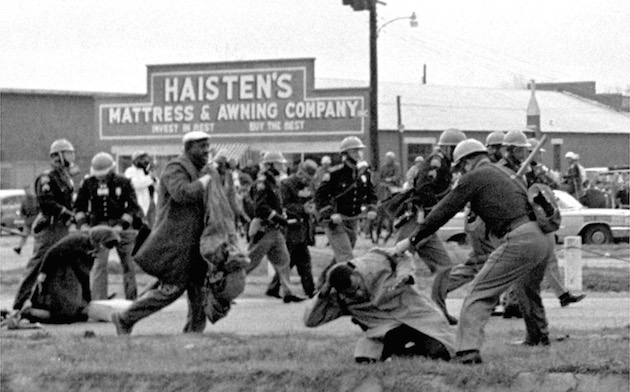
I just don’t agree that these things can be reasonably construed as ‘silencing’, not unless we stretch the meaning of the world out so broadly that it loses shape and force. Laws and regulations which threaten expulsion, arrest, and prosecution for expressing unpopular ideas are ‘silencing’ people. Police driving civil rights protesters from the streets with clubs, dogs, and fire hoses are ‘silencing’ people; the Cuban and North Korean governments’ imprisonment of political dissenters are ‘silencing’ people; issuing fatwas against Salman Rushdie and Ayaan Hirsi Ali are ‘silencing’ people; shooting Medgar Evers for his human rights activism and stabbing atheist bloggers and filmmaker Theo Van Gogh to death for their religious dissent are ‘silencing’ people. There’s a very real sense in which applying the term ‘silencing’ to any use of insensitive, politically incorrect, and offensive speech sounds like indulgent grandstanding that minimizes the horror of what people suffer when they are really being silenced. In that sense, the over-application of the term ‘silencing’ can be offensive in itself.

First, of course students putting on blackface for a Halloween party are doing the wrong thing; they are idiotically out of touch at best, or are behaving disgustingly, insultingly, even cruelly assholish at worst. Sometimes these sorts of behaviors, especially by bullies, may discourage some people from speaking out. But charging these misguided students with ‘silencing’ people? Since when? I’ve heard volumes of speech, free speech, vigorously criticizing this bad behavior, properly shaming people who are ignorant or jerkish enough to indulge in it. Second, I’m not sure if rape victims are generally accused of being “coddled” so I don’t know exactly what she’s referring to; I really hope she’s not equating this with any open discussion of rape without a ‘trigger warning’ preceding it. While some believe trigger warnings are appropriate in some circumstances, showing appropriate regard for the feelings of someone known to be wounded by past events, others believe that trigger warnings are intellectually insulting, implying that others are not strong or capable enough for open, honest, and challenging discussions of important issues. Third, reasoned debate over whether regulating forms of speech many people find offensive really promotes greater understanding and protects human rights is not the same thing as ‘imperially dismissing marginalized people’. And lastly, I don’t find that proponents of unfettered free speech routinely ‘decontextualize’ it either; rather, their arguments usually focus on the historical fact that suppression of free speech has always been a favored tool of social and political oppression (a very specific and important context) and therefore, we must protect this right at nearly all costs, even if people are sometimes offended and inconvenienced as a result.

When re-reading West’s article, a striking counterexample to her argument that political correctness expands free speech came to mind. As I write this, I’m also in the process of researching the life and thought of Frederick Douglass, the former slave who became one of America’s greatest antislavery activists and orators (this is for an upcoming O.P. Traveling Philosophy / History of Ideas series, stay tuned!). In his autobiographies, Douglass recounts the episode that he credits with setting the course of his life. When he was a child, his mistress thought it would be a good idea to teach him how to read, since he was companion and body servant to the young son of the household, and could thus aid in his education. When her husband came into the room and saw what she was doing, he stopped her, telling her in Frederick’s hearing, that ‘[he] should know nothing but how to obey his master …if you teach [him] how to read, there will be no keeping him. It would forever unfit him to be a slave…’ As Douglass tells it, this is the moment he realized the full inhumanity of the slave system, and learned exactly what he needed to do. Knowledge equals freedom, so he must learn to read and educate himself, at all costs. And not only does slavery inflict physical suffering and the loss of every kind of personal liberty, its most dehumanizing element is its reliance on forced ignorance, so that even the mind is completely subjected. In the end, it was precisely because Douglass heard his slaveowner express that cruel, offensive, and inhumane idea that he learned the truth and became the great man he was. And like Douglass, we must observe the effects of evil and hear its arguments if we are to combat it.

Of course, the flip side is true too: people free to express bad ideas influence and convince others to believe them. But, repressing speech rarely stops this: it just drives the ideas underground, to be shared in secret, shielded from the healthy and corrective criticism of public discourse. And as we can see from our vibrant history of ever-increasing freedom of speech, bad ideas that are subjected to vigorous and open public debate are refuted and ultimately rejected, one by one. While I think that bad ideas will always remain with us, I have much, much more faith that the market of ideas will weed out bad ones than repression will, again, as history has shown us. Name me one oppressive institution that has not been ultimately overthrown because of the power of speech, because people chose to liberate themselves through dissent, to offer better arguments than those of their ideological opponents and to back up them up with action, and I’ll gladly reconsider.

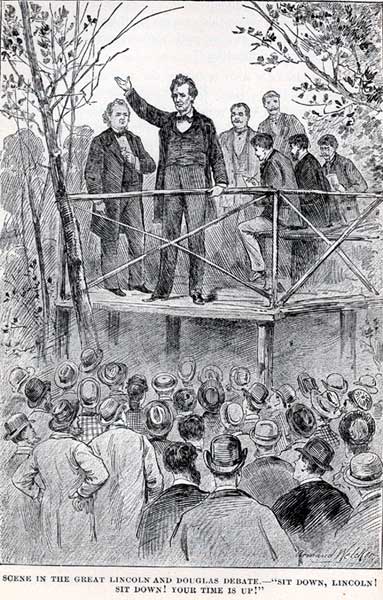
Unlike the case with guns, the only one who can defeat someone with a bad argument is someone with a better one. Only when speech is unfettered can it reveal its true power to liberate us from the grasp of bad ideas. The good ideas of Frederick Douglass ultimately triumphed over the bad ideas of Stephen Douglas, pro-slavery advocate whose series of heated exchanges with Abraham Lincoln were dubbed The Great Debate, because Douglass spoke out on the evils of slavery though it was contrary to mores and laws of his time. Likewise, we must rely on ourselves and on one another to overcome bad ideas by speaking out, as Erika Christakis recommends in the email that started the Yale free speech controversy, and not by co-opting the power of governing bodies to silence our ideological opponents for us.

*Listen to the podcast version here or on iTunes

*This piece is also published at Darrow

~~~~~~~~~~~~~~~~~~~~~~
Sources and inspiration:
Douglass, Frederick. ‘My Bondage and My Freedom.’, Mineola, NY: Dover, 1969, originally published 1855. https://books.google.com/books?id=b4aQY9jPkm0C&dq=My+Bondage+and+My+Freedom
West, Lindy. ‘Political correctness’ doesn’t hinder free speech – it expands it’. The Guardian, Nov 15th, 2015. http://www.theguardian.com/commentisfree/2015/nov/15/political-correctness-free-speech-racism

Mary Wollstonecraft, Champion of Reason, Passionate in Love

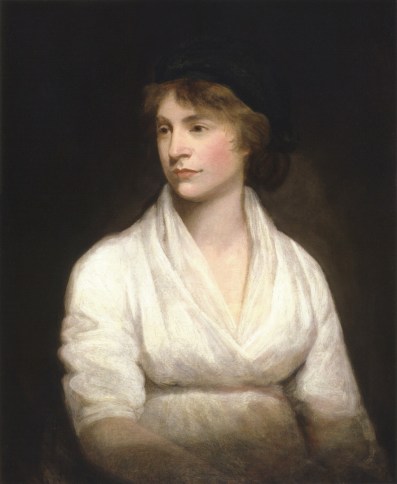
The life and work of Mary Wollstonecraft, mother of modern feminism, can seem to reveal a mass of contradictions.

Her seminal feminist work, A Vindication of the Rights of Woman, champions reason as the ultimate guide for a moral and productive life. She used reason to great effect to show why women should, and how they could, grow out of their socially constructed roles as under-educated coquettes and household drudges. She believed that reason should rule both individuals and societies because it’s the best tool we have to achieve justice and to perfect the self. Without reason, she thought, human beings are ruled by narrow self-interest, by prejudice born of ignorance, and by crude lust.

Yet the life Wollstonecraft chose to live was widely criticized both during her lifetime and over the two hundred plus years since her death. It’s not just because she didn’t conform to the mores of her time; her life choices are still considered unreasonable and even self-destructive by many. At times, they made her an object of scandal, impoverished, or deeply depressed, even in such desperate straits that she twice attempted suicide. That’s because she was also deeply passionate, devoted to retaining her personal and mental freedom while abandoning herself to loves which never failed to break her heart, be they revolution, family, friend, or lover. For Wollstonecraft, reason and passion are not opposites: they are two sides of the same coin. A truly reasonable person, she thought, is kind, affectionate, and generous as well, and a passionate lover of justice, truth, and beauty.

Wollstonecraft’s chosen role for herself was, first and foremost, a teacher, an advocate of knowledge and instiller of reason. While teaching was one of the few professions open to her as an eighteenth-century woman from a respectable but impoverished background, she brought her formidable powers of reason to bear on the problems with many of the educational and child-rearing practices of her day. After her first job as a companion, she became a teacher, first in the classroom at a school she founded with two of her sisters and her best friend, and then as a governess. When she became a mother twice over in her mid- and late thirties, she was a tender and hands-on mother, an advocate of breastfeeding and attentive parenting in an era of wet-nurses and governesses, when wealthy and middle-class parents participated relatively little in the care and instruction of their children even from infancy.

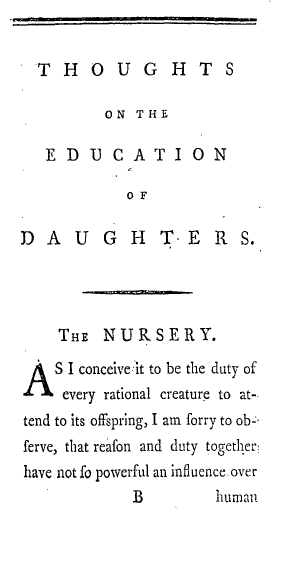
Her first book, Thoughts on the Education of Daughters, opens with her parenting advice and argues that girls should be taught how to run a household while also learning self-sufficiency. In Wollstonecraft’s time, women were not expected to support themselves; they were trained to raise a family, learning how to catch and keep a man first, to be household managers second, and to be educators of young children third. Single women, widows, and married women whose husbands, fathers, brothers, and other male relations could or would not support them had few employment options available to them, mostly directly related to one of the three roles they were trained for. Those jobs that women could respectably accept paid very little, so those working women nearly always lived a life of subservience and privation. Modern feminist thought, until very recently, equated domestic life with that housebound, nearly choiceless life most women were required to live. However, now that women’s basic moral right to self-determination has become so widely established, most have come to consider a domestic-centric life just as valid a choice for free women as a professional or public life. So in this sense, Wollstonecraft’s view of women was more progressive even than that of many modern feminists, even if by accident rather than foresight: she did not speak of a time when women would need to reject domesticity in order to free themselves from it, only to reclaim it by choice after their liberation.

Her ideas were inspired by her own experience: Wollstonecraft discovered firsthand how important it is never to assume that one’s self or one’s children will always have someone they can depend on for education, sustenance, or affection. Life’s too uncertain for that: parents, spouses, relatives, colleagues, and friends can become neglectful, estranged, impoverished, or disabled, and of course, sometimes they die. Wollstonecraft’s father squandered his inheritance and never bothered to learn how to earn an adequate living, leaving all of his children (except for his oldest son, who inherited what was left) to fend for themselves in adulthood, and his daughters without the dowry necessary for a respectable marriage. Knowing firsthand what it’s like to wrest a living from a world where women were ill-equipped for and mostly barred from nearly all employments that men were free to pursue, Wollstonecraft believed all girls should have a thorough education centered on self-sufficiency, from learning how to take care of a household, to learning how to think, to learning how to make a living. This not only gives women the freedom to choose a partner for better reasons than mere survival (Wollstonecraft equated the latter with prostitution), but leaves women free to live their lives as independently as they choose.

Until Wollstonecraft’s response to Edmund Burke’s critique of the French Revolution, her Vindication of the Rights of Men (1790), her published work continued on an educational vein, from original compositions to editorial work to translation. Beginning with The Rights of Men, through A Vindication of the Rights of Woman (1792), and up to her last work, Letters Written During a Short Residence in Sweden, Norway, and Denmark (1796), she transitioned from a teacher of ideas into an innovator, drawing on the wealth of knowledge she had obtained through her lifetime thus far of work and study. She was a semi-autodidact, her rather patchy childhood education supplemented in her teens by her own voracious reading and by friends who recognized her hunger for learning, and continued independently during her working years in the hours she could dedicate to her self-improvement. When she established herself as a professional author, she was finally able to immerse herself fully in the life of an intellectual, attending famous salons and becoming the friend and colleague of many of the brightest minds of her day.

One of the central themes in The Rights of Woman is women’s education. In this work, Wollstonecraft explained that it’s the nature of women, rather than their practical needs, that’s the ultimate justification for their rights, though she doesn’t minimize the importance of the latter. Since women possess reason just as men do, they also need education in order to be happy, fulfilled, and above all, moral. Infantilizing women by denying them a full education, she wrote, renders them not only financially helpless, entirely dependent on men whether or not they’re capricious, selfish, lazy, cruel, or just unlucky, but undermines them as moral beings. It’s reason, more than anything else, that determines the difference between right and wrong, and a quality, well-rounded education is required for using reason to its fullest capacity.

But outside of her moral reasoning, in her life as she lived it, Wollstonecraft displayed the often stark contrast between what one might expect a person ruled by reason would do, and what a person would do when driven by passion.

One of her earliest romantic interests, the Irish gentleman and songwriter George Ogle, ended up causing her no harm and probably doing her even more good than many might realize; not only did her cheer her with intellectual and witty conversation in her time as governess for the wealthy Kingsborough family in Ireland, a biographer credits him as the secret benefactor whose cash gift allowed her to return home to England and pursue writing in earnest. And her pursuit of the intellectual life she loved probably brought her more joy and fulfillment than anything else, with the possible exception of her daughter Fanny.

But most of her other loves did seem to bring her at least as much pain as joy. Her first deep attachment in her early teens was to her friend Jane Arden, who didn’t share her idealistic concept of the near-exclusive, passionate friendship of the soulmate. The more the young Mary sought to dominate her affections, the more Jane drew away. Fanny Blood, her dearest friend in adulthood, nearly lived up to her ideal, but her father’s shiftlessness kept her family impoverished, leaving Fanny with the responsibilities of main breadwinner as well as head housekeeper for her large family. Wollstonecraft saw her dreams for Fanny and herself mostly come true when they joined forces with Wollstonecraft’s sisters to found a school, but this didn’t last as long as she hoped. The distant and dithering suitor that Fanny had longed to marry for years finally carried her off to Portugal, leading to her painful death less than a year later as she succumbed simultaneously to her tuberculosis and the rigors of childbirth. The painter Henry Fuseli may have been a romantic interest: he later liked to claim this, and others echoed this claim, but much of the evidence also indicates that her interest in him was as an aesthetic and intellectual soulmate more than anything else. (At this time, she was still firmly opposed to marriage, and determined to keep herself free from the sort of entanglements that would hamper her mental and physical freedom.)

After a bit of scandal around her unconventional, and rejected, proposal to Fuseli and his wife (who was also her good friend) that she live with the two of them, she set off for Paris to witness the French Revolution firsthand. Wollstonecraft was an ardent supporter of the Revolution, as she saw it continuing the work of dismantling the tyranny of a parasitical monarchy, a corrupt and greedy church, and the oppressive social practices and mores that the American Revolution had started. By the time she arrived, the French Revolution had already taken a violent turn, but she held out hopes that this was a natural but temporary outcome of a people throwing off a tyranny that had ruthlessly oppressed them so badly and for so for so long. While she maintained throughout that a certain amount of violence is the natural byproduct of any truly transformative revolution, she became more and more disillusioned with its leadership and tactics over time, and finally, with her own hopes of its success. (She identified herself with the more moderate Girondin political persuasion throughout.) Wollstonecraft did not live long enough to see that the Revolution would end up ultimately succeeding in ushering in a new era of human rights-centered government in Europe, once some social balance was restored. But she did escape the Terror, probably narrowly, having fallen in love once again. She found herself pregnant and fleeing for her life, returning to England after giving birth her first child at age 35.

And it was Gilbert Imlay, the father of this child and the first deep romantic passion of her life, that caused her the most pain, more than the sisters with whom she was often at odds, more than her most cherished female friends who left her in one way or another, more than her ne’er-do-well brother and the Blood family, more than her self-important painter Fuselli, more than the school she founded that fell apart when she left to nurse Fanny in her final illness, leaving her deep in debt. Imlay presented himself as a man of adventure, an American frontiersman of rugged, self-sufficient, and honest character. These proved to be an illusion: he was actually primarily a man of business, sometimes (often?) of shady dealings, and one who frequently failed to keep his word. In Imlay, Wollstonecraft finally found an exciting sexual partner, a stimulating companion, and a fellow believer in truly living according to one’s personality. They never married because they didn’t believe in that institution, though they found it expedient at times to pass themselves off as husband and wife. In fact, this pretense may very well have saved Wollstonecraft’s life, since the perpetrators of the Terror, in its most insular stage, were executing many expatriate Britons; Americans, however, were still in good standing with the Revolution, and as Imlay’s ‘wife’ she was considered American as well. But it became clear over time that Imlay was not eager to embark on the happy domestic life her pregnancy caused her to long for, and he abandoned her slowly, in stages. It took her a long time to get over Imlay while struggling to get by as a single mother in 18th-century Europe; it was during this period she twice attempted suicide.

Her eventual husband and first biographer William Godwin called Wollstonecraft a ‘firmest champion’ of her sex. In Godwin, Wollstonecraft finally found the lasting sort of love she had been looking for. Their attraction was initially an intellectual connection which only later developed into romantic passion. Sadly, they only enjoyed a brief romance, less than two years, since she died of complications from giving birth to her second child. I think Godwin was right that she was a champion of reason, and I would add, of passion too, and a champion of seeking: of truth, of wisdom, of self-discovery, of new ideas and sources of knowledge, of experiences that expand the mind and the heart, of becoming the best human being one can be. To fully follow her example is very risky: she often flung prudent reasoning to the wind in favor of following her heart, in a time most dangerous for women to do so. Yet, though reasoned prudence is a virtue, it can be taken too far, holding you back, preventing you from taking chances and experiencing all the richness life can offer. She did not hold back.

~ Ordinary Philosophy is a labor of love and ad-free, supported by patrons and readers like you. Any support you can offer will be deeply appreciated!

~~~~~~~~~~~~~~~

Sources and inspiration:

Godwin, William. ‘Memoirs of the Author of A Vindication of the Rights of Woman‘. London, 1798.

Gordon, Lyndall. Vindication: A Life of Mary Wollstonecraft. New York: Harper Collins, 2006.

Jacobs, Diane. Her Own Woman: The Life of Mary Wollstonecraft. New York: Simon & Schuster, 2001. http://books.simonandschuster.com/Her-Own-Woman/Diane-Jacobs/9780743214704

Tomalin, Claire. The Life and Death of Mary Wollstonecraft. London: Weidenfield & Nicholson, 1974

Thomas Paine on Basic Income, and Why Welfare is Compatible with an Individualist Theory of Human Rights

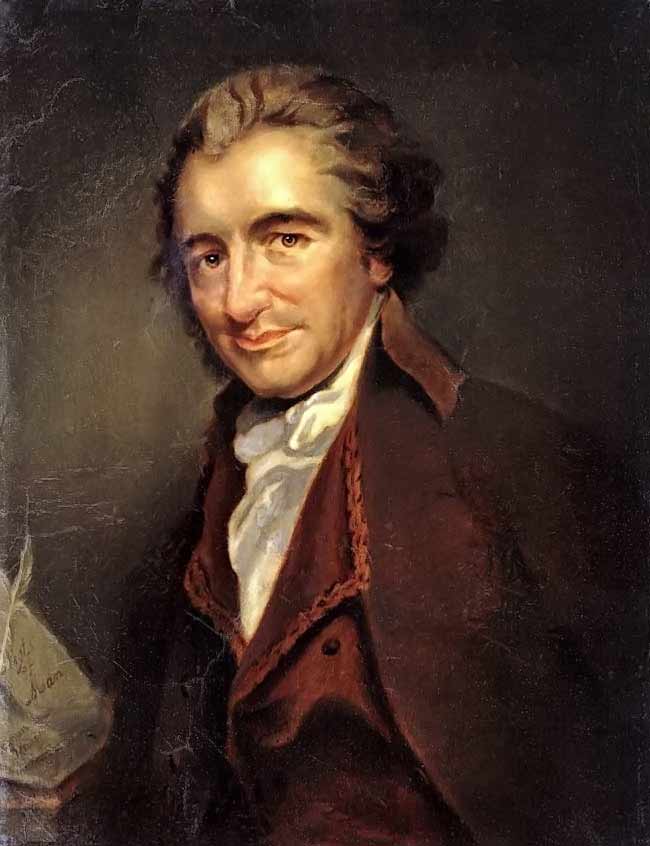
Thomas Paine, advocate of liberty par excellence, is an intellectual hero of all believers in democratic and accountable government. He’s also, especially, a hero of modern American conservatives and those of the libertarian persuasion.

But here’s a lesser known fact: he also argues in favor of what today we commonly call welfare.

Paine is, most famously, the author of Common Sense, The American Crisis, The Rights of Man, and The Age of Reason. These pamphlets are, in turn, an argument in favor of the American colonies’ cause for independence, a series of pamphlets of encouragement and calls for support for the struggling revolution, a rebuttal to Edmund Burke’s harsh critique of the French Revolution (and founding work of modern conservatism), and deist critique of Christianity and organized religion in general.

In Common Sense, Paine calls government a ‘necessary evil’, which we need only because of our flawed human nature, and he considers it legitimate only if it functions to benefit the people as a whole. But to do so, it must remain fully accountable and therefore not too large, or else it would do as governments had always done throughout the history of Europe: it would oppress, enslave, overly tax, and otherwise use its people for its own ends, making them suffer for the inevitable territorial, political, and ideological wars that all monarchs, power-hungry aristocrats, and high-ranking clergy embroiled themselves and their nations in. He also writes that commerce was one of the great pacifiers of the world by rendering people ‘useful to each other’, and as such, should not be interfered with. Thus far, his thinking is closely aligned with the political principles of libertarianism and modern American conservatism.

Yet libertarians and conservatives misunderstand Paine when they stop there: Paine very definitively argues that government should play some very important roles in public life beyond defense of life and private property and the enforcement of contracts. After all, it’s not only governments that oppress and neglect its citizens in all kinds of ways: it’s also other people.

One of these roles that government should take on is economic support of all citizens when they are the most vulnerable, especially the young, the elderly, and the infirm. As Paine observes, neither governments nor individuals sufficiently protect the rights of working people nor of the people to support themselves when they can’t yet work or can no longer work. He himself suffers at the hands of the government when in their employ as a tax officer: they routinely underpay and overwork him and his fellow tax officers, fire him for insufficient cause, and punish him for petitioning the government to improve their treatment of public employees.

Paine thinks government can do better, and go beyond just paying fair wages to its own representatives. He argues in favor of publicly funded welfare for all citizens, especially at the beginning and at end of life, and he outlines a concrete plan for its implementation. As he sees it, taxation and redistribution of wealth, within certain bounds, are just as essential for liberty as are the franchise, education, free trade, a constitution, and a bill of rights. For every person to have the chance at sustaining their life in a way compatible with their rights, the young should, at the very least, receive a free and full education and a sum of money with which to start out on their chosen profession, and a stipend to sustain them in health, comfort, and dignity when they can no longer work.

How is this possible? How can Paine be in favor of accountable government and individual rights while supporting a welfare system, often portrayed today as an enemy of both? His argument is an innovative one, and shows how a system of welfare is, in fact, not only consistent with an individualist theory of liberty and human rights, but is a necessary consequence of it.

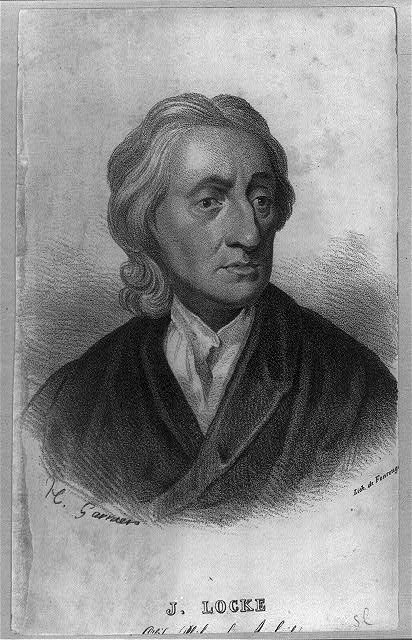
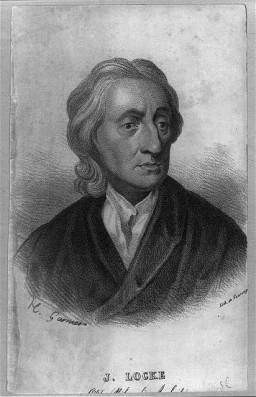
Like the writers of the Declaration of Independence, the Bill of Rights, and the United States Constitution, Paine is influenced by John Locke, author of Two Treatises on Government and therefore, indirectly, of American political theory. Paine bases his argument on a Lockean theory of rights: all human beings are born into the world with identical natural rights, including that to life and liberty. Everyone is also born with equal rights of access to the land and to its resources, since the latter two are necessary to the former, not only for sustaining life but for making it a free and happy one. The right of individuals to own property, therefore, is not a pure natural right like the others, since it allows particular people access to particular land and resources while denying it to others. Purely natural rights, by contrast, are equal in kind and in degree from individual to individual. Yet giving people the right to claim property as their own is valuable to everyone, since it provides incentives for individuals to create wealth through labor, improving what nature left on its own cannot provide: agriculture, technology, housing, art, and so on, and this wealth is shared by all through trade. Unlike the right to life and liberty, Locke’s labor theory of property rights is contingent, valid only if its original acquisition is ‘mixed’ with the owner’s labor. and only if enough is left so that others have not only enough, but just as good. (When the United States government drove the Native Americans of their ancestral land, they routinely and conveniently forgot the second part of Locke’s property rights theory as they grabbed the most resource-rich and most conveniently located land for themselves, driving the tribes into ever smaller and ever poorer places.) Even if it sometimes interferes with the ability of some to enjoy their purely natural rights, such as when certain people grab all the wealth for themselves while leaving others to suffer in poverty and even starve, Locke thinks that the right to own property benefits society on the whole to such a degree that it’s justified.
Paine, however, is not satisfied. He observes that property rights routinely benefit the few to a great degree and most relatively little. He looks not only at the world around him but at the whole of European history, seeing a world of immense wealth mostly enjoyed by a small number of people while most others earn just enough to sustain themselves, and the problem tends to grow worse over time. Paine tends to blame this state of affairs largely on a spoiled, despotic monarchy, aristocracy, and clergy, who use the law, assertions of ‘duty’, and enticements of salvation to wrangle most of the wealth out of the hands of people who actually create it. This leaves many of the young without the resources with which they could start creating wealth of their own for themselves and their families, and the impoverishment of the old who, after a lifetime of contribution through work, are left without resources when they can work no longer, having earned too little in their lives to save for their old age. So how can this be squared with Locke’s view that property rights should generally lead to the benefit of all, and that they are contingent on there generally being enough for everyone else to have what’s ‘just as good’?

He addresses this problem most thoroughly in his lesser-known pamphlet Agrarian Justice, written in 1795 and ’96 after he’s observed the success of the American revolution (except for enslaved Americans, of course) and the turmoil of the French one. The French Revolution, after all, was mostly driven by popular anger and despair over the widespread privation and suffering of the French people, condemned to a life of hard work, few prospects for social mobility, and a strict hierarchical class system in which most of the nation’s wealth was gobbled up by a very few.

Paine doesn’t just base his argument on sympathy for the poor, the hapless young, and the elderly, though his work is clearly driven by that emotion, occasioned partly by his hard-working parents’ and his own struggles to get by. Instead, his argument centers on justice; specifically, the principle of just recompense. Since every person is born into society denied of their birthright, which is the right of equal access to all land on earth and its resources, everyone is responsible for paying damages for that loss. What we now call welfare is really reparations, due to everyone, by all members of a society that enforces landed property rights.

But wait a minute, one might object: isn’t the very fact that society as a whole benefits from property rights recompense enough? Even if Paine is right, wouldn’t justice only demand we make sure that everyone has the same liberties, the same protection under the law, and the same access to basic public goods such as infrastructure and education? That way, outcomes in wealth will generally apportion themselves fairly according to the hard work and ingenuity of individuals. This idea, commonly called equality of opportunity, is especially popular with those who fall into the modern conservative and libertarian portions of the political spectrum. Anything else looks like an injustice in this view. After all, is it really just to take away wealth from some, especially those who earned it through their own labor, and give it to those who have not earned it?

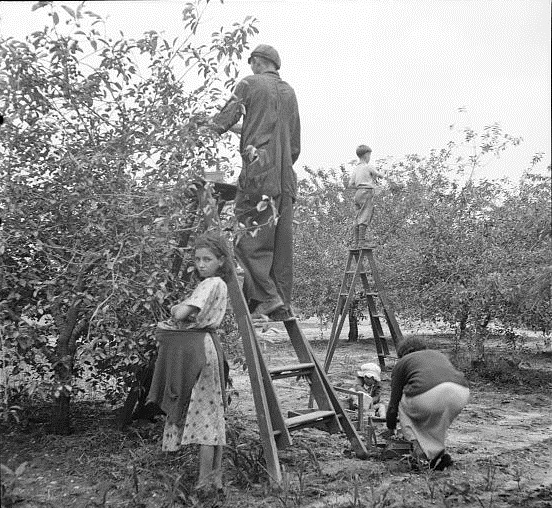
Remember that Paine offers the facts of history to show that fair wealth distribution just never seems to happen in societies that privatize land rights: the average person who works the hardest and does the most to benefit society very often does not accumulate even a fraction of the wealth as the relatively idle monarch, aristocrat, or member of the clergy. Well, then, how about today’s democratic market societies, where there is no monarch, aristocracy, or clergy empowered by the law to plunder most of the wealth from the working people for their personal use? We have only to pay attention to the news a short while to be aware that extreme inequality and unfairness of wealth distribution is as bad or nearly as bad as it’s ever been. The people doing the hardest and arguably most important jobs, such as teaching our children, manufacturing goods, cleaning up our cities, or harvesting the crops that sustain our lives earn anywhere from a pittance to a decent, but not stellar wage. Yet the CEO, the career politician, the idle children and grandchildren of millionaires, the trader and inventor of exotic financial products, and the tech whiz who invents the newest fad internet game often pile up money almost faster than they can stuff it into tax shelters.
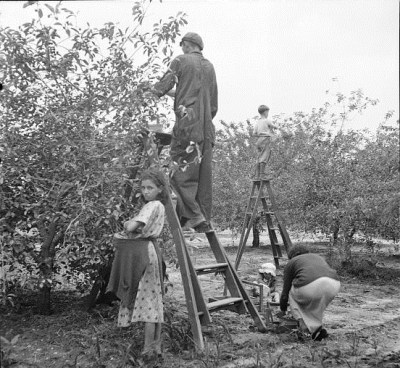
Many like to say that unskilled, low-paid jobs are a stepping-stone to something else, but this is belied by the facts in the United States and around the world. While some do work their way up to more highly skilled and highly paid jobs, there are many, many more who never do. The fact that our economy depends on there being a certain number of those low-wage jobs in existence guarantees they will keep existing, at least until technology renders them obsolete. And when and if that happens, what will all those unemployed people do then? Even if every single one received an education and job training sufficient for employment as a skilled worker, there will only be a certain proportion of jobs that will be decently paid, leaving the rest in the same predicament. And there very well may be far fewer jobs in existence than there are people in this technological age. What then?

The reason why the whole equality of opportunity idea never works out may be that it’s a mythical concept, incompatible with the laws of nature, or if it were at least theoretically possible, undemonstrable.

In the real world, competition among workers for jobs necessarily leaves a huge number of people out when it comes to the ability to earn decent or even any money whether or not they do work hard, whether or not they’re willing but don’t have the opportunity, or whether or not they can at all. There are countless reasons for this due to the variety inherent in human nature and in the human experience. Some never had access to a good education, or they lack the network of patrons and mentors that the offspring of successful people rely on to get their own start in life. Others are simply not as intelligent, or tall, or graceful, or otherwise good-looking enough according to the whimsical and capricious standards of society, or of the ‘right’ race, ethnicity, religion, or don’t have the ‘right’ accent, and so on. There are jobs that disappear from the market due to advances in technology, with suddenly unemployed middle-aged or older people with now useless job skills in a society that heavily favors youth. There are people who are born with medical problems that make it difficult or nearly impossible to get well-paying jobs in a competitive market: skin disorders, genetically-imposed obesity, missing limbs, compromised immune systems, cancers, heart conditions…. the list is very long. And there are countless numbers of people for whom the ‘rat race’ is painful or self-destructive, as they have personalities that are shy, contemplative, independent, gentle, non-competitive, ‘weird’, and otherwise totally unsuited to that whole competition thing, and therefore terrible at it. The list goes on and on.

And the reason why equality of opportunity is undemonstrable, at least as something that can be implemented through public policy, can be recognized when we compare it to the gold standard of demonstrating the truth or usefulness of a theory: the scientific experiment. Consider a group of scientists who say, we are sure this theory is true because of this, that, and the other thing. They have an assortment of facts, they have arguments to show why, given the facts, certain things should result, so they make a prediction. Then they run the experiment and… what do you know, the results of the experiment fail to support the hypothesis. They say, oh yes, we see the flaws with the experiment and/or with the participants, they compose new arguments, they formulate a new hypothesis, they run a new experiment and… oops, it failed again! And again, and again. Now, consider every democratic market economy ever in existence and see if any of them actually achieved actual equality of outcome. These actual economies are analogous to the scientific experiments, and the equality of opportunity-based sets of policies are analogous to the hypotheses being tested. Even if, hypothetically, some system based on the ideal of equality of opportunity would actually achieve equality of outcome in a world of identical beings who are not born with or given extra advantages by others, we’ll never know. Asking us to ascribe to indemonstrable political strategies based on equality of opportunity is like asking us to believe the truth of hypotheses that are never proven by scientific experiment. That’s why I, for one, don’t buy it, and am more interested in focusing on equality of outcome, which Paine’s basic income idea seeks to resolve in a practical and just way.

Returning to the original point regarding the fairness of redistributing income from the wealthy to the un- or under-employed: Paine foresees this objection by calling for a universal basic income. In other words, he thinks that it should not be granted on the basis of need. That’s because, for one thing, he bases his whole argument on the equality of natural rights. All human beings alike are deprived of their natural right of free and full access to all of the land and its resource in societies that enforce landed property rights. Even those who own land are still deprived of the right of access to other land, so they are still owed the same damages. If they are wealthy enough to throw the money back into the public fund since they don’t need it, that’s up to them, and very much to their credit, but it’s still owed to them, same as anyone else.
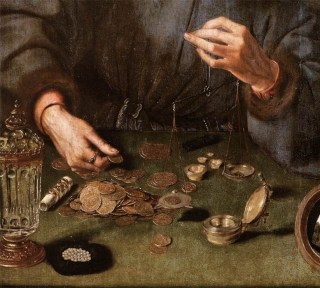
For another thing, and perhaps most importantly for its being popularly acceptable enough for implementation, Paine recognizes that basic human psychology instinctively abhors unfairness. The whole idea of giving welfare to some and not others, even based on need, might seem charitable but still feels unfair, especially when the funds are taken away from people who earned it through their own labor and given to the un- or under-employed. Human beings simply do not need any more sources of strife and division than they already contend with: politics, ideology, and religion do enough mischief on that account already. Therefore, Paine says, basic income should be equally distributed regardless of need so that no-one is given, by society at least, an excuse to resent or look down on anyone else.

*This essay has also been published at the Thomas Paine National Historical Association website (under a different title)

~ Ordinary Philosophy is a labor of love and ad-free, supported by patrons and readers like you. Any support you can offer will be deeply appreciated!

~~~~~~~~~~~~~~~~~~~~~

Sources and Inspiration:

“Labor Theory of Property.” Wikipedia, The Free Encyclopedia, 22 Sep. 2015. Web. 30 Sep. 2015.
https://en.wikipedia.org/w/index.php?title=Labor_theory_of_property&oldid=682304595

Locke, John. Two Treatises of Government, 1689
http://socserv2.socsci.mcmaster.ca/econ/ugcm/3ll3/locke/government.pdf

Paine, Thomas. Agrarian Justice, 1796.
http://piketty.pse.ens.fr/files/Paine1795.pdf

Paine, Thomas. The Rights of Man, 1791.
http://www.ucc.ie/archive/hdsp/Paine_Rights_of_Man.pdf

O.P. Recommends: Alison Gopnik’s ‘David Hume and the Buddha’

I just read a delightful piece in The Atlantic‘s October 2015 issue which combines three of my favorite things: history of ideas, a detective story, and David Hume. In her article ‘David Hume and the Buddha’, psychology researcher, philosopher, and author Alison Gopnik tells the tale of how she detected elements of Buddhist philosophy in Hume’s A Treatise on Human Nature, and how she set out to discover if he had indeed been influenced by it.

In Hume’s time, mid-1700’s, there was very little access to Buddhist philosophy in Europe, at least in part due to church suppression of its public dissemination. There was, however, some accounts of it buried in private libraries here and there, especially among the Jesuits, travelers, missionaries, and scholars as they were (and are). As Gopnik read up on Buddhist philosophy and European first encounters with it, she stumbled upon more than an ideological link with Hume: a possible way he could have discovered as a young scholar.

Like the 23-year-old Hume, Gopnik had fallen into a depression, but in her case, it was brought on by the changes that so often occur in mid-life: the children have grown up and left home, her marriage had broken up, she moved, and the stress of it all left her unable to work for a time. Hume’s depression was likely brought on by too many years of intense study, too much time spent indoors all alone. His Letter to a Physician of 1734 is a clear and detailed account of what it’s like to suffer a severe bout of depression, and he recognized it, clear-headed naturalist that he was, as an ailment of the physical body, and just as amenable to a cure if only the right one could be found.

Hume found the cure for depression in regular exercise and in enjoying the company of other people; Gopnik found in in a new love and renewed enthusiasm for her favorite pursuits, but first she found it in Hume. After finishing Gopnik’s story, I find myself even more impatient for my next traveling philosophy adventure in the history of ideas. Until then, I’ll continue to be inspired by Hume’s, Gopnik’s, the Buddha’s, and other great thinkers’ work, and heed Thomas Jefferson’s advice: if you keep yourself busy and your mind occupied, depression will be hard pressed to find its way in.

~~~~~~~~~~~~~~~~~~~~~~
Gopnik, Alison. ‘David Hume and the Buddha’. The Atlantic, October 2015 issue.
Published online as ‘How an 18th-Century Philosopher Helped Solve My Midlife Crisis:

David Hume, the Buddha, and a search for the Eastern roots of the Western Enlightenment’.
http://www.theatlantic.com/magazine/archive/2015/10/how-david-hume-helped-me-solve-my-midlife-crisis/403195/