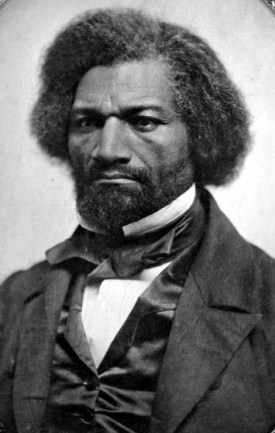
Celebrating Frederick Douglass in the Month of His Birth and Death

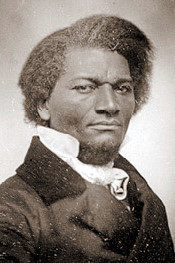
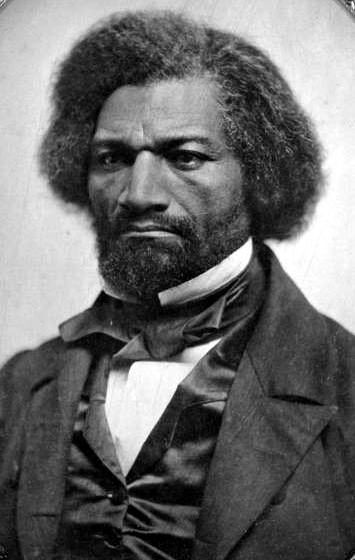
Frederick Douglass c. 1855, image Public DomainFrederick Douglass was born 198 years ago, as nearly as could be determined, on an unknown day in February 1818, based on an entry in the slave ledger of his first master who may have also been his father; Douglass hears reports throughout his young life that his father was certainly a white man, but who exactly it was is left unsaid. Aaron Anthony’s slave Harriet Bailey was Douglass’s mother, and she died when little Frederick was only about seven years old. Anthony’s daughter Lucretia married Thomas Auld, and upon Anthony’s death, she inherited young Frederick.

From such inauspicious beginnings, a ragged orphan enslaved on a plantation with prospects of little but a life of hard work and enforced ignorance, Douglass becomes one of the world’s most famous and well-respected people. His strong native intelligence and courage allows him to take the fullest advantage of every opportunity that comes his way, to his own credit and to the benefit of us all. After a long and illustrious career as an activist, writer, intellectual, and statesman, he dies on February 20th 1895 and leaves behind a legacy rivaled by few in American history.

I salute your memory, Mr. Douglass; my series on your life and ideas is my little tribute to you. Thanks for all you’ve done for your own people and for the whole human race!

I chose this day to commemorate his life and his death here at Ordinary Philosophy in advance of upcoming events in DC: the National Park Service will host a 2-day birthday celebration for Frederick Douglass on February 12th and 13th, 2016 at his home Cedar Hill and nearby sites in Anacostia and DC. Please visit the NPS website for more information.

Ordinary Philosophy and its Traveling Philosophy / History of Ideas series is a labor of love and ad-free, supported by patrons and readers like you. Please offer your support today!

Communitarianism, Writ Large

Amy M Cools's avatarOrdinary Philosophy

I listened to Bill Moyers’ discussion with Michelle Alexander recently, about her book The New Jim Crow and her activism against the over-incarceration of black people here in the US. Something she said really struck me, as it relates to a problem I’ve been mulling over for some time. She said:

I realize that as well-intentioned as all that work was, it was leading me to a place of relatively narrow thinking… If I care about a young man serving, you know, 25 years to life for a minor drug crime… If I care about him and care about his humanity, ought I not also care equally about a young woman who’s facing deportation back to a country she hardly knows and had lived in only as a child and can barely speak the language? And ought I not be as equally concerned about her fate as well? Ought…

View original post 1,483 more words

Fundraising Campaign for Frederick Douglass’ Traveling Philosophy / History of Ideas Series

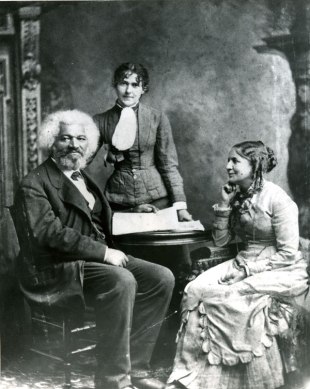
Frederick Douglass with his second wife Helen Pitts and her sister Eva, public domain via Wikimedia CommonsAs you may know, dear readers, I’m embarking on the travel portion of my fifth philosophical-historical themed adventure in mid to late March. I’m off to Baltimore, MD, New York, Washington DC, and other East Coast sites to follow in the footsteps of Frederick Douglass.

Ordinary Philosophy and its Traveling Philosophy / History of Ideas series is a labor of love and ad-free, supported by patrons and readers like you.

Every single bit helps, from $1 on up: directly through your contribution, and indirectly by inspiring confidence and enthusiasm in others who see the support already given.

As always, I count on you to help me accomplish what I do here; thanks to all who have contributed in the past, and thanks in advance to all who contribute in the future!

What the Frederick Douglass Traveling Philosophy / History of Ideas Series project will produce:
– A series of essays on the ideas of Frederick Douglass, how they relate to his time and ours
– A series of travel accounts of sites associated with Douglass’ life and ideas throughout the East Coast. I’ll be seeking insights into how the places informed the man, and vice versa. These will double as historical-philosophical investigations to bring Douglass to life in the mind of the reader, and as inspiration for other traveling history enthusiasts
– A series of downloadable walking tours to accompany the travel series: just subscribe and download in iTunes, and you’ll have your own travel guides to East Coast places I travel to for this series
– Free educational resources: supplementary teaching materials on the life and ideas of Douglass
– And if all goes as planned, a book!

Budget: In the interests of transparency and so you know exactly where your hard-earned, generously donated funds go, here’s the breakdown:

Primary Goal: $2,500 – To cover airfare, lodging, ground transportation, and advertising for Frederick Douglass’ Traveling Philosophy / History of Ideas series
– Airfare: to DC or NYC about $500 (w/taxes and fees)
– Car Rental: average $28 / day = $392
– Lodging: average $50 per night, will be staying with friends some nights = $700
– Parking / Fuel / Public Transportation: average $25 per day = $350
Subtotal = $1,942

Any amount I’ve saved on the above costs or amount collected in excess will be spent on paid advertising (Facebook, Google Adwords, Bing, Pinterest, etc, even a radio spot if funds allow!), which will be listed here, so that the total spent comes to $2,500. (I also advertise in a wide array of free venues)

Secondary Goal: $1,500 – Monthly wages
This year, O.P. is making a big push to include an expanded and more in depth history of ideas travel series, more regularly published podcast with downloadable history of ideas travel guides, interviews with fascinating people, scholarship and educational materials, more great guest posts, and so much more! To accomplish all this, O.P. will need to pay its own expenses and if possible, wages, so I can throw spend less time at other occupations, throwing myself into O.P. with all the heart, time, and energy I long to dedicate to this project.

Please visit the Subscribe, Submit, and Support page to help me fund this project.

I thank you in advance, from the bottom of my heart, for any support you can offer

Sincerely,

Amy Cools


What Is Happening to the Word ‘Beautiful’? by Tanya Newton

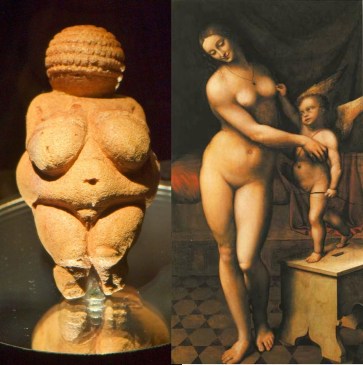
e993b-two2bvenuses2b-2bvenus2bof2bwillendorf2band2bvenus2band2bcupid2bby2bgiampietrino2c2bcopy2bafter2blost2bleda2band2bthe2bswan2bby2bleonardo2bda2bvinci2c2bboth2bpublic2bd‘Beautiful’ has always been a battleground in feminist discussions of representation. While it may seem counterintuitive to argue that we should consider more women as beautiful while also arguing that a woman’s capabilities are worth more than her appearance, tackling the rigid definition of beautiful has been important for intersectional feminism. A traditionally beautiful woman is white; women of colour are more likely to be sexualised instead. A beautiful woman is also normally able-bodied. She usually does not appear to be economically below the middle-class, something that is subtly but pervasively inherent in our ideas of the ideal body shape (too slender for manual labour) and the current trend of tanning (demonstrating leisure time and disposable income). A beautiful woman often also has long hair, a delicate face, and big eyes; she is vulnerable, not strong. So renegotiating this limited meaning of beautiful is a powerful act. Great progress has made with it, which should be cause for optimism. However, recent redefinitions are more troubling than empowering.

Beautiful is being used more and more often to denote a woman’s entire identity. Popular Urban Dictionary entries for beautiful state:

Beautiful is a woman who has a distinctive personality, one who can laugh at anything, including themselves, who is especially kind and caring to others. She is a woman who above all else knows the value of having fun, and not taking life too seriously. She is a woman that you can trust and count on to brighten your day. She is a woman who can inexplicably make you feel really good just by being around her, and yet brings such great sadness when she is gone.  (10,257 positive votes)

Your smile makes you pretty, your body makes you sexy, only your mind makes you beautiful (5,019 positive votes)

The description of anyone who is true to themself (3,272 positive votes)

Yes, it’s Urban Dictionary, but Urban Dictionary is not the only place this idea surfaces. A Buzzfeed video uploaded by Ashly Perez shows women stating that pretty is about “validation” from society, it is taught to young girls, and it is constructed by the media. I’m sure most feminists wouldn’t disagree. However, the video continues to say that beauty is different. “It is something that comes from the inside out: a combination of who I am and what I bring to the table”, one woman says. “I feel most beautiful when I’m using my mind and when I’m around my friends,” another adds. Beauty is made to mean personality. Perhaps this is why Dove’s latest marketing campaign makes women choose to label themselves as either “beautiful” or “average”—not average-looking. Perhaps Dove’s intention is to say that if your personality or capabilities are above average, you are beautiful.

However, beautiful already has a meaning and that meaning can’t simply be erased. It refers primarily to appearance, not identity. The number one definition in the Oxford Dictionary is: “Pleasing the senses or mind aesthetically”. Merriam Webster’s top definition is: “The quality of being physically attractive”. If these definitions were not true, and beauty instead referred to a person’s personality, then the trope beauty is bad wouldn’t exist and men could be called beautiful. Yet Cersei Lannister’s greatest weapon remains her beauty while calling a man beautiful remains an insult.

So Dove’s video, no matter what the intentions are, cannot tell women that if they are above average they are beautiful. Beautiful will not allow itself to be used that way; its meaning of ‘physically attractive’ always twists the message. Dove’s video actually tells women that if they are not beautiful, they are average: their intelligence, their capabilities, and their personality are not as relevant to their identity than their appearance. This video is more problematic than empowering. Buzzfeed’s video links being beautiful to being liked and loved, and while by “beautiful” Buzzfeed means being happy and sociable, we know that being physically attractive really does mean being more loved. Again, using the word beautiful subverts Buzzfeed’s message.

In fact, even if we were able to somehow strip beautiful of its current definition and redefine it to refer to a person’s attitudes and likeability instead of their appearance, that would damage the progress that intersectional feminism has already made. As discussed, beauty’s definition is under contention, and the meaning is slowly broadening. This is too important an accomplishment to discard. Beauty as appearance is a mainstream acknowledgement of visibility and measurement of value. To acknowledge that women of colour, trans women, disabled women, and less wealthy women are beautiful is to say that society considers them equal in appearance to white, able-bodied, cis, affluent women. Beauty meaning identity, on the other hand, does not do this. Stating that the category of beautiful that women have struggled to be included in still does not mean they are considered capable of being physically attractive by mainstream society, but that it’s irrelevant because their friends like them, is a regression.

Buzzfeed’s argument that women should be encouraged to measure their worth by more than their appearance is admirable. Dove’s advocacy of self-confidence is also applaudable. Yet beautiful is the wrong word to adopt to signify a person’s value and self-confidence; it is already laden with too much meaning.

After studying English Language and Literature at King’s College London, Tanya Newton moved to Japan where she teaches English. She loves to read and write, and loves tea almost as much. She is strongly interested in cultures and social structures. (Bio credit: Darrow)

This article was originally published on Darrow. Read the original article.

Ordinary Philosophy and its Traveling Philosophy / History of Ideas series is a labor of love and ad-free, supported by patrons and readers like you. Please offer your support today!

Frederick Douglass on the Constitution

Frederick Douglass Ambrotype, 1856 by an unknown photographer, image public domain via Wikimedia CommonsEarly on his career as an abolitionist speaker and activist, Frederick Douglass is a dedicated Garrisonian: anti-violence, anti-voting, anti-Union, and anti-Constitution.

In the early 1840’s, Douglass joins a revitalized abolitionist movement largely shaped by the views of William Lloyd Garrison. Since the early 1930’s, Garrison espouses a particular set of moral and political beliefs, radical for his time, which he promotes in his influential anti-slavery paper The Liberator. He believes in total non-violence, violence being a tactic of the slaveowners and their corrupt government protectors, not of good God-fearing people who have moral truth on their side. He believes that since voting implies that a government that legalizes slavery is legitimate, true abolitionists must abstain. He believes that the continued Union of the States, Abraham Lincoln’s sacred cause, was not only impossible, but undesirable: it involved the North, directly and indirectly, in the evil of slavery. Since the South was hell-bent on preserving that unnatural and therefore illegal institution, the South should go, and good riddance. And all of these are tied to Garrison’s view of the Constitution: it’s an ultimately pro-slavery, anti-human rights document, and therefore not worthy of obedience or respect.

For many years, Douglass fully agrees with Garrison. But over time, as a result of his conversations and debates with abolitionists who interpret the Constitution differently, and of his own study, experience, and thought in the first four years of publishing his own paper The North Star, Douglass changes his mind. By the early 1850’s, the abolitionist par excellence had come to disagree with Garrison, father of American radical abolitionism, and to agree with Lincoln, proponent of preserving the Union at all costs and of the gradual phasing out of slavery.

So how does Douglass come to make what seems such a counterintuitive change in his views on the Constitution and on the role of violence, voting, and the Union in bringing an end to slavery?

Some of the reasons for Douglass’ evolution are pragmatic; his pragmatist side becomes more pronounced with time and experience (more on this in another piece). For one, he comes to believe that violence is not only unavoidable at times, but sometimes necessary (more on this in another piece as well).

Douglass also becomes convinced that abstaining from politics is just suicide by degrees for the abolitionist movement, since it cedes political power to slaveowners and their supporters. Abstaining from voting in protest, as Garrison calls for, actually works against the project of obtaining greater political rights for black people. (As with celebrity comedian-guru Russell Brand’s anti-voting campaign today; the idea of abstaining from the vote in protest is neither new nor, in my opinion, any more effective now than it was then.) As Douglass points out, however motivated some people are to do the right thing by their fellow citizens, there will always be plenty of others motivated by greed, moral laziness in going along with the status quo, and the drive for power and domination over others. Political clout, gained through voting in those who represent their views, is one of the very few ways in which black people can finally obtain and protect their equal legal rights. And not only that: voting is one of the most practical yet powerful ways black people can demonstrate their full citizenship to those who might be inclined to doubt it. Other than getting an education and fighting in the war for emancipation, Douglass argues that it’s the most important way to undermine ugly stereotypes, prevalent in his day, of black people as lazy, uninformed, and fit only to have their lives run by others. (These stereotypes are, by the way, so ugly that it’s painful just to write them down, but confronting the ugliness head-on drives home the dire necessity of getting rid of them once and for all.)Constitution of the United States, first page of the original, provided by the National Archives and Records Administration, public domain via Wikimedia Commons
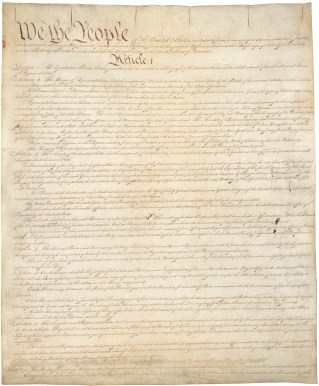
But voting’s not enough to ensure that black people obtain the political power necessary to enhance and preserve their rights. For the abolitionist revolution to succeed, the Union must be preserved at all costs, and in the process, it must be recreated as the unified, true haven of freedom it’s meant to be. Douglass believes it’s the responsibility of the free states to liberate the enslaved people of the Southern states, and to extend and enforce guarantees of human rights for all inhabitants of all states.

Why? Because the Preamble of the Constitution tells us that’s what it’s for.

But how does Douglass justify this interpretation when it’s still a matter of such contention that he’s watching his country tear itself in two over it?

To understand the Constitution, it can help somewhat to consider the history that led to its creation and the ideas and intentions of those who wrote it; but to fully understand its true meaning and purpose, Douglass believes, we must always interpret all of its parts in the context of its preamble:

We the People of the United States, in Order to form a more perfect Union, establish Justice, insure domestic Tranquility, provide for the common defence, promote the general Welfare, and secure the Blessings of Liberty to ourselves and our Posterity, do ordain and establish this Constitution for the United States of America.’

The preamble is the key to any valid interpretation of the Constitution because it tells us, in plain, direct, and eloquent language, why the Constitution is written, who it’s written for, and who is bound to obey it. Any interpretation inconsistent with the Preamble reveals that either the Constitution itself is illogical, inconsistent and therefore invalid, or it shows that it’s the interpreter’s reasoning that’s illogical, inconsistent and therefore failing in understanding. Garrisonians agree with the first; Douglass agrees with the second.

So what to do with such parts of the Constitution as the three-fifths clause, which reads:

Representatives and direct Taxes shall be apportioned among the several States which  may be included within this Union, according to their respective Numbers, which shall be determined by adding to the whole Number of free Persons, including those bound to Service for a Term of Years, and excluding Indians not taxed, three fifths of all other Persons‘?. (Art. I, Sec. 2, Cl 3.)

Doesn’t it imply that all those bound to service, which in Douglass’ time almost exclusively applies to black slaves, only count as three-fifths-person, and ergo, are not fully human? While Douglass grants that this clause is deeply problematic, he no longer agrees that it’s actually an endorsement of slavery.

There are two cases which can be argued when it comes to the effects of the three fifths clause: that it gives extra 3/5th’s representative powers to slaveowners, or that it takes away 2/5th’s; that point’s debatable. As Douglass points out, the clause actually appears to be a concession of a point that slaveowners didn’t really want to make but felt forced to if they wanted to increase their political power: that slaves are persons. If they’re not, it would make no more sense to include them at all for purposes of representation than it would to include cows, chickens, or farm implements. But even this grudging concession of personhood is conceivably debatable.

But while the effects of the three fifth clause may help indicate what use it’s been used for, they don’t tell us what it really means or what its true purpose is. So how do we successfully go about determining its meaning?

How about original intent? Since the expressed beliefs and opinions of the Constitution’s authors vary so widely on the matter of slavery, this won’t help us to decide the matter either. Douglass bases his original interpretation of the Constitution as a pro-slavery document on the basis of intent, but as we’ve seen, he changes his mind.

Well, then, how about strict constructionism? This won’t help us either. The terms used are so broad that it’s hard to tell what they literally and finally mean, or to prove outside of the historical context that they refer to the American brand of slavery at all. The three fifths clause never says anything about permanent bondage or race-based slavery. (In fact, the phrase ‘term of years’ seems to imply that there’s a beginning and end to the servitude in question that’s determined by something other than birth and death, but it doesn’t exclude the latter.)

So which interpretation of the three-fifths clause is most consistent with the preamble? Not the idea that those bound to service are anything other than persons or citizens, since the right to representation is only accorded to citizens, which, in turn, are necessarily persons. Nor is the idea that those bound to service are part-person or part-citizen: there’s nothing in the language of the clause nor of the rest of the Constitution that recognizes there’s such things as part-persons or part-citizens. Douglass points out that ‘…the Constitution knows of only two classes [of people]: Firstly, citizens, and secondly, aliens’. Constitutionally, all persons born in the United States are citizens by definition, and all others aliens; of course. the latter are still persons. So the ‘three-fifths’ clause can’t be referring to the completeness of individual persons; as we can see by the language itself, it specifically applies to the total number of persons for the purpose of apportionment only.
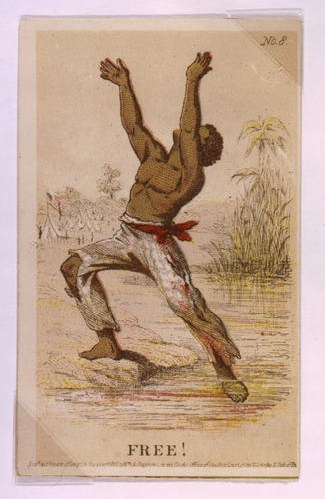
Free Stephens, Henry Louis 1824-1882 artist, Public Domain via Library of CongressIt’s clear, then, what the three-fifths clause says about persons and implies about citizens, but what does it really say about slavery?

In a word, nothing. At least, not directly. As Douglass reminds us, the word ‘slave’ and its derivatives never appear in the Constitution at all. It does mention people ‘bound to service for a term of years’ but as we’ve already considered, this is unspecific, never mentions race, nor implies that bondage to servitude is ever anything other than limited.

There is one reading of the three fifths clause that I think is most consistent with the Preamble and with Douglass’ view of proper Constitutional interpretation. Given that the Constitution is concerned with Union, and Justice, and Tranquility, and the common defense, and the general Welfare, and Liberty, the three-fifths compromise was the best the founders could do at the time, given the intransigence of the slaveowners coupled with the young country’s need for their inclusion in the Union, to make the country large and strong enough to bring as much liberty as possible to as many people as possible. Bringing an end to slavery, Douglass believes, is the next necessary step for accomplishing the goals laid out in the Preamble as well as in the Declaration of Independence: to finally stamp out that liberty-destroying institution which had so undermined the general welfare, strength, and tranquility of the Union from its very beginning.

To return to the twin issues of personhood and citizenship in Douglass’ America: in a speech in 1854, Douglass says ‘In the State of New York where I live, I am a citizen and legal voter, and may therefore be presumed to be a citizen of the United States’. Just three short years later, in the infamous Scott vs. Sandford, a.k.a. the Dred Scott decision, the Supreme Court ruled that Douglass and all his fellow black people are not citizens at all. While Douglass explains  in his speech’… [the]  Constitution knows no man by the color of his skin’, the infamous Dred Scott decision of 1857 upended decades of common practice and legal precedent since the founding of the nation, where free black people throughout the United States had enjoyed legal, if not social, equality. However, as Douglass correctly observes, skin color is never mentioned in the Constitution as a precondition for citizenship, only place of birth and status of naturalization.

According to his biographer Philip Foner, Douglass becomes the most advanced and most informed thinker in Constitutional law, and the political and legal theory that informs it, than any of his fellow prominent abolitionists. Douglass believes, in the end, that the Garrisonian abolitionists are making the same mistake as the slaveowners: they fail to interpret the Constitution rightly, on its own terms and as a unified legal document unparalleled and unprecedented in its full establishment of human liberty. From the Garrisonians onward, those of us who likewise interpret the Constitution as protecting the rights of some without protecting others, or who likewise fail to understand its true significance, its true potential, and its true power to bring the blessings of liberty to all, just don’t get the Constitution.

*Listen to the podcast version here or on iTunes

Ordinary Philosophy and its Traveling Philosophy / History of Ideas series is a labor of love and ad-free, supported by patrons and readers like you. Please offer your support today!

~ Also published at Darrow, a forum for ideas and culture

~~~~~~~~~~~~~~~~~~~~~~~

Sources and Inspiration:

Blassingame, J. (Ed.). The Frederick Douglass Papers, Series One: Speeches, Debates, and Interviews. 4 volumes, and The Frederick Douglass Papers, Series 2: Autobiographical Writings. 3 volumes. New Haven and London: Yale University Press, 1979-1999

Douglass, Frederick. Autobiographies, with notes by Henry Louis Gates, Jr. Volume compilation by Literary Classics of the United States. New York: Penguin Books, 1994.

Douglass, Frederick. The Heroic Slave: A Cultural and Critical Edition. Eds Robert S. Levine, John Stauffer, and John McKivigan. Hew Haven: Yale University Press, 2015.

Douglass, Frederick. My Bondage and My Freedom: 1855 Edition with a new introduction.. Re-published 1969, New York: Dover Publications, Inc.

Foner, Philip S. The Life and Writings of Frederick Douglass, Vol. 1-4. New York: International Publishers, 1950.

Landmark Cases: Scott vs. Sandford (The Dred Scott Decision), A C-Span Original TV Series, 2015  http://landmarkcases.c-span.org/Case/2/Scott-V-Sandford

O.P. Recommends: Landmark Cases / Injustices, Two Great Works on the Supreme Court

This last couple of weeks or so, I’ve been packing in a lot more learning about the Supreme Court, and is it ever fascinating.
It began when I stumbled on Landmark Cases last month, a C-Span series about 12 Supreme Court cases chosen because they had a dramatic impact on the legal landscape in United States history, and because they likewise had a significant impact on the Court itself, as precedent and on its perceived legitimacy, for good or ill. It can be found as a video series online, but I’ve been listening to the podcast version.
http://landmarkcases.c-span.org/

As I was listening, the discussions reminded me of a book I had heard about a little while ago but had forgotten to read, a book about the Supreme Court’s worst failures, terrible decisions that undermined its legitimacy and had a negative impact on the lives of people for years to come. It’s called Injustices: The Supreme Court’s History of Comforting the Comfortable and Afflicting the Afflicted, by Ian Millhiser. So, I went and picked it up, and just as with the Landmark Cases Series, I’ve been finding it difficult to tear myself away.

Both the Landmark Cases series and Injustices reveal that though sometimes the Supreme Court has been the bulwark against congressional, state, and individual encroachments of freedom, it has also too often betrayed the public trust. While we remember and celebrate such cases as Brown vs. Board of EducationGriswold v. Connecticut, and Obergefell v. Hodges, which brought the blessings of liberty to more of the American people than ever before, we sometimes forget how extensive the history of freedom-crushing Supreme Court decisions really is. The Dred Scott case, Lochner vs. New York, Korematsu vs. United States, and Citizens United v. FEC, for example, allowed employers to exploit desperate workers by cornering the market, fixing wages, and creating terrible working conditions with health-destroying long hours; permitted the government to imprison innocent citizens and allow the looting of their property based on no other consideration than race; and enabled the wealthy few to effectively buy up elections. Millhiser’s view of the Supreme Court’s historical tendency to value states and property rights over civil rights and the public interest is summarized here: ‘If American government truly derives its legitimacy from the consent of the governed, then [the] agenda [of the hardline conservatives] that is so often and so soundly rejected at the polls must not be implemented by one unelected branch of government when there is no constitutional basis to do so.’ (pp 184-85).

The Supreme Court’s conservative justices, joined at times by their otherwise more liberal-minded colleagues, all too often decided their cases according to the view that the Constitution only prescribes and limits federal action, and was not intended to do likewise with state or individual action. But as many other Supreme Court justices observed, especially in its civil rights phase throughout the latter half of the twentieth century, this reading of the Constitution renders it impotent (FDR’s terminology in his second inaugural address) to extend the protections of the Bill of Rights to citizens in almost all arenas of life.

After all, most of one’s life is not spent interacting directly with the federal government or its institutions, but in homes, shops, public squares, workplaces, and so on. If the state, or an employer, or a county sheriff, or a bus driver, or a neighbor, or any other non-federal institution or person uses their liberty to oppress another individual, then the latter can’t actually enjoy the freedoms that the Bill of Rights guarantees*. And surely the founders of our nation didn’t intend the Bill of Rights, demanded as a condition of the Constitution’s passage, to be powerless to protect individual freedoms in most circumstances. This is the principle which drives the more liberal Supreme Court Justices, Millhiser, and commentators on the Landmark Cases series to agree that strict constructionist, hyper-conservative, elitist, and commerce-centric justices have historically imposed opinions on the public that do not serve their interests as idealized in the Bill of Rights, and allowed the the powerful and wealthy few to claim the right to do as they like while trampling the liberties of everyone else. Since the Constitution derives its legitimacy from ‘we the people’, then we the people, in our institutions and as individuals, should be likewise bound by the Bill of Rights.

At times, I think that Milhiser champions too strongly the general principle that unelected judges should get out of the way and allow elected representatives to legislate as their constituents demand. After all, as so many of Milhiser’s examples indicate, legislators historically have been all too happy, too often, to make laws that favor some while trampling the rights of others. The potential value of an unelected judiciary to balance the power of an elected legislature is, I think, revealed more clearly in the Landmark Cases discussions. After all, the will of the majority often runs contrary to the national project laid out in the Preamble of the Constitution and the Bill of Rights, to protect and promote the rights of everyone, especially those in the minority who need protection the most. However, as author Jeffrey Toobin points out in his endorsement of the book, Millhiser’s book does an excellent job of balancing the good history of good Supreme Court jurisprudence with the bad.

Listen to the podcast version here or on iTunes

*For more on the distinction between liberty and freedom, please see my essay Freedom, Liberty, and the Inevitable Interconnectedness of Human Life

Ordinary Philosophy and its Traveling Philosophy / History of Ideas series is a labor of love and ad-free, supported by patrons and readers like you. Please offer your support today!

~~~~~~~~~~~~~~~~~~~~~~~

Sources and inspiration:

Landmark Cases: A C-Span Original TV Series, 2015
http://landmarkcases.c-span.org

Millhider, Ian. Injustices: The Supreme Court’s History of Comforting the Comfortable and Afflicting the Afflicted. New York: Nation Books, 2015.

“One Third of a Nation”: FDR’s Second Inaugural Address, published at History Matters website. http://historymatters.gmu.edu/d/5105/

Interview with Clay Jenkinson as Thomas Jefferson, Jan 16th 2016

I’m ple6759b-amy2band2bjeffersonased to announce that the 33rd episode of the podcast is a super special one, as it’s Ordinary Philosophy’s first interview, and my distinguished guest is Clay Jenkinson, humanities scholar, author, and creator of the Thomas Jefferson Hour radio show and blog.

I’m a long time listener of the show; in fact, I believe I’ve listened to just about every single episode, many of them more than once, and relied on Clay’s work to inform my own, especially in the two Traveling Philosophy / History of Ideas series I did following the life and ideas of Thomas Jefferson.

I highly, highly recommend you give the Thomas Jefferson Hour a listen, you can find it at www.jeffersonhour.com, along with many other resources on the life and ideas of Jefferson, and Clay’s other work in the humanities.

You can find the accounts of my two series on Jefferson, as part of the Traveling Philosophy / History of Ideas series, here and here.

I interview Clay here in character as Thomas Jefferson, as he does on the Thomas Jefferson Hour, discussing various issues as Jefferson himself might have viewed them, informed by Clay’s extensive scholarship on his life and expressed views.

I hope you enjoy our discussion as much as I did!

You can also subscribe to the Ordinary Philosophy and Thomas Jefferson Hour podcasts on iTunes.

*Thank you, Shane and David, for your help and technical support

Ordinary Philosophy and its Traveling Philosophy / History of Ideas series is a labor of love and is ad-free, entirely supported by patrons and readers like you. Please offer your support today!

Why We Need Citizen Philosophers

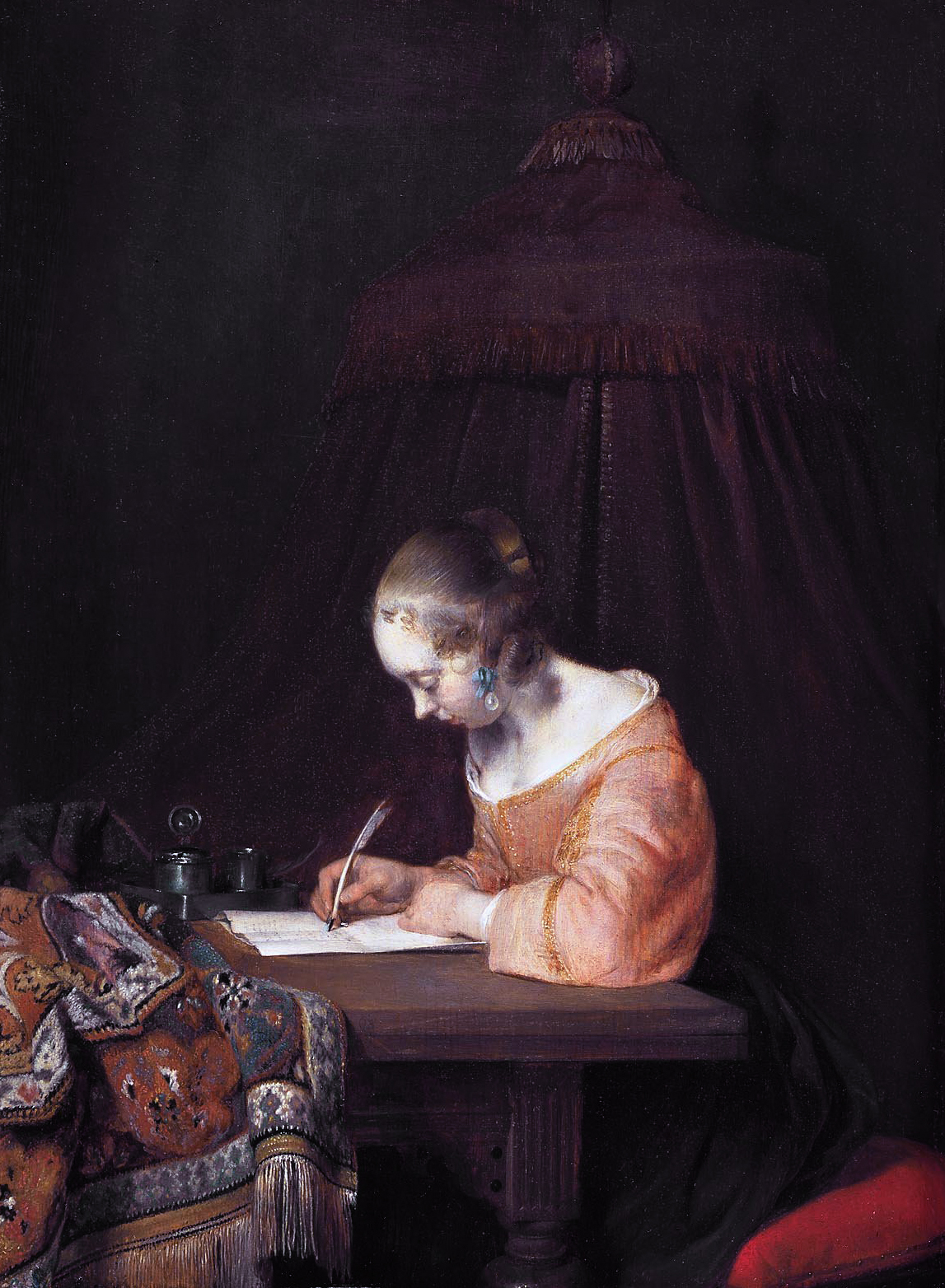
Writing a letter *oil on panel *39 x 29.5 cm *signed b.c.: GTB *ca. 1655I am a citizen philosopher, and very likely, so are you.

So what is citizen philosophy, why is it a useful concept, and what is its role in the world?

Let’s begin by considering what we mean by philosophy, generally speaking. For a long time, philosophy has been considered an almost exclusively academic pursuit, so highly specialized that only a very few experts can properly be called philosophers. As Eric Schwitzgebel points out, this is a relatively new development. In the Western world, it traces its origins to classical Greece; each region of the world has its own history of philosophy or its analogue, from Egypt to China to the Americas. As with all fields of inquiry, philosophy has branched out and specialized until much of it would be barely comprehensible to its first practitioners. Indeed, almost all fields of inquiry we know today started out as a branch of philosophy: mathematics, logic, science, medicine, theology, you name it.

But Philosophy, or ‘love of wisdom’, began in the home, the workplace, the market square, and the street corner with curious, intelligent people who, newly enjoying the luxury of free time accorded by advances in food-acquisition technologies, began to ponder on the whys and hows of the natural world and of the human experience. These people weren’t originally chosen or designated by some authority as the ‘thinkers’ as opposed to everyone else, the ‘doers’; instead, philosophy originated, grew, and specialized organically. We, as a species, began to ask and answer ever more complex questions about how to best live in the world as members of societies, what’s going on within our own minds and why, what are our roles in the universe, and what it all means… including the question ‘what is meaning?’. Over time, certain individuals came to be recognized as particularly adept at asking and answering these important questions, and came to be considered specialists and authorities in their fields of inquiry. But philosophy, broadly construed, remained a pursuit of many more people than that.Panthéon, Temple of Reason, Paris, France, Photo 2015 by Amy Cools

Philosophy has been demystified by re-entering popular culture, to a significant extent. There’s an ever-growing audience for popular philosophy books, articles, magazines, podcasts, and blogs. The term itself has also been re-broadened, so to speak. ‘Philosophy’ has taken on many new shades of meaning as it’s used to refer to a particular view of life, or aesthetic taste, or set of aspirations, or working theory of knowledge, or organization method, or substitution for the loaded term ‘spiritual’ …even a brand of skin care products (this one disgusts me somewhat, as it offends my aesthetic taste and sense of the ‘sacred’ by capitalizing on public respect for one of my most beloved, to me non-commodifiable things). Some of its newfound popularity is the result of advancing secularization accompanied by the desire to retain transcendence and meaning; some is the result of our newly data-centric lives brought to us by the word wide web, creating the need to make sense of the deluge of new information available to us; some is the result of the blending, annexing, and clashing of cultures in a world now widely and intimately connected through advanced media technologies and ease of travel, creating the need to find ways of communicating and living together in a world of new complexities. It’s all happening so fast that each of us is experiencing the urgency to make sense of it all right away, in a way that is practicable in our own communities and subcultures, and in a way each of us can understand and readily communicate.

In short, philosophy is enjoying a comeback in the public square. What I’m calling citizen philosophers are those who ask and answer questions there, about the nature of the universe and how to make sense of our experiences of it, who are not necessarily engaged in professional or academic philosophy. While citizen philosophers tend to spend a significant amount of time engaged in such inquiry and are motivated to educate themselves widely and systematically, many find academic philosophy too arcane and obscure to help the rest of us navigate our increasingly complex lives.

I, for one, love academic philosophy. I am continuously in awe of the work these men and women do, devoting their lives to hard study, to asking the most challenging questions, and to deep examination of the most nuanced and complex problems. This body of work is breathtaking in its scope, beautiful in the elegance of its arguments and solutions, satisfying in its wit and cleverness, fascinating in its intensive scholarship, and indispensable in its ability to help us figure out why and how to make a better world. I find it highly enjoyable and fulfilling, as well as challenging and frustrating, to grasp and wrangle with the work of academic philosophers. To be sure, academic philosophy has had its share of what David Hume calls sophistry and illusion, fit only to be consigned to the flames, and what Harry Frankfort more succinctly calls ‘bullshit’. But philosophy is not alone in this: science has had its phrenology and eugenics, medicine its humours and bloodletting, theology its justification for slavery and pogroms, and so on. Like these other disciplines, academic philosophy has some wonderfully effective built-in self-correctors, and continues to be an essential, I think preeminent, field of inquiry.

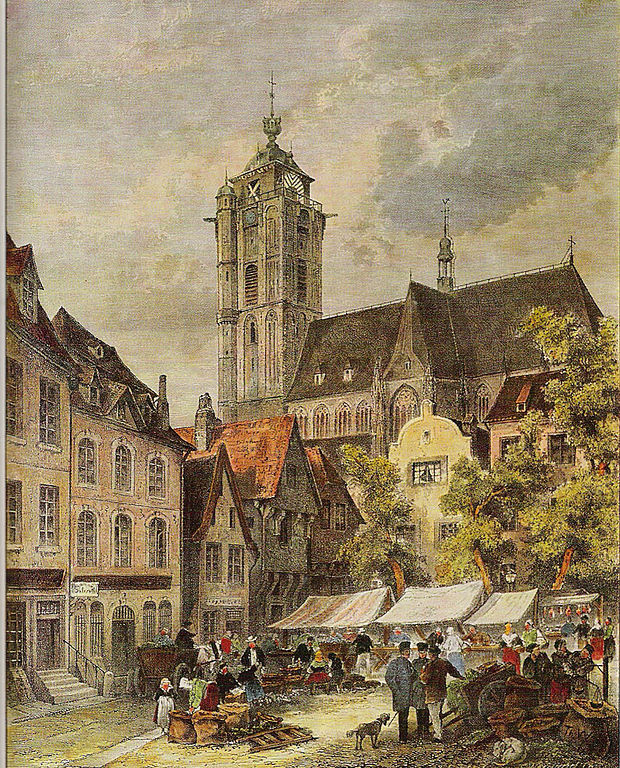
Marketplace in Duisburg by Theodor Weber, 1850, Public Domain via Wikimedia CommonsBut many of the most important and interesting questions don’t come down on us from on high, so to speak, originating from academia and revealed, as if a sort of holy writ, to the rest of us. In fact, most of the questions and problems we all wrangle with still originate in the public square, in the home, workplace, classroom, hospital, church, courtroom, political assembly, and so on. They bubble up from the challenges and uncertainties of our daily lives, are filtered through conversation and the arts, are swept up in social, legal, and political movements and institutions, and carried into the pool of academic philosophy, where they are further clarified and distilled in treatises, lectures, books, and so on.

And these questions don’t only originate with the public at large, we offer our first answers there. The answers range from fragmentary to nuanced, from intuitive to considered, from repetitions of received wisdom to original, from off-the-cuff to well-informed, by people from all walks of life with their own areas of expertise and unique capabilities of understanding born of particular experience. These citizen philosophers are on the first line of discovery and inquiry, and so called because they don’t participate in this process as a profession, but as a matter of personal interest and as a member of society at large, not subject to the demands and constraints of academic philosophy. Of course, the category of citizen philosopher does not exclude academic philosophers, because of course they, too, participate in the same process of question-creation and question-answering in the course of their everyday lives, separate from their academic pursuits.

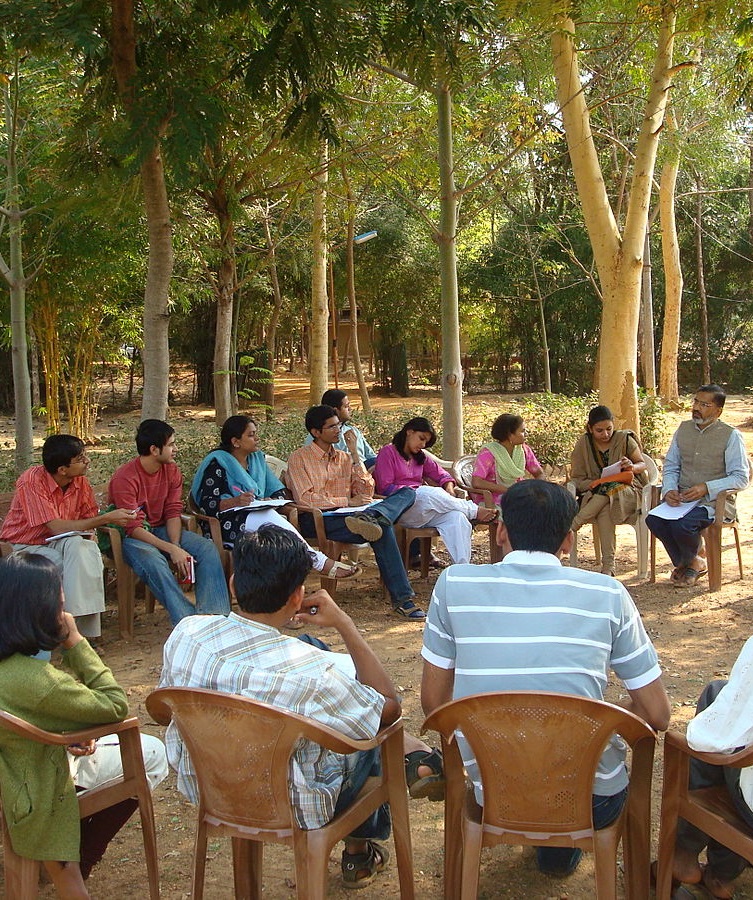
It’s the very lack of the demands and constraints of academic philosophy that gives citizen philosophy an important role to play in public life. The world as it is offers so many varieties of human experience, so many ways of seeing the world, so many challenges that academic philosophers, like the rest of us, never have the opportunity to confront directly. Yet the scope of academic philosophy, at least potentially, is as broad as the possibilities of human (even, perhaps nonhuman?) experience. So how can it be that academic philosophers can possibly access enough information to ask and answer all the important questions that could be addressed? It may be, if academic philosophers were endowed with immense powers of comprehension and imagination that would enable them to take all the information available in the world, to truly understand what it’s like to be a coal miner in China, a cardiologist experiencing a heart attack firsthand, a one and a half year old who just created their first sentence, a person with frontal lobe epilepsy experiencing a supernatural vision, or a terrorist who became so after their entire family was killed by a bomb, and then conceive of all of the social, epistemic, metaphysical, political, and every other sort of question that may arise from these experience. (À la the mythical Mary in Frank Jackson’s black and white room.) But of course, this is impossible, as even the most intelligent and informed human mind has its limits. Sometimes, raw data is the fodder of academic philosophical inquiry. But most often, it’s the questions, moral precepts, stories, works of art, aphorisms, dogmas, memories, narratives, and all other products of the human mind, already having undergone a first round of questioning and examination, that academic philosophers take up as topics of inquiry. Group discussion in the camps of Nirman (cropped), by Abhijeet Safai, Public Domain via Wikimedia Commons

I, for one, am glad to see philosophy ever more present in the public square. That’s because I perceive philosophy as the great quest for understanding that academic and citizen philosophers all engage in, and as I see it, each gives something of immeasurable and irreplaceable value to the other. We need only recall some philosophical forays that have failed, from hairsplitting quibbles of scholasticism to navelgazing-verging-on-masturbatory obscurantisms of postmodernism, to recognize that academic philosophy benefits enormously by maintaining a robust discourse with the broader human community of activists, artists, reporters, bloggers, protesters, discussion groups, and of all others who care enough to question.  The discipline and expertise of academic philosophers, and the broader set of experiences, challenges, and opportunities for new questions and unique ways of understanding of the larger community of citizen philosophers each serve to keep the other more honest, more challenged, and more informed, in the great world conversation we’re all having.

*Listen to the podcast version here or on iTunes

Ordinary Philosophy and its Traveling Philosophy / History of Ideas series is a labor of love and is ad-free, supported by patrons and readers like you. Please offer your support today!

O.P. Recommends: Fareed Zakaria on What America Could Learn From Singapore About Racial Integration

Singapore, Satay stalls along Boon Tat Street next to Telok Ayer Market by Allie Caulfield, Public Domain via Wikimedia CommonsIn thinking recently about the nature of government and its proper roles, I recalled this Fareed Zakaria piece about Singapore’s engineered diversity.

In it, Zakaria praises Singapore’s efforts to reduce racial and religious bigotry by increasing the diversity of its neighborhoods. The government’s tactics to achieve this would be intolerably intrusive to most Americans, and indeed to the citizens of most modern democratic nations. When it comes to race and class, the Singaporean law favors the government’s interest in providing an environment where citizens are brought up in familiarity with people who are different than they are, and therefore less subject to the harmful effects of bigotry, over the rights of individuals to freely choose where to live.

So can Singaporeans be considered more free than Americans when it comes to race and class? What does it mean to be free, in this sense? We struggle here in the United States from the ugly effects of entrenched bigotries, ancient and new, long after we considered it okay to sanction them by law: we live in self-segregated neighborhoods where racial minorities and the less wealthy enjoy a far lower level of health and personal safety, religious minorities (at this moment in our history, especially Muslims, although Quakers, Catholics, Jews, and others have had their turns) are subject to the suspicion and hatred born largely of ignorance, and social mobility is extremely slow. But we can choose to live, at least on paper, wherever we want. Does that really make us more free?

And if we generally agree, as a society, that we believe the end of bigotry is a worthy moral goal, is it right and proper for the government to be the arbiter of that goal? Is morality a governmental concern at all? Or is it the government’s role to keep out while citizens wrangle with important moral questions, interfering only to protect its citizens from bodily harm?

Along with Zakaria, I find much to admire in Singapore’s goal, and its tactics do appear to help foster social cohesion and reduce conflict. Would Americans would ever ‘go for’ anything like that, if our conflicts of race, class, and religion continue to set us against one another? I doubt it. But I don’t think we should kid ourselves that it makes us any more truly free.

*Listen to the podcast version here or on iTunes

~~~~~~~~~~~~~~~~~~~~~~~

Source and inspiration:

Zakaria, Fareed. ‘What America Could Learn From Singapore About Racial Integration’. The Washington Post, June 25, 2015 https://www.washingtonpost.com/opinions/from-singapore-lessons-in-harmony-and-diversity/2015/06/25/86fcbfa2-1b72-11e5-93b7-5eddc056ad8a_story.html

Frederick Douglass on Faith and Doubt

Frederick Douglass c. 1855, image Public Domain

In his lifetime and to this day, Frederick Douglass is a hero to the religious and non-religious,to believers and skeptics alike, each claiming him as a champion and exemplar of their values. Why the discrepancy? In his speeches, letters, and published work, Douglass reveals himself as both believer and doubter, a man of deep Christian faith who experiences a great deal of religious skepticism throughout his life.

Douglass is a self-professed believer in God and a Christian, yet he’s a vocal critic of most Christian denominations of his day, especially those of the United States. As a young man, Douglass struggles with religious doubts as he observes, time after time, that the most pious slaveowners are the most cruel. His master Thomas Auld, Edward Covey the slave-breaker, Reverend Daniel Weedon and the neighboring Hamiltons in Baltimore, among others, routinely and mercilessly whipped and abused their slaves, often to the point of great injury and near death, all justifying their behavior through Bible passages. In his second autobiography My Bondage and My Freedom, Douglass writes: ‘…The religion of the south…is a mere covering for the most horrid crimes…. Were I again to be reduced to the condition of a slave, next to that calamity, I should regard …being the slave of a religious slaveholder, the greatest that could befall me’ (159). In fact, he discovers to his surprise that the most decent master he ever had, William Freeman, was the only one without religion.

In his early days as an abolitionist activist and speaker, his accounts of his youthful doubts occasioned by his bad experiences with religious people cause many to accuse him of irreligion. But over time, he makes it clear that’s not religion itself he hates, it’s what he considers ‘false religion’. And no religion is as false as that which endorses slavery, which, first and foremost in Douglass’s time, was the Christian denominations of the American south.

But Douglass’s condemnation of American Christianity only begins with the southern churches; it by no means ends there. He calls on his fellow black people to leave any church, shaking the dust off their feet as they go, if their pastors or fellow parishioners subject them to indignity or unequal treatment. If anyone is segregated into balconies or back rows, or required to wait to receive communion after other colors or classes of parishioners, or their pastors preach against resistance to slavery, or the church in any other way indicates that black people are not deserving of the exact same respect, in degree and kind, as fellow children of God, then their church is revealed as just another peddler of false, corrupted religion. And all of these betrayals of the true Christianity, as Douglass perceives it, were as nearly pervasive in the northern churches as in the south.

Douglass believes that these practices, disrespectful of certain of God’s children, are not only unjust; they’re blasphemous because they’re direct attacks on the goodness and true nature of God. That’s because Douglass perceives the true God as not only ‘the God of Israel, Isaac, and Jacob’, but more broadly, the God of the oppressed. He sees this theme, this common thread, linking the plundered and oppressed desert tribes of Biblical Canaan (not mentioning that they did some plundering of their own) to those in his day who are suffering, reviled, and denied their natural rights: black people, women, the Irish, the abolitionists. Time and time again, Douglass relies on his interpretation of God as the God of the oppressed to show how the fugitive, the disenfranchised, the famine-starved left to die by their own governments, the righteous, reviled, and steadfast opposer of slavery and defender of the downtrodden, are actually those closest to him, are those who understand and share in his true nature.

But Douglass’s faith also appears at least as naturally derived as it is scripturally revealed. That’s because Douglass uses nature as a litmus test to reveal the truth and integrity of religion. Since by nature all people need and take joy in food and drink, physical and spiritual comfort, love, and beauty whatever their color, sex, or place of origin, and all people suffer alike from cold, hunger, thirst, cruelty, and neglect, and all people are just as capable of improvement through education and moral edification, then all people share the same nature, possess the same dignity, and have the same rights. Scripture may appear to allow for bigotry, unequal treatment, and bad behavior and even require it, but nature is observable and incontestable. So, if an interpretation of scripture seems to allow or require one to treat any of their fellow human beings as less than equally beloved, equally valuable children of the one God, that interpretation is certainly wrong since it violates the natural God-authored order of things.

In the end, Douglass relies on Jesus himself to tell us how to recognize true faith in true religion: ‘Wherefore by their fruits ye shall know them’ (Matthew 7:20). It’s not whether or not one professes belief in a religion, or can quote passages of scripture or the work of theologians, that reveals the worth and nature of faith. Douglass believes that true religion (which for Douglass, is true Christianity), always reveals itself by how well its adherents defend and promote justice and the equal dignity of all human persons. Conversely, if a religion commands or even permits injustice, it must be false. Where you find kindness and justice, there you find faith, and nowhere else.

It’s not the outward form or classification which indicates the true tree of religion to Douglass, it’s the sweetness and wholesomeness revealed in the fruit of true faith.

*Listen to the podcast version here or on iTunes

*Ordinary Philosophy and its Traveling Philosophy / History of Ideas series is a labor of love and is ad-free, supported by patrons and readers like you. Please offer your support today!

~~~~~~~~~~~~~~~~~~~~~~~~~~~~

Sources and Inspiration:

Douglass, Frederick. The Heroic Slave: A Cultural and Critical Edition. Eds Robert S. Levine, John Stauffer, and John McKivigan. Hew Haven: Yale University Press, 2015.

Douglass, Frederick. My Bondage and My Freedom: 1855 Edition with a new introduction.. Re-published 1969, New York: Dover Publications, Inc.

Foner, Philip S. The Life and Writings of Frederick Douglass, Vol. 1-4. New York: International Publishers, 1950.