Springfield, Illinois, In Search of Abraham Lincoln, Part 2

Abraham Lincoln Presidential Library and Museum, Springfield, Illinois. The Museum is to the left, the Library is to the right

Springfield, Illinois, Saturday, July 29th, 2017, continued

After my visit to the Lincoln Tomb at the Oak Ridge Cemetery and a quick stop to drop off my luggage at the room where I’ll be staying, I continue my Springfield journey downtown at the Abraham Lincoln Presidential Library and Museum, at 112 N. Sixth St. It’s a large complex, the two public buildings each stretching the length of one city block along N. Sixth St. It has a very late-1990’s – early 2000’s style, neither particularly handsome nor offensive in my view, just… generic. I associate it with municipal buildings such as city halls, branch libraries, and large post offices, perhaps because so many were built in this general style in my native California throughout my teens and early adulthood.

I start with the Museum at the northeast corner of N. Sixth and E. Jefferson. After passing through the foyer and security entrance, I step into a large central room, with very tall ceilings and a life-size sculptural grouping of the Lincoln family. I find I’ve neglected to take pictures of this, I think because I don’t like the sculptures much. For the most part, I don’t care for sculptures that attempt to recreate historical figures in a hyper-realistic way. These ones look like giant dolls: the hair looks like cheap wigs; the postures are stiff and slightly unnatural; and the face paint is a little off, like not-quite-successful funeral-parlor makeup. This is one of those sorts of things like playing the bagpipes or the violin, I think: you need to get it just right or the result is unpleasant. The overall effect of these figures, to me, is a little creepy and more than a little campy.
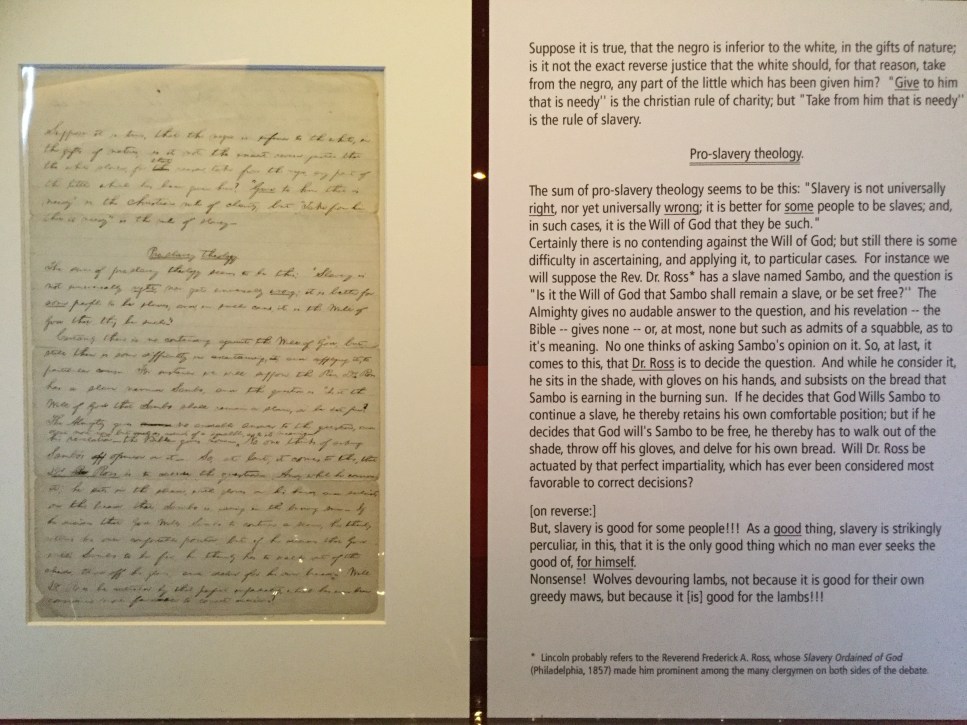
‘Satire on Slavery’ exhibit featuring ‘Fragment on Pro-Slavery Theology’. In these 1858 notes, Abraham Lincoln mocked pro-slavery arguments. On exhibit at the Abraham Lincoln Presidential Museum, Springfield

Still, overall, I like the museum well enough, and I do enjoy most of the life-size, walk-through dioramas of imagined scenes from Abraham Lincoln’s life. The figures within them look better in the low light and they’re surrounded by original and recreated interiors, structures, and artifacts of interest, so they’re properly illustrative and educational for a museum. They do also have something of an amusement park quality but, hearing the reactions of the visiting children and the discussions following their questions, they appear to be very effective in sparking interest in Lincoln’s history.
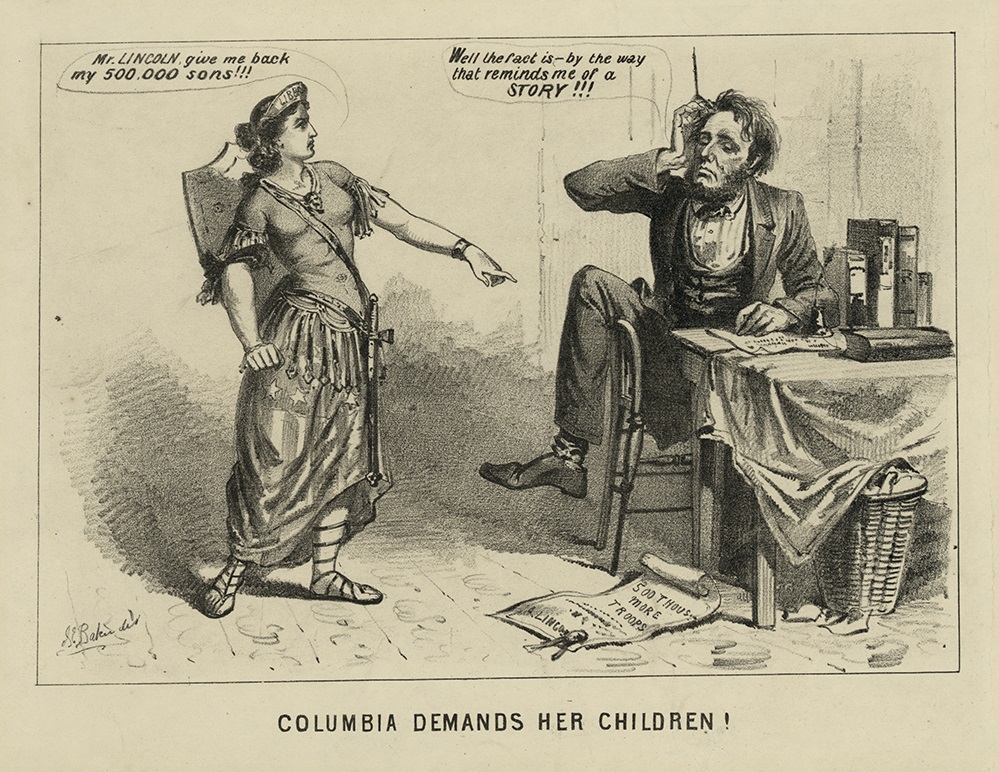
‘President Abraham Lincoln is blamed for the Civil War’s huge human toll and for deflecting the issue with his notorious storytelling in this 1864 cartoon by Joseph E. Baker.’ – Image and its caption courtesy of the Library of Congress. I don’t remember that a reproduction of this particular cartoon is displayed in the ALPM, but it’s representative of the sort of cartoons on display in the Whispering Room exhibit. As you may know, or may remember from one of my earlier accounts, Lincoln was notorious, for good or ill, for his penchant for storytelling

Pocket compass and sundial which belonged to Abraham Lincoln’s grandfather of the same name. He was a Revolutionary War captain and moved from Virginia to Lincoln’s native Kentucky in 1782. ALPL&M, Springfield

There’s one exhibit hall which I find particularly creative and interesting: it’s covered with reproductions satirical political cartoons critical of Lincoln’s real and fabricated opinions and policies. It’s an effective way to reveal the political issues and contrasting beliefs of the time, and the ways in which our nation was so deeply divided, just as we are deeply divided now. Comedy and satire, then as now, are two of the most efficient ways of communicating the nuances of issues that otherwise can be difficult to clearly explain. I did hear one grandmother use this as a teaching moment to tell her grandchild that, see, it’s not nice to make fun of presidents, just like people are making fun of Donald Trump today! I think she may have missed the point of the exhibit a little.

I also find many of the original artifacts on exhibit particularly interesting and I wish there was more space dedicated to the exhibit of these than to dioramas. There’s a tiny and delicate looking pocket sundial and compass set belonging to Captain Abraham Lincoln, Lincoln’s grandfather. They must not have been so delicate, however, since they traveled with him from Virginia to Kentucky in 1782, quite a rugged trek in those days.
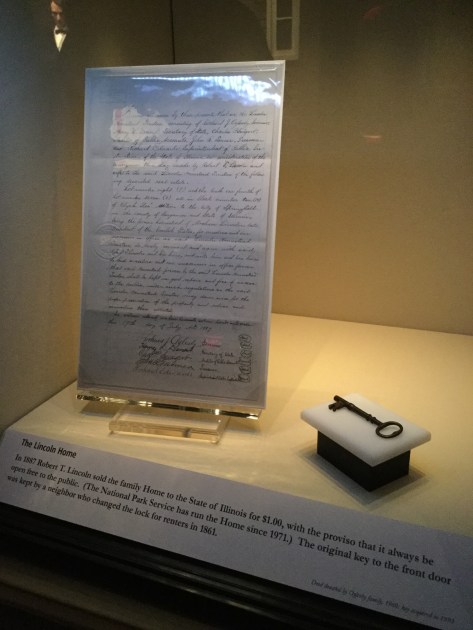
Original front door key and deed of sale of the Lincoln family home in Springfield, on display at the Abraham Lincoln Presidential Museum

An original plaster model by Gutzon Borglum for his 1908 marble bust of Lincoln is also on display. The bronze bust of Lincoln at the Lincoln Tomb in Oak Ridge Cemetery here in Springfield and the other smaller one in Peoria Heights are also derived from this plaster cast. As you can see, and as the accompanying placard in the museum describes, Borglum left the left side of Lincoln’s face unfinished and without an ear. He explained that he thought the right side of Lincoln’s face was fully developed and much more expressive while the left side was ‘immature.’ However, when he sculpted Lincoln into the Mt. Rushmore National Monument, Lincoln’s head is positioned so that the left side of his face is more readily seen. But there as here, his left ear is left unsculpted. I wonder how long it took Borglum to decide where to place Lincoln’s head among the others on Mt. Rushmore, given that he preferred the right side of his face. In Borglum’s original model for Mt Rushmore, the left side of Lincoln’s face is fully sculpted, ear and all. But on Mt. Rushmore it remains unfinished. It was even less finished when Borglum died, but his son, whom he named Lincoln, by the way, completed the sculpture to the point we see today. I also wonder if Lincoln Borglum decided not to finish carving the left side of Lincoln’s face based on this plaster cast and on his father’s remarks.
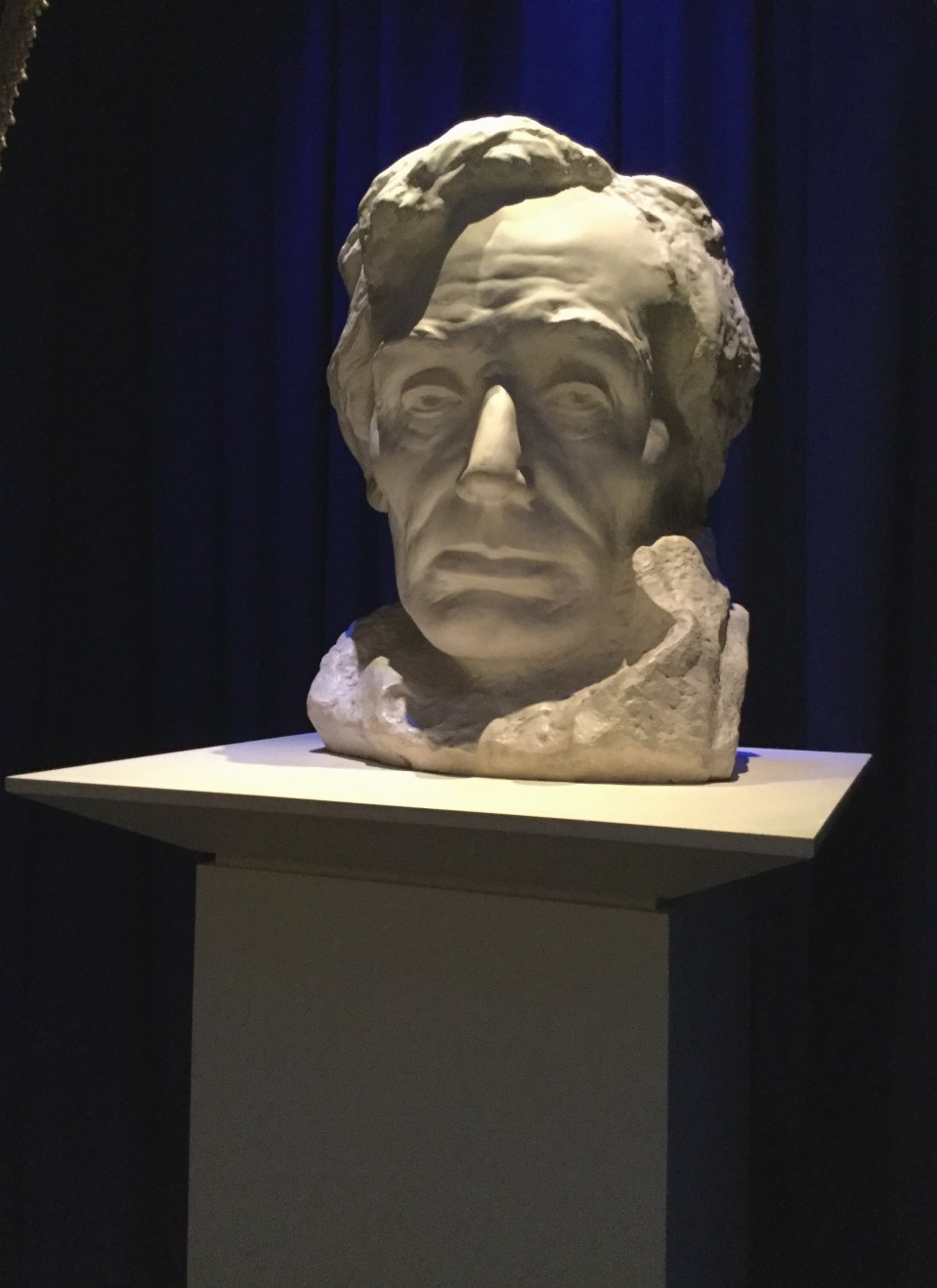
Plaster cast by Gutzon Borglum for 1908 marble bust now in the Rotunda of the U.S. Capitol building. On display at the Abraham Lincoln Presidential Museum

After touring the Museum, I cross the street and step into the Library to see if there are any more interesting artifacts on exhibit. There are only a few, and none that I find that are directly linked to Lincoln. The Library’s soon to close, so I’ll return another time to explore it more fully and to get some writing done.
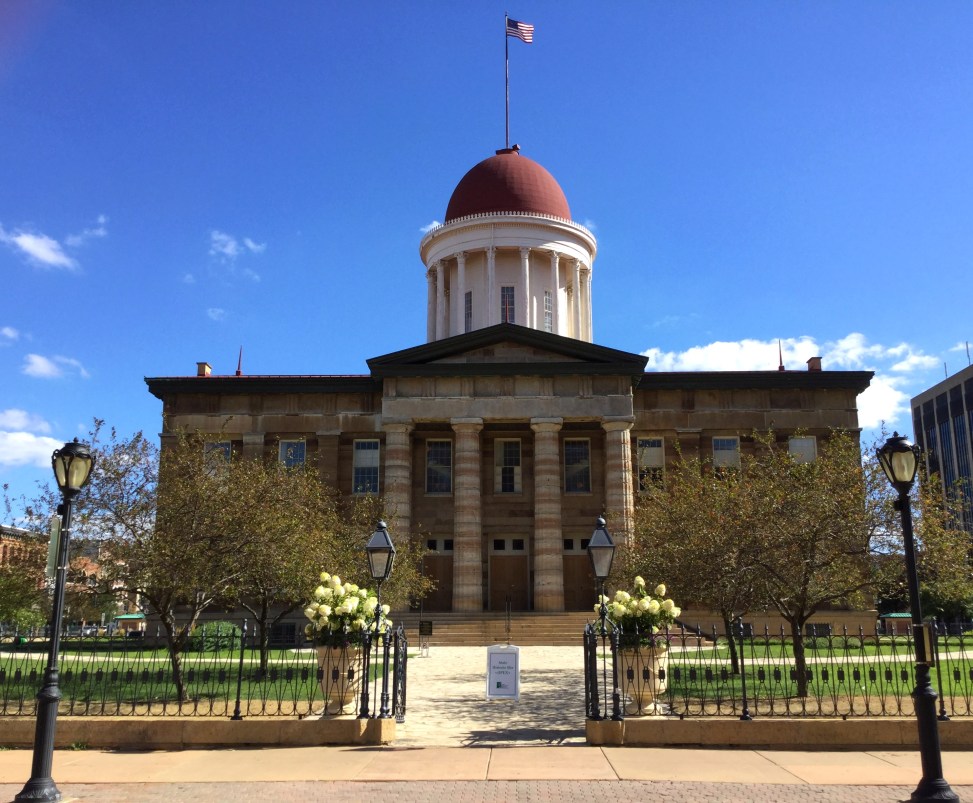
Old State Capitol Building at 6th and Adams Streets, Springfield, Illinois. Lincoln had many associations with this building and its predecessor, a brick courthouse in the center of the square which was torn down to make room for this one

I head south for one block, turn right, and enter the Greek Revival Old State House to my left. It’s a handsome, classical Doric-order building in natural, textured cream and pinkish-tan stone with a smoothly painted off-white tall, narrow, red-roofed dome that looks as if it’s been stuck on top without concern as to whether it will match or not. Nevertheless, the effect is good: it all works together, somehow. It was mainly built between 1837-1840, completed in 1851, and then reconstructed in the 1960’s. It stands by itself among a large grassy lawn and gardens in the public square bordered by E. Washington St, S. 6th St, E. Adams St, and S. 5th St.

Parts of the structure we see here today are original, but much of it has been changed drastically over the years: in 1899, the entire building was raised up to insert a new ground floor underneath, and a new dome replaced the old to better harmonize with the building’s changed proportions. The building had quickly become too small to accommodate the staff and the public in this rapidly growing state capital. Even with the addition of another floor, the administrative needs of the city outgrew the old state house and it was moved to a grand new capital building. In 1876, this building became the Sangamon County Courthouse. In the subsequent years, the building survived every successive move in and out of the various county bodies that had been assigned to it. It was the scene of so many great historic moments, especially those associated with the life and death of Lincoln, that all motions to tear it down were firmly opposed and defeated. Finally, in the 1960’s, the historic value of the building was fully realized in a complete restoration. What I see here today is a faithful manifestation of the original design and decor; examinations of old photos reveal that both the interior and exteriors appear almost exactly as they did in Lincoln’s time.
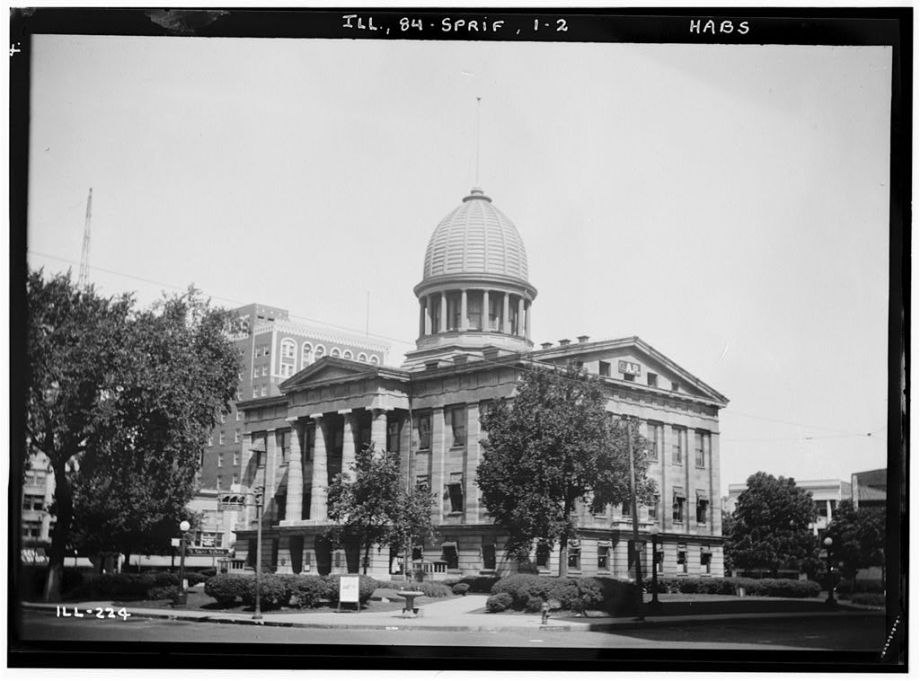
Old State House, Springfield, Sangamon County, Illinois, by Clark Bullard for the Historic American Buildings Survey, July 13, 1935. Public domain via the Library of Congress. Notice the ground floor and larger dome that had been added in 1899-1900.

Lincoln had many connections with this site on the square, in the 1831 red-brick courthouse that stood in the middle of the square, and in the state house built here over its former location. In 1901, historian Henry Douglas Giger wrote:

‘The brick court house stood in the middle of the square, and was completed in 1831 at a cost of $6,841.00. It was a two‐story square, brick building, with a hip roof, and cupala on top, similar to the court houses peculiar to the Mississippi valley at that period, and from the time it was built all the business of the town centered around the square, and the old town on Jefferson street began to decay. The row of small shops on the east end of the north side of the square was called “Chicken Row.” In the fall of 1835 a young man fresh from the prim and dignified courts of New York arrived in Springfield. He wandered into the brick building standing in the center of the square, and saw the judge on his bench with his chair tilted back, his heels higher than his head, a cob pipe in his mouth, his hair all awry, and before him stood a small dark man with long black hair pleading his case. Attentively listening sprawled a long sombre form on the low platform used for the judge’s rostrum. The room was filled with men laughing and smoking. The judge was Stephen T. Logan, acknowledged to be the greatest lawyer Illinois has ever produced. The little man was Stephen A. Douglas the “Little Giant,” and the form on the floor was that of Abraham Lincoln, destined in the years to come to be the two foremost characters in the most formidable crisis the Union ever knew.’

Six years after this scene that Giger describes took place, Lincoln would become Logan’s law partner. More on that to come. And as you know, Lincoln’s public debates with the ‘Little Giant’ Douglas 19 and then again 23 years later would catapult him to the national stage. Lincoln attended many court sessions in the old brick courthouse that stood here while he was studying to become a lawyer in the mid-1830’s. After he earned his law license in September of 1836, Lincoln would have argued his early cases here, and then in the larger, grander brick courthouse that was built in 1845 across the street where the building at 104 N. 6th St stands now. That was the county courthouse until it moved back here to its original location in the public square in January of 1876. That second brick courthouse was torn down shortly after that.

Lincoln likely visited that first brick courthouse which stood on this site a few years before he heard Logan argue that 1835 case. On March 26th, 1832, there was a celebration for the successful voyage of the steamer Talisman up the Sangamon River, while Lincoln was running his first political campaign for state legislator when he was 23 years old (he lost that one). He was a shop clerk at the time, with less than one year of formal education, and he hopped on board to pilot the Talisman through this section of the river. Lincoln was an experienced boatman at this point and knew this river well.

Interior of the Hall of Representatives, Old State House, Springfield, Illinois

On October 3rd and 4th, 1854, Lincoln and Douglas held their first debate here at the State House in the Hall of Representatives. It was not a scheduled debate. Douglas was on a cross-country campaign to garner public support for his Kansas-Nebraska Act, co-drafted with President Franklin Pierce, which effectively overturned the Missouri Compromise. The 1820 Compromise prohibited slavery in all new territories and states north of the 36°30′ parallel except for Missouri. The 1854 Act would leave the issue up to the individual states and territories to decide for themselves. Douglas, as we’ve seen, defended the Act as an instantiation of popular sovereignty on the principle that people have the right to govern themselves. Lincoln, by his own account, was drawn back into politics by the passage of the Act and his opposition to Douglas’ arguments and tried many times to schedule a public debate with Douglas, but the proud Senator refused to share a stage with this homegrown lawyer and minor ex-politician.

Douglas was originally scheduled to speak outdoors at the Illinois County Fair on October 3rd, but the speech was moved indoors because of the rain. After he delivered his speech in the Hall of Representatives, Lincoln loudly announced that Douglas’ speech would be answered in this same hall the next day, and Douglas could respond if he chose to do so. Douglas apparently felt he had no choice this time, and he appeared on the stage the next day. Lincoln’s three-hour speech on October 4th covered most of the same ground as his Peoria speech delivered two weeks later. It was an effective speech on this occasion, and much more so when he delivered a refined version on the front portico of the old Peoria courthouse on October 16, 1854.

As I was growing up and even still today, I often heard that the Civil War was not really about slavery, it was about states’ rights. The South just wanted to stand up for the right of the people to govern themselves, it was said. It was not just Southern sympathizers and states’-rights proponents who perpetuated this idea, very many American historians did as well. As a child and a young adult, I accepted that received wisdom. But it’s quite clear from the texts of the Lincoln and Douglas debates and from the history of the public controversy surrounding the Dred Scott case, the Missouri Compromise, and the Kansas-Nebraska Act, that this was not the case at all. It’s so clear that it’s not, in fact, that I still wonder why anyone believed it then or believes it now. Fortunately, most historians no longer accept that view.
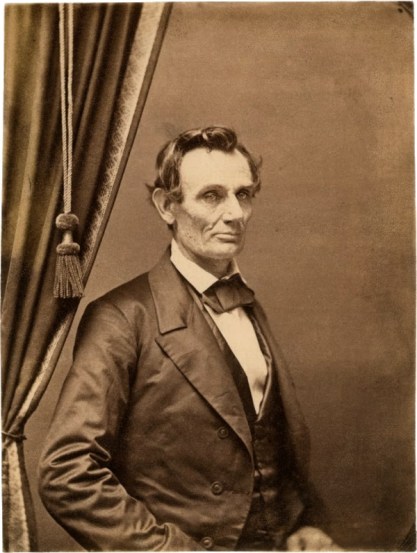
Abraham Lincoln, September 1858, photographer unknown

A key reason why all of these compromises and acts failed to avert the Civil War was that Southern states were often in favor of allowing new territories and states to allow slavery if they chose, but they were not at all in favor of states deciding for themselves whether slaves taken into their territories automatically became free, or of states deciding for themselves whether to enforce federal fugitive slave laws. So, the Southern claim to be on the side of ‘states rights’ was selective, limited to allowing, protecting, and promoting slavery, and nothing else. Otherwise, they insisted that it was the duty of the federal government to protect slave-property rights of Southerners in all states and to enforce fugitive slave laws in free states as well. In short, it was all about slavery, and Douglas’ doctrine of popular sovereignty came to be recognized as the non-solution it was. Lincoln’s election to the Presidency was taken as a signal that the federal government was not going to enforce the right of slaveowners to own human beings against antislavery laws in free states. Therefore, most Southern states seceded from the Union.

Lincoln, having made a careful examination of the issues and history of race-based slavery in the United States, knew very well that no number of compromises and acts would effectively resolve the inevitable conflicts between free and slave states. The principles of liberty that the North and hypocritically, the South called upon to defend the rights of their states to defend or counteract slavery were incompatible with that institution. Since that same desire for liberty appears to be a constant in human nature, slaves would always escape to freedom in the North, inevitably leading to those same old fugitive-slave-law-conflicts between the states. And at that time, there was no reason to believe that slavery would just die out anytime soon, given the Dred Scott decision, the compromises that pleased no one for very long, and the constant expansion of the country that kept disrupting the balance of political power between slave and free states. So, at the State House, in the Hall of Representatives where he first confronted Douglas face to face, candidate-for-state-senator Lincoln delivered his famous ‘House Divided Speech‘ on June 16, 1858, in which he clearly and succinctly made that case. He lost the race for the Senate seat to Douglas, but in this case, as it so often happened in his political career, Lincoln lost the battle but won the war. Douglas’ platform lost popularity as Lincoln’s reputation grew, and just two and a half years later, Lincoln was elected President of the United States.

Picture of Abraham Lincoln’s lying-in-state canopy in the Hall of Representatives, Old State House, Springfield
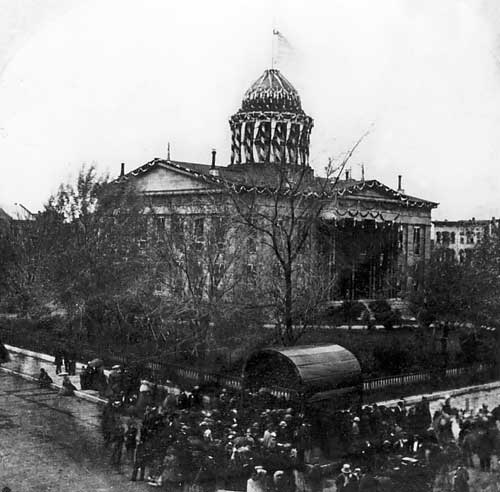
Lincoln’s Funeral at the Old State Capitol 1865. Springfield, Illinois. Courtesy of the Abraham Lincoln Presidential Library

Almost seven years later, in 1865, Lincoln’s assassinated body lay in state here in the Hall of Representatives. He was no longer the fiery, energetic lawyer and politician seen in this Hall on so many occasions. Lincoln had guided the country through the most horrific war the States had ever seen, freed the slaves (at least on paper; race-based slavery de facto would not be ended until black codes, convict leasing, and other like practices were outlawed well into the twentieth century), saved the Union, and lost a beloved son. He had suffered much and therefore aged much in the few intervening years. I like to think he did not die in vain, but I’m not quite sure what that phrase means. Lincoln could have achieved what he did and not died, and therefore could have achieved much more, so his death was a great waste of potential as well as a great injustice. It’s true that he went from being a hero to many to being a martyr to even more, and many who were doubtful about his legacy became so no longer. The great Frederick Douglass was one of those. And it’s true that his perceived martyrdom went on to inspire many more people to do good in their own lives.

When researching this piece, I discover that our first black President, Barack Obama, chose to announce his candidacy for President here at the Old State Capitol building in February of 2007. I think that’s quite fitting.

To be continued

*Listen to the podcast version here or on Google Play, or subscribe on iTunes

Ordinary Philosophy and its Traveling Philosophy / History of Ideas series is a labor of love and ad-free, supported by patrons and readers like you. Please offer your support today!

~~~~~~~~~~~~~~~~~~~~~~~~~~~~~~~~~~~~~~~

Sources and inspiration:

Abraham Lincoln Online: Lincoln Timelines and Highlights

Allen, Eric. ‘Creating Cartoons: Art and Controversy.’ Library of Congress Blog, June 2, 2015

Brink, McCormick & Co. ‘Springfield Township, Springfield City.‘ from Atlas of Sangamon County, 1874.

Carwardine, Richard. Lincoln: A Life of Purpose and Power. New York: Random House, 2003

Donald, David Herbert. Lincoln. New York: Simon & Schuster, 1995

Giger, Henry Douglas. ‘The Story of the Sangamon County Court House.’ Via the Sangamon County Circuit Clerk website, originally published Apr 29, 1901

Herndon, William H. and Jesse W. Weik. Herndon’s Lincoln: The True Story of a Great Life. 1889

History of Sangamon County, Illinois; Together with Sketches of its Cities, Villages and Townships … Portraits of Prominent Persons, and Biographies of Representative Citizens. Chicago: Interstate Publishing Co.,  1881

Jackson, Nicholas. ‘Picture of the Day: Mount Rushmore as Originally Planned‘. The Atlantic, May 16, 2011

Lehrman, Lewis E. Lincoln at Peoria: The Turning Point. Mechanicsburg, PA: Stackpole Books, 2008.

Lincoln Home National Historic Site, Illinois. Website, National Park Service

Looking for Lincoln: various historical/informational placards throughout the Springfield, Illinois and surrounding areas about the life and legacy of Abraham Lincoln at their associated sites

Old State Capitol (Sangamon County Courthouse).’ Historic Sites Survey, prepared by Stephen Lissandrello for the National Park Service, Apr 28, 1975

MacLean, Maggie. ‘Elizabeth Todd Edwards: Sister of Mary Todd Lincoln.’ Civil War Women blog, Jul 28, 2013

Sangamon County Courthouse (Old State Capitol).‘ National Park Service Historic Site nomination paper, prepared by Charles  Shedd, Sep 14, 1961
Athens and Springfield, Illinois, Part 1, in Search of Abraham Lincoln

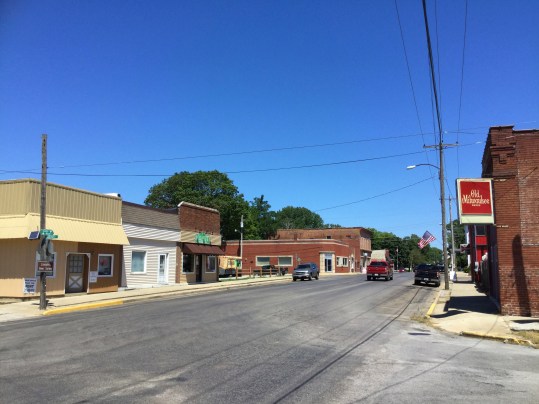
E. Hargrave and Main Streets in Athens, Illinois

Journal: Abraham Lincoln Presidential Library, Springfield, Illinois, Monday morning, July 31, 2017

Here I am in the handsomely designed, nicely lit, spacious reading room of the Abraham Lincoln Presidential Library. I don’t at this moment require any research materials from the collection, but as I often do, if I find myself with access to a grand space dedicated to the acquisition, preservation, and dissemination of knowledge, such as the Reading Room of the Library of Congress’ Jefferson Building or the National Library of Scotland, I feel the urge to go inside and do some thinking and writing just because I can. So here I am.

On Saturday evening, a sudden weariness and blueness of mood took me by surprise, and for the first time since I left home two weeks ago, I suddenly felt lonely. I realized I had been traveling at an unrelenting pace and it was time to rest. So over the weekend, I did a lot of strolling and lazing between bouts of purposeful touring and research. I watched Allied, a World War II romantic tragedy starring Marion Cotillard and Brad Pitt, and enjoyed it very much. I talked to family and friends on the phone, sometimes while walking through grassy parks under tall green trees whose resident cicadas made quite a racket. I wrote postcards, and drank beer, and feasted on a local specialty called a horseshoe, an artery-clogging concoction made from Texas toast, french fries, a sprinkling of vegetables if you so choose (I chose yes), and ground meat topped with a sort of cheese sauce similar to that on a Welsh rarebit.

So here I am this morning, rested, happy, reconnected with my loved ones and my sense of adventure, planning my itinerary for the rest of today and the next. I’m also thinking about the many things I’ve learned and seen here in and around Springfield…

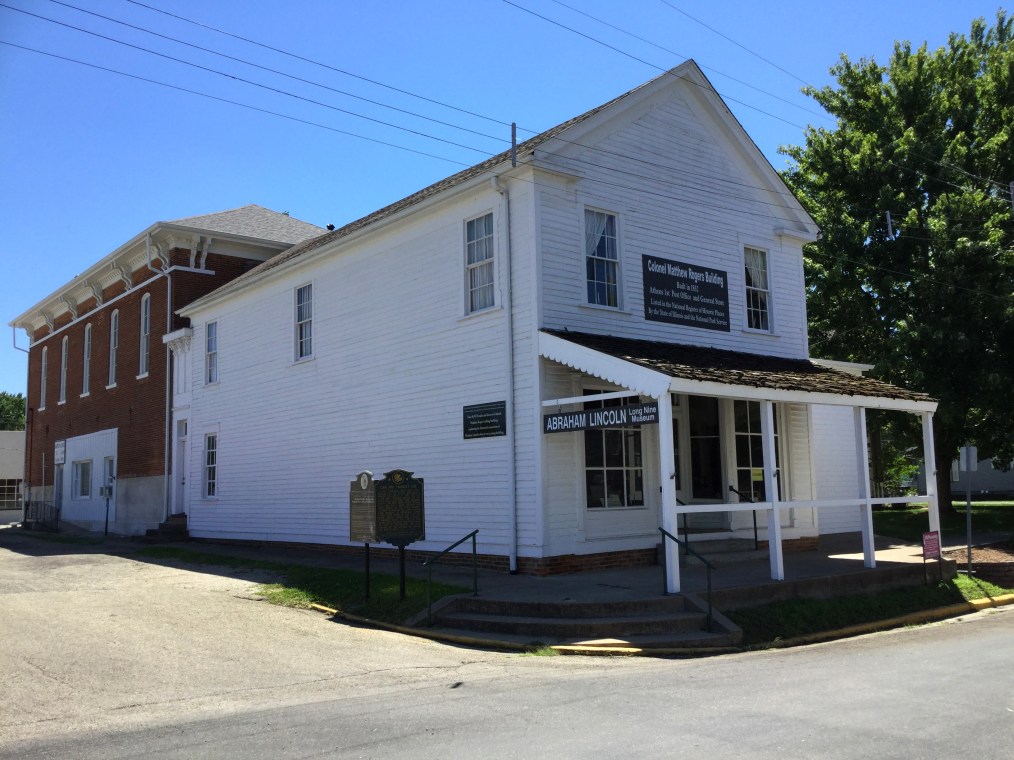
Abraham Lincoln’s Long Nine Museum, also known as the Rogers’ Building, Athens, Illinois. It used to house the post office and general store, both of which Lincoln somewhat frequently visited through much of the 1830’s

Athens, Illinois, Saturday, July 29th, 2017

I drive to Springfield from Peoria, about an hour south, and on the way, I notice a highway sign indicating the exit for an Abraham Lincoln historic site. As I did for the last one to Galesburg, I decide to take this Lincoln detour. A series of signs lead me through lovely green farmlands and tidy business establishments and houses to Athens’ old Main Street neighborhood where there are several sites associated with the life and political career of Lincoln. I park at E. Hargrave and Main, near the brick building at the corner with the ‘Old Milwaukee’ sign, and cross the street to a Looking for Lincoln placard with a Lincoln site map.

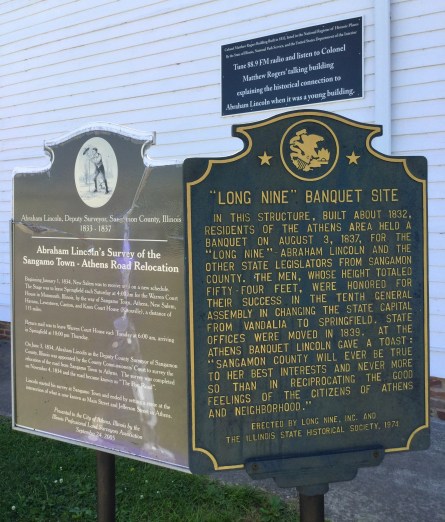
Historical placards for the Rogers Building – Abraham Lincoln Long Nine Museum, Athens, Illinois

Lincoln never lived here in Athens but he did visit, many times; he lived near here in New Salem, more about that later. Athens was a larger, more bustling community than New Salem, and mail delivery was more consistent, too. Lincoln was New Salem’s postmaster from 1833 to 1836, and he came to Athens to pick up the mail occasionally when the Sangamon River, which runs between here and New Salem, was in flood and prevented its delivery.

The post office in Athens, at this time, was located here in the white clapboard Rogers Building on Main St at Jefferson. This building now houses the Abraham Lincoln Long Nine Museum, which is closed as I peer through its windows. Some years after Lincoln’s stint as the New Salem postmaster, he and the other eight members of the Illinois State Legislature were honored here with a celebratory dinner in the upstairs banquet room on August 3rd, 1837. The dinner celebrated their success in getting the capital of Illinois moved from Vandalia to the more bustling Springfield. This iteration of the Legislature, nicknamed the ‘Long Nine’ because of their average height of 6 feet, included Ninian W. Edwards, the husband of his future wife Mary Todd’s sister Elizabeth. Ninian and Elizabeth will re-enter my story later on during my Springfield journey.

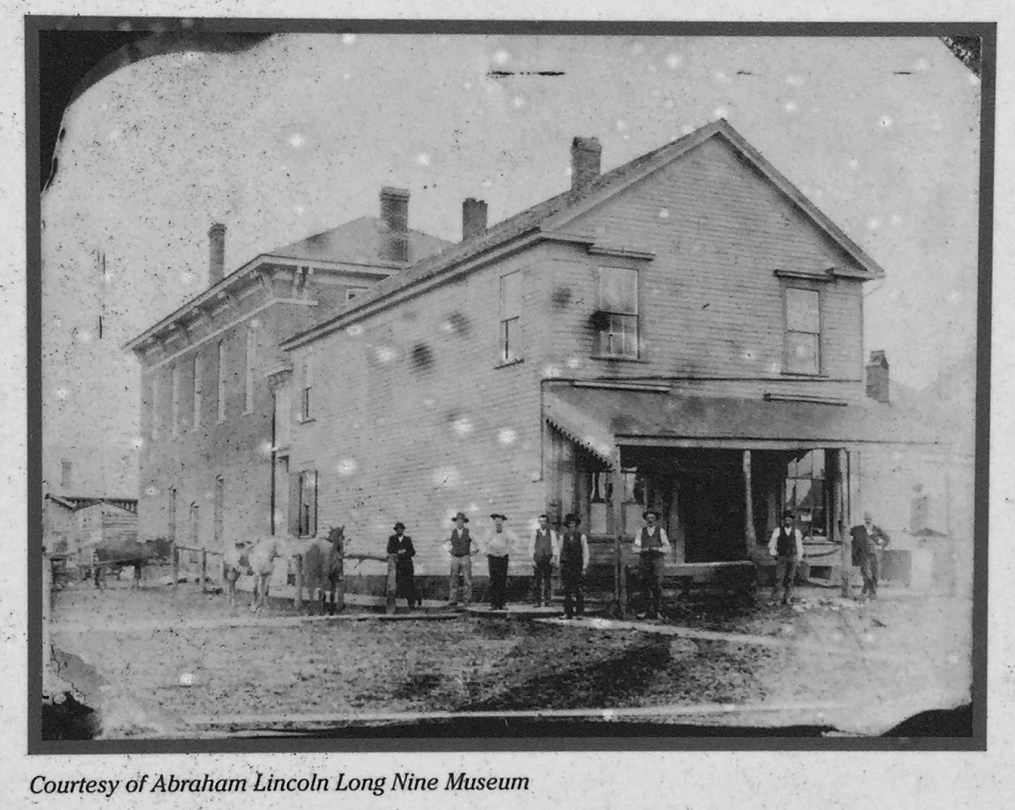
Detail of Looking for Lincoln placard showing a 1870’s tintype of the Rogers Building. As you can see, the buildings, front and back, look essentially the same today, sans chimneys.

I continue south on Main St, cross Madison, then continue about one-third of the long block between Madison and Little Streets. The fourth house on the left is at 400 Main St, the site of the home of Robert Wilson, one of Lincoln’s fellow Long Nine legislators, according to the map on the Looking for Lincoln placard. Lincoln stayed here at Wilson’s place on many occasions when he was in town, even borrowing a horse from Mrs. Wilson in 1836 while on campaign. Perhaps Wilson, as a fellow ‘long’ man, had a bed that Lincoln could fit in!

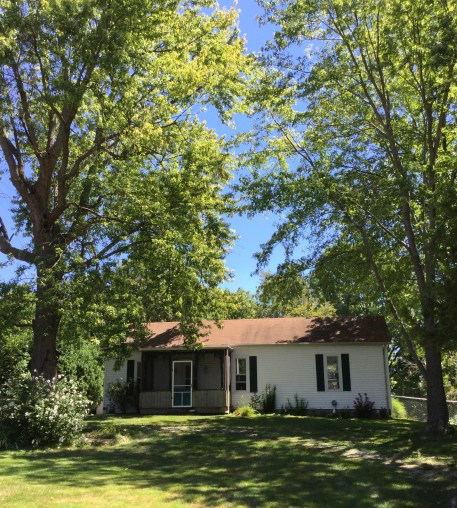
Robert Wilson used to live at this site where Abraham Lincoln would stay sometimes while in Athens, according to the Looking for Lincoln map. This house doesn’t look original to me, I’m supposing the map marks the site, not the building.

In any case, as well as serving in the legislature together, they were fellow political campaigners and remained friends for a long time. During the Civil War, Wilson joined the Union Army, then Lincoln gave him an appointment as a paymaster. In those days, it was common practice for Presidents and their administrations to grant government appointments to friends and political supporters. Hopefully, these appointees would have appropriate experience, but this was entirely up to the discretion of the one doing the appointing. At times, Lincoln did appoint people he believed had the experience and/or ability for the position; at other times, he traded desirable appointments for political favors. As the Steven Spielberg film Lincoln accurately portrays, this was a key tactic that Lincoln used for getting enough votes to pass the 13th Amendment to the Constitution, legally abolishing slavery throughout the U.S. After the Civil War and the new depths of corruption in the administration of Lincoln’s next elected successor, his General-in-Chief of the Union Army Ulysses S. Grant, the civil service was reformed so that, at least ostensibly, appointees were given the jobs solely based on merit and relevant experience.

One more thing: Wilson, in his 1866 description of Lincoln’s thought processes, made me aware of the word ratiocination. Nice. I like learning new words that are fun to say aloud.

Banks Hall’s Tavern site on the northwest corner of Mill and Jefferson Sts in Athens, Illinois. The house which stands here today retains parts of the original tavern, which was a remodeled frame house built by Abner Banks Hall’s father.

I double back on Main St and turn left on Jefferson St to my next destination at Jefferson and Mill. On the northwest corner, there’s a blue clapboard two-story house with white trim. This house incorporates the old Banks Hall’s Tavern, where Lincoln stayed and ate sometimes. The proprietors were Abner Banks Hall and Helen Jennett Francis Hall. Helen was Simeon Francis’ niece, and Simeon Francis came to have many close connections with Lincoln. I’ll return to that story when I’m in Springfield.

Banks Hall’s Tavern was the best place to get a bite to eat on that part of the stage route between Beardstown, New Salem, and Springfield. Perhaps Lincoln stayed here when he was a local surveyor as well; he surveyed the new Sangamon Town Road, which angled to meet Main St from the south and west, in 1834. He had become a surveyor as a likely way to supplement his meager living as a postmaster. Lincoln’s first two runs for political office had failed, his militia service had been brief and relatively uneventful, and his first foray into business as a shop owner had failed and left him in debt. Surveying was a skilled trade but one that could be self-taught for free, so thus Lincoln did. But he didn’t remain a surveyor for long. The pay was still not that great and his debts were substantial, so he began to teach himself law and again ran for state legislator. This time, he won a seat.

Lincoln Tomb, Oak Ridge Cemetery, Springfield, Illinois

I know that if I continue in the direction I was driving earlier, I would get to New Salem before long. However, the day’s getting on and I want to make some good progress exploring Springfield and gathering more information there first, so I pick up the car and continue south.

Springfield, Illinois, Saturday, July 29th, 2017

After about a 20 minute drive, I reach my first Springfield destination: the Lincoln Tomb. I wind through the hilly cemetery with its granite monuments and headstones almost white in the summer sun, and park the car. I round the showy, castellated old caretaker’s building and cross the lawn.

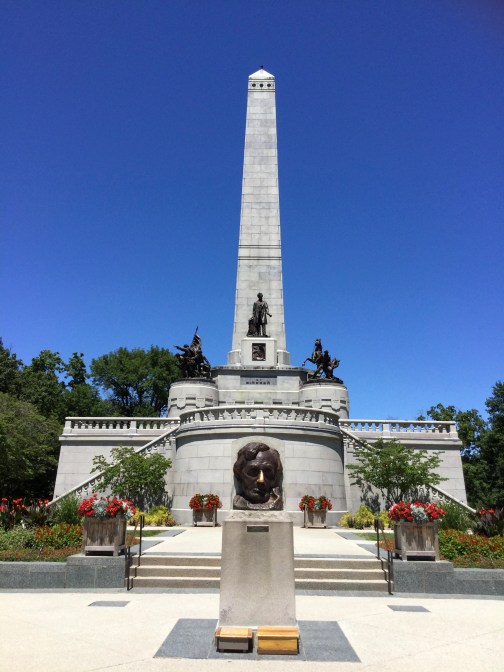
I find that the Lincoln Tomb is absolutely lovely. It’s just about the most elegant, grand while neither overblown nor fussy monument one could wish for. There are monumental sculptures surrounding the central towering obelisk which include fighting men, a rearing horse, and Lincoln himself, charged with drama and historical moment. The statues are well spaced and there’s not too many so the ones that are here stand out and invite study. Taste and restraint rule here as much as the desire to do great honor to the man buried below.

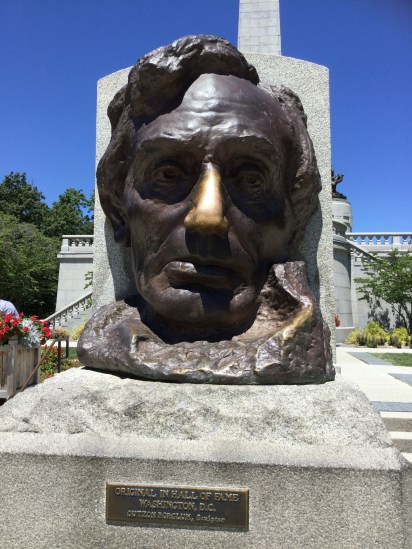
Gutzon Borglum’s portrait bust of Lincoln at the Lincoln Tomb, Oak Ridge Cemetery

There’s a bronze version of the same Gutzon Borglum portrait bust of Lincoln that I saw in Peoria Heights. This one’s larger, and its nose is shiny. I guess people rub it for luck; a giggling family is doing this very thing as I arrive. There’s a statue of David Hume with a shiny big toe on the Royal Mile in Edinburgh, Scotland, and it shines for the same reason. For some reason, I feel very differently about the Lincoln nose-rubbing than I do of the Hume toe-rubbing. The statue of Hume is on a public street, while Lincoln’s bust is at his tomb in a cemetery. The moment I see those kids jumping up, egged on by their mom with the dad taking pictures, I feel a little disturbed, even a little offended. My father’s strict injunctions against unruly and disrespectful behavior in the presence of the dead and in other solemn places remain deeply instilled in me, I suppose. I feel like scolding them. It also feels disrespectful to mess around with the image of someone’s face, rather than a toe or a sleeve, especially when it serves to disfigure it in some way. The rubbing gives Lincoln’s bronze portrait the clownish look of a cartoon image of a drunk with a shiny red nose. Apparently, however, many thousands of my fellow citizens feel differently than I do about this.

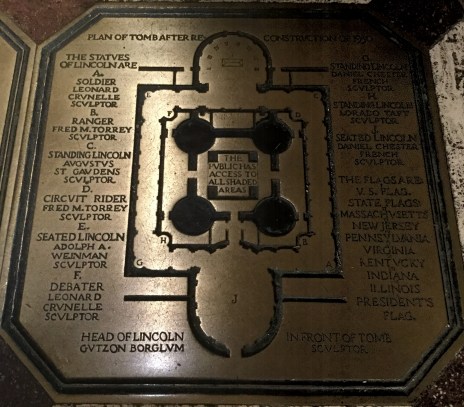
Floor plaque showing layout of the Lincoln Tomb and the sculptures with their names and artists, Oak Ridge Cemetery, Springfield, Illinois

I open the front door, which is a single one the size of an ordinary interior door, presumably because such a relatively small entrance is easy to guard against grave robbers, and enter. Yes, grave robbers. At least one attempt had been made to steal Lincoln’s body before, and history is rife with grave-robbing of the tombs of the rich, powerful, and honored dead. When Lincoln’s remains were moved to their final resting place in 1901, ten feet below the Tomb’s central chamber in a concrete-and-steel reinforced vault, the portion of the coffin lid that would cover the head and shoulders was cut open. After a brief view of the face to confirm identity, which was still recognizable after all those decades, the coffin was resealed.

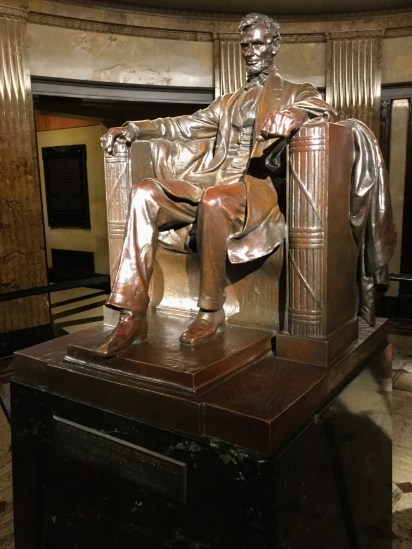
Statue of Lincoln in the center of the antechamber at the Lincoln Tomb, a copy of the statue at his Washington, D.C. memorial

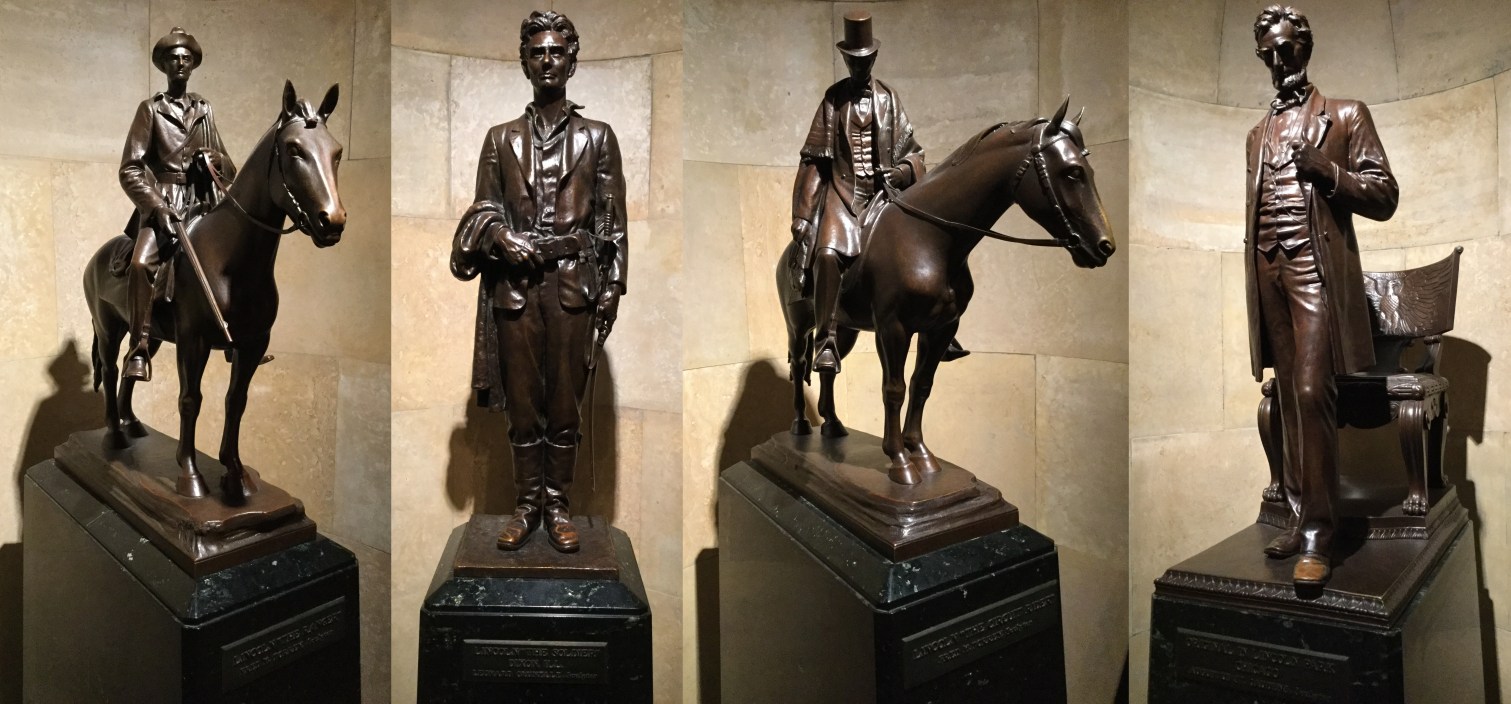
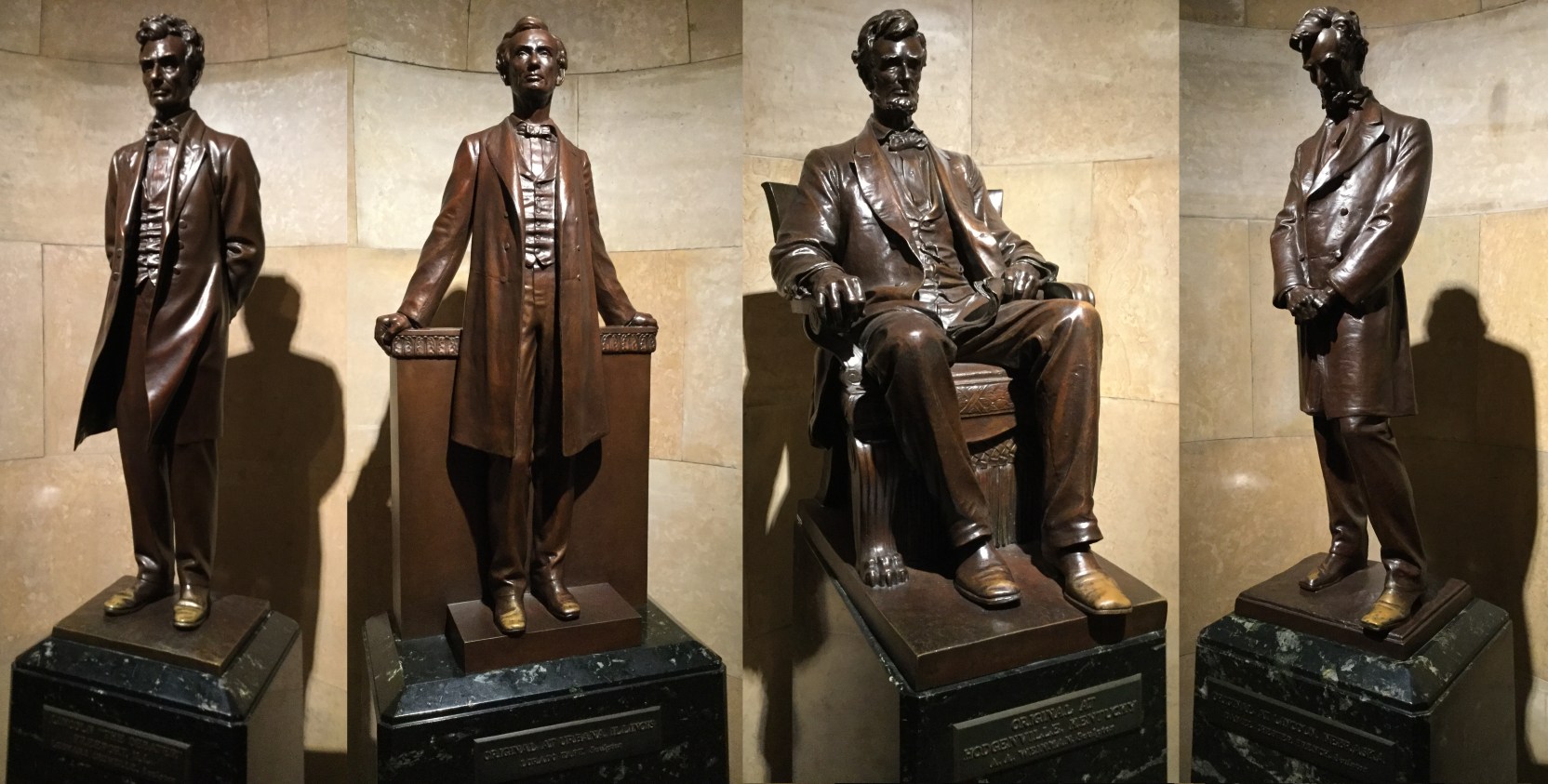
I step into a marble-lined, oval room with a bronze sculpture of Lincoln on a pedestal in the center, a smaller version of the Lincoln Memorial statue in Washington, D.C. There are many such bronze statues throughout the tomb, smaller versions of larger statues in various places. They are placed in alcoves in corridors that surround the central square room. The burial chamber is in the interrupted-oval room at the north end of the structure, which is above Lincoln’s actual burial vault. A red granite symbolic empty tomb, called a cenotaph, stands in the center. Crypts behind the south wall of this chamber hold the remains of his wife Mary Todd Lincoln, and three of his sons, Edward, William, and Thomas (called Tad). Lincoln’s oldest son Robert wanted to be buried here as well, but his wife decided otherwise. He’s buried at Arlington National Cemetery, as he served briefly in the Union Army and then as the 35th Secretary of War under Presidents James Garfield and Chester A. Arthur. Lincoln’s only grandson, Abraham Lincoln II (called Jack), was originally buried here, but he was re-interred in Arlington National Cemetery after his father’s death.

Four sculptures from the Lincoln Tomb, Oak Ridge Cemetery, Springfield, Illinois

Four more sculptures from the Lincoln Tomb, Oak Ridge Cemetery, Springfield, Illinois

The Tomb is as beautiful inside as it is outside, with a very different feel. Outside, the pale granite gleams, and the monument’s structures and sculptures tower and rise. Inside, the marble and granite and bronze glow gently in the lowly-lit rooms, the golden honey atmosphere at least as much a result of the lights as it is of the materials. I suspect the warm tone of these electric lights was chosen to reflect the quality of light of the gas lamps and candles that lit interiors in Lincoln’s time. The mood is warm despite the cold stones and metal, and the place feels close and solemn: it wraps around you just as it does around itself, just as a shroud does the departed. No one rubs any of the facsimiles of Lincoln’s nose in here, though as you can see from the photos, they do rub the toes of his bronze boots.

Abraham Lincoln’s red granite cenotaph in the burial chamber of the Lincoln Tomb, Oak Ridge Cemetery

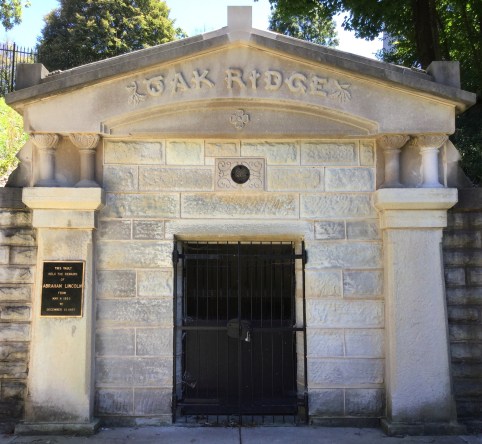
Receiving vault at the north foot of the Lincoln Tomb, the first resting place of Lincoln at Oak Ridge Cemetery, from May to December 1865

I pay my respects and look long at the sculptures and the architecture details, then re-emerge to the hot summer day. Down the hill to the north of the Tomb, there are two more structures of interest. At the north foot of the Tomb’s hill, there’s a pedimented marble vault with an iron gate. This was the initial resting place of Lincoln at Oak Ridge Cemetery in May of 1865, along with the remains of his son William, who had died in 1862, during Lincoln’s first term in office. The caskets remained here, under guard, until December of that year, until they were interred in a temporary vault partway up the ridge towards the Tomb here today. Lincoln, William, and his two other deceased sons were reburied within the unfinished Tomb in 1871.

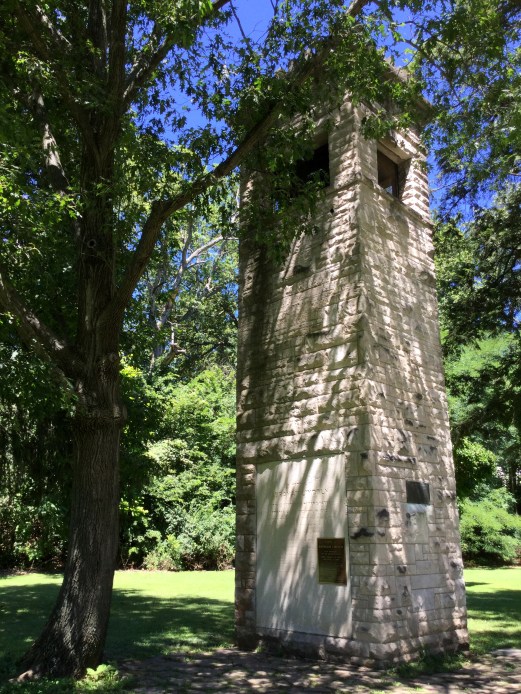
Tower holding the large white stone slab upon which Abraham Lincoln’s casket first rested at Oak Ridge Cemetery, Springfield, Illinois

The other is a castellated tower across the path from the receiving vault. It holds the original large flat stone, mounted upright and engraved, upon which Lincoln and his son William’s caskets were placed for the many months they awaited their temporary resting place on the ridge. The tower was built in 1900, the year before Lincoln’s casket was opened to confirm the presence of his remains, then re-interred in its permanent, secure resting place deep beneath the floor of the Tomb’s burial chamber.

As I leave Oak Ridge Cemetery, I wind among the lots before I find the way out. It’s a pretty and peaceful place and I would linger if I were a less restless traveler.

I continue south towards downtown Springfield and head for the Abraham Lincoln Presidential Library and Museum. I see so many interesting things here that I want to tell you about. Since this tale has already grown somewhat lengthy, I’ll continue the tale of my day’s explorations in my next installment of my explorations following the life and ideas of Lincoln in Springfield. Stay tuned!

Ordinary Philosophy and its Traveling Philosophy / History of Ideas series is a labor of love and ad-free, supported by patrons and readers like you. Please offer your support today!

~~~~~~~~~~~~~~~~~~~~~~~~~~~~~~~~~~~~~~~

Sources and inspiration:

Abraham Lincoln Long Nine Museum website: Walking Tour Map and Lincoln’s Connection

Abraham Lincoln OnlineLincoln Timelines and Highlights and Lincoln Tomb State Historic Site

Brink, McCormick & Co. ‘Springfield Township, Springfield City.‘ from Atlas of Sangamon County, 1874.

Carwardine, Richard. Lincoln: A Life of Purpose and Power. New York: Random House, 2003

Donald, David Herbert. Lincoln. New York: Simon & Schuster, 1995

Herndon, William H. and Jesse W. Weik. Herndon’s Lincoln: The True Story of a Great Life. 1889

History of Sangamon County, Illinois; Together with Sketches of its Cities, Villages and Townships … Portraits of Prominent Persons, and Biographies of Representative Citizens. Chicago: Interstate Publishing Co.,  1881

Illinois Ancestors.orgAbner Banks Hall and The Grandfathers Vol.I, The Hall and Overstreet Families

Lehrman, Lewis E. Lincoln at Peoria: The Turning Point. Mechanicsburg, PA: Stackpole Books, 2008.

Lincoln Home National Historic Site, Illinois. National Park Service website

Looking for Lincoln: various historical/informational placards throughout the Springfield, Illinois and surrounding areas about the life and legacy of Abraham Lincoln at their associated sites

MacLean, Maggie. ‘Elizabeth Todd Edwards: Sister of Mary Todd Lincoln.’ Civil War Women blog, Jul 28, 2013

Robert L. Wilson (1805-1880)‘ from Mr. Lincoln & Friends: The Politicians by The Lehrman Institute

Robertson, Peggy. ‘The Plot To Steal Lincoln’s Body.’ American Heritage, April/May 1982

Robert Todd Lincoln‘ In Wikipedia, The Free Encyclopedia.

Rogers, Colonel Matthew Building/Abraham Lincoln Long Nine Museum.‘ National Register of Historic Places Registration Form. Prepared by John R. Ede, Oct 1, 2004

Strange History Brought to Light‘ and ‘…And His Face Was Chalky White’ by Dorothy Meserve Kunhardt, Life Magazine, Feb 15, 1963

New Podcast Episode: Bitterroot Mountains and the Lewis and Clark Wendover Ridge Hike

A view through the windshield of Petty Creek Rd / Rte 489 between I-90 and Hwy 12, Lolo National Forest, Montana

Listen to this podcast episode here or on Google Play, or subscribe on iTunes

Journal: Powell Campground & Lochsa Lodge, Clearwater-Nez Perce National Forest, Monday, July 17th, 2017

After lingering over breakfast this morning with my sister Bonnie, cousin Beth, nephew Cory, and cousin Mo, I realized there was no way I was making it from Spokane to Yellowstone National Park today. So I thought: why not camp near Lochsa Lodge and do the Lewis and Clark Wendover Ridge hike, which friends of mine will be doing later this week, on the way? I’ve left plenty of time in my itinerary to go spur-of-the-moment adventuring. My friends have told so many tales of joy and hardship on this hike that my curiosity and spirit of competition just can’t resist the challenge. So, I make my decision. I stop at Superior Ranger Station off I-90, discuss my plans with the two oh-so-kind and helpful women there, and get directions. The ranger here who knows the trails, as well as the ranger she conferred with by phone at Powell Ranger Station, both warn me that the trail is extremely rough and in parts nearly impassible, not having been maintained in any way for at least two years. Sounds to me right now more like a dare than a warning.

I head south on Petty Creek Road, a beautiful drive through a pastoral valley, and over the ridge to Highway 12 and a short drive back west. I was here last in snowy, frigid January. It’s very different today… Read the written version here

Ordinary Philosophy and its Traveling Philosophy / History of Ideas series is a labor of love and ad-free, supported by patrons and readers like you. Please offer your support today!

New Podcast Episode: To the Great Plains and Illinois I Go, in Search of Crazy Horse, Sitting Bull, Abraham Lincoln, and Other American Histories

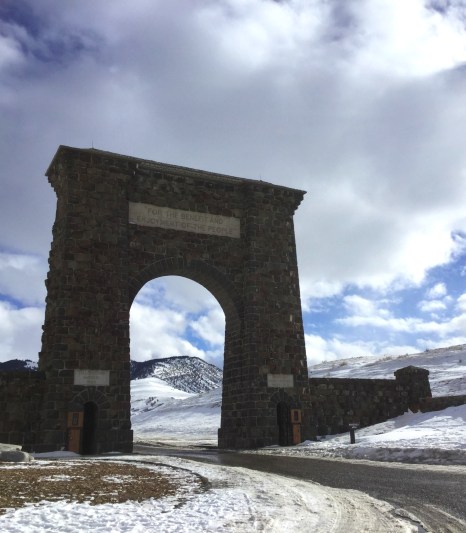
Roosevelt Arch at the North Entrance of Yellowstone National Park. Photo: January 2017 by Amy Cools

Listen to this podcast episode here or on Google Play, or subscribe on iTunes

Hello, friends of Ordinary Philosophy!

From time to time, I take a trip to some corner of the globe, to explore the lives and ideas of great thinkers in the places where they lived and worked. For this series, I follow in the footsteps of thinkers who are no longer alive, since those who are still telling their own stories. But those who are no longer alive in the body live on in the ideas that they pass on, and in the example they provide for us to follow.

I’m pleased and excited to announce my seventh philosophical-historical adventure: an almost three-week road trip through the Great Plains and on to Illinois. I’ll fly from Chicago to Scotland on August 9th: I’ll be pursuing a master’s degree in the history of ideas at the University of Edinburgh starting this fall. In the meantime, I’m overjoyed to have this window of time to explore parts of my country which I’ve never seen, and to learn as much as I can along the way…. Read the written version here

Ordinary Philosophy and its Traveling Philosophy / History of Ideas series is a labor of love and ad-free, supported by patrons and readers like you. Please offer your support today!

O.P. Recommends: Constitutional, a Podcast About the Story of America

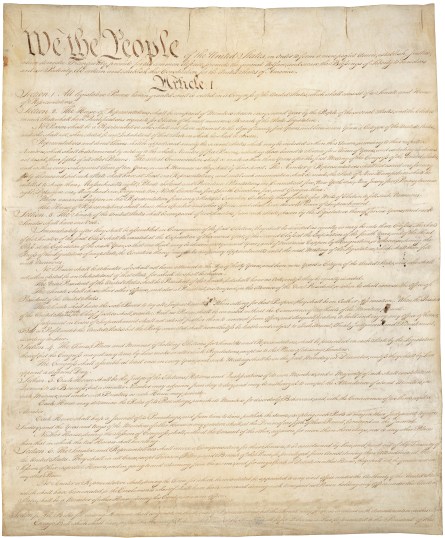
Constitution of the United States, first page of the original, provided by the National Archives and Records Administration, public domain via Wikimedia Commons

I loved the last podcast series that Lillian Cunningham hosted for the Washington Post: Presidential, which ‘explores the character and legacy of each of the American presidents’. This new podcast, Constitutional, also explores the character and legacy of the Constitution, so to speak, and how it came to be. Cunningham speaks with various guests, historians, librarians, politicians, activists, and many more experts about the philosophical underpinnings of the Constitution, what it can and can’t do and the debate over this very question, and how it has been applied throughout United States history.

I’ve just listened to the fifth episode, ‘Gender’, and learned something I feel like a doofus for not knowing: As of March 22nd of this year, the Equal Rights Amendment is only two states away from being ratified by enough of them to become part of the U.S. Constitution. A conservative senator slipped in a 1982 deadline as a tactic to help in its defeat, but it may still become that law of the land. Learn more about the fascinating story here in this wonderful episode, but I recommend starting from the beginning and listening to all of them.

Ordinary Philosophy and its Traveling Philosophy / History of Ideas series is a labor of love and ad-free, supported by patrons and readers like you. Please offer your support today!

Peoria, Illinois, In Search of Robert G. Ingersoll, Frederick Douglass, and Abraham Lincoln, Part 1


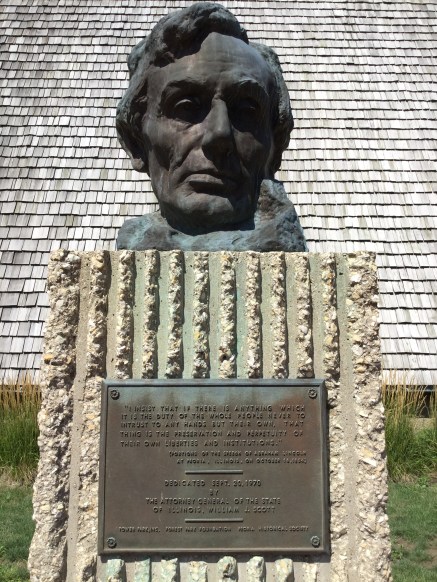
Abraham Lincoln portrait head, cast of Gutzon Borglum model for Mount Rushmore at Tower Park, Peoria Heights. Other versions of this sculpture are at the Abraham Lincoln Presidential Library, the Lincoln Tomb, and the Rotunda of the U.S. Capitol Building in Washington, D.C.

Peoria, Illinois, July 28th, 2017

I awake in a spotlessly clean, perfectly comfortable, aggressively unimaginative Motel 6 hotel room on the north end of Peoria, Illinois. I’ve noticed that Motel 6’s are much better than they used to be when I was a child and young adult, at least in terms of cleanliness and amenities. They were never glamorous, but they now have less character. For many years, for example, the beds sported these wonderfully colorful blankets printed with stylized images of famous cities and landscapes all over the United States. Now, the rooms and draperies are beige highlighted with rust-orange, furnished with the plainest of midcentury-style designs, angular objects only occasionally relieved by a sleek curve here and there.

My term for this sort of accommodation is ‘people storage’: strictly utilitarian, uninspired, and uninspiring. Perhaps that’s a good thing for my purposes: I fled the room as soon as I could to place myself in a more interesting environment. Still, I’m irritated as I so often am with modern architecture and interior design. Why have we stopped bothering to go on artistic flights of fancy, then directing the inspirations found there towards making these things beautiful?

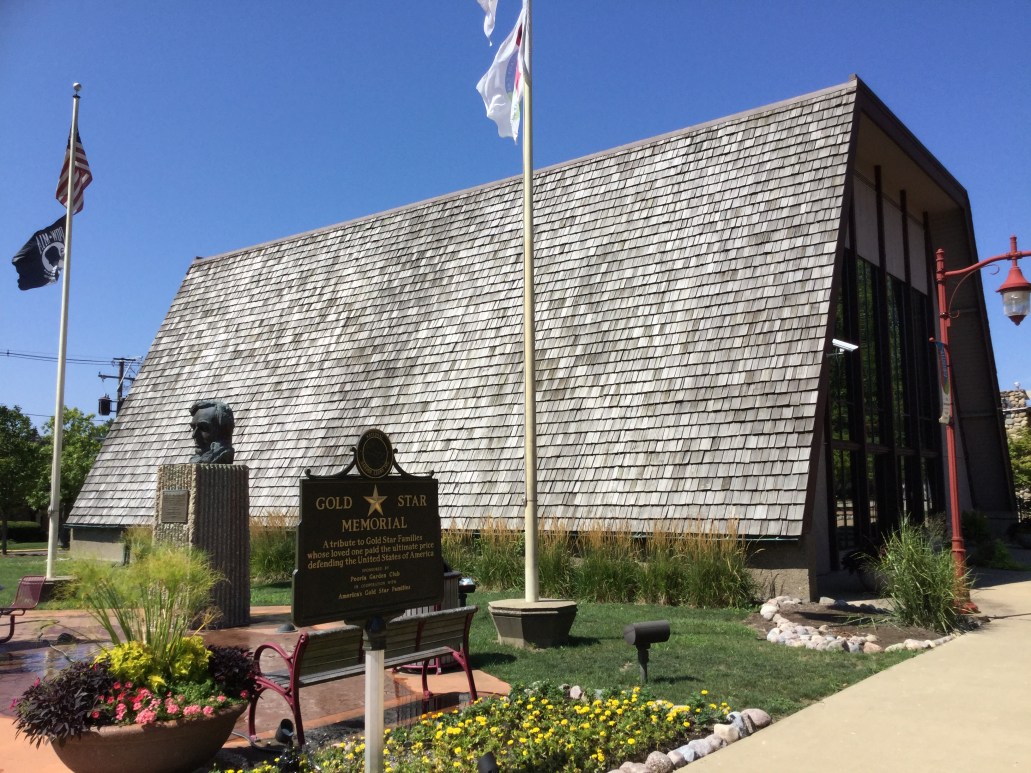
Abraham Lincoln portrait head near the Gold Star Memorial at Tower Park, Peoria Heights, IL

My first destination is a quick stop to see a bust of Abraham Lincoln at Tower Park in Peoria Heights. It’s a cast bronze derived from a plaster model by sculptor Gutzon Borglum for his most famous work, the Mount Rushmore National Memorial sculpture in the Black Hills. Here, it’s mounted on a grooved stony concrete pedestal near a Gold Star Memorial dedicated to the families of slain soldiers. I’ll be visiting the Abraham Lincoln Presidential Library and Museum in Springfield soon so I’ll see the original plaster cast there. More about this sculpture to follow.

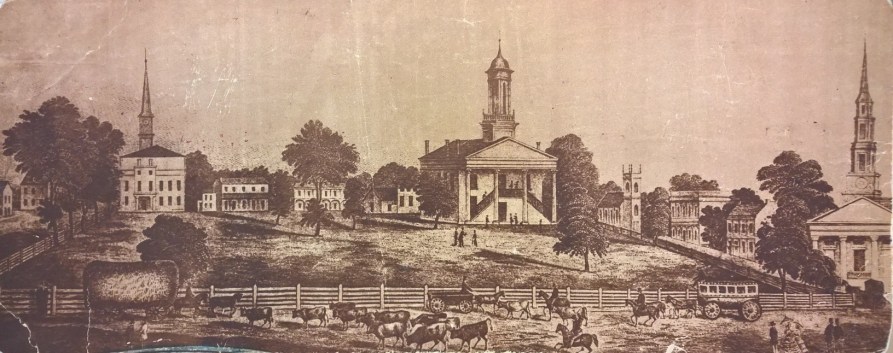
Courthouse Square, Peoria, Illinois, ca. 1845. Peoria Public Library. Peoria would have looked like this for most of the years Lincoln visited. It had grown and changed quite a bit, however, by the time Robert Ingersoll moved here in 1857 and Frederick Douglass spoke here for the first time in 1859.

Lincoln was a regular visitor to Peoria, first visiting in 1832 to buy a canoe on the way home to New Salem from serving briefly as a captain the Black Hawk War (his election to this position by the men of his company was among the proudest moments of his life), and he visited many more times throughout his legal and political career. His first campaign speech was also in Peoria, in 1840, during a Whig rally for Presidential candidate William Henry Harrison. There’s no record of what he said there that day, but many accounts of his early speeches describe a man initially hesitant and shy, whose eloquence increased as his confidence did. Peoria is the site of one of his greatest oratorical triumphs; I’ll tell the story once I reach the site where it occurred.

Plaque at the base of a flagpole dedicated to veterans in Glen Oak Park, Peoria, Illinois. Glen Oak Park is at the site of Camp Lyon, a Union recruitment and training camp for the Civil War

My second destination is pretty Glen Oak Park, lush with trees and large green lawns. I enter the park via the west entrance at Prospect Road and McClure Ave and park under the trees along the large oval central green. It’s hot and humid today, but there’s just a little breeze in addition to the plentiful shade, which helps a lot. There are two things that bring me here, both associated with the life of one man.

Robert G. Ingersoll, who lived from 1833 – 1899, was a colonel in the Civil War, a lawyer, a politician, and most famously, an orator. Born in Dresden, New York, he lived in Peoria from 1857-1877. Ingersoll was often called ‘The Great Agnostic’ for his trenchant critiques of religion. He was also an abolitionist, a women’s rights advocate, and a promoter of the memory of Thomas Paine as a great American hero. Thomas Paine had made a clear and eloquent case for the cause of American independence from Britain in his best-selling 1776 pamphlet Common Sense, then as the Revolutionary War struggled on, helped inspire patriotism and perseverance with his The American Crisis series. Paine’s once-stellar reputation suffered over time, especially after his publication of The Age of Reason, an attack on orthodox religion, and his vociferous criticism of diplomat Silas Deane and of President George Washington.

Ingersoll agreed with Paine’s criticism of Washington. He thought that Paine was right to be aggrieved with Washington’s decision to do nothing to deliver him from his captivity and sentence of death by the radical French Revolutionaries under Robespierre. After all, Paine was condemned by the French revolutionaries for opposing the execution of King Louis XVI, who had been an ally of the American Revolution and who had provided invaluable aid to Washington during the war. Paine also criticized Washington’s support for the institution of a state church in Virginia, which, of course, was the kind of thing Ingersoll would oppose as well. Ingersoll used his own eloquence to help rescue Paine’s memory from disrepute and reinstate him as one of the moral and intellectual founders of the United States of America.

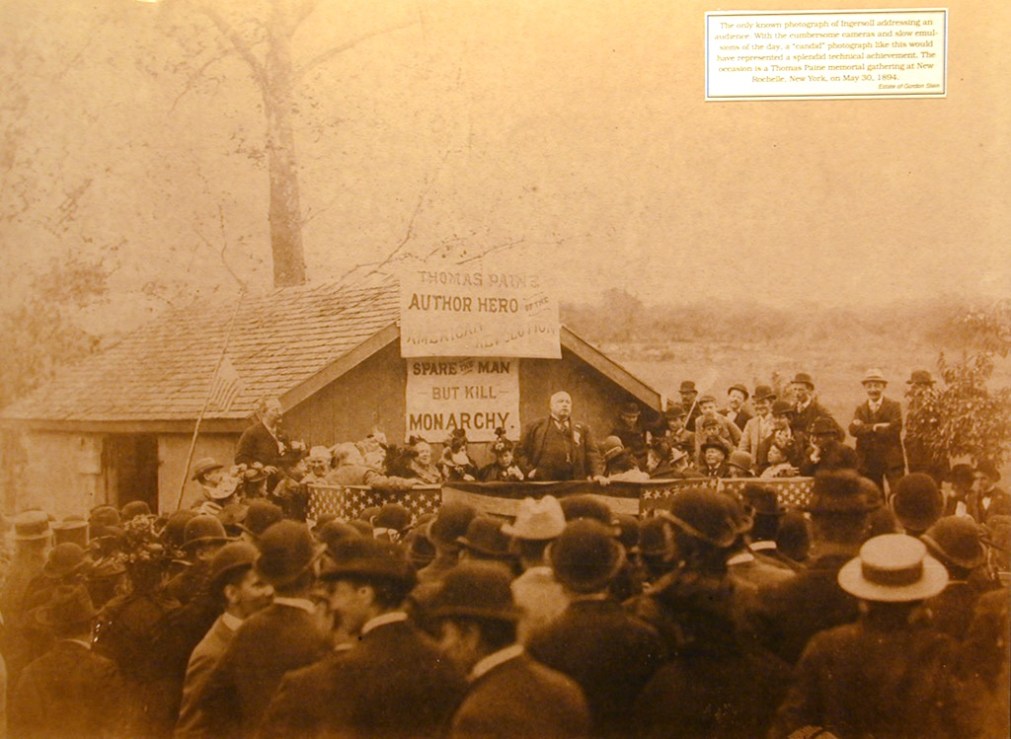
The only known image of Ingersoll addressing an audience, Robert Green Ingersoll Birthplace Museum, public domain via Wikimedia Commons. Note the Thomas Paine banner hanging above Ingersoll.

Lincoln held similar sentiments to Ingersoll about Paine. In his twenties, he wrote an essay defending Paine and his deism, which his friend burned so that it could never be found and published. Lincoln had political ambitions already, and his friend, probably correctly, predicted it could derail any run for office he might make. Then, as now, real or at least assumed religious belief was a prerequisite for a successful political career, despite our legal commitments to freedom of conscience and belief. Lincoln was a religious skeptic himself, a nonbeliever as a young man who became a non-denominational believer over time. God entered his writings and discourse ever more often throughout the years though tellingly, not so for Jesus Christ specifically. Lincoln preferred, for the most part, to keep the particulars of his religious belief private.

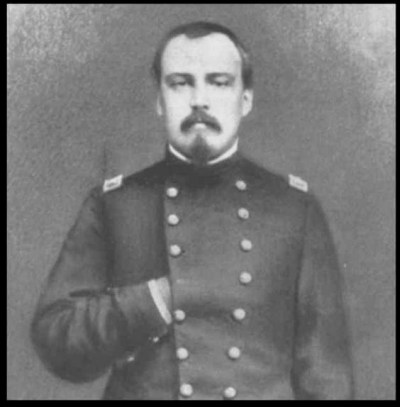
Colonel Robert G. Ingersoll in his uniform, early 1860’s

The west gate of Glen Oak Park is the approximate site of Camp Lyon, where Ingersoll was commissioned as a colonel of the Union Army in 1861 and where he raised his regiment. His first experience in battle was in the Battle of Shiloh, a particularly bloody engagement and a Union victory. He conducted himself well and was commended for his excellent service in many battles during the next year and a half. He resigned on June 30th, 1863; he had been captured then placed in charge of a camp of paroled prisoners who could not fight as a condition of their parole unless they were exchanged for Confederate prisoners. This system of conditional parole and prisoner exchange was common practice at the time, I’m guessing because it saved a lot of money and resources for both sides in feeding and housing prisoners. Ingersoll waited for months for an exchange to happen so he could return to active service, but this exchange never came. So, he went home. Ingersoll thought he could be more useful returning to his law practice and entering politics than continuing to wait around for something that might never happen.
While he was still in the field, Ingersoll wrote some very compelling, descriptive accounts of the battle, as did his fellow soldier who fought at the battle of Shiloh, Ambrose Bierce. Ingersoll’s contemporary accounts appeared in letters to his brother; Bierce’s account ‘What I Saw of Shiloh’ was written when he had become an experienced writer, published in 1881. If you haven’t read Bierce’s Shiloh account, I very, very highly recommend it. Bierce was a journalist and a prolific writer in many genres. He’s also the author of The Devil’s Dictionary and many other wonderful and skeptical satirical works, I think sometimes on the level of as well as in the spirit of Voltaire. He was a great admirer of Ingersoll, as was poet Walt Whitman, who was also Ingersoll’s personal friend. I’ll return to Ingersoll and Whitman’s relationship in a future installment of my Ingersoll account. Bierce included Ingersoll in his delightfully irreverent poetic definition of the term Decalogue:

Thou shalt no God but me adore:
’Twere too expensive to have more.
No images nor idols make
For Robert Ingersoll to break.
Take not God’s name in vain; select
A time when it will have effect.
Work not on Sabbath days at all,
But go to see the teams play ball.
Honor thy parents. That creates
For life insurance lower rates.
Kill not, abet not those who kill;
Thou shalt not pay thy butcher’s bill.
Kiss not thy neighbor’s wife, unless
Thine own thy neighbor doth caress.
Don’t steal; thou’lt never thus compete
Successfully in business. Cheat.
Bear not false witness— that is low—
But “hear ’tis rumored so and so.”
Covet thou naught that thou hast not
By hook or crook, or somehow, got.

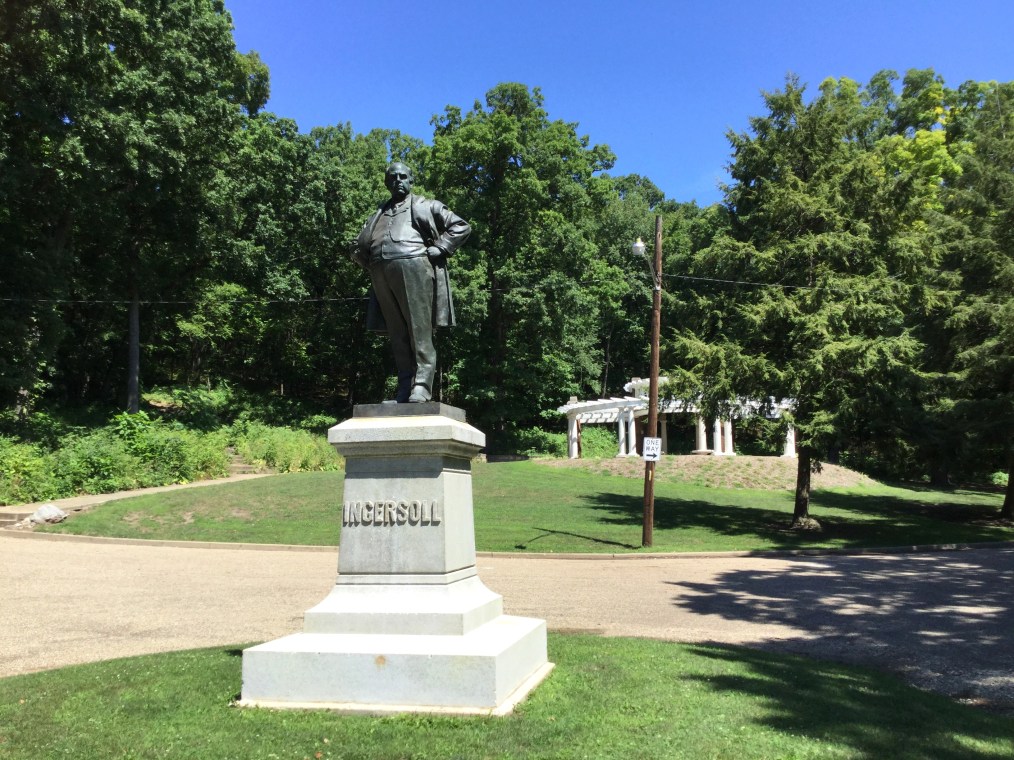
Robert Ingersoll statue in Glen Oak Park, Peoria, Illinois

Plaque on the sculpture of Robert G. Ingersoll at Glen Oak Park, Peoria, Illinois

I continue south and a little east through the park on winding paths and roads, past playgrounds, fields, and a lagoon. I’m headed toward the statue and monument to Ingersoll near the southernmost end of the park at Abington Street and Perry Avenue.

It’s a handsome statue, portraying Ingersoll in his maturer years as a portly man with a very round belly. As far as I could tell from photos, Ingersoll was never particularly slim, though he was more so when he was younger and I think when he was in his last year or so, based on facial portraits. His fleshiness gave him a very youthful look for most of his life, and I think a cheerful one. Especially then, being on the fatter side indicated that you led a happy life of plenty. The face of his statue, tilted slightly downwards, appears more serious than any photo I’ve seen of him in his later years. This, with his arms-akimbo stance, can at first glance seem an almost stern portrayal, as if he’s looking at you or something just beyond you reprovingly. But after studying the sculpture, I think it’s meant to convey Ingersoll in deep thought, perhaps walking back and forth with his hands on his hips as so many of us do when we’re working out some problem in our own minds, or when trying to recall some important fact or idea. Most photos of Ingersoll show him with a little smile on his lips, highlighted by his somewhat dimpled mouth and cheeks. He has the face of a ready and kindly friend.

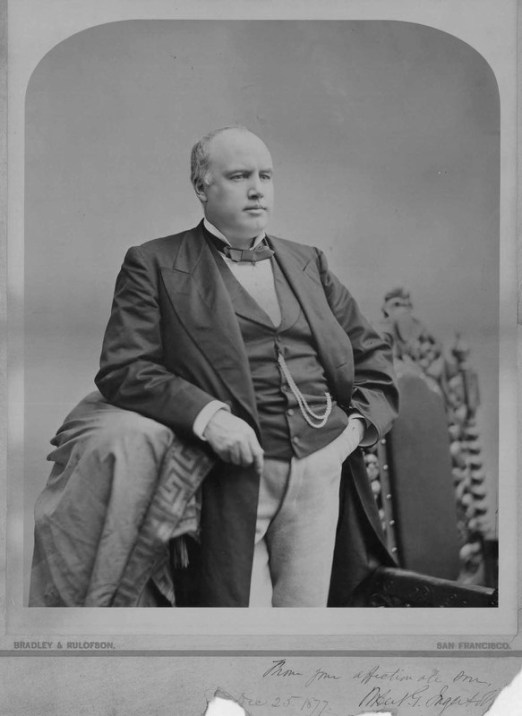
Bradley & Rulofson, “Robert Green Ingersoll,” Chronicling Illinois, Abraham Lincoln Presidential Library

I drive next to Peoria Historical Society’s Flanagan House Museum at 942 NE Glen Oak Ave. I had emailed their office yesterday in hopes of making an appointment but haven’t heard back yet. My research revealed that they have a portrait of Ingersoll on display. Since it’s close enough to being on my way to my next destination, I swing by to see if someone happens to be around. No such luck.

I continue on to the Local History and Genealogy Collection at the Peoria Public Library at 107 NE Monroe street. There’s a manuscript here by Romeo B. Garrett called The Negro in Peoria, I believe the only or one of very, very few copies, in which I’m seeking more details than I have about Frederick Douglass’ visits to Peoria. This manuscript served as Garrett’s doctoral dissertation, I believe. Dr. Garrett was the first African-American professor at Bradley University.

The people who work in this collection are very helpful, particularly Chris Farris, who is there most of the time I am. I find nearly everything I’m seeking and more that I didn’t know to look for. Thank you, Chris, for all the help and interesting conversation! You’re the best.

I spend several fascinating hours here and discover much about Ingersoll, Lincoln, and Douglass in Peoria. My time in this city is a rich one, and I visit so many places linked to interesting stories that I’ll break this up into a two- or three-parter. The next will begin with the sites I visit once I leave the library. To be continued…

*Listen to the podcast version here or on Google Play, or subscribe on iTunes

Ordinary Philosophy and its Traveling Philosophy / History of Ideas series is a labor of love and ad-free, supported by patrons and readers like you. Please offer your support today!

~~~~~~~~~~~~~~~~~~~~~~~~~~~~~~~~~~~~~~~

Sources and inspiration:

Bierce, Ambrose. ‘What I Saw of Shiloh.’ 1881
Blassingame, J. (Ed.). The Frederick Douglass Papers, Series One: Speeches, Debates, and Interviews. 4 volumes, New Haven and London: Yale University Press, 1979-1999

Burlingame, Michael. Abraham Lincoln: A Life, Volume 1. Baltimore: Johns Hopkins University Press, November 2012

Bust of Lincoln – Peoria Heights, IL – Abraham Lincoln‘, posted by NoLemon on Waymarking.com

Carwardine, Richard. Lincoln: A Life of Purpose and Power. New York: Random House, 2003

Donald, David Herbert. Lincoln. New York: Simon & Schuster, 1995

Douglass, Frederick. The Life and Times of Frederick Douglass, 1881.

Garrett, Romeo B. The Negro in Peoria, 1973 (manuscript is in the Peoria Public Library’s Local History & Genealogy Collection)

Herndon, William H. and Jesse W. Weik. Herndon’s Lincoln: The True Story of a Great Life. 1889

History of Dr. Romeo B. Garrett.‘ Bradley University website.

Hoffman, R. Joseph. ‘Robert Ingersoll: God and Man in Peoria‘. The Oxonian, Nov 13, 2011

Jacoby, Susan. The Great Agnostic: Robert Ingersoll and American Freethought. New Naven: Yale University Press, 2013.

Kelly, Norm. ‘Peoria’s Own Robert Ingersoll‘, Peoria Magazines website, Feb 2016

Leyland, Marilyn. ‘Frederick Douglass and Peoria’s Black History‘, Peoria Magazines website, Feb 2005

Lehrman, Lewis E. Lincoln at Peoria: The Turning Point. Mechanicsburg, PA: Stackpole Books, 2008.

Lincoln Home National Historic Site, Illinois. Website, National Park Service

Mcmillan, Brad. ‘Lincoln’s Strong Ties to the Peoria Area‘, Peoria Magazines website, Feb 2012

Nelson, Craig. Thomas Paine: Enlightenment, Revolution, and the Birth of Modern Nations. New York: Viking Penguin, 2006.

Peoria City‘ from Peoria County Atlas 1873, Illinois. Published by A. T. Andreas in 1873, posted in Historic Map Works

Peoria Speech, October 16, 1854‘. Lincoln Home National Historic Site, Illinois website, National Park Service

Robert Ingersoll Collection. From Chronicling Illinois, Abraham Lincoln Presidential Library

Robert Green Ingersoll Family Papers, 1854-1970 (bio)Chronicling Illinois, Abraham Lincoln Presidential Library

Simon, Paul. Lincoln’s Preparation for Greatness: The Illinois Legislative Years. University of Illinois Press, 1971

Smith, Edward Garstin. The Life and Reminiscences of Robert G. Ingersoll. New York: The National Weekly Publishing Co, 1904

Swaim, Don. ‘The Blasphemer Robert G. Ingersoll and Why He Mattered to Ambrose Bierce.’ 2012, Donswaim.com

Wakefield, Elizabeth Ingersoll, ed. The Letters of Robert Ingersoll. New York: Philosophical Library, 1951

The Wheeling Daily Intelligencer, W. Virginia, July 24th, 1899. From Chronicling America: Historic American Newspapers. Library of Congress

Standing Rock Reservation: In Search of Sitting Bull, I Find Sakakawea, Too, Part 2

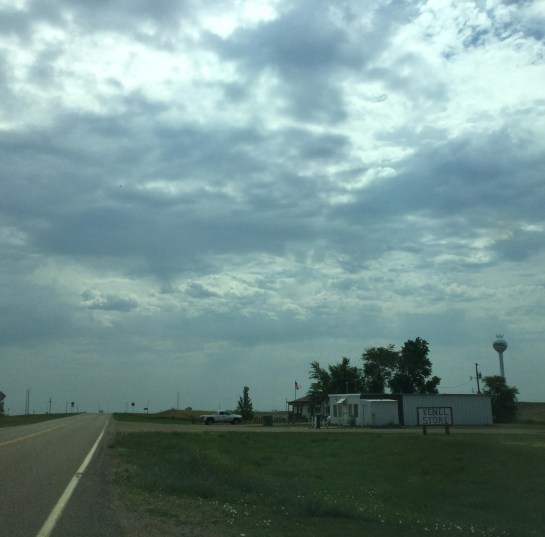
General store on the main road at Kenel, a community in Standing Rock Reservation, South Dakota, as seen through the windshield.

Standing Rock Sioux Reservation, North and South Dakota, morning and early afternoon of July 25th, 2017

I wake up at Prairie Knights Casino and Resort at the north end of Fort Yates in Standing Rock Reservation, on the North Dakota side. It’s by far the nicest place I’ve stayed during this trip and one of the cheapest. Thanks, gamblers, for subsidizing my roomy bed, my nice bathtub with its complimentary tasty-smelling chokecherry bath products, and my ultra-clean room!

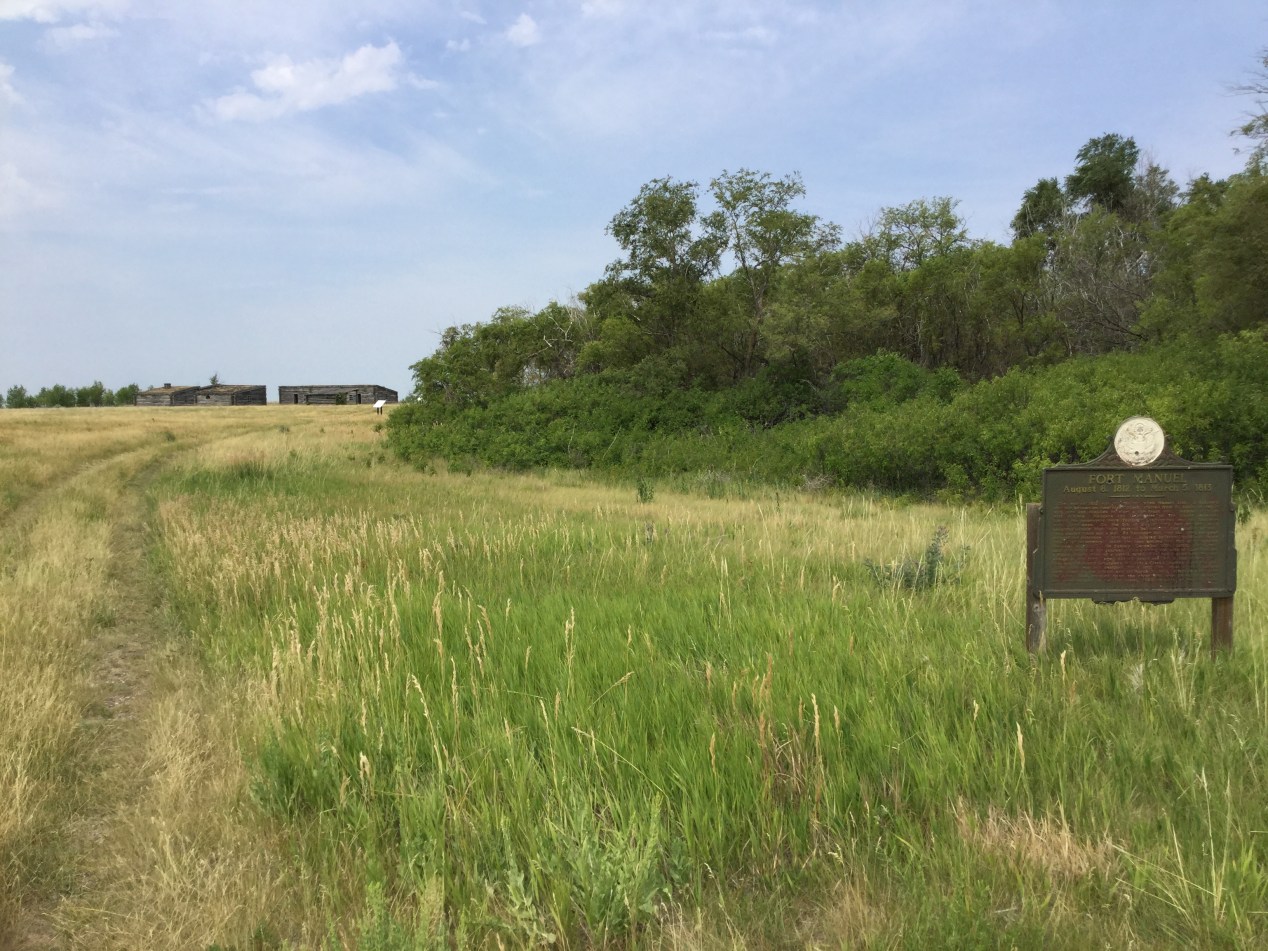
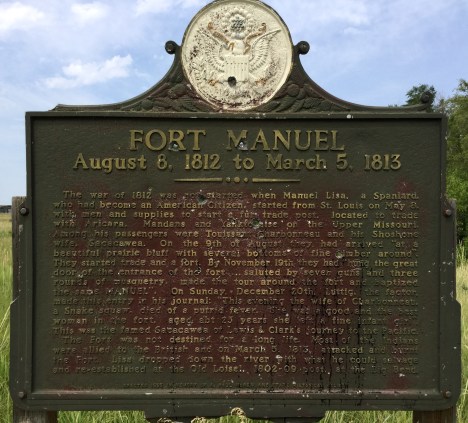
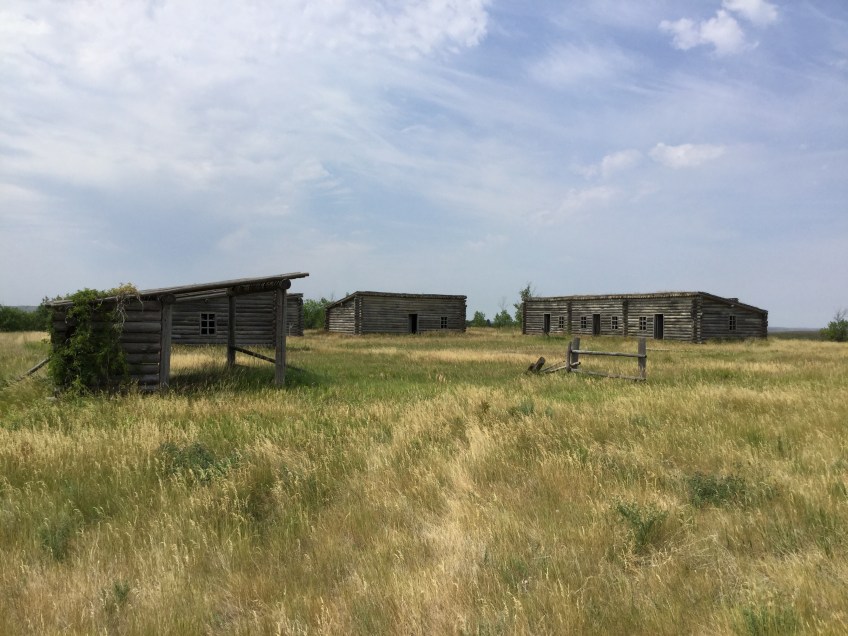
Historical sign and wood structures near the site of old Fort Manuel, Kenel. The original site of the town

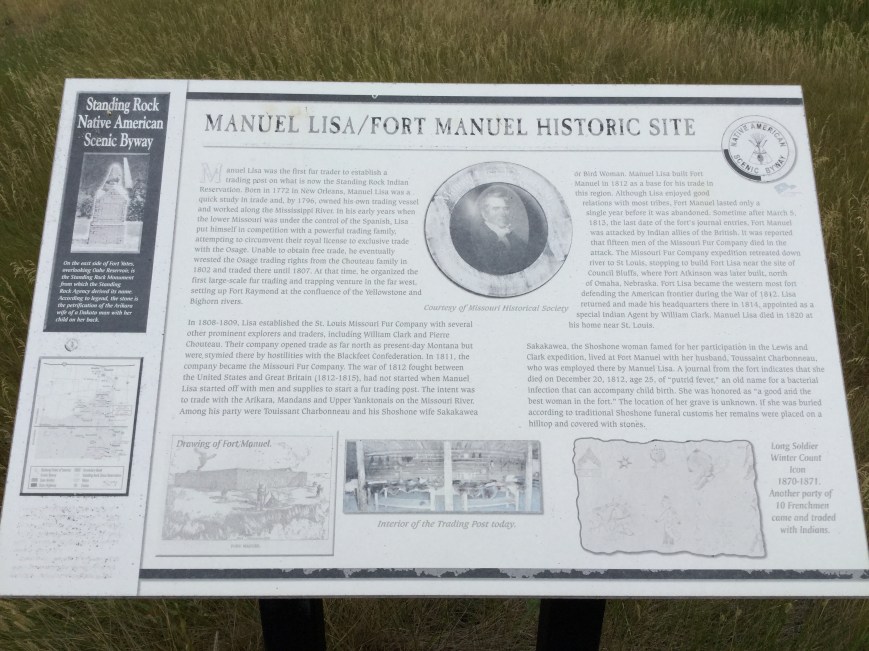
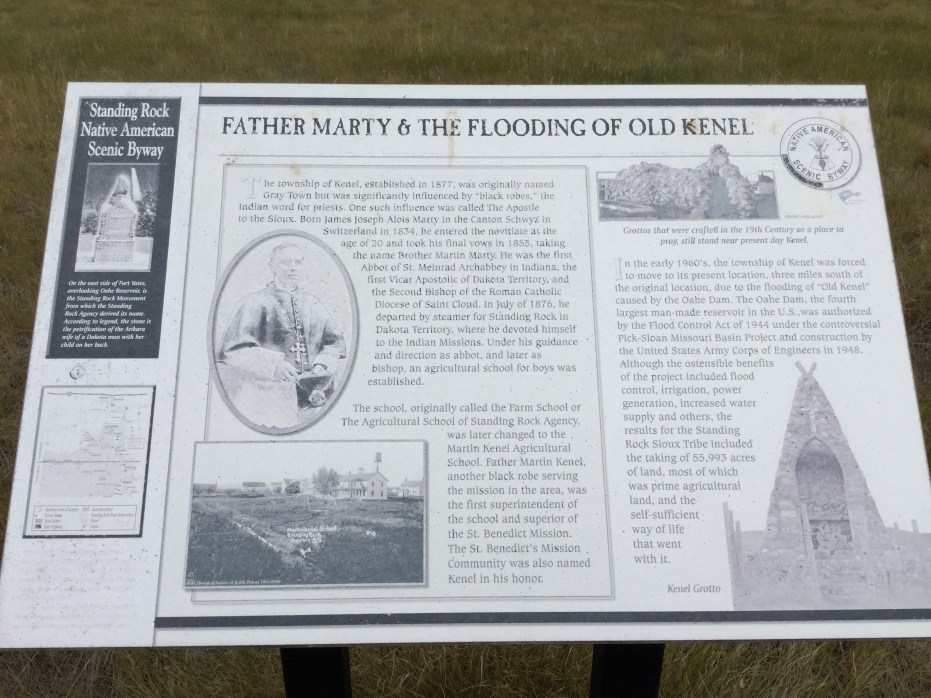
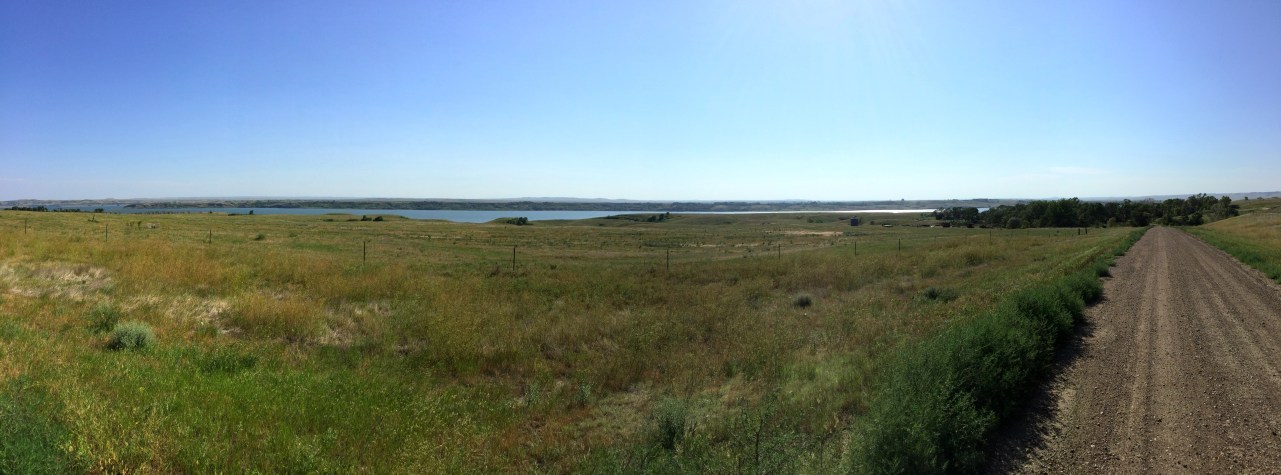
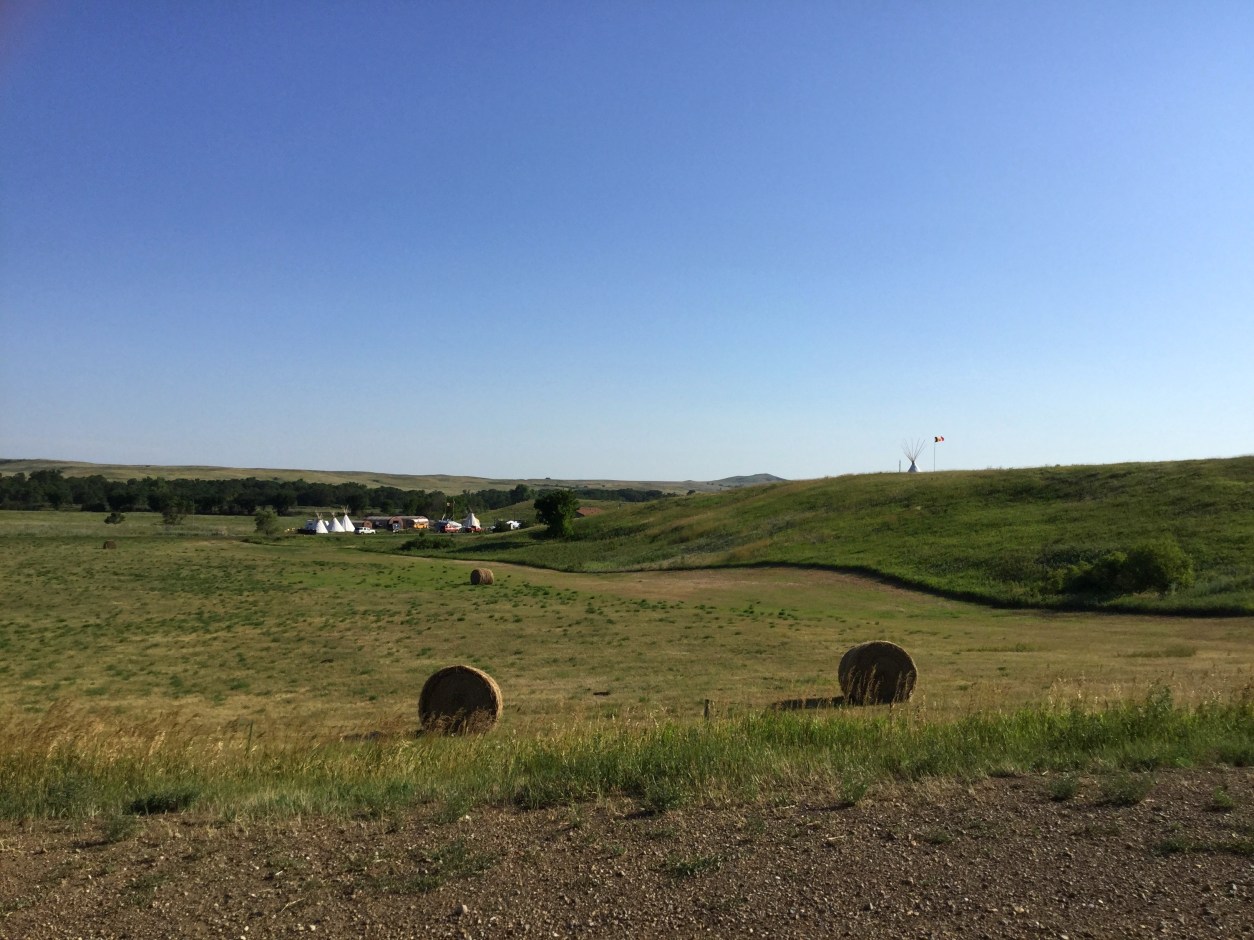
I head south on Highway 1806, otherwise known as the Native American Scenic Byway, towards the tiny unincorporated community of Kenel, in search of the site of old Fort Manuel. Counting from the road just across from Kenel’s general store, I turn left on the third road, a dirt road, guided by a little brown road sign. Then I head straight, past the turnoff that curves off to the left back towards Kenel. After a little while, this road curves to the left as well and arrives at a simple, tall, broad gateway made of three large poles with a pair of antlers in the center of the crossbeam, indicating the entrance to someone’s private property, likely a farm or ranch. The place for which the gate marks the entry is encircled by a thick grove of trees. I pull off to the right of the road in before I reach the gateway. Then I look around and see what look like historical marker signs in the field around and beyond the left side of the wooded boundary. There are some wood structures rising from the grass beyond that. I take the little footpath heading in that direction.

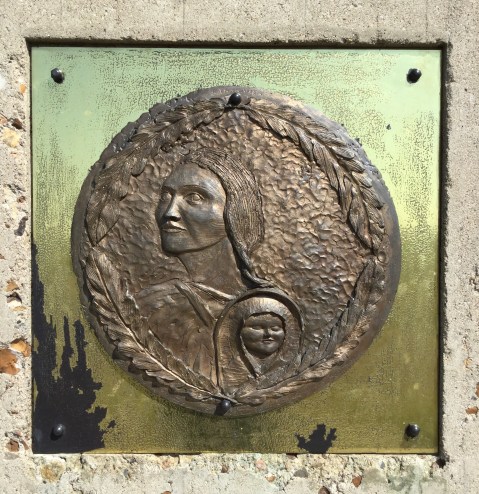
Portrait medallion on Sakakawea’s memorial obelisk on the west bank of the Missouri River, Standing Rock Reservation. In his record of her death, clerk John Luttig wrote: ‘She was a good and the best woman in the fort, aged about 25 years. She left a fine infant girl.’

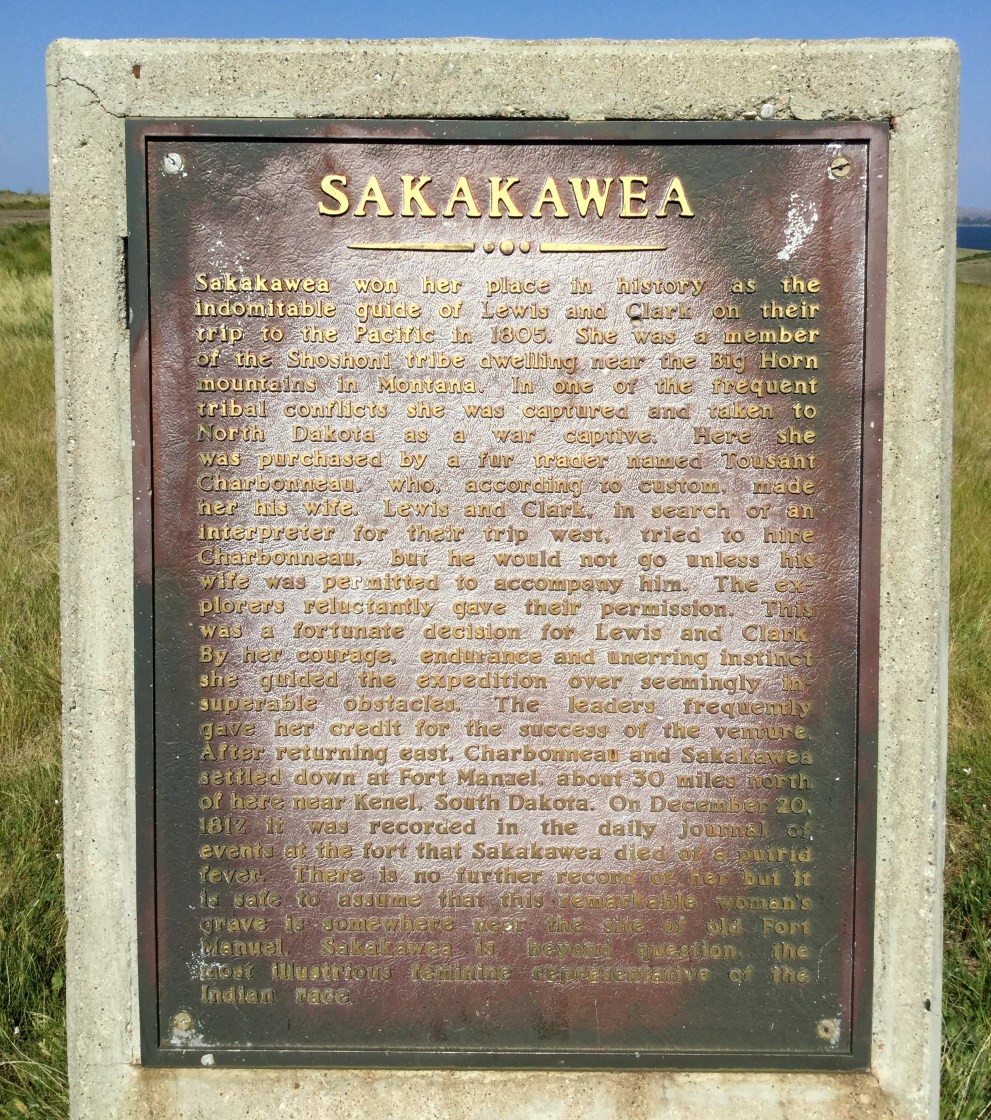
I’m here following my trail of discovery to the site where Sakakawea lived her last year, and where she died. She was a Shoshone girl captured and enslaved by the Hidatsa people, and became one of three purchased Native American wives of an inept, and by at least one account brutish, French Canadian fur trapper named Toussaint Charbonneau. Sakakawea died at only twenty-five years of age after a long illness, probably secondary to the rigors of the Lewis and Clark expedition. During that trek, which was otherwise only undertaken by strong, travel-hardened men, she gave birth to her first child, a son, which she carried and nursed the rest of the way. Despite what would seem to us as a rather grim life story, she was loved and admired for her ability to navigate most difficulties with aplomb and for her cheerful and willing disposition. Sakakawea went on to become one of the most famous and beloved women in American history.

According to most histories, Sakakawea, sometimes spelled Sacagawea or Sakajawea (the first two are preferable because they most closely indicate the correct pronunciation in the name’s Shoshone language), died here at Fort Manuel on December 20th, 1812. There are some sources which place her death much later and far away, at the Wind River Shoshone Reservation in Wyoming on April 9th, 1884. However, that evidence is much more circumstantial and based on hearsay, and later attempts to corroborate those sources are irreconcilable with better-recorded contemporary evidence.

Reconstruction of old Fort Manuel Lisa, Kenel, South Dakota, Standing Rock Reservation

Sakakawea had moved to Fort Manuel the year before her death with her husband and a troupe of fur traders in August of 1811. Her death in December of the following year was recorded by John Luttig, clerk of the Missouri Fur Company for which the fort was founded as an outpost. This company, in turn, was founded in St. Louis in 1809 by Manuel Lisa, the Spanish entrepreneur for whom the fort was named, and William Clark was elected its president. This was the Clark of Lewis and Clark; he and Meriwether Lewis led the great exploratory expedition ordered by President Thomas Jefferson to discover a more direct trading route across the continent. From 1804 – 1806, the expedition wound northwest up the Missouri River then straight west across land to the Pacific Ocean. It was Charbonneau who was recruited by Lewis and Clark, but it was Sakakawea who lent her invaluable assistance to this mission as interpreter, trail guide, identifier of wild foods to gather, and on one occasion, rescuer of the all-important contents of a tipped boat. Clark later adopted her son, Baptiste, whom he called ‘Pomp’; he had become very fond of this tiniest member of the expedition. He later made sure Baptiste received a quality education. Charbonneau, evidently, was also rather a deadbeat.

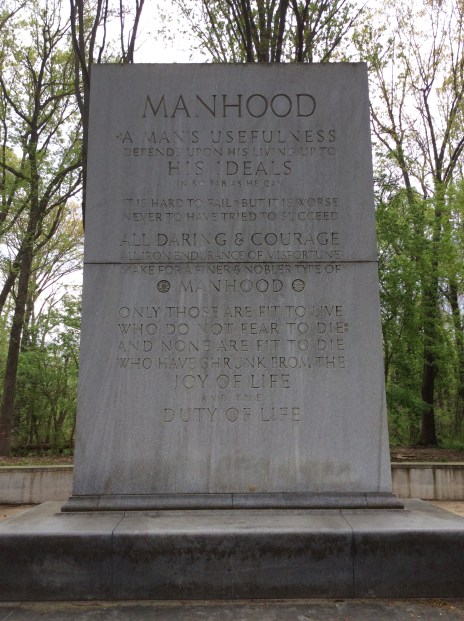
Theodore Roosevelt Monument Manhood stone

By the way, I remember being annoyed a couple of years ago while visiting Theodore Roosevelt’s monument in Washington, D.C. Among the monument’s structures was a row of large stones engraved with quotes. On one of these, Roosevelt equates manhood with daring and courage. I commented in a piece I wrote at the time that virtues such as these are human ones, and are not distributed in human nature according to sex. Sakakawea is just one of the countless women who demonstrate this, though she performed her brave acts within a cultural milieu that inculcated these virtues primarily in men while encouraging shrinking, even shuddering, modesty in women. To be sure, she showed fear at times and wept at others. But she not only did what it was her duty to do regardless, she took on men’s duties when they weren’t fulfilling them, and then went beyond that! And she did so in a way that made others love, admire, and remember her for her ability and excellent personal qualities long after others were forgotten.

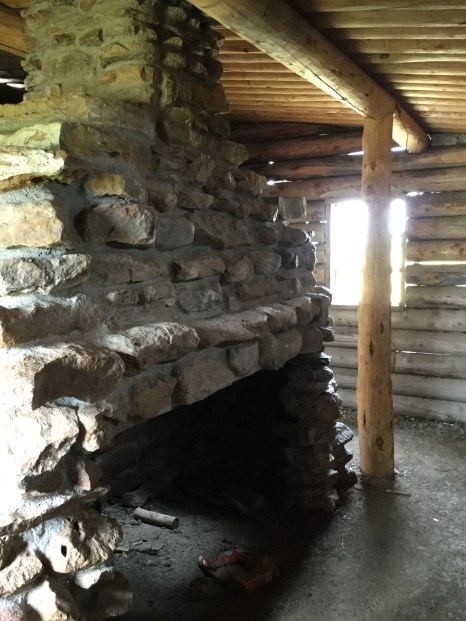
A large fireplace inside of one of Fort Manuel’s reconstructed buildings, Standing Rock, South Dakota

But back to my story… The wooden structures I see here today at Fort Manuel were built in 1965. They replaced a 1941 facsimile of the old stockade that had been built according to the details of a 1938 study of the fort’s records and of the grounds. The reconstructed stockade was not built on the exact site: its walls tracked more or less the shape of the original ones but about 6 feet away, to keep the ground open for a planned excavation that was done in 1965-1966. Fortunately, since the fort was built on high ground, it escaped the flooding of Kenel’s original location three miles north of its current site as a result of the construction of the Oahe Dam in 1944. Unfortunately, the original remains of the fort were eroded away shortly after its excavation by unusually high waves. But at least the archaeological information about the fort was retrieved before that happened. The reconstructions standing here today near the old site likely portray the original structures quite accurately, since they’re based on the very meticulous archaeological and historical research work done on the site.

View from a reconstructed building at Fort Manuel

The excavation uncovered the remains of seven structures within the original stockade walls. According to an archaeological and cultural report prepared for the U.S. Army Corps of Engineers, ‘Four of these units were dwellings (Structures A-C, E), one probably a storehouse (Structure 0), one a blacksmith shop (Structure F), and one possibly a stable or barn (Structure G). It is not known whether the post had other buildings, although extensive stripping of the site failed to reveal more. Luttig’s list of structures at the post does not tally exactly with the seven sites found by excavation and it may be incomplete.’ At first, I wonder why I see only five structures here today, but then I realize three of them are linked together like row houses, making seven in all.

Very, very few artifacts were found in the dig except for remains of the structures themselves. Fort Manuel was abandoned in the spring of 1813 after it was attacked by Native Americans allied with the British in the War of 1812. Any remaining goods were likely taken by the fort’s captors before it was burned down. Luttig, the clerk who admired Sakakawea and recorded both her death and his esteem for her; her little daughter Lizette; and her husband were among the survivors. Lizette likely died as a child, Charbonneau went on to enjoy a long life, and I don’t know what became of Luttig.

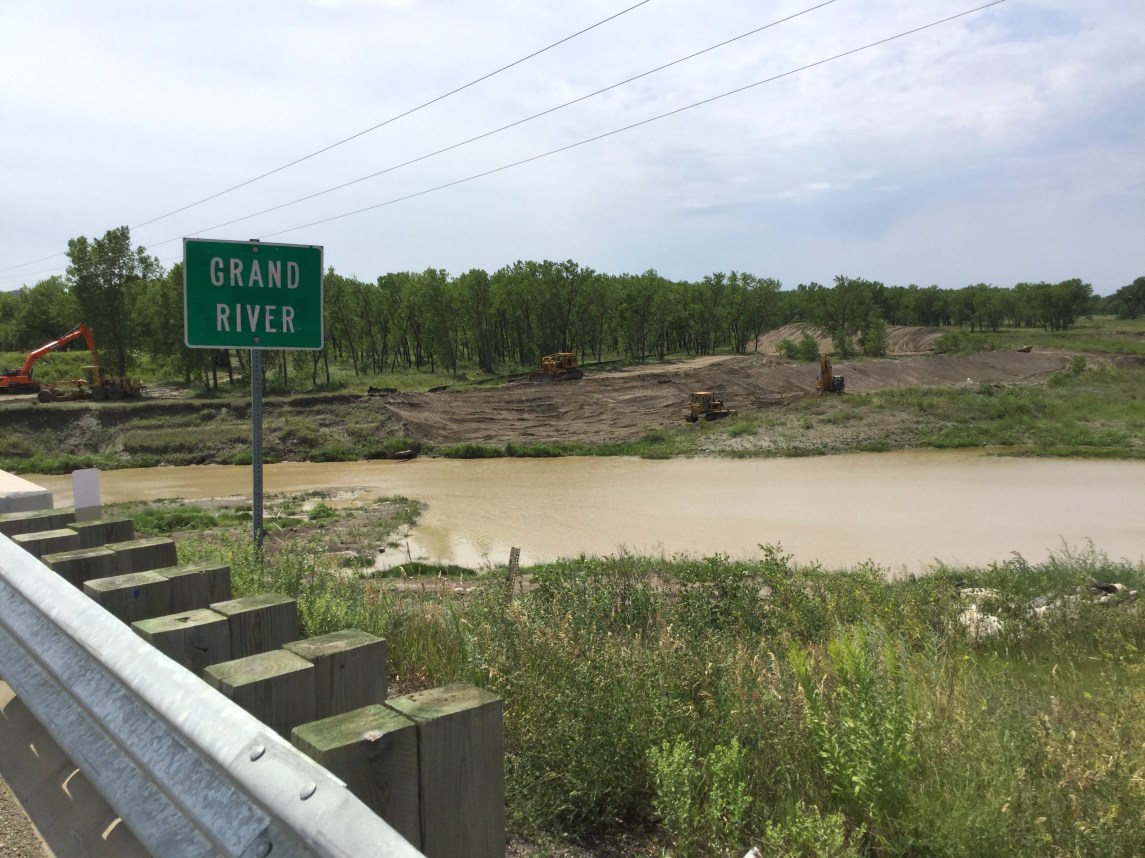
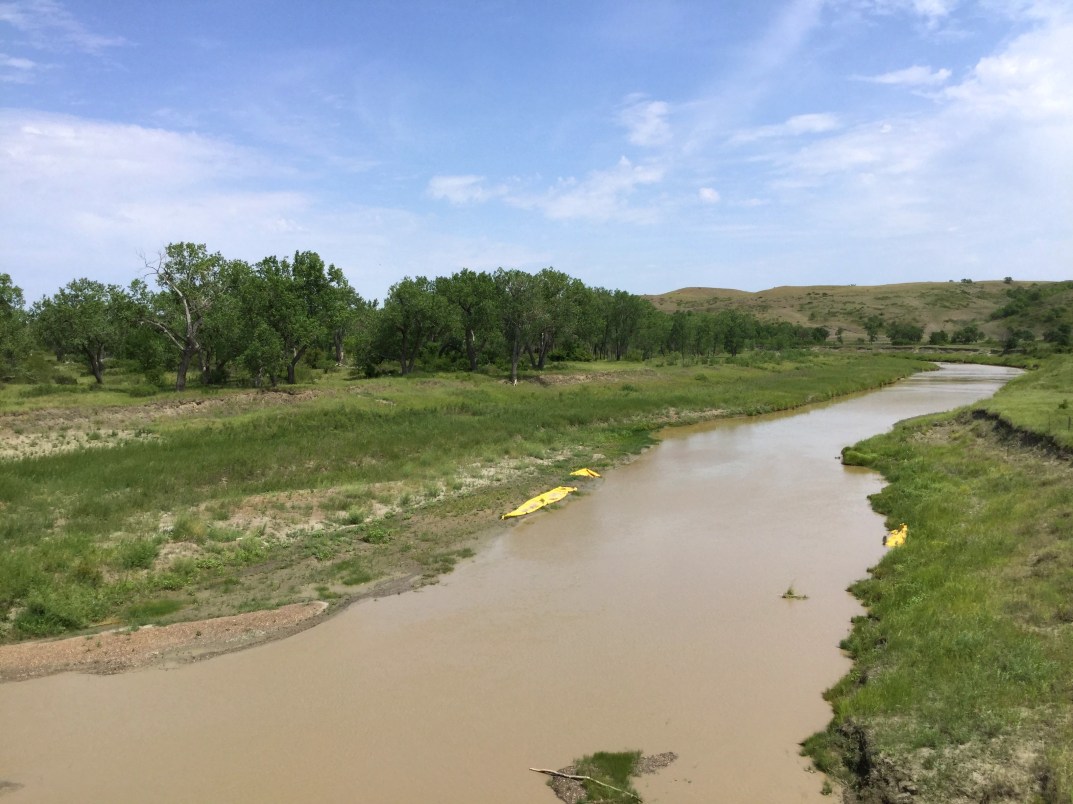
View of the Grand River from the bridge looking southwest, Standing Rock, just south of Little Eagle

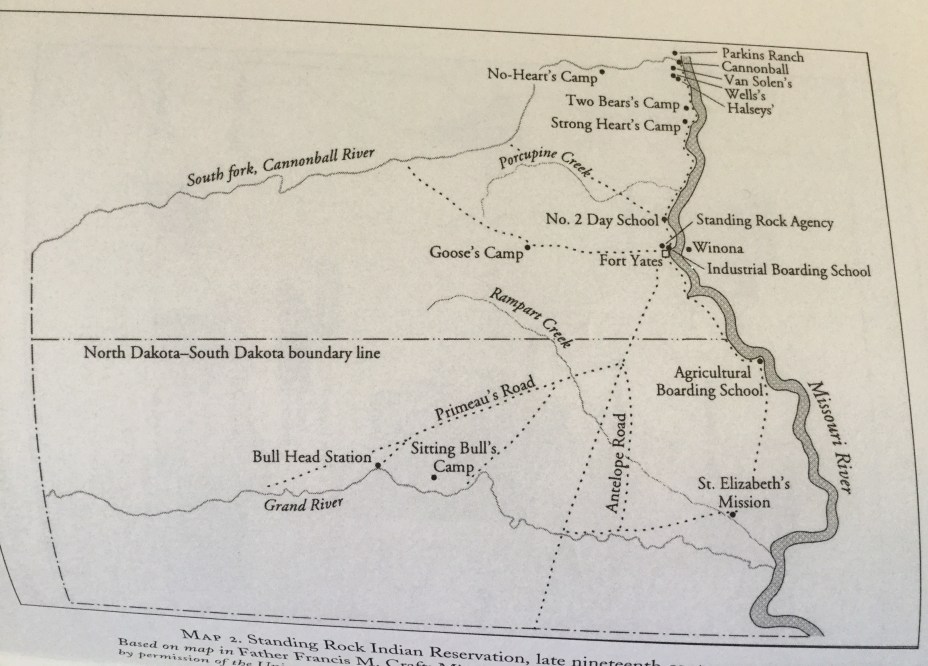
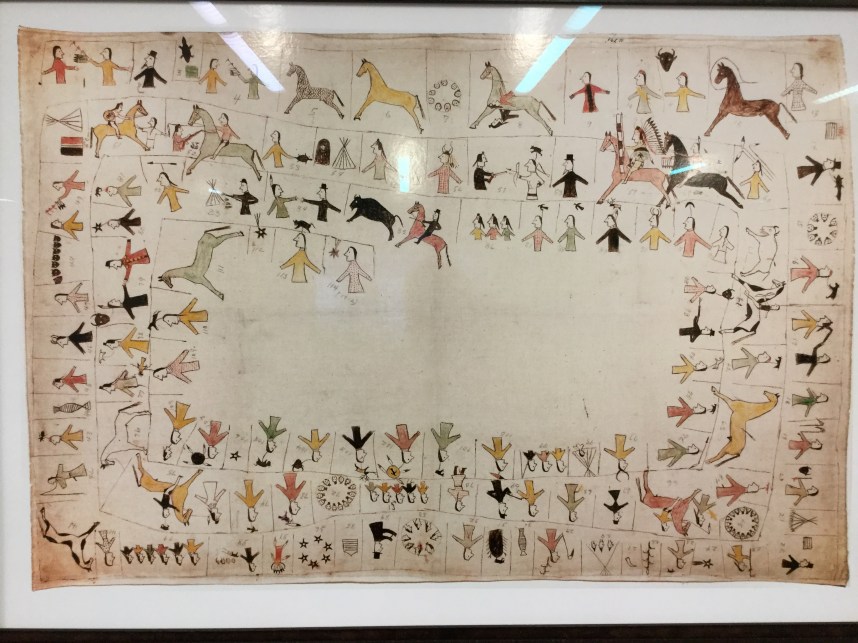
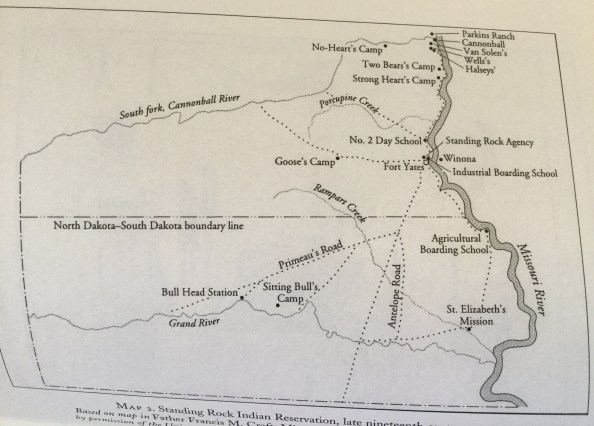
Late nineteenth-century map showing the site of Sitting Bull’s camp on the north bank of the Grand River in Standing Rock Sioux Reservation, from the papers of Francis M. Craft

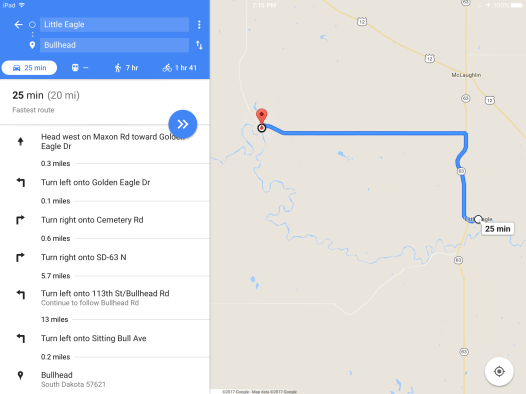
Little Eagle and Bullhead on the Grand River, as shown on Google Maps, 8-13-12017. Compare the dip of the river on today’s map with the dip of the river above.

I leave Fort Manuel and head south a little ways, turn right towards Kenel Road, stop for gas and an ice cream sandwich in McLaughlin, then turn south onto Highway 63. Just south of Little Eagle, I arrive at the bridge over the Grand River, the same bridge I crossed to come to Standing Rock and Fort Yates. I pull over at the head of the bridge and stop. I have more information this time. I’m here seeking the site of Sitting Bull’s death.

Based on Francis Craft’s late nineteenth-century map, Sitting Bull’s camp was on the north bank of the Missouri River, a good ways west of it, and a little ways east of Bullhead. I compare this map with the lay of the land and water here with that as shown on Google Maps. If Bullhead and the course of the Grand River are more or less the same as they are today and this map is accurate, the site of Sitting Bull’s camp would be a little ways west of where I’m standing, near the center of the curve where the river dips south. However, when you zoom out further, the lines of the river in the old map and in Google Maps track each other only loosely. Many years and weather systems have passed and the course and flow of the Missouri River, of which the Grand River is a tributary, have been tinkered with a lot since then. The first certainly, and the second likely, would affect its course over time.

Looking north and west from the bridge over the Grand River. It was somewhere along this north bank of the river, not far from here, where Sitting Bull was killed

I think of Sitting Bull’s death… no, martyrdom; he was killed for his beliefs. His real ones, and those that others ascribed to him.

Others believed he believed in the Ghost Dance movement because he tolerated it, and that the Ghost Dance movement was really a secret plot to violently overthrow white authority because it envisioned a blessed future in which the whites couldn’t oppress Native Americans anymore. Never mind that a specific doctrine of this cult was strict non-violence. Others believed he was a threat because he didn’t believe in white people, because he didn’t trust them as they thought he should. Never mind that white soldiers and settlers had treated him and his people so badly for so long.

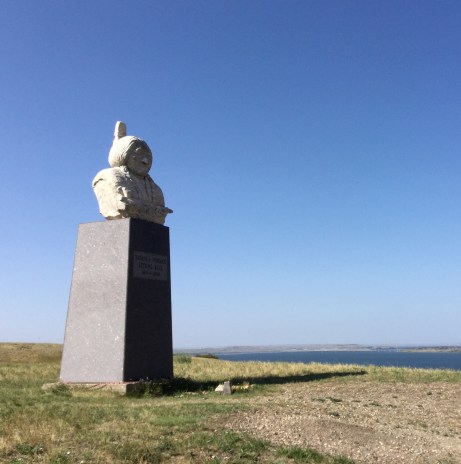
Sitting Bull Monument on the west bank of the Missouri River near Mobridge, SD

He believed that the world was big enough to hold many people with their different ways of living and that his people and their way of life deserved to exist, too. He believed in self-sacrifice and that convenience and luxury are not worth betraying your values for. He believed it was worth fighting the white people who were destroying his people’s ability to survive so long as it seemed there was a chance to drive them out. Then, he believed in peace when it became clear that was the only way left to survive. He believed in giving individuals, white ones too, the benefit of the doubt but he also believed you shouldn’t trust people who were crazy enough to value money and putting up fences above everything else. He believed in promises but not in written treaties: promises were the way of his people, but written treaties were invariably broken, as soon as they became inconvenient, by the very people who insisted on them.

Those are a few things I believe that he believed. I think I’m right about these, but I’m still learning, and I know there’s so much more.

I cross the bridge and continue south towards Pine Ridge Reservation, south and west of here, about a 5-hour drive.

To be continued….

Ordinary Philosophy and its Traveling Philosophy / History of Ideas series is a labor of love and ad-free, supported by patrons and readers like you. Please offer your support today!

~~~~~~~~~~~~~~~~~~~~~~

Sources and information: 

Brown, Dee. Bury My Heart at Wounded Knee: An Indian History of the American West. New York: Holt, Rinehart & Winston, 1970

Connell, Evan S. Son of the Morning Star. London: Macmillan, 1984

Courchane, John Chalk. ‘Toussaint Charbonneau: In the Pacific North in 1805‘. Oregonpioneers.com

A Cultural Resource Inventory of Portions of Lake Oahe, Corson County, South Dakota, Volume I
by Paul H. Sanders, Dori M. Penny, Michael L. McFaul, Keith H. Oueholm, Kurt P. Schwetgert, and Thomas K. Larson, for U.S. Army Corps of Engineers, Omaha District

Foley, Thomas W, ed. At Standing Rock and Wounded Knee: The Journals and Papers of Father Francis Francis M. Craft, 1888-1890. Norman: University of Oklahoma Press, 2009

Howard, Helen Addison. ‘The Mystery of Sacagawea’s Death.‘ The Pacific Northwest Quarterly, Vol. 58, No. 1 (Jan., 1967), pp. 1-6, University of Washington

Jackson, Joe. Black Elk: The Life of an American Visionary. New York: Farrar, Straus and Giroux, 2016

Kenel, South Dakota. In Wikipedia, The Free Encyclopedia.

Marshall, Joseph III. The Journey of Crazy Horse: A Lakota History. New York: Viking, 2004

Nelson, C.B. ‘South Dakota State Historical Society Markers.‘ (#391 Fort Manuel.) For the South Dakota State Historical Society

Perry, Douglass. ‘Lewis & Clark Expedition‘. Educator Resources, National Archives website.

Powers, Thomas. The Killing Of Crazy Horse. New York: Knopf, 2010

Sacagawea‘. Lewis & Clark National Historic Trail – People, National Park Service website

Sacagawea‘. In Wikipedia, The Free Encyclopedia.

Vestal, Stanley. Sitting Bull: Champion of the Sioux. Norman: University of Oklahoma Press, 1932

Wood, W. Raymond. ‘Manuel Lisa’s Fort Raymond: First Post in the Far West (November 1807—March 1813)‘. Discovering Lewis & Clark

See also: the South Dakota State Historical Society Markers in place at the Fort Manuel Site:and:

Standing Rock Sioux Tribe
Bldg. #1 N Standing Rock Ave.
P.O. Box D, Fort Yates, ND 58538
(701) 854-8500  http://standingrock.org/visit-us/

Standing Rock Reservation: In Search of Sitting Bull, I Find Sakakawea, Too, Part 1

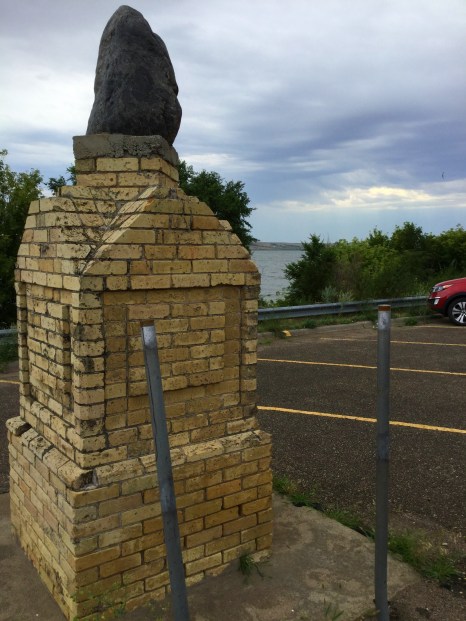
Standing Rock Monument, Fort Yates, Standing Rock Sioux Reservation, ND. It’s a very odd monument to unfamiliar eyes: unglamorous, unprepossessing. It’s the beginning of a part of my tour where the monuments and significant places are less curated. It’s up to the looker to slow down and really look close.

~ Dedicated to Genessa Kealoha

Journal: Faith, South Dakota, early morning July 24th, 2017

I woke up in the backseat of the rental car this morning feeling just a little stiff. I drove late into the night last night so I could break up the long drive. I stayed alert enough to continue until a little after midnight, but then sleepiness began to give me that oddly swaying feeling; time to pull over. I chose a nice big gravel lot with a semi truck parked close to the road. I pulled into the other end of the lot near a row of colorful but rusted old tractors and other farm machinery, changed into my sleep clothes, and curled up in my backseat nest. I’ve decided to leave it ready for such impromptu car campings.

When I awoke, I stepped out to a soft cool morning. It had rained intermittently last night and there were still a few occasional drops falling. A man stepped out from a little garage in front of what I then observed was a little motel right next to the lot. He kindly invited me into the motel’s cafe for hot coffee and to freshen up, without rebuking me in word or in tone for spending the night for free right outside of his establishment. I thanked him but decided to push on. I had a little thermos with some coffee left and had felt the urge to keep going. But what a generous man! I did rebuke myself afterward for not stopping in just to show that I appreciated the invitation.

Journal: Standing Rock Sioux Reservation, July 24th, 2017, later

A little less than two hours later, I reached McLaughlin, South Dakota, in the Standing Rock Sioux Reservation. At the little gas station, deli, and apparently popular gathering place, I confirmed directions to Fort Yates, another half hour northeast in the North Dakota part of the reservation.

I followed the signs to Fort Yates and to historical monuments on the main street that runs along the Missouri River. In a parking lot across from the tribal administration building, there’s a stone set upright on a pedestal of yellow-painted brick, well weathered, and some historical placards, also worn. The Standing Rock placard tells the tale of how this stone inspired the reservation’s name:

I went into the administration building and briefly described the nature of my trip. The woman at the desk directed me to the Sitting Bull Visitor Center at Sitting Bull College, up on the side of the hill above the main campus buildings. I was greeted there by Jennifer Martel, and she had much to say. Before long, it was clear to me that she’s had a long experience of feeling that she and her people are often talked at and around, that they are very frequently misrepresented and misunderstood, often because people from academia and from other cultures try to explain and portray Native American cultures in ways that make sense to themselves. That doesn’t necessarily translate into truth. It was also clear to me that this was a time to say very little, just to listen. So I did.

Lakota Winter Count (facsimile), Sitting Bull Visitor Center in Standing Rock Reservation

After we spoke for awhile, Jennifer rose to greet some people who arrived for a meeting and said she’ll keep in touch. I looked through the exhibits in the lounge area of the visitor center, then headed to the Sitting Bull College Library. I’ve just set up a little writing station where the wireless signal is best. I’ll start with asking the young lady at the desk for help….

Standing Rock Sioux Reservation, July 24th, 2017: the rest of the story

I ask the young lady at the front desk to help me find a few things I’m looking for, especially biographical information for the life and death of Sitting Bull, and especially, precisely where he died. So far, I’ve had little luck with that. She’s welcoming and friendly, and we get to talking as she begins to look through her digital and print materials. She introduces herself as Stormy, great-great (how many greats, I don’t remember) granddaughter of One Bull, nephew and adopted son of Sitting Bull. She kindly prints out maps for me to make it easier to find Sitting Bull’s monuments. After we look around for awhile, I sit down to look through what she’s given me so far while she assembles a collection of books for me. She’s friendly but not gushing, and seems like a person that would take most things in stride. I like her a lot.

Late nineteenth century map showing the site of Sitting Bull's camp in Standing Rock, from the papers of Francis M. Craft, photo of book image 2017 Amy Cools

Map showing the site of Sitting Bull’s camp on the north bank of the Grand River in Standing Rock Sioux Reservation, based on a late nineteenth-century map among the papers of Francis M. Craft

We continue to search our materials for information about the exact location of Sitting Bull’s death. Stormy hasn’t come up with anything so far with her online search. Among the books she gave me, I read that Sitting Bull was killed in his cabin on the Grand River ’40 miles from the Agency’, according to his biographer Stanley Vestal. The number of miles is new information for me, and I do find one more particularly helpful thing in these books: a map of Standing Rock from the late nineteenth century from the papers of Francis M. Craft, a Catholic priest who used to live here.  Sitting Bull was killed on December 15, 1890, and the map shows the location of his camp on the Grand River. One of Sitting Bull’s monuments is near where the Grand River flows into the Missouri. I’ll start there so I have plenty of daytime hours to work my way west along the Grand River to seek the place where he died.

Sakakawea Memorial on the bank of the Missouri River near Sitting Bull’s memorial at Standing Rock Sioux Reservation

I make my way to Highway 1806, here called the Native American Scenic Byway, and head south towards Mobridge, short for Missouri Bridge, a little town near the monument. I cross a bridge over the Missouri River and a little island. Instead of turning left on the 12 to Mobridge, I turn right towards the casino, then left, following a roadside sign which directs me towards the Sitting Bull Memorial down a little gravel road. I park and walk down the path towards the monument site near the bank of the river. Or, rather, monuments. I didn’t know that I would find two monuments here. The first I see is an obelisk with a medallion set into it portraying a woman and an infant. My mind immediately goes to the legend of Standing Rock, of the Arikara woman and her baby who turned to stone long ago.

But across the little path that encircles the obelisk, I find a bronze plaque which tells the story of Sakakawea, who famously accompanied the Lewis and Clark Corps of Discovery and was instrumental in its success. Cartoonist Bob Thaves once joked that sure, Fred Astaire was great, but Ginger Rogers did everything he did backwards and in high heels. Sakakawea guided Meriwether Lewis, William Clark, and all their big, strong men on their grueling trail first as a pregnant teenager, then as a first-time mom caring for the newborn infant strapped to her. Not only that, she jumped into a river to rescue Lewis and Clark’s journals and other important things when their boat capsized or was about to (they named that river in her honor), found wild foods for the men to eat when their rations ran low, and in countless other ways was instrumental to the expedition’s success. She was a truly impressive person.

As I read the plaque’s brief summary of her life and death, I remember that I saw signs earlier for Kenel and Fort Manuel. I mentally add that to my itinerary for later today or early tomorrow.

Sakakawea Memorial historical plaque

After I spend a little time here, I walk further down the path towards Sitting Bull’s monument overlooking the river. This may be the site of his remains, or of some of them. He was originally buried at Fort Yates, on the other bank of the Missouri River north of here. I’ll visit that monument later today or tomorrow. There’s a story that says his remains were secreted away and buried here, closer to the place he died, away from the Agency whose overzealous Indian police killed him in a botched arrest for allegedly helping to foment Native American discontent reinvigorated by the Ghost Dance movement. The Ghost Dance was the central ritual of the quasi-Christian cult of Wovoka, a Paiute holy man. Wovoka preached that Jesus Christ would soon return to earth if the Native Americans would live lives of scrupulous virtue and perform this sacred circle dance. In the happy time of Christ’s return, the sad world of death, destruction, deprivation, and loss of liberty brought by the whites would be swept away. Health and plenty would return and the people would be joyfully united with their ancestors and dead loved ones (the ‘ghosts’).

Sitting Bull Monument near Mobridge, SD, Standing Rock Sioux Reservation

The evidence was scant indeed that this religious movement was linked to any plans for violent rebellion; indeed, one of the virtues that Wovoka called on the people to practice was total nonviolence. The evidence was also scant that Sitting Bull had much more than a tangential link to the movement. He was curious about the movement and looked into it, but didn’t become a believer. However, there seemed to him no harm in it, and its message of nonviolence accorded well with the peaceful practices of his own life subsequent to his life as a young warrior. True, Sitting Bull never trusted the U.S. government, as was fitting given the history of their encounters with his people, but he no longer advocated armed resistance. He had seen the futility of this course over his lifetime and since his people now numbered so few, his primary purpose was to see that the remainder live as best they could in this alien new world imposed upon them.

Sitting Bull Memorial plaque

The distrust between Sitting Bull and the U.S. government went both ways, however, though the military power was all on one side. Standing Rock agent James McLaughlin sent out a cadre of Native American tribal police to arrest Sitting Bull for questioning. Initially, Sitting Bull was willing to go and asked leave to get dressed first, since it was his practice to sleep without clothes. But the police were impatient and tried to force him into his clothes while restraining his hands. Some friends and family, as well as adherents of the Ghost Dance movement, observed the disturbance and came to investigate. Sitting Bull then began to resist his rude treatment and in the scuffle that ensued, shots rang out. Sitting Bull was deliberately killed by shots from two separate policemen, and all told, fifteen men died, some from each side of the fight.

Sitting Bull was killed very near the site where he was born.

Ranchland along the north bank of the Grand River

After awhile, I go back a little ways north on 1806 and turn left, or east, on the first gravel road past the dirt road that runs along the Grand River, to see what I can see. I turn left again on another road, a rougher little dirt road called 121st St, which points directly toward the river. I pass through ranchland with grazing black cattle, the river usually in sight to my left. The road dead-ends at Strong Heart Ranch. I have not gone nearly far enough to reach this site I seek, but this road places me closest to the river bank that I can reach from this side, and I want to get a feel of what the riverside scenery is like. I turn back, then turn left on the gravel road towards Wakpala. I take this road through that little town and beautiful ranch land, all the way to Highway 12. I take the 12 to Highway 63, which I take back north to Fort Yates. Little Eagle, a town near the Highway 63 bridge that crosses the Grand River further south than the 12 junction, is nearer the likely site: it’s almost 40 miles from Fort Yates, the distance specified in the old map between Fort Yates and Sitting Bull’s camp. I decide to wait until tomorrow to visit that place since I’ll be passing that town and that bridge on my way south tomorrow to my next destination.

Tipis and farmland along the Wakpala road

I return to Fort Yates and seek Sitting Bull’s original burial site, which is still perhaps the current site of his remains. Stories of his reinterment elsewhere, which I mentioned earlier, are still in dispute. I find the monument on the east bank of the Missouri River, just off Sitting Bull Ave on a wide gravel path that runs north from here along the river through a tiny park. I read the plaque, look around, then sit and think. Two Native women walk by, talking and picking up litter from the grounds. One of the women approaches and greets me. We each tell what brings us here and where we’re from. She’s lived here for most of her life, as has her shy friend. That friend smiles at me and moves off to continue her task, taking no part in the conversation. The woman who greeted me tells me what she knows of the story of Sitting Bull and of his possible reburial, and about local landmarks. She points out an area where the sage grows thickly. It’s used for sweat lodges by the men and just to crush and breathe in the scent by women because, she says, the men can handle breathing in the smoke but the women can’t ‘well, you know, because we’re women’. I smile inwardly. She has a very sturdy appearance, like she’s spent her life outdoors and working hard, and seems able to hand more physically than most women and men I know.

The other Sitting Bull memorial on the other bank of the Missouri River, Fort Yates

Sitting Bull Memorial plaque, Fort Yates

I double check with her about a good place to spend the night. She agrees with a person I spoke to earlier that day, that the lodge and casino I’ll find just a few miles north of here is the best local place to go. I head there to get a good night’s sleep and do some research for my journey tomorrow.

To be continued…

Listen to the podcast version here or on Google Play, or subscribe on iTunes

Ordinary Philosophy and its Traveling Philosophy / History of Ideas series is a labor of love and ad-free, supported by patrons and readers like you. Please offer your support today!

~~~~~~~~~~~~~~~~~~~~~~

Sources and information: 

Brown, Dee. Bury My Heart at Wounded Knee: An Indian History of the American West. New York: Holt, Rinehart & Winston, 1970

Connell, Evan S. Son of the Morning Star. London: Macmillan, 1984

Faith, South Dakota‘. In Wikipedia, The Free Encyclopedia.

Foley, Thomas W, ed. At Standing Rock and Wounded Knee: The Journals and Papers of Father Francis M. Craft, 1888-1890. Norman: University of Oklahoma Press, 2009

Ginger Rogers, Article 2: Backwards and in High Heels’. ReelClassics website

Jackson, Joe. Black Elk: The Life of an American Visionary. New York: Farrar, Straus and Giroux, 2016

The Legend of Standing Rock‘. Akta Lakota Museum and Cultural Center and St. Joseph’s Indian School website

Marquis, Thomas Bailey. Wooden Leg: A Warrior Who Fought Custer, 1931

Marshall, Joseph III. The Journey of Crazy Horse: A Lakota History. New York: Viking, 2004

Powers, Thomas. The Killing Of Crazy Horse. New York: Knopf, 2010

Sacagawea‘. Lewis & Clark National Historic Trail – People, National Park Service website

Sacagawea‘. In Wikipedia, The Free Encyclopedia.

Vestal, Stanley. Sitting Bull: Champion of the Sioux. Norman: University of Oklahoma Press, 1932

and

Standing Rock Sioux Tribe
Bldg. #1 N Standing Rock Ave.
P.O. Box D, Fort Yates, ND 58538
(701) 854-8500  http://standingrock.org/visit-us/

On July 26, 1948, Harry Truman Abolishes Discrimination and Segregation in the Armed Forces by Executive Order 9981

On this day, President Harry Truman took one more step towards realizing the idea, central to the founding documents of the United States, that all persons are created equal.

Thank you, Grinman Films, for telling the story!

Ordinary Philosophy and its Traveling Philosophy / History of Ideas series is a labor of love and ad-free, supported by patrons and readers like you. Please offer your support today!

Bitterroot Mountains and the Lewis and Clark Wendover Ridge Hike

A view through the windshield of Petty Creek Rd / Rte 489 between I-90 and Hwy 12, Lolo National Forest, Montana

Journal: Powell Campground & Lochsa Lodge, Clearwater-Nez Perce National Forest, Monday, July 17th, 2017

After lingering over breakfast this morning with my sister Bonnie, cousin Beth, nephew Cory, and cousin Mo, I realized there was no way I was making it from Spokane to Yellowstone National Park today. So I thought: why not camp near Lochsa Lodge and do the Lewis and Clark Wendover Ridge hike, which friends of mine will be doing later this week, on the way? I’ve left plenty of time in my itinerary to go spur-of-the-moment adventuring. My friends have told so many tales of joy and hardship on this hike that my curiosity and spirit of competition just can’t resist the challenge. So, I make my decision. I stop at Superior Ranger Station off I-90, discuss my plans with the two oh-so-kind and helpful women there, and get directions. The ranger here who knows the trails, as well as the ranger she conferred with by phone at Powell Ranger Station, both warn me that the trail is extremely rough and in parts nearly impassible, not having been maintained in any way for at least two years. Sounds to me right now more like a dare than a warning.

I head south on Petty Creek Road, a beautiful drive through a pastoral valley, and over the ridge to Highway 12 and a short drive back west. I was here last in snowy, frigid January. It’s very different today.

Lochsa Lodge, Clearwater-Nez Perce National Forest, Idaho

I was in these mountains last when on a delightfully nerdy literary-historical retreat to celebrate my 40th birthday in my own way. Rather, it was just one, a newer one, of my own ways. I delight in parties, too, and in camping, and in going off on solitary adventures in which I also meet new people. On my actual 40th birthday, I went camping with a tiny company of closest family and friends, foregoing the usual New Year’s celebration with dancing, drinking, and light carousing. But I was feeling a little more pensive this time around and wanted to go off and do something on my own as well. So I went on a retreat a few weeks later which took me to Lochsa Lodge, right across the campground from where I am now, and made those very friends who will be doing the Wendover Ridge hike in a week or so. The thermometer never topped freezing when I was here last; now, it’s green and lush and warm. The campground is teeming with fat little chipmunks and birds, and the hidden animals are no doubt likewise well fed in all this abundant growth.

My tiny tent at Powell Campground, Clearwater National Forest, Idaho

The little orange tent is set up, a little green plastic doll shoe in the corner. I’ll be sleeping in my niece Savannah’s cast-off tent, very lightweight and very small. It’s sufficient for these summer days: it’s 8:30 pm as I write this and I don’t need sleeves yet. I’m using this little cast-off tent since I’ll be flying to Scotland at the end of this trip, and have no room in my luggage to take a good tent with me across the sea. It’ll go to a thrift store when I reach Chicago.

I hike trail 25, which runs north and south. I know that if I can’t find the trail or if I lose it, I could never get too lost: to the north is the top of the ridge, to the east, the West Fork of Wendover Creek and the fire road that runs along it, to the west, the other road and the steep hillside. And, of course, to the south, is the Lochsa River

Journal: Whitehouse Campground, Lolo National Forest, Idaho, July 18th, 2017

This morning, I’ll hike from the Lochsa River to Wendover Ridge, the steep 7-mile hike that those same friends I made during that January retreat call the ‘Wendover Death March.’ It follows the route (more or less) that Merriweather Lewis and William Clark took over Wendover Ridge, on a trail used by the Nez Perce, with a Shoshone guide. I’ll tell you the story tomorrow.

Trail marker for Lewis & Clark 25: 7 miles to Snowbank Camp on Wendover Ridge

Journal: Cafe at Park & Main, Butte, Montana, July 19th, 2017

From this cafe, I’ll tell the story of yesterday’s hike in annotated photos, with this introduction: relaxed from a hot bath last night, with that satisfying feeling of combined mild soreness and strength the day following strenuous exercise, a warm bowl of oatmeal and berries in my belly, a second hot cup of very creamy coffee, and the open road and adventures yet to come before my mind’s eye, I am as happy as a person can be.

This sign, not far from the trailhead, tells a bit of the Lewis & Clark story on this route

Sign marking the start of the overgrown Trail 25, Nez Perce-Clearwater National Forest

I climbed the steep first section of the trail, at times clambering over fallen trees and pushing through soft, lush, lower overgrowth, until I reached a fire road. I turned right, misreading the map, which is partially obscured by a little annotation where it portrays this section. The trail follows to the right of the road, not to the left of another which branches off, and I chose the wrong branch. I go half an hour out of my way before the sign for the Wendover Creek West Fork alerts me I’m too far east. No matter. It’s a lovely warm-up for the rigors of the next section of the hike. I go back to where I had turned onto the road and find the partially obscured trail marker which sets me on the right path again.

The butterflies are out in force in Clearwater National Forest

A cone of purple wildflowers echoes the shape of the trees on Wendover Ridge, Bitterroot Mountains, ID, 2017 Amy Cools

A cone of purple wildflowers echoes the shape of the trees on Wendover Ridge

Ah-hah, there’s the trail marker, off to the left among the tree. I was too far off to the right to notice it when I made that wrong turn.

Yes, there’s a trail under there

…. and under all that too. The trail’s overgrowth and fallen tree debris get thicker and thicker the farther I go. I should have worn pants, however warm the weather

I dub these ‘Jazz Hands Ferns’

A chipmunk tail, cleanly severed, draped decoratively on a stump. Creepy.

Hanging mosses drape a grove of trees

Another winged beauty

Thimbleberries, with a lightly sweet and tangy taste. The ripe fruit turns bright red and soft, and lifts easily off the underlying structure which it covers like a cap, or thimble. They also grow plentifully along one of my favorite hikes in the Oakland hills in California

Stunning view from the side of the ridge somewhere in the vicinity of the trail. At this point, I turned back about an hour ago. I believe I nearly reached the summit but I could not find the trail, try as I might, among the loose litter of needles in a large grove on a particularly steep section. I was nearly out of water and it was very hot: I’m still recovering from a chest inflammation and laryngitis following a particularly nasty chest cold and needed more water than usual. But the deep breathing of clean, dry, deliciously scented mountain air and strenuous exercise of the day invigorated me, and I felt better and better as I went along, nearly recovered. Still, it seemed prudent to turn back while I still had a little water, since I had hiked a long, hard distance already.

A little brook that feeds into Wendover Creek’s West Fork. Farther up, I found a large, muddy spring bubbling up over a large area; I discovered it as my shoes squelched right through it under its obscuring blanket of happy leaves. I searched and found a section where it filtered through a little patch of sand and tiny rocks. I tipped one of my canteens and pressed it gently on its side into the sand, so the water flowed into it nearly to the top. Then, I poured it into my larger canteen through my cotton shirt, filtering out most of the silt. The water was cold and minerally and incredibly refreshing. I filled the larger canteen with filtered water, and the smaller again with unfiltered. My water worry assuaged, I continued with renewed confidence. Not finding a better route down, I decided to follow the water, which I knew must inevitably lead to Wendover Creek. It was steep and required lots of sliding and Tarzaning down the slope from the overhanging strong but bendy branches

This is what a tired and very happy hiker looks like

I tore up my legs a bit on this adventure: I recommend pants despite the heat. Oh well.

I was glad to reach this fork of Wendover Creek, which is what I was aiming for hiking down off-trail, Bitterroot Mountains, ID, 2017 Amy Cools

I was glad to reach this fork of Wendover Creek. I was aiming for this creek since hiking downhill off-trail, which I knew was in this fold of the mountain on this side of the ridge. I finished the hike on this gravel fire road which takes me back to the main road just west of Whitehouse Pond, where I had begun the hike

One more of Nature’s winged jewels

The hike accomplished, I bathed my stinging legs and hot head and arms in the Lochsa River. What a glorious day. I completed it with two cold beers at the Lodge, a little rest, and a nice drive to Butte, Montana, and – oh, the joy – a hot bath and a long sleep. The hike took 8 1/2 hours all told, including the hour-long accidental detour.

*Listen to the podcast version here or on Google Play, or subscribe on iTunes

Ordinary Philosophy and its Traveling Philosophy / History of Ideas series is a labor of love and ad-free, supported by patrons and readers like you. Please offer your support today!