O.P. Recommends Freakonomics: Is Migration a Basic Human Right?

Airport Terminal in Salt Lake City, Photo 2015 by Amy Cools

I just listened to this episode of Freakonomics Radio podcast the other day, which I enjoyed very much and learned a lot from, and I think you’ll love it too. Freakonomics Radio is hosted full time by Stephen Dubner, one of the two authors of the famous book of the same name, published in 2005, with occasional guest hosting by its other author Steven Levitt. The book and podcast consider individual, social, and political situations from the view that human behavior is best explained in terms of the incentives that motivate us.

The podcast episode I’m recommending here is called ‘Is Migration a Basic Human Right?’ and I can hardly think of a more timely question. As Syrians fleeing death and destruction flee their war-torn country, we are invited to consider this question: do nations’ rights to maintain secure borders trump (how funny …no, actually ironic that I need that particular word right here!) the individual human right to survive and to flourish?

I love Freakonomics, despite the fact that it adopts, at times, a dismissive and even scornful tone towards philosophy (as do some of my other favorite podcasts), but that’s okay: there’s so much good information and clearheaded processing of it that its informative values trumps (groan) what might be philosophically lacking. After all, I believe, philosophy is at its best when it’s informed and disciplined by evidence, and it’s such a firmly established, fascinating, and eminently useful discipline that it can withstand critique and dismissiveness from economists, science enthusiasts, and so on. But to my edification and delight, the guest in this episode, Alex Tabarrok, professor of economics at George Mason University, gives a spirited defense of philosophy almost right off the bat.

Here’s a little excerpt for those of you in a hurry, but for the rest, I recommend you just skip this and go listen to the whole thing. Enjoy!

DUBNER: …As much as you may not like those reasons, aren’t they very much a symptom of the way humans have behaved throughout history? Borders, I mean.

TABARROK: So, borders are very common in one sense. As you say, when you look around, that’s the way the world is organized. And we’ve just gotten so used to them that we don’t even ask very much about their fundamental justification. And it’s when you come to ask about the fundamental justifications for borders that they begin to look very strange. Because they run counter to almost all of our moral writings and intuitions and philosophies. …

DUBNER: …I’ll be the skeptic for a moment — I could just say, “Well, that’s what philosophers do. Philosophers talk about ‘in a perfect world where all people were X, Y, and Z, things would go like this.’” But we all know that philosophers have no idea how the world actually works.

TABARROK: So, you know, our moral intuitions and indeed our laws today are that you shouldn’t discriminate against someone because of their race, because of their gender, their sexual preference or other issues. But for odd reasons, it’s perfectly OK to discriminate against someone because they were born somewhere else …Now, to defend philosophy, for very long periods of time, racism was perfectly normal; people have been doing it for thousands of years. And then people began to ask, “Well, what justification is there for treating someone so differently just because of their race?” And when people couldn’t come up with an answer to that question, when they were forced into this discomforting area that they can’t justify this terrible injustice, things began to change. …

~~~~~~~~~~~~~~~~~~~~~~~~~~

Sources and inspiration:

Dubner, Stephen. ‘Is Migration a Basic Human Right?’, Freakonomics Radio podcast, episode 231.
http://freakonomics.com/radio/


Traveling Philosophy Series: Frederick Douglass Edition, Prologue, Oakland, CA

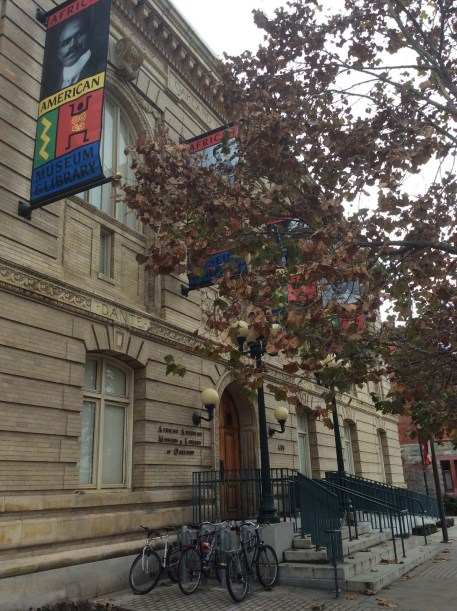
African American Museum and Library, Oakland, CA

Frederick Douglass’s Traveling Philosophy series will begin in earnest when I arrive on the East Coast. But behind every Traveling Philosophy series is research, and I have some excellent resources here where I live in Oakland, California. It’s still a little up in the air as when I’ll actually be able to make it to the East Coast for a long enough period to cover the ground I’d like to, since I intend this series to be the most comprehensive I’ve done yet. So, I’ve decided to do something a little different this time, to start the account of my journey with my discoveries and thoughts on the acts and ideas of Douglass I encounter while researching his life.

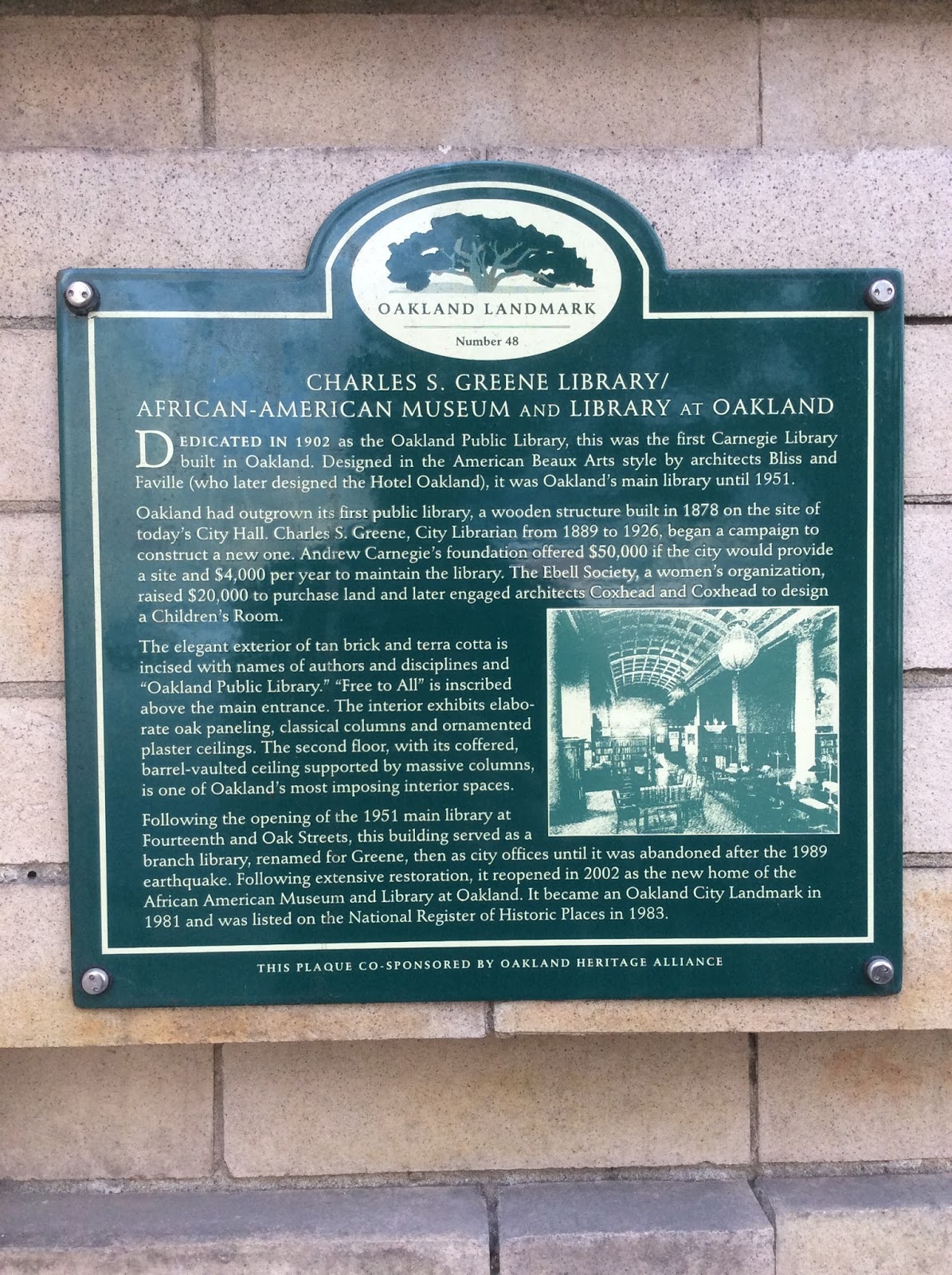
For the last several weeks, I’ve been gathering materials at my local library branch, the main branch near beautiful Lake Merritt on 14th St. But for many happy afternoons this early December, I’m on the other side of downtown, still on 14th St, in my new favorite study space, the lovely African American Museum and Library in Oakland.The AAMLO is a local Beaux Arts gem, the original main library building from 1902 until it moved to its current much larger location in the early 1950’s. (See the photo, right, of the museum’s green plaque for a brief history of the library and museum; you can click on the image to enlarge it for ease of reading, if you like.)

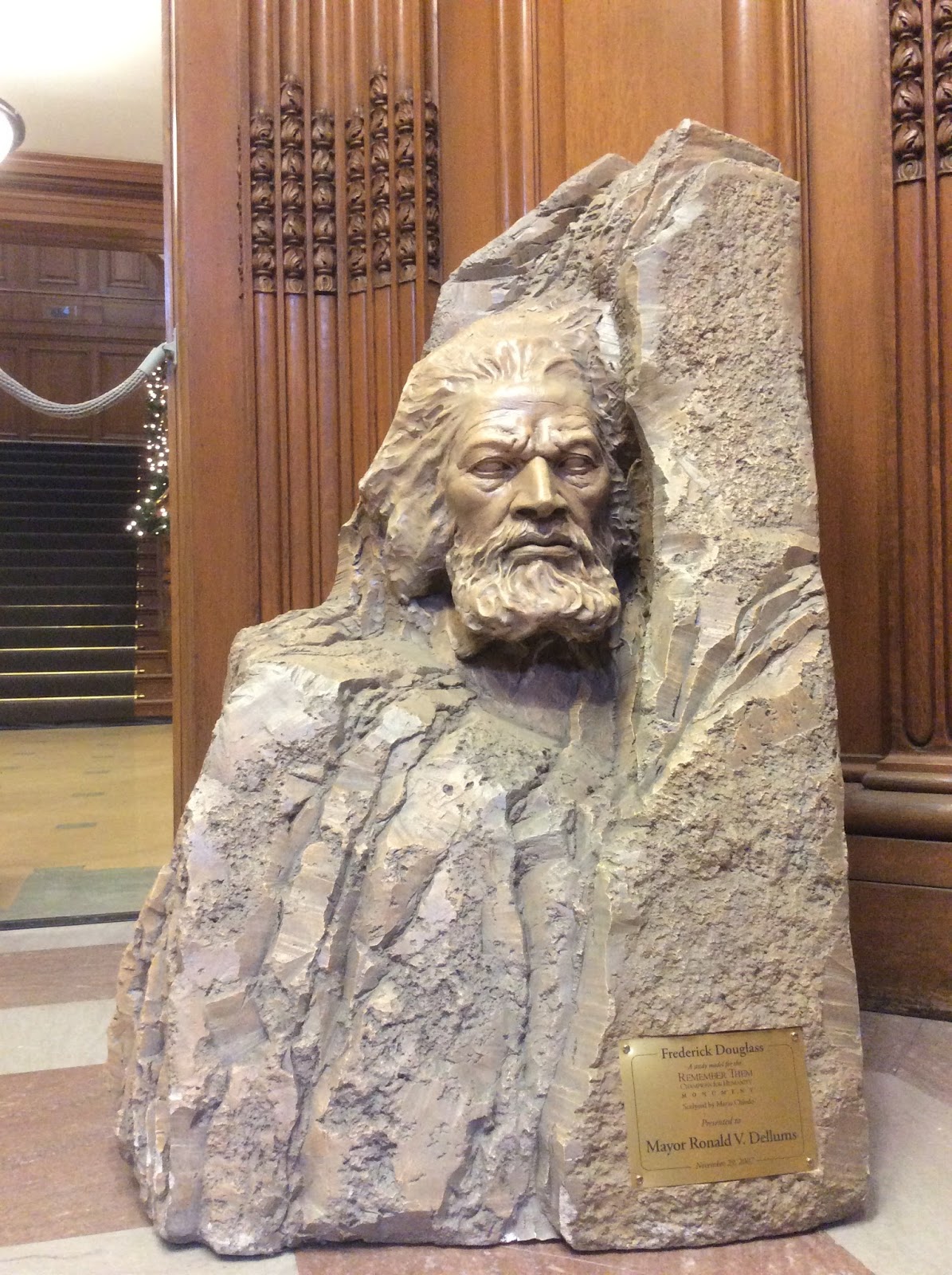
Sculpture of Frederick Douglass, AAMLO

The AAMLO is a new discovery for me this December, and as I enter, I’m greeted, to my delight, with a handsome (if rather stern) sculpture of the hero of my series. It’s this effigy of Douglass, in fact, which inspires me to just jump right in and start his Traveling Philosophy series here in Oakland.

So I’ll begin, as I mentioned, with stories and reflections on his life and work. My trip to the East Coast, tentatively planned for late winter / early spring, and the stories of that journey will be followed by a second series of essays inspired by my discoveries in the course of my travels. I hope you enjoy this new format, and as always, welcome any feedback you wish to offer!

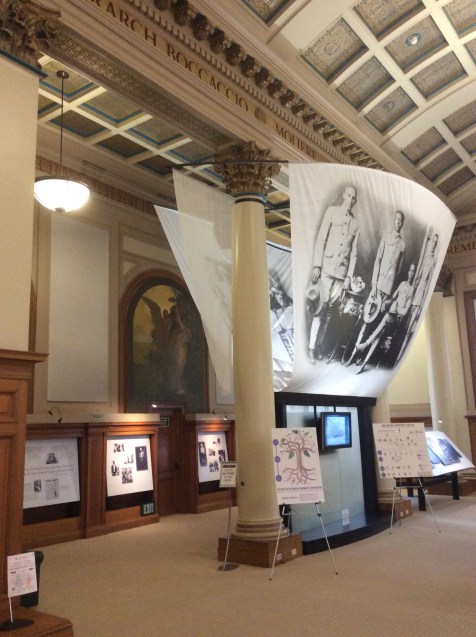
An interior view of AAMLO

AAMLO is a reference library only, so all materials I use must stay here. That’s perfectly fine with me, it’s such a lovely place to work, and lucky for me, it’s quite close by to where I live and work. Since I’ll be returning here a lot, I pick a quiet, cozy corner, and get to work…

One afternoon, after reading and making notes for quite some time, I feel the need to stretch my legs and rest my tired eyes. I go upstairs to the museum, a long gallery which runs the length of the building and which used to be the main reading room.

Crowning the main stairway which leads to this upper gallery, there’s a huge collage of great figures in African American history. It just so happens that the image of Douglass is under the name of Spinoza, among the list of names of great thinkers of the past which embellishes the frieze. Cool. Baruch Spinoza is next on my list of great thinkers to follow, but that’s a story for another time. I’d bet they’d have the most fascinating conversations, though, if they could speak the same language. Though they were very different in their histories, their particular beliefs, and their personalities, yet they were both lovers of reason, and they both lived authentically, true to their beliefs, models of intellectual integrity as they refused to obey the unjust rules of the societies they lived in.

An interior view of AAMLO, Oakland, CA, 2015 Amy Cools

A view of AAMLO’s main gallery on the upper floor

The museum tells the story of the African American people who did so much to make Oakland the vibrant and diverse city it is today, and how America’s legacy of laws and practices both helped and harmed the African American community here and throughout California. The African American community in Oakland grew by leaps and bounds throughout the 1900’s, much of it made up of refugees from the Old South, and through hard work, came to make up a significant proportion of its thriving middle class. Oakland’s economy centered around its busy port and manufactures, and as the work dried up after the stock market crash of 1929, it was no surprise that the economic woes hit African Americans the hardest: when jobs become more scarce, it was not the favored demographics that suffer from it most, as you may expect: Oakland’s working black population lost well over a third of their jobs.

Douglass himself experienced job discrimination in his time working on the Maryland docks as a caulker, hired out as a wage earner in the Baltimore shipyards for his master before he escaped to freedom. In his Narrative, Douglass relates the story of a severe beating he received at the hands of white shipbuilders who resented the competition of low-paid black labor, both slave and free. Douglass was driven from his job by violence; in 20th-century Oakland, it was a combination of job discrimination, rules and laws which prevented black people from joining or forming unions, and differential treatment by law enforcement. Not everything had changed since Douglass’s day.

A view of an exhibit in AAMLO's main gallery, upper floor, AAMLO, 2015 Amy Cools

A view of an exhibit in AAMLO’s main gallery

So as black Oaklanders suffered many of the worst effects of the economic downturn, the ills of poverty hit black communities the hardest, and harsh, unjust policing practices and drug policies exacerbated the problems that they may have been meant to alleviate. Many, however, passionately believe that there was no honest intent to help, just to oppress and destroy the black community. Whatever the case may be, the desperation of so many of Oakland’s black people makes it no wonder that the Black Panther Party was founded here in Oakland in the 1960’s. Then as now, a strong cultural tradition of racial justice activism and civic unrest flourished, sometimes, as again to be expected in an environment where so many felt disenfranchised and disrespected, to excess.

If he were alive to witness it, Douglass may have disapproved of many of the Black Panther Party’s militant tactics, but like the B.P.P. and Malcolm X after him, he came to believe that some kind of armed resistance may be necessary to achieve liberty and full equality for black people, and that if violent resistance was necessary to change the laws, it was just, given the depth of oppression and injustice black people suffered. He was, for example, an admirer of John Brown, a passionate abolitionist who unsuccessfully tried to start an armed slave rebellion and was hanged for treason as a result.

What Douglass thought about whether or not it’s right to use violence in the cause of furthering human rights, and if so, how much, against whom, and when, is a big topic, one for another essay in this series. Stay tuned!about whether or not it’s right to use violence in the cause of furthering human rights, and if so, how much, against whom, and when, is a big topic, one for another essay in this series. Stay tuned!

* Listen to the podcast version of this piece here or on iTunes

* Follow in the footsteps of Frederick Douglass with me… 

Ordinary Philosophy and its Traveling Philosophy / History of Ideas series is a labor of love and ad-free, supported by patrons and readers like you. Please offer your support today!

~~~~~~~~~~~~~~~~~~~~~~~~~

Sources and Inspiration

Douglass, Frederick. Narrative of the Life of Frederick Douglass. Originally published in Boston by the Anti-Slavery Office, May 1st, 1845.

Really, America? Ban the Refugees, Let the Troops Do All the Work?!?

Like so many of you, I’m sure, I’ve been dismayed, though not really surprised, at the vitriol aimed at Syrian refugees and Muslims in general, following the shootings in Paris and San Bernardino. Much of it is voiced in the form of inflammatory but silly memes, but now, even some of our presidential candidates are chiming in. Reactionary religious and ethnic hatred are at least as old as human history, and so are political capitalizations on them.

These memes and the anti-Islamic proposals they promote, such as calls for the U.S. to stop taking in Syrian refugees, to ban all Muslims from entering the country, or to force all Muslims to register with the government, as far as I can tell, are mostly coming from some on the conservative end of the political spectrum. However, the backlash against all this reactionary hate-mongering is coming from both liberals and conservatives, and their arguments are bolstered by the best in our political system and its founding documents, focused, if not always perfectly, on the protection and expansion of human rights.

Besides the basic problem of the xenophobic, anti-human-rights nature of the anti-refugee and anti-Muslim rhetoric, there’s something about the whole thing that’s been bothering me, something that I hadn’t really seen addressed in so many words. I jotted down this thought in the notes for this piece, and I hadn’t had the chance to finish it until tonight.

Then, today, just a few hours before I planned to write this, I heard a re-broadcast of a news story that appears to confirm my suspicions. A recent poll from Harvard revealed that the majority of millennials, age 18-29, say we should send more troops to fight ISIS and say they wouldn’t even consider enlisting.

This was my thought before I heard that story: for all the rhetoric calling for an increase in the war effort against Islamist violent extremism, and all the preaching about supporting our troops, it seemed to me that many of the same people who want to send more military abroad to fight to protect people’s freedoms want little or nothing to do with the effort themselves. They want others, namely our soldiers, to take all the risks, shoulder all the burdens, and do all the work of defending and promoting American values, but don’t want to participate even in a relatively small way by helping out the people who are most victimized by Islamic radicalism, who vote with their feet by fleeing from violent Islamist groups to ethnically diverse, religiously free nations.

It looks as if this poll reveals that this ‘you go do it, brave soldiers in uniform, but leave us out of it!’ attitude is likely true for at least for one significant slice of the population.

What happened to the idea that if we, the people, decide to go to war, it’s we, the people, who should fight it? Makes me feel nostalgic, in the way that you can feel nostalgic for a time you’ve never experienced yourself and are not sure ever really existed, for the ‘greatest generation’ of World War II and earlier wars. Wasn’t it the case back then that most ordinary citizens felt duty-bound to participate in the war effort that their nation was fighting, even if in some small way at home? Didn’t they involve themselves, if necessary, in the work, the sacrifice, and the danger of doing the right thing, even if doing so meant some risk to themselves? It’s not even that they have to worry about conscription anymore! Isn’t the mission of promoting the American values of multiculturalism and religious freedom, protecting the innocents that flee for sanctuary to our shores and in our neighborhoods, worth our support and participation, even if we do face the risk that a few terrorists might sneak in among the innocents?

It seems that decades of complacent materialism and the all-volunteer military, among other things, have eroded some of that true civic pride and moral courage it takes to show the world that Americans are willing to do the right thing, no matter what.

*Listen to the podcast version here or on iTunes

*Ordinary Philosophy and its Traveling Philosophy / History of Ideas series is a labor of love and is ad-free, entirely supported by patrons and readers like you. Please offer your support today!
~~~~~~~~~~~~~~~~~~~~~~~~~~~~

Sources and inspiration:

Gabriel, Trip. ‘Donald Trump Says He’d ‘Absolutely’ Require Muslims to Register’. New York Times website, Politics: First Draft. Nov 20th, 2015. http://www.nytimes.com/politics/first-draft/20

Khalid, Asma. ‘Millennials Want To Send Troops To Fight ISIS, But Don’t Want To Serve’. NPR.com. Dec 11, 2015. http://www.npr.org/2015/12/10/459111960/millennials-want-to-send-tro

Walsh, Deirdre, Jeremy Diamond, and Ted Barrett. ‘Priebus, Ryan and McConnell rip Trump anti-Muslim proposal’. CNN.com. Dec 8, 2015. http://www.cnn.com/2015/12/08/politics/paul-ryan-tru

From Oakland to Maryland, New York, and Massachusetts I Go, in Search of Frederick Douglass

Hello, friends of Ordinary Philosophy!

From time to time, I take a trip to some corner of the globe, to explore the lives and ideas of great thinkers in the places where they lived and worked. For this series, I follow in the footsteps of thinkers who are no longer alive, since those who are still telling their own stories. But those who are no longer alive in the body live on in the ideas that they pass on, and in the example they provide for us to follow.

I’m pleased and excited to announce my fifth philosophical-historical themed adventure, beginning with research and study in Oakland, CA, then off to Baltimore, MD, New York, Washington DC, and other East Coast sites to follow in the footsteps of Frederick Douglass.

Frederick Douglass’s life story is inspiring and humbling in the strength, character, and dazzling intellect he reveals, rising to such greatness in the midst of such adversity. Born a slave on the eastern shore of Maryland in the early 1800’s, he was an autodidact, having overheard his master say that learning to read leads to learning to think, rendering a slave too independent-minded to submit to domination by another. Hearing this, young Frederick knew what he had to do. Attaining literacy and learning a skilled trade gave him the wherewithal to escape to New York City in 1838 at about 20 years of age. A few years later, as a result of an impromptu but impassioned and eloquent speech about the hardships of a life enslaved, he was recruited as a public speaker for the abolitionist cause. He spent the rest of his life as an activist for all manner of human rights causes, from the abolition of slavery to universal suffrage to women’s rights and beyond.

Douglass is an especially compelling subject for a historian-philosopher; observing the true nature and ramifications of slavery led him to think deeply about the most essential questions in human life, which, in turn, spurred him on to a life of thought and action on behalf of oppressed peoples. In these roles, Douglass had a heavy influence on American thought and on the course of American history. He asked, and answered: What does it mean to be a person? What does it mean to be a person of faith? What are rights, and why are we entitled to them? What is dignity, and does possessing it entail that we have certain obligations to ourselves and others? Given the frailties and strengths of human nature, how can we best live together and form just societies? What do the Constitution, its Bill of Rights, and the Declaration of Independence really say about slavery, equality, and other human rights issues?

So I’ll begin my tale here in my home city of Oakland, CA, where I begin my research and exploration into Douglass’s life and ideas, then off to the east coast of the United States I’ll go, from March 19th thru April 2nd! There, I’ll visit landmarks associated with his life, places where he lived and died, worked, thought, wrote, studied, and rested, to see for myself how the places informed the man, and vice versa.

~ Listen to the podcast version of this series intro here or on iTunes

Here is the story of Frederick Douglass as I discover him:
Traveling Philosophy Series: Frederick Douglass Edition, Prologue, Oakland, CA
Frederick Douglass on Faith and Doubt
Frederick Douglass on the Constitution
Frederick Douglass the Pragmatist
Frederick Douglass Baltimore Sites
Frederick Douglass’s Birthplace, Maryland’s Eastern Shore Sites Part 1
Frederick Douglass, Easton and St. Michaels, Maryland’s Eastern Shore Sites Part 2
Frederick Douglass Havre de Grace and Philadelphia Sites
Frederick Douglass New York City Sites
Frederick Douglass New Bedford, Massachusetts Sites
Frederick Douglass Boston Sites
Frederick Douglass Lynn, Massachusetts Sites
Frederick Douglass Lynn Sites, Part 2: Historical Society & Hutchinson Scrapbook
Frederick Douglass Albany, Troy, and Syracuse NY Sites
Interview with Leigh Fought on Anna and Frederick Douglass
Frederick Douglass Rochester NY Sites, Day 1
Frederick Douglass, Rochester NY Sites Day 2
Interview with Ken Morris, Anti-Slavery Activist & Descendant of Frederick Douglass
Frederick Douglass Seneca Falls, Canandaigua, Honeoye, and Mt Hope Cemetery Sites
Frederick Douglass Chambersburg and Gettysburg PA Sites
Frederick Douglass Washington DC Sites, Day 1, Part 1
Frederick Douglass Washington DC Sites, Day 1, Part 2
Frederick Douglass Washington DC Sites, Last Day

More about Frederick Douglass:

Peoria, Illinois, In Search of Robert G. Ingersoll, Frederick Douglass, And Abraham Lincoln, Part 1
Peoria, Illinois, In Search of Robert G. Ingersoll, Frederick Douglass, And Abraham Lincoln, Part 2
Peoria, Illinois, in Search of Robert G. Ingersoll, Frederick Douglass, and Abraham Lincoln, Part 3
Photobook: Frederick Douglass and Edinburgh, Old and New
O.P. Recommends: ‘A Man’s a Man for a’ That: Frederick Douglass in Scotland’ by Andrea Baker for BBC Radio 4
Say What? Frederick Douglass on Originalist Interpretations of the United States Constitution
O.P. Recommends: Frederick Douglass’ Drunk History Episode
Say What? Frederick Douglass on Race Relations
Citizenship, Belonging, and the Experiences of Amero-Africans in West Africa: An Analysis of William Innes’ Early History of Liberia

Ordinary Philosophy and its Traveling Philosophy / History of Ideas series is a labor of love and ad-free, supported by patrons and readers like you. Please offer your support today!

Patrons of the Frederick Douglass series: RH Kennerly, Elizabeth Lenz, Alex Levin, Cory Argonti Cools, Bryan Kilgore, Michael Burke, Gaia So, Veronica Ruedrich, Blair Miller, Alex Black, Devin Cecil-Wishing, Roxanne and Fred Smalkin and family, and Jim Callahan and Nerissa Callahan-Stiles and family. ~ With warmest gratitude, thank you!

A Moral and Political Critique of Republican Primary Debate 2015 Arguments, Part 2

This is the third installment of my examination of the arguments presented by presidential primary candidates of both major parties. So far, this series includes critique and commentary on selections from the second Republican debate and the first Democratic one.
As with the first two, the debate transcript selections are in red, and my own remarks in black. I leave out introductions, banter, moderator comments, lines which indicate audience response, some purely empirical claims, and other parts that don’t directly pertain to the political and moral ideas considered here. The parts I leave out are indicated, as usual, by ellipses.
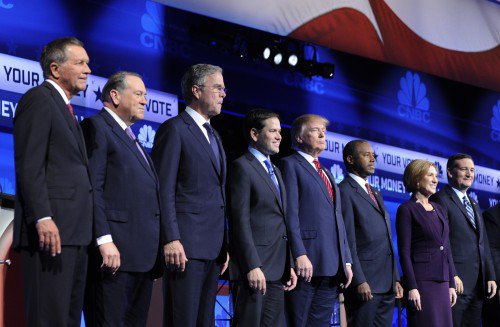
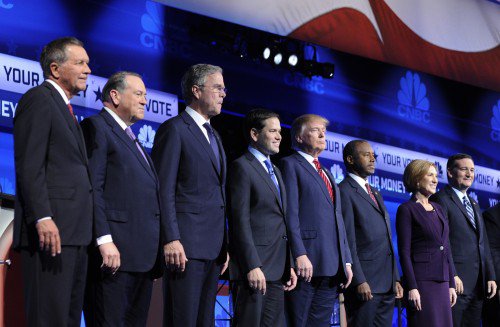
CNBC Republican presidential primary debate, October 28th 2015
The source of the debate transcript which follows is the New York Times, which is in turn as transcribed by the Federal News Service.


Participants
: Governor John Kasich, Governor Mike Huckabee, Governor Jeb Bush, Senator Marco Rubio, Mr. Donald Trump, Dr. Ben Carson, Mrs. Carly Fiorina, Senator Ted Cruz, Governor Chris Christie, and Senator Rand Paul.
Moderators: Carl Quintanilla, Becky Quick, John Harwood, Sharon Epperson, Rick Santelli and Jim Cramer.

….HUCKABEE: …I’ll tell you what a weakness is of this country: there are a lot of people who are sick and tired because Washington does not play by the same rules that the American people have to play by.

Hear, hear. Let’s see if the candidates propose concrete reforms that will ensure everyone has to play by the same rules. And as long as we’re using the analogy of a game, let’s hope that if one of these candidates are successful, they’ll also try to make sure that everyone gets to start out with at least roughly equivalent equipment: access to the same information as to how the game is played, a ball that can hold air, a tennis racket with all its strings in place, a pair of athletic shoes with intact soles, so that they have a chance to successfully compete with those who grow up receiving the best equipment money can buy.

RUBIO: …I would begin by saying that I’m not sure it’s a weakness, but I do believe that I share a sense of optimism for America’s future that, today, is eroding from too many of our people. I think there’s a sense in this country today that somehow our best days are behind us. And that doesn’t have to be true. Our greatest days lie ahead if we are willing to do what it takes now…

Many on Rubio’s side of the aisle are convinced that such things as high taxes, possible (they say inevitable) future insolvency of the Medicare system, illegal immigration, and over-regulation are what’s mainly holding America back and making us feel pessimistic about the future. While some of this might be true and especially for some people, I suspect that the seeming hopelessness of reforming our political system, bought and paid for through crony capitalism, corruptive campaign finance laws, and the revolving door between Washington and Big Finance / Big Business, informs American pessimism more than anything else. In short, we no longer feel like the government is of, by, and for the people. There are a few leading Republicans once again paying lip service to the idea that government could actually be a noble and worthy institution if we reform it. Yet the idea that now pervades the Republican party, that government is little else than a necessary evil and an inherently oppressive busybody, does not help in the least to inspire confidence or a feeling of civic unity and national (not nationalistic!) pride.

CARSON: ….we’re talking about America for the people versus America for the government.

…aaand there goes Carson, chiming in with that anti-government rhetoric. Maybe if those seeking to lead that government would identify it with the people, and in a hopeful and confident manner, portray it as capable of reform and of doing good instead of wishing it were so small and weak that it could be ‘drowned in a bathtub’ (a charming little Grover Norquist-ism) Americans would be better served, and the promise of the Constitution and the Bill of Rights could be more fully realized.

FIORINA: But I also think that these are very serious times; 75 percent of the American people think the federal government is corrupt. I agree with them. And this big powerful, corrupt bureaucracy works now only for the big, the powerful, the wealthy and the well-connected…. Ours was intended to be a citizen government

Now that’s a good start. Now let’s see if you want to keep government big enough to actually be useful. Remember, we started out with a small, weak government under the Articles of Confederation, and that didn’t work out so well, to say the least.

CHRISTIE: I don’t see a lot of weakness on this stage, quite frankly. Where I see the weakness is in those three people that are left on the Democratic stage. You know, I see a socialist, an isolationist and a pessimist. And for the sake of me, I can’t figure out which one is which.

I’m halfway with him on the isolationist part, but not militarily: I’m referring to the economic isolationism of protectionism, which removes vital opportunities for the improvement of human lives and for the exchange of ideas. That’s my primary complaint about Bernie Sanders, who appears an extreme and unapologetic protectionist, which is a deal-breaker for me. But more on that when I return to the Democratic debates.

HARWOOD: … You [Kasich] said yesterday that you were hearing proposals that were just crazy from your colleagues. Who were you talking about?

KASICH: Well, I mean …to talk about we’re just gonna have a 10 percent tithe and that’s how we’re gonna fund the government? And we’re going to just fix everything with waste, fraud, and abuse? Or that we’re just going to be great? Or we’re going to ship 10 million Americans — or 10 million people out of this country, leaving their children here in this country and dividing families?

Here, as in the previous debate, Kasich’s taking on the role of the realistic, practical, get-it-done politician, criticizing some of the extremist, crowd-pleasing, but impossible solutions offered by his rivals. Here, he’s challenging his fellow debaters to be responsible and accountable in their rhetoric, and to offer workable solutions, that hold up under scrutiny, for real problems, and not to pander to the reactionaries in the party.

FIORINA: Let me just say on taxes, how long have we been talking about tax reform in Washington, D.C.? …We now have a 73,000-page tax code. …There are loads of great ideas, great conservative ideas from wonderful think tanks about how to reform the tax code. The problem is we never get it done…

QUINTANILLA: You want to bring 70,000 pages to three?

FIORINA: That’s right, three pages …You know why three? Because only if it’s about three pages are you leveling the playing field between the big, the powerful, the wealthy and the well-connected who can hire the armies of lawyers and accountants and, yes, lobbyists to help them navigate their way through 73,000 pages.

Fiorina picks up on the analogy of the game here, and makes a very good point: if the tax code that everyone has to adhere to is too long and complex, it gives the wealthy an unfair advantage over average citizens who can’t afford to hire specialists to help navigate its requirements and discover obscure loopholes and tax breaks to take advantage of. Three pages sounds unrealistically short to me, and her claim that it’s now 73,000 pages sounds exaggerated, but her basic objection to the length and complexity of the current tax code is fair and reasonable. Our tax code should not automatically give any special advantages to the wealthy if we are truly dedicated to the principle of equal rights for all.

HARWOOD: ….[Governor Bush,] Ben Bernanke, who was appointed Fed chairman by your brother, recently wrote a book in which he said he no longer considers himself a Republican because the Republican Party has given in to know- nothingism. Is that why you’re having a difficult time in this race?

BUSH: (inaudible), the great majority of Republicans and Americans believe in a hopeful future. They don’t believe in building walls and a pessimistic view of the future.

The Know-Nothings, later called the American Party, was a political party in the mid-1800’s centered around anti-immigrant, anti-Catholic, pro-Protestant, nativist sentiments. While most mainstream Republicans might object to the comparison, it seems a fair one when leveled at many leaders of the Republican party prominently featured in the media today. For example, in response to the attacks in Paris, many leading Republicans predictably reacted with calls for an immediate halt in accepting Syrian refugees. They portray this as a common-sense, defensive policy to protect the American people from terrorists trying to sneak in among the refugees, but it appears to me that they’re jumping on this as they would any other excuse to keep Muslims and other non-white, non-wealthy, non-advanced-degree-holding people out. While it’s true that most terrorists around the world today are Muslim, it’s also true that the actual percentage of Muslims who actually are terrorists or who support terrorism is very small, that the Paris attacks were not carried out by Syrian nationals but by citizens of the E.U., and that the refugees they want to turn away are fleeing from the terrorists and other violent Islamist extremist groups. I compare keeping these refugees out, as I have compared deporting Mexican people who entered this country illegally to escape the drug war, to our old policy of keeping Jews out who were fleeing the Holocaust, forcing them to return at peril of their lives. If we really want to show the world a shining example of the nobility of our values and the strength of our commitment to them, I think we need to accept the risks that come with doing the right thing, and to do it anyway.

…. To be continued….

*Listen to the podcast version here or on iTunes

Ordinary Philosophy and its Traveling Philosophy / History of Ideas series is a labor of love and is ad-free, entirely supported by patrons and readers like you. Please offer your support today!

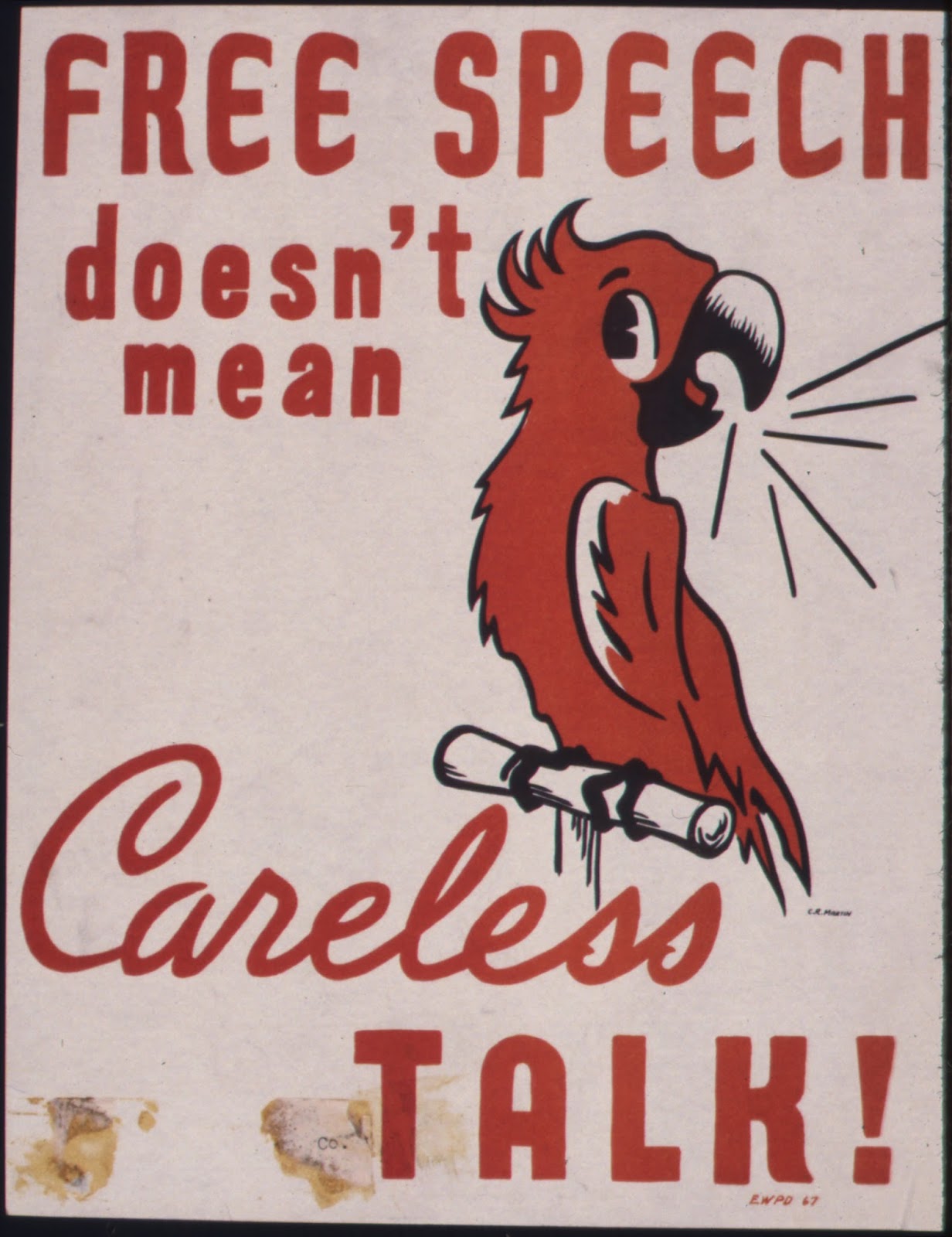
On Free Speech and Political Correctness: A Response to Lindy West

In reading a recent op-ed in The Guardian, ‘‘Political Correctness’ Doesn’t Hinder Free Speech – It Expands It’ by Lindy West, I was initially intensely annoyed.

Free speech, political correctness, and whether the two necessarily conflict are hot topics of debate at the moment, as they perennially are in this nation of ours. The right to freely express ourselves is foundational, among the first rights specified in our Constitution’s Bill of Rights, yet the full enjoyment of this right in our country was hard-won. It was only several decades ago that one could be prosecuted under the obscenity laws of the time for informing people about birth control and the workings of their own reproductive systems, for example, or for expressing certain political views (we now recall McCarthyism with a shudder). With a few exceptions mostly relating to public safety, any infringement of our right to free speech still has the power to make us fearful of that old, tried-and-true, oft-used method of social and political oppression.

My first impression of West’s piece was that it was yet another misguided liberal misapplying traditionally liberal values to make a perhaps well-intentioned, but ultimately illiberal argument.

When I re-read the piece, more slowly this time, I was still annoyed and in overall disagreement, but found myself at least sympathizing with some of her arguments, and in full agreement with others. As West points out, when people routinely hear derogatory, discriminatory, or insensitive remarks, even if relatively minor or unintentional, it can and does undermine their sense of confidence, dignity, and worth over time. And there are many groups in this country, such as black people, Jewish people, gay people, and religious minorities among others, who have had to deal with these slights as they struggle to get by in a historically racist, intolerant, and zenophobic country. It is incumbent on all of us, as West points out, to realize that the things we say have an effect other people, and therefore we should govern our tongues responsibly. We should strive to remain courteous and respectful in our speech, especially towards those who have suffered, and still do suffer, these slights and insults the most. And we should definitely call each other out when we are cruel, rude, or careless enough to use offensive language gratuitously.

Yet when it came to the central argument of her piece, the ‘silencing’ argument, she lost me. And when she went from disagreeing with to railing against Jonathan Chait, a columnist with New York Magazine who explains why he thinks free speech is being threatened on college campuses, to the extent that she accuses him, no, downright slanders him, of ‘imply[ing] that black Americans being shot in the streets by agents of the state are the real puppetmasters of an authoritarian regime’, she really lost me.

When West equates expressing disagreement with ‘silencing’, she makes me doubt that she has enough respect for the immense value of free speech, or grasps the true horror and dire ramifications of actual attempts to ‘silence’ it. She gives many example of what she considers ‘silencing tactics’: ‘white students parading around campus in blackface’, ‘telling rape victims that they’re “coddled”’, and ‘teaching marginalised people that their concerns will always be imperiously dismissed, always subordinated to some decontextualised free-speech absolutism’.

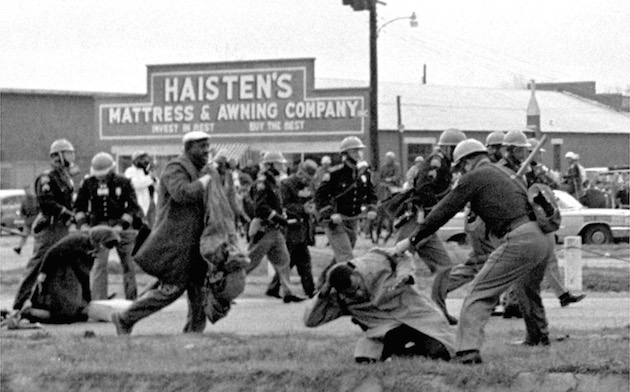
I just don’t agree that these things can be reasonably construed as ‘silencing’, not unless we stretch the meaning of the world out so broadly that it loses shape and force. Laws and regulations which threaten expulsion, arrest, and prosecution for expressing unpopular ideas are ‘silencing’ people. Police driving civil rights protesters from the streets with clubs, dogs, and fire hoses are ‘silencing’ people; the Cuban and North Korean governments’ imprisonment of political dissenters are ‘silencing’ people; issuing fatwas against Salman Rushdie and Ayaan Hirsi Ali are ‘silencing’ people; shooting Medgar Evers for his human rights activism and stabbing atheist bloggers and filmmaker Theo Van Gogh to death for their religious dissent are ‘silencing’ people. There’s a very real sense in which applying the term ‘silencing’ to any use of insensitive, politically incorrect, and offensive speech sounds like indulgent grandstanding that minimizes the horror of what people suffer when they are really being silenced. In that sense, the over-application of the term ‘silencing’ can be offensive in itself.

First, of course students putting on blackface for a Halloween party are doing the wrong thing; they are idiotically out of touch at best, or are behaving disgustingly, insultingly, even cruelly assholish at worst. Sometimes these sorts of behaviors, especially by bullies, may discourage some people from speaking out. But charging these misguided students with ‘silencing’ people? Since when? I’ve heard volumes of speech, free speech, vigorously criticizing this bad behavior, properly shaming people who are ignorant or jerkish enough to indulge in it. Second, I’m not sure if rape victims are generally accused of being “coddled” so I don’t know exactly what she’s referring to; I really hope she’s not equating this with any open discussion of rape without a ‘trigger warning’ preceding it. While some believe trigger warnings are appropriate in some circumstances, showing appropriate regard for the feelings of someone known to be wounded by past events, others believe that trigger warnings are intellectually insulting, implying that others are not strong or capable enough for open, honest, and challenging discussions of important issues. Third, reasoned debate over whether regulating forms of speech many people find offensive really promotes greater understanding and protects human rights is not the same thing as ‘imperially dismissing marginalized people’. And lastly, I don’t find that proponents of unfettered free speech routinely ‘decontextualize’ it either; rather, their arguments usually focus on the historical fact that suppression of free speech has always been a favored tool of social and political oppression (a very specific and important context) and therefore, we must protect this right at nearly all costs, even if people are sometimes offended and inconvenienced as a result.

When re-reading West’s article, a striking counterexample to her argument that political correctness expands free speech came to mind. As I write this, I’m also in the process of researching the life and thought of Frederick Douglass, the former slave who became one of America’s greatest antislavery activists and orators (this is for an upcoming O.P. Traveling Philosophy / History of Ideas series, stay tuned!). In his autobiographies, Douglass recounts the episode that he credits with setting the course of his life. When he was a child, his mistress thought it would be a good idea to teach him how to read, since he was companion and body servant to the young son of the household, and could thus aid in his education. When her husband came into the room and saw what she was doing, he stopped her, telling her in Frederick’s hearing, that ‘[he] should know nothing but how to obey his master …if you teach [him] how to read, there will be no keeping him. It would forever unfit him to be a slave…’ As Douglass tells it, this is the moment he realized the full inhumanity of the slave system, and learned exactly what he needed to do. Knowledge equals freedom, so he must learn to read and educate himself, at all costs. And not only does slavery inflict physical suffering and the loss of every kind of personal liberty, its most dehumanizing element is its reliance on forced ignorance, so that even the mind is completely subjected. In the end, it was precisely because Douglass heard his slaveowner express that cruel, offensive, and inhumane idea that he learned the truth and became the great man he was. And like Douglass, we must observe the effects of evil and hear its arguments if we are to combat it.

Of course, the flip side is true too: people free to express bad ideas influence and convince others to believe them. But, repressing speech rarely stops this: it just drives the ideas underground, to be shared in secret, shielded from the healthy and corrective criticism of public discourse. And as we can see from our vibrant history of ever-increasing freedom of speech, bad ideas that are subjected to vigorous and open public debate are refuted and ultimately rejected, one by one. While I think that bad ideas will always remain with us, I have much, much more faith that the market of ideas will weed out bad ones than repression will, again, as history has shown us. Name me one oppressive institution that has not been ultimately overthrown because of the power of speech, because people chose to liberate themselves through dissent, to offer better arguments than those of their ideological opponents and to back up them up with action, and I’ll gladly reconsider.

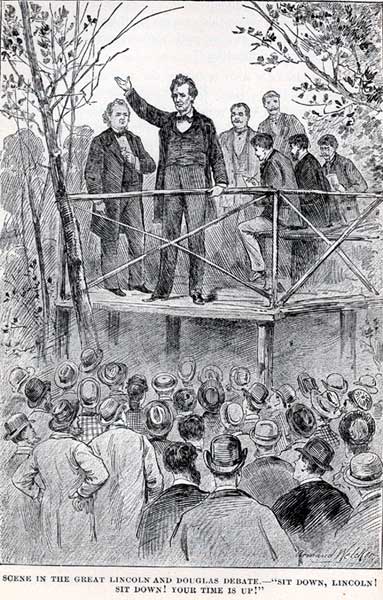
Unlike the case with guns, the only one who can defeat someone with a bad argument is someone with a better one. Only when speech is unfettered can it reveal its true power to liberate us from the grasp of bad ideas. The good ideas of Frederick Douglass ultimately triumphed over the bad ideas of Stephen Douglas, pro-slavery advocate whose series of heated exchanges with Abraham Lincoln were dubbed The Great Debate, because Douglass spoke out on the evils of slavery though it was contrary to mores and laws of his time. Likewise, we must rely on ourselves and on one another to overcome bad ideas by speaking out, as Erika Christakis recommends in the email that started the Yale free speech controversy, and not by co-opting the power of governing bodies to silence our ideological opponents for us.

*Listen to the podcast version here or on iTunes

*This piece is also published at Darrow

~~~~~~~~~~~~~~~~~~~~~~
Sources and inspiration:
Douglass, Frederick. ‘My Bondage and My Freedom.’, Mineola, NY: Dover, 1969, originally published 1855. https://books.google.com/books?id=b4aQY9jPkm0C&dq=My+Bondage+and+My+Freedom
West, Lindy. ‘Political correctness’ doesn’t hinder free speech – it expands it’. The Guardian, Nov 15th, 2015. http://www.theguardian.com/commentisfree/2015/nov/15/political-correctness-free-speech-racism

A Moral and Political Critique of the Democratic Primary Debates of 2015, Part 1

This is the second installment of my examination of the arguments presented by presidential primary candidates of both major parties. I began the series with selections from the second Republican debate (I decided to skip the first mostly because there are so many debates to consider, I thought I’d wait until the polls had settled in, so to speak, indicating the field of candidates more likely to succeed), and I continue here with the first Democratic one.

As with the first, the debate transcript selections are in red, and my own remarks in black. I leave out introductions, banter, moderator comments, lines which indicate audience response, some purely empirical claims, and other parts that don’t directly pertain to the political and moral ideas considered here. The parts I leave out are indicated, as usual, by ellipses.

From the CNN Democratic presidential primary debate, October 14th 2015

The source of the debate transcript which follows is the New York Times, at nytimes.com
Participants: former Governor Lincoln Chafee, former Governor Martin O’Malley, former Secretary of State Hillary Clinton, Senator Bernie Sanders, and former Senator Jim Webb
Moderators: Anderson Cooper, Dana Bash, Juan Carlos Lopez, and Don Lemon

COOPER: Welcome. I’m Anderson Cooper. Thanks for joining us….

WEBB: …You know, people are disgusted with the way that money has corrupted our political process, intimidating incumbents and empowering Wall Street every day, the turnstile government that we see, and also the power of the financial sector in both parties. They’re looking for a leader who understands how the system works, who has not been co-opted by it, and also has a proven record of accomplishing different things....

As you many remember from Huckabee’s comments in the first Republican debate examined here, mainstream Republican politicians are joining Democrats in denunciation of the corrupting influence of vast amounts of money flooding into the political system from a relatively few special interests and extremely wealthy individuals, and of the revolving-door relationships between our political institutions, lobbyist groups, and the finance industry. Many say that just because individuals and businesses freely decide to donate money, and that ex-politicians are routinely offered lucrative jobs by the same firms that lobbied them and donated to their campaigns, that doesn’t mean that they’re necessarily corrupted, guided by the will of their donors and potential employers instead of their constituents and their own best judgment.

But even if it’s true that most politicians are not purposefully corrupt, it’s already a well researched, well documented fact that gifts and donations have much more influence over one’s decisions than one might realize, even if one’s honestly trying not to let it happen. A few years ago, I read up on various studies of the ways that funding, gifts, and personal visits from sales representatives of pharmaceutical companies influence what physicians are more likely to prescribe and even worse, influence the outcome of clinical drug trials. And while the studies generally failed to find direct evidence that most researchers or physicians purposefully tailored their decisions or research to the financial interests of the funders, donors, or sales reps, the influence was clearly indicated, likely based on the unconscious desire to reciprocate real or perceive goodwill, and / or the bias in favor of perceived expertise. If you have a large amount of money to invest, or a team of sales reps with a convincing story to tell on your payroll, you have to know what you’re doing, right?

Human psychology being remarkably consistent, it’s nearly certain that politicians are subject to the same psychological phenomena. Lobbyists can be considered the political analogues of the sales reps, and donors the analogues of the research funders and pharmaceutical company gift-givers. And while the sales reps, lobbyists, funders, and donors may have good arguments, may be in the possession of good information, or may be driven by entirely noble motives, it’s still the case that their influence can crowd out other arguments, other evidence, and other interests which should have equal consideration.

COOPER: …Secretary Clinton …plenty of politicians evolve on issues, but even some Democrats believe you change your positions based on political expediency. You were against same-sex marriage. Now you’re for it. You defended President Obama’s immigration policies. Now you say they’re too harsh. You supported his trade deal dozen of times. You even called it the “gold standard”. Now, suddenly, last week, you’re against it. Will you say anything to get elected?

CLINTON: Well, actually, I have been very consistent. Over the course of my entire life, I have always fought for the same values and principles, but, like most human beings — including those of us who run for office — I do absorb new information. I do look at what’s happening in the world….

Clinton is right to point out that politicians, like all human beings, should remain ready and willing to learn, be open to new evidence, consider new and better arguments as they are presented, and be able to change their minds as warranted. Charges of ‘flip-flopping’ are often hurled at political candidates to portray their changes of mind as signs of dishonest maneuvering and weakness of will. But this isn’t always the case. A famous examples of a politician changing their mind on an important issue is Abraham Lincoln, who originally thought that preserving the political Union between the states took priority over the abolition of slavery. Another is Barack Obama, who originally thought that legal marriage should exclusively remain heterosexual, with civil union being an acceptable separate but equal institution for gay couples.

This being as it may, when a politician changes their mind, just like anyone else, it should be for very good reasons. And because they represent the people, they need to explain these changes of mind, to be open and honest to their constituents, especially when the change of mind might affect the voters’ choice of representative.

COOPER: Secretary Clinton, though, with all due respect, the question is really about political expediency. Just in July, New Hampshire, you told the crowd you’d, quote, “take a back seat to no one when it comes to progressive values.” Last month in Ohio, you said you plead guilty to, quote, “being kind of moderate and center.” Do you change your political identity based on who you’re talking to? 

CLINTON: No. I think that, like most people that I know, I have a range of views, but they are rooted in my values and my experience…

COOPER: Just for the record, are you a progressive, or are you a moderate?

CLINTON: I’m a progressive. But I’m a progressive who likes to get things done.

Clinton is not only representing herself as a practical politician, she’s making a larger point: while it’s important to be idealistic and to remain committed to one’s values, it’s also important to remember that if you can’t compromise when necessary, those ideals and those values will do no practical good because they’ll never be realized in public policy.

While I’m more than halfway with her on this, I still think we need a president, a Congress, and a Supreme Court who demonstrate a stronger commitment to a nobler political vision. With the notable exception of legalizing gay marriage, it’s been too long since our elected leaders exuded the moral strength necessary to lead us in accomplishing spectacular things like ending slavery, giving women the vote, establishing worker’s rights, instituting a New Deal, building a comprehensive and cutting-edge infrastructure, taking us to the moon. We’ve become cynical, expecting our politicians to squabble and block one another’s efforts at every turn while our infrastructure crumbles, healthcare costs soar, our middle-class dwindles, gun violence runs rampant, the earth warms as we continue to generate energy with old polluting technology, our education system becomes ever less effective, special interests take over our political system with enticements of massive amounts of money and cushy job offers, costly American military interventions take out bad leaders only to have worse ones rush in to fill the power gap, the war on drugs continues to fail while encouraging the rampant growth of violent cartels here and abroad, and more Americans are incarcerated than in any other nation.

As a result of this cynicism, too many of us have become hopeless and apathetic, staying away from the polls, content with venting our discontent and disillusion on social media. I’m not totally with those who hold a bleak view of the loss of civic engagement in our country: young people volunteer and donate at encouragingly high rates, and are vocal about their opposition to social ills such as racism, sexism, greed, violence, rampant incarceration, and so on. Still, if we care about doing the most good systematically and in the long run, I think it more important to begin with taking our political system back. A lot of the volunteering and donating is needed precisely because our political system is failing so many people.

COOPER: …Senator Sanders. A Gallup poll says half the country would not put a socialist in the White House. You call yourself a democratic socialist. How can any kind of socialist win a general election in the United States?

SANDERS: Well, we’re gonna win because first, we’re gonna explain what democratic socialism is. And what democratic socialism is about is saying that it is immoral and wrong that the top one-tenth of 1 percent in this country own almost …as much wealth as the bottom 90 percent. That it is wrong, today, in a rigged economy, that 57 percent of all new income is going to the top 1 percent…

COOPER: …You don’t consider yourself a capitalist, though?


SANDERS: Do I consider myself part of the casino capitalist process by which so few have so much and so many have so little by which Wall Street’s greed and recklessness wrecked this economy? No, I don’t. I believe in a society where all people do well. Not just a handful of billionaires….

For all Sander’s optimism on this point, socialism remains a hated word in the United States, and not for bad reasons. The largest socialist states of the 20th century did not act in the interests of their people as much as they acted in the interest of their leaders and their political ideology, with some exceptions. Yes, the Cuban health care system did and does better by their people, as a whole, than that of the United States: more people have access to good affordable health care, more people live healthier lives, and less people are financially ruined by a diagnosis of a serious disease. Yet the political rights of those in most socialist states are severely restricted if existent at all, and the average citizen remains relatively poor as their economies stagnate and the wealth and power are concentrated in the hands of a few. We can say the same historically of most modern socialist states, past and present: Cuba, the Soviet Union, China, East Germany, and so on.

However, here’s the key point about democratic socialism as Sanders describes it: all of those oppressive socialist states lack the ‘democracy’ element, even though it’s often part of the government’s official name. In those states, most people have no political voice or representation whatsoever, and their nations’ social, political, and economic systems are organized strictly along ‘top-down’ lines. A few political elites impose their will on the people unopposed, and any opposition is quashed with the justification that it was motivated by disloyalty ‘to the people’ or to the ‘dictatorship of the proletariat.’ Those that wield the power may describe lofty goals and proclaim that everything they do is according to the abstracted will of the people, but the actual people themselves are not allowed to participate in their own governance.

Democratic socialism is very different in principle and practice than socialism as commonly understood, if carried out as Sanders describes. Its public institutions are required to remain accountable to the people and its elected leaders subject to voter recall. It’s not a top-down system in the way authoritarian socialist regimes are for two reasons: there’s many points of view and sources of information that are brought to bear, not just the ideology of a single person or small political elite, and its policies and projects are implemented, constrained, and carried out by elected representatives and/or more directly by voters. Ostensibly, the democratic republican system we already have is this sort of government, but democratic socialists disagree because of the outsize influence of a few wealthy, powerful private interests. The reason why Sander’s party emphasizes ‘socialism’ in their name is because, they say, political systems dedicated more to individual liberty than to the well-being of its people inevitably fail in both.

In a market system, according to this view, the individual pursuit of profit will inevitably often work to the public’s detriment, whether or not individual capitalists have good or bad motives, because of the inherent incentives. Keeping an eye always on the bottom line keeps them off the plight of others, including that of the underpaid worker, or of the community’s lands being polluted, or those who can’t afford a necessary good or service (such as healthcare) because of price fixing, or the citizen who’s not being represented because of the money and influence that rigged the political system in the capitalist’s favor. Throughout history, both before and after regulations were put in place to protect the rights, health, and safety of citizens and the environment, there have always been a large percentage of capitalists who are greedy, who don’t care how the way they do business affects others, and they will always ruin it for everyone else, overrunning the system in their ruthlessness and making bad practice par for the course: exploiting those who need jobs but can’t find good ones, setting up grossly polluting factories wherever they’re not prevented from doing so, colluding with other businesses to fix prices and wages, forming monopolies, co-opting government to make laws in their favor, gambling in financial markets until they crash, and so on. And because these bad actors take over the system, other businesses must adopt these same bad practices in order to remain competitive and survive. That’s why, democratic socialists say, we need certain key goods and services to be controlled by public institutions that are accountable to the people, not just to the balance sheet, to investors, or the conscience (or lack thereof) of one individual.

Whether or not a well-run, truly democratic socialist state as would be more successful than a market-driven one remains to be seen. There are encouraging results in nations with mixed economies, such as the Scandinavian countries that Sanders hold up as his models, but the United States presents two important challenges these countries don’t face: it’s way more ideologically and ethnically diverse, and it’s way, way bigger. There are other much larger and more diverse countries who’ve nationalized a few but very important goods and services such as healthcare, like Canada and most modern European states, with very good results. Of course, they have their problems too, but that’s true of every system that has ever been devised. So the question’s not whether which system is perfect, it’s which one is better, and which one comes with a set of problems we find more tolerable to live with.

COOPER: We’re going to have a lot more on these issues. But I do want to just quickly get everybody in on the question of electability. Governor Chafee, you’ve been everything but a socialist. When you were senator from Rhode Island, you were a Republican. When you were elected governor, you were an independent. You’ve only been a Democrat for little more than two years. Why should Democratic voters trust you won’t change again?

CHAFEE: …I have not changed on the issues. I was a liberal Republican, then I was an independent, and now I’m a proud Democrat. But I have not changed on the issues…

COOPER: ….Senator Webb, in 2006, you called affirmative action “state-sponsored racism.” In 2010, you wrote an op/ed saying it discriminates against whites. Given that nearly half the Democratic Party is non-white, aren’t you out of step with where the Democratic Party is now?

WEBB: No, actually I believe that I am where the Democratic Party traditionally has been. The Democratic Party, and the reason I’ve decided to run as a Democrat, has been the party that gives people who otherwise have no voice in the corridors of power a voice….

I’ve been hearing the argument a lot: the Republican party is moving ever farther right, so the Democratic party feels compelled to keep moving more to the center in order to appear the moderate, reasonable choice. Clinton’s platform is the model of this, and it looks like Chafee and Webb agree. Sanders appears to be the one candidate who’s an unapologetic, leftist liberal.

COOPER: Senator Webb, thank you very much. Let’s move on to some of the most pressing issues facing our country right now…. We’re going to start with guns. The shooting in Oregon earlier this month, once again it brought the issue of guns into the national conversation. …Senator Sanders, you voted against the Brady bill that mandated background checks and a waiting period. You also supported allowing riders to bring guns in checked bags on Amtrak trains. For a decade, you said that holding gun manufacturers legally responsible for mass shootings is a bad idea. Now, you say you’re reconsidering that. Which is it: shield the gun companies from lawsuits or not?

SANDERS: …Let’s also understand that back in 1988 when I first ran for the United States Congress …I told the gun owners of the state of Vermont…, a state which has virtually no gun control, that I supported a ban on assault weapons. And over the years, I have strongly avoided [supported?] instant background checks, doing away with this terrible gun show loophole. And I think we’ve got to move aggressively at the federal level in dealing with the straw man purchasers. Also I believe, and I’ve fought for, to understand that there are thousands of people in this country today who are suicidal, who are homicidal, but can’t get the healthcare that they need, the mental healthcare, because they don’t have insurance or they’re too poor. I believe that everybody in this country who has a mental crisis has got to get mental health counseling immediately. 

Sanders is making the same argument here as most Republican candidates are now making, that when it comes to dealing with certain categories of gun violence, we should turn our focus to mental health and economic issues and away from gun control. While it’s true that there’s a lot of gun violence associated with mental illness and poverty, I think it’s a distraction. In fact, I don’t believe that Sanders and the Republicans would make this argument if they didn’t feel politically compelled to concoct some ad hoc justification for gun-friendly policies they ascribe to for other reasons. Even for people who believe in expansive rights to gun ownership, the fact that there’s far more gun violence in the United States than in all other first-world countries demands a more comprehensive explanation to be convincing.

So why don’t I buy the argument blaming lack of mental health care? For one thing, many or even most of the people known to have some kind of mental issue before the shootings were receiving treatment, or had access to it they were not availing themselves of, so far as I could tell from the news reports. In other cases, others only discover that people are violently mentally ill after they’ve shot up a theater or killed themselves. I agree wholeheartedly that everyone should have access to mental healthcare and to decent-paying jobs, and that it’s likely that gun violence would be somewhat mitigated if that were the case: some people’s mental illnesses would be discovered and hopefully successfully treated before resorting to violence, and others would be able to live in safer neighborhoods and stay out of the illicit drug trade, for example.

But all the free mental healthcare and jobs in the world will not solve the one problem that we all face when in comes to gun violence: when people have easy access to guns when they’re under the sway of some emotion, be it insanity, greed, anger, fear, excitement, zealotry, vengefulness, territorialism, or just carried away by the fun they’re having at the time, they are easily able to wreak death and destruction with the simple squeeze of a trigger, especially in a culture where guns are regarded as the best and only solution to so many problems. And other times, these deaths arise out of nothing more than sheer carelessness, ignorance, or bad luck while a gun was in hand. The trick is to mitigate the harm we can do each other out of the excesses of our variable human nature by limiting access to guns, and by changing our cultural attitudes to them. The former may very well lead to the latter.

COOPER: Do you want to shield gun companies from lawsuits?

SANDERS: Of course not. This was a large and complicated bill. There were provisions in it that I think made sense. For example, do I think that a gun shop in the state of Vermont that sells legally a gun to somebody, and that somebody goes out and does something crazy, that that gun shop owner should be held responsible? I don’t. On the other hand, where you have manufacturers and where you have gun shops knowingly giving guns to criminals or aiding and abetting that, of course we should take action.

COOPER: Secretary Clinton, is Bernie Sanders tough enough on guns?

CLINTON: No, not at all. I think that we have to look at the fact that we lose 90 people a day from gun violence. This has gone on too long and it’s time the entire country stood up against the NRA. The majority of our country supports background checks, and even the majority of gun owners do. Senator Sanders did vote … for this immunity provision. I voted against it. …It wasn’t that complicated to me. It was pretty straightforward to me that he was going to give immunity to the only industry in America. Everybody else has to be accountable, but not the gun manufacturers….

O’MALLEY: … here tonight in our audience are two people that make this issue very, very real. Sandy and Lonnie Phillips’… daughter, Jessie, was one of those who lost their lives in that awful mass shooting in Aurora. …A man had sold 4,000 rounds of military ammunition to this — this person that killed their daughter, riddled her body with five bullets, and he didn’t even ask where it was going. And not only did their case get thrown out of court, they were slapped with $200,000 in court fees because of the way that the NRA gets its way in our Congress…

While I laud the principle of personal responsibility of individual gun purchasers that seemingly informs the argument against increased liability for gun companies, it also has a serious practical downside: it removes one extra layer of protection for the public when gun manufacturers and sellers are not sufficiently motivated to ensure they operate reliably and have enough safety features, and to choose not to sell guns to people they have reason to believe won’t be a responsible sellers or owners. And, of course, it fails to apply the principle of personal responsibility to the gun manufacturers and sellers. Perhaps if everyone, not just the gun owners, but everyone involved was faced with the prospect of having to take responsibility for their part in contributing to gun violence, it would be substantially reduced.

I’ve offered a suggestion before that may sound oddly anachronistic, based as it is on the actual wording of and history behind the Second Amendment, but hear me out. The text of the Second Amendment reads: ‘A well regulated Militia, being necessary to the security of a free State, the right of the people to keep and bear Arms, shall not be infringed.’ When we read this, we tend to mentally cast aside the militia part, since originally the Second Amendment was informed by the infant United States’ aversion to the institution of a standing army, relying on state militias instead, which is no longer the American system of defense. However, if the right to gun ownership was contingent on belonging to a militia, or to modern equivalents such as the military, its reserves, and police forces, than all lawful gun owners would be, if the institution was well-regulated as it should be, publicly accountable and suitably trained. Maybe, then, a literal reading of the actual wording of the Constitution can offer a solution to our dilemma. As written, the phrase ‘the right of the people to keep and bear Arms’ is a subordinate clause to ‘A well regulated Militia’. So maybe we should likewise subordinate the right to keep and bear arms to whether one does belong to a modern equivalent of a militia.

SANDERS: …We can raise our voices, but I come from a rural state, and the views on gun control in rural states are different than in urban states…

O’MALLEY: …Senator, it is not about rural — Senator, it was not about rural and urban …We were able to pass this [in Maryland] and still respect the hunting traditions of people who live in our rural areas….

WEBB: …We need to keep the people who should not have guns away from them. But we have to respect the tradition in this country of people who want to defend themselves and their family from violence…

The right to self-protection is emphasized the most, on both sides, in arguments about gun rights, with the possible exception of deterrence, emphasized by many conservatives. I have serious doubts about both of these, mostly based on lack of evidence in its favor. We have higher gun ownership rates than most countries in the world, yet we have higher levels of gun violence. Even controlling for cultural attitudes (such as in Canada, which also has a high level of gun ownership rates but much lower levels of gun violence), we should see a general, consistent correlation over time and place between high levels of gun ownership and low levels of violence. Yet when we compare the United States with other countries, and we compare states with each other, we find that higher levels of gun ownership almost always correlate with higher levels of gun violence. There are a few exceptions, such as Germany and South Dakota, but when these are the exception rather than the rule, the explanation is almost certainly to be found elsewhere.

So, if protection of the life of citizens is the goal, it is not accomplished by instituting policies which usually lead to more deaths. I think, again, the real reasons so many Americans cling to the right to own guns have entirely to do with cultural and historically based norms.

I’ll go ahead and end this first critique of the Democratic debates here. In the next installment, I’ll skip the foreign policy part of this debate since it’s covered more thoroughly in a later one, and pick back up where the discussion turns to civil rights issues and the Black Lives Matter movement.

To be continued….

* Listen to the podcast reading of this piece here or on iTunes

A Moral and Political Critique of the Republican Primary Debates of 2015, Part 1

As have many Americans, no doubt, I put on the Presidential primary debates of both parties mostly as background entertainment while I was doing chores, at least at first listen. Yet it occurred to me that it might be fruitful to sit down and take some time to really consider the arguments. Yes, we’re all a bit cynical these days, it seems, and it’s easy to wonder: why bother? Aren’t all of these presidential hopefuls just corporate shills and lapdog ideologues of the powers that be anyway?

Be that as it may (and I doubt that’s the case for all or most of them, at least not fully, though I agree that the financial incentives in the current political structure are corruptive to say the least), many of these arguments win over or enrage a lot of people, and it seems important to understand why and how. After all, we’re still, ostensibly, a democracy, and we all still have to live together in this country. Why not make the effort to better understand the strengths and weaknesses of the arguments that pit citizens against one another, uniting people within factions while dividing the nation as a whole?

So here’s a critique of arguments offered in recent Republican primary debates; I’ll do the same with the Democratic debate(s) soon as well. The debate transcript selections are in red, and my own remarks in black. I leave out introductions, banter, moderator comments, lines which indicate audience response, some purely empirical claims, and other parts that don’t directly pertain to the political and moral ideas considered here. The parts I leave out are indicated, as usual, by a series of ellipses.

From the Fox News / Facebook Republican presidential primary debate, August 6th 2015

The source of the debate transcript which follows is Time.com
Participants: Donald Trump, Governor Jeb Bush, Governor Scott Walker, Senator Marco Rubio, Governor Chris Christie, Dr. Ben Carson, Senator Rand Paul, Senator Ted Cruz, and Governor John Kasich.
Moderators: Fox News anchors Bret Baier, Megyn Kelly and Chris Wallace.

KELLY: It is nine p.m. on the East Coast, and the moment of truth has arrived….

Great, truth, let’s hear it!

…Mr. Trump, one of the things people love about you is you speak your mind and you don’t use a politician’s filter. However, that is not without its downsides, in particular, when it comes to women.

You’ve called women you don’t like “fat pigs, dogs, slobs, and disgusting animals.” …. You once told a contestant on Celebrity Apprentice it would be a pretty picture to see her on her knees. Does that sound to you like the temperament of a man we should elect as president…?

TRUMP: I think the big problem this country has is being politically correct. …I’ve been challenged by so many people, and I don’t frankly have time for total political correctness…

I agree with Trump on one thing: political correctness can be a problem in public and political discourse, and I think our ‘outrage culture’ has gone too far in sanitizing what we could and should be able to say, both publicly and privately, and especially in education. Some of the outrage and sensitivity comes from a good place, the concern that, through offensive speech, we can harm one another, act as bad influences on one another, and perpetuate our own bad habits of thought. These are true. But it’s also true that speech is necessary for confronting and addressing ideas honestly, whether they be good or bad. For example, sexuality and gender issues, like all else, are all part of the human story that can and should be told, and humor, banter, and in-your-face crudeness are some of the valid ways in which we address them. Trump may consider himself a harmless participant in all that.

But we can and should consider what people say when we make judgments about people, especially when we’re choosing our representatives in government. In a free society, we all decide if someone who regularly makes remarks that disparages women as thinking beings and gauges their worth based on sexual attractiveness to men is the sort of person we think best represents the American people and their core values. And as we’ve already considered, the words we use, and especially that influential people use, can go a long way in determining how a society thinks and acts. Besides, do we really want to elect a person who makes such nasty remarks about the daughters, sisters, wives, and mothers of other people, which we wouldn’t tolerate directed to our own, to the highest office in the land?

So let Trump freely say what he wants to say. If Trump sounds like an asshole when he talks about women or anything else, that’s very useful information he’s providing. In the end, the people will decide if what he reveals about himself shows he’s worthy and capable of representing the rest of us on the national and international stage.

…WALLACE: Governor Huckabee, like Governor Walker, you have staked out strong positions on social issues. …You favor a constitutional amendment banning abortions, except for the life of the mother. …

HUCKABEE: Chris, I disagree with the idea that the real issue is a constitutional amendment. …I think it’s time to do something even more bold. I think the next president ought to invoke the Fifth, and Fourteenth Amendments to the constitution now that we clearly know that that baby inside the mother’s womb is a person at the moment of conception. The reason we know that it is is because of the DNA schedule that we now have clear scientific evidence on. And, this notion that we just continue to ignore the personhood of the individual is a violation of that unborn child’s Fifth and 14th Amendment rights for due process and equal protection under the law

The glaring assumption in this argument, of course, is that possessing a unique sequence of human DNA is equal to personhood. But so far as I know, neither American law nor its parent British law has ever established such a thing. Historically, legal personhood has been linked to the assignation of roles and responsibilities, and in modern times rights, to independently living, breathing human beings. Most spiritual and religious traditions have also equated breath and life throughout history, including the scriptures of Judaism and Christianity. It may very well be the case, with the advances we’ve made in medical science, that it’s time to reevaluate the concept of legal personhood. People who can no longer breathe on their own or otherwise survive naturally can be kept alive through extraordinary means, sometimes with their cognitive abilities intact or capable of restoration, and fetuses in the later stages of development are now usually viable and possess most or all of the mental capacities of newly born, healthy infants.

But linking personhood to DNA is a very recent and I would say extreme innovation, and as yet no federal court has recognized this linkage, to my relief. The science of human reproduction reveals that it’s a complex process, rife with false starts (it’s widely estimated that well over half of all human conceptions fail to result in healthy live births). To assign personhood to every human conception would overturn centuries of very good legal precedent which does not concern itself too much with assigning rights and responsibilities to human organisms in the earliest and not yet determinate stages of development. Instead, it does and should concern itself first with the protection of the rights and responsibilities of individual human beings who we know already possess the attributes traditionally assigned to legal persons: viability without radical intervention and/or evidence of consciousness. Recent attempts to enforce laws based on DNA-based personhood have reduced pregnant and potentially pregnant women too close to the legal status of mere incubators.

…KELLY: Governor Kasich, You chose to expand Medicaid in your state …[and] defended your Medicaid expansion by invoking God, saying to skeptics that when they arrive in heaven, Saint Peter isn’t going to ask them how small they’ve kept government, but what they have done for the poor.

KASICH: …we’re treating [drug addicts] and getting them on their feet. And …the working poor, instead of them having come into the emergency rooms where it costs more, where they’re sicker and we end up paying, we brought a program in here to make sure that people could get on their feet. And do you know what? Everybody has a right to their God-given purpose….

It’s a relief from time to time to hear an American politician on the Christian right who remembers, if only occasionally, what the Christian religion was originally all about, and what it’s still all about at its best: eschewing greed and helping others. The Ayn-Rand, Gordon-Gecko brand of ‘nothing personal, it’s just business’ ethics, equating selfishness and relentless personal enrichment with ‘personal responsibility’, is not traditional; it’s another very recent innovation, though not so recent as the unique human DNA = personhood one. The early Christians were the original socialists, though their government was not linked to the civic one, and the only enforcer of their laws was, according to the New Testament, God himself. The Acts of the Apostles tells the story of Ananias and Sapphira, who hid some of their wealth from their Christian community which required the sharing of all resources. When Paul calls them out on their deception, God strikes them dead.

If I heard more conservative Christian politicians declare publicly that while they don’t believe the government should interfere, it’s still a grave sin for people to spend their money on lavish lifestyles for themselves when their employees are underpaid and so many others go without healthcare and other basic necessities, I’d be inspired. If I heard their voices crying in the wilderness of this self-centered, hyper-materialistic society we’re creating that it’s wrong to hoard money in tax shelters, depriving their fellow citizens, including the military and its veterans, of lawful tax revenue, I’d listen and admire. What would the God of the Acts of the Apostles think of such deception? But it still appears clear that those who benefit most from tax loopholes are the ones funding most of these ‘pro-business’ politicians and giving them lucrative private sector jobs when they’re done. In such an environment, these politicians rarely proclaim that they believe Business, just like everyone else, should conduct itself according to principles that the biblical Jesus spent most of his time talking about.

….WALLACE: Gentlemen, we’re turning to …the issue of immigration. Governor Bush, …I want to ask you about a statement that you made last year about illegal immigrants. And here’s what you said. “They broke the law, but it’s not a felony, it’s an act of love. It’s an act of commitment to your family.” Do you stand by that statement and do you stand by your support for earned legal status?

BUSH: I do. I believe that the great majority of people coming here illegally have no other option. They want to provide for their family But we need to control our border… We need to be much more strategic on how we deal with border enforcement, border security. We need to eliminate the sanctuary cities in this country. It is ridiculous and tragic that people are dying because of the fact that — that local governments are not following the federal law. …I hope to be that president — will fix this once and for all so that we can turn this into a driver for high sustained economic growth. And there should be a path to earned legal status…

Sadly, this is not the first time people have been driven to our borders as political and economic refugees. In times past, we turned them away, and as they had no opportunity to enter illegally, their ships were forced to return, and they died in the Holocaust. In that case, I believe those fleeing to our country would have been justified in breaking the law, as their right to sustain their own lives trumped all. As Bush pointed out, the situation is not that different for many illegal immigrants. Our policies help perpetuate the drug war ravaging so many of the countries south of our border and our own citizens are the eager customers of the murderous cartels, and while we might point out that it’s their governments’ responsibility to protect them, not ours, that makes no difference when it comes time to choose, to try and make a safe and decent life for themselves and their children.

But Bush is not correct in claiming that people are dying specifically because sanctuary cities are not targeting illegal immigrants for arrest. The relatively few people who are the victims of crime at the hands of illegal immigrants are suffering because some people do wrong, whatever their citizenship status. Later in this debate, in remarks I leave out for the sake of space, Trump, Cruz, and Carson offer anecdotes of conversations had with Border Patrol agents and other officials as ‘proof’ that illegal immigrants are bringing unprecedented waves of crime with them, a very poor type of evidence compared with the official arrest and crime records which contradict their claims. If Bush, Trump, Cruz, Carson, and others want to make the argument that ‘sanctuary cities’ should do more to arrest illegal immigrants as a crime prevention measure, than for consistency’s sake they would need to argue in favor of also rounding up American citizens too, since they’re the ones committing violent crimes at higher rates.

It seems that we would do more to reduce crime and violent deaths across the board by reducing the incentives and opportunities which lead to them. We should change our drug policies, decriminalizing many drugs, replacing our prohibition system with sensible regulation and treatment options. And we should stop allowing guns to flood our country, making it all too easy for the depraved, the violent, the angry, the untrained, the mentally ill, the depressed, the clumsy, and the just plain unlucky to kill each other and themselves.

KELLY: Alright, gentlemen, we’re gonna switch topics now and talk a bit about terror and national security. Governor Christie. You’ve said that Senator Paul’s opposition to the NSA’s collection of phone records has made the United States weaker and more vulnerable….

CHRISTIE: When you actually have to be responsible for [prosecuting, investigated, and jailing] terrorists, you can do it, and we did it, for seven years in my office, respecting civil liberties and protecting the homeland….

PAUL: …I want to collect more records from terrorists, but less records from innocent Americans. The Fourth Amendment was what we fought the Revolution over! John Adams said it was the spark that led to our war for independence, and I’m proud of standing for the Bill of Rights…

CHRISTIE: …You know, that’s a completely ridiculous answer. “I want to collect more records from terrorists, but less records from other people.” How are you supposed to know, Megyn?

PAUL: Use the Fourth Amendment! …Get a warrant! …Here’s the problem, governor. You fundamentally misunderstand the Bill of Rights. Every time you did a case, you got a warrant from a judge. I’m talking about searches without warrants …indiscriminately, of all Americans’ records….

It’s always interesting to me when people who describe themselves as proponents of ‘small government’ become ardent defenders of big, intrusive government when it comes to certain pet causes. I agree with Paul here: one of the strengths of our system is that there are mechanisms built into our laws, at least ostensibly, to keep government accountable to its people. Obtaining a warrant before gathering information on citizens is one great way to accomplish this, and to show the world that we actually mean it when we claim to believe in a government of laws that’s accountable to its free citizens. And let’s not forget: amassing one massive, centralized database of the communication of private citizens provides an irresistible target for those who would want to hack into and steal such a gold mine of information, be it for political power, business, or terror.

… KELLY: Senator Cruz …you asked the chairman of the joint chiefs a question: “What would it take to destroy ISIS in 90 days?” He told you “ISIS will only be truly destroyed once they are rejected by the populations in which they hide.” …

CRUZ: Megyn, we need a commander in chief that speaks the truth. We will not defeat radical Islamic terrorism so long as we have a president unwilling to utter the words, “radical Islamic terrorism”. …When I asked General Dempsey, the chairman of the joint chiefs, what would be required militarily to destroy ISIS, he said there is no military solution. We need to change the conditions on the ground so that young men are not in poverty and susceptible to radicalization. That, with all due respect, is nonsense.

KELLY: You don’t see it as…an ideological problem — an ideological problem in addition to a military one?

CRUZ: Megyn, of course it’s an ideological problem …Let me contrast President Obama, who at the prayer breakfast, essentially acted as an apologist. He said, “Well, gosh, the crusades, the inquisitions–” ….

Cruz is right insofar as it’s an ideological problem, but not necessarily in the way he means. People are prone to be inspired and radicalized by ideology, and right now, there’s an influential brand of Islam that inspires its followers to do violence in its name. But waging war, especially in the opponent’s territory, doesn’t solve this problem; it doesn’t tend to make one’s ideological enemies wave the white flag right off the bat. It tends to do the opposite, to inflame patriotism on all sides, especially for citizens and sympathizers of the country that’s been ‘defiled’ by ‘outsiders’ breaching its borders. Young men, especially single and without families, have always been most susceptible to this. And a cause like ISIS, which promises salvation through glorious martyrdom, is an irresistible draw to people of certain temperaments and beliefs, and especially to those who have not made their own lives meaningful to themselves in some other way. History is rife with examples of this, the original Muslim conquests, the Inquisition, and the Crusades all included.

A policy which encourages a backlash of more martyrdom-seeking looks like the strategy of defeating the mythical Lernaean Hydra by cutting off heads as fast as you can, knowing all the while this causes twice as many to grow in their place. We would probably do better by other means, such as helping other Muslims defeat them, or by capturing their leaders and putting them on trial, showcasing them as criminals and murderers and not noble defenders of a worthy cause. While Obama may err sometimes on the side of political correctness, it’s clear from the context that his goals (and they are worthy ones) are to avoid stirring up more religiously-motivated hatred, and to reduce the use of religious- and ideologically-charged rhetoric that self-proclaimed holy warriors can use as recruitment tools.

…  KELLY: Dr. Carson, in one of his first acts as commander in chief, President Obama signed an executive order banning enhanced interrogation techniques in fighting terror. As president, would you bring back water boarding?

….CARSON: Alright. You know, what we do in order to get the information that we need is our business, and I wouldn’t necessarily be broadcasting what we’re going to do

This is a silly remark in the information age we live in. If government agents torture people, we all find out at some point, and not only does it undermines our credibility when we do it in secret, we cede the moral high ground. We’ve made the moral decision, along with most of the civilized world, that we no longer believe in using tactics that are so brutal and corrosive to respect for human dignity. How can we hold ourselves up as an example to the world while resorting to tactics we’ve declared wrong to use on our own people when it suits our purposes? And, of course, our willingness to resort to torture is yet another recruitment tool for ‘holy warriors’ and provides them with the justification they want to torture captured Americans.

CARSON: We’ve gotten into this — this mindset of fighting politically correct wars. There is no such thing as a politically correct war. …And I’ve talked to a lot of the generals, a lot of our advanced people. And believe me, if we gave them the mission, which is what the commander-in-chief does, they would be able to carry it out. And if we don’t tie their hands behind their back, they will do it extremely effectively…

If he means that torture is more effective than other means of extracting information, than he’s just empirically wrong. It’s been shown time and time again that people being tortured, just like people under other kinds of duress, will tell you whatever they think you want to hear. Look at the history of torture and how often torturers got people to confess to the most ridiculous and unbelievable things, such as trafficking with the Devil and casting spells to kill neighbors’ cattle. Not to mention the huge amount of data we have on coercive interrogation techniques in law enforcement, which we’ve come to discover has led to unacceptably high rates of false convictions.

BAIER: …Now, broadly, ..the size of government is a big concern … But year after year, decade after decade, there are promises from Republicans to shrink government. But year after year, decade after decade, it doesn’t happen. In fact, it gets bigger, even under Republican politicians. …Is the government simply too big for any one person, even a Republican, to shrink?

HUCKABEE: It’s not too big to shrink. But the problem is we have a Wall Street-to-Washington access of power that has controlled the political climate. The donor class feeds the political class who does the dance that the donor class wants. And the result is federal government keeps getting bigger.

True, Huckabee, that’s true of the revolving door, of the tendency of many of the wealthiest to co-opt the power of the federal government to promote their special interests. If Republicans were generally even a little less willing than Democrats to keep money flooding into politics from special interests, equating dollars with speech, I might believe he’s on the right stage. As of yet, it’s only been a relatively few libertarian-leaning candidates, and John McCain, who’s consistently, openly criticized the Republican party and called for its reform on this account.

…. HUCKABEE: And I’m still one who says that we can get rid of the Internal Revenue Service if we would pass the Fair Tax, which is a tax on consumption rather than a tax on people’s income, and move power back where the founders believed it should have been all along.

The so-called Fair Tax system is an interesting idea overall: it has a built-in system of basic welfare, which delivers on the claim that we value equal opportunity; it taxes consumption, which might significantly curb the environmental effects of industry; the code itself is simpler, increasing transparency and making the ordinary citizen more or less as able as the wealthy to navigate it without the help of professionals; and it’s progressive in one sense, in that people with less money, up to a point, end up paying less. It has some big problems as its currently formulated, such as: the excess money of the wealthiest people, who couldn’t spend most of it even if they tried, would not be taxed and would therefore fail to generate much-needed public revenue; it would be more difficult to enforce, especially when it comes to services; capital gains would not be taxed, encouraging investment in what Joseph Stieglitz calls ‘rent-seeking’ over innovation and the creation of useful goods and services; and its doesn’t have any disincentives that I could find for the kinds of financial speculation that so often brings down our economy. If the Fair Tax system underwent some pretty thorough reforms to solve some of these problems, I might become a proponent myself.

…BAIER: Dr. Carson, do you agree with that?

CARSON: What I agree with is that we need a significantly changed taxation system. And the one that I’ve advocated is based on tithing, because I think God is a pretty fair guy. And he said, you know, if you give me a tithe, it doesn’t matter how much you make

Carson, by contrast, advocates a flat tax, which is a deeply unfair system if there ever was one. $1 out of every $10 is a crushing burden to a poor person, but can have little to no impact on the quality of life of a wealthy person. And even if he wanted his Christian beliefs to inform our tax laws, there’s no evidence that the Judeo-Christian God would advocate a flat tax anyway. While tithing was a common charitable religious practice for the Jews as it was for other traditions, two remarks of the biblical Jesus express a different view of what the just person should contribute. In one parable, he dismisses the large charitable donations of the rich while praising an old women who gave only a tiny amount, because it was nearly everything she had. In another place, he said, ‘For unto whomsoever much is given, of him shall be much required’. Instead of proportionality, he valued the contribution according to the generous spirit with which it was given, and how much was given compared to how much one received in life. In this sense, Jesus could be considered a critic and advocate of reform of the old practice of tithing, just as he was of many other practices of his time.

KELLY: The subject of gay marriage and religious liberty. Governor Kasich, if you had a son or daughter who was gay or lesbian, how would you explain to them your opposition to same-sex marriage?

KASICH: Well, look, I’m an old-fashioned person here, and I happen to believe in traditional marriage. But I’ve also said the court has ruled … And guess what, I just went to a wedding of a friend of mine who happens to be gay. Because somebody doesn’t think the way I do, doesn’t mean that I can’t care about them or can’t love them. …I think the simple fact of the matter is …we need to give everybody a chance, treat everybody with respect, and let them share in this great American dream that we have….

Well said, a succinct and plain-spoken defense of the American value of pluralism and of the rule of law, the latter of which can be extended to protect people who had previously, and unjustly, been denied its protection.

…BAIER: Governor Huckabee, the culture of the American military is definitely changing. Women are moving into combat roles. Don’t Ask, Don’t Tell has obviously been dropped. And now Defense Secretary Ashton Carter recently directed the military to prepare for a moment when it is welcoming transgender persons to serve openly. As commander in chief, how would you handle that?

HUCKABEE: The military is not a social experiment. The purpose of the military is kill people and break things. It’s not to transform the culture by trying out some ideas that some people think would make us a different country and more diverse. The purpose is to protect America

The American military has been de-segregated and liberalized many times over the centuries, to it and the nation’s benefit. While its primary purpose to to fight wars and defend the homeland, its also a powerful symbol of how we conduct ourselves among the nations of the world. For example, when black soldiers were treated shamefully in the barracks, on the battlefield, and at home despite their heroism, the injustice of the differential treatment really sank in for the American people, and the civil rights movement first gained its real traction as a result. But the military is not only a symbol, it’s our national defense, and as such, should represent who we are as a people. And whether some individuals like it or not, we are, as a people, men, women, black, white, brown, straight, gay, and transgender.

KELLY: …In our final moments here together, we’re going to allow the candidates to offer their final thoughts. But first, we want to ask them an interesting closing question from Chase Norton on Facebook, who wants to know this of the candidates: “I want to know if any of them have received a word from God on what they should do and take care of first.”

….KASICH: …You know, today the country is divided. …We’ve got to unite our country again, because we’re stronger when we are united and we are weaker when we are divided. And we’ve got to listen to other people’s voices, respect them …because of how we respect human rights, because that we are a good force in the world, [the Lord] wants America to be strong. …And nothing is more important to me than my family, my faith, and my friends.

Again from Kasich, he is honest about his beliefs, but succinct: he places the focus of his answer on solving the political matter at hand, and expresses a commitment to the law and to human decency, which all Americans can unite behind, regardless of whether his religious beliefs cause him to disagree personally on specific matters. This is the right tone to take when you run for the presidency of a pluralistic society dedicated to freedom of belief. Carson took the same tone in answer to this question. The rest of the candidates made comments that mostly sounded religiously divisive to me, more like preachers and less like public officials.

….KELLY: Thank you all very much, and that will do it for the first Republican primary night of the 2016 presidential race. Our thanks to the candidates, who will now be joined by their families on stage.

To be continued….

* Listen to the podcast reading of this piece here or on iTunes
* A nearly identical version is also published as a guest post at The Moderate Voice.

Mary Wollstonecraft, Champion of Reason, Passionate in Love

The life and work of Mary Wollstonecraft, mother of modern feminism, can seem to reveal a mass of contradictions.

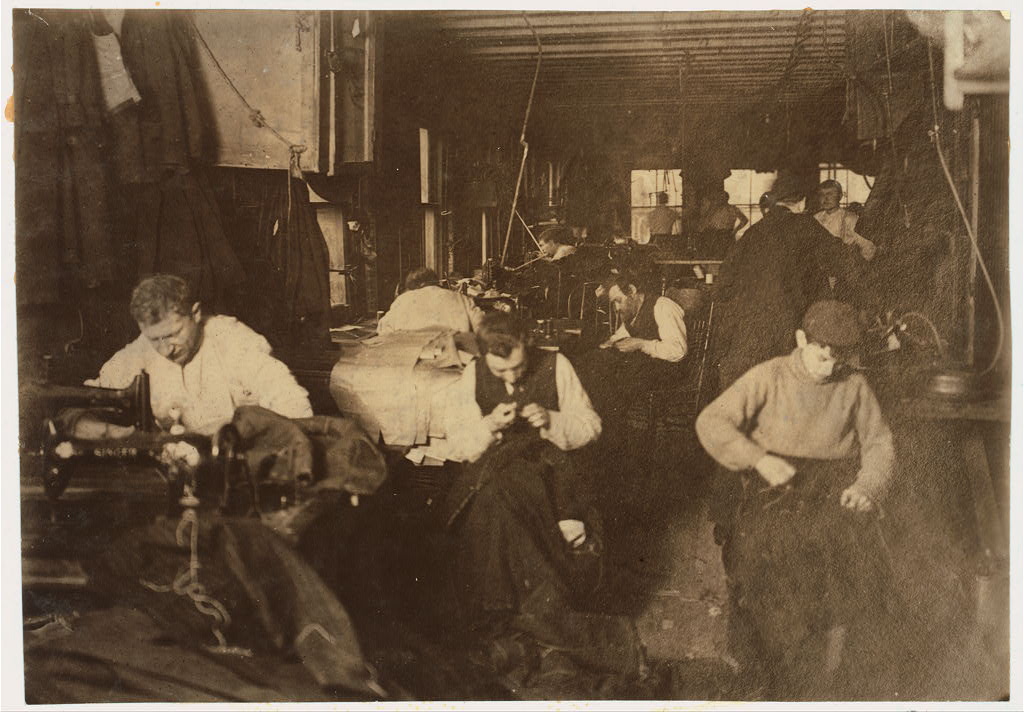
Her seminal feminist work, A Vindication of the Rights of Woman, champions reason as the ultimate guide for a moral and productive life. She used reason to great effect to show why women should, and how they could, grow out of their socially constructed roles as under-educated coquettes and household drudges. She believed that reason should rule both individuals and societies because it’s the best tool we have to achieve justice and to perfect the self. Without reason, she thought, human beings are ruled by narrow self-interest, by prejudice born of ignorance, and by crude lust.

Yet the life Wollstonecraft chose to live was widely criticized both during her lifetime and over the two hundred plus years since her death. It’s not just because she didn’t conform to the mores of her time; her life choices are still considered unreasonable and even self-destructive by many. At times, they made her an object of scandal, impoverished, or deeply depressed, even in such desperate straits that she twice attempted suicide. That’s because she was also deeply passionate, devoted to retaining her personal and mental freedom while abandoning herself to loves which never failed to break her heart, be they revolution, family, friend, or lover. For Wollstonecraft, reason and passion are not opposites: they are two sides of the same coin. A truly reasonable person, she thought, is kind, affectionate, and generous as well, and a passionate lover of justice, truth, and beauty.

Wollstonecraft’s chosen role for herself was, first and foremost, a teacher, an advocate of knowledge and instiller of reason. While teaching was one of the few professions open to her as an eighteenth-century woman from a respectable but impoverished background, she brought her formidable powers of reason to bear on the problems with many of the educational and child-rearing practices of her day. After her first job as a companion, she became a teacher, first in the classroom at a school she founded with two of her sisters and her best friend, and then as a governess. When she became a mother twice over in her mid- and late thirties, she was a tender and hands-on mother, an advocate of breastfeeding and attentive parenting in an era of wet-nurses and governesses, when wealthy and middle-class parents participated relatively little in the care and instruction of their children even from infancy.

Her first book, Thoughts on the Education of Daughters, opens with her parenting advice and argues that girls should be taught how to run a household while also learning self-sufficiency. In Wollstonecraft’s time, women were not expected to support themselves; they were trained to raise a family, learning how to catch and keep a man first, to be household managers second, and to be educators of young children third. Single women, widows, and married women whose husbands, fathers, brothers, and other male relations could or would not support them had few employment options available to them, mostly directly related to one of the three roles they were trained for. Those jobs that women could respectably accept paid very little, so those working women nearly always lived a life of subservience and privation. Modern feminist thought, until very recently, equated domestic life with that housebound, nearly choiceless life most women were required to live. However, now that women’s basic moral right to self-determination has become so widely established, most have come to consider a domestic-centric life just as valid a choice for free women as a professional or public life. So in this sense, Wollstonecraft’s view of women was more progressive even than that of many modern feminists, even if by accident rather than foresight: she did not speak of a time when women would need to reject domesticity in order to free themselves from it, only to reclaim it by choice after their liberation.

Her ideas were inspired by her own experience: Wollstonecraft discovered firsthand how important it is never to assume that one’s self or one’s children will always have someone they can depend on for education, sustenance, or affection. Life’s too uncertain for that: parents, spouses, relatives, colleagues, and friends can become neglectful, estranged, impoverished, or disabled, and of course, sometimes they die. Wollstonecraft’s father squandered his inheritance and never bothered to learn how to earn an adequate living, leaving all of his children (except for his oldest son, who inherited what was left) to fend for themselves in adulthood, and his daughters without the dowry necessary for a respectable marriage. Knowing firsthand what it’s like to wrest a living from a world where women were ill-equipped for and mostly barred from nearly all employments that men were free to pursue, Wollstonecraft believed all girls should have a thorough education centered on self-sufficiency, from learning how to take care of a household, to learning how to think, to learning how to make a living. This not only gives women the freedom to choose a partner for better reasons than mere survival (Wollstonecraft equated the latter with prostitution), but leaves women free to live their lives as independently as they choose.

Until Wollstonecraft’s response to Edmund Burke’s critique of the French Revolution, her Vindication of the Rights of Men (1790), her published work continued on an educational vein, from original compositions to editorial work to translation. Beginning with The Rights of Men, through A Vindication of the Rights of Woman (1792), and up to her last work, Letters Written During a Short Residence in Sweden, Norway, and Denmark (1796), she transitioned from a teacher of ideas into an innovator, drawing on the wealth of knowledge she had obtained through her lifetime thus far of work and study. She was a semi-autodidact, her rather patchy childhood education supplemented in her teens by her own voracious reading and by friends who recognized her hunger for learning, and continued independently during her working years in the hours she could dedicate to her self-improvement. When she established herself as a professional author, she was finally able to immerse herself fully in the life of an intellectual, attending famous salons and becoming the friend and colleague of many of the brightest minds of her day.

One of the central themes in The Rights of Woman is women’s education. In this work, Wollstonecraft explained that it’s the nature of women, rather than their practical needs, that’s the ultimate justification for their rights, though she doesn’t minimize the importance of the latter. Since women possess reason just as men do, they also need education in order to be happy, fulfilled, and above all, moral. Infantilizing women by denying them a full education, she wrote, renders them not only financially helpless, entirely dependent on men whether or not they’re capricious, selfish, lazy, cruel, or just unlucky, but undermines them as moral beings. It’s reason, more than anything else, that determines the difference between right and wrong, and a quality, well-rounded education is required for using reason to its fullest capacity.

But outside of her moral reasoning, in her life as she lived it, Wollstonecraft displayed the often stark contrast between what one might expect a person ruled by reason would do, and what a person would do when driven by passion.

One of her earliest romantic interests, the Irish gentleman and songwriter George Ogle, ended up causing her no harm and probably doing her even more good than many might realize; not only did her cheer her with intellectual and witty conversation in her time as governess for the wealthy Kingsborough family in Ireland, a biographer credits him as the secret benefactor whose cash gift allowed her to return home to England and pursue writing in earnest. And her pursuit of the intellectual life she loved probably brought her more joy and fulfillment than anything else, with the possible exception of her daughter Fanny.

But most of her other loves did seem to bring her at least as much pain as joy. Her first deep attachment in her early teens was to her friend Jane Arden, who didn’t share her idealistic concept of the near-exclusive, passionate friendship of the soulmate. The more the young Mary sought to dominate her affections, the more Jane drew away. Fanny Blood, her dearest friend in adulthood, nearly lived up to her ideal, but her father’s shiftlessness kept her family impoverished, leaving Fanny with the responsibilities of main breadwinner as well as head housekeeper for her large family. Wollstonecraft saw her dreams for Fanny and herself mostly come true when they joined forces with Wollstonecraft’s sisters to found a school, but this didn’t last as long as she hoped. The distant and dithering suitor that Fanny had longed to marry for years finally carried her off to Portugal, leading to her painful death less than a year later as she succumbed simultaneously to her tuberculosis and the rigors of childbirth. The painter Henry Fuseli may have been a romantic interest: he later liked to claim this, and others echoed this claim, but much of the evidence also indicates that her interest in him was as an aesthetic and intellectual soulmate more than anything else. (At this time, she was still firmly opposed to marriage, and determined to keep herself free from the sort of entanglements that would hamper her mental and physical freedom.)

After a bit of scandal around her unconventional, and rejected, proposal to Fuseli and his wife (who was also her good friend) that she live with the two of them, she set off for Paris to witness the French Revolution firsthand. Wollstonecraft was an ardent supporter of the Revolution, as she saw it continuing the work of dismantling the tyranny of a parasitical monarchy, a corrupt and greedy church, and the oppressive social practices and mores that the American Revolution had started. By the time she arrived, the French Revolution had already taken a violent turn, but she held out hopes that this was a natural but temporary outcome of a people throwing off a tyranny that had ruthlessly oppressed them so badly and for so for so long. While she maintained throughout that a certain amount of violence is the natural byproduct of any truly transformative revolution, she became more and more disillusioned with its leadership and tactics over time, and finally, with her own hopes of its success. (She identified herself with the more moderate Girondin political persuasion throughout.) Wollstonecraft did not live long enough to see that the Revolution would end up ultimately succeeding in ushering in a new era of human rights-centered government in Europe, once some social balance was restored. But she did escape the Terror, probably narrowly, having fallen in love once again. She found herself pregnant and fleeing for her life, returning to England after giving birth her first child at age 35.

And it was Gilbert Imlay, the father of this child and the first deep romantic passion of her life, that caused her the most pain, more than the sisters with whom she was often at odds, more than her most cherished female friends who left her in one way or another, more than her ne’er-do-well brother and the Blood family, more than her self-important painter Fuselli, more than the school she founded that fell apart when she left to nurse Fanny in her final illness, leaving her deep in debt. Imlay presented himself as a man of adventure, an American frontiersman of rugged, self-sufficient, and honest character. These proved to be an illusion: he was actually primarily a man of business, sometimes (often?) of shady dealings, and one who frequently failed to keep his word. In Imlay, Wollstonecraft finally found an exciting sexual partner, a stimulating companion, and a fellow believer in truly living according to one’s personality. They never married because they didn’t believe in that institution, though they found it expedient at times to pass themselves off as husband and wife. In fact, this pretense may very well have saved Wollstonecraft’s life, since the perpetrators of the Terror, in its most insular stage, were executing many expatriate Britons; Americans, however, were still in good standing with the Revolution, and as Imlay’s ‘wife’ she was considered American as well. But it became clear over time that Imlay was not eager to embark on the happy domestic life her pregnancy caused her to long for, and he abandoned her slowly, in stages. It took her a long time to get over Imlay while struggling to get by as a single mother in 18th-century Europe; it was during this period she twice attempted suicide.

Her eventual husband and first biographer William Godwin called Wollstonecraft a ‘firmest champion’ of her sex. In Godwin, Wollstonecraft finally found the lasting sort of love she had been looking for. Their attraction was initially an intellectual connection which only later developed into romantic passion. Sadly, they only enjoyed a brief romance, less than two years, since she died of complications from giving birth to her second child. I think Godwin was right that she was a champion of reason, and I would add, of passion too, and a champion of seeking: of truth, of wisdom, of self-discovery, of new ideas and sources of knowledge, of experiences that expand the mind and the heart, of becoming the best human being one can be. To fully follow her example is very risky: she often flung prudent reasoning to the wind in favor of following her heart, in a time most dangerous for women to do so. Yet, though reasoned prudence is a virtue, it can be taken too far, holding you back, preventing you from taking chances and experiencing all the richness life can offer. She did not hold back.

~ Ordinary Philosophy is a labor of love and ad-free, supported by patrons and readers like you. Any support you can offer will be deeply appreciated!

~~~~~~~~~~~~~~~

Sources and inspiration:

Godwin, William. ‘Memoirs of the Author of A Vindication of the Rights of Woman‘. London, 1798.

Gordon, Lyndall. Vindication: A Life of Mary Wollstonecraft. New York: Harper Collins, 2006.

Jacobs, Diane. Her Own Woman: The Life of Mary Wollstonecraft. New York: Simon & Schuster, 2001. http://books.simonandschuster.com/Her-Own-Woman/Diane-Jacobs/9780743214704

Tomalin, Claire. The Life and Death of Mary Wollstonecraft. London: Weidenfield & Nicholson, 1974

Investing in People

I’ve been hearing this refrain for what seems like forever now: ‘We need to invest in our [insert demographic group here]!’ Pick some class of people (but not just any, as we shall see), plug that into that opening phrase, and do an internet search. We need to invest in our children, in our women, in our entrepreneurs, in our African-Americans, in our veterans, and in our students, political leaders and the media proclaim. This phrase has been enthusiastically adopted by liberals and progressives, despite its strong capitalist, and thus ostensibly conservative, overtones. Because the phrase is so often coupled with the name of some group we’d all like to help succeed, it sounds so nice, doesn’t it? Shouldn’t we put more of our resources into helping others do well in life?

Of course we should. But remember what investment means: it’s putting resources into some venture in the hopes that it will pay off, and especially, that it will pay off for you. That, in itself, is not a bad thing. Investment, like capitalism generally, can lead to to all kinds of wonderful things: goods, technology, infrastructure, the arts, and other stuff which make other people’s lives better as well as your own, and more money with which fund more worthy projects. But think of the implication when it comes to investing in people. First, a good investment is one which has good results; so far, so good. But here’s what it also implies: putting our resources into bettering people’s lives is only worth doing if there’s something in it for someone else, and especially, for you. And that’s why I find the expression ‘investing in people’ irksome.

Of course, I realize that such expressions as ‘We need to invest in people’ are often shorthand for entirely benign sentiments such as ‘We need to invest in the projects and infrastructure that will provide opportunities and improve the lives of people because we care about their well-being’. Investment has become a buzzword that’s taken on more shades of meaning than it originally had, and political speeches and rallying cries are most effective when they’re short, punchy, catchy, and heavy on the use of buzzwords; I get it.  But I would be a more convinced of the humanitarian sense of purpose that investment rhetoric inspires if market interests were routinely subjugated to considerations of human rights and dignity and the health of our planet than the other way around. If it was used at least as often in the context of publicly supporting our elderly, our disabled, our homeless, our mentally ill, our artists, musicians, poets, volunteers, and others who don’t produce much of market value, it might not bother me much, and this essay wouldn’t exist.

As philosopher Michael Sandel worries, rightly to my mind, we seem to be transitioning from a market
economy to a market society, to the detriment of many. The rhetoric of investing in people is an emblem of a transition too far from from a humanistic, rights-based value system, and towards an acquisitive, incentive-based value system.

While personal gain has always figured heavily in market decisions, it seems to me that our behavior reveals less concern than ever about how our values should influence these choices. Despite what we find out about the low pay and awful working conditions of employees here and abroad compared to the wages of the company’s higher-ups, we keep gobbling their products up as fast as they’re churned out, and CEO’s continue to accept ever more lavish salaries without qualm. We know that children as well as adults are forced into labor mining rare earths, and that massive dumps of discarded electronics are rendering massive swaths of land and water in developing countries toxic, but we continue to invent, create, and gobble up new electronics without a murmur, and so on and so on. These are only two of the myriad ways in which we’re exhibiting a general loss of commitment to higher values in our market choices, and the noble working-class protests, strikes, and boycotts of the last century have disappeared and given way to complacent consumerism. We occasionally complain on the internet that higher-ups shouldn’t make quite so much when their workers are underpaid, and we sign petitions calling for a hike in the minimum wage, but we don’t do anything about it if our daily lives are made slightly less comfortable by doing so. As we can see from rising economic inequality, the plight of millions of unprotected workers who suffer and even die to produce cheap and plentiful goods, and the rate at which we’re causing mass extinctions, pollution (especially in poor countries), and climate change, they promise to undermine social cohesion and destroy our ability to sustain ourselves if we don’t start to seriously re-examine our behavior, re-commit to our values, and change our hyper-consumerist habits.

None of this is to say that we do wrong when we take into account how sharing our resources will impact our own lives. It’s actually quite an important consideration, especially given the fact that our own wellbeing is connected to the wellbeing of others, often closely. To clarify: I’m not a believer in so-called pure altruism. For example, I don’t believe, as did the great Immanuel Kant (at least according to some interpretations of his ethics) and as do some other philosophical and theological traditions, that an action is only fully morally praiseworthy if you don’t benefit from it in any way, even if only by feeling good about it. Kant thought that all actions that benefit the doer even a little are less morally good than they could be, because it means such actions are at least partly selfish. Only actions done purely out of duty, that are difficult or come at a cost to the doer, in this view, can be considered truly good.

But this extreme view of selfishness, which holds that doing anything that benefit’s one’s self is less than fully good, has a fatal flaw. It implies that there’s at least one human being in that’s less deserving of care than others, namely yourself.  So if you believe that all human beings have equal moral worth, or at least should be treated as if they do, then acting without concern for one’s own wellbeing offends justice just as much as acting without concern for others. The extreme view of selfishness also implies that human beings are atomistic, that the wellbeing of one is disconnected from the wellbeing of others, which we can easily recognize is untrue. It’s a demonstrable fact that the lives and fates of human beings are intimately intertwined in a way that’s unique among living creatures, due to our human nature as hypersocial creatures with highly developed, complex skills of communication. From the moment we’re born, we need human connection and human assistance to sustain life and enjoy happiness. As we saw earlier, the most pressing problems we face today, just as it’s been throughout history, concern the wider impact of individual human behavior and thought. I challenge the reader to think of any action or idea that doesn’t have consequences of any sort outside the life of an individual. Our own private thoughts habituate and instigate us to act in one way and not another, thereby manifesting themselves in the wider world. Even withdrawing ourselves from the human community, which gave us our being in the first place, is depriving it of our help and our participation, and therefore affecting it.

This all means that there’s no such thing as pure altruism or pure selflessness for human beings since, as we’ve seen, what we do affects others as well as ourselves as a matter of course. Concern for ourselves is bound up in everything we do and think. We’re all aware of this: human beings generally behave in a cooperative and even generous way because we know, by instinct, reason, and observation, that if we behave badly, it’s likely to come back and hurt us. When we behave badly, we seek ways to minimize the harm to ourselves, knowing it’s an expected result. When we consume too much, pollute too much, are greedy with our money when so many others are in want, and so on, we undermine the human community that sustains us (yet, this even includes those far away). We don’t trust bad actors, we are prone to respond in kind, and we aren’t as willing to cooperate and share with them. But when humans routinely do good, everyone benefits, ourselves included.

Even actions that are generally classified as selfless, such as self-immolation or martyrdom, are not really selfless. When we choose to sacrifice at least some portion of our well-being for other people or for an idea, we are satisfying some need of our own, such as the satisfaction of being fully committed to a cause, or of believing we’re saving our own souls, often at a cost to the wellbeing of others, such as that of the friends and family we leave behind. (I have some serious problems with the idea of martyrdom too, which I’ll explore more fully in another piece.)

In sum, pure altruism and the extreme view of selfishness and pure altruism are useless concepts, the first because it’s impossible in a hypersocial species such as ourselves, and the second since it would apply to every thought we have and everything we do, and thereby rendered meaningless.

If I seem to digress, I do this for a good reason: this discussion of altruism and selfishness directly relates to an objection that may seem to undermine the project of this essay, which is to demonstrate why it’s important we don’t restrict sharing our resources only to those situations where we can recognize and identify the potential payoff. Returning from the consideration of altruism and selfishness back to the idea of investing in people, it seems that my critique of the first two undermines my critique of the latter. Since the wellbeing of everyone is linked, and everything that goes around comes around, doesn’t that indicate that we should only want to spend our resources in ways that might benefit ourselves as well as others?

Well, for one thing, the term investment doesn’t generally apply where the returns might be to indirect or too spread out to be readily identifiable as benefiting the investor. It also doesn’t generally apply where non-monetary or at least non-material returns are irrelevant, if we wish the term investment to include expectations of more noble returns, such as decreasing suffering or protecting the rights of others. But even if we extend the meaning of the term to include these, I still think that using the rhetoric of investment is not only unhelpful, it can instill a bad habit of thinking. In a democratic society that ostensibly protects the rights of all of its members equally, a rhetoric that originates with the monetary concerns of the the most wealthy, or at least only those with material wealth to invest, is a very poor fit with the more broadly humanitarian aims of the public endeavor it refers to. At best, it implies that we should apply a market mentality of only spending money in hopes of personal reward to situations where human rights and dignity should be of primary concern. At worst, it ends up crowding out the habit of thinking we would do better to instill in one another, that human beings are worth sharing our resources with for their own sake, and that anything we can do to make it more likely that human rights are protected is a worthy goal in and of itself.

Returning to Kant, investing in people sounds like a violation of his great categorical imperative, that every person should be treated as if they’re an end in themselves, never as if they’re just a means to an end. Human beings, in his view and in the context of a humanitarian, rights-based value system, are worthy of respect and of support for their own sake.

You may object, who cares what it sounds like? We should only care about what we really mean by ‘investing in people’. Well, in case this whole discussion leaves you wondering if this is really all just a case of nitpicking about verbiage, that I would do better just making a case for why we should do more for those who need our help, well, I think that words really can matter. While the theory that language itself influences our thoughts is controversial, what’s not controversial is the knowledge that the words we choose both directly convey and imply our ideas and our values. When we choose the language of investment rather than the language of virtue or of human rights and dignity to talk to each other about why we should share our resources, I think we imply that we place a higher value on the return than on the persons being helped. And when our political leaders and the media flood the internet and the airwaves with this rhetoric, I think they do a disservice by making people too comfortable with that implied idea through repetition. After all, the American people (though not alone, by any means) are bombarded right and left with the message that to be a happy person and a good citizen we should work tirelessly to get ahead, and that the measure of our success is to be as well-dressed, well-housed, well-fed, and possessed of as much money in the bank and as much stuff as possible, whatever the wider ramifications.

I think that it would be an excellent thing if our political rhetoric more regularly emphasized the idea that the human community, and the world that makes its possible, is worth our respect and our support for their own sake. ‘Investment in people’, to my mind, does nothing to emphasize that point. While it’s true that a public commitment to sharing our resources where needed does benefit ourselves as well as others, that’s the gravy. The meat is the commitment to protecting human rights and to making lives comfortable and happy as befits their human dignity, and to preserving the wonderful world we are so fortunate to find ourselves in and which makes our lives possible, just because we know it’s the right and the beautiful thing to do.

~~~~~~~~~~~~~~~~~~~~~~~~

Sources and inspiration:

Rohlf, Michael, “Immanuel Kant”, The Stanford Encyclopedia of Philosophy (Summer 2014 Edition), Edward N. Zalta (ed.), URL = <http://plato.stanford.edu/archives/sum2014/entries/kant/>

Sandel, Michael. What Money Can’t Buy: The Moral Limits of Markets. New York: Farrar, Straus and Giroux, 2012. https://books.google.com/books?id=06-54FCTQ9AC&printsec=frontcover&dq=