
Visiting David Hume’s tricentennial plaque on Chirnside Community Center, Chirnside, Scottish Borders
Chirnside, Scottish Borders, Friday, December 29th, 2017
I arise early this morning and take a 40-minute train ride east from Edinburgh’s Waverley Station to Berwick-upon-Tweed at the mouth of the River Tweed, in the northeast corner of England. From there, I take the 60 bus east to Chirnside, a twenty-minute ride to a small village of just under 1,500 people. As I leave Berwick-upon-Tweed, a few flurries of snow are gently sprinkling down; when I exit the bus at Chirnside, the snowflakes are larger and fall much more frequently. The bus drops me right across the street from my first destination of the day: the Chirnside Community Center.
Located at the southeast corner of Main and Crosshill, a buttress of the community center sports a plaque for its most famous and accomplished former inhabitant: the great empiricist philosopher and historian David Hume. It was placed here to celebrate the tricentennial of his birth, May 7th, 1711. While Hume was not born here at Chirnside (he was born in Edinburgh), his family returned to Ninewells, the Home family home a little ways southwest of the village, when David was very small. (The family name was spelled H-o-m-e at the time but pronounced ‘Hume’; David changed the spelling so that those outside of Scotland would know how to pronounce his name.) Little David grew up here until he returned to Edinburgh at age eleven to study at the University. Ninewells, on the north bank of the Whiteadder River, later became his summer residence. It was David Hume who first inspired me to visit Edinburgh, upon which I fell in love with that incomparable city. So when I discovered that the University of Edinburgh, Hume’s alma mater, had a master’s program in intellectual history, I applied and they accepted. Now, I live here in beautiful Scotland!
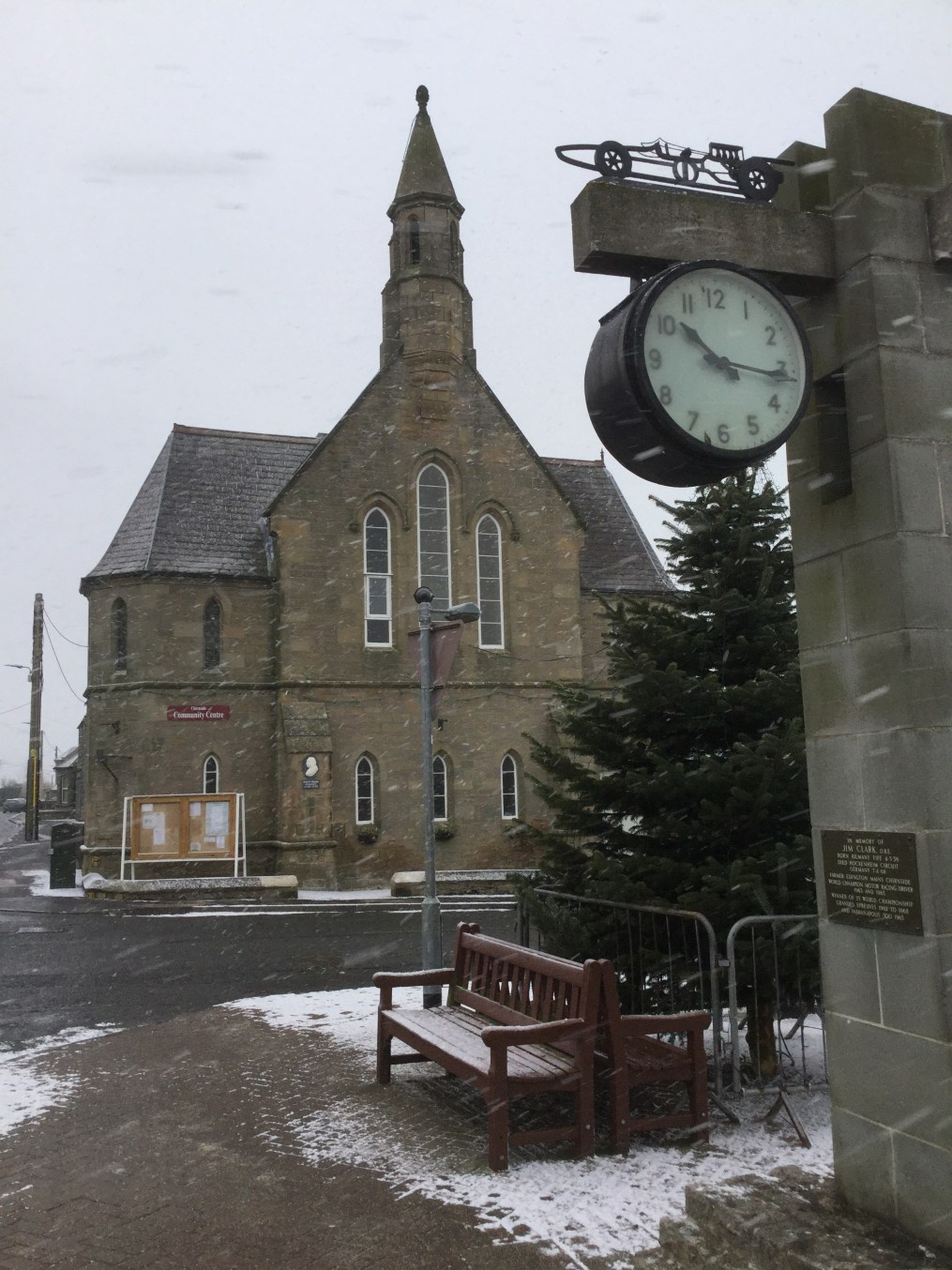
Chirnside Community Center with Hume’s plaque and to the right in the foreground, the memorial clock for Formula One racer Jim Clark, another of Chirnside’s famous one-time residents. Clark, who died in a racing accident, is buried here in Chirnside.
I’ve been planning to take this trip to Chirnside since my 2014 trip to Edinburgh, but I didn’t make it out here then. I’m so excited to be here today, and the snowfall is heightening my sense of adventure. After all, I grew up and lived in California nearly all of my life, and falling snow was not something you see much of there unless you live in the mountains or way up north, neither of which was true for me. So falling snow still never fails to give me a little thrill, a feeling of being in a new and unexpected, even magical place. As I head south on Crosshill, the snowfall is rapidly growing thicker, now falling in big, fluffy flakes. As I continue down the hill, Crosshill becomes Kirkgate where the road veers to the right where it meets the path that leads to the bright white primary school, at the bottom of the slope a little off to the left. The name of the road, Kirkgate, indicates my next destination but one.
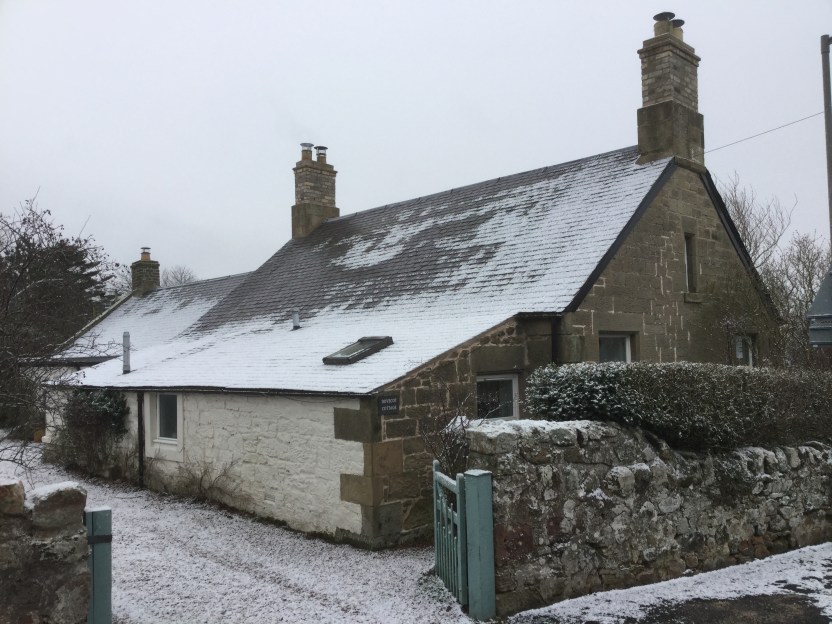
Dovecote Cottage, Chirnside, Scottish Borders
On my way to the old kirk (Scots for ‘church’), I keep watch for the structure I’m looking for, which I should find somewhere near here on my left. I spot a sign on the corner of a house: ‘Dovecote Cottage’. Ah hah! A dovecote is just the thing I’m looking for! Though the gate to the property is open, I’m loathe to enter the garden without a by-your-leave. So I walk slowly past, looking for someone I can talk to or perhaps a public path that will give me a good look into the garden. I find the gate open to a much wider drive just past Dovecote Cottage; the name on the gate, ‘White House,’ describes the large structure I pass as I enter. It appears to be a more public place than the cozy little cottage enclosure, so I don’t feel as if I’m trespassing or infringing on anyone’s privacy. Just a little ways in, I clearly see what I’m looking for off to my left over the garden wall, just where my sources said I would find it: in a garden near the church.
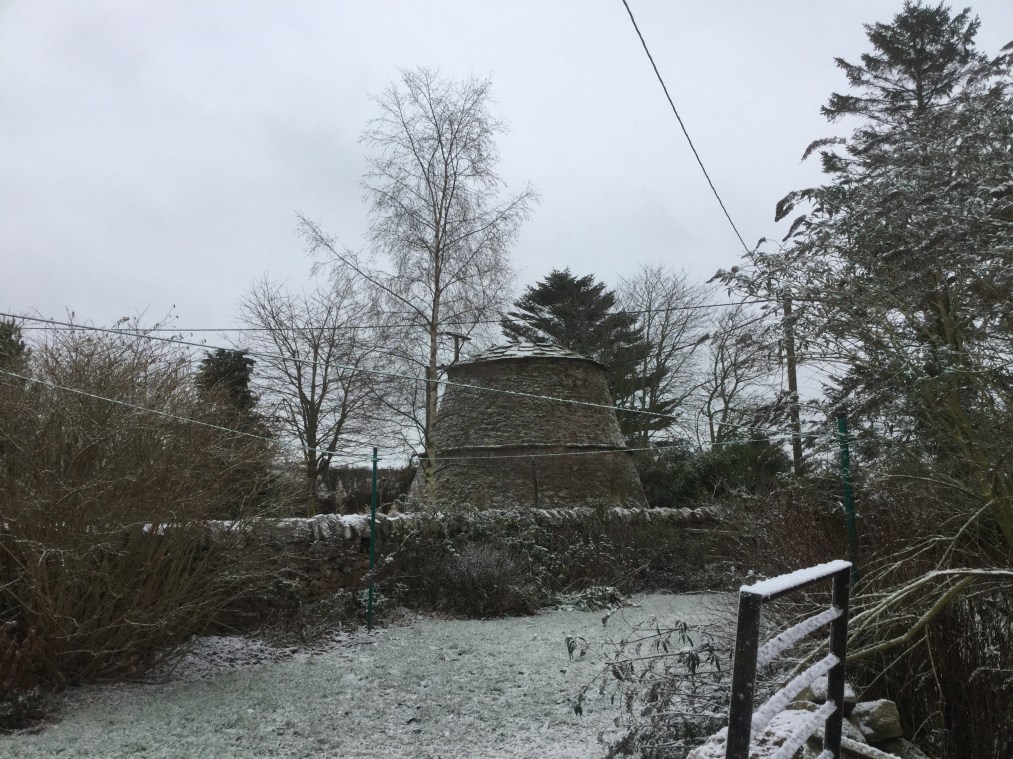
The dovecote built by the Humes of Ninewells, Chirnside, Scotland. It’s in the garden of Dovecote Cottage; this view is from the White House drive
The dovecote looks something like a giant hive built by a race of bees much larger and more skilled at masonry than any found on Earth. It’s had a new roof put on sometime since 1913, the date of a photograph I consulted during my research for identification. According to ‘Heritage Sites Around Chirnside,’ published by the Scottish Borders Council, it was built by a member of the Hume (again, variously spelled H-o-m-e) family in the 16th century on land won in a wager with a neighbor. This would explain why it’s at such a distance from the Ninewells grounds. A dovecote is a structure for raising doves and pigeons, a traditional and popular practice. I don’t know what the purpose was other than the enjoyment of their beauty and variety and of hearing their clucks and coos; I know people eat doves and pigeons (squab) but I believe that wasn’t then, and isn’t now, the primary purpose of pigeon-keeping.
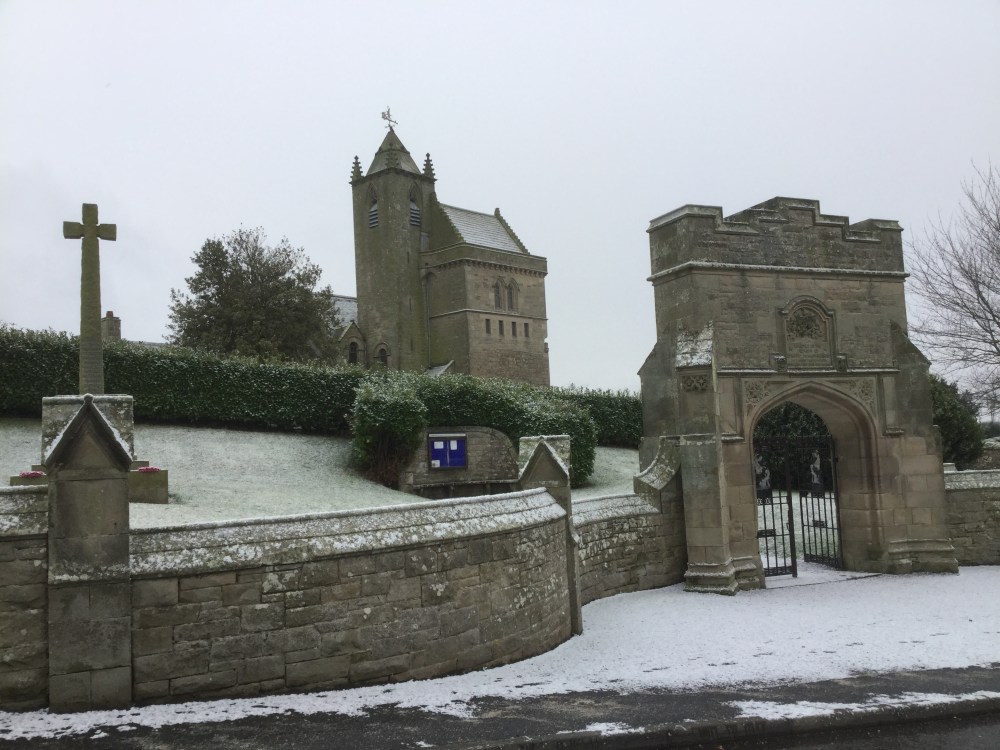
Approaching the Old Church / Chirnside Parish Church from Kirkyard Gate, Chirnside, Scotland, with the Tweedmouth Memorial Gateway to the right
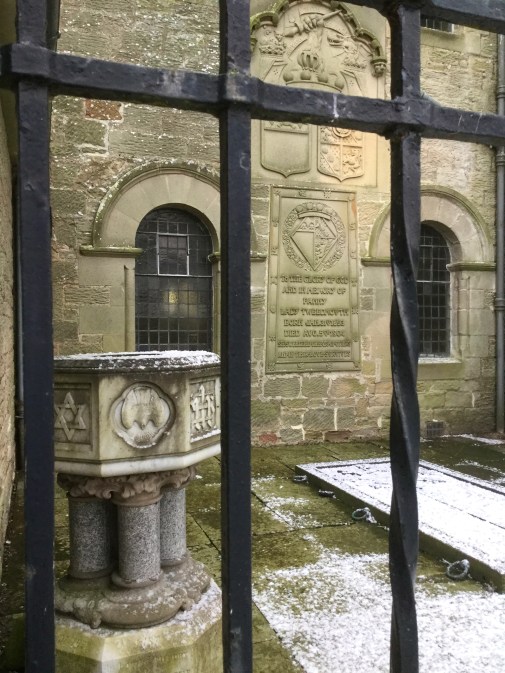
Lady Tweedmouth’s memorial tablet and grave at Chirnside Parish Church
I continue south on Kirkgate and before long, I see the old parish church on a rise to my left. The kirk is reached through a grand stone gateway: the Tweedmouth Gateway, named for Baron and Baroness Tweedmouth, erected in their honor by their son after the former’s death in 1909. Lady Tweedmouth was buried here in 1904, and in 1907, Lord Tweedmouth made extensive repairs and upgrades to the old church in her memory.
The building retains a few sections of the original Norman structure, including the south doorway under the portico (which I kick myself for neglecting to take a picture of!). The original church, a rectangular structure much smaller than what stands here today, was originally built in the 1100’s; the church was formally consecrated in 1242. It was largely rebuilt in 1572, repaired in 1705, enlarged in 1837, and repaired again and embellished during the early 1900’s.
A relation of Hume, it seems, was made parson of the church in 1573; at least, John Home shared the family name. David’s uncle George was the minister here when David was a boy. This church was the Presbyterian Church when Hume lived here and for long before. Hume’s mother Katherine was a devout Presbyterian and this was the Presbyterian church, so Hume likely attended services here regularly throughout his youth. Given his later lack of religious belief, it’s less certain that Hume would have done so as regularly when he spent summers and vacations here when he was an adult. Yet Hume was a sociable fellow and like any British village, its kirk would have been a center of social life; so, I think he would have attended sometimes at least.
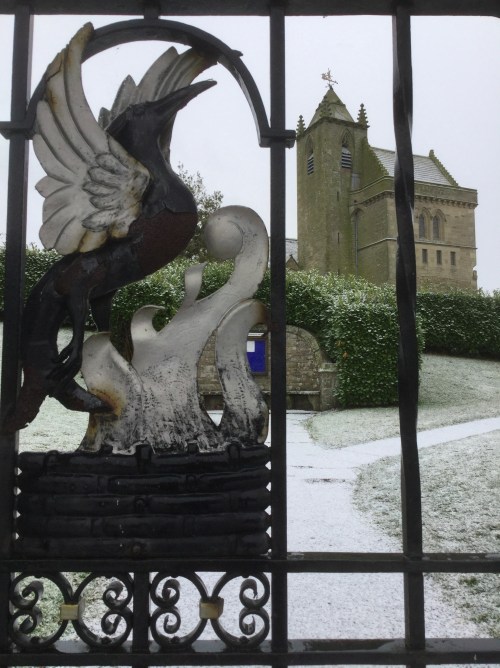
Chirnside Parish Church through the front gate
Given the religiosity of Hume’s family, I wonder what they thought of his religious skepticism. Being a very affable fellow, I think it unlikely he would have made a point of it with his family. In a 1745 letter, he writes with affection of his recently deceased mother and of mutual love and concern between himself and other members of his family, with no hint of rift or strain that may have been caused by religious strife. Hume was widely reputed to be an atheist and was notorious for it, but I think his equally well-known kindness and friendliness softened the effect that it may otherwise have had on public opinion. Because of his fascination with philosophy, I suspect his mother Katherine may have viewed any skepticism she spotted in him as the result of philosophical exploration, not wickedness or pride. She recognized early her David’s lively and precocious intelligence and saw to it that he had an excellent education. As I mentioned earlier, he attended the University of Edinburgh when he was just barely eleven. He never did graduate because he grew bored there; in 1735, he wrote of that university experience ‘there is nothing to be learnt from a Professor, which is not to be met with in Books.’ So, he dropped out at age 15 and continued his studies on his own, rejecting the study of law his family expected him to pursue (after his father, who was an advocate, as a lawyer’s called here, and who died when David was only two) in favor of his beloved philosophy. From all accounts, however, the University improved greatly not long after Hume attended. His nephew, also named David Hume, attended the University as well, becoming a distinguished advocate and the University’s Professor of Scottish Law.
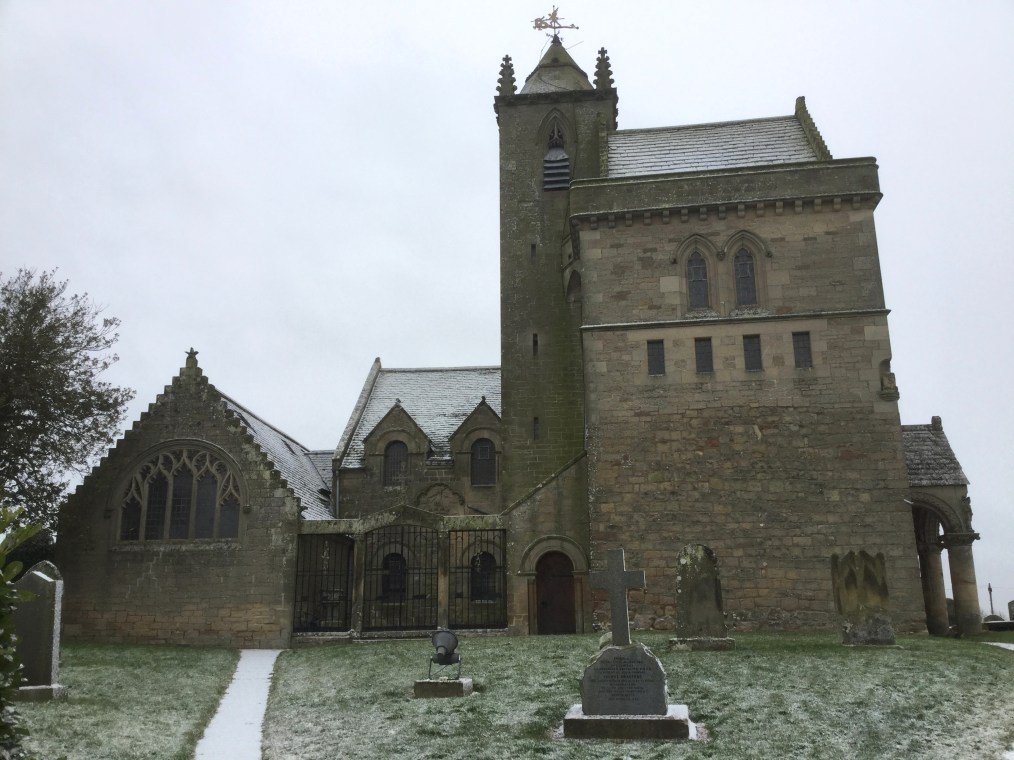
Chirnside Parish Church, west side
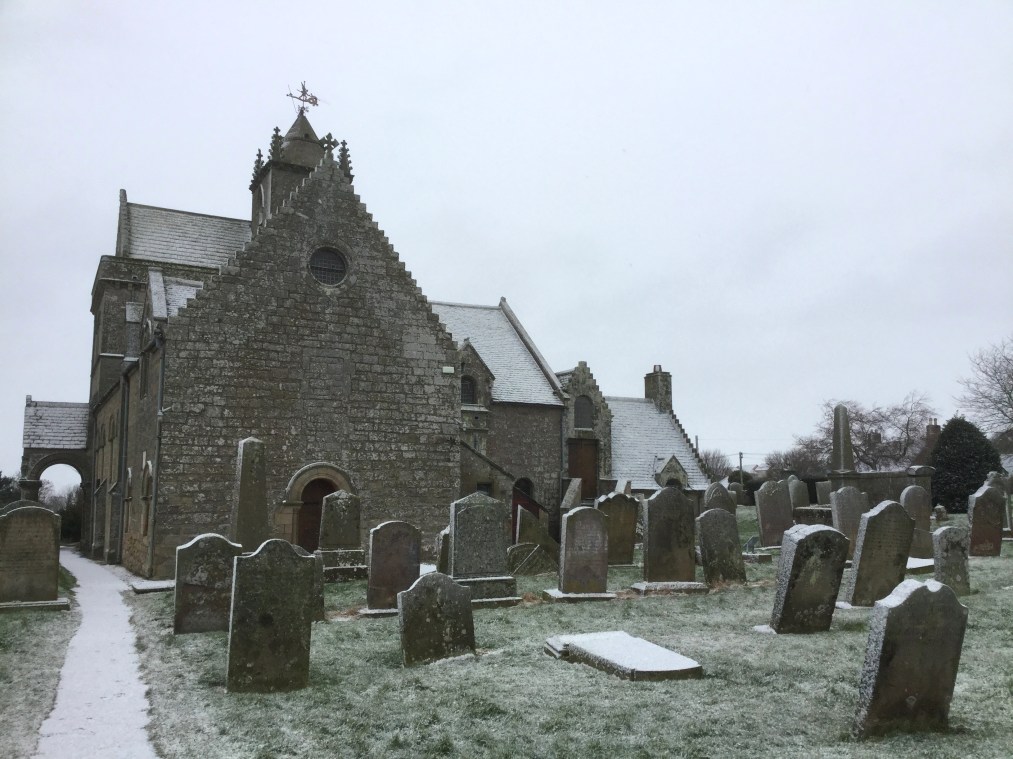
Chirnside Parish Church, east side from the kirkyard
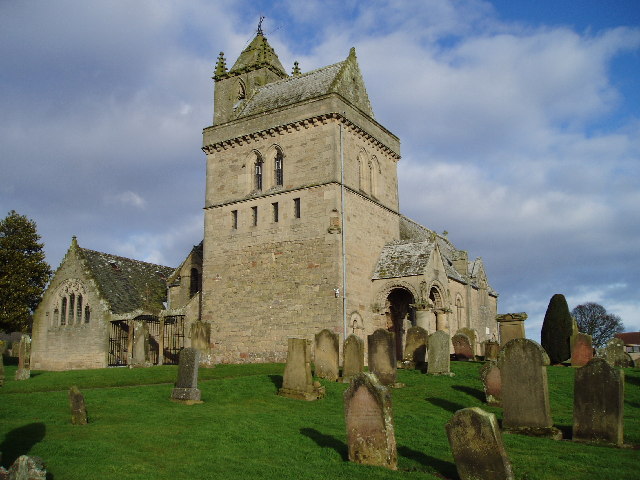
Chirnside Parish Church and kirkyard; some details are easier to see when free of the snow cover. The Norman doorway is under the pointy-roofed portico on the right. Photo by Kavin Rae, free to use under a CC BY-SA Creative Commons license.
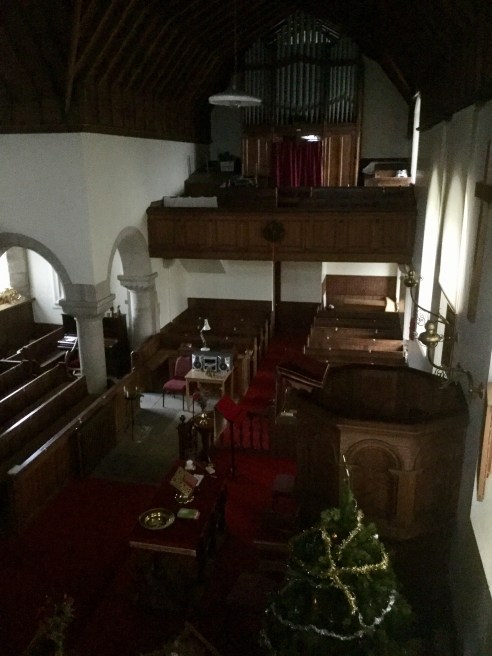
Chirnside Parish Church, interior from choir loft to the west
I circle the church slowly, both to see the details and to avoid slipping on the icy, snowy walkways. I try every door and tah-dah! I find a side door that was left unlocked. It opens with difficulty, appearing rarely used, the wood swelled so that it scrapes reluctantly along the ground as I slowly, carefully edge it open just enough to enter. I find myself in a very cobwebby stairwell. I ascend and find myself in a little choir loft, thick with white dust, an old fabric banner tossed over one of the pews. I step gingerly at first but the old wood floor is clearly very thick and sturdy.
The church, even with the lights out, looks festive with its red carpet, its three appliqued holiday banners hanging from the large central choir loft, and its Christmas decorations including, I’m charmed to see, a plastic baby doll in a rustic crib to represent the infant Christ. Though there’s a small pipe organ above and a piano below, I also see a boombox on a table. It’s low church, solid, practical, plain but not severe, with no imagery save a large plain cross over the raised, heavy wood pulpit.
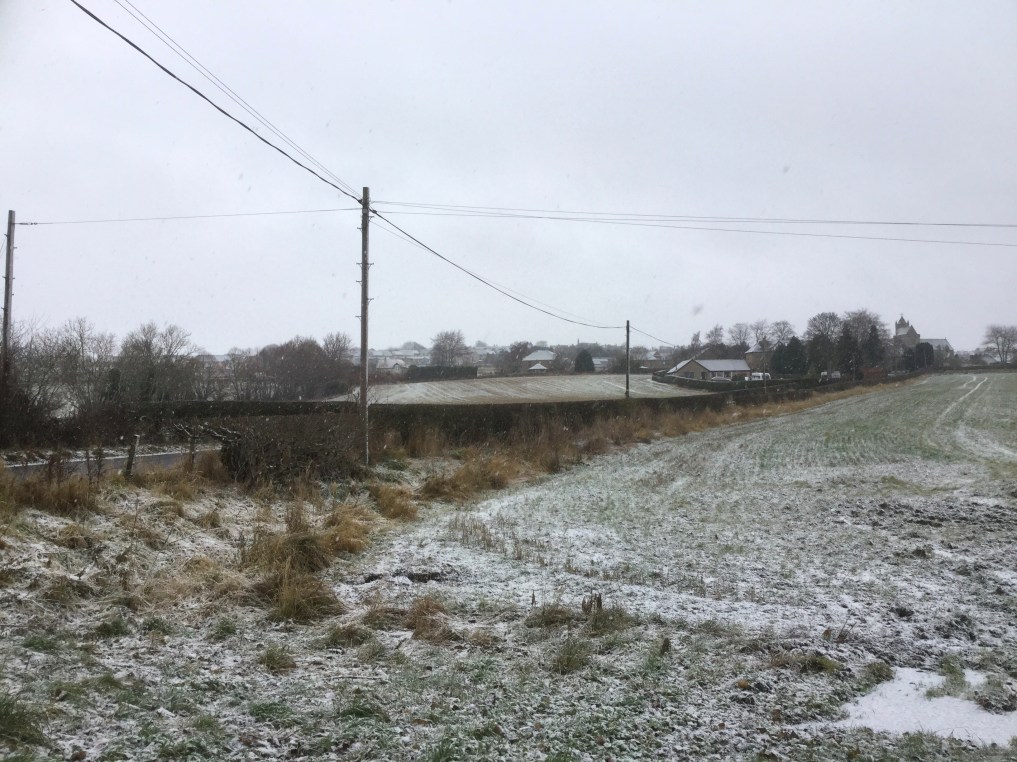
Looking north towards Chirnside from a path just off B6437. You can see the Chirnside Parish Church rising above the trees to the right
I take a good look around and many photos but don’t stay long: not sure I’m exactly trespassing since this is a place of public worship and the door was unlocked, but since this is a gray area, I don’t overstay any welcome I may have had. I close the door tightly behind me as I leave.
I continue south on Kirkgate, which turns to B4637 after it crosses A6105, the main thoroughfare east across this part of the Borders from Berwick-upon-Tweed. I’m looking to see how much of the old Ninewells estate I can see from the east side. I continue south as far as the Chirnside Sawmill, about a third of a mile south of the church. This takes me north and east of where the old Ninewells estate was, but based on the maps I consulted earlier, the best access is from the main road to the north of here. I retrace my steps, enjoying the ever-snowier landscape and the new views of the village from each bend.
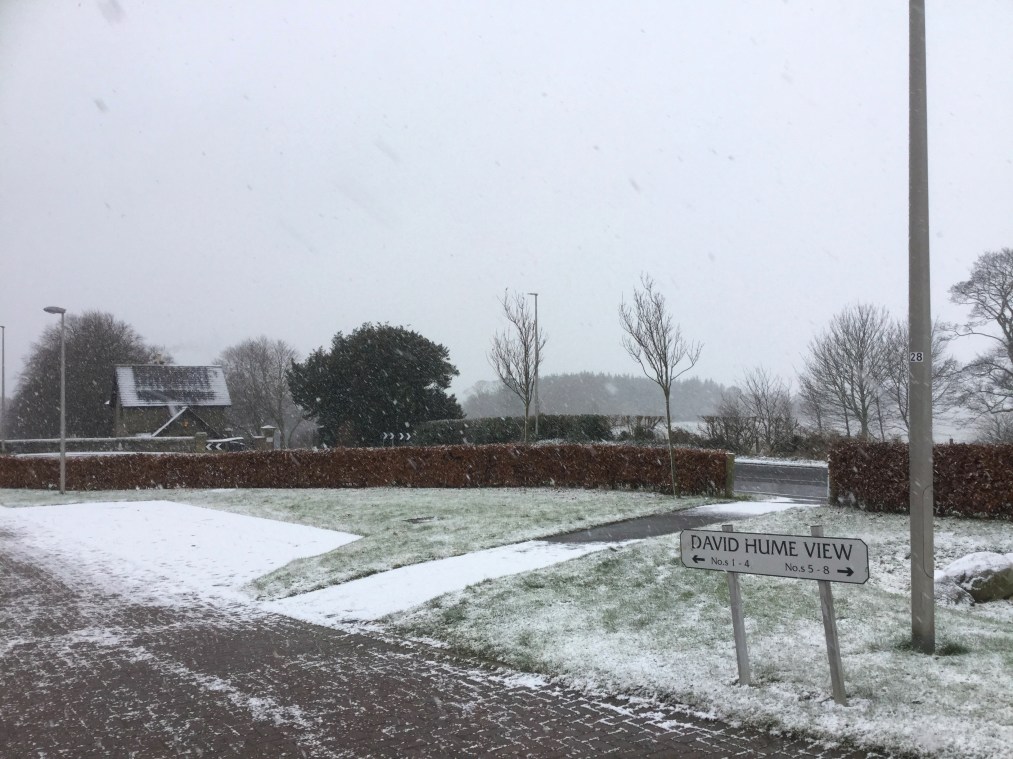
David Hume Way looking towards the Whiteadder River and the site of Ninewells
When I reach A6105, I turn left. After about a quarter of a mile, I turn right on Whiteadder Way, a road leading into a new-looking housing development. The sign tells me that I’ll access the next place I’m headed, a street named David Hume View. There’s nothing of historical interest that I know of relating to this street other than the name and the fact that you can see part of the old Ninewells estate grounds when you look south from the south end of the street. I look, but the view is blurred by the fresh snow that simultaneously beautifies it in its soft, pristine way.
‘In all that idyllic countryside of the Merse, there is no lovelier situation than the estate of Ninewells. The house itself stands on a bluff some 80 feet above the rushing waters of the Whiteadder. Down the bluff a few yards, and to the south-east of the house, an overhanging rock forms a shallow cave. Here, David Hume probably played as a boy, or read a book in solitary majesty; and here, according to the inevitable local legend, he indulged in profound philosophical meditation.’ – Mossner’s Life of David Hume, p 20
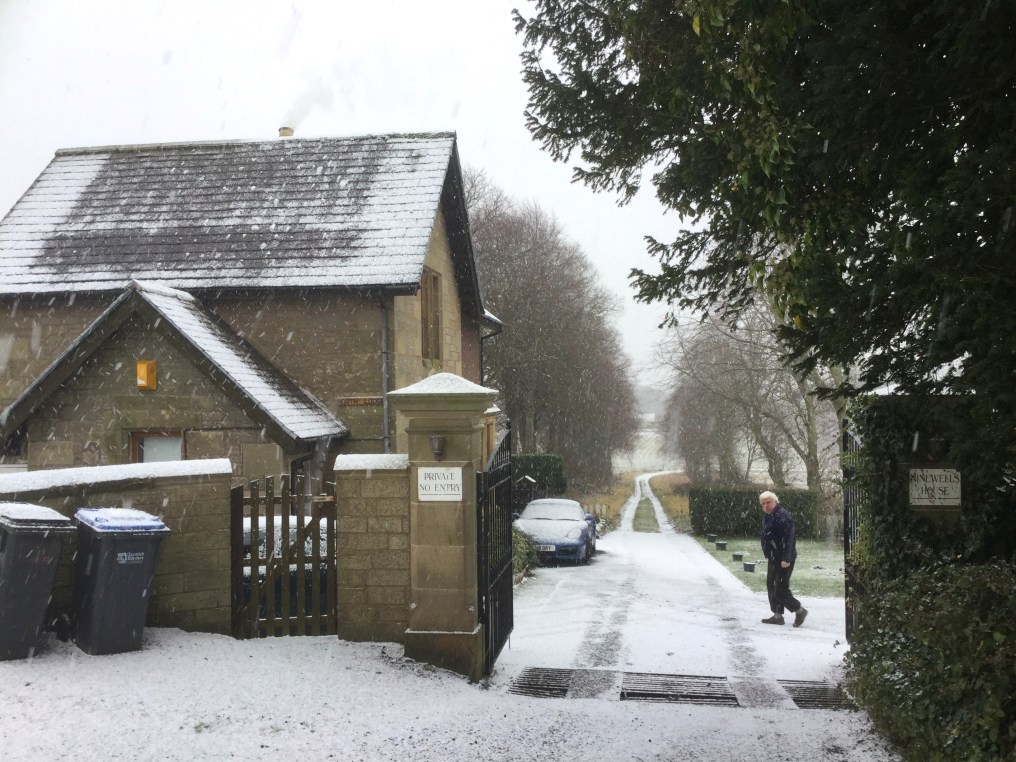
At Ninewells House, this man directs me to the path towards the site of the old Ninewells estate and the Whiteadder River
I retrace my steps to the foot of Whiteadder Way and turn right. On the south side of A6105, just as it veers north, there’s a pretty gabled house with its name prominently displayed on its stone wall, just to the right of the gate: ‘Ninewells House.’ I know I can reach the old Ninewells grounds from this direction from my maps, but this appears to be a private drive. I have only a moment to consider my next step when a man appears. He greets me, and in response to my inquiry, he directs me to the entry of the path that runs parallel to the drive heading towards the Whiteadder River, which will then continue all the way to and along the riverbank. I thank him and find the head of the path a short distance away to the east. It’s prominently marked by a large historical placard about David Hume, though I find it nearly entirely covered with snow. I take pictures of it to refer to later; I have to do so quickly since the snow is determined to obscure it nearly as fast as I sweep it away.
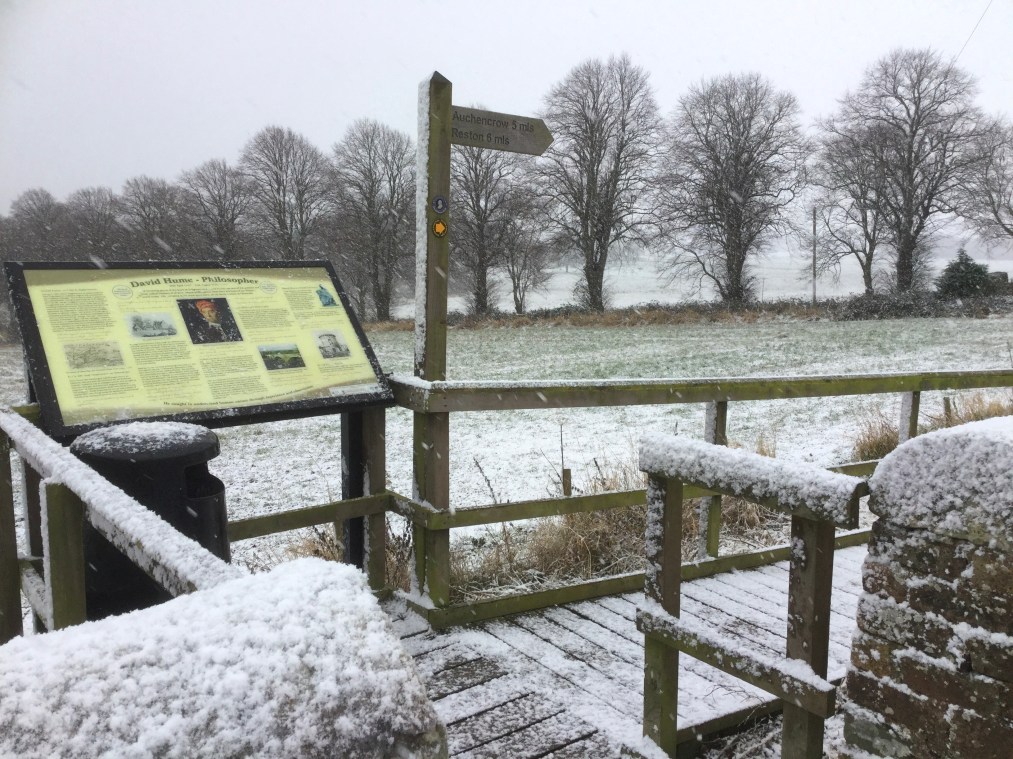
Historical placard at head of path to Ninewells site and Hume Walk.
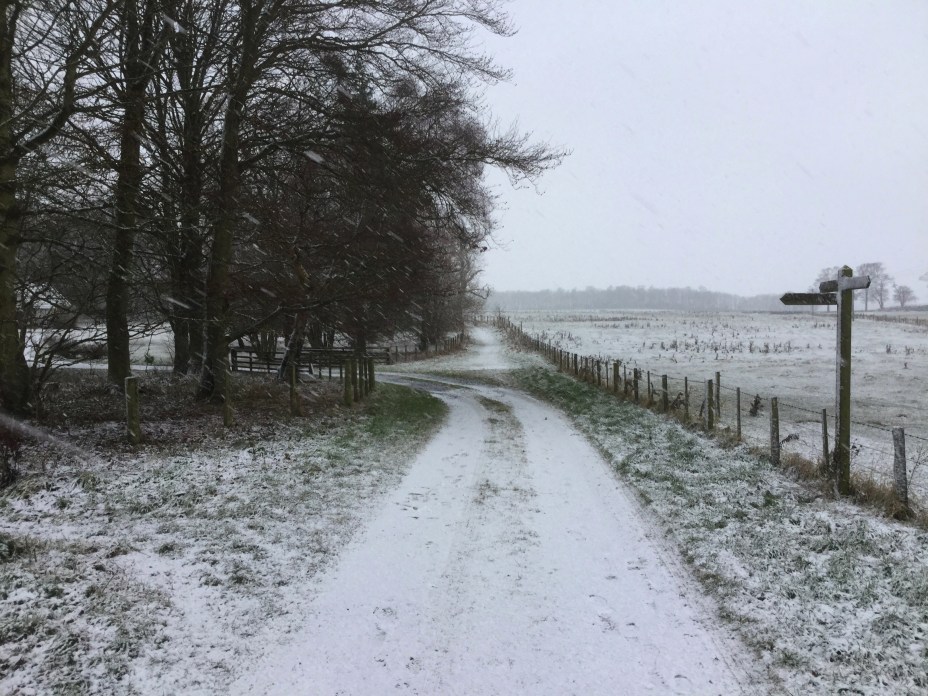
Continuing straight on the path to Ninewells site and Hume Walk
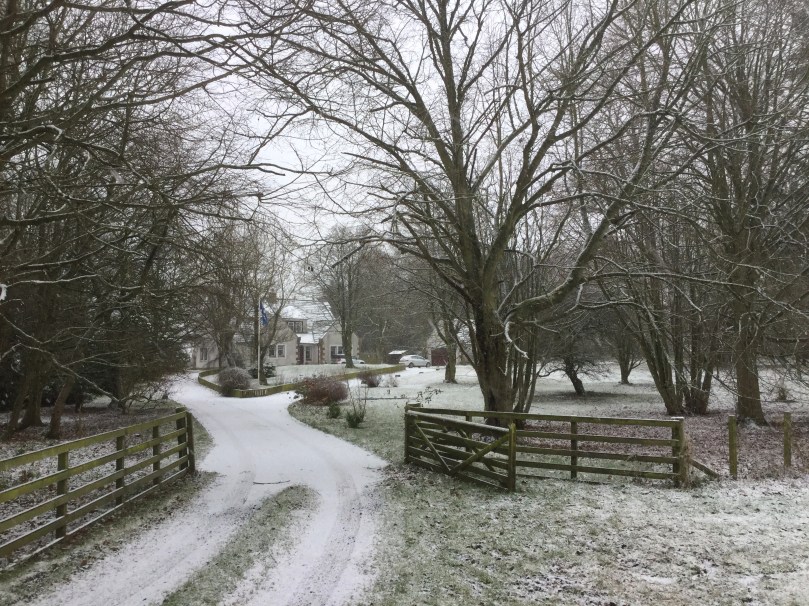
The house that stands just north of the site of Ninewells, on my left as I continue west on the path
I tromp through the accumulating snow and find that I have to step ever more carefully. I’m wearing my good sturdy leather boots but I discover that the rubber surface I had installed on the soles is not as grippy in the ice and snow as I would wish. At one point, the path leads me to the foot of the same unpaved drive that passes through the Ninewells House gate. I continue on where it veers right, then pause when I arrive at another curve to the left which enters the gate to a large, handsome, modern classic-style stone house. This house, I know from my sources, was built just north of the site of the house Hume grew up in. I also know, from my maps and the confirmation of the man at Ninewells House, that the path to the river will allow me to approach that site from below the house. So I continue past the house and onto the river path. As I walk, I join up and chat with three people also taking this walk, accompanied by their two dogs, joyful and frolicking in the snow.
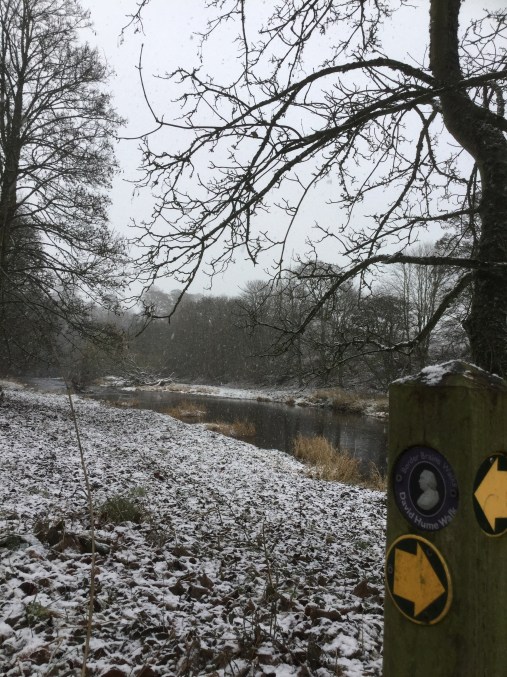
Post marking the start of David Hume Walk along the Whiteadder River
The path curves along the rise then leads to a set of wooden steps that leads down to the riverside. There’s a post here that identifies the path, which turns off to the right along the river, as the David Hume Walk. The site of Ninewells should be to my left here, on the north bank of the bend of the river from west to south. My sources tell me that southeast of the house there was a shallow riverside cave and other hollows and overhangs where young David would retreat and play or think. He and his brother also loved to fish in this river. So I decide to turn right first, to explore the river where it curves down to the southwest to see if I can spot any caves, overhangs, and likely fishing spots.
I need to pick my steps ever more carefully as I go along, the path growing ever slippier, and approaching so close to the Whiteadder in some spots that I’m in real danger of sliding right in. I walk in the branchy leaf-litter to the right of the path as often as I can, where my shoes find a better grip. In some places, I hold to the naked branches of the nearby trees and shrubs. Luckily, the sets of wooden steps at the steep rises and descents are each equipped with a rough but sturdy handrail. No doubt, the steps are often rendered slippery by Scotland’s abundant precipitation.
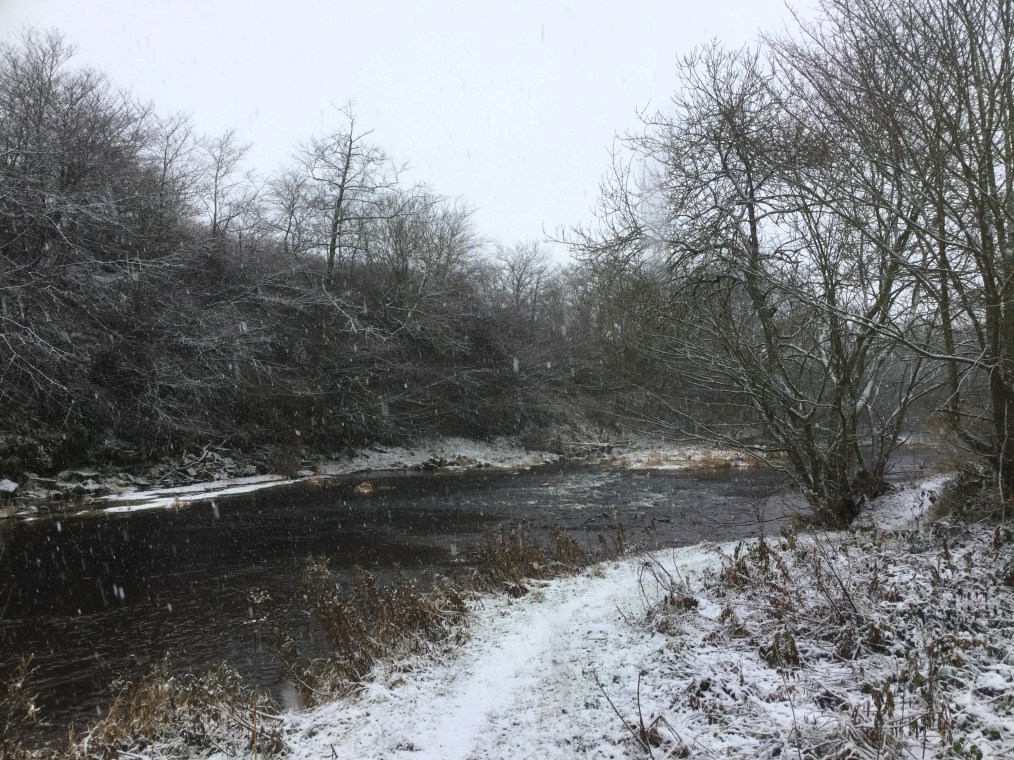
David Hume Walk along the Whiteadder River, looking west and a little south
During this glorious, wintry riverside walk, I see pheasant, ducks, and many small birds; at one point, off to my right, I see a very large hare bounding across a field. I also hear occasional shooting, presumably for pheasant, which reminds me not to leave the paths or hop fences to explore any private field or wood. Scotland’s laws permit free passage even through private property, but I’m not entirely confident that my bright red coat can guarantee against a hunting accident.
At a high clearing overlooking the river, I reach a wooden bench. It’s a good place, I think, to enjoy the little thermos of hot coffee I obtained at the little grocery store in the village shortly after I arrived this morning. I was a little surprised to discover, from the instructions posted on the wall behind the counter, that orders of fresh milk, bread, and eggs must be placed ahead of time; they don’t stock them otherwise. Hot water and instant coffee, however, are available on demand. Though nothing fancy, the coffee is warming and bracing, and I enjoy it thoroughly.
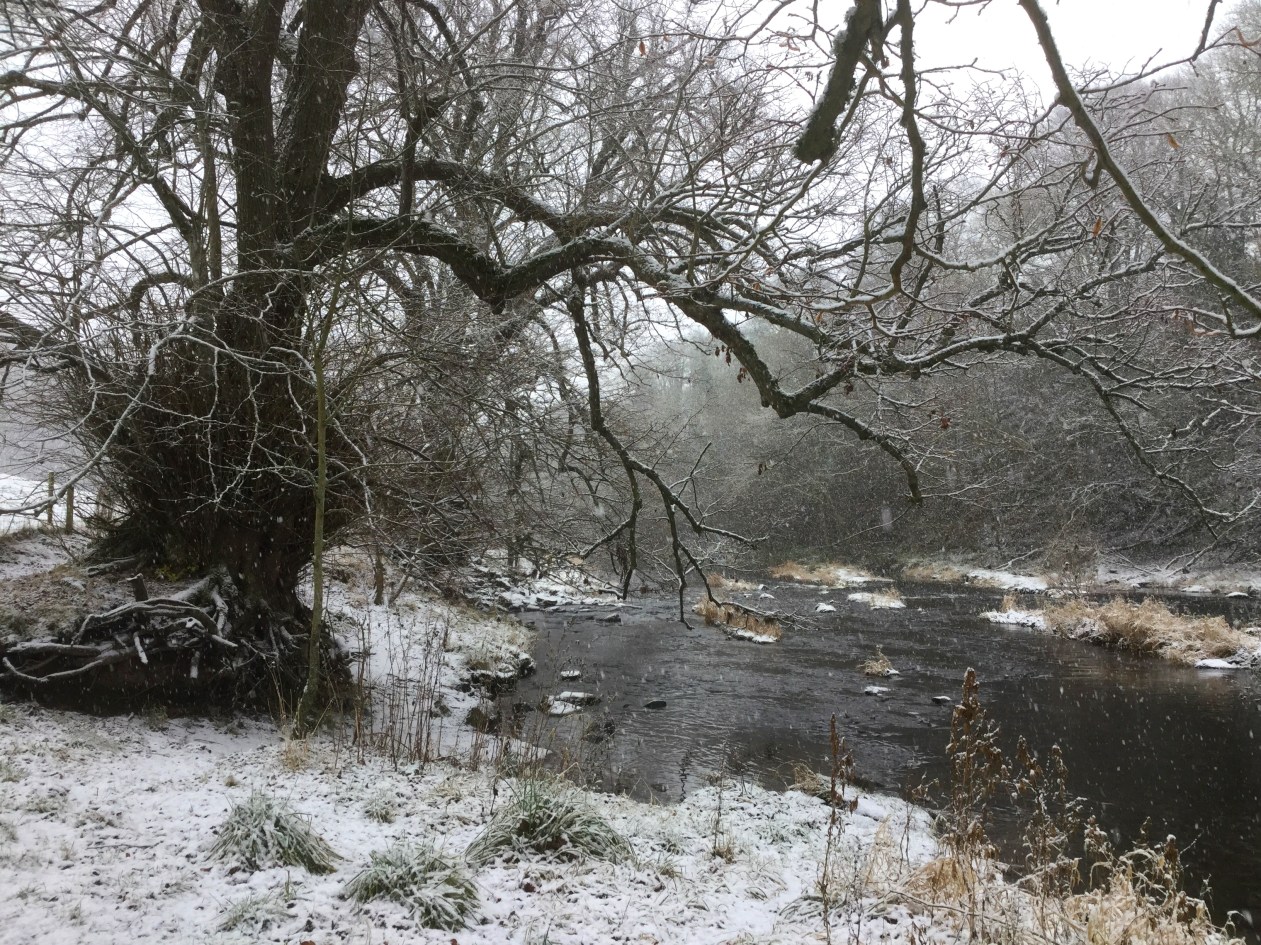
David Hume Walk along the Whiteadder River, looking east and north towards Ninewells.
After I finish my coffee, I brush as much snow off of myself as I can and bundle more firmly into my clothing: at this point, my coat is damp in places and my boots and two pairs of wool socks have allowed some of the cold and wet to reach my feet. I turn back and retrace my steps, walking more slowly this time and looking for the rocky overhangs I may find here. I don’t find much, but there is a small one with a tree that’s grown over the top of it. Perhaps the riverbank is higher here than it used to be, filling in the bottom of it. I think I’ll return in the summer when the river is lower and the banks are more accessible and not obscured by snow. When I reach the place where the wooden steps ascend the rise to the main path, I continue north this time, toward the site of Ninewells.
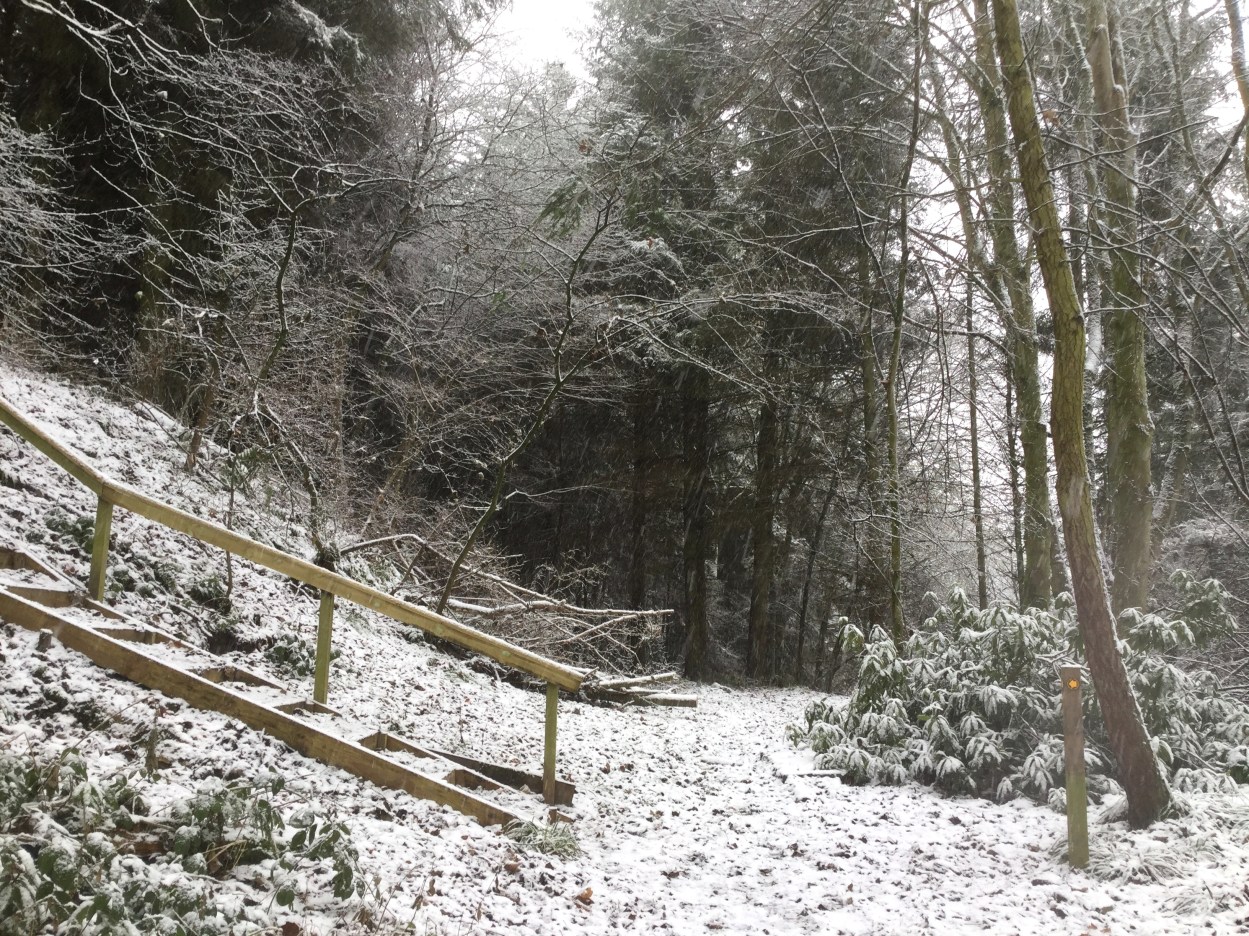
Stairs to the left continue the Chirnside Path, the unmarked branch straight ahead leads northeast and thus towards Ninewells site. So, I take the branch straight ahead
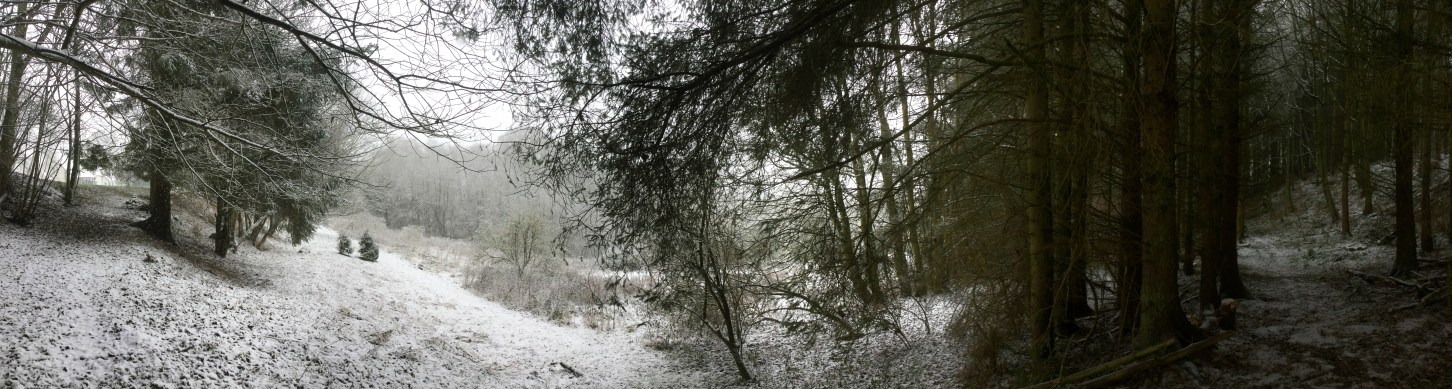
Left, the south side of the house built northeast of the original Ninewells site. Right, the path I came from branching north from Chirnside & Paxton Path

Path between the Chirnside Path and Ninewells site, with part of the rotted wood walkway passing over the springs. This is the view facing southwest as I’m returning to the main Chirnside path
As I walk, I see a raised wooden walkway rotting away under moss and leaf litter. Shortly after, my boots step off frozen ground and sink into mud. A few yards along, there’s another, even wetter patch. This is just what I hoped to find! It’s confirmation that I’m in the right place: Ninewells was named for the nine springs on the estate, which bubbled up from the slope down to the river. I’ve just passed two of them. These will have to do in lieu of any historical markers I fail to find here.
I imagine the old house and the three children, John, Katherine, and David, returning from their play along the river, wet and cold, ready for mother Katherine to bundle them up with books by the fireside. My mental picture of the old house is hazy, though, since I’ve found no images that reveal just what the house looked like during Hume’s time here. There’s an old drawing of the house, made no later than 1840, that I’ve seen here and there in my resources. It’s also reproduced on the David Hume historical placard at the head of the path to the river, which you can see below. Two successive fires damaged and then largely destroyed the original house, so David’s only brother John, his senior by two years and hence the family heir, had it rebuilt, likely in a very similar style to the original.
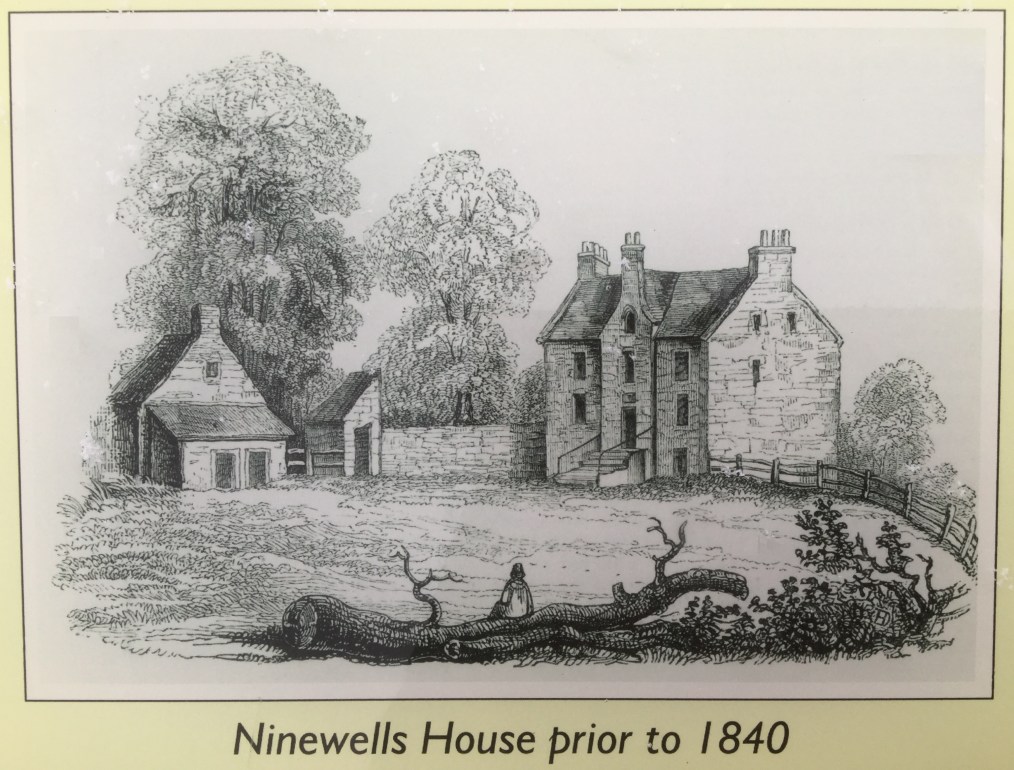
Ninewells House prior to 1840, from David Hume historical placard near Ninewells House
The house at Ninewells changed many times over the years, sometimes restored and expanded, sometimes torn down and replaced altogether. Its last incarnation, in World War II, saw its use as a hostel for displaced people and a prisoner of war camp. Its ruins were finally torn down in January of 1964. (I also find a photo of Ninewells’ ruins from the southwest, which would be my view from the path if it were still standing, in a Historic Environment Scotland website, but I’m still waiting to receive permission to publish it here.)

Clear view of the Ninewells site and south side of the modern house built to the northwest of it, looking northwest from the Chirnside Path. That places me somewhere very near or perhaps right on the old Ninewells house site. There’s no marker I can find.
I return to the main road, A6105, just to the east of the Ninewells house. A6105 veers sharply to the north where the driveway of Ninewells House meets the road, then a quarter mile on, makes a perpendicular meeting with Chirnside’s Main Street. Turning right would take you back into the village, but I’m not headed there yet. I turn left towards the river and the bridge.
The snow is still falling and my footing on the sidewalks ever more treacherous. As I walk along, there’s a truck salting the roads, so the snow on the asphalt turns quickly to muddy, icy brine. On my way to the bridge, I’m offered a ride by a kindly elderly couple. Then a little further on, I’m liberally splashed with that salty, slushy road water by the driver of a car paying no heed to the puddles or my proximity to them. I’ve spotted the danger and step as far off the road as I can when I see a car approaching, and most drivers see it too, thoughtfully veering over to avoid spraying me. But that one speedy driver just didn’t notice or care. Oh well, I’m wearing a secondhand coat anyway. From the head of the path to Ninewells to the bridge, it’s a little over a mile.
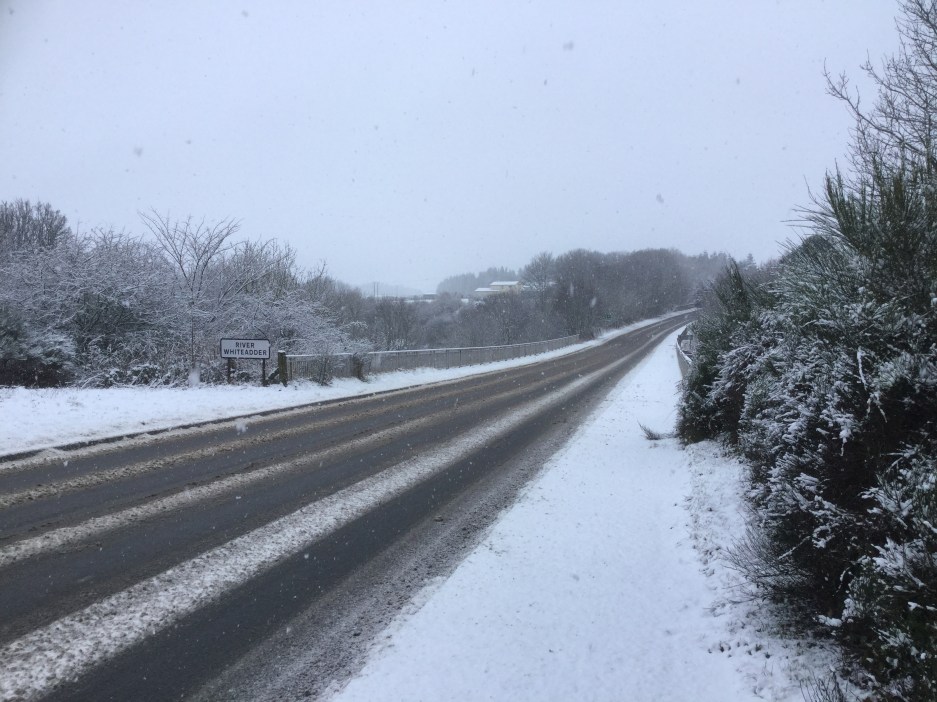
Walking on the A6105 towards the bridge over Whiteadder River from Chirnside, Scottish Borders
The David Hume Bridge over the Whiteadder Water is a modern span. I’m not sure just when it was built since its record in Historic Environment Scotland’s website doesn’t say. Not only is this bridge significant because it passes over the beautiful, rushing Whiteadder River, but because it parallels the old Chirnside Bridge. Hume left the sum of 100 pounds and instructions for its repair in his will. The bridge likely looks very much as it did then. Just beyond the bridge is the paper mill, a handsome Italianate structure built about a hundred years after the old bridge.

Looking at the old Chirnside Bridge from the David Hume Bridge over the Whiteadder River
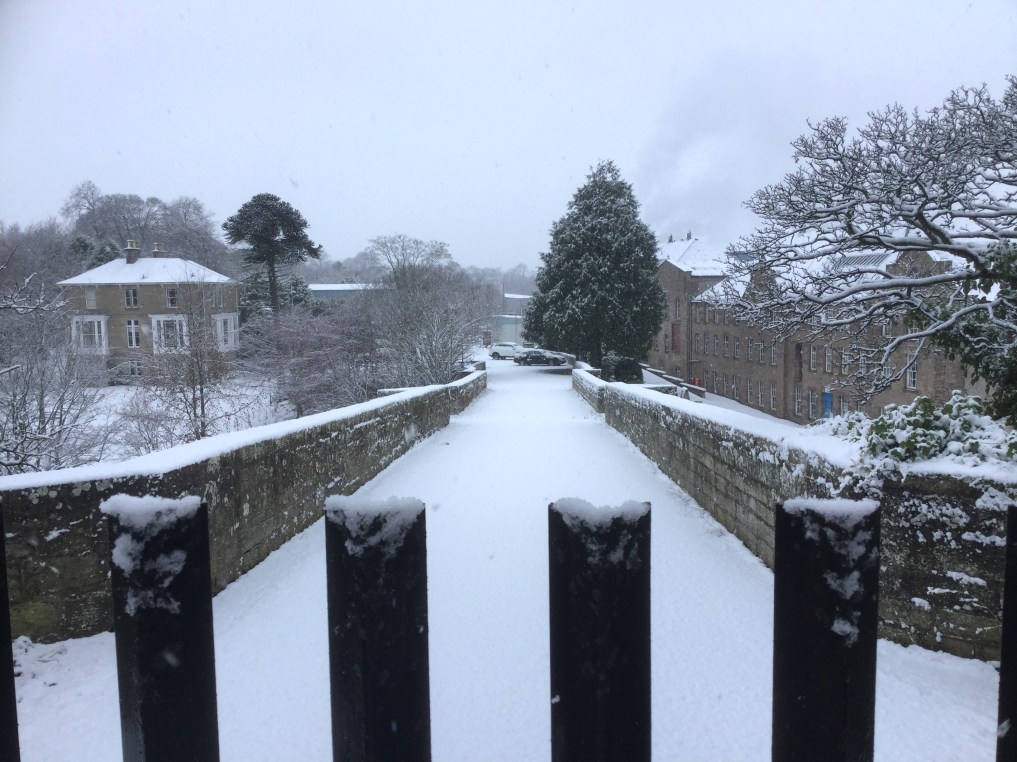
The old Chirnside Bridge over the Whiteadder River, near Chirnside, Scottish Borders
I turn and head back towards Chirnside, but pause to double back on the narrow little path that leads to the old bridge. I find I’m prevented from walking onto it by a high gate and warning signs to keep off, enforced via a CCTV camera. At this point, my gloves and much of my pants are soaked through and my toes are very cold, dampening any naughty urge I might have to climb over or go off path to find a way around the gate. Looking is enough for me for now. Maybe I’ll cross it if I get a chance to return this summer.
I return to Chirnside via the A6105, with another car splashing me even more liberally than the first one. I’m warmed somewhat by walking briskly up the hill, but still, I’m even wetter than I was on my way to the bridge, and my coat is looking rather disreputable. After a very chilly mile, my heart is gladdened when I see that the pub at the Red Lion Inn, just steps away from my bus stop across from the Chirnside Community Center, is open.

Russell, today’s master of Dovecote Cottage, at the Red Lion Inn pub, Chirnside
I find myself in a cozy, cheery room lined with gloriously warm radiators. The bartender nods his permission for me to strip off my coat and gloves and drape them on one of the radiators to dry. I plop on a barstool and promptly order a pint. My American accent, as it so often does here, sparks almost immediate conversation. I’m inclined to keep it for that reason.
I chat with the bartender and its one other patron as I hungrily devour my picnic lunch of cheese, oatcakes, biscuits, and a clementine I hadn’t found a good place to stop and eat earlier. It tastes that much better here in the warmth, washed down with my pint, accompanied by jolly conversation. We talk about the weather, where we’re all from originally, about how Russell, my barstool neighbor, was a geneticist, at one time doing research work at UCSF, and how he and his wife came to settle in this village upon retirement.
Once I’ve eaten, I move to the other side of the room to drape myself over the radiator along with my coat and gloves, mostly to warm my legs, chilly in my sodden jeans. The room is narrow here, placing little distance between us, and the conversation continues easily. When asked about what brings me here, I tell them, and we discuss my adventures of the day. Not long into that conversation, Russell says that there are just a few listed historical structures in Chirnside. He mentions the church and another place or two, and in answer to his expectant look, I say ‘…and the dovecote!’ I’ve evidently said the right thing since Russell’s face lights up. ‘I live at Dovecote Cottage!’ he tells me. I’m delighted to hear this, and Russell proceeds to tell me all about the pedigree of the structure and how dovecotes are used to ‘home’ pigeons.
I tell them of my visit to Ninewells, describing the location in relation to the river bend and landscape, and of finding the springs. They confirm that I was at the right place. At one point, Russell stops me. It’s ‘Nine-ulls,’ he says. Oh, I say apologetically, I often pronounce place names wrong here, I’m still learning. No, says the bartender, it’s ‘Ninewells’, just as you say, it’s named for the nine wells, and pointedly, to Russell, it has a ‘W’ in it. You English don’t say words right. We share a laugh over this. Our conversation continues, animated and a great deal of fun. It lasts for nearly an hour, until the time comes when I need, mentally as well as practically, to prepare myself to emerge into the cold and head for the bus stop.
At one point, Russell and Teddy, the bartender (I think I remember your name rightly, Teddy; if not and you’re reading this, please let me know!) mention one site I know nothing about: an old primary school which they claim David Hume attended as a child. This surprises me since it’s my understanding that young David and his siblings were taught at home by Katherine and tutors until the boys attended University. Perhaps I’m missing something? Russell and Teddy have an amusing little back-and-forth about the decision to place the plaque on the community center instead of the old primary school building, and how that decision was characteristic of a particular local official.
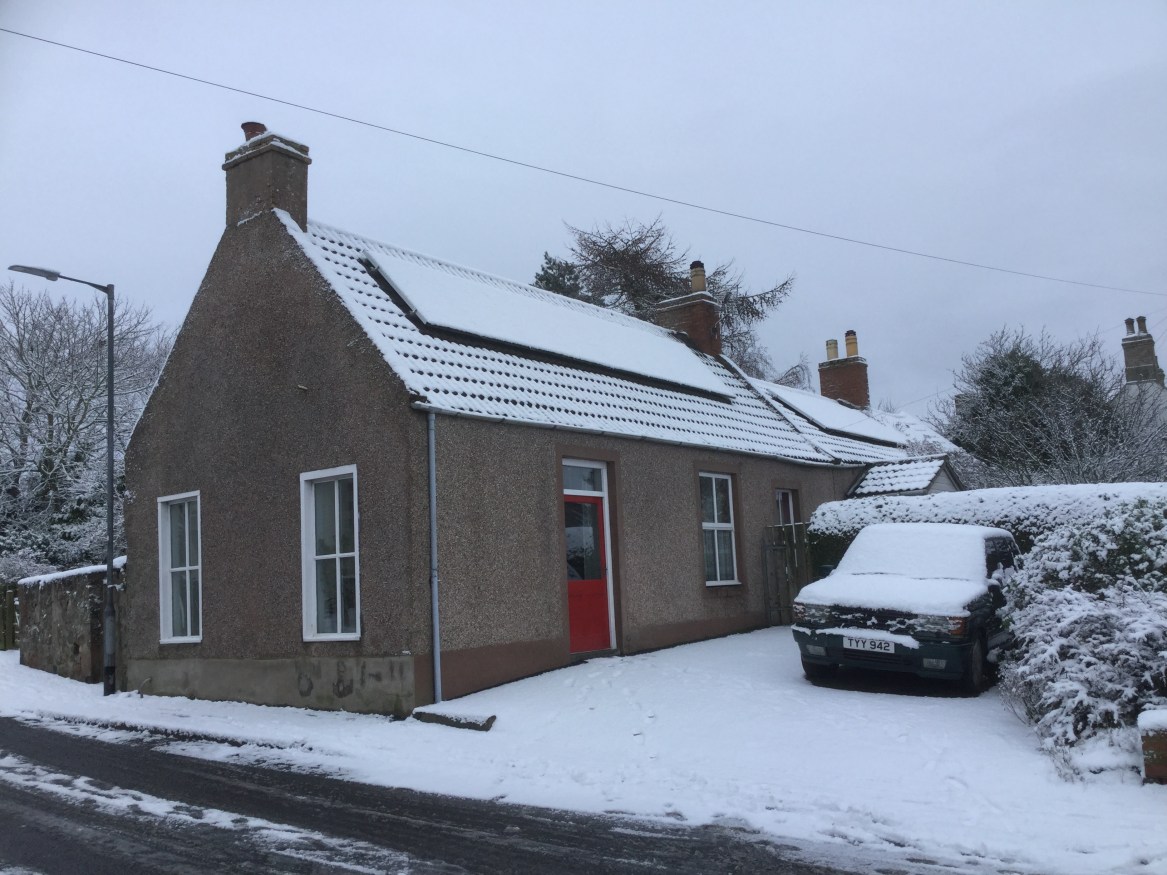
The building which Russell reports was the old Chirnside primary school expanded and converted into a family home
Russell volunteers to show me the old school, now a house, which they assure me is very nearby. When the clock advances enough to tell me we should leave to make that little excursion before I catch my bus, I rise. We laugh at the steam rising from my pant legs, well heated by the radiator I’ve been resting them against. My gloves at least are now well warmed and half dry, my coat now only damp in the places it had been sodden. I’m glad to see the muddy look has faded enough to be scarcely noticeable.
We walk past the last two buildings on Main Street before Dominies Loan and stop at the next building, on the northeast corner of Main and Dominies. It’s a very ordinary-looking, with pebbledash front and sides and a very steep roof. I comment that it looks very modern to me, and Russell agrees. But, he says, it’s been much altered since that time, as have many of the old buildings. In fact, the building was originally much smaller, and with all the additions and new siding, it’s unrecognizable. We walk up to where we can see the back of the house, and Russell points out the old stonework.
I’m intrigued. I don’t find this in any of the materials I found in my research for this day’s trip, and can’t confirm this tidbit of oral history in the resources I consult afterward. Perhaps I’ll find it in my research over time, or a helpful reader of my account of this day will guide me to some record of it. I do find an old Chirnside primary school as a listed historical building, but it’s at the other end of the village, the west end of Main Street. That one was built many decades after Hume’s death, and its only relation to him is that one of his two nieces, Katherine or Agnes, established it. My sources, Mossner’s Life of David Hume and the historical listing for the building in Historic Environment Scotland, don’t help me ascertain which.
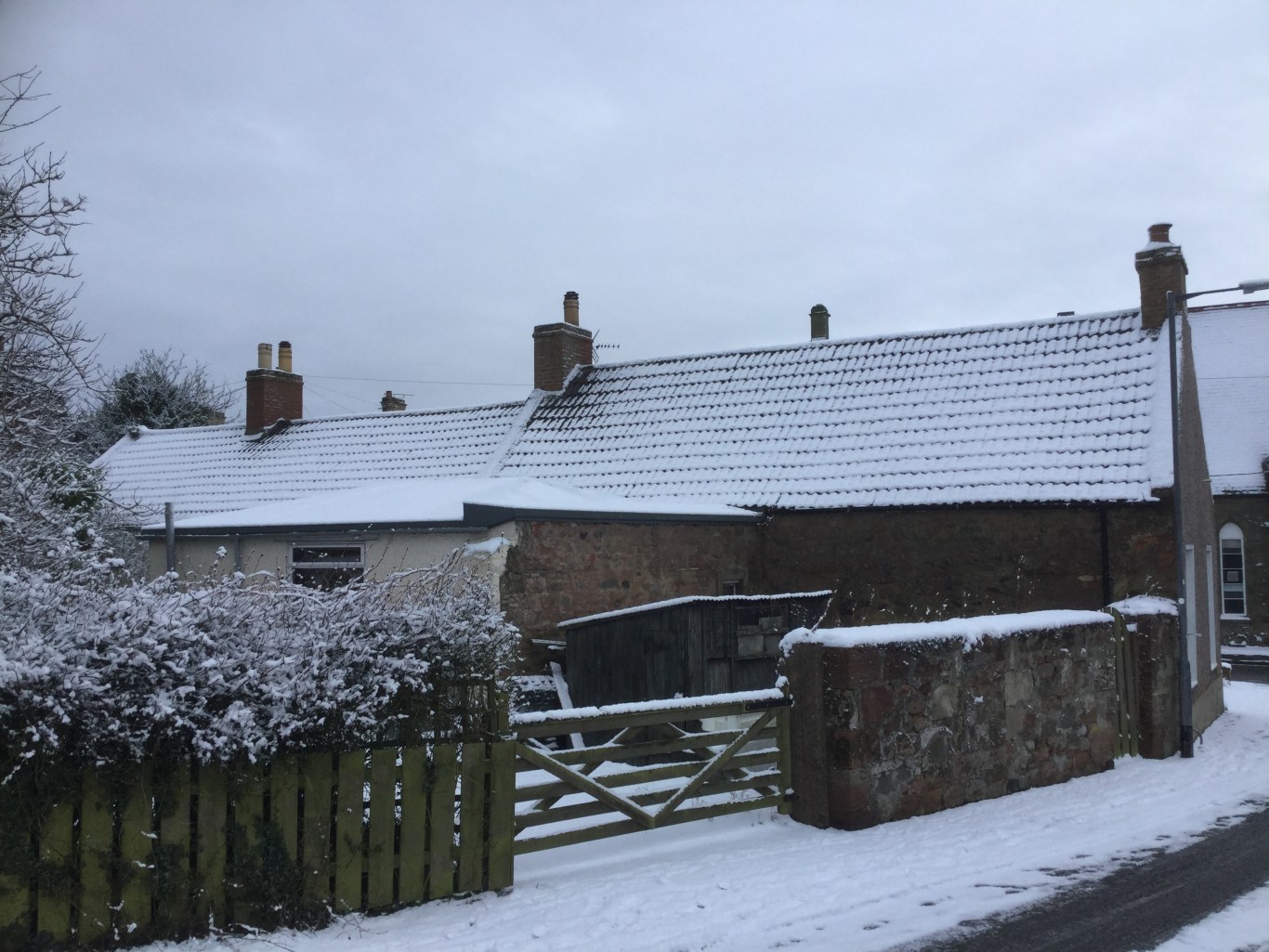
The rear walls of the old house which may have been a school, revealing some of the old stonework

Mourners enjoying an after-funeral smoke and a pint at the Red Lion Inn on Chirnside’s Main Street. I take this photo as I wait for the 60 bus back to Berwick-upon-Tweed.
We look at the building, discussing the history of the town a little more. Then, I regretfully tell Russell it’s time for me to get to the bus stop. I give him my thanks and a hug and tell him I hope to see him if I make it back and to hear from him sometime, especially if the account I write of my day’s adventure here contains any mistakes or is missing some important information.
I catch my bus, after a mercifully short wait, and return to Berwick-upon-Tweed. As I descend the steps which take me to the rail station platform and waiting room, I discover a sign which contains an interesting historical tidbit about both local and Scottish national history:

Railroad station platform on the site of the Great Hall of Berwick Castle, Berwick-upon-Tweed, England
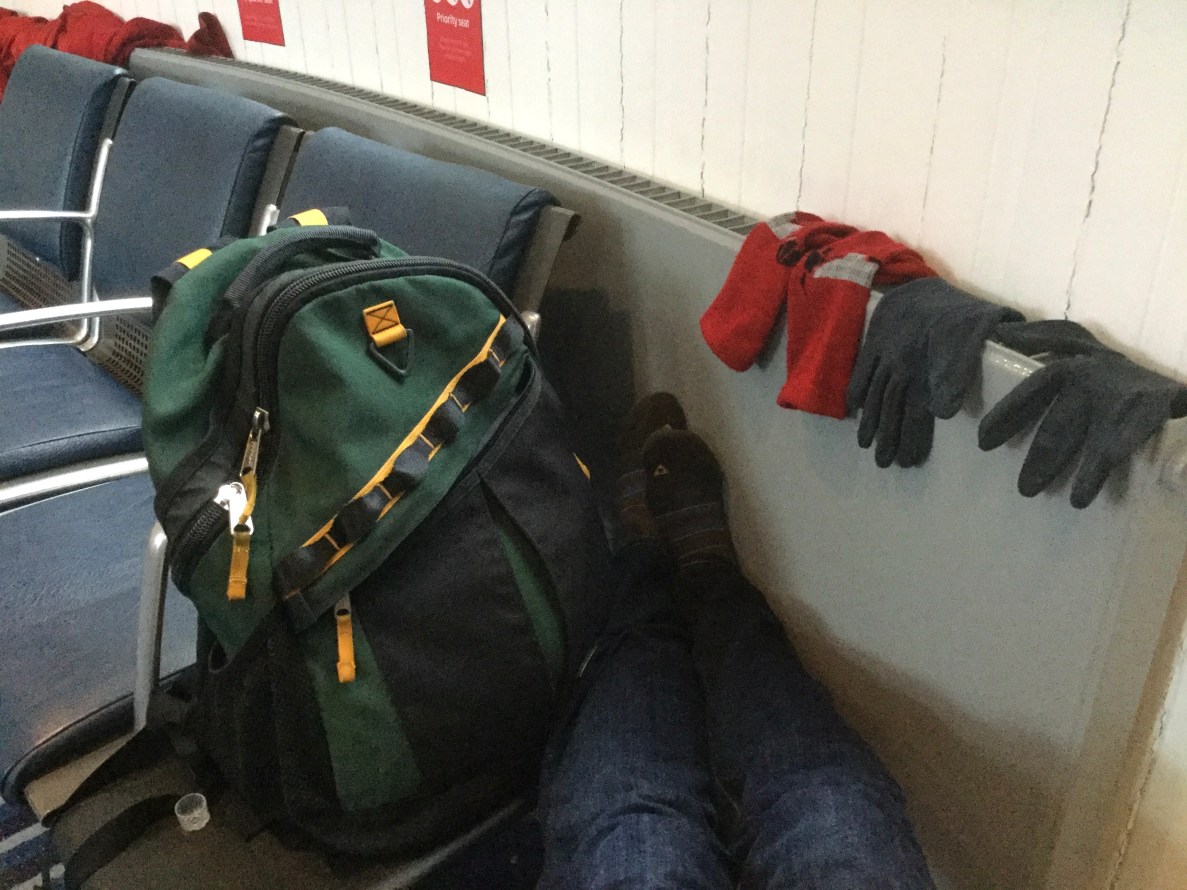
Continuing the drying-out process with the radiators in the railroad station waiting room at Berwick-upon-Tweed, England
In the waiting room, I find a comfy spot, drape my things over the radiators again, review my photos, jot down notes, and doze off a little: I was up early after a late night of research, and it’s been a somewhat taxing day. I have about an hour wait before my train arrives, but this is a nice cozy place to wait and dry off. I look forward to a hot dinner back in Edinburgh in a cozy little Sudanese restaurant near my place with some friends who are in town.
*Also published at Darrow webzine
Ordinary Philosophy and its Traveling Philosophy / History of Ideas series is a labor of love and ad-free, supported by patrons and readers like you. Please offer your support today!
~~~~~~~~~~~~~~~~~~~~~~~~~~~~~~~~~~
Sources and Inspiration:
Barton, Jim. ‘Plaque to David Hume, Chirnside‘, geograph.org.uk
Cairns, John W. ‘Hume, David (bap. 1757, d. 1838)‘, Oxford Dictionary of National Biography
‘Chirnside,’ Borders Family History Society website
‘Chirnside,‘ in Wikipedia, The Free Encyclopedia.
‘Chirnsidebridge, David Hume Bridge,‘ Canmore: National Record of the Historic Environment, Historic Environment Scotland
Chirnside, in Scottish Borders (Scotland), citypopulationinfo.org
‘Chirnside, Kirkgate, The Old Church,’ Canmore: National Record of the Historic Environment, Historic Environment Scotland
‘Chirnside, Kirkgate, Chirnside Parish Church (Church of Scotland) including Graveyard, Mort-House, War Memorial, Boundary Walls, Gatepiers, Quadrant Walls, Memorial Gateway and Gates.‘ Historic Environment Scotland website
‘Chirnside, Kirkgate, Dovecot,’ Canmore: National Record of the Historic Environment, Historic Environment Scotland
‘Chirnside, Main Street West End, Elm Bank (Former Ninewells School and School House) including Ancillary Structure, Boundary Wall, Gatepiers and Gate.‘ Historic Environment Scotland website
‘David Hume,’ Melvin Bragg talks with Peter Millican, Helen Beebee, and James Harris for BBC Radio 4’s In Our Time, Oct 6, 2011
‘David Hume Anniversary Marked in Chirnside,’ BBC News, April 30, 2011
‘Heritage Sites Around Chirnside,’ Scottish Borders Council
Hillman’s Hyperlinked and Searchable Chambers’ Book of Days (original version published in 1869)
Hume, David. New Letters of David Hume. Ed. by Raymond Klibansky and Ernest C. Mossner. Oxford: Oxford University Press, 1954, 2011
Jefferson-Davies, Carol. ‘World’s Scholars at Chirnside,’ The Berwickshire News, July 30, 2011, republished at the Hume Society website
‘Jim Clark OBE (1936 – 1968),’ Unique Cars & Parts website
Morris, William Edward and Brown, Charlotte R., ‘David Hume‘, The Stanford Encyclopedia of Philosophy
Mossner, Ernest C. The Life of David Hume. Austin, TX, 2001.
Mossner, Ernest C. ‘Hume at La Flèche, 1735: An Unpublished Letter.‘ Texas Studies in English, vol. 37, 1958, pp. 30–33. JSTOR
‘Ninewells House,’ Canmore: National Record of the Historic Environment, Historic Environment Scotland
Ritchie, Thomas Edward. An Account of the Life and Writings of David Hume, Esq. London: T. Cadell and W. Davies, 1807
Scott, Hew; Macdonald, Donald Farquhar. Fasti Ecclesiæ Scoticanæ; Succession of Ministers in the Church of Scotland from the Reformation. Edinburgh: Oliver & Boyd, 1915
Sutherland, Stewart. ‘David Hume and Civil Society,’ Gifford Lecture, October 25, 2011. University of Edinburgh College of Arts, Humanities and Social Sciences website
Thursfield, J.R., revised by H. C. G. Matthew. ‘Marjoribanks, Edward, second Baron Tweedmouth (1849–1909)‘, Oxford Dictionary of National Biography




 Ordinary Philosophy