Peoria, Illinois, In Search of Robert G. Ingersoll, Frederick Douglass, and Abraham Lincoln, Part 2

Etching of the old Peoria County Courthouse on a granite wall at the new one, Peoria, IL. It shows the portico from which Lincoln delivered his famed Peoria Speech of October 16th, 1854

Peoria, Illinois, July 28th, 2017, continued

~ Dedicated to Shannon Harrod Reyes

I leave the library and begin my afternoon’s site searches at the Peoria County Courthouse. Abraham Lincoln visited this courthouse many times over the years, on some occasions in his capacity as a lawyer and other times in association with his political career. There’s a statue of Lincoln here commemorating a particularly notable occasion: his delivery of a speech from the front portico of the old courthouse on October 16, 1854. This speech was composed and delivered in opposition to the Kansas-Nebraska Act, co-authored by Stephen A. Douglas. The Peoria Speech, as it’s now known, was part of a series that took place during that legislative election season where Douglas and Lincoln addressed and rebutted each other’s arguments, sometimes during the same event, sometimes separately. Their exchange would be revived four years later, notably in the series of seven formal debates of 1858. Douglas won that year’s Senate election with 54% of the vote, but Lincoln distinguished himself so well in that campaign season that he won the larger prize two years later. He was elected President in 1860, handily defeating his closest rival Douglas with a 10%+ lead.
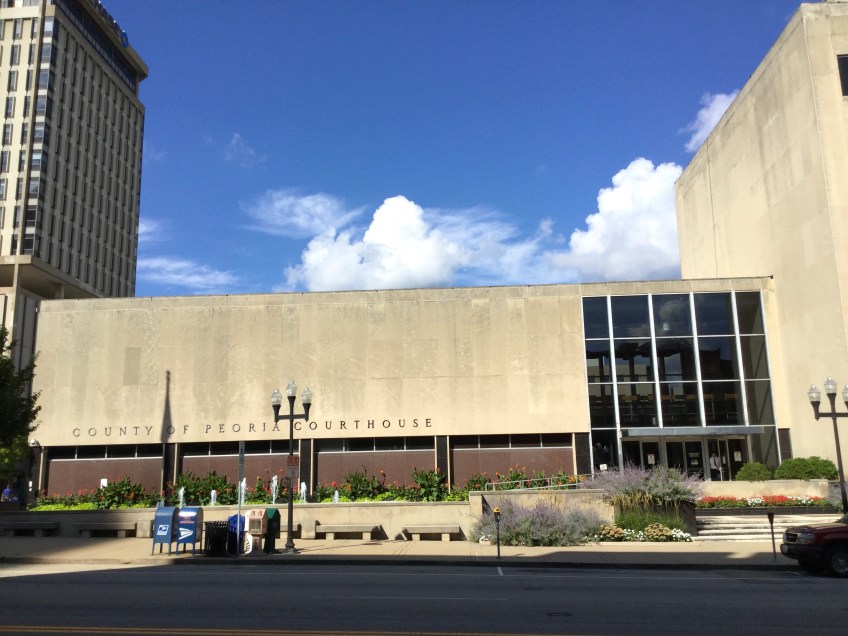
The Peoria County Courthouse as it appears today, Peoria, Illinois

It was this 1854 speech delivered here in Peoria, however, that’s widely credited with first putting Lincoln on the political map in a big way. Lincoln had mostly withdrawn from politics, having served many years in the Illinois state legislature but only winning one term in higher office in 1846 in the United States House of Representatives. The furor over the Kansas-Nebraska Act, which effectively repealed the Missouri Compromise and opened the door to the expansion of slavery, drove Lincoln back into politics, by his own account. He had always been rather reticent about the slavery issue, concerned that too much controversy over it would destabilize the country. The recent passage of the Kansas-Nebraska Act was only one of the many major events that revealed the controversy was unavoidable.

The Trial of John Brown by Horace Pippin, 1942 at the De Young Museum, San Francisco, CA. John Brown was one of those who led abolitionists into Kansas territory to combat pro-slavery advocates, and in the process, indiscriminately killed pro-slavery settlers. He led the unsuccessful raid on Harper’s Ferry in 1859 and was executed for treason.

For one thing, Kansas-Nebraska Act’s underlying political doctrine of popular sovereignty, where the states could decide on the legalization of slavery themselves by vote, led to such extreme regional disputes as Bleeding Kansas. People flooded into the territory (Kansas was not yet a state) to push the vote one way or another through violence as well as numbers. Those on the pro-slavery side wanted to preserve the political power of the slave states and to be able to settle in Kansas with their slaves if they so chose. Those opposing slavery wanted to keep slavery out of Kansas as a matter of principle and, more often, to make it a place where people could make a new life for themselves without having to compete with slaves for jobs and with wealthy slave-plantation owners for land.

Secondly, while attractive to many from both sides at first glance, the principle of popular sovereignty revealed its weaknesses over time and proved deadly to Douglas’ political career. Abolitionists and other free state citizens did not want to abide by fugitive slave laws which required that free states return escaped slaves, and did not want to protect the right of visitors to own slaves within their borders. They saw this as an imposition of slavery into territories that abolished it. Slave states regarded the refusal to return escaped slaves as an attack on their property rights, and an unfair limit on their right to travel freely from state to state. Popular sovereignty turned out to harm, not help, the cause of preserving the Union.
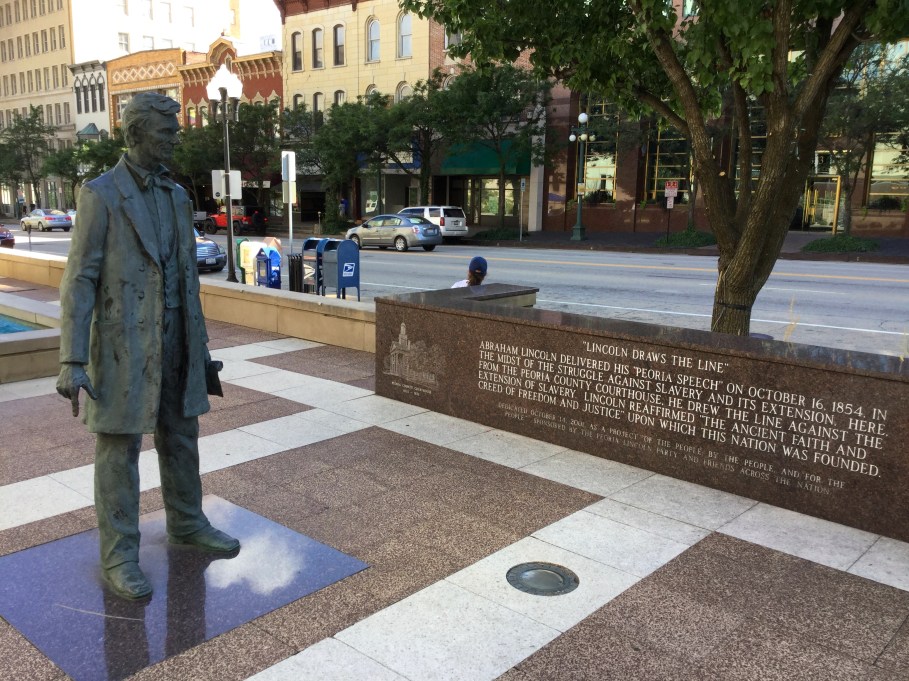
Statue of Abraham Lincoln outside the Peoria County Courthouse commemorating his Oct 16, 1854 speech here

The Peoria speech was Lincoln’s second public delivery of his first detailed and straightforward denunciation of slavery on moral grounds. While the speech did not promote the national abolition of slavery, Lincoln made the historical case that Thomas Jefferson was a reluctant slave-owner caught up in a social institution that he abhorred, but like slave-owners of Lincoln’s day, he felt trapped in it. So, Jefferson hoped and planned for its gradual dissolution. He used his influence to make sure the Northwest Ordinances of 1787 and ’89 banned slavery in all new territories of the United States, shifting the balance of political power away from the slave states and towards those states whose prosperity resulted from the industry of free people. Lincoln argued that continuing to prevent the spread of slavery was the only way to realize Jefferson’s hope while doing what was politically possible to assuage the evils of slavery until it faded away naturally. Though we, with Frederick Douglass, might be scornful of and impatient with Lincoln’s apparent have-your-cake-and-eat-it-too attitude towards slavery as a terrible moral evil but allowable in the South if it held the Union together, the speech contains the outline of the basic moral principles underlying Lincoln’s increasingly anti-slavery platform as his presidency and the Civil War progressed.

The version of the Peoria speech that’s come down to us was transcribed by Lincoln himself for publication in Springfield’s Illinois Daily Journal, in seven issues on October 21st, then the 23rd-28th, 1854. This is lucky for us as few transcripts of that series of exchanges between Douglas and Lincoln survive. Lincoln had delivered the first version of this speech in Springfield and had clarified and refined it, as well as making a few changes to tailor it to the Peoria audience.
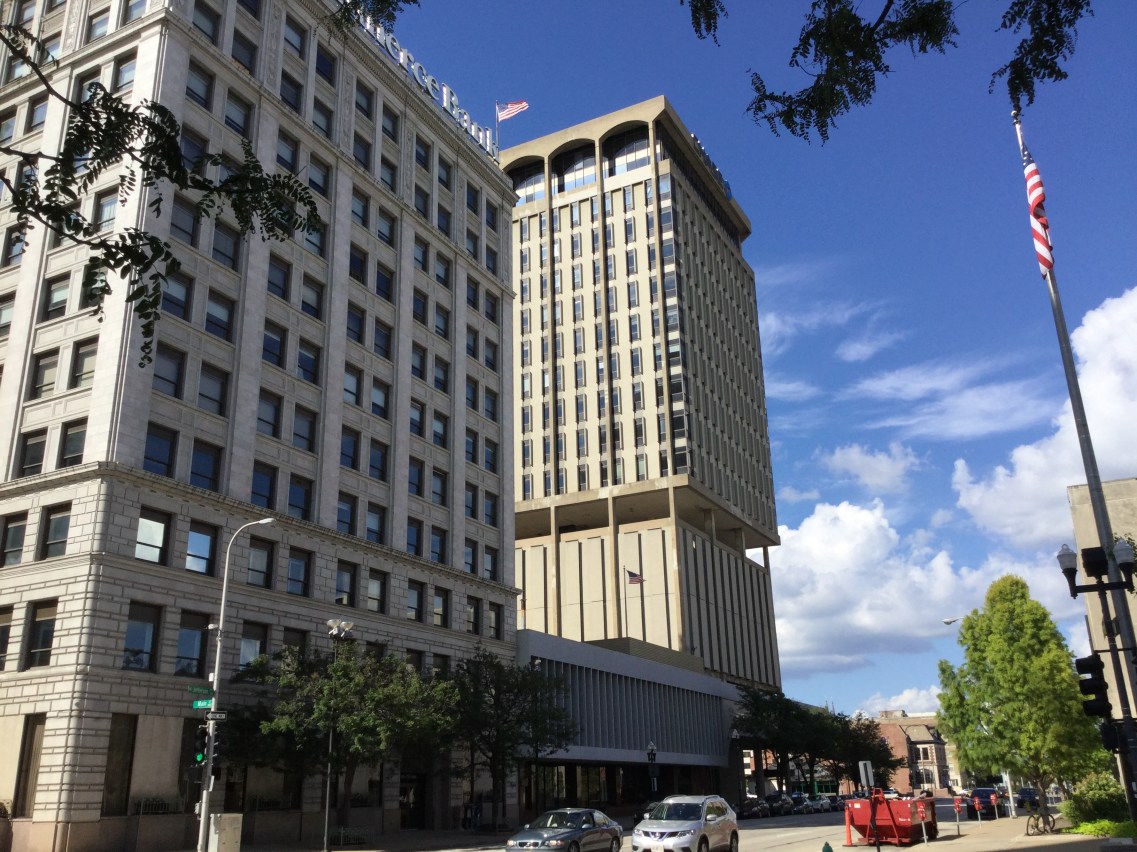
Commerce Bank at the approximate site of old Rouse’s Hall at Main St and Jefferson Ave, Peoria.

Frederick Douglass ambrotype, 1856, by an unknown photographer, image public domain via Wikimedia Commons. He spoke in Peoria in Rouse’s Hall about three years after this picture was taken.

Then I head to Jefferson and Main, to the site of Rouse’s Hall. Frederick Douglass lectured here on February 25th, 1859, and according to the Peoria Daily Transcript newspaper, his speech was so well received that Douglass decided to add a follow-up one a few days later. The Transcript reported that ‘appreciative and intelligent’ audience braved the weather in large numbers to hear this famous orator speak.

In the first speech, Douglass presented his argument that all human races had a common origin, supporting his views with ‘history, philosophy, and science’. He was not making a Darwinian case since On the Origin of Species would not be published until the fall of that same year. The Transcript also reported that the speech included an argument about slavery which ‘he had not yet exhausted,’ so presumably Douglass was presenting the larger case that since all human beings belong to a common natural family, there can be no claims of superiority that would justify one branch of this family oppressing another.

In their notice of the second speech scheduled for March 1st, the Transcript predicted that the crowd would be even larger, given the enthusiasm of the audience during the last one and the fact that this one was better advertised. They also confirmed that Douglass revealed the true ‘heinousness of Slavery’ by showing how black and white people belonged to the same human family, with the same ‘inherent faculties of the soul.’ Douglass, proclaimed the Transcript, was living proof that natural genius is to be found in all races in equal measure, and all it takes for the black race to achieve its potential and improve their faculties is to enjoy equal access to all that culture has to offer. One of the ways for his fellow black citizens to do so, Douglass said, was self-improvement: since they were not given equal chances to improve themselves, they must take their chances into their own hands as far as possible until legal and social equality was achieved.

Writing about ‘Our Recent Western Tour’ in Douglass’ Monthly, published the next month of April, 1859, Douglass spoke optimistically of the future, based on the mostly warm welcome he and his fellow speakers had received during the tour. In years past, he had often been subject to humiliation and rude treatment by audience members and people of the towns he traveled to. This time, he wrote, they were usually treated with courtesy, respect, and friendship, and the number of committed abolitionists seemed to be ever-increasing. As Douglass wrote, ‘We think a Negro lecturer an excellent thermometer of the state of public opinion on the subject of slavery…’ Though he found the overall temperature warming, he still encountered some chill between-times, as the next story will reveal.

Rouse’s Hall, image courtesy of Peoria Public Library

Robert Ingersoll in 1868. This photo would have been taken around the time that Frederick Douglass would have called on him in Peoria, when Ingersoll was about 35 years old, a married father of two, and the Attorney General of Illinois.

This also happens to be one of my favorite stories about Robert Ingersoll. It likely occurred during one of Frederick Douglass’ return visits here for an 1867 speech at Rouse’s Hall. This year is consistent with Douglass’ account: it must have happened in the late 1860’s since Douglass wrote it was ‘a dozen years ago or more’ in his final autobiography, 1881’s The Life and Times of Frederick Douglass. For all of the Transcript’s glowing review of his speeches and the audience’s enthusiasm, Douglass recalled finding little welcome offstage here on his first visit, so he dreaded going back. Perhaps he wouldn’t even be able to find a hotel that would accommodate him at all! Douglass mentioned this to a friend who he was staying with in Elmwood, a previous stop on his speaking tour. This friend said to him, ‘I know a man in Peoria, should the hotels be closed against you there, who would gladly open his doors to you – a man who would receive you at any hour of the night, and in any weather, and that man is Robert J. Ingersoll.’ (He got the middle initial wrong.) Douglass expressed concern about disturbing his family and was glad he didn’t have to since the ‘best hotel’ gave him a room. But he was intrigued his friend’s description of Ingersoll’s hospitable and unbiased personality, and about his ‘infidel’ views (these quotes are Douglass’ own, presumably tongue in cheek. Douglass was a religious skeptic in many ways himself). So Douglass went to call on the Ingersoll family at home the next morning. Douglass went on to describe the warmth of his welcome in fulsome terms, and to point out that this ‘infidel’ gave him a more Christian welcome than anyone who would define themselves that way ever had. His impression of Ingersoll’s face with its expression of ‘real living human sunshine’, I notice as I reread Douglass’ story, accords with the one I wrote in the first part of this account: ‘He has the face of a ready and kindly friend.’

In that March 6th, 1867 speech at Rouse’s Hall, Douglass spoke of the temperature dropping once again. The Civil War had ended just under two years before, and the North had not yet sorted out what they perceived as ‘the Negro problem.’ Even many of the most ardent Abolitionists were not ready to accept black people as equal members of their own communities. Like Lincoln had for most of his life, they considered slavery wrong but didn’t think that black and white people were fully if at all compatible as friends, coworkers, fellow politicians, and so on; certainly not as romantic partners. And many still thought condescendingly of freed black people as some kind of amorphous mass of downtrodden creatures that should be humbly grateful for the new freedoms that were bestowed on them, and therefore not demand too much. Douglass, of course, rejected this view. Black people had fought, and fought hard, for their own freedom, and those who fought with them, while brave and often motivated by sincerely held moral beliefs, were also acting in their own interests. The test of whether the emancipation of the black race was a true one, consistent with our American principles laid out in our founding documents, was to see how well the United States protected the rights of black people from there on out.
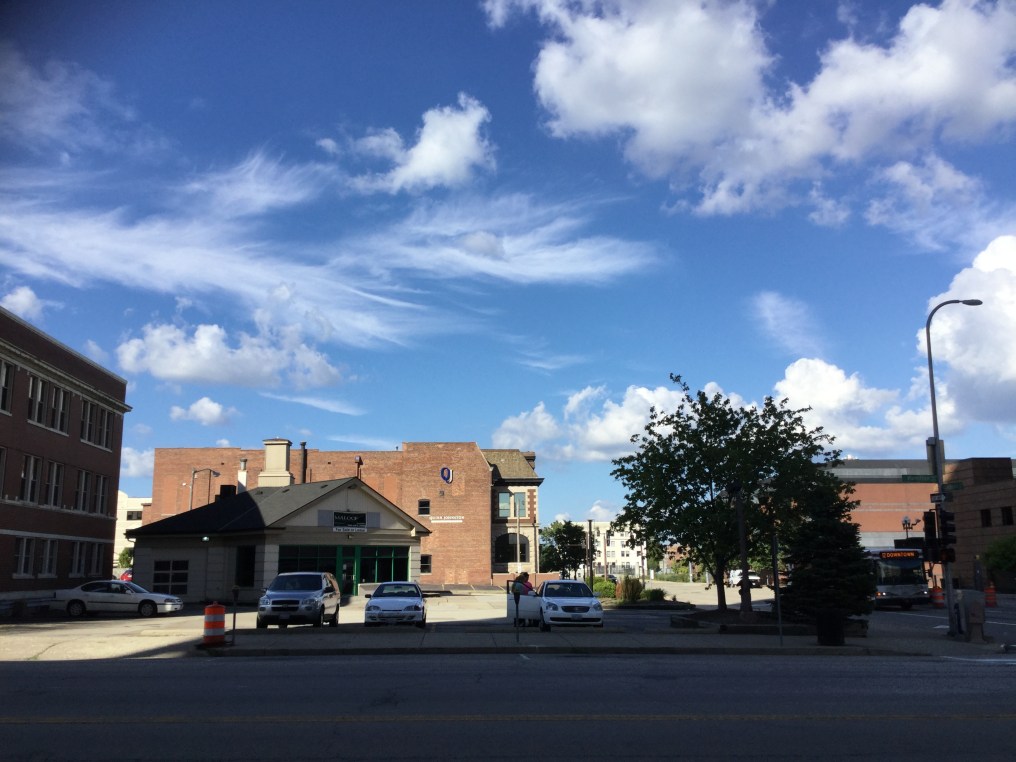
Parking lot where Robert Ingersoll’s mansion and then the National Hotel used to stand, at the north corner of Jefferson Ave and Hamilton St, kitty-corner from the Peoria County Courthouse
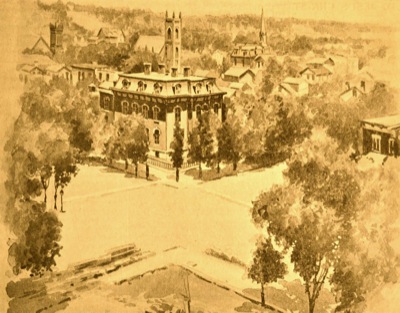
Period view of Robert Ingersoll’s grand house at Jefferson and Hamilton, image from the Robert Ingersoll Birthplace Museum webpage

In 1876, Robert Ingersoll took his law practice solo and moved his office into his third and final Peoria home at the corner of Jefferson Avenue and Hamilton Street. The Ingersoll family lived here until they returned to New York in 1877. All three locations of Ingersoll’s homes, by the way, are taken from Edward Garstin Smith’s The Life and Reminiscences of Robert G. Ingersoll. Smith provides street corners and some landmarks, but since he gives us no street numbers, doesn’t specify north, south, east, and west, and most of the landmarks have changed, I don’t always know just where to photograph. He does tell us that the National Hotel was later built on the site of this home, and Ingersoll’s ‘splendid mansion,’ a four-story affair, was ‘moved to the side of the lot’ of the hotel. Then, with further digging, I find an old postcard of the National Hotel site on the Local History and Genealogy Collection of the Peoria Public Library’s website. Once again, they come through admirably!
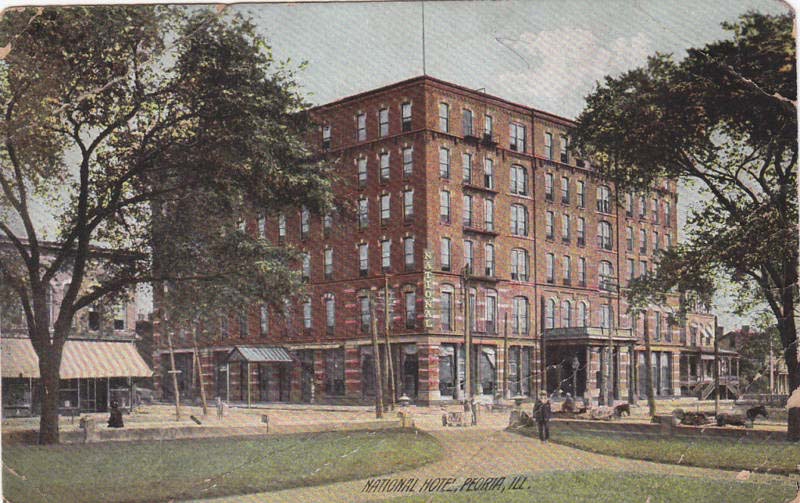
Peoria National Hotel postcard, pre-1911, courtesy of US Genealogy Express. This hotel was built on the site of the Ingersoll family’s third and final home in Peoria.

Another image of the New National Hotel at the former site of Robert G. Ingersoll’s home at the northeast corner of Jefferson & Hamilton. It was built 1883 and razed in 1970, having suffered a fire. It’s now a parking lot. Local History and Genealogy Collection, Peoria Public Library, Peoria, Illinois
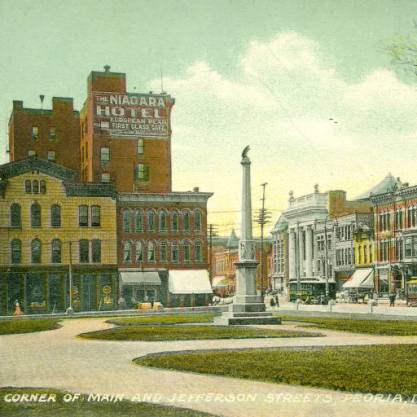
Corner of Main and Jefferson, Peoria, IL, pre-WWI, Local History and Geneology Collection, Peoria Public Library, IL.

The first home of Ingersoll in Peoria, which he rented, was in the 100 block of North Jefferson Ave, between Main St and Hamilton Blvd, and at the time Smith wrote his biography of Ingersoll, the site was occupied by the YMCA building. This site would likely be across the street from the Courthouse square; it’s my understanding that no other buildings ever occupied the square, based on all the old photos and atlases I could find of Peoria. That would place it somewhere near the Rouse’s Hall site, perhaps to the north of it where the tall building next to Commerce Bank is now. (See the Commerce Bank at Main St and Jefferson Ave photo above.)
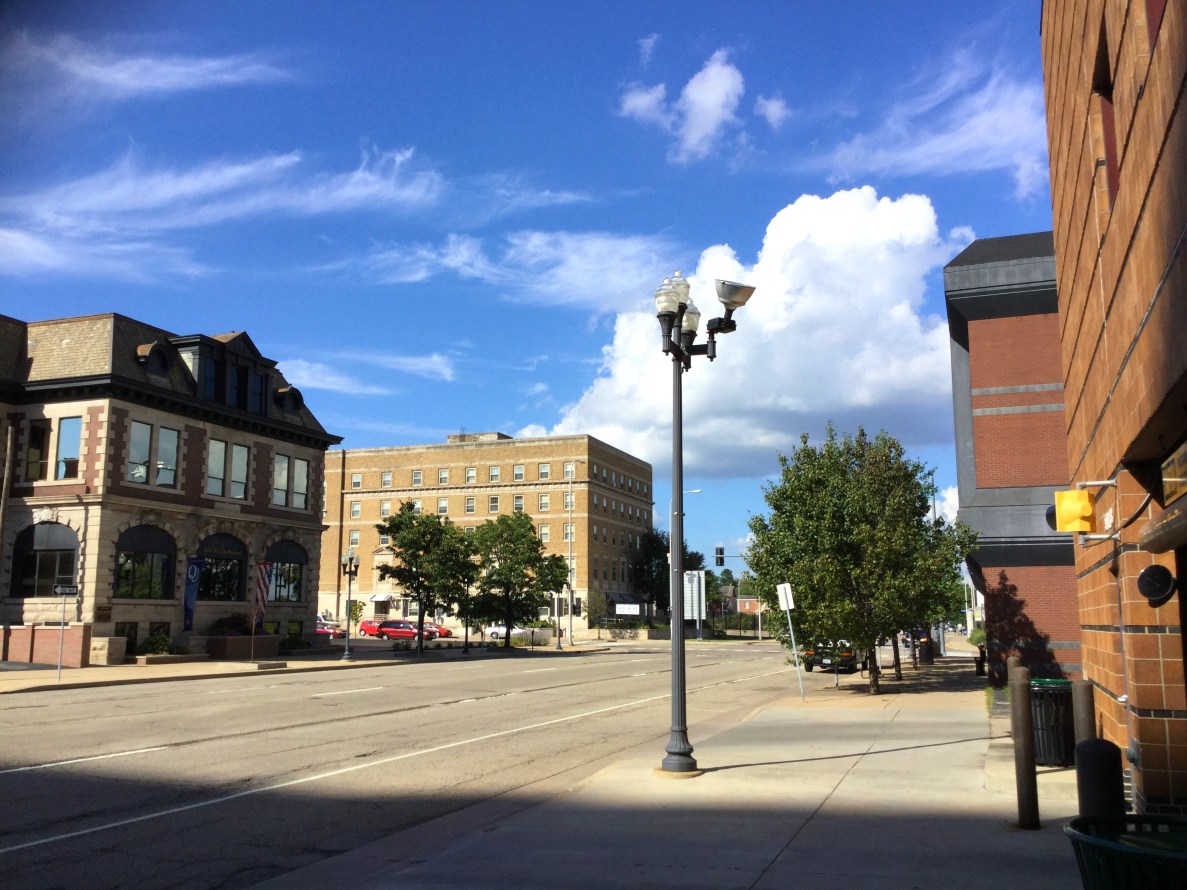
N Jefferson Ave between Hamilton & Fayette, Ingersoll's house stood about where the 1st building on left does now 2017 Amy Cools

N. Jefferson Ave between Hamilton and Fayette. Ingersoll’s second house in Peoria stood about where the first building on left does now

Ingersoll’s second home, which he also rented, was on North Jefferson Ave as well, on the 200 block between Hamilton and Fayette. It was still standing when Smith wrote his biography in 1904. This may be where Ingersoll lived when he met and married his wife, and perhaps where they lived when their daughters were born; Smith doesn’t provide a timeline for their moves between each house. Ingersoll married Eva Amelia Parker in February 1862, and his daughters Eva Robert Ingersoll and Maud Robert Ingersoll were born in 1863 and 1864, respectively. So he had already completed his time of service in the Civil War then he settled down to make a family with Eva.

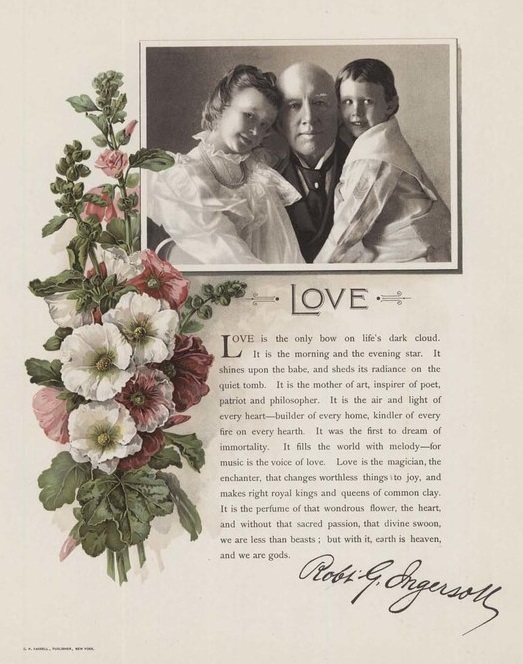
As I’ve written before, Ingersoll was a dedicated family man. He spoke eloquently and movingly of the joys of family life. It was a home filled with love and mutual respect, by all accounts. No wonder Ingersoll’s face almost invariably looks so amiable and friendly in photos! There’s a card I discover among the digital archives from the Robert Ingersoll Papers in the collection of the Abraham Lincoln Presidential Library which includes a photograph of Ingersoll cuddling two of his grandchildren over a poem he wrote titled, simply, ‘Love.’ I’ll leave you with this as I end this part of my account of my day in Peoria, and I’ll pick up the rest of the tale very soon

Farrell, C. P., “Robert Ingersoll, Love,” Chronicling Illinois, Abraham Lincoln Presidential Library

*Listen to the podcast version here or on Google Play, or subscribe on iTunes

Ordinary Philosophy and its Traveling Philosophy / History of Ideas series is a labor of love and ad-free, supported by patrons and readers like you. Please offer your support today!

~~~~~~~~~~~~~~~~~~~~~~~~~~~~~~~~~~~~~~

Sources and inspiration:

Blassingame, J. (Ed.). The Frederick Douglass Papers, Series One: Speeches, Debates, and Interviews. 4 volumes, New Haven and London: Yale University Press, 1979-1999

Carwardine, Richard. Lincoln: A Life of Purpose and Power. New York: Random House, 2003

Donald, David Herbert. Lincoln. New York: Simon & Schuster, 1995

Douglass, Frederick. The Life and Times of Frederick Douglass, 1881.

East, Ernest E. Abraham Lincoln Sees Peoria: An Historical and Pictorial Record of Seventeen Visits from 1832 to 1858. Peoria, 1939

Electoral history of Abraham Lincoln‘. In Wikipedia, The Free Encyclopedia

Foner, Philip S. The Life and Writings of Frederick Douglass, Vol. II. New York: International Publishers, 1950.

Garrett, Romeo B. Famous First Facts About Negroes. New York: Arno Press, 1972

Garrett, Romeo B. The Negro in Peoria, 1973 (manuscript is in the Peoria Public Library’s Local History & Genealogy Collection)

Herndon, William H. and Jesse W. Weik. Herndon’s Lincoln: The True Story of a Great Life. 1889

Hoffman, R. Joseph. ‘Robert Ingersoll: God and Man in Peoria‘. The Oxonian, Nov 13, 2011

Insurance Maps of Peoria, Volume 1. Sanborn Map Company of New York, 1927. (Showing the street numbers before they changed in 1958)

Kelly, Norm. ‘The Hall That Rouse Built‘, Peoria Magazines website, Feb 2015

Kelly, Norm. ‘Peoria’s Own Robert Ingersoll‘, Peoria Magazines website, Feb 2016

Leyland, Marilyn. ‘Frederick Douglass and Peoria’s Black History‘, Peoria Magazines website, Feb 2005

Lehrman, Lewis E. Lincoln at Peoria: The Turning Point. Mechanicsburg, PA: Stackpole Books, 2008.

Lincoln Draws the Line’, Peoria, IL – posted by KG1960 on Waymarking.com

Lincoln, Abraham. ‘Peoria Speech, October 16, 1854.’ via the National Park Service’s Lincoln Home National Historic Site website and ‘Abraham Lincoln’s speech at Peoria, Illinois: [Oct. 16, 1854] in reply to Senator Douglas‘. Seven numbers of the Illinois Daily Journal, Springfield, Oct. 21, 23-28, 1854. [Peoria, Ill.: E. J. Jacob]

Lincoln Home National Historic Site, Illinois. Website, National Park Service

MacMillan, Lois. ‘Close Reading: Speech at Peoria, October 16, 1854‘, published at Quora: Understanding Lincoln

Peck, Graham. ‘New Records of the Lincoln-Douglas Debate at the 1854 Illinois State Fair: The Missouri Republican and the Missouri Democrat‘. Journal of the Abraham Lincoln Association, Volume 30, Issue 2, Summer 2009, pp. 25-80

Peoria Speech, October 16, 1854‘. Lincoln Home National Historic Site, Illinois website, National Park Service

Smith, Edward Garstin. The Life and Reminiscences of Robert G. Ingersoll. New York: The National Weekly Publishing Co, 1904

Wakefield, Elizabeth Ingersoll, ed. The Letters of Robert Ingersoll. New York: Philosophical Library, 1951

The Wheeling Daily Intelligencer, W. Virginia, July 24th, 1899. From Chronicling America: Historic American Newspapers. Library of Congress
Peoria, Illinois, In Search of Robert G. Ingersoll, Frederick Douglass, and Abraham Lincoln, Part 1


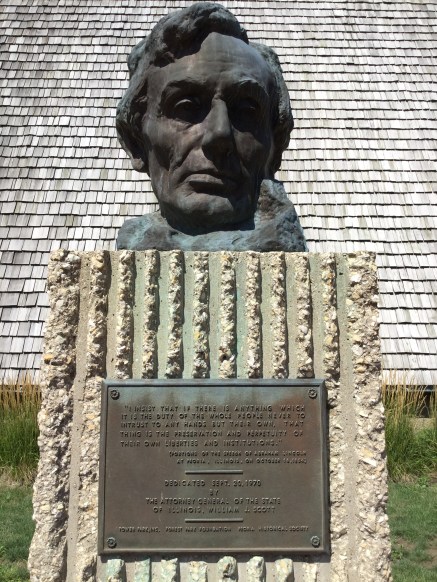
Abraham Lincoln portrait head, cast of Gutzon Borglum model for Mount Rushmore at Tower Park, Peoria Heights. Other versions of this sculpture are at the Abraham Lincoln Presidential Library, the Lincoln Tomb, and the Rotunda of the U.S. Capitol Building in Washington, D.C.

Peoria, Illinois, July 28th, 2017

I awake in a spotlessly clean, perfectly comfortable, aggressively unimaginative Motel 6 hotel room on the north end of Peoria, Illinois. I’ve noticed that Motel 6’s are much better than they used to be when I was a child and young adult, at least in terms of cleanliness and amenities. They were never glamorous, but they now have less character. For many years, for example, the beds sported these wonderfully colorful blankets printed with stylized images of famous cities and landscapes all over the United States. Now, the rooms and draperies are beige highlighted with rust-orange, furnished with the plainest of midcentury-style designs, angular objects only occasionally relieved by a sleek curve here and there.

My term for this sort of accommodation is ‘people storage’: strictly utilitarian, uninspired, and uninspiring. Perhaps that’s a good thing for my purposes: I fled the room as soon as I could to place myself in a more interesting environment. Still, I’m irritated as I so often am with modern architecture and interior design. Why have we stopped bothering to go on artistic flights of fancy, then directing the inspirations found there towards making these things beautiful?

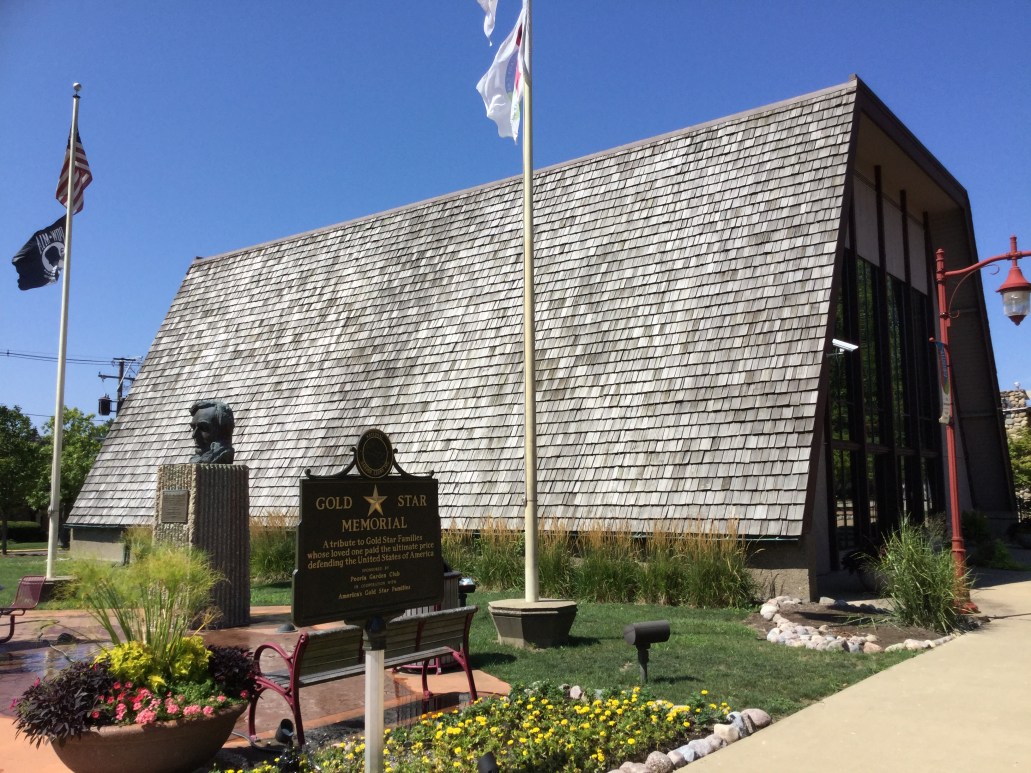
Abraham Lincoln portrait head near the Gold Star Memorial at Tower Park, Peoria Heights, IL

My first destination is a quick stop to see a bust of Abraham Lincoln at Tower Park in Peoria Heights. It’s a cast bronze derived from a plaster model by sculptor Gutzon Borglum for his most famous work, the Mount Rushmore National Memorial sculpture in the Black Hills. Here, it’s mounted on a grooved stony concrete pedestal near a Gold Star Memorial dedicated to the families of slain soldiers. I’ll be visiting the Abraham Lincoln Presidential Library and Museum in Springfield soon so I’ll see the original plaster cast there. More about this sculpture to follow.

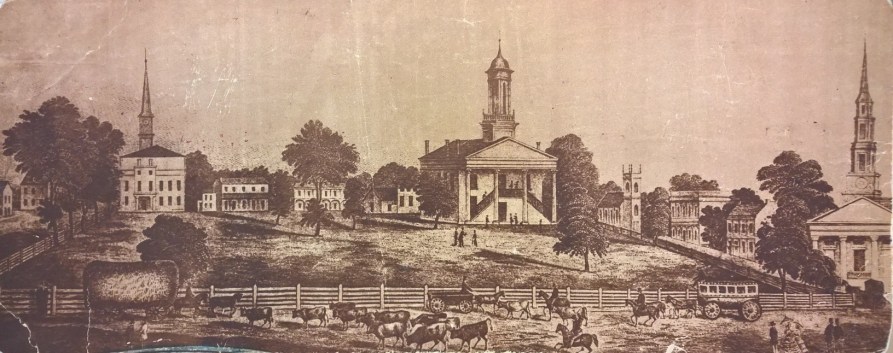
Courthouse Square, Peoria, Illinois, ca. 1845. Peoria Public Library. Peoria would have looked like this for most of the years Lincoln visited. It had grown and changed quite a bit, however, by the time Robert Ingersoll moved here in 1857 and Frederick Douglass spoke here for the first time in 1859.

Lincoln was a regular visitor to Peoria, first visiting in 1832 to buy a canoe on the way home to New Salem from serving briefly as a captain the Black Hawk War (his election to this position by the men of his company was among the proudest moments of his life), and he visited many more times throughout his legal and political career. His first campaign speech was also in Peoria, in 1840, during a Whig rally for Presidential candidate William Henry Harrison. There’s no record of what he said there that day, but many accounts of his early speeches describe a man initially hesitant and shy, whose eloquence increased as his confidence did. Peoria is the site of one of his greatest oratorical triumphs; I’ll tell the story once I reach the site where it occurred.

Plaque at the base of a flagpole dedicated to veterans in Glen Oak Park, Peoria, Illinois. Glen Oak Park is at the site of Camp Lyon, a Union recruitment and training camp for the Civil War

My second destination is pretty Glen Oak Park, lush with trees and large green lawns. I enter the park via the west entrance at Prospect Road and McClure Ave and park under the trees along the large oval central green. It’s hot and humid today, but there’s just a little breeze in addition to the plentiful shade, which helps a lot. There are two things that bring me here, both associated with the life of one man.

Robert G. Ingersoll, who lived from 1833 – 1899, was a colonel in the Civil War, a lawyer, a politician, and most famously, an orator. Born in Dresden, New York, he lived in Peoria from 1857-1877. Ingersoll was often called ‘The Great Agnostic’ for his trenchant critiques of religion. He was also an abolitionist, a women’s rights advocate, and a promoter of the memory of Thomas Paine as a great American hero. Thomas Paine had made a clear and eloquent case for the cause of American independence from Britain in his best-selling 1776 pamphlet Common Sense, then as the Revolutionary War struggled on, helped inspire patriotism and perseverance with his The American Crisis series. Paine’s once-stellar reputation suffered over time, especially after his publication of The Age of Reason, an attack on orthodox religion, and his vociferous criticism of diplomat Silas Deane and of President George Washington.

Ingersoll agreed with Paine’s criticism of Washington. He thought that Paine was right to be aggrieved with Washington’s decision to do nothing to deliver him from his captivity and sentence of death by the radical French Revolutionaries under Robespierre. After all, Paine was condemned by the French revolutionaries for opposing the execution of King Louis XVI, who had been an ally of the American Revolution and who had provided invaluable aid to Washington during the war. Paine also criticized Washington’s support for the institution of a state church in Virginia, which, of course, was the kind of thing Ingersoll would oppose as well. Ingersoll used his own eloquence to help rescue Paine’s memory from disrepute and reinstate him as one of the moral and intellectual founders of the United States of America.

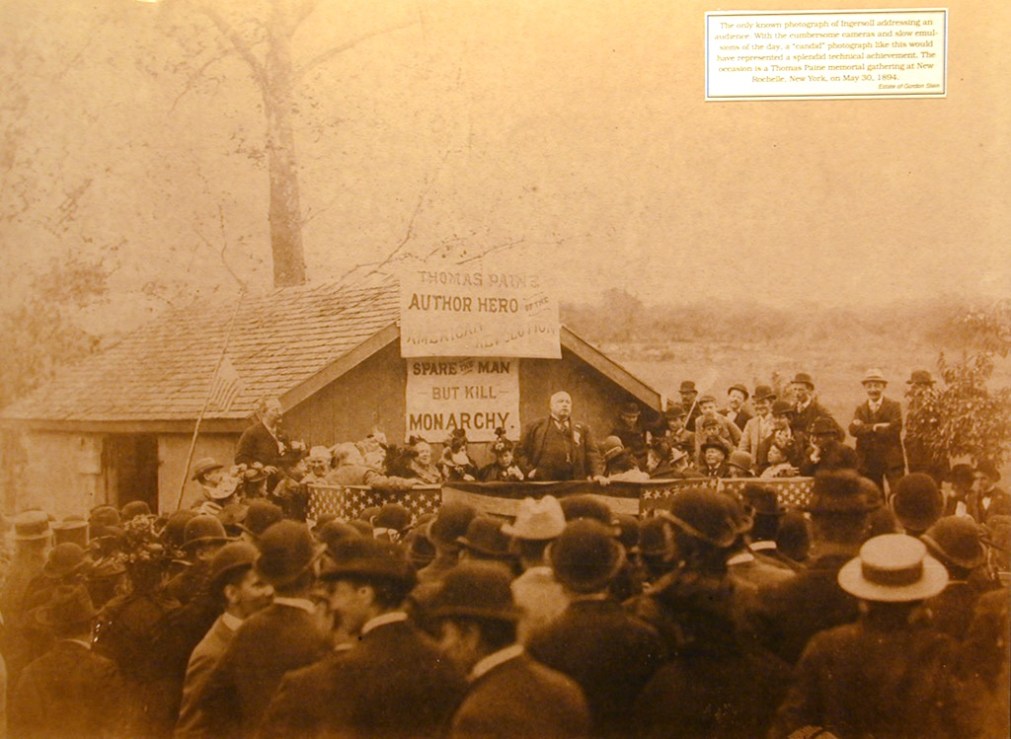
The only known image of Ingersoll addressing an audience, Robert Green Ingersoll Birthplace Museum, public domain via Wikimedia Commons. Note the Thomas Paine banner hanging above Ingersoll.

Lincoln held similar sentiments to Ingersoll about Paine. In his twenties, he wrote an essay defending Paine and his deism, which his friend burned so that it could never be found and published. Lincoln had political ambitions already, and his friend, probably correctly, predicted it could derail any run for office he might make. Then, as now, real or at least assumed religious belief was a prerequisite for a successful political career, despite our legal commitments to freedom of conscience and belief. Lincoln was a religious skeptic himself, a nonbeliever as a young man who became a non-denominational believer over time. God entered his writings and discourse ever more often throughout the years though tellingly, not so for Jesus Christ specifically. Lincoln preferred, for the most part, to keep the particulars of his religious belief private.

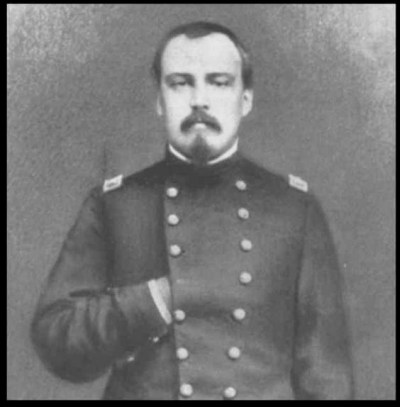
Colonel Robert G. Ingersoll in his uniform, early 1860’s

The west gate of Glen Oak Park is the approximate site of Camp Lyon, where Ingersoll was commissioned as a colonel of the Union Army in 1861 and where he raised his regiment. His first experience in battle was in the Battle of Shiloh, a particularly bloody engagement and a Union victory. He conducted himself well and was commended for his excellent service in many battles during the next year and a half. He resigned on June 30th, 1863; he had been captured then placed in charge of a camp of paroled prisoners who could not fight as a condition of their parole unless they were exchanged for Confederate prisoners. This system of conditional parole and prisoner exchange was common practice at the time, I’m guessing because it saved a lot of money and resources for both sides in feeding and housing prisoners. Ingersoll waited for months for an exchange to happen so he could return to active service, but this exchange never came. So, he went home. Ingersoll thought he could be more useful returning to his law practice and entering politics than continuing to wait around for something that might never happen.

While he was still in the field, Ingersoll wrote some very compelling, descriptive accounts of the battle, as did his fellow soldier who fought at the battle of Shiloh, Ambrose Bierce. Ingersoll’s contemporary accounts appeared in letters to his brother; Bierce’s account ‘What I Saw of Shiloh’ was written when he had become an experienced writer, published in 1881. If you haven’t read Bierce’s Shiloh account, I very, very highly recommend it. Bierce was a journalist and a prolific writer in many genres. He’s also the author of The Devil’s Dictionary and many other wonderful and skeptical satirical works, I think sometimes on the level of as well as in the spirit of Voltaire. He was a great admirer of Ingersoll, as was poet Walt Whitman, who was also Ingersoll’s personal friend. I’ll return to Ingersoll and Whitman’s relationship in a future installment of my Ingersoll account. Bierce included Ingersoll in his delightfully irreverent poetic definition of the term Decalogue:

Thou shalt no God but me adore:
’Twere too expensive to have more.
No images nor idols make
For Robert Ingersoll to break.
Take not God’s name in vain; select
A time when it will have effect.
Work not on Sabbath days at all,
But go to see the teams play ball.
Honor thy parents. That creates
For life insurance lower rates.
Kill not, abet not those who kill;
Thou shalt not pay thy butcher’s bill.
Kiss not thy neighbor’s wife, unless
Thine own thy neighbor doth caress.
Don’t steal; thou’lt never thus compete
Successfully in business. Cheat.
Bear not false witness— that is low—
But “hear ’tis rumored so and so.”
Covet thou naught that thou hast not
By hook or crook, or somehow, got.

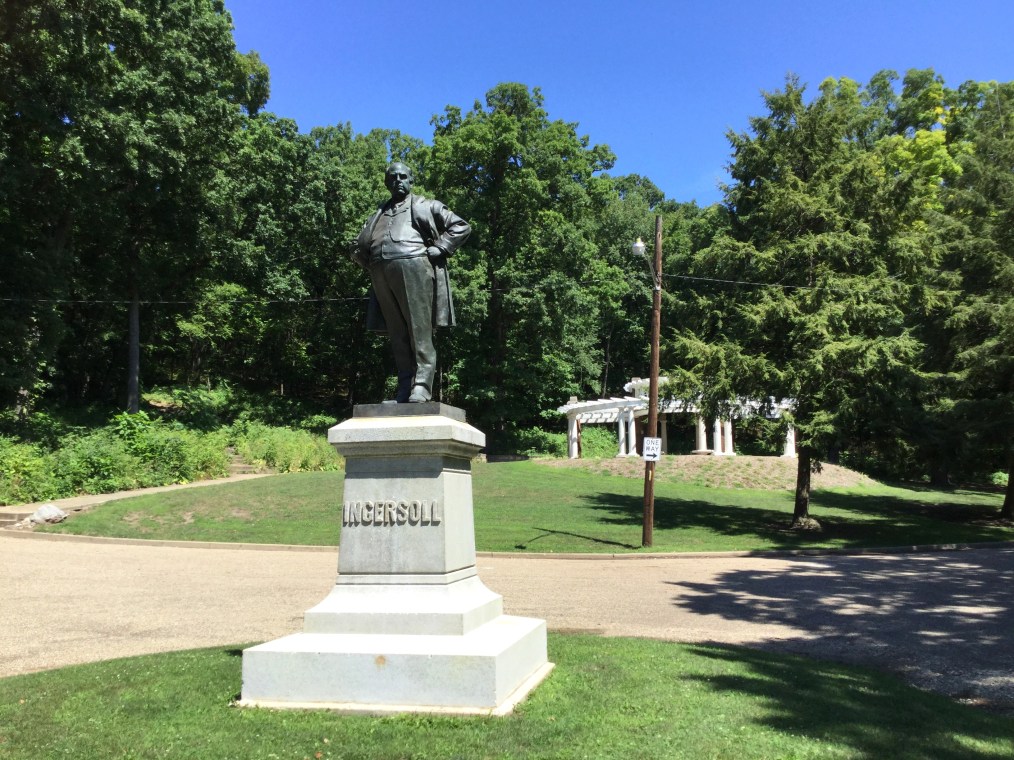
Robert Ingersoll statue in Glen Oak Park, Peoria, Illinois

Plaque on the sculpture of Robert G. Ingersoll at Glen Oak Park, Peoria, Illinois

I continue south and a little east through the park on winding paths and roads, past playgrounds, fields, and a lagoon. I’m headed toward the statue and monument to Ingersoll near the southernmost end of the park at Abington Street and Perry Avenue.

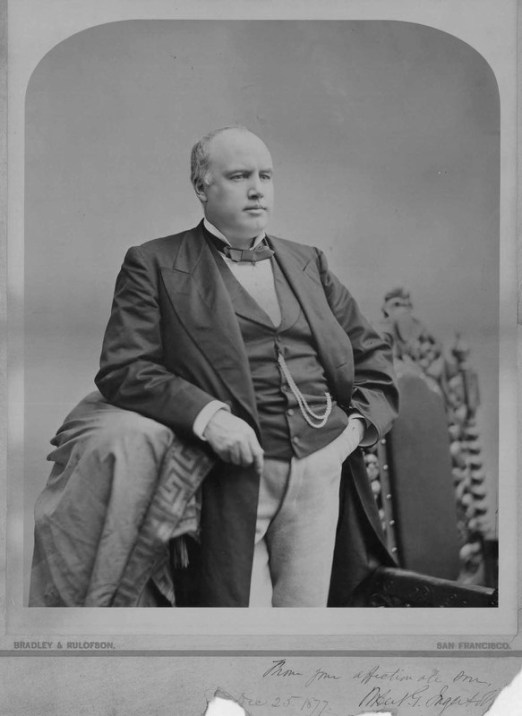
It’s a handsome statue, portraying Ingersoll in his maturer years as a portly man with a very round belly. As far as I could tell from photos, Ingersoll was never particularly slim, though he was more so when he was younger and I think when he was in his last year or so, based on facial portraits. His fleshiness gave him a very youthful look for most of his life, and I think a cheerful one. Especially then, being on the fatter side indicated that you led a happy life of plenty. The face of his statue, tilted slightly downwards, appears more serious than any photo I’ve seen of him in his later years. This, with his arms-akimbo stance, can at first glance seem an almost stern portrayal, as if he’s looking at you or something just beyond you reprovingly. But after studying the sculpture, I think it’s meant to convey Ingersoll in deep thought, perhaps walking back and forth with his hands on his hips as so many of us do when we’re working out some problem in our own minds, or when trying to recall some important fact or idea. Most photos of Ingersoll show him with a little smile on his lips, highlighted by his somewhat dimpled mouth and cheeks. He has the face of a ready and kindly friend.

Bradley & Rulofson, “Robert Green Ingersoll,” Chronicling Illinois, Abraham Lincoln Presidential Library

I drive next to Peoria Historical Society’s Flanagan House Museum at 942 NE Glen Oak Ave. I had emailed their office yesterday in hopes of making an appointment but haven’t heard back yet. My research revealed that they have a portrait of Ingersoll on display. Since it’s close enough to being on my way to my next destination, I swing by to see if someone happens to be around. No such luck.

I continue on to the Local History and Genealogy Collection at the Peoria Public Library at 107 NE Monroe street. There’s a manuscript here by Romeo B. Garrett called The Negro in Peoria, I believe the only or one of very, very few copies, in which I’m seeking more details than I have about Frederick Douglass’ visits to Peoria. This manuscript served as Garrett’s doctoral dissertation, I believe. Dr. Garrett was the first African-American professor at Bradley University.

The people who work in this collection are very helpful, particularly Chris Farris, who is there most of the time I am. I find nearly everything I’m seeking and more that I didn’t know to look for. Thank you, Chris, for all the help and interesting conversation! You’re the best.

I spend several fascinating hours here and discover much about Ingersoll, Lincoln, and Douglass in Peoria. My time in this city is a rich one, and I visit so many places linked to interesting stories that I’ll break this up into a two- or three-parter. The next will begin with the sites I visit once I leave the library. To be continued…

*Listen to the podcast version here or on Google Play, or subscribe on iTunes

Ordinary Philosophy and its Traveling Philosophy / History of Ideas series is a labor of love and ad-free, supported by patrons and readers like you. Please offer your support today!

~~~~~~~~~~~~~~~~~~~~~~~~~~~~~~~~~~~~~~~

Sources and inspiration:

Bierce, Ambrose. ‘What I Saw of Shiloh.’ 1881

Blassingame, J. (Ed.). The Frederick Douglass Papers, Series One: Speeches, Debates, and Interviews. 4 volumes, New Haven and London: Yale University Press, 1979-1999

Burlingame, Michael. Abraham Lincoln: A Life, Volume 1. Baltimore: Johns Hopkins University Press, November 2012

Bust of Lincoln – Peoria Heights, IL – Abraham Lincoln‘, posted by NoLemon on Waymarking.com

Carwardine, Richard. Lincoln: A Life of Purpose and Power. New York: Random House, 2003

Donald, David Herbert. Lincoln. New York: Simon & Schuster, 1995

Douglass, Frederick. The Life and Times of Frederick Douglass, 1881.

Garrett, Romeo B. The Negro in Peoria, 1973 (manuscript is in the Peoria Public Library’s Local History & Genealogy Collection)

Herndon, William H. and Jesse W. Weik. Herndon’s Lincoln: The True Story of a Great Life. 1889

History of Dr. Romeo B. Garrett.‘ Bradley University website.

Hoffman, R. Joseph. ‘Robert Ingersoll: God and Man in Peoria‘. The Oxonian, Nov 13, 2011

Jacoby, Susan. The Great Agnostic: Robert Ingersoll and American Freethought. New Naven: Yale University Press, 2013.

Kelly, Norm. ‘Peoria’s Own Robert Ingersoll‘, Peoria Magazines website, Feb 2016

Leyland, Marilyn. ‘Frederick Douglass and Peoria’s Black History‘, Peoria Magazines website, Feb 2005

Lehrman, Lewis E. Lincoln at Peoria: The Turning Point. Mechanicsburg, PA: Stackpole Books, 2008.

Lincoln Home National Historic Site, Illinois. Website, National Park Service

Mcmillan, Brad. ‘Lincoln’s Strong Ties to the Peoria Area‘, Peoria Magazines website, Feb 2012

Nelson, Craig. Thomas Paine: Enlightenment, Revolution, and the Birth of Modern Nations. New York: Viking Penguin, 2006.

Peoria City‘ from Peoria County Atlas 1873, Illinois. Published by A. T. Andreas in 1873, posted in Historic Map Works

Peoria Speech, October 16, 1854‘. Lincoln Home National Historic Site, Illinois website, National Park Service

Robert Ingersoll Collection. From Chronicling Illinois, Abraham Lincoln Presidential Library

Robert Green Ingersoll Family Papers, 1854-1970 (bio)Chronicling Illinois, Abraham Lincoln Presidential Library

Simon, Paul. Lincoln’s Preparation for Greatness: The Illinois Legislative Years. University of Illinois Press, 1971

Smith, Edward Garstin. The Life and Reminiscences of Robert G. Ingersoll. New York: The National Weekly Publishing Co, 1904

Swaim, Don. ‘The Blasphemer Robert G. Ingersoll and Why He Mattered to Ambrose Bierce.’ 2012, Donswaim.com

Wakefield, Elizabeth Ingersoll, ed. The Letters of Robert Ingersoll. New York: Philosophical Library, 1951

The Wheeling Daily Intelligencer, W. Virginia, July 24th, 1899. From Chronicling America: Historic American Newspapers. Library of Congress
Knox College, Galesburg, Illinois – Abraham Lincoln and Stephen Douglas Debate

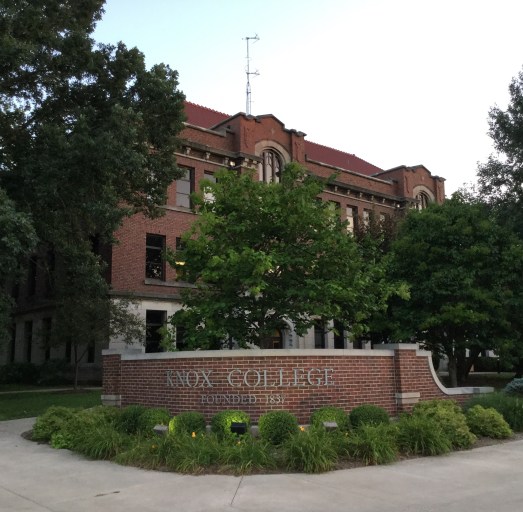
Knox College, George Davis Hall at E. South and S. Cherry Streets, Galesburg, Illinois

Knox College, Galesburg, Illinois, July 27, 2017

After exploring Fort Robinson for a couple of hours yesterday morning, I washed my face, changed my clothes, ate a hearty cooked breakfast in the restaurant in the main lodge, and drove east across Nebraska.

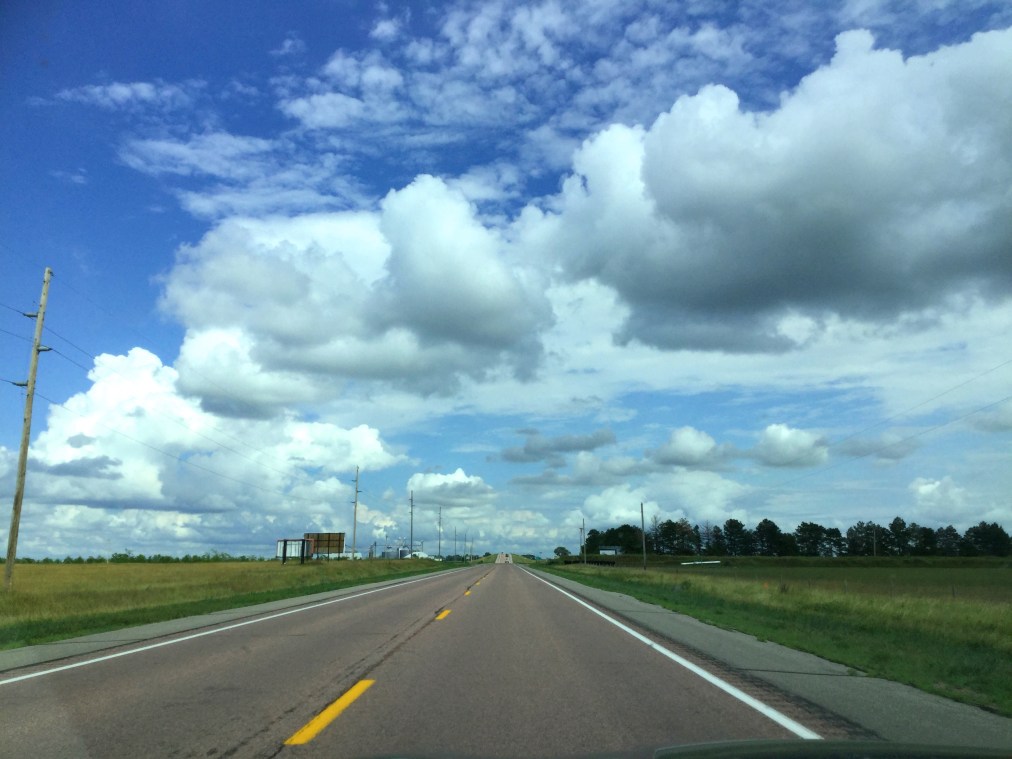
The drive was beautiful, vast blue-blue-blue skies with towering puffy clouds and occasional gray ones that blew through and dropped a little rain on the way. Rainbows faded in and out of view. The green and gold fields sometimes laid flat and sometimes rolled over gentle slopes and undulations. The road ran straight and wound among them accordingly. Tidy farmhouses were scattered across the land, and silos and grain elevators rose high near little town clusters, some full of quiet life on this warm summer afternoon, some nearly or entirely abandoned and decayed. I drove through the early evening until I decided I could no longer do without a nice shower and a proper bed. So I found a little hotel in Missouri Valley, Iowa and got a good night’s rest. This morning, I linger until nearly noon to finish writing up and publishing one of my pieces for this series.

Looking through the windshield on Highway 20, headed east through Nebraska farmland, 2017 Amy Cools

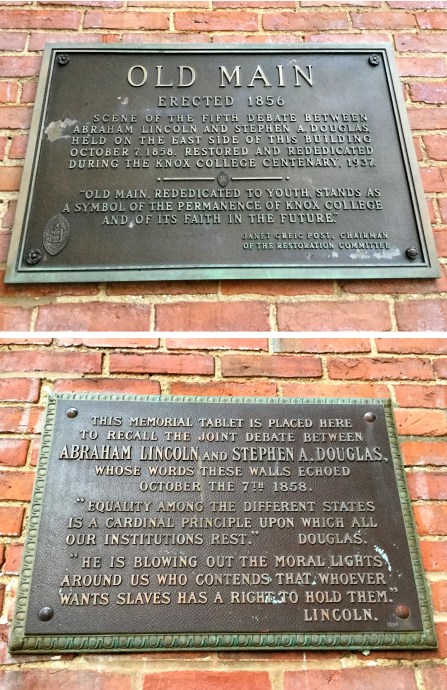
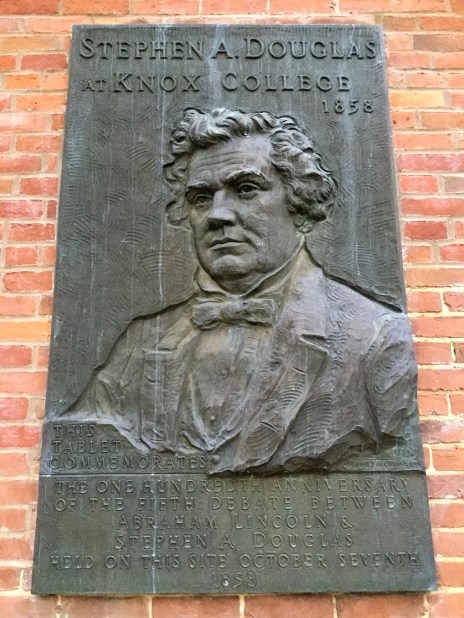
Lincoln Douglass debate plaques on Old Main, Knox College. The debate plaque on the bottom engages in a bit of romanticism: the words could not echo ‘from these walls’ since it was held outside. Perhaps they could have echoed from the outer east wall, but ‘blowing’ is the key word here: the chilly wind that day would have likely rendered any echo inaudible.

I continue east towards Peoria, and about an hour before I reach that city, I spot a highway sign for an Abraham Lincoln historical site in Galesburg, Illinois. I turn off the highway and follow the signs to Knox College.

Knox College was chartered in 1837 by the Illinois state legislature while Abraham Lincoln was still a member. It was founded by New York minister George Washington Gale and a group of fellow idealists and reformers. They were, among other things, dedicated to training people in self-sufficiency and the practical arts, to opposing slavery, and to providing women with a full education. So the twenty-one-year-old college no doubt enthusiastically welcomed the rising young anti-slavery politician already widely known for his unique combination of eloquence and broad knowledge, and his awkward, homespun, frontier appearance. He was engaged in a series of seven debates with the well-dressed, polished, canny career politician Stephen A. Douglas, who Lincoln was hoping to replace as Illinois Senator in the 1859 election. (At this time, senators were still elected into office by the state legislatures rather than by popular vote.)

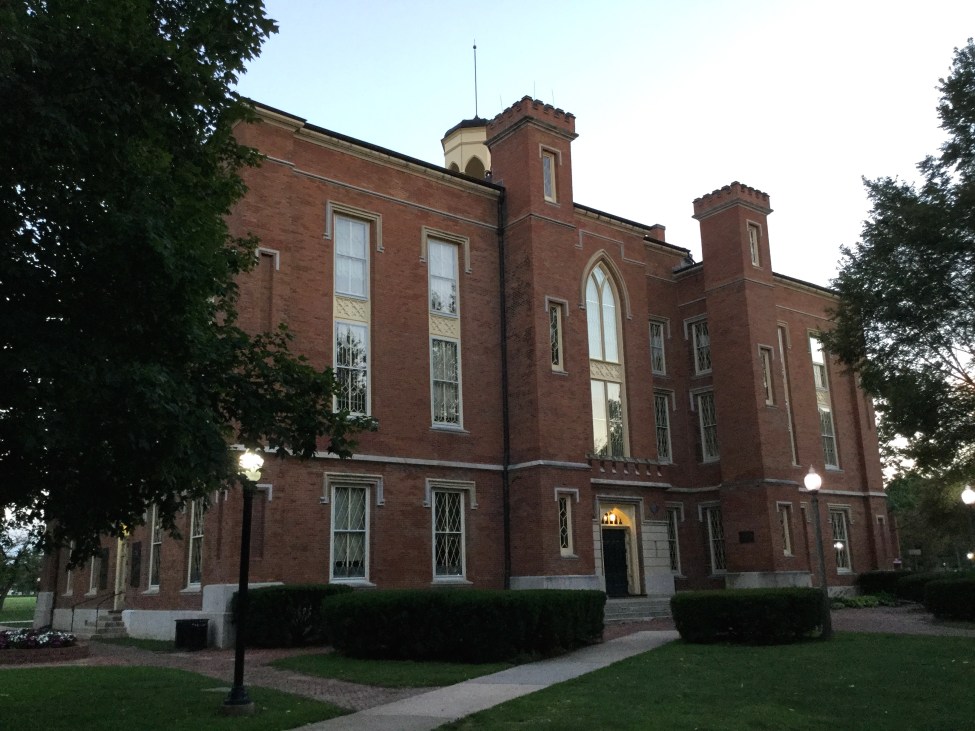
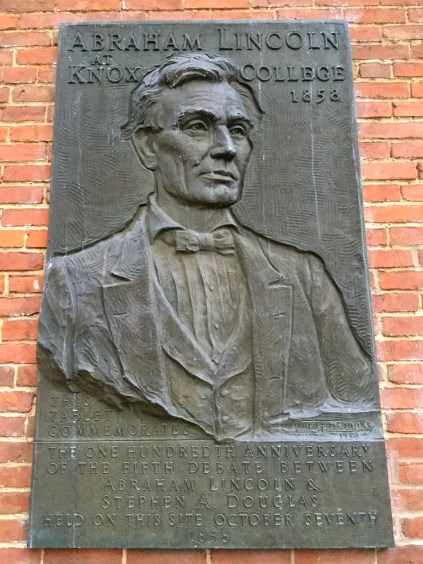
The fifth debate of the series was held here at Knox College on October 7, 1858, on the east lawn of the newly constructed Main building, now called Old Main. Plaques of Lincoln and Douglas are placed on the east wall of the Old Main to commemorate the event. This building, in fact, is the only remaining original building associated with these famous Lincoln-Douglas debates.

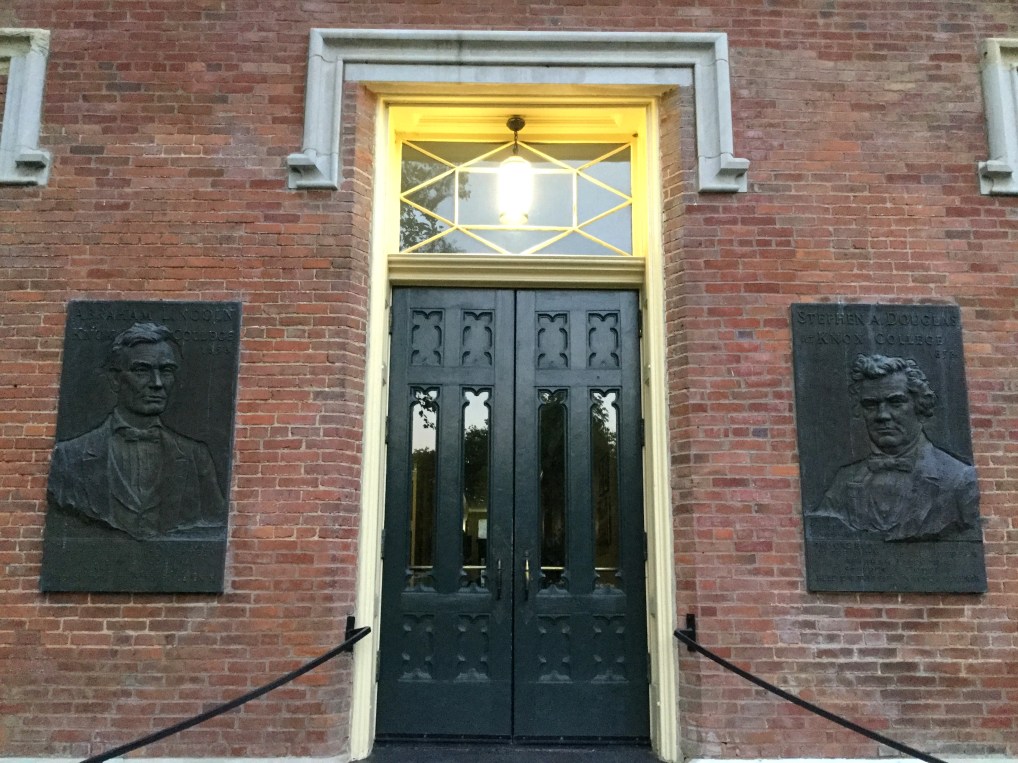
Old Main, Knox College, Galesburg, Illinois. The east lawn, where Abraham Lincoln and Stephen A. Douglass debated, is on the right side of this building, to the left looking at the photo. You can see the two tall plaques commemorating the debate on either side of the side door

Abraham Lincoln plaque on the east wall of Old Main, Knox College

Since it was a cold and blustery fall day, the debate was moved from an open lawn to a spot at the side of the Main building where the stage was sheltered from the wind; it couldn’t be moved inside because there were 10,000-20,000 people there, depending on which newspaper account you read. All agree that the audience was enormous.

Lincoln climbed through a window to reach the debate platform and as he did, he reportedly quipped ‘Well, at least I’ve gone through college.’ We tend to think of him as a somber man, ever dignified, ever noble in his comportment. He has attained such a mythical status as a moral leader and shepherd of our nation through our most severe national crisis, and his image in photographs, portraits, and sculpture are almost as invariably solemn, stately, unsmiling, his face often drawn with sorrow, as he appears in our collective imagination. But, Lincoln was actually quite playful and even goofy sometimes, a joker and teller of humorous, sometimes bawdy stories. If you’ve watched the excellent Steven Spielberg movie Lincoln, you’ve seen that delightful scene where he tells a naughty joke about a painting of George Washington and an outhouse. In case you want to know how the joke goes, well, I’m not going to tell you. Not because I mind telling naughty jokes (I love ’em!) but because if you’ve seen the film, you likely remember it, and if you haven’t, it’s high time you did, and I hope your curiosity about this joke is now one more incentive to do so.

Lincoln-Douglas debate plaques on either side of the door in the east wall of Old Main, Knox College

As they debated here, one of the main points on which Douglas attacked Lincoln was his alleged sectionalism. He argued that the Republican party platform was all about appealing to extremist adherents to regional political doctrines that the Northerners subscribed to, but not the South. But he, Douglas claimed, was the true believer in a universal principle: popular sovereignty. The states and all new territories that were admitted to the Union should each vote on whether or not to allow slavery within their own borders. After all, wasn’t the United States founded on the idea that people had the right to govern themselves? It was sectionalists like Lincoln who were worsening the growing pains of our nation. The national debate over slavery was dividing the nation ever more sharply was new territories were added, and with each new addition, North and South worried anew over the resulting balance of power between free and slave slaves.

Stephen Douglas plaque on the east wall of Old Main, Knox College

Lincoln, however, turned Douglas’ argument right back on him. Lincoln argued that slavery was wrong while admitting that the Constitution allowed for it to continue in the South where it had already existed. He further argued that the law must be obeyed as it stood. But he also believed that some of the slave-owning founders of our nation, including Thomas Jefferson and George Washington, as well all of the non-slave-owning founders, believed that slavery was a moral evil and hoped it would die out or be abolished over time. Lincoln pointed out unlike the founders, Douglas refused to take a moral stand on slavery; he insisted it should be a matter of popular sovereignty, up to the states to decide for themselves. In short, Douglas believed that sectional interests should decide the matter. Lincoln pressed Douglas on this point throughout the debates, especially at Knox College: either slavery is right or it is wrong, and as such, it should not simply be up to local popular vote. After all, this was a moral matter about those human rights such as those enumerated in the Bill of Rights. It was not merely a practical matter of ‘domestic affairs’ as Douglas put it, such as apportioning funds for regional projects, administering local public institutions, or community policing.

Now, of course, we would press Lincoln today just as he pressed Douglas on this point: if slavery was as wrong as Lincoln said it was for the reasons he said it was, then it would be intolerable anywhere it existed, the South included. Lincoln, in this, was as inconsistent as he accused Douglas of being. Slavery, after all, consisted of the imprisonment of the innocent, rape, child abduction, forced labor, wage theft, torture, even murder: all incompatible with the Constitution, the Bill of Rights, and the Declaration of Independence. Now Lincoln knew this: as he pointed out in an earlier speech, ‘A house divided against itself cannot stand. I believe this government cannot endure, permanently, half slave and half free.’ Yet, very much a border state man of his time, it took him a long time to reconcile the complex socioeconomic issues surrounding slavery with the convictions of his reason and his conscience. He may have been willing to allow slavery to continue if that’s what it took to preserve the Union, but as he himself more than hinted at, this would be futile anyway. Either slavery would dissolve away on its own, which the Missouri Compromise of 1850, the Kansas-Nebraska Act of 1954, and the Dred Scott decision of 1857 made appear a more distant and unlikely outcome than ever; or, slavery needed to be abolished. It would take Lincoln quite some time to fully evolve in the courage of his convictions and work to stop slavery everywhere it existed.
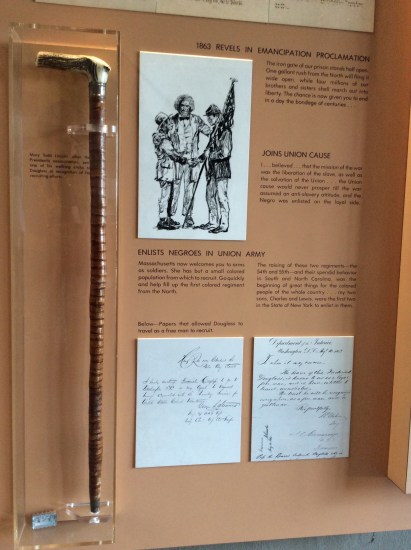
Abraham Lincoln’s walking stick, Mary Todd Lincoln’s gift to Frederick Douglass at the Frederick Douglass National Historic Site, Washington, D.C. Lincoln and Douglass were often at odds on matters of policy but became friends and allies during the Civil War. Douglass was unsparing in both praise and criticism of Lincoln as he believed it was deserved. Lincoln had the integrity to not let this interfere with his cordial treatment of Douglass, including his warm welcome of Douglass at the reception following his second inauguration.

The argument, which some continue to make today, that we should have allowed slavery to continue in the South in the expectation that it would gradually fade away on its own, to preserve the Union while averting the terrible and bloody Civil War, has always appeared to me at least extremely odd, if not morally repugnant. It especially disturbs me when I hear otherwise reasonable people make it, especially those who I otherwise admire and respect. After all, as I point out above and as I’ll repeat, slavery was imprisonment of the innocent, forced labor, destruction of families, and wage theft, and rife with rape, child abduction, torture, and murder, institutionalized with the blessing of the slave states. If slaveowners were kind to their slaves as far as the institution would allow, well, this rested entirely on their own good will. Even where laws existed to protect slaves from the worst abuses, such as murder, rape, and egregious physical punishment, enforcement of these laws were rare, and the Supreme Court’s Dred Scott decision effectively erased the right for wronged black people, free as well as slave, to take their cases to court. To drive this point home, Chief Justice Roger Taney wrote in his majority opinion that black people ‘had no rights which the white man was bound to respect.’ And slave families were necessarily torn apart on a regular basis since most slaveowners could not afford to maintain growing slave populations as they increased through childbirth. Would anyone seriously advocate, in any other circumstance, that we should permit rape, and murder, and torture, and tearing children from their families, and systematic imprisonment of the innocent to continue unabated in order to avoid war? Aren’t these the very sorts of things that the only wars we call just are fought to prevent?

Lincoln was awarded Knox College’s first honorary degree in 1860. Barack Obama was accorded that same honor in 2005, and I think this would make Knox College’s progressive founders very proud. Though Lincoln sometimes revealed that he had as many racial prejudices as a typical man of his time, opposing slavery while not believing that black and white people were fully equal or could live together in harmony, his thoughts and feelings in these matters apparently changed over time. As the Civil War went on and he was forced to confront issues of race head-on, he demonstrated growth in his understanding of the evils not only of slavery but of racism generally. So much so, in fact, that when Frederick Douglass met President Lincoln in person, he had a very positive impression of him, though Douglass had been his long-time and often very severe critic. They still did not agree on many matters of policy, but Douglass was impressed with Lincoln’s courteous treatment of him and his apparent lack of interpersonal racial prejudice. So I think that Abraham Lincoln, after getting used to the idea and observing the proof that it was slavery, not biology, that created the cultural gulf between white and black people, would also be proud that Obama is a fellow honoree and a fellow president, and of his own contributions to making that possible.

*Listen to the podcast version here or on Google Play, or subscribe on iTunes

Ordinary Philosophy and its Traveling Philosophy / History of Ideas series is a labor of love and ad-free, supported by patrons and readers like you. Please offer your support today!

~~~~~~~~~~~~~~~~~~~~~~

Sources and inspiration:

Carwardine, Richard. Lincoln: A Life of Purpose and Power. New York: Random House, 2003

Donald, David Herbert. Lincoln. New York: Simon & Schuster, 1995

Fifth Debate – Galesburg, October 7‘. History of the 1858 Debates: Lincoln-Douglas Debate Communities, from Looking for Lincoln Heritage Coalition website

Galesburg, Knox College, October 7, 1858.’ Mr. Lincoln and Freedom by The Lehrman Institute

Herndon, William H. and Jesse W. Weik. Herndon’s Lincoln: The True Story of a Great Life. 1889

Holzer, Harold. The Lincoln-Douglas Debates: The First Complete, Unexpurgated Text. New York: Fordham University Press, 2004

Knox College & Lincoln‘ from Lincoln Studies Center: About Knox, Knox College website

Knox College Circular & Plan‘ from About Knox: Our History, Knox College website

Oakes, James. The Radical and the Republican: Frederick Douglass, Abraham Lincoln, and the Triumph of Antislavery Politics. New York: W. W. Norton & Company, 2007

Scott V. Sandford | 1857‘. Landmark Cases: Historic Supreme Court Decisions, C-SPAN’s 12-part history series produced in cooperation with the National Constitution Center

Fort Robinson, Nebraska, in Search of Crazy Horse

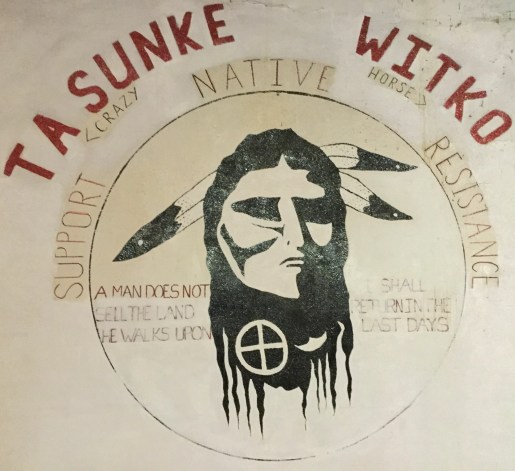
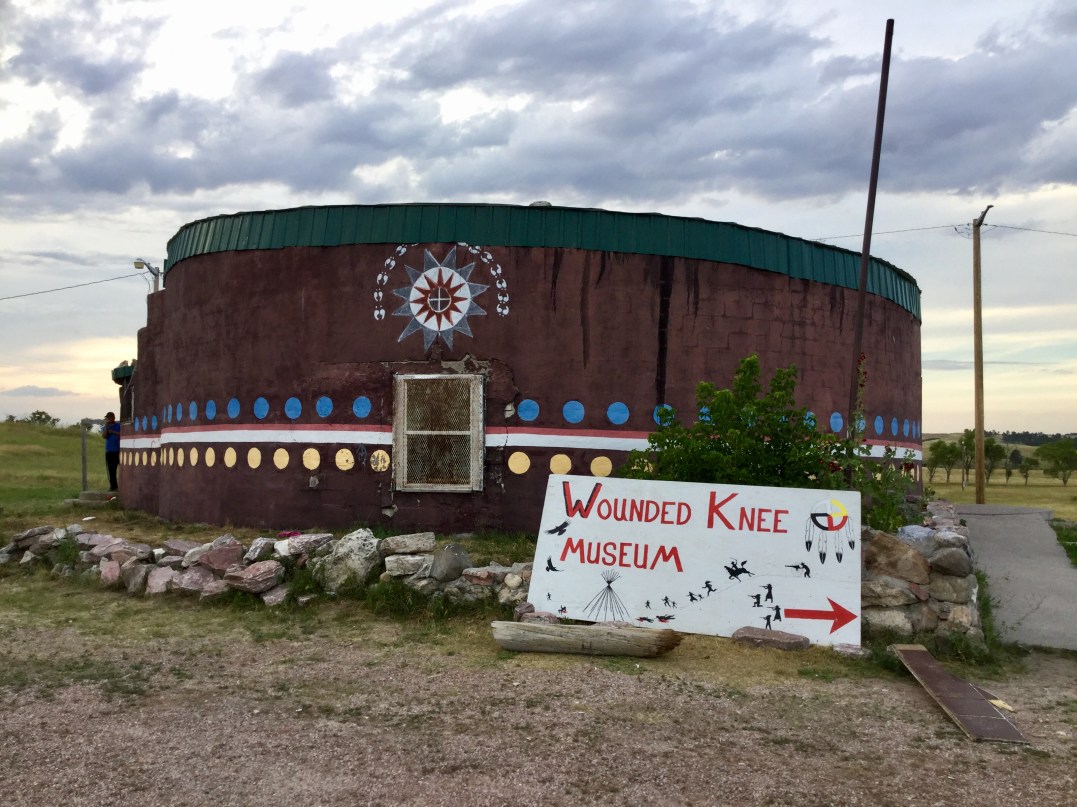
Portrait of Crazy Horse, Tasunke Witko in Lakota, fresco on the interior wall of Wounded Knee museum, Pine Ridge Reservation, South Dakota

Fort Robinson, Nebraska, July 26th, 2017

I wake up at Fort Robinson, just a little ways east of the village of Harrison in northwest Nebraska. I drove here last night from Wounded Knee, which takes about one hour and forty-five minutes. I camped out in the backseat of the car, where I continue to keep my sleeping bag, camp pad, and coats ready to make a cozy nest, in a parking lot behind one of the museum’s lodges. It’s a soft pinkish-blue morning, a little warm with a cool breeze blowing. It rained a little last night and everything feels fresh and clean, except me. I’ll soon find a place to wash my face, brush my teeth, and change into clean clothes. But right now, all I want to do is stretch my legs, drink my little thermos of coffee, and go out exploring in this calm and lovely early summer morning.

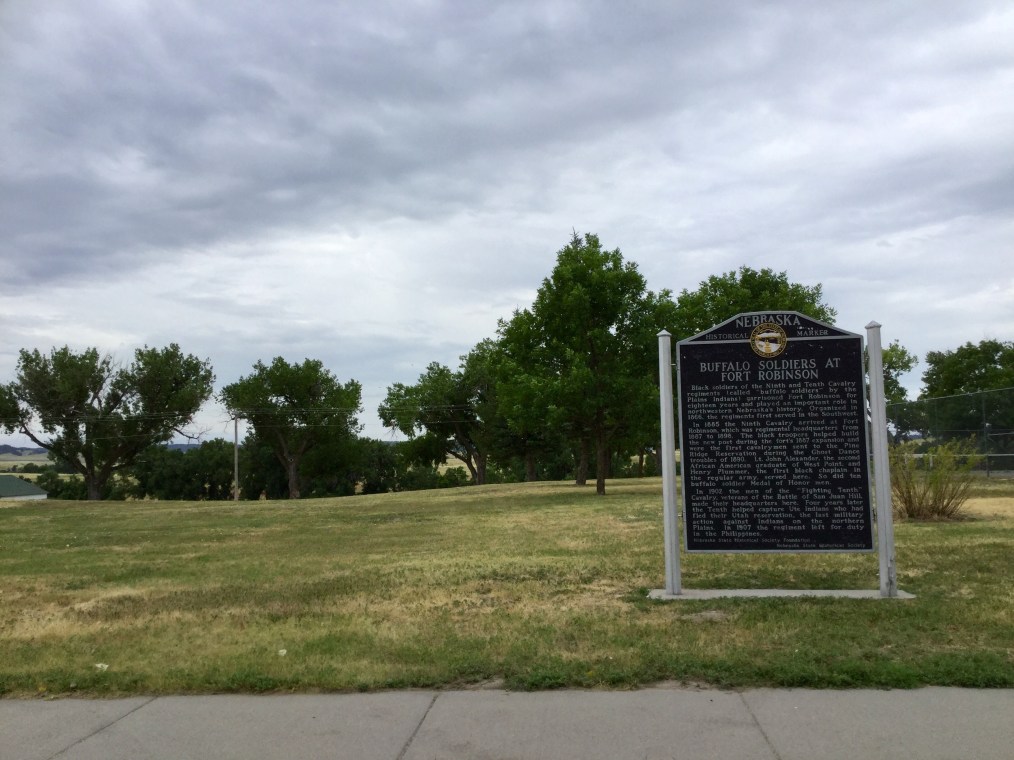
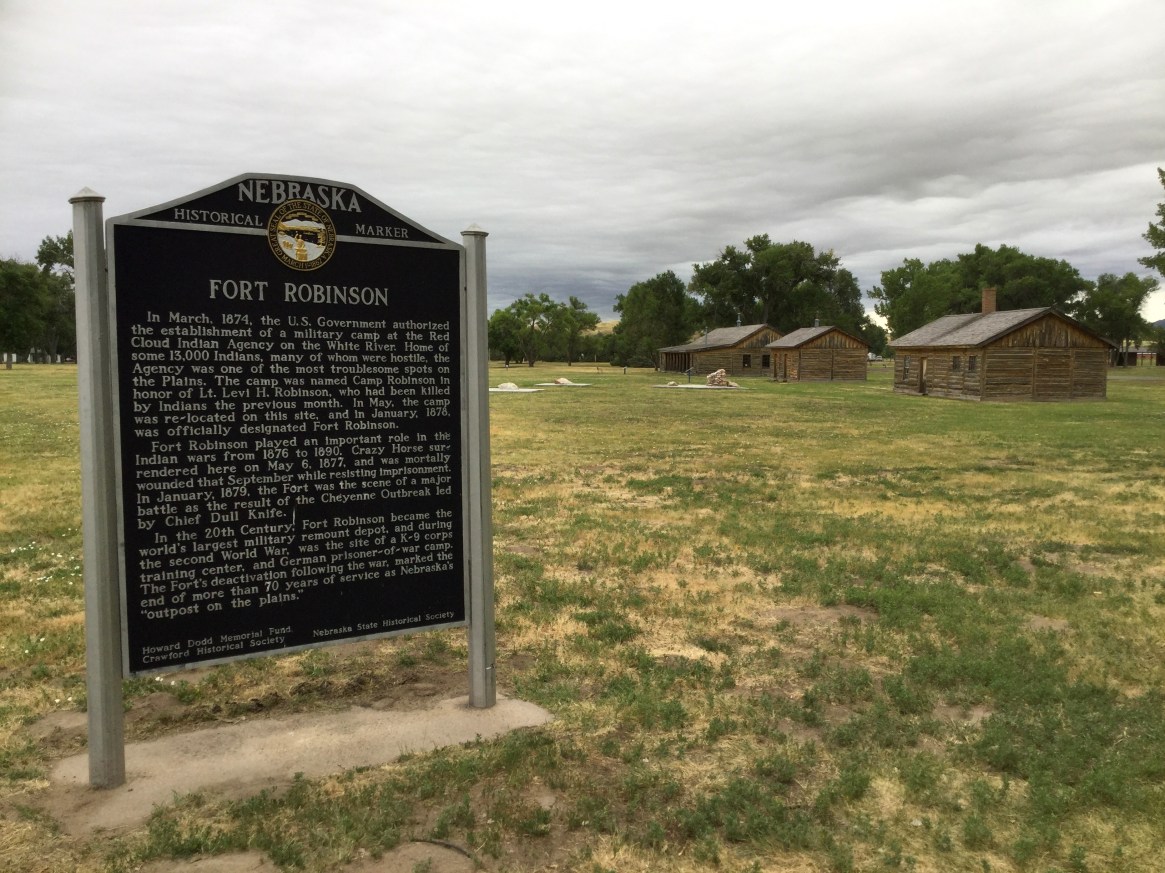
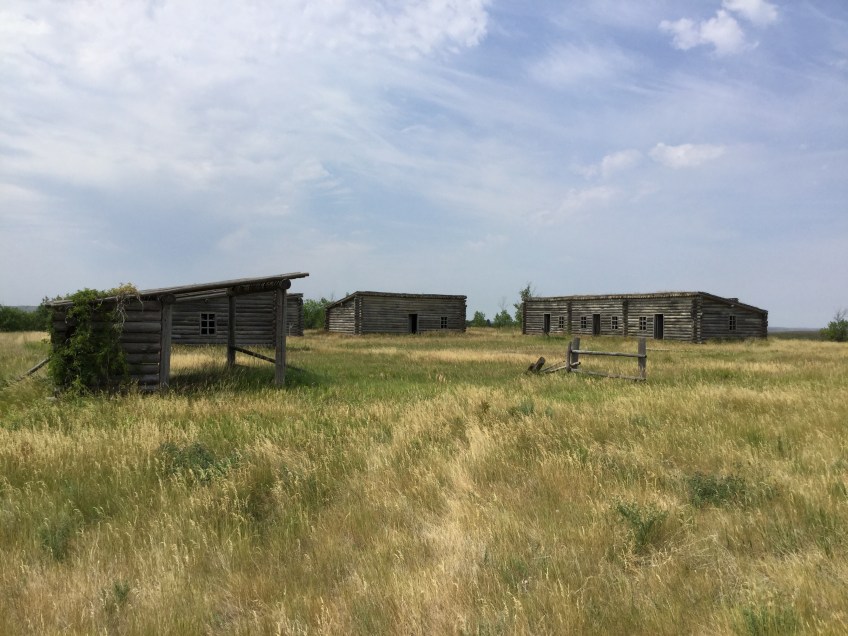
I drive the car around the fort, getting a good look at the layout and buildings until I find what I seek: a historical marker near apparent early fort buildings from the eighteenth century. I park. The grounds are lovely and well-maintained, and so are the buildings, from rough log structures to the tidy clapboard ones painted white and green to the large lodges, halls, and offices of brick, adobe, and stone. Originally Camp Robinson, this establishment remained in almost continuous use from its founding in 1874 as a military security outpost for the second Red Cloud Agency, to its reassignment as a training ground and quartermaster remount depot, breeding, training, and caring for up to 12,000 mules and horses at any given time prior to and for the duration of World War II. It was the regimental headquarters for the two African American black regiments in the then-segregated U.S. Army, first the Ninth Cavalry, then the Tenth, from 1887 to 1907. From 1885 to 1916, in fact, most of the troops stationed here were black.

Buffalo Soldiers historical monument at Fort Robinson, Nebraska

Crazy Horse was among the most revered war leaders of the Oglala Lakota and their allies in the Great Sioux War of 1876-1877. He had long been successful at resisting white settlers’ and the U.S. Army’s attempts to force him onto a reservation or to adopt their ways. He was one of the bold young warriors who led a contingent of soldiers into an ambush near Fort Phil Kearny, Wyoming. This 1866 engagement, called the Fight of the Hundred in the Hand by the Lakota and the Fetterman Fight by the United States, was the worst defeat of the U.S. Army by Native Americans until the Battle of the Little Bighorn ten years later. 81 U.S. troops from Fort Phil Kearny and a few civilians lost their lives there. This battle was the culmination of a series of skirmishes and raids on unwelcome white settlers and forts such as this one set up to protect them.

Fort Robinson historical sign and reconstructed buildings from the 1870’s

For a long time previously, white and Native American people traded with one another and enjoyed mostly good relations on the Great Plains. However, settlers began flooding in in ever great numbers, disrupting buffalo migrations, depleting game, clearing timber, and putting up fences. At a certain point, the white presence came to be seen as a menace to the way of life that Crazy Horse, Sitting Bull, and those who followed them believed was divinely and wisely arranged. Why resort to grubbing in the soil and putting up fences when Wakan Tanka, the Creator or Great Spirit, had given the people such rich herds of game, which, together with the rich stands of timber and plentiful flowing water, provided all the nourishment, clothing, and shelter one could need, on vast swaths of beautiful land where the people could roam as freely as the animals? The Bozeman Trail, which cut across this good land, was a major route for these white settlers and for a time, they passed through it mostly unmolested. But when the trickle became a flood, the situation changed from a matter of hospitality and mutual benefit to one of survival. Would any reasonable person continue to welcome guests once they’ve begun to ransack their home, raid their fridge, take their most prized possessions to sell, and block their passage from room to room?

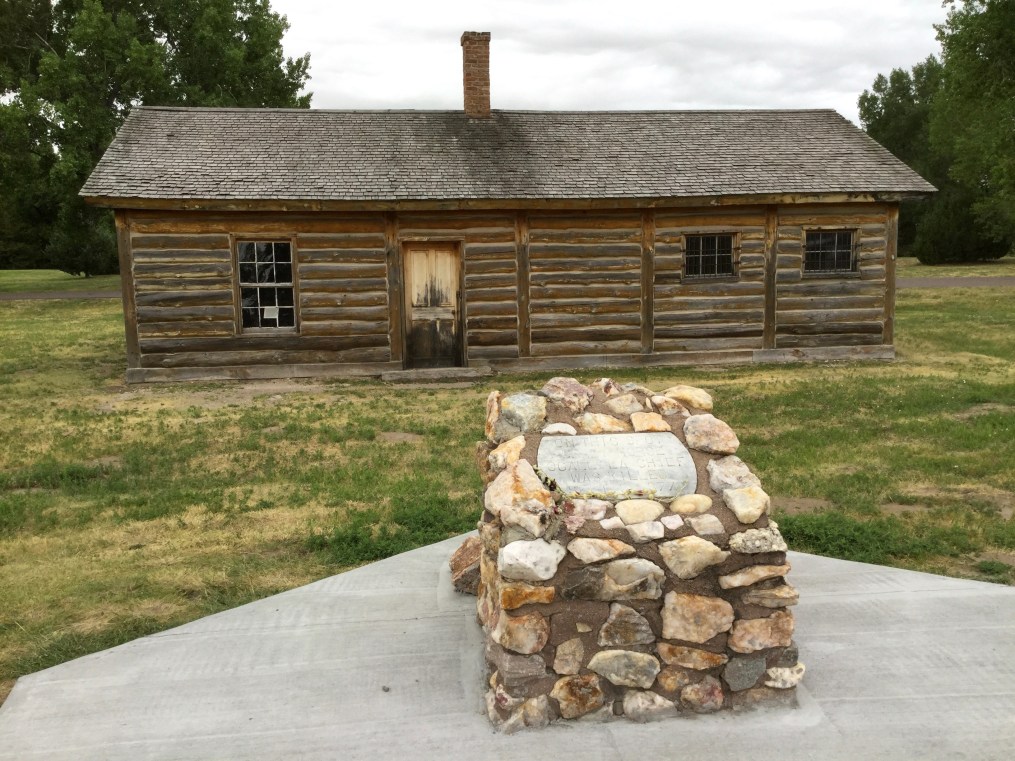
Reconstruction of the old guardhouse with marker for Crazy Horse’s death, Fort Robinson

Crazy Horse was having none of it. Like Sitting Bull, he distrusted white people and disdained their way of life. It seemed stunted to him, caged, lacking soul and nobility. Unlike Sitting Bull, he made no concessions to white ways until forced to do so for the survival of his band; even then, he did the absolute minimum necessary. We don’t know what he looked like since he refused to have his picture taken; he was unimpressed with most white-made goods and would accept no bribes; he absolutely refused to visit Washington, D.C. as his fellow great chiefs had done because, as he observed, the experience changed them. They were dazzled and bewitched by what they saw, so they lost their independent spirit, their sense of who they were.

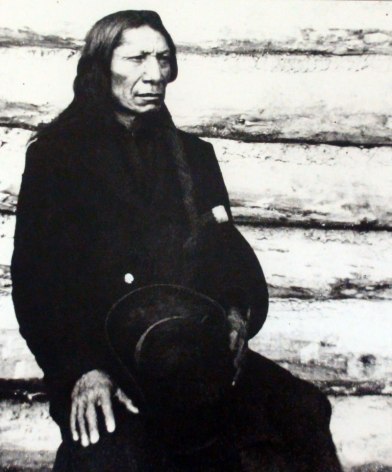
Red Cloud at Red Cloud Agency near Fort Robinson

Perhaps Crazy Horse’s attitude touched a nerve: Red Cloud and Spotted Tail, two chiefs who had once been among the greatest warrior defenders of the Lakota ways but who had adopted many white ways, grew jealous of the power and influence Crazy Horse enjoyed because of his steadfast independence. They remained great leaders of their people and had come to believe that the best way to preserve the lives of their people while preserving as much of their culture as they could was to work with the U.S. government. Nevertheless, it was a hard decision to make, and I’m sure they did so with a great degree of ambivalence. So, Crazy Horse’s recalcitrance must have been that much harder to take. They treated him with suspicion and took the U.S. Army’s side against him. Even his great friend who had fought at his side at the Little Bighorn, Little Big Man, had switched loyalties. He had visited Washington, too. He was one of those that assisted in the attempt to confine Crazy Horse on the day he was killed.

Crazy Horse wasn’t only an independent spirit when it came to white ways. He was very unusual within Oglala Lakota society. He was a reserved man in a gregarious culture; he dressed simply at all times, when warbonnets, elaborate jewelry, and other showy regalia were the usual garb of warriors in battle; he didn’t scalp the enemies he killed; he didn’t take a wife until he was in his thirties when most of his fellows had started a family by age twenty; though he fought bravely and ferociously, he was also methodical in battle, planning his moves carefully and stopping to shoot accurately when a whirlwind, showy style of fighting was more customary; he spoke little of his own exploits when tales of personal heroism were the usual topic of conversation after a good fight. But his fame grew because the daring and magnificence of his exploits made him an irresistible topic of conversation for others.

The Fetterman Fight and the Battle of the Little Bighorn were spectacular victories for Crazy Horse and his warriors, but he would never again enjoy that level of success in battle against the white invaders. His last fight with the U.S. Army was at the Battle of Wolf Mountains, which began when the soldiers attacked his band in the dead of winter.  Much of the fighting, in fact, occurred during a blizzard. The army decided to end the fighting, once and for all, to make an additional show of invincible strength by showing that they were willing and able to pursue the war even in the most extreme weather. The fighting was fierce and, though there was no decisive winner, the Lakota and Cheyenne’s losses were heavy. The camp, too, was suffering greatly from hunger and the intense cold. Crazy Horse was defeated, finally, not in battle, but by observing the suffering of his people. He, like so many great chiefs before him, surrendered so that his people, if they could not enjoy liberty, could at least survive.

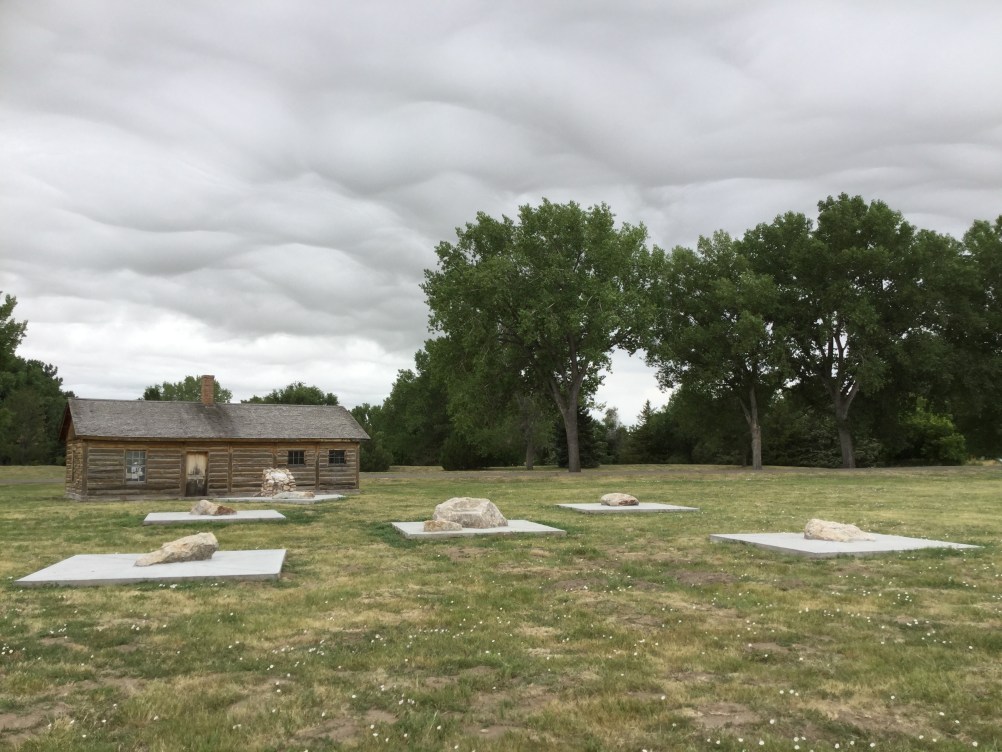
Stones placed in formation near the Crazy Horse Monument and guardhouse. It appears to be an unfinished memorial: when doing research for this piece, I found an article from 2015 which discussed plans for a new memorial for Crazy Horse and his entire band, 899 lovers of freedom who were forced to surrender here in 1877. The outer stones to mark four cardinal directions are in place, though they are not the massive ones described in the article, and the central stone has another smaller one beside it for offerings. The concrete walkways and large plaques containing the names of the people are not in place. Perhaps this simplified version was put in place as the often long, tedious, sometimes indefinite fundraising efforts for the more elaborate one continue.

Crazy Horse led his people to the Red Cloud Agency next to Fort Robinson and surrendered there on May 5th, 1877. For the next few months, rumor, gossip, accusations, negotiations, and whispers of plot and conspiracy whirled while Crazy Horse retreated ever further into himself. He was a man of action, not words, and he was impatient with all this hubbub. He had lost his only child, his beloved daughter They Are Afraid Of Her, about four years before, and her mother, his wife Black Shawl, was suffering from tuberculosis. So long as he could not fight nor be free, he wanted to be left alone as much as possible. But the rumors that Crazy Horse was plotting to assassinate General George Crook and start another war intensified, and Crook was determined to have him arrested, even assassinated if need be. Later inquiries showed that the rumors were unfounded, that there was no evidence that Crazy Horse planned to do otherwise than keep his word not to fight the whites anymore. Jealousy, infighting, betrayal, and poor translations, both accidental and deliberate, all contributed to the drama.

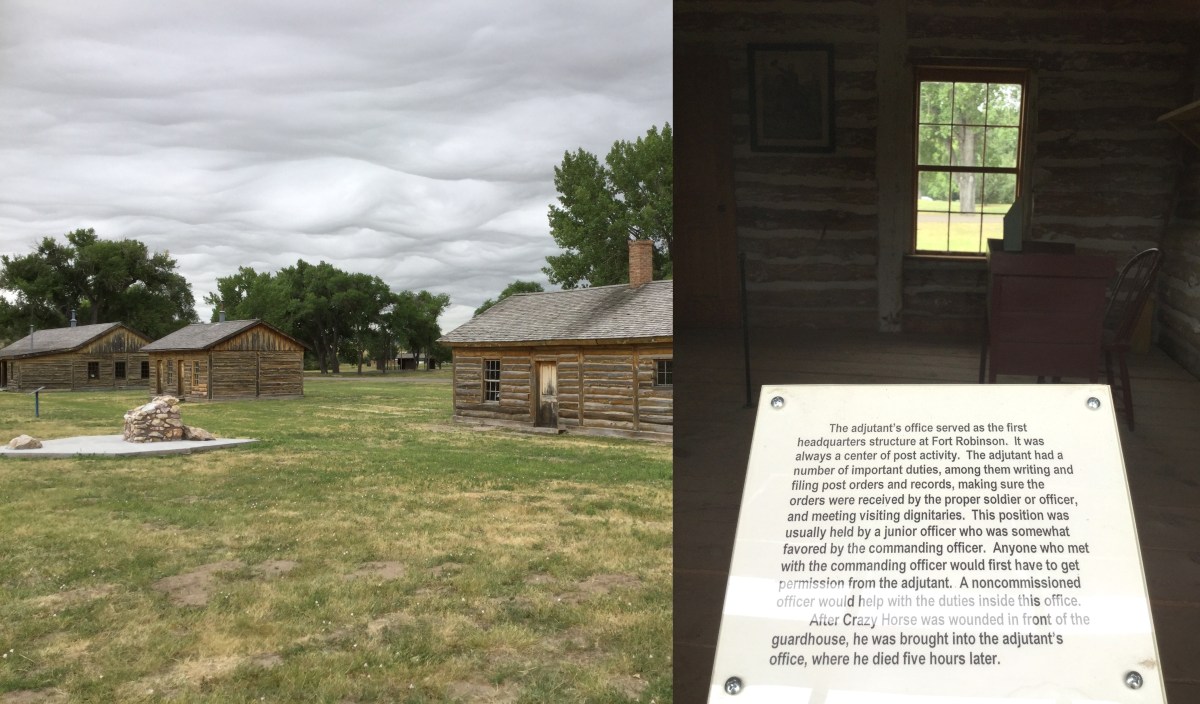
Left: Adjutant’s office, where Crazy Horse died, to the left of the guardhouse where he was stabbed; all of these buildings are reconstructions based on written records, photographs, and archaeological evidence. So you can see the actual distance between the adjutant’s office from which Crazy Horse walked to the guardhouse. Right: interior of the adjutant’s office with informational sign

The rumors got so bad that Crazy Horse feared that he would be executed or, worse, arrested and removed to some distant land of the whites away from his people, so on September 4th, 1877, he wrapped up his sick wife, and he and a few friends fled to his old friend Spotted Tail’s agency about forty miles east. He sought protection and advice as to what the whites were thinking, and he didn’t think this would betray his promise, of surrender. After all, he was going to an agency. Nevertheless, Lieutenant Jesse M. Lee was ordered to retrieve Crazy Horse, and he escorted him back to Fort Robinson the next morning. They went first to the adjutant’s office.

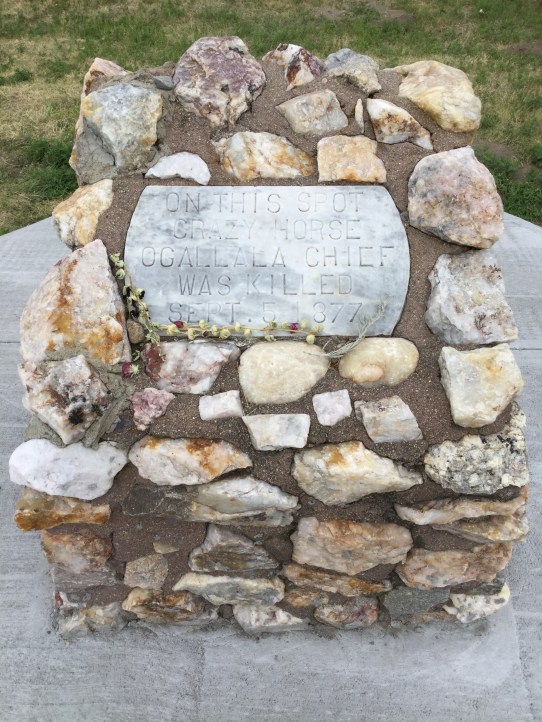
Stone monument, dedicated in 1934, near the site where Crazy Horse was bayoneted. I placed this little spray of sage here, picked in Deep Ravine at the Little Bighorn Battlefield from which Crazy Horse led his charge to split Custer’s forces. This maneuver was key to the successful outcome of the battle. You can see that the morning breeze is about to waft the sprig away

Crazy Horse understood that he was to have a chance to talk things over with U.S. Army officials and clear things up. Lee was pretty sure of his innocence regarding all those rumors of plots, conspiracies, and warmongering, and promised Crazy Horse an interview with the white authorities which he didn’t have the authority to arrange. Lee hoped he could persuade the higher-ups to talk to Crazy Horse before deciding his fate, but it was not to be. Unequivocal orders came down for Crazy Horse’s immediate arrest instead. When Crazy Horse was led from the adjutant’s office into the guardhouse, he showed no sign of resistance, walking hand in hand with the captain. But when he stepped in the door, he saw the bars of the prison, and he realized this was a trap: there would be no talks, only imprisonment and then, who knows? So Crazy Horse pushed himself out the door, and as soldiers and his old friend Little Big Man tried to restrain him, he pulled out his knife and slashed Little Big Man’s arm. Another soldier near the guardhouse lowered his bayonet at the ready, and when the opportunity came, he lunged and stabbed. The blade pierced Crazy Horse’ side and into his kidney, and he fell.

After some controversy over what to do (put Crazy Horse in prison as he was, now in his death struggle? Leave him lying where he was as his friends began to hear the news and gather in anger?), he was carried back to the adjutant’s office on the red blanket he had been wearing. He refused the white man’s cot offered to him and asked to be placed on the floor instead. Crazy Horse was given morphine to ease his intense pain and he died, after lingering for long and painful hours, in the presence of his father and stepfather. He spoke forgiving words for most involved with his death except Little Big Man, who had, it seemed, not only betrayed Crazy Horse but all of his people.

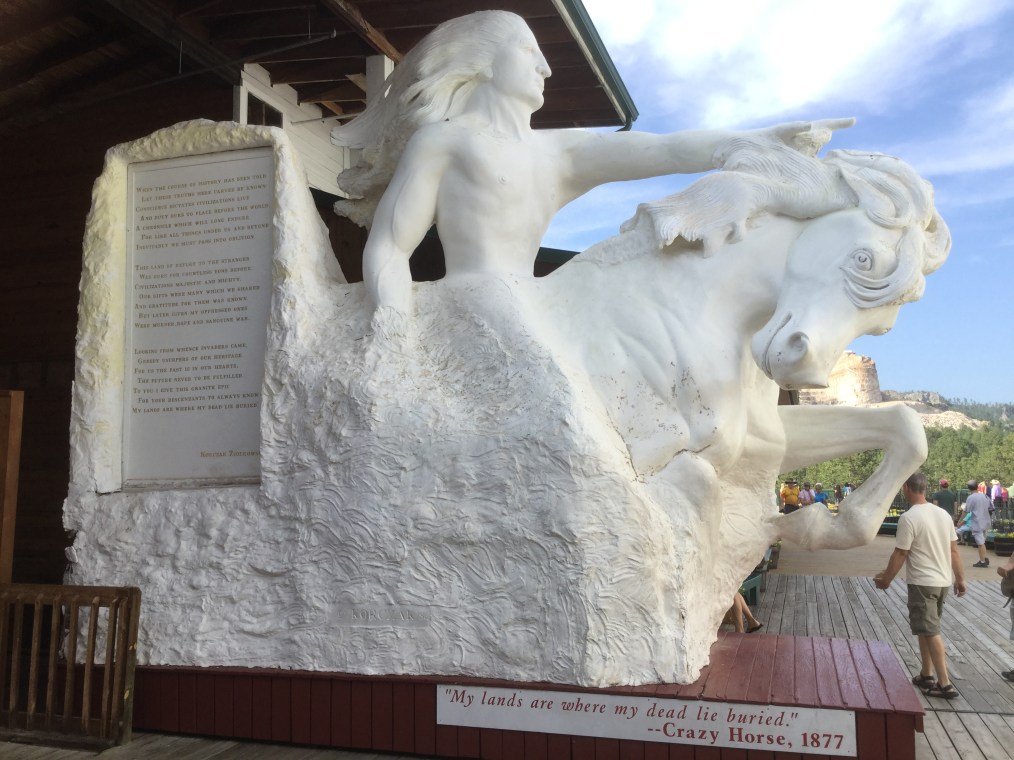
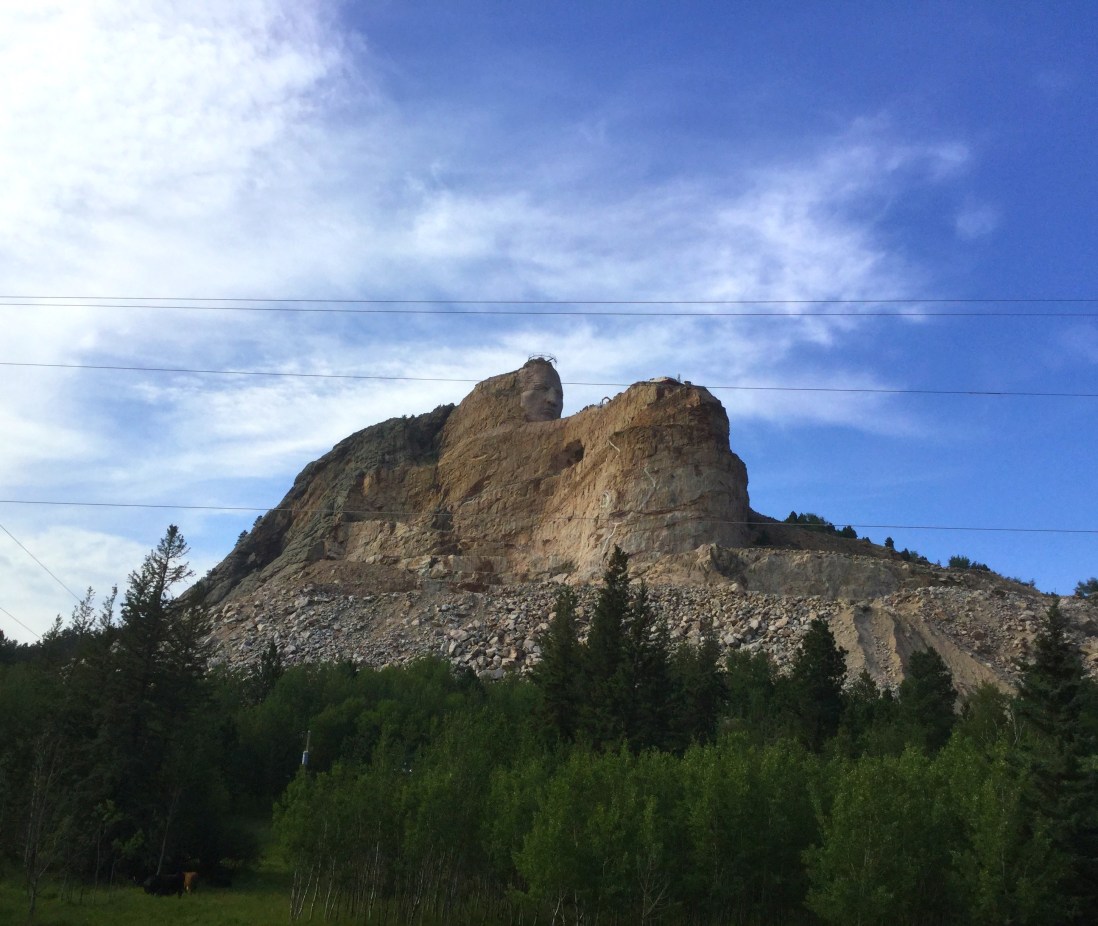
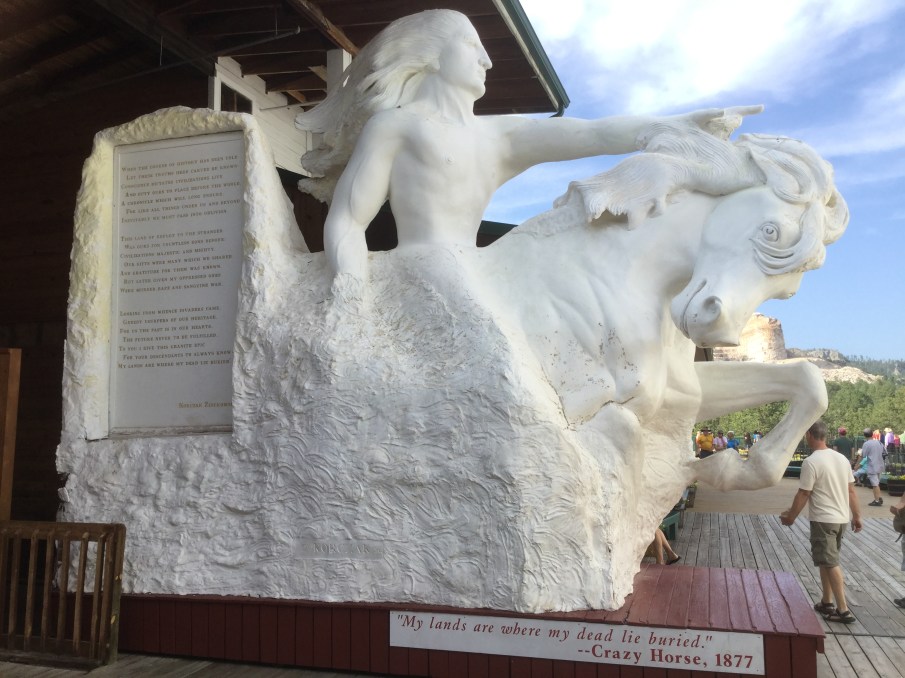
Working model at the Visitor Center for the Crazy Horse Memorial, Black Hills, South Dakota. When asked once where his lands were now that the Lakota were being driven out, Crazy Horse answered, ‘My lands are where my dead lie buried’.

Crazy Horse has become one of the most widely revered Native Americans in history, if not the most. Many recognize similarities in the life and death story of Jesus Christ to that of Crazy Horse: each was called by the supernatural to be a deliverer of his people, each beheld visions and went out to the wilderness to seek them; each was warned by the supernatural of the nature and manner of death but boldly continued his mission nonetheless; each refused to be tempted away from his purpose by a vision of earthly reward and the sight of a glorious city; each was a loner and dreamer but also a charismatic leader; each called on his people to eschew a life of promised ease and comfort to follow him on a harder road; each preferred simplicity in dress and humility in comportment; each died, falsely accused and betrayed by a friend, with a stab wound in his side. These themes resonate in our American culture generally, in which Christianity plays such a significant formative role. There are so many great Native Americans that we remember and admire but perhaps Crazy Horse remains preeminent in our collective memory for these perceived Christlike qualities. In a strictly historical sense, these similarities are exaggerated and perhaps unwarranted, but in a cultural and spiritual sense, they stand out to us because of their resonance with our most cherished beliefs and values. Native American communities too, many of whom have adopted Christianity and especially those doctrines which echo their traditional faith, perceive Crazy Horse as everything from a stalwart warrior to a messianic figure, a great symbol of hope, deliverance, traditional virtue, and spiritual renewal for their beleaguered peoples.
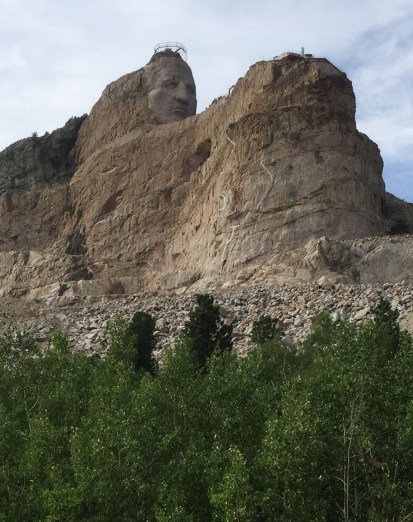
Crazy Horse Memorial in progress, Black Hills, South Dakota

One last thing: three days ago, I climbed Black Elk Peak in the Black Hills, South Dakota. Sylvan Lake is nearby, and I had stopped there at a lakeside hotel to seek recommendations for the best hike to the top. One of the routes departs from the short of Sylvan Lake, but not the longer, more scenic one which I had chosen. As a teen, Crazy Horse went to Sylvan Lake with his father on a vision quest, one of the most important in his life, in which he was instructed how to paint his body with hailstones and his face with lightning for battle; to dress simply and wear his hair flowing down; to take no scalps; and generally to live a life of bravery and modest virtue. I wanted to find the exact place he went, but it would take a level of meticulous research and mapping that I had run out of time to do before I left. When I return to the Black Hills, I will make a point of seeking out that place.

*Listen to the podcast version here or on Google Play, or subscribe on iTunes

~~~~~~~~~~~~~~~~~~~~~~~

Sources and inspiration:

Brown, Dee. Bury My Heart at Wounded Knee: An Indian History of the American West. New York: Holt, Rinehart & Winston, 1970

Buecker, Thomas R. ‘Final Days of Crazy Horse,’ Friends Of The Little Bighorn Battlefield website

Connell, Evan S. Son of the Morning Star. London: Macmillan, 1984

Cozzens, Peter. The Earth is Weeping: The Epic Story of the Indian Wars for the American West. New York: Knopf, 2016

Crazy Horse.’ In Wikipedia, The Free Encyclopedia.

Fort Robinson and Red Cloud Agency National Historic Landmark Nomination for the National Register of Historic Places. Prepared by Steven Lissandrello and Sarah J. Pearce, Historic Sites Survey, National Park Service / Rocky Mountain Region National Park Service, Sep 27, 1976/Jul 20, 1983

Fort Robinson History‘. Nebraska State Historical Society website

Jackson, Joe. Black Elk: The Life of an American Visionary. New York: Farrar, Straus and Giroux, 2016

Marquis, Thomas Bailey. Wooden Leg: A Warrior Who Fought Custer, 1931

Marshall, Joseph III. The Journey of Crazy Horse: A Lakota History. New York: Viking, 2004

Neihardt, John G. Black Elk Speaks, 1932

Pearson, Jeffey V. ‘Nelson A. Miles, Crazy Horse, and the Battle of Wolf Mountains‘. From Montana, The Magazine of Western History, 51 (Winter 2001), 53-67; presented courtesy of the Montana Historical Society

Powers, Thomas. The Killing Of Crazy Horse. New York: Knopf, 2010

Rose, Christina. ‘Native History: Crazy Horse Fights Final Battle,’ Indian Country Today, Jan 8, 2014

Rose, Christina. ‘New Fort Robinson Memorial Will Honor Crazy Horse and His Band,’ Indian Country Today, Jul 27, 2015

Schubert, Frank “Mickey”. ‘Fort Robinson, Nebraska (1874-1916)‘ Black Past website

Sites and Structures Maintained by the Nebraska State Historical Society‘. Nebraska State Historical Society website

Wounded Knee, Pine Ridge Reservation, South Dakota

Entering Pine Ridge Reservation via Bombing Range Rd (what a name!) from the Badlands, South Dakota.

Wounded Knee, South Dakota, afternoon and evening of July 25th, 2017

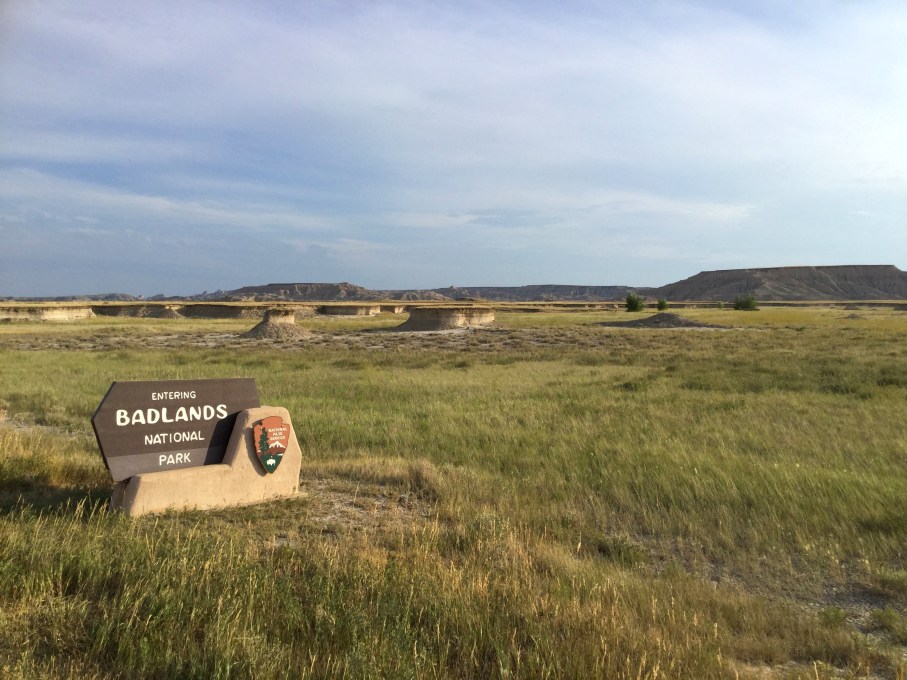
From McLaughlin, Standing Rock Reservation, South Dakota, I make the 5-hour drive south to my next destination in the Pine Ridge Reservation, just a little ways north of the Nebraska border. My drive takes me through Badlands National Park, though only for a short while. What I see of it is beautiful, and I certainly plan to return.

Badlands National Park, South Dakota

My destination is Wounded Knee, named for Wounded Knee Creek and the site of a conflict between the United States Army and the band of Chief Spotted Elk, or Big Foot, as the U.S. army dubbed him. This conflict was originally called the Battle of Wounded Knee in United States historical accounts but was generally redesignated the Massacre of Wounded Knee. As sympathy for the plight of defeated Native Americans grew and their side of the story became better known, it became clear that ‘massacre’ was a more fitting term for this affair than ‘battle,’ since the vast majority of those who were shot down here were noncombatants: women, children, infants, and the elderly.

Pine Ridge Reservation as I arrive on a soft summer evening

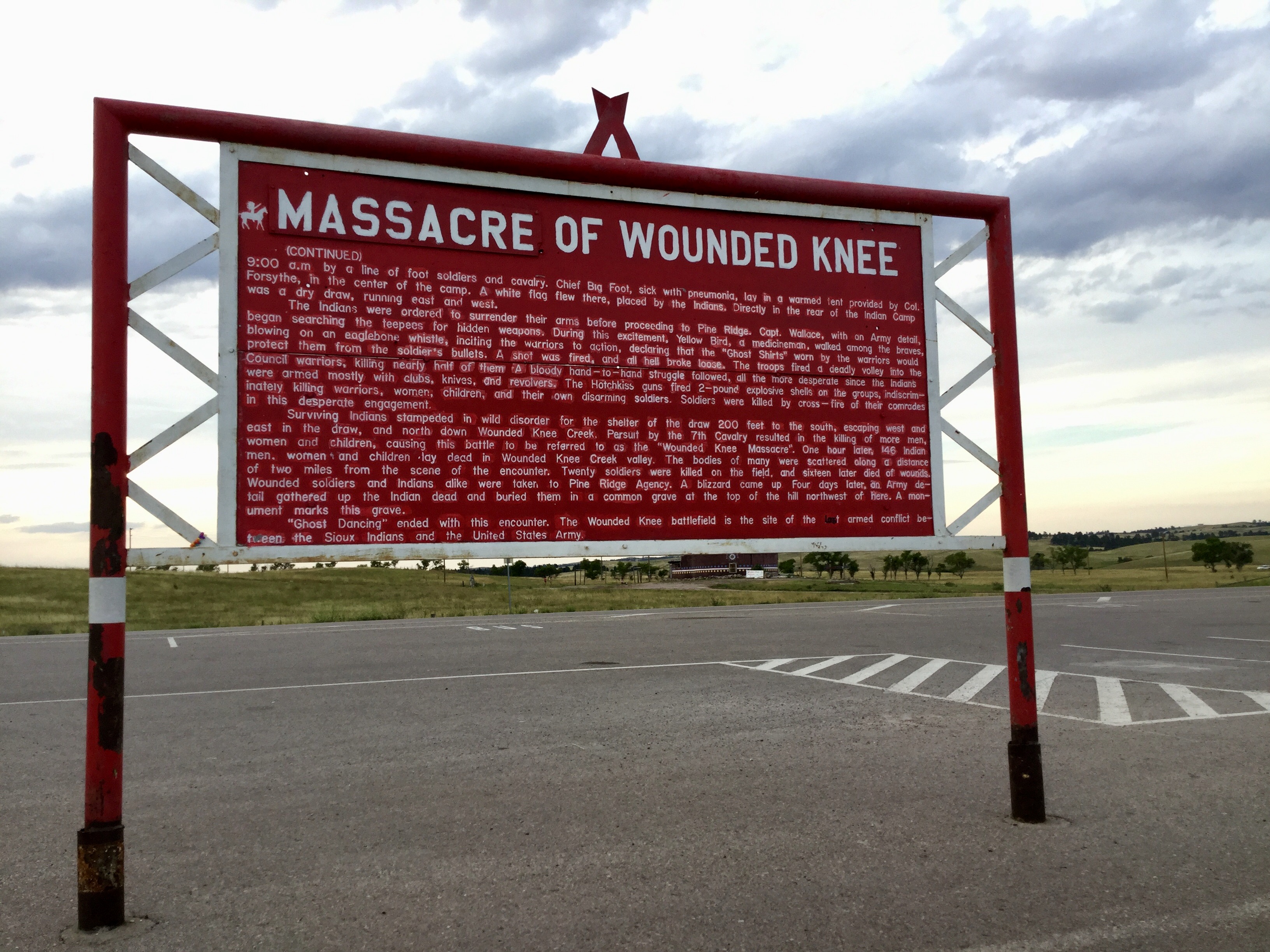
When I arrive at the large red and white sign at the side of the road which marks the Wounded Knee Massacre site, I park at the little lot in front of it. I look a while at the structures and the lay of the land here for a while. I take some pictures and then begin to read the sign, front and back. I’m not yet finished when a young man approaches me, perhaps fifteen or so. He is lean, about my height, with hair pulled back and hanging long behind. He’s dressed simply in a plain t-shirt and jeans. His skin is a rich reddish-gold tan in the deep peach just-after-sunset light, his cheekbones high. ‘That sign is wrong’, he says. ‘They tell the story wrong.’

‘Hello! And thanks for the warning,’ I reply. ‘Who are ‘they?”

He tells me that the people who agree with the army’s side of things wrote the sign. I interject and tell him, yes, I see where they placed a wood block on each side to cover part of the title, painted with the replacement word ‘massacre’. But, he explains, they still didn’t really fix most of what’s wrong with it. Big Foot was not really the chief’s name, and …well, the whole thing is wrong. He tells me why. Then he points to the colorfully painted round building across the road.

‘Go to the museum, that’s our museum, where we tell the story’, he directs me. ‘I will,’ I say, ‘That’s where I’m headed next. But I do want to finish reading the whole sign and see what they said about it, and try to find out the real story if I can.’

I return to the back of the sign, read the rest carefully, then approach him again. ‘I know what they say here now, so I’ll go to the museum and read the story there.’ ‘Okay, he says, then hesitates a moment, then holds up some beaded necklaces in different bright colors, each with a circular pendant holder open in the center to display the gemstone or colorful glass bead within. ‘I make these’, he says.

I admire them, and he names their prices. ‘I’m sorry,’ I tell him. ‘I can check to see what I have, but I remember I don’t have much cash on me, not nearly enough to pay you fairly for all this work.’

‘I take contributions’, he says.

I go to the car and check, and it’s true. I only have a few dollars. I take most of this and bring it back to him. ‘Thanks for telling me the story, and I’ll go find out more.’ I cross the road…

Wounded Knee historical sign, front side, Pine Ridge Reservation, South Dakota, 2017 Amy Cools

Wounded Knee historical sign, front side, Pine Ridge Reservation, South Dakota. You can click on the image and it will open it in a new tab, where you can click again on the image to zoom in for ease of reading

Wounded Knee historical sign, back side

In 1890, the Lakota people were not doing well. They had mostly been driven from their homelands, scattered and confined to reservations in unfamiliar and mostly inhospitable territories. U.S. government-issued rations, supplied by treaty agreement, were scarce, sometimes in punishment for real or perceived infractions, and more often because corrupt and underpaid government agents and dishonest contract suppliers skimmed liberally from the top. So, the Lakota often went hungry.

They were often disarmed too, so they could not always defend their holdings from white raiders or go on raids themselves when hunger or honor demanded it. The dispossessed men could sometimes get special dispensations from the army to get their guns back for hunting but the hunting was poor. The white settlers had also nearly wiped the American buffalo from the face of the earth, in part for their hides which made fashionable hats and other goods, and in part to remove the incentive for Great Plains Indians to want to remain to their traditional hunting grounds. Deer, elk, and other game were getting ever harder to find too, and their lean meat was not as nutritious.

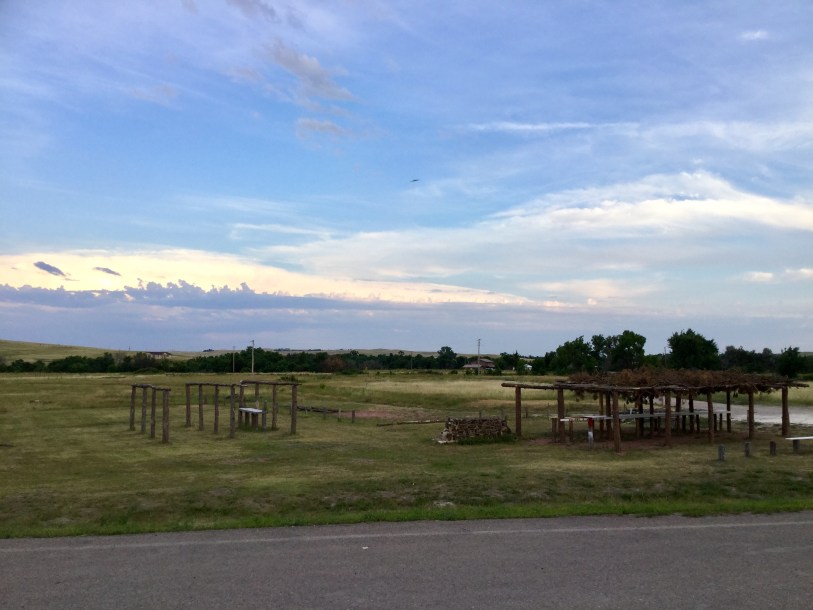
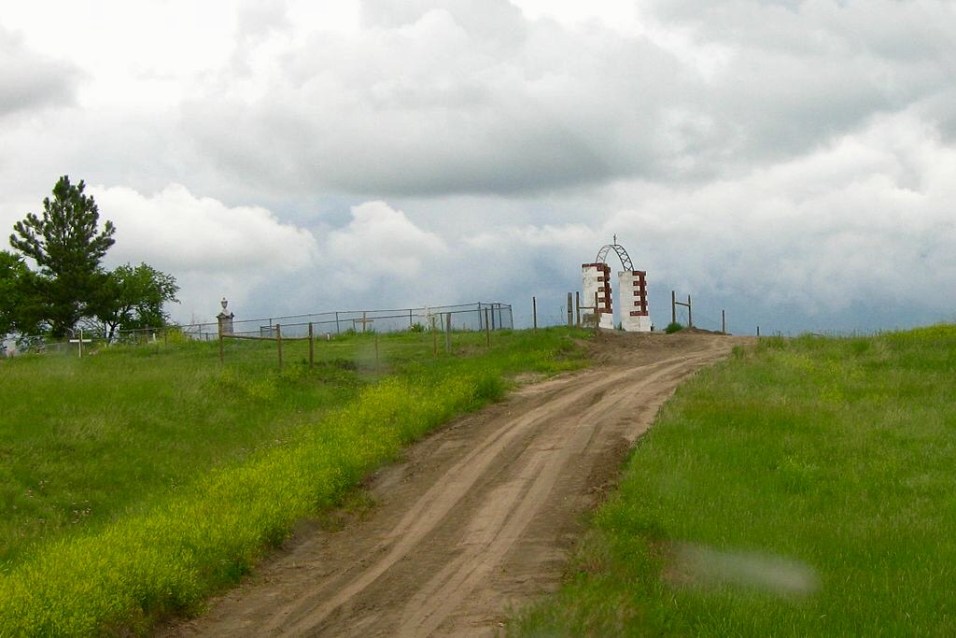
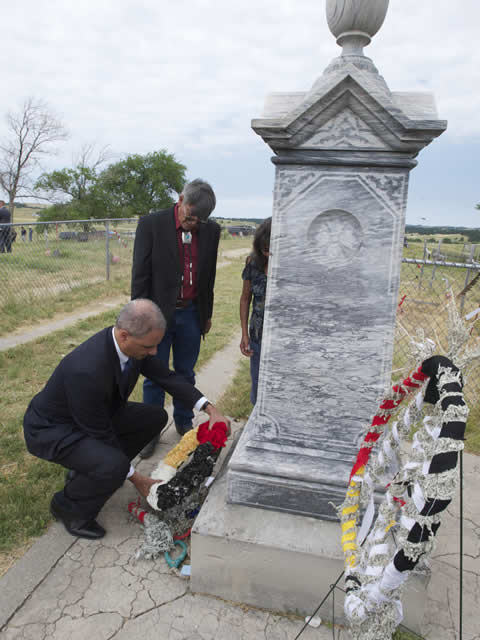
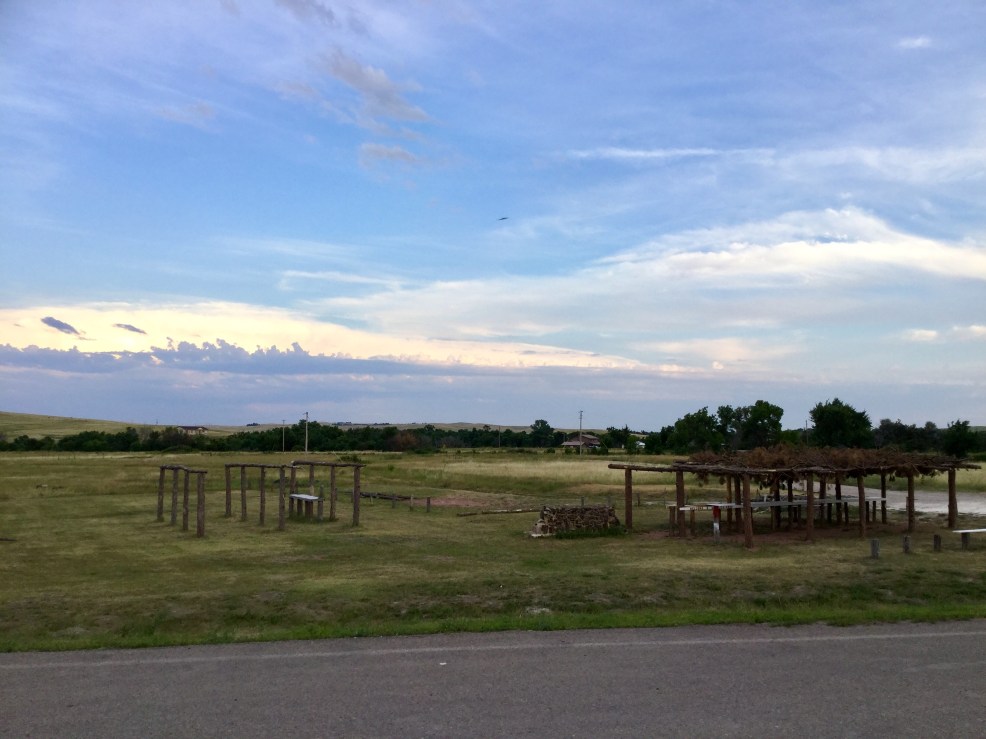
Wounded Knee massacre site. There are few and simple structures here. The site is privately owned, and negotiations to sell it to an organization that is both willing and has the resources to maintain it has been long and contentious. So, its fate as a preserved and protected national historic landmark is still uncertain.

Boredom, disillusionment, depression, and disease were also rampant. The traditional ways of life that gave it meaning were gone and the men, especially, had little to do and little reason to want to do it. Much of the reservation lands were not very good for farming even when some of the Lakota decided to take up this culturally undesirable occupation (it was traditionally acceptable for women but not for men), and bad land apportionment policies caused many Native American-owned ranches to fail. Children who were sent to white schools by their parents, or taken from their parents when they were unwilling, were shorn of their hair, traditionally worn long, and whipped when they dared speak a word of their native language or engage in any traditional ways. The unfamiliar terrain, often assigned as reservations precisely because their poor soil and malarial conditions made them undesirable to white settlers, helped contribute to the depression and disease that regularly wiped out large portions of Native American populations, who were already vulnerable to the diseases introduced by white people to which they had little or no immunity.

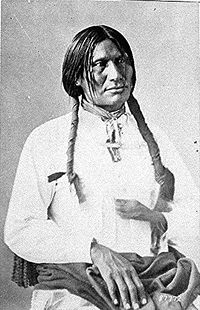
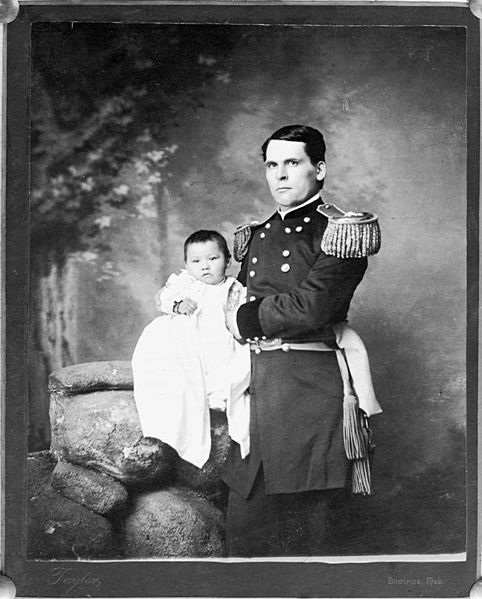
Spotted Elk, or Big Foot as he was known to the U.S. army, as a younger man. He was the Minneconjou Lakota chief who died with so many of his people at Wounded Knee in 1890

And when Native Americans of the Great Plains and throughout America, as individuals or groups, dared leave their poor circumstances in the reservations and strike out for a better life for themselves and their families, just as the white settlers had done when heading west, they were branded ‘hostiles’ and hunted down like criminals.

In 1890, the Minneconjou Lakota chief Spotted Elk welcomed two distressed Hunkpapa Lakota men into his camp in the Cheyenne River Reservation, just south of Standing Rock. They bore the sad tidings of the killing of his half-brother, Sitting Bull, and some of his followers who adhered to the Ghost Dance movement. About forty more of Sitting Bull’s band were set to flee Standing Rock, fearing they’d be next. White authorities thought that because the Ghost Dance cult believed sacred garments called Ghost Shirts could turn away bullets, this implied that their wearers secretly plotted war against the whites, though the Ghost Dance cult actually, explicitly preached non-violence. Like Sitting Bull, Spotted Elk was initially drawn to the Ghost Dance movement but later rejected its truth and utility, though they both tolerated adherence in the cult by others. After all, it revived a spirit of hope and purpose in its adherents, and it preached peace. But this made both Lakota leaders objects of suspicion by the white authorities, who apparently believed that once a Ghost Dancer, always a Ghost Dancer.

In solidarity and a spirit of brotherly hospitality, Spotted Elk invited the beleaguered and bereft Hunkpapas of the slain Sitting Bull’s band to take shelter with his own. Spotted Elk had become a trusted negotiator by white and Native American authorities by this time. He was an uncle of the great warrior Crazy Horse, Oglala hero of the Battle of the Little Bighorn, and an ally of the rebellious tribes in the Great Sioux Wars of the 1870’s, but had remained a peaceful moderate in dealing with white demands for many years since then, settling down and farming on the reservation. By the time of Sitting Bull’s death in the spring of 1890, however, White and Native Americans alike had begun to view the sixty-five-year-old Spotted Elk as, at best, out of touch and somewhat irrelevant, and at worst, a secret Ghost Dance anti-white conspirator.

Wounded Knee massacre site

When white authorities heard that the Ghost Dancing Hunkpapas were with Spotted Elk, they believed their suspicions of impending rebellion were confirmed. They wanted Spotted Elk arrested too, along with the Hunkpapa refugees. But the peaceful Spotted Elk, who didn’t want to betray these men, couldn’t convince the young men of his band to give up the Hunkpapas anyway. When he heard that troops were on their way, Spotted Elk decided it was useless to try to give in to these unreasonable demands and expose himself to unreasonable arrest. He decided to lead his band south to Pine Ridge instead, in answer to a request by Chief Red Cloud to mediate some difficulties there. Before he left, however, he fell terribly ill with pneumonia. He made this trek south with his people carried in a litter, coughing up blood and growing every weaker along the way. It was dead winter, late December, and they struggled through the snow, wind, and bitter cold.

Though the local army authority didn’t believe Spotted Elk and his people were a threat, they were ordered to intercept and detain them. U.S. Army troops caught up with Spotted Elk and his people not far from Wounded Knee Creek, where they proceeded on to camp and arrange for talks. But the talks did not go well. They began with the order from faraway higher-ups to disarm the band. Spotted Elk refused. The band needed to be able to protect themselves out here away from the Pine Ridge agency, and they needed to hunt and provide their families with food in these hard times.

The protracted and repeated bargaining and forced attempts to convince Spotted Elk’s men to give up their weapons became more and more contentious. It was just too humiliating for a man to be forced to give up his most expensive and prized possession, his main tool and weapon with which he could vanquish his enemies, protect his life and those of his people, and provide for his family and friends. Sometimes the Minneconjou would make a show of giving up weapons by turning in their old and broken ones, sometimes the soldiers would simply raid the tents and take the hidden weapons, pushing past the enraged and resisting women as they did so. This whole business of forcibly and unnecessarily disarming the band was not a policy that the local military authorities thought wise or necessary. But the orders came in insistingly, so they obeyed. Francis Craft, the Jesuit priest who lived with the Lakota people and spoke their language, assisted with these sticky negotiations. It’s a map from his papers, by the way, that I used as an aid in seeking the site of Sitting Bull’s death.

On December 29th, 1890, the Minneconjou men were called out to be thoroughly searched and all their firearms confiscated once and for all. When a rather clueless soldier tried to grab and wrest a gun from the hands of a deaf and perhaps mentally troubled man, a shot went off. It was all over then. The shots kept firing, and the killing began. And went on, and on. Both sides shot some from their own number in the crossfire. And both sides fought at first, but when it became clear that the badly outnumbered Minneconjou were losing, the killing kept going, segueing from combat to simple extermination. Soldiers, in a cold relentless sort of frenzy, began methodically picking off the fleeing Minneconjou one by one, aiming, shooting to kill all those the Hotchkiss guns didn’t get.

“Big Foot, leader of the Sioux, captured at the battle of Wounded Knee, S.D.” Here he lies frozen on the snow-covered battlefield where he died, 1890; this photo is in the National Archives collection at Washington, DC. The title of the photo is misleading in two ways: first, his people called him Spotted Elk, and he only later became known as Big Foot, an insulting nickname for him coined by a U.S. soldier; and second, he was not captured, he approached to the army on his own accord to discuss terms. He had been lying down, but his frozen body was propped up this way by the photographer. Many of the bodies on this sub-zero battlefield were similarly bent, distorted, gesturing in strange ways from rigor mortis combined with freezing

When the firing finally stopped, about two dozen soldiers were killed and about forty wounded. But despite the much lower number recorded on that old sign, between 250 and 300 of Spotted Elk’s people were killed, more than two-thirds of them women, children, and other noncombants. Spotted Elk was among them.

I enter the museum, and find myself in an open, roughly circular room. There’s a long folding table with a guestbook, a little cashbox, and some papers. Behind it stands a young woman in a long dark colored dress without sleeves, her long hair loosely pulled back. She’s rather petite, slim, with a round face and flushed cheeks. I greet her. She seems remote, almost out of it, and answers me in a voice so quiet I don’t catch all of what she says. She does indicate that should I look around, so I do. There’s a pair of child’s sparkly blue costume fairy wings in the center of the floor, and a few other toys. I find that the displays mostly consist of text and images painted on the wall and printed on large sheets, some framed, that sit atop more folding tables that line the room. They don’t refer much to the first clash at Wounded Knee, but to the second in the 1970’s, in the midst of the American Indian Movement. That’s a long and important story of its own, too much to get into for this piece. The displays also tell stories of other important moments in the struggle for Native American rights.

Here’s something of some of these stories, as this museum tells them:

American Indian Movement display at Wounded Knee Museum

American Indian Movement and Wounded Knee 1970’s conflict display at Wounded Knee Museum

Much needed addition to the Battle of the Little Bighorn Monument display at Wounded Knee Museum

Display about the Treaty of Fort Laramie of 1868 which recognized that the Sioux, or Lakota, were the rightful owners of the Black Hills, Wounded Knee Museum. This treaty went right out the window, like all the others, once gold was discovered in the Black Hills

I leave the museum and am just about to walk up the hill when two very small children ran up to me. A little girl, perhaps three, hugs my legs, and her wide grin displays her tiny upper teeth. She has wispy pigtails and wears a pink play dress. She evidently wants to play but doesn’t  speak. Her little companion, a ruddy-faced toddler in a blue t-shirt and diaper, chases after her, his tough little feet undeterred by the gravel. Once she hops and then runs away, looking back in invitation for a good chase, he grabs my legs in turn and looks up. His short hair sticks out all around his head. They are impish and adorable. I’ve always particularly liked bold and precocious children. Not bratty, mind you, but outgoing. I greet them and smile, and since the little girl doesn’t answer what I say to her, just continues to invite me to play with gestures and body language, I’m not sure if she understands me. The lady from the museum calls to the children, and after a few moments of stalling, they run inside.

Wounded Knee Massacre Burial Site from Wiki Loves Monuments 2012, public domain via Wikimedia Commons. I approach this rise from the other side, where the Oglala-run museum is. You can click on the photo above to find several more photos of this burial ground at the Find A Grave website. Note the white flag in Robert Schaller’s photo memorializing Spotted Elk’s surrender flag that did nothing to save his life or the lives of his people.

US Attorney General Eric Holder laying a wreath at the site of the Wounded Knee Memorial, photo from the US Department of Justice. The memorial was erected here in 1903.

I continue up the hill to the burial ground, the cemetery gate composed of an unpretentious arch of metal across two pillars of brick painted red and white. It’s surmounted by a simple cross. There are many gravestones and a handsome engraved marble monument that was erected in 1903. I’m about to take my camera out to take pictures for this piece when I see there are other visitors here standing over grave sites, some speaking to each other softly, some silent, two evidently praying. It doesn’t seem respectful, somehow, to take pictures while these people are having this solemn moment here, so I refrain. I’m certain to find some photos published in a public forum later for reference since this is an important historical site.

The burial ground is located on the very hill that the Hotchkiss guns were placed to mow the Oglalas down in their village, sparing no-one. But it wasn’t just the distant artillery that lacked discretion in whom it killed. Oglala survivors told of soldiers who deliberately shot women, children, and infants at point-blank range. Many of the soldiers believed that this indiscriminate killing was justified as a pre-emptive strike, and besides, just as Native Americans were not legal citizens or even persons under U.S. law, so were they considered on a moral basis. They were thought by many as a sort of species of sub-human, in a similar sense that Africans and their descendants were. They were just human enough to accept favors from and treat kindly when it was more expedient to do so, and just human enough to have sex with, at least with the women, with their consent if you could get it but if not, no matter. But they were not quite human enough to deserve representation in court, not human enough to judge each Native American as a moral individual deserving the benefit of the doubt or of the right to enjoy liberty in their own way.

Portrait of General L. W. Colby of Nebraska State Troops Holding Baby Girl, Zintkala Nuni (Lost Bird), Found On Wounded Knee Battlefield, South Dakota, 1890, National Anthropological Archives, Smithsonian Institution

There were, to be sure, some soldiers who did not get caught up in the rush to violence. Some believed and went on to report that the Lakota were being treated unfairly and in fact, this affair was little short of mass murder, a wholly unnecessary result of bad policy ordered by ill-informed and bigoted higher-ups who didn’t know or care much what was happening on the ground.

General L. W. Colby was one of those who believed that Wounded Knee was a murderous debacle. A few soldiers had rescued and shielded some of the Lakota, especially women and children. A few survivors were rescued from the frozen battlefield later, including a few infants pulled from the arms of their dead or dying mothers. One of these, Zintkala Nuni, or, Lost Bird, was adopted by Colby. Perhaps he saw this adoption as an opportunity to undo a tiny bit of the wrong done. He also seemed to perceive himself as a sort of white knight to this tiny damsel in distress.

Zintkala Nuni, or Lost Bird, as an actress portraying Pocahontas at San Francisco’s 1915 Panama-Pacific Exposition

Unfortunately, Colby’s dismay at what happened to the Lakotas at Wounded Knee didn’t translate into his being a very good caretaker to this one particular Lakota. He abandoned Lost Bird and her adoptive mother when she was still a child. She was put in white schools but never accepted by her white peers, yet she was forbidden by her doting but unwise adoptive mother to associate with children of her own or of other races either. She wanted Lost Bird to serve as an example of her brand of progressivism, to show that Native Americans could be as perfectly civilized as anyone else if you just assimilate them properly. But Lost Bird never adjusted well to white culture in general and struggled to get by as an adult, mostly working as a traveling performer. She had many troubled relationships, some of which were abusive, and Colby had her institutionalized in a harsh reformatory when she became pregnant at seventeen. She contracted syphilis from her first husband and suffered from it the rest of her life. Already weakened by this disease, Lost Bird died at only age 29 in an influenza epidemic in 1920. Her body was reclaimed by her people and reburied here at Wounded Knee in the burial ground on the hill.

*Listen to the podcast version here or on Google Play, or subscribe on iTunes

Ordinary Philosophy and its Traveling Philosophy / History of Ideas series is a labor of love and ad-free, supported by patrons and readers like you. Please offer your support today!

~~~~~~~~~~~~~~~~~~~~~~~

Sources and inspiration:

Brown, Dee. Bury My Heart at Wounded Knee: An Indian History of the American West. New York: Holt, Rinehart & Winston, 1970

Burgoyne, Mindie. ‘Lost Bird – the Sad Story of a Baby Taken from Wounded Knee.’ Dec 31, 2015, Travel Hag blog

Connell, Evan S. Son of the Morning Star. London: Macmillan, 1984

Cozzens, Peter. The Earth is Weeping: The Epic Story of the Indian Wars for the American West. New York: Knopf, 2016

Harrison, Eric. ‘A Girl Called ‘Lost Bird’ Is Finally at Rest: History: Lakota Infant Survived Wounded Knee Killing and Was Adopted by Whites. Now She is Buried Among Her People.’ Los Angeles Times, July 13, 1991

Jackson, Joe. Black Elk: The Life of an American Visionary. New York: Farrar, Straus and Giroux, 2016

Lawrence, Melanie. ‘Chronicle of a Lakota Girl Raised White / Baby Found at Wounded Knee Grew Up to Face an Identity Crisis.’ SF Gate, July 23, 1995

Lost Bird Story: Summary.’ South Dakota Pulic Television website

Marquis, Thomas Bailey. Wooden Leg: A Warrior Who Fought Custer, 1931

Marshall, Joseph III. The Journey of Crazy Horse: A Lakota History. New York: Viking, 2004

Neihardt, John G. Black Elk Speaks, 1932

Powers, Thomas. The Killing Of Crazy Horse. New York: Knopf, 2010

Spotted Elk‘. In Wikipedia, The Free Encyclopedia.

Wounded Knee National Historic Landmark Nomination form for the National Register of Historic Places. Prepared by Richard E. Jensen / Eli Paul, Research Department of the Nebraska Historical Society, Dec 6, 1990

Standing Rock Reservation: In Search of Sitting Bull, I Find Sakakawea, Too, Part 2

General store on the main road at Kenel, a community in Standing Rock Reservation, South Dakota, as seen through the windshield.

Standing Rock Sioux Reservation, North and South Dakota, morning and early afternoon of July 25th, 2017

I wake up at Prairie Knights Casino and Resort at the north end of Fort Yates in Standing Rock Reservation, on the North Dakota side. It’s by far the nicest place I’ve stayed during this trip and one of the cheapest. Thanks, gamblers, for subsidizing my roomy bed, my nice bathtub with its complimentary tasty-smelling chokecherry bath products, and my ultra-clean room!

Historical sign and wood structures near the site of old Fort Manuel, Kenel. The original site of the town

I head south on Highway 1806, otherwise known as the Native American Scenic Byway, towards the tiny unincorporated community of Kenel, in search of the site of old Fort Manuel. Counting from the road just across from Kenel’s general store, I turn left on the third road, a dirt road, guided by a little brown road sign. Then I head straight, past the turnoff that curves off to the left back towards Kenel. After a little while, this road curves to the left as well and arrives at a simple, tall, broad gateway made of three large poles with a pair of antlers in the center of the crossbeam, indicating the entrance to someone’s private property, likely a farm or ranch. The place for which the gate marks the entry is encircled by a thick grove of trees. I pull off to the right of the road in before I reach the gateway. Then I look around and see what look like historical marker signs in the field around and beyond the left side of the wooded boundary. There are some wood structures rising from the grass beyond that. I take the little footpath heading in that direction.

Portrait medallion on Sakakawea’s memorial obelisk on the west bank of the Missouri River, Standing Rock Reservation. In his record of her death, clerk John Luttig wrote: ‘She was a good and the best woman in the fort, aged about 25 years. She left a fine infant girl.’

I’m here following my trail of discovery to the site where Sakakawea lived her last year, and where she died. She was a Shoshone girl captured and enslaved by the Hidatsa people, and became one of three purchased Native American wives of an inept, and by at least one account brutish, French Canadian fur trapper named Toussaint Charbonneau. Sakakawea died at only twenty-five years of age after a long illness, probably secondary to the rigors of the Lewis and Clark expedition. During that trek, which was otherwise only undertaken by strong, travel-hardened men, she gave birth to her first child, a son, which she carried and nursed the rest of the way. Despite what would seem to us as a rather grim life story, she was loved and admired for her ability to navigate most difficulties with aplomb and for her cheerful and willing disposition. Sakakawea went on to become one of the most famous and beloved women in American history.

According to most histories, Sakakawea, sometimes spelled Sacagawea or Sakajawea (the first two are preferable because they most closely indicate the correct pronunciation in the name’s Shoshone language), died here at Fort Manuel on December 20th, 1812. There are some sources which place her death much later and far away, at the Wind River Shoshone Reservation in Wyoming on April 9th, 1884. However, that evidence is much more circumstantial and based on hearsay, and later attempts to corroborate those sources are irreconcilable with better-recorded contemporary evidence.

Reconstruction of old Fort Manuel Lisa, Kenel, South Dakota, Standing Rock Reservation

Sakakawea had moved to Fort Manuel the year before her death with her husband and a troupe of fur traders in August of 1811. Her death in December of the following year was recorded by John Luttig, clerk of the Missouri Fur Company for which the fort was founded as an outpost. This company, in turn, was founded in St. Louis in 1809 by Manuel Lisa, the Spanish entrepreneur for whom the fort was named, and William Clark was elected its president. This was the Clark of Lewis and Clark; he and Meriwether Lewis led the great exploratory expedition ordered by President Thomas Jefferson to discover a more direct trading route across the continent. From 1804 – 1806, the expedition wound northwest up the Missouri River then straight west across land to the Pacific Ocean. It was Charbonneau who was recruited by Lewis and Clark, but it was Sakakawea who lent her invaluable assistance to this mission as interpreter, trail guide, identifier of wild foods to gather, and on one occasion, rescuer of the all-important contents of a tipped boat. Clark later adopted her son, Baptiste, whom he called ‘Pomp’; he had become very fond of this tiniest member of the expedition. He later made sure Baptiste received a quality education. Charbonneau, evidently, was also rather a deadbeat.

Theodore Roosevelt Monument Manhood stone

By the way, I remember being annoyed a couple of years ago while visiting Theodore Roosevelt’s monument in Washington, D.C. Among the monument’s structures was a row of large stones engraved with quotes. On one of these, Roosevelt equates manhood with daring and courage. I commented in a piece I wrote at the time that virtues such as these are human ones, and are not distributed in human nature according to sex. Sakakawea is just one of the countless women who demonstrate this, though she performed her brave acts within a cultural milieu that inculcated these virtues primarily in men while encouraging shrinking, even shuddering, modesty in women. To be sure, she showed fear at times and wept at others. But she not only did what it was her duty to do regardless, she took on men’s duties when they weren’t fulfilling them, and then went beyond that! And she did so in a way that made others love, admire, and remember her for her ability and excellent personal qualities long after others were forgotten.

A large fireplace inside of one of Fort Manuel’s reconstructed buildings, Standing Rock, South Dakota

But back to my story… The wooden structures I see here today at Fort Manuel were built in 1965. They replaced a 1941 facsimile of the old stockade that had been built according to the details of a 1938 study of the fort’s records and of the grounds. The reconstructed stockade was not built on the exact site: its walls tracked more or less the shape of the original ones but about 6 feet away, to keep the ground open for a planned excavation that was done in 1965-1966. Fortunately, since the fort was built on high ground, it escaped the flooding of Kenel’s original location three miles north of its current site as a result of the construction of the Oahe Dam in 1944. Unfortunately, the original remains of the fort were eroded away shortly after its excavation by unusually high waves. But at least the archaeological information about the fort was retrieved before that happened. The reconstructions standing here today near the old site likely portray the original structures quite accurately, since they’re based on the very meticulous archaeological and historical research work done on the site.

View from a reconstructed building at Fort Manuel

The excavation uncovered the remains of seven structures within the original stockade walls. According to an archaeological and cultural report prepared for the U.S. Army Corps of Engineers, ‘Four of these units were dwellings (Structures A-C, E), one probably a storehouse (Structure 0), one a blacksmith shop (Structure F), and one possibly a stable or barn (Structure G). It is not known whether the post had other buildings, although extensive stripping of the site failed to reveal more. Luttig’s list of structures at the post does not tally exactly with the seven sites found by excavation and it may be incomplete.’ At first, I wonder why I see only five structures here today, but then I realize three of them are linked together like row houses, making seven in all.

Very, very few artifacts were found in the dig except for remains of the structures themselves. Fort Manuel was abandoned in the spring of 1813 after it was attacked by Native Americans allied with the British in the War of 1812. Any remaining goods were likely taken by the fort’s captors before it was burned down. Luttig, the clerk who admired Sakakawea and recorded both her death and his esteem for her; her little daughter Lizette; and her husband were among the survivors. Lizette likely died as a child, Charbonneau went on to enjoy a long life, and I don’t know what became of Luttig.

View of the Grand River from the bridge looking southwest, Standing Rock, just south of Little Eagle

Late nineteenth-century map showing the site of Sitting Bull’s camp on the north bank of the Grand River in Standing Rock Sioux Reservation, from the papers of Francis M. Craft

Little Eagle and Bullhead on the Grand River, as shown on Google Maps, 8-13-12017. Compare the dip of the river on today’s map with the dip of the river above.

I leave Fort Manuel and head south a little ways, turn right towards Kenel Road, stop for gas and an ice cream sandwich in McLaughlin, then turn south onto Highway 63. Just south of Little Eagle, I arrive at the bridge over the Grand River, the same bridge I crossed to come to Standing Rock and Fort Yates. I pull over at the head of the bridge and stop. I have more information this time. I’m here seeking the site of Sitting Bull’s death.

Based on Francis Craft’s late nineteenth-century map, Sitting Bull’s camp was on the north bank of the Missouri River, a good ways west of it, and a little ways east of Bullhead. I compare this map with the lay of the land and water here with that as shown on Google Maps. If Bullhead and the course of the Grand River are more or less the same as they are today and this map is accurate, the site of Sitting Bull’s camp would be a little ways west of where I’m standing, near the center of the curve where the river dips south. However, when you zoom out further, the lines of the river in the old map and in Google Maps track each other only loosely. Many years and weather systems have passed and the course and flow of the Missouri River, of which the Grand River is a tributary, have been tinkered with a lot since then. The first certainly, and the second likely, would affect its course over time.

Looking north and west from the bridge over the Grand River. It was somewhere along this north bank of the river, not far from here, where Sitting Bull was killed

I think of Sitting Bull’s death… no, martyrdom; he was killed for his beliefs. His real ones, and those that others ascribed to him.

Others believed he believed in the Ghost Dance movement because he tolerated it, and that the Ghost Dance movement was really a secret plot to violently overthrow white authority because it envisioned a blessed future in which the whites couldn’t oppress Native Americans anymore. Never mind that a specific doctrine of this cult was strict non-violence. Others believed he was a threat because he didn’t believe in white people, because he didn’t trust them as they thought he should. Never mind that white soldiers and settlers had treated him and his people so badly for so long.

Sitting Bull Monument on the west bank of the Missouri River near Mobridge, SD

He believed that the world was big enough to hold many people with their different ways of living and that his people and their way of life deserved to exist, too. He believed in self-sacrifice and that convenience and luxury are not worth betraying your values for. He believed it was worth fighting the white people who were destroying his people’s ability to survive so long as it seemed there was a chance to drive them out. Then, he believed in peace when it became clear that was the only way left to survive. He believed in giving individuals, white ones too, the benefit of the doubt but he also believed you shouldn’t trust people who were crazy enough to value money and putting up fences above everything else. He believed in promises but not in written treaties: promises were the way of his people, but written treaties were invariably broken, as soon as they became inconvenient, by the very people who insisted on them.

Those are a few things I believe that he believed. I think I’m right about these, but I’m still learning, and I know there’s so much more.

I cross the bridge and continue south towards Pine Ridge Reservation, south and west of here, about a 5-hour drive.

To be continued….

Ordinary Philosophy and its Traveling Philosophy / History of Ideas series is a labor of love and ad-free, supported by patrons and readers like you. Please offer your support today!

~~~~~~~~~~~~~~~~~~~~~~

Sources and information: 

Brown, Dee. Bury My Heart at Wounded Knee: An Indian History of the American West. New York: Holt, Rinehart & Winston, 1970

Connell, Evan S. Son of the Morning Star. London: Macmillan, 1984

Courchane, John Chalk. ‘Toussaint Charbonneau: In the Pacific North in 1805‘. Oregonpioneers.com

A Cultural Resource Inventory of Portions of Lake Oahe, Corson County, South Dakota, Volume I
by Paul H. Sanders, Dori M. Penny, Michael L. McFaul, Keith H. Oueholm, Kurt P. Schwetgert, and Thomas K. Larson, for U.S. Army Corps of Engineers, Omaha District

Foley, Thomas W, ed. At Standing Rock and Wounded Knee: The Journals and Papers of Father Francis Francis M. Craft, 1888-1890. Norman: University of Oklahoma Press, 2009

Howard, Helen Addison. ‘The Mystery of Sacagawea’s Death.‘ The Pacific Northwest Quarterly, Vol. 58, No. 1 (Jan., 1967), pp. 1-6, University of Washington

Jackson, Joe. Black Elk: The Life of an American Visionary. New York: Farrar, Straus and Giroux, 2016

Kenel, South Dakota. In Wikipedia, The Free Encyclopedia.

Marshall, Joseph III. The Journey of Crazy Horse: A Lakota History. New York: Viking, 2004

Nelson, C.B. ‘South Dakota State Historical Society Markers.‘ (#391 Fort Manuel.) For the South Dakota State Historical Society

Perry, Douglass. ‘Lewis & Clark Expedition‘. Educator Resources, National Archives website.

Powers, Thomas. The Killing Of Crazy Horse. New York: Knopf, 2010

Sacagawea‘. Lewis & Clark National Historic Trail – People, National Park Service website

Sacagawea‘. In Wikipedia, The Free Encyclopedia.

Vestal, Stanley. Sitting Bull: Champion of the Sioux. Norman: University of Oklahoma Press, 1932

Wood, W. Raymond. ‘Manuel Lisa’s Fort Raymond: First Post in the Far West (November 1807—March 1813)‘. Discovering Lewis & Clark

See also: the South Dakota State Historical Society Markers in place at the Fort Manuel Site:and:
Standing Rock Sioux Tribe
Bldg. #1 N Standing Rock Ave.
P.O. Box D, Fort Yates, ND 58538
(701) 854-8500  http://standingrock.org/visit-us/

A Walk to Calton Hill, Edinburgh, Scotland

Green fields and an old stone wall after a summer rain, Edinburgh, Scotland

Journal: Calton Hill, Edinburgh, early Saturday evening, August 12th

Right now, I’m tucked into a little sort of alcove formed by a guardrail behind me and an old cast iron fence in front of me, sitting on one of the concrete guardrail supports, resting my back on the end of the wide rail, with my feet up on the stone wall from which the cast iron posts rise. The slope of the hill behind Arthur’s Seat and the abbey ruins on the Holyrood Palace grounds are in my view. I’m eating an early dinner (or late tea) of sharp cheddar, an apple, a tangerine, and gingerbread which I brought with me, and a lightly salted, crusted pillowy pretzel and tiny bottle of wine which I picked up on my way here.

A view from my walk on Alnwickhill Rd north to Edinburgh’s city center with Arthur’s Seat in the background

Arthur’s Seat looms larger and the castle enters the view in the distance to the left, walking north along Liberton… perhaps Brae, perhaps Road, the one becomes the latter as you head north

I slept off much of my jet lag yesterday, last night well into the morning, with a break of wakefulness to sit down for a celebratory carvery dinner – with Yorkshire pudding, oh joy! – and beer, then grocery shopping. Much of this morning and early afternoon was spent on letters, working on my history of ideas travel articles for Ordinary Philosophy, going through photos of my journey of the last few weeks for that series, and a very, very long hot bath. It was raining pretty steadily all that time and it’s Saturday during the annual, world famous Fringe Festival, so it was not a good day to go hiking or taking care of business or commence job-hunting. Not that I minded at all. My room is cheery and cozy and I passed the first part of the day very pleasantly and unhurriedly.

Shops and cafes line Clerk Street

More shops and cafes on bustling Newington Road. The showy peacockian array of vintage clothing in the shop window catches my eye. I have a long background working with vintage clothing and these are very nice specimens

The crowds thicken considerably as I draw near to central Edinburgh

But as soon as I left the bath, it felt like it was time to go out. I was suddenly eager to see the lovely city I first fell in love with about three and a half years ago. It’s about an hour and a half walk from where I’m staying and I need the exercise, so I decide to go on foot. I love walking, and it’s a great way to get a detailed sense of the lay of the land between the city center and where I’m staying at the southern end of town near the city bypass. It’s sprinkling on and off a little, but I don’t mind. I’ll likely get tired of the damp and cold over time, but the last few weeks traveling through the United States have been mostly oppressively hot. It felt good today to put on a light wool sweater and not to be flushed and soaked in sweat after only a few moments of activity.

On the Royal Mile, the crowds meld into a dense throng attending Fringe Festival. During this famous, international event, the city population grows by about a third, even though many of the locals leave for vacation during this time to escape the hubbub and overcrowding

The route north to Calton Hill is pretty straightforward. After about a mile you clearly see Calton Hill and the Castle most of the way, so it’s very easy to orient yourself. I passed by petite and tidy suburban row houses, old and even ancient standalone ones, stone walls ditto, and even in one place, to my surprise, small crop fields [on subsequent thought, I think it’s a golf course, it just looks different than many American ones]. These gave way to taller, fancier buildings, new apartments, large handsome older row homes, parks, rows of shops with flats over them, then fancier homes, then tall handsome guest houses, and then, suddenly, I was in the city proper. It’s usual for Edinburgh’s old city to be very busy in tourist season but today, it’s absolutely packed, thronged with festival goers interspersed with those locals who have not fled the city, gritting their teeth as they try to reach their destinations through the hordes.

A view of Edinburgh’s New Town from the North Bridge. Sir Walter Scott’s darkly romantic neo-gothic monument rises prominently from the center of that stretch of Prince Street

A view of Calton Hill from the North Bridge

David Hume’s mausoleum and a monument to Scottish American soldiers featuring Abraham Lincoln at Old Calton Burial Ground at the foot of Calton Hill. I think it’s a beautiful thing that a great emancipator of the human person has a monument next to that of a great emancipator of human thought

I reached Calton Hill and turned into the cemetery gates to my right and paid my respects at the tomb of my man, the great Enlightenment philosopher David Hume. It was through him I met this lovely city, and he who inspired me to apply to the University of Edinburgh which he attended as a young prodigy of twelve years old.

His monument is beautiful, a neoclassical structure with clean lines, embellished just enough with a frieze of flowers and a carved urn. Other family members are buried here with him. The monument was built to reflect Hume’s wishes about the kind of monument he’d prefer if one was to be built for him; it was designed by his architect friend about a year after his death. He didn’t want anything too fancy. It’s near the base of the hill, just down the street from where the scenic walkway named for Hume circles the crown of the hill and its monuments. He successfully lobbied the town council for this path to be built so that the local people could take their exercise in a wholesome and beautiful environment readily accessible from the crowded, dirty, often dark and dank city. In this as in so many other ways, he’s totally my type of guy.

The doorway to David Hume’s mausoleum, Calton Hill, Edinburgh

I look forward so much to learning more about his life, thought, and legacy in my upcoming year here in Edinburgh. If, indeed, it’s only a year. Who knows, I may get even more hooked on this place and find myself here longer…

Ordinary Philosophy and its Traveling Philosophy / History of Ideas series is a labor of love and ad-free, supported by patrons and readers like you. Please offer your support today!

My view of a slope of Arthur’s Seat and the abbey ruins from my little picnic alcove tucked between the guardrail and the iron fence, Calton Hill

Standing Rock Reservation: In Search of Sitting Bull, I Find Sakakawea, Too, Part 1

Standing Rock Monument, Fort Yates, Standing Rock Sioux Reservation, ND. It’s a very odd monument to unfamiliar eyes: unglamorous, unprepossessing. It’s the beginning of a part of my tour where the monuments and significant places are less curated. It’s up to the looker to slow down and really look close.

~ Dedicated to Genessa Kealoha

Journal: Faith, South Dakota, early morning July 24th, 2017

I woke up in the backseat of the rental car this morning feeling just a little stiff. I drove late into the night last night so I could break up the long drive. I stayed alert enough to continue until a little after midnight, but then sleepiness began to give me that oddly swaying feeling; time to pull over. I chose a nice big gravel lot with a semi truck parked close to the road. I pulled into the other end of the lot near a row of colorful but rusted old tractors and other farm machinery, changed into my sleep clothes, and curled up in my backseat nest. I’ve decided to leave it ready for such impromptu car campings.

When I awoke, I stepped out to a soft cool morning. It had rained intermittently last night and there were still a few occasional drops falling. A man stepped out from a little garage in front of what I then observed was a little motel right next to the lot. He kindly invited me into the motel’s cafe for hot coffee and to freshen up, without rebuking me in word or in tone for spending the night for free right outside of his establishment. I thanked him but decided to push on. I had a little thermos with some coffee left and had felt the urge to keep going. But what a generous man! I did rebuke myself afterward for not stopping in just to show that I appreciated the invitation.

Journal: Standing Rock Sioux Reservation, July 24th, 2017, later

A little less than two hours later, I reached McLaughlin, South Dakota, in the Standing Rock Sioux Reservation. At the little gas station, deli, and apparently popular gathering place, I confirmed directions to Fort Yates, another half hour northeast in the North Dakota part of the reservation.

I followed the signs to Fort Yates and to historical monuments on the main street that runs along the Missouri River. In a parking lot across from the tribal administration building, there’s a stone set upright on a pedestal of yellow-painted brick, well weathered, and some historical placards, also worn. The Standing Rock placard tells the tale of how this stone inspired the reservation’s name:

I went into the administration building and briefly described the nature of my trip. The woman at the desk directed me to the Sitting Bull Visitor Center at Sitting Bull College, up on the side of the hill above the main campus buildings. I was greeted there by Jennifer Martel, and she had much to say. Before long, it was clear to me that she’s had a long experience of feeling that she and her people are often talked at and around, that they are very frequently misrepresented and misunderstood, often because people from academia and from other cultures try to explain and portray Native American cultures in ways that make sense to themselves. That doesn’t necessarily translate into truth. It was also clear to me that this was a time to say very little, just to listen. So I did.

Lakota Winter Count (facsimile), Sitting Bull Visitor Center in Standing Rock Reservation

After we spoke for awhile, Jennifer rose to greet some people who arrived for a meeting and said she’ll keep in touch. I looked through the exhibits in the lounge area of the visitor center, then headed to the Sitting Bull College Library. I’ve just set up a little writing station where the wireless signal is best. I’ll start with asking the young lady at the desk for help….

Standing Rock Sioux Reservation, July 24th, 2017: the rest of the story

I ask the young lady at the front desk to help me find a few things I’m looking for, especially biographical information for the life and death of Sitting Bull, and especially, precisely where he died. So far, I’ve had little luck with that. She’s welcoming and friendly, and we get to talking as she begins to look through her digital and print materials. She introduces herself as Stormy, great-great (how many greats, I don’t remember) granddaughter of One Bull, nephew and adopted son of Sitting Bull. She kindly prints out maps for me to make it easier to find Sitting Bull’s monuments. After we look around for awhile, I sit down to look through what she’s given me so far while she assembles a collection of books for me. She’s friendly but not gushing, and seems like a person that would take most things in stride. I like her a lot.

Late nineteenth century map showing the site of Sitting Bull's camp in Standing Rock, from the papers of Francis M. Craft, photo of book image 2017 Amy Cools

Map showing the site of Sitting Bull’s camp on the north bank of the Grand River in Standing Rock Sioux Reservation, based on a late nineteenth-century map among the papers of Francis M. Craft

We continue to search our materials for information about the exact location of Sitting Bull’s death. Stormy hasn’t come up with anything so far with her online search. Among the books she gave me, I read that Sitting Bull was killed in his cabin on the Grand River ’40 miles from the Agency’, according to his biographer Stanley Vestal. The number of miles is new information for me, and I do find one more particularly helpful thing in these books: a map of Standing Rock from the late nineteenth century from the papers of Francis M. Craft, a Catholic priest who used to live here.  Sitting Bull was killed on December 15, 1890, and the map shows the location of his camp on the Grand River. One of Sitting Bull’s monuments is near where the Grand River flows into the Missouri. I’ll start there so I have plenty of daytime hours to work my way west along the Grand River to seek the place where he died.

Sakakawea Memorial on the bank of the Missouri River near Sitting Bull’s memorial at Standing Rock Sioux Reservation

I make my way to Highway 1806, here called the Native American Scenic Byway, and head south towards Mobridge, short for Missouri Bridge, a little town near the monument. I cross a bridge over the Missouri River and a little island. Instead of turning left on the 12 to Mobridge, I turn right towards the casino, then left, following a roadside sign which directs me towards the Sitting Bull Memorial down a little gravel road. I park and walk down the path towards the monument site near the bank of the river. Or, rather, monuments. I didn’t know that I would find two monuments here. The first I see is an obelisk with a medallion set into it portraying a woman and an infant. My mind immediately goes to the legend of Standing Rock, of the Arikara woman and her baby who turned to stone long ago.

But across the little path that encircles the obelisk, I find a bronze plaque which tells the story of Sakakawea, who famously accompanied the Lewis and Clark Corps of Discovery and was instrumental in its success. Cartoonist Bob Thaves once joked that sure, Fred Astaire was great, but Ginger Rogers did everything he did backwards and in high heels. Sakakawea guided Meriwether Lewis, William Clark, and all their big, strong men on their grueling trail first as a pregnant teenager, then as a first-time mom caring for the newborn infant strapped to her. Not only that, she jumped into a river to rescue Lewis and Clark’s journals and other important things when their boat capsized or was about to (they named that river in her honor), found wild foods for the men to eat when their rations ran low, and in countless other ways was instrumental to the expedition’s success. She was a truly impressive person.

As I read the plaque’s brief summary of her life and death, I remember that I saw signs earlier for Kenel and Fort Manuel. I mentally add that to my itinerary for later today or early tomorrow.

Sakakawea Memorial historical plaque

After I spend a little time here, I walk further down the path towards Sitting Bull’s monument overlooking the river. This may be the site of his remains, or of some of them. He was originally buried at Fort Yates, on the other bank of the Missouri River north of here. I’ll visit that monument later today or tomorrow. There’s a story that says his remains were secreted away and buried here, closer to the place he died, away from the Agency whose overzealous Indian police killed him in a botched arrest for allegedly helping to foment Native American discontent reinvigorated by the Ghost Dance movement. The Ghost Dance was the central ritual of the quasi-Christian cult of Wovoka, a Paiute holy man. Wovoka preached that Jesus Christ would soon return to earth if the Native Americans would live lives of scrupulous virtue and perform this sacred circle dance. In the happy time of Christ’s return, the sad world of death, destruction, deprivation, and loss of liberty brought by the whites would be swept away. Health and plenty would return and the people would be joyfully united with their ancestors and dead loved ones (the ‘ghosts’).

Sitting Bull Monument near Mobridge, SD, Standing Rock Sioux Reservation

The evidence was scant indeed that this religious movement was linked to any plans for violent rebellion; indeed, one of the virtues that Wovoka called on the people to practice was total nonviolence. The evidence was also scant that Sitting Bull had much more than a tangential link to the movement. He was curious about the movement and looked into it, but didn’t become a believer. However, there seemed to him no harm in it, and its message of nonviolence accorded well with the peaceful practices of his own life subsequent to his life as a young warrior. True, Sitting Bull never trusted the U.S. government, as was fitting given the history of their encounters with his people, but he no longer advocated armed resistance. He had seen the futility of this course over his lifetime and since his people now numbered so few, his primary purpose was to see that the remainder live as best they could in this alien new world imposed upon them.

Sitting Bull Memorial plaque

The distrust between Sitting Bull and the U.S. government went both ways, however, though the military power was all on one side. Standing Rock agent James McLaughlin sent out a cadre of Native American tribal police to arrest Sitting Bull for questioning. Initially, Sitting Bull was willing to go and asked leave to get dressed first, since it was his practice to sleep without clothes. But the police were impatient and tried to force him into his clothes while restraining his hands. Some friends and family, as well as adherents of the Ghost Dance movement, observed the disturbance and came to investigate. Sitting Bull then began to resist his rude treatment and in the scuffle that ensued, shots rang out. Sitting Bull was deliberately killed by shots from two separate policemen, and all told, fifteen men died, some from each side of the fight.

Sitting Bull was killed very near the site where he was born.

Ranchland along the north bank of the Grand River

After awhile, I go back a little ways north on 1806 and turn left, or east, on the first gravel road past the dirt road that runs along the Grand River, to see what I can see. I turn left again on another road, a rougher little dirt road called 121st St, which points directly toward the river. I pass through ranchland with grazing black cattle, the river usually in sight to my left. The road dead-ends at Strong Heart Ranch. I have not gone nearly far enough to reach this site I seek, but this road places me closest to the river bank that I can reach from this side, and I want to get a feel of what the riverside scenery is like. I turn back, then turn left on the gravel road towards Wakpala. I take this road through that little town and beautiful ranch land, all the way to Highway 12. I take the 12 to Highway 63, which I take back north to Fort Yates. Little Eagle, a town near the Highway 63 bridge that crosses the Grand River further south than the 12 junction, is nearer the likely site: it’s almost 40 miles from Fort Yates, the distance specified in the old map between Fort Yates and Sitting Bull’s camp. I decide to wait until tomorrow to visit that place since I’ll be passing that town and that bridge on my way south tomorrow to my next destination.

Tipis and farmland along the Wakpala road

I return to Fort Yates and seek Sitting Bull’s original burial site, which is still perhaps the current site of his remains. Stories of his reinterment elsewhere, which I mentioned earlier, are still in dispute. I find the monument on the east bank of the Missouri River, just off Sitting Bull Ave on a wide gravel path that runs north from here along the river through a tiny park. I read the plaque, look around, then sit and think. Two Native women walk by, talking and picking up litter from the grounds. One of the women approaches and greets me. We each tell what brings us here and where we’re from. She’s lived here for most of her life, as has her shy friend. That friend smiles at me and moves off to continue her task, taking no part in the conversation. The woman who greeted me tells me what she knows of the story of Sitting Bull and of his possible reburial, and about local landmarks. She points out an area where the sage grows thickly. It’s used for sweat lodges by the men and just to crush and breathe in the scent by women because, she says, the men can handle breathing in the smoke but the women can’t ‘well, you know, because we’re women’. I smile inwardly. She has a very sturdy appearance, like she’s spent her life outdoors and working hard, and seems able to hand more physically than most women and men I know.

The other Sitting Bull memorial on the other bank of the Missouri River, Fort Yates

Sitting Bull Memorial plaque, Fort Yates

I double check with her about a good place to spend the night. She agrees with a person I spoke to earlier that day, that the lodge and casino I’ll find just a few miles north of here is the best local place to go. I head there to get a good night’s sleep and do some research for my journey tomorrow.

To be continued…

Listen to the podcast version here or on Google Play, or subscribe on iTunes

Ordinary Philosophy and its Traveling Philosophy / History of Ideas series is a labor of love and ad-free, supported by patrons and readers like you. Please offer your support today!

~~~~~~~~~~~~~~~~~~~~~~

Sources and information: 

Brown, Dee. Bury My Heart at Wounded Knee: An Indian History of the American West. New York: Holt, Rinehart & Winston, 1970

Connell, Evan S. Son of the Morning Star. London: Macmillan, 1984

Faith, South Dakota‘. In Wikipedia, The Free Encyclopedia.

Foley, Thomas W, ed. At Standing Rock and Wounded Knee: The Journals and Papers of Father Francis M. Craft, 1888-1890. Norman: University of Oklahoma Press, 2009

Ginger Rogers, Article 2: Backwards and in High Heels’. ReelClassics website

Jackson, Joe. Black Elk: The Life of an American Visionary. New York: Farrar, Straus and Giroux, 2016

The Legend of Standing Rock‘. Akta Lakota Museum and Cultural Center and St. Joseph’s Indian School website

Marquis, Thomas Bailey. Wooden Leg: A Warrior Who Fought Custer, 1931

Marshall, Joseph III. The Journey of Crazy Horse: A Lakota History. New York: Viking, 2004

Powers, Thomas. The Killing Of Crazy Horse. New York: Knopf, 2010

Sacagawea‘. Lewis & Clark National Historic Trail – People, National Park Service website

Sacagawea‘. In Wikipedia, The Free Encyclopedia.

Vestal, Stanley. Sitting Bull: Champion of the Sioux. Norman: University of Oklahoma Press, 1932

and

Standing Rock Sioux Tribe
Bldg. #1 N Standing Rock Ave.
P.O. Box D, Fort Yates, ND 58538
(701) 854-8500  http://standingrock.org/visit-us/

The Black Hills – Mt Rushmore, Black Elk Peak, and Crazy Horse Memorial

The Disneyfied, Las-Vegased Main Street of Deadwood.

Journal: Horsethief Campground North, Black Hills National Forest, Saturday evening, July 22nd, 2017

It’s a little before 10 pm, the last vestige of the sun’s light has left the sky. The starlight is somewhat obscured by the slight haze and the ambient light from this bustling, heavily populated campground. The children’s shouting and crying are finally quieting down but the teens and adults are still chatting, and some are partying. I chose this site, one, because it was available (it was the last one) and two, because of its proximity to the hike I have planned for early tomorrow, I’ll tell you about that after it happens. My tent is pitched for the night, my clothes are ready for the morning. I’ll be glad when the night is over and I can leave this campsite. I’m rather regretting choosing this spot because all the hubbub is breaking the peace and disturbing the beauty that this forest could bring, and worsens the disappointed surprise I’ve been feeling since I entered the Black Hills.

The first attraction (as a street sign identified it) that I came across after entering the Black Hills from the north is Deadwood. This Old West town has been converted to a sort of quaint Disneyland of themey cutesy old-timey trinket-mall combined with Las Vegas excess. I’m sure that if I expected to arrive at Disneyland-LasVegas, I’d think nothing of it, or take it all in with the sense of humor that usually keeps me from turning curmudgeon. But for the last few days I’ve been immersed in national parks, monuments, memorials, forests, and other spaces that move one to wonder and contemplation and even enlightenment. They’re managed so as to showcase, and to protect, and to educate about the natural wonders or important historical occurrences that caused them to be instituted. When I saw that ‘Black Hills National Forest’ sign among the lovely pines across from a glowing red clay hillside, I was happily anticipating more of that since that’s primarily what I was here for.

But here on Deadwood’s Main Street, the greed for gold, which drove our theft and rape of this natural treasure from those who treated it with the leave-no-trace care that did much better justice to its grandeur, is celebrated without any apparent self-consciousness. The signs proclaim ‘Black Hills Gold!’ and ‘Celebrity Hotel!’ and ‘Gaming!Gaming!Gaming!’ I would not presume to speak for any Native American of the Great Plains, but I can imagine that seeing this screamingly cartoon take on the gold rush, for the sake of which countless numbers of their people suffered, died, and were dispossessed of the homes and ways that gave life its meaning, as a result of greed for that ultimately useless soft yellow metal… I imagine that if I saw this while remembering what happened to my ancestors, I would want to vomit or set it all on fire.

Billboards off the highway through the Black Hills, 2017 Amy Cools

Billboards off the highway through the Black Hills. ‘Buy booze!’ they shout.

As I continued my drive, I passed tacky billboard after tacky billboard, loud recreational vehicles roaring by painted in garish colors, each casino and resort and gimmicky attraction following on each other’s heels with tedious regularity, and my mood continued to slump.

As there was a just enough light left to get a look at one of my destinations, I followed the signs to Mt Rushmore. I arrived not long after sunset. It was crowded and it cost $10 to park in the massive parking garage across from the monumental sculpture carved out of the rock of the cliff side (unfortunately, my magic annual National Park pass didn’t work to waive the concession parking charge, as the signs refer to it). The parking garage is actually well-designed for its purpose: it accommodates a huge number of vehicles while not interfering with the view of the sculpture and directs the considerable traffic very efficiently.

Mt Rushmore in Black Hills National Forest, South Dakota, shortly after sunset

Bust of Gutzon Borglum by Lincoln Borglum, Mt Rushmore viewing platform, Black Hills, SD

Mt Rushmore is an impressive, beautifully executed sculpture. There’s an excellent telling of the creation of the Mt Rushmore sculpture by PBS’s American Experience, I very much recommend it.

I don’t care so much for the bust of the Mt. Rushmore sculptor and designer Gutzon Borglum that I passed on the walkway to the viewing platform. The bust is the work of Borglum’s son Lincoln, who helped sculpt Mt Rushmore especially in the finishing stages after his father’s death in 1941. It’s technically good but rather stiff. Except for the semewhat redeeming little smile on the lips, the portrait bears an unfortunate resemblance to those forbidding Lenin busts and sculptures so omnipresent in parts of midcentury Europe. Gutzon Borglum had talent and perseverance and sculpted many of the most important figures in American history, and I’ve encountered his work many times throughout my historical travels. However, I’m not an admirer of him personally; perhaps that contributes to my impression of his portrait bust. He was a rather unscrupulous character and an unabashed white supremacist. I’ve no doubt he was aware of the incongruousness, even insult inherent in carving U.S.-presidential portraits into this U.S.-stolen mountain.

Walkway to the viewing platform at Mt Rushmore

It was sort of a carnival atmosphere when I approached the viewing platform. Patriotic music started blaring over the loudspeakers, and I heard talk of a light show. I was struck by the lack of diversity in the large crowd: I could count non-white people there on two hands. Born and raised in Southern California and having lived in the San Francisco Bay Area for fifteen years, I always find a lack of diversity discomfiting. I am used to being around a wide ethnic variety of people and I love it.
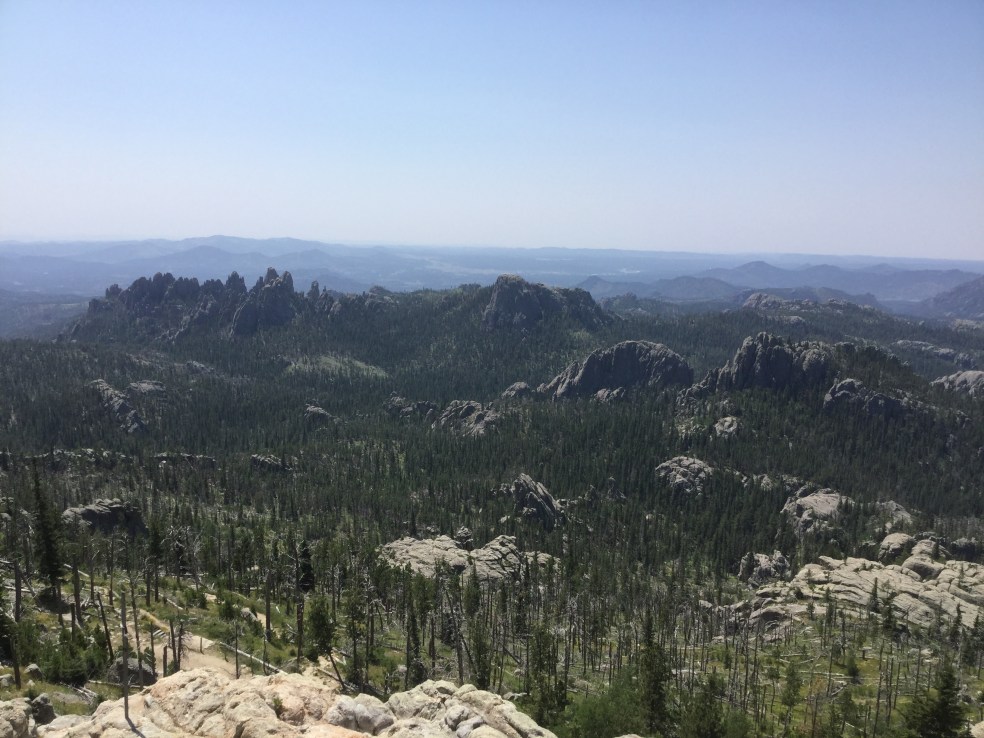
I thought about which of the four presidents would approve of their 60-foot-tall likenesses here. Washington and Jefferson: no, surely. Both were wary of the power of power to corrupt one’s character, and neither believed in deifying other human beings, especially themselves, in the way that this extraordinary sculpture seems to do. I’m a little less sure that Lincoln would wholly disapprove: he did believe in the unifying power of symbols, and he was an extremely ambitious man, though I think he was one of those rare characters whose ambition did little to erode his integrity. On the whole, I still think he would disapprove. Of the four, I think Theodore Roosevelt would most likely to approve if it, with his outsize personality, love of power, and ‘great man’ theory of history. He was a committed conservationist and was instrumental in creating the National Park system, but I still think he might approve of this particular exception to the rule of forbearance when it comes to altering natural wonders.
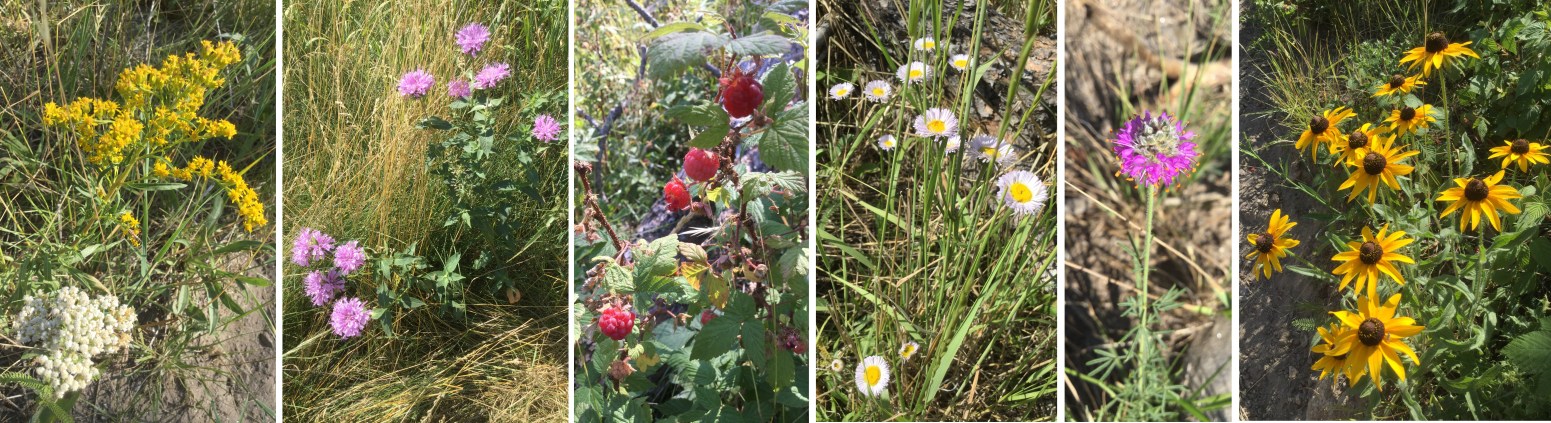
View of Horsethief Campground from my tent

After a rather short time on the viewing platform, I left. I was in no mood for a light show. The sculpture is impressive and looks lovely in the low soft light of the evening, but it just doesn’t belong here in the Black Hills.

Journal: On Black Elk Peak, Black Hills National Forest, Sunday afternoon, July 23rd, 2017

I woke up refreshed and cheerful this morning. The campers, cabin vacationers, and partiers of last night are getting ready for the day. Their evident satisfaction with this beautiful morning after a day and night of fun made me feel more kindly disposed towards them, and I chatted with several of them while waiting for a shower stall to open up, including the hospitable couple from the campsite next to mine who loaned me their camp light last night to set up my tent by.

Black Elk prays to the Six Grandfathers on Black Elk Peak, formerly known as Harney Peak, in 1931, when he ascends this peak for the first time in the flesh. He’s accompanied by his son, and by the poet and author John Neihardt with his daughters. Black Elk had been on this mountaintop in a vision when he was very young, a vision that guided him for the rest of this life. ‘He’d prepared in advance for this address to the gods. In his Vision, he’d been naked except for his breechclout, his body painted red, the color of the right road. But the girls were there and he didn’t want to embarrass them [what a gentleman! – AC], so he stepped behind an outcrop and a few minutes later emerged wearing a bright red union suit commonly called long johns. Over that he wore a black or dark blue breechclout, trimmed in green, and on his feet high stockings and beaded moccasins’ – Joe Jackson, Black Elk: The Life of an American Visionary

I packed up my tent and drove to the Sylvan Lake recreation center, where there’s a hotel, cabins, and structures for boating and water sports, and where I’ve been recommended by a few people to start my Black Elk Peak hike from. The young woman at the front desk looked and sounded quite a bit like Winona Ryder, but taller, leaner, more what’s often called ‘girl-next-door’. She looked to me like a local and a hiker so I approached her; my guess turned out to be right. I asked her about the hiking trails to Black Elk Peak, and she hesitated. I assured her that I’m a sturdy hiker and was looking for the best hike, not necessarily the most popular one. Her smile broadened, and she directed me to ascend via Trail #9, the Black Elk / Harney Peak Trail, from the Willow Creek trailhead rather than the Sylvan Lake one. The former is longer and more strenuous, but, she said, much more spectacular. ‘That’s the one, then!’ I said. After all, I’ve gone all this way to do this, so best do it right.

She was the first person in the Black Hills that didn’t react negatively to my calling it Black Elk Peak. It was finally renamed by the U.S. Board on Geographic Names last year after years and years of protest. Until last year, it was named Harney Peak after General William S. Harney, whose forces massacred Native American women and children in the wars for the Plains. When I had asked various people for directions and advice or just mentioned my plans in conversation, the response was invariably a rather sour look and something like ‘Oh, you mean Harney Peak. It’ll always be Harney Peak around here.’ I realize people like familiar things to remain familiar, but I’m still disappointed by this ungenerous reaction. I mean, c’mon. We’ve taken these hills by force and trickery and are milking them for cash to this day, and we’ll never give them back. Let a little something of their sacred history be memorialized here, too.

Trailhead to Black Elk Peak / Harney Peak from Willow Creek, Black Hills, SD, via Trail #9 by way of Trail #8

A view from Trail #9 in the Black Elk Wilderness

Returning to my story, the woman at Sylvan Lake Hotel was right. I’m so very grateful that she sent me here. This 9 ½-mile out-and-back hike is glorious, from gently winding sandy horse trails through pines and voluminous wildflowers to steeper, narrower climbs between fantastic rock formations….

…. Continued later the same day: I stopped writing just there because I of a happy interruption.

As I was writing what you just read, I was perched on a rock near the edge of the peak with a very long, nearly sheer drop under my feet. At overlooks like this one, I like to reverse-Spiderman towards the edge, creeping face-up along on all fours so I can’t slip as I near it, until I find a hollow I can sit in. The depression needs to be deep enough so I can tuck my rear well into it and feel that there’s no way I can fall unless I really tried (this tactic allowed me to fully enjoy the grandest view possible of the Virgin River canyon at Zion National Park from Observation Point not too long ago). I took photos of the amazing scenery from my perch and then was inspired to write. I was so absorbed in my writing that I was unaware of what was happening right next to me until I heard the tinkle of a bell and someone say, ‘Whoa!’ I swung my head around in the direction of these sounds and I saw a couple with their medium-size dog (the bell was on its collar) well behind me on the rocks. I swung my head back around again towards the white shape they were looking at rather near to me on my right, also near the edge like I was.

Perched on a rocky ledge on Black Elk Peak

It was a female Rocky Mountain goat, a mature one, with curved pointed horns. She was perhaps twenty-five or thirty feet away from me. I was surprised that such a large animal could come so close without my noticing, but I think the people who know me best would not be surprised. When I’m reading or writing, generally, I’m pretty oblivious to what’s going on around me. I carefully gathered up my things that I had tucked into another crevice next to me, buckled my pack around my waist again, and backed up a little farther from the edge, moving slowly all the while. I wasn’t afraid of her since she was very clearly not afraid of me so long as I didn’t approach or make any sudden sounds or movements. She kept half an eye on the dog which was carefully restrained by its owners; it was quiet, tensed in riveted attention. After apparently satisfying herself that the dog was no threat, she turned her attention to me, sniffing energetically and edging herself in my direction, chewing her cud all the while. At a certain point, she turned and walked purposefully towards me, coming to a stop about 8-10 feet away. I was only a little nervous, but not as a result of her behavior: she was still at ease. I was just aware that she’s a wild animal, very large, her efficient tools for ridding herself of enemies, and I’m near the edge of a cliff. It’s her natural habitat, but not one I could navigate gracefully if I needed to beat a quick retreat.

A Rocky Mountain goat approaches me on Black Elk Peak

We observed each other for quite a while at these close quarters. She continued to sniff: at my scent? at the snacks in my bag? and to watch me, sometimes looking at my straw-colored hat flopping in the wind. I could almost reach out and touch her: she was only about two steps and an arm’s length away. At one point, however, I coughed, and she shied away about ten feet.

A panoramic view from Black Elk Peak with a Rocky Mountain goat

A broken rock reveals its inner shine, set on a fallen log

After quite awhile, I decided it was time to go. I was thirsty, and I noticed my legs were getting sunburned. I still had a long trek ahead of me, mostly downhill, but steep and very hot. I rose slowly to my feet, and the goat ambled a few more feet away. I looked back at her at the edge of the rocks as I left. She looked grand standing there, ageless.

I wound my way back down, and the sandy trail sparkled under my feet. It’s as if the passing stars, in their slightly changed positions in each night sky, left a pinpoint of their glow behind, except where spilled moonlight stuck to the ground in the form of shining rocks and large luminescent pieces of mica. The trail is beflaked liberally in many places by thin little sheets of this translucent and opalescent mineral.

The trail was also bounded by exuberant sprays and stands of wildflowers. The wild raspberries were bursting with fruit along most of my course up and down. The ripe berries fell off their stems with very little encouragement and were as effortless to eat too. They were so tender that chewing and swallowing were almost unnecessary: you could just roll them on your tongue then press gently in your mouth and they would just dissolve away. I must have eaten one or two pounds of them on the round trip.

Wild raspberries grow plentifully along Black Peak Trail

A view near the top of Black Peak Trail

Flowers and fruits along the Black Peak Trail

Another view from the Black Elk Peak Trail

When I reached the end of my hike, I rested a bit, then headed to the nearest KOA center for some ice. I was soaked in sweat and covered in dust, the latter stuck firmly to me from the former. First I poured several pints of water over the ice, drank all that down, then poured a warm bottle of beer from the car over the rest to enjoy that when I reached my next destination. I headed east on 244, then south on 385.

Portrait of Korczak Ziolkowski at the Crazy Horse Memorial Visitor Center. The unfinished frame is purposeful: by direction of the artist, the rest of it will be put in place when the Crazy Horse sculpture is finished

In the early 1930’s, Lakota chief Henry Standing Bear approached Gutzon Borglum with a proposal to create another monument carved into the Black Hills. This one would immortalize his cousin, the great warrior Crazy Horse, a leader of the victorious Native American forces at the Battle of the Little Bighorn in 1876. Not surprisingly, Borglum turned him down. Standing Bear persevered in his search for another sculptor willing to undertake this massive project, and he found one: Korczak Ziolkowski, who had assisted with the carving of Mt Rushmore for a time. Standing Bear discovered him in a 1939 article about his prize-winning sculpture of the Polish pianist, politician, and independence activist Ignacy Jan Paderewski.

Ziolkowski thought the project sounded like a worthy endeavor. He worked on this massive sculpture, which already dwarfs the Mt Rushmore sculpture, with determination and single-mindedness for the rest of his life. He did preliminary work on the Crazy Horse Memorial throughout the early 1940’s when he wasn’t serving in the military, then arrived in the Black Hills in 1947 to begin creating the actual sculpture. He married and had 10 children during this time as well, and died 35 years later on October 20, 1982. His wife and now many of his children carry on his work. It won’t be fully finished for another several decades at least. By the way, it’s fully funded by private donations and the proceeds from entry ticket sales, so if you believe it’s a worthy project too, you can donate here.

The Crazy Horse Memorial sculpture by Korczak Ziolkowski rises from the pines of the Black Hills

Inside the shabby but sturdy old school bus that takes us closer to the Crazy Horse Memorial. I particularly liked our tour guide and driver: a funny and warm sweetheart.

After I arrived at the Visitor Center, I looked at a few of the several thousand interesting and beautiful artifacts and artworks throughout, and then made my way back outside to get a better view of the memorial itself. At the bus stop, I rested, waiting with the other tourists for our ride closer to the sculpture, which is not generally accessible by foot since it’s an active work site. I sipped my cold and watery beer, ate my beef jerky, and chatted with other travelers.

Working model of Crazy Horse Memorial at the Visitor Center

Profile view of George Washington’s sculpted head from the side of Mt Rushmore

When I returned from viewing the sculpture, I lingered at the visitor center and museum for awhile, I set off on my journey north and east to my next destination. On my way out from the Black Hills, I returned to Mt Rushmore, which was pretty much on my way, to see if I felt differently about it. The beauty of Black Elk Peak, seeing the Black Hills there as I had longed to see them, and then seeing the more noble and fitting endeavor of the Crazy Horse Memorial had left me feeling uplifted and inspired. Perhaps I could appreciate this work of art more fully and positively in my now very different frame of mind.

But, it was no good. I still felt the same about Mt Rushmore as I did the day before.

To be continued….

Listen to the podcast version here or on Google Play, or subscribe on iTunes

Ordinary Philosophy and its Traveling Philosophy / History of Ideas series is a labor of love and ad-free, supported by patrons and readers like you. Please offer your support today!

~~~~~~~~~~~~~~~~~~~~~~~~~~~~

Sources and inspiration:

Battle of Ash Hollow‘. In Wikipedia, The Free Encyclopedia.

Brown, Dee. Bury My Heart at Wounded Knee: An Indian History of the American West. New York: Holt, Rinehart & Winston, 1970

Crazy Horse Memorial, website by the Crazy Horse Memorial Foundation

Howard, Brian Clark. ‘Highest Point East of Rockies Renamed for Native American.’ National Geographic online, Aug 12, 2016

Jackson, Joe. Black Elk: The Life of an American Visionary. New York: Farrar, Straus and Giroux, 2016

Mountain Goat‘. In Wikipedia, The Free Encyclopedia.

Mount Rushmore‘. Season 14 Episode 4 of American Experience, PBS

Neihardt, John G. Black Elk Speaks, 1932

Shaer, Matthew. ‘The Sordid History of Mount Rushmore: The sculptor behind the American landmark had some unseemly ties to white supremacy groups‘. Smithsonian Magazine, Oct 2016

Taylor, Alan. ‘Statue or Bust: Around the World in Lenins‘. The Atlantic, Oct 9, 2014

Little Bighorn Battlefield National Monument, Day 2

Cheyenne Warrior Marker historical placard, Little Bighorn Battlefield Monument, NPS. I’m glad to see that there’s now public acknowledgement that other human beings died here that day besides U.S. soldiers. Soon, I hope, that more of the Oglala, Hunkpapa, Miniconjou, Arapaho, Cheyenne, and other tribe members, their slain warriors and slain women and children as well, will be specifically remembered too, as far as we can identify them. There’s a general remembrance in the Indian Memorial, but it would be a very good thing, I think, to see more of the victims named if possible. The attack began, after all, with U.S. soldiers firing into the lodges of families, regardless of the collateral damage (that pragmatic military term to ease the conscience of war-makers), the lives of noncombatants that would necessarily be lost.

Little Bighorn Battlefield National Monument, Saturday, July 22nd, 2017

As I continue to explore the Little Bighorn Battlefield the next morning and afternoon, I gain a much clearer idea of how the drama played out. I had read many accounts of the battle, but seeing the lay of the land helps me visualize it more clearly. For example, it all happened over a much larger area, and over a longer period of time, than I had conceived.

Here are just a few more images of the many, many more things I see and learn here this second day at the Little Bighorn battlefield:

Headstones marking where U.S. cavalry soldiers fell at the Battle of the Little Bighorn, June 25-26, 1876. The 7th cavalry was hopelessly outnumbered; later, Native American expressed their amazement that George Armstrong Custer’s 7th attacked the encampment given that it was so large, about 7,000 in all, including about 2,000 warriors. Though it was later revealed that Custer ordered the attack because he didn’t want the encampment to escape, still, it was suicidal to lead his men to attack such a large force before the other approaching U.S. troops arrived.  So it the question remains unanswered, at least satisfactorily: was it just hubris on his part, or dismissiveness of Native American prowess in war, or ignorance, or some of each? The debate continues….

John Stands in Timber, Lame White Man’s grandson, was one of those who helped the National Park Service to identify and honor the sites of fallen warriors

Here, about 7,000 people banded together near the banks of the Little Bighorn River in 1876 in a bid for freedom

Above: Deep Ravine, through which Crazy Horse led a charge towards Land Stand and Calhoun Hills from the Little Bighorn River.

Site of Major Marcus Reno’s retreat, about five miles from Last Stand Hill, Little Bighorn Battlefield. He attacked the encampment from one direction, Custer from another, and his detachment of soldiers was the first to start firing

Looking towards the Crow’s Nest vantage point from which Custer directed his attack

Black Elk quote on the wall of the Little Bighorn Battlefield National Monument museum. Black Elk, a Northern Cheyenne, was a young teenager when he fought in the battle here, and he went on to become an important witness to what occurred here. This quote is from Black Elk Speaks, poet and author John G. Neihardt’s account of Black Elk’s conversations about, among many things, this battle and of his life as a visionary and holy man. It was published in 1932, when Black Elk was in his late 60’s. Black Elk’s life was a fascinating one, and I’ll continue to follow him in this series. To be continued…

Many times throughout my life, especially as a child and teen, I had heard of the battle at the Little Bighorn, and shrugged my shoulders each time. I was not then inspired to learn more about it: it seemed to me like just one more of the countless times human beings have slaughtered each other for what were probably completely insufficient reasons. Why learn the tedious details?

I’ve only recently begun to make a serious study of the history of the Native Americans of the Great Plains and their encounters with the encroaching peoples of the United States and Europe. What I’ve learned is disturbing, amazing, complex, and heart-wrenching. Learning about this battle, it turns out, is not the least bit tedious. It’s dramatic, tragic, fascinating, and invaluable for understanding this very important and formative period in American history, and continues to be very relevant today. Human beings are still wasting lives on battlefields all over the world, and Americans are still dismissive of and doing wrong to the original inhabitants of the Plains, as the recent Dakota Access Pipeline debacle illustrates.

*Listen to the podcast version here or on Google Play, or subscribe on iTunes

Ordinary Philosophy and its Traveling Philosophy / History of Ideas series is a labor of love and ad-free, supported by patrons and readers like you. Please offer your support today!

~~~~~~~~~~~~~~~~~~~~~~~~~~~~~~

Sources and inspiration:

‘The Battle of the Little Bighorn‘, Little Bighorn Battlefield National Monument, National Park Service website

Brown, Dee. Bury My Heart at Wounded Knee: An Indian History of the American West. New York: Holt, Rinehart & Winston, 1970

Connell, Evan S. Son of the Morning Star. London: Macmillan, 1984

‘Indian Memorial’, Little Bighorn Battlefield National Monument, National Park Service website

Jackson, Joe. Black Elk: The Life of an American Visionary. New York: Farrar, Straus and Giroux, 2016

Janiskee. Bob.  ‘An Indian Memorial Helps to Re-Image Little Bighorn Battlefield National Monument‘, National Parks Traveler, Dec 7th, 2008

Marquis, Thomas Bailey. Wooden Leg: A Warrior Who Fought Custer, 1931

Marshall, Joseph III. The Journey of Crazy Horse: A Lakota History. New York: Viking, 2004

Neihardt, John G. Black Elk Speaks, 1932

Powers, Thomas. The Killing Of Crazy Horse. New York: Knopf, 2010