New Podcast Episode: Behind the Veil: Rawls, Locke, de Tocqueville, and Human Connection in a Liberal Society

People in a Public Square, cropped, Image Creative Commons CCO Public Domain via PixabayListen to this podcast episode here or subscribe on iTunes

I’ve been listening to this excellent series from a favorite podcast of mine, the Philosopher’s Zone on Australia’s RN (Radio National), hosted by Joe Gelonesi. There’s this recent series called Political Philosophy in the World, hosted by guest host Scott Stephens, which considers and critiques seven important topics in political philosophy. I just listened to the last one, Political Philosophy in the World: Liberalism and the End of the World as We Know It.

In it, interviewee Patrick Deneen offers a series of critiques of liberalism, his own and others’ over its roughly five century history. …The discussion in its entirety is absolutely fascinating, but my attention is caught particularly by Deneen’s observation of a problem with the great liberal political philosopher John Rawls’ famed ‘veil of ignorance’ thought experiment…. Read the written account here:

Ordinary Philosophy and its Traveling Philosophy / History of Ideas series is a labor of love and ad-free, supported by patrons and readers like you. Please offer your support today!
New Podcast Episode: Frederick Douglass Rochester NY Sites, Day 1

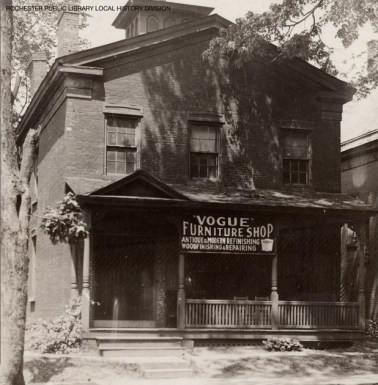
Douglass home at 4 Alexander St in later incarnation as a shop, image Rochester Public Library Local History

Listen to this podcast episode here or subscribe on iTunes

Ninth day, Monday Mar 28th

On a cold, gray, and blustery spring morning, I drive from Syracuse to Rochester NY, and head straight for a certain house very near Susan B. Anthony Square. As I suspect might be the case, the house is closed to the public today so I’ll return tomorrow; I head here first anyway to scope things out in person because it turns out,  I have more free time to explore Rochester this morning than I thought I would. Hooray! …Susan B. Anthony Square, at 39 King St, is a little park crisscrossed with meandering paths and dotted with benches and neatly trimmed shrubbery, in the center of pretty blocks of well-maintained early 19th century houses. The square is dominated by a life-size sculpture of Frederick Douglass and Susan B. Anthony by Pepsy Kettavong, called ‘Let’s Have Tea’, installed in 2001…. Read the written account here:

Ordinary Philosophy and its Traveling Philosophy / History of Ideas series is a labor of love and is ad-free, entirely supported by patrons and readers like you. Please offer your support today!
Interview with Leigh Fought on Anna and Frederick Douglass

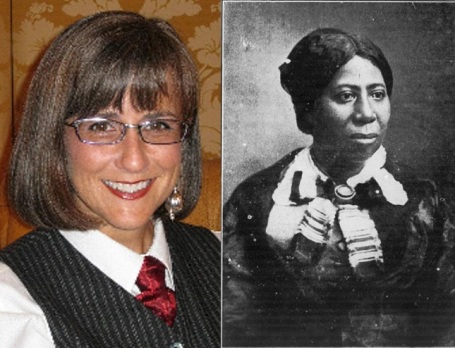
Leigh Fought image Le Moyne College, Anna Douglass image Library of CongressI’m pleased and honored to present my third interview guest, Leigh Fought, Anna and Frederick Douglass scholar and assistant professor at LeMoyne College in Syracuse. We’ll be talking about Anna Douglass, about whom I believe too little is known, and most historical presentations of her range from woefully incomplete to inaccurate and even unfair. Ms. Fought is doing significant work in righting this with her upcoming book about the women in the life of Frederick Douglass, the most significant of which, of course, is Anna.
Interview with Leigh Fought, Part One

Interview with Leigh Fought, Part Two

Find out more about Ms. Fought and her work at her blog Frederick Douglass’s Women: In Progressfaculty page for Le Moyne College, and Amazon author page, and here are some other articles and papers she’s written / co-authored; there are many others not available online, please contact the author:

Globalizing Protest in the 1980s: Musicians Collaborate to Change the World‘, The Gilder Lehrman Institute of American History

Commentary: Frederick Douglass and Interracial Marriage‘, Syracuse.com blog

~ Ordinary Philosophy and its Traveling Philosophy / History of Ideas series is a labor of love and ad-free, entirely supported by patrons and readers like you. Please offer your support today!

New Podcast Episode: Frederick Douglass Albany, Troy, and Syracuse NY sites

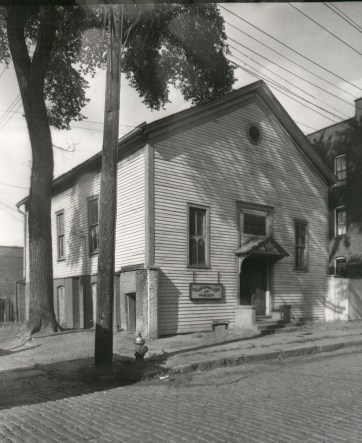
Liberty Street Presbyterian Church, Collection of the Rensselaer County Historical Society, Troy, NY 2

Liberty Street Presbyterian Church in a later incarnation as a laundry. This only known surviving photo is in the collection of the Rensselaer County Historical Society, Troy, NY

Listen to this podcast episode here or subscribe on iTunes

Eighth Day, Sunday March 27th

I get up very early and leave Cambridge (where I’ve been staying while visiting Boston and Lynn) and this time, instead of heading north, I head west across upstate New York. I’ve never visited this part of the country before. My friend who I’ll be staying with in Rochester laments that I’m visiting at the least advantageous time of year for beauty’s sake: the snow is gone, and having scrubbed the trees bare, leaves the trash it’s been concealing exposed, and there’s not a hint of green nor bloom yet on the branches. But I still think it’s lovely, with a sort of stark gray beauty, and enjoy the day’s drive of about 325 miles.… Read the original account here

Ordinary Philosophy and its Traveling Philosophy / History of Ideas series is a labor of love and is ad-free, entirely supported by patrons and readers like you. Please offer your support today!

Interview with Peter Adamson on Indian and Islamic Philosophy

OLYMPUS DIGITAL CAMERA

Listen to this podcast episode here or subscribe on iTunes

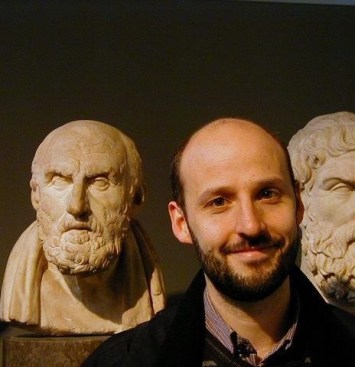
I’m honored to present my second interview guest, Peter Adamson, creator and host of the History of Philosophy Without Any Gaps podcast and Professor of Philosophy at the Munich School of Ancient Philosophy and at King’s College London. I’ve listened to his History of Philosophy podcast series for many years: it’s now almost 5 ½ years running, and if you are interested in philosophy, I’m hard pressed to think of a source that’s more comprehensive, thoughtful, and well-researched than Adamson’s.

In this interview, we focus on non-Western philosophy, specifically Indian and Islamic philosophy, since that’s his focus right now at his History of Philosophy series. We touch on Western philosophy as well, especially regarding the ways that Islamic and Indian philosophy influence and intersect with Western philosophy.

Listen to Adamson’s excellent series on the History of Philosophy (without any gaps)

and his Indian philosophy series co-authored by Jonardon Ganeri

Ordinary Philosophy and its Traveling Philosophy / History of Ideas series is a labor of love and is ad-free, entirely supported by patrons and readers like you. Please offer your support today!

New Podcast Episode: Frederick Douglass Lynn Sites, Part 2 – Historical Society and Hutchinson Scrapbook

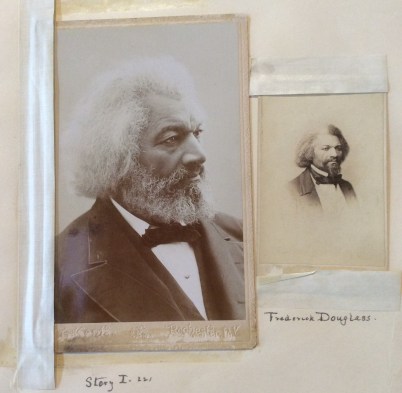
Frederick Douglass in Hutchinson Scrapbook, 2016 Amy Cools

Two portraits of Frederick Douglass from the Hutchinson Family scrapbook

Listen to this podcast episode here or subscribe on iTunes

Seventh Day, Saturday March 26th

…Lynn proves to be a Douglass treasure trove for me, especially the Lynn Museum & Historical Society. While I’m waiting to meet with a representative of the museum to look at some materials from the archives, I visit the ‘Abolitionist Lynn’ exhibit upstairs. As discussed in the first part of today’s account, Lynn had a particularly active and vocal abolitionist community. As I also discussed in the first part of today’s account, that’s what brought Douglass, laborer turned abolitionist speaker, here to Lynn… Read the original account here

Ordinary Philosophy and its Traveling Philosophy / History of Ideas series is a labor of love and is ad-free, entirely supported by patrons and readers like you. Please offer your support today!

New Podcast Episode: Frederick Douglass Lynn, Massachusetts Sites

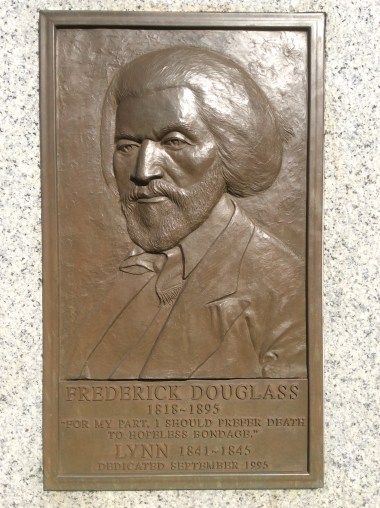
Frederick Douglass Memorial plaque in Lynn Commons, photo 2016 by Amy Cools

Frederick Douglass Memorial plaque in Lynn Commons

Listen to this podcast episode here or subscribe on iTunes

Seventh Day, Saturday March 26th

…Not long after Frederick Douglass began his public speaking career, he and his family moved here to Lynn from New Bedford. They lived here from the fall of 1841 through about November 1847. Well, actually, for much of that time, it was mostly Anna and the kids who lived here. First, Douglass was often on tour as a speaker, which took him away from home for long stretches. Secondly, he was away on a tour of the British Isles from 1845-1847, which is why many sources say Douglass himself only lived here until 1845. He returned only briefly to Lynn before moving himself and his family to Rochester near the end of 1847. His ‘industrious and neat companion‘ Anna took care of the household while he was away, and often took in piecework from Lynn’s thriving shoemaking industry to make sure the kids were always cared for and the bills paid on time….  Read the original account here

Ordinary Philosophy and its Traveling Philosophy / History of Ideas series is a labor of love and is ad-free, entirely supported by patrons and readers like you. Please offer your support today!

New Podcast Episode: On Martyrdom

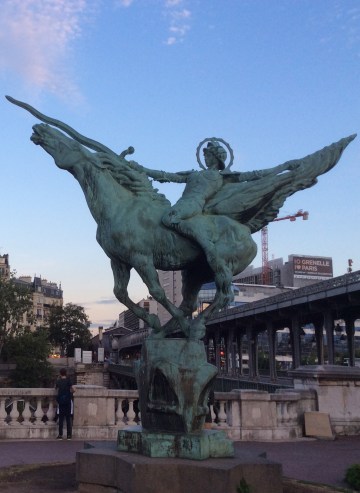
Joan of Arc statue in Paris, France, photo 2015 by Amy Cools

Listen to this podcast episode here or subscribe on iTunes
The school shooting at Oregon’s Umpqua Community College on October 1st, 2015 ended with nine dead and many more injured. The shootings may have been religiously motivated: according to some reports, the gunman commanded some of the students to stand up, asked if they were Christian, and when they responded ‘yes’, he shot them down.

Some have praised these murder victims as Christian martyrs dying for their faith. In one sense, it’s a plausible, and in any sense, an understandable interpretation of what happened: the gunman shot them down after they responded ‘Yes’ to his question ‘Are you a Christian?’ Other survivors tell the story a little differently. In any case, the martyr interpretation is tricky: if it did happen as described above, the murder victims wouldn’t have known ahead of time whether ‘yes’ or ‘no’ was the right answer, as at least one survivor pointed out. Though they may have intended to defy death rather than deny their faith, they could instead have thought that the truthful answer of ‘yes’ would save them from death. Sadly, we can never really know….  Read the original essay here

Ordinary Philosophy and its Traveling Philosophy / History of Ideas series is a labor of love and is ad-free, entirely supported by patrons and readers like you. Please offer your support today!

New Podcast Episode: Frederick Douglass Boston Sites

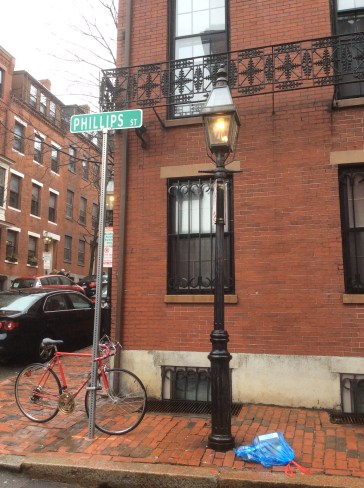
Phillips Street sign, where I begin my Frederick Douglass Boston journey, 2016 Amy Cools

I commence my Frederick Douglas Boston journey on Phillips St, and long for my bike. Mine is blue. Sigghhh

Listen to this podcast episode here or subscribe on iTunes

Sixth Day, Friday March 25th

As I am quick to discover, parking is at a premium in central Boston and its environs. I’ve decided not to pay the high garage rates and stick with metered parking (reasonably priced but harder to find). It’s to be expected in an awesome, busy, historically important city, of course, just be prepared! It’s such a handsome city, so much to look at, and I long for my bike: fleet, nimble, with uninterrupted view, parkable anywhere there’s a pole. At times such as this, a car feels like little but an expensive burden.

Frederick Douglass never did live here in Boston, but this city has many connections with his life: he and his family lived just a few miles north of here in Lynn from 1841-47. Douglass visited, worked, and spoke here often, and the Boston Anti-Slavery Society published his Narrative which, combined with his speaking tour of the British Isles and the United States that followed, catapulted him to fame and made him the leading African American abolitionist of his time… Read the original account here

Ordinary Philosophy and its Traveling Philosophy / History of Ideas series is a labor of love and is ad-free, entirely supported by patrons and readers like you. Please offer your support today!

New Podcast Episode: Frederick Douglass New Bedford, Massachusetts Sites

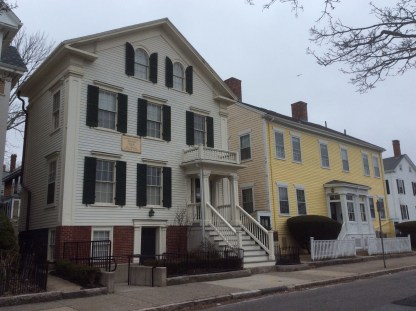
Nathan and Polly Johnson House (and adjoining) at 21 Seventh St, New Bedford MA, 2016 Amy Cools

Nathan and Polly Johnson House (and adjoining) at 21 Seventh St, New Bedford MA, 2016 Amy Cools

Listen to this podcast episode here or subscribe on iTunes

Fifth Day 5, Thursday March 24th

When I arrive in the old whaling town of New Bedford, Massachusetts, it’s overcast and very chilly. I had so enjoyed the respite from the cold in New York City’s balmy weather I was already a little spoiled. But I’m wearing lots of wool and my shearling boots, so I think I’m prepared. I start with the New Bedford Whaling National Historical Park visitor center, run by the National Park Service. Several of the town’s buildings of historical interest are also preserved by the NPS, including one of particular interest for my journey today. The visitor center is housed in the Old Third District Courthouse constructed in 1835, a handsome Greek Revival building.

I’m assisted by the kind and knowledgeable Diane Altman Berube, and when I describe the purpose of my trip, she immediately supplies me with information, advice, a map, some pamphlets about Frederick Douglass, the town’s Underground Railroad and abolitionist history (a strong one!), and another about the 54th Regiment of the Union Army and an accompanying collection of cards, like baseball cards, with images and stories of men involved…

… Read the original account here

Ordinary Philosophy and its Traveling Philosophy / History of Ideas series is a labor of love and ad-free, entirely supported by patrons and readers like you. Please offer your support today!