Happy Birthday, Grace Lee Boggs! Bio and Book Review by Ashley Farmer

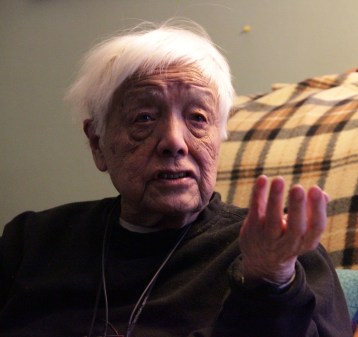
Grace Lee Boggs, By Kyle McDonaldm creativecommons.orglicensesby2.0, via Wikimedia Commons, cropped

In celebration of Grace Lee Bogg’s birthday on June 27th, 1915, I share here an excellent bio and book review by historian Ashley Farmer:

“The Power And Importance Of Ideas:” Grace Lee Boggs’s Revolutionary Vision”

In the opening lines of her autobiography, Living for Change, Grace Lee Boggs remarked: “Had I not been born female and Chinese American, I would not have realized from early on that fundamental changes were necessary in our society.”[1] A daughter of Chinese immigrants born in 1915, who, by her account, became a philosopher in her 20s and an activist in her 30s, Boggs remains one of the greatest radical theorists of the twentieth century.

Born in Rhode Island, Boggs spent her childhood in New York City, working in the two restaurants her father owned in Times Square. At the age of 16, she left home to attend Barnard College, and afterward, Bryn Mawr, where she earned a PhD in Philosophy in 1940. Philosophers like Hegel helped her “see [her] own struggle for meaning as part of the continuing struggle of the individual to become part of the universal struggle for Freedom.”[2] Boggs moved to Chicago in 1940. She began working with the South Side Tenants Organization set up by the Workers Party, a Trotskyist group that had split off from the Socialist Workers Party. Her time in the Windy City proved transformative. For the first time she was talking and working with the black community, getting a first-hand sense of what it meant to live within the confines of segregation and discrimination, and learning how to participate in grassroots organizing.[3]

It was also during her tenure with the Workers Party that she met Caribbean radical C.L.R. James, and began a “theoretical and practical collaboration that would last twenty years.”[4] As part of a small wing of the workers Party led by James and Raya Dunayevskaya, Boggs became a leading theoretician, co-authoring texts like State Capitalism and World Revolution (1950). Through James, she came into contact with a number of black writers and activists who expanded her perspective. She relocated to Detroit in 1953, where she would organize with, and marry, James (Jimmy) Boggs.

During the 1950s, Boggs, “mainly listened and learned” to the black activists around her in an effort to better understand the black condition. It would take several years before she decided that she had been “living in the black community long enough to play an active role in the Black Power Movement that was emerging organically in a Detroit where blacks were becoming the majority.”[5] Living and working in what was considered to be an epicenter of black radicalism, Boggs engaged in a combination of theorizing and protesting, authoring texts with James Boggs, meeting and organizing with Malcolm X, and mentoring young radicals like Muhammad Ahmad (Max Stanford), leader of the Revolutionary Action Movement (RAM).

Her liberation theory was grounded in her study of philosophy and honed through her experiences organizing with and for black communities. It was also constantly evolving. Boggs emphasized dialectical thinking, arguing that reality is ever changing and that we must “constantly be aware of the new and more challenging contradictions that drive change.”[6] This reciprocal process drove her expansive vision of revolution. In her final book, The Next American Revolution, she explained her latest concept of revolution:

The next American Revolution, at this stage in our history, is not principally about jobs or health insurance or making it possible for more people to realize the American Dream of upward mobility. It is about acknowledging that we as Americans have enjoyed middle-class comforts at the expense of other peoples all over the world. It is about living the kind of lives that will not only slow down global warming but also end the galloping inequality both inside this country and between the Global North and Global South. It is about creating a new American Dream whose goal is a higher Humanity instead of the higher standard of living dependent on Empire.[7]

Boggs consistently offered a holistic vision of revolution and concrete steps through which to build it. She argued that achieving this goal meant more than organizing or mobilizing to petition the state or “changing the color of political power,” but rather growing food, reinventing education, developing Peace Zones in local neighborhoods, and creating restorative justice programs. She saw the seeds of revolution everywhere and showed us how, by practicing dialectical thinking, breaking down divides and categories, and building on rather than replicating older political models, we might “grow our souls.” She mirrored this in her own life, constantly “combining activity and reflection.”[8] Her willingness to do the work, her ability to listen and learn from black activists, her commitment to living in the communities in which she organized, and her openness to revising her politics, and values, made her an effective life-long ally of the black community and theoretician of liberation and revolution.

As she noted, often, “in the excitement of an emerging movement, we tend to want to be part of the action, and we underestimate the power and importance of the ideas in our heads and hearts.”[9] Upon her death, it’s important to revisit the ideas in her head. She left us a roadmap for revolution through ideas and action, one that anyone could be a part of if they were clear about the stakes of the transformation and that fundamental change is necessary.

Originally published at the African American Intellectual History Society blog, this was originally republished at O.P. when it was under a Creative Commons license in 2016

~ Ashley Farmer is a historian of African-American women’s history. Her research interests include women’s history, gender history, radical politics, intellectual history, and black feminism. She earned a BA in French from Spelman College, an MA in History from Harvard University, and a PhD in African American Studies from Harvard University. She is currently a Provost Postdoctoral Fellow in the History Department at Duke University. In August 2016, she will be an Assistant Professor in the Department of History and the African American Studies Program at Boston University. (This bio and more about Ms. Farmer are to be found at her personal website)

*A version of this piece was previously published in Ordinary Philosophy

~ Ordinary Philosophy is a labor of love and ad-free, supported by patrons and readers like you. Any support you can offer will be deeply appreciated!

~~~~~~~~~~~~~~~~~~~~~~~~~~~~~~~~~~~~~~

[1] Grace Lee Boggs, Living for Change: An Autobiography (Minneapolis: University of Minnesota Press, 1998), xi.

[2] Ibid., 30-31.

[3] Ibid., 36.

[4] Ibid., 43. James and Boggs “went their separate ways in 1962.”

[5] Grace Lee Boggs with Scott Kurashige, The Next American Revolution: Sustainable Activism for the Twenty-first Century (Berkeley: University of California Press, 2011), 66.

[6] Ibid., 62.

[7] Ibid., 72.

[8] Ibid., 164.

[9] Ibid., 80.

Happy Birthday, Aimé Césaire!

Aimé Fernand David Césaire, photo credit manomerci.comAimé-Fernand-David Césaire was a poet, playwright, philosopher, and politician from Martinique. In his long life (he was born on June 26, 1913, and died April 17, 2008), Césaire accomplished much in each of these roles, a rare feat as the disparate talents required for each rarely coincide in one person.

In turn mayor of Fort-de-France, deputy to the French National Assembly for Martinique, and President of the Regional Council of Martinique, this prolific writer and intellectual was also co-founder of Négritude, a ‘literary movement of the 1930s, ’40s, and ’50s that began among French-speaking African and Caribbean writers living in Paris as a protest against French colonial rule and the policy of assimilation.’ (Encyclopædia Britannica). The Stanford Encyclopedia of Philosophy describes Négritude as ‘the self-affirmation of black peoples, or the affirmation of the values of civilization of something defined as “the black world” as an answer to the question “what are we in this white world?”’. The term was chosen so as to be provocative, a way of re-claiming the word nègre which had become a racial slur, while simultaneously shocking those who heard or read it into paying attention. Through his philosophy, political writing, and especially his poetry and plays, the world pays attention still.

Learn more about the great Aimé Césaire:

Aime Cesaire: Martinician Author and Politician – by the editors of Encyclopædia Britannica

Aimé Fernand Césaire, 1913–2008 – by Meredith Goldsmith forThe Poetry Foundation

Aimé Fernand David Césaire (1913-2008), chapter 1 of The Greatest Black Achievers in History – by Sylvia Lovina Chidi

Négritude – by Souleymane Bachir Diagne for The Stanford Encyclopedia of Philosophy

*A version of this piece was previously published in Ordinary Philosophy

~ Ordinary Philosophy is a labor of love and ad-free, supported by patrons and readers like you. Any support you can offer will be deeply appreciated!

Happy Birthday, W.V.O. Quine!

WVO Quine on the Bluenose II in Halifax, Nova Scotia, photo courtesy of Douglas Quine (cropped)

WVO Quine on the Bluenose II in Halifax, Nova Scotia, photo courtesy of Douglas Quine

The emphases in my own education in philosophy were Ethics, Politics, and Law, so I didn’t spend as much time studying Willard Van Orman Quine’s great contributions to philosophy as I would like. However, if my focus was Mathematical Logic, Epistemology, Philosophy of Language, or Philosophy of Science, I would have spent a lot of time with the prodigious output of his remarkable intelligence. But one of his important observations is brought up in introductory philosophy classes generally, an epistemological (having to do with knowledge) quandary: Given that science continuously makes new discoveries, sometimes in the process overturning and replacing earlier theories, how can we ever say that we actually know anything about the world? Science relies on the fact that all theories are subject to revision, expansion, and being proved wrong. Does this mean, then, there’s no such thing as knowledge, since, in theory, anything we claim to know may be disproved by later discoveries?

For Quine (born on June 25th, 1908), there is no dividing line between science and philosophy; they are interconnected ways of discovering and understanding the world. As the Stanford Encyclopedia of Philosophy puts it, Quine ‘denies that there is a distinctively philosophical standpoint, which might, for example, allow philosophical reflection to prescribe standards to science as a whole. He holds that all of our attempts at knowledge are subject to those standards of evidence and justification which are most explicitly displayed, and most successfully implemented, in the natural sciences. This applies to philosophy as well as to other branches of knowledge.’ The Internet Encyclopedia of Philosophy says further, ‘…Quine often appeals to [Otto] Neurath’s metaphor of science as a boat, where changes need to be made piece by piece while we stay afloat, and not when docked at port. He further emphasizes that both the philosopher and scientist are in the same boat (1960, 3; 1981, 72, 178). The Quinean philosopher then begins from within the ongoing system of knowledge provided by science, and proceeds to use science in order to understand science. …his use of the term “science” applies quite broadly referring not simply to the ‘hard’ or natural sciences, but also including psychology, economics, sociology, and even history (Quine 1995, 19; also see Quine 1997). But a more substantive reason centers on his view that all knowledge strives to provide a true understanding of the world and is then responsive to observation as the ultimate test of its claims…’

Oh, and he played the mandolin and piano, and learned a lot of languages just so he could deliver his lectures in the native language of the audience. Whatta guy!

Learn more about the great W.V.O. Quine:

W. V. Quine, Philosopher Who Analyzed Language and Reality, Dies at 92 – by Christopher Lehmann-Haupt for The New York Times, Dec 29, 2000

Willard Van Orman Quine – by Peter Hylton for The Stanford Encyclopedia of Philosophy

Willard Van Orman Quine: Philosophy of Science – by Robert Sinclair for The Internet Encyclopedia of Philosophy

Willard Van Orman Quine, 1908-2000: Philosopher and Mathematician – Website by Douglas B. Quine, W.V.O. Quine’s son

Willard Van Orman Quine – by Luke Mastin for The Basics of Philosophy: A huge subject broken down into manageable chunks

Willard Van Orman Quine – In Wikipedia, The Free Encyclopedia.

*A version of this piece was previously published in Ordinary Philosophy

~ Ordinary Philosophy is a labor of love and ad-free, supported by patrons and readers like you. Any support you can offer will be deeply appreciated!

Say What? James McCune Smith on the Exportation of Prejudice

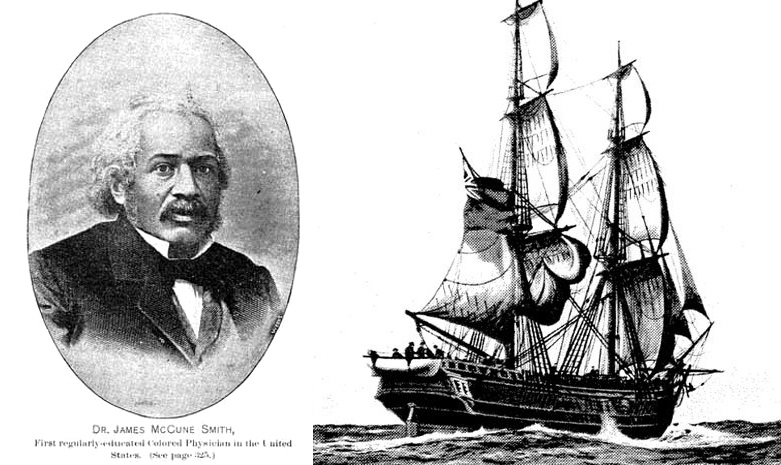
L, James McCune Smith, via Wikimedia Commons; R, The Caledonia, via Upper Canada History blog, both public domain

…'[A]n American ship is an epitome of the great and rising country, whose Star Spangled Banner proudly floats o’er her deck. “E Pluribus Unum” “From many nations” were the men gathered who felled the trees and chipped the timbers and moulded them into “one” harmonious and beautiful craft that

“Walks the waters like a thing of life”-

“From many nations” are the men gathered under the command of him who “moves the monarch of her peopled deck.” Would that the parallel might here end! And that gathering something of the spirit of liberty from the ocean which she cleaves, and the chainless wind which wafts her along, she might appear in foreign ports a fit representative of a land of the free, instead of a beautiful but baneful object, like the fated box of Pandora, scattering abroad among the nations the malignant prejudice which is a canker and curse to the soil, whence she sprung.’

~ James McCune Smith, travel journal entry August 1832*,
published in The Works of James McCune Smith, 2006

*Smith was nineteen years old when he wrote this, a former slave who, early in life, took his destiny into his own hands through his intellectual accomplishments. He wrote this as he sailed to Scotland to study at the University of Glasgow where he would receive his Bachelors, Masters, and Doctor of Medicine degrees. He would go on to become a renowned physician, scientist, writer, and abolitionist.

~ Ordinary Philosophy is a labor of love and ad-free, supported by patrons and readers like you. Any support you can offer will be deeply appreciated!

Happy Birthday, Walt Whitman!

Walt Whitman, age 35, from Leaves of Grass, Fulton St., Brooklyn, N.Y., engraving by Samuel Hollyer from daguerreotype by Gabriel Harrison, public domain via Wikimedia CommonsWalt Whitman, an American, one of the roughs, a kosmos, Disorderly fleshy and sensual . . . . eating drinking and breeding, No sentimentalist . . . . no stander above men and women or apart from them . . . . no more modest than immodest.’ Thus Walt Whitman (May 31, 1819 – March 26, 1892) introduces himself to us for the first time in his first self-published 1855 edition of Leaves of Grass. Not on the cover or on the title page, mind you, but deep within the body of the untitled poem later called Song of Myself. If this is a dialing-back attempt to inject a little respectable humility or yet another self-aggrandizing affectation on the part of this unapologetic egoist, it’s hard to say definitely, though I strongly suspect it’s the latter. It certainly is so-very-American.

Whitman was confident, earthy, crude, and vibrant, a self-styled natural man whose personas were nonetheless carefully crafted. He did his own thing and ‘lived the free life of a rover’ (an Eric Bogle phrase from his great anti-war ballad And the Band Played Waltzing Matilda), working odd jobs as a printer, journalist, teacher, and clerk, among other things. Moved by horror and compassion at the magnitude of death and suffering he observed, he worked some years as a nurse to the Civil War wounded, and spent much of his somewhat meager earnings on supplies for their comfort and care. He remained single but had many lovers, probably mostly homosexual, though he praises the physical beauty and power of women as lavishly in his poems as he does that of men. All the while, starting at just over age 30, Whitman began to write his highly idiosyncratic, free verse poetry celebrating the authentic and the crafted self, the human body, democracy, equality, work, nature, and companionship. He spent the rest of his somewhat long life revising and republishing several editions of Leaves of Grass, up to several months before his death at age 72 in 1892.

To read more work by, about, and inspired by the great Walt Whitman, here are some links and articles:

Leaves of Grass (1855) – by Walt Whitman, published in the Electronic Text Center, University of Virginia Library

Poems – by Walt Whitman at Poets.org

Walt Whitman – by Gay Wilson Allen Alexander Norman Jeffares for Encyclopædia Britannica

Walt Whitman, 1819–1892 – The Poetry Foundation 

The Walt Whitman Archive – by Ed Folsom and Kenneth M. Price, Ed., published by the Center for Digital Research in the Humanities at the University of Nebraska–Lincoln

and just because I love it:

The Body Electric, song and music video by Hooray for the Riff Raff. The song title is inspired by one of Whitman’s most enduring and controversial poems and is a critique of the traditional murder ballad

*A version of this piece was previously published at Ordinary Philosophy

~ Ordinary Philosophy is a labor of love and ad-free, supported by patrons and readers like you. Any support you can offer will be deeply appreciated!

Say What? George Combe on Human Nature

George Combe, 1836, by Sir Daniel Macnee, public domain via Wikimedia Commons

‘Man obviously stands pre-eminent among sublunary objects, and is distinguished by remarkable endowments above all other terrestrial beings. Nevertheless no creature presents such anomalous appearances as man. Viewed in one aspect he almost resembles a demon; in another he still bears the impress of the image of God.’

~ George Combe, The Constitution of Man Considered in Relation to External Objects, 1835

~ Ordinary Philosophy is a labor of love and ad-free, supported by patrons and readers like you. Any support you can offer will be deeply appreciated!

Happy Birthday, Omar Khayyám!

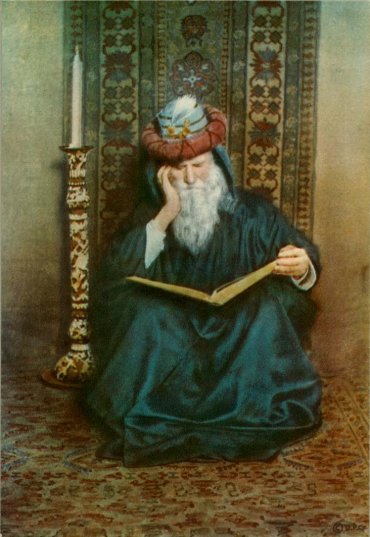
By Adelaide Hanscom, from Edward Fitzgerald's The Rubaiyat of Omar Khayyam, 1905, public domain via Wikimedia Commons

Since Edward FitzGerald published his translation of The Rubáiyát of Omar Khayyám in 1859, Omar Khayyám (May 18, 1048 – December 4, 1131) has been known, especially in the western world, first and foremost as a great poet, eloquently expressing the joy and beauty of life and our own struggles to live it with a sense of love and meaning. It’s a humanist work, with Khayyám writing much as an Epicurean or Skeptic here and a Stoic there, freely doubting and wondering at everything, unshackled from the orthodoxy one might expect from a famed teacher and writer of his time and place. Yet Khayyám, a devotee of Avicenna, took his Islamic faith very seriously, and thought deeply about the nature of God and our relationship to him.

Khayyám, born in Persia in 1048, was most famed in his own time as a mathematician, astronomer, and scientist. He wrote some of the most important medieval works in geometry and algebra, and helped reform the calendar, an even more accurate one than the Gregorian calendar we use today. But he was also an accomplished philosopher, and scholars are working on resolving the apparent contradictions between this work and his poetry.

One thing I’ve gotten from my research (which, thus far, is only beginning and therefore not nearly enough): for all his prodigious learning and accomplishments, Khayyám honestly acknowledges the limits of human understanding, and seems to tell us that while the great work of discerning the truths of the universe is a great, noble, even necessary endeavor, we do well to keep in mind that we can never know everything, whether through science or religion. So, Khayyám seems tells us, we do well to work, to wonder, to seek, to do right, but also to live for today:

At first they brought me perplexed in this way
Amazement still enhances day by day
We all alike are tasked to go but Oh!
Why are we brought and sent? This none can say’. (Rubā‘iyyāt, Tirtha 1941, 18, from IEP)

‘As Spring and Fall make their appointed turn,
The leaves of life one aft another turn;
Drink wine and brood not—as the Sage has said:
“Life’s cares are poison, wine the cure in turn.” (Sa‘idī 1994, 58, from IEP)

Learn more about this great poet and thinker at:

Umar Khayyam –  by Mehdi Aminrazavi and Glen Van Brummelen for The Stanford Encyclopedia of Philosophy

Omar Khayaam, 1048–1131 – The Poetry Foundation

Omar Khayyam – Encyclopædia Britannica.

Avicenna (Ibn Sina) – by Sajjad H. Rizvi for The Internet Encyclopedia of Philosophy

Umar al-Khayyam (Omar Khayyam) – for Muslim Heritage

*A version of this piece was previously published at Ordinary Philosophy

~ Ordinary Philosophy is a labor of love and ad-free, supported by patrons and readers like you. Any support you can offer will be deeply appreciated!

Happy Birthday, Bertrand Russell!

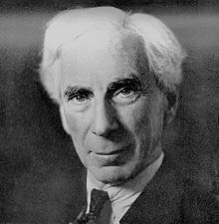
Betrand Russell in 1938, image public domain via Wikimedia CommonsBertrand Russell lived an extraordinarily long life, in which he did an extraordinary number of extraordinary things.

Encyclopedia Britannica introduces him thusly: ‘Bertrand Russell ….born May 18, 1872, Trelleck, Monmouthshire, Wales- died Feb. 2, 1970, Penrhyndeudraeth, Merioneth, [was a] British philosopher, logician, and social reformer, founding figure in the analytic movement in Anglo-American philosophy, and recipient of the Nobel Prize for Literature in 1950. Russell’s contributions to logic, epistemology, and the philosophy of mathematics established him as one of the foremost philosophers of the 20th century. To the general public, however, he was best known as a campaigner for peace and as a popular writer on social, political, and moral subjects. During a long, productive, and often turbulent life, he published more than 70 books and about 2,000 articles, married four times, became involved in innumerable public controversies, and was honoured and reviled in almost equal measure throughout the world…’

For myself, he was particularly influential to my younger freethinking self, disenchanted with the religion of my youth and seeking new and more satisfying ways of viewing the world. I read his History of Western Philosophy and Why I Am Not a Christian each several times over. I admire his clear, precise thinking and his principled anti-war stance which came at a significant cost, including jail time and loss of a prestigious job at the University of Chicago, and it’s always so enjoyable to watch him speak (you’ll find plenty of videos on YouTube) in his oh-so-aristocratic accent with a pipe often tucked into the corner of his mouth. He was not a perfect man, but he was never a less-than-fascinating one.

Learn more about the brilliant and idiosyncratic Bertrand Russell at:

Bertrand Russell – by Ray Monk for Encyclopedia Britannica

Bertrand Russell – by Andrew David Irvine for The Stanford Encyclopedia of Philosophy

Various pieces on Bertrand Russell – by Maria Popova for Brain Pickings

*A version of this piece was previously published at Ordinary Philosophy

~ Ordinary Philosophy is a labor of love and ad-free, supported by patrons and readers like you. Any support you can offer will be deeply appreciated!

Citizenship, Belonging, and the Experiences of Amero-Africans in West Africa: An Analysis of William Innes’ Early History of Liberia

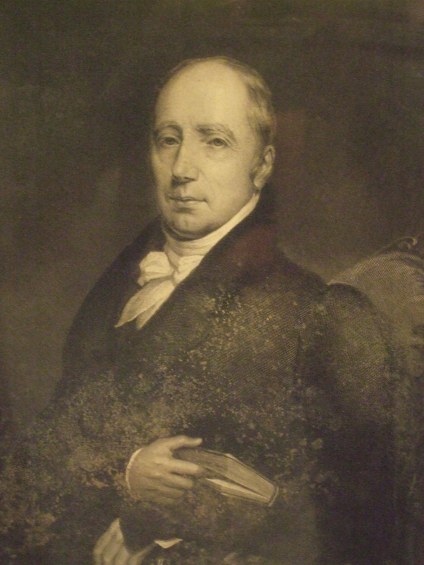
Rev. Dr. William Innes of Edinburgh

In 1831 and again in 1833, Waugh and Innes of Edinburgh published a history of Liberia by ‘Minister of the Gospel’ William Innes.[1]

In his Liberia: Or, The Early History & Signal Preservation of the American Colony of Free Negroes on the Coast of Africa, Innes describes the founding, structure, and struggles of this West African colony, founded in the early 1820’s as a haven for free and previously enslaved people of African descent and for ‘recaptives’[2] rescued from the newly illegal transatlantic slave trade.[3] Innes was an alumnus of the University of Edinburgh, an ‘independent’-minded Presbyterian and then Baptist minister, one-time chaplain of Stirling Castle, missionary, bookseller, and author of over two dozen books and other publications, mostly on religious topics. The titles of his publications, such as Reasons for Separating from the Church of Scotland (Dundee, 1804), Christianity, the Only Effectual Support Under the Afflictions of Life (Edinburgh, 1810), Domestic Religion, or an Exposition of the Precepts of Christianity Regarding the Duties of Domestic Life (Edinburgh, 1822), and Instructions for Young Enquirers (Edinburgh, translated into Gaelic 1827) indicate why this otherwise mostly theological writer decided to write a history of a colony.[4] As we shall see, this reform-minded man viewed Liberia as a worthy project within the larger goal of uplifting lives as well as souls.

Although Innes’ account includes some discussion of the hardships faced by the colonists trying to build a community in and wrest a living from this unfamiliar and somewhat hostile territory, he presents a generally positive view of the experience and prospects of the Liberian colonization project. Indeed, Innes seems anxious to convince his readers that the colony could not only exist and thrive, but that it should. As we shall see, Liberia is, to Innes, a project of community-building in line with ordered nature and with American beliefs in democracy, self-sufficiency, and the sense of social harmony necessary for a united and healthy political community. In interrogating this text, then, we are led to ask: how are ideas about citizenship and belonging implied and described in Innes’ history of Liberia, how do they relate to the lived experiences of Amero-Africans in the United States and Liberia, and how are these ideas challenged?

Innes commences his history with a discussion of the historical conditions in which this colonization movement arose. The American Colonization Society (ACS) was founded in November of 1816 as a benevolent institution dedicated to the long-conceived but as yet unsystematic scheme of colonizing black inhabitants of the United States to Africa, the continent of their ancestral origin.[5] As Innes and many others saw it, including many abolitionists and proslavery advocates alike,[6] black people could never live peacefully side by side with white Americans. Innes writes that all black persons are ‘branded by their colour as an inferior caste.’[7] He argues that so long as they live as an ‘inferior’ class within the general community of free persons, both black and white will suffer the ill effects of living in a mixed-race society, made up as it is of people with necessarily disparate natures and irreconcilable interests.[8] So long as people of African descent live within the mainstream white American community, the majority of the former will remain ‘idle, ignorant, vicious’ as a result of their disfavor, and cites as an example of this that ‘in many cases the free negroes are a great annoyance to the community, often living by pilfering the property of their neighbors.’[9] Therefore, Innes explains, the only way that people of African descent can create communities to which they naturally belong is to form them separately from white communities, and the best place to do so is by establishing their own communities in the continent of their ancestor’s origin. In doing so, they can enjoy the rights and privileges of citizens with others who share their place in the racial hierarchy. [10] In his majority opinion for the United States Supreme Court 1856 decision in the Dred Scott v. John F. A. Sandford case, which exacerbated the divisive political issues of slavery and race that helped spark the United States’ Civil War,[11] Chief Justice Roger Taney agrees with Innes’ theory of natural racial separation. He likewise believes that human beings are manifestly and naturally separated into inferior and superior races that cannot form a united political community.[12] Ideas such as Innes’ and Taney’s permeated political debate and policy in the United States for decades to come, widely disenfranchising black Americans and relegating them to second-class citizenship throughout the nation.

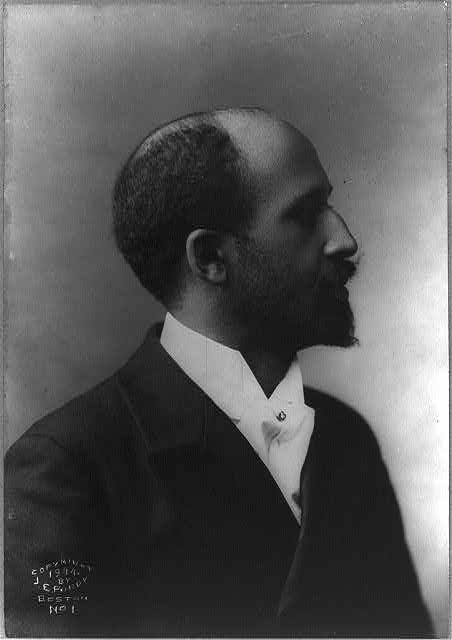
W.E.B. Dubois, Photograph taken by J.E. Purdy in 1904, public domain via Library of Congress

W.E.B. Dubois, Photograph taken by J.E. Purdy in 1904, public domain via Library of Congress

Yet the colonization scheme as described above is a manifestation of paradoxical ideas about belonging and citizenship rather than a straightforward, across the board rejection of the rights or abilities of black persons to enjoy political power, despite Taney’s assertions to the contrary. According to Innes, Taney, many in the ACS, the U.S. government, and so many Americans, people of African origin who were brought to American shores to labor, to raise crops and buildings and in every other way contribute to the economy and to the material well-being of United States citizens nevertheless do not belong within the political community nor could ever be citizens themselves. Yet advocates of colonization such as Innes believed that people of African descent were or could become citizens in Africa even if they were not born there. This was and continued to be believed by many of African descent as well. W.E.B. DuBois, African-American historian, racial theorist, and proponent of the pan-Africanist ‘vision’[13] of Africa as the natural homeland for all people of African descent, describes Africa as ‘fatherland,’ and ‘motherland.’ DuBois concedes that he has only a ‘tenuous’ connection to Africa ‘in culture and race’, like most people colonized to Africa in Innes’ time. African scholar M.B. Akpan points out that Amero-Africans (acculturated Americans of African descent who settled in Africa) who went to Liberia were vastly different from native Africans in about as many ways as they could be, in dress, language, religion, taste in food, clothing, housing, art, and so on.[14] Yet some, like DuBois, perceived themselves as bound to Africa by an essential ‘kinship.’[15] For Innes and others, this kinship is entirely racially based; for DuBois and many pan-Africanists, ‘the real essence of this kinship is its social heritage of slavery; the discrimination and the insult; and this heritage binds [us] together…’[16]

Innes and proponents of Amero-African colonization, Taney and other racial hierarchists, and pan-Africanists like Dubois share a belief that there is something about a common African descent and shared experiences, however combined with ethnic descent and acculturation from elsewhere, which creates a natural community. Such natural communities, in turn, create opportunities for citizenship that cannot be enjoyed at all, or at least not fully, in any other context. These ideas are in tension throughout Innes’ account of how West African colonies came to be and the way they persisted despite significant challenges and hardships. These challenges arose within the colonies themselves and from conflicts between colonists and the ecology, and between colonists and their native African neighbors. Innes’ account of the difficulties faced by the Liberian colonists differs significantly in many respects from later scholarship and from other contemporary accounts. In Innes’ account, these difficulties are relatively minor compared to the benefits the colonists enjoyed as citizens of a new community to which they rightly belonged.[17] The contrast between Innes’ account and other contemporary accounts backed up by later scholarship[18] imply that Innes’ driving concern to use Liberia as a positive example of how racially-based communities are formed biased his very favorable presentation of the colony.

Regarding their prospects for acceptance and inclusion within the mainstream American social and political community, Innes describes his perception of the state in which non-enslaved people of African descent find themselves:

…[T]roughout the non-slaveholding states, the negroes form a distinct race, branded by their color as an inferior caste; regarded with a species of loathing when thought of as companions, and for ever shut out from the privileges of the white men by whom they are surrounded. Be it prejudice, or founded on reason, the feeling of dislike mutually exists… .No matter what may be their industry and sobriety; no matter what their attainments in science, or their character for morality, they can never hope to pass the broad line of demarcation, or assume a station of equality with the other members of the community.[19]
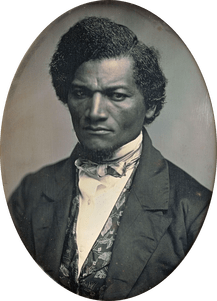
Frederick Douglass ca. 1847-52, Samuel Miller, American 1822-1882, Art Institute of Chicago, public domain via Wikimedia Commons

Racial hierarchists like Taney share the ‘species of loathing’ which Innes describes. Today, Innes’ and Taney’s descriptions of race relations are difficult to read, especially Taney’s. For one, they conflict with contemporary thoughts and sensibilities about race which are, in the main, orders of magnitude more optimistic about the likelihood that people of various races and ethnicities can meaningfully share and participate in communities as social and political equals. For another, they don’t ring true, especially in Taney’s harsh Dred Scott account of the social and political issues of race in America. After all, there were many mixed-race communities in which black Americans lived relatively safely and peacefully alongside their white neighbors even given the national tensions over issues of race. Leading black abolitionist and orator Frederick Douglass settled in one such community, New Bedford, Massachusetts, following his escape from slavery in Maryland in 1838.[20] Taney’s opinion reads very much like a partisan political document and presents a wholly dismal picture of both the capabilities and prospects of people of African descent.[21] Innes’ commentary, on the other hand, presents a more mixed though still racially hierarchical view. On the one hand, he implies in the selection above and makes clearer elsewhere that he believes people of African descent are fully capable of ‘industry and sobriety,’ of morality, of worthy and admirable attainments, of being ‘provident’ and ‘respectable,’ of conducting ‘affairs of empire,’ and so on.[22] Yet Innes does not believe they are capable of this, on the whole, so long as they live in communities among their white racial ‘superiors.’[23] Removal from white society and colonization with others of their own racial heritage, then, is the answer.

Yet all the qualities that Innes enumerates as making people belong within communities and which he characterizes as those of good citizens, he already ascribes to Americans of African descent. We can see this most clearly in the passages in Innes’ history where he describes the contrast between Amero-African colonizers and the beneficial and ‘civilizing’ influence that they exert on their native Africans neighbors. In matters of language, religion, dress, morality, ability, education, and so on, they are in turn, deems Innes, superior to their native African neighbors and the latter, recognizing this, wish to emulate them.[24] We can also recognize Innes’ conflicting views in the terms he chooses to refer to the Amero-African colonists and the native African peoples in their territorial conflicts. When describing the participants and victims of battles, Innes refers to Amero-Africans and their native African allies in such terms as ‘woman’, ‘men,’ ‘persons,’ ‘mother’, ‘the people’, and so on. By contrast, Innes refers to native Africans primarily by terms such as ‘barbarian,’ ‘savage’, ‘enemy’, and ‘wretches’, characterized by ‘moral deformity.’[25] This implies that for Innes, civilization can depend on culture, virtues, religious beliefs, and modes of comportment rather than race. The very qualities that make people belong to a community and become good citizens can and are often held by Amero-Africans whatever side of the Atlantic. As we can see in the selection above, Innes concedes this even as he explains why black people cannot belong within American white communities. He allows that black individuals can and do ‘rise above their degraded brethren’ and exhibit such good-citizenship qualities as ‘character for morality’ and ‘industry and sobriety,’ capable of ‘mak[ing] attainments in science’ and so forth.[26] Innes, then, presents two very distinct conceptions of belonging, citizenship, and race which are, if not in direct conflict, at least in tension with one another.
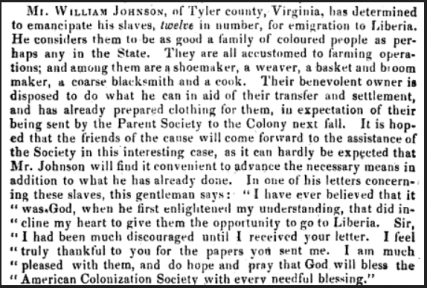
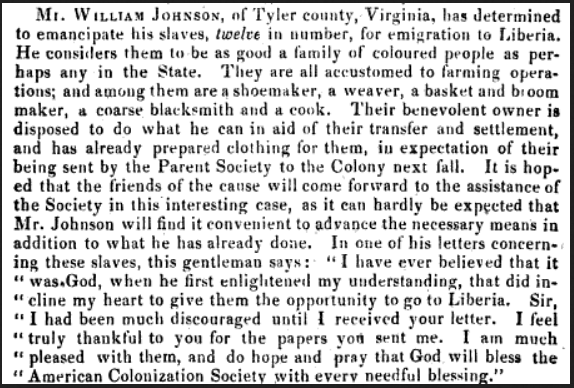
Clipping from The African Repository and Colonial Journal, V. XIII 1837, describing the efforts of William Johnson to settle his former slaves in Liberia, public domain via Wikimedia Commons

Perhaps Innes resolves these conflicting ideas about race and belonging to his own satisfaction through his appeal to divine approval. Innes, as a ‘Minister of the Gospel,’[27] looks for and finds signs of God’s will that the Liberian colony survive. He argues that God must approve of removing black people to Liberia because the preservation of Liberian colonies is unlikely otherwise given the obstacles they faced, which in turn shows divine approbation of this racial separation.[28] The idea of divine arrangement of peoples into natural types and nations which pervades Innes’ history resembles such racially hierarchical theories as Taney’s. However, Innes’ view of racial ordering displays more divine benevolence for the black race even as it is extremely patriarchal. Innes perceives a divine will that all people of African descent be redeemed through their separate political and religious institutions. This will best be brought about first by separating the races into naturally sympathetic racially divided communities, and then locating those communities in places where they can spread the gospel of Christ to others of the same race who have not yet received it through the establishment of colonies. The colonizers were then placed in a position to help bring about the divine will in the world such as providing a Christian example to their African neighbors[29] and helping to end the ‘evil’ and ‘dreadful malady’ of the slave trade.[30]

Yet Innes’ overall sunny take on the lived experience of the Liberian colonists contrasts with contemporary and later accounts of the Liberian experiment. Douglass, for example, is skeptical of the glowing accounts of the colony’s success as well as of its prospects of helping to end the slave trade; he questions the motives and therefore the accuracy of those offering glowing accounts of the colonization effort’s success.[31] Innes’ account is one which invites such skepticism. He considers the ‘signal preservation’ of the colony a sign of God’s approval but does not consider the severe hardships that he chooses to cite such as supply shortages, attacks from neighboring tribes, difficulties raising crops, the fact that they had to wrest the colony’s land concession from Dei ‘King Peter’ at gunpoint, and the high rates of disease and death as signs of God’s disapproval.[32] Innes seems to minimize the hardships in Liberia as he follows every mention of them with an immediate qualification or comparison, such as citing the early American colonies’ struggles or remarking that the Liberian colonies could have suffered worse.[33] He goes so far as to dismiss symptoms of illness as mere climatic adjustment reactions of healthy bodies, though he does admit that many died.[34] According to historian Claude Andrew Clegg, however, the colonists often suffered extremely high rates of hunger, disease, privation, and mortality.[35] Clegg also cites many examples of the colonists’ difficulties, including the telling example of Emily Hooper, a young colonist who, after an extraordinarily difficult and expensive effort on her father’s part to obtain her freedom and fund her journey to Liberia, decided to return to slavery rather than further suffer the hardships of the colony. This episode was a great embarrassment to the ACS.[36]

In addition to the evidence of hardship and mortality in many reports, accounts like Innes’ are roundly challenged by argument and even ridicule. One particularly scornful and influential critic of the colonization scheme was Douglass. Indeed, except for the fact that he actually refers to [news]paper accounts in his ‘Persecution on Account of Faith, Persecution on Account of Color’ address delivered in Rochester, New York in 1851, it would be reasonable to assume that Douglass was referring to Innes’ history when he observed: ‘Papers that never speak of colored men in this country but to abuse and slander them, speak in the most flattering terms of …Liberia.’[37] To Douglass, arguments such as those offered by Innes and American statesman Henry Clay, who recommend the removal of black people from American society due to idleness, lawlessness, and other perceived flaws invite a counter-question: ‘Suppose we should admit… that we are degraded and dissolute, as a class; are there no other degraded and dissolute people?… Who talks of their expatriation?’ to which he answers: ‘No one.’[38] Douglass also mocks the idea that colonization movement will weaken slavery as an institution. It’s the presence of free black people in slave states that help weaken slavery by demonstrating to the enslaved that there is another way they can live in America. Removing free black people to Africa, argues Douglass, removes this constant and substantial threat to slaveholders’ desire to rule unchallenged over a docile, resigned slave population.[39]
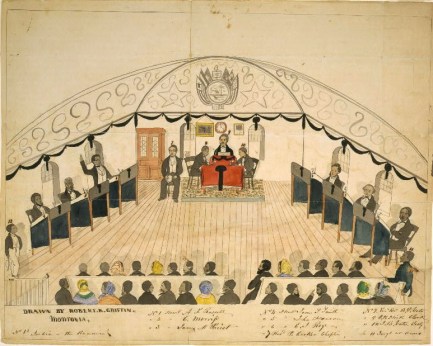
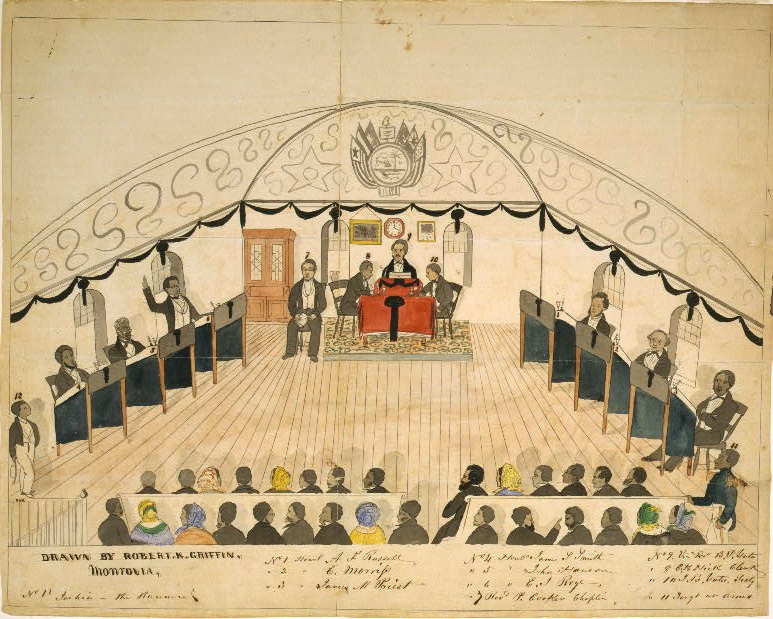
Liberian Senate drawn by Robert K. Griffin, Monrovia, 1856, public domain via the Library of Congress

Throughout his early history of Liberia, Innes wavers but does not stray far from his theme of Liberia as a natural home for Americans of African descent. His explanations for how and why Amero-Africans, acculturated to the United States in language, morals, religion, dress, and overall ways of life nevertheless belong in a land which most have never seen are not, as we have seen, entirely consistent. Why Amero-Africans can only successfully gain a sense of belonging and engage as citizens in a place where they are outsiders in every way except skin color is also not satisfactorily explained; indeed, Innis presents Liberia as if it were the only alternative to black Americans continuing to live in a state of political and social exclusion and oppression in mainstream white American society. Innes offers the ‘signal preservation’ of the Liberian colony as proof of its value to God and humankind as well as of its eventual success, but glosses over any consideration that the terrible hardships and dangers that the colonists had to face were evidence to the contrary. Others such as Douglass, however, perceive the flaws in the explanations and evidence that Innes offers, and presents both counterevidence and counterarguments that helped undermine support for the colonization project over the decades of its existence.[40]

~ Ordinary Philosophy is a labor of love and ad-free, supported by patrons and readers like you. Any support you can offer will be deeply appreciated!

Bibliography

Akpan, M. B. “Black Imperialism: Americo-Liberian Rule over the African Peoples of Liberia, 1841–1964.” Canadian Journal of African Studies/La Revue Canadienne Des études Africaines 7, no. 2 (1973): 217-36.

Clegg, Claude Andrew. The Price of Liberty: African Americans and the Making of Liberia. 2004.

Douglass, Frederick. Autobiographies. New York: Library of America, 1996.

Douglass, Frederick, and John R. McKivigan (project director). Frederick Douglass Papers: Digital Edition. Accessed 20 March 2018 at http://frederickdouglass.infoset.io/

Douglass, Frederick, and John W. Blassingame. The Frederick Douglass Papers. Series 1, Speeches, Debates and Interviews; John W. Blassingame, Editor. Vol.1, 1841-46. New Haven; London: Yale University Press, 1979.

Du Bois, W. E. B., and Herbert Aptheker. Dusk of Dawn. 1975.

Scott, Hew. Fasti Ecclesiae Scoticanae: The Succession of Ministers in the Church of Scotland from the Reformation, Vol. IV: Synods of Argyll, and of Perth and Stirling. Edinburgh: Oliver and Boyd, 1923.

Geiss, Imanuel. The Pan-African Movement. London: Methuen, 1974.

Innes, William. Liberia: Or, The Early History & Signal Preservation of the American Colony of Free Negroes on the Coast of Africa. Waugh & Innes; M. Ogle, etc., 1833. Accessed 20 March 2018 at https://babel.hathitrust.org/cgi/pt?id=hvd.32044051050987

Staudenraus, P. J. The African Colonization Movement, 1816-1865. London: Oxford University Press, 1961.

United States Supreme Court, Roger Brooke Taney, John H Van Evrie, and Samuel A Cartwright. The Dred Scott decision: opinion of Chief Justice Taney. New York: Van Evrie, Horton & Co., 1860. Retrieved from the Library of Congress, Accessed 21 March 21, 2018 at https://www.loc.gov/item/17001543/

West, Richard. Back to Africa: A History of Sierra Leone and Liberia. New York: Holt, Rinehart and Winston, 1971.

[1] Innes, William. Liberia: Or, The Early History & Signal Preservation of the American Colony of Free Negroes on the Coast of Africa. Waugh & Innes; M. Ogle, etc., 1833, frontispiece

[2] Clegg, Claude Andrew. The Price of Liberty: African Americans and the Making of Liberia. 2004 p. 37

[3] Staudenraus, P. J. The African Colonization Movement, 1816-1865. London: Oxford University Press, 1961 p. 51

[4] ‘William Innes’ in Scott, Hew. Fasti Ecclesiae Scoticanae: The Succession of Ministers in the Church of Scotland from the Reformation, Vol. IV: Synods of Argyll, and of Perth and Stirling. Edinburgh: Oliver and Boyd, 1923 pp. 325-326

[5] West, Richard. Back to Africa: A History of Sierra Leone and Liberia. New York: Holt, Rinehart and Winston, 1971 p. 93

[6] Clegg p. 3-4, Staudenraus pp. 2-7

[7] Ibid. p 102

[8] Innes pp. iv-v, 101-103

[9] Ibid. p. iv

[10] Ibid. pp. 102, 106-107

[11] Clegg pp. 174, 195-196

[12] United States Supreme Court, Roger Brooke Taney, John H. Van Evrie, and Samuel A. Cartwright. The Dred Scott decision: opinion of Chief Justice Taney. New York: Van Evrie, Horton & Co., 1860 pp. 18-19

[13] Geiss, Imanuel. The Pan-African Movement. London: Methuen, 1974 p. 5

[14] Akpan, M. B. “Black Imperialism: Americo-Liberian Rule over the African Peoples of Liberia, 1841–1964.” Canadian Journal of African Studies/La Revue Canadienne Des études Africaines 7, no. 2 (1973) p. 219

[15] Du Bois, W. E. B., and Herbert Aptheker. Dusk of Dawn. 1975 pp. 116

[16] Ibid. p. 117

[17] Innes pp. 87-89

[18] Clegg pp. 226-229

[19] Ibid. p. 102

[20] Douglass, Frederick. Autobiographies. New York: Library of America, 1996 pp. 353ff

[21] Taney pp. 17-18

[22] Innes pp. 77, 86-87, 91

[23] Ibid. pp. 101-102, 176

[24] Innes p. 83, 86-89

[25] Ibid. pp. 57-65

[26] Ibid. p 102

[27] Ibid., frontispiece

[28] Ibid. pp. vi-vii, 37-38, 62, 64, 72, 91

[29] Ibid., pp. 112-115

[30] Ibid., pp. 9-10, 108-112

[31] ‘Persecution on Account of Faith, Persecution on Account of Color: An Address Delivered in Rochester, New York, on 26 January 1851,’ North Star, 30 January 1851, in Douglass, Frederick, and John R. McKivigan (project director). Frederick Douglass Papers: Digital Edition, pp. 300-302

[32] Innes, pp. v-vi, 16-21, 38-39, 93-95, 101, 108-111; Clegg, p. 37; West pp. 114-115

[33] Innes., pp. 91-92

[34] Ibid., p. 93

[35] Clegg, see descriptions and figures in chapter 7 of The Price of Liberty, ‘To Live and Die in Liberia,’ pp. 201-248

[36] Ibid., pp. 187-188

[37] Douglass, ‘Persecution,’ p. 302

[38] ‘Henry Clay and Colonization Cant, Sophistry, and Falsehood: An Address Delivered in Rochester, New York, on 2 February 1851, North Star, 6 February 1851, in Douglass, Frederick, and John R. McKivigan (project director). Frederick Douglass Papers: Digital Edition, p. 323

[39] Ibid., p. 322

[40] Staudenraus, pp. 249-250

Happy Birthday, David Hume!

In honor of David Hume‘s birthday, May 7, 1711, let me share anew my history of ideas travel series and other pieces I’ve written in honor of my favorite philosopher if I was pressed to chose only one. I fell in love with his native Edinburgh when I originally visited in the spring of 2014 but even so, I wouldn’t have predicted I would now be living here furthering my education at his alma mater, the University of Edinburgh. It would have been even more impossible to predict that the window of my flat would be located directly across the narrow square from the University’s David Hume Tower. I was moved to observe one day, and still am whenever I think or tell of it, that the windows of that glassy tower often reflect the light of the rising sun into my window. I could imagine no more poetic image than that of how this great Enlightenment thinker has influenced my life.

Here they are in the order I wrote them, starting several years back. Perhaps you’ll find, as I do when I return to old pieces from time to time, that my thinking has developed and my mind has changed, to various degrees, on some things:

First Day in Old Edinburgh: Hume Sites and Monuments
Hume’s New Scene of Thought, and, It’s Good to Be Able to Say ‘I Don’t Know’
Hume Sites and Monuments, Part 2
The Consolations of Philosophy, and A Death Free from Fear
Scotticisms
Happy 303rd Birthday, David Hume!
The Debate Over Government and Freedom
The Tale of the Magic Toe – Superstition? Or What?
Hume Sites and Monuments, Part 3
Water of Leith
Last Day in Edinburgh, May 13th, 2014
Hume, Aristotle, and Guns
A memory quilt I created for my Edinburgh trip:
A Hill and a Wall in Edinburgh, 2015, 102″ x 69″
Enlightenment Scotland: Site of James Boswell’s Home in James Court, Edinburgh
Enlightenment Scotland: Advocates Library, Edinburgh
Chirnside and Ninewells, Scottish Borders, Childhood and Summer Home of David Hume
Enlightenment Scotland: Edinburgh’s Select Society
Photobook: Robert Adam, Architect of Edinburgh
Photobook: Letter from David Hume to James Balfour, Mar 15, 1753

*A version of this piece was previously published at Ordinary Philosophy

~ Ordinary Philosophy is a labor of love and ad-free, supported by patrons and readers like you. Any support you can offer will be deeply appreciated!