Margaret Sanger NYC Sites, Day 2, Part 2

79 and 71 W. 12th Street, New York City. 77 woy

79 and 71 W. 12th Street, New York City. There’s no longer a building with that address; the person in the blue shirt is passing by where it would have been. A NYC city atlas from the era seems to show that it was a residential building.

Wednesday, October 19th, 2016, continued

The next site I seek is right across the street from the New School on W. 12th St near 6th Ave. The address was number 77, but as you can see, there’s no building with that number here anymore. According to Robin Pokorski of the Margaret Sanger Papers Project, Sanger made her first public appearance here on January 6th, 1916 after returning from her self-imposed exile in Europe to escape obscenity charges. She eventually decided to return and face them, however: her husband had already done so on behalf of her cause the month before, and her chances in court were better now since birth control had become a much more regular topic in the press. I find no record of her talk nor a history of a public venue here. I do find a listing for 77 W 12th St in the Catalogue of the First Exhibition of the Society of Independent Artists, Volume 1, published in 1917. It’s the address of Caroline Speare, who has two pieces of art pictured in the catalogue. Looking through it for more about Speare, which I don’t find, I stumble across an early charcoal work by Georgia O’Keeffe, which is a delightful find. Perhaps talks were held at Speare’s place as well as displays of her art, but I can find no evidence of this at this time.
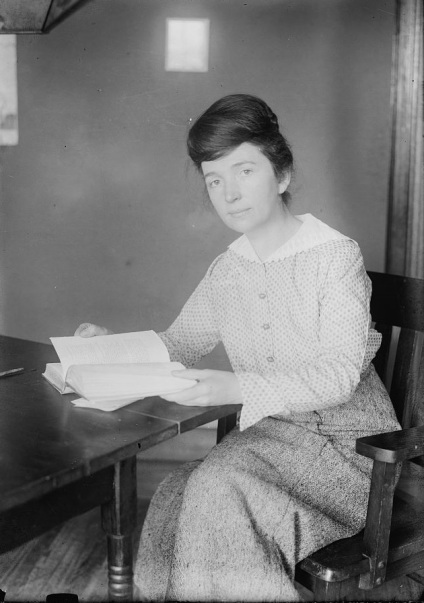
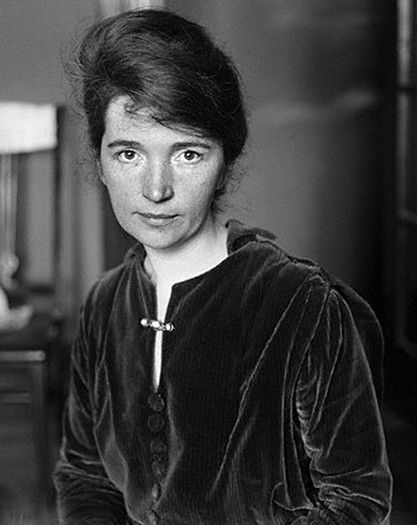
Margaret Higgins Sanger, Jan 1916 by Bain News Service, public domain via LOC

Margaret Higgins Sanger, Jan 1916 by Bain News Service, public domain via LOC

I do find a form letter which Sanger had written the previous day, on Jan. 5th, 1916, to send out to friends. In it, she writes about the indictments against her over her distribution the year before of her magazine The Woman Rebel and its so-called obscene subject matters: the sexual liberty of women and birth control.

She also shared the news in the letter, briefly, of the death of her ‘little daughter’ from pneumonia two months before. Five-year-old Peggy’s death was very hard on Sanger, and the brevity of her announcement in this letter betrays her feelings. She mourned her daughter for the rest of her life, sometimes in the shape of panicked dreams that her little girl needed her help but couldn’t be found, sometimes by looking into systems of spirituality that might put Sanger in touch with little Peggy somehow, be it Rosicrucianism or spiritualism. Sanger likely felt some degree of guilt that she left her daughter behind for so long, though Peggy was well cared for by family and friends. Her young son Grant also blamed Peggy’s illness on Sanger’s being away. This was a sore spot in their relationship for years to come, as were Sanger’s frequent and long absences from the lives of her children generally.

246 W. 14th Street, New York City, photo 2016 by Amy Cools

246 W. 14th Street, New York City, is on the right-hand side of the building with the chevron-patterned facade, where Up & Down and Stash night clubs are now. It used to be one nightclub called Nell’s, then Darby’s.

I head two blocks north on 6th Ave and turn left (west) on W 14th to number 246. Sanger lived here in December of 1916. The building I find here now, with a nightclub with a marquee and theater style doors painted a deep glossy black on its ground floor, is numbered 244, and the beer and burger shop next door is numbered 248. It appears 246 and 248 W. 14th St. used to be one address not too long ago before it split into two smaller spaces. There are apartments above the burger shop. It’s a five-story building with a store on the ground floor as a contemporary atlas indicates was there, but if it is original to Sanger’s time, it’s hard to tell given the changes to the exterior over the years.

Gotham shoot on 15th St in NYC, photo 2016 by Amy Cools

Gotham shoot on W. 15th St in NYC

Then I turn back east, then north, towards 46 W. 15th St. between 5th and 6th Aves. This stretch of 15th turns out to be the set for a scene from Gotham, as a sign taped to a lamppost says, which is presumably the TV show of that name. I’m allowed to pass by quickly but not stop at my destination until the scene is shot. So I watch the action while I wait. There’s a man of middle age, handsome, wearing slicked-back gray hair, a long black coat, and a serious expression, who stoops to attend to something near the rear driver’s side tire of a black car as the cameras record. Then, next take, he’s behind the wheel, parked, and he ‘flings’ a man aside who’s just leaned into the driver’s side window by shoving open the door, then leaps out and ‘punches’ another man who runs at him from the rear of the car. As I wait, the actors take breaks while they ready the car for another take. I find myself standing next to the actor who plays the protagonist of the scene. He looks on, bored, but smiles pleasantly when he catches my eye.

 42 and 50 15th St, New York City, photo 2016 by Amy Cools

Numbers 42 and 50, 15th St, Manhattan, NYC. They’re taping scenes from Gotham on this street. Number 46 would have been about where the glassy building next to the tile company is now

I return to take my photos in a pause between takes when they allow people to pass by. Again, the address I seek no longer belongs to any building. The tile company numbered 42 is next to a large, sleek, glassy building numbered 50. The Birth Control Clinical Research Bureau opened its third, expanded location here at 46 W. 15th Street in early 1929. (Pokorski gives the year of the move as 1930, but this photo and other evidence I find place it in the year before.) I find an image of the BCCRB, but it’s owned by Getty Images. The licensing fee is expensive so I won’t use it to illustrate this account, but you can see it online. In the background of that photo, you can see a W. 15th St address printed on an awning, so we know what’s happening in the foreground was at this location: the police raid of the BCCRB on April 15th, 1929.
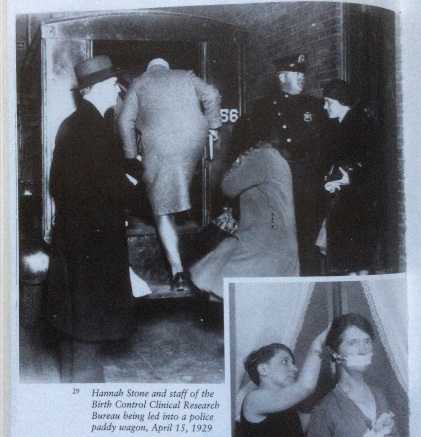
Birth Control Clinical Research Bureau raid 4-15-1929, photo of photo in Chesler's Sanger biography, 2016 Amy Cools

Birth Control Clinical Research Bureau raid at 46 W. 15th St, April 15th 1929, photo of photo in Chesler’s biography of Sanger

An undercover policewoman, Ann McNamara, posing as a patient, gave her medical history, received a pelvic exam, and was fitted with a diaphragm at the BCCRB. She reported the details of her visit to Mary Sullivan, administrator of the New York Police Department Women’s Bureau who led the raid, on the assumption that the clinic’s practices which McNamara observed were illegal. The police officers rounded up the clinic’s medical director Dr. Hannah Stone, assistant medical director Dr. Elizabeth Pissort, and nurses Antoinette Field, Marcella Sideri, and Sigrid H. Brestwell. The raid ended up garnering a lot of support for the BCCRB and for the birth control cause in general. As it turned out, the clinic was operating in accordance with state laws since it was run by physicians, and the police had overstepped their legal bounds by improperly seizing and reading confidential medical records. Physicians all over the United States and beyond were outraged at this violation of doctor-patient confidentiality and public support flooded in. The case was dropped, the five women were vindicated, and detective Sullivan was demoted.

It looks like they’re about to film another action scene here: the car is rigged with cameras and a machine nearby is dramatically pumping out steam. I have too many places to go today to stay and see what happens. But if you’re watching Gotham one day and see a woman in the background wandering with a red-covered tablet and a brightly printed Thai cotton shirt, that’s me. I wasn’t exactly good about staying put the whole time.

104 Fifth Ave, the first location of the American Birth Control League and the BCCRB, photo 2016 Amy Cools

104 Fifth Ave, the first location of the American Birth Control League, first opened here in 1921, and the Birth Control Clinical Research Bureau, which opened across the fall from the ABCL on Jan 1st, 1923.
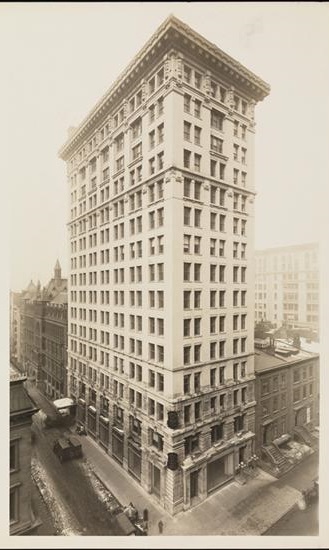
Stuyvesant Building, 100 Fifth Ave, at East 15th Street ca. 1910, photo courtesy of the Museum of the City of New York

Stuyvesant Building, 100 Fifth Ave, at East 15th Street ca. 1910, photo courtesy of the Museum of the City of New York

I walk just around the corner and a little ways north on Fifth Ave to number 104 between 16th and 15th Streets. 104 Fifth Ave was added to the already existing Stuyvesant Building at 100 Fifth Ave, built in 1906, in a style to match.

This was the first home of the Birth Control Clinical Research Bureau, founded here on January 1st, 1923 across the hall from the first offices of the American Birth Control League. The ABCL, as you may remember, was conceived of in Juliet Rublee’s home in 1921, then instituted here later that same year. The American Birth Control League would join forces, or in a sense, reunite, with the Birth Control Clinical Research Bureau and become Planned Parenthood in 1942. More on Planned Parenthood to follow in an upcoming account.

And just around the corner from 104 park Ave, north and then left at W. 16th St, at number 17 between 5th and 6th Aves, is the Margaret Sanger Clinic House. The actor’s trailers and equipment trucks from the Gotham shoot I just passed through a block over on W 15th are parked along this street, and one is so placed that it blocks a clear shot of the front of the building. So I take some closeup photos and one at a sharp angle which shows its location next to the Center for Jewish History. This seems fitting, since Sanger’s early work as a nurse in the Lower East Side and her birth control clinics served so many Jewish immigrant women struggling to make a new start in the United States.
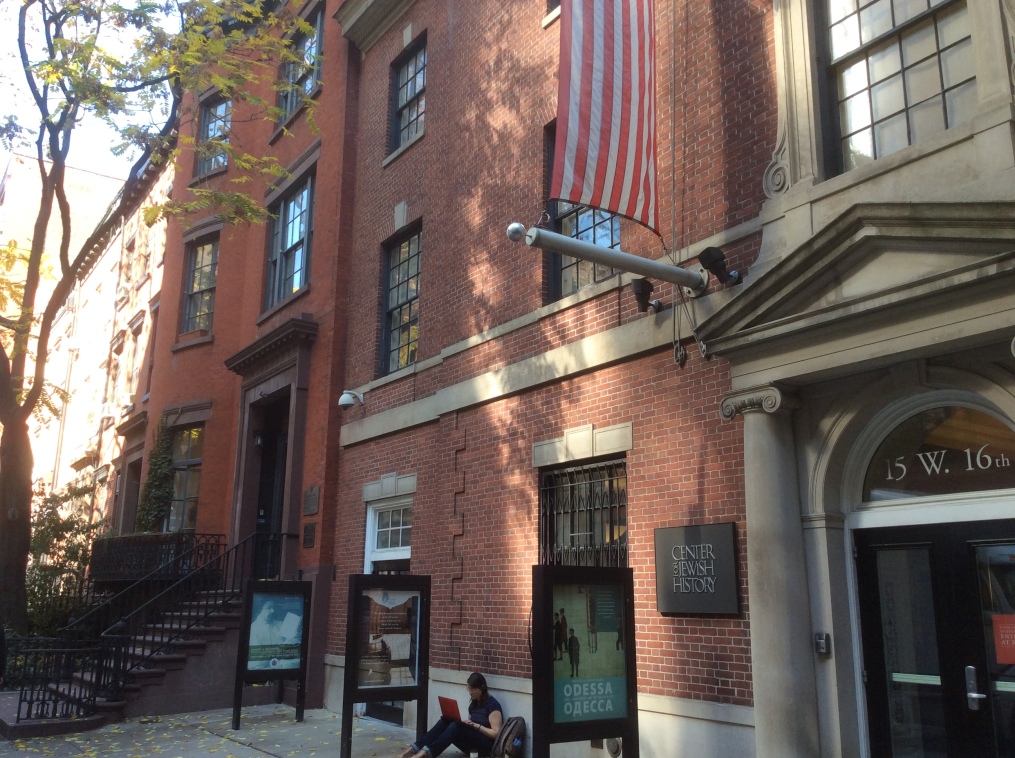
Margaret Sanger Clinic House at 17 W. 16th St next to the Center for Jewish Studies, 2016 Amy Cools

Margaret Sanger Clinic House at 17 W. 16th St, next to the Center for Jewish History
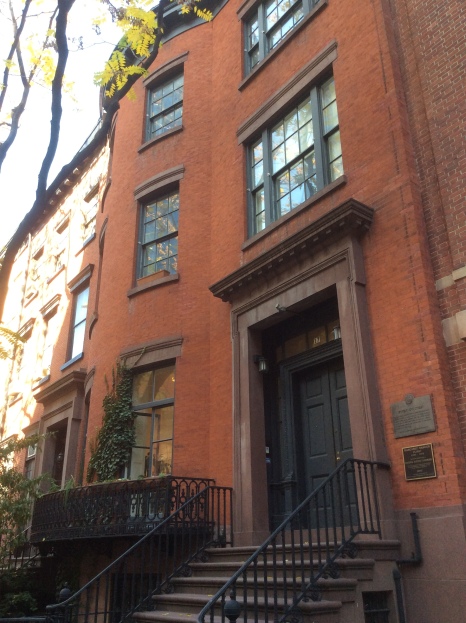
Margaret Sanger Clinic House at 17 W 16th St, New York City, photo 2016 Amy Cools

Margaret Sanger Clinic House at 17 W 16th St, Manhattan, New York City

The Margaret Sanger Clinic House at 17 W. 16th St, originally the second home of the Birth Control Clinical Research Bureau, was the first legal birth control clinic to open in the United States. That’s because, as discussed above, Sanger took care to run this one within the parameters of the law by placing it under the direction of physicians. Sanger was ambivalent about legally limiting all birth control services to physician-run clinics. For one thing, physicians were not yet in general agreement about the medical and moral effectiveness and desirability of birth control, for many reasons. Many physicians opposed it on religious grounds, others on positive eugenics grounds. And many more simply recognized that there was far too little known as yet about the processes of reproduction and how to control it.

Sanger knew the latter all too well, so often frustrated by her inability to help women control their fertility as much as she would like too. Most birth control methods had a fairly high failure rate even when used correctly, but using them correctly was time-consuming and awkward, especially, of course, in times of passion, so the failure rates overall were very high. Many of the best contraceptive devices were expensive and many other women, the very ones who needed birth control the most, could not afford doctor’s visits. And because the supply of artificial contraception was driven into the black market, all manner of dubious, ridiculous, and even outright dangerous methods proliferated. Sanger and the BCCRB staff knew this all too well and kept a curio cabinet full of these junk devices and potions at the clinic as examples of what not to use (which the police seized in the raid as well, in their ignorance). However dangerous, however dubious, women still continued to use them, as they were often safer than the other alternatives: self-inflicted or illegal abortions, or carrying a pregnancy to term. Maternal and infant mortality rates were very high at the time, especially among the poor.

Birth Control Clinical Research Bureau in New York, photo via the Margaret Sanger Papers, no known restrictions on use

Birth Control Clinical Research Bureau in New York, photo via the Margaret Sanger Papers

But Sanger’s more pressing doubts about restricting birth control services to physicians sprung from her feminist concerns over women’s right to control their own bodies and destinies. Many physicians believed that women should have as many babies as their bodies conceived, whether or not their patients believed this too. This subordinated women’s decisions about sex, reproduction, and family planning to those of their doctors, whose opinions on the matter often had nothing to do with medical concerns. And even more concerning since the ramifications were wider, much of the ignorance about reproduction stemmed from the indifference or squeamishness of the male-dominated medical and research science professions. Most were simply unwilling to risk their reputations and professional careers in the search for knowledge about human reproduction, still considered a distasteful, messy side of humanity best kept under a discreet veil of sentimentality and ignorance.
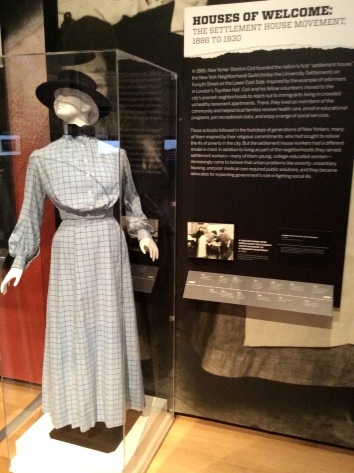
Nurse's uniform, ca. 1905, of Lilian Wald visiting service to the Lower East Side tenements of NYC

Nurse’s uniform, ca. 1905, of Lilian Wald visiting service to the Lower East Side tenements of NYC. Sanger likely wore a uniform very like this.

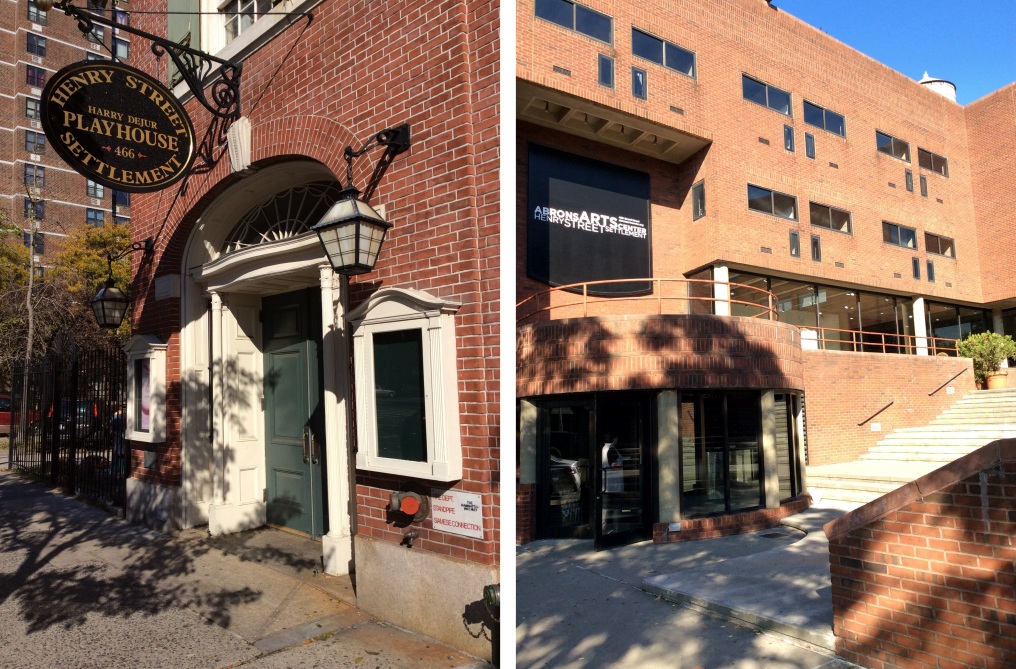
I take the subway north and return to the New York City Public Library. First, I consult Ellen Chesler’s excellent Sanger biography for more details of discoveries I’ve made and to refresh my memory on some other things. As I read page 62 of Woman of Valor, I’m reminded that Sanger worked for awhile as a nurse with Lilian Wald’s Visiting Nurses Association. I first learned about Lilian Wald’s nursing service at the Henry Street Settlement House site when I visited the Lower East Side for my Ernestine Rose and Elizabeth Cady Stanton series in 2014. It was right around the corner from the former site of Rose’s 1836 home at 484 Grand Street and the nearby Bialystoker Synagogue.henry-street-settlement-and-lilian-wald-display-activist-new-york-exhibit-2014-amy-cools
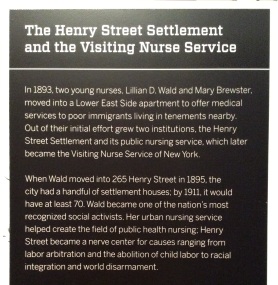
 

Henry Street Settlement and Playhouse, Lilian Wald Site, New York City, 2014 Amy Cools

Henry Street Settlement and Playhouse, Lilian Wald Site, New York City

Selfie in the beautiful Rose Room of the New York Public Library, 2016 Amy Cools

Selfie in the beautiful Rose Room of the New York Public Library

Coincidentally, I’m reminded of Ernestine Rose here in the beautiful Rose Room of the New York Public Library. I love this library. I read and make notes, my feet grateful for the rest, then I head down to the Lionel Pincus and Princess Firyal Map Division, Room 117, where I confirm the location of some sites that are no longer there. Some of the maps are original paper ones, and you’ll find photos of these throughout this series. Others are scanned into the online system, and the librarian helps familiarize me with the website’s digital collection.
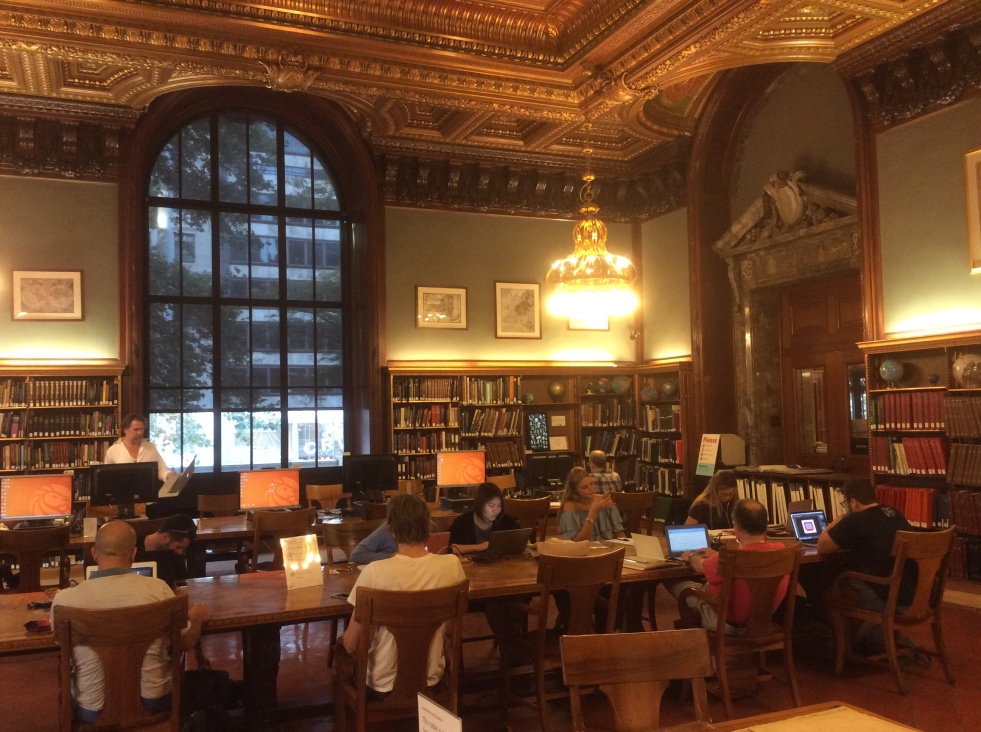
Pincus and Princess Firyal Map Division, Room 117 of the New York Public Library, 2016 Amy Cools
Another gorgeous room in the NYPL: Pincus and Princess Firyal Map Division, Room 117

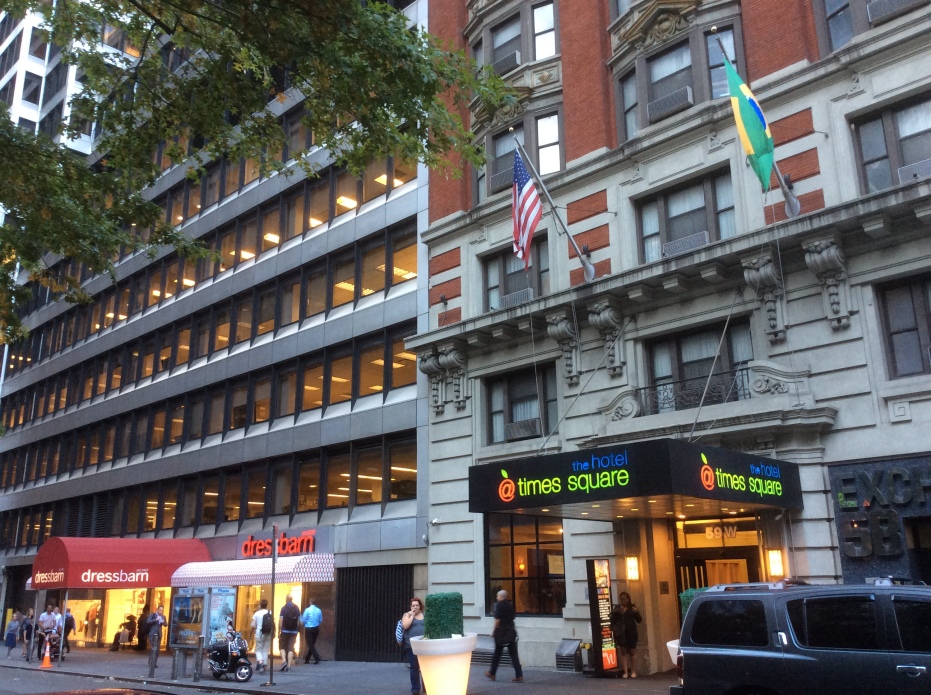
69 West 46th Street, NYC, photo 2016 by Amy Cools

69 West 46th Street, NYC. The Gamut Club would have been about where the Dress Barn is now
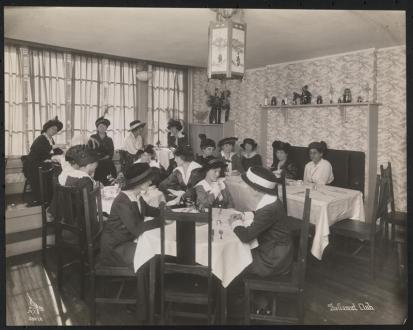
Women seated at tables in the dining room at the Gamut Club at 69 West 46th Street ca. 1914, courtesy of the Museum of the City of New York

Women seated at tables in the dining room at the Gamut Club at 69 West 46th Street ca. 1914, courtesy of the Museum of the City of New York

I walk north on 5th Ave then turn left at 46th, to 69 W. 46th St, just east of 6th Ave near Times Square. Again, there is no longer a building with that address here, but in the 1920’s it was the site of the Gamut Club, founded by feminist actress Mary Shaw in 1913. She thought other women’s clubs she belonged to had become little more than sessions of ‘tea table tattle, bridge, and banalities’. Her Gamut Club would devote itself instead to intelligent discussion and the support of socially conscious arts. The club hosted dinner discussions, guest speakers, and feminist-themed plays. There are two occasions which lead me to follow Sanger here. On January 21st, 1920, as recorded in the February edition of The Birth Control Review of that year, Sanger was a speaker at one of the weekly Tuesday dinner meetings. As the Review tells it, these women-only events were intimate enough to allow the attendees to discuss the issues much more fully and freely than they might have in mixed company. And on March 26, 1924, she lectured with Dr. Dorothy Bocker on the topic ‘Should All Women be Mothers?’ As of the time I write this, I find no record of the lecture, but my guess is that their answer to that questions was ‘no’.

Hotel Astor behind row of lighted billboards on Times Square, NYC, photo 2016 by Amy Cools

Hotel Astor behind row of lighted billboards on Times Square, NYC
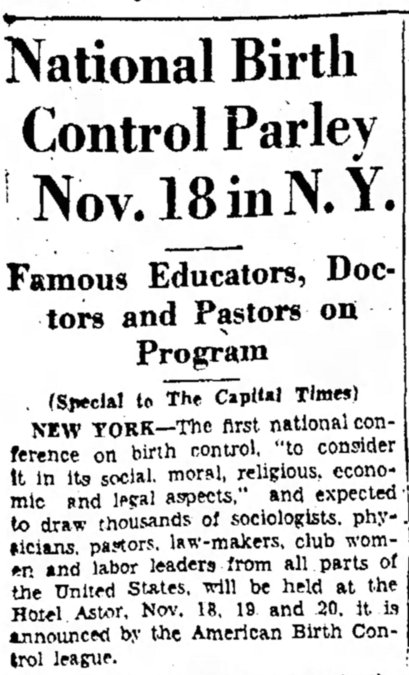
The Capital Times, Thu Oct 3, 1929, ABCL National Convention clipping, from Newspapers.com

Clipping from The Capital Times of Oct 3, 1929 announcing ABCL’s National Birth Control Convention. Click to read in full.

Then I head to Hotel Astor at One Astor Plaza at the intersection of 44th St and 7th Ave. The Astor faces onto Times Square. It’s a weekday rush hour and the throng is thick. I take a deep breath and plunge in.

According to Robin Pokorski’s Mapping Margaret Sanger, ‘The Hotel Astor was the site of the National Birth Control Conference of November 19 and 20, 1929. The conference was sponsored by the American Birth Control League.’ I find few contemporary references online to the talks and attendees of this conference other than a few remarks in some contemporary newspapers and a brief excerpt from Eugenics: A Journal of Race Betterment, Volumes 3-4, 1930, published by the American Eugenics Society. An article from The Capital Times of Madison, Wisconsin, outlines some of the topics of discussion, such as the Comstock laws and the current science of reproduction, and lists some of the headliners of the conference, which included ‘famous educators, doctors, and pastors.’

I see there’s a copy of the American Eugenics Society journal in the collections of the University of California. This now gives me two topics to research there for this series. I’ll return to fill in the details of this story as soon as I can.
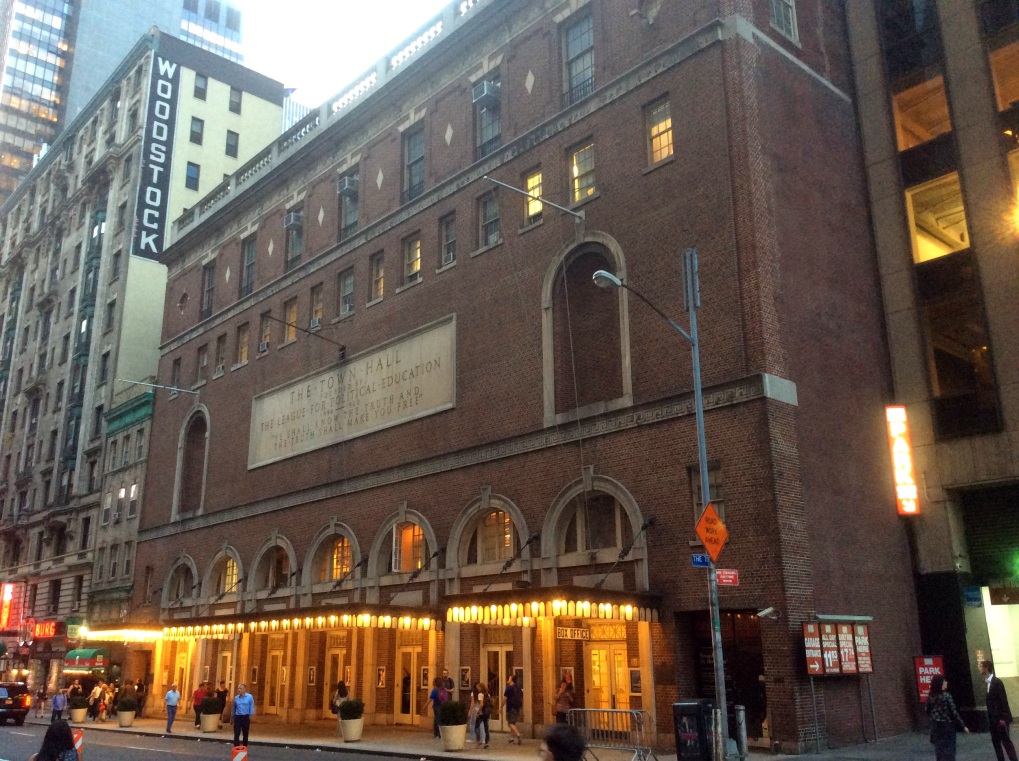
The Town Hall Building, New York City, photo 2016 by Amy Cools

The Town Hall Building, New York City

The Town Hall Building historical plaque, New York City, photo 2016 by Amy Cools

The Town Hall Building historical plaque

The last Sanger site I visit for the day is at 123 W. 43rd St between 6th and 7th Aves. It’s now early evening but I have just enough light left to photograph the Town Hall Building. It’s an attractive red brick building in a federal revival style, with modest decorations in pale stone and its name and humanitarian purposes carved into a huge pale stone placed horizontally and prominently along its façade. It was built in 1921, earlier in the same year of the event that brings me here.

On, Nov 13, 1921, a meeting was scheduled here to close the First American Birth Control Conference which saw the public launch of the American Birth Control League, which, in turn, was to become Planned Parenthood. Sanger’s friend Harold Cox was to deliver a speech called ‘The Morality of Birth Control‘, which Sanger authored. He was scheduled to speak after Mary Shaw, founder of the aforementioned Gamut Club. However, to their surprise (though perhaps not total surprise) a squadron of police officers blocked their entrance at the door.  After some wrangling, Sanger, Cox, and attendees managed to make their way inside. The police, however, would not allow Cox to speak, dragging him from the stage.

As it turns out, the police claimed to be there at the request of Archbishop Patrick Hayes. They carried Cox and Sanger off to the station followed by a crowd of protesting attendees. As a generator of publicity for her cause, Sanger couldn’t have planned it better. She had long opposed the Catholic church as backward, unscientific, and oppressive of women’s rights, and this debacle, in the eyes of many, proved her point. The American Civil Liberties Union, prominent New Yorkers, and newspapers from all over roundly criticized this trespass on free speech rights. While Hayes was ultimately never found officially responsible, we’ll likely never know for certain whether he did request police intervention. Who knows, it may have been a simple case of ‘Will no one rid me of this turbulent priest?’ except, of course, the other way around. Hayes’ friends and sympathizers may have just wanted to help him out by putting a stop to this turbulent woman, at least in his city.

But Sanger triumphed in public opinion in this case not once, but twice. On Jan 15th, 1937, Sanger was presented here at the Town Hall with the Award of Honor by the Town Hall Club in honor of her bravery and contributions to society.

Thus ends another fascinating day’s journey in the footsteps of Margaret Sanger. Stay tuned for my adventures on Day Three!

*Listen to the podcast version here or on Google Play, or subscribe on iTunes

Ordinary Philosophy and its Traveling Philosophy / History of Ideas series is a labor of love and ad-free, supported by patrons and readers like you. Please offer your support today!

~ Special thanks to the Museum of the City of New York, a wonderful institution with an extensive collection of photographs and documents which tell the story of New York City and its people

~~~~~~~~~~~~~~~~~~~~~~~~~~~

Sources and Inspiration:

100 Fifth Avenue‘, from 42Floors website

About Sanger: Biographical Sketch‘, from The Margaret Sanger Papers Project at New York University.

Achievements in Public Health, 1900-1999: Healthier Mothers and Babies‘. Morbidity and Mortality Weekly Report, Oct 01, 1999. From the Center for Disease Control website

Bromley, G.W. and Co. Atlas of the City of New York, 1921 – 1923, Plate 32 and Plate 37. Retrieved from Lionel Pincus and Princess Firyal Map Division Digital Collection, The New York Public Library.

Catalogue of the First Exhibition of the Society of Independent Artists, Volume 1, published 1917

Chesler, Ellen. Woman of Valor: Margaret Sanger and the Birth Control Movement in America. New York: Simon & Schuster, 1992

Diversity of the Desirable‘, The Evening Journal, Nov 21, 1929 page 6, Wilmington, Delaware

Eig, Jonathan. The Birth of the Pill: How Four Crusaders Reinvented Sex and Launched a Revolution. W.W. Norton & Company, New York, 2014.

Garrett, Y. ‘Jan. 2, 1923 First Legal Birth Control Clinic Opens in U.S.‘ From The Margaret Sanger Papers Project at NYU
Johnson, Ben. ‘Thomas Becket.’ Historic UK: The History and Heritage Accomodation Guide

Krich Chinoy, Helen and Linda Walsh Jenkins. Women in American Theatre, 1981, 1987, 2006. New York: Theatre Communications Group

Lepore, Jill. ‘Birthright: What’s Next for Planned Parenthood?‘, Nov 14, 2011. The New Yorker – American Chronicles

Margaret Sanger Is Dead at 82; Led Campaign for Birth Control‘. The New York Times: On This Day, Obituary Sep 7, 1966

Miller, Tom. ‘The 1847 “Margaret Sanger Clinic” House – 17 West 16th Street‘, Sep 18, 2010, Daytonian in Manhattan blog

National Birth Control Parley Nov 18 in N.Y.The Capital Times, Madison, Wisconsin, Oct 3, 1929

Nell’s‘. In Wikipedia, The Free Encyclopedia.

Pokorski, Robin. ‘Mapping Margaret Sanger‘ from The Margaret Sanger Papers Project at NYU

Raid Sanger Clinic on Birth Control‘. New York Times Apr 16, 1929

Regan, Margaret. ‘Margaret Sanger: Tucson’s Irish Rebel.Tucson Weekly, Mar 11, 2004.

Sanger, Margaret. ‘The Birth-Control Raid‘, May 1, 1929, The New Republic, from The Margaret Sanger Papers Project at NYU

Sanger, Margaret (ed.) The Birth Control Review, Volumes 1-3, 1917,  Volume 2; Volumes 4-5, 1920, and Vol 5, 1921

Sanger, Margaret. ‘Birth Control: Then and Now,’ 1944. Margaret Sanger Papers, Sophia Smith Collection

Sanger, Margaret. ‘Form Letter to Friend(s)‘, from Samples from The Margaret Sanger Papers Project for the Model Editions Partnership

Sanger, Margaret. Margaret Sanger, an Autobiography. Cooper Square Press: New York 1999, originally published by W.W. Norton & Co: New York, 1938

Sanger, Margaret. ‘The Morality of Birth Control,’ Nov 18, 1921. Published Speech. Source: The Morality of Birth Control, (New York, 1921)The Margaret Sanger Papers Project

Sanger, Margaret. The Pivot of Civilization, 1922. Free online version courtesy of Project Gutenberg, 2008, 2013

Sanger, Margaret. Woman and the New Race, 1920. Free online version courtesy of W. W. Norton & Company

The Town Hall Raid‘, Newsletter #27 (Spring 2001) of The Margaret Sanger Papers Project

Troublemakers!‘ Nov 28, 2012. From The Margaret Sanger Papers Project at NYU
Where Has All The Loving Gone? A Review Of The New Film, ‘Loving’ by Peter Cole

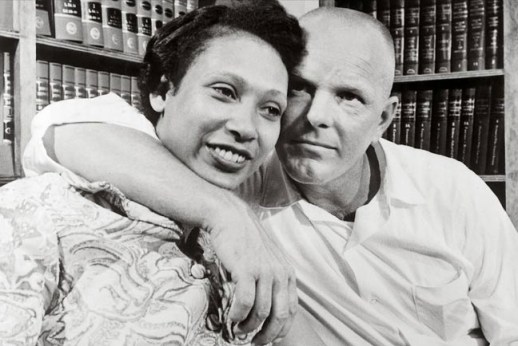
Mildred Jeter and Richard Loving, June 12, 1967, by Bettmann/Corbis via New York Times, public domain via Wikimedia Commons

Mildred Jeter and Richard Loving, June 12, 1967, by Bettmann/Corbis via New York Times, public domain via Wikimedia Commons

A new film about the Southern working class couple whose love and dedication broke the back of anti-miscegenation laws across the nation arrives just in time. Released days prior to Donald Trump’s election, viewers of Loving might be shocked to discover that anti-racist, blue-collared, white men—like Richard Loving—walked Southern soil. He was brave (or ignorant) enough to think he could get away with marrying a black woman; wise enough to know she was smarter than him. His deferral to her effort to seek legal counsel ultimately overturned laws banning interracial marriage in the landmark Supreme Court decision, Loving v. Virginia (1967)

Beneath the film, the Lovings’ story also speaks to the centuries-long effort by white supremacists to create a “white race” and defend it from “race-mixing”(also called miscegenation). In 1958, Richard Loving, 23, and Mildred Jeter, 17, married in the District of Columbia. They did so because Virginia outlawed interracial marriages, one of twenty-four states with similar laws at the time. Richard was “white,” Mildred “black” though actually a mixture of African American and Rappahannock Indian.

So began their nine-year odyssey that ended with the Court unanimously ruling that states could not prevent a man and a woman from marrying, regardless of their racial identities. Written and directed by Jeff Nichols, critics at Cannes hailed the motion picture and Oscar buzz has begun. The film deserves high praise and wide viewership, anchored by incredible performances from Ruth Negga and Joel Edgerton, the two principal actors.

Despite knowing the law—as proven by their DC marriage—the newlyweds chose to live in Central Point, their rural home in eastern Virginia’s Caroline County. A remote community made up of poor and working class people with a long, complicated history of ethnic and racial mixing, African Americans, European Americans, and Native Americans all lived in Central Point. Tellingly, despite 97% of all births, in 1960, occurring in hospitals, Richard’s mother, a midwife, delivered Mildred’s first child in 1959.

Just weeks after marrying, and prior to Mildred’s delivery, the sheriff arrested and jailed them for “unlawful cohabitation.” According to Mildred, when “they asked Richard who was that woman he was sleeping with,” she responded: “‘I’m his wife,’ and the sheriff said, ‘Not here you’re not.’”

The Lovings had violated Virginia’s Racial Integrity Act of 1924 though laws prohibiting interracial marriage and sex date back to the colonial era. The first “Richard Loving,” as it were, appeared in Virginia court records in 1630: “Hugh Davis [a white man] to be soundly whipped before an assembly of Negroes and others for abusing himself to the dishonor of God and shame of Christians by defiling his body in lying with a Negro; which fault he is to acknowledge next Sabbath day.”

By 1662, though, reality forced Virginia’s House of Burgesses to designate the status of interracial offspring:

WHEREAS some doubts have arisen whether children got by any Englishman upon a Negro woman should be slave or free, Be it therefore enacted and declared by this present grand assembly, that all children borne in this country shall; be held bond or free only according to the condition of the mother.

Virginia’s law dictated, “that which is brought forth follows the womb” or, in Latin, “partus sequitur ventrem.” In other words, a white, male slave-owner could have sex with—quite possibly raping—a black female slave, but their child was considered a slave, like the mother, rather than free, like the father. Previously, Virginia followed English common law, which dictated a father’s status determined a child’s. Virginia first outlawed miscegenation in 1691, as part of “An act for suppressing outlying Slaves.”

Over time, racial barriers further hardened in Virginia, the South, and nation. Before the twentieth century, Virginia considered a person “black” with one-forth African ancestry. In 1910, the state adopted one-sixteenth as its definition. With the Racial Integrity Act of 1924, Virginia embraced the notorious “one-drop” rule, authored in a period of heightened xenophobia and racism. For violating this law, in 1959 Judge Leon M. Bazile of the Caroline County Circuit Court sentenced Richard to prison for a year, but suspended this sentence if the couple agreed to leave Virginia and not return for twenty-five years.

In 1963, following encouragement from a relative inspired by the recent March on Washington for Jobs and Freedom, Mildred wrote Attorney General Robert Kennedy. He forwarded her letter to the American Civil Liberties Union (ACLU), which took the case. Attorneys Bernard S. Cohen and Philip J. Hirschkop, both young Jewish men committed to racial equality, quickly recognized this Loving story could, once and for all, overturn all interracial marriage bans.

In response to their appeal, Judge Bazile wrote: “Almighty God created the races white, black, yellow, malay and red, and he placed them on separate continents. And but for the interference with his arrangement, there would be no cause for such marriage. The fact that he separated the races shows that he did not intend for the races to mix.”

In this tumultuous era, the height of the civil rights movement, white Virginians led efforts to prevent integration. In 1956 Virginians Senator Harry F. Byrd and Representative Howard Smith introduced the Southern Manifesto, encouraging Southern whites to engage in “massive resistance” to integration.

In 1963, the same year Cohen and Hirschkop appealed the Lovings’ punishment, another Virginia court ruled against interracial marriage: “’to preserve the racial integrity of its citizens,’ and to prevent ‘the corruption of blood,’ ‘a mongrel breed of citizens,’ and ‘the obliteration of racial pride’.”

Four years later, Chief Justice Earl Warren profoundly disagreed: “Under our Constitution, the freedom to marry, or not marry, a person of another race resides with the individual and cannot be infringed by the State.” “Odious to a free people,” banning interracial marriage violated the 14th Amendment. Case closed.

Sadly, the Lovings only spent eight more years together after becoming the Supreme Court’s most aptly named case. A drunk driver killed Richard, just 41, in 1975. Mildred died of pneumonia, in 2008, at 68. She never remarried, living the rest of her days in the house her husband, a bricklayer, built for her after changing History.

Given the recent presidential election, it seems impossible to watch Loving and not meditate about the so-called white working class. Two-thirds of whites without a college education—a very imperfect correlation to socio-economic class—voted for Trump. Yet, for most of the twentieth century, such people, particularly Southern whites, voted Democratic. At least in part due to the civil rights revolution, Southern whites overwhelmingly realigned and, largely, took over the Republican Party. In 2016, 72% of registered Republicans still question the Americanness of America’s most famous mixed race citizen, Barack Obama.

Richard Loving rejected white supremacy when he married Mildred—in contrast to legions of white men who “simply” had sex with black women. He, his wife, and their three mixed race children became victims of racism. He became a “race traitor.” White film viewers come to see that, after marrying, Richard essentially joined the black community. They lived with her family, first in Virginia and, later, a racially segregated part of Washington, DC. Except for his mother in Central Point, Richard appeared to have no white friends; he and his best friend, a black man, owned and drag-raced cars. He kept to himself at work—(apparently) all-white construction sites.

A long history of accepting interracial couples and mixed race children exists in the black community, if only because no alternatives seem to exist. James Baldwin laid bare this ugly truth during a televised debate with a white conservative. When asked about what whites feared most, “Would you want your [white] daughter to marry one [black]?” Baldwin retorted, “You’re not worried about me marrying your daughter—you’re worried about me marrying your wife’s daughter. I’ve been marrying your daughter since the days of slavery.”

In a telling scene in the film, Richard drinks with three black friends in a black saloon. One friend pointedly asks Richard how it feels to experience what blacks had suffered from for 350 years: virulent racism. Richard, always taciturn, says nothing but proceeds to get drunk and, later, cry in Mildred’s arms.

Today, the number of interracial couples and families, like the Lovings, remains small. The 2010 U.S. Census reported nine million Americans identified as multiracial. The Pew Research Center noted in 2013, however, “a record-high 12% of newlyweds married someone of a different race.” Yet, apparently many white Americans still fear people like the Lovings and the ongoing demographic changes transforming America into a “majority-minority” nation.

Hence, we need reminding that America was not so great for many Americans, including African Americans, Latinos, American Indians, and Asian Americans along with their white allies who opposed white supremacy. We also need reminding that Mildred and Richard Loving personally overcame. Their story and this film demand a wide audience.

~ This review was originally published on Nov 27th, 2016 in the blog of the African creative-commons-attribution-noncommercial-4-0-international-licenseAmerican Intellectual History Society, and the text and links are here reproduced in full 


Peter Cole is a historian of the twentieth-century United States, South Africa and comparative history. Dr. Cole is Professor of History at Western Illinois University. He is the author of Wobblies on the Waterfront: Interracial Unionism in Progressive Era Philadelphia (University of Illinois Press, 2013) and currently at work on a book entitled Dockworker Power: Race, Technology & Unions in Durban and the San Francisco Bay Area. Follow him on Twitter @ProfPeterCole.

Ordinary Philosophy and its Traveling Philosophy / History of Ideas series is a labor of love and ad-free, supported by patrons and readers like you. Please offer your support today!

Philosophy and Early Feminist Thought

As I write my new series on a feminist activist, I thought I’d share this piece I published two years ago while writing about two other great feminist activists, also in New York City. Enjoy!

Amy M Cools's avatarOrdinary Philosophy

Ernestine Rose and Elizabeth Cady Stanton, two founders of modern feminism, are the subjects of my recent traveling philosophy series. While their advocacy for women’s rights, abolition of slavery, religious liberty, and other human rights issues was so important, wasn’t their work more about politics than anything else?

Why write about feminist activists for a philosophy blog?

It’s true, their focus was on achieving political goals: to establish laws protecting and empowering women and other classes of human beings in their property, their person, their range of opportunities, and their enfranchisement. But to accomplish this, they needed ideas: not only of their own, personal beliefs about the world and the way it should be, informed by facts and supported by reason; they needed to convince others that their ideas were not only interesting and desirable to themselves but good, true, and conducive to flourishing for all human beings.

The laws of their…

View original post 4,716 more words

Why So Much Hatred for Margaret Sanger?

Margaret Sanger, photo probably taken Jan 30th 1917, photo courtesy of the Library of Congress

Margaret Sanger, photo probably taken Jan 30th 1917, photo courtesy of the Library of Congress

There’s been a widespread and concerted effort to vilify Margaret Sanger and remove her name from the public roll of great contributors to human rights history. In my research for the Sanger project I’m working on, I find scores of examples of this effort every single time I do an internet search using her name.

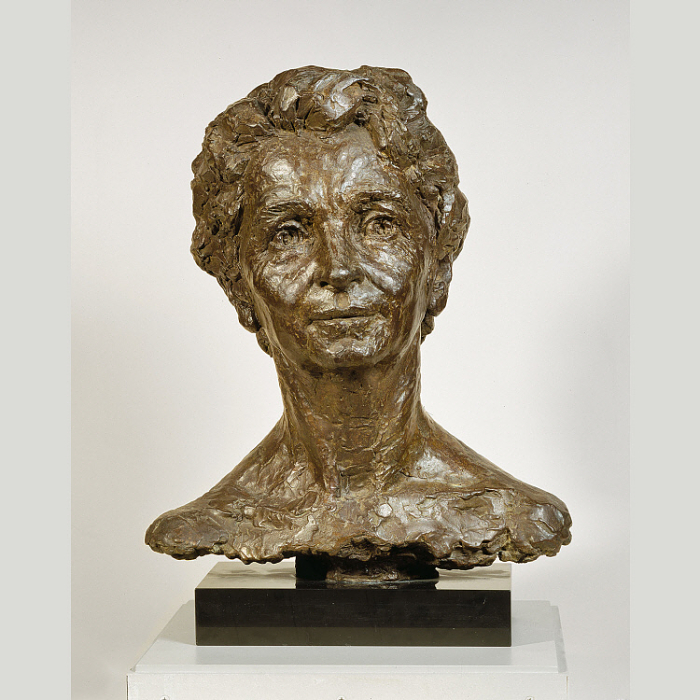
Last year, for example, Ted Cruz and some other conservative politicians called for her portrait to be removed from the Smithsonian’s National Portrait Gallery in Washington DC, where her portrait bust is included in the Struggle for Justice exhibition. In justification of his campaign, Cruz used part of a quote lifted from its original context and presented it as saying something nearly opposite of what it was originally meant to say. In a letter to a friend, Sanger expressed her worry that her birth control clinic project in the South might be misperceived and misrepresented as racist; Cruz lifted a few words from this very letter to ‘prove’ that it was. He may have borrowed this idea from Michael Steele, former chairman of the Republican Party, and Ben Carson and Herman Cain, one-time Republican presidential hopefuls. These three influential conservative men, in turn, likely received this bit of distorted wisdom, directly or indirectly, from Angela Davis and some others in the black power movement who, concerned that the reproductive justice movement might have ill effects in the long run on the empowerment of black people, (mis)represented Sanger’s words, works, and character in the worst possible light. The radical origin of the charges of racism against Sanger may surprise followers of these conservative political figures who have passed them along. And what was this purported insight into Margaret Sanger’s character? Why, that she was so racist that she wanted to exterminate the black race through preventing the conception of ensuing generations.

In my research and in early responses to my publications from my Sanger project I’ve also encountered frequent charges that she was a eugenicist, which is true, and in league with or at least sympathetic to Nazi beliefs, which is false.

So, let’s first consider Margaret Sanger’s beliefs and whether they justify her inclusion among the great American freedom leaders. Then, let’s consider her beliefs in the light of her own time and whether they deserve admiration today, on the whole, or are at least understandable given the circumstances of her time.

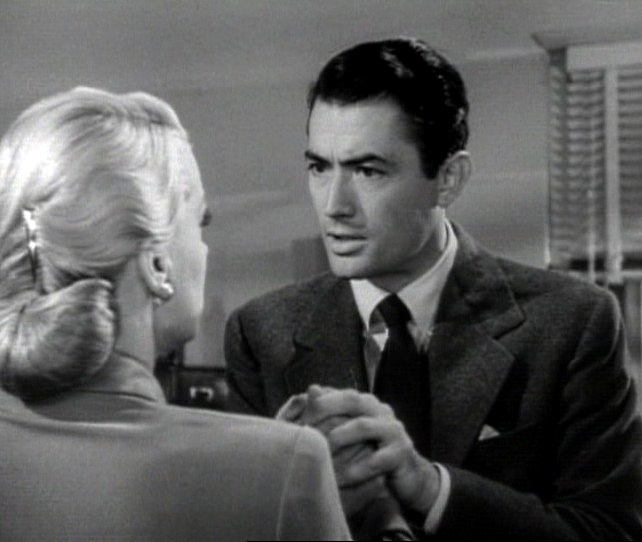
Gregory Peck and June Havoc in Gentleman's Agreement, public domain via Wikimedia Commons

Gregory Peck and June Havoc in Gentleman’s Agreement

As to Nazism, Sanger is actually an early and particularly vociferous opponent, much more so than many others in an America so rife with anti-Jewish sentiment in her time. I was surprised many years ago, in my late teens or early twenties, when I watched an old Gregory Peck movie (I’ve always been quite a fan of that talented and oh-so-handsome man) in which he played a reporter planning to write an exposé on the issue. To discover how prevalent anti-Semitism really was in America, his character Philip Schuyler Green goes undercover, putting it out there to his friends and colleagues that he was, in fact, Jewish, and had just never happened to mention it before. It doesn’t take long for his work and then his whole life to fall apart as he experiences terrible discrimination, his friends and colleagues turning against him one by one. At that time, I was surprised to learn that when Peck made this movie, anti-Semitism in America was enough of a thing that a major motion picture star would make a movie about it.

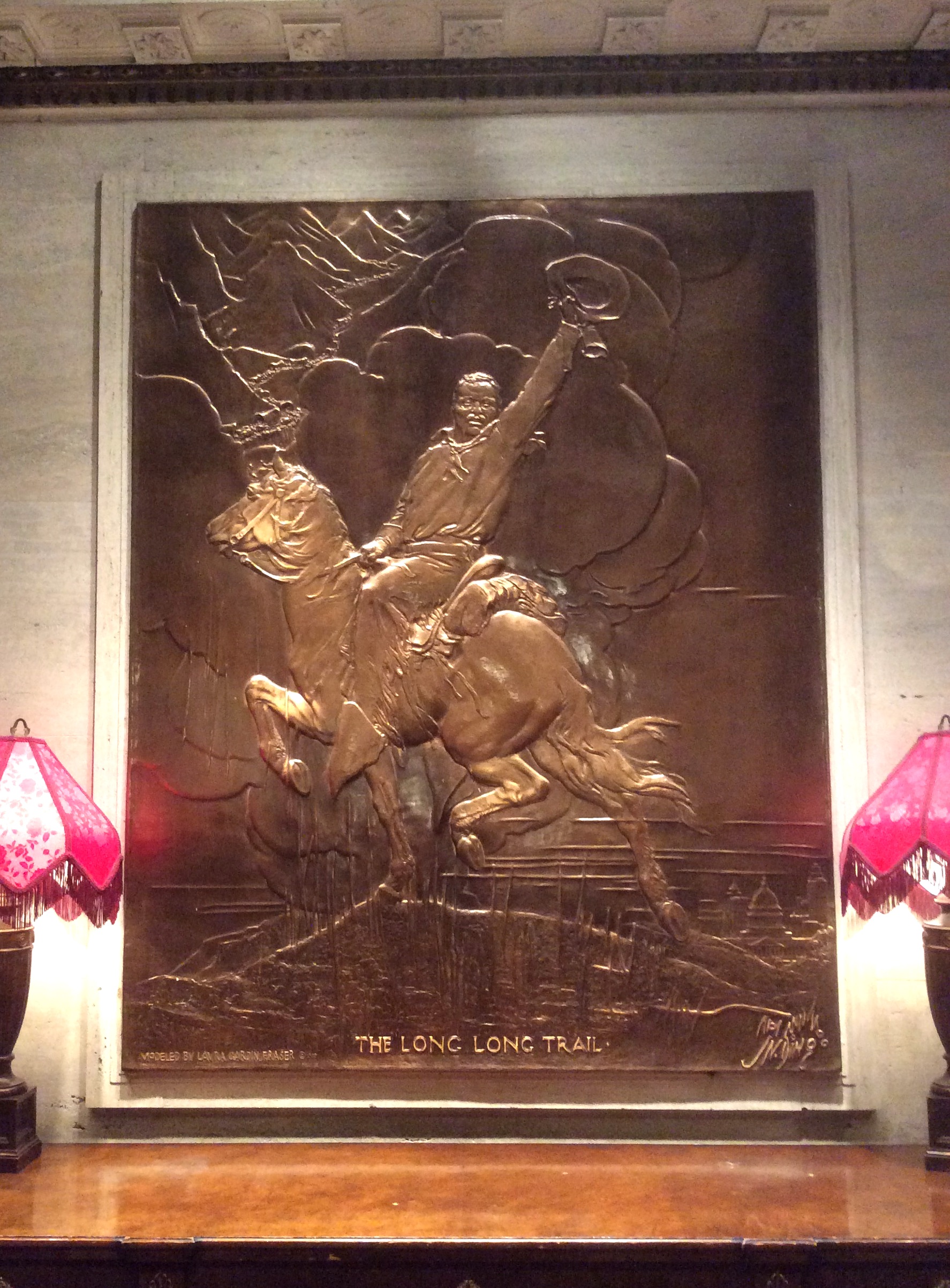
Theodore Roosevelt, American President and yes, a eugenicist too

Theodore Roosevelt, American President and yes, a eugenicist too

But Sanger is a eugenicist. This belief in the power of genetic inheritance to cure the ills of humankind by selectively breeding them out of existence was widely accepted at the time, even by such luminaries as our own President, Theodore Roosevelt. Eugenics is often divided into two types, positive and negative, and eugenicists are now often judged now by which of these they promoted. Positive eugenics is the idea that healthy, intelligent, hard-working, creative, and wealthy people should have more children so as to increase the stock of human beings who will, in turn, pass down desirable genetic traits. Roosevelt was a eugenicist of this sort. Negative eugenics is the idea that disabled, diseased, unintelligent, idle, and poor people should have fewer children so as to decrease the stock of human beings who will, in turn, pass down negative traits. The latter brand of eugenics can be further broken down into two camps, with differing ideas as to how it could be brought about: that decreased breeding of the ‘unfit’ should be entirely voluntary and encouraged through education, or, that it should be imposed by certain authorities. (Proponents of positive eugenics could also be broken down this way but I have yet to find an example of imposed human breeding of the ‘fit’, though Communist Romanian president Nicolae Ceaușescu’s policies on reproduction could conceivably be considered a sort of coercive positive eugenics).

Sanger promotes negative as well as positive eugenics principles, but as to whether she believes it should be voluntary or coerced, she’s incoherent at best. At times she’s opposed to any sort of official coercion, as in her many statements against the Nazis and in her stated principle that all human beings, women included and especially, should have the individual right and power to determine their own destinies. Yet she also often declares that since many people are incapable of rational judgment, including the ‘insane’ and the so-called ‘feeble-minded’, others need to make that decision for them. Though she criticizes the Nazis harshly for doing that very thing, she never makes it clear who should do the sterilizations, who should decide, and how coercive they should be if their ‘patients’ refuse. I believe she places herself in a moral dilemma in this matter. She so firmly believes in the power of eugenics to cure the terrible set of human ills that she encounters as a nurse that she wants it, no, needs it, to work. She’s well aware that most people would never consent to such a thing, be it for religious reasons or simply that most people, well or mentally ill, rational or not, naturally recoil at the idea that they should be sterilized because others think they should be. So how to cure these ills in the next generation, since Sanger knows there’s no way they could be cured in her own? That’s the dilemma that Sanger never successfully resolves.

Her vehement opposition to the Nazis goes back, first, to the race issue. One of her main criticisms of the Nazis is not that sterilization is a bad thing in principle, or even that the state might legitimately impose sterilization in special circumstances, such as in the case of criminally insane people (an idea we find abhorrent today but that many in Sanger’s time do not). It’s that the Nazis decide to ‘perfect’ the race along racial lines. To Sanger, this idea is both irrational and unscientific. In Woman and the New Race, she writes glowingly of the great wealth of contributions that people of all races and cultures have always brought and still bring to the world, and that much of the promise of future human greatness lies in this diversity. Since it’s clear that all races include people of great intelligence, health, and abilities, she believes that all races should be likewise bettered through eugenics, both positive and negative, and the latter only if and when necessary (though again, she’s incoherent on this point). Sanger is opposed to ‘human waste’, as she puts it, not only of human beings she considers physically and mentally ‘unfit’, but also the human waste of the lives of those children born in such numbers only to have many of them suffer terribly before dying early deaths, often taking their mothers with them; or permanently disabled by hard factory labor, malnutrition, and neglect; or shipped off as cannon fodder. She’s also opposed to the waste of human potential, of throwing away the great contributions, genetic and otherwise, of the best and brightest of all races to the human race as a whole. In this, she reminds me of Alexander Hamilton, who also argues against the waste of human potential inherent in race-based slavery.

It seems to me, in hindsight, that though many of her eugenics beliefs are founded on bad science, or rather, pseudoscience posing as science, they do not come from a malicious place. They form in the mind of a woman who cares enough about her fellow human beings to devote many years of her early adulthood nursing the poor immigrants in the slums of the Lower East Side of New York City, something few of us have the courage or the vision to do. Sanger is appalled by the suffering and privation she witnesses and desperately wants to help these people, especially the women and children who bear the brunt of society’s ills, but she recognizes that she and her fellow nurses don’t have a prayer of keeping up with the ever-growing need. And she realizes that even if they could keep up with the pace, they were only treating suffering that didn’t need to exist in the first place. She believes, over time, that she’s found the answer.

So given all of this, I ask again, why single out Margaret Sanger for such hatred? Why not call for, say, Teddy Roosevelt’s portrait to be taken down, or those of the many others who held problematic beliefs whose portraits hang, without challenge, on the National Portrait Gallery walls?

And why hate Sanger so much as to spread three major falsehoods about her, again and again and again, that have been so often and thoroughly debunked?

The first lie and second lies, as we’ve considered, are that Sanger’s a racist and a Nazi sympathizer. The other lie is that she’s pro-abortion. In fact, if we look at her writings, we find she’s more anti-abortion than anything.

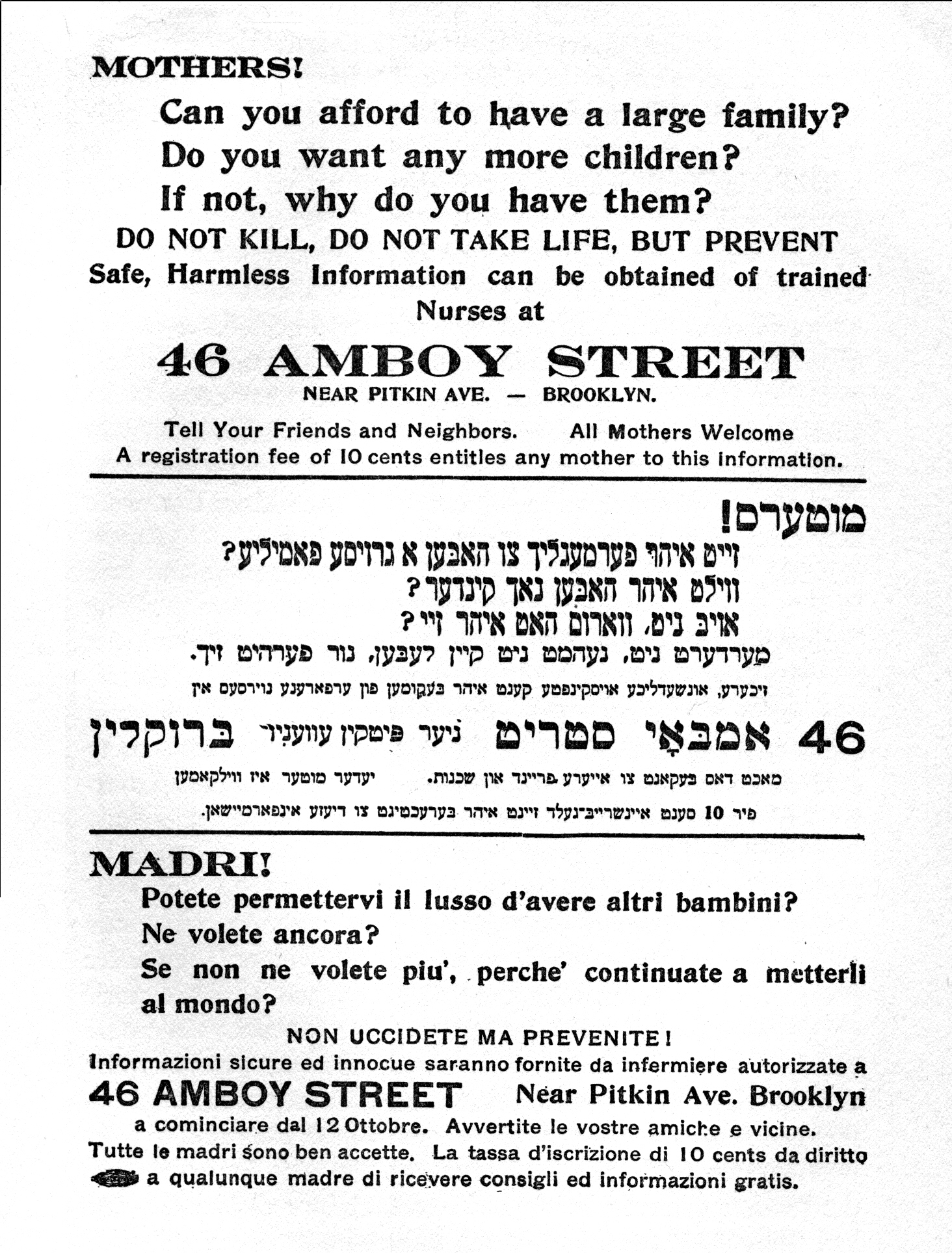
Flyer for Sanger Clinic, Brownsville, Brooklyn, image courtesy of the Margaret Sanger Papers Project

Flyer for Sanger Clinic, Brownsville, Brooklyn, image courtesy of the Margaret Sanger Papers Project

The fact that Sanger is opposed to abortion in most circumstances may surprise many people, especially many conservatives, though I believe the Sanger-as-abortionist lie is as prevalent and persistent as it is because her views on abortion are as politically inconvenient to many on the left, so they don’t trouble to contradict it. She does allow that there are some extreme circumstances in which it is permissible, such as to save the life of the mother (a standard we adhere to today), and she can’t bring herself to blame the women who resort to abortion out of desperation. It’s the Comstocks,the self-righteous anti-sex moralists, the Pope, priests, and bishops, the government, the medical establishment, and the exploitative labor system that cause abortions, not desperate women. They’re the victims. In fact, as you can see from the flyer for her groundbreaking birth control clinic, Sanger lists the prevention of abortion as one of the clinic’s primary purposes.

And yet, the hatred of Sanger rages unabated in so many quarters. There’s plenty to criticize in her eugenics beliefs, in fact, enough to make the three lies I’ve just discussed seemingly unnecessary if you feel the need to discredit her. Again, other people who have had a dramatic impact on our history, like her, are complicated and had some bad ideas, but no Cruzes, Steeles, and Cains are so vehemently, and I would say dishonestly, trying to undermine the validity of every part of their life’s work and demand that their legacy be erased from our public institutional memory. They’re not calling for the removal of the portraits of anti-Semitic Henry Ford or pro-Nazi Charles Lindbergh, for example. To be certain, there are such efforts on the left to challenge the legacies and even mostly discredit influential historical figures such as Cecil Rhodes, Woodrow Wilson, and Thomas Jefferson. But those are for things they actually did: promoting imperial colonialism, instituting scores of racist laws in our nation’s capital, and owning slaves. The debate is only whether their legacies, on the whole, are worthy of respect and admiration.

So I ask again: why single out Margaret Sanger for such a degree of hatred and slander, given her work with the immigrant poor and minorities, her strong anti-Nazism, and her anti-abortionism? Why is she not excused for her flawed eugenics ideas on the understanding that she was a woman of her time, or that the good parts of her legacy outshine and thus have outlasted the bad, as we excuse so many others of our flawed heroes? In New York City, teeming with statues, monuments, and portraits of noteworthy historical figures, I could find no monument to her, however modest, in the city she called home for so long and served so well in such difficult circumstances.

When it comes to Cruz and many others who are adamantly anti-Sanger, I strongly suspect that one of their primary objections to her is really her anti-Catholicism and irreligion. For example, Cruz is a self-proclaimed, unapologetically religious man who, like many prominent conservative politicians these days, often stresses the Christian heritage of the United States. He’s also often regarded as a proponent of dominionism, the idea that the Christian faith should guide all matters of government, because of his frequent praise of his father, who promotes that ideology. To Cruz’s credit, in his 2016 Republican convention speech he stated that religious freedom includes the freedom to be an atheist, in contrast to a declaration he made a year ago that only a religious person is fit to be president of the United States. But the targeting of Sanger by Cruz, and Carson, and Cain, based on easily-disproved, thoroughly-debunked attacks on her character, makes me wonder how committed such conservative leaders are to the idea that Americans should be free to believe in accordance with their conscience and their reason.

Margaret Sanger Portrait Bust, image credit National Portrait Gallery, Smithsonian, Washington DC

Margaret Sanger Portrait Bust, image credit National Portrait Gallery, Smithsonian, Washington DC

So why hate Margaret Sanger? Could it simply be because she was a strong woman, a fearless woman, a truly self-liberated woman who did not chase after monetary success or choose acceptable or glamorous routes to fame, an outspoken atheist who stood up to such a powerful man as the Pope… in other words, a self-realized, so-fully-human woman that she’s a mass of greatnesses, ordinarinesses, and deep flaws? For all of our self-assurances that we’ve achieved a sex-equal, religiously tolerant society which places such a high value on free speech, are too many of us still unable to accept such women?

I’m quite sure the answer is yes.

Listen to the podcast version here, on Google Play, or on iTunes

This piece is also published at Darrow, a forum for ideas and culture

Ordinary Philosophy and its Traveling Philosophy / History of Ideas series is a labor of love and ad-free, supported by patrons and readers like you. Please offer your support today!

~~~~~~~~~~~~~~~~~~~~~~~~~~

Sources and inspiration:

Birth Control or Race Control? Sanger and the Negro Project‘ The Margaret Sanger Papers Project Newsletter #28 (Fall 2001)

Cruz, Ted. ‘2016 Republican National Convention Speech‘, abcnews.go.com, Jul 21, 2016

Davidson, Amy. ‘Ted Cruz vs. Margaret Sanger’s Portrait‘. New Yorker, Oct 28, 2015

Davis, Angela. Women, Race, & Class. New York: Random House, 1981.

Fea, John. ‘Ted Cruz’s campaign is fueled by a dominionist vision for America‘. The Washington Post: Religion (Commentary), Feb 4th, 2016

Gentleman’s Agreement (1947)‘, from IMDB

Jenkinson, C.lay. ‘Self-Soothing by way of Erasing the Complexity of Human History‘. Clayjenkinson.com, Dec 28, 2015

Nicolae Ceaușescu‘. Encyclopædia Britannica

Parkinson, Justin. ‘Why is Cecil Rhodes Such a Controversial Figure?‘ BBC News Magazine, Apr 1, 2015

The Sanger-Hitler Equation‘, The Margaret Sanger Papers Project Newsletter #32 (Winter 2002/2003)

Sanger, Margaret. The Pivot of Civilization, 1922. Free online version courtesy of Project Gutenberg, 2008, 2013.

Sanger, Margaret. Woman and the New Race, 1920. Free online version courtesy of W. W. Norton & Company

Sullivan, Martin. ‘Margaret Sanger Portrait‘: talk for Face-to-Face, National Portrait Gallery of the Smithsonian

The Portraits: Margaret Sanger‘ from the National Portrait Gallery of the Smithsonian website

Wirestone, Clay. ‘Did Margaret Sanger believe African-Americans “should be eliminated”?PolitiFact, October 5th, 2015

To New York City I Go, in Search of Margaret Sanger

margaret-sangerHello, friends of Ordinary Philosophy!

From time to time, I take a trip to some corner of the globe, to explore the lives and ideas of great thinkers in the places where they lived and worked. For this series, I follow in the footsteps of thinkers who are no longer alive, since those who are still telling their own stories. But those who are no longer alive in the body live on in the ideas that they pass on, and in the examples they provide for us to follow.

I’m pleased and excited to announce my sixth philosophical-historical themed adventure, a rather impromptu trip to New York City to follow in the footsteps of Margaret Sanger.

Though the timing was spur of the moment, I’ve read and thought about Sanger quite a bit over the years and have some of the research done already for this long-planned trip. So when this little window of time opened up in my schedule, I happily seized the opportunity! As central to the history of women’s rights, free speech rights, and rights to sexual self-determination and privacy as she is, Sanger’s also the most problematic figure in the history of ideas I’ve followed so far for this series, with the possible exception of the brilliant but slave-owning Thomas Jefferson. She’s certainly the first that sparked immediate controversy when I casually mentioned my plans for following her on social media. Here’s a brief introduction, a condensed version of a short bio I published about a month ago in honor of her birthday:

Margaret Higgins Sanger was born on September 14, 1879 into a large Catholic family with 11 surviving children. Her mother died at about age 50 from tuberculosis. As young Margaret saw it, her mother was worn out from her 18 pregnancies, and would cite this as one of the many reasons she so passionately advocated for the right of women to control their own bodies and fertility.

She went on to become a nurse who worked with poor women in New York City in the 19-‘teens and twenties. As she saw these women struggle with the toll that large numbers of pregnancies took on their families’ finances and their own health, Sanger became convinced that ‘birth control’, a term she invented, was essential if these women hoped to escape poverty and sexual oppression. She opened America’s first birth control clinic and despite numerous arrests and fines, she continued her fight for reproductive rights. In this regard, she’s best known today as one of the founders of Planned Parenthood and a key figure in the development of the first birth control pill.

Sanger remains a controversial figure. An ardent feminist, human rights activist, and advocate of sex-positivity, Sanger was also a eugenicist, believing that birth control was at least as important a tool for limiting the production of ‘the unfit’ (her words) as it was for women’s liberation.  Generally, Sanger was an ardent advocate of self-determination, free speech, open discussions of sex and sexuality, and education, education, education.* It was up to informed and thoughtful people, Sanger believed, to take responsibility for their own sexual choices and to convince others to do the same. Regrettably, however, at times Sanger seemed to support some sort of coercive or compulsory forms of birth or population control, for those who she deemed incapable of making this choice for themselves, for example, or too dangerous to be allowed to conceive and raise children.

Aside from her (mostly good) ideas about human rights and personal responsibility, I find Sanger’s beliefs about human sexuality and its important role in spiritual and mental health particularly fascinating

So off to New York City I go, from October 17th thru the 21st. There, I’ll visit landmarks associated with her life, places where she lived, worked, thought, wrote, studied, and rested, to see for myself how the places informed the woman, and vice versa.

Here is the story of Margaret Sanger as I discover her:

Happy Birthday, Margaret Sanger!
Margaret Sanger NYC Sites, Day 1 Part 1, and a 100 Year Anniversary
Why So Much Hatred for Margaret Sanger?
Margaret Sanger NYC Sites, Day 1 Part 2
Margaret Sanger NYC Sites, Day 1 Part 3
Margaret Sanger NYC Sites, Day 2, Part 1
Margaret Sanger NYC Sites, Day 2, Part 2
Margaret Sanger NYC Sites, Day 3 Part 1
Margaret Sanger NYC Sites, Day 3 Part 2
Margaret Sanger NYC Sites, Day 4

Ordinary Philosophy and its Traveling Philosophy / History of Ideas series is a labor of love and ad-free, supported by patrons and readers like you. Please offer your support today!

Patrons of the Margaret Sanger series: Christopher Wallander, Magaly Gamarra Grant, Devin Cecil-Wishing, Sally Lee ~ With warmest gratitude, thank you!

*This piece was updated on 10/26/16. Originally, the 3rd and 4th sentences of the seventh paragraph read ‘She did not, however, support any kind of compulsory or coercive forms of birth or population control. Instead, Sanger was an ardent advocate of self-determination, free speech, open discussions of sex and sexuality, and education, education, education. It was up to informed and thoughtful people, Sanger believed, to take responsibility for their own sexual choices and to convince others to do the same.’ My subsequent research found that this is not quite accurate, as she surmised that coercive sterilization might be warranted in certain circumstances, for those who are mentally ill, handicapped in certain ways, or criminally violent, for example. Please read Why So Much Hatred for Margaret Sanger? and more from the series for further explorations of Sanger’s ideas on the subject.

Happy Birthday, Mahatma Gandhi!

Mahatma Gandhi spinning yarn in the late 1920's. Gandhi started the ultimate 'Shop Local' movement, in which he called on his fellow Indians to wear only homespun, locally made fabrics to counteract the British colonialist's exploitation of Indian textile worker

Mahatma Gandhi spinning yarn in the late 1920’s. Gandhi started the ultimate ‘Shop Local’ movement in which he called on his fellow Indians to wear only homespun, locally made fabrics to counteract British colonialist’s policies which impoverished and nearly destroyed India’s textile industry. I founded an apparel and accessory line and boutique in the early 2000’s based on the same principles, carrying only locally and US-made products as an alternative to buying goods made in overseas sweatshops whose workers were unprotected by labor laws. Gandhi’s and my own approach were nationalistic and protectionistic, which I no longer believe goes far enough in promoting equal human rights for all. While such approaches may be a good place to start in some circumstances, a better way to go about improving the lives and prospects of workers around the world is to require our governments to institute more comprehensive labor laws and rigorously enforce them. This must include holding companies responsible for the abuses of their contractors, of course, to actually be effective.

There are very few non-Americans, outside of our mother country of Britain and our godmother France, who have had a greater impact on the history of the United States and our attitudes towards human rights than the incomparable Mahatma Gandhi. For someone who preached simplicity, often wearing nothing but a loincloth, weaving his own fabric, and living a severely rustic lifestyle to exemplify his own teachings, Gandhi was a very complicated person.

He was a human rights activist, politician, journalist, social and religious reformer, and to many, a sort of messiah. Originally a British loyalist, Gandhi’s studies and personal observations led him to change his own views, often radically, many times over the course of his long life. His beliefs in the revolutionary and morally suasive power of civil disobedience and nonviolent resistance were and continue to be particularly influential in the United States, beginning with the mid-20th century civil rights movement. Martin Luther King, Jr, Gandhi’s intellectual and spiritual descendant, emerged as the leader of this movement following his role in the 1955 Montgomery bus boycott. King’s and Gandhi’s ideas about the civil disobedience and non-violence, in turn, both incorporate Henry David Thoreau’s ideas from his landmark essay ‘Civil Disobedience’.

Here are excerpts on Gandhi’s influence on the American civil rights movement from the encyclopedia of the Martin Luther King, Jr. Research and Education Institute at Stanford University:

‘Upon his death, Mohandas K. Gandhi was hailed by the London Times as ‘‘the most influential figure India has produced for generations’’ (‘‘Mr. Gandhi’’). Gandhi protested against racism in South Africa and colonial rule in India using nonviolent resistance. A testament to the revolutionary power of nonviolence, Gandhi’s approach directly influenced Martin Luther King, Jr., who argued that the Gandhian philosophy was ‘‘the only morally and practically sound method open to oppressed people in their struggle for freedom’’ (Papers 4:478)…

Gandhi was born 2 October 1869, in Porbandar, in the western part of India, to Karamchand Gandhi, chief minister of Porbandar, and his wife Putlibai, a devout Hindu. At the age of 18, Gandhi began training as a lawyer in England. After completing his barrister’s degree he returned to India in 1891, but was unable to find well-paid work. In 1893, he accepted a one-year contract to do legal work for an Indian firm in South Africa, but remained for 21 years. It was in South Africa that Gandhi was first exposed to official racial prejudice, and where he developed his philosophy of nonviolent direct action by organizing the Indian community there to oppose race-based laws and socioeconomic repression.

Gandhi returned to India in 1914. In 1919, British authorities issued the Rowlatt Acts, policies that permitted the incarceration without trial of Indians suspected of sedition. In response, Gandhi called for a day of national fasting, meetings, and suspension of work on 6 April 1919, as an act of satyagraha (literally, truth-force or love-force), a form of nonviolent resistance. He suspended the campaign of nonviolent resistance a few days later because protestors had responded violently to the police.

Within the next few years, Gandhi reshaped the existing Indian National Congress into a mass movement promoting Indian self-rule through a boycott of British goods and institutions…’ (Continue reading)

I’ve included a list of links of excellent online sources on Gandhi below, including journalist and social critic Christopher Hitchen’s critique. Gandhi did, at times, express ideas and make decisions that many regard as problematic to this day, such as his early rhetoric on black Africans and his relations with some of the women in his life, including his wife Kasturba. Gandhi was no plaster saint: like the rest of us, he struggled to find truth and meaning in a world of mutually contradictory yet worthy-seeming values, principles, and goals; sometimes, like the rest of us, he sometimes  didn’t get it right. True understanding, I believe, is never reached through uncritical hero worship, even of one as influential, internationally revered, and I believe ultimately beneficial to the intellectual, activist, and political history of human rights as Gandhi.

Ordinary Philosophy and its Traveling Philosophy / History of Ideas series is a labor of love and ad-free, supported by patrons and readers like you. Please offer your support today!

~~~~~~~~~~~~~~~~~~~~~~~~~

Sources and Inspiration:

Brownlee, Kimberley, ‘Civil Disobedience‘, The Stanford Encyclopedia of Philosophy.

Gandhi and Civil Disobedience‘, from the Constitutional Rights Foundation.

Hitchens, Christopher. ‘The Real Mahatma Gandhi: Questioning the Moral Heroism of India’s Most Revered Figure‘. The Atlantic, July/August 2011 issue.

In Search of Gandhi by Lalit Vachani, from BBC’s Radio Four Storyville Why Democracy? series, originally published October 2007 at BBC.com

Life of Gandhi (abridged), documentary by GandhiServe Foundation: Mahatma Gandhi Research and Media Service.

Mahatma Gandhi‘. In Wikipedia, The Free Encyclopedia.

Martin Luther King, Jr. encyclopedia of The Martin Luther King, Jr. Research and Education Institute at Stanford University, two entries: ‘India Trip (1959)‘ and ‘Gandhi, Mohandas Karamchand (1869-1948)

Thoreau, Henry David. ‘Civil Disobedience‘, 1849, published online by the University of Virgina’s American Studies department

Seneca to Lucilius: On Old Age, by Massimo Pigliucci

portrait-of-seneca-after-the-antique-the-pseudo-seneca-by-lucas-vorsterman-public-domain-via-wikimedia-commonsThis is the 12th letter to Lucilius, in the translation by Richard Mott Gummere published in the Delphi Classics edition of Seneca’s Complete Works, and it deals with an issue that an increasing number of people in the first world of today have to deal with: old age.

Seneca begins by recalling a recent visit to one of his country houses, during which he complained to one of his employees that too much money was being spent to keep it up. But his bailiff protested that the house was getting old, and the repairs were therefore entirely warranted. So Seneca writes to Lucilius: “And this was the house which grew under my own hands! What has the future in store for me, if stones of my own age are already crumbling?” (XII.1)

He then argues that there is much to be cherished in that stage of his life that the bailiff’s unchallengeable argument suddenly made him appreciate:

“Let us cherish and love old age; for it is full of pleasure if one knows how to use it. Fruits are most welcome when almost over; youth is most charming at its close; the last drink delights the toper, the glass which souses him and puts the finishing touch on his drunkenness. Each pleasure reserves to the end the greatest delights which it contains. Life is most delightful when it is on the downward slope, but has not yet reached the abrupt decline.” (XII, 4-5)

Notice the awareness of a coming “abrupt decline,” which Seneca is not foolish enough to argue will make for an enjoyable part of his life, should he live long enough (as it turns out, he didn’t). While not expressly mentioned here, this was the reason why the Stoics — including both Seneca and Epictetus, not to mention Zeno — thought that the wise man should make an exit, take “the open door,” as Epictetus memorably put it, when the appropriate time had come, no a moment sooner, but also not a moment later.

So what should be the wise person’s attitude toward old age? Seneca puts it very vividly to Lucilius:

“Let us go to our sleep with joy and gladness; let us say: I have lived; the course which Fortune set for me is finished. And if God is pleased to add another day, we should welcome it with glad hearts. That man is happiest, and is secure in his own possession of himself, who can await the morrow without apprehension. When a man has said: ‘I have lived!’, every morning he arises he receives a bonus.” (XII.9)

I am often struck by Seneca’s language, and this is one of many instances. “I have lived!, every morning I arise I receive a bonus.” Indeed.

As he frequently does in the early letters, Seneca parts from his friend with a “gift,” a meaningful quotation from another author, which in this case is: “It is wrong to live under constraint; but no man is constrained to live under constraint” (XII.10), another, more direct, reference to suicide to be chosen under certain circumstances.

The twist is that the above saying is from none other than Epicurus, the chief rival of the Stoic school at the time. Seneca, then, imagines Lucilius protesting: “‘Epicurus,’ you reply, ‘uttered these words; what are you doing with another’s property?’ Any truth, I maintain, is my own property.” (XII.11)

Again, a beautiful turn of phrase, and an example of real wisdom: it doesn’t matter where the truth comes from, once discovered, it is our collective property.

~ This piece was originally published at How to Be a Stoic on September 15, 2016

~ Massimo Pigliucci is K.D. Irani Professor of Philosophy at the City University of New York and member of the faculty at CUNY’s Graduate Center. Massimo has a background in evolutionary biology and philosophy of science. His most recent book, co-edited with Maarten Boudry, is Philosophy of Pseudoscience: Reconsidering the Demarcation Problem (Chicago Press).

~ Ordinary Philosophy and its Traveling Philosophy / History of Ideas series is a labor of love and is ad-free, entirely supported by patrons and readers like you. Please offer your support today!

Xerxes and Demaratus on Tyranny, Liberty, and the Law

Relief of the Persian king Xerxes (485-465 BC) in the doorway of his palace at Persepolis

Relief of the Persian king Xerxes (485-465 BC) in the doorway of his palace at Persepolis, public domain by O. Mustafin via Wikimedia Commons

I’m now reading Book Seven of Herodotus’ Histories which tells the story of Xerxes I of Persia and the second invasion of Greece, which he led to avenge the defeat of his father Darius, who led the first. Darius was defeated at the battle of Marathon when the Athenians and their allies the Plataeans, badly outnumbered, managed to drive away the Persians. In this story, I came across another interesting exchange I’d like to share with you.

After reviewing his massive forces, Xerxes calls for Demaratus, a former king of Lacedaemon (city-state of Sparta) who had defected to Persia after being deposed by a rival. He asks Demaratus if he believes that his fellow Greeks will dare oppose his invasion considering the size and wealth of the new Persian army. After all, Xerxes asks, ‘How could a thousand men, or ten thousand, or even fifty thousand come to that, possibly stand up to an army the size of mine, when all of them enjoy a similar degree of liberty, and have no one man in command?… Just perhaps, were they like us in having one man set in authority over them, they might indeed be prompted by their dread of him to conquer their own instincts, and under the compulsion of the whip to advance against a force much larger than themselves. Left to their own devices, though, there is no way they will do either of those things.’ (Histories 7.103)

Xerxes is speaking here of the land of Athens and Lacedaemon, cradle of democracy, a novel form of government at the time. Many of us moderns who are raised in societies which inherited that spirit of government would respond: ‘But of course! A free people who participate in their own government have a stake in the outcome of public enterprises. Therefore, in war or peace, free people have a reason to care about their outcomes and to be personally motivated to succeed, because the success belongs to each individual as well as the society. Those who are tyrannized and enslaved, however, have no personal stake in the outcome, and fear only motivates one to do the minimum needed for survival. Indeed, fear and resentment of tyranny can motivate the people to undermine the efforts of the tyrant, and to defect to another state at the first opportunity.’ I expected Damaratus to give some such answer.

But Damaratus takes a different tack. Though he begins by citing the courage and martial discipline of the Greeks, he tells Xerxes the main reason he believes the Greeks will stand up to him whatever the size of his army. They’ll resist, he says, because ‘Free as they are, you see, they are not altogether free. Set over them as their master is the law – and of that they are more terrified than ever your men are of you. Certainly, they do what it commands them to do – a command that never alters.’ (7.104)

I think it fascinating that Damaratus uses the expression ‘terrified’ when he describes the Greeks’ attitude to the law. I consulted two other translations and it used the word ‘fear’. I wonder: is this a fear or terror born of deep respect and awe, such as that due to the gods or nature itself? Of fear of their fellow citizens for breaking the social contract or upsetting the natural order of things? Why fear or terror? Then I realize: perhaps he uses this term because he wants Xerxes to understand what he’s saying, and the only thing Xerxes can imagine inspiring obedience is fear and terror. But it’s interesting that he holds on to that idea. After all, Xerxes knows that his father learned otherwise, and the hard way at that. A free

Or, do you think Damaratus means just what he says? That it’s possible that an otherwise free people can actually have a fear of the law itself? It’s not too far of a stretch, after all, that a religious, god-fearing society could fear something else that’s abstract which imposes order and its will on the world.

Or, it could be that Damaratus is talking about the fear of the Greeks betraying their own selves as living embodiments of the law. After all, if adherence to the law is instilled as a sort of sacred duty to the very thing that makes us both free and fully realized as human beings, then the thought of transgressing the law is as terrifying as the thought of destroying our very selves, of becoming something less than human. I suspect Damaratus is talking about something like this.

Ordinary Philosophy and its Traveling Philosophy / History of Ideas series is a labor of love and ad-free, entirely supported by patrons and readers like you. Please offer your support today!

~~~~~~~~~~~~~~~~~~~~~~~~~~~~~~~~~~~

Sources and inspiration:

Cartledge, Paul. ‘The Democratic Experiment‘. From History at BBC.com

Herodotus. Histories. Translated by Tom Holland. New York: Viking, 2013

Herodotus. Histories. Translated by A. D. Godley. Cambridge: Harvard University Press, 1920, from Tufts.edu

Herodotus. Histories. Translated by G. C. Macaulay, 1890, from Project Gutenberg.

Happy Birthday, Margaret Sanger!

margaret-sangerMargaret Higgins Sanger was born on September 14, 1879 into a large Catholic family with 11 surviving children. Her mother died at about age 50 from tuberculosis. As young Margaret saw it, her mother was worn out from her 18 pregnancies, and would cite this as one of the many reasons she so passionately advocated for the right of women to control their own bodies and their own fertility.

She went on to become a nurse who worked with poor women in New York City in the 19-‘teens and twenties. As she saw these women struggle with the toll that uncontrolled pregnancies took on their families’ finances and their own health, Sanger became convinced that ‘birth control’, a term she invented, was essential if these women hoped to escape poverty and oppression. She opened America’s first birth control clinic and despite numerous arrests and fines, she continued her fight for reproductive rights. She founded the American Birth Control League in 1921, which became the Birth Control Federation of America in 1939 after merging with another organization, which in turn became Planned Parenthood in 1942. She continued her activism right up to her death in 1966. Sanger was instrumental in the creation of the first birth control pill Enovid, first available to the public in 1957. She also lived to see the Supreme Court validate her beliefs in the basic human rights to openly talk about sex and to control their own fertility in the Griswold v. Connecticut decision of June 7, 1965.

Sanger remains a controversial figure today. An ardent feminist, human rights activist, and advocate of sex-positivity, Sanger was also a eugenicist, believing that birth control was at least as important a tool for limiting the production of ‘the unfit’ (her words) as it was for women’s liberation. Sanger agreed with many leading scientists and progressives of her day in ascribing to so-called Social Darwinism (a problematic term since it doesn’t reflect Darwin’s own views as he expressed them), which applied the principles of natural selection to human social practice.  She did not, however, support any kind of compulsory or coercive forms of birth or population control, such as that practiced by the Nazis and even by the United States government, who forcibly sterilized thousands of so-called ‘feebleminded’ women. Instead, Sanger was an ardent advocate of self-determination, free speech, open discussions of sex and sexuality, and education, education, education. It was up to informed and thoughtful people, Sanger believed, to take responsibility for their own sexual choices and to convince others to do the same.

Unlike many other eugenicists, however, Sanger was not a racist. She worked closely with many leading black civil rights figures, believing, as they did, that birth control would have the same liberating effect on the black community as would for women generally. By limiting the number of children according to how many they could afford to raise and when, parents could more readily pursue an education, start a business, or otherwise devote their time, energy, and health to improving their standard of living which, in turn, they could pass down to their children.

Aside from her human rights activism, I find Sanger’s beliefs about human sexuality and its important role in spiritual and mental health most fascinating. I’ve chosen her as one the topics of an upcoming History of Ideas Travel Series as soon as I can make it happen, stay tuned! In the meantime, please follow the links in this article above and below to learn more about this important, fascinating, and troubling woman, and I highly recommend Jonathon Eig’s The Birth of the Pill, in which he recounts much of her personal history as well as her role in the Pill’s creation.

Ordinary Philosophy and its Traveling Philosophy / History of Ideas series is a labor of love and ad-free, supported by patrons and readers like you. Please offer your support today!

~~~~~~~~~~~~~~~~~~~~~~~~~

Sources and Inspiration:

Margaret Sanger Papers Project ~ Research Annex. Accompanying blog to The Sanger Papers Project by New York University.

The Pill, People & Events: Margaret Sanger (1879-1966)‘. From the American Experience website by PBS.

Sanger, Margaret. The Pivot of Civilization, 1922. Free online version by Project Gutenberg, 2008, 2013.

Tong, Ng Suat. Which Margaret Sanger?The Hooded Utilitarian blog, April 14, 2014.

Frederick Douglass Washington DC Sites, Last Day

Portrait of Frederick Douglass by unknown artist, 1844, National Portrait Gallery in WashingtonD.C.,

Portrait of Frederick Douglass by unknown artist, 1844, National Portrait Gallery in Washington, D.C.. The NPG placard describes it as a ‘powerful portrait’ but I’m not particularly impressed, especially since I don’t think it looks like Douglass at all.

Fourteenth Day, Saturday, April 2nd

After a morning glancing at the light rainfall through the coffee shop window as I write up some notes and look up some things in preparation for the day, I begin my day’s explorations with a visit to the National Portrait Gallery. It’s at 8th and F Streets NW, its official address: unusually, it lacks a street number.

While I’m here primarily to see all the Douglass portraits I can find and have little time to spare since it’s my last day in D.C., I’ve wanted to visit the Portrait Gallery for a long time, and allow myself an extra hour to explore.

After I’ve made my inquiries at the information desk, one of the first portraits that grab my attention as I head towards my first destination is a bust of Louisa May Alcott. As you may remember from my Boston account, she was the only one willing to sit next to Douglass and his second wife Helen Pitts Douglass at Wendell Phillips’ funeral in 1884, just about a month after their marriage. You see, Helen was white, and even for that gathering of committed abolitionists, this interracial marriage was going more than a bit farther than their still rudimentary sense of human equality would allow.

The bust is an excellent likeness of Alcott, unlike the portrait of Douglass I’m seeking. It was painted in 1844 by an unknown artist. When I find it, unfortunately, I’m not impressed: it’s a nice enough painting if it portrayed just any man, but the figure I see here looks nothing like Douglass. Douglass was the son of a black mother and a white father, and his features reflected his mixed ancestry. But African ancestry is not nearly as discernible in the face in this portrait as it was in Douglass’: it just looks a little more tan, and with curlier hair, than the average white guy. Perhaps the portrait painter was not very used to, or comfortable with, portraying people other than those of European descent. Or, perhaps he wanted to emphasize Douglass’ European ancestry for other reasons. I’m very glad Douglass was an ardent fan of photography and commissioned so many portraits of himself in that medium. The camera presents an unbiased view so long as the light is good.

Left, bust of Louisa May Alcott. RAbraham Lincoln a month before his second inauguration, portrait by Alexander Gardner, February 5, 1865. National Portrait Gallery, Washington D.C.

Left, bust of Louisa May Alcott, sculpted by Frank Edwin Elwell, 1891. Right, Abraham Lincoln a month before his second inauguration, portrait by Alexander Gardner, February 5, 1865. National Portrait Gallery, Washington D.C.

Frederick Douglass photograph, National Portrait Gallery, Washington DC, 2016 by Amy CoolsI find a couple more portraits of Douglass, one an original photograph from 1876, and the other an 1845 lithograph of the sheet music cover reproduced in the Lynn Historical Society and Museum, which I featured at the beginning of my Lynn account. I go on to see many more portraits I’m excited about, but I won’t include them here for time’s sake since they’re not really relevant to Douglass’ story, except for the photographic portrait of Abraham Lincoln I find in the presidential portrait gallery. It was taken just a little more than two months before he was assassinated. Though photos of Douglass’ sometimes friend Lincoln often show him looking careworn and even rather disheveled during the course of the war, here, his hair is in place even if characteristically casually swept back and to the side, and his half-smile in the softly glowing light makes him look relaxed, even a bit day-dreamy.

Then I head to the Jefferson Building of the Library of Congress, just across First Street from the Capitol Building. For one thing, it’s my favorite place to be inside in Washington D.C., so even if I didn’t have some last-minute Douglass research to do, I would still swing by. As it turns out, however, it has an indirect yet significant relation to Douglass’ life. More specifically, to the last day of his life. As I mention in yesterday’s account, Douglass and his wife Helen were driven to the Congressional Library (better known today as the Library of Congress), where he was dropped off prior to attending the National Council of Women’s meeting, which started at ten a.m. and went until the afternoon. But the Library of Congress was not yet located in the grand Jefferson Building which was still under construction just across the street from the Capitol. It wouldn’t move in for two more years, in 1897. But Douglass would have seen the new Library it when it was well on its way to completion, and he would surely have appreciated its already obvious splendor.

Reading Room in the Jefferson Building of the Library of Congress

The main reading room in the Jefferson Building of the Library of Congress. How I love to read in this beautiful place!

I do some research here in the beautiful main Reading Room for a couple of hours, especially in John Muller’s excellent book Frederick Douglass in Washington, D.C.: The Lion of Anacostia. I make some great last-minute discoveries, including a site I thought was at a different location. I look at the clock and realize that I’ll have to hustle for the rest of the day to get everywhere I plan to go before meeting my kind hosts back in Baltimore for dinner.

In heading to my nest destination, I pass the Capitol Building again. The Women’s Council meeting that Douglass headed to from the Congressional Library in the Capitol Building was at Menzarott Hall, just a fifteen or twenty minute’s walk away; I discussed that site and that meeting in yesterday’s account. And as discussed in my story of visiting Cedar Hill, Douglass was quite the walker (as I am), and he regularly walked to and from his hilltop home in Anacostia and his D.C. office for work, ten miles round trip. When I walked from the National Portrait Gallery to the Jefferson Building earlier today, and again as I head now to my next destination, I retrace some of yesterday’s route from the Freedman’s Bank Building to the Menzarott Hall site (now covered by the J. Edgar Hoover building) to the Capitol Building. In doing so, I also trace routes Douglass would have walked, including that of the day of his death.

D.C. Court of Appeals, formerly City Hall, Washington, D.C.

D.C. Court of Appeals, formerly City Hall, Washington, D.C.

Lincoln's statue at DC Court of Appeals, formerly City Hall

Lincoln’s statue in front of D.C’s Court of Appeals, formerly City Hall

The grand edifice I find at 451 Indiana Avenue NW was once Old City Hall, where Douglass’ office used to be. It looks very much the same now as it did in Douglass’ time except now the grounds are landscaped and the street in front is paved. In 1877, Douglass was appointed U.S. Marshal of Washington, D.C. by President Rutherford B. Hayes, and he remained in that position until he resigned at the express wish of the newly elected President James Garfield in 1881. Garfield wanted to place a personal friend in that post, and as a sort of consolation prize, he arranged that Douglass be appointed Recorder of Deeds for Washington, D.C. in 1881. It seemed rather a poor prize since it was a much less prestigious post, but Douglass described the job itself as ‘more congenial to [his] feelings’ (Autobiographies 944) than the job as Marshal, where he had to deal with criminals and the courts. Douglass’ government appointments freed him from the necessity of going out on the lecture circuit for a living, and he used them to improve the lives of his fellow black citizens in other ways, such as helping them to obtain government jobs. Best of all, he was again free to speak and write as he wished, without the constraints placed on a federal officeholder, and he held this post for almost five years.

Frederick Douglass as US Recorder of Deeds, Library of Congress image, sign at D.C. Court of Appeals

Frederick Douglass as U.S. Recorder of Deeds, Library of Congress image on a sign across from the D.C. Court of Appeals building where City Hall and Douglass’ offices used to be

When Douglass was a young man, he used to say he wanted to become a senator, but over time, as he spent more time in Washington observing the grind of campaigning and favor-seeking required for running for political office, and the rampant backbiting and smear campaigns, he found he had no desire to go through all that. He himself was the victim of political backbiting, including rumors that he had grown enormously rich at public expense. (Which, by the way, was false.) Yet he always remained keenly interested in politics and called on his fellow black Americans to join him in involving themselves as deeply in the political process as they could. He stumped for many political candidates over his long career, from radical abolitionist Gerrit Smith to centrist Abraham Lincoln.

400 block of 11th St, former site of New National Era offices, Washington DC, 2016 Amy Cools

400 block of 11th St just north of Philadelphia Ave, the former site of the New National Era offices in Washington, D.C.

I’m finding that the time is simply flying by and I start to fear I’ll run out of it. So from now on, I’ll have to drive everywhere instead of walk, since what I have left to see is spread out and I have to travel a large area very quickly. I hate exploring a city by car: you have to pass by things too fast, you can’t stop, approach, and see details at will, and worst of all, you remove yourself from the crowd. I love people watching, catching bits of conversation, observing the ways they ornament and carry themselves, and stopping for a chat whenever the occasions arise.

Anyway, I head east to 11th St NW a little north of Pennsylvania Ave, the former site of The New National Era newspaper offices. They were then on the 400 block of 11th street on ‘Newspaper Row’, and the original address was 418 11th St, in the Star Annex building. Douglass was a corresponding editor when he helped launch The New Era in January of 1870, while his home was still in Rochester. The office used to be about where the sandy-gray building with the arched windows now stands (see the photograph above), or perhaps as far over as the 11th St. entrance to the 1111 Pennsylvania Ave parking garage, which is the large gated driveway with the large gray beam over its windows.

New National Era, Sept 8 1870, with Frederick Douglass as new main editor, image Library of Congress

New National Era, Sept 8 1870, the first edition after Douglass took over as chief editor

The venerable black abolitionist paper The New Era was only about a year old when it suffered an arson attack in 1848, and though the fire nearly destroyed the offices, the paper continued until 1860. The first edition of The New Era which Douglass helped found was published on January 13th, 1870, carrying on the mission of its predecessor: social justice journalism. It was spearheaded at the beginning by editor J. Sella Martin, a fellow escaped slave and abolitionist minister. Douglass’ enthusiasm as he helped launch the project was accompanied by as much trepidation; as he wrote in his Life and Times ‘…Sixteen years’ experience as editor and publisher of my own paper, and the knowledge of the toil and anxiety… caused me much reluctance and hesitation…’ (Autobiographies 836). Just a few months later, there was (likely) an arson attempt on their offices too. Douglass must have been sickened at how often he encountered arson as a tool for the oppression of himself and his people. But the offices remained intact and The New Era continued. When Douglass took over as primary editor in September of that first year, he renamed it The New National Era. He also put a lot of his own money into the venture, losing about nine to ten thousand dollars all told. His two sons Lewis and Charles worked on the paper and eventually took over its operation; they had begun their training in the newspaper trade as young boys working with their father at The North Star‘s press in Rochester. The New National Era continued until early 1974 when Douglass’ sons were forced to shut it down due to its continued financial woes.

Frederick Douglass Hall at Howard U., gated entrance facing 6th St NW, Washington, DC

Frederick Douglass Memorial Hall at Howard University, gated entrance facing onto 6th St NW, Washington, D.C.

Next, I zigzag my way north about 2 1/2 miles to Howard University, at 2400 Sixth St NW. My destination is Douglass Hall, which faces onto Sixth St. It’s between Childers Hall (which adjoins the south end of Cramton Auditorium) and the Carnegie Building, between Howard Lane and Fairmont on the east side of the street. I find out before too long that, as a non-student there, I’m actually not supposed to be on the grounds without having received permission beforehand from the university. When I explain my project to the the security guard, he seems more assured that I’m not just wandering around nosily with no good purpose, but it’s still clear it’s time for me to go. Fortunately, I’ve already found the hall and taken my photos, and he gives no indication that I’m not allowed to take any or to share them. So if you’d like to visit, just remember to call up the university first, regardless of the fact that the D.C. travel guides I’ve seen don’t tell you this.

At its founding in 1867, the historically black university was off to a financially healthy start, with generous funding from the Freedman’s Bureau to augment other government funding, private donations, and tuition. Despite some rocky times here and there over the years, Howard remains an extremely successful endeavor. It’s now, as it’s always been, open to the admission of people of all races, but it still, just as in Douglass’ time, functions as a primarily black institution. Its founder, trustee, and President General Oliver Otis Howard was also the Commissioner of the Freedman’s Bureau. Howard was a Civil War hero, having lost an arm in the war, who believed strongly in civil rights for black people and was an ardent Christian. He and some other like-minded social reformers initially founded it as a school to train black ministers, but while it still offers degrees in divinity and religious studies, it very quickly and broadly expanded its educational mission. It now includes medicine, philosophy, biochemistry and genetics, fine arts, physics and astronomy, and social work among its diverse fields of study, and is a thriving research center as well. In sum, it’s an institution that Douglass must have heartily approved of.

Frederick Douglass Memorial Hall, view facing onto square of Howard University, Washington D.C.

Frederick Douglass Memorial Hall’s east facade facing the Upper Quadrangle in the soft light of early evening

Yet…. Though Douglass was elected to the board of trustee on July 13th, 1871 and remained a member until his death, he didn’t mention his association with this important institution, so near his final home, in his last autobiography Life and Times. This seems somewhat strange. He was very active in the University’s affairs throughout his years as a member, from fundraising to personally donating to voting at board meetings to chairing commissions to writing about it in the newspaper and more, Douglass was so actively involved and admired by the university that he was granted an honorary doctorate. Why he chose not to mention Howard University in his Life and Times remains, it seems, rather inexplicable.

Charlotte Grimke House sandwiched between two apartment buildings, Washington DC

Charlotte Grimké House sandwiched between two apartment buildings, Washington DC

I head south on Georgia Ave then turn right (west) on R St, and arrive at my next destination just past 16th. 1608 R St NW was the home of Charlotte and Francis Grimké. Douglass and his second wife Helen Pitts were married here in the parlor on Jan. 24, 1884. A few days before the wedding, the Reverend Francis Grimké had stopped by Douglass’ office at City Hall because he happened to be passing by. Like Douglass, he and his wife Charlotte were of mixed African and European ancestry and were devoted, very active abolitionists. And Grimké, like Douglass, was an ordained minister, though Douglass had long since given up his role as a man of the cloth. Grimké was pastor of the large congregation of the Fifteenth Street Presbyterian Church. Yesterday, on my way from the Metropolitan A.M.E. Church to the Freedman’s Bank Building, I passed by the place it used to stand, on the east side of 15th off McPherson Square, between I and K Streets. As Grimké tells it, Douglass was especially glad to see him because he had made up his mind visit Grimké soon. Since he had decided to go ahead and marry the white woman he had fallen in love with, Douglass thought the progressive, mixed-race, widely respected Grimké would be the perfect officiant. Grimké would also prove up to the challenge of handling the inevitable public controversy to follow with equanimity.

Charlotte Grimke House

Charlotte Grimké House

While Grimké learned of Douglass’ plans sort of at the last minute, his own family was not so lucky. Douglass, for reasons still poorly understood, never told his children of his plans to remarry, let alone to a white woman. In fact, they only found out when a reporter stopped by Douglass’ Recorder of Deeds office at City Hall to follow up on his discovery of Douglass’ purchase of a marriage license that morning. His daughter Rosetta, who also worked at the office, was surprised and upset, and the rest of the family no less so when she returned home to Cedar Hill and shared the news. So when Douglass left home again that evening at six to go and wed Helen, none of them accompanied him. The newlyweds returned home again that evening for a wedding supper, and I can only imagine the very awkward tension of that meal.

Douglass’ children never really accepted the marriage, thinking it a betrayal of their mother and her race. Rosetta, evidently, felt this especially. And though Douglass and Helen were very happy in their marriage, the dynamics of family life at Cedar Hill were not always harmonious. The children’s disapproval of Helen’s perceived ‘replacement’ of Anna only added to the troubles of the household. For example, Rosetta was married to a man of dubious integrity who had trouble keeping a job and didn’t always operate within the law. Her husband Nathan Sprague even tried to extort a large sum of money from Douglass because, he claimed, his sister Helen Louisa had supposedly worked for him as a servant. In reality, Douglass had supported his sister as well as Rosetta and their children when Sprague was in jail and otherwise unemployed. Douglass’ children were accomplished in their own right and had many fine qualities, but they also, from time to time, leaned on him for financial support and relied on him to help care for their families. Some of Douglass’ friends thought that they relied on him perhaps a bit too much, and often tried to convince him to require his adult offspring to be more self-reliant, but this father hen found himself unable to hold back when his children asked him for help. Speaking for myself, given the degree to which he took such great pains to secure their happiness, I wish that his children found it in themselves to support this last great romance of his life just a little more.

Frederick and Helen Pitts Douglass at Niagara Falls, image public domain via NPS

Frederick and Helen Pitts Douglass at Niagara Falls, image public domain via NPS

While Douglass’ children joined the wider world and much of Helen’s family in their disapproval of the marriage, his wife’s mother came to accept it, joined the Cedar Hill household in her later years, and spoke fondly of her son-in-law. His protégée and friend Ida Wells often came to visit them and was outspoken in her support; same goes for the Grimkés. While many abolitionists, black and white, characterized Douglass’ choice of a white wife as Rosetta did, as a replacement or rejection of his first wife’s blackness and lack of formal education, for Douglass it was no such thing. Though he and Anna found themselves at a distance at times because she could not share in so many of his intellectual interests, they were deeply connected in other ways: their shared past as black people struggling to survive in a slave state, her instrumental role in helping him attain his freedom, their struggles together as a young black family on the run from his master while trying to make a living in a racist society, and of course, raising their many children together. With Helen, Douglass was able to share those parts of his intellectual side that he hadn’t been able to share with Anna in the context of a romantic partnership, and Helen was willing and able to travel the world with him as well. His relationship with Helen was a rounding-out of his romantic life, not a replacement of his earlier one, in my view.

Frederick Douglass' row houses at 2000–2008 17th Street, Washington

Frederick Douglass’ row houses at 2000–2004 17th Street, Washington, D.C.. He built the three to the left, from the blue one at the end to the left, now Hana Japanese Market, to the green one in the middle.

Sergeant Major Lewis Douglass, public domain courtesy of the National Gallery of Art website

Sergeant Major Lewis Douglass, public domain courtesy of the National Gallery of Art website

From here, I hurry to the last Douglass site of the trip, just a few blocks north of the Grimké house, on my way back to Baltimore. In 1875-1876, Douglass built three row houses at 2000–2004 17th Street NW, just north of U St. They’re the three southernmost houses in a five-house row. I don’t find any evidence that Douglass himself ever lived here since he and his family were living in the A Street house at that time. He did like to invest in real estate and his children would often live at the investment properties; these row houses present an example of this. Hana Japanese Market now occupies that was then number 2000 17th St; it’s now numbered 2004. His son Lewis lived in the one next to it, the yellow one, starting in 1877. This neighborhood was called Strivers’ Section for the successful African Americans who made their homes here. After all, for a black person to do well in D.C. and really anywhere in America, it took one hell of a lot of striving.

As you may remember from my earlier accounts, Lewis was a Civil War hero whose 54th regiment attacked Fort Wagner, the father of Joseph Douglass the great violinist, and direct ancestor of my honored podcast guest Ken Morris. He was an accomplished man in his own right, who had an honorable if short military career abbreviated by injury and ill health. He worked as a teacher and as a newspaperman who fought for black typesetters’ rights, worked closely with his father on The New National Era, and held many government posts. Lewis lived here at (then) 2002 17th St until he died in 1908.

This particular Douglass journey is now complete. But I’ll continue to follow his life and ideas throughout mine, whenever the opportunity presents itself. Douglass’ story is embedded deeply in my mind and heart as I’ve spent so many hours with him, peering through time and space in an effort to better understand and appreciate this fascinating, intelligent, and feeling man, with all his strengths, weaknesses, and quirks. I have lots of drafts and notes for more pieces about Douglass’ ideas on many topics, so I hope you’ll keep on the lookout for more about Douglass here at Ordinary Philosophy.

It seems that I should close the story of my journey following Frederick Douglass with an epic quote from the great man; there’s such a wealth to choose from! But I came across this visual treat that delighted me so much I’ve decided to close this account with it: a photo of Abraham Lincoln fist-bumping Martin Luther King Jr, as Douglass stands by, tall and dignified as ever amidst these shenanigans, next to Harriet Tubman. Well, actors portraying them, anyway. I wonder what the dignified Douglass would think of fist-bumping. Probably not much; it’s a little too casual a greeting for him, I think. But who knows? The fact that it was our first black President who made it a presidentially acceptable thing to do might have changed his mind.

Enjoy!

*Listen to the podcast version here or on Google Play, or subscribe on iTunes

Frederick Douglass and friends portrayed by actors for Emancipation and the Dream of Freedom From Slavery to the White House 2009 by Michael A. Roth, National Park Service

Frederick Douglass Michael Crutcher), Abraham Lincoln (Fritz Klein), Martin Luther King Jr (Jim Lucas), and Harriet Tubman (Kathryn Harris) as portrayed in ‘Emancipation and the Dream of Freedom: From Slavery to the White House’, Lincoln Home bicentennial celebration event, 2009 by Michael A. Roth for the National Park Service. Photo used by permission.

Ordinary Philosophy and its Traveling Philosophy / History of Ideas series is a labor of love and ad-free, supported by patrons and readers like you. Please offer your support today!

~~~~~~~~~~~~~~~~~~~~~~~~~

Sources and Inspiration:

About New National Era. (Washington, D.C.) 1870-1874‘. Library of Congress: Chronicling America

Baist’s Real Estate Atlas of Surveys of Washington, District of Columbia: Volume 2, Plates 31, 14and 22. By Baist, George William, William Edward, and Harry Valentine Baist, 1909. Via Library of Congress website

Charlotte Forten Grimke (1837-1914)‘, from The National Women’s History Museum website

Death Of Fred Douglass: Obituary‘, February 21, 1895, The New York Times from On This Day, nytimes.com

Douglass, Frederick. Autobiographies (includes Narrative…, My Bondage and my Freedom, and Life and Times). With notes by Henry Louis Gates, Jr. Volume compilation by Literary Classics of the United States. New York: Penguin Books, 1994.

Douglass, Frederick. The Life and Times of Frederick Douglass. Re-published 1993, Avenal, New York: Gramercy Books, Library of Freedom series.

Douglass, Frederick. My Bondage and My Freedom: 1855 Edition with a new introduction. Re-published 1969, New York: Dover Publications, Inc.

Douglass, Helen, 1838-1903, ed. In Memoriam: Frederick Douglass. Philadelphia: J.C. Yorston & Co, 1897

Foner, Philip S. The Life and Writings of Frederick Douglass, Vol. 1-4. New York: International Publishers, 1950.

Jefferson’s Legacy: A Brief History of the Library of Congress‘, Library of Congress website http://www.loc.gov

Journey to Greatness: Character Lessons from the Past‘, from Lincoln Home National Historic Site, Illinois website page of the National Park Service.

Logan, Rayford W. Howard University: the First Hundred Years, 1867-1967. New York University Press, 1969

McFeely, William. Frederick Douglass. New York: W.W. Norton & Company, 1991.

Muller, John. ‘Arson attempt on the offices of Frederick Douglass’ The New Era? [Baltimore Sun, May 1871]’ , ‘Francis Grimke tells story of “The Second Marriage of Frederick Douglass” [The Journal of Negro History, 1934]’, ‘Frederick Douglass, editor of The New National Era, explains newspaper’s name change [September 8, 1870]‘, and Howard Univeristy. Views of Fred. Douglass Upon the Proposed Changes in its Management [National Republican., June 24, 1875, p. 4.], In Frederick Douglass in Washington, D.C.: The Lion of Anacostia blog

Muller, John. Frederick Douglass in Washington, D.C.: The Lion of Anacostia. Charleston: The History Press, 2012.

Ott, Chris. ‘Grimké, Francis (1850–1937)‘ From BlackPast.org

Quarles, Benjamin. Frederick Douglass. Washington D.C.: The Associated Publishers, 1948.

Sergeant Major Lewis Douglass‘, National Gallery of Art website.

Strivers’ Section Historic District‘, from National Register of Historic Places hosted by the NPS

Turner, Cory. ‘Martin, John Sella (1832-1876)‘. BlackPast.org