‘Walt Whitman, an American, one of the roughs, a kosmos, Disorderly fleshy and sensual . . . . eating drinking and breeding, No sentimentalist . . . . no stander above men and women or apart from them . . . . no more modest than immodest.’ Thus Walt Whitman introduces himself to us for the first time in his first self-published 1855 edition of Leaves of Grass. Not on the cover or on the title page, mind you, but deep within the body of the untitled poem later called Song of Myself. If this is a dialing-back attempt to inject a little respectable humility or yet another self-aggrandizing affectation on the part of this unapologetic egoist, it’s hard to say definitely, though I strongly suspect it’s the latter. It certainly is so-very-American.
He was confident, earthy, crude, and vibrant, a self-styled natural man whose personas were nonetheless carefully crafted. He did his own thing and ‘lived the free life of a rover’ (an Eric Bogle phrase from his great anti-war ballad And the Band Played Waltzing Matilda), working odd jobs as a printer, journalist, teacher, and clerk, among other things. Moved by horror and compassion at the magnitude of death and suffering he observed, he worked some years as a nurse to the Civil War wounded, and spent much of his somewhat meager earnings on supplies for their comfort and care. He remained single but had many lovers, probably mostly homosexual, though he praises the physical beauty and power of women as lavishly in his poems as he does those of men. All the while, starting at just over age 30, he began to write his highly idiosyncratic, free verse poetry celebrating the authentic and the crafted self, the human body, democracy, equality, work, nature, and companionship. He spent the rest of his somewhat long life revising and republishing several editions of Leaves of Grass, up to several months before his death at age 72 in 1892.
To read more work by, about, and inspired by the great Walt Whitman, here are some links and articles:
“Walt Whitman“. in Encyclopædia Britannica Online.
The Walt Whitman Archive, Ed Folsom and Kenneth M. Price, Ed., published by the Center for Digital Research in the Humanities at the University of Nebraska–Lincoln
Ordinary Philosophy and its Traveling Philosophy / History of Ideas series is a labor of love and ad-free, supported by patrons and readers like you. Please offer your support today!
Joan of Arc by Amy Cools, about 1998. My mental image of her then was influenced by popular iconography and films, much of it which, as I did, portrayed her as tall, fair-skinned, and light-haired (think Ingrid Bergman’s 1948 film portrayal). In real life, she was somewhat short, dark-eyed with black hair, and had a sun-tanned, athletic body that, despite their describing it as attractive, aroused no lust in her fellow soldiers. Perhaps this resulted from their idealization of her as too godly for mere mortals to touch. Or perhaps, as I surmise, her indifference to sex with men was too manifest to give rise to that kind of chemistry. My drawing does, I think, manifest my youthful idea of her as a lovely tomboy, as an active, confident girl was then miscalled. Joan’s wearing the white shift which she wore to the stake and holding her cross made of two sticks tied together, which a sympathetic bystander quickly fashioned to comfort her on her way to execution
My fascination with Joan of Arc, born sometime in 1412 and put to death by fire on May 30th, 1431, is long-standing, beginning in my girlhood. Joan, as you likely know, is the French national heroine who fought to remove medieval France from English rule, whose exploits turned the tide and guaranteed France’s ultimate victory in the Hundred Year’s War.
She was the daughter of prosperous peasants in Domrémy, France. On a self-proclaimed mission from God to restore French rule to the rightful heir of the House of Valois, she convinced the local baron, military leaders, and eventually the crown prince to put her in charge of the dispirited French army, despite the fact that she was illiterate, militarily inexperienced, and a teenage girl.
By the time Joan reached the Dauphin, as the French crown prince was called, the French had long been in the habit of losing battles, even when they had the upper hand in numbers and defensive position, often because they were unable to cohere as a unified fighting force. French society was still feudal, highly stratified by class, and the army was no exception. Common soldiers were ill-equipped and underused, mistrusted and despised by aristocratic and wealthy knights jealous of their own superior rank. They could not bring themselves to give common soldiers opportunities for a share in the military glories of conquest. So French armies, fractured by class with everyone out for themselves, lost time after time to the more pragmatic and unified English forces. Troops of English longbowmen, for example, were made of up common soldiers highly valued for their strength and skill, and the English army made full use of them, to the detriment of the French. When Joan came along, a peasant in direct communication with Saint Micheal the Archangel, patron saint of French knights, she served as the much-needed unifier of French sympathies. Knights and commoners alike were united by their love of her and what she represented, and they began to fight as one, an army made holy and therefore equal: the aristocracy and chivalric order may have been respecters of persons, but the God who called Joan to lead them in their sacred quest was not.
Joan also whipped the army into shape, demanding that they train as hard as she did. She banned gambling, swearing, and prostitution from the camps, and required that soldiers attend religious services regularly. These reforms served the double purpose of further unifying soldiers through daily rituals that helped internalize their sense of holy, shared purpose, and of reducing the opportunities for alcoholism, venereal disease, and other ravages of hard living that could weaken her forces. She also prohibited raiding and pillaging which further unified French sympathies, especially of the common people and the countryside who had long suffered the predations of marauding English and French soldiers.
Joan of Arc, ca. 1450-1500, oil on parchment, artist unknown, public domain
Once she had raised the Seige of Orléans, drove the English from fort after fort, and led the Dauphin to be crowned King at Reims, her hawkish mission fell victim to what she considered dithering and intrigue, and what Charles VII considered diplomacy to save lives and capital. As Joan saw it, aristocrats and corrupt clerics, still jealous of their own social standing and opportunities for power either as leaders in the newly strengthened French order or as secret English collaborators, blocked her next great project: to deliver Paris from English control. She relieved her frustration and boredom by leading a series of minor skirmishes against the English, and was finally captured at one of these. She was handed over to an ecclesiastical court, led by French clerics symphathetic to the English cause, so they try her as heretic, ‘proving’ her in league with Satanic fiends, as the great English playwright William Shakespeare portrays her in Henry V. This would discredit her godly mission, her power to unite the French, and her assistance to Charles VII’s cause, thereby undermining his royal legitimacy. She was burned at the stake in Rouen, having accomplished the first part of her mission, the liberation of Orléans and the coronation of her King, and setting in motion the second part, the complete liberation of France from English rule, at only nineteen years old.
But it was clear to both French and English that the ‘holy’ court that condemned Joan was led and manipulated by political actors, not by men of God whose chief concern was to protect the Church from heresy. About twenty years after her death, the victorious French king Charles VII, who owed his crown and the reclamation of his kingdom to Joan, was finally reminded of his debt of gratitude by the realization that his hold on power was threatened if his rule was the result of the machinations of a heretic. A trial of rehabilitation and nullification commenced in the mid-1400’s, which formally vindicated her and proved to their satisfaction her mission came from God. Almost five hundred years after her death, Joan of Arc was proclaimed a saint by the Catholic Church.
Joan of Arc statue in Paris, France, photo 2015 by Amy Cools. This stylized depiction of her, in that Art Deco style I so love, makes me think of a green flame: green for the fields in which she roamed as a child shepherd, flame for her passionate intensity. Her attempt to liberate Paris by force from English rule was put to a stop by Charles VII’s diplomatic maneuverings, as well as by a wound she suffered in the failed assault. Paris was recovered by the French only a few years later by a means this inveterate warrior dismissed as a sign of weakness: by treaty. I believe, by the way, the fire she was wont to ignite in the hearts of soldiers also flamed in the breasts of the liberators of Paris five hundred years later in WWII.
I was religious as a child and a teenager, and admired her then as a Catholic saint. By my late teens, I had left religious belief behind, but my admiration for her has only grown and deepened over the years. She became something more to me, more rich, more mysterious, more complex. I think of her now as a native genius, with no other language or context in which to express, to herself and others, her political and military insights than the religion which infused her life and the life of the lives of her fellow countrypeople. And the way she was able to baffle, rebut, and defeat her interrogators at the show trial by those determined to discredit her before burning her at the stake remains a marvel. Her intellect was such that, despite her illiteracy and lack of formal education, she was able to see right through the legal deceptions of her judges and prosecutors, avoiding every verbal trap and pitfall they set for her, turning their attacks and arguments right back on them.
In preparation for this anniversary of her death, I’ve immersed myself in writing and art about Joan. Besides various histories, I’ve recently re-read Mark Twain’s historical novel Personal Recollections of Joan of Arc, which was recommended to me by my devoutly Catholic grandmother. I’ve read it many times over the last two decades. It was Twain’s own favorite of all his novels; he proudly announced he spent twelve years researching it and two years writing it, which he did for no other novel. While Joan is as full of comical scenes and quips as any of his other works, it’s a tender book, channeling his love for his own wife and daughters, with much less sarcasm and much more earnest, overtly expressed sorrow and compassion than anything else he ever wrote. His Joan is suffused with the sweetness, purity, and honesty he perceived much of in young girls and too little of in the rest of the world. Twain’s ideas about young girls and women are, I think, hyper-sentimental, naive, even dehumanizing to the extent that his ideal of female virtue did not include the full range of human reason and passion. He, like most in his era, in Joan’s time, and in fact, Joan herself, fetishized female virginity. But I love his account of Joan’s brave life and tragic death nonetheless, just as we can be forgivingly fond of the quaint idealizations of our fathers, uncles, and grandfathers of the sweet purity of womanhood while secretly rolling our eyes.
Drawing of Joan of Arc by Clément de Fauquembergue, as a doodle on the margin of the protocol of the parliament of Paris, dated May 10th, 1429. It’s the only contemporary image of her
Unlike Twain’s tender ideal of Victorian-style womanhood and the Church’s monumental Saint, I find the complex, flesh-and-blood Joan, full of marvelous virtues, deep flaws, incredible natural abilities, inexplicable quirks, and ordinary human qualities, much more interesting. I admire her courage, audacity, bravery, energy, savviness, intelligence, trust in her own abilities, and independence of spirit. I’m disturbed and even at times repelled by her single-minded, sometimes bloodthirsty willingness to sacrifice so many human lives for her cause; her insistence that those things going on in her own mind were the absolute truth and must be believed and obeyed or else; her absolute allegiance to the divine right of kings as established by male bloodline (especially given that many of the French preferred the less ruthless, less feudal, more legally scrupulous style of English rule); and her hyper-religiosity which impelled her to write letters calling on others to put Muslims and religious dissenters to the sword.
The real Joan is such a compendium of attributes and mysteries that she’s become an icon and an inspiration to perhaps the diverse set of people I can think of:
Joan of Arc is a working person’s icon. She’s a self-made woman who got her start working with her hands in the fields, and given very little formal education. But with her own common sense, strong sense of self, and enterprising spirit, she pulled herself up by her bootstraps more quickly and to a greater height than nearly anyone else in history. She began as an illiterate peasant in a feudal society and ended up chief of the armies of France before she reached twenty, and after her death reached even greater heights as a Catholic saint, a military legend, and France’s eternal national hero.
Joan of Arc is a religious icon. She claimed an intimate knowledge of the will of God through the voices of his emissaries he sent to her, St Michael the Archangel, St Catherine, and St Margaret. She’s a treasured if difficult icon for Catholicism: she claimed that God spoke to her directly through heavenly messengers, even as the Church considered itself the divinely-appointed sole intercessor between humanity and heaven. Though she presented a challenge to Church hierarchy and to the Pauline conception of women as the silent, submissive inheritors of Eve’s great sin, Joan was re-reconciled to the very Church that had condemned her, for a variety of theological as well as (I think history makes clear) political reasons. (Re-reconciled because her first formal ecclesiastical examination at Poitiers, to establish the truth of her mission before she was allowed to meet the Dauphin, declared that she was devout, orthodox in religion, a true virgin, and free of deceit). Though she remained passionately loyal to the Church and hated religious dissent, she also embodied the independent spirit that inspired the Protestant revolution, centered on the conviction that God can, and does, speak directly to us in our hearts and through Scripture, no earthly intercessors required.
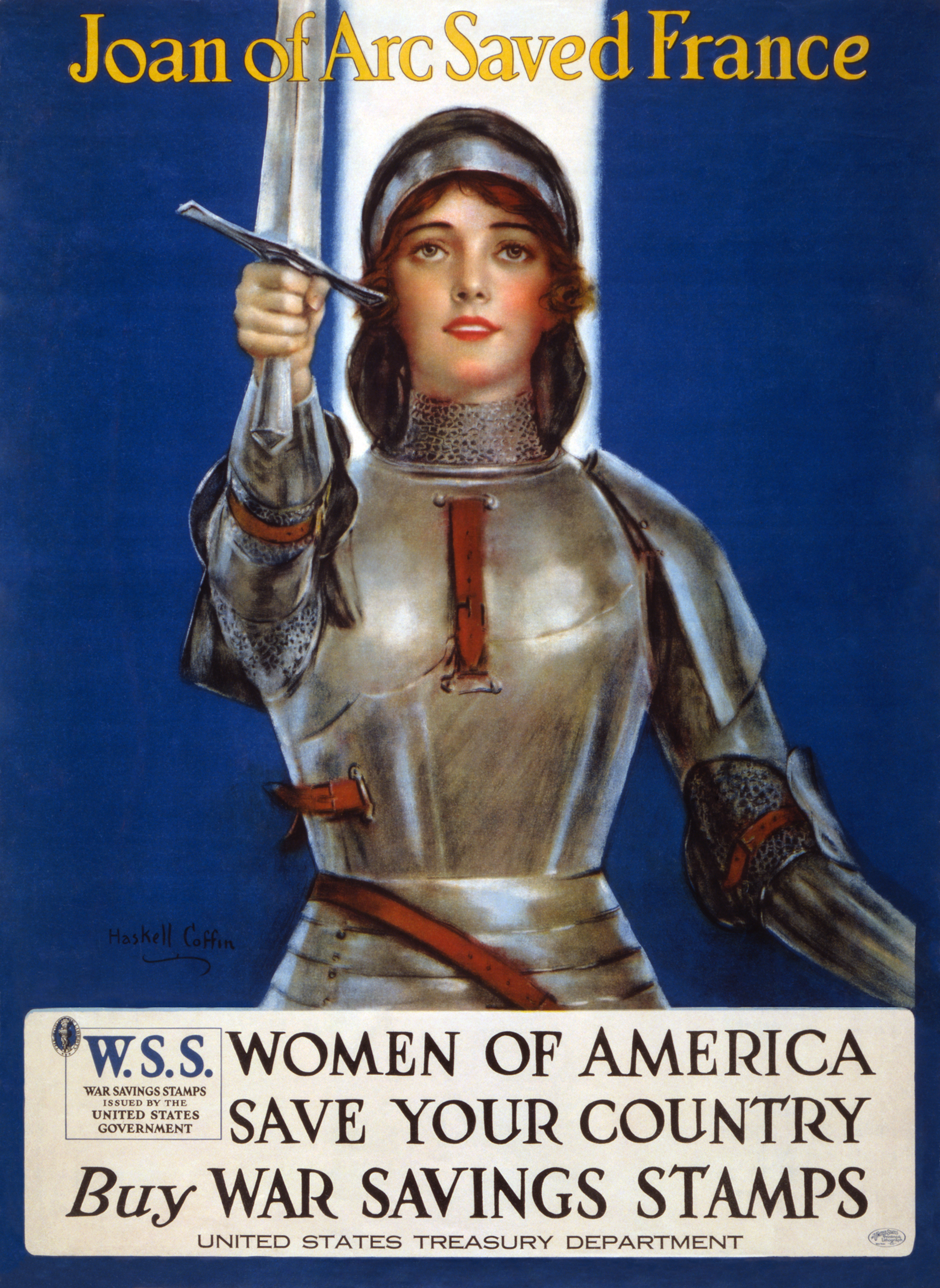
World War I lithograph poster, 1918. It’s rather a strange one, using the image of Joan to encourage women to help the war effort by attending to their domestic concerns; the US military still banned women from fighting. But Joan was all the rage then: Twain’s thoroughly researched novel, together with other renewed scholarly interest in her over the previous fifty years, made the story of her life much more widely known, and the Church had recently beatified her. She was made a saint two years after this poster was published.
Joan of Arc is a military icon. She loved fighting and spurned any diplomacy beyond plans to move the English out of France as quickly as possible. Though she initially wept at the sight of soldiers wounded and dead as a result of her aggressive tactic of direct assault, she continued to lead every charge in her favored, necessarily casualty-heavy way. Her rhetoric in letters and speech, though embellished with appeals to Christian forbearance and mercy, was violent, filled with threats to chop off heads and put to the sword all who did not obey the will of God as she proclaimed it to be. She inspired deep and enthusiastic devotion in her soldiers, even in her most hard-bitten, most skeptical generals, and quickly achieved a mythic stature among her countrypeople that even General Douglas MacArthur could only envy.
Joan of Arc is a queer icon. She was a cross-dresser who disdained sex with men. Her first simple style of male garb was a practical measure for a soldier who needed to move freely and for a woman often surrounded by men in a culture that regarded single women without escort as fair sexual prey. But over time, as she first encountered the delights of elegant and expensive clothing, showered upon her as gifts of admiration and gratitude, she became quite the clothes horse. She saw no problem with this: medieval sensibilities often conflated holiness with material richness just as the Old Testament did, and God, his favorites, saints, and angels were almost invariably portrayed in the richest of finery. But her enemies mocked her adopted style of wearing silken hose and richly embellished garments in fine fabrics as proof she was as vain, conceited, and driven by lust for personal fame and riches as they had always said. Another reputed French visionary, a young shepherd boy being groomed as Joan’s more convenient, less pugnacious replacement as saintly advisor to the king, blamed her capture on her having fallen prey to vanity and luxury. They claim that she was captured because of her finery, pulled off her horse by the fancy little cape she had grown fond of wearing.
Jeanne d’Arc by Albert Lynch, engraving from Figaro Illustre magazine, 1903, public domain
Joan of Arc is an art and fashion icon. Her exploits, her cross-dressing, her independence of spirit, and her short hair inspired centuries of creative people to capture this wondrously unique individual on canvas, in brass and wood, and in textiles. And songs, poems, stories, films, plays, and countless other forms of creative expression emphasize this, that, or the other facet of her varied and mysterious character. And the Joan-style, French-invented bobbed haircut of the 1920’s, the same decade which saw Joan’s canonization and women’s obtaining the full legal right to vote in the United States and Britain (it took France another twenty years), became a potent symbol, a public declaration that each cropped head recognized that:
Joan of Arc is the feminist icon, par excellence. She bested men in daring and stamina on the battlefield, in intellect time after time in the courtroom, in keeping her own counsel and determining her own destiny despite opposition from family, church, and society, in self-preservation from her would-be prison rapists, and in the courage she displayed on the day of her death. And yet, as she charmingly boasted near the beginning of her final trials, she was confident that she a better seamstress and spinner than just about any other woman! She wore armor, pretty dresses, rough men’s clothes, and over-the-top finery as it suited her. She sang, rode horses, adventured, communed with God and angels, told men and other women what to do, and drove thousands of people to distraction wondering what to make of this extraordinary, inspiring, difficult, inexplicable, and unforgettable person.
It’s my dream and my plan, as soon as resources and time allow, to follow the life and ideas of Joan of Arc in France. Stay tuned, though it might be quite a while, and in the meantime, here are some great sources for learning more about this marvelous woman:
~~~~~~~~~~~~~~~~~~~
Sources and inspiration:
Castor, Helen. Joan of Arc: A History. New York: HarperCollins, 2015
De Pizan, Christine. Ditié de Jeanne d’Arc (Song of Joan of Arc), ed. Angus J. Kennedy and Kenneth Varty (Oxford: Society for the Study of Medieval Languages and Literature, 1977), trans. L. Shopkow
Graham, Beckett and Susan Vollenweider. ‘Joan of Arc‘, episode 51 of The History Chicks podcast
Harrison, Kathryn. Joan of Arc: A Life Transfigured. New York: Doubleday, 2014
Joan of Arc, 1948 film directed by Victor Fleming, screenplay by Maxwell Anderson
Murray, T. Douglas. Jeanne d’Arc. New York: McClure, Phillips & Co, 1902 (excerpts detailing her trial)
The Passion of Joan of Arc. 1928 film, screenplay by Joseph Delteil and Carl Theodor Dreyer, directed by Carl Theodor Dreyer
Saint Joan, 1957 film adapted George Bernard Shaw’s play Saint Joan, screenplay by Graham Greene, directed by Otto Preminger
Shakespeare, William. Henry VI, Part I, 1591. Via Open Source Shakespeare (website)
Twain, Mark. Personal Recollections of Joan of Arc, 1896.
~ Ordinary Philosophy and its Traveling Philosophy / History of Ideas series is a labor of love and ad-free, supported by patrons and readers like you. Please offer your support today!
Julia Ward Howe, poet and activist, was born on May 27, 1819, and lived a long life ever dedicated to social reform.
She’s best known as the author of the Battle Hymn of the Republic, the stirring Civil War anthem still sung at military events and in churches today; I remember singing it at Mass growing up. Filled with Biblical imagery, it reminds me of the Old Testament-inspired Second Inaugural Address of Abraham Lincoln. In it, he addresses the terrible costs of the war in lives and property, surmising that God’s justice may demand that ‘all the wealth piled by the bondman’s two hundred and fifty years of unrequited toil shall be sunk., and …every drop of blood drawn with the lash shall be paid by another drawn with the sword’ in recompense for the terrible sin of slavery.
Howe wrote her Hymn in 1861, Lincoln’s Second Inaugural was delivered in 1865. Lincoln is known to have heard the Battle Hymn and reported to have wept when he did. Lincoln was well versed in Scripture and references it liberally in his writings and speeches; nevertheless, he may also have had Howe’s Hymn in mind when he wrote his Address. In any case, both remain prominent in American historical memory, continuing to resonate and inspire today in our Protestantism-derived culture. John Steinbeck uses her Book of Revelation-derived phrase The Grapes of Wrath as the title of his great novel about the suffering of Dust Bowl refugees fleeing to California. The great Leonard Cohen references her Hymn in ‘Steer Your Way’ from You Want It Darker, his final album released shortly before his death last fall. Howe’s lyric ‘As he died to make men holy, let us die to make men free’ becomes ‘…let us die to make things cheap.’ Cohen redirects her line to critique today’s great sin of destroying our environment likewise out of greed, complacency, indifference to the fate we’re creating for our descendants, and slavish adherence to the ‘way it’s always been done.’
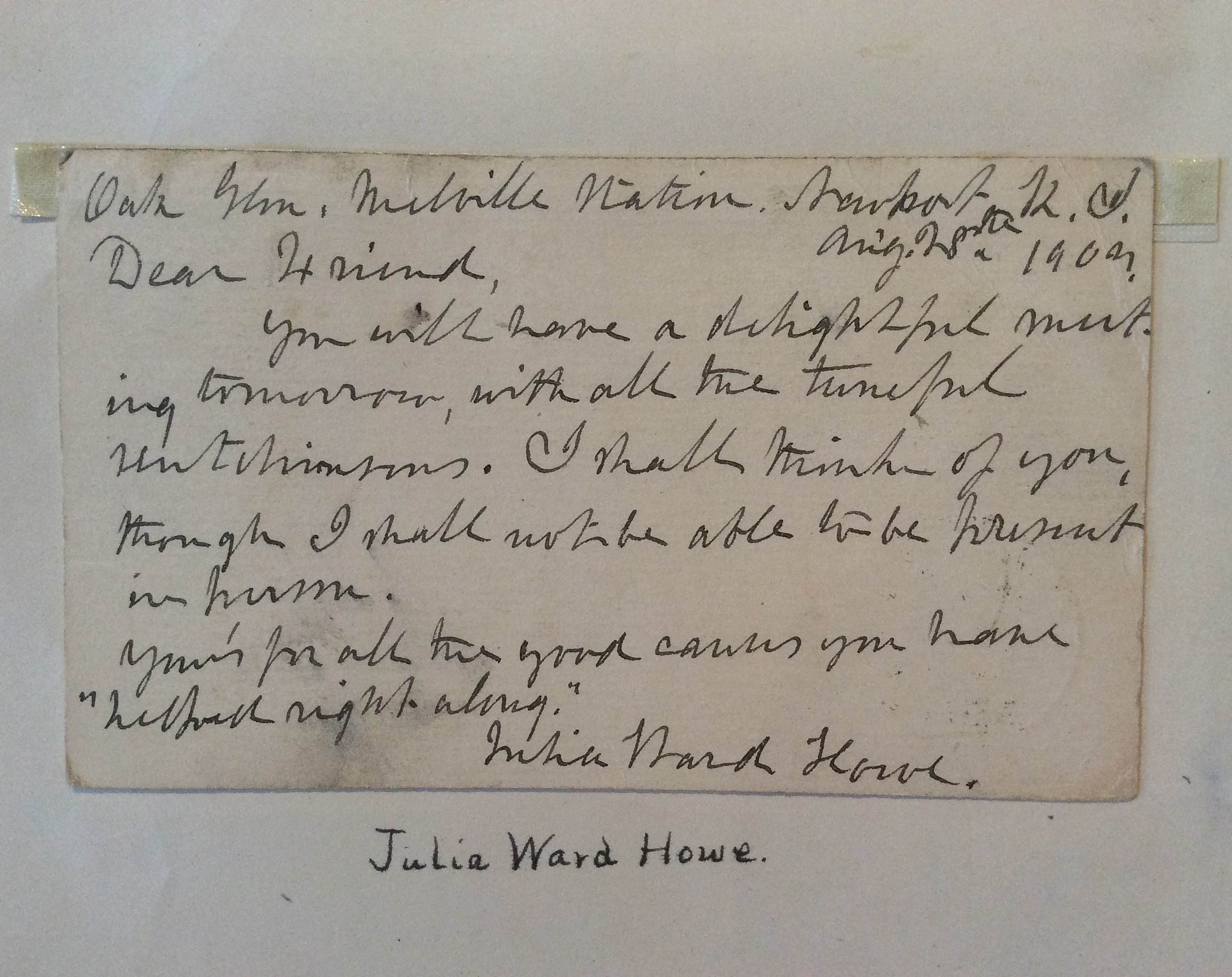
Julia Ward Howe postcard dated August 28th, 1903, from the Hutchinson Family Scrapbook in the collection of the Lynn Historical Society in Massachusetts. I was here in spring 2016 following the life and ideas of Frederick Douglass. The Hutchinson family dedicated their musical skills to the abolition movement and other reform causes and were friends with many prominent activists of their day. The scrapbook doesn’t note which member of the Hutchinson family Howe wrote this card to.
Read more about this great abolitionist, feminist, and author:
~ Ordinary Philosophy and its Traveling Philosophy / History of Ideas series is a labor of love and ad-free, supported by patrons and readers like you. Please offer your support today!
John Stuart Mill on writing to make a living versus writing for posterity, from his Autobiography: ‘…The writings by which one can live are not the writings which themselves live, and are never those in which the writer does his best.’
~~~~~
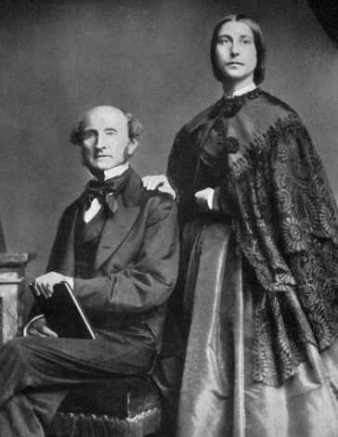
One of my very favorite ideas in political philosophy is John Stuart Mill’s ‘marketplace of ideas’ (though he didn’t phrase it this way himself): that the free, open, and vigorous exchange of ideas in the public square does more to further human knowledge than anything else. But not only has his comprehensive and to my mind, absolutely correct defense of free speech in his great work On Liberty had animmense and beneficial influence on the history and theory of human rights, he was admirable in myriad other ways as well:
‘Mill believed in complete equality between the sexes, not just women’s colleges and, someday, female suffrage but absolute parity; he believed in equal process for all, the end of slavery, votes for the working classes, and the right to birth control (he was arrested at seventeen for helping poor people obtain contraception), and in the common intelligence of all the races of mankind… all this along with an intelligent acceptance of the free market as an engine of prosperity and a desire to see its excesses and inequalities curbed…. Mill was an enemy of religious bigotry and superstition, and a friend of toleration and free thought, without overdoing either…’ ~ Adam Gopnik, from his article and book review ‘Right Again‘, 2008
‘The son of James Mill, a friend and follower of Jeremy Bentham, John Stuart Mill (1806-1873) was subjected to a rigorous education at home: he mastered English and the classical languages as a child, studied logic and philosophy extensively, read the law with John Austin, and then embarked on a thirty-five career with the British East India Company at the age of seventeen. (He also suffered through a severe bout of depression before turning twenty-one.) Despite such a rich background, Mill credited the bulk of his intellectual and personal development to his long and intimate association with Harriet Hardy Taylor. They were devoted friends for two decades before the death of her husband made it possible for them to marry in 1852; she died in Avignon six years later. Mill continued to write and to participate in political affairs, serving one term in Parliament (1865-68). The best source of information about Mill’s life is his own Autobiography (1873). Mill
Philosophically, Mill was a radical empiricist who held that all human knowledge, including even mathematics and logic, is derived by generalization from sensory experience. In A System of Logic, Ratiocinative and Inductive (1843) he explained in great detail the canons for reasoning inductively to conclusions about the causal connections exhibited in the natural world.
Mill’s moral philosophy was a modified version of the utilitarian theory he had learned from his father and Bentham. In the polemical Utilitarianism (1861) Mill developed a systematic statement of utilitarian ethical theory. He modified and defended the general principle that right actions are those that tend to produce the greatest happiness of the greatest number of people, being careful to include a distinction in the quality of the pleasures that constitute happiness. There Mill also attempted a proof of the principle of utility, explained its enforcement, and discussed its relation to a principle of justice. Mill
Mill’s greatest contribution to political theory occurs in On Liberty (1859), where he defended the broadest possible freedom of thought and expression and argued that the state can justify interference with the conduct of individual citizens only when it is clear that doing so will prevent a greater harm to others. Mill also addressed matters of social concern in Principles of Political Economy (1848) and Considerations on Representative Government (1861) and eloquently supported the cause of women’s rights in The Subjection of Women (1869).’
~ from The Philosophy Pages by Garth Kemerling, licensed under a Creative Commons Attribution-Share Alike 3.0 Unported License
Mill, John Stuart. On Liberty, from Project Gutenberg
Wilson, Fred. “John Stuart Mill“, The Stanford Encyclopedia of Philosophy
~ Ordinary Philosophy and its Traveling Philosophy / History of Ideas series is a labor of love and ad-free, supported by patrons and readers like you. Please offer your support today!
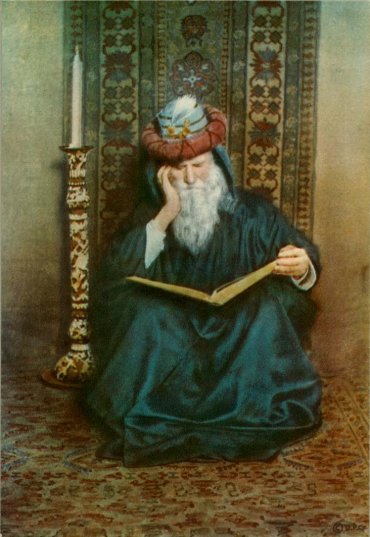
Since Edward FitzGerald published his translation of The Rubáiyát of Omar Khayyám in 1859, Omar Khayyám has been known, especially in the western world, first and foremost as a great poet, eloquently expressing the joy and beauty of life and our own struggles to live it with a sense of love and meaning. It’s a humanist work, with Khayyám writing much as an Epicurean or Skeptic here and a Stoic there, freely doubting and wondering at everything, unshackled from the orthodoxy one might expect from a famed teacher and writer of his time and place. Yet Khayyám, a devotee of Avicenna, took his Islamic faith very seriously, and thought deeply about the nature of God and our relationship to him.
Khayyám, born in Persia in 1048, was most famed in his own time as a mathematician, astronomer, and scientist. He wrote some of the most important medieval works in geometry and algebra, and helped reform the calendar, an even more accurate one than the Gregorian calendar we use today. But he was also an accomplished philosopher, and scholars are working on resolving the apparent contradictions between this work and his poetry.
One thing I’ve gotten from my research (which, thus far, is only beginning and therefore not nearly enough): for all his prodigious learning and accomplishments, Khayyám honestly acknowledges the limits of human understanding, and seems to tell us that while the great work of discerning the truths of the universe is a great, noble, even necessary endeavor, we do well to keep in mind that we can never know everything, whether through science or religion. So, Khayyám seems tells us, we do well to work, to wonder, to seek, to do right, but also to live for today:
‘At first they brought me perplexed in this way
Amazement still enhances day by day
We all alike are tasked to go but Oh!
Why are we brought and sent? This none can say’. (Rubā‘iyyāt, Tirtha 1941, 18, from IEP)
‘As Spring and Fall make their appointed turn,
The leaves of life one aft another turn;
Drink wine and brood not—as the Sage has said:
“Life’s cares are poison, wine the cure in turn.” (Sa‘idī 1994, 58, from IEP)
~ Ordinary Philosophy and its Traveling Philosophy / History of Ideas series is a labor of love and ad-free, supported by patrons and readers like you. Please offer your support today!
~~~~~~~~~~~~~~~~~~~~~~~~~~~~~~
Sources and Inspiration
Aminrazavi, Mehdi and Van Brummelen, Glen, ‘Umar Khayyam‘, The Stanford Encyclopedia of Philosophy
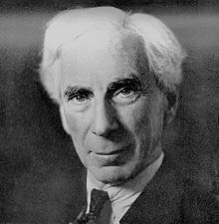
Bertrand Russell lived an extraordinarily long life, in which he did an extraordinary number of extraordinary things.
Encyclopedia Britannica introduces him thusly: ‘Bertrand Russell ….born May 18, 1872, Trelleck, Monmouthshire, Wales- died Feb. 2, 1970, Penrhyndeudraeth, Merioneth, [was a] British philosopher, logician, and social reformer, founding figure in the analytic movement in Anglo-American philosophy, and recipient of the Nobel Prize for Literature in 1950. Russell’s contributions to logic, epistemology, and the philosophy of mathematics established him as one of the foremost philosophers of the 20th century. To the general public, however, he was best known as a campaigner for peace and as a popular writer on social, political, and moral subjects. During a long, productive, and often turbulent life, he published more than 70 books and about 2,000 articles, married four times, became involved in innumerable public controversies, and was honoured and reviled in almost equal measure throughout the world…’
For myself, he was particularly influential to my younger freethinking self, disenchanted with the religion of my youth and seeking new and more satisfying ways of viewing the world. I read his History of Western Philosophy and Why I Am Not a Christian each several times over. I admire his clear, precise thinking and his principled anti-war stance which came at a significant cost, including jail time and loss of a prestigious job at the University of Chicago, and it’s always so enjoyable to watch him speak (you’ll find plenty of videos on YouTube) in his oh-so-aristocratic accent with a pipe often tucked into the corner of his mouth. He was not a perfect man, but he was never a less-than-fascinating one.
Bertrand Russell – by Andrew David Irvine for The Stanford Encyclopedia of Philosophy
~ Ordinary Philosophy and its Traveling Philosophy / History of Ideas series is a labor of love and ad-free, supported by patrons and readers like you. Please offer your support today!
In honor of David Hume’s birthday, May 7, 1711, let me share anew my history of ideas travel series I created in honor of my favorite philosopher in his home city of Edinburgh, Scotland. I’ll soon be in Edinburgh again, this time for at least one year, to pursue a Master’s Degree in Intellectual History at the University of Edinburgh. I can hardly express how thrilled I am at the prospect! I’ll be expanding this Hume series while I’m there.
To Edinburgh I Go, In Search of David Hume
Hello, friends of Ordinary Philosophy! I’m pleased and excited to announce my upcoming adventure: my first philosophical-historical themed adventure, and my first trip to Edinburgh, Scotland!
Here’s my plan:
I’m taking a series of trips to places around the world, where I explore the lives and ideas of great thinkers in the places where they lived and worked. I’ll follow in the footsteps of thinkers who are no longer alive, since those who are still telling their own stories. But those who are no longer alive in the body live on in the ideas that they pass on, and in the example they provide for us to follow.
I’ve decided to start with the philosopher I most admire as a person as well as a thinker, the great David Hume. He was not only revered for the brilliance of his ideas and his honesty in presenting them, but also as a premier example of a genial, generous, great-hearted person; so much so, in fact, that one of his closest friends nicknamed him ‘Saint David’.
Hume is often described as the greatest philosopher to write in English and among the greatest philosophers of all time, period. He was a central figure in the Scottish Enlightenment, and a profoundly influential empiricist and moral philosopher
So off to beautiful Edinburgh I go! There, I’ll visit the places where he worked, thought, wrote, studied, and rested. I’ll be traveling there in the first two weeks of May, and will be writing throughout the trip. I’ll be writing in this blog not only about his ideas, but about what I can discover about his everyday life, and whatever feeling of his time and place I manage to uncover in my time there.
If you have any questions for me to answer while I’m there, or pictures you’d like me to take for you, or any information you have that could help me with this project, I’d love to hear from you!
~~~~~~~~~~~~~~~~~~~~~~~
Here are my essays on Hume as I discover him in my travels, in (roughly) chronological order:
Ordinary Philosophy and its Traveling Philosophy / History of Ideas series is a labor of love and ad-free, supported by patrons and readers like you. Please offer your support today!
Una Marson was born on May 5, 1905 in the rural parish of St. Elizabeth, Jamaica, sixteen years after the novelist and poet Claude McKay. Following in the literary footsteps of McKay, Marson valorized African working-class cultural aesthetics and engaged with the wider African diaspora through her literary and political work. Although her work has not received the same attention or accolades as her fellow countryman Claude McKay, Marson has, without a doubt, made a significant contribution to Caribbean and diasporic literature. She was certainly a key figure in twentieth century black internationalist politics.
Fortunately, conversations around the life and work of Una Marson have been kept alive and archived in a few libraries throughout the world. Writers such as Erika Smilowitz, Honor Ford Smith, and Alison Donnell have also written critical essays on Marson’s literary and political involvement inside and outside of Jamaica. Additionally, her biographer Delia Jarrett-Macauley has provided a comprehensive documentation of Marson’s life and writing. Therefore, their works are most instructive in offering more information concerning Marson’s life and activism.
Not surprisingly, Marson’s early works of literature reflected her colonial education. Marson’s writing in her first collection of poems, Tropic Reveries (1930) and Heights and Depth (1931), adapted traditional European literary structure and spoke to pastoral style poetry. As her travels abroad strengthened her race consciousness in the mid-1930s, Marson’s literary work departed from the conventions of British Victorian and Romantic literature. As such, her third volume of poems, The Moth and the Star (1937), articulated themes that resonated with the experiences of African women entrapped within received notions of white beauty standards.
In her poem “Cinema eyes,” for example, the narrator tries to protect her daughter from procuring a “cinema mind” under the influence of white supremacy, which “saw no beauty in black faces.” Two other poems, “Kinky hair blues” and “Black is Fancy,” reveal black hair politics and many black women’s desire to alter their physical appearances:
I hate dat ironed hair
And dat bleaching skin
Hate dat ironed hair
And dat bleaching skin
But I’ll be alone
If I don’t fall in 2
Over time, Marson’s work also became more rooted in Jamaican experiences, and she integrated the indigenous culture of the black Jamaican working-class. In her poem “Stone Breaker, ”Marson sheds light on the experiences of black working-class Jamaican women using the native language, Jamaican, to express class and racial inequalities that inform life on the island: “De big backra car dem/ A lik up de dus’ in a we face” 3
Maintaining a bond to her Jamaican roots, “Quashie Comes to London,” a more lighthearted poem, highlights the immigrant experience of homesickness in the metropolis of London. Quashie’s diasporic journey in cold dreary London and yearning for familiar food items such as “some ripe breadfruit / Some fresh ackee and saltfish too / An’dumpins hot will suit,” later becomes common threads in the works of Caribbean diasporic writers living outside of the region.
Marson further developed her use of African Jamaican cultural aesthetics and experiences in her popular plays, London Calling and Pocomania. In Pocomania, for instance, she includes the local vernacular, folklore, and African-centered religious practice called Pocomania to challenge middle-class respectability and Christianity. She does this through Stella, the middle-class character in the play, who journeys to the world of the black Jamaican working-class in a bid to experience the forbidden religious rituals of Pocomania. Given the fact that the reference to anything “African” was frowned upon in colonial Jamaica, Marson’s plays and poems reflected a transgressive intervention in conventional Jamaican literature.
In many ways, Marson unselfishly employed her literary status to foster and build upon the development of a Caribbean literary canon. In her desire to advance Jamaican literature and culture, Marson formed the Writers Club, the Kingston Drama Club, and the Poetry League during the 1930s. Marson was also responsible for starting a publishing press.
While living in England, Marson developed the BBC radio program, “Caribbean Voices,” which evolved into a significant literary show, one that would have a crucial impact on the development of new writings and writers from the Anglophone Caribbean. Caribbean cultural luminaire Kamau Braithwaite has characterized the forum as the “single most important literary catalyst for Caribbean creative and critical writing in English.” 4
In addition to her literary engagement, Marson was also very politically active in local and international affairs. In 1928, at the age of 23, she became the first woman in Jamaica to own and edit a magazine, The Cosmopolitan. Marson used this publication as an outlet to express social concerns in Jamaica (i.e., race and class prejudices) and also to address gender issues. In her editorials, Marson consistently advocated for the expansion of educational and employment opportunities, the development of women’s self-help groups, and the granting of women’s suffrage.
As a feminist, Marson worked in various overseas women organizations and was the only black woman to attend the 12th Annual Congress of the International Alliance of Women for Suffrage and Equal Citizenship conference in Istanbul, Turkey in 1935. Motivated by wider diasporic experiences, she used the opportunity to advocate for the rights of black woman globally and called on the conference to recognize African women in their daily struggles.
Coupled with her feminist work, Pan-Africanism became a dominant feature of Marson’s activism. Marson’s Pan-Africanist vision, for example, was invested in the need for educational reform on her island, a reform that would reverse the colonial education to which she was subjected and instead teach Jamaican children about their African past. Equally, Marson worked as a secretary for the Ethiopian emperor, Haile Selassie, where she used this position to highlight the separation of families and Italian atrocities against women and children in Ethiopia. As his private secretary, Marson also accompanied him to Geneva where he pleaded his country’s case to the League of Nations on the matter of the Italian invasion and occupation.
Marson’s last years of political activism focused on advocacy for the Rastafarian community in her native Jamaica, where she successfully established a home for Rastafarians. She also created the Save the Children Fund, an organization that helped to fund poor children’s basic education.
According to published sources and acquaintances, Marson’s extensive work and travels later contributed to her frail health. Marson struggled with depression and was hospitalized several times in mental health facilities before she died of a heart attack in Jamaica in 1965.
Like Claude McKay, Una Marson’s literary and political work emerged out of their native country Jamaica and later became a part of a wider community of diasporic Africans who sought to assert a distinct national voice and identity. Both writers combined their work with the indigenous cultural expression of the island but were also open to bridging the conversation with other black art forms as evident in the jazz poems of Marson and her brief experimentation with the African American vernacular.
Unlike McKay, however, Marson remained in Jamaica to witness the fruition of her goal toward a cultural and literary renaissance. The 1950s and 1960s defined a literary and cultural rebirth for Anglophone Caribbean people as seen in the dramatic growth in the number of artists, musicians, and creative writers working regionally and internationally. Writers such as Jamaican Andrew Salkey, Barbadian George Lamming, and Trinidadian Samuel Selvon all began to make their mark as renowned Caribbean writers and cultural activists in various parts of the globe.
Therefore, Marson’s commitment to gender politics, race, class, and her impulse to divert from British literary style shaped a generation of writers who aspired to attain cultural and political sovereignty. Indeed, Marson belongs to a long line of black internationalist intellectuals and activists, whose works have been fundamental to struggles for cultural assertion and self-hood.
D. Jarrett-Macauley, The Life of Una Marson 1905-65 (Manchester: Manchester University Press, 1998), 73
Una Marson, Moth and the Star, 91.
Una Marson, Moth and the Star, 70; Like Professor Carolyn Cooper and some Caribbean linguistics I have chosen to use Jamaican (rather than patois) because the term “patois” has a negative linguistic connotation of inferiority.
Kamau Brathwaite, History of the Voice: The Development of Nation Language in Anglophone Caribbean Poetry (London: New Beacon, 1984).
Lisa Tomlinson is a Jamaican researcher and scholar residing in Kingston, Jamaica. Her area of specialization includes literary and cultural studies of the Caribbean and African diaspora, Black literary criticism and anti-colonial studies. She holds a degree in English Literature from Carleton University and a Ph.D. in Humanities (Comparative Perspective and Culture) with a graduate diploma in Latin America and Caribbean Studies.
Lisa has worked in tertiary institutions in Ontario, Canada where she taught courses in English literature, humanities, and visual culture. She is currently a lecturer at the University of the West Indies, Mona Campus in the Department of Literatures in English. Some of her publications include book chapters in Jamaicans in the Canadian Experience: A Multicultralizing Presence, Archipelagos of Sound: Transnational Caribbeanities: Women and Music, Critical Insights: Harlem Renaissance, as well as encyclopedia entries in the Dictionary of Afro-Latin American and Caribbean Biography. (Bio credit: AAIHS)
Søren Kierkegaard (1813-1855 CE), the great Danish philosopher and forerunner of existentialism, was born in the Danish city of Copenhagen, and throughout his life he enjoyed walking through the city, greeting everyone he met as his equal regardless of their station in life. As a young boy, Kierkegaard’s father drilled him with difficult lessons so he would be the top student in his class, but to prevent his son from developing selfish pride, the father demanded that his son get the third best grades in the class, purposefully making mistakes to prevent the boy from being recognized as first or second student.
For Kierkegaard, genuine truth is human subjectivity and perspective, and it is only the individual who accepts subjectivity who comes to realize the greater truth insofar as it is achievable by individuals. For Kierkegaard, truth is not objective, but subjective, not an object achieved, but a test withstood, not a hurdle overcome, but an experience endured. Kierkegaard argued that no social system can authentically give the individual meaning and truth. Individuals must make choices, and if they choose to go along with the masses, they have sacrificed their own ability to give truth meaning. Kierkegaard wrote that he could have, like most scholars of his day, become a voice pronouncing the greatness and objectivity of his race, his country, his historical period, his fellow scholars, but rather than commit treason to truth he chose to become a spy, a solitary individual who chronicled the hypocrisy of all claims to objectivity.
To be an individual is to experience “a vertigo of possibilities”, the monstrosity of spontaneity. Kierkegaard wrote, “We are condemned to be free”. It is our freedom, the experience of the infinite, undefined and unbounded, which unites us most intimately with our world. Kierkegaard argued that one can overcome the angst, the vertigo of possibilities, by making a leap of faith, by choosing to believe in something and act with some purpose in spite of the fact that beliefs and purposes can never be fully justified. Only this is authentic individuality and truth, having chosen what one is to be, with the honest recognition of the freedom involved in the choice.
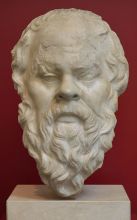
Kierkegaard saw himself as a true follower of Socrates, who argued that he knew that he did not know, which is why the Oracle at Delphi said that no man was wiser than he. Kierkegaard wrote his college thesis on Socrates, irony, and indirect communication, much as Kierkegaard himself indirectly communicated through his pseudonyms. Socrates never made great claims to truth, and would instead use analogy, myth, and paradox to show that human judgments and beliefs are problematic and contradictory even as they assert themselves with certainty, which Kierkegaard argued was also the method of Jesus. Kierkegaard wrote that Socrates “approached each man individually, deprived him of everything, and sent him away empty-handed”. Socrates showed others that they did not truly know what they believed themselves to know, and he was killed by the Athenian assembly just as Jesus was killed for questioning the Pharisees.
Kierkegaard’s works are dominated by theological concerns, wondering on many pages about the individual’s relationship to God and Jesus. For Kierkegaard, the meaning of Christianity was not the achievement of objectivity, but the acceptance of subjectivity, of individually lacking the God’s eye view. Kierkegaard was brutally critical of the Danish Lutheran Church for presenting itself as the objective truth, and argued that it is only as an individual that one can be a genuine Christian. Kierkegaard argued that Christianity began as a rebellion against the status quo, but then became the entrenched regime.
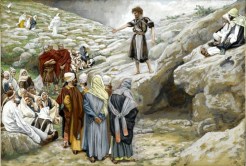
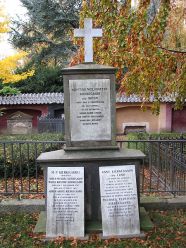
After healing a blind man, Jesus rebuked the Pharisees, the political and religious establishment of his time, and said that because they think they see they are in fact blind. In his later years, Kierkegaard attacked the Danish Church without mercy, and at his funeral a fight broke out when young theology students, progressive and inspired by Kierkegaard, protested that the church was attempting to hijack his name and fame by calling him one of their own after he had so bitterly attacked their hypocrisy for decades. Kierkegaard wanted his tombstone to read only, “The Individual”, though his relatives decided otherwise.
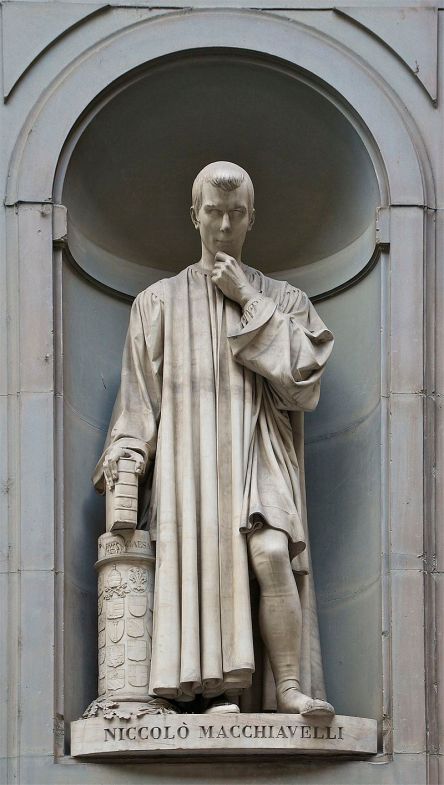
‘Why an entry on Machiavelli? That question might naturally and legitimately occur to anyone encountering an entry about him in an encyclopedia of philosophy. Certainly, Machiavelli [born May 3, 1469] contributed to a large number of important discourses in Western thought—political theory most notably, but also history and historiography, Italian literature, the principles of warfare, and diplomacy. But Machiavelli never seems to have considered himself a philosopher—indeed, he often overtly rejected philosophical inquiry as beside the point—nor do his credentials suggest that he fits comfortably into standard models of academic philosophy. His writings are maddeningly and notoriously unsystematic, inconsistent and sometimes self-contradictory. He tends to appeal to experience and example in the place of rigorous logical analysis. Yet succeeding thinkers who more easily qualify as philosophers of the first rank did (and do) feel compelled to engage with his ideas, either to dispute them or to incorporate his insights into their own teachings. Machiavelli may have grazed at the fringes of philosophy, but the impact of his musings has been widespread and lasting. The terms “Machiavellian” or “Machiavellism” find regular purchase among philosophers concerned with a range of ethical, political, and psychological phenomena, even if Machiavelli did not invent “Machiavellism” and may not even have been a “Machiavellian” in the sense often ascribed to him. Moreover, in Machiavelli’s critique of “grand” philosophical schemes, we find a challenge to the enterprise of philosophy that commands attention and demands consideration and response. Thus, Machiavelli deserves a place at the table in any comprehensive survey of philosophy…’ ~ Cary Nederman, “Niccolò Machiavelli”, The Stanford Encyclopedia of Philosophy
To introduce yourself to or learn more about the often contradictory, ever controversial, always fascinating and relevant Niccolò Machiavelli, read the Stanford Encyclopedia of Philosophy article linked above and listen to this discussion between one of my favorite broadcasters and public intellectuals Melvin Bragg, and his guests Quentin Skinner, Evelyn Welch, and Lisa Jardine.
Ordinary Philosophy and its Traveling Philosophy / History of Ideas series is a labor of love and ad-free, supported by patrons and readers like you. Please offer your support today!

 ‘Walt Whitman, an American, one of the roughs, a kosmos, Disorderly fleshy and sensual . . . . eating drinking and breeding, No sentimentalist . . . . no stander above men and women or apart from them . . . . no more modest than immodest.’ Thus Walt Whitman introduces himself to us for the first time in his first self-published 1855 edition of Leaves of Grass. Not on the cover or on the title page, mind you, but deep within the body of the untitled poem later called Song of Myself. If this is a dialing-back attempt to inject a little respectable humility or yet another self-aggrandizing affectation on the part of this unapologetic egoist, it’s hard to say definitely, though I strongly suspect it’s the latter. It certainly is so-very-American.






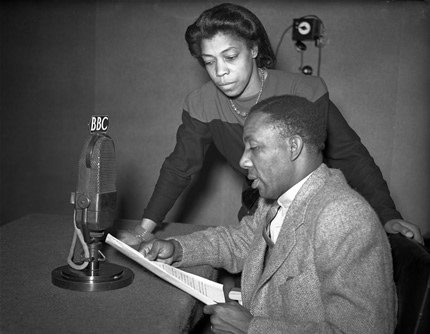
 While living in England, Marson developed the BBC radio program, “Caribbean Voices,” which evolved into a significant literary show, one that would have a crucial impact on the development of new writings and writers from the Anglophone Caribbean. Caribbean cultural luminaire Kamau Braithwaite has characterized the forum as the “single most important literary catalyst for Caribbean creative and critical writing in English.”
 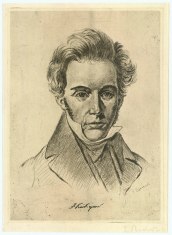 Søren Kierkegaard (1813-1855 CE), the great Danish philosopher and forerunner of existentialism, was born in the Danish city of Copenhagen, and throughout his life he enjoyed walking through the city, greeting everyone he met as his equal regardless of their station in life. As a young boy, Kierkegaard’s father drilled him with difficult lessons so he would be the top student in his class, but to prevent his son from developing selfish pride, the father demanded that his son get the third best grades in the class, purposefully making mistakes to prevent the boy from being recognized as first or second student.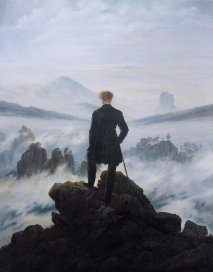

 Ordinary Philosophy