Interview with Ken Morris, Anti-Slavery Activist

Ken Morris, image credit Kenneth Morris.jpgListen to this podcast episode here or on Google Play, or subscribe on iTunes

I’m honored and excited to introduce my next guest for Ordinary Philosophy’s 58th podcast episode, Ken Morris.

Ken Morris is closely linked to Frederick Douglass, the subject of my most recent history of ideas travel series, and carries on his legacy by working in a noble and very important cause, anti-slavery activism. He has an incredible family history and personal life story and array of accomplishments which you’ll be sure to find as impressive and fascinating as I do, but I’ll stop here and let him tell you all about it….

For more about Ken Morris and his work, please visit:

The Frederick Douglass Family Initiatives website
Bio: http://fdfi.org/ken
Facebook: https://www.facebook.com/FrederickDouglassFamilyInitiatives/
Twitter: https://twitter.com/kmorrisjr
and Picturing Frederick Douglass, to which Mr. Morris contributed and sales of which benefit the FDFI: http://fdfi.org/book

Ordinary Philosophy and its Traveling Philosophy / History of Ideas series is a labor of love and ad-free, supported by patrons and readers like you. Please offer your support today!

Frederick Douglass, Rochester NY Sites Day 2

Douglass scholarship articles and posters, Dr. David Anderson's office, Nazareth College Rochester, 2016 Amy Cools

Articles, posters, and mementos of Frederick Douglass scholarship and events, Dr. David Anderson’s office, Nazareth College of Rochester

Tenth day, Tuesday March 29th

I begin my day with an early visit to Dr. David Anderson, a Frederick Douglass scholar, visiting professor at Nazareth College, founding member of Blackstorytelling League, and an all around delightful and fascinating man! He is kind enough to grant me an interview of an hour or so, which ends up turning into a much longer conversation than that.

Among many other things too numerous to describe in full here (I’ll bring more details of our talk into the discussion of my subsequent discoveries), we talk about the Douglass family as a whole, and especially, Frederick Douglass’ wife Anna.

As discussed in the account of my day in Lynn, Anna took in piecework from Lynn’s thriving shoe industry, attaching uppers to soles, to help support the family. According to Anderson, she brought in enough money doing this to put all of the money which Douglass sent home from his 1845-1847 British Isles tour into the bank. This is but one example of Anna’s hard work and skill as a household manager. The extent of Anna’s contributions to Frederick’ life is often overlooked, Anderson says: if people understood the degree to which Frederick relied on Anna, emotionally as well as logistically, people would understand much more about him too. From the beginning of their relationship, Anna supported his efforts to better himself and to make his escape, selling some of her belongings to fund it and helping him to plan it all out. Anna made the Douglass family home a happy one, and for many stretches especially in Douglass’ earlier years as a traveling speaker, she was often the sole financial support of the family. And when Frederick away on his innumerable meetings and lecture tours, she sent clean clothes ahead to wherever he was traveling, so he was always ready to appear in public neat, tidy, and comfortable.

Anna Douglass circa 1860, image from the Library of Congress collection

Anna Douglass circa 1860, image from the Library of Congress collection

Anna did all of this though she could not read or write. As Anderson points out, people often confuse illiteracy with lack of intelligence, and this simple fact, in addition to the general reticence of her personality, has long caused many to write her off as an influential or even very significant figure in Frederick’s life. In fact, she was resourceful, orderly, dignified, creative, and kept their ever-changing and complex life as the family of a traveling speaker and activist together, all while taking care of their constant flow of house guests, including Underground Railroad refugees. As she had been in Lynn, Anna was initially a member of the local Anti-Slavery Society but withdrew at some point. Anderson says it was because of apparent disdain of some of the members for Anna, perhaps because of her lack of education. I ask Anderson if the Society was elitist, but he thinks while this is a possibility on the part of some members, he doesn’t see J. P. Morris, a successful barber and leader of the black contingent of the Rochester Society, this way at all. Presumably, Morris would have set the tone for Society meetings. Whatever or whoever the source of Anna’s discomfiture, she was a dignified person, and it’s easy to see why she would withdraw if she did feel her dignity under attack in any way.

Amy Cools and Frederick Douglass scholar David Anderson at Nazareth College. Pro

Amy Cools and Frederick Douglass scholar David Anderson in his office at Nazareth College.

For more about Anna Douglass, please listen to my conversation with Leigh Fought, who has made a study of Anna for her upcoming book on the women in Frederick Douglass’ life.

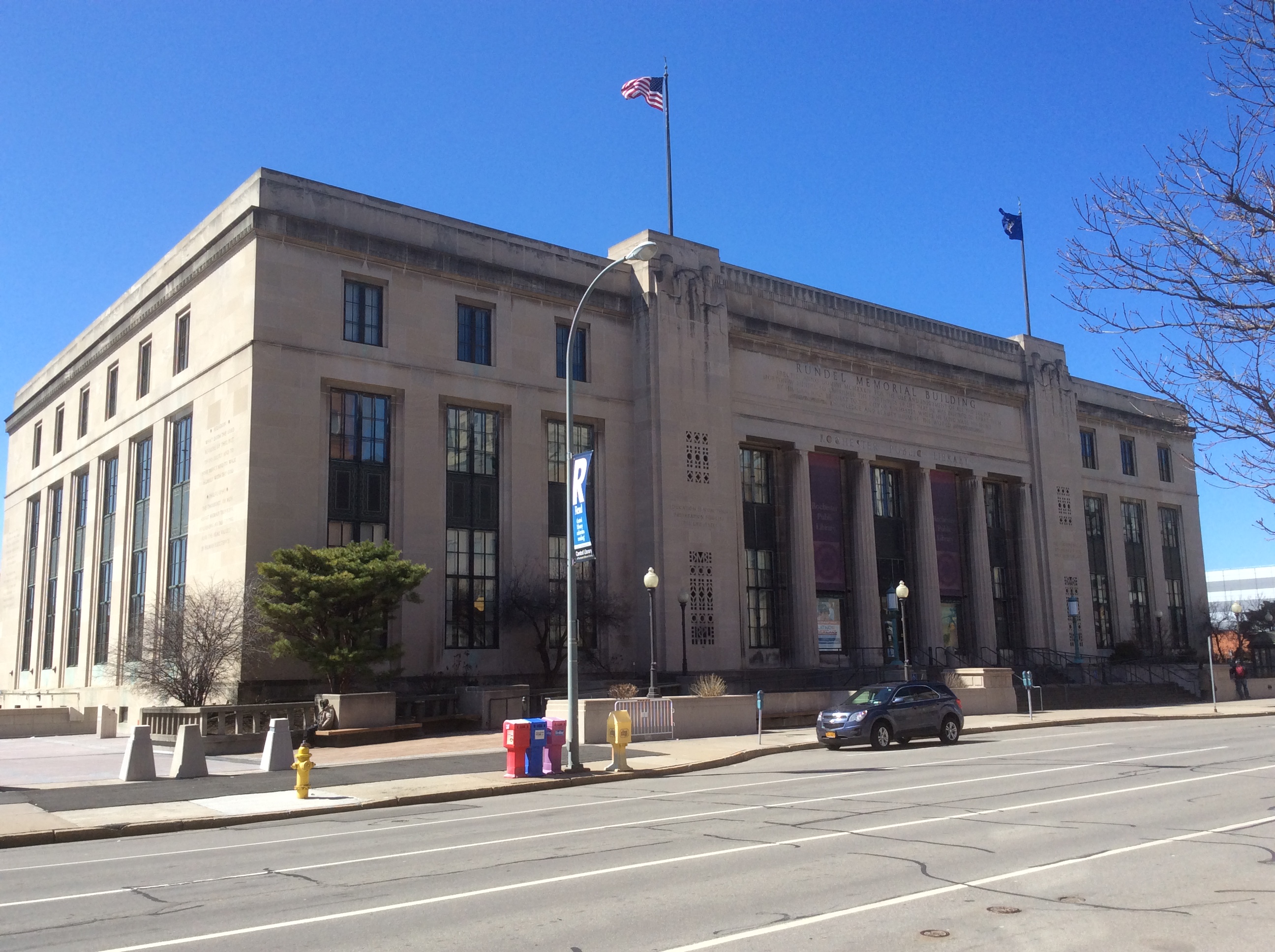
Among the many things I discuss with Anderson, I ask him where Rochester’s City Hall was in 1865; when I had looked for it, I found that the first official one, now called Irving Place / Old City Hall, was built in 1875 at 30 West Broad Street. He thinks it was probably on Broad St because that was the city center, but to make sure I have the exact location, he directs me to the Central Library of Rochester and Monroe County, to the City Historian’s office in the Rundel Building at 115 South Avenue. So that’s where I head next.
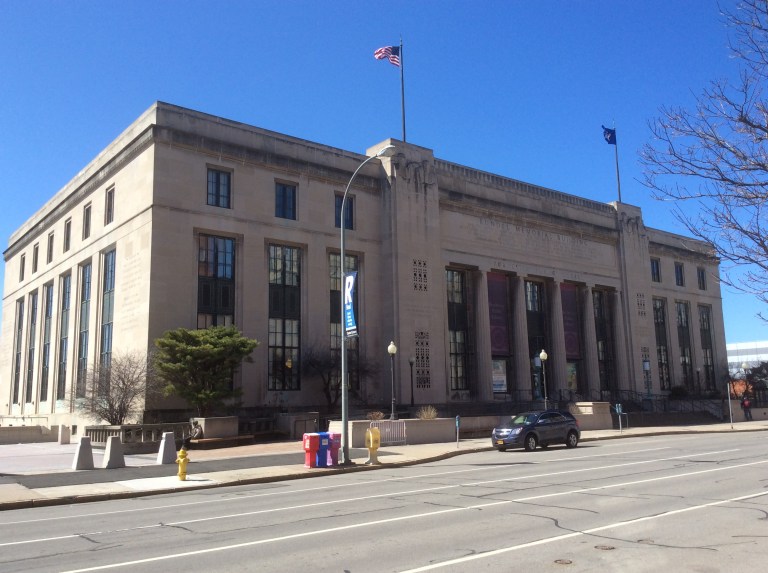
Rundell Building, Central Library of Rochester and Monroe County

Rundel Building, of the Central Library of Rochester and Monroe County, at 115 South Ave

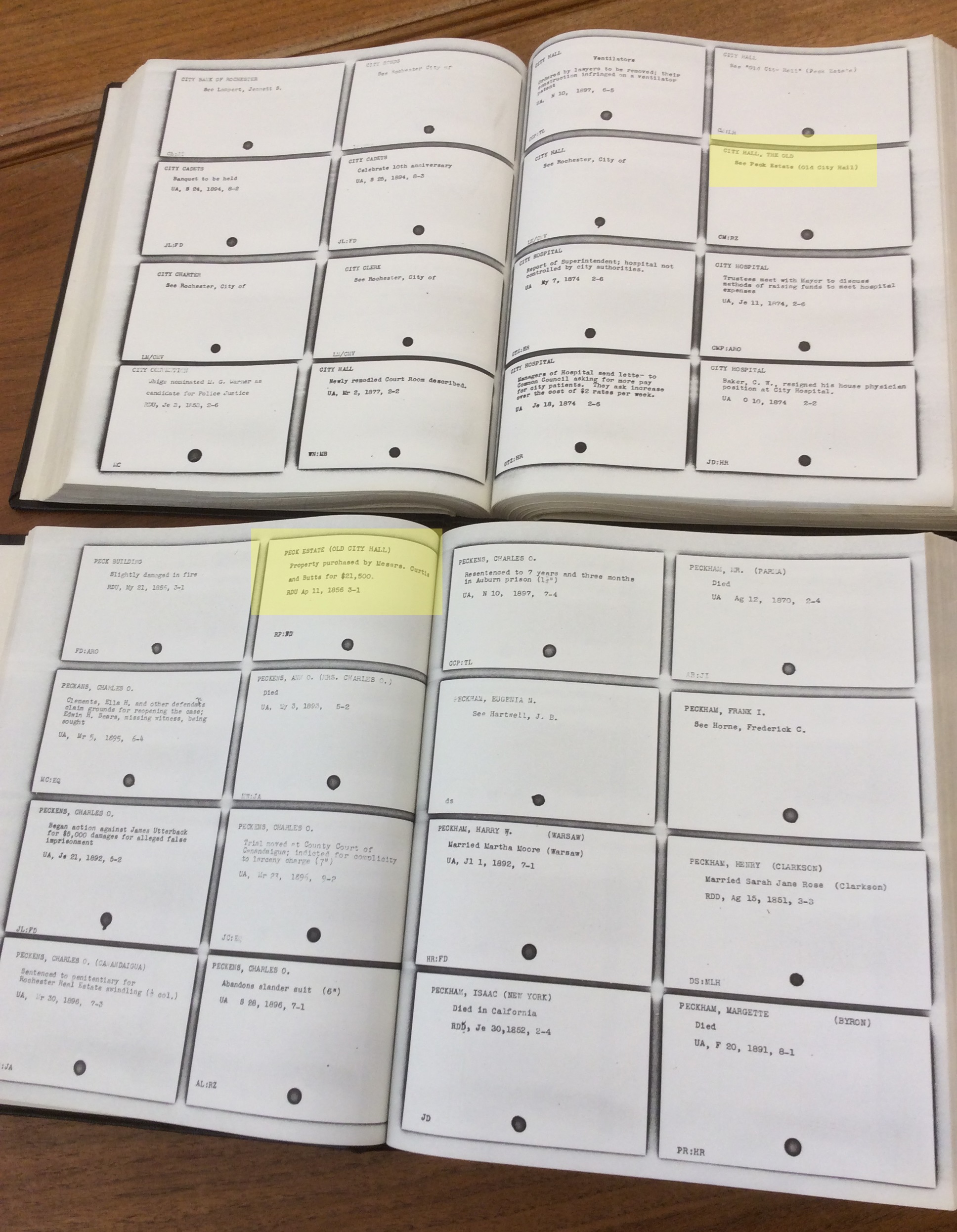
Index references to Old City Hall and Peck Estate, City Historian's Office of Rochester Public Library, 2016 Amy CoolsThe Rundel building is a handsome structure built spanning the years from the 19-teens through the 1930’s, and its pale gray-brown stone walls are punctuated with inscriptions, including this paraphrase of a John Dewey quote: ‘Education is more than preparation for life, it is life itself’. I’m sure Frederick Douglass would heartily concur, as much as he stressed the practical importance of education as well.

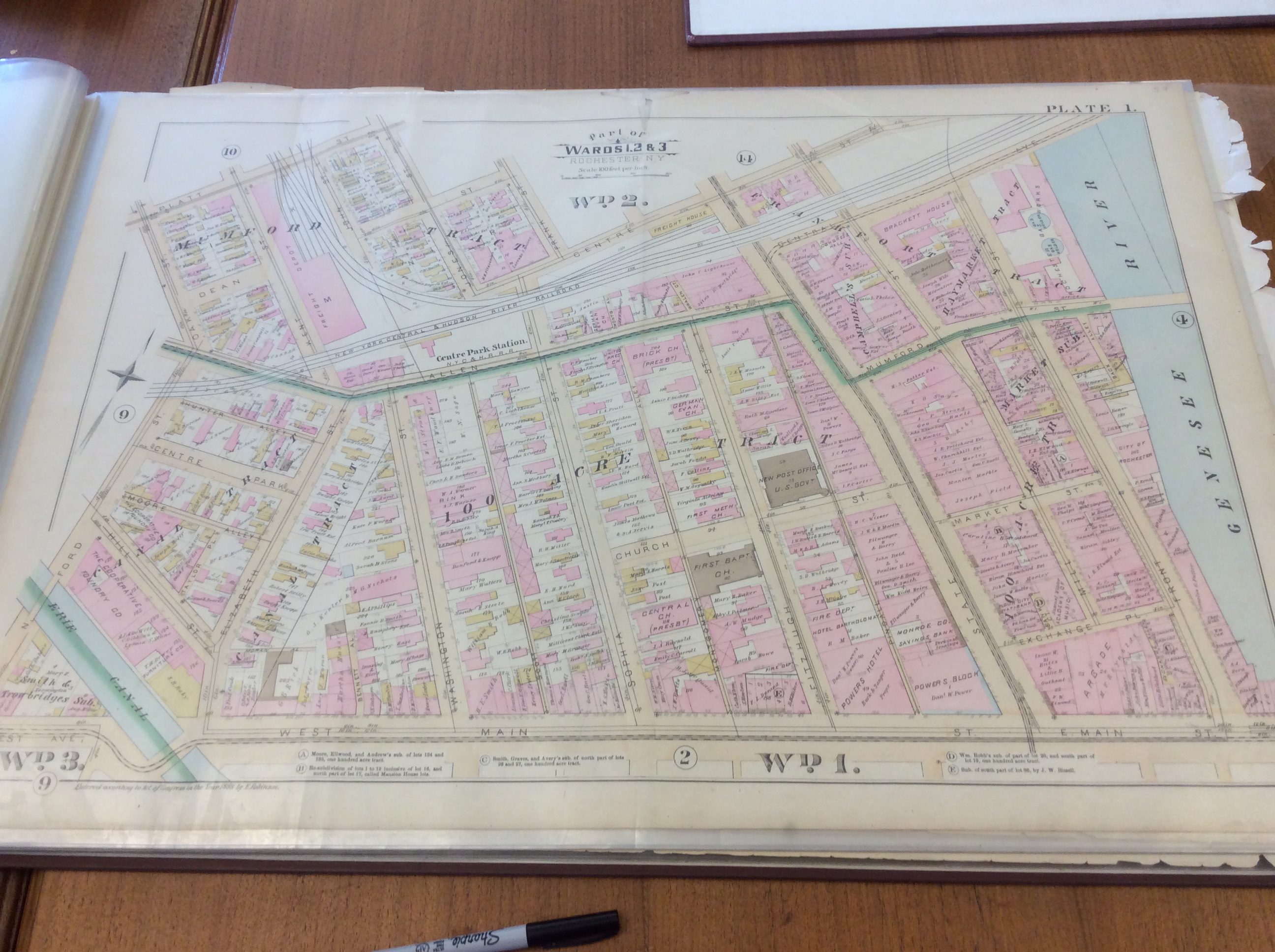
Librarian Cheri Crist, so knowledgeable and so generous with her time, proceeds to help me find what I’m looking for. Not long ago, she made a far more exciting discovery: a previously unknown Frederick Douglass photograph, taken in about 1873 and lost in the depths of the archives for over a hundred years. Today, Crist provides me with sources to help me track down the 1865 location of City Hall, starting with a search of the index card files, though we don’t find any that indicate the right time period there. We decide to cross reference some index entries with old newspapers, and Veronica Shaw helps me find old microfiches of the Rochester Daily Union. (*A clarification from Cheri Crist since this account was published: ‘The resources that we consulted at the Rochester Public Library are from the collection of the Local History & Genealogy Division, which is the department I worked for [as opposed to the City Historian’s office, which is a different entity]’. Thank you for the clarification, Cheri!)

Plat Book of the City of Rochester New York, 1888, Rochester Public Library

Plat Book of the City of Rochester New York, 1888, Rochester Public Library

Print of old article, Rochester's Evening Union on sale of Peck Building-City Hall and my notes

Print of old article, Rochester’s Evening Union on sale of Peck Building-City Hall and my notes

Our initial hunt leads us, after many twists and turns among newspaper accounts and old atlases, to an early location of City Hall. I’m all excited about the discovery until a careful rereading of the evidence shows this was in fact Old-Old-Old City Hall, prior to 1856, too early for the historical event I’m following today. Though we first find the wrong place after much searching and end up having to start over again, I find the wild goose chase to be lots of fun: it involves searching through pages and pages of old newspapers facsimiles and city atlases, getting a good glimpse of the history and layout of the city that I wouldn’t have gotten otherwise. I’ve been thoroughly enjoying the level of historical detective work this Douglass journey has led me into all along! We do subsequently find Old-Old City Hall, which, funnily enough, turns out to be much simpler search, it’s just that the right clue doesn’t turn up first: we had started with the index card files rather than old city atlases. More on that soon when I get to the site. In any case, I hope this search leads to a new index card in the City Historian’s files for City Hall between 1856 and 1875.

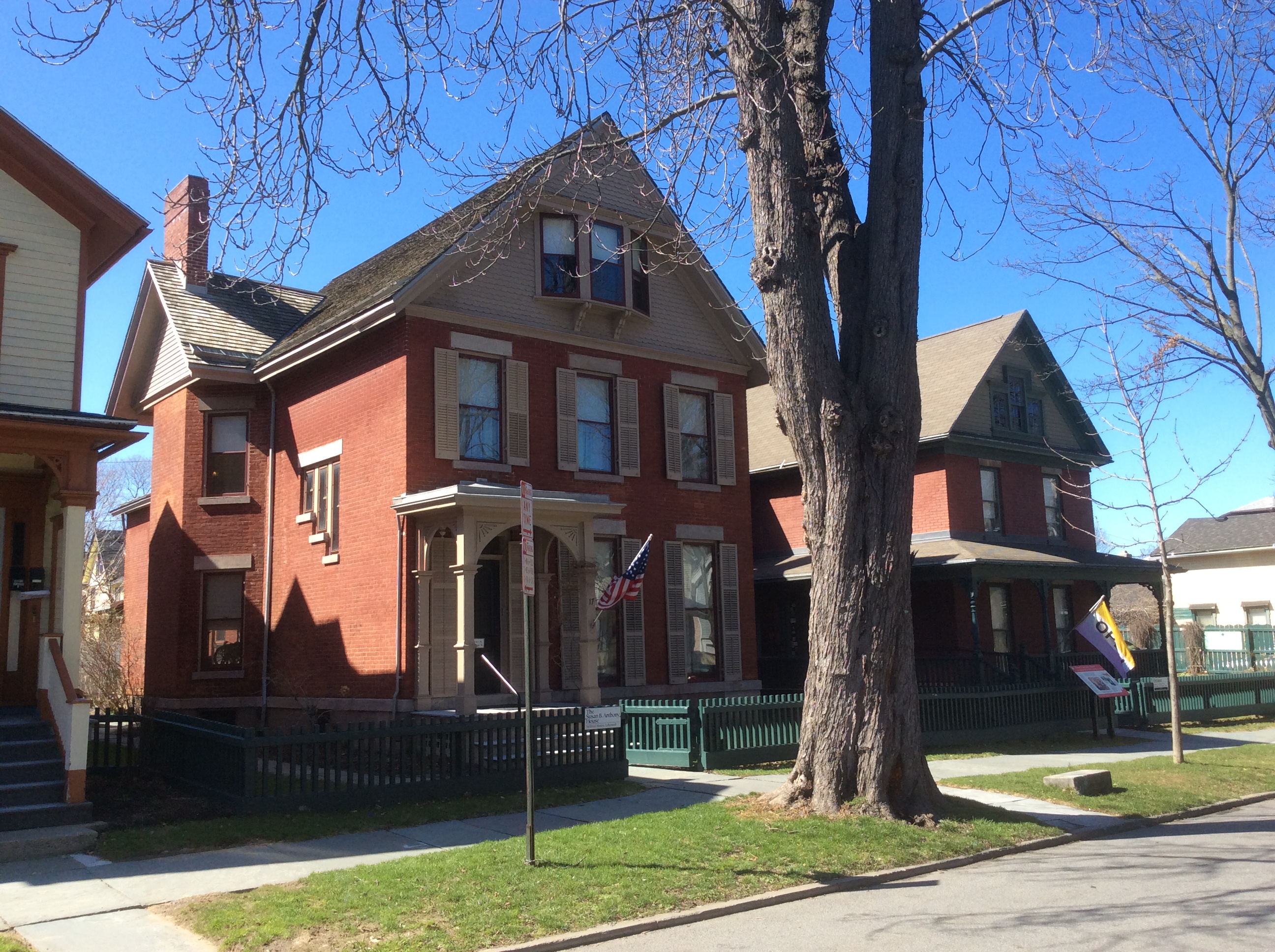
I realize, as soon as we find the site I seek, that the day’s really getting on, since I spent such a long, absorbing time with Anderson at Nazareth College and Crist at the City Historian’s office. I skeddadle to my next destination, the same place I start my tour of Rochester yesterday. It’s the Susan B. Anthony House at 17 Madison Street.
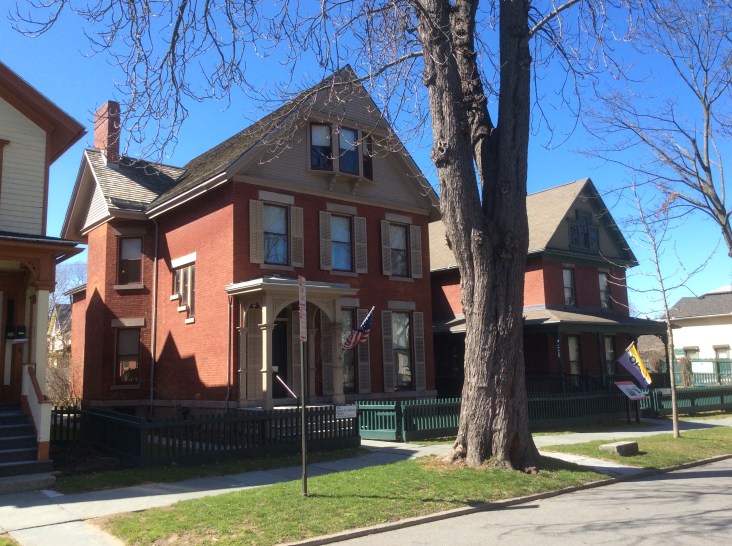
Susan B Anthony House (left) and Museum (right), at 17 Madison, Rochester

Susan B Anthony House (left) and Museum (right), at 17 Madison, Rochester

I visit the Susan B. Anthony House today for many reasons. I know Douglass and Anthony were friends (at least sometimes, and of different degrees and kinds when they were). Henry Louis Gates’ timeline in his Douglass Autobiographies compendium and history mentions Douglass visiting her at her Rochester home more than once in 1850, and other sources describe their visits as a regular occurrence around that time. And since they were sometimes friends and always activists in the same causes and lived in the same city for so long, Douglass must have visited Anthony here, right? Well, I find out early in the tour that while Douglass may have visited Anthony at this house and there are many good reasons to think he had, there’s no actual documentation of this. Anthony moved into this house 15 years after that particular 1850 documented visit, and other visits on several occasions while she was living in the family farmhouse now on the outskirts of Rochester, near the airport; more on that in a future account. Douglass lived in Rochester until 1872, and Anthony was among his many friends who pleaded with him to stay. So they must have been on good terms at that time, and she had been living in this house for 7 years by this time. I consider it likely, given all this, he would have visited her here at some point.
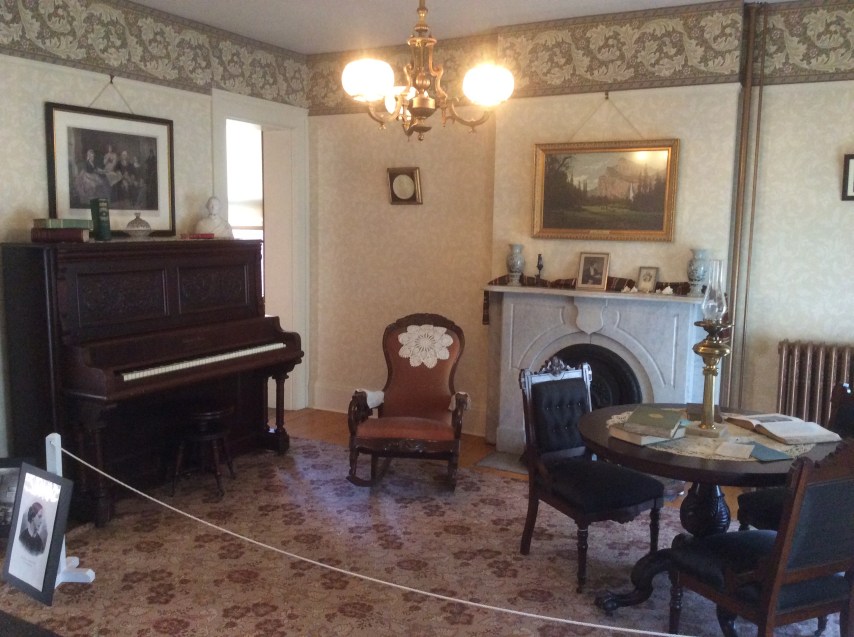
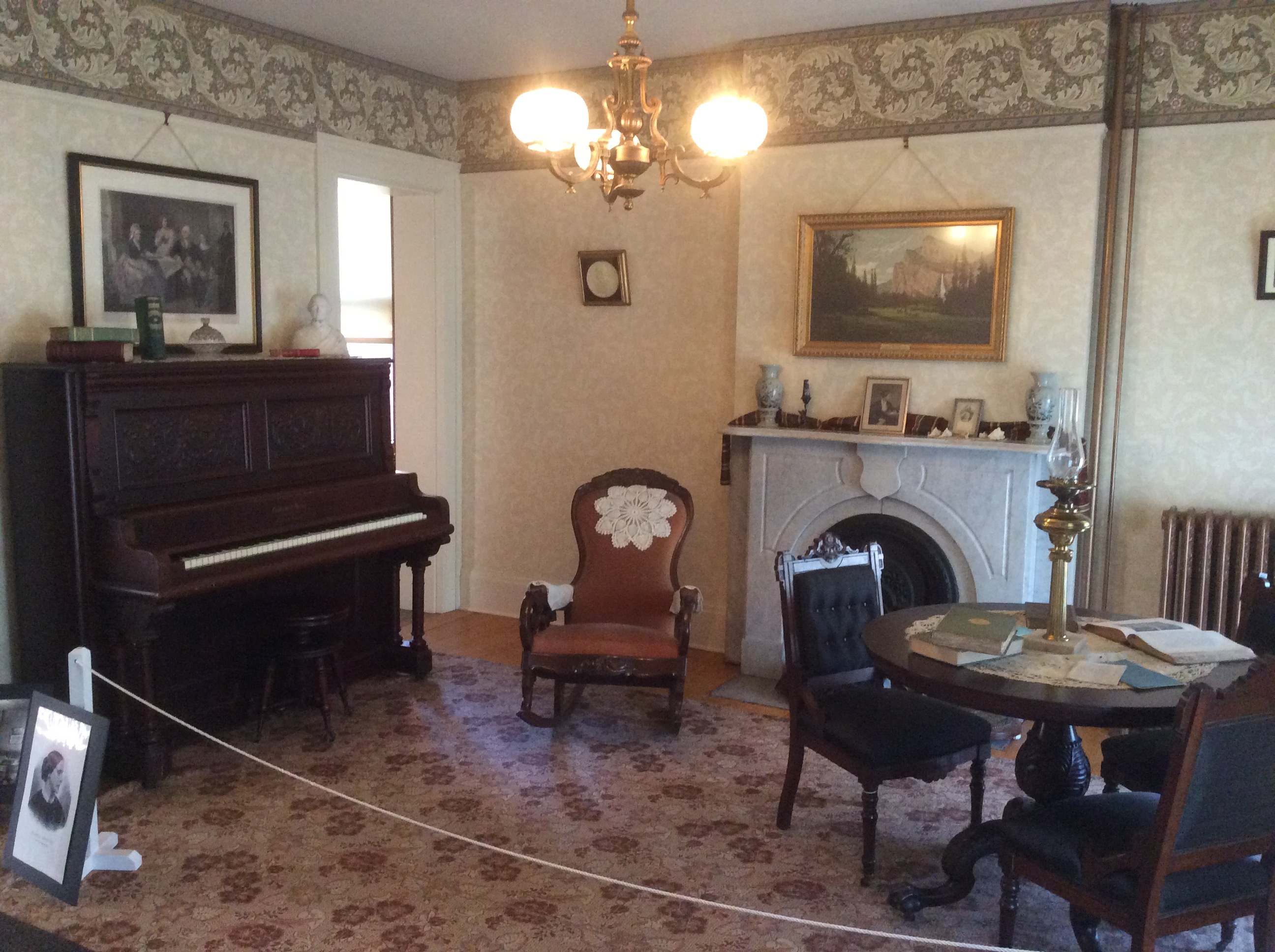
 Front Parlor of Susan B Anthony House in Rochester. I snap this photo before I see the 'no photography' sign, thinking the policy was the same here as in the museum. But the deed was done, and I'm not one to let a good photo go to waste

Front Parlor of the Susan B Anthony House in Rochester. I snap this photo before I see the ‘no photography’ sign, thinking the policy was the same here as in the museum. But the deed is done, and I’m not one to let a perfectly good photo go to waste
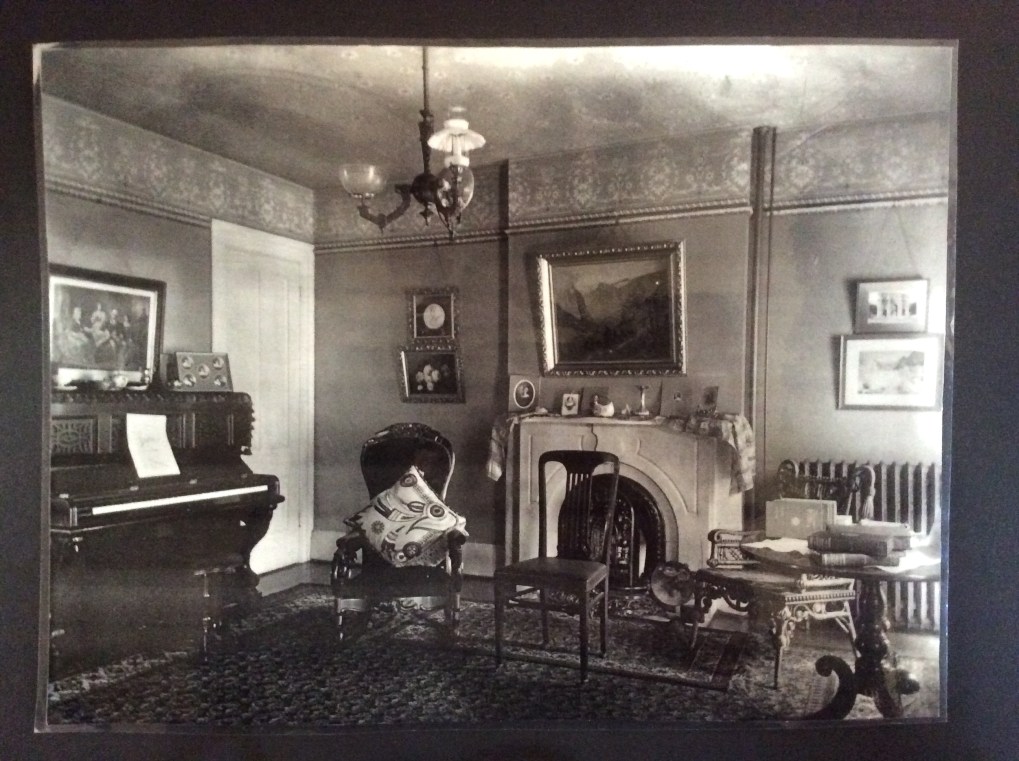
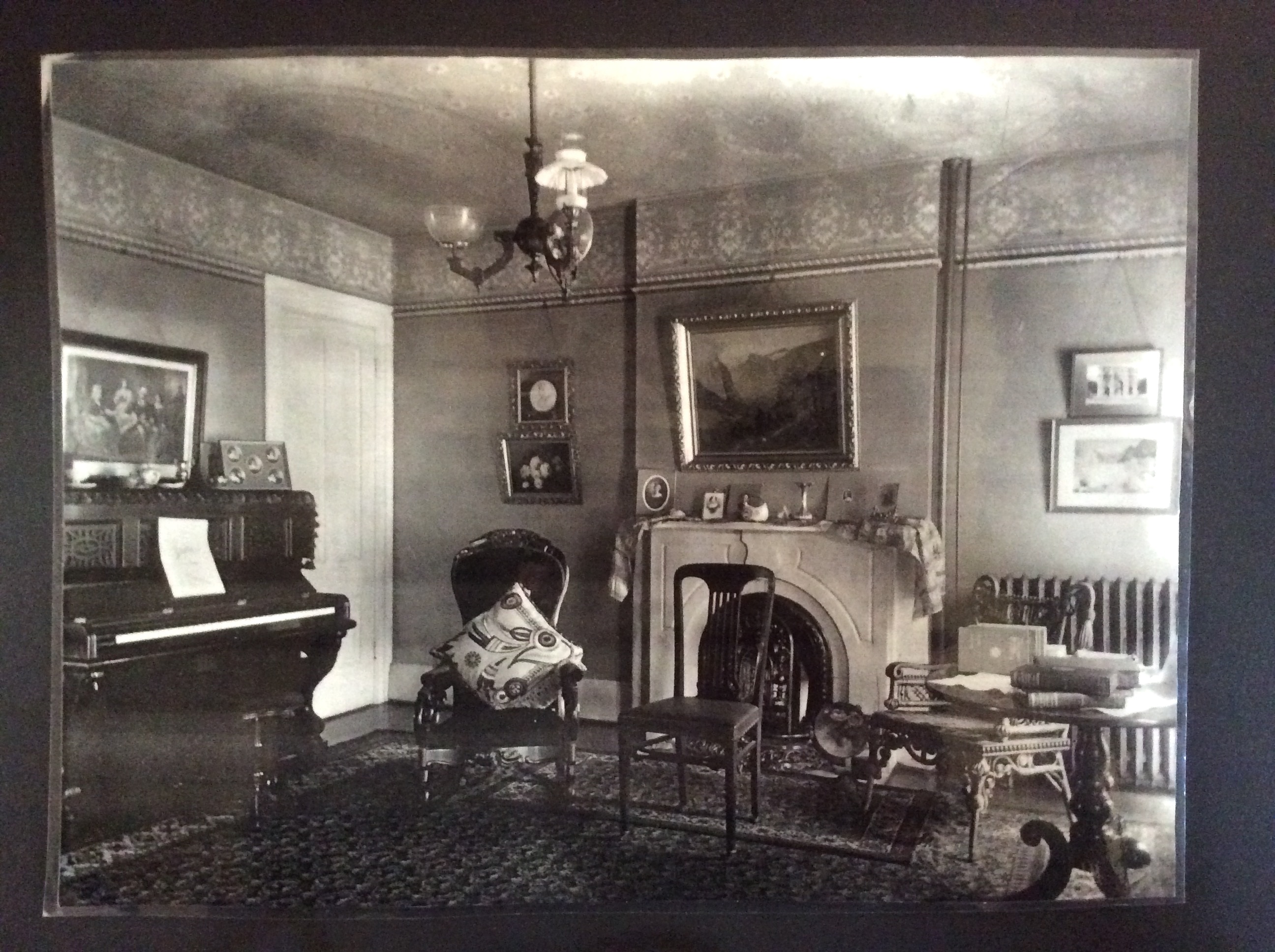
 Parlor of Susan B. Anthony House, photo of photo at museum exhibit

Parlor of Susan B. Anthony House as it looked in her time, this is my photo of the photo at the museum exhibit

Susan B Anthony House Museum plaque telling the story of her arrest for voting in 1872

Susan B Anthony House Museum plaque telling the story of her arrest for voting in 1872, and a brief timeline of her life

I have a most delightful visit, in a quiet moment between tours, with Linda Lopata, the Visitor Center manager, and Carolyn, Mary, and another kind woman whose name I can’t recall at the moment; if you read this, please excuse my forgetfulness, and I would be delighted to be reintroduced! They have a wealth of information to share and couldn’t be more kind, and are so sweet in their interest in my project and willingness to help. We talk some about Douglass, about whom they’re quite knowledgeable, and a lot about Anthony, including her arrest at this house for voting in the 1872 presidential election along with fourteen other women. Try as I might in an hour-plus-long search, I can’t find their names listed anywhere. It bothers me somehow to leave them anonymous, as all the sources I’ve found so far do, when they acted as bravely and with as much conviction at the polls as Anthony did! (I would be grateful, dear reader, if you happen to know how where to find their names and can pass the word along. Unless, of course, these women desired their names to remain anonymous, as was their right, to avoid scandal or censure. UPDATE: the always delightful and helpful Paige Sloan sent me a link to a page where the names of these brave voters are listed: their names are Charlotte Bowles Anthony, Mary S. Anthony, Ellen S. Baker, Nancy M. Chapman, Hannah M. Chatfield, Jane M. Cogswell, Rhoda DeGarmo, Mary S. Hebard, Susan M. Hough, Margaret Garrigues Leyden, Guelma Anthony McLean, Hannah Anthony Mosher, Mary E. Pulver, and Sarah Cole Truesdale.) The officials who allowed them to register to vote likely sympathized with their cause, and were certainly convinced by her interpretation of the 14th and 15th Amendments, that the first strongly, and the latter less so, implied that women had the right to vote.

Douglass, the ardent feminist and advocate of universal suffrage, must certainly have approved of this bold move, and the fact that all save one voted for his preferred candidate Ulysses S. Grant would have pleased his too. But he was no longer in town to lend his support in person, since he and his family had already moved to Washington D.C. that July.

S. Main and Fitzhugh Sts, site of Rochester's City Hall in 1865

Monroe County Executive Office building at S. Main and Fitzhugh Streets. The north of the building, where Patrick Printing is now, covers the site of Rochester’s City Hall in 1865. Pindle Alley runs through that little space you can see between the MCEO building and the Powers Building next door

My next destination is less than a mile almost directly east, at S Fitzhugh St just a little south of Main, to the site of the City Hall in 1865 we had searched for so assiduously this morning. The digitized 1863 map we found on the Monroe County Library System’s website shows that it stood where the Monroe County Executive Offices stand at 39 West Main is now. The long red brick building’s north end covers the site. As you can see from the ‘Reference’ (legend) at the top right of the map, #55 identifies that City Hall location, just across the street from that Old-Old-Old City Hall site we discovered at the corner of Main and tiny Pindle Alley, and just a little north from the Irving Place Old City Hall built in 1875, all three within a two-block radius.
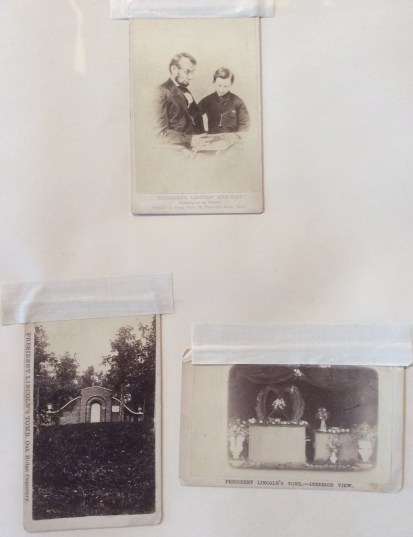
Abraham Lincoln with his son and 2 views of his tomb, from Hutchinson scrapbook at Lynn Museum

Abraham Lincoln with his son and 2 views of his tomb, photos from the Hutchinson family scrapbook at the Lynn Museum

I seek this site today because Douglass gave an impassioned, impromptu eulogy here in remembrance of his hero and friend Abraham Lincoln. A crowd had gathered here on April 15th, 1865 to mourn Lincoln’s death that morning, and they called upon Douglass to speak. He did so, delivering by all accounts one of the most moving addresses he ever gave. As Douglass sadly told them, ‘It was only a few weeks ago that I shook his brave, honest hand, and looked into his gentle eye and heard his kindly voice.’ That occasion was on March 4th of that same year, when Douglass went to the White House to congratulate Lincoln on his second inauguration and the excellence of his address. A you may remember, Douglass was critical of Lincoln’s first inaugural address, with its weak stance on slavery. The second, besides its sheer eloquence and beauty, was unapologetically anti-slavery, so of course Douglass heartily approved of it. Douglass went to the White House on his own account and was turned away at the door by two officers who said they were instructed by Lincoln not to admit black people. Douglass accused them of lying, which they were, and insisted on entering. He was ultimately successful, and when Lincoln spotted Douglass across the room, he called out ‘Here comes my friend Douglass’ and shook his hand. This was a moment of great triumph and validation for the proud, dignified Douglass, and he would treasure it for the rest of his life.
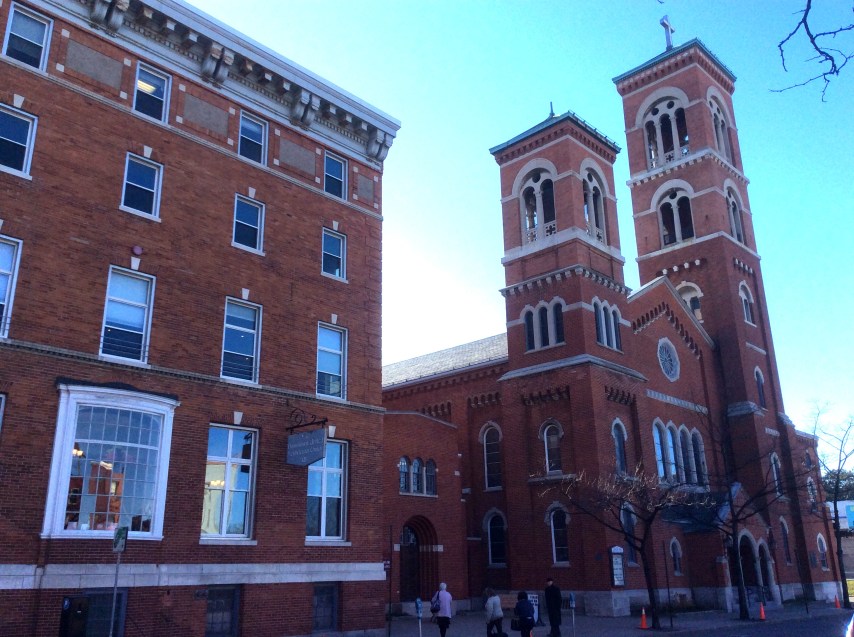
Downtown United Presbyterian Church and adjoining hall with 1848 Rochester Women's Rights Convention commemorative plaque. The sun was sinking low behind the church when I took this photo

Downtown United Presbyterian Church and adjoining hall with 1848 Rochester Women’s Rights Convention commemorative plaque.

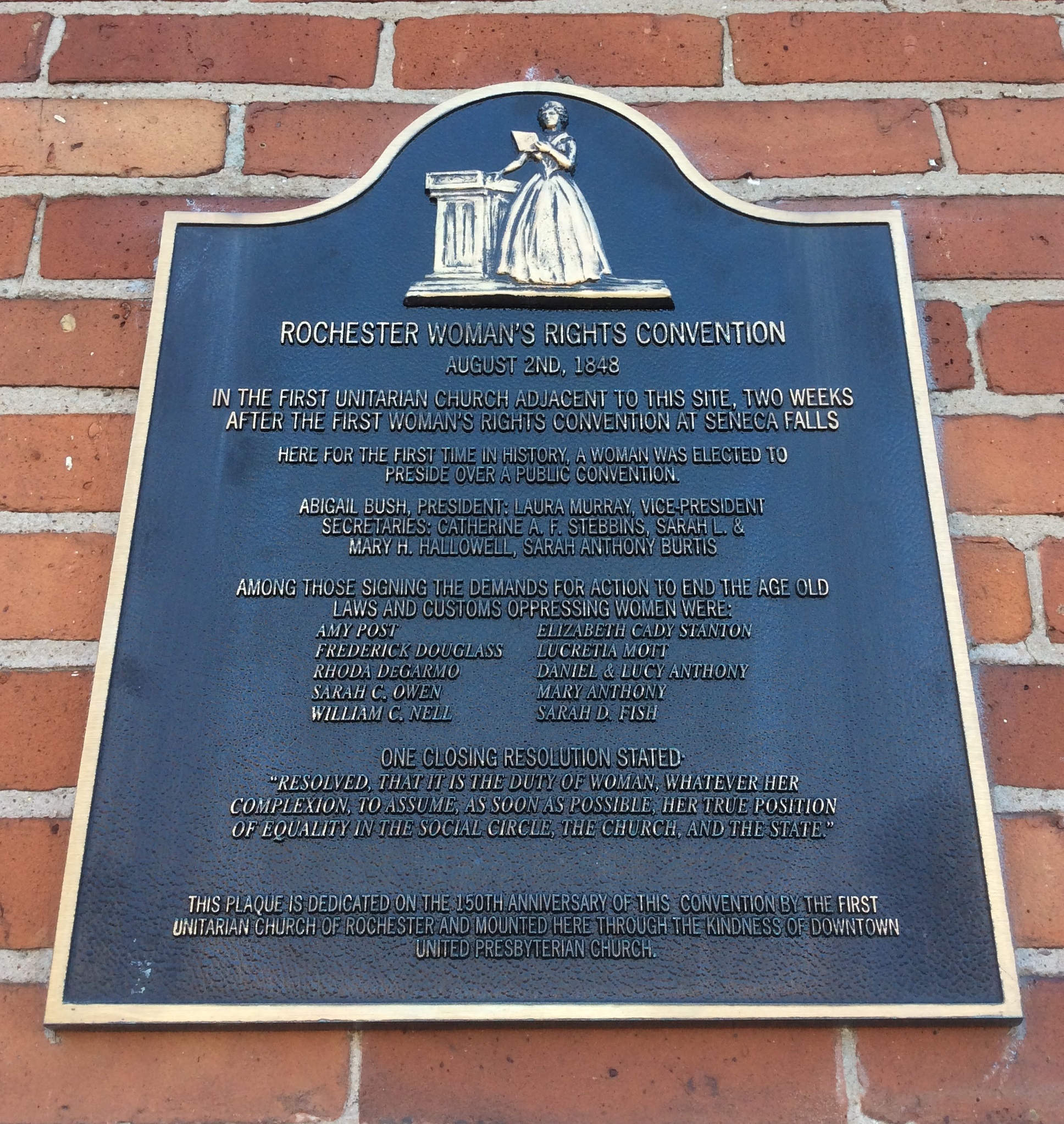
1848 Rochester Women's Rights Convention plaque, Downtown United Presbyterian Church

1848 Rochester Women’s Rights Convention plaque at the Downtown United Presbyterian Church.

My next destination is just two long blocks north, Downtown Presbyterian Church at 121 Fitzhugh St. It’s a lovely building with beautiful stained glass windows. It takes many, many attempts to snap any photos I can use since the sun is sinking low right behind the church, and still, I can’t quite color-correct the photos enough to do it justice. In the process, three ladies on separate occasions stop to exclaim something to the effect of ‘isn’t it beautiful?’ and to invite me an event going on there that evening. On an adjoining building to the left of the church, there’s a plaque commemorating the 1848 Rochester continuation of the Seneca Falls Women’s Rights Convention, which we’ll discuss in my next day’s account of this journey. This used to be the Unitarian Church, and the meeting was held in the church building itself. Douglass spoke at this convention as well, according to Ms. Lopata at the Susan B. Anthony House. In his remarks, he reiterated his conviction that he could not deny a woman any right he claimed for himself, nor could any just individual do so.
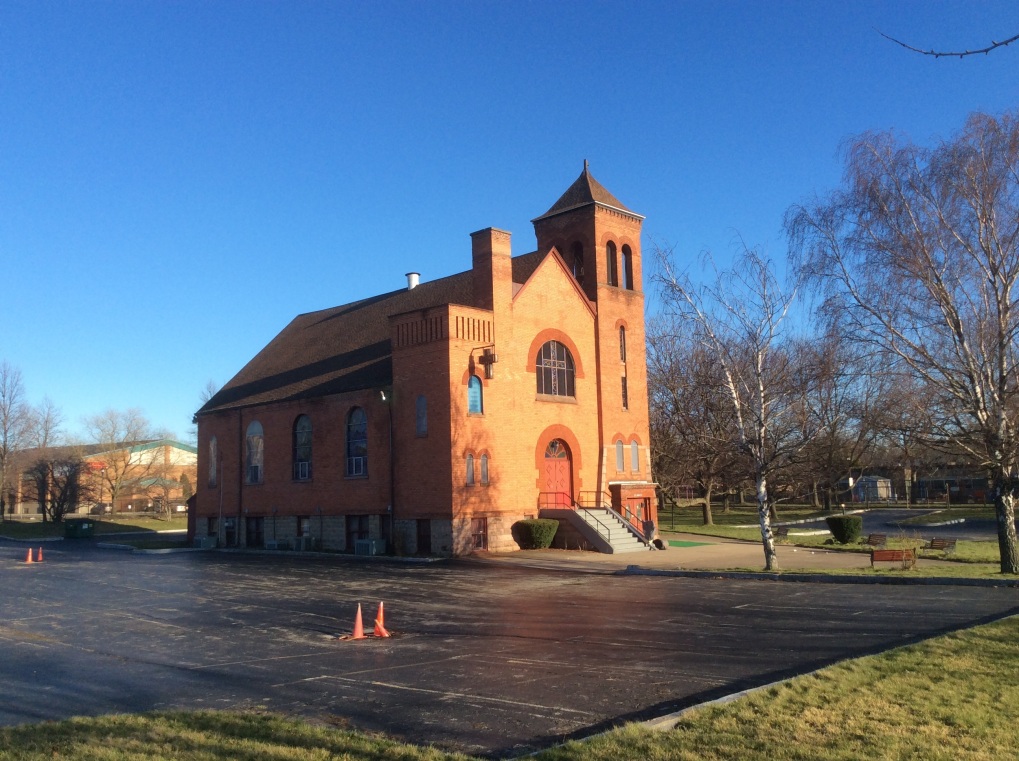
 American Methodist Episcopal Zion Church, Douglass family congregation Rochester

American Methodist Episcopal Zion Church in the historic Corn Hill neighborhood of Rochester. The Douglass family were members of this congregation who worshiped in one of the church’s earlier incarnations nearby, no longer standing

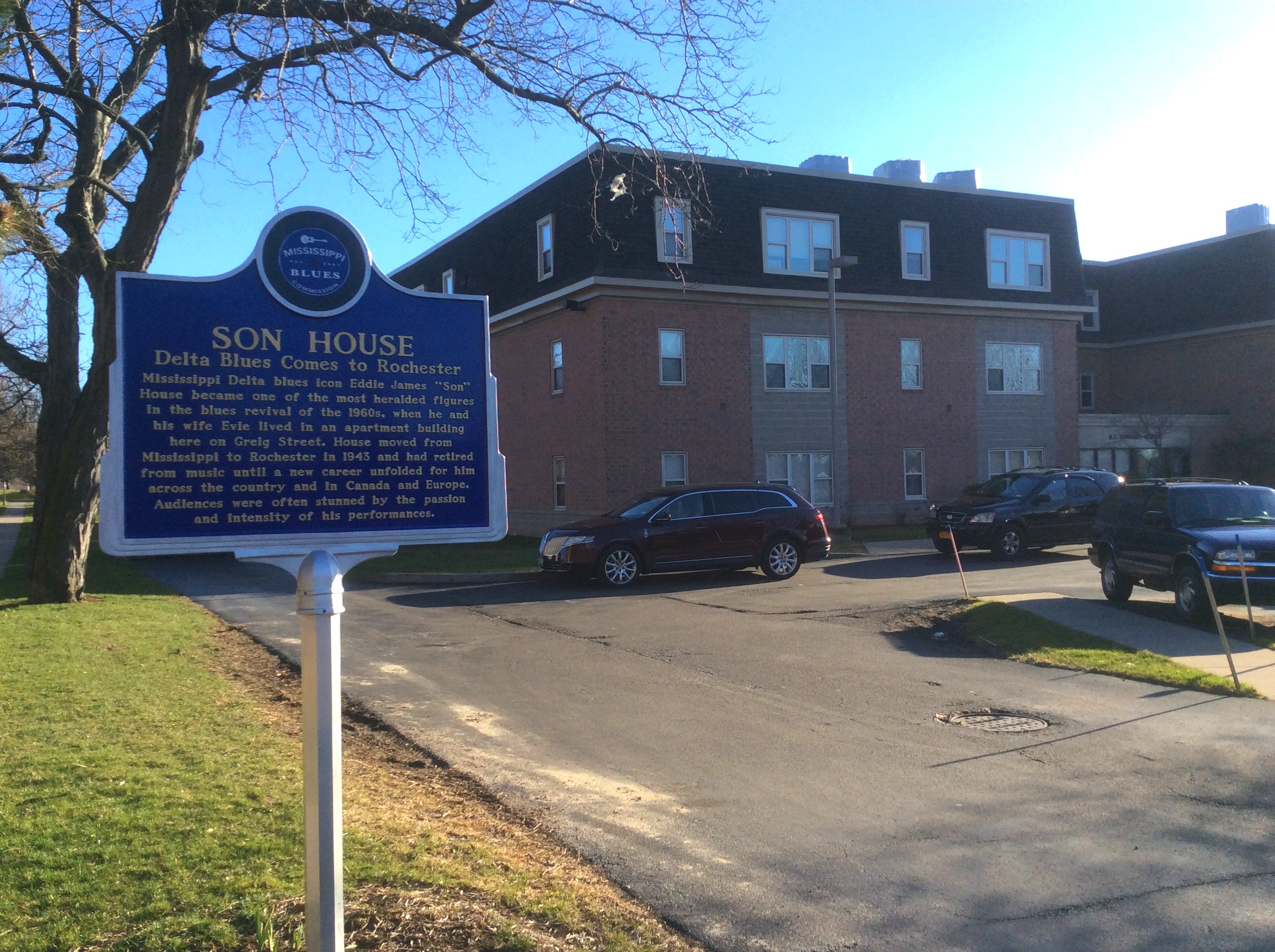
Son House apartment building site on Greig St, Corn Hill, Rochester NY, photo 2016 Amy Cools

Site of apartment building on Clarissa at Greig St where the great Son House once lived.

I zigzag my way a little over half mile east to the historic Corn Hill District, where the Memorial African Methodist Episcopal Zion Church now stands at Favor and Clarissa Streets, just off Ford. According to Cindy Boyer, Rochester’s Landmark Society director of public programs, ‘Clarissa Street was once the business and cultural heart of Rochester’s African American community… In the 1950’s, it became a jazz and entertainment hub.’ Exploring Clarissa St on my way from the current location of the AME Zion Church at 549 Clarissa St to the old site, I notice one of those distinctive blue historical marker signs and discover that the great bluesman Son House lived on Clarissa at Grieg St in the 1960’s. Cool.

The original site of the AME church was just a little east of this one, on the northeast corner where Spring and Favor streets once intersected, near where the 490 freeway now passes through. Anderson directs me here in our discussion this morning, as the Douglass family belonged to this progressive congregation, dedicated to reform and the education of black children. The church was also an important stop on the Underground Railroad. It had been reorganized and rebuilt by Thomas James, a former slave who became a minister and educator who founded new congregations in several cities. James was the one, according to Anderson, who had licensed Douglass, many years ago, to preach in New Bedford.

According to Michelle Finn, Deputy Historian of the City of Rochester, ‘The third church building, which is depicted in this photograph, featured memorial windows dedicated to Douglass, Anthony, Harriet Tubman and others’. I wonder why ‘featured’ is in the past tense: the photos reveal it’s the same building that stands today, and it appears there’s stained glass within the outer panes I can see from where I’m standing. Perhaps the stained glass windows are no longer intact; the church is all closed up, padlocked and surrounded by chain link fence so I can’t approach it to make sure.

I continue on, crossing over the Frederick Douglass-Susan B. Anthony Memorial Bridge, which carries Interstate 490 over the Genesee River in downtown Rochester, to my next destination.
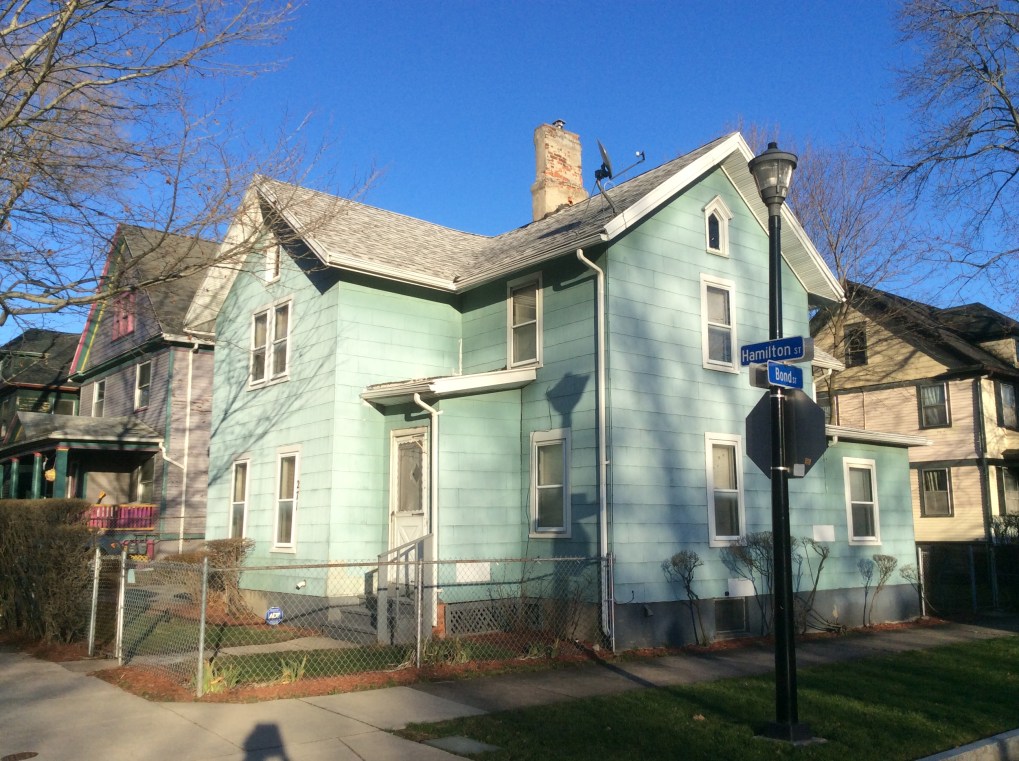
Rosetta Douglass home at 271 Hamilton Street at Bond
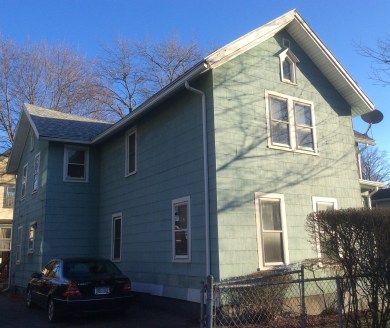
Rosetta Douglass home at 271 Hamilton Street at Bond

 Another view of Rosetta Douglass home at 271 Hamilton Street


Another view of Rosetta Douglass home at 271 Hamilton Street

At 271 Hamilton Street at Bond, there’s a two story blue house which was not long ago discovered to be a home owned by Douglass and his daughter’s family. This makes it the first house that Douglass owned and stayed in for any length of time that’s still standing, so I’m very excited to discover it too! Anderson’s colleague and fellow historian Jean Czerkas made the discovery of the deed for the house that had Douglass’ name on it. ‘She’s serious!’ said Anderson to me this morning. Czerkas has made many other important discoveries in local history over the years, including sites associated with the life and work of Austin Steward, one of Douglass’s fellow black abolitionists and Underground Railroad operatives and a successful Rochester business owner. ‘[Czerkas] helped me in another way’ Anderson continued. ‘She found out Austin Steward had children buried in Rochester.’ Steward is a fascinating figure, I’m very glad to learn about him and encourage you to so as well; like Douglass, he wrote a narrative of his life first as a slave, then as a free man and anti-slavery activist.

Douglass’ daughter Rosetta and her husband Nathan Sprague lived in this house for several years before following her father to Washington D.C. Douglass kept the house, however, listing himself as a boarder. Since he had fought so long for the right to vote and residents of Washington D.C. could not vote in presidential elections at the time, he retained that precious right for himself by keeping an official residence in Rochester.
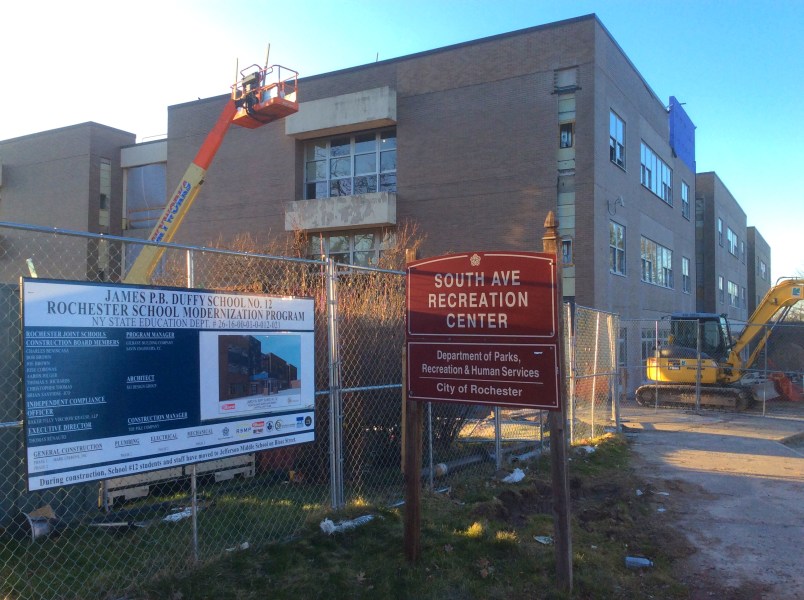
James P. Duffy School at site of Frederick Douglass Rochester farm home, under construction

James P. Duffy School, which stands on the site of the Douglass family home and farm, then on the outskirts of Rochester, on South Avenue. The school is being remodeled and improved.
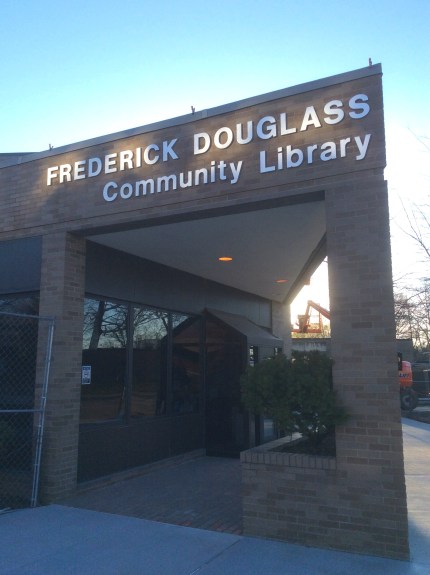
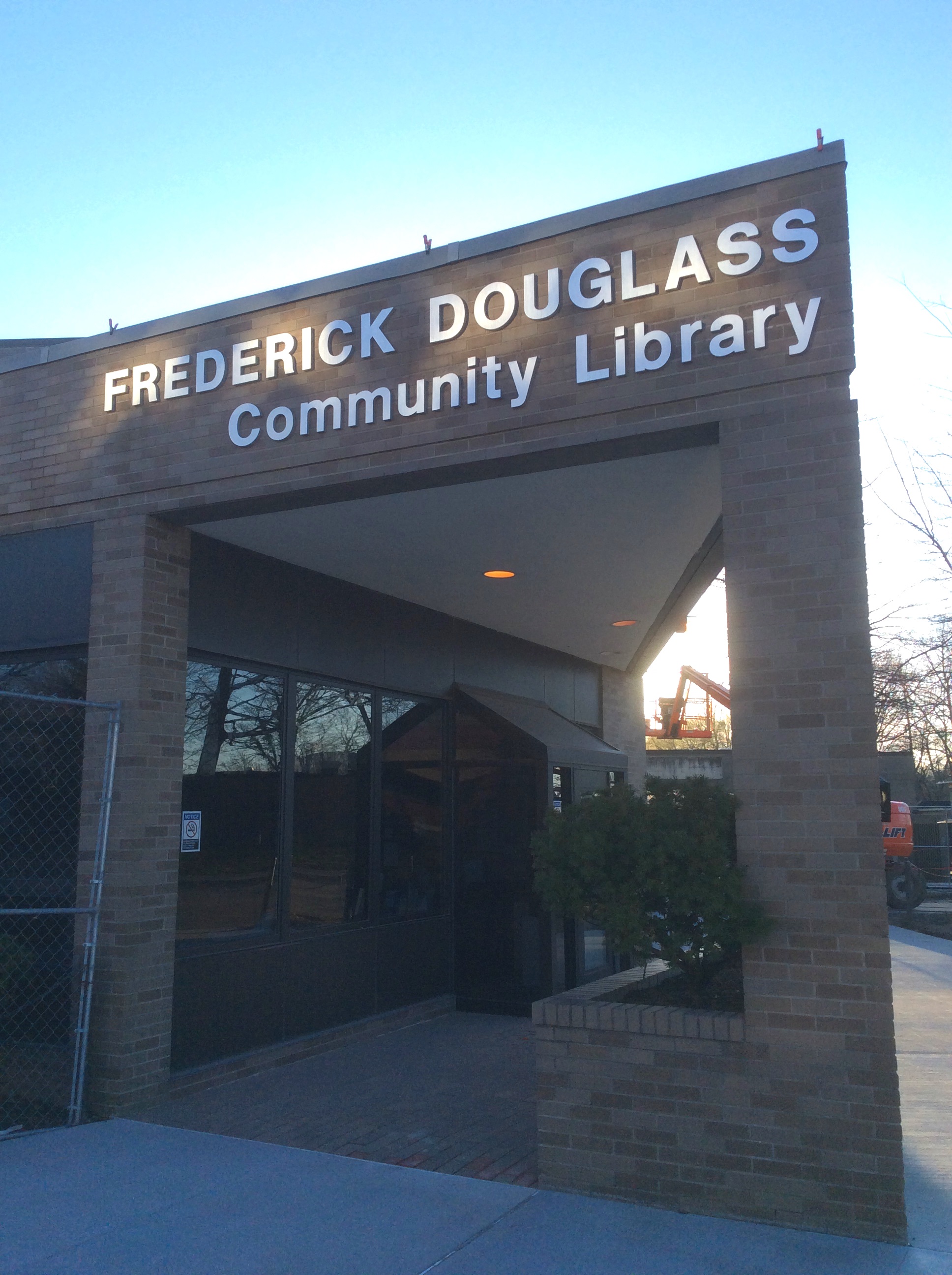
Fredrick Douglass Community Library at James P. Duffy School, site of South Ave Douglass home

Fredrick Douglass Community Library adjacent to the Duffy school, original site of the Douglasses’ South Ave home

I head south on Alexander St and turn left on South Avenue, which continues to take me south toward Highland Park. I look for the historical marker which I read is located at the site now occupied by James P. Duffy School at 999 South Ave near Highland Park, and for the community library now named after Douglass. Anderson said he and other local historians and citizens are making good headway in getting the school renamed after Douglass too. I easily find the school, which is being rebuilt. But I find no historical marker, though I circle the building slowly and scan the area carefully. Perhaps it’s been taken down until the construction is done, or it’s obscured by the large quantity of construction equipment and materials here now. (Update: fellow Douglass enthusiast and Rochester resident Paige Sloan comes to the rescue again and does a little more searching, locating the historical marker at this site. See the photos below.)
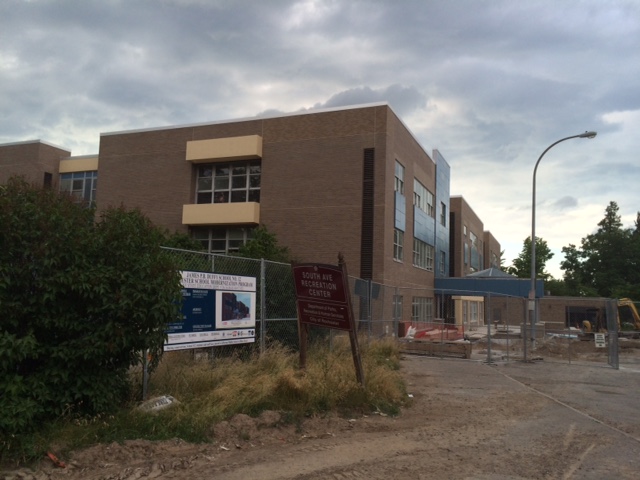
Frederick Douglass South Ave home site, photo 2016 by Paige Sloan

Frederick Douglass South Ave home site near the school under construction, with the historical marker now visible from this angle just beyond the red sign since it’s now leaning to the left. Photo 2016 by Paige Sloan

Frederick Douglass South Ave home site marker, 2016 Paige Sloan

Frederick Douglass South Ave home site marker, 2016 Paige Sloan

In 1852, Frederick Douglass moved his family here from that urban red brick house on Alexander Street to a hill top farmhouse on what was then the outskirts of the city. It was private, with no near neighbors, plenty of land surrounding it, and fruit trees galore: a perfect setting for five growing children and for sheltering runaway slaves. Both Douglass family homes in Rochester were Underground Railroad institutions.

Douglass loved his South Ave home and farm. He built a cozy office and library upstairs, he loved to ride his large white horse on the grounds, he planted trees with his own hands, his sons worked the land, and Anna kept a beautiful and orderly home. They lived here for twenty years, until June 2 1872, when it burned to the ground. The family escaped unharmed, and friends helped the family save many of their personal goods and all of the animals, but many of Douglass’ important papers and bound volumes of every issue of the North Star were burned. We suffer their loss too, as copies of very many have never been found elsewhere. Douglass was of town the day the house burned, and returned the next day having heard the news. He believed the fire was purposely set; the fire insurance company agreed with him. He had continued to struggle with elements of racism even in this relatively tolerant city, the city he said he felt most at home in, enough to believe the worst. He was so bitter over it that he decided to move his family to Washington D.C. for good. Their daughter Annie had died here in 1860 at only 10 years old; perhaps Anna’s unabated grief made her more amenable to moving from the place they had called home for twenty five years.
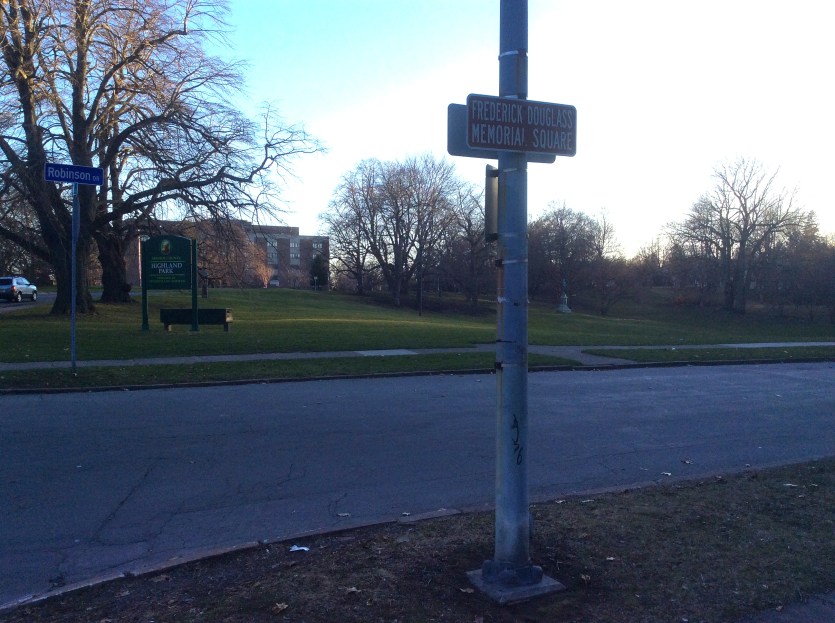
Frederick Douglass Memorial Square at Highland Park, at South Ave and Robinson Drive

Frederick Douglass Memorial Square at Highland Park, at South Ave and Robinson Drive. You can just make out Frederick Douglass’ monument / statue in the background just to the right of the signpost.

Then I continue up the hill, just a short stroll continuing south on South Ave to Robinson Dr, to end my day’s explorations at beautiful Highland Park. It was designed in 1890 by another Frederick, Frederick Law Olmsted, designer of Manhattan’s Central Park and Brooklyn’s Prospect Park. Olmsted is famous for creating some of the world’s most beautiful parks, with landscapes designed to look as natural as possible while maximizing their utility as public spaces.
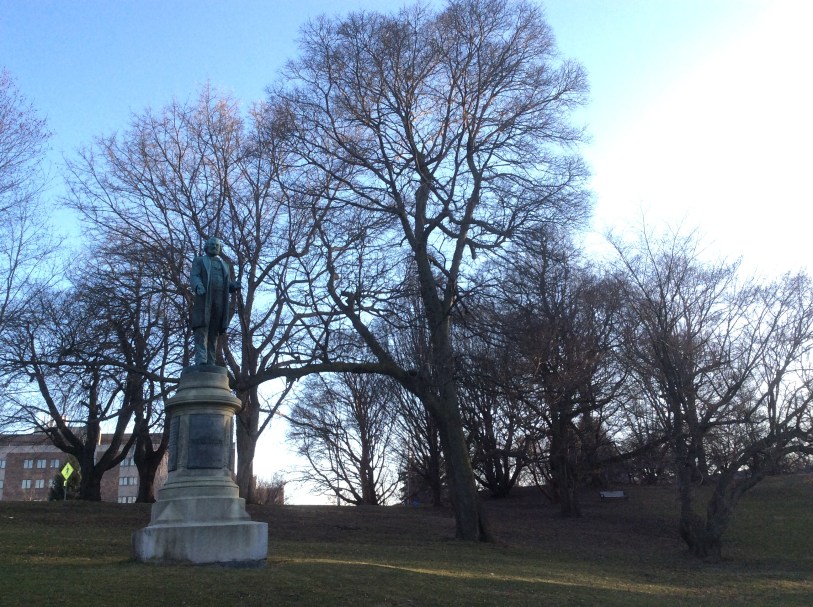
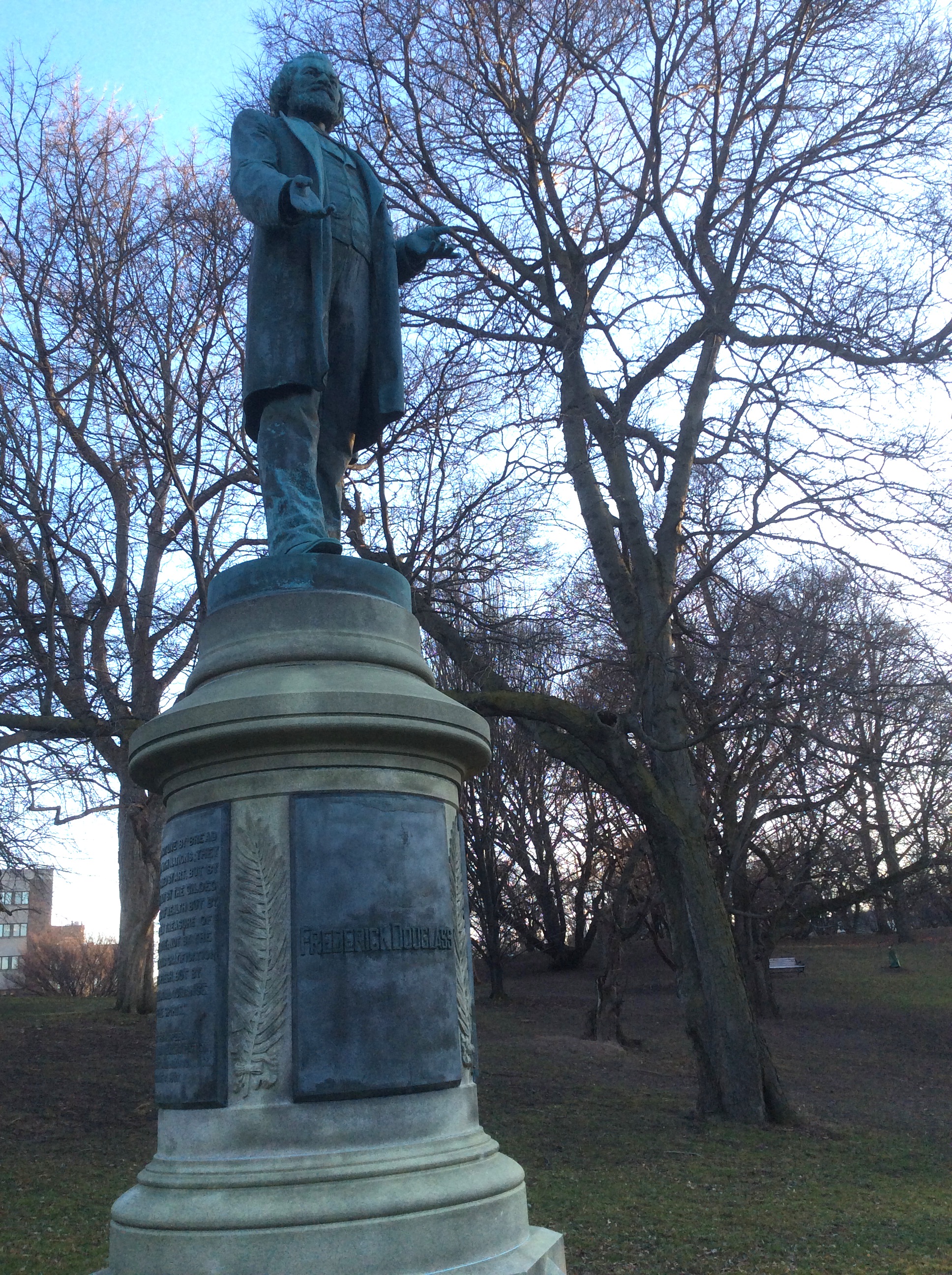
Frederick Douglass Monument Statue in Highland Park, Rochester NY

Frederick Douglass Monument and Statue in Highland Park, Rochester NY. It’s the first monument erected to memorialize an African American in the United States.
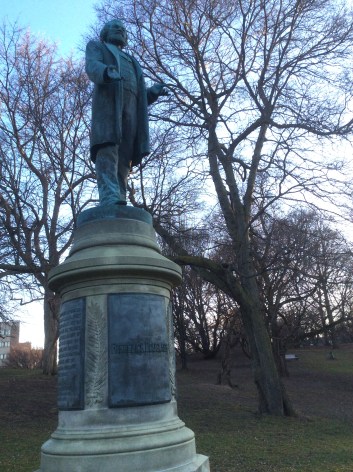
Frederick Douglass Monument Statue in Highland Park, Rochester NY, closer, 2016 Amy CoolsI cross Robinson Dr. to my right at an angle, then into the park down to Highland Bowl, the natural amphitheatre between Robinson Dr and Reservoir Ave with an Art Deco look open air theater built at its west end. Across the large grassy depression that makes the bowl, halfway up the hill on the other side from Robinson and to the left (or east) of the theater, there stands an 8 foot statue of Frederick Douglass on a tall columnar pedestal, with four plaques curved around it, three containing Douglass quotes. First erected in front of Rochester’s New York Central Train Station in 1899, it was moved to Highland Park in 1941, to place it in a more beautiful, dignified natural setting instead of the dust and bustle of the street corner it had been on. It’s also fitting that it’s placed near the site of his beloved South Ave home.

As you can see from the photos (though I’ve brightened them quite a bit so you can see the details), it’s growing late: dusk is drawing near. It’s been a long and fascinating day, I learned so much it will take some time to process it all, and I’m tired. The park is soft and lovely this evening, the trees bare and gray and lacy with their delicate veiny branches, the grass beetle green in the lowering light. I gaze at the statue awhile and reflect, then I sit in the grass and rest, lazily typing up a few notes. I like the way the statue’s hands are outstretched, palms up, as if Douglass is inviting you to draw near and hear what he has to say. So I’ll let him close this day account’s with his own words, until we meet again in the story of the next day of my Douglass journey:

Frederick Douglass quotes on his monument pedestal

Frederick Douglass quotes on his monument pedestal. There are many more powerful, original, and memorable Douglass quotes than these ones here that I wish they’d included instead. But these were chosen for popularity’s sake no doubt, as they express godly and patriotic sentiments

*Listen to the podcast version here or on Google Play, or subscribe on iTunes

~ With special thanks again to Paige Sloan, who heads and teaches a writing program for international students at the University of Rochester and, like me, is a big Fredrick Douglass fan! She provided me with an additional source for my Corinthian Hall research and a photo I neglected to take for my account of my first day in Rochester, and a link to a list of the women who voted with Susan B. Anthony for this day’s account.

~ Ordinary Philosophy and its Traveling Philosophy / History of Ideas series is a labor of love and ad-free, supported by patrons and readers like you. Please offer your support today!

~~~~~~~~~~~~~~~~~~~~~~~~~~~~

Sources and Inspiration:

28. Frederick Douglass Rural Homesite‘. The Freethought Trail website

Abraham Lincoln and Frederick Douglass‘. Lehrman Institute: Abraham Lincoln’s Classroom

Austin Steward, 1794-1860‘. From The Back Abolitionist Papers: Vol. II: Canada, 1830-1865 ed. by C. Peter Ripley, et al, 1992 by the University of North Carolina Press, via Documenting the American South

Blassingame, J. (Ed.). The Frederick Douglass Papers, Series One: Speeches, Debates, and Interviews. 4 volumes, and The Frederick Douglass Papers, Series 2: Autobiographical Writings. 3 volumes. New Haven and London: Yale University Press, 1979-1999

Cornell, Silas. Map of the City of Rochester, 1863, Rochester Images, Monroe County Library System website

Douglass, Frederick. Autobiographies (includes Narrative…, My Freedom and my Bondage, and Life and Times). With notes by Henry Louis Gates, Jr. Volume compilation by Literary Classics of the United States. New York: Penguin Books, 1994.

Dr. David A. Anderson/Sankofa‘, Blackstorytelling League of Rochester

Finn, Michelle. ‘The Memorial African Methodist Episcopal Zion Church‘. Democrat & Chronicle: Retrofitting Rochester series

Foner, Philip S. The Life and Writings of Frederick Douglass, Vol. 1-4. New York: International Publishers, 1950.

Highland Park Conservancy: ‘History of the Park‘ and ‘Park Map and Audio Tour

History & Political Science Directory: David Anderson. Nazareth College website.

History of the Federal Judiciary: The Trial of Susan B. Anthony- Biographies-Other indicted voters. From the Federal Judicial System website

Irving Place‘. In RocWiki, The People’s Guide to Rochester.

Linder, Doug. The Trial of Susan B. Anthony for Illegal Voting, 2001

McKelvey, Blake. ‘Lights and Shadows in Local Negro History‘. Rochester History, Vol 21, No. 4, 1959

Meives, Caitlin. ‘Recognition For a Forgotten Frederick Douglass Site‘. Landmark Society of Western New York website.

Memmott, Jim. Don’t Ignore Douglass StatueDemocrat & Chronicle, July 1, 2015

Morry, Emily. ‘Frederick Douglass Home on Alexander Street’. Democrat & Chronicle: Retrofitting Rochester series

Morry, Emily. ‘Frederick Douglass Monument’. Democrat & Chronicle: Retrofitting Rochester series

Rediscovering Frederick Douglass‘. City of Rochester website

Rundel Memorial Library Building‘. In RocWiki, The People’s Guide to Rochester.

Schmitt, Victoria Sandwick. ‘Rochester’s Frederick Douglass Part One‘ and ‘Rochester’s Frederick Douglass Part Two‘. Rochester History journal, Vol. LXVII Summer 2005 No. 3 and Vol. LXVII Fall 2005 No. 4. McFeely, William. Frederick Douglass. New York: W.W. Norton & Company, 1991.

Steward, Austin. Twenty-two Years a Slave, and Forty Years a Freeman. Rochester, 1857.

Susan B. Anthony Home & Museum website, all articles linked to on Her Story page

University of Rochester Library Bulletin: Report of the Woman’s Rights Convention, 1848, Volume IV · Autumn 1948 · Number 1. University of Rochester River Campus Library website

Wemett, Laurel. ‘Austin Steward: A Forgotten Figure in Abolitionist Movement‘. Canandaiga Daily Messenger, Feb. 4, 2013.

New Podcast Episode: Frederick Douglass Rochester NY Sites, Day 1

Douglass home at 4 Alexander St in later incarnation as a shop, image Rochester Public Library Local History

Listen to this podcast episode here or subscribe on iTunes

Ninth day, Monday Mar 28th

On a cold, gray, and blustery spring morning, I drive from Syracuse to Rochester NY, and head straight for a certain house very near Susan B. Anthony Square. As I suspect might be the case, the house is closed to the public today so I’ll return tomorrow; I head here first anyway to scope things out in person because it turns out,  I have more free time to explore Rochester this morning than I thought I would. Hooray! …Susan B. Anthony Square, at 39 King St, is a little park crisscrossed with meandering paths and dotted with benches and neatly trimmed shrubbery, in the center of pretty blocks of well-maintained early 19th century houses. The square is dominated by a life-size sculpture of Frederick Douglass and Susan B. Anthony by Pepsy Kettavong, called ‘Let’s Have Tea’, installed in 2001…. Read the written account here:

Ordinary Philosophy and its Traveling Philosophy / History of Ideas series is a labor of love and is ad-free, entirely supported by patrons and readers like you. Please offer your support today!

Interview with Leigh Fought on Anna and Frederick Douglass

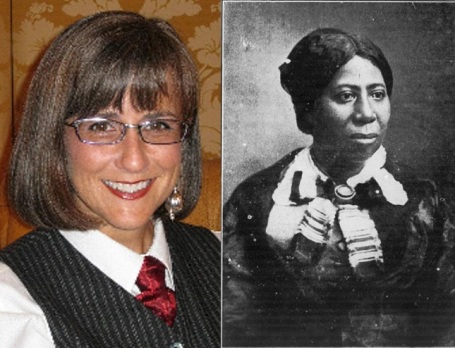
Leigh Fought image Le Moyne College, Anna Douglass image Library of CongressI’m pleased and honored to present my third interview guest, Leigh Fought, Anna and Frederick Douglass scholar and assistant professor at LeMoyne College in Syracuse. We’ll be talking about Anna Douglass, about whom I believe too little is known, and most historical presentations of her range from woefully incomplete to inaccurate and even unfair. Ms. Fought is doing significant work in righting this with her upcoming book about the women in the life of Frederick Douglass, the most significant of which, of course, is Anna.

Interview with Leigh Fought, Part One

Interview with Leigh Fought, Part Two

Find out more about Ms. Fought and her work at her blog Frederick Douglass’s Women: In Progressfaculty page for Le Moyne College, and Amazon author page, and here are some other articles and papers she’s written / co-authored; there are many others not available online, please contact the author:

Globalizing Protest in the 1980s: Musicians Collaborate to Change the World‘, The Gilder Lehrman Institute of American History

Commentary: Frederick Douglass and Interracial Marriage‘, Syracuse.com blog

~ Ordinary Philosophy and its Traveling Philosophy / History of Ideas series is a labor of love and ad-free, entirely supported by patrons and readers like you. Please offer your support today!

New Podcast Episode: Frederick Douglass Albany, Troy, and Syracuse NY sites

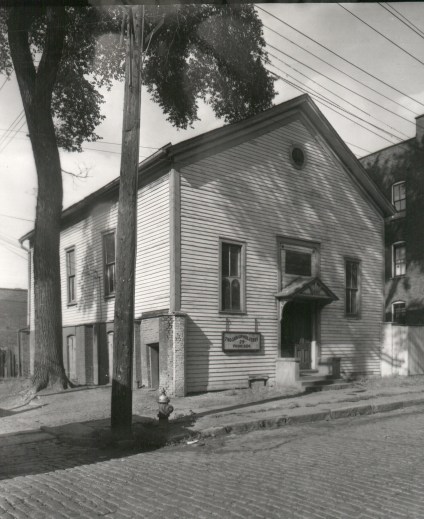
Liberty Street Presbyterian Church, Collection of the Rensselaer County Historical Society, Troy, NY 2

Liberty Street Presbyterian Church in a later incarnation as a laundry. This only known surviving photo is in the collection of the Rensselaer County Historical Society, Troy, NY

Listen to this podcast episode here or subscribe on iTunes
Eighth Day, Sunday March 27th

I get up very early and leave Cambridge (where I’ve been staying while visiting Boston and Lynn) and this time, instead of heading north, I head west across upstate New York. I’ve never visited this part of the country before. My friend who I’ll be staying with in Rochester laments that I’m visiting at the least advantageous time of year for beauty’s sake: the snow is gone, and having scrubbed the trees bare, leaves the trash it’s been concealing exposed, and there’s not a hint of green nor bloom yet on the branches. But I still think it’s lovely, with a sort of stark gray beauty, and enjoy the day’s drive of about 325 miles.… Read the original account here

Ordinary Philosophy and its Traveling Philosophy / History of Ideas series is a labor of love and is ad-free, entirely supported by patrons and readers like you. Please offer your support today!

Frederick Douglass Albany, Troy, and Syracuse NY Sites

A view of Albany, NY, 2016 by Amy Cools

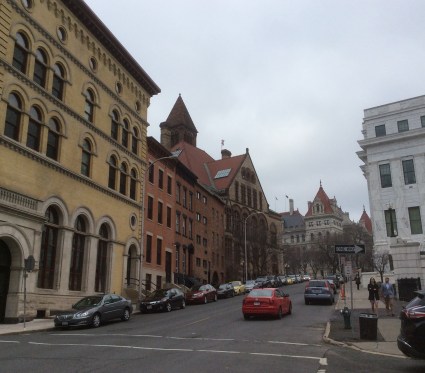
A view of downtown Albany, New York, looking west

Eighth Day, Sunday March 27th

I get up very early and leave Cambridge (where I’ve been staying while visiting Boston and Lynn) and this time, instead of heading north, I head west across upstate New York. I’ve never visited this part of the country before. My friend who I’ll be staying with in Rochester laments that I’m visiting at the least advantageous time of year for beauty’s sake: the snow is gone, and having scrubbed the trees bare, leaves the trash it’s been concealing exposed, and there’s not a hint of green nor bloom yet on the branches. But I still think it’s lovely, with a sort of stark gray beauty, and enjoy the day’s drive of about 325 miles.

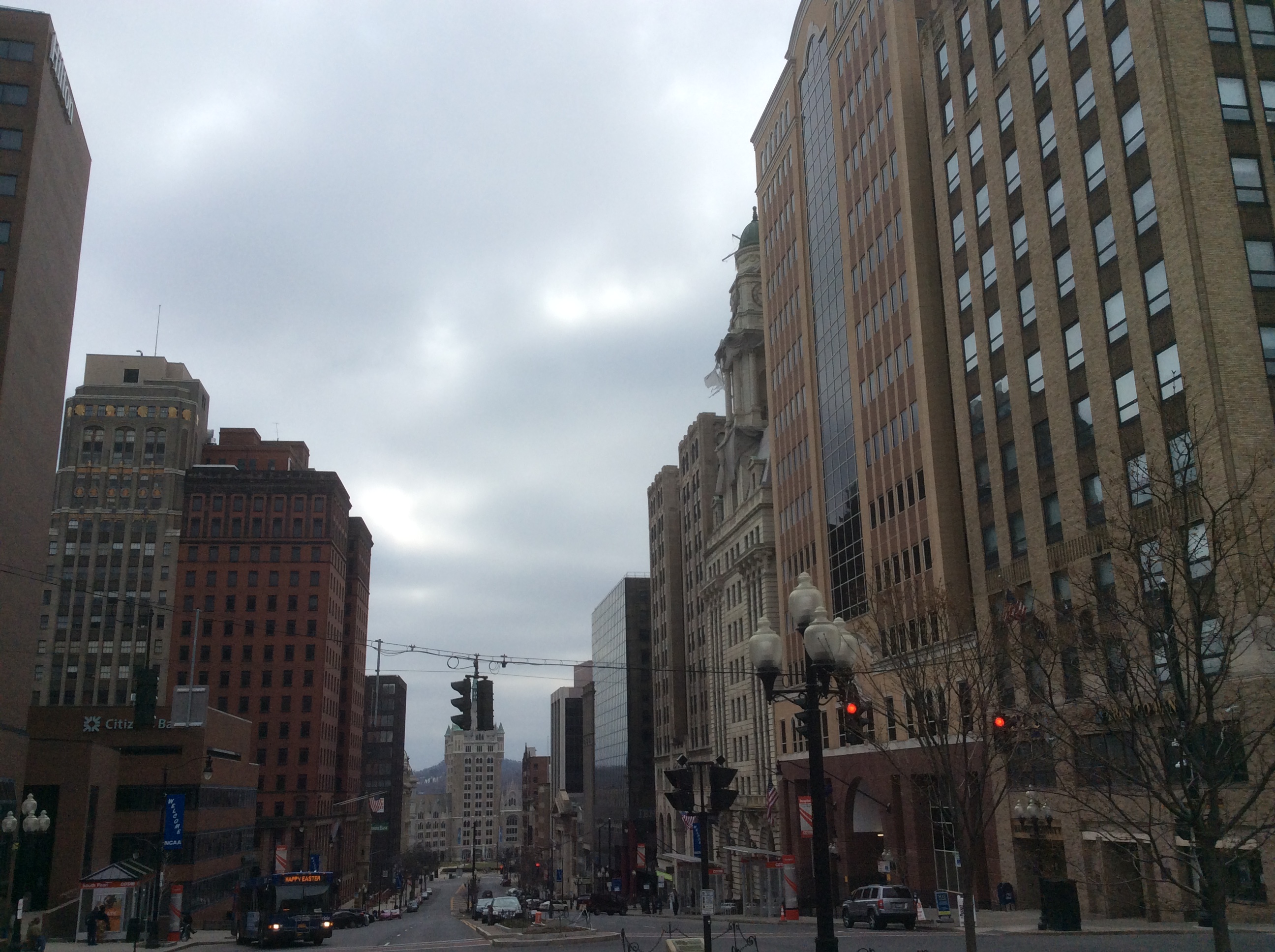
A view down State Street looking toward the Hudson River, Albany NY

A view down State Street looking toward the Hudson River, Albany NY

My first stop is Albany, a city on a hill with beautiful architecture. There were some ardent abolitionists here, and it had one of the main stations on the Underground Railroad on the route Frederick Douglass was connected to. Douglass named Stephen MyersLydia and Abigail Mott (who he entrusted with the education of his daughter Rosetta for a time) and William Topp in his autobiographies as some of the key figures here in the cause of the liberation of black people. But Douglass had some very unflattering things to say about Albany too: as he wrote in 1847, he observed a lot of racism here, especially in the wealthier families enriched directly or indirectly from slaveholding, and in the press. He was warmly welcomed by the congregation of the Baptist Church on State Street, but as of this time I can’t confirm its location: the current Baptist Church on State Street, Emmanuel, didn’t move there until 1869, and the Baptist church I found dating from his time was not on State St.

Tweddle Hall, inscribed 1754 Old Tweddle Hall, from Albany Institute of History & Art Library

Tweddle Hall, inscribed ‘1754 Old Tweddle Hall’, from Albany Institute of History & Art Library

I wander the downtown area for a little while, glad to stretch my legs, admiring the grand city center buildings, soaring churches (mostly built in the mid to late 1880’s), old stone and brick row houses, and the lovely view east where the hill slopes down to the Hudson River. Then I head to my main destination, the site where Frederick Douglass spoke at the American Equal Rights Convention at Tweddle Hall, held November 20th and 21st, 1866. Tweddle Hall once stood at the northeast corner of State and Pearl, and originally built in 1860, it burned down, was rebuilt once in 1883, then replaced in 1927 by the Bank Building which now stands here.

Douglass had long been an ardent champion of the women’s rights movement; he had been the first to back Elizabeth Cady Stanton’s call for women’s suffrage at the Seneca Falls convention in 1848 (more on this story in an upcoming account).

But here in Albany, a serious split in the women’s rights movement began with the debate over the 15th Amendment. The American Equal Rights Association had formed earlier that year, on May 10th in New York City. The Eleventh National Women’s Rights Convention reformed itself as the AERA, dedicated equally to black and female suffrage following the 14th Amendment, which for the first time specifically linked the word ‘male’ to the right to vote. While the 14th Amendment didn’t specifically guarantee the right to vote to all males, it did limit representation according to the number of adult males allowed to vote, overturning the hated 3/5ths compromise clause of the Constitution which granted representation, albeit reduced, to non-voting ‘persons bound to service for a number of years’, in other words, slaves.

Bank Building at NE corner of State and Pearl, site of old Tweddle Hall, 2016 Amy Cools

Bank Building at northeast corner of State and S. Pearl, site of old Tweddle Hall

The proposed 15th Amendment, as written and as it was eventually passed, would guarantee the right to vote to all citizens regardless of ‘race, color, or previous condition of servitude’, leaving the ‘male’ link to voting from the 14th Amendment intact. Douglass’ biographer Phillip S. Foner describes Douglass’ position on the 15th Amendment as: ‘to women the ballot was desirable, to the Negro it was a matter of life and death.’ Douglass thought it was absolutely imperative that black people get the right to vote even if it meant putting aside other great political causes for the moment. Adding women’s right to vote to the 15th Amendment would make it so much more controversial that it surely wouldn’t pass. After all, it wasn’t only black men who were still suffering great oppression and failing to enjoy the rights the Civil War victory was supposed to have won them; black women suffered worst of all because they had no legally protected voters to represent them. To many in the women’s rights movement, this was an unpardonable breach of loyalty from the man who had been their dedicated champion from the beginning. But Douglass still supported the AERA, joined in their petitions, and even acted as a representative and as a Vice President over the years.

Unfortunately, as the political struggle for racial suffrage gained more traction than woman suffrage, some of the feminist political rhetoric took on a racist character, saying, for example, that suffrage for educated, civilized white women should take precedent over suffrage for uneducated, ‘degraded’ black people. Sadly, even his old friends and allies Susan B. Anthony and Elizabeth Cady Stanton stooped to this rhetoric, though in later years Stanton redeemed herself somewhat by warmly, and wittily, congratulating Douglass and Helen Pitts on their January 24th, 1884 marriage: ‘After all the terrible battles and political upheavals we have had in expurgating our constitutions of that odious adjective ‘white’ it is really remarkable that you of all men should have stooped to do it honor.’ Perhaps his good example of loyalty to her in later years, despite her earlier racist comments, helped her overcome the worst in her character that angry disappointment can tend to bring out even in the best of us.

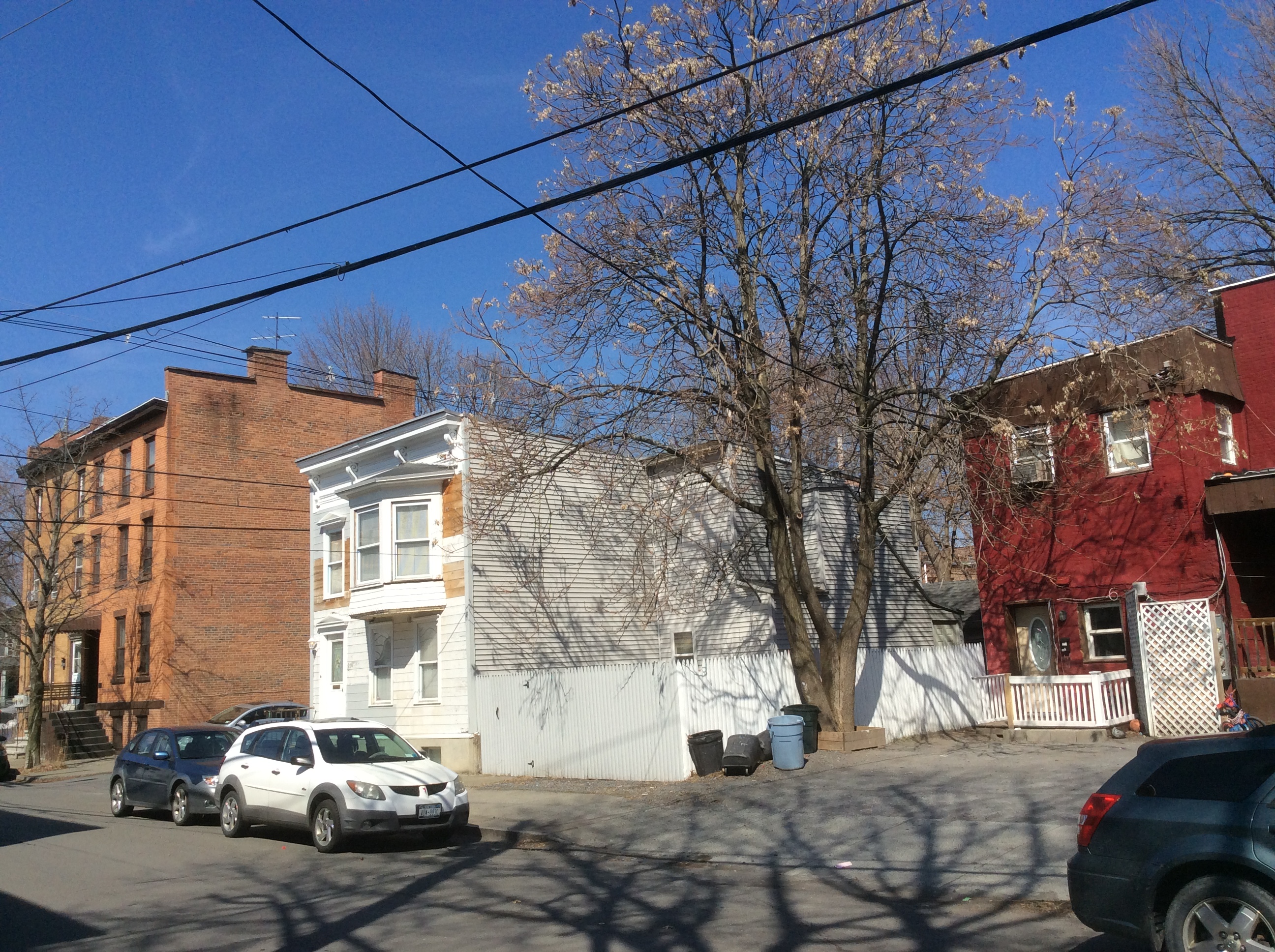
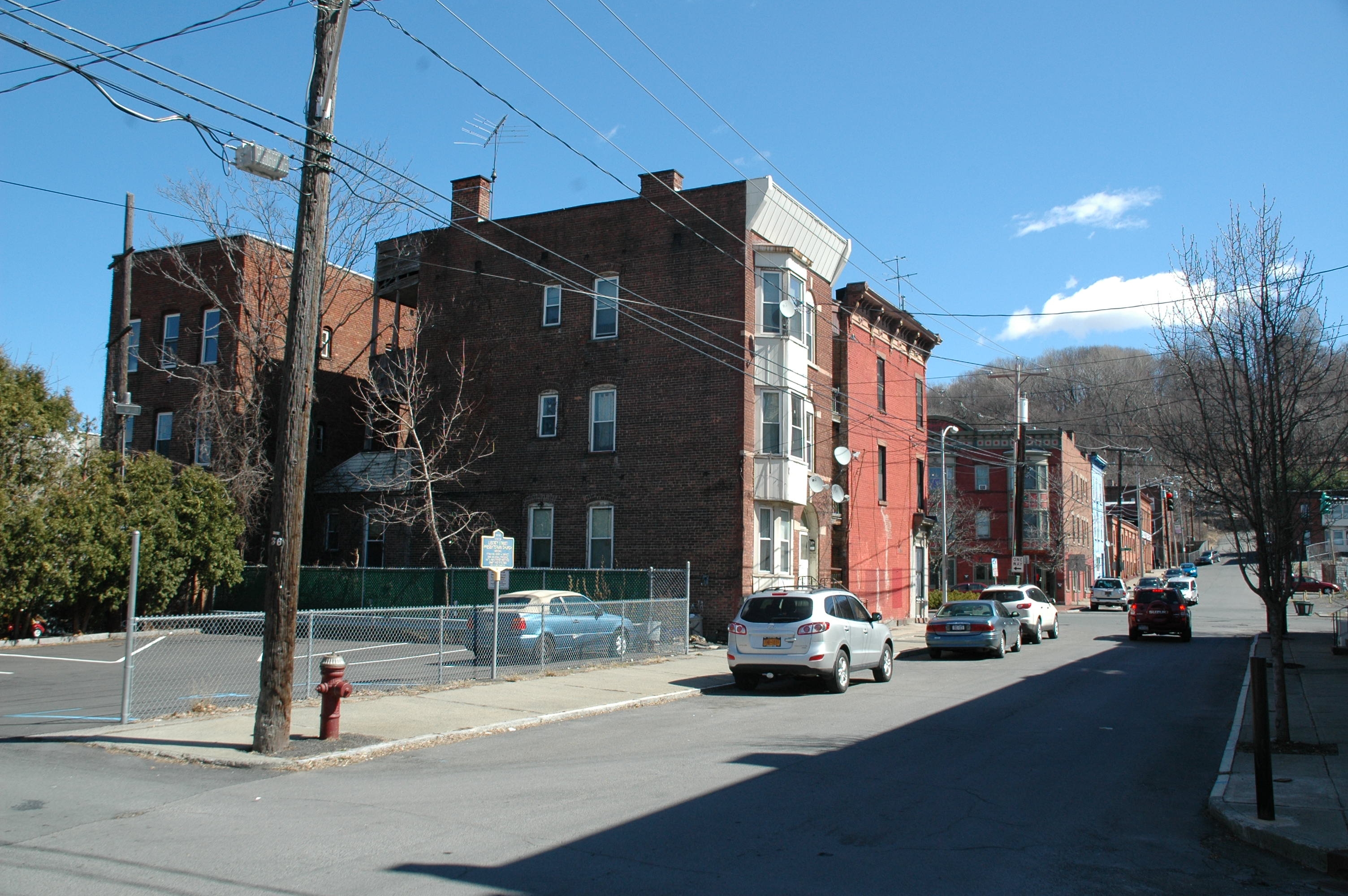
Liberty St at Franklin, Troy NY, two blocks east of the Liberty Street Presbyterian Church site

Liberty St at Franklin, Troy NY, two blocks east of the Liberty Street Presbyterian Church historical marker site

I return to my car and drive about 15 minutes north along the Hudson River to Troy, another northern New York State former industrial town which has clearly suffered a long and steady decline. But it’s full of lovely old buildings and has an interesting history; for example, Elizabeth Cady Stanton attended Troy Female Seminary. It’s also a college town; when I stop for coffee and to do some research, I find myself among many college age students spending late Easter morning studying (though I suppose they’re on spring break, what good students!) and hanging out.

Liberty Street Presbyterian Church, Collection of the Rensselaer County Historical Society, Troy, NY 2

Liberty Street Presbyterian Church in a later incarnation as a laundry. This only known surviving photo is in the collection of the Rensselaer County Historical Society, Troy, NY

I’m headed for the site of Liberty Street Presbyterian Church, which Albany’s Times Union newspaper reports was on the corner of Liberty and Franklin Streets – which may not actually be the right street corner, as I discover when fact-checking and doing extended research for this account, more on that in a moment. The Liberty Street Church used to be a stop on the Underground Railroad, ran by pastor Henry Highland Garner from 1838 to 1848.

I’m looking for this site today because the 1847 National Colored Convention was held here, where the ultimately unsuccessful movement to start a national, unified Negro League movement began. According to John Cromwell in his 1914 book The Negro in American History‘…the very first article in the first number of [Douglass’ paper] the North Star published January, 1848, is an extended notice of the National Colored Convention held at the Liberty Street Church, Troy, New York, October 9th, 1847′. Nathan Johnson, who the Douglasses made their first home with in New Bedford, was president of the convention. Frederick Douglass was one of the Massachusetts delegates to this convention. He still espoused Garrisonian principles at the time (he changed his mind later), which, among other things, held that moral suasion and non-violent boycotting of politics were the most effective ways to end slavery. He called on his fellow black people everywhere to leave their churches if they were segregated or supportive of slavery in any way, and stressed the importance of education and self-improvement to stand as living testaments against the prejudices of white people. However, for a variety of reasons, it proved too difficult to unite the scattered, disenfranchised black community together into one unified movement. Those who were free shared the tactical and philosophical disagreements of white members of the abolitionist movement; those who were still enslaved or suffering the worst hardships of poverty, illiteracy, and other innumerable forms of intimidation and oppression found it difficult or impossible to participate.

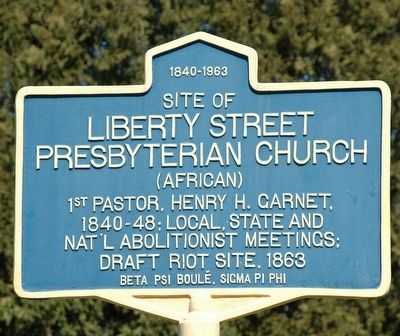
Liberty Street Presbyterian Church Site (according to historical marker), photo by Howard C. Ohlhous 2016

Liberty Street Presbyterian Church Site with historical marker, photo by Howard C. Ohlhous 2016

So why might I be at the wrong street corner here at Liberty and Franklin? Because my additional research for this account prior to publication pulled up two locations for the old church, rather than the one I had initially pulled up. A couple of secondary and tertiary sources, which I find first and which guide my day’s search here, list the location as Liberty at Franklin: the newspaper, and this booklet for a historical project from 2008. I don’t yet have enough evidence now to prove definitively which is correct, though I believe one much is more likely. The crossing of Liberty and Franklin Streets is unmarked; Franklin is a narrow little street that runs between 2nd and 3rd, between the three story brick building and the two story white board one with the bay window. It’s a rather shabby little street corner now, the buildings here now don’t appear to be all that old.

Liberty Street Presbyterian Church Marker at Liberty and Church Streets, photo by Howard C Ohlhous

Liberty Street Presbyterian Church Marker at Liberty and Church Streets, photo by Howard C Ohlhous

Yet the historical marker for the Liberty Street Presbyterian Church is placed at Liberty and Church Streets, two blocks east of here. Oddly enough, the creators of the Spectres of Liberty project describe the site in their booklet as located on Liberty at Franklin, yet they hold their ‘Raising the Ghost of the Liberty Street Presbyterian Church‘, a super cool historical art event, at the marker site. Could it be that the street names have been changed or reassigned? A city map / atlas from 1845 reveals that the street names and locations are the same here today as they were then.

In case the historical marker is placed incorrectly (update: the Rensselaer County Historical Society assures me that the marker is at the correct site) and this does turn out to be the correct site, which corner of Liberty and Franklin could it have been on? Comparing the photo to the streets now, there’s one clue that might help me: the fire hydrant shown in the photo. There is no fire hydrant now, but there is a capped water supply pipe which could have supplied it; unless it’s torn up and moved, this would remain a permanent fixture. It’s in the sidewalk in front of the three story red brick apartment building on the northwest corner of the street. If this is the same water supply, that would place the church on that corner with its narrower pointy side facing on Franklin and its long side facing Liberty. However, when I look more closely at the photo I’m referring to (the only known surviving one, it’s in the Rensselaer Historical Society collection), the site where the historical marker is located, two blocks east at Liberty and Church looks more like the correct location, if the placement of the fire hydrant and the street pole are the same today.

So why include my story of possibly looking in the wrong place (which, as it turns out, I do)? Well, this travel series is the story of a journey, and journeys often include wrong turns, misreading of signs, incorrect maps, bad directions, and so forth. Each of these is a learning experience, and I hope you don’t mind that I take you along with me as I learn. As we’ve just seen, there are conflicting sources of information out there, and the lesson I learn here: triple-check all sources!

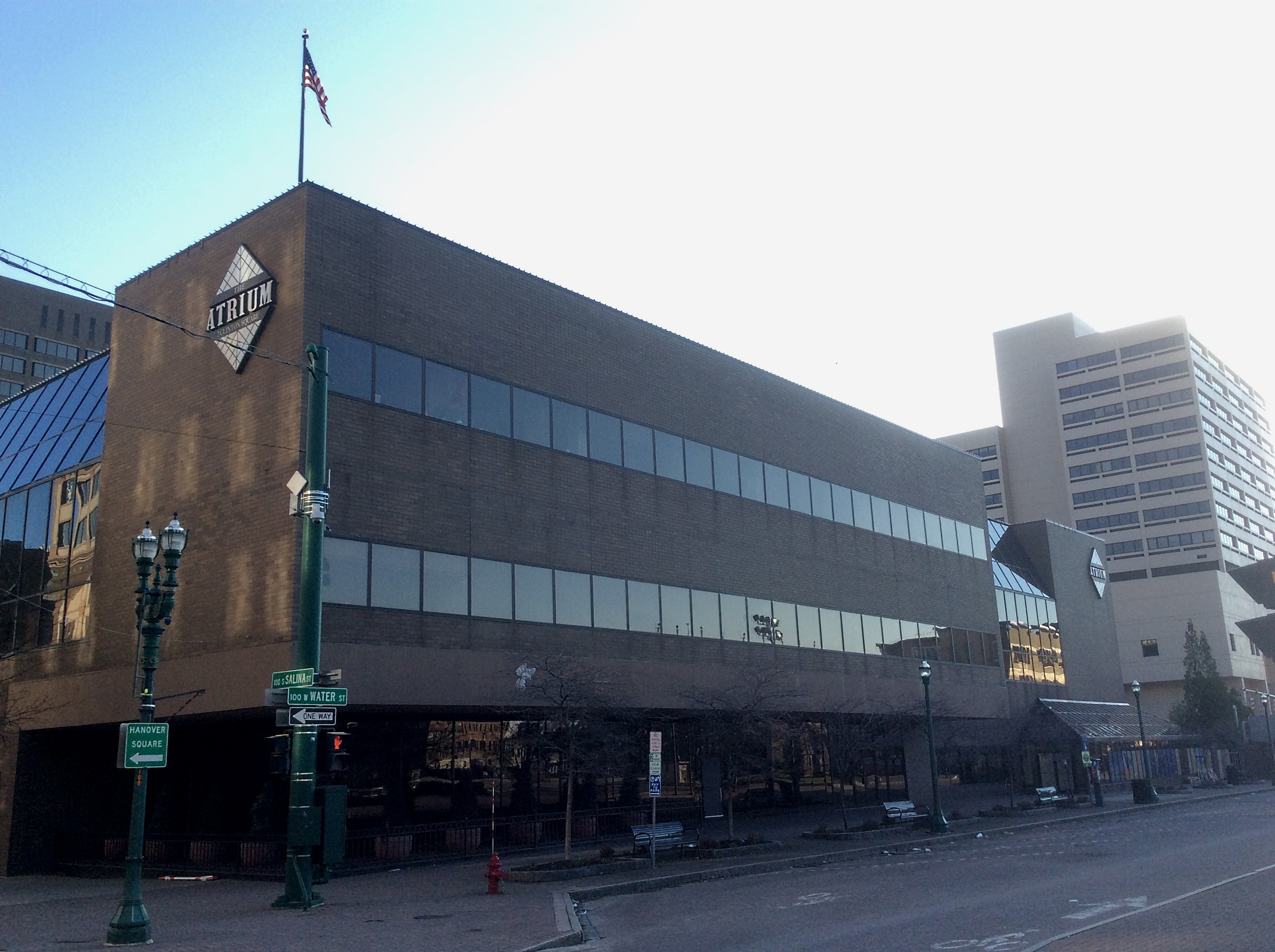
Wieting Hall Site, Syracuse NY,

Wieting Hall Site,  111-119 W. Water St at S. Salina off Clinton Square, Syracuse NY

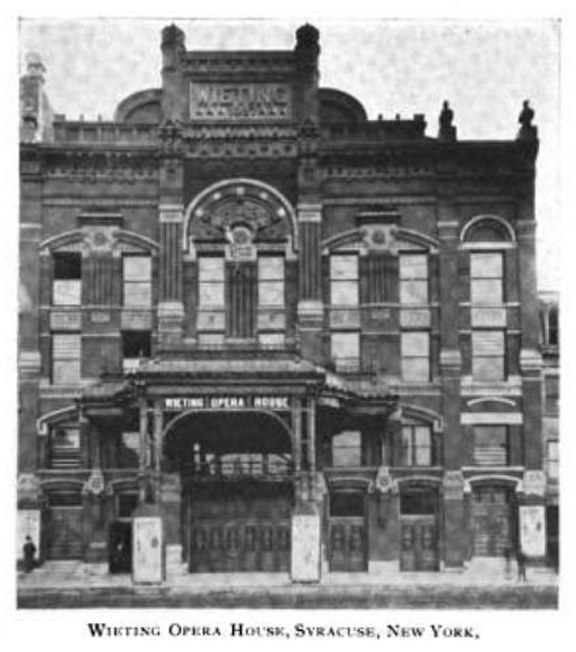
Wieting Opera House on Clinton Square in Syracuse, New York, 1898

Wieting Opera House on Clinton Square in Syracuse, New York, 1898

My last destination of the day is the site of Wieting Hall, at 111-119 W. Water Street in Syracuse, NY. The hall, which was first built in 1851, burned down in 1856 and was rebuilt as an opera house in 1857, burned and rebuilt yet again in 1881. Its builder and public-spirited owner Dr. John Wieting was a stoic yet tenacious man, responsible for its every incarnation. As you can see, what stands here now is not nearly so inspiring, in looks or in history.

On Nov 14th, 1861, Douglass was scheduled to deliver a speech on the Civil War and why the slaves needed to be freed en masse for the Union to win, one of his many appearances in Syracuse. Syracuse was another important stop on the underground railroad. However, as we’ve seen throughout this travel series, just because New York and other Northern states were free did not mean that all people here wanted black people to be armed, to enjoy civil rights, or even to be emancipated. Many in Syracuse were abolitionists and many others were not; racism was endemic in both of these groups.

According to Foner’s biography, an angry protest was planned: many townspeople were prepared to drive him and the other abolitionist speakers from the city. However, to his great credit, mayor Charles Andrews and Dr. Wieting refused to be intimidated, insisting that the talk take place as planned. They believed (as I agree all Americans should) that even unpopular speech should be protected speech, and their Syracuse was not to be a place where free speech could be squelched by threats. So 50 – 100 police were stationed (depending on the source) along with armed members of the Second Onondaga Regiment. When Douglass spoke, the crowd was well-behaved and respectful, be it because they actually did respect him and his right to speak, or because they were not allowed to be otherwise.

Clinton Square and Jerry Rescue Monument, Syracuse NY

Clinton Square and Jerry Rescue Monument, at S. Clinton and W. Water Streets, Syracuse NY, with Wieting Hall site in the background

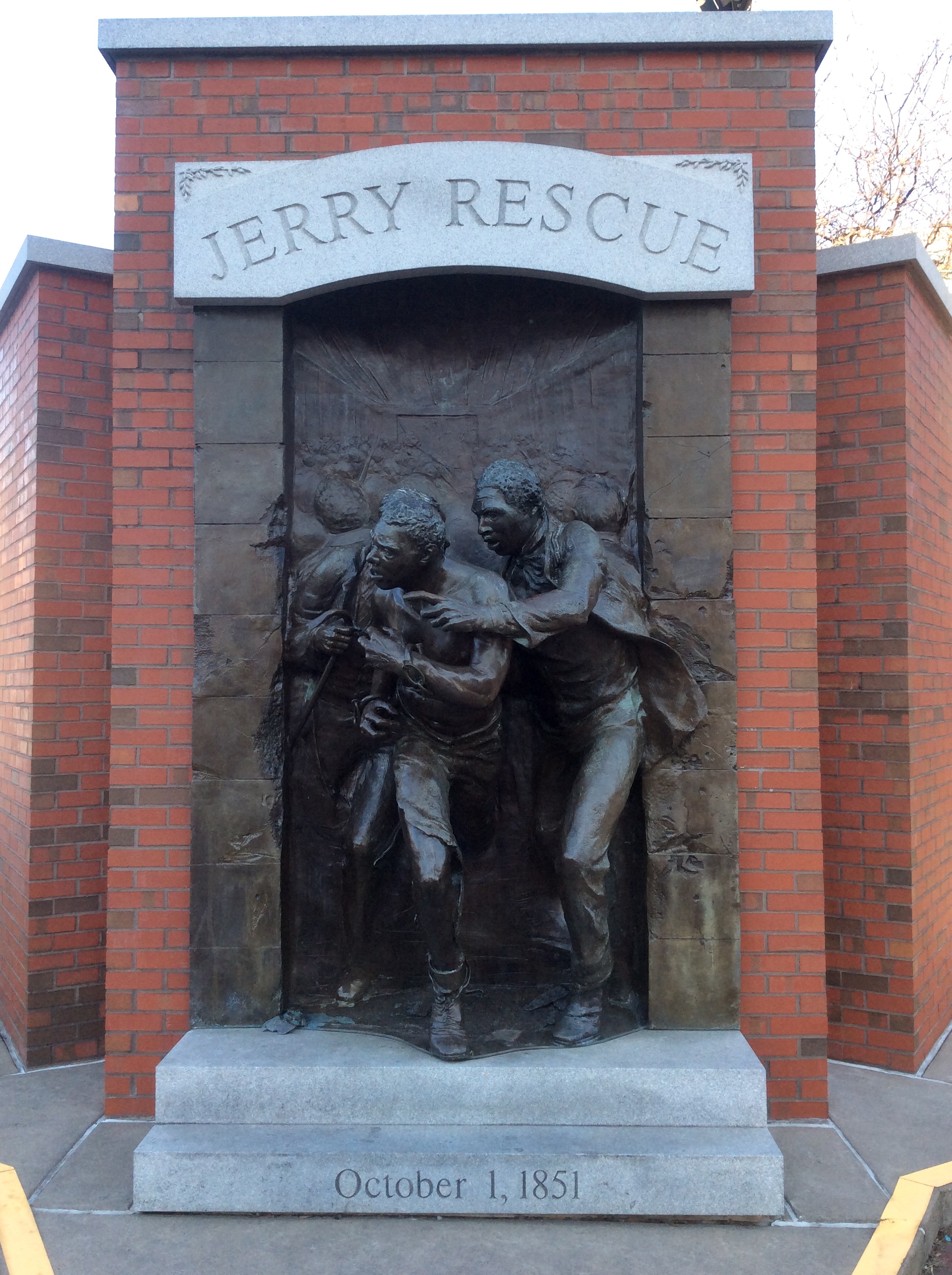
Jerry Rescue Monument, Syracuse NY, photo 2016 by Amy CoolsAs I have plenty of daylight left, I wander through lovely Clinton Square, clearly a site in the process of restoration. The large rectangular concrete center used to be a part of the Erie Canal, a waterway route to the center of the city, and a place to ice skate when frozen over in winter (part if it is still filled with water and turned into a wintertime outdoor skating rink today!)

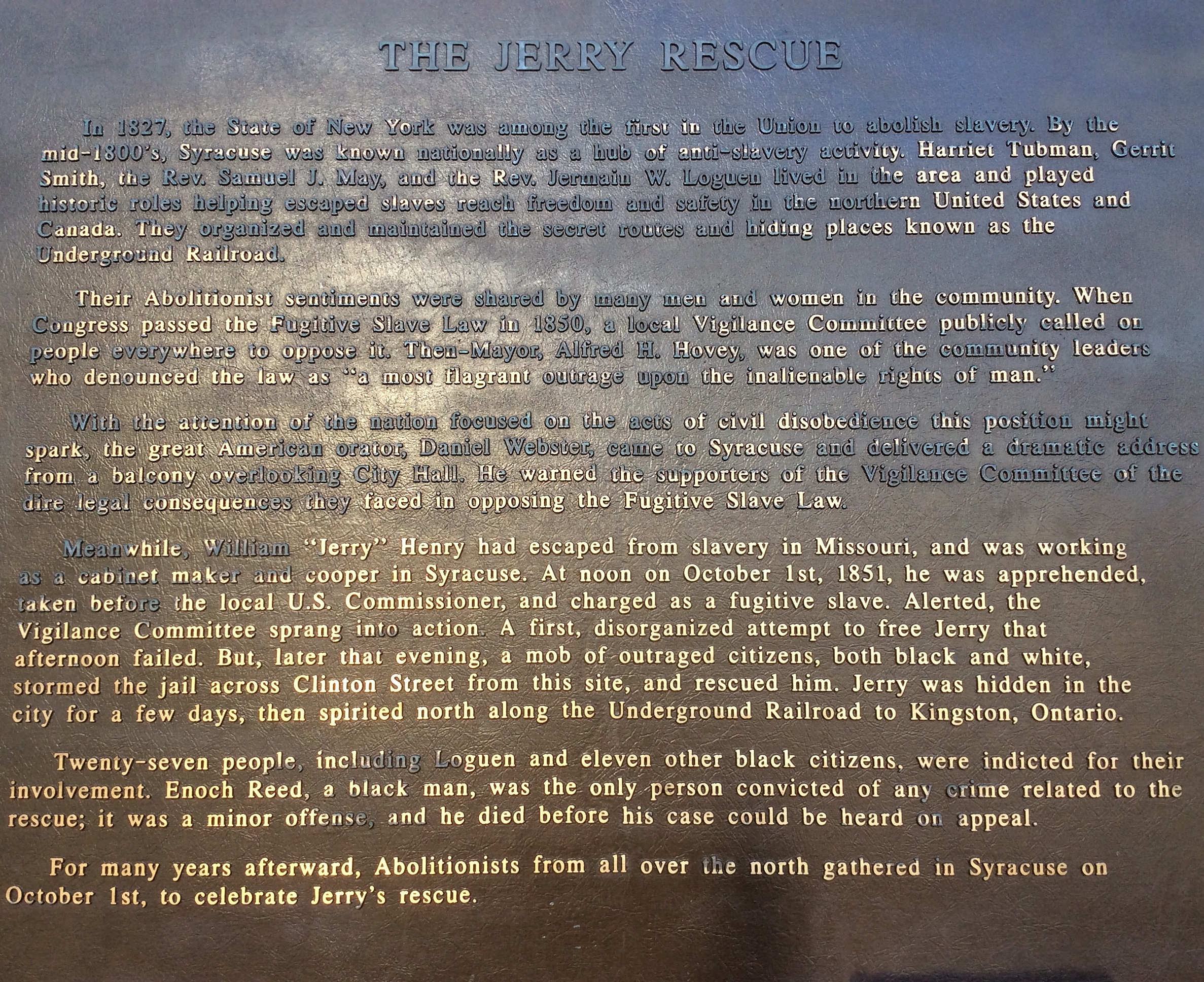
I discover a monument near the southwest corner of the square, erected in 2001 and dedicated to the October 1st, 1851 rescue of William ‘Jerry’ Henry. An escaped slave from Missouri, he was arrested as part of the effort to enforce the much-hated Fugitive Slave Act, enacted on September 18th, 1850. Many Northerners, abolitionist or not, thought it an intolerable intrusion on the legal autonomy of states and on freedom of conscience. Though the orator and statesman Daniel Webster (who, as you may remember from the second of my Lynn accounts, supported it as an acceptable compromise for preserving the Union) warned that the Fugitive Slave Act would be rigorously enforced here in Syracuse, it was vigorously defied on that October day. Attendees of the Liberty Party state convention (the party of Gerrit Smith, Douglass’ friend and mentor who we’ll learn more about soon) broke into the jail and freed Jerry, hid him in town for a few days, and smuggled him to Canada. This event would be long celebrated by abolitionists and champions of human rights, Douglass among them, as a triumph over oppression and in thanks to those who risked themselves to help a fellow human being in need.

Jerry Rescue Monument Plaque, Syracuse NY, photo 2016 by Amy Cools

Jerry Rescue Monument Plaque in Clinton Square, Syracuse NY

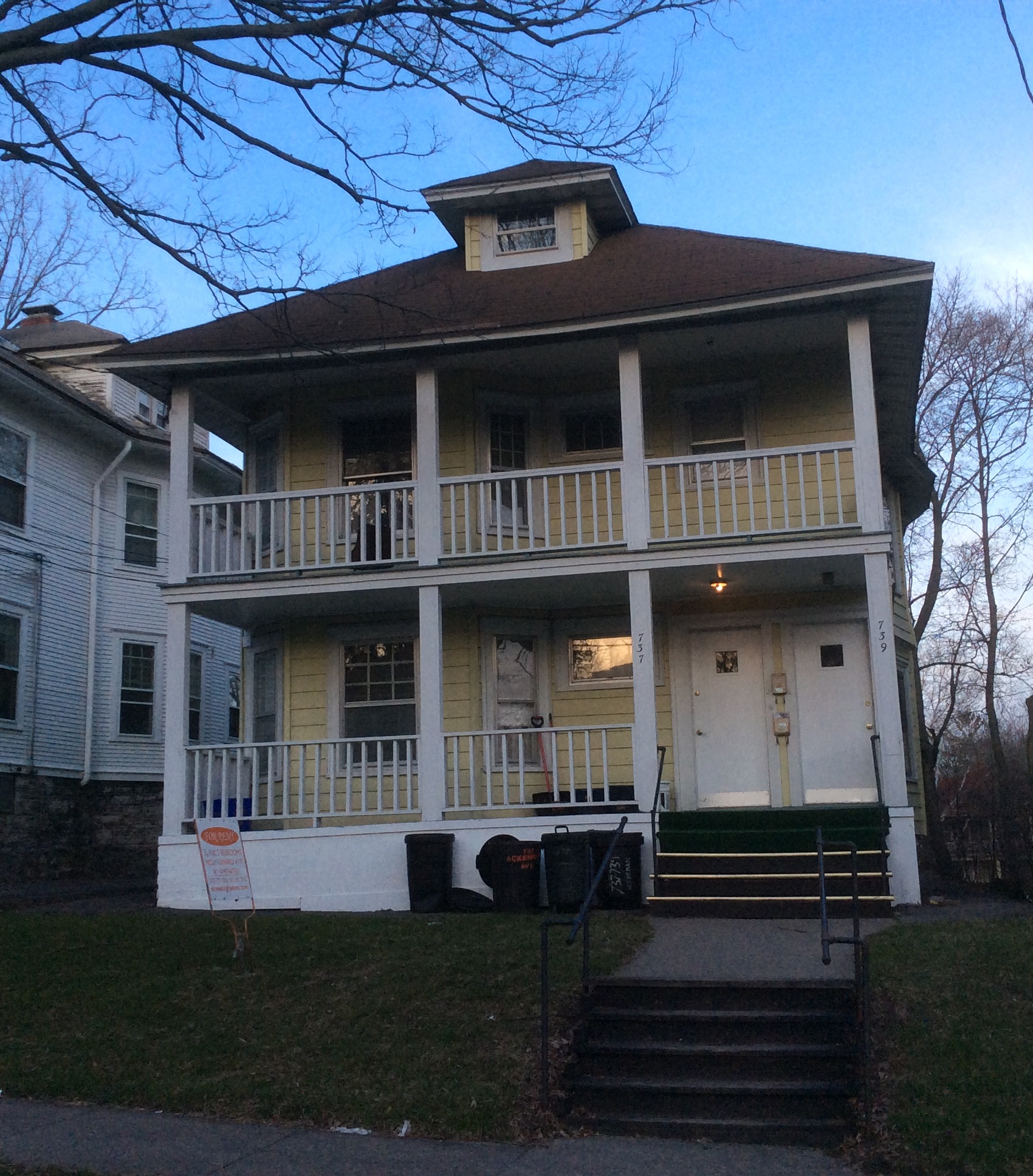
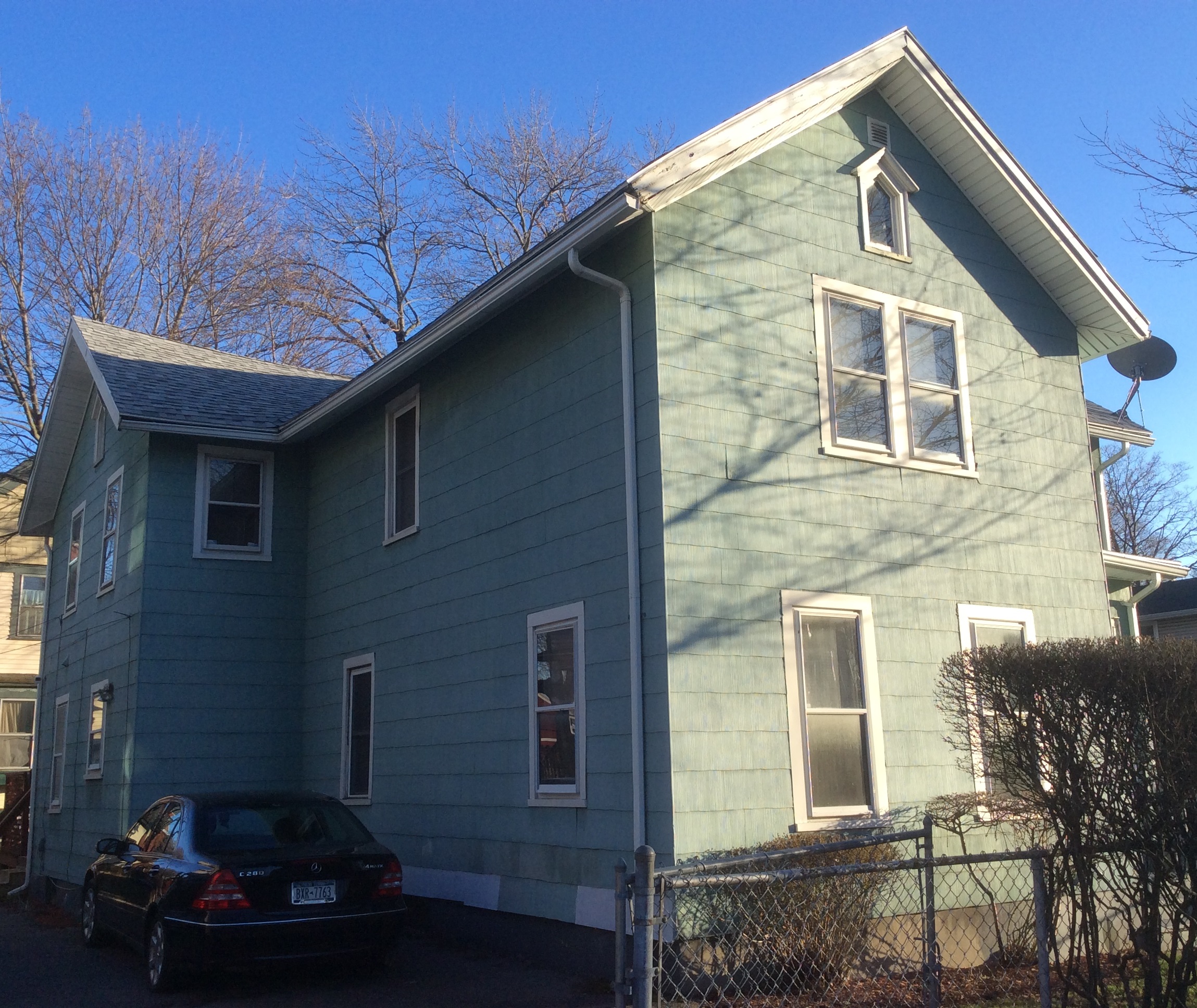
Yellow house I stay at in Syracuse, NY, photo 2016 by Amy CoolsSo ends my tale of today’s adventures. I’m going to spend the night in a rented room in an old yellow house near beautiful Syracuse University, the most charming place I stay throughout the trip, with the exception of my new friends’ house near Baltimore and my old friends’ house in Rochester. Stay tuned for my continuing adventures following the life and ideas of Frederick Douglass!

~ Ordinary Philosophy and its Traveling Philosophy / History of Ideas series is a labor of love and ad-free, supported by patrons and readers like you. Please offer your support today!

~~~~~~~~~~~~~~~~~~~~~~~~~~~~

Sources and Inspiration:

Amendment XIV: Citizenship Rights, Equal Protection, Apportionment, Civil War Debt‘, Constitution Center website

Amendment XV: Right to Vote Not Denied by Race‘, Constitution Center website

American Equal Rights Association‘. In Wikipedia, The Free Encyclopedia.

Beauchamp, William Martin. Past and Present of Syracuse and Onondaga County, New York: From Prehistoric Times to the Beginning of 1908 (Volume 2). SJ Clarke Publishing Co: New York, 1908.

Blassingame, J. (Ed.). The Frederick Douglass Papers, Series One: Speeches, Debates, and Interviews. 4 volumes, and The Frederick Douglass Papers, Series 2: Autobiographical Writings. 3 volumes. New Haven and London: Yale University Press, 1979-1999 (including a letter to Sydney H. Gay, dated Oct 4th 1847)

‘Courtesy of the Rensselaer County Historical Society: Rev. Henry Highland Garnet’. The Amistad CommissionNew York Department of State website

Cromwell, John Wesley. The Negro in American History: Men and Women Eminent in the Evolution of the American of African Descent. J.F. Tapley Co: New York, 1914

Douglass, Frederick. Autobiographies (includes Narrative…, My Freedom and my Bondage, and Life and Times). With notes by Henry Louis Gates, Jr. Volume compilation by Literary Classics of the United States. New York: Penguin Books, 1994.

Frederick Douglass Escapes Slavery, Becomes Leading Abolitionist‘, Onondaga Historical Association website

Foner, Philip S. The Life and Writings of Frederick Douglass, Vol. 1-4. New York: International Publishers, 1950.

Garrison, William Lloyd. The Letters of William Lloyd Garrison, Volume IV: From Disunionism to the Brink of War, 1850-1860. Edited by Louis Ruchames

Hallaron, Amy. ‘Artist’s magic lives on in Troy‘, Times Union, Albany, Monday, January 16, 2012

Jerry Rescue‘. In Wikipedia, The Free Encyclopedia.

Jerry Rescue Monument‘, #44, Freethought Trail website

‘Liberty Street Presbyterian Church (African)’, Historical Marker Database (source of marker photos)

Lydia and Abigail Mott‘, Underground Railroad History website

McFeely, William. Frederick Douglass. New York: W.W. Norton & Company, 1991.

Proceedings of the National Convention of Colored People and Their Friends; held in Troy, NY; on the 6th, 7th, 8th, and 9th of October, 1847.’ Colored Conventions website, University of Delaware

Rittner, Don. Albany, Then & NowArcadia: Charleston SC, 2002

Robinson, Olivia, Josh MacPhee, and Dara Greenwald. Spectres of Liberty: The Raising of the Ghost of the Liberty Street Church. Websitebooklet and video

Stephen Myers‘, Underground Railroad History website

Susan B. Anthony Boldly Writes the Speaker of the House Asking for a Public Endorsement of Women’s Suffrage‘, pamphlet for 1866 Convention and signed letter, RAAB collection website

Troy, N.Y., from actual survey‘ (map / atlas) by S.A. Beers, civl. engineer. Depicts: 1845

Upstate New York and the Women’s Rights Movement‘, University of Rochester / River Campus Libraries website

Wieting Opera House‘, #51, Freethought Trail website

New Podcast Episode: Frederick Douglass Lynn Sites, Part 2 – Historical Society and Hutchinson Scrapbook

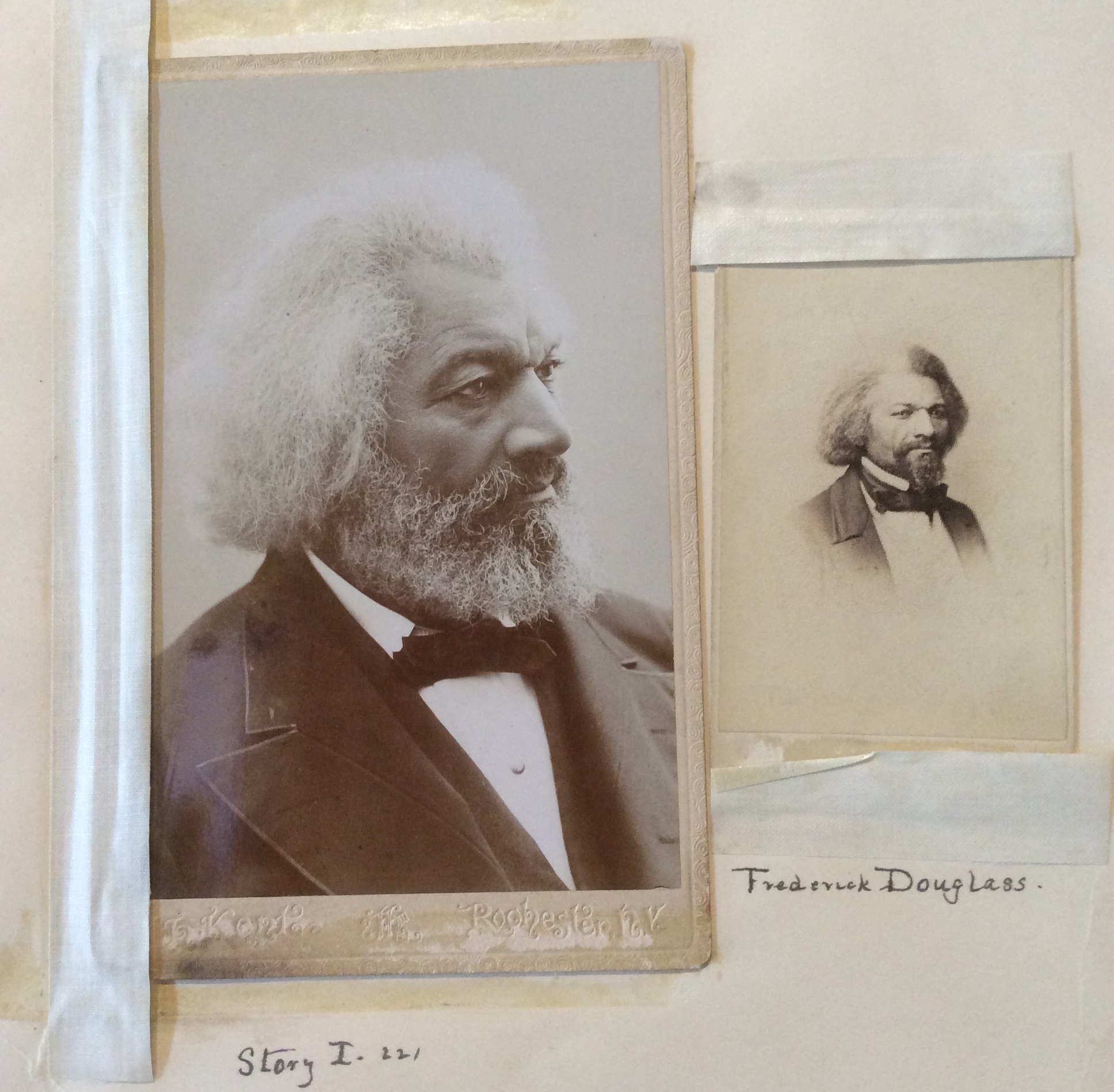
Frederick Douglass in Hutchinson Scrapbook, 2016 Amy Cools

Two portraits of Frederick Douglass from the Hutchinson Family scrapbook

Listen to this podcast episode here or subscribe on iTunes

Seventh Day, Saturday March 26th

…Lynn proves to be a Douglass treasure trove for me, especially the Lynn Museum & Historical Society. While I’m waiting to meet with a representative of the museum to look at some materials from the archives, I visit the ‘Abolitionist Lynn’ exhibit upstairs. As discussed in the first part of today’s account, Lynn had a particularly active and vocal abolitionist community. As I also discussed in the first part of today’s account, that’s what brought Douglass, laborer turned abolitionist speaker, here to Lynn… Read the original account here

Ordinary Philosophy and its Traveling Philosophy / History of Ideas series is a labor of love and is ad-free, entirely supported by patrons and readers like you. Please offer your support today!

New Podcast Episode: Frederick Douglass Lynn, Massachusetts Sites

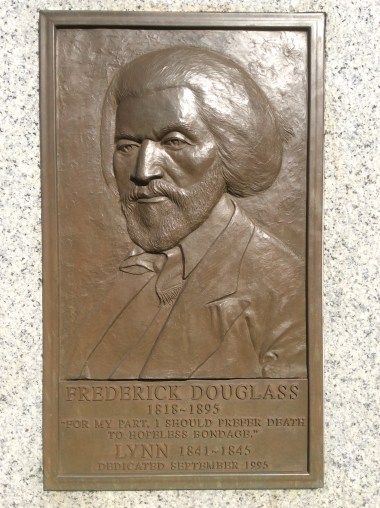
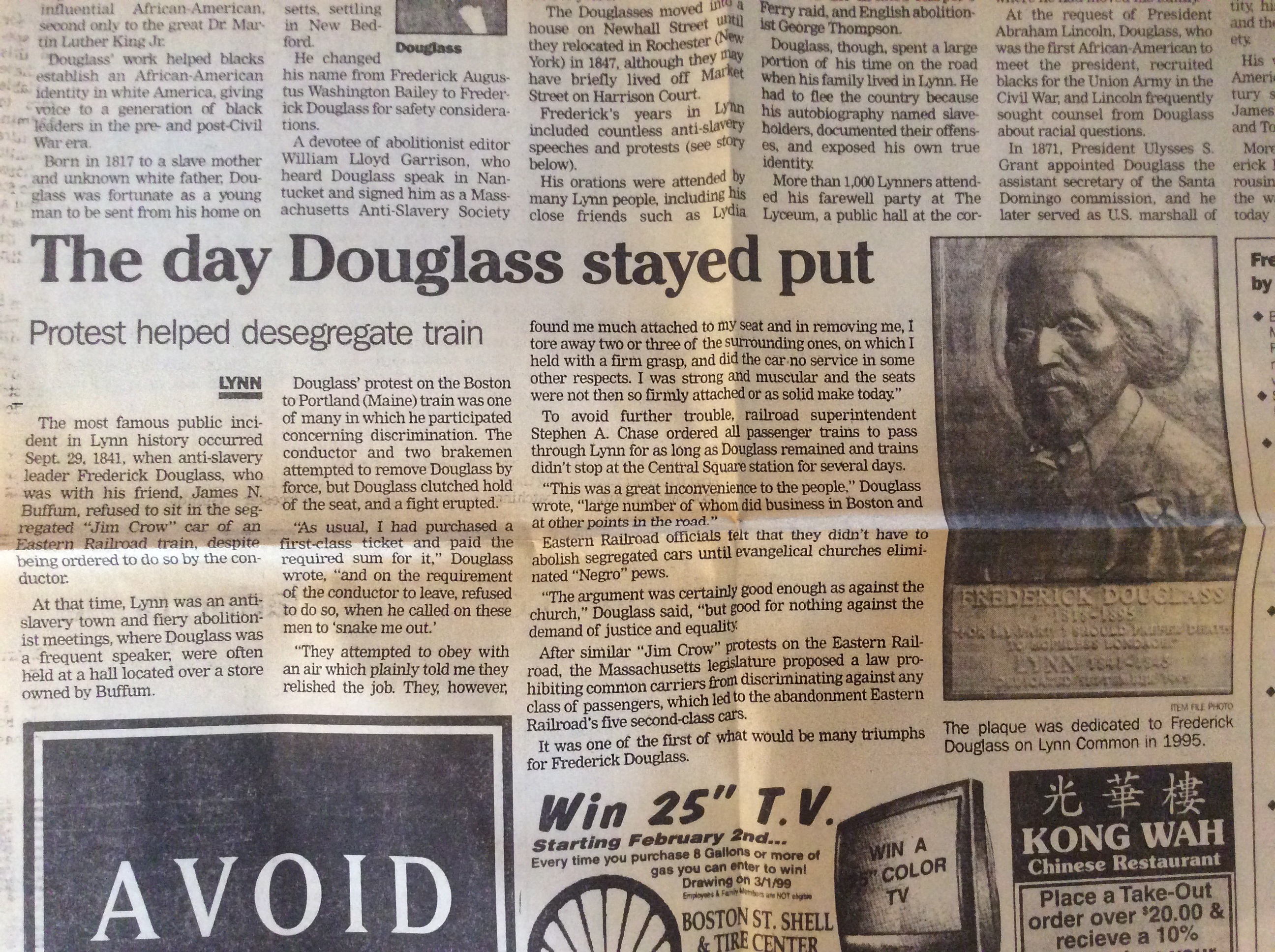
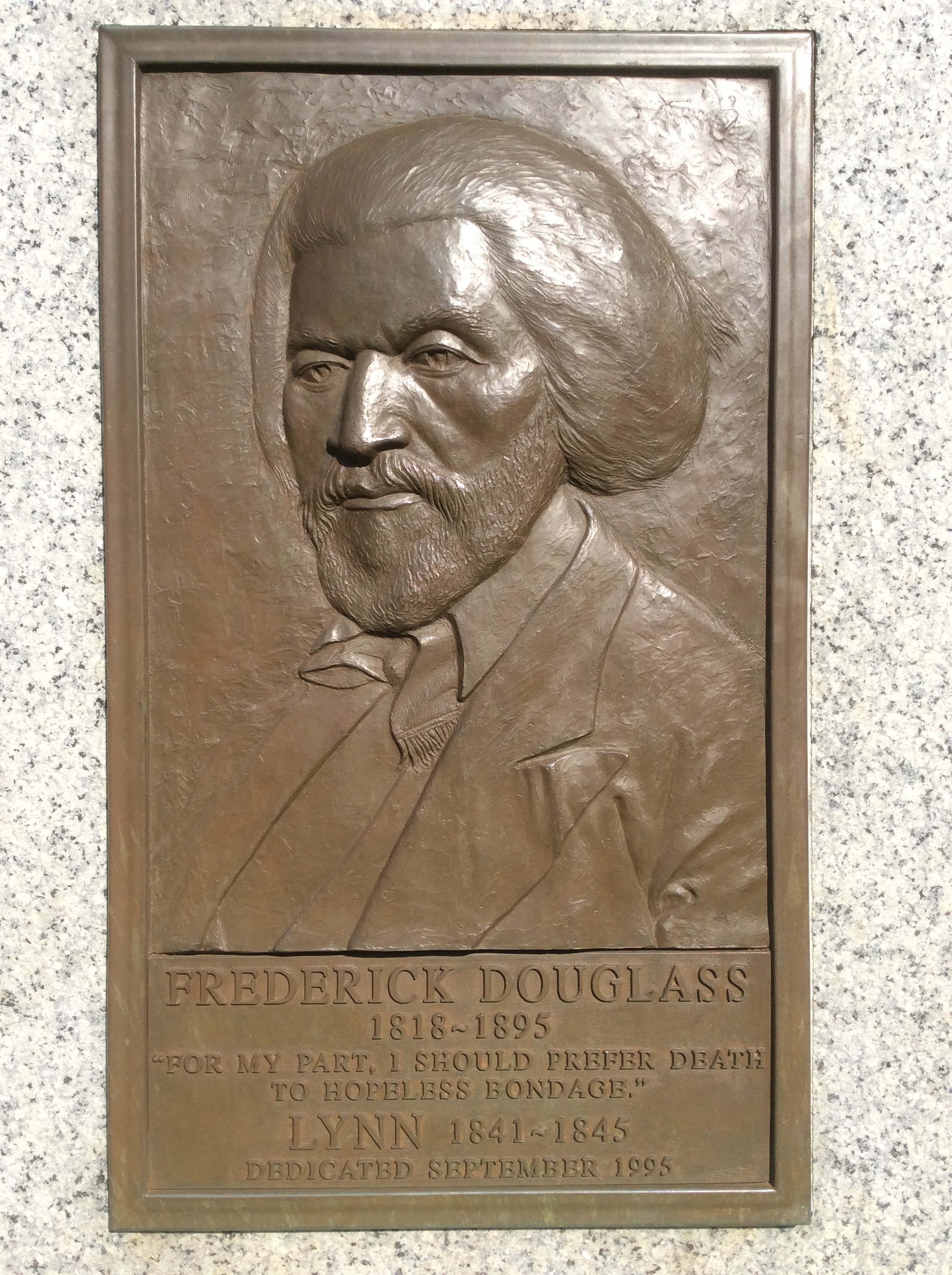
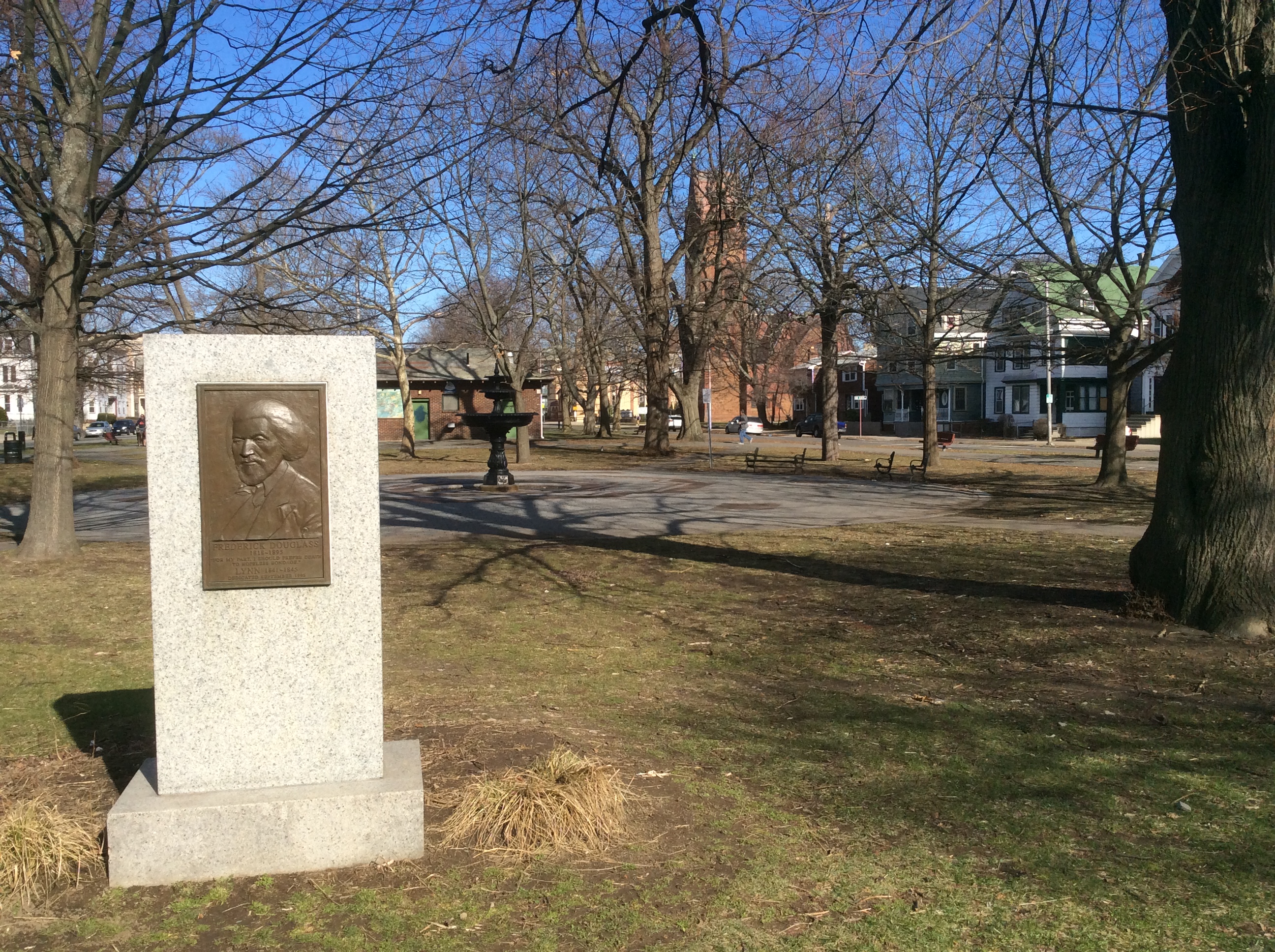
Frederick Douglass Memorial plaque in Lynn Commons, photo 2016 by Amy Cools

Frederick Douglass Memorial plaque in Lynn Commons

Listen to this podcast episode here or subscribe on iTunes
Seventh Day, Saturday March 26th

…Not long after Frederick Douglass began his public speaking career, he and his family moved here to Lynn from New Bedford. They lived here from the fall of 1841 through about November 1847. Well, actually, for much of that time, it was mostly Anna and the kids who lived here. First, Douglass was often on tour as a speaker, which took him away from home for long stretches. Secondly, he was away on a tour of the British Isles from 1845-1847, which is why many sources say Douglass himself only lived here until 1845. He returned only briefly to Lynn before moving himself and his family to Rochester near the end of 1847. His ‘industrious and neat companion‘ Anna took care of the household while he was away, and often took in piecework from Lynn’s thriving shoemaking industry to make sure the kids were always cared for and the bills paid on time….  Read the original account here

Ordinary Philosophy and its Traveling Philosophy / History of Ideas series is a labor of love and is ad-free, entirely supported by patrons and readers like you. Please offer your support today!

Frederick Douglass Lynn Sites, Part 2: Historical Society & Hutchinson Scrapbook

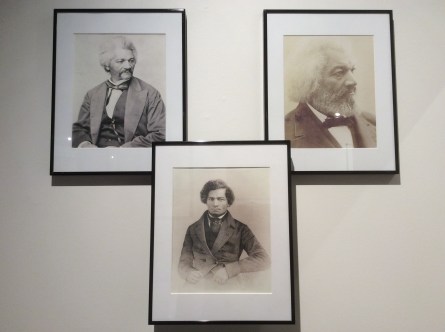
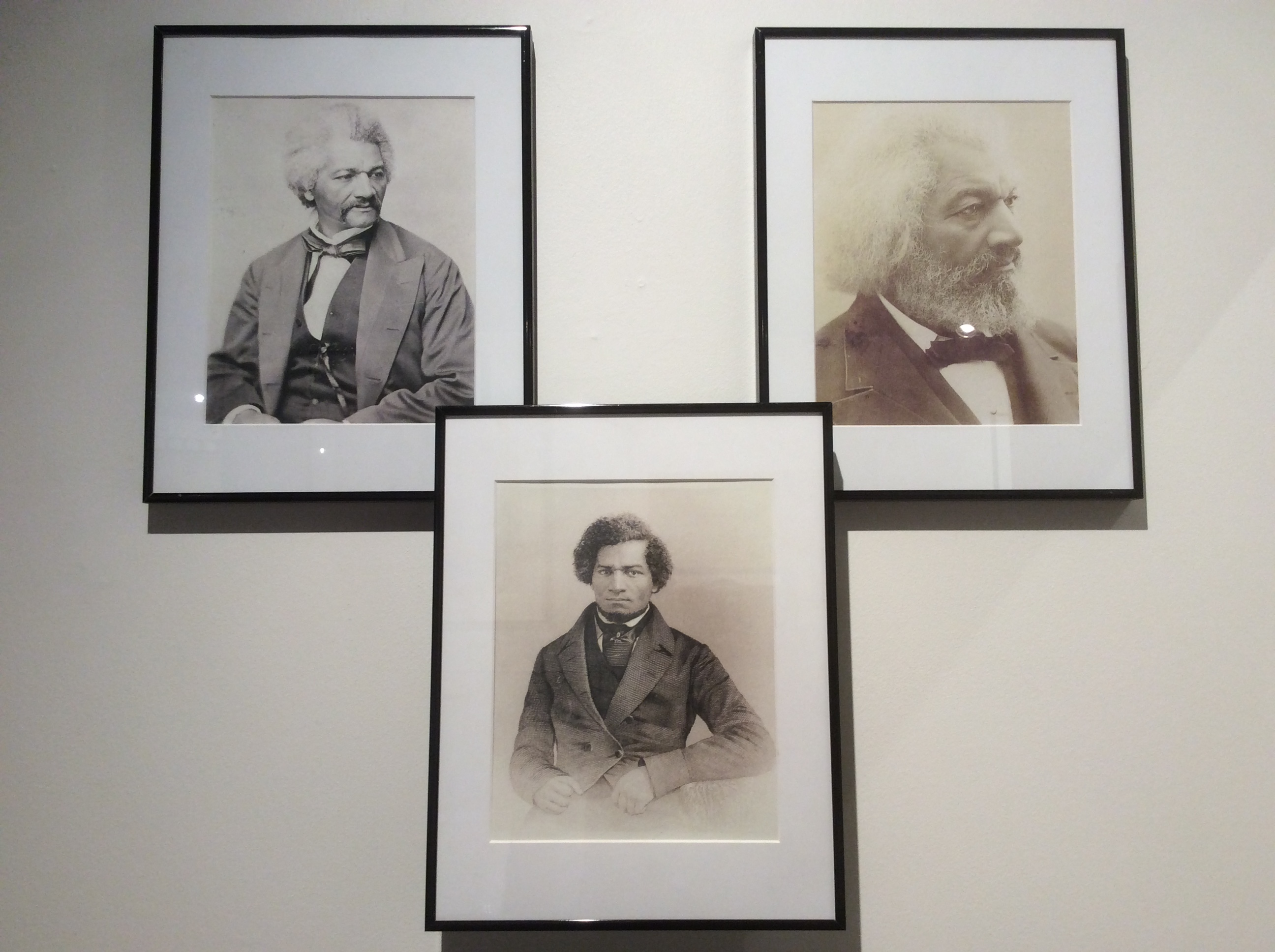
3 Portraits of Frederick Douglass at Lynn Museum, 2016 Amy Cools

Three portraits of Frederick Douglass at the Lynn Museum & Historical Society

Seventh Day, Saturday March 26th

As I mention in the first part of my account of today’s journey, Lynn proves to be a Douglass treasure trove for me, especially the Lynn Museum & Historical Society.

While I’m waiting to meet with a representative of the museum to look at some materials from the archives, I visit the  ‘Abolitionist Lynn’ exhibit upstairs. As discussed in the first part of today’s account, Lynn had a particularly active and vocal abolitionist community. As I also discussed in the first part of today’s account, that’s what brought Douglass, laborer turned abolitionist speaker, here to Lynn.

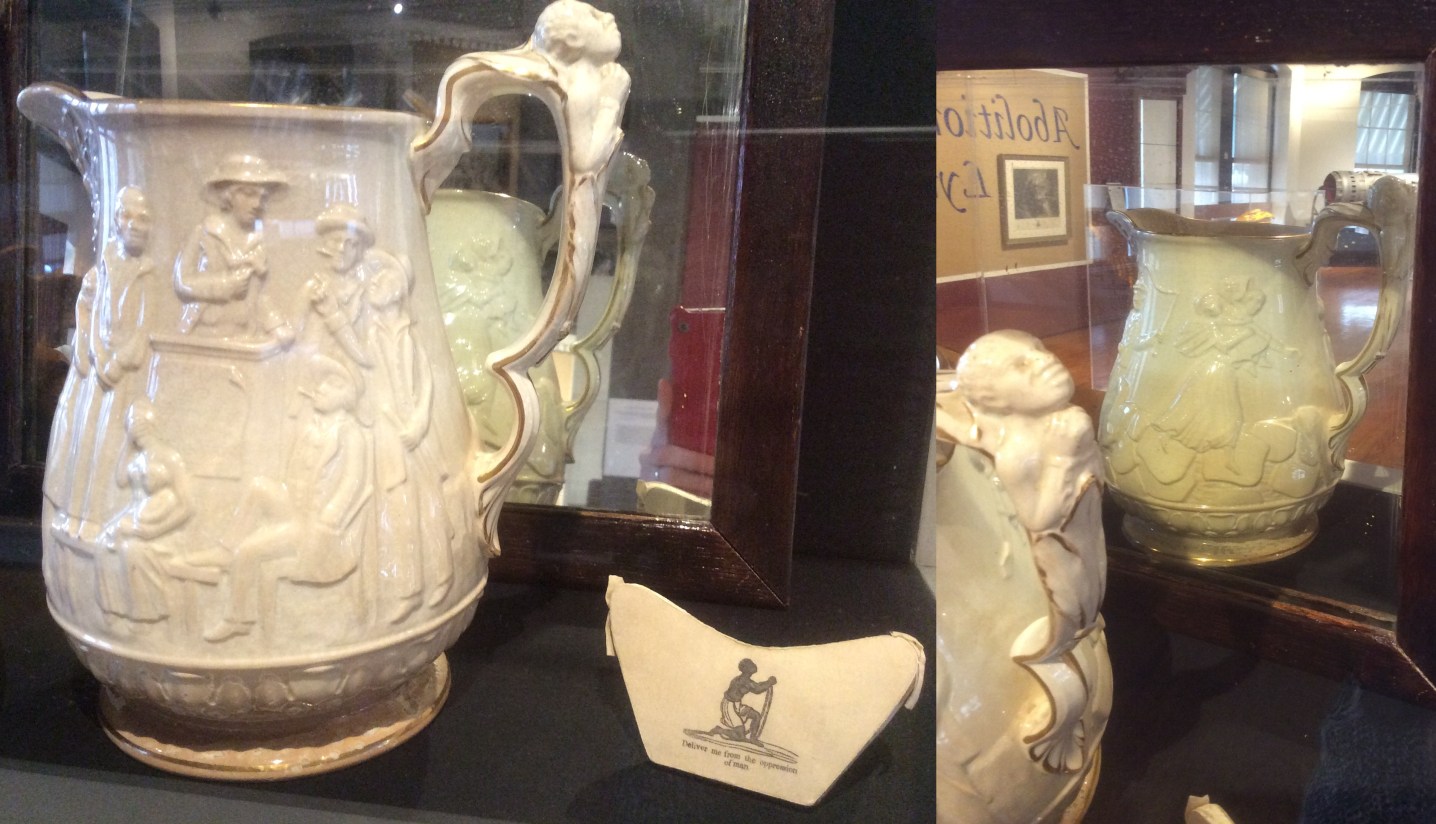
Abolitionist Pitcher at Lynn Museum, front and back, 2016 Amy Cools

Anti-Slavery Pitcher showing a slave auction at front, a slave mother and infant escaping on the back, and a praying manacled figure on the handle

Fugitive Slave Act poster, Lynn Museum, detail, 2016 Amy Cools

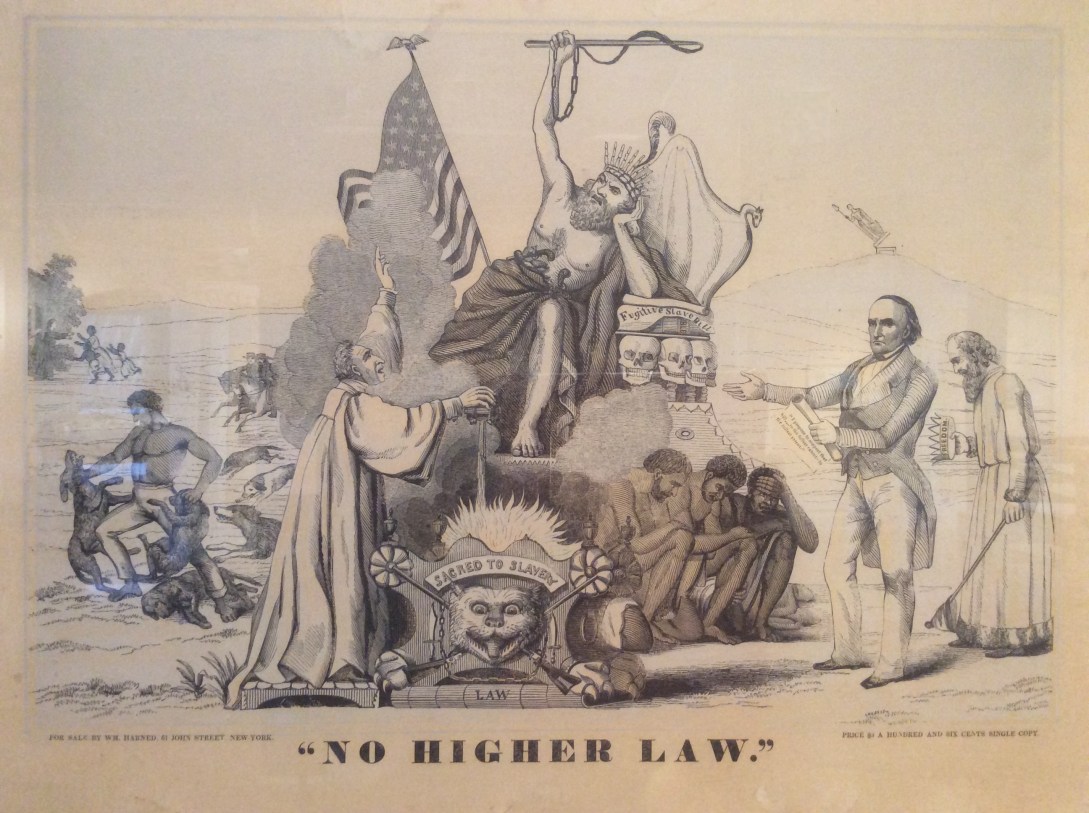
Among the many interesting exhibits I see are two posters, similar in format and general style but strikingly different in message and tone. One shows a man with an angry face, wearing a crown made of finger bones and brandishing a chain and whip, seated upon a throne and supported by three mournful slaves, three skulls, a Bible, and a copy of the Fugitive Slave Bill (Act) of 1850. A man in a white robe (perhaps a clergyman’s robe, since a judge’s robe would be black) is pouring an offering from a small cask into a fire on a small altar emblazoned ‘Sacred to Slavery’, while Daniel Webster, a leading Senator at the time famed for his eloquence, gestures to the throne, proclaiming ‘I propose to support that bill …to the fullest extent…’ and a bearded man behind him hangs his head in sorrow, lowering a crown labeled ‘Freedom’ from his head. Behind these figures, a barefoot escaping male slave wrestles with a pack of snarling dogs as two slavecatchers on horses gallop after him, a black woman and her children run into the open arms of an abolitionist white woman, and a statue of Minerva, goddess of wisdom and trade, topples from her pedestal on the hill.

The Fugitive Slave Act of 1850 was meant to put an end to a deeply divisive issue between the Northern and Southern states. Southern slaveowners were enraged that northern abolitionists, grown into an energetic movement and potent political force following the pioneering abolitionist work of William Lloyd Garrison starting in the late 1820’s, were aiding slaves escaping to the North. The Act would not only force all Northern officials to cooperate in the capture and return of escaped slaves, it would force private individuals to do so too, on pain of fines and imprisonment. Northerners, especially abolitionists, saw this as an intolerable intrusion on personal conscience by forcing them to participate in a deeply immoral system, while Southerners saw this as a simple enforcement of property rights.

No Higher Law Abolitionist Poster, Lynn Museum, 2016 Amy Cools

No Higher Law Abolitionist Poster, from the Abolitionist Lynn exhibit at the Lynn Museum & Historical Society, March 2016

Senator, statesman, and orator Daniel Webster personified the central conflicts between North and South at that time. A Northerner hailing from Massachusetts, he irreparably damaged his political career through his support for the Fugitive Slave Act, the final and most sweeping of many such acts passed over the decades. Northerners who admired him for his commitment to preserving the Union and for promoting the modernization of the United States into a center of finance and industry from the mostly agrarian economy it had long been, hated this cession of state and personal autonomy to Southern interests. And however much the South loved the bill, their economy was almost entirely based on agriculture and capital investment in slaves, so Webster’s economic policies were intolerable to them regardless of this compromise to preserve the Union. As Abraham Lincoln recognized from the beginning, though he too tried to find a way, peace between the states could never be attained so long as the law, founded on certain conceptions of human rights, tried to accommodate that intrinsically incompatible ‘peculiar institution‘ of slavery.

Haitian Ambassador Poster detail, Lynn Museum, 2016 Amy CoolsThe second poster is a nasty (despite the author’s snarky claim that it’s ‘respectful’) caricature of the abolitionist women of Lynn and of black people in general. Addressed in the subtitle to the ‘500 ladies of Lynn who wish to marry black husbands, it’s basically an elaborate telling of that schoolyard jibe ‘if you love…. so much, why don’t you marry …?’ As you can recognize in the quotes of the ladies in the ballroom oohing and awing over the visiting Haitian ambassador, the author plays on many stereotypes of black people and of women at the time. And unfortunately, most of us ‘get’ the twisted jokes in these quotes because these stereotypes persist to this day.
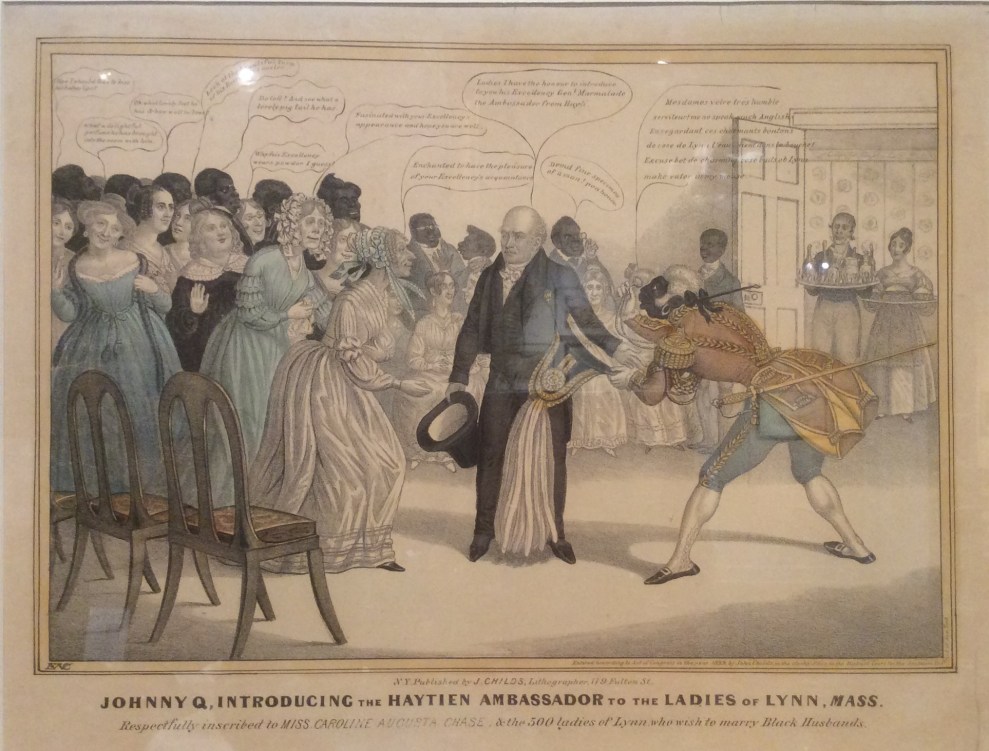
The person who created this poster in 1839 could not have foreseen that one of Lynn’s future black residents, Frederick Douglass, would go on to to become one of Lynn’s and America’s most loved and admired citizens, and would be appointed to the high office of United States Consul General to Haiti in 1889. I, for one, would get some satisfaction out of time-traveling to visit the author and inform him of these historical developments, just to see the look on his face. Douglass was too dignified a man himself to engage in such a prank if it were possible; throughout his life, he practiced great self-discipline in keeping to the moral high ground.

Johnny Q and Haitian Abassador Poster, Lynn Museum, 2016 Amy Cools

Poster caricaturing Lynn’s abolitionist movement, 1839, from the ‘Abolitionist Lynn’ exhibit at the Lynn Museum & Historical Society

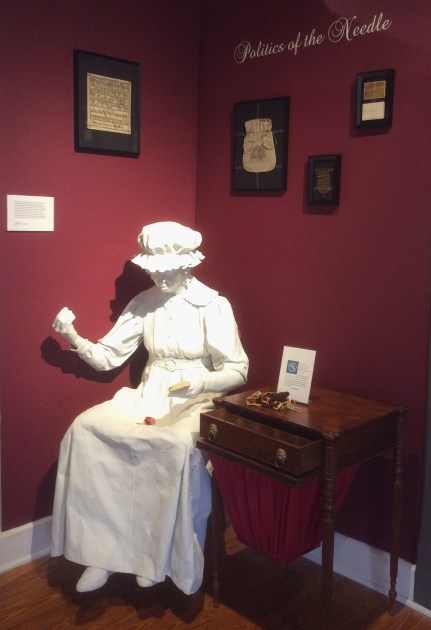
Politics of the Needle, Lynn Museum exhibit, 2016 Amy CoolsA seamstress and textile artist myself, I enjoy the exhibit of needlework artifacts here, created by the girls and women of Lynn’s abolitionist community to raise money for the abolitionist cause.
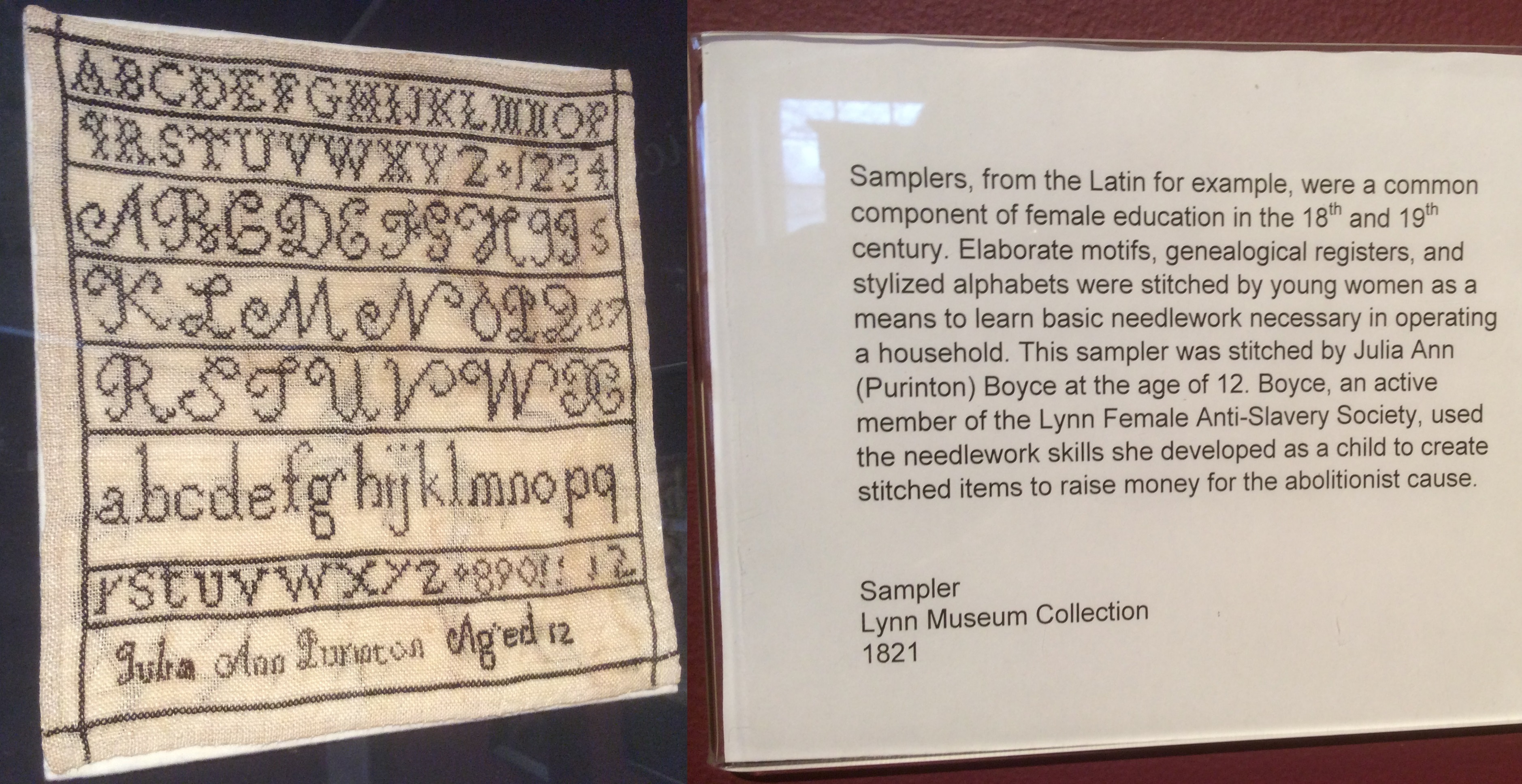
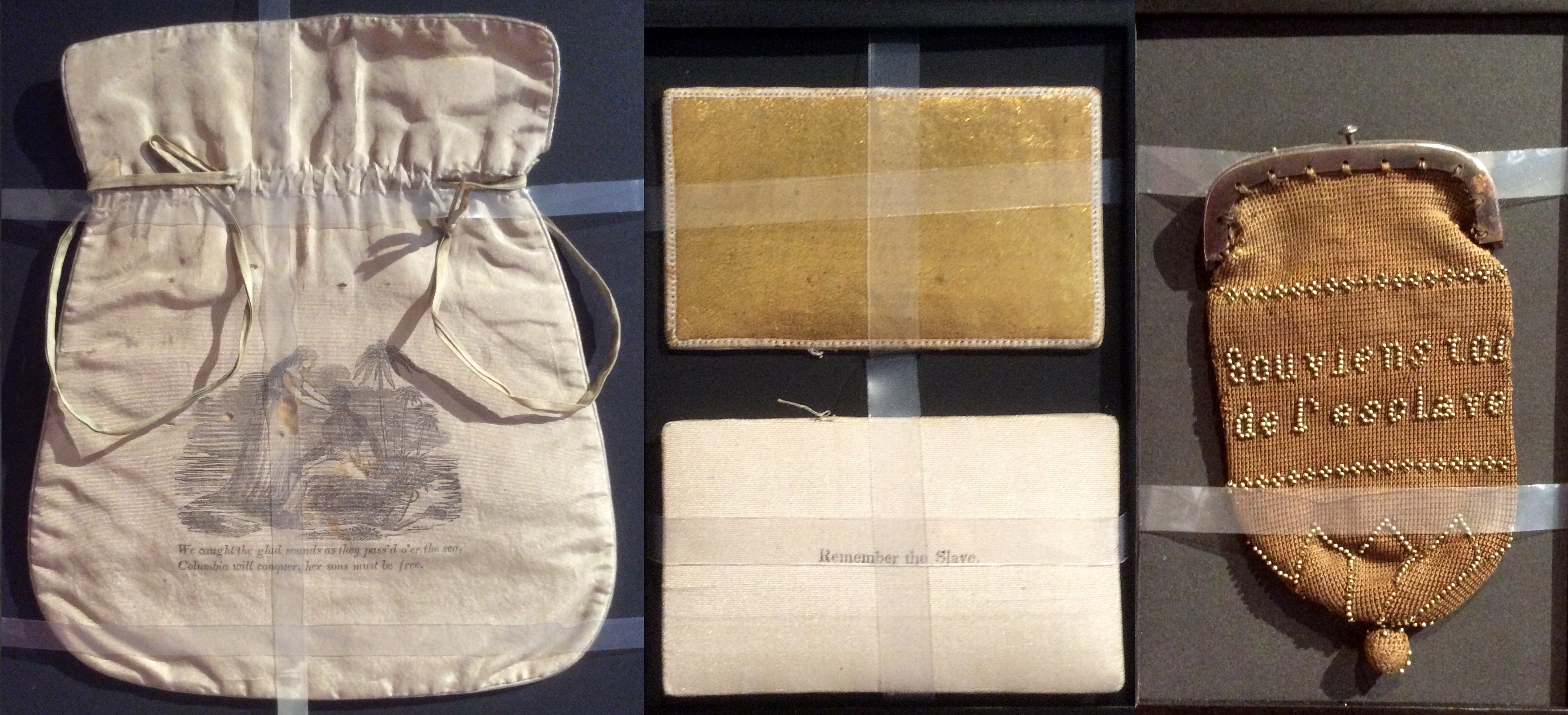
The sampler is a basic design, the only thing differentiating it from other samplers of the period is the cause it raised money for. The other pieces, through words and images, remind their owners not to forget the slaves’ plight while enjoying the freedom and comfort of their own daily lives.

The exhibit is filled with many more interesting artifacts and information, but to keep this account from becoming too long, I’ll refocus my attention on the main object of my visit here today.

Sampler by Julia Ann Boyce at Lynn Museum

Abolitionist needlework exhibit, Lynn Museum

Abolitionist needlework exhibit, Lynn Museum & Historical Society

Piano with John Hutchinson sheet music, Abolitionist Lynn exhibit, March 2016

Piano with John Hutchinson sheet music, Abolitionist Lynn exhibit, March 2016

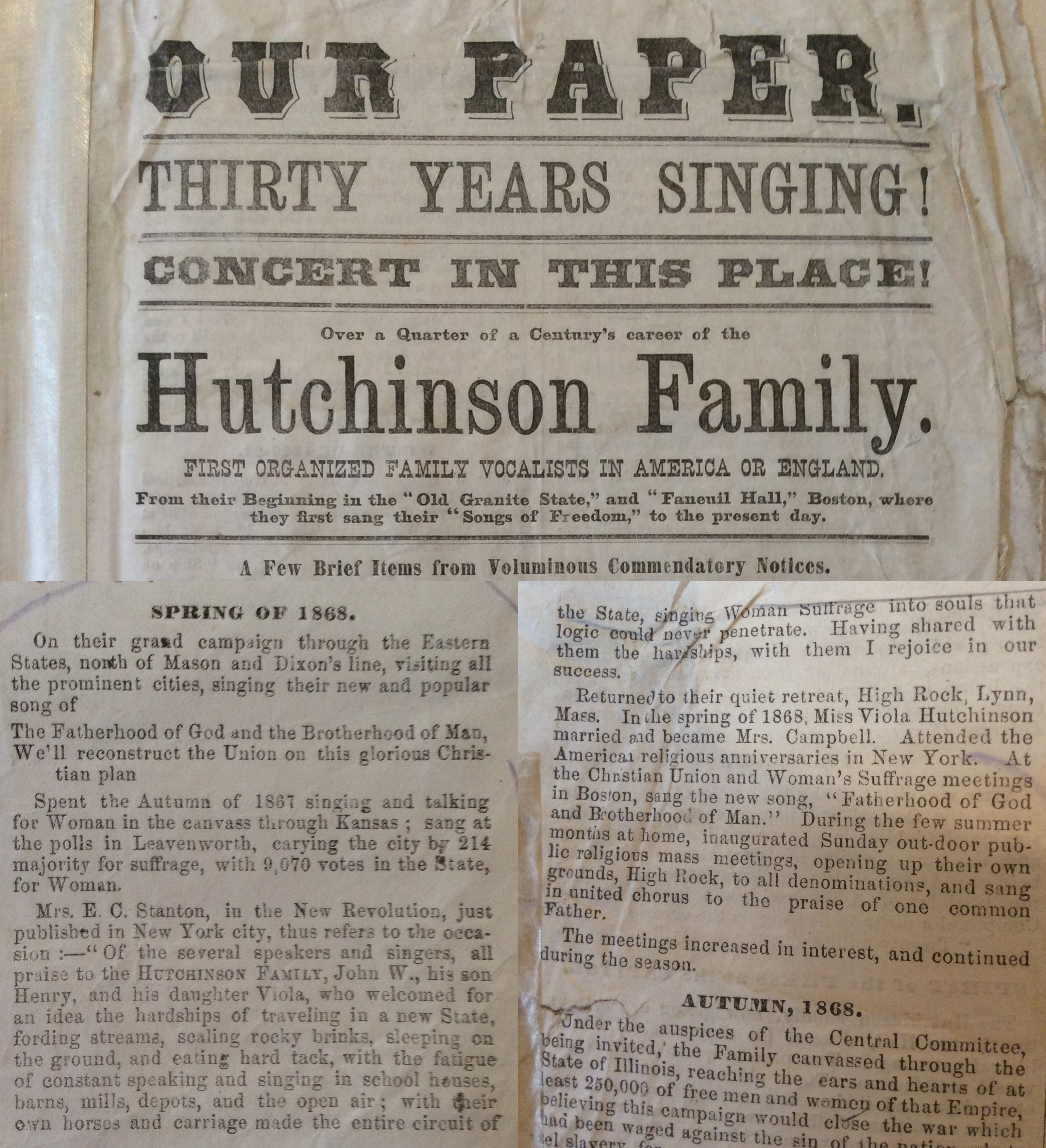
The Hutchinson Family Scrapbook at the Lynn Museum & Historical Society

The Hutchinson Family Scrapbook at the Lynn Museum & Historical Society

Britt arrives (she so kindly takes time out of her day off to come in and meet me!) and greets me with a cart of artifacts: one is a folder filled with ephemera relating to Douglass, mostly newspaper clippings, and the other is an old scrapbook entitled: ‘Memorabilia of the Hutchinson Family’. She reminds me of what Nicole Breault, Education and Research Specialist, had informed me by email: the Lynn Museum’s archival materials are now housed at the Phillips Library at the Peabody Essex Museum. She encourages me to visit and I long to do so, of course, but as I’ve been telling you, more and more to my regret, I only have two weeks for this trip and have no time to go! I hope to be able to follow up in future, and now have yet one more good resource for original sources.

So knowing time is short this morning, too, I begin with the exciting artifact here before me, the Hutchinson family scrapbook.

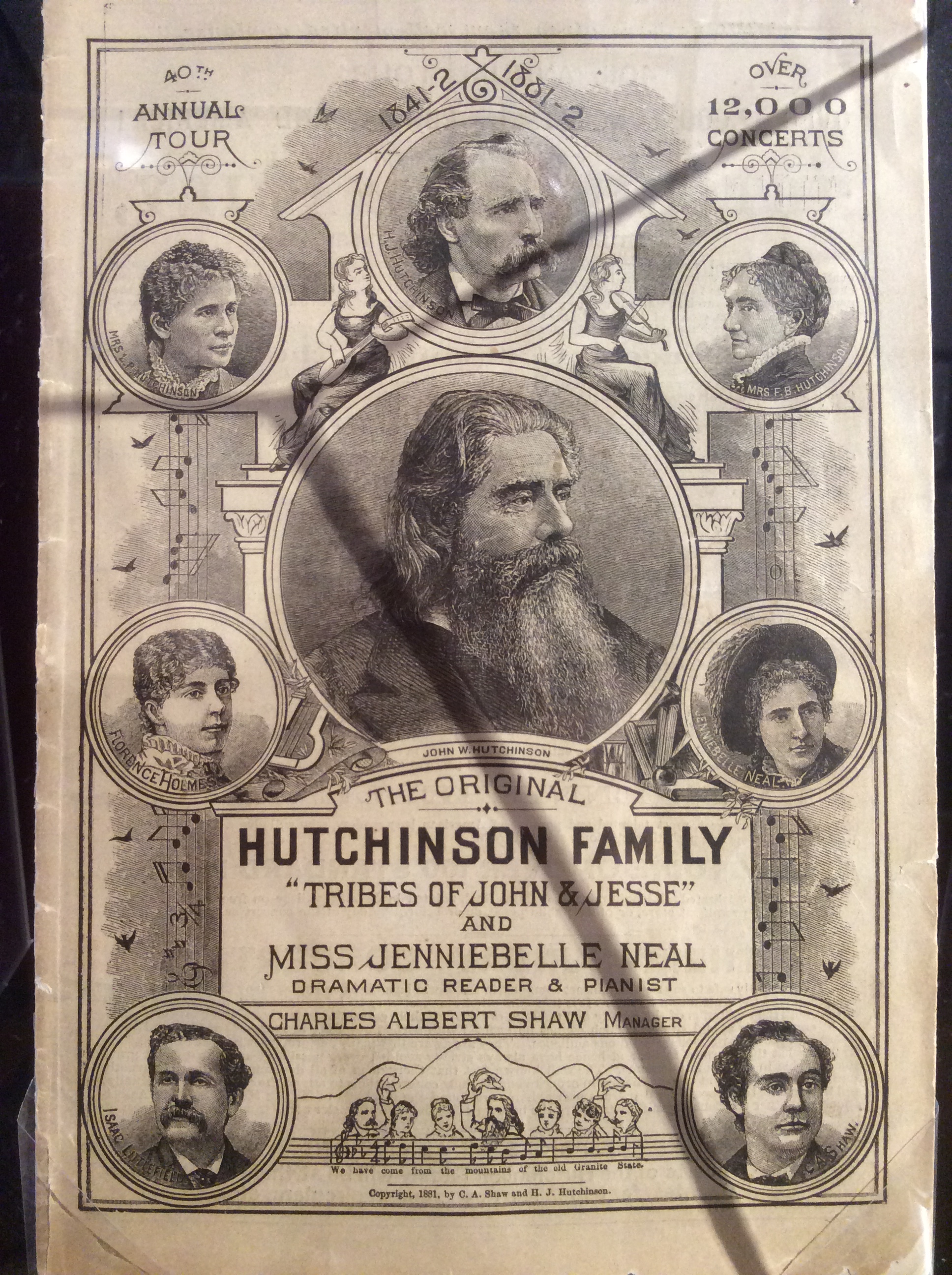
Hutchinson Family Singers Poster, Lynn Museum, 2016 Amy Cools

Hutchinson Family Singers Poster at the Abolitionist Lynn exhibit, March 2016, Lynn Museum & Historical Society

Portrait of John Hutchinson from the Hutchinson Family Scrapbook at the Lynn Historical Society. He's quite a handsome man, I think, with beautiful eyes

Portrait of John Hutchinson from the Hutchinson Family Scrapbook at the Lynn Historical Society. I think he’s very handsome, with beautiful eyes

It opens with a portrait of John Hutchinson. Douglass traveled on board with the Hutchinsons, the ‘sweet singers of anti-slavery and the “good time coming,”‘ (Life and Times) when he sailed to the British Isles on August 6th, 1847, on self-imposed exile when he felt the information contained in his newly published Narrative endangered his freedom.

The Hutchinson Family Singers vocal group was founded by John Hutchinson with his brothers Asa, Jesse, and Judson. The Hutchinson family was originally from New Hampshire, as Douglass described, but had many connections to Lynn: John saw a concert of a European singing troupe and was inspired to form his own in that style; the family later performed in Lynn; and John and his wife Patch settled here, on High Rock at the north part of the city, not far from the second Lynn home of the Douglass family. When Jesse became musical director of the group he stopped singing as often, but all of the brothers and sisters, as well as many spouses and other extended family members, joined in as full-time or occasional members. The group broke up into two ‘tribes’ since the brothers didn’t always get along (like so many brothers in bands together, like the great Kinks and maybe not the quite as great Oasis), but both groups were always billed as the ‘Hutchinson Family Singers’.

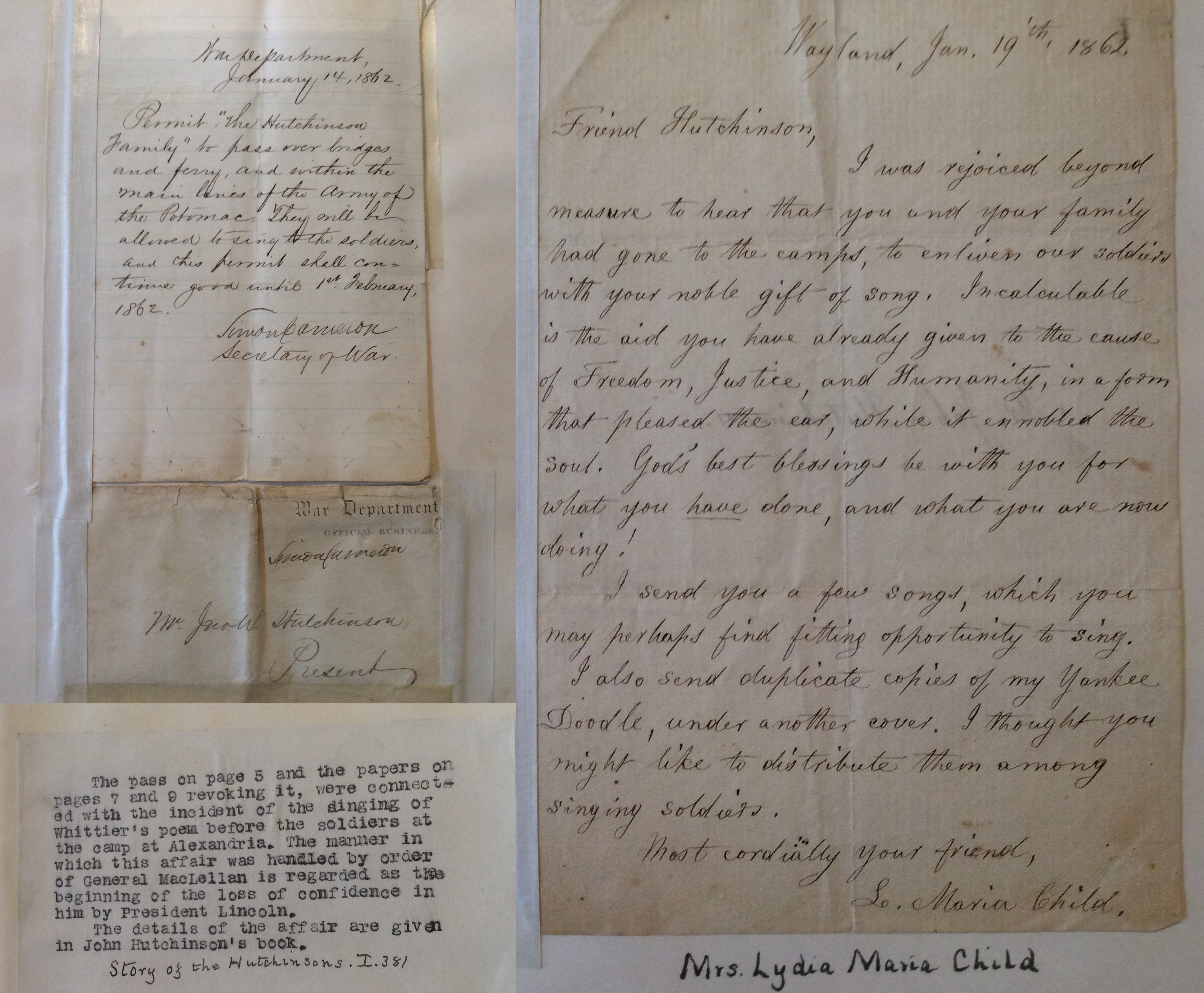
Civil War free pass and letter from Lydia Marie Child to John Huchinson, Lynn Museum & Historical Society

Civil War free pass and letter from Lydia Maria Child to John Hutchinson, Lynn Museum & Historical Society. The Hutchinson family would sing for the troops, by special permission of the Secretary of War, to cheer and inspire them. The great human rights activist and author Child applauds this in her letter to John of January 19th, 1862.

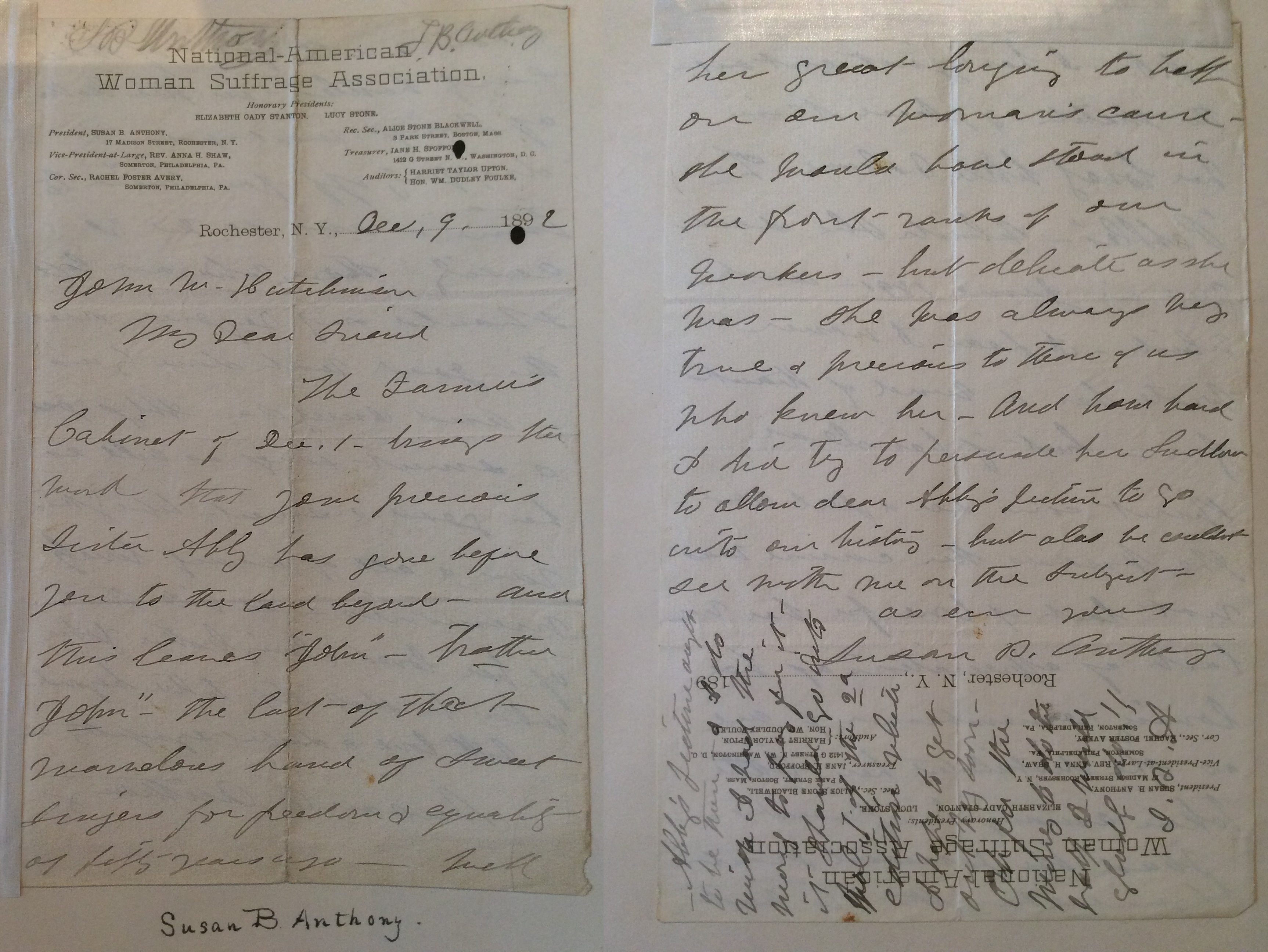
There are so many wonderful artifacts here, new thrills every time I turn the page! There’s a letter from Susan B. Anthony, great abolitionist, woman’s rights leader, and friend of Douglass, who I’ll discuss at greater length in a later account:

Susan B. Anthony Letter to John Hutchinson

Letter from Susan B. Anthony to John Hutchinson, December 9th 1892, sending condolences for the death of his sister Abby, an especially talented member of the group and also, as Anthony says here, dedicated to the women’s rights cause

Abby Hutchinson's tribute to Jesse upon his death on May 15, 1853

Abby Hutchinson’s tribute to her brother Jesse following his death on May 15, 1853. She replaced him as fourth member of the quartet when he stopped singing to become manager, then took over as manager when he died

There’s a note from Julia Ward Howe:

Note from Julia Ward Howe

Note from Julia Ward Howe, who wrote ‘Battle Hymn of the Republic’, which consisted of new lyrics to the tune of ‘John Brown’s Body’, a song about Douglass’ fiery abolitionist friend who led the raid on Harper’s Ferry. Both songs were popular Civil War hymns, for the Northern side, of course

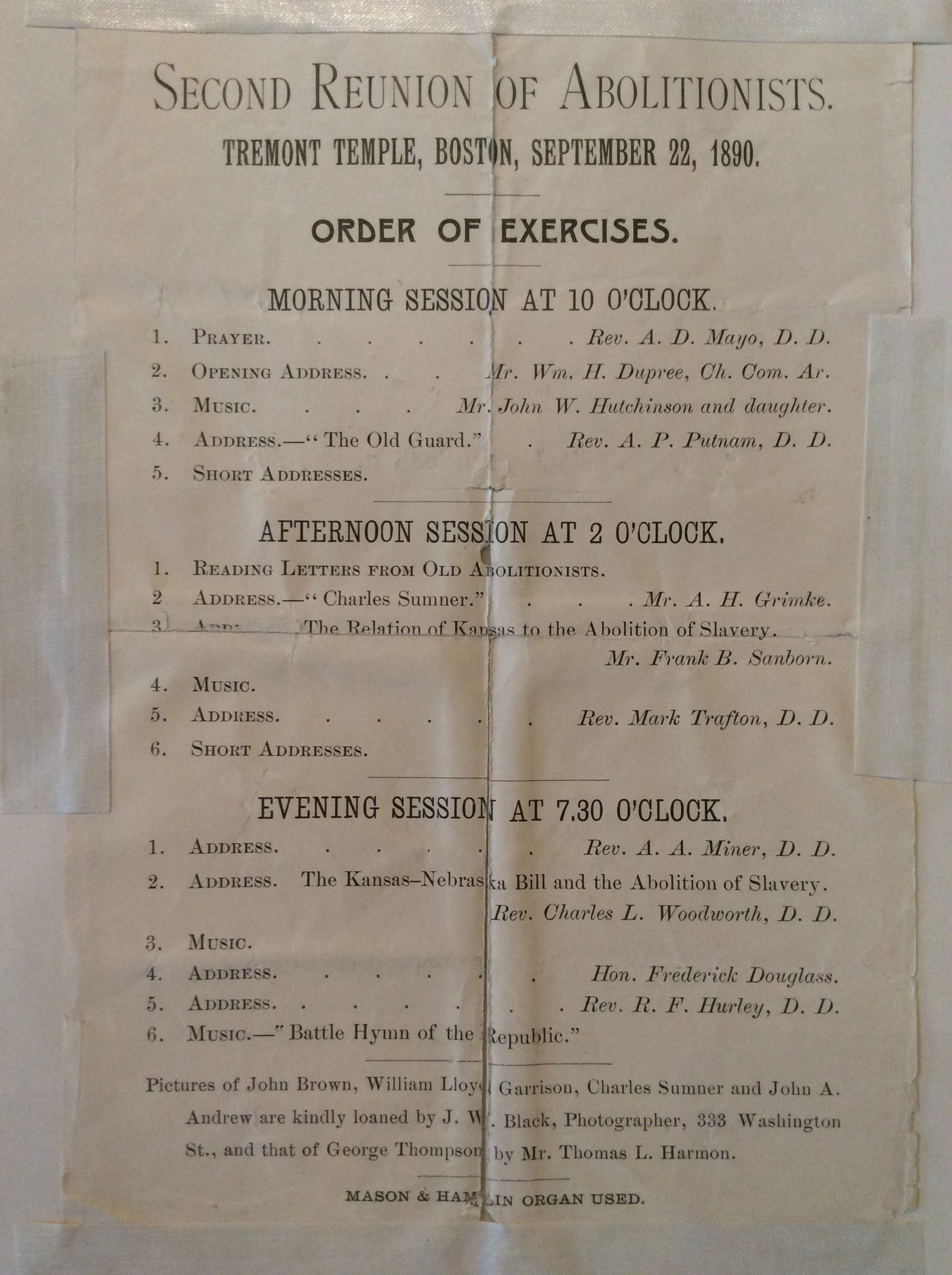
Tremont Temple Abolitionist Poster, 2016 Amy Cools

Poster for Second Abolitionist Reunion at Tremont Temple in Boston, September 22nd 1890. As you may remember from my account of my day in Boston visiting Douglass sites, he spoke here often, and as you can see from the poster, he shared the stage with John Hutchinson and his daughter Viola, who donated the scrapbook to the Lynn Historical Society (see cover photo above). They close the meeting with Howe’s ‘Battle Hymn of the Republic’

Hutchinson Family Paper celebrating 25 years as a group, with ringing endorsement by Elizabeth Cady Stanton

Hutchinson Family Paper celebrating over 25 years as a group, with a ringing endorsement by feminist leader and Douglass’ friend Elizabeth Cady Stanton

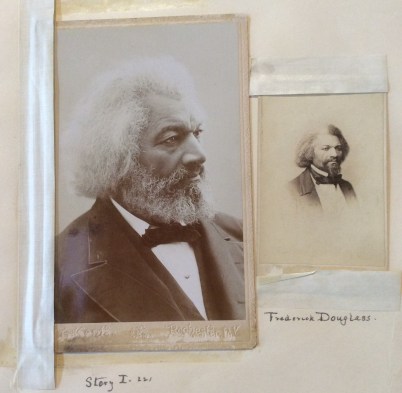
Two portraits of Frederick Douglass from the Hutchinson Family scrapbook

Two portraits of Frederick Douglass in the Hutchinson Family scrapbook

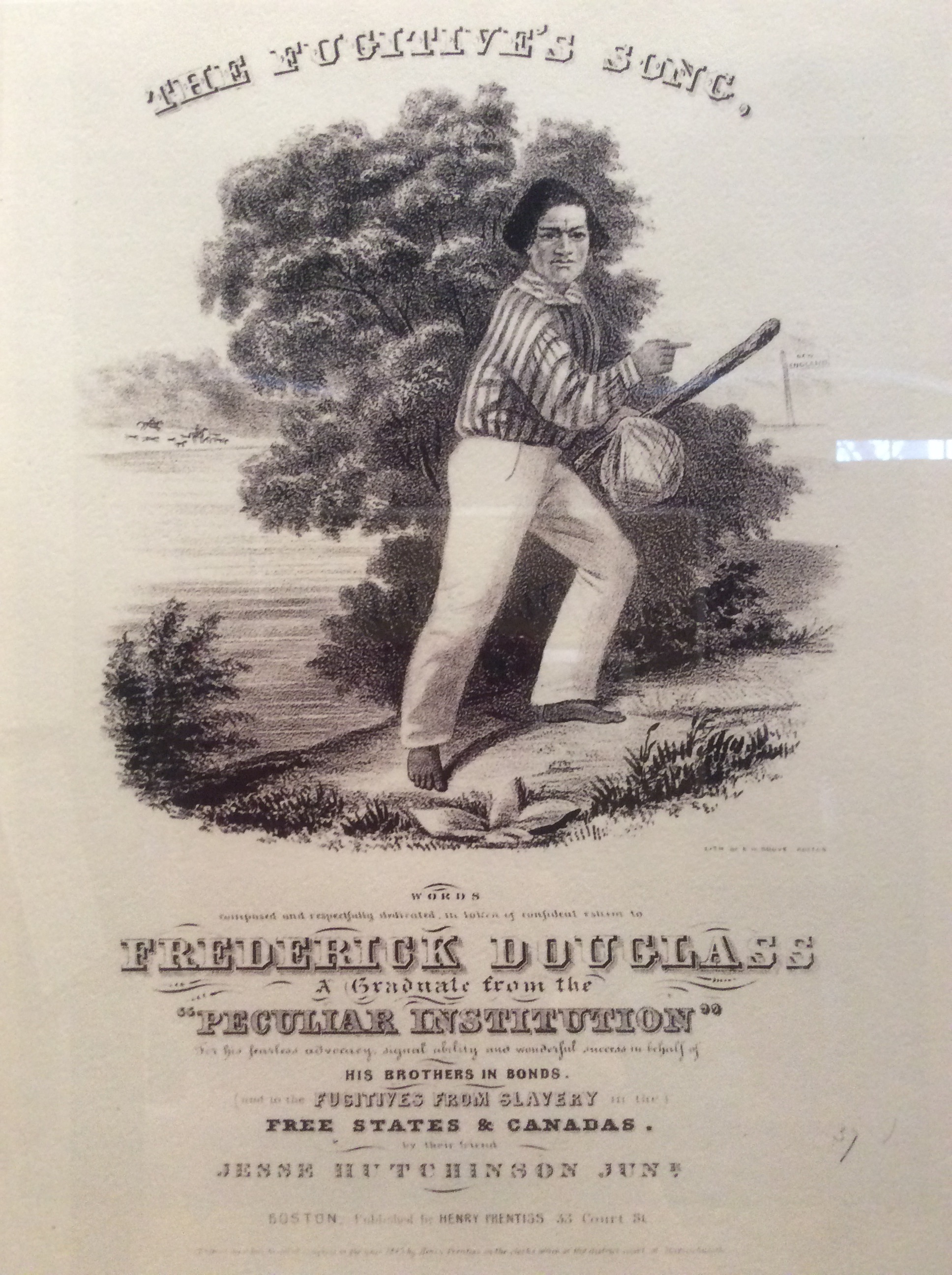
John Hutchinson Song Dedicated to Frederick Douglass Cover Page from Lynn Museum Exhibit

Jesse Hutchinson Song dedicated to Frederick Douglass, cover page print from Lynn Museum Abolitionist Lynn exhibit

As with the Lynn Museum exhibit, I find there are so many interesting things here to share and I can continue on, but this account would grow meandering and very long (it’s going to be pretty long regardless!). So, I’ll return to the central subject of this account, publishing more photos of artifacts I find here today in later accounts as they pertain to the story, and tell you about my most exciting discovery of the day.

Do you remember this drawing on the left from the first part of my Lynn journey account, of the cover page for ‘The Fugitive Song’, written by Jesse and dedicated to Frederick Douglass?

In 1874, Douglass wrote a letter to John Hutchinson mentioning Jesse (the group was often called ‘The Tribe of Jesse’ even long after his death), and it’s here in this scrapbook. Yes, I’m holding an original letter written by Douglass himself, in my own two hands! Well, archivist-gloved hands anyway, and of course I don’t remove it from the scrapbook, just carefully turn it over to read both sides. Like I’ve said many times before, artifacts and physical sites have a very strong effect on me emotionally, which is what keeps me from being just an armchair history enthusiast and drives me out on the road. So, of course, I get the chills all over again, and feel more than a bit teary-eyed!

The envelope is addressed: 'John W. Hutchinson, Lynn Mass' from 'Fred'k Douglass'

The envelope is addressed: ‘John W. Hutchinson, Lynn Mass’ from ‘Fred’k Douglass’

But anyway, here’s the full text of the letter:

‘Biddeford, Nov. 18, 1874

My dear John,

I have only time while on the wing as I am, to tell you that you made me very much obliged to you for the little pamphlet you kindly put into [sic] hands night before last in Lynn, containing biographical sketches of the several members of your remarkably musical family. No apology was needed for its publication. All who have listened as I have done, to the ‘Concord of Several Sounds’ from members of the ‘Tribe of Jesse’ want more of the music and wish to know more of the persons from whom it comes. I especially have reason to feel a grateful interest in the whole Hutchinson family for you have sung the yokes from the necks & the fetters from the limbs of my race, and dared to be true to humanity against all danger to worldly prosperity and reputation. You have dared to sing for a cause first and for cash afterward. I know of few instrumentalities which have done more for liberty and temperance than have your voices. But I only took this moment simply to thank you for the pamphlets and not to speak in the praise of the dear family.

Yours very truly, Fred’k Douglass.’

Frederick Douglass letter to John Hutchinson, dated 1874, Lynn Museum & Historical Society

Frederick Douglass letter to John Hutchinson, dated 1874, Lynn Museum & Historical Society

At long last and with little time to spare, I finish looking at the scrapbook and turn to the other clippings and ephemera I find in the Douglass file folder.

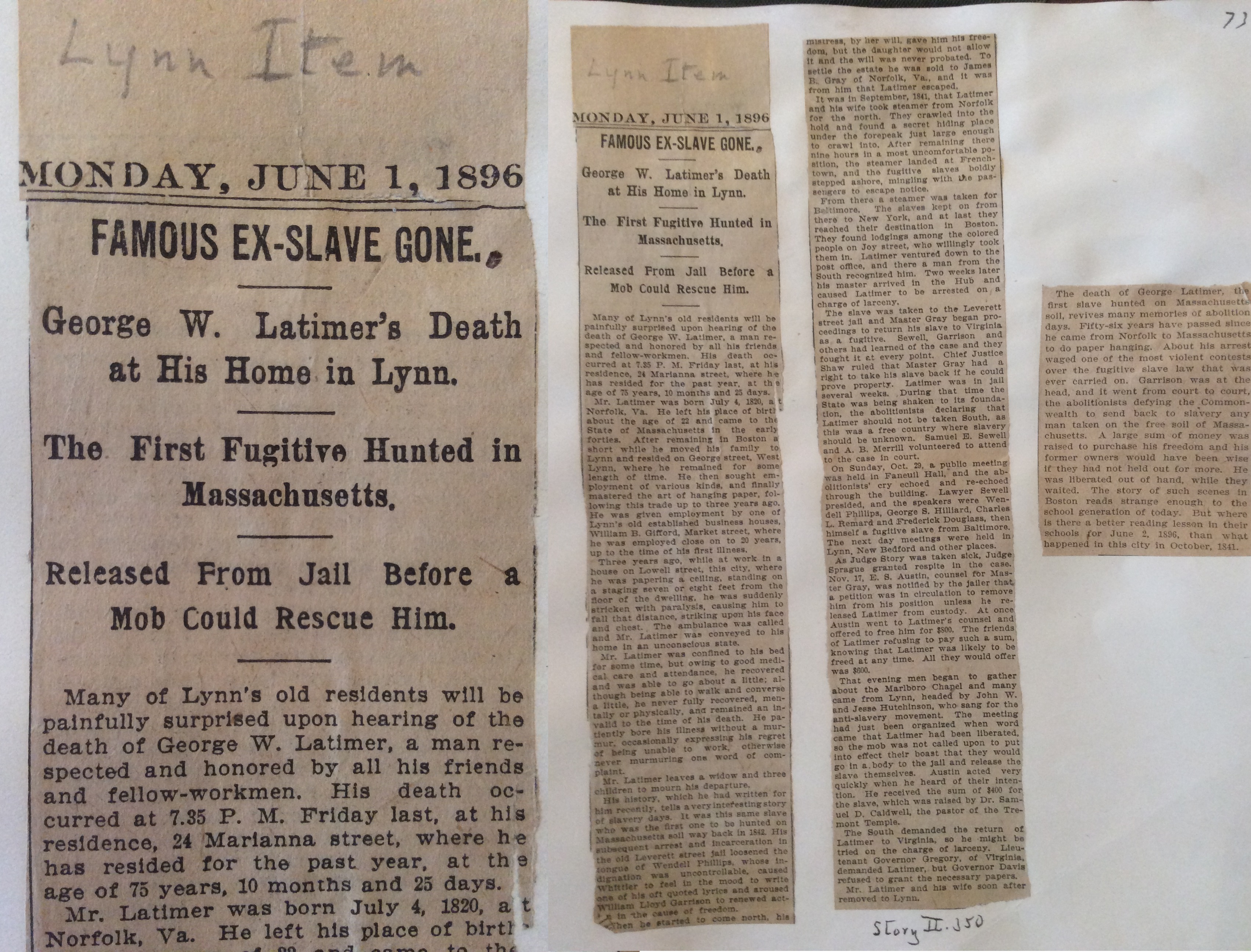
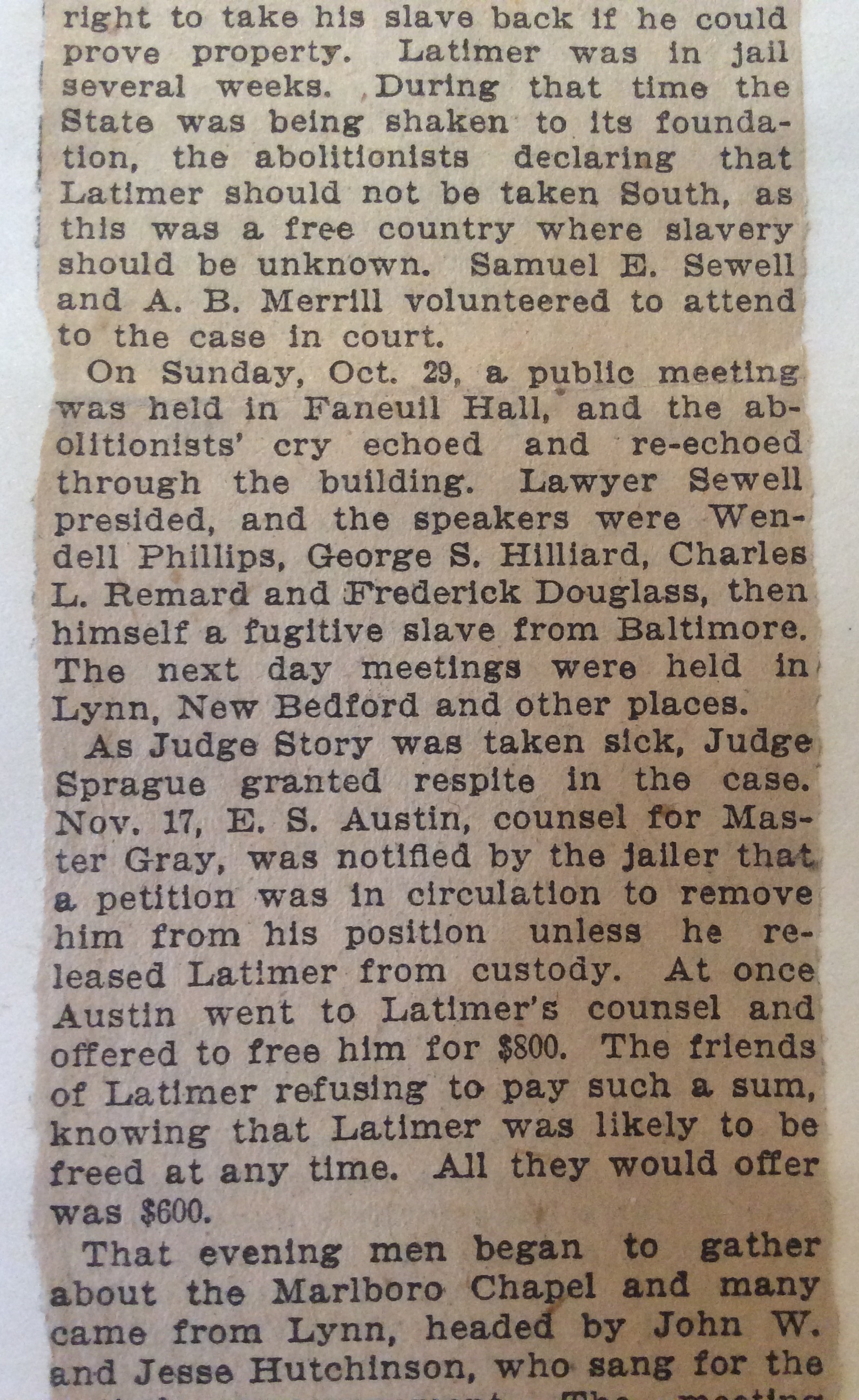
George Latimer article, Lynn Museum Archives

George Latimer article, Lynn Museum Archives

I find an old newspaper clipping here that’s very interesting, unique in its details yet generally characteristic of how high the tensions were between abolitionists and supporters of slavery, and how tight-knit abolitionist communities were. New Bedford, as discussed earlier in this series, was one such community. Lynn and Boston both have a strong history of abolitionism as well (John Adams, a Bostonian of many years, was the only one among our first several presidents who not only didn’t own slaves, but consistently regarded it a great wrong).

Detail of George Latimer article

Detail of George Latimer article

The clipping tells the story of George Latimer, a former slave who escaped with his wife Rebecca to Baltimore, than onto Boston, where George was arrested; after Latimer’s freedom was finally purchased, he and his wife settled in Lynn. I had read this story in my research on Douglass; it was disputes over slaves escaping north, such as the Latimers, that led to the passage of the Fugitive Slave Act, since the slavecatchers had pursued Latimer into a free state. And as you can see in the newspaper account (you can open the image in a new tab and zoom in to read), Douglass, William Lloyd Garrison, and Wendell Phillips were champions for Latimer’s cause and held meetings in Boston’s Faneuil Hall, where I visited yesterday. You’ll also see that Jesse and John Hutchinson were among the activists protesting Latimer’s treatment, that the pastor of Tremont Temple Samuel Caldwell paid the $400 that purchased his freedom (paid his ransom?), and that Latimer and his wife were taken in by people on Joy Street, on Beacon Hill in Boston; I walked that street just yesterday as well.

I find many other old newspaper clippings in this folder, some of which I’ve shared with you already in the first part of my account of today’s visit to Lynn, others which I’ll share with you as they relate to my further discoveries on my Douglass journey, and still others I’m happy to share upon request. But I’ll go ahead and end this account here for time’s sake, and soon follow this with the tale of my next day’s discoveries.

Again, my heartfelt thanks to all at the Lynn Museum & Historical Society. Thank you so much to Nicole Breault for arranging my visit, Britt Bowen who gave me access to historical artifacts for study, the kind ladies who greeted me and showed me around, and to everyone else there who makes this place a beautiful place to visit and a great resource!

~ Ordinary Philosophy and its Traveling Philosophy / History of Ideas series is a labor of love and ad-free, supported by patrons and readers like you. Please offer your support today!

~~~~~~~~~~~~~~~~~~~~~~~~~~~~

John and Patch Hutchinson from Family Scrapbook

John and Patch Hutchinson from Family Scrapbook

Sources and inspiration:

Blassingame, J. (Ed.). The Frederick Douglass Papers, Series One: Speeches, Debates, and Interviews. 4 volumes, and The Frederick Douglass Papers, Series 2: Autobiographical Writings. 3 volumes. New Haven and London: Yale University Press, 1979-1999

Daniel Webster‘. In Wikipedia, The Free Encyclopedia.

Douglass, Frederick. Autobiographies (includes Narrative…, My Freedom and my Bondage, and Life and Times). With notes by Henry Louis Gates, Jr. Volume compilation by Literary Classics of the United States. New York: Penguin Books, 1994.

Foner, Philip S. The Life and Writings of Frederick Douglass, Vol. 1-4. New York: International Publishers, 1950.

Frederick Douglass Chronology‘ from the National Park Service – History & Culture: People

Fugitive Slave Act of 1850‘. from Wikipedia, The Free Encyclopedia.

Fugitive Slave Law‘, from The African American Odyssey: A Quest for Full Citizenship online exhibit from the Library of Congress.

Hutchinson Family Singers‘. In Wikipedia, The Free Encyclopedia.

The Hutchinson Family Singers: America’s First Protest Singers‘. Amaranth Publishing website

Lewis, Alan. ‘Abby Hutchinson Patton‘ and ‘John Wallace Hutchinson‘, Hutchinson Family Singers Web Site (archived)

Peculiar Institution.” Dictionary of American History, 2003, from Encyclopedia.com

Weatherford, Doris. ‘Lydia Maria Child‘, via National Women’s History Museum website

William L. Garrison‘. Ohio History Central website

William Lloyd Garrison‘. From Wikipedia, The Free Encyclopedia.

Frederick Douglass Lynn, Massachusetts Sites

John Hutchinson Song Dedicated to Frederick Douglass Cover Page from Lynn Museum ExhibitJohn Hutchinson Song Dedicated to Frederick Douglass Cover Page, 2016 Amy Cools

Jesse Hutchinson song dedicated to Frederick Douglass, cover page print from Lynn Museum exhibit (a fanciful illustration: in real life, he wore shoes and escaped by train and ferry)

Seventh Day, Saturday March 26th

I drive from Boston to Lynn, Massachusetts, only about 25 minutes north by car.

Not long after Frederick Douglass began his public speaking career, he and his family moved here to Lynn from New Bedford. They lived here from the fall of 1841 through about November 1847. Well, actually, for much of that time, it was mostly Anna and the kids who lived here. First, Douglass was often on tour as a speaker, which took him away from home for long stretches. Secondly, he was away on a tour of the British Isles from 1845-1847, which is why many sources say Douglass himself only lived here until 1845. He returned only briefly to Lynn before moving himself and his family to Rochester near the end of 1847. His ‘industrious and neat companion‘ Anna took care of the household while he was away, and often took in piecework from Lynn’s thriving shoemaking industry to make sure the kids were always cared for and the bills paid on time.

Douglass wrote his Narrative of the Life of Frederick Douglass, An American Slave here in Lynn, and it was published by the Boston Anti-Slavery Society on May 28th, 1845. It sold well, and he became more than a bit nervous: he enjoyed freedom so much, of course, and now he had a family, he had even more to lose if he was to be captured and returned to slavery. After all, as discussed, he had said some not too nice things in his Narrative about his former master (who legally, still was), and who knows how badly Thomas Auld wanted to have him back in bondage! So, to avoid capture now that he publicly named his master and his whereabouts were more widely known, he sailed to England on August 6th, 1845, and embarked on an 18 month lecture tour of England and Ireland. Eventually, his abolitionist friends raised enough money to buy his freedom, or, as he conceived of it, to pay his ransom, and he was able to return home, arriving back in Lynn on April 20th, 1847. Though he was away so much, Lynn still played a significant role in his life.

Three Portraits of Frederick Douglass at the Lynn Museum & Historical Society

Three portraits of Frederick Douglass at the Lynn Museum & Historical Society

Lynn proves to be a Douglass treasure trove for me, primarily thanks to the Lynn Museum and Historical Society. Thank you so much to Nicole Breault for arranging my visit, Britt Bowen who gave me access to historical artifacts for study, the kind ladies who greeted me and showed me around, and to everyone else there who make this place a beautiful place to visit and a great resource! In fact, my visit to the museum was so full of wonderful discoveries that it needs its own separate piece, which will follow shortly.

Mural on wall of Lynn's greats on the side of Lynn Arts Building, crowned by portrait of Frederick Douglass Portrait, Lynn MA

Mural on wall of Lynn’s greats on the side of the Arts Building, crowned by portrait of Frederick Douglass Portrait

After I tear myself away from the museum (if it wasn’t closing just then, I don’t know how I’d tear myself away and get to visiting the sites on my itinerary!) and go eat a bit of lunch, I head for my first destination. On the way, my attention is caught by this vibrant mural on the side of the Lynn Arts Building at 25 Exchange St, where a portrait of Douglass presides over images of Lynn’s historical figures and creative and curious children (and other people) of today.

Newspaper clipping from the Lynn Museum and Historical Society about Frederick Douglass' train car sit-in

Old newspaper clipping from the archives at the Lynn Museum and Historical Society about Frederick Douglass’ Rosa Parks moment

I’m heading for the site of the old Central Square train station. Downtown Lynn is not easy for a first time visitor to navigate: no two streets seem to join at right angles. It takes me a few go-rounds to orient myself generally, yet I still often find myself often a little lost among the tangled streets. A man who tends a little restaurant called Capitol Diner, which looks like an old red train car, helps confirm that the place where the elevated tracks run above where Central Square meets Union and Exchange Streets is just about directly over the site of the early 1800’s train depots (there was a series of them), across the street from the mural on the side of the Arts Building.

Old Lynn Central Square and depot, photo by William T. Webster, via Wikimedia Commons

Old Lynn Central Square and depot, photo by William T. Webster, via Wikimedia Commons

Central Square Train Station raised platform

Central Square Train Station raised platform where the old train depot and Sagamore Hall once stood, to the right of the photo

According to Wikipedia, ‘The first depot at the Central Square location, built in 1838, was a small wooden building. It was replaced in 1848 with a brick building with a 2-track train shed.’

So it was in that smaller wooden incarnation that an incident occurred at this stop of a train between Boston and Portland. Douglass resisted being forced into a Jim Crow segregated car on September 28, 1841, while he was riding the train with his friend James N. Buffum, who would later become mayor of Lynn and who had inspired him to move to Lynn in the first place. Douglass simply refused to leave his seat, and when employees of the railroad company tried to remove him by force, he hung onto the seat until they were ripped and torn out of place.  As Edward Covey the slavebreaker had discovered some years earlier, Douglass was physically strong and no pushover.

Over time, he ended up doing this sort of protest often, to raise awareness. His letter about this experience was published in the newspaper, and local indignation and protests over this incident helped lead to the eventual end of segregated train cars in New England. It’s hard to imagine, to a modern reader in such an interconnected world, that there would be such a patchwork of racial sentiment in a geographic area that it took me only a few hours to cross by car. In Maryland, he was a slave; in New York City, he was free but in danger of being beaten or captured; in Boston, his Narrative was published in the same city where he was denied entry to the menagerie on Boston Common because ‘We don’t allow niggers in here!’ (as he reported); in Lynn, the trains were desegregated over rude treatment of a black customer. Amazing.

Clipping from Lynn Historical Society about Douglass' life in Lynn and Sagamore Hall

Clipping from Lynn Historical Society about Douglass’ life in Lynn and Sagamore Hall

A row of buildings on Central Square in Lynn, MA

A row of buildings on Central Square in Lynn, MA; the elevated train tracks at the right pass over the site of the old depot, and Sagamore Hall stood just beyond the tall white-faced brick building

In Central Square, I’m close to the site of Sagamore Hall where John Brown, fiery abolitionist, and friend and hero of Douglass, used to speak. Sagamore Hall was close and to the west of the depot, between Union and Mt Vernon Streets north of Exchange, also where that part of the elevated track structure now stands. If you look closely at the photo of the mural we looked at earlier, you’ll see the image of a burning building just under Douglass’ portrait: that’s Sagamore Hall burning down on November 25th, 1843. I’ll tell more about how John Brown figured in Douglass’ life, which was very significantly, before long. You’ve likely heard of him:  he led the unsuccessful raid on Harper’s Ferry from October 16th -18th 1859, in hopes of jump-starting a slave insurrection by providing them with a source of arms, and was hanged as a traitor for his trouble.

But when Douglass lived here throughout the early- to mid- 1840’s, he had not yet met John Brown, though they were here in Lynn contemporaneously. As Douglass tells it in his Life and Times, they would meet later, when Douglass lived in Rochester NY.

Market and Broad Streets near site of 1st Douglass family home in Lynn, 2016 Amy Cools

Market and Broad Streets, near the site of the first Douglass family home in Lynn, MA; their house would have been somewhere to the right of the iron structure

Manufacturing center of Lynn, Mass, by Bailey, O. H. (Oakley Hoopes) & J.C. Hazen Publisher: Bailey, O. H. & J.C. Hazen, 1879

Manufacturing center of Lynn, MA, 1879, by Bailey, Oakley Hoopes & J.C. Hazen

Douglass family homes in Lynn, MA, Lynn Museum & Historical Society placard

Douglass family homes in Lynn, MA, Lynn Museum & Historical Society placard

Then I head to the corner of Broad and Market Streets near the site of Harrison Court, where the first of the three Douglass family homes in Lynn used to stand. (I’m visiting the three Douglass home sites in chronological order).

There’s not much of historical interest here now: commercial buildings, broad highways, the big train station, and the iron skeleton of some new structure under construction. There are some great old photos of the area near Market and Broad Street at the Longyear Museum website’s Mary Baker Eddy photo gallery page; she lived a few blocks east of here at 8 Broad Street, and that home still stands. And if you look at these maps of Lynn from 1852 and from 1872, you can see where Harrison Court used to stand (I include both because, though the older one is closer to the Douglasses’ time here and more accurate for our purposes, the later one shows more detail when you zoom in). Look to the center bottom, just above the waterline and a little to to the right where two large streets come together in the point of a wedge. Click on that part to zoom in, and Harrison Court stood between the point of the wedge and the next main street running north and south to the left (Market), below Harrison St. Though none of the buildings from that time remain today, in any case, the modern openness of this place with the grassy Carroll Parkway, bright blue sky, and sea breeze is nice.

The unmarked V intersection at High and Baldwin Streets, near site of Frederick Douglass' second home in Lynn, MA

The unmarked V intersection at High and Baldwin (formerly Pearl) Streets, near site of Frederick Douglass’ second home in Lynn, MA

Then I take a brisk walk to my next destination, briefly east on Broad St then left (north) up Union St, then left again on Baldwin to the corner of Baldwin and High Streets. This is near the place where the Douglass family’s second home in Lynn used to stand. There are no street signs at all at this corner; missing street signs here and there is another reason I’ve been having a little trouble finding some places, hooray for GPS!) There’s now a tire and car care business, a white house with solar panels on its sharply pointed roof, and a three floor red brick building with arched windows. High and Baldwin streets meet here to make a ‘v’. The house, owned by Abel Houghton Jr., and where the Douglasses lived only briefly, stood somewhere near this corner. If you look at that 1872 map again), you can see the area where this house used to stand by following Union St from the point of that wedge where it meets Market to the northwest, then see where Pearl St (now Baldwin), meets it, running north and south with a crooked angle like a bent arm (Baldwin), High Street meeting it at the angle (inner elbow). Referring to the 1852 map, I don’t find the name of Abel Houghton Jr., or his Horticultural Society listed there, but it’s hard to read some of the names, or it may have changed hands in the approximate decade between between the time the Douglasses lived here and the time the map was drafted.

Newhall St between Sagamore and Sechem Streets, 3rd of Douglass family homes in Lynn MA, where Douglass wrote his Narrative

Newhall St between Sagamore and Sechem. The third Douglass family home in Lynn, from 1843-47, used to stand here where the parking lot is now. Douglass wrote his Narrative here in 1845

Then I head southeast on Silsbee St, which turns into Newhall St. I follow Newhall south to a stretch between Sagamore and Sechem Streets, where the third Douglass family home in Lynn once stood. This is where he wrote his Narrative, where his family lived while he was in the British Isles from August 1845 to April 1847, and where he returned home (after arriving in Boston on April 20th). When she saw me looking around and taking photos, a lady named Crystal (‘born and raised here!’) helpfully confirmed that the parking lot on Newhall between Santo Domingo liquor store and Sechem Streets, where Amity St ends, is the site where the Douglass home stood. As the old maps show, it’s where or about where someone named Chase lived. As the Douglass home placard in the Lynn Museum (see above) describes, it was moved once to Sagamore St nearby but eventually demolished.

Lynn Commons Frederick Douglass Bandstand and Ampitheatre near Frederick Douglass memorial

Lynn Commons Frederick Douglass Bandstand and Ampitheatre near Frederick Douglass memorial

 Frederick Douglass Memorial plaque in Lynn Commons

Frederick Douglass Memorial plaque in Lynn Commons

Then I return to the car and drive just over 5 minutes away to Lynn Commons, which runs between the one-ways streets of North and South Common, and park along South Common near Shepard St. I walk east on S. Common a little ways and turn left on the path that cuts across the park and ends at Harwood St on the other side. Halfway across the commons, before I would reach Harwood St, to my left, there’s a white raised gazebo surrounded by benches to create a little amphitheater, and on my right stands a stone and brass monument to Frederick Douglass.

The raised gazebo is the Frederick Douglass Bandstand, built in 1887 near the site where Douglass used to deliver many anti-slavery speeches here from an earlier structure, which was perhaps on or near the spot where the memorial is now.

Frederick Douglass Memorial across from the gazebo in Lynn Commons

Frederick Douglass Memorial across from the gazebo in Lynn Commons

Boston Sunday Globe article about Douglass mentioning plaque on Lynn Commons, Lynn Museum, photo 2016 by Amy Cools

Boston Sunday Globe article about Douglass which mentions his plaque on Lynn Commons, clipping from the archives at Lynn Museum

So ends my eventful day in Lynn, Massachusetts, but really, there’s much more to come. Remember, I haven’t yet finished telling the whole story of today’s journey which includes a couple fascinating hours in the Lynn Museum and Historical Society this morning (soon to follow), and I’m only halfway through my trip, there are still seven days to go!

*Listen to the podcast version here or on iTunes

~ Ordinary Philosophy and its Traveling Philosophy / History of Ideas series is a labor of love and ad-free, supported by patrons and readers like you. Please offer your support today!

~~~~~~~~~~~~~~~~~~~~~~~~~~~~

Sources and Inspiration:

Bailey, Oakley Hoopes & J.C. Hazen, 1879 map of Lynn from the Norman B. Leventhal Map Center of the Boston Public Library

Blassingame, J. (Ed.). The Frederick Douglass Papers, Series One: Speeches, Debates, and Interviews. 4 volumes, and The Frederick Douglass Papers, Series 2: Autobiographical Writings. 3 volumes. New Haven and London: Yale University Press, 1979-1999

D.G. Beers & Co., 1872 map of Lynn from the Norman B. Leventhal Map Center of the Boston Public Library

Douglass, Frederick. The Life and Times of Frederick Douglass. Re-published 1993, Avenal, New York: Gramercy Books, Library of Freedom series.

Douglass, Frederick. My Bondage and My Freedom: 1855 Edition with a new introduction. Re-published 1969, New York: Dover Publications, Inc.

Fichter, David. Lynn Mural Project: Stories of Lynn, 50 ft. X 60 ft. Lynn, Massachusetts [Acrylic paint and mosaic]. From davidfichter.com

Foner, Philip S. The Life and Writings of Frederick Douglass, Vol. 1-4. New York: International Publishers, 1950.

Frederick Douglass Chronology‘. From Frederick Douglass National Historic Site District of Columbia, National Park Service website

Levine, David. ‘Lynne, MA: Frederick Douglass Bandstand‘. History Stands Still: The Background of Bandstands Throughout New England blog

Lewis, Alonzo. The History of Lynn: Including Nahant. (p. 257) Boston: Samuel N. Dickinson, 1844.

Lynn (MBTA Station)‘. In Wikipedia, The Free Encyclopedia.

McFeely, William. Frederick Douglass. New York: W.W. Norton & Company, 1991.

McIntyre, Henry. Plan of the City of Lynn Mass. from Actual Surveys, 1852. From the Norman B. Leventhal Map Center of the Boston Public Library

The Miriam and Ira D. Wallach Division of Art, Prints and Photographs: Photography Collection, The New York Public Library. Central Square and Depot: 1848 Central Square station in Lynn, Webster, William T., Publisher

Rosenberg, Steven A. ‘City Embraces its Civil War Connections. May 31, 2012. TheBostonGlobe.com

Walker, G.H. City of Lynn, Massachusetts, 1891. Atlas Map. Pub. Geo.H. Walker & Co. From David Rumsey Historical Map Collection at davidrumsey.com

Rededication of the Frederick Douglass Bandstand and Marker‘. General Orders, Issue 68, Sep 2015, Published at 58 Andrew St, Lynn MA

The Register of the Lynn Historical Society, Volumes 8-12, by Lynn Historical Society