New Podcast Episode: Margaret Sanger NYC Sites, Day 1 Part 2

The Chrysler Building at Lexington and 42nd in Manhattan, NYC

The Chrysler Building at Lexington and 42nd in Manhattan, NYC

Listen to this podcast episode here or on Google Play, or subscribe on iTunes

Tuesday, October 18th, 2016, continued

Let me preface this second part of the story of today’s journey with full credit and a note of gratitude to Robin Pokorski, who worked with The Margaret Sanger Papers Project for a time. As with the MSPP overall, I found Pokorski’s project Mapping Margaret Sanger to be an absolutely invaluable resource…

…I exit Grand Central Station, where I’ve just returned to Manhattan from the Sanger clinic site in Brownsville, Brooklyn. I follow the signs to the exit which lets me out right underneath the Chrysler Building at 405 Lexington Ave, just north of 42nd St. I’ve long been curious about this building but for one reason or another, had never made it here. It’s fully as handsome on the outside and lovely on the inside as I’ve heard. It shoots up to the sky enthusiastically and towers overhead with almost aggressive confidence and optimism. I love its Art Deco style, and I’m excited to see all the wonderful architecture and art of this period that this trip will take me to…

Pokorsky writes, ‘At 4.30pm on April 20, 1939, Sanger met with Bill Melon at the Chrysler Building.’ I have not been able to discover who Melon was or why she met him here yet; I await her response to my inquiry…. Read the written version here:

Ordinary Philosophy and its Traveling Philosophy / History of Ideas series is a labor of love and ad-free, supported by patrons and readers like you. Please offer your support today!

New Podcast Episode: Margaret Sanger NYC Sites, Day 1 Part 1, and a 100 Year Anniversary

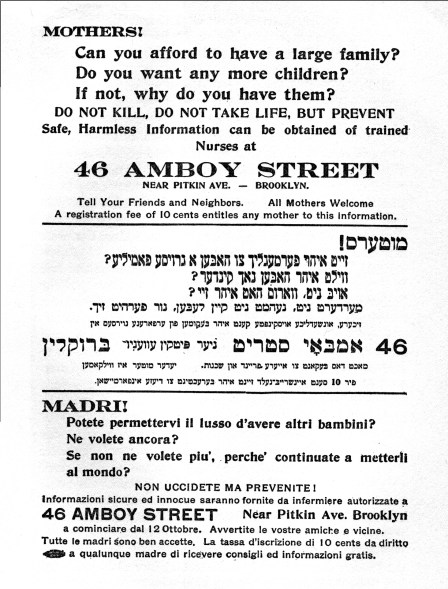
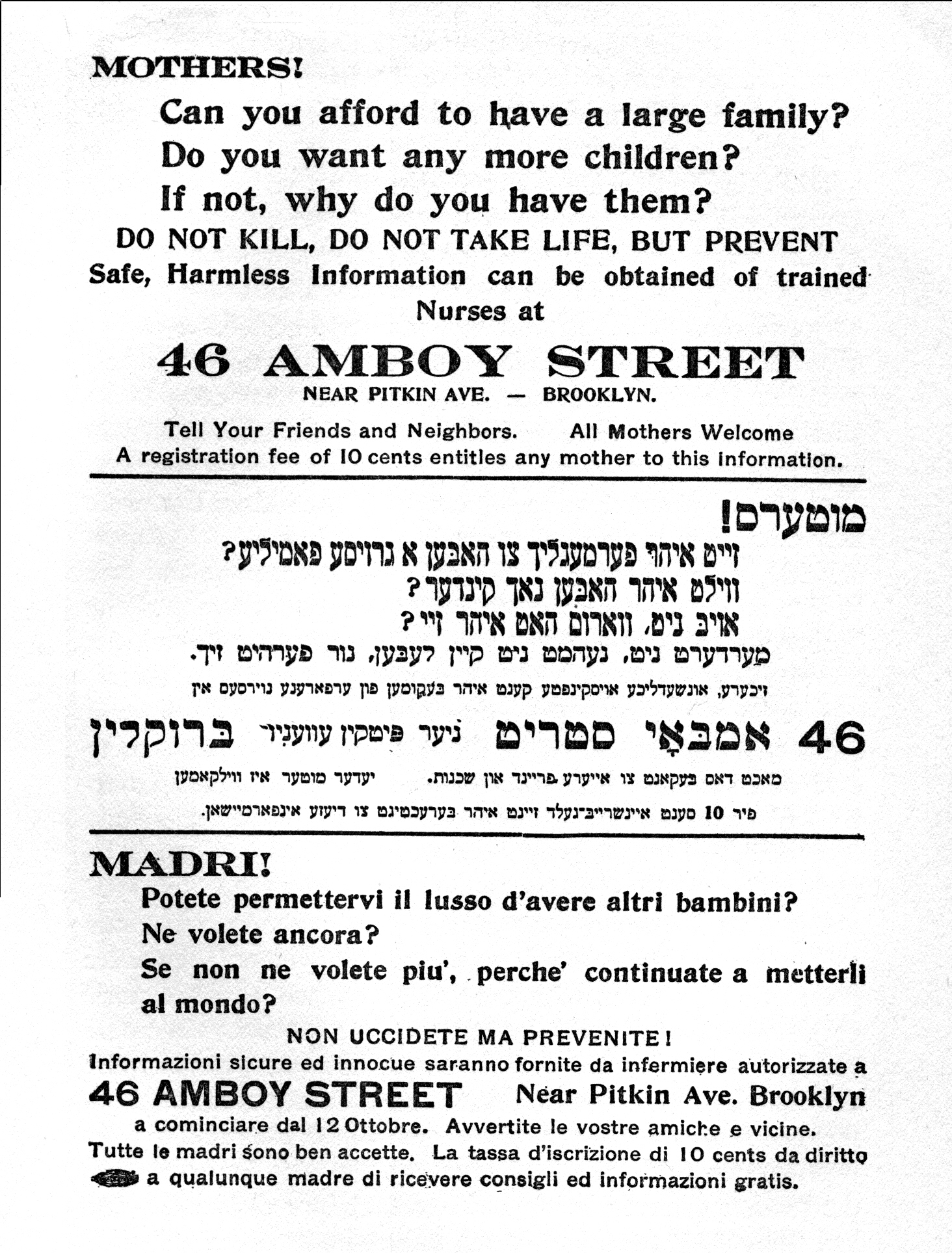
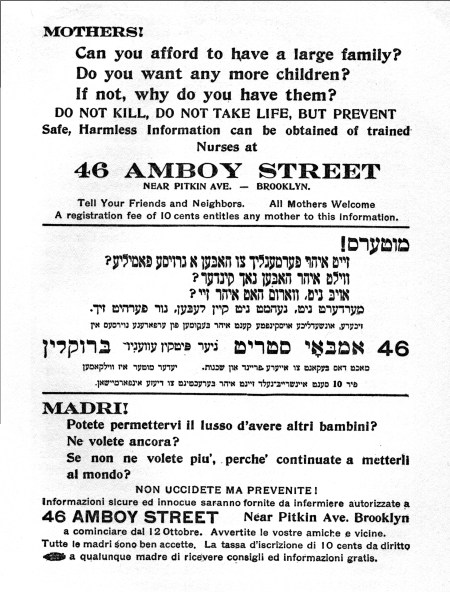
Flyer for Sanger Clinic, Brownsville, Brooklyn, image courtesy of the Margaret Sanger Papers Project

Flyer for Sanger Clinic, Brownsville, Brooklyn, image courtesy of the Margaret Sanger Papers Project

Listen to this podcast episode here or on Google Play, or subscribe on iTunes

Tuesday, October 18th, 2016

I start the morning preparing my itinerary for the day as I fortify myself with coffee and the first half of a sandwich.

My first stop is also the furthest east I’ll go this trip, to the Brownsville neighborhood of Brooklyn. I take the C train to the Rockaway station, head south on Saratoga, and wander around getting a feel for the neighborhood. It’s predominantly black, solidly working class, with lots of handsome old buildings, mostly well worn with peeling paint. I see lots of mothers and grandparents with strollers and very small children (it’s around noon during work hours), people taking smoke breaks in backdoors, and some very poor and homeless people. Reaching Pitkin’s busy sidewalk, I see shoppers, people going out for lunch, and shop and cafe proprietors in front doorways under brightly colored signs, and I hear many accents and many languages spoken, English, Spanish and French, and many others I don’t recognize. It reminds me of neighborhoods I frequent at home in Oakland. I turn north on Amboy Street, which runs north and south between Pitkin and E. New York Ave.

At 46 Amboy Street, just north of Pitkin, Margaret Sanger opened the United States’ first birth control clinic two days less than 100 years ago, on Oct 16th, 1916. Though just a  little late for the anniversary, I’m happy to be here at this historic place, humble as it now appears…. Read the written version here:

Ordinary Philosophy and its Traveling Philosophy / History of Ideas series is a labor of love and ad-free, supported by patrons and readers like you. Please offer your support today!

The Morning After Election Day 2016

3f86f-ballot2bbox2bclosed2bprotestI watched the election results roll in last night on the same sofa and in company with the same good friends as eight years ago when Barack Obama was elected the first black president of the United States. As the night wore on, our dearest hopes that we would see the first woman elected president of the United States were dashed, to the deep disappointment of everyone in the room. Trump was elected president. It was clear to me that though all believe that women should have equal chances of being elected president, the gender of the candidate was not foremost in their minds last night. It was the misogyny, racism, crass materialism, and bullying personality of Trump and his followers that must be defeated, showing the world that our values are much better than our new Twitter-troll-in-chief might have you believe.

My friends are nearly all liberal, my family mostly conservative. Some of my loved ones are rejoicing, some are mourning, and probably, given the new president’s coarse speech and demeanor, checkered past, and nonconservative positions on many issues, more were at least as glum as they were glad.

For some of my religious family members, I believe they did not vote for Trump because they like him, admire him, or agree with him on many issues. They voted for Trump while holding their noses at his attitudes toward women and minorities, his coziness with Putin, his anti-free-trade positions, his hiding of his tax returns. For them, abortion is by far the most important issue at stake, so the candidate that will nominate anti-abortion Supreme Court justices and oppose Roe v. Wade is their only viable choice. I understand their position: if you truly believe abortion is legalized murder, then the candidate that will likely to most to change the law in this regard must be their candidate. But that doesn’t mean they like having to vote for him.

Other people I know and love do sincerely admire Trump, dismissing some of his worst behavior as mere indiscretions, excesses of the vitality and exuberance that made him the go-getter they see him as: the man of the people who made himself rich in the can-do, hard-working, all-American way. For myself, I have a hard time seeing how exactly how the actual Trump fits in with this perception: his primary business is building luxury amenities for the wealthy, funding it at the beginning with piles of money he didn’t earn; he’s repeatedly exploited bankruptcy laws to the fullest which allowed him to escape personal responsibility for his bad investments while stiffing his contractors, the hard-working Americans that he’s supposed to represent; the things he does have made are often built from cheap Chinese steel and with low-paid Chinese, not American, hands; he starred in a reality TV show where he showcased his ‘business acumen’ by glowering behind a big shiny desk in a too-big suit, repeating generic self-help platitudes that convey no real guidance or information at all. In other words, he is just business-as-usual. But like so many Americans, they fell for his brand, the heavily marketed, glossy persona that the media lap up because he’s just so entertaining.

For me, what the Presidential candidates represent often does take priority over what they do, since they do not run the country on their own. Many of the qualities and principles that Trump represents to people are, I think, even uglier than what he’s said and done, which is often bad enough. But it seems that what he doesn’t represent is what got him into office: he doesn’t represent the establishment and he doesn’t represent the multicultural cosmopolitanism of the new information-centric world. And he doesn’t represent what’s been called the feminization of our culture, as machismo, militarism, and hyper-individualism slowly erodes from our national character. Hilary Clinton largely represented this feminization, the idea that the state also exists as a facilitator of care, for promoting health and education, of taking in those that flee to us for help, nurturing the young and the disenfranchised so that all have an equal shot or, if you happen to be a casualty of the capitalism most of us benefit from, you’re not out on your ear. And she represented it in a way that the strong mom does: idealistic yet practical, ruthless if need be in defense of her brood. Clinton has flaws, perhaps as many as Trump, but they are flaws of excess in the pursuit of greater and worthier things than self-aggrandizement and self-indulgence. But women, traditionally, are not allowed to have flaws, not if we are to be admired and promoted to any position of influence. For men, that’s just, well, part of being a man, part and parcel to being strong, bold, and getting things done.

I wish we could have shown the world last night that we believe in women too, that our girls do have the same chance of becoming president as anyone else, and they could do so by being women, unapologetically, able to succeed to our fullest potential whether or not we have flaws too.

Ordinary Philosophy and its Traveling Philosophy / History of Ideas series is a labor of love and ad-free, supported by patrons and readers like you. Please offer your support today!

Margaret Sanger NYC Sites, Day 1 Part 1, and a 100 Year Anniversary

Flyer for Sanger Clinic, Brownsville, Brooklyn, image courtesy of the Margaret Sanger Papers Project

Flyer for Sanger Clinic, Brownsville, Brooklyn, image courtesy of the Margaret Sanger Papers Project

Tuesday, October 18th, 2016

I start the morning preparing my itinerary for the day as I fortify myself with coffee and the first half of a sandwich.

My first stop is also the furthest east I’ll go this trip, to the Brownsville neighborhood of Brooklyn. I take the C train to the Rockaway station, head south on Saratoga, and wander around getting a feel for the neighborhood. It’s predominantly black, solidly working class, with lots of handsome old buildings, mostly well worn with peeling paint. I see lots of mothers and grandparents with strollers and very small children (it’s around noon during work hours), people taking smoke breaks in backdoors, and some very poor and homeless people. Reaching Pitkin’s busy sidewalk, I see shoppers, people going out for lunch, and shop and cafe proprietors in front doorways under brightly colored signs, and I hear many accents and many languages spoken, English, Spanish and French, and many others I don’t recognize. It reminds me of neighborhoods I frequent at home in Oakland. I turn north on Amboy Street, which runs north and south between Pitkin and E. New York Ave.

At 46 Amboy Street, just north of Pitkin, Margaret Sanger opened the United States’ first birth control clinic two days less than 100 years ago today, on Oct 16th, 1916. Though just a  little late for the anniversary, I’m happy to be here at this historic place, humble as it now appears. The clinic was in the tall red brick building to the right of the tan one with the ‘diamond’ pattern on the upper center front of the façade. You’ll find a photo below that shows the clinic as it originally appeared, and here as well.

46 Amboy St, site of Sanger's first birth control clinic

Sanger’s first birth control clinic, given address 46 Amboy St. One thing’s more or less the same: the little pale brick building with the crenelated top still stands next to where the clinic was, as you can see two photos down. The narrower red brick building against and to the left of the larger one, with a sign now identifying it as 42 Amboy, stands on the former clinic site.

46 Amboy St, site of Sanger's first birth control clinic

Another view, angled more like the view in the photo below. The two red brick buildings appear not to be original unless they’ve been changed so much as to be unrecognizable. As you can see from the photo below, there was space between the original clinic building and the tan one, but not so for the current structure. The clapboard building beyond may be original.

Photograph shows women and men sitting with baby carriages in front of the Sanger Clinic, LOC

Women and children sitting with baby carriages in front of the Sanger Clinic, with the white curtains in the windows. Photo courtesy of the Library of Congress

Before opening this clinic, Sanger had trained and worked as a nurse for many years among the poorest and most oppressed Americans, the immigrant and minority working class and poor. Originally a Socialist radical, Sanger came to realize that Marxists, philanthropists, and charity workers alike were making the same essential mistake. Since they failed to identify the root cause of human misery in the slums, the crowded tenements, and the factory floors, all of their well-intended efforts to help were failing and sure to continue to fail. Sanger came to feel this way about her own nursing, which addressed the effects and not the cause, so she turned her efforts to where she believed she could do the most good: birth control activism.
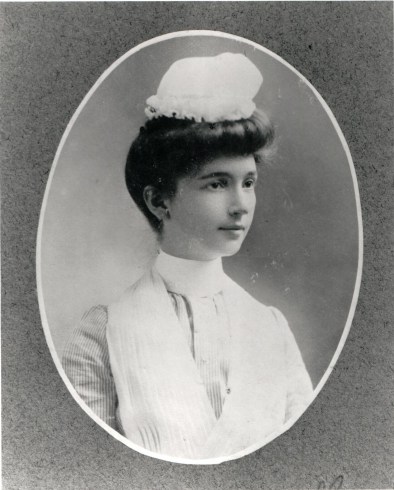
Margaret Sanger as a nursing student around 1900, by Boyce Photographer, White Plains, courtesy of the Sophia Smith Collection, Smith College

Margaret Sanger as a nursing student around 1900, by Boyce Photographer, White Plains, courtesy of the Sophia Smith Collection, Smith College

As a nurse, Sanger cared for poor women broken down in health and mind by laboring all night and caring for children all day, often pregnant all the while, often miscarrying, and the infant mortality rates were very high. So were death rates for the mothers, be it from childbirth, diseases secondary to exhaustion and malnutrition, and worst of all, from self-inflicted abortions. The mothers who resorted to the latter were desperate: they had often already watched other children die, or suffer every day from hunger, or forced into the factories or other labor at a very young age in the struggle to survive.

Though there were plenty of organizations trying to help these families, governmental and charitable, they could not keep up since the need was so great and increasing every day. Industrialization, Sanger recognized, encouraged rapid population growth by the ever-increasing demand for more labor and more future customers. And the workers responded to the social pressure by producing more children in hopes that their offspring could help the family by going out to work. But those hopes were often in vain since the population growth always kept up with or surpassed the need for laborers, constantly driving down wages. And so the cycle continued: immiseration through near-starvation wages, families barely keeping up with the cost of feeding themselves if at all, and children deprived of an education and of health as factory and other hard work often left children stunted, with malformed and weak bones and muscles, and often injured by machinery and chemicals.

Sanger thought: instead of trying vainly to keep up with the spiraling misery caused by this cycle, why not get at the root of it? After all, as the old saying goes, an ounce of prevention is worth a pound of cure. If women were empowered to decide whether to have children, and only as many as their health and financial circumstances would allow, all this misery could be prevented in the first place since parents could adequately care for the children they did have, mother’s bodies would no longer be broken down by constant pregnancy, infants and mothers would more likely survive childbirth, overcrowding and its accompanying epidemics would be mitigated or even disappear, and a reduced labor force would force employers to compete for workers, driving wages up. And as we’ve seen over the decades, high population growth is strongly correlated with endemic poverty, high infant and mother mortality rates, women’s rights abuses, and high income inequality.

But people will never stop having sex, as Sanger pointed out. Sex is just too powerful a force in human nature. Our need for love, for affection, for physical pleasure and release, are too powerful to be squelched, and in fact, shouldn’t be. Love and the need for physical connection are positive things, indeed, two of the best things in human nature. Birth control, thought Sanger, was the answer.

I’ll be exploring Sanger’s ideas on these and other topics in more detail in upcoming essays, stay tuned. In the meantime, the Margaret Sanger Papers Project has a wealth of articles and original works by Sanger available online, and I’ve relied on them more than on any other single resource for my own project. (See below for the links). Thank you so much to the good people at the MSPP, I very much appreciate what you do!

Photobombed in Brownsville, Brooklyn, NY

Photobombed in Brownsville, Brooklyn, NY

Street with handsome row houses on Bergen Street, Brownsville, Brooklyn, NYC

Tree lined street with attractive row houses on Bergen Street, Brownsville, Brooklyn, NYC

Brownsville neighborhood of Brooklyn, NY, near the Rockaway station, 2016 Amy Cools

Street scene at the Rockaway station entrance near the northern edge of the Brownsville neighborhood in Brooklyn, NY

Hipster Gourmet Deli in Brownsville, Brooklyn, Amy Cools 2016.

Hipster Gourmet Deli in Brownsville, Brooklyn. I took this photo on the way to Amboy St, after my laughter subsided enough to take a picture.

I head back to the station, on the way stopping to photograph some scenes in the neighborhood, including an especially pretty row of houses on Bergen Street as a young man photobombs my pic with a laugh and a smile. On the train back, I eat the now rather smashed second half of my egg salad sandwich and write my notes. I transfer a couple of times and head north to Grand Central Station…. To be continued

Ordinary Philosophy and its Traveling Philosophy / History of Ideas series is a labor of love and ad-free, supported by patrons and readers like you. Please offer your support today!

~~~~~~~~~~~~~~~~~~~~~~~~~~~~

Sources and Inspiration:

Alter, Charlotte. ‘How Planned Parenthood Changed Everything‘. Time.com, Oct. 14, 2016

Chesler, Ellen. ‘Was Planned Parenthood’s Founder Racist?Salon.com, Wed, Nov 2, 2011

Child Labor in U.S. History‘. From the Child Labor Public Education Project by the University of Iowa Labor Center

Demographics and Poverty‘, Center for Global Development.

Jacobs, Emma. ‘Margaret Sanger Clinic (former): the First Birth Control Clinic in the United States‘. From Places That Matter

Margaret Sanger Papers Project by New York University.

Regan, Margaret. ‘Margaret Sanger: Tucson’s Irish Rebel.Tucson Weekly, Mar 11, 2004.

Sanger, Margaret. The Pivot of Civilization, 1922. Free online version courtesy of Project Gutenberg, 2008, 2013.

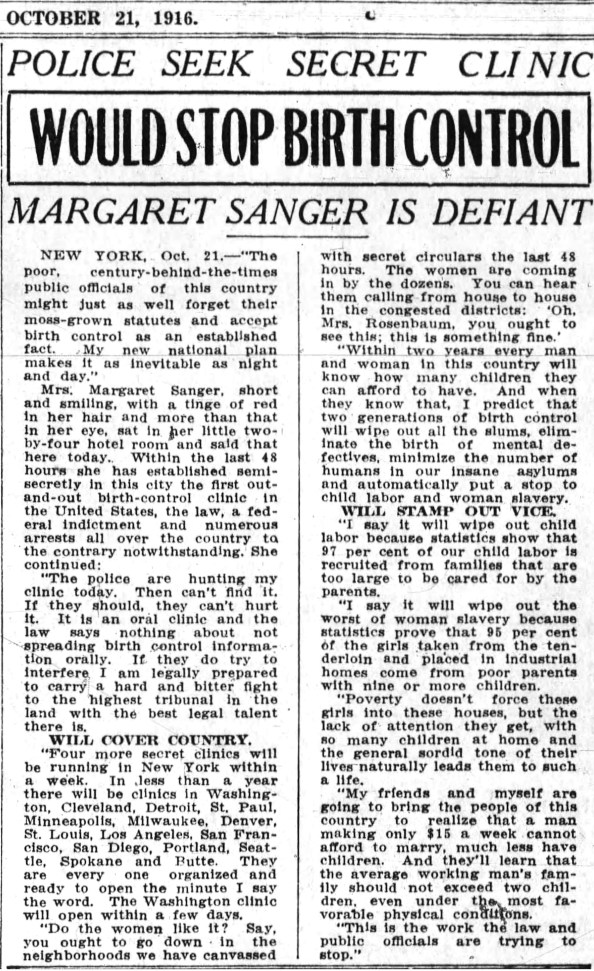
Sanger, Margaret. Woman and the New Race, 1920. Free online version courtesy of W. W. Norton & CompanyOakland Tribune Article about Margaret Sanger's NY clinic, Oct 21, 1916 evening edition
To New York City I Go, in Search of Margaret Sanger

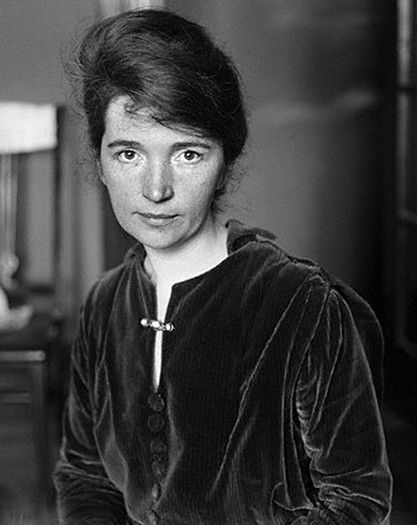
margaret-sangerHello, friends of Ordinary Philosophy!

From time to time, I take a trip to some corner of the globe, to explore the lives and ideas of great thinkers in the places where they lived and worked. For this series, I follow in the footsteps of thinkers who are no longer alive, since those who are still telling their own stories. But those who are no longer alive in the body live on in the ideas that they pass on, and in the examples they provide for us to follow.

I’m pleased and excited to announce my sixth philosophical-historical themed adventure, a rather impromptu trip to New York City to follow in the footsteps of Margaret Sanger.

Though the timing was spur of the moment, I’ve read and thought about Sanger quite a bit over the years and have some of the research done already for this long-planned trip. So when this little window of time opened up in my schedule, I happily seized the opportunity! As central to the history of women’s rights, free speech rights, and rights to sexual self-determination and privacy as she is, Sanger’s also the most problematic figure in the history of ideas I’ve followed so far for this series, with the possible exception of the brilliant but slave-owning Thomas Jefferson. She’s certainly the first that sparked immediate controversy when I casually mentioned my plans for following her on social media. Here’s a brief introduction, a condensed version of a short bio I published about a month ago in honor of her birthday:

Margaret Higgins Sanger was born on September 14, 1879 into a large Catholic family with 11 surviving children. Her mother died at about age 50 from tuberculosis. As young Margaret saw it, her mother was worn out from her 18 pregnancies, and would cite this as one of the many reasons she so passionately advocated for the right of women to control their own bodies and fertility.

She went on to become a nurse who worked with poor women in New York City in the 19-‘teens and twenties. As she saw these women struggle with the toll that large numbers of pregnancies took on their families’ finances and their own health, Sanger became convinced that ‘birth control’, a term she invented, was essential if these women hoped to escape poverty and sexual oppression. She opened America’s first birth control clinic and despite numerous arrests and fines, she continued her fight for reproductive rights. In this regard, she’s best known today as one of the founders of Planned Parenthood and a key figure in the development of the first birth control pill.

Sanger remains a controversial figure. An ardent feminist, human rights activist, and advocate of sex-positivity, Sanger was also a eugenicist, believing that birth control was at least as important a tool for limiting the production of ‘the unfit’ (her words) as it was for women’s liberation.  Generally, Sanger was an ardent advocate of self-determination, free speech, open discussions of sex and sexuality, and education, education, education.* It was up to informed and thoughtful people, Sanger believed, to take responsibility for their own sexual choices and to convince others to do the same. Regrettably, however, at times Sanger seemed to support some sort of coercive or compulsory forms of birth or population control, for those who she deemed incapable of making this choice for themselves, for example, or too dangerous to be allowed to conceive and raise children.

Aside from her (mostly good) ideas about human rights and personal responsibility, I find Sanger’s beliefs about human sexuality and its important role in spiritual and mental health particularly fascinating

So off to New York City I go, from October 17th thru the 21st. There, I’ll visit landmarks associated with her life, places where she lived, worked, thought, wrote, studied, and rested, to see for myself how the places informed the woman, and vice versa.

Here is the story of Margaret Sanger as I discover her:

Happy Birthday, Margaret Sanger!
Margaret Sanger NYC Sites, Day 1 Part 1, and a 100 Year Anniversary
Why So Much Hatred for Margaret Sanger?
Margaret Sanger NYC Sites, Day 1 Part 2
Margaret Sanger NYC Sites, Day 1 Part 3
Margaret Sanger NYC Sites, Day 2, Part 1
Margaret Sanger NYC Sites, Day 2, Part 2
Margaret Sanger NYC Sites, Day 3 Part 1
Margaret Sanger NYC Sites, Day 3 Part 2
Margaret Sanger NYC Sites, Day 4

Ordinary Philosophy and its Traveling Philosophy / History of Ideas series is a labor of love and ad-free, supported by patrons and readers like you. Please offer your support today!

Patrons of the Margaret Sanger series: Christopher Wallander, Magaly Gamarra Grant, Devin Cecil-Wishing, Sally Lee ~ With warmest gratitude, thank you!

*This piece was updated on 10/26/16. Originally, the 3rd and 4th sentences of the seventh paragraph read ‘She did not, however, support any kind of compulsory or coercive forms of birth or population control. Instead, Sanger was an ardent advocate of self-determination, free speech, open discussions of sex and sexuality, and education, education, education. It was up to informed and thoughtful people, Sanger believed, to take responsibility for their own sexual choices and to convince others to do the same.’ My subsequent research found that this is not quite accurate, as she surmised that coercive sterilization might be warranted in certain circumstances, for those who are mentally ill, handicapped in certain ways, or criminally violent, for example. Please read Why So Much Hatred for Margaret Sanger? and more from the series for further explorations of Sanger’s ideas on the subject.

O.P. Recommends: ‘Capitalism’s Crisis of Care’ – Sarah Leonard interviews Nancy Fraser for Dissent Magazine

068e8-father2band2bchild2bby2bandre25c425ad2bosipovich2bkarelin252c2b18372b-2b1906252c2bpublic2bdomain2bvia2bwikimedia2bcommons

Capitalism’s Crisis of Care is a discussion between Sarah Leonard of Dissent magazine and critical theorist and feminist Nancy Fraser, which focuses on Fraser’s concept of today’s ‘crisis of care’, which, as she explains, is a product of capitalism. In capitalist societies, ‘social reproduction’, the social and family bonds necessary for raising families and caring for the elderly, have ‘no monetized value. They are taken for granted, treated as free and infinitely available “gifts,” which require no attention or replenishment’ and which, like nature itself, is ‘an infinite reservoir from which we can take as much as we want and into which we can dump any amount of waste.’ Capitalism, unjustifiably and artificially, splits ‘economic production off from social reproduction, treating them as two separate things, located in two distinct institutions and coordinated in two different ways.’ This leaves us with this crisis of care, in which working people are stretched to the breaking point, trying to make a living while trying to maintain the level of care and attention that children, the elderly, and social bonds in general need as much as ever.

Fraser outlines the history of the development of this crisis of care, ‘trac[ing] a historical path from the so-called liberal capitalism of the nineteenth century to the state-managed regime of the mid-twentieth and on to the financialized capitalism of the present day. In a nutshell: liberal capitalism privatized social reproduction; state-managed capitalism partially socialized it; financialized capitalism is increasingly commodifying it.’

If we are to resolve many of the most pressing social problems we face today, from funding health care to adequately providing for the elderly, ill, and disabled to giving working families sufficient time and resources to raise the very families society depends on, we need to start by examining our assumptions and habits with the same care and rigor Fraser reveals in her analysis.

Here’s another excerpt from this absorbing and enlightening interview:

Leonard: Many of the questions that you raise about social life and the family have come to seem utopian again, like some remnant of the 1960s, and not necessarily central to a socialist program. And yet, you argue that we’re actually at a crisis point—these issues must be central. The challenge of social reproduction is so fundamental to everyone’s lived day-to-day experience that it’s been surprising to me that it’s often absent in the current revival of socialism.

Fraser: I agree very strongly with that. Given the acuteness of this crisis of social reproduction, it would be utopian, in the bad sense, for the left not to be focusing on this. The idea that we could somehow bring back manufacturing, that’s what’s utopian—again, in the bad sense. Unlike the idea that you could build a society that assumes every adult is a person with primary care responsibilities, community engagements, and social commitments. That’s not utopian. It’s a vision based on what human life is really like.’… Read more

~ Ordinary Philosophy and its Traveling Philosophy / History of Ideas series is a labor of love and ad-free, entirely supported by patrons and readers like you. Please offer your support today!

On Plastic Surgery and Other Cosmetic Interventions

I published this essay about a year ago today. Cosmetic medical intervention is a subject of special interest for me, and problems associated with it, especially those performed for non-functional or non-reconstructive purposes, are often brought to mind at the medical practice I work in.

Amy M Cools's avatarOrdinary Philosophy

I work for a dermatologist who focuses his practice on medical dermatology. While all treat many of the same medical conditions, an ever-increasing percentage of dermatologists devote a substantial portion of their time to performing cosmetic procedures, from Botox and filler injections, chemical peels, and laser treatments to surgeries: facelifts, chin implants, eyelid modifications, and so on. The sign on the door of the medical practice I work for, however, reads ‘Diseases of the Skin’.

To me, this is a reassuring message, as if to say to all who enter ‘We are here to try and cure what ails you.’ It contrasts sharply with the message I get from cosmetic dermatology and surgery ads: ‘We agree that you’re ugly and need to be altered.’

Now, of course, this is only what I read into those ads, especially in my more sensitive moods. I don’t for a moment speak for anyone…

View original post 4,456 more words

Happy Birthday, Margaret Sanger!

margaret-sangerMargaret Higgins Sanger was born on September 14, 1879 into a large Catholic family with 11 surviving children. Her mother died at about age 50 from tuberculosis. As young Margaret saw it, her mother was worn out from her 18 pregnancies, and would cite this as one of the many reasons she so passionately advocated for the right of women to control their own bodies and their own fertility.

She went on to become a nurse who worked with poor women in New York City in the 19-‘teens and twenties. As she saw these women struggle with the toll that uncontrolled pregnancies took on their families’ finances and their own health, Sanger became convinced that ‘birth control’, a term she invented, was essential if these women hoped to escape poverty and oppression. She opened America’s first birth control clinic and despite numerous arrests and fines, she continued her fight for reproductive rights. She founded the American Birth Control League in 1921, which became the Birth Control Federation of America in 1939 after merging with another organization, which in turn became Planned Parenthood in 1942. She continued her activism right up to her death in 1966. Sanger was instrumental in the creation of the first birth control pill Enovid, first available to the public in 1957. She also lived to see the Supreme Court validate her beliefs in the basic human rights to openly talk about sex and to control their own fertility in the Griswold v. Connecticut decision of June 7, 1965.

Sanger remains a controversial figure today. An ardent feminist, human rights activist, and advocate of sex-positivity, Sanger was also a eugenicist, believing that birth control was at least as important a tool for limiting the production of ‘the unfit’ (her words) as it was for women’s liberation. Sanger agreed with many leading scientists and progressives of her day in ascribing to so-called Social Darwinism (a problematic term since it doesn’t reflect Darwin’s own views as he expressed them), which applied the principles of natural selection to human social practice.  She did not, however, support any kind of compulsory or coercive forms of birth or population control, such as that practiced by the Nazis and even by the United States government, who forcibly sterilized thousands of so-called ‘feebleminded’ women. Instead, Sanger was an ardent advocate of self-determination, free speech, open discussions of sex and sexuality, and education, education, education. It was up to informed and thoughtful people, Sanger believed, to take responsibility for their own sexual choices and to convince others to do the same.

Unlike many other eugenicists, however, Sanger was not a racist. She worked closely with many leading black civil rights figures, believing, as they did, that birth control would have the same liberating effect on the black community as would for women generally. By limiting the number of children according to how many they could afford to raise and when, parents could more readily pursue an education, start a business, or otherwise devote their time, energy, and health to improving their standard of living which, in turn, they could pass down to their children.

Aside from her human rights activism, I find Sanger’s beliefs about human sexuality and its important role in spiritual and mental health most fascinating. I’ve chosen her as one the topics of an upcoming History of Ideas Travel Series as soon as I can make it happen, stay tuned! In the meantime, please follow the links in this article above and below to learn more about this important, fascinating, and troubling woman, and I highly recommend Jonathon Eig’s The Birth of the Pill, in which he recounts much of her personal history as well as her role in the Pill’s creation.

Ordinary Philosophy and its Traveling Philosophy / History of Ideas series is a labor of love and ad-free, supported by patrons and readers like you. Please offer your support today!

~~~~~~~~~~~~~~~~~~~~~~~~~

Sources and Inspiration:

Margaret Sanger Papers Project ~ Research Annex. Accompanying blog to The Sanger Papers Project by New York University.

The Pill, People & Events: Margaret Sanger (1879-1966)‘. From the American Experience website by PBS.

Sanger, Margaret. The Pivot of Civilization, 1922. Free online version by Project Gutenberg, 2008, 2013.

Tong, Ng Suat. Which Margaret Sanger?The Hooded Utilitarian blog, April 14, 2014.

New Podcast Episode: Frederick Douglass Seneca Falls, Canandaigua, Honeoye, and Mt Hope Cemetery Sites

Women's Rights National Historical Park headquarters, Seneca Falls NY

Women’s Rights National Historical Park headquarters, Seneca Falls NY

Listen to this podcast episode here or on Google Play, or subscribe on iTunes

Eleventh day, Tuesday March 30th

It’s a beautiful, clear sunny day, and the chill of the morning gives way to a balmy afternoon. I drive about an hour east and slightly to the south, through the lovely Finger Lakes region of New York to Seneca Falls.

I’m here to visit what’s now the Women’s Rights National Historical Park, which is headquartered at 136 Fall Street in Seneca Falls. I begin with the reconstructed Wesleyan Church next door at Fall and Mynderse Streets, the site of that momentous occasion which brings me here. I’ve long wanted to visit this place and had hoped to do so during my history of ideas travel series about Elizabeth Cady Stanton, but didn’t have enough time during that trip to make the journey, about a five hour drive from New York City one-way. But here I am at long last…. Read the written account here:

Ordinary Philosophy and its Traveling Philosophy / History of Ideas series is a labor of love and ad-free, entirely supported by patrons and readers like you. Please offer your support today!

O.P. Recommends The Stronger Sex: Women Scholars and Islam, by Peter Adamson

Bint al Shati, image credit AchetronI just listened to a podcast episode I had missed a year and a half or so ago, from my go-to podcast for discovering the gaps in my knowledge (of which there are so many! sigh) about Ancient Greek, Islamic, Medieval, and Indian philosophy from Peter Adamson’s History of Philosophy Without Any Gaps. As you may remember, I had the privilege of having a conversation with him not that long ago for Ordinary Philosophy’s podcast.

The podcast episode I just listened to that I’m recommending today is called The Stronger Sex: Women Scholars and Islam (#192). In it, ‘Fatema Mernissi and others challenge the long-standing (but not complete) exclusion of women from the intellectual traditions of Islam.’ It was altogether fascinating, and much of what I heard surprised me. It made me very curious to learn more about women in Islamic philosophy.

Enjoy!

Ordinary Philosophy and its Traveling Philosophy / History of Ideas series is a labor of love and ad-free, entirely supported by patrons and readers like you. Please offer your support today!