New Podcast Episode: Athens and Springfield, Illinois, Part 1, in Search of Abraham Lincoln

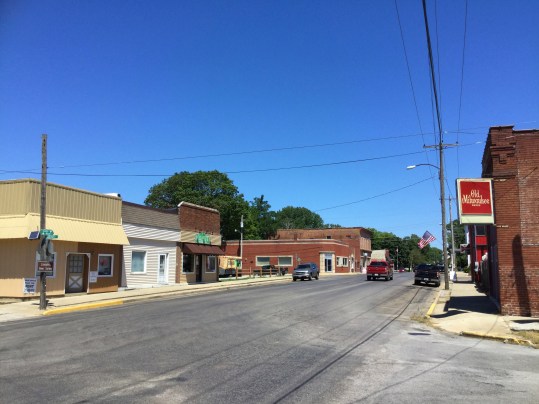
E. Hargrave and Main Streets in Athens, Illinois

Listen to this podcast episode here or on Google Play, or subscribe on iTunes

Journal: Abraham Lincoln Presidential Library, Springfield, Illinois, Monday morning, July 31, 2017

Here I am in the handsomely designed, nicely lit, spacious reading room of the Abraham Lincoln Presidential Library. I don’t at this moment require any research materials from the collection, but as I often do, if I find myself with access to a grand space dedicated to the acquisition, preservation, and dissemination of knowledge, such as the Reading Room of the Library of Congress’ Jefferson Building or the National Library of Scotland, I feel the urge to go inside and do some thinking and writing just because I can. So here I am… Read the written version here

Ordinary Philosophy and its Traveling Philosophy / History of Ideas series is a labor of love and ad-free, supported by patrons and readers like you. Please offer your support today!

New Podcast Episode: Peoria, Illinois, In Search of Robert G. Ingersoll, Frederick Douglass, and Abraham Lincoln, Part 1

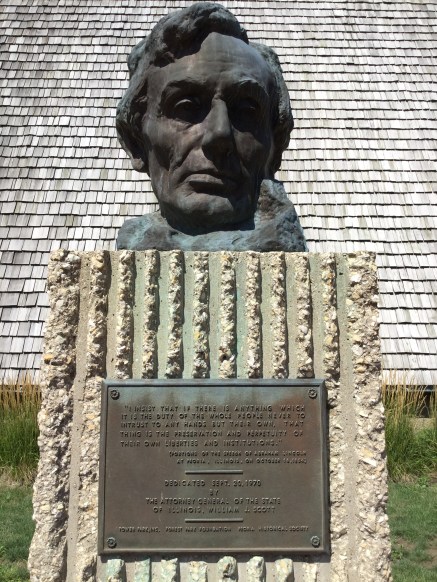
Abraham Lincoln portrait head, cast of Gutzon Borglum model for Mount Rushmore at Tower Park, Peoria Heights. Other versions of this sculpture are at the Abraham Lincoln Presidential Library, the Lincoln Tomb, and the Rotunda of the U.S. Capitol Building in Washington, D.C.

Listen to this podcast episode here or on Google Play, or subscribe on iTunes

Peoria, Illinois, July 28th, 2017

I awake in a spotlessly clean, perfectly comfortable, aggressively unimaginative Motel 6 hotel room on the north end of Peoria, Illinois. I’ve noticed that Motel 6’s are much better than they used to be when I was a child and young adult, at least in terms of cleanliness and amenities. They were never glamorous, but they now have less character. For many years, for example, the beds sported these wonderfully colorful blankets printed with stylized images of famous cities and landscapes all over the United States. Now, the rooms and draperies are beige highlighted with rust-orange, furnished with the plainest of midcentury-style designs, angular objects only occasionally relieved by a sleek curve here and there.

My term for this sort of accommodation is ‘people storage’: strictly utilitarian, uninspired, and uninspiring. Perhaps that’s a good thing for my purposes: I fled the room as soon as I could to place myself in a more interesting environment. Still, I’m irritated as I so often am with modern architecture and interior design. Why have we stopped bothering to go on artistic flights of fancy, then directing the inspirations found there towards making these things beautiful?

My first destination is a quick stop to see a bust of Abraham Lincoln at Tower Park in Peoria Heights… Read the written version here

Ordinary Philosophy and its Traveling Philosophy / History of Ideas series is a labor of love and ad-free, supported by patrons and readers like you. Please offer your support today!


New Salem, in Search of Abraham Lincoln

Statue of Abraham Lincoln as surveyor at New Salem, Illinois

New Salem, Sunday, July 31st, 2017

From the Michael J. Howlett building in downtown Springfield (part of which stands on the site of the Ninian Edwards house where Abraham and Mary Todd Lincoln were married and where Mary died), I head northwest on highway 97 to New Salem Historic Park. This is the site of New Salem, the small frontier commercial village which played no small role in Lincoln’s life as a young man striking out on his own. It’s a pleasant drive through farmland with homes and farm buildings and gas stations and tiny general stores scattered here and there. In a little under half an hour, I reach a wooded area, and soon after that, take the turnout to my left to New Salem. I stop for a snack at the little cafe offering a modest selection of hot dogs, nachos, sandwiches, and other things that take the edge off but don’t suffice as a meal. The park’s visitor center buildings are all closed because the air conditioning system isn’t working. I don’t blame them at all for not opening up: it feels very much like a summer day in the Midwest, hot and humid, and I imagine a full day indoors would get stuffy and miserable. But the park itself is open to roam, so I do.

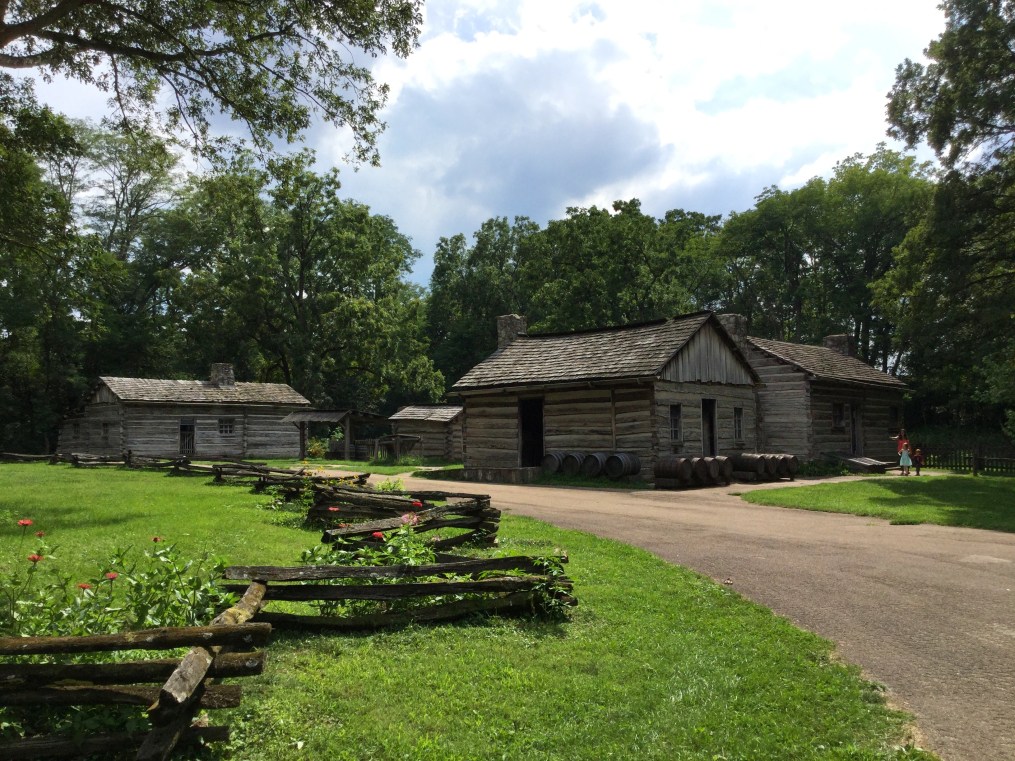
I find that some of the volunteer interpreters are not deterred today by the heat or the lack of an air-conditioned space to retreat to. Two men in early-to-mid 19th-century costume roam the park under shady, battered straw hats, recounting the history of New Salem and anecdotes from Lincoln’s life here. Some kind soul(s) placed large coolers here and there filled with ice water as well. It’s a lovely place to wander, and I take my time exploring. Though I visit all of them, there are so many structures that I’ll just show and tell of the ones that have some connection to Lincoln. The park contains 22 reconstructed and one original building from the New Salem of Lincoln’s time. The reconstructions are based on the findings from archaeological digs, on descriptions of the town from former residents, and on other representations of buildings, furniture, and tools from the same time period. Most of the buildings, as far as could be determined, are built on or near the original foundations. Many of the furnishings, equipment, dishes, and more are from that time period, too, collected locally.

Lincoln’s first sight of New Salem was from the Sangamon River, which powered the little town’s gristmill and sawmill. On that day in April 1831, to be more precise, he was in the river: barefoot, hatless, and soaked to the skin, working frantically to dislodge Denton Offutt’s flatboat from where it had gotten stuck going over the dam. Lincoln had helped build the flatboat whose cargo of bacon and grain, en route to New Orleans, was in danger of going overboard. His efforts to save the boat and cargo succeeded, and Offutt, impressed and relieved, offered Lincoln the management of the new general store he planned to build for New Salem. It took Offutt longer the get the store up and running than he planned, but eventually, it did open in September of that same year, and Lincoln did run it after all.

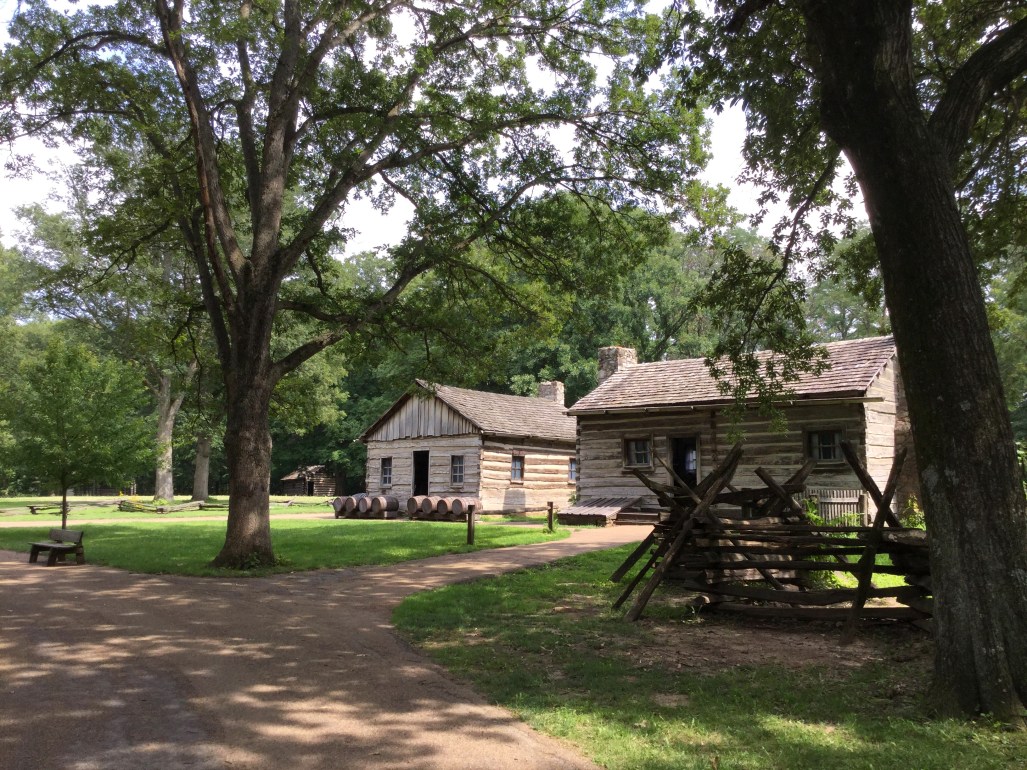
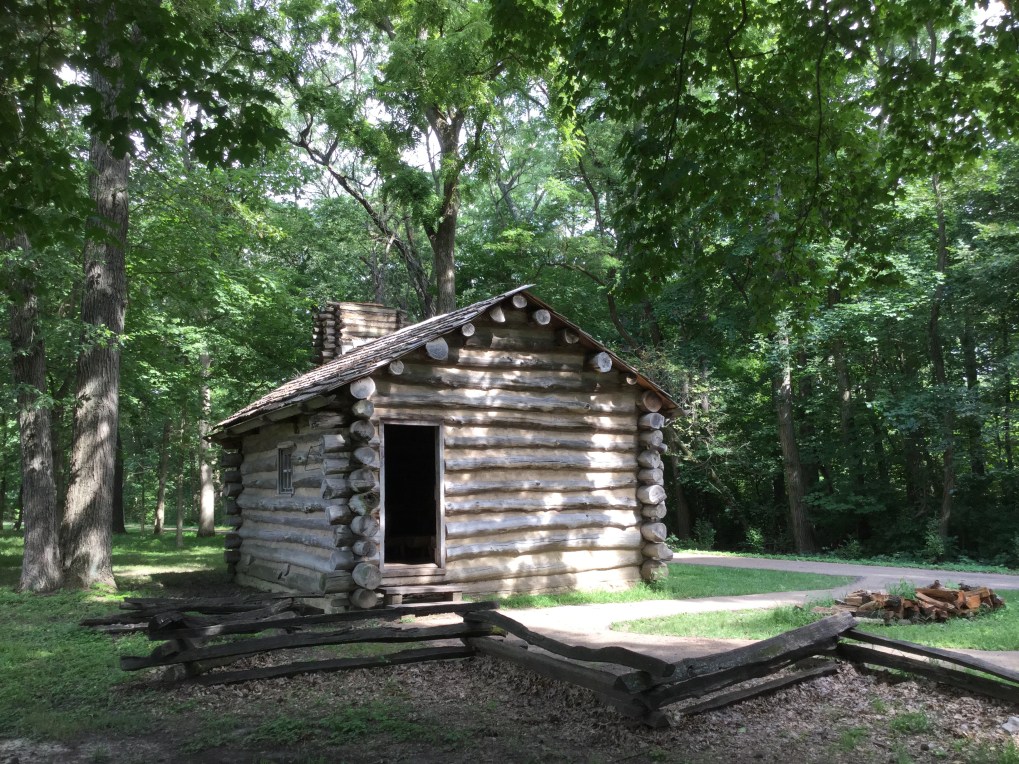
Henry Onstot’s cabin, right, and cooper shop, left, New Salem, Illinois. The cooper shop is the only original building from New Salem; the rest have been reconstructed

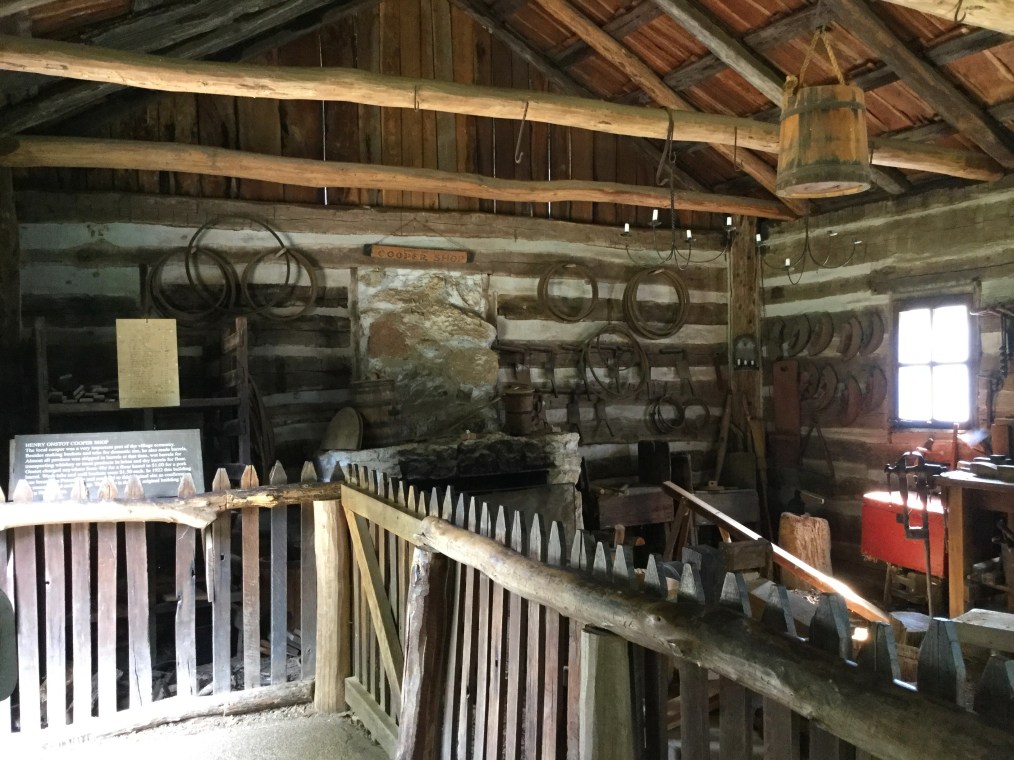
Interior of the Onstot cooper shop where Lincoln would retreat and light a fire to read by.

Henry Onstot, whose house is the first I visit, was the area cooper, maker of barrels and other implements that required the same wood-steaming and bending techniques. His cooper’s shop next door is the only original building that still stands in New Salem. After the village was abandoned in 1840, Onstat moved his business, building and all, to nearby Petersburg. The building was returned to New Salem in 1922, not long after the park was opened to the public by the State of Illinois. Sixteen years earlier, in 1906, William Randolph Hearst purchased the site and surrounding lands and donated it to the Old Salem Chautauqua Association, who had invited him to speak and had sparked his interest in the site and its history. (Chautauqua is an adult education movement founded in the 1870’s, named for the New York lake near which the first meeting was held.) The Association, in turn, donated it to the state. This building is the only thing on this site that Lincoln was sure to have touched. William Herndon, Lincoln’s future law partner and biographer, tells us that Lincoln frequently would retreat to the cooper shop to read by the light of the fire he’d build using the leftover barrel-making materials.

The Trent brothers’ residence behind Henry Onstot’s house and cooper shop, New Salem, Illinois. Alexander Trent served with Lincoln in the Black Hawk War in 1832, and the next year, he and his brother Martin took over the Lincoln-Berry store.

A view of Lincoln’s New Salem, Illinois

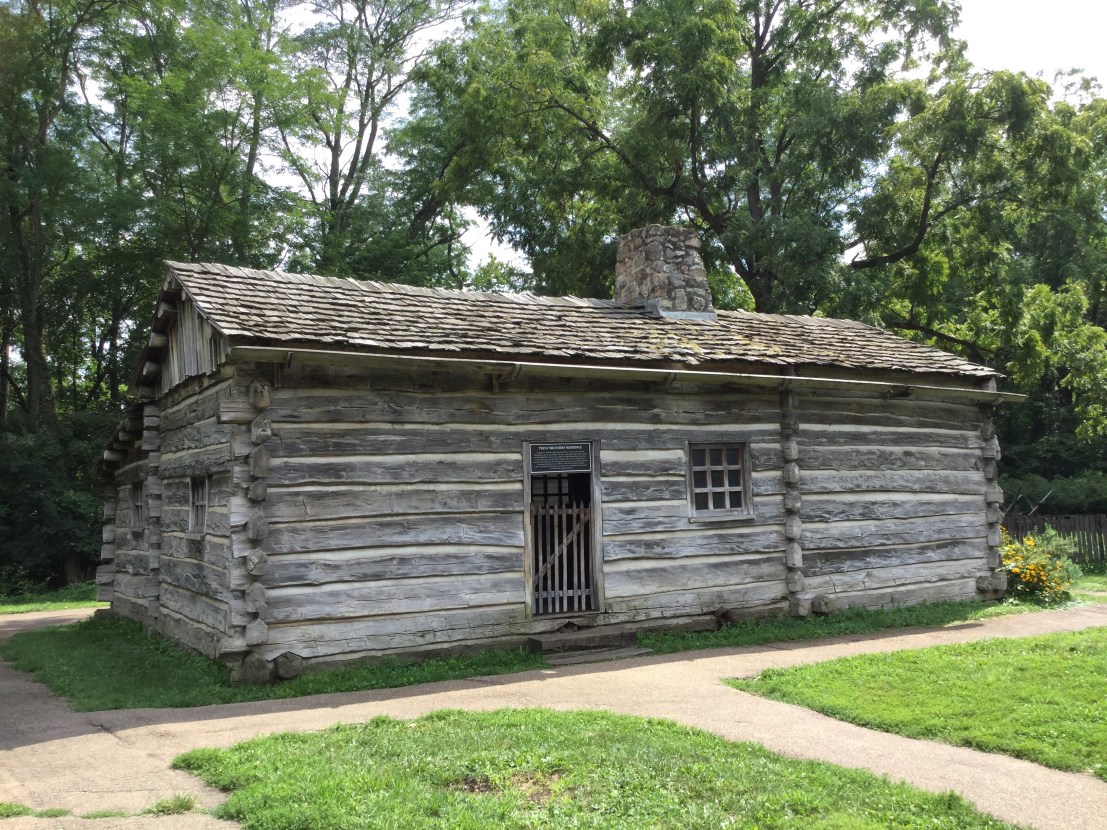
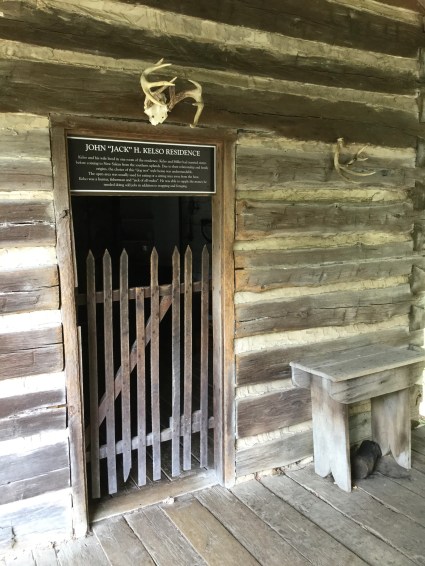
The doorway to Jack Kelso’s place, New Salem, Illinois

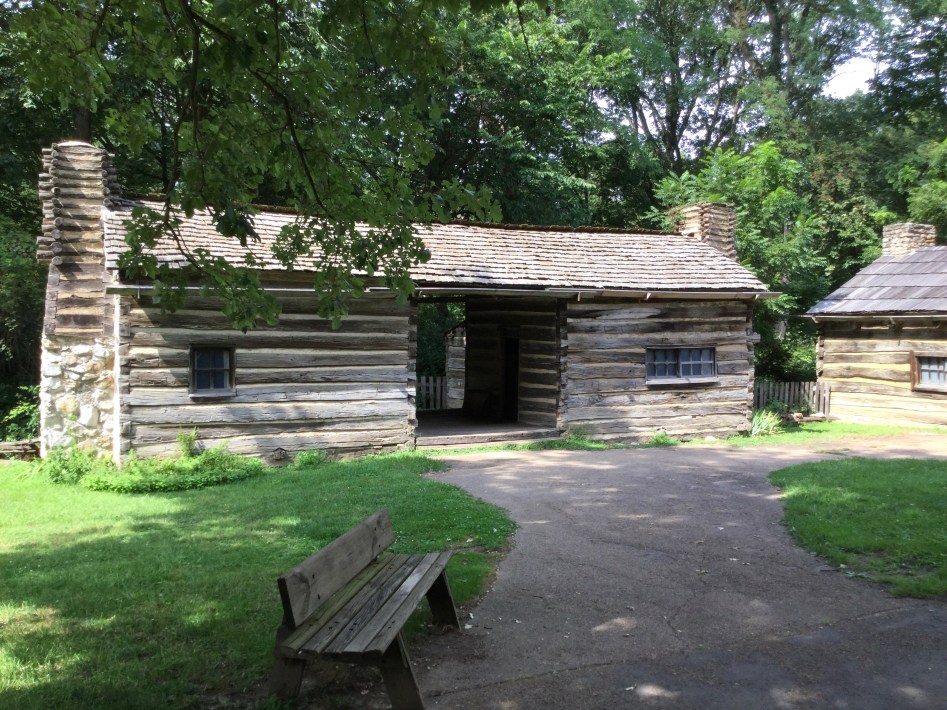
I visit the Trent brothers’ house next, then the Kelso-Miller house. The Kelso-Miller house is a sort of duplex sometimes called a ‘dogtrot house’. The front doors face one another across an unwalled roofed and floored passage between the two halves. Jack Kelso, who New Salem historian Benjamin Platt Thomas describes as ‘a lazy dreamer’ and ‘the village philosopher,’ was a hunter, trapper, fisher, and odd-jobber. He loved Shakespeare and Robert Burns and could recite from them at length, to the surprise and delight of many. Lincoln became a lifelong fan of both.

Especially during his early years here, Lincoln, who never owned a house in New Salem, would board with them. It amazes me that Kelso and his wife could host Lincoln: the tiny size of this place makes it difficult to imagine that it could hold three cooking, eating, sleeping people, especially given the girth of Kelso and the height of Lincoln.

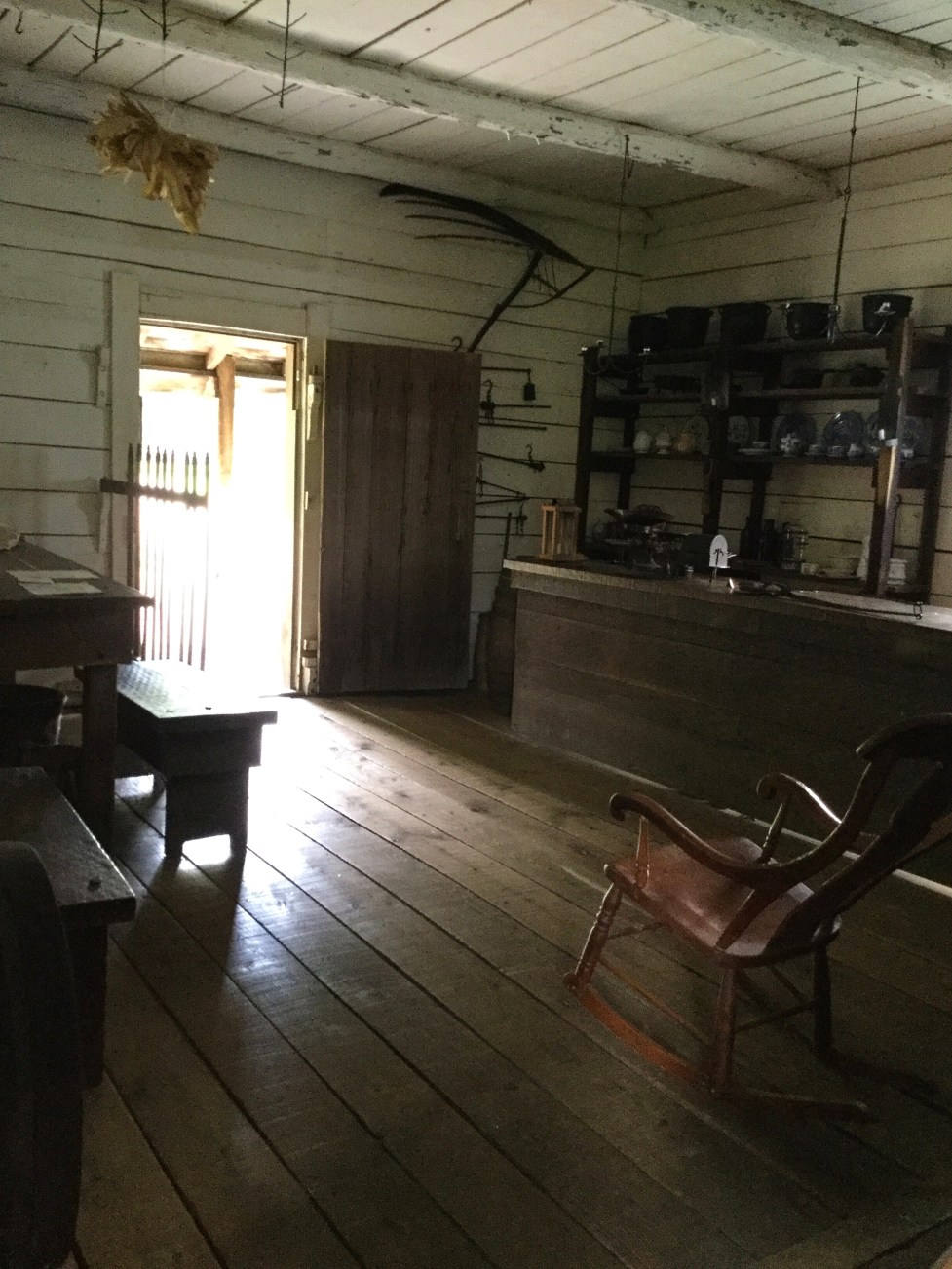
The interior of Jack Kelso’s residence; there’s not much more of this one-room house than what you can see here. Can you imagine three adults staying in this tiny place?

Kelso-Miller building, New Salem, Illinois. The Kelsos’ place is to the left, the Millers’ is to the right. Miller’s blacksmith shop can be seen at the far right and in the two photos to follow

Joshua Miller was the village blacksmith and wagon-builder. His wife and Kelso’s were sisters. Unlike Kelso, Miller was not a bit lazy. His skills were in high demand in the growing village so he was kept constantly busy. Now that Miller was here, the villages’ horses could remain properly shod; the doors and windows could have metal fittings instead of wood ones; plenty of wagons would have been needed to carry grain to and from the gristmill, and would require regular maintenance and repair as well.

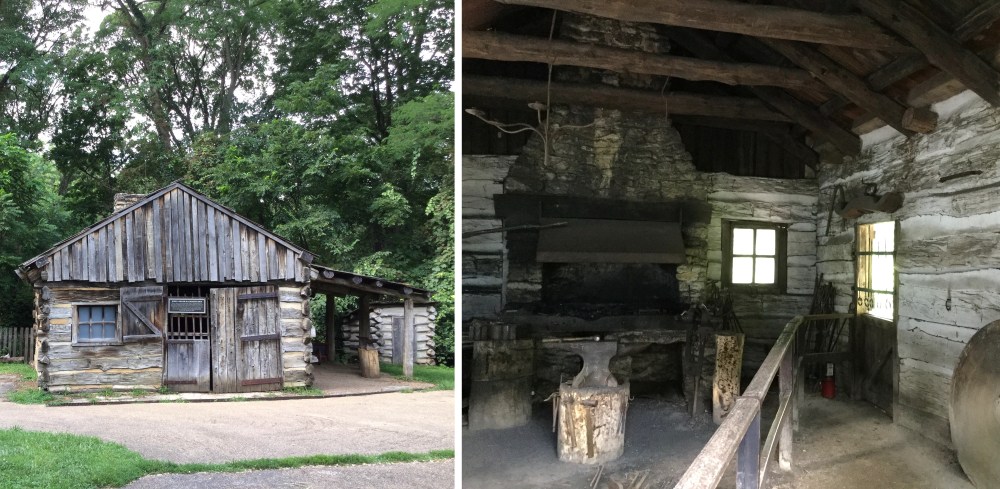
Exterior (left) and interior (right) of Joshua Miller’s blacksmith shop, New Salem

Interior of Mentor Graham’s schoolhouse. It also served as a church on Sundays.

Nxt, I visit the schoolhouse. Mentor Graham, the schoolmaster, was among those impressed by Lincoln’s ability, attentiveness to detail, and friendly concern for his neighbors and customers. According to New Salem historian Thomas, Graham assisted him in his continuing self-education, finding him a ready, apt, and diligent student. He helped Lincoln learn surveying as well, often working with Lincoln late into the night doing and checking calculations. Yet another biographer, Michael Burlingame, disputes the story that Graham was much of a help to Lincoln educationally, despite Graham’s and Lincoln’s friend Robert Rutledge’s claims. According to many of his former pupils, Graham had very poor math skills and was, in fact, a poor teacher overall. He had barely passed his teaching certification exams. Lincoln and Graham must have gotten along well enough, in any case: Lincoln boarded with his family for six months. If Graham’s former pupils spoke the truth, however, Lincoln likely mastered the skill of surveying on his own.

Mentor Graham’s schoolhouse, exterior view. It was originally located about a half mile southwest of the site of this reproduction.

A reproduction of the house of Isaac Guliher, or Golliher

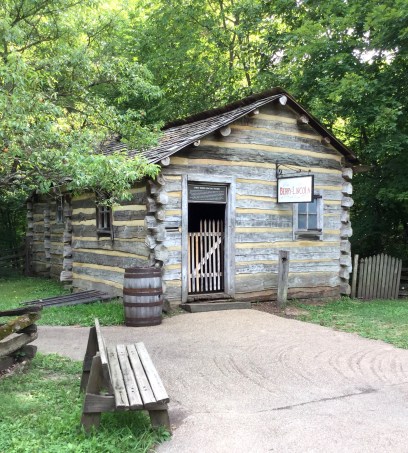
First location of the Berry-Lincoln store in New Salem, from late 1832 to January 1833

Next, I stop by the house of Isaac Guliher or Golliher, variously spelled in my sources. His only significance in this account is that he also served with Lincoln in the Black Hawk War, one of the little troop that’s described in Thomas’ history of New Salem as “…a hard-looking set of men, unkempt and unshaved” who “made war on the pigs and chickens,” and one of whom replied “go to the devil” when Lincoln gave his first command. Though Lincoln was very proud of being elected their captain, it sounds as if would have been a tough job.

Two buildings past the house of Isaac Guliher stands a little pointy-roofed shop. The Berry-Lincoln store building, the first of its two locations, looks very like most of the other buildings here, sturdy but modest, strictly utilitarian with its rough-hewn log structure, pointed shake roof, and small door and windows. In 1832, Lincoln entered into partnership with William Berry, buying out James and J. Rowan Herndon’s share of the general store. Lincoln, as usual, was broke. The modest compensation he received for his service in the Black Hawk War that spring and early summer wouldn’t go far. He paid his share with a promissory note, as he did for his share of the stock he and Berry purchased from a defunct local store. The store was never very busy so Lincoln read quite a bit. In his New Salem years, he mostly read Shakespeare, Burns, and the Bible, as well as law books, Kirkham’s Grammar, and other practical books. Other than poetry and Shakespeare, he didn’t read much literature, in which he had little interest.

The store limped along and, to save it, Berry decided to apply for a license to sell liquor in small quantities, which made it effectively a tavern as well. This didn’t suit Lincoln, who didn’t drink and saw the ill effects on those who did. He released his interest in the store in April of 1833. Once again, Lincoln was broke, and this time, in debt. He became an odd-jobber again like his friend Kelso, but not a lazy one. He split rails, worked on the farms, in the mill, and tended Sam Hill’s store, and when he got the chance, took any jobs he could get relating to voting, politics, and the law. In May, thanks to one of his very numerous friends, he was appointed to the job of village postmaster. It paid poorly but it was a social job, suitable for this friendly and often gregarious young man, and it gave him access to all the newspapers coming through the post. Since it was only a part-time job, this again gave him some time to read and study, though his odd-jobbing continued. A friend had recommended he try for the job of assistant to the newly appointed county surveyor John Calhoun. That job, coupled with his postmaster’s salary, should give him enough to live on. So he borrowed Calhoun’s books and learned surveying, took the job, and from January 1834 to late 1836, he made a success of it. But when his debts began to come due from the failed partnership with Berry and other speculations, what he was earning turned out, yet again, not to be nearly enough.

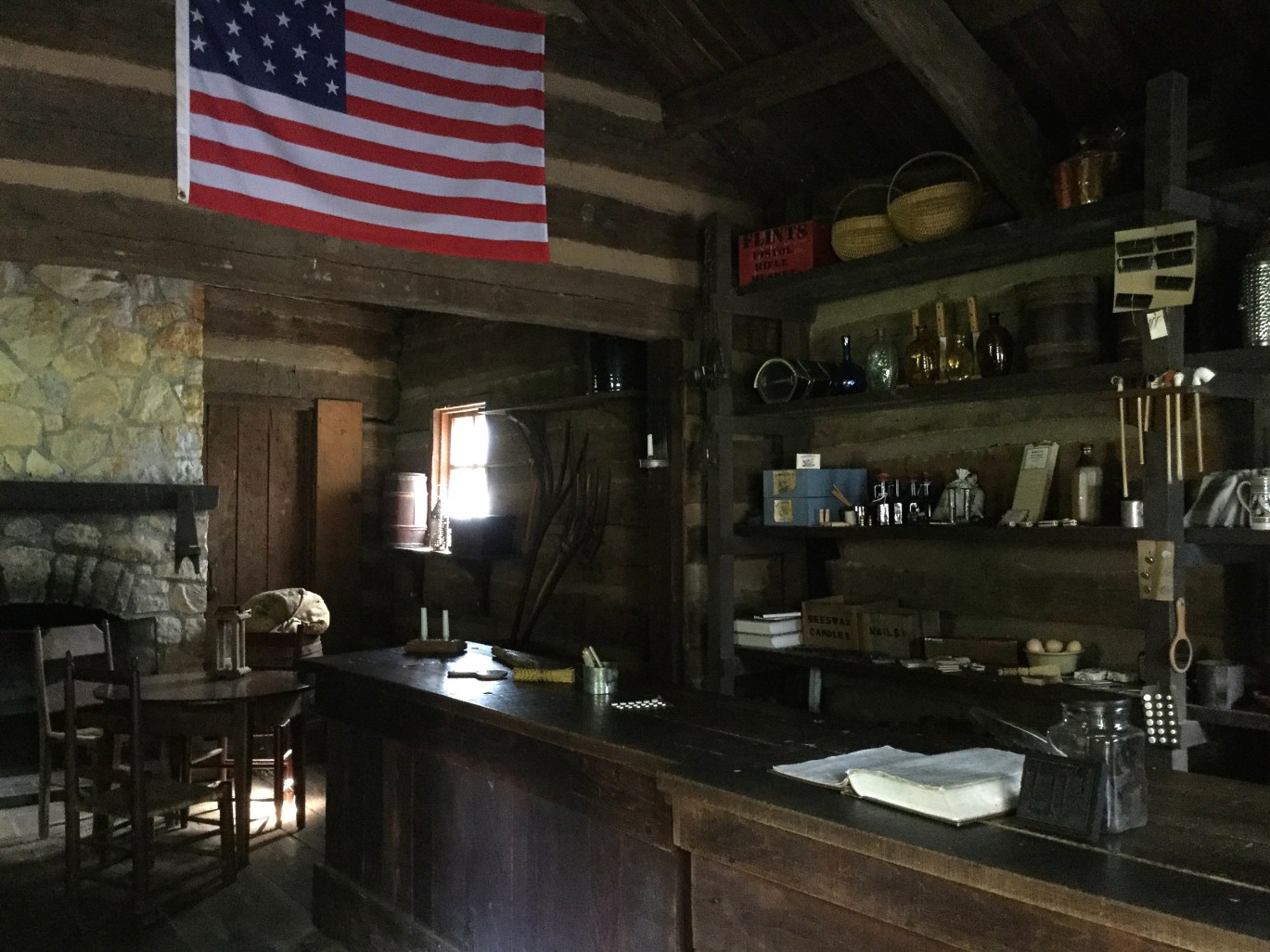
Berry-Lincoln store, interior view, New Salem, Illinois

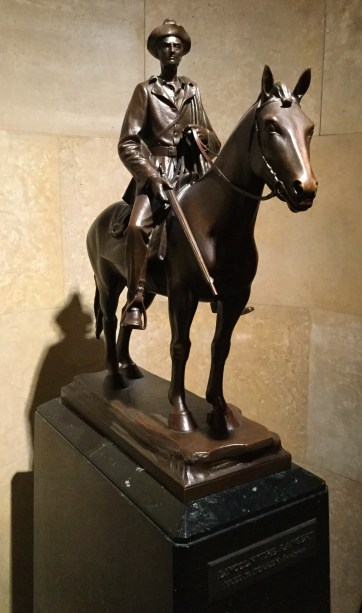
Lincoln the Ranger by Fred M. Torrey, portraying Lincoln as a soldier in the Black Hawk War, at the Lincoln Tomb, Springfield, Illinois

When it the time to elect state legislators began to come around in 1834, Lincoln’s friends encouraged him to run again. He first ran for that office in 1832, and his platform had included state investment in making the Sangamon River more navigable instead of putting in a much more expensive railroad line. He knew the river well, having been a flatboat pilot on it, and he knew just where it needed to be straightened, cleared, and dammed to get the goods flowing cheaply and easily to market. He also promoted public education, the lack thereof which had caused him so much frustration, and limits on predatory lending practices. Lincoln didn’t win the race, but made a respectable showing for a very young man of no means who had only been there about a year. In 1834, however, things were different. He had been a local businessman and postmaster, and his education and circle of friends had both increased. Among those who most encouraged Lincoln to run again was the justice of the peace Bowling Green.

So run he did, and he was elected to the Illinois House of Representatives on August 4th, 1834. Lincoln would be reelected to that office four times, serving as state legislator from 1834-1842.

During his 1834 run for office, Lincoln would develop his interest and education in the law. John Todd Stuart, who served with Lincoln in the Black Hawk War, also ran for state legislature in 1832 and won. He would eventually become Lincoln’s first law partner, took an active interest in his prospects and loaned him his law books. Lincoln’s friend and mentor Bowling Green (what a name!) also recognized that Lincoln’s sharp mind took right to his legal studies. As justice of the peace, Green allowed Lincoln to comment on his court cases, which in turn led to many turning to Lincoln for advice and assistance drafting legal documents.

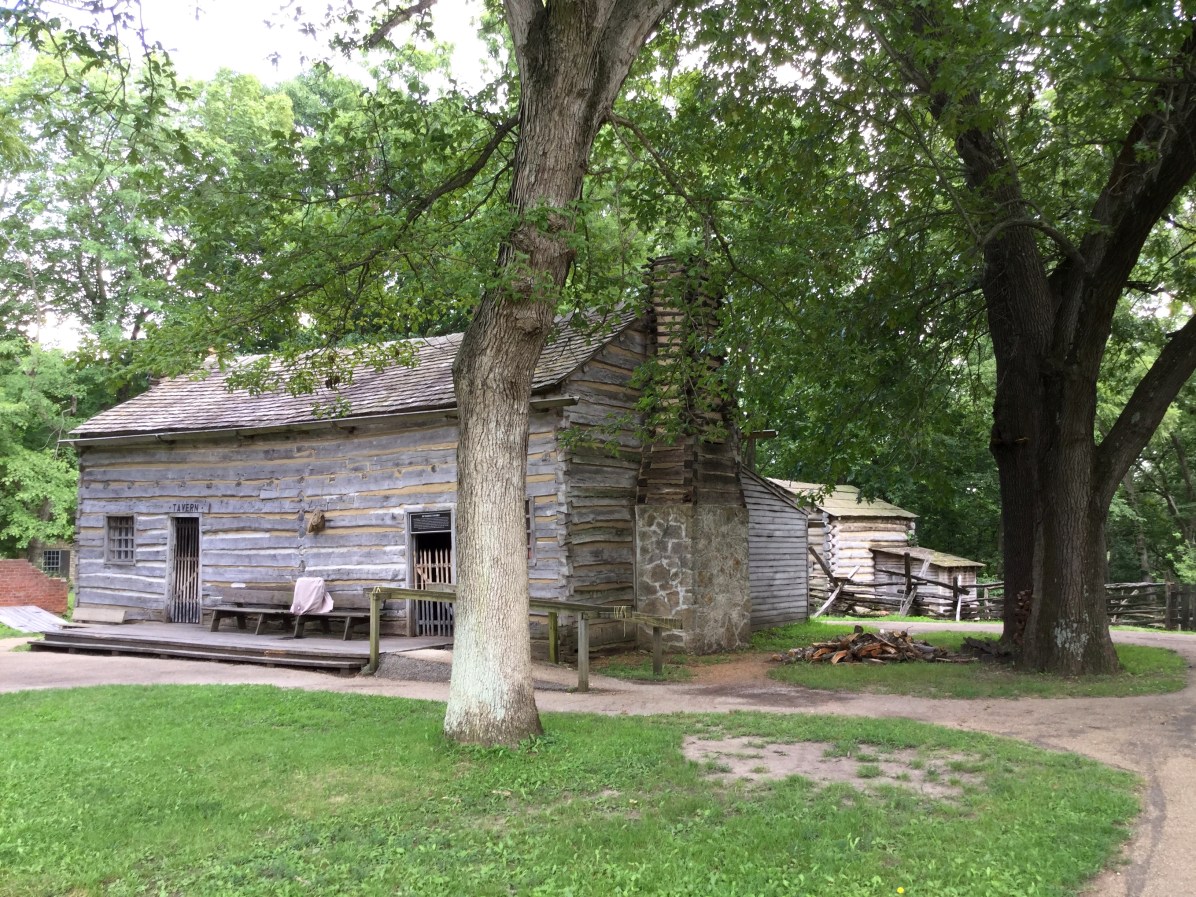
Rutledge Tavern, New Salem, Illinois, 2017

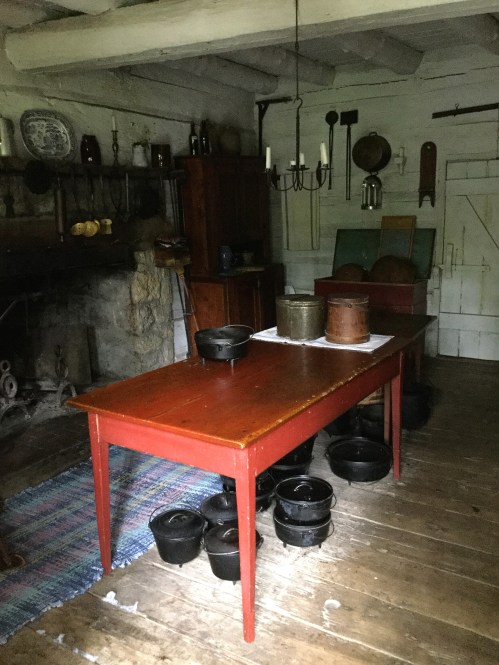
Rutledge Tavern kitchen

Almost three-quarters of the way down the main street, I take the right turn to that leads to the Rutledge Tavern. Its proprietor, James Rutledge, was one of the founders of New Salem in 1828. Rutledge was one of those who encouraged Lincoln to run for state legislator. This one and a half-story structure first served as the Rutledges’ home, but when the town began to grow, it was converted into a tavern or inn, with a low sleeping area overhead and a public dining room. This was one of the places where Lincoln regularly lodged and ate his meals.

In his biography of Lincoln, Herndon made much of a story that Ann Rutledge, James Rutledge’s daughter, was not only the first, but also the true love of Lincoln’s life. They certainly would have seen each other frequently, and as a petite, pretty, and plump young woman, she likely would have caught his eye (all of the women Lincoln is known to have courted or loved were curvy). Ann died in 1835, probably of typhoid, when she was only 22 years old; Abraham was 26. There are many stories of a courtship between Ann and Abraham, and of a tentative engagement contingent on an earlier beau’s reneging on his own promise. Some of the stories of their love affair claim that Lincoln wept by her deathbed, others that Lincoln was so distraught after her death that his friends kept suicide watch over him. Yet these stories are fragmentary, hearsay, and recalled many years or decades after the fact. It’s a sweet story, but we may never know how much of it is true. We must keep in mind that Herndon pushed the story within a larger narrative of Lincoln as a man who had lost in love, ending up with a difficult woman unworthy of him. As I have written previously, it appears to me that his portrayal of Mary Todd and her relationship with Lincoln is slanted based on Herndon’s personal dislike of her, and is not a balanced assessment. In any case, Ann and Abraham almost certainly shared an attraction and possibly love, and Abraham was certainly grieved by the early death of the sweet and pretty innkeeper’s daughter.

Rutledge Tavern, interior view, New Salem, Illinois

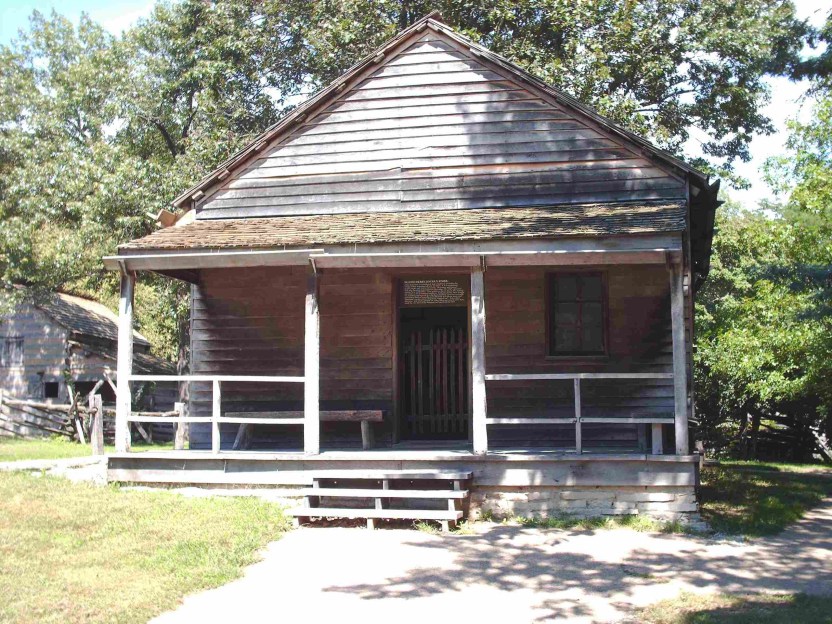
I return to the main road and straight ahead of me, across the street, I find a large milled limber structure with a nice shady porch. This is the second location of Berry and Lincoln’s general store.

Second Berry-Lincoln store, image credit Learning Abe website. (The photo I took of the outside of the shop is missing, I must have accidentally deleted it.) Lincoln and Berry moved the business here in January of 1833 when this larger, nicer-looking lumber building came available

Second Berry-Lincoln store, interior view. The building had been owned previously by John MacNamar, the absent fiancée of Ann Rutledge, Lincoln’s storied first love

Next, I spot a large sign in a grassy area followed by a series of smaller signs in a row leading toward the Sangamon River below the bluff. I read the sign and find that this is an archaeological site that has not be reconstructed.

Archaeology Walk in New Salem, Illinois. The sign reads: ‘The reconstructed buildings at New Salem are based on archaeological excavations conducted in the 1930’s. In 1994, two archaeological sites were discovered in this field which were missed by the 1930’s researchers. Unlike most of the other sites in this village, no deed records exist for these sites, and there are no stories of the families who lived here. Only a single hand drawn map, published by R.J. Onstot (son of Henry Onstot) in 1909, pictures houses in this location, but they are mysteriously unlabeled…’ The path here follows the old roadbed that ran across here. Many of the places associated with Lincoln in and around New Salem have not been reconstructed here, including Bowling Green’s and the Abells’ homes about a mile north of here

It reminds me that there are many inhabitants of New Salem who Lincoln befriended, did business with, and lived with whose homes have not been reconstructed. For example, Lincoln lived with his friend Bowling Green’s neighbors Bennett and Elizabeth Abell for a time. Lincoln would regularly borrow books from them and Elizabeth, especially, thought he showed promise. She took such a liking to him that she introduced him to her sister, Mary Owens, in 1833, as a potential beau. They courted briefly a time but, despite Elizabeth’s eagerness that they marry, their relationship didn’t work out. Years later, she wrote to Lincoln’s law partner and biographer William Herndon that though she thought Lincoln a good man, nevertheless, he was ‘deficient in those little links which make up the chain of a woman’s happiness.’ She broke off the relationship; Lincoln, apparently, regretted ever getting involved and had written her letters hinting that they’d be better off without each other

J. Rowan Herndon residence, New Salem, Illinois.

I continue east along the main road, and to my right, I see the Herndon brothers’ house. One of them, J. Rowan Herndon, was married to Mentor Graham’s sister Elizabeth, and Lincoln lived with them for a time. Herndon was Berry’s original partner in the general store but since they didn’t get along, Herndon sold his share to Lincoln on credit. In 1833, Herndon accidentally shot and killed his wide when he was preparing to go out hunting. He left town to escape the rumors that he killed his wife on purpose, but it was no good: the rumors followed him for the rest of his life. Lincoln moved to Graham’s house when Rowan left.

Denton Offutt Store, New Salem, Illinois.

Continuing onto the last little road which veers off to the left from the main road, I find the first store Lincoln worked in when he moved to New Salem. It was from Offutt’s flatboat that Lincoln first saw New Salem, and it was Offutt’s promise of a job managing his new store that caused Lincoln to move here in 1831. So this humble little store is the one that brought Lincoln to this place so formative to his life and education. It’s not much to look at, but it brings home to me anew how amazing Lincoln’s story really is.

Perhaps it was the fact that New Salem was both a tiny frontier village and a commercial community reaching hard beyond itself, seeking to become a hub of skilled trade and interstate commerce, that Lincoln found it such an effective springboard. From 1831 – 1837, this close-knit and ambitious village nurtured an uneducated, awkward, poor farm-boy into a canny lawyer, a political powerhouse, and a great moral leader, perhaps the greatest President the United States will ever see.

*Listen to the podcast version here or on Google Play, or subscribe on iTunes

Ordinary Philosophy and its Traveling Philosophy / History of Ideas series is a labor of love and ad-free, supported by patrons and readers like you. Please offer your support today!

~~~~~~~~~~~~~~~~~~~~~~~~~~~~~~~~~~~~~~~

Sources and inspiration:

Abraham Lincoln Online: Lincoln Early Life Timeline, Lincoln’s New Salem State Historic SiteLincoln Timelines and Highlights, and Pre-Presidential Political Timeline

Burlingame, Michael. Abraham Lincoln: A Life, Volume 1. Baltimore, Maryland: Johns Hopkins University Press, 2012

Carwardine, Richard. Lincoln: A Life of Purpose and Power. New York: Random House, 2003

The Chautauqua Movement‘, Chautauqua Trail website

Denton Offutt.’ from Kentucky’s Abraham Lincoln by the Kentucky Historical Society

Donald, David Herbert. Lincoln. New York: Simon & Schuster, 1995

Gannett, Lewis. ‘”Overwhelming Evidence” of a Lincoln-Ann Rutledge Romance?: Reexamining Rutledge Family Reminiscences.’ Journal of the Abraham Lincoln Association, Volume 26, Issue 1, Winter 2005, pp. 28-41.

Herndon, William H. and Jesse W. Weik. Herndon’s Lincoln: The True Story of a Great Life. 1889

Lehrman, Lewis E. Lincoln at Peoria: The Turning Point. Mechanicsburg, PA: Stackpole Books, 2008.

Lincoln’s New Salem‘, Illinois Historic Preservation Agency website

Lincoln’s New Salem.’ In Wikipedia, The Free Encyclopedia.

Lincoln’s New Salem 1830-1837‘, National Park Service website

New Salem: Virtual Tour, Lincoln’s New Salem State Historic Site website

Nicolay, John George. An Oral History of Abraham Lincoln: John G. Nicolay’s Interviews and Essays. Carbondale: Southern Illinois University Press, 2006

Shenk, Joshua Wolf. ‘The Suicide Poem‘, The New Yorker, June 14, 2004

Simon, John Y. ‘Abraham Lincoln and Ann Rutledge, Journal of the Abraham Lincoln Association,
Volume 11, Issue 1, 1990, pp. 13-33

Thomas, Benjamin Platt. Lincoln’s New Salem. Springfield, Ill.: The Abraham Lincoln Association, 1934; republished Ann Arbor, Michigan: University of Michigan Library, 2006.

Trenholm, Sandra. ‘Abraham Lincoln, Mary Owens, and the Accidental Engagement.’ The Gilder Lehrman Institute of American History website

Happy Birthday, Mark Twain!

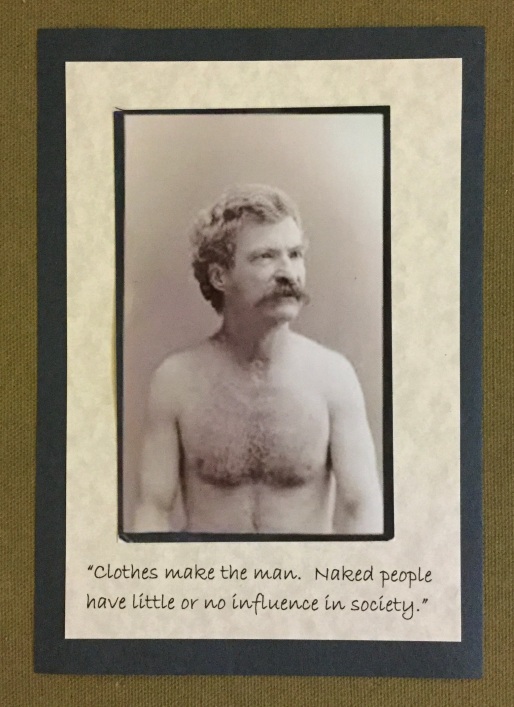
Mark Twain and ‘clothes make the man’ quote, at Mark Twain Birthplace State Historic Site, Florida, Missouri

As I work frantically on organizing my thoughts and assembling my notes for my three final semester papers (all due in a little over a week, gulp!), I can chuckle amid the stress when I think of Mark Twain’s quote ‘I have never let my schooling interfere with my education.’ In fact, he had a rib-tickling, snarky, or sarcastic witticism for just about any occasion.

But there’s so much more to Twain than his one-liners and his incredible body of work. This summer, on my way to Scotland to continue my university education, I crossed (and crisscrossed) the United States between Oakland and Chicago. My journey included following in the footsteps of the young Samuel Clemens, as he was named upon his birth on November 30, 1835, in Florida, Missouri. I have lots of notes and photos but alas, I haven’t been able to write up those parts of my journey in time to commemorate his birthday today. But I’ve found a way to work him into my studies in intellectual history here at the University of Edinburgh (I delivered a presentation on his work on Joan of Arc for one of my classes) and have gotten some additional reading done. I’ll turn the notes for that oral presentation into a written piece for Ordinary Philosophy as well as write up my travel pieces as soon as I can after turning in my papers, please stay tuned!

In this meantime, here’s the link to a bio of Twain by Thomas V. Quirk for Encyclopædia Britannica (my favorite online general encyclopedia) and to the webpage for Ken Burn’s excellent Twain documentary. And a shirtless (or shall I say, birthday suit?) photo of Twain captioned with a quote which I came across on one of my stops following his early life. Enjoy!

Ordinary Philosophy and its Traveling Philosophy / History of Ideas series is a labor of love and ad-free, supported by patrons and readers like you. Please offer your support today!

Happy Birthday, Abigail Adams!

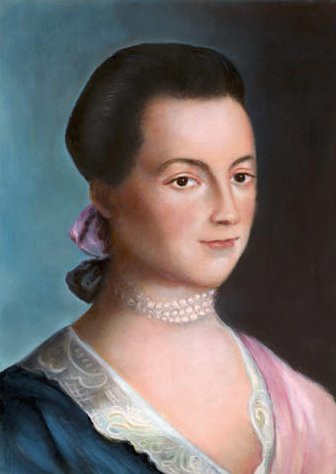
Abigail Adams, the earliest known image of her painted near the time of her marriage in 1764

Abigail Adams, born on November 22, 1744 in Weymouth, Massachusetts, was wife and chief advisor to John Adams, American founding father and second president; early advocate for women’s rights and opponent of slavery; self-taught intellectual; mother to many children including another American president; and something I just learned today, a savvy and successful financial speculator. She is one of the most well-known figures in American history because of the voluminous and well-preserved correspondence between her and her husband John. While she remained at home raising the children and managing their home, John was frequently away for extended periods on matters of revolution and state. Their letters are famous: they were loving and forthright with one other on a rare level, and the ideas and advice these two brilliant people shared with one another illuminate and inspire readers still.

Learn more about our wise and indefatigable founding mother Abigail Adams at:

Abigail Adams ~ by Beckett Graham and Susan Vollenweider for The History Chicks podcast

Abigail Adams (1744 – 1818) ~ bio for the Adams National Historical Park, National Park Service website

Abigail Adams: American First Lady ~ by Betty Boyd Caroli for Encyclopædia Britannica

Abigail Adams: Revolutionary Speculator ~ Liz Covart interviews Woody Holton for Ben Franklin’s World: A Podcast About Early American History

Abigail Smith Adams ~ by Debra Michals for the National Women’s History Museum website

First Family: Abigail and John Adams ~ by Joseph J. Ellis for the Philadelphia Free Library

How Abigail Adams Proves Bill O’Reilly Wrong About Slavery ~ by David A. Graham for The Atlantic

John Adams ~ Miniseries by HBO, 2008

Ordinary Philosophy and its Traveling Philosophy / History of Ideas series is a labor of love and ad-free, supported by patrons and readers like you. Please offer your support today!

Happy Birthday, John Adams!

John Adams by John Trumbull, 1793, National Portrait Gallery, Washington, D.C.

Like many who watched the excellent 2008 miniseries John Adams with Paul Giamatti in the title role and Laura Linney as Abigail Adams, my interest in the United States’ second president increased quite a bit after watching it. And when I read John Ellis’ Passionate Sage: The Character and Legacy of John Adams last year, I found myself thoroughly engrossed. I read of a man who was brilliant, insecure, honest, vain, visionary, retrograde, loving, selfish… all character traits which I believe are often found in the most interesting and accomplished people. The same traits that drive people to do wonderful and unusual things are often the same as, or found in conjunction with, those which make people thoroughly insufferable. For example, the insecure egoist’s need to be loved and admired provides the drive for accomplishment, and those who are intelligent enough to surpass most others in this regard are also intelligent enough to recognize it, resulting in vanity. Perhaps because I don’t have to put up with him personally, I can freely admire and even feel affection for Adams as the sensitive, flawed human being  revealed in his massive correspondence; an egoist who nevertheless was obsessed with justice and did his best to see it done in the world, who sacrificed his own posterity and a second term in office to preserve his new country from the existential threat of an ill-conceived war; whose dignity was far too easily wounded but at times proved himself a loyal friend even to those that betrayed him – Thomas Jefferson being a prime example.

Americans may have more easily forgiven all of this if he hadn’t championed the Alien and Sedition Acts and signed them into law, parts of which are seen today as contrary to essential American principles. In his fear that the bond between the states in his newly united country would break apart under the strain of war and the spiraling controversies of party politics, Adams overreached. But his legacy shouldn’t be overshadowed by this one, though admittedly significant, mistake. As Ellis writes for Encyclopædia Britannica,

Although Adams was regarded by his contemporaries as one of the most significant statesmen of the revolutionary era, his reputation faded in the 19th century, only to ascend again during the last half of the 20th century. The modern edition of his correspondence prompted a rediscovery of his bracing honesty and pungent way with words, his importance as a political thinker, his realistic perspective on American foreign policy, and his patriarchal role as founder of one of the most prominent families in American history.

Learn more about our oh-so-human, brilliant president John Adams at:

John Adams ~ Miniseries by HBO, 2008

John Adams As He Lived: Unpublished Letters to Dr. Benjamin Waterhouse, Professor of Physic at Harvard College ~ published in The Atlantic, May 1927

John Adams: The Case of the Missing John Adams Monument ~ Lillian Cunningham for the Presidential podcast series presented by The Washington Post

John Adams: President of the United States ~ Joseph J. Ellis for Encyclopædia Britannica

Plain Speaking: In David McCullough’s Telling, the Second President is Reminiscent of the 33rd (Harry Truman) ~ by Pauline Maier for The New York Times: Books, May 27, 2001

Sorry, HBO. John Adams Wasn’t That Much of a Hero ~ Jack Rakove for The Washington Post, April 20, 2008

~ Ordinary Philosophy is a labor of love and ad-free, supported by patrons and readers like you. Any support you can offer will be deeply appreciated!

Springfield, Illinois, in Search of Abraham Lincoln, Part 5

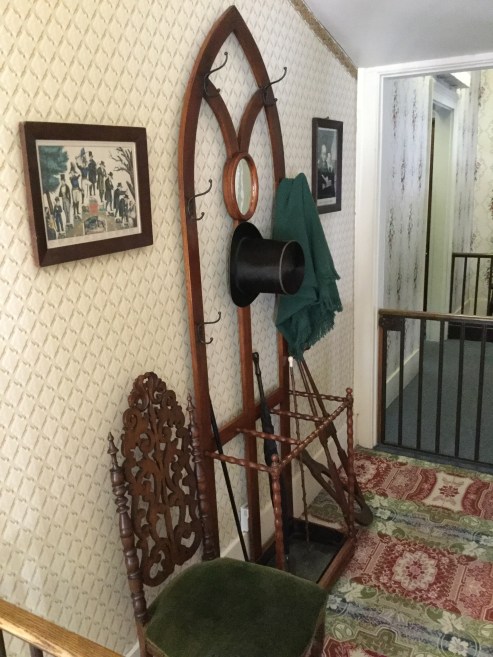
Downstairs hallway in the Lincoln Home with the Lincolns’ original hatstand – but no, not Abe’s original hat

Springfield, Illinois, Saturday, July 30th, 2017

I sleep in then linger over a continental breakfast-of-sorts in my rented room as I catch up on some rest, writing, and research. When I finally bestir myself in earnest, I head over to D’arcy’s Pint to enjoy a local delicacy for lunch. My brother John lived in Springfield for a time some years ago and told me I must eat a horseshoe while I’m in town. The internet tells me that this gastropub is the best place to enjoy this decadent regional take on the open-face sandwich, so here I am. I order a full-size one with the works, spicy, and a pint to wash it down with. They bring me a small mountain on a plate composed of Texas toast, french fries, ground meats, chopped tomatoes and other veggies, and cheese sauce, the spiciness added at the discretion of the diner from the little cup of (mildly) hot sauce on the side. It’s tasty enough, I can’t deny, and the cheese sauce is very good and appears to be homemade, not at all like the waxy bright yellow kind that comes from a can or jar. But it’s not the tastiest thing I’ve ever eaten: it’s really starchy. Potatoes and bread in one dish? Hmmm. Still, it’s plenty good enough to pack up the other half to eat later. The physically-demanding, hiking-heavy portion of my journey is far enough behind me now that I just can’t digest a heavy meal of this size all at once.
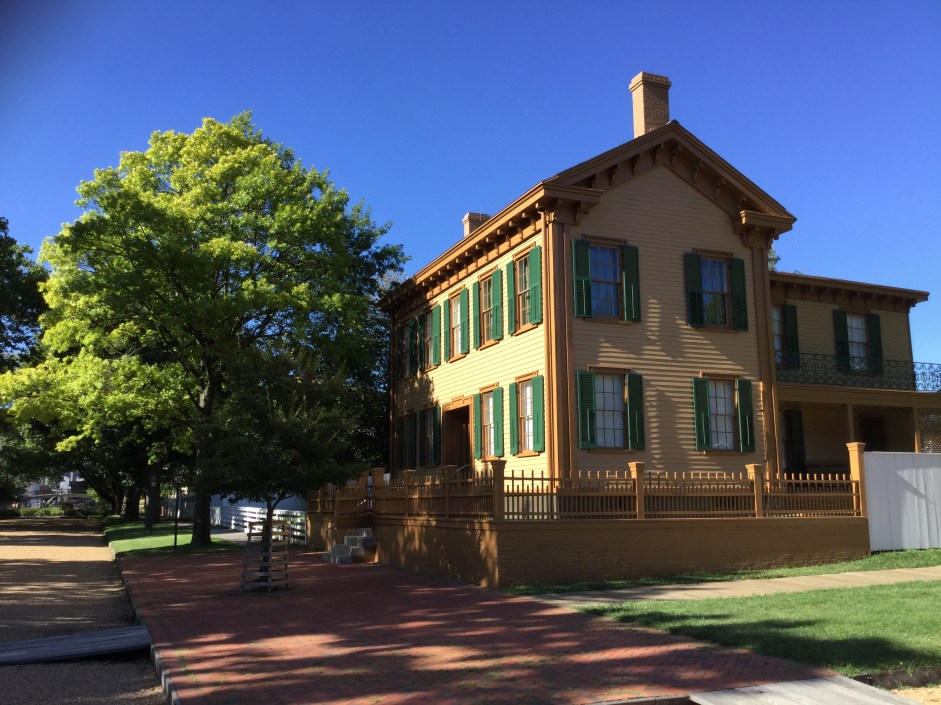
The Lincoln Home at the corner of Eighth and Jackson Streets, Springfield, Illinois. Abraham Lincoln planted the elm tree at the left.

Feeling pleasantly languorous, I return to the Lincoln Home Historic Site. The house where Abraham Lincoln, Mary Todd Lincoln, and their children lived from 1844 to 1861 stands at 413 S 8th St. It’s the only house where Lincoln lived that’s still standing except for the White House.  I park in front of the Visitor Center at 426 S 7th Street and buy my ticket for the next available tour. In the intervening forty-five minutes or so before my tour starts, I wander through the exhibits in the small museum/bookshop of the visitor center and obtain a little more information for the rest of my Illinois trip. There’s lots of great stuff here.
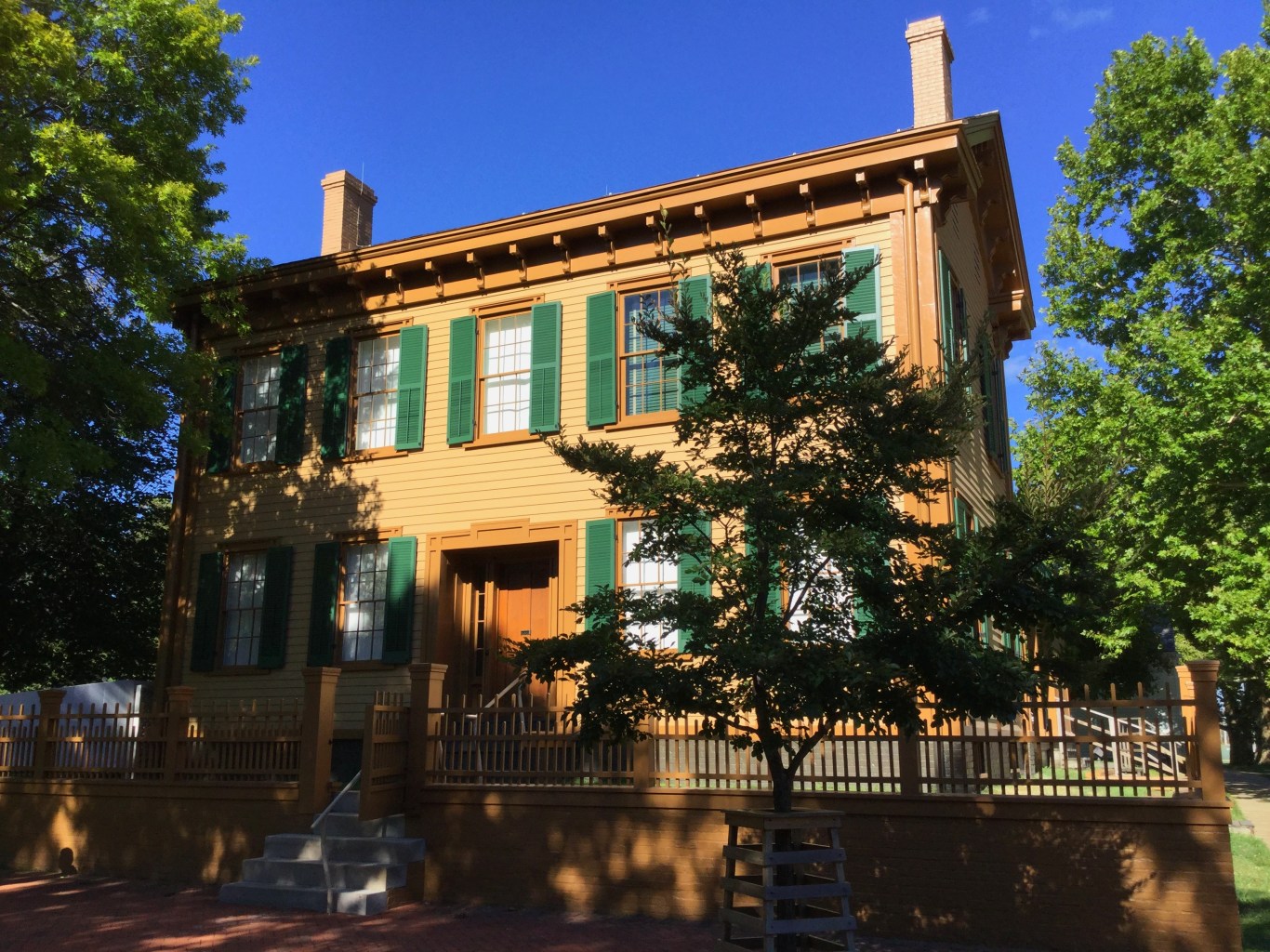
Another view of the exterior of the Lincolns’ home in Springfield, Illinois
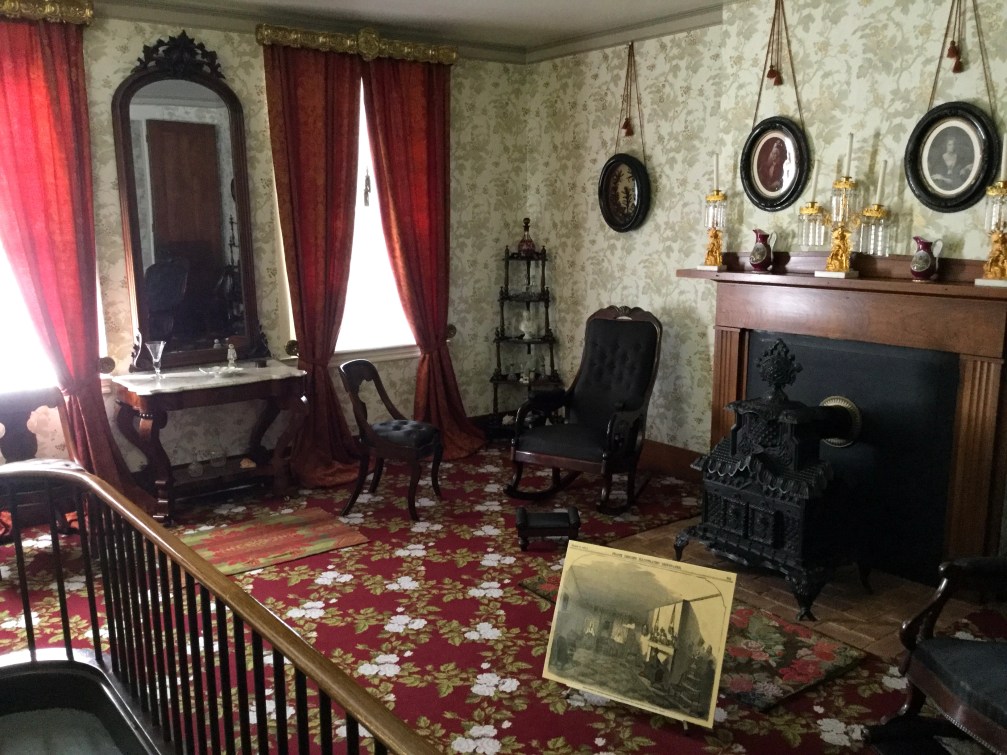
A view of the front parlor at the Lincoln Home, Springfield, Illinois.

A few minutes before our scheduled time, I meet the little tour group outside on a bench on the grass-edged wide walkway leading from the Visitor Center to the Lincoln Home. It sits among a very tidy little neighborhood of historic homes from around the Lincolns’ time here. Houses from later periods were not preserved, and a few stand empty and neatly painted, but not yet restored. Since the only activity at the streets and houses here are visitors strolling and gazing, guided and informed by the signs erected in front of some of the homes and other points of interest, it feels more like a nice outdoor museum or park than a neighborhood.
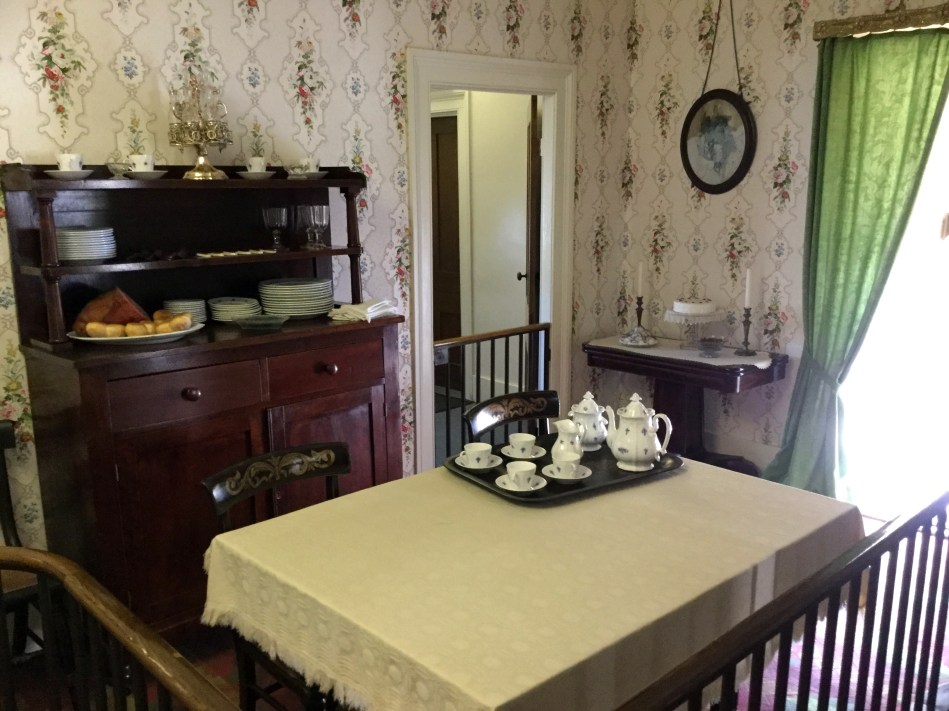
The Lincoln Home dining room
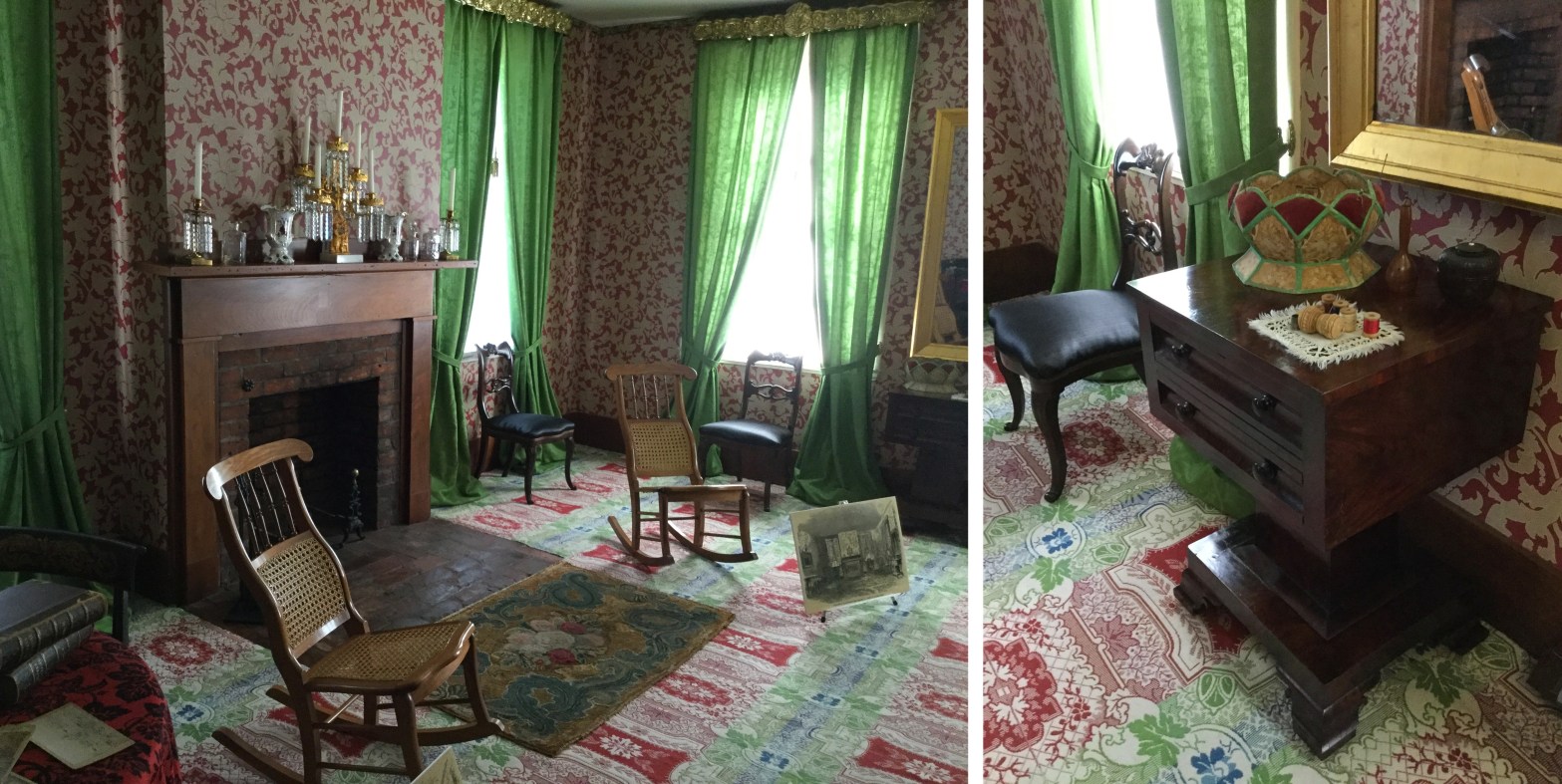
The Lincoln Home living room, with a closeup of Mary Todd Lincoln’s sewing table at the right
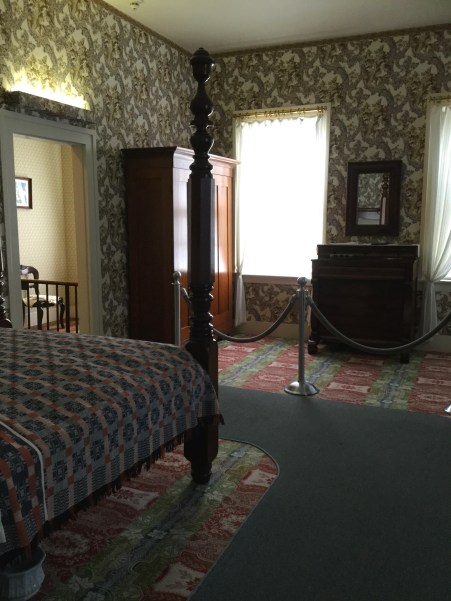
A view of the Lincolns’ extra-long four-poster bed in their bedroom at the Lincoln Home. It was the best shot I could get given I had to wait for the crowd to pass, then had only a few seconds before they ushered me along.

The Lincoln Home is a two-story house and, with the additions that the Lincolns added over the years, a decent size for a household of two adults and three children. Mary bore four sons; as you may remember, Robert was born the year before they moved here. Sadly, little Eddie died just short of four years old in 1850. He was the Lincolns’ second child and the first to be born in this house. Almost ten months after Eddie’s death, William was born, followed by Thomas, called Tad, in 1853.

The house originally consisted of just the front two-story section, tall but narrow, and this part feels as small today as I’m sure it did for the growing Lincoln family. It may seem roomier if I was here without my fellow visitors all herded together to one side of each room by the guardrail. Still, everything seems just a few steps away. The relatively small rooms would be practical for the time: they were easier and cheaper to keep warm in winter, hard to do since double-pane windows weren’t a thing yet. And since they had no modern appliances, the smaller rooms would have made cleaning the house more manageable as well.

We wind our way upstairs to the bedrooms. Each has its own wallpaper pattern, which modern tastes would generally find too ‘busy’, but these patterns were very French and therefore, very fashionable. It was very important to Mary that her homes be stylish enough to welcome and impress visitors even from the highest and wealthiest social classes. She continued this practice of elaborate home decorating at the White House, and she was reviled by many, and still is, for being an irresponsible, image-obsessed spendthrift.
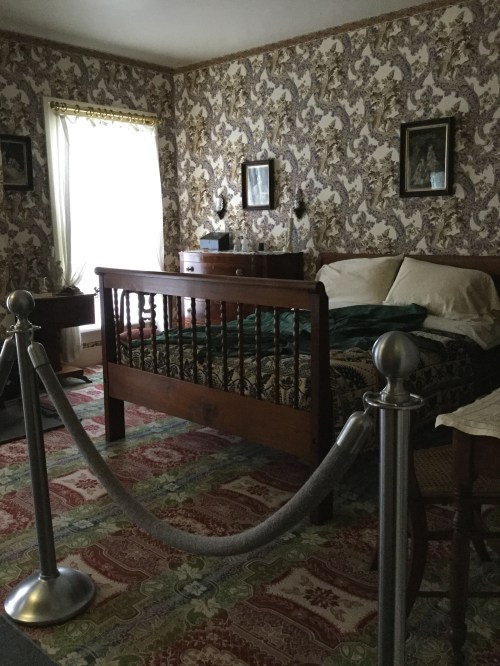
One of the children’s’ bedrooms on the upper floor of the Lincoln Home

But I don’t believe that Mary Todd’s insistence on style and elegance was the simple result of vanity or thirst for luxury. One of the things that originally drew Mary Todd and Abraham Lincoln to one another was their love of politics, and Mary, like Abraham, was ambitious; he on his own behalf, she mostly on his, since he was the only one who could engage actively in politics. She, like Abraham, was practical, and a woman’s sphere of influence then was in the home and in the entertainment of guests. She knew that her husband was more likely to be respected and admired as a political leader if he lived in homes that displayed taste, culture, and yes, money, since that was emblematic of responsibility, ability, and power. She was only one of the many First Ladies who recognized this and who likewise put a lot of energy and money into making the White House a symbol of national pride and success. But she, I believe, has been the most reviled for it.

After viewing the upper floor and its bedrooms, we return to the ground floor and pass through the little kitchen. I think I would find it inconveniently small, but Mary was a petite woman, so perhaps that helped. At least everything was in easy reach! She did most of the household cooking, a new feature of her life once she married Abraham.
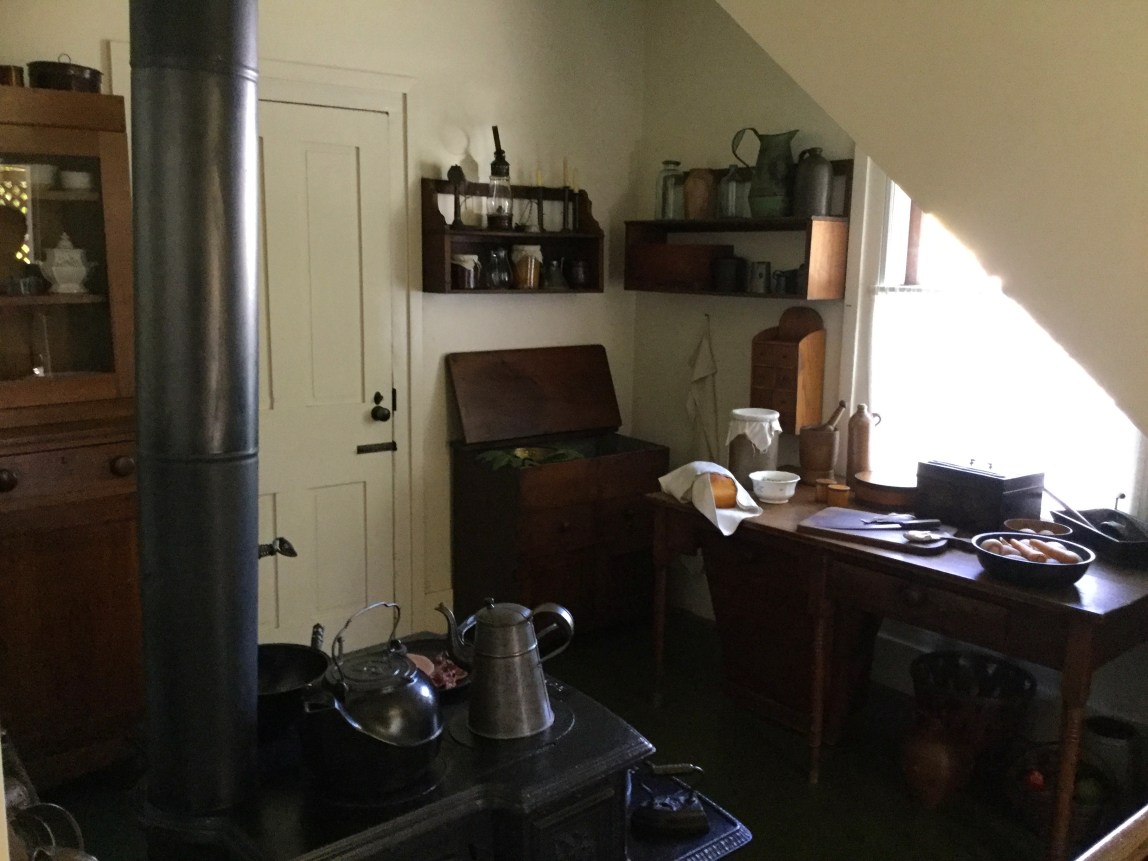
The cozy little kitchen in the Lincoln Home

Many considered their courtship and marriage a poor fit: Mary had grown up with all of the advantages of wealth while Abraham very much did not. But she, like many others once they got to know him, was impressed enough with his intelligence and character that his long background of debt and poverty didn’t seem to deter her much. But married life with Abraham was not always so easy for Mary. It wasn’t just that she had to learn to cook and to perform many of the household duties that the team of domestics at her parents’ house used to take care of. Over time, as Abraham became a more financially successful lawyer and then politician, they enjoyed a much more comfortable middle-class lifestyle and Mary had money to spend on her household and personal effects again. But Abraham was notoriously ‘deficient in those little links which make up the chain of a woman’s happiness,’ as one of his prior sweethearts observed, and often much less demonstrative of his feelings than Mary would wish.
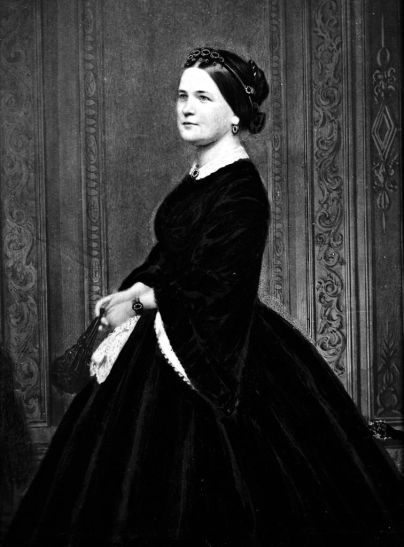
Mary Todd Lincoln, ca 1860 – 1865, Brady-Handy Photograph Collection, public domain via the Library of Congress

Yet especially during the early and middle years of their marriage, despite Lincoln’s law partner and eventual biographer William H. Herndon‘s many negative portrayals, the couple were very loving, respectful, and supportive of one another. Yes, they quarreled at times; both of them were moody, willful people. When angered, Mary would vent her frustrations but Abraham would bottle his up and withdraw, which, no doubt, sometimes made matters worse. Abraham may have had to put up with a lot sometimes, but at least for much of their marriage, Mary had to put up with more. She had a lot more character and a lot less selfishness and vanity than Herndon and many others later gave her credit for. After all, this was a woman who gave up a life of ease and wealth to marry an awkward-with-women, undemonstrative, unromantic, funny-looking guy of little means and few signs of promise besides his intelligence and charisma. She ended up with a faithful and hardworking but often absentee husband and father as he went out on the law circuit sometimes for weeks at a time, laying most of the household burdens on her shoulders. Their children were hard to deal with too: Mary and Abraham could not agree on a consistent method of discipline so they mostly gave it up, to the dismay of Lincoln’s colleagues at his law office and the White House since he’d sometimes bring his rambunctious kids to work.

Later on, the heartbreak of losing two of her children by the time she left the White House and the strain of public life took their toll on Mary. Mary was outspoken and decisive, and Victorian America was not yet accepting of such overt displays of will and opinion by women, especially by the First Lady, expected to be a model of decorum, of womanly modesty and restraint. But Mary would have none of it, and she made many enemies with her cutting wit, sarcasm, and displays of temper. She stood up for herself, not always gracefully, and this did not make her popular. Mary’s emotions, her depressions and passionate outbursts, became more volatile and frequent over time, and the Lincolns’ relationship was often more severely strained than ever. But although they had very different ways of expressing themselves, Mary and Abraham shared the sources of their pain and remained as supportive of one another as they knew how to be, and loyal to one another, for the rest of their lives.
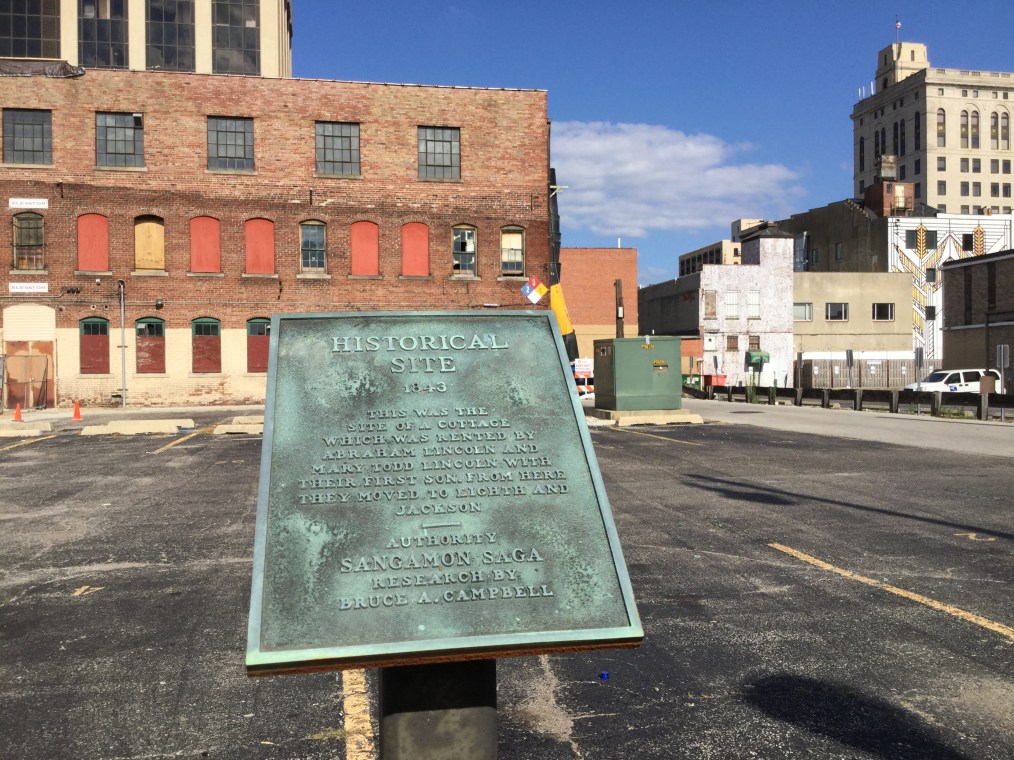
Site of Abraham and Mary Lincoln’s second home on 4th St just north of Adams, Springfield, IL 2017 Amy Cools

We complete the tour of the house and I zigzag north and west, returning to central downtown Springfield. I had confirmed the location of a few more sites in my research this morning, and in books and maps I found at the Lincoln Home Visitor Center while I was waiting for the tour to begin. The next site I visit is on 4th St, just north of Adams St, on the east side. There’s only a parking lot here now, where used to stand a modest three-room frame house. Search as I may, there seems to be no photo of the house, or, as the historical plaque at the site describes it, cottage. The Lincolns and their infant son Robert moved here in the fall of 1843. They didn’t want to raise their children in a bustling hotel, though the Globe Tavern was a nice enough place for a young couple, so they moved into the best home they could afford until Lincoln’s practice began bringing in enough money again for something better. They were here only about a year before they moved into their permanent home on 8th St.

Lincoln was still paying off old debts, and as you may remember from the last installment of my Lincoln story, his law partner at the time, Stephen T. Logan, was a little tightfisted with the practice’s money. But as Lincoln became better known and more in demand; with a little help from Mary’s father, who liked Abraham despite the fact that he couldn’t yet provide his daughter a more comfortable lifestyle; and with Lincoln’s new senior partnership with Herndon in late 1844, they felt able to afford the 8th St house that same winter.
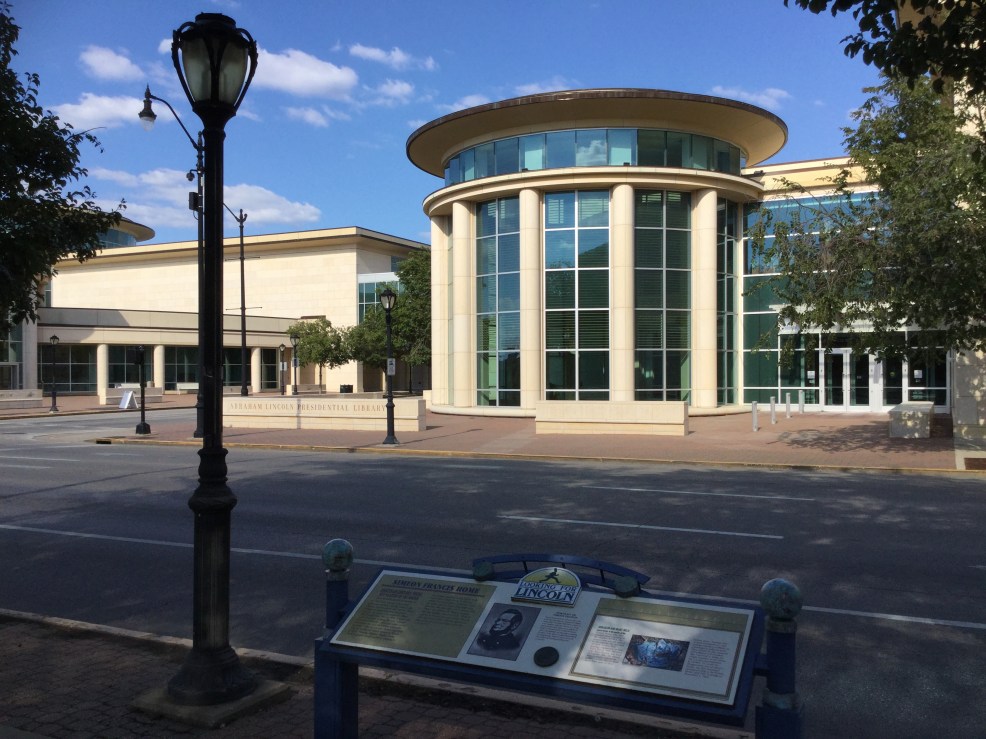
Abraham Lincoln Presidential Library and Museum, Springfield, Illinois. The Library building stands on the site of Mr. and Mrs. Simeon Francis’ home, where Abraham Lincoln and Mary Todd renewed their courtship.

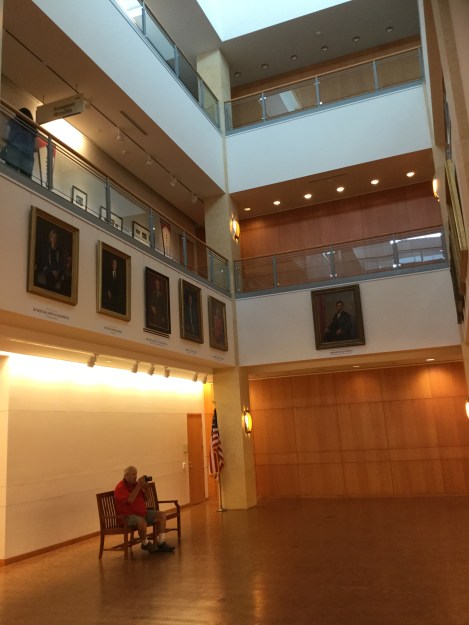
Then I return to the Abraham Lincoln Presidential Library. On my first day here, I missed the sign that indicated that the Library stands on the house site of Eliza and Simeon Francis; the sign is across the street on the sidewalk next to the business building and PNC bank parking lot. Simeon Francis was the editor of Sangamo Journal and had become close friends with Lincoln in this capacity. Lincoln was a regular contributor to the editorial page through much of the 1830’s. After Mary Todd moved to town in 1839, she and Eliza Francis became close friends as well. Within the first year of their courtship, Lincoln panicked and broke off his engagement with Mary Todd on New Year’s Day, 1841 (what a day to choose, Lincoln!), and they didn’t speak much for a while.
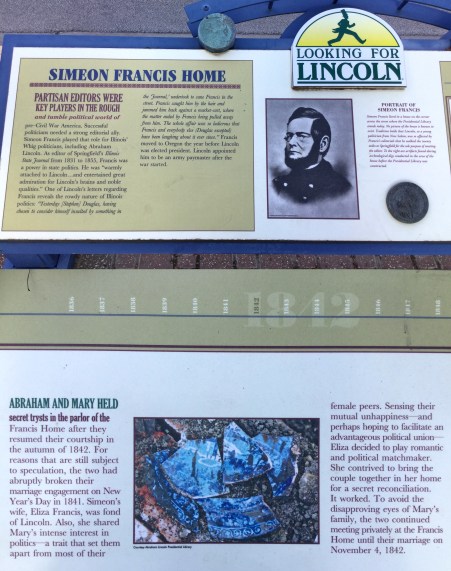
Close-ups from the Looking for Lincoln sign for the Francis home site

But they shared so many acquaintances, friends, and interests that they were inevitably brought together again, especially by their friend Eliza. They were reconciled in the house that once stood here the next year and met regularly here to renew their courtship in secret. They didn’t want their relationship to be the subject of gossip and public speculation as to the reasons for the breakup and the renewal of their relationship. I’m guessing this may have been caution especially on Mary’s part: she was pretty head over heels for this guy; her family didn’t approve of him as a match for her however much they may have liked him personally; and she had observed how the normally gregarious and social Lincoln became awkward, shy, and skittish in the presence of most women. But when they were alone, Abraham and Mary got along excellently and had much to talk about. It all went so well this time around that Abraham and Mary Todd were married on November 4th, 1842.
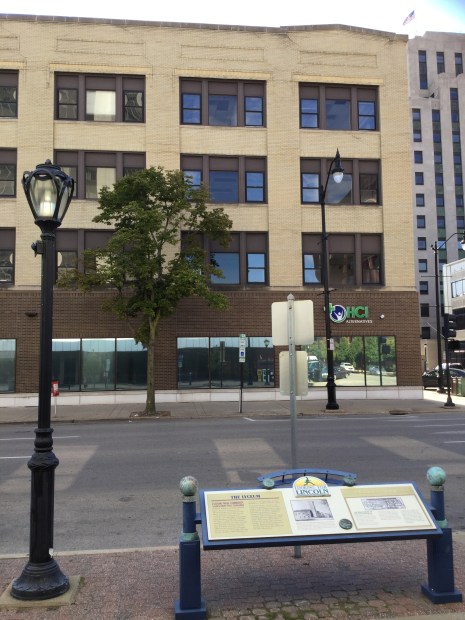
Site of the old Baptist Church at the southwest corner of 7th & Adams Sts where the Young Men’s Lyceum was held. Lincoln delivered his famous Lyceum Address here on January 27th, 1838.

I continue two blocks south and one block east to the northwest corner of 7th and Adams Sts. There’s a ‘Looking for Lincoln’ sign here on E Adams which points out the site across the street.

The Young Men’s Lyceum used to meet here at the old Baptist Church from 1838-1840. Early on during their tenure here, on January 27th, 1938, Lincoln addressed the young men with a speech titled The Perpetuation of Our Political Institutions. Now known as the Lyceum Address, Lincoln spoke against the ‘mobocracy’ which he feared was becoming too common a substitution for reasoned debate and institutional reform in American life. The rancor between abolitionist and pro-slavery sympathizers was growing, breaking out in increasing numbers of violent episodes. The Lyceum Address revolves around the lynching of Francis McIntosh, a young freeman of mixed-African and European descent, who was lynched in St. Louis less than two years before Lincoln’s address here.
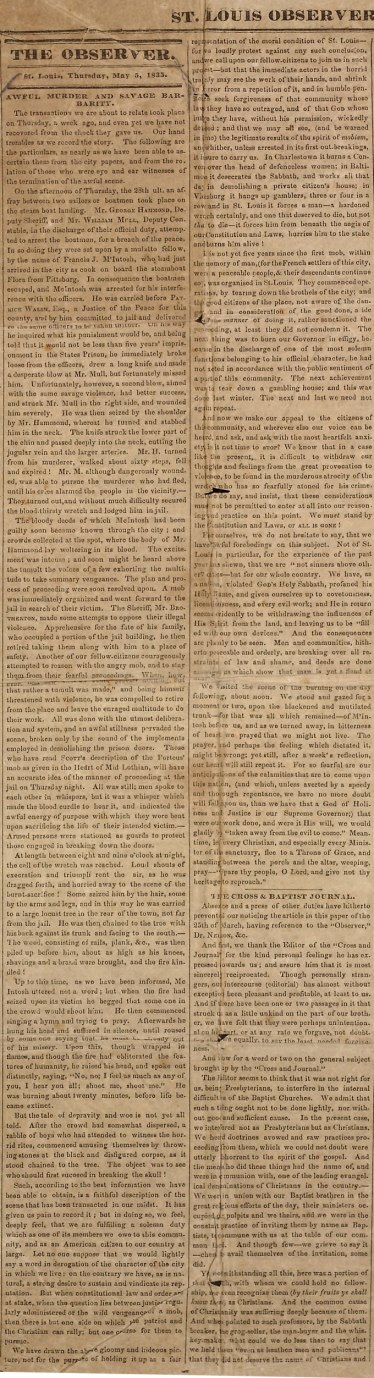
Lovejoy on the lynching of McIntosh in The Observer, May 5, 1835

McIntosh was working on a steamboat that docked in St Louis, and on his way to visit his girlfriend, he stumbled upon two policemen pursuing another man who had been in a drunken brawl. McIntosh did not obey the policeman’s shouted orders for his to help them catch the man. Like the average American of African descent, free or enslaved, McIntosh was very likely not in the habit of mixing himself up in any circumstance that involved police or government officials, for the simple reason that very few of them had any interest in dispensing justice to people like himself, especially in slave states like Missouri. The drunk man got away and McIntosh was arrested instead. When the police officers threatened him with five years in jail, in a slave state, remember, McIntosh panicked. He grabbed a knife and fled, killing one officer and wounding the other. He was caught and jailed again. A mob gathered, broke him out, chained him to a tree, and burned him alive. At first McIntosh begged for someone from the crowd, anyone, to shoot him and release him from his torture; when no one was willing to show even this level of mercy, he prayed and sang hymns until the pain and the flames silenced him for good.

Abolitionist minister and editor of The Observer Elijah Lovejoy picked up the story and, contrary to most of the press, condemned this episode as an episode of wickedness and lawlessness. Proslavery sympathizers ran a sabotage campaign against his St Louis press until he was forced to move across the Missouri River to Alton. But he was not safe there, either, and on November 7, 1837, a mob attacked the warehouse where he had hidden his press in a vain attempt at safety. They shot into the warehouse while Lovejoy and his supporters were inside. Forced to defend themselves, they shot back, wounding some members of the mob and killing one. In revenge, the mob tried to burn down the warehouse with the men still inside it, and Lovejoy was shot to death when he emerged to stop them. As was the case with McIntosh, the judge voiced his support for the mob and no-one was convicted of the murder.

Lincoln feared that his beloved country would devolve from an enlightened union of states founded on principles of reason and reverence for the rule of law into an association weakened and fractured by the same ideological intolerance and strife which marked old Europe. He did not fear that any European, or Asian, or African nation, or any other foreign power, could destroy the United States: he recognized that in this, the only thing Americans had to fear was themselves. Lincoln’s fear was prescient: Bleeding Kansas was still twenty-six years away, the Civil War thirty-three. When he delivered this speech, Lincoln was just short of 29 years old. He had been first elected a state legislator less than four years before and had been a practicing lawyer for less than a year. While ambitious for high office, I doubt that even Lincoln’s prophetic skills could help him foresee that he would be leading his nation to the ‘new birth of freedom’ he spoke of in his even more famous 1863 Gettysburg Address, with strengthened political institutions that could, it was hoped, better serve a government ‘of the people, by the people, and for the people’ – but all the people this time around. We’re still working on it.
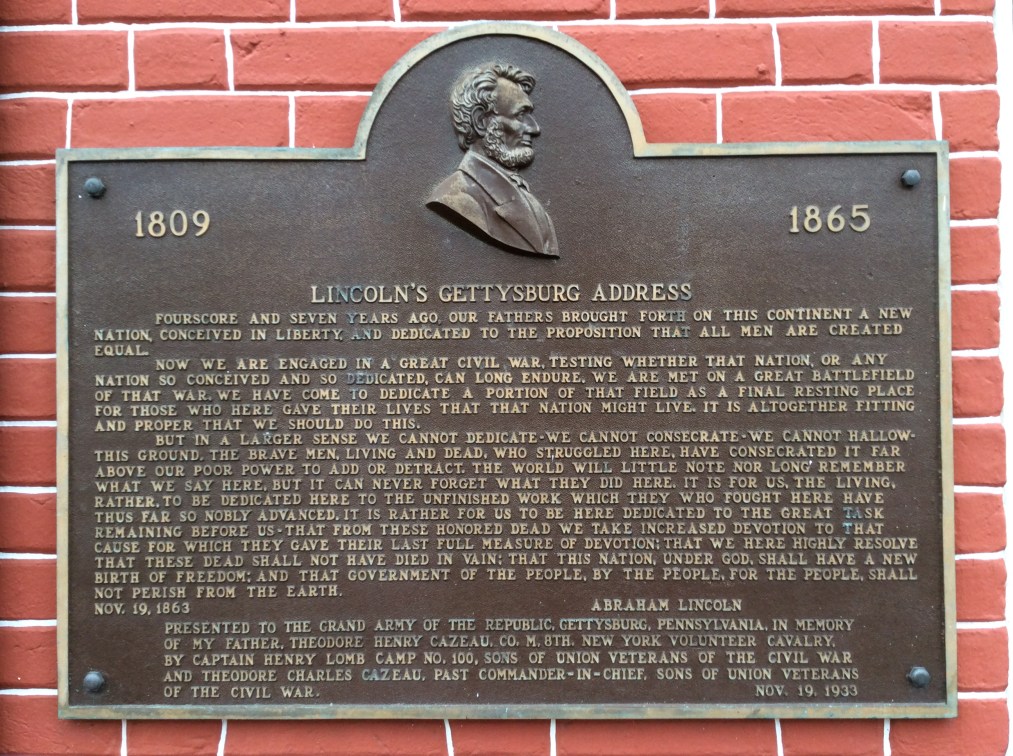
The Gettysburg Address on the Wills House wall in Gettysburg, Pennsylvania; photo taken during my visit there in 2016

The foyer of the Abraham Lincoln Presidential Library, Springfield, Illinois

It’s early evening, and those leftovers are sounding pretty good right now. The last places I’d like to follow Lincoln here in Springfield will be open tomorrow, so I return to my lodging.

Springfield, Illinois, Sunday, July 31st, 2017

I begin my day at the Abraham Lincoln Presidential Library and get a little writing done. I would love to dig into the archives here, which now include the Robert Ingersoll Papers, but I’m itching to get back on the road. I have this big comfy rental car (a free upgrade since the first one broke down) and only a certain number of road trip days left before I leave the U.S. for a while. But I’ll certainly be back here again.

A five minute’s drive north from the Library takes me to the Edwards Place Historic Home, now owned and operated by the Springfield Art Association. I enter the visitor center to the right of the house, and though I don’t have anything scheduled, a woman on staff there was kind enough to take me on a one-on-one tour. My timing is lucky: before long it will be closed to the public for restoration, at least until May 2018. As it is, I get to see some of the rooms decorated and ready for the public complete with nice carpet, wallpaper, artifacts original to the family and to the time period, as well as other rooms and passageways in various stages of disrepair, construction, and deconstruction. I see layers of plaster, wood, wallpaper, and paint peeled and cut away, little doorways into its history. Particularly revealing to me, familiar with vintage and antique textiles, I recognize various attempts at recreating the house’s antebellum history more or less successfully in the wallpapers, with 1990’s, 1960’s-1970’s, 1920’s, and other eras’ ideas of what wallpaper from the time would look like.  None of it looks at all like the Edwards’ own wallpaper peeking out from where bits of it had escaped the remodelers’ scrapers.
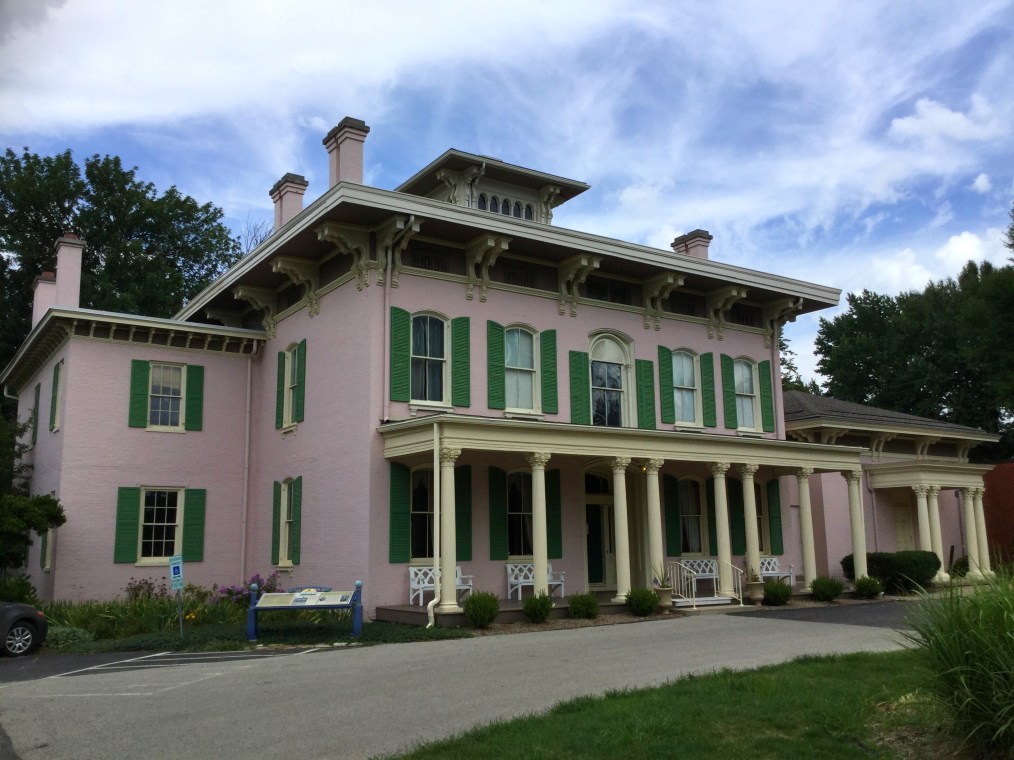
Edwards Place Historical Home, Springfield, Illinois
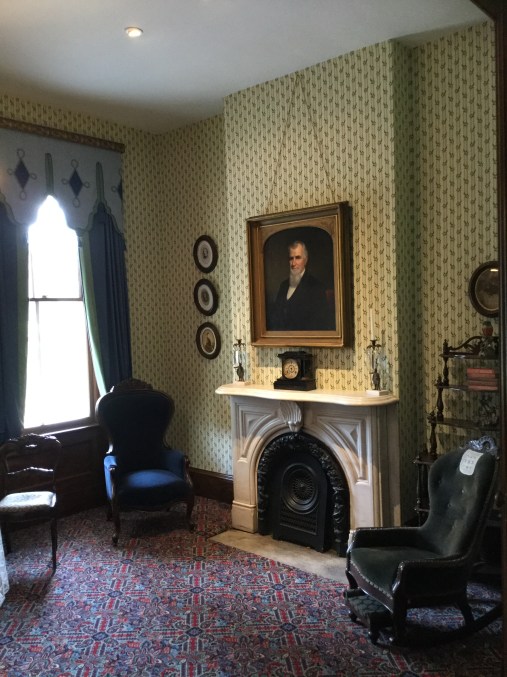
A view inside the Edwards Place Historical Home before planned restoration

The house was originally built in 1833 and expanded to its current grand dimensions after Benjamin and Helen Dodge Edwards bought the house in 1843. Benjamin Edwards was the brother of Mary Todd’s sister Elizabeth’s husband Ninian, named for the Edward brothers’ father. When Mary Todd moved to town in 1840 and settled in with her older sister Elizabeth, Mary and Helen became good friends. When Helen and her husband moved to this house three years later, Mary and her new husband Abraham were regular guests.

As Springfield Art Association says on their website, the

‘Edwards Place was a center for social activity in Springfield. Prominent citizens and politicians such as Lincoln, Stephen A. Douglas, David Davis, and numerous governors, judges, lawyers, and politicians were entertained at lavish dinner parties and the grounds played host to many summer picnics and political rallies…. Although the Lincolns did not court or marry here, Edwards Place is currently home to the “courting couch” on which Lincoln and Mary Todd sat during the early days of their romance, originally the property of Ninian Edwards.’
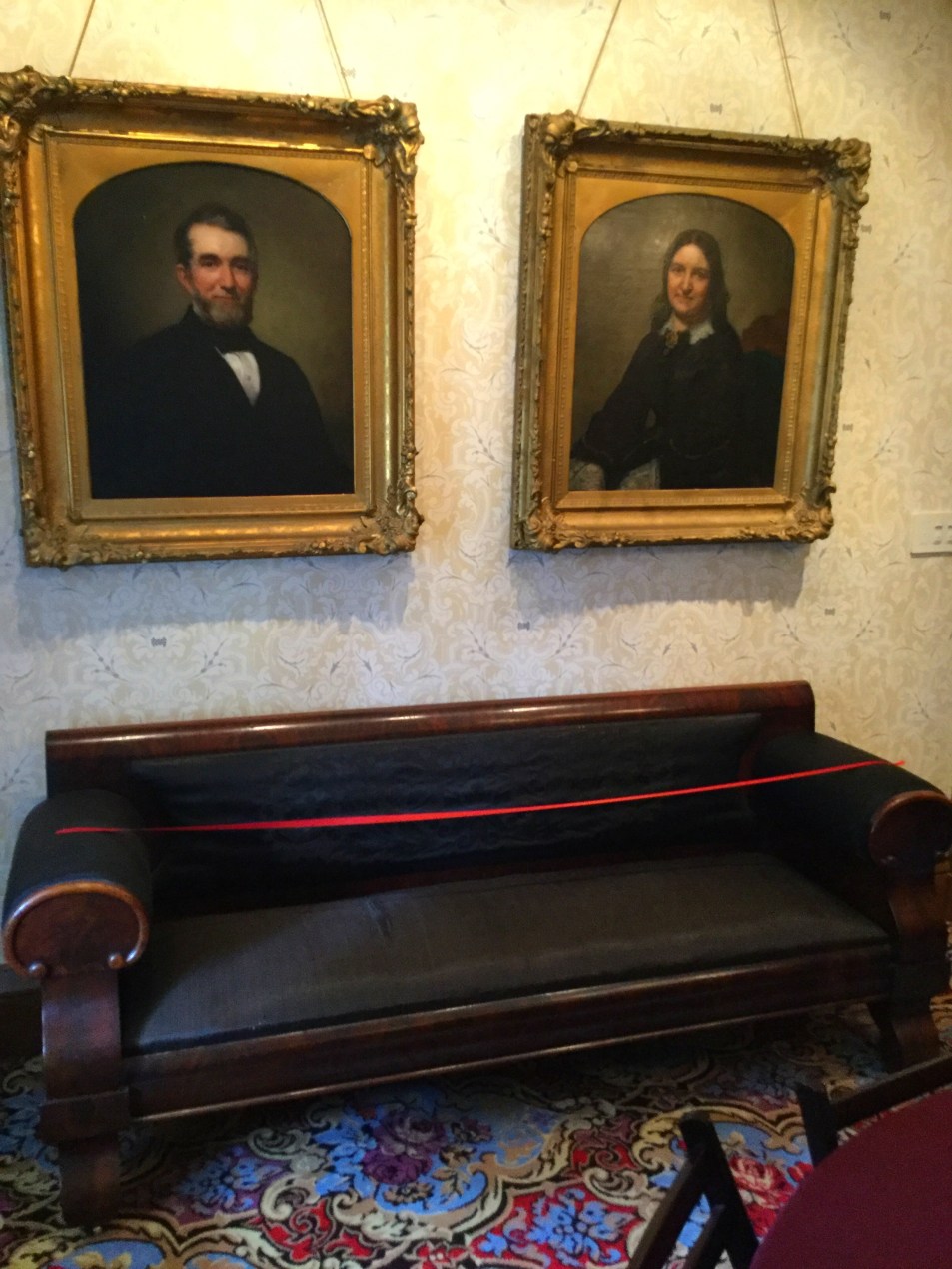
The Lincolns’ courting couch at Edwards Place Historical Home, Springfield, Illinois

The website’s article points out that I made the same mistake many people do: I mixed up the Edwards houses. This Edwards house, which currently houses the famous black horsehair couch where Abraham and Mary courted, is not the same house where that couch originally was, where the Lincolns originally courted and were married. These Edwards moved into this house the year after the Lincolns were married. The other Edwards house site, where Ninian and Elizabeth Edwards welcomed Elizabeth’s younger sister Mary into their home in 1840, is where the Michael J. Howlett building now stands. That’s downtown near where I just came from. Well, no matter. It’s only a five-minute or so backtrack.
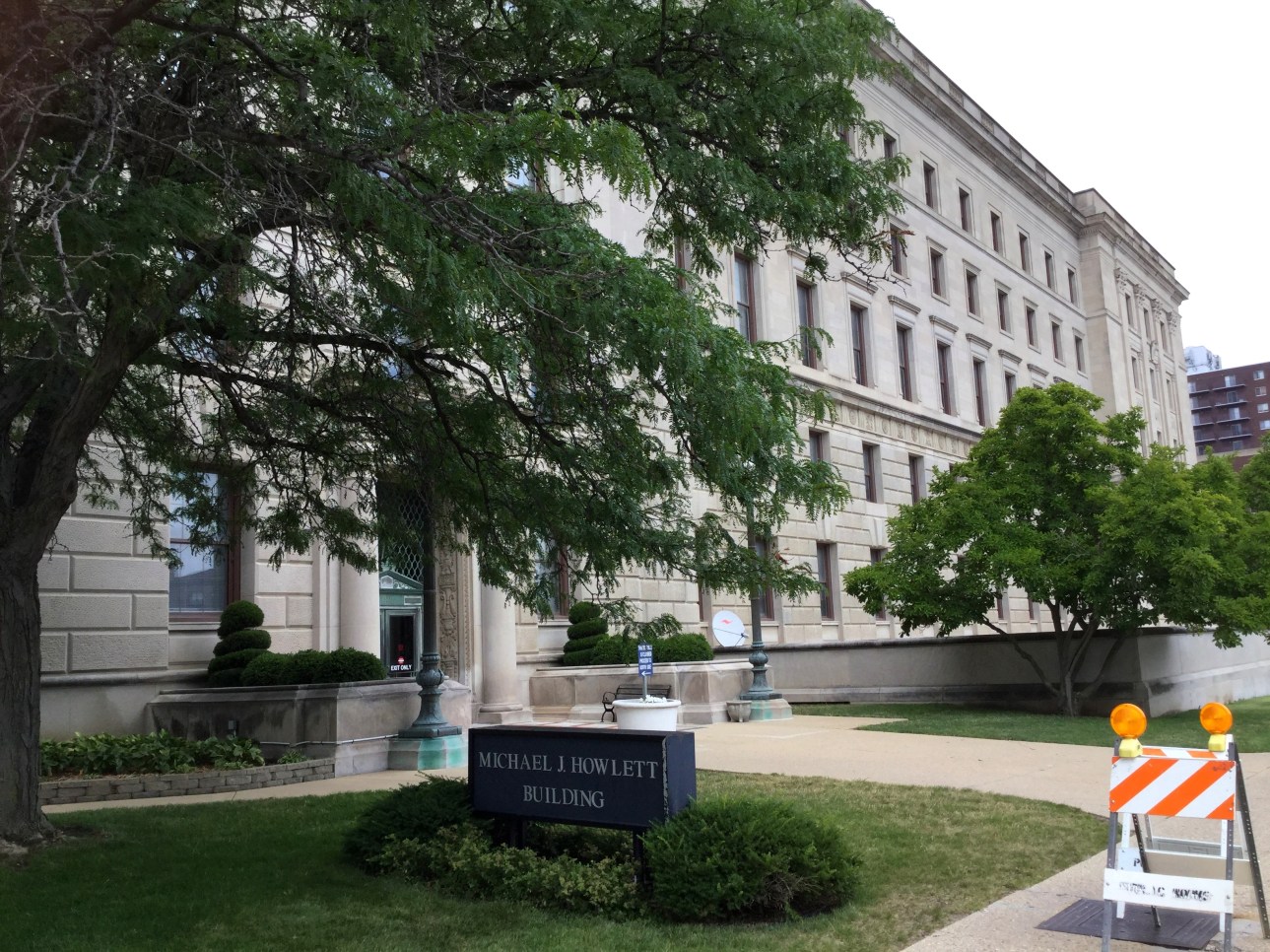
Michael J. Howlett Building, Springfield, Illinois

I find a parking spot near the Michael J. Howlett building–not easy to do since its a workday–and look for a plaque or marker. There’s sure to be one since it’s the site of such significance in Lincoln’s life. I don’t see one at first, so I visit the Illinois State Archive, the next building to the west of the Howlett building. The man at the front desk there doesn’t know of such a thing but hazards a few guesses. However, before I go on that little goose chase, the man looking after the state employee parking lot passes by. I tell him what I’m looking for, and he knows right off. Of course! He spends his days out here where it’s likely to be found. I follow his directions: if you start from the Howlett building sign on E Edwards St, head north on the driveway towards the Illinois State Capitol Building following the west side of the Howlett building. Turn right at the corner of the building, then look low on the outer wall of the accessible ramp. That’s why I missed it: it’s well below eye level, and not on a structure, or rather, the part of the structure, that I expected it to be on.
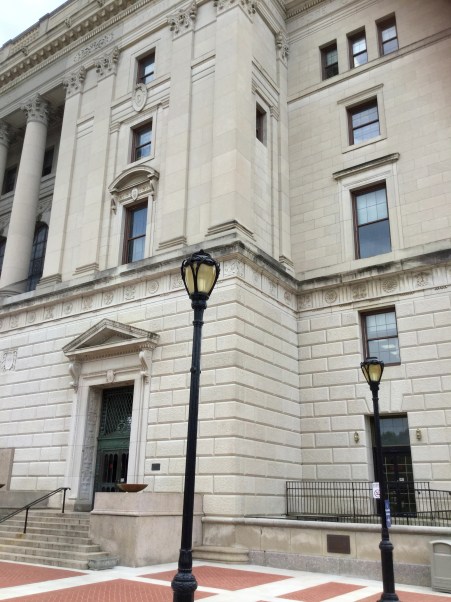
North (back) of the Michael J. Howlett building where the Edwards house site historical plaque is set low in the on the ramp wall

Mary Todd Lincoln returned to this house many years after her years in Springfield as a vivacious debutante, fiancée, wife of a lawyer and congressman, mother of a brood of wild young boys, and new First Lady. Her sister Elizabeth discovered that her oldest son Robert had her committed to an insane asylum in 1875 and was dismayed. Mary had lost her husband and three of her sons and had increasingly had a terrible time after each one. She may have struggled with what today we might call a mental illness, but since emotional issues were so poorly understood by the medical establishment at the time (as they are, in many ways, in our time) and there was no one to give a qualified assessment at the time, I won’t repeat modern diagnostic speculations here. Robert and Mary had not gotten along for a long time, and we can’t know for sure if he thought she really needed to be committed or if he was just wanted to get her out of the way and out of the bank accounts. She had adopted many unsettling habits, such as consulting spiritualists and alternating heavy spending on trifles she never used with eccentric miserly behavior, fearing poverty despite her generous government pension. Mary was able to get herself released from the asylum into the care of Elizabeth. She lived here for a time then moved to France for awhile until her health significantly declined, then returned to live with Elizabeth. She died here on July 16th, 1882.
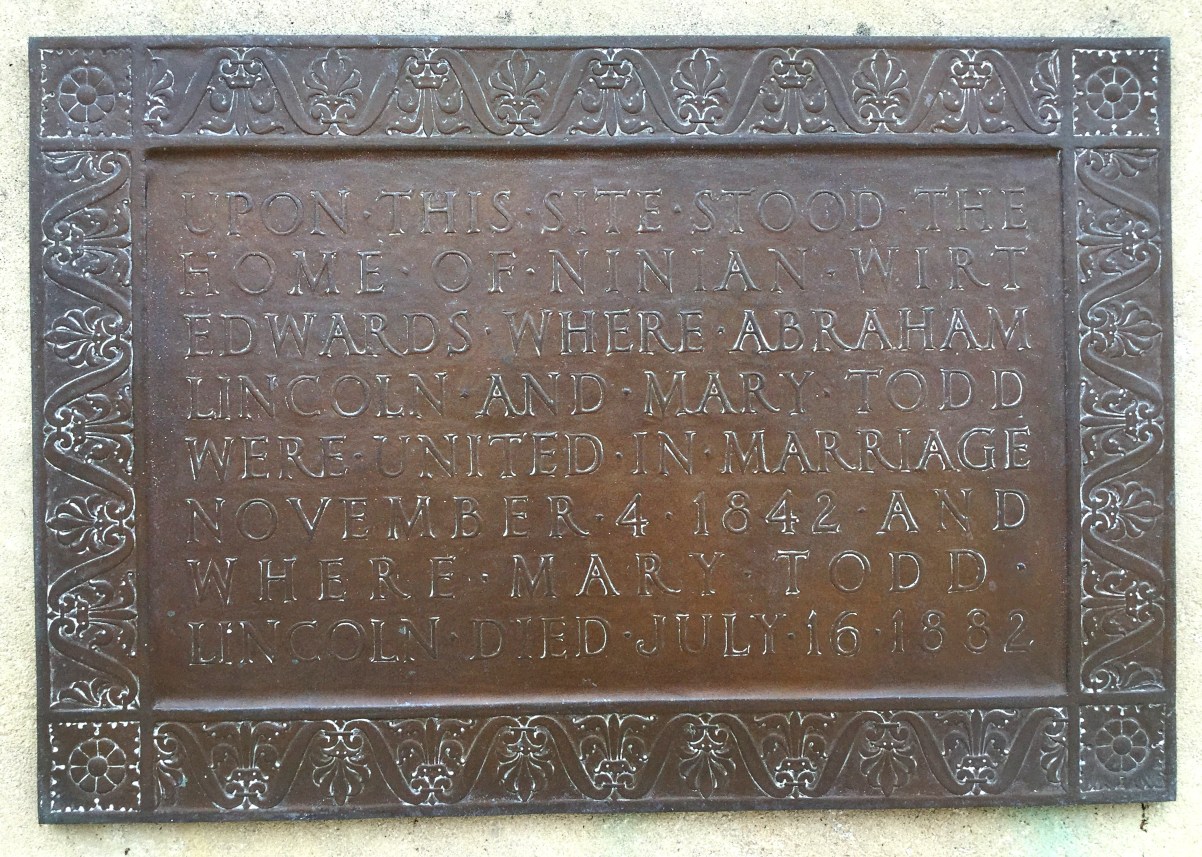
Edwards House site historical plaque on the north (back) side of the Michael J. Howlett building

Having visited all the sites on my list as well as a few I discovered during this journey, I continue on from Springfield to one more very important place associated with Lincoln’s life and ideas, and then arrive at another amazing place this evening. Stay tuned!

*Listen to the podcast version here or on Google Play, or subscribe on iTunes

Ordinary Philosophy and its Traveling Philosophy / History of Ideas series is a labor of love and ad-free, supported by patrons and readers like you. Please offer your support today!

~~~~~~~~~~~~~~~~~~~~~~~~~~~~~~~~~~~~~~~

Sources and inspiration:

Abraham Lincoln Online: Edwards PlaceLincoln Family TimelineLincoln Legal Career Timeline, Lincoln Timelines and Highlights, and Lyceum Address

Andreasen, Bryon C. Looking for Lincoln in Illinois: Lincoln’s Springfield. Southern Illinois University Press, 2015

Baker, Jean H. ‘Mary Todd Lincoln: Managing Home, Husband, and Children.Journal of the Abraham Lincoln Association, Volume 11, Issue 1, 1990, pp. 1-12

Carwardine, Richard. Lincoln: A Life of Purpose and Power. New York: Random House, 2003

Central Springfield Historic District‘ National Register of Historic Places Registration Form, Prepared by Nicholas P. Kalogeresis for the National Park Service.

Donald, David Herbert. Lincoln. New York: Simon & Schuster, 1995

Edwards Place Historical Home website and page on the Springfield Art Association website

Graham, Beckett and Susan Vollenweider. ‘Mary Todd Lincoln,’ Parts One and Two. The History Chicks podcast

Gourevitch, Philip. ‘Abraham Lincoln Warned Us About Donald Trump‘. The New Yorker, March 15, 2016

Herndon, William H. and Jesse W. Weik. Herndon’s Lincoln: The True Story of a Great Life. 1889

Lehrman, Lewis E. Lincoln at Peoria: The Turning Point. Mechanicsburg, PA: Stackpole Books, 2008.

Lincoln Home National Historic Site, Illinois, website by the National Park Service

Looking for Lincoln: various historical/informational placards throughout the Springfield, Illinois and surrounding areas about the life and legacy of Abraham Lincoln at their associated sites

MacLean, Maggie. ‘Elizabeth Todd Edwards: Sister of Mary Todd Lincoln.’ Civil War Women blog, Jul 28, 2013

Nicolay, John George. An Oral History of Abraham Lincoln: John G. Nicolay’s Interviews and Essays. Carbondale: Southern Illinois University Press, 2006

Simon, Paul. Freedom’s Champion-Elijah Lovejoy. Jefferson, North Carolina: McFarland & Company, 2004

Wright, John Aaron. Discovering African American St. Louis: A Guide to Historic Sites. St. Louis: Missouri Historical Society Press, 2002

New Podcast Episode: Standing Rock Reservation: In Search of Sitting Bull, I Find Sakakawea, Too, Part 2
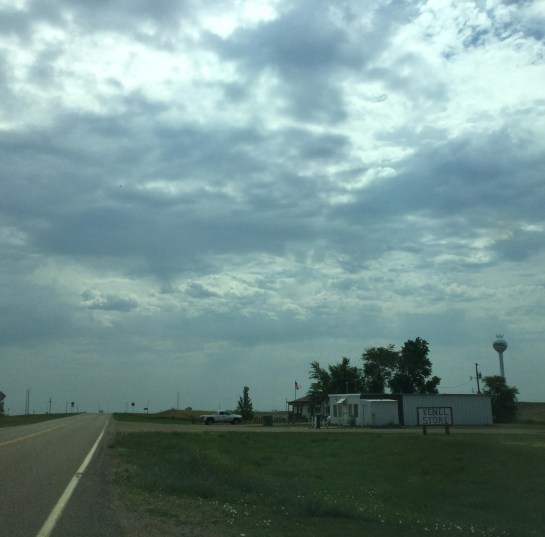
General store on the main road at Kenel, a community in Standing Rock Reservation, South Dakota, as seen through the windshield.

Listen to this podcast episode here or on Google Play, or subscribe on iTunes

Standing Rock Sioux Reservation, North and South Dakota, morning and early afternoon of July 25th, 2017

I wake up at Prairie Knights Casino and Resort at the north end of Fort Yates in Standing Rock Reservation, on the North Dakota side. It’s by far the nicest place I’ve stayed during this trip and one of the cheapest. Thanks, gamblers, for subsidizing my roomy bed, my nice bathtub with its complimentary tasty-smelling chokecherry bath products, and my ultra-clean room!

I head south on Highway 1806, otherwise known as the Native American Scenic Byway, towards the tiny unincorporated community of Kenel, in search of the site of old Fort Manuel. Counting from the road just across from Kenel’s general store, I turn left on the third road, a dirt road, guided by a little brown road sign. Then I head straight, past the turnoff that curves off to the left back towards Kenel. After a little while, this road curves to the left as well and arrives at a simple, tall, broad gateway made of three large poles with a pair of antlers in the center of the crossbeam, indicating the entrance to someone’s private property, likely a farm or ranch. The place for which the gate marks the entry is encircled by a thick grove of trees. I pull off to the right of the road in before I reach the gateway. Then I look around and see what look like historical marker signs in the field around and beyond the left side of the wooded boundary. There are some wood structures rising from the grass beyond that. I take the little footpath heading in that direction… Read the written version here

Ordinary Philosophy and its Traveling Philosophy / History of Ideas series is a labor of love and ad-free, supported by patrons and readers like you. Please offer your support today!

Springfield, Illinois, in Search of Abraham Lincoln, Part 4

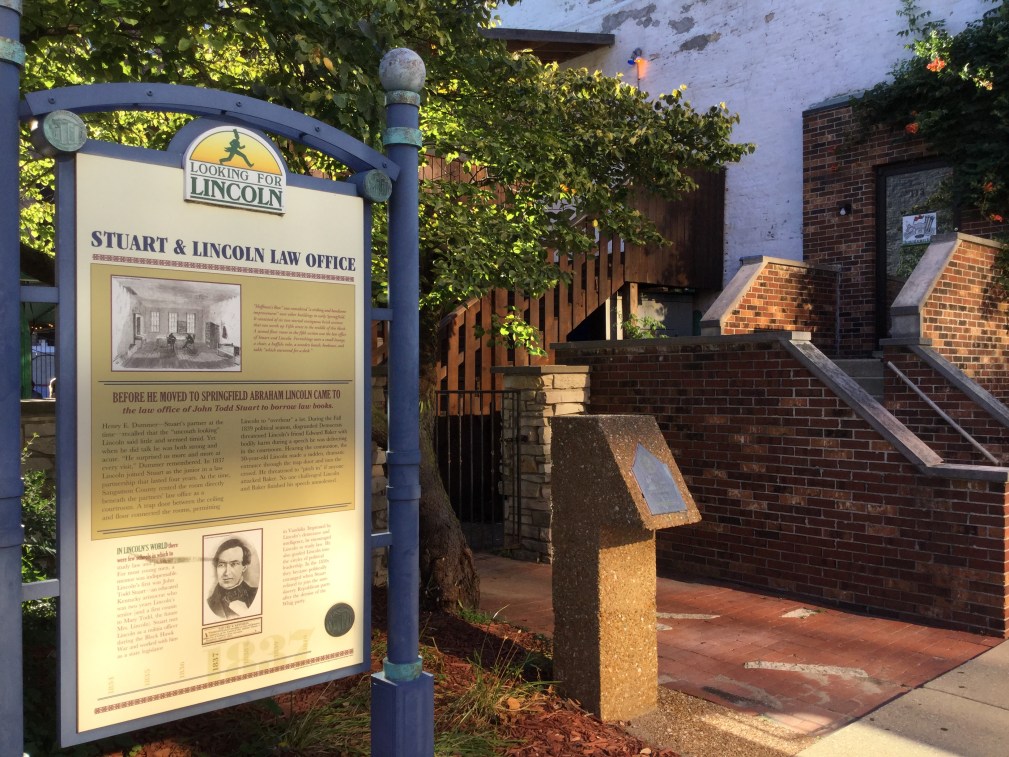
Site of Stuart & Lincoln law office at Hoffman’s Row, Springfield, Illinois

Springfield, Illinois, Saturday, July 29th, 2017, continued

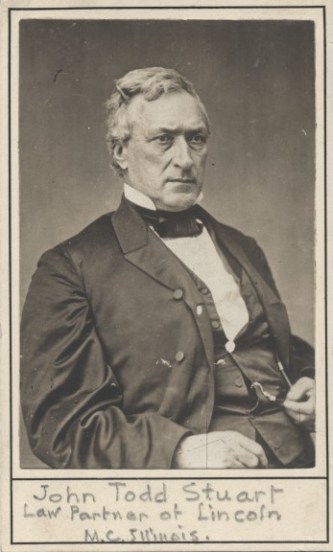
I leave the Myers Building at the former site of Joshua Fry Speed’s store and Abraham Lincoln’s last law office on S 5th Street, and head north, crossing E Washington St, and continue halfway up the block. On my left (west), at 109 N 5th St / NW Old State Capitol Plaza, is a historical marker for the Stuart & Lincoln Law Office. John Todd Stuart was Lincoln’s first law partner, the man from whom he borrowed the law books he needed for his legal training, and his future wife Mary Todd’s first cousin. Lincoln received his license to practice law two years after he began his studies, and joined Stuart’s law practice as a junior partner in April of 1837. He was living over Speed’s store, having moved here to Springfield to embark on his legal career, so he walked more or less the same route to get to work as I walk today from the Myers Building.

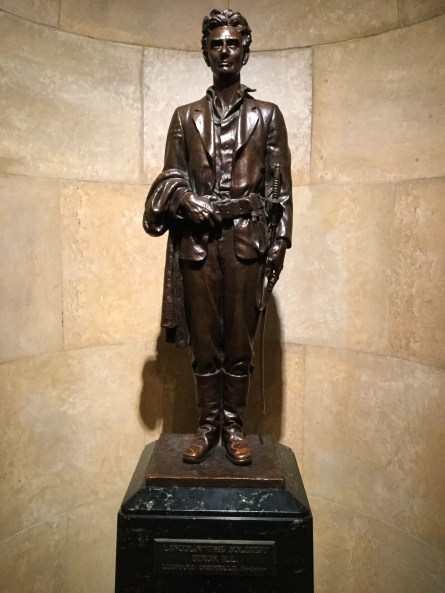
Sculpture of Lincoln as a soldier in the Black Hawk War at the Lincoln Tomb, Oak Ridge Cemetery, Springfield, Illinois

Stuart and Lincoln met in 1832 during the Black Hawk War and were friends and colleagues for many years after that. They served together in the same battalion, and their acquaintance turned to friendship when they both campaigned for, and served in, the Illinois State legislature in 1834. Stuart was only two years old than Lincoln, but like his cousin Mary Todd, he was the educated, sophisticated offspring of a well-to-do Kentucky family. So, he assigned himself a paternalistic role in their relationship. Perhaps it was this attitude that caused their friendship to erode once Lincoln eclipsed him in his success as a lawyer and then as a politician. They did not agree politically: Stuart was a Democrat sympathetic to the slaveowners’ cause, and as we all well know, Lincoln was most decidedly neither. But as the example of Joshua Speed demonstrates, Lincoln was ready and able to remain friends with political opponents. As many who knew them both well attest, Stuart was jealous of Lincoln, and at least one friend believed that Stuart even grew to hate him.

But during the years of their friendship, Stuart did much for Lincoln. He recognized Lincoln’s ability, despite his rough appearance and manners, and liked him personally. Stuart encouraged the precocious young entrepreneur and fellow budding politician to study law, a field that suited Lincoln’s natural abilities as well as the traditional field from which successful politicians so often emerged in those days. And after Lincoln received his law license and completed his last term in the Illinois State Legislature, Stuart accepted Lincoln as a junior law partner. Lincoln’s education in the law continued in Stuart’s practice. He observed Stuart closely and read his legal papers carefully, and during his first years as a lawyer, modeled his own legal practice and language on Stuart’s.

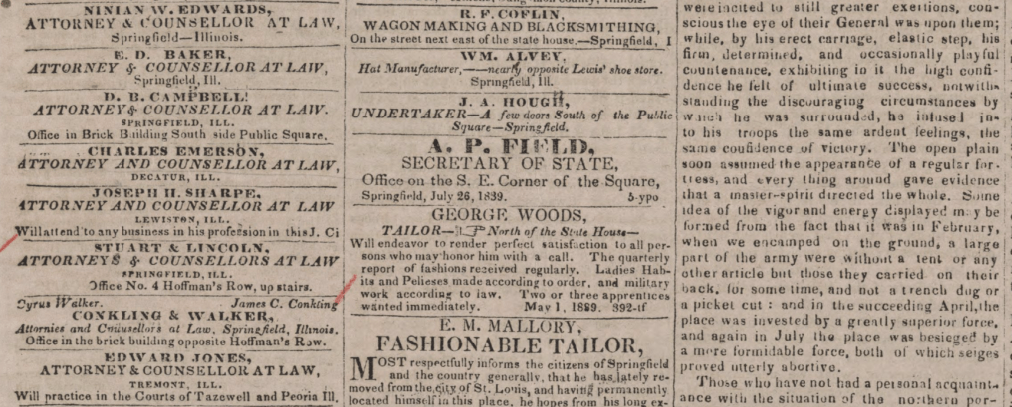
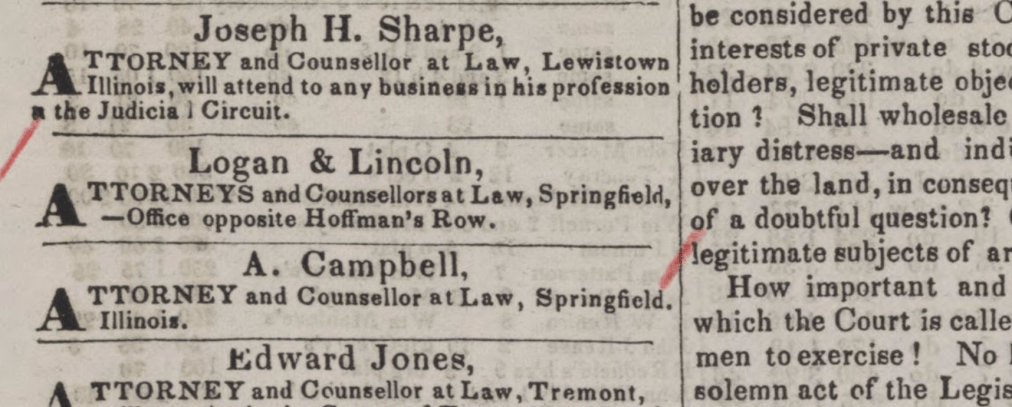
Clipping from Sangamo Journal, Mar 27, 1840 describing location of Stuart & Lincoln office, via the Library of Congress’ Chronicling America

Stuart & Lincoln’s office was also directly over a Sangamon County courtroom. The County occupied Hoffman’s Row starting in 1837, the same year that Lincoln joined Stuart’s practice here, until the first proper Greek-revival Sangamon County Courthouse was completed in 1845. As Lincoln was wont to do, he took advantage of this opportunity to learn by observation. There was a trap door in the floor of their office which communicated with the courtroom below, so Lincoln could easily hear the proceedings. As his later law partner and biographer William Herndon observed, Lincoln was not such an avid reader in the years succeeding his youth and early adulthood as he had once been. It seems Lincoln had become more of a listener.

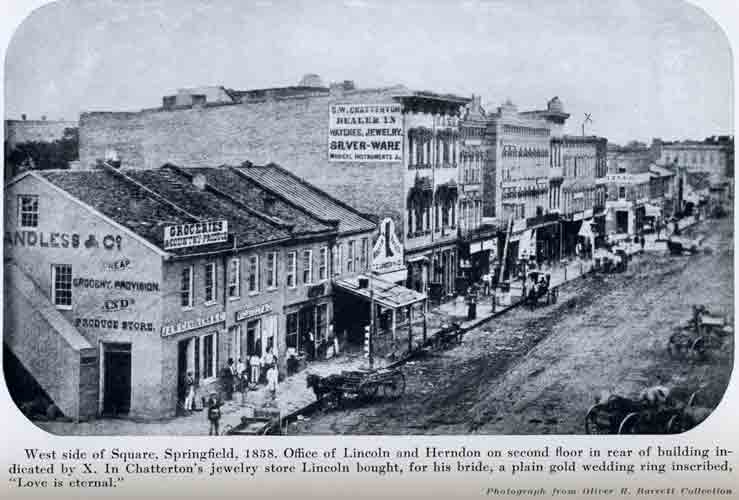
Photo showing Hoffman’s Row, Springfield, IL 1859. Stuart & Lincoln’s office was located on the third floor from 1837-1841; many years later, Lincoln & Herndon’s office moved here after their tenure at the Tinsley Building. Photo from the Abraham Lincoln Presidential Library; ‘X marks the spot’ and photo caption by the University of Chicago Libraries

John T. Stuart, Brady’s National Photographic Portrait Galleries, Lincoln Financial Foundation Collection, Allen County Public Library

During my research, I’m rather amused to learn that Stuart was once bitten by Stephen A. Douglas, now most famed for the series of debates between him and Lincoln which so well encapsulated the issues which were tearing the Union apart in the years leading up to the Civil War. Stuart and Douglas were also political rivals, both Democrats, so their political battles took place in the primaries. For the most part, their debates were civil, but on one occasion in the 1838 congressional race, Douglas said something that really enraged Stuart. So the tall Stuart picked up ‘The Little Giant’ and carried him around in front of the crowd. As you may remember, Douglas may not have been tall, but neither was he slim, so Stuart must have been fairly strong. Douglas repaid the insult by biting Stuart’s thumb so severely that infection later set in, and it took some time for that painful wound to heal.

During that healing time, as well as during much of the time Stuart was busy with politics, Lincoln took on more and more of their practices’ legal matters as well as the paperwork. I suppose that the jealous Stuart later regretted giving Lincoln that opportunity to master the skills that helped him eclipse Stuart’s own success later on. On one occasion, Stuart said to a friend, ‘…I believe I am going to live to posterity only as the man who advised Mr. Lincoln to study law and lent him his law books. It is a little humiliating that a man who has served his country in Congress and in his State, should have no further claim to remembrance than that, but I believe it will be so.’ It’s easy to understand, perhaps even forgive, Stuart’s developing antipathy towards his one-time protegee, given he believed Lincoln’s reputation obscured, even erased, his own hard-earned one. Stuart and Lincoln did keep in contact over the years and outwardly, their relationship remained cordial; Stuart visited the Lincolns at the White House on several occasions, as friend and as family. But according to some of those who knew both men, Stuart undermined and opposed Lincoln’s policies when he had the opportunity to do so covertly.

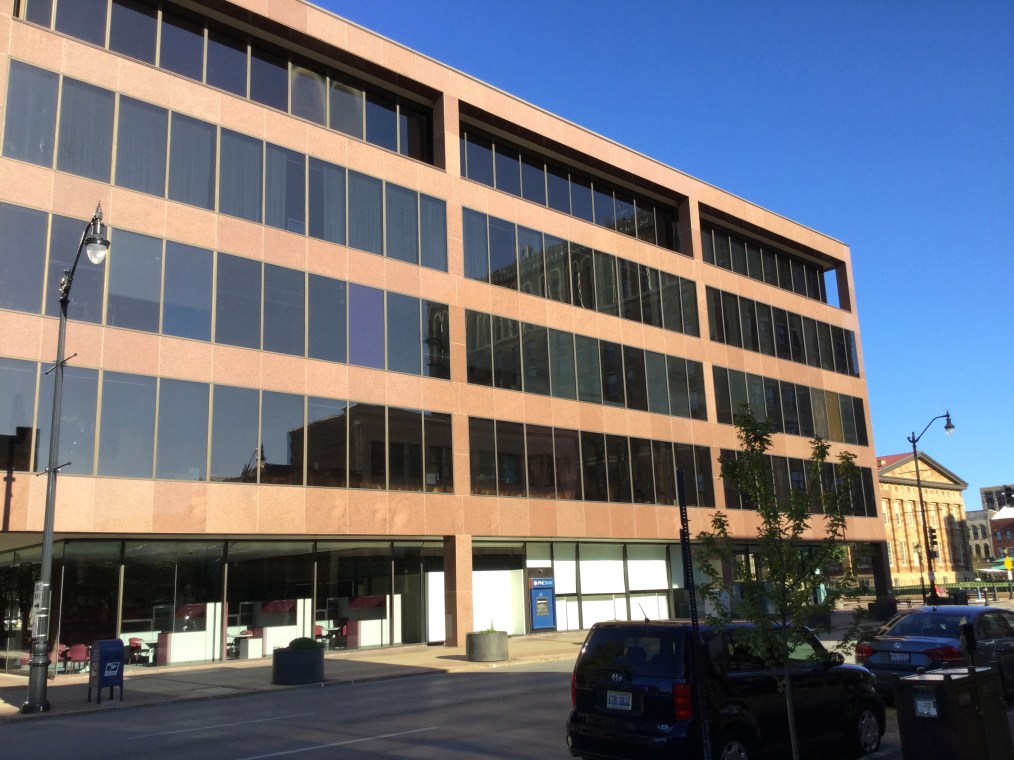
Building on the east side of North 5th St at former site of Logan & Lincoln law office, Springfield, Illinois

To visit the next site on my list, all I need to do is swing on my heels and head directly across the street. The large modular office building that I face stands on the site where the first Logan & Lincoln law office was located.

In April of 1841, Lincoln and Stuart dissolved their partnership, apparently over their political differences, and Lincoln joined Stephen T. Logan’s law practice. Their joint practice lasted three and a half years, until October of 1844. As you may remember from an earlier installment of this Springfield account, Logan was a circuit judge for a time, from 1835-1837, while Lincoln was still preparing to become a lawyer. Logan gave up his judgeship because it paid too little, and redirected all his efforts to making his practice successful and lucrative.

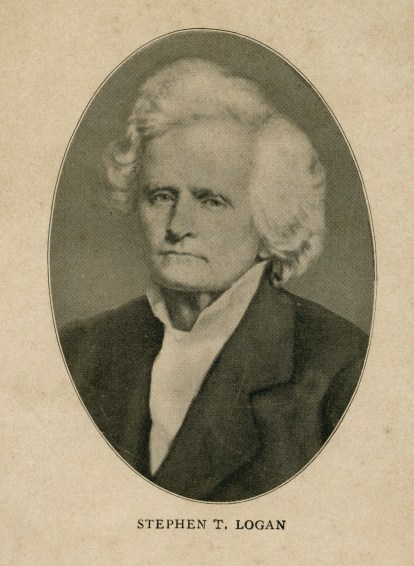
Stephen T. Logan, from the Helm and Todd Family Photographs and Papers at the Kentucky Digital Library

As Logan tells it, Lincoln showed promise very early. Despite his awkward and messy appearance in his too-short pants and coat, rough shirt, and tousled hair, Lincoln displayed the same ‘superior’ and ‘peculiar’ way of putting things, notable for its ‘individuality,’ that would characterize his public speaking throughout his career as a lawyer, a politician, and as President. Since the time Logan met Lincoln in 1832, the same year that Logan moved to Illinois from Kentucky, he acted as friend, mentor, promoter, and colleague. In some ways, they were political and legal rivals, but unlike Stuart, Logan did not let this interfere with his friendship with or political support for Lincoln. Lincoln reciprocated Logan’s ability to maintain a respectful friendship by keeping the personal and the professional separate, and, as President, repaid Logan’s personal integrity by awarding Logan with unsought but desired appointments.

It seems that the main thing that ever came between them to a significant degree was money, with the possible exception of Logan’s rather high-handed style of running his law practice. Lincoln did chafe at times under Logan’s blunt and demanding manner, but Lincoln also considered this partnership a challenge and an opportunity to increase his still limited knowledge of the law. He certainly did rise to the challenge. Logan’s account of Lincoln’s reading habits during his years as a lawyer match Stuart’s and Herndon’s: Lincoln had let go of his old habit of steady book-reading. In his years studying and practicing law, Lincoln turned to learning by observation, by listening to cases as they were argued in court and by closely studying the cases that his law partners prepared, and through practice, by carefully and rigorously preparing for his own. Over time, according to Logan, Lincoln’s method proved itself effective, and he became a ‘formidable’ lawyer in his own right. He never became as knowledgeable about the law as the restlessly intelligent, well-read Logan, but he was often more effective. Lincoln was certainly more successful and effective than Logan politically. Unlike Logan, Lincoln was charismatic and ‘seemed to put himself at once on an equality with everybody,’ and was a popular man as a result. Many of Lincoln’s political races were won on this account alone; his very wide circle of friends and acquaintances would vote for him against their own party just because of the high regard they held him in personally.

Clipping from Sangamo Journal, Feb 18, 1842 describing location of Lincoln & Logan office, via Library of Congress’ Chronicling America

But to return to the subject of the dissolution of the Logan & Lincoln practice: the official reason that Logan gave for it was his wish to partner exclusively with his now-grown son David instead. But some who knew both men and their personalities attribute the end of their partnership primarily to Logan’s tightfistedness with money, which was a hardship for Lincoln. He had a new family to support and was probably still paying off some of his old debts incurred from his failed entrepreneurial efforts in New Salem. Secondly, Lincoln had gained a new confidence with his increasing success and knowledge as a lawyer. This, combined with his ambitious instincts, led to his desire to take the lead in his practice. So, as discussed in the previous installment of this Springfield account, Lincoln took on a young and inexperienced but bright and promising partner, just as Stuart and Logan had done with him. For any conflict they may have had as law partners, Lincoln retained his respect and regard for Logan, and they remained friends both publicly and privately for life.

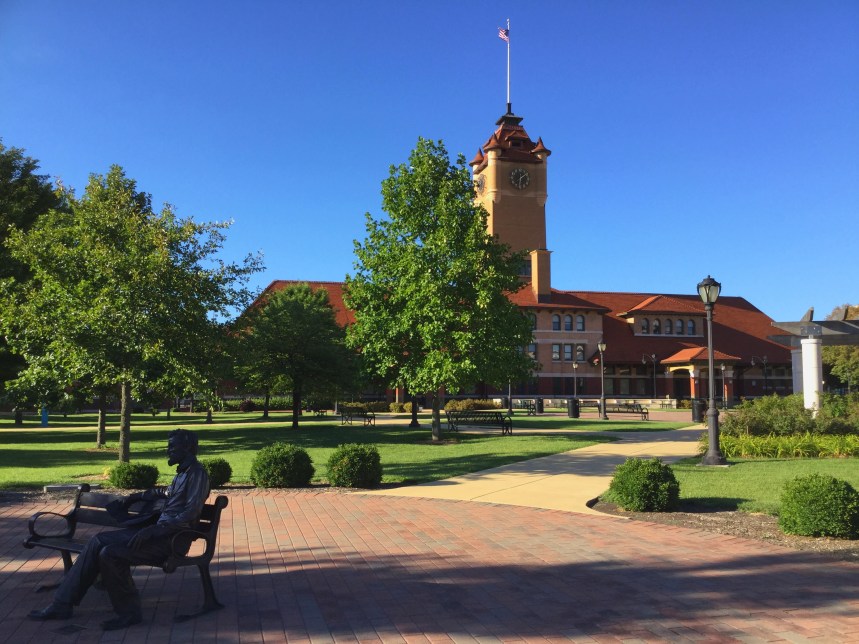
Union Station and the park before it, with a sculpture of Abraham Lincoln sitting on a park bench to the left.

I continue my journey north towards Union Station, heading north on 5th St about a block and a half and then through the park south and in front of the station. The station and the park occupy the whole block bounded by 5th and 6th Sts to the west and east, and Washington and Jefferson Sts to the north and south. There are various plaques scattered around the building recounting interesting tidbits about Springfield history, but the station building itself is closed for the day. It’s no longer a train station: it’s been incorporated into the Abraham Lincoln Presidential Library and Museum complex and serves as a visitor center and venue for special exhibits.

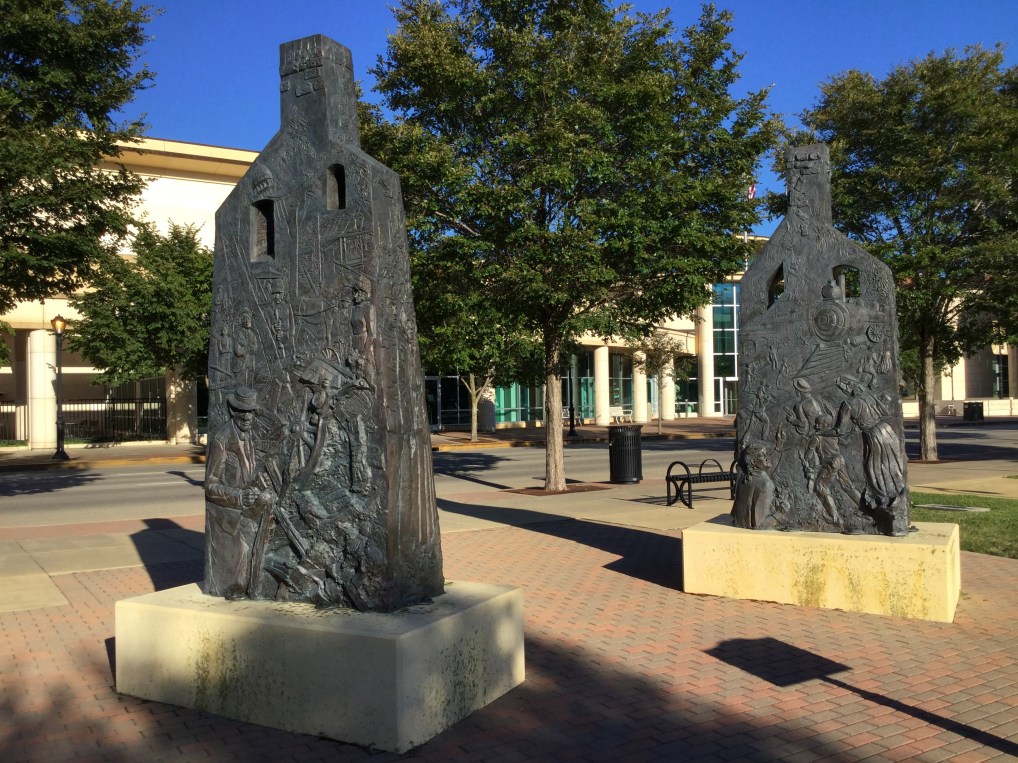
Acts of Intolerance by Preston Jackson, a commemorative sculpture for the 1908 Springfield Race Riots

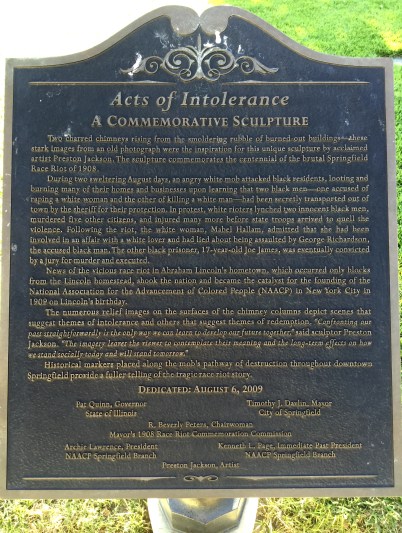
Historical plaque for the 1908 Springfield Race Riot and Preston Jackson’s memorial sculpture

As I wander around the building and park, seeing what there is to see outside, my attention is caught by two sculptures, placed side by side at an angle, their shapes reminiscent of two giant, stylized, square-sided bottles, with images of people and objects over their surfaces in high relief. I read the large bronze plaque accompanying the sculptures, and learn that they are entitled Acts of Intolerance, a two-part sculpture commemorating the Springfield Race Riots of 1908. I’ve been noticing sites commemorating events and people related to the race riots all over downtown, and I’m glad to learn more about the story here since my curiosity has been aroused repeatedly throughout the day.

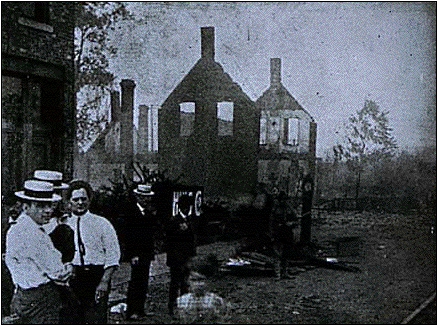
The shapes of the sculpture’s two parts, in fact, echo the shape of a burned-out home’s two remaining walls and chimneys in a photograph taken in the aftermath of the riot. This was only one of the multitude of homes and shops of Springfield’s black population that had been damaged or destroyed. The riot started on Friday evening, when the sheriff refused to release two black men, one jailed for the murder of a white man who caught him trying to assault his daughter, and another accused of attempted rape, to the justice of a gathering mob. (The second of these was later proved to be wrongly accused so as to divert blame from a white man.)

When they discovered that the sheriff had secreted the men away to a secure location, the mob decided to turn their rage on the entire black population of Springfield, shouting curses on the day that Lincoln freed their people from slavery. They lynched two black men. One was an elderly barber named Scott Burton, tortured and killed for daring to try and defend himself from the mob who were shooting at him and burning down his home. The other was 84-year-old William Donegan, strung up, his throat, body,and limbs sliced for the perceived crime of having been married for over 30 years to a white woman. There were tales of white heroism too, of which Lincoln, turning over in his grave, would surely have been comforted to hear. One was Henry Loper, who had his restaurant and car destroyed for daring to drive the accused black men to safety. Another was prohibitionist presidential candidate Eugene Chafin, who shielded a black man with his own body, his face badly bruised from the stones thrown by the crowd at the Court House Square.

Photograph showing the remains of a home in the aftermath of the 1908 Springfield Race Riot

Historian James L. Crouthamel writes that the mob


‘wrecked almost every building on Washington, Jefferson, and Madison Streets between Eighth and Twelfth Streets. It appears that the mob leaders were careful in destroying only homes and businesses which were either owned by Negroes or served a Negro clientele. (White handkerchiefs marked the homes and businesses of whites, and these were left untouched in the midst of the general destruction.)’

Around two thousand black people were driven from town, terrorized, their homes and means of making a living destroyed.

Although about 150 people were arrested for taking part in the riots, all escaped conviction and punishment except two: Kate Howard, who committed suicide by poison on her way to jail, and Roy Young, who confessed and was convicted of burglary, arson, and rioting. On the whole, sadly, the citizens of Springfield showed little remorse for their behavior, editorializing that the black people of Springfield brought it all on themselves. The press hailed Kate Howard as a ‘new Joan of Arc‘ for the role she played in attacking Loper’s restaurant and in lynching Burton. They certainly did no justice to the memory of their most famous and beloved citizen Lincoln.

The Lincoln Depot at 930 E Monroe St, Springfield, Illinois

Great Western Depot historical placard, which includes a photo of the depot more or less how it appeared in Lincoln’s time.

The last Lincoln site I visit for the day is the Great Western Railroad Depot, now called the Lincoln Depot. Since I’m heading back to my lodging directly afterwards, I take the car which I had parked near Union Station earlier today and zigzag a few blocks southeast to get here. This railroad station, at 930 E Monroe and the railroad tracks, is the site of Lincoln’s ‘Farewell Address’ to the city of Springfield. On February 11, 1861, Lincoln left for Washington, DC for his first inauguration as President. That morning, he delivered a speech of farewell to the city he had begun life in as a lonely and broke young man and was about to leave as a father, husband, successful lawyer, congressman, and President-Elect.

The Lincoln Depot is one of the few original buildings in Springfield to survive to this day to actually host Lincoln, though it’s quite altered. The red brick building was restored following a 1968 fire. The originally very small, one-story structure became the larger two-story structure we see here today around 1900. Though is it very much altered, it retains its original general shape and style, even to the curved metal supports for the roof.

Lincoln delivered a very moving speech that day, which moved very many in the sizable crowd to tears. We don’t have Lincoln’s original written text for this address, but several newspapers printed it, each with slight to moderate variations. One version is inscribed on a plaque in the Lincoln Tomb:

Abraham Lincoln Farewell to Springfield Address on a plaque at the Lincoln Tomb, Springfield, Illinois

It was understood and expected by all that Lincoln would return one day, including Lincoln himself. He did indeed return, but not in the way that anyone hoped or expected.

I’ll return to downtown Springfield tomorrow to visit a few more places on my itinerary. Stay tuned!

*Listen to the podcast version here or on Google Play, or subscribe on iTunes

Ordinary Philosophy and its Traveling Philosophy / History of Ideas series is a labor of love and ad-free, supported by patrons and readers like you. Please offer your support today!

~~~~~~~~~~~~~~~~~~~~~~~~~~~~~~~~~~~~~~~

Sources and inspiration:

Abraham Lincoln Online: Lincoln Family TimelineLincoln Legal Career Timeline,  Lincoln Timelines and Highlights, and Three Versions of Lincoln’s Farewell Address

Andreasen, Bryon C. Looking for Lincoln in Illinois: Lincoln’s Springfield. Southern Illinois University Press, 2015

Brink, McCormick & Co. ‘Springfield Township, Springfield City.‘ from Atlas of Sangamon County, 1874.

Brown, Caroline Owsley. ‘Springfield Society Before the Civil War.’ Journal of the Illinois State Historical Society (1908-1984), vol. 15, no. 1/2, 1922, pp. 477–500. JSTOR

Burlingame, Michael, ed. An Oral History of Abraham Lincoln: John G. Nicolay’s Interviews and Essays. Southern Illinois University Press, Jan 2006

Carwardine, Richard. Lincoln: A Life of Purpose and Power. New York: Random House, 2003

Central Springfield Historic District‘ National Register of Historic Places Registration Form, Prepared by Nicholas P. Kalogeresis for the National Park Service.

Crouthamel, James L. ‘The Springfield Race Riot of 1908.’ The Journal of Negro History, Vol. 45, No. 3 (Jul., 1960), pp. 164-181

Deming, Henry Champion. ‘Eulogy of Abraham Lincoln: before the General Assembly of Connecticut, at Allyn Hall, Hartford, Thursday, June 8th, 1865.’ Hartford: A.N. Clark & Co. State Printers, 1985

Donald, David Herbert. Lincoln. New York: Simon & Schuster, 1995

Elijah Iles‘. In Wikipedia, The Free Encyclopedia

Giger, Henry Douglas. ‘The Story of the Sangamon County Court House.’ Via the Sangamon County Circuit Clerk website, originally published Apr 29, 1901

Hart, Dick. ‘Lincoln’s Springfield: Hotels and Taverns.’ Lincoln’s Springfield blog

Havlik, Robert J. ‘Abraham Lincoln and the Reverend Dr. James Smith: Lincoln’s Presbyterian Experience in Springfield.Journal of the Illinois State Historical Society (1998-) Vol. 92, No. 3, A Lincoln Issue (Autumn, 1999), pp. 222-237

Herndon, William H. and Jesse W. Weik. Herndon’s Lincoln: The True Story of a Great Life. 1889

History of Sangamon County, Illinois; Together with Sketches of its Cities, Villages and Townships … Portraits of Prominent Persons, and Biographies of Representative Citizens. Chicago: Interstate Publishing Co.,  1881

Illinois, Springfield: Tinsley Building. Excerpts from newspapers and other sources compiled by the Lincoln Financial Foundation Collection, Allen County Public Library, Fort Wayne, Indiana, 1993

John Todd Stuart,’ Sangamon Link: History of Sangamon County, Illinois, Oct 6, 2013.

Lehrman Institute articles ‘The Lawyers: John Todd Stuart (1807-1885)‘ and ‘Stephen Trigg Logan’ from Mr. Lincoln and Friends, and Visitors from Congress: John Todd Stuart (1807-1885) from Mr. Lincoln’s White House

Lehrman, Lewis E. Lincoln at Peoria: The Turning Point. Mechanicsburg, PA: Stackpole Books, 2008.

Lincoln Home National Historic Site, Illinois. Website, National Park Service

Looking for Lincoln: various historical/informational placards throughout the Springfield, Illinois and surrounding areas about the life and legacy of Abraham Lincoln at their associated sites

MacLean, Maggie. ‘Elizabeth Todd Edwards: Sister of Mary Todd Lincoln.’ Civil War Women blog, Jul 28, 2013

Memorials of the Life and Character of Stephen T. Logan‘ by Stuart, John T.; Edwards, Benjamin S.; Cullom, Shelby; Davis, David et al. From Lincoln/Net by Northern Illinois University Libraries

Nicolay, John George. An Oral History of Abraham Lincoln: John G. Nicolay’s Interviews and Essays. Carbondale: Southern Illinois University Press, 2006

Springfield Race Riot‘, in the Encyclopædia Britannica

Yu, Karlson. ‘Springfield Race Riot, 1908.’ BlackPast.org

New Podcast Episode: Standing Rock Reservation: In Search of Sitting Bull, I Find Sakakawea, Too, Part 1

Standing Rock Monument, Fort Yates, Standing Rock Sioux Reservation, ND. It’s a very odd monument to unfamiliar eyes: unglamorous, unprepossessing. It’s the beginning of a part of my tour where the monuments and significant places are less curated. It’s up to the looker to slow down and really look close.

Listen to this podcast episode here or on Google Play, or subscribe on iTunes

~ Dedicated to Genessa Kealoha

Journal: Faith, South Dakota, early morning July 24th, 2017

I woke up in the backseat of the rental car this morning feeling just a little stiff. I drove late into the night last night so I could break up the long drive. I stayed alert enough to continue until a little after midnight, but then sleepiness began to give me that oddly swaying feeling; time to pull over. I chose a nice big gravel lot with a semi truck parked close to the road. I pulled into the other end of the lot near a row of colorful but rusted old tractors and other farm machinery, changed into my sleep clothes, and curled up in my backseat nest. I’ve decided to leave it ready for such impromptu car campings.

When I awoke, I stepped out to a soft cool morning. It had rained intermittently last night and there were still a few occasional drops falling. A man stepped out from a little garage in front of what I then observed was a little motel right next to the lot. He kindly invited me into the motel’s cafe for hot coffee and to freshen up, without rebuking me in word or in tone for spending the night for free right outside of his establishment. I thanked him but decided to push on. I had a little thermos with some coffee left and had felt the urge to keep going. But what a generous man! I did rebuke myself afterward for not stopping in just to show that I appreciated the invitation…. Read the written version here

Ordinary Philosophy and its Traveling Philosophy / History of Ideas series is a labor of love and ad-free, supported by patrons and readers like you. Please offer your support today!