Happy Birthday, Robert Ingersoll!

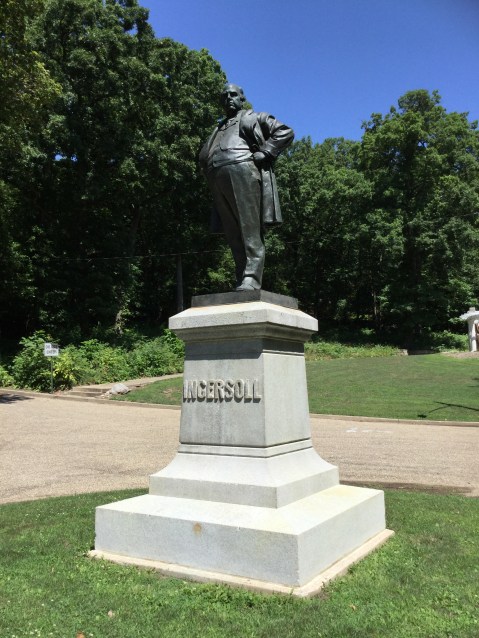
Statue of Robert G. Ingersoll in Glen Oak Park, Peoria, Illinois

Robert G. Ingersoll, orator, lawyer, politician and Civil War veteran often called ‘The Great Agnostic’, was a very famous man in his time but rather forgotten today. He was born on August 11, 1833 and died almost 66 years later. Among other things, he was a vocal and consistent advocate for abolitionism, women’s rights, freethought, and scientific progress. While very liberal and broad-minded, he was a dedicated family man. While his views are as progressive as could be for a person if his time, he was what we might call a square. Besides his unabashed and very public religious skepticism, he lived a life that even Victorian standards would consider altogether decorous and blameless, despite frequent attempts to discredit his views by finding something scandalous to publish about his personal life.

Ingersoll was a great friend of many of the era’s most interesting and influential people including Walt Whitman and Thomas Edison, who made two recordings of his voice with his new invention, the audio recorder.

https://m.youtube.com/watch?v=5u4sqdPSIcM

He was also an admirer and promoter of the memory of Thomas Paine. Though Paine was a founding father of the American cause for independence with his great pamphlet Common Sense and other writings, he had long fallen out of favor in American public memory following the publication of The Age of Reason, his diatribe against religious orthodoxy and superstition, as he perceived it.
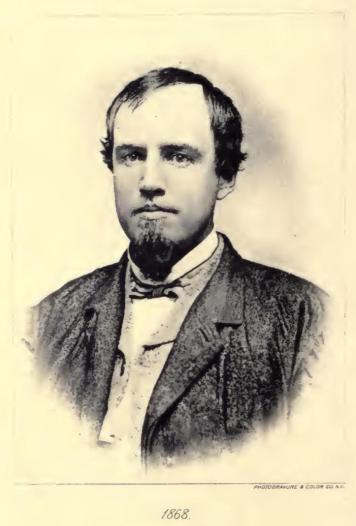
Robert Ingersoll in 1868

In the time Ingersoll enjoyed fame as an orator, freethought ideas had become more acceptable as a matter of public discourse. It was still generally unacceptable to be an out-and-out atheist, but even these could become popular speakers if they were eloquent and interesting enough. In fact, they were often considered novel and exciting, and free speech was enjoying one of its heydays in the United States in this period sometimes called The Golden Age of Freethought. This was a time when public speakers provided a very popular form of entertainment. Many of that era’s important thinkers and activists made their living, or much of it, through public speaking: Ingersoll himself, abolitionist and civil rights leader Frederick Douglass, and feminist, atheist, and civil rights activist Ernestine Rose among them. Rose was also a famous orator in her day, pre-dating Ingersoll by almost a generation but like him, eloquent, witty, and a champion of Paine. She generally spoke only of topics related to her social justice causes, but Ingersoll and Douglass, like many famous orators, spoke on a wide range of topics such as Shakespeare (both men were big fans), science, politics, and much more.

For more about the eloquent and brilliant Ingersoll, please see the links to excellent online sources and to my own writings about Ingersoll below. Last year, I followed the lives and ideas of Robert Ingersoll, Frederick Douglas, and Abraham Lincoln in Peoria, Illinois, where Ingersoll lived and worked for many years; all three men admired and were inspired by one another. It was a most fascinating journey.

By Amy Cools for Ordinary Philosophy:

Peoria, Illinois, In Search of Robert G. Ingersoll, Frederick Douglass, And Abraham Lincoln, Part 1
Peoria, Illinois, In Search of Robert G. Ingersoll, Frederick Douglass, And Abraham Lincoln, Part 2
Peoria, Illinois, In Search of Robert G. Ingersoll, Frederick Douglass, And Abraham Lincoln, Part 3

Review: The Great Agnostic: Robert Ingersoll and American Freethought, by Susan Jacoby

By others:

Robert G. Ingersoll: American Politician ~ by the editors for Encyclopaedia Britannica

Robert Ingersoll, the ‘Great Agnostic’ ~ by John Kelly for The Washington Post

Robert Ingersoll: Intellectual and Moral Atlas ~ by Tom Malone for The Objective Standard

Robert Green Ingersoll (1833-1899) ~ at SecularHumanism.org

That Old-Time Irreligion: ‘The Great Agnostic,’ by Susan Jacoby ~ by Jennifer Michael Hecht for The New York Times’ Sunday Book Review

~ Ordinary Philosophy is a labor of love and ad-free, supported by patrons and readers like you. Any support you can offer will be deeply appreciated!

*A version of this piece was previously published in Ordinary Philosophy
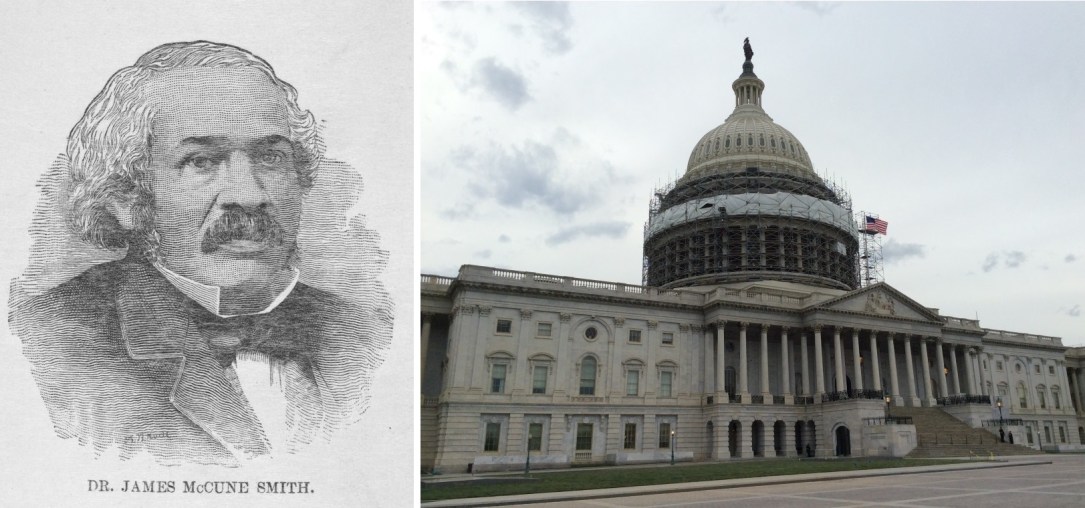
Say What? James McCune Smith on Revolutionary Conservatism

Left: Schomburg Center for Research in Black Culture, Manuscripts Archives & Rare Books Division., ‘Dr. James McCune Smith.’ NYPL Digital Collection, 1891. Right: US Capitol Building under repair, Washington, D.C., 2016 Amy Cools

‘We will save the form of government and convert it into a substance’

James McCune Smith, ‘The Destiny of the People of Color’ (1843),
published in The Works of James McCune Smith, 2006

~ Ordinary Philosophy is a labor of love and ad-free, supported by patrons and readers like you. Any support you can offer will be deeply appreciated!

Say What? James McCune Smith on the Exportation of Prejudice

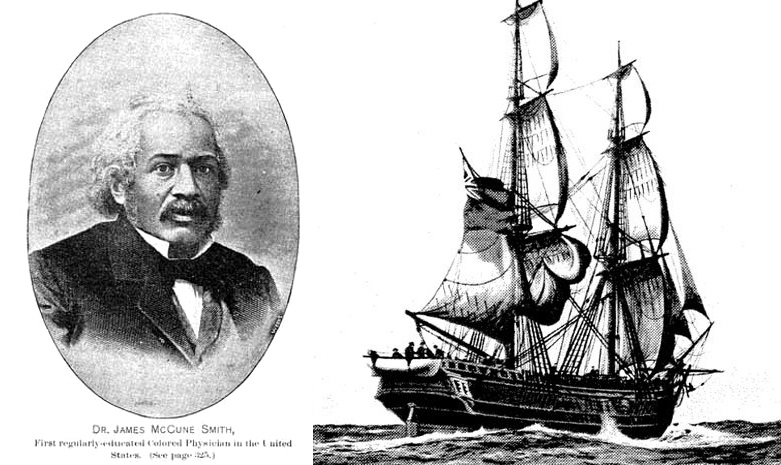
L, James McCune Smith, via Wikimedia Commons; R, The Caledonia, via Upper Canada History blog, both public domain

…'[A]n American ship is an epitome of the great and rising country, whose Star Spangled Banner proudly floats o’er her deck. “E Pluribus Unum” “From many nations” were the men gathered who felled the trees and chipped the timbers and moulded them into “one” harmonious and beautiful craft that

“Walks the waters like a thing of life”-

“From many nations” are the men gathered under the command of him who “moves the monarch of her peopled deck.” Would that the parallel might here end! And that gathering something of the spirit of liberty from the ocean which she cleaves, and the chainless wind which wafts her along, she might appear in foreign ports a fit representative of a land of the free, instead of a beautiful but baneful object, like the fated box of Pandora, scattering abroad among the nations the malignant prejudice which is a canker and curse to the soil, whence she sprung.’

~ James McCune Smith, travel journal entry August 1832*,
published in The Works of James McCune Smith, 2006

*Smith was nineteen years old when he wrote this, a former slave who, early in life, took his destiny into his own hands through his intellectual accomplishments. He wrote this as he sailed to Scotland to study at the University of Glasgow where he would receive his Bachelors, Masters, and Doctor of Medicine degrees. He would go on to become a renowned physician, scientist, writer, and abolitionist.

~ Ordinary Philosophy is a labor of love and ad-free, supported by patrons and readers like you. Any support you can offer will be deeply appreciated!

Happy Birthday, Walt Whitman!

Walt Whitman, age 35, from Leaves of Grass, Fulton St., Brooklyn, N.Y., engraving by Samuel Hollyer from daguerreotype by Gabriel Harrison, public domain via Wikimedia CommonsWalt Whitman, an American, one of the roughs, a kosmos, Disorderly fleshy and sensual . . . . eating drinking and breeding, No sentimentalist . . . . no stander above men and women or apart from them . . . . no more modest than immodest.’ Thus Walt Whitman (May 31, 1819 – March 26, 1892) introduces himself to us for the first time in his first self-published 1855 edition of Leaves of Grass. Not on the cover or on the title page, mind you, but deep within the body of the untitled poem later called Song of Myself. If this is a dialing-back attempt to inject a little respectable humility or yet another self-aggrandizing affectation on the part of this unapologetic egoist, it’s hard to say definitely, though I strongly suspect it’s the latter. It certainly is so-very-American.

Whitman was confident, earthy, crude, and vibrant, a self-styled natural man whose personas were nonetheless carefully crafted. He did his own thing and ‘lived the free life of a rover’ (an Eric Bogle phrase from his great anti-war ballad And the Band Played Waltzing Matilda), working odd jobs as a printer, journalist, teacher, and clerk, among other things. Moved by horror and compassion at the magnitude of death and suffering he observed, he worked some years as a nurse to the Civil War wounded, and spent much of his somewhat meager earnings on supplies for their comfort and care. He remained single but had many lovers, probably mostly homosexual, though he praises the physical beauty and power of women as lavishly in his poems as he does that of men. All the while, starting at just over age 30, Whitman began to write his highly idiosyncratic, free verse poetry celebrating the authentic and the crafted self, the human body, democracy, equality, work, nature, and companionship. He spent the rest of his somewhat long life revising and republishing several editions of Leaves of Grass, up to several months before his death at age 72 in 1892.

To read more work by, about, and inspired by the great Walt Whitman, here are some links and articles:

Leaves of Grass (1855) – by Walt Whitman, published in the Electronic Text Center, University of Virginia Library

Poems – by Walt Whitman at Poets.org

Walt Whitman – by Gay Wilson Allen Alexander Norman Jeffares for Encyclopædia Britannica

Walt Whitman, 1819–1892 – The Poetry Foundation 

The Walt Whitman Archive – by Ed Folsom and Kenneth M. Price, Ed., published by the Center for Digital Research in the Humanities at the University of Nebraska–Lincoln

and just because I love it:

The Body Electric, song and music video by Hooray for the Riff Raff. The song title is inspired by one of Whitman’s most enduring and controversial poems and is a critique of the traditional murder ballad

*A version of this piece was previously published at Ordinary Philosophy

~ Ordinary Philosophy is a labor of love and ad-free, supported by patrons and readers like you. Any support you can offer will be deeply appreciated!

Happy Birthday, Julia Ward Howe!

Julia Ward Howe, ca. 1855

Julia Ward Howe, poet and activist, was born on May 27, 1819, and lived a long life ever dedicated to social reform.

She’s best known as the author of the Battle Hymn of the Republic, the stirring Civil War anthem still sung at military events and in churches today; I remember singing it at Mass growing up. Filled with Biblical imagery, it reminds me of the Old Testament-inspired Second Inaugural Address of Abraham Lincoln. In it, he addresses the terrible costs of the war in lives and property, surmising that God’s justice may demand that ‘all the wealth piled by the bondman’s two hundred and fifty years of unrequited toil shall be sunk., and …every drop of blood drawn with the lash shall be paid by another drawn with the sword’ in recompense for the terrible sin of slavery.

Howe wrote her Hymn in 1861, Lincoln’s Second Inaugural was delivered in 1865. Lincoln is known to have heard the Battle Hymn and reported to have wept when he did. Lincoln was well versed in Scripture and references it liberally in his writings and speeches; nevertheless, he may also have had Howe’s Hymn in mind when he wrote his Address. In any case, both remain prominent in American historical memory, continuing to resonate and inspire today in our Protestantism-derived culture. John Steinbeck uses her Book of Revelation-derived phrase The Grapes of Wrath as the title of his great novel about the suffering of Dust Bowl refugees fleeing to California. The great Leonard Cohen references her Hymn in ‘Steer Your Way’ from You Want It Darker, his final album released shortly before his death last fall. Howe’s lyric ‘As he died to make men holy, let us die to make men free’ becomes ‘…let us die to make things cheap.’ Cohen redirects her line to critique today’s great sin of destroying our environment likewise out of greed, complacency, indifference to the fate we’re creating for our descendants, and slavish adherence to the ‘way it’s always been done.’

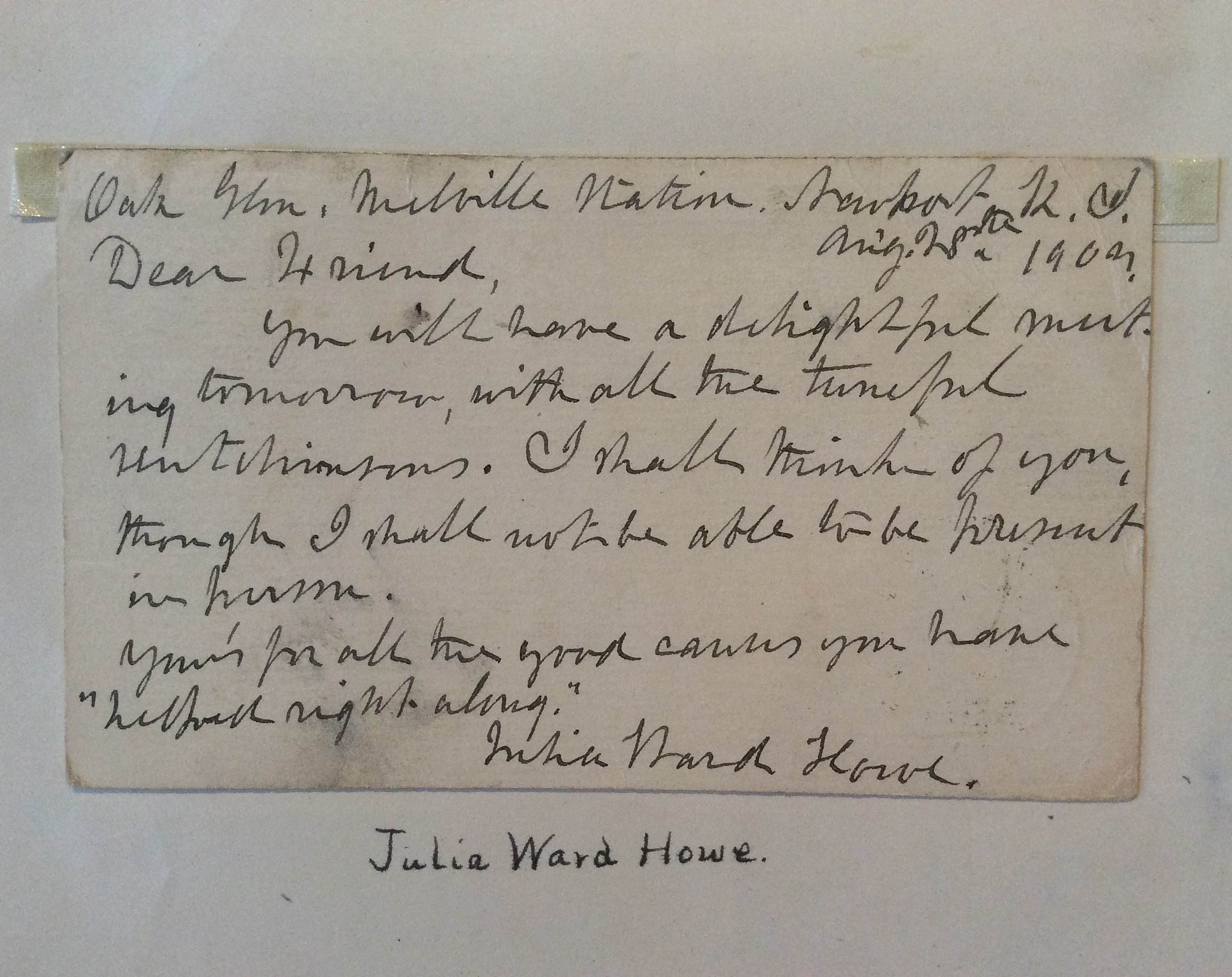
Julia Ward Howe postcard dated August 28th, 1903, from the Hutchinson Family Scrapbook in the collection of the Lynn Historical Society in Massachusetts. I was here in spring 2016 following the life and ideas of Frederick Douglass. The Hutchinson family dedicated their musical skills to the abolition movement and other reform causes and were friends with many prominent activists of their day. The scrapbook doesn’t note which member of the Hutchinson family Howe wrote this card to.

Read more about this great abolitionist, feminist, and author:

Julia Ward Howe, 1819–1910: BiographyPoetry Foundation

Julia Ward Howe (1819-1910) – by Debra Michals for the National Women’s History Museum

‘The Civil Wars of Julia Ward Howe,’ by Elaine Showalter – by Jill Lepore for The New York Times

Julia Ward Howe, 1819-1910, Volume 1 – by Laura Elizabeth Howe Richards, Maud Howe Elliott, and Florence Howe Hall, 1915

*A version of this piece was previously published at Ordinary Philosophy

~ Ordinary Philosophy is a labor of love and ad-free, supported by patrons and readers like you. Any support you can offer will be deeply appreciated!

Photobook: Marker and Train Station Where Abraham Lincoln’s Body Returned to Springfield, Illinois on May 3rd, 1865

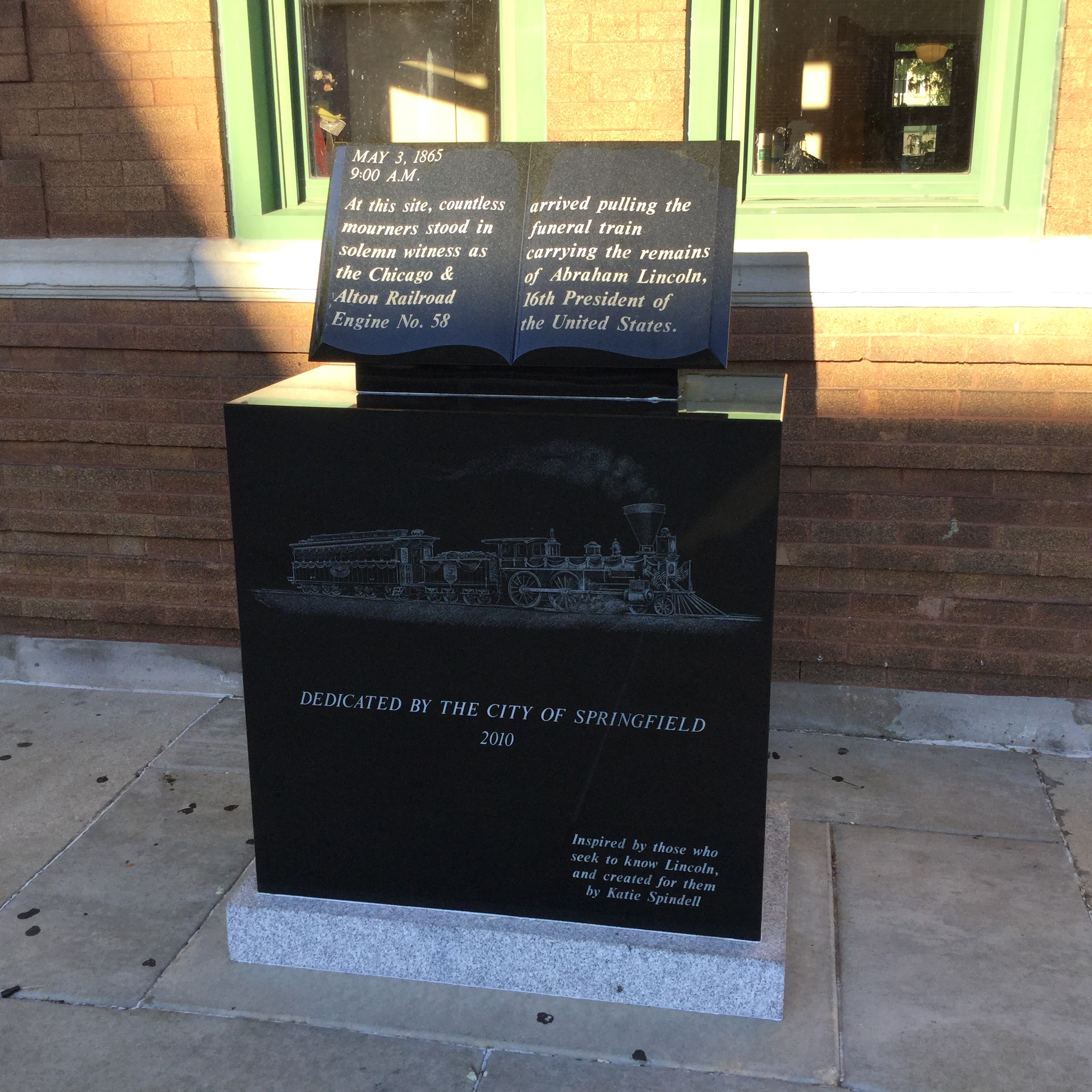
Marker for Lincoln’s funeral train in the summer evening light, at the Springfield Train Station at 100 N. 3rd Street, Springfield, Illinois

Last year, I visited Springfield, Illinois to follow the life and ideas of Abraham Lincoln while following in his footsteps. The last Springfield site associated with Lincoln that I visited on July 29th, 2017 was the train station at 100 N. 3rd St. The brick station, though plain, has clearly been spruced up since the photos featured on Google Maps, dated 2007, that I find on the day I write this. There’s now a shady porch over the outdoor waiting platform, new paint and benches, and a handsome stone marker signed by Katie Spindell.

The marker commemorates the May 3rd, 1865 arrival of the funeral train carrying Lincoln’s assassinated body. He lies buried at Oak Ridge Cemetery, in the city where he established his legal and political careers, married, and raised a family. Read more about my Lincoln travels in articles linked here, or listen to the podcast versions.

Springfield Train Station at 100 N. 3rd Street, Springfield, Illinois

Screenshot of 2007 Google Maps image of the N. 3rd Street train station in Springfield, IL

~ Ordinary Philosophy is a labor of love and ad-free, supported by patrons and readers like you. Any support you can offer will be deeply appreciated!

Photobook: Thomas Paine Artifacts at the People’s History Museum, Manchester, England

Thomas Paine display at the People’s History Museum, Manchester, England, 2018 Amy Cools

Thomas Paine display at the People’s History Museum, Manchester, England.

Paine’s death mask at the People’s History Museum. As you can see, this great thinker and writer was also a rather homely man.

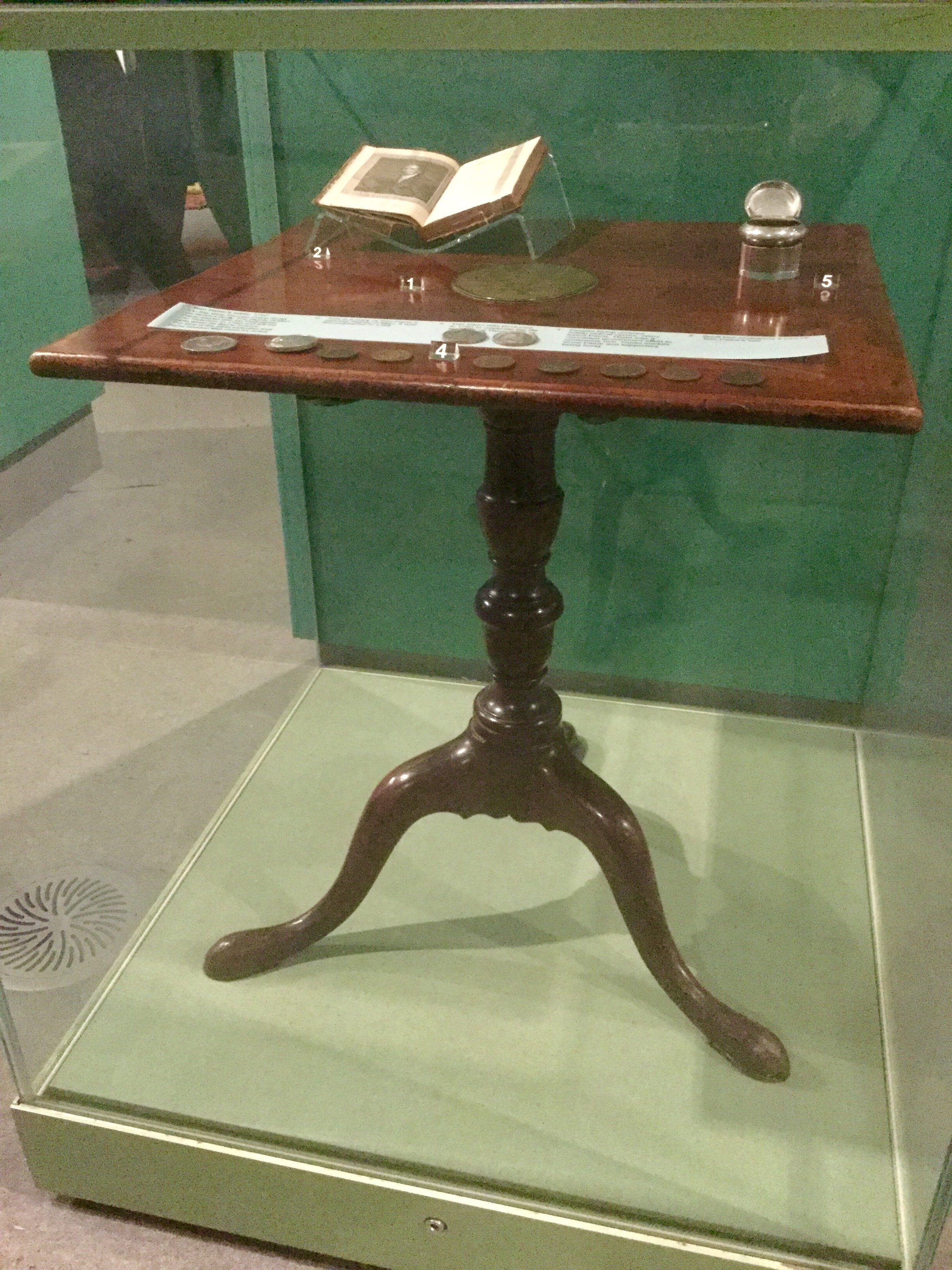
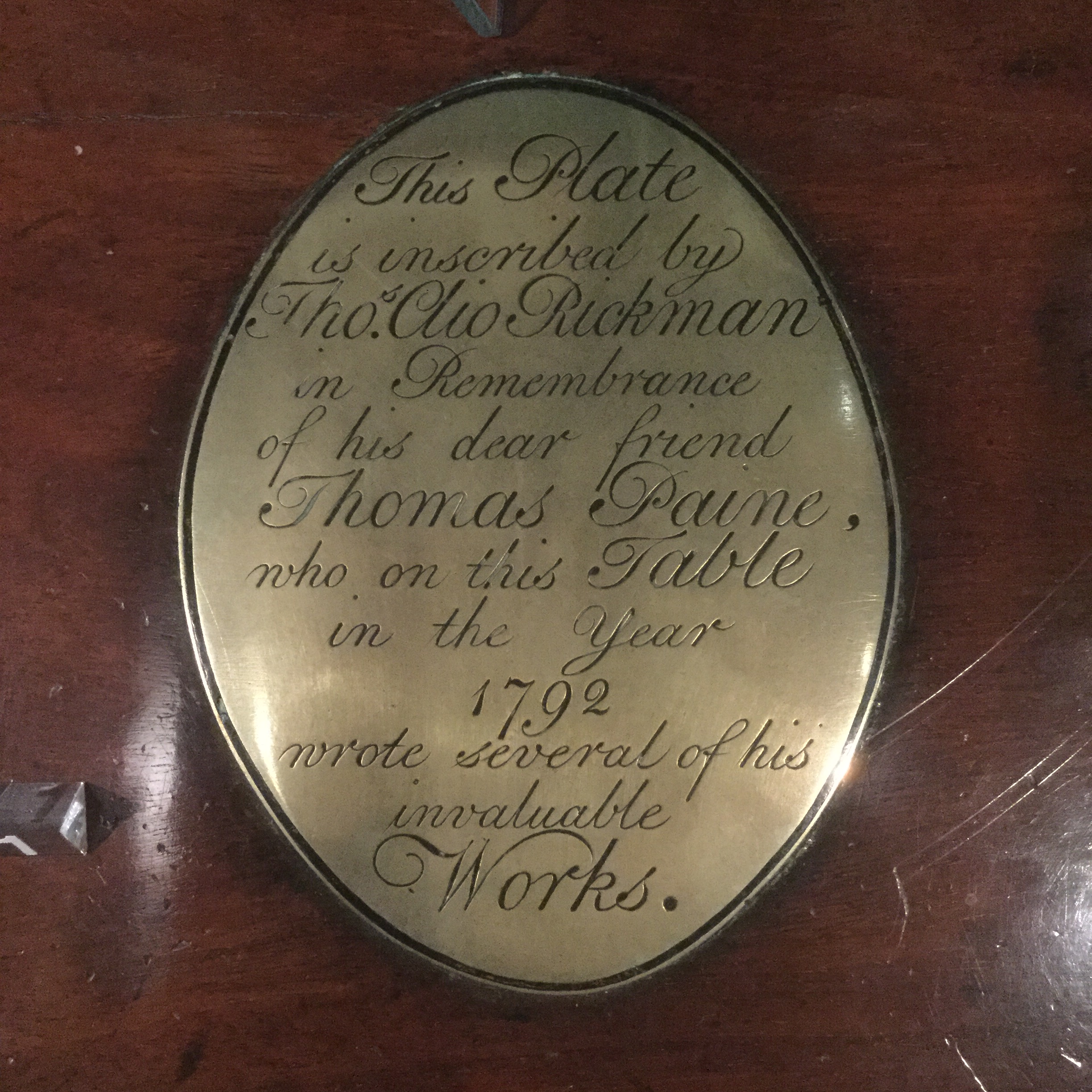
Thomas Paine’s writing table. As the People’s History Museum website explains, ‘The table actually belonged to Thomas Clio Rickman who lived at number 7 Upper Marylebone Street, London and whom Paine stayed with in 1792 before fleeing to France following the publication of The Rights of Man. Rickman would proudly show his visitors the table, now sanctified by his plaque…’

Plaque on the Paine writing table at the People’s History Museum

Lock of Thomas Paine’s hair in a snuffbox

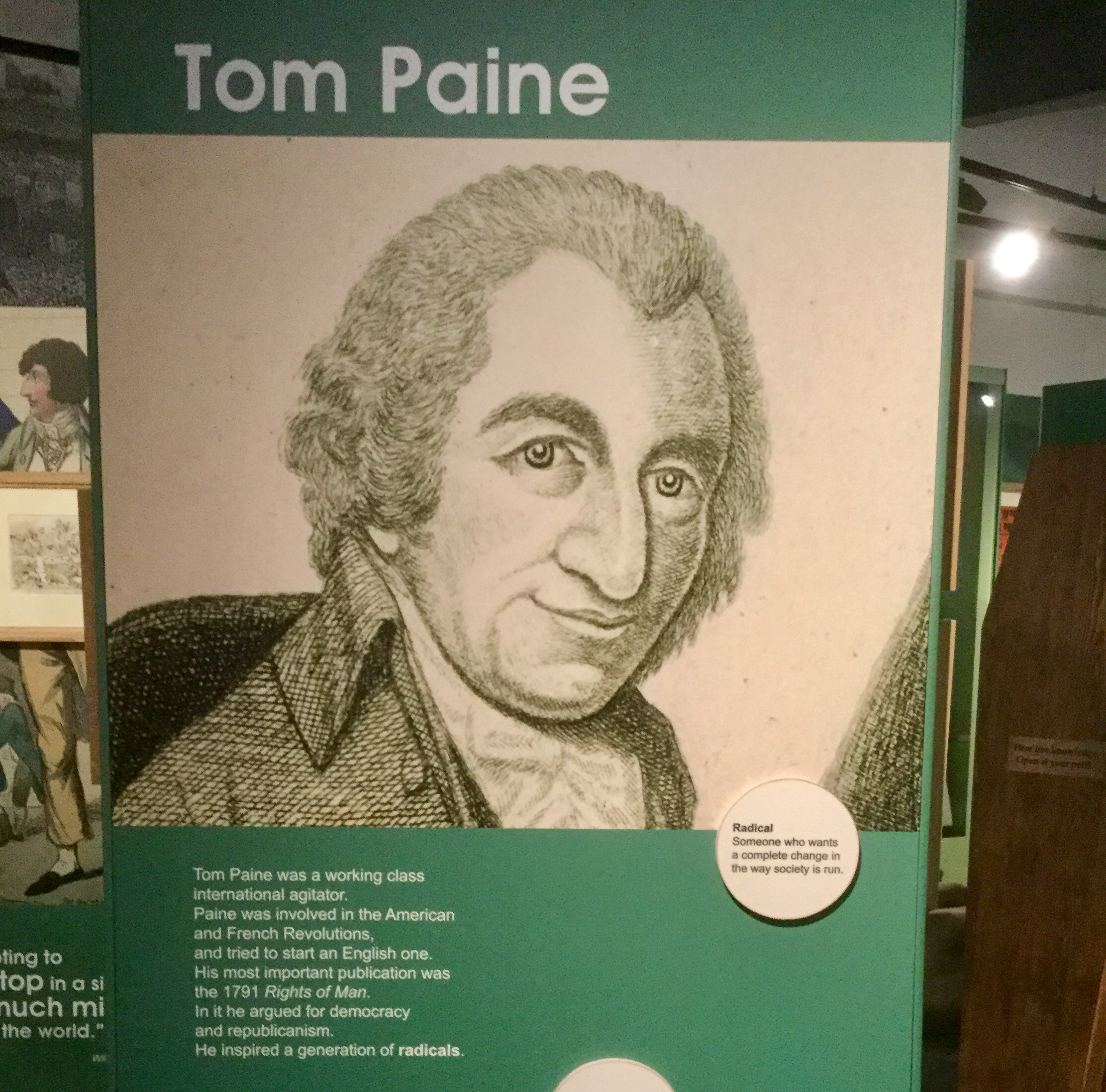
Placard for the Thomas Paine display at the People’s History Museum, Manchester, England

Thomas Paine display placard at the People’s History Museum, Manchester, England, 2018 Amy Cools

Another Paine display placard at the People’s History Museum, Manchester, England

~ Ordinary Philosophy is a labor of love and ad-free, supported by patrons and readers like you. Any support you can offer will be deeply appreciated!

Remembering Margaret Fell

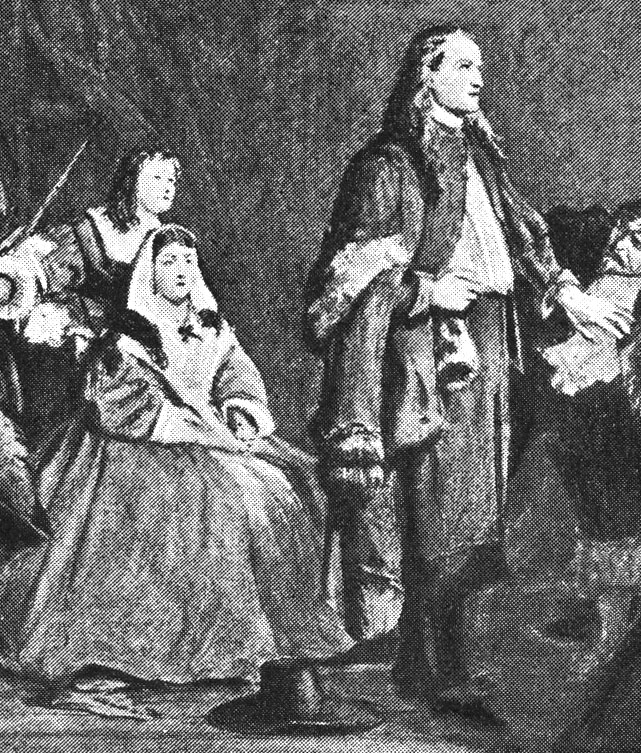
Margaret Fell, with George Fox before the judges, from a painting by J. Pettie 1663, public domain via Wikimedia Commons

Margaret Fell with George Fox before the judges, from a painting by J. Pettie, 1663

Margaret Fell was born on some unknown date in 1614, so let’s take this occasion to remember her on the date of her death, April 23rd, 1702.

Fell’s lived a life as passionate as it was long. She was an unconventional thinker for her time, a zealous and progressive religious activist at times imprisoned for her beliefs, a prolific writer, well-traveled, a mother of eight children and a wife twice.

An early adherent and eloquent promoter of Quakerism, Fell is now considered one of its founders. She converted to Quakerism after hearing a sermon by one of its most charismatic preachers, George Fox, and almost immediately launched into a lifetime of hosting Quaker meetings and speaking out on behalf of her new religion. After her husband died some years later, Fell married Fox, probably more as a co-missionary than as a romantic partner since their work, travels, and imprisonments kept them apart for much of their marriage.

As I’ve had a lifelong fascination with the history of human rights, I’ve long admired the Quakers because, along with Unitarians and Deists, so many have been leaders in the struggle to expand, establish, and promote them. That’s because these faiths emphasize the importance of individual conscience, the primacy of the human mind, God’s rational nature, and the moral equality of all human beings.

Fell believed in the Quaker doctrine of the Inner Light which God has caused to shine equally in the hearts of all beings; all we need do is heed it. Therefore, one does not need ministers, priests, or any other authorities or intercessors to achieve salvation. And because God has created everyone for the same purpose and gave everyone that light, everyone is spiritually equal and capable of understanding and proclaiming the Truth. We can see how this doctrine, central to Quakerism, readily aligns with human rights movements centered on a belief human spiritual and intellectual equality. The right of women to speak in church and write religious texts, in her time limited to men, was a cause particularly dear to Fell’s heart. While Fell’s belief in the equality of women was limited to their role as spiritual beings, Quakerism tended to encourage ever-more progressive beliefs in its adherents. Over time, many Quakers came to be leaders in the abolitionist and pacifist movements, promoting the right of all to receive equal and universal education and for women’s rights in social and political spheres as well.

In light of her achievements as a female religious pioneer, and the human rights advances facilitated by the Quaker faith she helped found, Fell’s contributions should continue to be remembered and celebrated.

*A version of this piece has been previously published at Ordinary Philosophy

~ Ordinary Philosophy is a labor of love and ad-free, supported by patrons and readers like you. Any support you can offer will be deeply appreciated!

~~~~~~~~~~~~~~~~~~~~~~~~~~

Sources and inspiration

Broad, Jacqueline, ‘Margaret Fell‘, The Stanford Encyclopedia of Philosophy, Edward N. Zalta (ed.)

Jacoby, Susan. Strange Gods: A Secular History of Conversion. New York: Pantheon, 2016 (see the chapter on Margaret Fell)

Happy Birthday, Thomas Jefferson!

Thomas Jefferson by Charles Bird King, 1836, after Gilbert Stuart, at the Smithsonian Portrait Gallery in Washington, D.C. Photo 2016 by Amy Cools

As I rest after completing my term papers, exploring the highlands and islands of Scotland with my dear friends, I find I have little time to write and even less time with good internet connection. So let me share some old things with you, friends, until I can write and record for O.P. again.

In remembrance of Thomas Jefferson (April 13, 1743 – July 4, 1826) on his birthday, here are my tributes to his memory, his life, and his ideas from over the years:

To Washington DC, Virginia, and Philadelphia I Go, In Search of Thomas Jefferson

To Paris, France I Go, In Search of Revolution-Era Thomas Paine, Mary Wollstonecraft, and Thomas Jefferson

and my thrilling interview with Clay Jenkinson, Jefferson scholar, of just over two years ago

Interview with Clay Jenkinson as Thomas Jefferson

I hope you enjoy following me as I followed in the footsteps of Jefferson!

~ Ordinary Philosophy is a labor of love and ad-free, supported by patrons and readers like you. Any support you can offer will be deeply appreciated!

Say What? Frederick Douglass on Race Relations

Frederick Douglass c. 1855, and the first edition of his North Star, Dec 3 1847, public domain via the Library of Congress

‘We are here, have been here, and we are to stay here. To imagine that we shall ever be eradicated [by removal to Africa], is absurd and ridiculous. We can be re-modified, changed, and assimilated, but never extinguished. The white and black must fall or flourish together. We shall neither die out, nor be driven out, but we shall go with you, remain with you, and stand either as a testimony against you, or as an evidence in your favor, throughout all your generations.’

~ Frederick Douglass ‘Henry Clay and Colonization Cant, Sophistry, and Falsehood:
An Address Delivered in Rochester, New York, on Feb 2, 1851’,
published in the North Star on Feb. 6, 1851

~ Ordinary Philosophy is a labor of love and ad-free, supported by patrons and readers like you. Any support you can offer will be deeply appreciated!!