The Bell Tower, Tower of London: Thomas More, Elizabeth I, and Other Histories, Part 2

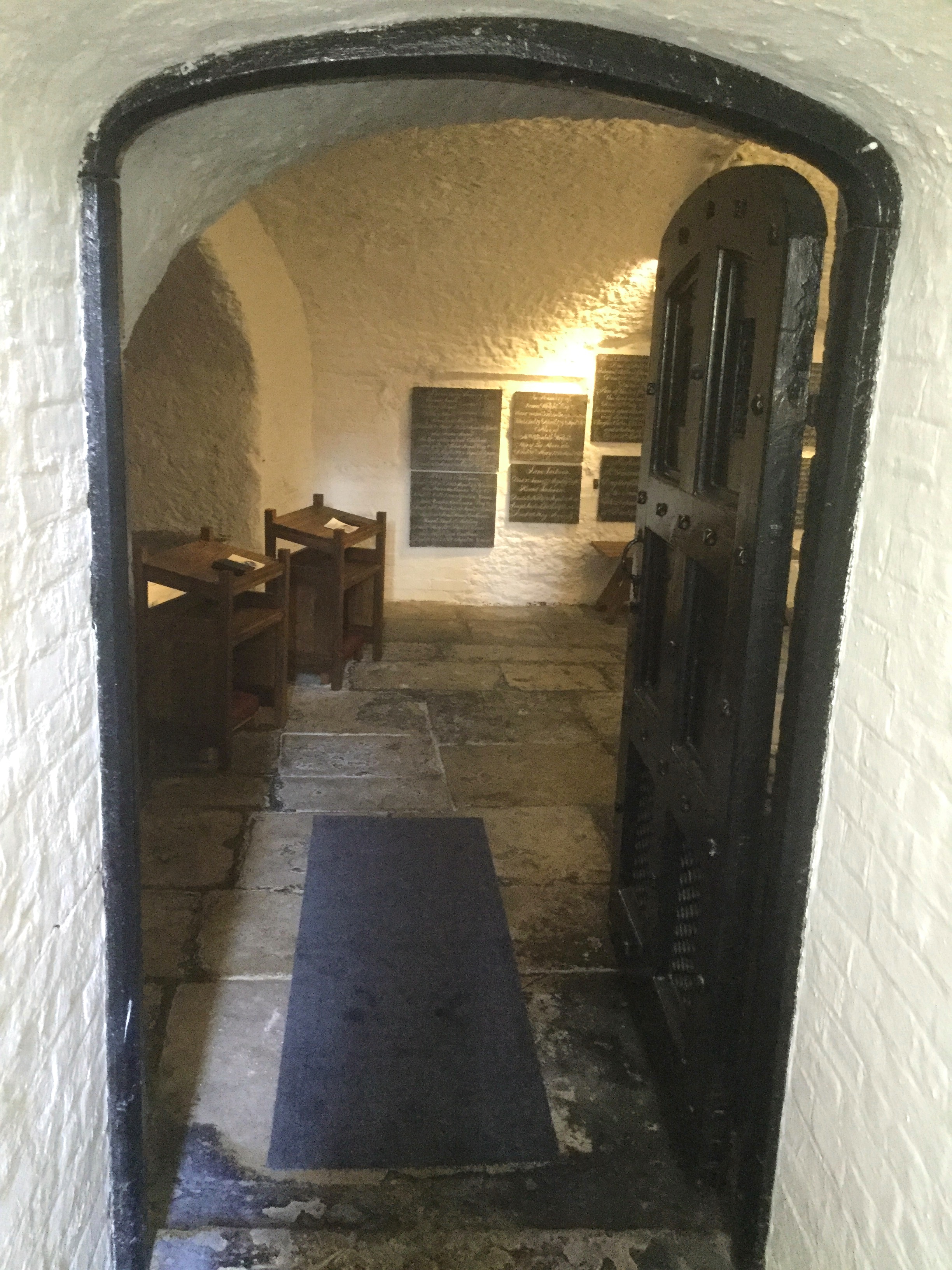
Entrance to the burial chamber below St Peter ad Vincula, Tower of London, England

Saturday, May 4th, 2018, continued

Simon, Laurence, and I leave the Queen’s House and follow Simon past the Tower Green to the Royal Chapel of St Peter ad Vincula (‘St Peter in Chains’). We descend a narrow stone stairway which leads to a chamber underneath the chapel and find ourselves in a chamber with low, arched ceilings. The room is constructed of stone or brick, perhaps both; it’s hard to determine exactly which since it’s thickly painted, and plastered in some places. The walls are lined with black tablets with names inscribed in curly script. Before the names, some contain such inscriptions as ‘Here lieth the body of…’ or ‘To the memory of…’

A tablet on the north wall, above several of these black name-inscribed tablets, explains:

‘Within this wall are deposited in two chests the remains of many distinguished persons who suffered death on Tower Hill and which were for a time interred beneath the floor of the chancel and nave of St Peter ad Vincula of the Tower of London * The removal of which was necessitated by repairs and alterations within the chapel by H.M. Office of Works in the years 1876-7 * The reinterment of these remains was under the supervision of Lieut-General Milman * Major of the Tower * A member of the committee appointed to carry out the alterations April 1877.’

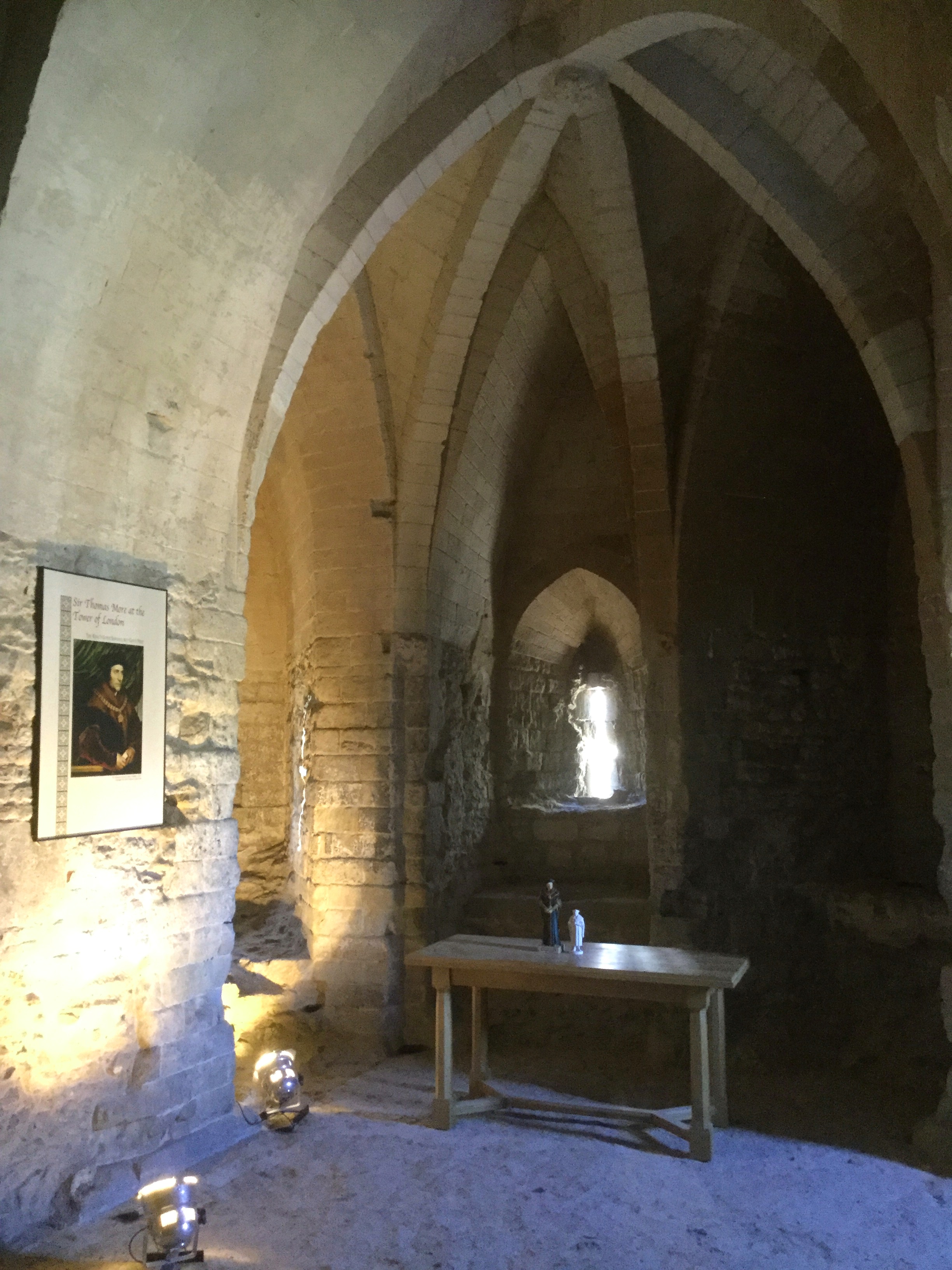
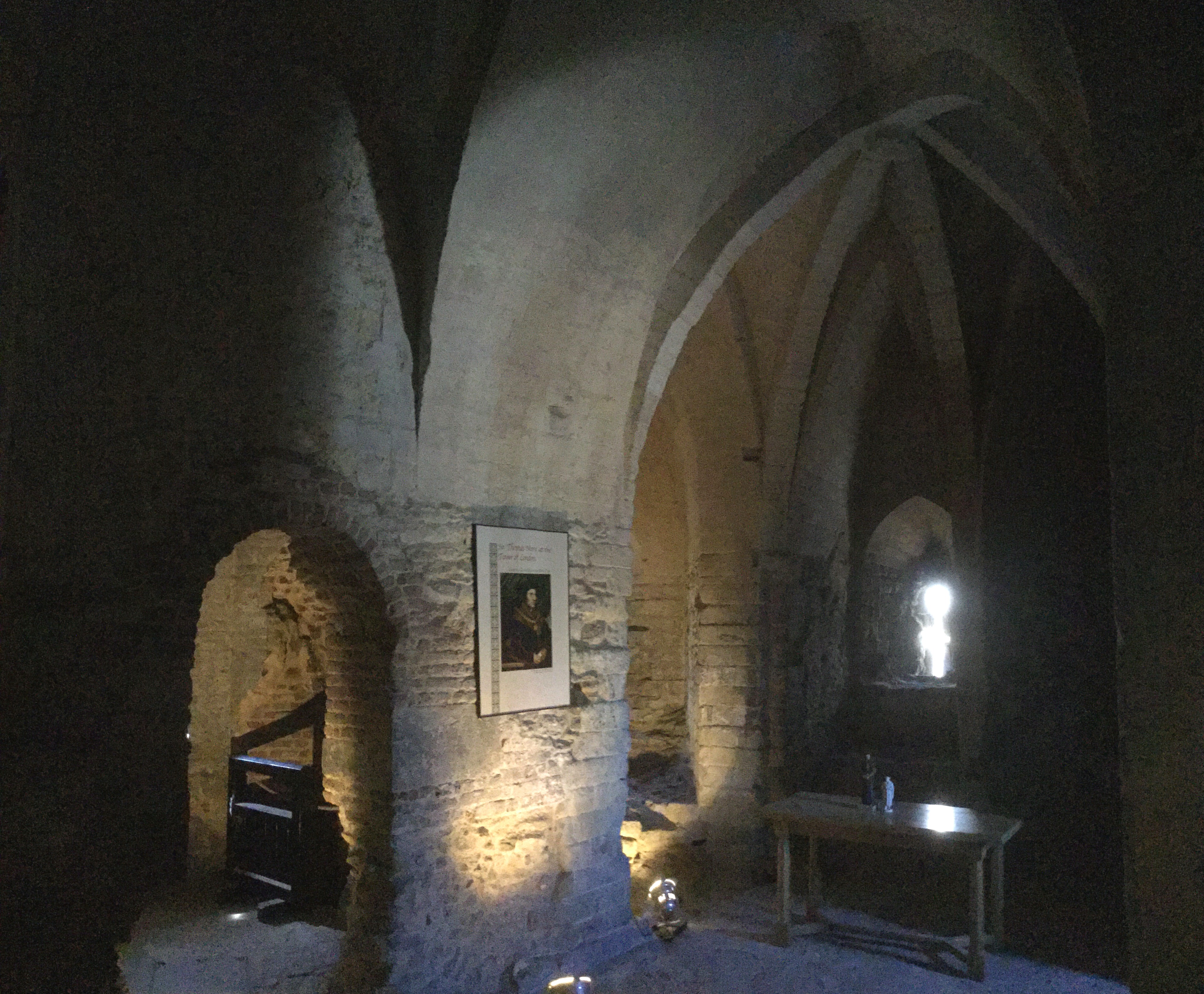
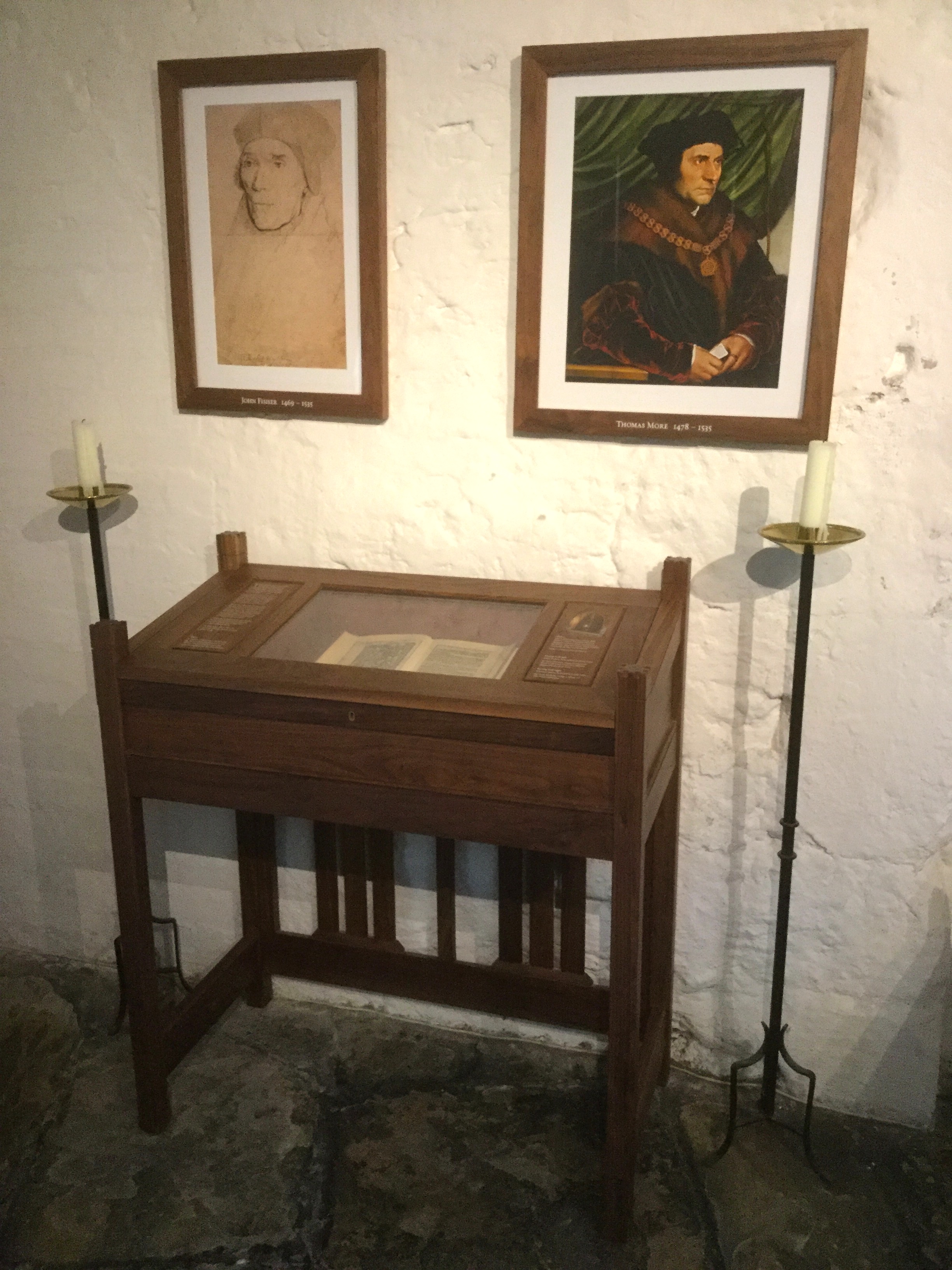
At the west end of the chamber near the door where we entered, there’s a large alcove with a pointed ceiling, and within the alcove is a large darkly-painted sort of chest with a portrait bust of Thomas More on the center top. It’s flanked by two large candles, with one small one in blue glass burning in the center in front of the bust, and two long narrow holders containing many more small candles below. There are two kneelers directly in front of the alcove, and one off to the left below two framed portrait prints, one of John Fisher and one of More. The large chest in More’s alcove is inscribed:

Thomas More
Knight * scholar * writer * statesman
Lord Chancellor of England 1529 – 32
Beheaded on Tower Hill, buried in this Chapel
1535
Canonized by Pope Pius XI 1935

This may be the actual resting place of his remains or it may be a cenotaph, an empty tomb memorializing a person whose remains are elsewhere, in this case, elsewhere within the chamber.
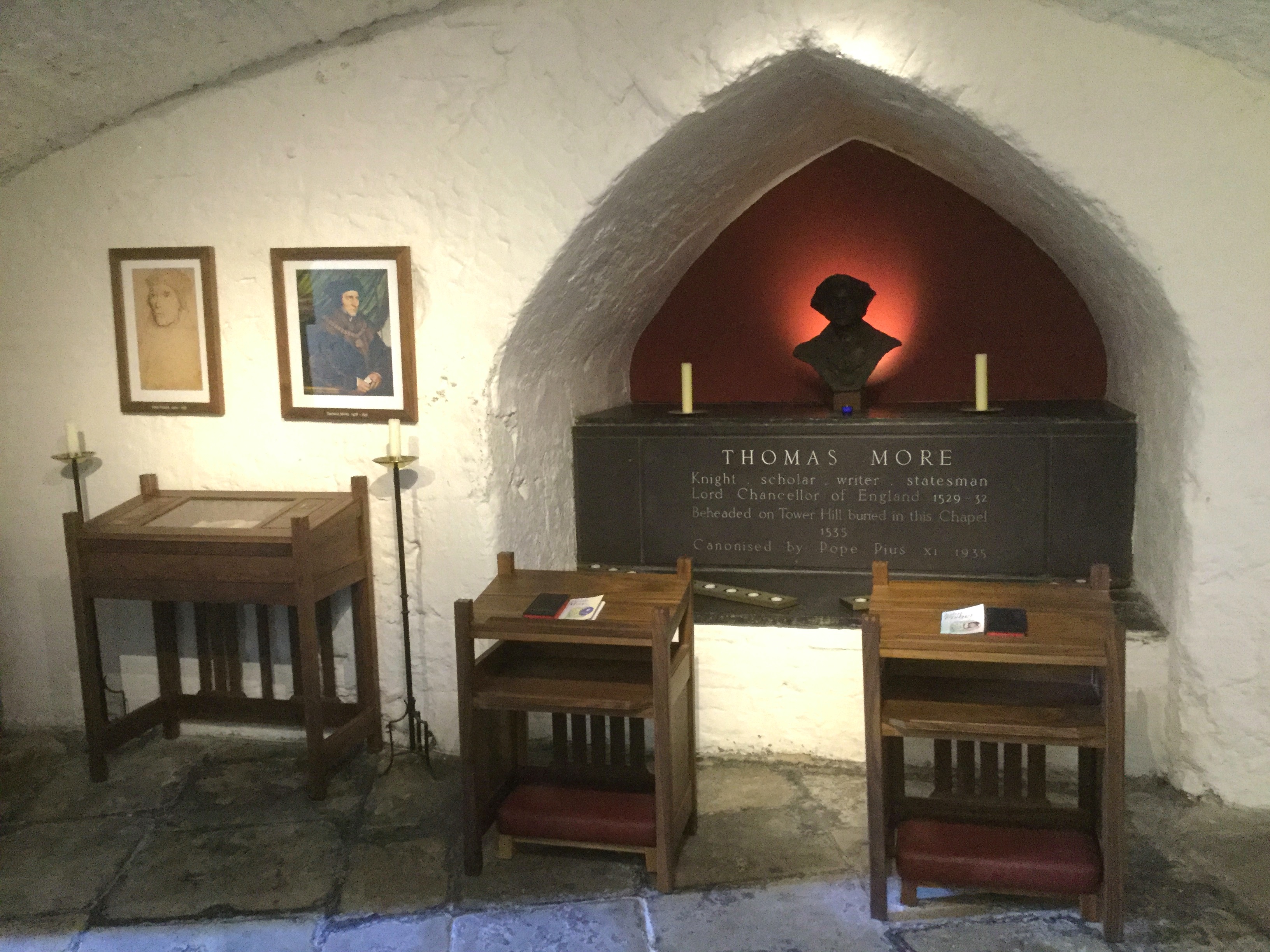
Thomas More memorial shrine below the chapel of St Peter ad Vincula, Tower of London
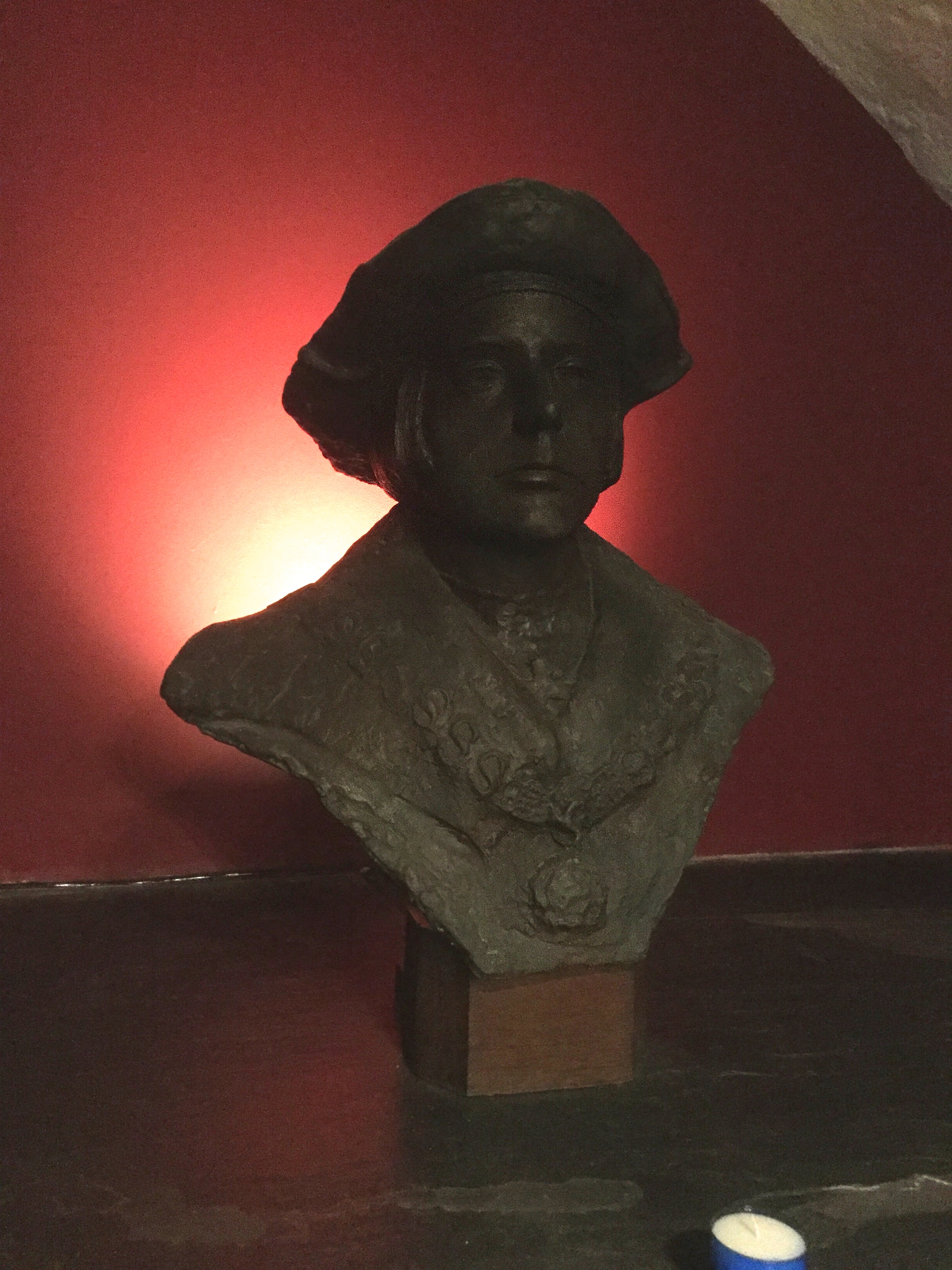
Thomas More portrait bust in his memorial shrine below St Peter ad Vincula, Tower of London

This chamber is where, as Simon confirms, More’s body is buried. His head, however, is not buried with it. As was the usual practice for those executed by beheading, More’s head was boiled for preservation then placed on a spike over London Bridge, on the very spike upon which John Fisher’s severed head had already been displayed for two weeks. They were placed there to serve as a warning to others. More’s daughter Margaret Roper, so distraught that she could not bring herself to witness his execution, managed to retrieve it after it was displayed for some time (my sources disagree about how much time), and the skull was buried with her in Chelsea Old Church when she died nine years later.

More and his family regularly attended services at Chelsea Old Church since they lived nearby; Roper’s Garden across the street may be on land that belonged to the More estate where Henry VIII would come to visit More during happier times. The More chapel in Chelsea Old Church is among the few sections that stand today after surviving the 1941 bombing that reduced most of the church to rubble. The church has since been restored to nearly its original appearance. More’s head and Margaret’s body are no longer buried there, however. After Margaret’s husband and More’s early biographer William Roper died in 1578, their remains were all buried together in the Roper family vault at St. Dunstan’s Church in Canterbury.
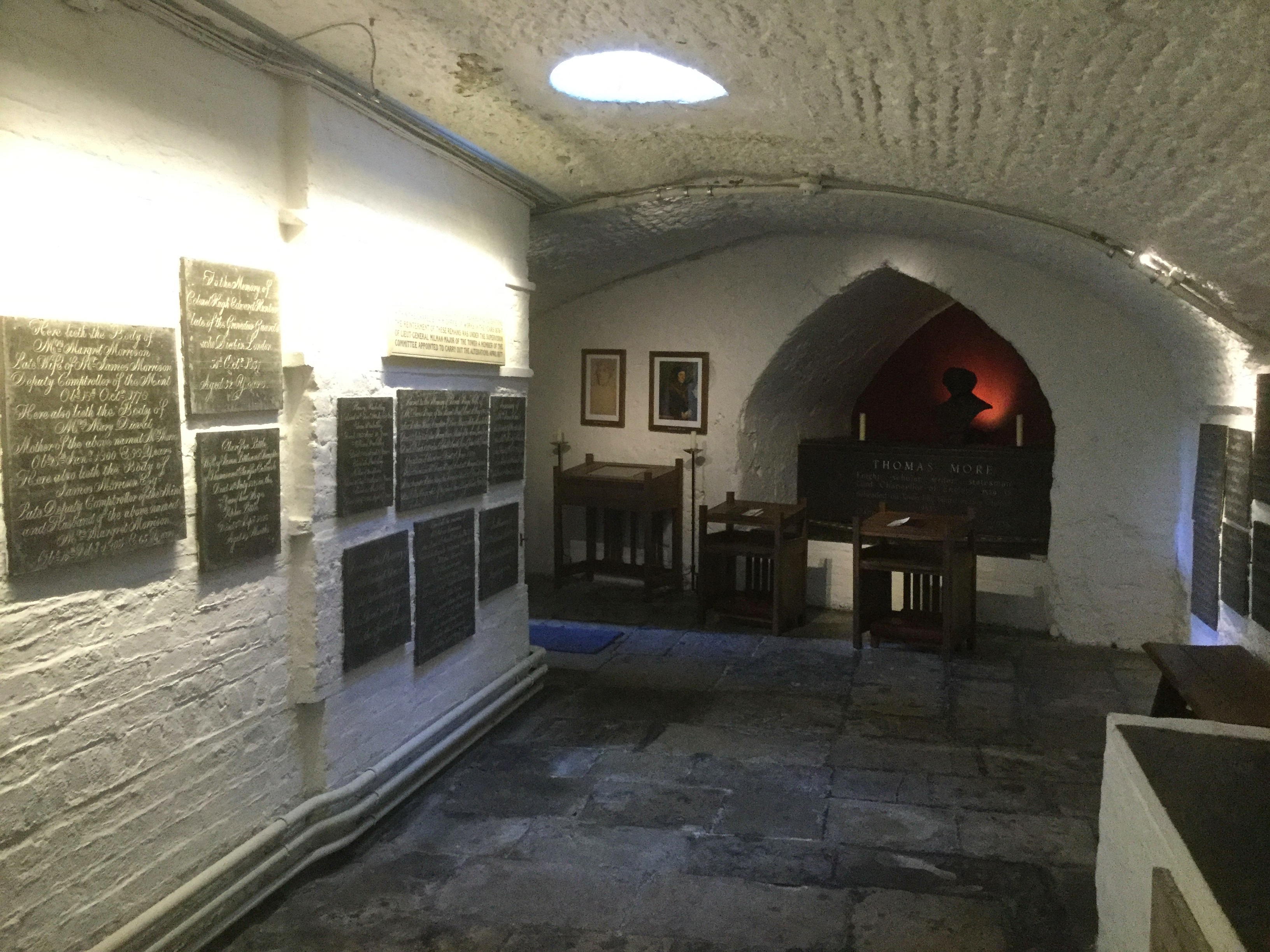
Burial chamber below St Peter ad Vincula, Tower of London
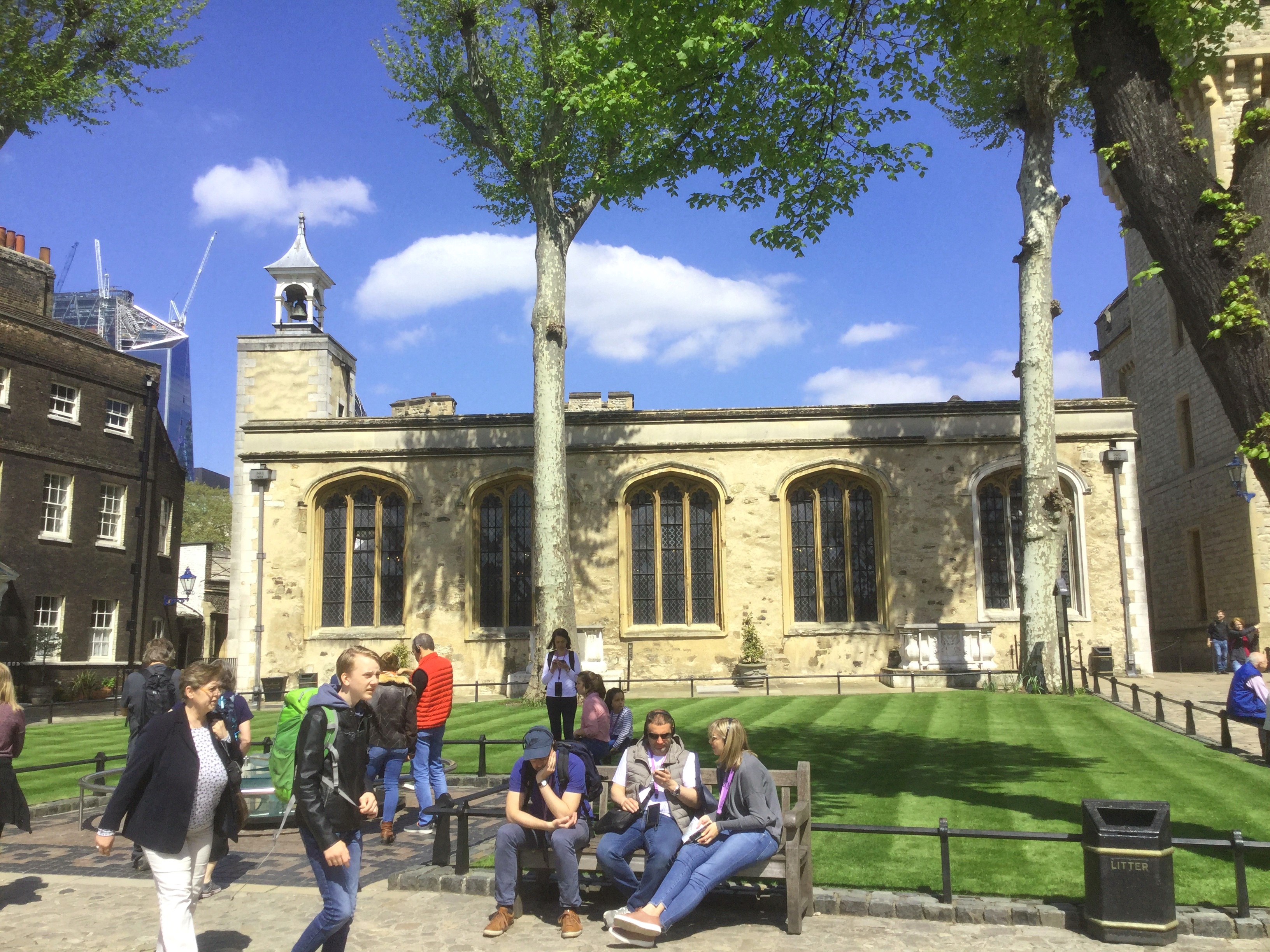
The Royal Chapel of St. Peter ad Vincula, Tower of London

Next, we ascend the stairs from low light of the burial chamber into the bright sunshine, then enter lovely St Peter’s chapel proper. Simon tells us stories about many things found in the chapel and people buried within it. While they’re very interesting to hear, I won’t include them in this account since they’re unrelated to the subjects I journeyed here to explore. St Peter ad Vincula was first converted from a simple parish church when the Tower walls were extended outward in the 11th century, placing the church within its walls as the complex was enlarged. Henry III expanded and redecorated it as a royal chapel in the 13th century. Though it had remained in use, the chapel had fallen into a sad state of repair by the latter half of the 19th century. The extensive restoration of 1876-77, which had led to the aforementioned reburials in the chapel’s subterranean chamber, also removed many of the seventeenth- and eighteenth- century additions that gave the chapel an ornate but dark and crowded look. Today, the interior has a bright and airy look while still very decorative with its arches and stained glass windows, a significant improvement.
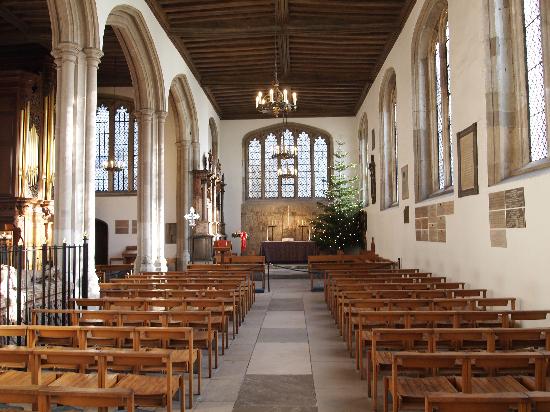
This photo of the Royal Chapel of St Peter ad Vincula at the Tower of London is courtesy of TripAdvisor. Photography is not allowed within the chapel, though evidently, it’s possible to obtain permission
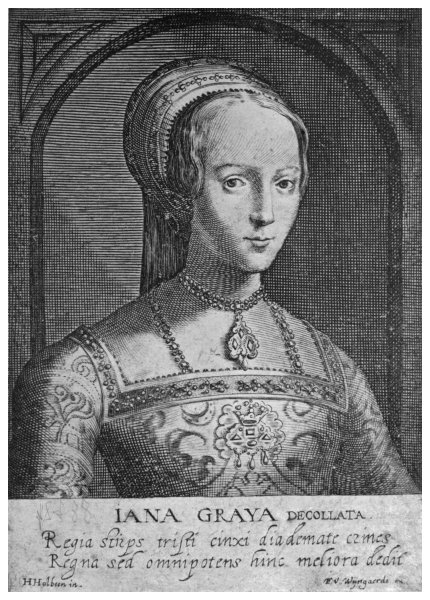
Lady Jane Grey, perhaps after a lost Holbein portrait by Magdalena and/or Willem de Passe, published by Frans van den Wyngaerde 1620, via Project Gutenberg

The names of many famous persons buried in and below the chapel are listed on a scrolled brass plaque on the wall near the front door. They include among them, in the order listed: John Fisher, Bishop of Rochester; Sir Thomas More; Queen Anne Boleyn; Thomas Cromwell, Earl of Essex; Queen Katherine Howard; Sir Thomas Arundel (his name is carved into the walls of Beauchamp Tower in numerous places); John Dudley, Duke of Northumberland; and Lady Jane Grey.

After touring the chapel, we part ways from Simon for about quarter of an hour: he discovers that he needs to fetch a key from his colleague in order to visit our next destination. Laurence and I bask in the sun and talk over what we’ve seen and heard thus far. What an adventure! we agree. When Simon returns, we head back past the Queen’s House towards the Beauchamp Tower.

Speaking of Lady Jane Grey… Simon points out a darker brick building on the way back past the Queen’s House. It’s a three-story structure not including the low attic rooms beneath its pointed gables, with brightly painted blue doors. Through the smudged windows, I see evidence of its use at least in part as a storage space. Before it can welcome visitors, the building needs to be restored, says Simon, and there are plans to do so. This is where Lady Jane Grey stayed during her brief nine-day reign, from July 10th, 1553, when she was proclaimed Queen after Henry VIII’s son Edward VI’s early death until July 19th when Henry VIII’s eldest daughter Mary was proclaimed Queen by her supporters. Mary won out, and Jane was then held here until executed seven months later.
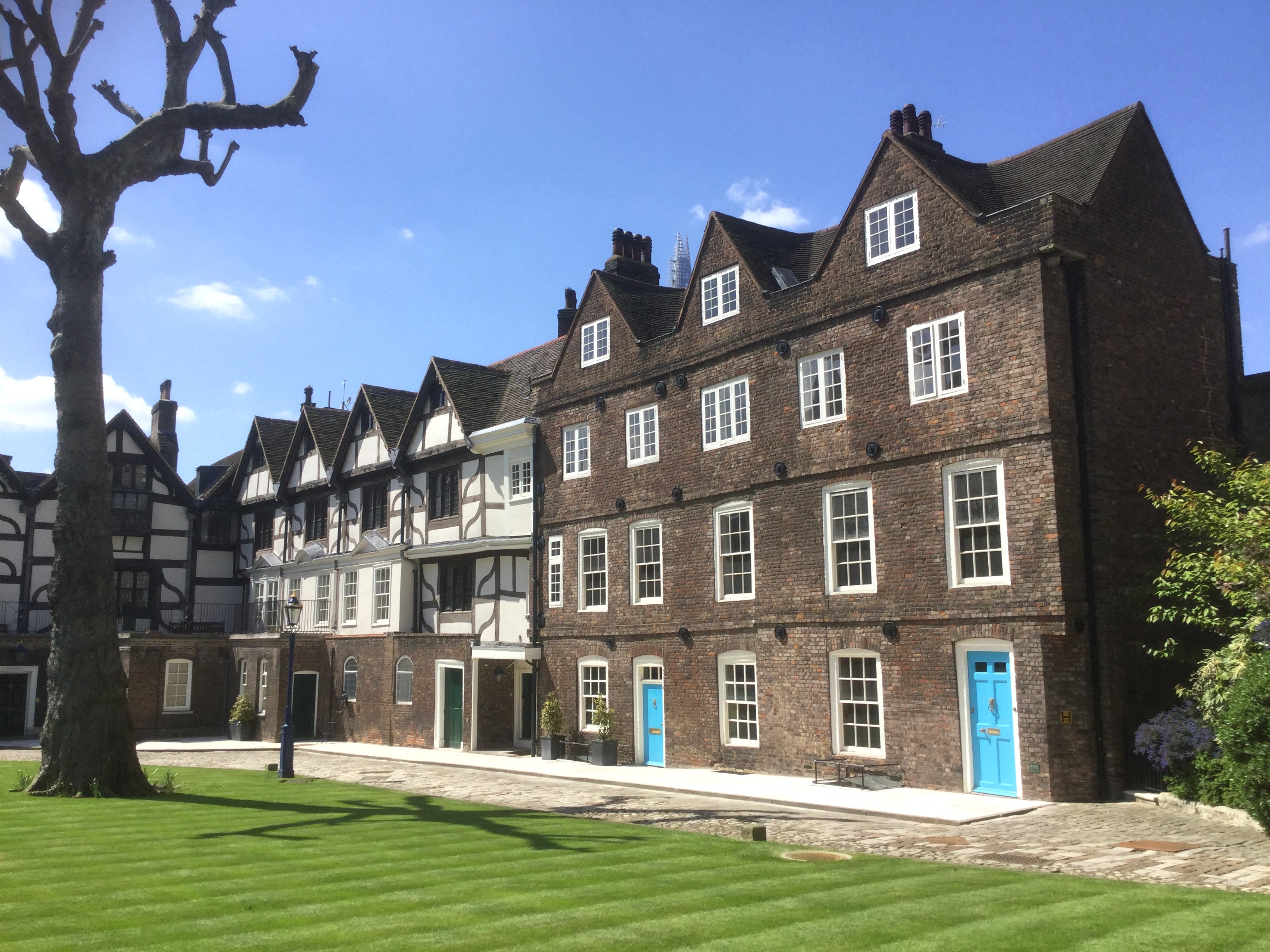
Section of Queen’s House where Lady Jane Grey was kept in the Tower of London

Jane Grey was a distant cousin of Mary; Jane was Henry VIII’s great-niece. Although Mary was the next in line to the throne after her younger brother Edward, according to Henry VIII’s third and final Act of Succession of 1543, the dying fifteen-year-old king named Jane Grey as his heir in hopes that foreign powers would not gain access to the throne through marriage to his elder sisters. It wasn’t just a matter of international politics, however: the Protestant Edward was anxious to keep the throne in Protestant hands and Mary was a committed Catholic. When Mary took power, Edward’s fears were realized: she released all of the Catholics still imprisoned since Henry VIII had them arrested, and worked to return England to the Catholic fold.
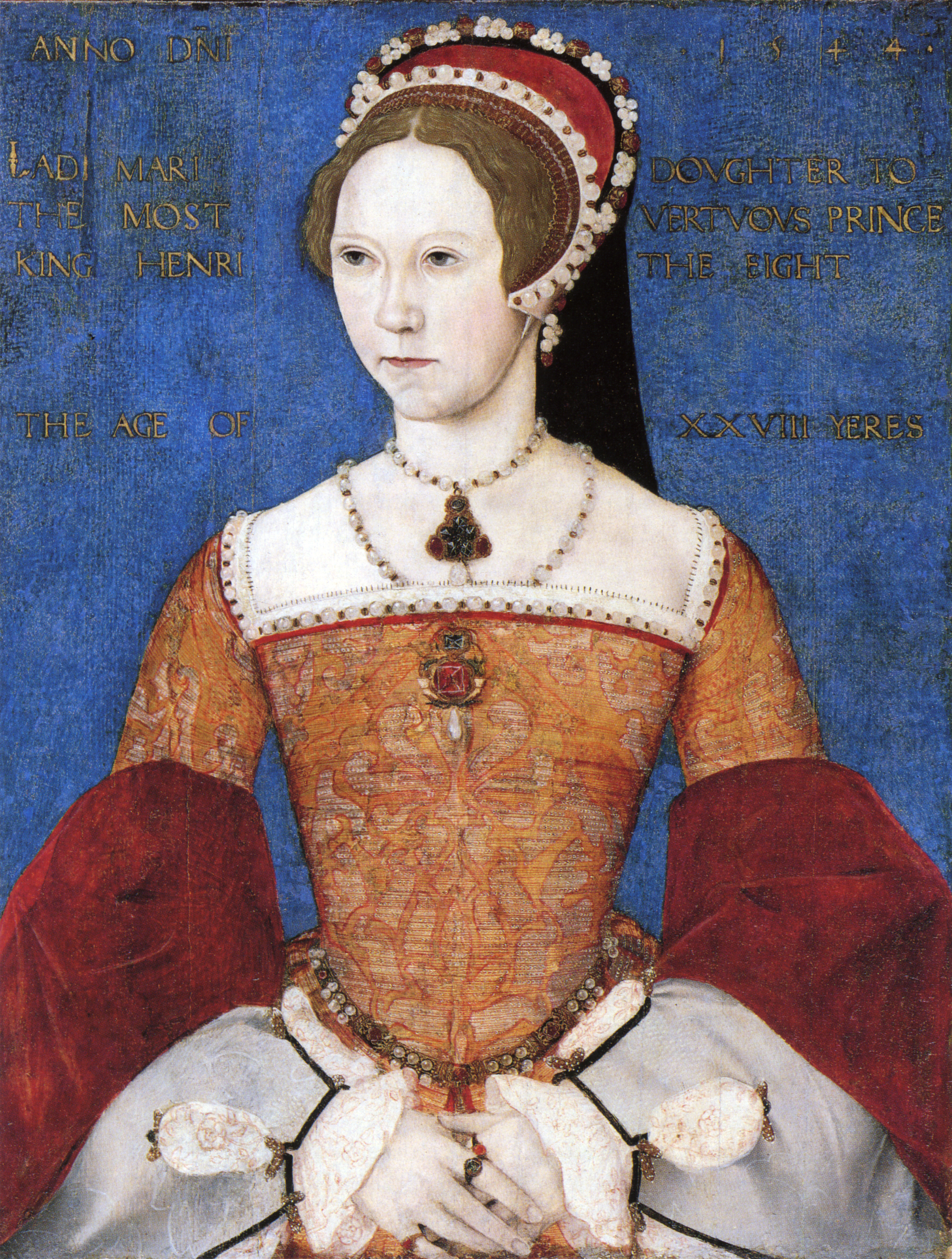
Queen Mary I by Master John, 1544, now at the National Portrait Gallery in London, public domain via Wikimedia Commons

Mary did not want to execute Jane. She was actually very fond of her, just as she was of her little brother Edward, despite their religious differences and despite the fact that they were rival claimants to the throne. Jane was persuaded by her husband Guildford Dudley, her parents, and her ambitious father-in-law the Duke of Northumberland to take the crown according to Edward’s wishes. Mary held the view that many historians still do today, that Jane was an unwilling pawn used to further the interests of power-hungry family members and their connections. Some, however, believe that Jane was more ready and willing to be queen then many of her later chroniclers would admit. She was and still often is portrayed as an innocent martyr to duty, family, and religious conflict. It is true that she was forced into the marriage with Dudley, that she harshly condemned her father-in-law Northumberland’s power grabs, and supported Mary’s ascendancy to the throne. So Mary was more than willing to spare Jane’s life, though she did keep her imprisoned in the Tower for security’s sake. But during her imprisonment, members of Jane’s family and their connections continued to involve themselves in plots to undermine Mary’s reign, and in the interests of removing these persistent threats around their Protestant figurehead Jane, Mary felt forced to act. Jane was executed on the same day as her husband, on February 12th, 1554. According to eyewitness accounts, after watching, at her own insistence, her husband’s execution, Jane faced her death stoically, proclaimed her innocence firmly but not self-pityingly, and held fast to her Protestant beliefs. Her father-in-law Northumberland had already been executed the previous August. Her father Henry Grey, Duke of Suffolk, was executed eleven days later, after having taken part in one too many anti-Mary conspiracies.
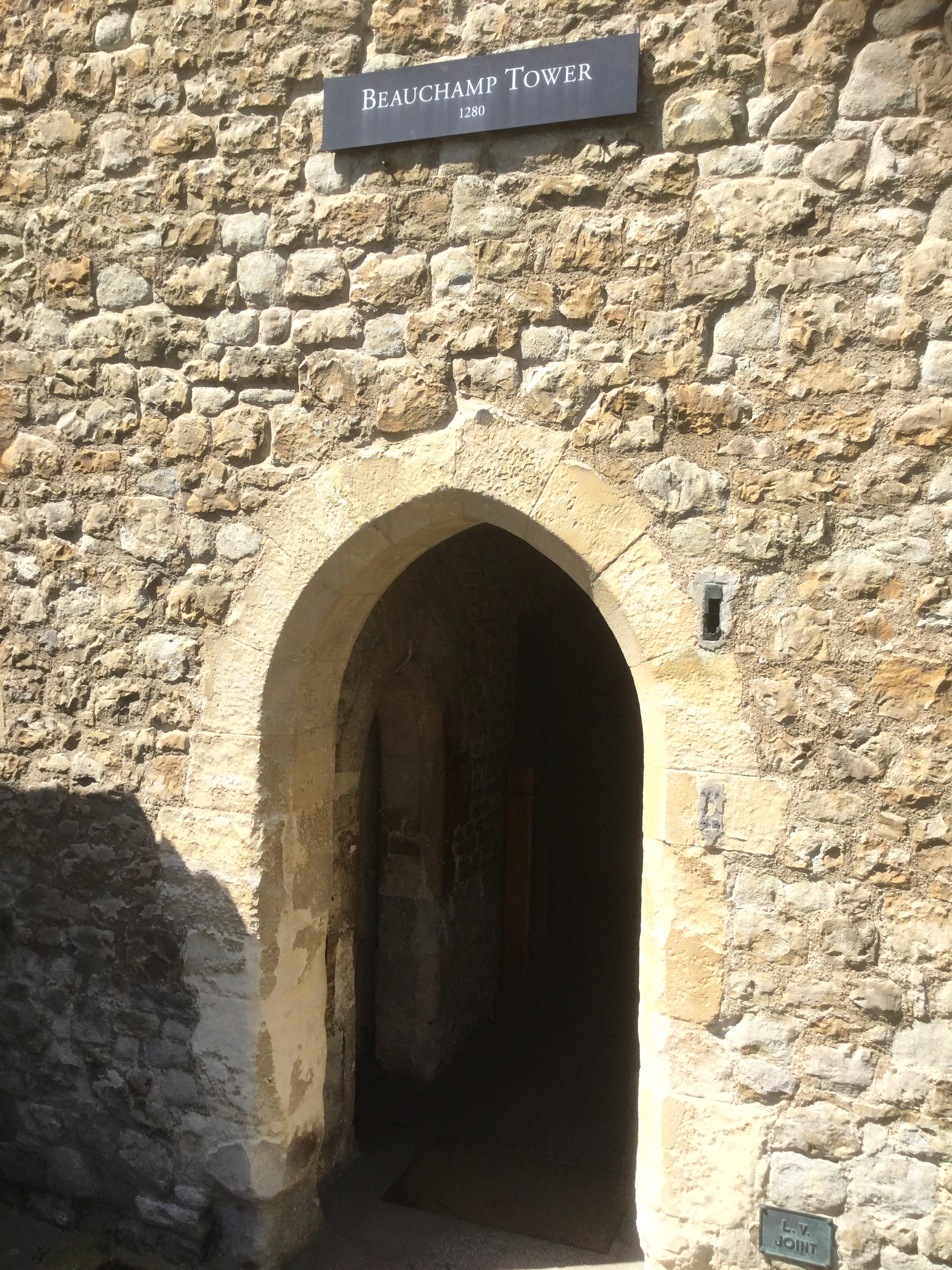
Entrance to the Beauchamp Tower, Tower of London, England

In the long run, Edward VI’s hopes of England continuing as a Protestant country were realized: the unpopular Mary I died on November 17th, 1558, after only a five-year-reign. Her younger sister, the daughter of Anne Boleyn who ascended to the throne as Elizabeth I, broke the pattern her siblings had set of dying after very short reigns. More about Elizabeth shortly.

As we continue past the Queen’s House, Simon points out the upper sections in white plaster supported by dark wood beams, in that classic Tudor style. It was originally built as a living space for Anne Boleyn, Henry VIII’s second wife and the reason he broke off communion with the Church of Rome, but it was not to be used as such. Instead, Anne was imprisoned there for about 18 days before her husband had her executed on May 19th, 1536, not even one year after More was executed in part for opposing her marriage to Henry VIII. I’ve decided not to tell the story of Anne Boleyn here. There’s been a glut of Anne Boleyn-related documentaries, miniseries, and television specials in the last several years, and I feel a bit of Boleyn-related-fatigue at this point. There’s also a five-day-a-week, twice-daily reenactment here at the Tower of Anne’s ‘tragic final days at the famous fortress, from her imprisonment and interrogation, through to her trial and execution,’ according to the Tower of London’s website. During our later Tower explorations, we see the troupe’s retinue, beautifully costumed and equipped, make the solemn march behind the faux Anne from the archway leading from the Traitor’s gate up to the Tower green. Though I won’t tell her story, she will figure in the next one, though.
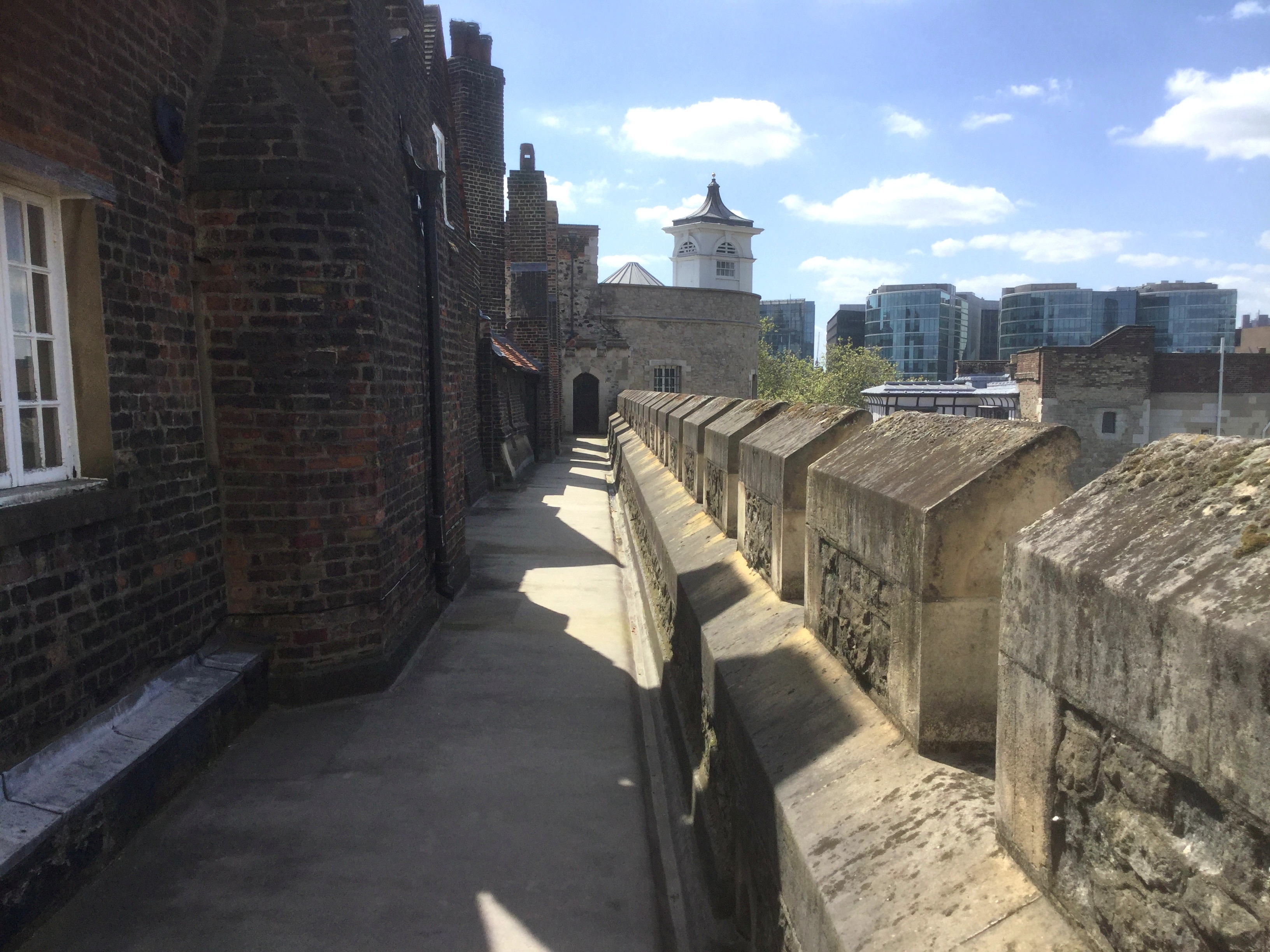
Elizabeth’s Walk leading from the Beauchamp Tower to the Bell Tower, Tower of London
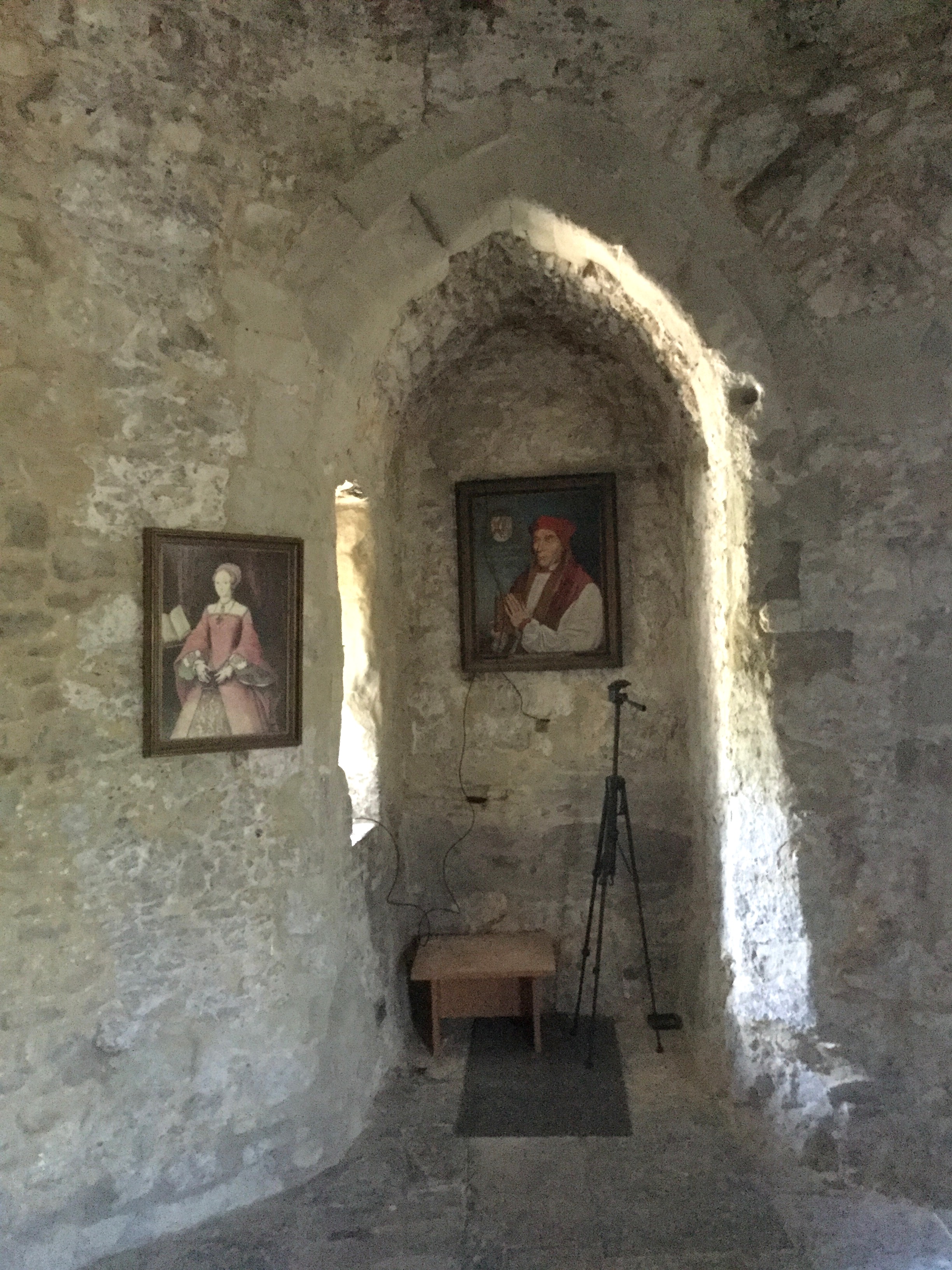
Alcove in the upper cell of the Bell Tower, Tower of London. Note the portraits of Bishop John Fisher, executed two weeks before More, and then-Princess Elizabeth

So, to continue: we follow Simon through the Beauchamp Tower door and up a narrow spiral staircase. There’s some uncertainty as to whether Simon had been given the right key, but after a little fumbling with its inability to smoothly open the lock, it gives way, and we step out onto a long balcony walk with a crenelated wall running along the Tower Green side.

This walkway leads from the Beauchamp Tower to the upper chamber of the Bell Tower, no longer accessible by the old small staircase that had been there in More’s time. Simon confirms that this is the walkway commonly known as Elizabeth’s Walk. Princess Elizabeth, daughter of Henry VIII and his second wife Anne Boleyn, younger sister of Mary, and older sister of Edward, was held here in 1554 following the Wyatt rebellion. This was one of those in which some of Jane’s family and connections were implicated, though the purpose of this one was to prevent Mary from marrying the Catholic Philip of Spain and to put Elizabeth, not Jane, on the throne. A few weeks after the plot was foiled and many involved it in were imprisoned and executed, Mary had Elizabeth committed to the Tower.
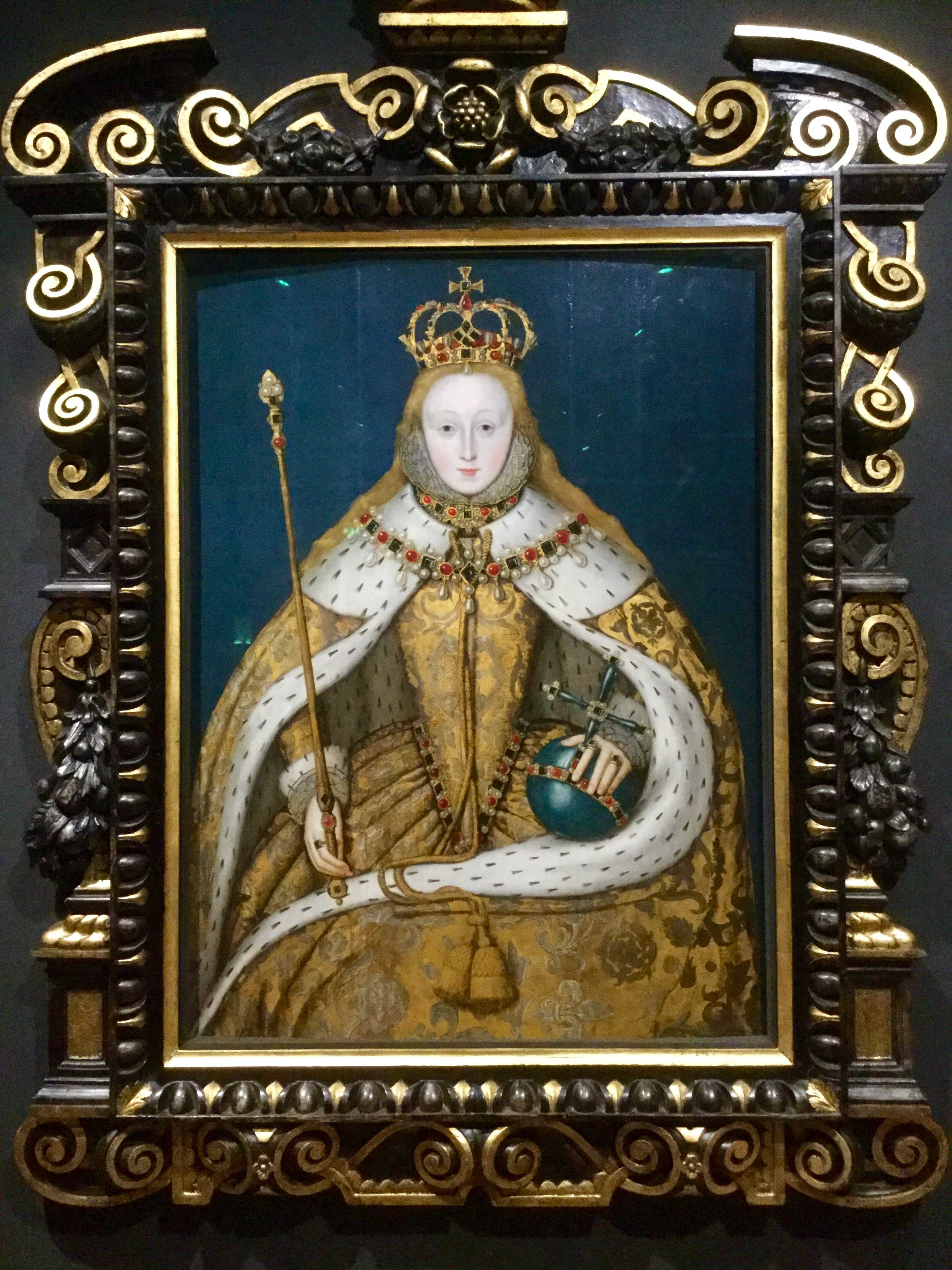
Queen Elizabeth I by unknown English artist, oil on panel, ca 1600, at the National Portrait Gallery, London

Unlike Jane and Edward, Mary did not particularly like Elizabeth. Religion must not have been that much of an issue since Mary loved her brother and cousin despite their religious differences, though it may have contributed. Rather, sibling rivalry likely had much more to do with it, sibling rivalry of a very particular sort, exacerbated or perhaps entirely created by the adults in their lives. When Henry VIII divorced Catherine of Aragon and married Anne Boleyn, he had Mary declared illegitimate as an additional way to bolster the perception of legitimacy for his new marriage. After Anne bore Elizabeth, the new Princess and heir apparent was given the honors and retinue that was stripped from Mary, who was required to stop referring to herself as Princess. Though she could do nothing about the other indignities of losing her place in the royal household, she refused to recognize her demotion to ‘Lady Mary.’ Henry VIII was angered at his daughter’s stubbornness in this matter and punished her for it in various ways, but she would not relent. He may have recognized and even come to respect that the steely will Princess Mary exhibited echoed his own, and over time he softened in his stance toward her.
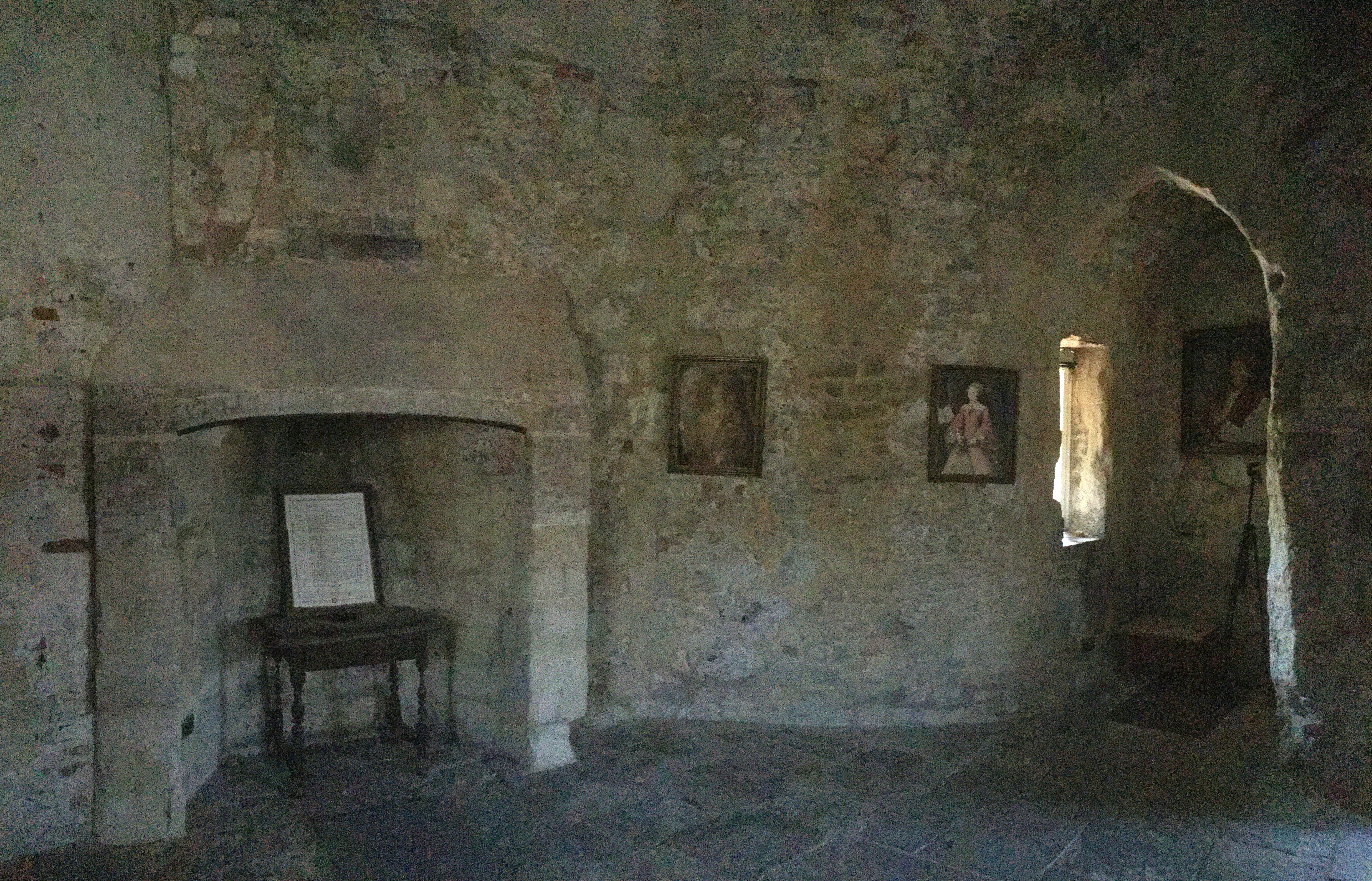
Upper cell of the Bell Tower, Tower of London, England

As we continue along Elizabeth’s Walk, Simon explains that evidence could not be produced that was sufficient to legally convict Elizabeth for her purported connections to plots to undermine or overthrow Mary’s reign. I think this was true for the court of public opinion as well. Immersed in the constantly shifting dangerous royal sand trap that was the Tudor family, the highly intelligent Elizabeth had grown wise and wary very early on. She was just too canny to accept communications from suspicious persons. But, says Simon, since she lied at least by omission since she knew about the plots, Elizabeth was technically guilty. Mary would have been far more legally justified in executing Elizabeth than Jane and nearly did so more than once, but she had reasons to hold back. One, it seems, was her religious compunction against killing her own sister. Another was Mary’s realization that she was growing increasingly unpopular and she was afraid of rousing support for Elizabeth and the Protestant cause by making a martyr of her. Simon tells us that Elizabeth was the only prisoner ever held in this room to survive their imprisonment here.
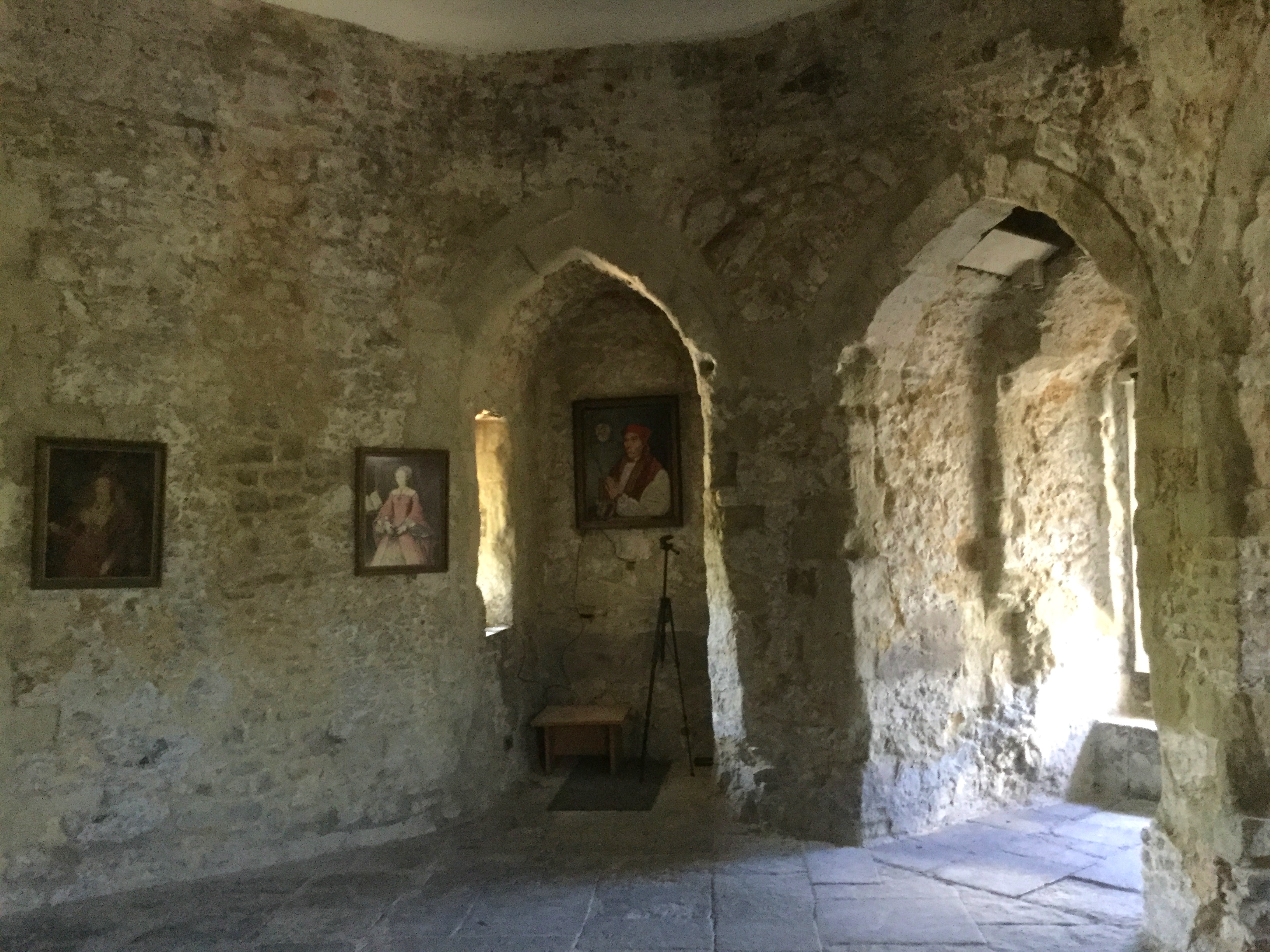
Another view of the upper cell of the Bell Tower, Tower of London

Then Simon opens the door to the Bell Tower’s upper chamber and we enter. In this rough-walled stone room, Princess Elizabeth was held for a time. All told, she was imprisoned in the Tower from mid-March to May 19th of 1554, but according to Patrick Collinson for the Oxford Dictionary of National Biography, she was held for much or most of that time in the aforementioned nearby upper floor apartments-turned-prison built for her mother Anne Boleyn, where the Queen’s House now stands. Perhaps this thickly-built, secure upper room of the Bell Tower we’re in now, above Thomas More’s cell and the same one which reportedly held John Fisher in 1535, may have been the room in which Elizabeth was initially held in or held anytime there seemed to be a danger of her rescue or escape.

Toilet installed for Hitler outside the upper cell of the Bell Tower, Tower of London

Next, Simon leads us down a tiny hallway off to the side of the main chamber. Perhaps, I’m guessing, it leads to where the old communicating stairway was. Whatever its original purpose, we find something very much unexpected: a toilet. Not just any toilet, it turns out. Simon explains that it this room was readied as a possible place to hold Adolf Hitler upon capture. Hitler’s imprisonment here never happened, and this toilet was therefore never used. And so, here it remains. I’m a little surprised it was never removed given its architectural incongruousness and the general depressing creepiness it evokes, but I suppose it’s just too interesting a historical reminder of that time of England’s crisis, tenacity, and triumph.

Simon has other interesting stories to tell us about World War II and his military history in general, which particularly fascinates Laurence. At one time, Simon says, he guarded the imprisoned Rudolf Hess, Adolf Hitler’s right-hand-man, for three years as I remember. Held in the Queen’s House for four days in May of 1941, Hess was the Tower’s last high-profile prisoner, as historian Tracy Borman writes. I won’t go into Simon’s stories of Hess and other military affairs here as they are unrelated to my quest here, but it’s a great starting point for digging into more of the long and fascinating history of the Tower.
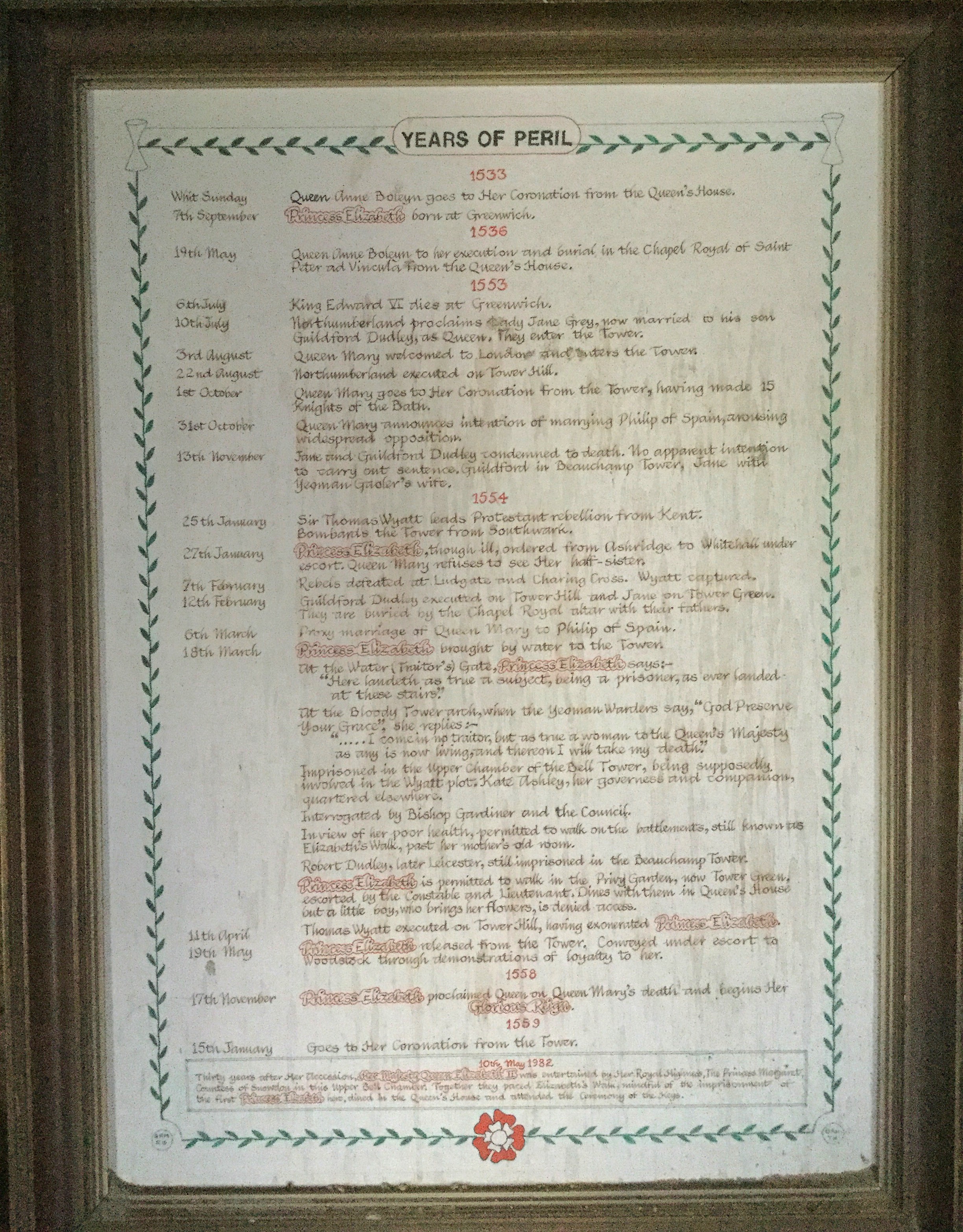
‘Years of Peril’ document in upper cell of the Bell Tower, Tower of London

Returning to the main chamber, I spot a framed document upon a table, leaning against the southeast wall, and move in for a closer look. It’s entitled ‘Years of Peril’, and it’s neatly written by hand in an old-fashioned script, in black highlighted in places with red and surrounded by a green leafy decorative border. In many places, the document is wrinkled and the ink has run from the damp. It’s a great overview of the history we’ve just considered, laid out as a timeline. It reads:

1533

Whit Sunday [1st of June] –  Queen Anne goes to Her Coronation from the Queen’s House
7th September  –  Princess Elizabeth born at Greenwich

1536

19th May  –  Queen Anne to her execution and burial in the Chapel Royal of Saint Peter ad Vincula from the Queen’s House

1553

6th July  –  King Edward dies at Greenwich
10th July  –  Northumberland proclaims Lady Jane Grey, now married to his son Guildford Dudley, as Queen, they enter the Tower
3rd August  –  Queen Mary welcomed to London and enters the Tower
22nd August  –  Northumberland executed on Tower Hill
1st October  –  Queen Mary goes to Her Coronation from the Tower, having made 15 Knights of the Bath
31st October  –  Queen Mary announces intention of marrying Philip of Spain, arousing widespread opposition
13th November  –  Jane and Guildford Dudley condemned to death. No apparent intention to carry out sentence. Guildford in Beauchamp Tower, Jane with Yeoman Gaoler’s wife.

1554

25th January  –  Sir Thomas Wyatt leads Protestant rebellion from Kent. Bombards the Tower from Southwark.
27th January  –  Princess Elizabeth, though ill, ordered from Ashridge to Whitehall under escort. Queen Mary refuses to see Her half-sister.
7th February  –  Rebels defeated at Ludgate and Charing Cross. Wyatt captured.
12th February  –  Guildford Dudley executed on Tower Hill and Jane on Tower Green. They are buried by the Chapel Royal altar with their fathers.
6th March  –  Proxy marriage of Queen Mary to Philip of Spain
18th March  –  Princess Elizabeth brought by water to the Tower.
At the Water (Traitor’s) Gate, Princess Elizabeth says: –
“Here landeth as true a subject, being a prisoner, as ever landed at these stairs.”
At the Bloody Tower arch, when the Yeoman Warders say, “God Preserve Your Grace,” she replies: –
“…..I come no traitor, but as true a woman to the Queen’s Majesty as any is now living, and thereon I will take my death.”
Imprisoned in the Upper Chamber of the Bell Tower, being supposedly involved in the Wyatt Plot. Kate Ashley, her governess and companion, quartered elsewhere.
Interrogated by Bishop Gardiner and the Council.
In view of her poor health, permitted to walk on the battlements, still known as Elizabeth’s Walk, past her mother’s old room.
Robert Dudley, later Leicester, still imprisoned in the Beauchamp Tower.
Princess Elizabeth is permitted to walk in the Privy Garden, now Tower Green, escorted by the Constable and Lieutenant. Dines with them in Queen’s House but a little boy, who brings her flowers, is denied access.
11th April  –  Thomas Wyatt executed on Tower Hill, having exonerated Princess Elizabeth.
19th May  –  Princess Elizabeth released from the Tower. Conveyed under escort to Woodstock through demonstrations of loyalty to her.

1558

17th November  –  Princess Elizabeth proclaimed Queen on Mary’s death and begins Her Glorious Reign

1559

15th January  –  Goes to Her Coronation from the Tower

====================
10th May, 1982

Thirty years after Her Accession, Her Majesty Queen Elizabeth II was entertained by Her Royal Highness, The Princess Margaret, Countess of Snowdon in this Upper Bell Chamber. Together they paced Elizabeth’s Walk, mindful of the imprisonment of the first Princess Elizabeth here, dined in the Queen’s House and attended the Ceremony of the Keys.’
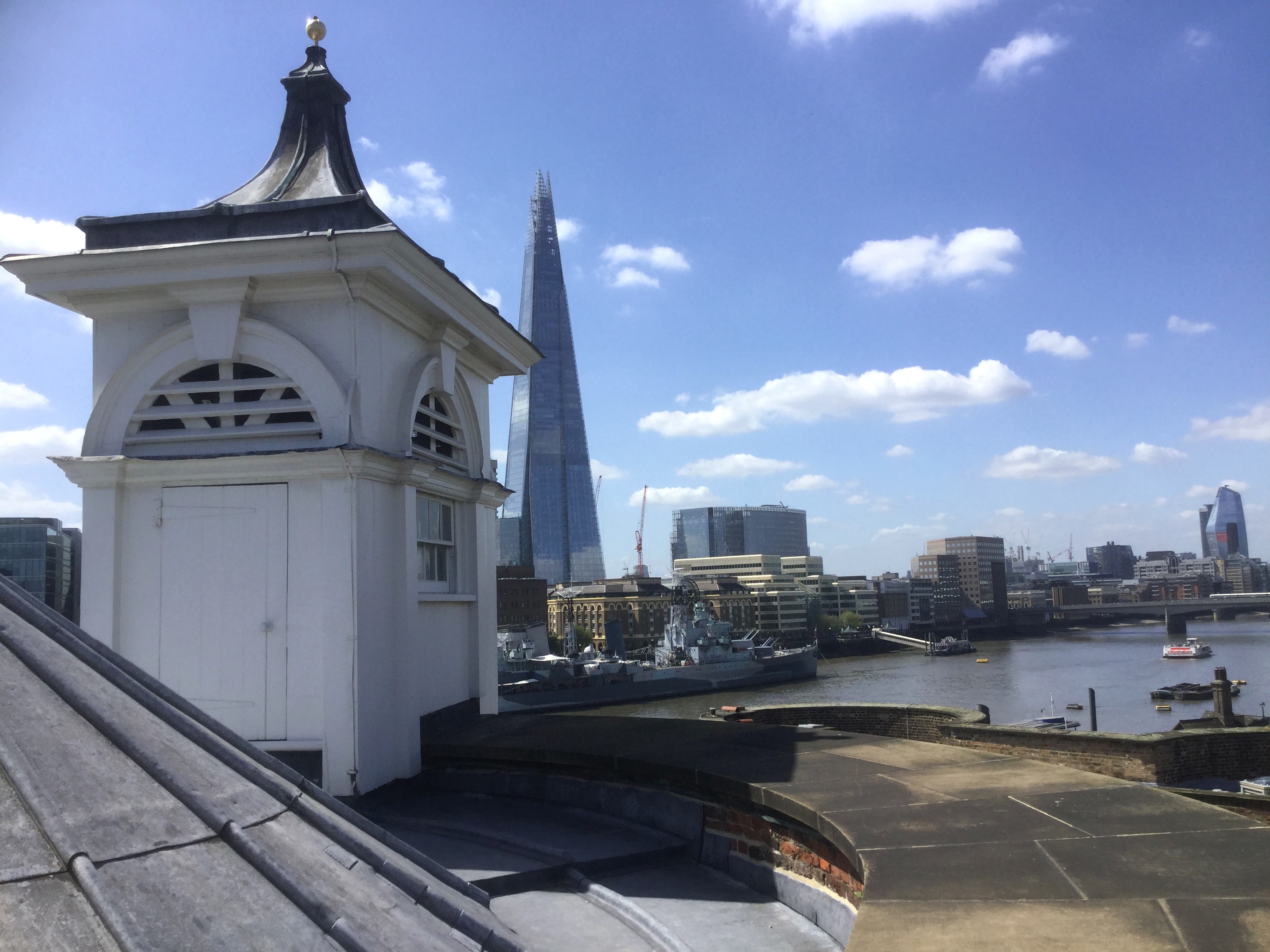
The Bell Tower cupola and a view of London and the Thames, Tower of London

The bell in the cupola of the Bell Tower, Tower of London, England, photo 2018 Amy Cools

The bell in the cupola of the Bell Tower, Tower of London

In the end, not only was Edward VI’s hopes of England remaining Protestant realized; his fears of a foreign prince taking power in England through marriage to one of his sisters came to naught. As her early chronicler William Camden described, Elizabeth was courted vigorously and widely by princes and aristocrats all over the Western world, some of whom she was personally fond of, and many of which could have helped replenish England’s exhausted coffers and bolster its world influence. Yet, she refused all of them. Her determination to remain single followed a severe bout of smallpox in 1562 which nearly killed her; such crises have a way of centering the mind and inspiring one to firmly establish priorities. As Camden reports, the next year Elizabeth replied to Parliament’s urging that she take a husband and produce heirs: ‘Yea, to satisfy you, I have already joined myself in marriage to an husband, namely, the Kingdom of England. And behold [taking a ring off her finger and showing it to them] the pledge of this my wedlock and marriage with my kingdom.’ And to underscore her determination to rule with authority in her own right, dominated by no man, Elizabeth continued, ‘But I commend you that ye have not appointed me a husband, for that were most unworthy the majesty of an absolute princess, and unbeseeming to your wisdom, which are subjects born.’ Elizabeth I was known through her long reign and ever after as the Virgin Queen.

After I do some photography, we leave the chamber through a little door, climb another little stairway,  and emerge onto the rooftop of the Bell Tower. The views up here are amazing, especially on this bright sunny day. The scattered clouds are puffy, the sky is a bright clear blue, and London is gleaming. We enter the pointy-roofed cupola and examine the old bell within. Simon tells us that this bell, once rung at executions, is now rung twice a day at curfew. We take in the views, talking all the while. Simon answers my questions about the histories I’m telling here and about good resources for researching my stories. He also tells us more interesting stories from his military career and of military history in general, again outside of the scope of this piece.
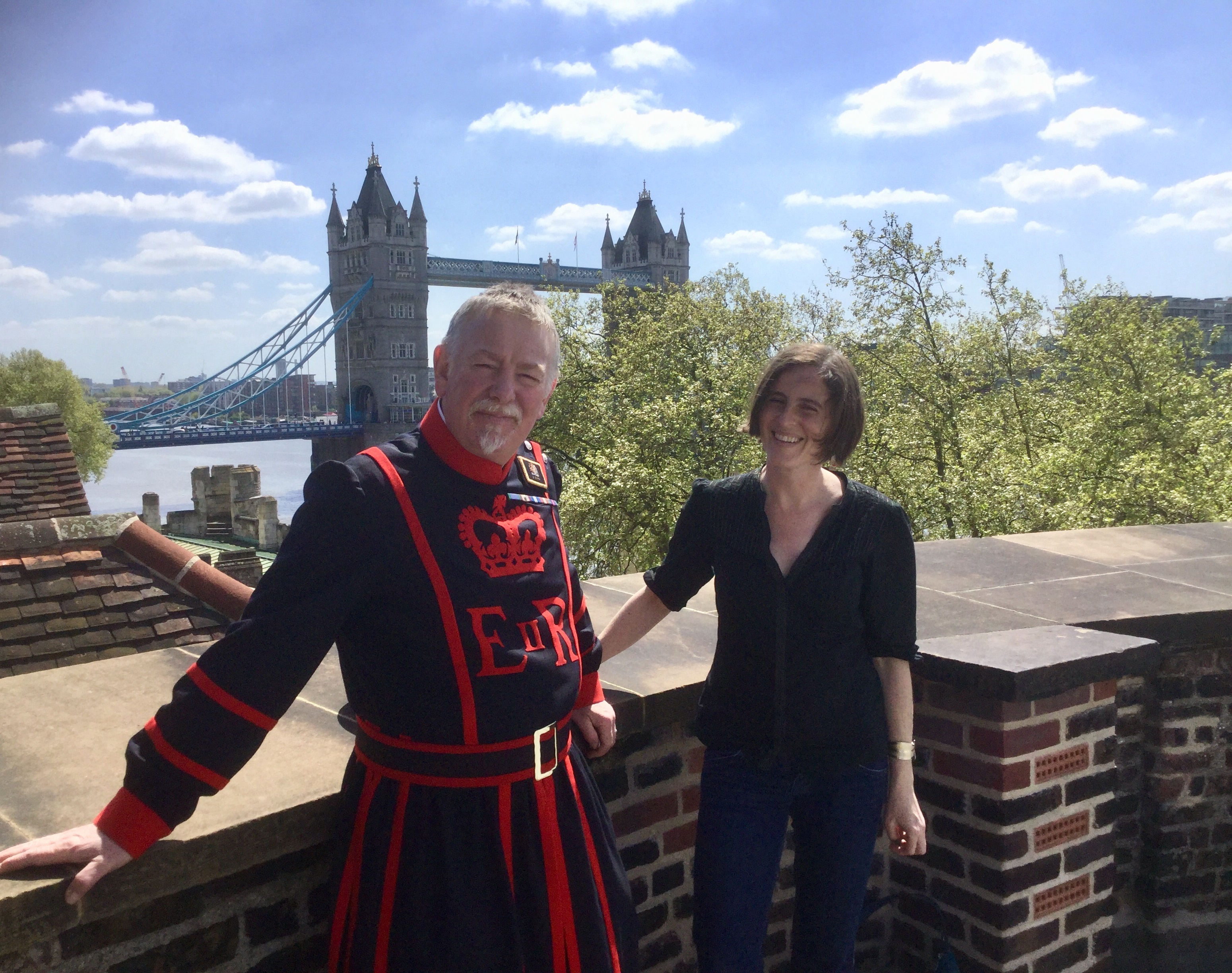
Simon Dodd and Amy Cools atop the Bell Tower, Tower of London

Inscription and clarification in the upper cell of the Bell Tower, Tower of London

As we go down again, on our way out of the Bell Tower chamber, I spot a section of stone that’s been inscribed and covered with a protective clear covering of glass or plastic, and a black slate underneath it with a transcription, strapped to the wall. In answer to my question, Simon tells me there’s a tradition that it was carved when Elizabeth was imprisoned here but it’s not really known just who carved it. Both texts are both worn and difficult to read. Here’s my best attempt to decipher what they say:

In forture strange
My trouth was tried
Yet of my liberty ye denied
There for reson, hath
Me perswaded did that
Pasyens must be ymb
rasyd. Thogh hard
Or unchasyth
Me with smart[…?]
Yet pasyens shall prevail

The gist of its meaning seems to be that the writer’s integrity was attacked and tried through the inexplicable circumstances of fortune and imprisonment. Though imprisoned, however, they decided that patience must be ‘ymbrasyd’ and that it would prevail in the end.
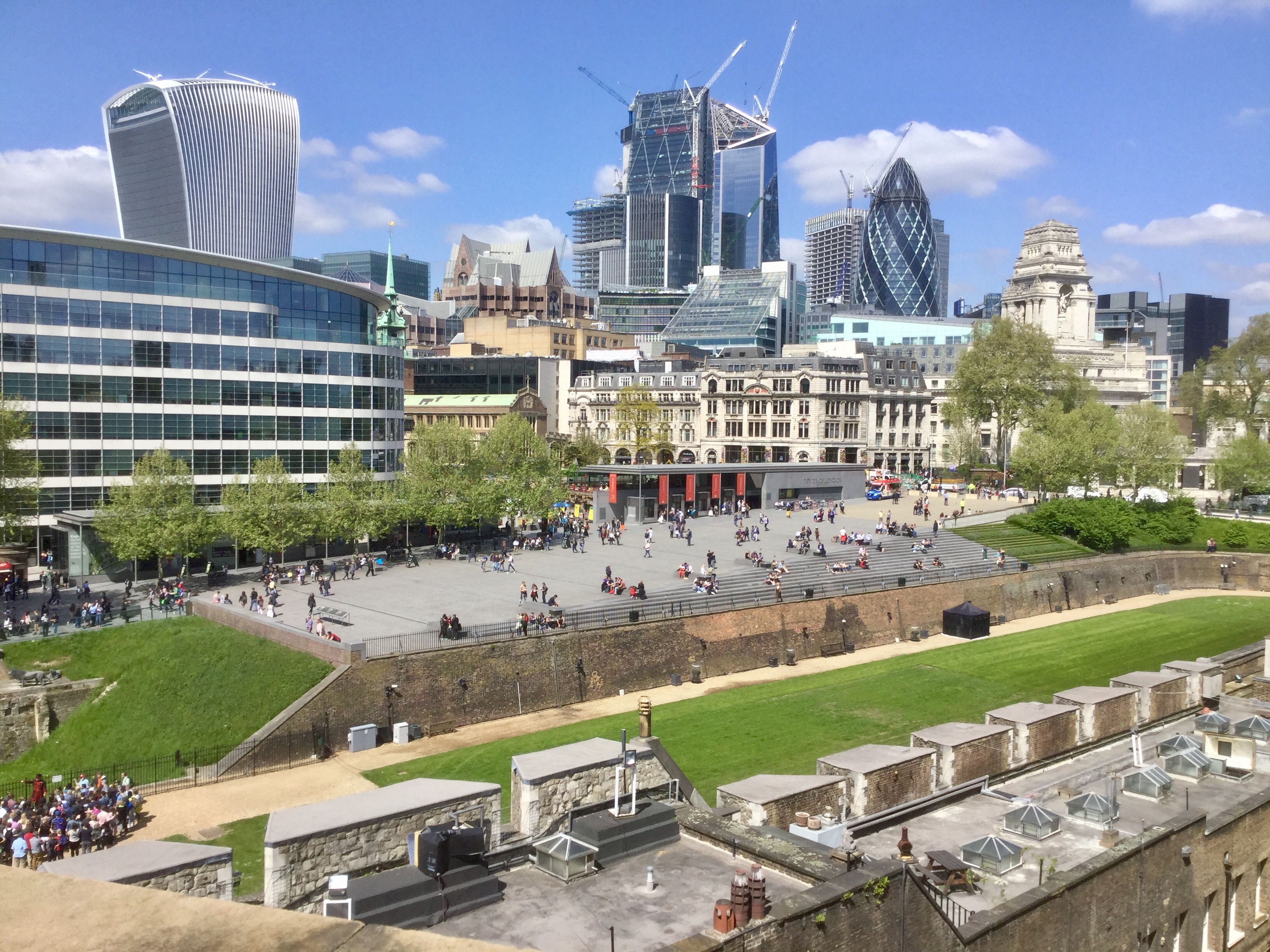
A view of London from the Bell Tower, Tower of London

We leave the Bell Tower, and in the courtyard near Tower Green, we thank Simon profusely and we all say our goodbyes. Then, accompanied by Laurence, I continue my Tower quest in the places that are accessible to us without official accompaniment. There are so many more fascinating aspects of these stories to be explored, and we press on. To be continued….

*Patron of this Tower of London journey: Laurence Murphy ~ With warmest gratitude, thank you!*

*Listen to the podcast version here

~ Ordinary Philosophy is a labor of love and ad-free, supported by patrons and readers like you. Any support you can offer will be deeply appreciated!

~~~~~~~~~~~~~~~~~~~~~~

Sources and inspiration:

Ackroyd, Peter. The Life of Thomas More. London: Chatto & Windus, 1998

Annual Survey of Visits to Visitor Attractions: Latest Results.‘ VisitBritain.org

The Bell Tower.’ English Monarchs website.

Borman, Tracy. The Story of the Tower of London. London: Merrell Publishers Limited, 2015

Borman, Tracy. ‘The Tudors and the Tower.‘ Tudor Times website, 3 Aug 2015

Camden, William Norton, Robert; Hans and Hanni Kraus. The historie of the most renowned and victorious Princesse Elizabeth, late queen of England. Contayning all the important and remarkeable passages of state both at home and abroad, during her long and prosperous raigne. Composed by way of annals. Neuer heretofore so faithfully and fully published in English. Sir Francis Drake Collection Library of Congress. London: Printed by N. Okes for B. Fisher; 1630

Chelsea Old Church: Thomas More.’ Chelsea Old Church website

Collinson, Patrick. ‘Elizabeth I (1533–1603), Queen of England and Ireland.‘ Oxford Dictionary of National Biography.

English Monarchs website: ‘The Bell Tower’ and ‘The Queen’s House

Freeman, Thomas S. (2002). ‘`As true a subiect being prysoner’: John Foxe’s notes on the imprisonment of Princess Elizabeth, 1554-5.‘ (Notes And Documents). The English Historical Review, 117(470), 104-116

Furness, Hannah. ‘Wolf Hall is ‘Deliberate Perversion’ of History, says David Starkey.The Telegraph, 26 Jan 2015

Guy, John. A Daughter’s Love: Thomas and Margaret More. London: Fourth Estate, 2008

Guy, John. ‘For What Did Thomas More So Silently Die?’ Lecture published at Tudors.org

House, Seymour Baker. ‘More, Sir Thomas [St Thomas More] (1478–1535), Lord Chancellor, Humanist, and Martyr.‘ Oxford Dictionary of National Biography.

Ives, Eric William. ‘Henry VIII (1491–1547), King of England and Ireland.’ Oxford Dictionary of National Biography.

Jones, Jonathan. ‘Wolf Hall is Wrong: Thomas More was a Funny, Feminist Renaissance Man.‘ The Guardian, 29 Jan 2015

Kennedy, Maev. ‘Historians Scorn Claims over Thomas More’s Cell.The Guardian, 10 Jan 2000

Marc’hadour, Germain P. ‘Thomas More.’ Encyclopædia Britannica

More, Thomas. The Apology of Sir Thomas More, Knight. from The Complete Works of St. Thomas More, Vol. 9. Yale University Press, published online by The Center for Thomas More Studies

More, Thomas. Conscience Decides: Letters and Prayers from Prison Written Between April 1534 and July 1535. Selected and arranged by Dame Bede Foord; preface by Trevor Huddleston; introduction by Germain Marc’hadour. London: Geoffrey Chapman Ltd, 1971

More, Thomas. The English Correspondence of Sir Thomas More, 1947 Rogers edition, Princeton University Press, published online by The Center for Thomas More Studies

Moynahan. God’s Bestseller: William Tyndale, Thomas More, and the Writing of the English Bible – A Story of Martyrdom and Betrayal. New York: St. Martin’s Press, 2003

Plowden, A. ‘Grey [married name Dudley], Lady Jane (1537–1554), Noblewoman and Claimant to the English Throne.Oxford Dictionary of National Biography.

Roper, William. The Life of Sir Thomas More1556. Ed. Gerard B. Wegemer and Stephen W. Smith. Center for Thomas More Studies, 2003

Stanford, Peter. ‘Sir Thomas More: Saint or Sinner?’ The Telegraph, 20 Jan 2015

Teysko, Heather and Melita Thomas. ‘Tudor Times on Thomas More.’ Renaissance English History Podcast: A Show About the Tudors, episode 55, Sep 16, 2016

Weikel, Ann. ‘Mary I (1516–1558), Queen of England and Ireland.’ Oxford Dictionary of National Biography

Happy Birthday, Walt Whitman!

Walt Whitman, age 35, from Leaves of Grass, Fulton St., Brooklyn, N.Y., engraving by Samuel Hollyer from daguerreotype by Gabriel Harrison, public domain via Wikimedia CommonsWalt Whitman, an American, one of the roughs, a kosmos, Disorderly fleshy and sensual . . . . eating drinking and breeding, No sentimentalist . . . . no stander above men and women or apart from them . . . . no more modest than immodest.’ Thus Walt Whitman (May 31, 1819 – March 26, 1892) introduces himself to us for the first time in his first self-published 1855 edition of Leaves of Grass. Not on the cover or on the title page, mind you, but deep within the body of the untitled poem later called Song of Myself. If this is a dialing-back attempt to inject a little respectable humility or yet another self-aggrandizing affectation on the part of this unapologetic egoist, it’s hard to say definitely, though I strongly suspect it’s the latter. It certainly is so-very-American.

Whitman was confident, earthy, crude, and vibrant, a self-styled natural man whose personas were nonetheless carefully crafted. He did his own thing and ‘lived the free life of a rover’ (an Eric Bogle phrase from his great anti-war ballad And the Band Played Waltzing Matilda), working odd jobs as a printer, journalist, teacher, and clerk, among other things. Moved by horror and compassion at the magnitude of death and suffering he observed, he worked some years as a nurse to the Civil War wounded, and spent much of his somewhat meager earnings on supplies for their comfort and care. He remained single but had many lovers, probably mostly homosexual, though he praises the physical beauty and power of women as lavishly in his poems as he does that of men. All the while, starting at just over age 30, Whitman began to write his highly idiosyncratic, free verse poetry celebrating the authentic and the crafted self, the human body, democracy, equality, work, nature, and companionship. He spent the rest of his somewhat long life revising and republishing several editions of Leaves of Grass, up to several months before his death at age 72 in 1892.

To read more work by, about, and inspired by the great Walt Whitman, here are some links and articles:

Leaves of Grass (1855) – by Walt Whitman, published in the Electronic Text Center, University of Virginia Library

Poems – by Walt Whitman at Poets.org

Walt Whitman – by Gay Wilson Allen Alexander Norman Jeffares for Encyclopædia Britannica

Walt Whitman, 1819–1892 – The Poetry Foundation 

The Walt Whitman Archive – by Ed Folsom and Kenneth M. Price, Ed., published by the Center for Digital Research in the Humanities at the University of Nebraska–Lincoln

and just because I love it:

The Body Electric, song and music video by Hooray for the Riff Raff. The song title is inspired by one of Whitman’s most enduring and controversial poems and is a critique of the traditional murder ballad

*A version of this piece was previously published at Ordinary Philosophy

~ Ordinary Philosophy is a labor of love and ad-free, supported by patrons and readers like you. Any support you can offer will be deeply appreciated!

Happy Birthday, Julia Ward Howe!

Julia Ward Howe, ca. 1855

Julia Ward Howe, poet and activist, was born on May 27, 1819, and lived a long life ever dedicated to social reform.

She’s best known as the author of the Battle Hymn of the Republic, the stirring Civil War anthem still sung at military events and in churches today; I remember singing it at Mass growing up. Filled with Biblical imagery, it reminds me of the Old Testament-inspired Second Inaugural Address of Abraham Lincoln. In it, he addresses the terrible costs of the war in lives and property, surmising that God’s justice may demand that ‘all the wealth piled by the bondman’s two hundred and fifty years of unrequited toil shall be sunk., and …every drop of blood drawn with the lash shall be paid by another drawn with the sword’ in recompense for the terrible sin of slavery.

Howe wrote her Hymn in 1861, Lincoln’s Second Inaugural was delivered in 1865. Lincoln is known to have heard the Battle Hymn and reported to have wept when he did. Lincoln was well versed in Scripture and references it liberally in his writings and speeches; nevertheless, he may also have had Howe’s Hymn in mind when he wrote his Address. In any case, both remain prominent in American historical memory, continuing to resonate and inspire today in our Protestantism-derived culture. John Steinbeck uses her Book of Revelation-derived phrase The Grapes of Wrath as the title of his great novel about the suffering of Dust Bowl refugees fleeing to California. The great Leonard Cohen references her Hymn in ‘Steer Your Way’ from You Want It Darker, his final album released shortly before his death last fall. Howe’s lyric ‘As he died to make men holy, let us die to make men free’ becomes ‘…let us die to make things cheap.’ Cohen redirects her line to critique today’s great sin of destroying our environment likewise out of greed, complacency, indifference to the fate we’re creating for our descendants, and slavish adherence to the ‘way it’s always been done.’

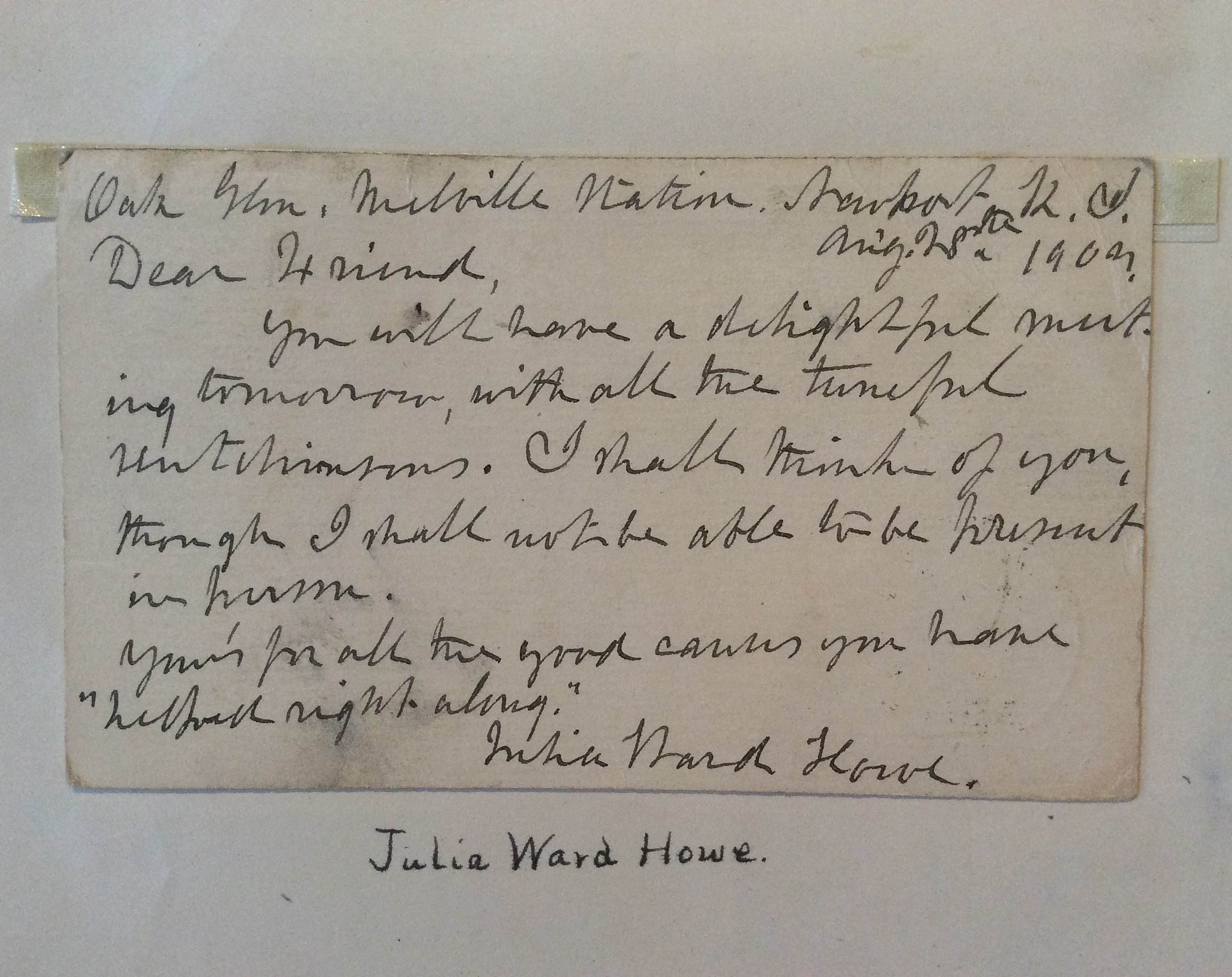
Julia Ward Howe postcard dated August 28th, 1903, from the Hutchinson Family Scrapbook in the collection of the Lynn Historical Society in Massachusetts. I was here in spring 2016 following the life and ideas of Frederick Douglass. The Hutchinson family dedicated their musical skills to the abolition movement and other reform causes and were friends with many prominent activists of their day. The scrapbook doesn’t note which member of the Hutchinson family Howe wrote this card to.

Read more about this great abolitionist, feminist, and author:

Julia Ward Howe, 1819–1910: BiographyPoetry Foundation

Julia Ward Howe (1819-1910) – by Debra Michals for the National Women’s History Museum

‘The Civil Wars of Julia Ward Howe,’ by Elaine Showalter – by Jill Lepore for The New York Times

Julia Ward Howe, 1819-1910, Volume 1 – by Laura Elizabeth Howe Richards, Maud Howe Elliott, and Florence Howe Hall, 1915

*A version of this piece was previously published at Ordinary Philosophy

~ Ordinary Philosophy is a labor of love and ad-free, supported by patrons and readers like you. Any support you can offer will be deeply appreciated!

New Podcast Episode: The Bell Tower, Tower of London: Thomas More, Elizabeth I, and Other Histories, Part 1

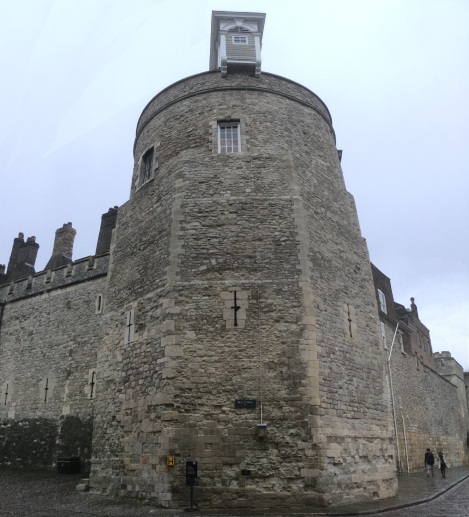
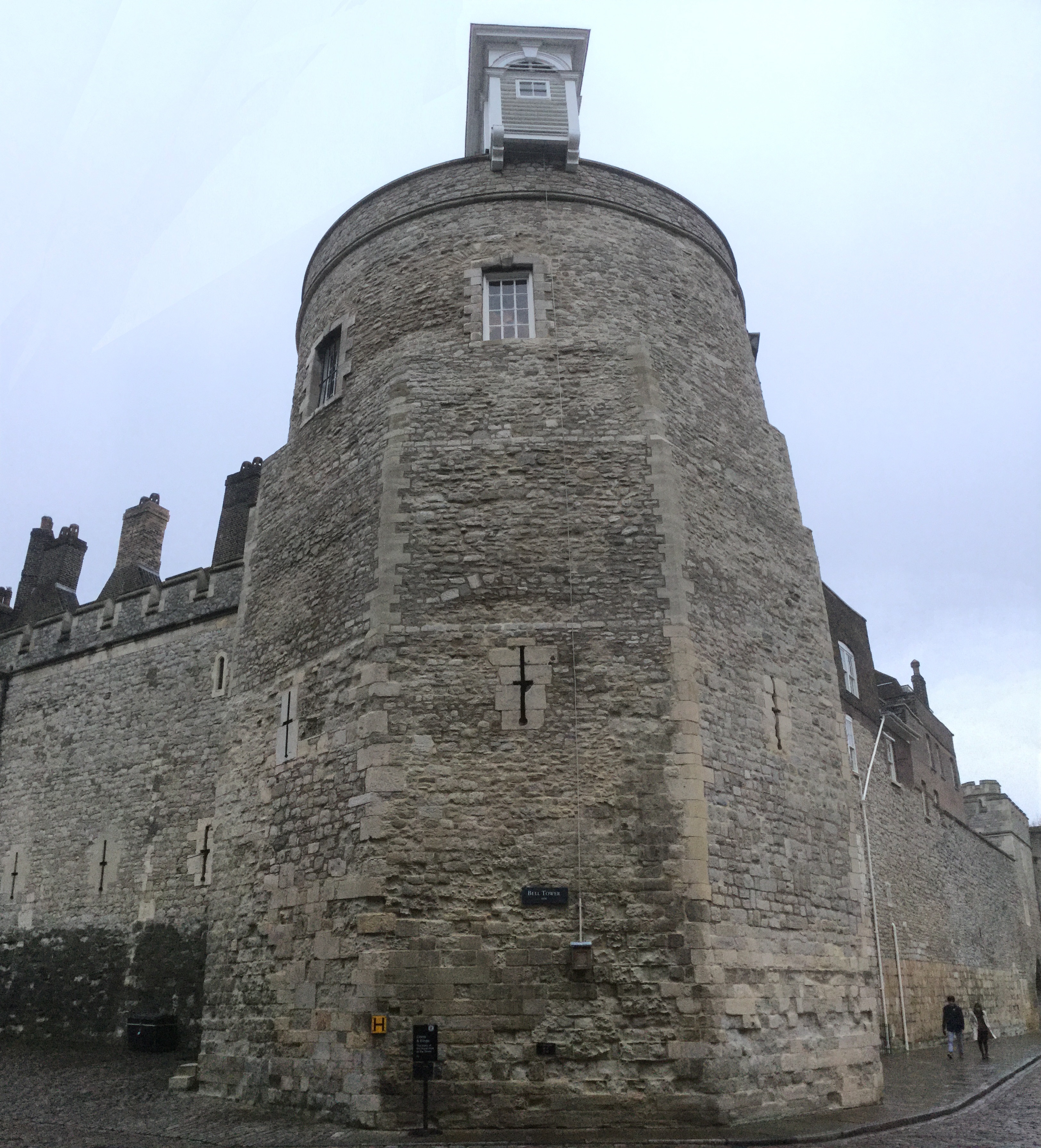
Bell Tower, Tower of London, England

Listen to this podcast episode here

Saturday, May 4th, 2018

I first visited the Tower of London in January of this year with my friend Steven, a fellow student of history; I at the University of Edinburgh in Scotland, he at King’s College, London. We had great fun, two history nerds running around London for a couple of days! While we were at the Tower, I looked for the cell where Sir Thomas More was imprisoned for over a year before he was executed for treason on July 6th, 1535. Like many brought up in Catholic families after the film was made, I grew up watching the adaptation of Robert Bolt’s Man for All Seasons starring Paul Scofield, seeing it so many times I believe I could have parroted the dialogue from entire scenes from memory with little effort. Going back and watching clips, I still remember just about everything that every character will say and do ahead of time. The tragic story of and Scofield’s compelling characterization of the clever lawyer and saint captured my imagination. Since then, I’ve read more about him over the years and broadened my understanding of this man, who was much more complex than the stellar but somewhat two-dimensional martyr of integrity and righteousness portrayed in the film… Read the written version here

~ Ordinary Philosophy is a labor of love and ad-free, supported by patrons and readers like you. Any support you can offer will be deeply appreciated!

Happy Birthday, John Stuart Mill!

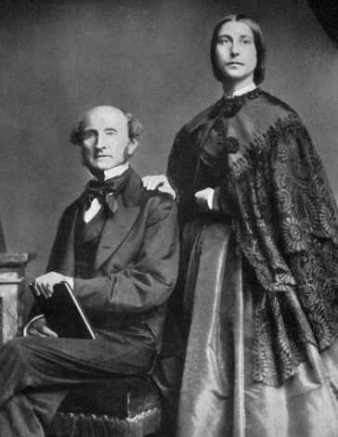
John Stuart Mill and Helen Taylor, daughter of Harriet Taylor, collaborated with Mill after her mother's death, public domain via Wikimedia Commons

John Stuart Mill and Helen Taylor, daughter of Harriet Taylor, who collaborated with Mill after her mother’s death. Public domain via Wikimedia Commons

…The writings by which one can live are not the writings which themselves live, and are never those in which the writer does his best.

John Stuart Mill, from his Autobiography

One of my favorite ideas in political philosophy is John Stuart Mill’s ‘marketplace of ideas’ (though he didn’t phrase it this way himself): that the free, open, and vigorous exchange of ideas in the public sphere does more to further human knowledge than anything else. But not only has his comprehensive and to my mind, absolutely correct defense of free speech in his great work On Liberty had an immense and beneficial influence on the history and theory of human rights, he was admirable in myriad other ways as well:

‘Mill believed in complete equality between the sexes, not just women’s colleges and, someday, female suffrage but absolute parity; he believed in equal process for all, the end of slavery, votes for the working classes, and the right to birth control (he was arrested at seventeen for helping poor people obtain contraception), and in the common intelligence of all the races of mankind… all this along with an intelligent acceptance of the free market as an engine of prosperity and a desire to see its excesses and inequalities curbed…. Mill was an enemy of religious bigotry and superstition, and a friend of toleration and free thought, without overdoing either…’

~ Adam Gopnik, from his article and book review ‘Right Again‘, 2008

John Stuart Mill, from an exhibit at the Museum of the University of St Andrews

‘The son of James Mill, a friend and follower of Jeremy Bentham, John Stuart Mill (1806-1873) was subjected to a rigorous education at home: he mastered English and the classical languages as a child, studied logic and philosophy extensively, read the law with John Austin, and then embarked on a thirty-five career with the British East India Company at the age of seventeen. (He also suffered through a severe bout of depression before turning twenty-one.) Despite such a rich background, Mill credited the bulk of his intellectual and personal development to his long and intimate association with Harriet Hardy Taylor. They were devoted friends for two decades before the death of her husband made it possible for them to marry in 1852; she died in Avignon six years later. Mill continued to write and to participate in political affairs, serving one term in Parliament (1865-68). The best source of information about Mill’s life is his own Autobiography (1873).

Philosophically, Mill was a radical empiricist who held that all human knowledge, including even mathematics and logic, is derived by generalization from sensory experience. In A System of Logic, Ratiocinative and Inductive (1843) he explained in great detail the canons for reasoning inductively to conclusions about the causal connections exhibited in the natural world.

Mill’s moral philosophy was a modified version of the utilitarian theory he had learned from his father and Bentham. In the polemical Utilitarianism (1861) Mill developed a systematic statement of utilitarian ethical theory. He modified and defended the general principle that right actions are those that tend to produce the greatest happiness of the greatest number of people, being careful to include a distinction in the quality of the pleasures that constitute happiness. There Mill also attempted a proof of the principle of utility, explained its enforcement, and discussed its relation to a principle of justice.

Mill’s greatest contribution to political theory occurs in On Liberty (1859), where he defended the broadest possible freedom of thought and expression and argued that the state can justify interference with the conduct of individual citizens only when it is clear that doing so will prevent a greater harm to others. Mill also addressed matters of social concern in Principles of Political Economy (1848) and Considerations on Representative Government (1861) and eloquently supported the cause of women’s rights in The Subjection of Women (1869).’

~ from The Philosophy Pages by Garth Kemerling, licensed under a Creative Commons Attribution-Share Alike 3.0 Unported License

Learn more about the massively influential, hard-thinking John Stuart Mill:

John Stuart Mill ~ Fred Wilson for The Stanford Encyclopedia of Philosophy

John Stuart Mill (1806—1873) ~ Colin Hydt for the Internet Encyclopedia of Philosophy

John Stuart Mill: British Philosopher and Economist ~ Richard Paul Anschutz for Encyclopædia Britannica.

On Liberty ~ by John Stuart Mill, via Project Gutenberg

Right Again: The Passions of John Stuart Mill ~ Adam Gopnik for The New Yorker, Oct 6th, 2008

~ Ordinary Philosophy is a labor of love and ad-free, supported by patrons and readers like you. Any support you can offer will be deeply appreciated!!

Photobook: A Letter from David Hume, May 20th, 1776

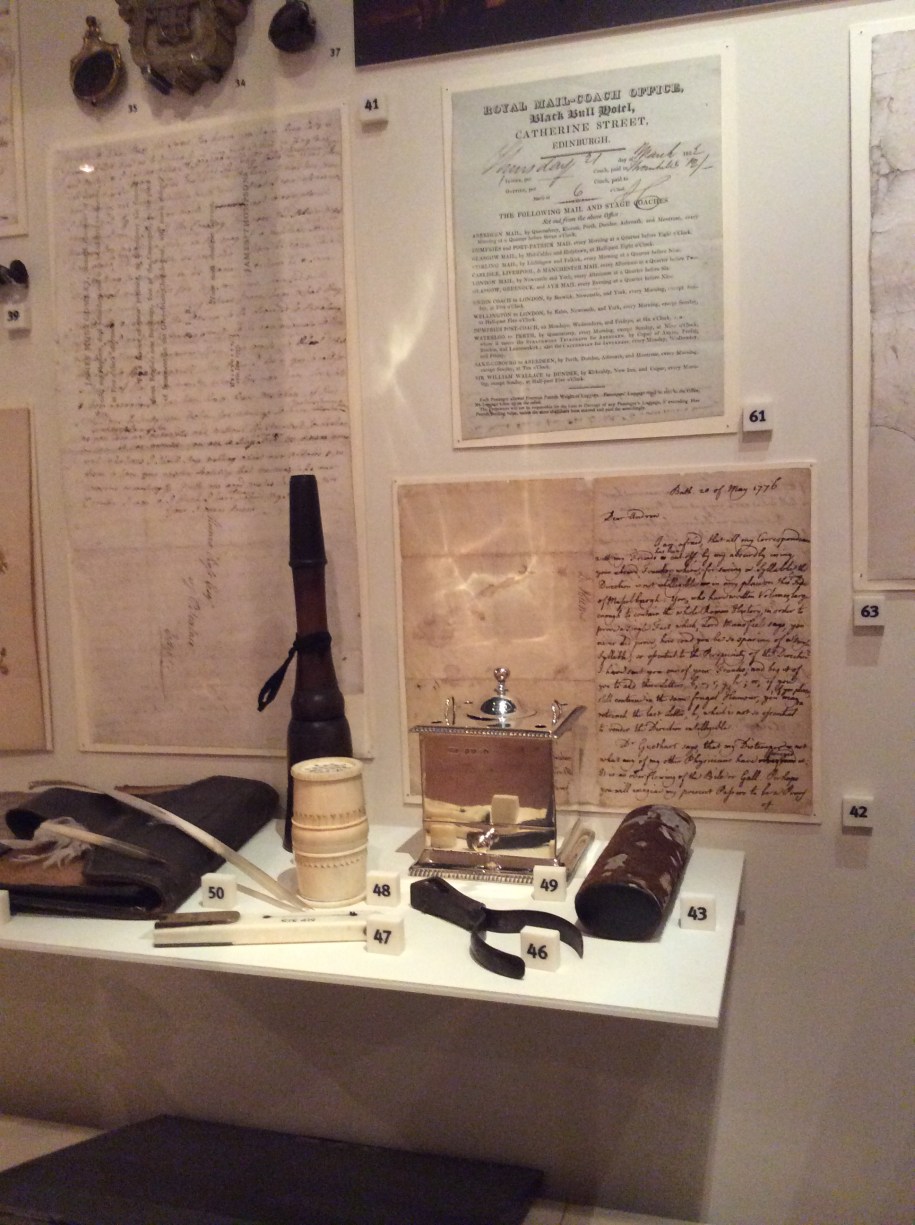
A letter from David Hume to ‘Andrew’ dated May 20th, 1776, on exhibit in the National Museum of Scotland in Edinburgh. Hume had gone to Bath in hopes that the mineral springs there would help relieve the symptoms of the intestinal or abdominal disorder, probably cancer, that he died from that August. In this letter, he tells his friend he’s feeling better at the moment. He suffered much at times from his fatal illness and his decline was quite prolonged, but his friends and critics alike marveled at his composure and even cheerfulness in the face of it all.

~ Ordinary Philosophy is a labor of love and ad-free, supported by patrons and readers like you. Any support you can offer will be deeply appreciated!!

Happy Birthday, Bertrand Russell!

Betrand Russell in 1938, image public domain via Wikimedia CommonsBertrand Russell lived an extraordinarily long life, in which he did an extraordinary number of extraordinary things.

Encyclopedia Britannica introduces him thusly: ‘Bertrand Russell ….born May 18, 1872, Trelleck, Monmouthshire, Wales- died Feb. 2, 1970, Penrhyndeudraeth, Merioneth, [was a] British philosopher, logician, and social reformer, founding figure in the analytic movement in Anglo-American philosophy, and recipient of the Nobel Prize for Literature in 1950. Russell’s contributions to logic, epistemology, and the philosophy of mathematics established him as one of the foremost philosophers of the 20th century. To the general public, however, he was best known as a campaigner for peace and as a popular writer on social, political, and moral subjects. During a long, productive, and often turbulent life, he published more than 70 books and about 2,000 articles, married four times, became involved in innumerable public controversies, and was honoured and reviled in almost equal measure throughout the world…’

For myself, he was particularly influential to my younger freethinking self, disenchanted with the religion of my youth and seeking new and more satisfying ways of viewing the world. I read his History of Western Philosophy and Why I Am Not a Christian each several times over. I admire his clear, precise thinking and his principled anti-war stance which came at a significant cost, including jail time and loss of a prestigious job at the University of Chicago, and it’s always so enjoyable to watch him speak (you’ll find plenty of videos on YouTube) in his oh-so-aristocratic accent with a pipe often tucked into the corner of his mouth. He was not a perfect man, but he was never a less-than-fascinating one.

Learn more about the brilliant and idiosyncratic Bertrand Russell at:

Bertrand Russell – by Ray Monk for Encyclopedia Britannica

Bertrand Russell – by Andrew David Irvine for The Stanford Encyclopedia of Philosophy

Various pieces on Bertrand Russell – by Maria Popova for Brain Pickings

*A version of this piece was previously published at Ordinary Philosophy

~ Ordinary Philosophy is a labor of love and ad-free, supported by patrons and readers like you. Any support you can offer will be deeply appreciated!

The Bell Tower, Tower of London: Thomas More, Elizabeth I, and Other Histories, Part 1

Bell Tower, Tower of London, England

Saturday, May 4th, 2018

I first visited the Tower of London in January of this year with my friend Steven, a fellow student of history; I at the University of Edinburgh in Scotland, he at King’s College, London. We had great fun, two history nerds running around London for a couple of days! While we were at the Tower, I looked for the cell where Sir Thomas More was imprisoned for over a year before he was executed for treason on July 6th, 1535. Like many brought up in Catholic families after the film was made, I grew up watching the adaptation of Robert Bolt’s Man for All Seasons starring Paul Scofield, seeing it so many times I believe I could have parroted the dialogue from entire scenes from memory with little effort. Going back and watching clips, I still remember just about everything that every character will say and do ahead of time. The tragic story of and Scofield’s compelling characterization of the clever lawyer and saint captured my imagination. Since then, I’ve read more about him over the years and broadened my understanding of this man, who was much more complex than the stellar but somewhat two-dimensional martyr of integrity and righteousness portrayed in the film.

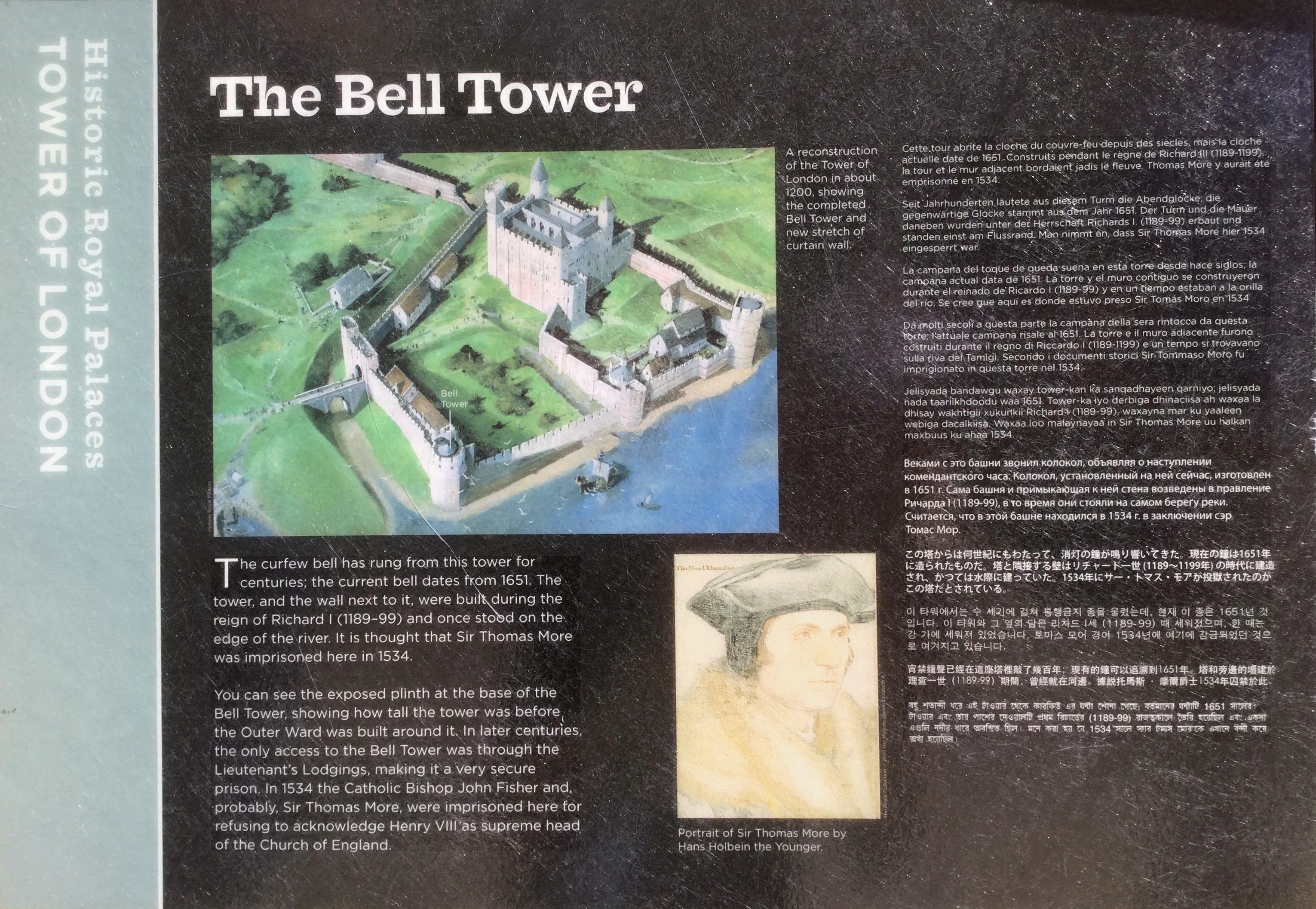
Bell Tower placard, Tower of London, England

Early on in our Tower visit, I spotted a sign near the base of the Bell Tower, just across and to the left of the place where visitors enter the Tower, which identified the Bell Tower as More’s place of imprisonment. Upon further inquiry, I discovered that it’s not open to the public. It had been for a short while many years back, but wear and tear caused by visitors there and in other especially historically significant places within the Tower caused them to be closed off again. The damage was minor but happened more quickly than expected, even given the very large number of people that pass through every year: almost three million in 2017 alone! I persisted in my inquiries, as my historically nosy self is wont to do, and discovered that historians can and do seek and gain permission to visit. And so I did!

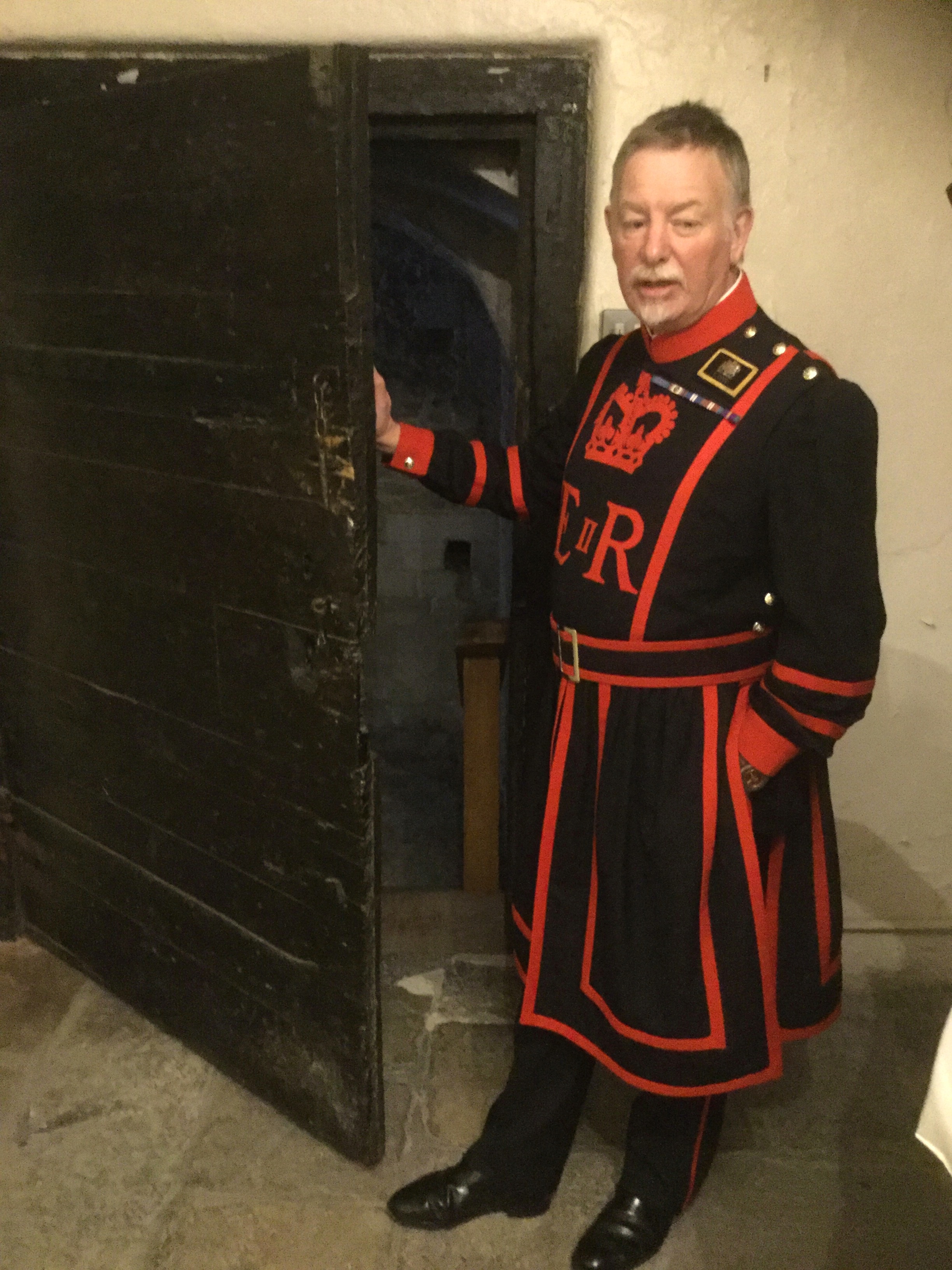
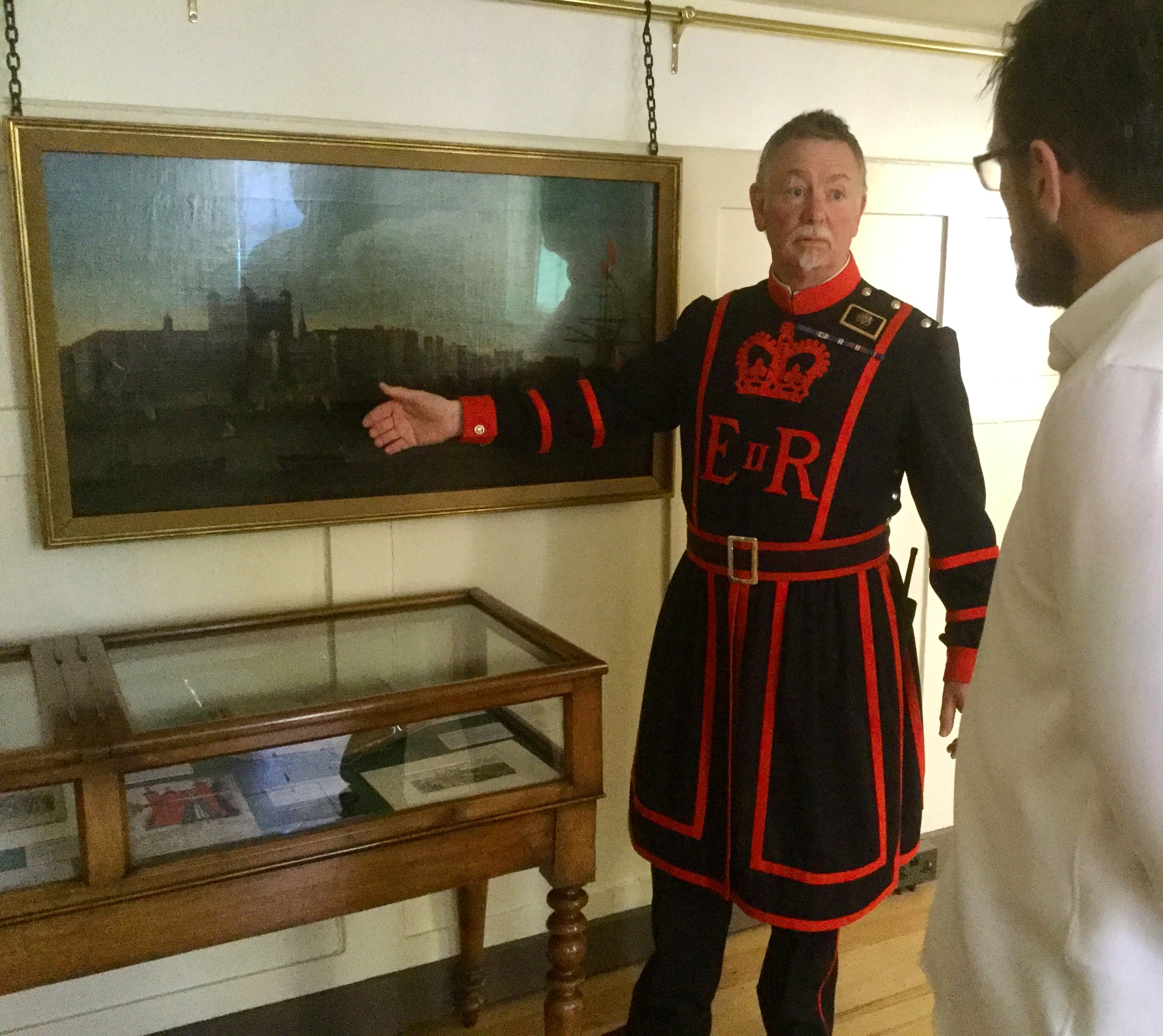
Simon Dodd, Yeoman Warder at the Tower of London

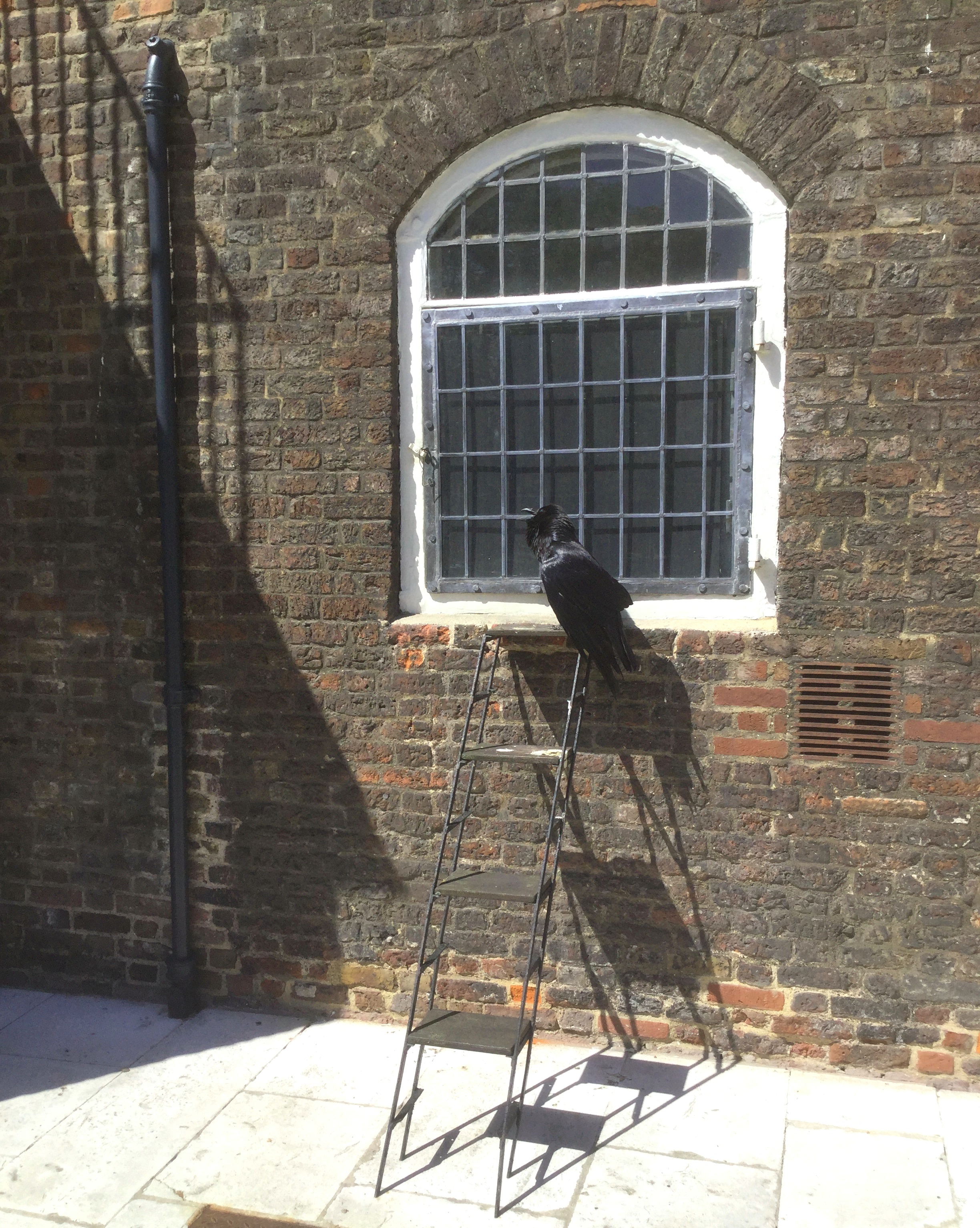
So on the morning of May 4th, 2018, I arrive at the Tower of London’s raven cages, this time with Laurence as my companion (unfortunately, Steven had a prior engagement and couldn’t make it.) We’re a little early for our assigned meeting time of 11 am with a Yeoman Warder of the Tower, one of the ceremonial guardians also commonly known as ‘beefeaters.’ We’re bleary-eyed since we had pulled an all-nighter: I was unable to get the night before off of work so I went straight to the airport after my shift in the very wee hours of the morning. Laurence very kindly met me there to keep me company. Fortunately, his sense of adventure is also strong and his knowledge of efficient travel to London excellent, so here we are, ahead of time. It’s a very sunny day, almost hot, much different than my first visit to the Tower which had been, appropriately, moodily gray and drizzly. As we wait, we watch the ravens. It’s long been a tradition to keep a certain number of these clever birds at the Tower, where they’re fed, groomed, and trained, their wings clipped just enough to keep them from going over the Tower walls but not enough to keep them from their perches. Some of them are roaming freely. Two of the ravens are nuzzling one another on a perch within one of the cages, one ducking regularly and enthusiastically to groom the other’s neck feathers.

Yeoman Warder Simon Dodd arrives and greets us. He proves throughout our time together to be an extremely friendly, knowledgeable, witty, and all-around delightful man, and very generous with his time. I couldn’t have asked for a better host or conversational partner. Laurence is particularly interested and well-read in military history and Simon has had a long and distinguished military career, so, we all have a lot to talk about. I only hope, as we tour and talk, that my sleep-deprived brain can form intelligent questions and process his answers. I take no chances with its ability to successfully retain information: I take plentiful notes as we go. After introductions and a brief chat, we start right in on our tour.

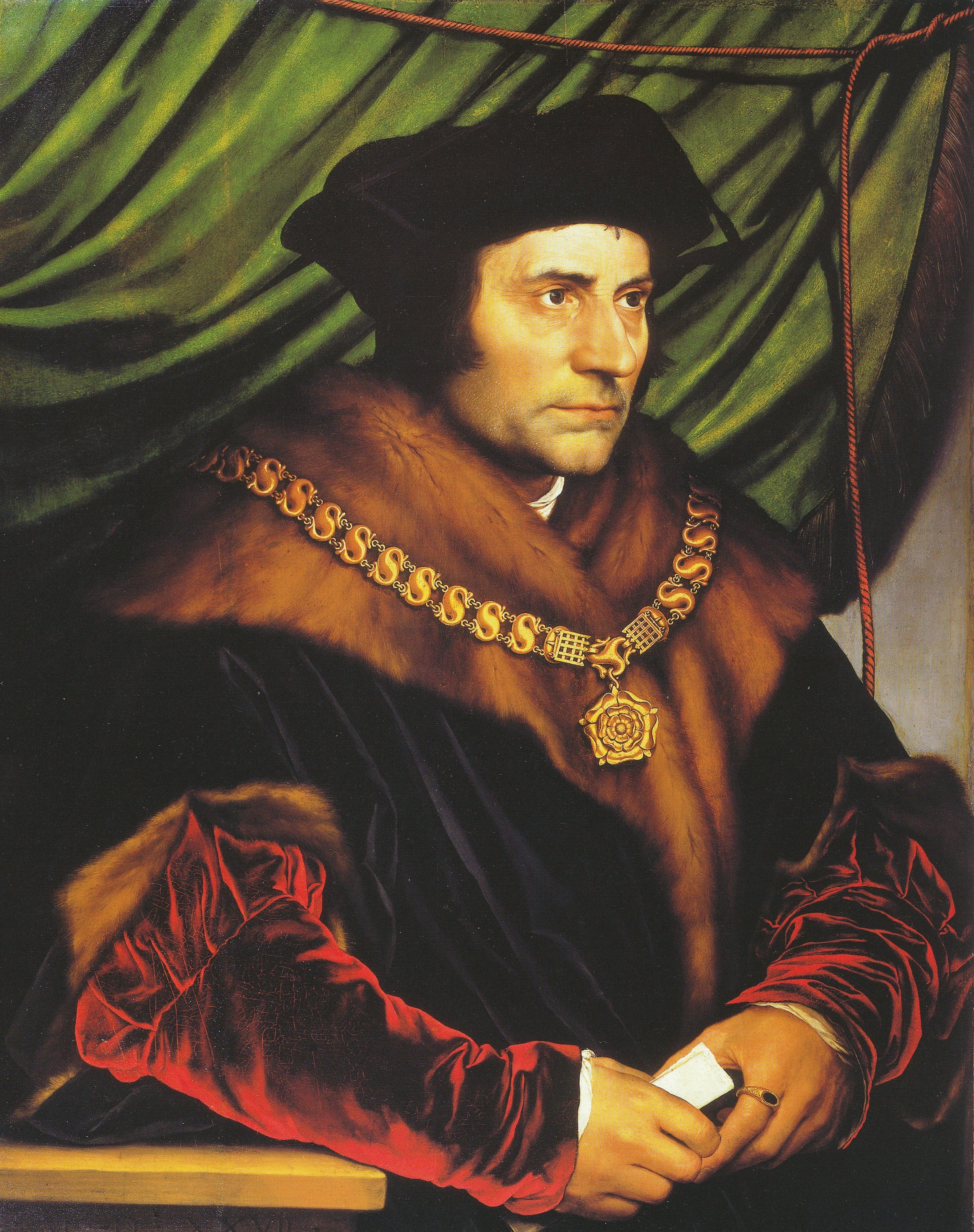
Sir Thomas More by Hans Holbein the Younger, ca. 1527, public domain via Wikimedia Commons

Before I get into the details of the day’s explorations, let me offer a few more details about Thomas More just in case this is your introduction to him, or, just in case it’s been awhile since you read or heard anything about him and your memory is rusty on the subject. Born on February 6th, 1478, he was a lawyer, scholar, writer, statesman, and Lord Chancellor of England from 1529 until he asked King Henry VIII to release him from the post in 1532 when More found himself no longer able to support the King in his power struggle with the Pope. Henry VIII’s first wife, Catherine of Aragon, was the widow of his older brother prior to Henry’s marriage to her. When the marriage failed to produce any living male heirs, Henry VIII sought to have his marriage to her annulled, freeing him to marry his paramour Anne Boleyn. Trouble was, Henry VIII had already sought and won a special dispensation to marry Catherine in the first place from the previous Pope; the new Pope was a virtual prisoner of the Holy Roman Emperor Charles V; and Catherine was the Emperor’s aunt. So, as you can imagine, this whole annulment business was a sticky, tangled religious and political mess. Henry solved the problem in a typically aggressive and self-aggrandizing way: he tore the Church of England away from the Catholic Church and placed himself at the head of it, ruining careers, taking away titles, confiscating lands and property, and chopping off heads along the way.

More and Henry went way back. More first met Henry when the latter was a young prince. In 1499, More’s friend Erasmus brought him along to the palace where the royal family was staying. The bright, athletic, and precocious eight-year-old Henry was second in line to the throne behind his elder brother Arthur. More would become a huge influence on and trusted counselor of King Henry VIII until the King turned against him when More refused to formally acknowledge Henry as supreme head of the Church in England. Erasmus was another central figure in More’s life. He was twelve years older than More, yet the two became very intimate friends very quickly. Erasmus called More ‘sweetest Thomas’ and More called Erasmus ‘my derlynge’ (my darling). These two humanist scholars bonded deeply over books and writing; Erasmus and More were inspirations for one another’s most enduring works, Erasmus’ In Praise of Folly (in fact, the book’s original Latin title Moriae Encomium is a pun on More’s name) and More’s Utopia. When More decided to turn his energies to a life of public service instead of scholarship, Erasmus was disappointed, but they remained friends. Sadly, according to More’s biographer John Guy, Erasmus effectively abandoned him in his troubles with the King, yet More continued to write to him as to a trusted friend up to the end of his life.

A view of the Thomas More cell in the Bell Tower, Tower of London

The bonds of trust and friendship between More and Henry VIII only went so far, however, at least on Henry’s part. From the beginning, More made it clear to Henry that his beliefs regarding the annulment and the nature and extent of papal authority did not accord with Henry’s actions or with what was included in the final version of the Act of Succession. Henry promised to allow More the freedom to act in accordance with his conscience, but like so many of Henry’s promises, this one turned out not to be worth much. Eventually, Henry (perhaps prodded by Anne Boleyn) demanded that More swear to the Act. More found he could not since the preamble of the Act specified that the monarch was the supreme head of the church in England rather than the Pope; as he told the King’s ministers charged with administering the Oath of Supremacy to him, ‘…it were a very hard thing to compel me to say either precisely with [the Act of Supremacy] against my conscience to the loss of my soul, or precisely against it to the destruction of my body.’

To return to the story of the day… Simon leads us first to the place I first sought: the cell where Sir Thomas More was held. Well, maybe he was held here. There’s plenty of dispute about this: there’s no contemporary written record of where exactly More was held. Historians disagree and their dispute continues in books, newspapers, and elsewhere. The Tower of London’s signage indicates that he was most likely kept in this Bell Tower cell, but Simon responds to my questions regarding this dispute that the chances may even be ‘fifty-fifty’ that he was held here or in the Salt Tower, another very secure cell where politically dangerous but distinguished and influential people like More were held. He goes on to explain that the southwest or southeast tower, the Bell Tower or Salt Tower respectively, were the only two likely candidates for More’s cell. Outside of rooms in the central White Tower, which was not a place of imprisonment at the time, the Bell Tower cell is the most secure, with 11 foot thick stone walls and 30 foot deep stone foundations. The Salt Tower was also pretty secure, though not quite to this degree.

A wider view of Thomas More’s cell, Bell Tower, Tower of London

Another More historian, Peter Ackroyd, believes More might have been held at least for a time in the Beauchamp Tower, where many other religious and political prisoners were held. But those cells were not so secure nor isolated as the Bell or Salt Tower cells. According to the notes for Ackroyd’s biography, Sonja Johnson of the Tower of London described More’s cell as ‘one of those apartments which were reserved for the more influential or privileged “guests” of the lieutenant. His was a pentagonal stone chamber, with a vaulted ceiling; it was some nineteen feet in height, with a floor space of approximately eighteen feet by twenty feet. The walls themselves were between nine and thirteen feet thick, the floor flagged through with rough and uneven stone, the windows merely arrow-slits or “loops”‘. And, it was cold: cold enough that, Simon says, it was used as a larder for a time. In fact, the very cool temperature helped preserve the room, despite the damp. Johnson’s description fits perfectly with this high-ceilinged, chilly stone room we’re in.

John Fisher and Thomas More portraits in chamber below St Peter ad Vincula, Tower of London

There are other reasons to think More may not have been held in this cell, at least not during the entire time of his imprisonment in the Tower. Historical researcher Stephen Priestley told the Guardian’s Maev Kennedy that Tower authorities tried to break up communication between More and fellow prisoner Bishop John Fisher, who was also opposed to the Act of Succession, much more openly so than More, and also thrown into the Tower for it. The cell above this one in the Bell Tower, which at the time could be reached by a narrow staircase from this one, was the one that held Fisher, or at least, probably did. This leads Priestly to surmise that Fisher and Thomas would have been eventually placed where they could not communicate so easily with one another. I also consider the stories that Simon and others tell of More rapping on the ceiling to get Fisher’s attention in the room above. But, as you can see yourself from the photos and as Simon points out today, this hardly seems possible in the Bell Tower cell, no matter how hard you might pound on the ceiling if you found a way to reach it at all. Perhaps, then, More and Fisher were held, at least for awhile, in neighboring cells where such communication was possible. Or perhaps, the ceiling-rapping stories are apocryphal and More and Fisher communicated only through smuggled notes and letters, as we know for certain they did.

On the way from the Bell Tower’s lower cell to our next destination, we spot Merlin the Raven. Simon Dodd tells us that she was named prior to knowing her sex, which was later determined by DNA. That’s the only way you can tell, he says – other than by such behavior as egg-laying, of course.

Overall, given what I’ve read and heard, I think, like Ackroyd does, that More’s place of imprisonment changed at least once. In one of his letters written in 1534 from his prison cell to his eldest daughter and confidante Margaret Roper, who he called ‘Meg,’ More reports that he was returned to ‘close keeping’ and ‘shut up again.’ Does this mean he was imprisoned more securely, perhaps in a different room, or just not allowed to leave his cell? Ackroyd interprets More’s comments to mean he was held in solitary confinement, but perhaps they could also refer to his being moved to a more isolated, stronger cell away from others where escape or rescue was far less likely.

After spending some time looking closely at the Bell Tower cell, talking over its history, and discussing the likelihood and duration of More’s imprisonment here, Simon, Laurence, and I re-emerge from the dim cell blinking against the bright sun’s light.

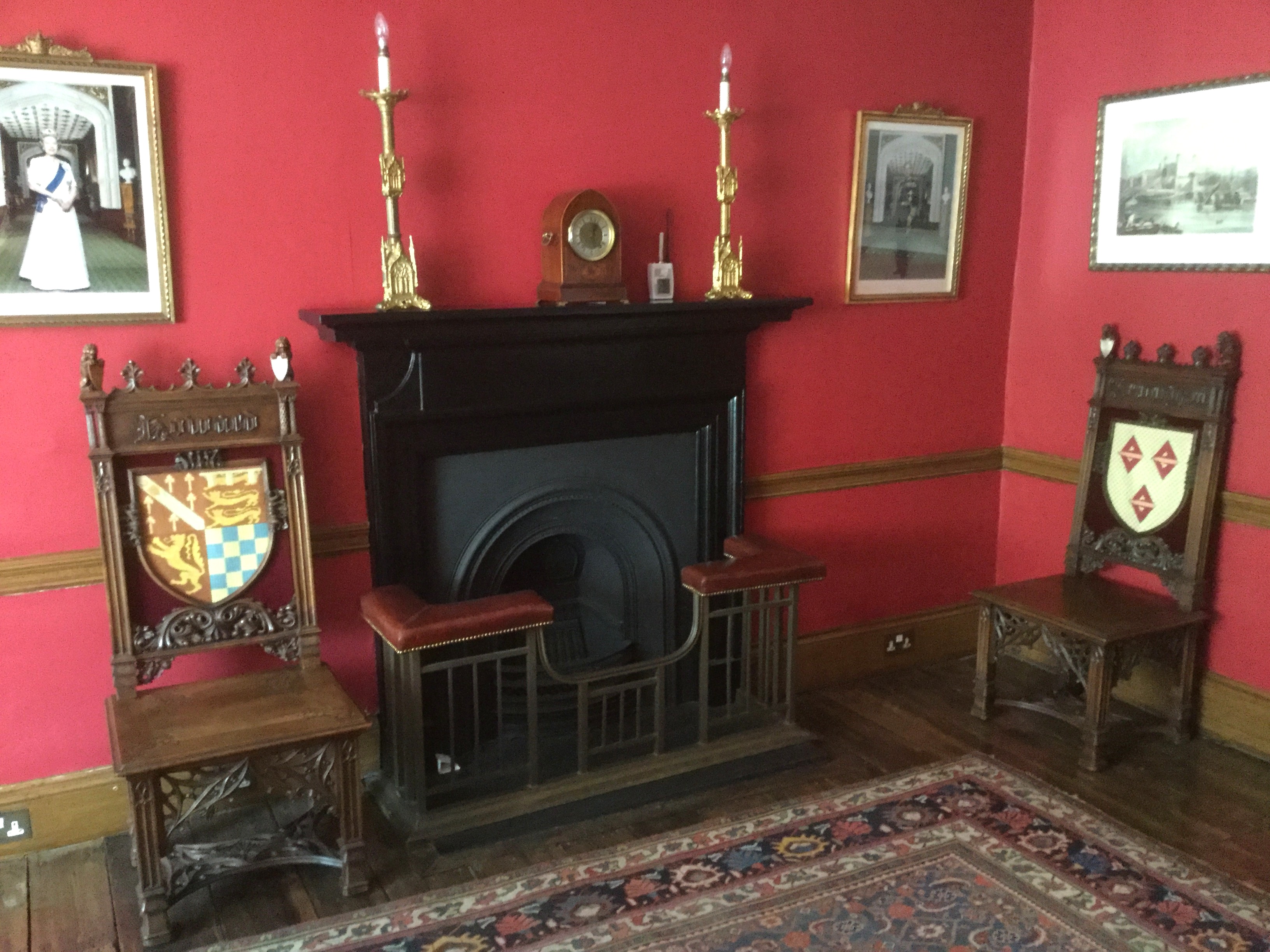
Next, we make a short visit to the Queen’s House. Simon tells us a bit about the history and historians of the Tower and that there have been 160 Constables of the Tower since 1066, the portraits of many of which are hanging here on the Queen’s House wall. He tells us about the early-to-mid 19th century Constable Duke Wellington who worked to make the Tower function better; made it look more like it did in the medieval era; increased its military management; and who was dismayed when tourism to the Tower drastically increased during his tenure there. Simon recommends us to read and watch David Starkey’s, Lucy Worsley’s, and Anna Keay’s books and audiovisual productions to learn more about Tudor history in general. In researching this piece, I recently read a Telegraph article about Starkey’s sharp criticism of the BBC’s historical miniseries Wolf Hall‘s negative portrayal of Thomas More.

A room in the Queen’s House, Tower of London

Simon Dodd telling us history in the Queen’s House, Tower of London

Simon also describes changing features of the Tower over the centuries with reference to a lovely old painting of the Tower hanging on the wall, and indicates the route by which More would have been taken from the gate through which he entered the Tower to his cell in *the Bell Tower.

We will see and talk about many, many more things during our day’s tour of the Tower so I’ve decided to break up this story into multiple parts. Stay tuned for more about our Tower adventure…

*Patron of this Tower of London journey: Laurence Murphy ~ With warmest gratitude, thank you!

Listen to the podcast version here

~ Ordinary Philosophy is a labor of love and ad-free, supported by patrons and readers like you. Any support you can offer will be deeply appreciated!

~~~~~~~~~~~~~~~~~~~~~~

Sources and inspiration:

Ackroyd, Peter. The Life of Thomas More. London: Chatto & Windus, 1998

Annual Survey of Visits to Visitor Attractions: Latest Results.‘ VisitBritain.org

Borman, Tracy. The Story of the Tower of London. London: Merrell Publishers Limited, 2015

Borman, Tracy. ‘The Tudors and the Tower.‘ Tudor Times website, 3 Aug 2015

Camden, William Norton, Robert; Hans and Hanni Kraus. The historie of the most renowned and victorious Princesse Elizabeth, late queen of England. Contayning all the important and remarkeable passages of state both at home and abroad, during her long and prosperous raigne. Composed by way of annals. Neuer heretofore so faithfully and fully published in English.
Sir Francis Drake Collection Library of Congress. London: Printed by N. Okes for B. Fisher; 1630

Collinson, Patrick. ‘Elizabeth I (1533–1603), Queen of England and Ireland.‘ Oxford Dictionary of National Biography.

Davies, C. S. L., and John Edwards. ‘Katherine [Catalina, Catherine, Katherine of Aragon] (1485–1536), Queen of England, First Consort of Henry VIII.’ Oxford Dictionary of National Biography

English Monarchs website: ‘The Bell Tower’ and ‘The Queen’s House

Freeman, Thomas S. (2002). ‘`As true a subiect being prysoner’: John Foxe’s notes on the imprisonment of Princess Elizabeth, 1554-5.‘ (Notes And Documents). The English Historical Review, 117(470), 104-116

Furness, Hannah. ‘Wolf Hall is ‘Deliberate Perversion’ of History, says David Starkey.The Telegraph, 26 Jan 2015

Guy, John. A Daughter’s Love: Thomas and Margaret More. London: Fourth Estate, 2008

Guy, John. ‘For What Did Thomas More So Silently Die?’ Lecture published at Tudors.org

House, Seymour Baker. ‘More, Sir Thomas [St Thomas More] (1478–1535), Lord Chancellor, Humanist, and Martyr.‘ Oxford Dictionary of National Biography.

Ives, Eric William. ‘Henry VIII (1491–1547), King of England and Ireland.’ Oxford Dictionary of National Biography.

Jones, Jonathan. ‘Wolf Hall is Wrong: Thomas More was a Funny, Feminist Renaissance Man.‘ The Guardian, 29 Jan 2015

Kennedy, Maev. ‘Historians Scorn Claims over Thomas More’s Cell.The Guardian, 10 Jan 2000

Marc’hadour, Germain P. ‘Thomas More.’ Encyclopædia Britannica

More, Thomas. The Apology of Sir Thomas More, Knight. from The Complete Works of St. Thomas More, Vol. 9. Yale University Press, published online by The Center for Thomas More Studies

More, Thomas. Conscience Decides: Letters and Prayers from Prison Written Between April 1534 and July 1535. Selected and arranged by Dame Bede Foord; preface by Trevor Huddleston; introduction by Germain Marc’hadour. London: Geoffrey Chapman Ltd, 1971

More, Thomas. The English Correspondence of Sir Thomas More, 1947 Rogers edition, Princeton University Press, published online by The Center for Thomas More Studies

Moynahan. God’s Bestseller: William Tyndale, Thomas More, and the Writing of the English Bible – A Story of Martyrdom and Betrayal. New York: St. Martin’s Press, 2003

Plowden, A. ‘Grey [married name Dudley], Lady Jane (1537–1554), Noblewoman and Claimant to the English Throne.Oxford Dictionary of National Biography.

Roper, William. The Life of Sir Thomas More1556. Ed. Gerard B. Wegemer and Stephen W. Smith. Center for Thomas More Studies, 2003

Stanford, Peter. ‘Sir Thomas More: Saint or Sinner?’ The Telegraph, 20 Jan 2015

Teysko, Heather and Melita Thomas. ‘Tudor Times on Thomas More.’ Renaissance English History Podcast: A Show About the Tudors, episode 55, Sep 16, 2016

Citizenship, Belonging, and the Experiences of Amero-Africans in West Africa: An Analysis of William Innes’ Early History of Liberia

Rev. Dr. William Innes of Edinburgh

In 1831 and again in 1833, Waugh and Innes of Edinburgh published a history of Liberia by ‘Minister of the Gospel’ William Innes.[1]

In his Liberia: Or, The Early History & Signal Preservation of the American Colony of Free Negroes on the Coast of Africa, Innes describes the founding, structure, and struggles of this West African colony, founded in the early 1820’s as a haven for free and previously enslaved people of African descent and for ‘recaptives’[2] rescued from the newly illegal transatlantic slave trade.[3] Innes was an alumnus of the University of Edinburgh, an ‘independent’-minded Presbyterian and then Baptist minister, one-time chaplain of Stirling Castle, missionary, bookseller, and author of over two dozen books and other publications, mostly on religious topics. The titles of his publications, such as Reasons for Separating from the Church of Scotland (Dundee, 1804), Christianity, the Only Effectual Support Under the Afflictions of Life (Edinburgh, 1810), Domestic Religion, or an Exposition of the Precepts of Christianity Regarding the Duties of Domestic Life (Edinburgh, 1822), and Instructions for Young Enquirers (Edinburgh, translated into Gaelic 1827) indicate why this otherwise mostly theological writer decided to write a history of a colony.[4] As we shall see, this reform-minded man viewed Liberia as a worthy project within the larger goal of uplifting lives as well as souls.

Although Innes’ account includes some discussion of the hardships faced by the colonists trying to build a community in and wrest a living from this unfamiliar and somewhat hostile territory, he presents a generally positive view of the experience and prospects of the Liberian colonization project. Indeed, Innes seems anxious to convince his readers that the colony could not only exist and thrive, but that it should. As we shall see, Liberia is, to Innes, a project of community-building in line with ordered nature and with American beliefs in democracy, self-sufficiency, and the sense of social harmony necessary for a united and healthy political community. In interrogating this text, then, we are led to ask: how are ideas about citizenship and belonging implied and described in Innes’ history of Liberia, how do they relate to the lived experiences of Amero-Africans in the United States and Liberia, and how are these ideas challenged?

Innes commences his history with a discussion of the historical conditions in which this colonization movement arose. The American Colonization Society (ACS) was founded in November of 1816 as a benevolent institution dedicated to the long-conceived but as yet unsystematic scheme of colonizing black inhabitants of the United States to Africa, the continent of their ancestral origin.[5] As Innes and many others saw it, including many abolitionists and proslavery advocates alike,[6] black people could never live peacefully side by side with white Americans. Innes writes that all black persons are ‘branded by their colour as an inferior caste.’[7] He argues that so long as they live as an ‘inferior’ class within the general community of free persons, both black and white will suffer the ill effects of living in a mixed-race society, made up as it is of people with necessarily disparate natures and irreconcilable interests.[8] So long as people of African descent live within the mainstream white American community, the majority of the former will remain ‘idle, ignorant, vicious’ as a result of their disfavor, and cites as an example of this that ‘in many cases the free negroes are a great annoyance to the community, often living by pilfering the property of their neighbors.’[9] Therefore, Innes explains, the only way that people of African descent can create communities to which they naturally belong is to form them separately from white communities, and the best place to do so is by establishing their own communities in the continent of their ancestor’s origin. In doing so, they can enjoy the rights and privileges of citizens with others who share their place in the racial hierarchy. [10] In his majority opinion for the United States Supreme Court 1856 decision in the Dred Scott v. John F. A. Sandford case, which exacerbated the divisive political issues of slavery and race that helped spark the United States’ Civil War,[11] Chief Justice Roger Taney agrees with Innes’ theory of natural racial separation. He likewise believes that human beings are manifestly and naturally separated into inferior and superior races that cannot form a united political community.[12] Ideas such as Innes’ and Taney’s permeated political debate and policy in the United States for decades to come, widely disenfranchising black Americans and relegating them to second-class citizenship throughout the nation.

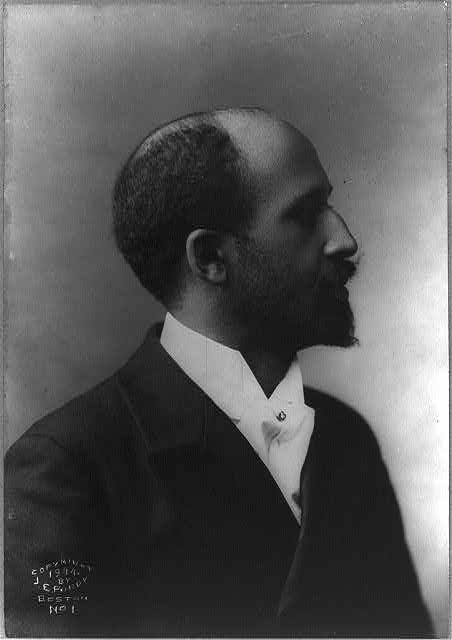
W.E.B. Dubois, Photograph taken by J.E. Purdy in 1904, public domain via Library of Congress

W.E.B. Dubois, Photograph taken by J.E. Purdy in 1904, public domain via Library of Congress

Yet the colonization scheme as described above is a manifestation of paradoxical ideas about belonging and citizenship rather than a straightforward, across the board rejection of the rights or abilities of black persons to enjoy political power, despite Taney’s assertions to the contrary. According to Innes, Taney, many in the ACS, the U.S. government, and so many Americans, people of African origin who were brought to American shores to labor, to raise crops and buildings and in every other way contribute to the economy and to the material well-being of United States citizens nevertheless do not belong within the political community nor could ever be citizens themselves. Yet advocates of colonization such as Innes believed that people of African descent were or could become citizens in Africa even if they were not born there. This was and continued to be believed by many of African descent as well. W.E.B. DuBois, African-American historian, racial theorist, and proponent of the pan-Africanist ‘vision’[13] of Africa as the natural homeland for all people of African descent, describes Africa as ‘fatherland,’ and ‘motherland.’ DuBois concedes that he has only a ‘tenuous’ connection to Africa ‘in culture and race’, like most people colonized to Africa in Innes’ time. African scholar M.B. Akpan points out that Amero-Africans (acculturated Americans of African descent who settled in Africa) who went to Liberia were vastly different from native Africans in about as many ways as they could be, in dress, language, religion, taste in food, clothing, housing, art, and so on.[14] Yet some, like DuBois, perceived themselves as bound to Africa by an essential ‘kinship.’[15] For Innes and others, this kinship is entirely racially based; for DuBois and many pan-Africanists, ‘the real essence of this kinship is its social heritage of slavery; the discrimination and the insult; and this heritage binds [us] together…’[16]

Innes and proponents of Amero-African colonization, Taney and other racial hierarchists, and pan-Africanists like Dubois share a belief that there is something about a common African descent and shared experiences, however combined with ethnic descent and acculturation from elsewhere, which creates a natural community. Such natural communities, in turn, create opportunities for citizenship that cannot be enjoyed at all, or at least not fully, in any other context. These ideas are in tension throughout Innes’ account of how West African colonies came to be and the way they persisted despite significant challenges and hardships. These challenges arose within the colonies themselves and from conflicts between colonists and the ecology, and between colonists and their native African neighbors. Innes’ account of the difficulties faced by the Liberian colonists differs significantly in many respects from later scholarship and from other contemporary accounts. In Innes’ account, these difficulties are relatively minor compared to the benefits the colonists enjoyed as citizens of a new community to which they rightly belonged.[17] The contrast between Innes’ account and other contemporary accounts backed up by later scholarship[18] imply that Innes’ driving concern to use Liberia as a positive example of how racially-based communities are formed biased his very favorable presentation of the colony.

Regarding their prospects for acceptance and inclusion within the mainstream American social and political community, Innes describes his perception of the state in which non-enslaved people of African descent find themselves:

…[T]roughout the non-slaveholding states, the negroes form a distinct race, branded by their color as an inferior caste; regarded with a species of loathing when thought of as companions, and for ever shut out from the privileges of the white men by whom they are surrounded. Be it prejudice, or founded on reason, the feeling of dislike mutually exists… .No matter what may be their industry and sobriety; no matter what their attainments in science, or their character for morality, they can never hope to pass the broad line of demarcation, or assume a station of equality with the other members of the community.[19]

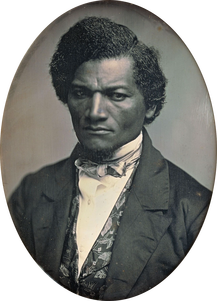
Frederick Douglass ca. 1847-52, Samuel Miller, American 1822-1882, Art Institute of Chicago, public domain via Wikimedia Commons

Racial hierarchists like Taney share the ‘species of loathing’ which Innes describes. Today, Innes’ and Taney’s descriptions of race relations are difficult to read, especially Taney’s. For one, they conflict with contemporary thoughts and sensibilities about race which are, in the main, orders of magnitude more optimistic about the likelihood that people of various races and ethnicities can meaningfully share and participate in communities as social and political equals. For another, they don’t ring true, especially in Taney’s harsh Dred Scott account of the social and political issues of race in America. After all, there were many mixed-race communities in which black Americans lived relatively safely and peacefully alongside their white neighbors even given the national tensions over issues of race. Leading black abolitionist and orator Frederick Douglass settled in one such community, New Bedford, Massachusetts, following his escape from slavery in Maryland in 1838.[20] Taney’s opinion reads very much like a partisan political document and presents a wholly dismal picture of both the capabilities and prospects of people of African descent.[21] Innes’ commentary, on the other hand, presents a more mixed though still racially hierarchical view. On the one hand, he implies in the selection above and makes clearer elsewhere that he believes people of African descent are fully capable of ‘industry and sobriety,’ of morality, of worthy and admirable attainments, of being ‘provident’ and ‘respectable,’ of conducting ‘affairs of empire,’ and so on.[22] Yet Innes does not believe they are capable of this, on the whole, so long as they live in communities among their white racial ‘superiors.’[23] Removal from white society and colonization with others of their own racial heritage, then, is the answer.

Yet all the qualities that Innes enumerates as making people belong within communities and which he characterizes as those of good citizens, he already ascribes to Americans of African descent. We can see this most clearly in the passages in Innes’ history where he describes the contrast between Amero-African colonizers and the beneficial and ‘civilizing’ influence that they exert on their native Africans neighbors. In matters of language, religion, dress, morality, ability, education, and so on, they are in turn, deems Innes, superior to their native African neighbors and the latter, recognizing this, wish to emulate them.[24] We can also recognize Innes’ conflicting views in the terms he chooses to refer to the Amero-African colonists and the native African peoples in their territorial conflicts. When describing the participants and victims of battles, Innes refers to Amero-Africans and their native African allies in such terms as ‘woman’, ‘men,’ ‘persons,’ ‘mother’, ‘the people’, and so on. By contrast, Innes refers to native Africans primarily by terms such as ‘barbarian,’ ‘savage’, ‘enemy’, and ‘wretches’, characterized by ‘moral deformity.’[25] This implies that for Innes, civilization can depend on culture, virtues, religious beliefs, and modes of comportment rather than race. The very qualities that make people belong to a community and become good citizens can and are often held by Amero-Africans whatever side of the Atlantic. As we can see in the selection above, Innes concedes this even as he explains why black people cannot belong within American white communities. He allows that black individuals can and do ‘rise above their degraded brethren’ and exhibit such good-citizenship qualities as ‘character for morality’ and ‘industry and sobriety,’ capable of ‘mak[ing] attainments in science’ and so forth.[26] Innes, then, presents two very distinct conceptions of belonging, citizenship, and race which are, if not in direct conflict, at least in tension with one another.

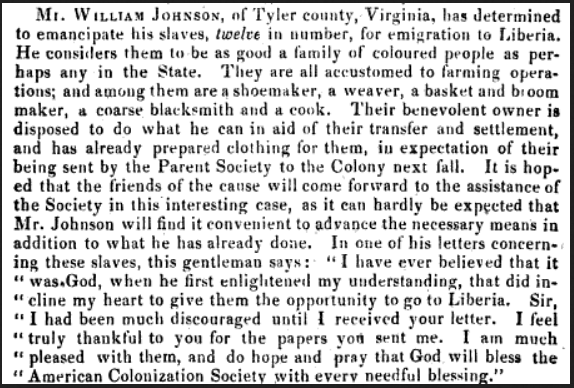
Clipping from The African Repository and Colonial Journal, V. XIII 1837, describing the efforts of William Johnson to settle his former slaves in Liberia, public domain via Wikimedia Commons

Perhaps Innes resolves these conflicting ideas about race and belonging to his own satisfaction through his appeal to divine approval. Innes, as a ‘Minister of the Gospel,’[27] looks for and finds signs of God’s will that the Liberian colony survive. He argues that God must approve of removing black people to Liberia because the preservation of Liberian colonies is unlikely otherwise given the obstacles they faced, which in turn shows divine approbation of this racial separation.[28] The idea of divine arrangement of peoples into natural types and nations which pervades Innes’ history resembles such racially hierarchical theories as Taney’s. However, Innes’ view of racial ordering displays more divine benevolence for the black race even as it is extremely patriarchal. Innes perceives a divine will that all people of African descent be redeemed through their separate political and religious institutions. This will best be brought about first by separating the races into naturally sympathetic racially divided communities, and then locating those communities in places where they can spread the gospel of Christ to others of the same race who have not yet received it through the establishment of colonies. The colonizers were then placed in a position to help bring about the divine will in the world such as providing a Christian example to their African neighbors[29] and helping to end the ‘evil’ and ‘dreadful malady’ of the slave trade.[30]

Yet Innes’ overall sunny take on the lived experience of the Liberian colonists contrasts with contemporary and later accounts of the Liberian experiment. Douglass, for example, is skeptical of the glowing accounts of the colony’s success as well as of its prospects of helping to end the slave trade; he questions the motives and therefore the accuracy of those offering glowing accounts of the colonization effort’s success.[31] Innes’ account is one which invites such skepticism. He considers the ‘signal preservation’ of the colony a sign of God’s approval but does not consider the severe hardships that he chooses to cite such as supply shortages, attacks from neighboring tribes, difficulties raising crops, the fact that they had to wrest the colony’s land concession from Dei ‘King Peter’ at gunpoint, and the high rates of disease and death as signs of God’s disapproval.[32] Innes seems to minimize the hardships in Liberia as he follows every mention of them with an immediate qualification or comparison, such as citing the early American colonies’ struggles or remarking that the Liberian colonies could have suffered worse.[33] He goes so far as to dismiss symptoms of illness as mere climatic adjustment reactions of healthy bodies, though he does admit that many died.[34] According to historian Claude Andrew Clegg, however, the colonists often suffered extremely high rates of hunger, disease, privation, and mortality.[35] Clegg also cites many examples of the colonists’ difficulties, including the telling example of Emily Hooper, a young colonist who, after an extraordinarily difficult and expensive effort on her father’s part to obtain her freedom and fund her journey to Liberia, decided to return to slavery rather than further suffer the hardships of the colony. This episode was a great embarrassment to the ACS.[36]

In addition to the evidence of hardship and mortality in many reports, accounts like Innes’ are roundly challenged by argument and even ridicule. One particularly scornful and influential critic of the colonization scheme was Douglass. Indeed, except for the fact that he actually refers to [news]paper accounts in his ‘Persecution on Account of Faith, Persecution on Account of Color’ address delivered in Rochester, New York in 1851, it would be reasonable to assume that Douglass was referring to Innes’ history when he observed: ‘Papers that never speak of colored men in this country but to abuse and slander them, speak in the most flattering terms of …Liberia.’[37] To Douglass, arguments such as those offered by Innes and American statesman Henry Clay, who recommend the removal of black people from American society due to idleness, lawlessness, and other perceived flaws invite a counter-question: ‘Suppose we should admit… that we are degraded and dissolute, as a class; are there no other degraded and dissolute people?… Who talks of their expatriation?’ to which he answers: ‘No one.’[38] Douglass also mocks the idea that colonization movement will weaken slavery as an institution. It’s the presence of free black people in slave states that help weaken slavery by demonstrating to the enslaved that there is another way they can live in America. Removing free black people to Africa, argues Douglass, removes this constant and substantial threat to slaveholders’ desire to rule unchallenged over a docile, resigned slave population.[39]

Liberian Senate drawn by Robert K. Griffin, Monrovia, 1856, public domain via the Library of Congress

Throughout his early history of Liberia, Innes wavers but does not stray far from his theme of Liberia as a natural home for Americans of African descent. His explanations for how and why Amero-Africans, acculturated to the United States in language, morals, religion, dress, and overall ways of life nevertheless belong in a land which most have never seen are not, as we have seen, entirely consistent. Why Amero-Africans can only successfully gain a sense of belonging and engage as citizens in a place where they are outsiders in every way except skin color is also not satisfactorily explained; indeed, Innis presents Liberia as if it were the only alternative to black Americans continuing to live in a state of political and social exclusion and oppression in mainstream white American society. Innes offers the ‘signal preservation’ of the Liberian colony as proof of its value to God and humankind as well as of its eventual success, but glosses over any consideration that the terrible hardships and dangers that the colonists had to face were evidence to the contrary. Others such as Douglass, however, perceive the flaws in the explanations and evidence that Innes offers, and presents both counterevidence and counterarguments that helped undermine support for the colonization project over the decades of its existence.[40]

~ Ordinary Philosophy is a labor of love and ad-free, supported by patrons and readers like you. Any support you can offer will be deeply appreciated!

Bibliography

Akpan, M. B. “Black Imperialism: Americo-Liberian Rule over the African Peoples of Liberia, 1841–1964.” Canadian Journal of African Studies/La Revue Canadienne Des études Africaines 7, no. 2 (1973): 217-36.

Clegg, Claude Andrew. The Price of Liberty: African Americans and the Making of Liberia. 2004.

Douglass, Frederick. Autobiographies. New York: Library of America, 1996.

Douglass, Frederick, and John R. McKivigan (project director). Frederick Douglass Papers: Digital Edition. Accessed 20 March 2018 at http://frederickdouglass.infoset.io/

Douglass, Frederick, and John W. Blassingame. The Frederick Douglass Papers. Series 1, Speeches, Debates and Interviews; John W. Blassingame, Editor. Vol.1, 1841-46. New Haven; London: Yale University Press, 1979.

Du Bois, W. E. B., and Herbert Aptheker. Dusk of Dawn. 1975.

Scott, Hew. Fasti Ecclesiae Scoticanae: The Succession of Ministers in the Church of Scotland from the Reformation, Vol. IV: Synods of Argyll, and of Perth and Stirling. Edinburgh: Oliver and Boyd, 1923.

Geiss, Imanuel. The Pan-African Movement. London: Methuen, 1974.

Innes, William. Liberia: Or, The Early History & Signal Preservation of the American Colony of Free Negroes on the Coast of Africa. Waugh & Innes; M. Ogle, etc., 1833. Accessed 20 March 2018 at https://babel.hathitrust.org/cgi/pt?id=hvd.32044051050987

Staudenraus, P. J. The African Colonization Movement, 1816-1865. London: Oxford University Press, 1961.

United States Supreme Court, Roger Brooke Taney, John H Van Evrie, and Samuel A Cartwright. The Dred Scott decision: opinion of Chief Justice Taney. New York: Van Evrie, Horton & Co., 1860. Retrieved from the Library of Congress, Accessed 21 March 21, 2018 at https://www.loc.gov/item/17001543/

West, Richard. Back to Africa: A History of Sierra Leone and Liberia. New York: Holt, Rinehart and Winston, 1971.

[1] Innes, William. Liberia: Or, The Early History & Signal Preservation of the American Colony of Free Negroes on the Coast of Africa. Waugh & Innes; M. Ogle, etc., 1833, frontispiece

[2] Clegg, Claude Andrew. The Price of Liberty: African Americans and the Making of Liberia. 2004 p. 37

[3] Staudenraus, P. J. The African Colonization Movement, 1816-1865. London: Oxford University Press, 1961 p. 51

[4] ‘William Innes’ in Scott, Hew. Fasti Ecclesiae Scoticanae: The Succession of Ministers in the Church of Scotland from the Reformation, Vol. IV: Synods of Argyll, and of Perth and Stirling. Edinburgh: Oliver and Boyd, 1923 pp. 325-326

[5] West, Richard. Back to Africa: A History of Sierra Leone and Liberia. New York: Holt, Rinehart and Winston, 1971 p. 93

[6] Clegg p. 3-4, Staudenraus pp. 2-7

[7] Ibid. p 102

[8] Innes pp. iv-v, 101-103

[9] Ibid. p. iv

[10] Ibid. pp. 102, 106-107

[11] Clegg pp. 174, 195-196

[12] United States Supreme Court, Roger Brooke Taney, John H. Van Evrie, and Samuel A. Cartwright. The Dred Scott decision: opinion of Chief Justice Taney. New York: Van Evrie, Horton & Co., 1860 pp. 18-19

[13] Geiss, Imanuel. The Pan-African Movement. London: Methuen, 1974 p. 5

[14] Akpan, M. B. “Black Imperialism: Americo-Liberian Rule over the African Peoples of Liberia, 1841–1964.” Canadian Journal of African Studies/La Revue Canadienne Des études Africaines 7, no. 2 (1973) p. 219

[15] Du Bois, W. E. B., and Herbert Aptheker. Dusk of Dawn. 1975 pp. 116

[16] Ibid. p. 117

[17] Innes pp. 87-89

[18] Clegg pp. 226-229

[19] Ibid. p. 102

[20] Douglass, Frederick. Autobiographies. New York: Library of America, 1996 pp. 353ff

[21] Taney pp. 17-18

[22] Innes pp. 77, 86-87, 91

[23] Ibid. pp. 101-102, 176

[24] Innes p. 83, 86-89

[25] Ibid. pp. 57-65

[26] Ibid. p 102

[27] Ibid., frontispiece

[28] Ibid. pp. vi-vii, 37-38, 62, 64, 72, 91

[29] Ibid., pp. 112-115

[30] Ibid., pp. 9-10, 108-112

[31] ‘Persecution on Account of Faith, Persecution on Account of Color: An Address Delivered in Rochester, New York, on 26 January 1851,’ North Star, 30 January 1851, in Douglass, Frederick, and John R. McKivigan (project director). Frederick Douglass Papers: Digital Edition, pp. 300-302

[32] Innes, pp. v-vi, 16-21, 38-39, 93-95, 101, 108-111; Clegg, p. 37; West pp. 114-115

[33] Innes., pp. 91-92

[34] Ibid., p. 93

[35] Clegg, see descriptions and figures in chapter 7 of The Price of Liberty, ‘To Live and Die in Liberia,’ pp. 201-248

[36] Ibid., pp. 187-188

[37] Douglass, ‘Persecution,’ p. 302

[38] ‘Henry Clay and Colonization Cant, Sophistry, and Falsehood: An Address Delivered in Rochester, New York, on 2 February 1851, North Star, 6 February 1851, in Douglass, Frederick, and John R. McKivigan (project director). Frederick Douglass Papers: Digital Edition, p. 323

[39] Ibid., p. 322

[40] Staudenraus, pp. 249-250

Happy Birthday, David Hume!

In honor of David Hume‘s birthday, May 7, 1711, let me share anew my history of ideas travel series and other pieces I’ve written in honor of my favorite philosopher if I was pressed to chose only one. I fell in love with his native Edinburgh when I originally visited in the spring of 2014 but even so, I wouldn’t have predicted I would now be living here furthering my education at his alma mater, the University of Edinburgh. It would have been even more impossible to predict that the window of my flat would be located directly across the narrow square from the University’s David Hume Tower. I was moved to observe one day, and still am whenever I think or tell of it, that the windows of that glassy tower often reflect the light of the rising sun into my window. I could imagine no more poetic image than that of how this great Enlightenment thinker has influenced my life.

Here they are in the order I wrote them, starting several years back. Perhaps you’ll find, as I do when I return to old pieces from time to time, that my thinking has developed and my mind has changed, to various degrees, on some things:

First Day in Old Edinburgh: Hume Sites and Monuments
Hume’s New Scene of Thought, and, It’s Good to Be Able to Say ‘I Don’t Know’
Hume Sites and Monuments, Part 2
The Consolations of Philosophy, and A Death Free from Fear
Scotticisms
Happy 303rd Birthday, David Hume!
The Debate Over Government and Freedom
The Tale of the Magic Toe – Superstition? Or What?
Hume Sites and Monuments, Part 3
Water of Leith
Last Day in Edinburgh, May 13th, 2014
Hume, Aristotle, and Guns
A memory quilt I created for my Edinburgh trip:
A Hill and a Wall in Edinburgh, 2015, 102″ x 69″
Enlightenment Scotland: Site of James Boswell’s Home in James Court, Edinburgh
Enlightenment Scotland: Advocates Library, Edinburgh
Chirnside and Ninewells, Scottish Borders, Childhood and Summer Home of David Hume
Enlightenment Scotland: Edinburgh’s Select Society
Photobook: Robert Adam, Architect of Edinburgh
Photobook: Letter from David Hume to James Balfour, Mar 15, 1753

*A version of this piece was previously published at Ordinary Philosophy

~ Ordinary Philosophy is a labor of love and ad-free, supported by patrons and readers like you. Any support you can offer will be deeply appreciated!