Happy Birthday, Baruch Spinoza!

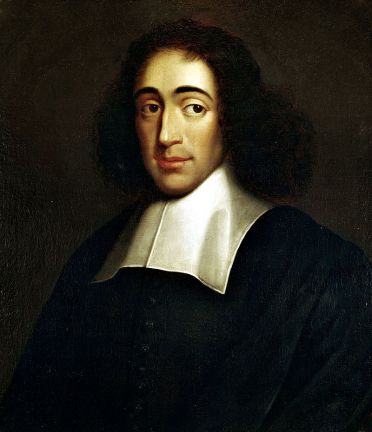
Portrait of Baruch de Spinoza (1632-1677), ca. 1665, by an unknown artist

Baruch Spinoza was born on November 24, 1632, in Amsterdam, the Netherlands. He was the son of Michael and Hannah Spinoza, Portuguese Jews who were forced to convert to Christianity, then imprisoned and tortured by the Inquisition, then fled to relatively tolerant Amsterdam. The Spinozas became successful and respected members of Amsterdam’s Jewish community.

Their son Baruch (also called by his Latinized name Benedicto, also meaning ‘blessed’), was a precocious and brilliant boy who became an intellectually rigorous, curious, and free-thinking man. He wrote prodigiously, profoundly, and often obscurely while earning a humble living as a scientific instrument lens-grinder. He was excommunicated for his unorthodox beliefs (rather surprising still given the relative broad-mindedness of that synagogue), shunned and condemned by his fellow Jews and by Christians alike, and lived the rest of his too-short life in near-solitude, though in rich correspondence with a wide circle of friends and intellectuals.

His idea of God as a unified substance which, in some sense, can be understood as being the same as Nature or the Universe itself, is still widely beloved (the great physicist Albert Einstein and eloquent, outspoken atheist Christopher Hitchens, for example, were among his biggest fans), hated, and debated widely, especially insofar as it can be difficult to grasp the exact nature of Spinoza’s metaphysical and ethical ideas. Spinoza refused to repudiate his ideas despite the intense social pressure he had to deal with for the rest of his life. But however much his correspondents argued, cajoled, threatened with hellfire, or otherwise tried to convince him to abandon his beliefs, Spinoza responded with firmness, constancy, thoroughness, and courtesy.

Learn more about the integrious Baruch Spinoza at:

Baruch Spinoza ~ by Steven Nadler for The Stanford Encyclopedia of Philosophy

Baruch Spinoza (1632 – 1677) ~ in the Jewish Virtual Library

Benedict De Spinoza (1632—1677) ~ by Blake D. Dutton for the Internet Encyclopedia of Philosophy

Betraying Spinoza ~ Rebecca Goldstein on her book Betraying Spinoza: The Renegade Jew Who Gave Us Modernity

Benedict de Spinoza: Dutch-Jewish Philosopher ~ by Richard H. Popkin for the Encyclopædia Britannica

From Baruch to Benedicto! (Spinoza pt. 1) and Spinoza Part 2 ~ by Stephen West for Philosophize This! podcast

God Intoxicated Man – The Life and Times of Benedict Spinoza ~ by Michael Goldfarb for the BBC’s Sunday Feature

Spinoza ~ Melvin Bragg discusses Spinoza’s life and thought with Jonathan Rée, Sarah Hutton, and John Cottingham for In Our Time

The Heretic Jew ~ by Harold Bloom, book review of Rebecca Goldstein’s Betraying Spinoza: The Renegade Jew Who Gave Us Modernity for The New York Times

The Writings of Spinoza ~ at Internet Sacred Text Archive

*A version of this piece was previously published at Ordinary Philosophy

~ Ordinary Philosophy is a labor of love and ad-free, supported by patrons and readers like you. Any support you can offer will be deeply appreciated!

Frederick Douglass in Edinburgh, Scotland, Part 1: Strike for Freedom Exhibit at the National Library of Scotland

Strike for Freedom Frederick Douglass exhibit poster, National Library of Scotland, Edinburgh, 2018, featuring an 1853 engraved portrait by John Buttre

Thursday, October 4th, 2018

This afternoon’s an exciting one: it’s the opening day of the Strike for Freedom exhibit at the National Library of Scotland in Edinburgh, Scotland. It features photos, letters, books, memorabilia, and more relating to Frederick Douglass and his family, friends, and colleagues, who spoke and worked for the abolition of slavery and equal rights in the antebellum United States and beyond.

Frederick Douglass is featured here at the NLS because he became an especially well-known abolitionist speaker in Scotland. Douglass traveled to the British Isles in August of 1845 following the publication of his Narrative of the Life of Frederick Douglass. He planned to kill two birds with one stone when he crossed the Atlantic: one, he would escape the danger of re-capture by his legal owner with the help of the information contained in the Narrative and two, he would add his voice to the growing antislavery movement in Britain. After touring Ireland, Douglass arrived in Ardrossan, Scotland on January 10th, 1846. Not long after his arrival, Douglass became involved in the ‘Send Back the Money!’ campaign, which called on the newly formed Free Church of Scotland to return donations from American congregations who supported slavery. Though the campaign did not succeed in persuading the Church to return the funds, Douglass’ speeches were immensely popular and he garnered a huge amount of support for the various causes he spoke for, including abolition, temperance, and equal access to public modes of transport and accommodations regardless of race.

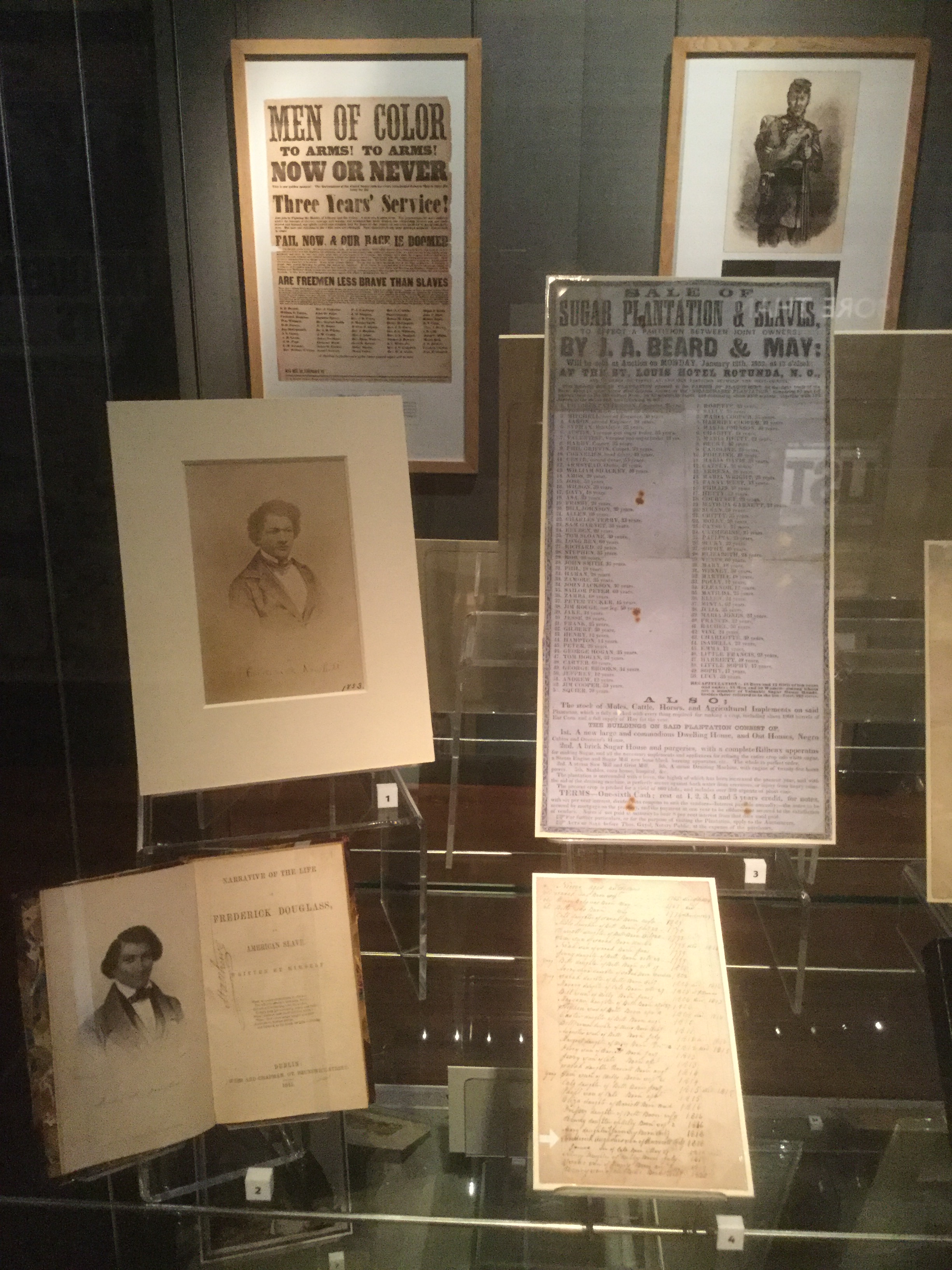
Frederick Douglass items in Strike for Freedom exhibit, National Library of Scotland, Edinburgh, 2018. At bottom left is the first Irish printing of Douglass’ Narrative, published by abolitionist Richard Webb, with a frontispiece portrait signed ‘B. Bell.’ Douglass hated the portrait, and though Webb took offense at Douglass’ reaction to it, he duly replaced it with another in subsequent printings. This is the very same copy from the NLS’ collection I consulted this summer when researching my master’s dissertation.

The Strike for Freedom exhibit’s opening is kicked off today with a fascinating and rousing talk by Celeste-Marie Bernier, who was instrumental in arranging this exhibit. The focus of her talk was how Douglass did not become the great man he was alone. His wife Anna Murray; his daughters and sons Rosetta, Lewis Henry, Frederick Jr., Charles Remond, and Annie; and his mother and grandmother Harriet and Betsy Bailey were all instrumental in helping him become the man he was. They functioned as inspirations, teachers, helpmeets, companions, consciences, correctives, encouragers, amanuenses, and above all, sources of love, pride, and joy for Frederick in every stage of his growth from slave child, to self-emancipated young man, to husband and father, to activist and author, to American statesman and moral leader.

The Strike for Freedom exhibit centers around Douglass family artifacts (mostly original with occasional facsimiles) from the Walter O. Evans collection. Dr. Evans and his wife Linda are major collectors of African-American art, but Dr. Evans has also gathered a massive collection of African-American documents, photos, and other artifacts throughout the course of his life. The exhibit also includes at least one item from the NLS’ own collection, and images from the Maryland State Archives, the Historical Society of Pennsylvania, the Library of Congress, the Central Library of Rochester & Monroe County in New York, and the National Park Service’s Frederick Douglass National Historic Site in Washington, D.C.
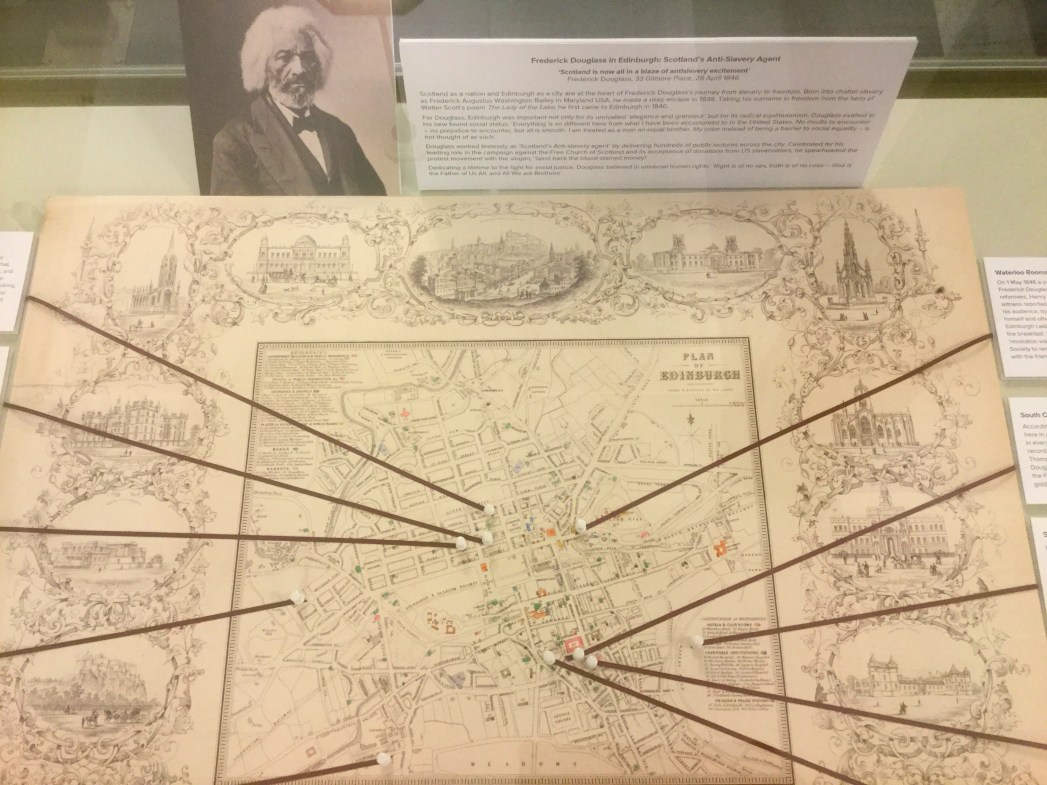
Frederick Douglass in Edinburgh map, Strike for Freedom exhibit, National Library of Scotland, 2018

As I head for the exhibit after the talk, I pass by a large glass case with a map laid out, marked with pins and labels. It shows the location of Edinburgh sites associated with Douglass’ visits to Scotland. I’ll be covering these Edinburgh sites as I take my own journey through Edinburgh following Douglass, stay tuned!

Here are just some of the artifacts I saw in the exhibit. No doubt, I’ll be sharing more with you throughout my Douglass in the British Isles series as they relate to the stories.

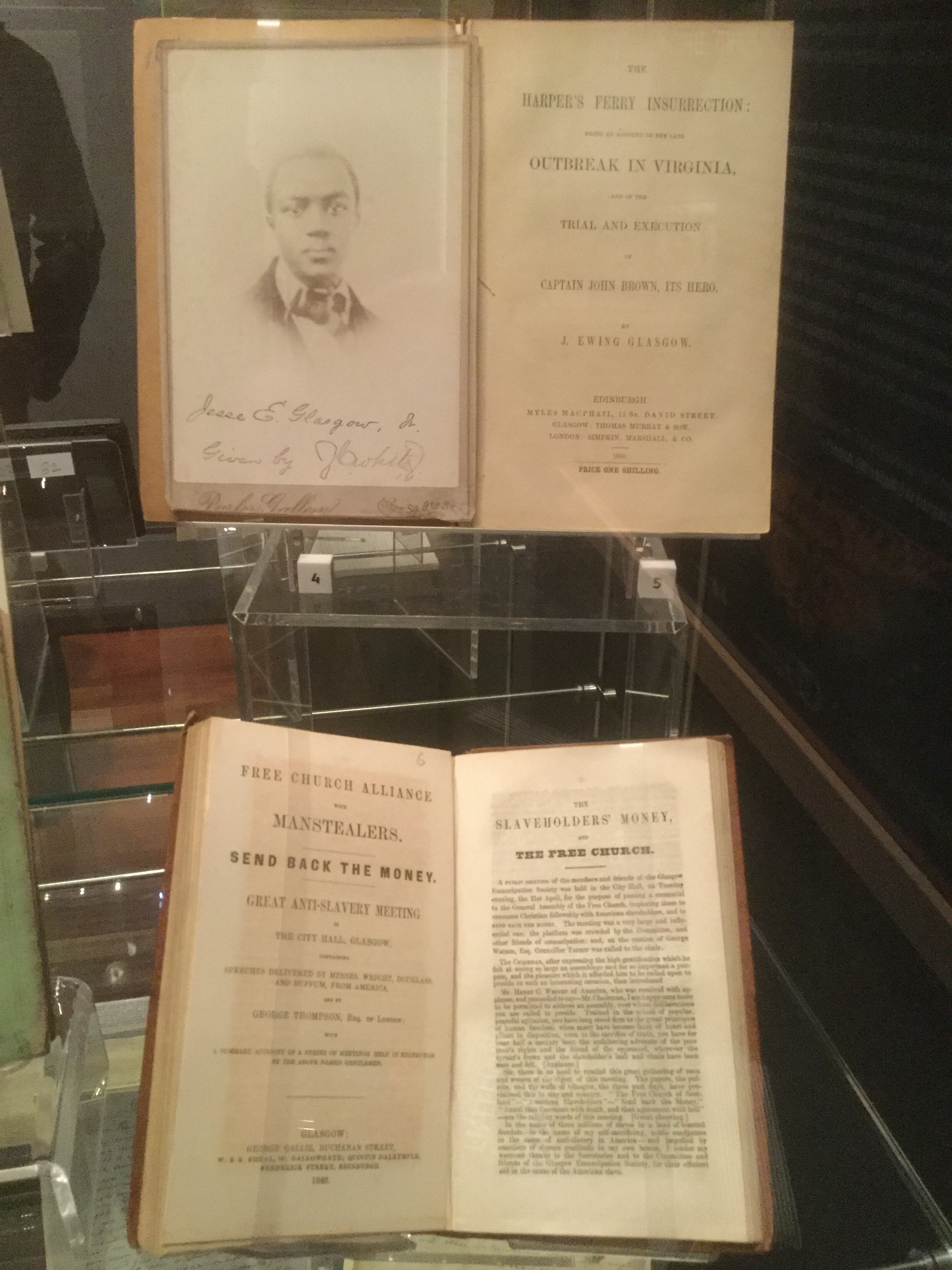
Jesse Glasgow’s book on Harper’s Ferry and John Brown and a ‘Send Back the Money!’ anti-slavery meeting pamphlet at the Strike for Freedom exhibit at the NLS, 2018. Glasgow was a classics student at the University of Edinburgh and unfortunately, died young in 1860, at only age 23, having already become a published author and an award-winning scholar.

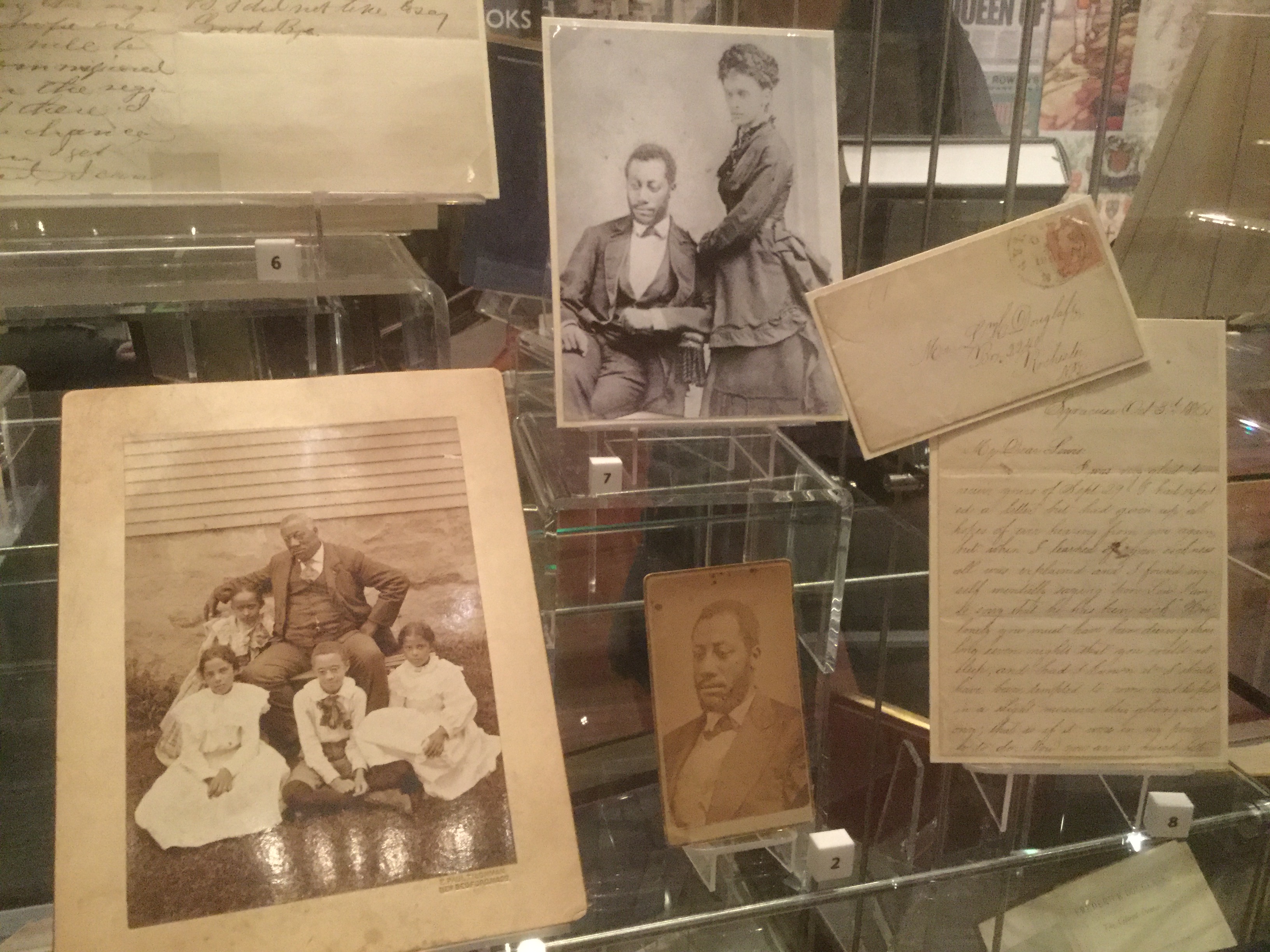
Lewis Henry and Helen Amelia Longuen Douglass photos and letter, Strike for Freedom exhibit at the NLS, 2018. Lewis was Douglass’ eldest son, and Amelia was a member of a prominent abolitionist family. The love letters between Lewis, away fighting in the Civil War, and his beloved Amelia tell a revealing and fascinating story of love among war and the fight for equality.

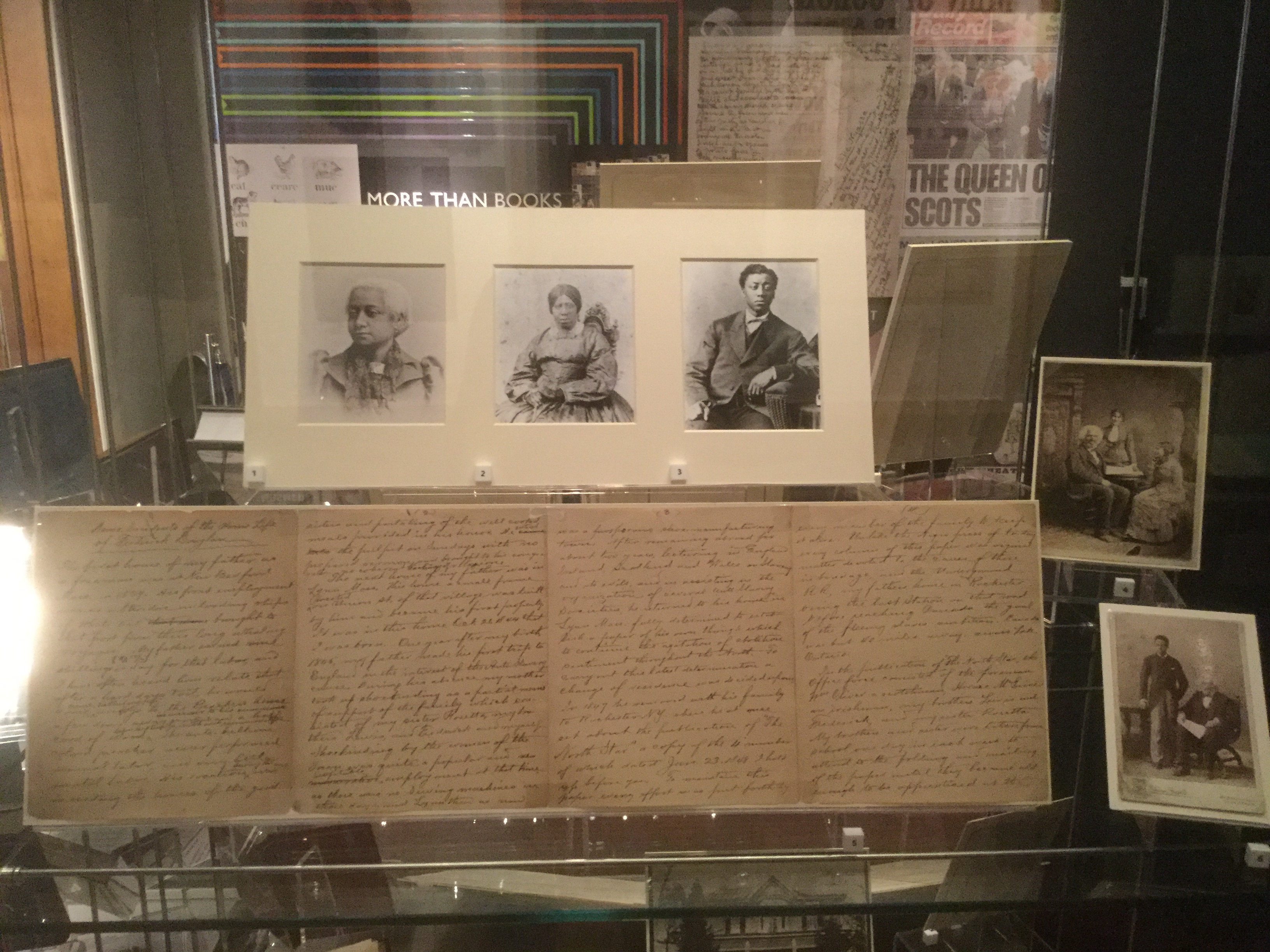
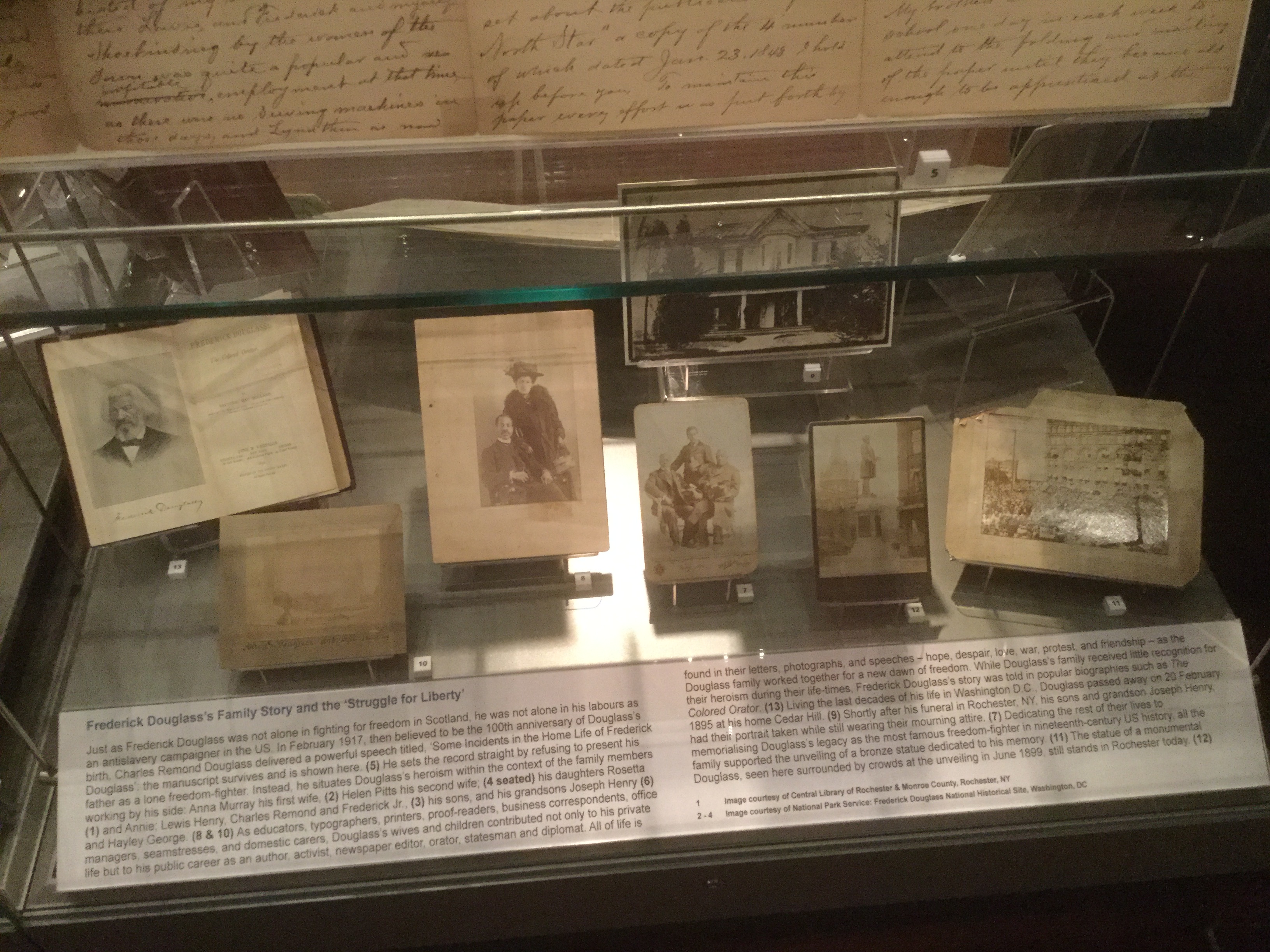
Frederick Douglass’ Family Story photos and artifacts at the Strike for Freedom exhibit at the NLS, 2018. At the top, from left to right clockwise, are pictured Rosetta, the Douglass’ eldest daughter; Anna Murray, Douglass’ first wife and mother of all of his children; the Douglass’ middle child Frederick Douglass, Jr.; Douglass with his second wife Helen Pitts (sitting) and her sister Eva (standing); and Douglass with his grandson Joseph (standing), a famous violinist. The four-page document is a speech written by Charles Remond Douglass titled ‘Some Incidents of the Home Life of Frederick Douglass’ in which he describes Douglass’ civil rights work as a family affair.
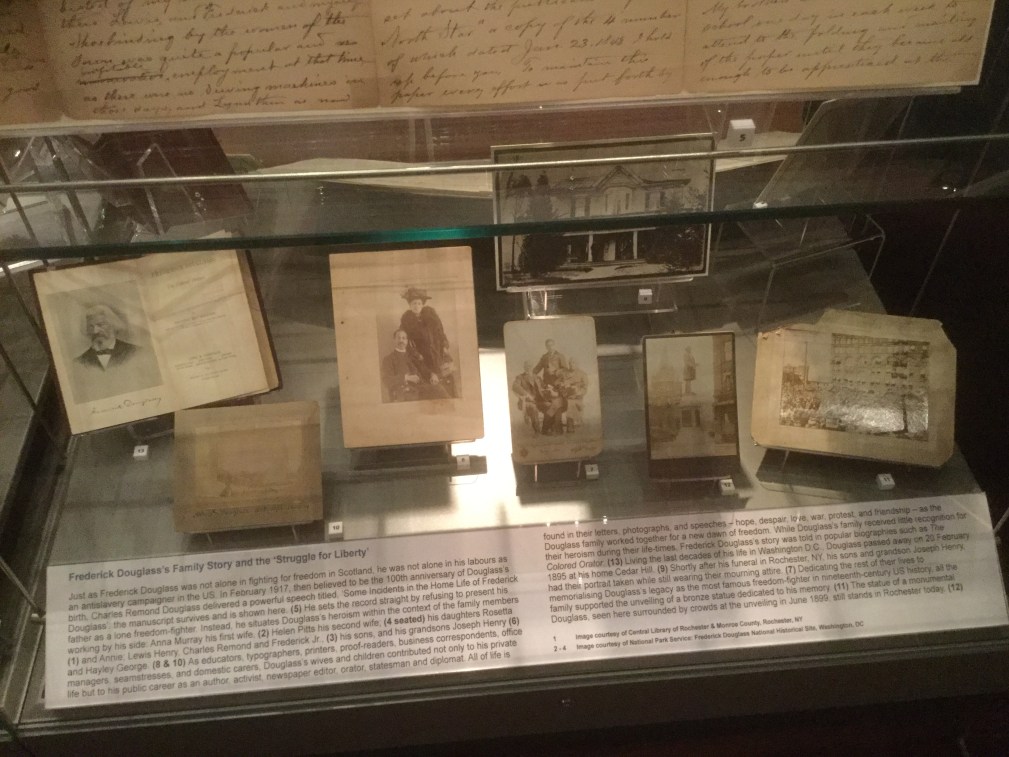
Frederick Douglass’ Family Story photos and artifacts, Strike for Freedom exhibit at the NLS, 2018

After a good long visit to the exhibit and chatting with some fellow attendees at the talk (including an all-too-brief chat with Dr. Evans), I depart, inspired, happy with the new things I’ve learned, and excited to continue my journey through texts and physical places following Douglass in the British Isles.

The National Library of Scotland’s Strike for Freedom exhibit will be continuing through February 16th, 2019.

~ Ordinary Philosophy is a labor of love and ad-free, supported by patrons and readers like you. Any support you can offer will be deeply appreciated!

~~~~~~~~~~~~~~~~~~

Sources and Inspiration:

Bernier, Celeste-Marie, and Andrew Taylor. If I Survive: Frederick Douglass and Family in the Walter O. Evans Collection. Edinburgh University Press, 2018

Delatinerjan, Barbara. ‘Interest in Black Art Just Grew and Grew.New York Times, Jan 30, 2000

Jesse Ewing Glasgow, Jr. (c. 1837-1860)‘, Falvey Memorial Library at Villanova University website

Murray, Hannah Rose. Frederick Douglass in Britain and Ireland

Our Bondage and Our Freedom: An international project celebrating the 200 year anniversary of the birth of African American activist and author, Frederick Douglass. School of Literatures, Languages and Cultures, University of Edinburgh website

Pettinger, Alasdair. Frederick Douglass and Scotland, 1846: Living an Antislavery Life. Edinburgh University Press, 2018

Pettinger, Alasdair. ‘Douglass in Scotland‘ series for bulldozia.com

Happy Birthday, Abigail Adams!

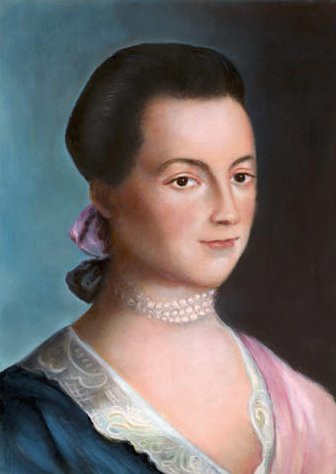
Abigail Adams, the earliest known image of her painted near the time of her marriage in 1764

Abigail Adams, born on November 22, 1744 in Weymouth, Massachusetts, was wife and chief advisor to John Adams, American founding father and second president; early advocate for women’s rights and opponent of slavery; self-taught intellectual; mother to many children including another American president; and a savvy and successful financial speculator. One reason why she remains among the most well-known figures in American history is the voluminous, well-preserved, witty, erudite, charming, highly personal, and utterly fascinating correspondence between her and her husband John. While she remained at home raising the children and managing their home, John was frequently away for extended periods on matters of revolution and state. Their letters are famous: they were loving and forthright with one other on a rare level, and the ideas and advice these two brilliant people shared with one another illuminate and inspire readers still.

Learn more about our wise and indefatigable founding mother Abigail Adams at:

Abigail Adams ~ by Beckett Graham and Susan Vollenweider for The History Chicks podcast

Abigail Adams ~ by Bonnie Hurd Smith for the Boston Women’s Heritage Trail website

Abigail Adams (1744 – 1818) ~ bio for the Adams National Historical Park, National Park Service website

Abigail Adams: American First Lady ~ by Betty Boyd Caroli for Encyclopædia Britannica

Abigail Adams: Revolutionary Speculator ~ Liz Covart interviews Woody Holton for Ben Franklin’s World: A Podcast About Early American History

Abigail Smith Adams ~ by Debra Michals for the National Women’s History Museum website

Correspondence Between John and Abigail Adams ~ Transcripts of over 1,100 letters, transcribed and digitized by The Massachusetts Historical Society

First Family: Abigail and John Adams ~ by Joseph J. Ellis for the Philadelphia Free Library

How Abigail Adams Proves Bill O’Reilly Wrong About Slavery ~ by David A. Graham for The Atlantic

John Adams ~ Miniseries by HBO, 2008

*A version of this piece was previously published at Ordinary Philosophy

~ Ordinary Philosophy is a labor of love and ad-free, supported by patrons and readers like you. Any support you can offer will be deeply appreciated!

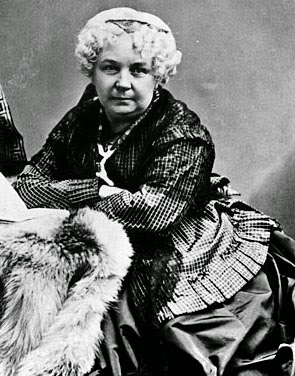
Happy Birthday, Elizabeth Cady Stanton!

In honor of the great feminist Elizabeth Cady Stanton‘s birthday, I’m sharing again the stories of my explorations of her life and ideas in the places she lived and worked, often in conjunction with her fellow feminists Ernestine Rose and Frederick Douglass:

To New York City I Go, In Search of Ernestine Rose and Elizabeth Cady Stanton

Enjoy, and I hope you find her story as fascinating and inspiring as I do!

~ Ordinary Philosophy is a labor of love and ad-free, supported by patrons and readers like you. Any support you can offer will be deeply appreciated!

*A version of this piece was previously published at Ordinary Philosophy

Happy Birthday, John Jones!

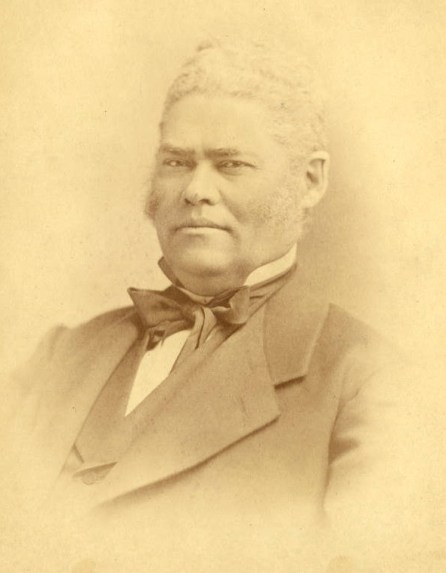
John Jones, portrait by Mosher & Baldwin, 1882, courtesy of the Chicago History Museum

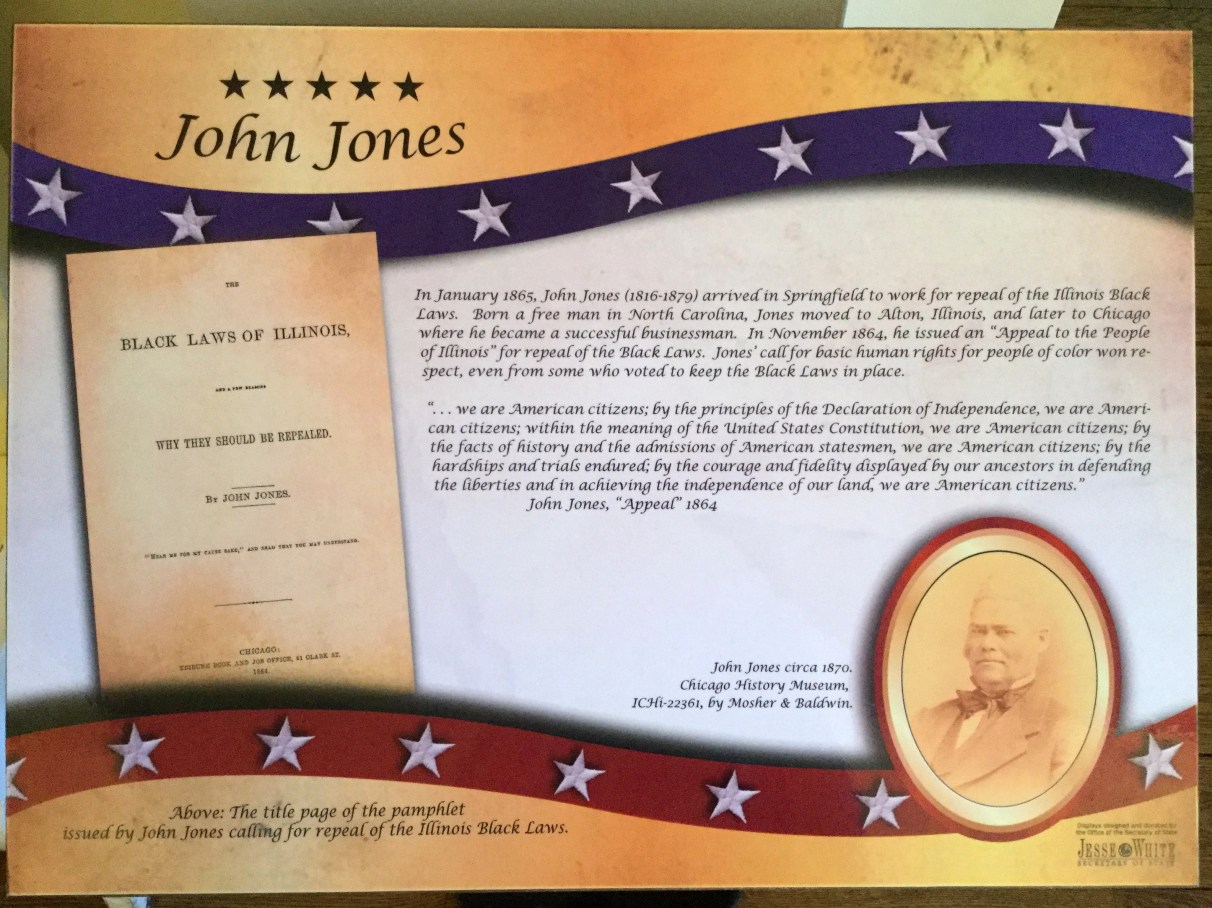
When I visited Springfield, Illinois last summer, I found a very interesting plaque at the Old State House downtown. It told the story of John Jones and his activism against Illinois’s Black Laws, a set of legal codes that pertained only to black people, and, as you likely and immediately supposed,  were terribly oppressive. Such laws have a long history in the United States and as long as they’ve been around, lovers of justice have been around to fight them. John Jones was one such person.

Born on November 3rd, 1816 to an American black mother and German white father, Jones had to make his own way early in the world. Jones’ mother did not trust his father to do right by his son so she apprenticed him to a tailor when he was very young. The resourceful Jones taught himself to read and write and, having learned what he needed to, he released himself from the tailor’s service by age 27. He then obtained official free papers for himself and his wife, née Mary Jane Richardson, and secured their freedom to live and travel by posting a $1,000 bond in 1844. While he and his wife were both born free, they had to worry about the numerous ‘fugitive’ slave catchers and kidnappers prowling around, all too happy to capture as many black persons as they could get ahold of, passing them off as escaped slaves in exchange for a substantial payoff.

The Joneses moved to Chicago from Alton, Illinois in 1845, where there was an established community of black entrepreneurs and therefore, more opportunities for families such as theirs. Jones worked hard and savvily, building up a very successful tailoring business and amassing an impressive fortune within just a few years. The Joneses used their success to help their fellow black citizens, making their home one of the key Chicago stops on the Underground Railroad. Jones poured much of his money and time into civil rights activism, working for the abolitionist cause and to overturn the Fugitive Slave Act of 1850 and the already decades-old Black Laws of Illinois, sometimes with his fellow autodidact and activist Frederick Douglass. For the rest of his life, Jones was a prominent intellectual, moral, religious, and political leader in the black community of Chicago and beyond.

Learn more about the courageous civil rights leader John Jones at:

John Jones (1816–1879): Activist, politician, tailor, entrepreneur  ~ by Jessie Carney Smith for Encyclopedia.com

Jones, John ~ by Cynthia Wilson for Blackpast.org

Historical placard for John Jones, Old State House, Springfield, Illinois

*A version of this piece was previously published at Ordinary Philosophy

~ Ordinary Philosophy is a labor of love and ad-free, supported by patrons and readers like you. Any support you can offer will be deeply appreciated!

Happy Birthday, John Adams!

John Adams by John Trumbull, 1793, National Portrait Gallery, Washington, D.C.

Like many who watched the excellent 2008 miniseries John Adams with Paul Giamatti in the title role and Laura Linney as Abigail Adams, my interest in the United States’ second president increased quite a bit after watching it. And when I subsequently read John Ellis’ Passionate Sage: The Character and Legacy of John Adams, I found myself thoroughly engrossed. I read of a man who was brilliant, insecure, honest, vain, visionary, retrograde, loving, selfish… all character traits which I believe are often found in the most interesting and accomplished people. The same traits that drive people to do wonderful and unusual things are often the same as, or found in conjunction with, those which make people thoroughly insufferable. For example, the insecure egoist’s need to be loved and admired provides the drive for accomplishment, and those who are intelligent enough to surpass most others in this regard are also intelligent enough to recognize it, which can result in an overinflated ego. Perhaps because I don’t have to put up with him personally, I can freely admire and even feel affection for Adams as the sensitive, flawed human being  revealed in his massive correspondence; an egoist who nevertheless was obsessed with justice and did his best to see it done in the world, who sacrificed his own posterity and a second term in office to preserve his new country from the existential threat of an ill-conceived war; whose dignity was far too easily wounded but at times proved himself a loyal friend even to those that betrayed him – Thomas Jefferson being a prime example.

Americans may have more easily forgiven all of this if he hadn’t championed the Alien and Sedition Acts and signed them into law, parts of which are seen today as contrary to essential American principles. In his fear that the bond between the states in his newly united country would break apart under the strain of war and the spiraling controversies of party politics, Adams overreached. But his legacy shouldn’t be overshadowed by this one, though admittedly significant, mistake. As Ellis writes for Encyclopædia Britannica,

Although Adams was regarded by his contemporaries as one of the most significant statesmen of the revolutionary era, his reputation faded in the 19th century, only to ascend again during the last half of the 20th century. The modern edition of his correspondence prompted a rediscovery of his bracing honesty and pungent way with words, his importance as a political thinker, his realistic perspective on American foreign policy, and his patriarchal role as founder of one of the most prominent families in American history.

Learn more about the oh-so-human, brilliant president John Adams at:

John Adams ~ Miniseries by HBO, 2008

John Adams As He Lived: Unpublished Letters to Dr. Benjamin Waterhouse, Professor of Physic at Harvard College ~ published in The Atlantic, May 1927

John Adams: The Case of the Missing John Adams Monument ~ Lillian Cunningham for the Presidential podcast series presented by The Washington Post

John Adams: President of the United States ~ Joseph J. Ellis for Encyclopædia Britannica

Plain Speaking: In David McCullough’s Telling, the Second President is Reminiscent of the 33rd (Harry Truman) ~ by Pauline Maier for The New York Times: Books, May 27, 2001

Sorry, HBO. John Adams Wasn’t That Much of a Hero ~ Jack Rakove for The Washington Post, April 20, 2008

*A version of this piece was previously published at Ordinary Philosophy

~ Ordinary Philosophy is a labor of love and ad-free, supported by patrons and readers like you. Any support you can offer will be deeply appreciated!

Happy Birthday, Erasmus!

Erasmus, from page 32 of The Century of Sir Thomas More by Benjamin Orange Flower, 1896, public domain via the British Library

Desiderius Erasmus (October 27, 1469 – July 12, 1536) was, by his own account, born in Rotterdam, Holland. His father was a priest and his mother the daughter of a physician, who, unsurprisingly, were not married. As a child of an illicit union, he had no apparent prospects for a successful worldly career, so he was initially educated for the life of a cleric. However, he was very unhappy during these early years of his education and training, feeling that the strict, narrowly constrained life didn’t suit him. Though he was ordained a priest, Erasmus later insisted he was pressured into doing so, likely because by that time he had long been an orphan of no means to speak of and so had no apparent alternative means of support.

Erasmus was, however, a very pious man, but in his own way. The Catholic Church, at this time, was seen by Erasmus and others of like mind as a decadent, corrupt, licentious institution in deep need of reform, as it had largely cast aside the pure, simple Christianity of its humble founder. Nevertheless, Erasmus’ reformist instincts did not ally him with those who wished to do away with the Catholic Church altogether: like his friend and protégé Thomas More, he saw the Church as a unified spiritual body that must be preserved. While he was sympathetic to Martin Luther’s impassioned and wholehearted rejection of ecclesiastical corruption, Erasmus rejected his views on the hopelessly sinful nature of humanity, so corrupt that goodness and redemption were dependent entirely on God’s grace. Erasmus contended that human beings had God-given free will, and thus were capable of goodness by exercising that will to choose good and reject evil. Erasmus also rejected Luther’s radical and wholesale rejection of the Church. Erasmus believed, rather, that reform would be achieved within its institutions by its conscientious members and through individual inner spiritual renewal, characterized by a life of love and humility in conjunction with a simple piety unconcerned with convoluted doctrines and earthly show.

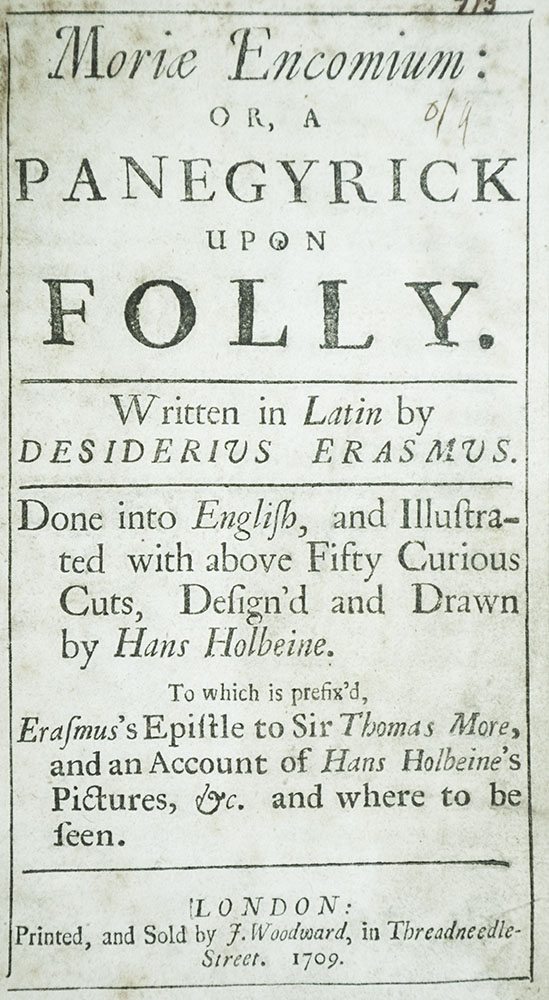
Moriæ Encomium, or, In Praise of Folly by Desiderius Erasmus, page from J. Woodward’s 1709 English translation

The Church, Erasmus believed, would also hugely benefit from a greater focus on secular and classical learning. After all, the human mind was one of God’s greatest creations, so the products of human intelligence deserved attention and reverence second only to sacred writ. Besides, secular scholarship could act as a valuable corrective to theologians’ tendencies to get so wrapped up in fine points of doctrine that their convoluted wranglings served only to confuse and confound the faithful. These convictions, and his long and successful career as a scholar and writer inspired by them, made Erasmus the godfather and patron saint, so to speak, of humanism. Erasmus did not invent that school of thought, but he created so many seminal works in that genre that his name has come to be nearly synonymous with humanism. A brilliant and deeply read scholar, Erasmus’ incredible body of work included annotated translations of classical Greek and Roman works; theological treatises; collections of proverbs and adages; works on aesthetics, style, and writing; voluminous correspondence with the most learned scholars of his time; and much, much more. Erasmus’ most widely known and popular work, however, remains his In Praise of Folly. However brilliant Erasmus was otherwise, he was unsurpassed as a satirist, and he used his cutting wit as a reformist tool, arguably more effective and memorable than his erudition and most eloquent argument.

Despite Erasmus’ disadvantageous start in life in other ways, he made the most of the education he was fortunate to receive. Over the course of his long life, his dissatisfaction with monastic and court life and restless curiosity drove him to create a career as a man of letters on his own terms, seeking patrons that allowed him a career of as much intellectual freedom as the times would allow. Erasmus is often a slippery character, and his motivations and true convictions are hard to pin down, by design. He was least as pragmatic as he was idealistic, and however sharp and potentially dangerous his religious and political satire, he deftly avoided getting himself in trouble in the turbulent and dangerous era he lived in. Not so Erasmus’ friend and protégé More, whose similarly sharp wit and lawyerly skill did not sufficiently counteract his religiosity enough to avoid the chopping block.

Learn more about the brilliant and witty Erasmus by following the links below. I’ve included selections about Erasmus from a variety of religious publication as well which illustrate the mixed admiration and vexation that Erasmus’ idiosyncratic intellect and religiosity still inspire:

Desiderius Erasmus ~ by Erika Rummel for The Stanford Encyclopedia of Philosophy

Desiderius Erasmus ~ in New Advent’s Catholic Encyclopedia

Desiderius Erasmus ~ in Reformation500

Desiderius Erasmus (1468?—1536) ~ by Eric MacPhail for Internet Encyclopedia of Philosophy

Desiderius Erasmus: Dutch Humanist and Scholar ~ by James D. Tracy for Encyclopædia Britannica

Erasmus ~ Melvin Bragg discusses Erasmus with Diarmaid MacCulloch, Eamon Duffy, and Jill Kraye for In Our Time

In Praise of Folly ~ by Desiderius Erasmus, with an introductory biography, Erasmus’ ‘Epistle to Sir Thomas More’, and illustrations by Hans Holbein at Project Gutenberg

The Praise of Folly ~ Nathan Gilmour, David Grubbs, and Michial Farmer discuss this work for The Christian Humanist Podcast

~ Ordinary Philosophy is a labor of love and ad-free, supported by patrons and readers like you. Any support you can offer will be deeply appreciated!

O.P. Recommends: Patrick Deneen and Ezra Klein Discuss the Failures (and Successes?) of Liberalism

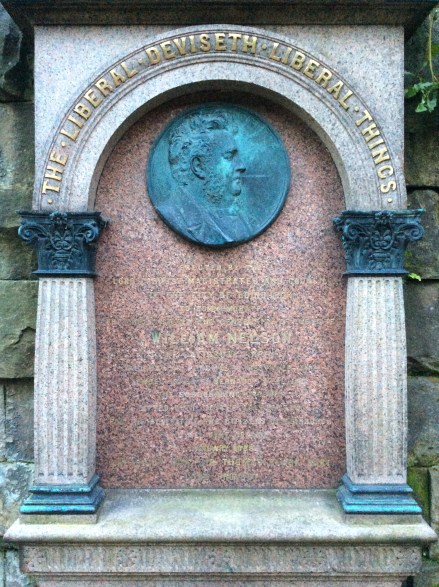
‘The Liberal Deviseth Liberal Things,’ memorial at St Bernard’s Well on the Water of Leith

I have not yet read the book and it may be some time before I get the opportunity, but as is the case so often these days as I work towards my doctorate degree, I rely on discussions with authors to keep up with what’s happening out there in the world of ideas. This little review is, therefore, of the ideas expressed in the context of this discussion only, not of those discussed in the context of the book.

Yesterday morning, as I walked to a class, I listened to this particularly fascinating discussion on Ezra Klein’s podcast: Patrick Deneen says liberalism has failed. Is he right?

Klein and Deneen base their discussion, in part, around the origins of classical liberal thinking, which include John Locke’s thought experiment regarding humankind ‘in the state of nature.’ This is the state of being prior to or outside civil government, and is a way to puzzle out which rights, if any, human beings have according to nature rather than according to civil law. Deneen points out, rightly I think, that this thought experiment is so artificial, so divorced from the actual reality of human nature, that it might lead to misleading results. Human nature, in fact, is bound up in ties to family, friends, society, the political sphere, and so on. To derive rights from the nature of the rootless individual is to derive them from a nature that is, well, not fully human. Liberalism, as Deneen defines it, is the prioritization of the rights and interests of the individual above all else, and points out that this is the central project of both the liberal and conservative parties of the United States. For the former, the personal and expressive life of the individual should suffer little interference from the state, and for the latter, the economic choices of the individual should suffer little such interference. Of course, this is a very rough characterization of the left-and-right political divide, and I suspect that Deneen would agree with my own observation that many on both sides of the political divide no longer seem to adhere very closely to these general principles.

As Klein points out, though there’s much to critique in Deneen’s views, his discussion of why so many people in liberal societies suffer loneliness, depression, alienation, addiction, suicide, and other ills, is often insightful and timely throughout. Deneen sees these as inevitable results of societal values that promote the rights and interests of the individual without sufficient, healthy checks on the single-minded pursuit of individual satisfaction and fulfillment. Human beings intimate ties to others to be happy and healthy, and it appears that without the corrective of social and spiritual concerns, the thoroughly liberal person (again, as Deneen defines it) may very well end up enslaved to the whims and vagaries of appetites, often unhealthy ones, unmoored from personal values or love and loyalty to others.

I consider myself more of a political liberal in many respects, and I felt myself recognizing that some of my reasons echo Deneen’s sentiments. For one, I believe that inherent to the ethos of personal responsibility, often cited as a core value of western conservatism, is taking individual responsibility for behaviors that contribute to larger problems. Further, if individuals continue to behave in a way that significantly erodes the healthy functioning of individuals, families, and societies, then people might have the right to demand that others change their behavior. For example, the degradation of ecosystems that sustain life, health, and happiness through thoughtless over-consumption is, then, it seems to me as it does to Deneen, at least as important a social issue as it is a moral and spiritual one. This is only one of the many matters on which Deneen, in this discussion, offers a timely and well-considered critique of many of the mores and practices the western world takes for granted.

~ Ordinary Philosophy is a labor of love and ad-free, supported by patrons and readers like you. Any support you can offer will be deeply appreciated!!

Happy Birthday, Philippa Foot!

‘Philippa Foot [, born on October 3rd, 1920, was] a philosopher who argued that moral judgments have a rational basis, and who introduced the renowned ethical thought experiment known as the Trolley Problem…’ William Grime’s New York Times obituary of this philosopher, far less widely known than she is influential, is an excellent introduction to the life and ideas of the brilliant Foot.

You can also learn more about Philippa Foot at

Is Goodness Natural? Philippa Foot was one of a group of brilliant women philosophers who swam against the tide of 20th-century moral thought ~ by Nakul Krishna for Aeon

Philippa Foot ~ by Martin L. White for Encyclopædia Britannica

Philippa Foot ~ Interview by Rick Lewis for Philosophy Now, conducted in the autumn of 2001

Philippa Foot (1920-2010) ~ by Lawrence Solum for Legal Theory Blog

Philippa Foot Obituary: A ‘Grande Dame of Philosophy’, She Pioneered Virtue Ethics – by Jane O’Grady for The Guardian, October 5th, 2010

Philippa Foot: Trolleys and Natural Goodness ~ by Edward Harcourt for Prospect magazine, Oct 7, 2010

Professor Philippa Foot: Philosopher Regarded as Being Among the Finest Moral Thinkers of the Age ~ by Peter J Conradi and Gavin Lawrence for The Independent, Oct 18th, 2010

and a multitude of citations in Stanford Encyclopedia of Philosophy entries

~ Ordinary Philosophy is a labor of love and ad-free, supported by patrons and readers like you. Any support you can offer will be deeply appreciated!!

Happy Birthday, Mahatma Gandhi!

Mahatma Gandhi spinning yarn in the late 1920's. Gandhi started the ultimate 'Shop Local' movement, in which he called on his fellow Indians to wear only homespun, locally made fabrics to counteract the British colonialist's exploitation of Indian textile worker

Mahatma Gandhi spinning yarn in the late 1920’s. Gandhi started the ultimate ‘Shop Local’ movement in which he called on his fellow Indians to wear only homespun, locally made fabrics to counteract British colonialist’s policies which impoverished and nearly destroyed India’s textile industry. I founded an apparel and accessory line and boutique in the early 2000’s based on the same principles, carrying only locally and US-made products as an alternative to buying goods made in overseas sweatshops whose workers were unprotected by labor laws. Gandhi’s and my own approach were nationalistic and protectionist, which I no longer believe goes far enough in promoting equal human rights for all. While such approaches may be a good place to start in some circumstances, a better way to go about improving the lives and prospects of workers around the world is to require our governments to institute more comprehensive labor laws and rigorously enforce them. This must include holding companies responsible for the abuses of their contractors, of course, to actually be effective. But Gandhi did, I think, point us down the right path, towards consciousness about what we buy, why we buy it, and how our market decisions effect others.

There are very few non-Americans, outside of our mother country of Britain and our godmother France, who have had a greater impact on the history of the United States and our attitudes towards human rights than the incomparable Mahatma Gandhi. For someone who preached simplicity, often wearing nothing but a loincloth, weaving his own fabric, and living a severely rustic lifestyle to exemplify his own teachings, Gandhi was a very complicated person.

He was a human rights activist, politician, journalist, social and religious reformer, and to many, a sort of messiah. Originally a British loyalist, Gandhi’s studies and personal observations led him to change his own views, often radically, many times over the course of his long life. His beliefs in the revolutionary and morally suasive power of civil disobedience and nonviolent resistance were and continue to be particularly influential in the United States, beginning with the mid-20th century civil rights movement. Martin Luther King, Jr, Gandhi’s intellectual and spiritual descendant, emerged as the leader of this movement following his role in the 1955 Montgomery bus boycott. King’s and Gandhi’s ideas about the civil disobedience and non-violence, in turn, both incorporate Henry David Thoreau’s ideas from his landmark essay ‘Civil Disobedience’.

Here are excerpts on Gandhi’s influence on the American civil rights movement from the encyclopedia of the Martin Luther King, Jr. Research and Education Institute at Stanford University:

‘Upon his death, Mohandas K. Gandhi was hailed by the London Times as ‘‘the most influential figure India has produced for generations’’ (‘‘Mr. Gandhi’’). Gandhi protested against racism in South Africa and colonial rule in India using nonviolent resistance. A testament to the revolutionary power of nonviolence, Gandhi’s approach directly influenced Martin Luther King, Jr., who argued that the Gandhian philosophy was ‘‘the only morally and practically sound method open to oppressed people in their struggle for freedom’’ (Papers 4:478)…

Gandhi was born 2 October 1869, in Porbandar, in the western part of India, to Karamchand Gandhi, chief minister of Porbandar, and his wife Putlibai, a devout Hindu. At the age of 18, Gandhi began training as a lawyer in England. After completing his barrister’s degree he returned to India in 1891, but was unable to find well-paid work. In 1893, he accepted a one-year contract to do legal work for an Indian firm in South Africa, but remained for 21 years. It was in South Africa that Gandhi was first exposed to official racial prejudice, and where he developed his philosophy of nonviolent direct action by organizing the Indian community there to oppose race-based laws and socioeconomic repression.

Gandhi returned to India in 1914. In 1919, British authorities issued the Rowlatt Acts, policies that permitted the incarceration without trial of Indians suspected of sedition. In response, Gandhi called for a day of national fasting, meetings, and suspension of work on 6 April 1919, as an act of satyagraha (literally, truth-force or love-force), a form of nonviolent resistance. He suspended the campaign of nonviolent resistance a few days later because protestors had responded violently to the police.

Within the next few years, Gandhi reshaped the existing Indian National Congress into a mass movement promoting Indian self-rule through a boycott of British goods and institutions…’ (Continue reading)

I’ve included a list of links of many excellent online sources on Gandhi below, including journalist and social critic Christopher Hitchen’s critique. Gandhi did, at times, express ideas and make decisions that many regard as problematic to this day, such as his early rhetoric on black Africans and his relations with some of the women in his life, including his wife Kasturba. Gandhi was no plaster saint: like the rest of us, he struggled to find truth and meaning in a world of mutually contradictory yet worthy-seeming values, principles, and goals; sometimes, like the rest of us, he didn’t get it right, and sometimes, he was very, very wrong. True understanding, I believe, is never reached through uncritical hero worship, even of one as influential, internationally revered, and I believe ultimately beneficial to the intellectual, activist, and political history of human rights as Gandhi.

Appreciating Gandhi Through His Human Side ~ by Hari Kunzru for the New York Times‘ Books of the Times, Mar 29, 2011

Civil Disobedience ~ by Kimberley Brownlee for The Stanford Encyclopedia of Philosophy.

Gandhi and Civil Disobedience ~ from the Constitutional Rights Foundation.

Gandhi the Philosopher: Better Known as the Face of Non-violent Protest, Gandhi Was Also a Surprising, Subtle Philosopher in the Stoic Tradition ~ by Richard Sorabji for Aeon

In Search of Gandhi ~ by Lalit Vachani, from BBC’s Radio Four Storyville Why Democracy? series

Life of Gandhi ~ a documentary by GandhiServe Foundation: Mahatma Gandhi Research and Media Service.

Gandhi, Mohandas Karamchand (1869-1948) and India Trip (1959)two entries from Martin Luther King, Jr. and The Global Freedom Struggle: Encyclopedia of the MLK Research and Education Institute at Stanford University

Mohandas Gandhi ~ by Salman Rushdie for Time magazine, Apr 13, 1998

The Real Mahatma Gandhi: Questioning the Moral Heroism of India’s Most Revered Figure ~ by Christopher Hitchens for The Atlantic, July/August 2011 issue.

~ Ordinary Philosophy is a labor of love and ad-free, supported by patrons and readers like you. Any support you can offer will be deeply appreciated!!