New Podcast Episode: Mary Wollstonecraft, Champion of Reason, Passionate in Love

Listen to this podcast episode here or on Google Play, or subscribe on iTunes

The life and work of Mary Wollstonecraft, mother of modern feminism, can seem to reveal a mass of contradictions.

Her seminal feminist work, A Vindication of the Rights of Woman, champions reason as the ultimate guide for a moral and productive life. She used reason to great effect to show why women should, and how they could, grow out of their socially constructed roles as under-educated coquettes and household drudges. She believed that reason should rule both individuals and societies because it’s the best tool we have to achieve justice and to perfect the self. Without reason, she thought, human beings are ruled by narrow self-interest, by the prejudice born of ignorance, and by crude lust.

Yet the life Wollstonecraft chose to live was widely criticized both during her lifetime and over the two hundred plus years since her death. It’s not just because she didn’t conform to the mores of her time; her life choices are still considered unreasonable and even self-destructive by many. At times, they made her an object of scandal, impoverished, or deeply depressed, even in such desperate straits that she twice attempted suicide. That’s because she was also deeply passionate, devoted to retaining her personal and mental freedom while abandoning herself to loves which never failed to break her heart, be they revolution, family, friend, or lover. For Wollstonecraft, reason and passion are not opposites: they are two sides of the same coin. A truly reasonable person, she thought, is kind, affectionate, and generous as well, and a passionate lover of justice, truth, and beauty….

Read the written version here

Ordinary Philosophy and its Traveling Philosophy / History of Ideas series is a labor of love and ad-free, supported by patrons and readers like you. Please offer your support today!

Robert Louis Stevenson Memorial Trail and Monument at Mount Saint Helena, CA

Stevenson Memorial Trail to the summit of Mount Saint Helena. The trailhead is about nine miles north of Calistoga, CA

My sister Therese and I hiked the lovely trail to the summit of Mount Saint Helena on April 22nd, 2017. This hike was Therese’s idea, as are so many of the best ones; thanks, dear sister!

The Stevenson Memorial Trail winds five miles to the summit (one way), about 1,800 feet of climbing all told to the 4,343-foot peak. The entrance to the trail led into dreamy forest, with branches highlighted here and there with fluttering pink plastic ribbons to guide the trail runners in an organized event held here that day. There was a table set up in the parking lot off Highway 29, with drinks, treats, and cheers available for the tired athletes.

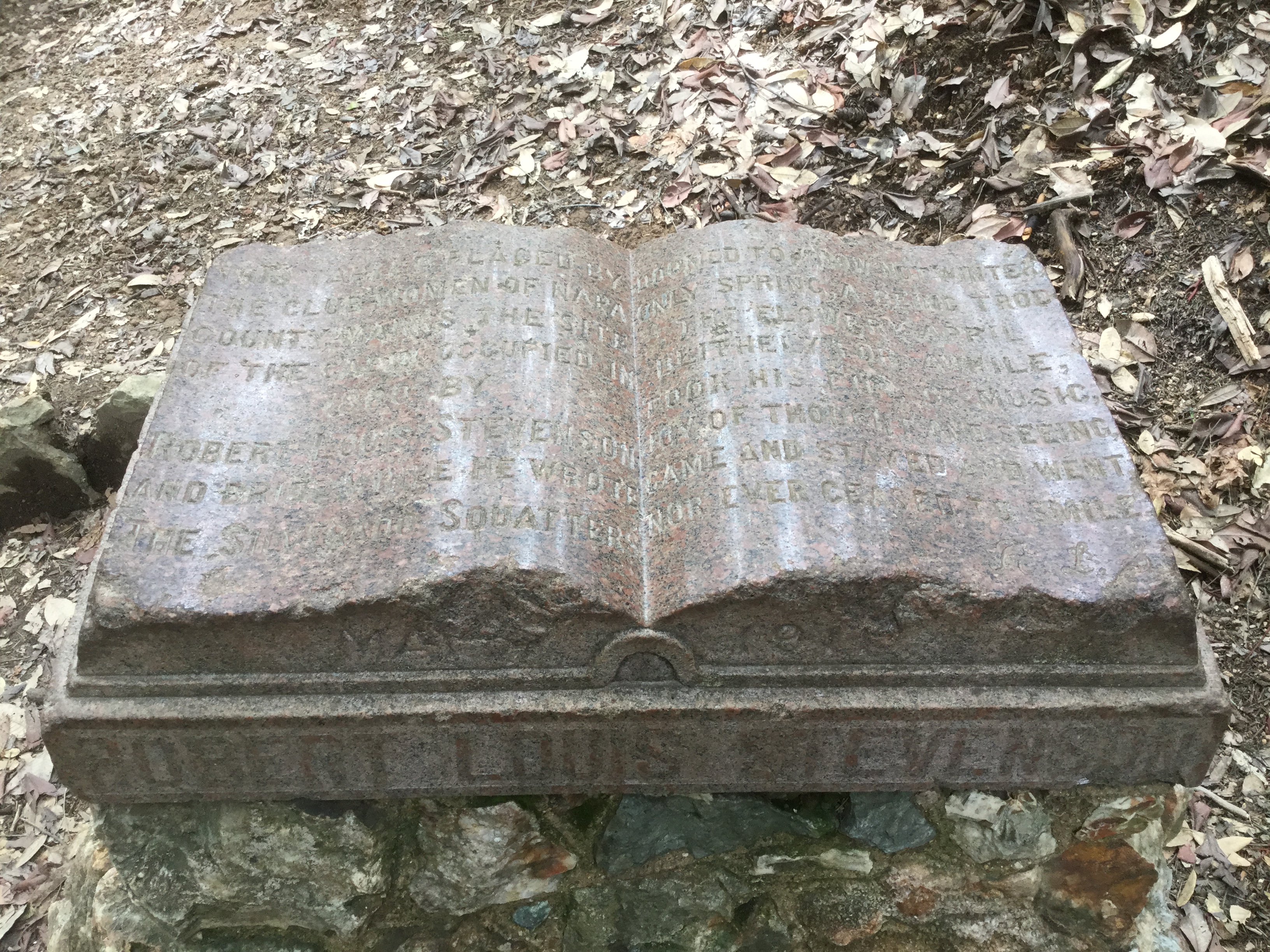
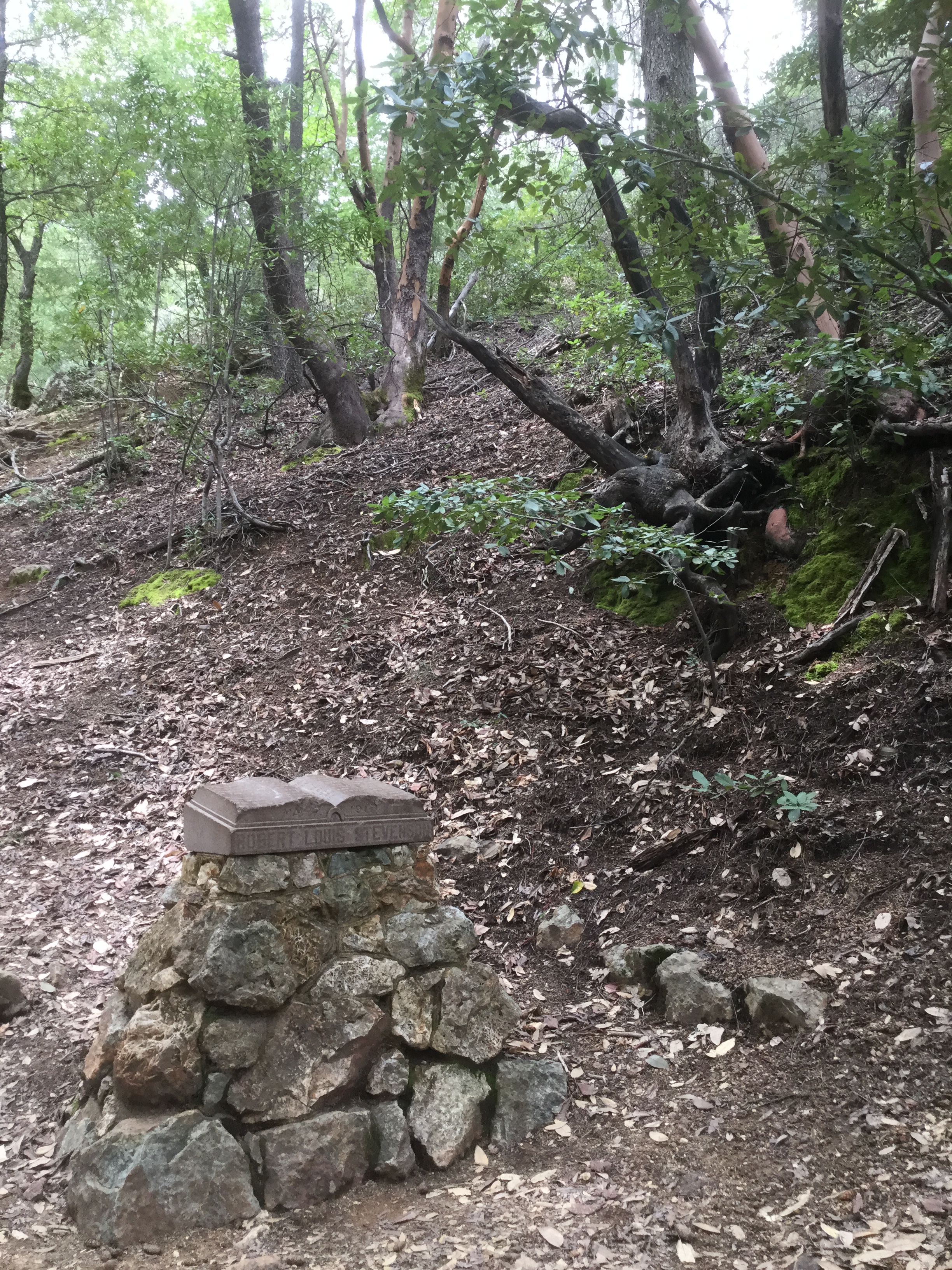
On our way up, we discovered the monument mentioned in the sign at the foot of the trail, a handsome little tribute to the memory of Robert Louis Stevenson and his wife placed here exactly 94 years ago on May 7th, 1911 by the Napa Club. Stevenson and his new wife Fanny Van de Grift stayed here for an adventurous honeymoon on the cheap, living for two months in an abandoned miners’ cabin. Stevenson, author of Treasure Island, The Strange Case of Dr Jekyll and Mr Hyde, and A Child’s Garden of Verses, was seeking adventure, new fodder for his writing which he feared was lagging due to his chronic poor health, and a climate in which his congested lungs could do their best. And he was here for Fanny: he had met her years earlier and fell in love. They had to wait to join their lives together until the divorce from her abusive husband came through, and when it did, he left his native Scotland to join her in her home country.

Monument at the site of the miners’-turned-honeymooners’ cabin on Stevenson Memorial Trail, Mount Saint Helena, Robert Louis Stevenson State Park, CA

The engraved marble tablet on the stone monument reads:

‘This tablet placed by the Club Women of Napa County
Marks the site of the cabin occupied in 1880 by Robert Louis Stevenson
And bride, while he wrote The Silverado Squatters.

“Doomed to know not winter only spring,
A being trod the flowery April blithely for awhile,
Took his fill of music, joy of thought
And seeing and stayed and went
Nor ever ceased to smile.” – R.L.S.

It was a beautiful hike, the first mile or so lovely and shaded on the narrow switchback trail, the last four mostly fire roads, though we found a couple of steep little shortcuts. The view from the top was spectacular, though not as far as it might have been on a less cloudy day. The wildflowers were lovely too, and the pine and madrone forests (and plentiful poison oak) very much as Stevenson describes them in The Silverado Squatters. It’s the story of his travels to California and his time here in Napa County with Fanny, which is available to read in full online. It’s an amusing and charming story, though the way he describes some Jewish acquaintances is disconcerting unless you keep in mind the prejudices of the time.

Enjoy!

Engraved stone book on the monument at the site of the old cabin on Stevenson Memorial Trail up Mount Saint Helena

Stream near the monument on Stevenson Memorial Trail. Stevenson describes a stream near the old bunkhouse in The Silverado Squatters

Panorama of the view from the peak of Mount Saint Helena, CA, 2017 by Amy Cools

The flat rocks at the peak make a perfect place for a picnic on Mount Saint Helena, CA, 2017 Amy Cools.jpg

Ordinary Philosophy and its Traveling Philosophy / History of Ideas series is a labor of love and ad-free, supported by patrons and readers like you. Please offer your support today!

~~~~~~~~~~~~~~~~~~~~~~~~~~~~~~~~~~~

Sources and inspiration

Bazzoli, Kathy. ‘The Legend of Mount St. Helena,’ The Weekly Calistogan, May 19, 2015

Robert Louis Stevenson (1850–1894)‘ – The Poetry Foundation website

Robert Louis Stevenson – Marriage‘, from Wikipedia, the Free Encyclopedia

Robert Louis Stevenson / Mt St. Helena State Park,’ Sonoma Hiking Trails website

Robert Louis Stevenson State Park,’ Napa Valley State Parks Association website

Stevenson, Robert Louis. The Silverado Squatters, 1883

Trading In

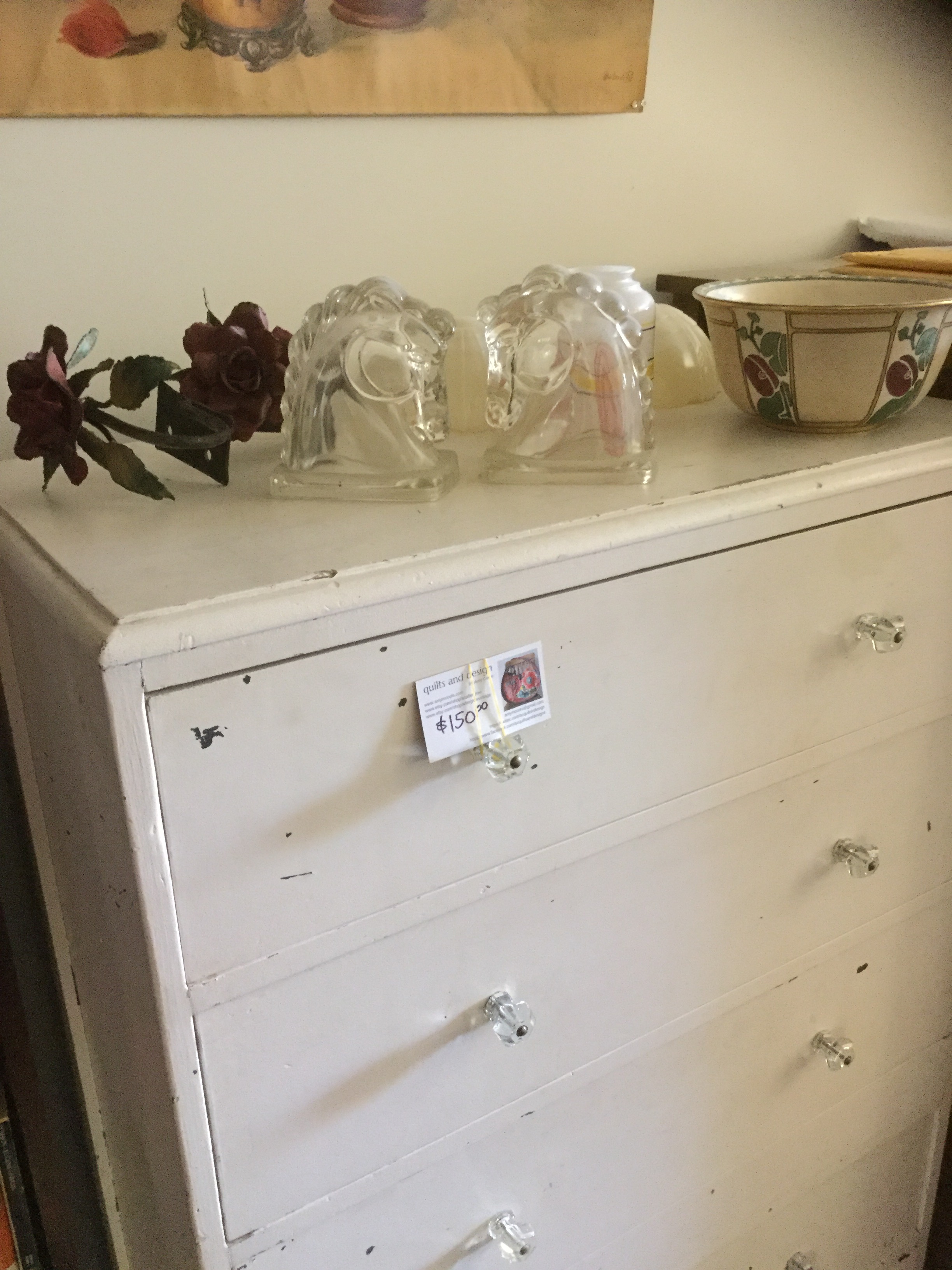
Some of my treasures… Art Deco glass horse heads and handpainted bowl, chest of drawers, lamp glass…

I’m preparing for my big move to Scotland and my subsequent years pursuing my PhD …where, I don’t know.

So I’m selling off my business, which I created and built up for well over a decade, and most of my belongings. At first, I’ve felt no pangs. I’ve been yearning for a big change and the freedom to move where my interests, passions, and opportunities take me, and owning a home based business with inventory makes that very difficult. Though I’ve enjoyed the work, it’s time for all that stuff to go. But as I dig deeper, I’m uncovering the treasures and mementos I’ve packed away from my whole life thus far, and my heart feels little stabs now and again, sometimes of joy, sometimes of nostalgia, sometimes of parting-pains.

There are some things that will remain packed away and stored at my sister’s house (thanks, Bonnie and Jasen!) for me to retrieve when I’ve settled down again. My inked and quilted artworks, mementos, photos, most beloved fabrics, my first and favorite clothing designs, my sewing machines, and so on. But most of my belongings other than my clothes, shoes, and personal needs will all go.

But then I think of what I’ll gain from shedding all this stuff: the public goods the world has to offer. For this first year alone, the treasures in Edinburgh’s wonderful museums and great libraries (all free to the public!), the architecture, the rich history, the beautiful views on the old streets and beautiful parks, will all belong to me too. And so on throughout all of the places my endeavors and travels will take me in the upcoming years, as I’ll be light, mobile, freed from the burdens of ownership.

And when I think of what I’m trading in all my little treasures for, I think I’m getting the far better part of the deal.

Ordinary Philosophy and its Traveling Philosophy / History of Ideas series is a labor of love and ad-free, supported by patrons and readers like you. Please offer your support today!

Happy Birthday, David Hume!

In honor of David Hume’s birthday, May 7, 1711, let me share anew my history of ideas travel series I created in honor of my favorite philosopher in his home city of Edinburgh, Scotland. I’ll soon be in Edinburgh again, this time for at least one year, to pursue a Master’s Degree in Intellectual History at the University of Edinburgh. I can hardly express how thrilled I am at the prospect! I’ll be expanding this Hume series while I’m there.

To Edinburgh I Go, In Search of David Hume

Hello, friends of Ordinary Philosophy! I’m pleased and excited to announce my upcoming adventure: my first philosophical-historical themed adventure, and my first trip to Edinburgh, Scotland!

Here’s my plan:

I’m taking a series of trips to places around the world, where I explore the lives and ideas of great thinkers in the places where they lived and worked. I’ll follow in the footsteps of thinkers who are no longer alive, since those who are still telling their own stories. But those who are no longer alive in the body live on in the ideas that they pass on, and in the example they provide for us to follow.

I’ve decided to start with the philosopher I most admire as a person as well as a thinker, the great David Hume. He was not only revered for the brilliance of his ideas and his honesty in presenting them, but also as a premier example of a genial, generous, great-hearted person; so much so, in fact, that one of his closest friends nicknamed him ‘Saint David’.

Hume is often described as the greatest philosopher to write in English and among the greatest philosophers of all time, period. He was a central figure in the Scottish Enlightenment, and a profoundly influential empiricist and moral philosopher

So off to beautiful Edinburgh I go! There, I’ll visit the places where he worked, thought, wrote, studied, and rested. I’ll be traveling there in the first two weeks of May, and will be writing throughout the trip. I’ll be writing in this blog not only about his ideas, but about what I can discover about his everyday life, and whatever feeling of his time and place I manage to uncover in my time there.

If you have any questions for me to answer while I’m there, or pictures you’d like me to take for you, or any information you have that could help me with this project, I’d love to hear from you!

~~~~~~~~~~~~~~~~~~~~~~~

Here are my essays on Hume as I discover him in my travels, in (roughly) chronological order:

First Day in Old Edinburgh: Hume Sites and Monuments
Hume’s New Scene of Thought, and, It’s Good to Be Able to Say ‘I Don’t Know’
Hume Sites and Monuments, Part 2
The Consolations of Philosophy, and A Death Free from Fear
Scotticisms
Happy 303rd Birthday, David Hume!
Cycling Through Edinburgh, First Time
The Debate Over Government and Freedom
The Tale of the Magic Toe – Superstition? Or What?
Hume Sites and Monuments, Part 3
Water of Leith
Last Day in Edinburgh, May 13th, 2014
Hume, Aristotle, and Guns
and a memory quilt I created for my Edinburgh trip:
A Hill and a Wall in Edinburgh, 2015, 102″ x 69″

Ordinary Philosophy and its Traveling Philosophy / History of Ideas series is a labor of love and ad-free, supported by patrons and readers like you. Please offer your support today!

New Podcast Episode: A Visit to the John Muir National Historic Site in Martinez, CA

The Muir family home built by Dr. John Strentzel at John Muir National Historic Site, Martinez, CA

Listen to this podcast episode here or on Google Play, or subscribe on iTunes

In honor of the anniversary of John Muir’s birth, April 21, 1838, I’ll share the story of my visit to an important place in his life last summer. It was June 26th, 2016, a hot, bright day in Martinez, CA.

The John Muir National Historic Site is just south of the Carquinez Strait, which links San Pablo and Suisun Bays. Benicia, California’s third but short-lived capital city, is just across the strait and was reached by ferry in Muir’s time. A lovely town with a well-preserved historic district, Benicia is well-situated on a waterway that permits easy passage for ships and ferries. In its early years, the strait allowed for easy passage of people, animals, and the products of this agricultural region and later industrial center, so it became a busy, thriving center of commerce. It enjoyed its first big boom with the Gold Rush, as it lay on an easy route between San Francisco and the gold fields.

Martinez was also a hub of Gold Rush activity. The ferry between Benicia and Martinez enjoyed a monopoly on getting all those gold-crazed fortune seekers south to the gold fields and north again to cash in. But Martinez was also an important agricultural town, and this site preserves just a little bit of that aspect of its history. It’s about a thirty-five-minute drive northeast of where I live in Oakland….

Ordinary Philosophy and its Traveling Philosophy / History of Ideas series is a labor of love and ad-free, supported by patrons and readers like you. Please offer your support today!

Lovely But Sterile?

Statue of Athena, goddess of Philosophy and War, in the Vatican Museum. Like so much of traditional academic philosophy: elegant, cold, impersonal, the purview of the wealthy, and white…

W.E.B. DuBois once wrote that academic philosophy is the ‘lovely but sterile land of philosophical speculation.’ He decides to turn his attention to history and the social sciences so he can offer more concrete answers and practical help to his beleaguered fellow black citizens.

I’ve been inclined to agree with DuBois now and again, out of irritation, out of impatience, out of out of distaste for the obscurantist language and arch tone philosophy is sometimes delivered in, and no doubt, out of my own inability to comprehend. While I often find academic philosophy enthralling, elegant, interesting, and beautiful, I sometimes think, well yes, this is interesting, this is clever, this is fun, but in the end, what does it do? What is it for, and who is it for? Why care about those fine points, technical details, and subtle nuances that academics and scholars go on about that are seemingly unrelated to practical matters of general human wellbeing? Are they just entertaining and impressing themselves and occasionally each other?

I’ve heard people make a similar critique of the arts as DuBois makes of philosophy. ‘Real art’ shouldn’t be primarily about pleasure, about beauty for beauty’s sake, though it can be beautiful too. Its primary purpose should be to transform, inspire, even disturb and shock the viewer so as to make them an agent of change.

Here’s the thing: as much as I love history, ethical theory, civil rights movements, the arts as described in the previous sentence, and so on, I also love human artifacts which have no apparent reason to exist other than their interest and beauty. This is sometimes portrayed as frivolous: why please ourselves with ‘useless’ things which don’t do any work, which don’t inspire action? But I counter: why does everything have to be useful to us, to do work for us? Putting aside the practical value of philosophy (which I and so many other lovers of philosophy contend is quite high) and the arts, is there no place for sheer beauty, sheer interest? Is there no value in just pleasing our senses, from our most basic and instinctual to our most highly refined? Are the deep desires for intellectual exercise and beauty any less central to the human psyche than the needs for love and liberty and life itself? I know sustaining life and expanding liberty is valuable not only because they help us to survive but because they give us access to those things which make life beautiful.

I also know, for myself, that the beauty and interest I find everywhere in the world, be they in products of nature or of human creativity, impact my heart directly and immediately. I enjoy them without wondering why they exist, if they have a right to exist, or if they are useful to me or others. With human artifacts, it’s only after that first impact that I wonder about the personality and motives of the artist, think about what they’re trying to convey, and find inspiration, whether it be to further refine of my sense of beauty or to change the world or myself in other ways.

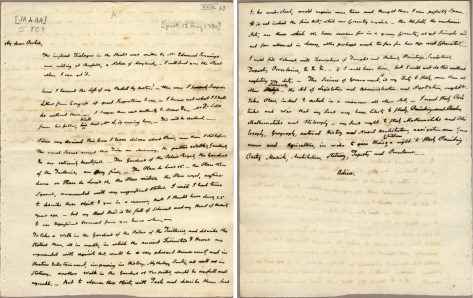
Letter from John Adams to Abigail Adams, posted from Paris on May 12, 1780. From the Massachusetts Historical Society collections

I think of something John Adams once wrote to his wife Abigail: ‘The Science of Government it is my Duty to study, more than all other Sciences: the Art of Legislation and Administration and Negotiation, ought to take Place, indeed to exclude in a manner all other Arts. I must study Politicks and War that my sons may have liberty to study Mathematicks and Philosophy. My sons ought to study Mathematicks and Philosophy, Geography, natural History, Naval Architecture, navigation, Commerce and Agriculture, in order to give their Children a right to study Painting, Poetry, Musick, Architecture, Statuary, Tapestry and Porcelaine.’ For Adams, the purpose of work to change the world for the better is in order that beauty can exist in the world more plentifully, to be promoted and protected for its own sake, and in order that everyone would ultimately have an equal right to access and enjoy in that beauty. Just so for art, for philosophy, for the natural world and for human society alike.

W.E.B. Dubois, Photograph taken by J.E. Purdy in 1904, public domain via Library of Congress

W.E.B. Dubois, Photograph taken by J.E. Purdy in 1904, public domain via Library of Congress

I think DuBois agrees, actually. He clearly loves philosophy for its own sake and thinks it beautiful; after all, he describes it as ‘lovely’ instead of merely dismissing it as useless. But he feels his own talents are best directed at making the world more just for himself and for others who are still routinely denied access to academic philosophy, the high arts, and any other realm of thought and creativity they might want to engage in. Some don’t have the leisure time or disposable income; some are deprived of the right to education or access to the funds needed to pay for it; some live in war-torn places unable to support or protect educational and arts institutions. Like Adams, Dubois feels it his duty and his calling to be an agent of change in his time. And like Adams, DuBois lives a life of philosophy-in-action, his work driven by his convictions about justice and the good life. This demonstrates that for him as it is for countless others, philosophy is fertile indeed.

Ordinary Philosophy and its Traveling Philosophy / History of Ideas series is a labor of love and ad-free, supported by patrons and readers like you. Please offer your support today!

Happy Birthday, Morton White!

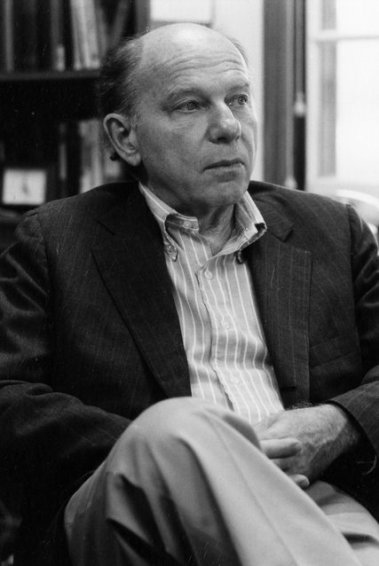
Morton White in 1981

The world lost Morton White (April 29, 1917 – May 27, 2016) less than a year ago as I write this today, and I first learned of him through reading his obituary in The New York Times. As I read, I knew this is a man and an approach to philosophy I must learn more about. Being immersed in other projects, I learned little about him in the intervening eleven months. Happily, I was just reminded by going through my list of significant dates in the lives of the world’s great thinkers (by no means comprehensive!) I placed two of his books on hold at the San Francisco Public Library and will commence reading them on this 100th anniversary of his birth.

White was a philosopher and historian of ideas. According to the Institute for Advanced Studies, ‘he maintained that philosophy of science is not philosophy enough, thereby encouraging the examination of other aspects of civilized life—especially art, history, law, politics and religion—and their relations with science’. And as William Grimes put it for TNYT, his ‘innovative theory of “holistic pragmatism” showed the way toward a more socially engaged, interdisciplinary role for philosophy’.

I studied philosophy with great love and enthusiasm as an undergraduate, yet I found myself then as now just as curious about other disciplines, especially history and the arts, and have often felt that the lines dividing these areas of study are sometimes artificial and even impediments to understanding. Since then, I’ve been pursuing my studies in the broader history of ideas as well, informally for the past few years, formally at the University of Edinburgh starting this fall. No doubt, White has influenced the direction my studies in intellectual history will take in ways I’ll learn as I go along, and in many more ways than I’ll ever know.

Learn more about White and his fascinating ideas with me:

Holistic Pragmatism and the Philosophy of Culture‘ – chapter 1 of A Philosophy of Culture: The Scope of Holistic Pragmatism, New Jersey: Princeton University Press 2002, in which White summarizes what his holistic pragmatism is all about

Morton White, Philosopher of Holistic Pragmatism, Dies at 99‘ – Obituary for the New York Times by William Grimes, June 10, 2016

Morton White 1917–2016 – His memorial page at the Institute for Advanced Study website, June 08, 2016

And you can find his selected bibliography at Wikipedia

Ordinary Philosophy and its Traveling Philosophy / History of Ideas series is a labor of love and ad-free, supported by patrons and readers like you. Please offer your support today!

Happy Birthday, Mary Wollstonecraft!

In honor of Mary Wollstonecraft’s birthday, April 27, 1759, I share two works about this great feminist thinker which I’ve published here at Ordinary Philosophy.

One is the Traveling Philosophy series in which I followed the life and ideas of Wollstonecraft, Thomas Paine, and Thomas Jefferson in Revolution-era Paris, France in 2015.

The second is the following essay:

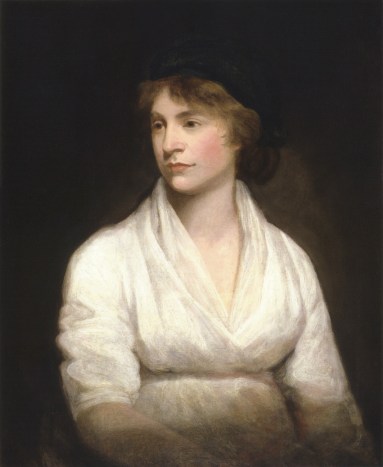
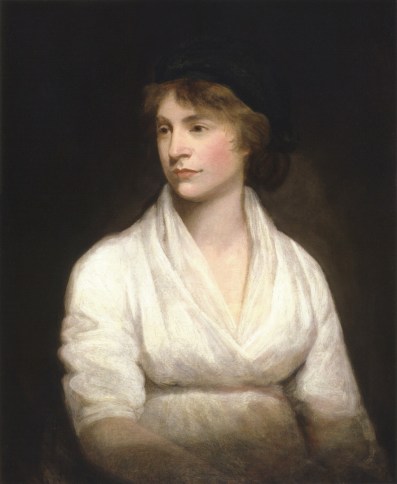
Mary Wollstonecraft, Champion of Reason, Passionate in Love

The life and work of Mary Wollstonecraft, mother of modern feminism, can seem to reveal a mass of contradictions.

Her seminal feminist work, A Vindication of the Rights of Woman, champions reason as the ultimate guide for a moral and productive life. She used reason to great effect to show why women should, and how they could, grow out of their socially constructed roles as under-educated coquettes and household drudges. She believed that reason should rule both individuals and societies because it’s the best tool we have to achieve justice and to perfect the self. Without reason, she thought, human beings are ruled by narrow self-interest, by prejudice born of ignorance, and by crude lust.

Yet the life Wollstonecraft chose to live was widely criticized both during her lifetime and over the two hundred plus years since her death. It’s not just because she didn’t conform to the mores of her time; her life choices are still considered unreasonable and even self-destructive by many. At times, they made her an object of scandal, impoverished, or deeply depressed, even in such desperate straits that she twice attempted suicide. That’s because she was also deeply passionate, devoted to retaining her personal and mental freedom while abandoning herself to loves which never failed to break her heart, be they revolution, family, friend, or lover. For Wollstonecraft, reason and passion are not opposites: they are two sides of the same coin. A truly reasonable person, she thought, is kind, affectionate, and generous as well, and a passionate lover of justice, truth, and beauty.
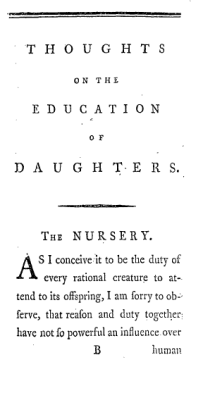
Wollstonecraft’s chosen role for herself was, first and foremost, a teacher, an advocate of knowledge and instiller of reason. While teaching was one of the few professions open to her as an eighteenth-century woman from a respectable but impoverished background, she brought her formidable powers of reason to bear on the problems with many of the educational and child-rearing practices of her day. After her first job as a companion, she became a teacher, first in the classroom at a school she founded with two of her sisters and her best friend, and then as a governess. When she became a mother twice over in her mid- and late thirties, she was a tender and hands-on mother, an advocate of breastfeeding and attentive parenting in an era of wet-nurses and governesses, when wealthy and middle-class parents participated relatively little in the care and instruction of their children even from infancy.

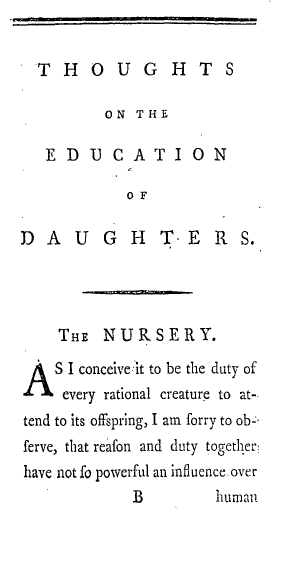
Her first book, Thoughts on the Education of Daughters, opens with her parenting advice and argues that girls should be taught how to run a household while also learning self-sufficiency. In Wollstonecraft’s time, women were not expected to support themselves; they were trained to raise a family, learning how to catch and keep a man first, to be household managers second, and to be educators of young children third. Single women, widows, and married women whose husbands, fathers, brothers, and other male relations could or would not support them had few employment options available to them, mostly directly related to one of the three roles they were trained for. Those jobs that women could respectably accept paid very little, so these working women nearly always lived a life of subservience and privation. Modern feminist thought, until very recently, equated domestic life with that housebound, nearly choiceless life most women were required to live. However, now that women’s basic moral right to self-determination has become so widely established, most have come to consider a domestic-centric life just as valid a choice for free women as a professional or public life. So in this sense, Wollstonecraft’s view of women was more progressive even than that of many modern feminists, even if by accident rather than foresight: she did not speak of a time when women would need to reject domesticity in order to free themselves from it, only to reclaim it by choice after their liberation.

Her ideas were inspired by her own experience: Wollstonecraft discovered firsthand how important it is never to assume that one’s self or one’s children will always have someone they can depend on for education, sustenance, or affection. Life’s too uncertain for that: parents, spouses, relatives, colleagues, and friends can become neglectful, estranged, impoverished, or disabled, and of course, sometimes they die. Wollstonecraft’s father squandered his inheritance and never bothered to learn how to earn an adequate living, leaving all of his children (except for his oldest son, who inherited what was left) to fend for themselves in adulthood, and his daughters without the dowry necessary for a respectable marriage. Knowing firsthand what it’s like to wrest a living from a world where women were ill-equipped for and mostly barred from nearly all employments that men were free to pursue, Wollstonecraft believed all girls should have a thorough education centered on self-sufficiency, from learning how to take care of a household, to learning how to think, to learning how to make a living. This not only gives women the freedom to choose a partner for better reasons than mere survival (Wollstonecraft equated the latter with prostitution), but leaves women free to live their lives as independently as they choose.

Until Wollstonecraft’s response to Edmund Burke’s critique of the French Revolution, her Vindication of the Rights of Men (1790), her published work continued on an educational vein, from original compositions to editorial work to translation. Beginning with The Rights of Men, through A Vindication of the Rights of Woman (1792), and up to her last work, Letters Written During a Short Residence in Sweden, Norway, and Denmark (1796), she transitioned from a teacher of ideas into an innovator, drawing on the wealth of knowledge she had obtained through her lifetime thus far of work and study. She was a semi-autodidact, her rather patchy childhood education supplemented in her teens by her own voracious reading and by friends who recognized her hunger for learning, and continued independently during her working years in the hours she could dedicate to her self-improvement. When she established herself as a professional author, she was finally able to immerse herself fully in the life of an intellectual, attending famous salons and becoming the friend and colleague of many of the brightest minds of her day.

One of the central themes in The Rights of Woman is women’s education. In this work, Wollstonecraft explained that it’s the nature of women, rather than their practical needs, that’s the ultimate justification for their rights, though she doesn’t minimize the importance of the latter. Since women possess reason just as men do, they also need education in order to be happy, fulfilled, and above all, moral. Infantilizing women by denying them a full education, she wrote, renders them not only financially helpless, entirely dependent on men whether or not they’re capricious, selfish, lazy, cruel, or just unlucky, but undermines them as moral beings. It’s reason, more than anything else, that determines the difference between right and wrong, and a quality, well-rounded education is required for using reason to its fullest capacity.

But outside of her moral reasoning, in her life as she lived it, Wollstonecraft displayed the often stark contrast between what one might expect a person ruled by reason would do, and what a person would do when driven by passion.

One of her earliest romantic interests, the Irish gentleman and songwriter George Ogle, ended up causing her no harm and probably doing her even more good than many might realize; not only did her cheer her with intellectual and witty conversation in her time as governess for the wealthy Kingsborough family in Ireland, a biographer credits him as the secret benefactor whose cash gift allowed her to return home to England and pursue writing in earnest. And her pursuit of the intellectual life she loved probably brought her more joy and fulfillment than anything else, with the possible exception of her daughter Fanny.

But most of her other loves did seem to bring her at least as much pain as joy. Her first deep attachment in her early teens was to her friend Jane Arden, who didn’t share her idealistic concept of the near-exclusive, passionate friendship of the soulmate. The more the young Mary sought to dominate her affections, the more Jane drew away. Fanny Blood, her dearest friend in adulthood, nearly lived up to her ideal, but her father’s shiftlessness kept her family impoverished, leaving Fanny with the responsibilities of main breadwinner as well as head housekeeper for her large family. Wollstonecraft saw her dreams for Fanny and herself mostly come true when they joined forces with Wollstonecraft’s sisters to found a school, but this didn’t last as long as she hoped. The distant and dithering suitor that Fanny had longed to marry for years finally carried her off to Portugal, leading to her painful death less than a year later as she succumbed simultaneously to her tuberculosis and the rigors of childbirth. The painter Henry Fuseli may have been a romantic interest: he later liked to claim this, and others echoed this claim, but much of the evidence also indicates that her interest in him was as an aesthetic and intellectual soulmate more than anything else. (At this time, she was still firmly opposed to marriage, and determined to keep herself free from the sort of entanglements that would hamper her mental and physical freedom.)

After a bit of scandal around her unconventional, and rejected, proposal to Fuseli and his wife (who was also her good friend) that she live with the two of them, she set off for Paris to witness the French Revolution firsthand. Wollstonecraft was an ardent supporter of the Revolution, as she saw it continuing the work of dismantling the tyranny of a parasitical monarchy, a corrupt and greedy church, and the oppressive social practices and mores that the American Revolution had started. By the time she arrived, the French Revolution had already taken a violent turn, but she held out hopes that this was a natural but temporary outcome of a people throwing off a tyranny that had ruthlessly oppressed them so badly and for so for so long. While she maintained throughout that a certain amount of violence is the natural byproduct of any truly transformative revolution, she became more and more disillusioned with its leadership and tactics over time, and finally, with her own hopes of its success. (She identified herself with the more moderate Girondin political persuasion throughout.) Wollstonecraft did not live long enough to see that the Revolution would end up ultimately succeeding in ushering in a new era of human rights-centered government in Europe, once some social balance was restored. But she did escape the Terror, probably narrowly, having fallen in love once again. She found herself pregnant and fleeing for her life, returning to England after giving birth her first child at age 35.

And it was Gilbert Imlay, the father of this child and the first deep romantic passion of her life, that caused her the most pain, more than the sisters with whom she was often at odds, more than her most cherished female friends who left her in one way or another, more than her ne’er-do-well brother and the Blood family, more than her self-important painter Fuselli, more than the school she founded that fell apart when she left to nurse Fanny in her final illness, leaving her deep in debt. Imlay presented himself as a man of adventure, an American frontiersman of rugged, self-sufficient, and honest character. These proved to be an illusion: he was actually primarily a man of business, sometimes (often?) of shady dealings, and one who frequently failed to keep his word. In Imlay, Wollstonecraft finally found an exciting sexual partner, a stimulating companion, and a fellow believer in truly living according to one’s personality. They never married because they didn’t believe in that institution, though they found it expedient at times to pass themselves off as husband and wife. In fact, this pretense may very well have saved Wollstonecraft’s life, since the perpetrators of the Terror, in its most insular stage, were executing many expatriate Britons; Americans, however, were still in good standing with the Revolution, and as Imlay’s ‘wife’ she was considered American as well. But it became clear over time that Imlay was not eager to embark on the happy domestic life her pregnancy caused her to long for, and he abandoned her slowly, in stages. It took her a long time to get over Imlay while struggling to get by as a single mother in 18th-century Europe; it was during this period she twice attempted suicide.

Her eventual husband and first biographer William Godwin called Wollstonecraft a ‘firmest champion’ of her sex. In Godwin, Wollstonecraft finally found the lasting sort of love she had been looking for. Their attraction was initially an intellectual connection which only later developed into romantic passion. Sadly, they only enjoyed a brief romance, less than two years, since she died of complications from giving birth to her second child. I think Godwin was right that she was a champion of reason, and I would add, of passion too, and a champion of seeking: of truth, of wisdom, of self-discovery, of new ideas and sources of knowledge, of experiences that expand the mind and the heart, of becoming the best human being one can be. To fully follow her example is very risky: she often flung prudent reasoning to the wind in favor of following her heart, in a time most dangerous for women to do so. Yet, though reasoned prudence is a virtue, it can be taken too far, holding you back, preventing you from taking chances and experiencing all the richness life can offer. She did not hold back.

~ Ordinary Philosophy is a labor of love and ad-free, supported by patrons and readers like you. Any support you can offer will be deeply appreciated!

~~~~~~~~~~~~~~~

Sources and inspiration:

Godwin, William. ‘Memoirs of the Author of A Vindication of the Rights of Woman‘. London, 1798.

Gordon, Lyndall. Vindication: A Life of Mary Wollstonecraft. New York: Harper Collins, 2006.

Jacobs, Diane. Her Own Woman: The Life of Mary Wollstonecraft. New York: Simon & Schuster, 2001. http://books.simonandschuster.com/Her-Own-Woman/Diane-Jacobs/9780743214704

Tomalin, Claire. The Life and Death of Mary Wollstonecraft. London: Weidenfield & Nicholson, 1974

New Podcast Episode: Two Stories About Following the Life and Work of John Steinbeck

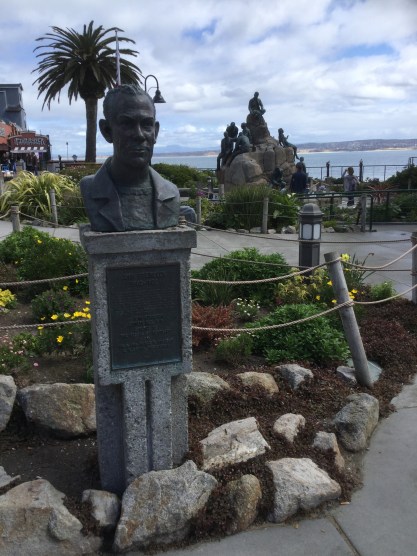
Bust of John Steinbeck and sculptures of people who inspired Cannery Row, Monterey, CA

Listen to this podcast episode here or on Google Play, or subscribe on iTunes
March 4th – 9th, 2017

For several days this last week, I’ve been on a literary retreat hosted by Clay Jenkinson, Becky Cawley, and Russ Eagle. You may remember Clay and Becky from the account of my last retreat with them at Lochsa Lodge in the Bitterroot Mountains in January. Clay is a humanities scholar who has been very influential in my own study and thought for the last few years, Becky has worked with Clay for many more years than that co-creating historical, cultural, and literary tours throughout the United States, and Russ Eagle has made Steinbeck a special study for many years as well. At Lochsa Lodge this winter, we read and discussed Walden Pond and Henry David Thoreau’s concept of living deliberately, as well the history of the Native Americans of the Great Plains and the wars of the United States’ expansion into their territories through the 1800’s, and the echoes of those wars and that expansion in the DAPL fight today.

This tour took us to Monterey, Pacific Grove, the Salinas Valley, and the mountains and coastline of this beautiful region of California following the life and work of the great American writer John Steinbeck

* See my profile of Julia Ward Howe, whose Battle Hymn of the Republic provided the title of The Grapes of Wrath, and which is printed in the opening pages of the novel

Read the written version here and here

Ordinary Philosophy and its Traveling Philosophy / History of Ideas series is a labor of love and ad-free, supported by patrons and readers like you. Please offer your support today!

Ordinary Philosophy’s 4th Anniversary

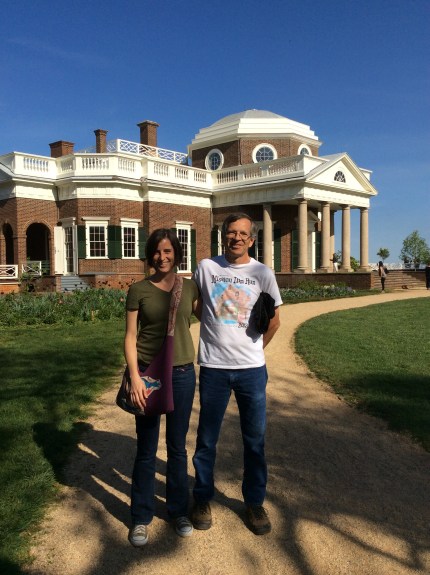
At Monticello, VA, with my Dad, John Cools, in 2015 for my history of ideas series following Thomas Jefferson in America

I published my first post for Ordinary Philosophy four years ago today, on April 23rd, 2013. Thank you, dear readers and listeners, for your kind attention, your encouragement, your corrections, your patience as I learn with and from you, and your hospitality and financial support (you know who you are!) for all of my traveling philosophy / history of ideas series.

Ordinary Philosophy has been one of the most satisfying projects of my life, and I look forward to continuing to share my love of philosophy, history, ideas, and travel for many more years to come, whatever form this will take.

I’m thrilled to share the news with you that I’ll be resuming my formal education at the University of Edinburgh this fall. What an adventure this will be! I’ll be living and studying in the center of the Scottish Enlightenment and the city of David Hume. He brought me here three years ago when I followed his life and ideas for my first history of ideas travel series. I’ll take this opportunity continue my Hume series as well. Though my studies will demand a great deal of my energy and attention, I dearly hope I’ll be able to devote more time to share more with you here at Ordinary Philosophy, not less, as I once again pour the bulk of my time, energy, and love into the world of ideas.

Yours, as ever, Amy Cools

Ordinary Philosophy and its Traveling Philosophy / History of Ideas series is a labor of love and ad-free, supported by patrons and readers like you. Please offer your support today!

Selfie in the beautiful Rose Room of the New York Public Library, 2016 Amy Cools

In the beautiful Rose Room of the New York Public Library. Thank you, friends, for supporting my New York projects too! Ahhh, what a town…