Happy Birthday, Mahatma Gandhi!

Mahatma Gandhi spinning yarn in the late 1920's. Gandhi started the ultimate 'Shop Local' movement, in which he called on his fellow Indians to wear only homespun, locally made fabrics to counteract the British colonialist's exploitation of Indian textile worker

Mahatma Gandhi spinning yarn in the late 1920’s. Gandhi started the ultimate ‘Shop Local’ movement in which he called on his fellow Indians to wear only homespun, locally made fabrics to counteract British colonialist’s policies which impoverished and nearly destroyed India’s textile industry. I founded an apparel and accessory line and boutique in the early 2000’s based on the same principles, carrying only locally and US-made products as an alternative to buying goods made in overseas sweatshops whose workers were unprotected by labor laws. Gandhi’s and my own approach were nationalistic and protectionist, which I no longer believe goes far enough in promoting equal human rights for all. While such approaches may be a good place to start in some circumstances, a better way to go about improving the lives and prospects of workers around the world is to require our governments to institute more comprehensive labor laws and rigorously enforce them. This must include holding companies responsible for the abuses of their contractors, of course, to actually be effective. But Gandhi did, I think, point us down the right path, towards consciousness about what we buy, why we buy it, and how our market decisions effect others.

There are very few non-Americans, outside of our mother country of Britain and our godmother France, who have had a greater impact on the history of the United States and our attitudes towards human rights than the incomparable Mahatma Gandhi. For someone who preached simplicity, often wearing nothing but a loincloth, weaving his own fabric, and living a severely rustic lifestyle to exemplify his own teachings, Gandhi was a very complicated person.

He was a human rights activist, politician, journalist, social and religious reformer, and to many, a sort of messiah. Originally a British loyalist, Gandhi’s studies and personal observations led him to change his own views, often radically, many times over the course of his long life. His beliefs in the revolutionary and morally suasive power of civil disobedience and nonviolent resistance were and continue to be particularly influential in the United States, beginning with the mid-20th century civil rights movement. Martin Luther King, Jr, Gandhi’s intellectual and spiritual descendant, emerged as the leader of this movement following his role in the 1955 Montgomery bus boycott. King’s and Gandhi’s ideas about the civil disobedience and non-violence, in turn, both incorporate Henry David Thoreau’s ideas from his landmark essay ‘Civil Disobedience’.

Here are excerpts on Gandhi’s influence on the American civil rights movement from the encyclopedia of the Martin Luther King, Jr. Research and Education Institute at Stanford University:

‘Upon his death, Mohandas K. Gandhi was hailed by the London Times as ‘‘the most influential figure India has produced for generations’’ (‘‘Mr. Gandhi’’). Gandhi protested against racism in South Africa and colonial rule in India using nonviolent resistance. A testament to the revolutionary power of nonviolence, Gandhi’s approach directly influenced Martin Luther King, Jr., who argued that the Gandhian philosophy was ‘‘the only morally and practically sound method open to oppressed people in their struggle for freedom’’ (Papers 4:478)…

Gandhi was born 2 October 1869, in Porbandar, in the western part of India, to Karamchand Gandhi, chief minister of Porbandar, and his wife Putlibai, a devout Hindu. At the age of 18, Gandhi began training as a lawyer in England. After completing his barrister’s degree he returned to India in 1891, but was unable to find well-paid work. In 1893, he accepted a one-year contract to do legal work for an Indian firm in South Africa, but remained for 21 years. It was in South Africa that Gandhi was first exposed to official racial prejudice, and where he developed his philosophy of nonviolent direct action by organizing the Indian community there to oppose race-based laws and socioeconomic repression.

Gandhi returned to India in 1914. In 1919, British authorities issued the Rowlatt Acts, policies that permitted the incarceration without trial of Indians suspected of sedition. In response, Gandhi called for a day of national fasting, meetings, and suspension of work on 6 April 1919, as an act of satyagraha (literally, truth-force or love-force), a form of nonviolent resistance. He suspended the campaign of nonviolent resistance a few days later because protestors had responded violently to the police.

Within the next few years, Gandhi reshaped the existing Indian National Congress into a mass movement promoting Indian self-rule through a boycott of British goods and institutions…’ (Continue reading)

I’ve included a list of links of many excellent online sources on Gandhi below, including journalist and social critic Christopher Hitchen’s critique. Gandhi did, at times, express ideas and make decisions that many regard as problematic to this day, such as his early rhetoric on black Africans and his relations with some of the women in his life, including his wife Kasturba. Gandhi was no plaster saint: like the rest of us, he struggled to find truth and meaning in a world of mutually contradictory yet worthy-seeming values, principles, and goals; sometimes, like the rest of us, he didn’t get it right, and sometimes, he was very, very wrong. True understanding, I believe, is never reached through uncritical hero worship, even of one as influential, internationally revered, and I believe ultimately beneficial to the intellectual, activist, and political history of human rights as Gandhi.

Appreciating Gandhi Through His Human Side ~ by Hari Kunzru for the New York Times‘ Books of the Times, Mar 29, 2011

Civil Disobedience ~ by Kimberley Brownlee for The Stanford Encyclopedia of Philosophy.

Gandhi and Civil Disobedience ~ from the Constitutional Rights Foundation.

Gandhi the Philosopher: Better Known as the Face of Non-violent Protest, Gandhi Was Also a Surprising, Subtle Philosopher in the Stoic Tradition ~ by Richard Sorabji for Aeon

In Search of Gandhi ~ by Lalit Vachani, from BBC’s Radio Four Storyville Why Democracy? series

Life of Gandhi ~ a documentary by GandhiServe Foundation: Mahatma Gandhi Research and Media Service.

Gandhi, Mohandas Karamchand (1869-1948) and India Trip (1959)two entries from Martin Luther King, Jr. and The Global Freedom Struggle: Encyclopedia of the MLK Research and Education Institute at Stanford University

Mohandas Gandhi ~ by Salman Rushdie for Time magazine, Apr 13, 1998

The Real Mahatma Gandhi: Questioning the Moral Heroism of India’s Most Revered Figure ~ by Christopher Hitchens for The Atlantic, July/August 2011 issue.

~ Ordinary Philosophy is a labor of love and ad-free, supported by patrons and readers like you. Any support you can offer will be deeply appreciated!!
Happy Birthday, John Locke!

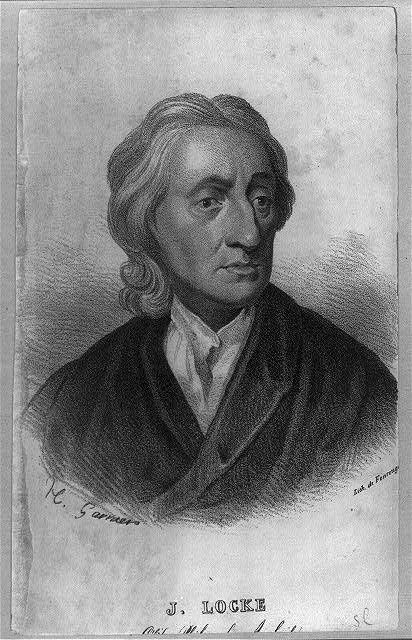
John Locke, lithograph by de Fonroug after H. Garnier, image public domain via the Library of Congress

John Locke, born August 29th, 1632, is probably the single person most responsible for our United States political form of government, or at least its philosophical underpinnings. (Montesquieu can be credited as most responsible for its form, but that’s a story for another time.) The ideas of this Enlightenment, empiricist philosopher and political theorist included arguments in favor of liberal government of and by the people centered on natural rights, including property rights and rights to freedom of thought and belief; an emphasis on reason inspired and restrained by evidence; and the so-called blank slate theory of the human mind, which postulates that experience entirely determines what we think and the kind of person we become.

Learn more about the great John Locke:

‘John Locke’ ~ by William Uzgalis for The Stanford Encyclopedia of Philosophy

John Locke (1632—1704) ~ by Patrick J. Connolly for the Internet Encyclopedia of Philosophy

John Locke, English Philosopher ~ by Graham A.J. Rogers for Encyclopædia Britannica

John Locke Part One and Part Two ~ by Stephen West for Philosophize This

John Locke, 1632-1704 ~ Dr. Rachael Kohn discusses Locke’s life and ideas with Perez Zagorin for The Ark, a program of Australia’s Radio International

The Social Contract ~ Melvyn Bragg and guests Melissa Lane, Susan James, and Karen O’Brien discuss this foundational question of political philosophy, the impetus for Locke’s political theory, for In Our Time. 

~ Ordinary Philosophy is a labor of love and ad-free, supported by patrons and readers like you. Any support you can offer will be deeply appreciated!

*A version of this piece was previously published in Ordinary Philosophy

Happy Birthday, Robert Ingersoll!

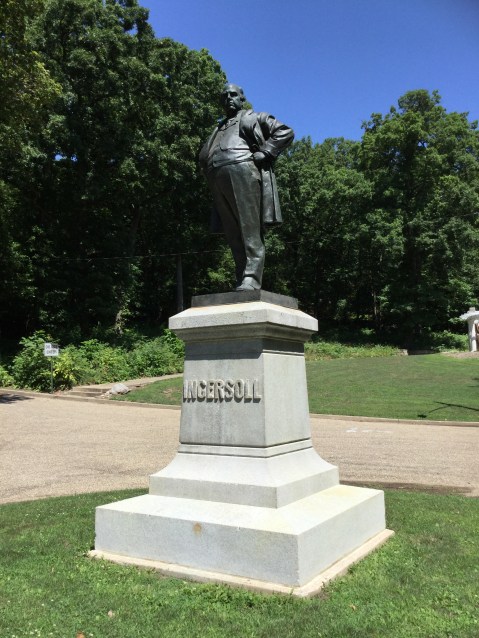
Statue of Robert G. Ingersoll in Glen Oak Park, Peoria, Illinois

Robert G. Ingersoll, orator, lawyer, politician and Civil War veteran often called ‘The Great Agnostic’, was a very famous man in his time but rather forgotten today. He was born on August 11, 1833 and died almost 66 years later. Among other things, he was a vocal and consistent advocate for abolitionism, women’s rights, freethought, and scientific progress. While very liberal and broad-minded, he was a dedicated family man. While his views are as progressive as could be for a person if his time, he was what we might call a square. Besides his unabashed and very public religious skepticism, he lived a life that even Victorian standards would consider altogether decorous and blameless, despite frequent attempts to discredit his views by finding something scandalous to publish about his personal life.

Ingersoll was a great friend of many of the era’s most interesting and influential people including Walt Whitman and Thomas Edison, who made two recordings of his voice with his new invention, the audio recorder.

https://m.youtube.com/watch?v=5u4sqdPSIcM

He was also an admirer and promoter of the memory of Thomas Paine. Though Paine was a founding father of the American cause for independence with his great pamphlet Common Sense and other writings, he had long fallen out of favor in American public memory following the publication of The Age of Reason, his diatribe against religious orthodoxy and superstition, as he perceived it.

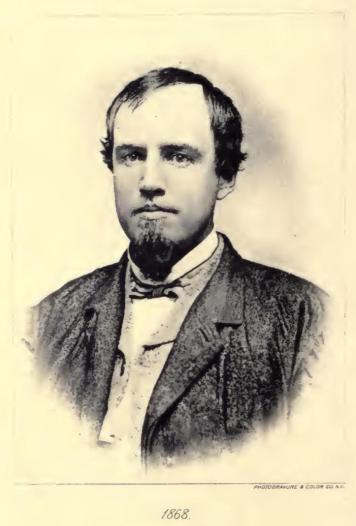
Robert Ingersoll in 1868

In the time Ingersoll enjoyed fame as an orator, freethought ideas had become more acceptable as a matter of public discourse. It was still generally unacceptable to be an out-and-out atheist, but even these could become popular speakers if they were eloquent and interesting enough. In fact, they were often considered novel and exciting, and free speech was enjoying one of its heydays in the United States in this period sometimes called The Golden Age of Freethought. This was a time when public speakers provided a very popular form of entertainment. Many of that era’s important thinkers and activists made their living, or much of it, through public speaking: Ingersoll himself, abolitionist and civil rights leader Frederick Douglass, and feminist, atheist, and civil rights activist Ernestine Rose among them. Rose was also a famous orator in her day, pre-dating Ingersoll by almost a generation but like him, eloquent, witty, and a champion of Paine. She generally spoke only of topics related to her social justice causes, but Ingersoll and Douglass, like many famous orators, spoke on a wide range of topics such as Shakespeare (both men were big fans), science, politics, and much more.

For more about the eloquent and brilliant Ingersoll, please see the links to excellent online sources and to my own writings about Ingersoll below. Last year, I followed the lives and ideas of Robert Ingersoll, Frederick Douglas, and Abraham Lincoln in Peoria, Illinois, where Ingersoll lived and worked for many years; all three men admired and were inspired by one another. It was a most fascinating journey.

By Amy Cools for Ordinary Philosophy:

Peoria, Illinois, In Search of Robert G. Ingersoll, Frederick Douglass, And Abraham Lincoln, Part 1
Peoria, Illinois, In Search of Robert G. Ingersoll, Frederick Douglass, And Abraham Lincoln, Part 2
Peoria, Illinois, In Search of Robert G. Ingersoll, Frederick Douglass, And Abraham Lincoln, Part 3

Review: The Great Agnostic: Robert Ingersoll and American Freethought, by Susan Jacoby

By others:

Robert G. Ingersoll: American Politician ~ by the editors for Encyclopaedia Britannica

Robert Ingersoll, the ‘Great Agnostic’ ~ by John Kelly for The Washington Post

Robert Ingersoll: Intellectual and Moral Atlas ~ by Tom Malone for The Objective Standard

Robert Green Ingersoll (1833-1899) ~ at SecularHumanism.org

That Old-Time Irreligion: ‘The Great Agnostic,’ by Susan Jacoby ~ by Jennifer Michael Hecht for The New York Times’ Sunday Book Review

~ Ordinary Philosophy is a labor of love and ad-free, supported by patrons and readers like you. Any support you can offer will be deeply appreciated!

*A version of this piece was previously published in Ordinary Philosophy

Happy Birthday, Ida B. Wells!

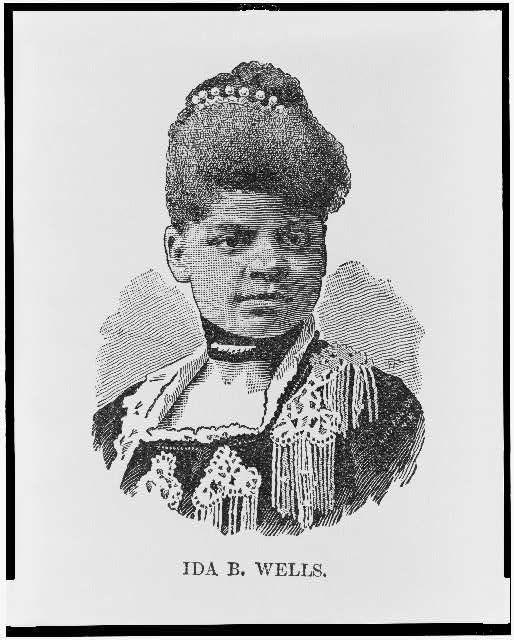
Ida B. Wells, head-and-shoulders portrait, published, 1891, Image retrieved from the Library of Congress LC-USZ62-107756, public domainIn the course of my journey following the life of Frederick Douglass in 2016, I was so glad to have the opportunity to visit the place in New York City where he may have first met the great Ida B. Wells. It was late 1892, and this fiery young newspaperwoman had published her very controversial piece of investigative journalism in the New York Age on June 25, 1892. It was expanded and published as a pamphlet later that year as Southern Horrors: Lynch Law in All Its Phases.

Many people at that time thought of lynching as an unfortunate and somewhat rare excess of race-hatred by frustrated Southern whites. And many more saw it as a lawless but not entirely unjustified species of vengeance against black men who had raped white women. But Wells (born in Mississippi on July 16th, 1862) would change all that. In early 1892, three of Wells’ friends were lynched after a dispute between themselves and white owners of a rival business. She was outraged and began an investigation of the practice and history of lynching.

When Wells wrote Southern Horrors, she had already been an activist and writer promoting black rights for many years. In 1884, she resisted being forced out of the first class train car into the ‘colored car’; she later sued the train company, won the first suit, then lost on appeal. This incident (which echoes Douglass’ train protest in 1841) led to many other lawsuits, articles, and activism against anti-black laws and social practices. In 1892, her investigation of lynching revealed to Wells that lynching was far from just vengeance for rape or other violent crimes; it served as vengeance for or a public warning against alleged insubordination or impertinence, petty crimes, idleness, drunkenness, and so on. It was also put to such uses as eliminating business competition (as was the case for Wells’ friends), getting rid of inconvenient owners of coveted land, or scapegoating black people for the crimes of others. She discovered that lynchings were not all that rare, either, and came to the conclusion that they constituted a form of social control that replaced the terrorism (the system of coercion which included whippings, deprivations, and threats of being sold ‘down the river’) of slavery.

Douglass was inspired and energized by Wells’ writing and anti-lynching work, and his letter in praise of Southern Horrors served as the pamphlet’s introduction. He visited her in New York City where she was living for a little while as a writer for and part owner of the New York Age, which was (probably) published at the site I visited in Harlem. I also visited a second site that happened to be associated with Wells two days after my New York visit: she delivered one of her hard-hitting speeches in her speaking tour following the publication of Southern Horrors at Tremont Temple in Boston on Feb 13th, 1893.

Education was another driving force in her life. Her first job was as a teacher at age 14, and she taught for many years, over time supplementing her teaching with journalism, writing and editing for the Evening Star, The Living Way, and the Free Speech and Headlight. Another of her most controversial, consciousness-raising articles was published in 1891 in the Free Speech about the conditions in black schools: the poor quality of the buildings which housed them, and of the education and morals of the teachers and school boards who administered them. She was not fired outright, but the school refused to hire her for the next school year. She then went on to work full-time for the newspaper, promoting the Free Speech from city to city and writing articles along the way, until the Free Speech‘s offices and printing press were destroyed by angry whites after the publication of her ‘Lynch Law’ piece. Adversity only served to strengthen Wells’ resolve, each attack causing her to re-double her efforts on behalf of her people.

Wells went on to have a long and distinguished career in writing, investigative journalism, and activism for black rights and women’s suffrage. She worked with Frederick Douglass and W.E.B. DuBois, toured the United States and Europe as a speaker and activist, founded Chicago’s Alpha Suffrage Club, served as secretary of the National Afro-American Council, founded and became the first president of the Negro Fellowship League, and helped found the National Association for the Advancement of Colored People (NAACP), among many other things.

For a long time, Wells thought of marriage and romantic relationships as oppressive, where women were expected to defer to men and flatter their vanity. But one day, she met a man who must have made her feel very differently, an attorney, writer, and fellow advocate for black rights named Ferdinand Barnett. She married him and they raised four children.

If I ever manage to accomplish the tiniest fraction of what she did in my own life, I would consider myself a great success!

Here are some excellent resources for learning more about the brilliant and irrepressible Ida B. Wells:

Barnett, Ida Wells (1862-1931) ~ by Tyina Steptoe for BlackPast.org

Crusade for Justice: The Autobiography of Ida B. Wells. ~ by Ida B. Wells, Ed. Alfred Duster. Chicago, University of Chicago Press, 1970.

Ida B. Wells-Barnett ~ by Beckett Graham and Susan Vollenweider, The History Chicks podcast episode 51

Ida B. Wells-Barnett ~ by the editors of Encyclopædia Britannica

Ida B. Wells: Crusade for Justice ~ by Jennifer McBride for Webster University’s website.

New York Age ~ by Heather Martin for the Encyclopedia of the Harlem Renaissance: K-Y

Southern Horrors: Lynch Law in All Its Phases ~ by Ida B. Wells (1892) via Project Gutenberg

*A version of this piece was previously published in Ordinary Philosophy

~ Ordinary Philosophy is a labor of love and ad-free, supported by patrons and readers like you. Any support you can offer will be deeply appreciated!

Happy Birthday, Grace Lee Boggs! Bio and Book Review by Ashley Farmer

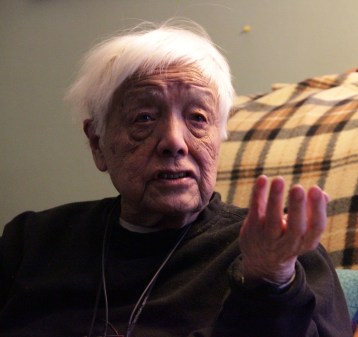
Grace Lee Boggs, By Kyle McDonaldm creativecommons.orglicensesby2.0, via Wikimedia Commons, cropped

In celebration of Grace Lee Bogg’s birthday on June 27th, 1915, I share here an excellent bio and book review by historian Ashley Farmer:

“The Power And Importance Of Ideas:” Grace Lee Boggs’s Revolutionary Vision”

In the opening lines of her autobiography, Living for Change, Grace Lee Boggs remarked: “Had I not been born female and Chinese American, I would not have realized from early on that fundamental changes were necessary in our society.”[1] A daughter of Chinese immigrants born in 1915, who, by her account, became a philosopher in her 20s and an activist in her 30s, Boggs remains one of the greatest radical theorists of the twentieth century.

Born in Rhode Island, Boggs spent her childhood in New York City, working in the two restaurants her father owned in Times Square. At the age of 16, she left home to attend Barnard College, and afterward, Bryn Mawr, where she earned a PhD in Philosophy in 1940. Philosophers like Hegel helped her “see [her] own struggle for meaning as part of the continuing struggle of the individual to become part of the universal struggle for Freedom.”[2] Boggs moved to Chicago in 1940. She began working with the South Side Tenants Organization set up by the Workers Party, a Trotskyist group that had split off from the Socialist Workers Party. Her time in the Windy City proved transformative. For the first time she was talking and working with the black community, getting a first-hand sense of what it meant to live within the confines of segregation and discrimination, and learning how to participate in grassroots organizing.[3]

It was also during her tenure with the Workers Party that she met Caribbean radical C.L.R. James, and began a “theoretical and practical collaboration that would last twenty years.”[4] As part of a small wing of the workers Party led by James and Raya Dunayevskaya, Boggs became a leading theoretician, co-authoring texts like State Capitalism and World Revolution (1950). Through James, she came into contact with a number of black writers and activists who expanded her perspective. She relocated to Detroit in 1953, where she would organize with, and marry, James (Jimmy) Boggs.

During the 1950s, Boggs, “mainly listened and learned” to the black activists around her in an effort to better understand the black condition. It would take several years before she decided that she had been “living in the black community long enough to play an active role in the Black Power Movement that was emerging organically in a Detroit where blacks were becoming the majority.”[5] Living and working in what was considered to be an epicenter of black radicalism, Boggs engaged in a combination of theorizing and protesting, authoring texts with James Boggs, meeting and organizing with Malcolm X, and mentoring young radicals like Muhammad Ahmad (Max Stanford), leader of the Revolutionary Action Movement (RAM).

Her liberation theory was grounded in her study of philosophy and honed through her experiences organizing with and for black communities. It was also constantly evolving. Boggs emphasized dialectical thinking, arguing that reality is ever changing and that we must “constantly be aware of the new and more challenging contradictions that drive change.”[6] This reciprocal process drove her expansive vision of revolution. In her final book, The Next American Revolution, she explained her latest concept of revolution:

The next American Revolution, at this stage in our history, is not principally about jobs or health insurance or making it possible for more people to realize the American Dream of upward mobility. It is about acknowledging that we as Americans have enjoyed middle-class comforts at the expense of other peoples all over the world. It is about living the kind of lives that will not only slow down global warming but also end the galloping inequality both inside this country and between the Global North and Global South. It is about creating a new American Dream whose goal is a higher Humanity instead of the higher standard of living dependent on Empire.[7]

Boggs consistently offered a holistic vision of revolution and concrete steps through which to build it. She argued that achieving this goal meant more than organizing or mobilizing to petition the state or “changing the color of political power,” but rather growing food, reinventing education, developing Peace Zones in local neighborhoods, and creating restorative justice programs. She saw the seeds of revolution everywhere and showed us how, by practicing dialectical thinking, breaking down divides and categories, and building on rather than replicating older political models, we might “grow our souls.” She mirrored this in her own life, constantly “combining activity and reflection.”[8] Her willingness to do the work, her ability to listen and learn from black activists, her commitment to living in the communities in which she organized, and her openness to revising her politics, and values, made her an effective life-long ally of the black community and theoretician of liberation and revolution.

As she noted, often, “in the excitement of an emerging movement, we tend to want to be part of the action, and we underestimate the power and importance of the ideas in our heads and hearts.”[9] Upon her death, it’s important to revisit the ideas in her head. She left us a roadmap for revolution through ideas and action, one that anyone could be a part of if they were clear about the stakes of the transformation and that fundamental change is necessary.

Originally published at the African American Intellectual History Society blog, this was originally republished at O.P. when it was under a Creative Commons license in 2016

~ Ashley Farmer is a historian of African-American women’s history. Her research interests include women’s history, gender history, radical politics, intellectual history, and black feminism. She earned a BA in French from Spelman College, an MA in History from Harvard University, and a PhD in African American Studies from Harvard University. She is currently a Provost Postdoctoral Fellow in the History Department at Duke University. In August 2016, she will be an Assistant Professor in the Department of History and the African American Studies Program at Boston University. (This bio and more about Ms. Farmer are to be found at her personal website)

*A version of this piece was previously published in Ordinary Philosophy

~ Ordinary Philosophy is a labor of love and ad-free, supported by patrons and readers like you. Any support you can offer will be deeply appreciated!

~~~~~~~~~~~~~~~~~~~~~~~~~~~~~~~~~~~~~~

[1] Grace Lee Boggs, Living for Change: An Autobiography (Minneapolis: University of Minnesota Press, 1998), xi.

[2] Ibid., 30-31.

[3] Ibid., 36.

[4] Ibid., 43. James and Boggs “went their separate ways in 1962.”

[5] Grace Lee Boggs with Scott Kurashige, The Next American Revolution: Sustainable Activism for the Twenty-first Century (Berkeley: University of California Press, 2011), 66.

[6] Ibid., 62.

[7] Ibid., 72.

[8] Ibid., 164.

[9] Ibid., 80.

Happy Birthday, Aimé Césaire!

Aimé Fernand David Césaire, photo credit manomerci.comAimé-Fernand-David Césaire was a poet, playwright, philosopher, and politician from Martinique. In his long life (he was born on June 26, 1913, and died April 17, 2008), Césaire accomplished much in each of these roles, a rare feat as the disparate talents required for each rarely coincide in one person.

In turn mayor of Fort-de-France, deputy to the French National Assembly for Martinique, and President of the Regional Council of Martinique, this prolific writer and intellectual was also co-founder of Négritude, a ‘literary movement of the 1930s, ’40s, and ’50s that began among French-speaking African and Caribbean writers living in Paris as a protest against French colonial rule and the policy of assimilation.’ (Encyclopædia Britannica). The Stanford Encyclopedia of Philosophy describes Négritude as ‘the self-affirmation of black peoples, or the affirmation of the values of civilization of something defined as “the black world” as an answer to the question “what are we in this white world?”’. The term was chosen so as to be provocative, a way of re-claiming the word nègre which had become a racial slur, while simultaneously shocking those who heard or read it into paying attention. Through his philosophy, political writing, and especially his poetry and plays, the world pays attention still.

Learn more about the great Aimé Césaire:

Aime Cesaire: Martinician Author and Politician – by the editors of Encyclopædia Britannica

Aimé Fernand Césaire, 1913–2008 – by Meredith Goldsmith forThe Poetry Foundation

Aimé Fernand David Césaire (1913-2008), chapter 1 of The Greatest Black Achievers in History – by Sylvia Lovina Chidi

Négritude – by Souleymane Bachir Diagne for The Stanford Encyclopedia of Philosophy

*A version of this piece was previously published in Ordinary Philosophy

~ Ordinary Philosophy is a labor of love and ad-free, supported by patrons and readers like you. Any support you can offer will be deeply appreciated!

Happy Birthday, W.V.O. Quine!

WVO Quine on the Bluenose II in Halifax, Nova Scotia, photo courtesy of Douglas Quine (cropped)

WVO Quine on the Bluenose II in Halifax, Nova Scotia, photo courtesy of Douglas Quine

The emphases in my own education in philosophy were Ethics, Politics, and Law, so I didn’t spend as much time studying Willard Van Orman Quine’s great contributions to philosophy as I would like. However, if my focus was Mathematical Logic, Epistemology, Philosophy of Language, or Philosophy of Science, I would have spent a lot of time with the prodigious output of his remarkable intelligence. But one of his important observations is brought up in introductory philosophy classes generally, an epistemological (having to do with knowledge) quandary: Given that science continuously makes new discoveries, sometimes in the process overturning and replacing earlier theories, how can we ever say that we actually know anything about the world? Science relies on the fact that all theories are subject to revision, expansion, and being proved wrong. Does this mean, then, there’s no such thing as knowledge, since, in theory, anything we claim to know may be disproved by later discoveries?

For Quine (born on June 25th, 1908), there is no dividing line between science and philosophy; they are interconnected ways of discovering and understanding the world. As the Stanford Encyclopedia of Philosophy puts it, Quine ‘denies that there is a distinctively philosophical standpoint, which might, for example, allow philosophical reflection to prescribe standards to science as a whole. He holds that all of our attempts at knowledge are subject to those standards of evidence and justification which are most explicitly displayed, and most successfully implemented, in the natural sciences. This applies to philosophy as well as to other branches of knowledge.’ The Internet Encyclopedia of Philosophy says further, ‘…Quine often appeals to [Otto] Neurath’s metaphor of science as a boat, where changes need to be made piece by piece while we stay afloat, and not when docked at port. He further emphasizes that both the philosopher and scientist are in the same boat (1960, 3; 1981, 72, 178). The Quinean philosopher then begins from within the ongoing system of knowledge provided by science, and proceeds to use science in order to understand science. …his use of the term “science” applies quite broadly referring not simply to the ‘hard’ or natural sciences, but also including psychology, economics, sociology, and even history (Quine 1995, 19; also see Quine 1997). But a more substantive reason centers on his view that all knowledge strives to provide a true understanding of the world and is then responsive to observation as the ultimate test of its claims…’

Oh, and he played the mandolin and piano, and learned a lot of languages just so he could deliver his lectures in the native language of the audience. Whatta guy!

Learn more about the great W.V.O. Quine:

W. V. Quine, Philosopher Who Analyzed Language and Reality, Dies at 92 – by Christopher Lehmann-Haupt for The New York Times, Dec 29, 2000

Willard Van Orman Quine – by Peter Hylton for The Stanford Encyclopedia of Philosophy

Willard Van Orman Quine: Philosophy of Science – by Robert Sinclair for The Internet Encyclopedia of Philosophy

Willard Van Orman Quine, 1908-2000: Philosopher and Mathematician – Website by Douglas B. Quine, W.V.O. Quine’s son

Willard Van Orman Quine – by Luke Mastin for The Basics of Philosophy: A huge subject broken down into manageable chunks

Willard Van Orman Quine – In Wikipedia, The Free Encyclopedia.

*A version of this piece was previously published in Ordinary Philosophy

~ Ordinary Philosophy is a labor of love and ad-free, supported by patrons and readers like you. Any support you can offer will be deeply appreciated!

Happy Birthday, James Hutton!

James Hutton by Sir Henry Raeburn ca. 1776, at the National Portrait Gallery of Scotland, image public domain via Wikimedia Commons

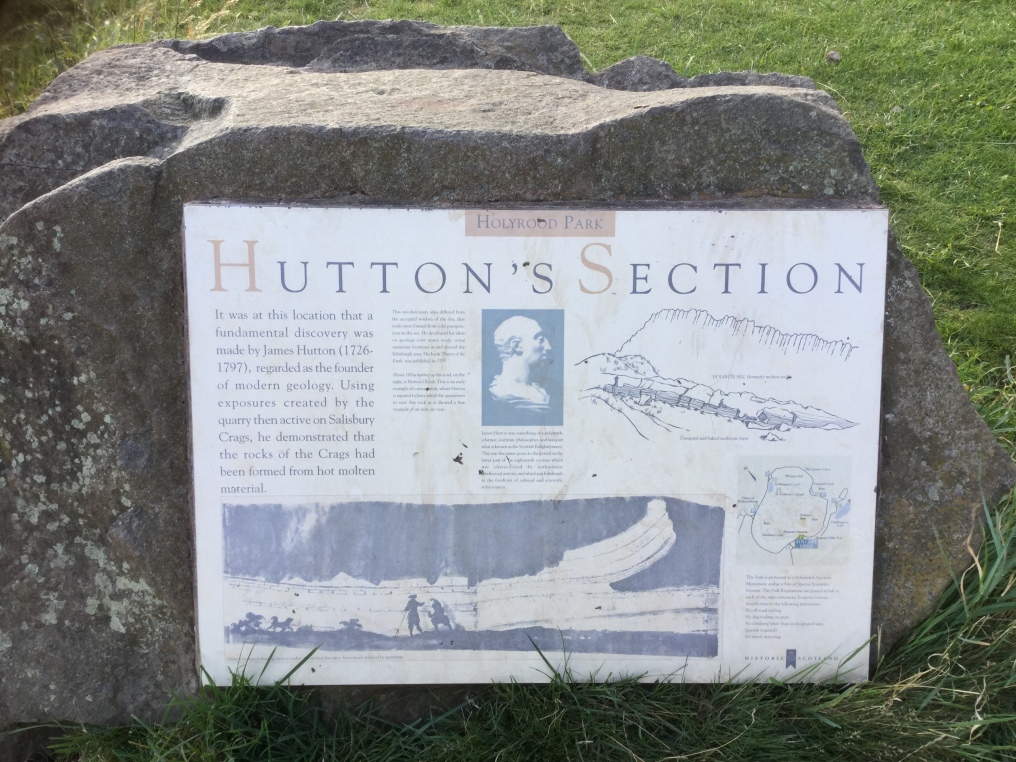
As I hike the hills and crags of Holyrood Park, I often pass a site associated with an alumnus of the University of Edinburgh, where I now attend. It’s not a spectacular site; in fact, it’s just a little stony outcropping that anyone other than a geologist might just pass by or clamber down without a thought. The more observant might notice that there are some nice colors and stripes in the rocks. If not for the fading white printed sign attached to a nearby stone, low enough to step right over it without noticing, no one might know that something important happened here.

Well, two somethings. One took a long time, one much less so. First, over millions of years, minerals were laid down and pressed into sandstone, a band of which pressed and warped against a dolerite sill, a remnant of the ancient volcano that created Arthur’s Seat. In fact, all manner of different processes created Arthur’s Seat, Salisbury Crags, and the other formations of Holyrood Park.

Holyrood Park in spring, viewing Salisbury Crags and Arthur’s Seat thru a flowering shrub, Edinburgh, Scotland

So the second important thing that happened to which I refer is that a sharp-eyed person of particular curiosity and intelligence noticed. In the mid-to-late 1700’s, James Hutton, a native of Edinburgh born on June 3, 1726, and who died here March 26, 1797, closely explored this area. He was a trained chemist and medical doctor, farmer and entrepreneur turned scientist. Hutton spent a great deal of time touring farms and open lands in Scotland, observing farming practices with a professional eye and rock and land formations with a scientific one.

Hutton’s careful observations led him to formulate the theory of uniformitarianism. This theory holds that the earth and its formations were generally not created quickly, in cataclysmic or miraculous events, but very slowly, over vast expanses of time, in slow but regular processes such as sedimentation, erosion, volcanism, and uplift. Hutton published his ideas in his two-volume magnum opus Theory of the Earth in 1795. His demonstration that the Earth was very old indeed made later scientific theories whose justifications required vast expanses of time, notably Charles Darwin’s theory of evolution by natural selection, possible.

Scroll down to see my photos of Hutton’s Section in Holyrood Park and its explanatory sign, and learn more about the great James Hutton through the links below:

James Hutton (1726 – 1797) ~ from ‘Alumni in History’ at the University of Edinburgh’s website

James Hutton: The Founder of Modern Geology ~ excerpt from Earth: Inside and Out, at the American Museum of Natural History website

James Hutton: Scottish Geologist ~ by the editors of Encyclopaedia Britannica

Hutton’s Section, Holyrood Park, Edinburgh, Scotland

Hutton’s Section historical sign, Holyrood Park, Edinburgh, Scotland

Another view of Hutton’s Section, Holyrood Park, Edinburgh, Scotland

~ Ordinary Philosophy is a labor of love and ad-free, supported by patrons and readers like you. Any support you can offer will be deeply appreciated!

Happy Birthday, Adam Smith!

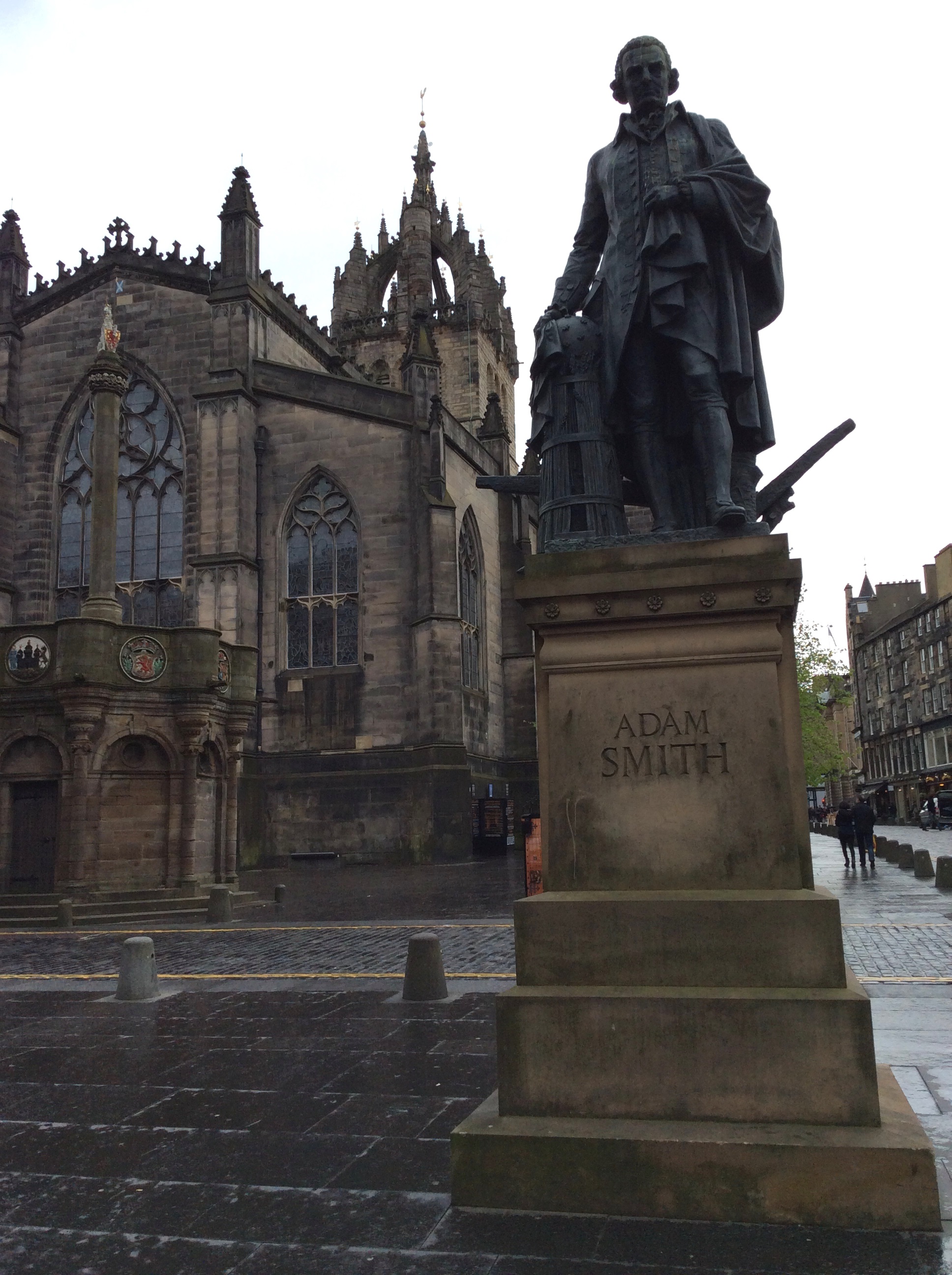
Adam Smith statue on the Royal Mile in Edinburgh, Scotland

Adam Smith was a philosophical disciple and life-long friend of David Hume, and as such, I encountered his ideas regularly while I was following the life and ideas of Hume a few years ago in Edinburgh. Smith wrote a moving account of Hume’s last days. I also encountered his ideas regularly in my undergraduate studies in moral philosophy.

Smith was baptized and perhaps born on June 5th, 1723 in Kirkcaldy, Scotland (a fishing village near Edinburgh) and died on July 17, 1790 in Edinburgh. He attended university at Glasgow and Oxford and found the former intellectual milieu more stimulating by orders of magnitude. Glasgow and Edinburgh were vigorous centers of Enlightenment thought in philosophy, natural philosophy (as the sciences were then known), linguistics, history, political theory, mathematics, and more. David Hume, Adam Smith, and their fellow leaders in the Scottish Enlightenment joined the ranks of this philosophical tradition’s greatest and most influential thinkers.

Like pretty much all Americans interested in basic economic theory, I’d heard a lot about The Wealth of Nations, Smith’s treatise on political economy. You likely have as well, since here you are reading a birthday tribute to Adam Smith! The Wealth of Nations is considered the foundational theoretical work on capitalism and therefore, Smith is regarded as a key figure in economic theory. But when I returned to university a few years ago to study philosophy, and when researching the life and ideas of Hume and his contemporaries for my aforementioned project, I spent more time with Smith’s moral philosophy. So I’ll focus this aspect of his thinking here. After all, this was his main arena of inquiry: he was not an economist, but a professor of moral philosophy at Glasgow. His Theory of Moral Sentiments was, and still is to a lesser consent, respected as a major work in moral philosophy.

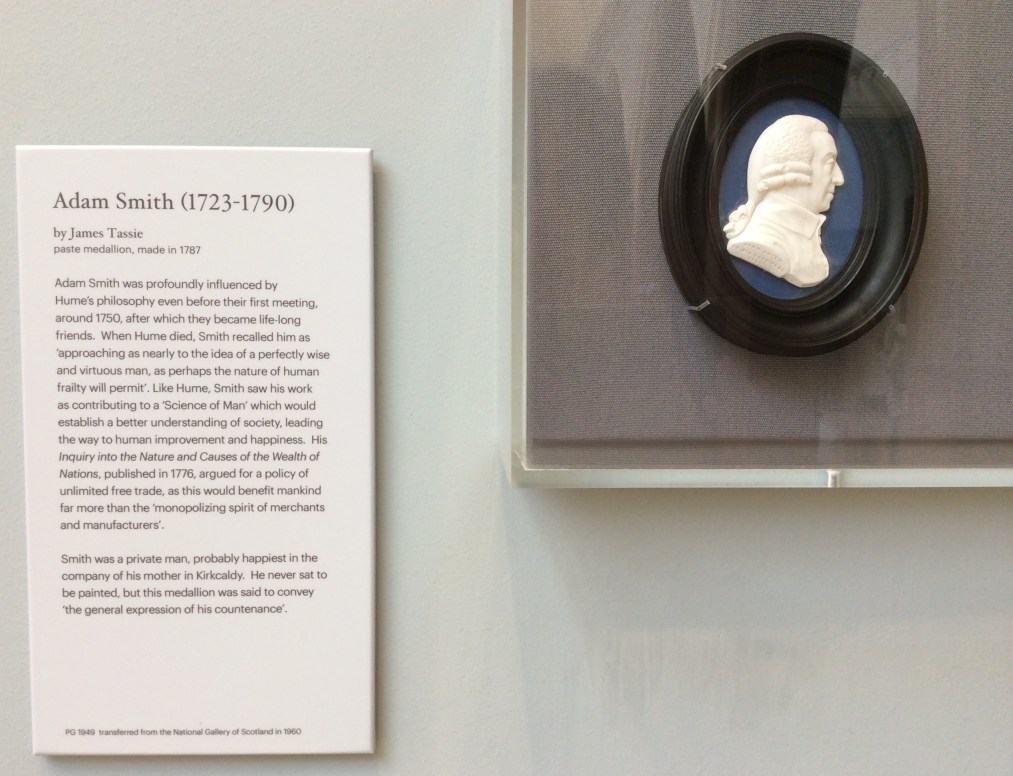
Portrait medallion of Adam Smith by James Tassie at the National Portrait Gallery in Edinburgh, Scotland.

Smith’s Theory of Moral Sentiments merges from a sort of compendium of elements of moral philosophy, in which Smith fuses what he considers the best and most coherent elements of moral philosophy into one compelling system. In it, one recognizes Humian sentimentalism, Kantian-type reason-based morality (Immanuel Kant’s work on this topic came after Smith’s, though the men were direct contemporaries), consequentialism, and Aristotelian virtue ethics. Like Hume, Smith thinks that the emotions play a central role. Before Hume, morality was widely considered to be primarily a matter of reason, and morality required us to quash our emotions, or as Hume put it, passions, because human are naturally and by default selfish, greedy, profane, lazy, and in myriad others way fallen creatures. Hume, however, does not agree. He believes that human beings naturally identify with the pains and joys of others, internalizing them and causing us to want to ameliorate their circumstances, and it’s this direct emotional response that drives the moral sense. Smith largely agrees, but not wholly. He also stresses the importance of sympathy (close to the sense that we’d usually now mean empathy) in making moral judgments. Smith explains that the moral agent is like an impartial spectator who participates in the daily lives, sufferings, and joys of our fellow human beings through our emotional response to their situation.

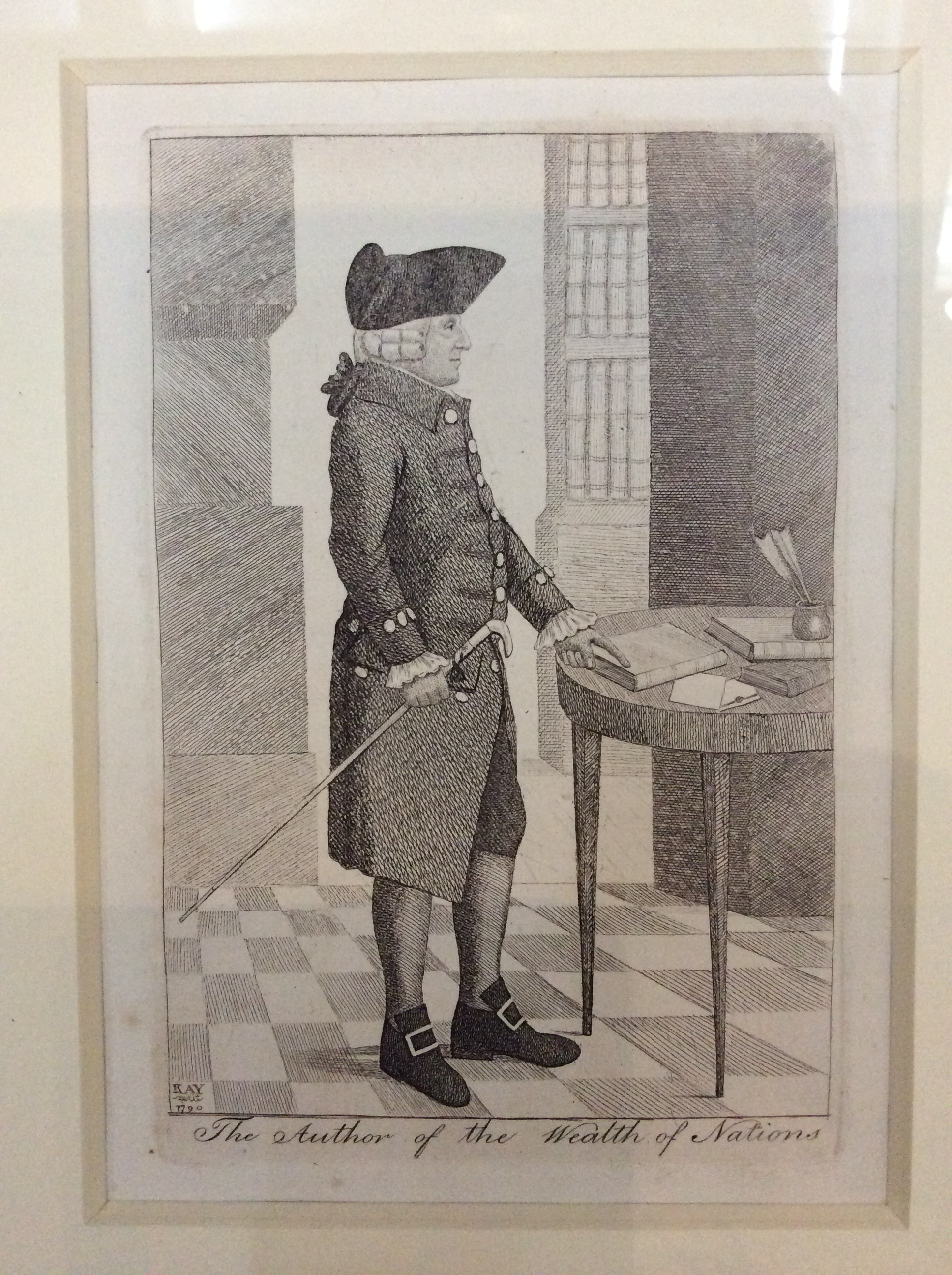
Adam Smith portrait by John Kay from 1790 (the year of Smith’s death), at the National Portrait Gallery, Edinburgh

But Smith also believes that sympathy (empathy) is not enough: our sympathies can and should be corrected by reason since our emotional responses can become inappropriate to the situation, corrupted by ignoble impulses such as greed, ambition, selfishness, and so on. An impartial, uncorrupted spectator would not consider indifference or cruelty, for example, as proper emotional responses to the plight of others. (I see shades of John Rawl’s ‘veil of ignorance‘ here.) One way to help us maintain moral ‘propriety’, as Smith put it, is to apply reason, and one way our reason can help us judge whether our moral sentiments are correct is to consider the consequence of actions we feel inclined to do. While the consequences of our actions don’t determine their rightness or wrongness as they do in consequentialist moral theories, they are an important consideration and in some cases, such as those in which human life hangs in the balance, they should take precedence. And finally, Smith agrees with Aristotle that we can’t rely on a pre-determined, reason-derived, emotionally-detached set of inflexible moral principles to differentiate right from wrong, good from bad, as Kant would have it. Rather, we naturally recognize and respond to virtue when we see it. We admire its beauty and goodness and have the desire to emulate it. Aristotle sees virtue as a perfect balance between opposing qualities in the same sphere: courage is the virtue on the right part of the spectrum between cowardliness and recklessness; temperance between licentiousness and insensibility; friendliness between obsequiousness and cold indifference. Smith likewise stresses the importance of balance in our moral character but focuses more on attuning our sympathies so they are in propriety, thereby driving us to act in the kindest, most honest, and fairest way towards one another as a matter of course.

adam smith_s grave in canongate kirkyard, edinburgh, scotland, 2017 amy cools

Adam Smith’s grave in Canongate Kirkyard, Edinburgh, Scotland

This is only a very short summary of Smith’s moral philosophy by one who not an expert on Smith’s life and thought. To learn more about the great philosopher and economist Adam Smith from those who are, and for more about the philosophical traditions that influenced him and which he influenced in turn, see:

Adam Smith (1723—1790) – Jack Russell Weinstein for the Internet Encyclopedia of Philosophy

Adam Smith’s Moral and Political Philosophy – by Samuel Fleischacker for The Stanford Encyclopedia of Philosophy

Adam Smith pt. 1 – Specialization and Adam Smith pt. 2 – The Tip of the Iceberg Of Wealth – Stephen West discusses Adam Smith’s political economy for his blog Philosophize This!

Adam Smith on What Human Beings Are Like – Nicholas Phillipson discusses Adam Smith’s view of human beings with Nigel Warburton for Philosophy Bites podcast

Dennis Rasmussen on Hume and Smith and his book The Infidel and the Professor – with Russ Roberts for EconTalk

Enlightenment – William Bristow for The Stanford Encyclopedia of Philosophy

Moral Sentimentalism – Antti Kauppinen for The Stanford Encyclopedia of Philosophy

The Problem With Inequality, According to Adam Smith – Dennis C. Rasmussen for The Atlantic

The Real Adam Smith – by Paul Sagar for Aeon

The Theory of Moral Sentiments – Adam Smith, first published in 1759

*A version of this piece was previously published in Ordinary Philosophy

~ Ordinary Philosophy is a labor of love and ad-free, supported by patrons and readers like you. Any support you can offer will be deeply appreciated!


Happy Birthday, Julia Ward Howe!

Julia Ward Howe, ca. 1855

Julia Ward Howe, poet and activist, was born on May 27, 1819, and lived a long life ever dedicated to social reform.

She’s best known as the author of the Battle Hymn of the Republic, the stirring Civil War anthem still sung at military events and in churches today; I remember singing it at Mass growing up. Filled with Biblical imagery, it reminds me of the Old Testament-inspired Second Inaugural Address of Abraham Lincoln. In it, he addresses the terrible costs of the war in lives and property, surmising that God’s justice may demand that ‘all the wealth piled by the bondman’s two hundred and fifty years of unrequited toil shall be sunk., and …every drop of blood drawn with the lash shall be paid by another drawn with the sword’ in recompense for the terrible sin of slavery.

Howe wrote her Hymn in 1861, Lincoln’s Second Inaugural was delivered in 1865. Lincoln is known to have heard the Battle Hymn and reported to have wept when he did. Lincoln was well versed in Scripture and references it liberally in his writings and speeches; nevertheless, he may also have had Howe’s Hymn in mind when he wrote his Address. In any case, both remain prominent in American historical memory, continuing to resonate and inspire today in our Protestantism-derived culture. John Steinbeck uses her Book of Revelation-derived phrase The Grapes of Wrath as the title of his great novel about the suffering of Dust Bowl refugees fleeing to California. The great Leonard Cohen references her Hymn in ‘Steer Your Way’ from You Want It Darker, his final album released shortly before his death last fall. Howe’s lyric ‘As he died to make men holy, let us die to make men free’ becomes ‘…let us die to make things cheap.’ Cohen redirects her line to critique today’s great sin of destroying our environment likewise out of greed, complacency, indifference to the fate we’re creating for our descendants, and slavish adherence to the ‘way it’s always been done.’

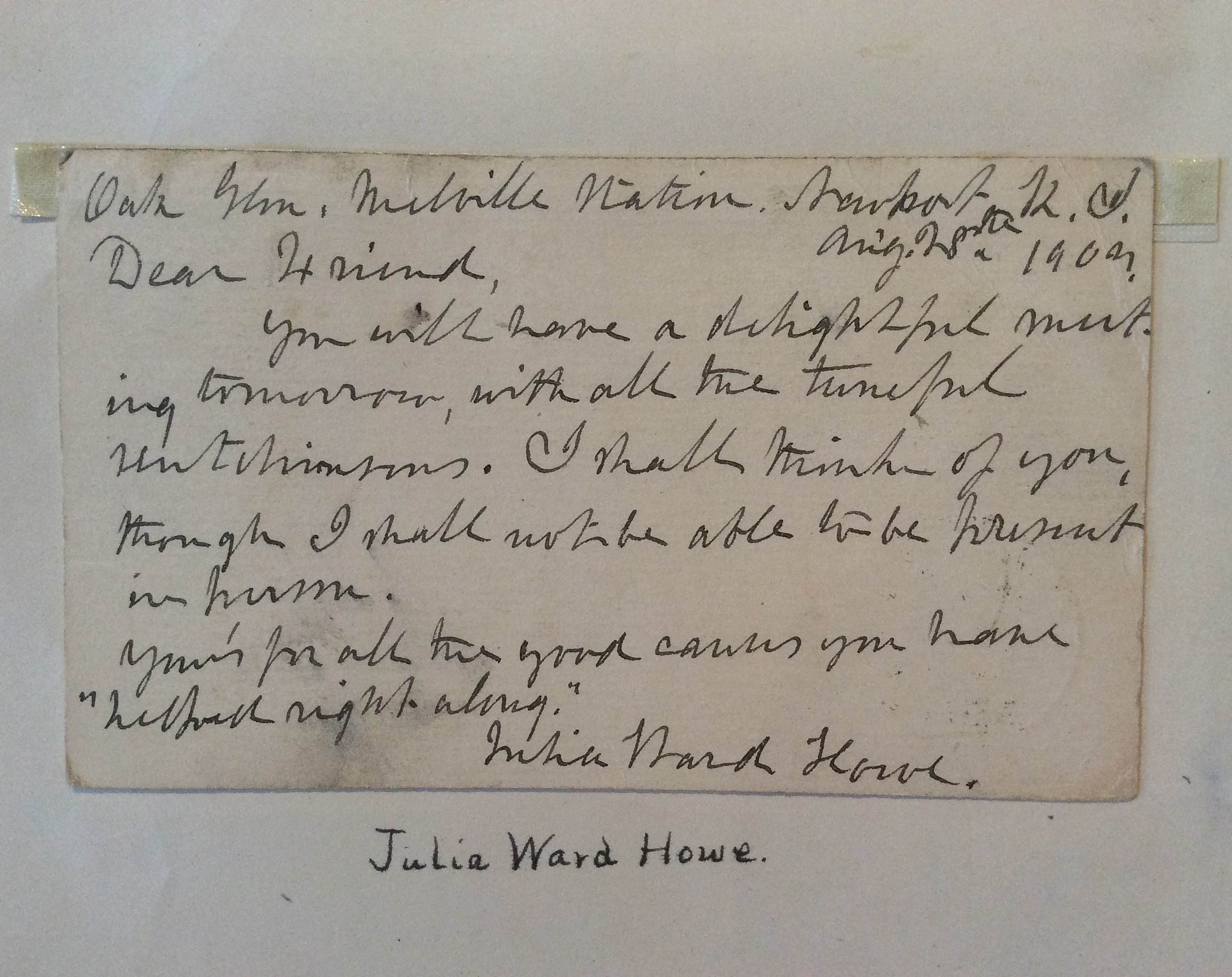
Julia Ward Howe postcard dated August 28th, 1903, from the Hutchinson Family Scrapbook in the collection of the Lynn Historical Society in Massachusetts. I was here in spring 2016 following the life and ideas of Frederick Douglass. The Hutchinson family dedicated their musical skills to the abolition movement and other reform causes and were friends with many prominent activists of their day. The scrapbook doesn’t note which member of the Hutchinson family Howe wrote this card to.

Read more about this great abolitionist, feminist, and author:

Julia Ward Howe, 1819–1910: BiographyPoetry Foundation

Julia Ward Howe (1819-1910) – by Debra Michals for the National Women’s History Museum

‘The Civil Wars of Julia Ward Howe,’ by Elaine Showalter – by Jill Lepore for The New York Times

Julia Ward Howe, 1819-1910, Volume 1 – by Laura Elizabeth Howe Richards, Maud Howe Elliott, and Florence Howe Hall, 1915

*A version of this piece was previously published at Ordinary Philosophy

~ Ordinary Philosophy is a labor of love and ad-free, supported by patrons and readers like you. Any support you can offer will be deeply appreciated!