Frederick Douglass Washington DC Sites, Last Day

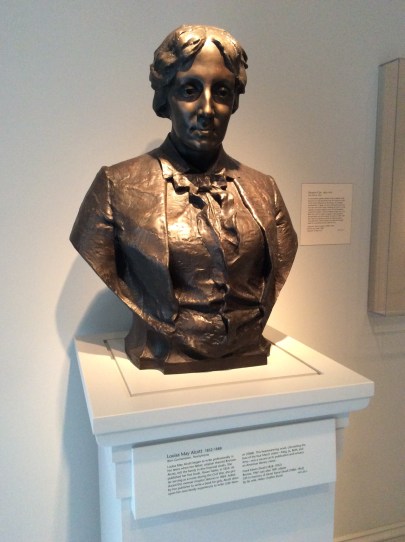
louisa-may-alcott-portrait-bust-at-the-smithsonian-national-portrait-gallery-2016-by-amy-cools

Louisa May Alcott portrait bust at the Smithsonian National Portrait Gallery, photo by Amy Cools, 2016

On Louisa May Alcott’s birthday evening, I think of a moment in her life that I discovered during my Frederick Douglass project, where she displayed the sort of moral clarity and courage I’ve associated with her since I was a little girl devouring every Alcott novel I could get my hands on. Thank you for your wonderful books, Ms. Alcott!

Amy M Cools's avatarOrdinary Philosophy

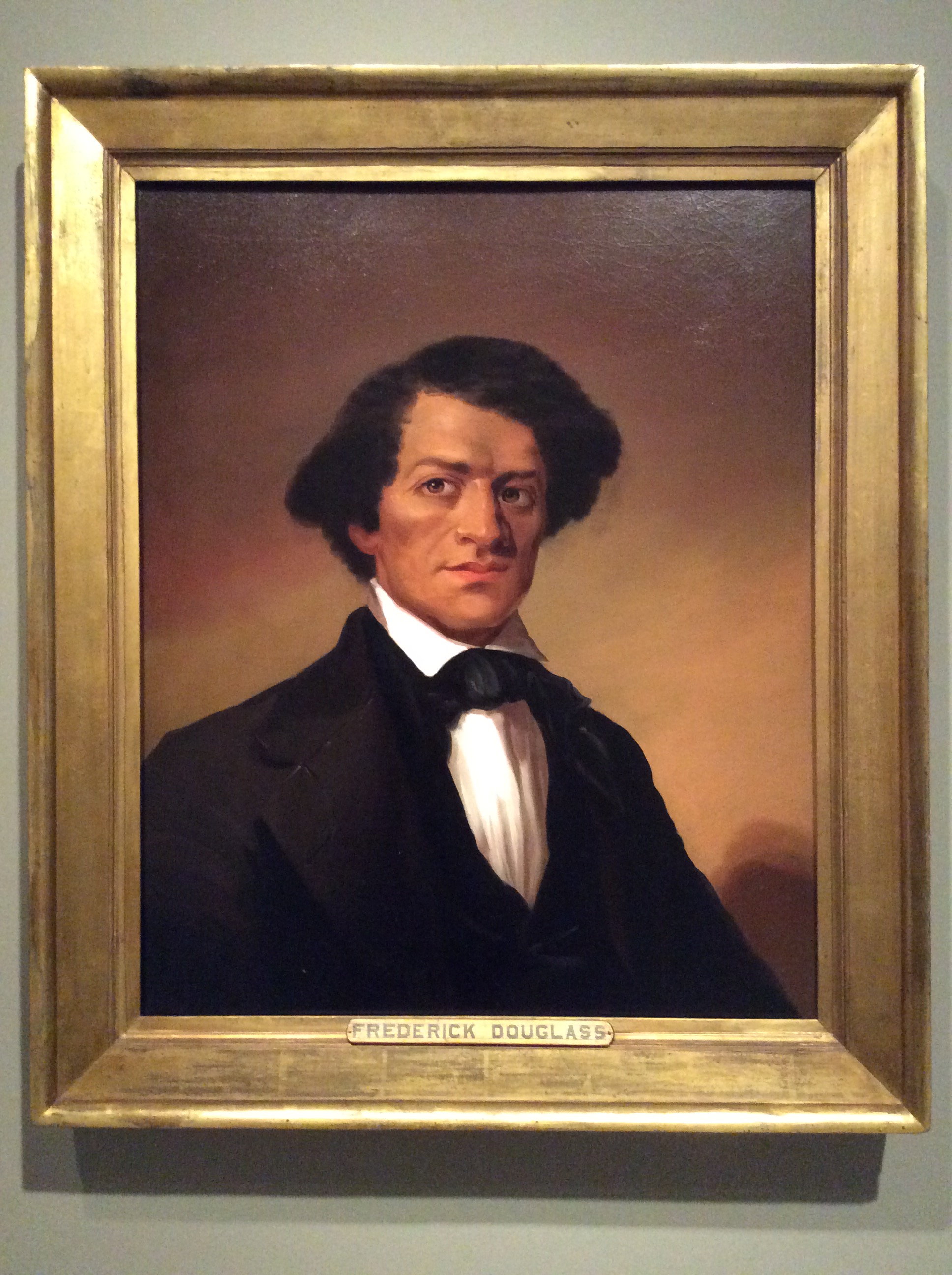
Portrait of Frederick Douglass by unknown artist, 1844, National Portrait Gallery in WashingtonD.C., Portrait of Frederick Douglass by unknown artist, 1844, National Portrait Gallery in Washington, D.C.. The NPG placard describes it as a ‘powerful portrait’ but I’m not particularly impressed, especially since I don’t think it looks like Douglass at all.

Fourteenth Day, Saturday, April 2nd

After a morning glancing at the light rainfall through the coffee shop window as I write up some notes and look up some things in preparation for the day, I begin my day’s explorations with a visit to the National Portrait Gallery. It’s at 8th and F Streets NW, its official address: unusually, it lacks a street number.

While I’m here primarily to see all the Douglass portraits I can find and have little time to spare since it’s my last day in D.C., I’ve wanted to visit the Portrait Gallery for a long time, and allow myself an extra hour to explore.

After I’ve made my inquiries…

View original post 4,382 more words

Happy Birthday, Mahatma Gandhi!

Mahatma Gandhi spinning yarn in the late 1920's. Gandhi started the ultimate 'Shop Local' movement, in which he called on his fellow Indians to wear only homespun, locally made fabrics to counteract the British colonialist's exploitation of Indian textile worker

Mahatma Gandhi spinning yarn in the late 1920’s. Gandhi started the ultimate ‘Shop Local’ movement in which he called on his fellow Indians to wear only homespun, locally made fabrics to counteract British colonialist’s policies which impoverished and nearly destroyed India’s textile industry. I founded an apparel and accessory line and boutique in the early 2000’s based on the same principles, carrying only locally and US-made products as an alternative to buying goods made in overseas sweatshops whose workers were unprotected by labor laws. Gandhi’s and my own approach were nationalistic and protectionistic, which I no longer believe goes far enough in promoting equal human rights for all. While such approaches may be a good place to start in some circumstances, a better way to go about improving the lives and prospects of workers around the world is to require our governments to institute more comprehensive labor laws and rigorously enforce them. This must include holding companies responsible for the abuses of their contractors, of course, to actually be effective.

There are very few non-Americans, outside of our mother country of Britain and our godmother France, who have had a greater impact on the history of the United States and our attitudes towards human rights than the incomparable Mahatma Gandhi. For someone who preached simplicity, often wearing nothing but a loincloth, weaving his own fabric, and living a severely rustic lifestyle to exemplify his own teachings, Gandhi was a very complicated person.

He was a human rights activist, politician, journalist, social and religious reformer, and to many, a sort of messiah. Originally a British loyalist, Gandhi’s studies and personal observations led him to change his own views, often radically, many times over the course of his long life. His beliefs in the revolutionary and morally suasive power of civil disobedience and nonviolent resistance were and continue to be particularly influential in the United States, beginning with the mid-20th century civil rights movement. Martin Luther King, Jr, Gandhi’s intellectual and spiritual descendant, emerged as the leader of this movement following his role in the 1955 Montgomery bus boycott. King’s and Gandhi’s ideas about the civil disobedience and non-violence, in turn, both incorporate Henry David Thoreau’s ideas from his landmark essay ‘Civil Disobedience’.

Here are excerpts on Gandhi’s influence on the American civil rights movement from the encyclopedia of the Martin Luther King, Jr. Research and Education Institute at Stanford University:

‘Upon his death, Mohandas K. Gandhi was hailed by the London Times as ‘‘the most influential figure India has produced for generations’’ (‘‘Mr. Gandhi’’). Gandhi protested against racism in South Africa and colonial rule in India using nonviolent resistance. A testament to the revolutionary power of nonviolence, Gandhi’s approach directly influenced Martin Luther King, Jr., who argued that the Gandhian philosophy was ‘‘the only morally and practically sound method open to oppressed people in their struggle for freedom’’ (Papers 4:478)…

Gandhi was born 2 October 1869, in Porbandar, in the western part of India, to Karamchand Gandhi, chief minister of Porbandar, and his wife Putlibai, a devout Hindu. At the age of 18, Gandhi began training as a lawyer in England. After completing his barrister’s degree he returned to India in 1891, but was unable to find well-paid work. In 1893, he accepted a one-year contract to do legal work for an Indian firm in South Africa, but remained for 21 years. It was in South Africa that Gandhi was first exposed to official racial prejudice, and where he developed his philosophy of nonviolent direct action by organizing the Indian community there to oppose race-based laws and socioeconomic repression.

Gandhi returned to India in 1914. In 1919, British authorities issued the Rowlatt Acts, policies that permitted the incarceration without trial of Indians suspected of sedition. In response, Gandhi called for a day of national fasting, meetings, and suspension of work on 6 April 1919, as an act of satyagraha (literally, truth-force or love-force), a form of nonviolent resistance. He suspended the campaign of nonviolent resistance a few days later because protestors had responded violently to the police.

Within the next few years, Gandhi reshaped the existing Indian National Congress into a mass movement promoting Indian self-rule through a boycott of British goods and institutions…’ (Continue reading)

I’ve included a list of links of excellent online sources on Gandhi below, including journalist and social critic Christopher Hitchen’s critique. Gandhi did, at times, express ideas and make decisions that many regard as problematic to this day, such as his early rhetoric on black Africans and his relations with some of the women in his life, including his wife Kasturba. Gandhi was no plaster saint: like the rest of us, he struggled to find truth and meaning in a world of mutually contradictory yet worthy-seeming values, principles, and goals; sometimes, like the rest of us, he sometimes  didn’t get it right. True understanding, I believe, is never reached through uncritical hero worship, even of one as influential, internationally revered, and I believe ultimately beneficial to the intellectual, activist, and political history of human rights as Gandhi.

Ordinary Philosophy and its Traveling Philosophy / History of Ideas series is a labor of love and ad-free, supported by patrons and readers like you. Please offer your support today!

~~~~~~~~~~~~~~~~~~~~~~~~~

Sources and Inspiration:

Brownlee, Kimberley, ‘Civil Disobedience‘, The Stanford Encyclopedia of Philosophy.

Gandhi and Civil Disobedience‘, from the Constitutional Rights Foundation.

Hitchens, Christopher. ‘The Real Mahatma Gandhi: Questioning the Moral Heroism of India’s Most Revered Figure‘. The Atlantic, July/August 2011 issue.

In Search of Gandhi by Lalit Vachani, from BBC’s Radio Four Storyville Why Democracy? series, originally published October 2007 at BBC.com

Life of Gandhi (abridged), documentary by GandhiServe Foundation: Mahatma Gandhi Research and Media Service.

Mahatma Gandhi‘. In Wikipedia, The Free Encyclopedia.

Martin Luther King, Jr. encyclopedia of The Martin Luther King, Jr. Research and Education Institute at Stanford University, two entries: ‘India Trip (1959)‘ and ‘Gandhi, Mohandas Karamchand (1869-1948)

Thoreau, Henry David. ‘Civil Disobedience‘, 1849, published online by the University of Virgina’s American Studies department

Happy Birthday, Margaret Sanger!

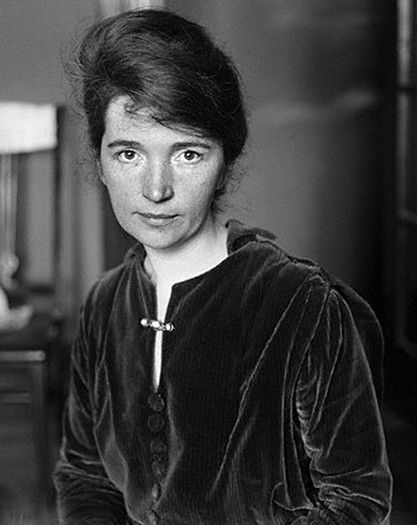
margaret-sangerMargaret Higgins Sanger was born on September 14, 1879 into a large Catholic family with 11 surviving children. Her mother died at about age 50 from tuberculosis. As young Margaret saw it, her mother was worn out from her 18 pregnancies, and would cite this as one of the many reasons she so passionately advocated for the right of women to control their own bodies and their own fertility.

She went on to become a nurse who worked with poor women in New York City in the 19-‘teens and twenties. As she saw these women struggle with the toll that uncontrolled pregnancies took on their families’ finances and their own health, Sanger became convinced that ‘birth control’, a term she invented, was essential if these women hoped to escape poverty and oppression. She opened America’s first birth control clinic and despite numerous arrests and fines, she continued her fight for reproductive rights. She founded the American Birth Control League in 1921, which became the Birth Control Federation of America in 1939 after merging with another organization, which in turn became Planned Parenthood in 1942. She continued her activism right up to her death in 1966. Sanger was instrumental in the creation of the first birth control pill Enovid, first available to the public in 1957. She also lived to see the Supreme Court validate her beliefs in the basic human rights to openly talk about sex and to control their own fertility in the Griswold v. Connecticut decision of June 7, 1965.

Sanger remains a controversial figure today. An ardent feminist, human rights activist, and advocate of sex-positivity, Sanger was also a eugenicist, believing that birth control was at least as important a tool for limiting the production of ‘the unfit’ (her words) as it was for women’s liberation. Sanger agreed with many leading scientists and progressives of her day in ascribing to so-called Social Darwinism (a problematic term since it doesn’t reflect Darwin’s own views as he expressed them), which applied the principles of natural selection to human social practice.  She did not, however, support any kind of compulsory or coercive forms of birth or population control, such as that practiced by the Nazis and even by the United States government, who forcibly sterilized thousands of so-called ‘feebleminded’ women. Instead, Sanger was an ardent advocate of self-determination, free speech, open discussions of sex and sexuality, and education, education, education. It was up to informed and thoughtful people, Sanger believed, to take responsibility for their own sexual choices and to convince others to do the same.

Unlike many other eugenicists, however, Sanger was not a racist. She worked closely with many leading black civil rights figures, believing, as they did, that birth control would have the same liberating effect on the black community as would for women generally. By limiting the number of children according to how many they could afford to raise and when, parents could more readily pursue an education, start a business, or otherwise devote their time, energy, and health to improving their standard of living which, in turn, they could pass down to their children.

Aside from her human rights activism, I find Sanger’s beliefs about human sexuality and its important role in spiritual and mental health most fascinating. I’ve chosen her as one the topics of an upcoming History of Ideas Travel Series as soon as I can make it happen, stay tuned! In the meantime, please follow the links in this article above and below to learn more about this important, fascinating, and troubling woman, and I highly recommend Jonathon Eig’s The Birth of the Pill, in which he recounts much of her personal history as well as her role in the Pill’s creation.

Ordinary Philosophy and its Traveling Philosophy / History of Ideas series is a labor of love and ad-free, supported by patrons and readers like you. Please offer your support today!

~~~~~~~~~~~~~~~~~~~~~~~~~

Sources and Inspiration:

Margaret Sanger Papers Project ~ Research Annex. Accompanying blog to The Sanger Papers Project by New York University.

The Pill, People & Events: Margaret Sanger (1879-1966)‘. From the American Experience website by PBS.

Sanger, Margaret. The Pivot of Civilization, 1922. Free online version by Project Gutenberg, 2008, 2013.

Tong, Ng Suat. Which Margaret Sanger?The Hooded Utilitarian blog, April 14, 2014.

Happy Birthday, Ida B. Wells!

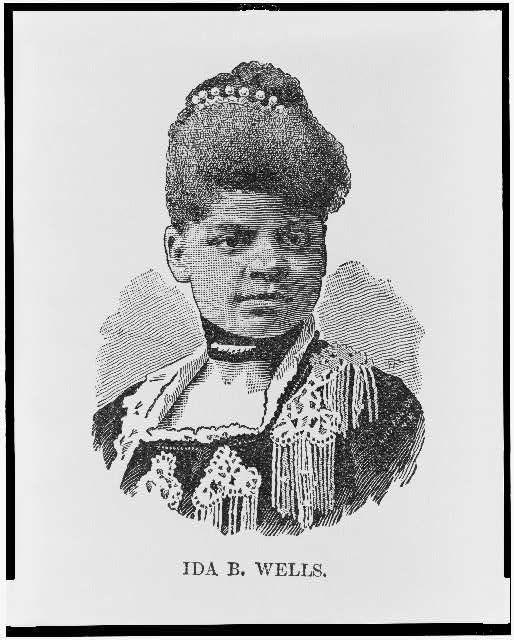
Ida B. Wells, head-and-shoulders portrait, published, 1891, Image retrieved from the Library of Congress LC-USZ62-107756, public domainIn my recent journey following the life of Frederick Douglass, I was so glad to have the opportunity to visit the place in New York City where he may have first met the great Ida B. Wells. It was late 1892, and this fiery young newspaperwoman had published her very controversial piece of investigative journalism in the New York Age on June 25, 1892. It was expanded and published as a pamphlet later that year as Southern Horrors: Lynch Law in All Its Phases.

Many people at that time thought of lynching as an unfortunate and somewhat rare excess of race-hatred by frustrated Southern whites. And many more saw it as a lawless but not entirely unjustified species of vengeance against black men who had raped white women. But Wells would change all that. In early 1892, three of Wells’ friends were lynched after a dispute between themselves and white owners of a rival business. She was outraged, and began an investigation of the practice and history of lynching as a whole.

When Wells wrote Southern Horrors, she had already been an activist and writer for black rights for many years. In 1884, she resisted being forced out of the first class train car into the ‘colored car’; she later sued the train company, won the first suit, then lost on appeal. This incident (which echoes Douglass’ train protest in 1841) led to many other lawsuits, articles, and activism against anti-black laws and social practices. In 1892, her investigation of lynching revealed to Wells that lynching was far from just vengeance for rape, it was inflicted for petty crimes, supposed insubordination or impertinence, drunkenness, competition, and so on. She discovered that lynchings were not all that rare, either, and came to the conclusion that they consisted a form of social control, a replacement for the terrorism of the slave system.

Douglass was inspired and energized by Wells’ writing and anti-lynching work, and wrote a letter praising Southern Horrors as an introduction. He visited her in New York City where she was living for a little while as a writer for and part owner of the New York Age, which was (probably) published at the site I visited in Harlem. I visited a second site associated with Wells two days after my New York visit: she delivered one of her hard-hitting speeches in her speaking tour following the publication of Southern Horrors at Tremont Temple in Boston on Feb 13th, 1893.

Education was another driving force in her life. Her first job was as a teacher at age 14, and she taught for many years, over time supplementing her teaching with journalism, writing and editing for the Evening Star, The Living Way, and the Free Speech and Headlight. Another of her most controversial, consciousness-raising articles was published in 1891 in the Free Speech about the conditions in black schools: the poor quality of the buildings which housed them, and of the education and morals of the teachers and school boards who administered them. She was not fired outright, but the school refused to hire her for the next school year. She then went on to work full-time for the newspaper, promoting the Free Speech from city to city and writing articles along the way, until the Free Speech‘s offices and printing press were destroyed by angry whites after the publication of her ‘Lynch Law’ piece. Adversity only served to strengthen Wells’ resolve, each attack causing her to re-double her efforts on behalf of her people.

Wells went on to have a long and distinguished career in writing, investigative journalism, and activism for black rights and women’s suffrage. She worked with Frederick Douglass and W.E.B. DuBois, toured the United States and Europe as a speaker and activist, founded Chicago’s Alpha Suffrage Club, served as secretary of the National Afro-American Council, founded and became the first president of the Negro Fellowship League, and helped found the National Association for the Advancement of Colored People (NAACP), among many other things.

For a long time, Wells thought of marriage and romantic relationships as oppressive, where women were expected to defer to men and flatter their vanity. But one day, she met a man who must have made her feel very differently, an attorney, writer, and fellow advocate for black rights named Ferdinand Barnett. She married him and they raised four children.

Please follow the links below to learn more about Ida B. Wells. If I manage to accomplish the tiniest fraction of what she did in my own life, I would consider myself a great success.

Ordinary Philosophy and its Traveling Philosophy / History of Ideas series is a labor of love and ad-free, supported by patrons and readers like you. Please offer your support today!

~~~~~~~~~~~~~~~~~~~~~~~~

Sources and inspiration:

Ida B. Wells-Barnett‘, episode 25 of the History Chicks podcast by Beckett Graham and Susan Vollenweider.

Ida B. Wells-Barnett‘. Encyclopædia Britannica. Encyclopædia Britannica Online.

McBride, Jennifer. ‘Ida B. Wells: Crusade for Justice‘. From Webster University’s website.

McNally, Deborah. ‘Barnett, Ferdinand Lee (1858-1936)‘, in BlackPast.org

Steptoe, Tyina. ‘Barnett, Ida Wells (1862-1931)’, in BlackPast.org

Wells, Ida. B. Crusade for Justice: The Autobiography of Ida B. Wells. Ed. Alfred Duster. Chicago, University of Chicago Press, 1970.

Wells, Ida. B. Southern Horrors: Lynch Law in All Its Phases, 1892, via Project Gutenberg

Wikipedia contributors. ‘Ida B. Wells‘. In Wikipedia, The Free Encyclopedia.

Wintz, Paul Finkelman, Cary D. Encyclopedia of the Harlem Renaissance: K-Y. 2004.


Happy Birthday, Henry David Thoreau!

Replica of Thoreau's cabin near Walden Pond, Rhythmic Quietude, Creative Commons BY-SA 3.0 via Wikimedia Commons, cropped

Replica of Thoreau’s cabin near Walden Pond

Henry David Thoreau is the American philosopher and writer best known for two books, Walden  and Civil Disobedience. The first is about simplifying your life so as to find what it’s really all about, the second promotes breaking the law in protest when the state does wrong (think Martin Luther King in the Birmingham jail). Walden tells of Thoreau’s experiences and observations living a simple life in a cabin for two years, where he seeks to clear his mind of the encumbrances and distractions of life in society and focus on immersion in nature and the life of the mind. Civil Disobedience is an essay prompted by Thoreau’s refusal to pay taxes in protest of slavery and of America’s starting a war to seize land from the Mexican government.

Here’s a list of resources, short but sweet, to introduce you to his life and work if you haven’t been already or would like a refresher. Not all are complimentary, but that’s good: we learn much from the debate over his ideas, too.

Henry David Thoreau‘, from American Transcendentalism Web

Henry David Thoreau‘. In Wikipedia, The Free Encyclopedia.

Popova, Maria. ‘Happy Birthday, Thoreau: The Beloved Philosopher on How to Use Civil Disobedience to Advance Justice‘ and ‘The Spirit of Sauntering: Thoreau on the Art of Walking and the Perils of a Sedentary Lifestyle‘ in Brainpickings.org

Schultz, Kathryn. ‘Pond Scum: Henry David Thoreau’s Moral Myopia.’ The New Yorker, Oct 19th 2015.

The Thoreau Reader: Annotated works of Henry David Thoreau – Three complete books and four essays, annotated copies of Walden and Civil Disobedience, and more…

West, Stephen. Henry David Thoreau. Episode 83 of Philosophize This podcast

Ordinary Philosophy and its Traveling Philosophy / History of Ideas series is a labor of love and ad-free, supported by patrons and readers like you. Please offer your support today!

Happy Birthday, Jean-Jacques Rousseau! / O.P. Recommends …Rousseau on Nature, Wholeness and Education by Michele Erina Doyle and Mark K. Smith

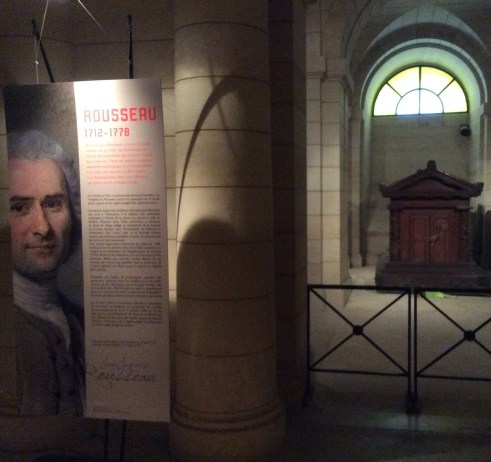
Jean-Jacque Rousseau's Tomb in the Parthenon, Paris, photo 2015 by Amy Cools

Jean-Jacque Rousseau’s tomb in the crypt of the Parthenon, Paris, which I visited in 2015 during my travels there following the life and ideas of Thomas Paine, Mary Wollstonecraft, and Thomas Jefferson in Paris

I found this article I really enjoyed, called Jean-Jacques Rousseau on Nature, Wholeness and Education by Michele Erina Doyle and Mark K. Smith, and thought I’d share it with you in honor of his birthday. I regret I ran out of time to write an original one, but Doyle and Smith’s is excellent and I’m so glad to have discovered it! You’ll also find links below to more great resources to introduce you to the life and ideas of this strange and interesting man.

The article begins, ‘Why should those concerned with education study Rousseau? He had an unusual childhood with no formal education. He was a poor teacher. Apparently unable to bring up his own children, he committed them to orphanages soon after birth. At times he found living among people difficult, preferring the solitary life. What can such a man offer educators? The answer is that his work offers great insight. Drawing from a broad spectrum of traditions including botany, music and philosophy, his thinking has influenced subsequent generations of educational thinkers – and permeates the practice of informal educators. His book Émile was the most significant book on education after Plato’s Republic, and his other work had a profound impact on political theory and practice, romanticism and the development of the novel….’ Read more:

Learn more about Rousseau:

Bertram, Christopher, ‘Jean Jacques Rousseau‘. In The Stanford Encyclopedia of Philosophy

Cranston, Maurice. ‘Jean-Jacques Rousseau: Swiss-Born French Philosopher.’ In Encyclopædia Britannica.

Delaney, James J. ‘Jean-Jacques Rousseau, (1712—1778)‘, in The Internet Encyclopedia of Philosophy

Doyle, Michele Erina and Mark K. Smith (2007) ‘Jean-Jacques Rousseau on Nature, Wholeness and Education’, from The Encyclopaedia of Informal Education

West, Steven. Three episodes from the Philosophize This! podcast: Rousseau Government Pt. 1, Rousseau pt. 2, and Rousseau pt. 3 – The General Will

Ordinary Philosophy and its Traveling Philosophy / History of Ideas series is a labor of love and ad-free, supported by patrons and readers like you. Please offer your support today!

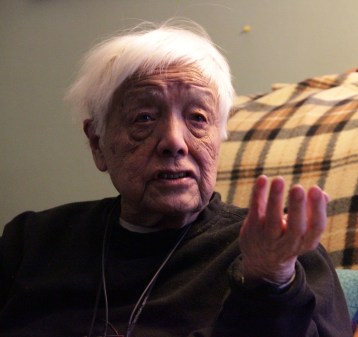
Happy Birthday, Grace Lee Boggs! Bio and Book Review by Ashley Farmer

Grace Lee Boggs, By Kyle McDonaldm creativecommons.orglicensesby2.0, via Wikimedia Commons, cropped“The Power And Importance Of Ideas:” Grace Lee Boggs’s Revolutionary Vision”

In the opening lines of her autobiography, Living for Change, Grace Lee Boggs remarked: “Had I not been born female and Chinese American, I would not have realized from early on that fundamental changes were necessary in our society.”[1] A daughter of Chinese immigrants born in 1915, who, by her account, became a philosopher in her 20s and an activist in her 30s, Boggs remains one of the greatest radical theorists of the twentieth century.

Born in Rhode Island, Boggs spent her childhood in New York City, working in the two restaurants her father owned in Times Square. At the age of 16, she left home to attend Barnard College, and afterward, Bryn Mawr, where she earned a PhD in Philosophy in 1940. Philosophers like Hegel helped her “see [her] own struggle for meaning as part of the continuing struggle of the individual to become part of the universal struggle for Freedom.”[2] Boggs moved to Chicago in 1940. She began working with the South Side Tenants Organization set up by the Workers Party, a Trotskyist group that had split off from the Socialist Workers Party. Her time in the Windy City proved transformative. For the first time she was talking and working with the black community, getting a first-hand sense of what it meant to live within the confines of segregation and discrimination, and learning how to participate in grassroots organizing.[3]

It was also during her tenure with the Workers Party that she met Caribbean radical C.L.R. James, and began a “theoretical and practical collaboration that would last twenty years.”[4] As part of a small wing of the workers Party led by James and Raya Dunayevskaya, Boggs became a leading theoretician, co-authoring texts like State Capitalism and World Revolution (1950). Through James, she came into contact with a number of black writers and activists who expanded her perspective. She relocated to Detroit in 1953, where she would organize with, and marry, James (Jimmy) Boggs.

During the 1950s, Boggs, “mainly listened and learned” to the black activists around her in an effort to better understand the black condition. It would take several years before she decided that she had been “living in the black community long enough to play an active role in the Black Power Movement that was emerging organically in a Detroit where blacks were becoming the majority.”[5] Living and working in what was considered to be an epicenter of black radicalism, Boggs engaged in a combination of theorizing and protesting, authoring texts with James Boggs, meeting and organizing with Malcolm X, and mentoring young radicals like Muhammad Ahmad (Max Stanford), leader of the Revolutionary Action Movement (RAM).

Her liberation theory was grounded in her study of philosophy and honed through her experiences organizing with and for black communities. It was also constantly evolving. Boggs emphasized dialectical thinking, arguing that reality is ever changing and that we must “constantly be aware of the new and more challenging contradictions that drive change.”[6] This reciprocal process drove her expansive vision of revolution. In her final book, The Next American Revolution, she explained her latest concept of revolution:

The next American Revolution, at this stage in our history, is not principally about jobs or health insurance or making it possible for more people to realize the American Dream of upward mobility. It is about acknowledging that we as Americans have enjoyed middle-class comforts at the expense of other peoples all over the world. It is about living the kind of lives that will not only slow down global warming but also end the galloping inequality both inside this country and between the Global North and Global South. It is about creating a new American Dream whose goal is a higher Humanity instead of the higher standard of living dependent on Empire.[7]

Boggs consistently offered a holistic vision of revolution and concrete steps through which to build it. She argued that achieving this goal meant more than organizing or mobilizing to petition the state or “changing the color of political power,” but rather growing food, reinventing education, developing Peace Zones in local neighborhoods, and creating restorative justice programs. She saw the seeds of revolution everywhere and showed us how, by practicing dialectical thinking, breaking down divides and categories, and building on rather than replicating older political models, we might “grow our souls.” She mirrored this in her own life, constantly “combining activity and reflection.”[8] Her willingness to do the work, her ability to listen and learn from black activists, her commitment to living in the communities in which she organized, and her openness to revising her politics, and values, made her an effective life-long ally of the black community and theoretician of liberation and revolution.

As she noted, often, “in the excitement of an emerging movement, we tend to want to be part of the action, and we underestimate the power and importance of the ideas in our heads and hearts.”[9] Upon her death, it’s important to revisit the ideas in her head. She left us a roadmap for revolution through ideas and action, one that anyone could be a part of if they were clear about the stakes of the transformation and that fundamental change is necessary.

~ Ashley Farmer is an historian of African-American women’s history. Her research interests include women’s history, gender history, radical politics, intellectual history, and black feminism. She earned a BA in French from Spelman College, an MA in History from Harvard University, and a PhD in African American Studies from Harvard University. She is currently a Provost Postdoctoral Fellow in the History Department at Duke University. In August 2016, she will be an Assistant Professor in the Department of History and the African American Studies Program at Boston University. This bio and more about Ms. Farmer are to be found at her personal website

~ Originally published at the African American Intellectual History Society blog, republished under the Creative Commons license

Ordinary Philosophy and its Traveling Philosophy / History of Ideas series is a labor of love and ad-free, entirely supported by patrons and readers like you. Please offer your support today!

~~~~~~~~~~~~~~~~~~~~~~~~~~~~~~~~~~~~~~

[1] Grace Lee Boggs, Living for Change: An Autobiography (Minneapolis: University of Minnesota Press, 1998), xi.

[2] Ibid., 30-31.

[3] Ibid., 36.

[4] Ibid., 43. James and Boggs “went their separate ways in 1962.”

[5] Grace Lee Boggs with Scott Kurashige, The Next American Revolution: Sustainable Activism for the Twenty-first Century (Berkeley: University of California Press, 2011), 66.

[6] Ibid., 62.

[7] Ibid., 72.

[8] Ibid., 164.

[9] Ibid., 80.

Happy Birthday, Aimé Césaire!

Aimé Fernand David Césaire, photo credit manomerci.comAimé-Fernand-David Césaire was a poet, playwright, philosopher, and politician from Martinique. In his long life (1913-2008), Césaire accomplished much in each of these roles, a rare feat as they rarely coincide in one person!

In turn mayor of Fort-de-France, deputy to the French National Assembly for Martinique, and President of the Regional Council of Martinique, this prolific writer and intellectual was also co-founder of Négritude, a ‘literary movement of the 1930s, ’40s, and ’50s that began among French-speaking African and Caribbean writers living in Paris as a protest against French colonial rule and the policy of assimilation.’ (Encyclopædia Britannica). The Stanford Encyclopedia of Philosophy describes Négritude as ‘the self-affirmation of black peoples, or the affirmation of the values of civilization of something defined as “the black world” as an answer to the question “what are we in this white world?”’. The term was chosen so as to be provocative, a way of re-claiming the word nègre, which had become a racial slur, while simultaneously shocking those who heard or read it into paying attention. Through his philosophy, political writing, and especially his poetry and plays, the world pays attention still.

Learn more about the great Aimé Césaire through the resources below; an excellent place to start is with Meredith Goldsmith’s article from The Poetry Foundation.

Ordinary Philosophy and its Traveling Philosophy / History of Ideas series is a labor of love and ad-free, supported by patrons and readers like you. Please offer your support today!

~~~~~~~~~~~~~~~~~~~~~~~~

Sources and inspiration:

Aime Cesaire‘. In Encyclopædia Britannica.

Chidi, Sylvia Lovina. The Greatest Black Achievers in History, chapter 1

Diagne, Souleymane Bachir, ‘Négritude‘. In The Stanford Encyclopedia of Philosophy

Goldsmith, Meredith. ‘Aimé Fernand Césaire‘, 1913–2008. In The Poetry Foundation


Happy Birthday, W.V.O. Quine!

WVO Quine on the Bluenose II in Halifax, Nova Scotia, photo courtesy of Douglas Quine (cropped)

WVO Quine on the Bluenose II in Halifax, Nova Scotia, photo courtesy of Douglas Quine

The emphases in my own education in philosophy were Ethics, Politics, and Law, so I didn’t spend as much time studying Willard Van Orman Quine’s great contributions to philosophy as I would like. However, if my focus was Mathematical Logic, Epistemology, Philosophy of Language, or Philosophy of Science, I would have spent a lot of time with the prodigious output of his remarkable intelligence. But one of his important observations is brought up in introductory philosophy classes generally, an epistemological (having to do with knowledge) quandary: Given that science continuously makes new discoveries, sometimes in the process overturning and replacing earlier theories, how can we ever say that we actually know anything about the world? Science relies on the fact that all theories are subject to revision, expansion, and being proved wrong. Does this mean, then, there’s no such thing as knowledge, since, in theory, anything we claim to know may be disproved by later discoveries?

For Quine, there is no dividing line between science and philosophy; they are interconnected ways of discovering and understanding the world. As the Stanford Encyclopedia of Philosophy puts it, Quine ‘denies that there is a distinctively philosophical standpoint, which might, for example, allow philosophical reflection to prescribe standards to science as a whole. He holds that all of our attempts at knowledge are subject to those standards of evidence and justification which are most explicitly displayed, and most successfully implemented, in the natural sciences. This applies to philosophy as well as to other branches of knowledge.’ The Internet Encyclopedia of Philosophy says further, ‘…Quine often appeals to [Otto] Neurath’s metaphor of science as a boat, where changes need to be made piece by piece while we stay afloat, and not when docked at port. He further emphasizes that both the philosopher and scientist are in the same boat (1960, 3; 1981, 72, 178). The Quinean philosopher then begins from within the ongoing system of knowledge provided by science, and proceeds to use science in order to understand science. …his use of the term “science” applies quite broadly referring not simply to the ‘hard’ or natural sciences, but also including psychology, economics, sociology, and even history (Quine 1995, 19; also see Quine 1997). But a more substantive reason centers on his view that all knowledge strives to provide a true understanding of the world and is then responsive to observation as the ultimate test of its claims…’

Oh, and he played the mandolin and piano, and learned a lot of languages just so he could deliver his lectures in the native language of the audience. Whatta guy!

For more about the great W.V.O. Quine, please visit the excellent sources below; a good place to start is the New York Times article.

Ordinary Philosophy and its Traveling Philosophy / History of Ideas series is a labor of love and ad-free, supported by patrons and readers like you. Please offer your support today!

~~~~~~~~~~~~~~~~~~~~~~~~

Sources and inspiration:

Hylton, Peter, ‘Willard van Orman Quine‘, The Stanford Encyclopedia of Philosophy

Sinclair, Robert. ‘Willard Van Orman Quine: Philosophy of Science‘, in The Internet Encyclopedia of Philosophy

Willard Van Orman Quine. In The Basics of Philosophy: A huge subject broken down into manageable chunks

Willard Van Orman Quine. In Wikipedia, The Free Encyclopedia.

Willard Van Orman Quine, 1908-2000: Philosopher and Mathematician. Website

W. V. Quine, Philosopher Who Analyzed Language and Reality, Dies at 92.’ New York Times, Dec 29, 2000

Happy Birthday, Walt Whitman!

Walt Whitman, age 35, from Leaves of Grass, Fulton St., Brooklyn, N.Y., engraving by Samuel Hollyer from daguerreotype by Gabriel Harrison, public domain via Wikimedia Commons‘Walt Whitman, an American, one of the roughs, a kosmos, Disorderly fleshy and sensual . . . . eating drinking and breeding, No sentimentalist . . . . no stander above men and women or apart from them . . . . no more modest than immodest.’ Thus Walt Whitman introduces himself to us for the first time in his first self-published 1855 edition of Leaves of Grass. Not on the cover or on the title page, mind you, but deep within the body of the untitled poem later called Song of Myself. If this is a dialing-back attempt to inject a little respectable humility or yet another self-aggrandizing affectation on the part of this unapologetic egoist, it’s hard to say definitely, though I strongly suspect it’s the latter. It certainly is so-very-American.

He was confident, earthy, crude, and vibrant, a self-styled natural man whose personas were nonetheless carefully crafted. He did his own thing and ‘lived the free life of a rover’ (an Eric Bogle phrase from his great anti-war ballad And the Band Played Waltzing Matilda), working odd jobs as a printer, journalist, teacher, and clerk, among other things. Moved by horror and compassion at the magnitude of death and suffering he observed, he worked some years as a nurse to the Civil War wounded, and spent much of his somewhat meager earnings on supplies for their comfort and care. He remained single but had many lovers, probably mostly homosexual, though he praises the physical beauty and power of women as lavishly in his poems as he does those of men. All the while, starting at just over age 30, he began to write his highly idiosyncratic, free verse poetry celebrating the authentic and the crafted self, the human body, democracy, equality, work, nature, and companionship. He spent the rest of his somewhat long life revising and republishing several editions of Leaves of Grass, up to several months before his death at age 72 in 1892.

To read more work by, about, and inspired by the great Walt Whitman, here are some links and articles:

Walt Whitman“. in Encyclopædia Britannica Online.

Walt Whitman, 1819–1892‘. The Poetry Foundation (website)

Whitman, Walt. Leaves of Grass (1855). Source: Electronic Text Center, University of Virginia Library

Whitman, Walt. Assorted poems at Poets.org

The Walt Whitman Archive, Ed Folsom and Kenneth M. Price, Ed., published by the Center for Digital Research in the Humanities at the University of Nebraska–Lincoln

and just because I love it:

The Body Electric, song and music video by Hooray for the Riff Raff. The song title is inspired by one of Whitman’s most enduring and controversial poems, and is a critique of the tradition of the murder ballad

Ordinary Philosophy and its Traveling Philosophy / History of Ideas series is a labor of love and ad-free, supported by patrons and readers like you. Please offer your support today!