Is it Moral to Respect the Wishes of the Dead, Above the Living? By Barry Lam

Imagine what a country would be like if every person could secure a vote in elections that happened after their death. If you stated your preferences in your will, you could execute a vote for the conservative, liberal, Asian, or White Separatist candidate, in every election, in perpetuity, and your vote would compete with the votes of the living. Imagine that a legal structure were erected to execute the wishes of the dead, and that the law would side with the dead even when their wishes conflicted with the needs of the living, or with the wellbeing of future generations.

We have overwhelmingly good moral reasons to reject such a society. We believe that with death comes the loss of the right to influence the political institutions of the living. Yet this kind of moral clarity disappears as soon as we move from politics to wealth. There is a huge industry dedicated to executing the wishes of human beings after their death. Through endowments, charitable trusts, dynasty trusts, and inheritance law, trillions of dollars in the US economy and many legal institutions at all levels are tied up in executing the wishes of wealthy people who died long ago. The UK does not fall far behind. As wealth inequality increases, the wealthy today are earmarking large amounts of money from the future economy to carry out their current wishes. The practice is so deeply ingrained in the culture of elite institutions, and such a ubiquitous feature of life, that only in obscure journals in law and philanthropy does anyone express concern about the justice of the practice.

In the US, the wealthy continue to own and grow wealth after their death, and the state can enforce the spending wishes of the dead in many ways. For instance, you may require, as a condition of inheritance, that your grandchildren marry within a religious faith, or that a school be named after you, forbidding a change in name even if the school would otherwise go bankrupt. Alternatively, an individual may secure current and future wealth in a tax-sheltered trust only for descendants, where the money can both grow and be shielded from creditors in perpetuity. A third legal instrument is the charitable trust, where the dead can earmark current and future wealth to some particular purpose considered ‘charitable’ where such purposes are now broad enough to include anything from the care of abandoned guinea pigs to the preservation of Huey military aircraft. Non-profit institutions such as hospitals, museums and universities can have large amounts of their spending constrained by the wishes of dead donors, such as that there be an endowed professorship for the study of parapsychology, or that a certain wing must be set aside for housing individuals of Confederate ancestry.

These practices are, on reflection, quite puzzling. Ideas about what is good to do in the world ought to change with the changing conditions of the world. Funding cancer research is good only in a world in which there is cancer. Giving distant descendants enormous amounts of wealth is good only if they are not sociopaths. And yet, we allow such power to those who are no longer around to know about the world, and who cannot be harmed or benefited any longer from such spending.

In fact, the idea that the dead could lose their rights to control the future is familiar in our moral lives, and this idea gets reflected elsewhere in the law. The state does not enforce your desire that your spouse not remarry. Even if your spouse promises this to you on your deathbed, it would not be illegal for her to break this promise. Businesses do not feel obligated to carry out the wishes of their now-dead founders, even if those founders had strong preferences about the future of the business. These kinds of posthumous desires carry little weight in our deliberations about what we should do now, and we certainly do not erect legal institutions to enforce these kinds of preferences.

However, when it comes to the wishes of the dead with respect to their personal wealth, we grant them many rights. And when you start adding up the wealth tied to the dead, the amount is staggering, likely in the trillions. The current state of wealth inequality together with the ongoing practice of honouring the wishes of the dead, could result in a future economy that will reflect the preferences of a past aristocracy, rather than the majority of those living. Respecting the wishes of the dead can lead to serious intergenerational economic injustice.
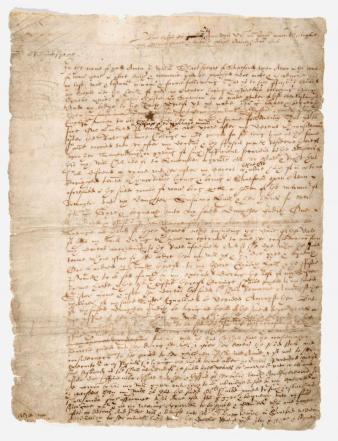
William Shakespeare’s last will and testament

The irony of our current practices is that we the living are to blame for sabotaging our own wellbeing. The dead are not around to complain if we were to change these practices; these are our institutions, and any pain we inflict on ourselves from being worse off but for the preferences of the dead cannot honestly be held against the dead. We do not need perpetual trusts to incentivise spending for charitable purposes. Many philanthropists today such as Bill Gates understand that there is greater charitable impact from spending done within one’s lifetime, which is the foundation of the Giving Pledge.

So why do we continue to give the dead such eternal rights? I believe we honour the wishes of the dead out of a misplaced sense of moral duty, as we would feel if we made a deathbed promise to a loved one. But deathbed promises are not unconditional, eternal, nor must they be satisfied at serious self-interested, financial, or moral, cost to the living. They are, instead, a lot like living promises. If I promise my child some candy but, through no fault of my own, the only available candy must be acquired at serious moral cost to some current candy-owner, it is not morally obligatory to fulfil this promise. A promise itself holds some moral weight, but not overriding moral weight.

Another reason we do this is that we have a self-interested desire that our own interests and values be preserved by future people after our own death, on pain that we disappear from the world without any legacy of influence. This existential fear we overcome by permitting institutions to honour the wishes of the dead in order to guarantee a place for our wishes in the future. But it is time to recognise the vanity and narcissism of the practice, and do what is actually best for the living, which is to have the living determine it for themselves.Aeon counter – do not remove

This article was originally published at Aeon and has been republished under Creative Commons.

Barry Lam is associate professor of philosophy at Vassar College, New York state, and is Humanities-Writ Large fellow at Duke University in North Carolina. He hosts and produces the philosophy podcast Hi-Phi Nation, and lives in Poughkeepsie, NY. (Bio credit: Aeon)

* Note: Barry’s podcast episode on this same topic is excellent, I highly recommend you give it a listen!

~ Ordinary Philosophy is a labor of love and ad-free, supported by patrons and readers like you. Any support you can offer will be deeply appreciated!

*All views and opinions expressed by guest writers are their own and do not necessarily reflect those of Ordinary Philosophy’s editors and publishers

The Comey Firing Reminds Us of a Bigger Danger, by Fareed Zakaria

Zakaria’s analysis of Trump’s presidency is excellent.

Fareed Zakaria's avatarFareed Zakaria

By Fareed Zakaria
Thursday, May 11, 2017

I have tried to evaluate Donald Trump’s presidency fairly. I’ve praised him when he has appointed competent people to high office and expressed support for his policies when they seemed serious and sensible (even though this has drawn criticism from some quarters). But there has always been another aspect to this presidency lurking beneath the surface, sometimes erupting into full view as it did this week. President Trump, in much of his rhetoric and many of his actions, poses a danger to American democracy.

The United States has the world’s oldest constitutional democracy, one that has survived the test of time and given birth to perhaps the most successful society in human history. What sets the nation apart is not how democratic it is, but rather the opposite. U.S. democracy has a series of checks intended to prevent the accumulation and abuse of…

View original post 660 more words

Happy Birthday, Niccolò Machiavelli!

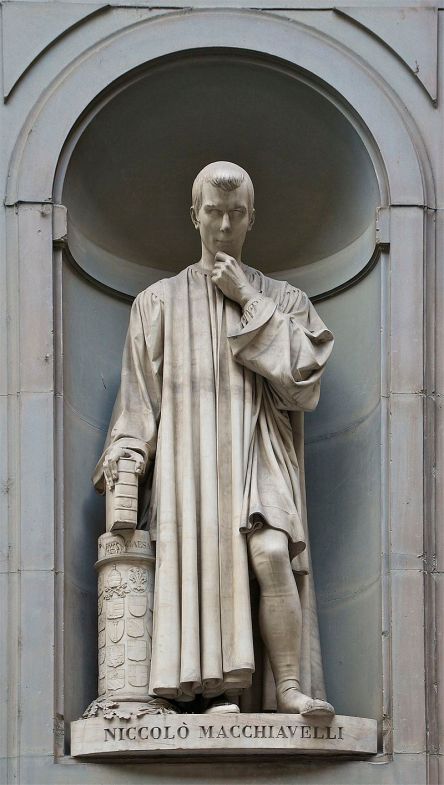
Niccolò Machiavelli statue at the Uffizi

‘Why an entry on Machiavelli? That question might naturally and legitimately occur to anyone encountering an entry about him in an encyclopedia of philosophy. Certainly, Machiavelli [born May 3, 1469] contributed to a large number of important discourses in Western thought—political theory most notably, but also history and historiography, Italian literature, the principles of warfare, and diplomacy. But Machiavelli never seems to have considered himself a philosopher—indeed, he often overtly rejected philosophical inquiry as beside the point—nor do his credentials suggest that he fits comfortably into standard models of academic philosophy. His writings are maddeningly and notoriously unsystematic, inconsistent and sometimes self-contradictory. He tends to appeal to experience and example in the place of rigorous logical analysis. Yet succeeding thinkers who more easily qualify as philosophers of the first rank did (and do) feel compelled to engage with his ideas, either to dispute them or to incorporate his insights into their own teachings. Machiavelli may have grazed at the fringes of philosophy, but the impact of his musings has been widespread and lasting. The terms “Machiavellian” or “Machiavellism” find regular purchase among philosophers concerned with a range of ethical, political, and psychological phenomena, even if Machiavelli did not invent “Machiavellism” and may not even have been a “Machiavellian” in the sense often ascribed to him. Moreover, in Machiavelli’s critique of “grand” philosophical schemes, we find a challenge to the enterprise of philosophy that commands attention and demands consideration and response. Thus, Machiavelli deserves a place at the table in any comprehensive survey of philosophy…’ ~ Cary Nederman, “Niccolò Machiavelli”, The Stanford Encyclopedia of Philosophy 

To introduce yourself to or learn more about the often contradictory, ever controversial, always fascinating and relevant Niccolò Machiavelli, read the Stanford Encyclopedia of Philosophy article linked above and listen to this discussion between one of my favorite broadcasters and public intellectuals Melvin Bragg, and his guests Quentin Skinner, Evelyn Welch, and Lisa Jardine.

Ordinary Philosophy and its Traveling Philosophy / History of Ideas series is a labor of love and ad-free, supported by patrons and readers like you. Please offer your support today!

Happy Birthday, Morton White!

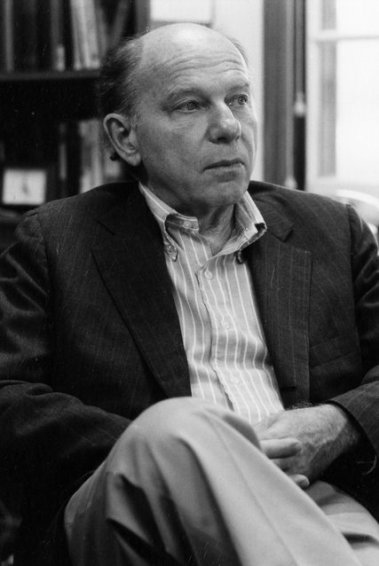
Morton White in 1981

The world lost Morton White (April 29, 1917 – May 27, 2016) less than a year ago as I write this today, and I first learned of him through reading his obituary in The New York Times. As I read, I knew this is a man and an approach to philosophy I must learn more about. Being immersed in other projects, I learned little about him in the intervening eleven months. Happily, I was just reminded by going through my list of significant dates in the lives of the world’s great thinkers (by no means comprehensive!) I placed two of his books on hold at the San Francisco Public Library and will commence reading them on this 100th anniversary of his birth.

White was a philosopher and historian of ideas. According to the Institute for Advanced Studies, ‘he maintained that philosophy of science is not philosophy enough, thereby encouraging the examination of other aspects of civilized life—especially art, history, law, politics and religion—and their relations with science’. And as William Grimes put it for TNYT, his ‘innovative theory of “holistic pragmatism” showed the way toward a more socially engaged, interdisciplinary role for philosophy’.

I studied philosophy with great love and enthusiasm as an undergraduate, yet I found myself then as now just as curious about other disciplines, especially history and the arts, and have often felt that the lines dividing these areas of study are sometimes artificial and even impediments to understanding. Since then, I’ve been pursuing my studies in the broader history of ideas as well, informally for the past few years, formally at the University of Edinburgh starting this fall. No doubt, White has influenced the direction my studies in intellectual history will take in ways I’ll learn as I go along, and in many more ways than I’ll ever know.

Learn more about White and his fascinating ideas with me:

Holistic Pragmatism and the Philosophy of Culture‘ – chapter 1 of A Philosophy of Culture: The Scope of Holistic Pragmatism, New Jersey: Princeton University Press 2002, in which White summarizes what his holistic pragmatism is all about

Morton White, Philosopher of Holistic Pragmatism, Dies at 99‘ – Obituary for the New York Times by William Grimes, June 10, 2016

Morton White 1917–2016 – His memorial page at the Institute for Advanced Study website, June 08, 2016

And you can find his selected bibliography at Wikipedia

Ordinary Philosophy and its Traveling Philosophy / History of Ideas series is a labor of love and ad-free, supported by patrons and readers like you. Please offer your support today!

‘Free Speech’ is a Blunt Instrument. Let’s Break It Up, by Robert Simpson

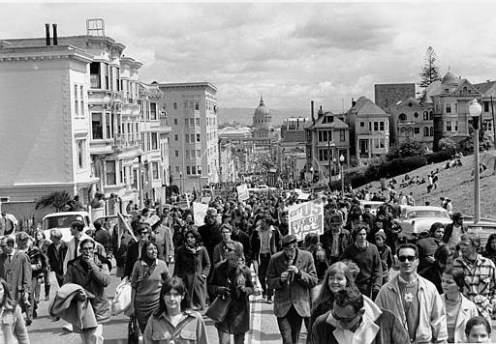
April 15, 1967, Spring Mobilization to End the War, San Francisco

Free speech is important. It guards against governments’ dangerous tendency to repress certain kinds of communication, including protest, journalism, whistleblowing, academic research, and critical work in the arts. On the other hand, think of a doctor dispensing bogus medical advice, or someone making a contract that she plans to breach, or a defendant lying under oath in court. These all involve written or spoken statements, but they don’t seem to fall within the domain of free speech. They are what the legal theorist Frederick Schauer at the University of Virginia calls ‘patently uncovered speech’: communication that warrants no special protection against government regulation.

However, once we extrapolate beyond the clear-cut cases, the question of what counts as free speech gets rather tricky. A business whose website gets buried in pages of search results might argue that Google’s algorithm is anti-competitive – that it impedes fair competition between sellers in a marketplace. But Google has dodged liability by likening itself to a newspaper, and arguing that free speech protects it from having to modify its results. Is this a case of free speech doing its proper work, or an instance of free speech running amok, serving as cover for a libertarian agenda that unduly empowers major corporations?

To answer this question, we need a principled account of the types of communication covered by free speech. But attempts to provide such an account haven’t really succeeded. We can pick out cases on either side of the divide – ‘Protections for journalism and protest? Yes! For perjury and contracts? No’ – but there aren’t any obvious or natural criteria that separate bona fide speech from mere verbal conduct. On the contrary, as theorists have told us since the mid-20th century, all verbal communication should be understood as both speech and conduct.

Some authors see these definitional difficulties as a fatal problem for the very idea of free speech. In There’s No Such Thing as Free Speech: And It’s a Good Thing Too (1994), the American literary critic and legal scholar Stanley Fish argued that ‘free speech’ is really just a rhetorically expedient label that people assign to their favoured forms of communication. There’s a grain of truth in this; but it doesn’t change the fact that governments still have a tendency to repress things such as protest and whistleblowing, and that we have good reasons to impose institutional safeguards against such repression if possible.

Instead of throwing out free speech entirely, a better response might be to keep the safeguards but make their sphere of application very broad. This is roughly what happens in Canadian law, where nearly any type of conduct can fall within the constitutional ideal of ‘free expression’, provided that it is trying to convey some kind of meaning. The downside is that if nearly anything can qualify as ‘expressive’ in the relevant sense, then we cannot categorically privilege expression itself as an inviolable norm. WhistlAll we can ask lawmakers to do is factor in the interests that such expression serves, and try to strike a balance with all the other, competing interests (such as ‘equality’, for example, or ‘national security’). While such trade-offs are standard in Commonwealth legal systems, they have the unwelcome effect of making it easier for governments to justify their repressive tendencies.

I’d propose a third way: put free ‘speech’ as such to one side, and replace it with a series of more narrowly targeted expressive liberties. Rather than locating actions such as protest and whistleblowing under the umbrella of ‘free speech’, we could formulate specially tailored norms, such as a principle of free public protest, or a principle of protected whistleblowing. The idea would be to explicitly nominate the particular species of communication that we want to defend, instead of just pointing to the overarching genus of ‘free speech’. This way the battle wouldn’t be fought out over the boundaries of what qualifies as speech, but instead, more directly, over the kinds of communicative activities we think need special protection.

Take the idea of public protest. Standard free-speech theory, concerned as it is with what counts as speech, tends to draw a line between interference based on the content of the speech, such as the speaker’s viewpoint (generally not allowed), and interference that merely affects the time, place and manner in which the speech takes place (generally allowed). But this distinction runs into trouble when it comes to protest. Clearly governments should be blocked from shutting down demonstrations whose messages they oppose. But equally they shouldn’t be able to multiply the rules about the time, place and manner in which demonstrations must take place, such that protests become prohibitively difficult to organise. One reason to have a dedicated principle of free public protest, then, is to help us properly capture and encode these concerns. Instead of seeing demonstrations as merely one application of a generic free-speech principle, we can use a narrower notion of expressive liberty to focus our attention on the distinctive hazards faced by different types of socially important communication.

If this all seems a bit optimistic, it’s worth noting that we already approach some types of communication in this way – such as academic freedom. Universities frequently come under pressure from political or commercial lobby groups – such as big oil, or the Israel lobby – to defund research that runs counter to their interests. This kind of threat has a distinctive underlying causal mechanism. In light of this problem, universities safeguard academic freedom via laws and regulations, including guidelines that specify the grounds for which academics can be fired or denied promotion. These moves are not just a specific implementation of a general free-speech principle. They’re grounded in notions of academic freedom that are narrower than and distinct from freedom of speech. My suggestion is that all our expressive liberties could be handled in this way.

The subdivision of expressive liberties isn’t going to magically fix all the genuinely controversial issues around free speech, such as what to do about search engines. However, we don’t need to resolve these debates in order to see, with clarity and confidence, that protest, journalism, whistleblowing, academic research and the arts need special protection. The parcelled-out view of expressive liberties captures the importance of these activities, while sidestepping the definitional problems that plague standard free-speech theory. These are not merely theoretical advantages. Any time a country is creating or revising a bill of rights, the question of how to protect communicative practices must be considered afresh. Multiple expressive liberties is an approach worth taking seriously.Aeon counter – do not remove

This article was originally published at Aeon and has been republished under Creative Commons.

Robert Simpson is a lecturer in philosophy at Monash University in Melbourne, Australia. He writes regularly about social and political philosophy. (Bio credit: Aeon)

~ Ordinary Philosophy is a labor of love and ad-free, supported by patrons and readers like you. Any support you can offer will be deeply appreciated!

*All views and opinions expressed by guest writers are their own and do not necessarily reflect those of Ordinary Philosophy’s editors and publishers
 

New Podcast Episode: O.P. Recommends: Why Radio’s Feminism as Philosophy, Politics, and Friendship with Guests Gloria Steinem and Suzanne Braun Levine

Gloria Steinem and Suzanne Braun Levine, image via Why? Radio podcast website

Listen to this podcast episode here or on Google Play, or subscribe on iTunes

I was recently thrilled to discover Why? Radio‘s podcast. It’s about time I did, since it’s eight years and more than 100 episodes in. Thanks for the share, Laura of Bismarck, ND!

For the 100th episode this February, host and creator Jack Russell Weinstein interviews Gloria Steinem, co-founder of Ms. magazine, journalist, writer, and feminist extraordinaire; and Suzanne Braun Levine, first editor of Ms. magazine, author, and authority on feminism and gender issues. The topics covered in this episode are summarized in the title ‘Feminism as Philosophy, Politics, and Friendship‘. Weinstein is a Professor of Philosophy at the University of North Dakota and created the IPPL radio show and podcast Why? Philosophical discussions about everyday life for very similar reasons I created Ordinary Philosophy, as you can see from the subtitle…. Read the written version here

Ordinary Philosophy and its Traveling Philosophy / History of Ideas series is a labor of love and ad-free, supported by patrons and readers like you. Please offer your support today!


O.P. Recommends: Why Radio’s Feminism as Philosophy, Politics, and Friendship with Guests Gloria Steinem and Suzanne Braun Levine

Gloria Steinem and Suzanne Braun Levine, image via Why Radio Podcast website

Gloria Steinem and Suzanne Braun Levine, image via Why? Radio podcast website

I was recently thrilled to discover Why? Radio‘s podcast. It’s about time I did, since it’s eight years and more than 100 episodes in. Thanks for the share, Laura of Bismarck, ND!

For the 100th episode this February, host and creator Jack Russell Weinstein interviews Gloria Steinem, co-founder of Ms. magazine, journalist, writer, and feminist extraordinaire; and Suzanne Braun Levine, first editor of Ms. magazine, author, and authority on feminism and gender issues. The topics covered in this episode are summarized in the title ‘Feminism as Philosophy, Politics, and Friendship‘. Weinstein is a Professor of Philosophy at the University of North Dakota and created the IPPL radio show and podcast Why? Philosophical discussions about everyday life for very similar reasons I created Ordinary Philosophy, as you can see from the subtitle.

My readers may often wonder why my philosophy/history of ideas blog and podcast are at least as devoted to the life and ideas of activists and civil rights leaders as they are to philosophers and theorists. Steinem sums up a conviction I share near the beginning of the interview: ‘To be part of any social justice movement is probably to be on the forefront of philosophy’. Social justice movements are founded on ideas that have not yet been understood and accepted widely enough to be embodied in law and social practice. Many activists, then, can be understood as philosophers in the public square, and activism as philosophy in action. They are part of the same noble tradition, forcing us to consider uncomfortable questions and raising our consciousness, as Socrates’ gadfly questions, awakening his fellow citizens from their ‘dogmatic slumbers‘. I’m also gratified to hear Steinem cite Louisa May Alcott as one of her earliest influences, as she was for me; the story of Alcott’s principled stand at Frederick and Helen Pitts Douglass’ wedding is among my favorite examples of philosophy in action, a perfect demonstration of the right way to think and act towards our fellow human beings.

Steinem also challenges the way that second-wave feminism is often characterized as a middle-class white movement. She points out that polls revealed that black women, especially in the early days of the movement, shared feminist and civil rights convictions in far greater proportions than any other group, and were more likely to demonstrate their convictions through action; it’s just that they were not recognized in the media nor did they have the opportunities that white women, as well as white and black men, had to rise to leadership positions. Steinem shares an anecdote from her participation in the March on Washington, in which a black woman in the crowd angrily points out that not a single black woman was chosen to address the crowd from the stage, which illustrates this paradox.

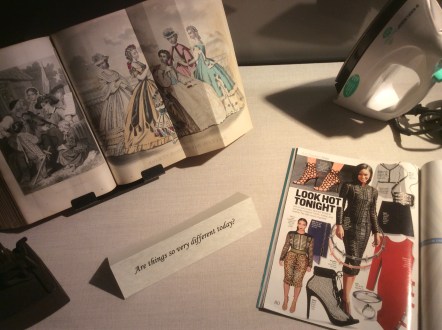
Women are still expected to wear ‘feminine’ clothing that pushes, pulls, and presses their bodies into fashionable shapes, sometimes painfully, and to wear heavy makeup and crippling and uncomfortable shoes in order to be considered well-dressed and sexy, especially for public figures. The problem is not necessarily these fashions themselves, it’s that women are generally required to adorn themselves this way in order to achieve their goals. Photo exhibit at Women’s Rights Historical Park, Seneca Falls, NY.

I also love what Braun Levine says about being a ‘tomboy’ as a young girl; she says it shows she was on the ‘wrong path’. She wasn’t saying that she was wrong to want to play with the boys and wear pants, to the contrary. I interpret her statement as her commentary on how we’ve long divided healthy, active pursuits such as sports and wanting to wear clothing that permits bodily freedom into the category ‘boy’, and daintiness constrained in clothing and shoes that limit bodily freedom into the category ‘girl’. It was only with the hindsight and wisdom made possible by her own evolving consciousness, which she, in turn, awoke in her readers, which made her realize that these ‘boy’ and ‘girl’ qualities, instincts, and preferences, are universal human ones. People of all genders, or of none depending on how you describe it, love to be very physically active or they don’t, like to wear constrictive and elaborate clothing, makeup, and shoes or don’t, and so on.

This wonderful discussion about the history and evolution of feminism, as Steinem and Braun Levine experience it, wraps up with an exchange with two budding activists, eleven-year old Faith and Adina. What a great way to show just how influential these two women are and how the young are moving their cause forward and applying it to the modern world!

*Listen to the podcast version here or on Google Play, or subscribe on iTunes

Ordinary Philosophy and its Traveling Philosophy / History of Ideas series is a labor of love and ad-free, supported by patrons and readers like you. Please offer your support today!

A Scot’s Lament fur her American Fellows (Oan their election of a tangerine gabshite walloper), by Lorna Wallace

I read this with such delight, I must share it with you!

Lorna Wallace's avatarWriting by Lorna

America, aw whit ye dain?!
How could ye choose a clueless wain
Ti lead yir country? Who wid trust
A man sae vile?!
A racist, sexist eedjit
Wi a shite hairstyle?

Yet lo, ye votit (michty me!)
Ti hawn’ this walloper the key
Ti pow’r supreme, ti stert his hateful,
Cruel regime.
A cling ti hope that this is aw
Jist wan bad dream.

But naw, the nightmare has come true,
A curse upon rid, white an’ blue,
An’ those who cast oot Bernie
Must feel sitch regret
Fur thinkin’ Mrs. Clinton
Was a safer bet.

So noo we wait ti see unfold
Division an’ intolerance, cold;
A pois’nous bigotry untold
Since Hitler’s rule
As the free world’s hopes an’ dreams
Lie with this fool.

Alas, complainin’ wullnae change
The fact this diddy has free range
Ti ride roughshod ow’r human beings
That fall outside
The cretinous ideals borne of

View original post 182 more words

The Morning After Election Day 2016

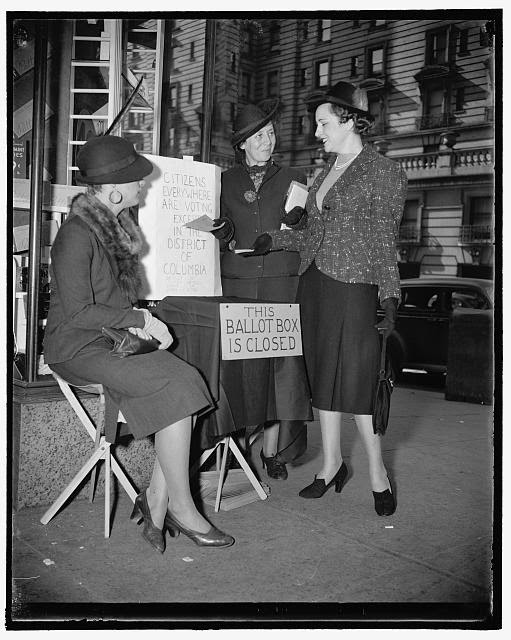
3f86f-ballot2bbox2bclosed2bprotestI watched the election results roll in last night on the same sofa and in company with the same good friends as eight years ago when Barack Obama was elected the first black president of the United States. As the night wore on, our dearest hopes that we would see the first woman elected president of the United States were dashed, to the deep disappointment of everyone in the room. Trump was elected president. It was clear to me that though all believe that women should have equal chances of being elected president, the gender of the candidate was not foremost in their minds last night. It was the misogyny, racism, crass materialism, and bullying personality of Trump and his followers that must be defeated, showing the world that our values are much better than our new Twitter-troll-in-chief might have you believe.

My friends are nearly all liberal, my family mostly conservative. Some of my loved ones are rejoicing, some are mourning, and probably, given the new president’s coarse speech and demeanor, checkered past, and nonconservative positions on many issues, more were at least as glum as they were glad.

For some of my religious family members, I believe they did not vote for Trump because they like him, admire him, or agree with him on many issues. They voted for Trump while holding their noses at his attitudes toward women and minorities, his coziness with Putin, his anti-free-trade positions, his hiding of his tax returns. For them, abortion is by far the most important issue at stake, so the candidate that will nominate anti-abortion Supreme Court justices and oppose Roe v. Wade is their only viable choice. I understand their position: if you truly believe abortion is legalized murder, then the candidate that will likely to most to change the law in this regard must be their candidate. But that doesn’t mean they like having to vote for him.

Other people I know and love do sincerely admire Trump, dismissing some of his worst behavior as mere indiscretions, excesses of the vitality and exuberance that made him the go-getter they see him as: the man of the people who made himself rich in the can-do, hard-working, all-American way. For myself, I have a hard time seeing how exactly how the actual Trump fits in with this perception: his primary business is building luxury amenities for the wealthy, funding it at the beginning with piles of money he didn’t earn; he’s repeatedly exploited bankruptcy laws to the fullest which allowed him to escape personal responsibility for his bad investments while stiffing his contractors, the hard-working Americans that he’s supposed to represent; the things he does have made are often built from cheap Chinese steel and with low-paid Chinese, not American, hands; he starred in a reality TV show where he showcased his ‘business acumen’ by glowering behind a big shiny desk in a too-big suit, repeating generic self-help platitudes that convey no real guidance or information at all. In other words, he is just business-as-usual. But like so many Americans, they fell for his brand, the heavily marketed, glossy persona that the media lap up because he’s just so entertaining.

For me, what the Presidential candidates represent often does take priority over what they do, since they do not run the country on their own. Many of the qualities and principles that Trump represents to people are, I think, even uglier than what he’s said and done, which is often bad enough. But it seems that what he doesn’t represent is what got him into office: he doesn’t represent the establishment and he doesn’t represent the multicultural cosmopolitanism of the new information-centric world. And he doesn’t represent what’s been called the feminization of our culture, as machismo, militarism, and hyper-individualism slowly erodes from our national character. Hilary Clinton largely represented this feminization, the idea that the state also exists as a facilitator of care, for promoting health and education, of taking in those that flee to us for help, nurturing the young and the disenfranchised so that all have an equal shot or, if you happen to be a casualty of the capitalism most of us benefit from, you’re not out on your ear. And she represented it in a way that the strong mom does: idealistic yet practical, ruthless if need be in defense of her brood. Clinton has flaws, perhaps as many as Trump, but they are flaws of excess in the pursuit of greater and worthier things than self-aggrandizement and self-indulgence. But women, traditionally, are not allowed to have flaws, not if we are to be admired and promoted to any position of influence. For men, that’s just, well, part of being a man, part and parcel to being strong, bold, and getting things done.

I wish we could have shown the world last night that we believe in women too, that our girls do have the same chance of becoming president as anyone else, and they could do so by being women, unapologetically, able to succeed to our fullest potential whether or not we have flaws too.

Ordinary Philosophy and its Traveling Philosophy / History of Ideas series is a labor of love and ad-free, supported by patrons and readers like you. Please offer your support today!

Frederick Douglass the Pragmatist

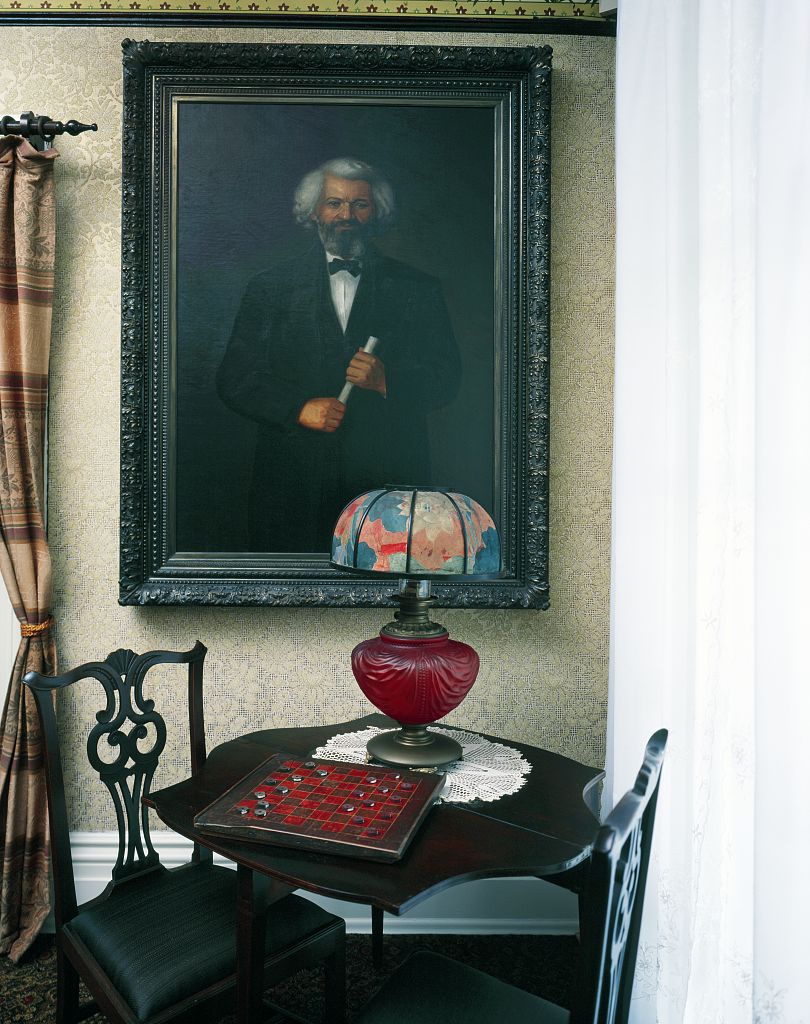
Frederick Douglass House Parlor, Washington, D.C.

Douglas is a fiery orator, an uncompromising abolitionist and proponent of universal human rights, and even an advocate of using violence if the cause is just, the harms too great, and other means prove ineffective (more on that in an upcoming piece). He criticizes those who ‘shamefully abandon their principles’. And very often, when he encounters discrimination in a hotel, restaurant, or other public place, he reports the incident to the local press.

Yet for all his energetic activism, uncompromising rhetoric, and devotion to principle, Douglass is also a pragmatist, in matters large and small.

To be sure, many of his activist tactics are as idealistic, and plainly appear so, as they are as practical. Douglass’ reports of discrimination, for example, fire up public support for the cause of equal rights by arousing a storm of protest and in turn, raising consciousness and providing examples for use in the political arena.

He’s a pragmatist when it comes to making a living as well: after a decades-long successful career lecturing and publishing, a house fire and an attempt to rescue the Freedman’s Bank from collapse leave Douglass’ finances in disarray. So he takes to the lecture circuit again full time in the 1870’s. In the pre-Civil War era, he makes his living doing what he believes in most: lecturing, debating, and arguing for abolishing slavery and expanding human rights. But in the post-Civil War era, he finds that morals, politics, and rights issues are no longer such profitable topics. So he goes ahead and lectures on the profitable ones, so long as it he can make the talks instructive and wholesome, and link them to more important issues. ‘People want to be amused as well as instructed’ he writes.

He’s a pragmatist when it comes to tactics and the importance of crafting an image. For example, Douglass considers photography a very important, modern tool for engendering mass support through empathy: if people can see and recognize the face of the person behind the ideas, and of one who is a member of a suffering and oppressed people, people will feel the visceral need for change. So, he takes care to become one of the most photographed men in American history.

Douglass’ practicality holds sway in larger issues too. He does not hesitate to change tactics or switch allegiances between organizations or parties if he thinks it would help the cause in the long run. In fact, he is convinced that true, unswerving, uncompromising allegiance to the cause itself requires a reformer to use whatever means necessary, so long as they are not morally wrong, even if they are imperfect or less inspiring or exciting to others than the more uncompromising choice. He has been criticized throughout the years for splitting with the Garrisonians, for siding with Captain John Fremont against Abraham Lincoln in the latter’s recall of Fremont’s emancipation proclamation in Missouri early in the war, for refusing to support or join in on the raid on Harper’s Ferry (though he supports John Brown’s ideas about the validity of armed resistance in general), for evading arrest and possible execution for charges of co-conspiracy in the Harper’s Ferry raid by fleeing to Canada, and for abandoning the Radical Abolitionist Party in favor of the newly formed Republican Party. His critics contend that his practice of often siding with moderate tactics and candidates reveal a lack of commitment and moral courage.

Yet he defends all of these practical choices on the grounds that commitment to the tactics or politics in and of themselves are actually a distraction, since the practice of committing to the ‘pure’ choice in the short run is often an impediment to achieving the ultimate goal in the long run. For example, if he throws his support behind his friend and hero Gerit Smith, uncompromising political candidate of the Radical Abolitionist Party, instead of Abraham Lincoln, the Republican candidate who ran on the more moderate goal of preventing the spread of slavery to the new states, he might be more admired as an uncompromising leader. But he understands what a risky move this would be. The Radical Abolitionists had little chance of winning, but the Republican Party was off to a very successful start, losing its first presidential campaign by a relatively small margin. Since the moderate goals of the Republican Party had a good chance of realization while those of the Radical Abolitionists little to none, Douglass sides with the former. The stakes are simply too high for Douglass to risk losing at this point, even if the risk appears nobler.

In sum, Douglass argues that the truly committed reformer is free to choose the more modest, practical, sure-bet option over the less apparently compromising, more radical option when it appears to be more effective in the long run. That’s because true faithfulness to the mission does not require appearing an effective reformer, it requires actually being as effective as possible. No small part of Douglass’ greatness as an activist and as a person is his willingness to forgo short-term public approval or personal glory in favor of acting in the long-term best interests of his cause. And it appears that history not only validates him as an astute tactician, but as a heroic figure, in part because in hindsight we can more easily recognize the wisdom, integrity, and strength in his pragmatism.

Ordinary Philosophy and its Traveling Philosophy / History of Ideas series is a labor of love and is ad-free, entirely supported by patrons and readers like you. Please offer your support today!

~~~~~~~~~~~~~~~~~~~~~

Sources and inspiration:

Blassingame, J. (Ed.). The Frederick Douglass Papers, Series One: Speeches, Debates, and Interviews. 4 volumes, and The Frederick Douglass Papers, Series 2: Autobiographical Writings. 3 volumes. New Haven and London: Yale University Press, 1979-1999

Douglass, Frederick. Autobiographies, with notes by Henry Louis Gates, Jr. Volume compilation by Literary Classics of the United States. New York: Penguin Books, 1994.

Douglass, Frederick. My Bondage and My Freedom: 1855 Edition with a new introduction.. Re-published 1969, New York: Dover Publications, Inc.

Foner, Philip S. The Life and Writings of Frederick Douglass, Vol. 1-4. New York: International Publishers, 1950.

Varon, Elizabeth. ‘Most photographed man of his era: Frederick Douglass’, the Washington Post, Jan 29, 2016. https://www.washingtonpost.com/opinions/most-photographed-man-of-his-era-frederick-dou