The Consolations of Philosophy, and A Death Free from Fear

A view of the interior of David Hume's grave monument, Edinburgh, Scotland, 2014 Amy Cools

A view of the interior of David Hume’s grave monument, Edinburgh, Scotland

There is one argument that seldom fails to come up in discussions with religious people who feel the deep need to persuade you to share their beliefs: that religion is the only thing that can bring real consolation, to overcome the fear of death. When I was a child, and through my twenties, I was often seized with that fear; with my grandmother’s death, the first deep grief I’d ever known, it really hit hard for awhile.

Yet it was in those same years that I was religious, or had recently come out of it, that I experienced most of that fear.

I began to wonder: can that association between religion and fear of death be something like smoking? The smoking creates the need to smoke, and then is the only relief for the urge to smoke again. I think there might be something in that idea, at least in the sense that since most religions bring up the subject of death a lot, it’s harder to shake the fear if you’re constantly reminded. But really, people have been afraid of death for at least as long as they’ve been creating art, literature, and religions that express it. The origins of that fear must be a feature of human psychology, or at least a common by-product of it.

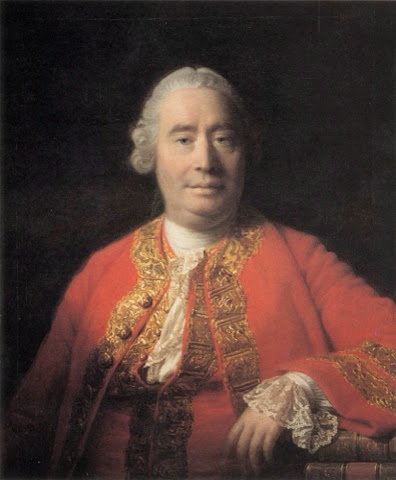
The death of Socrates has long been held up as the prime example of a good death, a death faced with composure and courage (if you’ve never read it, I encourage you to discover that moving, fascinating story!) Seneca, Epicurus, and many other great philosophers have shown us, through words and example, how death can be devoid of fear. I turn to a somewhat more modern example: the account I’m reading that Adam Smith wrote, of the death of his close friend David Hume, my favorite philosopher.

Hume was widely considered to be a skeptic and an atheist, and therefore a dangerous person, a corrupting influence. His naturalistic, practical, sensible philosophy revealed the impossibility of miracles and of knowing whether or not imperceptible things exist, and implied the lack of necessity for the existence of god(s). For his own safety and financial stability, Hume’s friends, as well as his own prudence, convinced him not to publish all he actually wrote, including one of his most important works, Dialogues Concerning Natural Religion, until after his death.

Adam Smith’s account of Hume’s death is one such that any us us could wish for. When Hume discovered he (probably) had intestinal cancer, he resigned himself to enjoying the time he had left, and making the best as well as the most, of it. After all, he said, ‘…a man of sixty-five, by dying, cuts off only a few years of infirmities…’ Hume continued to entertain and to visit friends, play cards, travel, write and edit, and do as much as his waning strength would let him. When he could finally no longer get out of bed, sit up for long, or leave his home, he passed the time in his favorite way, by reading, and dictating letters to his loved ones.

Here’s what Smith had to say, regarding how both the habits of a lifetime, and terminal illness, highlighted the true character of his friend Hume:

‘His temper, indeed, seemed to be more happily balanced… than that perhaps of any other man I have ever known. Even …the lowest state of his fortune… never hindered him from exercising… acts both of charity and generosity…. The extreme gentleness of his nature never weakened either the firmness of his mind, or the steadiness of his resolutions. His constant pleasantly was the genuine effusion of good-nature and good humor, tempered with delicacy and modesty… And that gaiety of temper …which is so often accompanied with frivolous and superficial qualities, was in him certainly attended with… the most extensive learning, the greatest depth of thought, and a capacity in every respect the most comprehensive. Upon the whole, I have always considered him, both in his lifetime and since his death, as approaching as nearly to the idea of a perfectly wise and virtuous man, as perhaps the nature of human frailty will permit.’ What a tribute!

David Hume's grave monument, Calton Hill, Edinburgh, Scotland, 2014 Amy Cools

David Hume’s grave monument, Calton Hill, Edinburgh, Scotland

The physician who attended his death wrote:

‘He continued to the last perfectly sensible, and free from much pain or feelings of distress. He never dropped the smallest expression of impatience; but when he had occasion to speak to the people about him, always did it with affection and tenderness…. [H]e died in such such a happy composure of mind, that nothing could exceed it.’

So how does a David Hume, a Socrates, a Seneca, or you, or I, live a life full of joy and virtue and free of the fear of death?

I’m not talking about living a perfect life, here. For one thing, I think the idea of ‘perfection’ is weird to apply to human beings, indeed any biological entity. The concept is too abstract, only applicable to such things as mathematics, logic, and geometry, when describing things such as numbers, and either/or distinctions, and the degree of the angles in a Euclidean triangle. Biological things, most especially human beings, are complicated, full of conflicting emotions, needs, desires, interests, and so on.

But there are ways to get though life that help you achieve happiness and goals worth having, and there are ways that don’t. And there are people (and some other animals, of course!) who exemplify ways of living that are so successful, and so admirable, that it’s an excellent idea to observe them, especially given that we are social creatures who depend on one another for edification and support.

So when it comes to living that life full of joy and virtue, relatively free of that fear of death, I think we would all do well not to look to an ideology, like a religion or some utopian ideal, or some such panacea. I’d look, rather, to a person who lived well, and consider how their character, how their general outlook on life, how their habits contributed to it. This would apply to anyone, secular or religious, anyone. 

But especially to lovers of philosophy. Philosophy, that love of wisdom, has been a love of mine for a long time, much longer than I knew what it was, how to identify it. From the time I was little, i was fascinated by the (mostly theological, sometimes political, sometimes otherwise strictly philosophical) discussions that often went on around the dinner table when the adults got together. And I would badger my dad with endless questions on such matters, my poor patient Dad!

By the time I returned to college the second time, I knew what I wanted to spend my time really getting into these fascinating topics, of how and why the world works, and how we should best go about living in it. And here I am, doing the same thing, but now sharing the discussion with all of you who take an interest, because it’s my firm conviction that philosophy is something pretty much all of us engage in, so often that it’s one of the most ordinary things we do.

But making philosophy a more central part of my life has been one of the most happy-making things in it. There’s a wonderfully titled book by a sixth-century thinker, Boethius, called The Consolation of Philosophy, written when he was going through the worst time of his life, imprisoned, facing execution. It’s such an excellent book title that it’s become an ordinary phrase, usually pluralized (I’ve used it for years before I ever found out where it came from). Like Boethius, like Socrates, like Seneca and Hume, I know that even if I had the great misfortune of facing the loss of the most treasured things in my life: my loving and beloved husband, my family and friends, my health and my possessions, I would have a way to keep my best self intact.

Philosophy is among the greatest ways, if not the greatest, to make sense not only out of day to day realities, it puts you closely in touch with the largest and most important things, and helps you realize your connections to them so deeply, that in a very real way you never fully lose your loves, your family, your friends, and it turns out that while some possessions are wonderful and worth having, they’re never worth so much that the loss of them should destroy you.

Living a life with philosophy now a conscious interest and pursuit has enabled me to live a richer and fuller life, and helps me day to day to figure out ways to make it better, and to overcome those difficulties I still have. I have high hopes that will enable me become at least a bit as admirable as these great people I’ve mentioned here, and many many more whom I have not. And not only does this hope rule my life: fear, including that of death, no longer does.

– Written in the Rare Books Reading Room of the Library of Scotland, Edinburgh, on my David Hume travel writing trip, May 2014

Ordinary Philosophy and its Traveling Philosophy / History of Ideas series is a labor of love and ad-free, supported by patrons and readers like you. Please offer your support today!
~~~~~~~~~~~~~~~~~~~~~~~~~~~~~~~~~~~~~~~
Sources and inspiration:
De Botton, Alain. ‘Seneca on Anger’ from the BBC series Philosophy: A Guide to Happiness, 2000.
 
Hume, David. Life of David Hume. (Includes his short autobiography My Own Life, and a letter from Adam Smith to William Strahan. Printed in London, 1777.
 
Konstun, David. ‘Epicurus’, 2014. The Standford Encyclopedia of Philosophy. http://plato.stanford.edu/entries/epicurus/#4
 
Marenbon, John, ‘Anicius Manlius Severinus Boethius’, 2013, The Stanford Encyclopedia of Philosophy. http://plato.stanford.edu/entries/boethius/

First Day in Old Edinburgh: Hume Sites and Monuments

On Calton Hill with Edinburgh’s Old City in the background.

‎It’s early Sunday afternoon, and I’m recovering from probably the single longest day of walking I’ve ever done, and that’s saying a lot for this avid hiker and walking enthusiast. My hip joints ache, my feet ache, my calves ache, my shins ache. But I don’t care, each of these aches are little tokens of a beautiful day. But let me back up a bit…

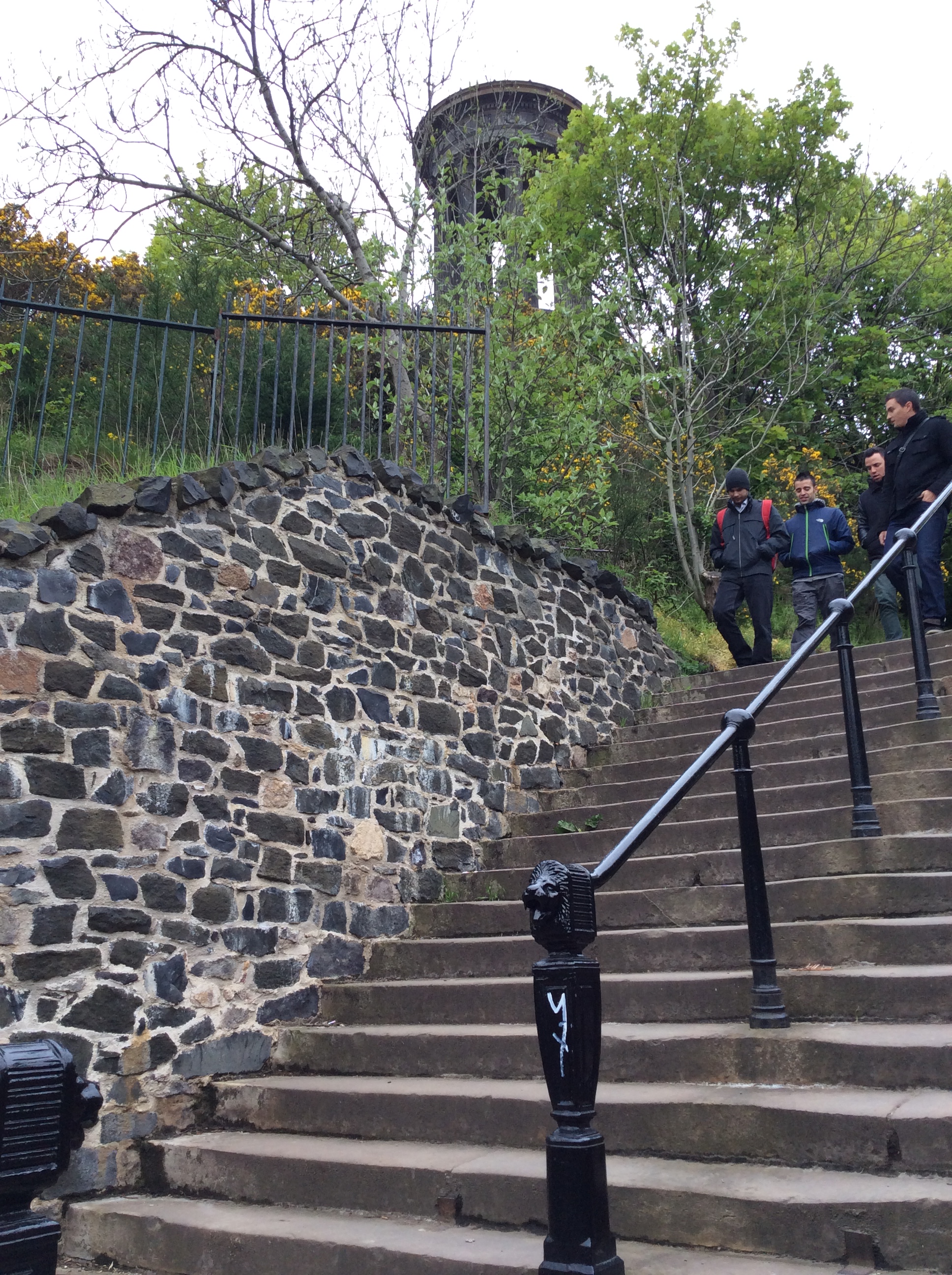
a-stairway-to-the-park-at-calton-hill-edinburgh-2014-amy-cools

Saturday, ‎May ‎03, ‎2014

I started my exploration of the Old City from the other end, where the Castle of Edinburgh overlooks all from its high perch on a craggy rock, along the Royal Mile, which heads east from the castle to Calton Hill and the Palace of Holyroodhouse.

The first half of my day is spent getting my bearings, creating a mental map of how the Old City hangs together, while spontaneously popping into any historic place that looked interesting. That can get expensive, paying entrance fees, but what the hell, it was my first day. Anyway, that’s what keeps these wonderful old places from falling into ruin or turning into tacky gift shops, so it’s worth every penny.) I have my little camera out to keep my hands free and snap a gazillion photos along the way. I don’t have a way to upload those photos and share them with you now, but I will when I get back home in a couple of weeks. The photos you see here are taken on my tablet.

Arthur's Seat as seen from Calton Hill on a gray spring day, Edinburgh, 2014 Amy Cools.JPG

Arthur’s Seat as seen from Calton Hill on a gray spring day

So here I am, overlooking Edinburgh from Calton Hill.

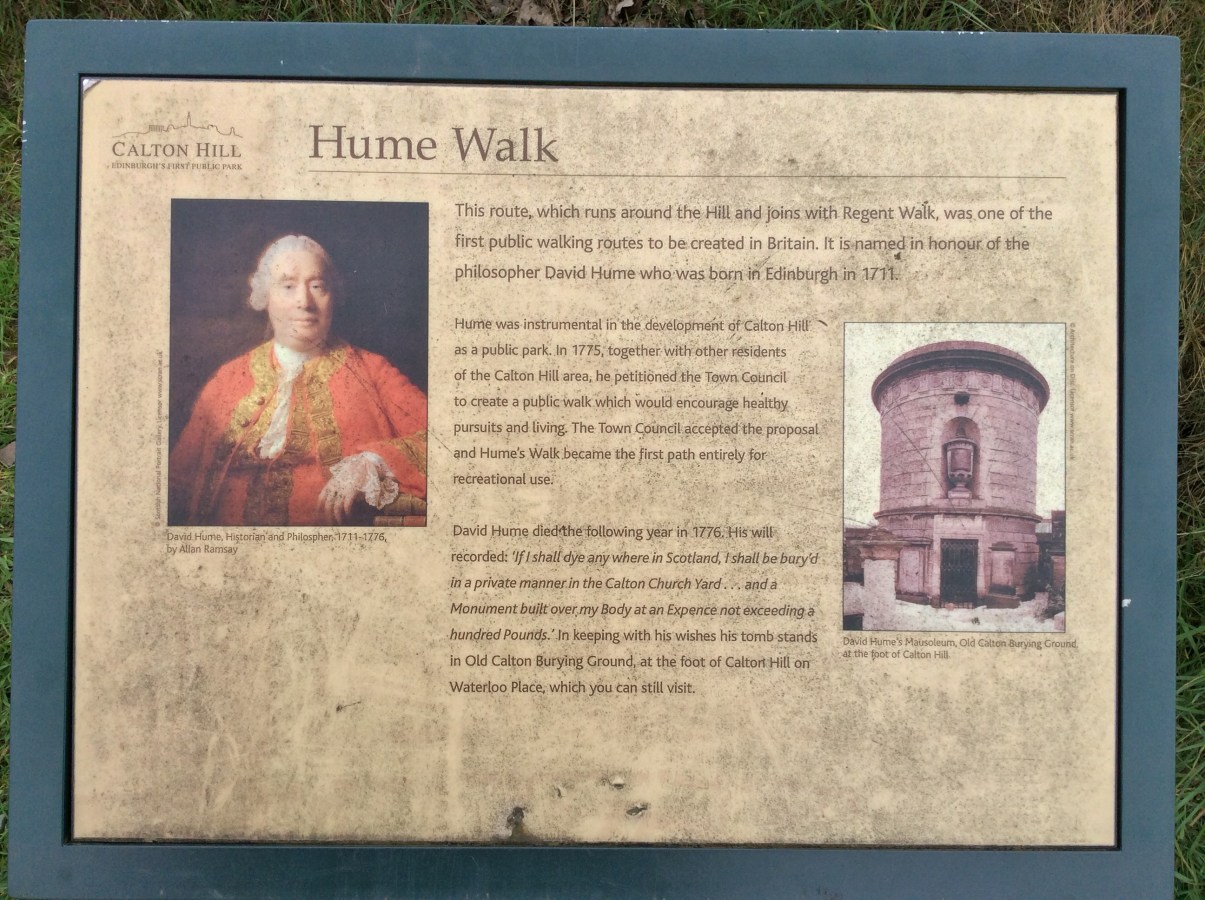
It’s on Calton Hill that my journey following David Hume really begins, though I had looked into some sites associated with his life on the way, that I’ll return to later. It’s here on Calton Hill that he’s buried, and it’s here, I discover, that he caused the first path in Edinburgh to be built dedicated solely to the improvement of mind and body. Here, people would be encouraged to take their exercise by having a lovely place to walk, on this hillside with its spectacular views of the city, the surrounding countryside, and the Firth (estuary), away from the hustle and bustle, the crowds, the dirt, the unhealthy air, and the smells of the city. The first path to be built is named Hume Path in his honor, so of course, that’s the path I choose.

hume-walk-plaque-on-calton-hill-edinburgh-2014-amy-cools

Hume Walk sign, Calton Hill, Edinburgh

David Hume’s grave monument, Calton Hill, Edinburgh, Scotland

Old Calton Cemetery, Calton Hill, Edinburgh, 2014 Amy Cools.JPGI head back downhill a little from the park at the top of the hill, and Calton Hill Cemetery is on my left. I go through the gate and up the short flight of steps, and a bit ahead to my right, I find Hume’s elegant and rather simple monument and gravesite. I spend a good bit of time here musing: the power of physical objects to really bring things into focus still never fails to surprise me, and my sense of purpose in this journey to Edinburgh is strengthened.

I’ll soon write a reflection on his good and noble death

Hume's and Abraham Lincoln Scottish soldier monuments,

Hume and Scottish soldier monuments at Old Calton Cemetery

I’m also moved to discover that a monument to Scottish-American soldiers was erected, featuring a statue of Abraham Lincoln. It seems to me so fitting that these two great heroes of freedom are honored here side by side, one of freedom of person, the other of thought.

When I leave Calton Hill, I return to the Royal Mile by an alternate route, with a detour along York Place to St. David’s Street. This street got its name from a fond prank by his close friend Nancy Orde, who wrote this little tribute in chalk on the side of Hume’s house. The street bears the name to this day.

My explorations are sure to bring me back to this street since Hume once lived here, so stay tuned. I’ll be back when I’ve gathered more details.

north-st-david-street-sign-edinburgh-scotland-2014-amy-cools

statue-of-david-hume-on-the-royal-mile-edinburgh-2014-amy-cools

Statue of David Hume on the Royal Mile by Sandy Stoddart, 1995

I return to the Royal Mile and this time head west, passing by a grand statue of David Hume, across from St. Giles’ Cathedral. I’m not sure it looks anything like him based on all of his portraits I’ve seen, but it’s a handsome statue, very classical. This bronze Hume probably looks much better with his shirt off than the real man ever did; he was a portly and not terribly good-looking fellow, as much as I admire and respect him. But who knows? Perhaps the younger Hume was a little more fit, before the years of poring over books left him out of shape. The statue’s right toe is polished and very shiny, looks like it’s a tradition to rub his toe for luck.

Plaque in close leading to James’s Court, where David Hume lived for a time

James Court on the Royal Mile, Edinburgh

James Court on the Royal Mile, Edinburgh

I return to James’s Court, where he lived for awhile in a tenement (apartment) with his sister. The original buildings are mostly gone, lost in a fire ages ago. I visited Gladstone’s Land and the John Knox house earlier in the day, two restored tenements from the era, and the Writer’s Museum, the restored home of Lady Stairs, built in 1622 and purchased and decorated by her in the 1700’s, all of which gives me a good idea of what Hume’s place would have looked like generally. James’s Court is a lovely little courtyard reached through a couple of lit

The old city is full of such little closes leading to pretty little courtyards or providing access to who knows where, all nearly irresistible to an American like me, where ancient cities are rare. Each time I see one of those closes, it looks like a little magic portal to some other place and time, and I just have to go through it. I spent much of my day stumbling on interesting corners of the city this way.

Tenements on the Royal Mile at Lawnmarket. 'Tenements' used to just refer to apartment buildings; the term gained its negative connotation later

Tenements on the Royal Mile at Lawnmarket. ‘Tenements’ used to just refer to apartment buildings; the term gained its negative connotation later

Granny's Green Steps

On the other side of Lawnmarket (the same little neighborhood as James Court) is another stand of tenements across from the castle, in the area where Hume was born in 1711. The original buildings are also no longer there; while most of the tenements that stand today in old Edinburgh are old, most of them date from the mid-1700’s and later. Many of the original tenements were lost in fires, a common occurrence in those days when people depended on open flames for all light, heating, and cooking, and a fire that started in one place would quickly spread. Many of the others were torn down, since after Hume’s time, the tenements became the homes of the poor, where overcrowding and the accompanying disease and filth left them in very poor condition (people and buildings like).

I end my first day of Hume-seeking here, as I suddenly realize I’ve been walking for hours without eating. I eat a meal of the obligatory haggis (it’s delicious, even if it does sit a bit heavy; I suspect it’s not the haggis that the Scots of yore ate, which was boiled. This haggis does not appear to be prepared that way), and I wash down with a pint, of course.

It’s a typical Scottish spring day, cloudy and a little chilly, totally bearable to one used to San Franciso weather. It rains on me just a little during my walk back to my temporary home.haggis-and-a-pint-edinburgh-scotland-2014-amy-cools

Ordinary Philosophy and its Traveling Philosophy / History of Ideas series is a labor of love and ad-free, entirely supported by patrons and readers like you. Please offer your support today!

Hume’s New Scene of Thought, and, It’s Good to Be Able to Say ‘I Don’t Know’

David Hume, sculpture by Sandy Stoddart on the Royal Mile, Edinburgh

David Hume was always a nerd, something I love about him. Since he was a young boy, he always had his face buried in a book. And he was a happy nerd, self-described as having a ‘cheerful’ and ‘sanguine’ (optimistic) personality. I like that too.

Perhaps that’s why he was able to enter into his self-described ‘New Scene of Thought’. It was a whole new philosophy, one which included, as a central guiding principle, that the honest thinker should never claim to know, or to understand, that which the human mind can’t know or understand, and if they can’t know or understand it, they shouldn’t make strong claims of knowledge about it. But another guiding principle is this: the process of learning and thinking critically is among the noblest endeavors there is.
 
This sounds simple enough. But to the thinkers and to the everyday person in his time, this was not the way people thought. It was the end of the long period of scholasticism, of academics and theologians who took great pride in devising complex and subtle arguments about anything and everything under the sun (and above it), and whose authority was not to be challenged. If you were a member of this elite, you better support this system or you better find another occupation if you don’t want to be financially, and reputationally, ruined. if you were an everyday person, you should stay in your place, accept what the great thinkers have to tell you, and don’t ask too many questions.
 
It’s also a challenge to the way many people think today, from the strong skeptic who says ‘no one can know anything at all, so who cares?’ to the theocrat who says ‘I know the author of the universe, I know what he says, and I know what everyone must believe and how they should act’. We live in an age where screaming pundits dominate the media, who are certain ‘the other side’ is leading us all straight to ruin; where politicians are more reluctant to serve the public interest by putting aside their differences and working together on important issues; where the funding and communication of science is up for grabs to the highest bidding corporations.
 
Hume challenged the philosophers, the theologians, all those who made extraordinary claims about the ultimate nature of reality and of the workings of the human mind. He thought that they were undermining, even destroying the great project of philosophy by being so abstract, and so extravagant in their claims. Too many, Hume thought, had pretensions of knowing exactly how the universe came into being and how it worked, what was ultimate source of morality, what is meant by ‘the soul’ and how human beings are defined by it, and so on. These thinkers based their claims on two things: that the author of the universe has communicated these things to them and that they knew what the author meant, and that the elaborate arguments they constructed were all based on irrefutable logic and careful reasoning. Or some combination of these.
 
Yet these philosophers and theologians were in violent disagreement all the time, sometimes with the such disastrous results as a willingness, even an enthusiasm, for silencing, oppressing, even killing those with different opinions. This was so for even such highly abstruse arguments as to whether there were one or three persons in God, or what was the nature of the invisible force that made the planets go around the sun.
 
How do we account for such disagreements, when they originated from such seemingly perfect sources, revelation and logic? 
 
That’s because, Hume said, they got this wrong: that there’s such a thing as perfect human knowledge or understanding, or even that there is any mind at all that exists that knows all there is to know about everything. The honest thinker is the one that understands that a mind is a limited, fallible thing, and that the one way to know the most we can know is to carefully observe the world then only accept those ideas as true which observation can support. ‘The wise man…proportions his belief to the evidence.’ That’s another thing they got wrong: they tried to go so far with their logic, that the evidence they founded it on was so far removed, or so slight, I’d liken it to building a pyramid of elephants on a ball in a cartoon circus. Better to have a pretty solid foundation before you try such a thing.
 
Hume’s ‘New Scene of Thought’ helped make philosophy a reinvigorated, attractive scene for the curious and the thoughtful. Philosophy, at the time, referred to all areas of study whose project was to discover and understand as much as could be known about the universe. 
 
Funnily enough, it’s the attitude that human beings are fallible in our perceptions and our thinking, that enabled us to learn out as much as we have so far about so many areas of life, and that made the scientific process not only sucessful, but possible. That means when we observe something, or think something, we can’t just run out and proclaim our discoveries, just like that. We have to talk to each other compare notes, patiently test our theories again and again, and even if we’ve done all that, be able to say, humbly, ‘I was wrong’ if a better explanation comes along. This doesn’t mean we can’t believe in anything. It means that belief is always on a spectrum, is stronger or weaker depending on the support we have for it: whether it’s supported by observation and evidence, whether it consistently leads us to make successful predictions and form quality explanatory theories, and so on. But it should never be absolute. We should always be open to finding out more, and always suspicious if someone tells us they have the final, absolute answer.
 
It took this optimistic, friendly (Hume was well known to be a kind and genial person), and careful thinker, of great integrity, to form such a beautifully honest philosophy. Always having his nose in a book, he was well-read, and understood that there was an incredibly wide range of human thought and experience to draw from, much of it contradicting each other. And his reaction was not that we should resolve these contradictions by finding some orthodoxy and sticking to it, or saying at all that is not strictly logical in some abstract, perfect sense is valueless. He was able to take it all at face value for what it was: the natural outcome of what it means to have a human mind. The human mind is not just a reasoner, or a believer: it also perceives, dreams, thinks, feels, hallucinates. It’s variable, and it’s fascinating, and it all needs to be taken into account, if you want to pursue understanding to the utmost that you can. 
 
If you don’t yet have the answer, you must always be ready to say, honestly, ‘I don’t know’. That leaves you able and ready to say the next best sentence in the quest for knowledge: ‘Let’s find out.’
 
And this is only his epistemology (the study of knowledge) and his answer to metaphysics (the study of the fundamental nature of reality). Don’t get me started on his moral philosophy, which is even more awesome….. ’cause that will be the topic for another essay.
Ordinary Philosophy and its Traveling Philosophy / History of Ideas series is a labor of love and ad-free, supported by patrons and readers like you. Please offer your support today!
~~~~~~~~~~~~~~~~~~~~~~~~~~~~~~~~~~~~~
 
Sources and inspiration:
 
Hume, David. ‘Letter to a Physician‘, 1734. 

Hume, David. My Own Life, 1776. 

Morris, William Edward. ‘David Hume‘. The Stanford Encyclopedia of Philosophy, 2009.

To Edinburgh I Go, In Search of David Hume

Hello, friends of Ordinary Philosophy! I’m pleased and excited to announce my upcoming adventure: my first philosophical-historical themed adventure, and my first trip to Edinburgh, Scotland!

Here’s my plan:

I’m taking a series of trips to places around the world, where I explore the lives and ideas of great thinkers in the places where they lived and worked. I’ll follow in the footsteps of thinkers who are no longer alive, since those who are still telling their own stories. But those who are no longer alive in the body live on in the ideas that they pass on, and in the example they provide for us to follow.

I’ve decided to start with the philosopher I most admire as a person as well as a thinker, the great David Hume. He was not only revered for the brilliance of his ideas and his honesty in presenting them, but also as a premier example of a genial, generous, great-hearted person; so much so, in fact, that one of his closest friends nicknamed him ‘Saint David’.

Hume is often described as the greatest philosopher to write in English and among the greatest philosophers of all time, period. He was a central figure in the Scottish Enlightenment, and a profoundly influential empiricist and moral philosopher

So off to beautiful Edinburgh I go! There, I’ll visit the places where he worked, thought, wrote, studied, and rested. I’ll be traveling there in the first two weeks of May, and will be writing throughout the trip. I’ll be writing in this blog not only about his ideas, but about what I can discover about his everyday life, and whatever feeling of his time and place I manage to uncover in my time there.

If you have any questions for me to answer while I’m there, or pictures you’d like me to take for you, or any information you have that could help me with this project, I’d love to hear from you!

~~~~~~~~~~~~~~~~~~~~~~~

Here are my essays on Hume as I discover him in my travels, in (roughly) chronological order:

First Day in Old Edinburgh: Hume Sites and Monuments
Hume’s New Scene of Thought, and, It’s Good to Be Able to Say ‘I Don’t Know’
Hume Sites and Monuments, Part 2
The Consolations of Philosophy, and A Death Free from Fear
Scotticisms
Happy 303rd Birthday, David Hume!
Cycling Through Edinburgh, First Time
The Debate Over Government and Freedom
The Tale of the Magic Toe – Superstition? Or What?
Hume Sites and Monuments, Part 3
Water of Leith
Last Day in Edinburgh, May 13th, 2014
Hume, Aristotle, and Guns
and a memory quilt I created for my 2014 Edinburgh trip: A Hill and a Wall in Edinburgh, 2015, 102″ x 69″
Chirnside and Ninewells, Scottish Borders, Childhood and Summer Home of David Hume

Ordinary Philosophy and its Traveling Philosophy / History of Ideas series is a labor of love and ad-free, supported by patrons and readers like you. Please offer your support today!

On Being Part of Something Bigger Than Oneself

Sometimes, I’m carried away by the awesome realization that I’m part of so many things that are larger than myself. In fact, I feel quite mystical at these times.

I’m part of a particular family; part of many communities of friends and of people who share passions and common goals; part of a cultural group; part of the whole human family. I love and am loved in return. I cooperate with my husband, with my family and friends with my coworkers, with the people I interact with everyday, be it in everyday life, in romance, in play; in conversation, in sharing meals, in commerce, in navigating traffic, and in other countless ways. I share in the business of life and in the struggle to survive, which for human beings necessitates this high level of cooperation, because with our relatively weak teeth, slow gait, blunt ‘claws’, big clumsy bodies, and expensive brains, we are much more vulnerable, as individuals, than most other animals to predation and hunger. So I share in this great community of empathy, some to a greater or a lesser degree, and we all do what we can to be good and decent people, at least much of the time.

I’m part of the history of human thought, part of the rich legacy of human curiosity and wonder over the millennia, whose love of learning and of doing our bit more to expand human understanding makes us, as Carl Sagan so beautifully put it, ‘..a way for the universe to know itself.’ And every one of us who takes part of this quest to understand the world get as far as we do only because those before us passed down what they learned and what they invented so we can build on it. No one human being can, on their own, invent languages to create and organize ideas, observe the full vastness of the universe, and form the myriad theories that make up the incredible body of knowledge we can access and enjoy today. But millions of human minds, sharing in this knowledge quest, have achieved a level of understanding that our ancestors could never have dreamed of, and our descendants will do the same. When we think about it, each of our individual minds is filled with the words and ideas created by others, which we rearrange and build on to create our own, which we then pass along. In this sense, it’s hard to tell where our own minds end and others’ begin; we all share in one human stream of consciousness, millennia-old, from which we draw, and into which we contribute, constantly, all of our lives. This is one sense in which we’re immortal.

I’m also a part of the great creative outpouring of humanity. We all participate in this, some as the makers, some as the enjoyers, most of us as both, to some degree or another. I am inspired by the beautiful, interesting, innovative, and curious things others create, which inspires me to create things I think are beautiful as well. I dance to music others make, some of us make our own, and some of us sing along and pass the songs on to our friends and to the next generation. I cry and laugh and smile and immerse myself as I read the stories and hear the jokes and watch the movies that our fantastically, restlessly, endlessly creative species never stops coming up with.

Finally, I’m part of the great workings of the universe, of the great process of evolution, where all the stuff I’m made of was forged in stars and crafted into what eventually became me, by the myriad forces that arranged every molecule in my body, in new formulations in each successive environment through the ages. Every bit of me used to be something else, and I’m intimately related to every single other thing in the universe; every human being, every plant, every insect, every thing that lives and moves is my cousin.

I often hear people expressing discontent, that they’re searching for something that’s missing, that they want to be part of something bigger than themselves. So we join cults, buy self-help books, immerse ourselves in various ‘spiritualities’ and ‘philosophies’, even immolate ourselves and destroy each other for the sake of some extremist ideology, in restless pursuit of that quest. It’s all too easy, in day to day life, to forget the all the amazing, myriad ‘something bigger”s that all of us are a part of just by virtue of existing. 

I’m now in a happy time in my life when I’ve learned to recognize and appreciate this fact more than ever before. These days, I have other ways to more fully participate in these ‘something bigger”s. I have an insatiable hunger for reading and learning in the last few years to a greater degree than any other time in my life, and since I left the stifling religion of my childhood, I’ve found the entire range of ideas available for my consideration, and the whole of humanity and of all living things is my spiritual community. I’ve taken a job in a new field so I’m learning something new every day, I’ve taken up writing and spending more time creating and developing my art, and trying to be more prudent with making and spending money so I can help out my family and travel more. We all have our own ways.

Being a part of something bigger is the simplest thing there is. It’s realizing it that’s the hard part.

The Value of a Liberal Education, and Two Risks of an Ideologically Narrow One

I grew up in a large, pretty close-knit extended family. There was a lot of dysfunction, as with many families, but a lot of love too. While I was often frustrated by the choices of some relatives (such as the tendency to enable bad behavior by sheltering the ‘sinner’ from consequences, or pretending it wasn’t happening), I was also secure in the knowledge that I belonged to a large, loving circle of people who would never abandon each other.

We were also a very insular family. We mostly hung out with each other and a few close family friends, pretty much all from church and pretty much all holding similar beliefs. Many of us kids, especially the older ones, had little contact with people outside of family and church. Many of us were (and some still are) home-schooled with a very conservative, fundamentalist Catholic curriculum, and many others attended all or mostly religious schools.

Given the state of much of the public school system, at least in the working class neighborhoods where many of us grew up, a part of me sympathizes with this choice. American public schools often leave much to be desired, to say the least. Since we have such a rotten system in America of funding public schools, with funding determined by the local tax base, we create a classist school system where the kids who need the most help don’t get the funding. So much for the non-aristocratic, egalitarian, freedom-of-opportunity ideal of America! But I digress…

But it seemed that the choice to limit our schooling to a strict Catholicism-centric education was usually based less on the concern with education quality as on a concern with raising children to replicate their parent’s beliefs and lifestyles. This makes sense in a certain way: parents want what’s best for their children, and people generally believe their own beliefs are the best, so, it’s logical parents want their children to believe and live as the parents see fit.

But here’s the way in which that doesn’t make sense: children are not replicants of their parents. They have their own thoughts, their own personalities, and their own sets of experiences. The world is full of different beliefs systems and lifestyles, often incompatible with those of the parents, that fulfill people, that suit them and make them happy. Every child, however they were raised, will inevitably confront that fact, and in today’s world of rapid, comprehensive access to data from all over the world, it will not take long.

Many parents recognize these facts, and are comfortable raising their children in a cosmopolitan fashion.

They want to equip their children with all the information they might require to navigate the world successfully in any community they may end up being a part of. To this end, they want children to truly understand not only their own beliefs, but the beliefs of others. While these parents may explain to their children why they think their own beliefs are better, they know that understanding the alternatives strengthens their capacity for critical thought. These patents also understand that their children should be comfortable interacting with people who believe and behave differently than they do, and familiarity with other faiths and cultures is the best way to accomplish this. Last but not least, these parents have the epistemic humility to admit that there’s a possibility that they are wrong, and they want to afford their children the opportunity to discover for themselves if that’s the case.

Such wise parents would agree, as I do, with Daniel Dennett, the philosopher who promotes the idea that a study of world religions should be a basic part of childhood education. Since religion is so central to both private and public life for most inhabitants of the world, he argues, children require this information to be wise and informed citizens. I think the same applies to science, politics, history, literature, and other disciplines relating to how people go about sharing, navigating, and understanding this world together.

For those parents who insist on providing an ideologically narrow education for their children, I’d ask them to consider this questions: when children grow up and confront different beliefs, customs, and lifestyles for the first time, as they inevitably will, what happens? What happens, for example, to the child of Biblical fundamentalists who finds out that almost all scientists, besides the half-dozen quoted in their textbooks, believe the Earth is billions of years old? Or that prayer doesn’t, statistically, prove to be effective in healing people? Or that people of other belief systems often live as harmonious, happy, fulfilled, ‘blessed’ lives as they do? Or even better? What happens to the barely educated woman, married off in her early teens and taught to be submissive to her husband, when she discovers that other women have the opportunity enjoy a rich intellectual life, a successful career, or a partnership with a spouse that respects her as an independent person?
For some children educated in this narrow way, whether their parents’ intentions were benign or otherwise, they will mostly reject alternative beliefs and ideas they come across out of hand. (‘That can’t be true, Dad would never lie to me.’ ‘I feel deep in my heart I know the truth, so I don’t need to question it.’ ‘Those poor Buddhists, they didn’t learn about Jesus. When they do, then they’ll truly be happy.’ ‘That’s the Devil talking, better not listen or I’ll be tortured in hell.’ ‘Liberals don’t believe in anything, but I do, so they must not have anything of value to say.’ ‘Environmentalists should just trust God instead of the government to protect the earth.’) They will grow up to more or less replicate the lives of their parents, happy in the security of knowing that they know the truth, what life’s really all about.
Others (I think very much a minority, but some) will thoroughly question the beliefs they were raised with in light of new ideas they’ve confronted, and in the end retain their parents’ beliefs because, to them, those beliefs ‘held up’ to the scrutiny. They might make some modifications here and there, but overall, stay convinced. These few are among the happiest of people, even happier than the unquestioning believers, I think, because they enjoy not only a sense of security in their beliefs, but intellectual satisfaction.

Still others will end up with a smorgasbord of beliefs, considering some sacred and unquestionable, discarding others, and adopting new ones. (Conservative Catholics derisively call others ‘cafeteria Catholics’ for engaging in this sort of picking and choosing.)

Many more will engage in ‘doublethink’, holding two or more contradictory beliefs at the same time. To take another example from the religion of my childhood, one might believe that it’s ‘spiritually true’ that the body and blood of Jesus is present in the eucharistic wafer, but also believe it’s scientifically impossible for a thing to have all the qualities of bread while simultaneously being composed of human tissue. (The psychological phenomenon of cognitive dissonance, how pervasive it is and the ways we deal with it, is discussed thoroughly and fascinatingly in Carol Tavris and Elliot Aronson’s book Mistakes Were Made, but Not By Me. I highly, highly recommend it.)

But there are two big risks for the hopeful yet, I think, misguided parents who seeks to shelter their children from knowledge that could contradict their own cherished beliefs. And I think parents would do well to consider these risks carefully before embarking on this project of transforming education into something more akin to indoctrination.
Risk #1: Your children might grow up to challenge you on your perceived deception. They will ask: What did you have to hide? Why did you feel you had to shelter me from thinking through these matters in an informed way? If what you taught me was really, evidently true, than why did you go to such lengths to keep me from learning about opposing ideas? And why would you undermine my ability to defend the beliefs you wanted to pass on, by keeping me ignorant of the challenges to those beliefs?
I went through that process myself, resenting my education which as narrow and limited until I took it into my own hands and chose a public college rather then the very conservative one my family would choose for me. Initially, I questioned the motives of my family, and was very angry that I was years behind in many subjects, especially science and history. Over time, I’ve come to realize that it was their tactics, not their motivations, that were at fault. But the damage had been done.

Risk #2: But by fair the largest danger is raising children with the potential to be bigots, even violent ones. While most children brought up to strictly conform to the beliefs of their parents will not turn out that way, of course, too many do. Consider this: what inspires oppression, warfare, and terrorists attacks? They come from the ideologically ‘pure’, from those who think it’s their job to make sure the world conforms to their ideology, from religious dogmatism to racial ideology to political utopianism. And the more isolated people are in their minds from the ideas and beliefs of others, the more sure, the more committed they are, that they are right, so everyone else must be wrong. And if others are wrong, if they are different, they are the enemy.

Since people are rarely convinced to convert to a whole new set of beliefs overnight, the ideologue often resorts to violence as a means of forcibly imposing those beliefs. Ironically, violence, though a popular tool
throughout history for trying to impose change, it’s the least effective, as psychologist Steven Pinker and other researchers reveal. To this day, religiously and politically motivated terror attacks and assassinations continue to make headlines.

Yet despite this, things on that front are getting better all the time. I recently heard Pete Seeger say, pertaining to the environment, that the world will be saved by people working in their communities. I think the world will also be saved by children who grow up in this new era where information about the world is not so easily hidden from them. Despite some parent’s best efforts, children can no longer so easily be sheltered in little bubbles of idealized ignorance, sentimentally dubbed ‘innocence’. Since information flows so freely, children now grow up exposed to media that brings others’ experiences so vividly to life, and are now more comfortable in the presence of people who look and think differently then they do. Familiarity with ‘others’ humanizes them, and communities will come to be determined mostly by shared interests, not by geographic location or ideological isolationism.

So parents, teach your children not only how to be good people, but to be informed citizens of the world. It will be a safer and more wondrous place for them and their progeny, and I bet they’ll thank you for it.

Hostility to Genetically Modified Organisms is Lazy and Misguided, by Scott Merlino

Hello dear readers!

Over the last couple of weeks, I’ve been absorbed in getting ready for a gallery show of my quilts and other sewn objects http://amymcools.blogspot.com/p/amber-avalos-and-amy-cools-textile.html. Between that and holiday preparations, birthdays, and so forth, I’ve been neglecting my writing (and missing it too!)

So in the meantime, until I get more time to write again, I thought I’d share this deliciously provocative, well-written essay on genetically modified foods that I just came across. It’s by Scott Merlino, who taught the epistemology class I took a couple of years ago. Deeply informed in the biological sciences and in philosophy, Merlino presents our current state of knowledge on the subject within an orderly and logical argument in favor of GMOs and their life-enhancing and life-saving potential.

Here it is, mirrored (unmodified) from the philosophy blog Cave of Reason. I’m curious to know what you think:

Hostility to genetically modified organisms is lazy and misguided

by Scott Merlino

“Anything that is in the world when you’re born is normal and ordinary and is just a natural part of the way the world works. Anything that’s invented between when you’re fifteen and thirty-five is new and exciting and revolutionary and you can probably get a career in it. Anything invented after you’re thirty-five is against the natural order of things.” – Douglas Adams, The Salmon of Doubt (2002)

Every week thousands of people protest genetically modified (GM) organisms, and not a few vandalize research sites where GM crops and animals are developed or tested. Many European countries and regions of Asia, Africa, South America, and Australia ban some or all GM products. Greenpeace, for example, has a zero-tolerance stance towards GM. However, co-founder of Greenpeace Patrick Moore now advocates ardently for GM crops for humanitarian reasons: GM remedies for dietary deficiencies save lives.

GM refers to any organism whose genotype has been altered and includes alteration by genetic engineering (GE) and non-genetic engineering methods. GE refers to changes in the genetic constitution of cells resulting from the introduction or elimination of specific genes via molecular biology (i.e., recombinant DNA) techniques. All GE is GM, but some GM is produced by GE and some GM is not.

GM corrects micronutrient deficiencies endemic where rice is a staple food. Vitamin A provides humans with an essential nutrient for vision, growth and reproduction; its deficiency is a public health problem in more than half of all countries, especially in Africa and South-East Asia. The World Health Organization finds that over 250 million people suffer from vitamin A deficiency and over 1 million die each year from it. Diets low in vitamin A produce over 300,000 irreversible cases of blindness annually, mainly in children, half of whom die within a year. Most of these people live in poverty, their diet is mainly a daily ration of rice. Lack of vitamin A also compromises immune system integrity and thus increases the risk of severe illness and even death from such common childhood infections as diarrhea and measles.

Wild rice grains contain a negligible amount of beta-carotene, a key metabolic vitamin A precursor. In the 1990s, molecular biologists Ingo Potrykus and Peter Beyer designed the “Golden Rice” cultivar by inserting two additional genes into the rice’s DNA, thereby producing beta-carotene in the grain. The presence of beta-carotene, which makes kernels of corn bright yellow, also makes Golden Rice grains yellow. Beta-carotene derived from Golden Rice converts to vitamin A in humans.

If GM organisms such as Golden Rice can save human lives, then why are so many people upset? What exactly is it about GM rice or GM in general that people oppose? As many see it, GM is (a) unnatural, (b) untested, (c) unsafe, or (d) over-industrializes agriculture. This last concern is important, especially to proponents of sustainable agriculture, but it is not an objection to GM as such, it is an objection to when, how, and to what extent we should use GM cultivated crops. I won’t address this issue here, but see this 2001 Economic Impacts of Genetically Modified Cropsreport. Each of the remaining three objections warrants serious consideration, because they are popular and thus undermine much that such technology offers. What interests me is both how weak each objection is and how little available evidence counts for (and against) each.

Suppose that someone accepts GM for crops such as Golden Rice but not for others. It is difficult, then, to sustain an objection to either GM or GE in general. To be sure, GM is mostly used so far to design into massively cultivated crops traits such as selective herbicide or insect resistance. Objecting to this use of GM or GE amounts to objecting to the specific traits produced, not the method by which such traits were produced. But if one objects to specific GM traits, then GM is not the problem, and we change the subject from whether GM is acceptable to when it is unacceptable. This is another conversation worth having, but it is a different issue. Again, either one objects to GM, in general, or specific GM traits. One need not reject GM, as a process, out of concern for any potential unintended, bad consequences of specific traits that GM (either GE or non-GE) produces. We don’t reject a whole technology simply because we because fear some of it products.

(a) Is GM unnatural? Yes, and so what? As I see it, one cannot oppose GM organisms produced by non-genetic engineering, since this amounts to a rejection of traditional/conventional agriculture, which was invented by our ancestors at least 10,000 years ago who cultivated plants and domesticated animals to suit their needs and wants. Cows, sheep, goats, pigs, sheep, horses, corn, wheat, rice, soybeans, and potatoes have all been genetically modified via selective breeding. We don’t reject all or even most human agricultural manipulations of these species, so we don’t reject all GM organisms. Of course, all GM is unnatural, but then all artificial selection is unnatural. Civilization depends upon artificial selection. We are living in and dealing with the consequences of human interventions (or expressions) of the natural order already. We innovate, observe consequences, and alter our ways so as to avoid the most demonstrably negative outcomes – this is nothing new.

What about genes moving from one species to another? Non-deliberate gene flow is possible when GM crops are grown in areas where interspecies contact occurs with non-GM crops or weedy species. It already happens in nature in wild populations, and in cultivated crop plants resulting from conventional selective breeding. However, rice species, and species, in general, with their different genotypes, have significant reproductive isolation, which makes them unlikely to hybridize with each other.

To be fair, there is something more specific to which many GM opponents object, namely genetic engineering (GE), which is a kind of GM. So, to call these GM techniques unnatural distinguishes molecular techniques from conventional plant and animal hybrid production methods such as outcrossing, crossbreeding, and inbreeding. GE is essentially biotechnology applied to genes. But we already accept such technologies in medicine. Since the 1990s, gene therapy researchers have been using “genes as medicine” in treatments for cystic fibrosis, diabetes, cancer, and even enhancing musculoskeletal tissue regeneration or inhibiting disease progression in brain disorders, stroke, and traumatic brain injury. Creating novel gene combinations in organisms is not without possible perils but this is a reason for careful design, controlled observations and tests, and above all vigilance. So many unfortunate people stand to benefit from such genetic engineering that it is inhumane and anti-science to block such innovations from fear alone.

(b) Is GM untested? No, even a superficial literature search reveals that GM products and consequences have been and continue to be subject to peer-reviewed, controlled, tests designed to reveal likely hazards to human health and the environment. People voicing this objection need to overcome their intellectual torpor and do their homework on this. I recommend starting with the 2004 National Academy of Sciences “Safety of Genetically Engineered Foods: Approaches to Assessing Unintended Health Effects,” (2004). And the most recent 2013 systematic review of tests published in the Critical Review of Biotechnology concludes that “scientific research conducted so far detected no significant hazards directly connected with the use of genetically engineered crops.”

(c) Is GM unsafe? Possibly, but that a process or product is possibly unsafe is a good reason for us to proceed with caution, and never a rational reason to forego research, development and testing, especially when profound improvements in human health and welfare are demonstrable. It is quite difficult to prove that something is safe, especially when people disallow or destroy research facilities. But tests for actual unsafe consequences have been done (see above).

Further, when studies designed specifically to detect adverse effects find no statistically greater risks using GM, opponents overlook or deny these results. In the US, FDA approval requires that each new GM crop be tested. If a new protein (trait) has been added to the genome, the protein must be shown to be neither toxic nor allergenic. The European Union invests more than €300 million in research on the biosafety of GM organisms. After a decade of research its recent 2010 report (p.16) concluded “GMOs are not, per se, more risky than e.g. conventional plant breeding technologies.”

Yes, some investigators conclude that some GM organisms are unsafe. But few published studies survive expert scrutiny. One spectacular case worth reviewing fully is the 2011 Seralini studyalleging that herbicide-resistant corn caused cancer in rats. Its problematic experimental design and low statistical power provoked this 2012 European Food Safety Authority review.

By the way, one cannot assert consistently that GM is unsafe or dangerous and untested in the same breath, since the only way we may reliably show that any specific GM is a danger or unsafe is by testing under controlled conditions. If there is no such test, then there is no evidence that GM is either safe or unsafe. Speculation, anecdotes, and poorly designed studies that fail peer scrutiny will never satisfy burden of proof requirements even if they satisfy the lazy among us.

Scott Merlino
Senior Lecturer
Department of Philosophy
Sacramento State

Submit to Ordinary Philosophy!

Hello you thoughtful people out there who also love to write!

Ordinary Philosophy is my little blog that’s all about thinking through the Big Questions that arise from being a conscious, curious being in a vast, fascinating universe, and a social being whose life is filled with ethical quandaries and the ups and downs of cooperation and conflict. Examples of the sort of ‘Big Questions I’m talking about:

‘What is the universe, and is everything that can be talked about a part of it?’
‘What’s it like to feel/think/love/experience this?’
‘What is Beauty / Justice / the Self?’
‘How do we know what we know, and what is “knowing” anyway?’….
‘What is a good life, and how do I go about living it?’

We all confront these questions every day, and I think all of us come up with some pretty deep questions and some pretty interesting answers to them throughout our lives. Some of these we come up with when thinking about situations we personally have experienced or just heard about. Some we derive from the thoughts of others, reading, considering, then responding with our own critiques and defenses.

So I’d like to invite you to share your own essays, critiques, meditations, and so forth. They can deal with all manner of topics, from music and art (aesthetics), to politics and law, to culture and the humanities, to naturalism and theology, to the incredible and the humdrum occurrences of everyday experience. Philosophy is about everything, really. My favorite definition of philosophy I’ve heard (thanks, Daniel Dennett!) was formulated by Wilfred Sellers: “The aim of philosophy… is to understand how things in the broadest possible sense of the term hang together in the broadest possible sense of the term.” 

This is an amateur philosophy blog, though if professional philosophers want to take part, I would be thrilled too! I’m saying amateur in the sense that here at Ordinary Philosophy, the posts are aimed at a non-academic audience, using (mostly) ordinary language, for the edification of anyone who wishes to read it. I’m also (unusually, for philosophy forums) more focused here on original philosophy, with ideas drawn directly from life and from other arenas and disciplines, be it science, the news, politics, theology, arts and culture, and so forth, rather than work derived more from other philosophical works (though I value and would accept for posting the latter too).

Works submitted for publication on this blog must relate to some Big Question(s), and / or offer argument in favor of some position or other (not just mere opinions or preferences). They must demonstrate some good, honest thinking, not name-calling and mud-slinging, and while pieces can be strongly worded as needed for the topic at hand, no ad hominem attacks allowed! (Ad hominem is the name of a logical fallacy where you seek to disprove an argument or position by attacking or undermining the person, not the argument the person is making.) No preaching either, please. And yes, it is my blog, so it’s up to me to decide what to include. That being said, I’m also a very democratically-minded person, so I will be happy to include pieces with content I don’t agree with so long as it’s in line with the aforementioned simple rules. 

So send that good stuff your brain makes my way! 

To: ordinaryphilosophy (at) gmail (dot) com

A ‘Light’ That Obscures: The Misrepresentation of Secular Thought in Pope Francis’s First Encyclical

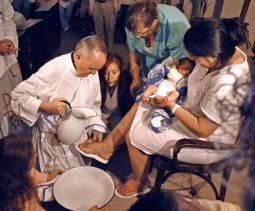
foot-washing-255x212Like many, I’ve found myself pleasantly surprised and impressed by many of the sayings and doings of the new Pope. He emphasizes helping the needy and is critical of over-judgmentalism and of hyper-materialism (he practices what he preaches by driving a cheap car and living in a simple apartment). He also goes out of his way to spend time with ordinary people, be it in a correctional facility, in processions, or on the phone. Often dubbed ‘The People’s Pope’, he’s making the most of his promotion, on a mission to do real good in the world. Catholic or not, most people are thrilled that such an influential person is providing such an excellent example of how to live a life of service and of mercy. 

But I wasn’t quite as pleased the author of an article in the Huffington Post about Pope Francis’ first encyclical Lumen Fidei (The Light of Faith) co-authored with the previous Pope, Benedict XVI. The author says that the encyclical ‘…reflects Francis’ subtle outreach to nonbelievers’. While I consider myself an atheist, I’m a cultural Catholic, brought up with that religion. Since so many of my loved ones are observant Catholics and the Catholic church is so influential in the world, I’m very interested in what goes on in it. The first encyclical of a new Pope is a big deal, and this encyclical does a good job of promoting Catholic teaching with inspirational language and metaphors. However, the authors also resort to bad arguments to make their point. In many instances, they do so by contrasting their doctrines, for positive effect, against ‘straw man’ versions of non-believers’ views. In others, they set up false dichotomies, where they present Catholic doctrine as the only positive alternative to something bleak. I was disappointed that such educated and influential men, willfully or otherwise, so thoroughly mischaracterized attitudes and beliefs of secular people. 

As I’m sure you know, a ‘straw man’ argument is the logical fallacy of first constructing a caricatured or artificial version of an opponent’s arguments, then attacking the false arguments in place of the real ones. A false dichotomy is a related fallacy, where the argument is presented as offering only two possible choices: the (arguer’s) favored position, or an opposing, usually unattractive or unbelievable one. While often effective in politics, these tactics are recognizable as a sign that the arguer finds themselves in a disadvantage. They might find that they can’t understand the arguments of his opponent, they might find that the opponent’s real arguments are so strong that they can’t find a way to answer them, or they might find that they’re worryingly attractive to others so they wish to obfuscate, misrepresent, or conceal them. The first two are less likely in this case as the authors are educated and articulate men. I think something like the latter is what’s going on here. 

I also found that the encyclical promoted some worrying misconceptions about human beings, our nature and how we actually go about thinking, learning, being good, and finding meaning for ourselves. They describe human nature through the lens of a very narrow Catholic conception, which is to be expected, but they ignore, denigrate, or dismiss the validity of other accounts of human nature, informed by the sciences, the liberal arts, and other belief systems. 

It’s especially clear from sections 2 and 3 that the Popes feel the Catholic Church is under attack by the scientific revolution, where evidence and reason are generally prized over tradition and belief. Perhaps this is the origin of the backlash against secularism and naturalism that’s characteristic of the poor arguments throughout the encyclical. The ways they present secular and atheistic thought is not new or unique to these men; they’re commonly held views, a fact very recently highlighted by Oprah Winfrey’s response to a self-professed ‘spiritual atheist’ interviewee. Yet the Popes could have offered a defense and promotion of their doctrines without the bad arguments, and their work would have been much better for it. It’s too bad that here again, the thoughts, motivations, beliefs, and characters of so many, in this case, naturalist, atheist, agnostic, and otherwise secular people, are misrepresented to such a large audience by influential men who I think should know better.

It’s true that there are some non-believers who are so, or become so, out of lack of interest, out of ignorance, or even simply to get out of following the rules of religion. But in my years of reading and research, I think the majority reject religion for worthy reasons. There are plenty of rational and moral reasons why people don’t believe in gods or a God as any religious tradition has conceived them or It. I think most secular people, from those who are personally believers of some sort but who value a society free of religious coercion, to the most ardent atheists, have done a lot of thinking on the matter, and this essay, I’m talking about these people. I’ll refer to them generally as secular thinkers, and to their musings as secular thought.

Here are some specific instances where I think the Popes got it wrong (there are plenty others). All quotes are from the encyclical ‘The Light of Faith’, in order of the sections they appear in, and my response follows directly after each:

From section 2:

‘Slowly but surely, however, it would become evident that the light of autonomous reason is not enough to illumine the future; ultimately the future remains shadowy… As a result, humanity renounced the search for a great light, Truth itself, in order to be content with smaller lights which illumine the fleeting moment yet prove incapable of showing the way. Yet in the absence of light… it is impossible to tell good from evil…’

There are many secular thinkers who feel that reason alone, the deliberative reflection on the nature of reality and what it means for the self and for humankind, is the only way people find truth and meaning. Yet more accept a more nuanced understanding, informed by the findings from more recent research in psychology, evolutionary biology, behavioral economics, and neuroscience. When we look closely at how we think and behave, we find that instinct and emotion play a huge role as well, and in fact, that reason is secondary to and cannot function without these. It’s that emotional part of us, where morality originates and the experience of transcending our individual selves takes place, that also leads us to discover truth, in the various ways it’s defined.
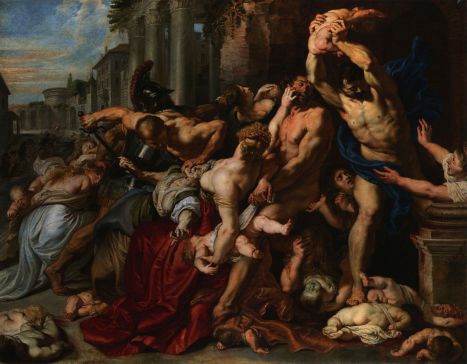
peter-paul-rubens-massacre-of-the-innocents-1611-12-photo-by-ken-thompson-at-the-art-gallery-of-ontario-public-domain-via-wikimedia-commonsSecular people, too, realize this, and by renouncing religion or never joining one, it does not at all mean that they renounce the search for ‘the great light’ of truth. It’s more often the opposite: secular people make the choice to become or to remain free to search for truth without the often seemingly arbitrary limits of dogma. We can go where the evidence leads us, and we can say ‘what if?’ and ‘I don’t know’ without fear of retribution from an inscrutable God. We can give an account of good and evil based on what we learn about human nature and about the natural world as a whole. It could be argued, against Pope Francis, that if there is an unaccountable, unknowable, and unanswerable supernatural, conscious being force that creates and rules the world, it would be impossible to tell whether it was good or evil since whatever it says goes. In one era God could say it’s good to slaughter the infants of enemies (Ezekial, Isaiah), and in another era he might say it’s evil. This argument, often called divine command ethics, is an ancient one, and philosophers generally agree that a conception of the good must exist prior to determining whether something, God or otherwise, is good. It is, in short, not only possible, but necessary, to tell good from evil outside of the parameters of religion. That’s how you can recognize, in the first place, whether a religion is a good one.

From 8 and 10:

‘Faith opens the way before us and accompanies our steps through time. Hence …we need to follow the route it has taken… Here a unique place belongs to Abraham, our father in faith. Something disturbing takes place in his life: God speaks to him… Abraham is asked to entrust himself to this word.’

The story of Abraham and his son Isaac is a strange one to the secular thinker, and not at all a good example for showing how faith is linked to the search for truth. In this story, God demands Abraham do something considered evil by just about any human being, secular or religious, from Abraham’s time to our own: to murder his son. All the while this God is knowing he doesn’t really mean it! Where’s the love of truth here? The sort of faith this deity demanded was the same sort of faith demanded of the suicide bomber, or the parent who denies life-saving medicine to their child because they belong to a faith-healing sect. It’s the sort of faith, that of the blind worshiper, that is deeply alien to one who seeks to understand what they do before they do it, and why they do it, while simultaneously demanding personal accountability from themselves and others.

It’s the ultimate anti-personal-responsibility fable, and was among the earliest religious tales that alerted me to the problems of faith.

From 13:

‘The history of Israel also shows us the temptation of unbelief to which the people yielded more than once. Here the opposite of faith is shown to be idolatry…Idols exist, we begin to see, as a pretext for setting ourselves at the centre of reality and worshiping the work of our own hands. Once man has lost the fundamental orientation which unifies his existence, he breaks down into the multiplicity of his desires… his life-story disintegrates into a myriad of unconnected instants.’

milky-way-by-unsplash-creative-commons-via-pixabay-croppedThis is also a very strange section to a secular thinker. The opposite of faith, the philosopher, the logician, the linguist would say, is non-faith, which precludes worship of anything at all. 13 is a long section of false dichotomies as well as straw man arguments. The thinker who learns from the world itself, through history, biology, psychology, astrophysics, and so on, learns that the universe, humankind, and the self are not a disorienting haze of ‘unconnnected instants’. Things are interconnected and form marvelous patterns throughout the universe, from the forming of stars, elements, galaxies, planets, and solar systems in the cosmos through various forces, to the transition from instinct-only to simpler forms of intelligence to consciousness in the story of human evolution, to the fascinating development over time from simple hunter-gatherers in small groups to complex societies, cultures, beliefs, and knowledge-gathering systems. The history of human thought reveals that human beings, from prehistoric times, throughout history, and up to now, from innocent of religion to pagan to religious believer, have been engrossed with understanding the cosmos, from the blazing sky to the deepest mysteries of their own minds, and all the while have demonstrated rigor and discipline while on their quest for knowledge. Religion is just one of the many human products of that quest.

From 19:

‘…The attitude of those who would consider themselves justified before God on the basis of their own works. Such people …are centred on themselves… Those who live this way, who want to be the source of their own righteousness, find that the latter is soon depleted and that they are unable even to keep the law. They become closed in on themselves and isolated …their lives become futile and their works barren…’

This section is focused on a debate within the larger community of believers, but I include it here because of what it implies about those who look to human nature and to their own instincts to find the impetus for goodness. It implies here that human nature, on its own, is essentially isolationist rather than altruistic. By doing so, it ignores nearly everything we know today about human psychology and behavior, about evolution, neuroscience, economics, and so on. Human beings are essentially social with an individualistic streak, and without deeply rooted instincts toward cooperative, generous behavior, we are weak, nearly defenseless against predators and the forces of nature, and are imprisoned by and even defeated in the pursuit of our own shortsighted needs. Goodness and kindness are accounted for with or without religion.

From 25:

‘In contemporary culture…truth is what we succeed in building and measuring by our scientific know-how, truth is what works and what makes life easier and more comfortable… But Truth itself, the truth which would comprehensively explain our life as individuals and in society, is regarded with suspicion… In the end, what we are left with is relativism, in which the question of universal truth …is no longer relevant.’

This section is problematic to begin with in the way that it seems to work with a definition of Truth narrowly defined within the parameters of Catholic doctrine, and from there proclaiming that people no longer care about Truth, just facts about the world that can lead us to make useful products. But people all over the world of no faith or any religious faith, throughout time, have demonstrated restless curiosity and boundless energy in trying to find out the truth about reality, from the most prosaic little problem in everyday life (how can I save time carrying water from the well?) to the greatest mysteries of the universe (what are the stars made of, and do they move on their own or do the gods push them around?). This is as true today as it ever was, regardless of the fact that some people (and I would agree, too many) are overly concerned about personal comfort at any cost and how much nice stuff they can amass for themselves.

It’s also problematic in that this section appears to imply that placing a high value on ‘what works’ leads people to care nothing about what’s truly enriching. The scientist, the naturalist, indeed anyone who finds the universe an utterly fascinating and meaningful thing on its own terms might find this idea very strange. Applying a test of ‘workability’, in fact, shows a great deal of respect for truth, in that the seeker takes great pains to make sure that personal bias, incomplete or misleading information, too small a sample size, etc. are not a source of error. If a theory or received dogma doesn’t ‘work’, doesn’t adequately account for the facts, doesn’t coherently explain how and why something is as it is, or doesn’t successfully make predictions, then, they know, the search for truth must continue.

From 35:

‘Because faith is a way, it also has to do with the lives of those men and women who, though not believers, nonetheless desire to believe and continue to seek. To the extent that they are sincerely open to love and set out with whatever light they can find, they are already, even without knowing it, on the path leading to faith. They strive to act as if God existed, at times because they realize how important he is for finding a sure compass for our life in common or because they experience a desire for light amid darkness, but also because in perceiving life’s grandeur and beauty they intuit that the presence of God would make it all the more beautiful.’

Here, the Popes make the most underhanded move to undermine secular people. They resort to a particularly transparent sort of fallacious argument along the lines of: ‘You’re saying (that), but I know what you’re really thinking, you’re thinking (this), and here’s why (this) is wrong’. This is simply a dishonest argument, and potentially insulting in a most unphilosophical way. The honest philosopher does their best to understand the argument of their opponent, consider it as it if might be true, and then argue against it on its own merits if she disagrees; they do not pretend as if it’s really something else. They do this sneakily, using the phrase ‘those…who’, so that there’s an out: this does not necessarily include the entire class of nonbelievers. But reading carefully, they also set it up so that no one could tell which nonbelievers it includes, since the nonbelievers themselves, ‘without knowing it’, really want to be believers somewhere deep down. So just as easily, they could be referring to all believers, or to none, though presumably they’re referring to some quantity in between. But this doesn’t work. If one is actually a non-believer, it seems incoherent to say that they could also be one who believes that a God is necessary for meaning and beauty. Unless you’re talking about a nihilist of a particular variety. Yet this can’t be so, because they’ve already added the caveat that they are also ‘sincerely open to love’. So either this section is entirely contradictory in its attempt to outline the true nature of believers (at least some), or it’s a veiled attempt to deny that there are really any unbelievers out there. Circular reasoning strikes again.

From 43:

‘Children are not capable of accepting the faith by a free act, nor are they yet able to profess that faith on their own; therefore the faith is professed by their parents and godparents in their name.’

Years back, when my grandfather began to notice that he never saw me at church anymore, he asked me if I was still going. When I said no, he said that that wasn’t acceptable: the promise my parents made for me at my baptism obligated me to go. I said little at the time, being in my late teens and still not comfortable with challenging my grandfather directly. But I was very annoyed at what I thought a most ridiculous notion: that anyone could make this sort of binding promise on another’s behalf.

But that’s not the worst of it: my grandfather was also making the same point the Popes make in this encyclical, that parents can proclaim tenets of faith on behalf of their child. But faith, or belief, is not something that can be simply transferred or put on, like a family heirloom or a piece of clothing. It’s the natural assent of the mind to the matter-of-factness of propositions or circumstances. True, you can ‘fake it ’til you make it’, engaging in a sort of cognitive-behavioral exercise where you decide ahead of time what you want to be true, then make a habit of acting as if it is, then come to believe it. Perhaps the Popes have this sort of thing in mind in this passage, though they don’t describe it that way. But to the secular thinker, this sort of belief-inducement is not an honest one, since it can be used to instill belief in anything at all. Rather, keeping an open mind to the evidence and allowing belief to emerge naturally in response is a much better method if you don’t want to be misled. When the Catholic religion of my early youth no longer offered meaningful, believable answers to so many of my questions, I felt angry at the time, feeling that I had been raised in a bubble, led to assent to all kinds of things without having the relevant information. ‘Faith’ became almost a dirty word for me, as it began to sound more and more as if it really meant something more like indoctrination or even brainwashing. So in the end, raising us to believe only in the strict ‘Truth’ of Catholic teaching without being allowed to question, and without introducing other possible answers, resulted in the opposite of its intended effect.

From 54:

‘Thanks to faith we have come to understand the unique dignity of each person, something which was not clearly seen in antiquity. …Without insight into these realities, there is no criterion for discerning what makes human life precious and unique. Man loses his place in the universe, he is cast adrift in nature, either renouncing his proper moral responsibility or else presuming to be a sort of absolute judge, endowed with an unlimited power to manipulate the world around him.’

I don’t know entirely know how the Popes feel justified making this claim. While it’s true that Bible-based religions caused many converts and believers throughout history to behave much better than they did before or might have otherwise, the opposite is also true. Sometimes it inspired the Christians to have mercy on their enemies, sometimes it led them to torture and kill ‘heretics’, slaughter Jews in pogroms, and to enslave and murder black people and Native Americans. Some may say that people who behave this way are not really of the ‘true faith’, but their actions are justifiable according to certain Biblical principles and commandments. In the Old Testament, unbelievers are to be put to death (and what are Jews and Native Americans to Christians if not unbelievers?). In the New Testament, Jesus says that the fate of towns who don’t accept his disciples’ teaching will be like that of Sodom and Gomorrah, where God put everyone to death (Matthew 10: 13-15, Genesis 19). It seems that, here, the worth of human life is actually often contingent in the Bible, on ‘good behavior’ or on whether they profess the right religion, and not always of value in its own right.
code-of-hammurabai-public-domain-via-wikimedia-commonsIn antiquity, in fact, there were many cultures and belief systems that did place human life and dignity on as high or even higher a plane than did the ‘faithful’ of the Old and New Testaments. Ancient Egyptian literature, the Code of Hammurabi, the Epic of Gilgamesh, and some philosophies and religions of ancient India and Greece, for example, advocate such principles as non-violence and the worth and dignity of the human person, and place strict limitations on harming and killing other human beings, and indeed, other living things that are not human beings. Many of these ideas and belief systems are religious, but many are not.

Secular thinkers such as myself find no trouble deriving firm principles and morals from the natural world, and in fact find that taking moral responsibility demands rejecting religious dogma in favor of an understanding of how human nature works and what the actual circumstances require. We don’t find ourselves ‘adrift’ since human morality is based on the social instincts, expanded and universalized through reason, and we’re all in this world to sink or swim together, ultimately. We also don’t consider ourselves ‘absolute judges’. Instead, we hold ourselves accountable not only to ourselves but to each other, to democratic principles, to the consideration of the rights of other people, and to the limits and strictures of the universe itself. In fact, it’s unquestioning acceptance of dogma that can look, to the secular thinker, very much like reneging on one’s moral responsibility.

In sum, the authors of this encyclical and secular thinkers find themselves in agreement on many particular issues, and in disagreement on others. (Of course, I don’t speak for all secular thinkers just as the Popes don’t represent every belief of all individual Catholics. Instead, I represent my own views and those I find generally promoted by secular thinkers who write about philosophy, morality, the physical sciences, psychology, political and legal theory, and the humanities.) Respect for individual rights, a commitment to promoting human health and happiness, justice, equality of opportunity, and so on, are universal human concerns, and have been throughout recorded history, from the atheistic to the pious.

Fortunately, in his public speeches and behavior, Pope Francis I publicly emphasizes the best of his humanistic principles with little or no disparagement of those who do not believe in these principles for the same underlying reasons. In this, I think the good example he provides will far outweigh his theological publications when it comes to his broader influence in the world. But it’s worth having the discussion about the nature of inherited faith versus evidenced-based belief, until secular thought is no longer maligned by those who fear and mistrust it because of the kind of misrepresentation this encyclical exemplifies.

Ordinary Philosophy and its Traveling Philosophy / History of Ideas series is a labor of love and ad-free, supported by patrons and readers like you. Please offer your support today!

~~~~~~~~~~~~~~~~~~~~~~~~~~~~~~

Sources and inspiration: 

Pope Francis I. Lumen Fidei (On The Light of Faith)Encyclical letter, June 29th, 2013

Calling All Philosonerds and Philosophriends: Support Philosophy Bites!

Mirrored from http://www.amazon.co.uk/exec/obidos/ASIN/0199694664/virtualphilos-21

One of my very favorite podcasts is Philosophy Bites, by David Edmonds and Nigel Warburton.

In it, they interview philosophers on all manner of topics, which are fascinating and relevant to just about anyone who cares about what’s going on out there in the world and in the life of the mind.
The interviews are concise (10 – 15 minutes) and engaging, yet thorough, and the questions are excellently devised.

They’ve rather recently begun to be funded by private donations only, so I encourage you to pitch in a little and support these awesome guys doing their awesome thing!

If you click the ‘Subscribe’ button at the upper left of the page (under the ‘Donate’ button), it’ll go to Paypal, where you can choose a monthly amount to donate.
(May I suggest 6 pounds/month, about $10, a nice tidy figure that’s totally affordable)

Credits: I borrowed the term ‘Philosophriends’ from my own philosophriend Preston Tillotson. I  made up the term ‘philosonerd’, but I’ve since found that many others have come up with that on their own