What Ordinary Philosophy’s All About: Clarifying the Vision

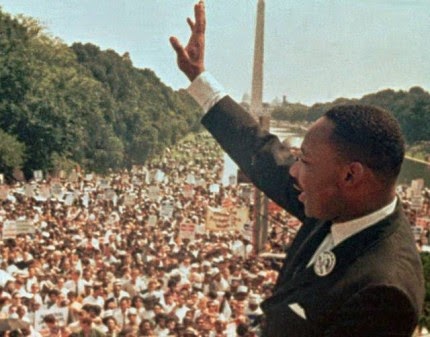
People in a Public Square, Image Creative Commons via PixabayIt’s been an especially busy few weeks for me: studying, researching, writing, planning for my upcoming traveling philosophy journey and for the expanded future of Ordinary Philosophy. This year so far, I’ve had the great good fortune to meet some inspiring new people: passionate, thinking, active, and creative. I’ve also gotten to know others better as well, and am opening new doors and making new contacts every day. Our conversations have been inspiring me to think more clearly and deeply about my vision for Ordinary Philosophy, about my hopes, dreams, and goals, and about the wonderful people who will work with me to accomplish them in the future.

So I’ve just been looking over my introductory statement about Ordinary Philosophy, and thought it needed some clarifying and expanding. Here’s my vision as it stands now, best as I can describe it, and it’s beautiful to me. I hope it is to you too!

~~~~~~~~~~~~~~~~~~~~~~~~~~~~~~

Ordinary Philosophy is founded on the belief that philosophy is an eminently useful endeavor as well as a fascinating and beautiful one, and that citizen philosophers and academic philosophers alike share in making it so.

So why the name Ordinary Philosophy?

The ‘Ordinary’ in Ordinary Philosophy means: Philosophy is not only pursued behind the walls of academia.

It’s an ordinary activity, something we can do regularly whatever our education, background, or profession, from our homes, workplaces, studies, public spaces, and universities. It’s applicable to ordinary life, since it’s about solving the problems we all encounter in the quest to pursue a good, happy, and meaningful one.

It’s about seeking answers to the ‘big questions’ we ask ourselves all the time: ‘What’s the right thing to do?’ ‘What’s a meaningful life, and how can I make mine so?’ ‘What’s the truth of the matter, what does truth mean anyway, and how do I know when I’ve found it?’ ‘What does it mean to have rights?’ ‘How did reality come to be as it is?’, and so on.

It’s also just as much about the ordinary, day-to-day questions: ‘Should I take this job, and will it help fulfill my highest aspirations?’ ‘It is wrong to put my interests first this time, even if it will harm someone else?’ ‘What’s the difference between just talking about other people and malicious gossip?’ ‘Why should I go out of my way to vote?’

And in the end, it’s about living philosophy, about philosophy in the public square, and the stories and histories of philosophy as it is realized, personified, lived out by activists, artists, scholars, educators, communicators, leaders, engaged citizens, and everyone else who loves what’s just, what’s beautiful, and what’s true.

All of this is philosophy.

~ Amy Cools, founder and editor of Ordinary Philosophy

Communitarianism, Writ Large

Amy M Cools's avatarOrdinary Philosophy

I listened to Bill Moyers’ discussion with Michelle Alexander recently, about her book The New Jim Crow and her activism against the over-incarceration of black people here in the US. Something she said really struck me, as it relates to a problem I’ve been mulling over for some time. She said:

I realize that as well-intentioned as all that work was, it was leading me to a place of relatively narrow thinking… If I care about a young man serving, you know, 25 years to life for a minor drug crime… If I care about him and care about his humanity, ought I not also care equally about a young woman who’s facing deportation back to a country she hardly knows and had lived in only as a child and can barely speak the language? And ought I not be as equally concerned about her fate as well? Ought…

View original post 1,483 more words

Interview with Clay Jenkinson as Thomas Jefferson, Jan 16th 2016

I’m ple6759b-amy2band2bjeffersonased to announce that the 33rd episode of the podcast is a super special one, as it’s Ordinary Philosophy’s first interview, and my distinguished guest is Clay Jenkinson, humanities scholar, author, and creator of the Thomas Jefferson Hour radio show and blog.

I’m a long time listener of the show; in fact, I believe I’ve listened to just about every single episode, many of them more than once, and relied on Clay’s work to inform my own, especially in the two Traveling Philosophy / History of Ideas series I did following the life and ideas of Thomas Jefferson.

I highly, highly recommend you give the Thomas Jefferson Hour a listen, you can find it at www.jeffersonhour.com, along with many other resources on the life and ideas of Jefferson, and Clay’s other work in the humanities.

You can find the accounts of my two series on Jefferson, as part of the Traveling Philosophy / History of Ideas series, here and here.

I interview Clay here in character as Thomas Jefferson, as he does on the Thomas Jefferson Hour, discussing various issues as Jefferson himself might have viewed them, informed by Clay’s extensive scholarship on his life and expressed views.

I hope you enjoy our discussion as much as I did!

You can also subscribe to the Ordinary Philosophy and Thomas Jefferson Hour podcasts on iTunes.

*Thank you, Shane and David, for your help and technical support

Ordinary Philosophy and its Traveling Philosophy / History of Ideas series is a labor of love and is ad-free, entirely supported by patrons and readers like you. Please offer your support today!

Why We Need Citizen Philosophers

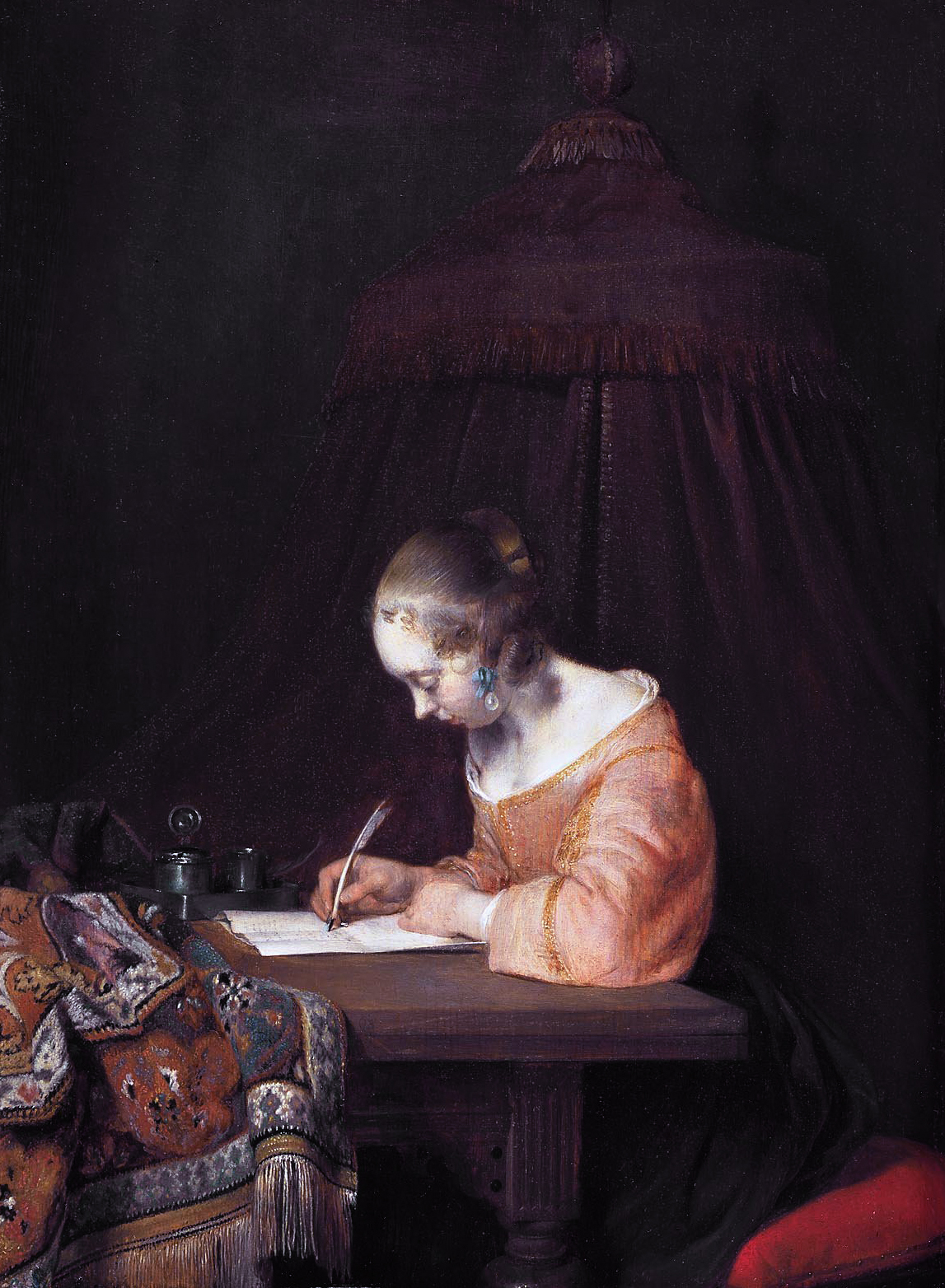
Writing a letter *oil on panel *39 x 29.5 cm *signed b.c.: GTB *ca. 1655I am a citizen philosopher, and very likely, so are you.

So what is citizen philosophy, why is it a useful concept, and what is its role in the world?

Let’s begin by considering what we mean by philosophy, generally speaking. For a long time, philosophy has been considered an almost exclusively academic pursuit, so highly specialized that only a very few experts can properly be called philosophers. As Eric Schwitzgebel points out, this is a relatively new development. In the Western world, it traces its origins to classical Greece; each region of the world has its own history of philosophy or its analogue, from Egypt to China to the Americas. As with all fields of inquiry, philosophy has branched out and specialized until much of it would be barely comprehensible to its first practitioners. Indeed, almost all fields of inquiry we know today started out as a branch of philosophy: mathematics, logic, science, medicine, theology, you name it.

But Philosophy, or ‘love of wisdom’, began in the home, the workplace, the market square, and the street corner with curious, intelligent people who, newly enjoying the luxury of free time accorded by advances in food-acquisition technologies, began to ponder on the whys and hows of the natural world and of the human experience. These people weren’t originally chosen or designated by some authority as the ‘thinkers’ as opposed to everyone else, the ‘doers’; instead, philosophy originated, grew, and specialized organically. We, as a species, began to ask and answer ever more complex questions about how to best live in the world as members of societies, what’s going on within our own minds and why, what are our roles in the universe, and what it all means… including the question ‘what is meaning?’. Over time, certain individuals came to be recognized as particularly adept at asking and answering these important questions, and came to be considered specialists and authorities in their fields of inquiry. But philosophy, broadly construed, remained a pursuit of many more people than that.Panthéon, Temple of Reason, Paris, France, Photo 2015 by Amy Cools

Philosophy has been demystified by re-entering popular culture, to a significant extent. There’s an ever-growing audience for popular philosophy books, articles, magazines, podcasts, and blogs. The term itself has also been re-broadened, so to speak. ‘Philosophy’ has taken on many new shades of meaning as it’s used to refer to a particular view of life, or aesthetic taste, or set of aspirations, or working theory of knowledge, or organization method, or substitution for the loaded term ‘spiritual’ …even a brand of skin care products (this one disgusts me somewhat, as it offends my aesthetic taste and sense of the ‘sacred’ by capitalizing on public respect for one of my most beloved, to me non-commodifiable things). Some of its newfound popularity is the result of advancing secularization accompanied by the desire to retain transcendence and meaning; some is the result of our newly data-centric lives brought to us by the word wide web, creating the need to make sense of the deluge of new information available to us; some is the result of the blending, annexing, and clashing of cultures in a world now widely and intimately connected through advanced media technologies and ease of travel, creating the need to find ways of communicating and living together in a world of new complexities. It’s all happening so fast that each of us is experiencing the urgency to make sense of it all right away, in a way that is practicable in our own communities and subcultures, and in a way each of us can understand and readily communicate.

In short, philosophy is enjoying a comeback in the public square. What I’m calling citizen philosophers are those who ask and answer questions there, about the nature of the universe and how to make sense of our experiences of it, who are not necessarily engaged in professional or academic philosophy. While citizen philosophers tend to spend a significant amount of time engaged in such inquiry and are motivated to educate themselves widely and systematically, many find academic philosophy too arcane and obscure to help the rest of us navigate our increasingly complex lives.

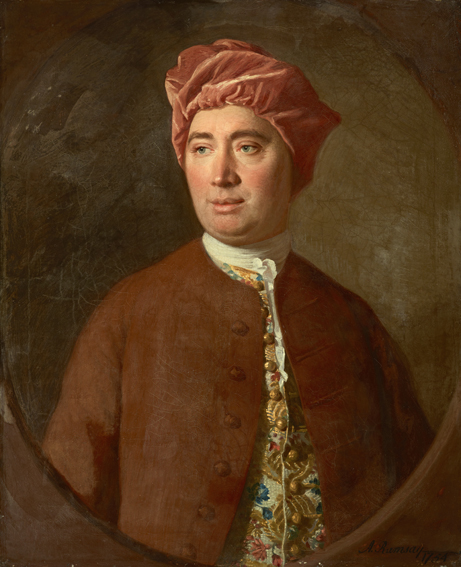
I, for one, love academic philosophy. I am continuously in awe of the work these men and women do, devoting their lives to hard study, to asking the most challenging questions, and to deep examination of the most nuanced and complex problems. This body of work is breathtaking in its scope, beautiful in the elegance of its arguments and solutions, satisfying in its wit and cleverness, fascinating in its intensive scholarship, and indispensable in its ability to help us figure out why and how to make a better world. I find it highly enjoyable and fulfilling, as well as challenging and frustrating, to grasp and wrangle with the work of academic philosophers. To be sure, academic philosophy has had its share of what David Hume calls sophistry and illusion, fit only to be consigned to the flames, and what Harry Frankfort more succinctly calls ‘bullshit’. But philosophy is not alone in this: science has had its phrenology and eugenics, medicine its humours and bloodletting, theology its justification for slavery and pogroms, and so on. Like these other disciplines, academic philosophy has some wonderfully effective built-in self-correctors, and continues to be an essential, I think preeminent, field of inquiry.

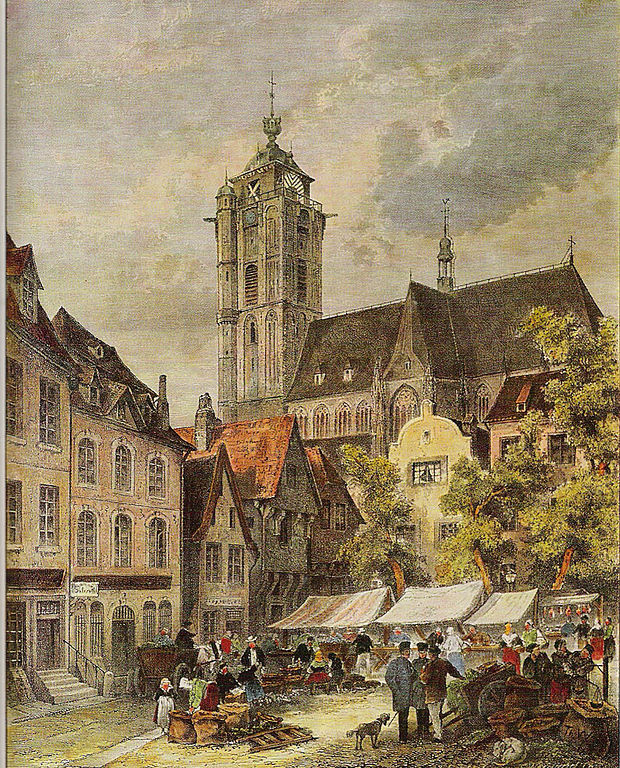
Marketplace in Duisburg by Theodor Weber, 1850, Public Domain via Wikimedia CommonsBut many of the most important and interesting questions don’t come down on us from on high, so to speak, originating from academia and revealed, as if a sort of holy writ, to the rest of us. In fact, most of the questions and problems we all wrangle with still originate in the public square, in the home, workplace, classroom, hospital, church, courtroom, political assembly, and so on. They bubble up from the challenges and uncertainties of our daily lives, are filtered through conversation and the arts, are swept up in social, legal, and political movements and institutions, and carried into the pool of academic philosophy, where they are further clarified and distilled in treatises, lectures, books, and so on.

And these questions don’t only originate with the public at large, we offer our first answers there. The answers range from fragmentary to nuanced, from intuitive to considered, from repetitions of received wisdom to original, from off-the-cuff to well-informed, by people from all walks of life with their own areas of expertise and unique capabilities of understanding born of particular experience. These citizen philosophers are on the first line of discovery and inquiry, and so called because they don’t participate in this process as a profession, but as a matter of personal interest and as a member of society at large, not subject to the demands and constraints of academic philosophy. Of course, the category of citizen philosopher does not exclude academic philosophers, because of course they, too, participate in the same process of question-creation and question-answering in the course of their everyday lives, separate from their academic pursuits.

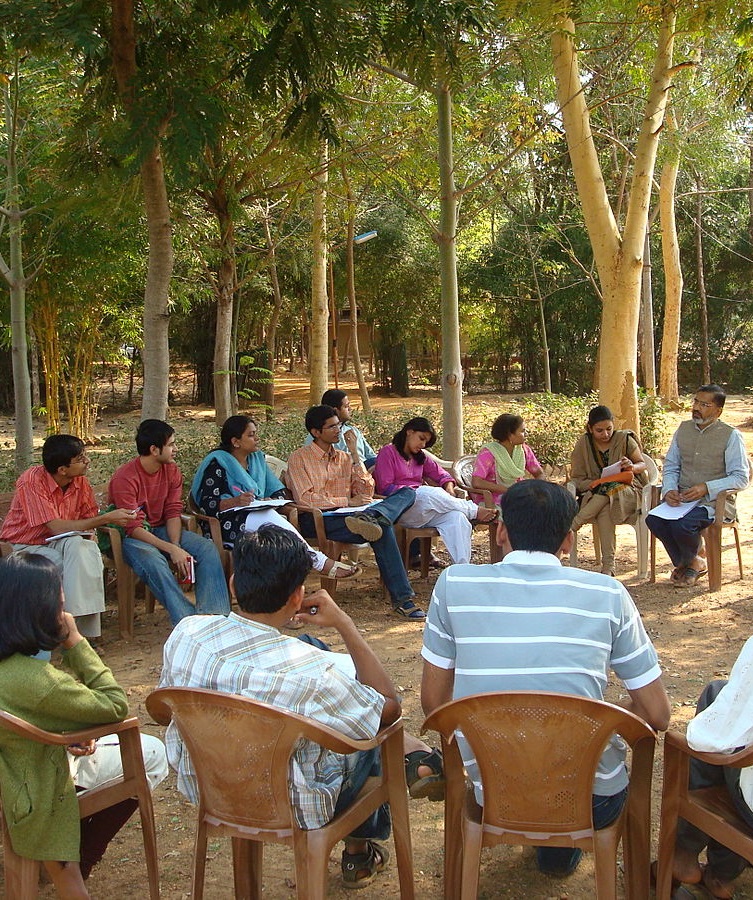
It’s the very lack of the demands and constraints of academic philosophy that gives citizen philosophy an important role to play in public life. The world as it is offers so many varieties of human experience, so many ways of seeing the world, so many challenges that academic philosophers, like the rest of us, never have the opportunity to confront directly. Yet the scope of academic philosophy, at least potentially, is as broad as the possibilities of human (even, perhaps nonhuman?) experience. So how can it be that academic philosophers can possibly access enough information to ask and answer all the important questions that could be addressed? It may be, if academic philosophers were endowed with immense powers of comprehension and imagination that would enable them to take all the information available in the world, to truly understand what it’s like to be a coal miner in China, a cardiologist experiencing a heart attack firsthand, a one and a half year old who just created their first sentence, a person with frontal lobe epilepsy experiencing a supernatural vision, or a terrorist who became so after their entire family was killed by a bomb, and then conceive of all of the social, epistemic, metaphysical, political, and every other sort of question that may arise from these experience. (À la the mythical Mary in Frank Jackson’s black and white room.) But of course, this is impossible, as even the most intelligent and informed human mind has its limits. Sometimes, raw data is the fodder of academic philosophical inquiry. But most often, it’s the questions, moral precepts, stories, works of art, aphorisms, dogmas, memories, narratives, and all other products of the human mind, already having undergone a first round of questioning and examination, that academic philosophers take up as topics of inquiry. Group discussion in the camps of Nirman (cropped), by Abhijeet Safai, Public Domain via Wikimedia Commons

I, for one, am glad to see philosophy ever more present in the public square. That’s because I perceive philosophy as the great quest for understanding that academic and citizen philosophers all engage in, and as I see it, each gives something of immeasurable and irreplaceable value to the other. We need only recall some philosophical forays that have failed, from hairsplitting quibbles of scholasticism to navelgazing-verging-on-masturbatory obscurantisms of postmodernism, to recognize that academic philosophy benefits enormously by maintaining a robust discourse with the broader human community of activists, artists, reporters, bloggers, protesters, discussion groups, and of all others who care enough to question.  The discipline and expertise of academic philosophers, and the broader set of experiences, challenges, and opportunities for new questions and unique ways of understanding of the larger community of citizen philosophers each serve to keep the other more honest, more challenged, and more informed, in the great world conversation we’re all having.

*Listen to the podcast version here or on iTunes

Ordinary Philosophy and its Traveling Philosophy / History of Ideas series is a labor of love and is ad-free, supported by patrons and readers like you. Please offer your support today!

Welcome to the new Ordinary Philosophy!

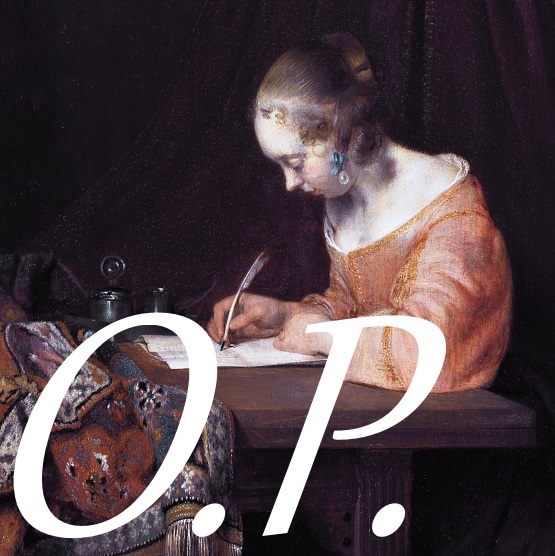
Ordinary Philosophy, Writing a letter *oil on panel *39 x 29.5 cm *signed b.c.: GTB *ca. 1655, assemblage by Amy Cools 2015Greetings to all,

On this New Year’s Day, which also happens to be my birthday and therefore, personally, doubly a day of new beginnings, I’m looking forward to a more expansive, more energetic future for Ordinary Philosophy!

What is Ordinary Philosophy?

It’s a series of explorations founded on the belief that philosophy is an eminently useful endeavor as well as a fascinating and beautiful one, and that citizen philosophers and academic philosophers alike share in making it so. A citizen philosopher myself, I found that my experiences as an avid reader, an artist, a working person, an entrepreneur, a student, and a writer filled my mind constantly with questions and new ideas, spurring me ever on in the search for answers. As I’ve always been a restless and hungry thinker, I fell in love with philosophy, especially, practical philosophy and the history of ideas.

What is Ordinary Philosophy’s mission?

It’s always been to share this love of philosophy and the history of ideas with you. In my explorations, I’ve encountered the most fascinating, innovative, and beautiful ideas from the curious, thoughtful, questing, and inventive world out there, from academic philosophy to science to history to current events to politics to the arts and so, so much more; so much more, in fact, that I can’t possibly process it all on my own.

So here at O.P.’s new home, I’ve broadened the mission.

While there have been occasional guest posts, there will be much more of an emphasis on providing a forum for many more voices at O.P., representing views from all walks of life. O.P. will also publish many more reviews, recommendations, and links directing readers to the great ideas proliferating out there that may be of special interest to O.P.’s audience.

The Traveling Philosophy / History of Ideas series will also expand. Each series will become more in-depth, with more detailed explorations of the life and ideas of each subject and more resources for further exploration and study. The podcast will expand in tandem: new audio recordings of longer pieces published in O.P. for those of you on the go who enjoy the ideas found here but don’t always have the time to sit down and read. As time goes by, I plan to expand the podcast as well to include interviews and a series of downloadable travel guides to accompany the History of Ideas series.

To better accomplish this expanded mission, I’ve moved O.P. here to its new platform: easier to read, use, and share. So if you love great ideas and the pieces you encounter here, please support O.P.’s expanded mission by sharing as widely as you can.

Lastly, dear readers, I appeal to you: Ordinary Philosophy is a labor of love, and depends entirely on your support. I’m determined to keep O.P. ad-free, but can’t do it without you. All financial contributions will be credited by name (unless anonymity is expressly preferred, of course!) on each project funded by their donations, and welcomed with deepest gratitude. Please support Ordinary Philosophy today!

Yours,

Amy Cools, founder and editor of Ordinary Philosophy

*Listen to the podcast version here or on iTunes

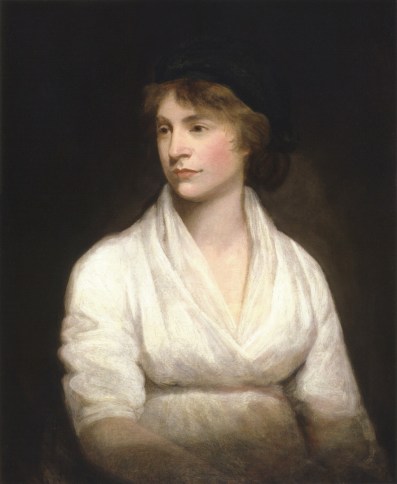
Mary Wollstonecraft, Champion of Reason, Passionate in Love

The life and work of Mary Wollstonecraft, mother of modern feminism, can seem to reveal a mass of contradictions.

Her seminal feminist work, A Vindication of the Rights of Woman, champions reason as the ultimate guide for a moral and productive life. She used reason to great effect to show why women should, and how they could, grow out of their socially constructed roles as under-educated coquettes and household drudges. She believed that reason should rule both individuals and societies because it’s the best tool we have to achieve justice and to perfect the self. Without reason, she thought, human beings are ruled by narrow self-interest, by prejudice born of ignorance, and by crude lust.

Yet the life Wollstonecraft chose to live was widely criticized both during her lifetime and over the two hundred plus years since her death. It’s not just because she didn’t conform to the mores of her time; her life choices are still considered unreasonable and even self-destructive by many. At times, they made her an object of scandal, impoverished, or deeply depressed, even in such desperate straits that she twice attempted suicide. That’s because she was also deeply passionate, devoted to retaining her personal and mental freedom while abandoning herself to loves which never failed to break her heart, be they revolution, family, friend, or lover. For Wollstonecraft, reason and passion are not opposites: they are two sides of the same coin. A truly reasonable person, she thought, is kind, affectionate, and generous as well, and a passionate lover of justice, truth, and beauty.
Wollstonecraft’s chosen role for herself was, first and foremost, a teacher, an advocate of knowledge and instiller of reason. While teaching was one of the few professions open to her as an eighteenth-century woman from a respectable but impoverished background, she brought her formidable powers of reason to bear on the problems with many of the educational and child-rearing practices of her day. After her first job as a companion, she became a teacher, first in the classroom at a school she founded with two of her sisters and her best friend, and then as a governess. When she became a mother twice over in her mid- and late thirties, she was a tender and hands-on mother, an advocate of breastfeeding and attentive parenting in an era of wet-nurses and governesses, when wealthy and middle-class parents participated relatively little in the care and instruction of their children even from infancy.

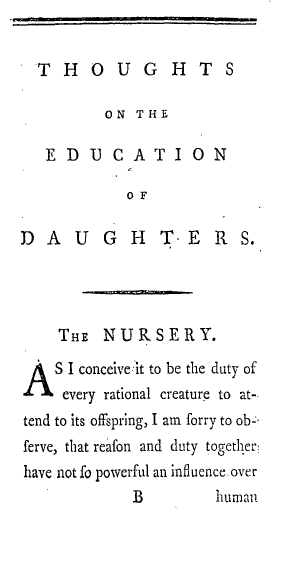
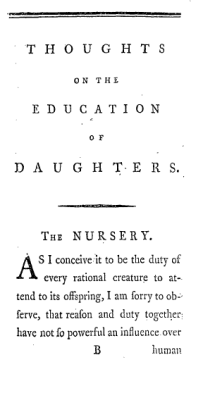
Her first book, Thoughts on the Education of Daughters, opens with her parenting advice and argues that girls should be taught how to run a household while also learning self-sufficiency. In Wollstonecraft’s time, women were not expected to support themselves; they were trained to raise a family, learning how to catch and keep a man first, to be household managers second, and to be educators of young children third. Single women, widows, and married women whose husbands, fathers, brothers, and other male relations could or would not support them had few employment options available to them, mostly directly related to one of the three roles they were trained for. Those jobs that women could respectably accept paid very little, so those working women nearly always lived a life of subservience and privation. Modern feminist thought, until very recently, equated domestic life with that housebound, nearly choiceless life most women were required to live. However, now that women’s basic moral right to self-determination has become so widely established, most have come to consider a domestic-centric life just as valid a choice for free women as a professional or public life. So in this sense, Wollstonecraft’s view of women was more progressive even than that of many modern feminists, even if by accident rather than foresight: she did not speak of a time when women would need to reject domesticity in order to free themselves from it, only to reclaim it by choice after their liberation.

Her ideas were inspired by her own experience: Wollstonecraft discovered firsthand how important it is never to assume that one’s self or one’s children will always have someone they can depend on for education, sustenance, or affection. Life’s too uncertain for that: parents, spouses, relatives, colleagues, and friends can become neglectful, estranged, impoverished, or disabled, and of course, sometimes they die. Wollstonecraft’s father squandered his inheritance and never bothered to learn how to earn an adequate living, leaving all of his children (except for his oldest son, who inherited what was left) to fend for themselves in adulthood, and his daughters without the dowry necessary for a respectable marriage. Knowing firsthand what it’s like to wrest a living from a world where women were ill-equipped for and mostly barred from nearly all employments that men were free to pursue, Wollstonecraft believed all girls should have a thorough education centered on self-sufficiency, from learning how to take care of a household, to learning how to think, to learning how to make a living. This not only gives women the freedom to choose a partner for better reasons than mere survival (Wollstonecraft equated the latter with prostitution), but leaves women free to live their lives as independently as they choose.

Until Wollstonecraft’s response to Edmund Burke’s critique of the French Revolution, her Vindication of the Rights of Men (1790), her published work continued on an educational vein, from original compositions to editorial work to translation. Beginning with The Rights of Men, through A Vindication of the Rights of Woman (1792), and up to her last work, Letters Written During a Short Residence in Sweden, Norway, and Denmark (1796), she transitioned from a teacher of ideas into an innovator, drawing on the wealth of knowledge she had obtained through her lifetime thus far of work and study. She was a semi-autodidact, her rather patchy childhood education supplemented in her teens by her own voracious reading and by friends who recognized her hunger for learning, and continued independently during her working years in the hours she could dedicate to her self-improvement. When she established herself as a professional author, she was finally able to immerse herself fully in the life of an intellectual, attending famous salons and becoming the friend and colleague of many of the brightest minds of her day.

One of the central themes in The Rights of Woman is women’s education. In this work, Wollstonecraft explained that it’s the nature of women, rather than their practical needs, that’s the ultimate justification for their rights, though she doesn’t minimize the importance of the latter. Since women possess reason just as men do, they also need education in order to be happy, fulfilled, and above all, moral. Infantilizing women by denying them a full education, she wrote, renders them not only financially helpless, entirely dependent on men whether or not they’re capricious, selfish, lazy, cruel, or just unlucky, but undermines them as moral beings. It’s reason, more than anything else, that determines the difference between right and wrong, and a quality, well-rounded education is required for using reason to its fullest capacity.

But outside of her moral reasoning, in her life as she lived it, Wollstonecraft displayed the often stark contrast between what one might expect a person ruled by reason would do, and what a person would do when driven by passion.

One of her earliest romantic interests, the Irish gentleman and songwriter George Ogle, ended up causing her no harm and probably doing her even more good than many might realize; not only did her cheer her with intellectual and witty conversation in her time as governess for the wealthy Kingsborough family in Ireland, a biographer credits him as the secret benefactor whose cash gift allowed her to return home to England and pursue writing in earnest. And her pursuit of the intellectual life she loved probably brought her more joy and fulfillment than anything else, with the possible exception of her daughter Fanny.

But most of her other loves did seem to bring her at least as much pain as joy. Her first deep attachment in her early teens was to her friend Jane Arden, who didn’t share her idealistic concept of the near-exclusive, passionate friendship of the soulmate. The more the young Mary sought to dominate her affections, the more Jane drew away. Fanny Blood, her dearest friend in adulthood, nearly lived up to her ideal, but her father’s shiftlessness kept her family impoverished, leaving Fanny with the responsibilities of main breadwinner as well as head housekeeper for her large family. Wollstonecraft saw her dreams for Fanny and herself mostly come true when they joined forces with Wollstonecraft’s sisters to found a school, but this didn’t last as long as she hoped. The distant and dithering suitor that Fanny had longed to marry for years finally carried her off to Portugal, leading to her painful death less than a year later as she succumbed simultaneously to her tuberculosis and the rigors of childbirth. The painter Henry Fuseli may have been a romantic interest: he later liked to claim this, and others echoed this claim, but much of the evidence also indicates that her interest in him was as an aesthetic and intellectual soulmate more than anything else. (At this time, she was still firmly opposed to marriage, and determined to keep herself free from the sort of entanglements that would hamper her mental and physical freedom.)

After a bit of scandal around her unconventional, and rejected, proposal to Fuseli and his wife (who was also her good friend) that she live with the two of them, she set off for Paris to witness the French Revolution firsthand. Wollstonecraft was an ardent supporter of the Revolution, as she saw it continuing the work of dismantling the tyranny of a parasitical monarchy, a corrupt and greedy church, and the oppressive social practices and mores that the American Revolution had started. By the time she arrived, the French Revolution had already taken a violent turn, but she held out hopes that this was a natural but temporary outcome of a people throwing off a tyranny that had ruthlessly oppressed them so badly and for so for so long. While she maintained throughout that a certain amount of violence is the natural byproduct of any truly transformative revolution, she became more and more disillusioned with its leadership and tactics over time, and finally, with her own hopes of its success. (She identified herself with the more moderate Girondin political persuasion throughout.) Wollstonecraft did not live long enough to see that the Revolution would end up ultimately succeeding in ushering in a new era of human rights-centered government in Europe, once some social balance was restored. But she did escape the Terror, probably narrowly, having fallen in love once again. She found herself pregnant and fleeing for her life, returning to England after giving birth her first child at age 35.

And it was Gilbert Imlay, the father of this child and the first deep romantic passion of her life, that caused her the most pain, more than the sisters with whom she was often at odds, more than her most cherished female friends who left her in one way or another, more than her ne’er-do-well brother and the Blood family, more than her self-important painter Fuselli, more than the school she founded that fell apart when she left to nurse Fanny in her final illness, leaving her deep in debt. Imlay presented himself as a man of adventure, an American frontiersman of rugged, self-sufficient, and honest character. These proved to be an illusion: he was actually primarily a man of business, sometimes (often?) of shady dealings, and one who frequently failed to keep his word. In Imlay, Wollstonecraft finally found an exciting sexual partner, a stimulating companion, and a fellow believer in truly living according to one’s personality. They never married because they didn’t believe in that institution, though they found it expedient at times to pass themselves off as husband and wife. In fact, this pretense may very well have saved Wollstonecraft’s life, since the perpetrators of the Terror, in its most insular stage, were executing many expatriate Britons; Americans, however, were still in good standing with the Revolution, and as Imlay’s ‘wife’ she was considered American as well. But it became clear over time that Imlay was not eager to embark on the happy domestic life her pregnancy caused her to long for, and he abandoned her slowly, in stages. It took her a long time to get over Imlay while struggling to get by as a single mother in 18th-century Europe; it was during this period she twice attempted suicide.

Her eventual husband and first biographer William Godwin called Wollstonecraft a ‘firmest champion’ of her sex. In Godwin, Wollstonecraft finally found the lasting sort of love she had been looking for. Their attraction was initially an intellectual connection which only later developed into romantic passion. Sadly, they only enjoyed a brief romance, less than two years, since she died of complications from giving birth to her second child. I think Godwin was right that she was a champion of reason, and I would add, of passion too, and a champion of seeking: of truth, of wisdom, of self-discovery, of new ideas and sources of knowledge, of experiences that expand the mind and the heart, of becoming the best human being one can be. To fully follow her example is very risky: she often flung prudent reasoning to the wind in favor of following her heart, in a time most dangerous for women to do so. Yet, though reasoned prudence is a virtue, it can be taken too far, holding you back, preventing you from taking chances and experiencing all the richness life can offer. She did not hold back.

~ Ordinary Philosophy is a labor of love and ad-free, supported by patrons and readers like you. Any support you can offer will be deeply appreciated!

~~~~~~~~~~~~~~~

Sources and inspiration:

Godwin, William. ‘Memoirs of the Author of A Vindication of the Rights of Woman‘. London, 1798.

Gordon, Lyndall. Vindication: A Life of Mary Wollstonecraft. New York: Harper Collins, 2006.

Jacobs, Diane. Her Own Woman: The Life of Mary Wollstonecraft. New York: Simon & Schuster, 2001. http://books.simonandschuster.com/Her-Own-Woman/Diane-Jacobs/9780743214704

Tomalin, Claire. The Life and Death of Mary Wollstonecraft. London: Weidenfield & Nicholson, 1974


O.P. Recommends: Alison Gopnik’s ‘David Hume and the Buddha’

I just read a delightful piece in The Atlantic‘s October 2015 issue which combines three of my favorite things: history of ideas, a detective story, and David Hume. In her article ‘David Hume and the Buddha’, psychology researcher, philosopher, and author Alison Gopnik tells the tale of how she detected elements of Buddhist philosophy in Hume’s A Treatise on Human Nature, and how she set out to discover if he had indeed been influenced by it.

In Hume’s time, mid-1700’s, there was very little access to Buddhist philosophy in Europe, at least in part due to church suppression of its public dissemination. There was, however, some accounts of it buried in private libraries here and there, especially among the Jesuits, travelers, missionaries, and scholars as they were (and are). As Gopnik read up on Buddhist philosophy and European first encounters with it, she stumbled upon more than an ideological link with Hume: a possible way he could have discovered as a young scholar.

Like the 23-year-old Hume, Gopnik had fallen into a depression, but in her case, it was brought on by the changes that so often occur in mid-life: the children have grown up and left home, her marriage had broken up, she moved, and the stress of it all left her unable to work for a time. Hume’s depression was likely brought on by too many years of intense study, too much time spent indoors all alone. His Letter to a Physician of 1734 is a clear and detailed account of what it’s like to suffer a severe bout of depression, and he recognized it, clear-headed naturalist that he was, as an ailment of the physical body, and just as amenable to a cure if only the right one could be found.

Hume found the cure for depression in regular exercise and in enjoying the company of other people; Gopnik found in in a new love and renewed enthusiasm for her favorite pursuits, but first she found it in Hume. After finishing Gopnik’s story, I find myself even more impatient for my next traveling philosophy adventure in the history of ideas. Until then, I’ll continue to be inspired by Hume’s, Gopnik’s, the Buddha’s, and other great thinkers’ work, and heed Thomas Jefferson’s advice: if you keep yourself busy and your mind occupied, depression will be hard pressed to find its way in.

~~~~~~~~~~~~~~~~~~~~~~
Gopnik, Alison. ‘David Hume and the Buddha’. The Atlantic, October 2015 issue.
Published online as ‘How an 18th-Century Philosopher Helped Solve My Midlife Crisis:

David Hume, the Buddha, and a search for the Eastern roots of the Western Enlightenment’.
http://www.theatlantic.com/magazine/archive/2015/10/how-david-hume-helped-me-solve-my-midlife-crisis/403195/

O.P. Recommends: Bettany Hughes on Three Intellectual Giants of the Ancient World and Their Practical Wisdom

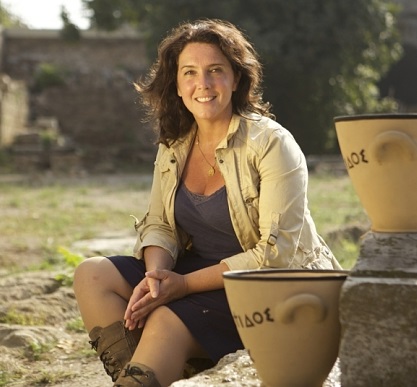
I’ve been listening to this wonderful new series by the always delightful historian and documentarian Bettany Hughes, as she delves into the origins of philosophy.

She tells us the story of three ancient thinkers who remain among the world’s most influential: the Buddha, Socrates, and Confucius. These men, who all lived within one hundred years of each other, formulated their groundbreaking philosophies at a time when new technologies in food production, housing, and travel allowed human beings, for the first time, to form sophisticated, specialized societies. This enabled people to spend a lot less time devoted to mere subsistence and to divert much of their energies into the arts, into thought, and into figuring out how the world works. It also made people ready and able to think of life as something they could improve and control, not merely subject to the whims of nature and of capricious, mysterious gods.

Hughes is not only enamored with these three great thinkers because they are fascinating in their own right, but because she thinks of philosophy as I do: a deeply practical pursuit, in which we puzzle out how to go about living as good a life as we possibly can, as individuals and as societies. As I’ve heard her say, we need to bring philosophy back to the street where it began, where Buddha, Socrates, and Confucius first confronted the world with their ideas, and where it also belongs.

Check out the series, which originally aired on the BBC, here:
https://www.youtube.com/watch?v=MCv20Z1q7eI
https://www.youtube.com/watch?v=N2cI9LfKKqo
https://www.youtube.com/watch?v=_zfENJlVz-g

Second Day in Paris Following Thomas Paine, Mary Wollstonecraft, and Thomas Jefferson, Part 1

22 rue Meslay, Paris. Mary Wollstonecraft may have lived here at Aline Filliettaz’s house from December 1792 through June 1793. See update to the search for the Filliataz house

Monday, August 10th, 2015

I get up at a decent hour, though of course not too early: I discovered early on when I began to travel in earnest that proper rest is essential for clear thinking, map-reading capabilities, and the good humor necessary for enjoying the day.

Since there’s such a huge number of sites to visit on my itinerary, I’ve decided to visit them in an order determined not by subject nor in any kind of chronological order, but by proximity to one another, so I can better cover them all.

I make my way from my temporary digs on Boulevard Voltaire up toward Republique, then make a soft left and head for 22 rue Meslée (now called the rue Meslay). Mary Wollstonecraft lived here at her friend Aline Filliettaz’s house from December 1792 through June of 1793, shortly after arriving in Paris. Wollstonecraft was full of hope for the Revolution and longed to be a part of it, and thought that the humanitarian and egalitarian Enlightenment principles she espoused were more likely to take hold there before they would in her home country of England, as they had (to an extent) in America. By the time she arrived in Paris, she was a self-made woman, a governess and schoolmarm who had become the bestselling author of two progressive and highly influential books, A Vindication of the Rights of Men, 1790 (a scathing rebuttal to Edmund Burke’s Reflections on the Revolution in France) and A Vindication of the Rights of Woman, 1792.

In fact, her Rights of Men was published the year before Paine’s Rights of Man, which was also a response to Burke, but Paine’s became the most famous by far. However, Wollstonecraft held her own with Rights of Woman, as it’s now widely considered the founding work of modern feminism. Wollstonecraft was lonely and blue when she first lived at this house, since her hosts were away and the servants behaved haughtily and uncooperatively towards her, but she soon cheered up when she began to get out more and hang out with her expatriate friends and their Parisian social circle. (More on that soon.)

Building where 22 rue Meslay is now located in Paris, France

The Fillattaz house is on a little side street in the Marais district, near the medieval Temple where the royal family was held during the French Revolution, before the King was guillotined in December of 1793 and Marie Antoinette was sent to the Concierge. Wollstonecraft wrote in her account of this period in her life that she saw the King being taken from the Temple prison to his trial at the Hôtel de Ville, where the Convention Nationale was held, from her window at this house. See update to the search for the Filliataz house

By the way, it’s important to make this point at the beginning: as is the case with all private residences and some other sites I visit during this tour, unless I can find a clear indicator of the history of the building (in accounts I have access to, on plaques, on cornerstones, etc), it’s very possible that I may not have found the exact location, especially if it’s not a public building with a clearly documented history. Many of my sources list an address without specifying whether it’s the modern address or the historical one and numbers change over time, and some streets are re-routed or disappear entirely, as do many of the original buildings, and records are not always consistently kept or may have been lost in the intervening years. Since my subjects were all here well over two centuries ago, it’s likely that at least a few of these locations are approximate, rather than the exact sites, despite my best efforts to discover them. This is especially true of Mary Wollstonecraft since she’s the only one of my subjects who never held public office or had any government appointments.

Courtyard behind 22 rue Meslay

63 rue Faubourg St-Denis, Paris, France. It’s the right address but not actually the site of Paine’s once-time residence, since the address had changed since his time. You can the story of how I find the true site here.

For example, poking around for historical details of the rue Meslay, I found that George Sands was born on that same street, and the address was 15 in her time, 46 now. I didn’t find any info as to whether Wollstonecraft’s 22 address is the new one, old one, or just that same address in different sources, but since she described seeing the King’s carriage pass by her window on the way to trial, it may be that the Filliettaz house was further up the street, in a taller building or at a higher elevation, so that she could see as far over as Boulevard Saint-Martin, the next street over and the route he would taken. But another source describes the house as having six stories, and the house now at 22 matches this description.

If I have time, I might swing back over there for further explorations since the place I’m staying now and the place I’ll be staying when I return to Paris (I’ll be joining my husband Bryan tomorrow for a quick family visit to Berlin, then to Saint Quentin en Yvellines where he’ll commence the Paris-Brest-Paris cycling event) are not too far away.

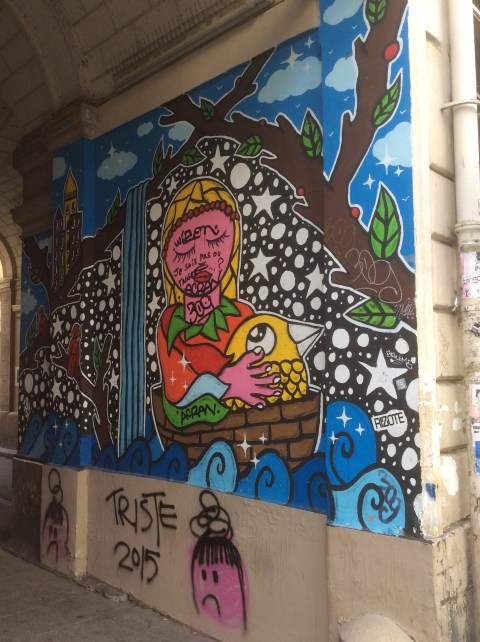
A mural on a wall on rue Faubourg St-Denis

Next, I head for 63 rue Faubourg St-Denis, at rue des Petits Ecuries, where Thomas Paine moved in 1793 to share the ground floor of a ‘mansion farmhouse’ with six friends. Paine wrote in glowing terms of the lifestyle there, and they had farm animals and grew fruits and vegetables, as that area was still pretty rural, and they would romp in the garden to take their minds off the tumult and violence in Paris. He was living here when he, with a committee of nine others, drafted a new constitution for France, though this one was unsuccessful: the Girondin faction which Paine worked with were moderates, while the radical Jacobins were gaining power and, over time, took over the Revolution entirely, instituting the Reign of Terror. (See update on the search for the rue Faubourg Saint-Denis house).

It’s unlikely that any part of the building that stands here now is original, either in whole or in part, given Paine’s description of it, and the current address may not the same as the historical one [this turns out to be the case]. The only fruits and vegetables to be obtained here now are from the colorful produce shops that line this now urban, rough-around-the-edges but vibrant and colorful part of the city. I think this neighborhood is wonderful, and it reminds me in many ways of the Mission district of San Francisco before it became mostly taken over by hipsters and tech people.

A view of rue Faubourg St-Denis

At 101 rue de Richelieu, Paris, France.

Next, I head down to rue de Richelieu in search of the place where Thomas Paine moved in with James Monroe’s family in November 1794. Monroe had finally secured Paine’s release from his eight-month imprisonment at the Luxembourg (I’ll return to this subject after I’ve visited that palace-turned-prison-turned-Senate house). Paine lived with the Monroes for about 2 years, not all of them here, since they moved more than once. At the time of his release, they lived at 101 rue de Richelieu, which begins at Bd. Montmarte where it meets Bd. Poissonere, in the 2nd Arrondissement.

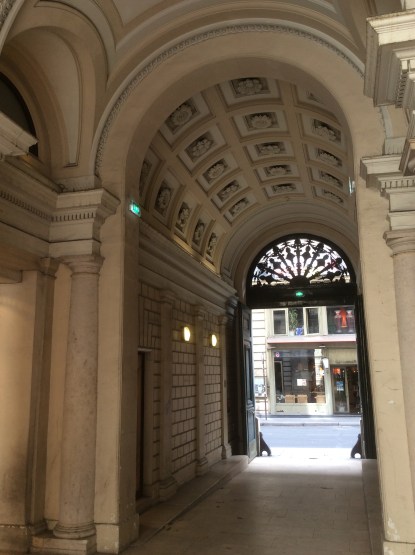
At 101, I find a classy place, fit for an honored foreign dignitary, with a lovely courtyard with a lovely arched entryway, updated with a modern reflecting pool. Again, I’ll return to this street soon for further explorations, which will be easier next time since I’m now getting very familiar with this corner of Paris, and as I find more source material with which to confirm whether the numbers have changed. (See update to the search for the Monroe house on rue de Richelieu.)

Courtyard at 101 rue de Richelieu

An entryway to 101 rue de Richelieu

When Paine was released from prison, he was broken down in health and spirits: he had nearly died from typhus, and he had an open ulcer on his side that wouldn’t heal. He had also felt that his American friends in high places had deserted him, not doing what they could to rescue him from his predicament. He was especially upset with Gouverneur Morris, the ambassador (then ‘Minister Plenipotentiary’) to France at the time, and with president George Washington. Morris was the primary author of the preamble to the United States Constitution as well as many of its other sections and he was an able statesman, but the French government lacked confidence in him; he was recalled after they repeatedly requested he be replaced by another. From their writings, it appears that Paine and Morris alternately liked, respected, and loathed one another. Morris often writes very sarcastically about Paine, and though I’m quite the Paine fan-girl, I find some of his remarks very funny and witty, though others are just plain bitchy and catty.

While Paine did offer valuable assistance to Monroe (Morris’ replacement) in his role as the new American ambassador, Paine was at this time also, as an aftereffect of his imprisonment and disillusionment with the French Revolution, given to depression, anger, and paranoia, and as a result of all of these, binge drinking. He was to acquire a reputation as an alcoholic, but since these accusations came almost entirely from his political enemies during and after his lifetime, this characterization is suspect. His friends and colleagues describe him as a social drinker, wont to make merry in the evenings and engage in enthusiastic discussions about politics, science, and philosophical topics as long as anyone was willing.

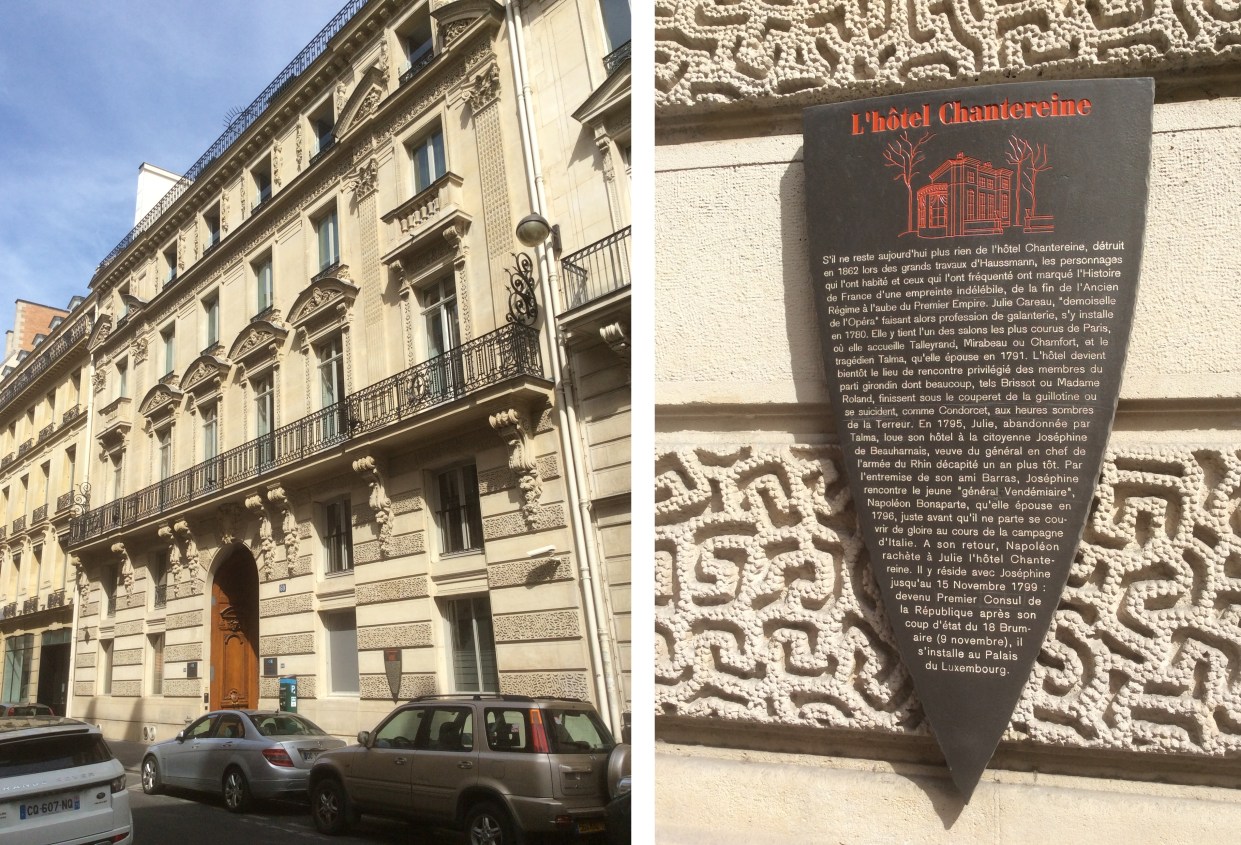
I next head north to rue Taitbout and turn left on rue de la Victoire, and go to the grand house at 60 rue de la Victoire, which was 6 rue Chantereine in Paine’s time, in the 9th Arrondissement.

60 rue de la Victoire, once 6 Rue Chantereine, former Home of Napoleon and Josephine Bonaparte

It was likely in this house that Paine attended a party thrown by Julie and Francois-Joseph Talma in October 1792. The house was owned by Mrs. Talma, formerly Louise-Julie Carreau, and she held a famous salon here. Her husband was a well-known actor and passionate Revolutionary, friends with Jacques-Louis David (who, I was surprised to discover was among those who voted in favor of executing the King) and Napoleon Bonaparte, who moved into this house in 1796 with his new wife Josephine). Like Paine and Wollstonecraft, the Talmas were Girondinist in their sympathies, yet there was a ruckus between Paine and other attendees of the party, many of whom had begun to turn on this once-beloved muse and author of two revolutions.

Two Details of 60 rue de la Victoire, former Home of Napoleon and Josephine Bonaparte

The history of the French Revolution is, among other things, a prime example of how people, even as they see themselves pursuing the same lofty goals and are members of the same political party, just can’t seem to avoid petty infighting. This sort of thing undermines so many important projects, and as we see all too often, petty disagreements can devolve to self-righteousness and even blind radicalism over time. French culture, in that era especially, placed a high value on ‘sensibility’, valuing the free expressions of both raw and cultivated emotions. As we have also seen in the French Revolution, unbridled passion was very often allowed to trump reason. To Paine’s dismay, he watched the beloved Enlightenment campaign for rational democratic government, that he served so enthusiastically and so well, turn into a bloody campaign of vengeance and terror.

View of Église Notre-Dame de Lorette from Rue Lafitte, Paris, France

Side view of Opera Comique, Formerly Theatre Des Italiens

It was very near this place that Thomas Jefferson moved for awhile, eight years earlier in October 1784, on the cul-de-sac (impasse) Taitbout off rue La Fayette near rue St Georges. He signed a long-term lease at Hotel Landron, also called Hotel Taitbout, but only ended up living here for about one year. I explore this area very thoroughly, peeking into every courtyard, driveway, and byway I can find, but a hotel by this name is nowhere to be found so far as I can see. (By the way, ‘hotel’ wasn’t used in the same sense as we use it today: It could refer to a grand house or a large public building.) This area is very near where I’ll be staying next week, so I’ll return if I find more leads, and I’m looking ever more forward to doing so, it’s such a beautiful neighborhood.

Jefferson was an avid patron of the arts, and attended the theatre often while living in Paris to see plays and musical performances. He often went to the Theatre des Italiens, very near his Taitbout place on Boulevard des Italiens. There is no theatre today with that name, but I find Opera Comique in just about the right place. Could this be the same building? The building appears to be of the right vintage. I look into it, and sure enough, it is! It’s in the process of getting a facelift and a good cleaning, but the side entrance is in good repair and attractive with its lovely cast iron lacy canopy.

Opera Comique, formerly Theatre Des Italiens, Paris, France, under repair

I still have many sites I’ll be visiting throughout the course of the day, so I’ll take a break here.

To be continued in Part 2:  >>>

~~~~~~~~~~~~~~~~~~~~~~~~~~~

Sources and inspiration:

Adams, William Howard. The Paris Years of Thomas Jefferson. New Haven/London: Yale University Press, 1997.

Bell, David. ‘5 Myths About the French Revolution‘, New York Post, Jul 9th, 2015.

Gordon, Lyndall. Vindication:  A Life of Mary Wollstonecraft. New York: Harper Collins, 2006.http://www.harpercollins.com/9780060957742/vindication

Grossman, Ira. ‘The House on the Rue de la Victoire
Jacobs, Diane. Her Own Woman: The Life of Mary Wollstonecraft. New York: Simon & Schuster, 2001.

Jacoby, Susan. Freethinkers: A History of American Secularism. New York: Owl Books, 2004.

Nelson, Craig. Thomas Paine: Enlightenment, Revolution, and the Birth of Modern Nations. New York: Viking Penguin, 2006.

Todd, Janet. Mary Wollstonecraft: A Revolutionary Life. New York: Columbia University Press, 2000

Tomalin, Claire. The Life and Death of Mary Wollstonecraft. London: Weidenfield & Nicholson, 1974.’

French Revolution.’ Wikipedia, The Free Encyclopedia., Jul. 17 2015.

Williamson, Audrey. Thomas Paine: His Life, Work, and Times. New York: St. Martin’s Press, 1973.

On Jonathan Webber’s Discussion on Deception With Words: Honesty in Public Discourse Part II

I’ve been thinking quite a bit on the subject of lies, deception, and public trust since I wrote about some recent high-profile cases of deceivers in the media.

I recently gave Jonathan Webber’s podcast interview on Philosophy Bites ‘On Deception With Words’ a second and more attentive listen. I remembered that something he said struck me as not quite right. I agree with him on the importance of honesty in general, yet I take issue with his position on lying versus deceiving. In this discussion, as Webber defines the terms, lying refers to telling a brazen untruth, and deceiving refers to implying an untruth without specifically stating one.

When host Nigel Warburton asks Webber which of the two is worse, morally speaking, Webber answers (at about 5:15):

‘I think that lying is worse… well, more precisely, I think that we ought to have the attitude that lying is worse. So we ought to treat liars more harshly than we treat people when we catch them misleading us… I think the difference is that lying does more damage to your credibility than misleading does. The way we work as human beings, as a community of people, is that we exchange information all the time, that’s one important part of the way we work, and in order to do that, we need to be able to rely on each other as informants. So we need one another to be credible. I need to be able to believe what you say, and you need to be able to believe what I say.’

I disagree with him on this point for the same reason I think that, in comparing the lies and deceptions of Brian Williams, Bill O’Reilly, and Rush Limbaugh, Limbaugh is the one who systematically betrays the public trust in the worst way. It’s because he not only lies fairly often, blatantly telling falsehoods about facts of the matter and about the opinions of the people he disagrees with, but he also misleads by a bait-and-switch tactic of relying on his self-bestowed credentials as a truth-teller in one moment, and then at other moments falls on his credentials as an entertainer who misrepresent, exaggerates, and distorts for the purposes of entertainment or to make a wider point. He does this at will, without making a distinction at any given time which he’s doing. This not only reflects on his general credibility as a reliable truth-teller: it harms his audience more by making it that much more difficult to tell the lies from deceptions from truths. It creates a situation that his audience, which he invites to trust him, can’t tell when they’re being misled.

So to me, in general, making a moral distinction between lies (brazen untruths) and deceptions (implied untruths) is not very helpful, especially the attempt to say that one is generally more wrong than the other. For one thing, lies and deception are used for the same purpose: compare it to a claim that it’s more wrong to commit murder with a hammer than with an axe, and you’ll see where the problem lies. But even if Weber is right, and the most important moral factor is the credibility of the speaker, I don’t think he demonstrates that lying does, in fact, damages credibility more. As we see in my Limbaugh example, it seems that deception can and often does do more to damage credibility, because it gives the speaker a weaselly ‘way out’ or plausible deniability which allows him to evade any and all personal responsibility for causing the listener to believe something untrue.

More than damaging the credibility of the speaker, however, I think that deception can be worse in many cases because the harm done to the listener can be more egregious. For example, a blatant lie can more readily be identified and fact-checked by the speaker. A deception, however, is not always so easily fact-checked, and in fact, can’t always be identified as the conveyor of untruth that it is. That’s because, as Webber points out, deception is usually done through implicature, exploiting the linguistic tool of leading the hearer to believe the speaker means one thing when he says another. The very indirectness of the

I’m not the least bit Pollyanna-ish about lying. Like most people, and I would claim like most morally committed people, I think there are times when lies and deception are permissible, and times when dishonesty is the only right way to go. I would usually not tell the truth about the proverbial dress that makes the wearer’s butt look too big (though given the fashionableness of curvy posteriors now, this could be taken as a compliment!), and I would lie my head off to lead the proverbial Nazi stormtroopers away from the Jewish family hiding in the closet. That’s because communication, in these instances, is only a tool to accomplish valuable ends, in these cases easing the mind of the insecure dress-wearer, and saving lives from murderous thugs.

So here’s where we get to why I think Webber is mistaken about the relative wrongness of lies and deception: if language is only the means, and the end if its use is to convey truth to the listener, than it wouldn’t make much sense to say that lies and deception, as two means of conveying untruth. are generally morally distinct. It seems to me that the rightness or wrongness of what’s said is entirely contingent on the moral value of its purpose, and if a lie or a deception is wrong, we can judge how wrong it is based on how effectively it undermines the public trust, and how injurious it is to the hearer’s need to know the truth of the matter.

~~~~~
Sources and Inspiration: 

Webber, Jonathan. ‘On Deception With Words’. Philosophy Bites podcast interview March 01, 2015.
http://philosophybites.com/2015/03/jonathan-webber-on-deceiving-with-words.html