New Podcast Episode: To New York City I Go, in Search of Margaret Sanger

margaret-sanger

Listen to this podcast episode here or on Google Play, or subscribe on iTunes

Hello, friends of Ordinary Philosophy!

From time to time, I take a trip to some corner of the globe, to explore the lives and ideas of great thinkers in the places where they lived and worked. For this series, I follow in the footsteps of thinkers who are no longer alive, since those who are still telling their own stories. But those who are no longer alive in the body live on in the ideas that they pass on, and in the examples they provide for us to follow.

I’m pleased and excited to announce my sixth philosophical-historical themed adventure, a rather impromptu trip to New York City to follow in the footsteps of Margaret Sanger.

Though the timing was spur of the moment, I’ve read and thought about Sanger quite a bit over the years and have some of the research done already for this long-planned trip. So when this little window of time opened up in my schedule, I happily seized the opportunity! As central to the history of women’s rights, free speech rights, and rights to sexual self-determination and privacy as she is, Sanger’s also the most problematic figure in the history of ideas I’ve followed so far for this series, with the possible exception of the brilliant but slave-owning Thomas Jefferson. She’s certainly the first that sparked immediate controversy when I casually mentioned my plans for following her on social media…. Read the written version here:

Ordinary Philosophy and its Traveling Philosophy / History of Ideas series is a labor of love and ad-free, supported by patrons and readers like you. Please offer your support today!

Margaret Sanger NYC Sites, Day 1 Part 2

The Chrysler Building at Lexington and 42nd in Manhattan, NYC

The Chrysler Building at Lexington and 42nd in Manhattan, NYC

Tuesday, October 18th, 2016, continued

Let me preface this second part of the story of today’s journey with full credit and a note of gratitude to Robin Pokorski, who worked with The Margaret Sanger Papers Project for a time. As with the MSPP overall, I found Pokorski’s project Mapping Margaret Sanger to be an absolutely invaluable resource. I’d made somewhat of a study of Sanger’s ideas over the last couple years but had not yet done the site research as of the time the opportunity to take this trip arose. With little time to prepare, imagine my joy and surprise when my research led me quickly to someone who had already done the mapping work! So I relied heavily on Robin’s work for all of the travel portions of this project. Please accept my sincerest thanks, Robin, wherever you are, and here’s to your continued success in all you do!

405 Lexington entrance to the Chrysler Building

405 Lexington entrance to the Chrysler Building

…I exit Grand Central Station, where I’ve just returned to Manhattan from the Sanger clinic site in Brownsville, Brooklyn. I follow the signs to the exit which lets me out right underneath the Chrysler Building, which stands at 405 Lexington Ave, just north of 42nd St. I’ve long been curious about this building but for one reason or another, had never made it here. It’s fully as handsome on the outside and lovely on the inside as I’ve heard. It shoots up to the sky enthusiastically and towers overhead with almost aggressive confidence and optimism. I love its Art Deco style, and I’m excited to see all the wonderful architecture and art of this period that this trip will take me to. I only wish I had a good enough camera to capture the details of the rather dimly glowing interiors. But I sacrifice camera quality for portability, and my iPad takes decent enough photos for the most part while also acting as my notepad, several books, laptop, maps and atlases, and more, all in one object the size of a slim novelette when it’s in its case. It’s just not good with low to medium interior lighting. Oh well. I love to not be heavily laden with lots of things to shuffle around.

Pokorski writes, ‘At 4.30pm on April 20, 1939, Sanger met with Bill Melon at the Chrysler Building.’ I have not been able to discover who Melon was or why she met him here yet; I await her response to my inquiry.

Elevator door in the Chrysler Building, Manhattan, NYC

Elevator door in the Chrysler Building, Manhattan, NYC

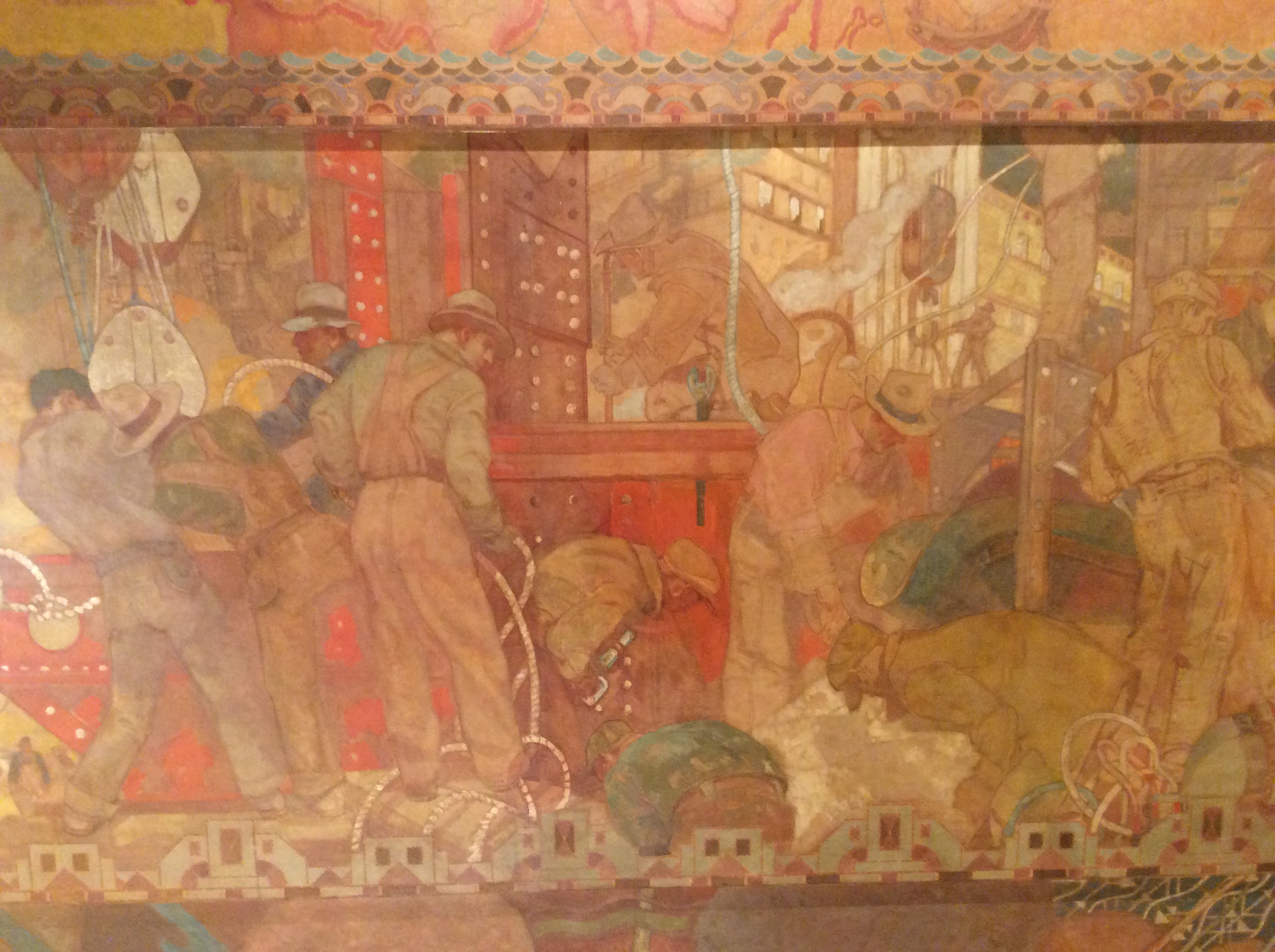
The walls of the lobby are lined with a beautiful wavy-patterned stone in shades of amber, rust, brown, and cream. It’s like entering into a semi-translucent, richly colored semi-precious stone held up to the early evening light. The ceilings are painted over with beautiful murals. Actually, as a sign on the wall tells me, these images are huge paintings on canvas which were subsequently glued into place. One of these murals is called ‘Transport and Human Endeavor’ and painted by Edward Trumbell. Sanger was a Socialist and worker’s rights activist for many years before she turned her focus to birth control, advocating for better workers’ protection laws, especially for women and children. She may have admired the mural’s beauty while scoffing a bit at its idealized depiction of labor.

As Sanger pointed out in Woman and the New Race, many working men enjoyed much better protections than women and children, especially those men who belonged to labor unions. But the relative paucity of workers’ protection laws and the abundance of men, women, and children desperate for jobs often made it unnecessary for employers to offer competitive wages or provide decent working conditions, and the situation of many working men, as well as that of working women and children, remained dire. It was the era of Lochner vs. New York, when ‘freedom of contract’ reigned supreme in court decisions regarding labor law and the regulation of commerce generally. Of course, the freedom of contract principle assumes that both employers and employees enter into contracts of their own free will, and therefore should have the right to do so. It’s quite easy to recognize, however, that this ideal bore little resemblance to the actual relationships between so many employers and the laboring poor Sanger worked on behalf of. It’s hard to see where free will comes in when the choice is between working backbreaking hours in miserable conditions, or starvation and homelessness for yourself and your family.

the-golden-glow-of-the-chrysler-buildings-agate-like-interior-2016-amy-cools

The golden glow of the Chrysler Building’s agate-like interior

Transport and Human Endeavor ceiling mural by Edward Trumbell. Margaret Sanger was a Socialist and worker's rights activist in her earlier years, and may have admired this mural's beauty while scoffing at its idealized depiction of a factory worker's place of employment

Transport and Human Endeavor ceiling mural by Edward Trumbell.

101 Park Ave entrance at former site of Manhattan Eye and Ear Hospital, NYC

101 Park Ave entrance at former site of Manhattan Eye and Ear Hospital, NYC

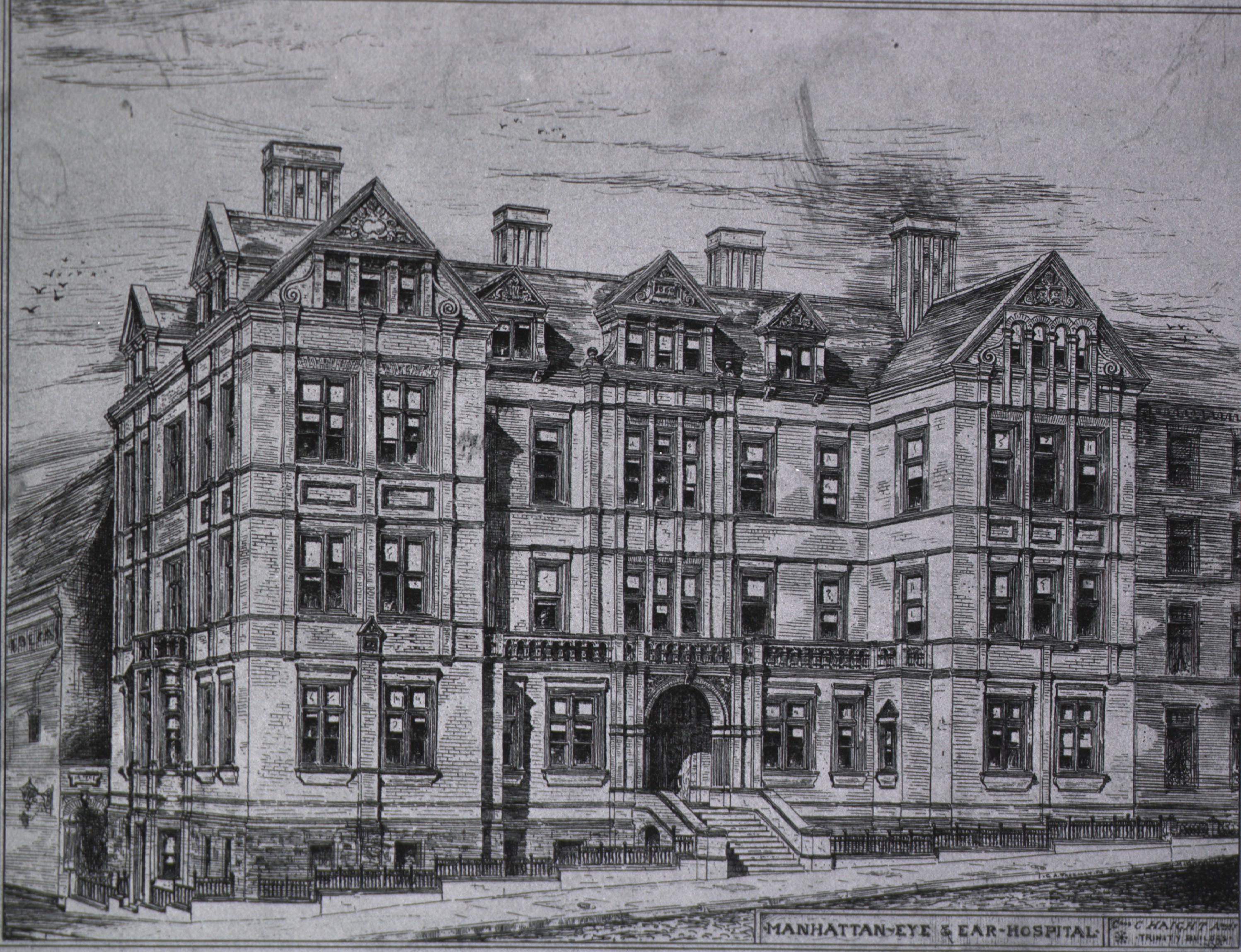
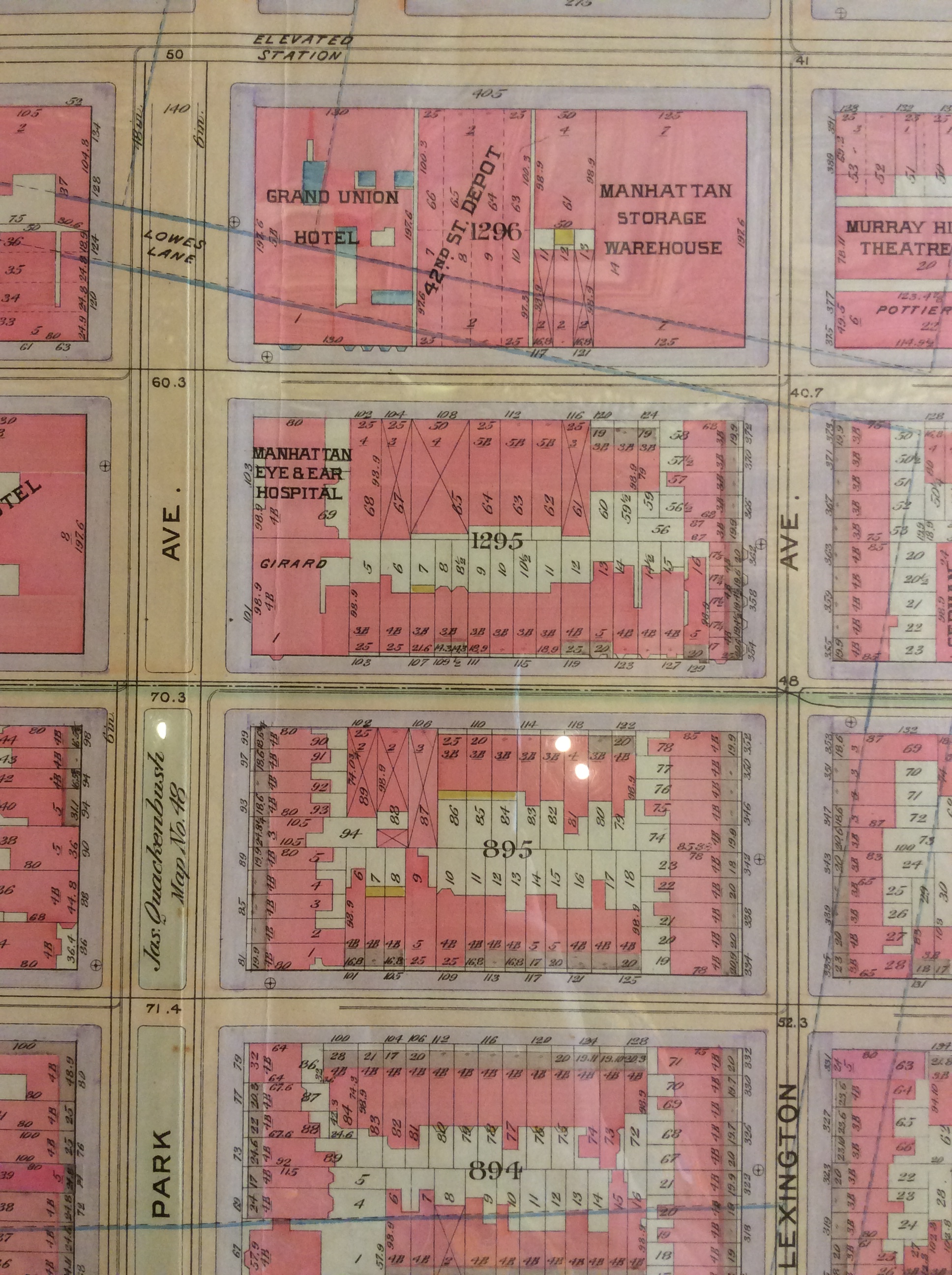
I leave the Crysler Building, then head west and south over to Park Avenue & E. 41st Street, also close to Grand Central Station, to the site of the Manhattan Eye and Ear Hospital where Sanger worked in 1902 to complete her training as a nurse. A gleaming glass highrise named 101 Park Avenue, after its address, now stands at the hospital’s former site. Sanger welcomed her assignment to this modern, well-run establishment after her ‘harsh and intense’ two years at White Plains Hospital.

It was here that she met William Sanger, her first husband, and as she put it, her ‘lover for all the world’, though their marriage didn’t last. He was a fine artist and architect, and their courtship began almost immediately after William visited the hospital with plans for the doctor’s home he was designing. The Sangers shared an intense passion for a time, and a happy marriage for a while. They had three children together, one of which died as a small child, and Sanger relished the early experience of motherhood. But over time, their marriage, which had taken them to quiet suburban Westchester, grew strained: William wanted to make a career as an artist and was often impractical about money; Sanger was discontent with the humdrum routine of domestic life after her years as a working nurse. They moved back to New York City and became active in the Socialist movement and bohemian Greenwich Village scene, and Sanger returned to her nursing career, this time in service to the poor and immigrant inhabitants of the Lower East Side. The differences in the way they wanted to live their lives proved too great over time, however, and they gradually split, finalizing their divorce in 1921.

Manhattan Eye and Ear Hospital. Photo courtesy of NIH's US Library of Medicine

Manhattan Eye and Ear Hospital. Photo courtesy of NIH’s US Library of Medicine

Bromley's 1902 atlas showing location of Manhattan Eye and Ear Hospital, from the maps collection of the NY Public Library

Bromley’s 1902 atlas showing location of Manhattan Eye and Ear Hospital, from the maps collection of the NY Public Library

William was a brave and loyal partner to Sanger, at one time jailed on her behalf by Anthony Comstock in 1915 for obscenity. Comstock, a special agent of the U.S. Postal Service who helped craft laws to zealously enforce his own strict views on public morality, tricked William into handing over, or in Comstock’s words, ‘distributing’, one of Sanger’s pamphlets on reproduction, health, and birth control. It included a description of two venereal diseases, gonorrhea and syphilis, and Comstock had helped make it legally obscene to name these diseases as well as to tell women how they could prevent pregnancy with any method other than abstinence, even in the context of a health care pamphlet. After arresting William, Comstock offered him a choice: he could tell him where Margaret Sanger was hiding out (she had fled to Europe the year before to avoid prosecution) or he could stand trial. William opted for the latter and was jailed because he refused, on principle, to pay the fine.

Over the years, Sanger regretted the way her relationship with William fell apart, blaming herself for much of what went wrong though she also thought she could have done little else. She wrote a very tender letter to him in 1919, directing that it be given to William after her death. Since she outlived him by five years, he never read it. She wrote,

Margaret Higgins Sanger (1879-1966) birth control activist, sex educator, and nurse, with her eldest son Stuart, public domain via LOC

Margaret Sanger with her eldest son Stuart, public domain via Library of Congress

‘…My life seems to have been in the hands of forces I could not control. My early days at the hospital seemed so hard & cruel at the time, but today I see how necessary they were for the accomplishment of the work I am doing today.

My marriage to you and our love and the coming of the children, the saving for a home — the building of the house — the seeking, shifting, changing, interesting life all today have meaning & full value to me in this cause of humanity to which my life is dedicated.

Often I have felt your loneliness & sorrow — often I would like to seek you & fling my arms about you & hold your aching head to my heart to tell you of my tenderness for you and my love — but — Forces stronger than physical desire — stronger than personal love held me to my task to the work I have undertaken to do. But I want you to know this — for I have told it to many — that you are to me the lover of all the world — Your love for me beautified my life and made possible the outlook on love & passion & sex — which has given me the courage & strength to go forth to do.

For this I owe you much and though my love for you is big & broad & tender it is the same today as when first we decided to go the path of life together. It has never changed. Sometimes I think it was not to be that I should love too intensely…’

You can read this letter in full, and a brief but very good account of the talented and principled William Sanger, at this website dedicated to his art and legacy.

Then I go to the lovely New York Public Library, where I request a copy of Ellen Chesler’s biography of Sanger. Since it’ll take about 30-45 minutes and I’ll need some time in the maps room, I decide to come back tomorrow and stay awhile.

 280 Madison Ave, Manhattan NYC, 2016 Amy Cools, and as it was in 1945 by Wurts Bros, courtesy of the Museum of the City of New York

280 Madison Ave, Manhattan NYC, my photo on the left, and to the right, as it looked in 1945. Photo by Wurts Bros, courtesy of the Museum of the City of New York

I head one block to the southwest to 280 Madison Ave at E 40th St, where, Pokorski notes, Sanger lived for a short time. She ‘moved from 280 Madison Avenue in late April, 1931, [and it’s] uncertain when she moved in or where she moved to’. The building looks more or less the same as it did then, according to a photo (above) of the same building in 1945, except that the ground floor has had a new ‘face’ put on at some point, of straight bands of gray-tan stone instead of the arched arcade it once featured.

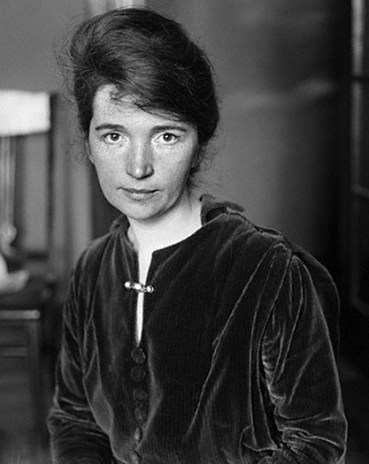
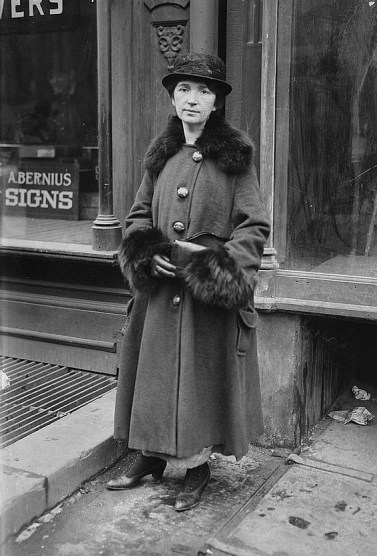
Margaret Higgins Sanger, Jan 1916 by Bain News Service, public domain via LOC

Margaret Higgins Sanger reading, Jan 1916 by Bain News Service, public domain via Library of Congress. I found a photo of Sanger at about the time she lived here at 280 Madison, but it’s not public domain. You can find it at Getty Images

Sanger was almost certainly living here when she published her ‘Comments on the Pope’s Encyclical‘ in Birth Control Review in February of 1931, and probably wrote it here, too. It’s a succinct version of at least two much longer critiques of Pope Pius XI’s Dec. 30, 1930 encyclical Casti Connubii. I’ll explore many of the ideas contained in Casti Connubii as well as Sanger’s responses to it in the context of her ideas about human sexuality and social welfare in another piece I plan to publish very soon. Sanger’s three main points, as contained in her brief ‘Comments’, are as follows. 1) The Pope never explicitly commands his followers to have as many children as they can, contrary to the beliefs of many who oppose family limitation. That’s a good thing, because even if  God exists and actually commanded the human race to “Increase and multiply and fill the earth,” that commandment has been fulfilled already. Now it’s up to us to make sure to have enough room left over to give the multitudes that exist a happy and healthy life. 2) While the Pope is correct that both love and procreation are two of the primary purposes of marriage, the latter is not essential to it. People often marry who can’t have children, and people remain married when they can no longer have more and their children have left the home, no longer requiring support. Clearly, marriage has many other purposes, which is also true of sex itself. Therefore, the Pope is wrong to propose an inextricable link between sex, marriage, and procreation. 3) The Pope declares that birth control is wrong because it frustrates nature. Yet so does abstinence, which the Pope recommends, to say nothing of the numerous ways we frustrate nature every day: shaving our faces and cutting our hair; eradicating germs with soap, water, and medicines; building shelters to protect ourselves from the natural elements, and so on. Civilization itself is one giant web of ways in which we frustrate nature or bend it to our will. The latter argument, as is evident from her sarcastic tone as well as from her other critiques of this encyclical, Sanger considers downright silly.

There are several more sites I visit today and since so there’s much more to tell, I’ll break here, and pick up my tale shortly. To be continued….

Listen to the podcast version here, on Google Play, or on iTunes

Ordinary Philosophy and its Traveling Philosophy / History of Ideas series is a labor of love and ad-free, supported by patrons and readers like you. Please offer your support today!

~~~~~~~~~~~~~~~~~~~~~~~~~~~

Sources and Inspiration:

About Sanger: Biographical Sketch‘, from The Margaret Sanger Papers Project at New York University.

Anthony Comstock‘. In Wikipedia, The Free Encyclopedia.

Chesler, Ellen. Woman of Valor: Margaret Sanger and the Birth Control Movement in America. New York: Simon & Schuster, 1992

Eig, Jonathan. The Birth of the Pill: How Four Crusaders Reinvented Sex and Launched a Revolution. W.W. Norton & Company, New York, 2014.

Labor History Timeline: California and the United States by California Assembly Committee on Public Employees, via the Los Angeles Community College District website

Lochner v. New York, 1905‘, from Landmark Cases: A C-Span Original TV Series, 2015

Pius XI. Casti Connubii. Encyclical of Dec. 30th, 1930

Pokorski, Robin. ‘Mapping Margaret Sanger‘ from The Margaret Sanger Papers Project at NYU

Regan, Margaret. ‘Margaret Sanger: Tucson’s Irish Rebel.Tucson Weekly, Mar 11, 2004.

Sanger, Margaret. ‘Comments on the Pope’s Encyclical‘, Birth Control Review, Feb. 1931, 40-41

Sanger, Margaret. Margaret Sanger, an Autobiography. Cooper Square Press: New York 1999, originally published by W.W. Norton & Co: New York, 1938

Sanger, Margaret. The Pivot of Civilization, 1922. Free online version courtesy of Project Gutenberg, 2008, 2013

Sanger, Margaret. Woman and the New Race, 1920. Free online version courtesy of W. W. Norton & Company

William Sanger: About‘, from williamsanger-art.com

Wurts Bros. ‘280 Madison Avenue and 40th Street, S.W. corner. Office building.’ Photo, courtesy of the Museum of the City of New York

Why So Much Hatred for Margaret Sanger?

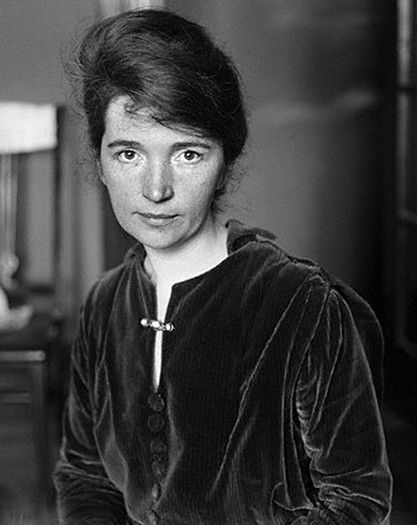
Margaret Sanger, photo probably taken Jan 30th 1917, photo courtesy of the Library of Congress

Margaret Sanger, photo probably taken Jan 30th 1917, photo courtesy of the Library of Congress

There’s been a widespread and concerted effort to vilify Margaret Sanger and remove her name from the public roll of great contributors to human rights history. In my research for the Sanger project I’m working on, I find scores of examples of this effort every single time I do an internet search using her name.

Last year, for example, Ted Cruz and some other conservative politicians called for her portrait to be removed from the Smithsonian’s National Portrait Gallery in Washington DC, where her portrait bust is included in the Struggle for Justice exhibition. In justification of his campaign, Cruz used part of a quote lifted from its original context and presented it as saying something nearly opposite of what it was originally meant to say. In a letter to a friend, Sanger expressed her worry that her birth control clinic project in the South might be misperceived and misrepresented as racist; Cruz lifted a few words from this very letter to ‘prove’ that it was. He may have borrowed this idea from Michael Steele, former chairman of the Republican Party, and Ben Carson and Herman Cain, one-time Republican presidential hopefuls. These three influential conservative men, in turn, likely received this bit of distorted wisdom, directly or indirectly, from Angela Davis and some others in the black power movement who, concerned that the reproductive justice movement might have ill effects in the long run on the empowerment of black people, (mis)represented Sanger’s words, works, and character in the worst possible light. The radical origin of the charges of racism against Sanger may surprise followers of these conservative political figures who have passed them along. And what was this purported insight into Margaret Sanger’s character? Why, that she was so racist that she wanted to exterminate the black race through preventing the conception of ensuing generations.

In my research and in early responses to my publications from my Sanger project I’ve also encountered frequent charges that she was a eugenicist, which is true, and in league with or at least sympathetic to Nazi beliefs, which is false.

So, let’s first consider Margaret Sanger’s beliefs and whether they justify her inclusion among the great American freedom leaders. Then, let’s consider her beliefs in the light of her own time and whether they deserve admiration today, on the whole, or are at least understandable given the circumstances of her time.
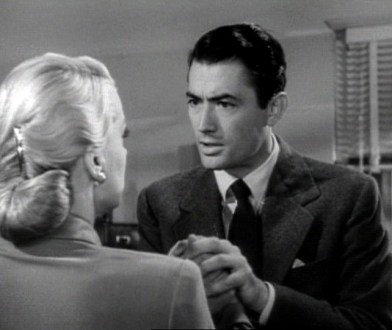
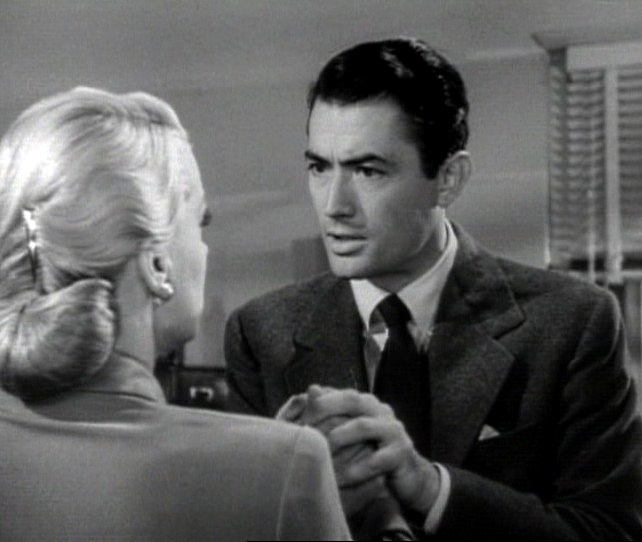
Gregory Peck and June Havoc in Gentleman's Agreement, public domain via Wikimedia Commons

Gregory Peck and June Havoc in Gentleman’s Agreement

As to Nazism, Sanger is actually an early and particularly vociferous opponent, much more so than many others in an America so rife with anti-Jewish sentiment in her time. I was surprised many years ago, in my late teens or early twenties, when I watched an old Gregory Peck movie (I’ve always been quite a fan of that talented and oh-so-handsome man) in which he played a reporter planning to write an exposé on the issue. To discover how prevalent anti-Semitism really was in America, his character Philip Schuyler Green goes undercover, putting it out there to his friends and colleagues that he was, in fact, Jewish, and had just never happened to mention it before. It doesn’t take long for his work and then his whole life to fall apart as he experiences terrible discrimination, his friends and colleagues turning against him one by one. At that time, I was surprised to learn that when Peck made this movie, anti-Semitism in America was enough of a thing that a major motion picture star would make a movie about it.

Theodore Roosevelt, American President and yes, a eugenicist too

Theodore Roosevelt, American President and yes, a eugenicist too

But Sanger is a eugenicist. This belief in the power of genetic inheritance to cure the ills of humankind by selectively breeding them out of existence was widely accepted at the time, even by such luminaries as our own President, Theodore Roosevelt. Eugenics is often divided into two types, positive and negative, and eugenicists are now often judged now by which of these they promoted. Positive eugenics is the idea that healthy, intelligent, hard-working, creative, and wealthy people should have more children so as to increase the stock of human beings who will, in turn, pass down desirable genetic traits. Roosevelt was a eugenicist of this sort. Negative eugenics is the idea that disabled, diseased, unintelligent, idle, and poor people should have fewer children so as to decrease the stock of human beings who will, in turn, pass down negative traits. The latter brand of eugenics can be further broken down into two camps, with differing ideas as to how it could be brought about: that decreased breeding of the ‘unfit’ should be entirely voluntary and encouraged through education, or, that it should be imposed by certain authorities. (Proponents of positive eugenics could also be broken down this way but I have yet to find an example of imposed human breeding of the ‘fit’, though Communist Romanian president Nicolae Ceaușescu’s policies on reproduction could conceivably be considered a sort of coercive positive eugenics).

Sanger promotes negative as well as positive eugenics principles, but as to whether she believes it should be voluntary or coerced, she’s incoherent at best. At times she’s opposed to any sort of official coercion, as in her many statements against the Nazis and in her stated principle that all human beings, women included and especially, should have the individual right and power to determine their own destinies. Yet she also often declares that since many people are incapable of rational judgment, including the ‘insane’ and the so-called ‘feeble-minded’, others need to make that decision for them. Though she criticizes the Nazis harshly for doing that very thing, she never makes it clear who should do the sterilizations, who should decide, and how coercive they should be if their ‘patients’ refuse. I believe she places herself in a moral dilemma in this matter. She so firmly believes in the power of eugenics to cure the terrible set of human ills that she encounters as a nurse that she wants it, no, needs it, to work. She’s well aware that most people would never consent to such a thing, be it for religious reasons or simply that most people, well or mentally ill, rational or not, naturally recoil at the idea that they should be sterilized because others think they should be. So how to cure these ills in the next generation, since Sanger knows there’s no way they could be cured in her own? That’s the dilemma that Sanger never successfully resolves.

Her vehement opposition to the Nazis goes back, first, to the race issue. One of her main criticisms of the Nazis is not that sterilization is a bad thing in principle, or even that the state might legitimately impose sterilization in special circumstances, such as in the case of criminally insane people (an idea we find abhorrent today but that many in Sanger’s time do not). It’s that the Nazis decide to ‘perfect’ the race along racial lines. To Sanger, this idea is both irrational and unscientific. In Woman and the New Race, she writes glowingly of the great wealth of contributions that people of all races and cultures have always brought and still bring to the world, and that much of the promise of future human greatness lies in this diversity. Since it’s clear that all races include people of great intelligence, health, and abilities, she believes that all races should be likewise bettered through eugenics, both positive and negative, and the latter only if and when necessary (though again, she’s incoherent on this point). Sanger is opposed to ‘human waste’, as she puts it, not only of human beings she considers physically and mentally ‘unfit’, but also the human waste of the lives of those children born in such numbers only to have many of them suffer terribly before dying early deaths, often taking their mothers with them; or permanently disabled by hard factory labor, malnutrition, and neglect; or shipped off as cannon fodder. She’s also opposed to the waste of human potential, of throwing away the great contributions, genetic and otherwise, of the best and brightest of all races to the human race as a whole. In this, she reminds me of Alexander Hamilton, who also argues against the waste of human potential inherent in race-based slavery.

It seems to me, in hindsight, that though many of her eugenics beliefs are founded on bad science, or rather, pseudoscience posing as science, they do not come from a malicious place. They form in the mind of a woman who cares enough about her fellow human beings to devote many years of her early adulthood nursing the poor immigrants in the slums of the Lower East Side of New York City, something few of us have the courage or the vision to do. Sanger is appalled by the suffering and privation she witnesses and desperately wants to help these people, especially the women and children who bear the brunt of society’s ills, but she recognizes that she and her fellow nurses don’t have a prayer of keeping up with the ever-growing need. And she realizes that even if they could keep up with the pace, they were only treating suffering that didn’t need to exist in the first place. She believes, over time, that she’s found the answer.

So given all of this, I ask again, why single out Margaret Sanger for such hatred? Why not call for, say, Teddy Roosevelt’s portrait to be taken down, or those of the many others who held problematic beliefs whose portraits hang, without challenge, on the National Portrait Gallery walls?

And why hate Sanger so much as to spread three major falsehoods about her, again and again and again, that have been so often and thoroughly debunked?

The first lie and second lies, as we’ve considered, are that Sanger’s a racist and a Nazi sympathizer. The other lie is that she’s pro-abortion. In fact, if we look at her writings, we find she’s more anti-abortion than anything.

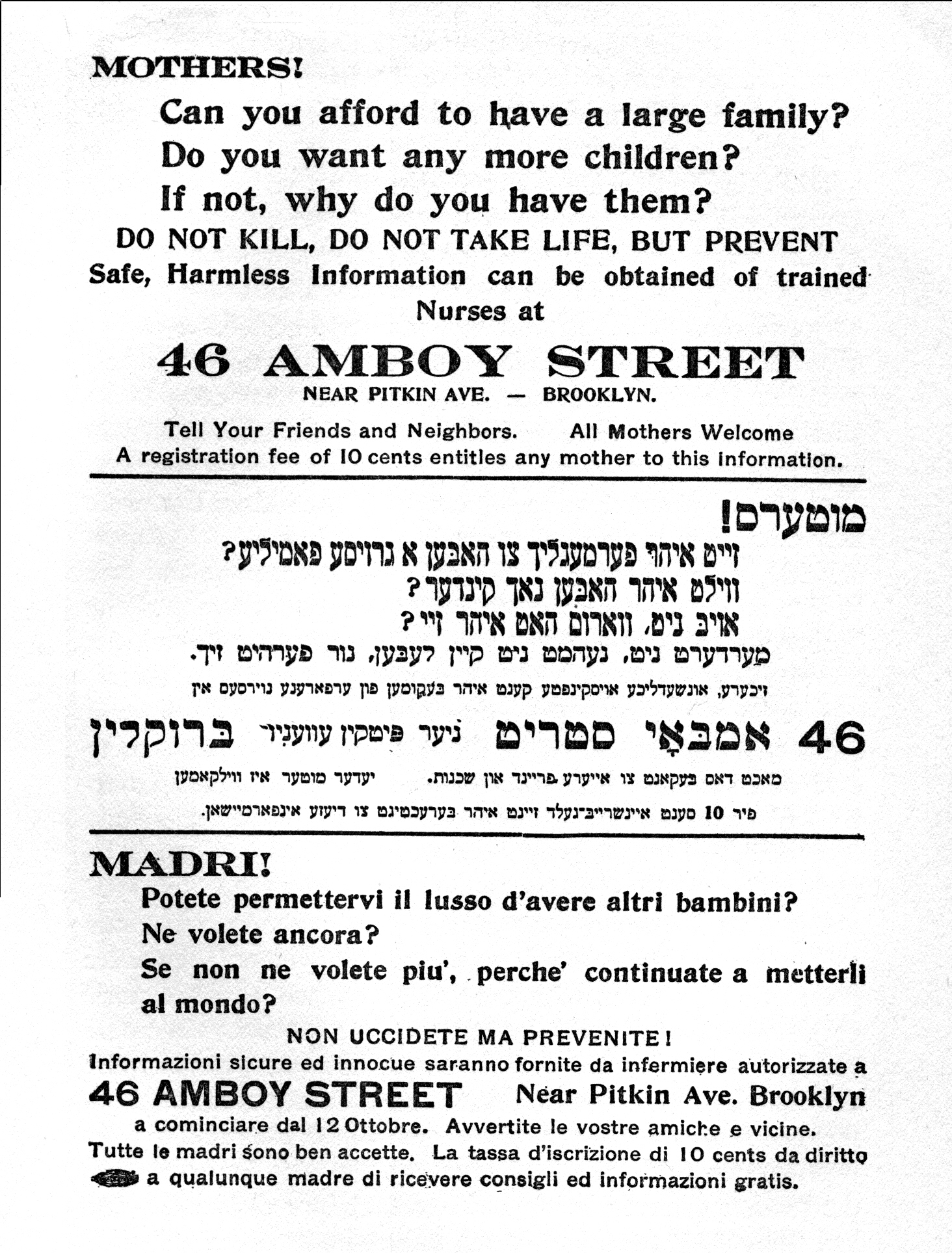
Flyer for Sanger Clinic, Brownsville, Brooklyn, image courtesy of the Margaret Sanger Papers Project

Flyer for Sanger Clinic, Brownsville, Brooklyn, image courtesy of the Margaret Sanger Papers Project

The fact that Sanger is opposed to abortion in most circumstances may surprise many people, especially many conservatives, though I believe the Sanger-as-abortionist lie is as prevalent and persistent as it is because her views on abortion are as politically inconvenient to many on the left, so they don’t trouble to contradict it. She does allow that there are some extreme circumstances in which it is permissible, such as to save the life of the mother (a standard we adhere to today), and she can’t bring herself to blame the women who resort to abortion out of desperation. It’s the Comstocks,the self-righteous anti-sex moralists, the Pope, priests, and bishops, the government, the medical establishment, and the exploitative labor system that cause abortions, not desperate women. They’re the victims. In fact, as you can see from the flyer for her groundbreaking birth control clinic, Sanger lists the prevention of abortion as one of the clinic’s primary purposes.

And yet, the hatred of Sanger rages unabated in so many quarters. There’s plenty to criticize in her eugenics beliefs, in fact, enough to make the three lies I’ve just discussed seemingly unnecessary if you feel the need to discredit her. Again, other people who have had a dramatic impact on our history, like her, are complicated and had some bad ideas, but no Cruzes, Steeles, and Cains are so vehemently, and I would say dishonestly, trying to undermine the validity of every part of their life’s work and demand that their legacy be erased from our public institutional memory. They’re not calling for the removal of the portraits of anti-Semitic Henry Ford or pro-Nazi Charles Lindbergh, for example. To be certain, there are such efforts on the left to challenge the legacies and even mostly discredit influential historical figures such as Cecil Rhodes, Woodrow Wilson, and Thomas Jefferson. But those are for things they actually did: promoting imperial colonialism, instituting scores of racist laws in our nation’s capital, and owning slaves. The debate is only whether their legacies, on the whole, are worthy of respect and admiration.

So I ask again: why single out Margaret Sanger for such a degree of hatred and slander, given her work with the immigrant poor and minorities, her strong anti-Nazism, and her anti-abortionism? Why is she not excused for her flawed eugenics ideas on the understanding that she was a woman of her time, or that the good parts of her legacy outshine and thus have outlasted the bad, as we excuse so many others of our flawed heroes? In New York City, teeming with statues, monuments, and portraits of noteworthy historical figures, I could find no monument to her, however modest, in the city she called home for so long and served so well in such difficult circumstances.

When it comes to Cruz and many others who are adamantly anti-Sanger, I strongly suspect that one of their primary objections to her is really her anti-Catholicism and irreligion. For example, Cruz is a self-proclaimed, unapologetically religious man who, like many prominent conservative politicians these days, often stresses the Christian heritage of the United States. He’s also often regarded as a proponent of dominionism, the idea that the Christian faith should guide all matters of government, because of his frequent praise of his father, who promotes that ideology. To Cruz’s credit, in his 2016 Republican convention speech he stated that religious freedom includes the freedom to be an atheist, in contrast to a declaration he made a year ago that only a religious person is fit to be president of the United States. But the targeting of Sanger by Cruz, and Carson, and Cain, based on easily-disproved, thoroughly-debunked attacks on her character, makes me wonder how committed such conservative leaders are to the idea that Americans should be free to believe in accordance with their conscience and their reason.

Margaret Sanger Portrait Bust, image credit National Portrait Gallery, Smithsonian, Washington DC

Margaret Sanger Portrait Bust, image credit National Portrait Gallery, Smithsonian, Washington DC

So why hate Margaret Sanger? Could it simply be because she was a strong woman, a fearless woman, a truly self-liberated woman who did not chase after monetary success or choose acceptable or glamorous routes to fame, an outspoken atheist who stood up to such a powerful man as the Pope… in other words, a self-realized, so-fully-human woman that she’s a mass of greatnesses, ordinarinesses, and deep flaws? For all of our self-assurances that we’ve achieved a sex-equal, religiously tolerant society which places such a high value on free speech, are too many of us still unable to accept such women?

I’m quite sure the answer is yes.

Listen to the podcast version here, on Google Play, or on iTunes

This piece is also published at Darrow, a forum for ideas and culture

Ordinary Philosophy and its Traveling Philosophy / History of Ideas series is a labor of love and ad-free, supported by patrons and readers like you. Please offer your support today!

~~~~~~~~~~~~~~~~~~~~~~~~~~

Sources and inspiration:

Birth Control or Race Control? Sanger and the Negro Project‘ The Margaret Sanger Papers Project Newsletter #28 (Fall 2001)

Cruz, Ted. ‘2016 Republican National Convention Speech‘, abcnews.go.com, Jul 21, 2016

Davidson, Amy. ‘Ted Cruz vs. Margaret Sanger’s Portrait‘. New Yorker, Oct 28, 2015

Davis, Angela. Women, Race, & Class. New York: Random House, 1981.

Fea, John. ‘Ted Cruz’s campaign is fueled by a dominionist vision for America‘. The Washington Post: Religion (Commentary), Feb 4th, 2016

Gentleman’s Agreement (1947)‘, from IMDB

Jenkinson, C.lay. ‘Self-Soothing by way of Erasing the Complexity of Human History‘. Clayjenkinson.com, Dec 28, 2015

Nicolae Ceaușescu‘. Encyclopædia Britannica

Parkinson, Justin. ‘Why is Cecil Rhodes Such a Controversial Figure?‘ BBC News Magazine, Apr 1, 2015

The Sanger-Hitler Equation‘, The Margaret Sanger Papers Project Newsletter #32 (Winter 2002/2003)

Sanger, Margaret. The Pivot of Civilization, 1922. Free online version courtesy of Project Gutenberg, 2008, 2013.

Sanger, Margaret. Woman and the New Race, 1920. Free online version courtesy of W. W. Norton & Company

Sullivan, Martin. ‘Margaret Sanger Portrait‘: talk for Face-to-Face, National Portrait Gallery of the Smithsonian

The Portraits: Margaret Sanger‘ from the National Portrait Gallery of the Smithsonian website

Wirestone, Clay. ‘Did Margaret Sanger believe African-Americans “should be eliminated”?PolitiFact, October 5th, 2015

Margaret Sanger NYC Sites, Day 1 Part 1, and a 100 Year Anniversary

Flyer for Sanger Clinic, Brownsville, Brooklyn, image courtesy of the Margaret Sanger Papers Project

Flyer for Sanger Clinic, Brownsville, Brooklyn, image courtesy of the Margaret Sanger Papers Project

Tuesday, October 18th, 2016

I start the morning preparing my itinerary for the day as I fortify myself with coffee and the first half of a sandwich.

My first stop is also the furthest east I’ll go this trip, to the Brownsville neighborhood of Brooklyn. I take the C train to the Rockaway station, head south on Saratoga, and wander around getting a feel for the neighborhood. It’s predominantly black, solidly working class, with lots of handsome old buildings, mostly well worn with peeling paint. I see lots of mothers and grandparents with strollers and very small children (it’s around noon during work hours), people taking smoke breaks in backdoors, and some very poor and homeless people. Reaching Pitkin’s busy sidewalk, I see shoppers, people going out for lunch, and shop and cafe proprietors in front doorways under brightly colored signs, and I hear many accents and many languages spoken, English, Spanish and French, and many others I don’t recognize. It reminds me of neighborhoods I frequent at home in Oakland. I turn north on Amboy Street, which runs north and south between Pitkin and E. New York Ave.

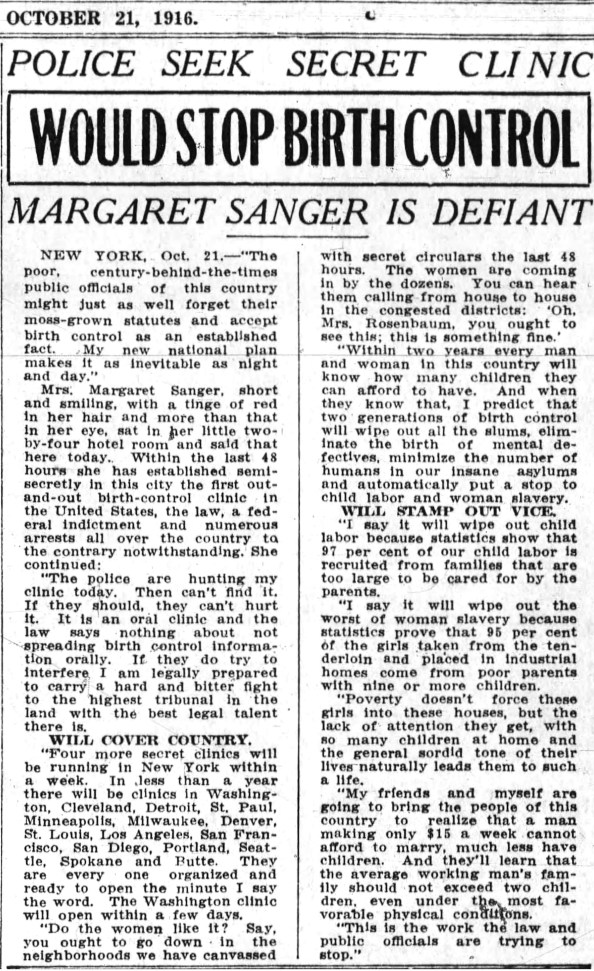
At 46 Amboy Street, just north of Pitkin, Margaret Sanger opened the United States’ first birth control clinic two days less than 100 years ago today, on Oct 16th, 1916. Though just a  little late for the anniversary, I’m happy to be here at this historic place, humble as it now appears. The clinic was in the tall red brick building to the right of the tan one with the ‘diamond’ pattern on the upper center front of the façade. You’ll find a photo below that shows the clinic as it originally appeared, and here as well.

46 Amboy St, site of Sanger's first birth control clinic

Sanger’s first birth control clinic, given address 46 Amboy St. One thing’s more or less the same: the little pale brick building with the crenelated top still stands next to where the clinic was, as you can see two photos down. The narrower red brick building against and to the left of the larger one, with a sign now identifying it as 42 Amboy, stands on the former clinic site.

46 Amboy St, site of Sanger's first birth control clinic

Another view, angled more like the view in the photo below. The two red brick buildings appear not to be original unless they’ve been changed so much as to be unrecognizable. As you can see from the photo below, there was space between the original clinic building and the tan one, but not so for the current structure. The clapboard building beyond may be original.

Photograph shows women and men sitting with baby carriages in front of the Sanger Clinic, LOC

Women and children sitting with baby carriages in front of the Sanger Clinic, with the white curtains in the windows. Photo courtesy of the Library of Congress

Before opening this clinic, Sanger had trained and worked as a nurse for many years among the poorest and most oppressed Americans, the immigrant and minority working class and poor. Originally a Socialist radical, Sanger came to realize that Marxists, philanthropists, and charity workers alike were making the same essential mistake. Since they failed to identify the root cause of human misery in the slums, the crowded tenements, and the factory floors, all of their well-intended efforts to help were failing and sure to continue to fail. Sanger came to feel this way about her own nursing, which addressed the effects and not the cause, so she turned her efforts to where she believed she could do the most good: birth control activism.

Margaret Sanger as a nursing student around 1900, by Boyce Photographer, White Plains, courtesy of the Sophia Smith Collection, Smith College

Margaret Sanger as a nursing student around 1900, by Boyce Photographer, White Plains, courtesy of the Sophia Smith Collection, Smith College

As a nurse, Sanger cared for poor women broken down in health and mind by laboring all night and caring for children all day, often pregnant all the while, often miscarrying, and the infant mortality rates were very high. So were death rates for the mothers, be it from childbirth, diseases secondary to exhaustion and malnutrition, and worst of all, from self-inflicted abortions. The mothers who resorted to the latter were desperate: they had often already watched other children die, or suffer every day from hunger, or forced into the factories or other labor at a very young age in the struggle to survive.

Though there were plenty of organizations trying to help these families, governmental and charitable, they could not keep up since the need was so great and increasing every day. Industrialization, Sanger recognized, encouraged rapid population growth by the ever-increasing demand for more labor and more future customers. And the workers responded to the social pressure by producing more children in hopes that their offspring could help the family by going out to work. But those hopes were often in vain since the population growth always kept up with or surpassed the need for laborers, constantly driving down wages. And so the cycle continued: immiseration through near-starvation wages, families barely keeping up with the cost of feeding themselves if at all, and children deprived of an education and of health as factory and other hard work often left children stunted, with malformed and weak bones and muscles, and often injured by machinery and chemicals.

Sanger thought: instead of trying vainly to keep up with the spiraling misery caused by this cycle, why not get at the root of it? After all, as the old saying goes, an ounce of prevention is worth a pound of cure. If women were empowered to decide whether to have children, and only as many as their health and financial circumstances would allow, all this misery could be prevented in the first place since parents could adequately care for the children they did have, mother’s bodies would no longer be broken down by constant pregnancy, infants and mothers would more likely survive childbirth, overcrowding and its accompanying epidemics would be mitigated or even disappear, and a reduced labor force would force employers to compete for workers, driving wages up. And as we’ve seen over the decades, high population growth is strongly correlated with endemic poverty, high infant and mother mortality rates, women’s rights abuses, and high income inequality.

But people will never stop having sex, as Sanger pointed out. Sex is just too powerful a force in human nature. Our need for love, for affection, for physical pleasure and release, are too powerful to be squelched, and in fact, shouldn’t be. Love and the need for physical connection are positive things, indeed, two of the best things in human nature. Birth control, thought Sanger, was the answer.

I’ll be exploring Sanger’s ideas on these and other topics in more detail in upcoming essays, stay tuned. In the meantime, the Margaret Sanger Papers Project has a wealth of articles and original works by Sanger available online, and I’ve relied on them more than on any other single resource for my own project. (See below for the links). Thank you so much to the good people at the MSPP, I very much appreciate what you do!

Photobombed in Brownsville, Brooklyn, NY

Photobombed in Brownsville, Brooklyn, NY

Street with handsome row houses on Bergen Street, Brownsville, Brooklyn, NYC

Tree lined street with attractive row houses on Bergen Street, Brownsville, Brooklyn, NYC

Brownsville neighborhood of Brooklyn, NY, near the Rockaway station, 2016 Amy Cools

Street scene at the Rockaway station entrance near the northern edge of the Brownsville neighborhood in Brooklyn, NY

Hipster Gourmet Deli in Brownsville, Brooklyn, Amy Cools 2016.

Hipster Gourmet Deli in Brownsville, Brooklyn. I took this photo on the way to Amboy St, after my laughter subsided enough to take a picture.

I head back to the station, on the way stopping to photograph some scenes in the neighborhood, including an especially pretty row of houses on Bergen Street as a young man photobombs my pic with a laugh and a smile. On the train back, I eat the now rather smashed second half of my egg salad sandwich and write my notes. I transfer a couple of times and head north to Grand Central Station…. To be continued

Ordinary Philosophy and its Traveling Philosophy / History of Ideas series is a labor of love and ad-free, supported by patrons and readers like you. Please offer your support today!

~~~~~~~~~~~~~~~~~~~~~~~~~~~~

Sources and Inspiration:

Alter, Charlotte. ‘How Planned Parenthood Changed Everything‘. Time.com, Oct. 14, 2016

Chesler, Ellen. ‘Was Planned Parenthood’s Founder Racist?Salon.com, Wed, Nov 2, 2011

Child Labor in U.S. History‘. From the Child Labor Public Education Project by the University of Iowa Labor Center

Demographics and Poverty‘, Center for Global Development.

Jacobs, Emma. ‘Margaret Sanger Clinic (former): the First Birth Control Clinic in the United States‘. From Places That Matter

Margaret Sanger Papers Project by New York University.

Regan, Margaret. ‘Margaret Sanger: Tucson’s Irish Rebel.Tucson Weekly, Mar 11, 2004.

Sanger, Margaret. The Pivot of Civilization, 1922. Free online version courtesy of Project Gutenberg, 2008, 2013.

Sanger, Margaret. Woman and the New Race, 1920. Free online version courtesy of W. W. Norton & CompanyOakland Tribune Article about Margaret Sanger's NY clinic, Oct 21, 1916 evening edition

To New York City I Go, in Search of Margaret Sanger

margaret-sangerHello, friends of Ordinary Philosophy!

From time to time, I take a trip to some corner of the globe, to explore the lives and ideas of great thinkers in the places where they lived and worked. For this series, I follow in the footsteps of thinkers who are no longer alive, since those who are still telling their own stories. But those who are no longer alive in the body live on in the ideas that they pass on, and in the examples they provide for us to follow.

I’m pleased and excited to announce my sixth philosophical-historical themed adventure, a rather impromptu trip to New York City to follow in the footsteps of Margaret Sanger.

Though the timing was spur of the moment, I’ve read and thought about Sanger quite a bit over the years and have some of the research done already for this long-planned trip. So when this little window of time opened up in my schedule, I happily seized the opportunity! As central to the history of women’s rights, free speech rights, and rights to sexual self-determination and privacy as she is, Sanger’s also the most problematic figure in the history of ideas I’ve followed so far for this series, with the possible exception of the brilliant but slave-owning Thomas Jefferson. She’s certainly the first that sparked immediate controversy when I casually mentioned my plans for following her on social media. Here’s a brief introduction, a condensed version of a short bio I published about a month ago in honor of her birthday:

Margaret Higgins Sanger was born on September 14, 1879 into a large Catholic family with 11 surviving children. Her mother died at about age 50 from tuberculosis. As young Margaret saw it, her mother was worn out from her 18 pregnancies, and would cite this as one of the many reasons she so passionately advocated for the right of women to control their own bodies and fertility.

She went on to become a nurse who worked with poor women in New York City in the 19-‘teens and twenties. As she saw these women struggle with the toll that large numbers of pregnancies took on their families’ finances and their own health, Sanger became convinced that ‘birth control’, a term she invented, was essential if these women hoped to escape poverty and sexual oppression. She opened America’s first birth control clinic and despite numerous arrests and fines, she continued her fight for reproductive rights. In this regard, she’s best known today as one of the founders of Planned Parenthood and a key figure in the development of the first birth control pill.

Sanger remains a controversial figure. An ardent feminist, human rights activist, and advocate of sex-positivity, Sanger was also a eugenicist, believing that birth control was at least as important a tool for limiting the production of ‘the unfit’ (her words) as it was for women’s liberation.  Generally, Sanger was an ardent advocate of self-determination, free speech, open discussions of sex and sexuality, and education, education, education.* It was up to informed and thoughtful people, Sanger believed, to take responsibility for their own sexual choices and to convince others to do the same. Regrettably, however, at times Sanger seemed to support some sort of coercive or compulsory forms of birth or population control, for those who she deemed incapable of making this choice for themselves, for example, or too dangerous to be allowed to conceive and raise children.

Aside from her (mostly good) ideas about human rights and personal responsibility, I find Sanger’s beliefs about human sexuality and its important role in spiritual and mental health particularly fascinating

So off to New York City I go, from October 17th thru the 21st. There, I’ll visit landmarks associated with her life, places where she lived, worked, thought, wrote, studied, and rested, to see for myself how the places informed the woman, and vice versa.

Here is the story of Margaret Sanger as I discover her:

Happy Birthday, Margaret Sanger!
Margaret Sanger NYC Sites, Day 1 Part 1, and a 100 Year Anniversary
Why So Much Hatred for Margaret Sanger?
Margaret Sanger NYC Sites, Day 1 Part 2
Margaret Sanger NYC Sites, Day 1 Part 3
Margaret Sanger NYC Sites, Day 2, Part 1
Margaret Sanger NYC Sites, Day 2, Part 2
Margaret Sanger NYC Sites, Day 3 Part 1
Margaret Sanger NYC Sites, Day 3 Part 2
Margaret Sanger NYC Sites, Day 4

Ordinary Philosophy and its Traveling Philosophy / History of Ideas series is a labor of love and ad-free, supported by patrons and readers like you. Please offer your support today!

Patrons of the Margaret Sanger series: Christopher Wallander, Magaly Gamarra Grant, Devin Cecil-Wishing, Sally Lee ~ With warmest gratitude, thank you!

*This piece was updated on 10/26/16. Originally, the 3rd and 4th sentences of the seventh paragraph read ‘She did not, however, support any kind of compulsory or coercive forms of birth or population control. Instead, Sanger was an ardent advocate of self-determination, free speech, open discussions of sex and sexuality, and education, education, education. It was up to informed and thoughtful people, Sanger believed, to take responsibility for their own sexual choices and to convince others to do the same.’ My subsequent research found that this is not quite accurate, as she surmised that coercive sterilization might be warranted in certain circumstances, for those who are mentally ill, handicapped in certain ways, or criminally violent, for example. Please read Why So Much Hatred for Margaret Sanger? and more from the series for further explorations of Sanger’s ideas on the subject.

Happy Birthday, Margaret Sanger!

margaret-sangerMargaret Higgins Sanger was born on September 14, 1879 into a large Catholic family with 11 surviving children. Her mother died at about age 50 from tuberculosis. As young Margaret saw it, her mother was worn out from her 18 pregnancies, and would cite this as one of the many reasons she so passionately advocated for the right of women to control their own bodies and their own fertility.

She went on to become a nurse who worked with poor women in New York City in the 19-‘teens and twenties. As she saw these women struggle with the toll that uncontrolled pregnancies took on their families’ finances and their own health, Sanger became convinced that ‘birth control’, a term she invented, was essential if these women hoped to escape poverty and oppression. She opened America’s first birth control clinic and despite numerous arrests and fines, she continued her fight for reproductive rights. She founded the American Birth Control League in 1921, which became the Birth Control Federation of America in 1939 after merging with another organization, which in turn became Planned Parenthood in 1942. She continued her activism right up to her death in 1966. Sanger was instrumental in the creation of the first birth control pill Enovid, first available to the public in 1957. She also lived to see the Supreme Court validate her beliefs in the basic human rights to openly talk about sex and to control their own fertility in the Griswold v. Connecticut decision of June 7, 1965.

Sanger remains a controversial figure today. An ardent feminist, human rights activist, and advocate of sex-positivity, Sanger was also a eugenicist, believing that birth control was at least as important a tool for limiting the production of ‘the unfit’ (her words) as it was for women’s liberation. Sanger agreed with many leading scientists and progressives of her day in ascribing to so-called Social Darwinism (a problematic term since it doesn’t reflect Darwin’s own views as he expressed them), which applied the principles of natural selection to human social practice.  She did not, however, support any kind of compulsory or coercive forms of birth or population control, such as that practiced by the Nazis and even by the United States government, who forcibly sterilized thousands of so-called ‘feebleminded’ women. Instead, Sanger was an ardent advocate of self-determination, free speech, open discussions of sex and sexuality, and education, education, education. It was up to informed and thoughtful people, Sanger believed, to take responsibility for their own sexual choices and to convince others to do the same.

Unlike many other eugenicists, however, Sanger was not a racist. She worked closely with many leading black civil rights figures, believing, as they did, that birth control would have the same liberating effect on the black community as would for women generally. By limiting the number of children according to how many they could afford to raise and when, parents could more readily pursue an education, start a business, or otherwise devote their time, energy, and health to improving their standard of living which, in turn, they could pass down to their children.

Aside from her human rights activism, I find Sanger’s beliefs about human sexuality and its important role in spiritual and mental health most fascinating. I’ve chosen her as one the topics of an upcoming History of Ideas Travel Series as soon as I can make it happen, stay tuned! In the meantime, please follow the links in this article above and below to learn more about this important, fascinating, and troubling woman, and I highly recommend Jonathon Eig’s The Birth of the Pill, in which he recounts much of her personal history as well as her role in the Pill’s creation.

Ordinary Philosophy and its Traveling Philosophy / History of Ideas series is a labor of love and ad-free, supported by patrons and readers like you. Please offer your support today!

~~~~~~~~~~~~~~~~~~~~~~~~~

Sources and Inspiration:

Margaret Sanger Papers Project ~ Research Annex. Accompanying blog to The Sanger Papers Project by New York University.

The Pill, People & Events: Margaret Sanger (1879-1966)‘. From the American Experience website by PBS.

Sanger, Margaret. The Pivot of Civilization, 1922. Free online version by Project Gutenberg, 2008, 2013.

Tong, Ng Suat. Which Margaret Sanger?The Hooded Utilitarian blog, April 14, 2014.

Book Review / Summary: The Birth of the Pill

In The Birth of the Pill, Jonathan Eig tells the fascinating story of the four people whose combined efforts, arguably more than any others, made birth control effective, affordable, widely available, and perhaps most importantly (since it makes all the others possible), socially acceptable: Margaret Sanger, Dr. Gregory Pincus, Dr. John Rock, and Katherine McCormick.

At the time the contraceptive pill was being developed, human reproduction was still very poorly understood. Prudish attitudes and obscenity laws hampered scientific research, discouraged and in many cases prevented doctors from educating their patients, and kept women from having any significant degree of control over their own bodies or the decision to become pregnant. It took a few independent-minded, morally driven people of unusual character to achieve change in the arena of reproductive rights.

Two of these four had spent years caring for people whose unchecked fertility threatened their own life and health, and the well-being of their families. Women, especially poor women, found themselves pregnant again and again before their bodies had recovered from earlier pregnancies, had medical conditions caused or exacerbated by pregnancy and childbirth, or could not afford adequate food, clothing, shelter, and health care for their rapidly growing families. Many women also found too many pregnancies burdensome, as they were prevented from pursuing an education or a career, or suffered from exhaustion, depression, and feelings of hopelessness as they found themselves caring for more children than they could cope with.

Margaret Sanger and Dr. John Rock encountered all of these problems up close and personal; their birth control activism was the direct result of their experiences as reproductive health care providers. Sanger worked for many years as a nurse caring for the poorest people in the slums and tenements of New York City. She was so moved by the plight of these women that she risked fines and imprisonment to open the first ‘birth control’ clinic (as she coined the term). Countless poor women, who had often already fled starvation, poverty, and disease in their home countries, found themselves unable to escape the cycle of repeated pregnancies and deepening poverty as their own bodies weakened and their meager resources were stretched ever thinner in the face of anti-immigrant bias, pittance wages, and filthy, overcrowded, and dangerous living and working conditions. This was also an era when women had no right of refusal of sex to their husbands. They faced the awful choice of risking another pregnancy, injury or death by self-performed abortion, or being abandoned when few jobs were available to women, and few jobs paid women enough to live on themselves, let alone support a family. And charity organizations, try as they might, could not keep up with even a fraction of the demand for assistance. Despite repeated arrests and fines, Sanger continued to provide birth control devices and information to the who women flocked to her clinic, pouring out their life stories in person and in letters like this one (original spelling):

‘… I am thirty years old have been married 14 years and have 11 children… I have kidney and heart disease, and every one of my children is defictived and we are very poor. Now Miss Sanger can you please help me… I am so worred and and I have cryed my self sick …I know I will go like my poor sister she went insane and died. …the doctor won’t do anything for me … if I could tell you all the terrible things that I have been through with my babys and children you would know why I would rather die than have another one. Please no one will ever know and I will be so happy and I will do anything in this world for you and your good work …Doctors are men and have not had a baby so they have no pitty for a poor sick Mother. You are a Mother and you know so please pitty me and help me. Please Please.’

I can only imagine what Sanger felt as she read this letter as she worked with so many women struggling under these same burdens, while social mores and the law opposed her efforts to help them.

Dr. John Rock was an obstetrician and fertility specialist. While one of his main focuses was on helping women with fertility problems become pregnant, he also worked with many other women for whom pregnancy, childbirth, and child care was detrimental to their physical and mental health, for various reasons. He became a staunch activist for birth control, and worked to convince the public and the Catholic church, of which he was a committed member, that effectively planning families and regulating childbirth is not only practical, but of the highest moral worth, since it promotes bodily and spiritual health, and a loving family life in which all children can be well cared for. He thought he could convince the church hierarchy that the hormonal method of birth control is consistent with Catholic teaching, since it’s simply an extension of the natural cycle that occurs in a woman’s body, rather than a barrier method with was doctrinally forbidden; his rhythm-method clinic taught the only form of birth control other than abstinence that was sanctioned by his religion, but as he observed, neither worked very well. His efforts to help women control their rates of pregnancy would eventually prove effective, but his efforts to convince the Church, until this day, have been in vain.

Yet birth control was not only linked to beliefs in reproductive rights and health: it was linked to a change in sexual mores. Sanger, Pincus, Rock, and McCormick all held what we’d now call ‘sex-positive’ beliefs: they thought sex could and should be a wonderful thing, among the most joyous, intimate, and healthy means by which humans connect with one another. In a time when sex was often regarded as shameful, depraved, and for the sake of men (I would argue that while it’s re-branded, it still is, as ‘liberated’, ‘powerful’ women painfully squeeze themselves into bustiers and stilettos and straighten, curl, bleach, and cut their hair and bodies to fit into a few stereotypical male fantasy body types as possible, in our crudely sex-obsessed, tabloid, misogynistic culture — yes, I’m talking about you too, Beyonce), they thought it could and should be a loving, freeing, and transcendent experience for both partners.

Dr. Gregory Pincus, the scientist who would ultimately formulate the first effective, FDA-approved birth control pill, was an unusually independent-minded, freethinking, colorful personality from an early age. As a young researcher at Harvard, he was widely publicized for his frank and unapologetic views on the benefits of revolutionizing human reproduction through scientific intervention. The sensationalist, brave-new-world ‘news’ stories led to Harvard’s kicking him out of their faculty and their labs, as a reputation-defense measure. Pincus went on to found his own research institute,. where he continued his research into hormones and their effects in reproduction. Arguably, it was this very political and financial independence from any large mainstream establishment that enabled him to succeed in his goal to produce the first birth control pill.

It also took money, and lots of it, as it does with any new pharmaceutical. Planned Parenthood could only provide limited funding for Pincus’s work, so it dragged on slowly, until Katherine McCormick, wealthy heiress, came along. She had discovered, shortly after she married, that her new husband suffered from severe mental illness. McCormick was well-educated, an MIT graduate at the time of her marriage, and was fascinated by all things science. When she learned of her husband’s mental illness, she poured time, money, and research into finding a cure, especially in the fields of hormonal research and heritability. She was also dedicated to women’s rights causes, and by the time of her husband’s death, her interests and fields of study and activism led to her single-minded determination to aid in the cause of making birth control effective and widely accessible. It was she, more than any other, who provided Pincus the funds to pursue more lab research, and for he and Rock to conduct more clinical trials.

Eig’s book is not a simple hero story: he reveals the history and personalities of each with their complex set of motivations, warts and all. Sanger was a eugenicist, for example. It was not uncommon for progressives, scientists, and those in the medical field to subscribe to the principles of eugenics at that time; many thought (mistakenly, as it turned out) that it was the only way science could really ‘cure’ disability and disease once and for all. Medical science, humanitarian groups, and governments had not yet offered systematic or effective solutions to the dangers of pregnancy and childbirth, diseases caused by overcrowding and malnourishment, and mental health issues, and were simply unable to keep up with the demands of the humanitarian crisis in affected communities. Eugenics, on the other had, seemed to offer the only sure and straightforward solution, until the application of its principles by fascist governments revealed how faulty a ‘science’ (really a pseudoscience) it was. Sanger was also a neglectful mother, unsuited by personality to the stay-at-home role mothers were restricted to in her time. Pincus was a media hound, and conducted some of his trials in what today would be considered an unethical manner. Rock was willing to mislead some of his patients when he found that public attitudes made most women unwilling to participate in contraceptive studies, if presented as such. And McCormick, like Sanger, had a marked tendency to elitism.

Yet the contributions of these four unusual, passionate, driven crusaders towards improving women’s health and social and legal emancipation can hardly be stressed enough. Women can now have as many children as they choose when they choose, and are not subject to the whims of men when it comes reproductive issues (still mostly true despite discouraging recent regrettable, retrograde legal decisions, for example, regarding the mandate that insurance companies pay for full reproductive health care). Sanger’s, Pincus’s, Rock’s, and McCormick’s belief that birth control would ultimately improve and save the lives of women, and improve the standard of living for families, have been vindicated over the years. For example, women on the pill live longer, on average, than other women, and the results of decades of study leads the World Health Organization to promote birth control as an important means of improving health and relieving poverty around the world.

With his excellent book, Eig not only compellingly tells the story of how the pill came to be, but also of the human dramas behind its invention. The history of the pill, the circumstances which gave rise to its invention, and the ideas of its creators show us how and why ready access to effective birth control is as important today as it ever was.

~~~~~~~~~~~~~~~~~~~~~~~~~~~

Sources and inspiration: 
Eig, Jonathan. The Birth of the Pill: How Four Crusaders Reinvented Sex and Launched a Revolution. W.W. Norton & Company, New York, 2014. http://books.wwnorton.com/books/The-Birth-of-the-Pill/

Kelland, Kate, Ed Jon Hemming ‘Women On the Pill Live Longer: Study’. Reuters, Mar 12 2010
http://www.reuters.com/article/2010/03/12/us-contraceptive-pill-risk-idUSTRE62B01R20100312

World Health Organization website, ‘Reproductive Health’.
http://www.who.int/topics/reproductive_health/en/

Is Feminism Passe? No! Cries A Distinct Lack of Statuary

Many say that the idea of ‘feminism’ is outmoded: it smacks of reverse sexism, and the women’s rights movement has pretty much accomplished its goals anyway, at least in the free world.

Why flog a dead horse, ladies?

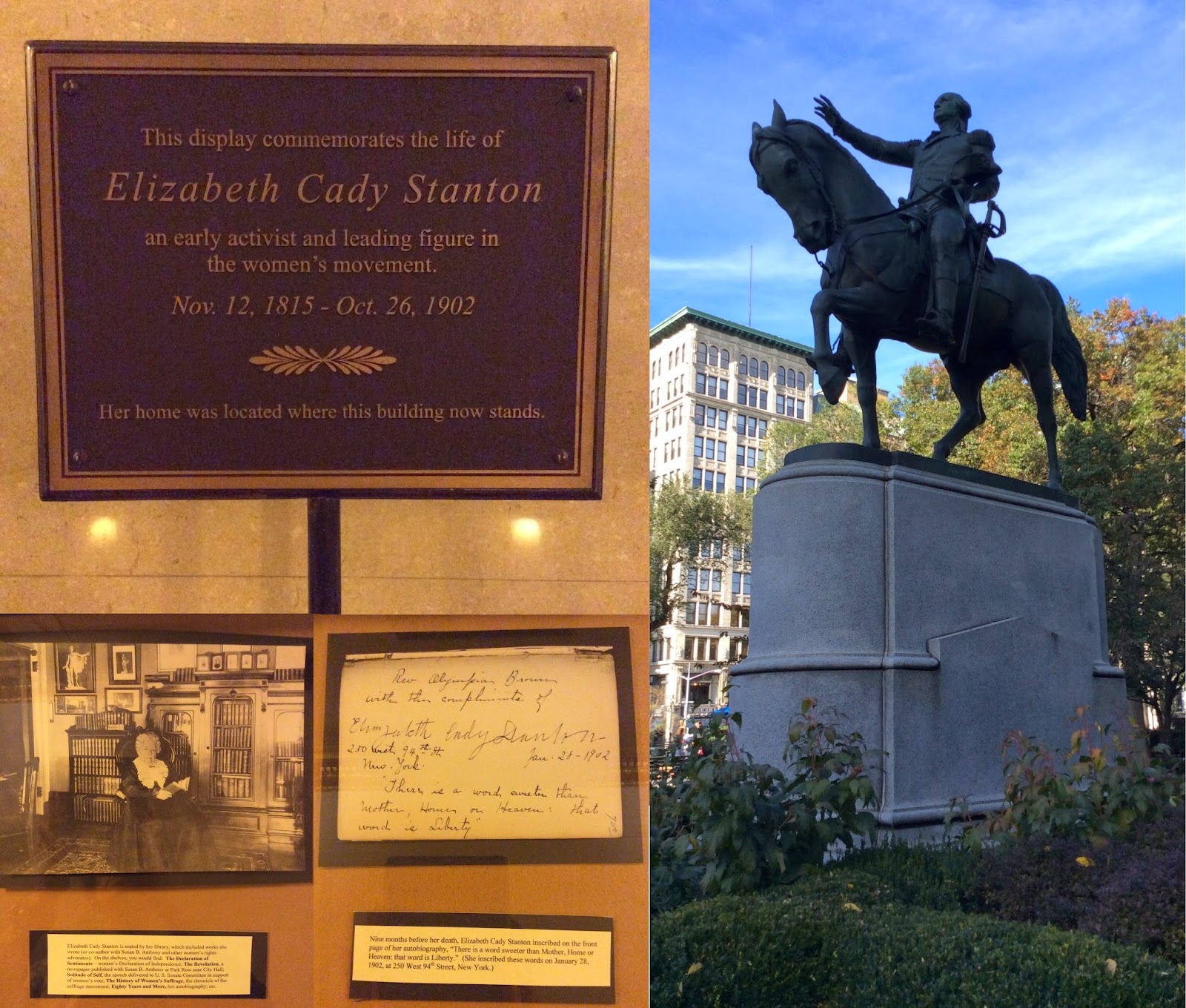
In my last travel blog series, following in the footsteps of great thinkers who changed the world, I explored New York City. I found statue after statue, monument after monument, portrait after portrait, of important men in American history: there were Lincolns, Jeffersons, Clintons, and Hamiltons galore, and speaking of horses, a multitude of Washingtons, often astride one. Yet search as I might, in this city that birthed and nurtured so many of the greatest American intellectual and reform movements, I was hard pressed to find such tributes to their female counterparts. Wait! there’s one: Eleanor Roosevelt, great humanitarian… and oh yes, wife and cousin to two American presidents.

Of course, Eleanor should be honored with this beautiful monument for the great things she did. But would she have been if it weren’t for the famous men in her life? Hmmm. It’s not that statues, monuments, and other public works of honorary art are necessary to show how important anyone’s achievements are, so long as we remember them and pass on their ideas. But they do provide a window into the values and interests of the people. Initiatives, petitions, and referendums are submitted, committees form, public collections are taken up, and wealthy people grant commissions to create these public works.

In short, these monuments go up when enough people care enough to publicly show how much they care.

So how can it be that great women like Mary Wollstonecraft, Ernestine Rose, Sojourner Truth, Elizabeth Cady Stanton, and Margaret Sanger are commemorated so modestly or so seldom? (A little plaque or a sign on a street corner here, a dusty little cabinet display there.) When their efforts, arguably, liberated more people than anyone else? After all, women make up more than half of the human race, and prior to their life’s work, most women in the world lived almost completely under the subjugation of men, most with restricted education, all denied the full range of rights and opportunities accorded to men.

I feel a free woman, myself, in most ways. I read, think, work, play, procreate (or not!), travel, dress, and so forth, as I decide for myself. Thanks, brilliant, fearless, principled women of history! But their work is not done so long as great women are not honored equally as great men, and working women as much as working men, and women who need health care as much as men need health care, and so on.

Is feminism over? I’ll believe it when I see it. In marble, granite, brass… or in the office of the President of the United States. Maybe then.

*Listen to the podcast version here or on iTunes