New Podcast Episode: Philosophy as Love of Wisdom and in the Public Sphere

Sophia, goddess of wisdom

Sophia, goddess of wisdom

Listen to this podcast episode here or on Google Play, or subscribe on iTunes

Some years ago, the economic downturn inspired me to put aside my business endeavors and return to school to study philosophy. I had loved philosophy for as long as I can remember, before I even knew what to call it, and later as I understood it in its broadest sense: the love and pursuit of wisdom. Wisdom was pursued through asking questions about everything, from the metaphysical and theological sort of questions that my religious and argumentative family used to debate around the dinner table and family gatherings (I credit these discussions and arguments, more than anything, with inspiring my philosophical curiosity) to all other questions about what’s true and false, just and unjust, good and bad, right and wrong. Wisdom was found through reading and learning as much as possible, then applying this learning to carefully thinking through possible answers to these questions. And wisdom was loved not because it brought understanding and meaning to life, but rather because its pursuit seemed beautiful to me.

Because my love of philosophy was formed prior to any introduction as a school of thought and my formal education was rather piecemeal, my approach was whimsical, idiosyncratic, unsystematic. Any and all subjects that aroused my curiosity and admiration could be brought to bear on what I understood as philosophical inquiry: literature, history, art, love of nature, social activism, law and justice, ethics, travel, architecture, science, in fact, every subject that involves human thought and appreciation…. Continue reading

This piece was written for the American Philosophical Association blog, originally published there on Sept. 22nd, 2016, and edited by Skye Cleary.

~ Ordinary Philosophy and its Traveling Philosophy / History of Ideas series is a labor of love and ad-free, entirely supported by patrons and readers like you. Please offer your support today!

Seneca to Lucilius: On Old Age, by Massimo Pigliucci

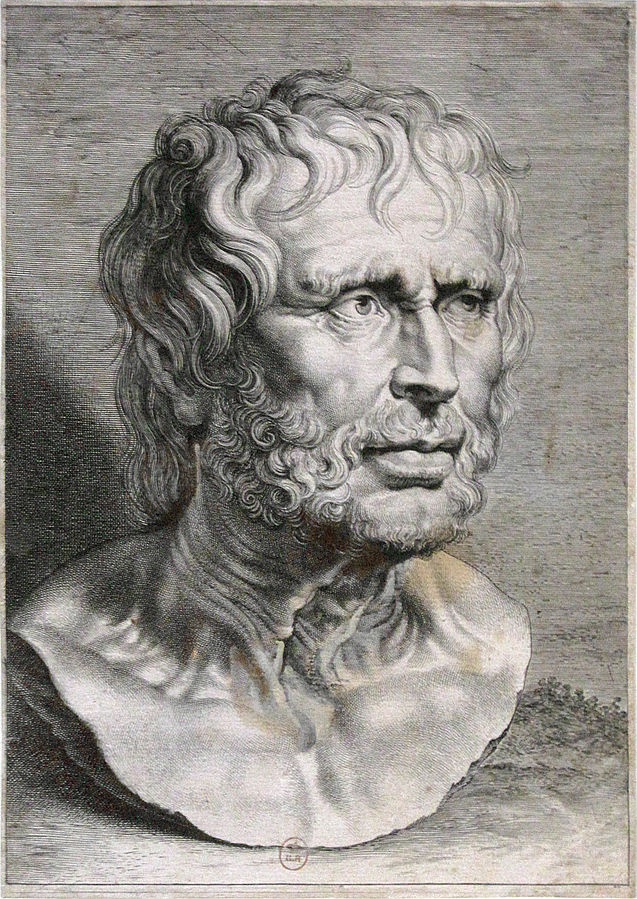
portrait-of-seneca-after-the-antique-the-pseudo-seneca-by-lucas-vorsterman-public-domain-via-wikimedia-commonsThis is the 12th letter to Lucilius, in the translation by Richard Mott Gummere published in the Delphi Classics edition of Seneca’s Complete Works, and it deals with an issue that an increasing number of people in the first world of today have to deal with: old age.

Seneca begins by recalling a recent visit to one of his country houses, during which he complained to one of his employees that too much money was being spent to keep it up. But his bailiff protested that the house was getting old, and the repairs were therefore entirely warranted. So Seneca writes to Lucilius: “And this was the house which grew under my own hands! What has the future in store for me, if stones of my own age are already crumbling?” (XII.1)

He then argues that there is much to be cherished in that stage of his life that the bailiff’s unchallengeable argument suddenly made him appreciate:

“Let us cherish and love old age; for it is full of pleasure if one knows how to use it. Fruits are most welcome when almost over; youth is most charming at its close; the last drink delights the toper, the glass which souses him and puts the finishing touch on his drunkenness. Each pleasure reserves to the end the greatest delights which it contains. Life is most delightful when it is on the downward slope, but has not yet reached the abrupt decline.” (XII, 4-5)

Notice the awareness of a coming “abrupt decline,” which Seneca is not foolish enough to argue will make for an enjoyable part of his life, should he live long enough (as it turns out, he didn’t). While not expressly mentioned here, this was the reason why the Stoics — including both Seneca and Epictetus, not to mention Zeno — thought that the wise man should make an exit, take “the open door,” as Epictetus memorably put it, when the appropriate time had come, no a moment sooner, but also not a moment later.

So what should be the wise person’s attitude toward old age? Seneca puts it very vividly to Lucilius:

“Let us go to our sleep with joy and gladness; let us say: I have lived; the course which Fortune set for me is finished. And if God is pleased to add another day, we should welcome it with glad hearts. That man is happiest, and is secure in his own possession of himself, who can await the morrow without apprehension. When a man has said: ‘I have lived!’, every morning he arises he receives a bonus.” (XII.9)

I am often struck by Seneca’s language, and this is one of many instances. “I have lived!, every morning I arise I receive a bonus.” Indeed.

As he frequently does in the early letters, Seneca parts from his friend with a “gift,” a meaningful quotation from another author, which in this case is: “It is wrong to live under constraint; but no man is constrained to live under constraint” (XII.10), another, more direct, reference to suicide to be chosen under certain circumstances.

The twist is that the above saying is from none other than Epicurus, the chief rival of the Stoic school at the time. Seneca, then, imagines Lucilius protesting: “‘Epicurus,’ you reply, ‘uttered these words; what are you doing with another’s property?’ Any truth, I maintain, is my own property.” (XII.11)

Again, a beautiful turn of phrase, and an example of real wisdom: it doesn’t matter where the truth comes from, once discovered, it is our collective property.

~ This piece was originally published at How to Be a Stoic on September 15, 2016

~ Massimo Pigliucci is K.D. Irani Professor of Philosophy at the City University of New York and member of the faculty at CUNY’s Graduate Center. Massimo has a background in evolutionary biology and philosophy of science. His most recent book, co-edited with Maarten Boudry, is Philosophy of Pseudoscience: Reconsidering the Demarcation Problem (Chicago Press).

~ Ordinary Philosophy and its Traveling Philosophy / History of Ideas series is a labor of love and is ad-free, entirely supported by patrons and readers like you. Please offer your support today!

Xerxes and Demaratus on Tyranny, Liberty, and the Law

Relief of the Persian king Xerxes (485-465 BC) in the doorway of his palace at Persepolis

Relief of the Persian king Xerxes (485-465 BC) in the doorway of his palace at Persepolis, public domain by O. Mustafin via Wikimedia Commons

I’m now reading Book Seven of Herodotus’ Histories which tells the story of Xerxes I of Persia and the second invasion of Greece, which he led to avenge the defeat of his father Darius, who led the first. Darius was defeated at the battle of Marathon when the Athenians and their allies the Plataeans, badly outnumbered, managed to drive away the Persians. In this story, I came across another interesting exchange I’d like to share with you.

After reviewing his massive forces, Xerxes calls for Demaratus, a former king of Lacedaemon (city-state of Sparta) who had defected to Persia after being deposed by a rival. He asks Demaratus if he believes that his fellow Greeks will dare oppose his invasion considering the size and wealth of the new Persian army. After all, Xerxes asks, ‘How could a thousand men, or ten thousand, or even fifty thousand come to that, possibly stand up to an army the size of mine, when all of them enjoy a similar degree of liberty, and have no one man in command?… Just perhaps, were they like us in having one man set in authority over them, they might indeed be prompted by their dread of him to conquer their own instincts, and under the compulsion of the whip to advance against a force much larger than themselves. Left to their own devices, though, there is no way they will do either of those things.’ (Histories 7.103)

Xerxes is speaking here of the land of Athens and Lacedaemon, cradle of democracy, a novel form of government at the time. Many of us moderns who are raised in societies which inherited that spirit of government would respond: ‘But of course! A free people who participate in their own government have a stake in the outcome of public enterprises. Therefore, in war or peace, free people have a reason to care about their outcomes and to be personally motivated to succeed, because the success belongs to each individual as well as the society. Those who are tyrannized and enslaved, however, have no personal stake in the outcome, and fear only motivates one to do the minimum needed for survival. Indeed, fear and resentment of tyranny can motivate the people to undermine the efforts of the tyrant, and to defect to another state at the first opportunity.’ I expected Damaratus to give some such answer.

But Damaratus takes a different tack. Though he begins by citing the courage and martial discipline of the Greeks, he tells Xerxes the main reason he believes the Greeks will stand up to him whatever the size of his army. They’ll resist, he says, because ‘Free as they are, you see, they are not altogether free. Set over them as their master is the law – and of that they are more terrified than ever your men are of you. Certainly, they do what it commands them to do – a command that never alters.’ (7.104)

I think it fascinating that Damaratus uses the expression ‘terrified’ when he describes the Greeks’ attitude to the law. I consulted two other translations and it used the word ‘fear’. I wonder: is this a fear or terror born of deep respect and awe, such as that due to the gods or nature itself? Of fear of their fellow citizens for breaking the social contract or upsetting the natural order of things? Why fear or terror? Then I realize: perhaps he uses this term because he wants Xerxes to understand what he’s saying, and the only thing Xerxes can imagine inspiring obedience is fear and terror. But it’s interesting that he holds on to that idea. After all, Xerxes knows that his father learned otherwise, and the hard way at that. A free

Or, do you think Damaratus means just what he says? That it’s possible that an otherwise free people can actually have a fear of the law itself? It’s not too far of a stretch, after all, that a religious, god-fearing society could fear something else that’s abstract which imposes order and its will on the world.

Or, it could be that Damaratus is talking about the fear of the Greeks betraying their own selves as living embodiments of the law. After all, if adherence to the law is instilled as a sort of sacred duty to the very thing that makes us both free and fully realized as human beings, then the thought of transgressing the law is as terrifying as the thought of destroying our very selves, of becoming something less than human. I suspect Damaratus is talking about something like this.

Ordinary Philosophy and its Traveling Philosophy / History of Ideas series is a labor of love and ad-free, entirely supported by patrons and readers like you. Please offer your support today!

~~~~~~~~~~~~~~~~~~~~~~~~~~~~~~~~~~~

Sources and inspiration:

Cartledge, Paul. ‘The Democratic Experiment‘. From History at BBC.com

Herodotus. Histories. Translated by Tom Holland. New York: Viking, 2013

Herodotus. Histories. Translated by A. D. Godley. Cambridge: Harvard University Press, 1920, from Tufts.edu

Herodotus. Histories. Translated by G. C. Macaulay, 1890, from Project Gutenberg.

New Podcast Episode: Frederick Douglass Washington DC Sites, Day 1, Part 1

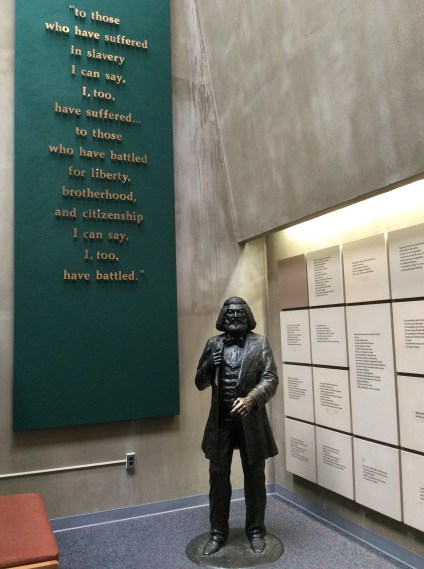
Statue and quote at the Frederick Douglass National Historic Site

Statue and quote at the Frederick Douglass National Historic Site

Listen to this podcast episode here or on Google Play, or subscribe on iTunes

Thirteenth Day, Friday April 1st

I begin at Cedar Hill in Anacostia, Frederick Douglass’ handsome, gabled house on a hill overlooking Washington DC. He moved here with Anna and the kids in September of 1878, having lived in the capital city of Washington for a little over six years. In a sense, the Douglasses didn’t really move out of Washington when they moved into their new suburban home east of the Anacostia River. Anacostia, called Uniontown in the mid-1800’s then switched back again, was part of the District of Columbia, which in turn was larger than Washington and encompassed it. When the boundaries of Washington and the District of Columbia became one and the same in 1878, the Douglasses’ Anacostia home became a Washington city home then too.

It’s another lovely day, again the sky is partly cloudy, the air soft and warm and a little breezy, freshly washed by the morning’s rain. The cold weather I had shivered in for much of the first half of my trip is nearly forgotten.

The National Park Service now owns and runs the house, the grounds, and the visitor center and museum, collectively called The Frederick Douglass National Historic Site. I take a brief look at the outside of the house, then stop at the visitor center and sign up for the guided tour which will start shortly. I take another brief look around while I wait, and note the displays and artifacts I want to examine more closely when I return to the visitor center museum…. Read the full account here:

Ordinary Philosophy and its Traveling Philosophy / History of Ideas series is a labor of love and ad-free, entirely supported by patrons and readers like you. Please offer your support today!

New Podcast Episode: Frederick Douglass Chambersburg and Gettysburg PA Sites

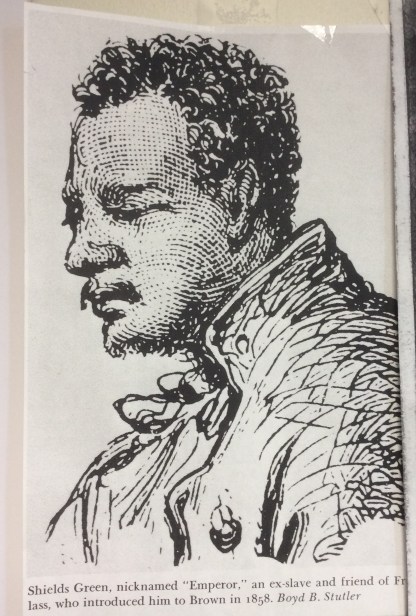
Poster of Shields Green in David Anderson's Nazareth College office, photo 2016 Amy Cools

Listen to this podcast episode here or on Google Play, or subscribe on iTunes

Twelfth Day, Thursday March 31st

It’s breezy, overcast, and warm the day I drive south from Rochester to Washington D.C., with a first stop in Chambersburg, Pennsylvania to visit two sites of special interest for my Frederick Douglass journey.

The first is a two story clapboard house at 225 E. King St, where John Brown rented a room in Mary Ritner’s boarding house in the summer of 1859, and where he planned his doomed raid on the federal arsenal at Harper’s Ferry. Unfortunately, I’m visiting during the off-season: the house is closed until the tourist season starts in May, but I find a blog with two nice photos of the interior posted. It happens to be a blog dedicated to Fredrick Law Olmsted, the great landscape architect who designed Highland Park, site of Frederick Douglass’ statue and memorial in Rochester…. Read the written account here:

Ordinary Philosophy and its Traveling Philosophy / History of Ideas series is a labor of love and ad-free, entirely supported by patrons and readers like you. Please offer your support today!

New Podcast Episode: Frederick Douglass Seneca Falls, Canandaigua, Honeoye, and Mt Hope Cemetery Sites

Women's Rights National Historical Park headquarters, Seneca Falls NY

Women’s Rights National Historical Park headquarters, Seneca Falls NY

Listen to this podcast episode here or on Google Play, or subscribe on iTunes

Eleventh day, Tuesday March 30th

It’s a beautiful, clear sunny day, and the chill of the morning gives way to a balmy afternoon. I drive about an hour east and slightly to the south, through the lovely Finger Lakes region of New York to Seneca Falls.

I’m here to visit what’s now the Women’s Rights National Historical Park, which is headquartered at 136 Fall Street in Seneca Falls. I begin with the reconstructed Wesleyan Church next door at Fall and Mynderse Streets, the site of that momentous occasion which brings me here. I’ve long wanted to visit this place and had hoped to do so during my history of ideas travel series about Elizabeth Cady Stanton, but didn’t have enough time during that trip to make the journey, about a five hour drive from New York City one-way. But here I am at long last…. Read the written account here:

Ordinary Philosophy and its Traveling Philosophy / History of Ideas series is a labor of love and ad-free, entirely supported by patrons and readers like you. Please offer your support today!

O.P. Recommends The Stronger Sex: Women Scholars and Islam, by Peter Adamson

Bint al Shati, image credit AchetronI just listened to a podcast episode I had missed a year and a half or so ago, from my go-to podcast for discovering the gaps in my knowledge (of which there are so many! sigh) about Ancient Greek, Islamic, Medieval, and Indian philosophy from Peter Adamson’s History of Philosophy Without Any Gaps. As you may remember, I had the privilege of having a conversation with him not that long ago for Ordinary Philosophy’s podcast.

The podcast episode I just listened to that I’m recommending today is called The Stronger Sex: Women Scholars and Islam (#192). In it, ‘Fatema Mernissi and others challenge the long-standing (but not complete) exclusion of women from the intellectual traditions of Islam.’ It was altogether fascinating, and much of what I heard surprised me. It made me very curious to learn more about women in Islamic philosophy.

Enjoy!

Ordinary Philosophy and its Traveling Philosophy / History of Ideas series is a labor of love and ad-free, entirely supported by patrons and readers like you. Please offer your support today!

New Podcast Episode: Frederick Douglass Rochester NY Sites, Day 2

Douglass scholarship articles and posters, Dr. David Anderson's office, Nazareth College Rochester, 2016 Amy CoolsListen to this podcast episode here or on Google Play, or subscribe on iTunes

Tenth day, Tuesday March 29th

I begin my day with an early visit to Dr. David Anderson, a Frederick Douglass scholar, visiting professor at Nazareth College, founding member of Blackstorytelling League, and an all around delightful and fascinating man! He is kind enough to grant me an interview of an hour or so, which ends up turning into a much longer conversation than that.

Among many other things too numerous to describe in full here (I’ll bring more details of our talk into the discussion of my subsequent discoveries), we talk about the Douglass family as a whole, and especially, Frederick Douglass’ wife Anna…. Read the written account here:

Ordinary Philosophy and its Traveling Philosophy / History of Ideas series is a labor of love and ad-free, entirely supported by patrons and readers like you. Please offer your support today!

New Podcast Episode: Behind the Veil: Rawls, Locke, de Tocqueville, and Human Connection in a Liberal Society

People in a Public Square, cropped, Image Creative Commons CCO Public Domain via PixabayListen to this podcast episode here or subscribe on iTunes

I’ve been listening to this excellent series from a favorite podcast of mine, the Philosopher’s Zone on Australia’s RN (Radio National), hosted by Joe Gelonesi. There’s this recent series called Political Philosophy in the World, hosted by guest host Scott Stephens, which considers and critiques seven important topics in political philosophy. I just listened to the last one, Political Philosophy in the World: Liberalism and the End of the World as We Know It.

In it, interviewee Patrick Deneen offers a series of critiques of liberalism, his own and others’ over its roughly five century history. …The discussion in its entirety is absolutely fascinating, but my attention is caught particularly by Deneen’s observation of a problem with the great liberal political philosopher John Rawls’ famed ‘veil of ignorance’ thought experiment…. Read the written account here:

Ordinary Philosophy and its Traveling Philosophy / History of Ideas series is a labor of love and ad-free, supported by patrons and readers like you. Please offer your support today!

Happy Birthday, Walt Whitman!

Walt Whitman, age 35, from Leaves of Grass, Fulton St., Brooklyn, N.Y., engraving by Samuel Hollyer from daguerreotype by Gabriel Harrison, public domain via Wikimedia Commons‘Walt Whitman, an American, one of the roughs, a kosmos, Disorderly fleshy and sensual . . . . eating drinking and breeding, No sentimentalist . . . . no stander above men and women or apart from them . . . . no more modest than immodest.’ Thus Walt Whitman introduces himself to us for the first time in his first self-published 1855 edition of Leaves of Grass. Not on the cover or on the title page, mind you, but deep within the body of the untitled poem later called Song of Myself. If this is a dialing-back attempt to inject a little respectable humility or yet another self-aggrandizing affectation on the part of this unapologetic egoist, it’s hard to say definitely, though I strongly suspect it’s the latter. It certainly is so-very-American.

He was confident, earthy, crude, and vibrant, a self-styled natural man whose personas were nonetheless carefully crafted. He did his own thing and ‘lived the free life of a rover’ (an Eric Bogle phrase from his great anti-war ballad And the Band Played Waltzing Matilda), working odd jobs as a printer, journalist, teacher, and clerk, among other things. Moved by horror and compassion at the magnitude of death and suffering he observed, he worked some years as a nurse to the Civil War wounded, and spent much of his somewhat meager earnings on supplies for their comfort and care. He remained single but had many lovers, probably mostly homosexual, though he praises the physical beauty and power of women as lavishly in his poems as he does those of men. All the while, starting at just over age 30, he began to write his highly idiosyncratic, free verse poetry celebrating the authentic and the crafted self, the human body, democracy, equality, work, nature, and companionship. He spent the rest of his somewhat long life revising and republishing several editions of Leaves of Grass, up to several months before his death at age 72 in 1892.

To read more work by, about, and inspired by the great Walt Whitman, here are some links and articles:

Walt Whitman“. in Encyclopædia Britannica Online.

Walt Whitman, 1819–1892‘. The Poetry Foundation (website)

Whitman, Walt. Leaves of Grass (1855). Source: Electronic Text Center, University of Virginia Library

Whitman, Walt. Assorted poems at Poets.org

The Walt Whitman Archive, Ed Folsom and Kenneth M. Price, Ed., published by the Center for Digital Research in the Humanities at the University of Nebraska–Lincoln

and just because I love it:

The Body Electric, song and music video by Hooray for the Riff Raff. The song title is inspired by one of Whitman’s most enduring and controversial poems, and is a critique of the tradition of the murder ballad

Ordinary Philosophy and its Traveling Philosophy / History of Ideas series is a labor of love and ad-free, supported by patrons and readers like you. Please offer your support today!