Happy Birthday, Bertrand Russell!

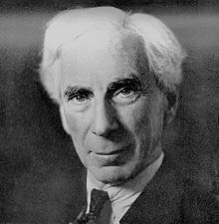
Betrand Russell in 1938, image public domain via Wikimedia CommonsBertrand Russell lived an extraordinarily long life, in which he did an extraordinary number of extraordinary things.

Encyclopedia Britannica introduces him thusly: ‘Bertrand Russell ….born May 18, 1872, Trelleck, Monmouthshire, Wales- died Feb. 2, 1970, Penrhyndeudraeth, Merioneth, [was a] British philosopher, logician, and social reformer, founding figure in the analytic movement in Anglo-American philosophy, and recipient of the Nobel Prize for Literature in 1950. Russell’s contributions to logic, epistemology, and the philosophy of mathematics established him as one of the foremost philosophers of the 20th century. To the general public, however, he was best known as a campaigner for peace and as a popular writer on social, political, and moral subjects. During a long, productive, and often turbulent life, he published more than 70 books and about 2,000 articles, married four times, became involved in innumerable public controversies, and was honoured and reviled in almost equal measure throughout the world…’

For myself, he was particularly influential to my younger freethinking self, disenchanted with the religion of my youth and seeking new and more satisfying ways of viewing the world. I read his History of Western Philosophy and Why I Am Not a Christian each several times over. I admire his clear, precise thinking and his principled anti-war stance which came at a significant cost, including jail time and loss of a prestigious job at the University of Chicago, and it’s always so enjoyable to watch him speak (you’ll find plenty of videos on YouTube) in his oh-so-aristocratic accent with a pipe often tucked into the corner of his mouth. He was not a perfect man, but he was never a less-than-fascinating one.

Read more about Bertrand Russell:

Bertrand Russell – in Encyclopedia Britannica

Bertrand Russell – by Andrew David Irvine for The Stanford Encyclopedia of Philosophy

~ Ordinary Philosophy and its Traveling Philosophy / History of Ideas series is a labor of love and ad-free, supported by patrons and readers like you. Please offer your support today!

Happy Birthday, David Hume!

In honor of David Hume’s birthday, May 7, 1711, let me share anew my history of ideas travel series I created in honor of my favorite philosopher in his home city of Edinburgh, Scotland. I’ll soon be in Edinburgh again, this time for at least one year, to pursue a Master’s Degree in Intellectual History at the University of Edinburgh. I can hardly express how thrilled I am at the prospect! I’ll be expanding this Hume series while I’m there.

To Edinburgh I Go, In Search of David Hume

Hello, friends of Ordinary Philosophy! I’m pleased and excited to announce my upcoming adventure: my first philosophical-historical themed adventure, and my first trip to Edinburgh, Scotland!

Here’s my plan:

I’m taking a series of trips to places around the world, where I explore the lives and ideas of great thinkers in the places where they lived and worked. I’ll follow in the footsteps of thinkers who are no longer alive, since those who are still telling their own stories. But those who are no longer alive in the body live on in the ideas that they pass on, and in the example they provide for us to follow.

I’ve decided to start with the philosopher I most admire as a person as well as a thinker, the great David Hume. He was not only revered for the brilliance of his ideas and his honesty in presenting them, but also as a premier example of a genial, generous, great-hearted person; so much so, in fact, that one of his closest friends nicknamed him ‘Saint David’.

Hume is often described as the greatest philosopher to write in English and among the greatest philosophers of all time, period. He was a central figure in the Scottish Enlightenment, and a profoundly influential empiricist and moral philosopher

So off to beautiful Edinburgh I go! There, I’ll visit the places where he worked, thought, wrote, studied, and rested. I’ll be traveling there in the first two weeks of May, and will be writing throughout the trip. I’ll be writing in this blog not only about his ideas, but about what I can discover about his everyday life, and whatever feeling of his time and place I manage to uncover in my time there.

If you have any questions for me to answer while I’m there, or pictures you’d like me to take for you, or any information you have that could help me with this project, I’d love to hear from you!

~~~~~~~~~~~~~~~~~~~~~~~

Here are my essays on Hume as I discover him in my travels, in (roughly) chronological order:

First Day in Old Edinburgh: Hume Sites and Monuments
Hume’s New Scene of Thought, and, It’s Good to Be Able to Say ‘I Don’t Know’
Hume Sites and Monuments, Part 2
The Consolations of Philosophy, and A Death Free from Fear
Scotticisms
Happy 303rd Birthday, David Hume!
Cycling Through Edinburgh, First Time
The Debate Over Government and Freedom
The Tale of the Magic Toe – Superstition? Or What?
Hume Sites and Monuments, Part 3
Water of Leith
Last Day in Edinburgh, May 13th, 2014
Hume, Aristotle, and Guns
and a memory quilt I created for my Edinburgh trip:
A Hill and a Wall in Edinburgh, 2015, 102″ x 69″

Ordinary Philosophy and its Traveling Philosophy / History of Ideas series is a labor of love and ad-free, supported by patrons and readers like you. Please offer your support today!

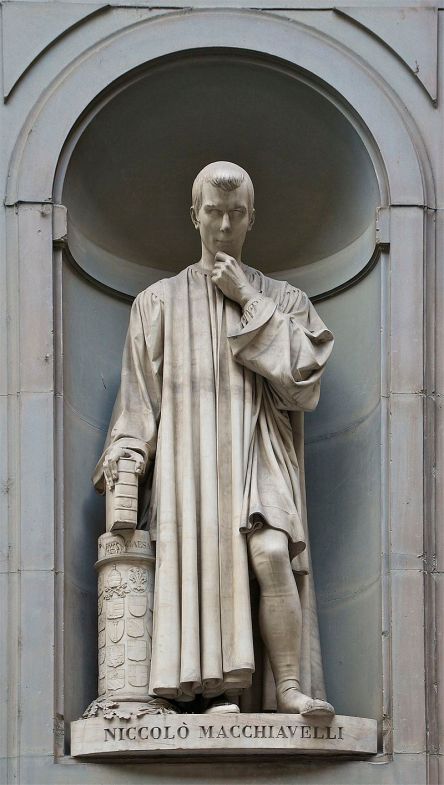
Happy Birthday, Niccolò Machiavelli!

Niccolò Machiavelli statue at the Uffizi

‘Why an entry on Machiavelli? That question might naturally and legitimately occur to anyone encountering an entry about him in an encyclopedia of philosophy. Certainly, Machiavelli [born May 3, 1469] contributed to a large number of important discourses in Western thought—political theory most notably, but also history and historiography, Italian literature, the principles of warfare, and diplomacy. But Machiavelli never seems to have considered himself a philosopher—indeed, he often overtly rejected philosophical inquiry as beside the point—nor do his credentials suggest that he fits comfortably into standard models of academic philosophy. His writings are maddeningly and notoriously unsystematic, inconsistent and sometimes self-contradictory. He tends to appeal to experience and example in the place of rigorous logical analysis. Yet succeeding thinkers who more easily qualify as philosophers of the first rank did (and do) feel compelled to engage with his ideas, either to dispute them or to incorporate his insights into their own teachings. Machiavelli may have grazed at the fringes of philosophy, but the impact of his musings has been widespread and lasting. The terms “Machiavellian” or “Machiavellism” find regular purchase among philosophers concerned with a range of ethical, political, and psychological phenomena, even if Machiavelli did not invent “Machiavellism” and may not even have been a “Machiavellian” in the sense often ascribed to him. Moreover, in Machiavelli’s critique of “grand” philosophical schemes, we find a challenge to the enterprise of philosophy that commands attention and demands consideration and response. Thus, Machiavelli deserves a place at the table in any comprehensive survey of philosophy…’ ~ Cary Nederman, “Niccolò Machiavelli”, The Stanford Encyclopedia of Philosophy 

To introduce yourself to or learn more about the often contradictory, ever controversial, always fascinating and relevant Niccolò Machiavelli, read the Stanford Encyclopedia of Philosophy article linked above and listen to this discussion between one of my favorite broadcasters and public intellectuals Melvin Bragg, and his guests Quentin Skinner, Evelyn Welch, and Lisa Jardine.

Ordinary Philosophy and its Traveling Philosophy / History of Ideas series is a labor of love and ad-free, supported by patrons and readers like you. Please offer your support today!

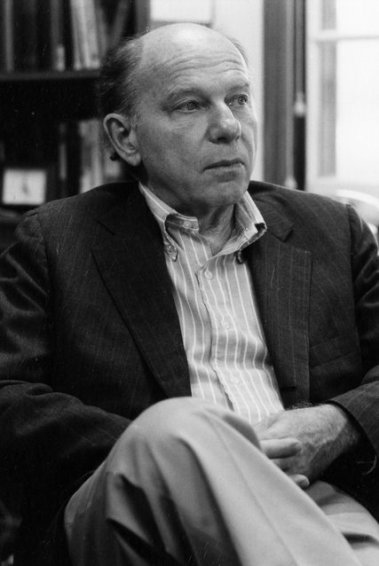
Happy Birthday, Morton White!

Morton White in 1981

The world lost Morton White (April 29, 1917 – May 27, 2016) less than a year ago as I write this today, and I first learned of him through reading his obituary in The New York Times. As I read, I knew this is a man and an approach to philosophy I must learn more about. Being immersed in other projects, I learned little about him in the intervening eleven months. Happily, I was just reminded by going through my list of significant dates in the lives of the world’s great thinkers (by no means comprehensive!) I placed two of his books on hold at the San Francisco Public Library and will commence reading them on this 100th anniversary of his birth.

White was a philosopher and historian of ideas. According to the Institute for Advanced Studies, ‘he maintained that philosophy of science is not philosophy enough, thereby encouraging the examination of other aspects of civilized life—especially art, history, law, politics and religion—and their relations with science’. And as William Grimes put it for TNYT, his ‘innovative theory of “holistic pragmatism” showed the way toward a more socially engaged, interdisciplinary role for philosophy’.

I studied philosophy with great love and enthusiasm as an undergraduate, yet I found myself then as now just as curious about other disciplines, especially history and the arts, and have often felt that the lines dividing these areas of study are sometimes artificial and even impediments to understanding. Since then, I’ve been pursuing my studies in the broader history of ideas as well, informally for the past few years, formally at the University of Edinburgh starting this fall. No doubt, White has influenced the direction my studies in intellectual history will take in ways I’ll learn as I go along, and in many more ways than I’ll ever know.

Learn more about White and his fascinating ideas with me:

Holistic Pragmatism and the Philosophy of Culture‘ – chapter 1 of A Philosophy of Culture: The Scope of Holistic Pragmatism, New Jersey: Princeton University Press 2002, in which White summarizes what his holistic pragmatism is all about

Morton White, Philosopher of Holistic Pragmatism, Dies at 99‘ – Obituary for the New York Times by William Grimes, June 10, 2016

Morton White 1917–2016 – His memorial page at the Institute for Advanced Study website, June 08, 2016

And you can find his selected bibliography at Wikipedia

Ordinary Philosophy and its Traveling Philosophy / History of Ideas series is a labor of love and ad-free, supported by patrons and readers like you. Please offer your support today!

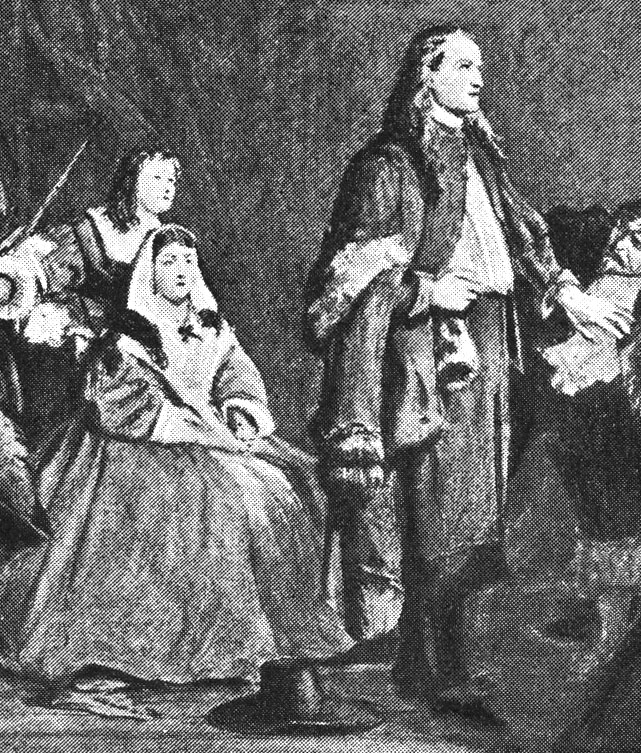
Remembering Margaret Fell

Margaret Fell, with George Fox before the judges, from a painting by J. Pettie 1663, public domain via Wikimedia Commons

Margaret Fell with George Fox before the judges, from a painting by J. Pettie, 1663

Margaret Fell was born on some unknown date in 1614, so let’s take this occasion to remember her on the date of her death, April 23rd, 1702.

Fell’s lived a life as passionate as it was long. She was an unconventional thinker for her time, a zealous and progressive religious activist at times imprisoned for her beliefs, a prolific writer, well-traveled, a mother of eight children and a wife twice.

An early adherent and eloquent promoter of Quakerism, Fell is now considered one of its founders. She converted to Quakerism after hearing a sermon by one of its most charismatic preachers, George Fox, and almost immediately launched into a lifetime of hosting Quaker meetings and speaking out on behalf of her new religion. After her husband died some years later, Fell married Fox, probably more as a co-missionary than as a romantic partner since their work, travels, and imprisonments kept them apart for much of their marriage.

As I’ve had a lifelong fascination with the history of human rights, I’ve long admired the Quakers because, along with Unitarians and Deists, so many have been leaders in the struggle to expand, establish, and promote them. That’s because these faiths emphasize the importance of individual conscience, the primacy of the human mind, God’s rational nature, and the moral equality of all human beings.

Fell believed in the Quaker doctrine of the Inner Light which God has caused to shine equally in the hearts of all beings; all we need do is heed it. Therefore, one does not need ministers, priests, or any other authorities or intercessors to achieve salvation. And because God has created everyone for the same purpose and gave everyone that light, everyone is spiritually equal and capable of understanding and proclaiming the Truth. We can see how this doctrine, central to Quakerism, readily aligns with human rights movements centered on a belief human spiritual and intellectual equality. The right of women to speak in church and write religious texts, in her time limited to men, was a cause particularly dear to Fell’s heart. While Fell’s belief in the equality of women was limited to their role as spiritual beings, Quakerism tended to encourage ever-more progressive beliefs in its adherents. Over time, Quakers came to be leaders in the abolitionist and pacifist movements, promoting the right of all to receive equal and universal education and for women’s rights in social and political spheres as well.

In light of her achievements as a female religious pioneer, and the human rights advances facilitated by the Quaker faith she helped found, Fell’s contributions should continue to be remembered and celebrated.

Ordinary Philosophy and its Traveling Philosophy / History of Ideas series is a labor of love and is ad-free, supported by patrons and readers like you. Please offer your support today!

~~~~~~~~~~~~~~~~~~~~~~~~~~

Sources and inspiration

Broad, Jacqueline, ‘Margaret Fell‘, The Stanford Encyclopedia of Philosophy, Edward N. Zalta (ed.)

Jacoby, Susan. Strange Gods: A Secular History of Conversion. New York: Pantheon, 2016 (see chapter on Margaret Fell)

Happy Birthday, Thomas Jefferson!

Thomas Jefferson by Charles Bird King, 1836, after Gilbert Stuart, at the Smithsonian Portrait Gallery in Washington, D.C. Photo 2016 by Amy Cools

In remembrance of Thomas Jefferson (April 13, 1743 – July 4, 1826) on his birthday, I’ll share my tributes to his memory, his life, and his ideas: my traveling philosophy / history of ideas series

To Washington DC, Virginia, and Philadelphia I Go, In Search of Thomas Jefferson

and

To Paris, France I Go, In Search of Revolution-Era Thomas Paine, Mary Wollstonecraft, and Thomas Jefferson

and my thrilling interview with Clay Jenkinson, Jefferson scholar, last year

Interview with Clay Jenkinson as Thomas Jefferson

I hope you enjoy following me as I follow in the footsteps of Jefferson!

Ordinary Philosophy and its Traveling Philosophy / History of Ideas series is a labor of love and ad-free, supported by patrons and readers like you. Please offer your support today!

New Podcast Episode: Margaret Sanger in the San Francisco Bay Area, California

Scottish Rite Temple mosaic, above the doorway of what’s now the Regency Center, San Francisco

Listen to this podcast episode here or on Google Play, or subscribe on iTunes

Fairly early on in my research for my history of ideas series on Margaret Sanger in New York City, I discover that she delivered one of her more famous addresses here in Oakland. Practically just around the corner from where I live, in fact!

So I’ve long had the idea of doing a follow-up Sanger project here in the San Francisco Bay Area, certain I’d find she’s been here more than once. That turns out to be the case. And not only do I discover that she visited here several times, I find that the excellent library at the University of California at Berkeley has some great resources for filling in some gaps in my information about Sanger in NYC. So, this story will have two parts: the first part is about sites associated with Sanger here, and the second part is about some discoveries I make in U.C. Berkeley’s archives following up on two NYC sites… Read the written version here

Ordinary Philosophy and its Traveling Philosophy / History of Ideas series is a labor of love and ad-free, supported by patrons and readers like you. Please offer your support today!

New Podcast Episode: Michel de Montaigne

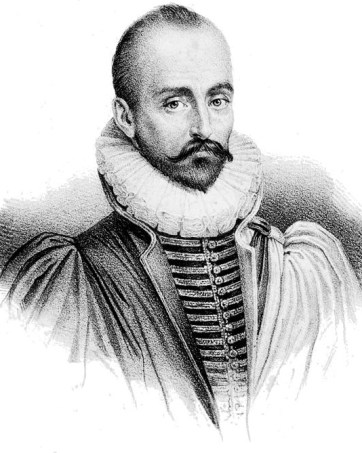
Michel de Montaigne, public domain via Wikimedia Commons

Listen to this podcast episode here or on Google Play, or subscribe on iTunes

Michel de Montaigne, who lived from February 28, 1533 to September 13, 1592, was a thinker after my own heart.

Montaigne was a deeply philosophical thinker, though he never developed a complete philosophical system or moral theory. He invented, or at least popularized, a revolutionary way of writing: the essay. In his Essays, he wrote about anything and everything he found interesting enough to observe and think deeply about which was …well, just about everything, especially his inner life. His Essays are a rich source of wonderful philosophical and moral insights. As the Stanford Encyclopedia of Philosophy describes: “… under the guise of innocuous anecdotes, Montaigne achieved the humanist revolution in philosophy. He moved from a conception of philosophy conceived of as theoretical science, to a philosophy conceived of as the practice of free judgment’. Judgment, in this sense, involves applying both our cultivated moral sense and our reason, enriched with knowledge, to navigating the complexity and variety of situations we face throughout our lives; it also refers to the expansive, tolerant attitude we should display towards each other and towards the whole of reality…. Read the written version here

Ordinary Philosophy and its Traveling Philosophy / History of Ideas series is a labor of love and ad-free, supported by patrons and readers like you. Please offer your support today!

Happy Birthday, Michel de Montaigne!

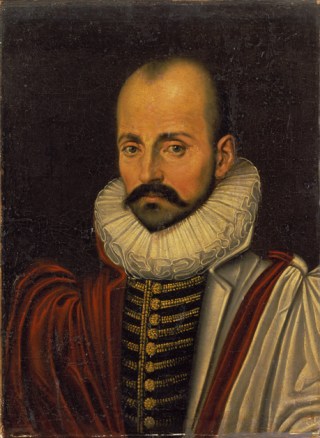
Michel de Montaigne, public domain via Wikimedia Commons

Michel de Montaigne, public domain via Wikimedia Commons

Michel de Montaigne, born on February 28, 1533, was a thinker after my own heart.

Montaigne was a deeply philosophical thinker, though he never developed a complete philosophical system or moral theory. He invented, or at least popularized, a revolutionary way of writing: the essay. In his essays, he wrote about anything and everything he found interesting enough to observe and think deeply about which was …well, just about everything, especially his inner life. His Essays are a rich source of wonderful philosophical and moral insights. As the Stanford Encyclopedia of Philosophy describes: “… under the guise of innocuous anecdotes, Montaigne achieved the humanist revolution in philosophy. He moved from a conception of philosophy conceived of as theoretical science, to a philosophy conceived of as the practice of free judgment’. Judgment, in this sense, involves applying both our cultivated moral sense and our reason, enriched with knowledge, to navigating the complexity and variety of situations we face throughout our lives; it also refers to the expansive, tolerant attitude we should display towards each other and towards the whole of reality.

While Montaigne highly valued education, he also recognized that it can be overemphasized to the detriment of learning from our own experiences. In his day, education often consisted largely, even mostly, of rote memorization of a vast quantity of facts. This learning method can stifle our ability to exercise practical judgment and serve to blunt social skills as well, preventing us from learning from and about each other, which is essential for cultivating moral understanding. We should learn as much about the world and each other as possible, Montaigne thought, through interpersonal interaction as well as through more formal types of education.

Montaigne also thought that sometimes, our big, smart brains can even hinder our quest for wisdom. For example, we can become ashamed, insecure, even hateful of our own bodies when we contrast the refinements of education and the arts to the material, often messy, even disgusting reality of caring for the body and satisfying its needs. This distaste for our bodies is ungenerous and ungrateful, said Montaigne, considering how we rely on our bodies for so much. In fact, even to this Catholic Christian man who believed in the soul, we are our bodies in an essential way. Our bodies are much more than just meat that our souls inhabit, they are intimate partners of souls, and together, they comprise whole human beings. As such, our bodies deserve our compassion, gratitude, love, and respect.

Our big brains can make also make us too proud, unable to recognize wisdom in humble or unexpected places. Those of little or no education, Montaigne maintains, sometimes display more wisdom than the most rigorous scholar. This includes animals, who, especially, are sometimes wiser than we are; for example, they live their whole lives with the natural, unembarrassed, proper attitudes towards their own bodies that allows them to unapologetically enjoy the pleasure of being alive. Montaigne believed that we should learn from them and imitate them in these respects. Those who have the most wisdom to teach us, then, can come from all walks of life, and the wisest person will be receptive to the lessons that can be learned anywhere.

Furthermore, we shouldn’t limit our exposure merely to our own cultures, but should learn about as many other cultures and beliefs as possible. Montaigne, like Confucius, believed that before you can be a philosopher or a moral theorist, you must first be an anthropologist. A wide-ranging education and exposure to the world has two major advantages. First, the information you have to work with will be much more vast, your scope much wider, than if you merely stuck to the received wisdom of your own culture. Secondly, you will cultivate in yourself the very virtues that characterize the wise and moral person: tolerance, benevolence, respect, kindness, generosity, understanding, and so forth. Conversely, narrowness of outlook and xenophobia lead to hatred, violence, and so on, as the horrific stories coming back from the conquest of the New World made him all too aware. Montaigne believed we shouldn’t base our attitudes about right and wrong on habit, which is morally lazy and which a narrow education can easily lead us to do; rather, we should temper our moral attitudes with reason, and our reason, in turn, should be informed by an expansive and ever-expanding body of knowledge.
michel-de-montaigneThis can make Montaigne seem like a moral relativist, but I don’t think that this is so. He was a committed Catholic, which seems to rule that out. Yet he did recognize that some things society traditionally recognized as wrong are in fact both bad and good, sometimes one or sometimes the other depending on the circumstances, sometimes both at the same time. For example, consider drunkenness. It can be bad, such as when it gets you fired or leads you to violence. But, it can also be good, such as promoting sociability or artistic disinhibition. Montaigne recognized that if there are universally true moral maxims, they’re likely to be few. Rather, his approach to philosophy is a skeptical one: he recognized that an attitude of uncertainty and doubt is a fruitful one for gaining wisdom. When you don’t easily accept the first easy answers that come along, when you’re always waiting for more information to come in, when you generally accept that there’s a possibility you are wrong, you are practicing a wise skepticism; otherwise, you cheat yourself out of the opportunity to learn.

Ethically, Montaigne espoused some behaviors as universally preferable: those that are inspired by tolerance, joyfulness, sociability, generosity, benevolence, curiosity, a good-humored attitude towards other people and their varied ways of living, and so on; he specifically denounced cruelty and narrowness in thinking and feeling. He described his ethical theory not by outlining a rigorous system, however, but by enacting and describing a moral attitude that inspired moral behavior in others. In sum, he may or may not have been a relativist when it comes to a specific theory or set of maxims, but he was definitely not relativistic in the overarching value he placed on the art of being a good, complete human being, and on promoting the same in others.

Montaigne’s Essays demonstrate that the most well-reasoned advanced moral theory may never be quite as convincing, effective, or influential when spelled out as that which is lived out. Montaigne showed us how we can all be philosophers, how we can live ethically, and how we can discover it all for ourselves.

Philosophers, if they’re doing it right, will be the happiest of all people since philosophy can and should be a joyful enterprise, and we should all be philosophers.

Listen to the podcast version here or on Google Play, or subscribe on iTunes

~ I wrote this essay in 2012 and edited it substantially for this publication in 2017

Learn more about this great master of introspection here:

Essays – by Michel de Montaigne

Me, Myself, and I: What Made Michel de Montaigne the First Modern Man? – by Jane Kramer for The New Yorker

Michel de Montaigne – by Marc Foglia for The Stanford Encyclopedia of Philosophy

Michel de Montaigne – from The Book of Life

Michel de Montaigne (1533—1592) – by Christopher Edelman for Internet Encyclopedia of Philosophy

Michel de Montaigne (1533-1592) – by Terence Green for Philosophy Now

Michel de Montaigne: French Writer and Philosopher – by Tilde A. Sankovitch for Encyclopædia Britannica

Montaigne on Death and the Art of Living – by Maria Popova for Brain Pickings

Can We Have More Than One Friend? According to Montaigne, No – by Manuel Bermudez

Philosophy: A Guide to Happiness – Montaigne on Self-Esteem – by Alain de Botton

Ordinary Philosophy and its Traveling Philosophy / History of Ideas series is a labor of love and ad-free, supported by patrons and readers like you. Please offer your support today!

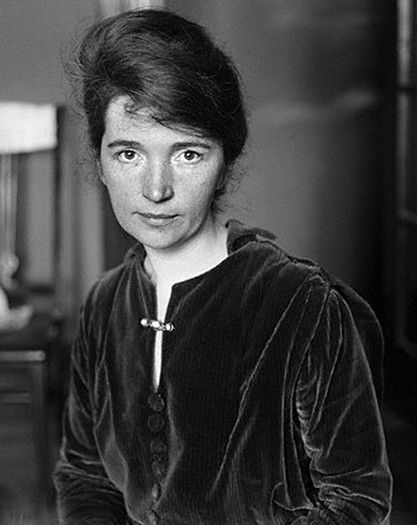
To New York City I Go, in Search of Margaret Sanger

margaret-sangerHello, friends of Ordinary Philosophy!

From time to time, I take a trip to some corner of the globe, to explore the lives and ideas of great thinkers in the places where they lived and worked. For this series, I follow in the footsteps of thinkers who are no longer alive, since those who are still telling their own stories. But those who are no longer alive in the body live on in the ideas that they pass on, and in the examples they provide for us to follow.

I’m pleased and excited to announce my sixth philosophical-historical themed adventure, a rather impromptu trip to New York City to follow in the footsteps of Margaret Sanger.

Though the timing was spur of the moment, I’ve read and thought about Sanger quite a bit over the years and have some of the research done already for this long-planned trip. So when this little window of time opened up in my schedule, I happily seized the opportunity! As central to the history of women’s rights, free speech rights, and rights to sexual self-determination and privacy as she is, Sanger’s also the most problematic figure in the history of ideas I’ve followed so far for this series, with the possible exception of the brilliant but slave-owning Thomas Jefferson. She’s certainly the first that sparked immediate controversy when I casually mentioned my plans for following her on social media. Here’s a brief introduction, a condensed version of a short bio I published about a month ago in honor of her birthday:

Margaret Higgins Sanger was born on September 14, 1879 into a large Catholic family with 11 surviving children. Her mother died at about age 50 from tuberculosis. As young Margaret saw it, her mother was worn out from her 18 pregnancies, and would cite this as one of the many reasons she so passionately advocated for the right of women to control their own bodies and fertility.

She went on to become a nurse who worked with poor women in New York City in the 19-‘teens and twenties. As she saw these women struggle with the toll that large numbers of pregnancies took on their families’ finances and their own health, Sanger became convinced that ‘birth control’, a term she invented, was essential if these women hoped to escape poverty and sexual oppression. She opened America’s first birth control clinic and despite numerous arrests and fines, she continued her fight for reproductive rights. In this regard, she’s best known today as one of the founders of Planned Parenthood and a key figure in the development of the first birth control pill.

Sanger remains a controversial figure. An ardent feminist, human rights activist, and advocate of sex-positivity, Sanger was also a eugenicist, believing that birth control was at least as important a tool for limiting the production of ‘the unfit’ (her words) as it was for women’s liberation.  Generally, Sanger was an ardent advocate of self-determination, free speech, open discussions of sex and sexuality, and education, education, education.* It was up to informed and thoughtful people, Sanger believed, to take responsibility for their own sexual choices and to convince others to do the same. Regrettably, however, at times Sanger seemed to support some sort of coercive or compulsory forms of birth or population control, for those who she deemed incapable of making this choice for themselves, for example, or too dangerous to be allowed to conceive and raise children.

Aside from her (mostly good) ideas about human rights and personal responsibility, I find Sanger’s beliefs about human sexuality and its important role in spiritual and mental health particularly fascinating

So off to New York City I go, from October 17th thru the 21st. There, I’ll visit landmarks associated with her life, places where she lived, worked, thought, wrote, studied, and rested, to see for myself how the places informed the woman, and vice versa.

Here is the story of Margaret Sanger as I discover her:

Happy Birthday, Margaret Sanger!
Margaret Sanger NYC Sites, Day 1 Part 1, and a 100 Year Anniversary
Why So Much Hatred for Margaret Sanger?
Margaret Sanger NYC Sites, Day 1 Part 2
Margaret Sanger NYC Sites, Day 1 Part 3
Margaret Sanger NYC Sites, Day 2, Part 1
Margaret Sanger NYC Sites, Day 2, Part 2
Margaret Sanger NYC Sites, Day 3 Part 1
Margaret Sanger NYC Sites, Day 3 Part 2
Margaret Sanger NYC Sites, Day 4

Ordinary Philosophy and its Traveling Philosophy / History of Ideas series is a labor of love and ad-free, supported by patrons and readers like you. Please offer your support today!
Patrons of the Margaret Sanger series: Christopher Wallander, Magaly Gamarra Grant, Devin Cecil-Wishing, Sally Lee ~ With warmest gratitude, thank you!

*This piece was updated on 10/26/16. Originally, the 3rd and 4th sentences of the seventh paragraph read ‘She did not, however, support any kind of compulsory or coercive forms of birth or population control. Instead, Sanger was an ardent advocate of self-determination, free speech, open discussions of sex and sexuality, and education, education, education. It was up to informed and thoughtful people, Sanger believed, to take responsibility for their own sexual choices and to convince others to do the same.’ My subsequent research found that this is not quite accurate, as she surmised that coercive sterilization might be warranted in certain circumstances, for those who are mentally ill, handicapped in certain ways, or criminally violent, for example. Please read Why So Much Hatred for Margaret Sanger? and more from the series for further explorations of Sanger’s ideas on the subject.