Argument & Censorship, Opposition & Oppression, by Eric Gerlach

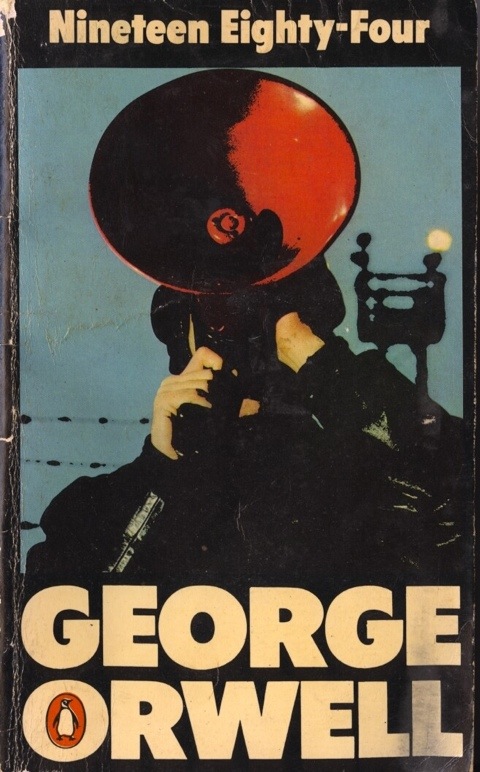
A friend of mine passed me an article about millennials and George Orwell, which claimed that young people on the internet are bullying others mercilessly who are out of step with the dogmas of the left.  This is hardly a new claim about millennials, as many since the 80’s have said that “political correctness” is oppressive and invoked 1984. While I agree that militant dogmatism is found on both sides of the aisle, I think what irked me most about the article was the comparison to Orwell and claims of censorship regarding heated exchanges online between free individuals.  At a time when many are confusing arguments and boycotts with fascism, I feel that a distinction needs to be made between opposition and oppression, between argument and censorship.

If someone argues with you, and continues to argue with you, they are not censoring you.  They are speaking with you.  They are opposed to your beliefs, but not necessarily opposed to you speaking. They may not be good at listening, and they may give you little chance to speak, but they are engaging you in a conversation, even if it is a terrible one. Often, they are hoping to hear the reasons you won’t change your mind, to change your mind, and then hear you say that your mind has been changed.  When I receive critical comments, I am irritated, but I have not been censored.  Nietzsche said that one should appreciate one’s enemies, as they help one to grow stronger, which I find to be an inspirational strategy for getting the most out of one’s beliefs.

~~~~~~~~~

Eric Gerlach teaches philosophy and the history of human thought at Berkeley City College. This piece was originally published on April 16 at his excellent blog Eric Gerlach, ‘A Skeptical & Global Guide to the History of Human Thought’, which I highly recommend, and re-published here with the author’s permission.

Jefferson and Slavery

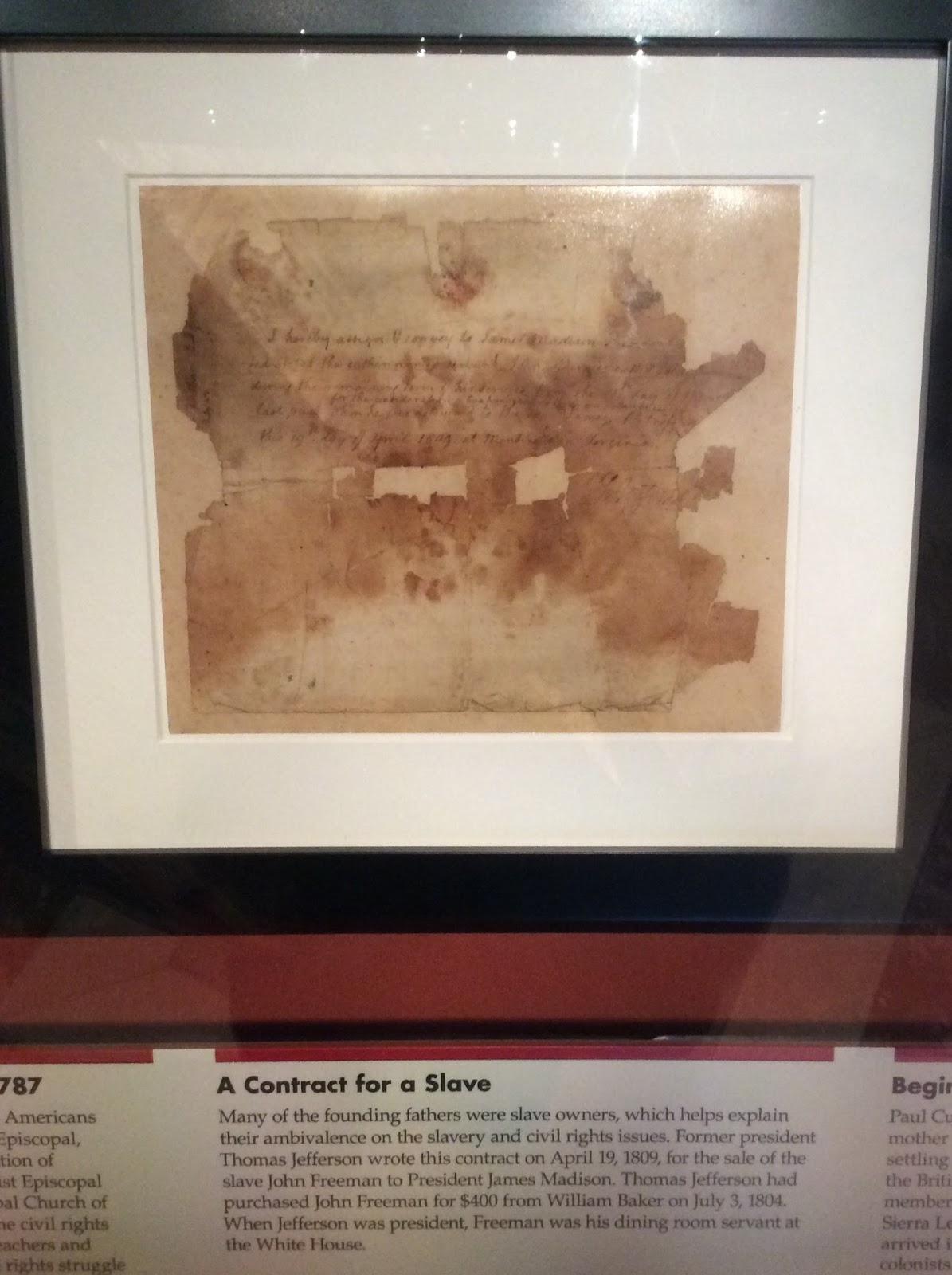
Throughout my history of ideas travel series following Thomas Jefferson, slavery was on my mind a lot: the institution as a whole, and Jefferson’s relationship to it. I was reminded of it constantly: by an original book from his own collection titled ‘The Horrors of Slavery’ now in the Library of Congress, which also displays a slave sale contract between himself and James Madison from 1809; the slave quarters and artifacts at Monticello; museum displays and plaques in D.C., Williamsburg, and Philly; and signs telling the story of his brief but telling correspondence with Benjamin Banneker.

As every student of American history learns early on, Jefferson’s words in the Declaration of Independence and his stated beliefs contrast sharply with his life as a slaveowner. And nearly every place I find something written about Jefferson, this contradiction is addressed but never really resolved.

Jefferson was in favor of the abolition of slavery early in his career as a lawyer and member of Virginia’s House of Burgesses. Having made little headway in the antislavery cause as a younger statesman, he rather abruptly gave up the fight in the 1790’s, proclaiming it unwinnable in his generation. While he continued to argue now and again that slavery was a moral and political evil, he chose to continue the expensive lifestyle of traveling, entertaining, building, and collecting fine wine, books, and art that he loved. This kept him in debt, so he funded it all the the familiar way: he remained a slaveowner for the rest of his life.

When I was in Philadelphia’s Old City, I visited the site of the President’s House and read the posted stories of the enslaved people who lived and worked there during George Washington’s tenure. As I read, I thought of how often I’d heard and read excuses made for Jefferson, Washington, and their fellow slaveowners, another common theme I encountered throughout my trip. Some sought to minimize their moral responsibility for slaveowning on the grounds they were ‘stuck’ in the institution already so they just had to ‘make the best of it’; others claimed that many were actually working on the problem in their own way but had to go slowly because of how entrenched the institution was, and so on. The most common excuse I encountered was that they weren’t really all that bad as slaveowners; in fact, they were benevolent because ‘they treated their slaves so well’, and their slaves were really better off than many free people of the laboring classes.

These ring hollow to me: they all sound like pretty lame attempts to make sense to ourselves of our history as self-professed champions of liberty who have simultaneously oppressed racial, ethnic, and ideological minorities throughout our history. I had read accounts before of Jefferson’s, Washington’s, and others’ so-called benevolent brands of slaveowning, but when I look around at these artifacts and displays, I really can’t see how true benevolence can ever coincide with that institution. As Jefferson himself wrote in his Notes on Virginia, The whole commerce between master and slave is a perpetual exercise of the most boisterous passions, the most unremitting despotism on the one part, and degrading submissions on the other. Our children see this, and learn to imitate it.’

The real answer to that conundrum is: it never made sense, and it never will. Jefferson knew it, evident not only in his embarrassed response to Benjamin Banneker, he said so over and over again, explicitly in some cases, between the lines in others. George Washington knew it too, as evidenced by his changing attitudes on slavery; indeed, all of our nation’s founding generation knew it.

That’s why they fought over the words of the Declaration of Independence, especially the original draft which more plainly revealed the stark contradiction between the colonies’ demand for liberty for themselves while they remained enslavers of others. That’s why they fought over slavery again during the Constitutional Convention and how that weird three-fifths clause got in, because they couldn’t solve the problem of how slaves could be persons deserving representation while neither free nor citizens. That’s why debates over how to treat black Revolutionary war veterans were never satisfactorily resolved, why the John Brown plot happened, why the Missouri Compromise and the Dred Scott decision and the Civil War and the Plessy vs Ferguson decision and the 1963 firehosing of the Baltimore Children’s Crusade and the Baptist Church bombing and the riots in Baltimore in 1968 and again this spring happened, and so on and so on.

The only excuse I’ve heard in defense of slaveowners like Jefferson and Washington that makes a particle of sense on the face of it is that freed slaves would likely have a worse time of it on their own than they might have under their protection. Free black people often did suffer terrible mistreatment, including terrible wages, racist criminal codes, segregation, kidnapping, and re-enslavement; freed slaves often had to choose between living where they had few prospects and leaving their still enslaved loved ones behind. Therefore, the argument goes, the attempts of some conscience-stricken slaveowners to keep their slaves while treating them more humanely were really quite benevolent. 

While there’s evidence indicating some good intentions on the part of some slaveowners, this argument just doesn’t hold up that well either when examined in the full light of history. To his credit, Washington kept more slaves on his plantation than was financially healthy for him so that families would not have to be split up, and tried to work out a way to eventually emancipate all of them with some financial provisions. Jefferson was squeamish about allowing slaves to be beaten in front of him and rarely allowed it, and paid many of them bonuses for good work. It seems on the whole, Washington has a far better record when it comes to gentler treatment and concern for the slaves’ own interests, and he freed all of them in his will though he couldn’t bring himself to do it during own his lifetime. It turns out there’s plenty of evidence Jefferson often had others whip his slaves when he wasn’t there to see it, especially when the profits from his nail business dropped off. And Jefferson’s habit of accruing large debts by his habit of living far beyond his means caused almost all of his slaves to all be sold at his death, and many slave families to be broken up, parents, children, brothers and sisters, wives and husbands torn away from one another. 

And many freed slaves actually did do quite well for themselves, or at least as well as they might have otherwise. Plenty of other plantation owners freed their slaves, and many free black people did very well for themselves in the North, West, and even in some areas of the South. Jefferson and Washington could also have allowed their slaves to make the choice for themselves whether or not they wanted to remain under their protection. They had both (Jefferson earlier in life, Washington later) come to the firm conclusion that slavery was morally wrong. They just couldn’t bring themselves to make the hard choices and personal sacrifice to fully act on their convictions.

So it’s not that, as the cliche goes, that we’re judging Jefferson, Washington, and other slaveowners by the standards of our own time, not theirs. Here’s what makes it all the more painful and injurious to our American self-image as bearers of the standard of liberty: we’re judging these Founding Fathers by their own standards, and by the standards of others in their own time, those principled lovers of freedom who did free their slaves, who decided to do the difficult but the right thing, according to the principles of the Declaration and those Washington professed later in life.

As to the issue of ‘treating their slaves so well’: consider what really went into keeping people enslaved besides whippings.

Slaves were denied the chance to make their own decisions and to enjoy the full range of human relationships that free and happy people need. The marriages of slaves were not held sacred by their masters and they could not enjoy the security of family bonds and affection. At any time, wife, husband, sister, brother, parent, and worst of all, children could be taken and sold elsewhere, never to be seen again. This happened all the time, since there was no plantation large enough to hold exponentially increasing slave families. They were provided no incentive to enjoy fulfilling occupations, since they are denied the fruits of their labor, they had a narrow field of roles to choose from or none at all (surely noone chose to be a field hand!) and there was not much personal reward for a job well done. They could be and very often were whipped, denied food and other necessities, and otherwise punished for any infraction, despite wishful hypotheses that slaves were too financially valuable to be treated badly. (Sorry, Pollyannas, history’s not on your side). They often were treated harshly even if the plantation owner didn’t desire or order it because slaveowners relied on their overseers, which they couldn’t watch most of the time, to get results.

And worst of all, because it left slaves most vulnerable to every sort of oppression and robbed them of great solace, slaves were denied education, especially higher education. Enforced ignorance was one of the surest ways to keep slaves from plotting escapes and revolts, to keep them from learning about the wider world they could wish to be a part of, from learning moral and religious arguments against slavery, and from the prospect of a good job if they ran away.

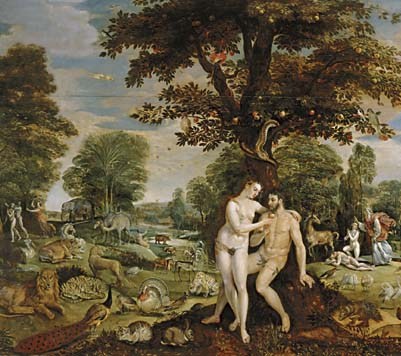
The Bible was often used to justify slavery: there are many instances of slavery in the Old Testament that Yahweh seems perfectly comfortable with, and Paul advises slaves to be obedient to their masters and to return to them if they ran away. Paul does say you should be nice to your slaves, but that’s the farthest his morals go in the matter. Like the myth of the Garden of Eden, Paul tries to instill in his readers a particular moral virtue. But if Jefferson, Washington, and their fellow slaveowners had read their Genesis a little more carefully, they might have discovered that there’s more there than a simple morality tale about obedience.A closer reading of the Garden of Eden story reveals a much deeper insight: human beings of spirit and will, of wit and intelligence, of curiosity and integrity always have, and always will, long for knowledge and self-determination. And they must and will have it, even if danger, privation, suffering, or destruction be the price.

~~~~~~~~~~~~~~~~~~~~~~~~~~~~~~~~~~~~~~~~

Sources and Inspiration:

‘Benjamin Banneker’, Africans in America, PBS.org
http://www.pbs.org/wgbh/aia/part2/2p84.html
Letter to Jefferson: http://www.pbs.org/wgbh/aia/part2/2h71t.html
and Jefferson’s response: http://www.pbs.org/wgbh/aia/part2/2h72t.html

Gordon-Reed, Annette. Thomas Jefferson and Sally Hemings: An American Controversy.
Charlottesville: University of Virginia Press, 1997. https://books.google.com/books/about/Thomas

Meacham, Jon. Thomas Jefferson: The Art of Power. New York: Random House, 2012.
http://www.jonmeacham.com/books/thomas-jefferson-the-art-of-power/

Thompson, Mary V. “The Private Life of George Washington’s Slaves”, Frontline, PBS.org
http://www.pbs.org/wgbh/pages/frontline/shows/jefferson/video/lives.html

Wiencek, Henry. ‘The Dark Side of Thomas Jefferson’, Smithsonian Magazine, Oct 2012.
http://www.smithsonianmag.com/history/the-dark-side-of-thomas-jefferson-35976004/

On the Josh Duggar Controversy, Part 2

My recent piece on the Josh Duggar controversy was an especially controversial one for many of my readers, as I expected it would be, and here’s a response in answer to the many objections and questions I received in response to it.

To begin with, what do I mean by ‘child’ anyway? Fifteen-year-olds aren’t children, are they? I mean, it’s not like they’re little kids any more! C’mon, they know what they’re doing!

Well, yes and no, They know what they’re doing much more than younger children; but, like younger children, they’re encountering new and often staggering challenges which their not yet fully developed brains are still learning how to handle, especially when it comes to integrating their newfound sexual needs and urges into socially responsible behavior.

When it comes to nailing down an exact age or age range for the category child, I would leave it to relevant experts to decide this as it relates to policy. I consider a child a person who has not yet reached a stage of development in experience and physical maturity (including and especially of the brain) generally capable of practicing reason, forward-thinking, and self-control to the level that mature persons are generally capable of. I expect this age to be somewhere in the range of 17 – 19, though of course this differs from person to person. This might be better determined by a mental health professional when deciding if an offender should be directed to medical treatment or juvenile court or to the adult justice system.

Disgust is also playing a big role in public reactions to this case. Many are uncomfortable with the fact that children often act on their new sexual urges at all, let alone in ways that don’t respect the rights of others, since they lack the relevant social experience and their immature brains lack the structures that adults rely on for self-control. I was recently listening to a talk by the great Martha Nussbaum on how disgust often leads us to act unjustly towards one another; I think that this is happening here in Josh’s case. We all need to remember that sex is just as much a natural part of life as any other, and that to help them get through their life changes, we must react constructively and help children learn how to deal with it all. There are plenty of childhood misbehaviors that infringe on others’ rights: bullying, stealing, selfish refusal to help or share, and so on and so on. It makes no more sense to react hysterically to one than the other.

To single out sexuality in children as an instinct or set of behaviors to be disgusted at or feared more than others is to my mind not only unreasonable but superstitious, since it’s anti-scientific and anti-naturalistic, even inhumane. And to lump all sexual misbehavior in children together as ‘molestation’ and ‘assault’ is not only inappropriate, it’s absolutely wrong. Not only does it cause the public to treat the person slapped with these labels unjustly, it minimizes the injury of those who suffered real assaults or suffered substantial harm. In this case, people are referring to Josh’s unwanted groping or petting in the same terms that people are referring to the rape of children by clergy, for example: they are all being lumped together as ‘child molesters’. There is no moral justification for equating the forcible rape of a younger person by an older person with unwanted groping of one child by another, yet so many people are getting away with doing this very thing in the public debate right now by referring to them all in the same terms.

And it doesn’t make sense to react to the suffering of one child, the target of the undesirable behavior, by treating the misbehaving child unjustly. Whether or not we like it, the process of growing into our mature sexual nature is uncomfortable, complicated, and riddled with mistakes. Sometimes we need to give sexually misbehaving children a talking-to, sometimes we need to punish them, and sometimes we need to separate violent or dangerous children from others until they’ve learned their lesson. But we need to stop trying to sanitize childhood and adolescence, both on the right side of the ideological spectrum and on the left. Conservatives need to stop screeching about the horrors of teens having sex, the dire consequences of sex-ed, and how making contraceptives and the HPV vaccine available to youngsters will cause them all to be sex-addled reprobates. Liberals need to stop self-righteously acting as if children are simultaneously passive receptacles of adult virtues and perfect little angels whose misbehaviors are products of a corrupt society rather than immaturity, that children who cause discomfort or suffering in others must be ruthlessly tried, convicted, and sentenced in public opinion, and most of all, they need to stop promoting a culture of perpetual victimhood. Like I said before, we all need to grow up!

Even in the cases of extreme misbehavior, the future of the offending child should not be ruined by exposing them to a lifetime of media scrutiny, or placing them on a publicly accessible criminal registry for life, or otherwise lynching their reputation. The situation is never helped by heaping injustice upon suffering. And imagine what a society would look like, what a huge and oppressed underclass we would create, if we were to actually punish all children who were caught misbehaving in ways that caused other children suffering, or infringed on others’ rights, by publicizing their misdeeds for life. Today, I’m finding it quite funny (not ‘ha-ha’ funny) how many of the same people who’ve jumped on the ‘Josh Duggar is a child molester’ bandwagon are upset, as they absolutely should be, by Kalief Browder’s unjust punishment for allegedly stealing a backpack as a child of 16. Yet they’re treating Josh as a pariah since he ‘should have known better’ and Kalief as a tragedy because ‘he was just a kid’. Of course, Kalief’s treatment was far more unfair, and had far more dire consequences, than Josh’s. But many lives are ruined forever because of how society sometimes unjustly punishes people for life for offenses they commit as children, by the courts and in the media, and many people are driven to despair and even suicide because of it. And as Human Rights Watch and many other criminal justice reform organizations have found, people treated as Josh is being treated now are often driven to the same desperate lengths as Kalief.

Another thing: it doesn’t matter a tiny bit what Josh Duggar believes as an adult, what his religious or political opinions are, and especially, what his parents’ beliefs are, when it comes to how he misbehaved as a child and how we treat him because of it. I don’t like Josh’s religion, I don’t like the indoctrination brand of homeschooling his family promotes (which I experienced myself, to the detriment of my early education), and I don’t agree with the Duggar clan’s message overall. None of that matters. Neither I nor anyone else has license to do the wrong thing just because we don’t agree with someone’s opinions, even if we think they are being hypocritical. In Josh’s case, if he now promotes Christian moral values and believes we should deal with sexual misbehavior harshly, it has nothing to do with whether he failed to live up to those principles before he was old enough to maturely formulate them. An adult can oppose bullying (rightly!) even if they themselves bullied others as a child, or promote stricter laws against theft even if they stole things as a child. The one has nothing to do with the other when it comes to one’s beliefs; every single one of us have convictions that our childhood behavior doesn’t reflect. We should criticize Josh’s beliefs on their own merits, and not on anything else.

In fact, we all learn right from wrong precisely because we’ve made mistakes: we do the wrong thing constantly as we grow up, and learn not to do it again because of the consequences. Sometimes it’s because we’re corrected or punished by an authority figure, sometimes it’s because we hurt others and feel ashamed, or because our peers strike back or shun us, and so on. It’s not until we’ve had ample opportunity to learn these lessons, and for our brains to develop enough to process and implement them, that we should begin to be held fully responsible for our actions.

One more thing: I would ask my fellow liberals and progressives who are jumping on the ‘Josh Duggar is a child molester’ bandwagon to consider this: would you accept this brand of character assassination based on childhood misdeeds from people on the other side of the ideological divide?

Let’s imagine ourselves in a counterfactual (make-believe or what-might-have-been) world in which Peter Singer, influential philosopher and founder of the modern animal rights movement, was suddenly embroiled in controversy. Suppose an angry neighbor convinced the local police to publish a report revealing that Singer has thrown rocks at the neighbors’ cats when he was fourteen or fifteen, sometimes injuring them a little or causing them fear and distress; sometimes, the rocks missed and the cats didn’t even notice what happened since they were asleep at the time. Then suppose conservatives who oppose animal rights’ legislation started splashing this story all over the press, saying things like: ‘Look what a hypocrite Peter Singer is, that animal abuser!’ and ‘See, I told you so-called liberal values are no good, look how Peter Singer behaves, that just shows what all those animal-rights bleeding-heart liberals who support him are really like!’ If you were not outraged at that injustice, and amazed at the unconscionable behavior of conservatives who reacted to the story this way, I would be just as appalled at the lack of critical thinking, and the willingness to betray ones’ principles to score political points, as I am with the ‘Josh Duggar is a child molester’ crowd. Peter Singer’s principles and beliefs he espouses as an adult has nothing to do with whether or not he misbehaved as a child in that counterfactual world.

In sum: we all need to deal justly with one another, and not stoop to assassinating one another’s characters for bad reasons just because we disagree. If we really believe in truth, justice, tolerance, and the rightness of our cause, we should hold ourselves to the discipline of never taking the moral low ground, because, ultimately, we all lose by doing so.

~~~~~~~~~~~~~~~~~~~~~~~~~~~~~~~~~~~~~~~~~~~~~~~~~~~

Sources nad Inspiration:

Nussbaum, Martha. ‘Same-Sex Marriage and Constitutional Law: Beyond the Politics of Disgust’
Talk at Cornell Law School, Nov 11, 2009 https://www.youtube.com/watch?v=dybhnOZvCvw

Schwirtz, Michael & Michael Winerip. ‘Kalief Browder, Held at Rikers Island for 3 Years Without Trial, Commits Suicide’. New York Times, June 8, 2015 http://www.nytimes.com/2015/06/09/nyregi

Singer, Peter. Animal Liberation. Random House, New York, 1975
https://books.google.com/books?id=2wi8AAAAIAAJ&q=animal+liberation+peter+singer&d

‘US: More Harm Than Good: Exempt Youth Sex Offenders From Registration Laws’. Human Rights Watch, May 1, 2013. http://www.hrw.org/news/2013/05/01/us-more-harm-good

Fury Road, by Christina Bellon

Max:  Here, everyone is broken.
Furiosa: Out here, everything hurts.

~ Mad Max: Fury Road

I couldn’t wait to see this movie. And then I couldn’t wait to see it again. The first viewing was cathartic in all the right ways, but it was a sensory assault. In 3-D it was almost abusive. The second time allowed me to attend to the story, the characters, the art and imagery, the dance of bodies in fight and vehicles in chase. Those Pole Cats are terrifyingly beautiful swinging through the air at high speed (all done live). Now I could enjoy the artistry of this post-apocalyptic adventure. Fury Road has everything the genre demands, explosions, fights, minimal dialogue. But, there’s more.

This is a fractured world, bodily and psychically. We find two competing philosophies, that understanding of reality by which we make sense of our world. There is the dualism of Joe’s warrior-cult, expressed best in the War Boy creed, “I live. I die. I live again.” There’s the witnessing of a warrior’s meritorious death in battle, being taken to the gates of Valhalla (by Joe, himself, for those not “mediocre”), and of being reborn, “shiny and chrome.”

There’s also the non-dualism of Furiosa’s unsentimental realism, her willingness to risk everything to return home, to find redemption in this life for the unstated horrors she has committed, and of the Free Women’s matrilineal earth-centered pragmatism, where the value of living is in being with others, clean water, fertile soil, and where the dead are held close in name and memory. There is no next life. The film doesn’t decide this ultimate question for us, though. Even as Joe’s mythology shatters in the wreckage of flesh and steel, one of the freed women is praying, “to anyone who’s listening.”

Commentators have claimed this is a feminist film, or that it should really be called Furiosa rather than Mad Max. The feminist in me (well, it’s really all of me) agrees. But most of these commentators are selling it short. This is a real feminist movie, and they don’t seem to know why.

If all it takes for a film to be feminist these days is for there to be a woman lead who can throw a punch and drive a truck, who isn’t a mere plot device, or isn’t there to fall in love or in bed with the leading man, then, yawn, ok, this is a feminist movie. But that’s not saying much. A genuinely feminist movie is more than not demeaning or minimizing. It is one that takes women seriously – with our strengths and weaknesses, as equals, complex, capable and vulnerable (as we all are), as worth knowing, trusting, and joining. And that’s what Fury Road does so brilliantly. Here we see women, portrayed complexly, richly, and honestly. It’s still so rare. It’s as refreshing as it is riveting.

Here, everyone has a price, a place, a function, and with it a value. Absent these, you’re rabble fighting for drops of precious water. In this post-apocalyptic hell, where every life-giving resource is either scarce, toxic, or gone, the human body becomes the principal resource: as meat, as breeders, as perpetually pregnant women milked for “mother’s milk,” as those caged and tapped as living blood bags, and as those War Boys who are “cannon fodder.” It’s not just the women in this movie who have no bodily autonomy, without means for bodily integrity, who are exploited and abused. Everyone is. Even Joe is trapped by the mythology he creates, as his body literally rots from nuclear contamination and as he fails repeatedly to produce “perfect” sons.

There is a deeply humanist principle on offer in this movie. It’s in all the great stories and in any of the laws worth preserving. It justifies their escape. It’s what they each would die in pursuit of. It’s in our dread they will fail and our weeping for those who don’t make it. This principle reminds us that each and every one of us is valuable to her- and himself, and that we must treat each other accordingly. It tells us that people are not only not food, they are not property. This is a humanist message. It is a message which is carried by the women, and adopted by the men who help them. It’s written on the walls of their captivity, demonstrated by their willingness to share what little they have, to risk themselves for the vulnerable and like-minded, and in their rejection of war. It’s in the satchel of seeds, “heirlooms, the real thing,” which Giddy Mary protects like her life, their lives – our lives – depend on it.

We want their vision of the world to replace the one they flee, we need them to succeed and Joe to fail, because we fucked it up for them… “Who killed the world?” they ask several times. Well, we did, clearly. Whether accidentally, negligently, or intentionally, we killed it. Our misdeeds gave birth to the world where one’s choices are Gas Town, Bullet Farm, or Citadel… or being feral in the wild. We created their hell. We need that humanist message to get through, for those carrying it to be successful, for them not to falter, or die along the way. We fucked up.

There’s so much this film makes us ask:
Why does Furiosa seek redemption? We know what haunts Max, but have few clues about what haunts her. Likely, it’s bad. She’s the only woman, an Imperator, in Joe’s hyper-masculinized war machine. That achievement would have been costly.
What was “The Green Place”? How did it last so long, and then disappear?
Why are there so many War Pups but no girls… anywhere?
… and, so much it asks of us:
What is the moral cost of our sources of milk and meat?

Is it inevitable that we send our young to war?

Why are we not terrified at the loss of our green places?
What value do we place on others – on those who grow and produce our food, teach our children… keep our gas flowing?

~~~~~~~~~

Christina Bellon is Professor and Chair of the Department of Philosophy at Sacramento State University, California. This piece was originally published on June 8 at the excellent blog The Dance of Reason: the Sac State Department of Philosophy’s virtual hallway, which I highly recommend, and re-published here with the author’s permission.

Josh Duggar and Public Hysteria Over the ‘Sex Crimes’ of Children

Sick of hearing about Josh Duggar yet?

I sure am. But it’s not the volume of reporting and public gossip on the story that’s making me sick. It’s the way we simultaneously fear and drool over stories that reveal that children have sexual instincts too. It’s the way our laws and the media punish children, often for the rest of their lives, for this very fact. And it’s the way that far too many of my fellow freethinkers, supposedly enlightened and sex-positive, have jumped on the bandwagon in their zeal to ‘get at’ the Duggars.

In case you haven’t heard, Josh is the 27 year old son of celebrity parents Michelle and Jim Bob Duggar, a conservative Christian couple whose practice of rampant childbearing (19 at this point) made them the subject of a popular reality television show.

It turns out that Josh was a kid like many other kids: as a young teen, he touched other children, some far younger than himself, in a sexual manner. Most of it was light petting, or touching of the genital area through clothing. I couldn’t find evidence that there was any violence or physical coercion involved. At some point Josh went to his parents and confessed, and over time, law enforcement was called in, and all those involved received counseling.

It started out with gossip, then somehow, someone got Arkansas authorities to release the police report, which was splashed all over the news by trashy celebrity-gossip publication InTouch Weekly. While names and pronouns were redacted, it became clear that the report was about Josh, and he and his family ‘fessed up. At the request of one of the recipients of the unwelcome touching, the record was destroyed.

Even my fellow freethinkers and sex-positivists have joined in the fray. While giving half-hearted disclaimers to their spreading Josh Duggar ‘molestation’ tales (a strong term for the type of non-violent, secret petting described) even though he was a child at the time, they’re so eager to get at Michelle and Jim Bob that their scruples have fled them.

Deeply disappointing. While it’s right that children taught to respect the bodily integrity of others and the importance of consent, it’s also true that children are insatiably curious, with immature brains that lack the structures adults rely on for self-control. C’mon, people. Don’t you have any memory at all of what it’s like to be a little bag of hormones lacking a developed prefrontal cortex? Don’t you remember the storms of emotion and urges, which we could hardly make sense of or control, that raged through us and seemed to take over our minds and bodies? Yes, children have bodies with parts, and sometimes they explore their budding sexuality by touching each other on these parts. We need to get over it and grow up, if we are to be the wise and just helpers children need as they grow up.

Whether or not their intentions were protective or self-serving, the Duggar parents did the right thing by shielding their child from the media circus. They probably did the right thing by privately turning to law enforcement to help teach their recalcitrant young son that actions have consequences and that there are personal boundaries that must be respected. They definitely did the right thing by seeking counseling, even if the counseling could have been of better quality. This is not a story, as many are portraying it, that echoes the clergy child abuse scandals of the last few decades. Those were real sexual crimes perpetuated on children by adults who are far more capable of self-control, and who wield a sort of power that children, as Josh was at the time, do not possess.

Correct children for their mistakes, punish them appropriately to discourage unacceptable behavior, but do not pillory them in the media and do not punish them for the rest of their lives for their childhood wrongdoing. This is true even if the person is now an adult. We do not hold adults to account for what they did as children because we believe in accountability and personal responsibility. To gossip about the mistakes and misdemeanors of children now grown is disgusting and morally reprehensible, because it teaches people that it’s no use to try and become a better person if society will always punish you no matter how you better yourself in the future. Shame on you, Rachel Ford of Friendly Atheist, usually such a good forum for critical thinking. Shame on you, Ana Kasparian and company on the Young Turks, for waiting till near the end of your video commentary to make a halfhearted disclaimer that kids’ disciplinary records shouldn’t be made public, after you passed along this gossip in such an unbalanced and salacious manner. And shame on all of you who joined in this witch hunt.

There’s yet another story that I recently heard about a man who was put on a sex offender registry because he, as a child, had sexual contact with another child. The young man in the story did wrong, but he reformed. Yet he and his family are still suffering the consequences, as are thousands just like him (often for offenses as minor as showing a photo of a body part to another minor, consensually or not), and may be suffering for the rest of his life. There’s nothing so cruel as a simultaneously sex-obsessed and sex-fearing society toward a registered ‘sex offender’, regardless of how they got the label. Think of that young man, of Josh, and of how every single one of our lives could be destroyed if our childhood mistakes were held over our heads in perpetuity.

If people want to criticize the Duggar parents for making a circus of their family and exposing their small children to the stress and danger of life in the limelight (think of the Jackson family and how celebrity affected those kids), well and good. But LEAVE THE KIDS OUT OF IT.

Sources:

Bryan, Miles. For Juvenile Sex Offenders, State Registries Create Lifetime of Problems’. All Things Considered, NPR. May 28th, 2015. http://www.npr.org/2015/05/28/410251735/for-juvenile-sex…

Ember, Sydney. ‘Josh Duggar Molested Four of His Sisters, His Parents Tell Fox News’, New York Times, June 4th 2015. http://www.nytimes.com/2015/06/04/business/media/josh-duggar-molested…

Ford, Rachel. ‘What the Rush to Defend Josh Duggar Tells Us About Conservative Christian Morality’, Friendly Atheist blog. http://www.patheos.com/blogs/friendlyatheist/2015/05/27/what-…

‘Josh Duggar Chilling Molestation Confession In New Police Report’, InTouch Weekly, June 3 2015
http://www.intouchweekly.com/posts/josh-duggar-chilling-molestation-confession-in-new-police…

‘Josh Duggar’s Child Molestation History Revealed’, The Young Turks, May 22nd 2015.
https://www.youtube.com/watch?v=_MEjjV_jcCc

You Can Still Call Me Feminist

 Many women don’t like to be called ‘feminist’ anymore.

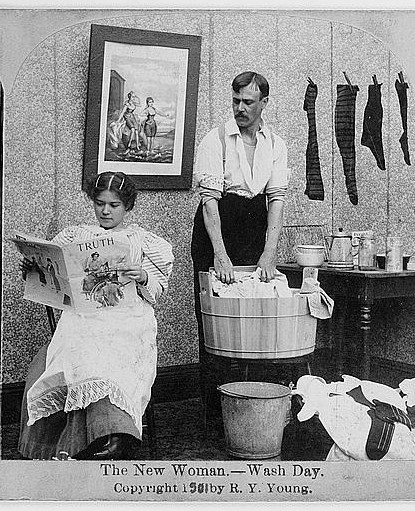
Some think the term’s outdated and no longer useful, because when we use it we remind people of, and thereby perpetuate, silly notions about women from the bad old days. Others think it’s too divisive, highlighting the differences between between men and women instead of emphasizing our much more important similarities, which was the whole point of feminism in the first place.

I understand the distaste for the f-word. Second-wave feminists, continuing the fight for equality that the first wave had only partially achieved, sometimes overshot the mark in their zeal. Some thought men had to be taken down a peg or several; others thought that greater separation of the sexes, rather than less, was what it would take to liberate women from men’s intransigent misogyny. Many even thought, and continue to think, that men and women are so fundamentally unlike in the ways they think and feel that they will never achieve true friendship and equality.

I, like those who object to the term feminism, think that these separatists are wrong about human psychology, and am more optimistic about the improving relations between the sexes, especially as gender roles are losing some of their rigidity throughout the world. Though the recent flap over Cannes Film Festival’s kicking women off the red carpet for not wearing high heels might put a damper on this view, the fact that this raised such a huge outcry makes the whole story seem more like a point in its favor. Like the first wave feminists, I hold the view that the similarities between men and women so far outnumber the differences as to render them largely irrelevant, especially when it comes to human rights and political equality. The term feminism itself is a first wave feminist invention.

There are many meaningful terms which make sense because of the history behind them, not because they make literal sense anymore. Take the term film as it’s used in ‘Cannes Film Festival’: it’s used to refer to movies in general. Yet actual film, that specially prepared plastic on which a multitude of images are imprinted to be played back later as a moving picture, are only sometimes used in movie-making today. Movie aficionados who now refer to movies as films don’t mean to imply that actual film was used in any given movie; whether or not it was, they wish to emphasize the craft and history behind the art of movie-making that they all share.

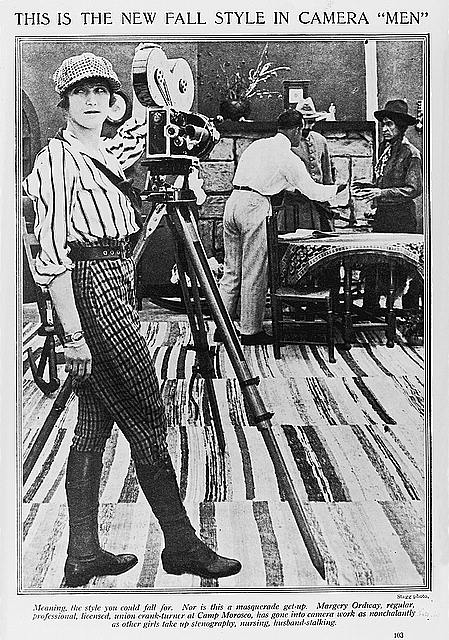
The term under question here also has a meaning that’s evolved over time. Feminism expresses, in the words of that great old tongue-in-cheek slogan, ‘the radical notion that women are people’. Just as humanism was coined as a rallying word to promote the idea that human beings and their achievements are valuable for their own sake, feminism was coined to rally people to the cause of equal rights for women, since women possess the same defining qualities of humanity as men. At one time, it was necessary to prove that point. Now that we take women’s equality for granted in much of the world,  feminism might seem antiquated or divisive. But I don’t think that’s really the case. Almost everyone is familiar enough with the current usage of the term film to know that what we mean now is not exactly what we used to mean, but we still like to use it because of the history it alludes to. Likewise, most people should be familiar enough with feminism to know it’s now generally used in the context of critiquing the more entrenched and obscure problems of sexism in our society, not to demonstrate the basic humanity of women or the depravity of men.

So I still like to identify myself as feminist. Despite the blemishes some put on the term over the last century and a half, I value it because of the way it connects the current pursuit of equal rights and dignity for all to the brave and noble women (and like-minded men) throughout history who fought for their freedom, and mine, under its banner.

Thomas Jefferson Sites, Part 6: Charlottesville, and Last Day in D.C.

John and Amy Cools at Monticello, 2015 by Amy Cools

I’m at Monticello with my dad, John Cools! I’m one happy gal

Sixth day, April 24th, 2015.

Today, I’m heading south of D.C., and have only two destinations for the day, and that’s a good thing: it’ll take every hour I have to explore them, and make me wish I have more to spend. These places tell the story of what Thomas Jefferson’s all about more than any of the other sites I visited, with the possible exception of the Library of Congress (though he never visited the building, of course, since it was built decades after his death).

And this time, I’m pleased to say, I have a travel companion, that very special person I told you I was meeting yesterday: my darling Dad, John Cools! He’s one of my very favorite people in the whole world, and I can’t imagine a better person to go on a history tour with. He’s also handsome, like his big brother Bob, who lives in nearby Falls Church and took me on the little driving tour on the first D.C. day of this trip.

Groves Store, Somerville Post Office, farmland in Fauquier County, Virginia, image Emridou via Wikimedia Commons

Groves Store, Somerville Post Office, farmland in Fauquier County, Virginia, photo by Emridout via Wikimedia Commons

Groves Store and Somerville Post Office, surrounded by farmland in Fauquier County, Virginia, is itself the self-described “Downtown Somerville”. Photo by Emridout via Wikimedia Commons

We drive to Charlottesville via the smaller highways that take us through the beautiful Virginia farmlands, lush and green and still colorful with wildflowers. We lose a few extra minutes getting out of town, since we’re so busy chatting and laughing that we miss a couple of turns. After these brief false starts, we’re on our way.

Since I’m driving and absorbed in conversation with my Dad, I forget to ask him to be my photographer, and have no photos from the drive to share. However, I find a great one online that’s in the public domain; thank you, Emridout! Remove the hay bales, and you’re seeing more or less what we see during our drive.

Thomas Jefferson's final site plan for Monticello on display at the visitor center museum, 2015 by Amy Cools

Thomas Jefferson’s final site plan for Monticello on display at the visitor center museum

We arrive at Monticello, Jefferson’s stately home on the hill in Albemarle County, Virginia, just a few miles away from where he was born at Shadwell. (Monticello is Italian for ‘little mountain’.) His childhood home burned down when he was in his mid-twenties, and though I was tempted to find the site, I think it’s best to first see the main places we came to to see, and stop by Shadwell if we have time later. Turns out, we don’t.

First, we head to the ticket machine for the house tour.We’re scheduled for a tour a few hours later, so we start with the museum. It’s an excellent one.
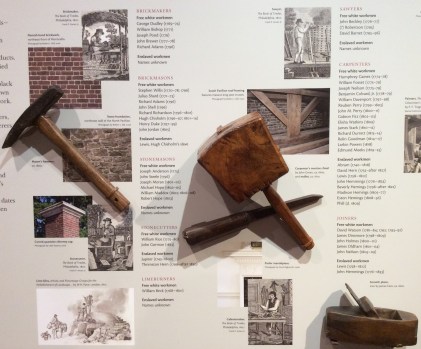
Tools like these would have been used in the building of Monticello, on display at the visitor center museum, 2015 by Amy Cools

Tools like these would have been used in building Monticello, on display at the visitor center museum

We start with the exhibit which shows how Monticello was designed and built in stages. In fact, it was never really finished. Jefferson was an experimental architect, and I guess he’d be considered an amateur, in the sense that although he designed buildings, he wasn’t paid to do it for a living and he wasn’t formally trained. It was one of his lifelong interests, however, and at Monticello, he’d often build up part of the house, only to see a building or illustration which gave him a better idea. So, he’d tear part of it down from time to time, redesign, and rebuild it.

Thomas Jefferson's standing desk, in the Monticello museum, photo 2015 by Amy Cools

Thomas Jefferson’s standing desk, in the Monticello museum. Doesn’t look like it would have been quite tall enough for his six-foot-two-inch self!

My Dad is a construction superintendent and started out in his professional life framing houses and building room additions; he’s also built or assisted in building many houses from the ground up. He used to take us kids with him to work sometimes, usually one or two at a time, and we would play with the wood scraps and little round metal cutouts from electrical boxes (which make perfect coins for buried treasure). Dad often says how much he misses building with his own hands, but a superintendent commands a much better salary and he had a family to support, so a superintendent he became. If Jefferson were here, they’d have a lot to talk about.

This exhibit is right up my Dad’s alley, and he pores over the displays in great interest. I’m interested too, but I’m more drawn to Jefferson’s standing desk displayed in the center of the room, as antique furniture is a little more my forte. It’s both elegant and practical; I would love to own it. With its tilt top and pull-out additional work surface, it’s just as great for the laptop and reference books I’m working with as it was for Jefferson’s pen and paper. My day job is in a medical office, and I often regret the number of hours I spend sitting down. This would be a perfect solution.
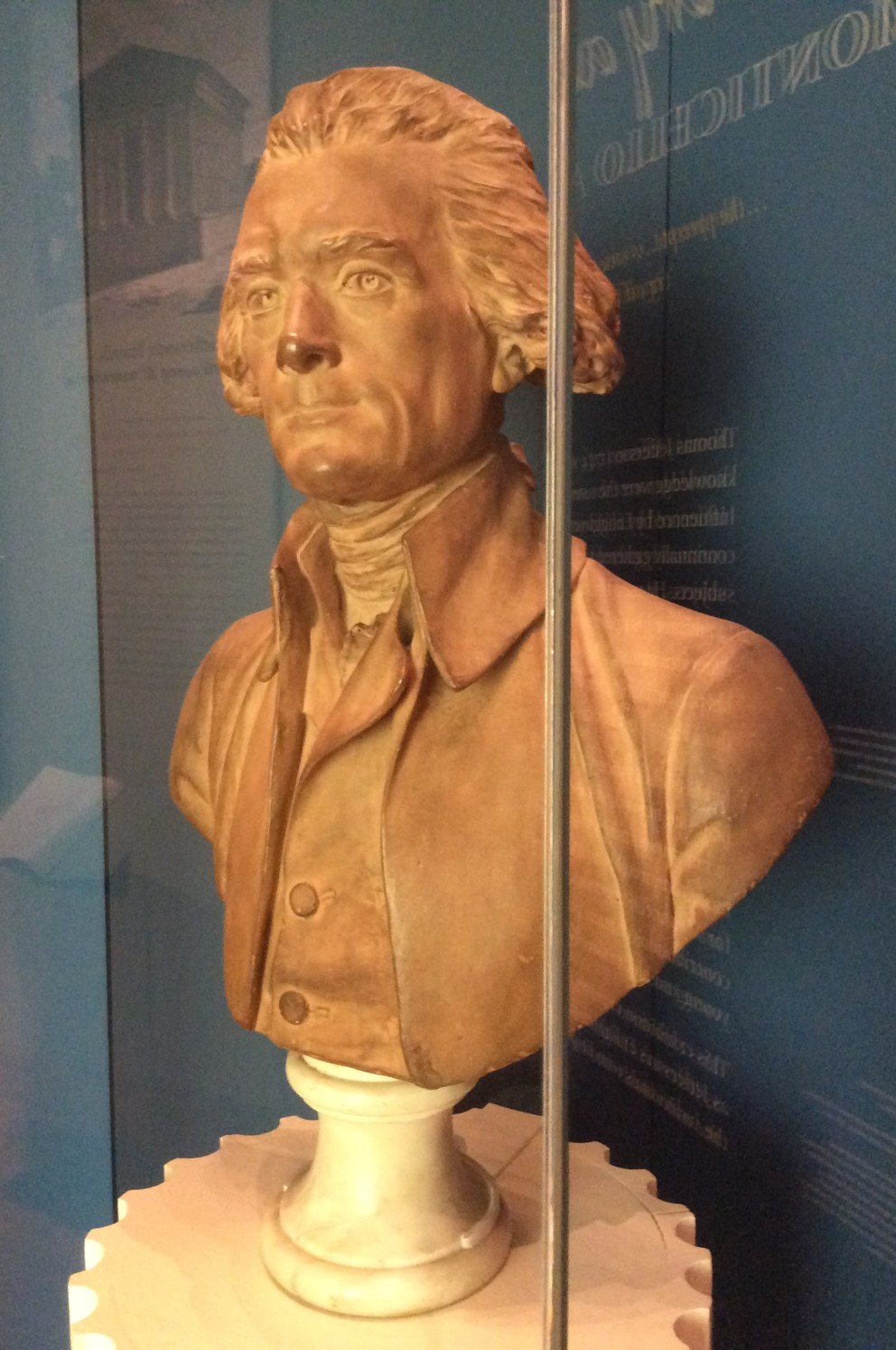
Bust of Thomas Jefferson at the Monticello museum, photo 2015 by Amy Cools

Bust of Thomas Jefferson by Jean-Antoine Houdon, 1789

We head for the gallery across the hall whose displays focus on the daily lives of all who lived and worked at Monticello. There’s a handsome bust of Jefferson at the front of gallery, and I find I like the face. It’s very expressive, a little handsome, with hair that looks awkward to my modern eyes, swept outward from either side of his face.
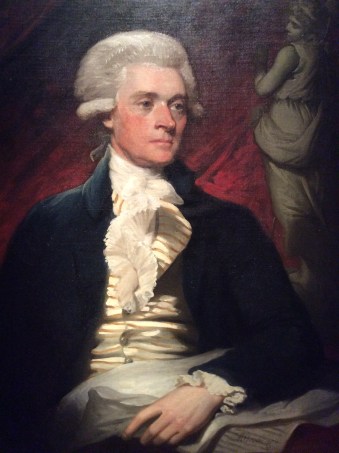
Thomas Jefferson portrait by Mather Brown, at Washington DC portrait gallery, photo 2016 by Amy Cools

Portrait of Thomas Jefferson by Mather Brown (original), at Washington DC’s National Portrait Gallery

I recall a portrait of Thomas Jefferson by Mather Brown, the first known portrait of him painted in London in 1786, which doesn’t look that much to me like the man portrayed in this bust or most of the other portrayals I’ve seen. A copy of this portrait hangs here at Monticello somewhere; the original is on display at the National Portrait Gallery in Washington DC.

I’ve heard the Brown portrait described as more handsome than Jefferson in real life: he was tall, lanky, with red hair and freckles and a long nose. But I like the face portrayed in the bust much better: it looks a bit patrician but with rough edges, the face of an energetic man who spends a lot of time outdoors or doing something else interesting. The Brown portrait looks stuffy and a little haughty in comparison, and I never did like the powdered look.
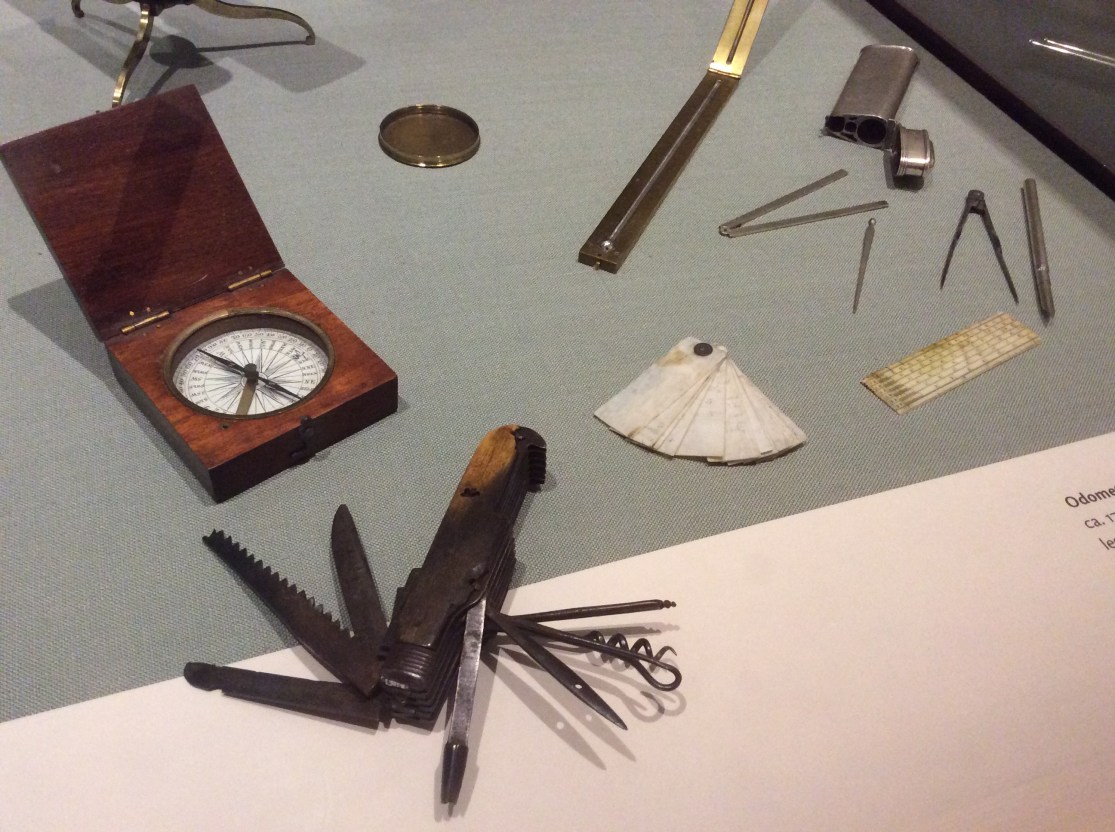
Thomas Jefferson tools and gadgets on display at Monticello museum, 2015 by Amy Cools

Thomas Jefferson’s pocket tools and gadgets

A project-oriented, outdoorsy man like Jefferson needed a toolkit, and we see a nifty one in this gallery. There’s a pocketknife, drafting instruments with a little silver case, architect’s scale, and most interesting to me, a sort of tiny notebook made of ivory. It fans out like a lady’s fan, and what’s nifty about it is that you can write notes on it in pencil, and then erase the marks by rubbing them off with your finger, making it available to use again. I use the Pages app on my mini iPad in sorta the same way during my travels.

The gallery has many, many more great exhibits, way too many to picture here!

The graveyard at Monticello as seen from the path from the museum to the house, 2015 Amy Cools

A view of the graveyard at Monticello, as seen from the path from the museum up to the house

Completing our tour of the museum, we grab a bite to eat at the cafe (they actually have very tasty, reasonably priced food, sometimes even serving vegetables raised in the restored Monticello gardens) and then head up the hill toward the house. It’s a nice little stroll, I think preferable to the shuttle, since it gives you time in nature to refresh yourself between the mental effort of taking in all that history; interesting as it is, it’s fatiguing after awhile, and the break is welcome. The path winds through a pretty little patch of woods, and it’s spring, so the leaves are still small and bright green, and you can see quite a ways through the trees and get a pretty good view of the lay of the land.
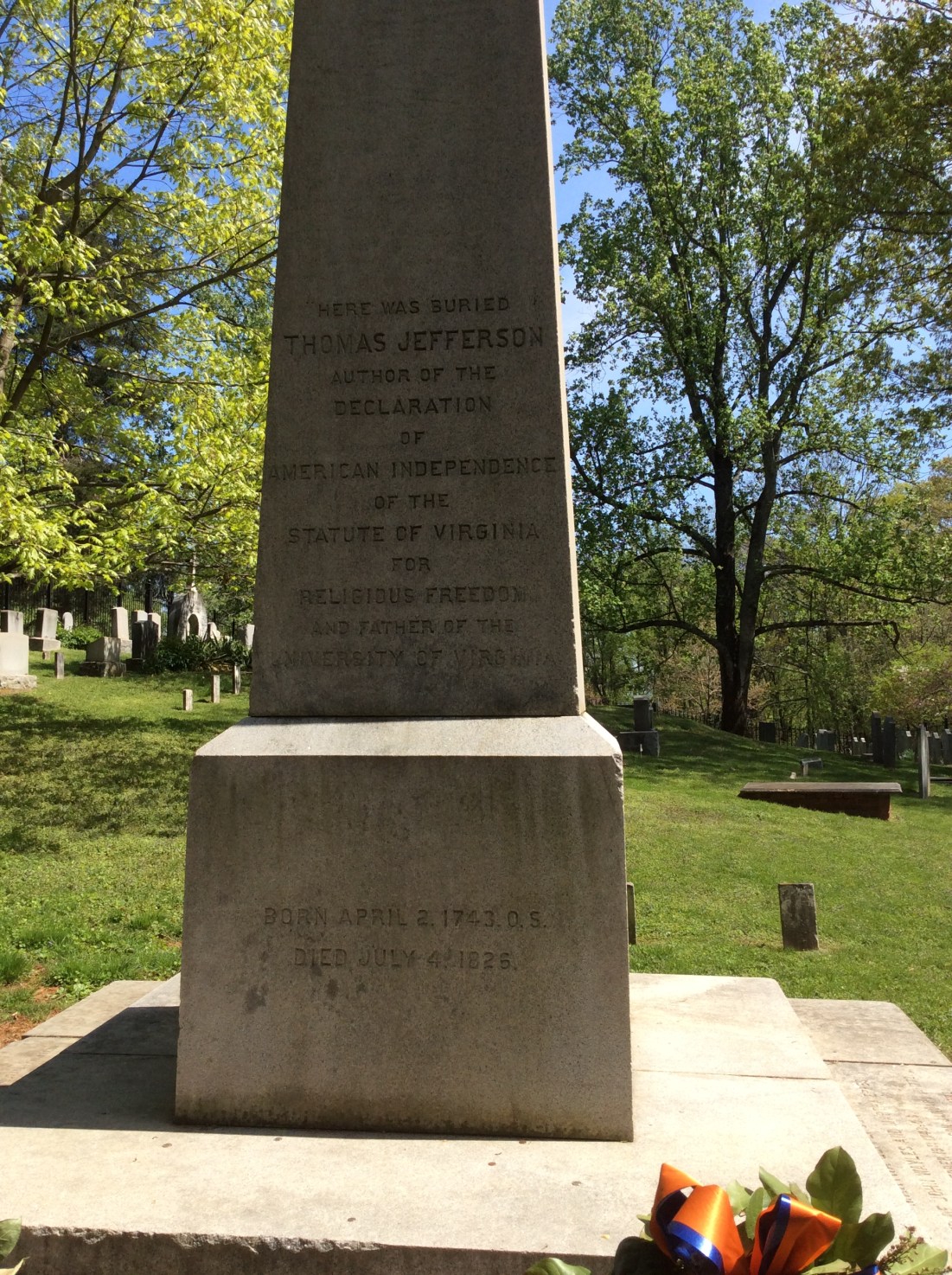
A closer view of Thomas Jefferson's obelisk-tombstone at Monticello, 2015 by Amy Cools

A closeup of Thomas Jefferson’s obelisk-tombstone, listing the three self-selected accomplishments he was most proud of

The Jefferson family graveyard is about halfway up the hill to the house from the welcome center, and Jefferson, his wife Martha Wayles Skelton Jefferson, his mother Jane Randolph Jefferson, his sister Martha Jefferson Carr, and her husband, his brother-in-law and best friend Dabney Carr. Carr and Jefferson studied law together and both were members of the Virginia House of Burgesses. They were very close since childhood, and would hang out on the hill that would later become the site of Monticello, often reading and talking under the shade of a favorite oak tree. They promised that whoever died first, the other would bury him under that oak. Carr, sadly, died at the early age of thirty, so it was up to Jefferson to fulfill that vow.
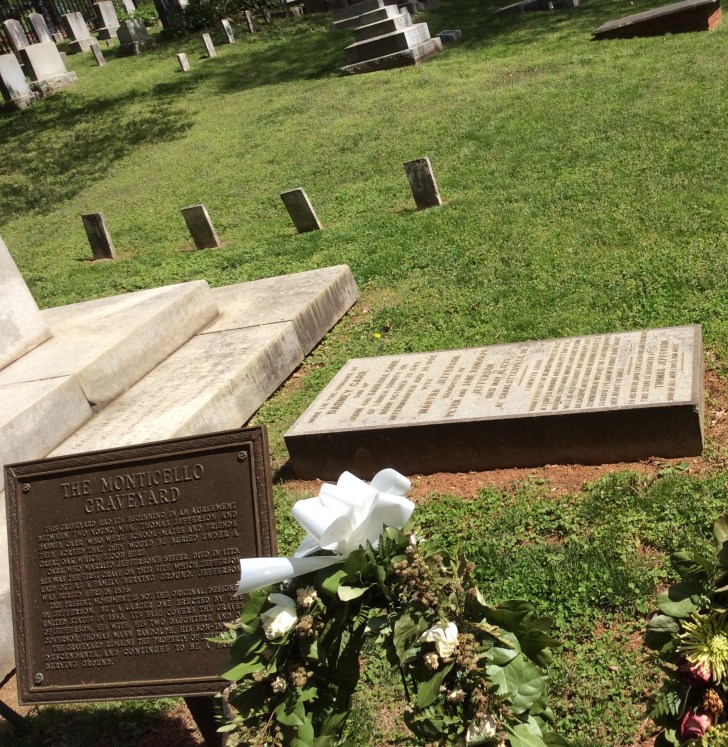
Dabney Carr's grave, first to be buried at Monticello, photo 2015 by Amy Cools.jpg

Dabney Carr’s grave; he was the first to be buried at Monticello

This graveyard grew up around that first burial, and over the years, his mother-in-law, nieces, nephews, cousins and other family, his wife Martha 38 years later, and finally Jefferson himself, were buried.

The obelisk that is Jefferson’s tombstone towers high above the rest, and besides his name and birth and death dates, it’s carved with a list of his three proudest accomplishments: author of the Declaration of Independence and the Virginia Statute for Religious Freedom, and founder of the University of Virginia. Not the presidency of the United States, or his diplomatic service to France, or any of his other achievements in politics, scholarship, law practice, legislation, agriculture, science, architecture, invention, or philosophy, none of these made it onto that stone.

Whatever his flaws, the fact that he directed only these three to be carved on his tombstone increases my respect for him quite a bit. Rights-based government; freedom of conscience; public access to a liberal education: it’s hard to come up with a list of three more valuable social goods. Jefferson did more than most to promote these in his lifetime; even where he didn’t carry out his goals or conceive of better ones, he helped lay the groundwork so that others could implement his ideals of a more enlightened, rational, humane society more fully.

Mulberry Row path and gardens at Monticello, photo 2015 by Amy Cools

Mulberry Row path and gardens at Monticello

Dad and I pause, gaze, and reflect a little while here, then we continue up the hill. We arrive next at the gardens and Mulberry Row, where many of Jefferson’s slaves and hired contractors lived and worked, including his slave, departed wife’s half-sister, and mistress of 38 years Sally Hemings. The gardens and the Row run side by side to the south of the house.

The gardens are fully restored, laid out in the same way as in Jefferson’s time in accordance with his notes and drawings, and as much as possible, grow what Jefferson’s farm grew, and are as carefully tended.

Chimney and foundation of the joiner's shop on Mulberry Row, 2015 by Amy Cools

Chimney and foundation of the joiner’s (woodworker’s) shop on Mulberry Row

Mulberry Row is a fascinating place: there’s been extensive archaeological work done, with many of the foundations of the original structures laid bare and described by signs, interspersed by a few reconstructions. Most of the buildings on the Row burned down or were pulled down when they fell into disrepair, but there are a few structures still standing that are original.

On the west end of the Row stands the chimney and bits of the walls of the joiner’s shop, where the fine woodworking was done: wood molding, furniture, carriages, doors, windows, and so on, from wood that had been imported or felled on the plantation and cut into lumber elsewhere, then brought here. If he needed skilled work done, the practical Jefferson would hire an expert, often from Europe, then apprentice one of his slaves to him so that they could provide the same services in the future. For example, Sally Heming’s half-brother John Hemings became Monticello’s master woodworker after acquiring the skill under the tutelage of David Watson, a hired Scotsman.

Uriah Phillips Levy's mother's gravesite on Mulberry Row, Monticello, 2015 by Amy Cools

Uriah Phillips Levy’s mother’s gravesite on Mulberry Row

One creative and lovely use of one of the crumbling structures on the Row is Uriah Phillips Levy’s mother’s gravesite wall. Levy believed that great people’s homes should be preserved in their memory, and as the first Jewish naval officer in the U.S. who also advocated for religious liberty and against flogging, was a great admirer of Jefferson’s. So, he bought Monticello in the 1830’s to restore and preserve it. When his mother died here, Levy buried her here in this site overlooking the gardens and vista of the woods and green farmlands below.

Textile workshop on Mulberry Row, Monticello, 2015 by Amy Cools.JPG

Textile workshop on Mulberry Row

There are two buildings on Mulberry Row that are original and still more or less intact: the workmen’s house which at some point became a small textile factory, and one of the stables.
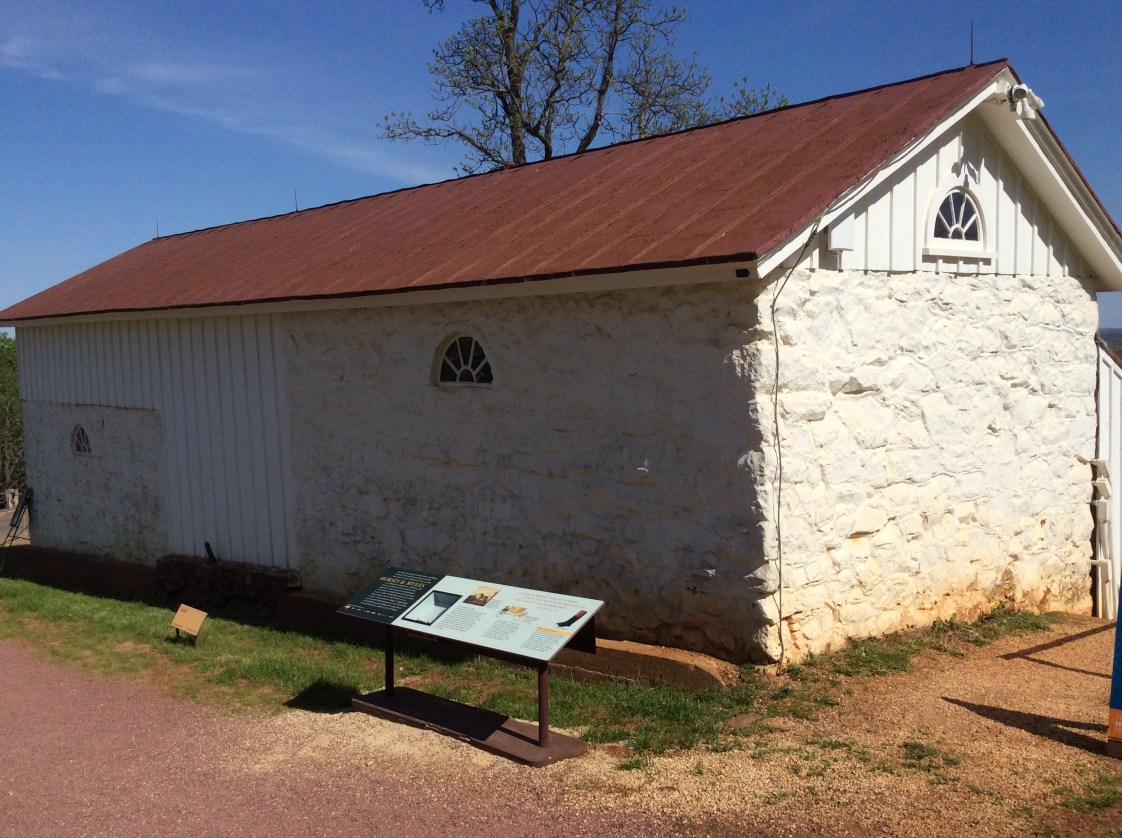
Remaining section of stables on Monicello's Mulberry Row, 2015 Amy Cools.JPG

Remaining section of the stables on Mulberry Row

The workmen’s house / textile workshop was first built in the 1770’s, and the stables in 1808. The latter was originally a larger, L-shaped building; this is what’s left.

We’re so absorbed in exploring Mulberry Row that we almost don’t notice those that the few hours we had to wait to tour the house had quickly passed. We scurry on over to join our tour group.

Monticello is preserved and run by a private non-profit, the Thomas Jefferson Foundation, and many of the artifacts contained in the house are on loan by private collectors. The tour guide explains that since the Foundation has not received permission from the owners of all the artifacts, no photography is allowed inside. So I contact the Foundation and receive permission to use a limited number of the Foundation’s images of the interior.John Cools and tour group at Monticello, 2015 by Amy Cools
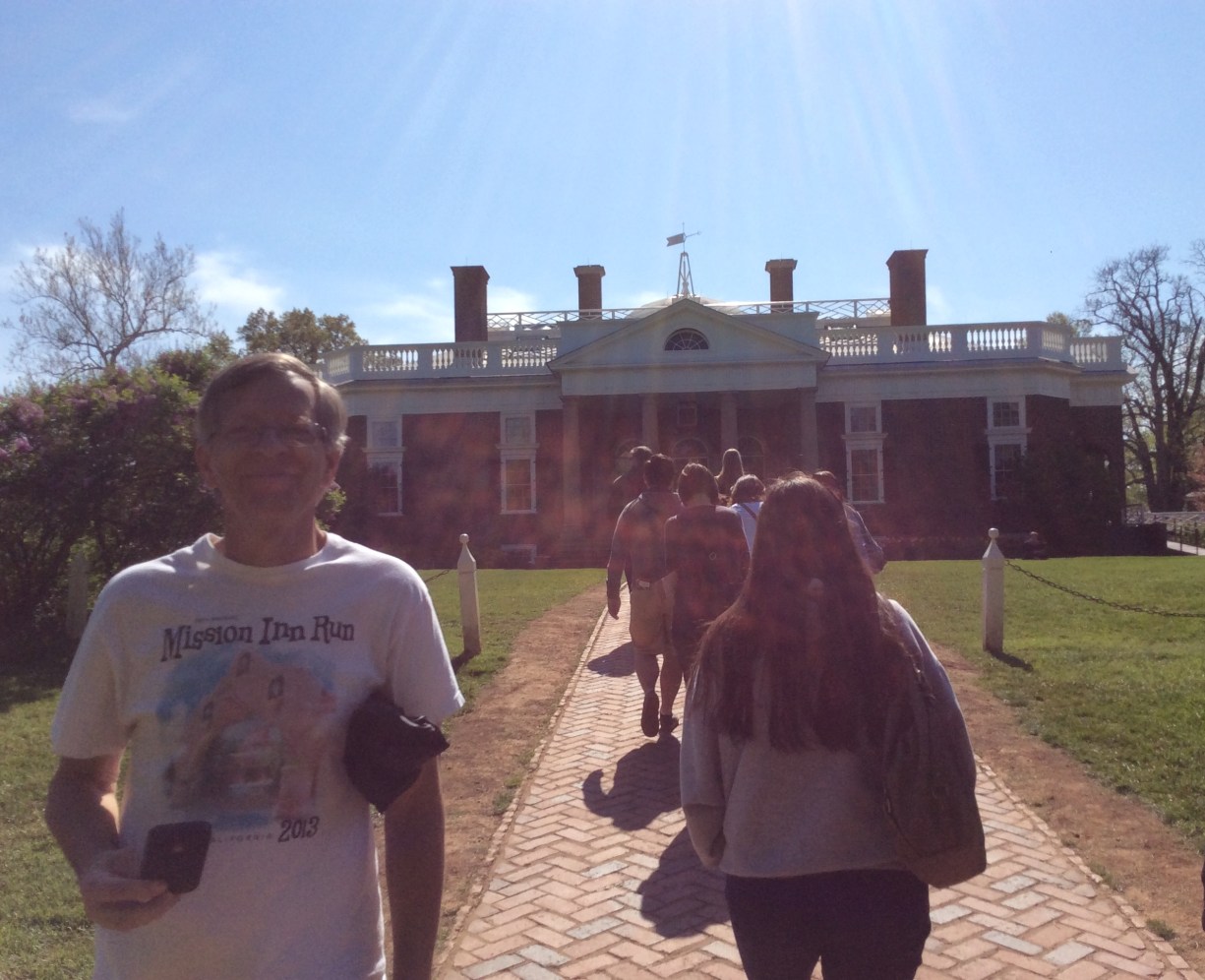
This may sound like heresy to many, but while Monticello is a very interesting and even impressive house, I don’t consider it particularly beautiful or graceful. It looks just like what it is: a concoction of an experimental architect who loves all things classical and equally loves invention and values practicality, constructed in a piecemeal fashion so that these two aspects of Jefferson’s taste are never reconciled. There are beautiful details and fine craftsmanship throughout the house, even some lovely rooms. But many of the elements don’t fully harmonize with one another and overall, it just doesn’t hang together. That’s fine by me: because it’s such a quirky place, very much a product of an individualist, I find it all the more interesting to explore, and I think it’s a really… well, nifty place.
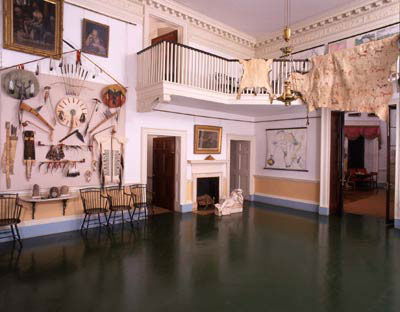
Monticello Entrance Hall © Thomas Jefferson Foundation at Monticello 2, photo by Robert Lautman

Monticello Entrance Hall © Thomas Jefferson Foundation at Monticello 2, photo by Robert Lautman, used by permission

We enter the front of the house through a large portico with a pointed lintel, topped with a large weather vane. While the weather vane looks rather funny with the neoclassical design, it pierces the roof and attaches to a dial on the portico ceiling so that the detail-oriented Jefferson could step out onto the front porch and see which way the wind was blowing just by glancing up.

There’s also a giant clock over the inside front door of the entrance hall, which tells not only the time of day but the day of the week, again, somewhat awkwardly. Since the weights suspended from overly long chains hang down through holes cut in the floor, he’d have to go down to the basement to check the day of the week on Saturdays and Sundays if his calendars hadn’t already alerted him. Again, over-the-top tech nerdy gear, still in the process of development, for the 18th century gadget-head.
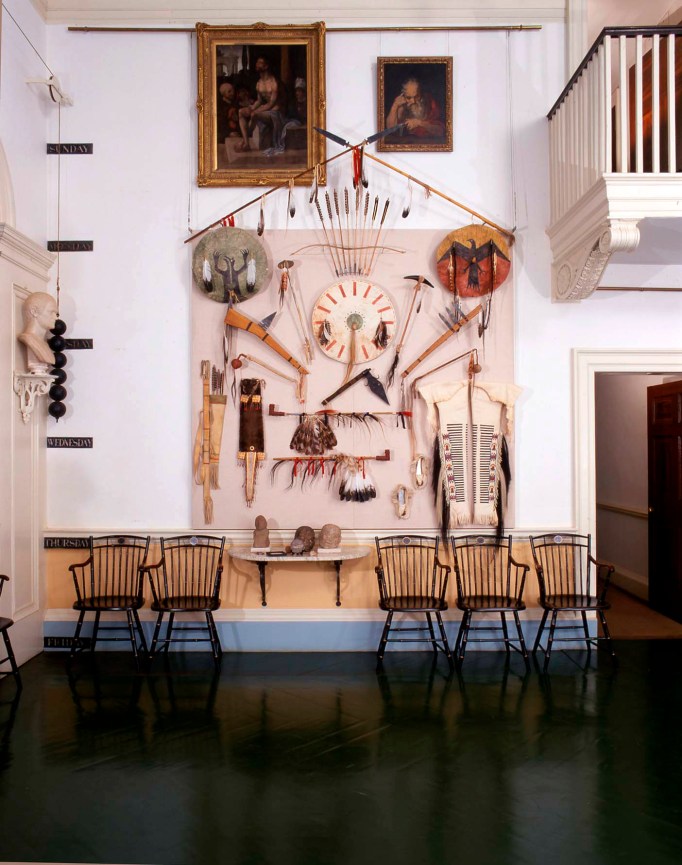
Monticello Entrace Hall South Wall 2, © Thomas Jefferson Foundation at Monticello

Monticello Entrace Hall South Wall 2, © Thomas Jefferson Foundation at Monticello, used by permission

 As we enter the entrance hall, Jefferson’s fascination with the natural world and the history of local cultures is manifest in the beautifully presented and preserved fossils and Indian artifacts that fill the room. Painted animal skins hang from the interior balcony, shields, spears, pipes, clothing, and the heads and skulls of animals hang on the walls, fossil remains of animals cover tables. Jefferson was an innovator and pioneer in many fields, including archaeology; he’s credited with directing the first scientific archaeological dig in the Americas.

Among the busts and portraits that ring the room, his own is placed across the room from Alexander Hamilton’s, Jefferson’s ideological foe and political nemesis. While he long thought Hamilton’s political beliefs would spell disaster for the new republic if carried out, he ended up using some of Hamilton’s methods to accomplish his own goals as President, such as taking on more national debt to pay for the Louisiana Purchase. Hamilton was a Federalist, and believed that a strong central government, a standing army, industry, and a national debt were necessary for any nation’s success and the liberty and well-being of its inhabitants; Jefferson believed that a small national government, largely independent agrarian states, no standing army, and freedom national debt would accomplish these ends much better. Let that be a lesson to us, as I’m sure it was to Jefferson; it’s always important to remember that others many have insight we haven’t yet had occasion to see clearly for ourselves, and to be ready and able to change our minds when the circumstances reveal that we’re wrong.

Monticello Book Room © Thomas Jefferson Foundation at Monticello

Monticello Book Room © Thomas Jefferson Foundation at Monticello, used by permission

We pass thorough a pretty, small blue parlor to the next room that really represents something that Jefferson’s all about: the book room. You may be surprised that Jefferson had such a large library as this in his later years considering he’d sold all his books to Congress in 1815. But as he wrote to John Adams, he couldn’t live without books, so he promptly resumed accumulating more debt by building a new library.

The book collection here is composed of only a few from Jefferson’s actual collection; the rest are identical titles that others had owned. The room does hold one of Jefferson’s actual high-backed easy chairs and an original portrait of Jefferson in profile by Gilbert Stuart, which Jefferson’s friends and family said looked more like him than just about any other portrait.

Monticello Jefferson Cabinet © Thomas Jefferson Foundation at Monticello

Monticello Jefferson Cabinet © Thomas Jefferson Foundation at Monticello, used by permission

Then through a beautiful, plant-filled, well-lit greenhouse and hobby room to Jefferson’s ‘cabinet’, or personal office, connected to his bedroom by two passageways. He was a busy man, disciplined in his reading, writing, and keeping of accounts, and wished to be able to get right back to what he was working on as efficiently as possible. So he devised two ways to get from one to the other: one, the standard little hallway which is the one we walk through and two, his alcove bed was set into the dividing wall, so he could roll out of bed to the left into his bedroom, or to the right straight into his office. It’s also the bed he died in, so there would have been plenty of space for his loved ones to bid him goodbye from whatever direction they came. I feel, for a moment, a little like an intruder, since Jefferson was a very private man in many ways, especially concerning matters of the bed, so to speak. But as he said, the world belongs to the living, not the dead, and we the living are here to learn from what he left behind.

Jefferson’s office is an especially interesting and revealing room. It’s full of scientific instruments, an orrery (model of the solar system), a polygraph (a mechanical device which makes a copy of the letter you’re writing while you’re writing it), and gadget-y furniture, including a revolving bookstand which allowed Jefferson to quickly consult several volumes at once, an adjustable-top desk which could be raised, lowered, and angled to suit the needs of the moment, and revolving chair and table. My good friend Alex, who simply must to have or at least try out every new invention that comes along, would drool over this room.

Like the entrance hall, it’s also ringed by portrait busts and images of his friends and influences, including George Washington, James Monroe, and, like Hamilton, a Federalist, but unlike Hamilton, a friend, John Adams. Adams and Jefferson met at the Second Continental Congress in 1775 and became close friends. While they shared a commitment to the Revolution and to the cause of political and personal liberty in general, they differed sharply in some particulars in how this could best be accomplished. Adams held a more pessimistic view of human nature, and thought that a free people needed a stronger government, stricter laws with greater social accountability, and a more aristocratic, pomp-and-circumstance-orientated leadership to inspire and impress. Jefferson held a more optimistic view of human nature, and thought that the people could be trusted to govern themselves if mostly left alone, with government interference only when people infringed on one another’s natural rights. Both emphasized the importance role of education, believing that an uninformed and uneducated populace would always remain vulnerable to exploitation and oppression. Adams thought it should be fully financed at public expense, and Jefferson was a founder of the American system of public higher education (more on that shortly).

At Monticello with my Dad, John Cools, photo 2015 by Amy Cools.JPGWe pass through many other interesting and handsome rooms, including the parlor, lined floor to ceiling with portraits, again of Jefferson’s friends and influences. If I were to describe all the rooms in detail, this account would go on far too long, so I refer you to Monticello’s website’s excellent virtual online tour, or better yet, go see it in person! I assure you, you will not be disappointed.

Leaving the house, we chat just a little with some other tourists. Since we all want photos of ourselves and our companions in front of the house, we oblige one another in turn, and I pose with my handsome Dad and favorite travel buddy. We pause for a little break outside, and take in the view looking down from the hill at the scenery all around. Peering through a little break in the trees, we can see, far off in the distance, our next destination after Monticello.West (rear) entrance of Monticello, photo 2015 by Amy Cools.JPG

 But we still have some exploring to do here. Monticello is also composed of an L-shaped wing on either side of the house, with the long ends extending past the rear portico. These wings are set below the house, built into the base of the hillock the main house is on with the entry doors facing out, and connect with the basement on either side; the roofs of each these wings form a terrace. At the tail end of each L, there’s a two-story brick building, or pavilion.

View north from Monticello's west lawn, 2015 by Amy Cools

View north from Monticello’s west lawn. If you look hard, you can just make out the University of Virginia through the trees

The south pavilion was the first finished house structure at Monticello, composed of two rooms, a combination bedroom and sitting room over a kitchen. Because Shadwell had burned two years earlier, Jefferson moved into this building in 1772, before schedule, with his new wife Martha and his infant daughter, also named Martha but called Patsy. They lived in this little house for nearly two years, until the main house was built up enough to be habitable in 1794.

We head on down below the terrace. The basement and both lower wings of Monticello house more slaves’ quarters, the smokehouse, the dairy, the kitchen, the wine cellar and brewery, the ware room, stables, the wash house, a privy, and numerous other rooms, all full of interesting exhibits showing how a large plantation community raised and produced food, ran a great house, manufactured goods for sale and for consumption, and so on. Again, I very, very highly recommend a visit!

After thoroughly exploring this fascinating place, we realize that a couple more hours had flown by and we needed to skedaddle if we were to reach our next destination in time to tour it in daylight.
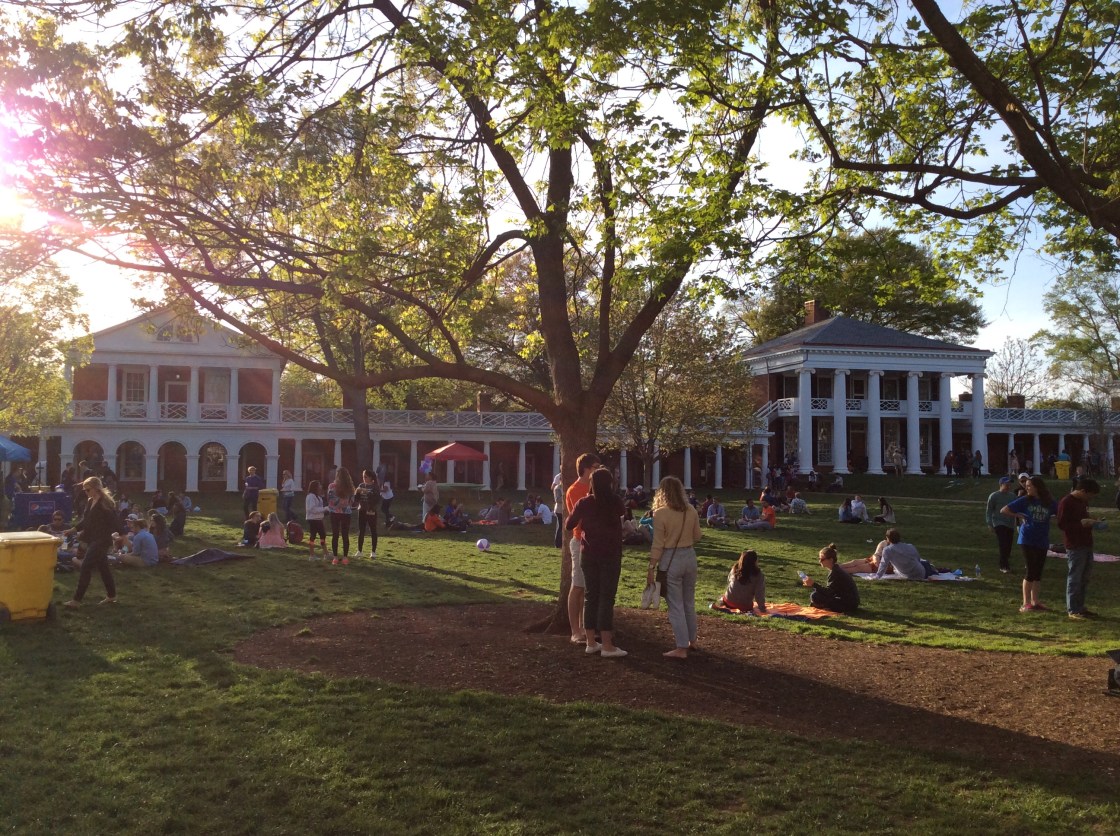
Students attending festivities in The Lawn at the University of Virginia, 2015 Amy Cools.JPG

Students attending festivities winding down on the Lawn at the University of Virginia
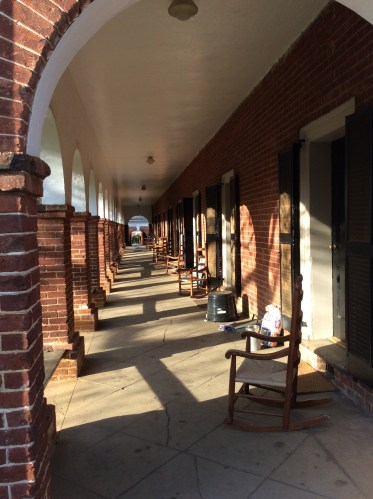
Long porch of student housing at the Pavilion, University of Virginia, 2015 by Amy Cools

Long porch of students’ quarters at the University of Virginia. The Academical Village was designed to place students and teachers in close proximity and therefore, frequent discourse

We wind our way down the hill toward the University of Virginia, which Jefferson founded in 1819. As aforementioned, you can see the domed roof of the Rotunda between the trees from Monticello looking northwest. I’d bet he kept the trees trimmed from time to time in that direction so that he could look upon what he considered one of the most important accomplishments of his life.

As were so many of Jefferson’s brainchildren, the University was an innovative institution. It was nonsectarian; it was among the first to adopt the elective system; it focused on educating students qualified entirely on the basis of merit, not wealth or social standing; it emphasized the study of the sciences as well as the humanities; and it was built as an ‘academical village’, which emphasized a close association between instructors and students but with private lodgings for the latter, facilitating peaceful study and healthful rest. When we arrive, it’s not exactly peaceful: it appears we’ve caught the tail end of a daytime festival, with tents and booths scattered around, groups of students standing or lolling on picnic blankets, and a live band playing.
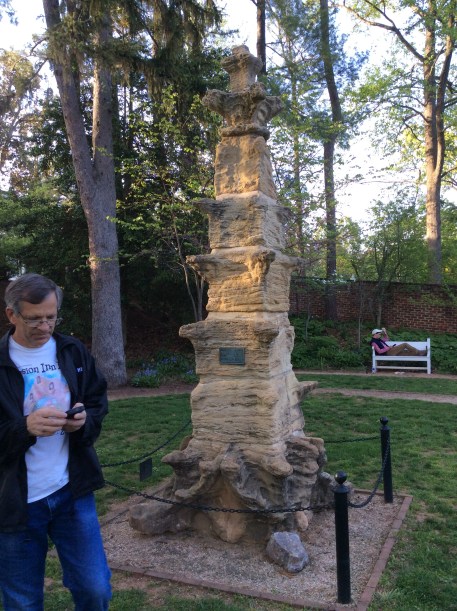
A pinnacle of Merton College Chapel tower, erected 1451, in the gardens at University of Virginia, 2015 Amy Cools

A worn pinnacle from Merton College Chapel tower, erected 1451, in one of the University of Virginia’s gardens

The center of the University is arranged around a grand rectangular Lawn, where the festivities are winding down, with the Rotunda Building at the head. It’s a very handsome building, modeled after the Pantheon and exactly half its height and width, where Jefferson much more successfully married the local red brick look with classical design than at Monticello. Jefferson not only designed the Rotunda (with help), he designed the Academical Village, many of the other buildings, the overall layout, even, as I discover on a plaque on one of them, the whimsical wavy garden walls.

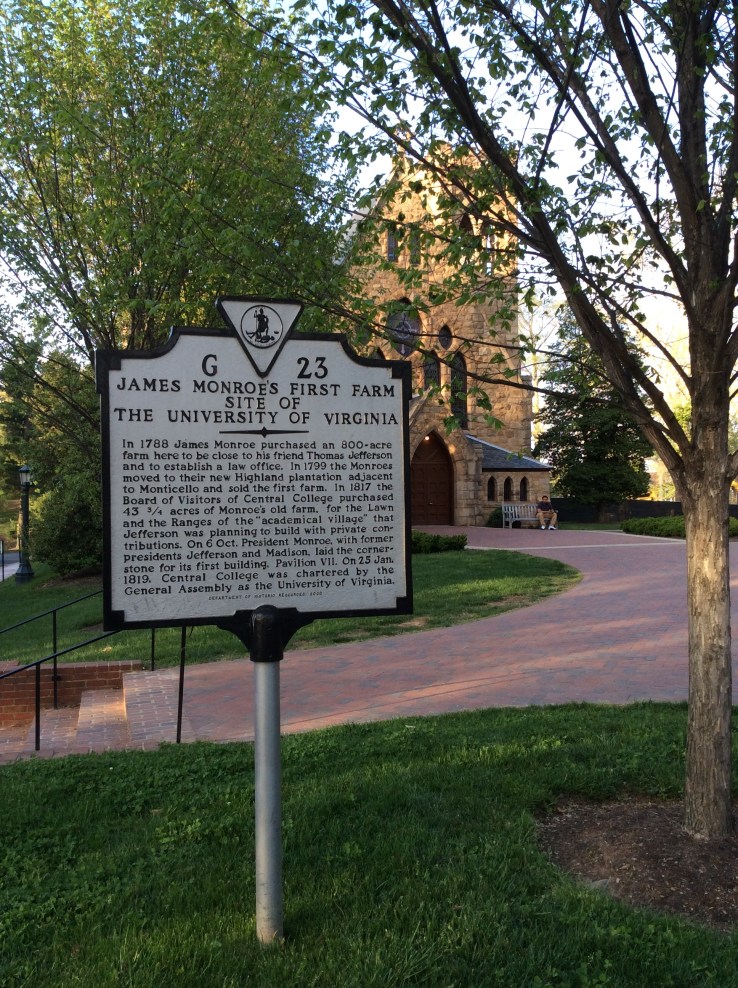
The University is a lovely place to stroll, built on hilly green grounds with lots of trees, enchanting little gardens tucked behind student buildings, many containing interesting sculptures or old architectural relics. One has at its center an original ancient, heavily weathered stone spire from Merton College at Oxford dating from 1451. It’s about to turn Friday evening, and the students are out in droves to start off their weekend dressed to impress, laughing, chatting, and jostling their buddies.The Rotunda at the University of Virginia, undergoing extensive renovation, 2015 Amy Cools.JPGUniversity of Virginia stands on site of James Monroe's first farm, historical marker, 2015 Amy Cools.JPGMy Dad and I wander and chat, discussing what I had learned before the trip of the history of the University and its architecture. It also works out well that our visit coincides with the Rotunda building’s restoration, since, as aforementioned, my Dad has spent his life working in construction. Even though we can’t see the interior, we can observe the process of restoration as well as see many of the Rotunda’s underlying structures exposed, which he finds very interesting.
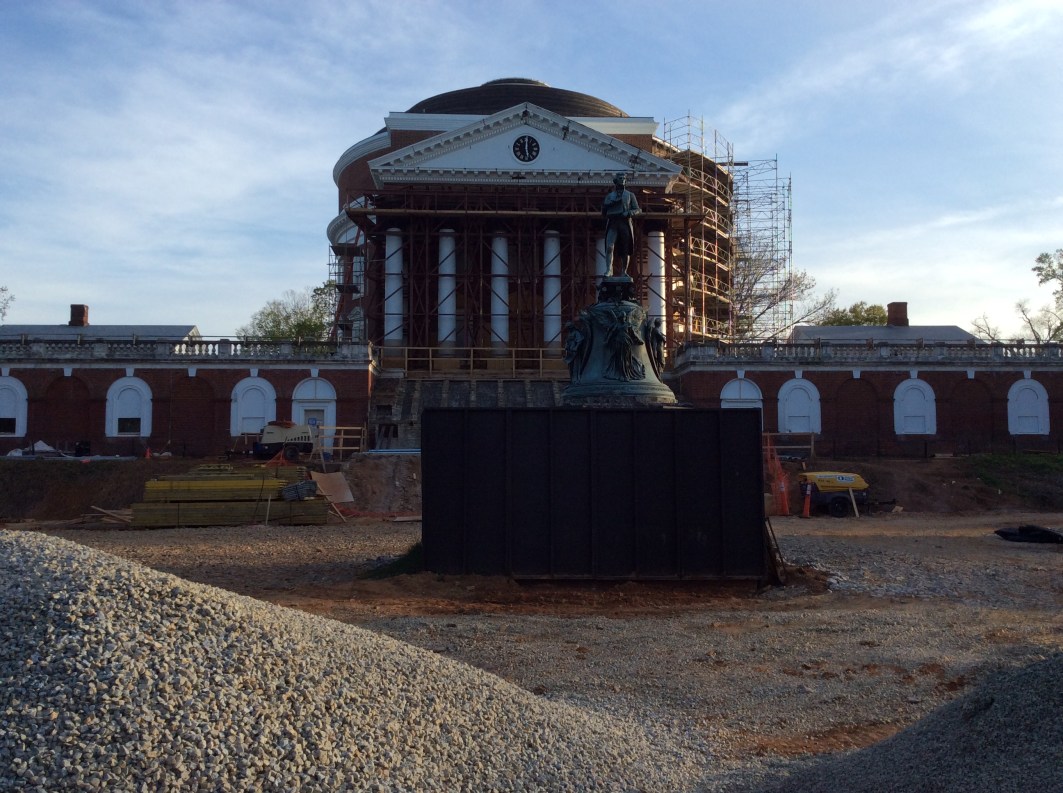
We learn various other interesting facts as we explore; there are historical markers aplenty throughout the college grounds. Part of the grounds of the University is located on the site of Jefferson friend and colleague James Monroe’s old farm, one sign explains. Another informs us that Edgar Allen Poe attended for one term in 1826, dropping out because his adopted father would not pay all of his debts. Imagine becoming so famous that briefly attending and dropping out of a prestigious university would earn you a historical marker there!

Dusk arrives, and it’s time to seek out dinner before the two-hour-plus drive back. It’s been an excellent day, and I couldn’t ask for better company. If you couldn’t tell already, I’m a bit of a daddy’s girl.
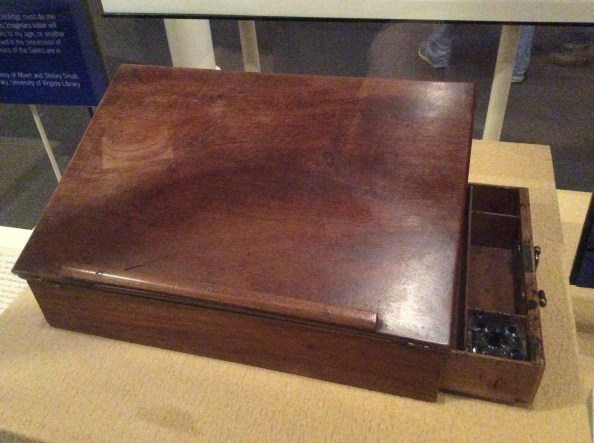
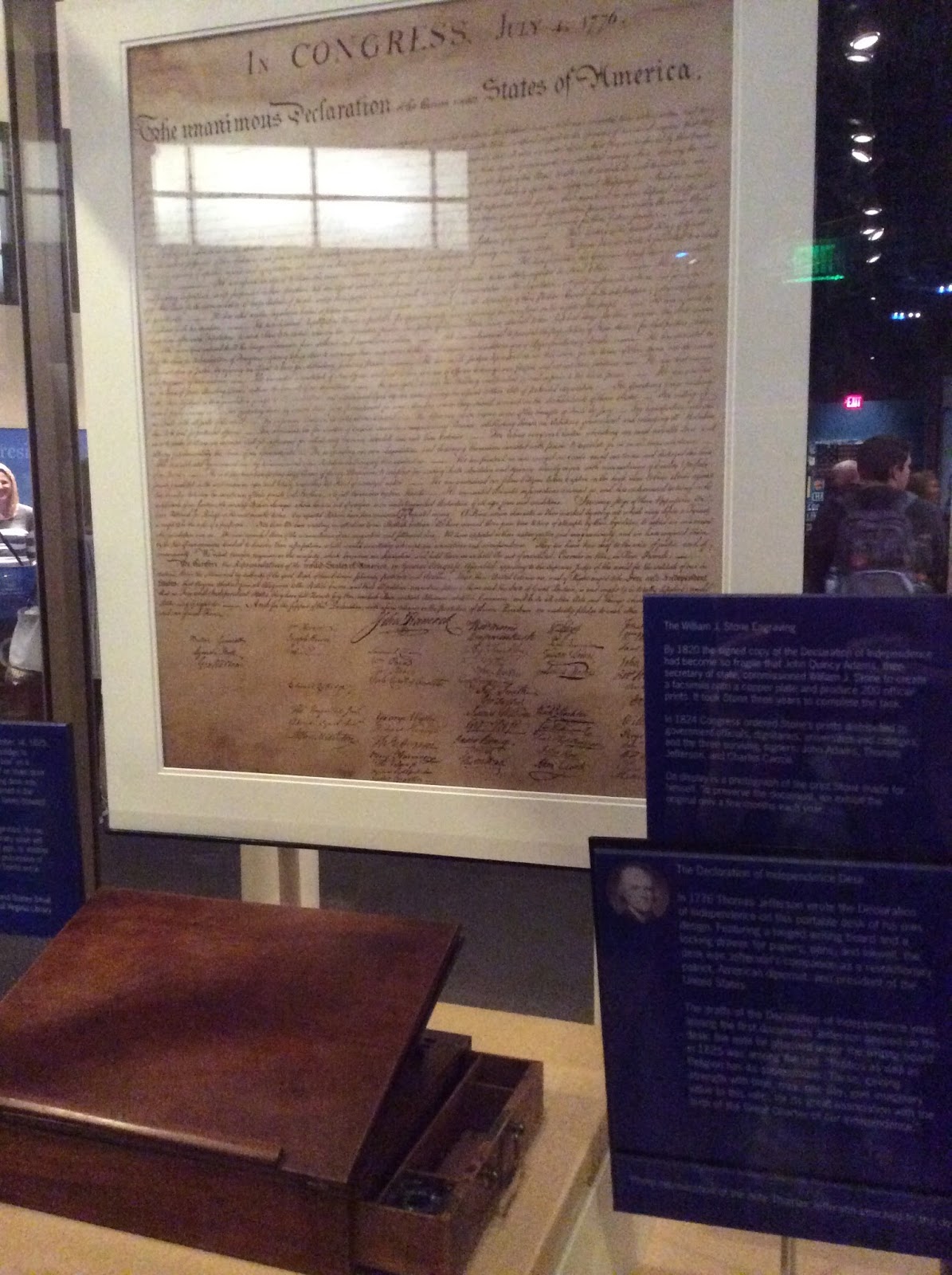
Thomas Jefferson's lap desk, on which he wrote the Declaration of Independence, 2015 by Amy Cools

Thomas Jefferson’s lap desk, which he designed himself and on which he wrote the Declaration of Independence

Seventh day, April 25th.

The last day of my trip is dedicated to visiting museums with my Dad, and I put my project on hold for the time being. However, I return to the Jefferson Building of the Library of Congress with my Dad to show him around because I know he’ll absolutely love it. (He does.)
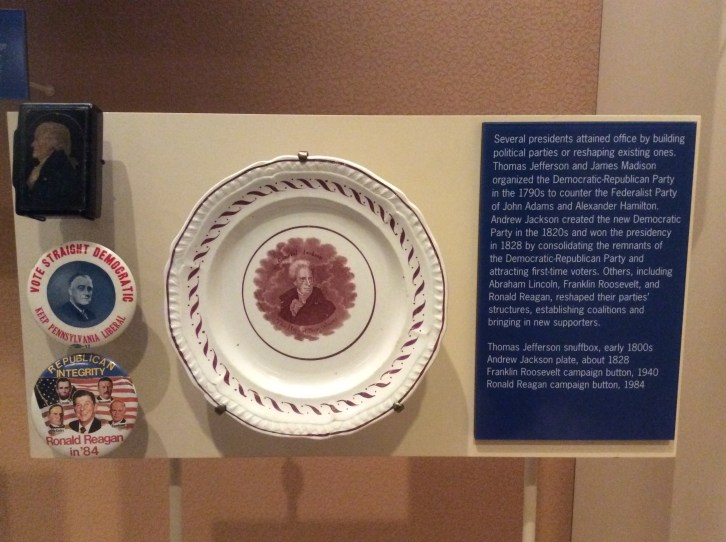
Presidential Souvenirs at the Smithsonian, including a Jefferson snuffbox at upper left, 2015 by Amy Cools

Presidential Souvenirs at the Smithsonian, including an early 1800’s snuffbox painted with Jefferson’s portrait at upper left

In the course of the day, we visit the National Museum of American History of the Smithsonian, where I make sure to visit the American Presidency gallery. I find some Jefferson artifacts among the collection, including the original portable desk on which he wrote the Declaration of Independence (which I already know is here, having visited the Smithsonian some years before), and a great little snuffbox from the early 1800’s painted with Jefferson’s likeness, which I don’t remember from my earlier visit.

There’s one more stop I do have to make before I finish my Jefferson tour. Of course, that’s the White House.

Amy Cools with father John Cools in front of the White House, photo 2015 by Amy Cools.jpgWhile he didn’t list his Presidency among his proudest accomplishments, Jefferson’s time in the White House significantly influenced the way the United States government would function in the future. Though he downsized the size of government following Washington and Adams’ Federalist administrations and reduced the national debt, he increased it again with the Louisiana Purchase and adopted Federalist (or in today’s terms, big-government) policies when he deemed it necessary for national security or the well-being of the nation as a while. He insisted on entertaining foreign dignitaries in a egalitarian and casual manner, with everyone free to seat themselves where they liked rather than being seated according to importance, and insisted on being addressed like any ordinary citizen, without honorific. The latter innovations, while initially shocking and offensive to European sensibilities, helped set the tone for American cultural egalitarianism as well as the spread of democracy in the centuries ahead, even if only in their tiny way.

While Jefferson stooped to some shady political back-handedness during his bid for the presidency (estranging his friends John and Abigail Adams in the process), he struck the right tone in his First Inaugural Address in 1801 when he said ‘…Every difference of opinion is not a difference of principle… We are all Republicans, we are all Federalists.’ We could all use a little more of Jefferson’s rational, conciliatory idealism amidst the partisan bickering, conspiracy-theorizing, extremist, unkind rhetoric that over-saturates our public discourse today.

So ends the account of my Jefferson travels. But in following in his footsteps, learning more about his life and thought, and putting it all together in a narrative, many questions arose and trains of thought were initiated. There will be many more reflections on Jefferson to come in future essays, you can be sure of that.

*Listen to the podcast version here or on iTunes. 

~~~~~~~~~~~~~~~~~~~~~~~~~~~~

Sources and Inspiration:

Brandt, Lydia Mattice. ‘The Architecture of the University of Virginia’
http://www.encyclopediavirginia.org/University_of_Virginia_The_Architecture_of_the

Founders Online: Correspondence and Other Writings of Six Major Shapers of the United States,
Website. http://founders.archives.gov/

‘Gilbert Stuart’, article, National Gallery of Art website.
https://www.nga.gov/exhibitions/2005/stuart/washington.shtm

Hirst, K. Kris. History of Archaeology: The Series. About.com.
http://archaeology.about.com/od/historyofarchaeology/a/history_series.htm

Jacoby, Susan. Freethinkers: A History of American Secularism. New York: Owl Books, 2004.
http://us.macmillan.com/freethinkers/susanjacoby

Jefferson, Thomas. Writings. Compiled by The Library of America, New York: Penguin Books.
http://www.loa.org/volume.jsp?RequestID=67

Jenkinson, Clay. The Thomas Jefferson Hour. Podcast.
http://www.jeffersonhour.com/listen.html

Meacham, Jon. Thomas Jefferson: The Art of Power. New York: Random House, 2012.
http://www.jonmeacham.com/books/thomas-jefferson-the-art-of-power/

‘Short History of the University of Virginia’, University of Virginia website.
http://www.virginia.edu/uvatours/shorthistory/

‘Timeline of Jefferson’s Life’. Monticello.org. Website of the Thomas Jefferson Foundation.
http://www.monticello.org/site/jefferson/timeline-jeffersons-life

Zakaria, Fareed. In Defense of a Liberal Education. New York: W.W. Norton, 2015
http://books.wwnorton.com/books/In-Defense-of-a-Liberal-Education/


Review: In Defense of a Liberal Education, by Fareed Zakaria

In Defense of a Liberal Education, by Fareed Zakaria
New York: W.W. Norton & Company, Inc., 2015

When I returned to college a few years ago to follow my heart’s desire and study philosophy, one of my ethics professors opened the first class session with this question: ‘Why are you here?’ It was not meant as that ubiquitous and difficult-to-answer metaphysical question which would be the topic of so many future course discussions (difficult because it’s not well-formed, many of us would object, being too nebulous). He meant, why where we there in his class, and why were we attending college at all?

I was sitting there, aglow with satisfaction at having resumed my pursuit of a higher education after spending so many years working for others, then struggling to keep my own small business afloat in the 2008 recession era. I was feeling that the daily tasks of my working life were taking up an inordinate amount of time while failing to satisfy my curiosity about the world, so I reduced the size of my business (I’m happy to report it continues to thrive to this day) and returned to school.

In answer to my ethics professor’s question, a few hands went up. ‘To get a good job?…’ one student offered, hesitatingly. ‘I want to get rich! That’s what we’re all here for, really’ said another, with bravado. Others chimed in in assent, with a few objecting that while that’s really what they were here for, too, that’s not the only reason. While some lip service was paid to the intrinsic value of education, the instrumental view of college, as a means to the end of achieving wealth and status, won out in that particular discussion.

In the idealistic mood I was in, I was disappointed. I was here because I was sick to death of the struggle to get ahead, and was thrilled at the prospect of pouring most of my energy into learning and thinking; making money was now relegated to the periphery of my life, and good riddance. For awhile, at least, I would be thrifty and work enough to pay the bills and save a little for emergencies, and that was it.

Why open this review with an anecdote? I’m inspired to to do by Zakaria himself, who opens his excellent little book with his own story: how he, like his brother, came to America and received a liberal education, and what it did for him. In fact, his book is all about what education can do to make each individual’s life a much richer one, in every sense of the word. When I say ‘little book’, I only mean it’s not long, just six chapters and less than 200 pages. It’s really a very big book when it comes to the ideas he explores and the wealth of information and evidence he supplies in support of his arguments. I’ve long admired Zakaria’s ability to express important ideas clearly, succinctly, and with personality, and with this book, he accomplishes all of these to the highest degree.

A liberal education, as Zakaria describes it, is not only generous in its rewards; it’s liberating. It frees the mind narrowed by a lack knowledge and experience, of deeply exploring other points of view. It expands and strengthens the mind as it becomes more elastic, ever ready to take in more information and process it in light of what you’ve learned so far. The more art and culture you take in, the more developed your aesthetic tastes become, and the more you’re able to appreciate. The more you’re practiced in critical thinking, the better able you are to take in new ideas and explore them for quality and for beauty, for strengths and weaknesses. When done right, a liberal education should not make you a ‘know-it-all’; it should make you more open, more ready and able to constantly learn more as you go through life, and more keenly aware of how little anyone can really know about this fantastically rich, complicated, and endlessly fascinating universe we find ourselves in.

A liberal education also makes you a better citizen. You learn about important and influential political theories, and critiquing them logically as well as comparing how they fare throughout history, you learn what works, what doesn’t, and how to judge what might work best in the future. You learn about those who made a big difference in the world, how you can make a difference too, and why you should try to do so. It’s also a quintessentially American innovation: by the people, of the people, and for the people. It’s a great equalizer, open to anyone (or at least intended to be) who has the basic skills and the desire to learn, no matter what socioeconomic class they come from. It presents the best ideas from all over the world for the students to critique and compare on their own merits, though instructors who themselves came from all manner of backgrounds.
Zakaria compares liberal education to skills-based training, which is now winning favor in public and political discourse as the more practical way to help people improve their lives. Many politicians are decrying public education as too ephemeral and calling for more public money to be spent on job training, if spent on education at all. Even President Obama, in favor of free junior college for qualified applicants, recently took a crack at a humanities major. While agreeing that skills-based training is very important, Zakaria explains why it’s not only not enough for a democracy, it’s not enough for a nation that wants to stay innovative and competitive. A person whose talents are honed and locked into one narrow set of skills may be very good at one particular job, but when changes in technology and in the market render that job obsolete, that person’s training is no longer relevant, and they’re left poorly equipped to pursue other options. Consider an entire population educated and trained this narrowly, and you see the problem. As Zakaria points out, a liberal education, which focuses on instilling a broad base of knowledge and generally applicable critical thinking skills, does much more to help people become more informed, flexible, and equipped to take in new information and apply it in new ways.

When I reconsider that ethics class discussion in light of Zakaria’s book, I realize we were talking past each other. There’s no reason to choose between the instrumental side and the intrinsic value of college. A liberal education, which as undergrads we were all pursuing, helps us accomplish all of our goals in a way few other social institutions can, and can be essential for helping us become the best human beings we can be.

Anecdote and Evidence

I was engaged in conversation the other day with someone I like very much and whose opinions I respect, yet with whom I often disagree. This is a very good thing: these are the sort of discussions that keep us honest. They force us to confront arguments and evidence we hadn’t considered before. They challenge us to recognize our unjustified assumptions, things we’ve long taken for granted and never thought to question. And over time, they instill in us the habit of forming good quality arguments that withstand such challenges, and discard those that don’t. These are valuable lessons which we don’t learn so readily in discussion with like-minded people, in preaching to the choir, so to speak.

That evening, we were mostly discussing politics, history, and social issues. Over the course of the evening, I found my interlocutor often supported his arguments primarily with anecdotes, as we all often do. Anecdotes are invaluable discussion tools: they illustrate what we mean by taking the argument out of the realm of the abstract into concrete reality, or in other words, they bring the argument to life. But over the course of the evening, I found that for nearly every anecdote he presented, I thought of one in support of a counterargument. Now it just so happened that some of the topics under discussion were sensitive issues, and since we were in mixed company and everyone was on holiday, I was loathe to bring up anything that would cause strong discomfort or hurt feelings, so I held back.

But I wish I had asked him to clarify this crucial detail: did he mean to use these anecdotes as illustrations, or as evidence?

If he was using these anecdotes to illustrate the larger points he was making, well and good. If he was using these anecdotes as evidence of how stated facts or general rules were manifested or broke down in particular circumstances, well and good. And if he was using these anecdotes as evidence of how particular circumstances can give rise to unique results, again, well and good.

Yet, the fact that I could easily think of a contradictory anecdote for every one he presented weakened his arguments in my mind as he was making them, in those cases where he was arguing in favor of truth claims about the world as a whole. That’s because he hadn’t made is clear how he was using these anecdotes to support his claims.

We should keep this in mind every time we make an argument: an anecdote, considered on its own, should not be considered evidence when it comes to general rules, facts, or theories.

Generally, we should be hesitant to rely too much on anecdotes when we want to persuade others of the truth of what we’re saying.Why? Well, the world is a complicated place, with innumerable factors to consider when making a judgment on any given situation. So while any one anecdote can show how a particular array of circumstances can lead to a specific outcome, it doesn’t reveal enough about what can happen given another particular set of circumstances, or what usually happens in the world as a whole.

There was a warehouse cat I knew named Stinky, years ago when I worked in a salvage yard and retail warehouse. She was a charmingly decrepit cat, runty and ancient. She purred like an old lawnmower, she had rheumy eyes, and she ate a special diet of soft food because she had no teeth. She had terrible arthritis or some other undiagnosed bone or joint condition, which gave her an oddly rolling gait and caused her to nearly fall over every time she strained her head up around to the side to look at you. She also left a patch of brown dust everywhere she slept because she could not reach around to groom her body. For all of this, she seemed to have a happy life: she was very affectionate, showed few signs of pain or distress for all her maladies, and dearly loved and tenderly cared for by all of us who worked there. (My heart still aches with affection when I remember our dear departed little kitty!)

Now, suppose someone where to discuss cats with me, and based on my close acquaintance with Stinky, I were to argue that cats are slow, ungainly creatures with no teeth, that they are dirty animals that don’t groom themselves, they always weigh less than eight pounds, and if you were to hear a low rumbling sound, you can bet it’s a cat. My interlocutor would justifiably think I’m a little nutty. When it comes to talking about one cat, an anecdote is very revealing. When it comes to talking about the species cat, not so much. In other words: one cat is an anecdote, but lots of cats are evidence.

While all this might appear obvious, it’s natural for human beings to form beliefs and to argue on the basis of what we’re familiar with: we all have our own sets of experiences from which we draw our ideas about the world. Yet, as we grow in knowledge and understanding, it’s important to gather as much information as we can about the world that goes beyond our own experience, since we lead ourselves astray all the time by relying on anecdotes, or in other words, the limits of our own experience. The anecdote can point us in the direction of where to seek for truth, since it reveals facts about the world in that particular time and place, but on its own, can’t tell us much about larger truths or how the world works as a whole.

Statistics are evidence. Meta-studies are evidence. One study can be considered useful evidence if it’s sufficiently large and well-conducted, but given so many variables in the world and the statistical likelihood of getting skewed results in any one given study, it’s better to rely on meta-studies, or a hypothesis or theory supported by many studies and observations over time.

Returning to the anecdote with which I began this piece to illustrate my argument: given the evidence of the many discussions we’ve had over time, I have every reason to believe my interlocutor that evening is an intelligent person, well-informed in many ways. Given my confidence in his abilities, I also believe he’s fully aware of the difference between anecdote and evidence. Yet, since our evolved brains naturally think first in terms of our own experience so that we easily fall into the anecdote-belief trap, we need to keep in mind the difference between anecdote and evidence, use them appropriately, and make it clear to ourselves and our partners in discussion how we’re using each of them to support our arguments and why.

Thomas Jefferson Sites, Part 5: Washington, D.C., Third Day

 Fifth day, April 23rd

I map out my route, then make a timely departure from my temporary home this morning: I have lots to do before I meet up with someone very special this evening, and I don’t want to be late.

I’ll be traveling today by car, since I have so many places to go throughout the day that aren’t close to one another, but that’s okay, none of my destinations are downtown.

I start with Kalorama, site of an opulent home belonging to Thomas Jefferson’s friend and fellow statesman Joel Barlow, who purchased the property on Jefferson’s advice in 1807. Barlow made extensive additions and improvements to the house originally on the site, and Jefferson, always the enthusiastic gardener and improver of homes, offered his advice for the gardens and orchards too, and visited the estate many times. Kalorama, by the way, is Greek for ‘fine view’.

The mansion and its associated buildings are long gone, the main house finally torn down in the late 1800’s to make way for city expansion in that area. The intersection of Massachusetts and Florida Avenues where I was directed to by one source, and where I park, turns out to be closer to where the gatehouse stood at the entrance to the grounds. The main house actually stood closer to 23rd and S Streets. I explore the streets and alleys about a block radius to the north and west of where my car is, and an alley I photograph seems to be oriented in the same direction as the gatehouse used to be, but south about a block.

In my poking around, I find this great little antique call box, painted by Peter Waddell, who specializes in images of 18th and 19th century Washington’, according to the little plaque on the back. It portrays George Washington, who never lived in D.C.; his nephew, however, is the man Barlow bought Kalorama from.

My next destination is Georgetown, formerly known as George Town before it became a district of D.C.. It’s now known for the university of the same name, its history as a commercial and industrial center for the area, its canal, and its elegant shops and restaurants.


I’m headed first for the site of Suter’s tavern, where Jefferson stayed on his travels back and forth from Philadelphia, and wrote of the delicious glasses of wine he enjoyed there (Jefferson loved wine). There’s nothing apparently left of that building, either, except many stories, since it was a very popular inn at the time and many famous people stayed there. There are also many claims that it’s actually still standing (including one made by a business that’s in the building in question. Marketing tool?). There’s an old photo, supposedly of Suter’s tavern in the Library of Congress, but it seems that neither the photo nor the rest of these claims can be substantiated. John Suter, the proprietor, didn’t actually own the building, so there are no property records to back any of these claims up. From what I can find, it seems there’s a consensus that it was probably on or near what’s now Wisconsin Ave just north of the canal.

As I head west on M Street to make my way to my next destination just a few blocks away, I’m scanning the scene as I’ve been doing the whole trip, looking for markers indicating historical sites and buildings that appear to date to the right time period.Here, it pays off. To my left, I spot a sign with a stylized old-fashioned image of a Native American on it, with the dates 1796 and 1962. I look up and, yes, the building looks promising. I quickly locate the plaques that identify it as The City Tavern and date its original construction to 1796. Great! It’s the right place, the right time …even the right name: as you may remember, Jefferson frequented the City Tavern in Philadelphia too. Okay, okay, the name doesn’t matter, it’s so generic that any city Jefferson visited is fairly likely to have a tavern of that name. Seriously, though, I think it likely that he’d be associated with it for the same reasons I came up with that Jefferson version of the Six Degrees of Kevin Bacon game: he seemed to know just about everyone, or have professional or social connections with everyone.Sure enough, it turns out Jefferson is associated with this City Tavern too: he probably came here to at least to dine and attend events, since around this time he lived close to the White House while he was Vice President (the White House was still called the President’s House at the time) and then in the White House. He may even have had occasion to stay the night now again, even if it was not far from home: he was a busy, social man with lots of friends, and even short distances to us seemed a lot farther in Jefferson’s time of travel by horse and carriage

I continue on my way to my next stop: Uriah Forrest’s house, AKA the Forrest-Marbury House, AKA the Ukranian Embassy. Jefferson dined at Forrest’s house and apparently stayed the night, along with Madison and others (though my primary source for this indicates that Jefferson spent the night in Georgetown, it’s not clear whether it was elsewhere, such as nearby Suter’s, or this house). They were on that same trip that took them to nearby Notley Young’s house visiting local landowners in preparation for building the new capital city there. Jefferson and company took the time for a little pleasure trip, to take a tour of the area and visit some small waterfalls about four miles away, according to a letter of a contemporary describing the day’s outings.

While the house is named for Uriah Forrest, who was one of the party when Jefferson was there in 1790, he actually didn’t live in that house yet; he moved in in 1792. Another member of the group did, the original owner who had it built in 1788, Secretary of the Navy Benjamin Stoddert. Like so many of the other Federal style buildings featured in this series, it’s a tall, somewhat plain but still handsome house of red brick. It’s one of the few buildings that date before the turn of the 19th century still standing in Georgetown.

I decide to take the long way back to my car, via Francis Scott Key Park and the canal walk (I’ll add a photobook with more images of Georgetown soon). It’s a lovely stroll, via simple gravel paths along either side of the grass-lined canal, crossed by steel bridges painted that same rusty-red color of the Golden Gate bridge in San Francisco, and hemmed by old red brick warehouses, industrial buildings, and stone walls. Georgetown, originally a port town and trading center along the Chesapeake & Ohio Canal, became a bustling industrial center in the 19th century. Over time, the railroads and then flooding rendered the canal useless as a shipping route.

After my happy stroll, I continue on to my final destination of the afternoon before the person I’m going to meet arrives. I’m heading for Analostan Island, which I had stood over, but not on, when I attempted to reach it by the Interstate 66 bridge footpath a few days before. This time I’m successful, but reach it very circuitously, as I miss the turn at the other end of the Francis Scott Key Memorial Bridge that would put me on George Washington Parkway, and end up going around and through Arlington National Cemetery. But I’m okay with that: I like getting lost sometimes, I find out interesting things that way.

 As I mentioned earlier in this series, Jefferson visited Analostan Island many times. His friend John Mason, son of George Mason (who was a member of the Constitutional Convention and contributed to the writing of the Constitution, but in the end, refused to sign it), built a mansion on Analostan in the 1790’s. The island, now named Theodore Roosevelt Island, retains no apparent traces of its history as the site of a plantation, luxury home, and getaway spot. It’s mostly grown wild, except for the hiking paths that crisscross its perimeter, length, and breadth, and the Theodore Roosevelt Memorial perhaps half a mile from the island end of the footpath that reaches it.

The memorial appears just a little neglected: there are weeds growing through the spaces between the flagstones, and the fountain is waterless and scattered with debris, mostly just dead plant stuff. Theodore Roosevelt’s likeness, large and a little menacing-looking (calls to mind the phrase ‘bully pulpit’, though more in today’s sense of the term than his), is portrayed in the act of delivering some impassioned speech, one arm upraised. If there were a crowd here, the statue’s demeanor would be fitting; the island being nearly empty this afternoon, it looks oddly out of place with its peaceful surroundings, with no sound but birds chirping and the wind blowing through the trees (it’s another blustery day).

There are large stones carved with phrases praising bold, courageous ‘manliness’ which I find a bit annoying; my feminist side protests that I and many of my fellow women are more bold and courageous than many men, and that these are human traits, not ‘manly’ ones. I’m also aware of the warmongering, reckless side of his personality, which I don’t find admirable. I prefer Jefferson’s philosophy, which places a far higher value on courtesy, reason, and compromise, with war a measure of absolute last resort (though not so for spontaneous revolution of the people when they find their natural rights are being trampled upon, that’s another matter; he considered this a desirable thing sometimes). I remember, however, that Roosevelt often used his power to promote the rights of the poor and to protect our natural resources. Parks like this, for example, as are many of the places I’ve visited this trip, are an extension of his legacy, publicly funded preservations of natural beauty and historical places that market forces nearly caused the destruction of. I forgive him and move on.

My main goal for this island hike is to find some remnant of the Mason house, since it’s the artifact directly associated with Jefferson here, and then skedaddle and swing by Alexandria, home of Gadsby’s tavern where Jefferson stayed once, on my way to the place I’m meeting someone later. But once I start tramping round the island, my inner hiker, having been starved of her exercise and natural scenery for over a week now, demands a longer stay. So I forego the Alexandria stop (which I never end up making, oh well) and hike vigorously for a couple of hours.

It’s mostly forest, with large area of marshland along its south and eastern end; I start my hike on the trail that goes through it from end to end, counterclockwise around the island. Much of this path consists of a wooden boardwalk to keep the hiker out of the water. There are birds galore, many of which I’ve never seen before and whose unusual calls I try to memorize so I can find out more about them later.

At the end of the marsh walk, I return to the woods, and I crisscross the entire island time and again. I think I walked every single official trail on the island, some more than once, and some unofficial little narrow ones as well. A herd of deer and I spooked one another when I was on one of these little narrow ones. Most bounded away to my left toward the marsh, but one bounded across my path and ended up very close to me on my right. We stared at one another for awhile, then she moved on.

Finally I come across what I’m looking for, sort of. I find a National Park Service Sign indicating the little rise where the mansion stood. I ascend the rise, and among the trees, find the only sign that indicates there was once a structure here: a few broken remnants of old brick. Perhaps there’s some remains below ground; how fun it would be to dig it up, if so! However, since I never did fulfill that childhood dream of becoming an archaeologist, I suppose I better not.

I find the site just in time, since the time has come to leave the island for the meeting I spoke of. But you’ll have to wait ’til the next installment of my Jefferson adventure to find out who with!

Stay tuned….

*Listen to the podcast version here or on iTunes. 

Sources and Inspiration:

‘Analostan Island’, George Mason’s Gunstan Hall website.
http://www.gunstonhall.org/georgemason.

‘City Tavern Club: History’, City Tavern Club website.
http://www.citytavernclubdc.org/Default.aspx?p=DynamicModule&pageid=335988...

DeFerrari, John. Lost Washington, Part 3. Charleston, SC: The History Press, 2011
http://books.google.com/books/about/Lost_Washington.html?id=NTvO0u1JzK8C

Hansen, Stephen A. ‘General John Mason House, Analostan Island’
http://analostan.dchistoricdesigns.com/
and ‘The Kalorama Estate: A Brief History’
http://kalorama.dchistoricdesigns.com/

‘History of the Forrest-Marbury House’, Embassy of Ukraine website.
http://usa.mfa.gov.ua/en/embassy/history

Jacoby, Susan. Freethinkers: A History of American Secularism. New York: Owl Books, 2004.
http://us.macmillan.com/freethinkers/susanjacoby

Jefferson, Thomas. Writings. Compiled by The Library of America, New York: Penguin Books.
http://www.loa.org/volume.jsp?RequestID=67

Jenkinson, Clay. The Thomas Jefferson Hour. Podcast.
http://www.jeffersonhour.com/listen.html

Meacham, Jon. Thomas Jefferson: The Art of Power. New York: Random House, 2012.
http://www.jonmeacham.com/books/thomas-jefferson-the-art-of-power/

Shippen, Thomas Lee. ‘Letter to William Shippen, Sep. 15. 1790’. Founders Online, website
http://founders.archives.gov/documents/Jefferson/01-17-02-0136-0004

‘Timeline of Jefferson’s Life’. Monticello.org. Website of the Thomas Jefferson Foundation.
http://www.monticello.org/site/jefferson/timeline-jeffersons-life

‘Washington, D.C.’ Thomas Jefferson Encyclopedia, Monticello.org website.
http://www.monticello.org/site/research-and-collections/washington-dc