APA Member Interview: Amy Cools

Amy Cools, Portrait by Alex Black, 2014October 21, 2016 by Skye Cleary for the American Philosophical Association Blog

What excites you about philosophy?

There’s something about discovering or realizing a truth about the world and about our inner experiences of it that’s more thrilling to me than anything else. When I first read Wilfred Seller’s definition of philosophy, the “aim…to understand how things in the broadest possible sense of the term hang together in the broadest possible sense of the term”, I recognized that his conception of philosophy is closest to my own. I believe philosophy is something that all human beings engage in, to one degree or another, and to feel that I’m part of this great human endeavor to understand and appreciate the world is also deeply satisfying…

Read the rest of this interview at the APA Blog

Ordinary Philosophy and its Traveling Philosophy / History of Ideas series is a labor of love and ad-free, supported by patrons and readers like you. Please offer your support today!


Frederick Douglass Washington DC Sites, Last Day

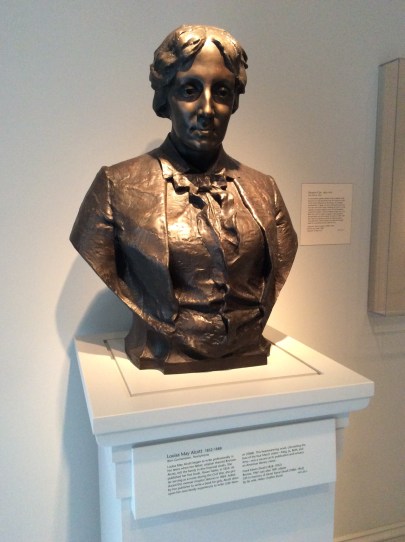
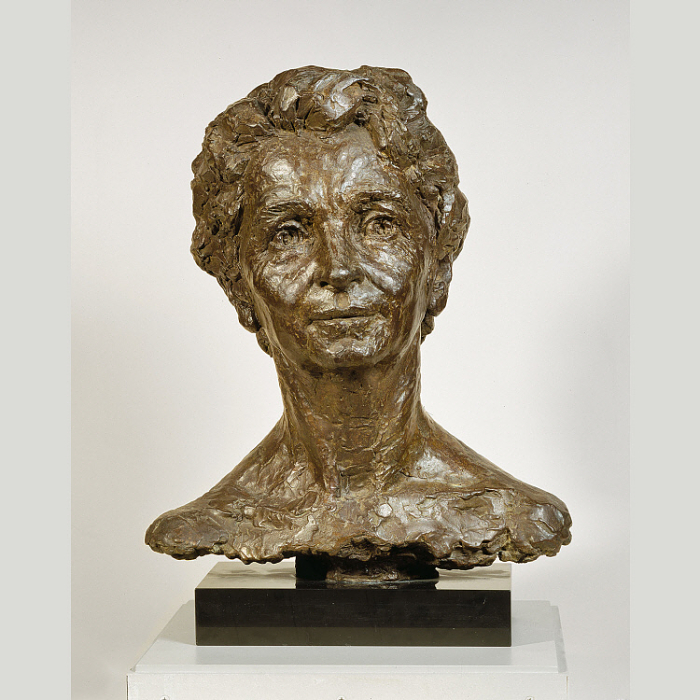
louisa-may-alcott-portrait-bust-at-the-smithsonian-national-portrait-gallery-2016-by-amy-cools

Louisa May Alcott portrait bust at the Smithsonian National Portrait Gallery, photo by Amy Cools, 2016

On Louisa May Alcott’s birthday evening, I think of a moment in her life that I discovered during my Frederick Douglass project, where she displayed the sort of moral clarity and courage I’ve associated with her since I was a little girl devouring every Alcott novel I could get my hands on. Thank you for your wonderful books, Ms. Alcott!

Amy M Cools's avatarOrdinary Philosophy

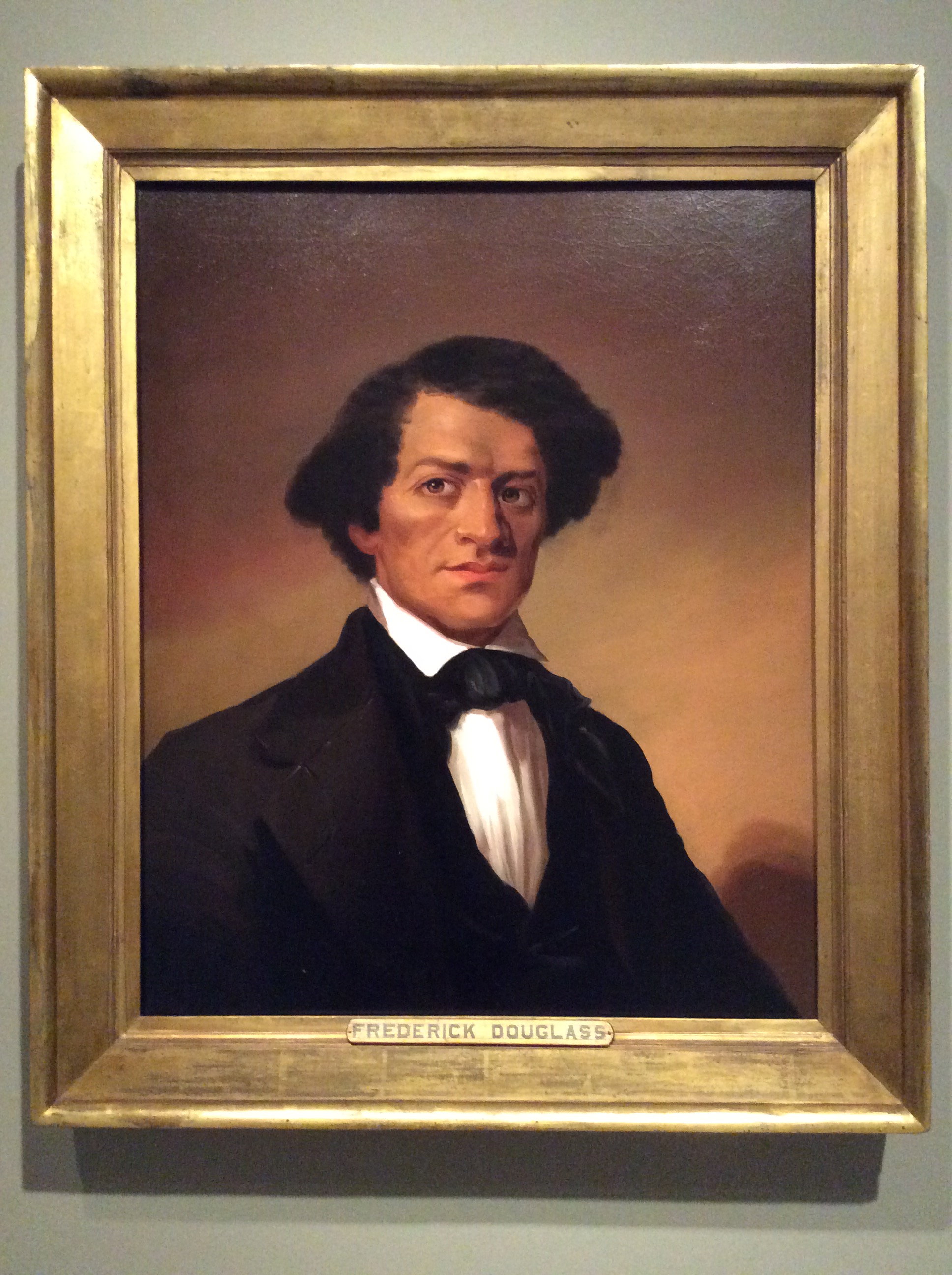
Portrait of Frederick Douglass by unknown artist, 1844, National Portrait Gallery in WashingtonD.C., Portrait of Frederick Douglass by unknown artist, 1844, National Portrait Gallery in Washington, D.C.. The NPG placard describes it as a ‘powerful portrait’ but I’m not particularly impressed, especially since I don’t think it looks like Douglass at all.

Fourteenth Day, Saturday, April 2nd

After a morning glancing at the light rainfall through the coffee shop window as I write up some notes and look up some things in preparation for the day, I begin my day’s explorations with a visit to the National Portrait Gallery. It’s at 8th and F Streets NW, its official address: unusually, it lacks a street number.

While I’m here primarily to see all the Douglass portraits I can find and have little time to spare since it’s my last day in D.C., I’ve wanted to visit the Portrait Gallery for a long time, and allow myself an extra hour to explore.

After I’ve made my inquiries…

View original post 4,382 more words

Margaret Sanger NYC Sites, Day 2, Part 1

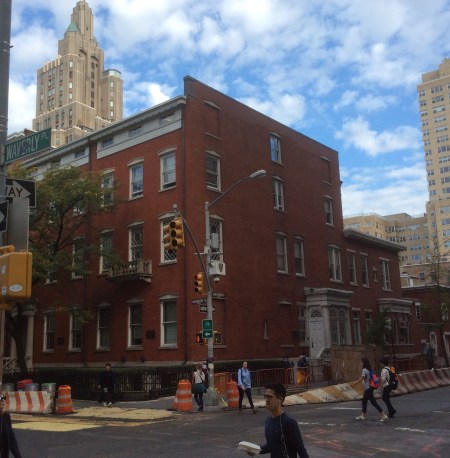
Waverly Pl and University at Washington Square, Manhattan, NY

Waverly and University Places at Washington Square, Manhattan, NY, northeast corner

Wednesday, October 19th, 2016

I take the E train north from where I’m staying in NYC’s Soho neighborhood of Manhattan to Washington Square. It’s a lovely, warm, and soft day, the sky blue and thickly scattered with puffy, small, wispy clouds like spilled cheap cotton balls.

On March 1, 1926, Margaret Sanger delivered a lecture titled ‘The Need for Birth Control in America’ to New York University’s Liberal Club. It takes a bit of digging to find out where the Liberal Club met at this time, but I finally discover it in a letter written to Sanger’s supporter and sometimes collaborator W.E.B. DuBois. In this letter, dated Nov. 22nd, 1926, the secretary of the Liberal Club, Mary Broger, invited him to address the Club’s open forum on Monday, Dec 6th of that same year. The letter also specified that the Club met at New York University’s Washington Square College ‘at University and Waverly Places’, which is at the northeast corner of Washington Square Park. (Pokorski’s ‘Mapping Margaret Sanger’ Google map has it a little wrong, marking the location of this event near the southeast corner of the park).

NYU's Silver Center at Washington Square Park, at the southeast corner of Waverly and University at the northeast corner of the park

NYU’s Silver Center at Washington Square Park, at the southeast corner of Waverly and University Places at the northeast corner of the park

It’s still unclear exactly where the Club met since there are buildings at the northwest, northeast, and southeast corner of this intersection, and my sources, including the DuBois letter, don’t specify an address. I think it most likely that the Club met in what’s now the New York University Silver Center for Arts and Sciences at the southeast corner of University and Waverly, called American Book Company of the Law Department of New York University in G.W. Bromley & Co’s city atlas of 1923. The buildings that stand at the other corners of this intersection appear to have been all residential, based on that same atlas, just as they appear now. At the southwest corner of this intersection, Washington Square Park pre-dates the 1926 meeting of the Liberal Club by about a century. The Silver Center building was built in 1892.

1926 was a hard year for Sanger. She was long subject to periodic depressions, and some legal setbacks in the birth control movement and the deaths of her sister Mary and her father that year all helped to start the cycles again. But she continued to think, and speak, and write, and plan, and that summer she decided she would present her case for birth control in the context of an international conference. Hoping to make her case to a world audience and influence delegates to the League of Nations, she began planning and organizing a World Population Conference in Geneva which would take place the next fall. It was a great success, and Rockefeller and many other benefactors helped fund the project. Its attendees and speakers included experts from a wide array of scientific fields from around the world, and this would be the first of many more such gatherings where problems of population growth would be studied and addressed.

The soft coolness of the morning has given way to a warm, somewhat humid day.

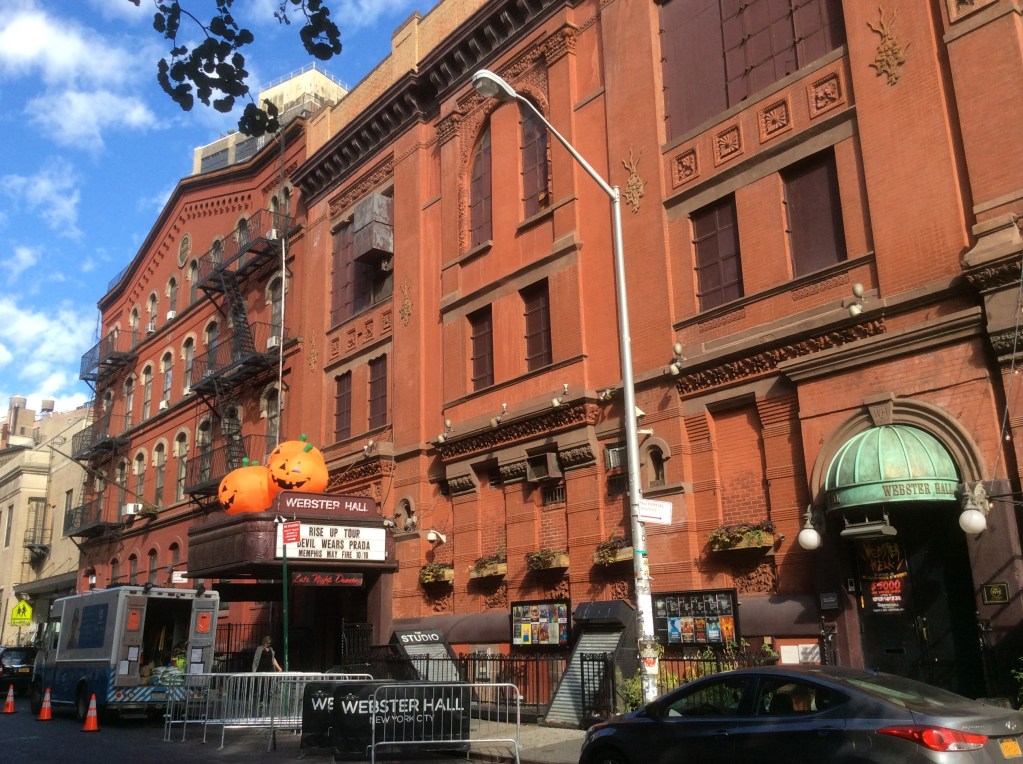
Webster Hall in October, festooned with pumpkin decorations, New York City

Webster Hall festooned with pumpkin decorations in October, New York City

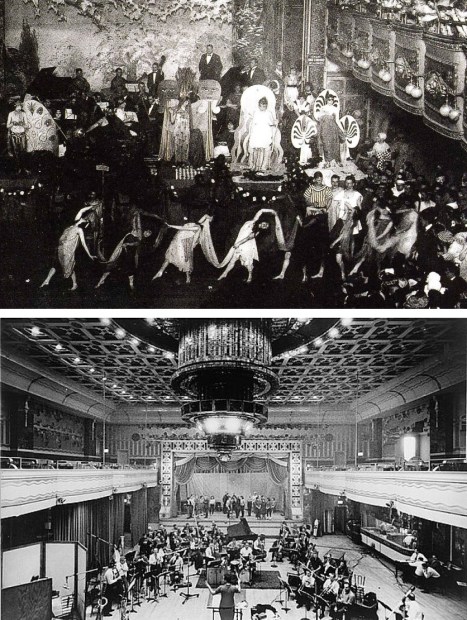
Two views of Webster Hall's Grand Ballroom, public domain via Wikimedia Commons. Above, a Costume Ball probably in the nineteen-teens or early twenties. Below, an orchestra prepares to record 'How to Succeed Without Really Trying' in 1961, public domain via Library of Congress

Two views of Webster Hall’s Grand Ballroom. Above, one of their popular costume balls, probably in the nineteen-teens or early twenties. Below, an orchestra prepares to record ‘How to Succeed Without Really Trying’ in 1961

I continue north (after a little wild goose chase several blocks to the east which turns out to be an out of date or incorrect address), and turn left on E 11th. My destination is Webster Hall at 125 E 11th St between 3rd and 4th Aves. It’s a red brick and brownstone structure, built in 1886-1887, and there’s a deco era small marquee added to the main entryway. The Hall has been restored and rebuilt many times after several major fires, and though its original brickwork, brownstone trim, and terracotta decorations survive, its beautiful old mansard roof is gone. It’s now a nightclub and concert venue. The doors are locked and there’s no one around to let me inside to see its famous Grand Ballroom with its reputed great acoustics. For a time, it was used as a recording studio, which leads to the second accidental Bob Dylan connection I make on this trip. His iconic harmonica backs Harry Belafonte’s 1962 recording of Midnight Special and is Dylan’s first published album recording.

In 1912, Sanger led a march of 119 child refugees from the Lawrence Mills textile strike, from Grand Central Terminal to Webster Hall. It was a difficult and violent strike, and this children’s march was to raise awareness of the plight of the striking families as much as it was to obtain proper shelter, food, and medical care for them. Sanger wrote in her autobiography that these children were underfed and inadequately dressed for the winter weather, and though many were sick, they had still been required to work. When they arrived at Webster Hall, however, they found a banquet all ready and families ready to give these children a caring home until better arrangements could be made for them.

Garment workers, Webster Hall. Bain News Service, P. (ca. 1915) [between and Ca. 1920] [Image] Retrieved from the Library of Congress

Garment workers, Webster Hall, ca. 1915-1920. By Bain News Service. Library of Congress

We think of Sanger today primarily as a feminist and birth control activist, yet she was an ardent Socialist and labor rights activist first. She increasingly distanced herself from her radicalist roots over the years because she believed it necessary to court the middle-class and wealthy for the long term success of her cause. Scientific research and development of effective means of birth control cost a lot of money. It also required influence in high places, to attract doctors and scientists willing to take the risk of working in this field as well as lawmakers, litigators, and politicians to push through legal reforms. Nevertheless, what Sanger observed in her early years as a nurse and activist among poor working families horrified, galvanized, and drove her in her cause for ready access to affordable and reliable birth control, especially essential for the health and safety of working class women and children.

The main entrance of The Brevoort

The main entrance of The Brevoort

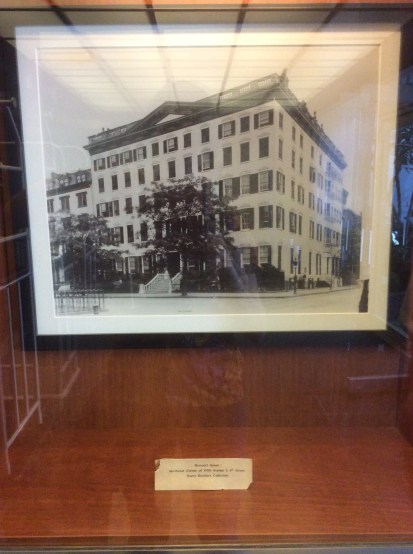
I zigzag back east to The Brevoort, once Hotel Brevoort at 11 Fifth Avenue at 8th St. The doorman invites me inside when I tell of that I’m on a historical writing tour, and politely inquires about my subject. He utters a noncommittal ‘hmmm’ when I tell him who it’s about. This building dates to the 1950’s but he confirms that it stands on the original hotel site. There’s a photograph of the original hotel in a glass covered niche in the entryway.

Sanger gave many lectures and speeches at the Hotel Brevoort over the decades. The one I’ll focus on here was held the night before her obscenity trial for distributing The Woman Rebel through the mail. In this speech of January 17th, 1916, Sanger reminded her audience that birth control was not a new thing: it had been widely practiced since antiquity. Even the great philosopher Aristotle, arguably also the first scientist, had advocated it. She wrote more extensively about the history of birth control and its methods in her book Woman and the New Race.

Photo of the original Hotel Brevoort in a glass case in The Brevort lobby

Photo of the original Hotel Brevoort in a glass case in The Brevoort lobby

She also stressed her conviction that there was nothing anti-life about birth control. In fact, birth control prevented death: it prevented the death of mothers in childbirth, much more dangerous then than it is today, especially if you were poor. It prevented the suffering and death of infants and children born into deprivation and disease. It prevented the death of mothers who resorted to abortion, illegal then but widely available in back alleys if they could scrape together five dollars to pay for it. If they couldn’t, they did it themselves, often rupturing the uterus and causing deadly infections. But even this risk was acceptable to women who found themselves pregnant in circumstances so dire that they couldn’t face the thought of raising another child that way. When it came to abortion, in fact, Sanger opposed Aristotle, who promoted it especially in the early stages of pregnancy to prevent social ills such as poverty, overcrowding, and political unrest. In her Hotel Brevoort speech, as in her book, Sanger also reminded her audience that birth control prevented infanticide, another last but not uncommon resort of desperate women, and another acceptable form of population control to Aristotle in certain circumstances.

In other words, contrary to the opinion of her opponents then and now, Sanger considered herself and her movement radically pro-life, as we’ll recognize from her own words in a moment.

Today's incarnation of The Brevoort

Today’s incarnation of The Brevoort

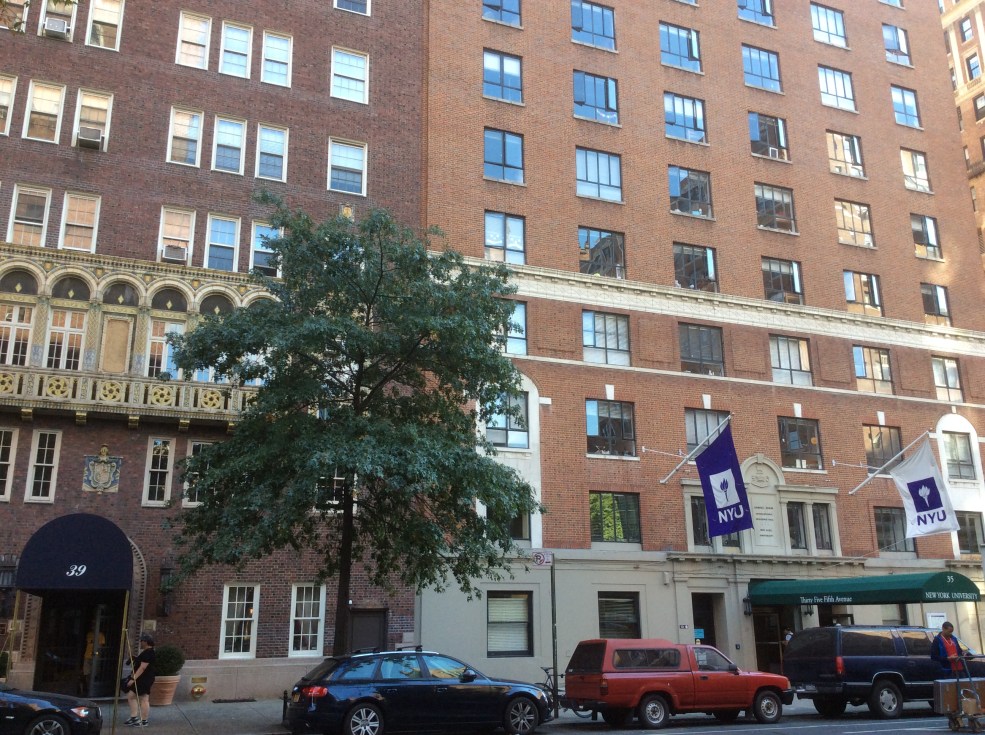
35 and 39 Fifth Ave, Manhattan, NYC, photo 2016 by Amy Cools

35 and 39 Fifth Ave, Manhattan, NYC

My next destinations, just a little ways up Fifth Ave between 10th and 11th Streets, are two buildings which stand shoulder to shoulder, both tall and handsome in their red brick. I especially like the second one, with its beautiful painted terracotta loggia-style embellishments. I’m unable to gain entry to either since they’re now residential buildings not open to the public. These two buildings turn out to have interesting histories.

The first is 35 Fifth Ave, formerly the Grosvenor Hotel, now Rubin Residence Hall of NYU. This 1925 building replaced the earlier 6-story Grosvenor, the first residential hotel in New York City, completed in 1876. Mark Twain lived in the original Grosvenor in 1904 while his new home at 21 Park Ave was being renovated. Another of my favorite novelists, Willa Cather, lived in the building that stands here today, from 1927 to 1932. Sanger stayed here a year earlier, from April to September of 1926, when the new Grosvenor was only a year old. She stayed here again for one month in 1928.

Sanger also lived next door at 39 Fifth Ave for a short time in mid-1923, when this building was also only a year old. It was designed by Emory Roth, whose firm designed many of New York City’s most iconic structures, and built in 1922.

1923 was a significant year for the progress of birth control for many reasons, one of which I’ll cover in the next installment of this story of my Sanger journey. Sanger wrote an article for the journal The Thinker in 1924 in which she summarized the trials and successes of the movement of the year before. In ‘The Birth Control Movement in 1923‘, Sanger restates and reaffirms the basic tenets of her movement:

‘…[W]e witness [an] appalling waste of women’s health and women’s lives by too frequent pregnancies. These unwanted pregnancies often provoke the crime of abortion, or alternatively multiply the number of child workers and lower the standard of living.

To create a race of well-born children it is essential that the function of motherhood should be elevated to a position of dignity, and this is impossible as long as conception remains a matter of chance.

We hold that children should be

1. Conceived in love;

2. Born of the mother’s conscious desire;

3. And only begotten under conditions which render possible the heritage of health. Therefore we hold that every woman must possess the power and freedom to prevent conception except when these conditions can be satisfied.

Every mother must realize her basic position in human society. She must be conscious of her responsibility to the race in bringing children into the world.

Instead of being a blind and haphazard consequence of uncontrolled instinct, motherhood must be made the responsible and self-directed means of human expression and regeneration.’

Entryways of 35 and 39 Fifth Avenue in Greenwich Village, NYC

Entryways of 35 and 39 Fifth Avenue in Greenwich Village, NYC

I visit many more sites on this long and adventurous day and will return soon to pick up the tale. To be continued….

Ordinary Philosophy and its Traveling Philosophy / History of Ideas series is a labor of love and ad-free, supported by patrons and readers like you. Please offer your support today!

*Listen to this podcast version here or on Google Play, or subscribe on iTunes

~~~~~~~~~~~~~~~~~~~~~~~~~~~

Sources and Inspiration:

10th Street.’ From New York Songlines: Virtual Walking Tours of Manhattan Streets

35 Fifth Avenue, 1926‘. What Was There website

39 Fifth Avenue, Between East 10th Street & East 11th Street, Greenwich Village‘, CityRealty website

About Sanger: Biographical Sketch‘, from The Margaret Sanger Papers Project at New York University.

Bromley, G.W. and Co. Atlas of the City of New York, 1921 – 1923, Plate 31. Retrieved from Lionel Pincus and Princess Firyal Map Division Digital Collection, The New York Public Library.

Chesler, Ellen. Woman of Valor: Margaret Sanger and the Birth Control Movement in America. New York: Simon & Schuster, 1992

Eig, Jonathan. The Birth of the Pill: How Four Crusaders Reinvented Sex and Launched a Revolution. W.W. Norton & Company, New York, 2014.

From Geneva to Cairo: Margaret Sanger and the First World Population Conference‘, The Margaret Sanger Papers Project Newsletter #8 (Spring 1994)

Garrett, Y. ‘Jan. 2, 1923 First Legal Birth Control Clinic Opens in U.S.‘ From The Margaret Sanger Papers Project at NYU

Greenhouse, Steven. ‘New York, Cradle Of Labor History‘, Aug 30th, 1996. The New York Times

Kaplan, Fred. The Singular Mark Twain: A Biography. New York: Anchor, 2005

The Lost Grosvenor Hotel — 35 Fifth Avenue‘. From Daytonian in Manhattan blog

New York University. Liberal Club. ‘Letter from New York University Liberal Club to W. E. B. Du Bois, November 22, 1926‘. W. E. B. Du Bois Papers (MS 312). Special Collections and University Archives, University of Massachusetts Amherst Libraries

Pokorski, Robin. ‘Mapping Margaret Sanger‘ from The Margaret Sanger Papers Project at NYU

Regan, Margaret. ‘Margaret Sanger: Tucson’s Irish Rebel.Tucson Weekly, Mar 11, 2004.

Sanger, Margaret. ‘The Birth Control Movement in 1923‘, Apr 1924. Source: The Thinker, Apr. 1924, pp. 49-51. From The Margaret Sanger Papers Project at NYU

Sanger, Margaret. ‘Hotel Brevoort Speech,” Jan 17, 1916. From The Margaret Sanger Papers Project at NYU

Sanger, Margaret. Margaret Sanger, an Autobiography. Cooper Square Press: New York 1999, originally published by W.W. Norton & Co: New York, 1938

Sanger, Margaret. The Pivot of Civilization, 1922. Free online version courtesy of Project Gutenberg, 2008, 2013

Sanger, Margaret. Woman and the New Race, 1920. Free online version courtesy of W. W. Norton & CompanyZorea Ph.D., Birth Control

Webster Hall‘. In Wikipedia, The Free Encyclopedia.

Webster Hall and Annex, 119-125 East 11th Street, Manhattan‘. Landmarks Preservation Commission
March 18, 2008, Designation List 402, LP-2273

Margaret Sanger NYC Sites, Day 1 Part 3

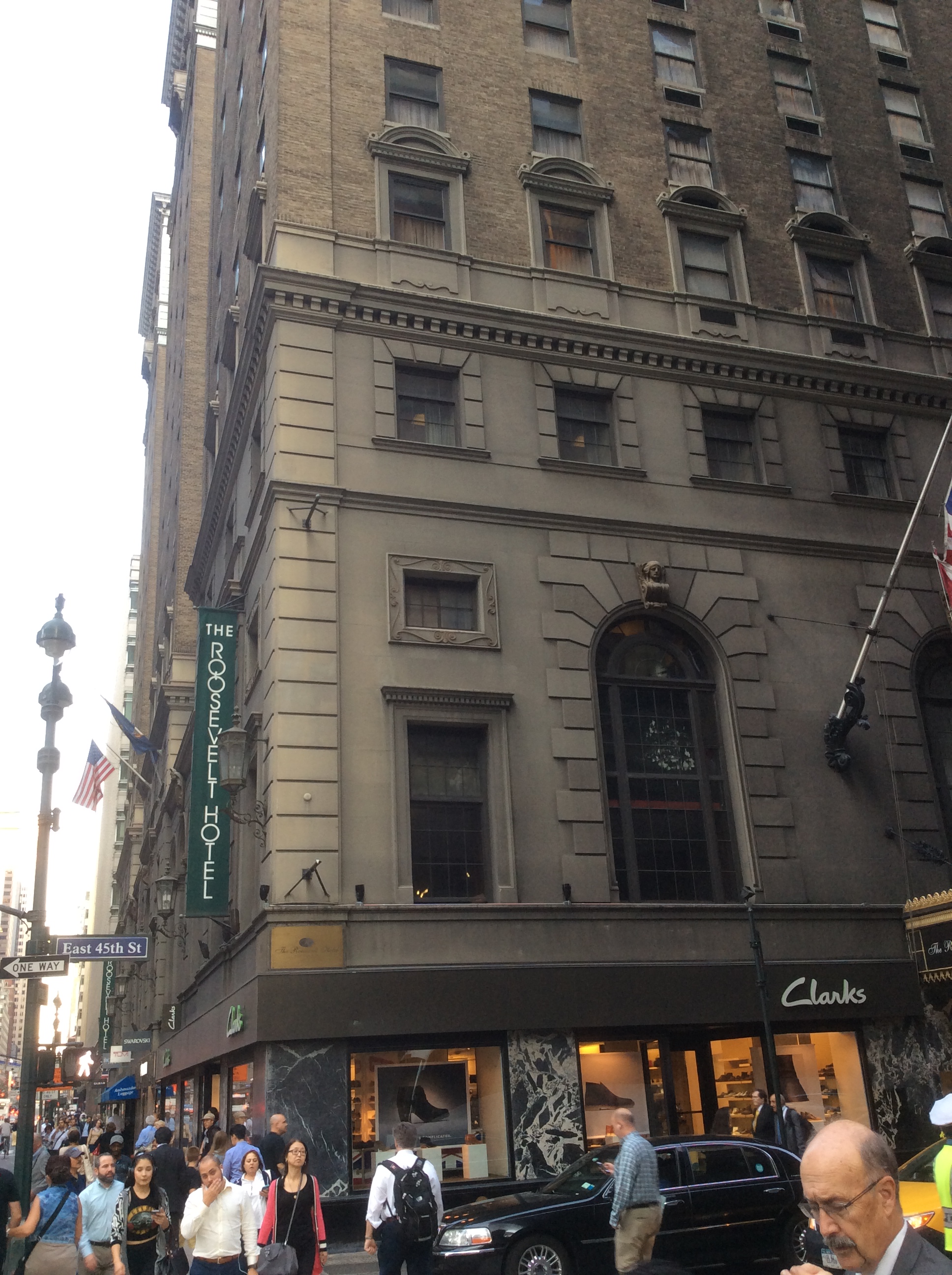
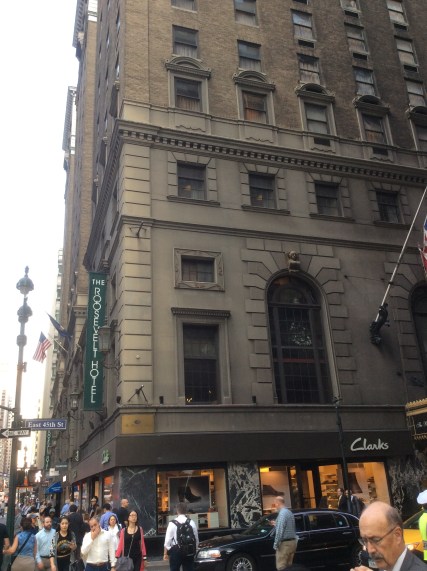
roosevelt-hotel-exterior-view-manhattan-nyc-photo-by-amy-cools-2016Tuesday, October 18th, 2016, continued

I continue north to the Roosevelt Hotel at Madison Ave and E. 45th Street. Margaret Sanger attended the Conference on Contraceptive Research and Clinical Practice that met here on December 29th and 30th, 1936. She delivered a welcoming speech on the 29th and spoke on a panel the next day which discussed technical and medical birth control issues. While The New York Times reported optimistically on the effectiveness of birth control methods available at the time and Sanger spoke proudly of the ‘56,000 women who have voluntarily appealed to us for help’, she and many of the attendees knew that the lack of access to and effectiveness of birth control remained big problems. It was still fairly expensive; anti-obscenity laws were barriers to access and information in those pre-Griswold years; and too many of the methods were only moderately effective since they were not always easy to use correctly, especially in well, you know, the heat of the moment.
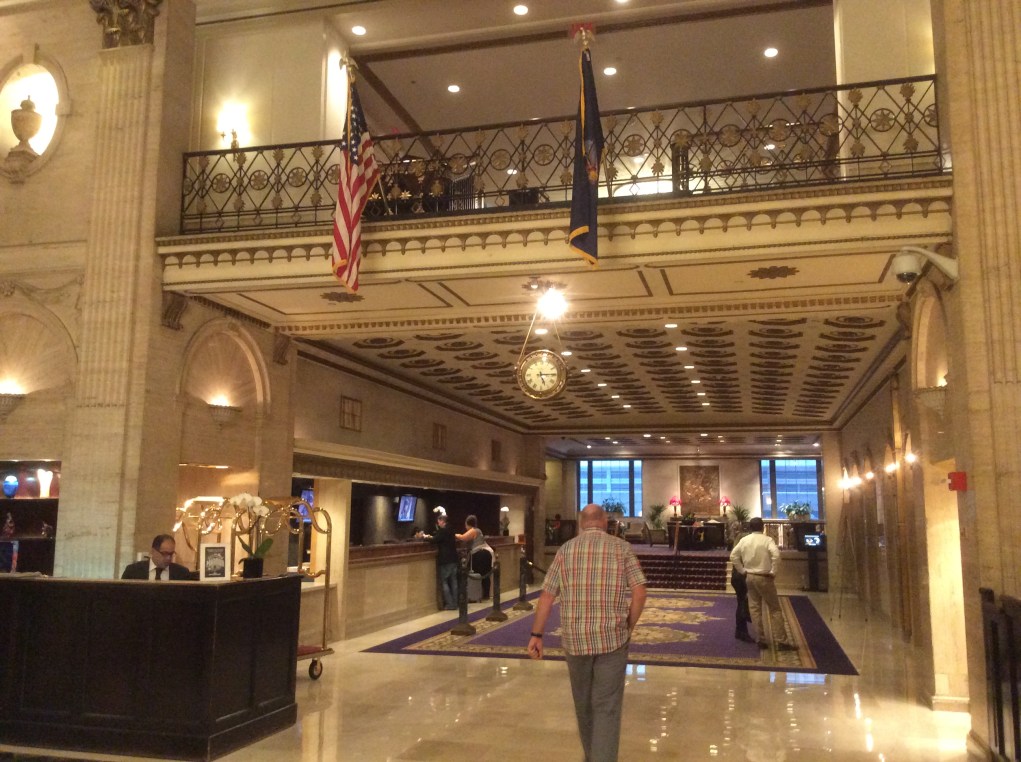
Roosevelt Hotel Lobby view

Roosevelt Hotel central lobby

But despite these problems, Sanger had reasons to be optimistic: the birth control movement had seen some successes in the twenty years since the raid of her first clinic in 1916. One of the most important was the recent decision in United States v. One Package of Japanese Pessaries (what a name!) in which the United States Court of Appeals upheld the decision of a lower court from earlier that year regarding a shipment of birth control devices that U.S. Customs had confiscated under the Comstock laws, which prohibited sending ‘obscene’ items through the mail. Sanger had ordered a case of unusually shaped diaphragms from Japan and requested that U.S. Customs forward them to her friend and colleague Dr. Hannah Stone. The circumstances of this shipment, between two physicians and across state lines, was arranged by Sanger and her lawyer Morris Ernst to create a test case to try and defeat the old Comstock laws. As they hoped, the Courts decided that obscenity laws, which had been broadly applied to prevent dissemination of information about contraception and the distribution of contraception devices themselves, could not be applied to the legitimate practice of medicine. But the birth control movement had a long way to go: would take three more decades before the Supreme Court weighed in on the issue of birth control, specifically.
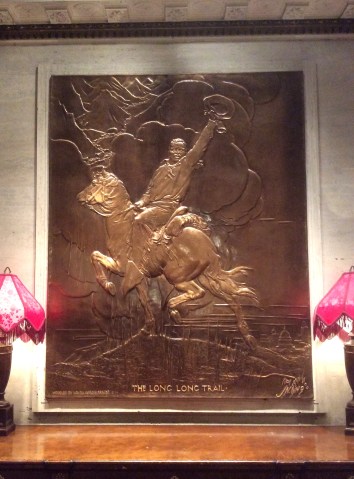
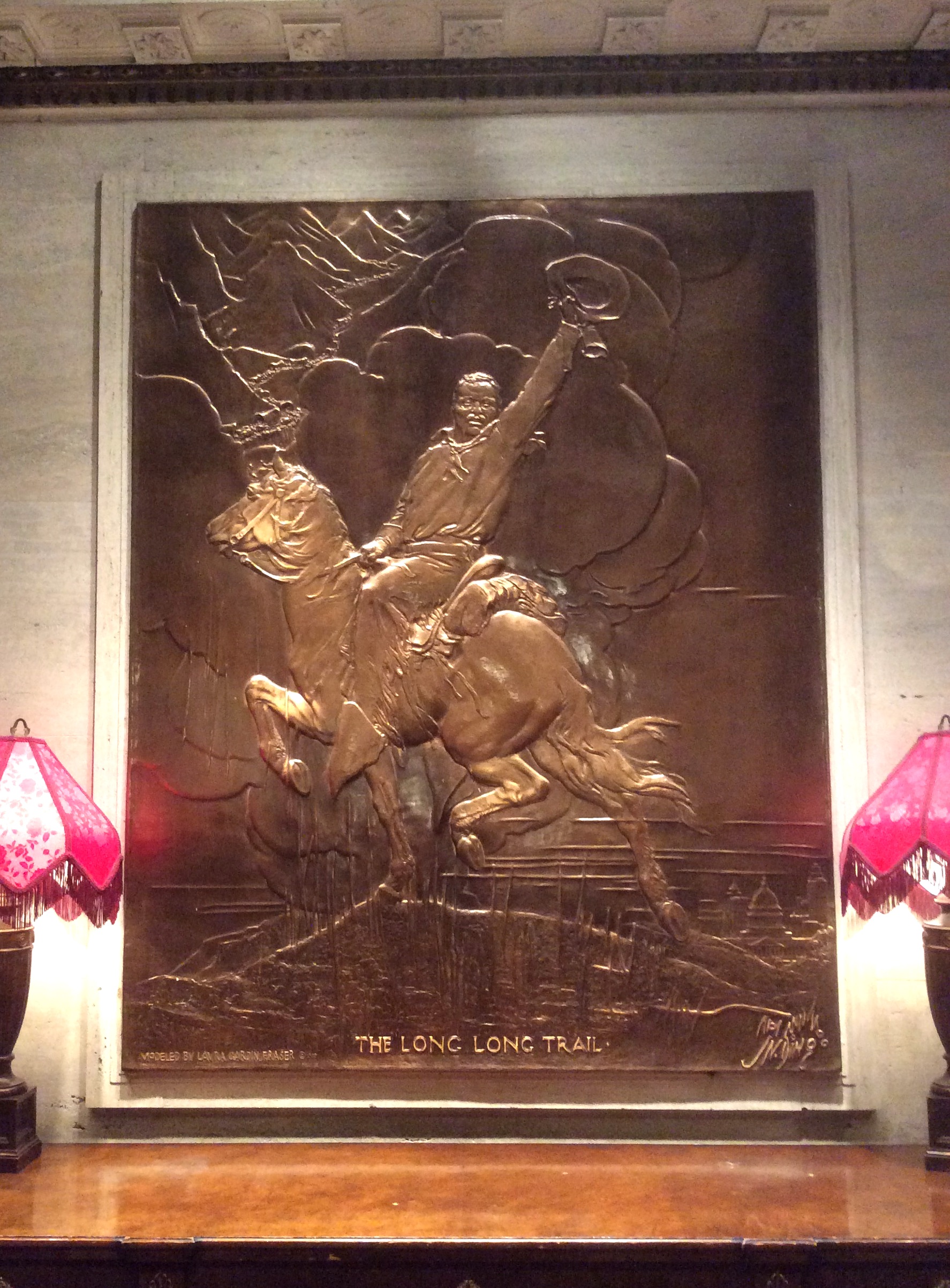
Theodore Roosevelt, American President and yes, a eugenicist too

Bas-relief sculpture of Theodore Roosevelt, ‘The Long Long Trail’, at the Roosevelt Hotel

Speaking of Roosevelt, for whom this hotel was named (I assume, based on a sculpture of him prominently displayed in an upper lobby): Theodore Roosevelt was very much opposed to birth control. He feared that the very people who should be having the most children, the most talented, intelligent, and well educated, the healthiest and the wealthiest, were the very ones who were having fewer than ever. He believed the falling birth rate could lead to what he called ‘race suicide’, and opposed any and all methods that would facilitate this trend. Though Sanger and Roosevelt both believed in eugenics principles, their conclusions were very different when it came to population issues and the right to reproductive self-determination. I explore the differences in their views which led to their different conclusions in an earlier essay I wrote as part of this series. Sanger publicly and vigorously opposed Roosevelt’s public positions on birth control and the population question. In Sanger’s article ‘Birth Control: Margaret Sanger’s Reply to Theodore Roosevelt‘, published in The Metropolitan Magazine in December of 1917, she described why she believed his views were shortsighted and ill-informed.
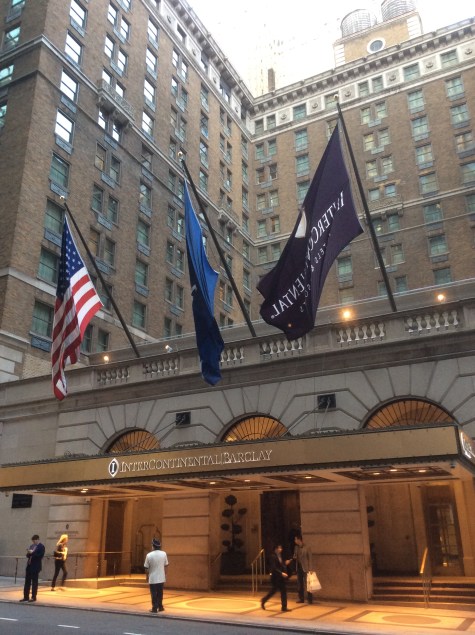
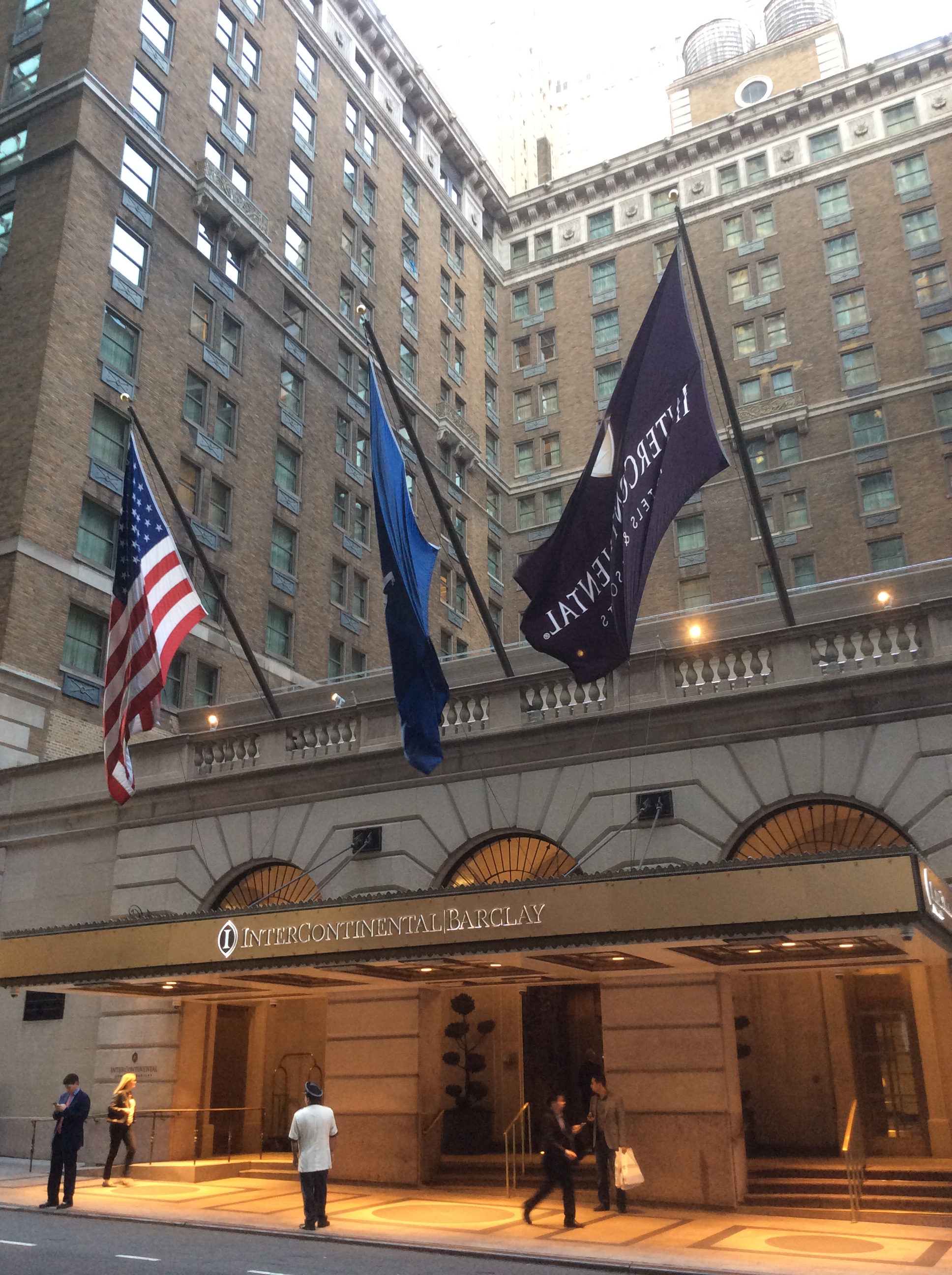
barclay-hotel-entrance-manhattan-nyc-photo-2016-by-amy-cools

The Barclay Hotel, Manhattan, NYC, where Margaret Sanger stayed several times in 1938 and 1939

I zigzag northeast to the Barclay Hotel at 111 E. 48th Street, between Park and Lexington Aves. According to Robin Pokorski of the Margaret Sanger Papers Project, ‘Sanger stayed at the Barclay Hotel in April and May 1938, and again in January 1939.’

I track down a listing in the Margaret Sanger Papers Microfilm Edition: Smith College Collection Series catalog for a microfilm of a letter Sanger received from the Barclay hotel, but I don’t have access to it at the moment. It’s not available online and I’ve not yet had a chance to visit the library at the University of California at Berkeley, which has a copy. I’ll update this account if I find anything interesting in the letter when I do get over there, and if I come across any other interesting details relating to her stay here in my continued research. In the meantime, I’ll continue with my story so I can publish it in good time.
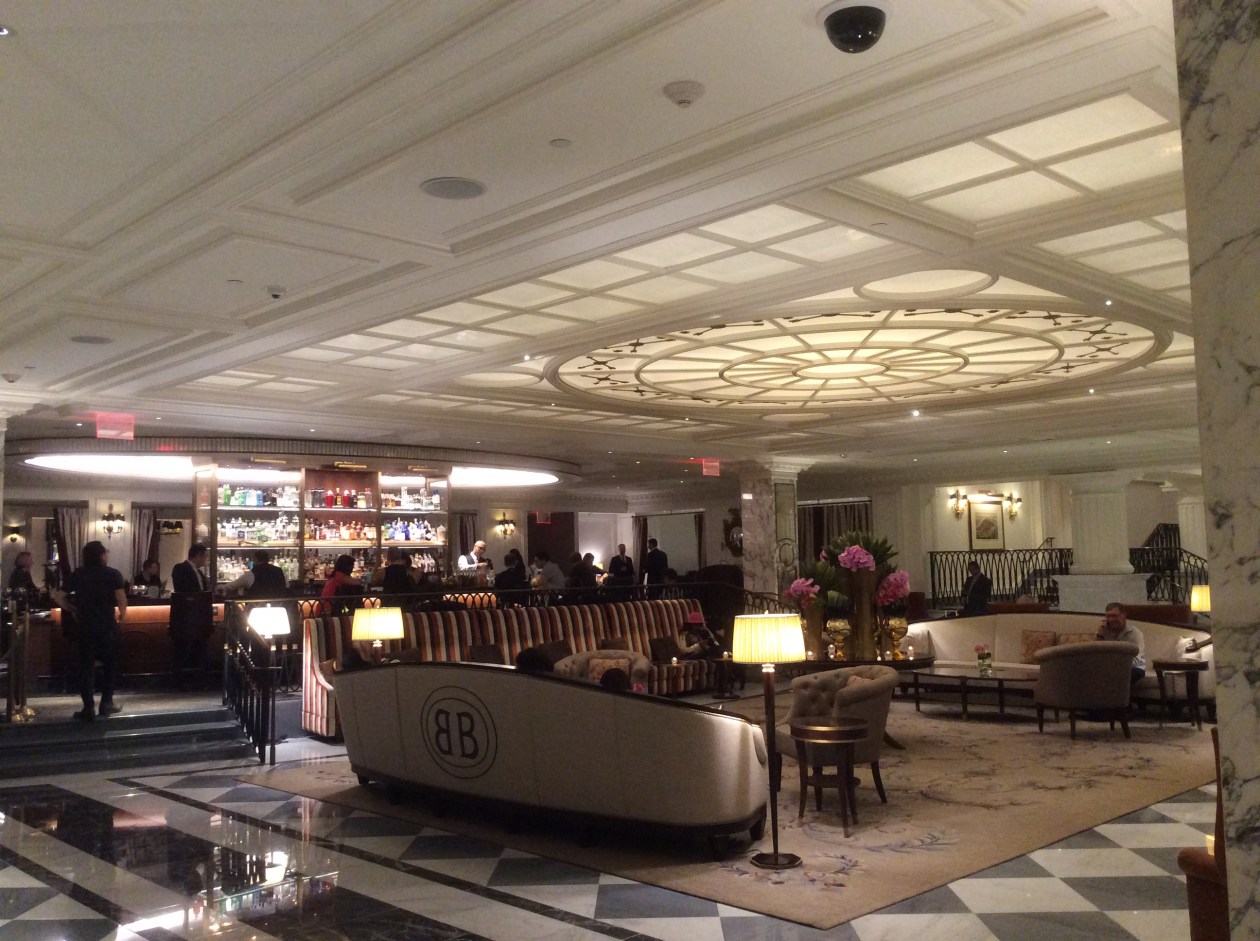
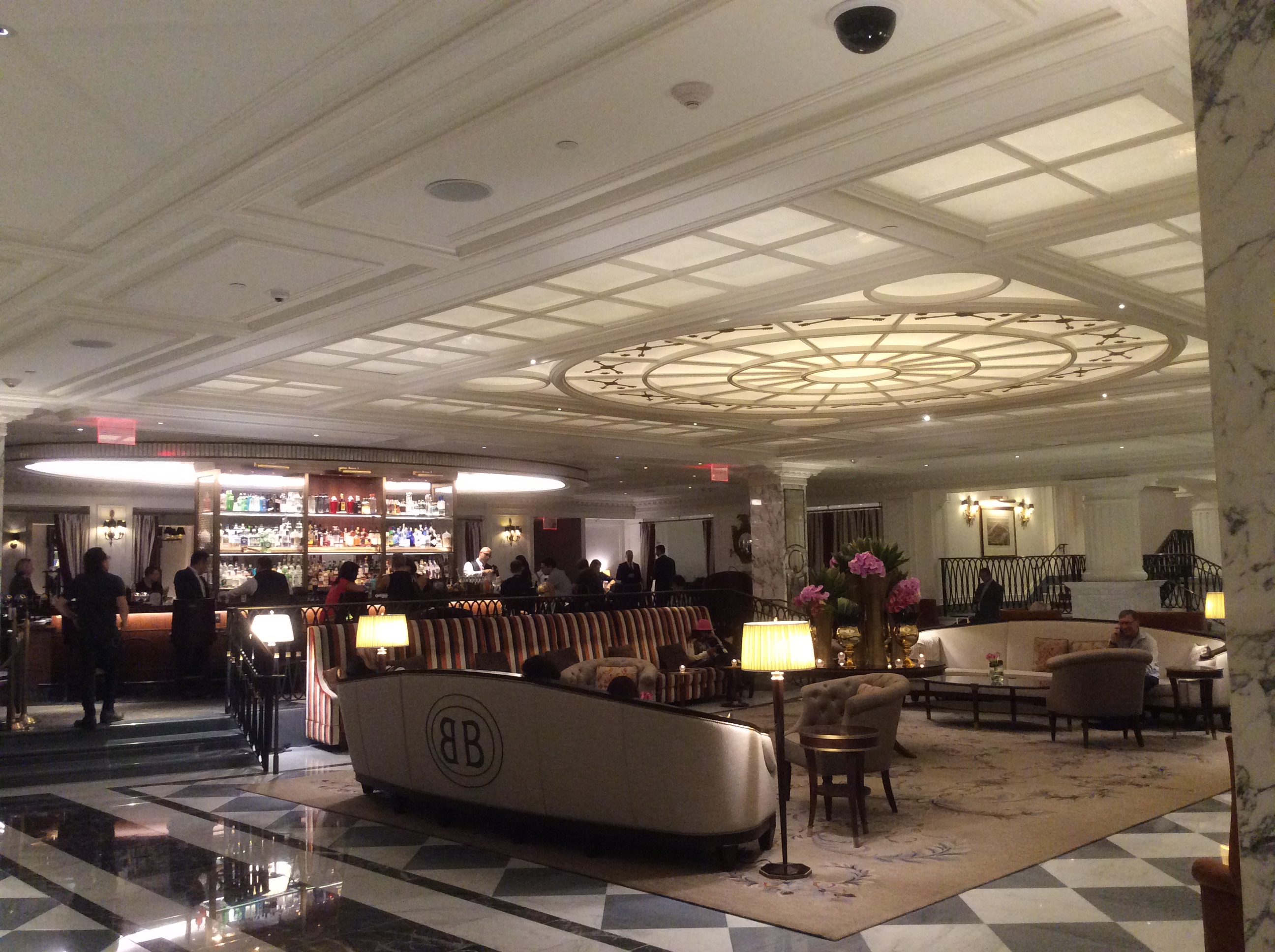
barclay-hotel-lobby-manhattan-nyc-photo-2016-by-amy-cools

Barclay Hotel lobby, Manhattan NYC

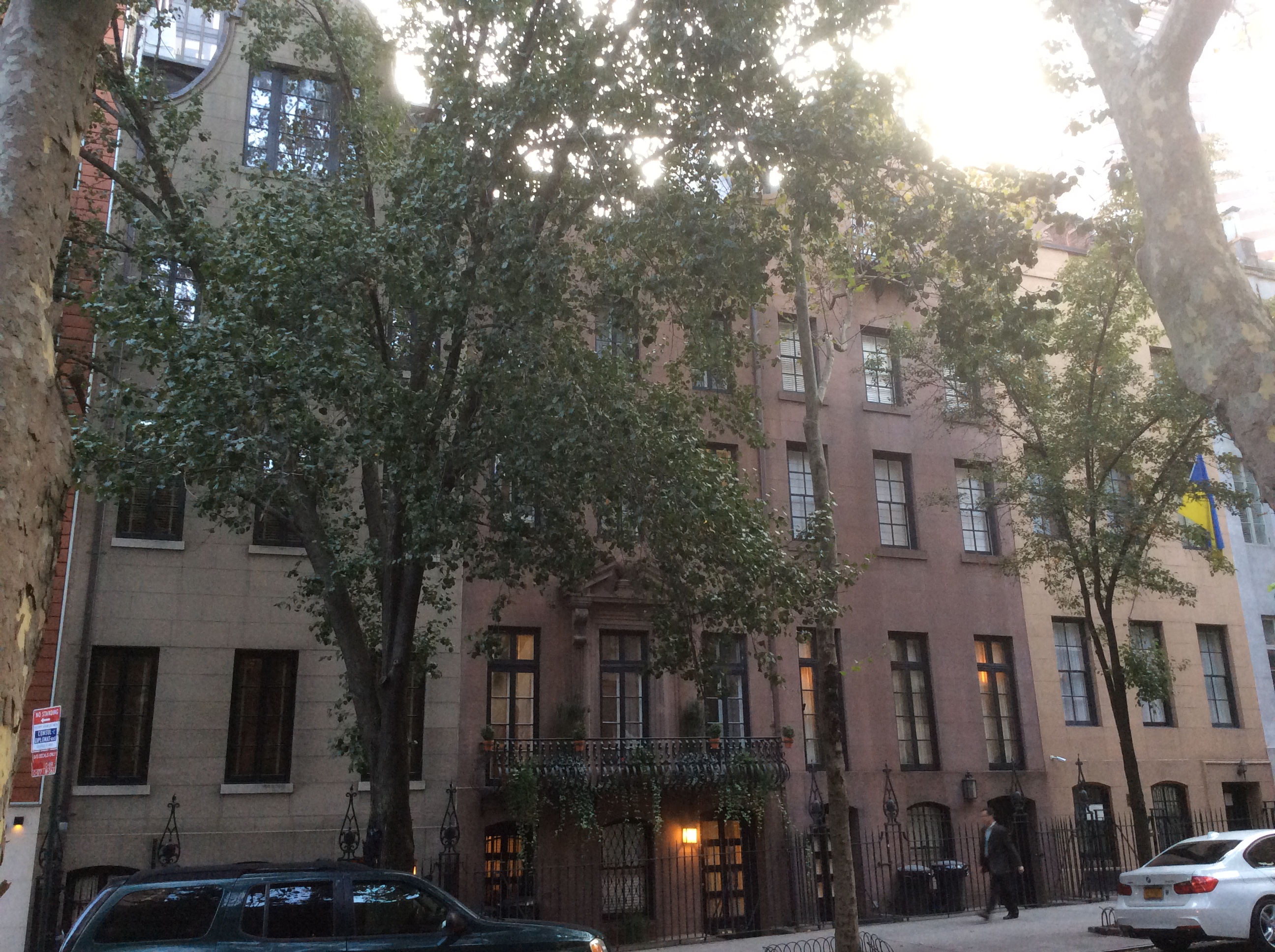
242 E. 49th St, between 3rd and 2nd Ave’s, Turtle Bay Gardens

242 E. 49th St, between 3rd and 2nd Ave’s, Turtle Bay Gardens. Note the turtles in the ironwork at either side of the gate

I continue on a few blocks away, heading east, to 242 E. 49th St, between 3rd and 2nd Aves, to a brownstone at Turtle Bay Gardens. Sanger founded the American Birth Control League here at her friend Juliet Barrett Rublee’s home in 1921. Rublee, the wealthy wife of an influential lawyer, enthusiastically devoted her time and money to supporting feminist, humanitarian, and artistic causes. She’s a fascinating character, an activist, a nurse, a filmmaker, and an adventurer, whose exciting lifestyle was very well funded by her enormous fortune, leaving plenty of money to lavish on such projects as Sanger’s pamphlet Family Limitation and magazine The Birth Control Review, first published in February of 1917. Rublee took an active interest in Sanger’s work since Sanger was arrested for opening her birth control clinic in 1916 and they remained the closest of friends for the rest of their lives, dying only a few months apart. They wrote to each other often in intimate and detailed letters, many of which each kept although they marked them ‘destroy upon reading’. The Margaret Sanger Papers Project describes their correspondence as among the resources that reveal most about Sanger’s inner life. As with any public figure, especially one as controversial and embattled as Sanger, it can be difficult to get past the persona, the defensive walls they feel the need to construct.
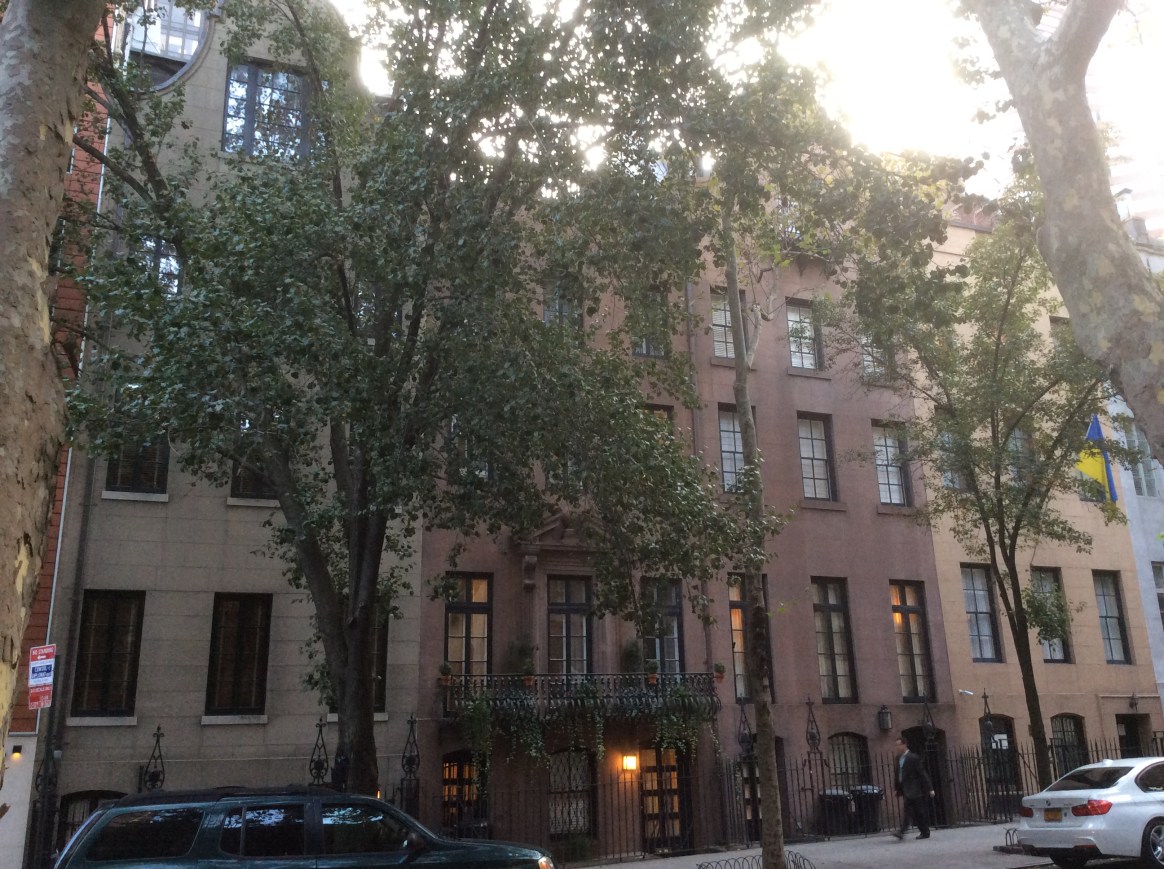
Row which includes 242 E. 49th St

Turtle Bay Historic District row houses, including 242 E. 49th St. Behind these handsome brownstones is a lush, private urban garden, which you can see here.

242-e-49th-st-turtle-bay-gardens-view-2-2016-by-amy-cools

242 E. 49th St at Turtle Bay Gardens, Manhattan

Turtle Bay Gardens Historic District stands on what once was a bay of the East River, where ships harbored, country farmhouses stood, and Edgar Allan Poe used to go diving off the rocks. The bay was gradually filled in, and the once-thriving and handsome industrial district with its breweries, mills, and carpentry shops turned into a squalid, overcrowded district packed with cheap tenements, slaughterhouses, and run-down warehouses. One part of this neighborhood was destroyed in the riots that followed the establishment of a Civil War draft conscription office here in 1863.

When Sanger established the American Birth Control League at Rublee’s Turtle Bay home in 1921, it would have very recently been renovated and turned into a place of beauty and luxury. Another wealthy heiress, Charlotte Martin, bought this and an adjoining row of rundown brownstones in 1919 and thoroughly remodeled them, with a lush garden (complete with a copy of a fountain from Rome’s Villa Medici in the center) inspired by the European gardens she had fallen in love with during her travels, to create a haven of elegance and refuge in this what was then out-of-the-way, unfashionably too-far-east neighborhood of Manhattan. And by the way, as I just discovered, one of my favorite musical artists, Bob Dylan, used to live here at #242 as well!
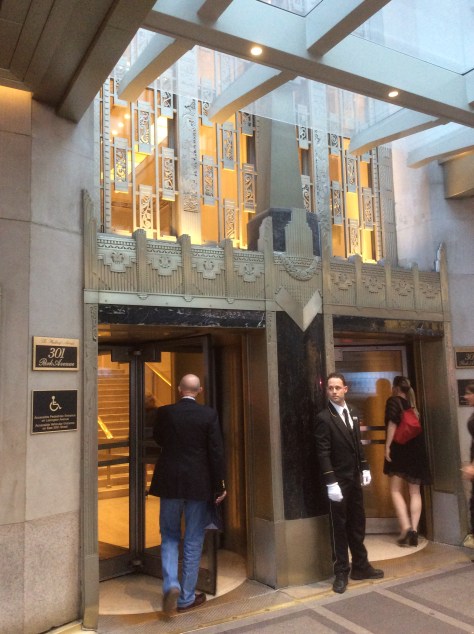
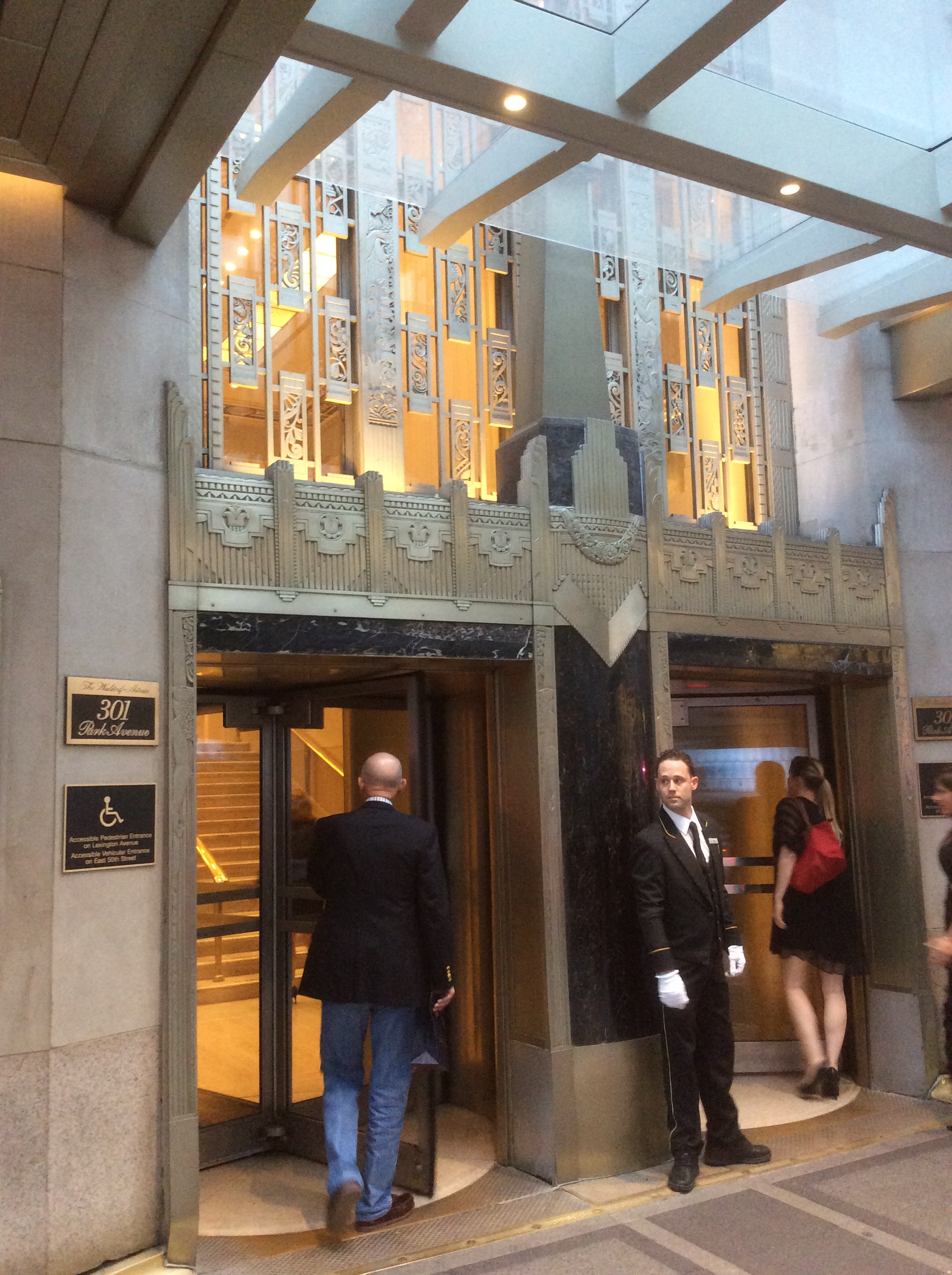
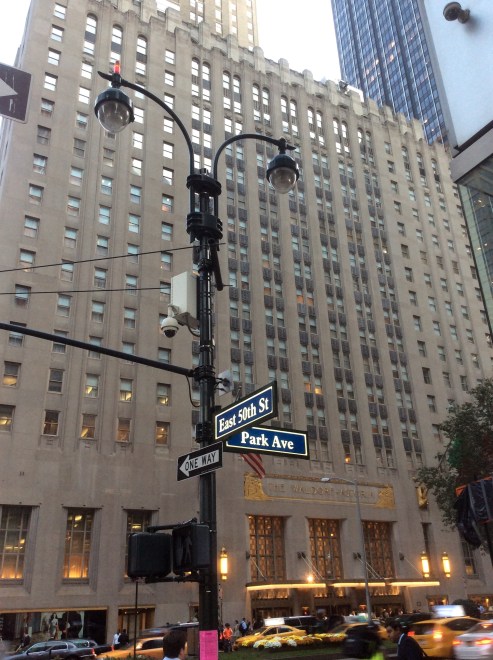
Front entrance of the Waldorf-Astoria Hotel on Park Ave at E. 50th St, Manhattan, NYC

Front entrance of the Waldorf-Astoria Hotel on Park Ave at E. 50th St, Manhattan, NYC

I backtrack on 49th and turn right to 301 Park Ave, to the Waldorf Astoria between 49th & 50th Streets. There are three occasions in the life of Sanger which bring me here.

On January 5th, 1917, Sanger participated in one of the many debates on birth control she would take part in over the years. I’ll soon visit another site where she participated in a well-publicized debate four years later; I’ve found the text of it published online where I can share it with you, so I’ll wait to discuss her debate topics and style then.

Over fourteen years later, on October 23, 1931, Sanger addressed the attendees of a dinner honoring H.G. Wells, an important influence, long-time friend, and occasional lover. Wells shared many of her views on economics and eugenics, as well as her abiding concern that too many children were born into families and communities that didn’t have the capabilities to feed and care for them properly, leading to needless suffering and death. Wells’ article ‘The Needless Waste of Human Lives’ was published in the first edition of Sanger’s Birth Control Review, which described the plight of children born into poverty and privation only to be soon forced into labor in the most heart-wrenching terms this literary star could summon. Wells supported Sanger’s work in many other ways, both personal and public, some of which she described and thanked him for in her address that night. One of the ways Wells supported Sanger was by adding his influential name to an appeal to President Woodrow Wilson to get the many indictments which had piled up against her dropped. Most importantly, however, it was the enduring friendship with this famed man of like mind which propped up her confidence and spirits throughout the years until his death in 1946.
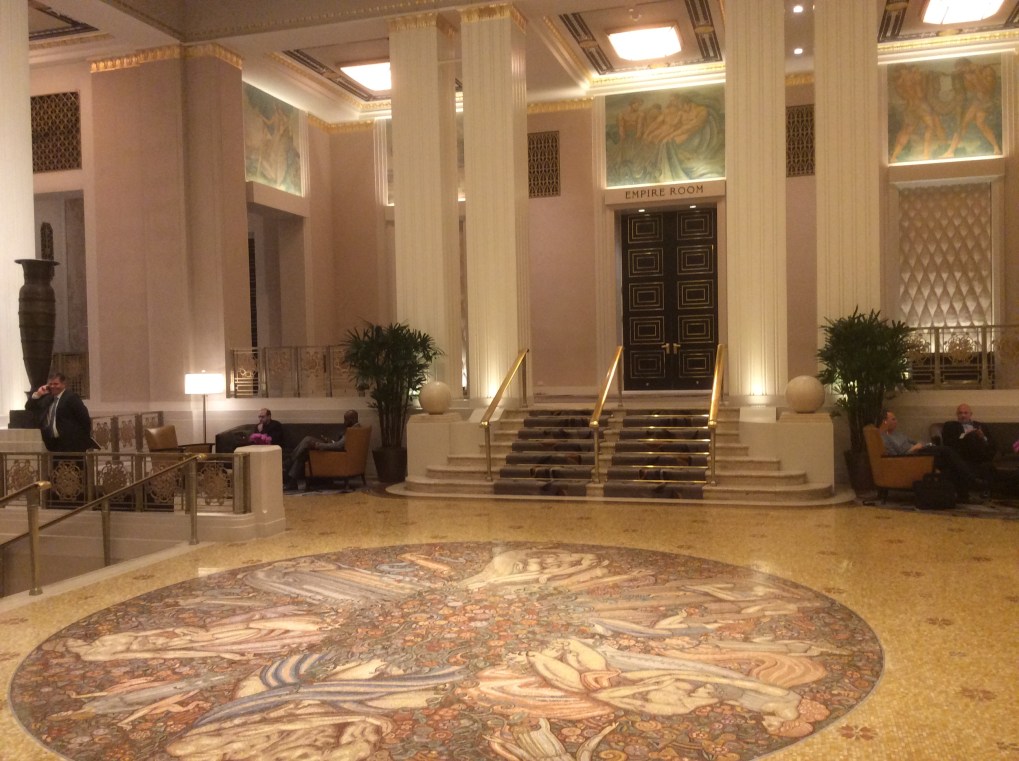
The front lobby of the Waldorf-Astoria. I snapped this photo in a brief moment between the stream of guests elegantly attired to attend some special event
The front lobby of the Waldorf-Astoria. I snapped this photo in a brief moment between the stream of guests elegantly attired to attend some special event

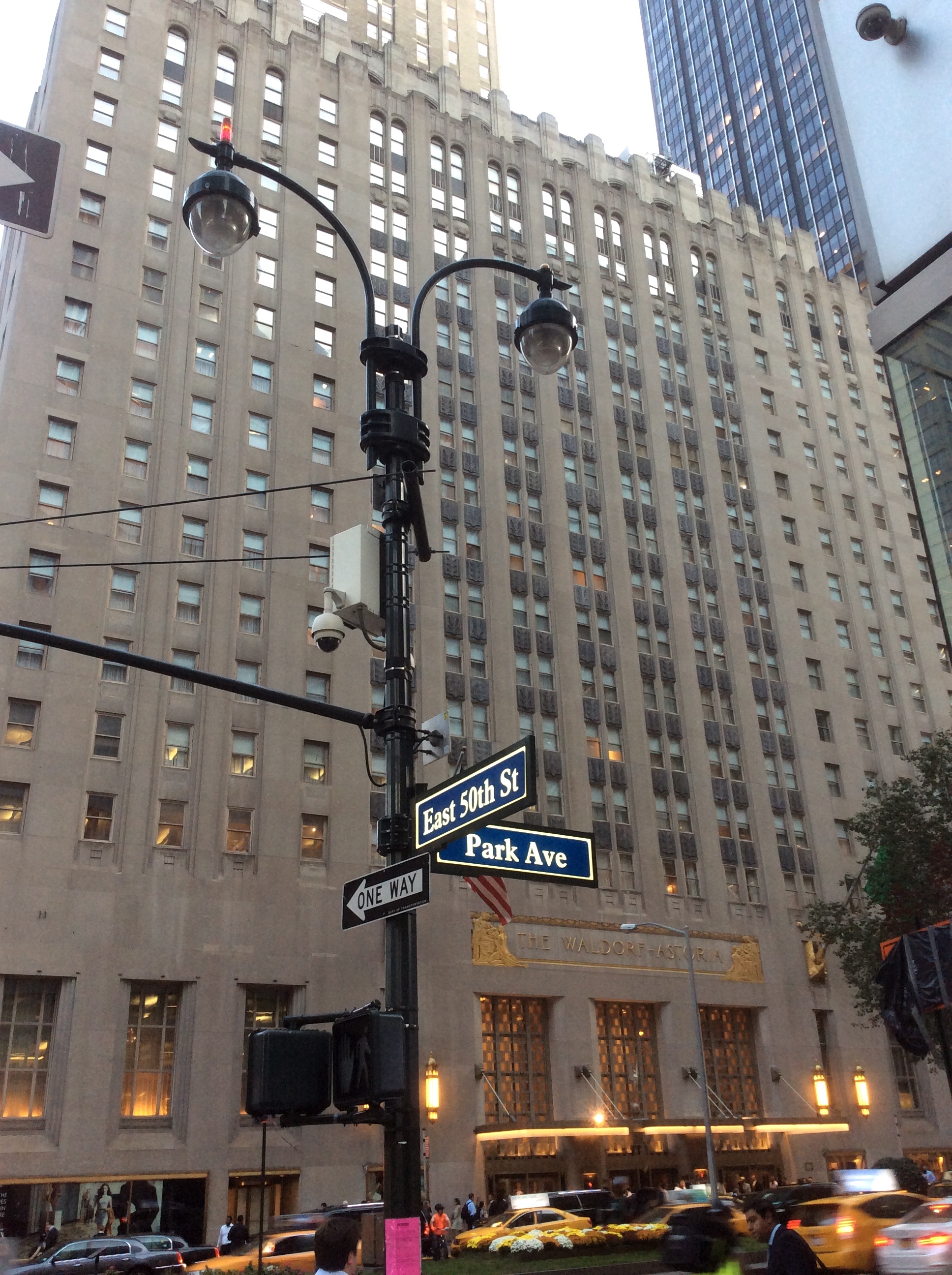
The Waldorf-Astoria on Park Ave at E. 50th St, Manhattan, NYC

Looking back on the Waldorf-Astoria in the early evening light

On May 11th, 1961, the Waldorf Astoria also hosted a World Tribute dinner for Margaret Sanger, organized as a fundraiser by the World Population Emergency Campaign and chaired by the renowned evolutionary biologist Julian Huxley. It was Sanger’s last public appearance since by that time she had developed heart disease, and while the alcohol and Demerol she treated her pain with may have helped in that regard, she was often tired, confused, and emotionally volatile. The senility which would incapacitate her within a few short years may have been starting to set in as well. But she was delighted at the invitation, and she rallied what strength she could to get to New York, assisted by her younger son Stuart, and briefly deliver her thanks. Even this was too much, and she nodded off her in her chair shortly afterward. Sanger would live five and a half more years, four of those in a nursing home, dying just before her eighty-eighth birthday. She enjoyed intermittent bouts of lucidity until her last year of life and appeared to understand the significance of the Supreme Court decision in Griswold v. Connecticut in 1965 when she was given the news. ‘It’s about time’, she said. It seemed as obvious to her as it does to most of us today that people had a right to privacy in their sexual relationships, yet the Comstockism she had fought for so long proved tenacious in American law and culture.

The Ambassador Hotel once stood where this plain office building does now, across E. 51st from St. Bart's at Park Ave.

The Ambassador Hotel once stood where this plain office building does now, across E. 51st from St. Bart’s at Park Ave.
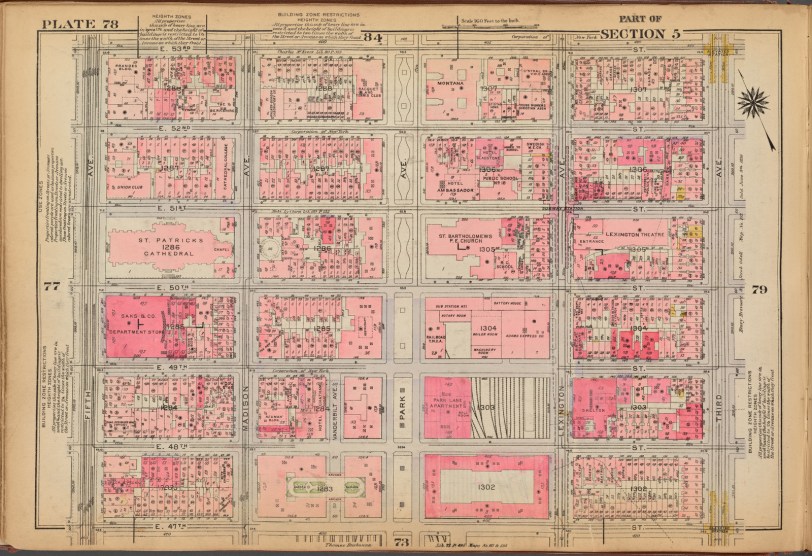
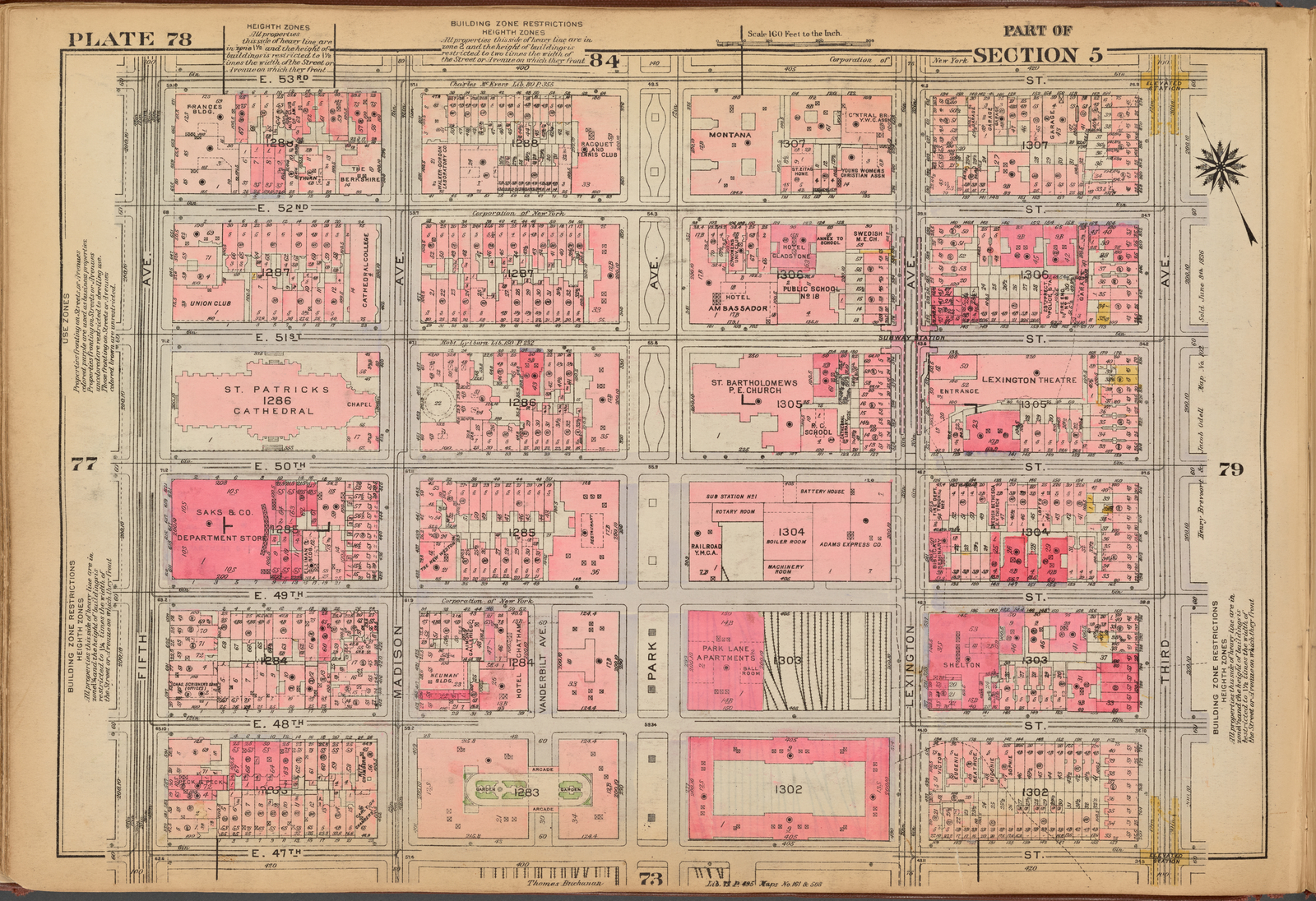
1921-gw-bromley-atlas-of-nyc-plate-78-showing-location-of-ambassador-hotel

1921-1923 G.W. Bromley Atlas of the City of New York, Plate 78, showing location of Ambassador Hotel

My next stop is the northwest corner of 51st St. and Park Ave. According to plate 78 of G.W. Bromley’s 1921-1923 Atlas of the City of New York, the Ambassador Hotel used to stand at Park Ave and across 51st St. from St. Bart’s, as the beautiful 1835 St. Bartholomew’s Episcopal Church is commonly known. There’s a nondescript office highrise here now.
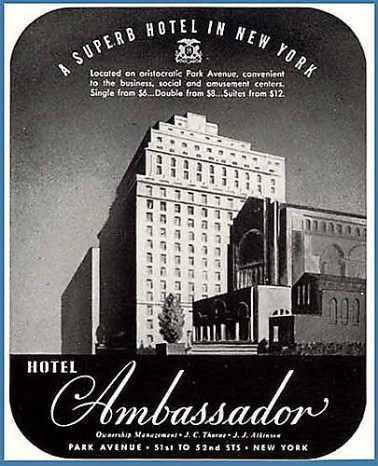
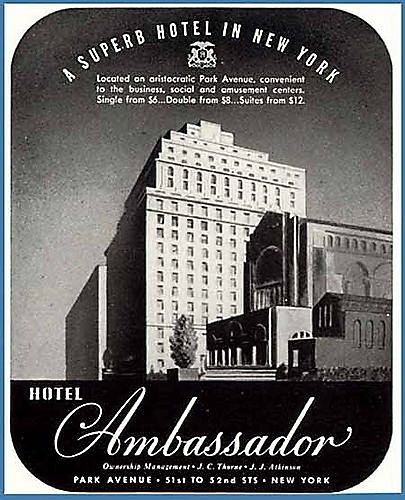
Ambassador Hotel, Park Ave, New York City midcentury advertisement

Ambassador Hotel ad; you can see St Bart’s in the foreground and to the right

The Ambassador Hotel was linked to Sanger in two ways. One, she stayed here on several occasions in late 1936 after she returned from her trip to India. While there, she toured the country and discussed and debated population and poverty issues, law, women’s rights, and birth control with Mahatma Gandhi. Gandhi opposed artificial means of birth control. He shared the Catholic Church’s position that sex without the possibility of procreation is a form of animal lust unworthy of a spiritual being. He believed that human respect, understanding, and true spiritual connection were incompatible with carnal desire. However, he did believe in the right of women to control their own bodies insofar as they should never be coerced into having sex and that they had full rights of refusal, for any reason, within marriage as well as without. Sanger strongly disagreed with some of his views: she believed that sexual union could be as spiritually transcendent as it was pleasurable, one of the most beautiful, intimate, and powerful ways in which human beings connect with one another. And she believed that when partners were forced to refuse sex to one another for fear of having children, it undermined harmony and romance between couples, thereby breaking up marriages and destroying families. I recommend reading her debate with Gandhi published in Asia magazine, which not held in public but fortunately preserved because her secretary Florence Rose had the presence of mind to record in shorthand. I’ll further explore Sanger’s ideas about sex, love, and interpersonal spirituality in an essay I plan to publish before long.

Secondly, the Ambassador Hotel was also the site of a special joint meeting of the American Birth Control League and the National Committee on Federal Legislation for Birth Control following the December 7th, 1936 United States Court of Appeals ruling in the One Package case I discuss at the beginning of this piece. In this decision, Appellate Judge Augustus Noble Hand (again, what a name!) upheld Judge Grover M. Moscowitz’s decision from earlier that year, which prohibited the government from interfering with mail from doctors sending medical devices and information. This case seriously undermined the Comstock laws and was an important moment in extracting, isolating, and describing the right to privacy, implied but never specified in the Constitution, in American jurisprudence.

485 Madison Ave, NYC

485 Madison Ave, NYC, former home of CBS and recording studio for WABC (not the same WABC that exists today)

I head next to 485 Madison Avenue, between 52nd and 51st St, to the former Columbia Broadcasting System offices where WABC radio broadcasts were recorded. The founder of CBS, William S. Paley, had taken over as president of the tiny radio network United Independent Broadcasters founded in Chicago in early 1927. The savvy Paley quickly put the newly expanded media operation, which he bought the majority share of and renamed CBS, on firm financial footing, good enough to move to new, sleek 485 Madison Avenue in New York City in 1929. He wanted his new company to be where the action was, well situated for success. CBS stayed here until it moved into its own specially designed building in 1965.

Sanger recorded a radio broadcast here on birth control, on April 11, 1935, which was distributed to many radio stations throughout the country. In it, she outlined her basic arguments in favor of birth control which we’ve already considered (the benefits to women’s and children’s health, the right to reproductive self-determination, and so on) as well as her incredulity that the United States was now the only advanced country to legally prohibit birth control on obscenity grounds, in defiance of what she perceived as a preponderance of medical opinion in its favor. (In reality, the science of reproduction was still at a very early stage and there was far less of a medical consensus that birth control is safe, effective, and on the whole, medically beneficial for women as there is today.) She also announced plans for a petition directly to the second President Roosevelt, who she hoped would be much more progressive in this matter than the first one was. Sanger had a good reason for these hopes: Eleanor Roosevelt was also a long time supporter of the right to free access to medically approved forms of birth control. However, once Roosevelt’s husband Franklin became president, she felt could no longer publicly state her views on this issue. When asked, Roosevelt would neither oppose nor support the issue, stating simply that she refused to discuss it. Sanger understood and didn’t much blame the First Lady for making that choice. Like Sanger, Roosevelt was a strong woman who spent her days working hard on behalf of progressive causes, and like Sanger, she was willing to compromise and choose her battles when she felt it was necessary.

the-rockefeller-center-courtyard-in-the-evening-2016-amy-cools

The Rockefeller Center courtyard in the evening
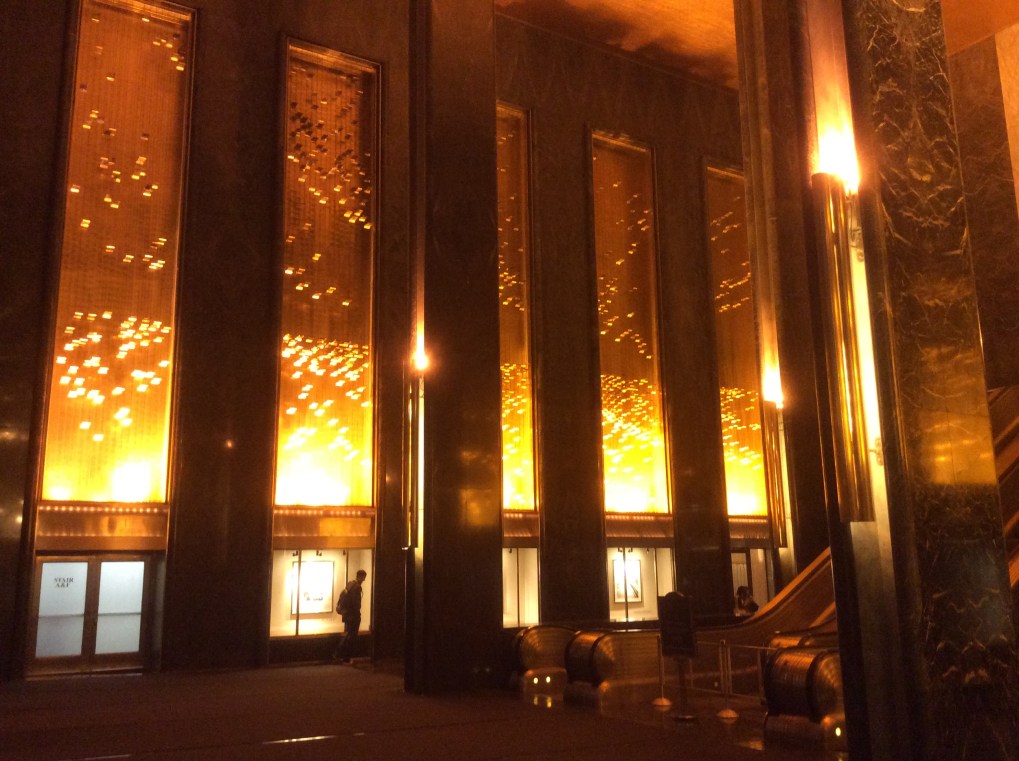
The Rockefeller Center's glowing lobby

The Rockefeller Center’s glowing lobby
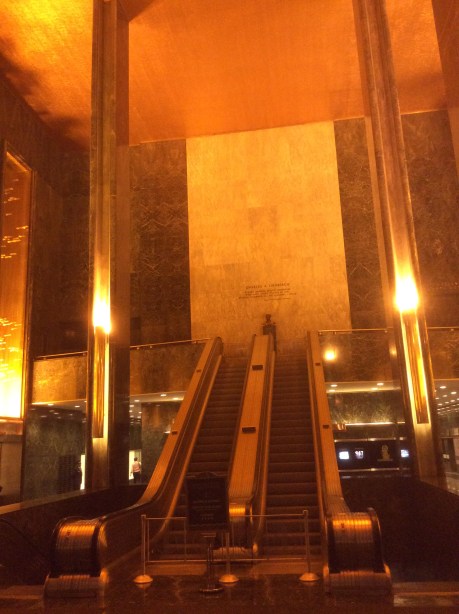
The Rockefeller Center's central escalator

The Rockefeller Center’s central escalator

The last site I visit for the day is the Rockefeller Center at 5th Ave and 50th St, another of New York City’s grand edifices I’ve been wanting to see. According to Pokorski, Sanger met with John D. Rockfeller, Jr’s aide Arthur Packard at Rockefeller Center in October of 1936. The Rockefeller Center is handsome outside, breathtaking inside. It glows even brighter, more golden and coppery and gemlike than the inside of the Chrysler Building. My camera doesn’t do justice to what I’m seeing since it has such difficulties in low light, but it does capture its amber-like quality.
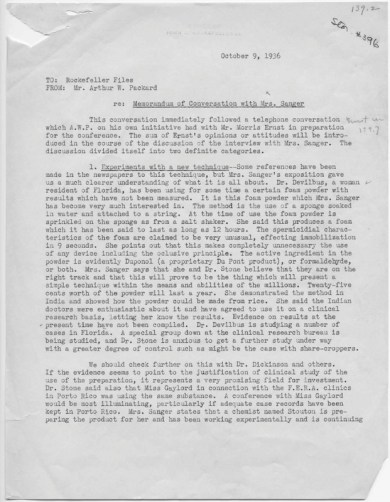
arthur-packard-memorandum-of-conversation-with-margaret-sanger-oct-9th-1936-1st-page

Memorandum of the conversation between Margaret Sanger and Arthur Packard, click to read the whole thing

I track down a memorandum of a conversation between Sanger and Packard dated Oct 9th, 1936, so I assume this memorandum discusses that meeting. One of Packard’s primary duties was to help select projects that the wealthy philanthropist Rockefeller might wish to fund.

A humanitarian and progressive, Rockefeller was interested in Sanger’s work and helped fund many of her projects over the years. In this case, Sanger and Packard were discussing a new form of sponge-and-spermicidal-foam birth control that Sanger had become aware of through Dr. Lydia DeVilbiss (which Packard amusingly misspelled as ‘Devilbus’) of Florida, who had been prescribing it to her patients. In addition to the further research on this method Sanger wanted to help fund, they discussed the One Package case, and Sanger’s increasing doubts about some of the long-term ramifications of the case as it was being argued. As you may recall, Sanger, Ernst, and Dr. Stone had arranged the circumstances that led to this test case purposefully so that it would be argued largely as a case about the right to practice medicine, since it involved devices shipped from doctor to doctor. However, Sanger was growing more concerned that this would focus too much on the rights of medical practitioners to make decisions in these matters and not enough on the rights of the women themselves. Perhaps the fact that it took another thirty years for the Supreme Court to base their decision in a major birth control case on the right to privacy, and hence to self-determination, is enough to demonstrate that Sanger’s fears were well-grounded.

It’s dark now, a beautiful balmy night, so I end my day’s Sanger explorations and just wander freely a bit before I head back for dinner. I still have three more days to go, stay tuned!
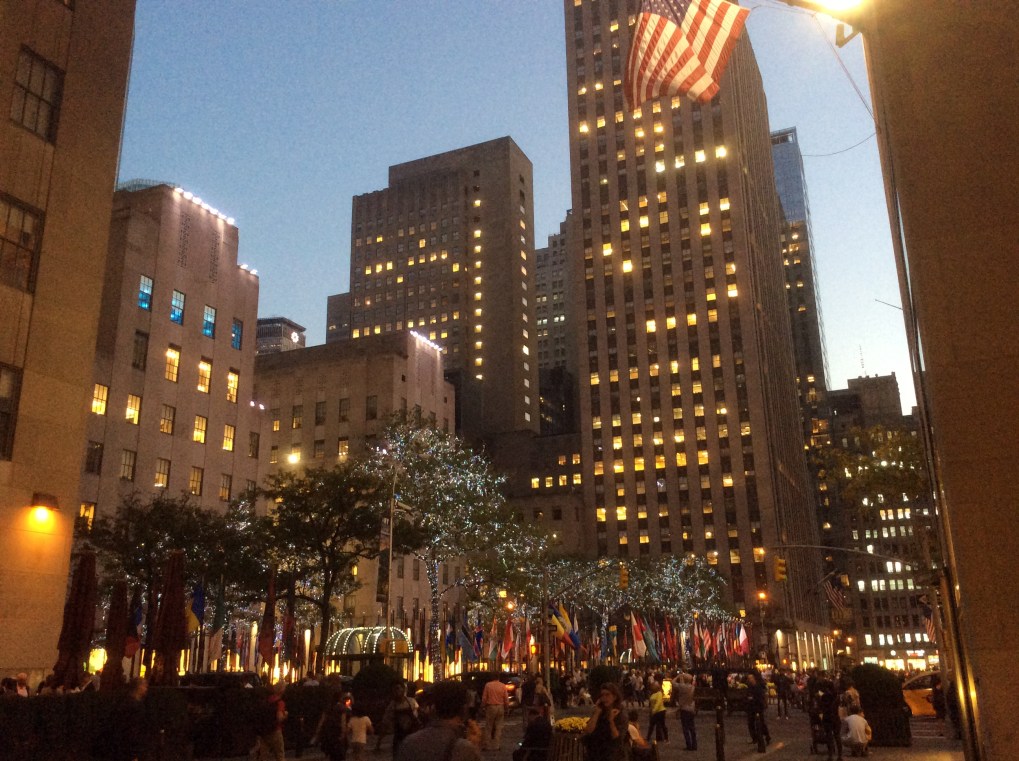
New York City rising above the Rockefeller Center's skating rink on a fall evening

New York City rising above the Rockefeller Center’s skating rink on a fall evening

Ordinary Philosophy and its Traveling Philosophy / History of Ideas series is a labor of love and ad-free, supported by patrons and readers like you. Please offer your support today!

~~~~~~~~~~~~~~~~~~~~~~~~~~~

Sources and Inspiration:

242 East 49th Street‘. Douglas Elliman Real Estate website

About Sanger: Biographical Sketch‘, from The Margaret Sanger Papers Project at New York University.

Arredondo, Isabel. ‘Juliet Barrett Rublee‘. Women Film Pioneers Project at Columbia University

Barbanel, Josh. ‘Turtle Bay Gardens House on Market for Second Time Since 1961‘, Wall Street Journal July 15, 2013

Birth Control Aid Received By 56,000‘, New York Times, Dec. 30, 1936, p. 10, via The Margaret Sanger Papers Project

Bromley, G.W. and Co. Atlas of the City of New York, 1921 – 1923, Plate 78. Retrieved from Lionel Pincus and Princess Firyal Map Division Digital Collection, The New York Public Library.

CBS‘. From Wikipedia, The Free Encyclopedia, retrieved from Wikiwand

Chesler, Ellen. Woman of Valor: Margaret Sanger and the Birth Control Movement in America. New York: Simon & Schuster, 1992

Documenting a Friendship‘, The Margaret Sanger Papers Project Newsletter #3 (Fall 1992)

Eig, Jonathan. The Birth of the Pill: How Four Crusaders Reinvented Sex and Launched a Revolution. W.W. Norton & Company, New York, 2014.

Griswold v. Connecticut‘, Oyez. Chicago-Kent College of Law at Illinois Tech, n.d. Nov 3, 2016

History of Turtle Bay‘, Turtle Bay Association website

John D. Rockefeller, Jr.Encyclopædia Britannica Online.

Juliet Barrett Rublee Papers, 1917-1955: Biographical Note‘. Five College Archives & Manuscript Collections: Sophia Smith Collection

Margaret Sanger and Eleanor Roosevelt – The Burden of Public Life‘, The Margaret Sanger Papers Project Newsletter #11 (Winter 1995)

Packard, Arthur W., 1901-1953: Biographical Information‘, from The Margaret Sanger Papers Project at NYU, Editor’ Notes

Pokorski, Robin. ‘Mapping Margaret Sanger‘ from The Margaret Sanger Papers Project at NYU

Regan, Margaret. ‘Margaret Sanger: Tucson’s Irish Rebel.Tucson Weekly, Mar 11, 2004.

Sanger, Margaret. ‘Birth Control: Margaret Sanger’s Reply to Theodore Roosevelt,’ The Metropolitan Magazine, Dec. 1917, pp. 66-67 .

Sanger, Margaret. ‘Conference on Contraceptive Research and Clinical Practice Welcoming Speech Notes‘, Dec 29, 1936. Source: Margaret Sanger Papers, Library of Congress Microfilm, 128:0262

Sanger, Margaret. ‘Family Planning: A Radio Talk By Margaret Sanger Columbia Broadcasting System‘, Station W.A.B.C., New York, April 11, 1935, from The Margaret Sanger Papers Project at NYU

Sanger, Margaret ‘Gandhi and Mrs. Sanger Debate Birth Control,’ Recorded by Florence Rose, published in Asia magazine, Vol. 26, no. 11, Nov. 1936, pp. 698-702

Sanger, Margaret. Margaret Sanger, an Autobiography. Cooper Square Press: New York 1999, originally published by W.W. Norton & Co: New York, 1938

Sanger, Margaret. The Pivot of Civilization, 1922. Free online version courtesy of Project Gutenberg, 2008, 2013

Sanger, Margaret. Woman and the New Race, 1920. Free online version courtesy of W. W. Norton & CompanyZorea Ph.D., Birth Control

Tracing One Package — The Case that Legalized Birth Control‘, The Margaret Sanger Papers Project Newsletter #59 (Winter 2011)

Wells, H.G. ‘The Needless Waste of Little Lives‘. The Birth Control Review, February, 1917

Zorea, Aharon W. Birth Control. 2012, Santa Barbara: ABC-Clio, Ltd.

Goodbye, Dear Leonard Cohen!

leonard-cohen-2008-by-rama-own-work-cc-by-sa-2-0-via-wikimedia-commons

‘I’ve been listening
To all the dissension
I’ve been listening
To all the pain
And I feel that no matter
What I do for you
It’s going to come back again
But I think that I can heal it
I’m a fool, but I think I can heal it
With this song’

– Leonard Cohen, ‘Minute Prologue’ from Live Songs, 1973

I heard of Leonard Cohen’s death when I returned home from work yesterday evening. Thursdays are my long day at the doctor’s office, and by the time I left, we had cared for about sixty patients, and I had just enough time on my short break to do a little reading and quickly tuck a little lunch away. No time for social media or news and no interest in them either, weary from election coverage and its aftermath.

So I learned of his death not from the cold glow of a screen but from the living face of my husband Bryan, who is also one of my oldest friends. We’ve sung Cohen’s songs together countless times over the years as he played guitar, or a capella while driving, which I especially love to do. Bryan had his guitar out, in fact, likely expecting I would want to sing his songs together at that moment. But after feeling stunned and for some reason …well, what I can best describe as wounded, after a few moments I felt the urgent need to go out to a place where people gather. I felt that being in the presence of warm, vibrant life might prevent me from sinking backing into the glum pessimism that had overshadowed the last two days, a mood so at odds with Cohen’s own life and spirit. We went to Cato’s, a favorite gastropub on Piedmont Ave in Oakland, where the lights glow warmly, the food and beer are very good, the wooden tables are deeply carved with graffiti, there’s often live music, and always the pervasive sense of neighborly camaraderie.

Just one friend, it turned out, was free to meet with us on such short notice, and we passed a happy evening, talking about the arts (mostly music and film), politics, and work. And we talked about Cohen, his wisdom and his humor and his life and his poetry, about what his music meant to us and did for us, and we swapped favorite songs, my own which I’ll share with you below. And we talked about how we came to know his work.

For me, it was from a guy whose name, I think, is Brad. Certainly begins with a ‘B’. I worked with him a very long time ago at a vintage clothing store; I think I was eighteen or nineteen at the time. He usually wore rather close-fitting plain tee shirts with plaid shorts from the 1960’s and early 1970’s, of madras cotton, wool blend, or polyester, and had little round glasses. I loved his style. He was tall, blond, had good taste in everything, and was a linguistics major. ‘Brad’ put on 1975’s The Best of Leonard Cohen, a collection for which Cohen picked the songs, wrote liner notes, and designed the packaging. I was stunned at what I heard, and very soon afterward bought several of his albums on tape. I wore them out, especially in the little boombox I kept with me; it served as my car stereo from the backseat of my little hatchback. In Southern California, you can’t get much of anywhere without driving, especially then, so I spent a lot of time in that car listening to music, especially Cohen’s at that time, sometimes rapt in attention, sometimes singing along.

Sometime in 1996 or ’97, I learned that Cohen was living at Mount Baldy’s Zen Center and that he would often visit the Village, the artsy little town center of nearby Claremont. So, being the ardent fangirl that I was, I began to hang out in the Village even more often than I had been, hoping I would find an opportunity to meet him. With its Folk Music Center (founded by Ben Harper’s grandparents), Rhino Records (one of the very best music stores ever), funky little stores, coffee shops, live music, and nearby drum circles at one of Claremont’s many colleges (I’ve forgotten which one), the Village was already one of this then-hippie-girl’s regular haunts. But, alas, that meeting was never to occur, not even a sighting from afar.

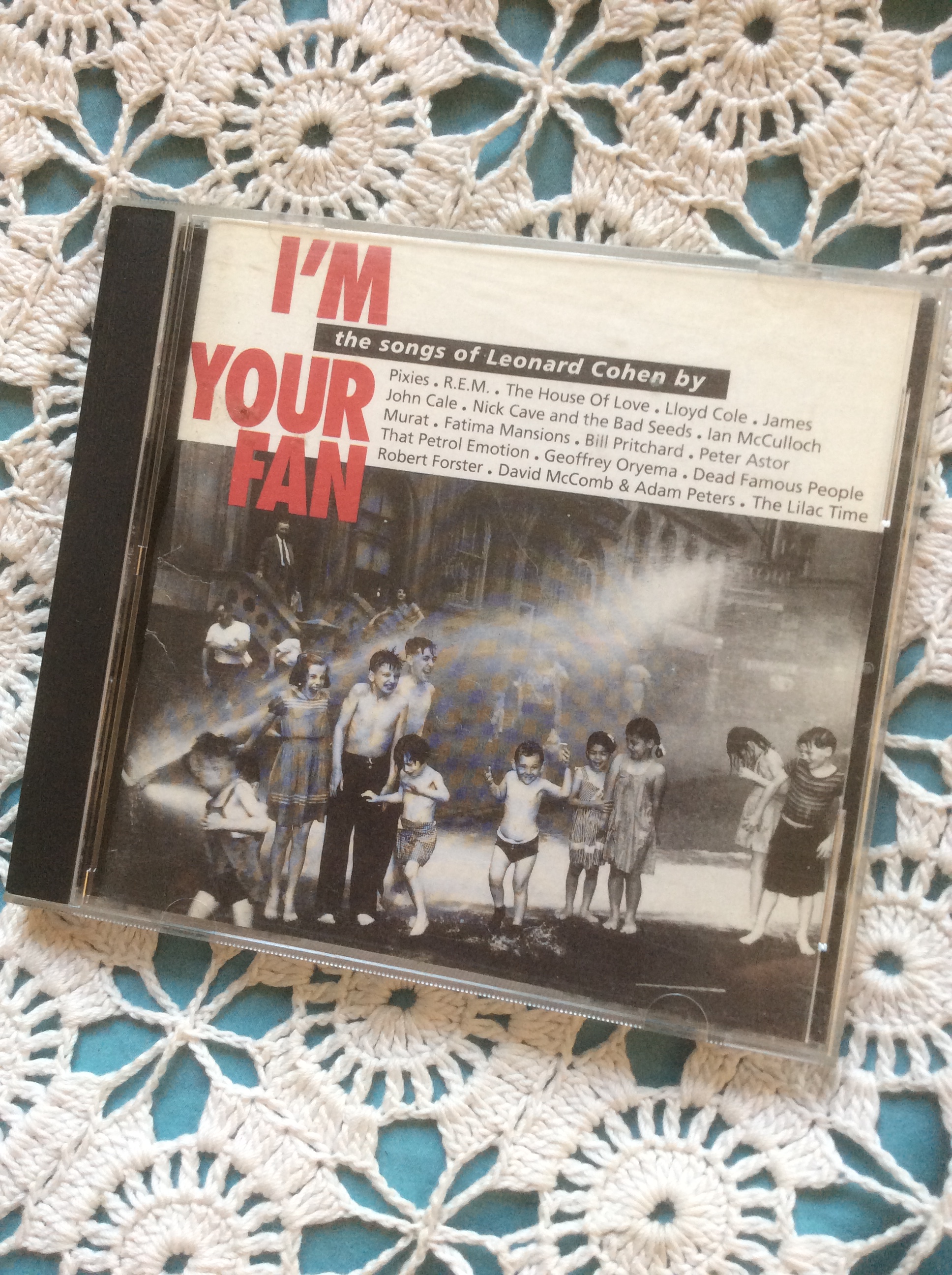
My Leonard Cohen tribute album I'm Your Fan

My well-played, yellowed copy of the Leonard Cohen tribute album I’m Your Fan

I’m quite sure I purchased my copy of I’m Your Fan at Rhino Records. This 1991 Cohen tribute album features prominently in Malcolm Gladwell’s discussion of the history and evolution of one of Cohen’s masterpieces, the majestic Hallelujah, in a recent Revisionist History podcast episode. I must admit, I experienced a moment of music-nerd smug self-congratulation when Gladwell speaks of being one of the enlightened few who bought this album. Anyway, it has some good covers on it. Geoffrey Oryema does a lovely performance of Suzanne; the Pixies rock I Can’t Forget; R.E.M. and David McComb with Adam Peters are true to the urban-decay spirit of First We Take Manhattan and the self-deprecating, odd creepiness of Don’t Go Home With Your Hard-On, respectively; Dead Famous People do a sweetly pop-py take on True Love Leaves No Traces; and Nick Cave & the Bad Seeds recast the reflective Tower of Song into a raucous tour of musical styles. (‘I was born like this, I had no choice, I was born with the gift of a golden voice’ remains one of the sneakiest, funniest witticisms I’ve ever heard.) But best of all, John Cale does a glorious version of Hallelujah. I very much recommend you listen to Gladwell’s telling of the story of how Cale came to create the definitive version of Hallelujah which, in turn, became one of the most-covered and most-loved songs in popular music. And, you’ll likely learn some other nice little music history tidbits you didn’t know, too. Thanks, Malcolm Gladwell!
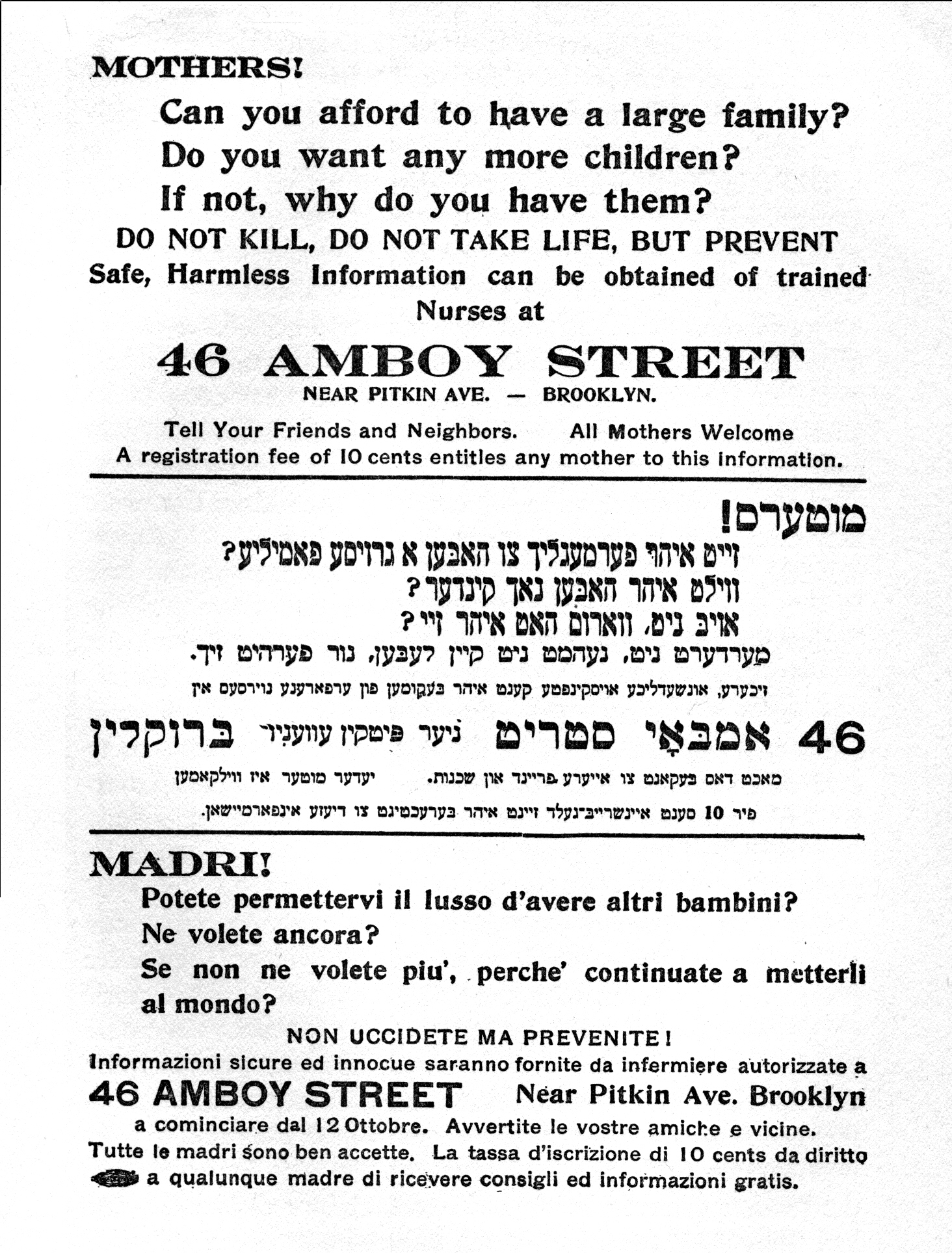
My Leonard Cohen concert ticket from Apr 13, 2009.

My Leonard Cohen concert ticket from Apr 13, 2009. It’s pictured on the notebook that became my concert diary, which records every concert I’ve gone to which issues tickets that I could keep and was a gift from my first love, who broke up with me to prepare for the priesthood though he ultimately decided to remain a layperson. I feel this little anecdote fits in with this story, though I’m not sure how.

I did, finally, get to see Leonard Cohen in the flesh, in concert at Oakland’s Paramount Theater on Monday, April 13th, 2009. How lucky I felt that I would get to see him perform at one of my favorite theaters, a gorgeous Art Deco temple to the arts, its gold-and-green interior replete with sleekly ornate stylized figures of animals and humans, real, mythological, and archetypal. He sang, danced, told stories, kneeled then stood then kneeled again very like we used to do at Mass, and gesticulated for two and a half hours. I marveled at his vigor while I was transported by his beautiful performance, and I thrilled and smiled throughout, here and there weeping just a little.

If you’ve read this, thank you for allowing me to share this story with you, and if you’ve read this all the way here, you likely love Leonard Cohen too. I would love for you to share your stories and favorite Leonard Cohen songs, poems, and other things too.

Here’s to you, Leonard Cohen!

Sincerely, A. Cools

Listen the podcast version of this story here, on Google Play, or subscribe on iTunes

Here are some of my favorite songs and works from Leonard Cohen, those which first spring to mind that I must share with you. This list is by no means definitive and I will add to it over time, freely, as I am inspired to.

Please enjoy, and let Cohen transport, arouse, entertain, amuse, and enlighten you as he helps you find a little redemption here and there, as he has me.

God Is Alive, Magic Is Afoot‘, poem from Beautiful Losers, 1966 reading by Leonard Cohen. When I read it to myself, it sounds more like a chant, with a study drumbeat behind it

The description of a dream feast in Beautiful Losers, where Kateri Tekakwitha spills a glass of wine which spreads everywhere. I discovered it’s missing from my bookshelf, I loaned it out and never got it back, and Google Books doesn’t include that chapter. I’ll borrow it from the library.

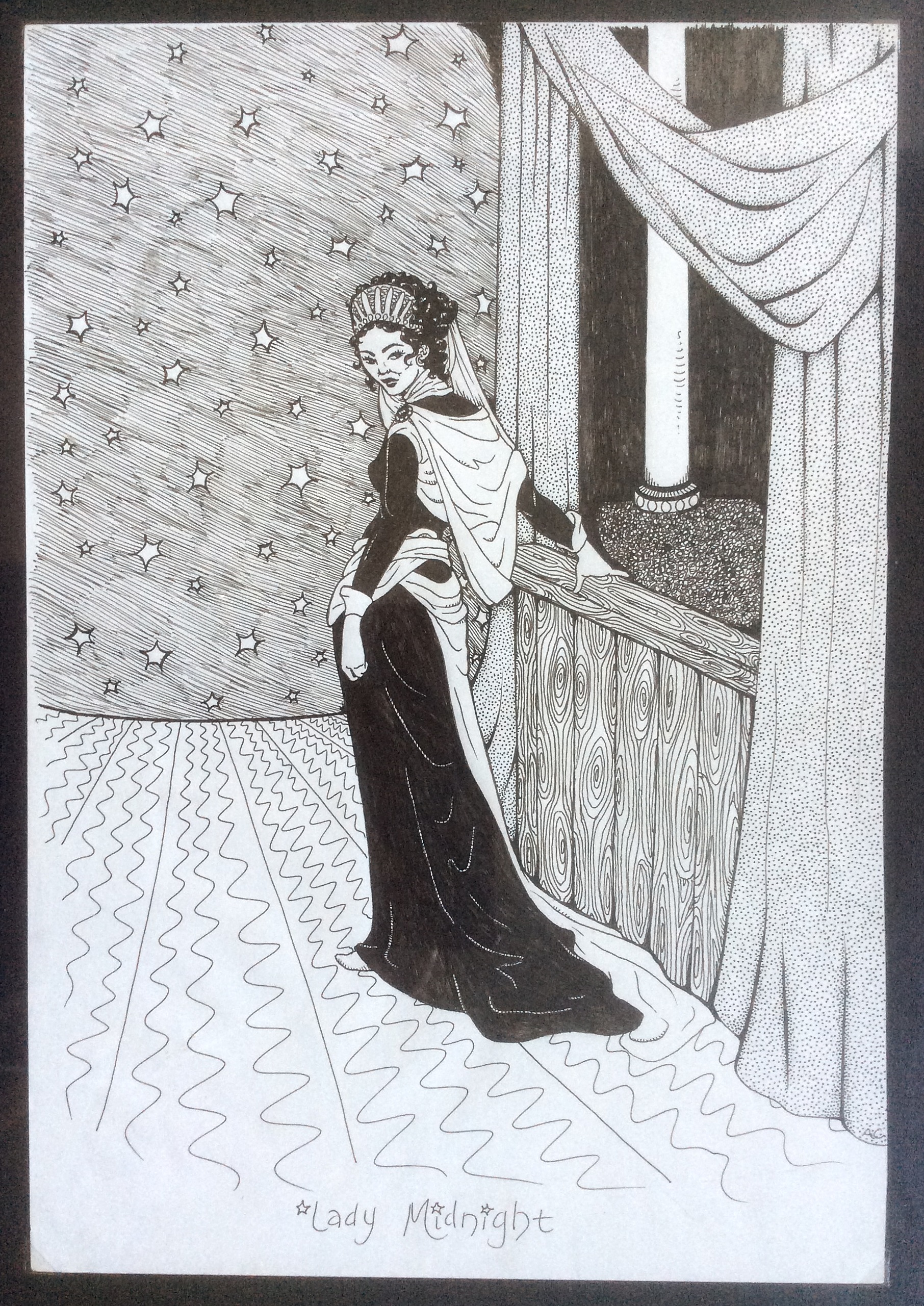
My illustration of Leonard Cohen's Lady Midnight, from about 1997 - 1998

My illustration of Leonard Cohen’s Lady Midnight, from about 1997 – 1998 according to my best guess; I was about 20 or 21

Suzanne, 1967

Sisters of Mercy, 1967

So Long Marianne, 1967

Bird on the Wire, 1969

Story of Isaac, 1969. The story of Abraham and Isaac has long fascinated and repelled me.

Lady Midnight, 1969. Has long delighted my romantic heart, this cry to the arch, cruel, enchanting, ageless, mythical woman who’s capured his heart, Cohen’s Helen

Famous Blue Raincoat, 1971

Joan of Arc, 1971. Like Mark Twain and Cohen, I’ve long been fascinated by Joan of Arc. My portrait of her hangs in my dad’s living room.

Minute Prologue, 1972.

Passing Through, 1972. Written by Richard Blakeslee, I love Cohen’s performance

Nancy, 1972. Originally titled Seems So Long Ago, Nancy in 1969’s Songs from a Room. I love this version best.

At the Chelsea Hotel in July of 2011, before they kicked everyone out to remodel

At the Chelsea Hotel in July of 2011, before they kicked everyone out to remodel it

Chelsea Hotel #2, 1974.

Why Don’t You Try, 1974. A feminist song

Take This Longing, 1974. Melts me every time

A Singer Must Die, 1974.

Leaving Green Sleeves, 1974. Only Cohen would think to write about a breakup with Henry VIII’s love interest

Paper Thin Hotel, 1977. The first song to make me empathize with a sex-starved voyeur. The next and last one to do so was Randy Newman with his You Can Leave Your Hat OnThe Telegraph listed Death of a Ladies’ Man as one of Cohen’s least-good albums, but I don’t agree. It’s wonderful, though it’s true it’s very weird.

The Window, 1979.

The Traitor, 1979.

Night Comes On, 1984.

Hallelujah, 1984.

The Captain, 1984. The production’s odd and rather cheesy, but I still love it

If It Be Your Will, 1984. Oh, the beauty!

First We Take Manhattan, 1988.

Everybody Knows, 1988.

Take This Waltz, 1988. …And only Cohen is brilliant enough to realize that Federico García Lorca’s great poem had be to set to music

Tower of Song, 1988.

… to be continued…..

Traveling Philosophy / History of Ideas series is a labor of love and ad-free, supported by patrons and readers like you. Please offer your support today!

The Morning After Election Day 2016

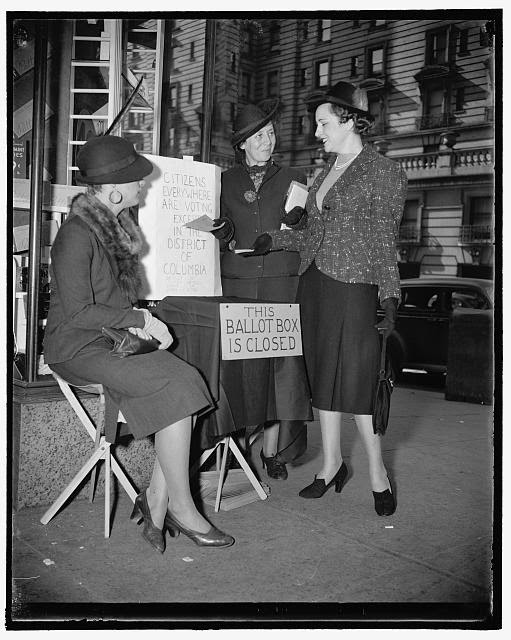
3f86f-ballot2bbox2bclosed2bprotestI watched the election results roll in last night on the same sofa and in company with the same good friends as eight years ago when Barack Obama was elected the first black president of the United States. As the night wore on, our dearest hopes that we would see the first woman elected president of the United States were dashed, to the deep disappointment of everyone in the room. Trump was elected president. It was clear to me that though all believe that women should have equal chances of being elected president, the gender of the candidate was not foremost in their minds last night. It was the misogyny, racism, crass materialism, and bullying personality of Trump and his followers that must be defeated, showing the world that our values are much better than our new Twitter-troll-in-chief might have you believe.

My friends are nearly all liberal, my family mostly conservative. Some of my loved ones are rejoicing, some are mourning, and probably, given the new president’s coarse speech and demeanor, checkered past, and nonconservative positions on many issues, more were at least as glum as they were glad.

For some of my religious family members, I believe they did not vote for Trump because they like him, admire him, or agree with him on many issues. They voted for Trump while holding their noses at his attitudes toward women and minorities, his coziness with Putin, his anti-free-trade positions, his hiding of his tax returns. For them, abortion is by far the most important issue at stake, so the candidate that will nominate anti-abortion Supreme Court justices and oppose Roe v. Wade is their only viable choice. I understand their position: if you truly believe abortion is legalized murder, then the candidate that will likely to most to change the law in this regard must be their candidate. But that doesn’t mean they like having to vote for him.

Other people I know and love do sincerely admire Trump, dismissing some of his worst behavior as mere indiscretions, excesses of the vitality and exuberance that made him the go-getter they see him as: the man of the people who made himself rich in the can-do, hard-working, all-American way. For myself, I have a hard time seeing how exactly how the actual Trump fits in with this perception: his primary business is building luxury amenities for the wealthy, funding it at the beginning with piles of money he didn’t earn; he’s repeatedly exploited bankruptcy laws to the fullest which allowed him to escape personal responsibility for his bad investments while stiffing his contractors, the hard-working Americans that he’s supposed to represent; the things he does have made are often built from cheap Chinese steel and with low-paid Chinese, not American, hands; he starred in a reality TV show where he showcased his ‘business acumen’ by glowering behind a big shiny desk in a too-big suit, repeating generic self-help platitudes that convey no real guidance or information at all. In other words, he is just business-as-usual. But like so many Americans, they fell for his brand, the heavily marketed, glossy persona that the media lap up because he’s just so entertaining.

For me, what the Presidential candidates represent often does take priority over what they do, since they do not run the country on their own. Many of the qualities and principles that Trump represents to people are, I think, even uglier than what he’s said and done, which is often bad enough. But it seems that what he doesn’t represent is what got him into office: he doesn’t represent the establishment and he doesn’t represent the multicultural cosmopolitanism of the new information-centric world. And he doesn’t represent what’s been called the feminization of our culture, as machismo, militarism, and hyper-individualism slowly erodes from our national character. Hilary Clinton largely represented this feminization, the idea that the state also exists as a facilitator of care, for promoting health and education, of taking in those that flee to us for help, nurturing the young and the disenfranchised so that all have an equal shot or, if you happen to be a casualty of the capitalism most of us benefit from, you’re not out on your ear. And she represented it in a way that the strong mom does: idealistic yet practical, ruthless if need be in defense of her brood. Clinton has flaws, perhaps as many as Trump, but they are flaws of excess in the pursuit of greater and worthier things than self-aggrandizement and self-indulgence. But women, traditionally, are not allowed to have flaws, not if we are to be admired and promoted to any position of influence. For men, that’s just, well, part of being a man, part and parcel to being strong, bold, and getting things done.

I wish we could have shown the world last night that we believe in women too, that our girls do have the same chance of becoming president as anyone else, and they could do so by being women, unapologetically, able to succeed to our fullest potential whether or not we have flaws too.

Ordinary Philosophy and its Traveling Philosophy / History of Ideas series is a labor of love and ad-free, supported by patrons and readers like you. Please offer your support today!

Margaret Sanger NYC Sites, Day 1 Part 2

The Chrysler Building at Lexington and 42nd in Manhattan, NYC

The Chrysler Building at Lexington and 42nd in Manhattan, NYC

Tuesday, October 18th, 2016, continued

Let me preface this second part of the story of today’s journey with full credit and a note of gratitude to Robin Pokorski, who worked with The Margaret Sanger Papers Project for a time. As with the MSPP overall, I found Pokorski’s project Mapping Margaret Sanger to be an absolutely invaluable resource. I’d made somewhat of a study of Sanger’s ideas over the last couple years but had not yet done the site research as of the time the opportunity to take this trip arose. With little time to prepare, imagine my joy and surprise when my research led me quickly to someone who had already done the mapping work! So I relied heavily on Robin’s work for all of the travel portions of this project. Please accept my sincerest thanks, Robin, wherever you are, and here’s to your continued success in all you do!

405 Lexington entrance to the Chrysler Building

405 Lexington entrance to the Chrysler Building

…I exit Grand Central Station, where I’ve just returned to Manhattan from the Sanger clinic site in Brownsville, Brooklyn. I follow the signs to the exit which lets me out right underneath the Chrysler Building, which stands at 405 Lexington Ave, just north of 42nd St. I’ve long been curious about this building but for one reason or another, had never made it here. It’s fully as handsome on the outside and lovely on the inside as I’ve heard. It shoots up to the sky enthusiastically and towers overhead with almost aggressive confidence and optimism. I love its Art Deco style, and I’m excited to see all the wonderful architecture and art of this period that this trip will take me to. I only wish I had a good enough camera to capture the details of the rather dimly glowing interiors. But I sacrifice camera quality for portability, and my iPad takes decent enough photos for the most part while also acting as my notepad, several books, laptop, maps and atlases, and more, all in one object the size of a slim novelette when it’s in its case. It’s just not good with low to medium interior lighting. Oh well. I love to not be heavily laden with lots of things to shuffle around.

Pokorski writes, ‘At 4.30pm on April 20, 1939, Sanger met with Bill Melon at the Chrysler Building.’ I have not been able to discover who Melon was or why she met him here yet; I await her response to my inquiry.

Elevator door in the Chrysler Building, Manhattan, NYC

Elevator door in the Chrysler Building, Manhattan, NYC

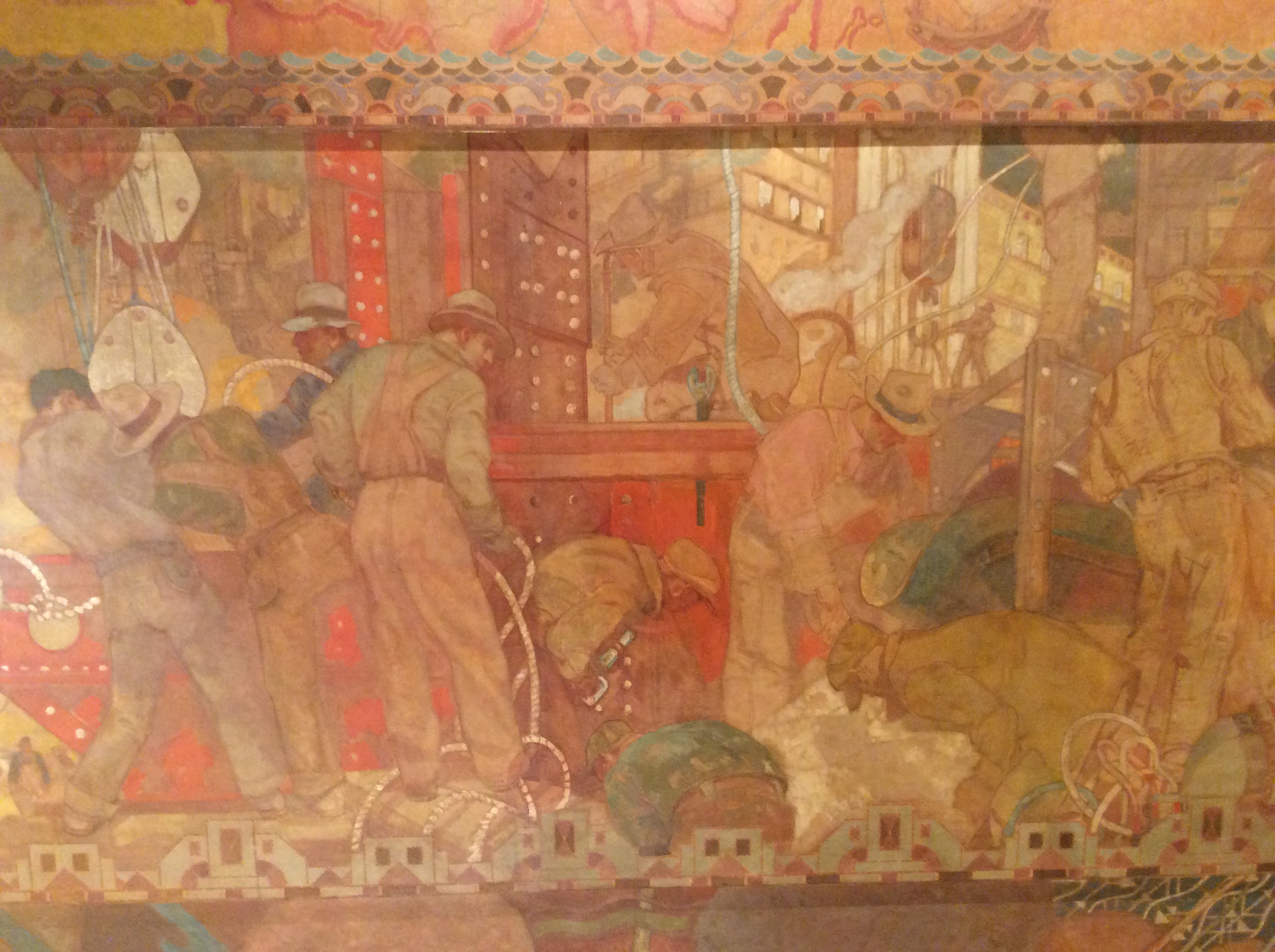
The walls of the lobby are lined with a beautiful wavy-patterned stone in shades of amber, rust, brown, and cream. It’s like entering into a semi-translucent, richly colored semi-precious stone held up to the early evening light. The ceilings are painted over with beautiful murals. Actually, as a sign on the wall tells me, these images are huge paintings on canvas which were subsequently glued into place. One of these murals is called ‘Transport and Human Endeavor’ and painted by Edward Trumbell. Sanger was a Socialist and worker’s rights activist for many years before she turned her focus to birth control, advocating for better workers’ protection laws, especially for women and children. She may have admired the mural’s beauty while scoffing a bit at its idealized depiction of labor.

As Sanger pointed out in Woman and the New Race, many working men enjoyed much better protections than women and children, especially those men who belonged to labor unions. But the relative paucity of workers’ protection laws and the abundance of men, women, and children desperate for jobs often made it unnecessary for employers to offer competitive wages or provide decent working conditions, and the situation of many working men, as well as that of working women and children, remained dire. It was the era of Lochner vs. New York, when ‘freedom of contract’ reigned supreme in court decisions regarding labor law and the regulation of commerce generally. Of course, the freedom of contract principle assumes that both employers and employees enter into contracts of their own free will, and therefore should have the right to do so. It’s quite easy to recognize, however, that this ideal bore little resemblance to the actual relationships between so many employers and the laboring poor Sanger worked on behalf of. It’s hard to see where free will comes in when the choice is between working backbreaking hours in miserable conditions, or starvation and homelessness for yourself and your family.

the-golden-glow-of-the-chrysler-buildings-agate-like-interior-2016-amy-cools

The golden glow of the Chrysler Building’s agate-like interior

Transport and Human Endeavor ceiling mural by Edward Trumbell. Margaret Sanger was a Socialist and worker's rights activist in her earlier years, and may have admired this mural's beauty while scoffing at its idealized depiction of a factory worker's place of employment

Transport and Human Endeavor ceiling mural by Edward Trumbell.

101 Park Ave entrance at former site of Manhattan Eye and Ear Hospital, NYC

101 Park Ave entrance at former site of Manhattan Eye and Ear Hospital, NYC

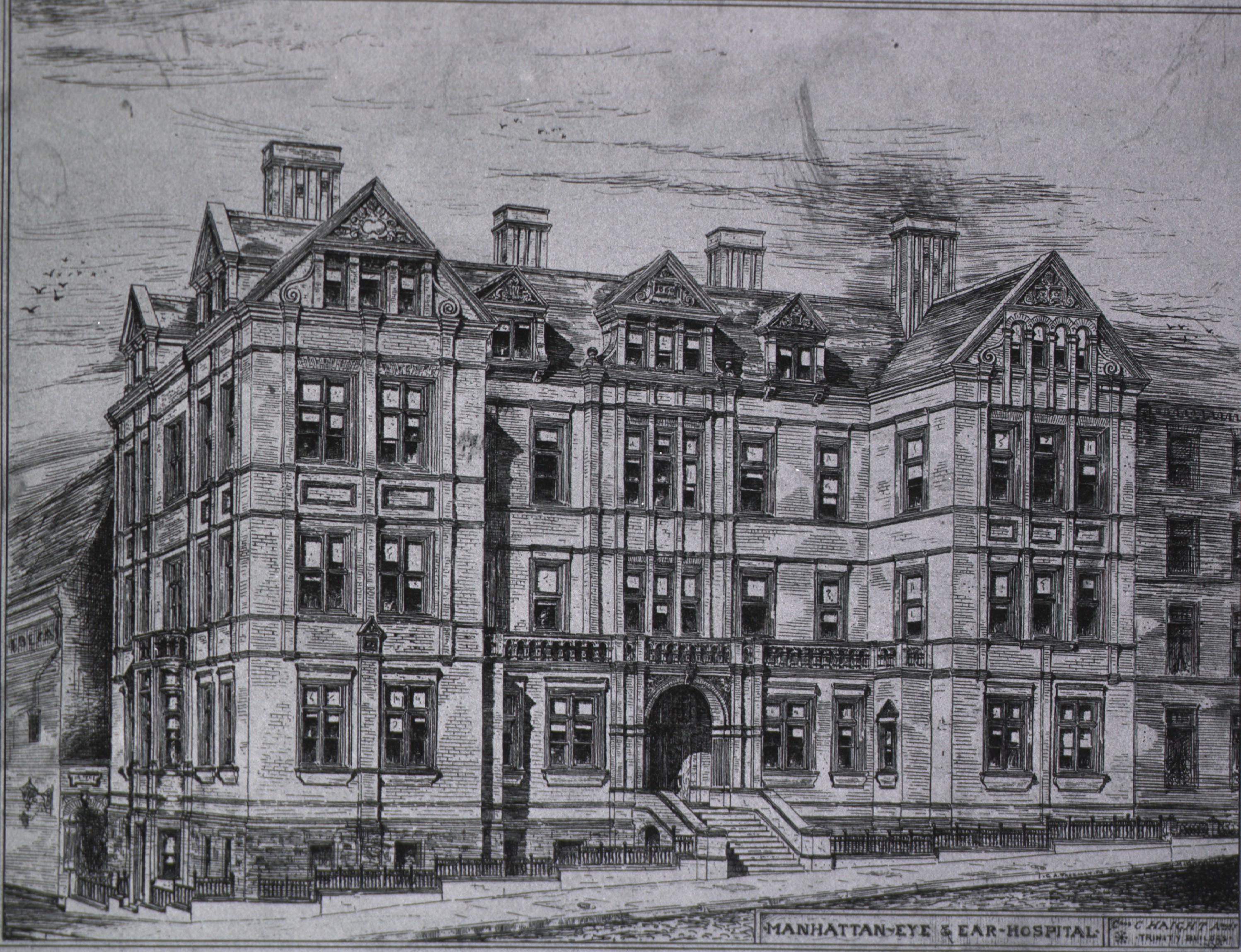
I leave the Crysler Building, then head west and south over to Park Avenue & E. 41st Street, also close to Grand Central Station, to the site of the Manhattan Eye and Ear Hospital where Sanger worked in 1902 to complete her training as a nurse. A gleaming glass highrise named 101 Park Avenue, after its address, now stands at the hospital’s former site. Sanger welcomed her assignment to this modern, well-run establishment after her ‘harsh and intense’ two years at White Plains Hospital.

It was here that she met William Sanger, her first husband, and as she put it, her ‘lover for all the world’, though their marriage didn’t last. He was a fine artist and architect, and their courtship began almost immediately after William visited the hospital with plans for the doctor’s home he was designing. The Sangers shared an intense passion for a time, and a happy marriage for a while. They had three children together, one of which died as a small child, and Sanger relished the early experience of motherhood. But over time, their marriage, which had taken them to quiet suburban Westchester, grew strained: William wanted to make a career as an artist and was often impractical about money; Sanger was discontent with the humdrum routine of domestic life after her years as a working nurse. They moved back to New York City and became active in the Socialist movement and bohemian Greenwich Village scene, and Sanger returned to her nursing career, this time in service to the poor and immigrant inhabitants of the Lower East Side. The differences in the way they wanted to live their lives proved too great over time, however, and they gradually split, finalizing their divorce in 1921.

Manhattan Eye and Ear Hospital. Photo courtesy of NIH's US Library of Medicine

Manhattan Eye and Ear Hospital. Photo courtesy of NIH’s US Library of Medicine

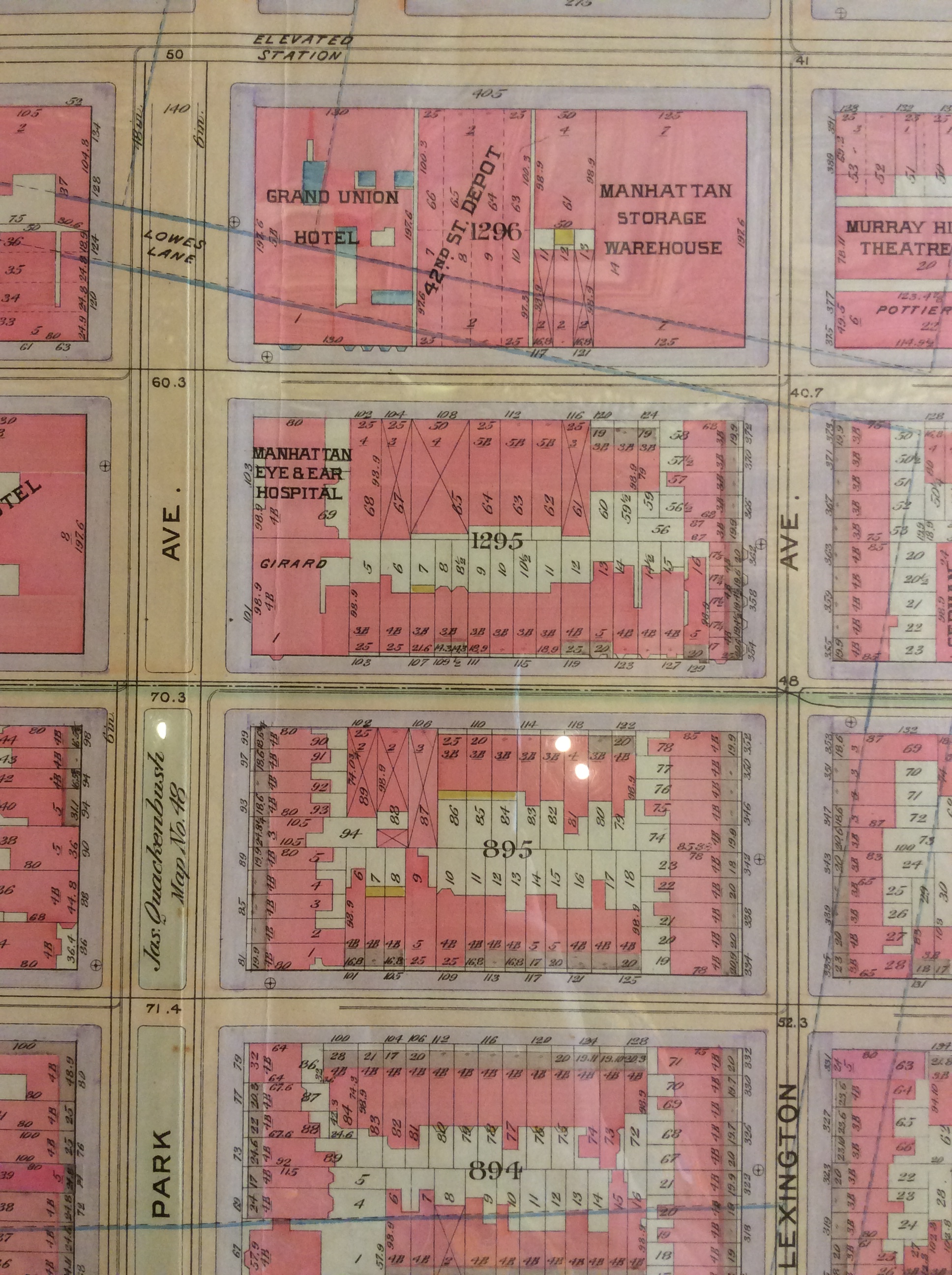
Bromley's 1902 atlas showing location of Manhattan Eye and Ear Hospital, from the maps collection of the NY Public Library

Bromley’s 1902 atlas showing location of Manhattan Eye and Ear Hospital, from the maps collection of the NY Public Library

William was a brave and loyal partner to Sanger, at one time jailed on her behalf by Anthony Comstock in 1915 for obscenity. Comstock, a special agent of the U.S. Postal Service who helped craft laws to zealously enforce his own strict views on public morality, tricked William into handing over, or in Comstock’s words, ‘distributing’, one of Sanger’s pamphlets on reproduction, health, and birth control. It included a description of two venereal diseases, gonorrhea and syphilis, and Comstock had helped make it legally obscene to name these diseases as well as to tell women how they could prevent pregnancy with any method other than abstinence, even in the context of a health care pamphlet. After arresting William, Comstock offered him a choice: he could tell him where Margaret Sanger was hiding out (she had fled to Europe the year before to avoid prosecution) or he could stand trial. William opted for the latter and was jailed because he refused, on principle, to pay the fine.

Over the years, Sanger regretted the way her relationship with William fell apart, blaming herself for much of what went wrong though she also thought she could have done little else. She wrote a very tender letter to him in 1919, directing that it be given to William after her death. Since she outlived him by five years, he never read it. She wrote,

Margaret Higgins Sanger (1879-1966) birth control activist, sex educator, and nurse, with her eldest son Stuart, public domain via LOC

Margaret Sanger with her eldest son Stuart, public domain via Library of Congress

‘…My life seems to have been in the hands of forces I could not control. My early days at the hospital seemed so hard & cruel at the time, but today I see how necessary they were for the accomplishment of the work I am doing today.

My marriage to you and our love and the coming of the children, the saving for a home — the building of the house — the seeking, shifting, changing, interesting life all today have meaning & full value to me in this cause of humanity to which my life is dedicated.

Often I have felt your loneliness & sorrow — often I would like to seek you & fling my arms about you & hold your aching head to my heart to tell you of my tenderness for you and my love — but — Forces stronger than physical desire — stronger than personal love held me to my task to the work I have undertaken to do. But I want you to know this — for I have told it to many — that you are to me the lover of all the world — Your love for me beautified my life and made possible the outlook on love & passion & sex — which has given me the courage & strength to go forth to do.

For this I owe you much and though my love for you is big & broad & tender it is the same today as when first we decided to go the path of life together. It has never changed. Sometimes I think it was not to be that I should love too intensely…’

You can read this letter in full, and a brief but very good account of the talented and principled William Sanger, at this website dedicated to his art and legacy.

Then I go to the lovely New York Public Library, where I request a copy of Ellen Chesler’s biography of Sanger. Since it’ll take about 30-45 minutes and I’ll need some time in the maps room, I decide to come back tomorrow and stay awhile.

 280 Madison Ave, Manhattan NYC, 2016 Amy Cools, and as it was in 1945 by Wurts Bros, courtesy of the Museum of the City of New York

280 Madison Ave, Manhattan NYC, my photo on the left, and to the right, as it looked in 1945. Photo by Wurts Bros, courtesy of the Museum of the City of New York

I head one block to the southwest to 280 Madison Ave at E 40th St, where, Pokorski notes, Sanger lived for a short time. She ‘moved from 280 Madison Avenue in late April, 1931, [and it’s] uncertain when she moved in or where she moved to’. The building looks more or less the same as it did then, according to a photo (above) of the same building in 1945, except that the ground floor has had a new ‘face’ put on at some point, of straight bands of gray-tan stone instead of the arched arcade it once featured.

Margaret Higgins Sanger, Jan 1916 by Bain News Service, public domain via LOC

Margaret Higgins Sanger reading, Jan 1916 by Bain News Service, public domain via Library of Congress. I found a photo of Sanger at about the time she lived here at 280 Madison, but it’s not public domain. You can find it at Getty Images

Sanger was almost certainly living here when she published her ‘Comments on the Pope’s Encyclical‘ in Birth Control Review in February of 1931, and probably wrote it here, too. It’s a succinct version of at least two much longer critiques of Pope Pius XI’s Dec. 30, 1930 encyclical Casti Connubii. I’ll explore many of the ideas contained in Casti Connubii as well as Sanger’s responses to it in the context of her ideas about human sexuality and social welfare in another piece I plan to publish very soon. Sanger’s three main points, as contained in her brief ‘Comments’, are as follows. 1) The Pope never explicitly commands his followers to have as many children as they can, contrary to the beliefs of many who oppose family limitation. That’s a good thing, because even if  God exists and actually commanded the human race to “Increase and multiply and fill the earth,” that commandment has been fulfilled already. Now it’s up to us to make sure to have enough room left over to give the multitudes that exist a happy and healthy life. 2) While the Pope is correct that both love and procreation are two of the primary purposes of marriage, the latter is not essential to it. People often marry who can’t have children, and people remain married when they can no longer have more and their children have left the home, no longer requiring support. Clearly, marriage has many other purposes, which is also true of sex itself. Therefore, the Pope is wrong to propose an inextricable link between sex, marriage, and procreation. 3) The Pope declares that birth control is wrong because it frustrates nature. Yet so does abstinence, which the Pope recommends, to say nothing of the numerous ways we frustrate nature every day: shaving our faces and cutting our hair; eradicating germs with soap, water, and medicines; building shelters to protect ourselves from the natural elements, and so on. Civilization itself is one giant web of ways in which we frustrate nature or bend it to our will. The latter argument, as is evident from her sarcastic tone as well as from her other critiques of this encyclical, Sanger considers downright silly.

There are several more sites I visit today and since so there’s much more to tell, I’ll break here, and pick up my tale shortly. To be continued….

Listen to the podcast version here, on Google Play, or on iTunes

Ordinary Philosophy and its Traveling Philosophy / History of Ideas series is a labor of love and ad-free, supported by patrons and readers like you. Please offer your support today!

~~~~~~~~~~~~~~~~~~~~~~~~~~~

Sources and Inspiration:

About Sanger: Biographical Sketch‘, from The Margaret Sanger Papers Project at New York University.

Anthony Comstock‘. In Wikipedia, The Free Encyclopedia.

Chesler, Ellen. Woman of Valor: Margaret Sanger and the Birth Control Movement in America. New York: Simon & Schuster, 1992

Eig, Jonathan. The Birth of the Pill: How Four Crusaders Reinvented Sex and Launched a Revolution. W.W. Norton & Company, New York, 2014.

Labor History Timeline: California and the United States by California Assembly Committee on Public Employees, via the Los Angeles Community College District website

Lochner v. New York, 1905‘, from Landmark Cases: A C-Span Original TV Series, 2015

Pius XI. Casti Connubii. Encyclical of Dec. 30th, 1930

Pokorski, Robin. ‘Mapping Margaret Sanger‘ from The Margaret Sanger Papers Project at NYU

Regan, Margaret. ‘Margaret Sanger: Tucson’s Irish Rebel.Tucson Weekly, Mar 11, 2004.

Sanger, Margaret. ‘Comments on the Pope’s Encyclical‘, Birth Control Review, Feb. 1931, 40-41

Sanger, Margaret. Margaret Sanger, an Autobiography. Cooper Square Press: New York 1999, originally published by W.W. Norton & Co: New York, 1938

Sanger, Margaret. The Pivot of Civilization, 1922. Free online version courtesy of Project Gutenberg, 2008, 2013

Sanger, Margaret. Woman and the New Race, 1920. Free online version courtesy of W. W. Norton & Company

William Sanger: About‘, from williamsanger-art.com

Wurts Bros. ‘280 Madison Avenue and 40th Street, S.W. corner. Office building.’ Photo, courtesy of the Museum of the City of New York

Why So Much Hatred for Margaret Sanger?

Margaret Sanger, photo probably taken Jan 30th 1917, photo courtesy of the Library of Congress

Margaret Sanger, photo probably taken Jan 30th 1917, photo courtesy of the Library of Congress

There’s been a widespread and concerted effort to vilify Margaret Sanger and remove her name from the public roll of great contributors to human rights history. In my research for the Sanger project I’m working on, I find scores of examples of this effort every single time I do an internet search using her name.

Last year, for example, Ted Cruz and some other conservative politicians called for her portrait to be removed from the Smithsonian’s National Portrait Gallery in Washington DC, where her portrait bust is included in the Struggle for Justice exhibition. In justification of his campaign, Cruz used part of a quote lifted from its original context and presented it as saying something nearly opposite of what it was originally meant to say. In a letter to a friend, Sanger expressed her worry that her birth control clinic project in the South might be misperceived and misrepresented as racist; Cruz lifted a few words from this very letter to ‘prove’ that it was. He may have borrowed this idea from Michael Steele, former chairman of the Republican Party, and Ben Carson and Herman Cain, one-time Republican presidential hopefuls. These three influential conservative men, in turn, likely received this bit of distorted wisdom, directly or indirectly, from Angela Davis and some others in the black power movement who, concerned that the reproductive justice movement might have ill effects in the long run on the empowerment of black people, (mis)represented Sanger’s words, works, and character in the worst possible light. The radical origin of the charges of racism against Sanger may surprise followers of these conservative political figures who have passed them along. And what was this purported insight into Margaret Sanger’s character? Why, that she was so racist that she wanted to exterminate the black race through preventing the conception of ensuing generations.

In my research and in early responses to my publications from my Sanger project I’ve also encountered frequent charges that she was a eugenicist, which is true, and in league with or at least sympathetic to Nazi beliefs, which is false.

So, let’s first consider Margaret Sanger’s beliefs and whether they justify her inclusion among the great American freedom leaders. Then, let’s consider her beliefs in the light of her own time and whether they deserve admiration today, on the whole, or are at least understandable given the circumstances of her time.

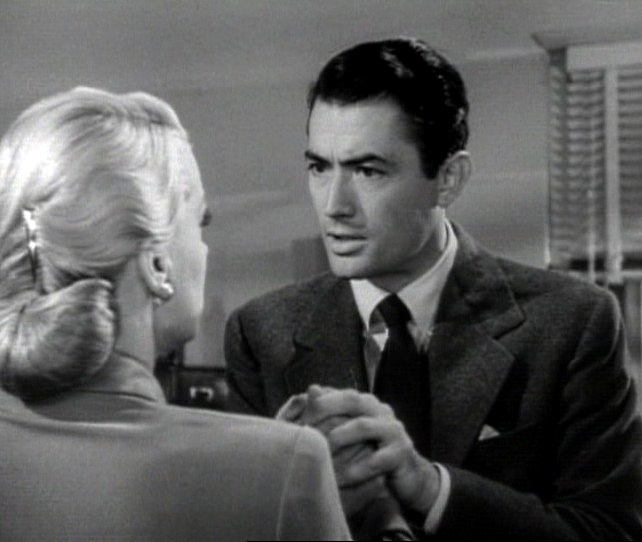
Gregory Peck and June Havoc in Gentleman's Agreement, public domain via Wikimedia Commons

Gregory Peck and June Havoc in Gentleman’s Agreement

As to Nazism, Sanger is actually an early and particularly vociferous opponent, much more so than many others in an America so rife with anti-Jewish sentiment in her time. I was surprised many years ago, in my late teens or early twenties, when I watched an old Gregory Peck movie (I’ve always been quite a fan of that talented and oh-so-handsome man) in which he played a reporter planning to write an exposé on the issue. To discover how prevalent anti-Semitism really was in America, his character Philip Schuyler Green goes undercover, putting it out there to his friends and colleagues that he was, in fact, Jewish, and had just never happened to mention it before. It doesn’t take long for his work and then his whole life to fall apart as he experiences terrible discrimination, his friends and colleagues turning against him one by one. At that time, I was surprised to learn that when Peck made this movie, anti-Semitism in America was enough of a thing that a major motion picture star would make a movie about it.

Theodore Roosevelt, American President and yes, a eugenicist too

Theodore Roosevelt, American President and yes, a eugenicist too

But Sanger is a eugenicist. This belief in the power of genetic inheritance to cure the ills of humankind by selectively breeding them out of existence was widely accepted at the time, even by such luminaries as our own President, Theodore Roosevelt. Eugenics is often divided into two types, positive and negative, and eugenicists are now often judged now by which of these they promoted. Positive eugenics is the idea that healthy, intelligent, hard-working, creative, and wealthy people should have more children so as to increase the stock of human beings who will, in turn, pass down desirable genetic traits. Roosevelt was a eugenicist of this sort. Negative eugenics is the idea that disabled, diseased, unintelligent, idle, and poor people should have fewer children so as to decrease the stock of human beings who will, in turn, pass down negative traits. The latter brand of eugenics can be further broken down into two camps, with differing ideas as to how it could be brought about: that decreased breeding of the ‘unfit’ should be entirely voluntary and encouraged through education, or, that it should be imposed by certain authorities. (Proponents of positive eugenics could also be broken down this way but I have yet to find an example of imposed human breeding of the ‘fit’, though Communist Romanian president Nicolae Ceaușescu’s policies on reproduction could conceivably be considered a sort of coercive positive eugenics).

Sanger promotes negative as well as positive eugenics principles, but as to whether she believes it should be voluntary or coerced, she’s incoherent at best. At times she’s opposed to any sort of official coercion, as in her many statements against the Nazis and in her stated principle that all human beings, women included and especially, should have the individual right and power to determine their own destinies. Yet she also often declares that since many people are incapable of rational judgment, including the ‘insane’ and the so-called ‘feeble-minded’, others need to make that decision for them. Though she criticizes the Nazis harshly for doing that very thing, she never makes it clear who should do the sterilizations, who should decide, and how coercive they should be if their ‘patients’ refuse. I believe she places herself in a moral dilemma in this matter. She so firmly believes in the power of eugenics to cure the terrible set of human ills that she encounters as a nurse that she wants it, no, needs it, to work. She’s well aware that most people would never consent to such a thing, be it for religious reasons or simply that most people, well or mentally ill, rational or not, naturally recoil at the idea that they should be sterilized because others think they should be. So how to cure these ills in the next generation, since Sanger knows there’s no way they could be cured in her own? That’s the dilemma that Sanger never successfully resolves.

Her vehement opposition to the Nazis goes back, first, to the race issue. One of her main criticisms of the Nazis is not that sterilization is a bad thing in principle, or even that the state might legitimately impose sterilization in special circumstances, such as in the case of criminally insane people (an idea we find abhorrent today but that many in Sanger’s time do not). It’s that the Nazis decide to ‘perfect’ the race along racial lines. To Sanger, this idea is both irrational and unscientific. In Woman and the New Race, she writes glowingly of the great wealth of contributions that people of all races and cultures have always brought and still bring to the world, and that much of the promise of future human greatness lies in this diversity. Since it’s clear that all races include people of great intelligence, health, and abilities, she believes that all races should be likewise bettered through eugenics, both positive and negative, and the latter only if and when necessary (though again, she’s incoherent on this point). Sanger is opposed to ‘human waste’, as she puts it, not only of human beings she considers physically and mentally ‘unfit’, but also the human waste of the lives of those children born in such numbers only to have many of them suffer terribly before dying early deaths, often taking their mothers with them; or permanently disabled by hard factory labor, malnutrition, and neglect; or shipped off as cannon fodder. She’s also opposed to the waste of human potential, of throwing away the great contributions, genetic and otherwise, of the best and brightest of all races to the human race as a whole. In this, she reminds me of Alexander Hamilton, who also argues against the waste of human potential inherent in race-based slavery.

It seems to me, in hindsight, that though many of her eugenics beliefs are founded on bad science, or rather, pseudoscience posing as science, they do not come from a malicious place. They form in the mind of a woman who cares enough about her fellow human beings to devote many years of her early adulthood nursing the poor immigrants in the slums of the Lower East Side of New York City, something few of us have the courage or the vision to do. Sanger is appalled by the suffering and privation she witnesses and desperately wants to help these people, especially the women and children who bear the brunt of society’s ills, but she recognizes that she and her fellow nurses don’t have a prayer of keeping up with the ever-growing need. And she realizes that even if they could keep up with the pace, they were only treating suffering that didn’t need to exist in the first place. She believes, over time, that she’s found the answer.

So given all of this, I ask again, why single out Margaret Sanger for such hatred? Why not call for, say, Teddy Roosevelt’s portrait to be taken down, or those of the many others who held problematic beliefs whose portraits hang, without challenge, on the National Portrait Gallery walls?

And why hate Sanger so much as to spread three major falsehoods about her, again and again and again, that have been so often and thoroughly debunked?

The first lie and second lies, as we’ve considered, are that Sanger’s a racist and a Nazi sympathizer. The other lie is that she’s pro-abortion. In fact, if we look at her writings, we find she’s more anti-abortion than anything.

Flyer for Sanger Clinic, Brownsville, Brooklyn, image courtesy of the Margaret Sanger Papers Project

Flyer for Sanger Clinic, Brownsville, Brooklyn, image courtesy of the Margaret Sanger Papers Project

The fact that Sanger is opposed to abortion in most circumstances may surprise many people, especially many conservatives, though I believe the Sanger-as-abortionist lie is as prevalent and persistent as it is because her views on abortion are as politically inconvenient to many on the left, so they don’t trouble to contradict it. She does allow that there are some extreme circumstances in which it is permissible, such as to save the life of the mother (a standard we adhere to today), and she can’t bring herself to blame the women who resort to abortion out of desperation. It’s the Comstocks,the self-righteous anti-sex moralists, the Pope, priests, and bishops, the government, the medical establishment, and the exploitative labor system that cause abortions, not desperate women. They’re the victims. In fact, as you can see from the flyer for her groundbreaking birth control clinic, Sanger lists the prevention of abortion as one of the clinic’s primary purposes.

And yet, the hatred of Sanger rages unabated in so many quarters. There’s plenty to criticize in her eugenics beliefs, in fact, enough to make the three lies I’ve just discussed seemingly unnecessary if you feel the need to discredit her. Again, other people who have had a dramatic impact on our history, like her, are complicated and had some bad ideas, but no Cruzes, Steeles, and Cains are so vehemently, and I would say dishonestly, trying to undermine the validity of every part of their life’s work and demand that their legacy be erased from our public institutional memory. They’re not calling for the removal of the portraits of anti-Semitic Henry Ford or pro-Nazi Charles Lindbergh, for example. To be certain, there are such efforts on the left to challenge the legacies and even mostly discredit influential historical figures such as Cecil Rhodes, Woodrow Wilson, and Thomas Jefferson. But those are for things they actually did: promoting imperial colonialism, instituting scores of racist laws in our nation’s capital, and owning slaves. The debate is only whether their legacies, on the whole, are worthy of respect and admiration.

So I ask again: why single out Margaret Sanger for such a degree of hatred and slander, given her work with the immigrant poor and minorities, her strong anti-Nazism, and her anti-abortionism? Why is she not excused for her flawed eugenics ideas on the understanding that she was a woman of her time, or that the good parts of her legacy outshine and thus have outlasted the bad, as we excuse so many others of our flawed heroes? In New York City, teeming with statues, monuments, and portraits of noteworthy historical figures, I could find no monument to her, however modest, in the city she called home for so long and served so well in such difficult circumstances.

When it comes to Cruz and many others who are adamantly anti-Sanger, I strongly suspect that one of their primary objections to her is really her anti-Catholicism and irreligion. For example, Cruz is a self-proclaimed, unapologetically religious man who, like many prominent conservative politicians these days, often stresses the Christian heritage of the United States. He’s also often regarded as a proponent of dominionism, the idea that the Christian faith should guide all matters of government, because of his frequent praise of his father, who promotes that ideology. To Cruz’s credit, in his 2016 Republican convention speech he stated that religious freedom includes the freedom to be an atheist, in contrast to a declaration he made a year ago that only a religious person is fit to be president of the United States. But the targeting of Sanger by Cruz, and Carson, and Cain, based on easily-disproved, thoroughly-debunked attacks on her character, makes me wonder how committed such conservative leaders are to the idea that Americans should be free to believe in accordance with their conscience and their reason.

Margaret Sanger Portrait Bust, image credit National Portrait Gallery, Smithsonian, Washington DC

Margaret Sanger Portrait Bust, image credit National Portrait Gallery, Smithsonian, Washington DC

So why hate Margaret Sanger? Could it simply be because she was a strong woman, a fearless woman, a truly self-liberated woman who did not chase after monetary success or choose acceptable or glamorous routes to fame, an outspoken atheist who stood up to such a powerful man as the Pope… in other words, a self-realized, so-fully-human woman that she’s a mass of greatnesses, ordinarinesses, and deep flaws? For all of our self-assurances that we’ve achieved a sex-equal, religiously tolerant society which places such a high value on free speech, are too many of us still unable to accept such women?

I’m quite sure the answer is yes.

Listen to the podcast version here, on Google Play, or on iTunes

This piece is also published at Darrow, a forum for ideas and culture

Ordinary Philosophy and its Traveling Philosophy / History of Ideas series is a labor of love and ad-free, supported by patrons and readers like you. Please offer your support today!

~~~~~~~~~~~~~~~~~~~~~~~~~~

Sources and inspiration:

Birth Control or Race Control? Sanger and the Negro Project‘ The Margaret Sanger Papers Project Newsletter #28 (Fall 2001)

Cruz, Ted. ‘2016 Republican National Convention Speech‘, abcnews.go.com, Jul 21, 2016

Davidson, Amy. ‘Ted Cruz vs. Margaret Sanger’s Portrait‘. New Yorker, Oct 28, 2015

Davis, Angela. Women, Race, & Class. New York: Random House, 1981.

Fea, John. ‘Ted Cruz’s campaign is fueled by a dominionist vision for America‘. The Washington Post: Religion (Commentary), Feb 4th, 2016

Gentleman’s Agreement (1947)‘, from IMDB

Jenkinson, C.lay. ‘Self-Soothing by way of Erasing the Complexity of Human History‘. Clayjenkinson.com, Dec 28, 2015

Nicolae Ceaușescu‘. Encyclopædia Britannica

Parkinson, Justin. ‘Why is Cecil Rhodes Such a Controversial Figure?‘ BBC News Magazine, Apr 1, 2015

The Sanger-Hitler Equation‘, The Margaret Sanger Papers Project Newsletter #32 (Winter 2002/2003)

Sanger, Margaret. The Pivot of Civilization, 1922. Free online version courtesy of Project Gutenberg, 2008, 2013.

Sanger, Margaret. Woman and the New Race, 1920. Free online version courtesy of W. W. Norton & Company

Sullivan, Martin. ‘Margaret Sanger Portrait‘: talk for Face-to-Face, National Portrait Gallery of the Smithsonian

The Portraits: Margaret Sanger‘ from the National Portrait Gallery of the Smithsonian website

Wirestone, Clay. ‘Did Margaret Sanger believe African-Americans “should be eliminated”?PolitiFact, October 5th, 2015

Margaret Sanger NYC Sites, Day 1 Part 1, and a 100 Year Anniversary

Flyer for Sanger Clinic, Brownsville, Brooklyn, image courtesy of the Margaret Sanger Papers Project

Flyer for Sanger Clinic, Brownsville, Brooklyn, image courtesy of the Margaret Sanger Papers Project

Tuesday, October 18th, 2016

I start the morning preparing my itinerary for the day as I fortify myself with coffee and the first half of a sandwich.

My first stop is also the furthest east I’ll go this trip, to the Brownsville neighborhood of Brooklyn. I take the C train to the Rockaway station, head south on Saratoga, and wander around getting a feel for the neighborhood. It’s predominantly black, solidly working class, with lots of handsome old buildings, mostly well worn with peeling paint. I see lots of mothers and grandparents with strollers and very small children (it’s around noon during work hours), people taking smoke breaks in backdoors, and some very poor and homeless people. Reaching Pitkin’s busy sidewalk, I see shoppers, people going out for lunch, and shop and cafe proprietors in front doorways under brightly colored signs, and I hear many accents and many languages spoken, English, Spanish and French, and many others I don’t recognize. It reminds me of neighborhoods I frequent at home in Oakland. I turn north on Amboy Street, which runs north and south between Pitkin and E. New York Ave.

At 46 Amboy Street, just north of Pitkin, Margaret Sanger opened the United States’ first birth control clinic two days less than 100 years ago today, on Oct 16th, 1916. Though just a  little late for the anniversary, I’m happy to be here at this historic place, humble as it now appears. The clinic was in the tall red brick building to the right of the tan one with the ‘diamond’ pattern on the upper center front of the façade. You’ll find a photo below that shows the clinic as it originally appeared, and here as well.

46 Amboy St, site of Sanger's first birth control clinic

Sanger’s first birth control clinic, given address 46 Amboy St. One thing’s more or less the same: the little pale brick building with the crenelated top still stands next to where the clinic was, as you can see two photos down. The narrower red brick building against and to the left of the larger one, with a sign now identifying it as 42 Amboy, stands on the former clinic site.

46 Amboy St, site of Sanger's first birth control clinic

Another view, angled more like the view in the photo below. The two red brick buildings appear not to be original unless they’ve been changed so much as to be unrecognizable. As you can see from the photo below, there was space between the original clinic building and the tan one, but not so for the current structure. The clapboard building beyond may be original.

Photograph shows women and men sitting with baby carriages in front of the Sanger Clinic, LOC

Women and children sitting with baby carriages in front of the Sanger Clinic, with the white curtains in the windows. Photo courtesy of the Library of Congress

Before opening this clinic, Sanger had trained and worked as a nurse for many years among the poorest and most oppressed Americans, the immigrant and minority working class and poor. Originally a Socialist radical, Sanger came to realize that Marxists, philanthropists, and charity workers alike were making the same essential mistake. Since they failed to identify the root cause of human misery in the slums, the crowded tenements, and the factory floors, all of their well-intended efforts to help were failing and sure to continue to fail. Sanger came to feel this way about her own nursing, which addressed the effects and not the cause, so she turned her efforts to where she believed she could do the most good: birth control activism.

Margaret Sanger as a nursing student around 1900, by Boyce Photographer, White Plains, courtesy of the Sophia Smith Collection, Smith College

Margaret Sanger as a nursing student around 1900, by Boyce Photographer, White Plains, courtesy of the Sophia Smith Collection, Smith College

As a nurse, Sanger cared for poor women broken down in health and mind by laboring all night and caring for children all day, often pregnant all the while, often miscarrying, and the infant mortality rates were very high. So were death rates for the mothers, be it from childbirth, diseases secondary to exhaustion and malnutrition, and worst of all, from self-inflicted abortions. The mothers who resorted to the latter were desperate: they had often already watched other children die, or suffer every day from hunger, or forced into the factories or other labor at a very young age in the struggle to survive.

Though there were plenty of organizations trying to help these families, governmental and charitable, they could not keep up since the need was so great and increasing every day. Industrialization, Sanger recognized, encouraged rapid population growth by the ever-increasing demand for more labor and more future customers. And the workers responded to the social pressure by producing more children in hopes that their offspring could help the family by going out to work. But those hopes were often in vain since the population growth always kept up with or surpassed the need for laborers, constantly driving down wages. And so the cycle continued: immiseration through near-starvation wages, families barely keeping up with the cost of feeding themselves if at all, and children deprived of an education and of health as factory and other hard work often left children stunted, with malformed and weak bones and muscles, and often injured by machinery and chemicals.

Sanger thought: instead of trying vainly to keep up with the spiraling misery caused by this cycle, why not get at the root of it? After all, as the old saying goes, an ounce of prevention is worth a pound of cure. If women were empowered to decide whether to have children, and only as many as their health and financial circumstances would allow, all this misery could be prevented in the first place since parents could adequately care for the children they did have, mother’s bodies would no longer be broken down by constant pregnancy, infants and mothers would more likely survive childbirth, overcrowding and its accompanying epidemics would be mitigated or even disappear, and a reduced labor force would force employers to compete for workers, driving wages up. And as we’ve seen over the decades, high population growth is strongly correlated with endemic poverty, high infant and mother mortality rates, women’s rights abuses, and high income inequality.

But people will never stop having sex, as Sanger pointed out. Sex is just too powerful a force in human nature. Our need for love, for affection, for physical pleasure and release, are too powerful to be squelched, and in fact, shouldn’t be. Love and the need for physical connection are positive things, indeed, two of the best things in human nature. Birth control, thought Sanger, was the answer.

I’ll be exploring Sanger’s ideas on these and other topics in more detail in upcoming essays, stay tuned. In the meantime, the Margaret Sanger Papers Project has a wealth of articles and original works by Sanger available online, and I’ve relied on them more than on any other single resource for my own project. (See below for the links). Thank you so much to the good people at the MSPP, I very much appreciate what you do!

Photobombed in Brownsville, Brooklyn, NY

Photobombed in Brownsville, Brooklyn, NY

Street with handsome row houses on Bergen Street, Brownsville, Brooklyn, NYC

Tree lined street with attractive row houses on Bergen Street, Brownsville, Brooklyn, NYC

Brownsville neighborhood of Brooklyn, NY, near the Rockaway station, 2016 Amy Cools

Street scene at the Rockaway station entrance near the northern edge of the Brownsville neighborhood in Brooklyn, NY

Hipster Gourmet Deli in Brownsville, Brooklyn, Amy Cools 2016.

Hipster Gourmet Deli in Brownsville, Brooklyn. I took this photo on the way to Amboy St, after my laughter subsided enough to take a picture.

I head back to the station, on the way stopping to photograph some scenes in the neighborhood, including an especially pretty row of houses on Bergen Street as a young man photobombs my pic with a laugh and a smile. On the train back, I eat the now rather smashed second half of my egg salad sandwich and write my notes. I transfer a couple of times and head north to Grand Central Station…. To be continued

Ordinary Philosophy and its Traveling Philosophy / History of Ideas series is a labor of love and ad-free, supported by patrons and readers like you. Please offer your support today!

~~~~~~~~~~~~~~~~~~~~~~~~~~~~

Sources and Inspiration:

Alter, Charlotte. ‘How Planned Parenthood Changed Everything‘. Time.com, Oct. 14, 2016

Chesler, Ellen. ‘Was Planned Parenthood’s Founder Racist?Salon.com, Wed, Nov 2, 2011

Child Labor in U.S. History‘. From the Child Labor Public Education Project by the University of Iowa Labor Center

Demographics and Poverty‘, Center for Global Development.

Jacobs, Emma. ‘Margaret Sanger Clinic (former): the First Birth Control Clinic in the United States‘. From Places That Matter

Margaret Sanger Papers Project by New York University.

Regan, Margaret. ‘Margaret Sanger: Tucson’s Irish Rebel.Tucson Weekly, Mar 11, 2004.

Sanger, Margaret. The Pivot of Civilization, 1922. Free online version courtesy of Project Gutenberg, 2008, 2013.

Sanger, Margaret. Woman and the New Race, 1920. Free online version courtesy of W. W. Norton & CompanyOakland Tribune Article about Margaret Sanger's NY clinic, Oct 21, 1916 evening edition

New Podcast Episode: The Little Way of Goodness

therese-of-lisieuxListen to this podcast episode here or on Google Play, or subscribe on iTunes

Growing up Catholic, my siblings and I were taught many stories of saints and their heroic exploits in their quest to attain union with God. One of these was Thérèse of Lisieux, a young Frenchwoman who became a nun at 16 and died of tuberculosis at the early age of 24. She was an especially beloved saint of my family; one of my sisters is named after her.

Thérèse was a romantic and an idealist, and as a young girl, admired the glorious deaths of Christian martyrs and wished to emulate them. Realizing that she was unlikely to find herself in a situation where she could likewise be killed for the sake of her religion, she devised her own system for attaining heaven. She called it her “Little Way”, in which she would regularly perform acts of holiness in day-to-day life. The trials and tribulations of ordinary life would be elevated and be made important by virtue of their being endured with patience and good grace, and opportunities for sacrificing oneself for the good of others would be seized and fulfilled to their utmost… Read the written piece here:

Ordinary Philosophy and its Traveling Philosophy / History of Ideas series is a labor of love and ad-free, supported by patrons and readers like you. Please offer your support today!