Happy Birthday, David Hume!

In honor of David Hume‘s birthday, May 7, 1711, let me share anew my history of ideas travel series and other pieces I’ve written in honor of my favorite philosopher if I was pressed to chose only one. I fell in love with his native Edinburgh when I originally visited in the spring of 2014 but even so, I wouldn’t have predicted I would now be living here furthering my education at his alma mater, the University of Edinburgh. It would have been even more impossible to predict that the window of my flat would be located directly across the narrow square from the University’s David Hume Tower. I was moved to observe one day, and still am whenever I think or tell of it, that the windows of that glassy tower often reflect the light of the rising sun into my window. I could imagine no more poetic image than that of how this great Enlightenment thinker has influenced my life.

Here they are in the order I wrote them, starting several years back. Perhaps you’ll find, as I do when I return to old pieces from time to time, that my thinking has developed and my mind has changed, to various degrees, on some things:

First Day in Old Edinburgh: Hume Sites and Monuments
Hume’s New Scene of Thought, and, It’s Good to Be Able to Say ‘I Don’t Know’
Hume Sites and Monuments, Part 2
The Consolations of Philosophy, and A Death Free from Fear
Scotticisms
Happy 303rd Birthday, David Hume!
The Debate Over Government and Freedom
The Tale of the Magic Toe – Superstition? Or What?
Hume Sites and Monuments, Part 3
Water of Leith
Last Day in Edinburgh, May 13th, 2014
Hume, Aristotle, and Guns
A memory quilt I created for my Edinburgh trip:
A Hill and a Wall in Edinburgh, 2015, 102″ x 69″
Enlightenment Scotland: Site of James Boswell’s Home in James Court, Edinburgh
Enlightenment Scotland: Advocates Library, Edinburgh
Chirnside and Ninewells, Scottish Borders, Childhood and Summer Home of David Hume
Enlightenment Scotland: Edinburgh’s Select Society
Photobook: Robert Adam, Architect of Edinburgh
Photobook: Letter from David Hume to James Balfour, Mar 15, 1753

*A version of this piece was previously published at Ordinary Philosophy

~ Ordinary Philosophy is a labor of love and ad-free, supported by patrons and readers like you. Any support you can offer will be deeply appreciated!

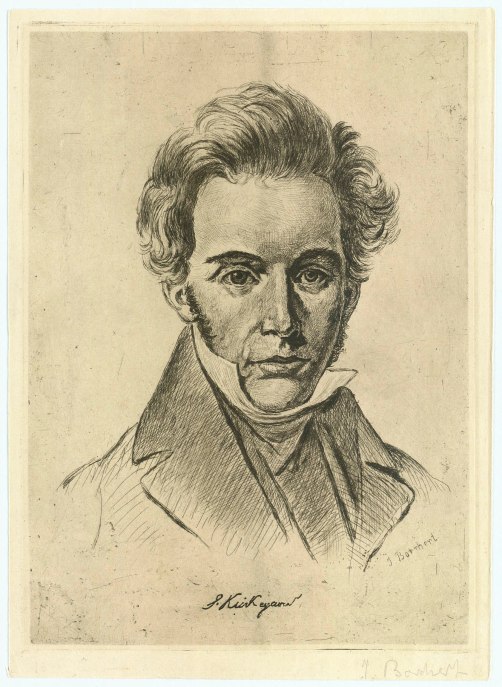
Happy Birthday, Søren Kierkegaard! By Eric Gerlach

S. <>Søren Kierkegaard (May 5, 1813 – Nov. 11, 1855 CE), the great Danish philosopher and forerunner of existentialism, was born in the Danish city of Copenhagen, and throughout his life he enjoyed walking through the city, greeting everyone he met as his equal regardless of their station in life.  As a young boy, Kierkegaard’s father drilled him with difficult lessons so he would be the top student in his class, but to prevent his son from developing selfish pride, the father demanded that his son get the third best grades in the class, purposefully making mistakes to prevent the boy from being recognized as first or second student.

Caspar_David_Friedrich_-_Wanderer_above_the_sea_of_fog

For Kierkegaard, genuine truth is human subjectivity and perspective, and it is only the individual who accepts subjectivity who comes to realize the greater truth insofar as it is achievable by individuals.  For Kierkegaard, truth is not objective, but subjective, not an object achieved, but a test withstood, not a hurdle overcome, but an experience endured.  Kierkegaard argued that no social system can authentically give the individual meaning and truth. Individuals must make choices, and if they choose to go along with the masses, they have sacrificed their own ability to give truth meaning.  Kierkegaard wrote that he could have, like most scholars of his day, become a voice pronouncing the greatness and objectivity of his race, his country, his historical period, his fellow scholars, but rather than commit treason to truth he chose to become a spy, a solitary individual who chronicled the hypocrisy of all claims to objectivity.

472px-Kittinger-jump

To be an individual is to experience “a vertigo of possibilities”, the monstrosity of spontaneity.  Kierkegaard wrote, “We are condemned to be free”.  It is our freedom, the experience of the infinite, undefined and unbounded, which unites us most intimately with our world.  Kierkegaard argued that one can overcome the angst, the vertigo of possibilities, by making a leap of faith, by choosing to believe in something and act with some purpose in spite of the fact that beliefs and purposes can never be fully justified.  Only this is authentic individuality and truth, having chosen what one is to be, with the honest recognition of the freedom involved in the choice.

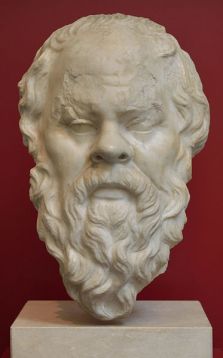
373px-Head_of_Socrates_in_Palazzo_Massimo_alle_Terme_(Rome)

Kierkegaard saw himself as a true follower of Socrates, who argued that he knew that he did not know, which is why the Oracle at Delphi said that no man was wiser than he.  Kierkegaard wrote his college thesis on Socrates, irony, and indirect communication, much as Kierkegaard himself indirectly communicated through his pseudonyms.  Socrates never made great claims to truth, and would instead use analogy, myth, and paradox to show that human judgments and beliefs are problematic and contradictory even as they assert themselves with certainty, which Kierkegaard argued was also the method of Jesus.  Kierkegaard wrote that Socrates “approached each man individually, deprived him of everything, and sent him away empty-handed”.  Socrates showed others that they did not truly know what they believed themselves to know, and he was killed by the Athenian assembly just as Jesus was killed for questioning the Pharisees.

Brooklyn_Museum_-_Saint_John_the_Baptist_and_the_Pharisees_(Saint_Jean-Baptiste_et_les_pharisiens)_-_James_Tissot_-_overall

Kierkegaard’s works are dominated by theological concerns, wondering on many pages about the individual’s relationship to God and Jesus.  For Kierkegaard, the meaning of Christianity was not the achievement of objectivity, but the acceptance of subjectivity, of individually lacking the God’s eye view.  Kierkegaard was brutally critical of the Danish Lutheran Church for presenting itself as the objective truth, and argued that it is only as an individual that one can be a genuine Christian.  Kierkegaard argued that Christianity began as a rebellion against the status quo, but then became the entrenched regime.

450px-Image-Søren_Kierkegaard_grave_4

After healing a blind man, Jesus rebuked the Pharisees, the political and religious establishment of his time, and said that because they think they see they are in fact blind.  In his later years, Kierkegaard attacked the Danish Church without mercy, and at his funeral a fight broke out when young theology students, progressive and inspired by Kierkegaard, protested that the church was attempting to hijack his name and fame by calling him one of their own after he had so bitterly attacked their hypocrisy for decades.  Kierkegaard wanted his tombstone to read only, “The Individual”, though his relatives decided otherwise.

A version of this piece was previously published at Ordinary Philosophy

~ Ordinary Philosophy is a labor of love and ad-free, supported by patrons and readers like you. Any support you can offer will be deeply appreciated!

*All views and opinions expressed by guest writers are their own and do not necessarily express those of Ordinary Philosophy’s editors and publishers

Philosophers Should be Keener to Talk About the Meaning of Life, by Kieran Setiya

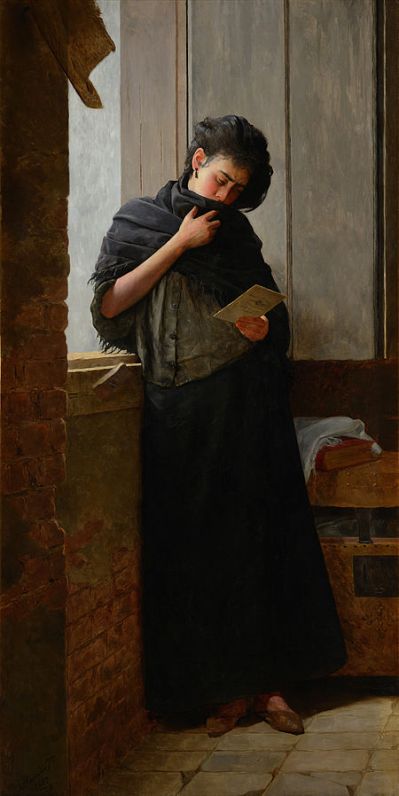
Saudade (Longing), by José Ferraz de Almeida Júnior, oil on canvas, 1899. Public domain via Wikimedia Commons

Philosophers ponder the meaning of life. At least, that is the stereotype. When I risk admitting to a stranger that I teach philosophy for a living and face the question ‘What is the meaning of life?’, I have a ready response: we figured that out in the 1980s, but we have to keep it secret or we’d be out of a job; I could tell you, but then I’d have to kill you. In fact, professional philosophers rarely ask the question and, when they do, they often dismiss it as nonsense.

The phrase itself is of relatively recent origin. Its first use in English is in Thomas Carlyle’s parodic novel Sartor Resartus (1836), where it appears in the mouth of a comic German philosopher, Diogenes Teufelsdröckh (‘God-born devil-dung’), noted for his treatise on clothes. The question of life’s meaning remains both easy to mock and paradigmatically obscure.

What is the meaning of ‘meaning’ in ‘the meaning of life’? We talk about the meaning of words, or linguistic meaning, the meaning of an utterance or of writing in a book. When we ask if human life has meaning, are we asking whether it has meaning in this semantic sense? Could human history be a sentence in some cosmic language? The answer is that it could, in principle, but that this isn’t what we want when we search for the meaning of life. If we are unwitting ink in some alien script, it would be interesting to know what we spell out, but the answer would not have authority over us, as befits the meaning of life.

‘Meaning’ could mean purpose or function in a larger system. Could human life play that role? Again, it could, but yet again, this seems irrelevant. In Douglas Adams’s Hitchhiker’s books, the Earth is part of a galactic computer, designed (ironically) to reveal the meaning of life. Whatever that meaning might be, our role in the computer program is not it. To discover that we are cogs in some cosmic machine is not to discover the meaning of life. It leaves our existential maladies untouched.

Seeing no other way to interpret the question, many philosophers conclude that the question is confused. If they go on to talk about meaning in life, they have in mind the meaning of individual lives, the question of whether this life or that life is meaningful for the person who is living it. But the meaning of life is not an individual possession. If life has meaning, it has a meaning that applies to us all. Does this idea make sense?

I think it does. We can make progress if we turn from the words that make up the question – ‘meaning’ in particular – to the contexts in which we feel compelled to ask it. We raise the question ‘Does life have meaning?’ in times of anguish, or despair, or emptiness. We ask it when we confront mortality and loss, the pervasiveness of suffering and injustice, the facts of life from which we recoil and which we cannot accept. Life seems profoundly flawed. Is there meaning to it all? Historically, the question of life’s meaning comes into focus through the anxiety of early existentialist philosophers, such as Søren Kierkegaard and Friedrich Nietzsche, who worried that it has none.

On the interpretation that this context suggests, the meaning of life would be a truth about us and about the world that makes sense of the worst. It would be something we could know about life, the Universe and everything, that should reconcile us to mortality and loss, suffering and injustice. Knowledge of this truth would make it irrational not to affirm life as it is, not to accept things as they are. It would show that despair, or angst, is a mistake.

The idea that life has meaning is the idea that there is a truth of this extraordinary kind. Whether or not there is, the suggestion is not nonsense. It is a hope that animates the great religions. Whatever else they do, religions offer metaphysical pictures whose acceptance is meant to bestow salvation, to reconcile us to the seeming faults of life. Or if they do not supply the truth, if they do not claim to convey the meaning of life, they offer the conviction that there is one, however hard to grasp or articulate it might be.

The meaning of life might be theistic, involving God or gods, or it might be non-theistic, as in one form of Buddhism. What distinguishes Buddhist meditation from mindfulness-based stress-reduction is the aim of ending suffering through metaphysical revelation. The emotional solace of Buddhism is meant to derive from insight into how things are – in particular, into the non-existence of the self – an insight that should move anyone. To come to terms with life through meditation for serenity, or through talk therapy, is not to discover the meaning of life, since it is not to discover any such truth.

Albert Einstein wrote that to know an answer to the question ‘What is the meaning of human life?’ means to be religious. But there is in principle room for non-religious accounts of meaning, ones that do not appeal to anything beyond the given world or the world revealed to us by science. Religion has no monopoly on meaning, even if it is hard to see how a non-transcendent truth could meet our definition: to know the meaning of life is to be reconciled to all that is wrong with the world. At the same time, it is hard to prove a negative, to show that nothing short of religion could play this role.

Philosophers are prone to see confusion in the question ‘What is the meaning of life?’ They have replaced it with questions about meaningful lives. But the search for life’s meaning will not go away and it is perfectly intelligible. I cannot tell you the meaning of life or give assurance that it has one. But I can say that it is not a mistake to ask the question. Does life have meaning? The answer is: it might.Aeon counter – do not remove

~ Kieran Setiya is a professor of philosophy at the Massachusetts Institute of Technology. His latest book is Midlife: A Philosophical Guide (2017). He lives in Brookline, Massachusetts. (Bio credit: Aeon)

This article was originally published at Aeon and has been republished under Creative Commons.

~ Ordinary Philosophy is a labor of love and ad-free, supported by patrons and readers like you. Any support you can offer will be deeply appreciated!

*All views and opinions expressed by guest writers are their own and do not necessarily express those of Ordinary Philosophy’s editors and publishers

Happy Birthday, Morton White!

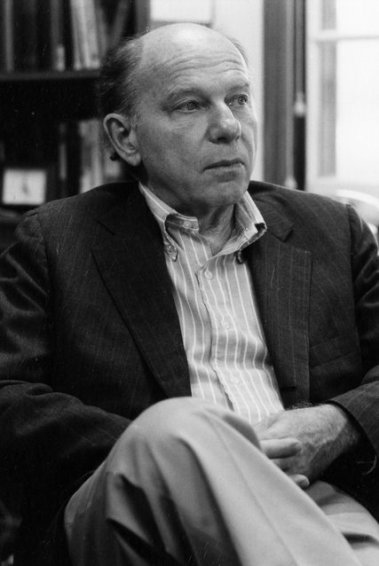
Morton White in 1981

The world lost Morton White (April 29, 1917 – May 27, 2016) less than two years ago, and I first learned of him through reading his obituary in The New York Times. As I read, I knew this is a man and an approach to philosophy I must learn more about.

White was a philosopher and historian of ideas. According to the Institute for Advanced Studies, ‘he maintained that philosophy of science is not philosophy enough, thereby encouraging the examination of other aspects of civilized life—especially art, history, law, politics and religion—and their relations with science’. And as William Grimes put it for TNYT, his ‘innovative theory of “holistic pragmatism” showed the way toward a more socially engaged, interdisciplinary role for philosophy’.

I studied philosophy with great love and enthusiasm as an undergraduate, yet I found myself then as now just as curious about other disciplines, especially history and the arts, and have often felt that the lines dividing these areas of study are sometimes artificial and even impediments to understanding. Since then, I’ve been pursuing my studies in the history of ideas more broadly, informally for the past several years, formally now at the University of Edinburgh. No doubt, White has influenced the direction my studies in intellectual history will take in ways I’ll learn as I go along, and in many more ways than I’ll ever know.

Learn more about White and his fascinating ideas:

Holistic Pragmatism and the Philosophy of Culture‘ – chapter 1 of A Philosophy of Culture: The Scope of Holistic Pragmatism, New Jersey: Princeton University Press 2002, in which White summarizes what his holistic pragmatism is all about

Morton White, Philosopher of Holistic Pragmatism, Dies at 99‘ – Obituary by William Grimes for The New York Times, June 10, 2016

Morton White 1917–2016 – His memorial page at the Institute for Advanced Study website, June 08, 2016

And you can find his selected bibliography at Wikipedia

*A version of this piece was previously published at Ordinary Philosophy

~ Ordinary Philosophy is a labor of love and ad-free, supported by patrons and readers like you. Any support you can offer will be deeply appreciated!

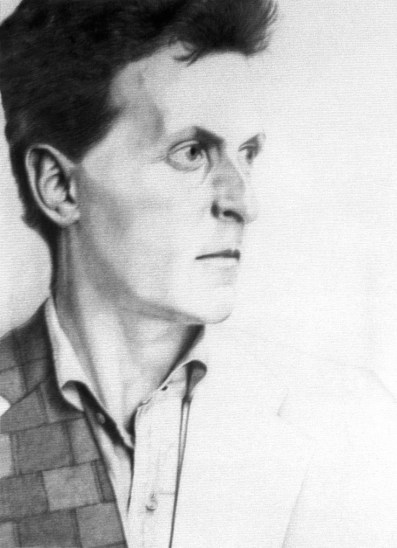
Happy Birthday, Ludwig Wittgenstein!

Drawing of Ludwig Wittgenstein by Christiaan Tonnism, pencil on board 1985, Creative Commons

In honor of Ludwig Wittgenstein’s birthday, Apr 26, 1889, let me share four fascinating discussions about the great philosopher’s life and ideas.

The first is by philosopher Stephen West for his podcast Philosophize This!, in which he discusses ‘…the limitations of language as described by Ludwig Wittgenstein. Considered by some to be the greatest philosopher of the 20th century, Ludwig Wittgenstein played a central, if controversial, role in 20th-century analytic philosophy. He continues to influence current philosophical thought in topics as diverse as logic and language, perception and intention, ethics and religion, aesthetics and culture….’ (this episode is only the first West will create about Wittgenstein)

The second is from the BBC series Great Lives, hosted by Matthew Parris and featuring guests Raymond Tallis and Ray Monk. In this program, Parris, Tallis, and Monk discuss ‘Ludwig Wittgenstein, the fascinating and misunderstood genius who changed the course of philosophy…’

The third is from the BBC series In Our Time, hosted by Melvin Bragg and featuring guests Ray Monk, Barry Smith, and Marie McGinn. In this program, Monk, Bragg, Smith, and McGinn discuss ‘…the life, work and legacy of Ludwig Wittgenstein… Wittgenstein is credited with being the greatest philosopher of the modern age, a thinker who left not one but two philosophies for his descendants to argue over: The early Wittgenstein said, “the limits of my mind mean the limits of my world”; the later Wittgenstein replied, “If God looked into our minds he would not have been able to see there whom we were speaking of”. Language was at the heart of both. Wittgenstein stated that his purpose was to finally free humanity from the pointless and neurotic philosophical questing that plagues us all. As he put it, “To show the fly the way out of the fly bottle.” How did he think language could solve all the problems of philosophy? How have his ideas influenced contemporary culture?…’

The fourth is by Ian Ground for the Times Literary Supplement, an excellent piece I recommended here at Ordinary Philosophy last fall. In it, Ground discusses ‘why writers and artists have found him an object of fascination and inspiration. He is the subject of novels, poetry, plays, painting, music, sculpture and films. In the arts and the culture generally, Wittgenstein seems to be what a philosopher ought to be.’

Enjoy, and be inspired, awed, puzzled, and enlightened!

*A version of this piece was previously published at Ordinary Philosophy

~ Ordinary Philosophy is a labor of love and ad-free, supported by patrons and readers like you. Any support you can offer will be deeply appreciated!

O.P. Recommends: M.M. Owen on Martin Buber’s I and Thou

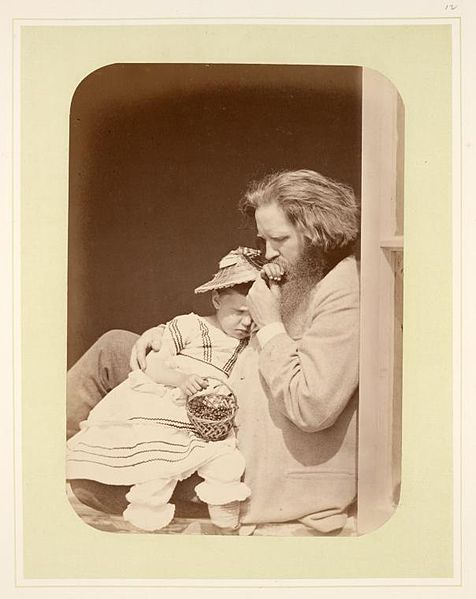
‘A Father and Child’ by Andrei Osipovich Karelin, public domain via Wikimedia Commons

In this excellent essay, M. M. Owen explores Martin Buber‘s idea that ‘when we encounter another individual truly as a person, not as an object for use, we become fully human.’:

I and Thou argues that within this elementally networked reality there are two basic modes of existence: the I-It, and the I-Thou. These two stances make up our basic ‘twofold attitude’. In the I-It mode, an ‘Ego’ approaches another as an object separate from itself. This type of engagement is driven by a sort of instrumentalism; the object is engaged primarily as something to be known or used, and its nature is always mediated through the subject’s own self-regard. From the I-It stance, we don’t engage with things in their entirety. Instead, we engage with a web of distinct and isolated qualities notable for how they are useful to us. Buber regarded this kind of self-centred outlook – typified, in his view, by proto-existentialists such as Kierkegaard and Nietzsche – as a grave error.

By contrast, in the I-Thou relationship, rather than simply experiencing another, we encounter them. A subject encounters a fellow subject’s whole being, and that being is not filtered through our mediated consciousness, with its litter of preconceptions and projections. ‘No purpose intervenes,’ as Buber put it. The I-Thou stance has a purity and an intimacy, and is inherently reciprocal. In relation to others, he argued, we can step into an intersubjective space where two people coexist in (and co-contribute to) what he called the Between. In this Between lurks the vital, nourishing experience of human life, the real sacred stuff of existence. As he put it: ‘All real living is meeting.’

Read the full essay here

~ Ordinary Philosophy is a labor of love and ad-free, supported by patrons and readers like you. Any support you can offer will be deeply appreciated!!

Photobook: Letter from David Hume to James Balfour, Mar 15, 1753

Letter from David Hume to James Balfour dated Mar 15, 1753 and Balfour’s response, in a special exhibit at the National Library of Scotland in 2014

Ordinary Philosophy and its Traveling Philosophy / History of Ideas series is a labor of love and ad-free, supported by patrons and readers like you. Please offer your support today!

In Memory of Hypatia of Alexandria

Detail of the death portrait of a wealthy woman, c. 160-170 AD near modern-day Er-Rubayat in the Fayum, public domain via Wikimedia Commons

Detail of the death portrait of a wealthy woman, c. 160-170 AD near modern-day Er-Rubayat in the Fayum, public domain via Wikimedia Commons

Hypatia’s birthday is somewhere between 350 and 370 AD; a range of dates indicating great uncertainty, to be sure, but original sources that old are hard to come by, especially from a city as turbulent and violence-torn as the Alexandria of her day. The day of her death is better known, sometime in March of 415 AD. Since the latter date is more precise, we’ll break with our birthday remembrance tradition here and celebrate the memory of Hypatia in the month of her tragic and violent death instead of on the date of her birth.

She was a mathematician, astronomer, teacher, and philosopher who wrote commentaries on important works in geometry and astronomy with her father Theon, likely contributing original work of her own. Hypatia was a Neoplatonist, a philosophy with mystical overtones which posits that everything derives its being from the One, an ultimately conscious yet nonmaterial, non-spacial entity which is the pure ideal of everything that is. She was a scholar and teacher in a field and in a male-dominated world, and historians from her day to ours emphasize her extraordinary talents and her femininity with a nearly equal mix of awe and bemusement.

So let us remember and honor Hypatia for her great contributions to human knowledge and to the history of women’s liberation, living proof that women are equals in intellect and courage.

And let us also remember her sad death as a cautionary tale against those who inflame popular sentiment to seize power for themselves. Hypatia met her death at the hands of a mob caught up in the anti-pagan hysteria of the day, an at least partly political religious hysteria shared by Christians, Jews, and pagans alike; Alexandria itself was caught up in a power struggle between political and religious factions. The mob of extremists who dragged Hypatia from her carriage, stripped and then tortured and killed her by tearing off her skin with broken roof tiles, and then defiled her body were inspired by their partisanship with theocratic bishop Cyril to kill this pagan philosopher also admired by many Christians, this mathematician and astronomer (then often equated with sorcerer), this woman who dared teach men, this friend of Cyril’s rival Orestes, civic leader of Alexandria. According to Hypatia scholar Micheal Deakin, “Cyril was no party to this hideous deed, but it was the work of men whose passions he had originally called out. Had there been no [earlier such episodes], there would doubtless have been no murder of Hypatia.”*

Learn more about the great Hypatia of Alexandria:

Hypatia: Mathematician and Astronomer – by Michael Deakin for Encyclopædia Britannica

Hypatia of Alexandria‘ – by Michael Deakin for Ockham’s Razor radio program of Radio National of Australia (transcript), Sun August 3rd 1997. (click ‘Show’ across from ‘Transcript’)

Hypatia of Alexandria‘ – by Beckett Graham and Susan Vollenweider for The History Chicks podcast

Hypatia of Alexandria‘ – by J J O’Connor and E F Robertson for the School of Mathematics and Statistics of thr University of St Andrews in  Scotland website.

“Agora” and Hypatia – Hollywood Strikes Again – by Tim O’Neill for Armarium Magnum blog, Wed May 20, 2009

Hypatia, Ancient Alexandria’s Great Female Scholar – Zielinski, Sarah. ‘Smithsonianmag.com, Mar 14, 2010.

…and about Neoplatonism

Wildberg, Christian, “Neoplatonism“, The Stanford Encyclopedia of Philosophy

~ Ordinary Philosophy is a labor of love and ad-free, supported by patrons and readers like you. Please offer your support today!

* Versions of this piece were originally published here at Ordinary Philosophy one and two years ago. As you can see from past comments, some took issue with my characterization of Hypatia’s murder as, at least in part, inspired by anti-pagan and anti-science religious extremism which in turn, could make her appear as an ideological martyr. One of the most impassioned critics of this piece accused me of perpetuating a partisan and ideologically-motivated distortion created by the anti-clerical John Toland in 1753. This critic insisted that Hypatia’s death was entirely the result of politics, not religion, and therefore any retelling of her death that even hints at religious persecution is likewise just more myth-making. I respond, in brief, that one: the circumstances surrounding her death are still the subject of much scholarly debate given the paucity of contemporary sources and two: that it seems ahistorical to separate out the political from the religious. In Hypatia’s time and indeed, throughout much of history, the religious and political were intertwined and thus, impossible to consider as fully separate issues. I do agree, however, that modern accounts of Hypatia’s murder tend to emphasize the religious and anti-science persecution elements without enough consideration of the political aspects, which is why I include a variety of resources and articles for the reader to consider. I’ve also edited it lightly for clarity, and removed a section in which I drew a parallel between the circumstances which led to Hypatia’s violent death and a timely political news story.

How Schopenhauer’s Thought Can Illuminate a Midlife Crisis, by Kieran Setiya

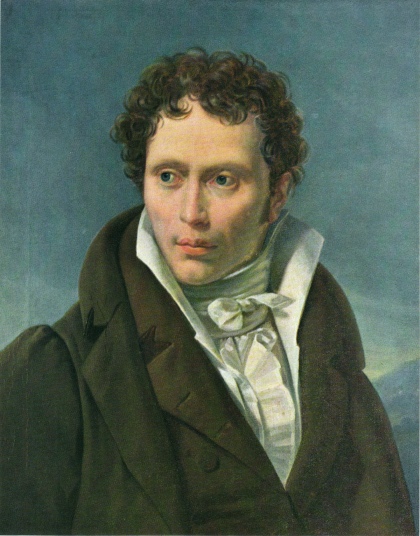
Arthur Schopenhauer, portrait by Ludwig Sigismund Ruhl 1815, public domain via Wikimedia Commons

Despite reflecting on the good life for more than 2,500 years, philosophers have not had much to say about middle age. For me, approaching 40 was a time of stereotypical crisis. Having jumped the hurdles of the academic career track, I knew I was lucky to be a tenured professor of philosophy. Yet stepping back from the busyness of life, the rush of things to do, I found myself wondering, what now? I felt a sense of repetition and futility, of projects completed just to be replaced by more. I would finish this article, teach this class, and then I would do it all again. It was not that everything seemed worthless. Even at my lowest ebb, I didn’t feel there was no point in what I was doing. Yet somehow the succession of activities, each one rational in itself, fell short.

I am not alone. Perhaps you have felt, too, an emptiness in the pursuit of worthy goals. This is one form of midlife crisis, at once familiar and philosophically puzzling. The paradox is that success can seem like failure. Like any paradox, it calls for philosophical treatment. What is the emptiness of the midlife crisis if not the unqualified emptiness in which one sees no value in anything? What was wrong with my life?

In search of an answer, I turned to the 19th-century pessimist Arthur Schopenhauer. Schopenhauer is notorious for preaching the futility of desire. That getting what you want could fail to make you happy would not have surprised him at all. On the other hand, not having it is just as bad. For Schopenhauer, you are damned if you do and damned if you don’t. If you get what you want, your pursuit is over. You are aimless, flooded with a ‘fearful emptiness and boredom’, as he put it in The World as Will and Representation (1818). Life needs direction: desires, projects, goals that are so far unachieved. And yet this, too, is fatal. Because wanting what you do not have is suffering. In staving off the void by finding things to do, you have condemned yourself to misery. Life ‘swings like a pendulum to and fro between pain and boredom, and these two are in fact its ultimate constituents’.

Schopenhauer’s picture of human life might seem unduly bleak. Often enough, midlife brings with it failure or success in cherished projects: you have the job you worked for many years to get, the partner you hoped to meet, the family you meant to start – or else you don’t. Either way, you look for new directions. But the answer to achieving your goals, or giving them up, feels obvious: you simply make new ones. Nor is the pursuit of what you want pure agony. Revamping your ambitions can be fun.

Still, I think there is something right in Schopenhauer’s dismal conception of our relationship with our ends, and that it can illuminate the darkness of midlife. Taking up new projects, after all, simply obscures the problem. When you aim at a future goal, satisfaction is deferred: success has yet to come. But the moment you succeed, your achievement is in the past. Meanwhile, your engagement with projects subverts itself. In pursuing a goal, you either fail or, in succeeding, end its power to guide your life. No doubt you can formulate other plans. The problem is not that you will run out of projects (the aimless state of Schopenhauer’s boredom), it’s that your way of engaging with the ones that matter most to you is by trying to complete them and thus expel them from your life. When you pursue a goal, you exhaust your interaction with something good, as if you were to make friends for the sake of saying goodbye.

Hence one common figure of the midlife crisis: the striving high-achiever, obsessed with getting things done, who is haunted by the hollowness of everyday life. When you are obsessed with projects, ceaselessly replacing old with new, satisfaction is always in the future. Or the past. It is mortgaged, then archived, but never possessed. In pursuing goals, you aim at outcomes that preclude the possibility of that pursuit, extinguishing the sparks of meaning in your life.

The question is what to do about this. For Schopenhauer, there is no way out: what I am calling a midlife crisis is simply the human condition. But Schopenhauer was wrong. In order to see his mistake, we need to draw distinctions among the activities we value: between ones that aim at completion, and ones that don’t.

Adapting terminology from linguistics, we can say that ‘telic’ activities – from ‘telos’, the Greek work for purpose – are ones that aim at terminal states of completion and exhaustion. You teach a class, get married, start a family, earn a raise. Not all activities are like this, however. Others are ‘atelic’: there is no point of termination at which they aim, or final state in which they have been achieved and there is no more to do. Think of listening to music, parenting, or spending time with friends. They are things you can stop doing, but you cannot finish or complete them. Their temporality is not that of a project with an ultimate goal, but of a limitless process.

If the crisis diagnosed by Schopenhauer turns on excessive investment in projects, then the solution is to invest more fully in the process, giving meaning to your life through activities that have no terminal point: since they cannot be completed, your engagement with them is not exhaustive. It will not subvert itself. Nor does it invite the sense of frustration that Schopenhauer scorns in unsatisfied desire – the sense of being at a distance from one’s goal, so that fulfilment is always in the future or the past.

We should not give up on our worthwhile goals. Their achievement matters. But we should meditate, too, on the value of the process. It is no accident that the young and the old are generally more satisfied with life than those in middle age. Young adults have not embarked on life-defining projects; the aged have such accomplishments behind them. That makes it more natural for them to live in the present: to find value in atelic activities that are not exhausted by engagement or deferred to the future, but realised here and now. It is hard to resist the tyranny of projects in midlife, to find a balance between the telic and atelic. But if we hope to overcome the midlife crisis, to escape the gloom of emptiness and self-defeat, that is what we have to do.Aeon counter – do not remove

This article was originally published at Aeon and has been republished under Creative Commons.

Kieran Setiya is a professor of philosophy at the Massachusetts Institute of Technology. His latest book is Midlife: A Philosophical Guide (2017). He lives in Brookline, Massachusetts. (Bio credit: Aeon)

~ Ordinary Philosophy is a labor of love and ad-free, supported by patrons and readers like you. Any support you can offer will be deeply appreciated!

*All views and opinions expressed by guest writers are their own and do not necessarily reflect those of Ordinary Philosophy’s editors and publishers

Some of the Mysteries of Good Character, by Christian B. Miller

The topic of character is one of the oldest in both Western and Eastern thought, and has enjoyed a renaissance in philosophy since at least the 1970s with the revival of virtue ethics. Yet, even today, character remains largely a mystery. We know very little about what most peoples’ character looks like. Important virtues are surprisingly neglected. There are almost no strategies advanced by philosophers today for improving character. We have a long way to go.

We do know, though, that matters of character are vitally important. Consider the news these days, dominated by people like Harvey Weinstein and Kevin Spacey. Or consider the behavior of our heroes, like Lincoln and King, or our villains, like Hitler and Stalin. Or consider the latest scandals in the entertainment world, professional sports, or politics. So much of what has happened can be traced back to the character of the people involved. And to take it one step further, thanks to the latest psychological research, character traits have been linked to all kinds of things that we care about in life: optimism, academic achievement, mood, health, meaning, life satisfaction…the list goes on and on.

To say that philosophers—who have been studying character extensively for thousands of years—are mostly in the dark about the topic, surely sounds like I am exaggerating, right? Maybe that’s true, but let me offer two concrete illustrations.

1. Neglected Virtues. The moral virtues are good character traits like justice, temperance, and fortitude. Here are two questions (among many others) you can ask about these virtues. First, conceptually, what do they involve? How, for instance, would you characterize a temperate person? Or a heroic one? Secondly, on empirical grounds, do people actually have the virtues (and if so, how many people and which virtues)? For instance, are there actually any temperate people today?

To help with the empirical question, there has been a recent flurry of interest among philosophers in consulting studies in psychology, and thinking about whether the behavior displayed in those studies is virtuous or not. For a virtue like compassion, real progress has been made in reading the relevant studies carefully, with the conclusion being that most people are not in fact compassionate. Unfortunately, philosophers don’t have much of an idea about what is going on empirically with most of the other virtues (and I’m not sure anyone else does either, for that matter). Part of the reason why is that for some moral virtues there just isn’t the wealth of existing studies to analyze, in the way that there is for compassion. Stealing is a good example—as you might imagine, it is hard to do helpful experimental studies of theft.

But part of the reason is also that some virtues have simply not been on our philosophical radar screens. The attention of philosophers has been elsewhere.

Take the virtue of honesty, for instance. If any virtue is on most people’s top five list, it is that one. Yet it has had no traction at all in the philosophy literature. In fact, there has not been a single paper in a mainstream philosophy journal on the moral virtue of honesty in over fifty years.

Or take the virtue of generosity—just three papers in the past forty years (by way of comparison, there are over two dozen papers on the virtue of modesty—who would have expected that to happen!).

So the upshot is that compassion is likely to be a rare virtue. But at this point it is not at all clear how we are doing with the rest of them. Indeed, in some cases we are not even clear what the virtues look like in the first place.

2. Virtue Development. The natural suspicion, of course, is that across the board we are not doing very well when it comes to being people of good moral character. History, current events, the local news, and social media all seem to confirm this. Hence it seems apparent that there is a sizable character gap:

There are moral exemplars, people like Abraham Lincoln and Sojourner Truth, whose character is morally virtuous in many respects.

Examining their lives ends up reflecting badly on most of us, myself included, since it illustrates in vivid terms just how much of a character gap there really is.

To try to at least reduce this gap, it would be helpful to have some strategies which can, if followed properly, help us to make slow and gradual progress in the right direction. Naturally philosophers needn’t be the only ones who can come up with these strategies, but it would be nice if we had something to say that is practically relevant, empirically informed, and actually efficacious if carried out properly.

By and large, we haven’t had much to say. But there are signs that this is beginning to change, thanks to the work of Nancy Snow, Julia Annas, Jonathan Webber, and a few others. In fact, the development of character improvement strategies strikes me as one of the most promising areas of philosophy in the coming decade. Many good and innovative dissertations are there for interested graduate students to tackle.

My hope is that this groundswell of interest in how to cultivate the virtues will continue to expand in the coming years. These are indeed early days in the philosophical study of character. And exciting days too, full of so many worthwhile possibilities to explore.

This article was originally published at OUPBlog.

Christian B. Miller is the A. C. Reid Professor of Philosophy at Wake Forest University and author or editor of eight books including The Character Gap: How Good Are We? (Bio credit: OUPBlog)

~ Ordinary Philosophy and its Traveling Philosophy / History of Ideas series is a labor of love and ad-free, supported by patrons and readers like you. Please offer your support today!

*All views and opinions expressed by guest writers are their own and do not necessarily express those of Ordinary Philosophy’s editors and publishers