Faster Horses (The Cowboy and the Poet)

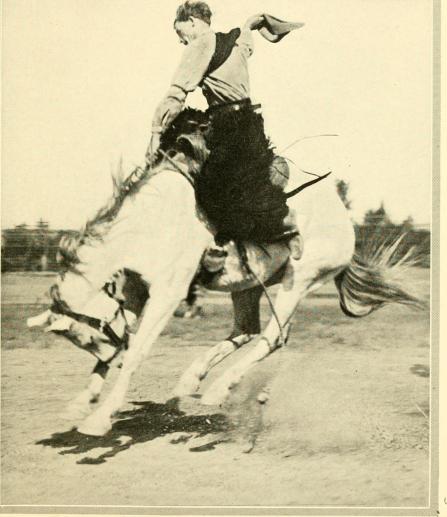
Let'er buck, 1921 by Charles Wellington Furlong, public domain via Wikimedia Commons

‘…He was an old philosopher, of course!’

This song never fails to make me smile. Thanks for the song, Tom T. Hall!

~ Ordinary Philosophy and its Traveling Philosophy / History of Ideas series is a labor of love and ad-free, supported by patrons and readers like you. Please offer your support today!

Seneca: On Tranquility of Mind, by Massimo Pigliucci

Another excellent piece by one of my favorite philosophers in the public square. I, for one, would do well to heed Seneca’s advice: I often find myself stressed and overwhelmed by running around too much and just doing, doing, doing, without enough reflection on whether or not it’s most conducive to my well-being and to the overall success of my endeavors. Thanks, Massimo, for bringing the wisdom of Stoicism to the hectic modern world!

David Hume, the Skeptical Stoic, by Massimo Pigliucci

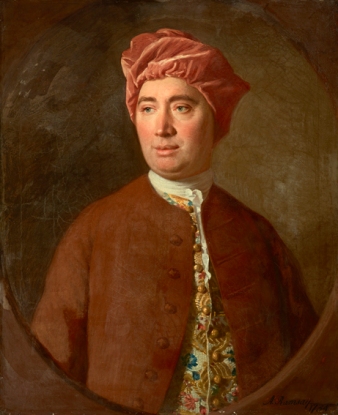
c9bd8-portrait2bof2bdavid2bhume2bby2ballan2bramsey252c2b1754252c2bscottish2bnational2bgallery252c2bpublic2bdomain2bvia2bwikimedia2bcommonsI have always been a philosophical fan of David Hume. His clear writing, commonsense approach to things, rejection of abstruse philosophizing, embracing of science, and constructive skepticism have been the sort of traits I have aspired to, however imperfectly (no, I assure you this ain’t false modesty), throughout my career. Hume’s idea that a wise person proportions beliefs to evidence, later popularized (and somewhat distorted) by Carl Sagan in the motto “extraordinary claims require extraordinary evidence” has guided me for many years, hopefully leading me to make as sound judgments as possible, as well as to change them when the cumulative evidence requires it. Add to this that le bonne David, as he was known in the Parisian salons of the Enlightenment, had a generally mild and pleasant character, and you get the features of an intellectual role model. A Stoic, however, David Hume certainly wasn’t. Or was he?

A recent article by Matthew Walker in the British Journal for the History of Philosophy (2013) tackles the question in an interesting way. Walker focuses on four essays in which Hume explores the nature of “the true philosopher,” simply entitled “The Epicurean,” “The Stoic,” “The Platonist,” and “The Sceptic.” Hume, who does not write in his own voice, but attempts an analysis of each school by writing as if he were a member (just like Cicero had done in his De Finibus, which Hume used as a model for his own essays), seems far more sympathetic to the Stoics and the Skeptics then to the Epicureans and the Platonists.

Walker, then, explores an apparent contradiction in the way Hume talks about Stoicism and Skepticism: on the one hand, he accepts the Stoic tenet that there is a way of life that the true philosopher attempts to follow, and that it is the best life possible. On the other hand, however, he also agrees with the Skeptics that there is no single way of achieving happiness. What gives? The answer, Walker suggests, lies in Hume’s flexible concept of how a true philosopher should live.

Let’s begin with Hume’s presentation of the Stoic point of view. It hinges on three theses: i) virtue-eudaimonism, the idea that virtue is the primary contributor to the happy life; ii) the reflection thesis, whereby the true philosopher guides his actions by reflection, the same way he develops and maintains his character; and iii) the supremacy thesis, the proposition that this is the best life for a human being.

Walker provides a nice analysis of Hume’s commitment to virtue-eudaimonism — the first of the three Stoic theses — albeit in a qualified fashion. He does think that the “sole purpose [of virtue] is, to make her votaries and all mankind … cheerful and happy,” but then distinguishes different virtues according to their specific contributions. So we have virtues that are immediately “agreeable” to oneself (cheerfulness and pride), those that free us from harmful behaviors (discretion, industry and frugality), virtues that are immediately good for others (wit), and those that are good for others in the long run (humanity, generosity, beneficence). Interestingly, Hume’s take come close to that of a minority opinion within ancient Stoicism, as expressed for instance by Panaetius, of whose thought Hume was aware.

Hume is also committed to the reflection thesis, the second one advanced by the Stoics. Here he takes a cue from a famous phrase by the poet Ovid: “A faithful study of the liberal arts humanizes character and permits it not to be cruel,” meaning that learning and reflection do make crucial contributions to a worthwhile human life. For Hume, philosophical reflection can help both negatively, by “extinguishing” violent passions, and positively, by improving our sensitivity to agreeable passions. Importantly, Hume doesn’t think that simply thinking about stuff improves our character and conduct, but he maintains that rational reflection can be used to change behavior and that, through repetition and habituation, one eventually can alter his character and disposition for the best. Needless to say, this is very similar to the Stoic doctrine of the gradual development and practice of virtue.

What about the supremacy thesis? That’s where things get interesting. Hume’s Skeptic answers the Stoic by saying that only a philosopher could be so blind as to think that the life of reflection is the only path to happiness. Plenty of people are happy by pursuing different lives, resulting in a type of pluralism that appears incompatible with the supremacy thesis. Moreover, Hume agrees with the Skeptic that the powers of philosophical reflection are limited, and so is their efficacy on strong passions like anger and ambition.

Hume attempts at synthesizing the two schools (just like Cicero’s before him), beginning with the contention that the Skeptic “carries the matter too far” in his criticism of philosophical reflection. Sure, one’s anger doesn’t go away because of one’s philosophizing, but critical reflection makes us see that anger is a destructive passion, therefore inducing us to take steps to curtail it, if not extinguish it. The Skeptic is right in thinking that reflection by itself cannot instill virtue, but the ancient Stoics did not think this either, hence their above mentioned developmental psychological account of virtue, from children before the age of reason to mature adults.

Also, Hume again agrees with the Skeptic that Stoicism can be used to conceal cold-heartedness and self-absorption, but counters that in effect those would be cases of bad Stoicism, as the philosophy itself only counsels a reasonable detachment from externalities, nothing more. Stoics, in other words, do not attempt to extirpate passions, but to moderate and redirect them.

The core of Walker’s argument, however, is that Hume reconciles Stoic and Skeptic positions, rescuing the supremacy thesis, by suggesting that there are two types of “philosophical” lives: narrow and broad. Walker’s analogy with religion here is brilliant and very helpful: we have no trouble understanding that religion can guide, and be central to, the lives of people. But we don’t translate that into the absurd idea that everyone should be a monk. Rather, we recognize a religious life narrowly defined, which is attractive to a few people, who achieve a meaningful existence through contemplation, prayer and the study of scriptures. But we also recognize a broadly defined religious life, which is practicable by most people, which still provides meaning and requires certain practices and studies, but that is also compatible with a number of other, non-religious aspects of existence. This is the case across religious traditions, from Christianity to Buddhism.

Analogously, says Hume, a few people can live the life of the philosopher in the narrow sense, i.e., spend most of their time reading and writing philosophy at a fairly abstract level, treating it almost as a monastic practice. But most of us can live a “philosophical” life in the sense of reading and reflecting about certain principles and attempting to put them into everyday practice, while at the same time engaging in other, more common, pursuits, what the Stoics call “preferred indifferents.”

The Stoic position, then, becomes untenable for Hume if they meant that only the narrow philosophical life is conducive to happiness. But they clearly did not. Just like there were Stoics who did live that life — Zeno, Chrysippus, Musonius Rufus, Epictetus — there were others who lived a Stoic life in the broad sense, including Cato and Marcus Aurelius.

As Walker concludes his essay, his analysis shows both that Hume keeps being fresh and relevant today, and that a Humean account of Stoicism-Skepticism demonstrates “how the ancient conception of philosophy as a way of life remains a conception worth examining even today.”

~ This piece was originally published on Massimo’s blog How to Be a Stoic on April 22, 2016

~ Massimo Pigliucci is K.D. Irani Professor of Philosophy at the City University of New York and member of the faculty at CUNY’s Graduate Center. Massimo has a background in evolutionary biology and philosophy of science. His most recent book, co-edited with Maarten Boudry, is Philosophy of Pseudoscience: Reconsidering the Demarcation Problem (Chicago Press).

~ Ordinary Philosophy and its Traveling Philosophy / History of Ideas series is a labor of love and ad-free, entirely supported by patrons and readers like you. Please offer your support today!

O.P. Recommends: Ordinary Language Philosophy, by Melvin Bragg and Guests

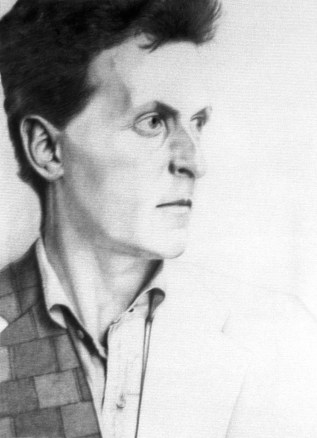
Drawing of Ludwig Wittgenstein by Christiaan Tonnism, Pencil on board 1985, Creative Commons via Wikimedia CommonsFrom time to time, like anyone who publishes online, I do an online search for ‘Ordinary Philosophy’ to see what comes up. Without fail, the first results are a list of articles and discussions on ordinary language philosophy. It recently occurred to me that I should discuss ordinary language philosophy with my readers, not only because it’s such an interesting and influential school of philosophical thought, but because it likely influenced the name ‘Ordinary Philosophy’. I say ‘likely’ because, though I have no memory of having ordinary language philosophy on my mind at the time, my familiarity and interest with it no doubt kept the phrase stored in my mind, easily recalled through some sort of unconscious word association.

This school of thought holds that problems and contradictions in philosophy arise chiefly through confusing language as actually used in everyday discourse with technical language, or terms abstracted from ordinary usage and understood to have discrete, consistent definitions. A ready example is eternity. What is eternity?  What do we mean by ‘eternity’? Are these two questions asking the same thing in different ways or are they actually asking two different questions? If, for example, we understand eternity to mean an infinite duration of time, how does this make sense if we know time to have at least one defining boundary, its beginning at the big bang? Do we mean just one thing when we talk about eternity, as in the example of religious doctrines which hold that all souls have eternal life, or does it have a variety of very different but equally valid meanings, such as in this example of a common usage ‘this water is taking an eternity to boil’. If eternity has only has one or a limited set of valid meanings, why is/are these meaning(s) valid and not others?

The brilliant Melvin Bragg, author and radio host and documentarian par excellence (his video series on the history of the English language The Adventure of English is among my very favorite documentary series) discusses ordinary language philosophy with philosophers Stephen Mulhall, Ray Monk, and Julia Tanney on his program In Our Time on BBC’s Radio 4. This discussion is comprehensive and very interesting, and there are few hosts better than Bragg at keeping the discussion clear, orderly, and comprehensive. He makes sure to require his interviewees to define and clarify their terms and provide the necessary background before getting too technical. However, if you happen to find the tone and style of academic discourse rather dry, this discussion may be a little hard to listen to with full attention all the way through. Still, I think it an excellent introduction to ordinary language philosophy, and I’ve included a short list of links below of other very helpful resources for better understanding this interesting and important school of thought.

After all, there are many ways we actually express the same ideas, and some are more effective than others at promoting understanding depending on the listener. So, while some might prefer Bragg’s style of moderated academic discussion, others might find Sally Parker-Ryan’s entry in the Internet Encyclopedia of Philosophy much more clear and enjoyable to read. The variety of ways we express and understand things is among the very problems that ordinary language philosophy may be particularly helpful in figuring out.

~~~~~~~~~~~~~~~~~~~~~

Sources and inspiration:c

Blackburn, Simon. ‘Philosophy of Language: Ordinary Language Philosophy‘. Encyclopædia Britannica

Bragg, Melvin, Stephen Mulhall, Ray Monk, and Julia Tanney.’Ordinary Language Philosophy‘. In Our Time, BBC Radio 4

Magee, Bryan and John Searle. ‘John Searle on Ludwig Wittgenstein‘ video series.

Parker-Ryan, Sally. ‘Ordinary Language Philosophy‘. The Internet Encyclopedia of Philosophy


O.P. Recommends: Some Pragmatic Considerations Against Intellectualism about Belief, by Eric Schwitzgebel

A Trail in Redwood Park, photo 2016 by Amy CoolsAs you may have noticed, I often recommend pieces by Eric Schwitzgebel; of course, that’s because his work is fantastic, and I’m always looking forward to his new posts.

This one’s about understanding why and how we believe, and especially, what our behavior reveals about the true nature of our beliefs. Schwitzgebel offers a succinct and to my mind, convincing criticism of the idea that we have certain beliefs but just often fail to live up to them. Instead, he places the emphasis on observing behavior as a more reliable and accurate indicator of what we in fact do believe.

This is a sobering thought, since it means that the way we like to comfort ourselves when we don’t behave as we think we should isn’t really valid: ‘I meant well! And I’ll do better next time because I really believe in….’ This kind of excuse it always readily available to us in the intellectualist model of belief as Schwitzgebel describes it, but really, what’s the practical use of saying we believe something something then if we consistently give ourselves this kind of ‘out’?  In this way, it’s closely related to the Socratic argument that there’s no such thing as weakness of will, since if we actually believe something, it makes no sense to think we actually could act otherwise. And it seems to me to go beyond pragmatism: if belief and behavior are considered separately, the former seems to lose a good deal of meaning, seeming a disembodied, impersonal thing that doesn’t seem so much to describe the actual world, or an actual person so much as something very abstract, very removed.

But it’s also an encouraging thought. For one, it helps us be more honest about who we really are and why we do what we do; as Schwitzgebel points out, this understanding of belief makes us more responsible for not only our reactions but our beliefs, and therefore gives us more control over them. Which ties into: this view of belief fits in neatly with the ‘fake it ’til you make it’ approach to self improvement. Perhaps our intellect tells to us that there’s a better way to behave, or that there’s a proposition we should accept since upon consideration, it appears to be the truth, but the way we act so far doesn’t accord with this intellectual discovery. How to resolve this uncomfortable cognitive dissonance? Why, change our behavior! Not only will it change our habits over time, it helps turn our intellectual considerations into conviction, or part of our mental makeup as not only thinking, but believing beings.

Ordinary Philosophy and its Traveling Philosophy / History of Ideas series is a labor of love and is ad-free, entirely supported by patrons and readers like you. Please offer your support today!

~~~~~~~~~~~~~~~~~~~~~~~~~~~~

Sources and inspiration:

Schwitzgebel, Eric. ‘Some Pragmatic Considerations Against Intellectualism about Belief, The Splintered Mind blog, April 07, 2016.

Stroud, Sarah, “Weakness of Will“, The Stanford Encyclopedia of Philosophy (Spring 2014 Edition) Edward N. Zalta (ed.)

Pounding on a Tub: A Short Essay on Zhuangzi, Death, and the Logos by Ryan V. Stewart

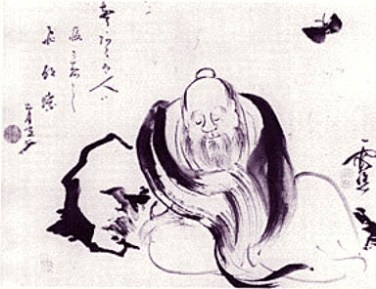
Zhuangzi Butterfly Dream by Ike no Taiga, Japan, 1723-1776, Public domain via Wikimedia CommonsTaoism, to my mind, is one of the world’s most intriguing philosophical and religious traditions. Uniquely Chinese, and yet deeply universal in its message, Taoism, perhaps more than any other mystical system, emphasizes simplicity, mystery, awe, tranquility, spontaneity, and naturalness. (Though Zen Buddhism, as well as Stoicism—granted, not a form of mysticism per se—would give it a run for its money.)

In the past few centuries, growing intrigue in this tradition has brought about a slew of inquiries from spiritually-conflicted Westerners and Orientalist anthropologists, as well as mystics and philosophers then-unfamiliar with, and those still curious about, Taoist and Chinese thought. This includes the general barrage of “big questions” that the world’s religions so often provide answers for: Why am I here? What is my purpose? What happens when I die?

It is this last question—What happens when I die?—that I’d like to focus on here, including, for consideration, the perspective of a very famous—and this is unsurprising—Taoist.

Alongside Laozi—said to be the author of the eponymous Laozi, or Tao Te Ching—there is one other great philosopher who shaped the development of Taoist philosophy: This is Chuang-tzu (or Zhuangzi, as his name is also transliterated), regarded by many as the penultimate thinker or sage in the current of philosophical Taoism. Chuang-tzu’s book, often (as with Laozi) titled after his own name, reads as a series of parables and short stories—many humorous—whereas Laozi’s text is more of a work of verse or creative prose, steeped in obscure symbolism. Either way, the Chuangzu, like its earlier counterpart, touches on both metaphysics and ethics, laying out the way in which action—namely action which is virtuous (de) and “effortless” (wu wei)—follows from a deep understanding of the fundamental nature of oneself and the cosmos, both reifying and stemming from an existence marked by tranquility and happiness. To the individual who has realized the nature of things, being at peace, time and change present no problem. And thus death, an aspect of life so many of us are even wary of discussing, is—as with all things appropriate to nature in its own element—nothing perturbing, and merely a transformation.

On that note, Chuang-tzu’s views on death are perhaps best articulated in a parable concerning his wife’s passing:

The parable, set after the death of Chuang-tzu’s wife, tells us that the sage’s friend, Hui Shih, has come to Chuang-tzu to offer his condolences. To his surprise, Hui Shih—expecting to see a man in mourning—finds Chuang-tzu celebrating by singing and pounding on a tub.

Hui Shih, understandably surprised, asks Chuang-tzu about his apparent dispassion towards his wife’s passing, saying, “You lived with her, she brought up your children and grew old. It should be enough simply not to weep at her death. But pounding on a tub and singing—this is going too far, isn’t it?”

Chuang-tzu then replies, “You’re wrong. When she first died, do you think I didn’t grieve like anyone else? But I looked back to her beginning and the time before she was born. Not only the time before she was born, but the time before she had a body. Not only the time before she had a body, but the time before she had a spirit. In the midst of the jumble of wonder and mystery a change took place and she had a spirit. Another change and she had a body. Another change and she was born. Now there’s been another change and she’s dead. It’s just like the progression of the four seasons, spring, summer, fall, winter.

Now she’s going to lie down peacefully in a vast room. If I were to follow after her bawling and sobbing, it would show that I don’t understand anything about fate. So I stopped.” (Zhuangzi, 191-192.)

Chuang-tzu’s reply is consistent with the overall passivity of Taoist thought. In Taoism, emphasis is placed on the acceptance of natural order, and of understanding and living in accordance with the actual nature of things, as opposed to one’s judgments of, or mental impositions upon, the world. (On this note, Chuang-tzu’s “If I were to follow after her bawling and sobbing, it would show that I don’t understand anything about fate,” is sometimes translated as “for me to go about weeping and wailing would be to proclaim myself ignorant of the natural laws.”) Part of this order is the universe’s constant state of flux and, as such, death for Chuang-tzu is more so a transformation than a stopping point—merging, and becoming inseparable from the world, rather than merely dissolving. (The “vast room,” as Chuang-tzu calls it, is sometimes translated as “the great mansion of the universe.”)

Thus we see Chuang-tzu’s exemplification of the Taoist master as an individual who accepts the world on its own terms. The master is also one who, in some manner, observes or experiences the constant principle—the ineffable Tao, or “Way”—which remains behind the mundane state of transience, being its source, essence, and end. Nature (in all its transitions), here represented by the four seasons, performs different operations—albeit indifferently—its cyclical nature a symbol of something greater than mere beginnings and passings away. Hence, aware of the union of the metaphysical and the purely natural, a Taoist sage (zhenren or shengren) is at ease in the world.

Such a perspective seems so simple, and yet pervasive, that one could consider it almost perennial. Another strain of metaphysics in which we observe the wholesale acceptance of change (and a kind of mysterious monism to complement it) is that of the ever-obscure Heraclitus, whose Logos(“Word” or “the Word”) is in certain ways a sort of Western (or Greek) Tao. While Heraclitus in many ways remains as much a legend as, and his sayings even more disorganized than those of, Laozi, the principle of the Logos is the main feature of his philosophy, and provides a parallel to the Tao. To this effect Heraclitus famously states, “This logos holds always but humans always prove unable to understand it, both before hearing it and when they have first heard it. For though all things come to be in accordance with this logos, humans are like the inexperienced… distinguishing each in accordance with its nature and saying how it is.” (Heraclitus, 98.) Chuang-tzu, exemplifying the impartial and natural philosophy of a Taoist sage, shows us how, in understanding the nature of change and death, one follows and lives in accordance with a perennial understanding, not bound by particular traditions, but available through a common reasoning and intuition regarding the operations of the universe. Through such common reasoning, Heraclitus was not far off the mark, if at all.

Heraclitus’s Logos, moreover, implies not only an order to be found in the natural world, but in human action, as well. Humans are, after all, just as much part of the Logos as anything else. (Similarly, in Taoism, a human being is considered a microcosm of the universe, and in Marcus Aurelius’s Stoicism the individual is treated as a subset of “the Whole.”) Thus, on the topic of human conduct, Heraclitus notes, “Speaking with understanding they must hold fast to what is shared by all, as a city holds to its law, and even more firmly. For all human laws are nourished by a divine one. It prevails as it wills and suffices for all and is more than enough.” (Heraclitus, 43.) Heraclitus also delves more deeply, into the constituents of human wellbeing, on which topic he contends that “Thinking well is the greatest excellence: to act and speak what is true, perceiving things according to their nature,” (Heraclitus, 43) and that “Wantonness needs putting out, even more than a house on fire.” Together these passages suggest that wisdom and goodness consist of perceiving things truthfully, as they are, and that one’s acceptance of and contentment with nature leads to real happiness.

Chuang-tzu, as a Taoist, maintains a similar position, though with a twist: The sage’s passivity, part of his deep appreciation for the reality of change—as demonstrated in the parable of his wife’s death—can be understood as an example of the aforementioned wu-wei, or “non-doing.” (Roughly.) Wu-wei implies an action, behavior, or process which is “effortless,” supremely efficient by virtue of avoiding all that is needless. Any obstacle or struggle is rendered a non-concern when one acts in terms of wu-wei—thus in accordance with the Tao. Hence, all the simplest things in life exemplify the principle of wu-wei by virtue of their doing, and doing-with, so little.

As is noted in section 18 of the text of the Zhuangzi, Chuang-tzu says, “I take inaction to be true happiness, but ordinary people think it is a bitter thing. I say: perfect happiness knows no happiness, perfect praise knows no praise. The world can’t decide what is right and what is wrong. And yet inaction can decide this. Perfect happiness, keeping alive—only inaction gets you close to this.

“Let me try putting it this way: The inaction of Heaven is its purity, the inaction of earth is its peace…” (Zhuangzi, 191.)

Note here that wu-wei—“inaction”—is sometimes translated (more accurately) as “actionless action,” and that the first two lines of Chuang-tzu’s poem (after “Let me try putting it this way…”) has more recently been rendered as “Heaven does without through its purity, / Earth does without through its calmness…”

Heaven and earth, primordial elements of the Chinese mythological cosmos, are at ease in their ancient perfection, achieved through nothing and achieving everything without effort. The sage, in seeking to emulate the Tao as it is presented in and by the world, becomes indifferent, as the universe is indifferent, and thus has no trepidations in regards to death. The sage understands that he, and those individuals around him, are merely manifestations of the absolute Way. Thus, what can death be to him who is indifferent toward change, however great or small? Death, for the sage, is merely “the beginning,” and a continuation of the “life” of the cosmos and, indeed, the Tao—the Way.

About the author ~ Ryan V. Stewart is a writer and student from Connecticut. He has been actively writing since 2006, and blogs about everything from mysticism and philosophy to environmental issues, the arts, and personal peeves at The Grand Tangent. He’s interested in the intersection of mysticism, comparative religion, and philosophical analysis (among other things). 

~ Ordinary Philosophy and its Traveling Philosophy / History of Ideas series is a labor of love and is ad-free, entirely supported by patrons and readers like you. Please offer your support today!

Bibliography

  • The Complete Works of Zhuangzi. Trans. Burton Watson. New York, NY: Columbia UP, 1968. Print.
  • The Art and Thought of Heraclitus: An Edition of the Fragments with Translation and Commentary. Trans. Charles H. Kahn. Cambridge, UK: Cambridge UP, 1979. Print.

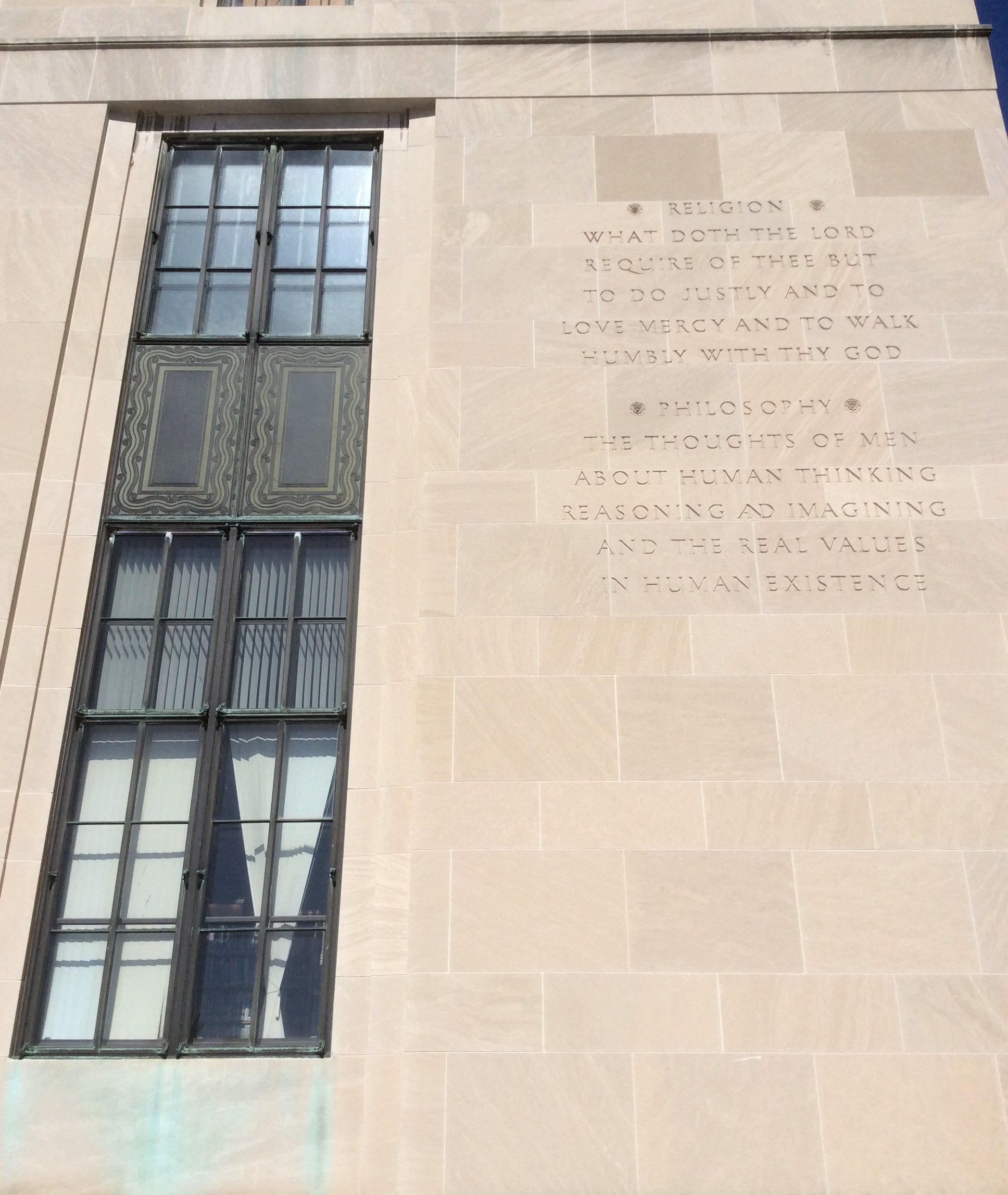
Spotted: A Definition of Philosophy and of Religion on a Library Wall

Definition of Philosophy and Religion on Rundel Library Building, Rochester, photo 2016 Amy CoolsThe other day, I spotted these definitions of Religion and Philosophy.

They’re engraved on the side of the handsome Rundel Memorial Building of the downtown Central Library of Rochester and Monroe County.

What do you think of these definitions?

Like the author(s), do you think religion and philosophy are two separate things, one dealing strictly with human thought and affairs, and the other with aligning human will to the divine?

Ordinary Philosophy is Pleased to Introduce Eric Gerlach

Eric GerlachHello dear readers,

I’m so pleased to welcome Eric Gerlach as a regular contributor to Ordinary Philosophy!

Eric was my teacher some years ago when I returned to college to study philosophy. I attended his Introduction to Philosophy class, and it very much inspired and influenced me to this day. In the class, he emphasized and explained the connections between human thought in all times and places in a friendly, warm, and easygoing style, and ancient philosophy from all over the world seemed as relatable, timely, and relevant today as it ever was. He still teaches this excellent class, which I very much recommend if you’re ever enrolled at Berkeley City College. I’ve been continuing to enjoy his work at his blog for some years now.

I’m so thrilled that Eric accepted my invitation to lend his voice to Ordinary Philosophy, and I’m sure you’ll find his work as interesting and edifying as I always do. Please join me in extending Eric a warm welcome to O.P.!

~ Amy Cools, creator and editor of Ordinary Philosophy


Confucianism & Daoism: The Basics

The following is a lecture I composed for teaching Confucianism and Daoism to my sister’s 6th grade History class at Star of the Sea School in San Francisco.

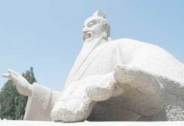
Confucius_Sculpture,_Nanjing

Confucius and Laozi, the philosophers who founded Confucianism and Daoism, lived just before the Warring States Period of ancient China (476 – 221 BCE), a time of war, tragedy and interest in philosophy.  Unfortunately, people’s lives are full of problems, but fortunately problems make people think about their lives, question the answers of authorities and experts, and reason beyond their understandings.

Laozi

Each of us, as individuals, should use both belief and doubt to become better, wiser people, but how should we go about doing this?  Confucianism and Daoism, the two great philosophies of ancient China, gave people opposing ways to gain wisdom.  Many in ancient and modern times used both to compliment and extend each other.

The Confucians say we should build ourselves up to be educated, compassionate and civilized, while the Daoists say we should clear ourselves out to become open-minded, patient and peaceful.  The Confucians say we should learn from others, reason for ourselves, and do what we know to be right.  The Daoists say we should seek less for ourselves and gain perspective beyond our own interests, reasons and actions.

Confucius, the Golden Rule & Learning from Everyone

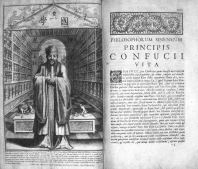
Confucius Latin

When Catholic Jesuit missionaries arrived in China in the 1600s, they were astounded to find that Confucius, the most influential and central Chinese philosopher, was incredibly similar to Jesus in his sayings and teachings.  First and foremost, like Jesus, Buddha, Muhammad and other revered teachers, Confucius taught what has been called the Golden Rule: Do for others what you would want them to do for you, and do not do to others what you do not want done to yourself.  Confucius said that this was the single thing that should guide one’s life, and that compassion is the central thread running throughout his thinking.

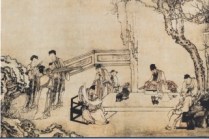
chinese-scholars1

Confucius’ student Zigong once told his teacher, “I do not want to do to others what I do not want them to do to me.”  Confucius replied, “You have not come that far yet”, probably because none of us want others to simply tell us that they are amazing.  Another time, Confucius heard Zigong criticizing other people, and said, “Zigong must have already reached perfection, which affords him leisure I do not possess.”  Confucius is being sarcastic, as he often said that no one is perfect, but anyone can be excellent by continuously working to become better.

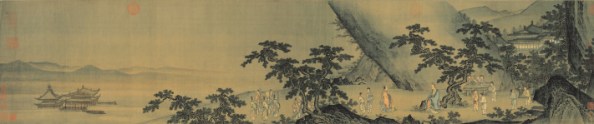
confucius-teaching-hillside-painting

Not only can anyone be excellent, but we can each learn from anyone about how to be better ourselves.  Confucius taught that when we see great people, we should seek to be like them, but when we see horrible people, we should seek how we are like them by examining ourselves.  Confucius said, “Put me with any two people at random and they will always have something to teach me, as I can take their qualities as a model and their defects as a warning.  Clearly, Confucius believed that we all share the same set of strengths and faults, no matter how talented (or horrible) we happen to individually be or where our talents are.

emperor-shun-of-china

Because no one is perfect and everyone can learn from anyone, there is no one who is above criticism, not even the prince of the state.  When asked by a duke if there is a single thing that could ruin a country, Confucius said that if the prince is never told when he is in error or contradicted, it could be the ruin of everyone.  About himself, Confucius said, “I am fortunate indeed… Whenever I make a mistake, there is always someone who notices it.”

chinese-painting-inquiring-about-the-dao

Daoism, Perspective & Less is More

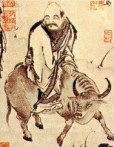
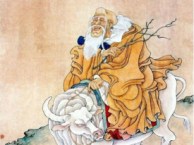
laozi-water-buffalo

The legendary Daoist sages Laozi, Zhuangzi and Liezi taught that human perspectives are limited, and we should always keep this in mind.  Because we only have partial perspectives, we should keep in mind that others have their own perspectives which may not be the same as ours.  In one famous story, a turtle comes across a frog living in a well, and tells the frog about the sea, water that goes beyond the horizon with no walls in sight.  The frog refuses to believe the turtle, arguing that he has lived in water all his life and knows perfectly well that it comes in wells that are only so wide and have walls.  In Zhuangzi’s book, it says:

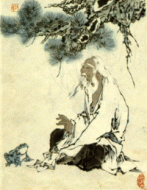
frog-with-zhuangzi

You can’t discuss the ocean with well frogs.  They’re limited by the space they live in.  You can’t discuss ice with summer insects.  They’re bound to a single season.  You can’t discuss the greater way of things with cramped scholars.  They’re shackled by their doctrines.  Now you have come out beyond your banks and borders and have seen the great sea, and so you realize how small you are.  From now on it will be possible to talk to you about the greater way of things.

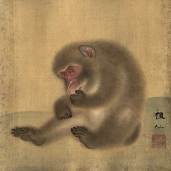
japanese monkey painting

If someone sleeps in a damp place, their back aches and they ends up half paralyzed, but is this true of a carp?  If someone lives in a tree, they are terrified and shake with fright, but is this true of a monkey?  Of these three creatures, which knows the proper place to live?  We eat the flesh of grass-fed and grain-fed animals, deer eat grass, centipedes find snakes tasty, and hawks and falcons love mice.  Of these four, who knows how food ought to taste?  Monkeys pair with monkeys, deer go out with deer, and fish play around with fish.  Men claim that Mao-Qiang and Lady Li were beautiful, but if fish saw them they would dive to the bottom of the stream, if birds saw them they would fly away, and if deer saw them they would break into a run.  Of these four, which knows the standard of beauty for the world?

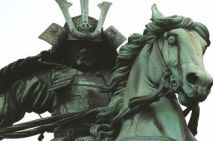
samurai-on-horseback-statue

Daoists also teach the idea of wu-wei, or non-action.  This does not mean that one should not act at all, but that often doing less is doing more.  Being patient and paying attention can save us from doing too much or having to do things over again.  In a Japanese story that illustrates this well, a local lord has three sons and must decide who should inherit his position.  He tests them by placing a pillow on the door to his room and calling them one at a time.  The eldest son enters and annihilates the pillow in a frenzy of skilled sword strikes.  The middle son draws his sword but sees the pillow in mid-air and catches it.  The youngest son sees the pillow on the door, tucks it under his arm and enters the room to the joy of his father.  The youngest son was paying attention, and so he did not even need to pull out his sword.

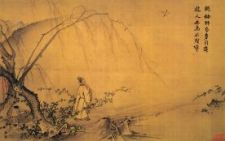
walking-in-nature-chinese-painting

There are many passages In the Dao De Jing and Zhuangzi, the two central texts of Daoism, that similarly teach that wanting too much and trying too hard is the wrong way to be:

Sages do not boast, and are thus admired by everyone, do not want to shine, and thus will be enlightened, do not seek excellence, and are thus excellent, and because they do not argue, no one can argue with them.

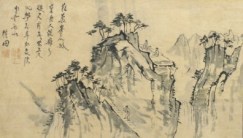
chinese-mountain-painting-stairs

Those who know do not speak.  Those who speak do not know.

Whoever knows how to lead well is not warlike.  Whoever knows how to fight well is not angry.  Whoever knows how to conquer enemies does not fight them.  Whoever knows how to use others well keeps themselves low.

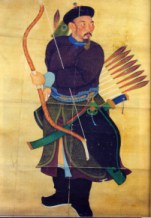
archer-china

Those who divide fail to divide.  Those who judge are bad at judging.  What does this mean, you ask?  The sage embraces things.  Ordinary people judge between things and parade their judgements in front of others.  So I say, those who judge fail to see.

When you’re betting for cheap prizes in an archery contest, you shoot with skill.  When you’re betting for fancy belt buckles, you worry about your aim, and when you’re betting for real gold, you’re a nervous wreck.  Your skill is the same in all three cases, but because one prize means more to you than another, you let outside considerations weigh on your mind.  They who look too hard on the outside get clumsy on the inside.

~ Ordinary Philosophy and its Traveling Philosophy / History of Ideas series is a labor of love and is ad-free, entirely supported by patrons and readers like you. Please offer your support today!

In Memory of Hypatia of Alexandria

Detail of the death portrait of a wealthy woman, c. 160-170 AD near modern-day Er-Rubayat in the Fayum, public domain via Wikimedia CommonsHypatia’s birthday is somewhere between 350 and 370 AD; a range of dates indicating great uncertainty, to be sure, but clear original sources this old are hard to come by, especially from a city as turbulent and violence-torn as the Alexandria of her day. The day of her death is better known, sometime in March of 415 AD. Since the latter date is more precise, we’ll break with our tradition here and remember Hypatia in the month of her tragic and violent death instead of on the date of her birth.

She’s a mathematician, astronomer, teacher, and philosopher, who writes commentaries on important works in geometry and astronomy with her father Theon, likely contributing original work of her own. Hypatia is a Neoplatonist, a philosophy with mystical overtones which posits that everything derives its being from the One, an ultimately conscious yet nonmaterial, non-spacial entity which is the pure ideal of everything that is. She is a scholar and teacher in a field and in a world that’s male-dominated, and historians from her day to ours emphasize her extraordinary talents and her femininity with a nearly equal mix of awe and bemusement.

So let us remember and honor Hypatia for her great contributions to human knowledge and to the history of women’s liberation, living proof that women are equals in intellect and courage.

And let us also remember her sad death as a cautionary tale against those who inflame popular sentiment to seize power for themselves. Hypatia meets her death at the hands of a Christian mob caught up in the anti-pagan hysteria of the day; Alexandria itself was caught up in a power struggle between civic and religious authority. The mob of extremists who drag Hypatia from her carriage, torture and kill her with roofing tiles, and defile her body are inspired by their partisanship with theocratic bishop Cyril to kill this pagan philosopher, this mathematician and astronomer (then often equated with sorcerer), this woman who dared teach men, this friend of Cyril’s rival Orestes, civic leader of Alexandria. As Hypatia scholar Micheal Deakin quotes: “Cyril was no party to this hideous deed, but it was the work of men whose passions he had originally called out. Had there been no [earlier such episodes], there would doubtless have been no murder of Hypatia.”

From the current presidential primary race, in which a certain millionaire is whipping up populist support* with extremist racial and religious rhetoric, back to Hypatia’s time and beyond, power-hungry opportunists plead innocence from the very violence they inspire. Yet it appears hard to justify that plea when reason and the lessons of history plainly reveal the nearly inevitable results of fomenting sectarian strife. Extremism in the defense of liberty or anything else is a vice** because of the way it drives away reason and sympathy, and after all, nothing is as liberty-destroying as mob violence and death.

Ordinary Philosophy is a labor of love and is ad-free, entirely supported by patrons and readers like you. Please offer your support today!

~~~~~~~~~~~~~~~~~~~~~~~~~~~~~

Read more about Hypatia:

Deakin, Michael.’Hypatia of Alexandria‘ from Ockham’s Razor radio program of Radio National of Australia (transcript), Sun August 3rd 1997. (click ‘Show’ across from ‘Transcript’)

O’Connor, J J and E F Robertson. ‘Hypatia of Alexandria‘, from the School of Mathematics and Statistics, University of St Andrews, Scotland website.

‘O’Neill, Tim. ‘“Agora” and Hypatia – Hollywood Strikes Again‘. Armarium Magnum blog, Wed May 20, 2009

Zielinski, Sarah. ‘Hypatia, Ancient Alexandria’s Great Female Scholar‘. Smithsonianmag.com, Mar 14, 2010.

…and about Neoplatonism

Wildberg, Christian, “Neoplatonism“, The Stanford Encyclopedia of Philosophy (Spring 2016 Edition), Edward N. Zalta (ed.)

* ‘What If Trump Wins?’ by Jeet Heer in New Republic, Nov 24, 2015

** in reference to the quote ‘Extremism in the defense of liberty is no vice’ from Barry Goldwater’s 1964 presidential nomination acceptance speech