Confucianism & Daoism: The Basics

The following is a lecture I composed for teaching Confucianism and Daoism to my sister’s 6th grade History class at Star of the Sea School in San Francisco.
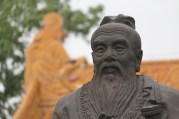
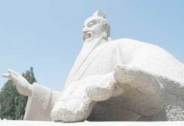
Confucius_Sculpture,_Nanjing

Confucius and Laozi, the philosophers who founded Confucianism and Daoism, lived just before the Warring States Period of ancient China (476 – 221 BCE), a time of war, tragedy and interest in philosophy.  Unfortunately, people’s lives are full of problems, but fortunately problems make people think about their lives, question the answers of authorities and experts, and reason beyond their understandings.
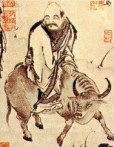
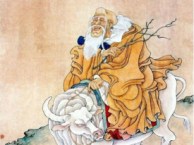
Laozi

Each of us, as individuals, should use both belief and doubt to become better, wiser people, but how should we go about doing this?  Confucianism and Daoism, the two great philosophies of ancient China, gave people opposing ways to gain wisdom.  Many in ancient and modern times used both to compliment and extend each other.

The Confucians say we should build ourselves up to be educated, compassionate and civilized, while the Daoists say we should clear ourselves out to become open-minded, patient and peaceful.  The Confucians say we should learn from others, reason for ourselves, and do what we know to be right.  The Daoists say we should seek less for ourselves and gain perspective beyond our own interests, reasons and actions.

Confucius, the Golden Rule & Learning from Everyone
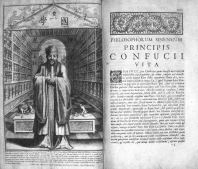
Confucius Latin

When Catholic Jesuit missionaries arrived in China in the 1600s, they were astounded to find that Confucius, the most influential and central Chinese philosopher, was incredibly similar to Jesus in his sayings and teachings.  First and foremost, like Jesus, Buddha, Muhammad and other revered teachers, Confucius taught what has been called the Golden Rule: Do for others what you would want them to do for you, and do not do to others what you do not want done to yourself.  Confucius said that this was the single thing that should guide one’s life, and that compassion is the central thread running throughout his thinking.
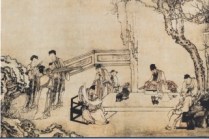
chinese-scholars1

Confucius’ student Zigong once told his teacher, “I do not want to do to others what I do not want them to do to me.”  Confucius replied, “You have not come that far yet”, probably because none of us want others to simply tell us that they are amazing.  Another time, Confucius heard Zigong criticizing other people, and said, “Zigong must have already reached perfection, which affords him leisure I do not possess.”  Confucius is being sarcastic, as he often said that no one is perfect, but anyone can be excellent by continuously working to become better.

confucius-teaching-hillside-painting

Not only can anyone be excellent, but we can each learn from anyone about how to be better ourselves.  Confucius taught that when we see great people, we should seek to be like them, but when we see horrible people, we should seek how we are like them by examining ourselves.  Confucius said, “Put me with any two people at random and they will always have something to teach me, as I can take their qualities as a model and their defects as a warning.  Clearly, Confucius believed that we all share the same set of strengths and faults, no matter how talented (or horrible) we happen to individually be or where our talents are.
emperor-shun-of-china

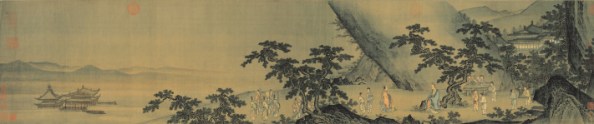
Because no one is perfect and everyone can learn from anyone, there is no one who is above criticism, not even the prince of the state.  When asked by a duke if there is a single thing that could ruin a country, Confucius said that if the prince is never told when he is in error or contradicted, it could be the ruin of everyone.  About himself, Confucius said, “I am fortunate indeed… Whenever I make a mistake, there is always someone who notices it.”
chinese-painting-inquiring-about-the-dao

Daoism, Perspective & Less is More

laozi-water-buffalo

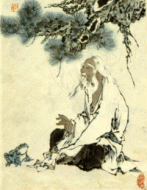
The legendary Daoist sages Laozi, Zhuangzi and Liezi taught that human perspectives are limited, and we should always keep this in mind.  Because we only have partial perspectives, we should keep in mind that others have their own perspectives which may not be the same as ours.  In one famous story, a turtle comes across a frog living in a well, and tells the frog about the sea, water that goes beyond the horizon with no walls in sight.  The frog refuses to believe the turtle, arguing that he has lived in water all his life and knows perfectly well that it comes in wells that are only so wide and have walls.  In Zhuangzi’s book, it says:
frog-with-zhuangzi

You can’t discuss the ocean with well frogs.  They’re limited by the space they live in.  You can’t discuss ice with summer insects.  They’re bound to a single season.  You can’t discuss the greater way of things with cramped scholars.  They’re shackled by their doctrines.  Now you have come out beyond your banks and borders and have seen the great sea, and so you realize how small you are.  From now on it will be possible to talk to you about the greater way of things.
japanese monkey painting

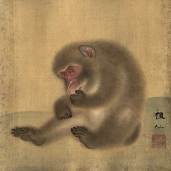
If someone sleeps in a damp place, their back aches and they ends up half paralyzed, but is this true of a carp?  If someone lives in a tree, they are terrified and shake with fright, but is this true of a monkey?  Of these three creatures, which knows the proper place to live?  We eat the flesh of grass-fed and grain-fed animals, deer eat grass, centipedes find snakes tasty, and hawks and falcons love mice.  Of these four, who knows how food ought to taste?  Monkeys pair with monkeys, deer go out with deer, and fish play around with fish.  Men claim that Mao-Qiang and Lady Li were beautiful, but if fish saw them they would dive to the bottom of the stream, if birds saw them they would fly away, and if deer saw them they would break into a run.  Of these four, which knows the standard of beauty for the world?
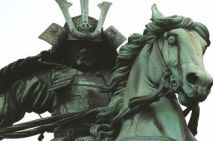
samurai-on-horseback-statue

Daoists also teach the idea of wu-wei, or non-action.  This does not mean that one should not act at all, but that often doing less is doing more.  Being patient and paying attention can save us from doing too much or having to do things over again.  In a Japanese story that illustrates this well, a local lord has three sons and must decide who should inherit his position.  He tests them by placing a pillow on the door to his room and calling them one at a time.  The eldest son enters and annihilates the pillow in a frenzy of skilled sword strikes.  The middle son draws his sword but sees the pillow in mid-air and catches it.  The youngest son sees the pillow on the door, tucks it under his arm and enters the room to the joy of his father.  The youngest son was paying attention, and so he did not even need to pull out his sword.
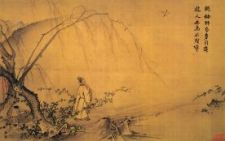
walking-in-nature-chinese-painting

There are many passages In the Dao De Jing and Zhuangzi, the two central texts of Daoism, that similarly teach that wanting too much and trying too hard is the wrong way to be:

Sages do not boast, and are thus admired by everyone, do not want to shine, and thus will be enlightened, do not seek excellence, and are thus excellent, and because they do not argue, no one can argue with them.
chinese-mountain-painting-stairs

Those who know do not speak.  Those who speak do not know.

Whoever knows how to lead well is not warlike.  Whoever knows how to fight well is not angry.  Whoever knows how to conquer enemies does not fight them.  Whoever knows how to use others well keeps themselves low.
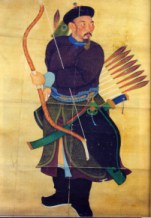
archer-china

Those who divide fail to divide.  Those who judge are bad at judging.  What does this mean, you ask?  The sage embraces things.  Ordinary people judge between things and parade their judgements in front of others.  So I say, those who judge fail to see.

When you’re betting for cheap prizes in an archery contest, you shoot with skill.  When you’re betting for fancy belt buckles, you worry about your aim, and when you’re betting for real gold, you’re a nervous wreck.  Your skill is the same in all three cases, but because one prize means more to you than another, you let outside considerations weigh on your mind.  They who look too hard on the outside get clumsy on the inside.

~ Ordinary Philosophy and its Traveling Philosophy / History of Ideas series is a labor of love and is ad-free, entirely supported by patrons and readers like you. Please offer your support today!

In Memory of Hypatia of Alexandria

Detail of the death portrait of a wealthy woman, c. 160-170 AD near modern-day Er-Rubayat in the Fayum, public domain via Wikimedia CommonsHypatia’s birthday is somewhere between 350 and 370 AD; a range of dates indicating great uncertainty, to be sure, but clear original sources this old are hard to come by, especially from a city as turbulent and violence-torn as the Alexandria of her day. The day of her death is better known, sometime in March of 415 AD. Since the latter date is more precise, we’ll break with our tradition here and remember Hypatia in the month of her tragic and violent death instead of on the date of her birth.

She’s a mathematician, astronomer, teacher, and philosopher, who writes commentaries on important works in geometry and astronomy with her father Theon, likely contributing original work of her own. Hypatia is a Neoplatonist, a philosophy with mystical overtones which posits that everything derives its being from the One, an ultimately conscious yet nonmaterial, non-spacial entity which is the pure ideal of everything that is. She is a scholar and teacher in a field and in a world that’s male-dominated, and historians from her day to ours emphasize her extraordinary talents and her femininity with a nearly equal mix of awe and bemusement.

So let us remember and honor Hypatia for her great contributions to human knowledge and to the history of women’s liberation, living proof that women are equals in intellect and courage.

And let us also remember her sad death as a cautionary tale against those who inflame popular sentiment to seize power for themselves. Hypatia meets her death at the hands of a Christian mob caught up in the anti-pagan hysteria of the day; Alexandria itself was caught up in a power struggle between civic and religious authority. The mob of extremists who drag Hypatia from her carriage, torture and kill her with roofing tiles, and defile her body are inspired by their partisanship with theocratic bishop Cyril to kill this pagan philosopher, this mathematician and astronomer (then often equated with sorcerer), this woman who dared teach men, this friend of Cyril’s rival Orestes, civic leader of Alexandria. As Hypatia scholar Micheal Deakin quotes: “Cyril was no party to this hideous deed, but it was the work of men whose passions he had originally called out. Had there been no [earlier such episodes], there would doubtless have been no murder of Hypatia.”

From the current presidential primary race, in which a certain millionaire is whipping up populist support* with extremist racial and religious rhetoric, back to Hypatia’s time and beyond, power-hungry opportunists plead innocence from the very violence they inspire. Yet it appears hard to justify that plea when reason and the lessons of history plainly reveal the nearly inevitable results of fomenting sectarian strife. Extremism in the defense of liberty or anything else is a vice** because of the way it drives away reason and sympathy, and after all, nothing is as liberty-destroying as mob violence and death.

Ordinary Philosophy is a labor of love and is ad-free, entirely supported by patrons and readers like you. Please offer your support today!

~~~~~~~~~~~~~~~~~~~~~~~~~~~~~

Read more about Hypatia:

Deakin, Michael.’Hypatia of Alexandria‘ from Ockham’s Razor radio program of Radio National of Australia (transcript), Sun August 3rd 1997. (click ‘Show’ across from ‘Transcript’)

O’Connor, J J and E F Robertson. ‘Hypatia of Alexandria‘, from the School of Mathematics and Statistics, University of St Andrews, Scotland website.

‘O’Neill, Tim. ‘“Agora” and Hypatia – Hollywood Strikes Again‘. Armarium Magnum blog, Wed May 20, 2009

Zielinski, Sarah. ‘Hypatia, Ancient Alexandria’s Great Female Scholar‘. Smithsonianmag.com, Mar 14, 2010.

…and about Neoplatonism

Wildberg, Christian, “Neoplatonism“, The Stanford Encyclopedia of Philosophy (Spring 2016 Edition), Edward N. Zalta (ed.)

* ‘What If Trump Wins?’ by Jeet Heer in New Republic, Nov 24, 2015

** in reference to the quote ‘Extremism in the defense of liberty is no vice’ from Barry Goldwater’s 1964 presidential nomination acceptance speech 

O.P. Recommends: Like the Oscars, #PhilosophySoWhite

School of Athens by Raphael [Public domain], via Wikimedia Commons (cropped)Eric Schwitzgebel, who authors the The Splintered Mind blog (a favorite of mine), recently co-wrote this excellent opinion piece about philosophy’s lack of diversity.

Like Hollywood, Schwitzgebel and Myisha Cherry find that there’s a set of preconceptions which underlie the way work is chosen and promoted which, in turn, virtually guarantees philosophy will remain non-diverse. Hollywood has its own set; for academic philosophy, the glorification of obscurantism is a primary factor. Schwitzgebel and Cherry write: ‘We admire philosophers whose central arguments are nearly impossible to understand, or who speak in paradoxes, who accept seemingly bizarre views, or who display dazzling skill with formal logical structures of no practical significance. Kant and Hegel are better loved than understood.’ Seeming smart, the authors explain, has long been confused by too many academics with being smart.

The piece goes on to show how this obscurantism has become the traditional province of white male academics, and is integral to keeping the field of philosophy so exclusionary, and to most people, so irrelevant.

This, of course, would be sad news for Ordinary Philosophy, dedicated as it is to philosophy in the public square, if it were news. But it’s not news, and that’s one of the main reasons O.P. exists. Philosophy should be, like good government, of, by, and for the people. While specialization is key to the development and exploration of complex ideas, obscurantism and jargon, despite assumptions to the contrary, are not necessary to that project. In fact, they accomplish little except ensuring that philosophy is tedious and unpleasant to read, that philosophers end up talking to nearly no-one but each other, and that the field as a whole ends up remaining oh-so-white, oh-so-male, and to most, oh-so-irrelevant.

Ordinary Philosophy and its Traveling Philosophy / History of Ideas series is a labor of love and is ad-free, entirely supported by patrons and readers like you. Please offer your support today!

Happy Birthday, Rosa Luxemburg!

Rosa Luxemburg, By unknown photographer around 1895-1900 [Public domain], via Wikimedia CommonsRosa Luxemburg, Mar 5 1871 – Jan 15 1919, is the great Marxist theorist, writer, economist, revolutionist, anti-war and anti-capital-punishment activist, and philosopher who was murdered during the German Revolution of 1918–1919.
Though she’s an anti-war activist, Luxemburg is also critical of the idea that a just society can be brought about by incremental reforms through established political systems. If she were to be involved in the 2016 Democratic primary race between Hillary Clinton and Bernie Sanders, she would very likely back Bernie, with his more revolutionary style and rhetoric: she’s sharply critical of the Social Democratic Party of Germany, to which she belongs (in its left wing) for favoring a Hillary-style reformist approach. However, her internationalism takes Marxist thinking beyond the point where leading Marxists of her day had progressed, with their focus on unique formulations of Marxist political theory tailored to their own particular national identities and histories. She would likely find fault, then, with Bernie’s protectionism.

Luxemburg’s other great contribution to Marxist thought is her theory about the accumulation of capital. Since capitalism’s primary fuel is constant and ever-increasing consumption, she thinks it’s a mechanism for the ultimate destruction of our material capabilities to sustain ourselves, starting with the ecosystems on which indigenous people, the poor, and the working class depend. Here as well, her progressive thinking takes her far beyond Marx himself, and her concerns in this timely issue makes her as relevant now as ever.

Read more about the brilliant and fearless Luxemburg:

‘Who’s Who – Rosa Luxemburg’ at First World War.com

‘The Dialectic of the Spatial Determination of Capital: Rosa Luxemburg’s Accumulation of Capital Reconsidered’ by Peter Hudis

The Crisis of German Social Democracy (The Junius Pamphlet) by Rosa Luxemburg, 1915

‘Rosa Luxemburg’, from Wikipedia, the free encyclopedia

Ordinary Philosophy and its Traveling Philosophy / History of Ideas series is a labor of love and is ad-free, entirely supported by patrons and readers like you. Please offer your support today!

Frederick Douglass the Pragmatist

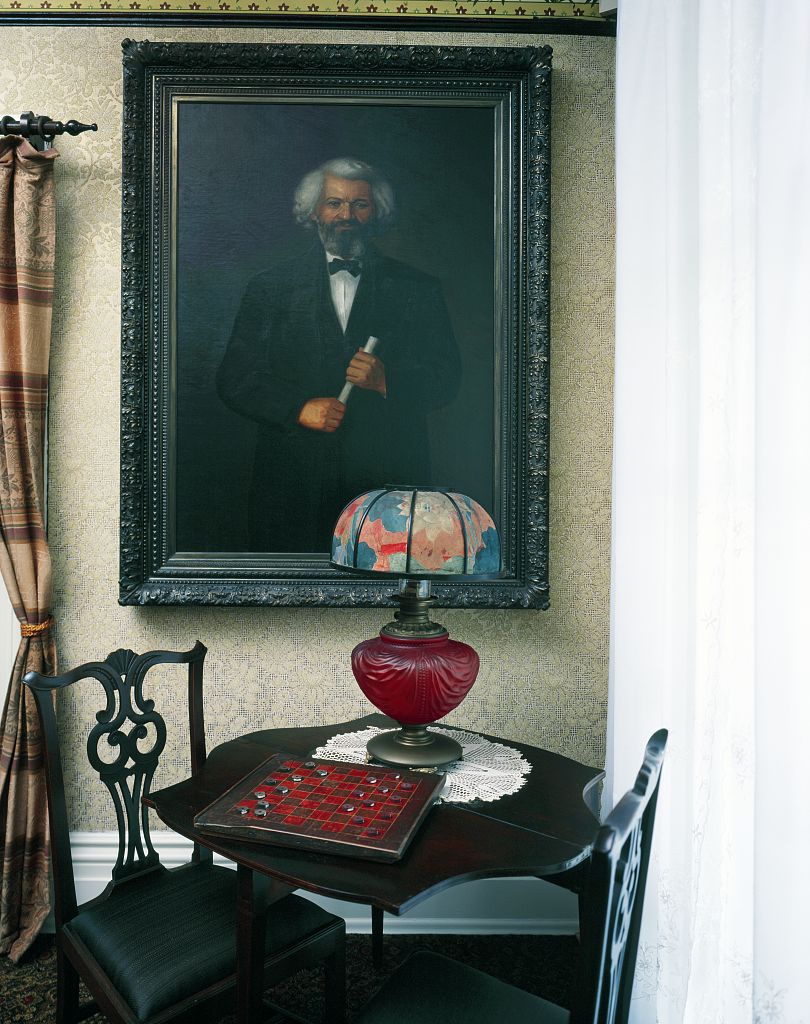
Frederick Douglass House Parlor, Washington, D.C.

Douglas is a fiery orator, an uncompromising abolitionist and proponent of universal human rights, and even an advocate of using violence if the cause is just, the harms too great, and other means prove ineffective (more on that in an upcoming piece). He criticizes those who ‘shamefully abandon their principles’. And very often, when he encounters discrimination in a hotel, restaurant, or other public place, he reports the incident to the local press.

Yet for all his energetic activism, uncompromising rhetoric, and devotion to principle, Douglass is also a pragmatist, in matters large and small.

To be sure, many of his activist tactics are as idealistic, and plainly appear so, as they are as practical. Douglass’ reports of discrimination, for example, fire up public support for the cause of equal rights by arousing a storm of protest and in turn, raising consciousness and providing examples for use in the political arena.

He’s a pragmatist when it comes to making a living as well: after a decades-long successful career lecturing and publishing, a house fire and an attempt to rescue the Freedman’s Bank from collapse leave Douglass’ finances in disarray. So he takes to the lecture circuit again full time in the 1870’s. In the pre-Civil War era, he makes his living doing what he believes in most: lecturing, debating, and arguing for abolishing slavery and expanding human rights. But in the post-Civil War era, he finds that morals, politics, and rights issues are no longer such profitable topics. So he goes ahead and lectures on the profitable ones, so long as it he can make the talks instructive and wholesome, and link them to more important issues. ‘People want to be amused as well as instructed’ he writes.

He’s a pragmatist when it comes to tactics and the importance of crafting an image. For example, Douglass considers photography a very important, modern tool for engendering mass support through empathy: if people can see and recognize the face of the person behind the ideas, and of one who is a member of a suffering and oppressed people, people will feel the visceral need for change. So, he takes care to become one of the most photographed men in American history.

Douglass’ practicality holds sway in larger issues too. He does not hesitate to change tactics or switch allegiances between organizations or parties if he thinks it would help the cause in the long run. In fact, he is convinced that true, unswerving, uncompromising allegiance to the cause itself requires a reformer to use whatever means necessary, so long as they are not morally wrong, even if they are imperfect or less inspiring or exciting to others than the more uncompromising choice. He has been criticized throughout the years for splitting with the Garrisonians, for siding with Captain John Fremont against Abraham Lincoln in the latter’s recall of Fremont’s emancipation proclamation in Missouri early in the war, for refusing to support or join in on the raid on Harper’s Ferry (though he supports John Brown’s ideas about the validity of armed resistance in general), for evading arrest and possible execution for charges of co-conspiracy in the Harper’s Ferry raid by fleeing to Canada, and for abandoning the Radical Abolitionist Party in favor of the newly formed Republican Party. His critics contend that his practice of often siding with moderate tactics and candidates reveal a lack of commitment and moral courage.

Yet he defends all of these practical choices on the grounds that commitment to the tactics or politics in and of themselves are actually a distraction, since the practice of committing to the ‘pure’ choice in the short run is often an impediment to achieving the ultimate goal in the long run. For example, if he throws his support behind his friend and hero Gerit Smith, uncompromising political candidate of the Radical Abolitionist Party, instead of Abraham Lincoln, the Republican candidate who ran on the more moderate goal of preventing the spread of slavery to the new states, he might be more admired as an uncompromising leader. But he understands what a risky move this would be. The Radical Abolitionists had little chance of winning, but the Republican Party was off to a very successful start, losing its first presidential campaign by a relatively small margin. Since the moderate goals of the Republican Party had a good chance of realization while those of the Radical Abolitionists little to none, Douglass sides with the former. The stakes are simply too high for Douglass to risk losing at this point, even if the risk appears nobler.

In sum, Douglass argues that the truly committed reformer is free to choose the more modest, practical, sure-bet option over the less apparently compromising, more radical option when it appears to be more effective in the long run. That’s because true faithfulness to the mission does not require appearing an effective reformer, it requires actually being as effective as possible. No small part of Douglass’ greatness as an activist and as a person is his willingness to forgo short-term public approval or personal glory in favor of acting in the long-term best interests of his cause. And it appears that history not only validates him as an astute tactician, but as a heroic figure, in part because in hindsight we can more easily recognize the wisdom, integrity, and strength in his pragmatism.

Ordinary Philosophy and its Traveling Philosophy / History of Ideas series is a labor of love and is ad-free, entirely supported by patrons and readers like you. Please offer your support today!

~~~~~~~~~~~~~~~~~~~~~

Sources and inspiration:

Blassingame, J. (Ed.). The Frederick Douglass Papers, Series One: Speeches, Debates, and Interviews. 4 volumes, and The Frederick Douglass Papers, Series 2: Autobiographical Writings. 3 volumes. New Haven and London: Yale University Press, 1979-1999
Douglass, Frederick. Autobiographies, with notes by Henry Louis Gates, Jr. Volume compilation by Literary Classics of the United States. New York: Penguin Books, 1994.

Douglass, Frederick. My Bondage and My Freedom: 1855 Edition with a new introduction.. Re-published 1969, New York: Dover Publications, Inc.

Foner, Philip S. The Life and Writings of Frederick Douglass, Vol. 1-4. New York: International Publishers, 1950.

Varon, Elizabeth. ‘Most photographed man of his era: Frederick Douglass’, the Washington Post, Jan 29, 2016. https://www.washingtonpost.com/opinions/most-photographed-man-of-his-era-frederick-dou

Happy Birthday, John Rawls!

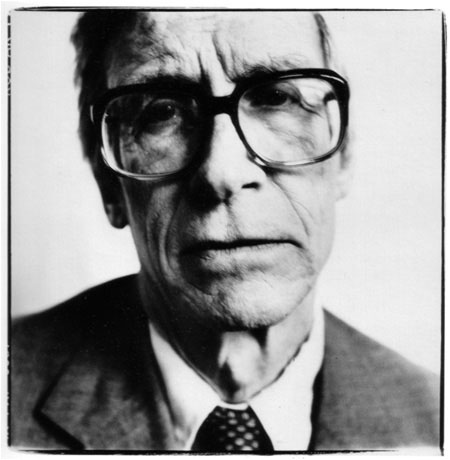
John Rawls, image via BBC's Will and Testament blogJohn Rawls, Feb 21, 1921 – Nov 24, 2002, is the great moral theorist who thinks of justice as fairness.

Among his greatest contributions is the thought experiment called ‘the veil of ignorance’. It’s a beautifully simple method for helping to design a just society: imagine you’re to be placed into society with no idea what you would be: rich, poor, or middle-class; tall or short; intelligent or not; of which gender; outgoing or shy; of which race; employed or not and at what kind of job; and so on.

Given that you have no idea what your roles in life will be, what cultural practices, laws, policies, governmental system, economic system, and so on, would you put into place? Remember, behind that veil of ignorance, you’ll have to decide what kind of society benefits everyone the most, since you could end up being anyone. If you were really in that situation, imagine just how fair you’d be. Perhaps, as Rawls imagines, we’d all be far better off if that was really how the world works.

~~~~~~~~~~~~~~~~~~~~~~~~~~~~~~~~~~~~

Further reading:

Stanford Encyclopedia of Philosophy: John Rawls

John Rawls’ A Theory of Justice (book preview)

Ordinary Philosophy pieces featuring John Rawls:

Communitarianism, Writ Large

Sources, Influences, Shout-Outs, and all that Good Stuff

What Ordinary Philosophy’s All About: Clarifying the Vision

People in a Public Square, Image Creative Commons via PixabayIt’s been an especially busy few weeks for me: studying, researching, writing, planning for my upcoming traveling philosophy journey and for the expanded future of Ordinary Philosophy. This year so far, I’ve had the great good fortune to meet some inspiring new people: passionate, thinking, active, and creative. I’ve also gotten to know others better as well, and am opening new doors and making new contacts every day. Our conversations have been inspiring me to think more clearly and deeply about my vision for Ordinary Philosophy, about my hopes, dreams, and goals, and about the wonderful people who will work with me to accomplish them in the future.

So I’ve just been looking over my introductory statement about Ordinary Philosophy, and thought it needed some clarifying and expanding. Here’s my vision as it stands now, best as I can describe it, and it’s beautiful to me. I hope it is to you too!

~~~~~~~~~~~~~~~~~~~~~~~~~~~~~~

Ordinary Philosophy is founded on the belief that philosophy is an eminently useful endeavor as well as a fascinating and beautiful one, and that citizen philosophers and academic philosophers alike share in making it so.

So why the name Ordinary Philosophy?

The ‘Ordinary’ in Ordinary Philosophy means: Philosophy is not only pursued behind the walls of academia.

It’s an ordinary activity, something we can do regularly whatever our education, background, or profession, from our homes, workplaces, studies, public spaces, and universities. It’s applicable to ordinary life, since it’s about solving the problems we all encounter in the quest to pursue a good, happy, and meaningful one.

It’s about seeking answers to the ‘big questions’ we ask ourselves all the time: ‘What’s the right thing to do?’ ‘What’s a meaningful life, and how can I make mine so?’ ‘What’s the truth of the matter, what does truth mean anyway, and how do I know when I’ve found it?’ ‘What does it mean to have rights?’ ‘How did reality come to be as it is?’, and so on.

It’s also just as much about the ordinary, day-to-day questions: ‘Should I take this job, and will it help fulfill my highest aspirations?’ ‘It is wrong to put my interests first this time, even if it will harm someone else?’ ‘What’s the difference between just talking about other people and malicious gossip?’ ‘Why should I go out of my way to vote?’

And in the end, it’s about living philosophy, about philosophy in the public square, and the stories and histories of philosophy as it is realized, personified, lived out by activists, artists, scholars, educators, communicators, leaders, engaged citizens, and everyone else who loves what’s just, what’s beautiful, and what’s true.

All of this is philosophy.

~ Amy Cools, founder and editor of Ordinary Philosophy

Celebrating Frederick Douglass in the Month of His Birth and Death

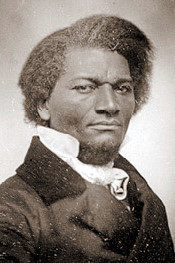
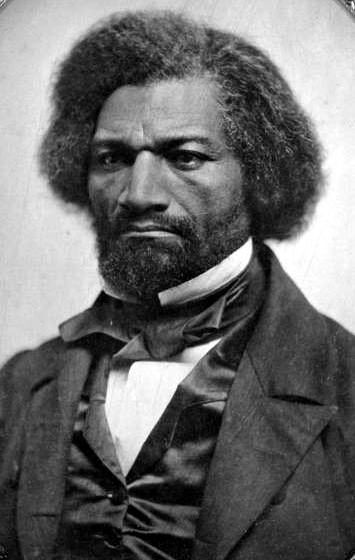
Frederick Douglass c. 1855, image Public DomainFrederick Douglass was born 198 years ago, as nearly as could be determined, on an unknown day in February 1818, based on an entry in the slave ledger of his first master who may have also been his father; Douglass hears reports throughout his young life that his father was certainly a white man, but who exactly it was is left unsaid. Aaron Anthony’s slave Harriet Bailey was Douglass’s mother, and she died when little Frederick was only about seven years old. Anthony’s daughter Lucretia married Thomas Auld, and upon Anthony’s death, she inherited young Frederick.

From such inauspicious beginnings, a ragged orphan enslaved on a plantation with prospects of little but a life of hard work and enforced ignorance, Douglass becomes one of the world’s most famous and well-respected people. His strong native intelligence and courage allows him to take the fullest advantage of every opportunity that comes his way, to his own credit and to the benefit of us all. After a long and illustrious career as an activist, writer, intellectual, and statesman, he dies on February 20th 1895 and leaves behind a legacy rivaled by few in American history.

I salute your memory, Mr. Douglass; my series on your life and ideas is my little tribute to you. Thanks for all you’ve done for your own people and for the whole human race!

I chose this day to commemorate his life and his death here at Ordinary Philosophy in advance of upcoming events in DC: the National Park Service will host a 2-day birthday celebration for Frederick Douglass on February 12th and 13th, 2016 at his home Cedar Hill and nearby sites in Anacostia and DC. Please visit the NPS website for more information.

Ordinary Philosophy and its Traveling Philosophy / History of Ideas series is a labor of love and ad-free, supported by patrons and readers like you. Please offer your support today!

Fundraising Campaign for Frederick Douglass’ Traveling Philosophy / History of Ideas Series

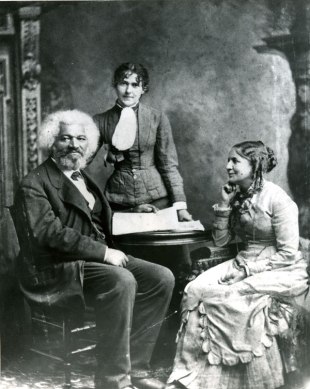
Frederick Douglass with his second wife Helen Pitts and her sister Eva, public domain via Wikimedia CommonsAs you may know, dear readers, I’m embarking on the travel portion of my fifth philosophical-historical themed adventure in mid to late March. I’m off to Baltimore, MD, New York, Washington DC, and other East Coast sites to follow in the footsteps of Frederick Douglass.

Ordinary Philosophy and its Traveling Philosophy / History of Ideas series is a labor of love and ad-free, supported by patrons and readers like you.

Every single bit helps, from $1 on up: directly through your contribution, and indirectly by inspiring confidence and enthusiasm in others who see the support already given.

As always, I count on you to help me accomplish what I do here; thanks to all who have contributed in the past, and thanks in advance to all who contribute in the future!

What the Frederick Douglass Traveling Philosophy / History of Ideas Series project will produce:
– A series of essays on the ideas of Frederick Douglass, how they relate to his time and ours
– A series of travel accounts of sites associated with Douglass’ life and ideas throughout the East Coast. I’ll be seeking insights into how the places informed the man, and vice versa. These will double as historical-philosophical investigations to bring Douglass to life in the mind of the reader, and as inspiration for other traveling history enthusiasts
– A series of downloadable walking tours to accompany the travel series: just subscribe and download in iTunes, and you’ll have your own travel guides to East Coast places I travel to for this series
– Free educational resources: supplementary teaching materials on the life and ideas of Douglass
– And if all goes as planned, a book!

Budget: In the interests of transparency and so you know exactly where your hard-earned, generously donated funds go, here’s the breakdown:

Primary Goal: $2,500 – To cover airfare, lodging, ground transportation, and advertising for Frederick Douglass’ Traveling Philosophy / History of Ideas series
– Airfare: to DC or NYC about $500 (w/taxes and fees)
– Car Rental: average $28 / day = $392
– Lodging: average $50 per night, will be staying with friends some nights = $700
– Parking / Fuel / Public Transportation: average $25 per day = $350
Subtotal = $1,942

Any amount I’ve saved on the above costs or amount collected in excess will be spent on paid advertising (Facebook, Google Adwords, Bing, Pinterest, etc, even a radio spot if funds allow!), which will be listed here, so that the total spent comes to $2,500. (I also advertise in a wide array of free venues)

Secondary Goal: $1,500 – Monthly wages
This year, O.P. is making a big push to include an expanded and more in depth history of ideas travel series, more regularly published podcast with downloadable history of ideas travel guides, interviews with fascinating people, scholarship and educational materials, more great guest posts, and so much more! To accomplish all this, O.P. will need to pay its own expenses and if possible, wages, so I can throw spend less time at other occupations, throwing myself into O.P. with all the heart, time, and energy I long to dedicate to this project.

Please visit the Subscribe, Submit, and Support page to help me fund this project.

I thank you in advance, from the bottom of my heart, for any support you can offer

Sincerely,

Amy Cools


Frederick Douglass on the Constitution

Frederick Douglass Ambrotype, 1856 by an unknown photographer, image public domain via Wikimedia CommonsEarly on his career as an abolitionist speaker and activist, Frederick Douglass is a dedicated Garrisonian: anti-violence, anti-voting, anti-Union, and anti-Constitution.

In the early 1840’s, Douglass joins a revitalized abolitionist movement largely shaped by the views of William Lloyd Garrison. Since the early 1930’s, Garrison espouses a particular set of moral and political beliefs, radical for his time, which he promotes in his influential anti-slavery paper The Liberator. He believes in total non-violence, violence being a tactic of the slaveowners and their corrupt government protectors, not of good God-fearing people who have moral truth on their side. He believes that since voting implies that a government that legalizes slavery is legitimate, true abolitionists must abstain. He believes that the continued Union of the States, Abraham Lincoln’s sacred cause, was not only impossible, but undesirable: it involved the North, directly and indirectly, in the evil of slavery. Since the South was hell-bent on preserving that unnatural and therefore illegal institution, the South should go, and good riddance. And all of these are tied to Garrison’s view of the Constitution: it’s an ultimately pro-slavery, anti-human rights document, and therefore not worthy of obedience or respect.

For many years, Douglass fully agrees with Garrison. But over time, as a result of his conversations and debates with abolitionists who interpret the Constitution differently, and of his own study, experience, and thought in the first four years of publishing his own paper The North Star, Douglass changes his mind. By the early 1850’s, the abolitionist par excellence had come to disagree with Garrison, father of American radical abolitionism, and to agree with Lincoln, proponent of preserving the Union at all costs and of the gradual phasing out of slavery.

So how does Douglass come to make what seems such a counterintuitive change in his views on the Constitution and on the role of violence, voting, and the Union in bringing an end to slavery?

Some of the reasons for Douglass’ evolution are pragmatic; his pragmatist side becomes more pronounced with time and experience (more on this in another piece). For one, he comes to believe that violence is not only unavoidable at times, but sometimes necessary (more on this in another piece as well).

Douglass also becomes convinced that abstaining from politics is just suicide by degrees for the abolitionist movement, since it cedes political power to slaveowners and their supporters. Abstaining from voting in protest, as Garrison calls for, actually works against the project of obtaining greater political rights for black people. (As with celebrity comedian-guru Russell Brand’s anti-voting campaign today; the idea of abstaining from the vote in protest is neither new nor, in my opinion, any more effective now than it was then.) As Douglass points out, however motivated some people are to do the right thing by their fellow citizens, there will always be plenty of others motivated by greed, moral laziness in going along with the status quo, and the drive for power and domination over others. Political clout, gained through voting in those who represent their views, is one of the very few ways in which black people can finally obtain and protect their equal legal rights. And not only that: voting is one of the most practical yet powerful ways black people can demonstrate their full citizenship to those who might be inclined to doubt it. Other than getting an education and fighting in the war for emancipation, Douglass argues that it’s the most important way to undermine ugly stereotypes, prevalent in his day, of black people as lazy, uninformed, and fit only to have their lives run by others. (These stereotypes are, by the way, so ugly that it’s painful just to write them down, but confronting the ugliness head-on drives home the dire necessity of getting rid of them once and for all.)Constitution of the United States, first page of the original, provided by the National Archives and Records Administration, public domain via Wikimedia Commons

But voting’s not enough to ensure that black people obtain the political power necessary to enhance and preserve their rights. For the abolitionist revolution to succeed, the Union must be preserved at all costs, and in the process, it must be recreated as the unified, true haven of freedom it’s meant to be. Douglass believes it’s the responsibility of the free states to liberate the enslaved people of the Southern states, and to extend and enforce guarantees of human rights for all inhabitants of all states.

Why? Because the Preamble of the Constitution tells us that’s what it’s for.

But how does Douglass justify this interpretation when it’s still a matter of such contention that he’s watching his country tear itself in two over it?

To understand the Constitution, it can help somewhat to consider the history that led to its creation and the ideas and intentions of those who wrote it; but to fully understand its true meaning and purpose, Douglass believes, we must always interpret all of its parts in the context of its preamble:

We the People of the United States, in Order to form a more perfect Union, establish Justice, insure domestic Tranquility, provide for the common defence, promote the general Welfare, and secure the Blessings of Liberty to ourselves and our Posterity, do ordain and establish this Constitution for the United States of America.’

The preamble is the key to any valid interpretation of the Constitution because it tells us, in plain, direct, and eloquent language, why the Constitution is written, who it’s written for, and who is bound to obey it. Any interpretation inconsistent with the Preamble reveals that either the Constitution itself is illogical, inconsistent and therefore invalid, or it shows that it’s the interpreter’s reasoning that’s illogical, inconsistent and therefore failing in understanding. Garrisonians agree with the first; Douglass agrees with the second.

So what to do with such parts of the Constitution as the three-fifths clause, which reads:

Representatives and direct Taxes shall be apportioned among the several States which  may be included within this Union, according to their respective Numbers, which shall be determined by adding to the whole Number of free Persons, including those bound to Service for a Term of Years, and excluding Indians not taxed, three fifths of all other Persons‘?. (Art. I, Sec. 2, Cl 3.)

Doesn’t it imply that all those bound to service, which in Douglass’ time almost exclusively applies to black slaves, only count as three-fifths-person, and ergo, are not fully human? While Douglass grants that this clause is deeply problematic, he no longer agrees that it’s actually an endorsement of slavery.

There are two cases which can be argued when it comes to the effects of the three fifths clause: that it gives extra 3/5th’s representative powers to slaveowners, or that it takes away 2/5th’s; that point’s debatable. As Douglass points out, the clause actually appears to be a concession of a point that slaveowners didn’t really want to make but felt forced to if they wanted to increase their political power: that slaves are persons. If they’re not, it would make no more sense to include them at all for purposes of representation than it would to include cows, chickens, or farm implements. But even this grudging concession of personhood is conceivably debatable.

But while the effects of the three fifth clause may help indicate what use it’s been used for, they don’t tell us what it really means or what its true purpose is. So how do we successfully go about determining its meaning?

How about original intent? Since the expressed beliefs and opinions of the Constitution’s authors vary so widely on the matter of slavery, this won’t help us to decide the matter either. Douglass bases his original interpretation of the Constitution as a pro-slavery document on the basis of intent, but as we’ve seen, he changes his mind.

Well, then, how about strict constructionism? This won’t help us either. The terms used are so broad that it’s hard to tell what they literally and finally mean, or to prove outside of the historical context that they refer to the American brand of slavery at all. The three fifths clause never says anything about permanent bondage or race-based slavery. (In fact, the phrase ‘term of years’ seems to imply that there’s a beginning and end to the servitude in question that’s determined by something other than birth and death, but it doesn’t exclude the latter.)

So which interpretation of the three-fifths clause is most consistent with the preamble? Not the idea that those bound to service are anything other than persons or citizens, since the right to representation is only accorded to citizens, which, in turn, are necessarily persons. Nor is the idea that those bound to service are part-person or part-citizen: there’s nothing in the language of the clause nor of the rest of the Constitution that recognizes there’s such things as part-persons or part-citizens. Douglass points out that ‘…the Constitution knows of only two classes [of people]: Firstly, citizens, and secondly, aliens’. Constitutionally, all persons born in the United States are citizens by definition, and all others aliens; of course. the latter are still persons. So the ‘three-fifths’ clause can’t be referring to the completeness of individual persons; as we can see by the language itself, it specifically applies to the total number of persons for the purpose of apportionment only.

Free Stephens, Henry Louis 1824-1882 artist, Public Domain via Library of CongressIt’s clear, then, what the three-fifths clause says about persons and implies about citizens, but what does it really say about slavery?

In a word, nothing. At least, not directly. As Douglass reminds us, the word ‘slave’ and its derivatives never appear in the Constitution at all. It does mention people ‘bound to service for a term of years’ but as we’ve already considered, this is unspecific, never mentions race, nor implies that bondage to servitude is ever anything other than limited.

There is one reading of the three fifths clause that I think is most consistent with the Preamble and with Douglass’ view of proper Constitutional interpretation. Given that the Constitution is concerned with Union, and Justice, and Tranquility, and the common defense, and the general Welfare, and Liberty, the three-fifths compromise was the best the founders could do at the time, given the intransigence of the slaveowners coupled with the young country’s need for their inclusion in the Union, to make the country large and strong enough to bring as much liberty as possible to as many people as possible. Bringing an end to slavery, Douglass believes, is the next necessary step for accomplishing the goals laid out in the Preamble as well as in the Declaration of Independence: to finally stamp out that liberty-destroying institution which had so undermined the general welfare, strength, and tranquility of the Union from its very beginning.

To return to the twin issues of personhood and citizenship in Douglass’ America: in a speech in 1854, Douglass says ‘In the State of New York where I live, I am a citizen and legal voter, and may therefore be presumed to be a citizen of the United States’. Just three short years later, in the infamous Scott vs. Sandford, a.k.a. the Dred Scott decision, the Supreme Court ruled that Douglass and all his fellow black people are not citizens at all. While Douglass explains  in his speech’… [the]  Constitution knows no man by the color of his skin’, the infamous Dred Scott decision of 1857 upended decades of common practice and legal precedent since the founding of the nation, where free black people throughout the United States had enjoyed legal, if not social, equality. However, as Douglass correctly observes, skin color is never mentioned in the Constitution as a precondition for citizenship, only place of birth and status of naturalization.

According to his biographer Philip Foner, Douglass becomes the most advanced and most informed thinker in Constitutional law, and the political and legal theory that informs it, than any of his fellow prominent abolitionists. Douglass believes, in the end, that the Garrisonian abolitionists are making the same mistake as the slaveowners: they fail to interpret the Constitution rightly, on its own terms and as a unified legal document unparalleled and unprecedented in its full establishment of human liberty. From the Garrisonians onward, those of us who likewise interpret the Constitution as protecting the rights of some without protecting others, or who likewise fail to understand its true significance, its true potential, and its true power to bring the blessings of liberty to all, just don’t get the Constitution.

*Listen to the podcast version here or on iTunes

Ordinary Philosophy and its Traveling Philosophy / History of Ideas series is a labor of love and ad-free, supported by patrons and readers like you. Please offer your support today!

~ Also published at Darrow, a forum for ideas and culture

~~~~~~~~~~~~~~~~~~~~~~~

Sources and Inspiration:

Blassingame, J. (Ed.). The Frederick Douglass Papers, Series One: Speeches, Debates, and Interviews. 4 volumes, and The Frederick Douglass Papers, Series 2: Autobiographical Writings. 3 volumes. New Haven and London: Yale University Press, 1979-1999

Douglass, Frederick. Autobiographies, with notes by Henry Louis Gates, Jr. Volume compilation by Literary Classics of the United States. New York: Penguin Books, 1994.

Douglass, Frederick. The Heroic Slave: A Cultural and Critical Edition. Eds Robert S. Levine, John Stauffer, and John McKivigan. Hew Haven: Yale University Press, 2015.

Douglass, Frederick. My Bondage and My Freedom: 1855 Edition with a new introduction.. Re-published 1969, New York: Dover Publications, Inc.

Foner, Philip S. The Life and Writings of Frederick Douglass, Vol. 1-4. New York: International Publishers, 1950.

Landmark Cases: Scott vs. Sandford (The Dred Scott Decision), A C-Span Original TV Series, 2015  http://landmarkcases.c-span.org/Case/2/Scott-V-Sandford