Happy Birthday, Thomas Paine!

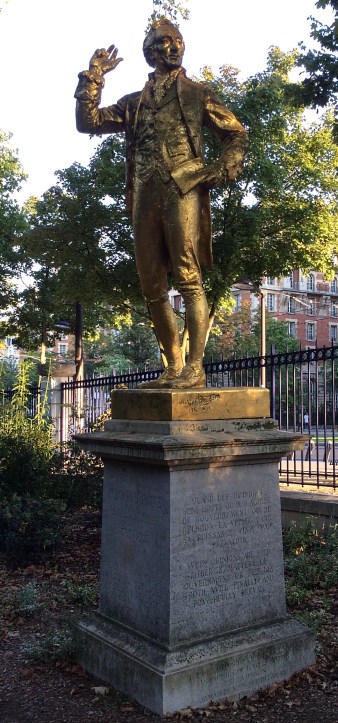
Statue of Thomas Paine by Gutzon Borglum, 1938, Parc Montsouris, Paris, photo 2015 by Amy Cools

Statue of Thomas Paine by Gutzon Borglum, 1938, Parc Montsouris, Paris, photo 2015 by Amy Cools

Let’s remember and salute the great Thomas Paine, father of our American identity, on his birthday. Born on January 29th, 1737, this British-American expatriate, former entrepreneur, and corset-maker’s pamphlets made the case for American independence from Britain, outlined his Lockean conception of human rights, and argued for the primacy of reason in epistemology, politics, science, and theology. He’s a primary influence in my own concept of America as a work-in-progress bastion of liberty, of reason, of freedom of conscience, of the idea that property rights entail the obligation to share the wealth with those who lack what they need.

Here are a few links to some articles and works of art by, about, and inspired by Thomas Paine, including some of my own work:

Common Sense – Thomas Paine (1776)

The American Crisis – Thomas Paine (1776-83)

The Rights of Man – Thomas Paine (1791)

The Age of Reason – Thomas Paine (1794)

Agrarian Justice – Thomas Paine (1795-96)

Thomas Paine – from The Stanford Encyclopedia of Philosophy

To Paris, France I Go, In Search of Revolution-Era Thomas Paine, Mary Wollstonecraft, and Thomas Jefferson – history of ideas travel series in which I follow Thomas Paine’s life and ideas in the era of the French Revolution

Thomas Paine on Basic Income, and Why Welfare is Compatible with an Individualist Theory of Human Rights – my essay on how Paine’s ideas about property rights led him to advocate the unconditional allocation of public funds for the support of the young, the old, and the disabled

Pretty Pink Rose – David Bowie and Adrian Belew (1990) – ‘She tore down Paris on the tail of Tom Paine, but the left wing’s broken, the right’s insane’

As I Went Out One Morning – Bob Dylan (1968) ‘As I went out one morning to breathe the air around Tom Paine’s, I spied the fairest damsel that ever did walk in chains’

Tom Paine’s Bones – Graham Moore (1995) Recorded by Dick Gaughan in 2001. ‘Well they say I preached revolution but let me say in my defence, all I did wherever I went was to talk a lot of Common Sense’

Ordinary Philosophy and its Traveling Philosophy / History of Ideas series is a labor of love and ad-free, supported by patrons and readers like you. Please offer your support today!
Robert Burns Letter at the National Library of Scotland in Honor of the Bard’s Birthday

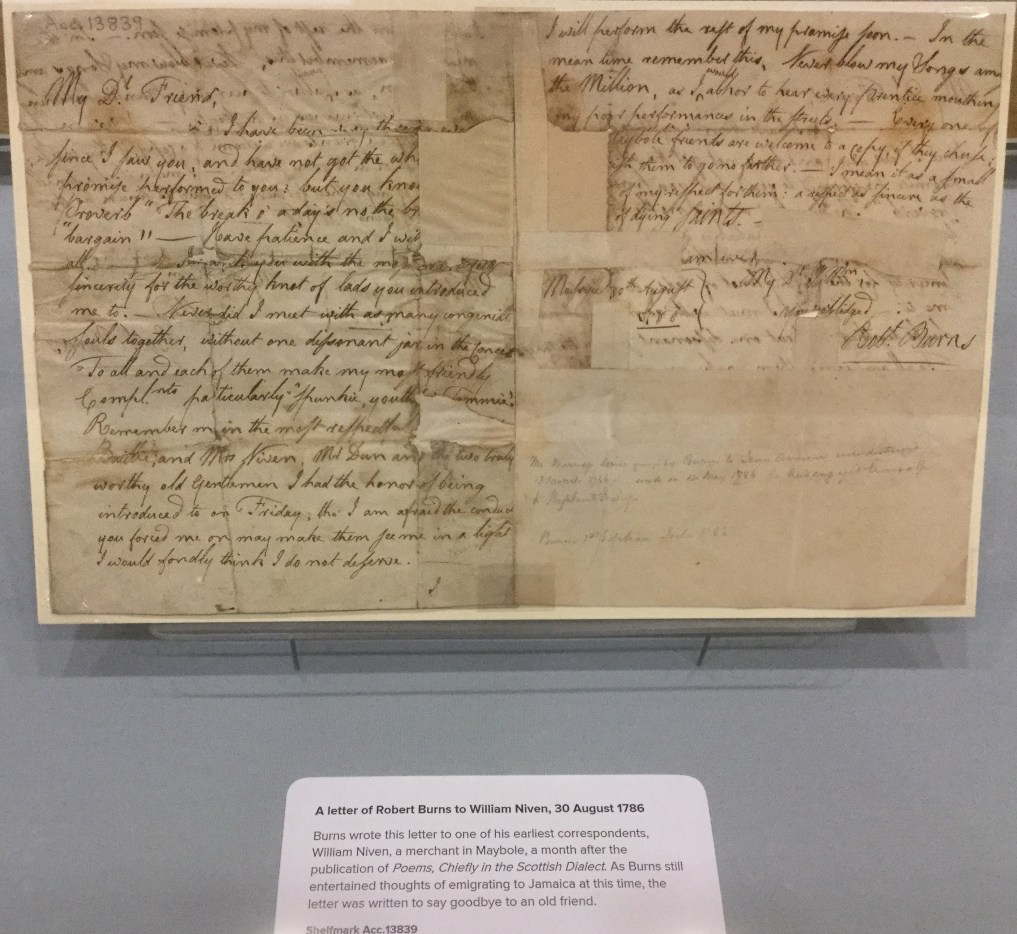
Robert Burns letter to William Niven, 30 August 1786, at National Library of Scotland, special showing 25 January 2018

Robert Burns, aka ‘the Bard’, is, as you may know, one of Scotland’s most honored sons. His poems and songs are widely regarded as among the most beautiful and resonant literary creations of all of Scotland’s people. Some of the people I’ve written about for Ordinary Philosophy were inspired and influenced by Burns, notably Abraham Lincoln and Frederick Douglass. I’ll be writing much more and regularly about Burns before long in the context of my upcoming Frederick Douglass in Scotland series and pieces on the Scottish history of ideas, stay tuned!

In honor of Robert Burns’s birthday celebration, aka Burns Night, the National Library of Scotland put one of his original letters on display for a few hours today, with a little informational card that provides a brief context. I’ll be elaborating on the significance of his planned emigration to Jamaica in my next Douglass series as well.

The letter reads:

My Dr Friend,

I have been very throng every since I saw you, and have not got the wh[ole of my] promise performed to you: but you know [the old] Proverb “The break o’ day’s no the bre[ak o’ a] bargain” – Have patience and I will [pay you] all. – I thank you with the most heart-felt sincerity for the worthy knot of lads you introduced me to. – Never did I meet with so many congenial souls together, without one dissonant jar in the Concert. To all and each of them make my friendly Complnts particularly “spunkie, youthfu’ Tammy.” Remember me in the most respectful [manner to the] Baillie, and Mrs Niven, Mr Dun, and the two truly worthy old Gentlemen I had the honor of being introduced to on Friday; tho’ I am afraid the conduct you forced me on may make them see me in a light I would fondly think I do not deserve. –

I will perform the rest of my promise soon. – In the mean time, remember this, never blow my Songs amo[ng] the Million, as I would abhor to hear every Prentice mouthing my poor performances in the streets. – Every one of [my] Maybole friends are welcome to a Copy, if they chuse; but [I w]ish them to go no farther. – I mean it as a small [mark] of my respect for them: a respect as sincere as the [faith] of dying SAINTS. –

I am ever, My Dr Willm Your oblidged,
Robt Burns

Ordinary Philosophy and its Traveling Philosophy / History of Ideas series is a labor of love and ad-free, supported by patrons and readers like you. Please offer your support today!
Happy Birthday, Emmanuel Chukwudi Eze!

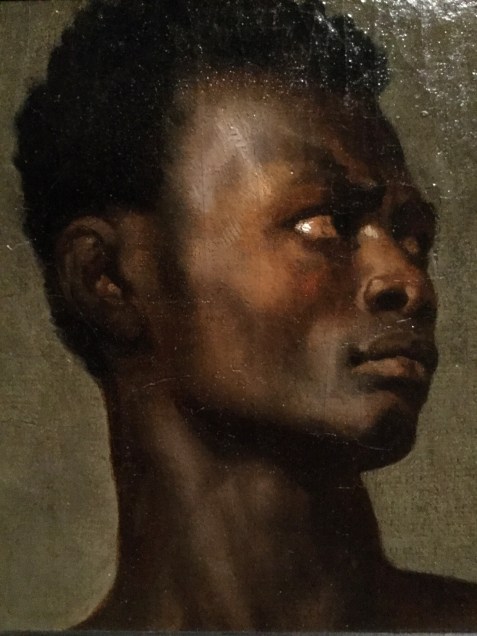
Study of an African’s Head, 1830 by Paul-Jean Flandron, Seattle Art Museum. I could not find a portrait of Dr. Eze that I could share, so I chose this powerful portrait instead. I used it to illustrate a piece shared here some weeks ago at O.P. by Dag Herbjørnsrud, which describes the ideas of the 17th-century Ethiopian philosopher Zera Yacob. Eze also studied Yacob’s ideas.

Emmanuel Chukwudi Eze, born in Nigeria on January 18th, 1963, made a deep study of systems of thought in Africa, Europe, and the Americas. Born of Catholic parents, he was educated in Jesuit colleges and universities. He read deeply and pushed at the limits of philosophy and human thought, mining it widely, regardless of origin, for the riches he could find there. He focused a great deal of his work on postcolonial thought in Africa and the Americas, and rejected attempts to relegate tools of thought to people of one culture or another. Instead, he emphasized the importance of difference and complexity in the practice of reason.

Learn more about Dr. Eze’s broad and rigorous approach to thought:

About Dr. Eze and his book On Reason: Rationality in a World of Cultural Conflict and Racism ~ Duke University Press

African Philosophy at the Turn of the Millennium ~  Emmanuel Chukwudi Eze in dialogue with Rick Lewis

Book review: Achieving our Humanity: The Ideal of the Postracial Future by Emmanuel Chukwudi Eze ~ by Cleavis Headley and Kibujjo M. Kalumba

The Color of Reason: The Idea of “Race” in Kant’s Anthropology ~ by Emmanuel Chukwudi Eze

A Defence of Emmanuel Chukwudi Eze’s Conception of Reason ~ by Mohammed Xolile Ntshangase

Emmanuel Chukwudi Eze ~ in Wikipedia, The Free Encyclopedia 

Emmanuel Chukwudi Eze, 1963-2007: A Personal Reflection ~ by Bruce B. Janz

Philosophia Africana ~ archive of the journal Dr. Eze edited and often published in at the Philosophy Documentation Center

Reading Reason with Emmanuel Eze ~ by John Pittman

Ordinary Philosophy and its Traveling Philosophy / History of Ideas series is a labor of love and ad-free, supported by patrons and readers like you. Please offer your support today!
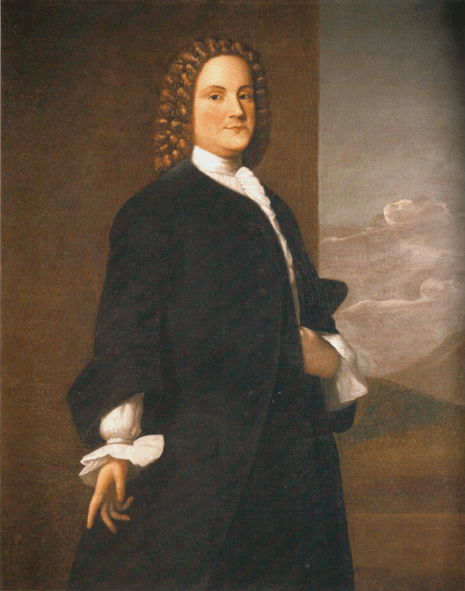
Happy Birthday, Benjamin Franklin!

Benjamin Franklin, earliest known portrait by Robert Feke, 1738-1746, public domain via Wikimedia Commons

My philosophy and history of ideas travels and research have now led me to many, many sites associated with the life, ideas, friends, and colleagues of Benjamin Franklin in two continents and the United Kingdom, and I have more on my list to visit still. Just the other day, I visited Benjamin Franklin’s house in London (see below). And I’ve discovered more links between this man and other great thinkers and ideas that will be the topics of future stories, stay tuned!

This long-lived, very sociable polymath was born January 17th, 1706 and died April 17, 1790. He was a printer, writer, publisher, inventor, scientist, diplomat, and American founding father, mentor to many, friend to countless more, and mediator extraordinaire between rivals, colleagues, friends, and nations. Always on a quest to further expand and expound human knowledge, Franklin founded the American Philosophical Society, which persists to this day.

Learn more about this extraordinary man:

Autobiography of Benjamin Franklin ~ by Benjamin Franklin, 1791

Benjamin Franklin: American Author, Scientist, and Statesman ~ by Theodore Hornberger and Gordon S. Wood for Encyclopædia Britannica

Benjamin Franklin: An Extraordinary Life, an Electric Mind ~ PBS

Benjamin Franklin FAQ ~ The Franklin Institute Website

Benjamin Franklin Joins the Revolution ~ by Walter Isaacson for Smithsonian.com, July 2003

What Led Benjamin Franklin to Live Estranged From His Wife for Nearly Two Decades? ~ by Stephen Coss for Smithsonian.com, September 2017

Ordinary Philosophy and its Traveling Philosophy / History of Ideas series is a labor of love and ad-free, supported by patrons and readers like you. Please offer your support today!
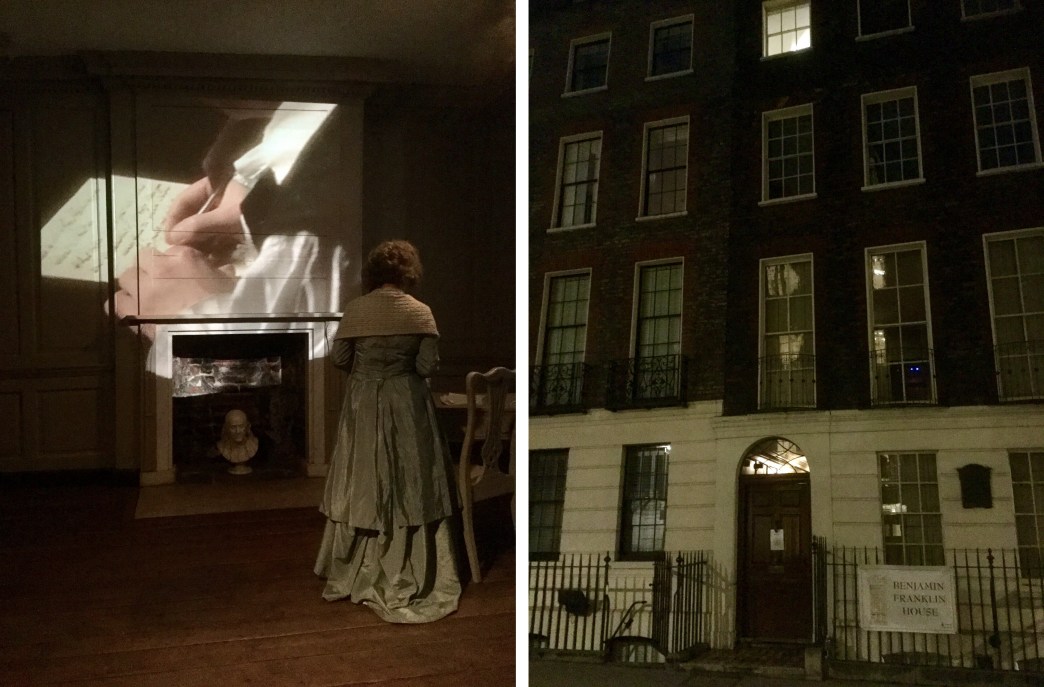
Benjamin Franklin House in London, evening visit, left, interpretive tour, right, exterior

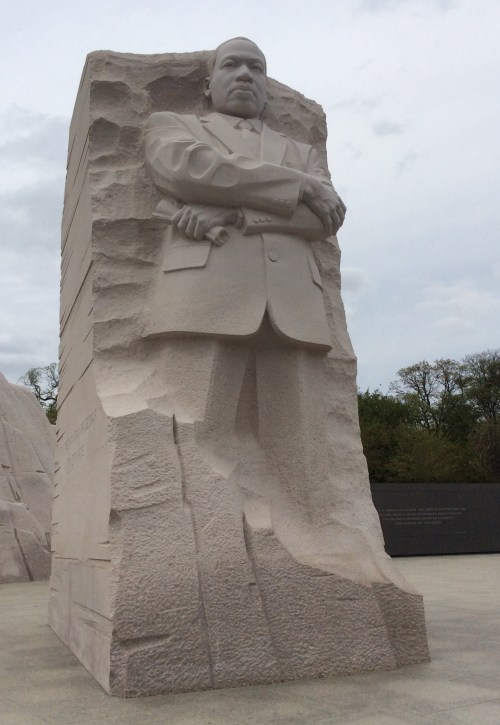
Happy Birthday, Martin Luther King, Jr.!

Sculpture of Martin Luther King, Jr by Lei Yixin on the Mall in Washington D.C.

Dr. Martin Luther King, Jr., born January 15, 1929, is among the world’s most influential and memorable civil rights leaders. The young, respected theologian and pastor of Dexter Avenue Baptist Church was elected president of the Montgomery Improvement Association in late 1955, which ran the bus boycott following Rosa Park’s refusal to move to the back of a segregated bus earlier that year. King proved to be a charismatic and eloquent leader and soon moved to the forefront of the larger movement to end legal and social discrimination and segregation in the American South. His philosophy of nonviolent direct action, heavily influenced by Mahatma Gandhi, resonated widely and still does. It’s consistent with key religious sentiments and principles found in King’s and the majority of Americans’ Christianity, as well as other philosophical and religious systems which emphasize both justice and mercy. The nonviolent tactics that King endorsed also kept the movement on such a moral high ground that it stymied would-be white critics who found it necessary to resort to smear campaigns and ad-hominem attacks, including and especially J. Edgar Hoover’s FBI administration. King’s ‘I Have a Dream’ speech and his ‘Letter From a Birmingham Jail’ are two of the most moving and most influential creations of the American modern Civil Rights Movement, or indeed of any civil rights movement.

King was cut down by an assassin’s bullet on April 4, 1968, outside of his hotel room in Memphis, Tennessee, where he was engaged in worker’s rights activism, another major cause to which he dedicated his life.

Learn more about the complex, flawed, and great Dr. King at:

About Dr. King ~ at The Martin Luther King, Jr. Center for Nonviolent Social Change

Envisioning Martin Luther King, Jr. in the Twenty-First Century ~ by Dr. Elwood Watson for Black Perspectives, blog of the African American Intellectual History Society (AAIHS)

I Have A Dream ~ speech by Martin Luther King, Jr.

King, Martin Luther, Jr. (1929-1968) ~ by Clayborne Carson for BlackPast.org

Martin Luther King ~ by the BBC

Martin Luther King, Jr. ~ by David L. Lewis and Clayborne Carson for Encyclopædia Britannica

Martin Luther King and Union Rights ~ by Michael Honey for Clarion, newspaper of PSC/Cuny

Martin Luther King, Jr: An Extraordinary Life ~ a project by The Seattle Times

Martin Luther King Jr.: Leader of Millions in Nonviolent Drive for Racial Justice ~ obituary by Murray Schumach for The New York Times

A Reading of the Letter from Birmingham Jail ~ by Martin Luther King, Jr, read and recorded by The Kirwan Institute for the Study of Race and Ethnicity and project participants

Ordinary Philosophy and its Traveling Philosophy / History of Ideas series is a labor of love and ad-free, supported by patrons and readers like you. Please offer your support today!
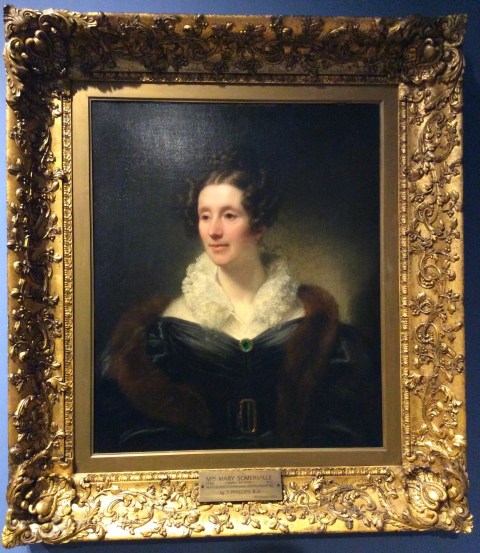
Happy Birthday, Mary Fairfax Somerville!

Mary Fairfax Somerville by Thomas Phillips at the National Portrait Gallery, Edinburgh, Scotland

Mary Fairfax Somerville, born on December 26, 1780 in Jedburgh, Scotland, was a mathematician of uncommon brilliance. After a very limited formal education, Fairfax educated herself from the family’s library. Though she initially was a poor writer and speller, she was an avid reader and an accomplished painter. Her interest in mathematics was sparked by a series of algebraic symbols and equations used as decoration in a fashion book. Once she began to uncover their meanings, she was hooked, and mathematics became one of the ruling passions and pursuits of her life.

Mary spent much of her time in youth and young adulthood in nearby Edinburgh. She married a cousin, Samuel Greig, at age 24, who didn’t actively interfere with her intellectual pursuits but didn’t support or approve of them, either. He died only three years later.

Back in Scotland, with a newfound independence purchased by her late husband’s money and her respectable status as a young widow with two children, Mary immersed herself in her intellectual pursuits in earnest, despite her family’s disapproval. She solved a mathematical problem placed in the Edinburgh Review by Dr. William Wallace, professor of Mathematics at the University of Edinburgh; her successful solution won her a medal and the interest of the mathematical community. Wallace guided her continuing education and introduced her to other mathematicians and scientists. She began to publish articles and books on a wide variety of mathematical and scientific subjects, including for the Royal Society, and would continue to do so for the rest of her life.

Mary received more moral and financial support when she married again in 1812. Her second husband, William Somerville (another cousin, whose mother nursed Mary as an infant), delighted in her work. They initially settled in Edinburgh, where Mary regularly communed with a small but noteworthy circle of intellectuals which included Wallace, Adam Ferguson, and Sir Walter Scott (a long-time family friend). Mary and William later moved to London for his job, where her impressive intellect and accomplishments brought her greater fame. She became friends with other luminaries such as Sir John Herschel and Annabella Milbanke (Lady Byron), who engaged Mary to tutor her daughter. This daughter, Ada Lovelace, also became a noted mathematician and a founding mother of computer science.

For the rest of her long life (she died on November 29th, 1872, about a month before she would have turned 92), Mary continued her research, problem-solving, and writing in science and mathematics, publishing many important works. Her success enabled her to support her family after her husband lost his money in an unsuccessful investment, then had to retire from work due to ill health. She became an active feminist, joining London’s General Committee for Women’s Suffrage and signing John Stuart Mill’s 1866 petition for women’s right to vote.

Learn more about this brilliant woman at:

Mary Fairfax, Mrs William Somerville, 1780 – 1872. Writer on science ~ site page for her portrait at the National Portrait Gallery, Edinburgh, Scotland

Mary Fairfax Somerville ~ by Shane Wood for Biographies of Women Mathematicians, Agnes College

Mary Somerville: British Science Writer ~ by Erik Gregersen for the Encyclopædia Britannica

Mary Somerville: Pioneer Woman Mathematician and Scientist ~ by Jone Johnson Lewis for ThoughtCo.com

Mary Somerville: Queen of Science ~ by Ruth Boreham for DangerousWomenProject.org

Mary Somerville, Scientist, Writer and a Woman of Her Time ~ by Alice Prochaska, Somerville College, Oxford

Personal Recollections, from Early Life to Old Age, of Mary Somerville ~ by Mary Somerville, edited and annotated by her daughter Martha Somerville, published in 1874

Scientist Mary Somerville to Appear on Scottish £10 Note ~ by Rob Davies for The Guardian, Feb 10th,  2016

Ordinary Philosophy and its Traveling Philosophy / History of Ideas series is a labor of love and ad-free, supported by patrons and readers like you. Please offer your support today!
Remembering Margaret Cavendish

Margaret Cavendish (née Lucas), Duchess of Newcastle

Margaret Lucas Cavendish, the Duchess of Newcastle, was a rare and singular intelligence, a memorable and outrageous personality, and a prolific thinker and writer. Born on an unknown date in 1623, she was not given much of a formal education beyond the basics of reading and writing. As is so often the case for such independent and active minds, she obtained a higher education on her own. She sought out the company and conversation of learned people, including her brother John, a lawyer, scholar, and founding member of the Royal Society, and otherwise gobbled up learning wherever she could find it.

She married William Cavendish, Marquis and then Duke of Newcastle upon Tyne, in the spring of 1645. Though he was thirty years her senior, they had much in common, including a deep love of literature. Like Margaret, he was an unusual and independent personality, and he encouraged her in her intellectual pursuits, helping her to get her works published when she ran into obstacles doing it on her own. She wrote in a wide variety of genres, including philosophy, poetry, and plays; she wrote essays, a utopia, a biography of her husband, and an autobiography. She hung out with Thomas Hobbes, Kenelm Digby, René Descartes, Marin Mersenne and Pierre Gassendi at her husband’s salons; unfortunately, they would not engage her in serious conversation. So, she engaged with their ideas on her own within her philosophical writings. She designed her own outrageous clothing, was reputed to sprinkle her speech with obscenities, and as far as she could, did as she liked. However much it was due to her connections or to her own accomplishments, she was the first woman to attend a meeting of the Royal Society. Though she was so much younger than her husband, she died two years before him on December 15, 1673, at age fifty. William outlived her by two years, proud of his ‘Mad Madge’ to the end.

Learn more about this amazing woman at:

Biography of Margaret Cavendish, Duchess of Newcastle upon Tyne (c. 1623-1673) ~ for the Manuscripts and Special Collections pages of the University of Nottingham website

Duchess of Newcastle Margaret Cavendish ~  at the Poetry Foundation

“Mad Madge” – Margaret Cavendish, Duchess of Newcastle ~ by Lauren Gilbert for English Historical Fiction Authors blog

Mad Madge: Margaret Cavendish, Duchess of Newcastle, Royalist, Writer and Romantic ~ Min Wild’s review of Katie Whitaker’s biography for the Independent

Margaret Cavendish (1623—1673) ~ by Eugene Marshall for the Internet Encyclopedia of Philosophy 

Margaret Lucas Cavendish ~ by David Cumming for The Stanford Encyclopedia of Philosophy

Ordinary Philosophy and its Traveling Philosophy / History of Ideas series is a labor of love and ad-free, supported by patrons and readers like you. Please offer your support today!
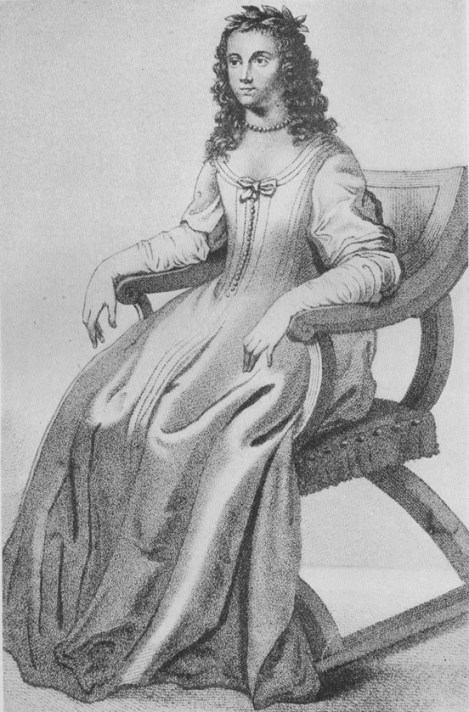
Happy Birthday, Mark Twain!

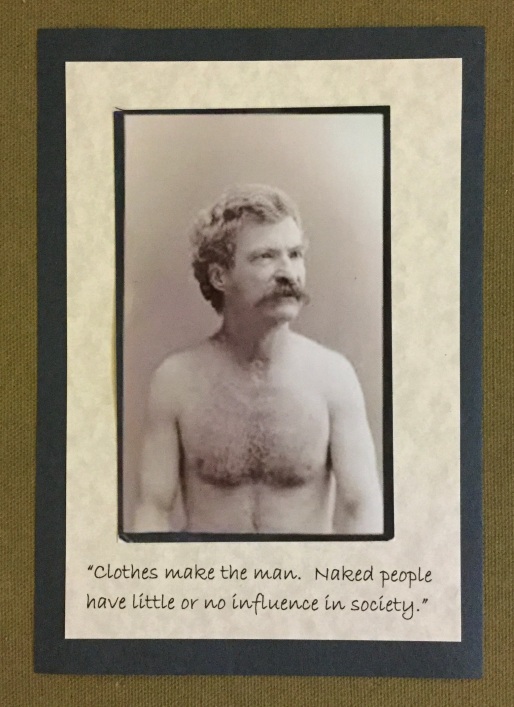
Mark Twain and ‘clothes make the man’ quote, at Mark Twain Birthplace State Historic Site, Florida, Missouri

As I work frantically on organizing my thoughts and assembling my notes for my three final semester papers (all due in a little over a week, gulp!), I can chuckle amid the stress when I think of Mark Twain’s quote ‘I have never let my schooling interfere with my education.’ In fact, he had a rib-tickling, snarky, or sarcastic witticism for just about any occasion.

But there’s so much more to Twain than his one-liners and his incredible body of work. This summer, on my way to Scotland to continue my university education, I crossed (and crisscrossed) the United States between Oakland and Chicago. My journey included following in the footsteps of the young Samuel Clemens, as he was named upon his birth on November 30, 1835, in Florida, Missouri. I have lots of notes and photos but alas, I haven’t been able to write up those parts of my journey in time to commemorate his birthday today. But I’ve found a way to work him into my studies in intellectual history here at the University of Edinburgh (I delivered a presentation on his work on Joan of Arc for one of my classes) and have gotten some additional reading done. I’ll turn the notes for that oral presentation into a written piece for Ordinary Philosophy as well as write up my travel pieces as soon as I can after turning in my papers, please stay tuned!

In this meantime, here’s the link to a bio of Twain by Thomas V. Quirk for Encyclopædia Britannica (my favorite online general encyclopedia) and to the webpage for Ken Burn’s excellent Twain documentary. And a shirtless (or shall I say, birthday suit?) photo of Twain captioned with a quote which I came across on one of my stops following his early life. Enjoy!

Ordinary Philosophy and its Traveling Philosophy / History of Ideas series is a labor of love and ad-free, supported by patrons and readers like you. Please offer your support today!
Happy Birthday, Baruch Spinoza!

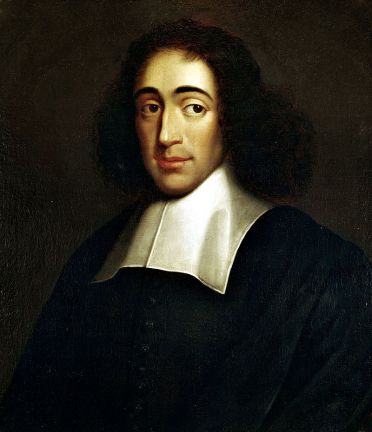
Portrait of Baruch de Spinoza (1632-1677), ca. 1665, by an unknown artist

Baruch Spinoza was born on November 24, 1632, in Amsterdam, the Netherlands. He was the son of Michael and Hannah Spinoza, Portuguese Jews who were forced to convert to Christianity, then imprisoned and tortured by the Inquisition, then fled to relatively tolerant Amsterdam. The Spinozas became successful and respected members of Amsterdam’s Jewish community.

Their son Baruch (also called by his Latinized name Benedicto, also meaning ‘blessed’), was a precocious and brilliant boy who became an intellectually rigorous, curious, and free-thinking man. He wrote prodigiously, profoundly, and often obscurely while earning a humble living as a scientific instrument lens-grinder. He was excommunicated for his unorthodox beliefs (rather surprising still given the relative broad-mindedness of that synagogue), shunned and condemned by his fellow Jews and by Christians alike, and lived the rest of his too-short life in near-solitude, though in rich correspondence with a wide circle of friends and intellectuals.

His idea of God as a unified substance which, in some sense, can be understood as being the same as Nature or the Universe itself, is still widely beloved (the great physicist Albert Einstein and eloquent, outspoken atheist Christopher Hitchens, for example, were among his biggest fans), hated, and debated widely, especially insofar as it can be difficult to grasp the exact nature of Spinoza’s metaphysical and ethical ideas. Spinoza refused to repudiate his ideas despite the intense social pressure he had to deal with for the rest of his life. But however much his correspondents argued, cajoled, threatened with hellfire, or otherwise tried to convince him to abandon his beliefs, Spinoza responded with firmness, constancy, thoroughness, and courtesy.

Learn more about the integrious Baruch Spinoza at:

Baruch Spinoza ~ by Steven Nadler for The Stanford Encyclopedia of Philosophy

Baruch Spinoza (1632 – 1677) ~ in the Jewish Virtual Library

Benedict De Spinoza (1632—1677) ~ by Blake D. Dutton for the Internet Encyclopedia of Philosophy

Betraying Spinoza ~ Rebecca Goldstein on her book Betraying Spinoza: The Renegade Jew Who Gave Us Modernity

Benedict de Spinoza: Dutch-Jewish Philosopher ~ by Richard H. Popkin for the Encyclopædia Britannica

From Baruch to Benedicto! (Spinoza pt. 1) and Spinoza Part 2 ~ by Stephen West for Philosophize This! podcast

God Intoxicated Man – The Life and Times of Benedict Spinoza ~ by Michael Goldfarb for the BBC’s Sunday Feature

Spinoza ~ Melvin Bragg discusses Spinoza’s life and thought with Jonathan Rée, Sarah Hutton, and John Cottingham for In Our Time

The Heretic Jew ~ by Harold Bloom, book review of Rebecca Goldstein’s Betraying Spinoza: The Renegade Jew Who Gave Us Modernity for The New York Times

The Writings of Spinoza ~ at Internet Sacred Text Archive

Ordinary Philosophy and its Traveling Philosophy / History of Ideas series is a labor of love and ad-free, supported by patrons and readers like you. Please offer your support today!
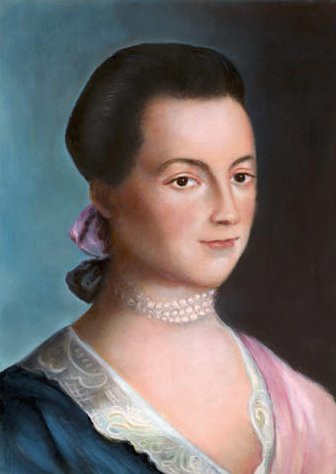
Happy Birthday, Abigail Adams!

Abigail Adams, the earliest known image of her painted near the time of her marriage in 1764

Abigail Adams, born on November 22, 1744 in Weymouth, Massachusetts, was wife and chief advisor to John Adams, American founding father and second president; early advocate for women’s rights and opponent of slavery; self-taught intellectual; mother to many children including another American president; and something I just learned today, a savvy and successful financial speculator. She is one of the most well-known figures in American history because of the voluminous and well-preserved correspondence between her and her husband John. While she remained at home raising the children and managing their home, John was frequently away for extended periods on matters of revolution and state. Their letters are famous: they were loving and forthright with one other on a rare level, and the ideas and advice these two brilliant people shared with one another illuminate and inspire readers still.

Learn more about our wise and indefatigable founding mother Abigail Adams at:

Abigail Adams ~ by Beckett Graham and Susan Vollenweider for The History Chicks podcast

Abigail Adams (1744 – 1818) ~ bio for the Adams National Historical Park, National Park Service website

Abigail Adams: American First Lady ~ by Betty Boyd Caroli for Encyclopædia Britannica

Abigail Adams: Revolutionary Speculator ~ Liz Covart interviews Woody Holton for Ben Franklin’s World: A Podcast About Early American History

Abigail Smith Adams ~ by Debra Michals for the National Women’s History Museum website

First Family: Abigail and John Adams ~ by Joseph J. Ellis for the Philadelphia Free Library

How Abigail Adams Proves Bill O’Reilly Wrong About Slavery ~ by David A. Graham for The Atlantic

John Adams ~ Miniseries by HBO, 2008

Ordinary Philosophy and its Traveling Philosophy / History of Ideas series is a labor of love and ad-free, supported by patrons and readers like you. Please offer your support today!