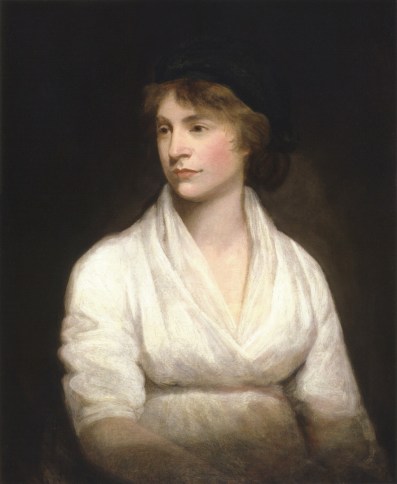
Mary Wollstonecraft, Champion of Reason, Passionate in Love

The life and work of Mary Wollstonecraft, mother of modern feminism, can seem to reveal a mass of contradictions.

Her seminal feminist work, A Vindication of the Rights of Woman, champions reason as the ultimate guide for a moral and productive life. She used reason to great effect to show why women should, and how they could, grow out of their socially constructed roles as under-educated coquettes and household drudges. She believed that reason should rule both individuals and societies because it’s the best tool we have to achieve justice and to perfect the self. Without reason, she thought, human beings are ruled by narrow self-interest, by prejudice born of ignorance, and by crude lust.

Yet the life Wollstonecraft chose to live was widely criticized both during her lifetime and over the two hundred plus years since her death. It’s not just because she didn’t conform to the mores of her time; her life choices are still considered unreasonable and even self-destructive by many. At times, they made her an object of scandal, impoverished, or deeply depressed, even in such desperate straits that she twice attempted suicide. That’s because she was also deeply passionate, devoted to retaining her personal and mental freedom while abandoning herself to loves which never failed to break her heart, be they revolution, family, friend, or lover. For Wollstonecraft, reason and passion are not opposites: they are two sides of the same coin. A truly reasonable person, she thought, is kind, affectionate, and generous as well, and a passionate lover of justice, truth, and beauty.
Wollstonecraft’s chosen role for herself was, first and foremost, a teacher, an advocate of knowledge and instiller of reason. While teaching was one of the few professions open to her as an eighteenth-century woman from a respectable but impoverished background, she brought her formidable powers of reason to bear on the problems with many of the educational and child-rearing practices of her day. After her first job as a companion, she became a teacher, first in the classroom at a school she founded with two of her sisters and her best friend, and then as a governess. When she became a mother twice over in her mid- and late thirties, she was a tender and hands-on mother, an advocate of breastfeeding and attentive parenting in an era of wet-nurses and governesses, when wealthy and middle-class parents participated relatively little in the care and instruction of their children even from infancy.

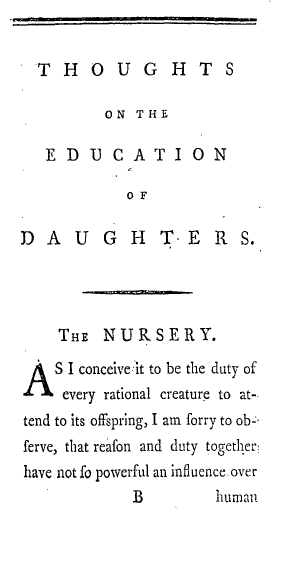
Her first book, Thoughts on the Education of Daughters, opens with her parenting advice and argues that girls should be taught how to run a household while also learning self-sufficiency. In Wollstonecraft’s time, women were not expected to support themselves; they were trained to raise a family, learning how to catch and keep a man first, to be household managers second, and to be educators of young children third. Single women, widows, and married women whose husbands, fathers, brothers, and other male relations could or would not support them had few employment options available to them, mostly directly related to one of the three roles they were trained for. Those jobs that women could respectably accept paid very little, so those working women nearly always lived a life of subservience and privation. Modern feminist thought, until very recently, equated domestic life with that housebound, nearly choiceless life most women were required to live. However, now that women’s basic moral right to self-determination has become so widely established, most have come to consider a domestic-centric life just as valid a choice for free women as a professional or public life. So in this sense, Wollstonecraft’s view of women was more progressive even than that of many modern feminists, even if by accident rather than foresight: she did not speak of a time when women would need to reject domesticity in order to free themselves from it, only to reclaim it by choice after their liberation.

Her ideas were inspired by her own experience: Wollstonecraft discovered firsthand how important it is never to assume that one’s self or one’s children will always have someone they can depend on for education, sustenance, or affection. Life’s too uncertain for that: parents, spouses, relatives, colleagues, and friends can become neglectful, estranged, impoverished, or disabled, and of course, sometimes they die. Wollstonecraft’s father squandered his inheritance and never bothered to learn how to earn an adequate living, leaving all of his children (except for his oldest son, who inherited what was left) to fend for themselves in adulthood, and his daughters without the dowry necessary for a respectable marriage. Knowing firsthand what it’s like to wrest a living from a world where women were ill-equipped for and mostly barred from nearly all employments that men were free to pursue, Wollstonecraft believed all girls should have a thorough education centered on self-sufficiency, from learning how to take care of a household, to learning how to think, to learning how to make a living. This not only gives women the freedom to choose a partner for better reasons than mere survival (Wollstonecraft equated the latter with prostitution), but leaves women free to live their lives as independently as they choose.

Until Wollstonecraft’s response to Edmund Burke’s critique of the French Revolution, her Vindication of the Rights of Men (1790), her published work continued on an educational vein, from original compositions to editorial work to translation. Beginning with The Rights of Men, through A Vindication of the Rights of Woman (1792), and up to her last work, Letters Written During a Short Residence in Sweden, Norway, and Denmark (1796), she transitioned from a teacher of ideas into an innovator, drawing on the wealth of knowledge she had obtained through her lifetime thus far of work and study. She was a semi-autodidact, her rather patchy childhood education supplemented in her teens by her own voracious reading and by friends who recognized her hunger for learning, and continued independently during her working years in the hours she could dedicate to her self-improvement. When she established herself as a professional author, she was finally able to immerse herself fully in the life of an intellectual, attending famous salons and becoming the friend and colleague of many of the brightest minds of her day.

One of the central themes in The Rights of Woman is women’s education. In this work, Wollstonecraft explained that it’s the nature of women, rather than their practical needs, that’s the ultimate justification for their rights, though she doesn’t minimize the importance of the latter. Since women possess reason just as men do, they also need education in order to be happy, fulfilled, and above all, moral. Infantilizing women by denying them a full education, she wrote, renders them not only financially helpless, entirely dependent on men whether or not they’re capricious, selfish, lazy, cruel, or just unlucky, but undermines them as moral beings. It’s reason, more than anything else, that determines the difference between right and wrong, and a quality, well-rounded education is required for using reason to its fullest capacity.

But outside of her moral reasoning, in her life as she lived it, Wollstonecraft displayed the often stark contrast between what one might expect a person ruled by reason would do, and what a person would do when driven by passion.

One of her earliest romantic interests, the Irish gentleman and songwriter George Ogle, ended up causing her no harm and probably doing her even more good than many might realize; not only did her cheer her with intellectual and witty conversation in her time as governess for the wealthy Kingsborough family in Ireland, a biographer credits him as the secret benefactor whose cash gift allowed her to return home to England and pursue writing in earnest. And her pursuit of the intellectual life she loved probably brought her more joy and fulfillment than anything else, with the possible exception of her daughter Fanny.

But most of her other loves did seem to bring her at least as much pain as joy. Her first deep attachment in her early teens was to her friend Jane Arden, who didn’t share her idealistic concept of the near-exclusive, passionate friendship of the soulmate. The more the young Mary sought to dominate her affections, the more Jane drew away. Fanny Blood, her dearest friend in adulthood, nearly lived up to her ideal, but her father’s shiftlessness kept her family impoverished, leaving Fanny with the responsibilities of main breadwinner as well as head housekeeper for her large family. Wollstonecraft saw her dreams for Fanny and herself mostly come true when they joined forces with Wollstonecraft’s sisters to found a school, but this didn’t last as long as she hoped. The distant and dithering suitor that Fanny had longed to marry for years finally carried her off to Portugal, leading to her painful death less than a year later as she succumbed simultaneously to her tuberculosis and the rigors of childbirth. The painter Henry Fuseli may have been a romantic interest: he later liked to claim this, and others echoed this claim, but much of the evidence also indicates that her interest in him was as an aesthetic and intellectual soulmate more than anything else. (At this time, she was still firmly opposed to marriage, and determined to keep herself free from the sort of entanglements that would hamper her mental and physical freedom.)

After a bit of scandal around her unconventional, and rejected, proposal to Fuseli and his wife (who was also her good friend) that she live with the two of them, she set off for Paris to witness the French Revolution firsthand. Wollstonecraft was an ardent supporter of the Revolution, as she saw it continuing the work of dismantling the tyranny of a parasitical monarchy, a corrupt and greedy church, and the oppressive social practices and mores that the American Revolution had started. By the time she arrived, the French Revolution had already taken a violent turn, but she held out hopes that this was a natural but temporary outcome of a people throwing off a tyranny that had ruthlessly oppressed them so badly and for so for so long. While she maintained throughout that a certain amount of violence is the natural byproduct of any truly transformative revolution, she became more and more disillusioned with its leadership and tactics over time, and finally, with her own hopes of its success. (She identified herself with the more moderate Girondin political persuasion throughout.) Wollstonecraft did not live long enough to see that the Revolution would end up ultimately succeeding in ushering in a new era of human rights-centered government in Europe, once some social balance was restored. But she did escape the Terror, probably narrowly, having fallen in love once again. She found herself pregnant and fleeing for her life, returning to England after giving birth her first child at age 35.

And it was Gilbert Imlay, the father of this child and the first deep romantic passion of her life, that caused her the most pain, more than the sisters with whom she was often at odds, more than her most cherished female friends who left her in one way or another, more than her ne’er-do-well brother and the Blood family, more than her self-important painter Fuselli, more than the school she founded that fell apart when she left to nurse Fanny in her final illness, leaving her deep in debt. Imlay presented himself as a man of adventure, an American frontiersman of rugged, self-sufficient, and honest character. These proved to be an illusion: he was actually primarily a man of business, sometimes (often?) of shady dealings, and one who frequently failed to keep his word. In Imlay, Wollstonecraft finally found an exciting sexual partner, a stimulating companion, and a fellow believer in truly living according to one’s personality. They never married because they didn’t believe in that institution, though they found it expedient at times to pass themselves off as husband and wife. In fact, this pretense may very well have saved Wollstonecraft’s life, since the perpetrators of the Terror, in its most insular stage, were executing many expatriate Britons; Americans, however, were still in good standing with the Revolution, and as Imlay’s ‘wife’ she was considered American as well. But it became clear over time that Imlay was not eager to embark on the happy domestic life her pregnancy caused her to long for, and he abandoned her slowly, in stages. It took her a long time to get over Imlay while struggling to get by as a single mother in 18th-century Europe; it was during this period she twice attempted suicide.

Her eventual husband and first biographer William Godwin called Wollstonecraft a ‘firmest champion’ of her sex. In Godwin, Wollstonecraft finally found the lasting sort of love she had been looking for. Their attraction was initially an intellectual connection which only later developed into romantic passion. Sadly, they only enjoyed a brief romance, less than two years, since she died of complications from giving birth to her second child. I think Godwin was right that she was a champion of reason, and I would add, of passion too, and a champion of seeking: of truth, of wisdom, of self-discovery, of new ideas and sources of knowledge, of experiences that expand the mind and the heart, of becoming the best human being one can be. To fully follow her example is very risky: she often flung prudent reasoning to the wind in favor of following her heart, in a time most dangerous for women to do so. Yet, though reasoned prudence is a virtue, it can be taken too far, holding you back, preventing you from taking chances and experiencing all the richness life can offer. She did not hold back.

~ Ordinary Philosophy is a labor of love and ad-free, supported by patrons and readers like you. Any support you can offer will be deeply appreciated!

~~~~~~~~~~~~~~~

Sources and inspiration:

Godwin, William. ‘Memoirs of the Author of A Vindication of the Rights of Woman‘. London, 1798.

Gordon, Lyndall. Vindication: A Life of Mary Wollstonecraft. New York: Harper Collins, 2006.

Jacobs, Diane. Her Own Woman: The Life of Mary Wollstonecraft. New York: Simon & Schuster, 2001. http://books.simonandschuster.com/Her-Own-Woman/Diane-Jacobs/9780743214704

Tomalin, Claire. The Life and Death of Mary Wollstonecraft. London: Weidenfield & Nicholson, 1974

On Plastic Surgery and Other Cosmetic Interventions

I work for a dermatologist who focuses his practice on medical dermatology. While all treat many of the same medical conditions, an ever-increasing percentage of dermatologists devote a substantial portion of their time to performing cosmetic procedures, from Botox and filler injections, chemical peels, and laser treatments to surgeries: facelifts, chin implants, eyelid modifications, and so on. The sign on the door of the medical practice I work for, however, reads ‘Diseases of the Skin’.

To me, this is a reassuring message, as if to say to all who enter ‘We are here to try and cure what ails you.’ It contrasts sharply with the message I get from cosmetic dermatology and surgery ads: ‘We agree that you’re ugly and need to be altered.’

Now, of course, this is only what I read into those ads, especially in my more sensitive moods. I don’t for a moment speak for anyone else, including the doctor I work for. ‘Diseases of the Skin’ is a simple statement of fact, conveying the information that he specializes in certain areas of dermatology and nothing else.

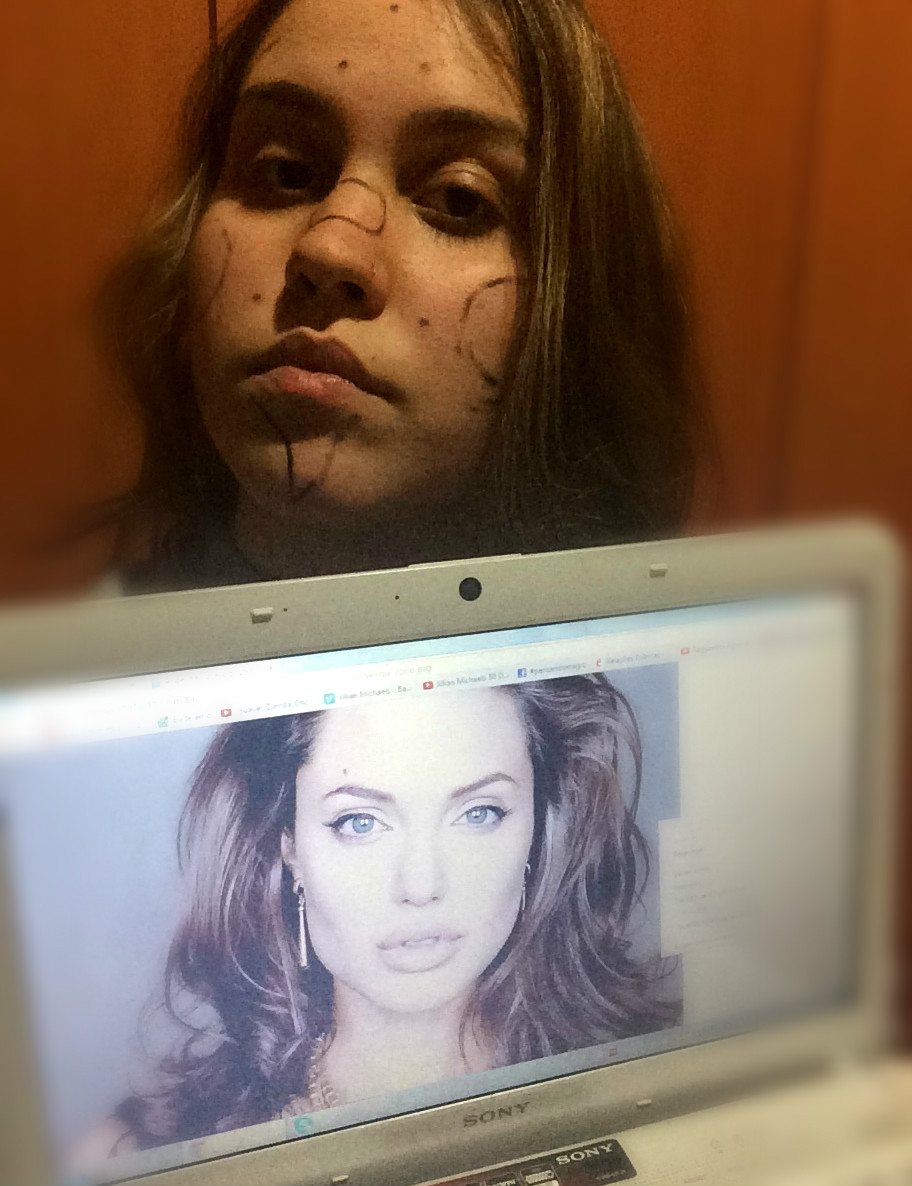
I’ve thought about the issue of cosmetic medical interventions, aka, ‘getting work done’, quite a bit over the years. The idea of using surgery and other invasive procedures to permanently alter a person’s body because they and others have decided they don’t like and can’t accept how they look makes me very uncomfortable, even angry on their behalf in case others have led them to feel that way. I admit right now, I have a longstanding bias against most forms of plastic surgery and cosmetic dermatology, and even the de facto social requirement that women wear heavy makeup, binding clothing, and hobbling footwear to be successful in many fields of work, especially in the performing arts and public media, and to ‘make a good catch’ as it used to be commonly called. Oh, and these women are often effectively required to ‘get work done’ at some point, too. While these procedures (CMI’s for short) are performed on men too, over 90% are performed on women, so I’ll continue to address cosmetic interventions as if it’s primarily a woman’s issue, though most of my comments apply to men as well.

So why worry about any of it? Is it any of my business what other women freely choose to do with their bodies? Are are my objections just personal, rooted in some sort of insecurity, just ‘sour grapes’ towards other women who are willing to do what I’m too lazy, cheap, or tomboyish to do?

As to the first, I don’t believe our life decisions have nothing to do with others; in fact, as I often argue, our choices so often affect other people in some way that we should make it a habit of assuming that they do. But whether or not deciding to have a cosmetic procedure performed is a purely personal choice, it’s an important topic for public discussion, since there are so many risks and ramifications to financial, physical, and mental health, and so many moral issues to consider. And when it comes to freedom of choice, I’m not at all convinced that the pressure women feel to conform to certain standards of beauty, especially the perception that they must have cosmetic procedures in order to have the kind of life they want, can meaningfully be referred to as real freedom.

As to the latter, I’ve occasionally wondered if elements of some or all of those things influence my attitudes on the subject. Of course I sometimes feel insecure in the presence of particularly beautiful or glamorous people, especially as a teen, but I’m quite sure everyone experiences these feelings from time to time. I also refuse to wear makeup primarily for two reasons: I loathe the scent, feel, and taste of it, and I’m not willing to spend the time it takes to put it on and touch it up all the time. But this is also normal, I know plenty of women who wear little or no makeup. Still, perhaps, my youthful ‘sour grapes’ got the whole ball rolling on my mostly negative attitude towards cosmetic interventions, it’s hard to say. But at this point, I’ve considered the case for and against cosmetic interventions, especially those undergone for the sake of simple vanity, so many times that I’ve thought out a wide range of arguments, and though I’m not sure I’ve drawn rock-solid conclusions, the objections remain. I’d like to share them with you, dear readers, and see what comes of them.

I’ve often shared my concerns with the dermatologist I work for, but his attitude toward the whole issue of CMI’s is much more tolerant than mine. Some weeks ago, he gave me a cutting of an article published in the Journal of the American Medical Association in April of this year. It’s the abstract of a study whose purpose is ‘to introduce the concept of facial profiling to the surgical literature and to evaluate and quantify the changes in personality perception that occur with facial rejuvenation surgery’. The study seems, on the face of it, to provide some scientific evidence against at least some of my objections. So what are they, anyway? Well, the study gives me a good starting point.

It goes like this: the researchers gave people pictures of 30 white women who had undergone various kinds of plastic surgery, and gave the participants a mixed assortment of the before- and after-procedure photos. They then had the participants rate the people in the photos for several personality traits, including attractiveness and femininity. As you may have guessed, the study found that the people who had received plastic surgery were rated significantly higher in several four positive traits: attractiveness, femininity, social skills, and likeability. They rated the people in the photos for other traits, too, some positive and some neutral, but there were no significant statistical differences for those. By the way, I was surprised to find the researchers didn’t ask the participants to rate for traits usually considered negative, unless ‘aggressiveness’ counts.

As I read the abstract, however, I didn’t find much that told against my objections; rather, several problems with the study leapt to the eye.

First, the study had a very tiny pool of subjects whose pictures were rated, and an even tinier pool of participants doing the rating, which may render it little more than a record of statistical outliers. It is difficult to fund a study, and the small size may not necessarily render it useless, since the researchers may very well have conducted this small study just to see if their hypothesis had any merit at all. Still, it seems hard to be convinced by such thinly tested results.

Secondly, and I think especially problematically when it comes to perception, the participants only looked at still pictures. I’ve frequently observed that those who have had ‘some work done’ often look rather odd in person: Botox-paralyzed brows don’t harmonize well with the expression of the the rest of the face; various parts of the body don’t match in age appearance, with smooth cheeks and perked breasts accompanying evidence of age and softening in other parts of the body; eyebrows often end up arched alarmingly and eyes narrowed by being tightened too many times; the corners of the mouth curve artificially, Joker-like, whether the person is smiling, talking, or at rest; scar tissue often adds a stiff and often texturally incongruous look to surgically altered areas of the body. A still photo reveals only a small fraction of the actual alterations in appearance and movement that are caused by CMI’s.

As to measuring attractiveness, femininity, sociability, and the like: many of these are mostly or entirely culturally ingrained stereotypes of what a (white) woman ‘should’ look like if she is likely to possess these traits. But the cultivation and perpetuation of many of these stereotypes is one of those things I object to the most in the first place. What sorts of surgery did these few women choose to have and why did they select those particular ones? What results were they trying to achieve: to look like a typical Hollywood starlet or socialite, or to look like their own younger selves, or to express their own idiosyncratic ideals of beauty? And as to those involved in the study itself: Why were only white women chosen, and why these particular set of personality traits? Did the raters also perform other tasks to help determine what they think an ‘attractive, feminine, and socially skilled’ person ‘looks like’ in the first place, and why they assume that’s how they look?

Now, the authors of the study, at least in this abstract, seem to try not to make too many preemptive value judgments on these points. They merely state that the results of this study indicate that receiving plastic surgery can alter one’s likelihood of being perceived in certain ways by other people. I don’t critique this study to claim the researchers are wrong in their predictions, but to point out various ways in which I think the study is unsuccessful in demonstrating what they want it to. The study was just too small; the participants did not have an adequate opportunity to observe what recipients of plastic surgery really look like since they saw only stills; and the way the participants were asked to rate the photos, as well the way the researchers selected the traits and photos themselves, probably influenced the outcome to a significant degree, revealing at least as much about the researchers’ biases, or tendencies to ‘facially profile’, as anything else.

I’m also going to stop here and make this clear: I’m fully aware that CMI’s, like the field of dermatology as a whole, have many wonderful, life-enhancing applications, repairing all manner of disfigurements caused by disease and injury, from tumors to severe acne to burns to the ravages caused by severe weight-gain and -loss. People with such disfigurements, and those born with physical traits that are very unusual or exaggerated, may have a very hard time getting a job, promotions, and dates, and feeling as if they can live freely without the constant distractions that come with having a very unusual appearance. Try as one might, it’s extremely difficult to keep stares, startled or disgusted looks, and other negative reactions to one’s appearance from damaging one’s peace and overall happiness. CMI’s, in these cases, can provide enormous benefits by normalizing appearance and thus ease feelings of stress and isolation, remove unwanted negative attention, and open up opportunities.

I also want to make it clear that I’m not critiquing the human desire to be beautiful or to ornament ourselves. The human species is an imaginative, creative, and playful one, after all, and I am the first to admire a fantastic costume, a gorgeous shade of lipstick, or a flattering haircut. What I’m critiquing is the obsession we have with fitting into very narrow, culturally-derived stereotypes of what it means to be attractive, the ways in which we oblige one another to do so, and our blasé attitudes towards these procedures regardless of their effects on our financial, mental, and physical health.

Cosmetic dermatology treatments and plastic surgery are expensive. They may also be addictive, or signify and likely exacerbate underlying mental health problems. (I found conflicting information on this point, since few rigorous studies have been done; while a large percentage of recipients of cosmetic procedures display observable and well-documented behaviors consistent with addiction, it’s still uncertain if the procedure-seeking is a primary or secondary symptom.) They are also often unpredictable in their results, and sometimes dangerous. People can suffer allergic reactions to the chemicals used, or the skin can burn, scar, or be discolored. We all tend to heal and to scar at different rates as well, even in different parts of the same body, and often there’s no way to predict ahead of time how the procedures will turn out, how well the results will harmonize with one’s overall appearance, and how much they will affect the natural mobility and expression of the face and body.

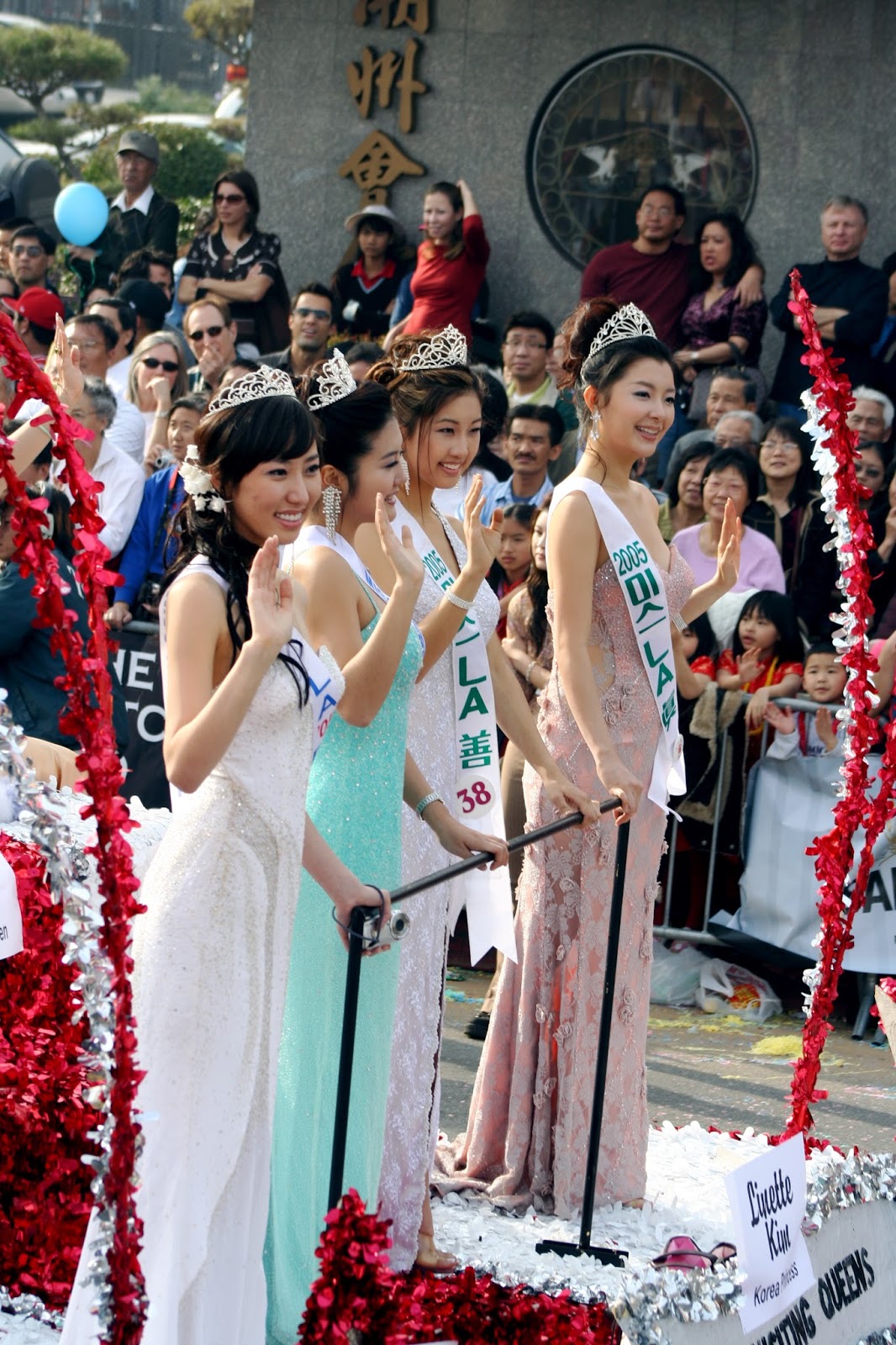
The story of the twenty eerily near-identical Korean beauty queens that went viral a couple of years ago is a case in point, a story which I found disturbing in the way it reveals the degree to which an obsession with artificial beauty standards can overrun a culture, destroying even its acceptance of the way its individuals naturally look. One of the most popular cosmetic procedures these Korean beauty queens choose, after all, is eyelid surgery to make their eyes look less ‘Asian’ and more ‘western’. A quick internet search will reveal innumerable horror stories of individuals who become obsessed with cosmetic interventions, and their addiction to ‘getting work done’ leaves them scarred, deformed, even disabled.

Anecdotally, I tend to be very conscious of such things because of my years of training in observing the details of the human body. Drawing was among my favorite pursuits as a child and young adult, and I studied figure drawing and painting in my first go-around in college. My fascination with the human form, combined with my sewing hobby and my years as a buyer, seller, and tailor of denim and vintage clothing, led me to choose the career of dressmaker and independent fashion designer for many years. I assisted people in choosing the proper fit in clothing (and still do!), and designed and created patterns and custom pieces to fit various figure.

And over time, the detailed observation and assessment of bodily forms gave me a deep appreciation of the wonderful and fascinating variety inherent in the human species. Noticing how the features and foibles of a person’s appearance express their personality and life story has become such a deeply ingrained habit in me that I just can’t turn off. Automatically, I assess the proportions of the faces and bodies I see, and note how the ways people carry themselves, their bodily attitudes and ways of speaking, denote their mood and general personality. A gesture, an expression, a moment’s pose, the way the hair falls across the shoulders or the hand rests on a surface, will sometimes strike me as the perfect subject for artistic representation. I’ll draw, paint, quilt, or snap a picture in my imagination, or decide which other artist would choose this as their subject. What rich offerings to the imagination does the variety in human appearance bring! In so many ways, it’s strange to me to decide that wrinkles and other body folds, those curves and lines that lend interesting shape and dramatic texture to a face or body, are ugly and must be eliminated, or that all bodies should be tucked, sucked, and otherwise molded into a narrow and far less interesting range of forms. I remain very grateful for the wonderful training I received, and thank all of those who helped me to recognize the true beauty and interest there is in this world.

And in my day to day life, I regularly have the opportunity to closely observe the results of regular recipients of cosmetic interventions and the personality traits that often accompany them. The dermatology practice I work at rents out a cosmetic dermatologist’s office one day a week to see patients local to that area. When it’s my turn to accompany the doctor to that relatively wealthy suburb, I find myself in the position of closely observing the physical results of cosmetic intervention when that doctor’s patients come in to purchase skin care products, as well as their behavior towards those of us behind the front desk. And what I observe is not always pretty, to say the least. These women are often curt, demanding, complaining, and chatter at long length about every little real or perceived flaw in their appearance that they’re eager to ‘cure’, whether or not that European-formula sunblock-concealer or skin serum costs sixty dollars per tiny bottle, and many with the stiff, tight faces of the sort I described earlier, oddly inexpressive and of indeterminate age. They have very often not, in my view, purchased beauty, good social skills, or an aura of happiness with the faces they now wear.

There’s an actress I’ve long thought very lovely, and I admired her since I first saw her, self-confident and wry, in an early 90’s movie. A few years ago, I was glad to see her act again in a certain miniseries, and while I still enjoyed her acting very much, I watched in dismay as, between each season, her face was altered more and more until I found myself cringing a little during her scenes. Having clearly ‘gotten some work done’ time and time again, her once very expressive face stiffened, stretched, and morphed into an ever more mask-like appearance. Now, I find her nearly unrecognizable. Do I fault her, and so many others like her (yes, some men too)? Sometimes I think yes, sometimes no, usually somewhere between the two, but my intention is not at all to pick on people in her position. I don’t really know what it’s like to feel that you have to choose between staying in a profession you know and love and having to remain looking as young and smooth as possible. Like all people at at some point in their lives, I do know the deep discomfort of perceived bodily dysmorphism, a feeling particularly common in our culture as we so often compare our own appearance unfavorably with cultural standards of beauty. But in her case, as with so many others, I find the surgical, ahem, ‘enhancements’ a failure, not at all conducive to her fully expressing her talents or growing into new roles she could explore.

So far, we’ve considered the practical and artistic downsides to CMI’s. But what I find even more problematic are some of the ethical implications, the ways in which these practices can help create, instill, and perpetuate some undesirable character traits if we are concerned with respect, tolerance, and appreciation for ourselves and our fellow human beings.

For one thing, participating in the project of creating a world of beauty-conformism can be socially irresponsible. There’s an idea, commonly held by liberals, that if a person wants to do something with their own body, it’s nobody else’s business. In short, people should be allowed to do whatever they like, without being subject to moral judgment or criticism of any kind, unless it harms other people directly and only in certain ways. I think this view is mistaken, or at least shortsighted. While I’m a fellow liberal and lover of freedom, it’s also true that our actions more often than not can and do affect others, indirectly, directly, or in the aggregate, and judging our own and other’s actions in light of this fact is essential to caring about doing the right thing. When individuals make personal decisions in matters of what they buy, how much they consume and waste, how their actions affect public safety, how much they contribute to pollution and future overpopulation, how courteously, fairly, and respectfully we treat our fellow human beings in our day to day dealings with them, and so on, we see that our personal decisions really do impact other people. Participating in a harmful or potentially harmful practice of engendering beauty conformism, for example, can be as irresponsible as participating in the wasteful and polluting practices of a hyper-consumerist culture. In their concern for liberating people from the oppressions and encroachments of others as well as from government, many confuse liberalism in politics with the idea that we shouldn’t value certain things over others, and that we shouldn’t make judgments about might be better ways to think and act.

So when we keep buying into this view that the only people that count are the ones that look good (whatever we mean by that) and help perpetuate it by choosing cosmetic interventions for ourselves, we help create a world that’s less free. By doing so, we do our part to foster the view that women (and men) should all ‘look good’ in more or less the same way if they expect to get ahead in the world, and if they don’t, they can expect to be sidelined in their careers or even in life. For myself, I already feel this way about the expectation that we women must alter the appearance of our faces with makeup and increase the sexiness of our foot, butt, and leg shape with high heels in order to be feminine and attractive, so the Beyoncé and Miley Cyrus brand of hyper-sexualized ‘liberated grrrrl power’ doesn’t feel like freedom or empowerment to me. While I enjoy looking at cute shoes as much as anyone, we’ve gone beyond that: sexiness in women virtually equals high heels, blond and/or straight-to-wavy hair, and/or revealing skirts, if cultural mirrors such as Cannes File Festival organizers or Fox News policy-makers are to be believed. How much more oppressive is the social pressure such as that experienced by my aforementioned admired actress: whether or not she liked her own face as it was, it’s not ‘good enough’ in a culture that values the trappings of youth, such a smoothness, slimness, and sexual availability, real or manufactured. It’s the image that counts, not the person. To me, there’s something dehumanizing in all of it, something that smacks of the same old oppression that corseted Victorian women and foot-bound Chinese women experienced, whether they bought into the whole thing or not. By the way, I’ve also long wondered how men would deal with it if the fashions they were expected to wear and the beauty-alterations they were expected to undergo were as uncomfortable, binding, and camouflaging as women’s.

Another problem with CMI’s is the way they can reinforce one of our most self-destructive habits, an obsession with looks that all too often comes from equating worth with beauty, and equating beauty with fitting into a few narrow aesthetic stereotypes. We have become quite a vain and self-obsessed culture. While a certain amount of vanity may be useful in helping us stay fit, clean, and well-dressed at appropriate times, overall it’s limiting and even self-destructive. How many hours we waste when obsessed and disturbed by perceived imperfections in our appearance, and how much beauty and interest we fail to see in the world when our perspective is so unforgiving, so narrowed, so unimaginative! The person overcome by vanity draws into themselves; their world becomes small, their preoccupations dull and trite, and their problems loom large because they are no longer contrasted with the real problems outside the world of their own narrow range of interests. Acting on that vanity to often entrenches it ever more deeply into our character through habituation and reinforcement, justifying our vain preoccupation to ourselves by expending our money, time, even suffering satisfying its demands. And when we instill in ourselves the value that our looking a certain way matters so much that we’ll go through all that expense and pain to to attain it, it seems we also change the way we habitually perceive other people. Perhaps if we can’t appreciate or respect ourselves if we don’t look good enough, we might soon find that others who don’t look good enough by our own or society’s standards aren’t worthy of our appreciation or respect either.

It seems as if we want to get closer to creating a world where people are more generous, tolerant, and celebratory of one another, a good place to start is with one’s own face and body, and then to extend that disposition outward. If we can’t come to terms with our own appearance, to learn to appreciate one’s own self with its own set of quirks, wrinkles, spots, lines, bulges, colors, etc, how can we do that with other people? Each and every one of us enjoys the good fortune to be born into this world, so why do violence to the very body that makes our existence possible? Why not instead habituate in ourselves an attitude of gratitude to the body which gives us everything we have? And do we really want a world of clones and lookalikes anyway, or would we rather be in a habit of enjoying the marvelous richness and diversity of the world is that we’re so lucky to find ourselves in? And anyway, who decided that only the smooth, slim, and young are worth looking at? Definitely not the artist, the loving grandchild, the parent, the friend, or the kindest and noblest part of our own characters.

Perhaps it would be much better for us to habituate ourselves to looking at the world differently. Perhaps it’s better to decide it’s not up to others to conform themselves to our expectations of how they should look, just as it’s not up to others to impose their expectations on us. Perhaps we could train ourselves to look at people whose appearances do not conform to narrow stereotypes of beauty, ourselves included, and react not with the desire to change them, but to accept and appreciate them. Perhaps we could open ourselves up appreciating to more types of beauty, such as perceiving the lines and spots in an aged person’s face as the writing and punctuation of an interesting life story, or the prominent curves and angles of a nose as the proud badge of one’s ethnicity that also lends drama to one’s features, or the softened tummies and breasts of mothers as the tokens of the new life they bring into the world, and not as ugly flaws.

When we think about CMI’s generally and to consider whether we should do this to ourselves, maybe we should ask: is it really a good thing to chose to spend the time and money and take these risks in order to alter my looks to fit in with these contrived standards of beauty? And yes, they are contrived, as we can see by observing rigid but often non-overlapping beauty standards throughout the world and throughout history, as well as contradictory and changing societal attitudes towards the aged. Or might it be better to forgo all of that in favor of internalizing a more open and appreciative attitude towards the variety inherent in the world? Is it really a harmless thing to perpetuate in ourselves and others the kinds of attitudes about physical appearance that lead us to seek cosmetic interventions in the first place?

In a world struggling with racism, sexism, nationalism, ageism, celebrity-obsession, commodification of human beings, and all other kinds of racial and gendered bigotry, based on assumptions about who a person is and how desirable they are based on the color, shape, and smoothness of their body… should we think it’s generally a good idea to carve these expectations into our own bodies and burn them into our own skin?

What do you think?

~~~~~~~~~~~~~~~~~

Sources and inspiration:

‘2013 Plastic Surgery Statistics Report’. American Society of Plastic Surgeons website.
http://www.plasticsurgery.org/Documents/news-resources/statistics/2013-statistics/plastic-surg

‘The Dangers of Plastic Surgery Addiction’, Jun 26, 2015, Jim Brantner, MD Plastic & Reconstructive Surgery website. http://jimbrantnermd.com/the-dangers-of-plastic-surgery-addiction/

Dimiero, Ben & Eric Hananoki. ‘”I Can’t See Her Legs!”: Roger Ailes’ Rampant Sexism’. Jan 13th 2014, Media Matters blog. http://mediamatters.org/blog/2014/01/13/i-cant-see-her-legs-roger-ail

Griffiths, Mark D., Ph.D. ‘Cosmetic Products: Can People Become Addicted to Plastic Surgery?’ Sep 2, 2013. Psychology Today website, https://www.psychologytoday.com/blog/in-excess/2013

Nolan, Steve. ‘Has Plastic Surgery Made These Beauty Queens All Look the Same? Koreans Complain About Pageant “Clones”‘. Daily Mail.com, April 25th 2013.
http://www.dailymail.co.uk/news/article-2314647/Has-plastic-surgery-20-Korean-beauty-pageant

Reilly, Michael J, Jaclyn A. Tomsic, Stephen J. Fernandez, et al. ‘Abstract: Effect of Facial Rejuvenation Surgery on Perceived Attractiveness, Femininity, and Personality’. JAMA Facial Plastic Surgery Journal. May/June 2015, Vol 17, No. 3. http://archfaci.jamanetwork.com/article.aspx?art

To Paris, France I Go, In Search of Revolution-Era Thomas Paine, Mary Wollstonecraft, and Thomas Jefferson

Hello, friends of Ordinary Philosophy!

From time to time, I take a trip to some corner of the globe, to explore the lives and ideas of great thinkers in the places where they lived and worked. For this series, I follow in the footsteps of thinkers who are no longer alive, since those who are still telling their own stories. But those who are no longer alive in the body live on in the ideas that they pass on, and in the example they provide for us to follow.

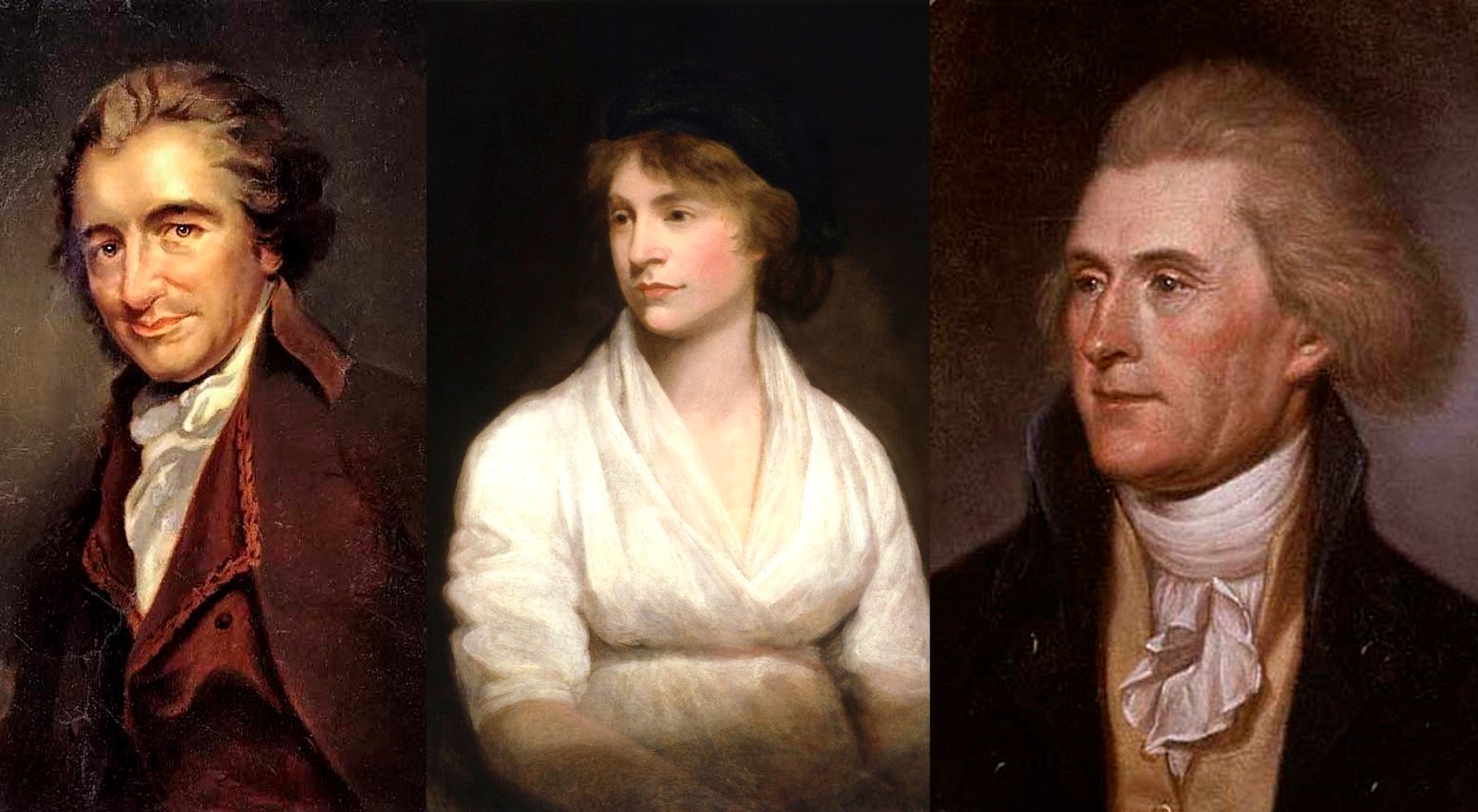
I’m pleased and excited to announce my fourth philosophical-historical themed adventure, this time in Paris, France to follow in the footsteps of Thomas Paine, Mary Wollstonecraft, and Thomas Jefferson at the time of the French Revolution.

The French Revolution, following on the heels of the American Revolution, inspired and horrified many. The financial crisis, caused by over-expenditures in recent wars (including assistance to the Americans) and food shortages, caused by a series of crop failures, led to an uprising mostly of professionals and merchants, joined later by members of the laboring classes. The movement for reform called for disestablishment of the monarchy, who entangled the nation in wars and continued to spend lavishly in times of want, and for ending the special privileges of the aristocracy and clergy, whose tax exemptions often placed the heaviest financial burden on those who could least afford it.

Thomas Paine, Mary Wollstonecraft, and Thomas Jefferson were three Enlightenment thinkers whose work is central in the intellectual legacy of modern human rights movements, and who were heavily influenced by the French Revolution. Paine, a British-born corset-maker who became involved in local politics and reform movements in his native country, in America, and in France, set down his political theory and freethought philosophy in Common Sense, The Rights of Man, and The Age of Reason. Mary Wollstonecraft, who was also born in England and also moved to Paris to take part in the revolutionary activism taking place there, followed Paine’s The Rights of Man with her Vindication of the Rights of Woman, now considered the founding work of the modern feminist movement. Thomas Jefferson, founding father of the United States and eventual President, was an American statesman living in Paris as the events leading up to the French Revolution unfolded, and continued to defend its core democratic values, if not all its tactics, even as it devolved to the bloody Terror.

So off to the Paris I go! There, from August 9th through the 21st, I’ll visit landmarks associated with their lives at this time, and see how the events that occurred at that time in the places where they lived, worked, died, thought, wrote, studied, rested, and played contributed to their thought during and after the Revolution.

~ Thank you, Ronnie Ruedrich and Mark Sloan, for your generous support

Here’s the story of the trip and related essays about these three thinkers and their ideas:

Fury Road, by Christina Bellon

Max:  Here, everyone is broken.
Furiosa: Out here, everything hurts.

~ Mad Max: Fury Road

I couldn’t wait to see this movie. And then I couldn’t wait to see it again. The first viewing was cathartic in all the right ways, but it was a sensory assault. In 3-D it was almost abusive. The second time allowed me to attend to the story, the characters, the art and imagery, the dance of bodies in fight and vehicles in chase. Those Pole Cats are terrifyingly beautiful swinging through the air at high speed (all done live). Now I could enjoy the artistry of this post-apocalyptic adventure. Fury Road has everything the genre demands, explosions, fights, minimal dialogue. But, there’s more.

This is a fractured world, bodily and psychically. We find two competing philosophies, that understanding of reality by which we make sense of our world. There is the dualism of Joe’s warrior-cult, expressed best in the War Boy creed, “I live. I die. I live again.” There’s the witnessing of a warrior’s meritorious death in battle, being taken to the gates of Valhalla (by Joe, himself, for those not “mediocre”), and of being reborn, “shiny and chrome.”

There’s also the non-dualism of Furiosa’s unsentimental realism, her willingness to risk everything to return home, to find redemption in this life for the unstated horrors she has committed, and of the Free Women’s matrilineal earth-centered pragmatism, where the value of living is in being with others, clean water, fertile soil, and where the dead are held close in name and memory. There is no next life. The film doesn’t decide this ultimate question for us, though. Even as Joe’s mythology shatters in the wreckage of flesh and steel, one of the freed women is praying, “to anyone who’s listening.”

Commentators have claimed this is a feminist film, or that it should really be called Furiosa rather than Mad Max. The feminist in me (well, it’s really all of me) agrees. But most of these commentators are selling it short. This is a real feminist movie, and they don’t seem to know why.

If all it takes for a film to be feminist these days is for there to be a woman lead who can throw a punch and drive a truck, who isn’t a mere plot device, or isn’t there to fall in love or in bed with the leading man, then, yawn, ok, this is a feminist movie. But that’s not saying much. A genuinely feminist movie is more than not demeaning or minimizing. It is one that takes women seriously – with our strengths and weaknesses, as equals, complex, capable and vulnerable (as we all are), as worth knowing, trusting, and joining. And that’s what Fury Road does so brilliantly. Here we see women, portrayed complexly, richly, and honestly. It’s still so rare. It’s as refreshing as it is riveting.

Here, everyone has a price, a place, a function, and with it a value. Absent these, you’re rabble fighting for drops of precious water. In this post-apocalyptic hell, where every life-giving resource is either scarce, toxic, or gone, the human body becomes the principal resource: as meat, as breeders, as perpetually pregnant women milked for “mother’s milk,” as those caged and tapped as living blood bags, and as those War Boys who are “cannon fodder.” It’s not just the women in this movie who have no bodily autonomy, without means for bodily integrity, who are exploited and abused. Everyone is. Even Joe is trapped by the mythology he creates, as his body literally rots from nuclear contamination and as he fails repeatedly to produce “perfect” sons.

There is a deeply humanist principle on offer in this movie. It’s in all the great stories and in any of the laws worth preserving. It justifies their escape. It’s what they each would die in pursuit of. It’s in our dread they will fail and our weeping for those who don’t make it. This principle reminds us that each and every one of us is valuable to her- and himself, and that we must treat each other accordingly. It tells us that people are not only not food, they are not property. This is a humanist message. It is a message which is carried by the women, and adopted by the men who help them. It’s written on the walls of their captivity, demonstrated by their willingness to share what little they have, to risk themselves for the vulnerable and like-minded, and in their rejection of war. It’s in the satchel of seeds, “heirlooms, the real thing,” which Giddy Mary protects like her life, their lives – our lives – depend on it.

We want their vision of the world to replace the one they flee, we need them to succeed and Joe to fail, because we fucked it up for them… “Who killed the world?” they ask several times. Well, we did, clearly. Whether accidentally, negligently, or intentionally, we killed it. Our misdeeds gave birth to the world where one’s choices are Gas Town, Bullet Farm, or Citadel… or being feral in the wild. We created their hell. We need that humanist message to get through, for those carrying it to be successful, for them not to falter, or die along the way. We fucked up.

There’s so much this film makes us ask:
Why does Furiosa seek redemption? We know what haunts Max, but have few clues about what haunts her. Likely, it’s bad. She’s the only woman, an Imperator, in Joe’s hyper-masculinized war machine. That achievement would have been costly.
What was “The Green Place”? How did it last so long, and then disappear?
Why are there so many War Pups but no girls… anywhere?
… and, so much it asks of us:
What is the moral cost of our sources of milk and meat?

Is it inevitable that we send our young to war?

Why are we not terrified at the loss of our green places?
What value do we place on others – on those who grow and produce our food, teach our children… keep our gas flowing?

~~~~~~~~~

Christina Bellon is Professor and Chair of the Department of Philosophy at Sacramento State University, California. This piece was originally published on June 8 at the excellent blog The Dance of Reason: the Sac State Department of Philosophy’s virtual hallway, which I highly recommend, and re-published here with the author’s permission.

You Can Still Call Me Feminist

 Many women don’t like to be called ‘feminist’ anymore.

Some think the term’s outdated and no longer useful, because when we use it we remind people of, and thereby perpetuate, silly notions about women from the bad old days. Others think it’s too divisive, highlighting the differences between between men and women instead of emphasizing our much more important similarities, which was the whole point of feminism in the first place.

I understand the distaste for the f-word. Second-wave feminists, continuing the fight for equality that the first wave had only partially achieved, sometimes overshot the mark in their zeal. Some thought men had to be taken down a peg or several; others thought that greater separation of the sexes, rather than less, was what it would take to liberate women from men’s intransigent misogyny. Many even thought, and continue to think, that men and women are so fundamentally unlike in the ways they think and feel that they will never achieve true friendship and equality.

I, like those who object to the term feminism, think that these separatists are wrong about human psychology, and am more optimistic about the improving relations between the sexes, especially as gender roles are losing some of their rigidity throughout the world. Though the recent flap over Cannes Film Festival’s kicking women off the red carpet for not wearing high heels might put a damper on this view, the fact that this raised such a huge outcry makes the whole story seem more like a point in its favor. Like the first wave feminists, I hold the view that the similarities between men and women so far outnumber the differences as to render them largely irrelevant, especially when it comes to human rights and political equality. The term feminism itself is a first wave feminist invention.

There are many meaningful terms which make sense because of the history behind them, not because they make literal sense anymore. Take the term film as it’s used in ‘Cannes Film Festival’: it’s used to refer to movies in general. Yet actual film, that specially prepared plastic on which a multitude of images are imprinted to be played back later as a moving picture, are only sometimes used in movie-making today. Movie aficionados who now refer to movies as films don’t mean to imply that actual film was used in any given movie; whether or not it was, they wish to emphasize the craft and history behind the art of movie-making that they all share.

The term under question here also has a meaning that’s evolved over time. Feminism expresses, in the words of that great old tongue-in-cheek slogan, ‘the radical notion that women are people’. Just as humanism was coined as a rallying word to promote the idea that human beings and their achievements are valuable for their own sake, feminism was coined to rally people to the cause of equal rights for women, since women possess the same defining qualities of humanity as men. At one time, it was necessary to prove that point. Now that we take women’s equality for granted in much of the world,  feminism might seem antiquated or divisive. But I don’t think that’s really the case. Almost everyone is familiar enough with the current usage of the term film to know that what we mean now is not exactly what we used to mean, but we still like to use it because of the history it alludes to. Likewise, most people should be familiar enough with feminism to know it’s now generally used in the context of critiquing the more entrenched and obscure problems of sexism in our society, not to demonstrate the basic humanity of women or the depravity of men.

So I still like to identify myself as feminist. Despite the blemishes some put on the term over the last century and a half, I value it because of the way it connects the current pursuit of equal rights and dignity for all to the brave and noble women (and like-minded men) throughout history who fought for their freedom, and mine, under its banner.

Book Review / Summary: The Birth of the Pill

In The Birth of the Pill, Jonathan Eig tells the fascinating story of the four people whose combined efforts, arguably more than any others, made birth control effective, affordable, widely available, and perhaps most importantly (since it makes all the others possible), socially acceptable: Margaret Sanger, Dr. Gregory Pincus, Dr. John Rock, and Katherine McCormick.

At the time the contraceptive pill was being developed, human reproduction was still very poorly understood. Prudish attitudes and obscenity laws hampered scientific research, discouraged and in many cases prevented doctors from educating their patients, and kept women from having any significant degree of control over their own bodies or the decision to become pregnant. It took a few independent-minded, morally driven people of unusual character to achieve change in the arena of reproductive rights.

Two of these four had spent years caring for people whose unchecked fertility threatened their own life and health, and the well-being of their families. Women, especially poor women, found themselves pregnant again and again before their bodies had recovered from earlier pregnancies, had medical conditions caused or exacerbated by pregnancy and childbirth, or could not afford adequate food, clothing, shelter, and health care for their rapidly growing families. Many women also found too many pregnancies burdensome, as they were prevented from pursuing an education or a career, or suffered from exhaustion, depression, and feelings of hopelessness as they found themselves caring for more children than they could cope with.

Margaret Sanger and Dr. John Rock encountered all of these problems up close and personal; their birth control activism was the direct result of their experiences as reproductive health care providers. Sanger worked for many years as a nurse caring for the poorest people in the slums and tenements of New York City. She was so moved by the plight of these women that she risked fines and imprisonment to open the first ‘birth control’ clinic (as she coined the term). Countless poor women, who had often already fled starvation, poverty, and disease in their home countries, found themselves unable to escape the cycle of repeated pregnancies and deepening poverty as their own bodies weakened and their meager resources were stretched ever thinner in the face of anti-immigrant bias, pittance wages, and filthy, overcrowded, and dangerous living and working conditions. This was also an era when women had no right of refusal of sex to their husbands. They faced the awful choice of risking another pregnancy, injury or death by self-performed abortion, or being abandoned when few jobs were available to women, and few jobs paid women enough to live on themselves, let alone support a family. And charity organizations, try as they might, could not keep up with even a fraction of the demand for assistance. Despite repeated arrests and fines, Sanger continued to provide birth control devices and information to the who women flocked to her clinic, pouring out their life stories in person and in letters like this one (original spelling):

‘… I am thirty years old have been married 14 years and have 11 children… I have kidney and heart disease, and every one of my children is defictived and we are very poor. Now Miss Sanger can you please help me… I am so worred and and I have cryed my self sick …I know I will go like my poor sister she went insane and died. …the doctor won’t do anything for me … if I could tell you all the terrible things that I have been through with my babys and children you would know why I would rather die than have another one. Please no one will ever know and I will be so happy and I will do anything in this world for you and your good work …Doctors are men and have not had a baby so they have no pitty for a poor sick Mother. You are a Mother and you know so please pitty me and help me. Please Please.’

I can only imagine what Sanger felt as she read this letter as she worked with so many women struggling under these same burdens, while social mores and the law opposed her efforts to help them.

Dr. John Rock was an obstetrician and fertility specialist. While one of his main focuses was on helping women with fertility problems become pregnant, he also worked with many other women for whom pregnancy, childbirth, and child care was detrimental to their physical and mental health, for various reasons. He became a staunch activist for birth control, and worked to convince the public and the Catholic church, of which he was a committed member, that effectively planning families and regulating childbirth is not only practical, but of the highest moral worth, since it promotes bodily and spiritual health, and a loving family life in which all children can be well cared for. He thought he could convince the church hierarchy that the hormonal method of birth control is consistent with Catholic teaching, since it’s simply an extension of the natural cycle that occurs in a woman’s body, rather than a barrier method with was doctrinally forbidden; his rhythm-method clinic taught the only form of birth control other than abstinence that was sanctioned by his religion, but as he observed, neither worked very well. His efforts to help women control their rates of pregnancy would eventually prove effective, but his efforts to convince the Church, until this day, have been in vain.

Yet birth control was not only linked to beliefs in reproductive rights and health: it was linked to a change in sexual mores. Sanger, Pincus, Rock, and McCormick all held what we’d now call ‘sex-positive’ beliefs: they thought sex could and should be a wonderful thing, among the most joyous, intimate, and healthy means by which humans connect with one another. In a time when sex was often regarded as shameful, depraved, and for the sake of men (I would argue that while it’s re-branded, it still is, as ‘liberated’, ‘powerful’ women painfully squeeze themselves into bustiers and stilettos and straighten, curl, bleach, and cut their hair and bodies to fit into a few stereotypical male fantasy body types as possible, in our crudely sex-obsessed, tabloid, misogynistic culture — yes, I’m talking about you too, Beyonce), they thought it could and should be a loving, freeing, and transcendent experience for both partners.

Dr. Gregory Pincus, the scientist who would ultimately formulate the first effective, FDA-approved birth control pill, was an unusually independent-minded, freethinking, colorful personality from an early age. As a young researcher at Harvard, he was widely publicized for his frank and unapologetic views on the benefits of revolutionizing human reproduction through scientific intervention. The sensationalist, brave-new-world ‘news’ stories led to Harvard’s kicking him out of their faculty and their labs, as a reputation-defense measure. Pincus went on to found his own research institute,. where he continued his research into hormones and their effects in reproduction. Arguably, it was this very political and financial independence from any large mainstream establishment that enabled him to succeed in his goal to produce the first birth control pill.

It also took money, and lots of it, as it does with any new pharmaceutical. Planned Parenthood could only provide limited funding for Pincus’s work, so it dragged on slowly, until Katherine McCormick, wealthy heiress, came along. She had discovered, shortly after she married, that her new husband suffered from severe mental illness. McCormick was well-educated, an MIT graduate at the time of her marriage, and was fascinated by all things science. When she learned of her husband’s mental illness, she poured time, money, and research into finding a cure, especially in the fields of hormonal research and heritability. She was also dedicated to women’s rights causes, and by the time of her husband’s death, her interests and fields of study and activism led to her single-minded determination to aid in the cause of making birth control effective and widely accessible. It was she, more than any other, who provided Pincus the funds to pursue more lab research, and for he and Rock to conduct more clinical trials.

Eig’s book is not a simple hero story: he reveals the history and personalities of each with their complex set of motivations, warts and all. Sanger was a eugenicist, for example. It was not uncommon for progressives, scientists, and those in the medical field to subscribe to the principles of eugenics at that time; many thought (mistakenly, as it turned out) that it was the only way science could really ‘cure’ disability and disease once and for all. Medical science, humanitarian groups, and governments had not yet offered systematic or effective solutions to the dangers of pregnancy and childbirth, diseases caused by overcrowding and malnourishment, and mental health issues, and were simply unable to keep up with the demands of the humanitarian crisis in affected communities. Eugenics, on the other had, seemed to offer the only sure and straightforward solution, until the application of its principles by fascist governments revealed how faulty a ‘science’ (really a pseudoscience) it was. Sanger was also a neglectful mother, unsuited by personality to the stay-at-home role mothers were restricted to in her time. Pincus was a media hound, and conducted some of his trials in what today would be considered an unethical manner. Rock was willing to mislead some of his patients when he found that public attitudes made most women unwilling to participate in contraceptive studies, if presented as such. And McCormick, like Sanger, had a marked tendency to elitism.

Yet the contributions of these four unusual, passionate, driven crusaders towards improving women’s health and social and legal emancipation can hardly be stressed enough. Women can now have as many children as they choose when they choose, and are not subject to the whims of men when it comes reproductive issues (still mostly true despite discouraging recent regrettable, retrograde legal decisions, for example, regarding the mandate that insurance companies pay for full reproductive health care). Sanger’s, Pincus’s, Rock’s, and McCormick’s belief that birth control would ultimately improve and save the lives of women, and improve the standard of living for families, have been vindicated over the years. For example, women on the pill live longer, on average, than other women, and the results of decades of study leads the World Health Organization to promote birth control as an important means of improving health and relieving poverty around the world.

With his excellent book, Eig not only compellingly tells the story of how the pill came to be, but also of the human dramas behind its invention. The history of the pill, the circumstances which gave rise to its invention, and the ideas of its creators show us how and why ready access to effective birth control is as important today as it ever was.

~~~~~~~~~~~~~~~~~~~~~~~~~~~

Sources and inspiration: 
Eig, Jonathan. The Birth of the Pill: How Four Crusaders Reinvented Sex and Launched a Revolution. W.W. Norton & Company, New York, 2014. http://books.wwnorton.com/books/The-Birth-of-the-Pill/

Kelland, Kate, Ed Jon Hemming ‘Women On the Pill Live Longer: Study’. Reuters, Mar 12 2010
http://www.reuters.com/article/2010/03/12/us-contraceptive-pill-risk-idUSTRE62B01R20100312

World Health Organization website, ‘Reproductive Health’.
http://www.who.int/topics/reproductive_health/en/

Sexual Purity: A Dirty Idea

So have you ever heard of a purity ball?

It’s sort of like a prom, but with a twist: daughters are accompanied by their fathers, instead of their boyfriends. There, they enjoy music, eat, drink, and dance… and then these young girls pledge to remain sexually abstinent, or ‘pure’, until their wedding day.

Other than sounding weirdly out-of-date, like bride-prices and trousseaus, anything else bother you about this concept?

What does this concept of ‘purity’ mean?

The idea seems to be that if you’ve never had sex with someone, you’re more virtuous, more worthy, more desirable, more ….clean.

But what does this imply? That if you do have sex with someone, you’ve become, somehow, ‘impure’? That it makes you dirty, less desirable, less worthy, less virtuous, less worthy of respect, maybe even less valuable as a person?
This idea, that engaging in one of the most social, most cooperative, most intimately friendly actions that human beings enjoy with one another can ever make you ‘impure’, has been a bee in my bonnet ever since I began to question what the idea of sexual purity, like the Cult of the Virgin, really stands for. For ages, human belief systems have equated virginity, especially of women, with sacredness. The stories of the birth of Horus, of the Buddha, of many of the Greek gods, of Jesus, all illustrate this obsession many of the world’s cultures, and especially religions, have had with virginity. (The virgin birth of the Buddha seems to be a later addition: early Buddhist texts honor the Buddha’s father, as his natural father, as well.) These gods and heroes are made out to be more special, better than mere ordinary human beings, at least partly because their mothers didn’t create them with the help of another human being. Gods and saints have been more revered, and brides’ dowries have been higher, so long as they or their mothers are virgins.
So what does this say about our attitude towards human beings?
‘How about respect?’ one might ask. ‘How about the idea that we should practice self-control, that we should respect each other’s bodies, and not ‘use’ each other for our own selfish pleasure?’ I answer: this is both an important issue, and an entirely separate one. Sexuality, for human beings, is generally a deeply emotional thing, unlike most other animals (so far as we know). For us, it’s intertwined with the need for closeness, for intimacy, for feeling more alive, for just plain feeling good. In short, it’s one of the most richly sociable activities we engage in. And we can easily hurt each other through sex, when we lie to our partners, when we make promises we don’t keep, when we profess love to get what we want only to show indifference afterwards, and worst of all, when we inflict pain and violate their right to self-determination through rape. We expect each other to practice sexual self-control, and we are right to condemn ‘using’ anyone as a mere tool for our exclusive pleasure.

But sex outside of marriage is more often friendly, affectionate, respectful, mutually exciting, and consensual than not. Most of the time, it’s a good and valuable thing, not only for its own sake, but for what it can teach us about being good partners not only for the evening, but for life. And even when it’s not, when we use our sexuality selfishly, or to harm or deceive others, our bad behavior has no impact at all on their integrity or worth. We may be said to make ourselves ‘impure’ through our disrespect, dishonesty, cruelty, or violence; we may metaphorically be said to sully our own moral characters by wronging anotherYet we don’t have purity balls in which we pledge not to sully ourselves by lying, stealing, cheating, or murdering. There’s no Cult of the Honest Woman, no god or prophet honored by virtue of their mother’s never haven stolen anything. And we don’t ever imply that we can be made impure if others lie to, steal from, or cause harm to us. It’s sex that’s been so widely singled out and associated with the concept of transmissible purity and impurity in so many of the world’s ideologies, cultures, and religions, for reasons that are no longer useful, and no longer morally defensible.

When I look at the belief systems that sacralize virginity, it seems the common denominator is the inheritance of values from tribal, patriarchal cultures, in which life was wrested out of the land with great difficulty, where infant mortality was high and competition for territory was fierce. Keeping tight control over women helped ensure one’s bloodline was unmixed with that of competitors, and worthy of protection by the head of the household and the tribe. The mythology of purity and impurity, of ritual, superstition, and prohibition surrounding human sexuality is perceived as such effective method of social control that they persist in many cultures and belief systems even to this day (though sexual assault statistics over the decades reveal that liberal, secular societies generally have lower rates of sexual assaults than more sexually repressive ones). Over the years, the justifications have changed, but attitudes remain the same.

Yet most of the world’s population has long since left that harsh ancestral world behind, and we are in an age in which personal liberty and individual human worth and dignity are valued like never before. Murder, theft, assault, and sexual coercion and violence are vilified and illegal, and most societies now go out of their way to ensure individuals can express their personalities and pursue their own goals as much as possible, in safety and security. We also care to understand how and why our social institutions and practices can enrich and beautify human life, and to celebrate them, from conversation, humor, and storytelling, to music and fine arts, to dining with friends, family, and allies, to sex itself, as countless scholarly volumes, scientific studies, and works of art and literature attest.

I argue that this view of human nature, in which human beings are understood as both individually valuable and thoroughgoingly social, doesn’t have room for this concept of sexual purity and impurity. In fact, to say sex with another human being can ever make you impure is just about the most personally insulting and antisocial idea one can express: the claim that the touch of another human being can make you dirty is an attack on human dignity itself.

It undermines the concept of personal responsibility, in which we are morally accountable for what we do and not for what a person does to us. It treats sex as a thing that is corrupt and evil outside of a narrow context, in a way totally divorced from what we’ve discovered about the history, evolutionary biology, and psychology of human sexuality. It reveals a deep scorn for human nature, in which sexuality is as basic a component as rationality, language, the need to survive, to feel pleasure, to matter, and to find love and companionship. And it implies that human beings are innately corrupt, dirty, wicked things, redeemed only through distancing themselves from their own humanity.

Just as I reject all of these, so I reject the idea of sexual purity. And I think you should, too, if you believe that human beings are valuable and worthy of respect for their own sake.

* Listen to the podcast version here or on iTunes

* Also published at The Dance of Reason, Sac State’s philosophy blog

Is Feminism Passe? No! Cries A Distinct Lack of Statuary

Many say that the idea of ‘feminism’ is outmoded: it smacks of reverse sexism, and the women’s rights movement has pretty much accomplished its goals anyway, at least in the free world.

Why flog a dead horse, ladies?

In my last travel blog series, following in the footsteps of great thinkers who changed the world, I explored New York City. I found statue after statue, monument after monument, portrait after portrait, of important men in American history: there were Lincolns, Jeffersons, Clintons, and Hamiltons galore, and speaking of horses, a multitude of Washingtons, often astride one. Yet search as I might, in this city that birthed and nurtured so many of the greatest American intellectual and reform movements, I was hard pressed to find such tributes to their female counterparts. Wait! there’s one: Eleanor Roosevelt, great humanitarian… and oh yes, wife and cousin to two American presidents.

Of course, Eleanor should be honored with this beautiful monument for the great things she did. But would she have been if it weren’t for the famous men in her life? Hmmm. It’s not that statues, monuments, and other public works of honorary art are necessary to show how important anyone’s achievements are, so long as we remember them and pass on their ideas. But they do provide a window into the values and interests of the people. Initiatives, petitions, and referendums are submitted, committees form, public collections are taken up, and wealthy people grant commissions to create these public works.

In short, these monuments go up when enough people care enough to publicly show how much they care.

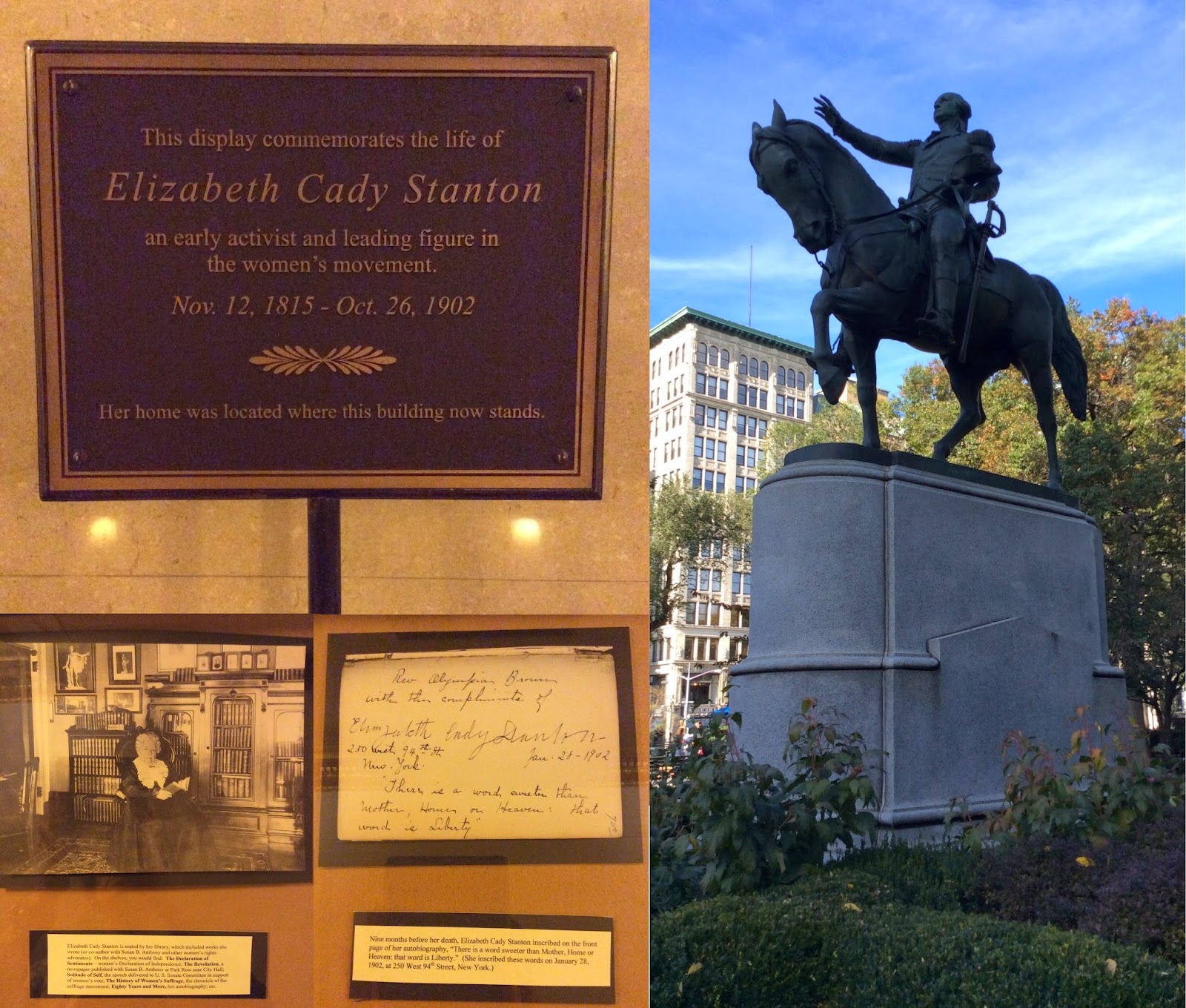
So how can it be that great women like Mary Wollstonecraft, Ernestine Rose, Sojourner Truth, Elizabeth Cady Stanton, and Margaret Sanger are commemorated so modestly or so seldom? (A little plaque or a sign on a street corner here, a dusty little cabinet display there.) When their efforts, arguably, liberated more people than anyone else? After all, women make up more than half of the human race, and prior to their life’s work, most women in the world lived almost completely under the subjugation of men, most with restricted education, all denied the full range of rights and opportunities accorded to men.

I feel a free woman, myself, in most ways. I read, think, work, play, procreate (or not!), travel, dress, and so forth, as I decide for myself. Thanks, brilliant, fearless, principled women of history! But their work is not done so long as great women are not honored equally as great men, and working women as much as working men, and women who need health care as much as men need health care, and so on.

Is feminism over? I’ll believe it when I see it. In marble, granite, brass… or in the office of the President of the United States. Maybe then.

*Listen to the podcast version here or on iTunes

Welcome to the Podcast Edition of Ordinary Philosophy!

Hello dear readers, and welcome to the
podcast version of Ordinary Philosophy!

You can listen to the podcast here, on Google Play, or subscribe in iTunes.

Like many of you, I’m a big fan of podcasts, mostly because my life is very busy. One day in the future, I hope to have a lot more time to do each task one at a time, to really be present, as they say, as I wash the dishes, straighten the house, do the laundry, and perform all those other tasks that take up time, but not much thought.

But at this time in my life, between my day jobs, my creative projects, and spending time with friends and family (which I don’t do enough of these days, sadly), I don’t have enough time to keep up the world of ideas as nearly much as I’d like to by sitting down and reading. Instead, I keep myself informed and increase my education by listening to lots of podcasts: discussions with my favorite authors and thinkers, audio renditions of books and essays, debates, recordings of classes on my favorite subjects, and so on. I listen to these podcasts while doing those aforementioned chores, and let me tell you: as one who is not fond at all of household chores like doing the dishes and washing the floor, the podcast is a marvelous invention: they transform boring chore time into great opportunities for learning and exploration. I’m also an avid hiker, and it’s a wonderful thing to be able to immerse myself in some fascinating ideas or discussion as I immerse myself in the beauties of nature.

To begin with, this podcast will simply consist of audio recordings of my Ordinary Philosophy pieces. Over time, I may add commentary and who knows, perhaps interviews and discussions with guests. We’ll see how it goes. In the meantime, here’s Ordinary Philosophy in audio form: I hope you find it interesting and enjoyable!

… And here’s episode 2: Is the Market Really the Most Democratic Way to Determine Wages?
Originally published as an essay Feb 6th, 2014

Philosophy and Early Feminist Thought

Ernestine Rose and Elizabeth Cady Stanton, two founders of modern feminism, are the subjects of my recent traveling philosophy series. While their advocacy for women’s rights, abolition of slavery, religious liberty, and other human rights issues was so important, wasn’t their work more about politics than anything else?

Why write about feminist activists for a philosophy blog?

It’s true, their focus was on achieving political goals: to establish laws protecting and empowering women and other classes of human beings in their property, their person, their range of opportunities, and their enfranchisement. But to accomplish this, they needed ideas: not only of their own, personal beliefs about the world and the way it should be, informed by facts and supported by reason; they needed to convince others that their ideas were not only interesting and desirable to themselves but good, true, and conducive to flourishing for all human beings.

The laws of their time, which barred most women from owning any property, which subjugated them and their children to husbands, fathers, and male relatives, and which failed to protect women as they sought to engage in traditionally ‘unwomanly’ activities such as voting, receiving a full education, pursuing any occupation other than housekeeping or teaching, speaking in public, taking leadership roles, and so on, were based on certain widely held ideas and beliefs about the nature and proper roles of women. 

Women in some states, especially married women, had few political rights in the era when Rose and Stanton began to agitate for them. In fact, many women in the United States, legally, had as few rights as many slaves did, which may surprise many of us today; I know it surprised me as I did my research. Not to suggest that slaves were better off: far from it. Cultural expectations required better behavior toward and treatment of (non-slave) women. Most husbands, then as now, treat their wives with respect and try to make them happy, and they had a degree of power and influence in the home in her position as mother and keeper of the house. Many states had laws protecting women in cases of abuse, and some had laws requiring men to provide for their wives in a ‘decent’ manner. And adult single women legally enjoyed a degree of personal liberty a slave could only dream of. But it was extremely difficult for any woman to earn a decent wage or find an interesting, full-filling, non-menial job, and women were generally denied access to a full education. 

While some states offered better protections for women than others with fairly liberal laws (for the standards of that time, not necessarily ours) concerning divorce, remarriage, and a woman’s right to some control of property she brought into a marriage, in many other states, women lost their individual identity upon marriage under coverture. The legal doctrine of coverture meant that a women’s identity was absorbed into, or ‘covered by’, that of her husband, and her rights were subsumed under those of her husband. In other words, they disappeared. As a result of coverture and other laws, if a married woman felt the desire or need to leave her husband for any reason, including abuse, cruelty, neglect, etc, she had no right whatsoever to her children, to any of her property besides the clothing she wore and utensils to cook with, or to keep any wages she would earn. Not only that, if she was apprehended, she could legally be forced to return, echoing the cruelty of the Fugitive Slave Law (Mistress of Herself, p 93-94, 185-86). It’s no wonder, then, that the early feminist movement rose out of, and in partnership with, the abolitionist movement, since many of the arguments in favor of emancipation of slaves applied to the liberation of women as well. Rose and Stanton’s sister feminists identified with their enslaved fellow women in this: married women had no identity as individual persons under the law, and all women were barred from choosing their own professions, fulfilling their intellectual and other capacities, and subject to laws to which they could not consent because they were not full citizens, or citizens at all.

And nowhere were women of any status permitted to vote. So how could they better their situation?

Rose, Stanton, and other human rights activists and reformers of their era recognized that laws and practices of their time that oppressed women, blacks and other racial minorities, religious dissenters, and immigrants, were all there, more or less, because of the same ideas. So to change the law, they had to change minds, not only with logical, well-supported, eloquent arguments, but with passion, which revealed the conviction behind the words. Their ideas inspired them, and in turn, inspired others. That’s where their philosophy comes in.

So what were these old ideas they wished to supplant? Why did they wish to supplant them? And with what?

Here are some of the most important ideas that underlie Ernestine Rose and Elizabeth Cady Stanton’s work; not comprehensive, to be sure, but central to their goals of attaining legal and cultural liberty and equality, and to their beliefs about human nature and what constitutes the good:

~ The nature of rights, and where they come from

Ernestine Rose and Elizabeth Cady Stanton both have similar, though not identical, views on the nature of human rights. Stanton believes in a divine creator*, and that all human beings are created with certain endowments and dignities, so to transgress against human nature was to transgress the divine will. Rose doesn’t believe in a divine creator, and doesn’t think it an important question in matters of ethics, law, or everyday life, as it would involve understanding a reality incomprehensible to the human mind. Since we can only comprehend this world, we are only responsible for life within it, and we must put all of our effort in making this life the best we can. For Rose, human nature is a product of nature, no supernatural explanation useful or necessary. To both of these thinkers, however, human rights are indissolubly linked to human nature, and one could no more be legitimately denied than the other, by the simple fact of the existence of human beings whose qualities and aspirations are clearly discernible to anyone. And both think that reason is all we need to describe these rights and put them into law. As Stanton says, ‘…Viewed as a woman, an equal factor in civilization, her rights and duties are still the same; individual happiness and development. ‘(Solitude Of Self)

Whether Rose and Stanton think human nature is primary and human rights are derived from it, or whether they think both exist equally as qualities or attributes of a human person, I haven’t been able to discern. For myself, I think human nature is primary, and rights are derived from it; that’s why we must formulate, fight for, and protect human rights, not merely observe them as facts of nature. Either view is consistent with Rose and Stanton’s writings, yet I suspect they perhaps would agree with me, or at least see my point, if we ever had a chance to sit down and thrash it out. What a delightful and invigorating afternoon that would be!

In any case, Rose says, one needs only to observe the world to discover the truth of the matter, and the evidence is available to anyone, anywhere, whatever one’s culture or belief system. In fact, one needs no education at all (though it helps!) to recognize what to her is so plain, if only one would put aside their biases for a moment. A young man once challenged Rose during a speech, claiming that divine revelation and authority are in opposition to the Women’s Rights movement platform and supportive of the traditional view of women’s rights and women’s ‘sphere’ in the home. Rose replied: ‘…I will show him the revelation from which we derive our authority, and the nature in which it is written, in living characters. It is true we do not go to revelations written in books… That revelation is no less than the living, breathing, thinking, feeling, acting revelation manifested in the nature of woman…Books and opinions, no matter from whom they came, if they are in opposition to human rights, are but dead letters’ (MOH, 227)

~ Individual identity

The legal doctrine of coverture, inherited from British law, remained more or less unchallenged in the United States until the early feminists, with Rose and Stanton, agitated for and finally pushed through laws protecting the property rights of married women in the mid-nineteenth century. Rose began the petition to the New York State Assembly in the 1930’s, where she was soon joined by other activists; Stanton’s efforts led to success in 1848, when the first Married Woman’s Property Act was passed into law in New York (MOH, 12). Coverture was widely justified on a Biblical basis: passages such as Ephesians 5:22-5:24 ‘Wives, submit yourselves unto your own husbands, as unto the Lord. For the husband is the head of the wife, even as Christ is the head of the Church…Therefore as the Church is subject unto Christ, so let the wives be to their own husbands in everything’ was used to demonstrate divine support for complete control of husbands over their wives. And not only wives: Stanton goes through the Bible line by line, and finds and critiques a multitude of verses in support of the idea that all women should be subjugated to men (The Woman’s Bible).

As we have seen, Rose does not accept the idea that any sort of ‘revelation’ trumps the evidence of nature, so she scorns the idea that a woman’s identity could be absorbed in another’s. ‘From the cradle to the grave she is subject to the power and control of man…At marriage she loses her entire identity, and her being is said to have become merged in her husband. Has nature thus merged it? Has she ceased to exist and feel pleasure and pain?…What an inconsistency, that from the moment she enters that compact, in which she assumes the high responsibility of wife and mother, she ceases legally to exist…’ (MOH, p 93). Since a woman feels her own feelings, thinks her own thoughts, and experiences her own selfhood, she is fully an individual as a man, whatever her relation to him. And since she is an individual person, she should have all the rights of an individual person, to the same extent as a man, and for the same reasons. Stanton concurs: ‘The point I wish plainly to bring before you on this occasion is the individuality of each human soul; our Protestant idea, the right of individual conscience and judgment; our republican idea, individual citizenship’ (SOS)

What drive Rose and Stanton is that same idea that drive all feminists to seek full human rights protections: the inner experience of our own selves as human persons in the fullest sense of the term. The differences between women and men, as they repeatedly point out, are of minor significance compared to the similarities.

~ The intellectual, emotional, and moral equality of women and men

All able human persons, say Rose, Stanton, and their fellow feminists, enjoy and experience an inner life made up of the same components: reason, emotion, and the moral instincts chief among them. While there is some difference in degree and quality from person to person, and some minor differences in tendencies between male and female, women and men are the same kind of being. Rose, again, appeals to the evidence of experience: ‘What has man ever done, that woman, under the same advantages, could not do? …Even now, where her mind has been called out at all, her intellect is as bright, as capacious, and as powerful as his…And do you ask for fortitude, energy, and perseverance? Then look at woman under suffering, reverse of fortune, and affliction…’ (MOH,  99). She recognized, as her fellow reformers did, that the intelligence and ability they found in their own selves contradicted the claims underlying the rigid belief system of her day regarding the ‘proper spheres’ of men and women. 

Instead of thinking of intelligent, ambitious, entrepreneurial, and independent women as ‘unwomanly’ freaks of nature, and women as subservient mother and housewife as ‘natural’, Rose and Stanton think of women as complex and rich in their interior lives as men, and have similar needs. For example, Stanton reveled in motherhood and was one seven times over, but she often felt stifled by the way motherhood, in her day, relegated her to a narrower arena of activity and intellectual stimulation than suited her. She is restless and curious thinker, deeply intelligent and active by nature, and while her family lived in Boston, her busy social life kept her satisfied in mind and body. When her family moved to Seneca Falls, a small town in upstate New York, however, her new life of a full-time homemaker often made her feel trapped (Jacoby, 88). Stanton doesn’t recognize herself as confined to a ‘sphere’, or conforming to the ideal of ‘true womanhood’ of the time. She thinks these ideas are not divinely inspired, but are human creations, derived from men’s need to carry on their legacy and keep the mothers of their children obediently at home under their control (TWB, Jacoby 195). Instead, like Rose, Stanton recognizes in herself and her fellow woman the full human intelligence that needs to be satisfied and developed, and the range of needs, desires, and challenges in life that, like men, can only be addressed by protecting and furthering their chances of pursuing their own goals, in law and cultural practice.

(I felt this very same way, growing up, regarding ideas about women I was brought up to believe. Beginning in my mid- to late teens, the ideal of the ‘proper sphere of women’ of the very traditional, conservative religion I was brought up in, felt alien to me. I just couldn’t believe that most, let along all, women wanted more or less the same things, and though I recognized that lifestyle made many women happy, it was not so for all women. As an adult, I’m much more interested in the experiences, the day-to-day joys and challenges of my friends and family who are mothers, yet I still don’t feel the desire to live that life myself, especially that of a homemaker, and it’s increasingly undesirable to me personally as the years pass. Yet I’m glad that so many women now have a choice: they are not forced into it, or out of it, by the state, and less and less by overbearing families or isolationist, fundamentalist communities.)

~ Women, men, and their capacities

In the period in which Ernestine Rose and Elizabeth Cady Stanton lived, the ‘myth of true womanhood’ held that each woman naturally has a specific and narrow set of capacities and tastes, all of which confine her to the choice of a few roles, the first two being primary: wife, mother, homemaker, and/or teacher (of children and other women, not of men), craftsperson in the ‘daintier’ arts, and nurse. But Rose and Stanton see things differently: while they allow there may be some differences in temperament and ability on the average, especially when it comes to physical strength, as we have seen, men and women are far more alike than they are different (intellectually, emotionally, and morally). Since women and men have similar capacities and aspirations in accordance with their human nature and their individual proclivities, so each individual should have equal opportunity to make the fullest use of them. The first and arguably most important method of developing ones capacity is a quality education, and the goal of their education should be to expand and fulfill the intellectual capacity of each individual person to the utmost.

And all persons should have full and equal access to engage in any occupation that suits their own tastes. As Rose says, in response to an influential lecturer who argues that women’s natural talents were confined to the ornamental arts, housekeeping, and the care and education of children, ‘…the great difficulty is, that …certain taste and adaptation or peculiar faculties are required for proficiency in any art or science…then it would be just as reasonable to expect all men to be painters, sculptors, or chemists, as to ask all women to be scientific cooks [chefs]. If men and women were educated in accordance with their predilections and tastes, it might so happen that some men might have the best capacity for the science of cooking, and some women for the science of government…’ (MOH, 115). In other words, preordaining and then imposing narrowly defined roles is, in fact, unnatural, and systematically wastes human potential.

~ Marriage and relationships between women and men

Rose and Stanton both believe that the traditional hierarchical view of marriage was wrong. It was still generally believed in their time that a marriage could only survive harmoniously if one partner was ultimately the authority figure, and many people in the world still believe that today (as in Paul’s doctrine of men as the ‘head’ of the family, for example, outlined in the Ephesians quote we considered earlier). Rose and Stanton, to the contrary, believe that sort of arrangement to be not only non-conducive to harmony (since it builds resentment, reduces serious consideration of the wishes and solutions to problems of the ‘subject’ partner, and encourages bullying in one and passivity in the other), but a to vow of obedience in marriage is to renege on one’s responsibilities as a moral agent:

Ernestine Rose has much to say about this subject. She was happily married for 57 years to a man who, like her, was radically egalitarian for the time, and also considered marriage a partnership between equals. She says, ‘But I assert that every woman …is bound to maintain her own independence and her own integrity of character; to assert herself, earnestly and firmly, as the equal of man, who is her only peer. This is her first right, her first duty: and if she lives in a country where the law supposes that she is to be subjected to her husband, and she consents to this subjection, I do insist that she consents to degradation: that this is sin…Marriage is a union of equals’ (MOH 275-276). She critiques the idea that blanket submission is a virtue: ‘Blind submission in woman is considered a virtue, while submission to wrong is itself wrong, and resistance to wrong is virtue alike in woman as in man’ (MOH 93). And she considers the vow of obedience in marriage not only wrong, but a lack of civilization:‘…who knows but the time may come when man and woman will be so far civilized as to agree to differ in an amicable and friendly way whenever they should not be able to agree?’ (MOH 119)

Stanton demonstrates her own commitment to the idea of marriage as a full and equal partnership not only in her writing, espousing the same principles as Rose, but likewise through action. She kept her own name upon marriage, adding her husband’s at the end. She thinks that referring to a married woman by ‘Mrs’ tacked onto the husband’s name, while leaving out hers, was a much a symbol of denigration and ownership as it was to refer a bondsperson by the name of their plantation or master. She agrees wholeheartedly that the vow of obedience was retrograde and against the true ideal of marriage as an equal partnership (Eighty Years 72). She lived a life of as much independence as her situation would allow during her years raising dependent children, and reveled in her freedom in later years, becoming more active than ever in her work for women’s rights.

~ The role of reform and progress in morality

Rose and Stanton hold somewhat different views of religion: to Rose, most religions oppressed women for so long, and their holy books contained so many anti-woman passages, that religions, in general, could only be considered more harmful than helpful, and were pretty much all antithetical to the women’s rights movement. Stanton is mildly religious, in the sense that she doesn’t identify with any particular sect of Christianity, and openly criticizes most of them for their support of retrograde laws and practices in respect to women. Yet she admires Jesus Christ himself, as a friend to the poor and oppressed, as a revolutionary, and as a promoter of tolerance (the story of Magdalene’s interrupted stoning, the Good Samaritan parable, and apostleship of the tax collector are some examples.) Both of them, in their day, would have been called freethinkers, and Stanton would also have been called an atheist by many, since that term was often used to refer to anyone who did not agree with orthodox ideas about God.

Many of the major religions go through more or less the same cycle: inspired by one (probably) historical figure 
who was some sort of inspirational radical (Abram, Siddhārtha Gautama, Jesus of Nazareth, Muḥammad ibn `Abd Allāh), evolving oral traditions and hagiography transformed these figures into gods or sacred beings with special moral authority (Abraham, the Buddha, Christ, The Prophet). As well as encouraging good behavior in their believers and often radically changing cultures for the better with their progressive ideas, eventually these belief systems rigidified, and were pressed into political service to enforce power structures which adopted them. Over time, culturally and legally, these religions were transformed from their reformist roots to dogmatic systems which enforced othodoxy of belief and rigidly proscribed behavior, with promises of reward and/or threats of punishment, by the divine and by the state. Sometimes this was beneficial to promoting pro-social behavior and attitudes; sometimes it led to such evils as religious wars, persecution of heretics, witch-hunts, and pogroms. Rose cites the cruel treatment of dissenters as one of her main criticisms of religion (MOH 76-77).

Over time, new reformists would spring up, challenging the more ugly, oppressive, or retrograde beliefs and practices religions had accumulated over time. Dissenters came from the fringes of that tradition (in the West, liberal anti-clerical Protestants such as Stanton, Deists such as Thomases Paine and Jefferson, Quakers such as Lucretia Mott and Susan B. Anthony, and Unitarians* such as William Lloyd Garrison) as well as from the outside (freethinkers, atheists, and agnostics such as Rose, Robert Ingersoll, and Charles Darwin). Time and time again, it would take these reformers, and the moral and rational arguments with which they won over popular opinion, to convince these the old religions to reform themselves, to become more liberal and to adopt more humanistic beliefs and practices, in order to stay relevant. This process has advanced much more with some religions than with others; it’s not hard to recognize which ones, by the standard of living and the human rights protections in those countries in which those religions are most dominant.

Rose and Stanton, despite their differences of opinion of the existence of the divine, think that dogma is antithetical to morality, properly understood. The capacity of a culture or a belief system to be reformed from outside, or better yet, contain within it ideas that generate self-reform, is a sign of its superiority, since it can adapt to solve problems in a changing world. A rigid, ‘eternal’ system, by contrast, is necessarily harmful, since it’s immune to new evidence, and attempts to solve new problems with old ideas that don’t apply. In Rose’s and Stanton’s day, science had made a major breakthrough, illuminating how natural laws can explain the evolution of human nature and in turn, human morality. In Biblical times, for example, a relatively rigid, harsh moral code, centered on sexual dominance, tribal loyalty, and the accumulation of property (be it through farming, herding, dowry, or plunder) evolved to aid the survival of small nomadic tribes in a similarly harsh landscape. In a modern industrial society, such a code no longer appropriate. But aside from the usefulness of a moral code, Rose and Stanton think that morality should be drawn from observations of human nature, and as human nature expands and evolves, so does morality. Religion, they think, has this backward: it codifies some idea about what human nature is and should be in relation to a wider reality, and this rigid system is then imposed upon everyone, regardless of how poorly it’s equipped to deal with any particular circumstance or new problem that arises, or how poorly it fits with the personality, interests, or abilities of particular individuals.

In sum: Rose, Stanton, and the ideas of the early feminists are as relevant and as important today as they ever were, since they so eloquently and convincingly make the case for the equality of legal rights for women, and for a cultural and religious reexamination of the predominant ideas about women in their time. The debate over the ideas that they opposed, and the better ideas with which they convinced most of the Western world, is still raging today. In many parts of the world, women are still subjugated to men, for many of the same reasons as they were in Rose and Stanton’s time, though the holy book these oppressive laws are often based on now is more often a different one.
And in the modern Western world, the rights of women to control their own bodies and their own minds is still under attack from some quarters. For example, traditional views about women still lead many to attack President Obama’s recent remarks on such reform by deliberating misrepresenting his views based on a grammatical unclarity in one sentence of a speech that otherwise promoted the economic rights of mothers. The reforms he was calling for in that speech would ultimately support a women’s right to choose to be a full-time stay at home mother, by limiting the negative economic impact such a choice would have on her future prospects. But the fervor of some traditionalists against the idea that a women’s choice to remain childless, or to be a working mother, or pursue other goals altogether, is a valid one, can lead to blanket opposition to all women’s rights reform, however just such reform appears on its face. Opposition to full rights for women is alive and kicking, as is opposition to full human rights for immigrants, prisoners, atheists, and other minority groups, so it’s important to keep the ideas of Rose, Stanton, and the early feminists alive since they still apply, in essence, to all of these.
~~~~~~~~~~~~~~~~~~~~~~~

*Note: it’s a little tricky to pin down Stanton’s religious views: she was, from early life, a liberal Protestant Christian, a believer in God and an admirer of Jesus Christ. Yet she was a fierce critic of the mainstream organized religions of her day which opposed rights for women, which were most of them, and did not consider the Bible the ultimate authority on questions of human rights or on morality generally. As she once remarked to Susan B. Anthony, she grew more radical in her opinions over the years, and later in life, may have been closer to a Deist or freethinking Theist than a Protestant (Eighty Years 44, Jacoby 194)

~ Listen to the podcast edition of this essay here or here in iTunes

Ordinary Philosophy and its Traveling Philosophy / History of Ideas series is a labor of love and ad-free, supported by patrons and readers like you. Please offer your support today!

~~~~~~~~~~~~~~~~~~~~~~~~~~~~~~~~
Sources and inspiration:

The Bible, King James version

Cassidy, Jessie J. ‘The Legal Status of Women’. New York, The National-American Woman Suffrage Association, 1897. Obtained from the Library of Congress website

Dorress-Worters, Paula. Mistress of Herself: Speeches and Letters of Ernestine Rose, Early Women’s Rights Leader.  The Feminist Press at CUNY, 2008

Duke, Selwyn. ‘Just Say No to Stay-At-Home Moms‘. The New American. Nov 2nd, 2014.

Elizabeth Cady Stanton‘. (2014, November 4). In Wikipedia, The Free Encyclopedia

Ernestine Rose‘. (2014, July 7). In Wikipedia, The Free Encyclopedia

Gordon, Ann D. ‘Elizabeth Cady Stanton‘. American Natinal Biography Online.

Jacoby, Susan. Freethinkers: A History of American Secularism. New York: Owl Books, 2004.

Married Women’s Property Laws‘, American Memory: American Women. Library of Congress website. http://memory.loc.gov/ammem/awhhtml/awlaw3/property_law.html

Obama, Barack. ‘On Women and the Economy‘ speech, Oct 30th, 2014. Retrieved from the White House website, Office of the Press Secretary

Salmon, Marylynn. ‘The Legal Status of Women, 1776–1830‘. Gilder Lehrman Institute of American History (website)

Stanton, Elizabeth et al. Declarations and Sentiments / Proceedings of the First Women’s Rights Convention at Seneca Falls, New York, 1848.

Stanton, Elizabeth Cady. Eighty Years And More: Reminiscences 1815-1897 New Jersey: Mershon Company Press, 1897.

Stanton, Elizabeth. ‘Solitude of Self‘. Address Delivered by Mrs. Stanton before the Committee of the Judiciary of the United States Congress, Monday, January 18, 1892.

Stanton, Elizabeth et al. The Woman’s Bible, 1898.