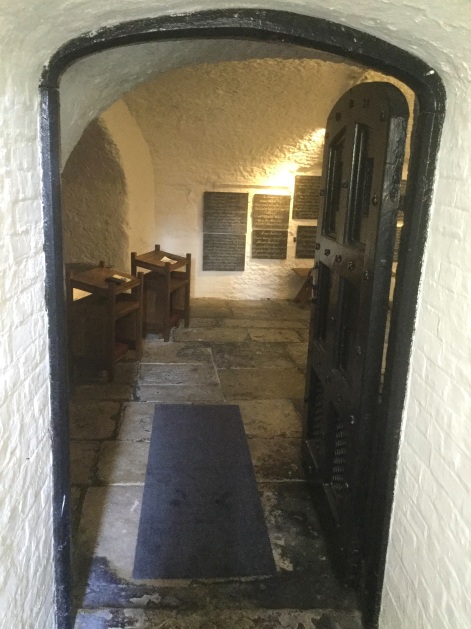
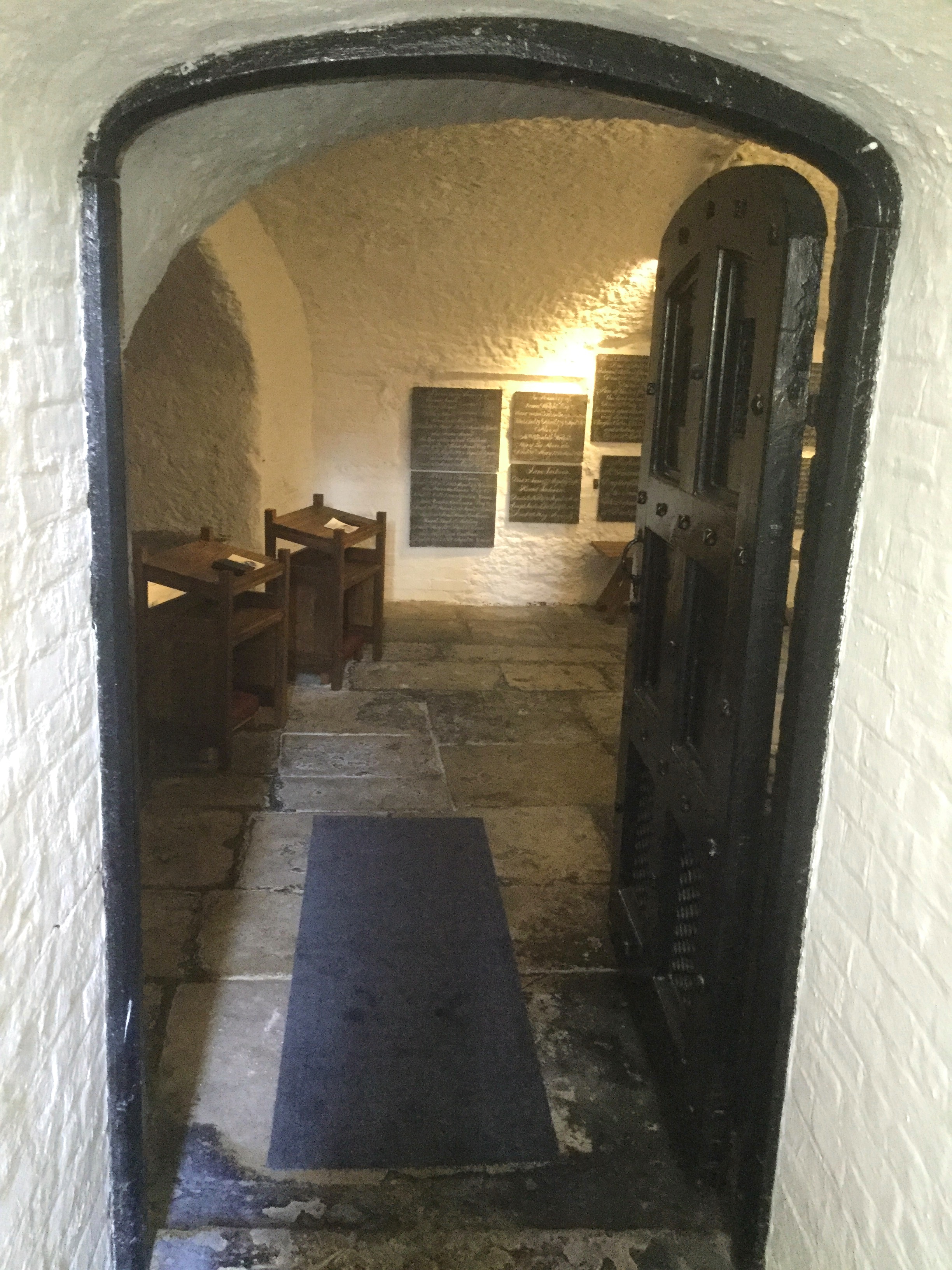
Entrance to the burial chamber below St Peter ad Vincula, Tower of London, England
Saturday, May 4th, 2018, continued
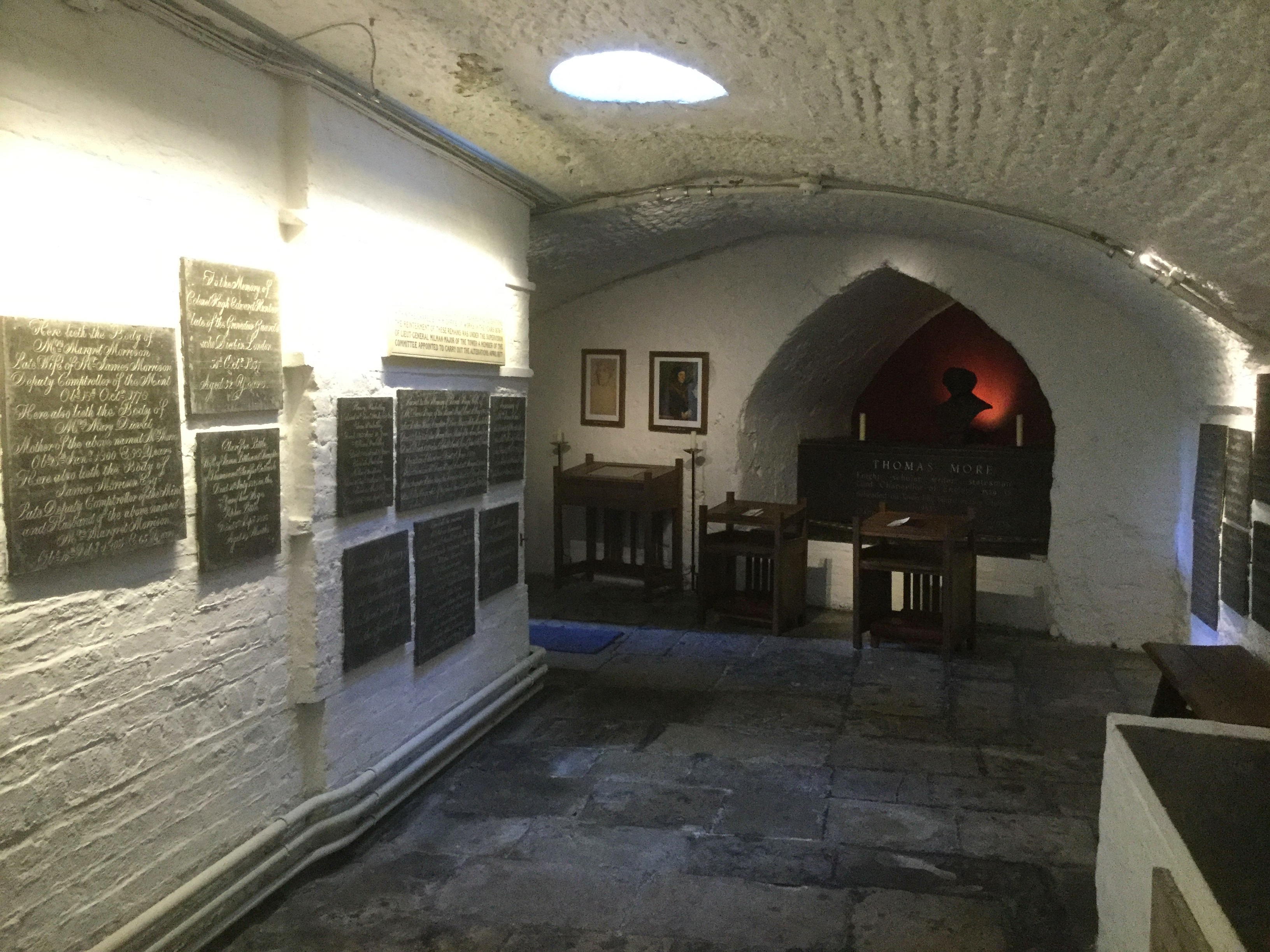
Simon, Laurence, and I leave the Queen’s House and follow Simon past the Tower Green to the Royal Chapel of St Peter ad Vincula (‘St Peter in Chains’). We descend a narrow stone stairway which leads to a chamber underneath the chapel and find ourselves in a chamber with low, arched ceilings. The room is constructed of stone or brick, perhaps both; it’s hard to determine exactly which since it’s thickly painted, and plastered in some places. The walls are lined with black tablets with names inscribed in curly script. Before the names, some contain such inscriptions as ‘Here lieth the body of…’ or ‘To the memory of…’
A tablet on the north wall, above several of these black name-inscribed tablets, explains:
‘Within this wall are deposited in two chests the remains of many distinguished persons who suffered death on Tower Hill and which were for a time interred beneath the floor of the chancel and nave of St Peter ad Vincula of the Tower of London * The removal of which was necessitated by repairs and alterations within the chapel by H.M. Office of Works in the years 1876-7 * The reinterment of these remains was under the supervision of Lieut-General Milman * Major of the Tower * A member of the committee appointed to carry out the alterations April 1877.’
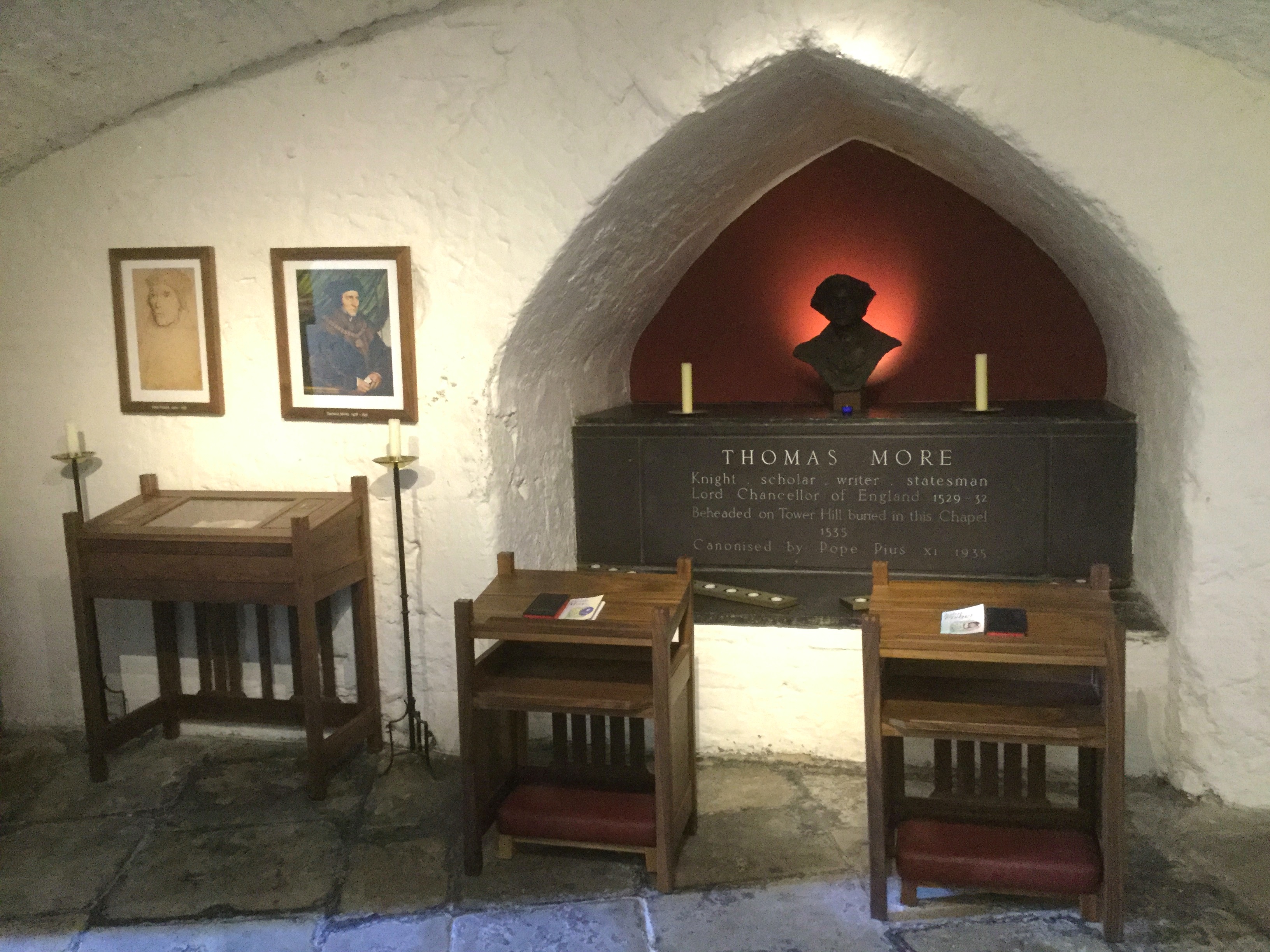
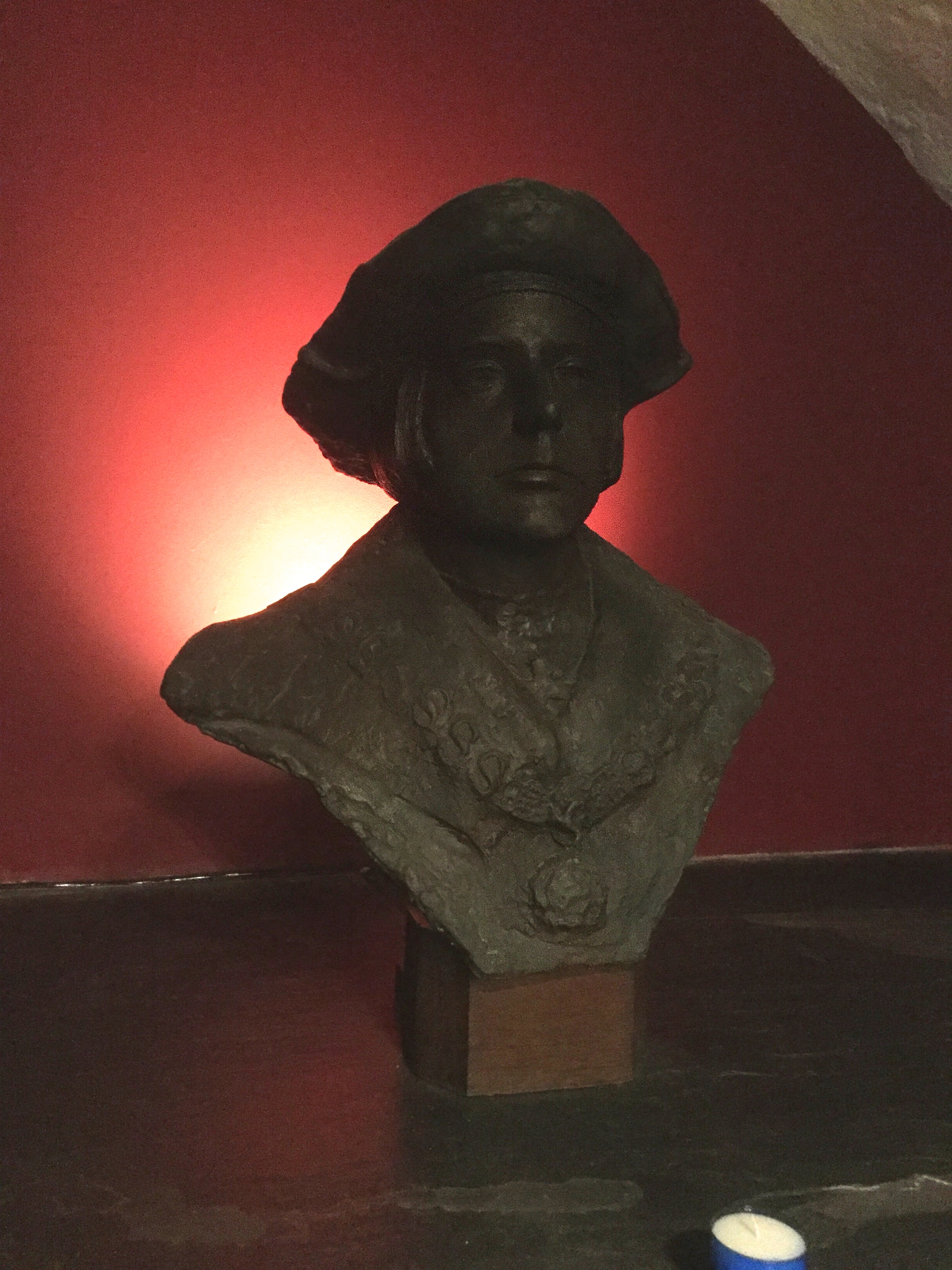
At the west end of the chamber near the door where we entered, there’s a large alcove with a pointed ceiling, and within the alcove is a large darkly-painted sort of chest with a portrait bust of Thomas More on the center top. It’s flanked by two large candles, with one small one in blue glass burning in the center in front of the bust, and two long narrow holders containing many more small candles below. There are two kneelers directly in front of the alcove, and one off to the left below two framed portrait prints, one of John Fisher and one of More. The large chest in More’s alcove is inscribed:
Thomas More
Knight * scholar * writer * statesman
Lord Chancellor of England 1529 – 32
Beheaded on Tower Hill, buried in this Chapel
1535
Canonized by Pope Pius XI 1935
This may be the actual resting place of his remains or it may be a cenotaph, an empty tomb memorializing a person whose remains are elsewhere, in this case, elsewhere within the chamber.

Thomas More memorial shrine below the chapel of St Peter ad Vincula, Tower of London
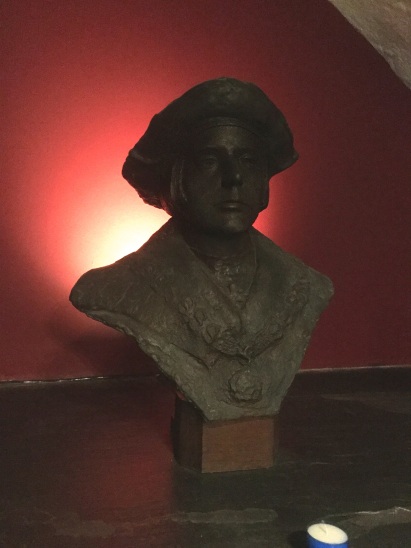
Thomas More portrait bust in his memorial shrine below St Peter ad Vincula, Tower of London
This chamber is where, as Simon confirms, More’s body is buried. His head, however, is not buried with it. As was the usual practice for those executed by beheading, More’s head was boiled for preservation then placed on a spike over London Bridge, on the very spike upon which John Fisher’s severed head had already been displayed for two weeks. They were placed there to serve as a warning to others. More’s daughter Margaret Roper, so distraught that she could not bring herself to witness his execution, managed to retrieve it after it was displayed for some time (my sources disagree about how much time), and the skull was buried with her in Chelsea Old Church when she died nine years later.
More and his family regularly attended services at Chelsea Old Church since they lived nearby; Roper’s Garden across the street may be on land that belonged to the More estate where Henry VIII would come to visit More during happier times. The More chapel in Chelsea Old Church is among the few sections that stand today after surviving the 1941 bombing that reduced most of the church to rubble. The church has since been restored to nearly its original appearance. More’s head and Margaret’s body are no longer buried there, however. After Margaret’s husband and More’s early biographer William Roper died in 1578, their remains were all buried together in the Roper family vault at St. Dunstan’s Church in Canterbury.
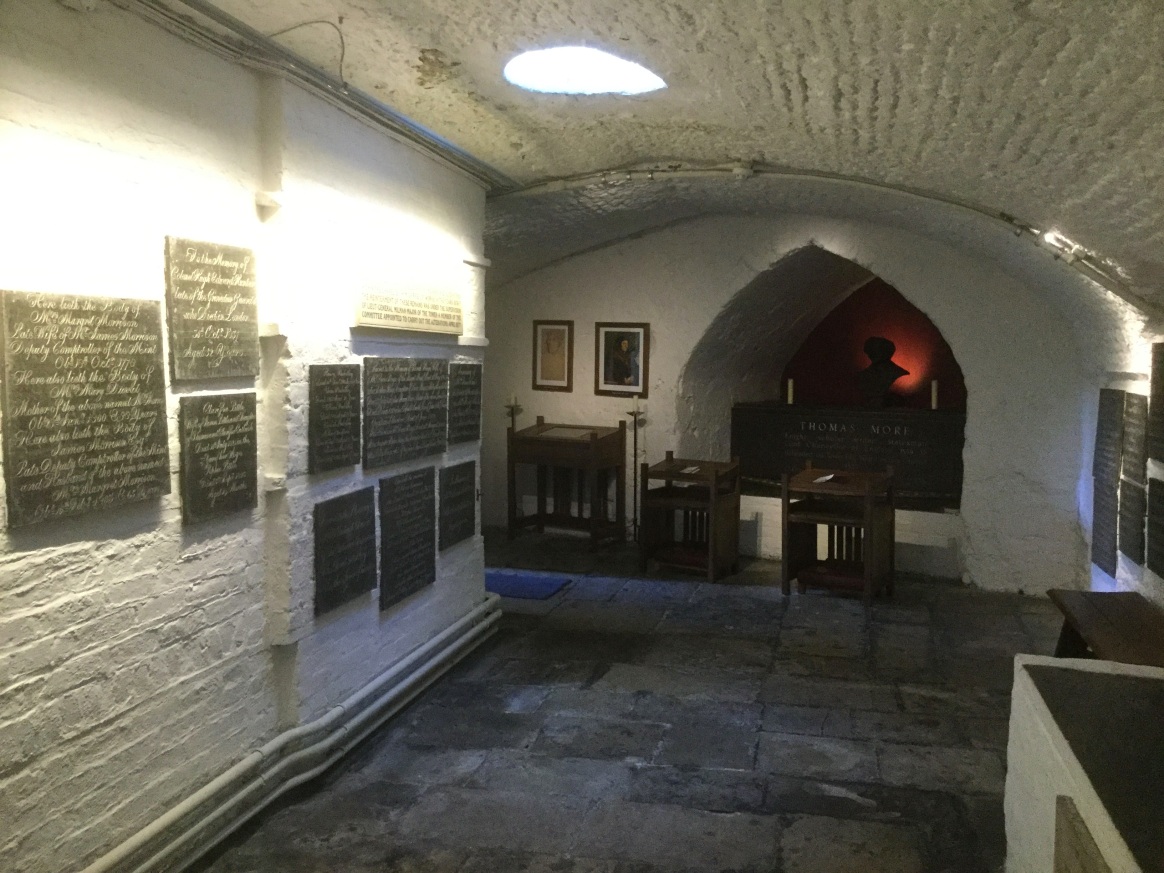
Burial chamber below St Peter ad Vincula, Tower of London
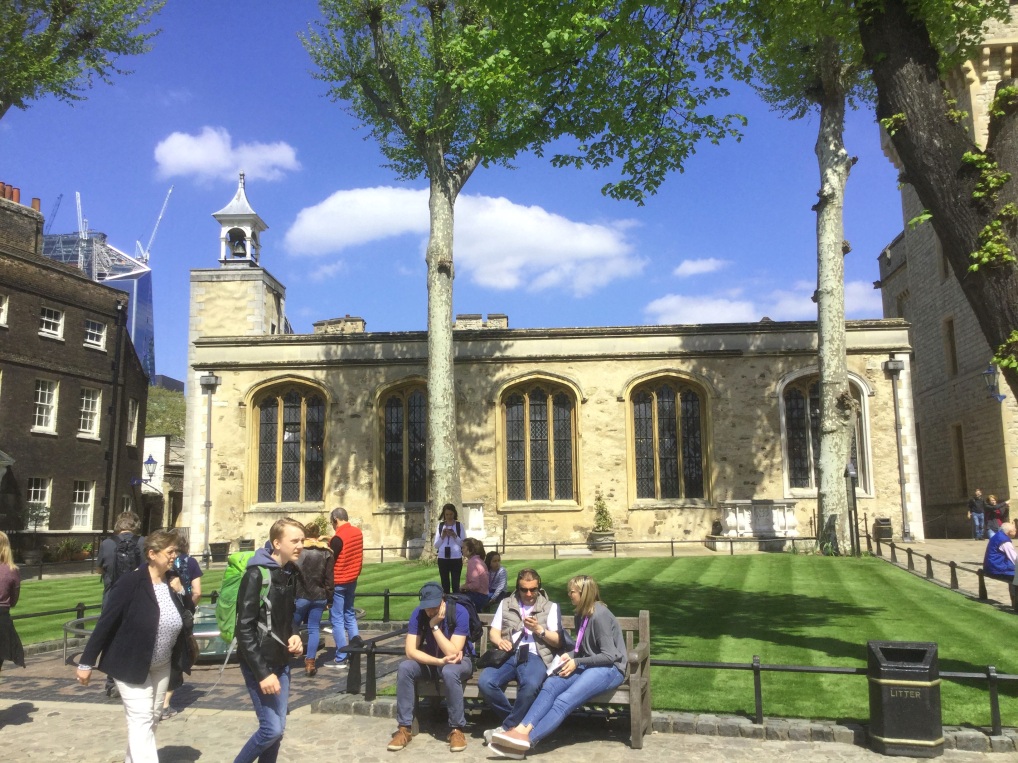
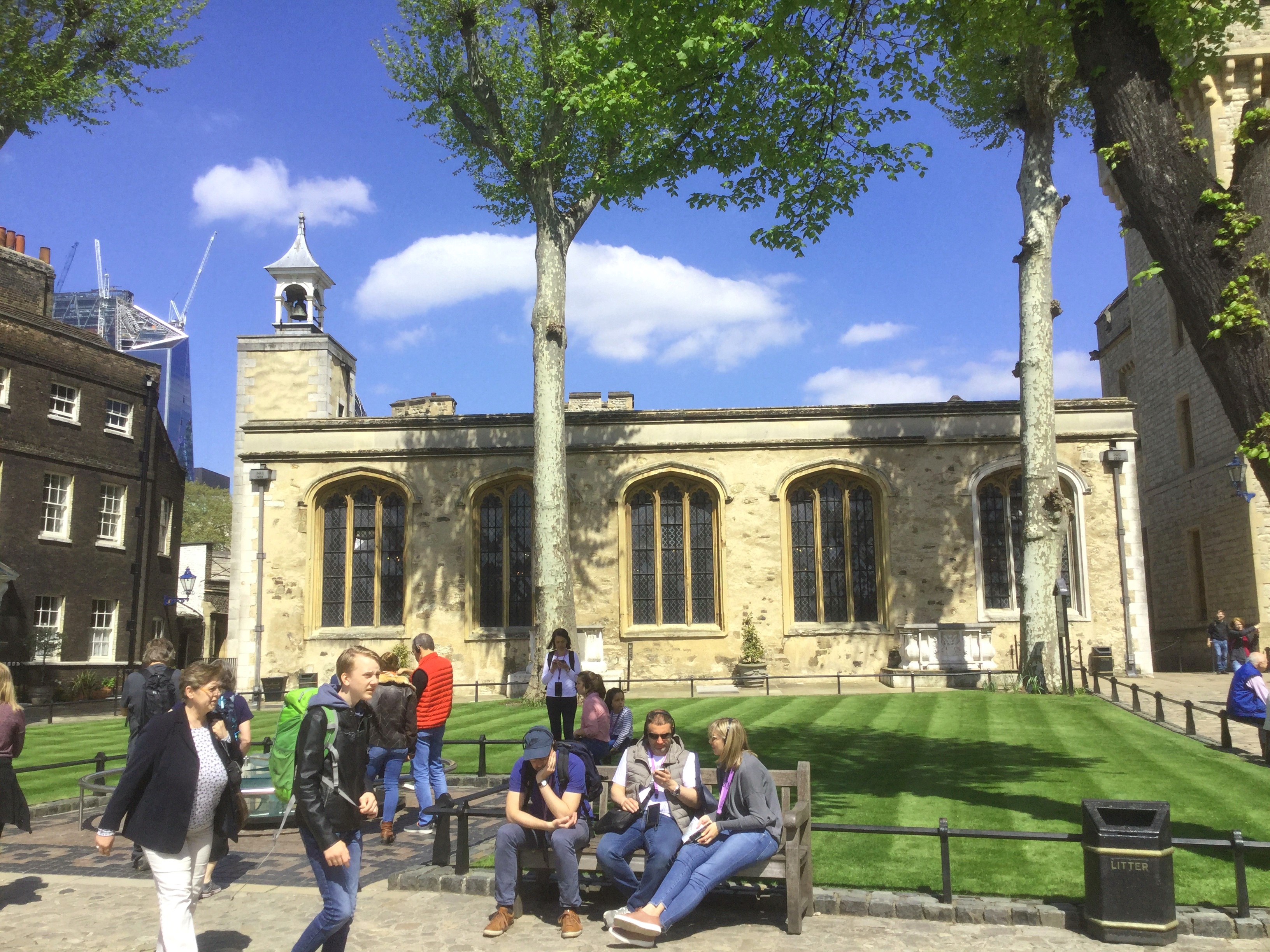
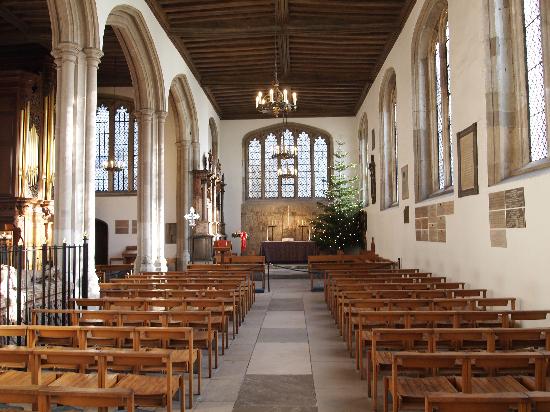
The Royal Chapel of St. Peter ad Vincula, Tower of London
Next, we ascend the stairs from low light of the burial chamber into the bright sunshine, then enter lovely St Peter’s chapel proper. Simon tells us stories about many things found in the chapel and people buried within it. While they’re very interesting to hear, I won’t include them in this account since they’re unrelated to the subjects I journeyed here to explore. St Peter ad Vincula was first converted from a simple parish church when the Tower walls were extended outward in the 11th century, placing the church within its walls as the complex was enlarged. Henry III expanded and redecorated it as a royal chapel in the 13th century. Though it had remained in use, the chapel had fallen into a sad state of repair by the latter half of the 19th century. The extensive restoration of 1876-77, which had led to the aforementioned reburials in the chapel’s subterranean chamber, also removed many of the seventeenth- and eighteenth- century additions that gave the chapel an ornate but dark and crowded look. Today, the interior has a bright and airy look while still very decorative with its arches and stained glass windows, a significant improvement.

This photo of the Royal Chapel of St Peter ad Vincula at the Tower of London is courtesy of TripAdvisor. Photography is not allowed within the chapel, though evidently, it’s possible to obtain permission

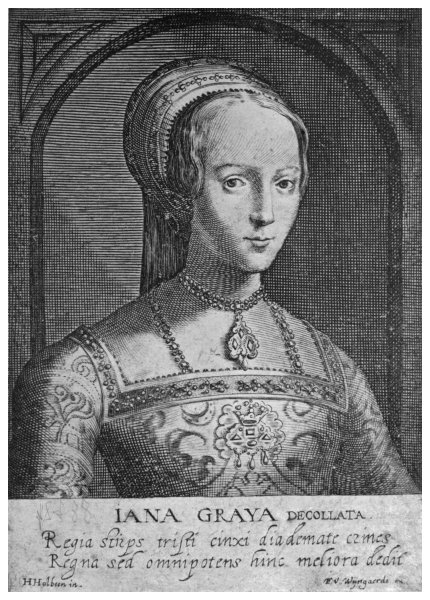
Lady Jane Grey, perhaps after a lost Holbein portrait by Magdalena and/or Willem de Passe, published by Frans van den Wyngaerde 1620, via Project Gutenberg
The names of many famous persons buried in and below the chapel are listed on a scrolled brass plaque on the wall near the front door. They include among them, in the order listed: John Fisher, Bishop of Rochester; Sir Thomas More; Queen Anne Boleyn; Thomas Cromwell, Earl of Essex; Queen Katherine Howard; Sir Thomas Arundel (his name is carved into the walls of Beauchamp Tower in numerous places); John Dudley, Duke of Northumberland; and Lady Jane Grey.
After touring the chapel, we part ways from Simon for about quarter of an hour: he discovers that he needs to fetch a key from his colleague in order to visit our next destination. Laurence and I bask in the sun and talk over what we’ve seen and heard thus far. What an adventure! we agree. When Simon returns, we head back past the Queen’s House towards the Beauchamp Tower.
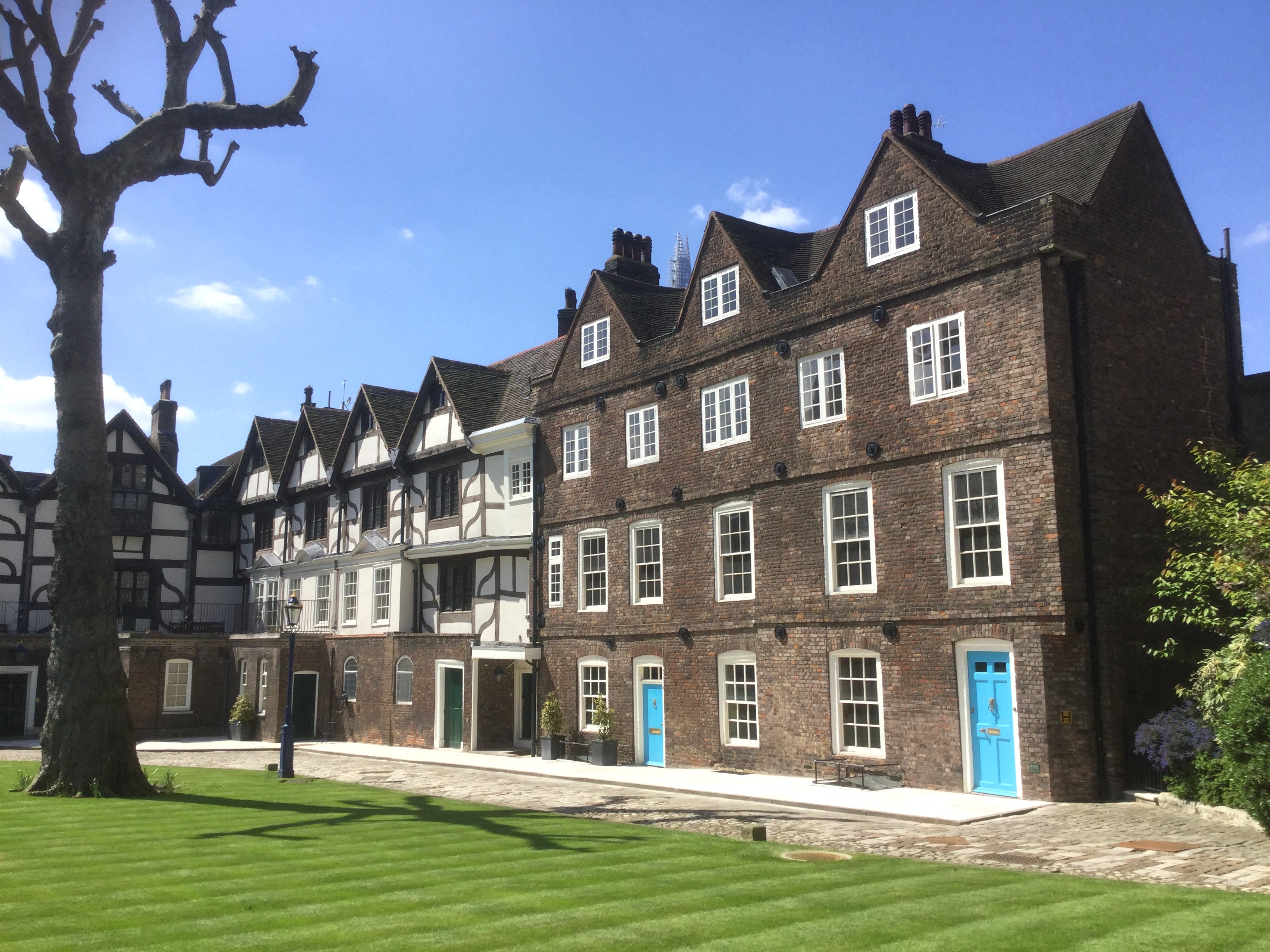
Speaking of Lady Jane Grey… Simon points out a darker brick building on the way back past the Queen’s House. It’s a three-story structure not including the low attic rooms beneath its pointed gables, with brightly painted blue doors. Through the smudged windows, I see evidence of its use at least in part as a storage space. Before it can welcome visitors, the building needs to be restored, says Simon, and there are plans to do so. This is where Lady Jane Grey stayed during her brief nine-day reign, from July 10th, 1553, when she was proclaimed Queen after Henry VIII’s son Edward VI’s early death until July 19th when Henry VIII’s eldest daughter Mary was proclaimed Queen by her supporters. Mary won out, and Jane was then held here until executed seven months later.
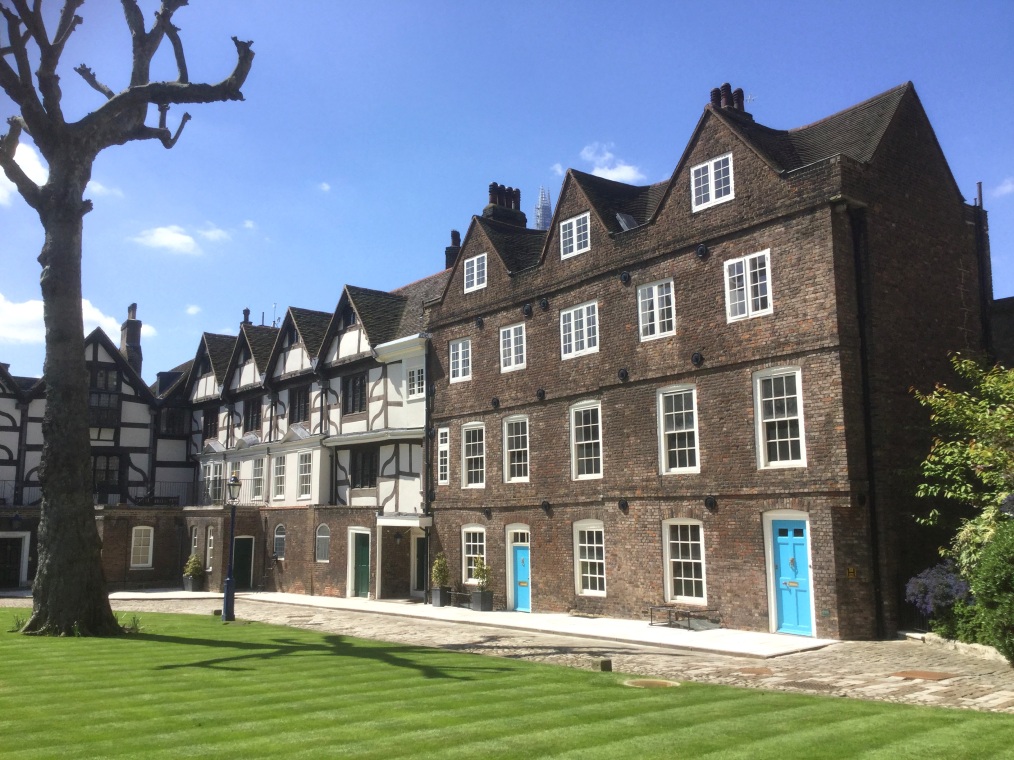
Section of Queen’s House where Lady Jane Grey was kept in the Tower of London
Jane Grey was a distant cousin of Mary; Jane was Henry VIII’s great-niece. Although Mary was the next in line to the throne after her younger brother Edward, according to Henry VIII’s third and final Act of Succession of 1543, the dying fifteen-year-old king named Jane Grey as his heir in hopes that foreign powers would not gain access to the throne through marriage to his elder sisters. It wasn’t just a matter of international politics, however: the Protestant Edward was anxious to keep the throne in Protestant hands and Mary was a committed Catholic. When Mary took power, Edward’s fears were realized: she released all of the Catholics still imprisoned since Henry VIII had them arrested, and worked to return England to the Catholic fold.
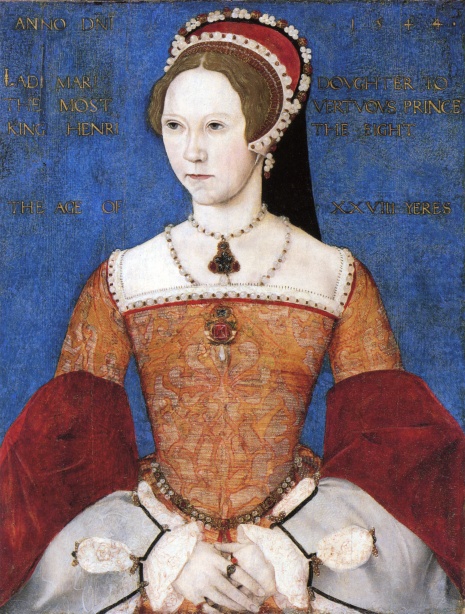
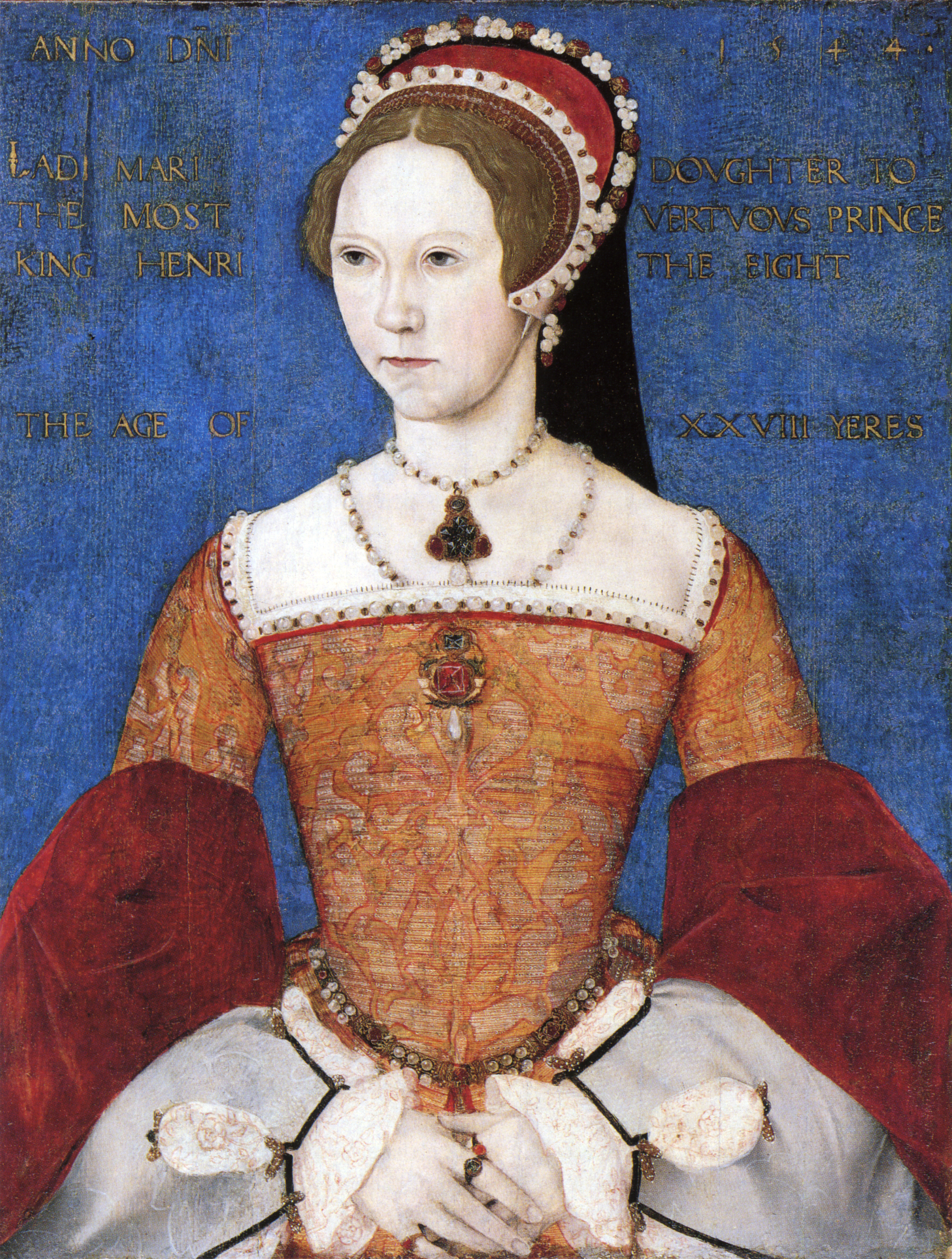
Queen Mary I by Master John, 1544, now at the National Portrait Gallery in London, public domain via Wikimedia Commons
Mary did not want to execute Jane. She was actually very fond of her, just as she was of her little brother Edward, despite their religious differences and despite the fact that they were rival claimants to the throne. Jane was persuaded by her husband Guildford Dudley, her parents, and her ambitious father-in-law the Duke of Northumberland to take the crown according to Edward’s wishes. Mary held the view that many historians still do today, that Jane was an unwilling pawn used to further the interests of power-hungry family members and their connections. Some, however, believe that Jane was more ready and willing to be queen then many of her later chroniclers would admit. She was and still often is portrayed as an innocent martyr to duty, family, and religious conflict. It is true that she was forced into the marriage with Dudley, that she harshly condemned her father-in-law Northumberland’s power grabs, and supported Mary’s ascendancy to the throne. So Mary was more than willing to spare Jane’s life, though she did keep her imprisoned in the Tower for security’s sake. But during her imprisonment, members of Jane’s family and their connections continued to involve themselves in plots to undermine Mary’s reign, and in the interests of removing these persistent threats around their Protestant figurehead Jane, Mary felt forced to act. Jane was executed on the same day as her husband, on February 12th, 1554. According to eyewitness accounts, after watching, at her own insistence, her husband’s execution, Jane faced her death stoically, proclaimed her innocence firmly but not self-pityingly, and held fast to her Protestant beliefs. Her father-in-law Northumberland had already been executed the previous August. Her father Henry Grey, Duke of Suffolk, was executed eleven days later, after having taken part in one too many anti-Mary conspiracies.

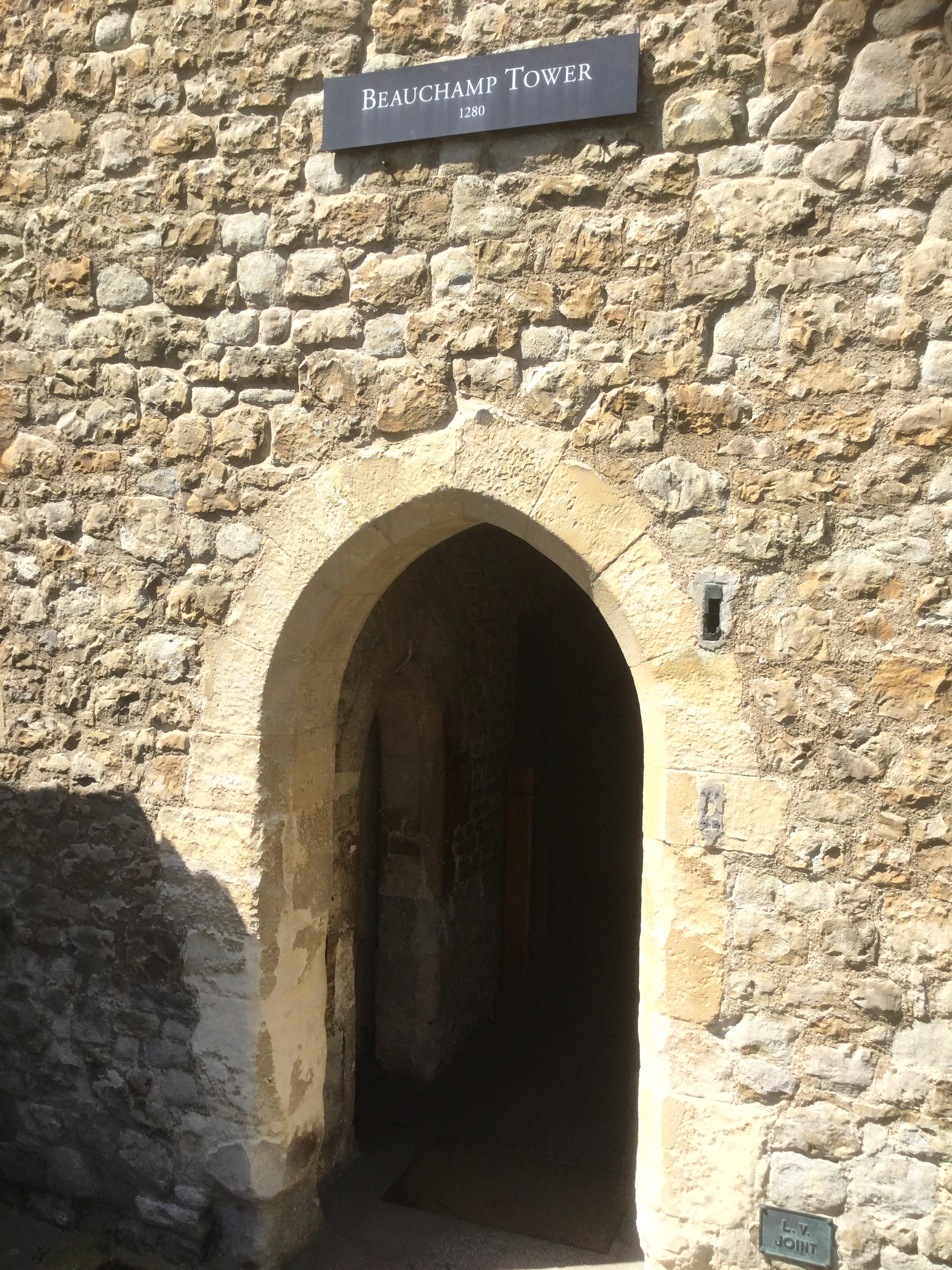
Entrance to the Beauchamp Tower, Tower of London, England
In the long run, Edward VI’s hopes of England continuing as a Protestant country were realized: the unpopular Mary I died on November 17th, 1558, after only a five-year-reign. Her younger sister, the daughter of Anne Boleyn who ascended to the throne as Elizabeth I, broke the pattern her siblings had set of dying after very short reigns. More about Elizabeth shortly.
As we continue past the Queen’s House, Simon points out the upper sections in white plaster supported by dark wood beams, in that classic Tudor style. It was originally built as a living space for Anne Boleyn, Henry VIII’s second wife and the reason he broke off communion with the Church of Rome, but it was not to be used as such. Instead, Anne was imprisoned there for about 18 days before her husband had her executed on May 19th, 1536, not even one year after More was executed in part for opposing her marriage to Henry VIII. I’ve decided not to tell the story of Anne Boleyn here. There’s been a glut of Anne Boleyn-related documentaries, miniseries, and television specials in the last several years, and I feel a bit of Boleyn-related-fatigue at this point. There’s also a five-day-a-week, twice-daily reenactment here at the Tower of Anne’s ‘tragic final days at the famous fortress, from her imprisonment and interrogation, through to her trial and execution,’ according to the Tower of London’s website. During our later Tower explorations, we see the troupe’s retinue, beautifully costumed and equipped, make the solemn march behind the faux Anne from the archway leading from the Traitor’s gate up to the Tower green. Though I won’t tell her story, she will figure in the next one, though.
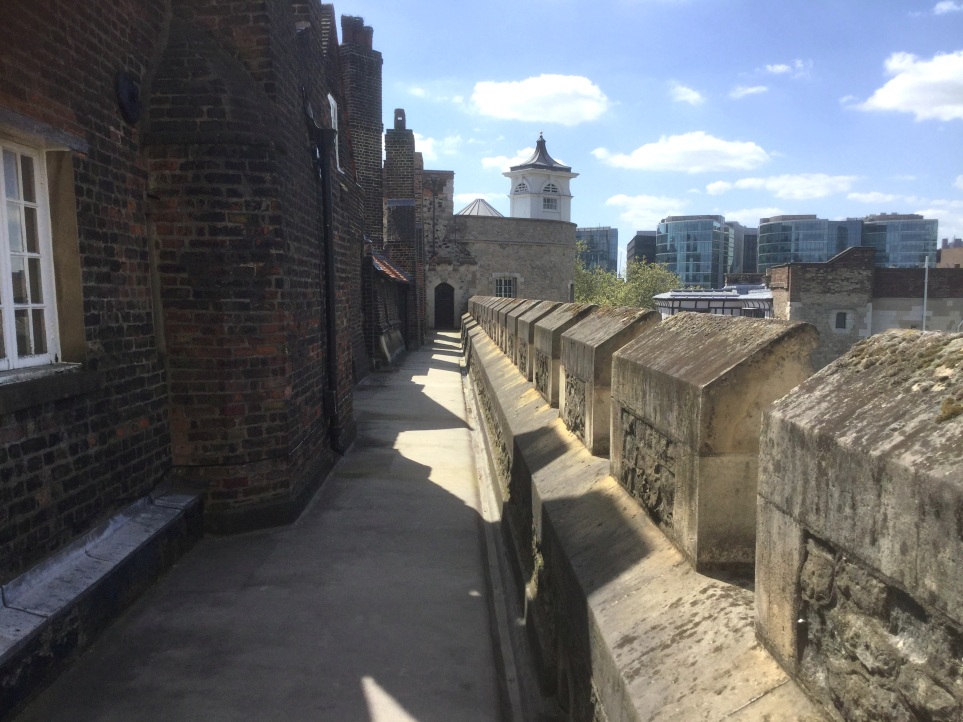
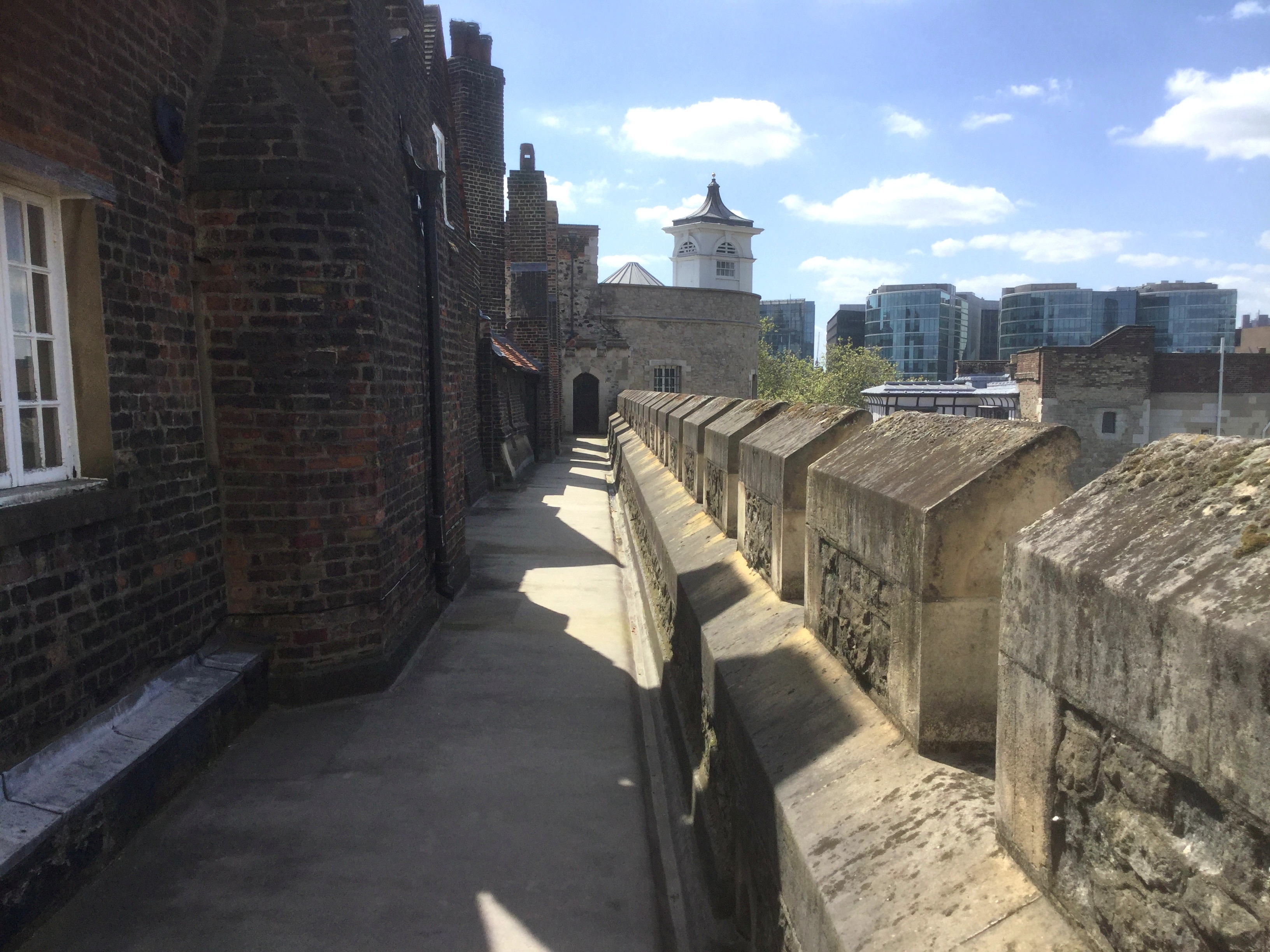
Elizabeth’s Walk leading from the Beauchamp Tower to the Bell Tower, Tower of London
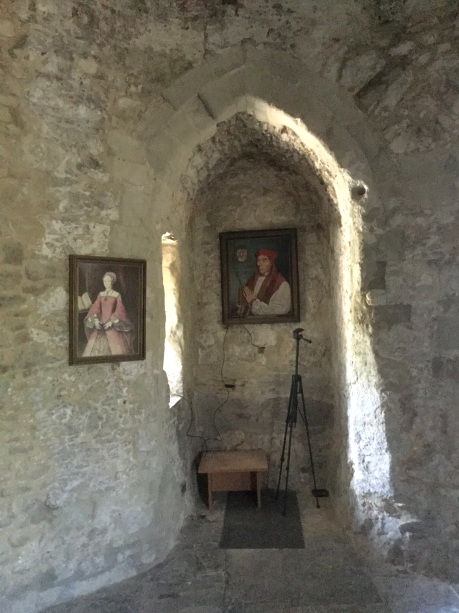
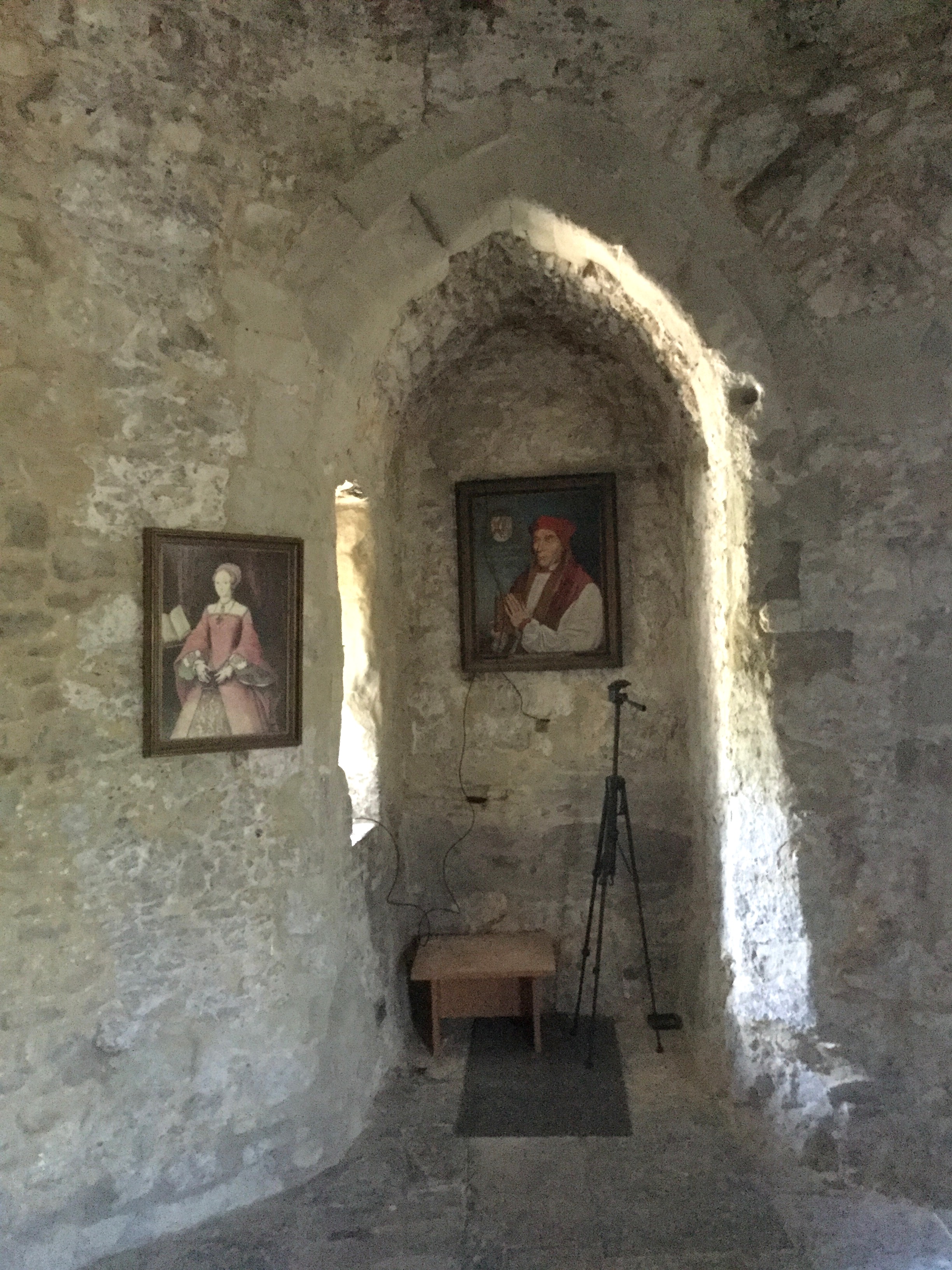
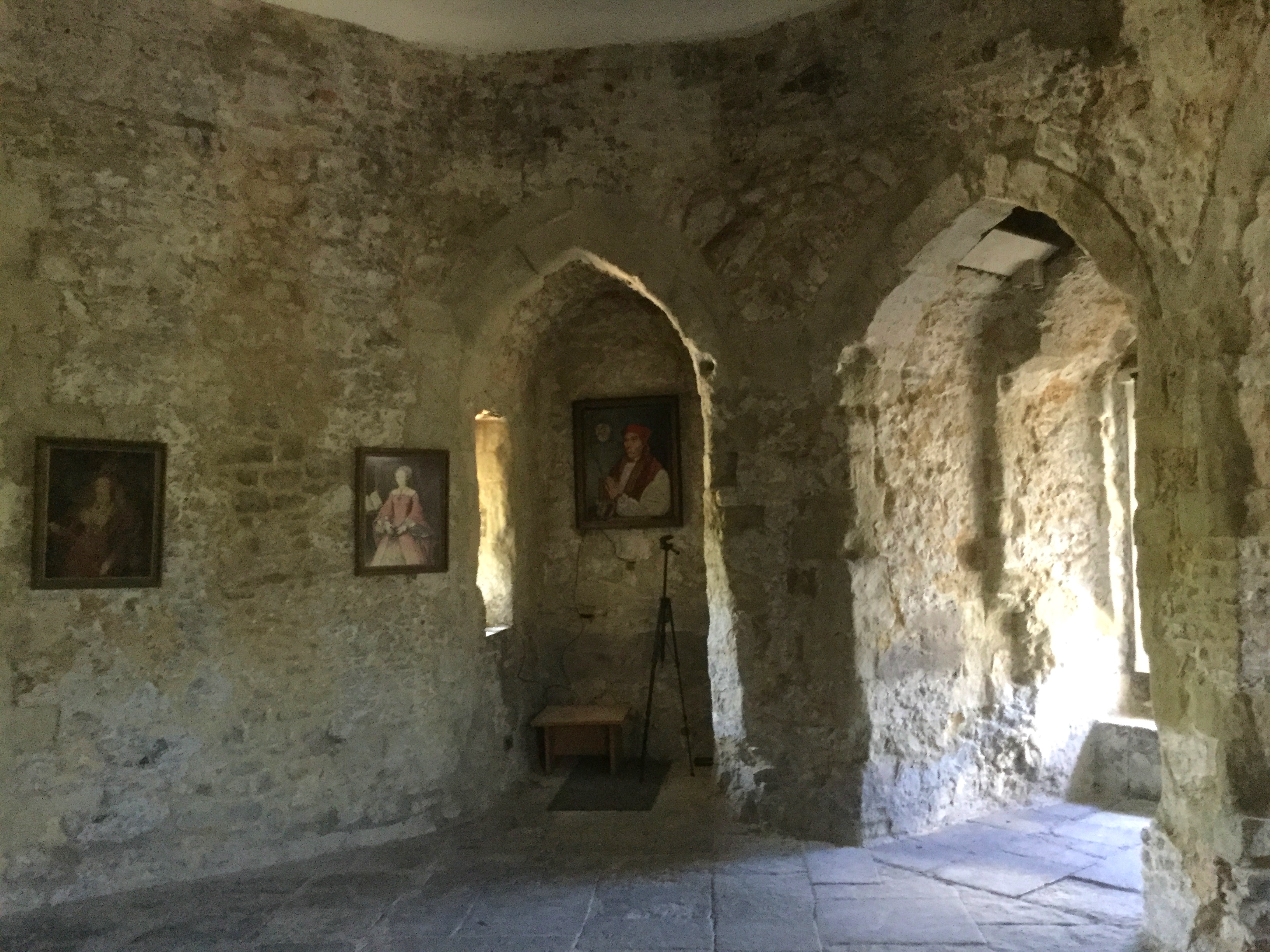
Alcove in the upper cell of the Bell Tower, Tower of London. Note the portraits of Bishop John Fisher, executed two weeks before More, and then-Princess Elizabeth
So, to continue: we follow Simon through the Beauchamp Tower door and up a narrow spiral staircase. There’s some uncertainty as to whether Simon had been given the right key, but after a little fumbling with its inability to smoothly open the lock, it gives way, and we step out onto a long balcony walk with a crenelated wall running along the Tower Green side.
This walkway leads from the Beauchamp Tower to the upper chamber of the Bell Tower, no longer accessible by the old small staircase that had been there in More’s time. Simon confirms that this is the walkway commonly known as Elizabeth’s Walk. Princess Elizabeth, daughter of Henry VIII and his second wife Anne Boleyn, younger sister of Mary, and older sister of Edward, was held here in 1554 following the Wyatt rebellion. This was one of those in which some of Jane’s family and connections were implicated, though the purpose of this one was to prevent Mary from marrying the Catholic Philip of Spain and to put Elizabeth, not Jane, on the throne. A few weeks after the plot was foiled and many involved it in were imprisoned and executed, Mary had Elizabeth committed to the Tower.

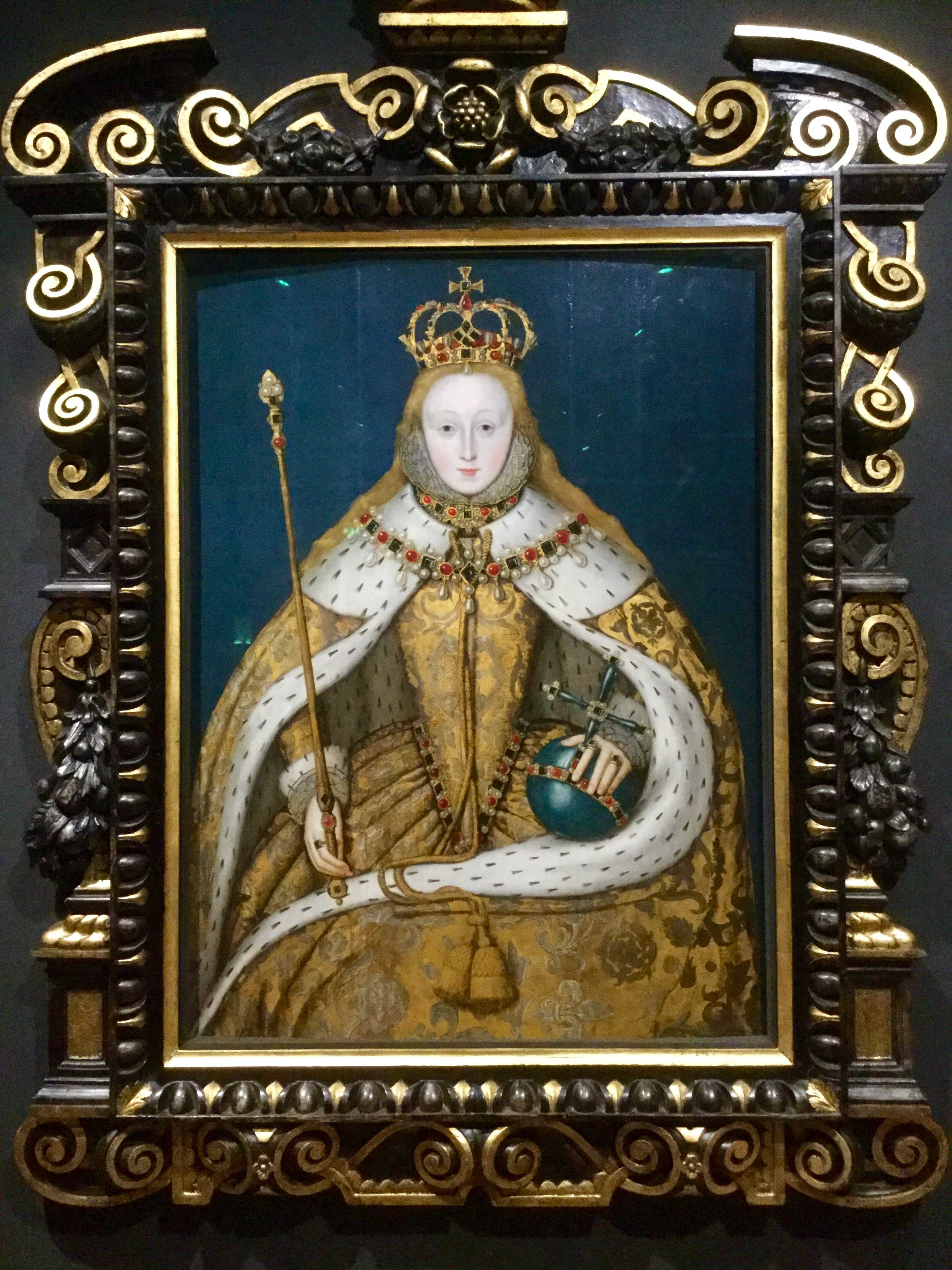
Queen Elizabeth I by unknown English artist, oil on panel, ca 1600, at the National Portrait Gallery, London
Unlike Jane and Edward, Mary did not particularly like Elizabeth. Religion must not have been that much of an issue since Mary loved her brother and cousin despite their religious differences, though it may have contributed. Rather, sibling rivalry likely had much more to do with it, sibling rivalry of a very particular sort, exacerbated or perhaps entirely created by the adults in their lives. When Henry VIII divorced Catherine of Aragon and married Anne Boleyn, he had Mary declared illegitimate as an additional way to bolster the perception of legitimacy for his new marriage. After Anne bore Elizabeth, the new Princess and heir apparent was given the honors and retinue that was stripped from Mary, who was required to stop referring to herself as Princess. Though she could do nothing about the other indignities of losing her place in the royal household, she refused to recognize her demotion to ‘Lady Mary.’ Henry VIII was angered at his daughter’s stubbornness in this matter and punished her for it in various ways, but she would not relent. He may have recognized and even come to respect that the steely will Princess Mary exhibited echoed his own, and over time he softened in his stance toward her.
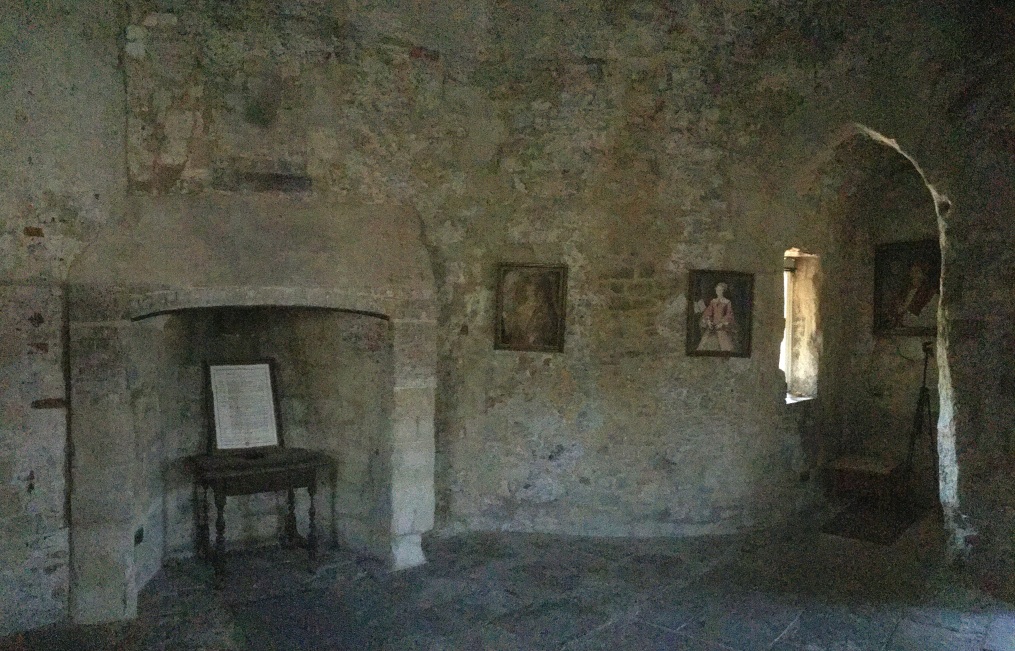
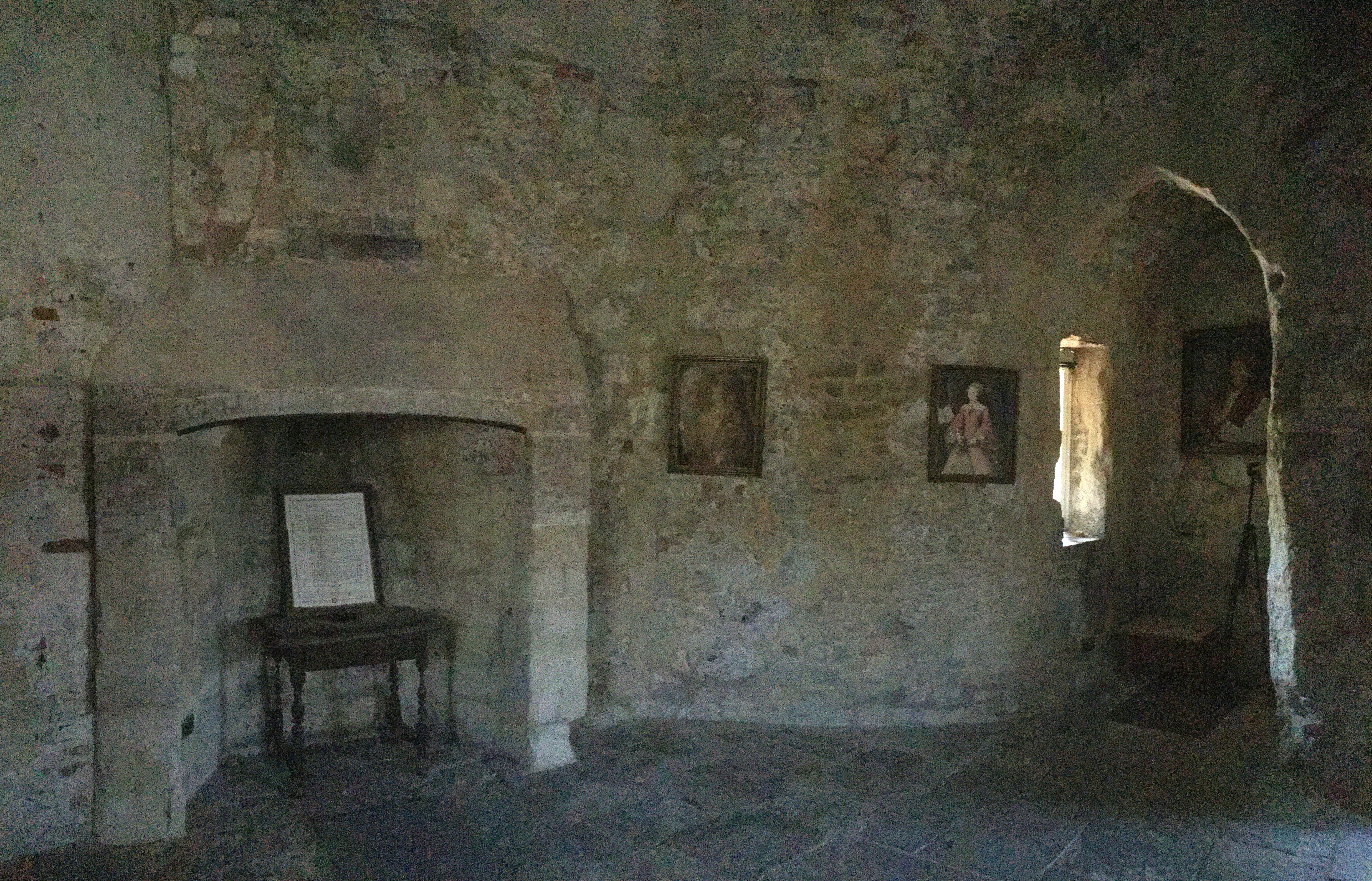
Upper cell of the Bell Tower, Tower of London, England
As we continue along Elizabeth’s Walk, Simon explains that evidence could not be produced that was sufficient to legally convict Elizabeth for her purported connections to plots to undermine or overthrow Mary’s reign. I think this was true for the court of public opinion as well. Immersed in the constantly shifting dangerous royal sand trap that was the Tudor family, the highly intelligent Elizabeth had grown wise and wary very early on. She was just too canny to accept communications from suspicious persons. But, says Simon, since she lied at least by omission since she knew about the plots, Elizabeth was technically guilty. Mary would have been far more legally justified in executing Elizabeth than Jane and nearly did so more than once, but she had reasons to hold back. One, it seems, was her religious compunction against killing her own sister. Another was Mary’s realization that she was growing increasingly unpopular and she was afraid of rousing support for Elizabeth and the Protestant cause by making a martyr of her. Simon tells us that Elizabeth was the only prisoner ever held in this room to survive their imprisonment here.
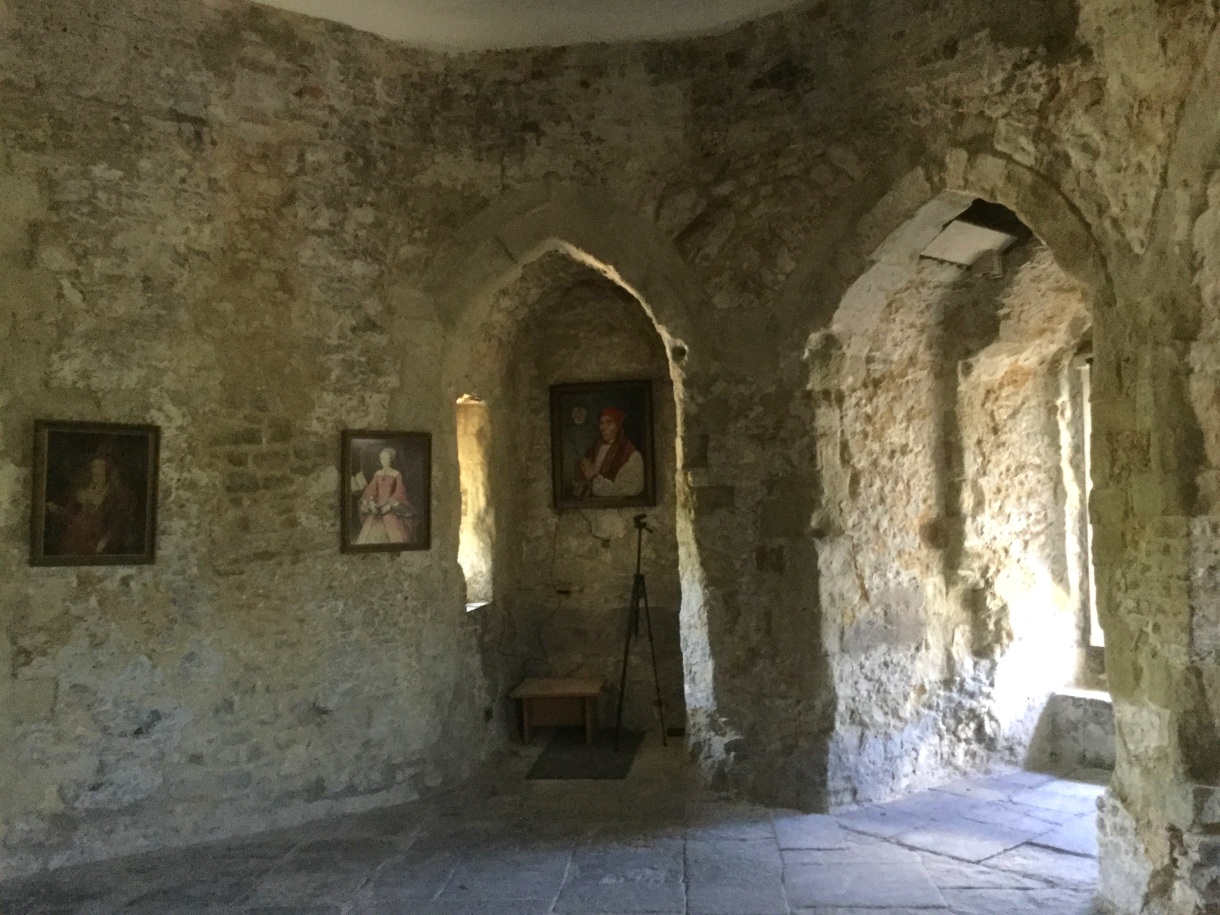
Another view of the upper cell of the Bell Tower, Tower of London
Then Simon opens the door to the Bell Tower’s upper chamber and we enter. In this rough-walled stone room, Princess Elizabeth was held for a time. All told, she was imprisoned in the Tower from mid-March to May 19th of 1554, but according to Patrick Collinson for the Oxford Dictionary of National Biography, she was held for much or most of that time in the aforementioned nearby upper floor apartments-turned-prison built for her mother Anne Boleyn, where the Queen’s House now stands. Perhaps this thickly-built, secure upper room of the Bell Tower we’re in now, above Thomas More’s cell and the same one which reportedly held John Fisher in 1535, may have been the room in which Elizabeth was initially held in or held anytime there seemed to be a danger of her rescue or escape.
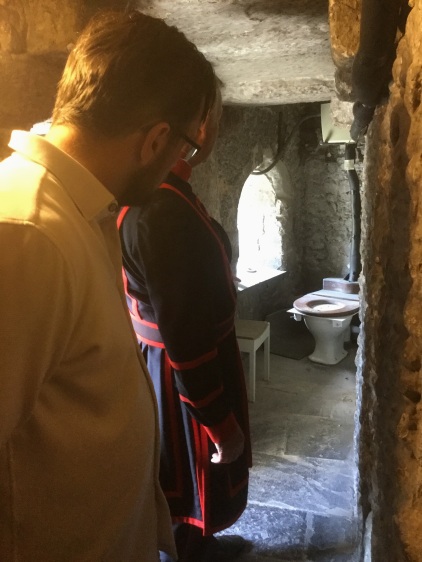
Toilet installed for Hitler outside the upper cell of the Bell Tower, Tower of London
Next, Simon leads us down a tiny hallway off to the side of the main chamber. Perhaps, I’m guessing, it leads to where the old communicating stairway was. Whatever its original purpose, we find something very much unexpected: a toilet. Not just any toilet, it turns out. Simon explains that it this room was readied as a possible place to hold Adolf Hitler upon capture. Hitler’s imprisonment here never happened, and this toilet was therefore never used. And so, here it remains. I’m a little surprised it was never removed given its architectural incongruousness and the general depressing creepiness it evokes, but I suppose it’s just too interesting a historical reminder of that time of England’s crisis, tenacity, and triumph.
Simon has other interesting stories to tell us about World War II and his military history in general, which particularly fascinates Laurence. At one time, Simon says, he guarded the imprisoned Rudolf Hess, Adolf Hitler’s right-hand-man, for three years as I remember. Held in the Queen’s House for four days in May of 1941, Hess was the Tower’s last high-profile prisoner, as historian Tracy Borman writes. I won’t go into Simon’s stories of Hess and other military affairs here as they are unrelated to my quest here, but it’s a great starting point for digging into more of the long and fascinating history of the Tower.

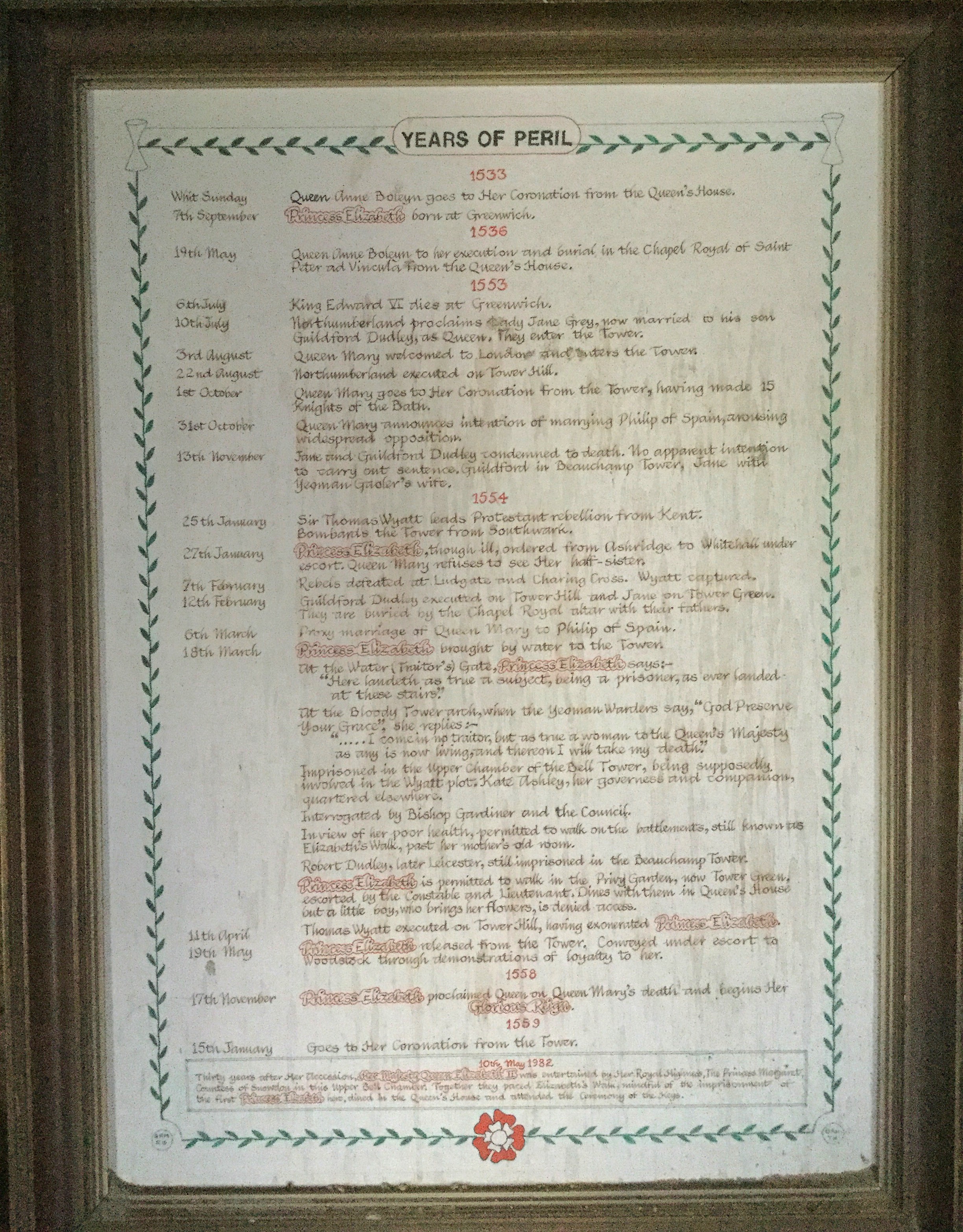
‘Years of Peril’ document in upper cell of the Bell Tower, Tower of London
Returning to the main chamber, I spot a framed document upon a table, leaning against the southeast wall, and move in for a closer look. It’s entitled ‘Years of Peril’, and it’s neatly written by hand in an old-fashioned script, in black highlighted in places with red and surrounded by a green leafy decorative border. In many places, the document is wrinkled and the ink has run from the damp. It’s a great overview of the history we’ve just considered, laid out as a timeline. It reads:
1533
Whit Sunday [1st of June] – Queen Anne goes to Her Coronation from the Queen’s House
7th September – Princess Elizabeth born at Greenwich
1536
19th May – Queen Anne to her execution and burial in the Chapel Royal of Saint Peter ad Vincula from the Queen’s House
1553
6th July – King Edward dies at Greenwich
10th July – Northumberland proclaims Lady Jane Grey, now married to his son Guildford Dudley, as Queen, they enter the Tower
3rd August – Queen Mary welcomed to London and enters the Tower
22nd August – Northumberland executed on Tower Hill
1st October – Queen Mary goes to Her Coronation from the Tower, having made 15 Knights of the Bath
31st October – Queen Mary announces intention of marrying Philip of Spain, arousing widespread opposition
13th November – Jane and Guildford Dudley condemned to death. No apparent intention to carry out sentence. Guildford in Beauchamp Tower, Jane with Yeoman Gaoler’s wife.
1554
25th January – Sir Thomas Wyatt leads Protestant rebellion from Kent. Bombards the Tower from Southwark.
27th January – Princess Elizabeth, though ill, ordered from Ashridge to Whitehall under escort. Queen Mary refuses to see Her half-sister.
7th February – Rebels defeated at Ludgate and Charing Cross. Wyatt captured.
12th February – Guildford Dudley executed on Tower Hill and Jane on Tower Green. They are buried by the Chapel Royal altar with their fathers.
6th March – Proxy marriage of Queen Mary to Philip of Spain
18th March – Princess Elizabeth brought by water to the Tower.
At the Water (Traitor’s) Gate, Princess Elizabeth says: –
“Here landeth as true a subject, being a prisoner, as ever landed at these stairs.”
At the Bloody Tower arch, when the Yeoman Warders say, “God Preserve Your Grace,” she replies: –
“…..I come no traitor, but as true a woman to the Queen’s Majesty as any is now living, and thereon I will take my death.”
Imprisoned in the Upper Chamber of the Bell Tower, being supposedly involved in the Wyatt Plot. Kate Ashley, her governess and companion, quartered elsewhere.
Interrogated by Bishop Gardiner and the Council.
In view of her poor health, permitted to walk on the battlements, still known as Elizabeth’s Walk, past her mother’s old room.
Robert Dudley, later Leicester, still imprisoned in the Beauchamp Tower.
Princess Elizabeth is permitted to walk in the Privy Garden, now Tower Green, escorted by the Constable and Lieutenant. Dines with them in Queen’s House but a little boy, who brings her flowers, is denied access.
11th April – Thomas Wyatt executed on Tower Hill, having exonerated Princess Elizabeth.
19th May – Princess Elizabeth released from the Tower. Conveyed under escort to Woodstock through demonstrations of loyalty to her.
1558
17th November – Princess Elizabeth proclaimed Queen on Mary’s death and begins Her Glorious Reign
1559
15th January – Goes to Her Coronation from the Tower
====================
10th May, 1982
Thirty years after Her Accession, Her Majesty Queen Elizabeth II was entertained by Her Royal Highness, The Princess Margaret, Countess of Snowdon in this Upper Bell Chamber. Together they paced Elizabeth’s Walk, mindful of the imprisonment of the first Princess Elizabeth here, dined in the Queen’s House and attended the Ceremony of the Keys.’
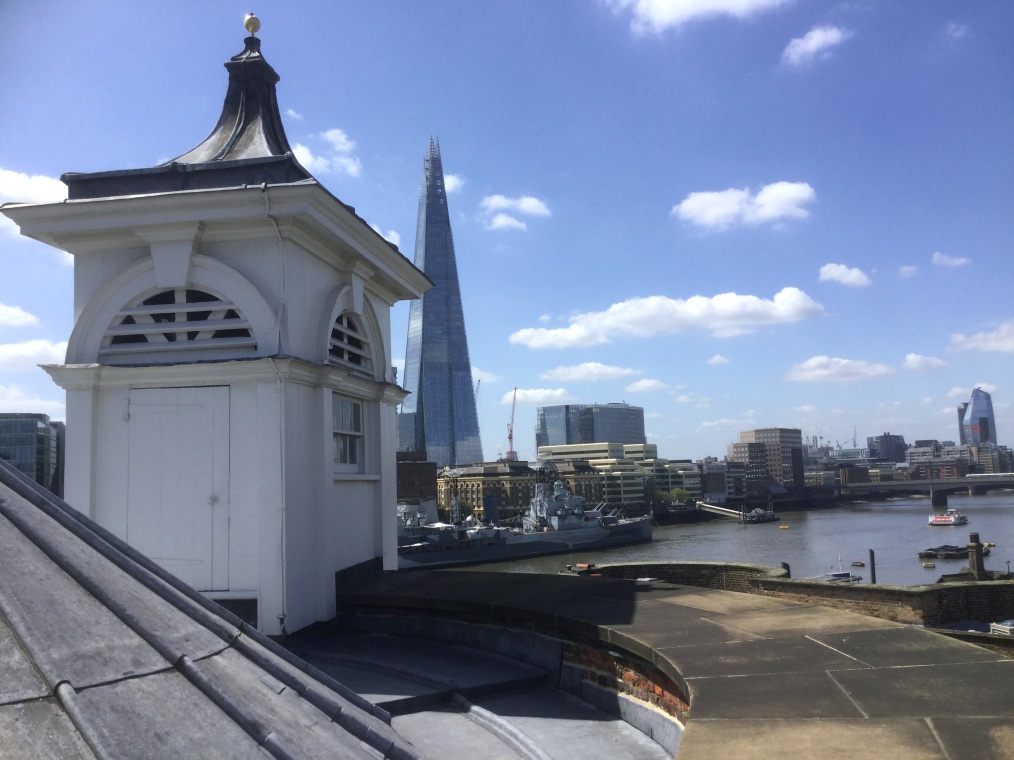
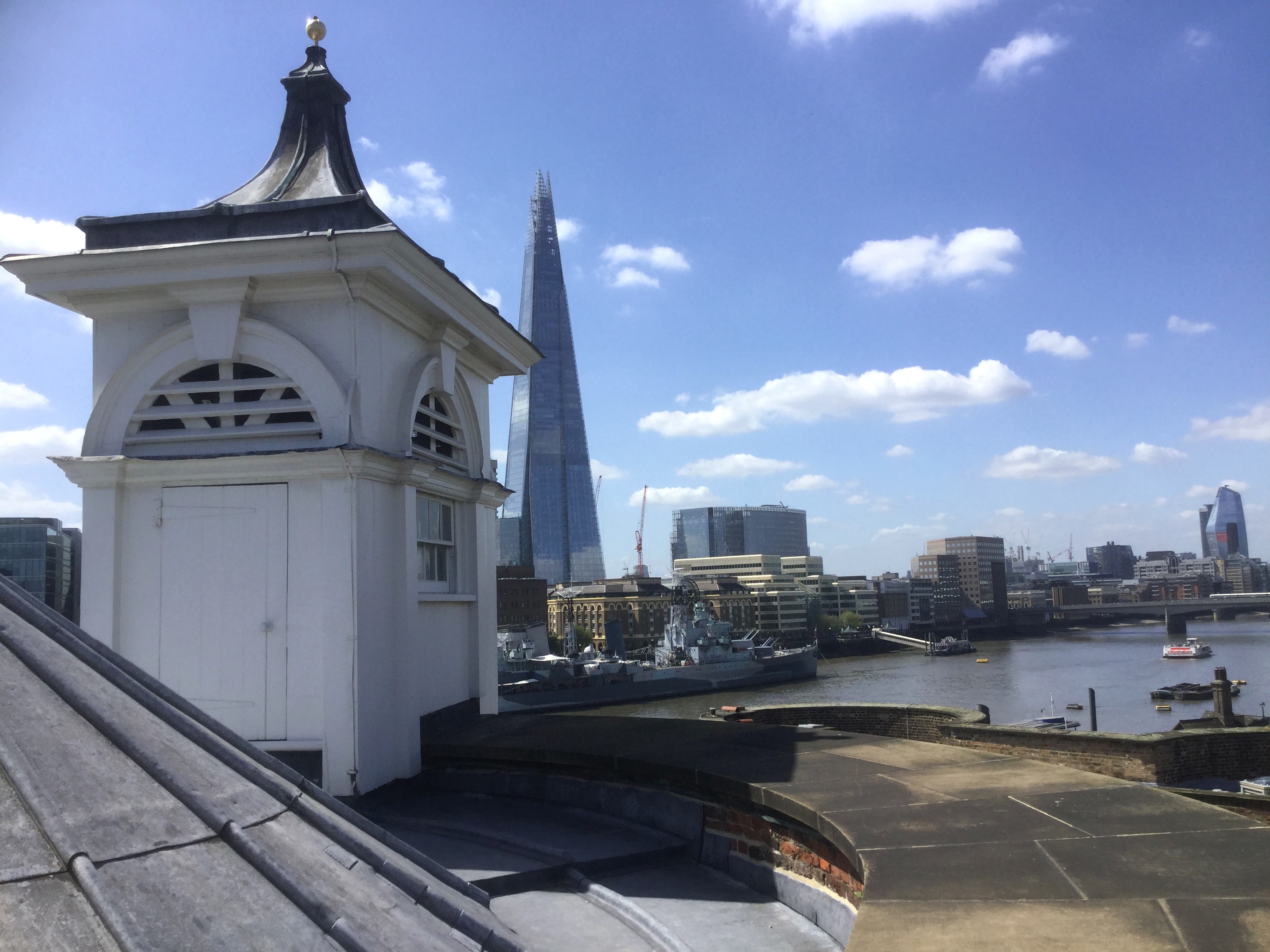
The Bell Tower cupola and a view of London and the Thames, Tower of London

The bell in the cupola of the Bell Tower, Tower of London
In the end, not only was Edward VI’s hopes of England remaining Protestant realized; his fears of a foreign prince taking power in England through marriage to one of his sisters came to naught. As her early chronicler William Camden described, Elizabeth was courted vigorously and widely by princes and aristocrats all over the Western world, some of whom she was personally fond of, and many of which could have helped replenish England’s exhausted coffers and bolster its world influence. Yet, she refused all of them. Her determination to remain single followed a severe bout of smallpox in 1562 which nearly killed her; such crises have a way of centering the mind and inspiring one to firmly establish priorities. As Camden reports, the next year Elizabeth replied to Parliament’s urging that she take a husband and produce heirs: ‘Yea, to satisfy you, I have already joined myself in marriage to an husband, namely, the Kingdom of England. And behold [taking a ring off her finger and showing it to them] the pledge of this my wedlock and marriage with my kingdom.’ And to underscore her determination to rule with authority in her own right, dominated by no man, Elizabeth continued, ‘But I commend you that ye have not appointed me a husband, for that were most unworthy the majesty of an absolute princess, and unbeseeming to your wisdom, which are subjects born.’ Elizabeth I was known through her long reign and ever after as the Virgin Queen.
After I do some photography, we leave the chamber through a little door, climb another little stairway, and emerge onto the rooftop of the Bell Tower. The views up here are amazing, especially on this bright sunny day. The scattered clouds are puffy, the sky is a bright clear blue, and London is gleaming. We enter the pointy-roofed cupola and examine the old bell within. Simon tells us that this bell, once rung at executions, is now rung twice a day at curfew. We take in the views, talking all the while. Simon answers my questions about the histories I’m telling here and about good resources for researching my stories. He also tells us more interesting stories from his military career and of military history in general, again outside of the scope of this piece.
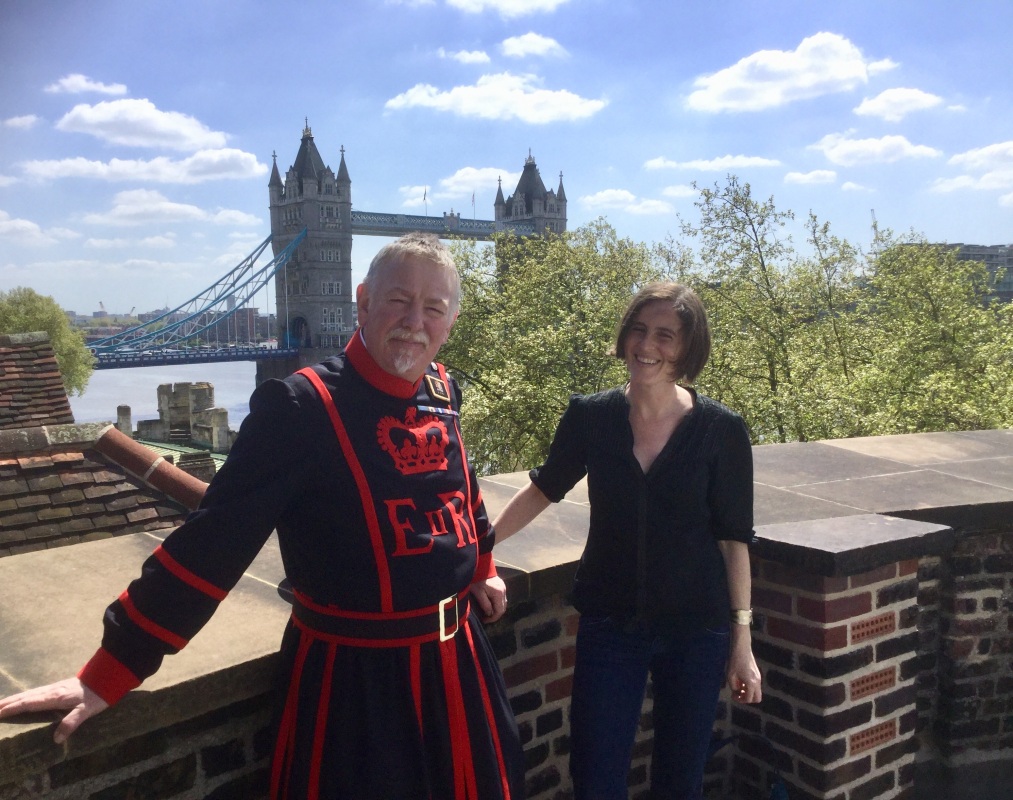
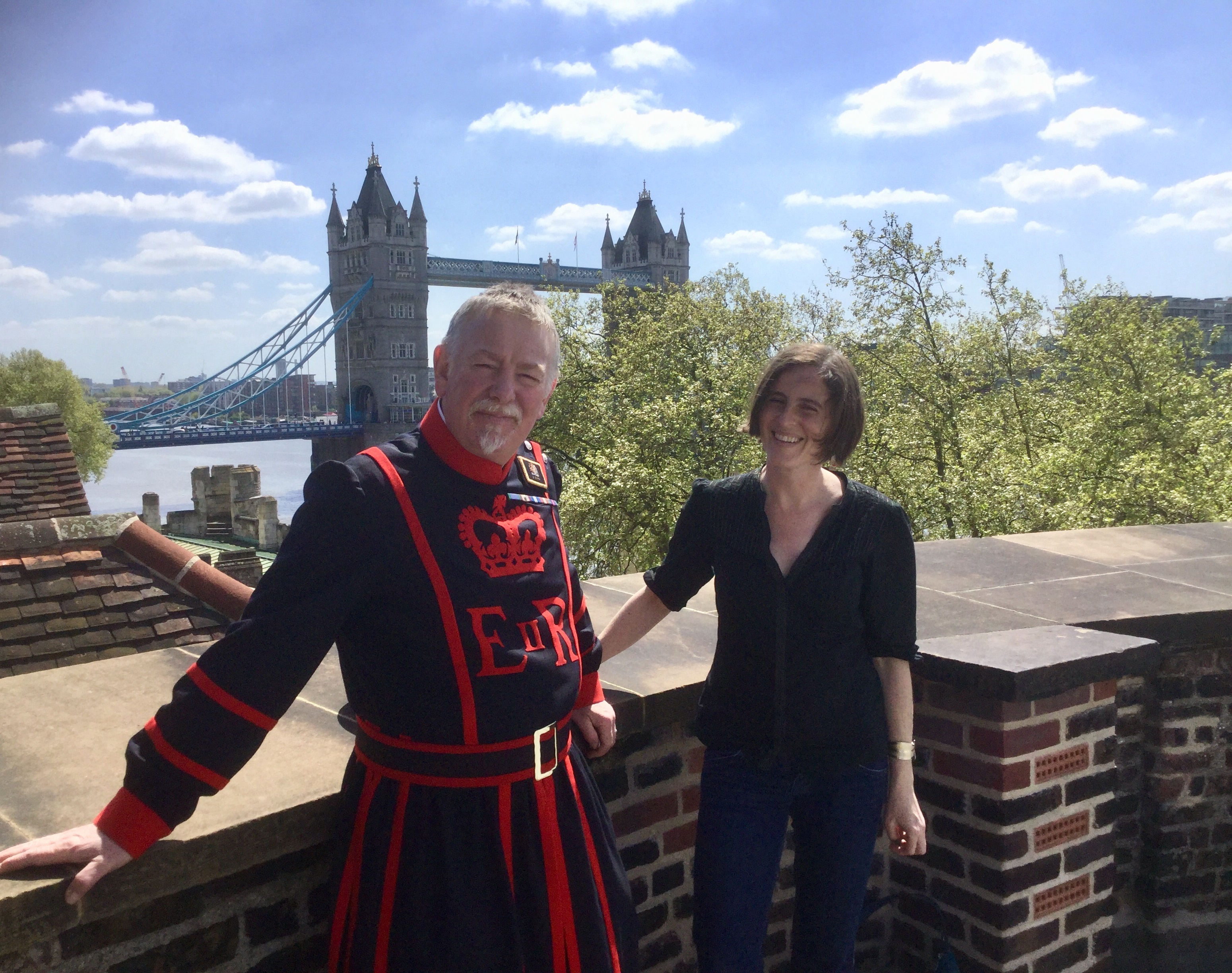
Simon Dodd and Amy Cools atop the Bell Tower, Tower of London
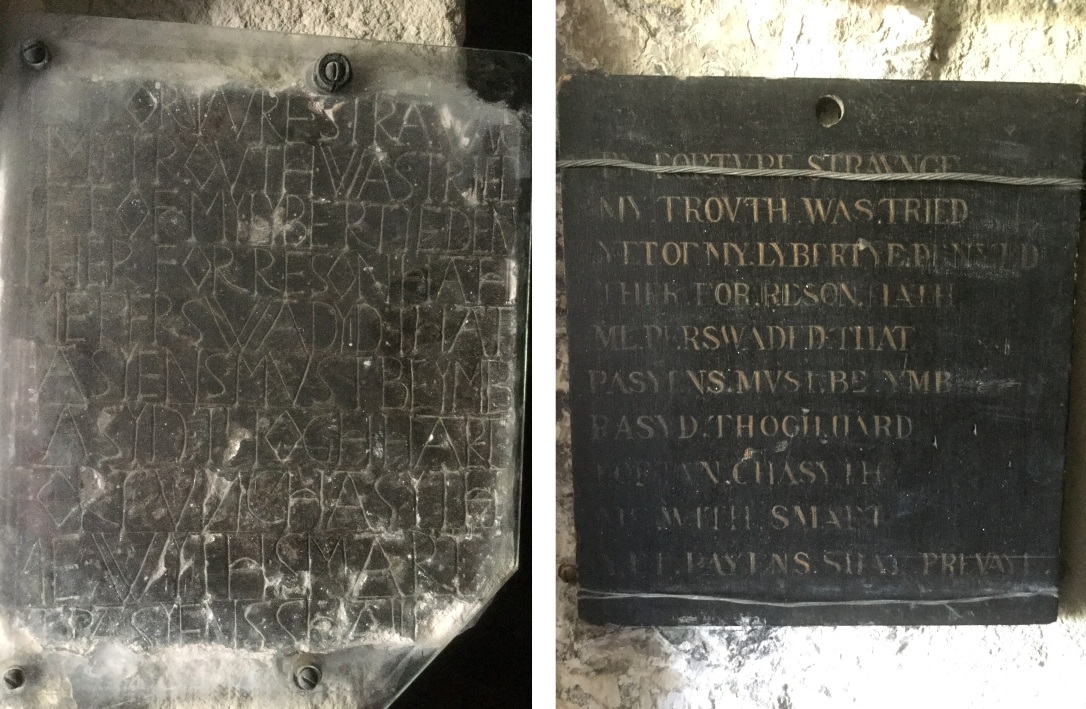
Inscription and clarification in the upper cell of the Bell Tower, Tower of London
As we go down again, on our way out of the Bell Tower chamber, I spot a section of stone that’s been inscribed and covered with a protective clear covering of glass or plastic, and a black slate underneath it with a transcription, strapped to the wall. In answer to my question, Simon tells me there’s a tradition that it was carved when Elizabeth was imprisoned here but it’s not really known just who carved it. Both texts are both worn and difficult to read. Here’s my best attempt to decipher what they say:
In forture strange
My trouth was tried
Yet of my liberty ye denied
There for reson, hath
Me perswaded did that
Pasyens must be ymb
rasyd. Thogh hard
Or unchasyth
Me with smart[…?]
Yet pasyens shall prevail
The gist of its meaning seems to be that the writer’s integrity was attacked and tried through the inexplicable circumstances of fortune and imprisonment. Though imprisoned, however, they decided that patience must be ‘ymbrasyd’ and that it would prevail in the end.
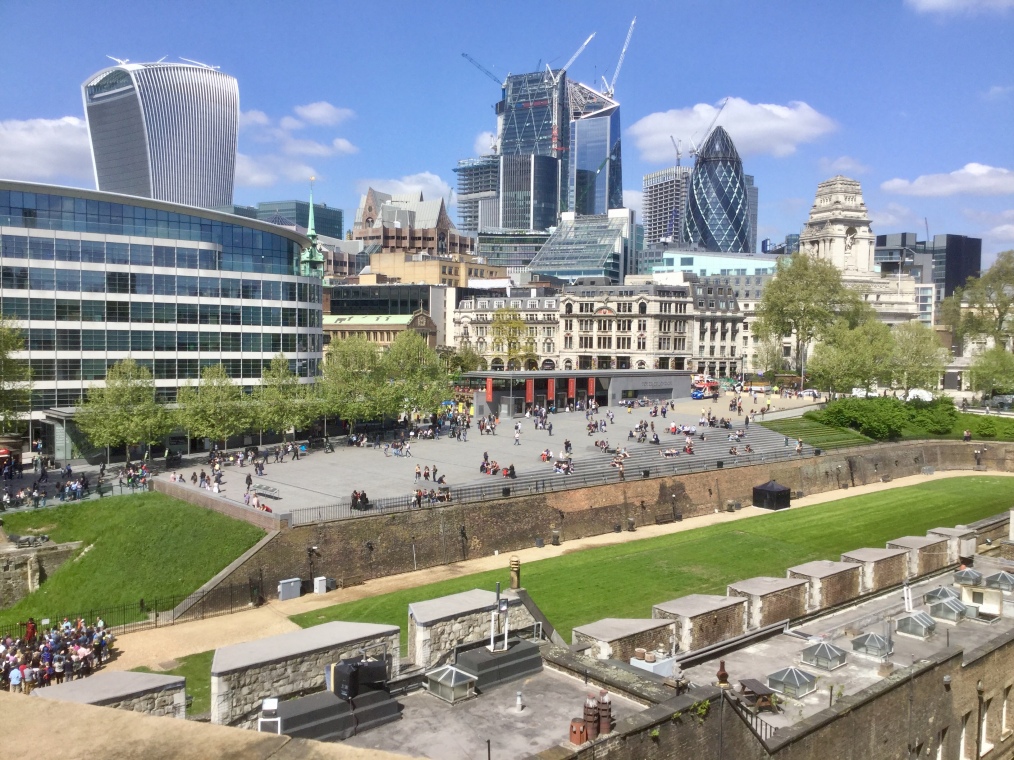
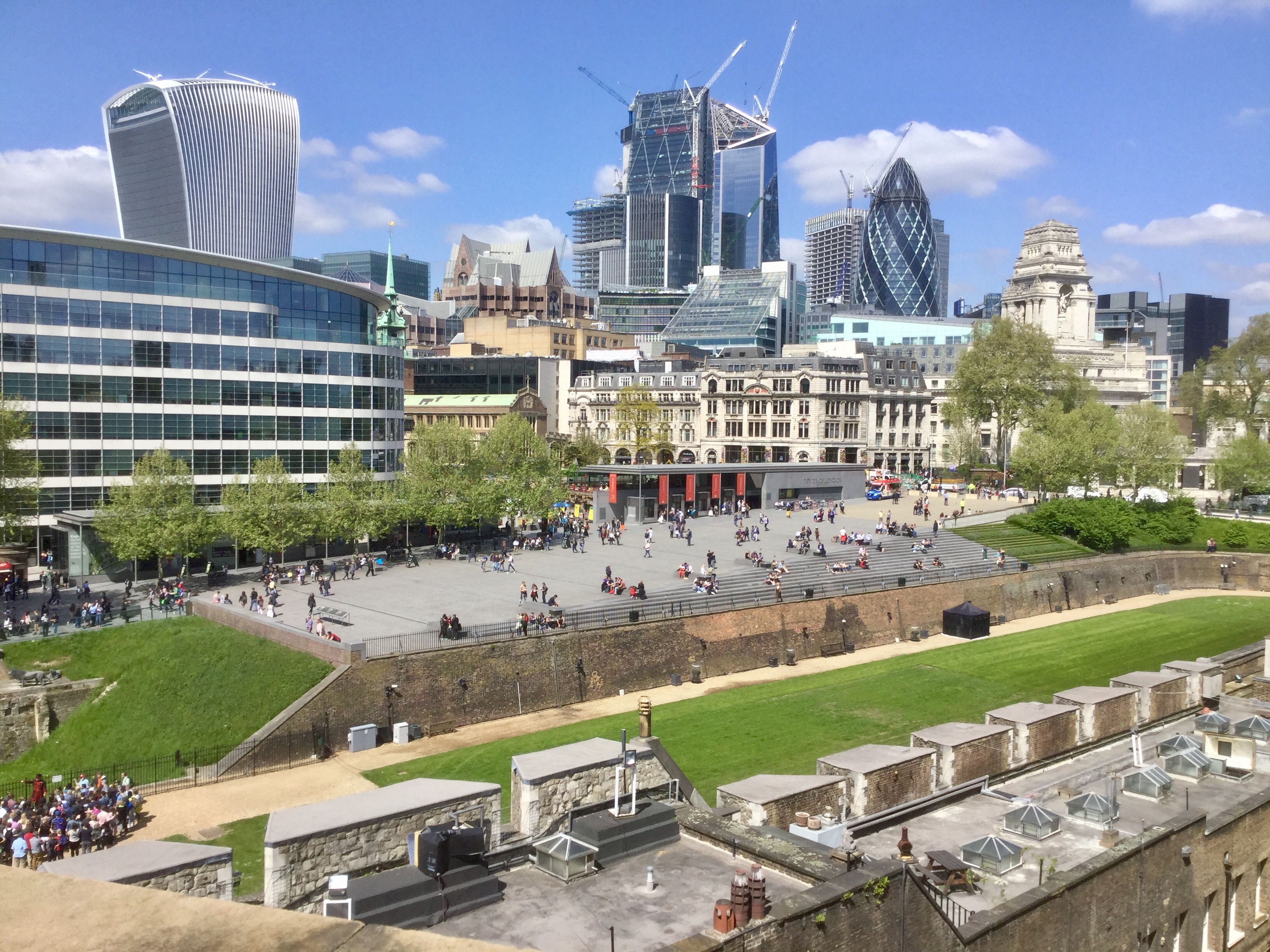
A view of London from the Bell Tower, Tower of London
We leave the Bell Tower, and in the courtyard near Tower Green, we thank Simon profusely and we all say our goodbyes. Then, accompanied by Laurence, I continue my Tower quest in the places that are accessible to us without official accompaniment. There are so many more fascinating aspects of these stories to be explored, and we press on. To be continued….
*Patron of this Tower of London journey: Laurence Murphy ~ With warmest gratitude, thank you!*
*Listen to the podcast version here
~ Ordinary Philosophy is a labor of love and ad-free, supported by patrons and readers like you. Any support you can offer will be deeply appreciated!
~~~~~~~~~~~~~~~~~~~~~~
Sources and inspiration:
Ackroyd, Peter. The Life of Thomas More. London: Chatto & Windus, 1998
‘Annual Survey of Visits to Visitor Attractions: Latest Results.‘ VisitBritain.org
‘The Bell Tower.’ English Monarchs website.
Borman, Tracy. The Story of the Tower of London. London: Merrell Publishers Limited, 2015
Borman, Tracy. ‘The Tudors and the Tower.‘ Tudor Times website, 3 Aug 2015
Camden, William Norton, Robert; Hans and Hanni Kraus. The historie of the most renowned and victorious Princesse Elizabeth, late queen of England. Contayning all the important and remarkeable passages of state both at home and abroad, during her long and prosperous raigne. Composed by way of annals. Neuer heretofore so faithfully and fully published in English. Sir Francis Drake Collection Library of Congress. London: Printed by N. Okes for B. Fisher; 1630
‘Chelsea Old Church: Thomas More.’ Chelsea Old Church website
Collinson, Patrick. ‘Elizabeth I (1533–1603), Queen of England and Ireland.‘ Oxford Dictionary of National Biography.
English Monarchs website: ‘The Bell Tower’ and ‘The Queen’s House‘
Freeman, Thomas S. (2002). ‘`As true a subiect being prysoner’: John Foxe’s notes on the imprisonment of Princess Elizabeth, 1554-5.‘ (Notes And Documents). The English Historical Review, 117(470), 104-116
Furness, Hannah. ‘Wolf Hall is ‘Deliberate Perversion’ of History, says David Starkey.‘ The Telegraph, 26 Jan 2015
Guy, John. A Daughter’s Love: Thomas and Margaret More. London: Fourth Estate, 2008
Guy, John. ‘For What Did Thomas More So Silently Die?’ Lecture published at Tudors.org
House, Seymour Baker. ‘More, Sir Thomas [St Thomas More] (1478–1535), Lord Chancellor, Humanist, and Martyr.‘ Oxford Dictionary of National Biography.
Ives, Eric William. ‘Henry VIII (1491–1547), King of England and Ireland.’ Oxford Dictionary of National Biography.
Jones, Jonathan. ‘Wolf Hall is Wrong: Thomas More was a Funny, Feminist Renaissance Man.‘ The Guardian, 29 Jan 2015
Kennedy, Maev. ‘Historians Scorn Claims over Thomas More’s Cell.’ The Guardian, 10 Jan 2000
Marc’hadour, Germain P. ‘Thomas More.’ Encyclopædia Britannica
More, Thomas. The Apology of Sir Thomas More, Knight. from The Complete Works of St. Thomas More, Vol. 9. Yale University Press, published online by The Center for Thomas More Studies
More, Thomas. Conscience Decides: Letters and Prayers from Prison Written Between April 1534 and July 1535. Selected and arranged by Dame Bede Foord; preface by Trevor Huddleston; introduction by Germain Marc’hadour. London: Geoffrey Chapman Ltd, 1971
More, Thomas. The English Correspondence of Sir Thomas More, 1947 Rogers edition, Princeton University Press, published online by The Center for Thomas More Studies
Moynahan. God’s Bestseller: William Tyndale, Thomas More, and the Writing of the English Bible – A Story of Martyrdom and Betrayal. New York: St. Martin’s Press, 2003
Plowden, A. ‘Grey [married name Dudley], Lady Jane (1537–1554), Noblewoman and Claimant to the English Throne.‘ Oxford Dictionary of National Biography.
Roper, William. The Life of Sir Thomas More. 1556. Ed. Gerard B. Wegemer and Stephen W. Smith. Center for Thomas More Studies, 2003
Stanford, Peter. ‘Sir Thomas More: Saint or Sinner?’ The Telegraph, 20 Jan 2015
Teysko, Heather and Melita Thomas. ‘Tudor Times on Thomas More.’ Renaissance English History Podcast: A Show About the Tudors, episode 55, Sep 16, 2016
Weikel, Ann. ‘Mary I (1516–1558), Queen of England and Ireland.’ Oxford Dictionary of National Biography





 ‘
‘

 Ordinary Philosophy