The Comey Firing Reminds Us of a Bigger Danger, by Fareed Zakaria

Zakaria’s analysis of Trump’s presidency is excellent.

Fareed Zakaria's avatarFareed Zakaria

By Fareed Zakaria
Thursday, May 11, 2017

I have tried to evaluate Donald Trump’s presidency fairly. I’ve praised him when he has appointed competent people to high office and expressed support for his policies when they seemed serious and sensible (even though this has drawn criticism from some quarters). But there has always been another aspect to this presidency lurking beneath the surface, sometimes erupting into full view as it did this week. President Trump, in much of his rhetoric and many of his actions, poses a danger to American democracy.

The United States has the world’s oldest constitutional democracy, one that has survived the test of time and given birth to perhaps the most successful society in human history. What sets the nation apart is not how democratic it is, but rather the opposite. U.S. democracy has a series of checks intended to prevent the accumulation and abuse of…

View original post 660 more words

A Politic of Forgiveness and Responsibility, by Dylan Flint

“Our fathers sinned, and are no more; and we bear their iniquities” Lamentations 5:7

Whether or not we buy the metaphysical presuppositions of this passage from the Bible, and others like it, we cannot deny that we do not choose the household we are born into nor can we choose our country of birth.

To put it bluntly, I did not choose to be American.

I moved to China in the midst of an ugly election and considered, like many others, going (in my case staying) abroad if a certain candidate was elected. Well, he was elected, and I probably won’t stay abroad. But, then again, I do not know what the future holds.

Living in China during this election cycle has caused me a great deal of reflection surrounding three things: the sociopolitical climate of my new home, the shortcomings of democracy, and what it means to be an American.

In many ways, China is ahead of us. For starters, they’ve already had their experiment with communism and thrown it out as no good. In America, however (pardon the metaphor) we seem rather stuck, unable to do our business or get off the pot. Yet, in many other ways, China seems centuries behind. The current government at times easily reminds us of something out of the Dark Ages: complete centralized authoritative rule, shadow policy making, the imprisoning and beating of dissenting artists, and a hell-bent policy of eliminating any hint of revolution. And while the beheadings aren’t held in the square, China currently executes more of its citizens than any other nation in the world.(1)

While we are quick to lament, and rightly so, I can not deny that it works. In fact, I have never seen so many happy people in my life.

Cyber-threats, terrorism, misinformation, hacked elections, these are all non-issues. At least, not ones felt by ordinary citizens. With closed borders, the great firewall, and a state-run media, this is the reality.

And what about crime? Likewise, it is a non-issue.

But why is this so?

One can cite the fact that the government wastes trillions of renminbi (RMB) on new construction projects, many of which will never see the light of day, simply so people can stay employed. While I do not deny this contributes to the low crime rate, I feel I have struck something deeper — something ingrained in the social fabric of the people. In China, there are no second chances. I have found the concept of forgiveness to be a strangely western, strangely Christian idea.

When I asked a group of Chinese students, aged 20–35, about the private prison system in America, many agreed that it was unjust and that rehabilitation has fallen behind cheap labor and profit in priority. But when I asked those same students if they would invite a convict back into their lives after they had served their time, I was shocked by the fiercely absolute “No” I received. Not one of them said they would hire the person if they owned a company, and many suggested they wouldn’t even associate with the person. Even if the person was a child when they committed the offense, the answer was still the same. The verdict was in: if you did something that landed you in jail, you are forever an outsider. It is no wonder people don’t commit crimes.

While I found this to be a bit cruel, I had to remember that outside Christendom this is the way things work. And I am starting to realize that forgiveness comes at quite the cost.

Higher principles are not cheap. They demand a lot from us.

Last year, when Angela Merkel opened Germany’s doors to more than a million refugees, she was doing so because it was the right thing to do. Nevertheless, the tangible consequences appear to have been devastating. Whether the rate of terror has actually increased due to the influx of refugees, or politicians are merely fanning flames of xenophobia, it doesn’t seem to matter much. Regardless of who is responsible, the country is in turmoil.

Now, I would like to believe that, given enough time, Merkel’s good graces will be rewarded. However, it is hard to see such a thing outside the classroom. All I can see is sensible people living in fear, opportunistic politicians cashing in, and daily injustices committed against those who seek refuge.(2) This is a spotty resume for “doing the right thing”, to say the least. But beyond this, I think there is a real lesson here. I think we must realize what it is our higher principles ask us to overcome.

We have to understand that this growing alt-right protectionist polemic that passed Brexit, put Donald Trump in office, and may put out Angela Merkel is not all based on false news, rhetoric, and politics of fear. Despite what I am about to say going against everything I was taught by Hollywood, the reality is that foreigners wreak havoc on familiar social norms, dissent is painful to bear, tolerance is exhausting, criminals hardly ever learn from their mistakes, and our enemies know to hit us where it hurts: they take advantage of our good graces, making a mockery of our higher principles. Free trade, open borders, second chances, all of it attracts exploitation.

When taking one honest, good-long-look at China, it is not hard to see the draw of a massive one party system with closed borders that censures the media and silences civil unrest at all costs.(3) It is so peaceful here. And while the harmony may be faux, there is real solidarity. Despite all the problems China faces (and they are immense), the sentiment of the people is that we are all in this together — we are all Chinese.

It pains me to admit that this sense of identity is gone in America, if there ever was such a thing. Despite the few radical god-fearing patriots, the sentiment of American solidarity — the home to pioneers of freedom, people who believed they could build the future they wanted for themselves, the shining beacon of hope for the tired, hungry, and poor of the world — is completely gone.

Maybe I envision America’s past as does a child who reads a storybook, and maybe I see China through the eyes of a foreigner, but I still believe free people can come together of their own volition, and that this is somehow better than the alternatives. However, I would be lying if I said this belief isn’t constantly being challenged by everything around me, or that I have never considered its outright abandonment. In fact, it may be worth asking ourselves why it is we even have this belief. What is this something extra that makes it better if we make decisions for ourselves, and come together on our own, instead of someone one else forcing this upon us?

This very same question is to be found, incidentally enough, in the history of Christianity. There the question takes on the form: why is conversion in the heart better than conversion through coercion?

Many Christian philosophers, Pierre Bayle comes to mind, have argued that this is just clearly so — that only a true conversion takes place if it happens in the heart of man, not merely in his outward demonstrations. But this argument, though I agree with its conclusions, often ends with an appeal to the “natural light” of reason. In other words, a conversion in the heart is just obviously better. But, absent this vague intuition, it is hard to see why.

I’ve always believed the ends to never justify the means… but, if God is the end, it could hardly matter how you got there. After all, you arrived at God.

*     *     *

Benjamin Franklin once said, “those who would give up Essential Liberty to purchase a little Temporary Safety, deserve neither Liberty nor Safety.”

As a juvenile, I believed this quote to be expounding the sagacity of the libertarian. Now, as an adult, I see it more as a proclamation, or rather a warning, of the insecurity of a democracy. On the one hand, if essential liberties are lost, then the entire system collapses. On the other, if an individual wishes to relinquish his liberty in exchange for some relief from the anxiety that that liberty expounds upon him, then he loses his place in that system. In other words, everyone must believe in it for the system to work. What a frail thing indeed. That is, unless we take ‘belief’ to mean something other than it does in its pejorative sense. In any event, if I were not a talented, energetic, young Aristotelian who stood to gain from toppling monarchs, it would be hard to see why anyone would want to buy into such a thing.

It could be rebutted that a democracy ensures against corruption, and I would reply that profit-seeking corporations are running America. It could be replied that a democracy represents the people, and I would say then that the last honest politician was shot in the head. It could be said that a democracy ensures against the homogeneity of opinion and the stagnation of ideas, and I would say we are overrun with opinion and everyone’s “good” ideas. It could be said that democracy encourages progress, and I would say America is behind a lot of the world. It could be said that democracy and religious freedom go hand-in-hand, and I would say purchasing good vibes at a megachurch hardly constitutes unabated spiritual development. It could be said that only in a democracy do we get to choose our leader, and I would say that over half the voting populous didn’t select America’s current president.

Now to be sure, charges against democracy are nothing new. Plato famously argued in his masterpiece Republic that the next logical step after the beautiful, multifarious democracy was tyranny. And it isn’t because some tyrant comes and takes our kingdom: it is because we give rise to the tyrant. This is simply the natural consequence of our desires playing the part of the ruler in the political organism that is the state. So the story goes: our customs and values diminish from generation to generation because, in a democracy, the father is on equal ground with the son; when things go wrong, as they are bound to, we desperately elect a leader who promises to continue to give us everything we wish for. But the thing is, because we have destroyed our values in the relativism that cohabits with democracy, the leader lacks that which it takes to be a good leader. The beautiful tragedy runs its course, and we become slaves to the tyrant — the embodiment of our passions — in his wild pursuit to save us.

But let be also known that Plato likewise believed in something called the Form of the Good: a metaphysical force which has the power to transform the natural world, including its natural consequences.

While I do not doubt that this is a hard notion for people to understand, let alone believe in, I find it compelling. And the reason why is I have been transformed, if not by it, then by something similar. See, the thing I can not deny, no matter how bad things get in America and how good things get for me in China, is that I have been given a second chance — a second chance I did not deserve.

*     *     *

As a heroin addict in my early 20’s, I tore through the lives of others. In my wild pursuit for pleasure and comfort, I abused my freedom just as much as America is being abused today. My family, my community, my society, my culture, have now all forgiven me, and my debt for this is insurmountable. But it isn’t a debt I don begrudgingly.

I moved to China to repay a debt to my father — to become my own man: a self-sufficient man who under his own propensities can nurture and provide for himself and others — and it is becoming one of the defining experiences of my life. The process of going back over our lives — our histories — and making right our wrongs, is one of great beauty, tremendous insight, and strengthening of soul. It is not a journey of dread. It is the path we want to be on, and, for me, it all began with a choice, a free choice.

Now, I am compelled by this path. It is not by force that I am compelled, but by a sense of moral duty. I am beginning to see what a life of service means, and it is something I really want. I want to repay my family, my community, my country, my western ethos, which gave me another chance at life.

I was once asked as an undergraduate what the Form of the Good meant to me, and for the first time I have a genuine answer: being able to implement your own ideas and to have the consequences be of benefit — to see the lives of other people improve by your hand. It is hard to imagine such a thing flowering and reaching its fullest fruition in a country that stifles free expression and assembly.

The spirit of the west — freedom of conscience, forgiveness, freedom of assembly, freedom of expression, freedom to influence, self-governance — is sick and dying, but it is not dead. Being able to believe what you want, to say what you want, to think what you want, to go after what you want, and to fall flat on your face, but then to be given a second chance, the means of redemption, the opportunity to really learn, and then to see it all work — to see yourself become a positive force in the lives of others — that, that is worth saving.

But I am fully aware that unless one has shared this experience, it is hard to see how they could reach the same conclusion. In other words, it is hard to see why ordinary people should buy into these higher principles if they don’t immediately benefit from them.

I recently read that chaos, insecurity, anxiety, complaining, deceit, and rhetoric are not signs that a democracy is failing. Rather, these are signs a democracy is working —that this is a democracy in action.

Maybe it is the case that we don’t need everyone to be convinced. Maybe the system need only produce a few good men — maybe even only one. I take some solace in the idea.

*     *     *

So why then is it better if conversion takes place in the heart? If answers must be given, this is because once the Father dies, it can live on in the Son, and the Son can one day pass on the torch. Absent this internalization, it is hard to imagine a thing surviving once our father leaves us.

And, after all has been said, what does it mean to be an American? For me, it means having the freedom to become influential in the lives of others, for better or for worse. It means taking part in a socio-political environment where goodness at least has the potential to reach its highest expression.

But what will happen to us? Will a democracy give rise to a tyrant, a few good men, or to a philosopher king? This I obviously do not know, but since I have recovered from my passions, and things are beginning to fall into their proper place, I am hopeful, nay faithful, that the same thing can happen to her.

Despite the fact my generation is being handed a broken country, I assume the responsibility it entails. I forgive my father’s transgressions. I forgive my country’s mistakes. And I, of my own volition, compelled by moral duty, seek a life in politics.

It is true I never chose to be American. But today, I do.

1)  https://en.wikipedia.org/wiki/Capital_punishment_in_China

2) http://www.bbc.com/news/world-europe-39096833

3) I have in mind Tiananmen Square June, 4th 1989.

*A version of this essay was originally published by Chosenmag.com in April 2017

Dylan Flint is a Seattle native with deep ties to the Pacific Northwest. He has been writing continuously ever since getting sober in 2013. He has written on a wide range of topics, from spirituality and addiction to politics and poetry, but everything has always had a philosophical bent. Philosophy is not only dear to Dylan, he considers it a part of himself–an “expression of his soul” to use his own words. Dylan received his BA in philosophy from the University of Washington in 2015. Since graduating he has spent time in Germany at the University of Tubingen, and for this past year, he has been teaching English in China’s Jiangsu province. When he isn’t reading and writing, Dylan enjoys skiing, hiking, traveling and generally being outdoors. This fall he plans to return to the Pacific Northwest. He has been accepted to the philosophy masters program at Simon Fraser University in Vancouver, BC. After he completes this program, he plans to pursue a PhD in philosophy and dreams of one day being a philosophy professor so he can share his love with the next generation of thinkers. To follow Dylan’s thoughts and experiences along the way, you can check out his blog at www.medium.com/@aphilosophersquarrel or on Instagram @aphilosophersquarrel

~ Ordinary Philosophy is a labor of love and ad-free, supported by patrons and readers like you. Any support you can offer will be deeply appreciated!

*All views and opinions expressed by guest writers are their own and do not necessarily reflect those of Ordinary Philosophy’s editors and publishers

Bertrand Russell Got Stoicism Seriously Wrong, by Massimo Pigliucci

I’m an admirer of Bertrand Russell in some ways, and not in others. For one, I, too, have discovered over time that Russell had gotten some things very wrong about some philosophers and their ideas, and had to overcome some of the prejudices his History of Philosophy had instilled in me. Thanks for the defense of Stoicism, Massimo Pigliucci! This essay serves as a good introduction to Stoicism as well.

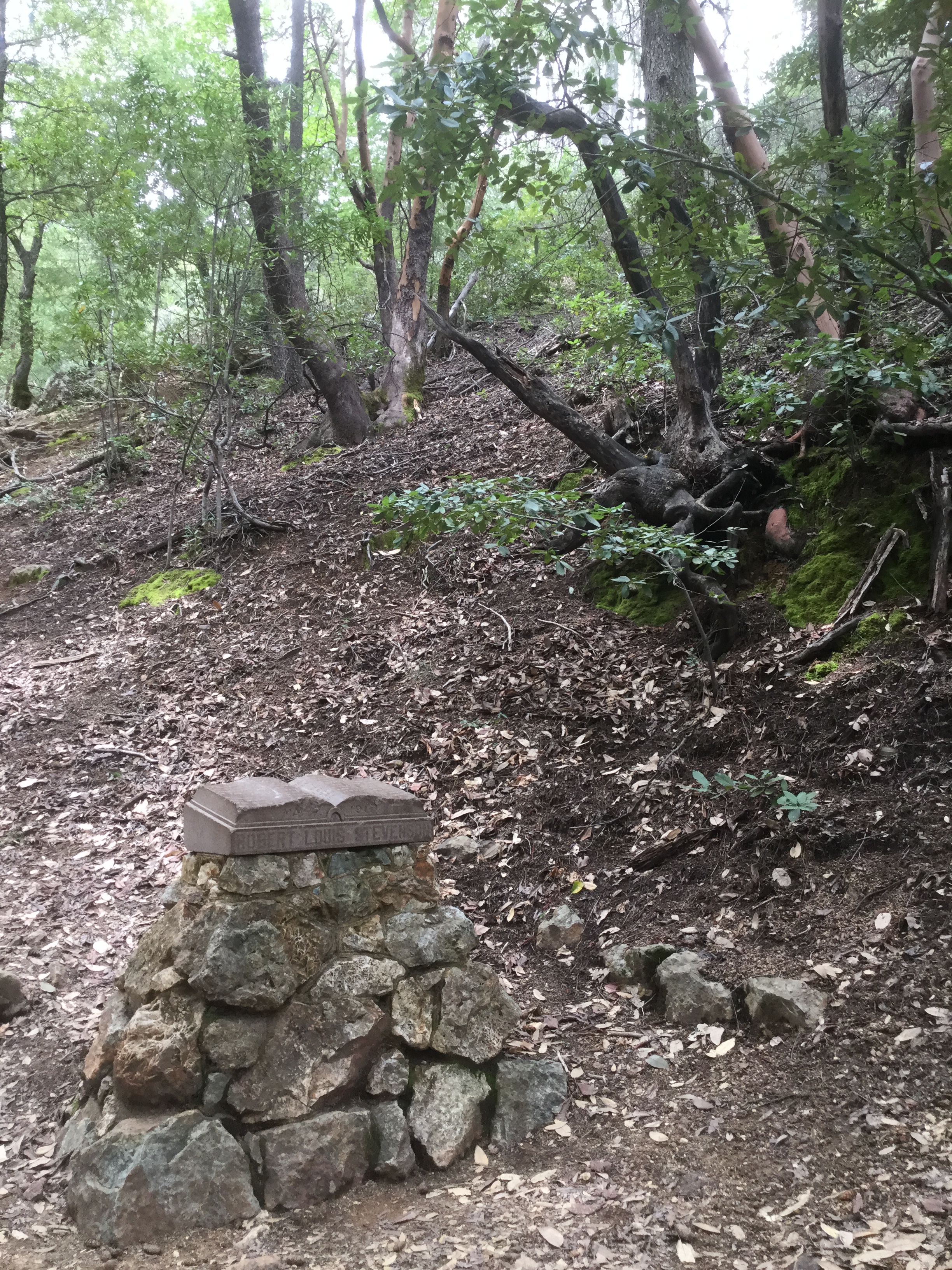
Robert Louis Stevenson Memorial Trail and Monument at Mount Saint Helena, CA

Stevenson Memorial Trail to the summit of Mount Saint Helena. The trailhead is about nine miles north of Calistoga, CA

My sister Therese and I hiked the lovely trail to the summit of Mount Saint Helena on April 22nd, 2017. This hike was Therese’s idea, as are so many of the best ones; thanks, dear sister!

The Stevenson Memorial Trail winds five miles to the summit (one way), about 1,800 feet of climbing all told to the 4,343-foot peak. The entrance to the trail led into dreamy forest, with branches highlighted here and there with fluttering pink plastic ribbons to guide the trail runners in an organized event held here that day. There was a table set up in the parking lot off Highway 29, with drinks, treats, and cheers available for the tired athletes.

On our way up, we discovered the monument mentioned in the sign at the foot of the trail, a handsome little tribute to the memory of Robert Louis Stevenson and his wife placed here exactly 94 years ago on May 7th, 1911 by the Napa Club. Stevenson and his new wife Fanny Van de Grift stayed here for an adventurous honeymoon on the cheap, living for two months in an abandoned miners’ cabin. Stevenson, author of Treasure Island, The Strange Case of Dr Jekyll and Mr Hyde, and A Child’s Garden of Verses, was seeking adventure, new fodder for his writing which he feared was lagging due to his chronic poor health, and a climate in which his congested lungs could do their best. And he was here for Fanny: he had met her years earlier and fell in love. They had to wait to join their lives together until the divorce from her abusive husband came through, and when it did, he left his native Scotland to join her in her home country.

Monument at the site of the miners’-turned-honeymooners’ cabin on Stevenson Memorial Trail, Mount Saint Helena, Robert Louis Stevenson State Park, CA

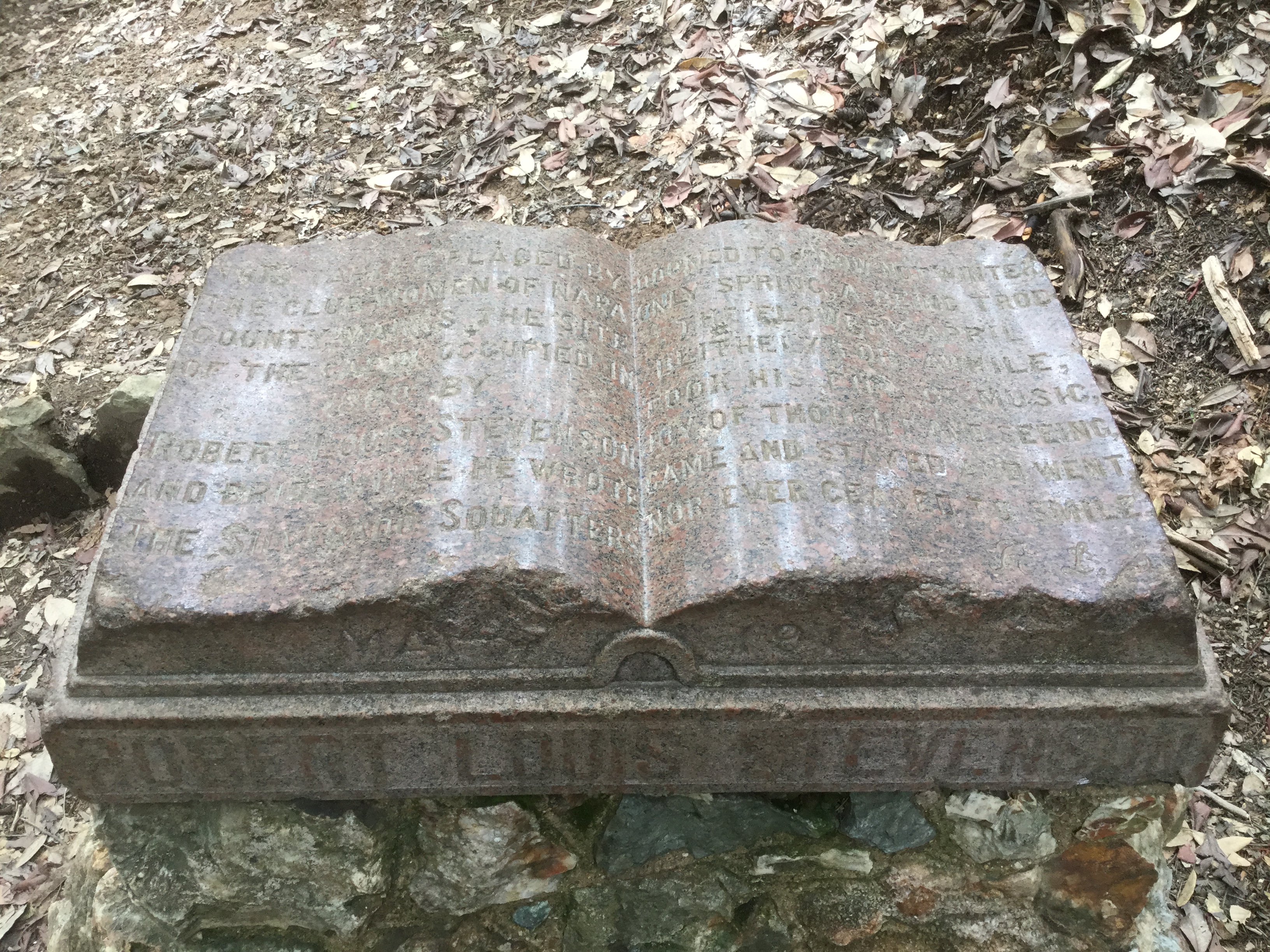
The engraved marble tablet on the stone monument reads:

‘This tablet placed by the Club Women of Napa County
Marks the site of the cabin occupied in 1880 by Robert Louis Stevenson
And bride, while he wrote The Silverado Squatters.

“Doomed to know not winter only spring,
A being trod the flowery April blithely for awhile,
Took his fill of music, joy of thought
And seeing and stayed and went
Nor ever ceased to smile.” – R.L.S.

It was a beautiful hike, the first mile or so lovely and shaded on the narrow switchback trail, the last four mostly fire roads, though we found a couple of steep little shortcuts. The view from the top was spectacular, though not as far as it might have been on a less cloudy day. The wildflowers were lovely too, and the pine and madrone forests (and plentiful poison oak) very much as Stevenson describes them in The Silverado Squatters. It’s the story of his travels to California and his time here in Napa County with Fanny, which is available to read in full online. It’s an amusing and charming story, though the way he describes some Jewish acquaintances is disconcerting unless you keep in mind the prejudices of the time.

Enjoy!

Engraved stone book on the monument at the site of the old cabin on Stevenson Memorial Trail up Mount Saint Helena

Stream near the monument on Stevenson Memorial Trail. Stevenson describes a stream near the old bunkhouse in The Silverado Squatters

Panorama of the view from the peak of Mount Saint Helena, CA, 2017 by Amy Cools

The flat rocks at the peak make a perfect place for a picnic on Mount Saint Helena, CA, 2017 Amy Cools.jpg

Ordinary Philosophy and its Traveling Philosophy / History of Ideas series is a labor of love and ad-free, supported by patrons and readers like you. Please offer your support today!

~~~~~~~~~~~~~~~~~~~~~~~~~~~~~~~~~~~

Sources and inspiration

Bazzoli, Kathy. ‘The Legend of Mount St. Helena,’ The Weekly Calistogan, May 19, 2015

Robert Louis Stevenson (1850–1894)‘ – The Poetry Foundation website

Robert Louis Stevenson – Marriage‘, from Wikipedia, the Free Encyclopedia

Robert Louis Stevenson / Mt St. Helena State Park,’ Sonoma Hiking Trails website

Robert Louis Stevenson State Park,’ Napa Valley State Parks Association website

Stevenson, Robert Louis. The Silverado Squatters, 1883

Trading In

Some of my treasures… Art Deco glass horse heads and handpainted bowl, chest of drawers, lamp glass…

I’m preparing for my big move to Scotland and my subsequent years pursuing my PhD …where, I don’t know.

So I’m selling off my business, which I created and built up for well over a decade, and most of my belongings. At first, I’ve felt no pangs. I’ve been yearning for a big change and the freedom to move where my interests, passions, and opportunities take me, and owning a home based business with inventory makes that very difficult. Though I’ve enjoyed the work, it’s time for all that stuff to go. But as I dig deeper, I’m uncovering the treasures and mementos I’ve packed away from my whole life thus far, and my heart feels little stabs now and again, sometimes of joy, sometimes of nostalgia, sometimes of parting-pains.

There are some things that will remain packed away and stored at my sister’s house (thanks, Bonnie and Jasen!) for me to retrieve when I’ve settled down again. My inked and quilted artworks, mementos, photos, most beloved fabrics, my first and favorite clothing designs, my sewing machines, and so on. But most of my belongings other than my clothes, shoes, and personal needs will all go.

But then I think of what I’ll gain from shedding all this stuff: the public goods the world has to offer. For this first year alone, the treasures in Edinburgh’s wonderful museums and great libraries (all free to the public!), the architecture, the rich history, the beautiful views on the old streets and beautiful parks, will all belong to me too. And so on throughout all of the places my endeavors and travels will take me in the upcoming years, as I’ll be light, mobile, freed from the burdens of ownership.

And when I think of what I’m trading in all my little treasures for, I think I’m getting the far better part of the deal.

Ordinary Philosophy and its Traveling Philosophy / History of Ideas series is a labor of love and ad-free, supported by patrons and readers like you. Please offer your support today!

Happy Birthday, David Hume!

In honor of David Hume’s birthday, May 7, 1711, let me share anew my history of ideas travel series I created in honor of my favorite philosopher in his home city of Edinburgh, Scotland. I’ll soon be in Edinburgh again, this time for at least one year, to pursue a Master’s Degree in Intellectual History at the University of Edinburgh. I can hardly express how thrilled I am at the prospect! I’ll be expanding this Hume series while I’m there.

To Edinburgh I Go, In Search of David Hume

Hello, friends of Ordinary Philosophy! I’m pleased and excited to announce my upcoming adventure: my first philosophical-historical themed adventure, and my first trip to Edinburgh, Scotland!

Here’s my plan:

I’m taking a series of trips to places around the world, where I explore the lives and ideas of great thinkers in the places where they lived and worked. I’ll follow in the footsteps of thinkers who are no longer alive, since those who are still telling their own stories. But those who are no longer alive in the body live on in the ideas that they pass on, and in the example they provide for us to follow.

I’ve decided to start with the philosopher I most admire as a person as well as a thinker, the great David Hume. He was not only revered for the brilliance of his ideas and his honesty in presenting them, but also as a premier example of a genial, generous, great-hearted person; so much so, in fact, that one of his closest friends nicknamed him ‘Saint David’.

Hume is often described as the greatest philosopher to write in English and among the greatest philosophers of all time, period. He was a central figure in the Scottish Enlightenment, and a profoundly influential empiricist and moral philosopher

So off to beautiful Edinburgh I go! There, I’ll visit the places where he worked, thought, wrote, studied, and rested. I’ll be traveling there in the first two weeks of May, and will be writing throughout the trip. I’ll be writing in this blog not only about his ideas, but about what I can discover about his everyday life, and whatever feeling of his time and place I manage to uncover in my time there.

If you have any questions for me to answer while I’m there, or pictures you’d like me to take for you, or any information you have that could help me with this project, I’d love to hear from you!

~~~~~~~~~~~~~~~~~~~~~~~

Here are my essays on Hume as I discover him in my travels, in (roughly) chronological order:

First Day in Old Edinburgh: Hume Sites and Monuments
Hume’s New Scene of Thought, and, It’s Good to Be Able to Say ‘I Don’t Know’
Hume Sites and Monuments, Part 2
The Consolations of Philosophy, and A Death Free from Fear
Scotticisms
Happy 303rd Birthday, David Hume!
Cycling Through Edinburgh, First Time
The Debate Over Government and Freedom
The Tale of the Magic Toe – Superstition? Or What?
Hume Sites and Monuments, Part 3
Water of Leith
Last Day in Edinburgh, May 13th, 2014
Hume, Aristotle, and Guns
and a memory quilt I created for my Edinburgh trip:
A Hill and a Wall in Edinburgh, 2015, 102″ x 69″

Ordinary Philosophy and its Traveling Philosophy / History of Ideas series is a labor of love and ad-free, supported by patrons and readers like you. Please offer your support today!

Happy Birthday, Una Marson! A Profile of this Great Cultural and Literary Nationalist by Lisa Tomlinson

Una Marson, image from AAIHS

Una Marson: Cultural and Literary Nationalist

Una Marson was born on May 5, 1905 in the rural parish of St. Elizabeth, Jamaica, sixteen years after the novelist and poet Claude McKay. Following in the literary footsteps of McKay, Marson valorized African working-class cultural aesthetics and engaged with the wider African diaspora through her literary and political work. Although her work has not received the same attention or accolades as her fellow countryman Claude McKay, Marson has, without a doubt, made a significant contribution to Caribbean and diasporic literature. She was certainly a key figure in twentieth century black internationalist politics.

Fortunately, conversations around the life and work of Una Marson have been kept alive and archived in a few libraries throughout the world. Writers such as Erika Smilowitz, Honor Ford Smith, and Alison Donnell have also written critical essays on Marson’s literary and political involvement inside and outside of Jamaica. Additionally, her biographer Delia Jarrett-Macauley has provided a comprehensive documentation of Marson’s life and writing. Therefore, their works are most instructive in offering more information concerning Marson’s life and activism.

Not surprisingly, Marson’s early works of literature reflected her colonial education. Marson’s writing in her first collection of poems, Tropic Reveries (1930) and Heights and Depth (1931), adapted traditional European literary structure and spoke to pastoral style poetry. As her travels abroad strengthened her race consciousness in the mid-1930s, Marson’s literary work departed from the conventions of British Victorian and Romantic literature. As such, her third volume of poems, The Moth and the Star (1937), articulated themes that resonated with the experiences of African women entrapped within received notions of white beauty standards.

In her poem “Cinema eyes,” for example, the narrator tries to protect her daughter from procuring a “cinema mind” under the influence of white supremacy, which “saw no beauty in black faces.” Two other poems, “Kinky hair blues” and “Black is Fancy,” reveal black hair politics and many black women’s desire to alter their physical appearances:

I hate dat ironed hair
And dat bleaching skin
Hate dat ironed hair
And dat bleaching skin
But I’ll be alone
If I don’t fall in 2

Over time, Marson’s work also became more rooted in Jamaican experiences, and she integrated the indigenous culture of the black Jamaican working-class. In her poem “Stone Breaker, ”Marson sheds light on the experiences of black working-class Jamaican women using the native language, Jamaican, to express class and racial inequalities that inform life on the island: “De big backra car dem/ A lik up de dus’ in a we face” 3

Maintaining a bond to her Jamaican roots, Quashie Comes to London, a more lighthearted poem, highlights the immigrant experience of homesickness in the metropolis of London. Quashie’s diasporic journey in cold dreary London and yearning for familiar food items such as “some ripe breadfruit / Some fresh ackee and saltfish too / An’dumpins hot will suit,” later becomes common threads in the works of Caribbean diasporic writers living outside of the region.

Marson further developed her use of African Jamaican cultural aesthetics and experiences in her popular plays, London Calling and Pocomania. In Pocomania, for instance, she includes the local vernacular, folklore, and African-centered religious practice called Pocomania to challenge middle-class respectability and Christianity. She does this through Stella, the middle-class character in the play, who journeys to the world of the black Jamaican working-class in a bid to experience the forbidden religious rituals of Pocomania. Given the fact that the reference to anything “African” was frowned upon in colonial Jamaica, Marson’s plays and poems reflected a transgressive intervention in conventional Jamaican literature.

In many ways, Marson unselfishly employed her literary status to foster and build upon the development of a Caribbean literary canon. In her desire to advance Jamaican literature and culture, Marson formed the Writers Club, the Kingston Drama Club, and the Poetry League during the 1930s. Marson was also responsible for starting a publishing press.

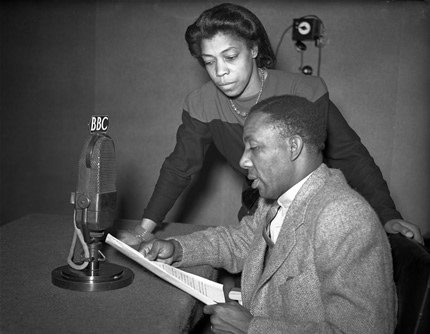
una1While living in England, Marson developed the BBC radio program, “Caribbean Voices,” which evolved into a significant literary show, one that would have a crucial impact on the development of new writings and writers from the Anglophone Caribbean. Caribbean cultural luminaire Kamau Braithwaite has characterized the forum as the “single most important literary catalyst for Caribbean creative and critical writing in English.” 4

In addition to her literary engagement, Marson was also very politically active in local and international affairs. In 1928, at the age of 23, she became the first woman in Jamaica to own and edit a magazine, The Cosmopolitan. Marson used this publication as an outlet to express social concerns in Jamaica (i.e., race and class prejudices) and also to address gender issues. In her editorials, Marson consistently advocated for the expansion of educational and employment opportunities, the development of women’s self-help groups, and the granting of women’s suffrage.

As a feminist, Marson worked in various overseas women organizations and was the only black woman to attend the 12th Annual Congress of the International Alliance of Women for Suffrage and Equal Citizenship conference in Istanbul, Turkey in 1935. Motivated by wider diasporic experiences, she used the opportunity to advocate for the rights of black woman globally and called on the conference to recognize African women in their daily struggles.

Coupled with her feminist work, Pan-Africanism became a dominant feature of Marson’s activism. Marson’s Pan-Africanist vision, for example, was invested in the need for educational reform on her island, a reform that would reverse the colonial education to which she was subjected and instead teach Jamaican children about their African past. Equally, Marson worked as a secretary for the Ethiopian emperor, Haile Selassie, where she used this position to highlight the separation of families and Italian atrocities against women and children in Ethiopia. As his private secretary, Marson also accompanied him to Geneva where he pleaded his country’s case to the League of Nations on the matter of the Italian invasion and occupation.

Marson’s last years of political activism focused on advocacy for the Rastafarian community in her native Jamaica, where she successfully established a home for Rastafarians. She also created the Save the Children Fund, an organization that helped to fund poor children’s basic education.

According to published sources and acquaintances, Marson’s extensive work and travels later contributed to her frail health. Marson struggled with depression and was hospitalized several times in mental health facilities before she died of a heart attack in Jamaica in 1965.

Like Claude McKay, Una Marson’s literary and political work emerged out of their native country Jamaica and later became a part of a wider community of diasporic Africans who sought to assert a distinct national voice and identity. Both writers combined their work with the indigenous cultural expression of the island but were also open to bridging the conversation with other black art forms as evident in the jazz poems of Marson and her brief experimentation with the African American vernacular.

Unlike McKay, however, Marson remained in Jamaica to witness the fruition of her goal toward a cultural and literary renaissance. The 1950s and 1960s defined a literary and cultural rebirth for Anglophone Caribbean people as seen in the dramatic growth in the number of artists, musicians, and creative writers working regionally and internationally. Writers such as Jamaican Andrew Salkey, Barbadian George Lamming, and Trinidadian Samuel Selvon all began to make their mark as renowned Caribbean writers and cultural activists in various parts of the globe.

Therefore, Marson’s commitment to gender politics, race, class, and her impulse to divert from British literary style shaped a generation of writers who aspired to attain cultural and political sovereignty. Indeed, Marson belongs to a long line of black internationalist intellectuals and activists, whose works have been fundamental to struggles for cultural assertion and self-hood.

  1. D. Jarrett-Macauley, The Life of Una Marson 1905-65 (Manchester: Manchester University Press, 1998), 73
  2. Una Marson, Moth and the Star, 91.
  3. Una Marson, Moth and the Star, 70; Like Professor Carolyn Cooper and some Caribbean linguistics I have chosen to use Jamaican (rather than patois) because the term “patois” has a negative linguistic connotation of inferiority.
  4. Kamau Brathwaite, History of the Voice: The Development of Nation Language in Anglophone Caribbean Poetry (London: New Beacon, 1984).

This piece was originally published at the African American Intellectual History Society blog on March 26, 2016

Lisa Tomlinson is a Jamaican researcher and scholar residing in Kingston, Jamaica. Her area of specialization includes literary and cultural studies of the Caribbean and African diaspora, Black literary criticism and anti-colonial studies. She holds a degree in English Literature from Carleton University and a Ph.D. in Humanities (Comparative Perspective and Culture) with a graduate diploma in Latin America and Caribbean Studies.

Lisa has worked in tertiary institutions in Ontario, Canada where she taught courses in English literature, humanities, and visual culture. She is currently a lecturer at the University of the West Indies, Mona Campus in the Department of Literatures in English. Some of her publications include book chapters in Jamaicans in the Canadian Experience: A Multicultralizing Presence, Archipelagos of Sound: Transnational Caribbeanities: Women and Music, Critical Insights: Harlem Renaissance, as well as encyclopedia entries in the Dictionary of Afro-Latin American and Caribbean Biography. (Bio credit: AAIHS)

~ Ordinary Philosophy is a labor of love and ad-free, supported by patrons and readers like you. Any support you can offer will be deeply appreciated!

*All views and opinions expressed by guest writers are their own and do not necessarily reflect those of Ordinary Philosophy’s editors and publishers

Happy Birthday, Søren Kierkegaard! By Eric Gerlach

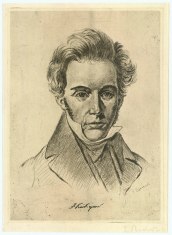
S. <>Søren Kierkegaard (1813-1855 CE), the great Danish philosopher and forerunner of existentialism, was born in the Danish city of Copenhagen, and throughout his life he enjoyed walking through the city, greeting everyone he met as his equal regardless of their station in life.  As a young boy, Kierkegaard’s father drilled him with difficult lessons so he would be the top student in his class, but to prevent his son from developing selfish pride, the father demanded that his son get the third best grades in the class, purposefully making mistakes to prevent the boy from being recognized as first or second student.

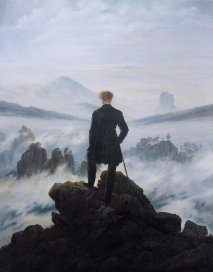
Caspar_David_Friedrich_-_Wanderer_above_the_sea_of_fog

For Kierkegaard, genuine truth is human subjectivity and perspective, and it is only the individual who accepts subjectivity who comes to realize the greater truth insofar as it is achievable by individuals.  For Kierkegaard, truth is not objective, but subjective, not an object achieved, but a test withstood, not a hurdle overcome, but an experience endured.  Kierkegaard argued that no social system can authentically give the individual meaning and truth. Individuals must make choices, and if they choose to go along with the masses, they have sacrificed their own ability to give truth meaning.  Kierkegaard wrote that he could have, like most scholars of his day, become a voice pronouncing the greatness and objectivity of his race, his country, his historical period, his fellow scholars, but rather than commit treason to truth he chose to become a spy, a solitary individual who chronicled the hypocrisy of all claims to objectivity.

472px-Kittinger-jump

To be an individual is to experience “a vertigo of possibilities”, the monstrosity of spontaneity.  Kierkegaard wrote, “We are condemned to be free”.  It is our freedom, the experience of the infinite, undefined and unbounded, which unites us most intimately with our world.  Kierkegaard argued that one can overcome the angst, the vertigo of possibilities, by making a leap of faith, by choosing to believe in something and act with some purpose in spite of the fact that beliefs and purposes can never be fully justified.  Only this is authentic individuality and truth, having chosen what one is to be, with the honest recognition of the freedom involved in the choice.

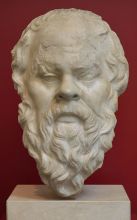
373px-Head_of_Socrates_in_Palazzo_Massimo_alle_Terme_(Rome)

Kierkegaard saw himself as a true follower of Socrates, who argued that he knew that he did not know, which is why the Oracle at Delphi said that no man was wiser than he.  Kierkegaard wrote his college thesis on Socrates, irony, and indirect communication, much as Kierkegaard himself indirectly communicated through his pseudonyms.  Socrates never made great claims to truth, and would instead use analogy, myth, and paradox to show that human judgments and beliefs are problematic and contradictory even as they assert themselves with certainty, which Kierkegaard argued was also the method of Jesus.  Kierkegaard wrote that Socrates “approached each man individually, deprived him of everything, and sent him away empty-handed”.  Socrates showed others that they did not truly know what they believed themselves to know, and he was killed by the Athenian assembly just as Jesus was killed for questioning the Pharisees.

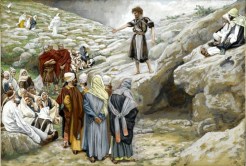
Brooklyn_Museum_-_Saint_John_the_Baptist_and_the_Pharisees_(Saint_Jean-Baptiste_et_les_pharisiens)_-_James_Tissot_-_overall

Kierkegaard’s works are dominated by theological concerns, wondering on many pages about the individual’s relationship to God and Jesus.  For Kierkegaard, the meaning of Christianity was not the achievement of objectivity, but the acceptance of subjectivity, of individually lacking the God’s eye view.  Kierkegaard was brutally critical of the Danish Lutheran Church for presenting itself as the objective truth, and argued that it is only as an individual that one can be a genuine Christian.  Kierkegaard argued that Christianity began as a rebellion against the status quo, but then became the entrenched regime.

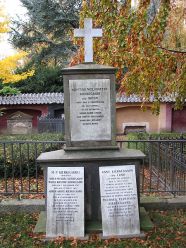
450px-Image-Søren_Kierkegaard_grave_4

After healing a blind man, Jesus rebuked the Pharisees, the political and religious establishment of his time, and said that because they think they see they are in fact blind.  In his later years, Kierkegaard attacked the Danish Church without mercy, and at his funeral a fight broke out when young theology students, progressive and inspired by Kierkegaard, protested that the church was attempting to hijack his name and fame by calling him one of their own after he had so bitterly attacked their hypocrisy for decades.  Kierkegaard wanted his tombstone to read only, “The Individual”, though his relatives decided otherwise.

~ Ordinary Philosophy is a labor of love and ad-free, supported by patrons and readers like you. Any support you can offer will be deeply appreciated!

*All views and opinions expressed by guest writers are their own and do not necessarily reflect those of Ordinary Philosophy’s editors and publishers

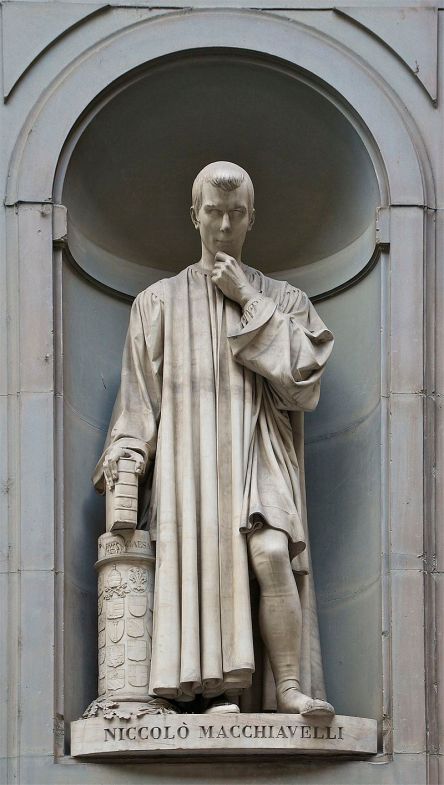
Happy Birthday, Niccolò Machiavelli!

Niccolò Machiavelli statue at the Uffizi

‘Why an entry on Machiavelli? That question might naturally and legitimately occur to anyone encountering an entry about him in an encyclopedia of philosophy. Certainly, Machiavelli [born May 3, 1469] contributed to a large number of important discourses in Western thought—political theory most notably, but also history and historiography, Italian literature, the principles of warfare, and diplomacy. But Machiavelli never seems to have considered himself a philosopher—indeed, he often overtly rejected philosophical inquiry as beside the point—nor do his credentials suggest that he fits comfortably into standard models of academic philosophy. His writings are maddeningly and notoriously unsystematic, inconsistent and sometimes self-contradictory. He tends to appeal to experience and example in the place of rigorous logical analysis. Yet succeeding thinkers who more easily qualify as philosophers of the first rank did (and do) feel compelled to engage with his ideas, either to dispute them or to incorporate his insights into their own teachings. Machiavelli may have grazed at the fringes of philosophy, but the impact of his musings has been widespread and lasting. The terms “Machiavellian” or “Machiavellism” find regular purchase among philosophers concerned with a range of ethical, political, and psychological phenomena, even if Machiavelli did not invent “Machiavellism” and may not even have been a “Machiavellian” in the sense often ascribed to him. Moreover, in Machiavelli’s critique of “grand” philosophical schemes, we find a challenge to the enterprise of philosophy that commands attention and demands consideration and response. Thus, Machiavelli deserves a place at the table in any comprehensive survey of philosophy…’ ~ Cary Nederman, “Niccolò Machiavelli”, The Stanford Encyclopedia of Philosophy 

To introduce yourself to or learn more about the often contradictory, ever controversial, always fascinating and relevant Niccolò Machiavelli, read the Stanford Encyclopedia of Philosophy article linked above and listen to this discussion between one of my favorite broadcasters and public intellectuals Melvin Bragg, and his guests Quentin Skinner, Evelyn Welch, and Lisa Jardine.

Ordinary Philosophy and its Traveling Philosophy / History of Ideas series is a labor of love and ad-free, supported by patrons and readers like you. Please offer your support today!

New Podcast Episode: A Visit to the John Muir National Historic Site in Martinez, CA

The Muir family home built by Dr. John Strentzel at John Muir National Historic Site, Martinez, CA

Listen to this podcast episode here or on Google Play, or subscribe on iTunes

In honor of the anniversary of John Muir’s birth, April 21, 1838, I’ll share the story of my visit to an important place in his life last summer. It was June 26th, 2016, a hot, bright day in Martinez, CA.

The John Muir National Historic Site is just south of the Carquinez Strait, which links San Pablo and Suisun Bays. Benicia, California’s third but short-lived capital city, is just across the strait and was reached by ferry in Muir’s time. A lovely town with a well-preserved historic district, Benicia is well-situated on a waterway that permits easy passage for ships and ferries. In its early years, the strait allowed for easy passage of people, animals, and the products of this agricultural region and later industrial center, so it became a busy, thriving center of commerce. It enjoyed its first big boom with the Gold Rush, as it lay on an easy route between San Francisco and the gold fields.

Martinez was also a hub of Gold Rush activity. The ferry between Benicia and Martinez enjoyed a monopoly on getting all those gold-crazed fortune seekers south to the gold fields and north again to cash in. But Martinez was also an important agricultural town, and this site preserves just a little bit of that aspect of its history. It’s about a thirty-five-minute drive northeast of where I live in Oakland….

Ordinary Philosophy and its Traveling Philosophy / History of Ideas series is a labor of love and ad-free, supported by patrons and readers like you. Please offer your support today!