O.P. Recommends: If Philosophy Won’t Diversify… A Critique of Philosophy’s Lack of Diversity

School of Athens by Raphael [Public domain], via Wikimedia Commons (cropped)

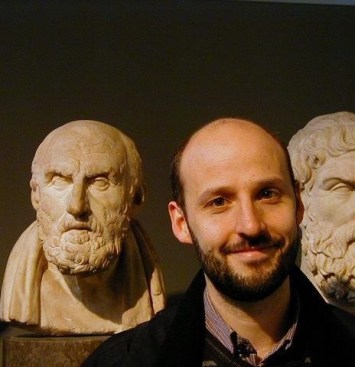
‘Old dead white guys’ – yes, we should study their great contributions to human thought, but what about the rest of the world’s great thinkers?

In this New York Times op-ed for the Stone (NYT’s philosophy forum), Jay L. Garfield and Bryan W. Van Norden critique philosophy’s lack of diversity, and point out the serious problems with calling an academic philosophy department simply a ‘Philosophy’ department while focusing almost exclusively on European and American philosophy.

Their point? If academic philosophy departments want to imply that their students will receive a thorough education in philosophy department by using the broad term ‘philosophy’, then the education they offer should likewise be broad. If not, then they need to be up front and call it what it is: ‘European and American Philosophy’ (…’with a smattering of Islamic Philosophy’: in my undergraduate philosophy courses, Eurocentric as they were, we inevitably received some, if severely limited, instruction in Islamic philosophy, given its strong influence on medieval European thought).

I, for one, look forward to the diversification of philosophy departments. It’s not only desirable but necessary, if philosophy is going to remain the relevant and dynamic pursuit it could and should be.

If Philosophy Won’t Diversify, Let’s Call It What It Really Is‘, by  Jay L. Garfield and Bryan W. Van Norden. New York Times: The Stone, May 11, 2016

Ordinary Philosophy and its Traveling Philosophy / History of Ideas series is a labor of love and ad-free, entirely supported by patrons and readers like you. Please offer your support today!

O.P. Recommends: Wired Interviews Sean Carroll on Poetic Naturalism & His New Book The Big Picture

In this interview, Eric Niiler discusses ‘poetic naturalism’, atheism, theism, the universe, our inner lives, and how we can find meaning regardless of the existence of a deity with Sean Carroll, theoretical physicist, Caltech professor, and author, for his new book The Big Picture: On the Origins of Life, Meaning and the Universe Itself.

I’ve enjoyed Carroll’s work before, mostly through podcast interviews, and I’m really looking forward to reading his book on this topic he’s though so much about over the years. The Big Picture is coming out today, May 10th, 2016.

Ordinary Philosophy and its Traveling Philosophy / History of Ideas series is a labor of love and is ad-free, entirely supported by patrons and readers like you. Please offer your support today!

Interview with Peter Adamson on Indian and Islamic Philosophy

OLYMPUS DIGITAL CAMERA

Listen to this podcast episode here or subscribe on iTunes

I’m honored to present my second interview guest, Peter Adamson, creator and host of the History of Philosophy Without Any Gaps podcast and Professor of Philosophy at the Munich School of Ancient Philosophy and at King’s College London. I’ve listened to his History of Philosophy podcast series for many years: it’s now almost 5 ½ years running, and if you are interested in philosophy, I’m hard pressed to think of a source that’s more comprehensive, thoughtful, and well-researched than Adamson’s.

In this interview, we focus on non-Western philosophy, specifically Indian and Islamic philosophy, since that’s his focus right now at his History of Philosophy series. We touch on Western philosophy as well, especially regarding the ways that Islamic and Indian philosophy influence and intersect with Western philosophy.

Listen to Adamson’s excellent series on the History of Philosophy (without any gaps)

and his Indian philosophy series co-authored by Jonardon Ganeri

Ordinary Philosophy and its Traveling Philosophy / History of Ideas series is a labor of love and is ad-free, entirely supported by patrons and readers like you. Please offer your support today!

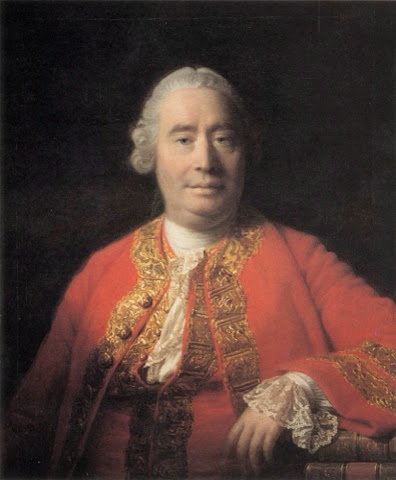
To Edinburgh I Go, In Search of David Hume

Happy 305th Birthday, David Hume! I had the great good fortune to be in Edinburgh on his 303rd birthday, following his life and ideas for my first history of ideas travel series. Here’s the story of my journey…

Amy M Cools's avatarOrdinary Philosophy

Hello, friends of Ordinary Philosophy! I’m pleased and excited to announce my upcoming adventure: my first philosophical-historical themed adventure, and my first trip to Edinburgh, Scotland!

Here’s my plan:

I’m taking a series of trips to places around the world, where I explore the lives and ideas of great thinkers in the places where they lived and worked. I’ll follow in the footsteps of thinkers who are no longer alive, since those who are still telling their own stories. But those who are no longer alive in the body live on in the ideas that they pass on, and in the example they provide for us to follow.

I’ve decided to start with the philosopher I most admire as a person as well as a thinker, the great David Hume. He was not only revered for the brilliance of his ideas and his honesty in presenting them, but also as…

View original post 303 more words

New Podcast Episode: Frederick Douglass Lynn Sites, Part 2 – Historical Society and Hutchinson Scrapbook

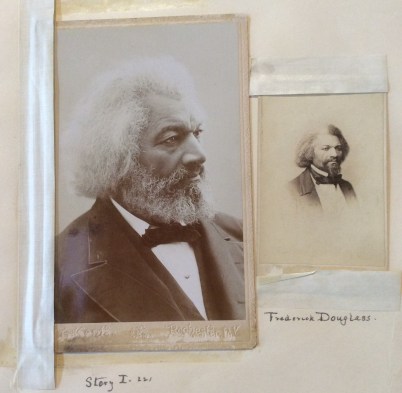
Frederick Douglass in Hutchinson Scrapbook, 2016 Amy Cools

Two portraits of Frederick Douglass from the Hutchinson Family scrapbook

Listen to this podcast episode here or subscribe on iTunes

Seventh Day, Saturday March 26th

…Lynn proves to be a Douglass treasure trove for me, especially the Lynn Museum & Historical Society. While I’m waiting to meet with a representative of the museum to look at some materials from the archives, I visit the ‘Abolitionist Lynn’ exhibit upstairs. As discussed in the first part of today’s account, Lynn had a particularly active and vocal abolitionist community. As I also discussed in the first part of today’s account, that’s what brought Douglass, laborer turned abolitionist speaker, here to Lynn… Read the original account here

Ordinary Philosophy and its Traveling Philosophy / History of Ideas series is a labor of love and is ad-free, entirely supported by patrons and readers like you. Please offer your support today!

Happy Birthday, Karl Marx!

Marx by Sam Kaprielov, 76x61cm, oil on canvas, 2015, image used by permission of the artist

Marx by Sam Kaprielov, 76x61cm, oil on canvas, 2015, http://www.samkaprielov.com/

Born on May 5 1818, few thinkers have been as influential as Karl Marx. Philosopher, theoretician of history, economist, sociologist, journalist, and revolutionary socialist, he was a prolific thinker and writer, widely lauded, criticized, and misunderstood, especially by those who claimed to act in his name.

In honor of his birthday, here is a series of pieces about Karl Marx, a recent painting by an artist whose work my good friend just introduced me to, and a song that I love.

The World Isn’t Fair, by Randy Newman

Karl Marx (1818 – 1883), a very brief bio at BBC: History

Karl Marx, 1818-1883, by Steven Kreis at The History Guide

Karl Marx, by Jonathan Wolff, at the Stanford Encyclopedia of Philosophy

Karl Marx, Wikipedia

~ Ordinary Philosophy and its Traveling Philosophy / History of Ideas series is a labor of love and ad-free, entirely supported by patrons and readers like you. Please offer your support today!

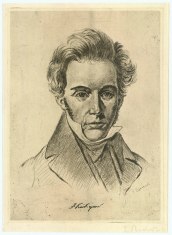
Happy Birthday, Søren Kierkegaard! By Eric Gerlach

S. <>Søren Kierkegaard (1813-1855 CE), the great Danish philosopher and forerunner of existentialism, was born in the Danish city of Copenhagen, and throughout his life he enjoyed  walking through the city, greeting everyone he met as his equal regardless of their station in life.  As a young boy, Kierkegaard’s father drilled him with difficult lessons so he would be the top student in his class, but to prevent his son from developing selfish pride, the father demanded that his son get the third best grades in the class, purposefully making mistakes to prevent the boy from being recognized as first or second student.
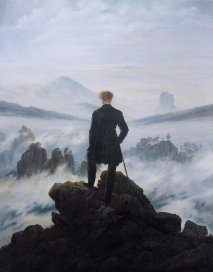
Caspar_David_Friedrich_-_Wanderer_above_the_sea_of_fog

For Kierkegaard, genuine truth is human subjectivity and perspective, and it is only the individual who accepts subjectivity who comes to realize the greater truth insofar as it is achievable by individuals.  For Kierkegaard, truth is not objective, but subjective, not an object achieved, but a test withstood, not a hurdle overcome, but an experience endured.  Kierkegaard argued that no social system can authentically give the individual meaning and truth. Individuals must make choices, and if they choose to go along with the masses, they have sacrificed their own ability to give truth meaning.  Kierkegaard wrote that he could have, like most scholars of his day, become a voice pronouncing the greatness and objectivity of his race, his country, his historical period, his fellow scholars, but rather than commit treason to truth he chose to become a spy, a solitary individual who chronicled the hypocrisy of all claims to objectivity.

472px-Kittinger-jump

To be an individual is to experience “a vertigo of possibilities”, the monstrosity of spontaneity.  Kierkegaard wrote, “We are condemned to be free”.  It is our freedom, the experience of the infinite, undefined and unbounded, which unites us most intimately with our world.  Kierkegaard argued that one can overcome the angst, the vertigo of possibilities, by making a leap of faith, by choosing to believe in something and act with some purpose in spite of the fact that beliefs and purposes can never be fully justified.  Only this is authentic individuality and truth, having chosen what one is to be, with the honest recognition of the freedom involved in the choice.
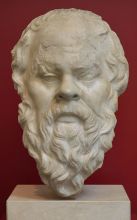
373px-Head_of_Socrates_in_Palazzo_Massimo_alle_Terme_(Rome)

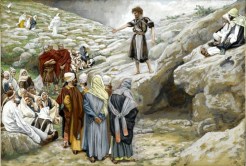
Kierkegaard saw himself as a true follower of Socrates, who argued that he knew that he did not know, which is why the Oracle at Delphi said that no man was wiser than he.  Kierkegaard wrote his college thesis on Socrates, irony, and indirect communication, much as Kierkegaard himself indirectly communicated through his pseudonyms.  Socrates never made great claims to truth, and would instead use analogy, myth, and paradox to show that human judgements and beliefs are problematic and contradictory even as they assert themselves with certainty, which Kierkegaard argued was also the method of Jesus.  Kierkegaard wrote that Socrates “approached each man individually, deprived him of everything, and sent him away empty-handed”.  Socrates showed others that they did not truly know what they believed themselves to know, and he was killed by the Athenian assembly just as Jesus was killed for questioning the Pharisees.
Brooklyn_Museum_-_Saint_John_the_Baptist_and_the_Pharisees_(Saint_Jean-Baptiste_et_les_pharisiens)_-_James_Tissot_-_overall

Kierkegaard’s works are dominated by theological concerns, wondering on many pages about the individual’s relationship to God and Jesus.  For Kierkegaard, the meaning of Christianity was not the achievement of objectivity, but the acceptance of subjectivity, of individually lacking the God’s eye view.  Kierkegaard was brutally critical of the Danish Lutheran Church for presenting itself as the objective truth, and argued that it is only as an individual that one can be a genuine Christian.  Kierkegaard argued that Christianity began as a rebellion against the status quo, but then became the entrenched regime.
450px-Image-Søren_Kierkegaard_grave_4

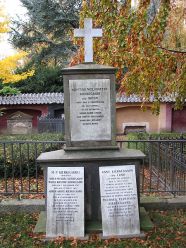
After healing a blind man, Jesus rebuked the Pharisees, the political and religious establishment of his time, and said that because they think they see they are in fact blind.  In his later years, Kierkegaard attacked the Danish Church without mercy, and at his funeral a fight broke out when young theology students, progressive and inspired by Kierkegaard, protested that the church was attempting to hijack his name and fame by calling him one of their own after he had so bitterly attacked their hypocrisy for decades.  Kierkegaard wanted his tombstone to read only, “The Individual”, though his relatives decided otherwise.

Ordinary Philosophy and its Traveling Philosophy / History of Ideas series is a labor of love and is ad-free, entirely supported by patrons and readers like you. Please offer your support today!

New Podcast Episode: Frederick Douglass Lynn, Massachusetts Sites

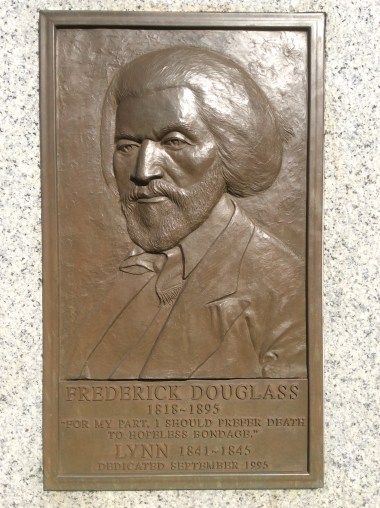
Frederick Douglass Memorial plaque in Lynn Commons, photo 2016 by Amy Cools

Frederick Douglass Memorial plaque in Lynn Commons

Listen to this podcast episode here or subscribe on iTunes

Seventh Day, Saturday March 26th

…Not long after Frederick Douglass began his public speaking career, he and his family moved here to Lynn from New Bedford. They lived here from the fall of 1841 through about November 1847. Well, actually, for much of that time, it was mostly Anna and the kids who lived here. First, Douglass was often on tour as a speaker, which took him away from home for long stretches. Secondly, he was away on a tour of the British Isles from 1845-1847, which is why many sources say Douglass himself only lived here until 1845. He returned only briefly to Lynn before moving himself and his family to Rochester near the end of 1847. His ‘industrious and neat companion‘ Anna took care of the household while he was away, and often took in piecework from Lynn’s thriving shoemaking industry to make sure the kids were always cared for and the bills paid on time….  Read the original account here

Ordinary Philosophy and its Traveling Philosophy / History of Ideas series is a labor of love and is ad-free, entirely supported by patrons and readers like you. Please offer your support today!

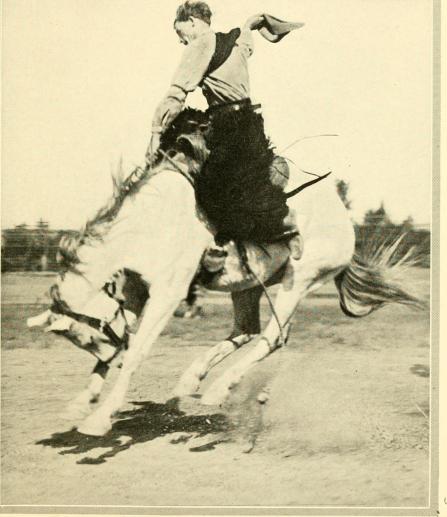
Faster Horses (The Cowboy and the Poet)

Let'er buck, 1921 by Charles Wellington Furlong, public domain via Wikimedia Commons

‘…He was an old philosopher, of course!’

This song never fails to make me smile. Thanks for the song, Tom T. Hall!

~ Ordinary Philosophy and its Traveling Philosophy / History of Ideas series is a labor of love and ad-free, supported by patrons and readers like you. Please offer your support today!