On July 26, 1948, Harry Truman Abolishes Discrimination and Segregation in the Armed Forces by Executive Order 9981

On this day, President Harry Truman took one more step towards realizing the idea, central to the founding documents of the United States, that all persons are created equal.

Thank you, Grinman Films, for telling the story!

Ordinary Philosophy and its Traveling Philosophy / History of Ideas series is a labor of love and ad-free, supported by patrons and readers like you. Please offer your support today!

Happy Birthday, Ida B. Wells!

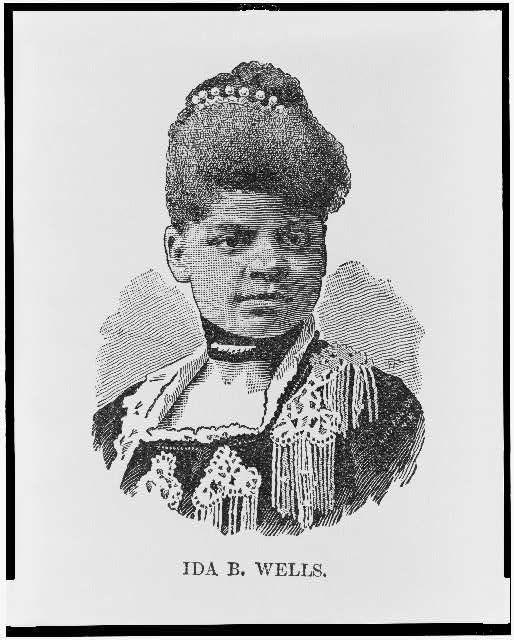
Ida B. Wells, head-and-shoulders portrait, published, 1891, Image retrieved from the Library of Congress LC-USZ62-107756, public domainIn the course of my journey following the life of Frederick Douglass last year, I was so glad to have the opportunity to visit the place in New York City where he may have first met the great Ida B. Wells. It was late 1892, and this fiery young newspaperwoman had published her very controversial piece of investigative journalism in the New York Age on June 25, 1892. It was expanded and published as a pamphlet later that year as Southern Horrors: Lynch Law in All Its Phases.

Many people at that time thought of lynching as an unfortunate and somewhat rare excess of race-hatred by frustrated Southern whites. And many more saw it as a lawless but not entirely unjustified species of vengeance against black men who had raped white women. But Wells would change all that. In early 1892, three of Wells’ friends were lynched after a dispute between themselves and white owners of a rival business. She was outraged, and began an investigation of the practice and history of lynching as a whole.

When Wells wrote Southern Horrors, she had already been an activist and writer for black rights for many years. In 1884, she resisted being forced out of the first class train car into the ‘colored car’; she later sued the train company, won the first suit, then lost on appeal. This incident (which echoes Douglass’ train protest in 1841) led to many other lawsuits, articles, and activism against anti-black laws and social practices. In 1892, her investigation of lynching revealed to Wells that lynching was far from just vengeance for rape, it was inflicted for petty crimes, supposed insubordination or impertinence, drunkenness, competition, and so on. She discovered that lynchings were not all that rare, either, and came to the conclusion that they consisted a form of social control, a replacement for the terrorism of the slave system.

Douglass was inspired and energized by Wells’ writing and anti-lynching work, and wrote a letter praising Southern Horrors as an introduction. He visited her in New York City where she was living for a little while as a writer for and part owner of the New York Age, which was (probably) published at the site I visited in Harlem. I visited a second site associated with Wells two days after my New York visit: she delivered one of her hard-hitting speeches in her speaking tour following the publication of Southern Horrors at Tremont Temple in Boston on Feb 13th, 1893.

Education was another driving force in her life. Her first job was as a teacher at age 14, and she taught for many years, over time supplementing her teaching with journalism, writing and editing for the Evening Star, The Living Way, and the Free Speech and Headlight. Another of her most controversial, consciousness-raising articles was published in 1891 in the Free Speech about the conditions in black schools: the poor quality of the buildings which housed them, and of the education and morals of the teachers and school boards who administered them. She was not fired outright, but the school refused to hire her for the next school year. She then went on to work full-time for the newspaper, promoting the Free Speech from city to city and writing articles along the way, until the Free Speech‘s offices and printing press were destroyed by angry whites after the publication of her ‘Lynch Law’ piece. Adversity only served to strengthen Wells’ resolve, each attack causing her to re-double her efforts on behalf of her people.

Wells went on to have a long and distinguished career in writing, investigative journalism, and activism for black rights and women’s suffrage. She worked with Frederick Douglass and W.E.B. DuBois, toured the United States and Europe as a speaker and activist, founded Chicago’s Alpha Suffrage Club, served as secretary of the National Afro-American Council, founded and became the first president of the Negro Fellowship League, and helped found the National Association for the Advancement of Colored People (NAACP), among many other things.

For a long time, Wells thought of marriage and romantic relationships as oppressive, where women were expected to defer to men and flatter their vanity. But one day, she met a man who must have made her feel very differently, an attorney, writer, and fellow advocate for black rights named Ferdinand Barnett. She married him and they raised four children.

Please follow the links below to learn more about Ida B. Wells. If I manage to accomplish the tiniest fraction of what she did in my own life, I would consider myself a great success.

Ordinary Philosophy and its Traveling Philosophy / History of Ideas series is a labor of love and ad-free, supported by patrons and readers like you. Please offer your support today!

~~~~~~~~~~~~~~~~~~~~~~~~

Sources and inspiration:

Ida B. Wells-Barnett‘, episode 25 of the History Chicks podcast by Beckett Graham and Susan Vollenweider.

Ida B. Wells-Barnett‘. Encyclopædia Britannica. Encyclopædia Britannica Online.

McBride, Jennifer. ‘Ida B. Wells: Crusade for Justice‘. From Webster University’s website.

McNally, Deborah. ‘Barnett, Ferdinand Lee (1858-1936)‘, in BlackPast.org

Steptoe, Tyina. ‘Barnett, Ida Wells (1862-1931)’, in BlackPast.org

Wells, Ida. B. Crusade for Justice: The Autobiography of Ida B. Wells. Ed. Alfred Duster. Chicago, University of Chicago Press, 1970.

Wells, Ida. B. Southern Horrors: Lynch Law in All Its Phases, 1892, via Project Gutenberg

Wikipedia contributors. ‘Ida B. Wells‘. In Wikipedia, The Free Encyclopedia.

Wintz, Paul Finkelman, Cary D. Encyclopedia of the Harlem Renaissance: K-Y. 2004.

Happy Birthday, Aimé Césaire!

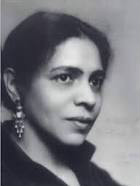
Aimé Fernand David Césaire, photo credit manomerci.comAimé-Fernand-David Césaire was a poet, playwright, philosopher, and politician from Martinique. In his long life (1913-2008), Césaire accomplished much in each of these roles, a rare feat as they rarely coincide in one person!

In turn mayor of Fort-de-France, deputy to the French National Assembly for Martinique, and President of the Regional Council of Martinique, this prolific writer and intellectual was also co-founder of Négritude, a ‘literary movement of the 1930s, ’40s, and ’50s that began among French-speaking African and Caribbean writers living in Paris as a protest against French colonial rule and the policy of assimilation.’ (Encyclopædia Britannica). The Stanford Encyclopedia of Philosophy describes Négritude as ‘the self-affirmation of black peoples, or the affirmation of the values of civilization of something defined as “the black world” as an answer to the question “what are we in this white world?”’. The term was chosen so as to be provocative, a way of re-claiming the word nègre, which had become a racial slur, while simultaneously shocking those who heard or read it into paying attention. Through his philosophy, political writing, and especially his poetry and plays, the world pays attention still.

Learn more about the great Aimé Césaire through the resources below; an excellent place to start is with Meredith Goldsmith’s article from The Poetry Foundation.

Ordinary Philosophy and its Traveling Philosophy / History of Ideas series is a labor of love and ad-free, supported by patrons and readers like you. Please offer your support today!

~~~~~~~~~~~~~~~~~~~~~~~~

Sources and inspiration:

Aime Cesaire‘. In Encyclopædia Britannica.

Chidi, Sylvia Lovina. The Greatest Black Achievers in History, chapter 1

Diagne, Souleymane Bachir, ‘Négritude‘. In The Stanford Encyclopedia of Philosophy

Goldsmith, Meredith. ‘Aimé Fernand Césaire‘, 1913–2008. In The Poetry Foundation

Happy Birthday, Una Marson! A Profile of this Great Cultural and Literary Nationalist by Lisa Tomlinson

Una Marson, image from AAIHS

Una Marson: Cultural and Literary Nationalist

Una Marson was born on May 5, 1905 in the rural parish of St. Elizabeth, Jamaica, sixteen years after the novelist and poet Claude McKay. Following in the literary footsteps of McKay, Marson valorized African working-class cultural aesthetics and engaged with the wider African diaspora through her literary and political work. Although her work has not received the same attention or accolades as her fellow countryman Claude McKay, Marson has, without a doubt, made a significant contribution to Caribbean and diasporic literature. She was certainly a key figure in twentieth century black internationalist politics.

Fortunately, conversations around the life and work of Una Marson have been kept alive and archived in a few libraries throughout the world. Writers such as Erika Smilowitz, Honor Ford Smith, and Alison Donnell have also written critical essays on Marson’s literary and political involvement inside and outside of Jamaica. Additionally, her biographer Delia Jarrett-Macauley has provided a comprehensive documentation of Marson’s life and writing. Therefore, their works are most instructive in offering more information concerning Marson’s life and activism.

Not surprisingly, Marson’s early works of literature reflected her colonial education. Marson’s writing in her first collection of poems, Tropic Reveries (1930) and Heights and Depth (1931), adapted traditional European literary structure and spoke to pastoral style poetry. As her travels abroad strengthened her race consciousness in the mid-1930s, Marson’s literary work departed from the conventions of British Victorian and Romantic literature. As such, her third volume of poems, The Moth and the Star (1937), articulated themes that resonated with the experiences of African women entrapped within received notions of white beauty standards.

In her poem “Cinema eyes,” for example, the narrator tries to protect her daughter from procuring a “cinema mind” under the influence of white supremacy, which “saw no beauty in black faces.” Two other poems, “Kinky hair blues” and “Black is Fancy,” reveal black hair politics and many black women’s desire to alter their physical appearances:

I hate dat ironed hair
And dat bleaching skin
Hate dat ironed hair
And dat bleaching skin
But I’ll be alone
If I don’t fall in 2

Over time, Marson’s work also became more rooted in Jamaican experiences, and she integrated the indigenous culture of the black Jamaican working-class. In her poem “Stone Breaker, ”Marson sheds light on the experiences of black working-class Jamaican women using the native language, Jamaican, to express class and racial inequalities that inform life on the island: “De big backra car dem/ A lik up de dus’ in a we face” 3

Maintaining a bond to her Jamaican roots, Quashie Comes to London, a more lighthearted poem, highlights the immigrant experience of homesickness in the metropolis of London. Quashie’s diasporic journey in cold dreary London and yearning for familiar food items such as “some ripe breadfruit / Some fresh ackee and saltfish too / An’dumpins hot will suit,” later becomes common threads in the works of Caribbean diasporic writers living outside of the region.

Marson further developed her use of African Jamaican cultural aesthetics and experiences in her popular plays, London Calling and Pocomania. In Pocomania, for instance, she includes the local vernacular, folklore, and African-centered religious practice called Pocomania to challenge middle-class respectability and Christianity. She does this through Stella, the middle-class character in the play, who journeys to the world of the black Jamaican working-class in a bid to experience the forbidden religious rituals of Pocomania. Given the fact that the reference to anything “African” was frowned upon in colonial Jamaica, Marson’s plays and poems reflected a transgressive intervention in conventional Jamaican literature.

In many ways, Marson unselfishly employed her literary status to foster and build upon the development of a Caribbean literary canon. In her desire to advance Jamaican literature and culture, Marson formed the Writers Club, the Kingston Drama Club, and the Poetry League during the 1930s. Marson was also responsible for starting a publishing press.

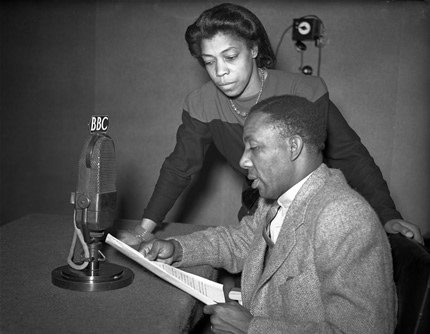
una1While living in England, Marson developed the BBC radio program, “Caribbean Voices,” which evolved into a significant literary show, one that would have a crucial impact on the development of new writings and writers from the Anglophone Caribbean. Caribbean cultural luminaire Kamau Braithwaite has characterized the forum as the “single most important literary catalyst for Caribbean creative and critical writing in English.” 4

In addition to her literary engagement, Marson was also very politically active in local and international affairs. In 1928, at the age of 23, she became the first woman in Jamaica to own and edit a magazine, The Cosmopolitan. Marson used this publication as an outlet to express social concerns in Jamaica (i.e., race and class prejudices) and also to address gender issues. In her editorials, Marson consistently advocated for the expansion of educational and employment opportunities, the development of women’s self-help groups, and the granting of women’s suffrage.

As a feminist, Marson worked in various overseas women organizations and was the only black woman to attend the 12th Annual Congress of the International Alliance of Women for Suffrage and Equal Citizenship conference in Istanbul, Turkey in 1935. Motivated by wider diasporic experiences, she used the opportunity to advocate for the rights of black woman globally and called on the conference to recognize African women in their daily struggles.

Coupled with her feminist work, Pan-Africanism became a dominant feature of Marson’s activism. Marson’s Pan-Africanist vision, for example, was invested in the need for educational reform on her island, a reform that would reverse the colonial education to which she was subjected and instead teach Jamaican children about their African past. Equally, Marson worked as a secretary for the Ethiopian emperor, Haile Selassie, where she used this position to highlight the separation of families and Italian atrocities against women and children in Ethiopia. As his private secretary, Marson also accompanied him to Geneva where he pleaded his country’s case to the League of Nations on the matter of the Italian invasion and occupation.

Marson’s last years of political activism focused on advocacy for the Rastafarian community in her native Jamaica, where she successfully established a home for Rastafarians. She also created the Save the Children Fund, an organization that helped to fund poor children’s basic education.

According to published sources and acquaintances, Marson’s extensive work and travels later contributed to her frail health. Marson struggled with depression and was hospitalized several times in mental health facilities before she died of a heart attack in Jamaica in 1965.

Like Claude McKay, Una Marson’s literary and political work emerged out of their native country Jamaica and later became a part of a wider community of diasporic Africans who sought to assert a distinct national voice and identity. Both writers combined their work with the indigenous cultural expression of the island but were also open to bridging the conversation with other black art forms as evident in the jazz poems of Marson and her brief experimentation with the African American vernacular.

Unlike McKay, however, Marson remained in Jamaica to witness the fruition of her goal toward a cultural and literary renaissance. The 1950s and 1960s defined a literary and cultural rebirth for Anglophone Caribbean people as seen in the dramatic growth in the number of artists, musicians, and creative writers working regionally and internationally. Writers such as Jamaican Andrew Salkey, Barbadian George Lamming, and Trinidadian Samuel Selvon all began to make their mark as renowned Caribbean writers and cultural activists in various parts of the globe.

Therefore, Marson’s commitment to gender politics, race, class, and her impulse to divert from British literary style shaped a generation of writers who aspired to attain cultural and political sovereignty. Indeed, Marson belongs to a long line of black internationalist intellectuals and activists, whose works have been fundamental to struggles for cultural assertion and self-hood.

  1. D. Jarrett-Macauley, The Life of Una Marson 1905-65 (Manchester: Manchester University Press, 1998), 73
  2. Una Marson, Moth and the Star, 91.
  3. Una Marson, Moth and the Star, 70; Like Professor Carolyn Cooper and some Caribbean linguistics I have chosen to use Jamaican (rather than patois) because the term “patois” has a negative linguistic connotation of inferiority.
  4. Kamau Brathwaite, History of the Voice: The Development of Nation Language in Anglophone Caribbean Poetry (London: New Beacon, 1984).

This piece was originally published at the African American Intellectual History Society blog on March 26, 2016

Lisa Tomlinson is a Jamaican researcher and scholar residing in Kingston, Jamaica. Her area of specialization includes literary and cultural studies of the Caribbean and African diaspora, Black literary criticism and anti-colonial studies. She holds a degree in English Literature from Carleton University and a Ph.D. in Humanities (Comparative Perspective and Culture) with a graduate diploma in Latin America and Caribbean Studies.

Lisa has worked in tertiary institutions in Ontario, Canada where she taught courses in English literature, humanities, and visual culture. She is currently a lecturer at the University of the West Indies, Mona Campus in the Department of Literatures in English. Some of her publications include book chapters in Jamaicans in the Canadian Experience: A Multicultralizing Presence, Archipelagos of Sound: Transnational Caribbeanities: Women and Music, Critical Insights: Harlem Renaissance, as well as encyclopedia entries in the Dictionary of Afro-Latin American and Caribbean Biography. (Bio credit: AAIHS)

~ Ordinary Philosophy is a labor of love and ad-free, supported by patrons and readers like you. Any support you can offer will be deeply appreciated!

*All views and opinions expressed by guest writers are their own and do not necessarily reflect those of Ordinary Philosophy’s editors and publishers

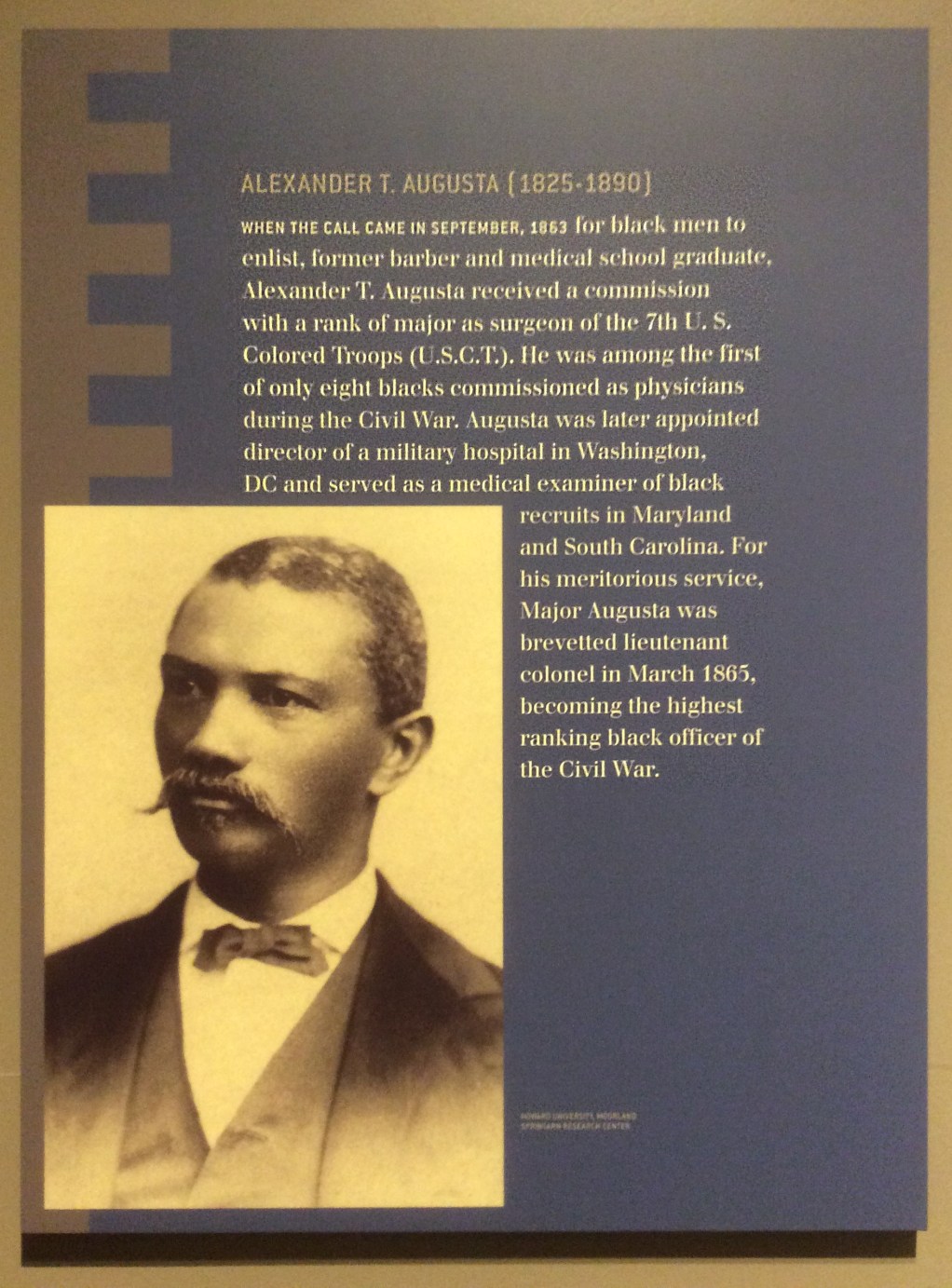
Photobook: Alexander Thomas Augusta, Highest Ranking Black Officer in the Civil War

‘Alexander Thomas Augusta was the highest-ranking black officer in the Union Army during the Civil War. He was also the first African American head of a hospital (Freedmen’s Hospital) and the first black professor of medicine (Howard University in Washington, D.C… On April 14, 1863, Augusta was commissioned (the first out of eight other black officers in the Civil War) as a major in the Union army and appointed head surgeon in the 7th U.S. Colored Infantry’ – Blackpast.org. I took this photo at the Maryland Historical Society in Baltimore, while on my history of ideas travels following the life and work of Frederick Douglass last spring

Happy Birthday, Maya Angelou!

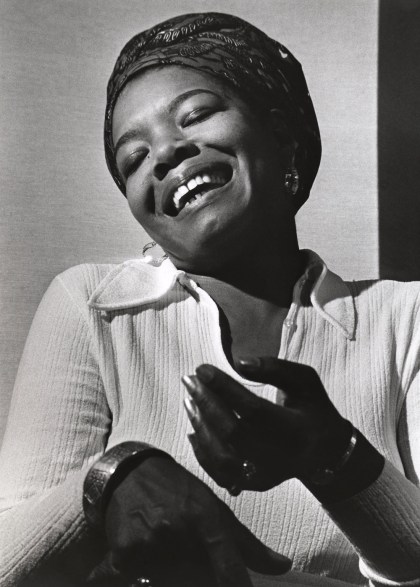
Maya Angelou, author, poet, singer, dancer, activist, and so much more, was born on April 4th, 1928. We lost her only a few years ago, on May 28th, 2014.

There’s a wonderful Angelou biopic on PBS that I watched just a few weeks ago. In case you haven’t seen it, I highly, highly recommend it, and what better day to watch it than today? It’s only available now if you purchase a Passport subscription, but it’s very inexpensive and besides, our great public institutions like PBS need all the support we can give them in our current political climate of de-funding that which is not a weapon or a tax break for some special interest. I’ve long known of her and was aware of her prominence as an American author and civil rights leader, as most have, and had read and heard snippets by and about her over the years. This biopic, however, was my first sustained look at her life and accomplishments. How I went so long without more than a passing familiarity with her I know not. I am drawn in, and must discover more.

The Poetry Foundation’s page for Angelou is another excellent source for learning about her life and work and includes a short biography, lists of works by and about her, and some of her poetry.

What a fascinating woman.

Ordinary Philosophy and its Traveling Philosophy / History of Ideas series is a labor of love and ad-free, supported by patrons and readers like you. Please offer your support today!

“Held in Trust by History:” The Intellectual Activism of Lerone Bennett Jr., by Christopher Tinson

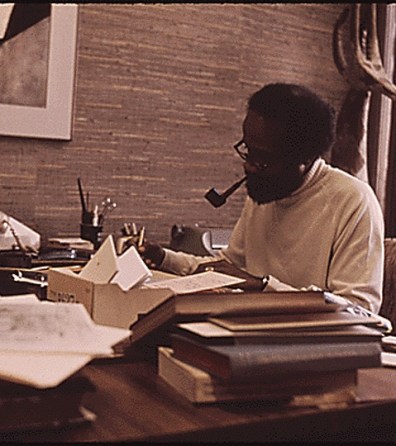
Lerone Bennett, Jr, by John H. White for Series DOCUMERICA, Oct 1973, public domain (cropped)

On the morning of December 11, 2016, a notice in the Chicago area news read as follows: “Author Lerone Bennett Found Safe After Being Reported Missing.” The 88-year old scholar and journalist had decided to go for an early morning walk, without telling anyone. According to the notice, Bennett had been located hours after he had gone missing. While the news report provided few details about the incident, it indicated that Bennett was “the author of multiple books” who had “previously worked as an editor at JET and Ebony Magazine.” The brevity of this note calls attention to two important facts: that Bennett is not dead as many have assumed, and that he is still largely known for his work at Ebony and for the publication of two critically acclaimed texts even though he produced over ten. While this notice locates Bennett, it fails to account for the extraordinary impact of this important figure.

Lerone Bennett, Jr.—social historian, Black Studies architect, and intellectual activist—spent over four decades at Ebony magazine. Ebony, arguably the premier African American lifestyle magazine of the 20th century, was founded by John H. Johnson in 1945. In addition to Ebony, Bennett also maintained a full organizational life, holding memberships and associations in such organizations as the short-lived Black Academy of Arts and Letters, the Race Relations Information Center, the Institute of the Black World, the Association for the Study of Negro Life and History, and the Martin Luther King, Jr. Memorial Center. In 1965, John Henrik Clarke was the first to announce Bennett as a social historian and historian Pero Dagbovie revisited Bennett’s influence on Africana Studies in an article in the Journal of Black Studies. Renewing the interest in Bennett’s life opens us to several objectives: to gain a sense of African American historical expertise and craftsmanship, to achieve an expansive definition of intellectual history and the social function of the historian, to contextualize Bennett’s productivity, motivations, and range as a thinker, to achieve a view into his philosophy of life, and lastly to arrive at the creatively disruptive and reparative dimensions of history, all of which are discernible in Bennett’s robust body of work.

Born and bred in the south, Bennett moved to Chicago after a stint at the Atlanta Daily World and was named Associate Editor at Ebony in 1954. Bennett’s time at Ebony was unique. Starting out slowly, he later emerged as one of Johnson’s trusted advisors—he eventually co-wrote Johnson’s autobiography. He used the prestige of one of America’s most successful black entrepreneurs to teach and disseminate black history. The common association of Bennett with the popularizing of history reduces his impact. His record shows that far from watering down the African American experience in the United States, he sought to forge a reparative, justice-centric, visionary account of past human endeavor and the stakes of social disequilibrium. For Bennett, history looks backwards and forwards simultaneously. A brief survey of Ebony issues over this period reveals several principal social concerns, including: African American struggles over rights, passionate interest in the decolonization of the African continent, the uncovering or rediscovering key contributors to Africana intellectual life, and measuring the growing discontent with the prospects of American democracy. On one hand, Ebony emphasized high-life aspiration and on the other it cultivated a devoted and deeply engaged readership. Throughout the 1960s Bennett published a broad range of essays commenting on African American politics, culture, and Afro-diasporic history. Virtually no subject escaped Bennett’s pen. Among the writings in this period are essays on African independence, civil rights militancy, popular culture, and other histories that comprised the series “Pioneers of Protest.”

However, Bennett’s career took off upon the publication of Before the Mayflower in 1962, which began as a series of Ebony essays in 1961. The book was an immediate sensation. Mainstream press outlets such as the Chicago Tribune favorably reviewed the book. The Tribune also carried book reviews written by Bennett while he served as associate editor at Ebony. Historian and activist John Henrik Clarke’s review essay for the black left periodical Freedomways in 1965 locates Bennett in relation to the Civil Rights upsurge carried out by “A new generation of restless black Americans.” For Clarke, Bennett was part of a new generation who, like himself, could be called participant historians. In other words these were historians who not only documented history, but were themselves poised and principled activists in their own regard. Clarke offered readers a glimpse into Bennett’s background before diving into a review of key sections of Before the Mayflower and several of his seminal Ebony articles. Accompanying the piece was two of Bennett’s poems, showcasing a multitalented intellect.

The great irony of Bennett’s career, perhaps, is found in his relationship with Ebony, a magazine known for its dependency on advertising that peddled skin lighteners, platform shoes, cigarettes, scotch, the latest styles, and wigs. Bennett was bent on using the popular magazine of the black high life as a reputable platform to document and forecast black struggle, and he succeeded. Still, this did not mean he went unquestioned about what some perceived to be a contradiction.

Without question, Ebony was a critical platform for Bennett. In the front matter of every book he published for JPC, he earnestly thanked Johnson for allowing him the massive platform, time, and resources to research and write. He could reach larger audiences than professors at exclusive colleges or universities, but he could also keep relationships with those institutions that had no effect on his work. Ebony thus emerges as a premier, if unlikely, site of black cultural knowledge production. In this sense Ebony was a different kind of public institution. Bennett certainly benefitted from this unique arrangement and never took it for granted. Not only could he be in the thick of key debates as sage and journalist and historian, but also Ebony’s book publishing gave him a direct line to the national book networks. Among their many publishing pursuits, Bennett and Johnson had plans for an Ebony Encyclopedia.

Bennett’s approach to publishing was methodical and systematic. Lectures and speeches became articles, articles became books, or anthologies. Ebony therefore was unparalleled in its disruption of American consumer trends and U.S. based intellectual work. Bennett had the best of both worlds in terms of institutional credibility among all sectors of the black community. Bennett’s work ethic and standards of excellence had earned him the trust of John H. Johnson. The two carved out what was an enviable relationship. Bennett had access to the publishing mogul, and Johnson needed Bennett’s intellectual heft to bolster the magazine’s reputation and commitment to sincere and earnest coverage of black life beyond the simple demands of capitalist advertising and an aspiring black middle class’s pursuit of the high life. But Johnson was no fool. And although he refused to wear his politics on his sleeve, Bennett viewed Johnson as a sincere and chief advocate of black life. Effectively, Bennett was the bridge across a full spectrum that stretched from a petty capitalist, black bourgeoisie, churchgoing, assimilationist community, to grassroots militants and middle- and working class intellectuals with nationalist proclivities, alongside full expressions of black elite aspiration. No matter the segments of the black community and their ideological shadings or capitalist accouterments, in Bennett’s view, their fates were linked, and, moreover, they all had to answer the call of history and the demands of time.

At the turn of the 21st Century, Bennett remained active. On April 26, 2000, Bennett testified in front of the “Joint Hearing of the Finance and Human Relations Committees of the Chicago City Council on Reparations for African-American Slaves and Their Descendants.” The sage historian took full advantage of the opportunity to underscore the unpaid debt long past due. Interestingly, atop the typed speech, in Bennett’s cursive handwriting are the words, “Held in Trust by History.” It was as if Bennett was reminding himself of the duty to once again shine due light on the evidence and make the case plain.

Like W.E.B. Du Bois and Carter G. Woodson, he showed a commitment to “living history” and modeled a kind of public intellectualism that was both strident and sensitive. His time at Ebony suggests that a popular media platform could just as easily become a classroom. For Bennett, history was not just a discipline–it was obligation, memory, and art. He was moved by the opportunity, calling, and challenge of doing good work on behalf of a people’s struggle. Lerone Bennett, Jr. no longer needs an “All Points Bulletin/Missing Persons Report.” He has been here the whole time.

This piece was originally published at The African American Intellectual History Society (AAIHS) Blog

Christopher Tinson is an Associate Professor of Africana Studies and History at Hampshire College. His interdisciplinary research and teaching focuses on the intersections between Africana radical traditions, Ethnic Studies, critical media studies, incarceration, and community-based education. His book on Liberator magazine and black activism of the 1960s, entitled Radical Intellect, is forthcoming. (Bio credit: AAIHS)

~ Ordinary Philosophy is a labor of love and ad-free, supported by patrons and readers like you. Any support you can offer will be deeply appreciated!

*All views and opinions expressed by guest writers are their own and do not necessarily reflect those of Ordinary Philosophy’s editors and publishers

Happy Birthday, Angelina Weld Grimké!

angelina-weld-grimke-image-public-domain

Angelina Weld Grimké

El Beso

Twilight—and you
Quiet—the stars;
Snare of the shine of your teeth,
Your provocative laughter,
The gloom of your hair;
Lure of you, eye and lip;
Yearning, yearning,
Languor, surrender;
Your mouth,
And madness, madness,
Tremulous, breathless, flaming,
The space of a sigh;
Then awakening—remembrance,
Pain, regret—your sobbing;
And again, quiet—the stars,
Twilight—and you.   (via Poets.org)

Let us celebrate the memory of the wonderful and far-too-unknown author of this gorgeous poem and so many other wonderful works of art and literature on her birthday!

Alix North of Island of Lesbos writes of Grimké:

Angelina Weld Grimké was born [on February 27th, 1880] in Boston, the only child of Archibald Grimké and Sarah Stanley. Angelina had a mixed racial background; her father was the son of a white man and a black slave, and her mother was from a prominent white family. Her parents named her after her great aunt Angelina Grimké Weld, a famous white abolitionist and women’s rights advocate.

Angelina received a physical education degree at the Boston Normal School of Gymnastics in 1902. She worked as a gym teacher until 1907, when she became an English teacher, and she continued to teach until her retirement in 1926. During her teaching career, she wrote poetry, fiction, reviews, and biographical sketches. She became best known for her play entitled “Rachel.” The story centers around an African-American woman (Rachel) who rejects marriage and motherhood. Rachel believes that by refusing to reproduce, she declines to provide the white community with black children who can be tormented with racist atrocities. “Rachel” was the only piece of Angelina’s work to be published as a book; only some of her stories and poems were published, primarily in journals, newspapers, and anthologies.

Only her poetry reveals Angelina’s romantic love toward women. The majority of her poems are love poems to women or poems about grief and loss. Some (particularly those published during her lifetime) deal with racial concerns, but the bulk of her poems are about other women, and were unlikely to be published for this reason. Only about a third of her poetry has been published to date… Read the complete bio and a wonderful selection of poems here

angelina-weld-grimke…and learn more about Angelina Weld Grimké at:

Angelina Weld Grimké – in Encyclopedia of African American Women Writers, edited by Yolanda Williams Page

Angelina Weld Grimké – by Judith Zvonkin for The Black Renaissance in Washington, D.C.

Angelina Weld Grimké – from Encyclopædia Britannica

Grimke, Angelina Weld (1880-1958) – by Claudia E. Sutherland for Blackpast.org

Grimkè’s Life and Career: The Introduction to The Selected Works of Angelina Weld Grimké – by Carolivia Herron for Modern American Poetry at the Department of English, University of Illinois at Urbana-Champaign

Further reading: Selected Women Writers of the Harlem Renaissance: A Resource Guide – Angelina Weld Grimké 

Ordinary Philosophy and its Traveling Philosophy / History of Ideas series is a labor of love and ad-free, supported by patrons and readers like you. Please offer your support today!

New Podcast Episode: Frederick Douglass Washington DC Sites, Last Day

Portrait of Frederick Douglass by unknown artist, 1844, National Portrait Gallery in WashingtonD.C.,

Portrait of Frederick Douglass by unknown artist, 1844, National Portrait Gallery in WashingtonD.C.,

Listen to this podcast episode here or on Google Play, or subscribe on iTunes

Fourteenth Day, Saturday, April 2nd

After a morning glancing at the light rainfall through the coffee shop window as I write up some notes and look up some things in preparation for the day, I begin my day’s explorations with a visit to the National Portrait Gallery. It’s at 8th and F Streets NW, its official address: unusually, it lacks a street number.

While I’m here primarily to see all the Douglass portraits I can find and have little time to spare since it’s my last day in D.C., I’ve wanted to visit the Portrait Gallery for a long time, and allow myself an extra hour to explore.

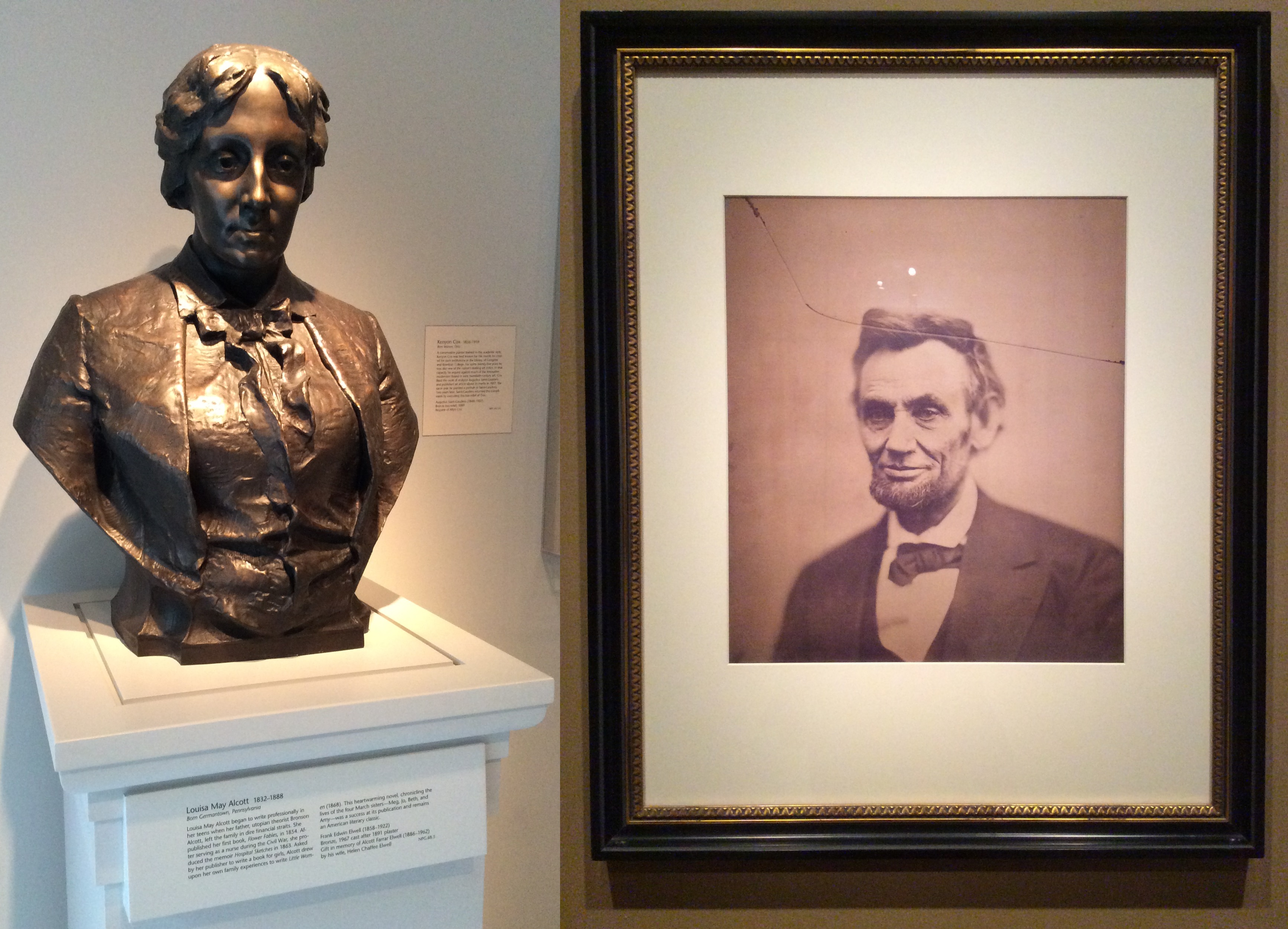
After I’ve made my inquiries at the information desk, one of the first portraits that grab my attention as I head towards my first destination is a bust of Louisa May Alcott. As you may remember from my Boston account, she was the only one willing to sit next to Douglass and his second wife Helen Pitts Douglass at Wendell Phillips’ funeral in 1884, just about a month after their marriage…. Read the original account here:

Ordinary Philosophy and its Traveling Philosophy / History of Ideas series is a labor of love and ad-free, supported by patrons and readers like you. Please offer your support today!

Frederick Douglass Washington DC Sites, Last Day

Portrait of Frederick Douglass by unknown artist, 1844, National Portrait Gallery in WashingtonD.C.,

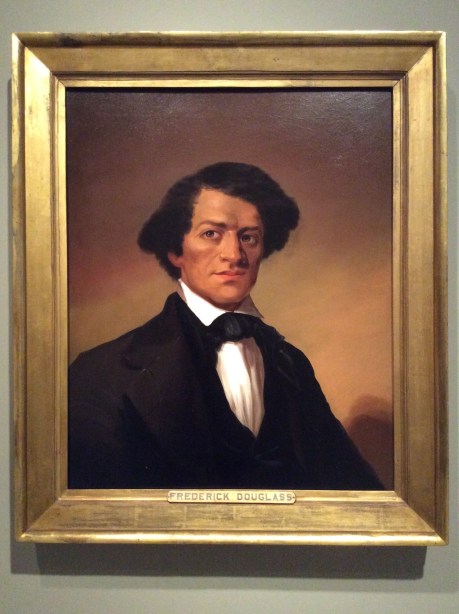
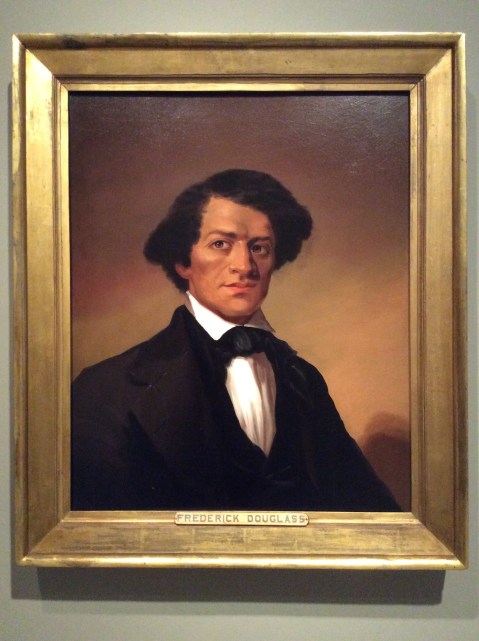
Portrait of Frederick Douglass by unknown artist, 1844, National Portrait Gallery in Washington, D.C.. The NPG placard describes it as a ‘powerful portrait’ but I’m not particularly impressed, especially since I don’t think it looks like Douglass at all.

Fourteenth Day, Saturday, April 2nd

After a morning glancing at the light rainfall through the coffee shop window as I write up some notes and look up some things in preparation for the day, I begin my day’s explorations with a visit to the National Portrait Gallery. It’s at 8th and F Streets NW, its official address: unusually, it lacks a street number.

While I’m here primarily to see all the Douglass portraits I can find and have little time to spare since it’s my last day in D.C., I’ve wanted to visit the Portrait Gallery for a long time, and allow myself an extra hour to explore.

After I’ve made my inquiries at the information desk, one of the first portraits that grab my attention as I head towards my first destination is a bust of Louisa May Alcott. As you may remember from my Boston account, she was the only one willing to sit next to Douglass and his second wife Helen Pitts Douglass at Wendell Phillips’ funeral in 1884, just about a month after their marriage. You see, Helen was white, and even for that gathering of committed abolitionists, this interracial marriage was going more than a bit farther than their still rudimentary sense of human equality would allow.

The bust is an excellent likeness of Alcott, unlike the portrait of Douglass I’m seeking. It was painted in 1844 by an unknown artist. When I find it, unfortunately, I’m not impressed: it’s a nice enough painting if it portrayed just any man, but the figure I see here looks nothing like Douglass. Douglass was the son of a black mother and a white father, and his features reflected his mixed ancestry. But African ancestry is not nearly as discernible in the face in this portrait as it was in Douglass’: it just looks a little more tan, and with curlier hair, than the average white guy. Perhaps the portrait painter was not very used to, or comfortable with, portraying people other than those of European descent. Or, perhaps he wanted to emphasize Douglass’ European ancestry for other reasons. I’m very glad Douglass was an ardent fan of photography and commissioned so many portraits of himself in that medium. The camera presents an unbiased view so long as the light is good.
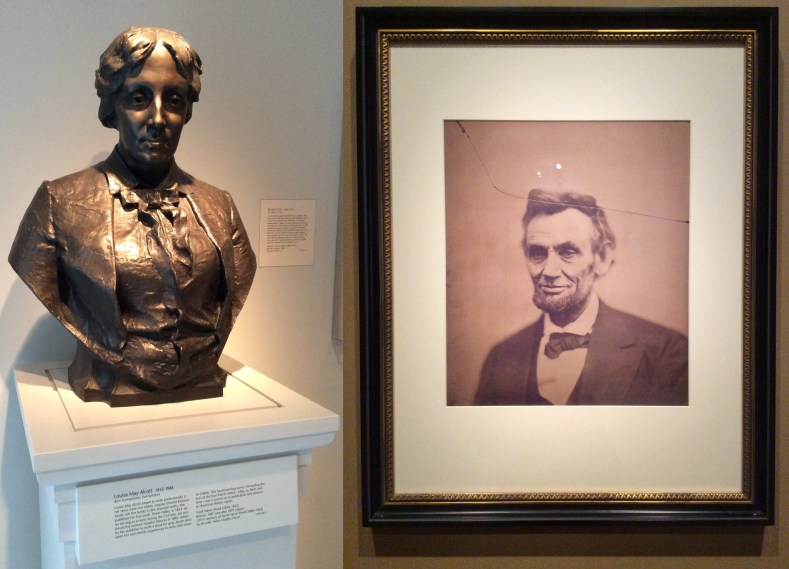
Left, bust of Louisa May Alcott. RAbraham Lincoln a month before his second inauguration, portrait by Alexander Gardner, February 5, 1865. National Portrait Gallery, Washington D.C.
Left, bust of Louisa May Alcott, sculpted by Frank Edwin Elwell, 1891. Right, Abraham Lincoln a month before his second inauguration, portrait by Alexander Gardner, February 5, 1865. National Portrait Gallery, Washington D.C.

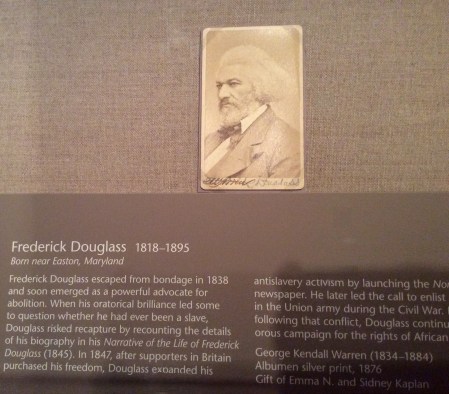
Frederick Douglass photograph, National Portrait Gallery, Washington DC, 2016 by Amy CoolsI find a couple more portraits of Douglass, one an original photograph from 1876, and the other an 1845 lithograph of the sheet music cover reproduced in the Lynn Historical Society and Museum, which I featured at the beginning of my Lynn account. I go on to see many more portraits I’m excited about, but I won’t include them here for time’s sake since they’re not really relevant to Douglass’ story, except for the photographic portrait of Abraham Lincoln I find in the presidential portrait gallery. It was taken just a little more than two months before he was assassinated. Though photos of Douglass’ sometimes friend Lincoln often show him looking careworn and even rather disheveled during the course of the war, here, his hair is in place even if characteristically casually swept back and to the side, and his half-smile in the softly glowing light makes him look relaxed, even a bit day-dreamy.

Then I head to the Jefferson Building of the Library of Congress, just across First Street from the Capitol Building. For one thing, it’s my favorite place to be inside in Washington D.C., so even if I didn’t have some last-minute Douglass research to do, I would still swing by. As it turns out, however, it has an indirect yet significant relation to Douglass’ life. More specifically, to the last day of his life. As I mention in yesterday’s account, Douglass and his wife Helen were driven to the Congressional Library (better known today as the Library of Congress), where he was dropped off prior to attending the National Council of Women’s meeting, which started at ten a.m. and went until the afternoon. But the Library of Congress was not yet located in the grand Jefferson Building which was still under construction just across the street from the Capitol. It wouldn’t move in for two more years, in 1897. But Douglass would have seen the new Library it when it was well on its way to completion, and he would surely have appreciated its already obvious splendor.
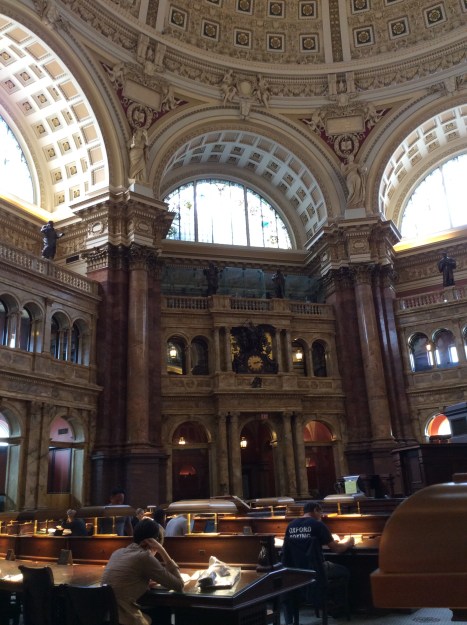
Reading Room in the Jefferson Building of the Library of Congress

The main reading room in the Jefferson Building of the Library of Congress. How I love to read in this beautiful place!

I do some research here in the beautiful main Reading Room for a couple of hours, especially in John Muller’s excellent book Frederick Douglass in Washington, D.C.: The Lion of Anacostia. I make some great last-minute discoveries, including a site I thought was at a different location. I look at the clock and realize that I’ll have to hustle for the rest of the day to get everywhere I plan to go before meeting my kind hosts back in Baltimore for dinner.

In heading to my nest destination, I pass the Capitol Building again. The Women’s Council meeting that Douglass headed to from the Congressional Library in the Capitol Building was at Menzarott Hall, just a fifteen or twenty minute’s walk away; I discussed that site and that meeting in yesterday’s account. And as discussed in my story of visiting Cedar Hill, Douglass was quite the walker (as I am), and he regularly walked to and from his hilltop home in Anacostia and his D.C. office for work, ten miles round trip. When I walked from the National Portrait Gallery to the Jefferson Building earlier today, and again as I head now to my next destination, I retrace some of yesterday’s route from the Freedman’s Bank Building to the Menzarott Hall site (now covered by the J. Edgar Hoover building) to the Capitol Building. In doing so, I also trace routes Douglass would have walked, including that of the day of his death.
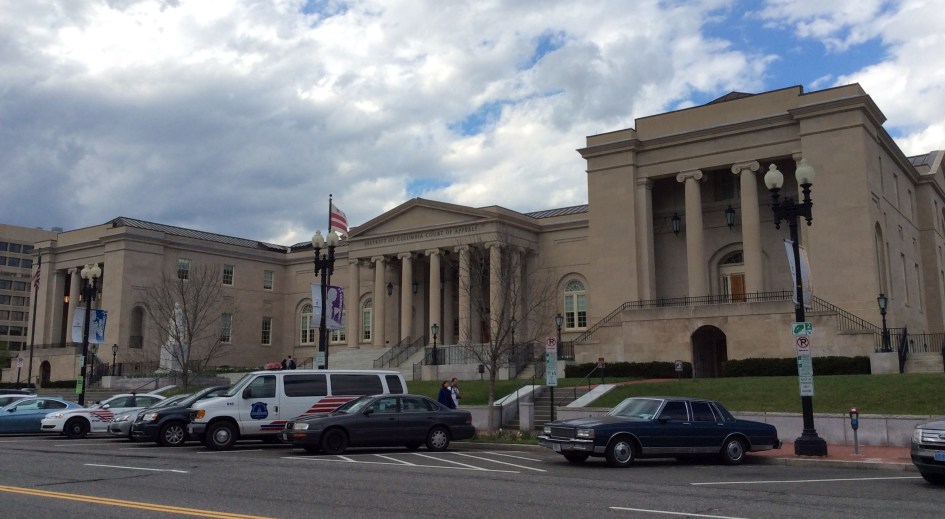
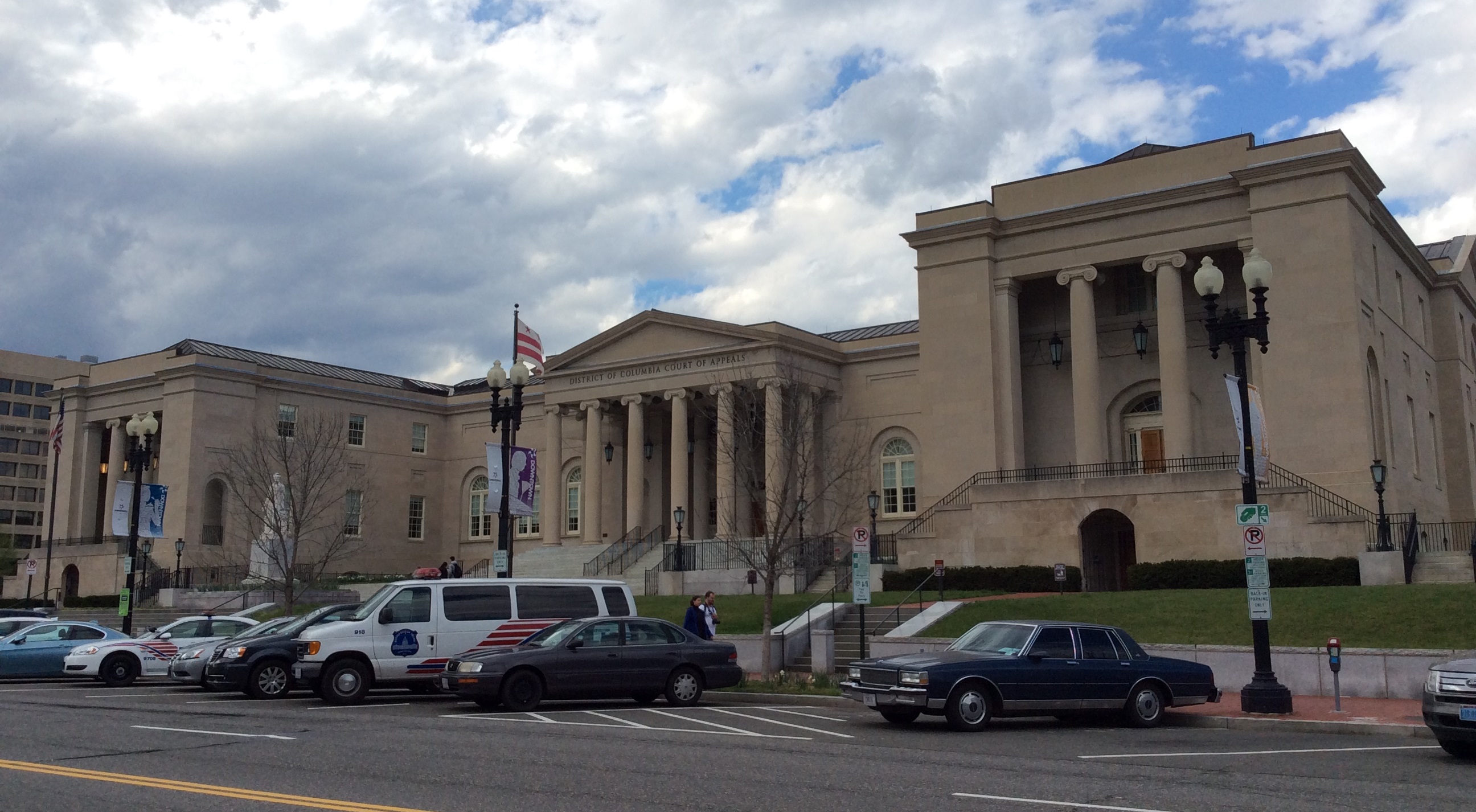
D.C. Court of Appeals, formerly City Hall, Washington, D.C.

D.C. Court of Appeals, formerly City Hall, Washington, D.C.

Lincoln's statue at DC Court of Appeals, formerly City Hall

Lincoln’s statue in front of D.C’s Court of Appeals, formerly City Hall

The grand edifice I find at 451 Indiana Avenue NW was once Old City Hall, where Douglass’ office used to be. It looks very much the same now as it did in Douglass’ time except now the grounds are landscaped and the street in front is paved. In 1877, Douglass was appointed U.S. Marshal of Washington, D.C. by President Rutherford B. Hayes, and he remained in that position until he resigned at the express wish of the newly elected President James Garfield in 1881. Garfield wanted to place a personal friend in that post, and as a sort of consolation prize, he arranged that Douglass be appointed Recorder of Deeds for Washington, D.C. in 1881. It seemed rather a poor prize since it was a much less prestigious post, but Douglass described the job itself as ‘more congenial to [his] feelings’ (Autobiographies 944) than the job as Marshal, where he had to deal with criminals and the courts. Douglass’ government appointments freed him from the necessity of going out on the lecture circuit for a living, and he used them to improve the lives of his fellow black citizens in other ways, such as helping them to obtain government jobs. Best of all, he was again free to speak and write as he wished, without the constraints placed on a federal officeholder, and he held this post for almost five years.
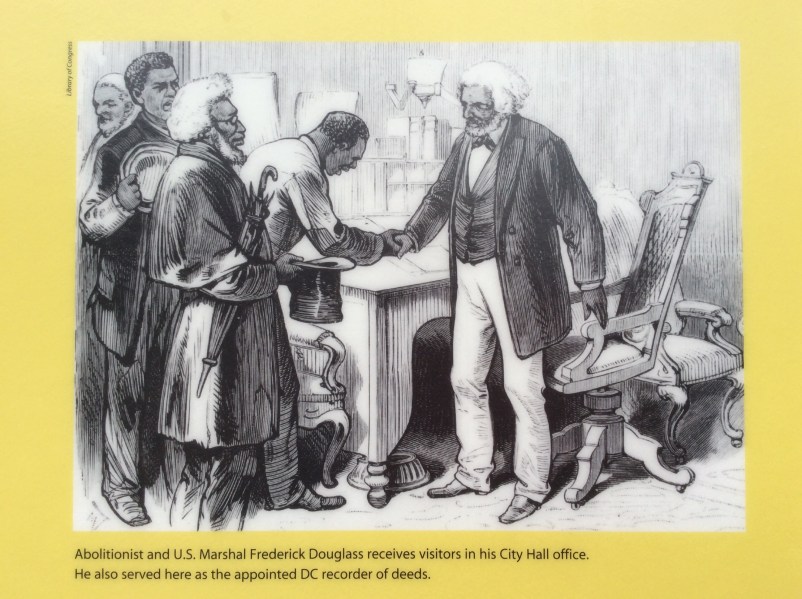
Frederick Douglass as US Recorder of Deeds, Library of Congress image, sign at D.C. Court of Appeals

Frederick Douglass as U.S. Recorder of Deeds, Library of Congress image on a sign across from the D.C. Court of Appeals building where City Hall and Douglass’ offices used to be

When Douglass was a young man, he used to say he wanted to become a senator, but over time, as he spent more time in Washington observing the grind of campaigning and favor-seeking required for running for political office, and the rampant backbiting and smear campaigns, he found he had no desire to go through all that. He himself was the victim of political backbiting, including rumors that he had grown enormously rich at public expense. (Which, by the way, was false.) Yet he always remained keenly interested in politics and called on his fellow black Americans to join him in involving themselves as deeply in the political process as they could. He stumped for many political candidates over his long career, from radical abolitionist Gerrit Smith to centrist Abraham Lincoln.

400 block of 11th St, former site of New National Era offices, Washington DC, 2016 Amy Cools

400 block of 11th St just north of Philadelphia Ave, the former site of the New National Era offices in Washington, D.C.

I’m finding that the time is simply flying by and I start to fear I’ll run out of it. So from now on, I’ll have to drive everywhere instead of walk, since what I have left to see is spread out and I have to travel a large area very quickly. I hate exploring a city by car: you have to pass by things too fast, you can’t stop, approach, and see details at will, and worst of all, you remove yourself from the crowd. I love people watching, catching bits of conversation, observing the ways they ornament and carry themselves, and stopping for a chat whenever the occasions arise.

Anyway, I head east to 11th St NW a little north of Pennsylvania Ave, the former site of The New National Era newspaper offices. They were then on the 400 block of 11th street on ‘Newspaper Row’, and the original address was 418 11th St, in the Star Annex building. Douglass was a corresponding editor when he helped launch The New Era in January of 1870, while his home was still in Rochester. The office used to be about where the sandy-gray building with the arched windows now stands (see the photograph above), or perhaps as far over as the 11th St. entrance to the 1111 Pennsylvania Ave parking garage, which is the large gated driveway with the large gray beam over its windows.

New National Era, Sept 8 1870, with Frederick Douglass as new main editor, image Library of Congress

New National Era, Sept 8 1870, the first edition after Douglass took over as chief editor

The venerable black abolitionist paper The New Era was only about a year old when it suffered an arson attack in 1848, and though the fire nearly destroyed the offices, the paper continued until 1860. The first edition of The New Era which Douglass helped found was published on January 13th, 1870, carrying on the mission of its predecessor: social justice journalism. It was spearheaded at the beginning by editor J. Sella Martin, a fellow escaped slave and abolitionist minister. Douglass’ enthusiasm as he helped launch the project was accompanied by as much trepidation; as he wrote in his Life and Times ‘…Sixteen years’ experience as editor and publisher of my own paper, and the knowledge of the toil and anxiety… caused me much reluctance and hesitation…’ (Autobiographies 836). Just a few months later, there was (likely) an arson attempt on their offices too. Douglass must have been sickened at how often he encountered arson as a tool for the oppression of himself and his people. But the offices remained intact and The New Era continued. When Douglass took over as primary editor in September of that first year, he renamed it The New National Era. He also put a lot of his own money into the venture, losing about nine to ten thousand dollars all told. His two sons Lewis and Charles worked on the paper and eventually took over its operation; they had begun their training in the newspaper trade as young boys working with their father at The North Star‘s press in Rochester. The New National Era continued until early 1974 when Douglass’ sons were forced to shut it down due to its continued financial woes.

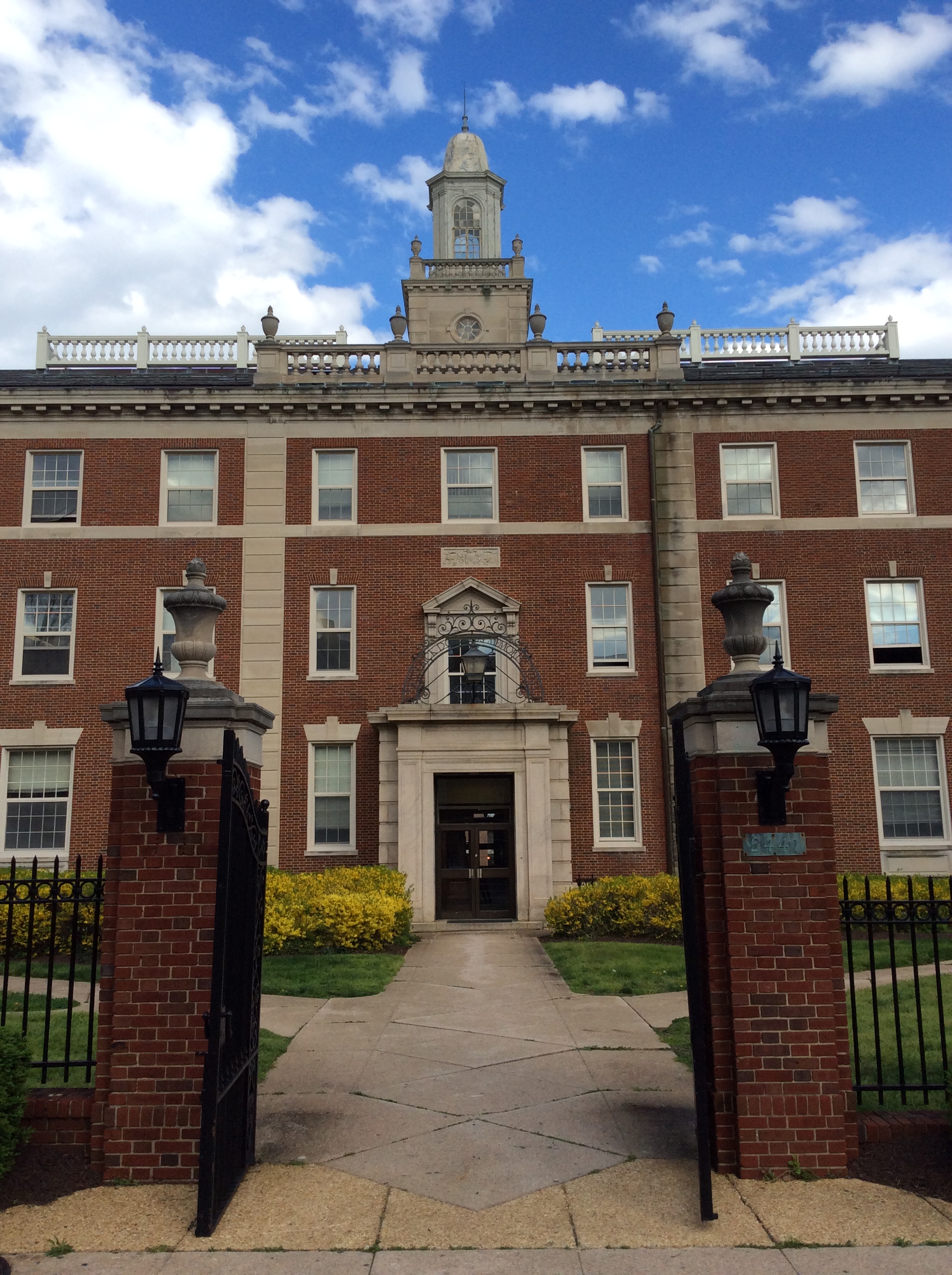
Frederick Douglass Hall at Howard U., gated entrance facing 6th St NW, Washington, DC

Frederick Douglass Memorial Hall at Howard University, gated entrance facing onto 6th St NW, Washington, D.C.

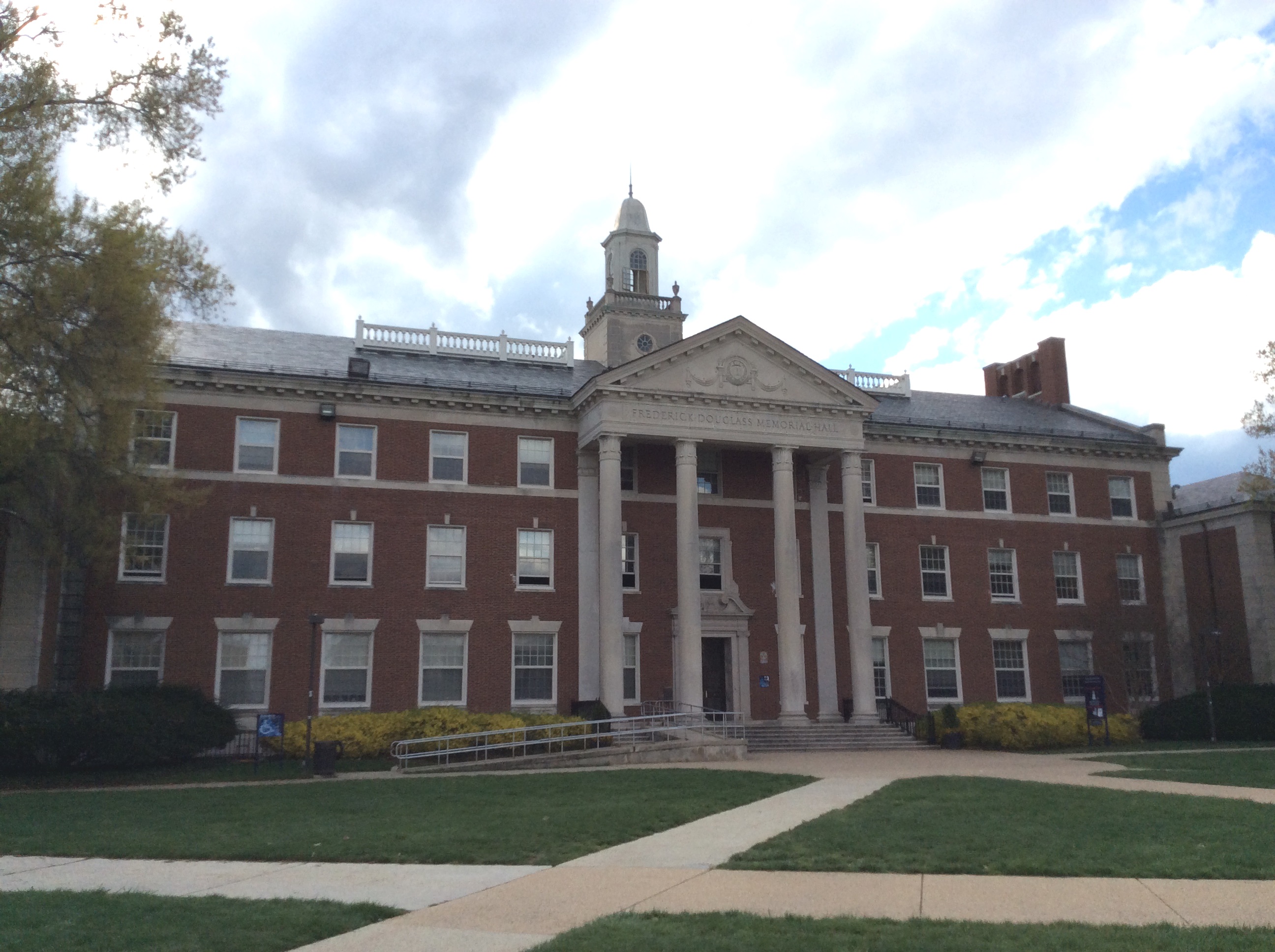
Next, I zigzag my way north about 2 1/2 miles to Howard University, at 2400 Sixth St NW. My destination is Douglass Hall, which faces onto Sixth St. It’s between Childers Hall (which adjoins the south end of Cramton Auditorium) and the Carnegie Building, between Howard Lane and Fairmont on the east side of the street. I find out before too long that, as a non-student there, I’m actually not supposed to be on the grounds without having received permission beforehand from the university. When I explain my project to the the security guard, he seems more assured that I’m not just wandering around nosily with no good purpose, but it’s still clear it’s time for me to go. Fortunately, I’ve already found the hall and taken my photos, and he gives no indication that I’m not allowed to take any or to share them. So if you’d like to visit, just remember to call up the university first, regardless of the fact that the D.C. travel guides I’ve seen don’t tell you this.

At its founding in 1867, the historically black university was off to a financially healthy start, with generous funding from the Freedman’s Bureau to augment other government funding, private donations, and tuition. Despite some rocky times here and there over the years, Howard remains an extremely successful endeavor. It’s now, as it’s always been, open to the admission of people of all races, but it still, just as in Douglass’ time, functions as a primarily black institution. Its founder, trustee, and President General Oliver Otis Howard was also the Commissioner of the Freedman’s Bureau. Howard was a Civil War hero, having lost an arm in the war, who believed strongly in civil rights for black people and was an ardent Christian. He and some other like-minded social reformers initially founded it as a school to train black ministers, but while it still offers degrees in divinity and religious studies, it very quickly and broadly expanded its educational mission. It now includes medicine, philosophy, biochemistry and genetics, fine arts, physics and astronomy, and social work among its diverse fields of study, and is a thriving research center as well. In sum, it’s an institution that Douglass must have heartily approved of.
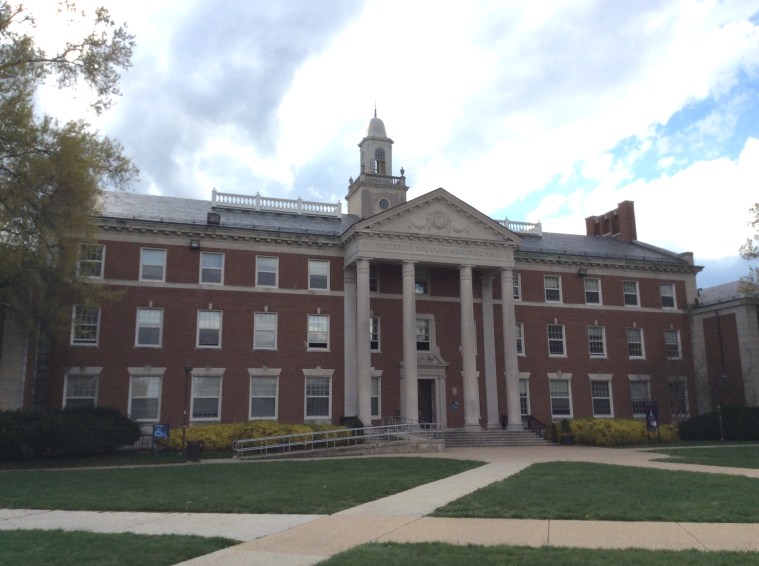
Frederick Douglass Memorial Hall, view facing onto square of Howard University, Washington D.C.

Frederick Douglass Memorial Hall’s east facade facing the Upper Quadrangle in the soft light of early evening

Yet…. Though Douglass was elected to the board of trustee on July 13th, 1871 and remained a member until his death, he didn’t mention his association with this important institution, so near his final home, in his last autobiography Life and Times. This seems somewhat strange. He was very active in the University’s affairs throughout his years as a member, from fundraising to personally donating to voting at board meetings to chairing commissions to writing about it in the newspaper and more, Douglass was so actively involved and admired by the university that he was granted an honorary doctorate. Why he chose not to mention Howard University in his Life and Times remains, it seems, rather inexplicable.
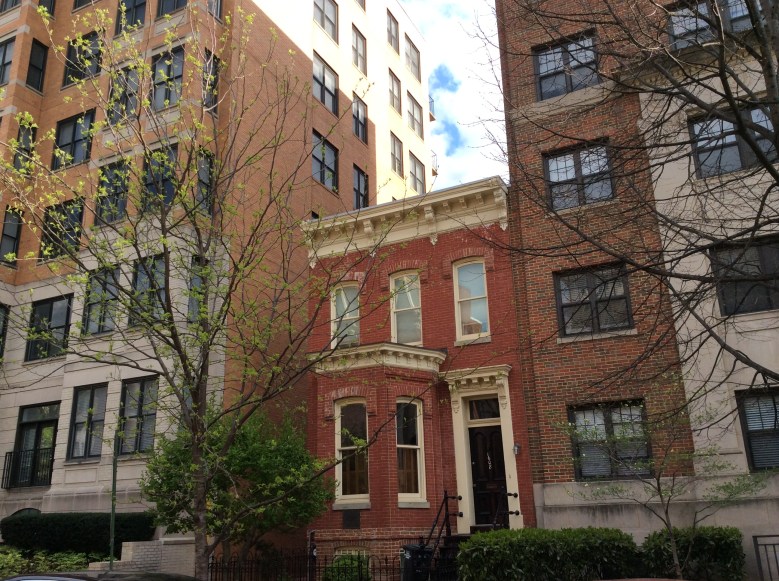
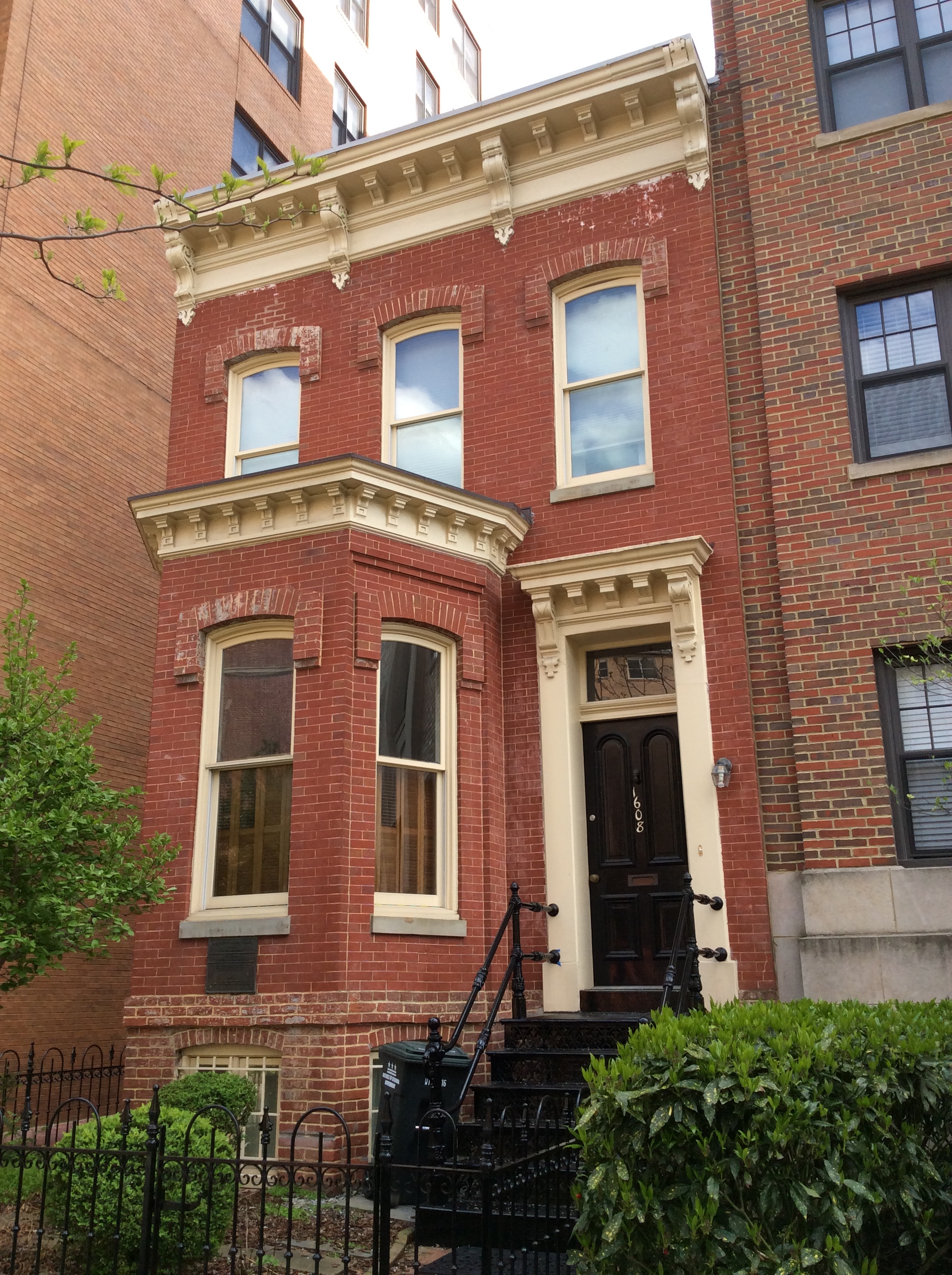
Charlotte Grimke House sandwiched between two apartment buildings, Washington DC

Charlotte Grimké House sandwiched between two apartment buildings, Washington DC

I head south on Georgia Ave then turn right (west) on R St, and arrive at my next destination just past 16th. 1608 R St NW was the home of Charlotte and Francis Grimké. Douglass and his second wife Helen Pitts were married here in the parlor on Jan. 24, 1884. A few days before the wedding, the Reverend Francis Grimké had stopped by Douglass’ office at City Hall because he happened to be passing by. Like Douglass, he and his wife Charlotte were of mixed African and European ancestry and were devoted, very active abolitionists. And Grimké, like Douglass, was an ordained minister, though Douglass had long since given up his role as a man of the cloth. Grimké was pastor of the large congregation of the Fifteenth Street Presbyterian Church. Yesterday, on my way from the Metropolitan A.M.E. Church to the Freedman’s Bank Building, I passed by the place it used to stand, on the east side of 15th off McPherson Square, between I and K Streets. As Grimké tells it, Douglass was especially glad to see him because he had made up his mind visit Grimké soon. Since he had decided to go ahead and marry the white woman he had fallen in love with, Douglass thought the progressive, mixed-race, widely respected Grimké would be the perfect officiant. Grimké would also prove up to the challenge of handling the inevitable public controversy to follow with equanimity.
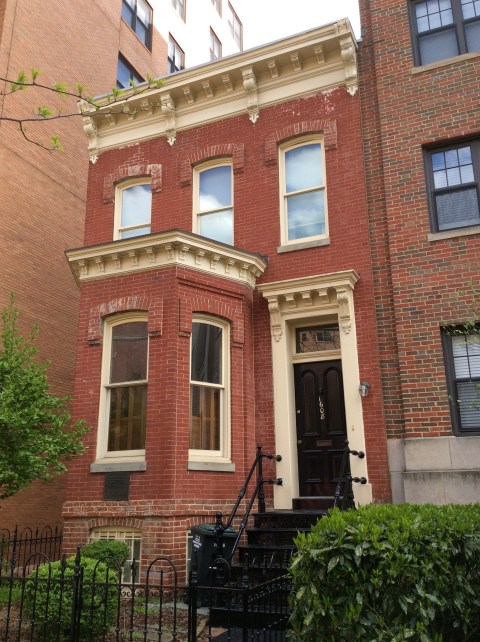
Charlotte Grimke House

Charlotte Grimké House

While Grimké learned of Douglass’ plans sort of at the last minute, his own family was not so lucky. Douglass, for reasons still poorly understood, never told his children of his plans to remarry, let alone to a white woman. In fact, they only found out when a reporter stopped by Douglass’ Recorder of Deeds office at City Hall to follow up on his discovery of Douglass’ purchase of a marriage license that morning. His daughter Rosetta, who also worked at the office, was surprised and upset, and the rest of the family no less so when she returned home to Cedar Hill and shared the news. So when Douglass left home again that evening at six to go and wed Helen, none of them accompanied him. The newlyweds returned home again that evening for a wedding supper, and I can only imagine the very awkward tension of that meal.

Douglass’ children never really accepted the marriage, thinking it a betrayal of their mother and her race. Rosetta, evidently, felt this especially. And though Douglass and Helen were very happy in their marriage, the dynamics of family life at Cedar Hill were not always harmonious. The children’s disapproval of Helen’s perceived ‘replacement’ of Anna only added to the troubles of the household. For example, Rosetta was married to a man of dubious integrity who had trouble keeping a job and didn’t always operate within the law. Her husband Nathan Sprague even tried to extort a large sum of money from Douglass because, he claimed, his sister Helen Louisa had supposedly worked for him as a servant. In reality, Douglass had supported his sister as well as Rosetta and their children when Sprague was in jail and otherwise unemployed. Douglass’ children were accomplished in their own right and had many fine qualities, but they also, from time to time, leaned on him for financial support and relied on him to help care for their families. Some of Douglass’ friends thought that they relied on him perhaps a bit too much, and often tried to convince him to require his adult offspring to be more self-reliant, but this father hen found himself unable to hold back when his children asked him for help. Speaking for myself, given the degree to which he took such great pains to secure their happiness, I wish that his children found it in themselves to support this last great romance of his life just a little more.
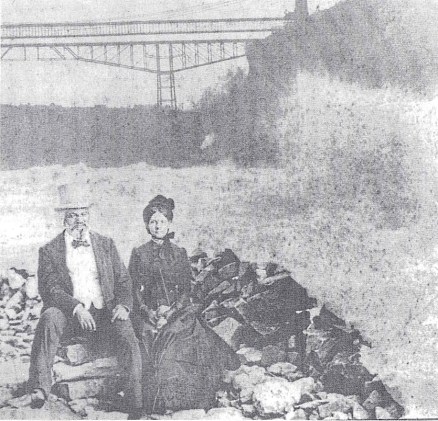
Frederick and Helen Pitts Douglass at Niagara Falls, image public domain via NPS

Frederick and Helen Pitts Douglass at Niagara Falls, image public domain via NPS

While Douglass’ children joined the wider world and much of Helen’s family in their disapproval of the marriage, his wife’s mother came to accept it, joined the Cedar Hill household in her later years, and spoke fondly of her son-in-law. His protégée and friend Ida Wells often came to visit them and was outspoken in her support; same goes for the Grimkés. While many abolitionists, black and white, characterized Douglass’ choice of a white wife as Rosetta did, as a replacement or rejection of his first wife’s blackness and lack of formal education, for Douglass it was no such thing. Though he and Anna found themselves at a distance at times because she could not share in so many of his intellectual interests, they were deeply connected in other ways: their shared past as black people struggling to survive in a slave state, her instrumental role in helping him attain his freedom, their struggles together as a young black family on the run from his master while trying to make a living in a racist society, and of course, raising their many children together. With Helen, Douglass was able to share those parts of his intellectual side that he hadn’t been able to share with Anna in the context of a romantic partnership, and Helen was willing and able to travel the world with him as well. His relationship with Helen was a rounding-out of his romantic life, not a replacement of his earlier one, in my view.
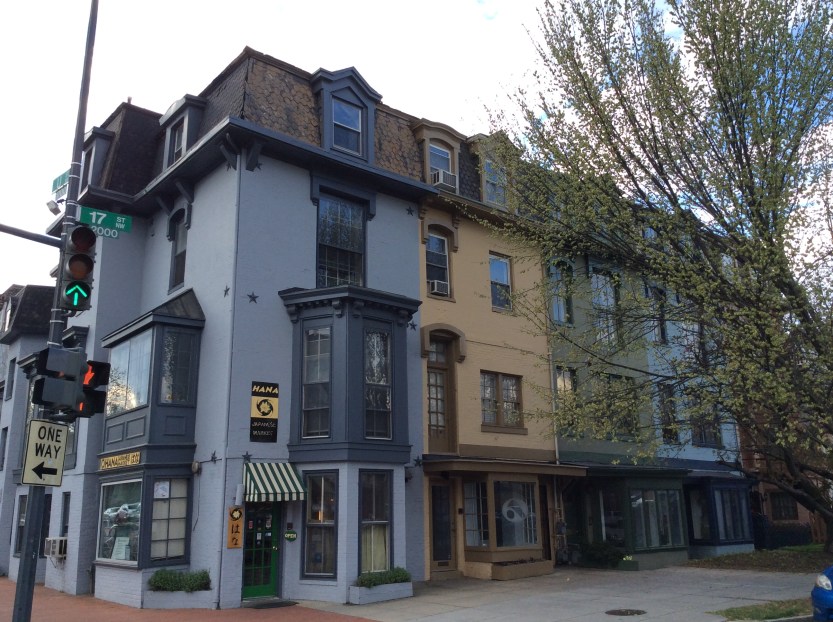
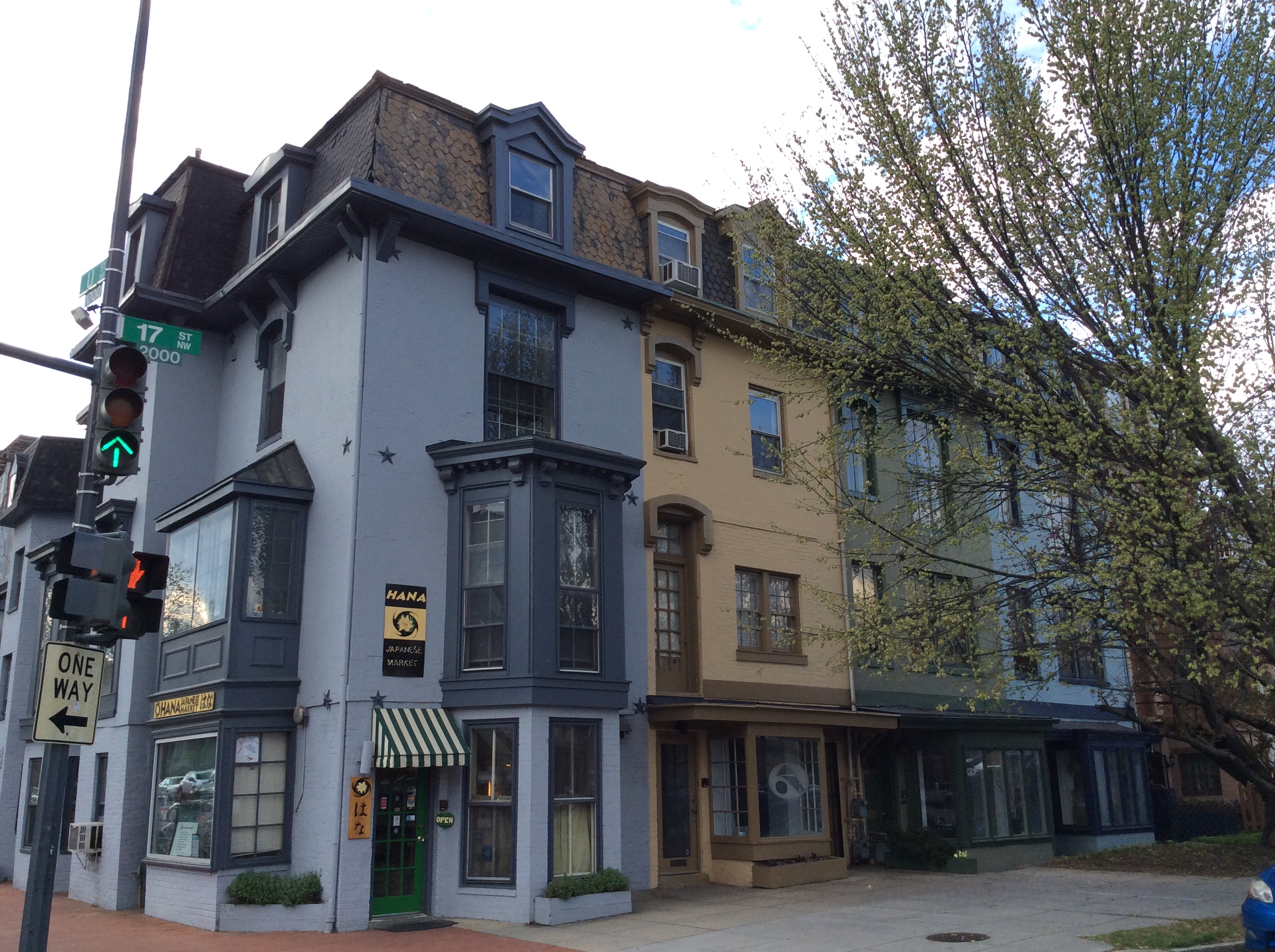
Frederick Douglass' row houses at 2000–2008 17th Street, Washington

Frederick Douglass’ row houses at 2000–2004 17th Street, Washington, D.C.. He built the three to the left, from the blue one at the end to the left, now Hana Japanese Market, to the green one in the middle.
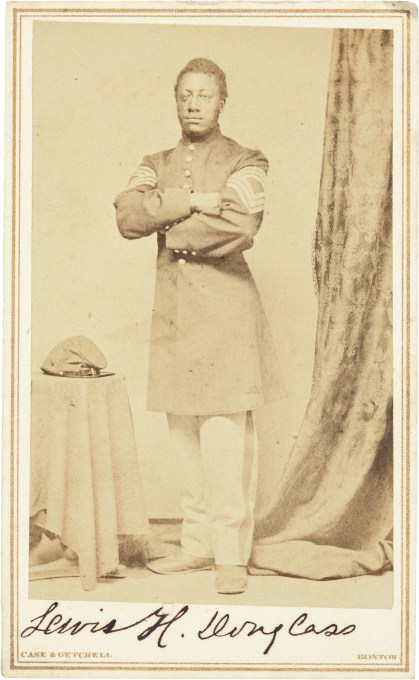
Sergeant Major Lewis Douglass, public domain courtesy of the National Gallery of Art website

Sergeant Major Lewis Douglass, public domain courtesy of the National Gallery of Art website

From here, I hurry to the last Douglass site of the trip, just a few blocks north of the Grimké house, on my way back to Baltimore. In 1875-1876, Douglass built three row houses at 2000–2004 17th Street NW, just north of U St. They’re the three southernmost houses in a five-house row. I don’t find any evidence that Douglass himself ever lived here since he and his family were living in the A Street house at that time. He did like to invest in real estate and his children would often live at the investment properties; these row houses present an example of this. Hana Japanese Market now occupies that was then number 2000 17th St; it’s now numbered 2004. His son Lewis lived in the one next to it, the yellow one, starting in 1877. This neighborhood was called Strivers’ Section for the successful African Americans who made their homes here. After all, for a black person to do well in D.C. and really anywhere in America, it took one hell of a lot of striving.

As you may remember from my earlier accounts, Lewis was a Civil War hero whose 54th regiment attacked Fort Wagner, the father of Joseph Douglass the great violinist, and direct ancestor of my honored podcast guest Ken Morris. He was an accomplished man in his own right, who had an honorable if short military career abbreviated by injury and ill health. He worked as a teacher and as a newspaperman who fought for black typesetters’ rights, worked closely with his father on The New National Era, and held many government posts. Lewis lived here at (then) 2002 17th St until he died in 1908.

This particular Douglass journey is now complete. But I’ll continue to follow his life and ideas throughout mine, whenever the opportunity presents itself. Douglass’ story is embedded deeply in my mind and heart as I’ve spent so many hours with him, peering through time and space in an effort to better understand and appreciate this fascinating, intelligent, and feeling man, with all his strengths, weaknesses, and quirks. I have lots of drafts and notes for more pieces about Douglass’ ideas on many topics, so I hope you’ll keep on the lookout for more about Douglass here at Ordinary Philosophy.

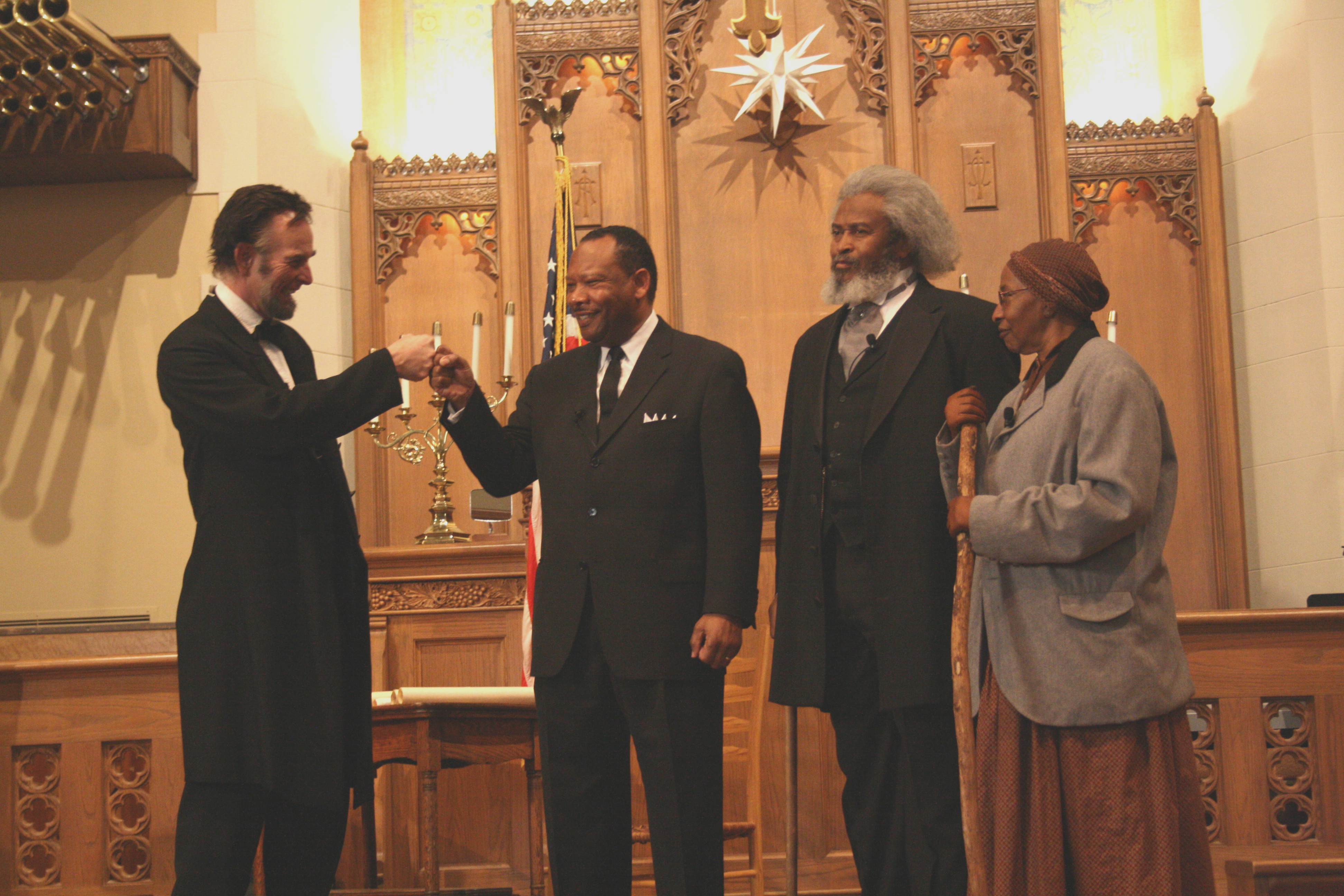
It seems that I should close the story of my journey following Frederick Douglass with an epic quote from the great man; there’s such a wealth to choose from! But I came across this visual treat that delighted me so much I’ve decided to close this account with it: a photo of Abraham Lincoln fist-bumping Martin Luther King Jr, as Douglass stands by, tall and dignified as ever amidst these shenanigans, next to Harriet Tubman. Well, actors portraying them, anyway. I wonder what the dignified Douglass would think of fist-bumping. Probably not much; it’s a little too casual a greeting for him, I think. But who knows? The fact that it was our first black President who made it a presidentially acceptable thing to do might have changed his mind.

Enjoy!

*Listen to the podcast version here or on Google Play, or subscribe on iTunes

Frederick Douglass and friends portrayed by actors for Emancipation and the Dream of Freedom From Slavery to the White House 2009 by Michael A. Roth, National Park Service

Frederick Douglass Michael Crutcher), Abraham Lincoln (Fritz Klein), Martin Luther King Jr (Jim Lucas), and Harriet Tubman (Kathryn Harris) as portrayed in ‘Emancipation and the Dream of Freedom: From Slavery to the White House’, Lincoln Home bicentennial celebration event, 2009 by Michael A. Roth for the National Park Service. Photo used by permission.

Ordinary Philosophy and its Traveling Philosophy / History of Ideas series is a labor of love and ad-free, supported by patrons and readers like you. Please offer your support today!

~~~~~~~~~~~~~~~~~~~~~~~~~

Sources and Inspiration:

About New National Era. (Washington, D.C.) 1870-1874‘. Library of Congress: Chronicling America

Baist’s Real Estate Atlas of Surveys of Washington, District of Columbia: Volume 2, Plates 31, 14and 22. By Baist, George William, William Edward, and Harry Valentine Baist, 1909. Via Library of Congress website

Charlotte Forten Grimke (1837-1914)‘, from The National Women’s History Museum website

Death Of Fred Douglass: Obituary‘, February 21, 1895, The New York Times from On This Day, nytimes.com

Douglass, Frederick. Autobiographies (includes Narrative…, My Bondage and my Freedom, and Life and Times). With notes by Henry Louis Gates, Jr. Volume compilation by Literary Classics of the United States. New York: Penguin Books, 1994.

Douglass, Frederick. The Life and Times of Frederick Douglass. Re-published 1993, Avenal, New York: Gramercy Books, Library of Freedom series.

Douglass, Frederick. My Bondage and My Freedom: 1855 Edition with a new introduction. Re-published 1969, New York: Dover Publications, Inc.

Douglass, Helen, 1838-1903, ed. In Memoriam: Frederick Douglass. Philadelphia: J.C. Yorston & Co, 1897

Foner, Philip S. The Life and Writings of Frederick Douglass, Vol. 1-4. New York: International Publishers, 1950.

Jefferson’s Legacy: A Brief History of the Library of Congress‘, Library of Congress website http://www.loc.gov

Journey to Greatness: Character Lessons from the Past‘, from Lincoln Home National Historic Site, Illinois website page of the National Park Service.

Logan, Rayford W. Howard University: the First Hundred Years, 1867-1967. New York University Press, 1969

McFeely, William. Frederick Douglass. New York: W.W. Norton & Company, 1991.

Muller, John. ‘Arson attempt on the offices of Frederick Douglass’ The New Era? [Baltimore Sun, May 1871]’ , ‘Francis Grimke tells story of “The Second Marriage of Frederick Douglass” [The Journal of Negro History, 1934]’, ‘Frederick Douglass, editor of The New National Era, explains newspaper’s name change [September 8, 1870]‘, and Howard Univeristy. Views of Fred. Douglass Upon the Proposed Changes in its Management [National Republican., June 24, 1875, p. 4.], In Frederick Douglass in Washington, D.C.: The Lion of Anacostia blog

Muller, John. Frederick Douglass in Washington, D.C.: The Lion of Anacostia. Charleston: The History Press, 2012.

Ott, Chris. ‘Grimké, Francis (1850–1937)‘ From BlackPast.org

Quarles, Benjamin. Frederick Douglass. Washington D.C.: The Associated Publishers, 1948.

Sergeant Major Lewis Douglass‘, National Gallery of Art website.

Strivers’ Section Historic District‘, from National Register of Historic Places hosted by the NPS

Turner, Cory. ‘Martin, John Sella (1832-1876)‘. BlackPast.org