How Schopenhauer’s Thought Can Illuminate a Midlife Crisis, by Kieran Setiya

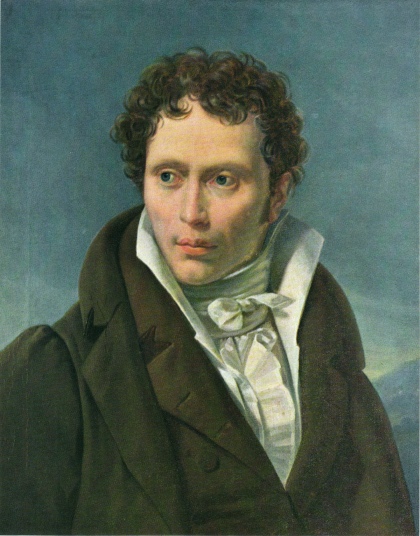
Arthur Schopenhauer, portrait by Ludwig Sigismund Ruhl 1815, public domain via Wikimedia Commons

Despite reflecting on the good life for more than 2,500 years, philosophers have not had much to say about middle age. For me, approaching 40 was a time of stereotypical crisis. Having jumped the hurdles of the academic career track, I knew I was lucky to be a tenured professor of philosophy. Yet stepping back from the busyness of life, the rush of things to do, I found myself wondering, what now? I felt a sense of repetition and futility, of projects completed just to be replaced by more. I would finish this article, teach this class, and then I would do it all again. It was not that everything seemed worthless. Even at my lowest ebb, I didn’t feel there was no point in what I was doing. Yet somehow the succession of activities, each one rational in itself, fell short.

I am not alone. Perhaps you have felt, too, an emptiness in the pursuit of worthy goals. This is one form of midlife crisis, at once familiar and philosophically puzzling. The paradox is that success can seem like failure. Like any paradox, it calls for philosophical treatment. What is the emptiness of the midlife crisis if not the unqualified emptiness in which one sees no value in anything? What was wrong with my life?

In search of an answer, I turned to the 19th-century pessimist Arthur Schopenhauer. Schopenhauer is notorious for preaching the futility of desire. That getting what you want could fail to make you happy would not have surprised him at all. On the other hand, not having it is just as bad. For Schopenhauer, you are damned if you do and damned if you don’t. If you get what you want, your pursuit is over. You are aimless, flooded with a ‘fearful emptiness and boredom’, as he put it in The World as Will and Representation (1818). Life needs direction: desires, projects, goals that are so far unachieved. And yet this, too, is fatal. Because wanting what you do not have is suffering. In staving off the void by finding things to do, you have condemned yourself to misery. Life ‘swings like a pendulum to and fro between pain and boredom, and these two are in fact its ultimate constituents’.

Schopenhauer’s picture of human life might seem unduly bleak. Often enough, midlife brings with it failure or success in cherished projects: you have the job you worked for many years to get, the partner you hoped to meet, the family you meant to start – or else you don’t. Either way, you look for new directions. But the answer to achieving your goals, or giving them up, feels obvious: you simply make new ones. Nor is the pursuit of what you want pure agony. Revamping your ambitions can be fun.

Still, I think there is something right in Schopenhauer’s dismal conception of our relationship with our ends, and that it can illuminate the darkness of midlife. Taking up new projects, after all, simply obscures the problem. When you aim at a future goal, satisfaction is deferred: success has yet to come. But the moment you succeed, your achievement is in the past. Meanwhile, your engagement with projects subverts itself. In pursuing a goal, you either fail or, in succeeding, end its power to guide your life. No doubt you can formulate other plans. The problem is not that you will run out of projects (the aimless state of Schopenhauer’s boredom), it’s that your way of engaging with the ones that matter most to you is by trying to complete them and thus expel them from your life. When you pursue a goal, you exhaust your interaction with something good, as if you were to make friends for the sake of saying goodbye.

Hence one common figure of the midlife crisis: the striving high-achiever, obsessed with getting things done, who is haunted by the hollowness of everyday life. When you are obsessed with projects, ceaselessly replacing old with new, satisfaction is always in the future. Or the past. It is mortgaged, then archived, but never possessed. In pursuing goals, you aim at outcomes that preclude the possibility of that pursuit, extinguishing the sparks of meaning in your life.

The question is what to do about this. For Schopenhauer, there is no way out: what I am calling a midlife crisis is simply the human condition. But Schopenhauer was wrong. In order to see his mistake, we need to draw distinctions among the activities we value: between ones that aim at completion, and ones that don’t.

Adapting terminology from linguistics, we can say that ‘telic’ activities – from ‘telos’, the Greek work for purpose – are ones that aim at terminal states of completion and exhaustion. You teach a class, get married, start a family, earn a raise. Not all activities are like this, however. Others are ‘atelic’: there is no point of termination at which they aim, or final state in which they have been achieved and there is no more to do. Think of listening to music, parenting, or spending time with friends. They are things you can stop doing, but you cannot finish or complete them. Their temporality is not that of a project with an ultimate goal, but of a limitless process.

If the crisis diagnosed by Schopenhauer turns on excessive investment in projects, then the solution is to invest more fully in the process, giving meaning to your life through activities that have no terminal point: since they cannot be completed, your engagement with them is not exhaustive. It will not subvert itself. Nor does it invite the sense of frustration that Schopenhauer scorns in unsatisfied desire – the sense of being at a distance from one’s goal, so that fulfilment is always in the future or the past.

We should not give up on our worthwhile goals. Their achievement matters. But we should meditate, too, on the value of the process. It is no accident that the young and the old are generally more satisfied with life than those in middle age. Young adults have not embarked on life-defining projects; the aged have such accomplishments behind them. That makes it more natural for them to live in the present: to find value in atelic activities that are not exhausted by engagement or deferred to the future, but realised here and now. It is hard to resist the tyranny of projects in midlife, to find a balance between the telic and atelic. But if we hope to overcome the midlife crisis, to escape the gloom of emptiness and self-defeat, that is what we have to do.Aeon counter – do not remove

This article was originally published at Aeon and has been republished under Creative Commons.

Kieran Setiya is a professor of philosophy at the Massachusetts Institute of Technology. His latest book is Midlife: A Philosophical Guide (2017). He lives in Brookline, Massachusetts. (Bio credit: Aeon)

~ Ordinary Philosophy is a labor of love and ad-free, supported by patrons and readers like you. Any support you can offer will be deeply appreciated!

*All views and opinions expressed by guest writers are their own and do not necessarily reflect those of Ordinary Philosophy’s editors and publishers
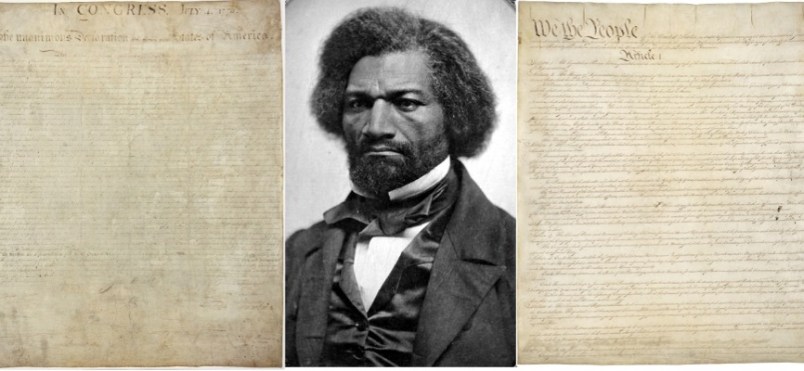
Say What? Frederick Douglass on Originalist Interpretations of the United States Constitution

‘The fact that Mr. [James] Madison can be cited on both sides of this question [of slavery] is another evidence of the folly and absurdity of making the secret intentions of the framers the criterion by which the Constitution is to be construed.’

~ Frederick Douglass, ‘The Constitution of the United States: is it Pro-Slavery or Anti-Slavery?’
Speech delivered in Glasgow, Scotland, March 26th, 1860

Ordinary Philosophy and its Traveling Philosophy / History of Ideas series is a labor of love and ad-free, supported by patrons and readers like you. Please offer your support today!

Some of the Mysteries of Good Character, by Christian B. Miller

The topic of character is one of the oldest in both Western and Eastern thought, and has enjoyed a renaissance in philosophy since at least the 1970s with the revival of virtue ethics. Yet, even today, character remains largely a mystery. We know very little about what most peoples’ character looks like. Important virtues are surprisingly neglected. There are almost no strategies advanced by philosophers today for improving character. We have a long way to go.

We do know, though, that matters of character are vitally important. Consider the news these days, dominated by people like Harvey Weinstein and Kevin Spacey. Or consider the behavior of our heroes, like Lincoln and King, or our villains, like Hitler and Stalin. Or consider the latest scandals in the entertainment world, professional sports, or politics. So much of what has happened can be traced back to the character of the people involved. And to take it one step further, thanks to the latest psychological research, character traits have been linked to all kinds of things that we care about in life: optimism, academic achievement, mood, health, meaning, life satisfaction…the list goes on and on.

To say that philosophers—who have been studying character extensively for thousands of years—are mostly in the dark about the topic, surely sounds like I am exaggerating, right? Maybe that’s true, but let me offer two concrete illustrations.

1. Neglected Virtues. The moral virtues are good character traits like justice, temperance, and fortitude. Here are two questions (among many others) you can ask about these virtues. First, conceptually, what do they involve? How, for instance, would you characterize a temperate person? Or a heroic one? Secondly, on empirical grounds, do people actually have the virtues (and if so, how many people and which virtues)? For instance, are there actually any temperate people today?

To help with the empirical question, there has been a recent flurry of interest among philosophers in consulting studies in psychology, and thinking about whether the behavior displayed in those studies is virtuous or not. For a virtue like compassion, real progress has been made in reading the relevant studies carefully, with the conclusion being that most people are not in fact compassionate. Unfortunately, philosophers don’t have much of an idea about what is going on empirically with most of the other virtues (and I’m not sure anyone else does either, for that matter). Part of the reason why is that for some moral virtues there just isn’t the wealth of existing studies to analyze, in the way that there is for compassion. Stealing is a good example—as you might imagine, it is hard to do helpful experimental studies of theft.

But part of the reason is also that some virtues have simply not been on our philosophical radar screens. The attention of philosophers has been elsewhere.

Take the virtue of honesty, for instance. If any virtue is on most people’s top five list, it is that one. Yet it has had no traction at all in the philosophy literature. In fact, there has not been a single paper in a mainstream philosophy journal on the moral virtue of honesty in over fifty years.

Or take the virtue of generosity—just three papers in the past forty years (by way of comparison, there are over two dozen papers on the virtue of modesty—who would have expected that to happen!).

So the upshot is that compassion is likely to be a rare virtue. But at this point it is not at all clear how we are doing with the rest of them. Indeed, in some cases we are not even clear what the virtues look like in the first place.

2. Virtue Development. The natural suspicion, of course, is that across the board we are not doing very well when it comes to being people of good moral character. History, current events, the local news, and social media all seem to confirm this. Hence it seems apparent that there is a sizable character gap:

There are moral exemplars, people like Abraham Lincoln and Sojourner Truth, whose character is morally virtuous in many respects.

Examining their lives ends up reflecting badly on most of us, myself included, since it illustrates in vivid terms just how much of a character gap there really is.

To try to at least reduce this gap, it would be helpful to have some strategies which can, if followed properly, help us to make slow and gradual progress in the right direction. Naturally philosophers needn’t be the only ones who can come up with these strategies, but it would be nice if we had something to say that is practically relevant, empirically informed, and actually efficacious if carried out properly.

By and large, we haven’t had much to say. But there are signs that this is beginning to change, thanks to the work of Nancy Snow, Julia Annas, Jonathan Webber, and a few others. In fact, the development of character improvement strategies strikes me as one of the most promising areas of philosophy in the coming decade. Many good and innovative dissertations are there for interested graduate students to tackle.

My hope is that this groundswell of interest in how to cultivate the virtues will continue to expand in the coming years. These are indeed early days in the philosophical study of character. And exciting days too, full of so many worthwhile possibilities to explore.

This article was originally published at OUPBlog.

Christian B. Miller is the A. C. Reid Professor of Philosophy at Wake Forest University and author or editor of eight books including The Character Gap: How Good Are We? (Bio credit: OUPBlog)

~ Ordinary Philosophy and its Traveling Philosophy / History of Ideas series is a labor of love and ad-free, supported by patrons and readers like you. Please offer your support today!

*All views and opinions expressed by guest writers are their own and do not necessarily express those of Ordinary Philosophy’s editors and publishers

If Work Dominated Your Every Moment Would Life be Worth Living? by Andrew Taggart

Working Woman, public domain via Wikimedia Commons

Imagine that work had taken over the world. It would be the centre around which the rest of life turned. Then all else would come to be subservient to work. Then slowly, almost imperceptibly, anything else – the games once played, the songs hitherto sung, the loves fulfilled, the festivals celebrated – would come to resemble, and ultimately become, work. And then there would come a time, itself largely unobserved, when the many worlds that had once existed before work took over the world would vanish completely from the cultural record, having fallen into oblivion.

And how, in this world of total work, would people think and sound and act? Everywhere they looked, they would see the pre-employed, employed, post-employed, underemployed and unemployed, and there would be no one uncounted in this census. Everywhere they would laud and love work, wishing each other the very best for a productive day, opening their eyes to tasks and closing them only to sleep. Everywhere an ethos of hard work would be championed as the means by which success is to be achieved, laziness being deemed the gravest sin. Everywhere among content-providers, knowledge-brokers, collaboration architects and heads of new divisions would be heard ceaseless chatter about workflows and deltas, about plans and benchmarks, about scaling up, monetisation and growth.

In this world, eating, excreting, resting, having sex, exercising, meditating and commuting – closely monitored and ever-optimised – would all be conducive to good health, which would, in turn, be put in the service of being more and more productive. No one would drink too much, some would microdose on psychedelics to enhance their work performance, and everyone would live indefinitely long. Off in corners, rumours would occasionally circulate about death or suicide from overwork, but such faintly sweet susurrus would rightly be regarded as no more than local manifestations of the spirit of total work, for some even as a praiseworthy way of taking work to its logical limit in ultimate sacrifice. In all corners of the world, therefore, people would act in order to complete total work’s deepest longing: to see itself fully manifest.

This world, it turns out, is not a work of science fiction; it is unmistakably close to our own.

‘Total work’, a term coined by the German philosopher Josef Pieper just after the Second World War in his book Leisure: The Basis of Culture (1948), is the process by which human beings are transformed into workers and nothing else. By this means, work will ultimately become total, I argue, when it is the centre around which all of human life turns; when everything else is put in its service; when leisure, festivity and play come to resemble and then become work; when there remains no further dimension to life beyond work; when humans fully believe that we were born only to work; and when other ways of life, existing before total work won out, disappear completely from cultural memory.

We are on the verge of total work’s realisation. Each day I speak with people for whom work has come to control their lives, making their world into a task, their thoughts an unspoken burden.

For unlike someone devoted to the life of contemplation, a total worker takes herself to be primordially an agent standing before the world, which is construed as an endless set of tasks extending into the indeterminate future. Following this taskification of the world, she sees time as a scarce resource to be used prudently, is always concerned with what is to be done, and is often anxious both about whether this is the right thing to do now and about there always being more to do. Crucially, the attitude of the total worker is not grasped best in cases of overwork, but rather in the everyday way in which he is single-mindedly focused on tasks to be completed, with productivity, effectiveness and efficiency to be enhanced. How? Through the modes of effective planning, skilful prioritising and timely delegation. The total worker, in brief, is a figure of ceaseless, tensed, busied activity: a figure, whose main affliction is a deep existential restlessness fixated on producing the useful.

What is so disturbing about total work is not just that it causes needless human suffering but also that it eradicates the forms of playful contemplation concerned with our asking, pondering and answering the most basic questions of existence. To see how it causes needless human suffering, consider the illuminating phenomenology of total work as it shows up in the daily awareness of two imaginary conversation partners. There is, to begin with, constant tension, an overarching sense of pressure associated with the thought that there’s something that needs to be done, always something I’m supposed to be doing right now. As the second conversation partner puts it, there is concomitantly the looming question: Is this the best use of my time? Time, an enemy, a scarcity, reveals the agent’s limited powers of action, the pain of harrying, unanswerable opportunity costs.

Together, thoughts of the not yet but supposed to be done, the should have been done already, the could be something more productive I should be doing, and the ever-awaiting next thing to do conspire as enemies to harass the agent who is, by default, always behind in the incomplete now. Secondly, one feels guilt whenever he is not as productive as possible. Guilt, in this case, is an expression of a failure to keep up or keep on top of things, with tasks overflowing because of presumed neglect or relative idleness. Finally, the constant, haranguing impulse to get things done implies that it’s empirically impossible, from within this mode of being, to experience things completely. ‘My being,’ the first man concludes, ‘is an onus,’ which is to say an endless cycle of unsatisfactoriness.

The burden character of total work, then, is defined by ceaseless, restless, agitated activity, anxiety about the future, a sense of life being overwhelming, nagging thoughts about missed opportunities, and guilt connected to the possibility of laziness. Hence, the taskification of the world is correlated with the burden character of total work. In short, total work necessarily causes dukkha, a Buddhist term referring to the unsatisfactory nature of a life filled with suffering.

In addition to causing dukkha, total work bars access to higher levels of reality. For what is lost in the world of total work is art’s revelation of the beautiful, religion’s glimpse of eternity, love’s unalloyed joy, and philosophy’s sense of wonderment. All of these require silence, stillness, a wholehearted willingness to simply apprehend. If meaning, understood as the ludic interaction of finitude and infinity, is precisely what transcends, here and now, the ken of our preoccupations and mundane tasks, enabling us to have a direct experience with what is greater than ourselves, then what is lost in a world of total work is the very possibility of our experiencing meaning. What is lost is seeking why we’re here.Aeon counter – do not remove

This article was originally published at Aeon and has been republished under Creative Commons.

Andrew Taggart is a practical philosopher and entrepreneur. He is a faculty member at the Banff Centre in Canada, where he trains creative leaders, and at Kaospilot in Denmark, where he trains social entrepreneurs. His latest book is The Good Life and Sustaining Life (2014). He lives in Santa Fe, New Mexico. (Bio credit: Aeon)

~ Ordinary Philosophy and its Traveling Philosophy / History of Ideas series is a labor of love and ad-free, supported by patrons and readers like you. Please offer your support today!

*All views and opinions expressed by guest writers are their own and do not necessarily express those of Ordinary Philosophy’s editors and publishers

Which is More Fundamental: Processes or Things? by Celso Vieira

Glass Half Full or Half Empty by Sealle, public domain via Wikimedia Commons

Metaphysics is the attempt to understand how existence works by examining the building blocks of reality, the distinctions between mental and physical entities, and the fundamental questions of being and reality. But metaphysics is not only an arcane branch of philosophy: human beings use metaphysical assumptions to navigate the world. Assumptions about what exists and what is fundamental exert a powerful influence on our lives. Indeed, the less aware we are of our metaphysical assumptions, the more we are subject to them.

Western metaphysics tends to rely on the paradigm of substances. We often see the world as a world of things, composed of atomic molecules, natural kinds, galaxies. Objects are the paradigmatic mode of existence, the basic building blocks of the Universe. What exists exists as an object. That is to say, things are of a certain kind, they have some specific qualities and well-defined spatial and temporal limits. For instance: Fido is my dog, he is grey, and was born one year ago. (It’s worth noting that such a simple statement will give rise to a litany of metaphysical disputes within substance metaphysics: realists believe that universals, such as the natural kind ‘dogs’, exist while nominalists believe them to be only intellectual abstractions.)

Though substance metaphysics seems to undergird Western ‘common sense’, I think it is wrong. To see this, consider the cliché about the glass of water: is it half-empty or half-full? The question assumes a static arrangement of things serving as a basis for either an optimistic or a pessimistic interpretation. One can engage in interminable disputes about the correct description of the physical set-up, or about the legitimacy of the psychological evaluations. But what if the isolated frame ‘a glass of water’ fails to give the relevant information? Anyone would prefer an emptier glass that is getting full to a fuller one getting empty. Any analysis lacking information about change misses the point, which is just what substance metaphysics is missing. Process philosophers, meanwhile, think we should go beyond looking at the world as a set of static unrelated items, and instead examine the processes that make up the world. Processes, not objects, are fundamental.

The pre-Socratic Greek philosopher Heraclitus provides the most famous image of process metaphysics. ‘It is not possible,’ he says, ‘to step twice into the same river’ – because existence depends on change; the river you step into a second time is changed from the river you stepped into originally (and you have changed in the interval, too). And while substance philosophers will tend to search for the smallest constituent objects in order to locate reality’s most fundamental building blocks, process philosophers think this is insufficient. So do modern physicists. Electrons are now understood as bundles of energy in a field, and quantum vacuum fluctuations prove that there are fields without bundles but no bundles without fields. Things seem to be reducible to processes – and not the reverse. (As the philosopher Alfred North Whitehead put it, we should think about ‘occurrences’ instead of ‘things’.)

Change poses a recurring problem for substance metaphysics. Universals have traditionally been a popular way to circumvent it. These static entities are difficult to define precisely, but can be thought of as ‘hyper-things’ that are instantiated in many different particular things. A universal is the thing that particulars have in common, such as types, kinds and relations. Universals are essentially different from particulars: Aristotle, for instance, argued that particulars – such as Fido my dog – are subject to generation and corruption, while species – the universal – are eternal. This particular example provides another instance in which science seems to favour process metaphysics. Thanks to the theory of evolution, the Aristotelian view that species are unchanging and eternal was proven wrong. Species evolve. They change. Dogs, after all, evolved from wolves to constitute a whole different kind. Once again, we’re better off using the paradigm of change rather than substance.

Process metaphysics leads to a re-evaluation of other important philosophical notions. Consider identity. To explain why things change without losing their identity, substance philosophers need to posit some underlying core – an essence –that remains the same throughout change. It is not easy to pin down what this core might be, as the paradox of Theseus’ ship illustrates. A ship goes on a long voyage and requires significant repairs: new planks to replace the old, fresh oars to replace the decayed, and so on, until, by the time the ship returns to port, there is not one single piece that belonged to the ship when it departed. Is this the same ship, even though materially it is completely different? For substance philosophers, this is something of a paradox; for process philosophers, this is a necessary part of identity. Of course it is the same ship. Identity ceases to be a static equivalence of a thing with itself. After all, without the repairs, the ship would have lost its functionality. Instead, as the German philosopher Nicholas Rescher argues in Ideas in Process (2009), identity just is a programmatic development. That is, the identity of a process is the structural identity of its programme. Other things being equal, every puppy will turn out to be a dog. (This programme need not be thought of as deterministic. The interactions between processes, Rescher argues, open room for variations.)

Processes are not the mere intervals between two different states of affairs or two objects, as the paradox of the heap exemplifies: take a heap of sand and remove one grain. It remains a heap; one grain doesn’t make a difference. But if you repeat the subtraction enough times, eventually there will be just one grain. Clearly, this isn’t a heap. Where did it become a non-heap? By looking at the process, and not the end-states of affairs, you’ll realise the impossibility of pinpointing the boundary between heap and non-heap. (Similarly, no individual was the exact turning point between wolves and dogs.) At the very least, this gives us a warning about the unnoticed abstraction operating on our division of natural kinds. Process philosophers such as Henri Bergson stop at this negative conclusion, believing that processes cannot be known but only experienced. Regardless, as the Danish philosopher Johanna Seibt notes, it might just be the case that focusing on the process requires a whole new perspective.

Looking at the world as a manifold of interconnected processes has scientific and philosophical advantages, but there are more prosaic benefits too. Process philosophy invites us to look at longer stretches of time, blurred boundaries and connected relations. Identity as a programmatic – but not deterministic – process welcomes innovation through small, recurring changes. Under these metaphysical assumptions, a meaningful life is less about finding your ‘real’ self than expanding its boundaries. Aeon counter – do not remove

This article was originally published at Aeon and has been republished under Creative Commons.

Celso Vieira has a PhD in philosophy from the Federal University of Minas Gerais in Brazil. He lives in Belo Horizonte where he started the first Brazilian chapter of the effective altruist group The Life You Can Save. (Bio credit: Aeon)

~ Ordinary Philosophy and its Traveling Philosophy / History of Ideas series is a labor of love and ad-free, supported by patrons and readers like you. Please offer your support today!

*All views and opinions expressed by guest writers are their own and do not necessarily express those of Ordinary Philosophy’s editors and publishers

Say What? Adorno on Thinking, Oppression, and Happiness

‘The happiness that dawns in the eye of the thinking person is the happiness of humanity. The universal tendency of oppression is opposed to thought as such. Thought is happiness, even where it defines unhappiness: by enunciating it. By this alone happiness reaches into the universal unhappiness. Whoever does not let it atrophy has not resigned.’

~ Theodor W. Adorno, Critical Models: Interventions and Catchwords

Ordinary Philosophy and its Traveling Philosophy / History of Ideas series is a labor of love and ad-free, supported by patrons and readers like you. Please offer your support today!


When I Help You, I Also Help Myself: On Being a Cosmopolitan, by Massimo Pigliucci

Kunyu Quantu, or Map of the World, 1674 by Ferdinand Verbiest. At the Hunterian Museum, University of Glasgow

One of the axioms of modern morality is that there is an inevitable tension between altruism and selfishness. The more you focus your attention, energy and resources toward your own benefit, the less ‘of course’ you can do for others. As a result, we all strive to find some balance between these two opposing demands, often ending up far short of our ideal, and feeling guilty about it. (Well, some of us feel guilty, at any rate.)

But what if this is in fact a false dichotomy? What if we adopted a different framework, according to which helping ourselves helps humanity at large, and conversely, helping others helps us as well? This is the basic idea behind cosmopolitanism, literally being a citizen of the world, which originated in Ancient Greece and was further developed in Rome. Turns out, ancient Greco-Roman philosophy still has a thing or two to teach us moderns.

The term ‘cosmopolitan’ was associated with the ancient Cynic philosophers, named after a word that didn’t have the modern connotation at all, but rather indicated a group of radicals devoted to challenging society’s norms by living simply, owning no property or housing. One of the schools of Hellenistic philosophy influenced by the Cynics was that of the much more mainstream Stoics (who lived in actual houses, and some – like the Roman Senator Seneca – were even rich). The Stoics developed the idea of cosmopolitanism into a general philosophy that guided their everyday thoughts and actions. As Epictetus, the slave-turned-philosopher of second-century Rome, put it in Discourses: ‘Do as Socrates did, never replying to the question of where he was from with: “I am Athenian,” or “I am from Corinth,” but always: “I am a citizen of the world.”’ This strikes me as something we ought to remember, internalise, and practise – especially in these times of fear-mongering, xenophobia, Brexit, Trumpism, and nationalistic tribalism.

The Stoic idea was simple and elegant: all humans inhabit the same big city, indeed we are so interconnected and interdependent that we are really an extended family, and we ought to act accordingly, for our own sake. The Stoic philosopher Hierocles came up with the image of a number of concentric circles of concern: at the centre of the smaller, inner circle, is you. Right outside is the circle of your family. Outside that is the one comprising your friends. The next circle over is that of your fellow citizens (ie, in the literal sense of those inhabiting the same city), then that of your countrymen, and finally humanity at large.

A modern philosopher such as Peter Singer talks of expanding the circles, meaning that we should aim at enlarging our concerns to encompass more and more people, thus overcoming our natural selfishness. Hierocles, in contrast, thought that we should aim at contracting the circles, bringing other people closer to us because we realise that they are our own kin. The closer we get them to us, the more the self/other dichotomy dissolves, and the more our interests align with those of our community. Indeed, Hierocles went so far as to instruct his students to address strangers as ‘brothers’ and ‘sisters’ (or, depending on their age, as ‘uncles’ and ‘aunts’), in an early form of cognitive therapy aiming at restructuring the very way we think about others – and consequently the way we act toward them.

In his Meditations, the emperor Marcus Aurelius, also a Stoic, summarised the idea of cosmopolitanism and our duty to others in the form of a logical sequence: ‘If the intellectual part is common to all men, so is reason, in respect of which we are rational beings: if this is so, common also is the reason that commands us what to do, and what not to do; if this is so, there is a common law also; if this is so, we are fellow-citizens; if this is so, we are members of some political community.’

This is what the Stoics captured in one of their fundamental slogans: ‘Live according to nature.’ It doesn’t mean that we should go around naked, hugging trees in the forest, but rather that we should examine human nature and live according to it. And human nature is fundamentally that of a social being capable of reason. (Notice that I said capable of reason, some of us employ such capacity more often or more keenly than others…) It follows that living according to, or in harmony with, nature, means doing our part to use reason to improve society. Whenever we do so, we at the same time make things better for us (because social beings thrive in a functional and just society) as well as for others. Which means that the modern self/other dichotomy is far too simplistic, and in fact misleading, because it artificially pits the interests of the individual against those of society. Of course, there will always be specific cases where we have to choose between the immediate interests of, say, our children and those of strangers. But keeping in mind that in the long run our children will thrive in a flourishing society helps to shift our way of thinking from treating life as a zero-sum game to seeing it as a cooperative one.

Stoic cosmopolitanism should not be taken to imply that the ideal human society resembles a beehive, where individuality is subsumed for the benefit of the group. On the contrary, the Stoics were keen defenders of human freedom and very much valued the independence of individual agents. But they thought that the freedom to pursue our individual goals, to flourish in our own way, is predicated on the existence of a society of similarly free individuals. And such society is possible only if we realise that our collective interests are broadly aligned. We might be from Athens or Corinth (or the United States or Mexico) as an accident of birth, but in a deeper sense we are all members of the same global polis. We would be well advised to start acting like it.Aeon counter – do not remove

This article was originally published at Aeon and has been republished under Creative Commons.

Massimo Pigliucci is professor of philosophy at City College and at the Graduate Center of the City University of New York. His latest book is How to Be a Stoic: Ancient Wisdom for Modern Living, 2017. He lives in New York. (Bio credit: Aeon)

~ Ordinary Philosophy and its Traveling Philosophy / History of Ideas series is a labor of love and ad-free, supported by patrons and readers like you. Please offer your support today!

*All views and opinions expressed by guest writers are their own and do not necessarily express those of Ordinary Philosophy’s editors and publishers

Say What? David Hume on Religion

‘Convulsions in nature, disorders, prodigies, miracles, though the most opposite to the plan of a wise superintendent, impress mankind with the strongest sentiments of religion; the causes of events seeming then the most unknown and unaccountable.’

~ David Hume, The Natural History of Religion, Section VI, paragraph 3

Ordinary Philosophy and its Traveling Philosophy / History of Ideas series is a labor of love and ad-free, supported by patrons and readers like you. Please offer your support today!

The Bodies of Men Who Have Perished: Reading the Iliad in the 1980s, by L.D. Burnett

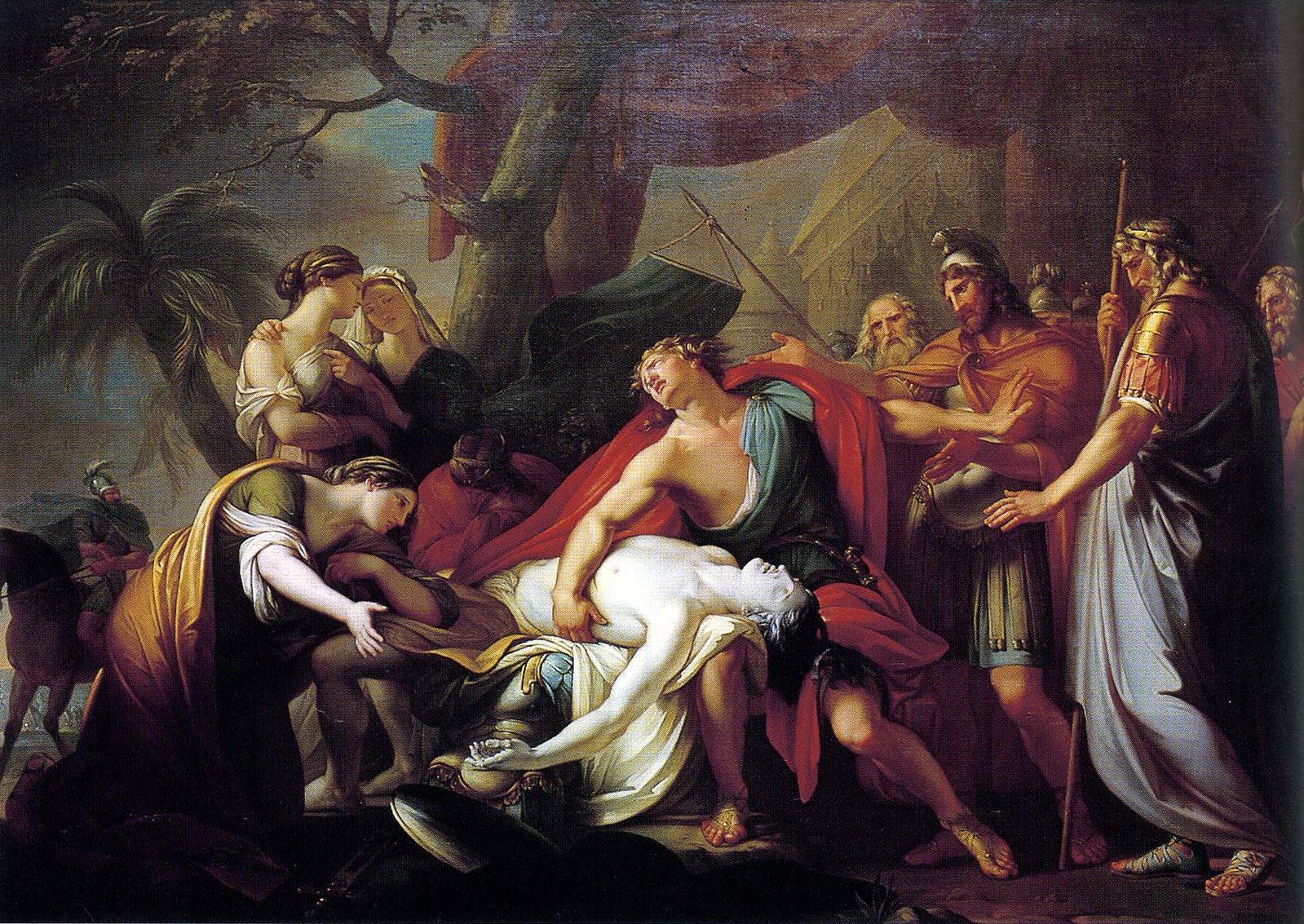
“Achilles Lamenting the Death of Patroclus,” Gavin Hamilton, ca. 1763

Queer love lies at the heart of the Iliad as a work of art.

This was not the claim of my fall quarter Western Culture prof, though he certainly tried to explain the nature of the relationship between Achilles and Patroklos, and how that fit into Greek ideas of manhood, and how it fit (or didn’t) with our own ideas of sexuality.  I don’t think he used the word “queer,” but he did emphasize that to call those two heroes “a gay couple” or “gay lovers” would be both anachronistic and inattentive to the complexities and resonances of the intimacy between them.  Or something like that.

But “queer” as a word that points to a body of scholarly theory and “queer” as a word reclaimed by folk whose intimate relationships, whose inner and intertwined lives, don’t fit neatly within simple binaristic categorizations – that’s a fitting enough word for a consideration of Patroklos and Achilles and the Iliad and the canon and the culture of the 1980s.

What struck me on this re-read of the Iliad was the distinctive portrayal of Achilleus’s grief.  Many warriors fall in these few days of battle, and many Greek heroes, and Trojan heroes too, lose men dear to them – perhaps as dear, indeed, as Patroklos was to Achilles.  Warriors on both sides are smitten with sorrow to see their brothers in arms fall, and warriors on both sides fight fiercely to retrieve the bodies of their fallen comrades – though no battle rages as fiercely or as long as the battle for Patroklos’s body.

And when that broken body is returned to the tents of Achilles – there grief pours forth from different, deeper streams. It is all the grief of brothers in arms, and more.  It is the grief of a lover for not only the life, but the very body, of his beloved.

Achilleus’s anguish over the broken body of Patroklos is compelling.  In a way, I suppose, it is echoed in Priam’s grief as he later pleads for Hector’s body.  But I think rather Priam’s grief harmonizes with Achilleus’s sorrow – it is grief in a different register, or maybe a different key altogether, and they share but one note in common between them:  an unfathomable tenderness toward the body of their own fallen warrior, beloved, though loved in different ways.

Here is how Achilles mourned, and what he feared:

Peleus’ son led the thronging chat of their lamentation
and laid his manslaughtering hands over the chest of his dear friend
with outbursts of incessant grief. As some great bearded lion
when some man, a deer hunter, has stolen his cubs away from him
out of the close wood; the lion comes back too late, and is anguished,
and turns into many valleys quartering after the man’s trail
on the chance of finding him, and taken with bitter anger;
so he, groaning heavily, spoke out to the Myrmidons….
So speaking brilliant Achilleus gave orders to his companions
to set a great cauldron across the fire, so that with all speed
they could wash away the clotted blood from Patroklos….(XVIII, 316-323, 343-345)

The poem goes on to describe in detail the tender care Achilles and his companions take in cleaning and preparing Patroklos body for his eventual funeral.

Yet no mortal effort can overcome decay. The body of the beautiful, the beloved one, his spirit shorn from the world of the living, will see corruption, Achilles fears, before he has a chance to return from avenging Patroklos’s death.  And he is not resigned.

His mother cannot comfort him, but she can help him.

Thetis, the water nymph, the immortal, does two things for her son in his grief:  she commissions for him immortal armor from the Olympian forge of Hephaistos, and when she returns with the enchanted shield – that immortal aesthetic object, art that literally captures the full round of earthly life, a frieze of figures in constant motion, the whole world of human meaning and meaning-making to live on and on past the death of the hero who will bear it on his shoulders – she gives her son what aid she can in caring for the body of his friend.

Achilles, after receiving the armor, tells his mother,

I am sadly afraid,
during this time, for the warlike son of Menoitios
that flies might get into the wounds beaten by bronze in his body
and breed worms in them, and these make foul the body, seeing
that the life is killed in him, and that all his flesh may be rotted.”(XIX, 23-27)

Achilles’ love for Patroklos does not transcend the burdens of embodiment.  This a feature that some other readers, maybe from another time or maybe now, might see as a great flaw. But in Achilles I see a mother’s son grieving for his lover, and like his mother, I find in this no cause for reproach.

In turn the goddess Thetis the silver-footed answered him:
“My child, no longer let these things be a care in your mind.
I shall endeavor to drive from him the swarming and fierce things,
those flies, which feed upon the bodies of men who have perished….
Go then and summon into assembly the fighting Achaians,
and unsay your anger against Agamemnon, shepherd of the people,
and arm at once for the fighting, and put your war strength upon you.”
She spoke so, and drove the strength of great courage into him;
and meanwhile through the nostrils of Patroklos she distilled
ambrosia and red nectar, so that his flesh might not spoil. (XIX, 28-39)

Ambrosia is an Olympian gift, the drink of the immortals – but that was not the gift we talked about when we discussed this work in reading group in the 1980s.  Instead, we talked about that shield, about how the poet celebrated art and storytelling as something immortal, with the shield of Achilles a stand-in for the poet’s work itself: a made thing through which life immortal moves.  That was our focus:  understanding the meaning of the shield of Achilles.

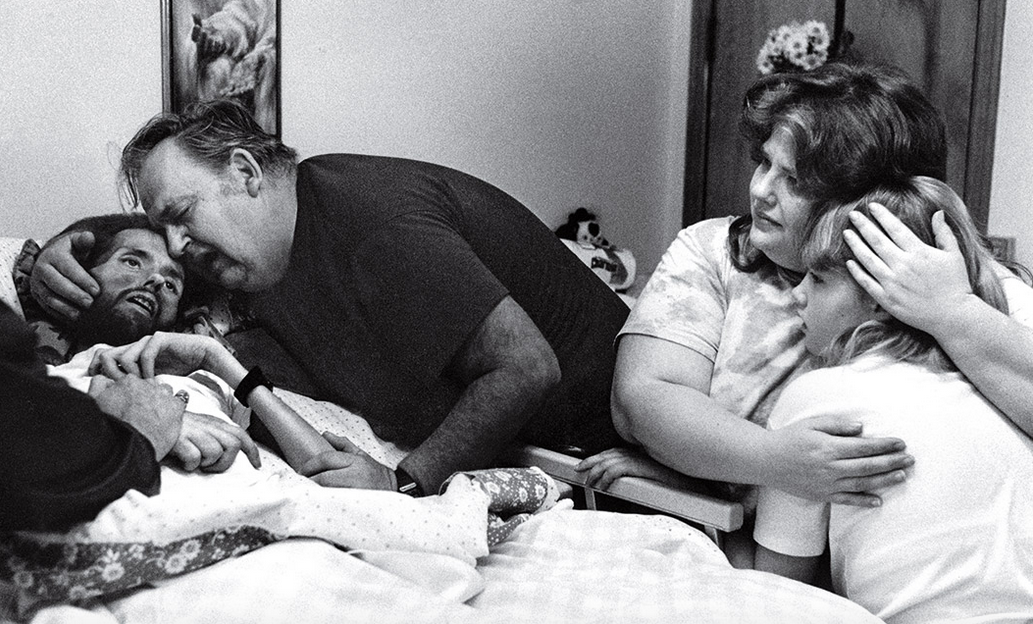
But the years during which Stanford freshmen were asked to read the Iliad were the very years when AIDS was ravaging queer communities, sweeping away queer lives (and hemophiliacs’ lives, and needle-sharing heroin addicts’ lives and unsuspecting partners’ lives) in an ever-advancing tidal wave of utter destruction.  Imagine the keening grief of Achilles magnified by the millions.  Imagine the great immortal shield, the Solace of Art, clattering to the ground, unfinished and undone, because the artists – the writers, the painters, the set designers, the actors, the sculptors, the dancers, the poets, the singers, the writers of songs – were literally wasting away.  Often they were mourned by the friends, their comrades in arms, their partners in love.  But often they died, as Patroklos did, and Achilles too, far away from home – disowned, despised, abandoned.

“David Kirby on his deathbed, Ohio, 1990,” Therese Frare / LIFE

We were reading this text against that background, but I’m not sure how many of us made the connection.  At the time, I did not. Seeing they do not see…

Now, though, every time I teach the second half of the U.S. history survey, I talk at length about the AIDS crisis.  I talk about the murderous neglect of the Reagan administration, and the vile hatefulness pouring forth from many key leaders on the religious Right, who called AIDS a punishment from God and a fate that gays deserved.  I talk about how many in mainstream American culture, out of prejudice and fear, had turned their backs on their own fellow citizens, and how AIDS activists and allies incessant advocacy and hospice training and political work and lobbying and protesting and constant painful heartrending public appeals to shared humanity and common decency combined to force the nation to take heed, to take care, to pour research and resources into finding a cure, a treatment, a ray of hope.

I tell my students that in the 1980s and 1990s, AIDS was seen as a sure death sentence, and many saw it as a sentence that its sufferers deserved.  But now there is preventative treatment, and treatment for symptoms, and maybe even hope of a cure.  And on the final exam, every semester, I have one or two students who tell me some version of, “I’m gay [or, I’m queer, or, I’m a LGBTQ ally] and I didn’t know anything about this history. Thank you so much for teaching this.  We didn’t cover the AIDS crisis in high school.”

And at first I think, How could you not cover the AIDS crisis in a high school U.S. history class?  On the other hand, how could you begin do it justice?

And who am I to judge?  I read Achilles mourning for Patroklos, lover for beloved, and my thoughts turned to abstractions like Art and Immortality, Great Books and Canonicity, when matters of much greater import were at stake.

Learn, and live – live.  There were too many who did not.

This piece was originally published at the Society for U.S. Intellectual History Blog

L.D. Burnett received her Ph.D. in Humanities (History of Ideas) from the University of Texas at Dallas (2015), where she is currently employed as the 2017-2018 Teaching Fellow in History. Her book, Canon Wars: The 1980s Western Civ Debates at Stanford and the Triumph of Neoliberalism in Higher Education, is under contract with University of North Carolina Press. (Bio credit: S-USIH)

~ Ordinary Philosophy and its Traveling Philosophy / History of Ideas series is a labor of love and ad-free, supported by patrons and readers like you. Please offer your support today!

*All views and opinions expressed by guest writers are their own and do not necessarily reflect those of Ordinary Philosophy’s editors and publishers

Should Life in Jail be Worse than Outside, on Principle? By Chris Barker

Sheriff’s House and Jail in Easton, Maryland, c. 1881

Approximately 2.3 million people in the United States are currently in prison or jail. (Prisons are run by federal or state authorities; jails are run locally.) China, a non-democratic regime with a population four times larger than the US, incarcerates fewer persons in per-capita and absolute terms. What’s more, most people in US jails today have not been convicted, meaning that they are being punished without trial. Since US jail admissions number approximately 11 million per year, pre-trial incarceration is, arguably, the real problem of ‘mass incarceration’.

The crucial concept governing carceral practices is something called ‘less eligibility’. The idea dates back to the English Poor Law Amendment Act of 1834, which codified English practices of dealing with the indigent. In 1832, the economist Nassau William Senior described how the ‘first and most essential of all conditions’ in administering relief to the poor (often by moving them into a workhouse) is that the indigent’s ‘situation on the whole shall not be made really or apparently so eligible as the situation of the independent labourer of the lowest class’. That is, the conditions in the workhouse should be awful: worse even than the poorest of the poor.

But even before Senior’s famous line, a different carceral ideal was afoot: equality. In 1791, writing specifically about criminal offenders, the English utilitarian philosopher Jeremy Bentham argued that ‘the ordinary condition of a convict doomed to a punishment that few or none but the individuals of the poorest class are apt to incur, ought not to be made more eligible than that of the poorest class of subjects in a state of innocence and liberty’. As the historian Janet Semple observed in Bentham’s Prison (1993), his rule of severity is not ‘less eligibility’ but a more commonsense equality principle – offenders should have access to no more resources than they had while free. ‘Bentham,’ Semple wrote, ‘did not envisage grinding his convicts down to below the level of the poorest of the poor.’

Other countries do not run their jails and prisons according to a principle of less eligibility. German prisons operate under an ‘approximation’ principle, wherein offenders’ rights to privacy, dignity and property are protected. Norwegian prisons use a similar ‘normality principle’, which holds that daily prison life should be, as far as possible, no different from ordinary life. Fellow Englishman and Bentham disciple James Mill embraced the normality principle in 1825 by arguing that inmates in pre-trial incarceration should be allowed to lead the same life that they enjoyed prior to arrest, including access to employment and freedom to make small purchases with their own money. Today, US jails and prisons have rejected these examples in thrall to ‘less eligibility’, and not just for the poorest of the poor.

Why are the carceral practices in the US so harsh? Part of the reason is the vestige of a Christian-inspired desire to reform the offender’s soul. Around the time of the Revolution, the penitentiary’s ‘unsocial manner of life’ based on order, obedience and silence could seem plausible only to those who thought that they could achieve a ‘new victory of mind over matter’. Today, prolonged solitary confinement is coming to be seen for what it is: torture. Another reason, identified in James Whitman’s book Harsh Justice (2005), is populism. Elected prosecutors and judges are guided by popular, punitive attitudes in a way that unelected bureaucrats in countries such as Germany (or Canada) are not. Survey research shows that Canadian and US attitudes about punishment are similar, but Canada has much more lenient sentencing policies than the US because bureaucratic appointees, not elected officials, make decisions about punishment. Another layer is race. Warehousing black males is clearly an outcome, and perhaps also an important aim, of US criminal justice. The result of this grab-bag of influences is segregation without soul-craft, and discipline and surveillance without reform.

If, as I think, the aim of punishment is rehabilitation, it is hard to justify less rather than equal eligibility. But not all agree that rehabilitation is the primary aim of punishment. Deterrence theorists think that controlling crime is the most important aim of punishment. Retributivists hold that punishment should repay the harm done to another in a like manner: an eye for an eye, a tooth for a tooth.

As evidence that precisely the opposite happens in US prisons, The End of Punishment (2013) by the present-day retributivist Robert Blecker’s recounts an interview with a Tennessee Death Row correctional officer who feels like a waiter, and a guard who complains that Florida’s Death Row is ‘the best deal in the building’. Blecker is right that we should classify offences and offenders according to the severity of their crime. Perhaps the ADX Florence supermax prison should even be, as its ex-warden described it to CNN, ‘far much worse than death’ for the worst of the worst. But think about this: county jail is ‘hard time’, and harder than state prison, as I am told by a local jail administrator. Almost 500,000 held in US jails are being held pre-trial. The average jail time served is short. Offenders quickly return to their communities, but they are not prepared for re-entry. Even the average jail and prison time might actually help offenders to become worse.

Too often, the US conversation about criminal justice is about principles and theories of punishment: rehabilitation, retribution, deterrence. What I am arguing here is that these theories amount to little if we ignore less eligibility, or how we punish. Visiting a jail without an outdoor yard, where offenders have no physical contact with friends and family during their incarceration, or a prison where life unfolds within coils of obtrusive razor wire, is not a normal life, and doesn’t prepare you to return to normal life. As opinion in the US starts to move away from some punitive strategies such as solitary confinement, we should reconsider which of our other carceral practices meet or violate the crucial secondary principles (leniency, proportionality, egalitarianism) of a just criminal justice system.

In Germany, there are restrictions on types of uniforms, on partitioning visitors from offenders, and on the use of bars and peepholes in cells. There are also protections of offenders’ rights to privacy, information, public exposure, and leisure and culture, that do not exist in the US. In the US, courts have upheld the constitutionality of expressive punishments that demean offenders, pre-trial incarceration that looks punitive, and denials of privacy and dignity.

It is a tragedy if the attempt to have a just society with a suitable criminal justice system has been transformed into criminogenic warehousing, based on surveillance and discipline, which achieves few or none of the goals of punishment. It is foolishness to countenance such a system merely because it has not yet touched you. The road to the present state of affairs leads through less eligibility, which, on the surface, is a principle that makes sense: treat offenders to a life that is worse than life on the outside. After all, why should offenders have air conditioning if the farmer ‘living in innocence and liberty’ does not? But the answer is that it is too easy to forget the other constraints on the dignity, privacy and autonomy of those incarcerated in jails and prisons.

Our present system is costly and ineffective; it creates aberrant economies and empowers prison gangs that in turn influence street gangs. Prisons reproduce the cultural inadequacy of life on the inside on our streets and in popular culture, and when offenders are released into communities, their lack of rehabilitation justifies further segregation and other collateral consequences, such as employment and housing discrimination.Aeon counter – do not remove

This article was originally published at Aeon and has been republished under Creative Commons.

Chris Barker is assistant professor of political science at Southwestern College in Kansas. (Bio credit: Aeon)

~ Ordinary Philosophy is a labor of love and ad-free, supported by patrons and readers like you. Any support you can offer will be deeply appreciated!

*All views and opinions expressed by guest writers are their own and do not necessarily reflect those of Ordinary Philosophy’s editors and publishers