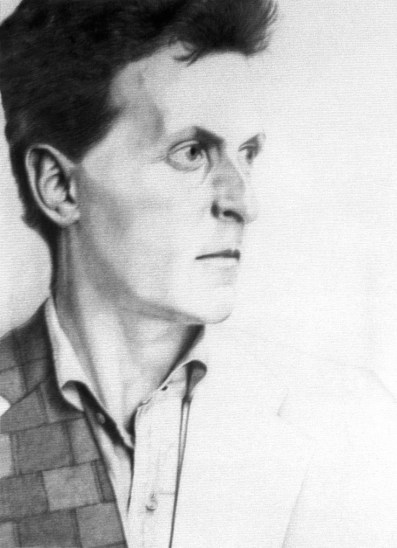
Drawing of Ludwig Wittgenstein by Christiaan Tonnism, pencil on board 1985, Creative Commons
In honor of Ludwig Wittgenstein’s birthday, Apr 26, 1889, let me share four fascinating discussions about the great philosopher’s life and ideas.
The first is by philosopher Stephen West for his podcast Philosophize This!, in which he discusses ‘…the limitations of language as described by Ludwig Wittgenstein. Considered by some to be the greatest philosopher of the 20th century, Ludwig Wittgenstein played a central, if controversial, role in 20th-century analytic philosophy. He continues to influence current philosophical thought in topics as diverse as logic and language, perception and intention, ethics and religion, aesthetics and culture….’ (this episode is only the first West will create about Wittgenstein)
The third is from the BBC series In Our Time, hosted by Melvin Bragg and featuring guests Ray Monk, Barry Smith, and Marie McGinn. In this program, Monk, Bragg, Smith, and McGinn discuss ‘…the life, work and legacy of Ludwig Wittgenstein… Wittgenstein is credited with being the greatest philosopher of the modern age, a thinker who left not one but two philosophies for his descendants to argue over: The early Wittgenstein said, “the limits of my mind mean the limits of my world”; the later Wittgenstein replied, “If God looked into our minds he would not have been able to see there whom we were speaking of”. Language was at the heart of both. Wittgenstein stated that his purpose was to finally free humanity from the pointless and neurotic philosophical questing that plagues us all. As he put it, “To show the fly the way out of the fly bottle.” How did he think language could solve all the problems of philosophy? How have his ideas influenced contemporary culture?…’
The fourth is by Ian Ground for the Times Literary Supplement, an excellent piece I recommended here at Ordinary Philosophy last fall. In it, Ground discusses ‘why writers and artists have found him an object of fascination and inspiration. He is the subject of novels, poetry, plays, painting, music, sculpture and films. In the arts and the culture generally, Wittgenstein seems to be what a philosopher ought to be.’
Enjoy, and be inspired, awed, puzzled, and enlightened!
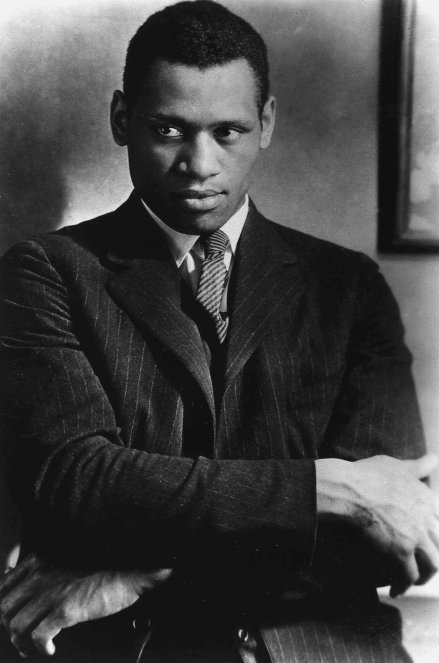
Paul Robeson was one of the greatest black internationalists of the twentieth century. A gifted actor and singer, he was also an unabashed leftist and union supporter. This resulted in his bitter persecution, destroying his career and causing, to a surprising degree, his disappearance from popular–if not academic–memory. Robeson’s connections to the fiery black dockworkers of the San Francisco Bay illuminate a form of black internationalism still left out of scholarly analyses –what I will refer to as Labor-Left Pan-Africanism.
Robeson’s life exemplified Pan-Africanism, a global movement of politically conscious black people who believed they shared much in common with all people of African descent in Africa and across the African Diaspora. In the 1930s, Robeson embraced this ideology, along with communism, and supported the Soviet Union. Robeson and other leftwing, Pan-African black intellectuals and activists—such as W. E. B. Du Bois, Eslanda Robeson, Vicki Garvin, and Hubert Harrison—fought long and hard for racial equality in the United States and for liberation of African and Caribbean nations abroad.
Robeson connected struggles for civil rights with socialism and working class politics. His interest in black equality first came from his father, William Drew Robeson, who was born a slave and successfully liberated himself. Robeson’s leftist politics emerged in the 1930s, first visiting the Soviet Union in 1934, and subsequently embracing socialism for treating black people as equals. He combined politics and artistry from then onwards.
In 1935, Robeson performed in the London debut of the American play Stevedore.1 The reviewer in the NAACP’s Crisis magazine concluded: “Stevedore is extremely valuable in the racial–social question—it is straight from the shoulder.” Later that year, he also played the lead in C. L. R. James’ take on Toussaint L’Ouverture, itself written shortly before James’ classic history of the Haitian Revolution, The Black Jacobins (1938).
In 1937, back in the United States, Robeson helped to establish the Council on African Affairs (CAA), which promoted African liberation in an era when few Americans actively engaged in such matters. Perhaps its greatest achievement came in 1946, when the CAA submitted a memorandum to the United Nations Commission on Human Rights in support of the African National Congress (ANC). Led by its US-educated President, Alfred Xuma, the ANC successfully fought to prevent the annexation of South-West Africa (now Namibia) by racist, white minority-ruled South Africa. Alas, the CAA was red-baited out of existence shortly after this victory.
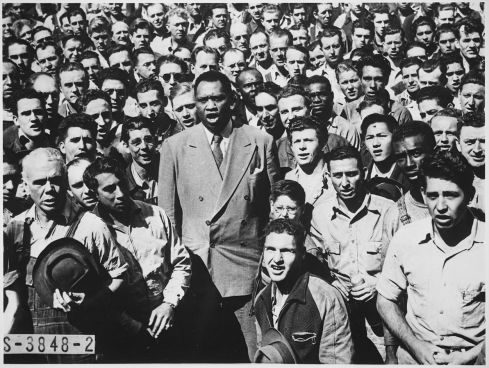
In 1942, during WWII, Robeson traveled to Oakland to champion the black and white union workers contributing to the Allied war effort on the home front. One of Robeson’s most famous photos shows him singing the “Star Spangled Banner” amidst a sea of black and white workers at Moore Shipyard in Oakland. The image captures his politics brilliantly, all the more so since Robeson had worked as a shipbuilder during WWI.
Paul Robeson, world famous baritone, at Moore Shipyard in Oakland, CA, leading workers in singing the Star Spangled Banner.
After WWII, the Cold War commenced and black people linked to communism, like Robeson and Du Bois, were persecuted by the US State Department, the FBI, and many so-called patriots intolerant of dissent. Historian Penny M. Von Eschen cites Robeson’s “extreme advocacy on behalf of the independence of the colonial peoples of Africa” as an explanation for his career’s destruction in the Red Scare. I would also add his labor activism.
Just like Robeson, many of the black dockworkers I study adhered to Labor-Left Pan-Africanism. In the San Francisco Bay Area, thousands of African Americans belonged to the International Longshore & Warehouse Union (ILWU).2 This leftwing union was renowned for its fierce and proud commitment to racial equality and black internationalism. Indeed, during WWII, Robeson became an honorary member of the ILWU. Robeson and the ILWU were, in many ways, a perfect fit.
The ILWU was—and remains—amongst America’s most radical unions, led for decades by its leftist President Harry Bridges and supported by many leftists in the rank-and-file. The union put socialism into action in its hiring halls, which dispatched members based upon a “low man out” system in which the person with the fewest amount of hours worked, that quarter, received the first available job.
In keeping with its politics, the ILWU attacked racism on the waterfront beginning with its initial “Big Strike” even though the workforce was 99% white in 1934. Local 10 welcomed thousands of African Americans during the WWII-induced shipping boom and these blacks, alongside leftist white allies, fully integrated their union and fought for civil rights in the Bay Area and nationwide. Due to their aggressive efforts, ILWU Local 10, which represents dockworkers in San Francisco, Oakland, and throughout the Bay Area, became black majority in the mid-1960s with blacks elected to every leadership position available. Truly, the ILWU embodied what historian Robert Korstad labeled “civil rights unionism.”
Robeson understood the significance of the ILWU as a platform from which to demand civil rights. Two of Robeson’s best friends– Joe Johnson and Revels Cayton— belonged to the ILWU. Together, these three black men articulated a commitment to Labor-Left Pan-Africanism.
The best example of its Pan-Africanism was ILWU’s commitment to the struggle against apartheid and, more broadly, for the liberation of all the peoples of southern Africa. In the 1950s and 1960s, the union repeatedly condemned white-minority rule in South Africa and also noted the ironic similarities with Jim Crow segregation in the States. In the 1970s and 1980s, rank-and-file members of ILWU Local 10 formed the Southern Africa Liberation Support Committee, which stood at the vanguard of black working class anti-apartheid activism during this period. Leo Robinson, Texas-born and a child of the 2nd Great Migration to Oakland, followed in his father’s footsteps to the waterfront in 1963. In Local 10 Robinson became a communist and activist who helped found the SALSC after the Soweto student uprising of 1976. Although Robeson died that same year, after declining health and decades in forced retirement due to McCarthyism, other radical longshoremen inspired by socialism and liberation movements in Africa joined Robinson and following in Robeson’s footsteps.
The black and white members of the SALSC fought for the liberation of black people in South Africa, Mozambique, Rhodesia, and elsewhere in the best way they knew how: direct action on the job. To leftist, Pan-African dockworkers, the most logical way to attack apartheid and racial capitalism was flexing their economic muscle, i.e. stop work. In 1962, 1977, and for eleven days in 1984 (shortly after Reagan’s landslide re-election), they refused to unload South African cargo. By contrast, other black Pan-Africanists embraced consumer boycotts or economic divestment. Local 10’s actions set the bar for US anti-apartheid activism and helped inspire many in the Bay Area to join the solidarity struggle. Nelson Mandela thanked the union on his first visit to Oakland in 1990 and Robinson received a posthumous award from the now-democratic South African government.
Long after his death, Paul Robeson continued to inspire African Americans in the ILWU including the Bay Area’s Alex Bagwell. Like Leo Robinson, Bagwell’s family moved to San Francisco during WWII. In the 1960s, he dropped out of college after admission to the union, which had elevated so many black folks into the middle class. Like Robeson, Bagwell was a leftist and active in the union’s anti-apartheid efforts. He and his wife, Harriet, belonged to a radical choir, Vukani Mawethu, founded by a South African who belonged to the ANC and had gone into exile. Alex and his wife were among those in Vukani who sang when Mandela visited Oakland.
In the early 1990s, though not yet retired, Bagwell finished his B.A. and then earned his M.A. in Creativity and Arts Education at San Francisco State University. For his graduate degree, he wrote a play on Robeson’s life, conducting interviews with twenty people who knew him including Local 10 member Joe Johnson, Robeson’s long-time friend.
After the birth of a multiracial, democratic South Africa, the Bagwells traveled to the country, as part of Vukani Mawethu, to perform there. Other black and white radicals in the ILWU did so, as well. The Pan-Africanism of these dockworkers clearly followed in the footsteps of Robeson, who first championed the rights of black South Africans in the 1940s. The spirit and ideals of Robeson continue to shape the Pan-Africanism of working class black dockworkers who now have established connections with black dockworkers in South African ports. Robeson would be proud.
Stevedore is an older term for dockworker or longshoreman, workers who load and unload cargo ships.
The ILWU’s original name was the International Longshoremen’s & Warehousemen’s Union but, in 1997, a resolution was approved, unanimously at its biennial convention, that made its name gender-neutral. “What’s in a Name? For ILWU, it’s not ‘men’,” Journal of Commerce, May 4, 1997
~ Peter Cole is a historian of the twentieth-century United States, South Africa and comparative history. Dr. Cole is Professor of History at Western Illinois University. He is the author of Wobblies on the Waterfront: Interracial Unionism in Progressive Era Philadelphia (University of Illinois Press, 2013) and currently at work on a book entitled Dockworker Power: Race, Technology & Unions in Durban and the San Francisco Bay Area. He writes on labor history and politics (Bio credit: AAIHS)
Every year around Cesar Chavez’s birthday, as media outlets report of festivities in his honor, I’m reminded of a joke in a Simpsons episode and the strange sadness it elicited in me when I saw it: Homer Simpson is on his front lawn and is confronted with the apparition of a debonair, mustachioed man who introduces himself as, “the spirit of Cesar Chavez.”
In typical Homer confusion he asks, “Then why do you look like Cesar Romero?”
The ghost replies, “Because you don’t know what I look like!”
Cesar Chavez is certainly revered by many people, especially within the Latino community, but despite the steadily increasing ubiquity of his name across the United States, especially the American Southwest, there are still many Americans today who don’t really know who he is, let alone what he stood for, or what he accomplished.
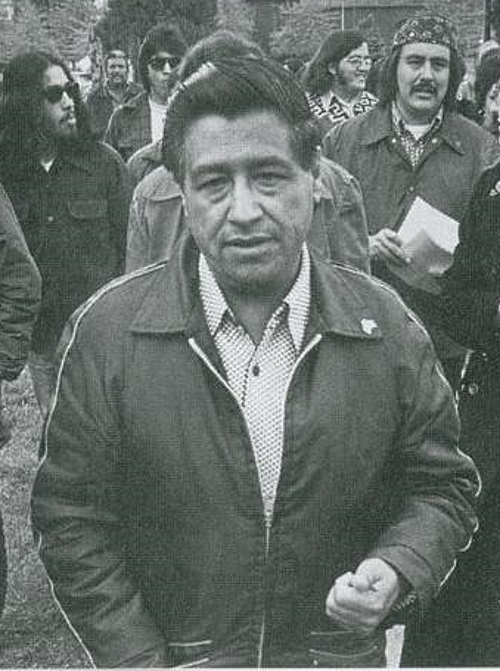
Cesar Chavez was a Mexican-American community organizer turned labor leader. A former migrant farmworker recruited by the Community Service Organization (CSO) in its heyday of the 1950s, he co-founded the National Farmworkers Association (NFWA,) which later became the United Farm Workers (UFW,) the first successful union for migrant farmworkers. The UFW’s membership consisted mostly of indigent Latinos and Filipinos, and their struggle for justice and dignity, fighting to gain higher wages and better conditions in the fields where they were deprived of basic needs such as clean drinking water and bathrooms, became a national moral cause under the stewardship of Chavez, who courted national and international sympathy using militant non-violent tactics in the vein of Mahatma Gandhi and Martin Luther King Jr, such as strikes, boycotts, fasts, and peaceful marches.
Chavez was not an imposing orator with the fire-and-brimstone timbre of the Reverend Dr. King, nor did he cut as iconoclastic a figure as Gandhi, but in his unassuming way he could be just as charismatic and endearing, and this often caught people off guard, as it did an interviewer for the New Yorker in 1973, who, “had expected, if not a Mexican-American Lenin…a young, hard, intense man bristling with revolutionary zeal. Instead we found Mr. Chavez to be a stocky man…about five feet seven …with Indian features…and a pleasant earnest manner.” With his trademark regular boys’ haircut parted on the side and wearing simple cardigans with button down plaid shirts and slacks, his fashion was more Mr. Rogers than Mr. Lenin. He looked the part of the humble Everyman that people felt they could relate to.
On a personal note, my parents actually met while working with Cesar Chavez in the early ‘70s, and when they tell stories of those days, they both recall how approachable he was with his easy but confident demeanor; how people were drawn to him and trusted him, even as he took them out of their comfort zones, like the time he sent my mom and a few other farmworkers to Chicago, to publicize and organize the Grape Boycott, even though they spoke very little English and were armed with just a few phone numbers of sympathizers there along with the names of some churches that might possibly provide them with food, room and board. They believed they could accomplish such ambitious plans because this diminutive, unpretentious man seemed capable of stopping the engine of the entire agricultural industry and took on Big Agribusiness all by himself. Before it became widely known as the slogan of Barack Obama’s presidential campaign, I grew up with my father reminding me, “¡Si se puede!” (Yes, you can!) a phrase Chavez often chanted before throngs of people at picket lines and marches.
Like Gandhi and King, he was intensely spiritual and absolutely committed to non-violence. In what may be his most recognizable aphorism, he said, “It is my deepest belief that only by giving our lives do we find life. I am convinced that the truest act of courage…is to sacrifice ourselves for others in a totally non-violent struggle for justice.” Self-immolation was a recurring theme in both word and deed: in 1968, during the Delano Grape Strike, after several tense confrontations at the picket lines nearly devolved into violence, he fasted for 25 days to encourage and remind the farmworkers that their fight was to be a non-violent one. He would fast for 24 days again in 1972, and in 1988 he fasted for 36 days(!) to bring attention to the pesticide poisoning of grape workers and their children. It is thought that his relatively early death at the age of 63 in 1993 was probably due to aggregated health complications suffered from these sacrifices. Still, even now, if you talk to people who marched with Chavez and the UFW back then, most speak of Chavez in reverential, even hagiographical ways, for to them he was como un santo: like a saint..
Throughout the 1960s and 1970s, as the UFW made sweeping legislative strides on behalf of organized farm labor, Chavez was also becoming the most widely known leader within the broader Chicano Movement, or “El Movimiento,” a civil rights movement which empowered Mexican Americans caught between two cultures, not quite Mexican enough for their Mexican immigrant forebears, nor seen as truly American by the white hegemony. The term “chicano” was originally a derogatory term for the American children of Mexican migrants, but in the Movement it was flipped, transmogrified, to be a badge of ethnic pride. Of course Chavez always made sure to situate the fight of the UFW as united with the struggle of “all farm workers across the country, the Negroes and poor whites, the Puerto Ricans, Japanese, and Arabians…the races that comprise the oppressed minorities of the United States,” but “The Plan de Delano,” a text co-authored by Chavez with Dolores Huerta and the Chicano playwright Luis Valdez, reifies and emboldens his ethnic heritage, declaring “We are sons of the Mexican Revolution.” To this day, the flag of the UFW, showing a black Aztec eagle on stark red background, is widely considered a symbol of Chicano or Latino pride. Those of us who wear this symbol, or even, as in my case, have it tattooed on their body, recognize that the life we have so firmly rooted in the United States, with access to resources and opportunities that our parents or grandparents did not have, is due to the hard work and vigilance of people like Cesar Chavez, Dolores Huerta, or my mother, Maria Saludado.
The identity politics that certainly began to swell in the 1960s have persisted despite reactionary criticism and remain particularly relevant today; an era in which the ugly scars of racism seem as starkly etched in our national consciousness as ever. As we near the end of the second term of America’s first ‘non-white’ President, as Mexican immigration continues to be a galvanizing and polarizing issue in the US, and the Latino vote is highly prized on both sides of the political aisle, conditions would seem fecund for a reboot of El Movimiento. In appropriate fashion, this year the Cesar Chavez Foundation, an offshoot of the UFW, began its annual celebration in San Fernando, the first city in the nation to commemorate Cesar Chavez Day with a paid holiday, with a rally and march to encourage activism to “Dump Trump.”
~ Alejandro Magaña is a musician, poet, and songwriter some of the time, and a father and husband all of the time. He blogs at Aether Ore and lives in San Diego with his wife and son and books and records.
Sources and Inspiration:
● My mother and father. ¡Que viva mis padres!
● Chasan, Daniel. “‘Marcher,’ an interview with Cesar Chavez,” The New Yorker, May 27, 1967.
● Chavez, Cesar, Huerta, Dolores, and Valdez, Luis. “The Plan of Delano,” El Malcriado, March 17, 1966.
● Chavez, Cesar. An Organizer’s Tale: Speeches Ed. Ilan Stevens. London: Penguin Books, 2008.
Maimonides medallion, photo by T. Horydczak, approx. 1950, sculpture over the door of the gallery of House chamber, U.S. Capitol. Photo public domain via Library of Congress
‘Moses Maimonides… [born on March 30, 1135]… is the greatest Jewish philosopher of the medieval period and is still widely read today. The Mishneh Torah, his 14-volume compendium of Jewish law, established him as the leading rabbinic authority of his time and quite possibly of all time. His philosophic masterpiece, the Guide of the Perplexed, is a sustained treatment of Jewish thought and practice that seeks to resolve the conflict between religious knowledge and secular….’
~ Kenneth Seeskin for the Stanford Encyclopedia of Philosophy
Read and hear more about this great philosopher and religious thinker at:
Frederick Douglass c. 1855, and the first edition of his North Star, Dec 3 1847, public domain via the Library of Congress
‘We are here, have been here, and we are to stay here. To imagine that we shall ever be eradicated [by removal to Africa], is absurd and ridiculous. We can be re-modified, changed, and assimilated, but never extinguished. The white and black must fall or flourish together. We shall neither die out, nor be driven out, but we shall go with you, remain with you, and stand either as a testimony against you, or as an evidence in your favor, throughout all your generations.’
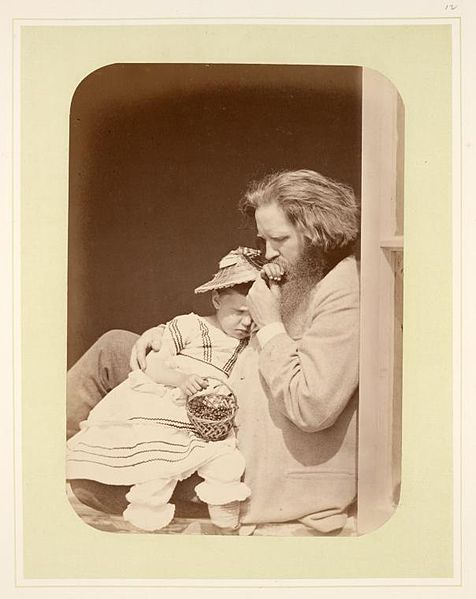
‘A Father and Child’ by Andrei Osipovich Karelin, public domain via Wikimedia Commons
In this excellent essay, M. M. Owen explores Martin Buber‘s idea that ‘when we encounter another individual truly as a person, not as an object for use, we become fully human.’:
I and Thou argues that within this elementally networked reality there are two basic modes of existence: the I-It, and the I-Thou. These two stances make up our basic ‘twofold attitude’. In the I-It mode, an ‘Ego’ approaches another as an object separate from itself. This type of engagement is driven by a sort of instrumentalism; the object is engaged primarily as something to be known or used, and its nature is always mediated through the subject’s own self-regard. From the I-It stance, we don’t engage with things in their entirety. Instead, we engage with a web of distinct and isolated qualities notable for how they are useful to us. Buber regarded this kind of self-centred outlook – typified, in his view, by proto-existentialists such as Kierkegaard and Nietzsche – as a grave error.
By contrast, in the I-Thou relationship, rather than simply experiencing another, we encounter them. A subject encounters a fellow subject’s whole being, and that being is not filtered through our mediated consciousness, with its litter of preconceptions and projections. ‘No purpose intervenes,’ as Buber put it. The I-Thou stance has a purity and an intimacy, and is inherently reciprocal. In relation to others, he argued, we can step into an intersubjective space where two people coexist in (and co-contribute to) what he called the Between. In this Between lurks the vital, nourishing experience of human life, the real sacred stuff of existence. As he put it: ‘All real living is meeting.’
Elizabeth Anscombe, [born Mar 18, 1919] was considered by some to be the greatest English philosopher of her generation. She was professor of philosophy at Cambridge from 1970 to 1986, having already, as a research fellow at Oxford in the 50s, helped change the course of moral philosophy. Also influential in philosophy of mind, she pioneered contemporary action theory, and the pre-eminent philosopher Donald Davidson called her 1957 monograph Intention the best work on practical reasoning since Aristotle. The philosophical world owes her an enormous debt, too, for bringing Wittgenstein, probably the greatest philosopher of the 20th century, to public knowledge….
Elizabeth Anscombe – Sarah Woolman speaks to Dr Rosalinde Hursthouse and Professor Philippa Foot for the BBC’s Woman’s Hour
The Golden Age of Female Philosophy – Eleanor Gordon-Smith speaks with Dr Rachael Wiseman, Assoc Prof Fiona Jenkins, and philosopher Mary Midgley about Anscombe’s, work along with the work of other great contemporary women philosophers, for The Philosopher’s Zone
Anscombe Bioethics Centre – ‘a Roman Catholic academic institute that engages with the moral questions arising in clinical practice and biomedical research’
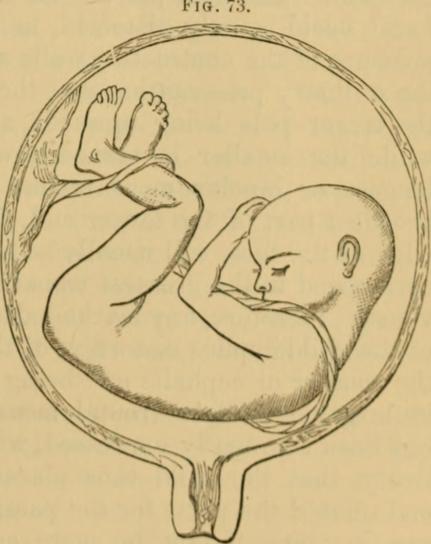
Illustration from A System of Midwifery, Including the Diseases of Pregnancy and the Puerperal State, 1875 by Leishman & Parry, public domain via Wikimedia Commons
In the 1970s, the Australian moral philosopher Peter Singer, perhaps best-known for his book Animal Liberation (1975), began to argue that it is ethical to give parents the option (in consultation with doctors) to euthanise infants with disabilities. He mostly, but not exclusively, discussed severe forms of disabilities such as spina bifida or anencephaly. In Practical Ethics (1979), Singer explains that the value of a life should be based on traits such as rationality, autonomy and self-consciousness. ‘Defective infants lack these characteristics,’ he wrote. ‘Killing them, therefore, cannot be equated with killing normal human beings, or any other self-conscious beings.’
The thought of killing disabled babies is especially dangerous because the concept of disability often functions as a mere cloak, thrown over much uglier hatreds. In ‘Disability and the Justification of Inequality in American History’ (2001), the historian Douglas Baynton points out that African-American enslavement was justified through disability models: there was a supposition that African Americans suffered from a number of medical conditions that were understood to make them unable to care for themselves. Until 1973, homosexuality was a psychological disorder justified in the Diagnostic and Statistical Manual of Mental Disorders; the current edition, the DSM-5, still considers transgender people disabled.
Singer generally frames severe physical disabilities through a medical lens. His ideas chafe against models of the disabled as a minority group. To Singer, severe disability is more a problem to be solved than a difference to be embraced and accommodated.
For years, I thought Singer was morally bankrupt. I grew up in a family with hereditary deafness, and though deafness is far from the type of disability that Singer was focusing on (with some arguing that it’s not a disability at all), I still recognised an idea that the disability community has faced for centuries: that people with disabilities are fundamentally less entitled to their rights – even their lives. Singer’s ideas stood in opposition to my core belief that the disabled body is created largely through a lack of accommodation, and that people with disabilities are different perhaps, but not less.
While most of Singer’s other writings seemed so thoughtful, so compassionate, his writings on disabled children seemed to be approaching the slippery slope toward ethnocide – the intentional and systematic destruction of cultures, like the Deaf culture that my own family embraced. I had never been able to shake what he was saying about the disabled – and I wanted to know more: what he thought today; if his ideas had ever shifted; and, mostly, how he could believe so strongly in something that seemed so out of sync with his reverence for life.
This past winter, I reached out to Singer to learn more.
I was nervous to talk with him, even over the blurry, jumpy distance of Skype, but I had no reason to be. Though his ideas felt abrasive, even violent, to me, he took opposition with thoughtful consideration. And as we talked, I began to wonder if I hated his ideas because they poked at sore spots in my worldview, exposing its vulnerabilities.
Singer resists the idea that disability is mere difference; there is suffering involved, he says, and not only of the social variety. ‘I don’t think the idea that it’s better to be able rather than disabled is in itself a prejudice,’ he told me. ‘To see that as akin to racism or sexism is a mistake.’ He argues that if it weren’t preferable to be able-bodied, we wouldn’t have a problem with pregnant women taking drugs or drinking heavily, that avoiding disability would have to also be seen as prejudicial. It isn’t, and Singer maintains that it shouldn’t be.
Instead, Singer maintains that disability, unlike race or gender, comes with intrinsic suffering – sometimes great enough that it is more compassionate to end the lives of infants than to force them to live in pain. Over the years since he first began discussing this proposal, Singer has had to contend with studies showing that quality-of-life assessments of people with disabilities are not that different from those of able-bodied people – a fact that could grossly undermine his argument of alleviating suffering. While he has found those studies compelling, he maintains that it’s not fair to allow them to speak for those too severely disabled to respond to such a survey. (In general, he doesn’t buy the idea that people with vastly different disabilities ought to be speaking to each other’s experiences.)
Disturbingly, though he focuses mostly on severe disabilities, he also resists putting strict parameters around which disabilities would qualify for infanticide. ‘Look,’ he told me, ‘I don’t think it’s for me to tell parents [that] if your child is like this you are to end the child’s life, and if the child is like that you ought not to.’ Instead, he considers how class, family, community, not to mention regional and national support, shape the potential life of the child.
Particularly surprising was how Singer’s responses often revealed under-investigated issues in the disability movement’s rhetoric: the idea that class and location could have tremendous impact on a parent’s ability to raise a child with a disability, for instance, or that some are so disabled that they have no ability to speak to their own quality of life. The way that Singer’s ideas are often engaged with exhibits an intellectual laziness that tosses these issues dangerously aside.
Singer has not focused on infanticide for decades, but his ideas still ache in the disability world, like a wound that won’t heal. Singer is still deeply entrenched in questions about the hierarchy of lives, and his ideas about the inferiority of many people with disabilities – and the dangers that those ideas imply – are as pertinent today as they’ve ever been. The epidemic of spina bifida that spurred his arguments has now passed, but the larger questions he poses are still central to questions of prejudice and equality in the disability community. This makes it hard to sort through Singer. His arguments are built intricately and beautifully, like a perfect mathematics equation, but at their core beats a single assertion, one that is still too difficult to concede: that this group of human beings aren’t really people. That’s the pain that obscures the rest.
~ Katie Booth is a freelance writer and a 2017-18 John W Kluge fellow at the Library of Congress. She has written for the Indiana Review, Mid-American Review, The Fourth River and Vela. Her first book, The Performance of Miracles: Language, Power, and Alexander Graham Bell’s Quest to Cure Deafness, will be published by Simon & Schuster. She lives in Washington, DC. (Bio credit: Aeon)
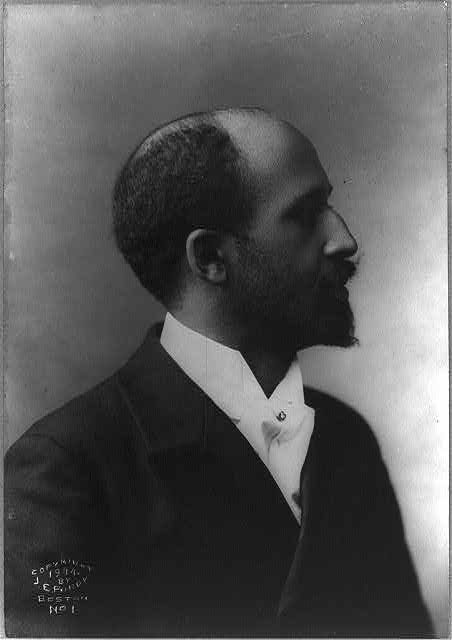
W.E.B. Dubois, photograph taken by J.E. Purdy in 1904, public domain via Library of Congress
Let us honor the life and legacy of the great American writer, historian, journalist, professor, activist, philosopher, and race theorist W.E.B. Du Bois, born on February 23, 1868.
The NAACP (of which he was a founder) writes of Du Bois:
‘William Edward Burghardt Du Bois (February 23, 1868 – August 27, 1963) was an American civil rights activist, leader, Pan-Africanist, sociologist, educator, historian, writer, editor, poet, and scholar. He became a naturalized citizen of Ghana in 1963 at the age of 95.
…In 1891 Du Bois got his master of arts and in 1895 his doctorate in history from Harvard. His dissertation, The Suppression of the AfricanSlave Trade to the United States of America, 1638-1870, was published as No. 1 in the Harvard Historical Series. This important work has yet to be surpassed. In 1896 he married Nina Gomer, and they had two children. …[A]t the University of Pennsylvania… he conducted the pioneering sociological study of an urban community, published as The Philadelphia Negro: A Social Study (1899). These first two works assured Du Bois’s place among America’s leading scholars.
Du Bois’s life and work were an inseparable mixture of scholarship, protest activity, and polemics. All of his efforts were geared toward gaining equal treatment for black people in a world dominated by whites and toward marshaling and presenting evidence to refute the myths of racial inferiority’ …
Donald J. Morse writes of Du Bois for the Internet Encyclopedia of Philosophy:
‘W. E. B. Du Bois was an important American thinker: a poet, philosopher, economic historian, sociologist, and social critic. His work resists easy classification. This article focuses exclusively on Du Bois’ contribution to philosophy; but the reader must keep in mind throughout that Du Bois is more than a philosopher; he is, for many, a great social leader. His extensive efforts all bend toward a common goal, the equality of colored people. His philosophy is significant today because it addresses what many would argue is the real world problem of white domination. So long as racist white privilege exists, and suppresses the dreams and the freedoms of human beings, so long will Du Bois be relevant as a thinker, for he, more than almost any other, employed thought in the service of exposing this privilege, and worked to eliminate it in the service of a greater humanity. Du Bois’ pragmatist philosophy, as well as his other work, underlies and supports this larger social aim. Later in life, Du Bois turned to communism as the means to achieve equality. He envisioned communism as a society that promoted the well being of all its members, not simply a few. Du Bois came to believe that the economic condition of Africans and African-Americans was one of the primary modes of their oppression, and that a more equitable distribution of wealth, as advanced by Marx, was the remedy for the situation ….
‘[T]he passions [affectus animi] which arise from animal nature are not themselves evil, though the actions that proceed from them sometimes are, namely, when they are harmful and contrary to duty. Unless you give infants everything they want, they cry and get angry, they even beat their own parents, and nature prompts them to do so. But they are not to blame, and are not evil, first, because they cannot do any harm, and then because, not having the use of reason, they are totally exempt from duties. If they continue to do the same things when they are grown up and have acquired the strength to do harm, then they begin to be evil and to be called so. Thus an evil man is rather like a sturdy boy, or a man of childish mind, and evil is simply want of reason at an age when it normally accrues to men by nature governed by discipline and experience of harm.’
~ Thomas Hobbes, from On the Citizen: ‘Preface to the readers’, 1642






 Ordinary Philosophy