Developing the Virtues, by Darcia Narvaez

mothers-love-by-isaias-bartolomeu-public-domain-via-pixabay-croppedHelicopter parenting is denounced by onlookers (e.g., David Brooks) as babying children who should be self-reliant, a highly valued characteristic in the USA. Children should not need parents but should use their own capacities to get through the day. The notion of a good person is intertwined with this individualistic view of persons and relationships. Good people know how to behave. They stand on their own, with little dependency on others. They are given rules and obey them. Bad people don’t–they are whiny and weak.

It should be noted that when one applies this view to babies, to make them “independent,” one not only misunderstands baby development but creates the opposite result—a less confident, regulated and capable child (see Contexts for Young Child Flourishing).

This machine-like view of persons and relationships contrasts, not only with what we know about child development (kids’ biology is constructed by their social experience) but with longstanding theories of virtue and virtue development. A virtue-theory approach to persons and relationships emphasizes their intertwining. One always needs mentors as one cultivates virtues throughout life. Relationships matter for moral virtue. One must be careful about the relationships one engages in or they can lead one astray.

What does it mean to be virtuous? Virtue is a holistic look at goodness and, for individuals, involves reasoning, feeling, intuition, and behavior that are appropriate for each particular situation. Who the person is—their feelings, habits, thinking, perceptions—matters for coordinating internally-harmonious action that matches the needs of the situation. This holistic approach contrasts with theories of morality that emphasize one thing or another—doing one’s duty by acting on good reasoning and good will (deontology) or attending to short-term consequences (utilitarianism). (Most moral systems pay attention to all three aspects but emphasize one over the others.)

The high-demand definition of goodness in virtue theory suggests that few of us are truly good. Instead, most of us most of the time act against our feeling, behave in ways that counter our best reasoning, or completely miss noticing the need for moral action. In other words, our feelings/emotions, reasoning, inclinations are not harmonious but in conflict.

Some philosophers are particularly concerned with the inconsistencies in people’s behavior—for example, a person might be honest on taxes, but dishonest in business dealings or interpersonal situations.

However, among social-cognitive psychologists inconsistency is not a surprise. Each person has habitual patterns of acting one way in certain types of situations and a different way in another type of situation. Traits like honesty don’t adhere to a person like eye color but vary from situation to situation, e.g., outgoing with friends but shy with strangers. Individuals show consistent patterns of behavior for particular types of situations (person by context interaction). Thus, a person may have learned to be honest on taxes but not yet have learned how to be honest in business or has other priorities when with family. Expertise also plays a role in that when someone is new to a domain: behavior will be inconsistent as one learns the ins and outs of best behavior. All of us need mentors to help us learn good behavior for particular situations. Virtue is a lifelong endeavor.

This essay was originally published at OUPblog on Oct 22nd, 2016

~ Darcia Narvaez is Professor of Psychology at the University of Notre Dame. She brings evolutionary theory, neurobiology and positive psychology to considerations of wellbeing, morality and wisdom across the lifespan, including early life, childhood and adulthood and in multiple contexts (parenting, schooling). Bio credit: OUPblog

Ordinary Philosophy and its Traveling Philosophy / History of Ideas series is a labor of love and ad-free, supported by patrons and readers like you. Please offer your support today!
Seneca to Lucilius: On Old Age, by Massimo Pigliucci

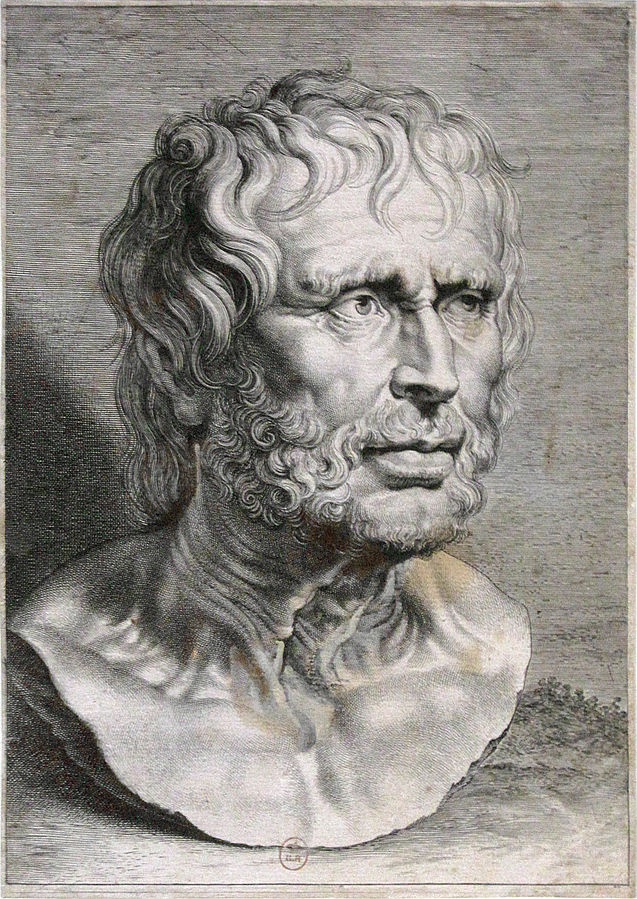
portrait-of-seneca-after-the-antique-the-pseudo-seneca-by-lucas-vorsterman-public-domain-via-wikimedia-commonsThis is the 12th letter to Lucilius, in the translation by Richard Mott Gummere published in the Delphi Classics edition of Seneca’s Complete Works, and it deals with an issue that an increasing number of people in the first world of today have to deal with: old age.

Seneca begins by recalling a recent visit to one of his country houses, during which he complained to one of his employees that too much money was being spent to keep it up. But his bailiff protested that the house was getting old, and the repairs were therefore entirely warranted. So Seneca writes to Lucilius: “And this was the house which grew under my own hands! What has the future in store for me, if stones of my own age are already crumbling?” (XII.1)

He then argues that there is much to be cherished in that stage of his life that the bailiff’s unchallengeable argument suddenly made him appreciate:

“Let us cherish and love old age; for it is full of pleasure if one knows how to use it. Fruits are most welcome when almost over; youth is most charming at its close; the last drink delights the toper, the glass which souses him and puts the finishing touch on his drunkenness. Each pleasure reserves to the end the greatest delights which it contains. Life is most delightful when it is on the downward slope, but has not yet reached the abrupt decline.” (XII, 4-5)

Notice the awareness of a coming “abrupt decline,” which Seneca is not foolish enough to argue will make for an enjoyable part of his life, should he live long enough (as it turns out, he didn’t). While not expressly mentioned here, this was the reason why the Stoics — including both Seneca and Epictetus, not to mention Zeno — thought that the wise man should make an exit, take “the open door,” as Epictetus memorably put it, when the appropriate time had come, no a moment sooner, but also not a moment later.

So what should be the wise person’s attitude toward old age? Seneca puts it very vividly to Lucilius:

“Let us go to our sleep with joy and gladness; let us say: I have lived; the course which Fortune set for me is finished. And if God is pleased to add another day, we should welcome it with glad hearts. That man is happiest, and is secure in his own possession of himself, who can await the morrow without apprehension. When a man has said: ‘I have lived!’, every morning he arises he receives a bonus.” (XII.9)

I am often struck by Seneca’s language, and this is one of many instances. “I have lived!, every morning I arise I receive a bonus.” Indeed.

As he frequently does in the early letters, Seneca parts from his friend with a “gift,” a meaningful quotation from another author, which in this case is: “It is wrong to live under constraint; but no man is constrained to live under constraint” (XII.10), another, more direct, reference to suicide to be chosen under certain circumstances.

The twist is that the above saying is from none other than Epicurus, the chief rival of the Stoic school at the time. Seneca, then, imagines Lucilius protesting: “‘Epicurus,’ you reply, ‘uttered these words; what are you doing with another’s property?’ Any truth, I maintain, is my own property.” (XII.11)

Again, a beautiful turn of phrase, and an example of real wisdom: it doesn’t matter where the truth comes from, once discovered, it is our collective property.

~ This piece was originally published at How to Be a Stoic on September 15, 2016

~ Massimo Pigliucci is K.D. Irani Professor of Philosophy at the City University of New York and member of the faculty at CUNY’s Graduate Center. Massimo has a background in evolutionary biology and philosophy of science. His most recent book, co-edited with Maarten Boudry, is Philosophy of Pseudoscience: Reconsidering the Demarcation Problem (Chicago Press).

~ Ordinary Philosophy and its Traveling Philosophy / History of Ideas series is a labor of love and is ad-free, entirely supported by patrons and readers like you. Please offer your support today!

Interview with Leigh Fought on Anna and Frederick Douglass

In my research and fact-checking for the final installment of my travel series following the life and ideas of Frederick Douglass, I stumbled on this recommendation on John Muller’s blog again. Thank you for this, John, and I’ve relied heavily on your work for my D.C. travels, I couldn’t have done it as enjoyably and as thoroughly without you!

jmullerwashingtonsyndicate's avatarFrederick Douglass in Washington, D.C.: The Lion of Anacostia

Anna Murray DouglassIf you haven’t reviewed the Douglass travel writing at “Ordinary Philosophy,” you should!

In the meantime, check out an interview with Prof. Leigh Fought here!

View original post

New Podcast Episode: Compassion, Emptiness, and the Heart Sutra, by Ryan V. Stewart

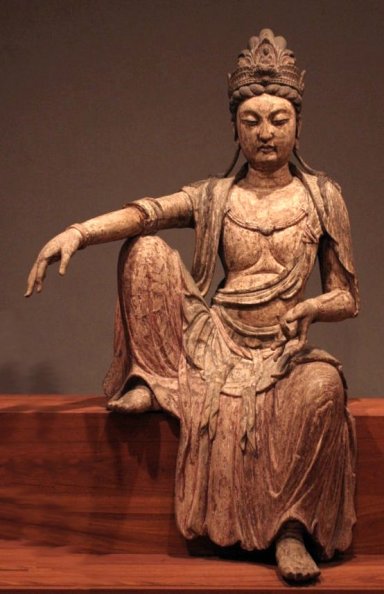
d1185-guanyin252c2bthe2bchinese2bexpression2bof2bavalokiteshvara252c2bnorthern2bsung2bdynasty252c2bchina252c2bc-2b1025252c2bwood252c2bhonolulu2bacademy2bof2barts252c2bpublic2b1Listen to this podcast episode here or on Google Play, or subscribe on iTunes

One of the chief concerns of philosophy, since time immemorial, has been to properly address the question, “How do I live?” Namely, “How do I live well?” Naturally—for as long as our species has had the wherewithal to question its purpose and condition, the problem of ethics has found itself at the frontiers of human thought. Many moral philosophies have since rushed into that wide gulf between knowledge and truth, systems of understanding and action which attempt to conquer our ethical indecisiveness and color in a void where so much uncertainty exists.

Many traditions prescribe the ideal, virtuous, or noble life. From the ancient, academic, or political—e.g. Epicureanism, utilitarianism, humanism, or libertarianism—to the more mystical or overtly religious—e.g. Jainism, Christianity, or Taoism—many are concerned with how one acts (or can act), or at least how one views oneself in relation to others and to the world at large…. Read the original essay here

Ordinary Philosophy and its Traveling Philosophy / History of Ideas series is a labor of love and ad-free, entirely supported by patrons and readers like you. Please offer your support today!

O.P. Recommends: Texas Picked an Ominous Date to Arm Its Public Colleges, by Rosa A. Eberly

Charles Whitman's rifles and sawed-off shotgun used in University of Texas massacre of 8-1-1966, image free use under CCA 3.0As you may know, dear reader, I’ve long expressed deep concerns over my country’s obsession with guns, over the widespread conviction that guns are the solution to many problems that the proliferation of guns, in fact, manifestly worsens. We’re so awash in guns, culturally and historically, that we take them for granted and forget that there are other possible ways to live. Even the fact that high rates of gun ownership rarely correlate now or throughout history with relatively low rates of gun deaths, be it by state or country, doesn’t seem to matter. Our culturally-induced intuition that bad guys with guns will behave themselves out of fear of good guys with guns seems to render the preponderance of available evidence irrelevant, time after time after bloody time. There’s a particularly telling illustration of this going on right now, as Rosa Eberly writes in her recent piece for The Chronicle of Higher Education:

‘In what appears to be an audacious act of public forgetting, a controversial Texas campus-carry law allowing concealed guns in university buildings is scheduled to take effect on Monday, August 1, the 50th anniversary of the University of Texas tower shootings.

The first mass murder on a U.S. college campus, the tower shootings left 14 people dead, plus the gunman, and more than 30 wounded. As in other more recent examples of mass gun violence, the shooter first used deadly force in a domestic setting — he killed his wife and mother before ascending the tower with an arsenal…’

I dearly hope the students that don’t suffer the possible worst consequences of this very dangerous social experiment. But the evidence of history gives us very good reasons to worry that they will.

Ordinary Philosophy and its Traveling Philosophy / History of Ideas series is a labor of love and ad-free, supported by patrons and readers like you. Please offer your support today!

Does Death Rob Our Lives of Meaning? by Richard Pettigrew

Headstones in Gettysburg National Cemetery 2 (cropped), photo 2016 Amy CoolsIn the previous post, we met the argument with which Epicurus hoped to cure our fear of death and, with that, our fear of everything else. But we found it wanting. Epicurus assumed that only that which can harm you may be feared; and only that which causes pain can harm you. But we saw that both of these assumptions are false. Along the way, we met one specific reason to fear our death, namely, its effect on those we love. But I suggested that, while this might justify certain responses to the fact of our own mortality, it does not seem to support the sort of response that people often report – the halting existential terror felt in the pit of the stomach. This sort of response, it seems, comes from somewhere else. In this post, we consider a conjecture as to its source: I fear death, you might think, because the fact that I will die robs the things I do in my life of their meaning or their value or their worth. This, if it were true, would justify the feeling of vertigo and emptiness that comes when we reflect that we will die. To remind ourselves that all we have done is meaningless is to have the basis for all we do pulled out from under us.

As so often, Bill Watterson’s six-year old philosopher, Calvin, has been here before us. In the first pane of one comic strip, Calvin is at his school-desk: “Miss Wormwood, I have a question about this math class”; “Yes?”; “Given that sooner or later, we’re all just going to die, what’s the point of learning about integers?” Calvin’s thought seems to be based on an assumption that many of us make about what makes it worthwhile to do the things that we do in our lives. We assume that an activity can only get meaning or value by contributing to some larger goal that we pursue. Death, then, robs our lives of meaning or value by interrupting our ultimate over-arching goals before they can be fully achieved.

But this is based on a mistaken view of how things get their meaning or their value or their worth. Of course, some things get their meaning from how they contribute to some larger project (the philosopher Kieran Setiya calls these ‘telic activities’). I sharpen my pencil in order to draft this blog; and if I don’t finish the blog, the pencil sharpening becomes devoid of worth – doing it will have added no value to my life. I make a birthday card for a friend in order to make her laugh; if I drop it down a drain on my way to her party, there was no value in the making of it. But other things I undertake not because they contribute to a larger project – or not only for that reason – but because I value them as they are; they are, for me, sources of value in themselves (Setiya calls these ‘atelic activities’). For example, this blog might be part of a larger project I have to think through the effect on our lives of knowing of our own mortality. But I don’t value writing it only for its contribution to that goal. The process of thinking through these questions is itself something of value for me; something that gives my life meaning in and of itself. I might listen to my friend’s woes as part of a larger project of supporting her and living my life as connected to some extent to hers; but I value each particular part of that project, each evening talking to her, and not just because of their contribution to the whole; they are ends in themselves. What’s more, as philosopher Frances Kamm points out, much of what gives value to our lives is not any activity, such as thinking through a philosophical issue or connecting my life to that of my friend, but a way of being, such as being wise or being virtuous; and these ways of being are complete in themselves whenever you have them. The value that being wise or being virtuous add to your life does not increase the longer you live, though of course the longer you live, the more chance you have of achieving them.

In another comic strip, Calvin is sitting with his friend Hobbes, the tiger, under a tree. He turns to Hobbes: “I don’t understand this business about death. If we’re all going to die, what’s the point of living?” After a moment, Hobbes replies: “Well, there’s seafood.” And he’s right. Much of what we do in life – spending time with friends or family, taking in the beauty of the natural world, writing, reading, campaigning, or eating seafood – we value for its own sake. We don’t value it because of its contribution to some larger project that is curtailed by our death, thereby robbing our actions and lives that contain them of meaning. So, this aspect of death – that it truncates some of our projects, and frustrates some of our goals – gives us cause for sadness, perhaps, or disappointment or regret; but not fear, and not halting existential terror in the pit of our stomach. After all, there’s seafood.

~ Richard Pettigrew is Professor of Philosophy at the University of Bristol. He completed his PhD in mathematical logic in 2008. Since then, he has worked in logic, philosophy of mathematics, the epistemology of uncertainty, and the theory of rational choice. (Bio credit: OUPblog)

~ This piece was originally published at OUPblog

Ordinary Philosophy and its Traveling Philosophy / History of Ideas series is a labor of love and ad-free, supported by patrons and readers like you. Please offer your support today!
Our Present and The Past, by Ben Alpers

Millenium Clock, National Museum of Scotland, Edinburgh, 2014 by Amy Cools

Millennium Clock, National Museum of Scotland, Edinburgh

At times of great political upheaval, people suddenly start paying attention to history, grasping to find past events that might provide a kind of road map for what the world is going through in the present. The last several months and weeks feel extraordinary in so many ways. The steady stream of mass killings around the world, many of which are connected to ISIS. The nomination of Donald Trump, whose candidacy is clearly unusual and seems to many unusually disturbing. Norbert Hofer of Austria’s Freedom Party nearly becoming the first candidate of the far right to win a western European presidency since World War II … and getting a second bite at the apple when the election results get thrown out. The Brexit vote and the apparent meltdown of UK politics. Cops caught on video killing African Americans in this country with seemingly little cause. The shooting of five cops in Dallas. And today an attempted military coup in Turkey. On and on it goes.

1968 seems to have emerged in recent months as the go-to historical analogy for our current global political upheavals. In the spring, it was often raised by Democrats made nervous by the Bernie Sanders candidacy who wondered if this year’s convention in Philadelphia might fall apart like their party’s 1968 convention in Chicago did. Donald Trump, too, brought back memories of 1968, though more of third-party candidate George Wallace than of Republican Richard Nixon.

As things seem to have fallen apart around the world, the ’68 analogy has been extended beyond the presidential race itself, though most Americans who lived through that year remember it as much worse. “What’s happening now is terrible. 1968 incomparably worse: RFK & MLK assass, 17k US deaths VN, LBJ steps down etc,” tweeted James Fallows last week.

Over the weekend, Vox published an interview with the journalist Michael Cohen, who wrote a recent book on America in 1968. Acknowledging that the political unrest we’re experiencing leads to the analogy, Cohen, like most others who have tackled the question in recent weeks, thinks that 1968 was much worse, both because it was significantly more violent and because we have made so much social progress since then.
But what fascinates me about this whole debate is that it misses half of what 1968 was about. 1968 is such a painful memory because it was a year of dashed hopes. Johnson’s stepping down was a triumph for the anti-war movement. Martin Luther King, Jr. began the year planning a Poor People’s March that would broaden the scope of his movement. RFK emerged as a candidate who seemed potentially capable of bringing America together and end the war in Vietnam. Of course none of these things worked out.

1968 was a year of dashed hopes around the world, as well, The Prague Spring in Czechoslovakia. Student movements in France and Mexico. The sense of political defeat that set in by the end of the year was so strong precisely because the hopes had been so high.

For 1968 to stand only for things falling apart, for political promises unfulfilled, is something that could really only entirely emerge in hindsight. And there’s nothing particularly unusual about this. In fact, that’s why we do history. In the middle of a string of events, one simply doesn’t know how things are going to turn out.

And that’s very much the case for our experience of 2016. So far at least, if the political violence and despair, at least in the U.S., seem less acute this year than they did then, so too do the hopes for change. But we really don’t know, can’t know, how 2016 will turn out, let alone how we will remember it. There is an odd comfort in reaching for analogies, even when those analogies are very negative. If 2016 is 1968 redux, if Trump’s movement is fascism, then at least we know what we’re dealing with. But history never really repeats itself. We can certainly learn from the past. But this year, however it turns out, will end up being something new.

Ben Alpers is Reach for Excellence Associate Professor in the University of Oklahoma’s Honors College, whose faculty he joined in 1998. His primary teaching and research interests concern twentieth-century American intellectual and cultural history, with special interests in political culture and film history. Among the courses he offers in the Honors College are colloquia on World War II in history and memory and film noir, and Perspectives courses on American social thought and politics and culture in the Great Depression. Alpers is also affiliated with the History Department and the Film and Media Studies Program. He is the author of Dictators, Democracy, and American Public Culture: Envisioning the Totalitarian Enemy, 1920s-1950s (UNC Press, 2002) (Bio credit S-USIH.org)

~ This piece was originally published on July 15, 2016 at U.S. Intellectual History Blog

Ordinary Philosophy and its Traveling Philosophy / History of Ideas series is a labor of love and ad-free, entirely supported by patrons and readers like you. Please offer your support today!

Philosophie Sans Frontières, by Graham Priest

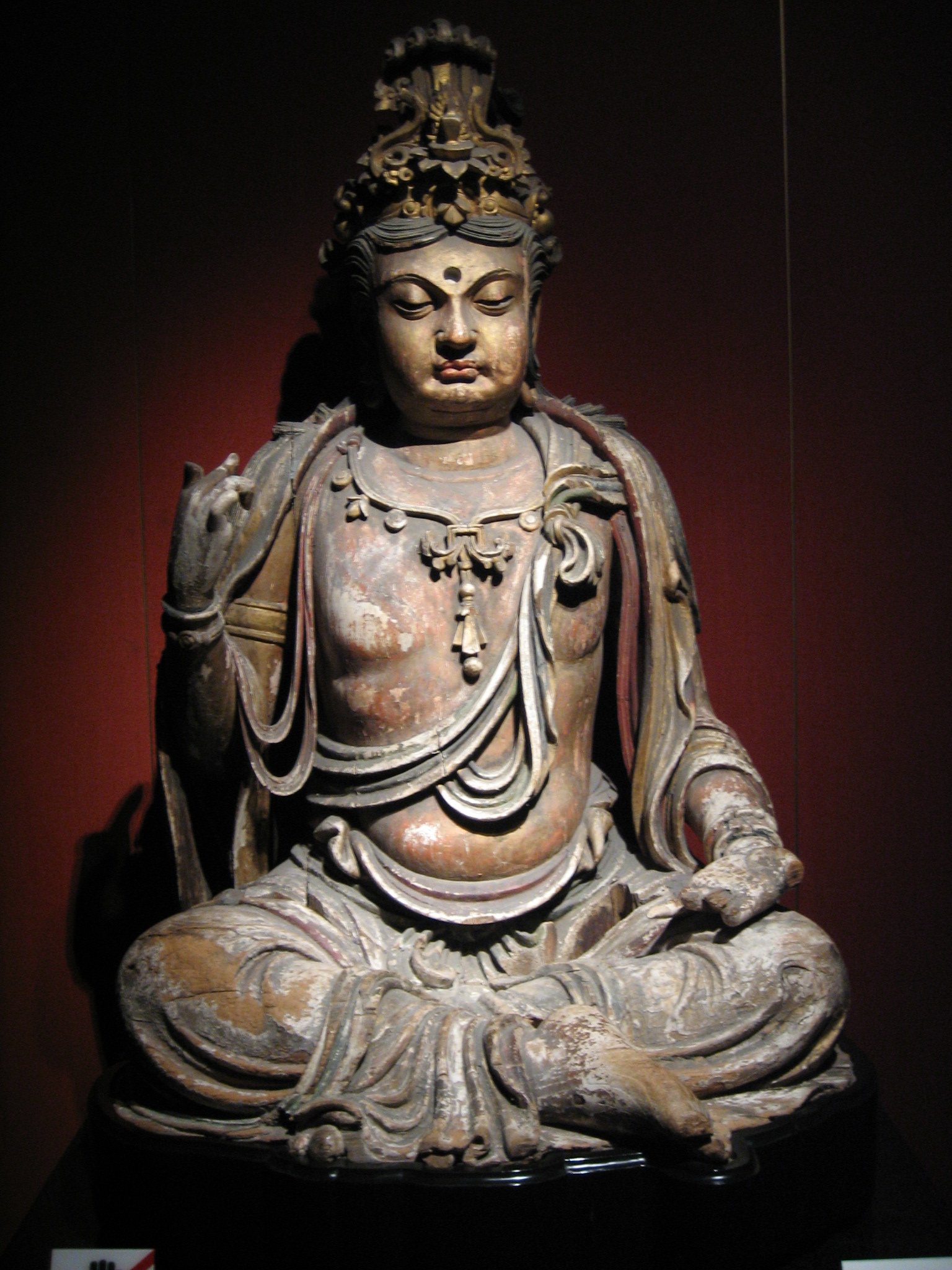
Wood Bodhisattva, Jin Dynasty (1115-1234 AD), by Mountain at Shanghai Museum, CC BY-SA 3.0 US via Wikimedia Commons“East is East and West is West, and ne’er the twain shall meet.”

Well, no. Kipling got it wrong.

The East and the West have been meeting for a long time. For most of the last few hundred years, the traffic has been mainly one way. The West has had a major impact on the East. India felt the full force of British imperialism with the British East India Company and the British Raj. Japan fell in love with German culture — especially military culture — after the Meiji restoration. The French colonization of Vietnam drew it inexorably into the Vietnam War.

In the last 40 years, however, a lot of the trade has been going the other way. The post-war developments in Japanese electronics and motorbikes came to dominate the West. Many global IT developments — not to mention call-centers — are now firmly based in India. And it is impossible for Westerners to miss all the garments now bearing the label “Made in China.”

Economy moves at the speed of money. Philosophy moves at the speed of ideas, which is somewhat slower. But the story is similar. In the last 150 years, Western philosophy has made a major impact on the East. The British Raj brought German Idealism — or at least the British take on it — to 19th and early 20th century Indian philosophy. The Japanese Kyoto school absorbed influences from Bergson, James, and — above all — Heidegger. And the influence of Marx on Chinese thinkers hardly needs emphasis.

The influence in the reverse direction is still nascent, but it is now gathering pace. As little as 30 years ago, there was hardly a course on an Eastern philosophical tradition in any Western philosophy department. In fact, it was common to hear Western philosophers claim that the Eastern traditions were merely religion, mysticism, or simply oracular pronouncements. That view was held by philosophers who had never taken the trouble to engage with any of the texts. Had they read them, with care, they would have realized that the philosophy behind them is clear, once one has learned to see beyond the cultural and stylistic differences.

Now, however, many good Western philosophy departments teach at least one course on some Eastern philosophical traditions (at least in the English-speaking world). Good translations of Asian texts are being made by Western philosophers with the appropriate linguistic skills (in the past, translation was firmly in the domain of philologists and scholars of religion). Articles which draw on Eastern ideas are starting to appear in Western philosophy journals. PhD theses are being written comparing Confucius and Aristotle, Buddhist ethics and Stoic ethics, Nyāya and contemporary metaphysical categories. Introductory text books are appearing.

There is still a long way to go until the institution of Western philosophy understands that it is just that — Western philosophy. But at least the movement is under way, though it will certainly take time to overcome the current marginalization of the other half.

What will happen to Western philosophy when full realization sets in? Of course, if we knew what philosophy was going to emerge, it would already have done so. And predictions in this area are worth little. However, I will venture a theory.

We are in the situation that arises when different cultures meet. This has happened before in philosophy. It happened when Greek philosophy met the ideas of the Jewish break-away sect based on the life and death of Yeshua Bar-Yosef. The result was the remarkable development of Christian philosophy. It happened when the ideas of Indian Buddhism came to infuse Chinese thought in the early years of the Common Era. The result was the remarkably distinctive forms of Chinese Buddhisms, such as Chan (Zen). It happened when the new scientific culture which developed in Europe around the Scientific Revolution impacted late Medieval Philosophy, to give us the wealth of Modern Philosophy. I predict that we will witness a similar progressive moment in the present context.

Why do these meetings of culture deliver such progress? It is hard to answer this question without talking about what progress in philosophy amounts to. I can only gesture at an answer here. Progress in philosophy is not like progress in science — whatever that is: as philosophers of science know, this is not an easy question either. One way to see this is to note that philosophers still read Plato, Augustine, Hume. No scientist, qua scientist, reads Newton, Darwin, or even Einstein. Nor is this because the philosophers are simply doing the history of philosophy. They read because the texts contain ideas from which one can still learn.

Cynics might say that what this shows is that there is no progress in philosophy. I demur. Progress in philosophy certainly arises when we become aware of new problems and new arguments. But old problems of importance rarely go away. Yet even here there is still progress in the depth of our understanding. We see new ways to articulate ideas, new aspects of problems, new possible solutions to them.

Now, there are at least two reasons why the impact of a new culture promotes such progress. First, it is a truism that the best way to understand your native tongue is to learn another; and the best way to understand your culture is to become familiar with a radically different one. The contrast throws into prominence things so obvious as to have been invisible. So it is in philosophy. And when these assumptions become visible, they can be scrutinized in the cold hard light of day, to expose any shortcomings.

Secondly, there is genuine innovation in philosophy, but it does not arise ex nihilo. Philosophers draw on their philosophical background for ideas, problems, solutions. The more they have to draw on, the greater the scope for creation and innovation. In the same way, when good Western chefs learn about Eastern cuisine (ingredients, preparations, dishes), they do not simply reproduce them — though of course they can do this, and they do. The most creative draw on the Eastern and Western traditions is to produce entirely new dishes. Call this “fusion cuisine” if you like, but the name is not a great one, since what emerges is not simply merging two cuisines, but creating genuinely novel fare. So it is with philosophy. An understanding of Eastern traditions, when added to an understanding of Western traditions will allow creative philosophers to come up with philosophical ideas, questions, problems, which we cannot, as yet, even imagine.

Over the last couple of decades, it has been my privilege — and that of a small band of other Western-trained philosophers — to help bring the Asian philosophical traditions to the awareness of Western philosophers. For all of us, I think it is true to say, our own philosophical thinking has been enriched by an understanding of Eastern philosophical traditions. If we can enrich the thinking of our Western philosophical colleagues in the same way, our time will have been well spent.

Graham Priest is Distinguished Professor of Philosophy at the Graduate Center, City University of New York, and Boyce Gibson Professor Emeritus at the University of Melbourne. (Bio credit: OUPblog)

~ This piece was originally published at OUPblog

Ordinary Philosophy and its Traveling Philosophy / History of Ideas series is a labor of love and ad-free, entirely supported by patrons and readers like you. Please offer your support today!

History, Philosophy, and Political Hope, by Richard Eldridge

US Capitol Building under repair, Washington DC, photo 2016 by Amy CoolsPolitics in general is all about how to develop, sustain, and revise institutions, practices, and policies that bind individuals together productively and that point toward more fulfilling individual and joint futures for them. Debates about how best to do this are natural. Should the US become yet more aggressively libertarian-individualist, or should a substantial social compact that enforces terms of fair cooperation via significant redistribution be instituted? Should the UK embrace European social democratic values and relations, or should it stand on its Anglo-Saxon distinctiveness?
These important questions are increasingly addressed, however, in the absence of significant, articulate knowledge of political ideals that historically have informed political life. As a result, debates about these questions are typically shriller and less productive than they could and should be. Various forms of nativism and populism supplant more considered deliberations, for good enough reasons, as individuals and subpopulations come to be and to feel disenfranchised from political and economic business-as-usual. In a 15 May 2016 New York Times opinion piece, the economic historian Michael Lind reports that “A 2016 Presidential Election Survey by the RAND Corporation revealed that the single factor that best predicted voter support for Donald Trump among likely Republican voters was not income, education, race, gender or attitudes toward Muslim or illegal immigration, but agreement with the statement ‘people like me don’t have any say.’” Globalization and the degradations of the powerful are increasing political and economic disenfranchisement throughout the industrialized world. Disenchantment then produces anger, for good reasons. Presciently, and echoing Plato’s criticisms of democracy (though not his proposals to abolish it), the philosopher Richard Rorty suggested in 1997 in Achieving Our Country that

members of labor unions, and unorganized unskilled workers, will sooner or later realize that their government is not even trying to prevent wages from sinking or to prevent jobs from being exported. Around the same time, they will realize that suburban white-collar workers–themselves desperately afraid of being downsized–are not going to let themselves be taxed to provide social benefits for anyone else.

At that point, something will crack. The non-suburban electorate will decide that the system has failed and start looking around for a strongman to vote for–someone willing to assure them that once he is elected, the smug bureaucrats, tricky lawyers, overpaid bond salesmen, and postmodernist professors will no longer be calling the shots…

One thing that is very likely to happen is that the gains made in the past forty years by black and brown Americans, and by homosexuals, will be wiped out. Jocular contempt for women will come back into fashion…All the resentment which badly educated Americans feel about having their manners dictated to them by college graduates will find an outlet.

The demand for an outlet for resentment and anger is being exploited by so-called anti-system politicians and parties, including Trump and Sanders in the US, Marie LePen in France, Nigel Farage in the UK, Beppo Grillo in Italy, and the Syriza Party in Greece. Whether from the left or the right, the watchword is “tear it down,” not “build it up.”

One way to begin to reverse these developments and to enrich political debates is to consider detailed accounts of political-ideals-as-lived that have been articulated and argued for by major philosophers who are sensitive to the values all at once of individualism, responsibility, political equality, economic security, rich joint meaningful life, and ongoing critical thought, as commitments to these values have been lived out against the backgrounds of religious and philosophical traditions. Immanuel Kant and Walter Benjamin are two thinkers of exactly this kind. Each of them eloquently asked and answered the question, “What may we hope for?,” and each of them answered it by taking seriously both political ideals and available historical possibilities that might be seized. Working through their partly complementary, partly opposed ideas about the historical achievement of value within joint political life might help us to develop richer images of political maturity and help us toward more productive public political debate. As Michael Lind concluded his essay, “If we want to avert the sense of powerlessness among voters that fuels demagogy, the answer is not less democracy…, but more.” Reading Kant and Benjamin together and subjecting their accounts to reflective comparison and criticism can help us to cultivate a more genuine, informed, reflective democracy and, thus, to give life and depth to political hope.

~ Originally published at OUP Blog: Oxford University Press’s Academic Insights for the Thinking World, on June 26th, 2016

~ Richard Eldridge is Charles and Harriett Cox McDowell Professor of Philosophy at Swarthmore College. He has held visiting appointments at Essex, Stanford, Bremen, Erfurt, Freiburg, Brooklyn, and Sydney. He is the author of 5 books and over 100 articles in aesthetics, philosophy of language, philosophy of literature, and Romanticism and Idealism. He has edited 4 volumes, including The Oxford Handbook of Philosophy and Literature, and he is the Series Editor of Oxford Studies in Philosophy and Literature. (Bio credit: OUP Blog)

Ordinary Philosophy and its Traveling Philosophy / History of Ideas series is a labor of love and ad-free, supported by patrons and readers like you. Please offer your support today!

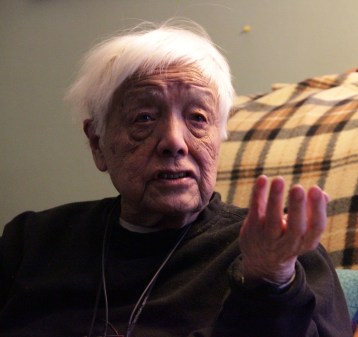
Happy Birthday, Grace Lee Boggs! Bio and Book Review by Ashley Farmer

Grace Lee Boggs, By Kyle McDonaldm creativecommons.orglicensesby2.0, via Wikimedia Commons, cropped“The Power And Importance Of Ideas:” Grace Lee Boggs’s Revolutionary Vision”

In the opening lines of her autobiography, Living for Change, Grace Lee Boggs remarked: “Had I not been born female and Chinese American, I would not have realized from early on that fundamental changes were necessary in our society.”[1] A daughter of Chinese immigrants born in 1915, who, by her account, became a philosopher in her 20s and an activist in her 30s, Boggs remains one of the greatest radical theorists of the twentieth century.

Born in Rhode Island, Boggs spent her childhood in New York City, working in the two restaurants her father owned in Times Square. At the age of 16, she left home to attend Barnard College, and afterward, Bryn Mawr, where she earned a PhD in Philosophy in 1940. Philosophers like Hegel helped her “see [her] own struggle for meaning as part of the continuing struggle of the individual to become part of the universal struggle for Freedom.”[2] Boggs moved to Chicago in 1940. She began working with the South Side Tenants Organization set up by the Workers Party, a Trotskyist group that had split off from the Socialist Workers Party. Her time in the Windy City proved transformative. For the first time she was talking and working with the black community, getting a first-hand sense of what it meant to live within the confines of segregation and discrimination, and learning how to participate in grassroots organizing.[3]

It was also during her tenure with the Workers Party that she met Caribbean radical C.L.R. James, and began a “theoretical and practical collaboration that would last twenty years.”[4] As part of a small wing of the workers Party led by James and Raya Dunayevskaya, Boggs became a leading theoretician, co-authoring texts like State Capitalism and World Revolution (1950). Through James, she came into contact with a number of black writers and activists who expanded her perspective. She relocated to Detroit in 1953, where she would organize with, and marry, James (Jimmy) Boggs.

During the 1950s, Boggs, “mainly listened and learned” to the black activists around her in an effort to better understand the black condition. It would take several years before she decided that she had been “living in the black community long enough to play an active role in the Black Power Movement that was emerging organically in a Detroit where blacks were becoming the majority.”[5] Living and working in what was considered to be an epicenter of black radicalism, Boggs engaged in a combination of theorizing and protesting, authoring texts with James Boggs, meeting and organizing with Malcolm X, and mentoring young radicals like Muhammad Ahmad (Max Stanford), leader of the Revolutionary Action Movement (RAM).

Her liberation theory was grounded in her study of philosophy and honed through her experiences organizing with and for black communities. It was also constantly evolving. Boggs emphasized dialectical thinking, arguing that reality is ever changing and that we must “constantly be aware of the new and more challenging contradictions that drive change.”[6] This reciprocal process drove her expansive vision of revolution. In her final book, The Next American Revolution, she explained her latest concept of revolution:

The next American Revolution, at this stage in our history, is not principally about jobs or health insurance or making it possible for more people to realize the American Dream of upward mobility. It is about acknowledging that we as Americans have enjoyed middle-class comforts at the expense of other peoples all over the world. It is about living the kind of lives that will not only slow down global warming but also end the galloping inequality both inside this country and between the Global North and Global South. It is about creating a new American Dream whose goal is a higher Humanity instead of the higher standard of living dependent on Empire.[7]

Boggs consistently offered a holistic vision of revolution and concrete steps through which to build it. She argued that achieving this goal meant more than organizing or mobilizing to petition the state or “changing the color of political power,” but rather growing food, reinventing education, developing Peace Zones in local neighborhoods, and creating restorative justice programs. She saw the seeds of revolution everywhere and showed us how, by practicing dialectical thinking, breaking down divides and categories, and building on rather than replicating older political models, we might “grow our souls.” She mirrored this in her own life, constantly “combining activity and reflection.”[8] Her willingness to do the work, her ability to listen and learn from black activists, her commitment to living in the communities in which she organized, and her openness to revising her politics, and values, made her an effective life-long ally of the black community and theoretician of liberation and revolution.

As she noted, often, “in the excitement of an emerging movement, we tend to want to be part of the action, and we underestimate the power and importance of the ideas in our heads and hearts.”[9] Upon her death, it’s important to revisit the ideas in her head. She left us a roadmap for revolution through ideas and action, one that anyone could be a part of if they were clear about the stakes of the transformation and that fundamental change is necessary.

~ Ashley Farmer is an historian of African-American women’s history. Her research interests include women’s history, gender history, radical politics, intellectual history, and black feminism. She earned a BA in French from Spelman College, an MA in History from Harvard University, and a PhD in African American Studies from Harvard University. She is currently a Provost Postdoctoral Fellow in the History Department at Duke University. In August 2016, she will be an Assistant Professor in the Department of History and the African American Studies Program at Boston University. This bio and more about Ms. Farmer are to be found at her personal website

~ Originally published at the African American Intellectual History Society blog, republished under the Creative Commons license

Ordinary Philosophy and its Traveling Philosophy / History of Ideas series is a labor of love and ad-free, entirely supported by patrons and readers like you. Please offer your support today!

~~~~~~~~~~~~~~~~~~~~~~~~~~~~~~~~~~~~~~

[1] Grace Lee Boggs, Living for Change: An Autobiography (Minneapolis: University of Minnesota Press, 1998), xi.

[2] Ibid., 30-31.

[3] Ibid., 36.

[4] Ibid., 43. James and Boggs “went their separate ways in 1962.”

[5] Grace Lee Boggs with Scott Kurashige, The Next American Revolution: Sustainable Activism for the Twenty-first Century (Berkeley: University of California Press, 2011), 66.

[6] Ibid., 62.

[7] Ibid., 72.

[8] Ibid., 164.

[9] Ibid., 80.