Colorful Language

I love slang, and I love cussin’.

But why, you might ask? Why love that which is rude, crude, and lewd?

I hear people complain a lot these days that ‘four-letter’ words and slang are taking over our language. Since the social revolutions of the 20th century, language has become much more casual, more free and easy, less mannered. By the latter, I’m not talking about manners as they relate to courtesy. I’m talking about rules of conversational etiquette that are often arbitrary. Most of these conventions are useful, as they help organize language and assign definitions so that people can readily make themselves understood to one another. But many other conventions seem contrived, imposed by a social elite to lend a patrician air of refinement to the speaker. Sometimes, it works to their advantage: after all, who isn’t impressed when hearing public intellectual Bertrand Russell wax eloquent on current events, the value of philosophy, and the horror of war in his rather delightful, oh-so-aristocratic style? But while this kind of etiquette can lend a certain pleasing elegance to language, it can give it a stiff, stilted, artificial, and to our modern ears, oddly quaint quality. And too much insistence on ‘correctness’ in speech can render a language dead, in the sense that it’s frozen in time, unable to evolve to express new ideas and ever more shades of meaning.

Those who are especially offended by the increasing use of slang and cuss words consider it a sign that we’re becoming lazier, ruder, more selfish, more aggressive, less respectful of one another. These ‘bad’ words, they complain, are proliferating ever more on the internet, in popular music, on TV, and in movies, infiltrating our kids’ vocabulary at an ever younger age, and worst of all, dumbing down our language.

I agree with these objections to a certain extent. People can be rude, selfish, aggressive, disrespectful, and hateful, and express these attitudes through the use of slang and cuss words. But they can and do express all of these with formal, more ‘acceptable’ language as well. Euphemisms, double-speak, and coded language are all classic examples of ways in which we insult, denigrate, and undermine one another while avoiding the use of lowbrow or taboo terms.

Yet I would argue that many types of ‘polite’ speech, such as euphemisms, double-speak, and coded language, can be much more offensive and harmful because they’re less direct and therefore, less honest. The speaker who chooses these indirect methods of expressing offensive ideas are often attempting to evade responsibility for them, giving themselves an ‘out’ they don’t deserve. These sorts of ‘weasel words’, easy to recognize with the uncanny ability most people have at recognizing and understanding innuendo, are so conveniently slippery that they’re a common tool of the self-righteous jerk, the racist, the sexist, and the elitist. The speaker who uses what are generally considered overtly offensive terms, on the other hand, render themselves accountable for what they say by expressing what they think in a way that’s readily understood and open to critique.

So it’s not slang or cussing that should give true offense in these cases, it’s the intent of the speaker and the content of the speech.

I also grant that people can be lazy and dumb down their language with slang and cuss words because they haven’t bothered to educate themselves, because they want to avoid saying anything challenging or of substance, and because they want to pander to the listener. But like the aforementioned forms of ‘polite’ offensive speech, this is true of other forms of speech as well. ‘Folksy’-speak (Sarah Palin is a famous example, and sadly, she has influenced too many of our politicians to pander ever more to the ‘folks’ in that way); psychobabble; obscurantist academic language; politically-correct speech; scrupulously ‘polite’ speech, and so on, can all be to obscure the fact that the speaker has little of substance they’re willing or able to say.

But those who pick on slang and cuss words generally are just plain wrong: they don’t always dumb down language. In fact, they often have rich and nuanced shades of meaning that polite language lacks, and can lend force, humor, and nuance to language. George Carlin’s immortal ‘Seven Words You Can’t Say on Television’ comedy routine is not only incredibly funny, it highlights the arbitrariness of so many of our language prohibitions, and how taboo words so often convey meaning that polite language can’t.

That’s why we have positive terms to refer to such language: strong, explicit, and colorful. And these terms point to the reasons why I love them.

As a fan of slang and cuss words when used right (no, you pedant, not ‘rightly’), I give the metaphorical finger right along with Carlin when I hear people complain about ‘bad’ language without bothering to understand and address the content behind the words. I suspect that most people who single out strong, explicit, and colorful language for criticism are mostly unfamiliar with the terms used, only enough to identify them as taboo. They assume that because these terms are sometimes used out of simple ignorance, crudeness, anger, or cheap desire to offend, they’re always used these ways. It seems, then, that the complaints often result form a simple lack of understanding. As restless and rebellious youth so often say of their parents, whose ability to understand is subject to the often self-imposed limits of their own experience, they just don’t get it.

Advocates for the exclusive use of polite language in public discourse usually claim that everything can be expressed in those terms, so long as a person possesses an excellent vocabulary. I’m here to tell you that just ain’t so. (My tiny little homage to Mark Twain, among the great innovators who introduced slang, colloquialisms, and other colorful language to great literature, as he illustrated better than anyone how the strictures of polite language so often hold us back.) Since slang and cuss words spring forth and evolve outside of the regulatory realm of polite language, the’re quick to fill in the gaps where there were no expressions for those exact ideas. For that reason, I submit, slang and cuss words are often much more nuanced and expressive than their much fewer yet more polite approximations.

This was brought home to me especially as I was reading (and commenting on) the the delightful Assholes: a Theory, and the many times I watched one of my favorite simultaneously very funny and informative documentariesF*ck. While you might immediately think ‘what a crude person that Amy is’, well, you’re partly right. Humor that is heavy on the use of strong, explicit, and colorful language tickles my funnybone like nothing else, but only if it’s simultaneously very witty. That’s because, for one thing, these terms reveal the wonderful nimbleness of language, when freed from its social constraints, to express just about anything our creative minds can come up with. It’s also because such terms generally concern themselves with the down-and-dirty (pun intended) realities of everyday human experience, for which laughter is the best cure, and humor the most accurate commentary. Strong, explicit, and colorful language chosen for nothing but its shock value, on the other hand, leaves me not only cold, but deeply annoyed, as it does nothing but justify the narrow stereotypes of the self-styled language police.
When it comes to strong colorful language, there’s a time and a place for everything. Formal language is great for the workplace, where strife needs to be avoided and the tasks readily made clear to everyone. Academic language can be great for academia, where highly technical, narrowly defined terms are needed to more efficiently discuss complex ideas. (Steven Pinker, however, very astutely points out that academic language has just as much of a tendency to become ever more obscure and confusing, even to other academics.) Likewise, jargon can be most suitable for professional conferences and talks, polite language most suitable for family and other gatherings of mixed age (since standards of politeness change over time), and so on.

But strong, explicit, and colorful language are also the best ways to express ourselves sometimes, and to avoid using them when they can best express what you’re trying to say is as foolish and self-defeating as refusing to use any tool that’s best for the job. Biting social commentary, humorous examinations of the human experience, expressions of just anger, getting to the bottom of how and why ‘douchebags’ and ‘assholes’ exemplify different ways of people failing to be decent… there are countless ways in which colorful language is the most excellent mode of expression. After all, ‘jerk’ or ‘louse’, while polite, are lame and far less nuanced terms to describe a person who behaves in such loathsome, or more accurately, ‘shitty’ ways as the douchebag and the asshole. From Chaucer to Shakespeare to Carlin, the discerning and true lover of language will recognize that polite terms often just don’t cut it when we need terms that will really help us get to the heart of the matter. Prissy fastidiousness or squeamishness about language can cause the listener to miss out on something interesting or important in what’s being said, and hamper the speaker in their efforts to express themselves as fully as they otherwise could.

So use language vigorously, creatively, and wittily, whatever form it takes, and it’s only proper to take offense at its use when the intent of the speaker, or the content of what they have to say, sucks.

– To Thomas Pyne, professor of philosophy at Sacramento State University, and his always fascinating and erudite lectures in Philosophy of Language, delightfully spiced with a little colorful language here and there

~~~~~~~~~~~~~~~~~~~~
Sources and inspiration:
Anderson, Steve. F**k, A Documentary, 2005 http://www.imdb.com/title/tt0486585/

Fry, Stephen. “Don’t Mind Your Language” Stephenfry.com
http://www.stephenfry.com/2008/11/04/dont-mind-your-language%E2%80%A6/

James, Aaron. Assholes, a Theory. First published Doubleday, NY 2012.
First Anchor Books Edition, Apr 2014. http://www.onassholes.com/Pinker, Steven. The Sense of Style: The Thinking Person’s Guide to Writing in the 21st Century. 2014, New York, NY: Penguin. http://stevenpinker.com/publications/sense-style-thinking-persons-guide

Thomas Paine on Basic Income, and Why Welfare is Compatible with an Individualist Theory of Human Rights

Thomas Paine, advocate of liberty par excellence, is an intellectual hero of all believers in democratic and accountable government. He’s also, especially, a hero of modern American conservatives and those of the libertarian persuasion.

But here’s a lesser known fact: he also argues in favor of what today we commonly call welfare.

Paine is, most famously, the author of Common Sense, The American Crisis, The Rights of Man, and The Age of Reason. These pamphlets are, in turn, an argument in favor of the American colonies’ cause for independence, a series of pamphlets of encouragement and calls for support for the struggling revolution, a rebuttal to Edmund Burke’s harsh critique of the French Revolution (and founding work of modern conservatism), and deist critique of Christianity and organized religion in general.

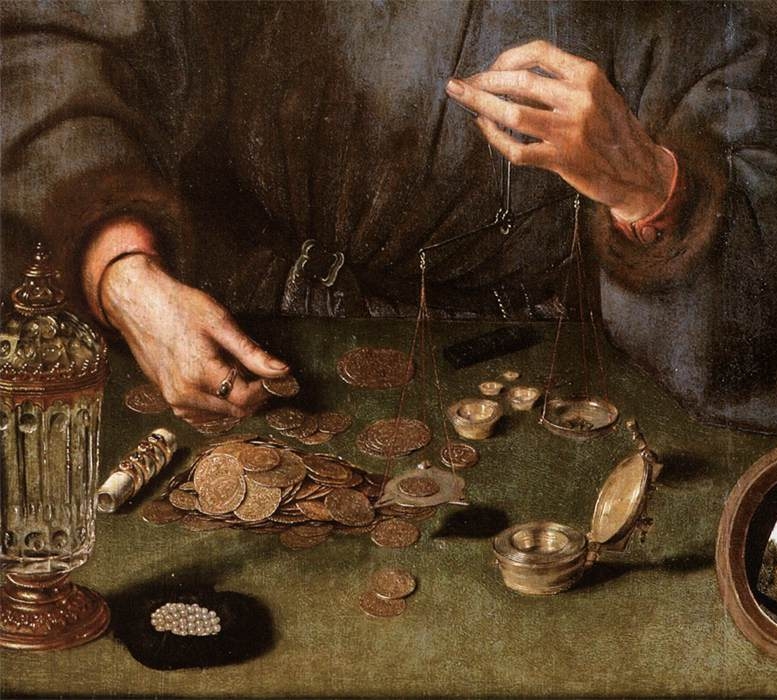
In Common Sense, Paine calls government a ‘necessary evil’, which we need only because of our flawed human nature, and he considers it legitimate only if it functions to benefit the people as a whole. But to do so, it must remain fully accountable and therefore not too large, or else it would do as governments had always done throughout the history of Europe: it would oppress, enslave, overly tax, and otherwise use its people for its own ends, making them suffer for the inevitable territorial, political, and ideological wars that all monarchs, power-hungry aristocrats, and high-ranking clergy embroiled themselves and their nations in. He also writes that commerce was one of the great pacifiers of the world by rendering people ‘useful to each other’, and as such, should not be interfered with. Thus far, his thinking is closely aligned with the political principles of libertarianism and modern American conservatism.

Yet libertarians and conservatives misunderstand Paine when they stop there: Paine very definitively argues that government should play some very important roles in public life beyond defense of life and private property and the enforcement of contracts. After all, it’s not only governments that oppress and neglect its citizens in all kinds of ways: it’s also other people.

One of these roles that government should take on is economic support of all citizens when they are the most vulnerable, especially the young, the elderly, and the infirm. As Paine observes, neither governments nor individuals sufficiently protect the rights of working people nor of the people to support themselves when they can’t yet work or can no longer work. He himself suffers at the hands of the government when in their employ as a tax officer: they routinely underpay and overwork him and his fellow tax officers, fire him for insufficient cause, and punish him for petitioning the government to improve their treatment of public employees.

Paine thinks government can do better, and go beyond just paying fair wages to its own representatives. He argues in favor of publicly funded welfare for all citizens, especially at the beginning and at end of life, and he outlines a concrete plan for its implementation. As he sees it, taxation and redistribution of wealth, within certain bounds, are just as essential for liberty as are the franchise, education, free trade, a constitution, and a bill of rights. For every person to have the chance at sustaining their life in a way compatible with their rights, the young should, at the very least, receive a free and full education and a sum of money with which to start out on their chosen profession, and a stipend to sustain them in health, comfort, and dignity when they can no longer work.

How is this possible? How can Paine be in favor of accountable government and individual rights while supporting a welfare system, often portrayed today as an enemy of both? His argument is an innovative one, and shows how a system of welfare is, in fact, not only consistent with an individualist theory of liberty and human rights, but is a necessary consequence of it.

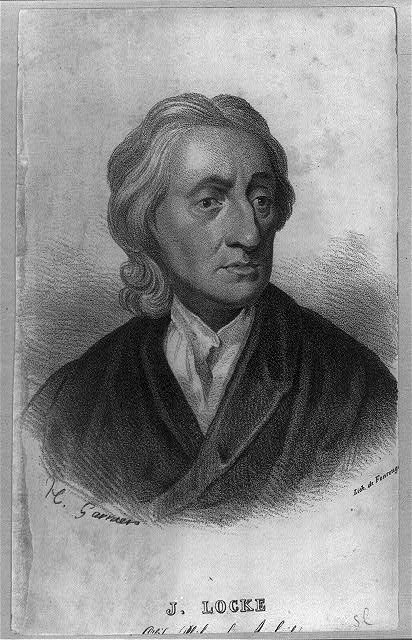
Like the writers of the Declaration of Independence, the Bill of Rights, and the United States Constitution, Paine is influenced by John Locke, author of Two Treatises on Government and therefore, indirectly, of American political theory. Paine bases his argument on a Lockean theory of rights: all human beings are born into the world with identical natural rights, including that to life and liberty. Everyone is also born with equal rights of access to the land and to its resources, since the latter two are necessary to the former, not only for sustaining life but for making it a free and happy one. The right of individuals to own property, therefore, is not a pure natural right like the others, since it allows particular people access to particular land and resources while denying it to others. Purely natural rights, by contrast, are equal in kind and in degree from individual to individual. Yet giving people the right to claim property as their own is valuable to everyone, since it provides incentives for individuals to create wealth through labor, improving what nature left on its own cannot provide: agriculture, technology, housing, art, and so on, and this wealth is shared by all through trade. Unlike the right to life and liberty, Locke’s labor theory of property rights is contingent, valid only if its original acquisition is ‘mixed’ with the owner’s labor. and only if enough is left so that others have not only enough, but just as good. (When the United States government drove the Native Americans of their ancestral land, they routinely and conveniently forgot the second part of Locke’s property rights theory as they grabbed the most resource-rich and most conveniently located land for themselves, driving the tribes into ever smaller and ever poorer places.) Even if it sometimes interferes with the ability of some to enjoy their purely natural rights, such as when certain people grab all the wealth for themselves while leaving others to suffer in poverty and even starve, Locke thinks that the right to own property benefits society on the whole to such a degree that it’s justified.

Paine, however, is not satisfied. He observes that property rights routinely benefit the few to a great degree and most relatively little. He looks not only at the world around him but at the whole of European history, seeing a world of immense wealth mostly enjoyed by a small number of people while most others earn just enough to sustain themselves, and the problem tends to grow worse over time. Paine tends to blame this state of affairs largely on a spoiled, despotic monarchy, aristocracy, and clergy, who use the law, assertions of ‘duty’, and enticements of salvation to wrangle most of the wealth out of the hands of people who actually create it. This leaves many of the young without the resources with which they could start creating wealth of their own for themselves and their families, and the impoverishment of the old who, after a lifetime of contribution through work, are left without resources when they can work no longer, having earned too little in their lives to save for their old age. So how can this be squared with Locke’s view that property rights should generally lead to the benefit of all, and that they are contingent on there generally being enough for everyone else to have what’s ‘just as good’?

He addresses this problem most thoroughly in his lesser-known pamphlet Agrarian Justice, written in 1795 and ’96 after he’s observed the success of the American revolution (except for enslaved Americans, of course) and the turmoil of the French one. The French Revolution, after all, was mostly driven by popular anger and despair over the widespread privation and suffering of the French people, condemned to a life of hard work, few prospects for social mobility, and a strict hierarchical class system in which most of the nation’s wealth was gobbled up by a very few.

Paine doesn’t just base his argument on sympathy for the poor, the hapless young, and the elderly, though his work is clearly driven by that emotion, occasioned partly by his hard-working parents’ and his own struggles to get by. Instead, his argument centers on justice; specifically, the principle of just recompense. Since every person is born into society denied of their birthright, which is the right of equal access to all land on earth and its resources, everyone is responsible for paying damages for that loss. What we now call welfare is really reparations, due to everyone, by all members of a society that enforces landed property rights.

But wait a minute, one might object: isn’t the very fact that society as a whole benefits from property rights recompense enough? Even if Paine is right, wouldn’t justice only demand we make sure that everyone has the same liberties, the same protection under the law, and the same access to basic public goods such as infrastructure and education? That way, outcomes in wealth will generally apportion themselves fairly according to the hard work and ingenuity of individuals. This idea, commonly called equality of opportunity, is especially popular with those who fall into the modern conservative and libertarian portions of the political spectrum. Anything else looks like an injustice in this view. After all, is it really just to take away wealth from some, especially those who earned it through their own labor, and give it to those who have not earned it?

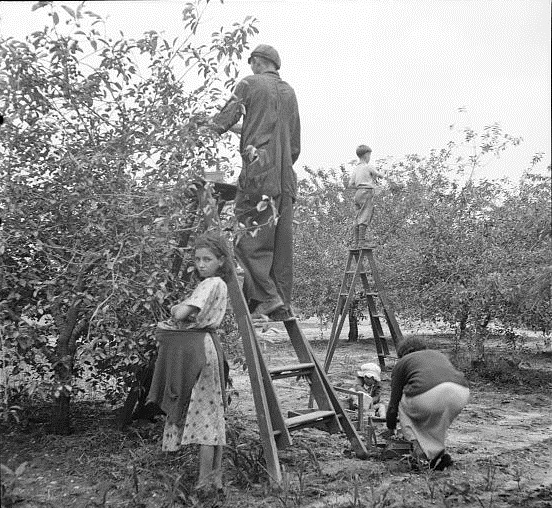
Remember that Paine offers the facts of history to show that fair wealth distribution just never seems to happen in societies that privatize land rights: the average person who works the hardest and does the most to benefit society very often does not accumulate even a fraction of the wealth as the relatively idle monarch, aristocrat, or member of the clergy. Well, then, how about today’s democratic market societies, where there is no monarch, aristocracy, or clergy empowered by the law to plunder most of the wealth from the working people for their personal use? We have only to pay attention to the news a short while to be aware that extreme inequality and unfairness of wealth distribution is as bad or nearly as bad as it’s ever been. The people doing the hardest and arguably most important jobs, such as teaching our children, manufacturing goods, cleaning up our cities, or harvesting the crops that sustain our lives earn anywhere from a pittance to a decent, but not stellar wage. Yet the CEO, the career politician, the idle children and grandchildren of millionaires, the trader and inventor of exotic financial products, and the tech whiz who invents the newest fad internet game often pile up money almost faster than they can stuff it into tax shelters.

Many like to say that unskilled, low-paid jobs are a stepping-stone to something else, but this is belied by the facts in the United States and around the world. While some do work their way up to more highly skilled and highly paid jobs, there are many, many more who never do. The fact that our economy depends on there being a certain number of those low-wage jobs in existence guarantees they will keep existing, at least until technology renders them obsolete. And when and if that happens, what will all those unemployed people do then? Even if every single one received an education and job training sufficient for employment as a skilled worker, there will only be a certain proportion of jobs that will be decently paid, leaving the rest in the same predicament. And there very well may be far fewer jobs in existence than there are people in this technological age. What then?

The reason why the whole equality of opportunity idea never works out may be that it’s a mythical concept, incompatible with the laws of nature, or if it were at least theoretically possible, undemonstrable.

In the real world, competition among workers for jobs necessarily leaves a huge number of people out when it comes to the ability to earn decent or even any money whether or not they do work hard, whether or not they’re willing but don’t have the opportunity, or whether or not they can at all. There are countless reasons for this due to the variety inherent in human nature and in the human experience. Some never had access to a good education, or they lack the network of patrons and mentors that the offspring of successful people rely on to get their own start in life. Others are simply not as intelligent, or tall, or graceful, or otherwise good-looking enough according to the whimsical and capricious standards of society, or of the ‘right’ race, ethnicity, religion, or don’t have the ‘right’ accent, and so on. There are jobs that disappear from the market due to advances in technology, with suddenly unemployed middle-aged or older people with now useless job skills in a society that heavily favors youth. There are people who are born with medical problems that make it difficult or nearly impossible to get well-paying jobs in a competitive market: skin disorders, genetically-imposed obesity, missing limbs, compromised immune systems, cancers, heart conditions…. the list is very long. And there are countless numbers of people for whom the ‘rat race’ is painful or self-destructive, as they have personalities that are shy, contemplative, independent, gentle, non-competitive, ‘weird’, and otherwise totally unsuited to that whole competition thing, and therefore terrible at it. The list goes on and on.

And the reason why equality of opportunity is undemonstrable, at least as something that can be implemented through public policy, can be recognized when we compare it to the gold standard of demonstrating the truth or usefulness of a theory: the scientific experiment. Consider a group of scientists who say, we are sure this theory is true because of this, that, and the other thing. They have an assortment of facts, they have arguments to show why, given the facts, certain things should result, so they make a prediction. Then they run the experiment and… what do you know, the results of the experiment fail to support the hypothesis. They say, oh yes, we see the flaws with the experiment and/or with the participants, they compose new arguments, they formulate a new hypothesis, they run a new experiment and… oops, it failed again! And again, and again. Now, consider every democratic market economy ever in existence and see if any of them actually achieved actual equality of outcome. These actual economies are analogous to the scientific experiments, and the equality of opportunity-based sets of policies are analogous to the hypotheses being tested. Even if, hypothetically, some system based on the ideal of equality of opportunity would actually achieve equality of outcome in a world of identical beings who are not born with or given extra advantages by others, we’ll never know. Asking us to ascribe to indemonstrable political strategies based on equality of opportunity is like asking us to believe the truth of hypotheses that are never proven by scientific experiment. That’s why I, for one, don’t buy it, and am more interested in focusing on equality of outcome, which Paine’s basic income idea seeks to resolve in a practical and just way.

Returning to the original point regarding the fairness of redistributing income from the wealthy to the un- or under-employed: Paine foresees this objection by calling for a universal basic income. In other words, he thinks that it should not be granted on the basis of need. That’s because, for one thing, he bases his whole argument on the equality of natural rights. All human beings alike are deprived of their natural right of free and full access to all of the land and its resource in societies that enforce landed property rights. Even those who own land are still deprived of the right of access to other land, so they are still owed the same damages. If they are wealthy enough to throw the money back into the public fund since they don’t need it, that’s up to them, and very much to their credit, but it’s still owed to them, same as anyone else.

For another thing, and perhaps most importantly for its being popularly acceptable enough for implementation, Paine recognizes that basic human psychology instinctively abhors unfairness. The whole idea of giving welfare to some and not others, even based on need, might seem charitable but still feels unfair, especially when the funds are taken away from people who earned it through their own labor and given to the un- or under-employed. Human beings simply do not need any more sources of strife and division than they already contend with: politics, ideology, and religion do enough mischief on that account already. Therefore, Paine says, basic income should be equally distributed regardless of need so that no-one is given, by society at least, an excuse to resent or look down on anyone else.

*This essay has also been published at the Thomas Paine National Historical Association website (under a different title)

~ Ordinary Philosophy is a labor of love and ad-free, supported by patrons and readers like you. Any support you can offer will be deeply appreciated!

~~~~~~~~~~~~~~~~~~~~~

Sources and Inspiration:

“Labor Theory of Property.” Wikipedia, The Free Encyclopedia, 22 Sep. 2015. Web. 30 Sep. 2015.
https://en.wikipedia.org/w/index.php?title=Labor_theory_of_property&oldid=682304595

Locke, John. Two Treatises of Government, 1689
http://socserv2.socsci.mcmaster.ca/econ/ugcm/3ll3/locke/government.pdf

Paine, Thomas. Agrarian Justice, 1796.
http://piketty.pse.ens.fr/files/Paine1795.pdf

Paine, Thomas. The Rights of Man, 1791.
http://www.ucc.ie/archive/hdsp/Paine_Rights_of_Man.pdf

O.P. Recommends: Alison Gopnik’s ‘David Hume and the Buddha’

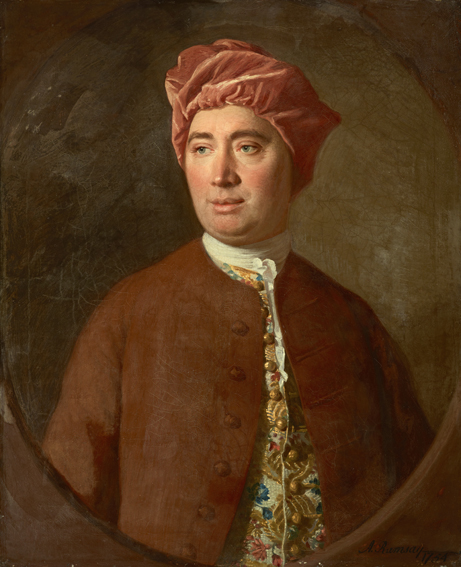
I just read a delightful piece in The Atlantic‘s October 2015 issue which combines three of my favorite things: history of ideas, a detective story, and David Hume. In her article ‘David Hume and the Buddha’, psychology researcher, philosopher, and author Alison Gopnik tells the tale of how she detected elements of Buddhist philosophy in Hume’s A Treatise on Human Nature, and how she set out to discover if he had indeed been influenced by it.

In Hume’s time, mid-1700’s, there was very little access to Buddhist philosophy in Europe, at least in part due to church suppression of its public dissemination. There was, however, some accounts of it buried in private libraries here and there, especially among the Jesuits, travelers, missionaries, and scholars as they were (and are). As Gopnik read up on Buddhist philosophy and European first encounters with it, she stumbled upon more than an ideological link with Hume: a possible way he could have discovered as a young scholar.

Like the 23-year-old Hume, Gopnik had fallen into a depression, but in her case, it was brought on by the changes that so often occur in mid-life: the children have grown up and left home, her marriage had broken up, she moved, and the stress of it all left her unable to work for a time. Hume’s depression was likely brought on by too many years of intense study, too much time spent indoors all alone. His Letter to a Physician of 1734 is a clear and detailed account of what it’s like to suffer a severe bout of depression, and he recognized it, clear-headed naturalist that he was, as an ailment of the physical body, and just as amenable to a cure if only the right one could be found.

Hume found the cure for depression in regular exercise and in enjoying the company of other people; Gopnik found in in a new love and renewed enthusiasm for her favorite pursuits, but first she found it in Hume. After finishing Gopnik’s story, I find myself even more impatient for my next traveling philosophy adventure in the history of ideas. Until then, I’ll continue to be inspired by Hume’s, Gopnik’s, the Buddha’s, and other great thinkers’ work, and heed Thomas Jefferson’s advice: if you keep yourself busy and your mind occupied, depression will be hard pressed to find its way in.

~~~~~~~~~~~~~~~~~~~~~~
Gopnik, Alison. ‘David Hume and the Buddha’. The Atlantic, October 2015 issue.
Published online as ‘How an 18th-Century Philosopher Helped Solve My Midlife Crisis:

David Hume, the Buddha, and a search for the Eastern roots of the Western Enlightenment’.
http://www.theatlantic.com/magazine/archive/2015/10/how-david-hume-helped-me-solve-my-midlife-crisis/403195/

On Plastic Surgery and Other Cosmetic Interventions

I work for a dermatologist who focuses his practice on medical dermatology. While all treat many of the same medical conditions, an ever-increasing percentage of dermatologists devote a substantial portion of their time to performing cosmetic procedures, from Botox and filler injections, chemical peels, and laser treatments to surgeries: facelifts, chin implants, eyelid modifications, and so on. The sign on the door of the medical practice I work for, however, reads ‘Diseases of the Skin’.

To me, this is a reassuring message, as if to say to all who enter ‘We are here to try and cure what ails you.’ It contrasts sharply with the message I get from cosmetic dermatology and surgery ads: ‘We agree that you’re ugly and need to be altered.’

Now, of course, this is only what I read into those ads, especially in my more sensitive moods. I don’t for a moment speak for anyone else, including the doctor I work for. ‘Diseases of the Skin’ is a simple statement of fact, conveying the information that he specializes in certain areas of dermatology and nothing else.

I’ve thought about the issue of cosmetic medical interventions, aka, ‘getting work done’, quite a bit over the years. The idea of using surgery and other invasive procedures to permanently alter a person’s body because they and others have decided they don’t like and can’t accept how they look makes me very uncomfortable, even angry on their behalf in case others have led them to feel that way. I admit right now, I have a longstanding bias against most forms of plastic surgery and cosmetic dermatology, and even the de facto social requirement that women wear heavy makeup, binding clothing, and hobbling footwear to be successful in many fields of work, especially in the performing arts and public media, and to ‘make a good catch’ as it used to be commonly called. Oh, and these women are often effectively required to ‘get work done’ at some point, too. While these procedures (CMI’s for short) are performed on men too, over 90% are performed on women, so I’ll continue to address cosmetic interventions as if it’s primarily a woman’s issue, though most of my comments apply to men as well.

So why worry about any of it? Is it any of my business what other women freely choose to do with their bodies? Are are my objections just personal, rooted in some sort of insecurity, just ‘sour grapes’ towards other women who are willing to do what I’m too lazy, cheap, or tomboyish to do?

As to the first, I don’t believe our life decisions have nothing to do with others; in fact, as I often argue, our choices so often affect other people in some way that we should make it a habit of assuming that they do. But whether or not deciding to have a cosmetic procedure performed is a purely personal choice, it’s an important topic for public discussion, since there are so many risks and ramifications to financial, physical, and mental health, and so many moral issues to consider. And when it comes to freedom of choice, I’m not at all convinced that the pressure women feel to conform to certain standards of beauty, especially the perception that they must have cosmetic procedures in order to have the kind of life they want, can meaningfully be referred to as real freedom.
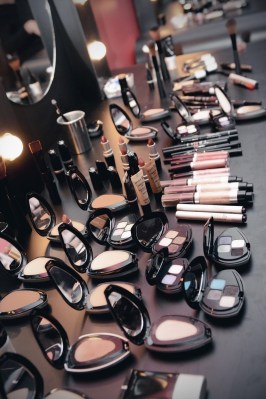
As to the latter, I’ve occasionally wondered if elements of some or all of those things influence my attitudes on the subject. Of course I sometimes feel insecure in the presence of particularly beautiful or glamorous people, especially as a teen, but I’m quite sure everyone experiences these feelings from time to time. I also refuse to wear makeup primarily for two reasons: I loathe the scent, feel, and taste of it, and I’m not willing to spend the time it takes to put it on and touch it up all the time. But this is also normal, I know plenty of women who wear little or no makeup. Still, perhaps, my youthful ‘sour grapes’ got the whole ball rolling on my mostly negative attitude towards cosmetic interventions, it’s hard to say. But at this point, I’ve considered the case for and against cosmetic interventions, especially those undergone for the sake of simple vanity, so many times that I’ve thought out a wide range of arguments, and though I’m not sure I’ve drawn rock-solid conclusions, the objections remain. I’d like to share them with you, dear readers, and see what comes of them.

I’ve often shared my concerns with the dermatologist I work for, but his attitude toward the whole issue of CMI’s is much more tolerant than mine. Some weeks ago, he gave me a cutting of an article published in the Journal of the American Medical Association in April of this year. It’s the abstract of a study whose purpose is ‘to introduce the concept of facial profiling to the surgical literature and to evaluate and quantify the changes in personality perception that occur with facial rejuvenation surgery’. The study seems, on the face of it, to provide some scientific evidence against at least some of my objections. So what are they, anyway? Well, the study gives me a good starting point.

It goes like this: the researchers gave people pictures of 30 white women who had undergone various kinds of plastic surgery, and gave the participants a mixed assortment of the before- and after-procedure photos. They then had the participants rate the people in the photos for several personality traits, including attractiveness and femininity. As you may have guessed, the study found that the people who had received plastic surgery were rated significantly higher in several four positive traits: attractiveness, femininity, social skills, and likeability. They rated the people in the photos for other traits, too, some positive and some neutral, but there were no significant statistical differences for those. By the way, I was surprised to find the researchers didn’t ask the participants to rate for traits usually considered negative, unless ‘aggressiveness’ counts.

As I read the abstract, however, I didn’t find much that told against my objections; rather, several problems with the study leapt to the eye.

First, the study had a very tiny pool of subjects whose pictures were rated, and an even tinier pool of participants doing the rating, which may render it little more than a record of statistical outliers. It is difficult to fund a study, and the small size may not necessarily render it useless, since the researchers may very well have conducted this small study just to see if their hypothesis had any merit at all. Still, it seems hard to be convinced by such thinly tested results.

Secondly, and I think especially problematically when it comes to perception, the participants only looked at still pictures. I’ve frequently observed that those who have had ‘some work done’ often look rather odd in person: Botox-paralyzed brows don’t harmonize well with the expression of the the rest of the face; various parts of the body don’t match in age appearance, with smooth cheeks and perked breasts accompanying evidence of age and softening in other parts of the body; eyebrows often end up arched alarmingly and eyes narrowed by being tightened too many times; the corners of the mouth curve artificially, Joker-like, whether the person is smiling, talking, or at rest; scar tissue often adds a stiff and often texturally incongruous look to surgically altered areas of the body. A still photo reveals only a small fraction of the actual alterations in appearance and movement that are caused by CMI’s.

As to measuring attractiveness, femininity, sociability, and the like: many of these are mostly or entirely culturally ingrained stereotypes of what a (white) woman ‘should’ look like if she is likely to possess these traits. But the cultivation and perpetuation of many of these stereotypes is one of those things I object to the most in the first place. What sorts of surgery did these few women choose to have and why did they select those particular ones? What results were they trying to achieve: to look like a typical Hollywood starlet or socialite, or to look like their own younger selves, or to express their own idiosyncratic ideals of beauty? And as to those involved in the study itself: Why were only white women chosen, and why these particular set of personality traits? Did the raters also perform other tasks to help determine what they think an ‘attractive, feminine, and socially skilled’ person ‘looks like’ in the first place, and why they assume that’s how they look?

Now, the authors of the study, at least in this abstract, seem to try not to make too many preemptive value judgments on these points. They merely state that the results of this study indicate that receiving plastic surgery can alter one’s likelihood of being perceived in certain ways by other people. I don’t critique this study to claim the researchers are wrong in their predictions, but to point out various ways in which I think the study is unsuccessful in demonstrating what they want it to. The study was just too small; the participants did not have an adequate opportunity to observe what recipients of plastic surgery really look like since they saw only stills; and the way the participants were asked to rate the photos, as well the way the researchers selected the traits and photos themselves, probably influenced the outcome to a significant degree, revealing at least as much about the researchers’ biases, or tendencies to ‘facially profile’, as anything else.

I’m also going to stop here and make this clear: I’m fully aware that CMI’s, like the field of dermatology as a whole, have many wonderful, life-enhancing applications, repairing all manner of disfigurements caused by disease and injury, from tumors to severe acne to burns to the ravages caused by severe weight-gain and -loss. People with such disfigurements, and those born with physical traits that are very unusual or exaggerated, may have a very hard time getting a job, promotions, and dates, and feeling as if they can live freely without the constant distractions that come with having a very unusual appearance. Try as one might, it’s extremely difficult to keep stares, startled or disgusted looks, and other negative reactions to one’s appearance from damaging one’s peace and overall happiness. CMI’s, in these cases, can provide enormous benefits by normalizing appearance and thus ease feelings of stress and isolation, remove unwanted negative attention, and open up opportunities.

I also want to make it clear that I’m not critiquing the human desire to be beautiful or to ornament ourselves. The human species is an imaginative, creative, and playful one, after all, and I am the first to admire a fantastic costume, a gorgeous shade of lipstick, or a flattering haircut. What I’m critiquing is the obsession we have with fitting into very narrow, culturally-derived stereotypes of what it means to be attractive, the ways in which we oblige one another to do so, and our blasé attitudes towards these procedures regardless of their effects on our financial, mental, and physical health.

Cosmetic dermatology treatments and plastic surgery are expensive. They may also be addictive, or signify and likely exacerbate underlying mental health problems. (I found conflicting information on this point, since few rigorous studies have been done; while a large percentage of recipients of cosmetic procedures display observable and well-documented behaviors consistent with addiction, it’s still uncertain if the procedure-seeking is a primary or secondary symptom.) They are also often unpredictable in their results, and sometimes dangerous. People can suffer allergic reactions to the chemicals used, or the skin can burn, scar, or be discolored. We all tend to heal and to scar at different rates as well, even in different parts of the same body, and often there’s no way to predict ahead of time how the procedures will turn out, how well the results will harmonize with one’s overall appearance, and how much they will affect the natural mobility and expression of the face and body.
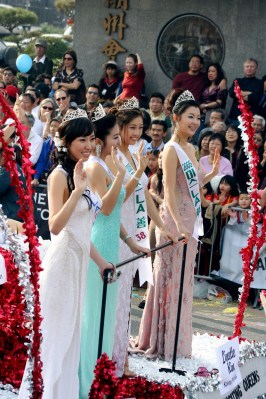
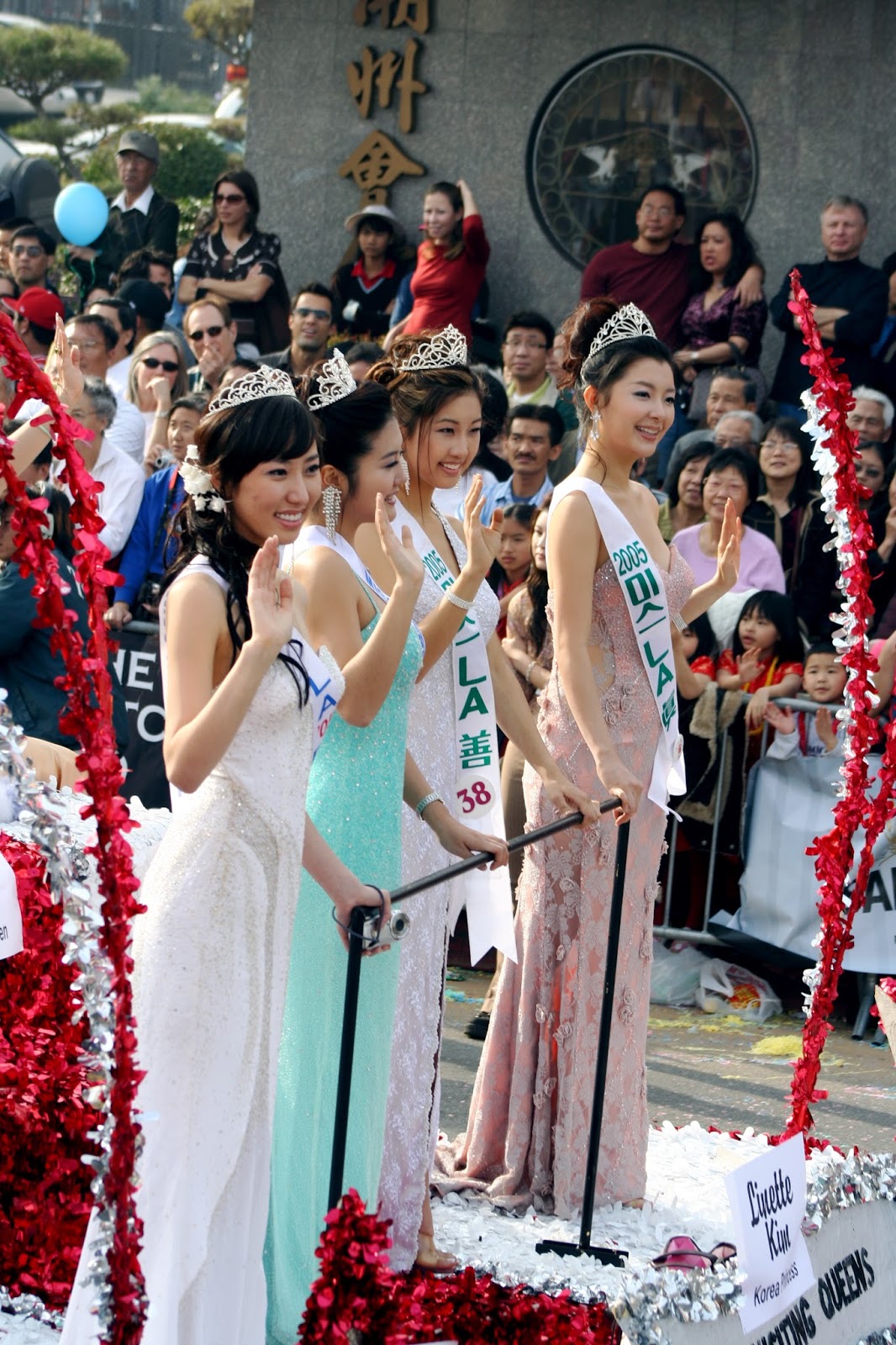
The story of the twenty eerily near-identical Korean beauty queens that went viral a couple of years ago is a case in point, a story which I found disturbing in the way it reveals the degree to which an obsession with artificial beauty standards can overrun a culture, destroying even its acceptance of the way its individuals naturally look. One of the most popular cosmetic procedures these Korean beauty queens choose, after all, is eyelid surgery to make their eyes look less ‘Asian’ and more ‘western’. A quick internet search will reveal innumerable horror stories of individuals who become obsessed with cosmetic interventions, and their addiction to ‘getting work done’ leaves them scarred, deformed, even disabled.

Anecdotally, I tend to be very conscious of such things because of my years of training in observing the details of the human body. Drawing was among my favorite pursuits as a child and young adult, and I studied figure drawing and painting in my first go-around in college. My fascination with the human form, combined with my sewing hobby and my years as a buyer, seller, and tailor of denim and vintage clothing, led me to choose the career of dressmaker and independent fashion designer for many years. I assisted people in choosing the proper fit in clothing (and still do!), and designed and created patterns and custom pieces to fit various figure.

And over time, the detailed observation and assessment of bodily forms gave me a deep appreciation of the wonderful and fascinating variety inherent in the human species. Noticing how the features and foibles of a person’s appearance express their personality and life story has become such a deeply ingrained habit in me that I just can’t turn off. Automatically, I assess the proportions of the faces and bodies I see, and note how the ways people carry themselves, their bodily attitudes and ways of speaking, denote their mood and general personality. A gesture, an expression, a moment’s pose, the way the hair falls across the shoulders or the hand rests on a surface, will sometimes strike me as the perfect subject for artistic representation. I’ll draw, paint, quilt, or snap a picture in my imagination, or decide which other artist would choose this as their subject. What rich offerings to the imagination does the variety in human appearance bring! In so many ways, it’s strange to me to decide that wrinkles and other body folds, those curves and lines that lend interesting shape and dramatic texture to a face or body, are ugly and must be eliminated, or that all bodies should be tucked, sucked, and otherwise molded into a narrow and far less interesting range of forms. I remain very grateful for the wonderful training I received, and thank all of those who helped me to recognize the true beauty and interest there is in this world.

And in my day to day life, I regularly have the opportunity to closely observe the results of regular recipients of cosmetic interventions and the personality traits that often accompany them. The dermatology practice I work at rents out a cosmetic dermatologist’s office one day a week to see patients local to that area. When it’s my turn to accompany the doctor to that relatively wealthy suburb, I find myself in the position of closely observing the physical results of cosmetic intervention when that doctor’s patients come in to purchase skin care products, as well as their behavior towards those of us behind the front desk. And what I observe is not always pretty, to say the least. These women are often curt, demanding, complaining, and chatter at long length about every little real or perceived flaw in their appearance that they’re eager to ‘cure’, whether or not that European-formula sunblock-concealer or skin serum costs sixty dollars per tiny bottle, and many with the stiff, tight faces of the sort I described earlier, oddly inexpressive and of indeterminate age. They have very often not, in my view, purchased beauty, good social skills, or an aura of happiness with the faces they now wear.

There’s an actress I’ve long thought very lovely, and I admired her since I first saw her, self-confident and wry, in an early 90’s movie. A few years ago, I was glad to see her act again in a certain miniseries, and while I still enjoyed her acting very much, I watched in dismay as, between each season, her face was altered more and more until I found myself cringing a little during her scenes. Having clearly ‘gotten some work done’ time and time again, her once very expressive face stiffened, stretched, and morphed into an ever more mask-like appearance. Now, I find her nearly unrecognizable. Do I fault her, and so many others like her (yes, some men too)? Sometimes I think yes, sometimes no, usually somewhere between the two, but my intention is not at all to pick on people in her position. I don’t really know what it’s like to feel that you have to choose between staying in a profession you know and love and having to remain looking as young and smooth as possible. Like all people at at some point in their lives, I do know the deep discomfort of perceived bodily dysmorphism, a feeling particularly common in our culture as we so often compare our own appearance unfavorably with cultural standards of beauty. But in her case, as with so many others, I find the surgical, ahem, ‘enhancements’ a failure, not at all conducive to her fully expressing her talents or growing into new roles she could explore.

So far, we’ve considered the practical and artistic downsides to CMI’s. But what I find even more problematic are some of the ethical implications, the ways in which these practices can help create, instill, and perpetuate some undesirable character traits if we are concerned with respect, tolerance, and appreciation for ourselves and our fellow human beings.

For one thing, participating in the project of creating a world of beauty-conformism can be socially irresponsible. There’s an idea, commonly held by liberals, that if a person wants to do something with their own body, it’s nobody else’s business. In short, people should be allowed to do whatever they like, without being subject to moral judgment or criticism of any kind, unless it harms other people directly and only in certain ways. I think this view is mistaken, or at least shortsighted. While I’m a fellow liberal and lover of freedom, it’s also true that our actions more often than not can and do affect others, indirectly, directly, or in the aggregate, and judging our own and other’s actions in light of this fact is essential to caring about doing the right thing. When individuals make personal decisions in matters of what they buy, how much they consume and waste, how their actions affect public safety, how much they contribute to pollution and future overpopulation, how courteously, fairly, and respectfully we treat our fellow human beings in our day to day dealings with them, and so on, we see that our personal decisions really do impact other people. Participating in a harmful or potentially harmful practice of engendering beauty conformism, for example, can be as irresponsible as participating in the wasteful and polluting practices of a hyper-consumerist culture. In their concern for liberating people from the oppressions and encroachments of others as well as from government, many confuse liberalism in politics with the idea that we shouldn’t value certain things over others, and that we shouldn’t make judgments about might be better ways to think and act.
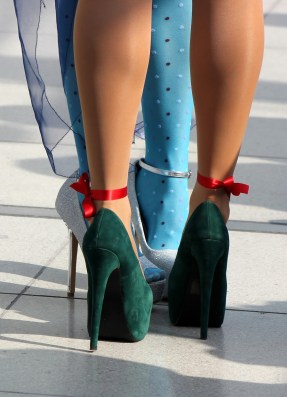
So when we keep buying into this view that the only people that count are the ones that look good (whatever we mean by that) and help perpetuate it by choosing cosmetic interventions for ourselves, we help create a world that’s less free. By doing so, we do our part to foster the view that women (and men) should all ‘look good’ in more or less the same way if they expect to get ahead in the world, and if they don’t, they can expect to be sidelined in their careers or even in life. For myself, I already feel this way about the expectation that we women must alter the appearance of our faces with makeup and increase the sexiness of our foot, butt, and leg shape with high heels in order to be feminine and attractive, so the Beyoncé and Miley Cyrus brand of hyper-sexualized ‘liberated grrrrl power’ doesn’t feel like freedom or empowerment to me. While I enjoy looking at cute shoes as much as anyone, we’ve gone beyond that: sexiness in women virtually equals high heels, blond and/or straight-to-wavy hair, and/or revealing skirts, if cultural mirrors such as Cannes File Festival organizers or Fox News policy-makers are to be believed. How much more oppressive is the social pressure such as that experienced by my aforementioned admired actress: whether or not she liked her own face as it was, it’s not ‘good enough’ in a culture that values the trappings of youth, such a smoothness, slimness, and sexual availability, real or manufactured. It’s the image that counts, not the person. To me, there’s something dehumanizing in all of it, something that smacks of the same old oppression that corseted Victorian women and foot-bound Chinese women experienced, whether they bought into the whole thing or not. By the way, I’ve also long wondered how men would deal with it if the fashions they were expected to wear and the beauty-alterations they were expected to undergo were as uncomfortable, binding, and camouflaging as women’s.

Another problem with CMI’s is the way they can reinforce one of our most self-destructive habits, an obsession with looks that all too often comes from equating worth with beauty, and equating beauty with fitting into a few narrow aesthetic stereotypes. We have become quite a vain and self-obsessed culture. While a certain amount of vanity may be useful in helping us stay fit, clean, and well-dressed at appropriate times, overall it’s limiting and even self-destructive. How many hours we waste when obsessed and disturbed by perceived imperfections in our appearance, and how much beauty and interest we fail to see in the world when our perspective is so unforgiving, so narrowed, so unimaginative! The person overcome by vanity draws into themselves; their world becomes small, their preoccupations dull and trite, and their problems loom large because they are no longer contrasted with the real problems outside the world of their own narrow range of interests. Acting on that vanity to often entrenches it ever more deeply into our character through habituation and reinforcement, justifying our vain preoccupation to ourselves by expending our money, time, even suffering satisfying its demands. And when we instill in ourselves the value that our looking a certain way matters so much that we’ll go through all that expense and pain to to attain it, it seems we also change the way we habitually perceive other people. Perhaps if we can’t appreciate or respect ourselves if we don’t look good enough, we might soon find that others who don’t look good enough by our own or society’s standards aren’t worthy of our appreciation or respect either.

It seems as if we want to get closer to creating a world where people are more generous, tolerant, and celebratory of one another, a good place to start is with one’s own face and body, and then to extend that disposition outward. If we can’t come to terms with our own appearance, to learn to appreciate one’s own self with its own set of quirks, wrinkles, spots, lines, bulges, colors, etc, how can we do that with other people? Each and every one of us enjoys the good fortune to be born into this world, so why do violence to the very body that makes our existence possible? Why not instead habituate in ourselves an attitude of gratitude to the body which gives us everything we have? And do we really want a world of clones and lookalikes anyway, or would we rather be in a habit of enjoying the marvelous richness and diversity of the world is that we’re so lucky to find ourselves in? And anyway, who decided that only the smooth, slim, and young are worth looking at? Definitely not the artist, the loving grandchild, the parent, the friend, or the kindest and noblest part of our own characters.
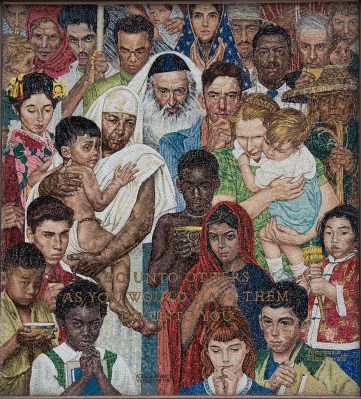
Perhaps it would be much better for us to habituate ourselves to looking at the world differently. Perhaps it’s better to decide it’s not up to others to conform themselves to our expectations of how they should look, just as it’s not up to others to impose their expectations on us. Perhaps we could train ourselves to look at people whose appearances do not conform to narrow stereotypes of beauty, ourselves included, and react not with the desire to change them, but to accept and appreciate them. Perhaps we could open ourselves up appreciating to more types of beauty, such as perceiving the lines and spots in an aged person’s face as the writing and punctuation of an interesting life story, or the prominent curves and angles of a nose as the proud badge of one’s ethnicity that also lends drama to one’s features, or the softened tummies and breasts of mothers as the tokens of the new life they bring into the world, and not as ugly flaws.

When we think about CMI’s generally and to consider whether we should do this to ourselves, maybe we should ask: is it really a good thing to chose to spend the time and money and take these risks in order to alter my looks to fit in with these contrived standards of beauty? And yes, they are contrived, as we can see by observing rigid but often non-overlapping beauty standards throughout the world and throughout history, as well as contradictory and changing societal attitudes towards the aged. Or might it be better to forgo all of that in favor of internalizing a more open and appreciative attitude towards the variety inherent in the world? Is it really a harmless thing to perpetuate in ourselves and others the kinds of attitudes about physical appearance that lead us to seek cosmetic interventions in the first place?

In a world struggling with racism, sexism, nationalism, ageism, celebrity-obsession, commodification of human beings, and all other kinds of racial and gendered bigotry, based on assumptions about who a person is and how desirable they are based on the color, shape, and smoothness of their body… should we think it’s generally a good idea to carve these expectations into our own bodies and burn them into our own skin?

What do you think?

~~~~~~~~~~~~~~~~~

Sources and inspiration:

‘2013 Plastic Surgery Statistics Report’. American Society of Plastic Surgeons website.
http://www.plasticsurgery.org/Documents/news-resources/statistics/2013-statistics/plastic-surg

‘The Dangers of Plastic Surgery Addiction’, Jun 26, 2015, Jim Brantner, MD Plastic & Reconstructive Surgery website. http://jimbrantnermd.com/the-dangers-of-plastic-surgery-addiction/

Dimiero, Ben & Eric Hananoki. ‘”I Can’t See Her Legs!”: Roger Ailes’ Rampant Sexism’. Jan 13th 2014, Media Matters blog. http://mediamatters.org/blog/2014/01/13/i-cant-see-her-legs-roger-ail

Griffiths, Mark D., Ph.D. ‘Cosmetic Products: Can People Become Addicted to Plastic Surgery?’ Sep 2, 2013. Psychology Today website, https://www.psychologytoday.com/blog/in-excess/2013

Nolan, Steve. ‘Has Plastic Surgery Made These Beauty Queens All Look the Same? Koreans Complain About Pageant “Clones”‘. Daily Mail.com, April 25th 2013.
http://www.dailymail.co.uk/news/article-2314647/Has-plastic-surgery-20-Korean-beauty-pageant

Reilly, Michael J, Jaclyn A. Tomsic, Stephen J. Fernandez, et al. ‘Abstract: Effect of Facial Rejuvenation Surgery on Perceived Attractiveness, Femininity, and Personality’. JAMA Facial Plastic Surgery Journal. May/June 2015, Vol 17, No. 3. http://archfaci.jamanetwork.com/article.aspx?art

Seventh Day in Paris Following Thomas Paine, Mary Wollstonecraft, and Thomas Jefferson

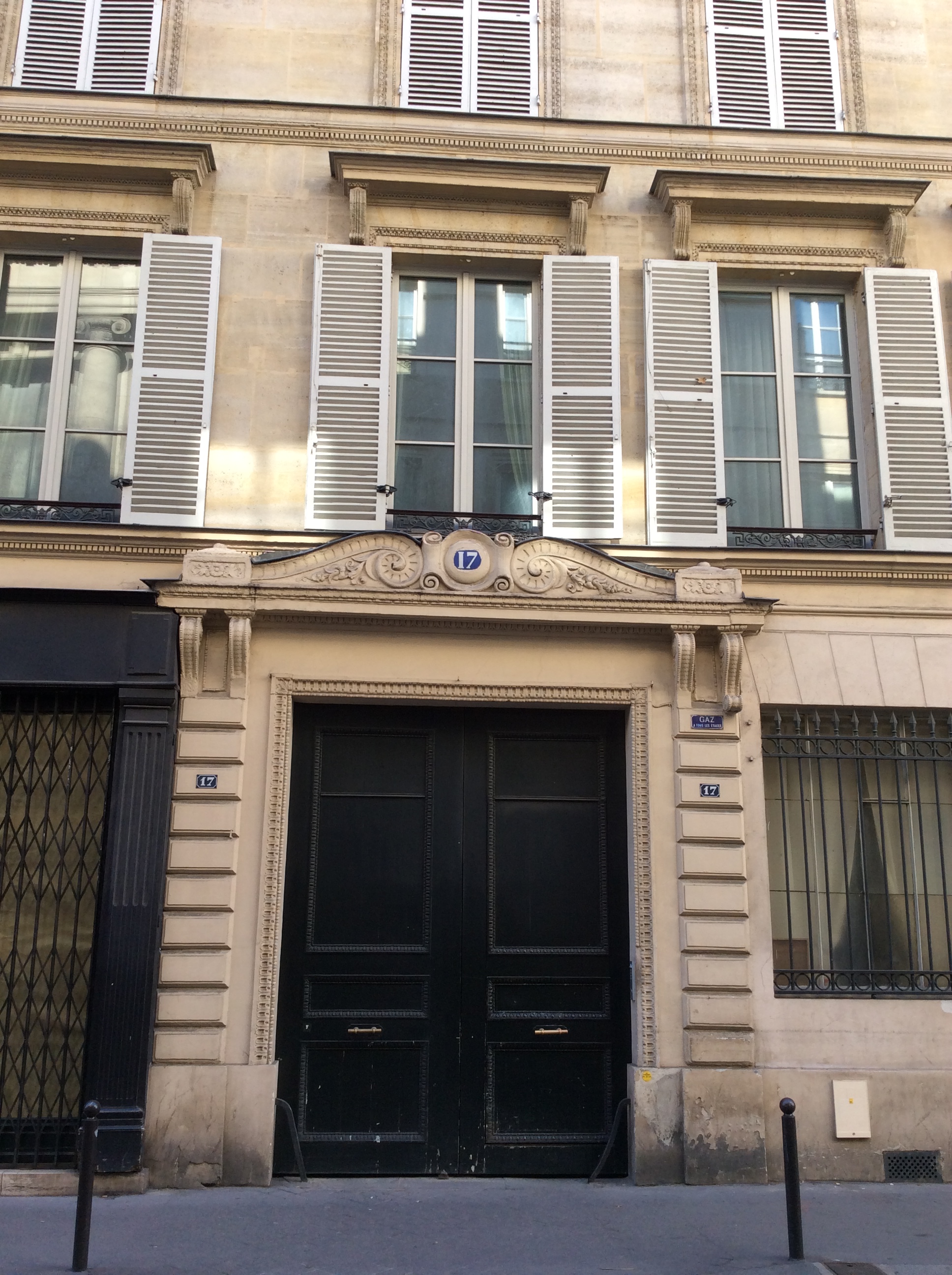
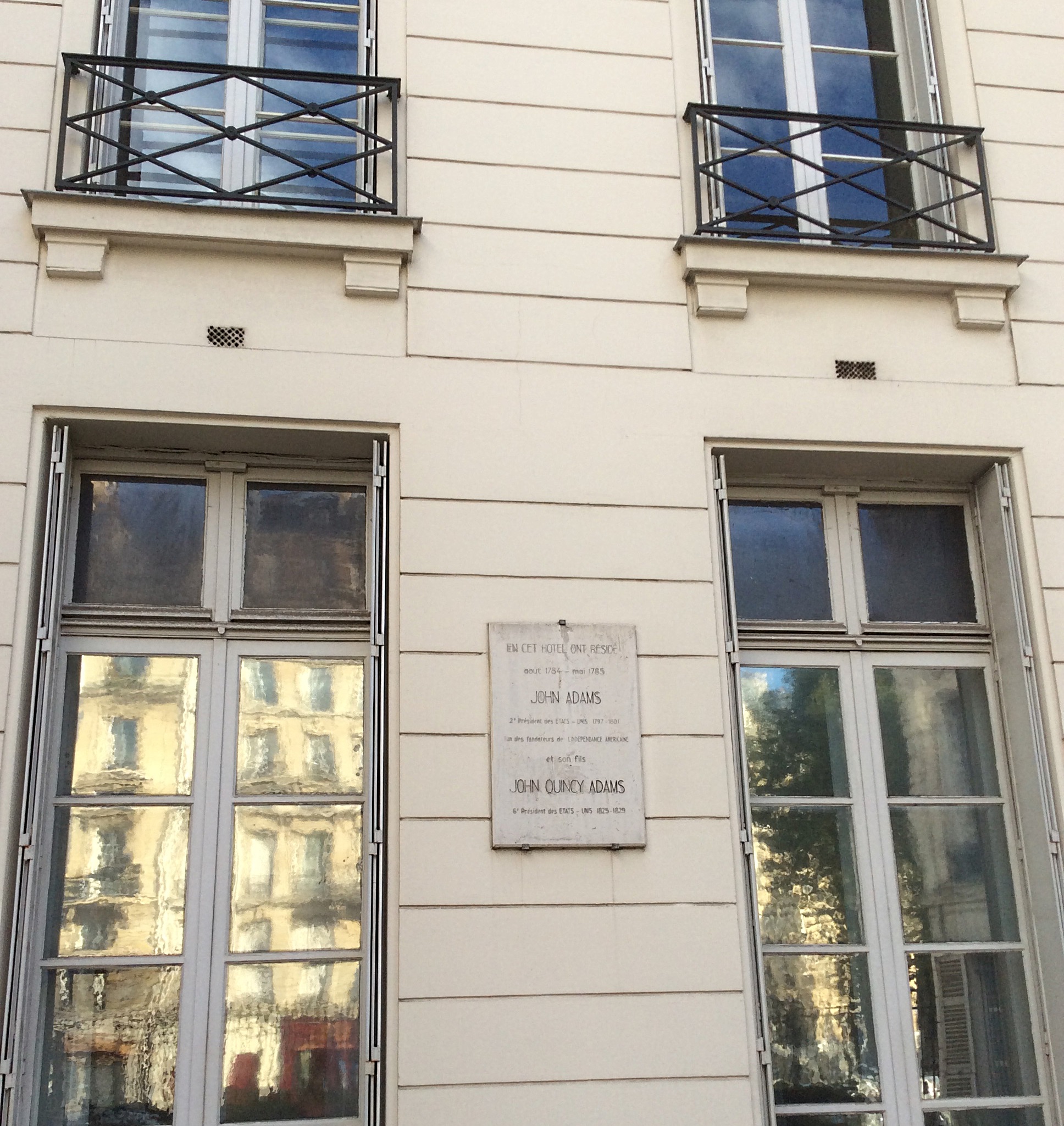
Former site of the Hotel d'Orleans at 17 rue Bonaparte, Paris

Front door of 17 rue Bonaparte, Paris, at or near the former site of the Hotel d’Orleans

Friday, August 21st, 2015

Today’s tale will be a shorter one, though the places I do make it to are wonderful and full of interest. It’s my last full day in Paris and I’m accompanied by my tired husband, so we take it easy. We visit Serge Gainsbourg’s house in Saint-Germain-des-Prés, enjoy some celebratory Paris-Brest pastries  from La Pâtisserie des Rêves on rue du Bac (considered by many to be the very best), take a boat ride on the Seine (a lovely way to see the city!), and otherwise just stroll around at a very leisurely pace, stopping here and there for a coffee or a cold drink.

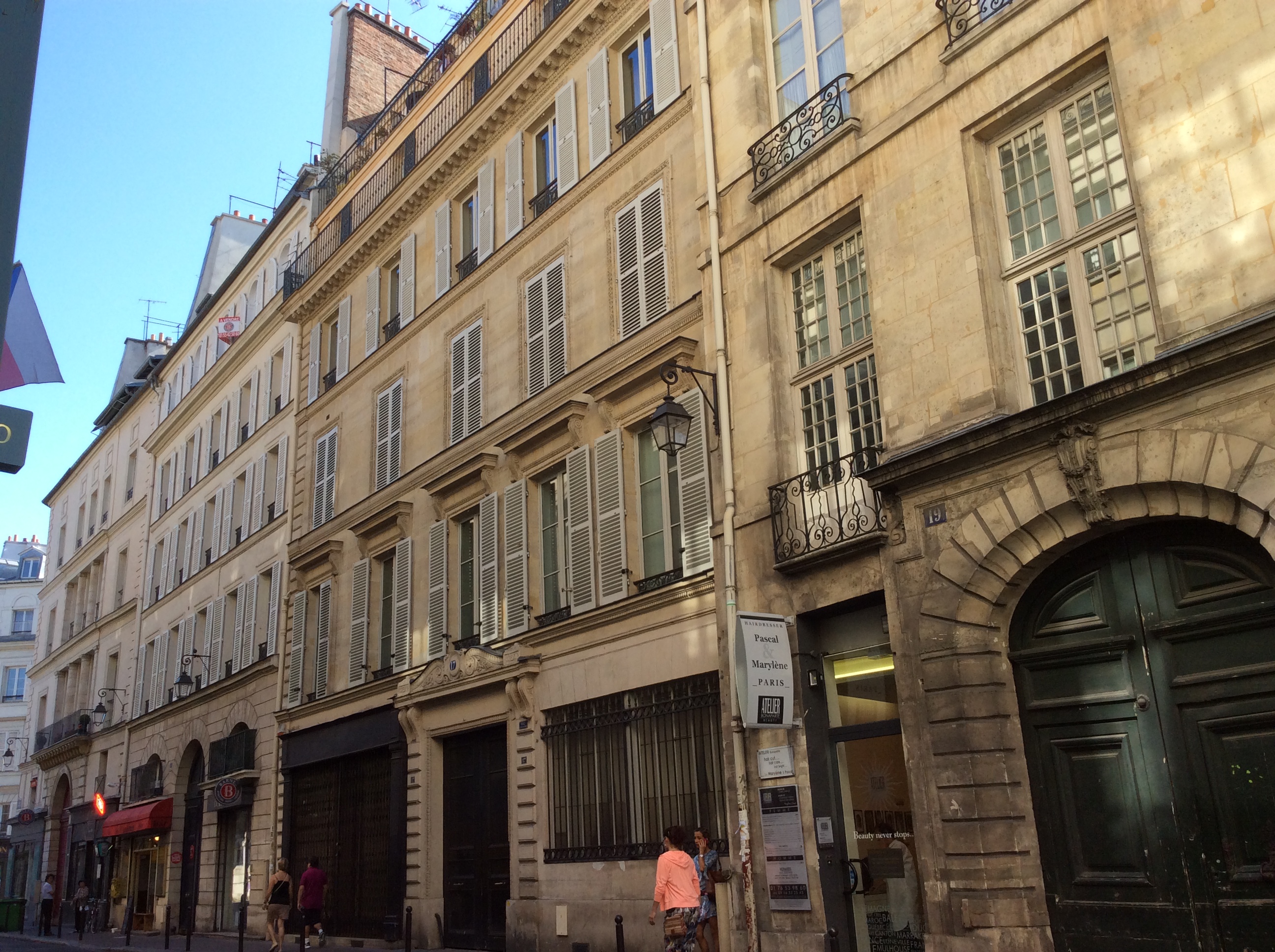
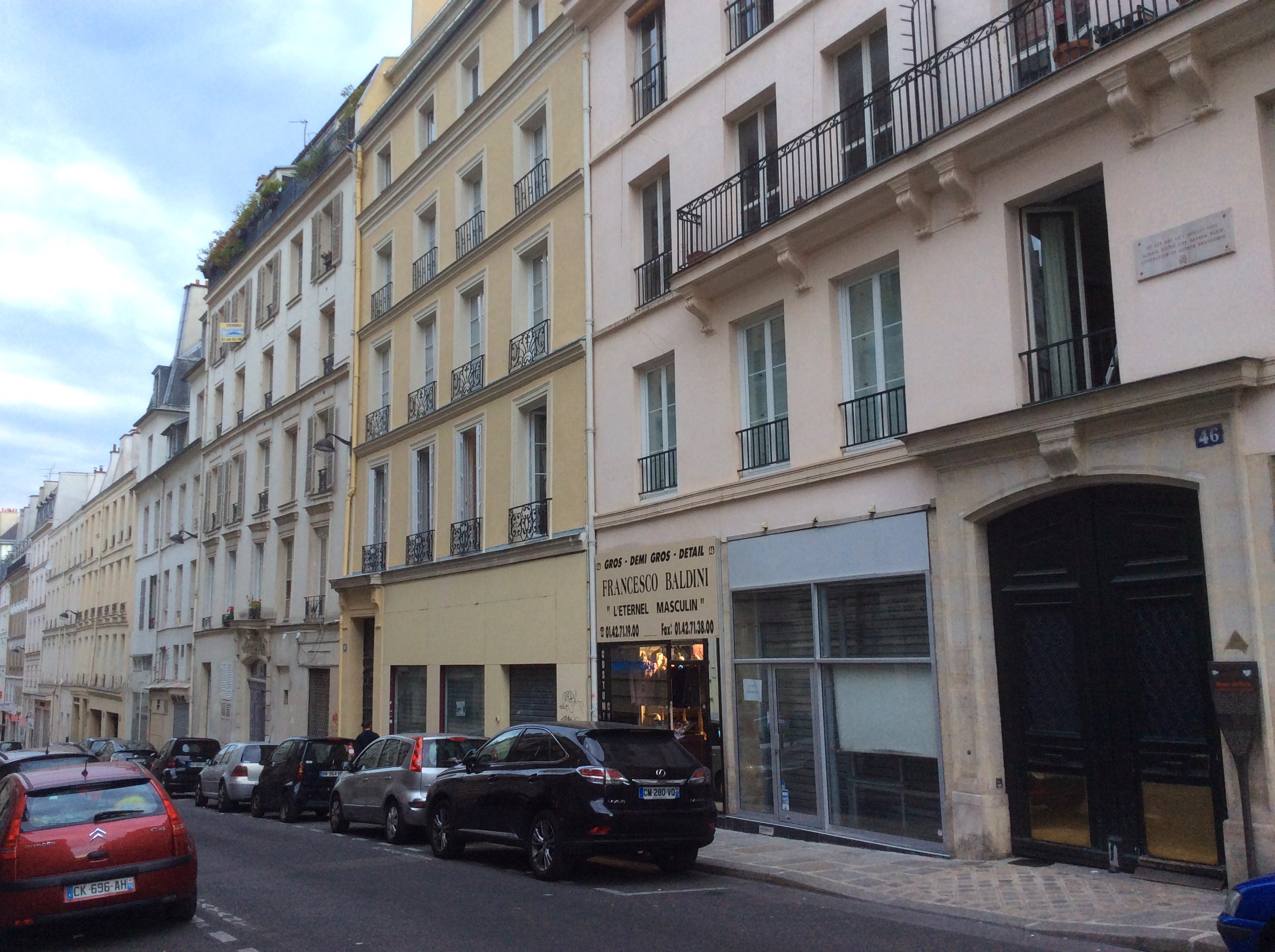
On our way to the pastry shop, we swing by 17 rue Bonaparte, where, sometime in early to mid-August of 1784, Thomas Jefferson and his daughter Patsy moved from the smaller Hôtel d’Orleans on rue de Richelieu to more comfortable lodgings at this larger hotel, also named d’Orleans. This street was named the rue des Petits-Augustins in Jefferson’s time, and this time around, I have the address. The Hôtel would be Jefferson and Patsy’s home until he found the one that was supposed to be their permanent home in Paris on cul-de-sac Taitbout that October, and until he settled on a good school for Patsy. However, as we have seen, Jefferson ended up living the longest on Champs-Élysées.

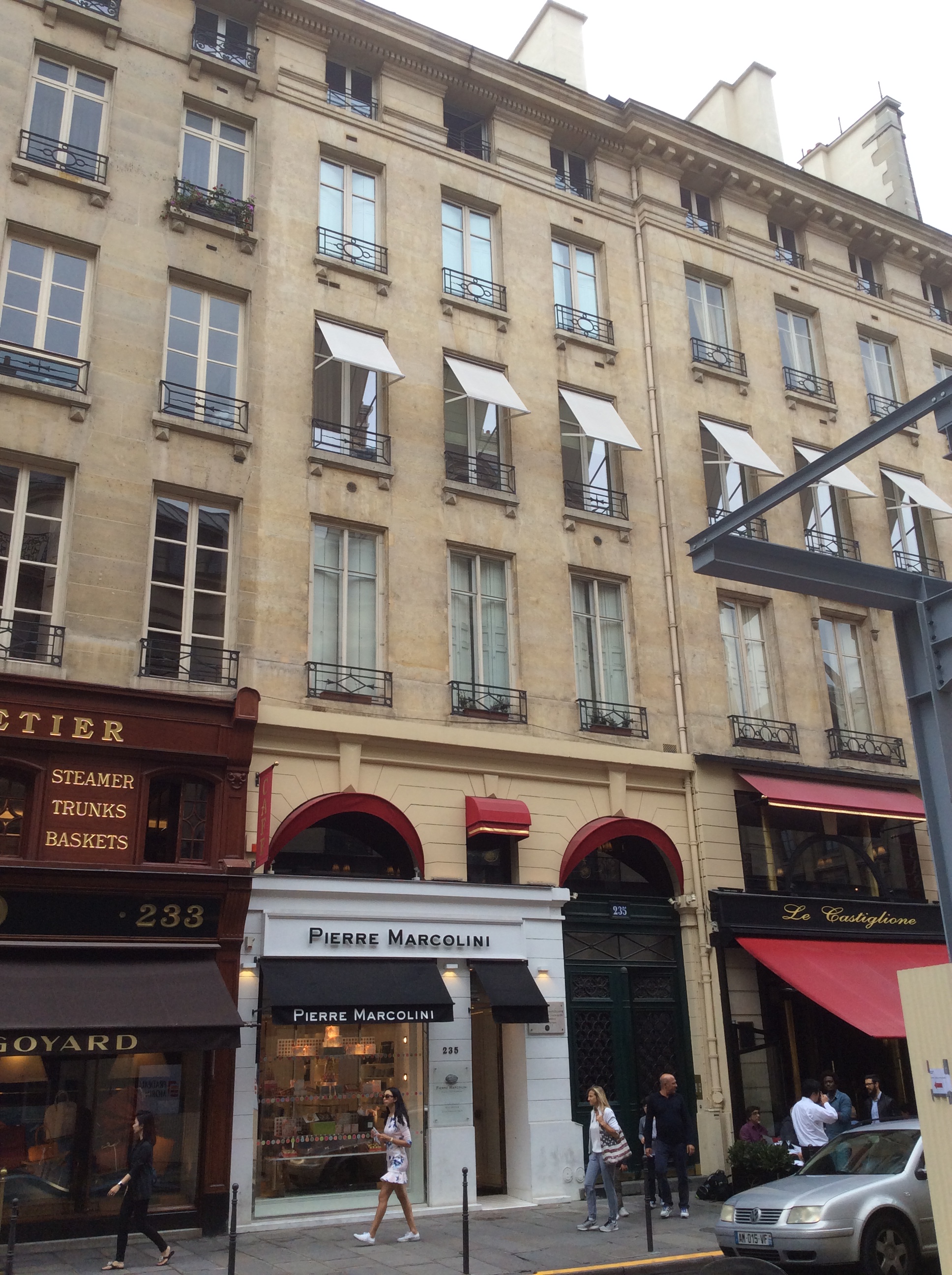
Rown of shops and hotels including 17 rue Bonaparte, at or near Hotel d'Orleans site, Paris

Row of shops and hotels including 17 rue Bonaparte at or near the Hotel d’Orleans site where Thomas Jefferson lived for a short time in the fall of 1784

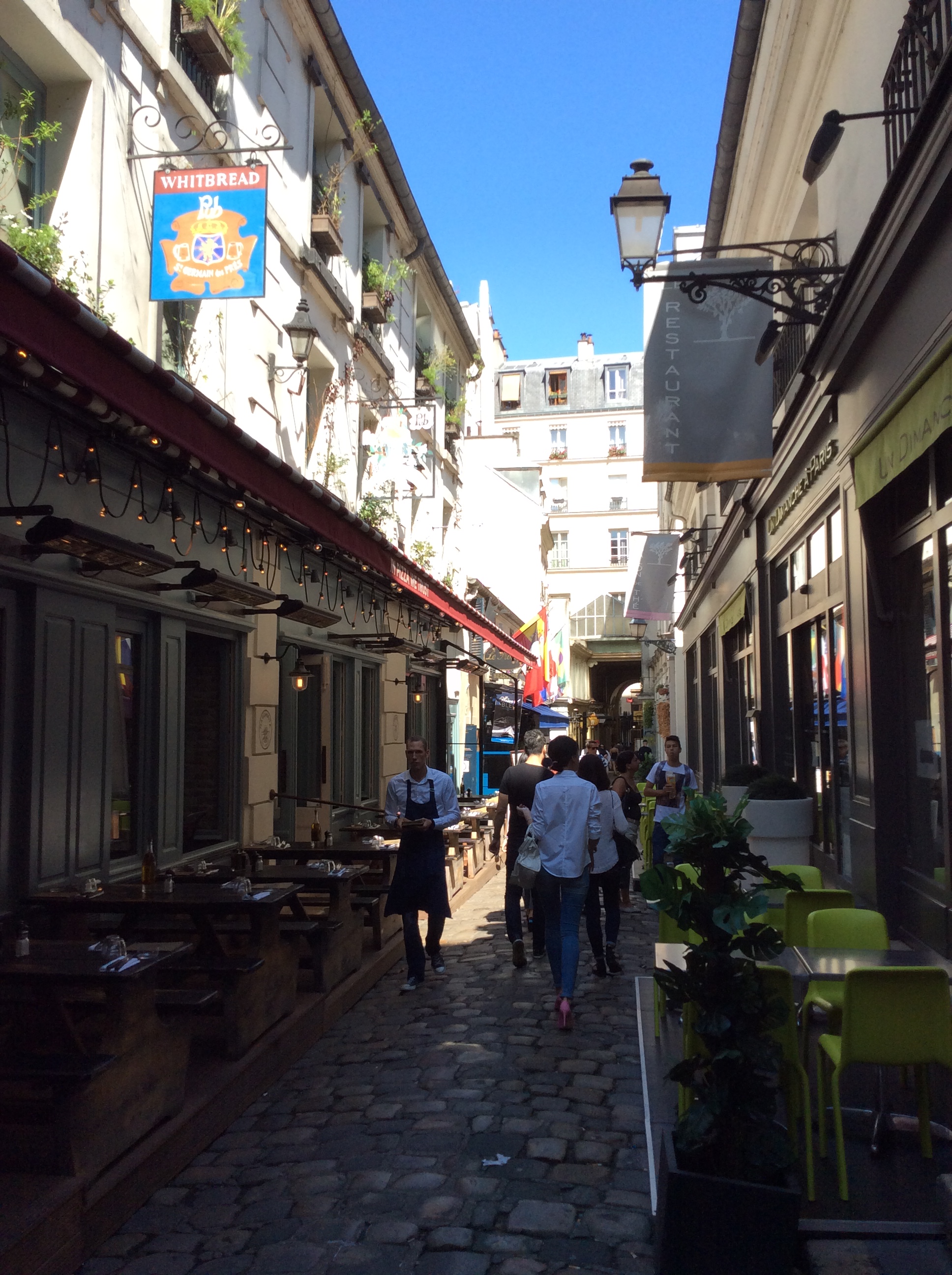
 Cour du Commerce Saint André behind Cafe Procope, Paris,

Cour du Commerce Saint André behind Café Procope, Paris

Next, we head east on Boulevard Saint-Germain, passing the beautiful medieval Église de Saint-Germain-des-Prés. One of its chapels is the oldest surviving religious building in Paris, originally built in the 11th century, and I admire its spartan beauty.

We’re heading for Café Procope, which Jefferson frequented during his years in Paris in the company of Benjamin Franklin. Their time in Paris overlapped for a little less than a year, as Franklin left Paris in June of 1785, and Jefferson, as I have mentioned, arrived on August 6th, 1784. Franklin had already been a regular at Café Procope for many years, since 1776. The Café is located at 13 rue de l’Ancienne Comedie in the 6th Arrondissement, just off Bd. St-Germaine at Odéon, though we first spot it from the charming little pedestrian street that runs behind it named Cour du Commerce Saint André.

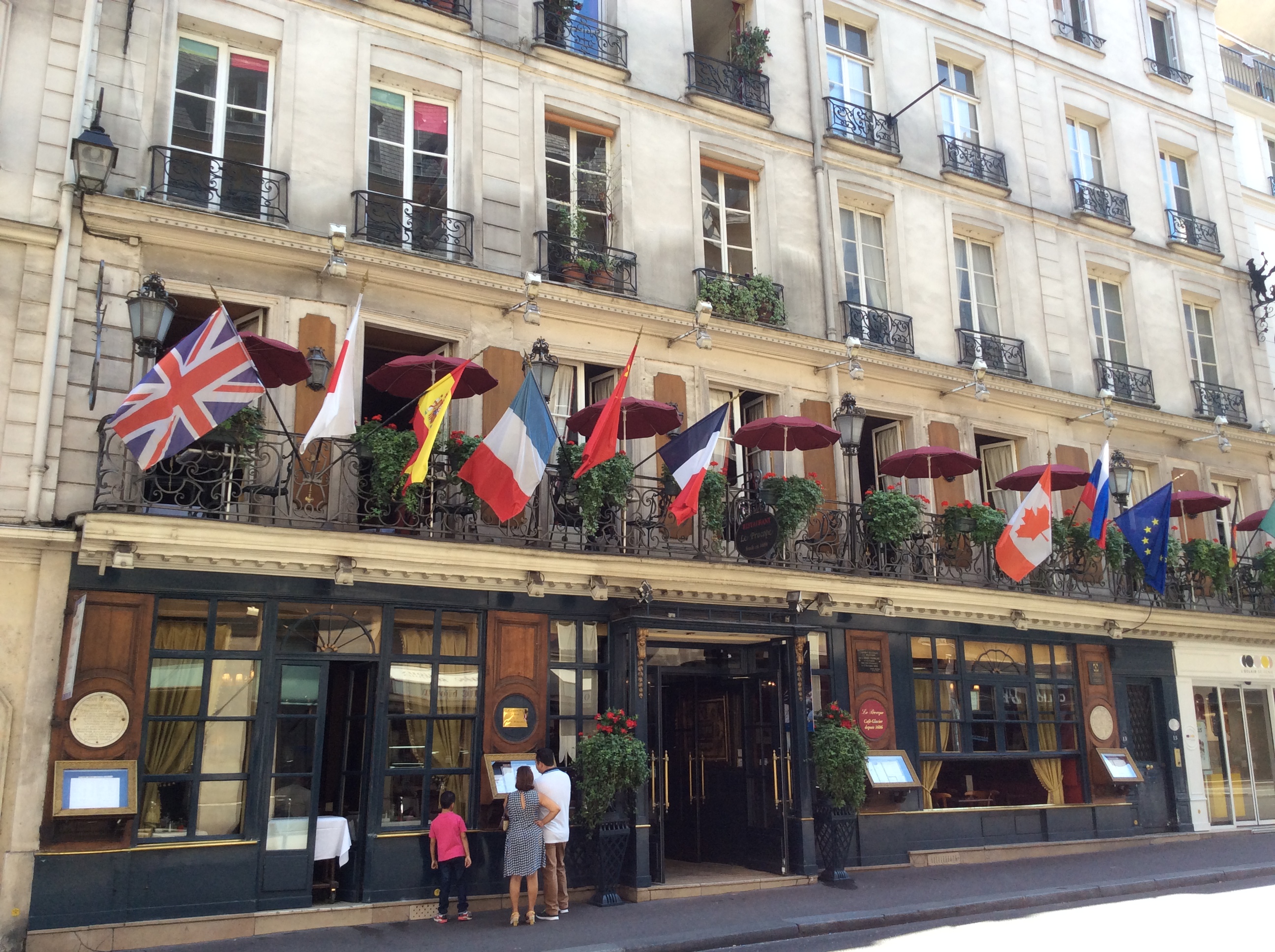
Cafe Procope and its flags, Paris

Cafe Procope and its flags

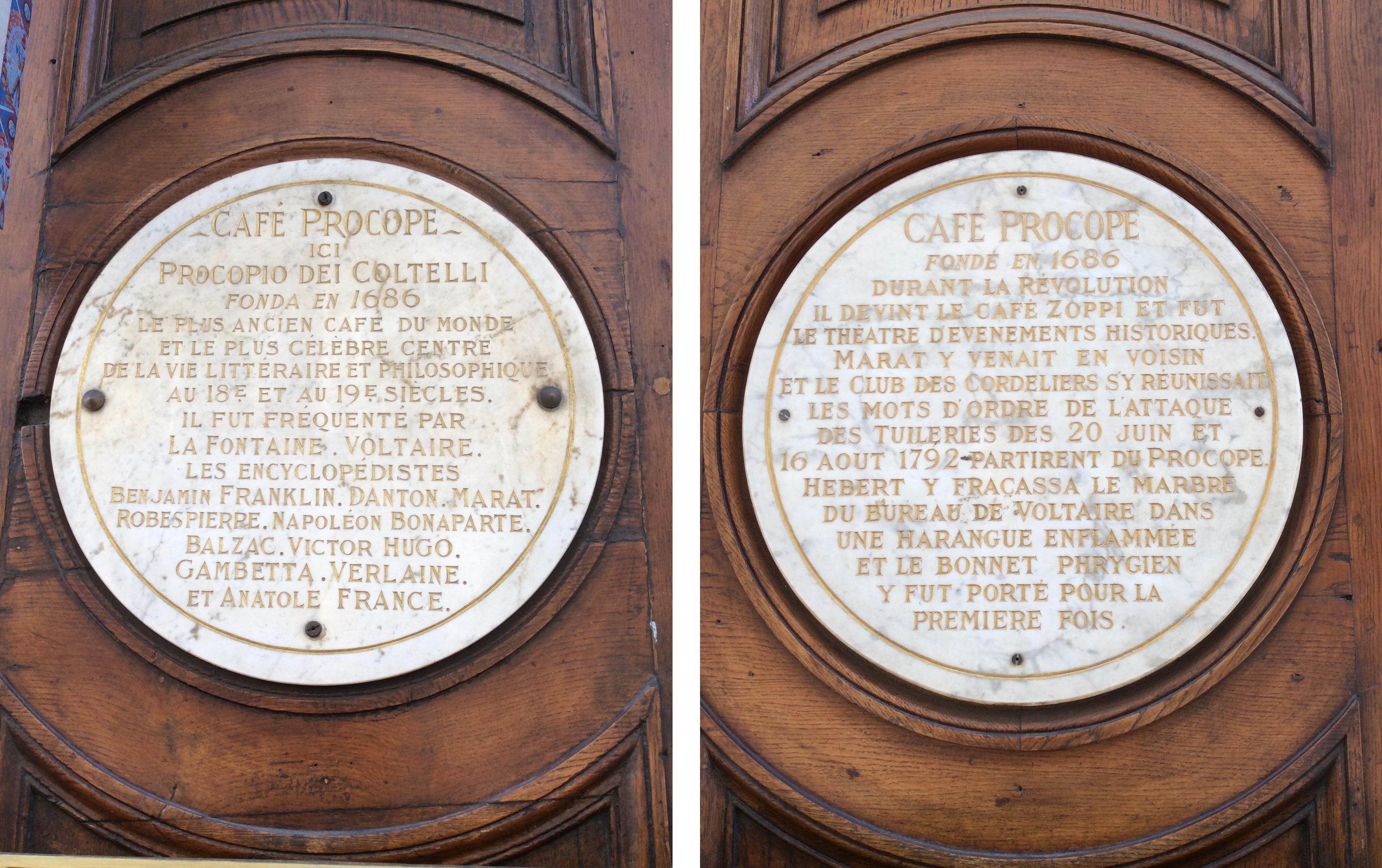
Marble plaques at Café Procope, 13 rue de l’Ancienne Comedie, Saint-Germain-des-Prés

Café Procope is a large, cheery restaurant, whose front is bedecked with flowerpots and flags from around the world. It’s considered the oldest continuously operating restaurant in Paris, and started as a literary cafe centered around conversation and coffee. Many of Paris’s best minds and most influential movers and shakers were guests here over the centuries: Jefferson, Franklin, Jean de La Fontaine, Voltaire, Denis Diderot, Jean-Jacques Rousseau, Pierre-Augustin Caron de Beaumarchais, Napoleon Bonaparte, Honoré de Balzac, Victor Hugo, Anatole France, and perhaps Thomas Paine too, though I haven’t been able to verify the latter. After all, Paine was a great friend of Franklin’s, a sort of protege of whom Franklin took the trouble to introduce to his friends both in Paris and in the United States.

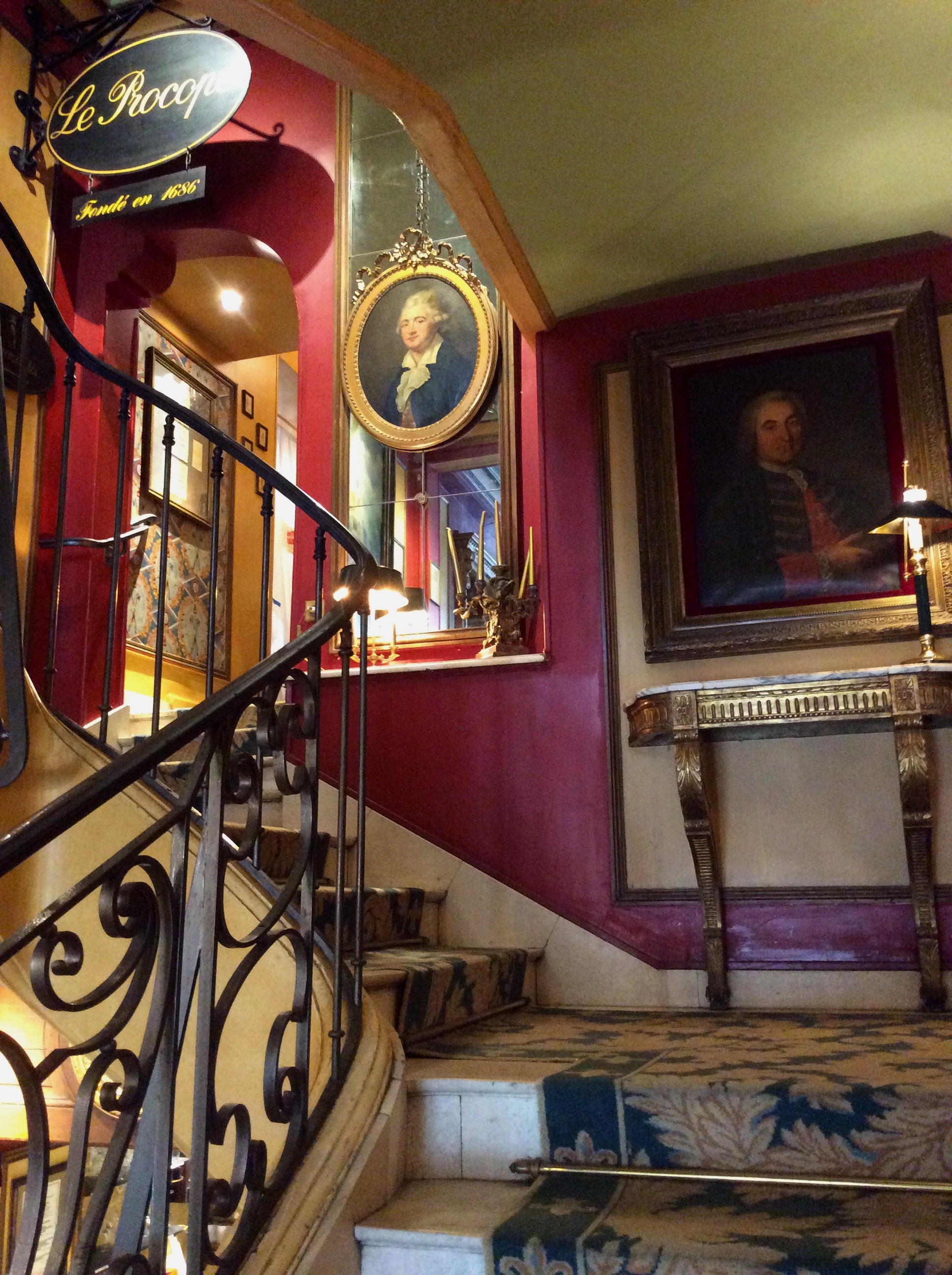
Central stairway in Cafe Procope

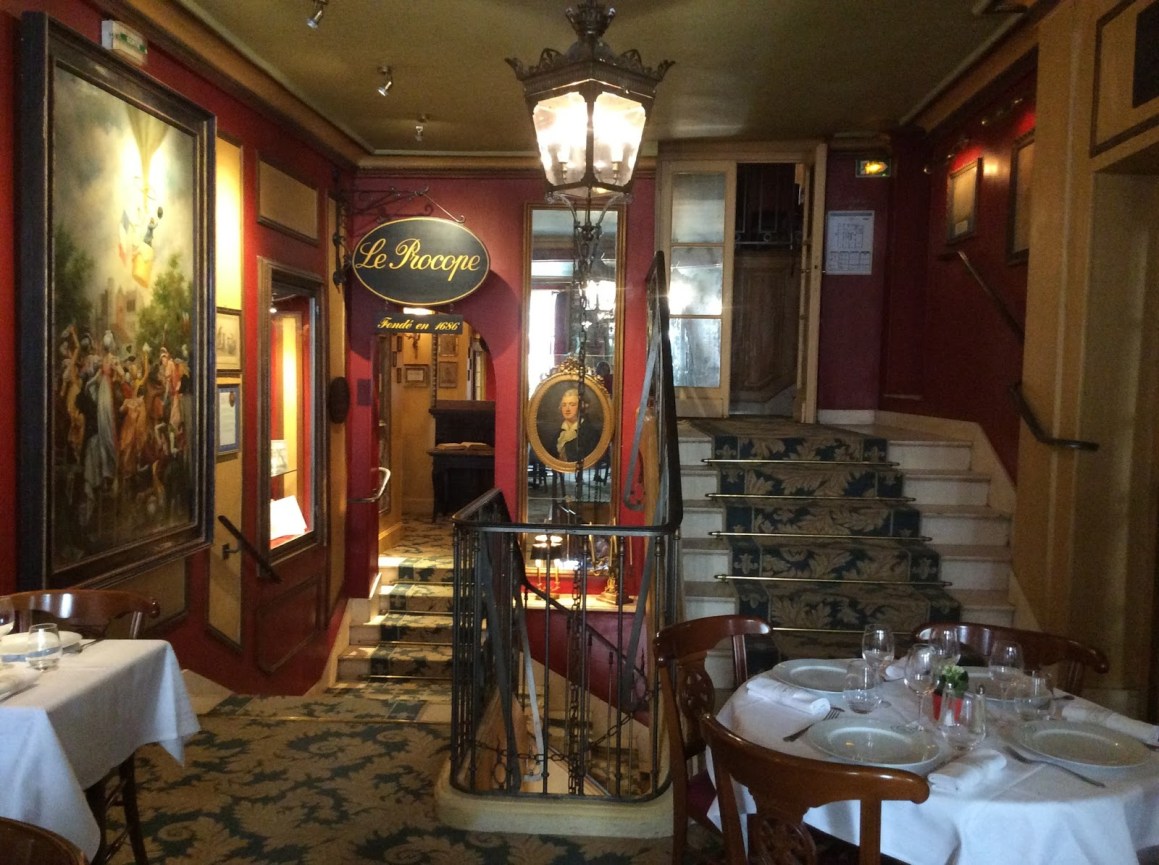
Central stairway at Café Procope

We approach the hostess and ask if they have a bar; we want to spend some time here and take in the atmosphere, but we have our picnic lunch with us already. It turns out it’s only a sit-down restaurant, no bar or coffee service. We pause and look around a bit, and a tall man with salt and pepper hair, in response to my inquiring expression, welcomes us very warmly and gives me permission take pictures. We have a little chat, and I tell him of my project, and though he appears pleased to hear it it’s clear I’m not the first visitor interested in the history of the place. He also invites us to go to the upstairs suite of dining rooms and explore those rooms as well, since they’re doing a little painting and it’s closed to diners at the moment. It appears that he manages the restaurant according to the wise principle that all press is good press, and the more people share stories and pictures of the place, the better for all.

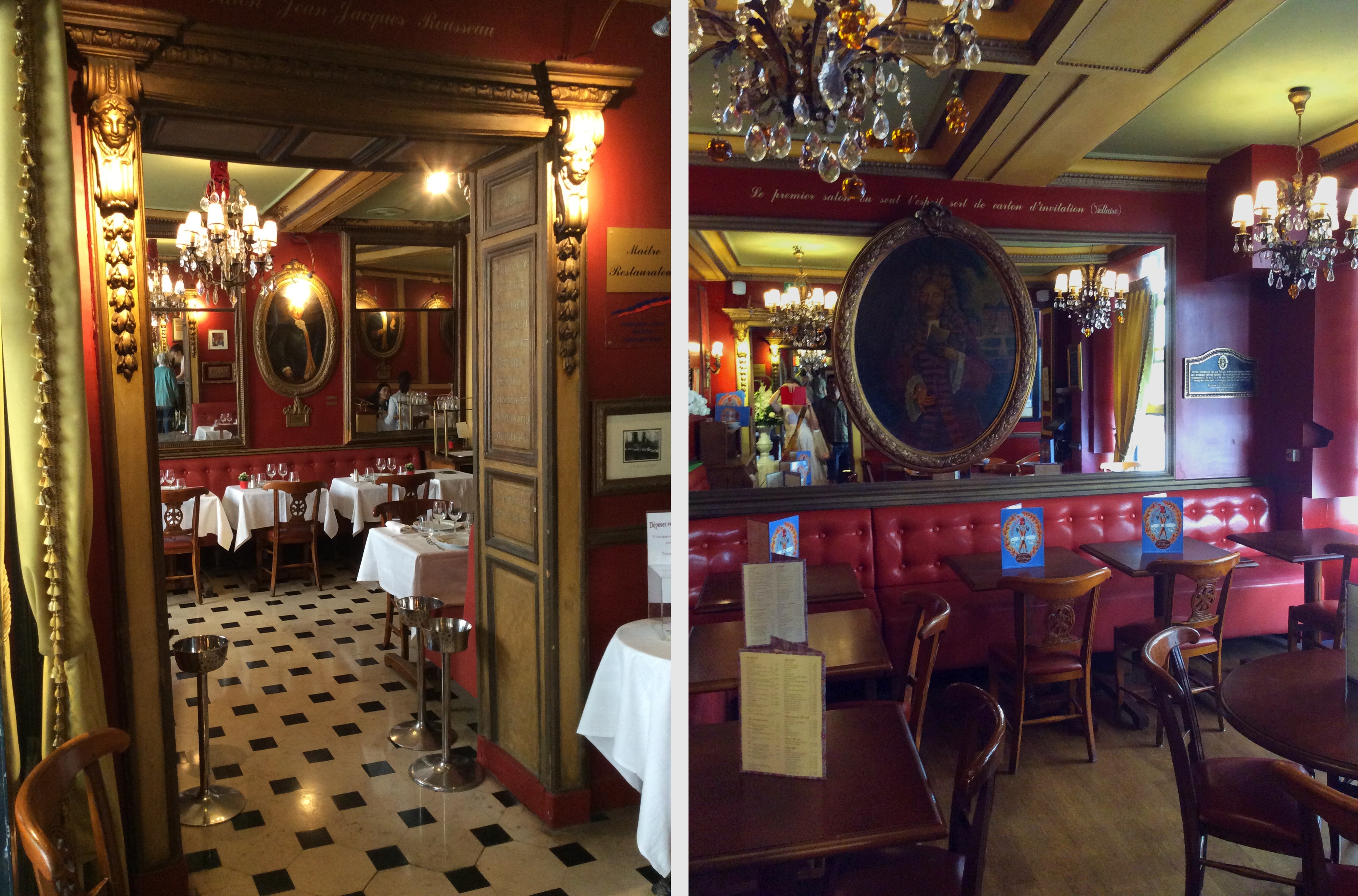
Two interior views of upstairs dining rooms in Café Procope, Paris

Two interior views of upstairs dining rooms in Café Procope, Paris

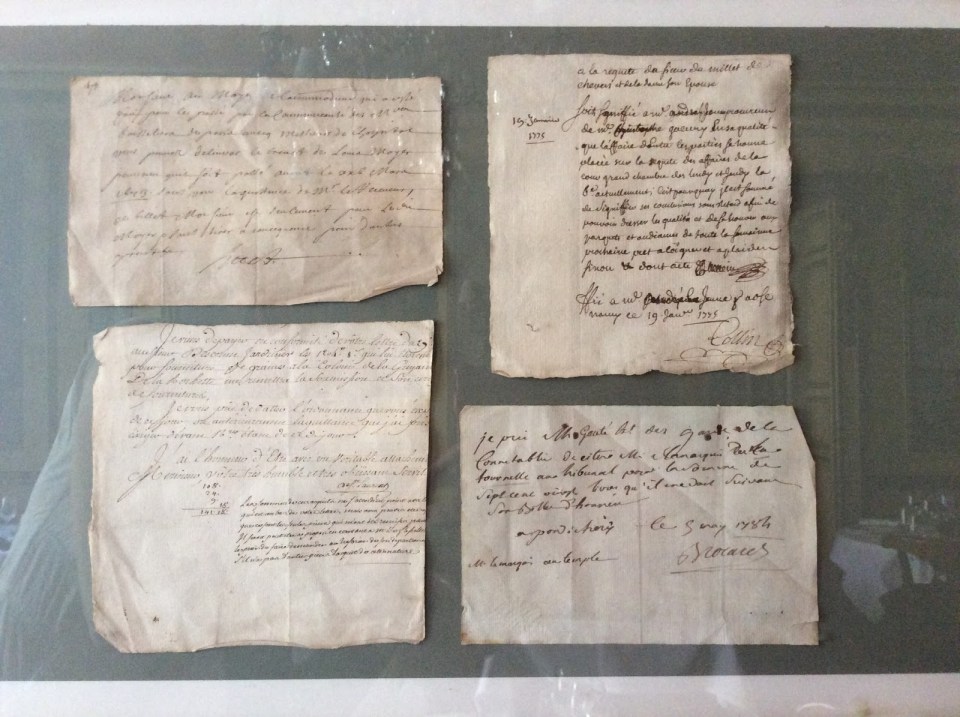
Facsimiles of letters of famous diners over the centuries at Cafe Procope

thomas-jefferson-plaque-and-upstairs-dining-nook-at-cafe-procope-paris-2015-amy-cools

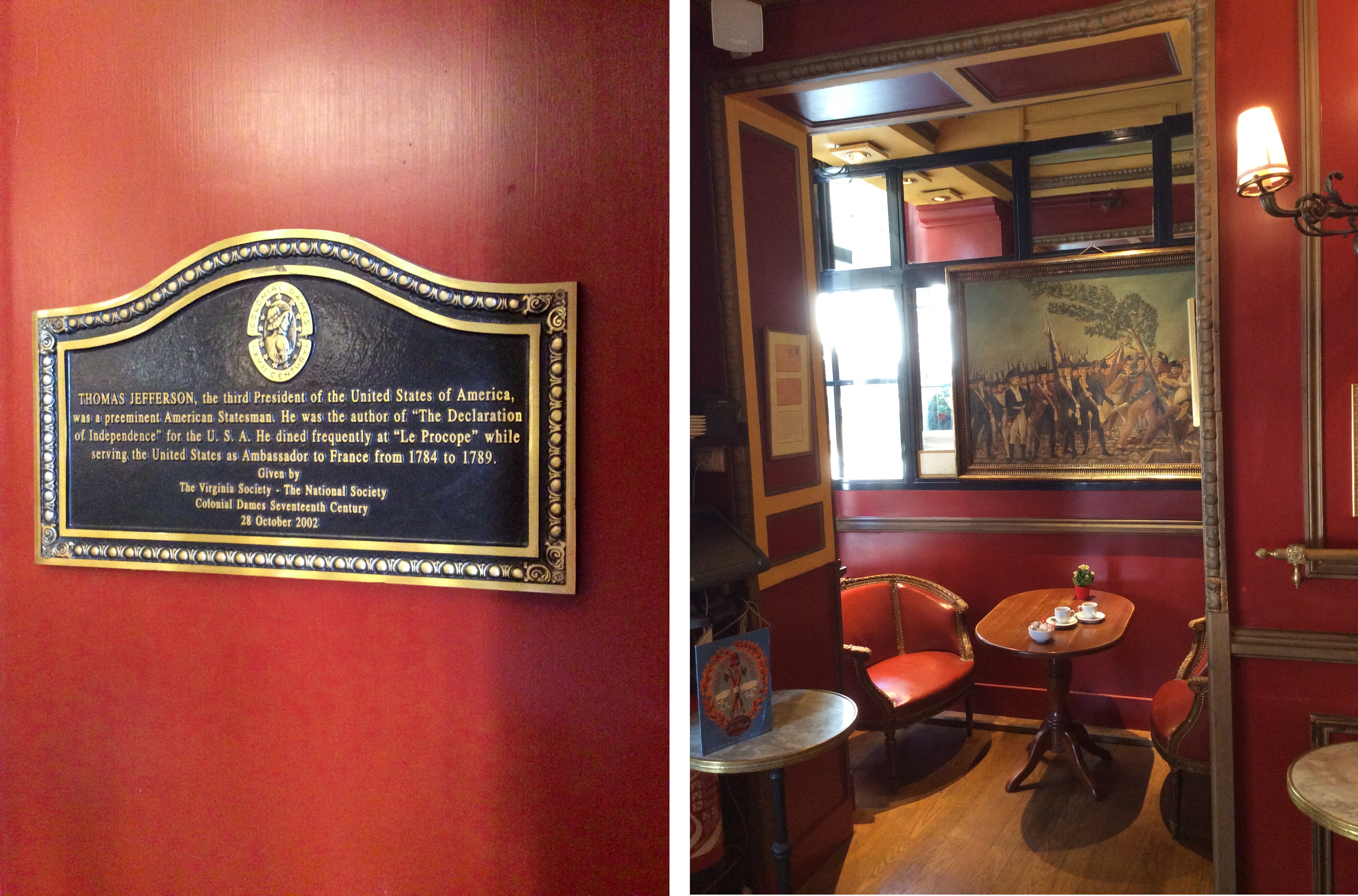
Thomas Jefferson plaque and upstairs dining nook at Café Procope

Painting of a hot air balloon ride at Café Procope, Paris

Painting of a hot air balloon ride at Café Procope, Paris

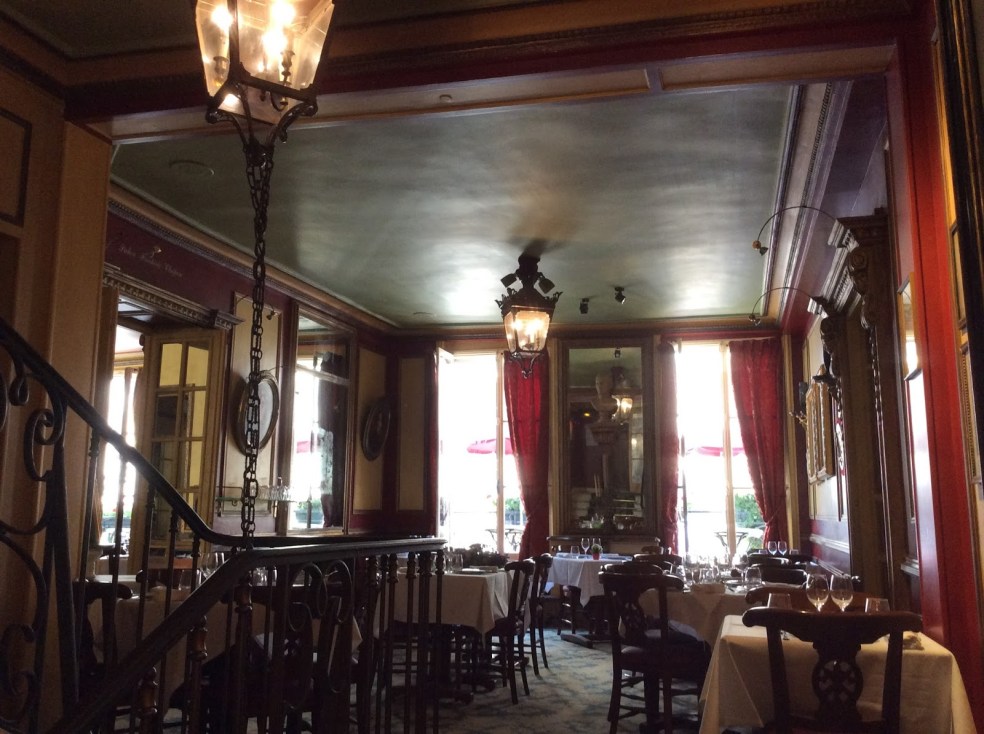
The restaurant has numerous dining rooms, upstairs and down, and has a sweet little back terrace dining area facing the passage we first spotted the restaurant from. They’re decorated in shades of gold and red, which coupled with the large and numerous windows, lend the rooms a warm and cheerful feeling. The walls are covered with portraits, plaques, facsimiles of personal correspondence, and many more artifacts pertaining to the great people who have sipped coffee, dined, and talked here over the centuries.

There’s a plaque dedicated to Jefferson on the wall of one dining room south of the central stairway, and a scene of a hot air balloon taking off with an adventurous couple in the basket in the hall. Jefferson was fascinated with this technology, the first by which people could travel by air, and Jefferson witnessed this marvel for himself in Paris for the first time, in the Tuileries Gardens. This place is a treasure trove for a person following history as I am, and next time I’m in Paris, this will certainly be the first on my list of restaurants to splurge on dinner.

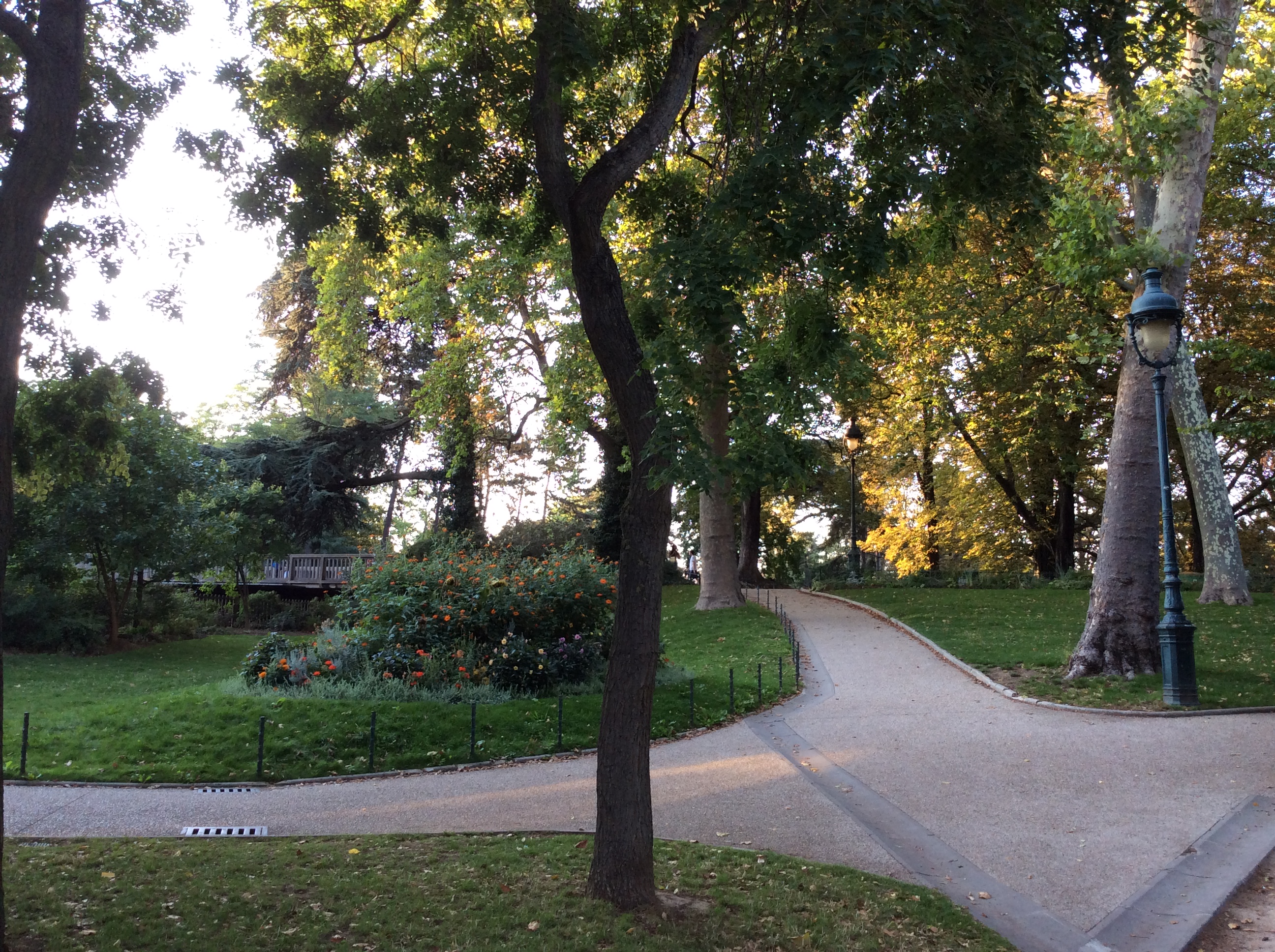
Parc Montsouris, Paris, France

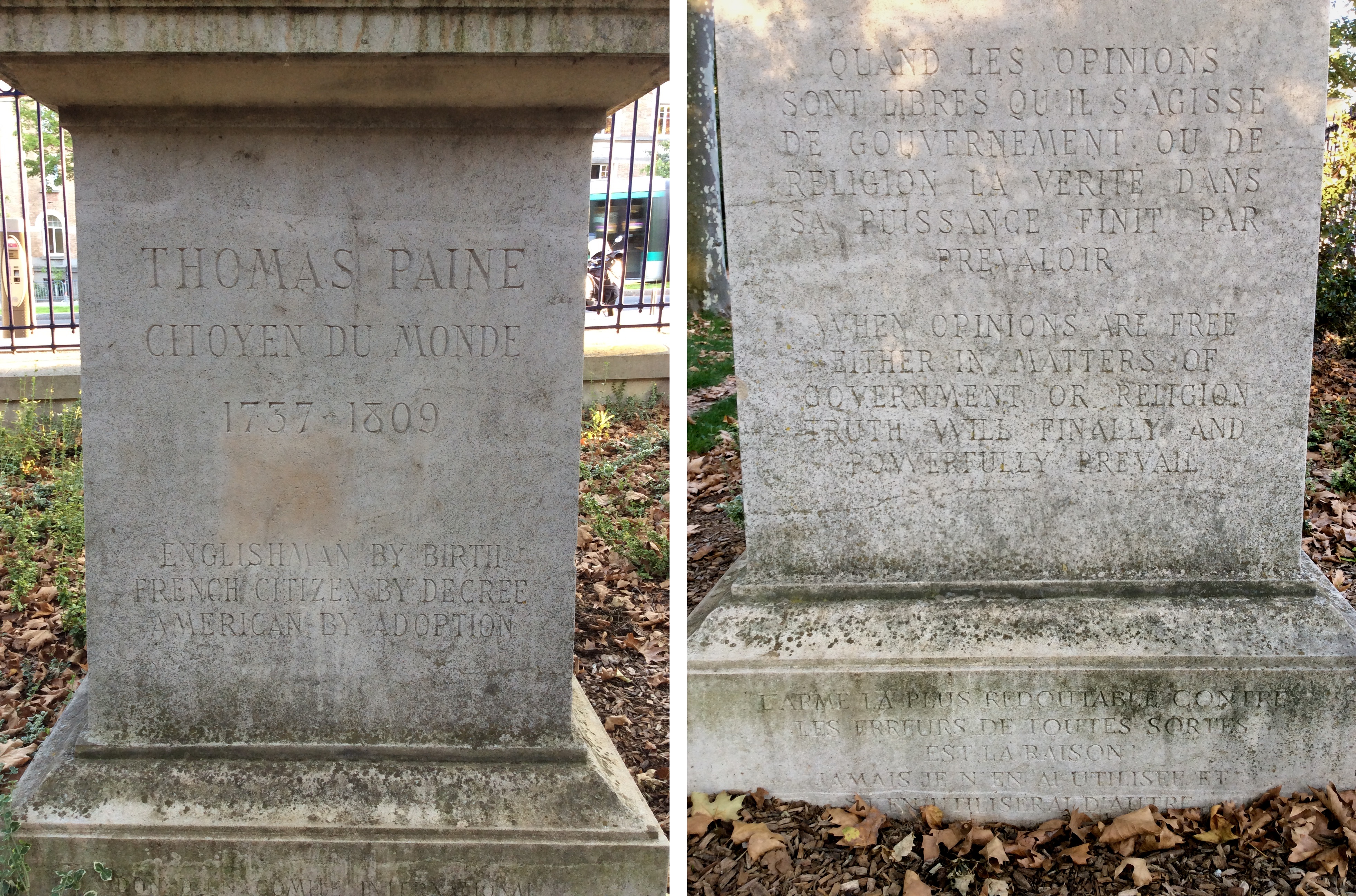
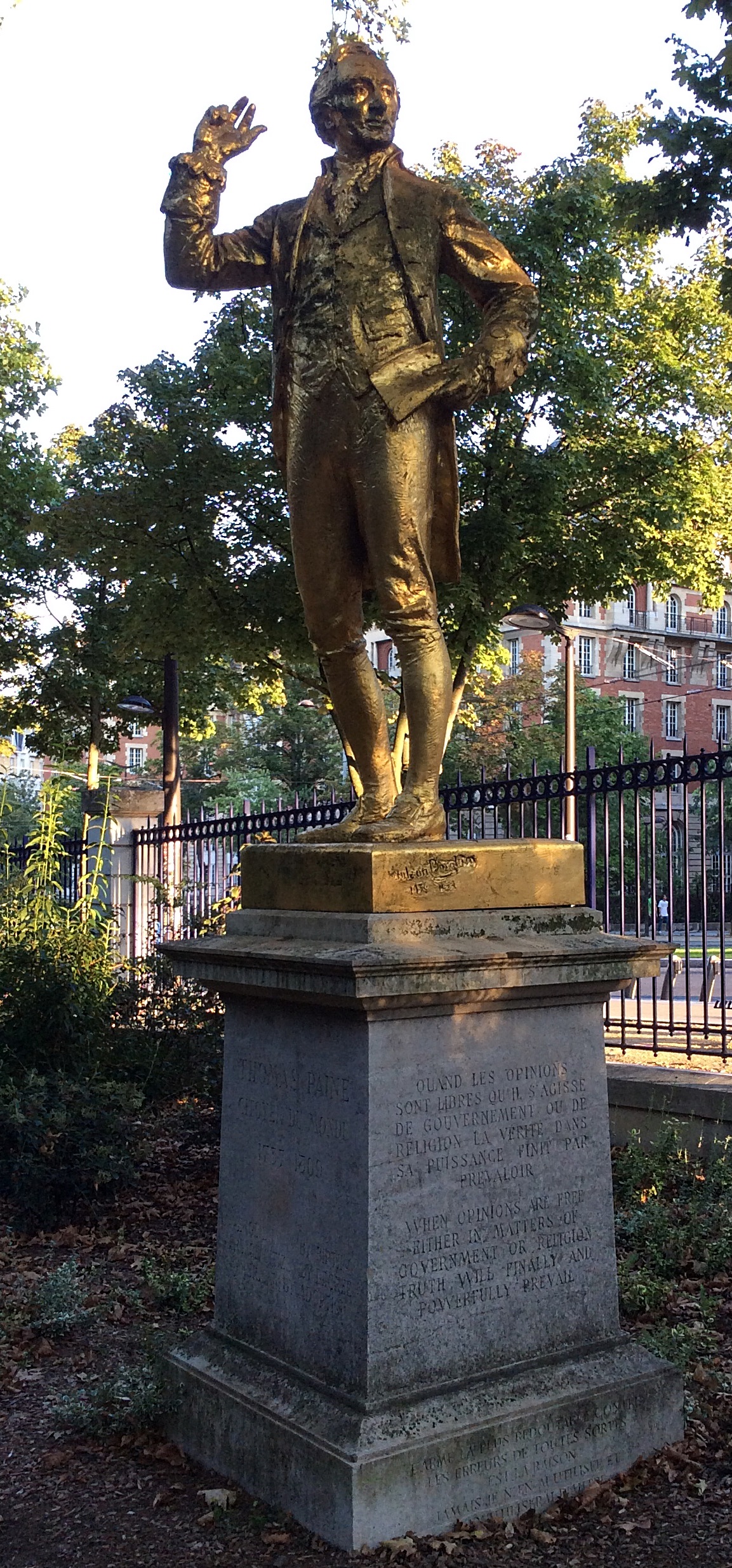
Statue of Thomas Paine by Gutzon Borglum at Parc Montsouris, Paris

Two views of the pedestal of the statue of Thomas Paine by Gutzon Borglum, 1938, at Parc Montsouris in Paris

At a certain point late in the afternoon, my exhausted husband decides to return to his hotel in Saint-Quentin en Yvelines where his bike and luggage are, so he can get plenty of sleep before leaving early in the morning, and we say goodbye until we see each other at home. I plan to stay up late, however, since my flight leaves tomorrow afternoon. So I decide that my last historical site to visit for this trip will be Parc Montsouris at the southern edge of Paris in the middle. I plan to spend my last evening at the Seine, watching the sun go down over the Île de la Cité, and I figure that I have time to get to the park and back before sunset. I’m headed to Parc Montsouris because the only statue of Thomas Paine in Paris is there, and to get there, I take the metro to the Port d’Orleans station then head east on Boulevard Jourdan. The park is across from the Cité Universitaire, and the statue is just off the pathway that runs along Bd. Jourdan, nearer the west end of the park. It’s a lovely place for a stroll on this cooling late afternoon, a relief from this hot summer day.

787-5

Statue of Thomas Paine by Gutzon Borglum, 1938, Parc Montsouris, Paris

The statue is a gilded affair, sculpted by Gutzon Borglum in 1938, the same artist who conceived of and designed Mount Rushmore. He was a man of outsize personality, with a strange family history, overweening ambition, and a membership in the Ku Klux Klan. There’s a documentary about Mount Rushmore on PBS’s American Experience from which you can learn more about this most unusual character, and it’s really worth a watch. I’m pretty sure the egalitarian, anti-slavery, human-rights activist and critic-of-organized-religion Paine would disapprove of the commission for his statue going to this guy. It’s also just a middling portrait: not particularly evocative of Paine’s personality, as is the portrait by George Romney, nor particularly artful, interesting, or innovative in other ways. But it’s a serviceable one, and I’m glad this tribute exists in any case.
It’s likely Borglum painted it gold because of Napoleon Bonaparte. They first met at a dinner party in 1800, where Bonaparte invited Paine over to flatter him and get his support for his ambitious plan to invade Britain and ‘liberate’ them from their oppressive monarchy. (‘Liberate’ is in scare quotes because, in hindsight, it’s funny to think of Napoleon liberating people from monarchy as an institution. While he may have been sincere to begin with, over time, it became clear that he didn’t have a problem with monarchy per se so long as he was the monarch. He did, however, institute laws that promoted some of the best principles of the French Revolution including political equality, for men at least.) Paine had been advocating such a plan for years and continued to do so; however, his initial enthusiasm for Bonaparte rather quickly turned to disillusionment and then disgust. He recognized Bonaparte’s overweening arrogance, and accused him of freely shedding blood because of it and not out of a true concern for the people. Anyway, Bonaparte flattered Paine by telling him that he slept every night with a copy of The Rights of Man under his pillow, and that a golden statue of Paine should be erected ‘in every city in the universe’. Well, here’s one anyway.

~~~~~~~~~~~~~~~~~~~~~~~~~
I’ve come to the end of my travel adventures following in the footsteps of Thomas Paine, Mary Wollstonecraft, and Thomas Jefferson in Paris, though not to the end of immersing myself in their ideas.

I’ve had a most wonderful and energizing time here in Paris, and I am very sorry it’s drawing to a close. I got to know the city in a way that I might never have done if I had come just for the food, the museums, and the scenery. My adventures led me to walk many, many miles a day up and down, back and forth across the city, and I got to know many of the neighborhoods very well. I didn’t make it to a few sites I would have liked to visit: the Bois de Boulogne, the woods where Jefferson liked to relax; Versailles, which Paine and Jefferson both visited on official business (I visited Versailles when I was here seven years ago, and decided not to go this trip because it gets absolutely mobbed by tourists in mid-August); and to search for the sites of Wollstonecraft’s Neuilly-sur-Seine cottage and Helen Williams’ salon which Wollstonecraft and Paine frequented (the latter two are way out in the suburbs and I can’t find records of the addresses). Through my research and my search for buildings of a particular era set among others of varying ages, I also developed much more of an understanding of how the city changed over time.
I had one main disappointment: I had hoped to find more sites associated with the life of Mary Wollstonecraft, and to find some sort of public tribute to her as well: a statute, a street named after her, even a little plaque marking any of the places she had been. No such luck. Even given the fact that Paine and Jefferson were appointed state officials whose movements in Paris would have been documented more thoroughly, the degree of the lack of evidence of places Wollstonecraft had bee been, and of public recognition of her contributions, was still a little surprising to me. Wollstonecraft was the first to publish a best-selling rebuttal to Edmund Burke’s screed against the French Revolution; she was an ardent supporter of the Revolution and championed its cause to the western world; she was close friends with Paine and many other leaders of the Revolutionary movement; she was a famous and highly respected intellectual; she was among the first to make a systematic, well-developed philosophical case in favor of women’s rights; she lived her life as unconventionally as she thought her thoughts; and by the way, she gave the world Mary Shelley. How, then, are her contributions still so overlooked in Paris? Perhaps for some of the same reasons I was so hard-pressed to find significant public recognition of the contributions of Ernestine Rose and Elizabeth Cady Stanton in New York City.

I learned so much about these three great thinkers and about this great city, what a joy this journey has been! And I’ll be continuing to immerse myself in their ideas and to think about much they still contribute to our lives and thought. Stay tuned…

Sources and Inspiration:

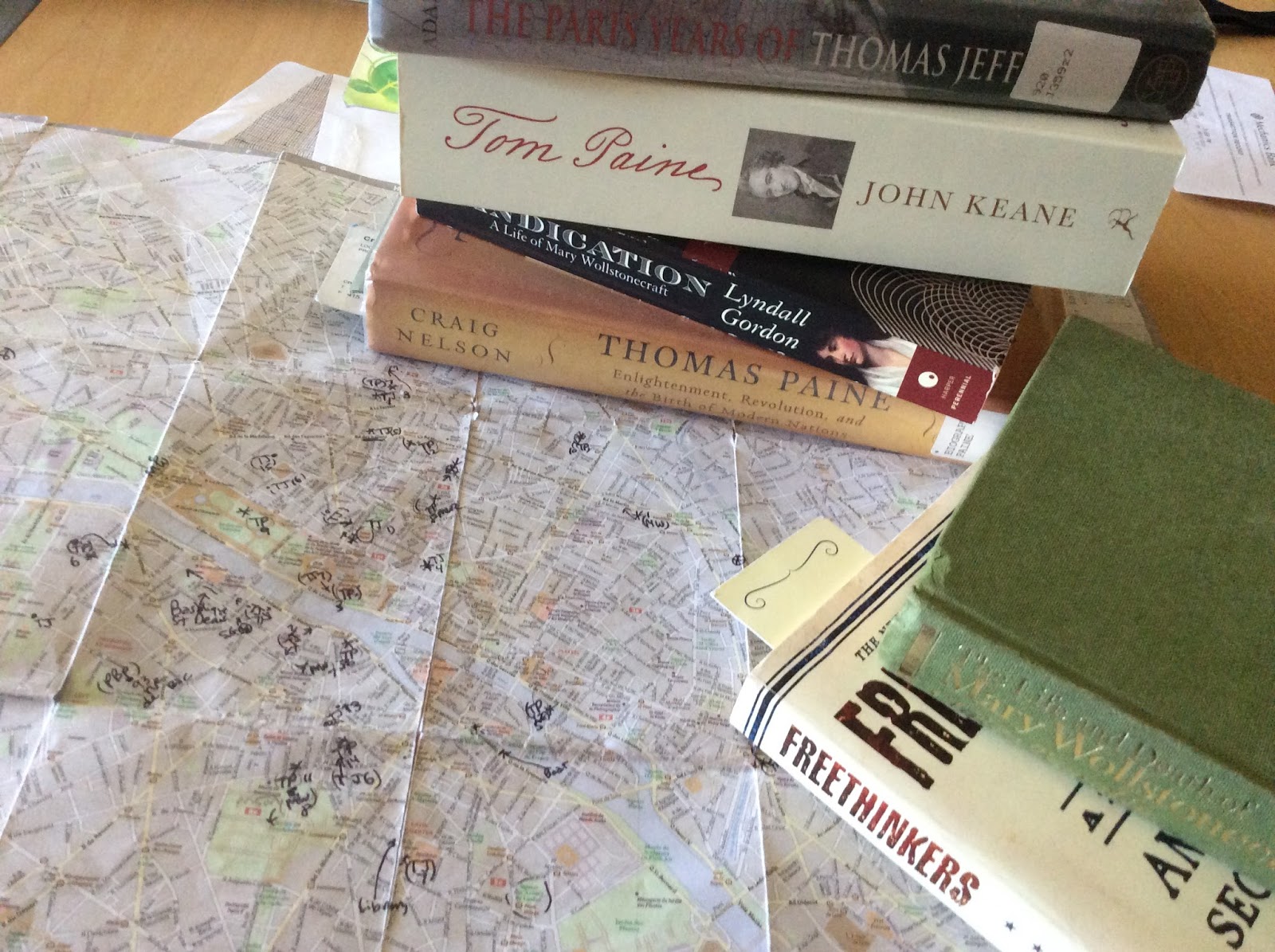
Adams, William Howard. The Paris Years of Thomas Jefferson. New Haven/London: Yale University Press, 1997.

‘Café Procope.’ Wikipedia, The Free Encyclopedia.

‘French Revolution’. Wikipedia, The Free Encyclopedia.

Gordon, Lyndall. Vindication:  A Life of Mary WollstonecraftNew York: Harper Collins, 2006.

Gutzon Borglum‘, Biographical page on the American Experience website.

History of the Restaurant‘, Café Procope website.

Hitchens, Christopher. Thomas Paine’s Rights of Man: A Biography. New York: Grove Press, 2006.

Jacobs, Diane. Her Own Woman: The Life of Mary Wollstonecraft. New York: Simon & Schuster, 2001.

Jacoby, Susan. Freethinkers: A History of American Secularism. New York: Owl Books, 2004.

Les Statues du Parc Monsouris: Thomas Paine, Citoyen du Monde’, Laparisienneetsesphotos.com

Nelson, Craig. Thomas Paine: Enlightenment, Revolution, and the Birth of Modern Nations. New York: Viking Penguin, 2006.

Todd, Janet. Mary Wollstonecraft: A Revolutionary Life. New York: Columbia University Press, 2000

Tomalin, Claire. The Life and Death of Mary Wollstonecraft. London: Weidenfield & Nicholson, 1974.

Williamson, Audrey. Thomas Paine: His Life, Work, and Times. New York: St. Martin’s Press, 1973.

Zwerin, Mike. ‘Traveling In Style: With Jefferson In Paris’. Los Angeles Times, October 16, 1994.
http://articles.latimes.com/1994-10-16/magazine/tm-51199_1_thomas-jefferson
http://articles.latimes.com/1994-10-16/magazine/tm-51199_1_thomas-jefferson/2
http://articles.latimes.com/1994-10-16/magazine/tm-51199_1_thomas-jefferson/3

Sixth Day in Paris Following Thomas Paine, Mary Wollstonecraft, and Thomas Jefferson

Crossing rue de Richelieu on a drizzly day in Paris, France

Thursday, August 20th, 2015

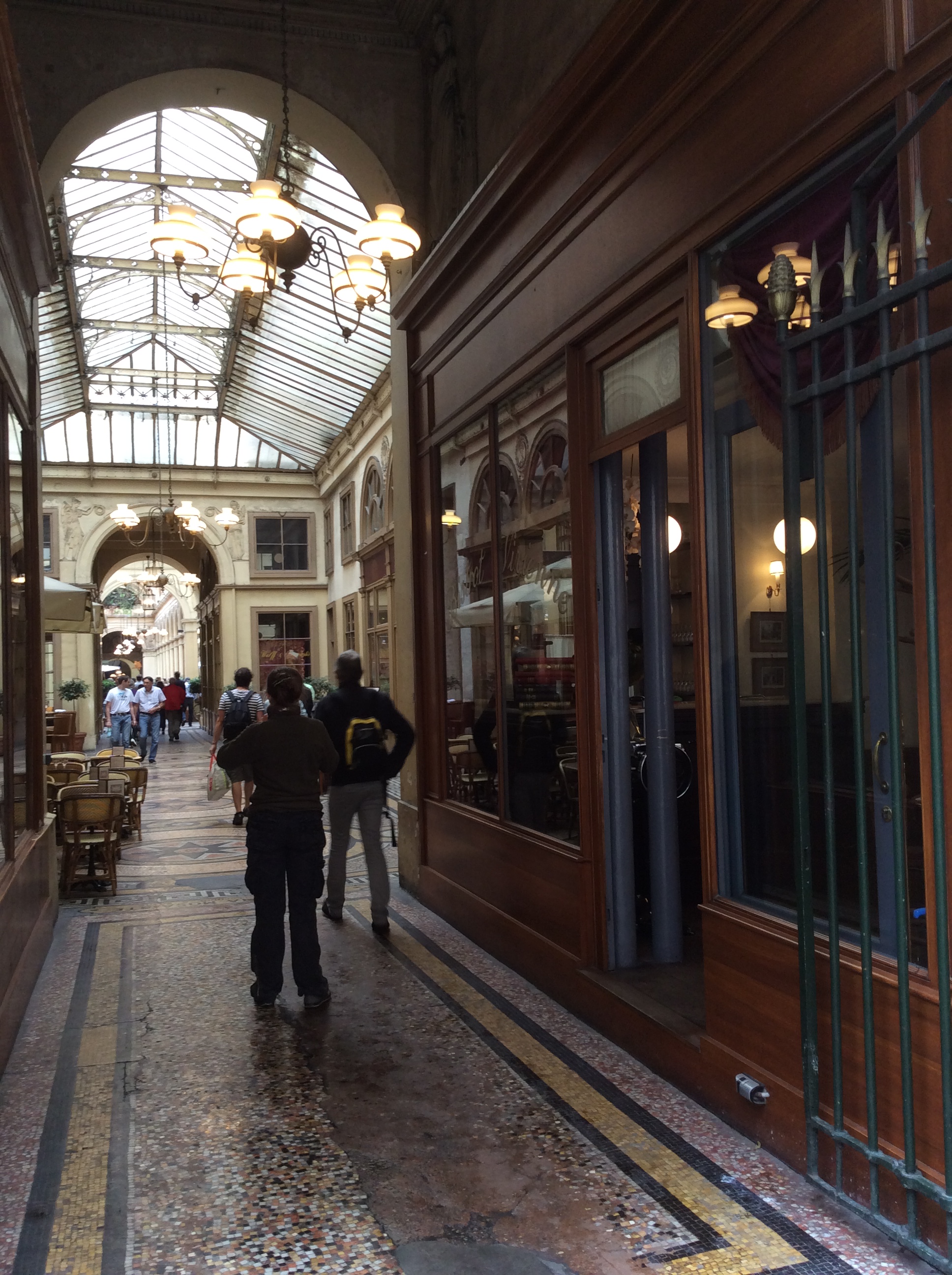
It’s a rainy morning, wet enough to drive away the otherwise intrepid kids at the little alleyway skate park across the street, though not quite enough to drive away the hardworking construction crew renovating the building next to it. I take advantage of the inclement weather by catching up on my writing and research, and the clangs, buzzes, and shouts from the workers only adds to the feeling of productiveness, and don’t disturb me at all. By late morning, the rainfall lightens up, so I head out for the day. Along the way, I pop into several passages, covered pathways lined with shops and cafes: Passage des Panoramas, Passage Jouffrey, la galerie Vivienne, Passage des 2 Galleries, and more. It’s a great way to duck out of the rain while discovering some of the most charming little spots in Paris.

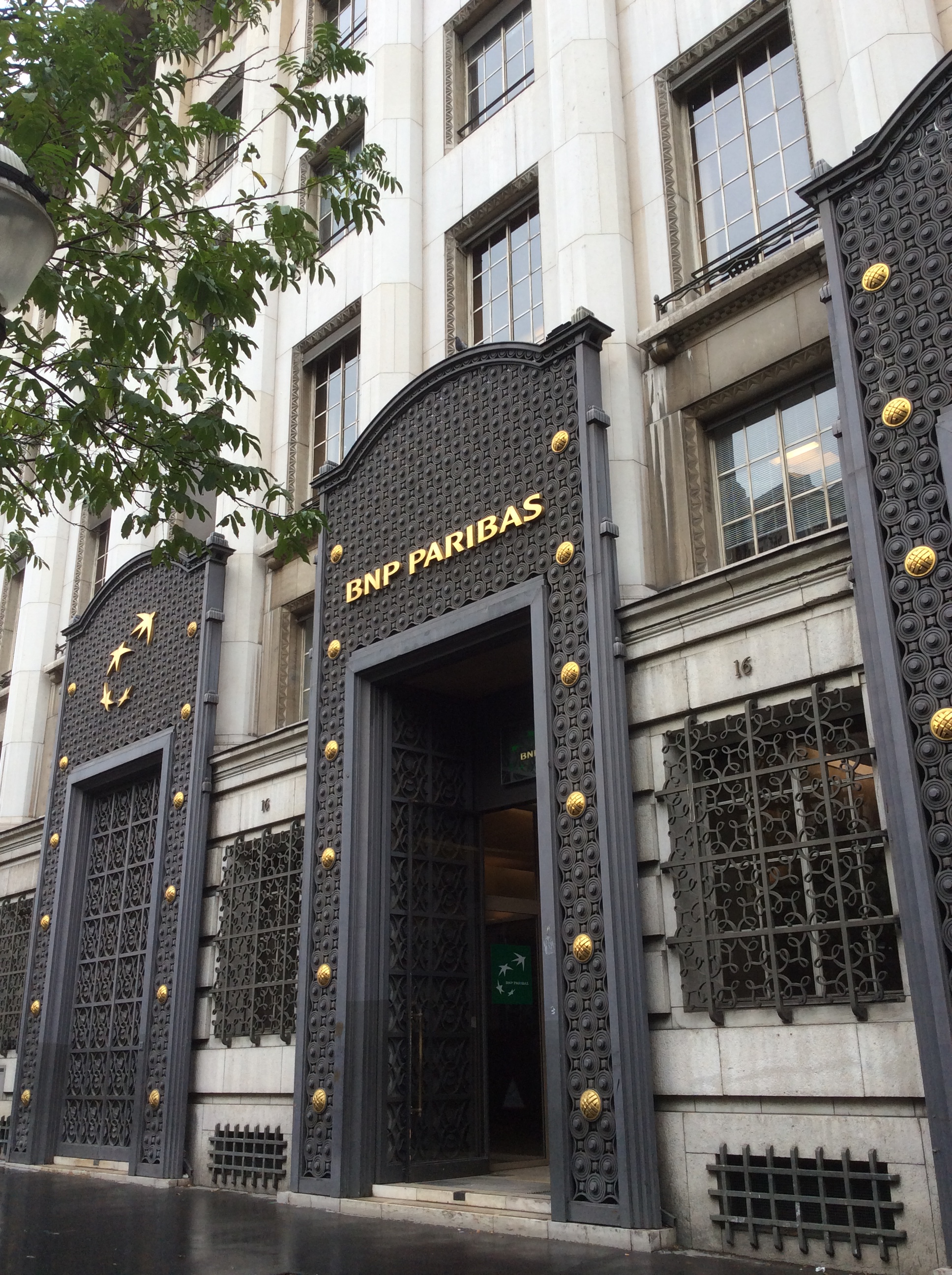
BNP Paribas offices, about where Hôtel Landron and cul-de-sac Taitbout used to be

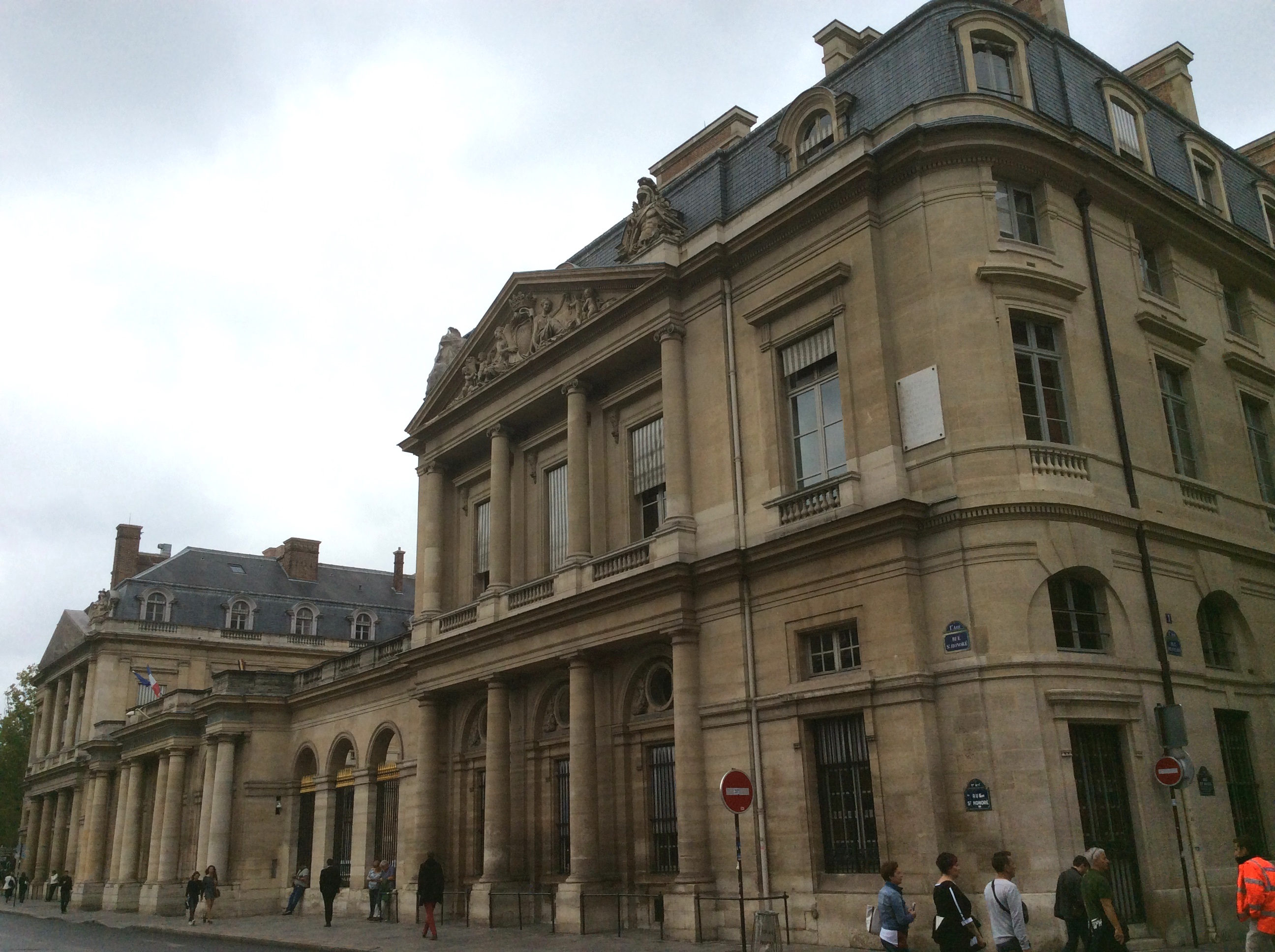
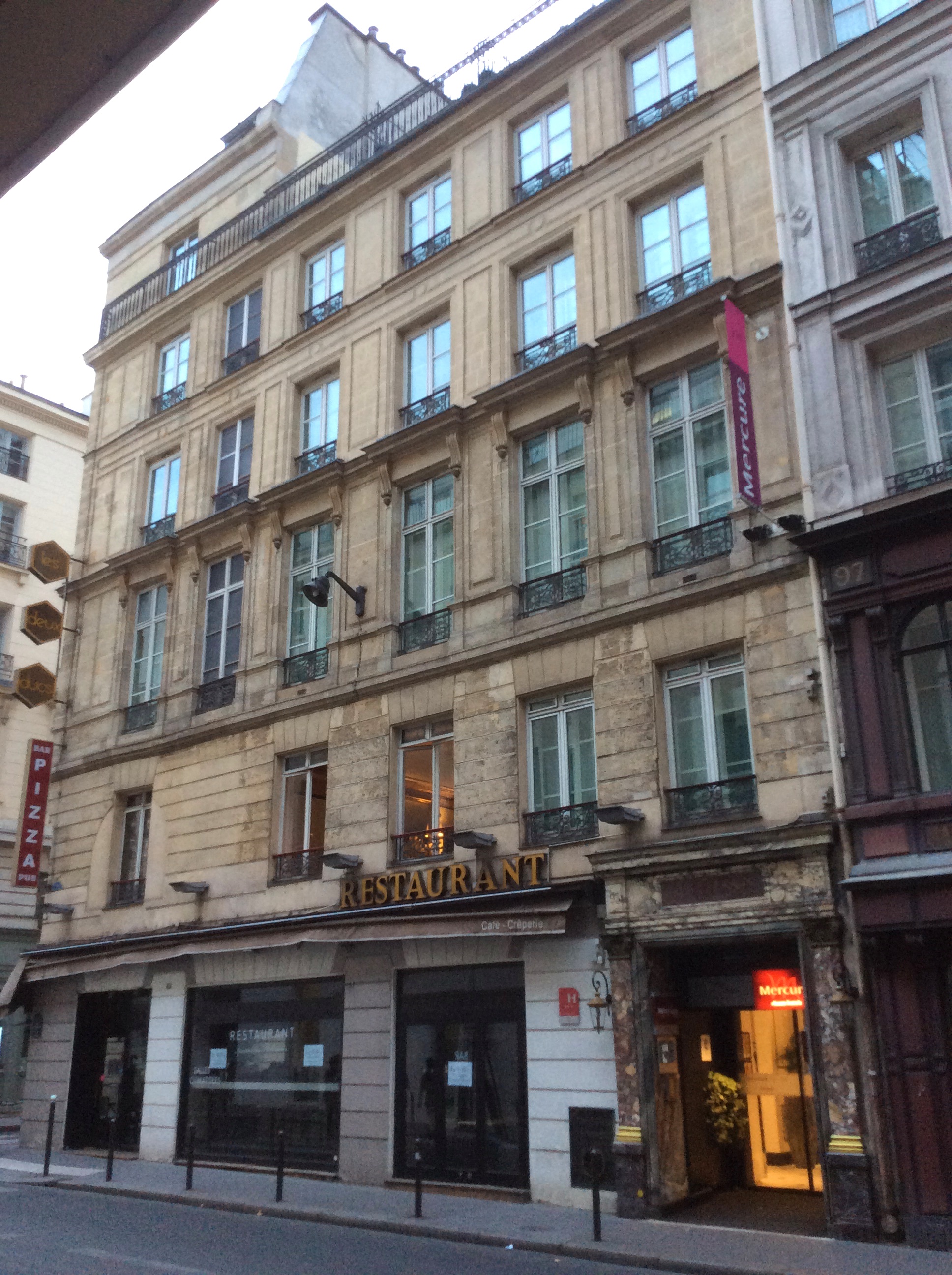
On my way to my main destinations of the day, I quickly follow up on two sites from earlier in my trip. Last evening, I visited 95 Rue Richelieu, the actual site of James Monroe’s first house in Paris when he arrived to take over the ambassadorship from Governeur Morris. It’s now occupied by a Mercure Hotel (hotel in the modern sense), and I follow the desk clerk’s recommendation from yesterday, to see if the day manager can help me find more historical information about the building, but no dice. Upon inquiry, the lady in charge at the front desk stopped me with an abrupt ‘no’, as if to say, ‘I don’t have time for this nonsense, I have a hotel to run.’ Fair enough. I move on.

I swing over to Boulevard des Italiens, where Thomas Jefferson had lived at Hôtel Landron, aka Taitboit, for the first year of his sojourn in Paris. It stood on cul-de-sac Taitbout, which used to run north off this street right across from the back side of the Theatre des Italiens. I have since confirmed the site in additional sources, but I was right the first time: the building, and the cul-de-sac it was on, no longer exists. This place is now occupied by a large, much more modern building which houses the offices of BNP Paribas.

Then I head for 30 rue Richelieu, where Thomas Jefferson stayed first for a few days when he arrived in Paris, at one of the two hotels he stayed at named Hotel d’Orleans; this is the first of them. It’s a smaller and simpler building than many that Jefferson stayed at, which might explain why he stayed there such a short time, being used to more luxurious quarters. I find that it’s right down the street from the house where one of my literary heroes, Moliere, died, and there’s a monument to him right across the street. The statue is wearing a scarlet blindfold, just like another statue I saw on another day. I wonder what it means….

30 rue Richelieu where Thomas Jefferson stayed at one of two Hôtels d’Orléans, and 40 rue Richelieu, where the great playwright and actor Molière died

Galerie de Vivienne, behind approximate site of White’s Hotel, aka Hôtel de Philadelphia, at passage des Petits-Pères

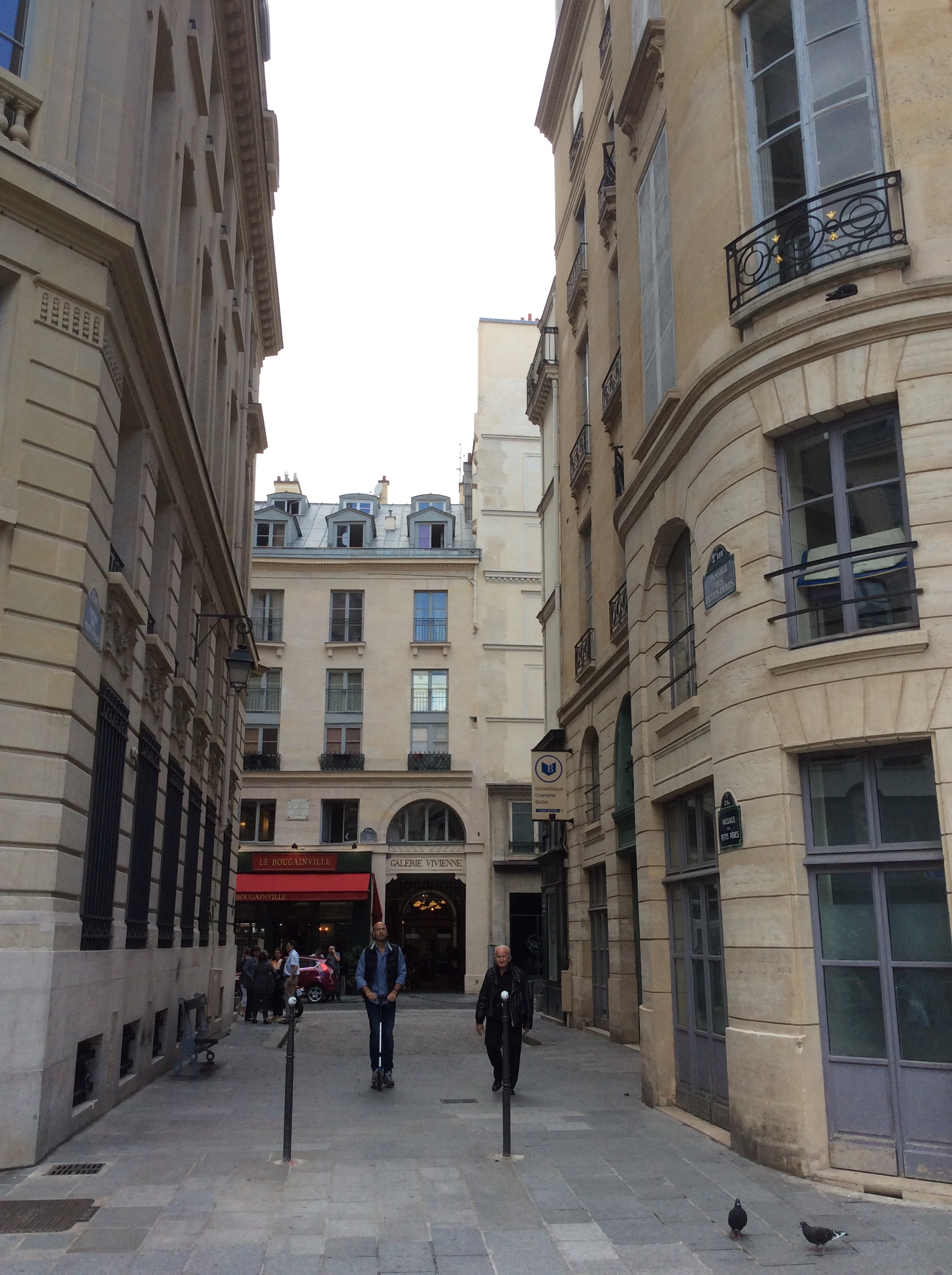
Next, I swing by the site of the former White’s Hotel, where Thomas Paine stayed several times while he was in Paris and where Mary Wollstonecraft visited him, to confirm its actual site. As I mentioned at the opening of the story of my second day in Paris, part 2, it was listed as 7 passage des Petits Pères in three separate biographies I referenced (two of Mary Wollstonecraft, one of Thomas Paine). However, in the U.S. State Department paper I just discovered, it’s listed as 1 rue des Petits Pères. Turns out the place I had gone to on the first day was half right: putting two and two together, it seems that White’s Hotel, later Hôtel de Philadelphia, stood at the intersection of passage des Petits Pères and rue des Petits Pères, which join at an angle. Paine also lived in a place across from the hotel at 7 passage des Petits Pères, hence the confusion.

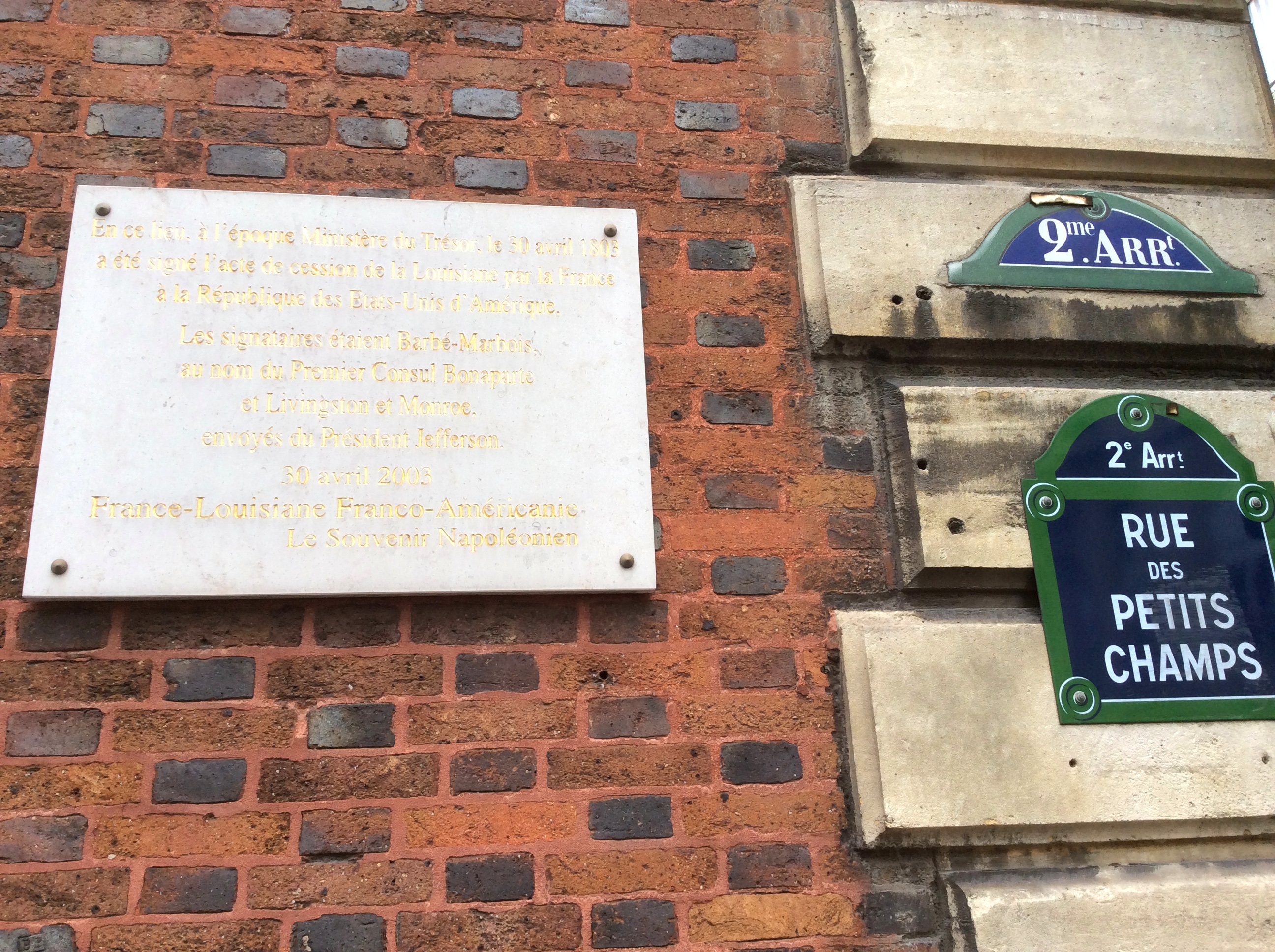
Building where James Monroe and Robert Livingston signed the Louisiana Purchase, rue des Petits Champs

Historical plaque on the building where James Monroe and Robert Livingston signed the Louisiana Purchase

So on with the story of the day: on the way to passage des Petits Peres, I stumble upon a Jefferson site quite by accident! It’s at rue des Petits Champs and rue Vivienne, the next block over from the White’s Hotel site, and it’s the place where James Monroe and Robert Livingston signed the Louisiana Purchase treaty on April 30th, 1803.

Jefferson had authorized them to purchase the crucially important port city of New Orleans and the area surrounding it so that U.S. trade could not be hampered by European quarrels. But when Napolean offered the entire Louisiana territory for $15 million, vastly larger than what they were prepared to purchase, Monroe and Livingston jumped at the chance, since they had also been instructed to use their best judgment. This was sort of going over Congress’s head, because though the President has the power to negotiate treaties, they don’t have the power to make land purchases, strictly speaking, and Jefferson had not received funding or the permission from Congress. For all his strict constructionism and anti-government-debt rhetoric, Jefferson at times operated more in accordance with a ‘great man theory’ of government like Theodore Roosevelt did. After all, if you have the vision and the power coupled with the proper concern for the wellbeing of your country, at times it just seems incumbent upon you to take such bold and decisive steps, even if they’re not strictly legal. And Jefferson was right: the Louisiana purchase was an opportunity like no other to increase the prestige, population, and power of the young United States, and had to be done almost regardless of the price.

Palais Royal, Paris, France

Front Gate of the Palais Royal / Conseil d’État, Paris, France

On my way to my next destination, I pause to snap some photos of the front of the Palais Royal, which I had neglected to do on my second day in Paris, in favor of staying under the shady walkways of its rear enclosure and tree-lined gardens. 

229 – 235 Rue Saint-Honore, former Home of Abbé André Morellet

The next site I swing by is the former home of Abbé André Morellet at 229 – 235 Rue Saint-Honore in the 8th Arrondissement, north of the Jardin des Tuileries at about its midpoint at Rue Castiglione. Morellet was an economist and contributing writer to Diderot’s Encyclopedia of the Sciences, Arts. and Crafts, and close mutual friend of Jefferson and Benjamin Franklin. It’s a tall narrow house, over a macaron shop between a cafe and a luggage shop, on a touristy and expensive section of the street. Jefferson, as we have seen, was an avid collector of knowledge, and Morellet’s learned, witty, and sarcastic brain was an excellent one for picking.

Jefferson was also a frequent guest of Geoffrey Chalut de Vérin at 17 Place Vendôme, between the Opera metro station and the Jardin des Tuileries. He was a customs official and another close friend of Benjamin Franklin, though I can’t find that much information about him with a brief internet search, The collected Franklin papers contain some notes from him. Many of the opulent buildings surrounding the Place Vendôme are being restored, and some are being converted to a Ritz Hotel; 17 Place Vendôme is one of these. The column in the center of the place is also being reconstructed: the Paris Commune pulled it down in the revolution of 1871, the same revolution which saw the destruction of the Tuileries Palace.

A view of the Place Vendôme. The printed screen is shielding the monument under repair

17 Place Vendôme, behind the printed screen, at or near the site of the home of Geoffrey Chalut de Vérin

Returning to my lodgings to meet up with my husband Bryan, hopefully rested enough from riding Paris-Brest-Paris to spend a day touring Paris with me, I pass by the Palais Garnier Opera, whose spectacular beauty really knocks your socks off as you enter the square. It’s not the opera house that Jefferson attended, however, as it was built many decades after his time there.

Palais Garnier Opera House, Paris, France

When I meet up with Bryan, it turns out he’s still too exhausted to take much of a walk, so we go out for a delicious meal at a little gastropub just down the street from my place on rue Montmartre. After he goes in for a nap, I take the metro nearly as far west as it goes to Auteuil, which once was a suburb of Paris, and now in its 16th Arrondissement.

Hôtel de Verrières, 47 Rue d’Auteuil, former residence of John, Abigail, and John Quincy Adams, Paris, France

Histoire de Paris sign and view of the Hôtel de Verrières, 47 rue d’Auteil, former residence of the Adamses

Plaque on the wall in the courtyard of the Hôtel de Verrières, 47 rue d’Auteuil

Jefferson stayed here at John and Abigail Adams’ place for awhile in 1784, probably not long before he signed the lease at the Hôtel Landron at the cul-de-sac Taitbout that fall. The Adams’ former residence is at 43 – 47 rue d’Auteuil, about halfway between the Seine and the southeast corner of the Bois de Boulogne, at rue Michel-Ange, near the Monoprix grocery which is near the metro stop. The house at 47 rue d’Auteuil has a historical marker identifying it as the Hôtel de Verrières, where many famous people lived. It’s on a sweet little street, which still feels like central Paris but much mellower. The house is cute too, with rounded corners and sweet little garden area. There’s a plaque on the wall above the front garden with both John Adams and his son John Quincy Adams’ names on it, but try as I might, I can’t make out the small print or capture it on the basic camera I have with me. A young boy with a little black dog and thick blue glasses, which give him oversize Keane eyes, looks at me like I’m crazy as he goes to let himself in the front gate which I happen to be blocking. He doesn’t speak English, but I’m able to communicate with gestures that I’d just like to take a picture real quick. He lets me in and I do so. Nice kid.

Near 59 Rue d’Auteil, the former site of the salon of Madame Helvétius

In 1784 and onwards, Jefferson also often hung out at the famous salon of the fabulous Madame Helvétius just down the street at 59 rue d’Auteil. The rather puritanical Adamses were often shocked at French manners and dress, loud, lots of makeup, exposed bosoms, frank conversation, and these were to be found in abundance at Madame Helvétius’. (There are great scenes from the John Adams miniseries, starring Paul Giamatti and Laura Linney, of their unease in Parisian society and discomfiture at Madame Helvetius’ salon.) Aside from her own accomplishments and outsize personality, she was famous for Ben Franklin’s being so smitten with her that he asked her to marry him. The building I find is not old, quaint, or lovely, but an aggressively sleek, square building of concrete blocks and smoked glass, all angled corners. The suburb of Auteuil was very fashionable in Adams’ and Jefferson’s time, and the neighborhood I find myself in today still is, full of elegant buildings, cute expensive shops, well-dressed people, and families with one or two likewise well-dressed children. it looks like a postcard or realtor’s advertisement of the perfect neighborhood and reminds me a bit of Noe Valley in San Francisco, Paris-style.

Corner view of Benjamin Franklin’s house at Hôtel Valentinois, Passy

The last site I visit today is in Passy, also in the 16th Arrondissemont, also a former fashionable suburb of Paris which is now one of its outer wealthy neighborhoods. Thomas Paine lived somewhere in this neighborhood near Ben Franklin, who befriended him during Paine’s first stay in Paris in 1781 as he helped negotiate a loan from the French government to aid the American Revolution. Though I couldn’t find the exact site where Paine lived, Franklin lived at Hôtel Valentinois at 62-70 rue Raynouard at Avenue de Lamballe. There’s no doubt that Paine visited here often. The Hôtel Valentinois stands on a hill overlooking the city, and the view must have been particularly spectacular in Franklin and Paine’s time, with an uninterrupted view of the city since this is way out in the outskirts of Paris. Passy was an outlying village or suburb at the time, but highrises galore have sprung up between the Valentinois and central Paris since then. The view has still got to be pretty great from the upper floors, since it towers seven tall stories from the hill it’s on.

A view of Benjamin Franklin’s house at Hôtel Valentinois, Passy, Paris, France

Benjamin Franklin’s image on the corner of the historic Hôtel Valentinois

It was Franklin who wrote letters of introduction for the young Paine to his friends in the American Colonies, which enabled him to find a job and make connections with other young thinkers, movers, and shakers, eventually involving Paine in the burgeoning independence movement, which led to the publication of Common Sense… and the rest, as we have seen, is history!

As I walk back towards the Seine to meet my husband at rue Saint Dominique for dinner (just down the street from where we honeymooned seven years before, how romantic!), I’m treated to the most beautiful views, quite changed since Franklin’s, Paine’s, Wollstonecraft’s, and Jefferson’s time, but no more or less breathtaking, I’m sure. Just different.

A view from Avenue du President Kennedy, Passy, Paris, France

A View through Pont de Bir-Hakiem, Passy

A View From Pont de Bir-Hakiem, Paris, France

 
~~~~~~~~~~~~~~~~~~~~~~
Sources and Inspiration:
 
Adams, William Howard. The Paris Years of Thomas Jefferson. New Haven/London: Yale University Press, 1997.
 
André Morellet‘. Wikipedia, The Free Encyclopedia.
 
Bell, David. ‘5 Myths About the French Revolution‘, New York Post, Jul 9th, 2015.
The Encyclopedia of Diderot & d’Alembert‘, Collaborative Translation Project website.
 
French Revolution‘. Wikipedia, The Free Encyclopedia.
Gordon, Lyndall. Vindication:  A Life of Mary WollstonecraftNew York: Harper Collins, 2006. 
 
 
Hôtel de Verrières‘, Structurae website.
 
Jacobs, Diane. Her Own Woman: The Life of Mary Wollstonecraft. New York: Simon & Schuster, 2001.
 
Jacoby, Susan. Freethinkers: A History of American Secularism. New York: Owl Books, 2004.
http://us.macmillan.com/freethinkers/susanjacoby

Louisiana Purchase, 1803‘, U.S. Department of State Office of the Historian website.
Nelson, Craig. Thomas Paine: Enlightenment, Revolution, and the Birth of Modern Nations. New York: Viking Penguin, 2006.
 
O’Brien, Kristin. ‘Madame Helvétius‘, The Salonniere blog.
 
Paris Residences‘, from the Thomas Jefferson Encyclopedia, Monticello.org
Todd, Janet. Mary Wollstonecraft: A Revolutionary Life. New York: Columbia University Press, 2000 
Tomalin, Claire. The Life and Death of Mary Wollstonecraft. London: Weidenfield & Nicholson, 1974. 
 
Williamson, Audrey. Thomas Paine: His Life, Work, and Times. New York: St. Martin’s Press, 1973.

Fifth Day in Paris Following Thomas Paine, Mary Wollstonecraft, and Thomas Jefferson

On rue du Faubourg Saint-Denis, Paris, France

Wednesday, August 19th, 2015

I get a very late start resuming my history of ideas adventure today: I greeted my husband Bryan last night in Saint Quentin en Yvellines as he finished Paris-Brest-Paris in excellent time, 1200 kilometers in 53.15 hours! We celebrate his accomplishment and restore his energy by feasting throughout the morning and early afternoon, after he gets some good rest. When I arrive back in Paris, I still have at least three good hours of daylight, so I throw down my overnight bag and head right back out into the street. Although I only have a short time to explore, it turns out to be a very fruitful evening.

Today’s explorations will be conducted in light of some new information I’ve just uncovered. As Bryan slept, I researched, and as I had been discovering new details about the history of the places I visit, the more leads I have. As I enter these new combinations of keywords, I discover this wonderful U.S. State Department paper on the official history of U.S. representatives in France, complete with more detailed location descriptions, including some historical addresses listed alongside the new. It’s the site-identification Rosetta Stone I’ve been looking for, and I discover that three of the places I visited on my second day in Paris have different modern addresses. Today’s mission, then, will be one of rediscovery.

I begin by heading up rue Montmartre over to Boulevard Montmartre, then to rue du Faubourg Saint-Denis, once again in search of the site of the mansion farmhouse Thomas Paine shared with six others from the fall of 1793 to 1794. The State Department paper reveals that while in Paine’s time the address was number 63, it’s now numbered 144, and that the mansion had once belonged to Madame de Pompadour, Louis IV’s official mistress. Unlike the other two sites that I’ll be seeking today, this one is quite far from the original address I sought, because the original rue Saint-Denis of Paine’s time had been lengthened significantly since then.

Produce shop on rue Faubourg St-Denis

It’s a beautiful and still warm, and Bd. St-Denis, like Bd. Montmartre, is thronged with people greeting friends, walking their dogs, shopping the produce markets, hawking flowers, and eating and drinking at the cafes, with a few drinking in the street and getting a little rowdy. As I mentioned in my earlier post about this street, it reminds me of the old Mission district in San Francisco, and I love it. The crowd is multiracial, multicultural, rich, poor, and in-between. There are cafes and little food markets offering foods from around the world: Indian, Pakistani, Bangladeshi, and Turkish, to name a few, and the large produce markets, open to the street, offer a colorful array of fruits and vegetables.

A Street View of 144 Rue Faubourg Saint-Denis

As I head farther north and uphill, pretty far past 63 that I visited last time, the neighborhood becomes fancier, the buildings are taller, larger, more ornate, and well-kept. At 144 rue Faubourg Saint-Denis, I find an imposing brick building, beautifully ornamented, but closed off with iron gates. I photograph the outside, then peer into the large courtyard.

Courtyard of 144 Rue Faubourg Saint-Denis

Vertical Garden in the Courtyard at 144 Rue Faubourg Saint-Denis

A young man, clearly a local, stops and asks if I need directions, then explains that people can usually get into the courtyard of this building if they need to, and we chat a bit. Then an elderly man, who’s taking keys from his bag approaches the side gate, overhears our conversation and offers to let me inside as long as I make sure to close the gate behind me. I agree, and briefly explain my mission: he’s surprised at the historical details of the place formerly at this site. He smiles at my obvious enjoyment of the beauty I’m pleased to find all around me here, and explains that the lush green wall garden towering over us to our right is the largest in all of Europe. He’s a humble man and won’t consent to have his picture taken or name listed for this piece. I thank him, and he wishes me a good evening.

Though Paine might be pained to find that his happy garden retreat is now built over with towering (though very handsome) apartments and SNCF offices, he may take some comfort at the spectacular green wall.

Another View of the Vertical Garden in the Courtyard at 144 Rue Faubourg Saint-Denis

I exit the back gate of the courtyard and find myself at the side entrance of the Gare du Nord. I go up an inviting stairway that takes me to the street above station level, though it’s not necessarily the most direct route, just ’cause, ya know? In a place such as this, sometimes you just have to meander a bit.

Street Stairway near the Gare du Nord

Front Entrance to House Where George Sands Was Born at 46 Rue Meslay

After a bit, I pick up the pace, since I lingered at the last place and it’s getting late. I head in the direction of the square at Republique, back to the friends’ house that Mary Wollstonecraft lived in when she first moved to Paris in December of 1792. There are two candidates for the site of the Filliettaz house: the first is at 22 rue Meslay, the number I found in all the biographies I referenced, which may reference only the address at the time. Or, it could be somewhere farther up nearer to the house the author George Sand was born in, number 15 at the time of her birth in 1804, which is, of course, is close to 22.

A couple is strolling down the street, an older man in theatrical round blue glasses and a glowing green cardigan, and a younger tanned man with a leather vest and  wavy hair ‘artlessly’ swept back in a ponytail. They catch me looking around and I wish them good evening, and the man in the green cardigan asks me where I’m from. As usual, my poor pronunciation of French gives me away, though he tells me it’s my ‘happy visitor smile’. He tells me what a great street Meslay is and I agree, and he helpfully points me towards George Sand’s house. I tell him the object of my quest, but he hasn’t heard of the Filliettaz house, though is familiar with Mary Wollstonecraft, but doesn’t know she ever lived here. We say good evening and part ways.

A view of rue Meslay, Paris

Another view of rue Meslay

95 Rue de Richelieu, Former Residence of James Monroe and Thomas Paine

Though I find the Sand house easily, try as I might, I see no indication of the original Filliataz house andits exact location, just as I couldn’t in my books or online, so I photograph the part of the street and the houses near enough to the Sand house to be number 22. As you can see, it’s really a great street, just as the man said, and it does seem more likely that Wollstonecraft lived in a house near this end of the street, given the story of seeing the King passing by, since it’s higher up and the street veers closer to Boulevard Saint-Martin.

The last stop is 95 rue de Richelieu, which the State Department paper describes as the former 101 rue Richelieu. The name of the house where Thomas Paine lived with James Monroe and his family was the Hôtel Cusset, and I find this name with the address carved into an ornate lintel made of an incredible variegated, colorful stone over the doorway of another grand building just down the street from the current 101 that I visited last week. The address 101, which I found in more than one source, must have been the old address, and if that’s true, this lintel must date after Paine’s and Monroe’s time here.

Entryway to 95 Rue de Richelieu, once the Hôtel Cusset and former residence of James Monroe and Thomas Paine

As I described in the tale of my second day in Paris, Paine was physically broken down from his imprisonment in the Luxembourg, and the Monroes, while sympathetic, found him increasingly difficult to put up with over the two years he stayed with them afterwards.

This place, now a hotel in the modern sense, is right around the corner from where I’m staying, and the kind lady at the front desk suggested that I return when the day manager’s there who might be able to tell me more about the history of the building. Since it’s growing dark and I’m getting hungry (do you notice that the beautiful stone that surround the doorway look like perfectly marbled charcuterie and veined blue cheese, or is that just my hungry belly making that observation?), I plan to do that very thing tomorrow.

To be continued….

Beautiful stonework at entryway of 95 rue de Richelieu

~~~~~~~~~~~~~~~~~~~~~~~~

Sources and inspiration:

Adams, William Howard. The Paris Years of Thomas Jefferson. New Haven/London: Yale University Press, 1997.

Bell, David. ‘5 Myths About the French Revolution‘, New York Post, Jul 9th, 2015.

French Revolution. Wikipedia, The Free Encyclopedia.

Gordon, Lyndall. Vindication: A Life of Mary WollstonecraftNew York: Harper Collins, 2006.

A History of the Official American Presence in France‘, U.S. State Department.

Jacobs, Diane. Her Own Woman: The Life of Mary Wollstonecraft. New York: Simon & Schuster, 2001.

Jacoby, Susan. Freethinkers: A History of American Secularism. New York: Owl Books, 2004.

Nelson, Craig. Thomas Paine: Enlightenment, Revolution, and the Birth of Modern Nations. New York: Viking Penguin, 2006.

Todd, Janet. Mary Wollstonecraft: A Revolutionary Life. New York: Columbia University Press, 2000

Tomalin, Claire. The Life and Death of Mary Wollstonecraft. London: Weidenfield & Nicholson, 1974.

Williamson, Audrey. Thomas Paine: His Life, Work, and Times. New York: St. Martin’s Press, 1973.

O.P. Recommends: Bettany Hughes on Three Intellectual Giants of the Ancient World and Their Practical Wisdom

I’ve been listening to this wonderful new series by the always delightful historian and documentarian Bettany Hughes, as she delves into the origins of philosophy.

She tells us the story of three ancient thinkers who remain among the world’s most influential: the Buddha, Socrates, and Confucius. These men, who all lived within one hundred years of each other, formulated their groundbreaking philosophies at a time when new technologies in food production, housing, and travel allowed human beings, for the first time, to form sophisticated, specialized societies. This enabled people to spend a lot less time devoted to mere subsistence and to divert much of their energies into the arts, into thought, and into figuring out how the world works. It also made people ready and able to think of life as something they could improve and control, not merely subject to the whims of nature and of capricious, mysterious gods.

Hughes is not only enamored with these three great thinkers because they are fascinating in their own right, but because she thinks of philosophy as I do: a deeply practical pursuit, in which we puzzle out how to go about living as good a life as we possibly can, as individuals and as societies. As I’ve heard her say, we need to bring philosophy back to the street where it began, where Buddha, Socrates, and Confucius first confronted the world with their ideas, and where it also belongs.

Check out the series, which originally aired on the BBC, here:
https://www.youtube.com/watch?v=MCv20Z1q7eI
https://www.youtube.com/watch?v=N2cI9LfKKqo
https://www.youtube.com/watch?v=_zfENJlVz-g

Fourth Day in Paris Following Thomas Paine, Mary Wollstonecraft, and Thomas Jefferson

Colonne de Juillet at center of the Place de la Bastille, Paris, France

Tuesday, August 18th, 2015

I wake up, get some fresh pastries and baguettes, eat breakfast, and make the day’s sandwiches. It’s another beautiful clear morning, and I’m eager to get out there.

If anyone tells you that traveling in Paris is necessarily expensive, don’t believe ’em. You can make delicious sandwiches with charcuterie and cheese that cost less than about $1-2 euros each in ingredients, fresh baked breads and basic pastries are super cheap, sightseeing is free and so is the entertainment if you know where to look. Take a tall can of beer or a bottle of wine to the left bank of the Seine, near the sculpture garden, and watch the dancers in the evening, even join in if you’re more talented than I; watch the acrobatic street performers on the Pont au Double bridge to the Île de la Cité; let your ears guide you to the many talented street musicians to be found near every bridge and in many other public places.

If you’re sick of sandwiches, pastries, and fruit, I found one grocery store (turns out, it’s a chain) that sells nothing but frozen foods: delicious and well-prepared meals that are much, much cheaper than going out. And Airbnb has done wonders for making inexpensive but comfortable travel accessible to just about anyone. So you can easily be frugal and have a great time, saving your money to spend on the really amazing things to do here, like going inside the Pantheon or splurging on a fine meal (rue Cler is the place to go for this: excellent food while not overpriced).

Baguette, salami, and cheese picnic sandwiches

Before I tell the tale of my day’s adventures, let me start with a site I stop by on the morning of Aug 11th that I’ve forgotten to mention. I had a little window of time before I was due at Gare du Nord to meet my husband and head off to Berlin for a few days’ detour to visit family, so I was able to visit just one place associated with my traveling philosophy adventures. So from my little cubbyhole apartment on Boulevard Voltaire, I head down Boulevard Richard Lenoir, a lovely wide street with a shady tree-lined park running down the center, where I find a fresh-faced grandmother playing ping pong with her young charge on one of the outdoor tables. What a great way to start the day!

Place de la Bastille

I’m heading for the Place de la Bastille, the site where the notorious prison once stood, which by the late 1700’s had become a symbol of unchecked monarchial, aristocratic, and clerical power. When it was stormed by an angry mob of working people of the professional class and soldiers who were sent to quell the uprising but joined it instead, the Revolution was understood to have begun in earnest. July 14th, 1789, is celebrated to this day as the pivotal juncture on the road to French liberty. The day before it happened, Thomas Jefferson wrote to Thomas Paine of the impending political storm that was about to break any moment, given public outrage over the King’s perceived disdain for the will of the people as embodied in the National Assembly and the popular unrest that was already raging throughout the city.

Historical plaque at the Place de la Bastille

When King Louis XVI observed how violently unhappy his people had become under the established system of government, he took steps to regain their confidence and to show them he was dedicated to reform. He appointed the marquis de Lafayette, a great favorite of the people, as Commander of the National Guard. Lafayette immediately proceeded to organize the full demolition of the Bastille, which the crowd had already begun. He entrusted Paine with the mission of delivering the key of the Bastille as a gift to Washington, a symbol of the French unity with America in their commitment to democratic rule. Given the unrest in Paris and the enmity between the British, French, and American navies (it was the persistence of the British practice of forcefully boarding American ships and impressing sailors into British service that led, in part, to the War of 1812), it took awhile for Paine to get it delivered to the United States. He was ultimately successful, and key of the Bastille resides at Mount Vernon to this day.

Steps and sandy walkway, at the park at the site of the Tuileries Palace

So now back to August 18th’s adventures.

I zigzag my way from rue Montmartre to my first destination of the day: the site of the Tuileries Palace. From May of 1793, the Convention, or the French revolutionary government, met at Palais Tuileries.

Here, Thomas Paine called for leniency for the royal family, arguing as forcefully as he could that the Revolutionary government’s show of mercy would be an inspiration to the world, setting itself apart from centuries of European bloodshed in the pursuit of power, and also show its commitment to progressive Enlightenment principles. The Tuileries had, by this time, become a dark and neglected palace since King Louis XIV moved the monarchy out of the city to Versailles.

Paine’s arguments did no good. On October 6th, 1789, the King and Queen were forced by the Women’s March to move back to the Tuileries so they could be more accountable to the people of Paris and the nation. Versailles was seen as a symbol of a corrupt and wealthy monarchy that had set itself apart from its subjects, collecting taxes and imposing the royal will without sufficient regard for the overall rights and well-being of its people. Most of this was mostly true, although King Louis XVI conducted himself better in these respects than most of his predecessors; he showed himself ready and willing to make substantial reforms, and anxious to see his people happy. Unfortunately, Louis’s attempts to make things right did not succeed, and he was guillotined on Monday, January 21st at what’s now known as the Place de la Concorde nearby, where Mary Wollstonecraft slipped on the blood of executed victims of the Terror that summer.

Historical sign at the Jardin des Tuileries

Carousel at the Jardin des Tuileries

The Tuileries palace no longer stands: it was destroyed in 1871 in a subsequent revolution as an ancient symbol of monarchy and oppression. A long raised terrace all what remains of the palace site, situated between the Louvre, which was also almost destroyed at the same time the Tuileries palace was, and the Tuileries gardens, preserved as a beautiful public space open to all. Paine would approve: he was a committed populist, and often got in more trouble for his insistence on disseminating his views to the public as widely as possible by writing in concise, direct, and accessible prose and forgoing profit to make his books affordable, than he did for the ideas themselves. Meritocrats, big-government proponents, and monarchist sympathizers such as John Adams, for example, considered Paine little more than a rabble-rouser.

Arched entryway to the courtyard at the Hôtel de Salm

The Hôtel de Salm, now the Palais de la Légion d’Honneur

Columns at the Hôtel de Salm. Note the lovely cameo bust in the round niche

My second destination for the day stands near the Left Bank of the Seine. The Hôtel de Salm stands facing the quai Anatole France on the river side, and facing 64 rue de Lille, formerly named the rue Bourbon, on the other. Built in 1987 during Thomas Jefferson’s sojourn in Paris, it was one of the buildings which most inspired his design for Monticello. Originally a private home, it’s now the headquarters of the Legion of Honor. It’s a beautiful building, and I especially share his enthusiasm for this one; as he put it, he was ‘violently smitten’ with it. It’s much more welcoming than the imposing colonnade of the Louvre, especially the front entrance on rue de Lille (see the first two photos). It’s inspiring in its beauty and classical style yet friendly, more of and for the people, so to speak, meant more to welcome than to impress or intimidate.

The Hôtel de Salm, now the Palais de la Légion d’Honneur, the side facing quai Anatole France

Statue of Thomas Jefferson on the Left Bank near the Pont de Solferino

As I round the building to take in all of its aspects, I see that the statue of Thomas Jefferson I had passed by on my first day in Paris stands kitty-corner from the Salm, at quai Anatole France and rue de Solferino at the foot of the Pont (bridge) de Solferino.

123 rue de Lille, formerly rue de Bourbon, in the 7th Arrondissement. Paine may have lived at this address for awhile, but I have my doubts. It certainly wasn’t this building, it dates later than his time

The next site I seek is much farther west on rue de Lille, formerly rue de Bourbon, number 123 in the 7th Arrondissement. Again with this address, at the time of my visit I haven’t found confirmation whether this number is the modern day address or the address at the time. In any case, I’m looking for the marquis de la Fayette’s Paris house, where Thomas Paine lived for much of 1791 working on French edition of The Rights of Man. He had returned to Paris the previous fall to celebrate his being elected an honorary French citizen in recognition of his defense of human rights.

Doorway of 123 rue de Lille, formerly rue de Bourbon

Later in that same fall, in early November of 1790, Edmund Burke’s Reflection on the Revolution in France was published. It was a scathing indictment of the extremist and anti-traditionalist nature of the French Revolution, and predicted it would end in disaster, in bloodshed and in even greater tyranny as a ruthless dictator would be sure to seize power amidst the ruins. As history has revealed, Burke was actually correct in his predictions in the short term. But the Terror had not yet begun, and Mary Wollstonecraft and Paine both offered impassioned arguments against Burke’s positions on the nature of legitimate governmental authority and the possibility of instituting a new order based on reason. Wollstonecraft got to it first with her Vindication of the Rights of Men, published less than a month after Burke’s treatise, and it quickly became a bestseller.

Paine had his Rights of Man published the next spring, also by Wollstonecraft’s publisher Joseph Johnson, in London on February 22nd, 1791. Almost immediately after its first printing, Paine left for Paris to work on the French edition, and the second, bargain-priced printing in London, released March 13th, really made the book take off. It made him a more celebrated author than ever as well as, more than ever, an enemy of the British crown, especially after Paine released the second part in 1792. William Pitt, the minister of Great Britain, unleashed a public campaign against Paine, just as he did against the French Revolution, and Paine was forced to flee the British isles for good in September 1792, returning to France, his new home country, until 1802.

Crue du 28 Janvier and Crue de la Siene 1910 lines, Paris, France

I can’t find any indication on the building before me, 123 rue de Lille, that it once belonged to Lafayette. I’m certain that this is the right street, though, based on more than one source, so as  I walk back, I look carefully for plaques that might indicate that his house was elsewhere on this street. I don’t find such a plaque, but I do see many buildings marked with a line and the text ‘Crue du 28 Janvier, 1910’ with a line. I remember that, a few days previously, I had seen the corner of a small building on the Seine walkway, right down by the water, marked with a series of dated lines. It appears there was a severe flood in 1910, and a series of pretty bad ones over the last century or so.

Passage des Petits-Pères

I return to my apartment to gather some things: I’ll be spending the night in Saint Quentin en Yvellines to greet my husband as he finishes his epic bike ride. Since it’s on my way back, I swing by the Passage des Petites Pères to see if there’s anything I missed when looking for White’s Hotel, the hangout for American expatriates that Wollstonecraft and Paine frequented and where Paine lived intermittently. It still seems likely that the building that houses the Galerie Vivienne is the former White’s Hotel, but Hotel de Normandie is a candidate as well, in its location on the left side of the Passage where the odd numbers are assigned.

To be continued….
~~~~~~~~~~~~~~~~~~~~~~~~~

Sources and inspiration:

Adams, William Howard. The Paris Years of Thomas Jefferson. New Haven/London: Yale University Press, 1997.

Bell, David. ‘5 Myths About the French Revolution‘, New York Post, Jul 9th, 2015.

French Revolution‘. Wikipedia, the Free Encyclopedia

Gordon, Lyndall. Vindication: A Life of Mary WollstonecraftNew York: Harper Collins, 2006.

Hôtel de Salm, Palace of the Legion of Honor‘, Grand Chancellor of the Legion of Honor website.

Jacobs, Diane. Her Own Woman: The Life of Mary Wollstonecraft. New York: Simon & Schuster, 2001.

Jacoby, Susan. Freethinkers: A History of American Secularism. New York: Owl Books, 2004.

Jenkinson, Clay. ‘The Magna Carta‘. The Thomas Jefferson Hour podcast, episode 1141.

Morgan, George. The Life of James Monroe. Boston: Small, Maynard, and Co., 1921

Nelson, Craig. Thomas Paine: Enlightenment, Revolution, and the Birth of Modern Nations. New York: Viking Penguin, 2006.

Todd, Janet. Mary Wollstonecraft: A Revolutionary Life. New York: Columbia University Press, 2000

Tomalin, Claire. The Life and Death of Mary Wollstonecraft. London: Weidenfield & Nicholson, 1974.

Williamson, Audrey. Thomas Paine: His Life, Work, and Times. New York: St. Martin’s Press, 1973.

Women’s March on Versailles‘. Wikipedia, the Free Encyclopedia

Third Day in Paris Following Thomas Paine, Mary Wollstonecraft, and Thomas Jefferson

Front view of the Old Courtyard / Colonnade of the Louvre facing Rue du Louvre, Paris, France

Monday, August 17th, 2015

Last night, I arrive a bit late, having cheered on my husband on as he set off on the Paris-Brest-Paris ride in Saint Quentin en Yvellines, a suburb near Versailles. I’m back from Berlin and Saint Quintin, staying this time at 136 rue Montmartre, another Airbnb bargain. The red front door of my room enters a narrow white building decorated from top to bottom with two rows of classical statues in niches, and opens to a shabby, ancient spiral stairway. Though my room is plain with ugly and mismatched furniture, it’s roomy and spic-and-span, with a big comfortable bed with crisp clean bedclothes. My thoughtful host has every basic need stocked: bottles water of water chilled in the fridge (bubbly and still), decent coffee, soap and shampoo, even band aids (I can’t be the first traveler to have stayed here who have walked too far in shoes that are too new for a full day of walking. Two painful blisters are the inevitable result). I settle in happily, get a good night’s sleep, and then…

I head towards the Seine, towards the wonderful Saint-Germaine-des-Pres neighborhood and its environs across the river where many sites associated with my subjects are; I’m really looking forward to spending the bulk of my day here. On my way down towards the Seine down the rue de Louvre, I pass by the colonnade of the older part of the Louvre, which Thomas Jefferson admired very much.

Colonnade of the Louvre facing the rue du Louvre, Paris, France

Old Courtyard behind the Colonnade of the Louvre, facing the rue du Louvre

A panoramic view of the Old Courtyard behind the Colonnade of the Louvre

Jefferson was forward thinking in science and human rights theory, but looked more to the past for his politics, art, and architecture. He thought, up to his time, that the ancients Greeks and Romans had reached the pinnacle of architectural and the artistic achievement up to that point, just as they had done in politics by with their democratic and republican forms of government (though he believed that ancient Germanic tribes were actually the first to govern in the spirit of respect for human rights) and in philosophy with their focus on reason and the development of virtue. He loved the Greek and Roman-revival art and architecture the most, all the rage in Paris at the time of his visit, and believed it inspired virtuous sentiments in all who beheld its beauty and symmetry. Jefferson spent his five years here drinking it all in, seeking inspiration for great new public buildings for his own country and well as for his own home.

Street view of the Monnaie de Paris on the Quai de Conti, once the Hôtel des Monnaies

hotel de monnais, sophie de grouchie salon site, paris, france, 2018 amy cools, 1

Hotel de Monnais, entry to Sophie de Grouchie salon site on rue Guénégaud, Paris, France

Thomas Paine and Thomas Jefferson were both regular guests, along with Adam Smith and Benjamin Franklin, of the famous salon of Sophie de Grouchie and her husband, the great Marquis de Condorcet, at the Hôtel des Monnaies. It’s the French Royal Mint, and Condorcet held the position of Inspecteur general des monnaies (chief currency inspector), so he and his family were given a suite of rooms there, on therue Guénégaud. The Monnaie is a grand building facing the Seine, on quai Conti between rue Guenegaud and the impasse de Conti in the 6th Arrondissement, not far to the east of the Institut de France. I peeked inside the gate to see one of the grand entryways, but I can’t back up quite enough get a good picture of the front of the building without falling off the wall onto the Seine walkway, so you’ll have to visit the Monnaie website if you’d like to see the entire facade. There’s also a statue of Condorcet just a block away, also on the quai Conti facing the Seine, near the corner of the quai and the impasse de Conti.

De Grouchie was an embodiment of the successful Parisian society woman of the 18th century, very fashionable and an accomplished intellectual. She translated Smith’s Theory of Moral Sentiments into French, and her salon was well attended by the best minds in Paris.

Statue of Condorcet on the Quai de Conti, France, Photo 2015 by Amy Cools

Statue of Condorcet on the Quai de Conti

The Marquis de Condorcet was a mathematician, philosopher, and author, and he lived at the Hôtel des Monnaies. He was an ardent supporter of the American Revolution and hoped its influence would lead to similar forms of government to spread throughout Europe as well. He shared the Enlightenment belief, along with Paine, Wollstonecraft, and Jefferson, in the perfectibility of humankind through education and through civic participation in a democratic state founded on human rights, and also believed the inevitable triumph of the human race against government oppression and usurpation of the right of self-rule.

Like Paine and unlike Jefferson, Condorcet was unequivocal on the subject of full and equal rights for people of all races, and with, Paine, declared the concept of human rights meaningless if it did not apply to all, so he called for the immediate and full emancipation of all slaves. Like Wollstonecraft, he was what came to be called feminist, though he was more ardent and unequivocal in his belief that women were full intellectual equals with men and should have the exact same political rights. Of course, all of these were among the topics of discussion at the salons, along with the meaning of French Revolution itself and the direction it was going.

Condorcet held onto his faith in the ultimate benefit of the Revolution to his country despite the extremist faction that had taken over and plunged it into violence. Since he believed that, once awakened, the people would ultimately triumph in their fight for human rights, he saw the Terror as a temporary setback, a bump in the road to liberty. Condorcet would become one of its most tragic martyrs. He hid out at a friend’s house for eight months, then fled to the woods, after the Robespierre’s Jacobins ordered his arrest in 1793. He was captured when he left the woods three days later, famished, attempting to purchase a meal. He was found in his prison cell two days later, the victim of an apparent suicide.

Looking down rue Bonaparte south of the Quai De Conti

On my way to my next destination, I walk a short way west and turn left down rue Bonaparte, keeping an eye out for a site which two of my sources describe as near this end of this street, but neither give an exact address.

Thomas Jefferson stayed here for a short time in August 1784, when he moved to the more comfortable Hôtel d’Orléans from a smaller one he first stayed at upon arrival in Paris. This street, called rue des Petits-Augustins in Jefferson’s time, is also in the 6th Arrondissement. Despite looking carefully, I don’t see a marker identifying the site of the Hôtel. I do see a grand entryway with a historic plaque describing 5 Rue des Petits-Augustins, near the north end of the street, as a former residence of many famous people, especially artists. This is a bustling arts district, crowded with wonderful and elegant little galleries. Anne-Sophie Duval, Galerie de Vos, and Lawrence Esnol Gallery share the ground floor of that Hotel. I consider it a possible candidate for the location I seek, since it’s a grander hotel than the others I see within these two blocks, but since I can’t confirm it, I move on.

Grand entryway with a historic plaque describing 5 Rue des Petits-Augustins as a former residence of many famous people

At rue Jacob and rue Bonaparte

My next confirmed destination (at least, a specified address, without reference to whether the street numbers ever changed) is a house that Mary Wollstonecraft often visited and later lived at for awhile. In September 1793, she returned from her sojourn in Neilly-sur-Seine to Paris. She had become pregnant with Imlay’s child and moved in with him to Faubourg Saint-Germain, to a house of her close friend Ruth Barlow, wife of Joel Barlow, Paine’s and Jefferson’s friend, statesman, and poet (more on Mr. Barlow shortly). At the time they moved in together here, it was still a happy stage in Wollstonecraft and Imlay’s relationship. Wollstonecraft was described by friends and acquaintances as glowing and never so lovely as at this time, and Imlay was temporarily dazzled enough by his intellectual, unconventionally lovely, and emotionally intense lover to put his womanizing on hold. The small house the Barlows owned here was rue Jacob, number 22. If this address address matches its modern location, it’s near the Musée National Eugene Delacroix in the 6 Arrondissement. Now there’s a jazz club / cabaret and Galerie Eberwein on the ground floor of this place.

22 rue Jacob, former home of the Barlows near the Musée National Eugene Delacroix

Street view of 10 rue de L’Odeon, Nicholas de Bonneville / Thomas Paine House

I continue my trek farther south and a little to the east in this oh-so-charming neighborhood, among my favorites, especially as I’ve gotten a little deeper in and away from the crush of tourists and tacky souvenir shops. I head down rue de l’Odeon, below Boulevard Sainte-Germain.

Thomas Paine moved in with printer and writer Nicholas de Bonneville in the spring of 1797, after the Monroes had left Paris, and lived in his place for five years, until 1802. While here, Paine wrote a series of articles for Bonneville’s paper promoting the invasion of Britain by France for the purposes of overthrowing the corrupt monarchical system there. Napoleon Bonaparte visited Paine there, interested in the strategies for doing so that Paine had outlined. At first, they were friends, but Paine became disillusioned with Bonaparte and didn’t end up trusting that his intentions were anything other than self-serving. He moved out of this house and back to the United States in September of 1802, at the invitation and with the help of newly elected President Thomas Jefferson, to the latter’s credit. Paine’s reputation had been seriously undermined in the United State after the publication of The Rights of Man and with his involvement in the French Revolution.

Plaque Over Librairie Guenegaud awning of 10 Rue De L’Odeon, Nicholas de Bonneville / Thomas Paine House, Paris

I find that the street number to this house has definitely changed with the name. The plaque that identifies the house as the former residence of Paine and Bonneville is at number 10, while the biographies I referenced for this site list 4 rue du Theatre Francais, the former name of rue de l’Odéon. It’s above the Librairie (bookstore) Guelegaud. I discover a fun fact: it’s next to the building where Sylvia Beach published James Joyces’ Ulysses in 1922.

Odeon Theater, Paris, France

Arched and vaulted walkway along the Odeon Theater

As I’ve mentioned in this series already, Thomas Jefferson was quite the theater-goer, and from 1784 and onwards, he often attended performances at Theatre Francais, later the Theatre Odeon. He saw the 16th performance of Baumarchais’ Mariage de Figaro there on Aug 4th, 1786. The Odeon is at 2 rue Corneille near the convergence of place, rue, and currefour de l’Odeon. The front door of the theater opens to a lovely foyer, but almost immediately after I go inside, the guard at the front door pounces on me, informing me that taking photos inside is forbidden. I explain the object of my trip and he becomes a little friendlier, but still says no, since the video cameras would reveal he let me take photos without official permission, which I could seek by writing to the building’s administrators when they return on September 1st. Oh well. There’s always the website!

I go around to the side to see if I could find a historical marker or plaque, passing through an elegant vaulted promenade lined with hanging lamps, then walk all around the building. No luck. It’s a very lovely theater, someday I hope to go inside.

La Fontaine Medicis, Luxembourg Gardens, Paris

I head down to the Luxembourg gardens and palace. After I do a little photography of the informational signs and before I do my historical explorations, I sit down to eat my lunch and do a little writing at La Fontaine Medicis, a beautiful little rectangular pool below an ornate fountain. It’s a lovely day, balmy with a cool breeze blowing and partly cloudy, a relief after the first week of oppressive heat, though the warm evenings were a definite upside. Today’s the day that many Parisians open up shop again, having been away for vacation for the last month, and I’m sure they’re very glad at being welcomed back home by the beautiful weather. The Jardin de Luxembourg is a very happy place, a mix of formal geometric gardens and meandering paths among beautiful trees and flowers, more like botanical gardens. People are picnicking and sunning themselves by the dozens, and children are sailing their little boats in the big reflecting pool.

A front view of the Luxembourg Palace, now the Senate Building

Children sailing boats in the Luxembourg Gardens reflecting pool, Paris, France

Colorful flowerbeds at the Luxembourg Gardens

It’s a far cry from the dark days of the Terror when the Luxembourg became a prison, albeit one of the better ones, reserved for prisoners who even the architects of the Terror felt deserved some respect. Paine, after all, was still one of the revered fathers and authors of the Revolution of France as well of the United States. Robespierre turned against him because he was growing increasingly paranoid and suspicious, as his overweening pride of power turned to bloodlust for the Revolution’s enemies, real or imagined. This came to include all foreigners, so despite his status as an honorary citizen of France, off to prison went Paine. He spent over ten months there, watching in horror as old friends, and new ones he made while in prison, were carted off to the guillotine. Mary Wollstonecraft visited her good friend Paine her, along with other friends and like-minded people imprisoned here at this time.

Another view of the Luxembourg Palace, now the Senate Building

Paine was popular with his prison mates and made a lot of friends. This was a good thing, too, since Paine eventually fell seriously ill with typhoid for the second time, and again nearly died from it, probably only saved because of the good care taken of him by his new friends, one of which was a prison guard. There’s a story, probably though not certainly true, that Paine was finally assigned his turn for the guillotine. The doorway was marked with chalk accordingly, but because Paine was boiling with fever, the guard allowed the door to remain open to cool the room. When the man came to collect those condemned to die, the door had since been closed, concealing the chalk mark, so Paine was passed over. Why the mistake was never remedied is never explained, which casts some doubt on the story. Perhaps the author of Common Sense and The Rights of Man was still just too valued and his would-be executioners lost their nerve, who knows? It’s a great story nonetheless.

Looking down the street at the entryway to the Pantheon, Paris, France

Looking up in the entryway to the Pantheon

I head for my last historical excursion for the day: the Pantheon. I had seen the building’s exterior when in Paris seven years ago, and had promised myself to go inside next time. Today is the day!

Formerly the basilica of Saint Genevieve, it was decommissioned as a reliquary for the bones of this beloved and ancient patron saint of Paris and made a temple dedicated to the intellectuals and great people of France during the French Revolution. Thomas Jefferson greatly admired this incredible monument, modeled on the classical ‘temple of all the gods, and visited with his new friend and platonic lover, the beautiful and consummate conversationalist Maria Cosway.

Interior of the Pantheon under the dome

Convention Nationale Sculpture in the Pantheon

As beautiful and perfectly designed as it is on the outside, the inside is stunning. The dome soars high overhead, but right now it’s covered on the inside by a screen showing the faces of people from around the world. It’s currently being renovated, as you can see from the scaffolding and supports around the dome from the outside. It’s massive, and the enormous frescoes add color and light to the place, which is otherwise maybe just a little too dark and somber. It had originally been designed to let in a lot of light, but many of its windows and open spaces were walled up since 1793, four years after Jefferson’s time in Paris, because the architect charged with transforming into a mausoleum thought it should have a more solemn look and feel. The Pantheon was never restored to its original open design, and perhaps the walls remain because the frescoes they contain are just too beautiful to tear out.

Condorcet’s and Abbe Gregoire’s tombs in the crypt of the Pantheon

Condorcet’s tomb is here, though his actual remain are lost. Voltaire and Rousseau are actually interred here: their tombs are placed opposite of one another, on either side of the central main aisle of the crypt. They were in many ways opposites in thought: in general, Voltaire emphasized the Head, Rousseau the Heart; Voltaire was a satirist, Rousseau a romantic; Voltaire critiqued all religions, Rousseau though being religious was important but also though all were equally valid: Voltaire loved science and culture, Rousseau thought that all that removed human beings from their raw ‘natural’ selves was corruption, and so on. I love how well thought out their final resting places are arranged: the statue of Voltaire has a genial expression, as if looking around the room, ready to enter into witty repartee with one who has the time to stop and chat. Rousseau has no statue, but the tomb of this incurable romantic is carved with a facsimile of his hand reaching out to offer the world a bouquet of flowers.

All three of my subjects, Paine, Wollstonecraft, and Jefferson, read Voltaire and Rousseau and were very much influenced by them. Wollstonecraft, in particular, was very critical of Rousseau’s views on women, especially regarding education and their ‘natural’ roles in society. Like the others, however, she admired his defense of the natural origins of human rights.

Voltaire’s alcove with statue and tomb in the crypt of the Pantheon, Paris

Voltaire’s tomb in the crypt of the Pantheon

Rousseau’s alcove with tomb in the crypt of the Pantheon

Side view of Rousseau’s tomb in the crypt of the Pantheon

Well, this has been a particularly long, fascinating, and beauty-filled day, yet there is still much more to come of my journeys in Paris. To be continued in Part 4….

~~~~~~~~~~~~~~~~~~~~~~~~~~~

Sources and inspiration:

Adams, William Howard. The Paris Years of Thomas Jefferson. New Haven/London: Yale University Press, 1997.

Bell, David. ‘5 Myths About the French Revolution‘, New York Post, Jul 9th, 2015.

French Revolution.’ Wikipedia, the Free Encyclopedia

Gordon, Lyndall. Vindication:  A Life of Mary WollstonecraftNew York: Harper Collins, 2006.
http://www.harpercollins.com/9780060957742/vindication

Jacobs, Diane. Her Own Woman: The Life of Mary Wollstonecraft. New York: Simon & Schuster, 2001.

Jacoby, Susan. Freethinkers: A History of American Secularism. New York: Owl Books, 2004.

Jenkinson, Clay. ‘The Magna Carta‘. The Thomas Jefferson Hour podcast, episode 1141.

Monnaie de Paris, website.

 Morgan, George. The Life of James Monroe. Boston: Small, Maynard, and Co., 1921
Nelson, Craig. Thomas Paine: Enlightenment, Revolution, and the Birth of Modern Nations. New York: Viking Penguin, 2006.
Soufflot: The Pantheon, Paris.’ Khan Academy
Todd, Janet. Mary Wollstonecraft: A Revolutionary Life. New York: Columbia University Press, 2000
Tomalin, Claire. The Life and Death of Mary Wollstonecraft. London: Weidenfield & Nicholson, 1974.
Williamson, Audrey. Thomas Paine: His Life, Work, and Times. New York: St. Martin’s Press, 1973.