Frederick Douglass’s Birthplace, Maryland’s Eastern Shore Sites Part 1

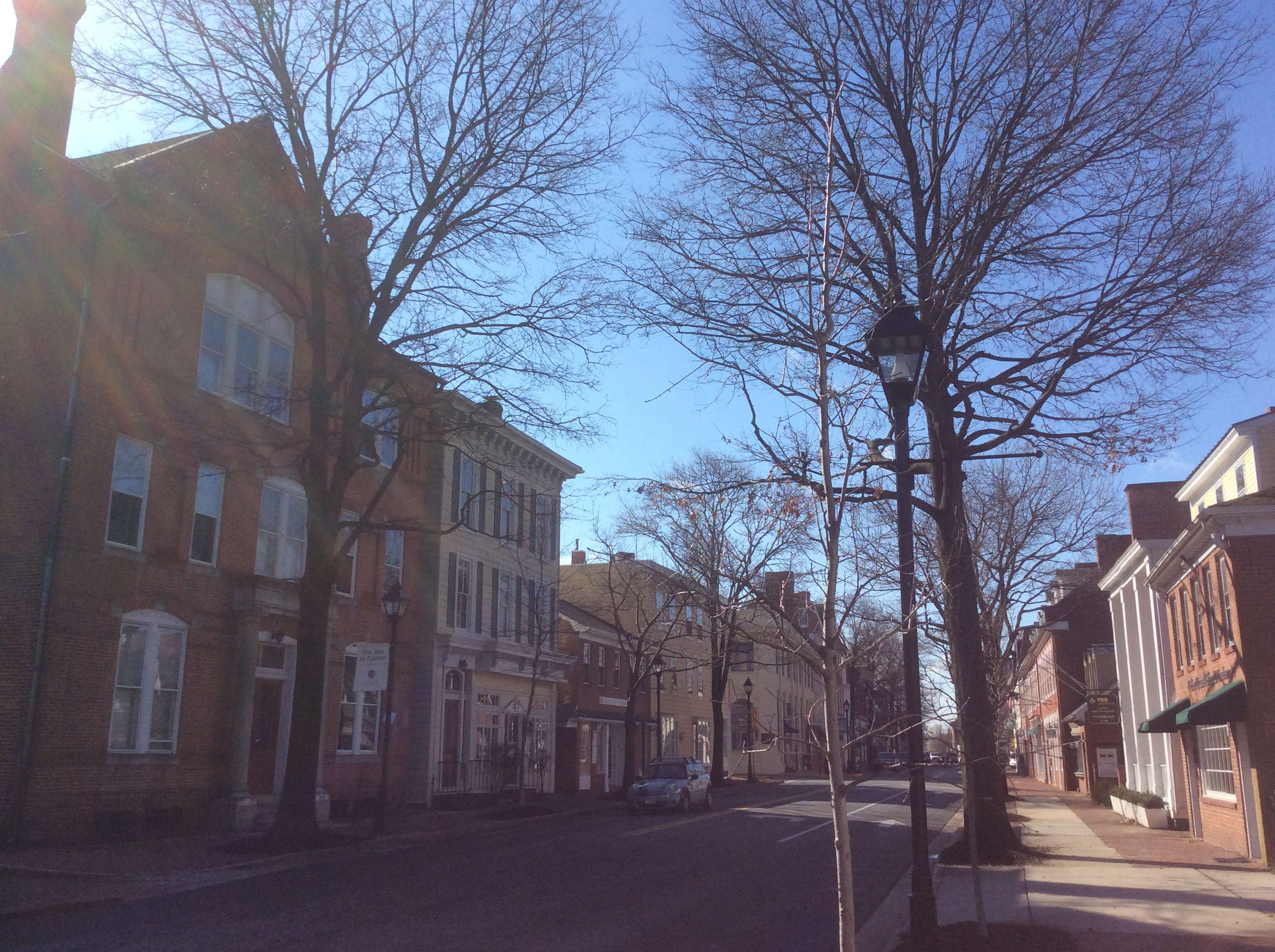
Easton, MD on a bright spring morning in March

Easton, MD on a bright spring morning in March

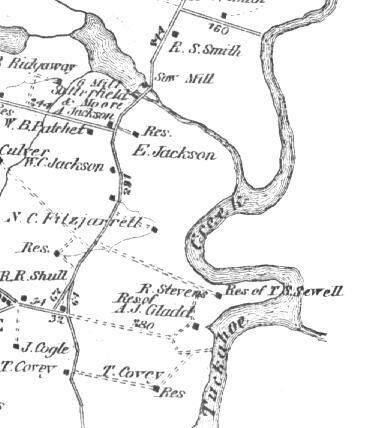
Frederick Douglass Birthplace Map 3

Second day, Monday March 21st

I wake up early and make my way to Maryland’s east shore, looking forward to a beautiful day in the country. It’s windy and very cold, but clear and sunny. I head for downtown Easton: the route from there to my first destination is easiest to follow for a non-local like me. And I can use all the help I can get: this will be the first site I visit in any of my history travels where I will rely both on maps that predate the turn of the 20th century and natural landmarks to locate it.

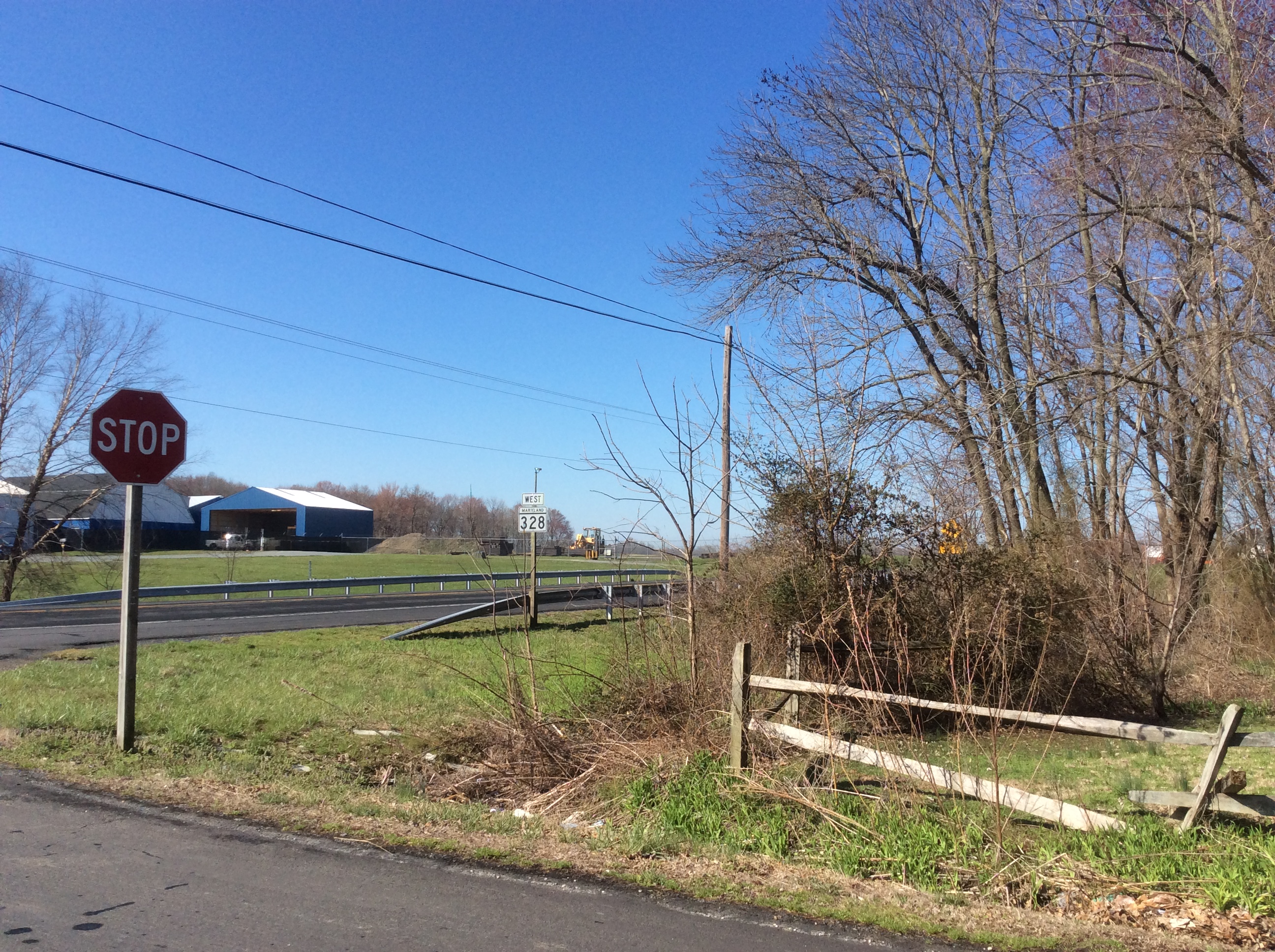
Just a few blocks into downtown Easton, I turn left on highway 328, which is Goldsborough Street where it starts /ends at Washington Street (Highway 565) in Easton, running only east from here. After about 7 or 8 miles, I turn left onto Lewiston Road.

Looking back on Highway 328 from Lewiston Rd, Easton MD

Looking back on Highway 328 from Lewiston Rd, Easton MD

I decide it would be a good idea to check with local people before I start looking for the next landmark, a crossroads called Tapper’s Corner: generally, it’s best to confer with the experts when you want to do something right. The lady I ask at the business at the corner, Bullock Construction, says go 2 or 3 miles, but the lady who gave me directions from the porch of her home down the street says go further. She lives right here, so I go with her recommendation.

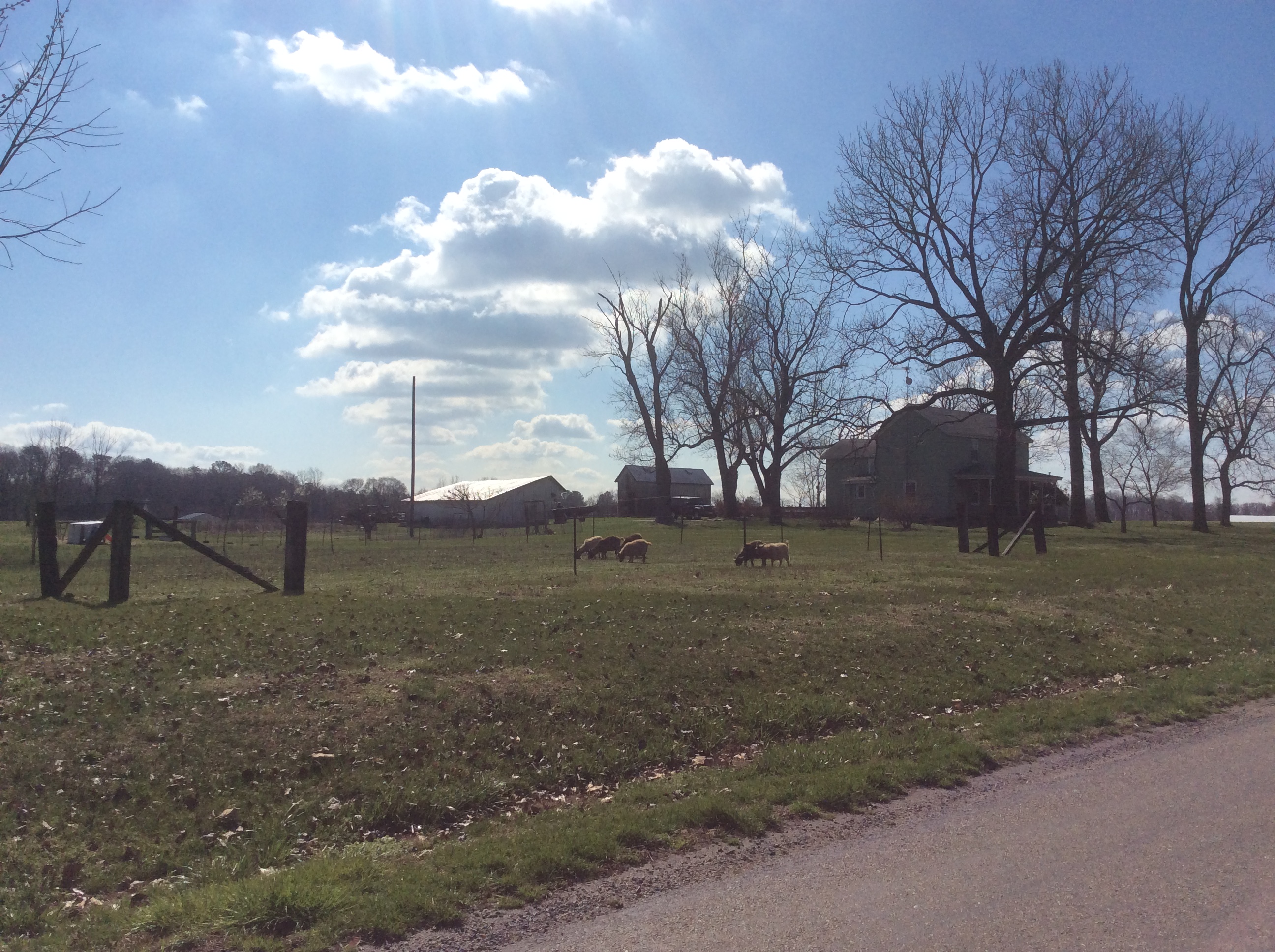
Sheep at a farm on Lewiston Rd en route to Tapper's Corner

Sheep at a farm on Lewiston Rd en route to Tapper’s Corner

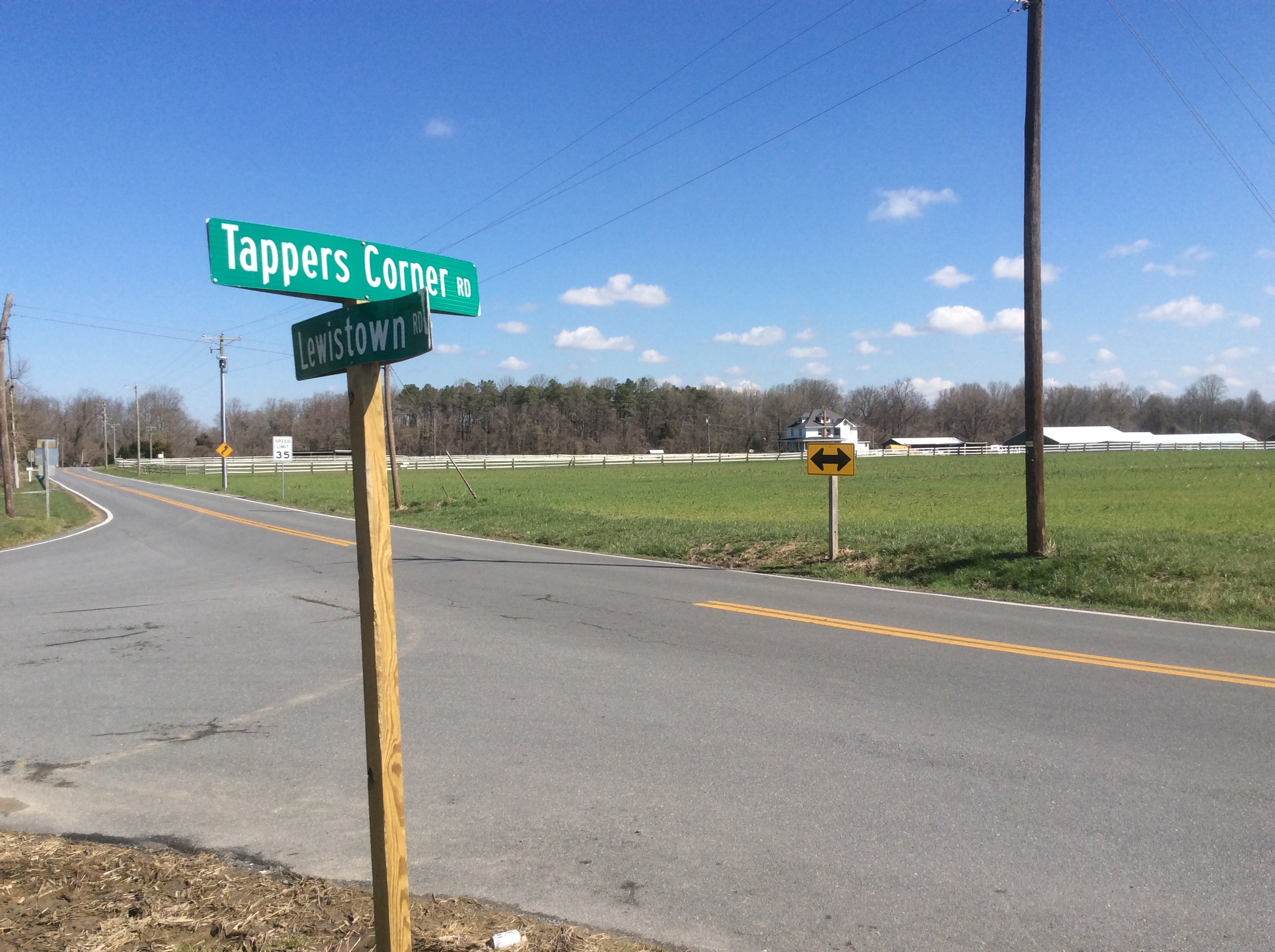
It ends up about 5 (oh so pretty) miles to Tapper’s Corner Rd, also know as Highway 303, a road that t-bones off Lewiston to my left.

Tapper's Corner off Lewiston Rd, with the Aaron Anthony old Holme Hill Farm site at the right

Tapper’s Corner off Lewiston Rd, with the Aaron Anthony old Holme Hill Farm site at the right

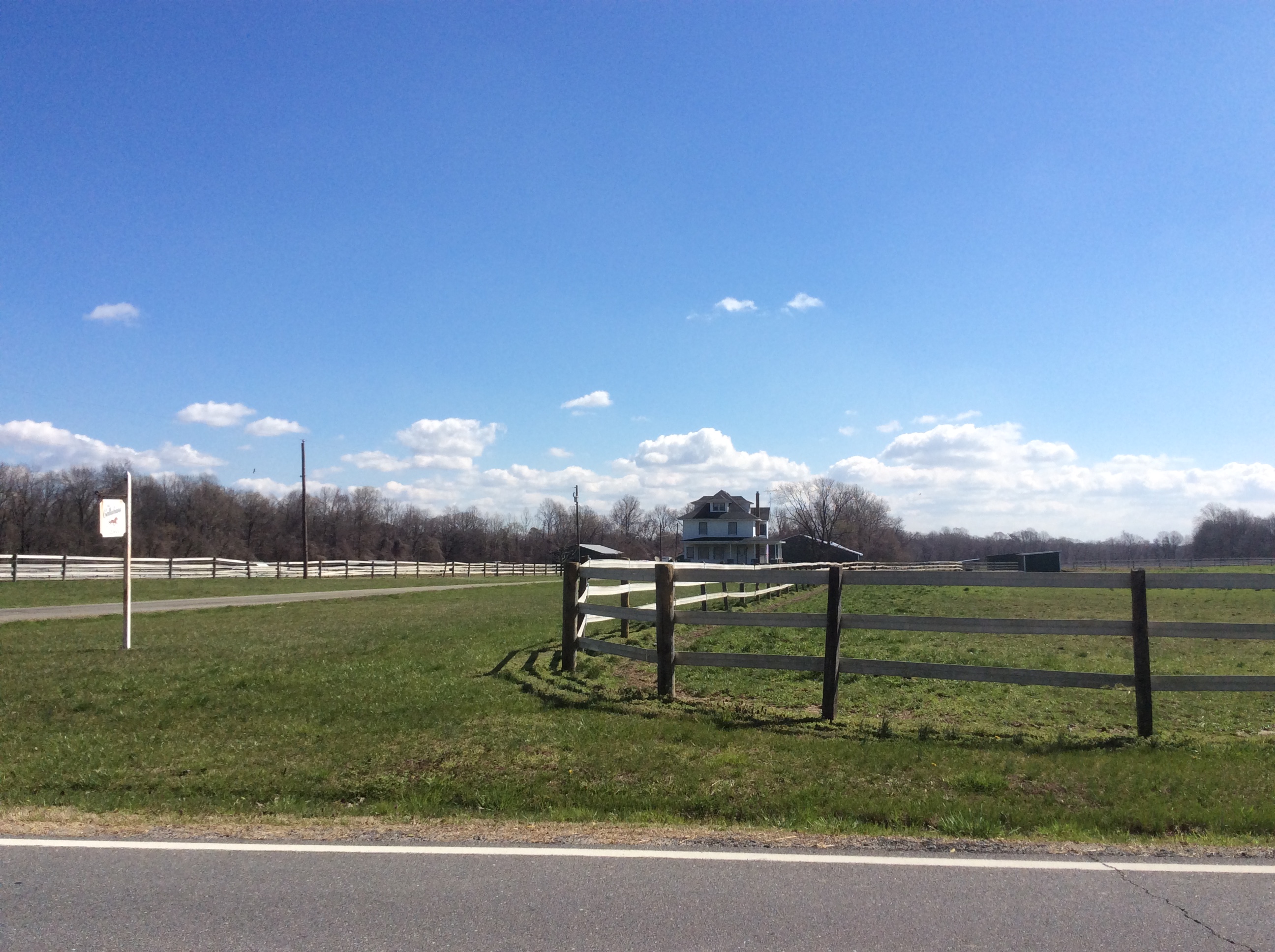
At my right I see, facing forward toward Queen Anne’s County, a big white house with white roofed green barns. According to my sources, this is the site of Aaron Anthony’s old Holme Hill Farm.

Aaron Anthony's farm, later Ebenezer Jackson's, now horse farm, Easton MD

Aaron Anthony’s farm, later Ebenezer Jackson’s, now horse farm, Easton MD

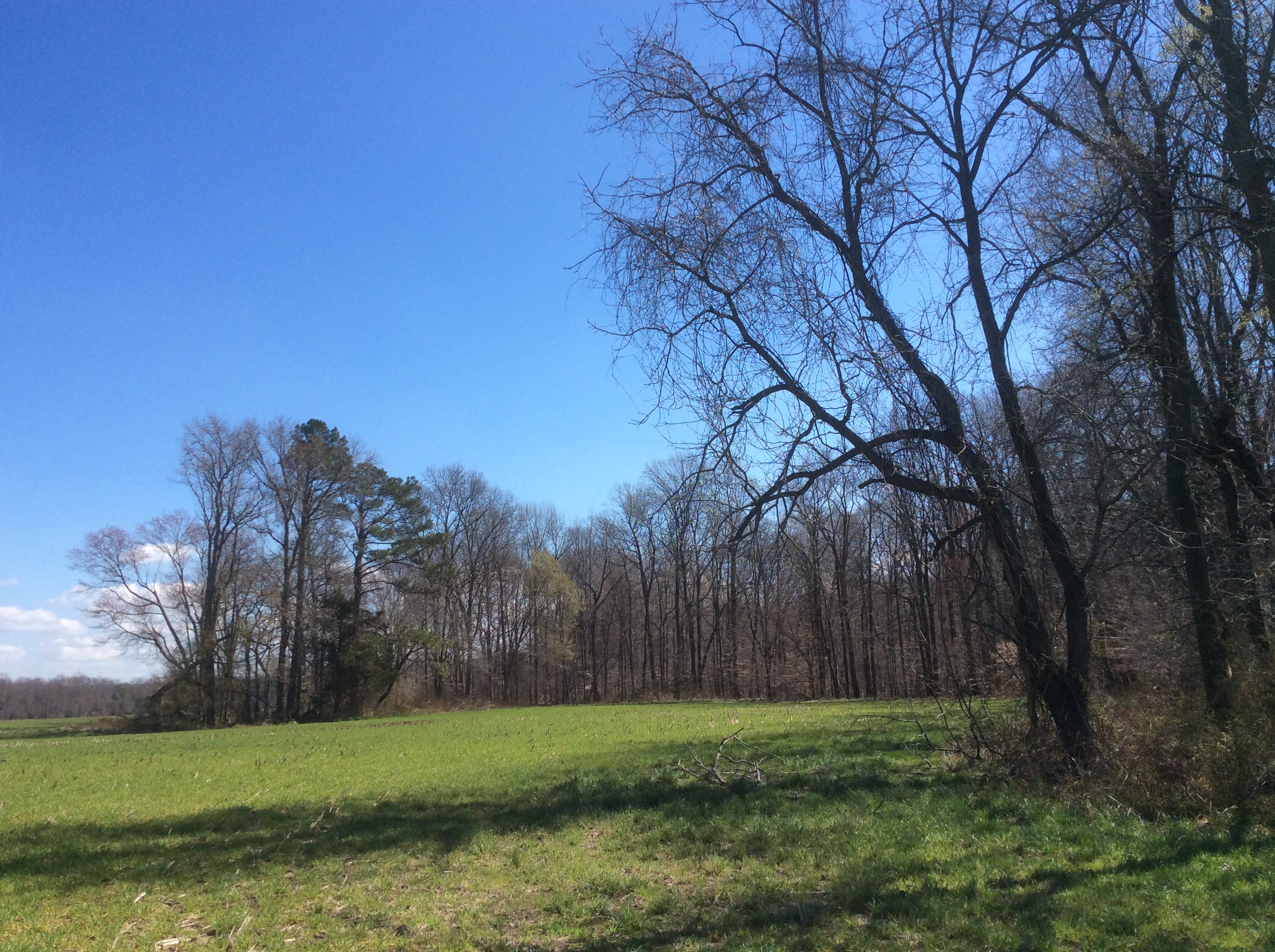
To my right and a little behind me, in the big green field with the trees behind it lining the Tuckahoe creek, is where Douglass was born in 1818, in a little long-vanished cabin. It was called Aunt Bettie’s lot, located between the road, a little ravine called Kentucky, and the Anthony farm, behind which runs the little mill stream into the pond where little Frederick went fishing.

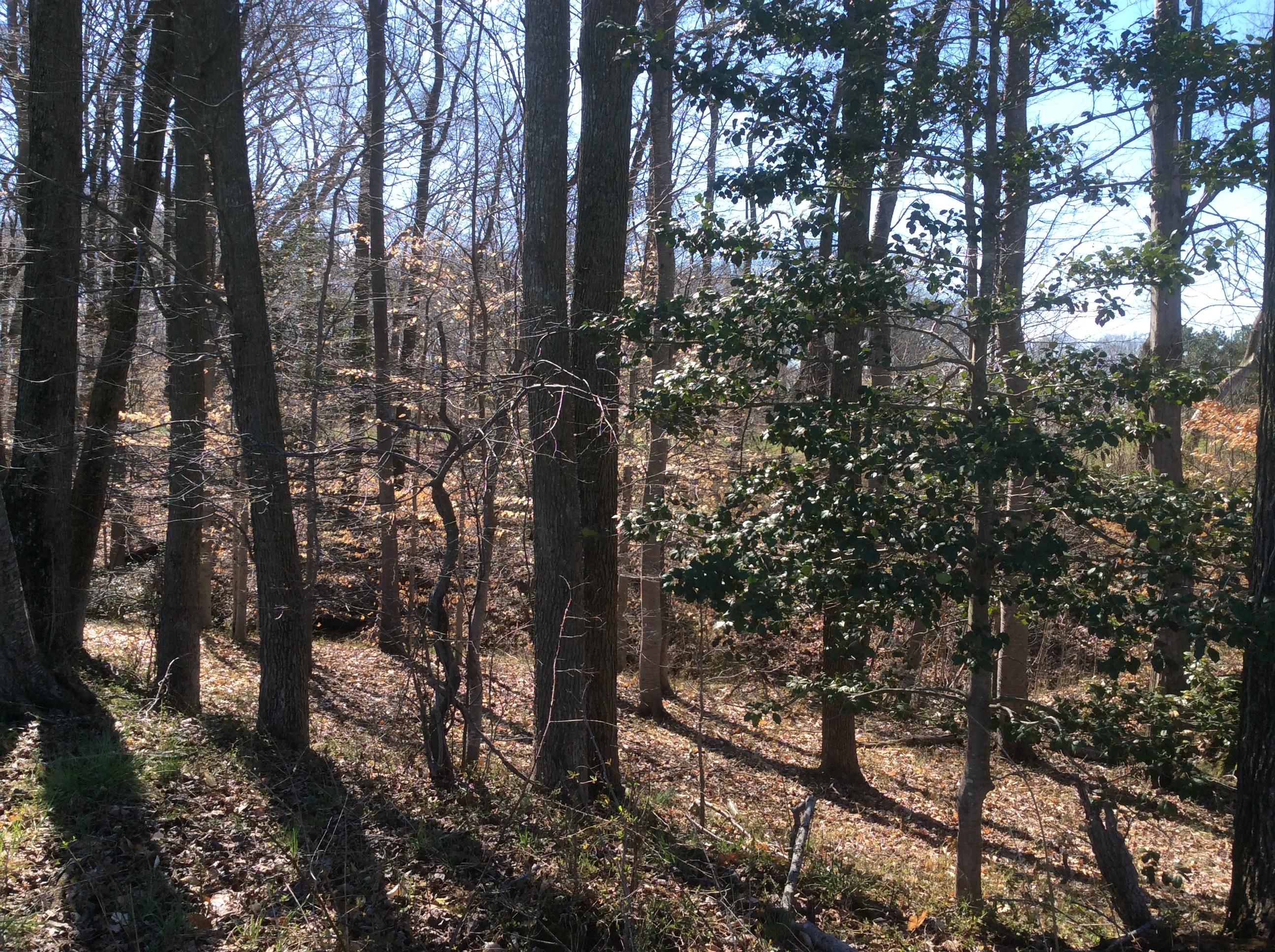
Ravine, Woods & Field at Frederick Douglass's birthplace between Tapper's Corner & the Tuckahoe

Ravine, woods, and field at Frederick Douglass’s birthplace between Tapper’s Corner and the Tuckahoe

I want to stand on the very spot where the cabin stood, as near as I can determine it to be. I turn around, go back and park along the road at the lone little pull-out spot available on that side. The rest of the road is has a drainage ditch running the full length on either side. The little pull-out area at the side of the road is a little clue that there’s something special here: it’s at the same field where the cabin was and the ravine is. I cross the big green field, a plowed-under grassy cornfield, toward the ravine. I follow where it veers to the left, towards the one green tree among the gray winter branches along the curving ravine. When Douglass returned in 1878 to find his birthplace, he looked for a big cedar tree that he remembered from his childhood ‘a little deeper in the woods, near the edge of the ravine’. I draw closer to the green and discover it’s actually three trees: two pines and another tree, tucked in among the pines and other trees, shorter than them with darker needles. I jump up and pull off a little chunk of greenery: yes, it’s cedar. I get a chill.

The ravine among the woods next to Frederick Douglass' birthplace

The woods along Kentucky Ravine next to Frederick Douglass’ birthplace

Perhaps it’s the very same cedar tree that led Douglass, or perhaps, it’s an offspring of that tree. It seems too much of a coincidence that there would be one lone but unrelated cedar tree right here by the ravine as he described. Either way, I feel very emotional, very moved. I tend to develop a sense of love and concern for the people whose lives I follow and am solicitous of their memory, and these mementos of their lives help bring their stories closer to me. I hope this account makes you feel the same, and will help you more easily make this same pilgrimage one day.

*Listen to the podcast version here or on iTunes

~ Ordinary Philosophy and its Traveling Philosophy / History of Ideas series is a labor of love and is ad-free, entirely supported by patrons and readers like you. Please offer your support today!

~~~~~~~~~~~~~~~~~~~~~~

Sources and Inspiration:

Note: A wonderful source for finding Frederick Douglass’ birthplace, complete with maps and her research process, is my youngest yet: the author, Amanda Barker, did this research project and report in the 1990’s for her 7th grade honors class. Wherever you are, thank you, Amanda!

Aaron Anthony’s Holme Hill Farm‘. ChoptankRiverHeritage.org

Barker, Amanda. ‘The Search for Frederick Douglass’ Birthplace‘. The Eastern Shore Guide 

Douglass, Frederick. Autobiographies (includes Narrative…, My Bondage and my Freedom, and Life and Times). With notes by Henry Louis Gates, Jr. Volume compilation by Literary Classics of the United States. New York: Penguin Books, 1994.

Douglass, Frederick. The Life and Times of Frederick Douglass. Re-published 1993, Avenal, New York: Gramercy Books, Library of Freedom series.

Douglass, Frederick. My Bondage and My Freedom: 1855 Edition with a new introduction. Re-published 1969, New York: Dover Publications, Inc.

Foner, Philip S. The Life and Writings of Frederick Douglass, Vol. 1-4. New York: International Publishers, 1950.

Frederick Douglass Heritage: The Official Website. Website of the University of Massachusetts History Club

Holland, Jesse. Black Men Built the Capitol: Discovering African-American History In …, Part 3. Connecticut: Globe Pequot Press: North Carolina 2007

Holmes Hill Farm‘. Sankofa’s Slavery Data Collection, at Rootsweb.ancestry.com (Sankofa is an avatar of Dr. David Anderson of Nazareth College in Rochester, this may be coincidental)

McFeely, William. Frederick Douglass. New York: W.W. Norton & Company, 1991.

Frederick Douglass Baltimore Sites

Home where Amy 's host family lives in Garrison, MD, in a post-Civil War freedman's settlement, photo March 2016 by Amy Cools

Home where my host family lives in Garrison, MD, in a post-Civil War freedman’s settlement

First day, Sunday, March 20th

So here I am on the East Coast, commencing my Frederick Douglass history of ideas travel adventure in earnest! I’m thrilled and know I’ll learn and see a lot since I have so many sites I plan to visit already and know I’ll discover more as I go along.

I wake up still undecided whether to begin my Douglass explorations on the East Shore of Maryland or in Baltimore proper. I was leaning toward the Shore to keep my account more chronologically aligned with Douglass’s life, but inclement weather, the Maryland Historical Society’s open hours, a lost document, and a bit of oversleeping decided for me: a delayed start made it best to keep today’s journeys closer to home away from home. So, Baltimore it is!
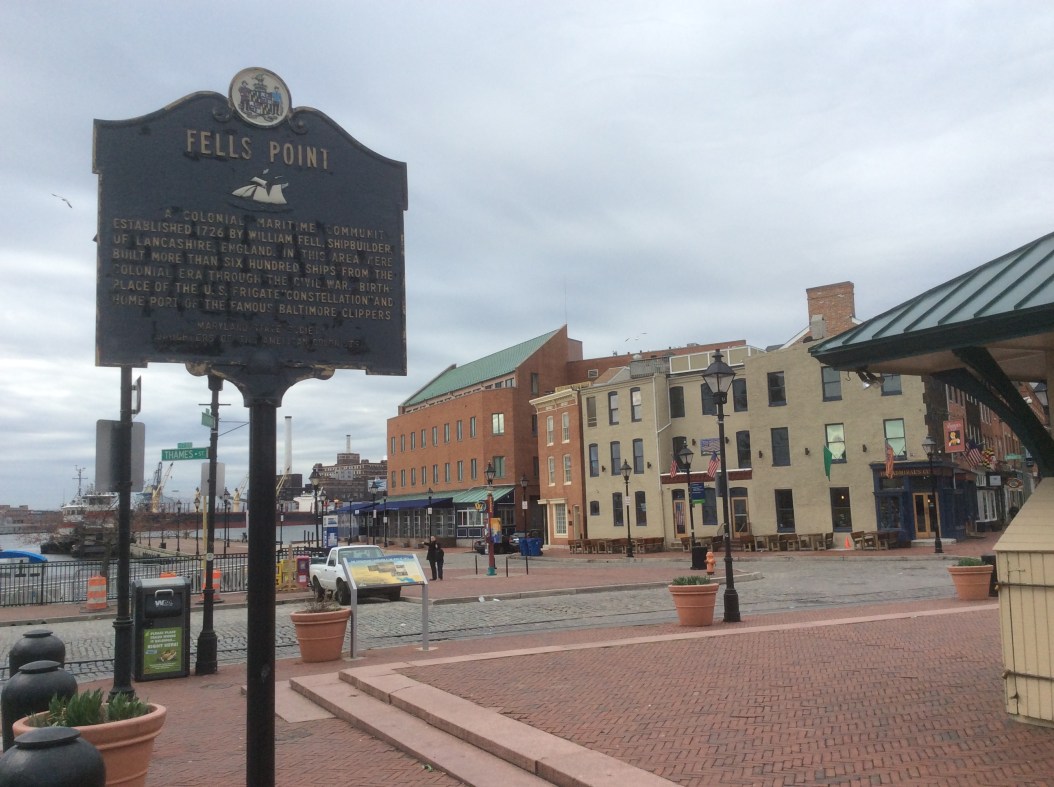
Fell's Point, Baltimore MD, photo March 2016 by Amy Cools

Fell’s Point, Baltimore, Maryland

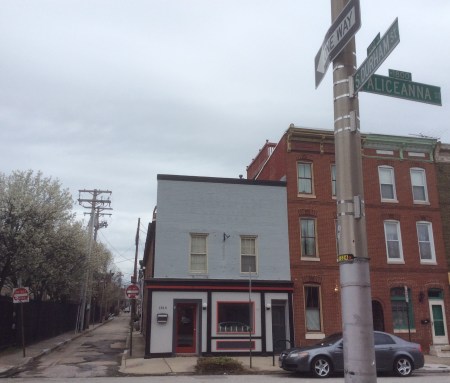
Aliceanna and Durham Streets, Baltimore, Maryland March 2016, photo by Amy Cools

Aliceanna and Durham Streets, Baltimore, Maryland

In a very important way, it’s actually fitting to begin with Douglass’ life here in Baltimore, centered in the waterfront district of Fell’s Point, since this is where Frederick Douglass had one of the most formative experiences of his life.

It happened in a ‘spare, narrow house at the corner of an alley’, Happy Alley, off Alliceanna Street at S. Durham. This was Douglass’s first home with the Hugh Auld family, composed of shipbuilder Hugh, his wife Sophia, and their little son Tommy. Frederick Bailey, who adopted the last name Douglass after fleeing slavery, was a child of just seven or eight himself, was imported from the plantation to be Tommy’s companion and body servant.

There used to be a sign marking this street corner as a Frederick Douglass historical site, but it’s disappeared (you can see the two silvery clamps still strapped under the street name signs). Perhaps people in the neighborhood were tired of being bothered by tourists asking where the exact house is. I have no shame, so I bother a young man with my inquiries. He doesn’t happen to know about that historical tidbit but is interested to hear the story; he happens to pass me by again a little while later, pulls over, and asks for the website so he can check in later and see what I find out, so I know he isn’t just being polite; he certainly is very kind.

Site of Frederick Douglass' home with the Aulds at Aliceanna and S. Durham, Fell's Point, Baltimore, MD, photo March 2016 by Amy Cools

Site of Frederick Douglass’ home with the Aulds at Aliceanna and S. Durham, Fell’s Point, Baltimore, MD

And another nice person, a woman entering her home in the very new-looking building on the southeast corner of Alliceanna and S. Durham does know, however, and confirms that building below, as far as she knows, stands on the very site of the old Auld house. She, for one, hopes the sign will go back up.

So back to that formative experience: Sophia Auld thought it would be a good idea to teach Frederick how to read since he was companion and body servant to the young son of the household and could thus aid in his education. But when Hugh came into the room and saw her teaching Frederick his letters, he stopped her, telling her in his hearing that ‘[he] should know nothing but how to obey his master …if you teach [him] how to read, there will be no keeping him. It would forever unfit him to be a slave…’ As Douglass later recalled, this is the moment he realized the full inhumanity of the slave system, and knew exactly what he needed to do. No enforced ignorance for him!
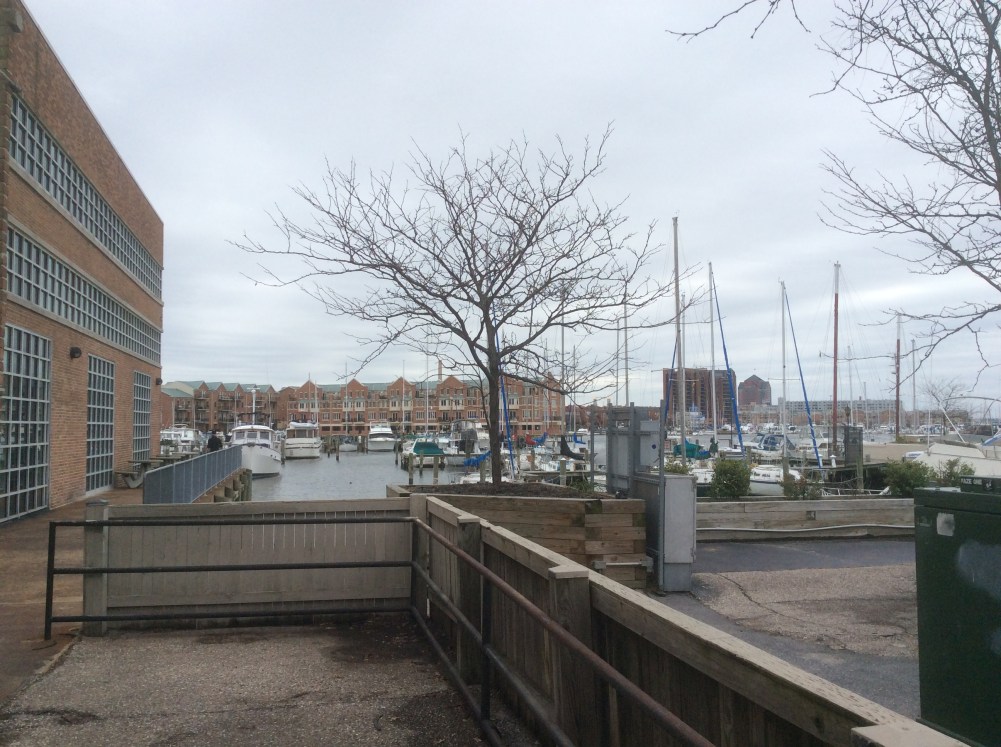
Lancaster St, end where Gardiner's and Meacham's shipyards used to be, Fell's Point, Baltimore MD, photo 2016 by Amy Cools

Lancaster St, end where Gardiner’s and Beacham’s shipyards used to be, Fell’s Point, Baltimore MD

Then I head down to the end of Lancaster St, about where Frederick worked at James Beacham’s shipyard in 1826, close to William Gardiner’s shipyard where he received more advanced training, upon returning to Baltimore in 1836 after three years back on the East Shore. He had another formative experience at Gardiner’s which I’ll tell you about shortly. Frederick worked on many shipyards and became a skilled caulker over time, earning him enough wages that Hugh was willing to let him keep some, unaware Frederick was saving up to start a new life as a free man one day.
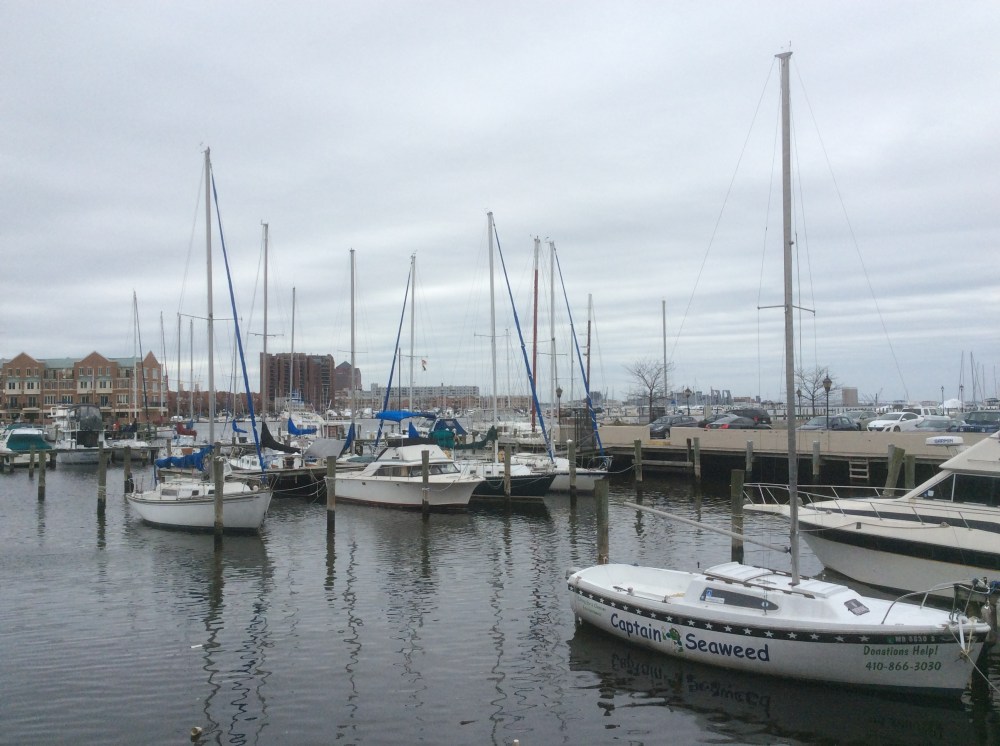
Boats docked at end of Lancaster and Thames Streets, Fell's Point, Photo 2016 Amy Cools

Boats docked at end of Lancaster and Thames Streets, Fell’s Point

I head west on Thames St. At number 12 or 13, Frederick purchased the first book he ever owned at Nathaniel Knight’s shop at 28 Thames St, The Columbian Orator. The buildings are numbered very differently now, and at the time I write this post, I’ve yet to find an early atlas with street addresses. Fell’s Point is clearly a moneyed area, and large sections of Thames St has been built over with luxury condos, especially on the waterfront side. The other side of the street retains more of its older buildings, and all is very well kept and very charming.
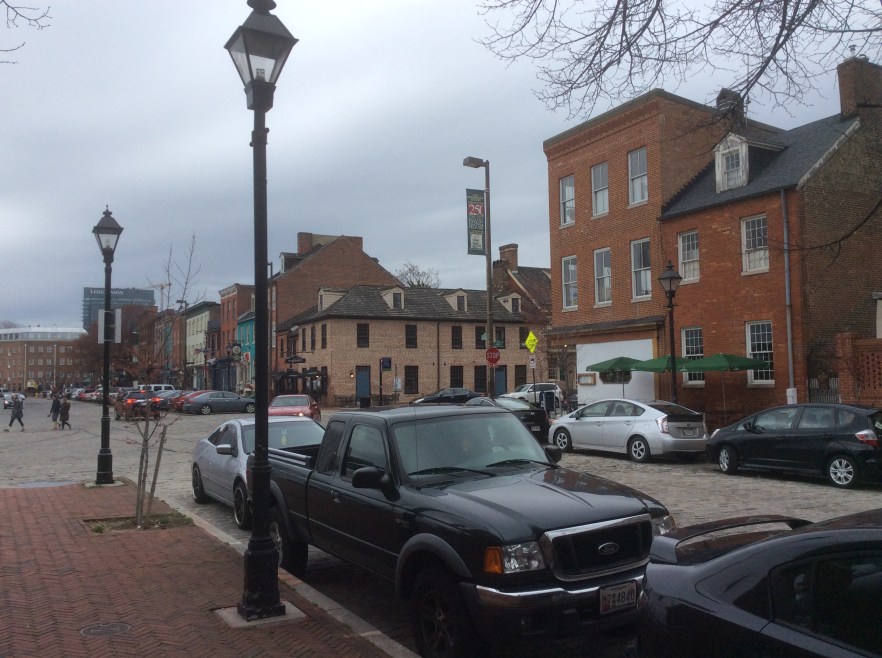
A view of Thames St, Fell's Point, Baltimore MD, photo 2016 Amy Cools

A view of Thames St, Fell’s Point, Baltimore MD

I continue on to the very end of Thames St, heading west to the Frederick Douglass-Isaac Myers Maritime Park and Museum.

Frederick Douglass-Isaac Myers Maritime Park and Museum Fell's Pt, photo 2016 by Amy Cools

Frederick Douglass-Isaac Myers Maritime Park and Museum, Fell’s Point
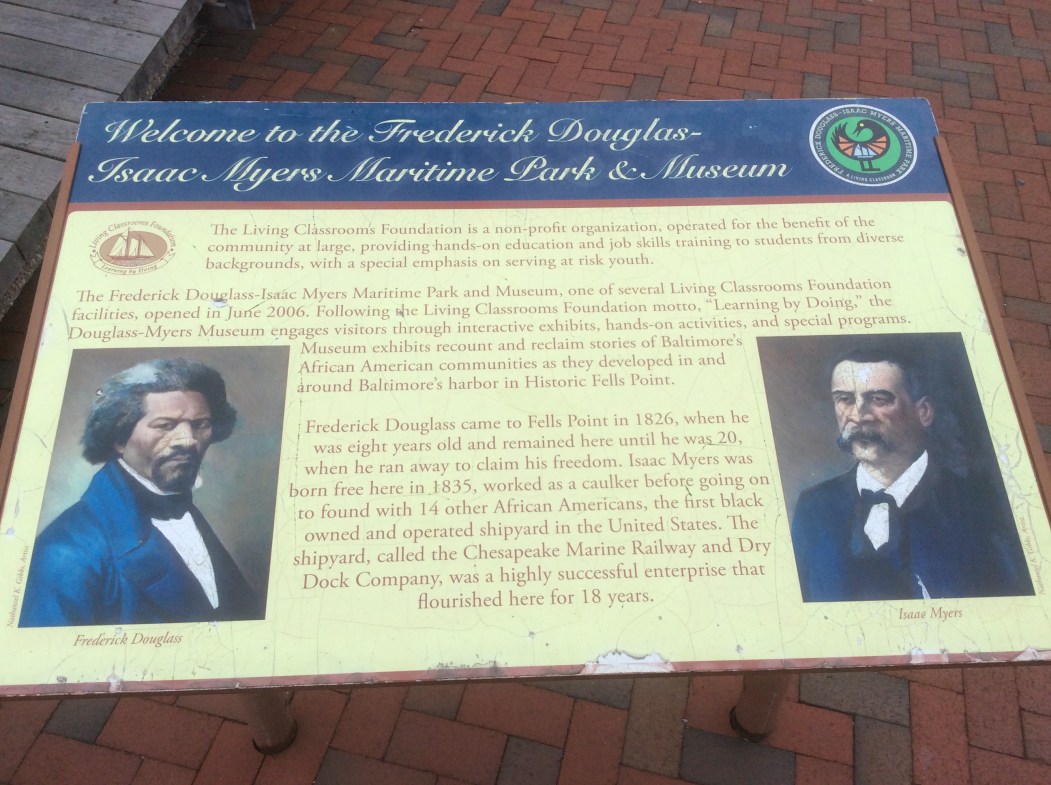
Frederick Douglass-Isaac Myers Maritime Museum Sign, Fell's Pt, photo 2016 by Amy Cools

Frederick Douglass-Isaac Myers Maritime Museum Sign, Fell’s Point

The sculpture I find here of his head, though striking, looks a little odd just sitting on the ground as it is; I find myself instinctively looking around for the body it fell off of. Perhaps they’ll give it a new setting at some point.
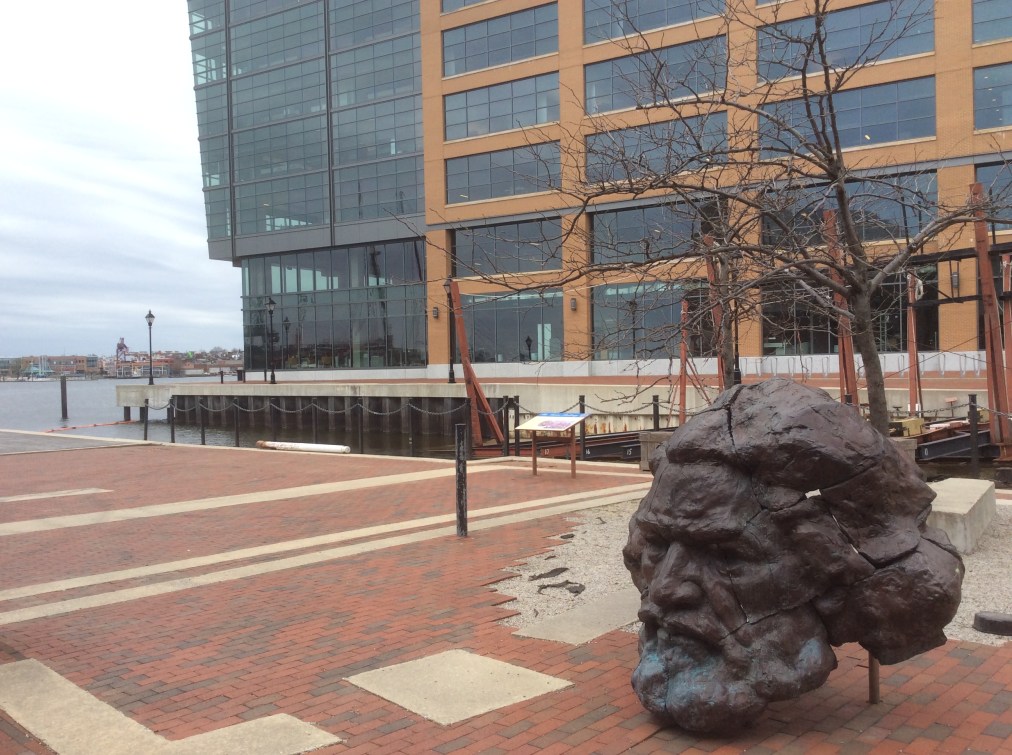
Frederick Douglass sculpture at Maritime Park Fell's Pt, photo 1, 2016 by Amy Cools

Frederick Douglass sculpture at Maritime Park Fell’s Point
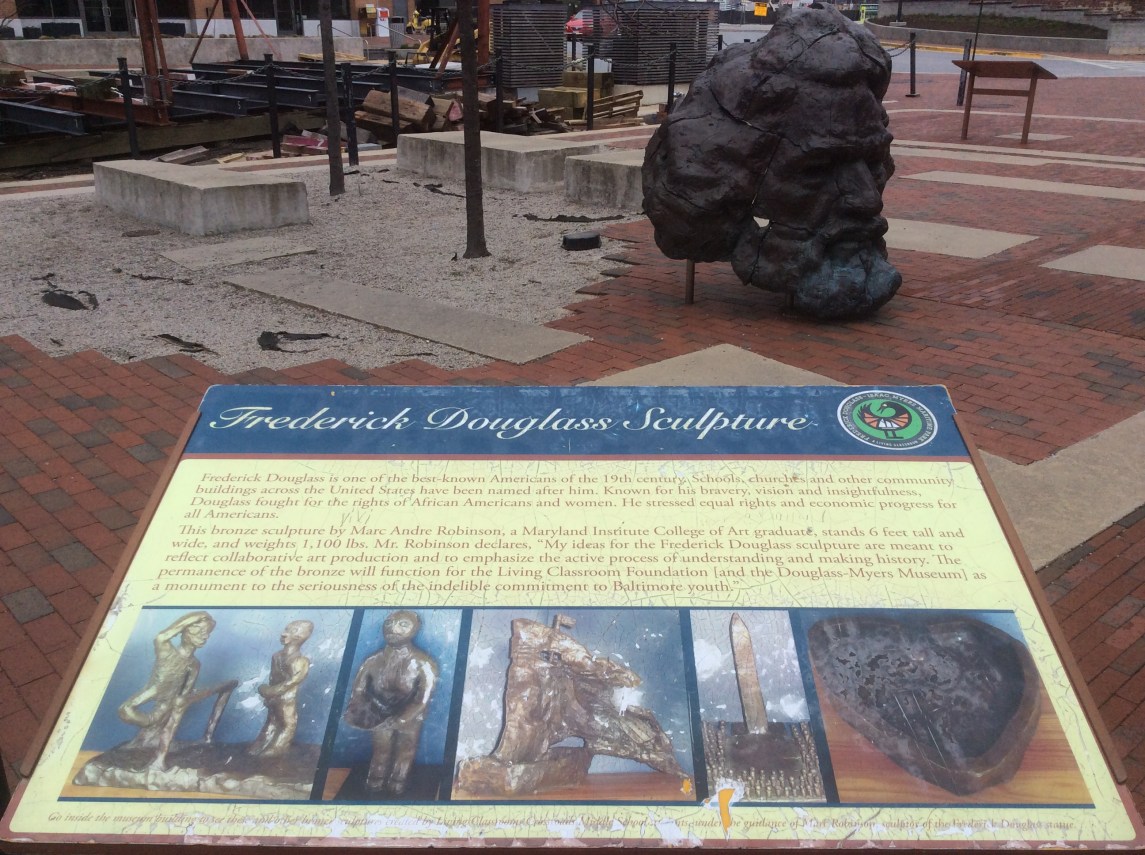
Frederick Douglass sculpture at Maritime Park Fell's Pt, photo 2, 2016 by Amy Cools

Frederick Douglass sculpture at Maritime Park, with sign

Then I head right, around to Philpot St, where Frederick also lived with the Auld family (they moved around the Fell’s Point neighborhood a few times). The Maritime Park Museum actually faces onto it at least as much as it does onto Thames. Here, little Frederick obtained the help of his playmates to build on the fragmentary education he had received from Sophia and really learn to read. Some neighborhood boys helped him out, and though he never named them in his narrative for fear they’ll be criticized for this, he thanked them anonymously.

S Caroline and Block St corner by Philpot St, Fell's Point, photo 2016 Amy Cools

Corner of S. Caroline and Block St by Philpot St, Fell’s Point

The little loop of a street which remains that’s still called Philpot St on Google Maps, though there are no identifying street signs, is at the west end of Thames behind Block and S. Caroline. It curves around to where the Maritime Museum and Park overlook the harbor, and you can see Domino Sugars factory in the background across the water. The area where the Auld house was, and perhaps where Frederick played and read with his friends at Durgin and Bailey’s shipyard, is now flattened, with all signs that there ever was a street here, let alone a neighborhood, obliterated and under new construction.

Then I backtrack a little on Thames towards Bond St. If you look closely, you can see this view of Bond St is at Shakespeare St; Frederick grew to love William Shakespeare.

Bond St at Shakespeare, Fell's Point, Baltimore MD, photo 20156 by Amy Cools

Bond St at Shakespeare St, Fell’s Point

The occasion which took Frederick to Bond St, and which takes me here next too, was a sad one. Since he had become a skilled caulker at Gardiner’s shipyard, his work was very much in demand, especially as an enslaved black man who commanded lower wages than skilled white workers. Baltimore’s shipyards employed many skilled black workers on its busy waterfront, paying them all lower wages, and the white workers felt deeply resentful at this threat to their livelihood. So one day, when Frederick was perhaps sixteen, he was severely beaten by four of his coworkers. Auld was very angry, both because, as Frederick believed, he was genuinely concerned about his well-being and considered what they had done cruel and unjust, and, of course, he did not want his prized source of income to lose his ability to work. So he accompanied Frederick to magistrate William Watson’s office on Bond St. Again, as of this date, I can find no specific street address; when and if I do, I’ll let you know.

But to Auld’s chagrin, Watson refused to arrest the men or do anything about the crime at all: although the evidence a crime had been committed was presented in Frederick’s own battered face, only a white man’s testimony was legally admissible. The indignity and injustice of this were yet more striking evidence for Frederick that slavery was a great evil, strengthening his conviction that he must find a way to gain his freedom.

Then back up Bond to Aliceanna again, to grab a snack and better wifi connectivity at Cafe Latte’da, a punk rock-y comfy little hole in the wall coffee shop. It’s right around the corner from Jimmy’s Restaurant and Fountain Service on S. Broadway, where I had begun with a delicious breakfast of tater tots topped with pulled pork and cole slaw. If you’re like me and love comfy, well-established eateries with down to earth food and atmosphere, I recommend these two.
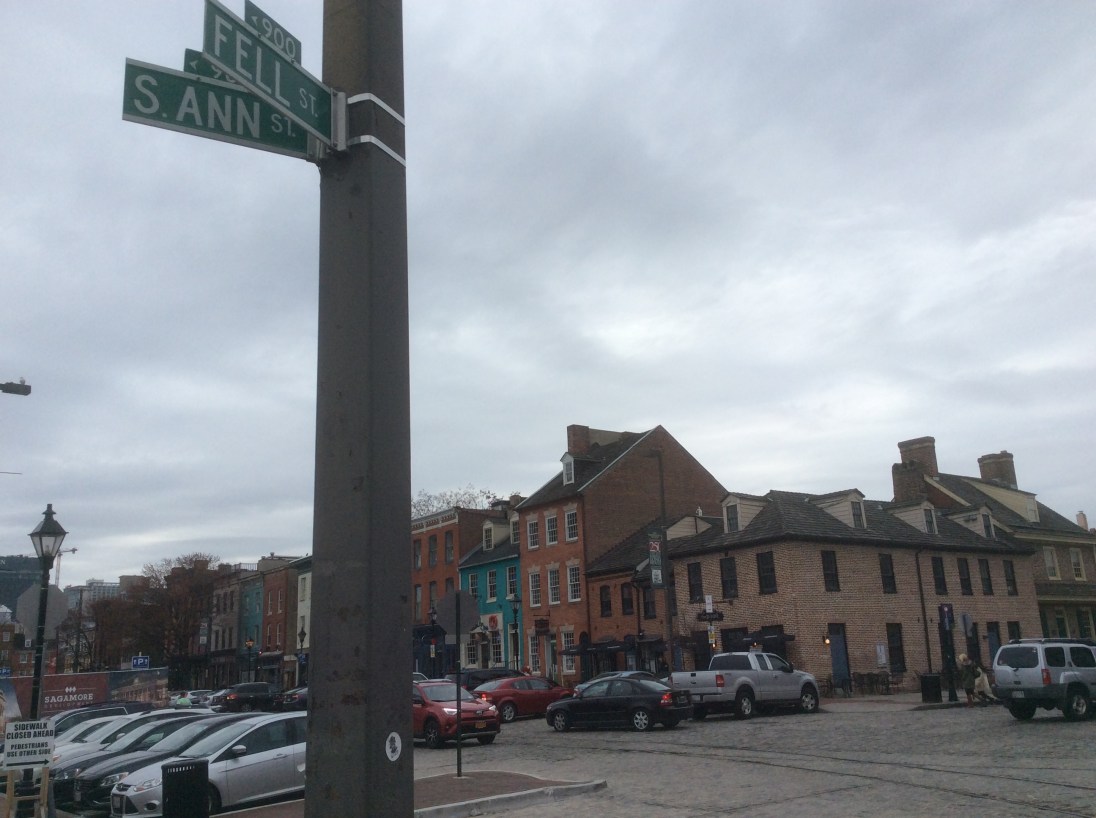
Fell St at Thames and Ann, Fell's Point, Baltimore Md, photo 2016 by Amy Cools

Fell St at Thames and Ann, Fell’s Point, Baltimore MD

Then back to Fell St at Thames and Ann, which I had overlooked on my first go-round, but it’s no problem since the waterfront part of Fell’s Point is pretty small and very walkable. Frederick lived on Fell’s St with Hugh Auld when he returned to his service in Baltimore in late 1836. Again, Douglass gave no address in his memoirs. Hugh thought he’d be less likely to try to escape if he had more interesting employment in an environment which better suited him, enjoying more independence through retaining part of his wages and eventually, living in a place of his own. At this point, Frederick had become an expert caulker and could command much better wages despite his race and status as a slave. When Frederick did live on his own for awhile, there was an episode where Frederick didn’t return from a weekend outing to the Fell St house in time, and Auld was enraged. He threatened to take away the independence he had granted Frederick up to this point and to make him move back home.
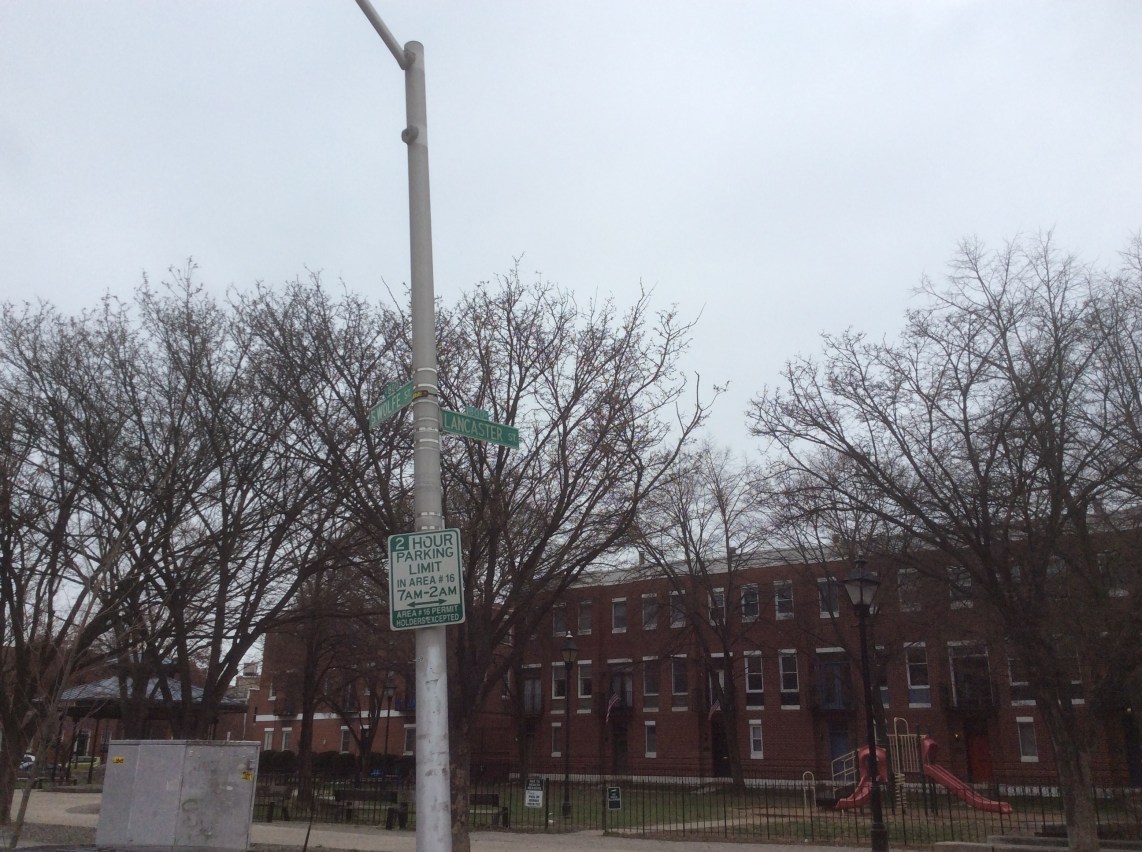
Thames St Park bordered also by Lancaster and Wolfe, Fell's Pt, photo 2016 by Amy Cools

Thames St Park bordered also by Lancaster and Wolfe, Fell’s Point

Since I’m back near the east end of Thames, I go back towards the end of Wolfe Street since I had found another secondary resource, a Baltimore Sun article, on my coffee break. I’m looking again for the site of Gardiner’s shipyard where he was beaten by his co-workers.  According to the article, ‘William and George Gardiner’s shipyard [was] on the north-east corner of Lancaster and Wolfe Streets’. It’s not at the water’s edge now; the waterline at Fell’s Point has been changed quite a bit in many places over the years as it’s been filled in and built over. Beacham’s, as I described earlier, would have been nearby, around the corner to the north. There’s this little park called Thames St Park, bordered also by Wolfe and Lancaster; perhaps this is the site of one or part of both of those shipyards.
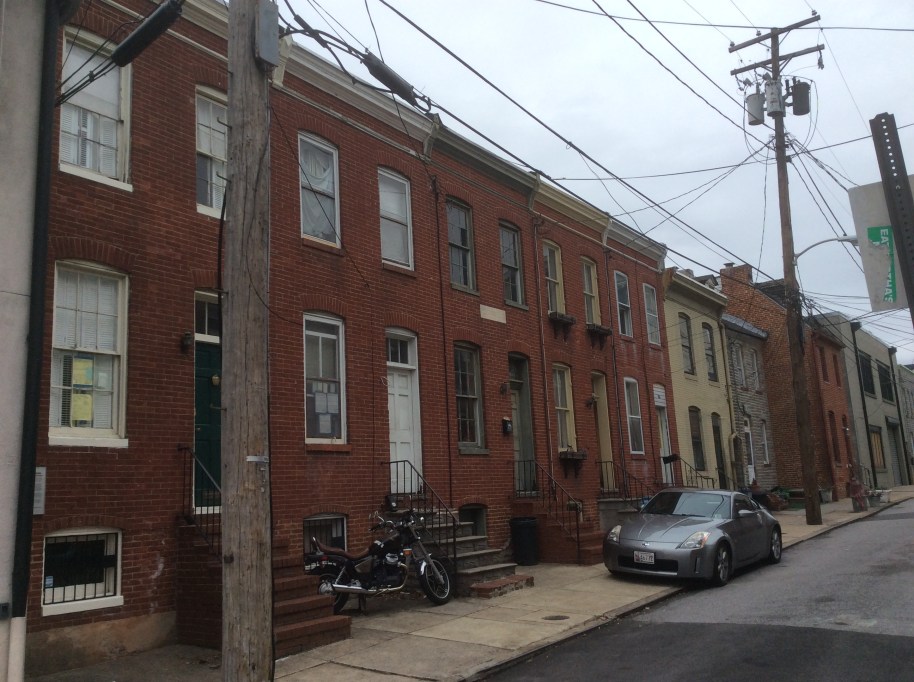
Douglass Place, 500 block of Dallas St, Fell's Point Baltimore MD, photo 2016 by Amy Cools

Douglass Place, 500 block of Dallas St, Fell’s Point Baltimore MD
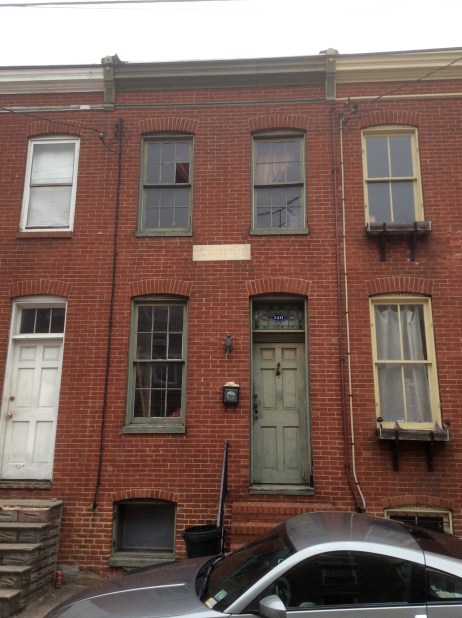
Douglass Place with engraved marker, Fell's Point Baltimore MD, photo 2016 Amy Cools

Douglass Place with engraved marker, Fell’s Point

Next, I head for a site associated with Douglass many years later in his life. I walk north on S. Durham St, passing Douglass’ first home site with the Aulds again, then left (west) on Aliceanna towards S. Dallas St. I find that the stretch of Dallas between me and the 500 block of Dallas near Fleet St where I’m headed is built over, so I go back up Bond to go around. I find what I’m looking for: a little row of brick houses, where an engraved cream stone in the larger of the red brick buildings confirms this is indeed ‘Douglass Place’. Douglass built these in the early 1890’s as quality, affordable rental housing for black residents.
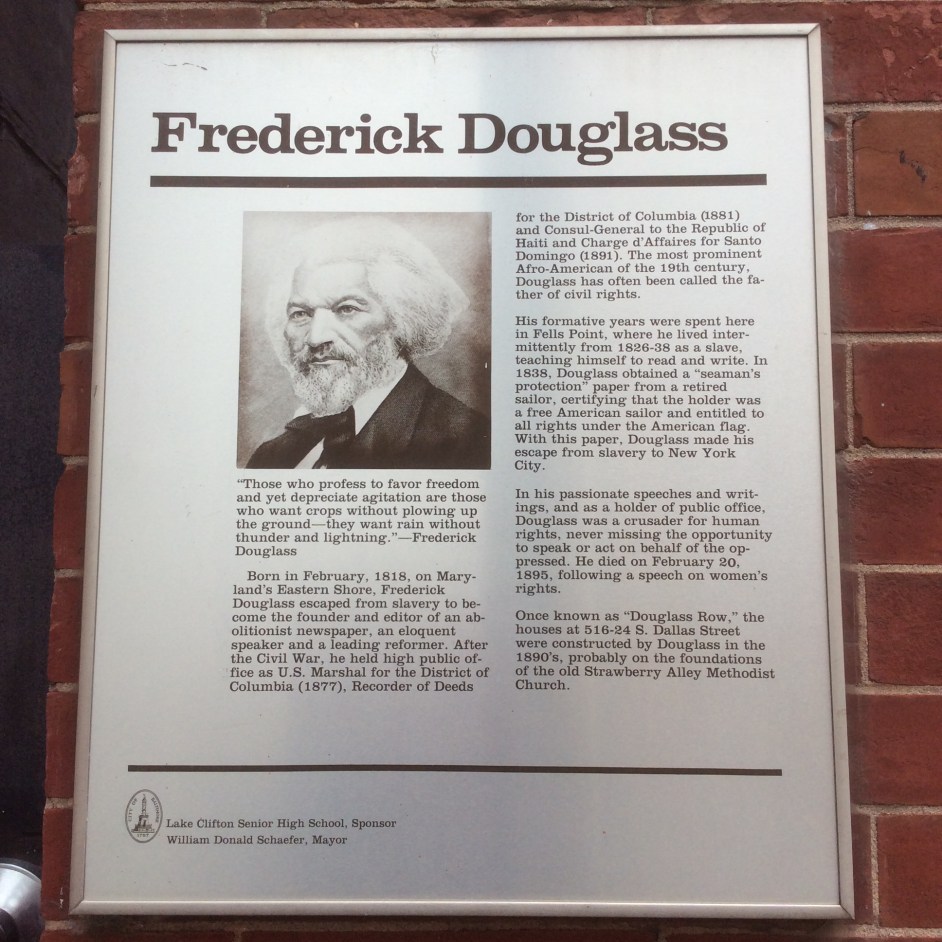
Historical Plaque at Douglass Place, Fell's Pt Baltimore, photo 2016 by Amy Cools

Historical Plaque at Douglass Place, Fell’s Pt

Billie Holliday house at 219 Durham St, Fell's Point, Baltimore MD, photo 2016 Amy Cools

Billie Holliday house at 219 Durham St, Fell’s Point

On my way out from Fell’s Point proper, I decide to swing by a site only very tangentially linked to Douglass. The lady who confirmed the location of the Aliceanna St house directed me to a home where Billie Holiday grew up at 219 Durham St. I love Billie Holiday, as I’m sure you do too, so I’m thrilled to make this discovery. Holiday, as you remember, sang ‘Strange Fruit’, a stark and haunting song about lynching that was very controversial when she recorded it in the late 1930’s but well loved, and her performance of this song is among the very best. Douglass became an activist in his later years against lynching…. more on that in a future post.
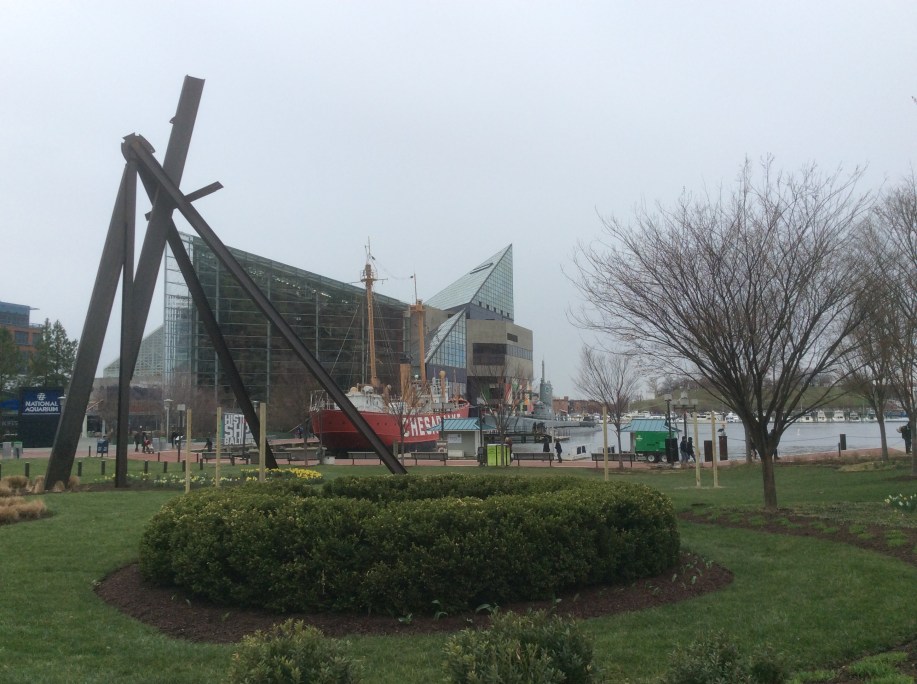
The Wharf formerly known as Smith's, Inner Harbor, Baltimore MD, 2016 by Amy Cools

The Wharf, formerly known as Smith’s Wharf, at the end of Gay St, Inner Harbor, Baltimore MD

Then I head towards the Inner Harbor, west towards downtown, to the wharf which used to be called Smith’s Wharf. It’s described in an old document as located at the south end of Gay St. ‘run[ning] north and south, from the east side of Gay St dock…’, now at Pratt, assuming that where the water meets the shore has not changed dramatically, though it’s not really a safe assumption. It’s just that I mostly have the current shoreline to follow, with atlases from young Frederick’s time so scarce.
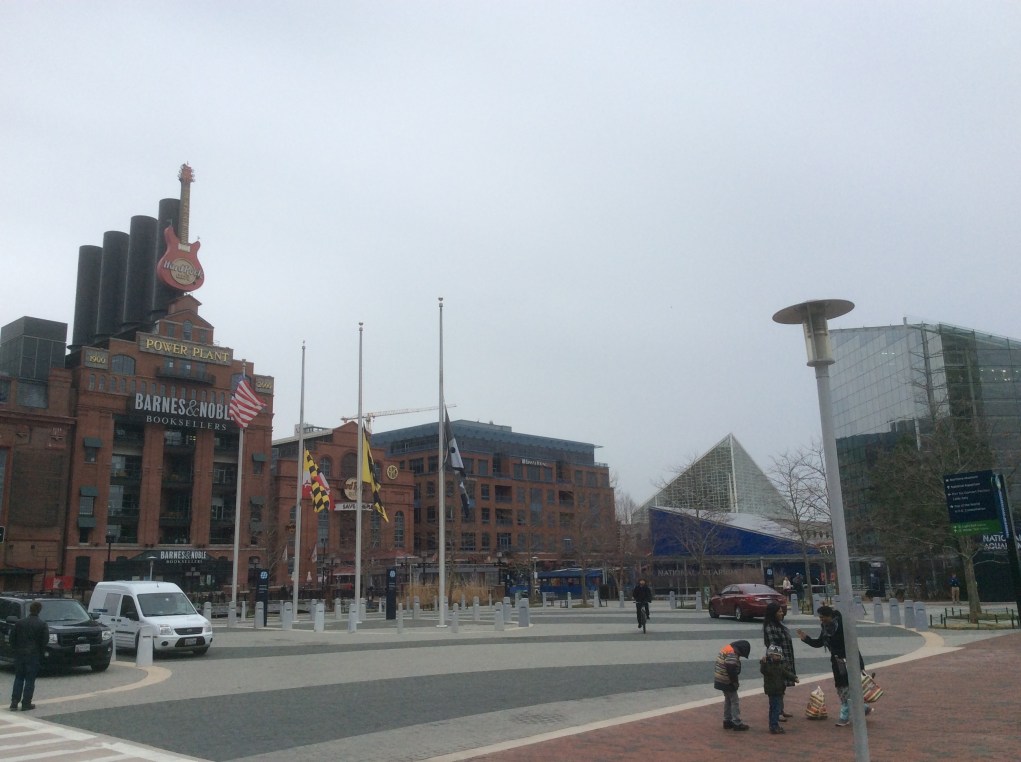
Wharf at Gay and Pratt, formerly Smith's, Inner Harbor, Baltimore MD, photo 2016 Amy Cools

Wharf at Gay and Pratt, formerly Smith’s, Inner Harbor, Baltimore MD

This is where little Frederick first arrived in Baltimore, diverted from his likely destiny as a plantation slave to a better one working in the city, though this was no guarantee of better treatment. Though city slaves often enjoyed a better standard of living in the city, Douglass tells of slaves in neighboring homes in Fell’s Point who were treated very cruelly. But on that day in the mid-1820’s, as Frederick watched the city shore draw near, he was thrilled at the prospect of a new and easier life than that of his deprived, if somewhat carefree, childhood as a plantation orphan.
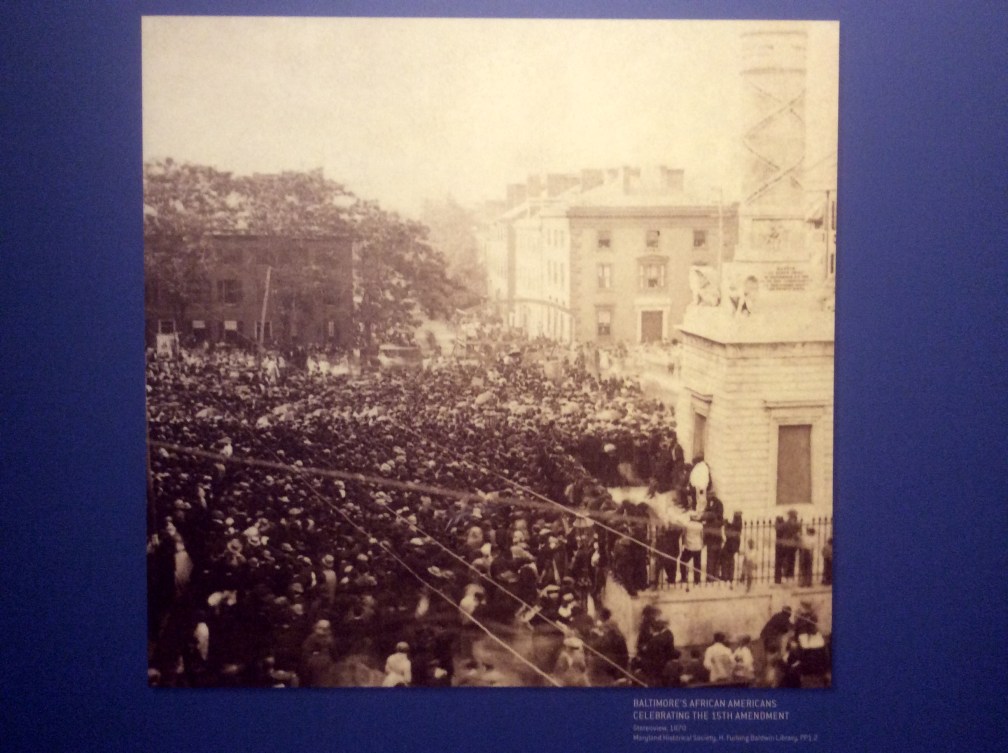
Maryland Historical Society, Celebrating the 15th Amendment, photo 2016 by Amy Cools

Maryland Historical Society Museum, Celebrating the 15th Amendment Plaque in the Civil War Exhibit

Then to my last stop, the Maryland Historical Society downtown, to see what they have on Douglass. I don’t find much, as the library is closed, though the museum is open. I am excited, however, to find a plaque with a photo of an event I want to discover a location for but haven’t yet. In 1870, Douglass gave a speech before a crowd of about 10,000 people in Baltimore in celebration of the passage of the 15th Amendment, and as it turns out, the celebratory parade ends at, and the celebrations culminate, at the War of 1812 memorial tower called the Battle Monument at E. Fayette and N. Calvert; you can see its column to the right. As luck would have it, an unsuccessful search for another site (I’ll tell you about it in the next post) happens to take me to thus very same place; when going through and studying my photos afterward, I’m excited to make this discovery! Here’s the site today; as you can see, it looks very different, except for the Monument itself.
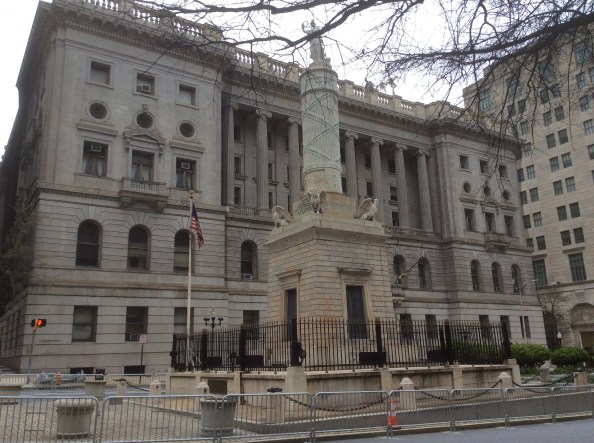
Battle Monument at E. Fayette and N. Calvert, Baltimore MD, photo 2016 by Amy Cools

Battle Monument at E. Fayette and N. Calvert, Baltimore MD

So ends my first day of following the life of Frederick Douglass on the East Coast, and it’s been a thrilling one. Coming up next: a day on the East Shore of Maryland, his birthplace and towns where he spent much of his early life. Stay tuned!

*Listen to the podcast version here or on iTunes

~ Ordinary Philosophy and its Traveling Philosophy / History of Ideas series is a labor of love and is ad-free, supported by patrons and readers like you. Please offer your support today!

~~~~~~~~~~~~~~~~~~~~~~

Sources and Inspiration:

Battle Monument‘. In Wikipedia, The Free Enclyclopedia. Encyclopedia.

Douglass, Frederick. The Life and Times of Frederick Douglass. Re-published 1993, Avenal, New York: Gramercy Books, Library of Freedom series.

Douglass, Frederick. My Bondage and My Freedom: 1855 Edition with a new introduction. Re-published 1969, New York: Dover Publications, Inc.

Douglass Terrace – Dallas Street North of Fleet Street’. BaltimoreMD. com

Eastern District‘. Baltimore City Police History.com

Foner, Philip S. The Life and Writings of Frederick Douglass, Vol. 1-4. New York: International Publishers, 1950.

Historical Sign Marking Where Frederick Douglass Lived as a Slave in Fells Point at Durham & Aliceanna‘. (photo) What I Saw Riding My Bike Around Today blog

Kelly, Jacques. ‘2 Neighborhoods Show City’s Gems of Black History‘. Feb 19, 1993, The Baltimore Sun website

Lakin, James. The Baltimore Directory and Register, for 1814-15. Baltimore: J.C. O’Reilly.

McFeely, William. Frederick Douglass. New York: W.W. Norton & Company, 1991.

Papenfuse, Edward. ‘Recreating Lost Neighborhoods: The House on Ann Street, Fells Point, Baltimore City, Maryland‘. Reflections by a Maryland Archivist blog

Separate is Not Equal: Brown vs. Board of Education‘. The National Museum of American History website, by the Smithsonian

Shopes, Linda. ‘Fells Point: A Close-up Look At Baltimore’s Oldest Working-class Community’. Nov 24, 1991. The Baltimore Sun website

Troy, Davis. ‘The Story of the 15th Amendment in Maryland‘. Maryland.gov

O.P. Recommends: The Supreme Court Ruling That Led To 70,000 Forced Sterilizations

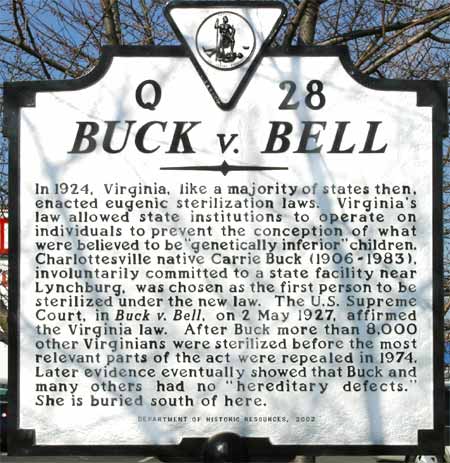
Buck v Bell Virginia Historical Marker Q 28, Courtesy of Historical Collections, Claude Moore Health Sciences Library, University of VirginiaFresh Air’s Terry Gross interviews author Adam Cohen about his book Imbeciles, which tells the story of eugenics in the United States and how the Supreme Court upheld many laws which arose from that once influential pseudoscience. Among these laws were those which forced the sterilization and incarceration into ‘colonies’, of the ‘feebleminded’ and ‘unfit’. Cohen makes the story of Carrie Buck central to his discussion in this podcast and to the book. She was a young woman who suffered about as greatly as one could from these policies and was eventually betrayed even by the Supreme Court, supposed to be the last bastion against legislative and democratic excess.

It’s a shocking story, and as Cohen and Gross point out, it’s not discussed nearly often enough today. Not only did such laws and practices harm thousands of American citizens, they influenced the Nazis, who based many of their own policies and tactics on American eugenics programs.

Less directly but important nonetheless, the backlash against that old eugenicist-brand forced confinement of mentally ill, disabled, and so-called unfit helped garner support for the release of huge numbers of people from mental hospitals in the late 1900’s. Intentions may have been good in many circumstances, since overcrowding, understaffing, and ineffective modes of treatment were at times serious problems. However, deinstitutionalization did little to solve them; the problematic institutions were not replaced with sufficient or viable options for patients and their families to continue receiving the treatment and care they needed. To this day, thousands of mentally ill people are arrested every year, incarcerated, and treated, often against their will, in prisons and other correctional facilities instead of hospitals, and only after they’ve committed crimes, victimizing yet more innocent people. And these correctional facilities, like the mental hospitals they’ve ended up replacing, are often overcrowded and ill-equipped to deal with those who should be patients rather than inmates.

Why link this podcast discussion about the failures of eugenics to the modern movement to deinstitutionalize the mentally ill? Because it’s important to remember that since it’s not always clear what the full ramifications of an idea are, we need to look at them more carefully and critically, beyond the obvious, considering the long-term and indirect effects of its influence as well. In the example of eugenics, its failures were so egregious, its lack of regard for the humanity of those it declared ‘unfit’ so ugly, that it became too easy to undermine all sorts of other things, many of them good, simply by finding a way to link them together. In this case, as the same century that saw the rise of eugenics was drawing to a close, all institutionalization of mentally ill people, all requirements that certain people receive treatment, became painted with the same broad eugenicist brush. But here’s the thing with deinstitutionalization: it turns out that a similar lack of regard for the suffering humanity of the mentally ill had more to do with those policies than anything else. This seems clear when we observe that the public debate ended up being about funding more than anything else, and not nearly enough of the savings from shutting down institutions were redirected to help the people who continued to need it. The mentally ill were too often simply abandoned by the state to survive on their own or with the help of their un-equipped families, in a world unnavigable and inhospitable to them, and their plight remains largely unaddressed by legislatures.

This one example shows how lessons to be learned from Carrie Buck’s sad story and from the eugenicist movement, then, are much more far-reaching than just the obvious ‘look how it inspired the Nazis!’ The 20th century was too often characterized by an obsession with progress and economic growth at all cost; all things and persons not seen as contributors were dismissed as superfluous and a drain on the rest of society. Let’s make the 21st century one that values humanity for its own sake, and deem scientific progress, economic policies, and public institutions successful only if they serve and promote humanitarian values, not the other way around.

~ Ordinary Philosophy and its Traveling Philosophy / History of Ideas series is a labor of love and is ad-free, entirely supported by patrons and readers like you. Please offer your support today!

~~~~~~~~~~~~~~~~~~~~~~~~~~~~~

Sources and inspiration

Frontline: The New Asylums May 2005 and The Released April 2009 (documentaries)
http://www.pbs.org/wgbh/pages/frontline/released/view/

Lyons, Richard. ‘How Release of Mental Patients Began.’, New York Times, Oct. 30, 1984
http://www.nytimes.com/1984/10/30/science/how-release-of-mental-patients-began.html

‘The Supreme Court Ruling That Led To 70,000 Forced Sterilizations’, Fresh Air interview
Mar 7 2016. http://www.npr.org/sections/health-shots/2016/03/07/469478098/the-supreme-court-ruling-that-led-to-70-000-forced-sterilizations

Ordinary Philosophy is Pleased to Introduce Eric Gerlach

Eric GerlachHello dear readers,

I’m so pleased to welcome Eric Gerlach as a regular contributor to Ordinary Philosophy!

Eric was my teacher some years ago when I returned to college to study philosophy. I attended his Introduction to Philosophy class, and it very much inspired and influenced me to this day. In the class, he emphasized and explained the connections between human thought in all times and places in a friendly, warm, and easygoing style, and ancient philosophy from all over the world seemed as relatable, timely, and relevant today as it ever was. He still teaches this excellent class, which I very much recommend if you’re ever enrolled at Berkeley City College. I’ve been continuing to enjoy his work at his blog for some years now.

I’m so thrilled that Eric accepted my invitation to lend his voice to Ordinary Philosophy, and I’m sure you’ll find his work as interesting and edifying as I always do. Please join me in extending Eric a warm welcome to O.P.!

~ Amy Cools, creator and editor of Ordinary Philosophy


Confucianism & Daoism: The Basics

The following is a lecture I composed for teaching Confucianism and Daoism to my sister’s 6th grade History class at Star of the Sea School in San Francisco.

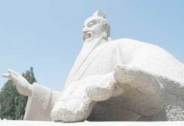
Confucius_Sculpture,_Nanjing

Confucius and Laozi, the philosophers who founded Confucianism and Daoism, lived just before the Warring States Period of ancient China (476 – 221 BCE), a time of war, tragedy and interest in philosophy.  Unfortunately, people’s lives are full of problems, but fortunately problems make people think about their lives, question the answers of authorities and experts, and reason beyond their understandings.

Laozi

Each of us, as individuals, should use both belief and doubt to become better, wiser people, but how should we go about doing this?  Confucianism and Daoism, the two great philosophies of ancient China, gave people opposing ways to gain wisdom.  Many in ancient and modern times used both to compliment and extend each other.

The Confucians say we should build ourselves up to be educated, compassionate and civilized, while the Daoists say we should clear ourselves out to become open-minded, patient and peaceful.  The Confucians say we should learn from others, reason for ourselves, and do what we know to be right.  The Daoists say we should seek less for ourselves and gain perspective beyond our own interests, reasons and actions.

Confucius, the Golden Rule & Learning from Everyone

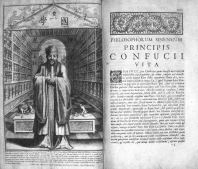
Confucius Latin

When Catholic Jesuit missionaries arrived in China in the 1600s, they were astounded to find that Confucius, the most influential and central Chinese philosopher, was incredibly similar to Jesus in his sayings and teachings.  First and foremost, like Jesus, Buddha, Muhammad and other revered teachers, Confucius taught what has been called the Golden Rule: Do for others what you would want them to do for you, and do not do to others what you do not want done to yourself.  Confucius said that this was the single thing that should guide one’s life, and that compassion is the central thread running throughout his thinking.

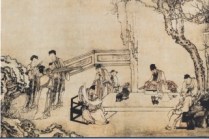
chinese-scholars1

Confucius’ student Zigong once told his teacher, “I do not want to do to others what I do not want them to do to me.”  Confucius replied, “You have not come that far yet”, probably because none of us want others to simply tell us that they are amazing.  Another time, Confucius heard Zigong criticizing other people, and said, “Zigong must have already reached perfection, which affords him leisure I do not possess.”  Confucius is being sarcastic, as he often said that no one is perfect, but anyone can be excellent by continuously working to become better.

confucius-teaching-hillside-painting

Not only can anyone be excellent, but we can each learn from anyone about how to be better ourselves.  Confucius taught that when we see great people, we should seek to be like them, but when we see horrible people, we should seek how we are like them by examining ourselves.  Confucius said, “Put me with any two people at random and they will always have something to teach me, as I can take their qualities as a model and their defects as a warning.  Clearly, Confucius believed that we all share the same set of strengths and faults, no matter how talented (or horrible) we happen to individually be or where our talents are.

emperor-shun-of-china

Because no one is perfect and everyone can learn from anyone, there is no one who is above criticism, not even the prince of the state.  When asked by a duke if there is a single thing that could ruin a country, Confucius said that if the prince is never told when he is in error or contradicted, it could be the ruin of everyone.  About himself, Confucius said, “I am fortunate indeed… Whenever I make a mistake, there is always someone who notices it.”

chinese-painting-inquiring-about-the-dao

Daoism, Perspective & Less is More

laozi-water-buffalo

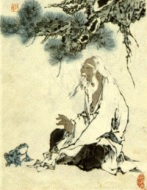
The legendary Daoist sages Laozi, Zhuangzi and Liezi taught that human perspectives are limited, and we should always keep this in mind.  Because we only have partial perspectives, we should keep in mind that others have their own perspectives which may not be the same as ours.  In one famous story, a turtle comes across a frog living in a well, and tells the frog about the sea, water that goes beyond the horizon with no walls in sight.  The frog refuses to believe the turtle, arguing that he has lived in water all his life and knows perfectly well that it comes in wells that are only so wide and have walls.  In Zhuangzi’s book, it says:

frog-with-zhuangzi

You can’t discuss the ocean with well frogs.  They’re limited by the space they live in.  You can’t discuss ice with summer insects.  They’re bound to a single season.  You can’t discuss the greater way of things with cramped scholars.  They’re shackled by their doctrines.  Now you have come out beyond your banks and borders and have seen the great sea, and so you realize how small you are.  From now on it will be possible to talk to you about the greater way of things.

japanese monkey painting

If someone sleeps in a damp place, their back aches and they ends up half paralyzed, but is this true of a carp?  If someone lives in a tree, they are terrified and shake with fright, but is this true of a monkey?  Of these three creatures, which knows the proper place to live?  We eat the flesh of grass-fed and grain-fed animals, deer eat grass, centipedes find snakes tasty, and hawks and falcons love mice.  Of these four, who knows how food ought to taste?  Monkeys pair with monkeys, deer go out with deer, and fish play around with fish.  Men claim that Mao-Qiang and Lady Li were beautiful, but if fish saw them they would dive to the bottom of the stream, if birds saw them they would fly away, and if deer saw them they would break into a run.  Of these four, which knows the standard of beauty for the world?

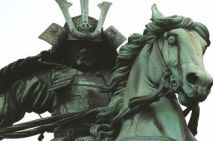
samurai-on-horseback-statue

Daoists also teach the idea of wu-wei, or non-action.  This does not mean that one should not act at all, but that often doing less is doing more.  Being patient and paying attention can save us from doing too much or having to do things over again.  In a Japanese story that illustrates this well, a local lord has three sons and must decide who should inherit his position.  He tests them by placing a pillow on the door to his room and calling them one at a time.  The eldest son enters and annihilates the pillow in a frenzy of skilled sword strikes.  The middle son draws his sword but sees the pillow in mid-air and catches it.  The youngest son sees the pillow on the door, tucks it under his arm and enters the room to the joy of his father.  The youngest son was paying attention, and so he did not even need to pull out his sword.

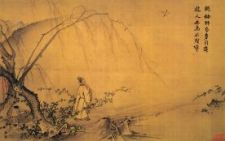
walking-in-nature-chinese-painting

There are many passages In the Dao De Jing and Zhuangzi, the two central texts of Daoism, that similarly teach that wanting too much and trying too hard is the wrong way to be:

Sages do not boast, and are thus admired by everyone, do not want to shine, and thus will be enlightened, do not seek excellence, and are thus excellent, and because they do not argue, no one can argue with them.

chinese-mountain-painting-stairs

Those who know do not speak.  Those who speak do not know.

Whoever knows how to lead well is not warlike.  Whoever knows how to fight well is not angry.  Whoever knows how to conquer enemies does not fight them.  Whoever knows how to use others well keeps themselves low.

archer-china

Those who divide fail to divide.  Those who judge are bad at judging.  What does this mean, you ask?  The sage embraces things.  Ordinary people judge between things and parade their judgements in front of others.  So I say, those who judge fail to see.

When you’re betting for cheap prizes in an archery contest, you shoot with skill.  When you’re betting for fancy belt buckles, you worry about your aim, and when you’re betting for real gold, you’re a nervous wreck.  Your skill is the same in all three cases, but because one prize means more to you than another, you let outside considerations weigh on your mind.  They who look too hard on the outside get clumsy on the inside.

~ Ordinary Philosophy and its Traveling Philosophy / History of Ideas series is a labor of love and is ad-free, entirely supported by patrons and readers like you. Please offer your support today!

New Podcast Episode: Sex, Gender, Surgery, and Freedom

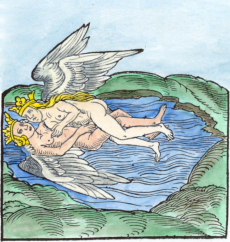
Illustration of fermentation in the Rosarium philosophorum, Frankfurt, 1550, public domain via Wikimedia CommonsListen to this podcast episode here or subscribe on iTunes

I believe that people should be free to express their tastes, preferences, and personalities without legal limits if little or no harm is done to others by doing so. Not including mere hurt feelings, however: if it did, no one would be free to do much of anything.

Likewise, I believe we have positive moral obligations to respect each other and ourselves, and to do so, we should work to free ourselves from harmful biases and distastes based on cultural, racial, religious, and gender stereotypes and narrow standards of beauty.

But when a popular social practice seems to promote one of these principles while betraying the other, it can be difficult to decide whether it’s right or wrong, good or bad…. Read the original piece here

Ordinary Philosophy and its Traveling Philosophy / History of Ideas series is a labor of love and is ad-free, entirely supported by patrons and readers like you. Please offer your support today!

In Memory of Hypatia of Alexandria

Detail of the death portrait of a wealthy woman, c. 160-170 AD near modern-day Er-Rubayat in the Fayum, public domain via Wikimedia CommonsHypatia’s birthday is somewhere between 350 and 370 AD; a range of dates indicating great uncertainty, to be sure, but clear original sources this old are hard to come by, especially from a city as turbulent and violence-torn as the Alexandria of her day. The day of her death is better known, sometime in March of 415 AD. Since the latter date is more precise, we’ll break with our tradition here and remember Hypatia in the month of her tragic and violent death instead of on the date of her birth.

She’s a mathematician, astronomer, teacher, and philosopher, who writes commentaries on important works in geometry and astronomy with her father Theon, likely contributing original work of her own. Hypatia is a Neoplatonist, a philosophy with mystical overtones which posits that everything derives its being from the One, an ultimately conscious yet nonmaterial, non-spacial entity which is the pure ideal of everything that is. She is a scholar and teacher in a field and in a world that’s male-dominated, and historians from her day to ours emphasize her extraordinary talents and her femininity with a nearly equal mix of awe and bemusement.

So let us remember and honor Hypatia for her great contributions to human knowledge and to the history of women’s liberation, living proof that women are equals in intellect and courage.

And let us also remember her sad death as a cautionary tale against those who inflame popular sentiment to seize power for themselves. Hypatia meets her death at the hands of a Christian mob caught up in the anti-pagan hysteria of the day; Alexandria itself was caught up in a power struggle between civic and religious authority. The mob of extremists who drag Hypatia from her carriage, torture and kill her with roofing tiles, and defile her body are inspired by their partisanship with theocratic bishop Cyril to kill this pagan philosopher, this mathematician and astronomer (then often equated with sorcerer), this woman who dared teach men, this friend of Cyril’s rival Orestes, civic leader of Alexandria. As Hypatia scholar Micheal Deakin quotes: “Cyril was no party to this hideous deed, but it was the work of men whose passions he had originally called out. Had there been no [earlier such episodes], there would doubtless have been no murder of Hypatia.”

From the current presidential primary race, in which a certain millionaire is whipping up populist support* with extremist racial and religious rhetoric, back to Hypatia’s time and beyond, power-hungry opportunists plead innocence from the very violence they inspire. Yet it appears hard to justify that plea when reason and the lessons of history plainly reveal the nearly inevitable results of fomenting sectarian strife. Extremism in the defense of liberty or anything else is a vice** because of the way it drives away reason and sympathy, and after all, nothing is as liberty-destroying as mob violence and death.

Ordinary Philosophy is a labor of love and is ad-free, entirely supported by patrons and readers like you. Please offer your support today!

~~~~~~~~~~~~~~~~~~~~~~~~~~~~~

Read more about Hypatia:

Deakin, Michael.’Hypatia of Alexandria‘ from Ockham’s Razor radio program of Radio National of Australia (transcript), Sun August 3rd 1997. (click ‘Show’ across from ‘Transcript’)

O’Connor, J J and E F Robertson. ‘Hypatia of Alexandria‘, from the School of Mathematics and Statistics, University of St Andrews, Scotland website.

‘O’Neill, Tim. ‘“Agora” and Hypatia – Hollywood Strikes Again‘. Armarium Magnum blog, Wed May 20, 2009

Zielinski, Sarah. ‘Hypatia, Ancient Alexandria’s Great Female Scholar‘. Smithsonianmag.com, Mar 14, 2010.

…and about Neoplatonism

Wildberg, Christian, “Neoplatonism“, The Stanford Encyclopedia of Philosophy (Spring 2016 Edition), Edward N. Zalta (ed.)

* ‘What If Trump Wins?’ by Jeet Heer in New Republic, Nov 24, 2015

** in reference to the quote ‘Extremism in the defense of liberty is no vice’ from Barry Goldwater’s 1964 presidential nomination acceptance speech 

O.P. Recommends: Like the Oscars, #PhilosophySoWhite

School of Athens by Raphael [Public domain], via Wikimedia Commons (cropped)Eric Schwitzgebel, who authors the The Splintered Mind blog (a favorite of mine), recently co-wrote this excellent opinion piece about philosophy’s lack of diversity.

Like Hollywood, Schwitzgebel and Myisha Cherry find that there’s a set of preconceptions which underlie the way work is chosen and promoted which, in turn, virtually guarantees philosophy will remain non-diverse. Hollywood has its own set; for academic philosophy, the glorification of obscurantism is a primary factor. Schwitzgebel and Cherry write: ‘We admire philosophers whose central arguments are nearly impossible to understand, or who speak in paradoxes, who accept seemingly bizarre views, or who display dazzling skill with formal logical structures of no practical significance. Kant and Hegel are better loved than understood.’ Seeming smart, the authors explain, has long been confused by too many academics with being smart.

The piece goes on to show how this obscurantism has become the traditional province of white male academics, and is integral to keeping the field of philosophy so exclusionary, and to most people, so irrelevant.

This, of course, would be sad news for Ordinary Philosophy, dedicated as it is to philosophy in the public square, if it were news. But it’s not news, and that’s one of the main reasons O.P. exists. Philosophy should be, like good government, of, by, and for the people. While specialization is key to the development and exploration of complex ideas, obscurantism and jargon, despite assumptions to the contrary, are not necessary to that project. In fact, they accomplish little except ensuring that philosophy is tedious and unpleasant to read, that philosophers end up talking to nearly no-one but each other, and that the field as a whole ends up remaining oh-so-white, oh-so-male, and to most, oh-so-irrelevant.

Ordinary Philosophy and its Traveling Philosophy / History of Ideas series is a labor of love and is ad-free, entirely supported by patrons and readers like you. Please offer your support today!

New Podcast Episode: Communitarianism, Writ Large

Listen to this podcast episode here or subscribe on iTunes

I listened to Bill Moyers’ discussion with Michelle Alexander recently, about her book The New Jim Crow and her activism against the over-incarceration of black people here in the US. Something she said really struck me, as it relates to a problem I’ve been mulling over for some time. She said:

‘…I realize that as well-intentioned as all that work was, it was leading me to a place of relatively narrow thinking… Ought I not care equally for all? And that really was Dr. King’s insistence at the end of his life….’

Alexander’s reflection on her own work illustrates our need not only to grow more expansive in our thinking in order to achieve a more just society not just locally, but globally: we need to witness and internalize the sufferings faced by other human beings who are not like us in appearance and culture, so that our instincts for empathy and for justice expand as well… Read original essay here

Ordinary Philosophy and its Traveling Philosophy / History of Ideas series is a labor of love and is ad-free, entirely supported by patrons and readers like you. Please offer your support today!


Happy Birthday, Rosa Luxemburg!

Rosa Luxemburg, By unknown photographer around 1895-1900 [Public domain], via Wikimedia CommonsRosa Luxemburg, Mar 5 1871 – Jan 15 1919, is the great Marxist theorist, writer, economist, revolutionist, anti-war and anti-capital-punishment activist, and philosopher who was murdered during the German Revolution of 1918–1919.

Though she’s an anti-war activist, Luxemburg is also critical of the idea that a just society can be brought about by incremental reforms through established political systems. If she were to be involved in the 2016 Democratic primary race between Hillary Clinton and Bernie Sanders, she would very likely back Bernie, with his more revolutionary style and rhetoric: she’s sharply critical of the Social Democratic Party of Germany, to which she belongs (in its left wing) for favoring a Hillary-style reformist approach. However, her internationalism takes Marxist thinking beyond the point where leading Marxists of her day had progressed, with their focus on unique formulations of Marxist political theory tailored to their own particular national identities and histories. She would likely find fault, then, with Bernie’s protectionism.

Luxemburg’s other great contribution to Marxist thought is her theory about the accumulation of capital. Since capitalism’s primary fuel is constant and ever-increasing consumption, she thinks it’s a mechanism for the ultimate destruction of our material capabilities to sustain ourselves, starting with the ecosystems on which indigenous people, the poor, and the working class depend. Here as well, her progressive thinking takes her far beyond Marx himself, and her concerns in this timely issue makes her as relevant now as ever.

Read more about the brilliant and fearless Luxemburg:

‘Who’s Who – Rosa Luxemburg’ at First World War.com

‘The Dialectic of the Spatial Determination of Capital: Rosa Luxemburg’s Accumulation of Capital Reconsidered’ by Peter Hudis

The Crisis of German Social Democracy (The Junius Pamphlet) by Rosa Luxemburg, 1915

‘Rosa Luxemburg’, from Wikipedia, the free encyclopedia

Ordinary Philosophy and its Traveling Philosophy / History of Ideas series is a labor of love and is ad-free, entirely supported by patrons and readers like you. Please offer your support today!