
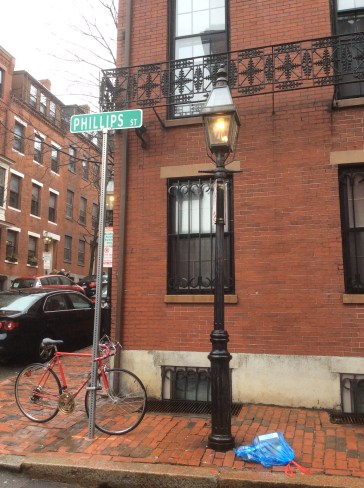
I commence my Frederick Douglas Boston journey on Phillips St, and long for my bike. Mine is blue with upright bars for better sightseeing. Sigghhh.
Sixth Day, Friday March 25th
As I’m quick to discover, parking is at a premium in central Boston and its environs. I’ve decided not to pay the high garage rates and stick with metered parking (reasonably priced but harder to find). It’s to be expected in an awesome, busy, historically important city, of course, just be prepared! It’s such a handsome city, so much to look at, and I long for my bike: fleet, nimble, with uninterrupted view, parkable anywhere there’s a pole. At times such as this, a car feels like little but an expensive burden.
Frederick Douglass never did live here in Boston, but this city has many connections with his life: he and his family lived just a few miles north of here in Lynn from 1841-47. Douglass visited, worked, and spoke here often, and the Boston Anti-Slavery Society published his Narrative which, combined with his speaking tour of the British Isles and the United States that followed, catapulted him to fame and made him the leading African American abolitionist of his time.
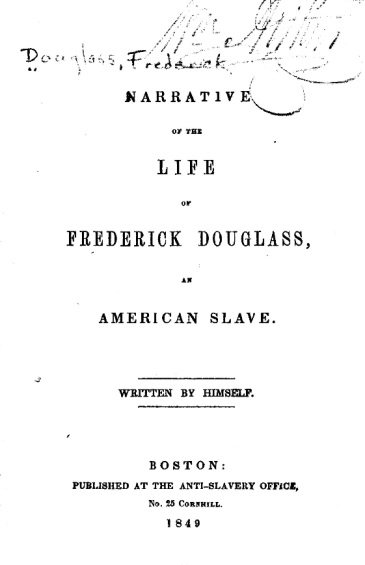
Narrative of the Life of Frederick Douglass, published by Boston Anti-Slavery Society, image: Library of Congress. It was published on Cornhill St which no longer exists, but I passed near its old location while walking through City Hall Plaza
As I discussed an earlier piece on Frederick Douglass and the Constitution, Douglass had a falling-out over time with the abolitionist movement of William Lloyd Garrison in the early 1850’s. The Garrisonians rejected the Constitution as a pro-slavery document and as a result, considered the government unjust and therefore illegitimate; Douglass came to believe that the Constitution, if interpreted correctly, is an anti-slavery document, and the government must be reclaimed from its pro-slavery element by seizing power through political channels if possible, through violence if necessary. The advent of the Civil War changed everything; in the face of this monumental upheaval and national crisis, political and theoretical disagreements no longer seemed so important. (Douglass demonstrates, to my mind, that one can be fully both a fiery revolutionary and a pragmatist.)
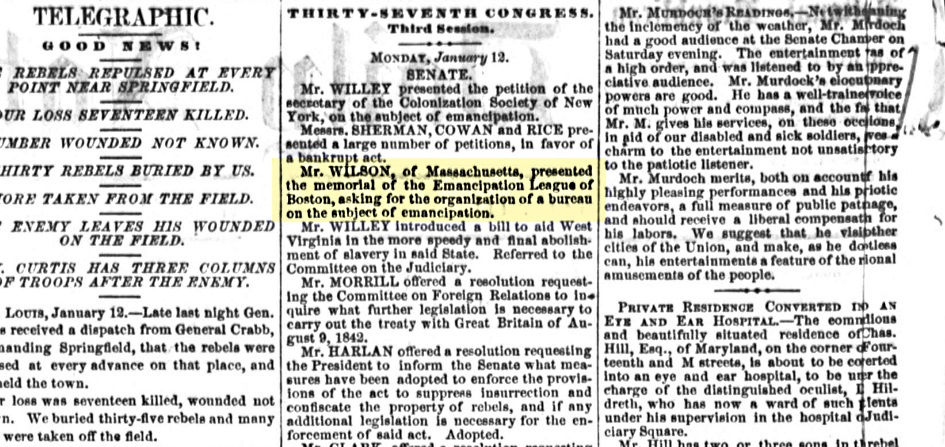
In November of 1861, the Emancipation League organized in Boston, where Douglass, the followers of Gerrit Smith (who influenced Douglass to reexamine the way he interpreted the Constitution) and the Garrisonian abolitionists formally reconciled so they could rally and unite their efforts in the cause of the Civil War cause for national union and the end of slavery. Try as I might, I’m unable to locate any exact addresses where they assembled, though I find many newspaper accounts from the time announcing their meetings and relating their activities in Boston and elsewhere. These activities included petitioning the Senate to commence emancipation efforts in earnest.
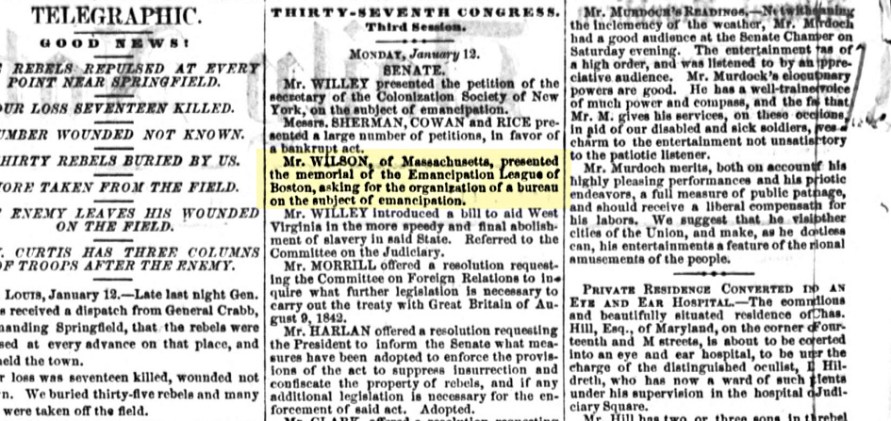
From the Daily National Republican, January 12, 1863 2nd edition from Chronicling America, Library of Congress
I begin my day’s journey by heading up Beacon Hill, where many of Boston’s abolitionists and black people settled, to 43-47 Phillips St, one block north of Cambridge between Grove and Anderson. I start here for efficiency’s sake since it’s right up the way from the coffee shop where I’m marking out my map with some new details I’ve just learned. However, it doesn’t make sense to start my story here since what happens at this site is the second part of a two-part event, so I’ll tell you about it shortly.

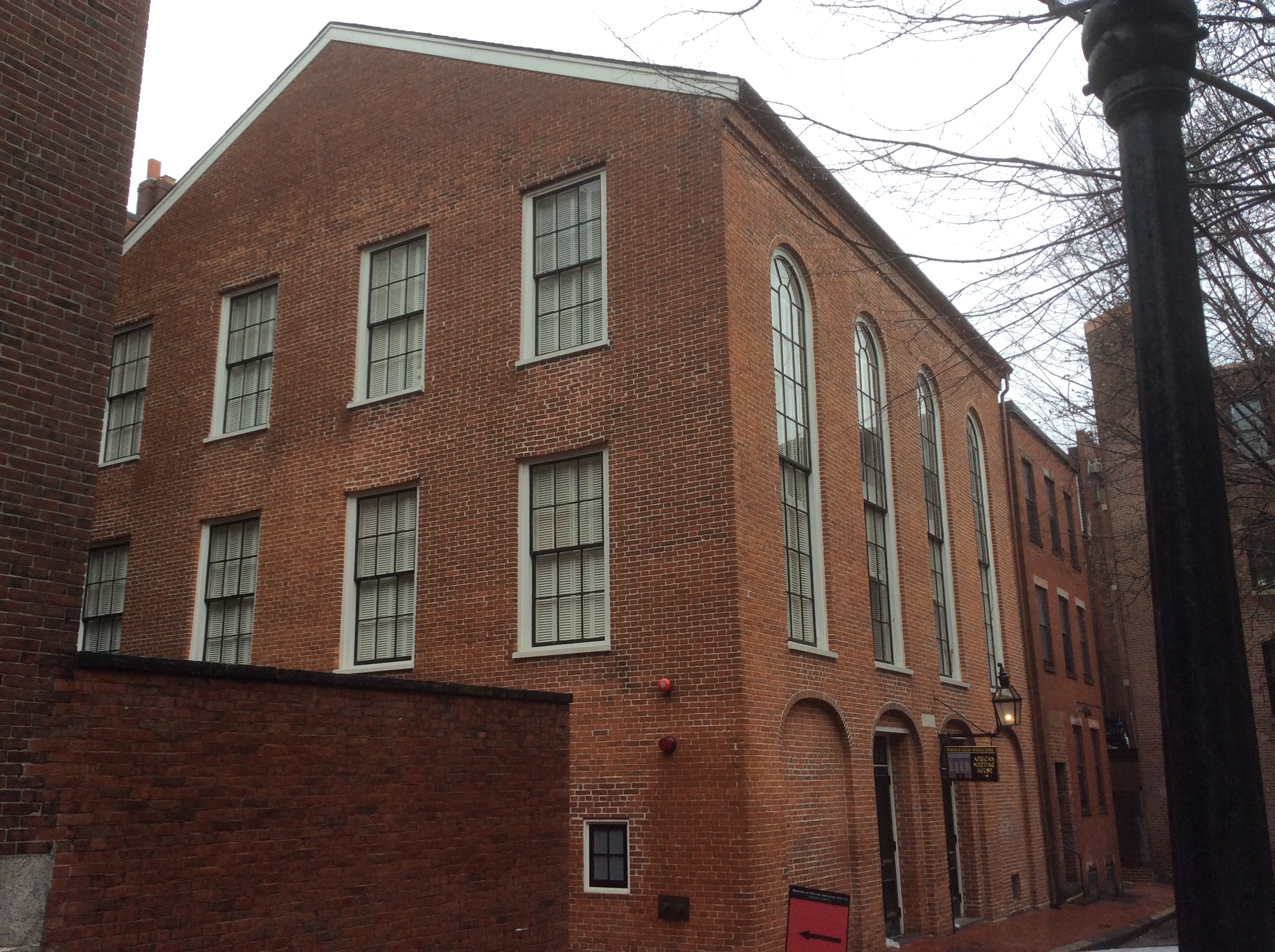
Museum of Afro-American History in front of the African Meeting House, Beacon Hill, Smith Ct, Boston
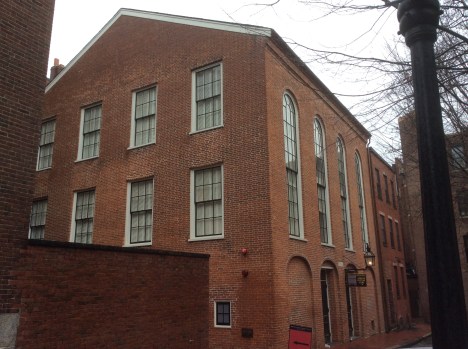
African Meeting House, the oldest black church in America
Then I head east on Phillips, turn right (south) on Irving, left on Myrtle, left on Joy, to Smith Court which heads off to the left from Joy St between Cambridge and Myrtle. The African Meeting House stands at the end of Smith Court just behind the Museum of Afro-American History at 46 Joy St. The Meeting House was built in 1806 ‘…to house the first African Baptist Church of Boston (a.k.a. First Independent Baptist Church) and it is now the oldest extant black church building in America’ according to the National Park Service, which maintains it and many other Black Heritage sites here on Beacon Hill. Douglass, William Lloyd Garrison, Wendell Phillips, and Sarah Grimke all spoke here at the African Meeting House, and for those in this list of people I haven’t talked about yet in my account, they will feature later on. There’s a guided tour you can take in season (I’m here too early in the year for that) or the self guided tour. I wish I had another day to visit all the site, including the guided tour of the Meeting house which is actually available today but I’d have to wait till the next available time (which, sadly, I run out of). Next time I’m in Boston…!
There are a great few things about traveling to historical places in the off-season: the crowds are light and you can get better pictures, it’s cheaper to fly, and it’s a bit easier to park (the fact that I can hope to find street parking at all is pretty good, and I didn’t get a ticket either time my meter expired). But, the weather can be iffy, the trees are bare, and some places are closed or have very limited hours. So, you have to decide if the trade-offs are worth it.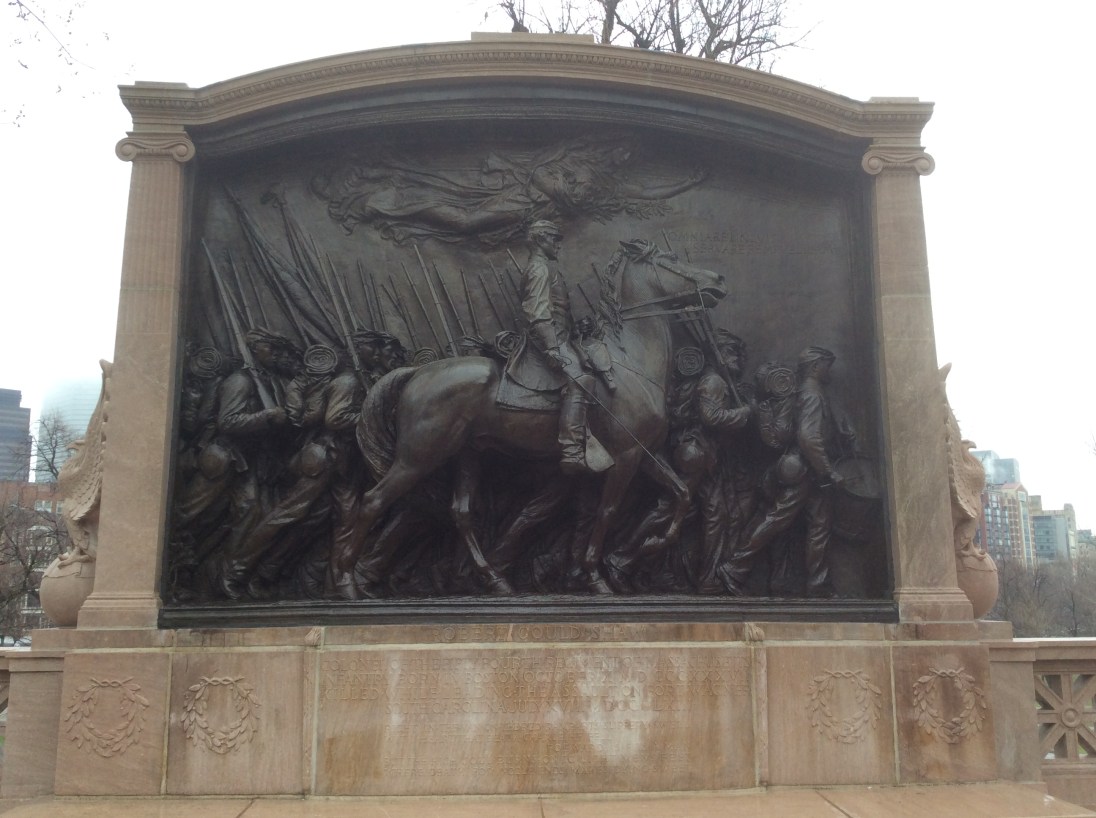

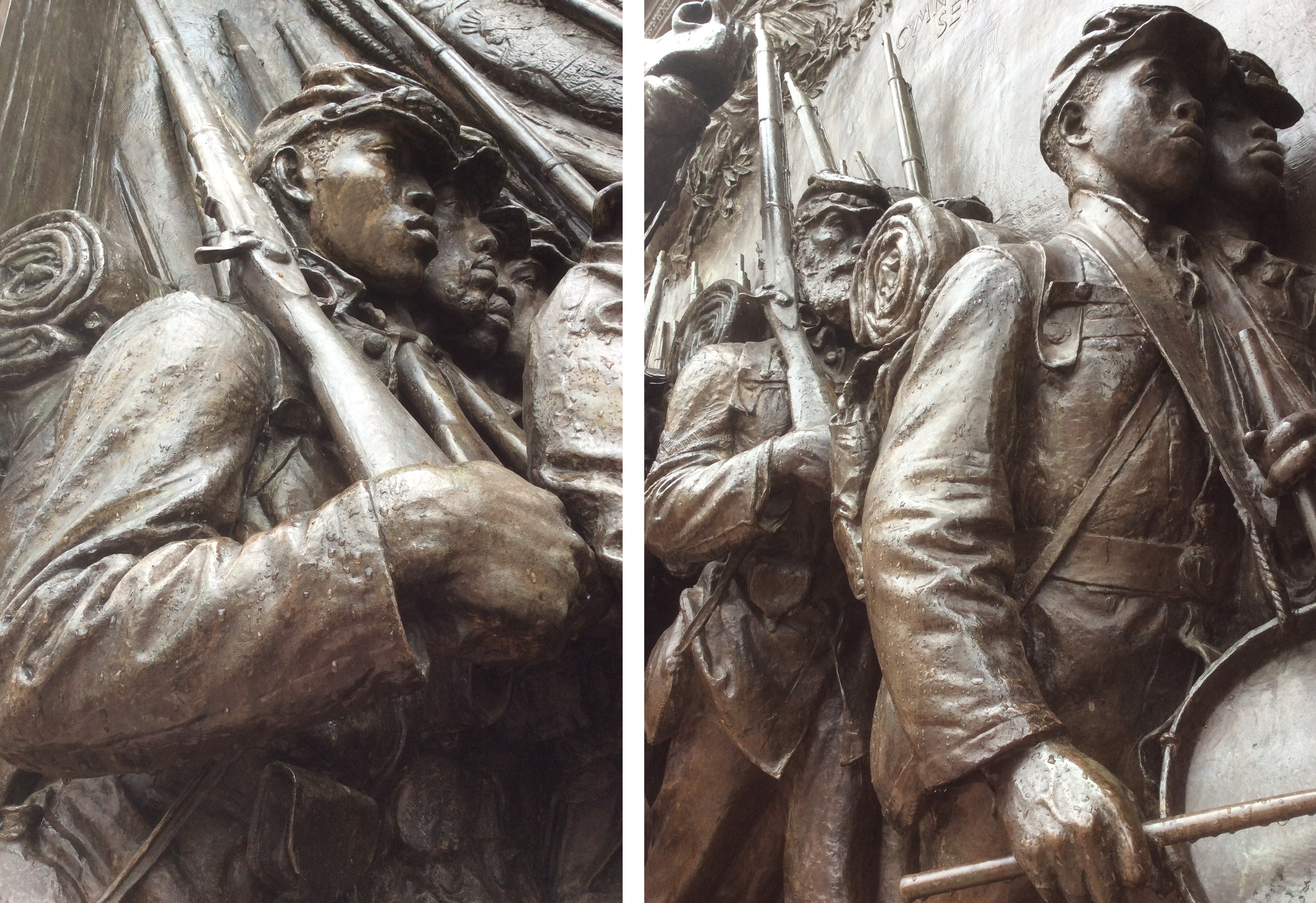
Two closeups of the 54th Regiment Memorial at Boston Common. What determination is expressed in these sculpted faces!
Then I turn back and head south to Boston Common, to the 54th Regiment Memorial on Beacon St at Park, near the park’s northeast corner. On May 28 1863, the Massachusetts 54th Infantry Regiment of 1000 troops marched triumphantly into Boston Common. It was the first black regiment to be raised in the North. As discussed in my post from yesterday’s travels to New Bedford, Douglass was instrumental in the fight to get Abraham Lincoln to authorize and federally fund black troops’ enlistment in the Union Army, and Douglass’ two sons Lewis and Charles enlisted to fight in this regiment. What a proud papa he certainly was!
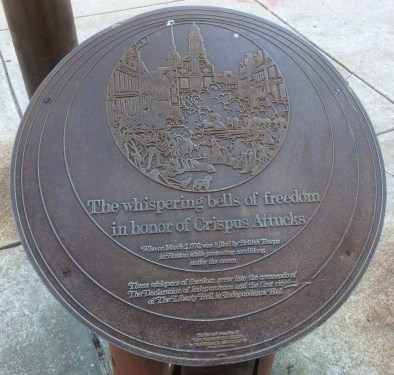
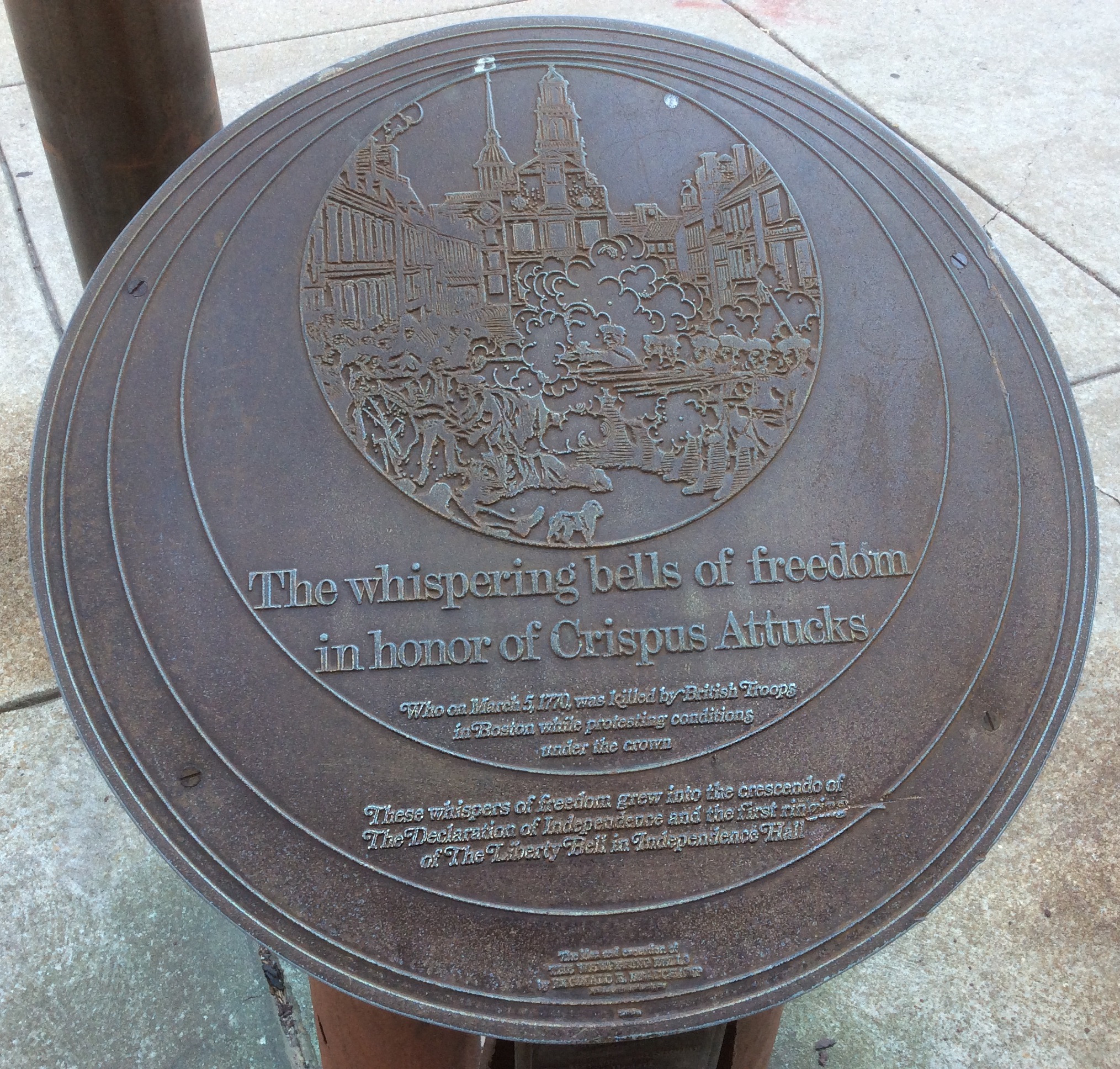
Plaque honoring Crispus Attucks, at Philadelphia’s African American Museum
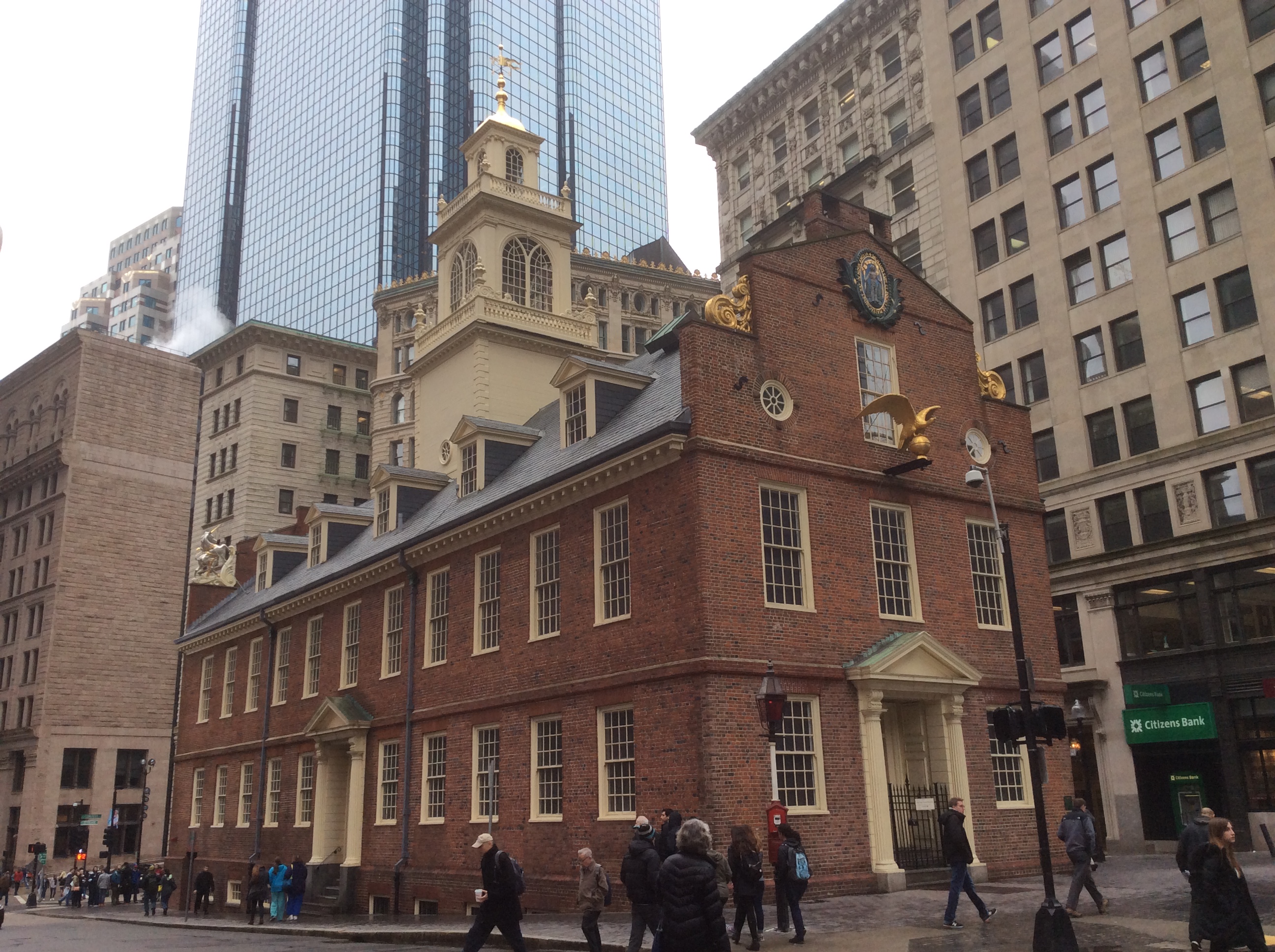
The 54th Regiment continued their march from Boston Common on to Battery Wharf (which I will also do soon), passing the site of the Boston Massacre. That incident, where a colonial mob dared British guards to fire on them until they did, happened outside of the Old State House, at Congress, Court, and Washington Sts. (John Adams successfully defended most of the British soldiers. Though he was as ardent a patriot as you could find, he was also a man of high integrity and made the legally sound argument and fair point that if a large mob attacks a small number of armed guards, they are duty bound to defend themselves, whatever side they’re on. Crispus Attucks, a man of African and Native American ancestry, was mortally wounded in that scuffle 0n March 5th, 1770, and is often regarded as the first American casualty of the American Revolution. When I passed by Philadelphia’s African American Museum a few days ago, I snapped a photo of his memorial plaque there, knowing I would soon visit the site of his death.
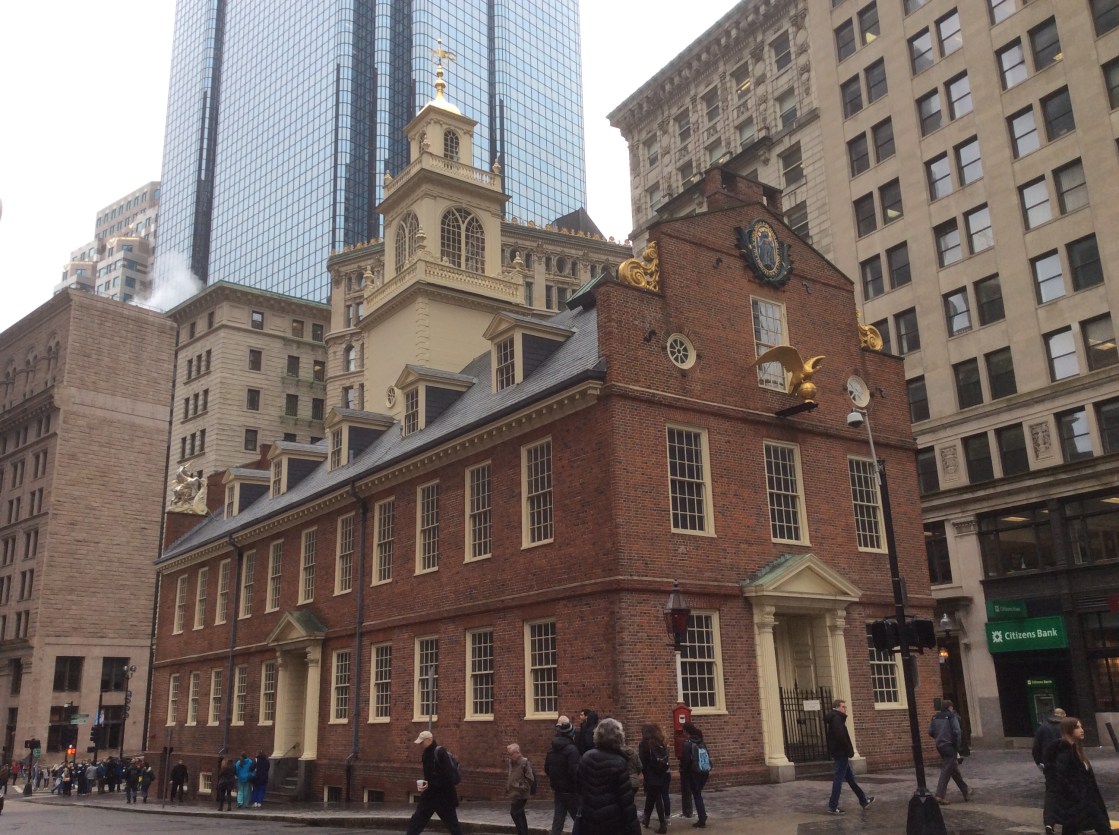
The Old State House in Boston Massachusetts, site of the Boston Massacre and of debates over whether the colonies should rebel against Britain
Back to the story of the 54th Regiment: Douglass was also active in recruiting efforts, believing that enlistment in the Union army, made possible by the Emancipation Proclamation, would give black people their chance to prove themselves as the strong, brave, patriotic, true Americans he knew them to be, and their participation in the war would establish their full right to citizenship once and for all. Unfortunately, black soldiers faced unfair and degrading treatment in the Union Army: lower pay than whites, less weapons and equipment, no chances for promotion, assigned the most dangerous and menial jobs, and so on. Many black soldiers, joined by the 54th’s white commander and son of wealthy Boston abolitionists Robert Gould Shaw, refused pay until it was equal, which was granted the next year. The South also imposed terrible penalties for captured black Union soldiers and anyone leading them: immediate execution, same as for insurrectionists. To his great credit, Shaw accepted no pay and braved the same risk of execution along with the rest of his regiment. In response to the poor treatment of black soldiers, Douglass stopped recruiting for awhile.

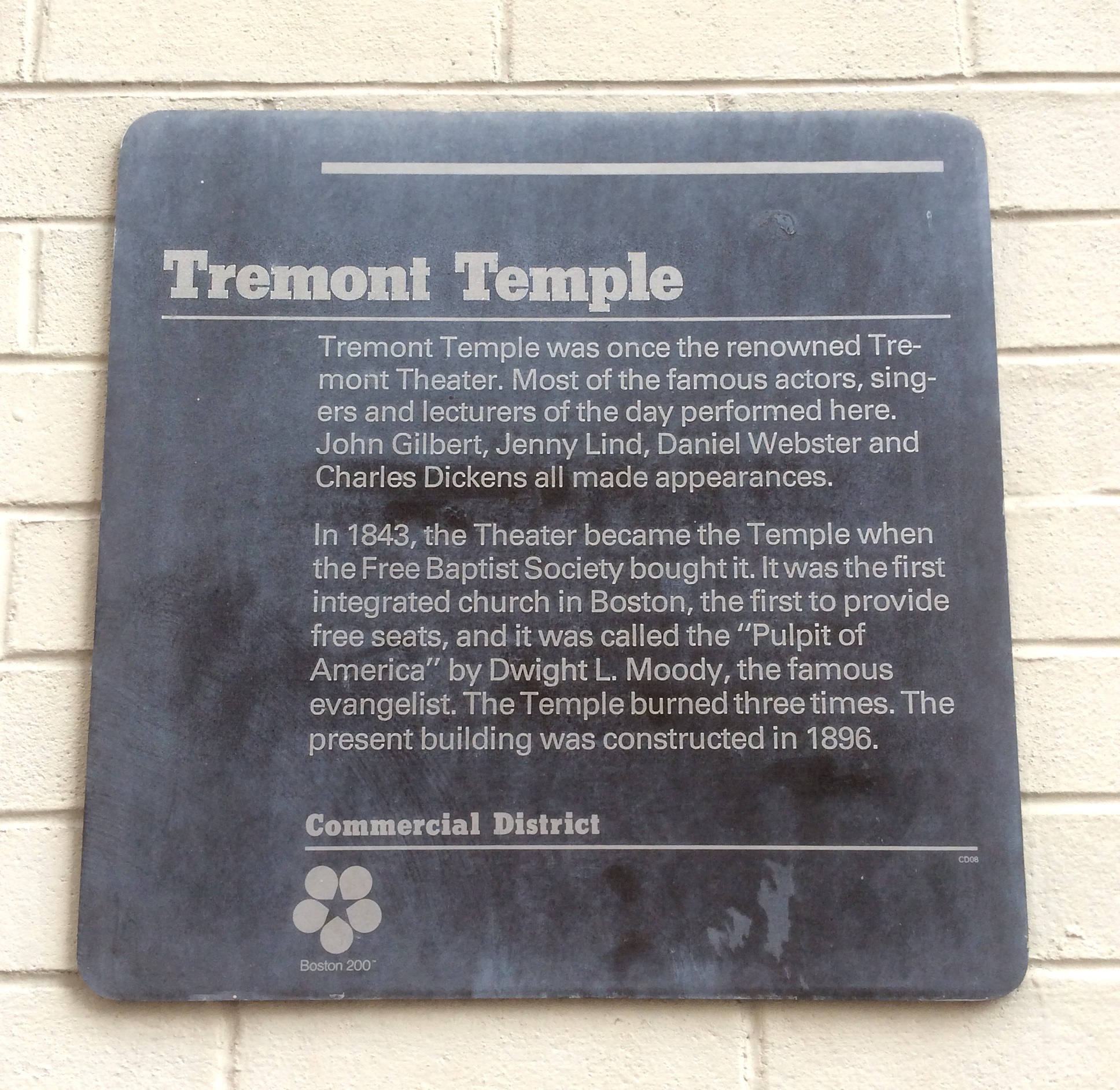
Tremont Temple, the very ornamental building on the right, Boston, Massachusetts
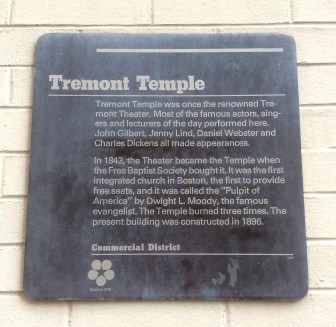
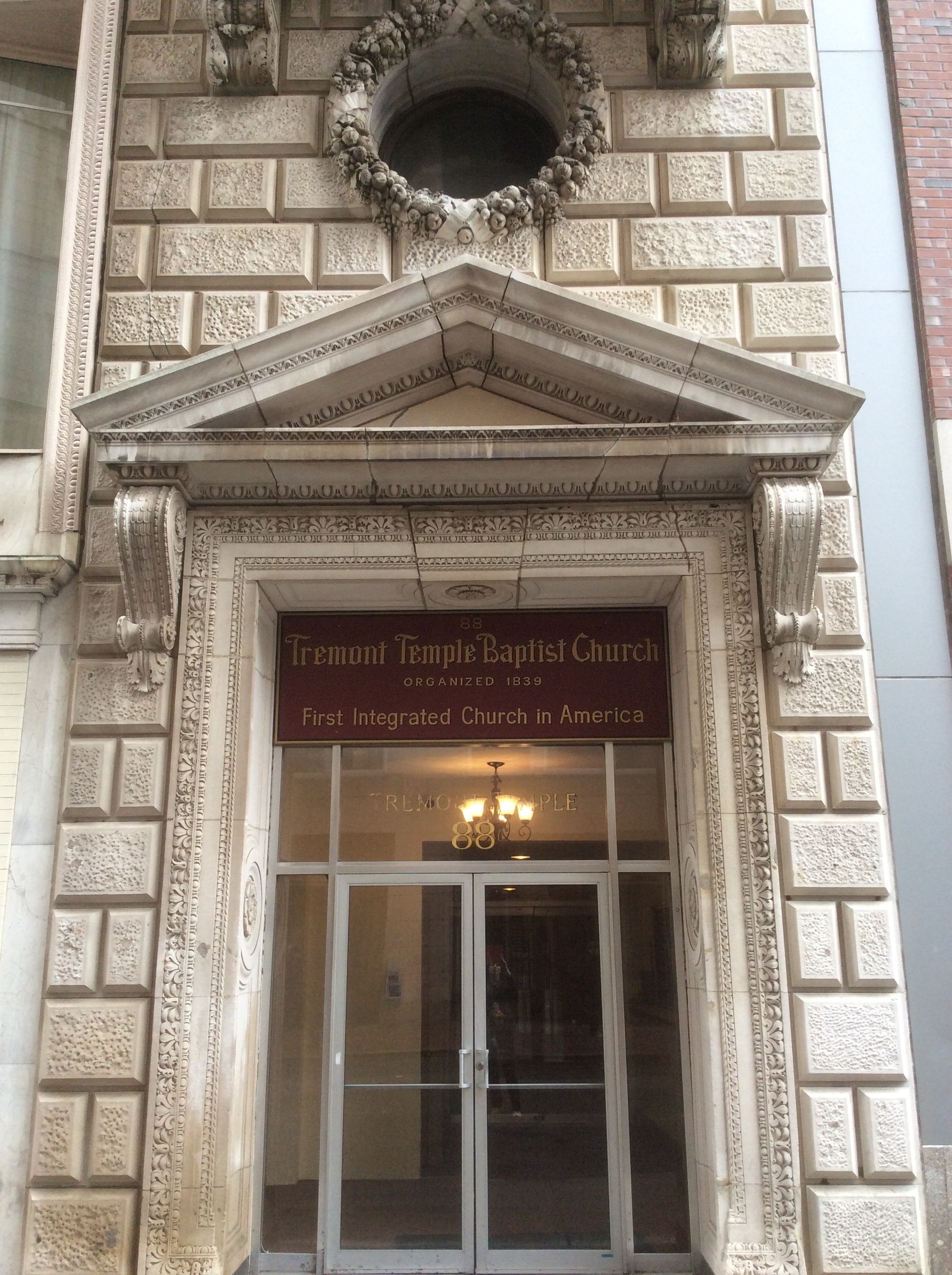
Then I wind my way east of Boston Common to 88 Tremont St, between Bosworth and School, to Tremont Temple. From December 31st, 1862 through the next day’s New Year holiday, Union Progressive Association and about 3,000 attendees, abolitionists, and human rights advocates gathered to greet the official announcement of the Emancipation Proclamation, and Douglass spoke at this event.
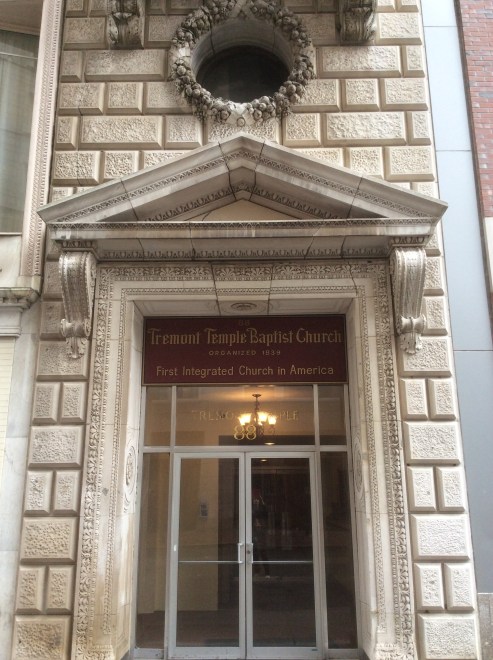
Tremont Temple doorway, ‘First Integrated Church in America’
Douglass had spoken here before, and at one time was roughed up when the recent election of Abraham Lincoln inflamed pro-slavery violence against abolitionists, even in relatively anti-slavery Boston. The Temple structure now here dates to 1896, replacing the original 1827 fire-damaged, much smaller building. Many years later, in 1893 (still in the old building), Douglass’s friend and inspiration Ida B. Wells delivered a lecture on lynching here at Tremont Temple; as discussed in my account of following Douglass in NYC, she inspired his anti-lynching activism later in life.
After the Union Progressive Association’s celebration of the Emancipation Proclamation, the party left Tremont Temple, since it closed at midnight, and moved the meeting to Twelfth Baptist Church. After fighting, working, and hoping for such a proclamation for so long, the party was not to end anytime soon, not until the wee hours at least.
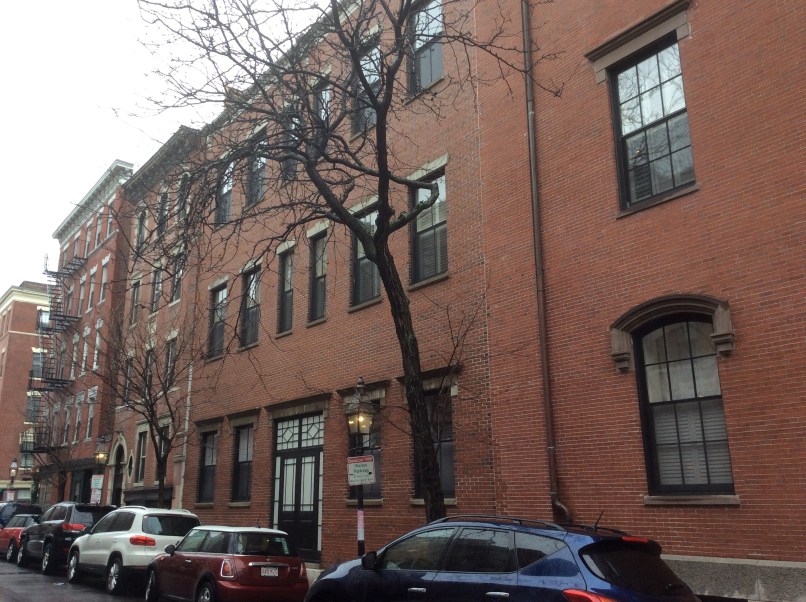
43-47 Phillips St, former site of Twelfth St Baptist Church in Boston
I’ll backstep a bit here: remember the first site I visited today, on Phillips Street? That’s where the Twelfth Baptist Church (where the Emancipation Proclamation celebration continued) used to stand, founded by former congregants of the African Meeting House, at number 43-47 Phillips St, a little over a half mile away on the other side of Beacon Hill.

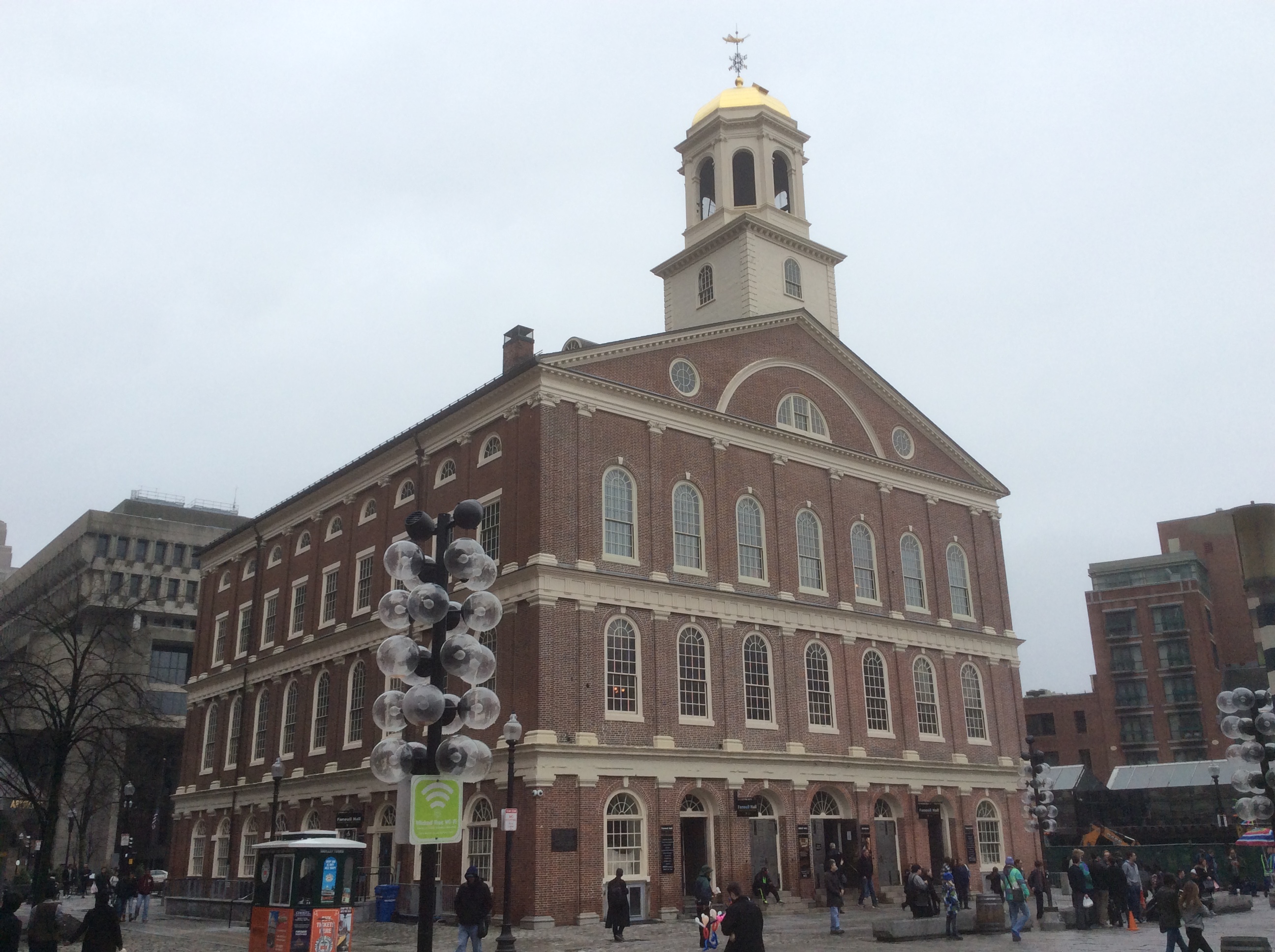
Faneuil Hall, Boston, Massachusetts
Then I head a little less than half a mile away in (kind of) the opposite direction of the Phillips St church site to Faneuil Hall at 1 Faneuil Square, where the body of Wendell Phillips lay in state in on February 6th 1884, after his funeral in the Hollis Street Church (more on this shortly, in fact, it’s the last story of the day and the most exciting as a traveling history nerd… ahem, enthusiast seeking a hard-to-find site). Phillips was another great human rights activist, writing in support of women’s civil rights including the right to the ballot box, in an article he published about two years before Elizabeth Cady Stanton famously introduced this same resolution at the 1848 Woman’s Rights Convention in Seneca Falls (we’ll be returning to this story in an upcoming piece). In his Life and Times, Douglass referred to the great abolitionist and reformer Phillip’s eloquence as ‘word painting’, an art which he had performed in life previously in this same hall.
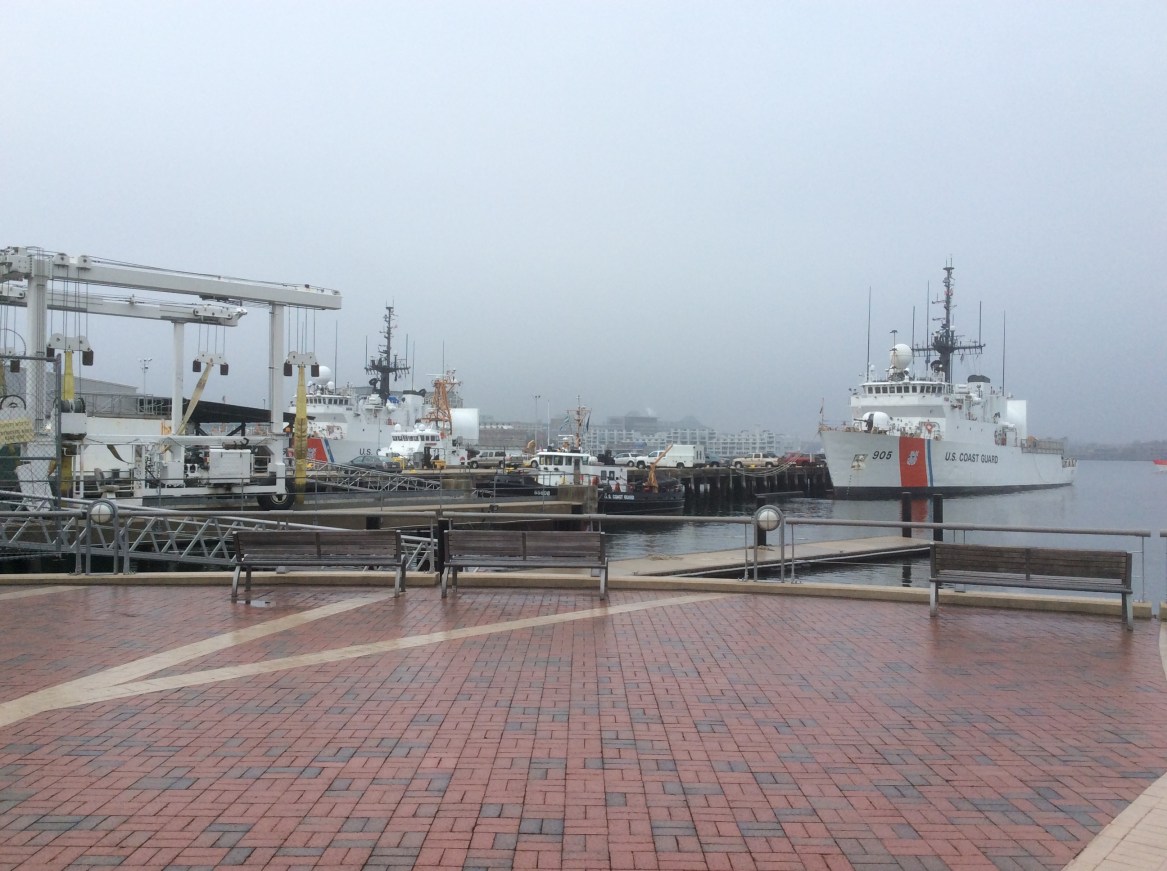
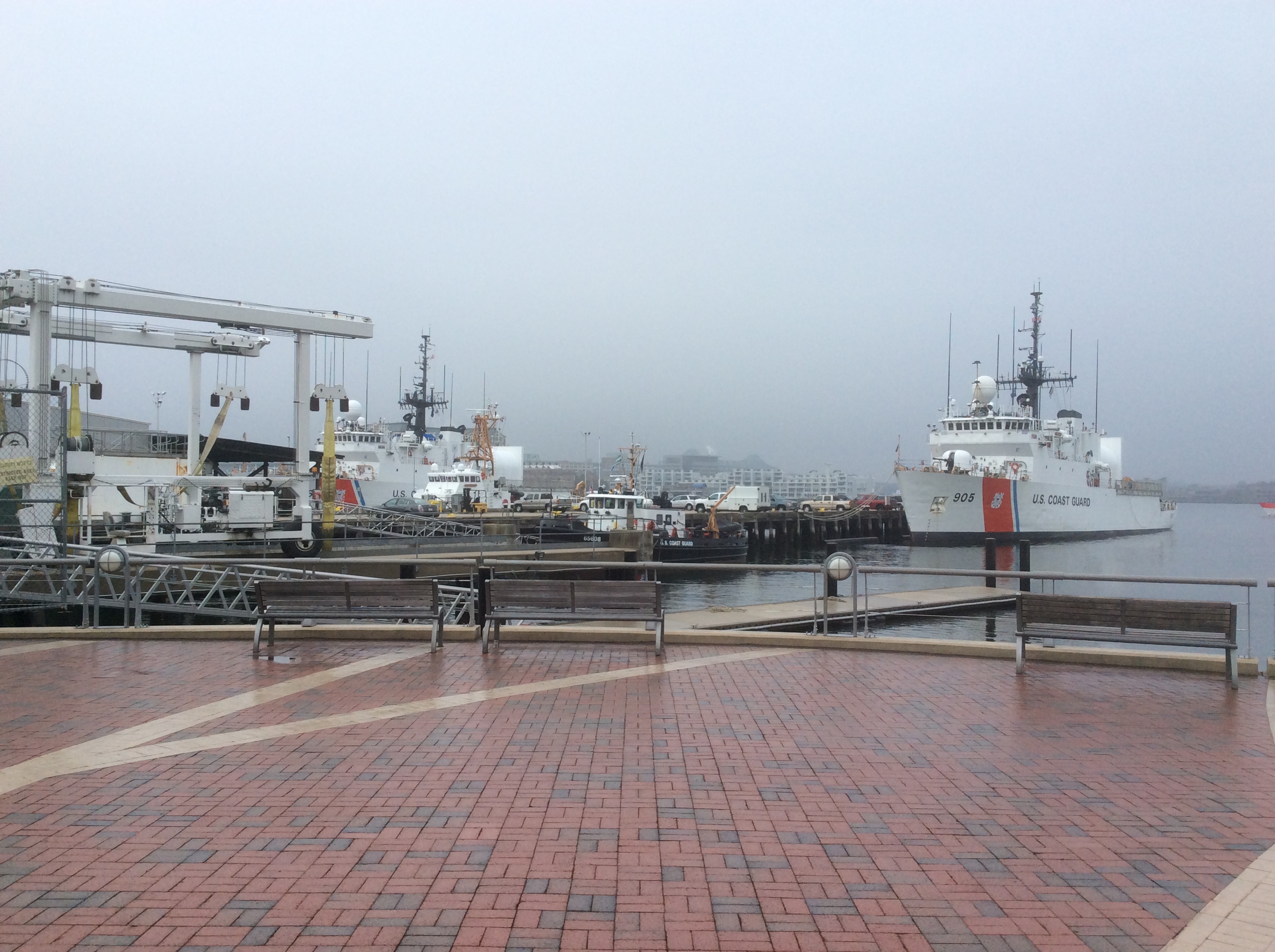
A view from Battery Wharf, now used by the Coast Guard
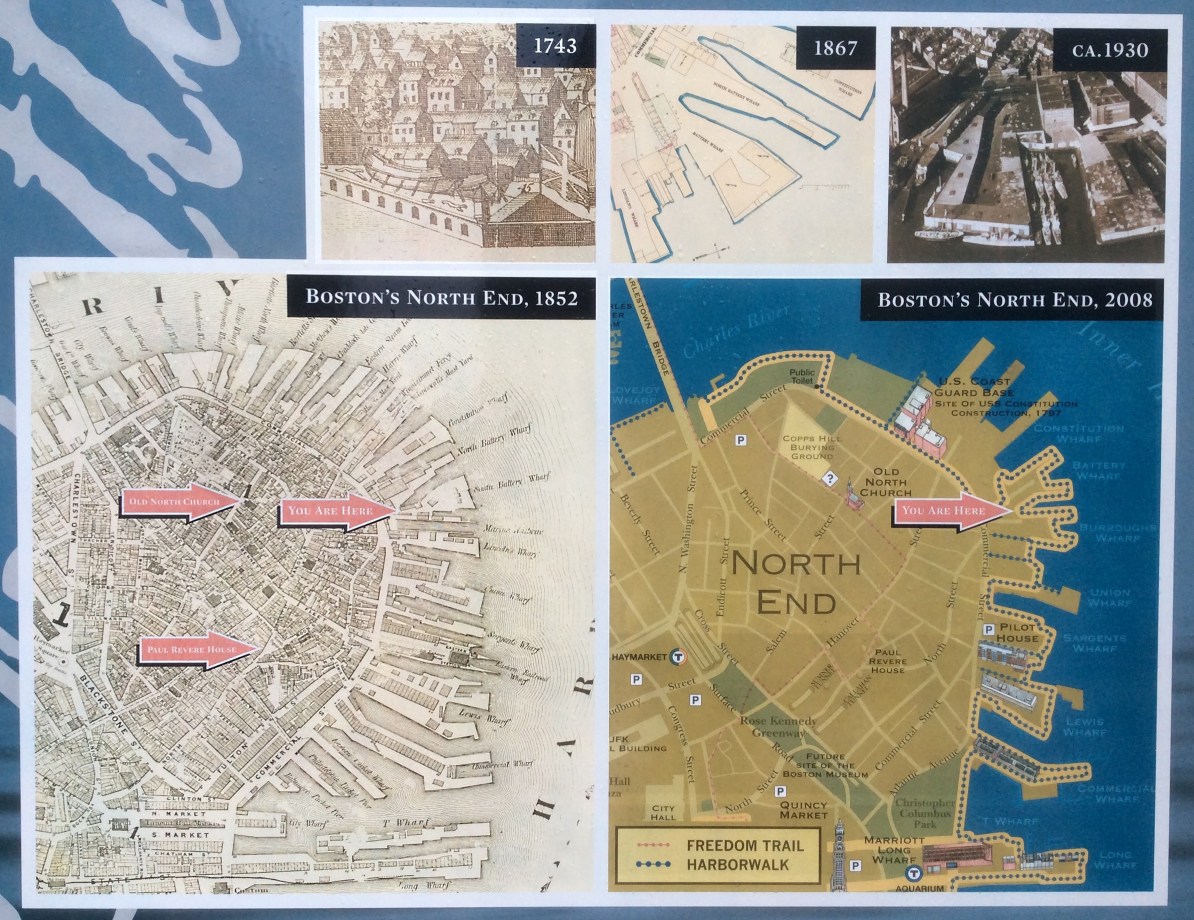
Battery Wharf plaque maps, detail
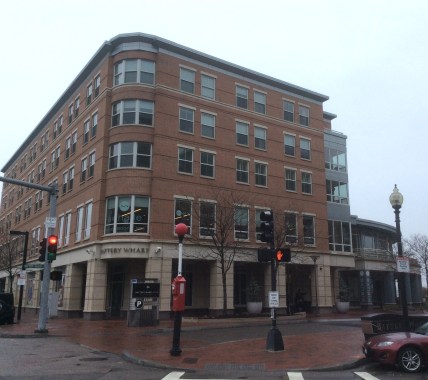
Battery Wharf office building
Then after moving the car (again!) I head to Battery Wharf, where, as I described earlier, the 54th Infantry Regiment continued their triumphal march to the sea on May 28th, 1863, to travel by steamship to South Carolina. Seven weeks later, about a quarter of their number and their commander Shaw died in a bold and bloody assault on Fort Wagner. Though that battle was lost, the heroic example of these soldiers inspired many others to enlist, and Shaw’s body remained buried in a common grave with many of his soldiers. The Confederates who buried Shaw this way saw it as an insult, since officers were generally accorded their own burial with special honors, even by the enemy. Shaw’s abolitionist family and the soldiers inspired to join by the Fort Wagner fight, however, thought this manner of burial a great honor, and a testament to his courage as a soldier and his devotion to his men and the cause of human rights.

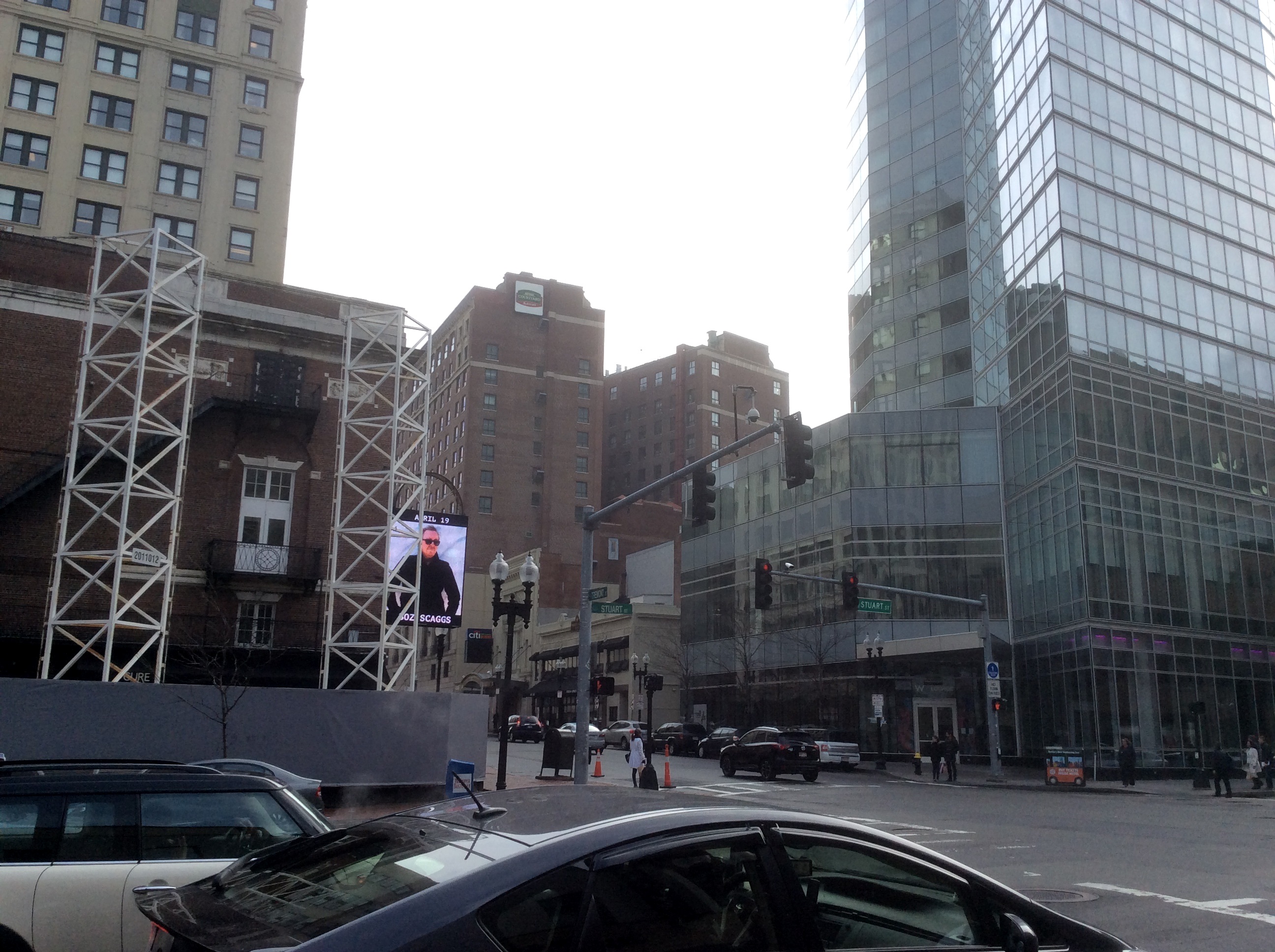
Tremont St at Stuart, approaching the Citi Performing Arts Center
I make the long walk south and a bit east, about a mile and a half, to the Citi Performing Arts Center. I’m seeking the site of the old Hollis Street Unitarian Church, where Wendell Phillips’ funeral took place prior to his lying in state at Faneuil Hall. This site took me far longer than any other site to find. I had scoured through old newspapers and finally discovered that his funeral was at ‘Hollis-street chapel’, certainly Hollis Street Unitarian Church, according to a Feb 16th 1884 edition of Washington D.C.’s The Bee. I found the entry in Chronicling America, an absolutely invaluable online resource for the history enthusiast on the go, an archive of old newspapers hosted on the Library of Congress website. (When fact-checking later, I find a secondary source that confirms this, based on another newspaper in an archive available only through a paid subscription.
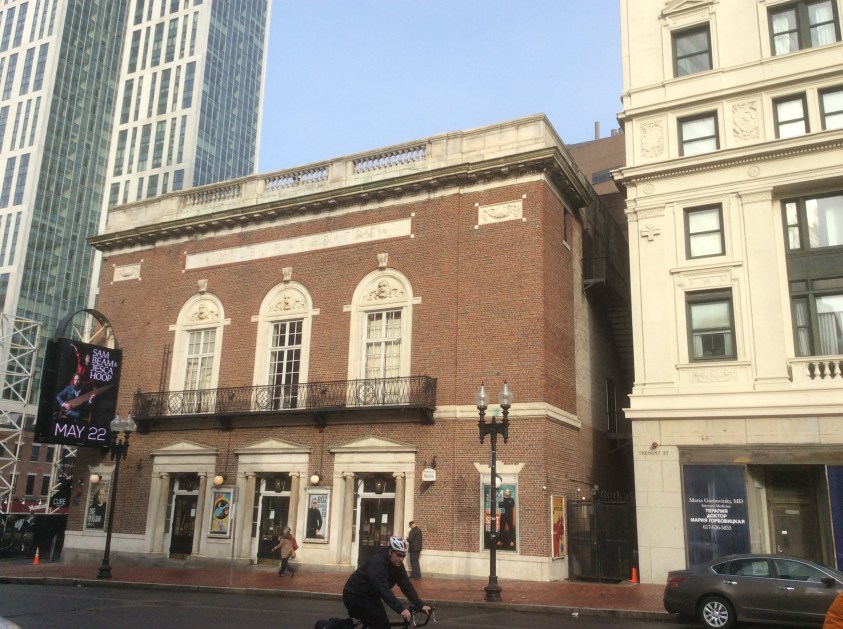
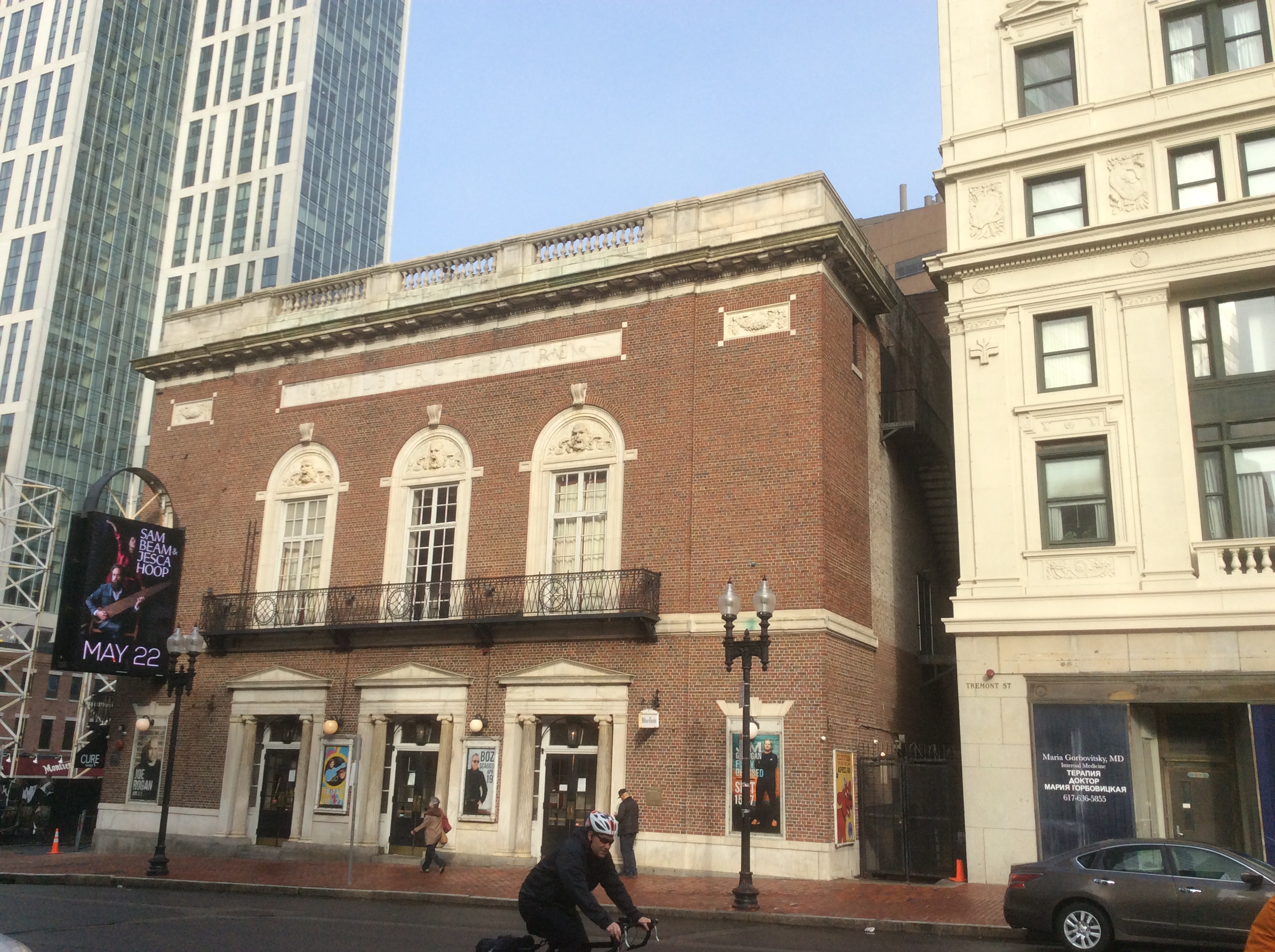
Ye Wilbur Theater (left) and Wang Theater at Citi Performing Arts Center (right)
To continue the story of Wendell Phillips’ funeral, which Douglass attended on February 56th, 1884… He was not alone: he was accompanied by his second wife, Helen Pitts Douglass, who he had married just that January. Helen was white, and even many of their closest friends and family couldn’t deal this fact, as we’ll discover more about later in this series. Even at this church packed with Phillips’ and Douglass’ most progressive, ardent, life-long abolitionists and human rights activists, no one would dare to be the first to sit next to them until… who other than the most beloved author of my youth, Louisa May Alcott. Alcott’s show of friendship and solidarity warms the deepest parts of my heart. I read every single Alcott novel I could get my hands on throughout my girl- and young adult-hood, over and over again. As it was and still is for so many young people, especially girls and women in the English speaking world, she was one of my primary early influences, one who helped set my moral compass more than just about anyone or anything else.
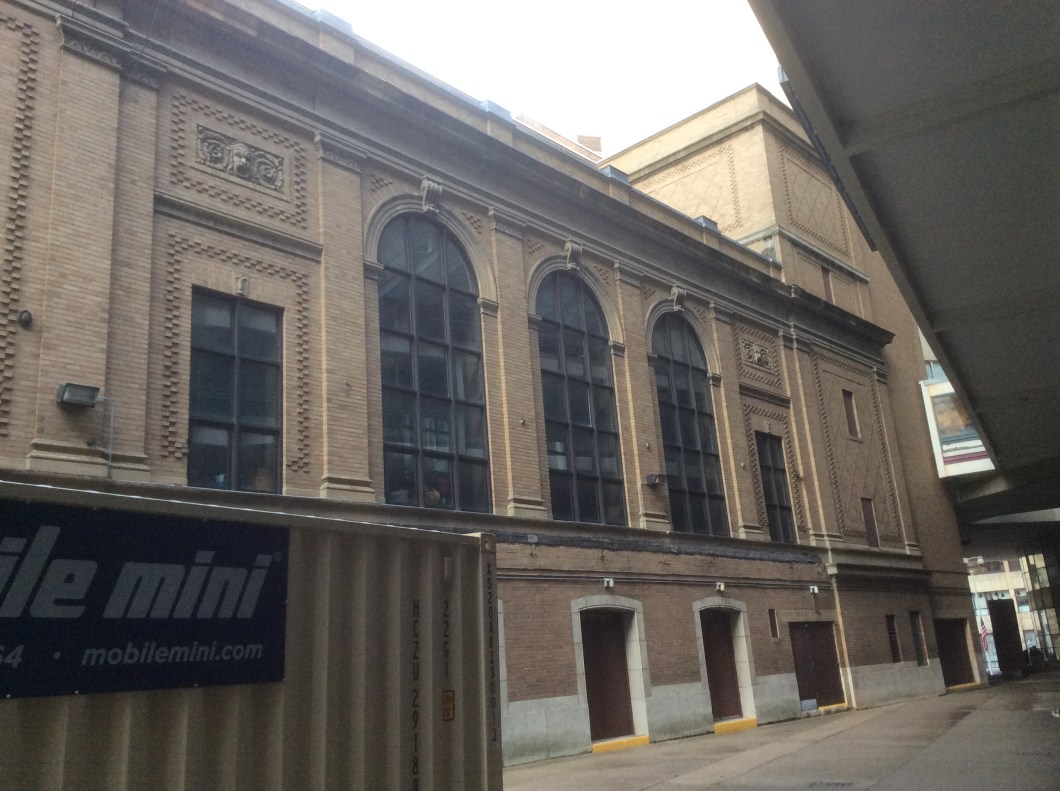
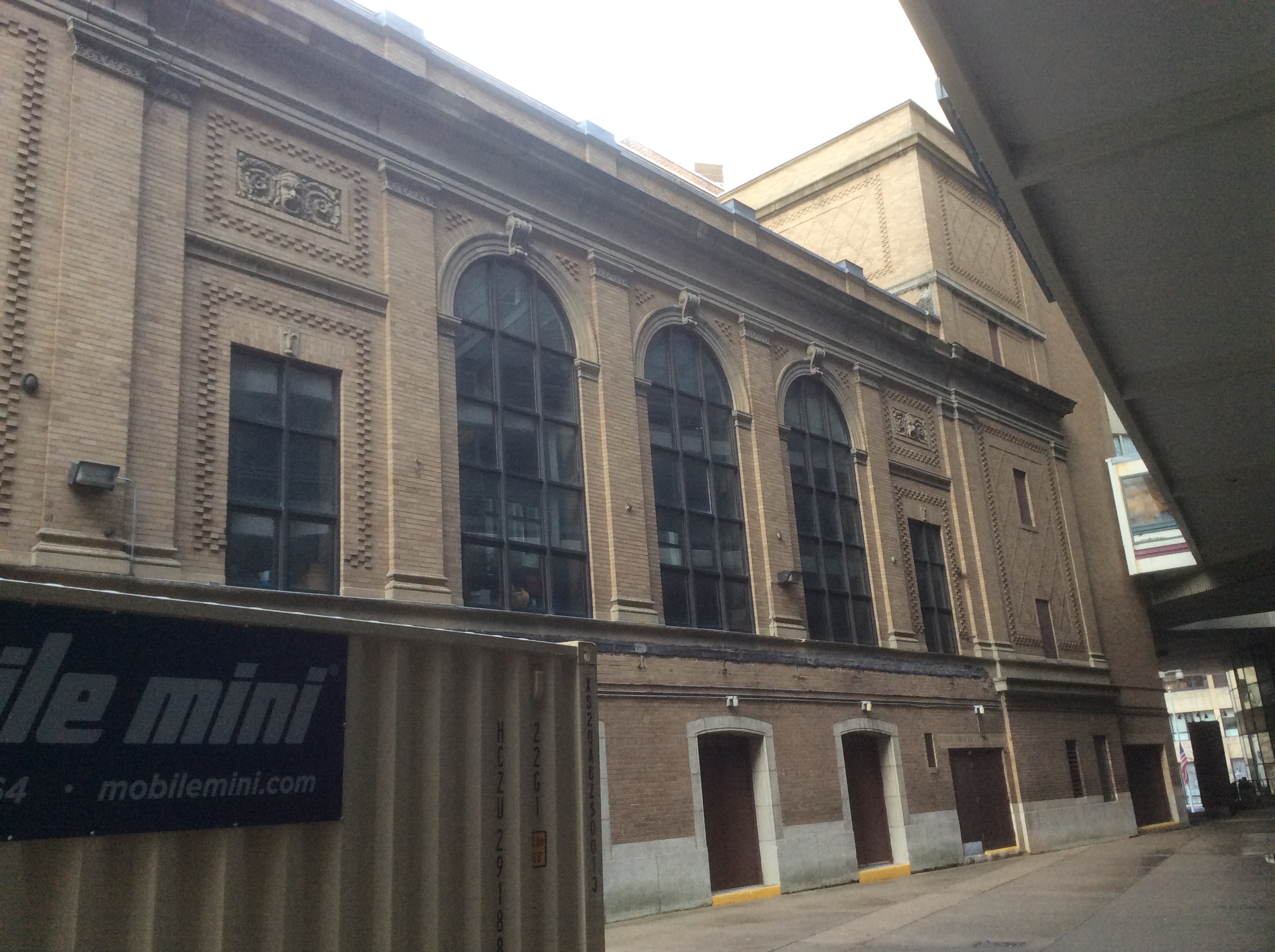
A rear side view of Wang Theater along the alley off Tremont St
I expect to find little here today, since the history of the church reveals it’s no longer standing, but I made the trip and spend some time poking around anyway. Because that moment at Phillips’ funeral is so beautiful to me, I’m doing to dig deep. Clearly, from the name, the church was on Hollis St; trouble is, there’s no longer a Hollis Street according to Google Maps, the print maps I have with me, or anywhere else online. Poring over old city atlases earlier today, I at last discovered where Hollis Street used to be. It seems that stood about where the Tremont St garage is now, just south of the historic and grand Wang Theatre of the Citi Arts Center and Tufts Health Sciences campus behind it. More specifically, Hollis St used to connect Tremont and Washington Streets halfway between Kneeland and Oak.
I also discover that Hollis Street Church became Hollis Street Theater in 1885, after the congregation moved to a more spacious location the year after the funeral. I poke around, and walk up and down the walkway between the Wang Theater and the garage. Could the Wang Theater be standing on the site of the old Hollis St Theater? I notice that the front of the Wang Building differs in motifs and materials than the wide of the building. It occurs to me that possibly, a building already standing here may have been incorporated into the Wang Theater. Could there be remnants here of the old Hollis Theater, once the old Hollis Street Unitarian Church where the funeral was held? In researching the history of the Wang Theater, formerly the Metropolitan Theater, I find no evidence of this; by all accounts this grand theater was built entirely in 1925, and the photos of the old Hollis Street Church show a very different looking structure, though looking at the half-windowed bottom parts of the two buildings (see photo below and at the end of this piece), there are some similarities. Too bad, that would have been a great find!
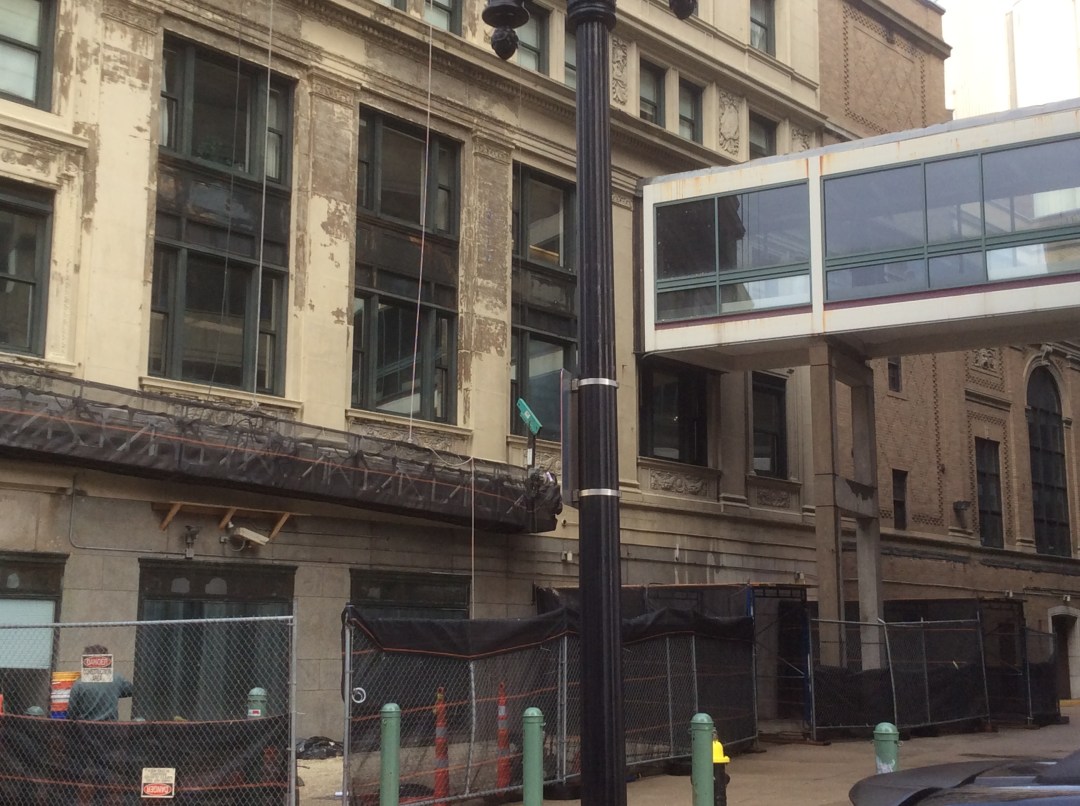
Wang Theater on Tremont St, side facing alley, showing contrast between marble front and brick back sections of the building. As you can see, this side is undergoing some restoration work
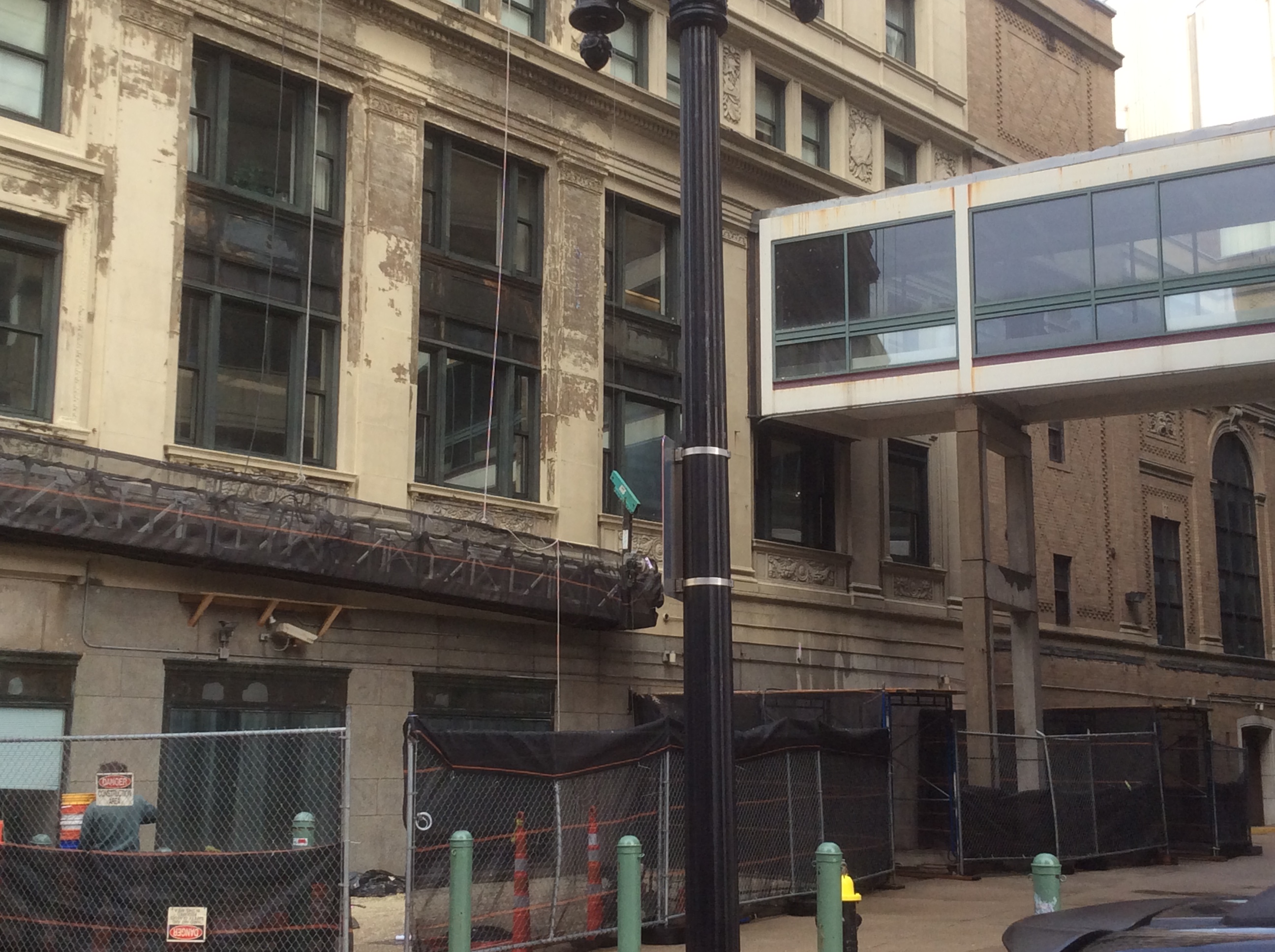
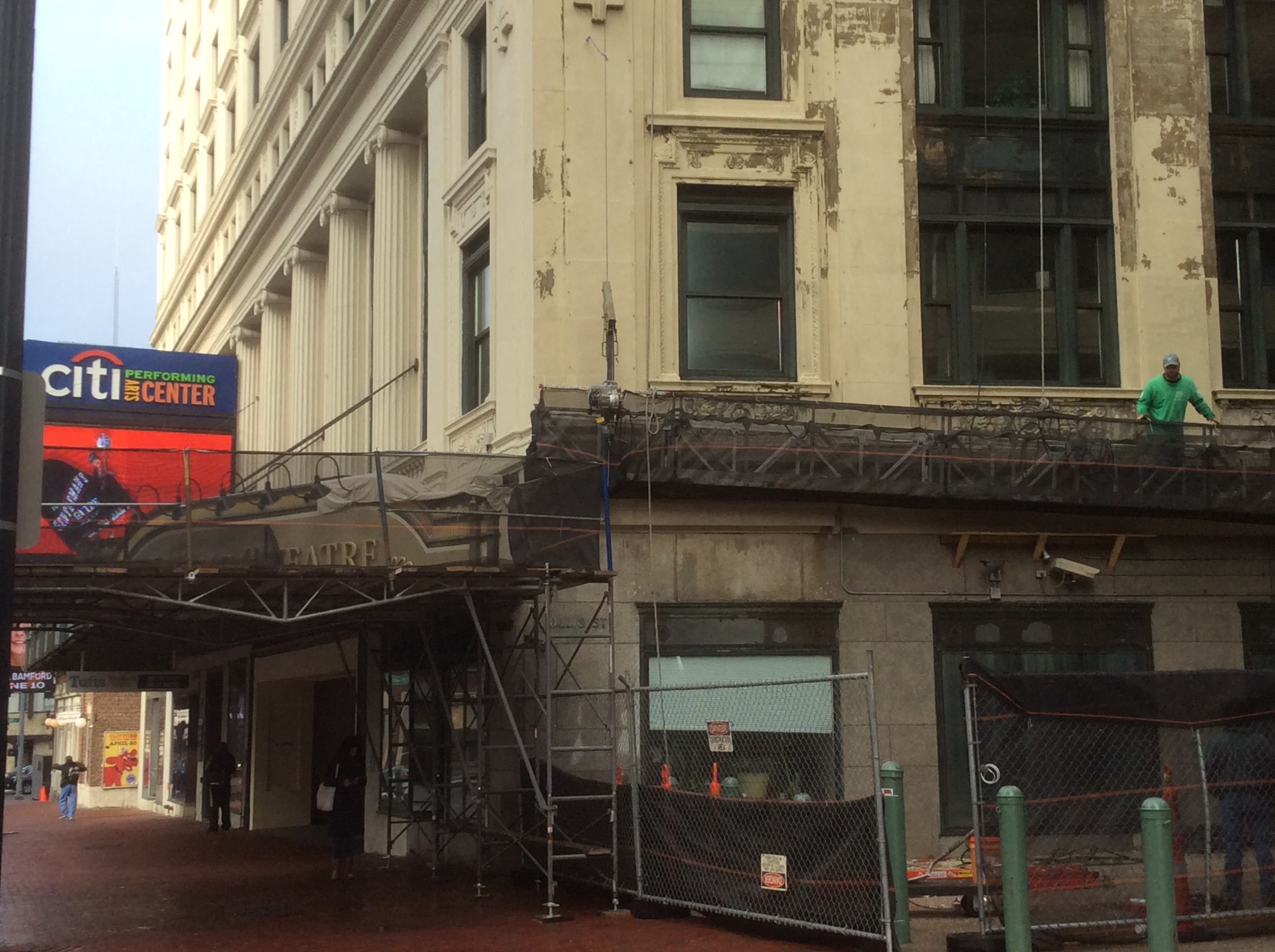
But in a moment of good luck, as I’m scanning the building and the area surrounding it for any evidence of older structures, I spot something among the scaffolding that wraps around the front and south sides of the Wang Theater as its south end it undergoing some maintenance. Near the corner of the building are old brass letters which spell out ‘Tremont St’ on its west side and ‘…ollis St’ on the south. My heart skips a beat. Here it is: confirmation that this is where Hollis St was.
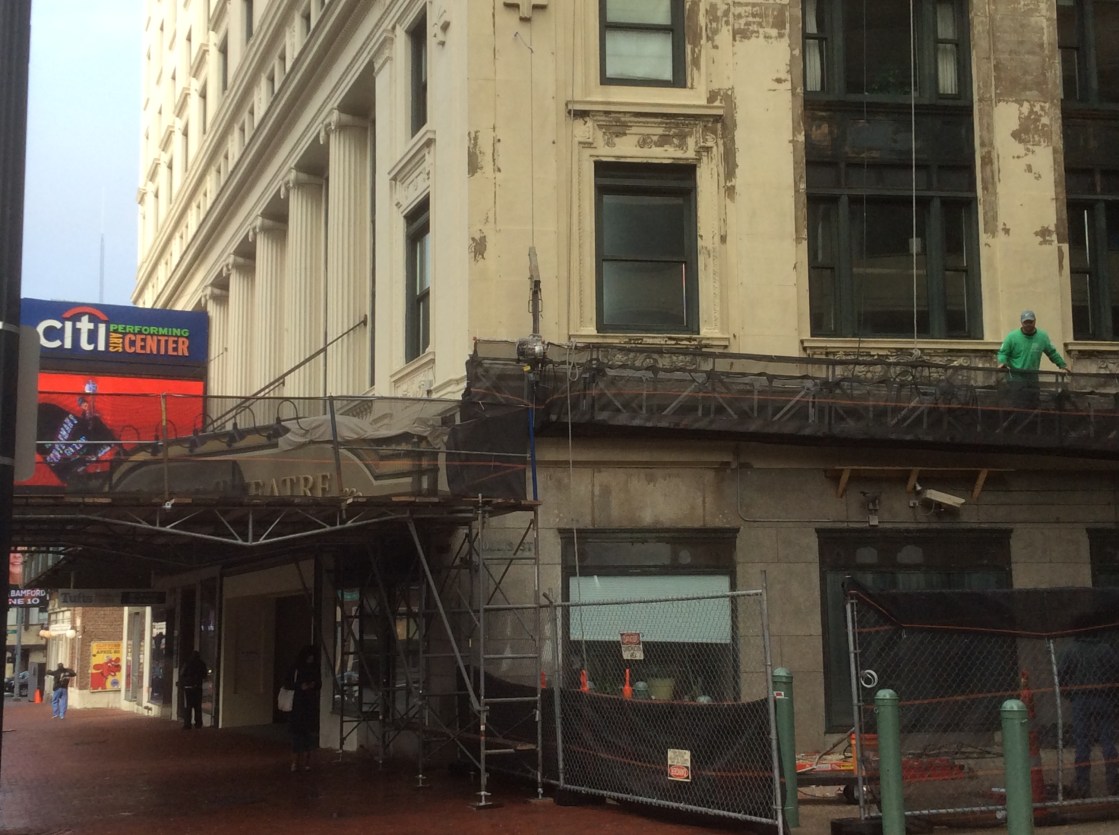
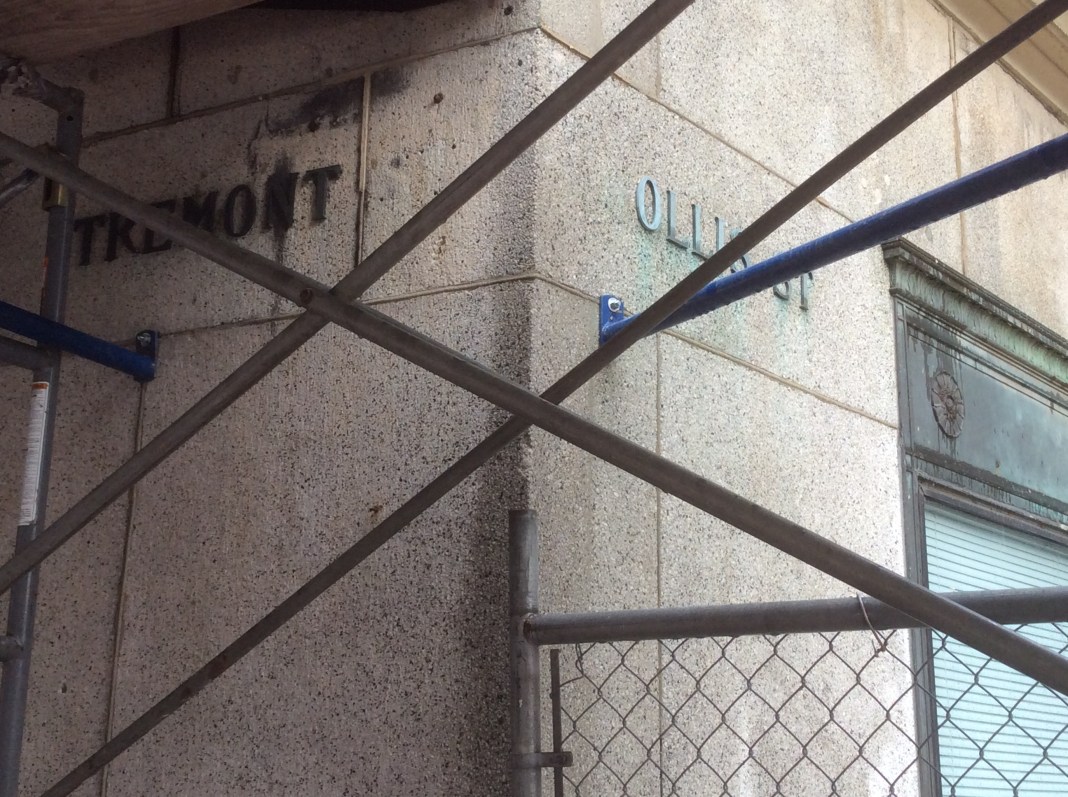
Wang Theater’s southwest corner revealing where Hollis St used to be
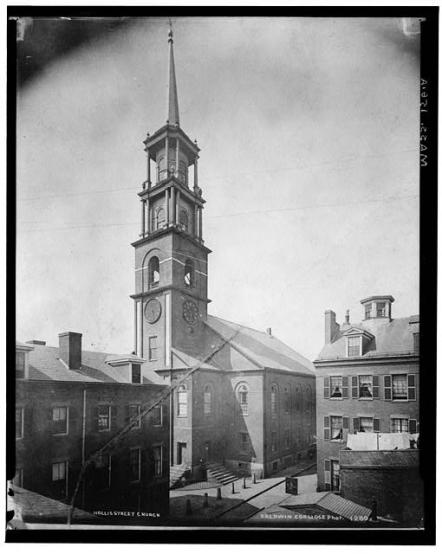
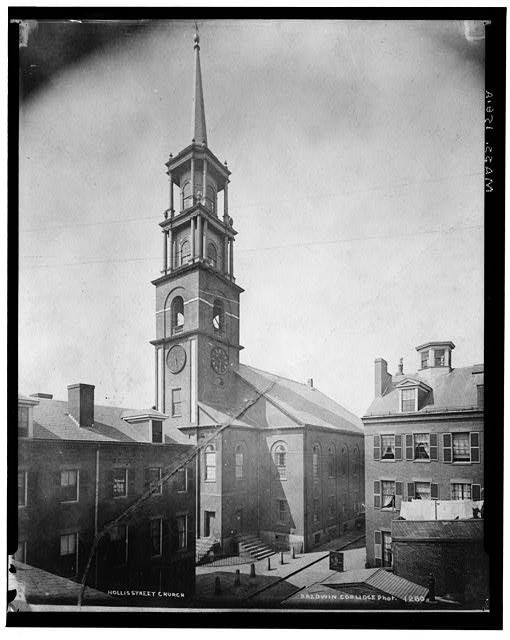
Hollis Street Church from the northeast, 1870, photo public domain via Library of Congress
We can see what the church looked like inside from an old photo I found online. But more importantly for my purposes here, the Library of Congress has a photo of the church ‘taken from the Northeast’. If that description is right, then it seems that the church stood not where the Wang Theater does but across from it, somewhere under where the Tremont St. Garage stands now, with its side facing Hollis (as you can see, it opens onto a square rather than the street) with its steepled front facing towards but not onto Washington St, and its back to Tremont.
This last discovery, successfully triangulating the location where this beautiful moment of true friendship, of love and sympathy overcoming prejudice, makes me feel very emotional and celebratory. My friend recommends The Lower Bottoms, a place that pours excellent ales, so off I go as the sun sets.
Many more adventures and exciting historical discoveries soon to come, as I continue to follow Douglass north… come on back, y’hear?
*Listen to the podcast version here or on iTunes
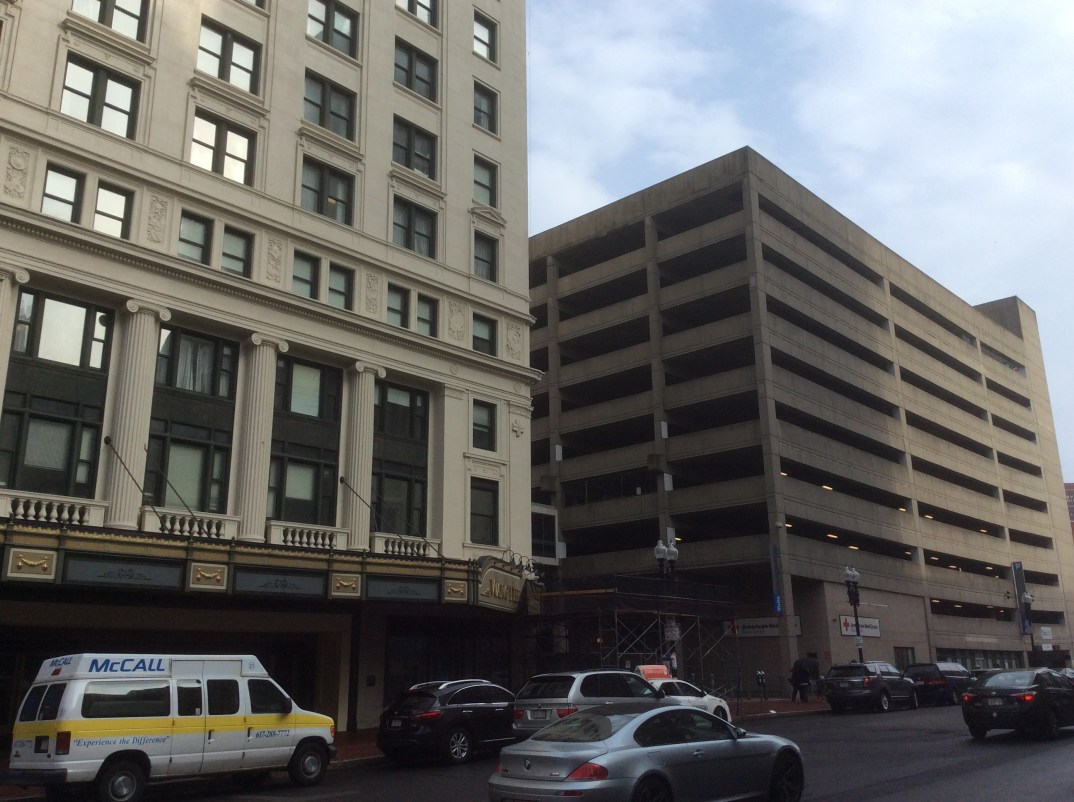
Wang Theater (left) and Tremont St Garage (right) view from Tremont St. (west)
Ordinary Philosophy and its Traveling Philosophy / History of Ideas series is a labor of love and ad-free, supported by patrons and readers like you. Please offer your support today!
~~~~~~~~~~~~~~~~~~~~~~~~~~~~~~~~~~~~
Sources and Inspiration:
‘1843 Boston Almanac Church Engravings: Hollis Street Church‘. Congregational Library Exhibits website
‘54th Massachusetts Infantry Regiment‘. In Wikipedia, The Free Encyclopedia.
‘African American Churches of Beacon Hill‘ and ‘African Meeting House‘. Boston African American National Historic Site Massachusetts, National Park Service website
Blassingame, J. (Ed.). The Frederick Douglass Papers, Series One: Speeches, Debates, and Interviews. 4 volumes, and The Frederick Douglass Papers, Series 2: Autobiographical Writings. 3 volumes. New Haven and London: Yale University Press, 1979-1999
‘Boston Athenæum Theater History‘, from BostonAthenæum.org
Brooks, Rebecca Beatrice. ‘Funerals and Wakes at Faneuil Hall‘. History of Massachusetts: A History Blog About The Bay State. May 14, 2012
Bromley, George Washington and Walter Scott. Boston, 1895. Index Map. Pub. G.W. Bromley and Co. From David Rumsey Historical Map Collection at davidrumsey.com
Cutter, William Richard and William Frederick Adams, eds. Genealogical and Personal Memoirs Relating to the Families of the State of Massachusetts, Volume 4. New York, 1910.
Daily National Republican. (Washington, D.C.), 12 Jan. 1863. Chronicling America: Historic American Newspapers. Lib. of Congress.
Douglass, Frederick. The Life and Times of Frederick Douglass. Re-published 1993, Avenal, New York: Gramercy Books, Library of Freedom series.
Douglass, Frederick. My Bondage and My Freedom: 1855 Edition with a new introduction. Re-published 1969, New York: Dover Publications, Inc.
Evening Star. (Washington, D.C.), 07 Feb. 1884. Chronicling America: Historic American Newspapers. Lib. of Congress.
Foner, Philip S. The Life and Writings of Frederick Douglass, Vol. 1-4. New York: International Publishers, 1950.
‘Frederick Douglass Chronology‘. From Frederick Douglass National Historic Site District of Columbia, National Park Service website
‘History of the Old State House Building‘. The Bostonian Society (website).
‘Hollis Street Church‘. (2016, March 23). In Wikipedia, The Free Encyclopedia.
Hollis Street, Harvard Street. Boston 1819 and 1820 Street-Lines. Pub. 1819 by John Graves Hale, author unknown
McFeely, William. Frederick Douglass. New York: W.W. Norton & Company, 1991.
Tremont Temple. In Wikipedia, The Free Encyclopedia.
‘Wendell Phillips‘. In Wikipedia, The Free Encyclopedia.
‘What was the Boston Massacre?.’ John Adams Historical Society (website).

 The
The 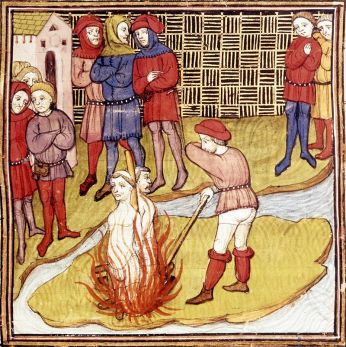 That’s because we’re still under the influence of a very old, even primal idea: that death is rendered not only glorious but a worthy goal if it’s for a cause. Nearly all ideologies and belief systems still prize their martyrs, and we see, worryingly, the resurgence of this idea in some parts of the world are leading to ever more deadly results. Martyrdom has long been such a potent symbol of belief and an effective recruitment tool that if there aren’t any genuine ones to hold up for emulation, it’s a sure bet some will be created. The Umpqua tragedy may be an example of this, of recasting the horrific murder of innocent people as a romantic tale of holy self-immolation in defiance of evil personified. The memory of the lives of the innocents who died there, and the heroism of those who risked themselves to protect others from harm, can become lost in the ideological rhetoric.
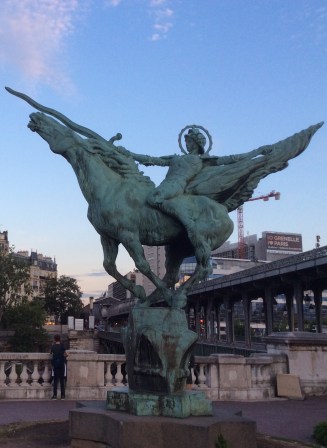 Yet I am simultaneously wary of glorifying these cases of martyrdom for martyrdom’s sake, even when the circumstances of deaths such as these appear most moving, most noble, and most beautiful. That’s because I can’t forget, and I believe none of us can afford to forget, that what makes death or suffering count as martyrdom depends entirely on your frame of reference. My martyr may be your heretic; your martyr may be my traitor who deserved death; my martyr may be the holy warrior who attacked your corrupt and sinful country in the name of all that’s holy and your deadly foe it’s your patriotic duty to destroy. Martyrdom of this sort, understood as the ultimate sacrifice of the death-defying, uncompromising champion of the ultimate good, knows no side and every side. Every side claims their own, and every side who has martyrs to claim (creating them if necessary) treats them as their trump card, the ultimate demonstration of the rightness and superiority of their own beliefs. There’s Father Damien, and there are kamikaze pilots. There’s Quảng Đức, and there are suicide bombers. There’s Joan of Arc, and there are Crusaders, jihadists, those who carried out pogroms, and youth who still flock every day to join the ranks of ISIS and fight to deliver sacred territory from the hated infidels.
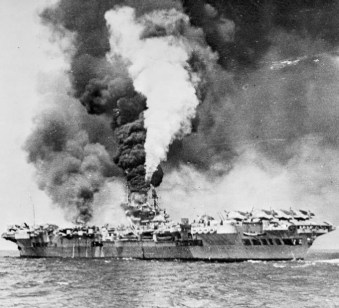 But here’s the problem: if it’s okay to sacrifice one person, even if that person is one’s own self, then it’s more than just a slippery slope to thinking it’s okay to sacrifice others. As we can see in such cases as kamikaze pilots, crusaders, holy warriors, and suicide bombers, the glorification of martyrdom has always had the unfortunate tendency to inspire willingness to sacrifice others along with ourselves. After all, if it’s good to sacrifice one person for the greater good, isn’t it at least as good or even better to sacrifice more people? But self-inflicted martyrdom which simultaneously kills others is generally not driven by this sort of calculation, of each side just upping the ante. When we consider martyrdom, we must also consider the ideologies and belief systems that inspire or at least allow for it. And nearly all not only involve a belief in an afterlife, they believe this world is merely a proving ground for that afterlife, so death counts for little in comparison to eternity. Furthermore, most ideologies and faiths who glorify martyrdom base their beliefs on sacred books in which holy war and violent destruction of the nonbeliever, the godless, the idolator, and the infidel is celebrated as much or even more than personal martyrdom. In the end, we end up with the same old world full of mutually hostile martyr/holy warrior belief systems that have led to centuries of violent religious and ideological conflict and ethnic cleansing.
 And who’s to say who’s right? Which religion, which ideology has the correct view of martyrdom? Which, if any, can be demonstrated to inspire true martyrdom, to the exclusion of others? Bertrand Russell, philosopher and ardent pacifist, is often quoted as saying ‘I would never die for my beliefs because I might be wrong’. Many have described this as cynical or revealing a weakness of character, an inability to form convictions. I think a more fair and charitable interpretation is that Russell believed everyone should practice proper epistemic humility. Especially when it comes to such a momentous question as preserving human life, our own and others: we should do so whenever possible, since whatever our other beliefs, we can all readily demonstrate, whatever our other beliefs, that other human beings suffer grief when we die and that we can surely help others when we’re around to do so. It’s far more difficult to demonstrate, for example, that God likes it even better when we die in his name or that we can help those on earth from beyond the grave, as believers in intercessory prayer or spiritualists hold. Better all around, when it comes to our safety as well as our chances of not believing in things that are terribly wrong, when we’re accountable to one another for the larger consequences of our beliefs.
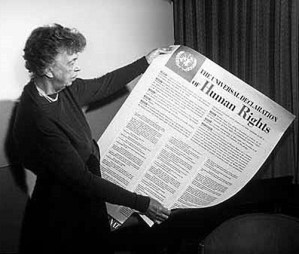 In a world where religiously-, politically-, and ideologically-motivated terrorism and mass shootings are again on the rise, we need to let go of our old cherished ideal of martyrdom as the ultimate holy and noble act. If we want to instill in ourselves and others the value that all lives matter, the glorification of any kind of martyrdom appears as toxic to this as the old belief in the curative powers of bleeding and purging was to health. This seems like a call for rejecting our long-loved heroes, our Joans and Quảngs and Damiens, but I don’t believe it is. We have a robust capacity for understanding that context matters, and just as we can believe George Washington’s doctors did their best to cure him the only (turns out wrong) way they knew how, we can simultaneously revere the courage and conviction of martyrs of the past while believing that in the age of universal human rights and ethics of care, martyrdom is the wrong way to go and should not be glorified, praised, or used as evidence of the superiority of our own beliefs over others.
 From time to time, like anyone who publishes online, I do an online search for ‘Ordinary Philosophy’ to see what comes up. Without fail, the first results are a list of articles and discussions on ordinary language philosophy. It recently occurred to me that I should discuss ordinary language philosophy with my readers, not only because it’s such an interesting and influential school of philosophical thought, but because it likely influenced the name ‘Ordinary Philosophy’. I say ‘likely’ because, though I have no memory of having ordinary language philosophy on my mind at the time, my familiarity and interest with it no doubt kept the phrase stored in my mind, easily recalled through some sort of unconscious word association.











 Ordinary Philosophy