
To New York City I Go, in Search of Margaret Sanger

margaret-sangerHello, friends of Ordinary Philosophy!

From time to time, I take a trip to some corner of the globe, to explore the lives and ideas of great thinkers in the places where they lived and worked. For this series, I follow in the footsteps of thinkers who are no longer alive, since those who are still telling their own stories. But those who are no longer alive in the body live on in the ideas that they pass on, and in the examples they provide for us to follow.

I’m pleased and excited to announce my sixth philosophical-historical themed adventure, a rather impromptu trip to New York City to follow in the footsteps of Margaret Sanger.

Though the timing was spur of the moment, I’ve read and thought about Sanger quite a bit over the years and have some of the research done already for this long-planned trip. So when this little window of time opened up in my schedule, I happily seized the opportunity! As central to the history of women’s rights, free speech rights, and rights to sexual self-determination and privacy as she is, Sanger’s also the most problematic figure in the history of ideas I’ve followed so far for this series, with the possible exception of the brilliant but slave-owning Thomas Jefferson. She’s certainly the first that sparked immediate controversy when I casually mentioned my plans for following her on social media. Here’s a brief introduction, a condensed version of a short bio I published about a month ago in honor of her birthday:

Margaret Higgins Sanger was born on September 14, 1879 into a large Catholic family with 11 surviving children. Her mother died at about age 50 from tuberculosis. As young Margaret saw it, her mother was worn out from her 18 pregnancies, and would cite this as one of the many reasons she so passionately advocated for the right of women to control their own bodies and fertility.

She went on to become a nurse who worked with poor women in New York City in the 19-‘teens and twenties. As she saw these women struggle with the toll that large numbers of pregnancies took on their families’ finances and their own health, Sanger became convinced that ‘birth control’, a term she invented, was essential if these women hoped to escape poverty and sexual oppression. She opened America’s first birth control clinic and despite numerous arrests and fines, she continued her fight for reproductive rights. In this regard, she’s best known today as one of the founders of Planned Parenthood and a key figure in the development of the first birth control pill.

Sanger remains a controversial figure. An ardent feminist, human rights activist, and advocate of sex-positivity, Sanger was also a eugenicist, believing that birth control was at least as important a tool for limiting the production of ‘the unfit’ (her words) as it was for women’s liberation.  Generally, Sanger was an ardent advocate of self-determination, free speech, open discussions of sex and sexuality, and education, education, education.* It was up to informed and thoughtful people, Sanger believed, to take responsibility for their own sexual choices and to convince others to do the same. Regrettably, however, at times Sanger seemed to support some sort of coercive or compulsory forms of birth or population control, for those who she deemed incapable of making this choice for themselves, for example, or too dangerous to be allowed to conceive and raise children.

Aside from her (mostly good) ideas about human rights and personal responsibility, I find Sanger’s beliefs about human sexuality and its important role in spiritual and mental health particularly fascinating

So off to New York City I go, from October 17th thru the 21st. There, I’ll visit landmarks associated with her life, places where she lived, worked, thought, wrote, studied, and rested, to see for myself how the places informed the woman, and vice versa.

Here is the story of Margaret Sanger as I discover her:

Happy Birthday, Margaret Sanger!
Margaret Sanger NYC Sites, Day 1 Part 1, and a 100 Year Anniversary
Why So Much Hatred for Margaret Sanger?
Margaret Sanger NYC Sites, Day 1 Part 2
Margaret Sanger NYC Sites, Day 1 Part 3
Margaret Sanger NYC Sites, Day 2, Part 1
Margaret Sanger NYC Sites, Day 2, Part 2
Margaret Sanger NYC Sites, Day 3 Part 1
Margaret Sanger NYC Sites, Day 3 Part 2
Margaret Sanger NYC Sites, Day 4

Ordinary Philosophy and its Traveling Philosophy / History of Ideas series is a labor of love and ad-free, supported by patrons and readers like you. Please offer your support today!

Patrons of the Margaret Sanger series: Christopher Wallander, Magaly Gamarra Grant, Devin Cecil-Wishing, Sally Lee ~ With warmest gratitude, thank you!

*This piece was updated on 10/26/16. Originally, the 3rd and 4th sentences of the seventh paragraph read ‘She did not, however, support any kind of compulsory or coercive forms of birth or population control. Instead, Sanger was an ardent advocate of self-determination, free speech, open discussions of sex and sexuality, and education, education, education. It was up to informed and thoughtful people, Sanger believed, to take responsibility for their own sexual choices and to convince others to do the same.’ My subsequent research found that this is not quite accurate, as she surmised that coercive sterilization might be warranted in certain circumstances, for those who are mentally ill, handicapped in certain ways, or criminally violent, for example. Please read Why So Much Hatred for Margaret Sanger? and more from the series for further explorations of Sanger’s ideas on the subject.
O.P. Recommends: ‘Capitalism’s Crisis of Care’ – Sarah Leonard interviews Nancy Fraser for Dissent Magazine

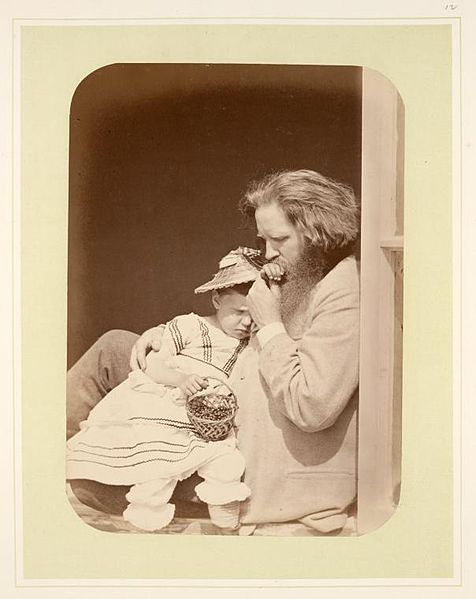
068e8-father2band2bchild2bby2bandre25c425ad2bosipovich2bkarelin252c2b18372b-2b1906252c2bpublic2bdomain2bvia2bwikimedia2bcommons

Capitalism’s Crisis of Care is a discussion between Sarah Leonard of Dissent magazine and critical theorist and feminist Nancy Fraser, which focuses on Fraser’s concept of today’s ‘crisis of care’, which, as she explains, is a product of capitalism. In capitalist societies, ‘social reproduction’, the social and family bonds necessary for raising families and caring for the elderly, have ‘no monetized value. They are taken for granted, treated as free and infinitely available “gifts,” which require no attention or replenishment’ and which, like nature itself, is ‘an infinite reservoir from which we can take as much as we want and into which we can dump any amount of waste.’ Capitalism, unjustifiably and artificially, splits ‘economic production off from social reproduction, treating them as two separate things, located in two distinct institutions and coordinated in two different ways.’ This leaves us with this crisis of care, in which working people are stretched to the breaking point, trying to make a living while trying to maintain the level of care and attention that children, the elderly, and social bonds in general need as much as ever.

Fraser outlines the history of the development of this crisis of care, ‘trac[ing] a historical path from the so-called liberal capitalism of the nineteenth century to the state-managed regime of the mid-twentieth and on to the financialized capitalism of the present day. In a nutshell: liberal capitalism privatized social reproduction; state-managed capitalism partially socialized it; financialized capitalism is increasingly commodifying it.’

If we are to resolve many of the most pressing social problems we face today, from funding health care to adequately providing for the elderly, ill, and disabled to giving working families sufficient time and resources to raise the very families society depends on, we need to start by examining our assumptions and habits with the same care and rigor Fraser reveals in her analysis.

Here’s another excerpt from this absorbing and enlightening interview:

Leonard: Many of the questions that you raise about social life and the family have come to seem utopian again, like some remnant of the 1960s, and not necessarily central to a socialist program. And yet, you argue that we’re actually at a crisis point—these issues must be central. The challenge of social reproduction is so fundamental to everyone’s lived day-to-day experience that it’s been surprising to me that it’s often absent in the current revival of socialism.

Fraser: I agree very strongly with that. Given the acuteness of this crisis of social reproduction, it would be utopian, in the bad sense, for the left not to be focusing on this. The idea that we could somehow bring back manufacturing, that’s what’s utopian—again, in the bad sense. Unlike the idea that you could build a society that assumes every adult is a person with primary care responsibilities, community engagements, and social commitments. That’s not utopian. It’s a vision based on what human life is really like.’… Read more

~ Ordinary Philosophy and its Traveling Philosophy / History of Ideas series is a labor of love and ad-free, entirely supported by patrons and readers like you. Please offer your support today!

New Podcast Episode: Philosophy as Love of Wisdom and in the Public Sphere

Sophia, goddess of wisdom

Sophia, goddess of wisdom

Listen to this podcast episode here or on Google Play, or subscribe on iTunes

Some years ago, the economic downturn inspired me to put aside my business endeavors and return to school to study philosophy. I had loved philosophy for as long as I can remember, before I even knew what to call it, and later as I understood it in its broadest sense: the love and pursuit of wisdom. Wisdom was pursued through asking questions about everything, from the metaphysical and theological sort of questions that my religious and argumentative family used to debate around the dinner table and family gatherings (I credit these discussions and arguments, more than anything, with inspiring my philosophical curiosity) to all other questions about what’s true and false, just and unjust, good and bad, right and wrong. Wisdom was found through reading and learning as much as possible, then applying this learning to carefully thinking through possible answers to these questions. And wisdom was loved not because it brought understanding and meaning to life, but rather because its pursuit seemed beautiful to me.

Because my love of philosophy was formed prior to any introduction as a school of thought and my formal education was rather piecemeal, my approach was whimsical, idiosyncratic, unsystematic. Any and all subjects that aroused my curiosity and admiration could be brought to bear on what I understood as philosophical inquiry: literature, history, art, love of nature, social activism, law and justice, ethics, travel, architecture, science, in fact, every subject that involves human thought and appreciation…. Continue reading

This piece was written for the American Philosophical Association blog, originally published there on Sept. 22nd, 2016, and edited by Skye Cleary.

~ Ordinary Philosophy and its Traveling Philosophy / History of Ideas series is a labor of love and ad-free, entirely supported by patrons and readers like you. Please offer your support today!

The Golden Rule

‘What is hateful to thee, do not do until thy fellow man; this is the whole Law. The rest is commentary’ – Hillel the Elder, ca. 30 BCE – 10 CE

This is a particularly beautiful iteration of the Golden Rule, as I remember hearing Christopher Hitchens point out. Rather than recommending that you do to others what you would want done to yourself, which assumes you know best what others would prefer, this Golden Rule is one of restraint and respect. Do not impose, it says: we do not always know what’s best, so live and let live, and do no harm.

Ordinary Philosophy and its Traveling Philosophy / History of Ideas series is a labor of love and ad-free, supported by patrons and readers like you. Please offer your support today!

~~~~~~~~~~~~~~~~~~~~~~~~~~~~~~
Source and inspiration: 

Kloppenburg, James T. Towards Democracy. New York: Oxford University Press, 2016, p. 41.


Happy Birthday, Mahatma Gandhi!

Mahatma Gandhi spinning yarn in the late 1920's. Gandhi started the ultimate 'Shop Local' movement, in which he called on his fellow Indians to wear only homespun, locally made fabrics to counteract the British colonialist's exploitation of Indian textile worker

Mahatma Gandhi spinning yarn in the late 1920’s. Gandhi started the ultimate ‘Shop Local’ movement in which he called on his fellow Indians to wear only homespun, locally made fabrics to counteract British colonialist’s policies which impoverished and nearly destroyed India’s textile industry. I founded an apparel and accessory line and boutique in the early 2000’s based on the same principles, carrying only locally and US-made products as an alternative to buying goods made in overseas sweatshops whose workers were unprotected by labor laws. Gandhi’s and my own approach were nationalistic and protectionistic, which I no longer believe goes far enough in promoting equal human rights for all. While such approaches may be a good place to start in some circumstances, a better way to go about improving the lives and prospects of workers around the world is to require our governments to institute more comprehensive labor laws and rigorously enforce them. This must include holding companies responsible for the abuses of their contractors, of course, to actually be effective.

There are very few non-Americans, outside of our mother country of Britain and our godmother France, who have had a greater impact on the history of the United States and our attitudes towards human rights than the incomparable Mahatma Gandhi. For someone who preached simplicity, often wearing nothing but a loincloth, weaving his own fabric, and living a severely rustic lifestyle to exemplify his own teachings, Gandhi was a very complicated person.

He was a human rights activist, politician, journalist, social and religious reformer, and to many, a sort of messiah. Originally a British loyalist, Gandhi’s studies and personal observations led him to change his own views, often radically, many times over the course of his long life. His beliefs in the revolutionary and morally suasive power of civil disobedience and nonviolent resistance were and continue to be particularly influential in the United States, beginning with the mid-20th century civil rights movement. Martin Luther King, Jr, Gandhi’s intellectual and spiritual descendant, emerged as the leader of this movement following his role in the 1955 Montgomery bus boycott. King’s and Gandhi’s ideas about the civil disobedience and non-violence, in turn, both incorporate Henry David Thoreau’s ideas from his landmark essay ‘Civil Disobedience’.

Here are excerpts on Gandhi’s influence on the American civil rights movement from the encyclopedia of the Martin Luther King, Jr. Research and Education Institute at Stanford University:

‘Upon his death, Mohandas K. Gandhi was hailed by the London Times as ‘‘the most influential figure India has produced for generations’’ (‘‘Mr. Gandhi’’). Gandhi protested against racism in South Africa and colonial rule in India using nonviolent resistance. A testament to the revolutionary power of nonviolence, Gandhi’s approach directly influenced Martin Luther King, Jr., who argued that the Gandhian philosophy was ‘‘the only morally and practically sound method open to oppressed people in their struggle for freedom’’ (Papers 4:478)…

Gandhi was born 2 October 1869, in Porbandar, in the western part of India, to Karamchand Gandhi, chief minister of Porbandar, and his wife Putlibai, a devout Hindu. At the age of 18, Gandhi began training as a lawyer in England. After completing his barrister’s degree he returned to India in 1891, but was unable to find well-paid work. In 1893, he accepted a one-year contract to do legal work for an Indian firm in South Africa, but remained for 21 years. It was in South Africa that Gandhi was first exposed to official racial prejudice, and where he developed his philosophy of nonviolent direct action by organizing the Indian community there to oppose race-based laws and socioeconomic repression.

Gandhi returned to India in 1914. In 1919, British authorities issued the Rowlatt Acts, policies that permitted the incarceration without trial of Indians suspected of sedition. In response, Gandhi called for a day of national fasting, meetings, and suspension of work on 6 April 1919, as an act of satyagraha (literally, truth-force or love-force), a form of nonviolent resistance. He suspended the campaign of nonviolent resistance a few days later because protestors had responded violently to the police.

Within the next few years, Gandhi reshaped the existing Indian National Congress into a mass movement promoting Indian self-rule through a boycott of British goods and institutions…’ (Continue reading)

I’ve included a list of links of excellent online sources on Gandhi below, including journalist and social critic Christopher Hitchen’s critique. Gandhi did, at times, express ideas and make decisions that many regard as problematic to this day, such as his early rhetoric on black Africans and his relations with some of the women in his life, including his wife Kasturba. Gandhi was no plaster saint: like the rest of us, he struggled to find truth and meaning in a world of mutually contradictory yet worthy-seeming values, principles, and goals; sometimes, like the rest of us, he sometimes  didn’t get it right. True understanding, I believe, is never reached through uncritical hero worship, even of one as influential, internationally revered, and I believe ultimately beneficial to the intellectual, activist, and political history of human rights as Gandhi.

Ordinary Philosophy and its Traveling Philosophy / History of Ideas series is a labor of love and ad-free, supported by patrons and readers like you. Please offer your support today!

~~~~~~~~~~~~~~~~~~~~~~~~~

Sources and Inspiration:

Brownlee, Kimberley, ‘Civil Disobedience‘, The Stanford Encyclopedia of Philosophy.

Gandhi and Civil Disobedience‘, from the Constitutional Rights Foundation.

Hitchens, Christopher. ‘The Real Mahatma Gandhi: Questioning the Moral Heroism of India’s Most Revered Figure‘. The Atlantic, July/August 2011 issue.

In Search of Gandhi by Lalit Vachani, from BBC’s Radio Four Storyville Why Democracy? series, originally published October 2007 at BBC.com

Life of Gandhi (abridged), documentary by GandhiServe Foundation: Mahatma Gandhi Research and Media Service.

Mahatma Gandhi‘. In Wikipedia, The Free Encyclopedia.

Martin Luther King, Jr. encyclopedia of The Martin Luther King, Jr. Research and Education Institute at Stanford University, two entries: ‘India Trip (1959)‘ and ‘Gandhi, Mohandas Karamchand (1869-1948)

Thoreau, Henry David. ‘Civil Disobedience‘, 1849, published online by the University of Virgina’s American Studies department

The Little Way of Goodness

As I continue to work on my graduate school applications, I’ll share another piece from the OP archives. This one, published about two years ago today, is among my favorites, no less because it’s dedicated to and partly inspired by my darling little sister Therese, one of the very kindest and wisest people I have the privilege to know.

I have several OP pieces in the works and will be publishing a new piece soon. In the meantime, I hope you enjoy my essay on the Little Way of Goodness!

Amy M Cools's avatarOrdinary Philosophy

Growing up Catholic, my siblings and I were taught many stories of saints and their heroic exploits in their quest to attain union with God. One of these was Thérèse of Lisieux, a young Frenchwoman who became a nun at 16, and died of tuberculosis at the early age of 24. She was an especially beloved saint of my family; one of my sisters is named after her.

Thérèse was a romantic and idealistic, and as a young girl, admired the glorious deaths of Christian martyrs and wished to emulate them. Realizing that she was unlikely to find herself in a situation where she could likewise be killed for the sake of her religion, she devised her own system for attaining heaven. She called it her “Little Way”, in which she would regularly perform acts of holiness in day to day life. The trials and tribulations of ordinary…

View original post 1,517 more words

Philosophy as Love of Wisdom and in the Public Sphere

Sophia, goddess of wisdom

Sophia, goddess of wisdom

Some years ago, the economic downturn inspired me to put aside my business endeavors and return to school to study philosophy. I had loved philosophy for as long as I can remember, before I even knew what to call it, and later as I understood it in its broadest sense: the love and pursuit of wisdom. Wisdom was pursued through asking questions about everything, from the metaphysical and theological sort of questions that my religious and argumentative family used to debate around the dinner table and family gatherings (I credit these discussions and arguments, more than anything, with inspiring my philosophical curiosity) to all other questions about what’s true and false, just and unjust, good and bad, right and wrong. Wisdom was found through reading and learning as much as possible, then applying this learning to carefully thinking through possible answers to these questions. And wisdom was loved not because it brought understanding and meaning to life, but rather because its pursuit seemed beautiful to me.

Because my love of philosophy was formed prior to any introduction as a school of thought and my formal education was rather piecemeal, my approach was whimsical, idiosyncratic, unsystematic. Any and all subjects that aroused my curiosity and admiration could be brought to bear on what I understood as philosophical inquiry: literature, history, art, love of nature, social activism, law and justice, ethics, travel, architecture, science, in fact, every subject that involves human thought and appreciation…. Continue reading

This piece was written for the American Philosophical Association blog, originally published there on Sept. 22nd, 2016, and edited by Skye Cleary.

~ Ordinary Philosophy and its Traveling Philosophy / History of Ideas series is a labor of love and ad-free, entirely supported by patrons and readers like you. Please offer your support today!

On Plastic Surgery and Other Cosmetic Interventions

I published this essay about a year ago today. Cosmetic medical intervention is a subject of special interest for me, and problems associated with it, especially those performed for non-functional or non-reconstructive purposes, are often brought to mind at the medical practice I work in.

Amy M Cools's avatarOrdinary Philosophy

I work for a dermatologist who focuses his practice on medical dermatology. While all treat many of the same medical conditions, an ever-increasing percentage of dermatologists devote a substantial portion of their time to performing cosmetic procedures, from Botox and filler injections, chemical peels, and laser treatments to surgeries: facelifts, chin implants, eyelid modifications, and so on. The sign on the door of the medical practice I work for, however, reads ‘Diseases of the Skin’.

To me, this is a reassuring message, as if to say to all who enter ‘We are here to try and cure what ails you.’ It contrasts sharply with the message I get from cosmetic dermatology and surgery ads: ‘We agree that you’re ugly and need to be altered.’

Now, of course, this is only what I read into those ads, especially in my more sensitive moods. I don’t for a moment speak for anyone…

View original post 4,456 more words

Xerxes and Demaratus on Tyranny, Liberty, and the Law

Relief of the Persian king Xerxes (485-465 BC) in the doorway of his palace at Persepolis

Relief of the Persian king Xerxes (485-465 BC) in the doorway of his palace at Persepolis, public domain by O. Mustafin via Wikimedia Commons

I’m now reading Book Seven of Herodotus’ Histories which tells the story of Xerxes I of Persia and the second invasion of Greece, which he led to avenge the defeat of his father Darius, who led the first. Darius was defeated at the battle of Marathon when the Athenians and their allies the Plataeans, badly outnumbered, managed to drive away the Persians. In this story, I came across another interesting exchange I’d like to share with you.

After reviewing his massive forces, Xerxes calls for Demaratus, a former king of Lacedaemon (city-state of Sparta) who had defected to Persia after being deposed by a rival. He asks Demaratus if he believes that his fellow Greeks will dare oppose his invasion considering the size and wealth of the new Persian army. After all, Xerxes asks, ‘How could a thousand men, or ten thousand, or even fifty thousand come to that, possibly stand up to an army the size of mine, when all of them enjoy a similar degree of liberty, and have no one man in command?… Just perhaps, were they like us in having one man set in authority over them, they might indeed be prompted by their dread of him to conquer their own instincts, and under the compulsion of the whip to advance against a force much larger than themselves. Left to their own devices, though, there is no way they will do either of those things.’ (Histories 7.103)

Xerxes is speaking here of the land of Athens and Lacedaemon, cradle of democracy, a novel form of government at the time. Many of us moderns who are raised in societies which inherited that spirit of government would respond: ‘But of course! A free people who participate in their own government have a stake in the outcome of public enterprises. Therefore, in war or peace, free people have a reason to care about their outcomes and to be personally motivated to succeed, because the success belongs to each individual as well as the society. Those who are tyrannized and enslaved, however, have no personal stake in the outcome, and fear only motivates one to do the minimum needed for survival. Indeed, fear and resentment of tyranny can motivate the people to undermine the efforts of the tyrant, and to defect to another state at the first opportunity.’ I expected Damaratus to give some such answer.

But Damaratus takes a different tack. Though he begins by citing the courage and martial discipline of the Greeks, he tells Xerxes the main reason he believes the Greeks will stand up to him whatever the size of his army. They’ll resist, he says, because ‘Free as they are, you see, they are not altogether free. Set over them as their master is the law – and of that they are more terrified than ever your men are of you. Certainly, they do what it commands them to do – a command that never alters.’ (7.104)

I think it fascinating that Damaratus uses the expression ‘terrified’ when he describes the Greeks’ attitude to the law. I consulted two other translations and it used the word ‘fear’. I wonder: is this a fear or terror born of deep respect and awe, such as that due to the gods or nature itself? Of fear of their fellow citizens for breaking the social contract or upsetting the natural order of things? Why fear or terror? Then I realize: perhaps he uses this term because he wants Xerxes to understand what he’s saying, and the only thing Xerxes can imagine inspiring obedience is fear and terror. But it’s interesting that he holds on to that idea. After all, Xerxes knows that his father learned otherwise, and the hard way at that. A free

Or, do you think Damaratus means just what he says? That it’s possible that an otherwise free people can actually have a fear of the law itself? It’s not too far of a stretch, after all, that a religious, god-fearing society could fear something else that’s abstract which imposes order and its will on the world.

Or, it could be that Damaratus is talking about the fear of the Greeks betraying their own selves as living embodiments of the law. After all, if adherence to the law is instilled as a sort of sacred duty to the very thing that makes us both free and fully realized as human beings, then the thought of transgressing the law is as terrifying as the thought of destroying our very selves, of becoming something less than human. I suspect Damaratus is talking about something like this.

Ordinary Philosophy and its Traveling Philosophy / History of Ideas series is a labor of love and ad-free, entirely supported by patrons and readers like you. Please offer your support today!

~~~~~~~~~~~~~~~~~~~~~~~~~~~~~~~~~~~

Sources and inspiration:

Cartledge, Paul. ‘The Democratic Experiment‘. From History at BBC.com

Herodotus. Histories. Translated by Tom Holland. New York: Viking, 2013

Herodotus. Histories. Translated by A. D. Godley. Cambridge: Harvard University Press, 1920, from Tufts.edu

Herodotus. Histories. Translated by G. C. Macaulay, 1890, from Project Gutenberg.

Happy Birthday, Margaret Sanger!

margaret-sangerMargaret Higgins Sanger was born on September 14, 1879 into a large Catholic family with 11 surviving children. Her mother died at about age 50 from tuberculosis. As young Margaret saw it, her mother was worn out from her 18 pregnancies, and would cite this as one of the many reasons she so passionately advocated for the right of women to control their own bodies and their own fertility.

She went on to become a nurse who worked with poor women in New York City in the 19-‘teens and twenties. As she saw these women struggle with the toll that uncontrolled pregnancies took on their families’ finances and their own health, Sanger became convinced that ‘birth control’, a term she invented, was essential if these women hoped to escape poverty and oppression. She opened America’s first birth control clinic and despite numerous arrests and fines, she continued her fight for reproductive rights. She founded the American Birth Control League in 1921, which became the Birth Control Federation of America in 1939 after merging with another organization, which in turn became Planned Parenthood in 1942. She continued her activism right up to her death in 1966. Sanger was instrumental in the creation of the first birth control pill Enovid, first available to the public in 1957. She also lived to see the Supreme Court validate her beliefs in the basic human rights to openly talk about sex and to control their own fertility in the Griswold v. Connecticut decision of June 7, 1965.

Sanger remains a controversial figure today. An ardent feminist, human rights activist, and advocate of sex-positivity, Sanger was also a eugenicist, believing that birth control was at least as important a tool for limiting the production of ‘the unfit’ (her words) as it was for women’s liberation. Sanger agreed with many leading scientists and progressives of her day in ascribing to so-called Social Darwinism (a problematic term since it doesn’t reflect Darwin’s own views as he expressed them), which applied the principles of natural selection to human social practice.  She did not, however, support any kind of compulsory or coercive forms of birth or population control, such as that practiced by the Nazis and even by the United States government, who forcibly sterilized thousands of so-called ‘feebleminded’ women. Instead, Sanger was an ardent advocate of self-determination, free speech, open discussions of sex and sexuality, and education, education, education. It was up to informed and thoughtful people, Sanger believed, to take responsibility for their own sexual choices and to convince others to do the same.

Unlike many other eugenicists, however, Sanger was not a racist. She worked closely with many leading black civil rights figures, believing, as they did, that birth control would have the same liberating effect on the black community as would for women generally. By limiting the number of children according to how many they could afford to raise and when, parents could more readily pursue an education, start a business, or otherwise devote their time, energy, and health to improving their standard of living which, in turn, they could pass down to their children.

Aside from her human rights activism, I find Sanger’s beliefs about human sexuality and its important role in spiritual and mental health most fascinating. I’ve chosen her as one the topics of an upcoming History of Ideas Travel Series as soon as I can make it happen, stay tuned! In the meantime, please follow the links in this article above and below to learn more about this important, fascinating, and troubling woman, and I highly recommend Jonathon Eig’s The Birth of the Pill, in which he recounts much of her personal history as well as her role in the Pill’s creation.

Ordinary Philosophy and its Traveling Philosophy / History of Ideas series is a labor of love and ad-free, supported by patrons and readers like you. Please offer your support today!

~~~~~~~~~~~~~~~~~~~~~~~~~

Sources and Inspiration:

Margaret Sanger Papers Project ~ Research Annex. Accompanying blog to The Sanger Papers Project by New York University.

The Pill, People & Events: Margaret Sanger (1879-1966)‘. From the American Experience website by PBS.

Sanger, Margaret. The Pivot of Civilization, 1922. Free online version by Project Gutenberg, 2008, 2013.

Tong, Ng Suat. Which Margaret Sanger?The Hooded Utilitarian blog, April 14, 2014.