Ordinary Philosophy’s 4th Anniversary

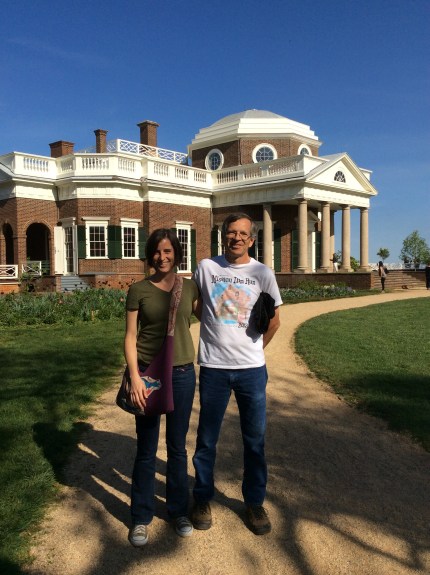
At Monticello, VA, with my Dad, John Cools, in 2015 for my history of ideas series following Thomas Jefferson in America

I published my first post for Ordinary Philosophy four years ago today, on April 23rd, 2013. Thank you, dear readers and listeners, for your kind attention, your encouragement, your corrections, your patience as I learn with and from you, and your hospitality and financial support (you know who you are!) for all of my traveling philosophy / history of ideas series.

Ordinary Philosophy has been one of the most satisfying projects of my life, and I look forward to continuing to share my love of philosophy, history, ideas, and travel for many more years to come, whatever form this will take.

I’m thrilled to share the news with you that I’ll be resuming my formal education at the University of Edinburgh this fall. What an adventure this will be! I’ll be living and studying in the center of the Scottish Enlightenment and the city of David Hume. He brought me here three years ago when I followed his life and ideas for my first history of ideas travel series. I’ll take this opportunity continue my Hume series as well. Though my studies will demand a great deal of my energy and attention, I dearly hope I’ll be able to devote more time to share more with you here at Ordinary Philosophy, not less, as I once again pour the bulk of my time, energy, and love into the world of ideas.

Yours, as ever, Amy Cools

Ordinary Philosophy and its Traveling Philosophy / History of Ideas series is a labor of love and ad-free, supported by patrons and readers like you. Please offer your support today!

Selfie in the beautiful Rose Room of the New York Public Library, 2016 Amy Cools

In the beautiful Rose Room of the New York Public Library. Thank you, friends, for supporting my New York projects too! Ahhh, what a town…

Photobook: John Muir National Historic Site in Martinez, CA, continued

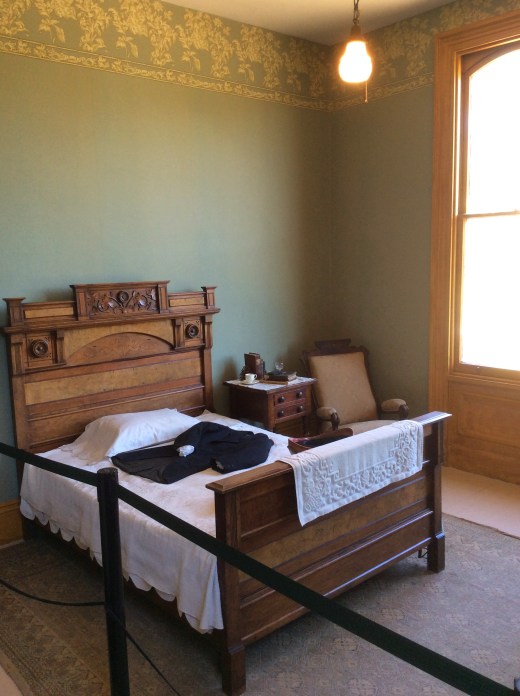
John Muir’s bedroom at John Muir National Historic Site, Martinez, CA

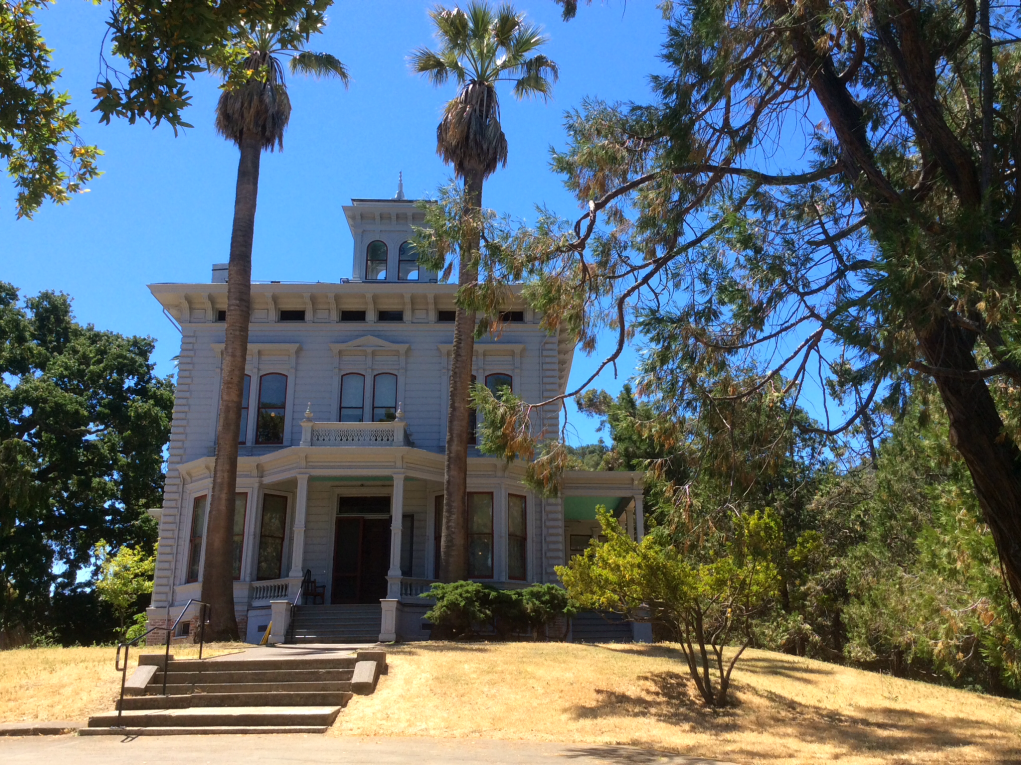
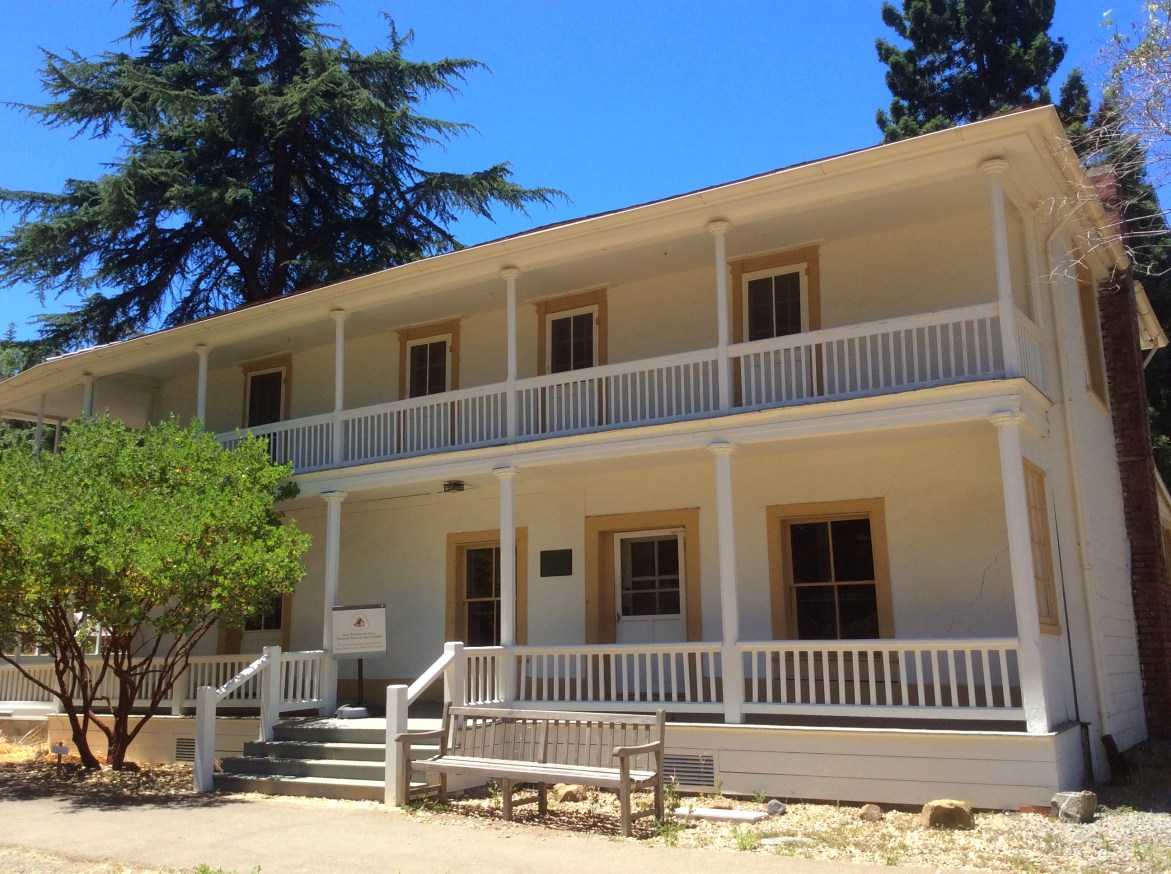
Yesterday, I published a piece in honor of John Muir’s birthday. Muir was the great naturalist and writer who, perhaps more than any other single individual, awoke America’s consciousness to the sacredness and essential value of the unspoiled natural world. Here are a few more photos from my visit to his home at John Muir National Historic Site in Martinez, CA.

Enjoy!

Ordinary Philosophy and its Traveling Philosophy / History of Ideas series is a labor of love and ad-free, supported by patrons and readers like you. Please offer your support today!

The Muir family home built by Dr. John Strentzel at John Muir National Historic Site, Martinez, CA

An orchard at John Muir National Historic Site, Martinez, CA. They are beautifully maintained and visitors may wander the orchards and eat the fruit at will.

Dr John Strentzel’s pomegranate trees in bloom at John Muir National Historic Site, Martinez, CA

Vicente Martinez Adobe, built in 1849, on the grounds at the John Muir National Historic Site, Martinez, CA

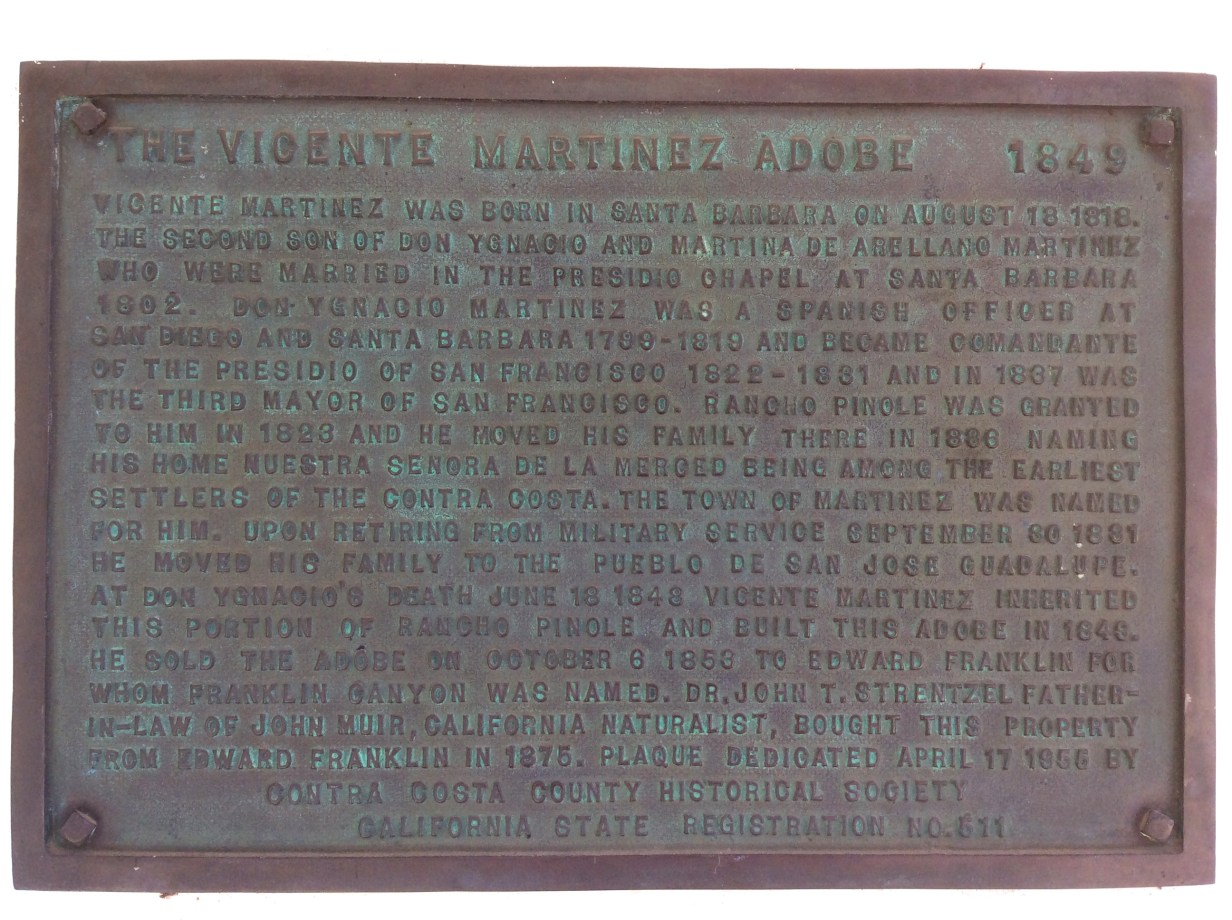
Vicente Martinez Adobe plaque at the John Muir National Historic Site, Martinez, CA

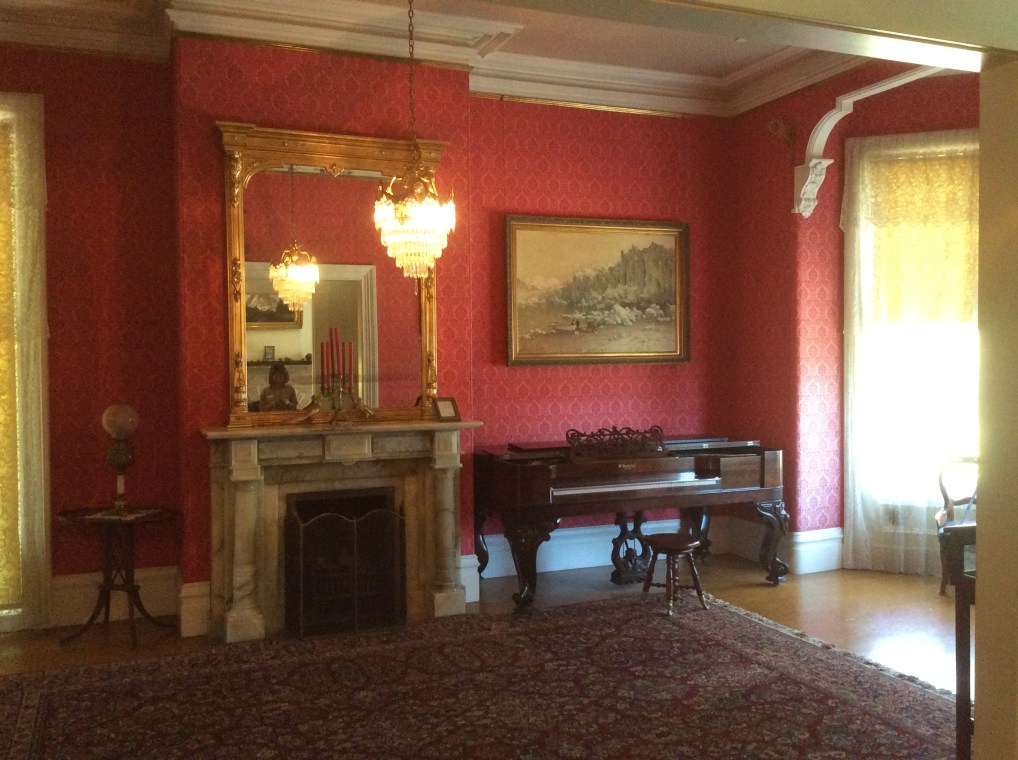
The living room of the big house, John Muir National Historic Site, Martinez, CA. Louie Muir was an expert piano player, having learned as part of her excellent education in lovely Benicia, just across the Carquinez Strait from Martinez

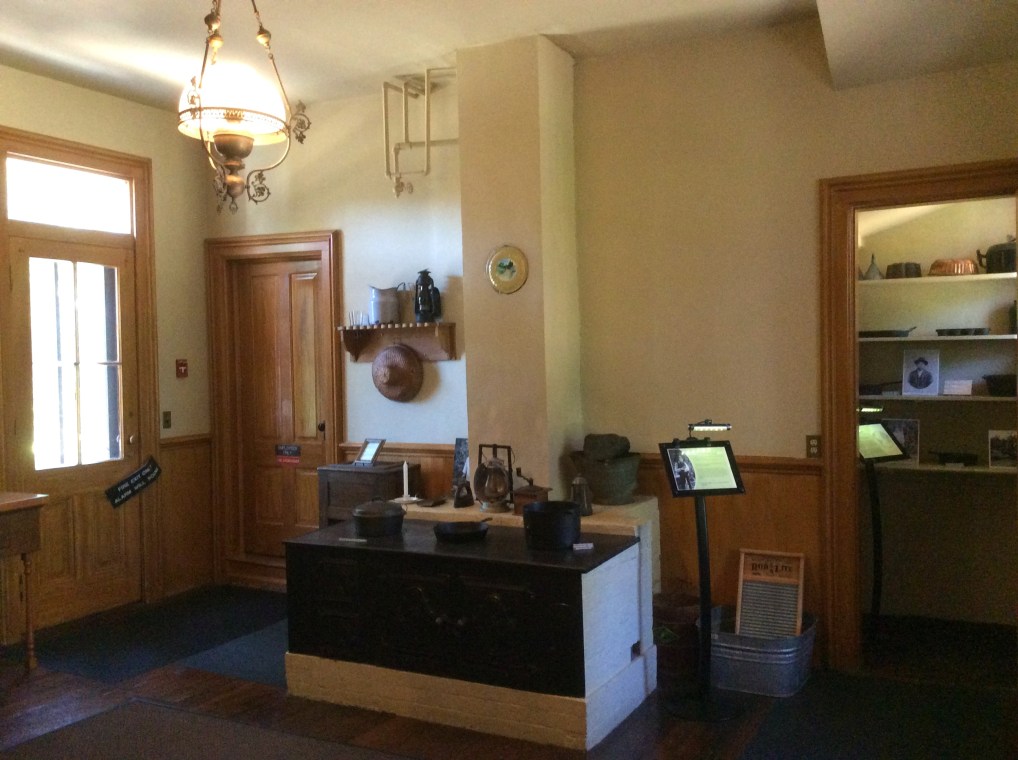
The kitchen at John Muir National Historic Site, Martinez, CA

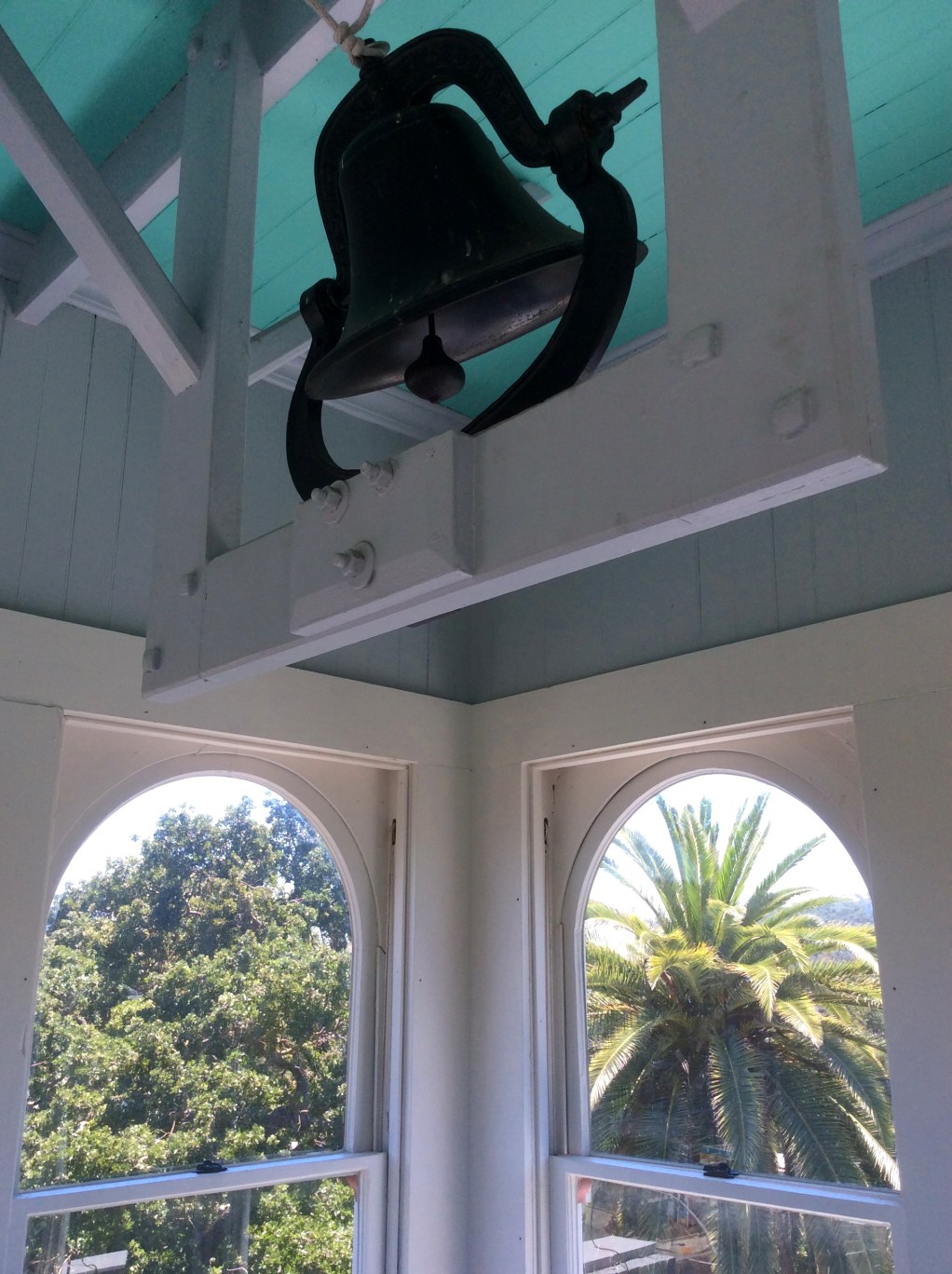
Inside the bell tower of the big house at John Muir National Historic Site, Martinez, CA. From this tower, one has an excellent view of the surrounding orchards.

Traveling Philosophy Series, Thomas Jefferson Edition: Prologue

Three years ago today

Amy M Cools's avatarOrdinary Philosophy

As I sit here in the airport terminal in Salt Lake City, waiting for one of my connecting flights to DC, I sleepily munch on French fries and watch the crowd go by. My ever-generous darling awoke with me at three thirty this morning to drive me to the airport, and though I’m almost too tired to think, I can’t sleep either, as is usually the case at the beginning of a trip (I can usually sleep on the way home).

So as I’m watching the crowd, I’ve got Thomas Jefferson in the back of my mind, as I’ve been immersing myself in biographies, lectures, discussions, and author’s talks about his life and thought over the last couple of weeks. On the first leg of my trip, I had just been re-reading the first chapters of Susan Jacoby’s marvelous Freethinkers: A History of American Secularism, in which Jefferson’s Enlightenment philosophy…

View original post 589 more words

New Podcast Episode: Frederick Douglass Baltimore Sites

About a year ago…

Amy M Cools's avatarOrdinary Philosophy

Listen to this podcast episode hereDouglass Place with engraved marker, Fell's Point Baltimore MD, photo 2016 Amy Cools or subscribe on iTunes

First day, Sunday March 20th

So here I am on the East Coast, commencing my Frederick Douglass history of ideas travel adventure in earnest! I’m thrilled, and know I’ll learn and see a lot, since I have so many sites I plan to visit already and know I’ll discover more as I go along.

…In a very important way, it’s fitting to begin with Douglass’s life here in Baltimore, centered in the waterfront district of Fell’s Point, since this is where Frederick Douglass had one of the most formative experiences of his life.

… Read the original travel account here

Ordinary Philosophy and its Traveling Philosophy / History of Ideas series is a labor of love and is ad-free, entirely supported by patrons and readers like you. Please offer your support today!

View original post

Margaret Sanger in the San Francisco Bay Area, California

Scottish Rite Masonic Temple mosaic, above the doorway of what’s now the Regency Center, San Francisco

Fairly early on in my research for my history of ideas series on Margaret Sanger in New York City, I discover that she delivered one of her more famous addresses here in Oakland. Practically just around the corner from where I live, in fact!

So I’ve long had the idea of doing a follow-up Sanger project here in the San Francisco Bay Area, certain I’d find she’s been here more than once. That turns out to be the case. And not only do I discover that she visited here several times, I find that the excellent library at the University of California at Berkeley has some great resources for filling in some gaps in my information about Sanger in NYC. So, this story will have two parts: the first part is about sites associated with Sanger here, and the second part is about some discoveries I make in U.C. Berkeley’s archives following up on two NYC sites.
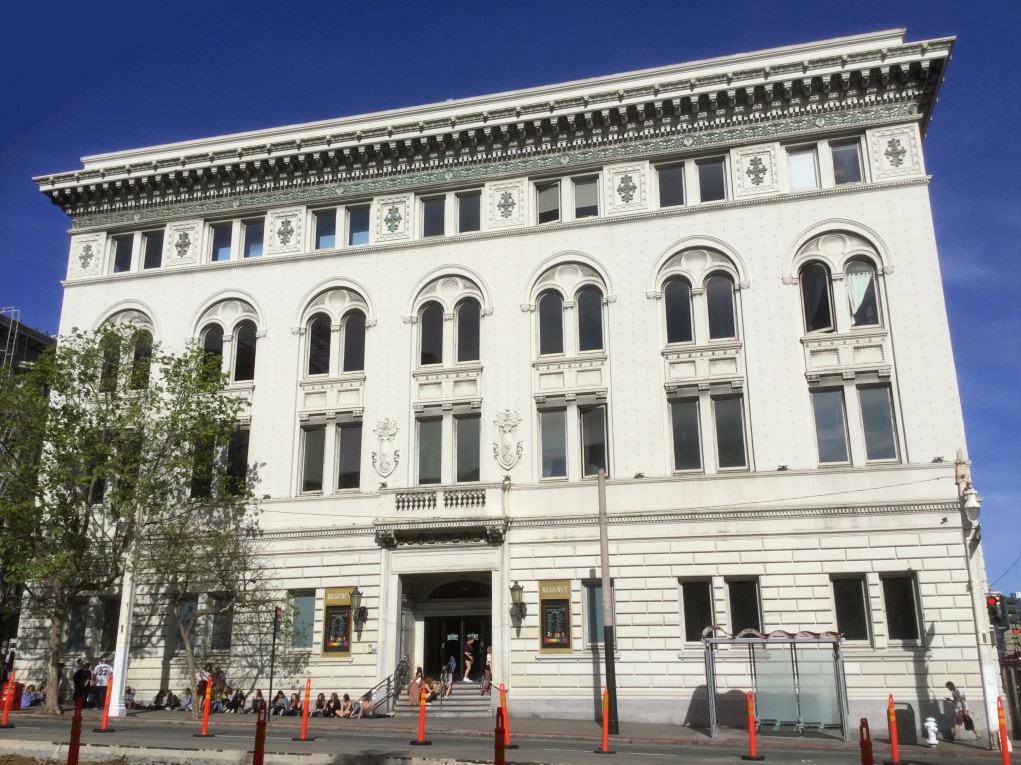
Scottish Rite Masonic Temple, now the Regency Center, at Sutter and Van Ness in San Francisco, CA

Stairway and elevator at the Regency Center, formerly the Scottish Rite Temple at Sutter and Van Ness, San Francisco

I: Sanger in Oakland and San Francisco

Friday, March 31st, 2017

I head first to San Francisco, a quick and easy trip on BART (Bay Area Rapid Transit System, our subway/ell) across the Bay, and take a pleasant walk on this spring day from Montgomery Street station east, first along Post through Union Square, then on Sutter. December 16th, 1928, Sanger spoke at the Scottish Rite Hall in San Francisco, at Sutter and Van Ness. The Scottish Rite Masonic Temple moved into its new quarters in the early 1960’s, and this building became the Regency Center, a multi-purpose venue. In fact, I was here just a few years ago when I saw John Cale, one of my very favorite musical artists of all time, perform in the ballroom, but Sanger likely spoke in the Social Hall. It’s also likely she delivered more or less the same speech she delivered at Oakland Civic Auditorium three days later, the story of that speech will follow below. Perhaps the speeches and corrections she scribbled onto the speech, which I link to here, constitute the differences between her addresses at the San Francisco and Oakland venues.

Small upper room in the Scottish Rite Temple, now the Regency Center, San Francisco

I write to people who manage and organize events at the Regency Center but am unable to line up a day to meet soon that will work with all of our schedules.

But since I have this free afternoon on a glorious spring day, I head over anyway, in case I luck out and end up there at a good time. Turns out, the very helpful man I find here, who’s in charge of setting up events, regretfully tells me there’s just too much going on for me to head upstairs and poke around to the rooms where she may have spoken; various contemporary sources designate the venue as the Scottish Rite ‘Hall’ and ‘Auditorium’, so the exact site is unclear. So I take photos in the places he allows me to wander: the hallway, the main stairway, and a meeting room just off the main landing now converted into a small bar.

About 22 years earlier, in August of 1916, Sanger wrote to her friends Charles and Bessie Drysdale, ‘In San Francisco [on a birth control lecture tour] I had a collapse, and was three days in bed under medical care, but recovered sufficiently to hold six meetings.’ As you may recall, Sanger suffered from recurrent tubercular infections, and from time to time they made her quite ill and exhausted. I have yet to find a record of specific locations she visited or stayed in San Francisco on that trip. Sanger didn’t mention her time in Oakland in this letter, though she may have meant to include the greater Bay Area when she said ‘San Francisco’, as visitors often do. Since she delivered her Oakland speech only three days after this San Francisco tour, this may have been one of the six meetings she spoke of.

So I return to Oakland to follow in Sanger’s footsteps there.

Margaret Sanger Hotel Oakland appearance, Oakland Tribune, Thu Jun 15, 1916, evening edition, front page. For the full article, click here. The drawing looks nothing like Sanger, and what’s up with the silhouette of celery? Yes, I know it’s meant to be a vase…

Hotel Oakland Ballroom, vintage postcard via Hotel Oakland Village website

On June 15, 1916, Sanger gave a speech in the ballroom of the Hotel Oakland at 270 13th St. I don’t find a transcript of this speech, but I do find a newspaper article about this event, which includes a summary of its main points as well as a review. The speech was well received by the audience, according to Gene Baker, writing for the Oakland Tribune. He compared Sanger favorably to Emma Goldman, Sanger’s one-time friend and ally from whom, truth be told, Sanger co-opted the mantle of birth control advocate-in-chief. As Baker commented in his article, Sanger was much more traditionally ‘feminine’ than Goldman in appearance, ‘slight’ and prettily dressed. Sanger was both a committed sex-positivist and a straight woman and saw no contradictions between her feminist convictions and in making herself attractive to men. Baker also described Sanger as speaking with intensity (which indicates she was feeling better since her collapse in San Francisco) and with scientific coldness. Perhaps she did convey a sense of scientific detachment, given her habit of buttressing her calls for action with a barrage of facts and statistics, or perhaps he perceived her keen grasp of the issues and her memory for detail as unfeminine and therefore ‘cold.’

Baker also wrote of her outspoken opposition to Theodore Roosevelt’s beliefs about childbearing in this speech; she frequently published rebukes and rebuttals to the President’s public stances against birth control and in favor of large families. (Baker mentioned that she spoke out against Roosevelt in San Francisco as well.) Both Sanger and Roosevelt were eugenicists but of different types: Sanger believed in negative eugenics, in curing human ills through having less children, especially if the parents were ill, disabled, or too poor to bring up well-nourished, well-educated, and well-housed children, and Roosevelt believed in positive eugenics, improving the human race through intelligent and hardworking people having as many children as possible.
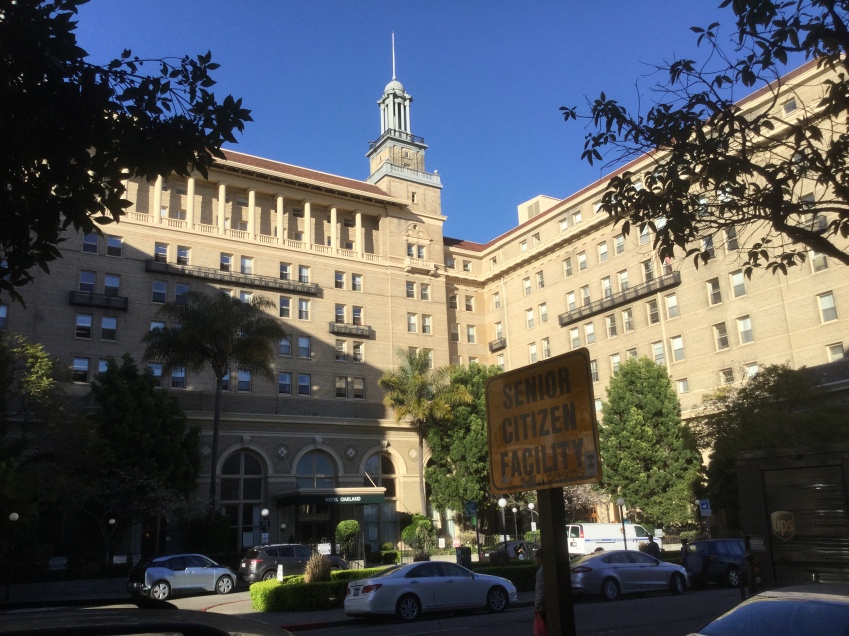
Hotel Oakland, now Hotel Oakland Village senior citizen community


Hotel Oakland Village main lounge, Oakland, CA

Hotel Oakland, vintage postcard via Hotel Oakland Village website

Hotel Oakland Historical Plaque, Oakland, CA

The Hotel Oakland, which opened as a luxury hotel on December 23rd, 1912, is now a senior community residence. Its grand edifice is little changed, but its garden is no longer so sumptuous and much of its interior is much plainer, having been stripped of its chandeliers and fancy furniture and painted plain white, though the lounge ceiling is painted a lovely antique-gold color. I sign in at the desk and walk around the first floor, greeting each person I see with a hello, a smile, and a nod, everyone is friendly and welcoming, and no one questions my presence. I take photos freely on the ground floor except in the large back room converted into an activity and physical therapy area, which, it so happens, appears to be the former ballroom I seek. I ask the person who works there if I may take pictures; she’s a Spanish speaker, and I ask in that language (unforgivably clumsily, given that I’m a California native and I should be more adept) if I may take pictures. She explains that the person that could authorize this won’t be back in until Monday, so I depart. As much as I am historically nosy, I make it my practice never to infringe on the territory of working people. They have enough to worry about without wondering if they could get in trouble on my behalf.

I do, however, take photos of the front lobby, in full view of everyone there who appears not the least concerned with my presence except to return my smile when they happen to catch my eye. Most of the residents are Chinese. This is no surprise since the Hotel Oakland Village, as it’s now named, borders Chinatown, and like the neighborhood in general, it is family-oriented, with visitors of all ages coming and going, often taking the elderly residents for local outings, such infirmities as they have lovingly supported by wheelchairs, walkers, arms, and hands. The parks in this neighborhood often contain large groups, sometimes very large, of older people going through the graceful, slow, deliberate movements of Tai Chi. It’s likely they include many of the residents of this hotel. The sight of these people, something like colorful wildflowers waving in the wind, something like windmills if windmills were endowed with personalities, intention, and rich history and could move deliberately to music, warms my heart on my morning walks.

Oakland’s Chinatown at the time of the Hotel Oakland’s heyday; many of these old houses stand today. This photo is on the wall of the Oakland Hotel Village main hallway

Margaret Sanger Speeches, Announcement for Oakland and S.F, in the Oakland Tribune, Sun Dec 16, 1928

Margaret Sanger Speeches, Announcement for Oakland and S.F, in the Oakland Tribune, Sun Dec 16, 1928

Next, I visit the Oakland Civic Auditorium, later called the Kaiser Convention Center, also just a few blocks from my house, near Lake Merritt. On December 19th, 1928, Sanger delivered the speech ‘The Necessity for Birth Control‘ here. It was a least as dedicated to eugenics-based arguments about the ill effects of ‘feeble-minded’, ill, disabled, and poor people having children to whom they passed down these traits and which they could not care for properly, as it was about preventing suffering.

The eugenics arguments and opinions she used in this speech are hard to take now, just as they were for many then. Yet to be fair to Sanger, we must remember that her arguments were informed by her experiences working as a visiting nurse in the slums where the poorest of the working poor lived in NYC, where the best efforts of public charities often seemed to hardly make a dent in relieving suffering, especially when, as Sanger believed, so much of it was preventable:

In her speech, Sanger said:

To define Birth Control, we say it is the conscious control of the birth-rate by scientific means that prevent the conception of human life. Prevent, remember. Prevent does not mean to interfere. It does not mean to destroy. There is no more interference with life through birth control than there is to remain unmarried or to live a celibate life. We also say “to control.” Control does not mean that you limit. When you control your furnace you do not have to put the fire out. When you control your motor you do not necessarily stop your car. To control the birth rate means that there shall be the same right for those who do not wish to have children as for those who do wish to have them. There are no objections to those who wish to increase the size of their families, but on the other side there seems to be a great deal of question and controversy as to the right of those who wish to limit or control the number of their children. ~ Margaret Sanger, ‘The Necessity for Birth Control’

Booklet for the Oakland Civic Auditorium and Opera House, now Kaiser Convention Center, Oakland Public Library

Oakland Civic Auditorium as it appears today

The Oakland Civic Auditorium had stood for 14 years when Sanger spoke here in 1928 and she had become very well known indeed in the dozen intervening years since she spoke at the Hotel Oakland. The Auditorium is a huge venue, as we can see in historical photos: it held Buffalo Bill’s Wild West Show and the Barnum and Bailey circus, symphony orchestras, and other large-scale entertainments. The history of this place is wonderful, with so many other amazing activists, artists, speakers, and performers appearing here over the years: Isadora Duncan, Duke Ellington, Marian Anderson, Paul Robeson, Johnny Cash, Elvis Presley, Martin Luther King, Jr, the Grateful Dead… It’s no longer in use, standing empty since just before the turn of this century, but I hope this beautiful Beaux-Arts edifice is reclaimed, restored, and put to as good a use as it once was.

Buffalo Bill Wild West Show at the Oakland Civic Auditorium, photo from booklet at Oakland Public Library

II: More About Sanger in NYC at U.C. Berkeley’s Doe Memorial Library

Research & photos: gathered on various dates from November 2016 to March 2017

And now, here’s my follow-up on two sites associated with Sanger in NYC:

Margaret Sanger Letter to Noah Slee on Barclay Hotel Stationery, excerpt, from the Sophia Smith Microfilm Collection

From Day 1, Part 3‘I track down a listing in the Margaret Sanger Papers Microfilm Edition: Smith College Collection Series catalog for a microfilm of a letter Sanger received from the Barclay hotel, but I don’t have access to it at the moment. It’s not available online and I’ve not yet had a chance to visit the library at the University of California at Berkeley, which has a copy’

I finally get around to tracking down the microfilm collection, stored deep in the archives at the Doe Memorial Library at U.C. Berkeley, with the assistance of the ever- kind and helpful Nancy Oanh Tran. In looking through the microfilms of documents dated around the time of Sanger’s stay at the Barclay Hotel, I find a phone message for Sanger and many chatty letters to her husband Noah Slee written on Barclay Hotel stationery. The letters discussed visits to and from friends, a visit from her son Grant, how much less pleasant it was to drive a car in New York City than in Tucson, how disorganized she was, and so on. Most of the contents of these letters are of little interest to anyone outside of their relationship, their circle of friends, and of course, dedicated historians, except, I think, for one thing: she begs him not to join her in New York City, and not to ask her to leave her work there yet. In her second marriage, she demanded the freedom she wanted that she did not find enough of in her first, and she got it through endearments, compliments, even sappiness, so that Noah would feel loved and not abandoned; through cajoling; through explanations and arguments about the importance of her work and her need to do it unimpeded; and even through what reads to me like a guilt trip.

o I American Eugenics Society journal, Doe Memorial Library at U.C. Berkeley

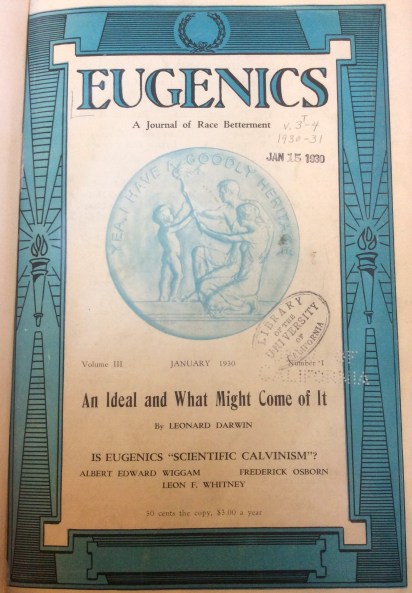
From Day 2, Part 2: ‘According to Robin Pokorski’s Mapping Margaret Sanger, ‘The Hotel Astor was the site of the National Birth Control Conference of November 19 and 20, 1929. The conference was sponsored by the American Birth Control League.’ I find few contemporary references online to the talks and attendees of this conference other than a few remarks in some contemporary newspapers and a brief excerpt from Eugenics: A Journal of Race Betterment, Volumes 3-4, 1930, published by the American Eugenics Society. An article from The Capital Times of Madison, Wisconsin outlines some of the topics of discussion, such as the Comstock laws and the current science of reproduction, and lists some of the headliners of the conference, which include ‘famous educators, doctors, and pastors.’ ‘

In doing further research, I find there’s a copy of the American Eugenics Society journal also in the collections of U.C. Berkeley’s Doe Memorial Library.

Mary Louise Inman, who wrote an account of and commentary on the meeting for the Eugenics Journal, wrote:

‘Most of our adult generation can remember when [the birth control movement] was chiefly characterized by determined looking ladies selling The Birth Control Review on metropolitan street corners, Margaret Sanger being held up for her propaganda, and a general feeling in the lay breast that the whole thing was not quite respectable.

Here we see before our eyes the evolution of an idea. That the movement has undergone a decided moral, social, and intellectual transformation is evidenced by the presence on the speaker’s platform of some of our foremost religious leaders, together with eminent writers, physicians, educators and scientists, as well as other professional and non-professional men and women of the highest social standing.’ ~ Inman, Eugenics, Jan 3oth ed, p 12

As I read further, I take notes. They go:

National Birth Control article for Eugenics journal by Mary Inman, 1930

‘In his speech, one Dr. E. Bord Barrett, a former Jesuit and still a practicing Catholic, held out hope that the Church would be flexible and adaptable on the birth control issue. He was a believer in the social benefits of birth control, and based his hope on the fact that so many Catholics used birth control, that Church-mandated celibacy for priests and others indicated that the Church recognized it was not always in the best interests of individuals and communities for everyone to have children, and that the Church blessed marriages of couples who could not have children.

Dr. Hannah Stone, director of the Birth Control Clinical Research Bureau and Sanger’s long-time colleague who was arrested in the raids on the W. 15th Street clinic, was among the speakers, but her talk was not recorded or described in Inman’s article.

Ministers and rabbis voiced their support for birth control on humanitarian and personal responsibility grounds.

The second day of the conference was dedicated to issues related to eugenics. They discussed the questions of whether it was desirable to ‘breed geniuses at will’, if it could be done at all; who would be qualified to decide what are ‘desirable’ human traits and types beyond those which impart health and the ability to take care of ones’ self; whether ‘spiritual values’ should be brought to bear on the issues, and much more.

Albert Edward Wiggam, worried that birth control might exacerbate a differential birth rate between those who are prudent, far-sighted, intelligent and self-controlled enough to be more likely to use birth control, and those who conceive and bear children thoughtlessly. He believed these traits were largely transmissible, predicting the likely behavior of the next generation. To counteract this problem, Wiggam believed that birth control needed to be universally and readily available as well as easy to use.’

Margaret Sanger, from Eugenics journal, Doe Memorial Library at U.C. Berkeley

The article ends by noting that Margaret Sanger could not attend the conference, which surprises me! Instead, she sent a telegram which was read to the attendees since her attendance was sorely missed given her role as a founder of the movement and the most important activist of her time for women’s rights, since the suffragists. Inman predicted that birth control would become as readily accepted in society as women’s right to vote, however controversial its past. She was mostly right. Though many Americans are uncomfortable with publicly funding birth control since we believe so firmly in the right to religious dissent, most Americans actually do use birth control, at least at some point in their lives. And as Sanger hoped, it has become readily available, easy to use, mostly every cheap, and all very safe. And she played a very significant role in bringing this about.

Thank you, Margaret Sanger.

Listen to the podcast version here or on Google Play, or subscribe on iTunes

Ordinary Philosophy and its Traveling Philosophy / History of Ideas series is a labor of love and ad-free, entirely supported by patrons and readers like you. Please offer your support today!

~~~~~~~~~~~~~~~~~~~~~~

Sources and Inspiration:

Duchsherer, Aimee. ‘Better Babies or More Babies?: Theodore Roosevelt, Margaret Sanger, and the Birth Control Movement‘. July 16, 2015, Theodore Roosevelt Center at Dickenson State University blog.

The Hotel Oakland Village website: ‘History: Grand Hotel‘ and ‘Historical Photos

Inman, Mary Louise. ‘The National Birth Control Conference’ from Eugenics: A Journal of Race Betterment, Volumes 3-4, January 1930, pp 12-17.

Kaiser Convention Center‘. In Wikipedia, The Free Encyclopedia.

The Margaret Sanger Papers Electronic Edition: Margaret Sanger and The Woman Rebel, 1914-1916, eds. Esther Katz, Cathy Moran Hajo and Peter Engelman (Columbia, S.C.: Model Editions Partnership, 1999)

The Margaret Sanger Papers Microfilm Edition: Smith College Collection, eds. Esther Katz, Cathy Moran Hajo, Peter Engelman, and Anke Vass Hubbard, 1996. #Microfilm 77685 , S15:0042. Reel S15: May 1938 – Nov 1938

Brochure for the Kaiser Center, one the old Oakland Civic Auditorium, Oakland Library collection


‘The Regency Ballroom: About‘, from their website

The Regency Center‘. In Wikipedia, The Free Encyclopedia.

Regency Center: Venue Overview: History‘, from their website

Sanger, Margaret. ‘A “Birth Control” Lecture Tour‘, Aug 9, 1916. Published article: Malthusian, Sept. 1916, 83-84. (Sanger’s letter to Charles and Bessie Drysdale published as an article)

Sanger, Margaret. ‘The Necessity for Birth Control,’ Dec 19, 1928. Typed Draft Speech. Source: Margaret Sanger Papers, Library of Congress, Library of Congress Microfilm 130:0226

Social Hall SF: Venue Info‘, from their website (part of the Regency Center)

Tillmany, Jack. ‘Regency I: 1320 Van Ness Avenue, San Francisco, CA 94109‘. Cinema Treasures website

Margaret Sanger and Race

Dr Dorothy Ferebee - Planned Parenthood as a Public Health Measure for the Negro Race, speech for Birth Control Federation of America, 1942

Dr Dorothy Ferebee – Planned Parenthood as a Public Health Measure for the Negro Race, speech for Birth Control Federation of America, 1942

Since the earliest days of her birth control activism, Margaret Sanger has been often accused of being a racist, among other things. To many of her critics, her birth control advocacy must be understood as a nefarious plot to undermine human morals and decency, and any means of twisting her message to convey this are fair game. As I discuss in an earlier piece, a favored method of attack, which persists to this day, is to present a sentence or phrase of Sanger’s out of context to ‘prove’ her ‘true’ beliefs about people of other races. Her detractors even claim that she was on a genocidal mission to reduce or even exterminate black people, Jews, and other immigrant groups by destroying future generations. Never mind that Martin Luther King, Jr. praised her work on behalf of his beleaguered people. Never mind that she worked closely with civil rights leaders such as Mary McLeod Bethune and W.E.B. DuBois. Never mind that she opened clinics to serve black and other minority women because so many existing clinics refused to serve anyone but whites. Never mind that she wrote in 1944:

‘We must protect tomorrow’s Chinese baby and Hindu baby, English and Russian baby, Puerto Rican, Negro and white American babies who will stand side by side… to bring promise of a better future’.

Eugenics journal, photo 2017 by Amy CoolsNow, as a eugenicist, Sanger did make herself an easy target for her accusers despite her decades of work with underserved and marginalized people, first as a nurse in the slums of the Lower East Side of New York City and then as a birth control pioneer. Eugenics, enthusiastically adopted by many who considered themselves scientific, progressive, and enlightened in the first half of the 20th century, is now recognized as pseudoscience, (mis)applying the evolutionary process of (unguided) natural selection to utopian social engineering theories. Eugenicists believed that the ills of humanity could be cured preemptively by breeding them out of existence while breeding in favor of ‘desirable’ traits. Despite the rosy vision of transforming humanity into the most vigorous, hyper-intelligent, and disease free race the world had ever seen, eugenics principles actually produced very ugly results when instituted as social policy. Here in the United States, government programs incarcerated mentally ill, disabled, and socially maladjusted people and forcibly sterilized them. Then the world’s most infamous eugenicists, the Nazis, took those principles to their most extreme logical conclusion, borrowing a page from the United States’ eugenics book in instituting the most horrific, murderous selective-breeding process the world has ever seen, inflicting untold and untellable quantities of human suffering and bloodshed.

Little wonder, then, that eugenics has a very bad name. Though the desire to reduce human suffering caused so many to embrace it, eugenics was based on a fundamental misunderstanding of Darwin’s great theory. Its proponents understood natural selection just well enough to appreciate its power for change but missed the greater point: the wide variety of human traits and capabilities is itself a long-evolved, complexly-balanced, and very very successful web of adaptations developed and attuned over hundreds of thousands of years. Human beings, necessarily self-centered and short-sighted, are very inept judges of trait selection in comparison with Nature itself.

Buck v Bell Virginia Historical Marker Q 28, Courtesy of Historical Collections, Claude Moore Health Sciences Library, University of VirginiaSanger, like many other eugenicists, was inconsistent in her attitudes about who should have children, when, and who should decide. Generally, she advocated for the right to self-determination in reproductive matters, calling for mass education and for cheap, reliable, widely available methods of birth control. In many instances, however, she advocated coercive sterilization for violent criminals and for those who she believed could not make this important decision for themselves, such as the mentally ill and cognitively disabled. She backed away from the latter, though, as the Nazis rose to power and instituted coercive, violent eugenics practices on a grand scale. Sanger was an early, ardent, and very vocal opponent of Nazism, and its policies alerted her to the problems of her short-sighted views on forced sterilization for anyone. As the logical-extreme beliefs of Nazism revealed, eugenics had its limits, and even the most non-coercive, most benign brands of eugenics were discarded by most of its former proponents over time.
But there are two other things Sanger was very consistent about.

One was her dismay at the sheer quantity of human suffering in the world and her desire to reduce it if she could. I find that oft-cited Sanger quotes, particularly from her book Woman and the New Race, refer to her observation that poor immigrants were especially likely to have more children than they could afford, and her claim that they were more likely therefore to produce ‘unfit’ children. ‘Unfit’, as Sanger described them, are those who are malnourished, diseased, undereducated, and in countless other ways ill-equipped to lead happy, flourishing lives. Yet, as is often the case with politically- and ideologically-motivated attacks, Sanger’s words are presented out of the context in which she wrote them, inspired by the plight of the immigrants she had in mind, mostly the Eastern Europeans she worked with in New York City’s Lower East Side. Before her time as a birth control activist, Sanger worked for them as a visiting nurse. As a Socialist activist and as a health care provider, she was driven by her special concern for the working poor that she observed were abused, often taken advantage of, in their desperation, by rapacious employers who offered them meager wages and terrible working conditions in exchange for backbreaking hours of miserable labor. These families were broken down from disease, hard labor, malnutrition, and, for the women, numerous pregnancies that often ended disastrously from these very health-destroying circumstances. One of Sanger’s most infamous quotes from Woman and the New Race, ‘The most merciful thing that the large family does to one of its infant members is to kill it’, so often used to ‘prove’ that Sanger was both racist and genocidal, is understood as a sarcastically-despairing remark when presented within the chapter in which it appears. That chapter describes the horror and suffering that preceded the all-too-frequent deaths of the immigrant poor, especially children and their mothers, and laments society’s lack of concern in preventing all this suffering and death. Even the next sentence alone will do: ‘The same factors which create the terrible infant mortality rate, and which swell the death rate of children between the ages of one and five, operate even more extensively to lower the health rate of the surviving members.’

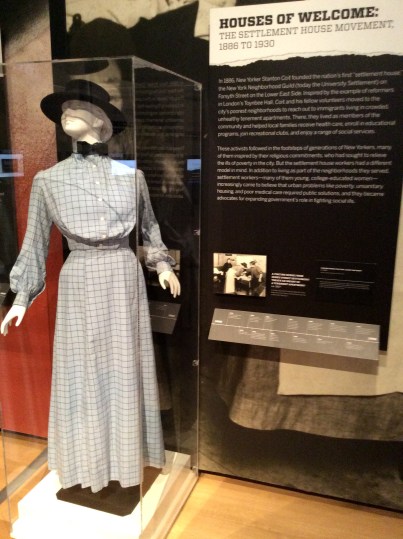
Nurse's uniform, ca. 1905, of Lilian Wald visiting service to the Lower East Side tenements of NYC

Nurse’s uniform, ca. 1905, of Lilian Wald visiting service to the Lower East Side tenements of NYC. Sanger would likely have worn an updated version of this uniform when she worked there in 1911

Second, Sanger believed all human beings should be given the same care and opportunities as everyone else. That’s why she opened her first birth control clinic in the racially diverse Brownsville neighborhood of Brooklyn in 1916, opened clinics to serve black and Latina women in Columbus Hill and Harlem neighborhoods in the late 1920’s and early 1930’s, and expanded her mission to help black communities in the American South in 1939. While there might be more than a shade of paternalism (maternalism?) in these efforts, her own writings, as well as the support of black civil rights leaders, demonstrate that her motives were, at least on the whole, motivated by her concern that justice be done for these underserved people.

As Sanger wrote to her friend Albert Lasker in 1939:

‘You are quite right in assuming that poor white people down South are not much better off than the Negroes, but there has been at least a start in several states to help the poor whites and as there is not sufficient time for a nurse, nor the material left over, for the Negroes, they are just left out of the service in most of the states. That is why I was anxious to have a special fund directed for the Negroes…’

Returning to Woman and the New Race, Sanger gave another reason why she was driven to improve lives in the disadvantaged communities she worked with and advocated for:

‘They would not be here if they did not bear within them the hardihood of pioneers, a courage of no mean order… And they have something else. The cell plasms of these peoples are freighted with the potentialities of the best in the Old World civilization. They come from lands rich in the traditions of courage, of art, music, letters, science, and philosophy… The immigrant brings the possibilities of all these things to our shores, but where is the opportunity to reproduce in the New World the cultures of the old? What opportunities have we given to these peoples to enrich our civilization? We have greeted them as “a lot of ignorant foreigners,” we have shouted at, bustled, and kicked them… What hope is there for racial progress in this human material, treated more carelessly and brutally than the cheapest factory product?’

In other words, America’s immigrants carry greatness in their very genetics, which our factories and farms have too often exploited, quashed, and wasted over the centuries by treating them as little more than wealth-generating fodder before kicking them to the curb or the ditch.

And in her article ‘Love or Babies: Must Negro Mothers Choose?’ Sanger wrote:

‘The Negro race has reached a place in its history when every possible effort should be made to have every Negro child count as a valuable contribution to the future of America. Negro parents, like all parents, must create the next generation from strength, not from weakness; from health, not from despair.’

Civil rights leader W.E.B. Dubois shared this view with Sanger: that if oppressed people were to overcome the social forces arrayed against them, they needed to forge their way from a position of strength: of health, of education, of increased wealth, and birth control was one of the ways to get there. And Sanger and DuBois both believed that they all could get there because they were just as capable of greatness as anyone else, given the same chances.

This doesn’t sound like racism to me.

*Listen to the podcast version here or on Google Play, or subscribe on iTunes

Ordinary Philosophy and its Traveling Philosophy / History of Ideas series is a labor of love and ad-free, supported by patrons and readers like you. Please offer your support today!

~~~~~~~~~~~~~~~~~~~~~~~~~~~~~~~~~~~

Sources and inspiration:

Another Look at Margaret Sanger and Race‘, Feb 23, 2012. From The Margaret Sanger Papers Project at NYU

Birth Control or Race Control? Sanger and the Negro Project‘ The Margaret Sanger Papers Project Newsletter #28 (Fall 2001)

Ferebee, Dorothy Boulding, d. 1980, “Speech by Dorothy Boulding Ferebee, M.D. entitled “Planned Parenthood as a Public Health Measure for the Negro Race,” January 29th, 1942,” Smith Libraries Exhibits

Margaret Sanger and the African American Community‘, compiled by Anna Holley, SisterSong Intern, July 2010, TrustBlackWomen.org

Marlin, George. ‘Margaret Sanger: “Abortion is Dangerous and Vicious”‘ Dec 14, 2011, The Catholic Thing blog

A Negro Number, June 1932 edition of Birth Control Review, by various authors.

Reed, Miriam. ‘Margaret Sanger: Correcting the False Narratives of Racism‘, June 30, 2016. Church and State

Sanger, Margaret, 1879-1966, “Letter from Margaret Sanger to Albert Lasker, November 12, 1939,” Smith Libraries Exhibits, Margaret Sanger Papers, Sophia Smith Collection.

Sanger, Margaret. ‘Love or Babies: Must Negro Mothers Choose?‘ Source: Negro Digest, August 1946, pp.3-8, via The Margaret Sanger Papers Project at NYU

Sanger, Margaret. ‘Population – Everybody’s Business,’ Published Article. Source: Tomorrow, 1944, pp. 16-18, Margaret Sanger Microfilm S72:0480, via The Margaret Sanger Papers Project at NYU

The Truth About Margaret Sanger‘, Blackgenocide.org

Untapped Cities piece about Frederick Douglass in NYC

The hymnal Frederick Douglass had with him when he escaped from slavery in 1838

The hymnal Frederick Douglass had with him when he escaped from slavery in 1838. It would have been in his bag he carried when he arrived in New York City, newly free.

Hello friends of Ordinary Philosophy!

The travel site Untapped Cities just published a piece of mine about Frederick Douglass in New York City: 7 Haunts of Abolitionist Frederick Douglass in NYC

Hope you find it of interest!

– Amy

Ordinary Philosophy and its Traveling Philosophy / History of Ideas series is a labor of love and ad-free, supported by patrons and readers like you. Please offer your support today!


Happy Birthday, Thomas Paine!

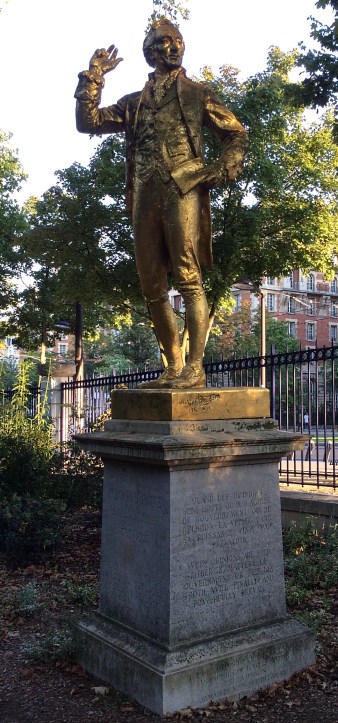
Statue of Thomas Paine by Gutzon Borglum, 1938, Parc Montsouris, Paris, photo 2015 by Amy Cools

Statue of Thomas Paine by Gutzon Borglum, 1938, Parc Montsouris, Paris, photo 2015 by Amy Cools

Let’s remember and salute the great Thomas Paine, father of our American identity, on his birthday. Born on January 29th, 1737, his great pamphlets made the case for American independence from Britain, outlined his Lockean conception of human rights, and argued for the primacy of reason in epistemology, politics, science, and theology. He’s a primary influence in my own concept of America as a bastion of liberty, of reason, of freedom of conscience, of the idea that property rights entail the obligation to share our wealth with those who lack what they need.

Here are a few links to some articles and works of art by, about, and inspired by Thomas Paine, including some of my own work.

Common Sense – Thomas Paine (1776)

The American Crisis – Thomas Paine (1776-83)

The Rights of Man – Thomas Paine (1791)

The Age of Reason – Thomas Paine (1794)

Agrarian Justice – Thomas Paine (1795-96)

Thomas Paine – from The Stanford Encyclopedia of Philosophy

To Paris, France I Go, In Search of Revolution-Era Thomas Paine, Mary Wollstonecraft, and Thomas Jefferson – history of ideas travel series in which I follow Thomas Paine’s life and ideas in the era of the French Revolution

Thomas Paine on Basic Income, and Why Welfare is Compatible with an Individualist Theory of Human Rights – my essay on how Paine’s ideas about property rights led him to advocate the unconditional allocation of public funds for the support of the young, the old, and the disabled

Pretty Pink Rose – David Bowie and Adrian Belew (1990) – ‘She tore down Paris on the tail of Tom Paine, but the left wing’s broken, the right’s insane’

As I Went Out One Morning – Bob Dylan (1968) ‘As I went out one morning to breathe the air around Tom Paine’s, I spied the fairest damsel that ever did walk in chains’

Tom Paine’s Bones – Graham Moore (1995) Recorded by Dick Gaughan in 2001. ‘Well they say I preached revolution but let me say in my defence, all I did wherever I went was to talk a lot of Common Sense’

Ordinary Philosophy and its Traveling Philosophy / History of Ideas series is a labor of love and ad-free, supported by patrons and readers like you. Please offer your support today!

Margaret Sanger NYC Sites, Day 4

Planned Parenthood Clinic at Margaret Sanger Square, Mott and Bleeker Streets, NYC

Planned Parenthood Margaret Sanger Center at Margaret Sanger Square, Mott and Bleeker Streets, NYC

Friday, October 21st, 2016

It’s cold and rainy, so I spend a long morning with my coffee as I do more research. Try as I might, I just can’t identify, with any certainty, the exact site of the Queens County Penitentiary, Long Island City, where Margaret Sanger was imprisoned for thirty days in 1917 for operating her Brownsville birth control clinic. Nor do I locate the site of the original White Plains Hospital where Sanger trained as a nurse. I had pored over the atlases of that town, from that time, in the New York Public Library map division, and I searched assiduously in their digitized records this morning. No luck.

So I finish my account of the first site I visited on Tuesday and publish it, then head out. It keeps raining, but oh well, it’s not a terribly long walk and besides, I welcome a walk in the rain, under my umbrella, of course. The drought back home had been mostly unrelenting for ages and it’s nice to experience a good rain again.

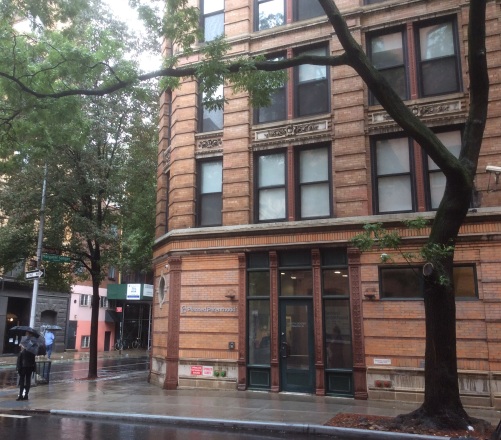
My first destination is Planned Parenthood’s Margaret Sanger Center at Mott and Bleecker Streets. The rain is really coming down and I’m fairly wet by the time I get here, so I hurriedly enter the lobby. Immediately, a man approaches me and asks what I’m looking for, while another man at the desk trains his eye on me. Not unfriendly, but alert. I explain my mission and present my driver’s license and business card. He makes a call upstairs to see if the director of the center has a moment to meet with me, but she’s heading out for a meeting. I ask if I can take a photo of the colorful mural on the lobby wall, but they say no: for security reasons, no photos are allowed inside the building. I express my understanding: after all, such establishments are under constant threats of terrorism and negative, often distorted and falsified media. I’m content with taking photos of the outside, and note the array of security cameras.

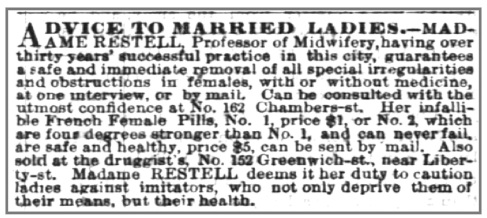
Advice to Married Ladies Madame Restell abortion ad in the New York Times, Nov 9th 1865

‘Advice to Married Ladies’, Madame Restell abortion ad in the New York Times, Nov 9th, 1865

New York City has a long history as a place where a woman can more readily obtain an abortion than just about anywhere else. In his detailed article on the subject, Robert Nizza wrote for New York magazine:

‘In many ways, the story of abortion in the United States is the story of abortion in New York. There were no laws against the procedure until the 1820s. Before that, British common law allowed abortions before “quickening,” or the moment when the fetus first moved. It was in New York in 1828 that America’s first real abortion law was passed. The debate of the day wasn’t driven by religious concerns about when life begins. Instead, as James C. Mohr’s classic history of the subject, Abortion in America, explains, Albany responded to pressure from doctors who were aghast at quacks’ butchering women and scamming them with phony abortifacient potions. The law was really about medical regulation, and, according to Mohr, it went completely unenforced.’

Sanger opposed abortion on the same health and safety grounds as the medical community Nizza refers to. We can only guess what her stance would be on abortion today, though based on her stated reasons for opposition to the practice as well as her refusal to condemn the women who sought abortions, I think her position would echo Bill Clinton’s: that abortion should be safe, legal, and through the ready availability of safe, legal, and affordable birth control, rare.

http://www.nyu.edu/pages/projects/sanger/articles/sanger_on_trial.php

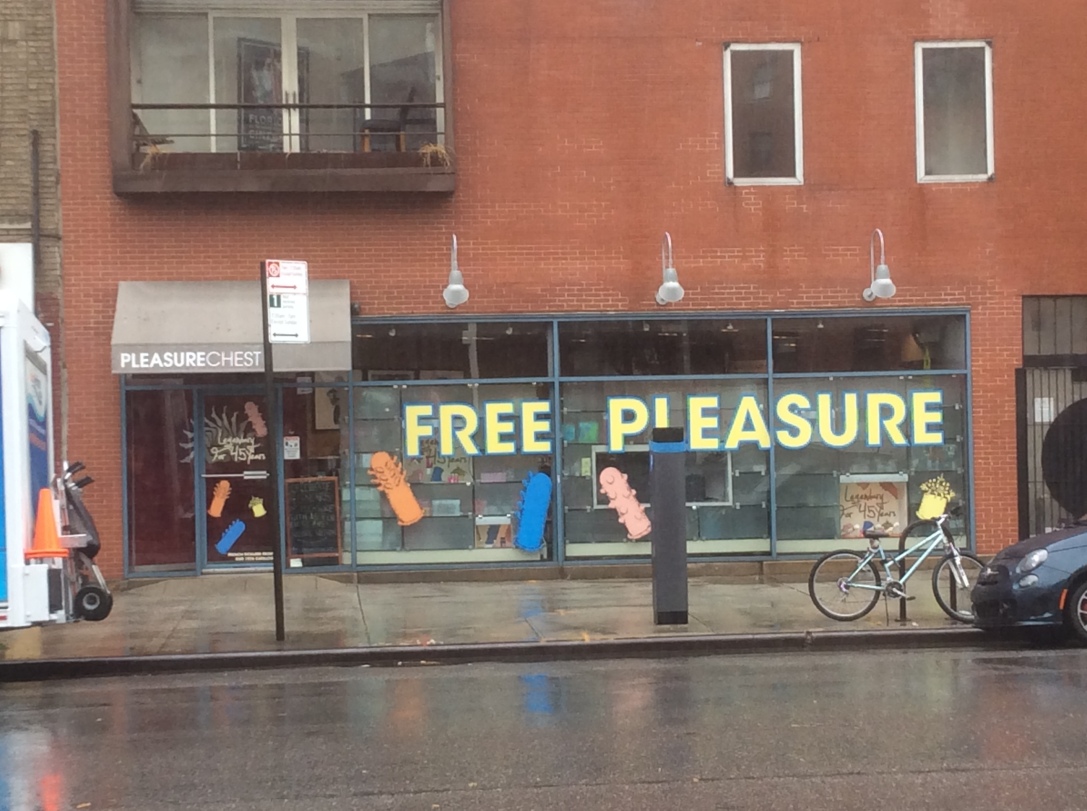
The Pleasure Chest ‘Free Pleasure’ painted storefront window, New York City

I take the subway to my next destination, which is close enough so that I’d ordinarily walk but I don’t want to spend the day in soaking wet pants; I’m already very damp from my first long walk. On my way from the station, just around the corner from where I’m headed, I’m amused to see a sex shop storefront that’s vibrantly painted with the words ‘Free Pleasure’ surrounded by cartoon-like images of pleasure devices. It’s apropos to the birth control debate that I’ve been considering throughout this journey. Each side might find it illustrates their views: those who share Sanger’s view that sex and reproduction are not and should not be necessarily linked, and those that oppose all forms of artificial birth control on the grounds that they’re contrary to nature and to God’s will. The latter also find the idea of sex unmoored from reproduction repellent because they believe it will lead to irresponsible and extramarital sex, and corrode family values and ideals of sexual purity. They might interpret the colorful shop window as a negative demonstration of the cheapening of sex from permissive birth control laws and secular sexual mores. Sanger, like her fellow sex-positivists, believed instead that unmooring sex from reproduction leads to happier, more romantic and less stressful marriages, and to healthier and more prosperous families while providing a broader scope for women to enjoy and explore their sexual natures. They would likely interpret this painting as a positive demonstration of sexual freedom.

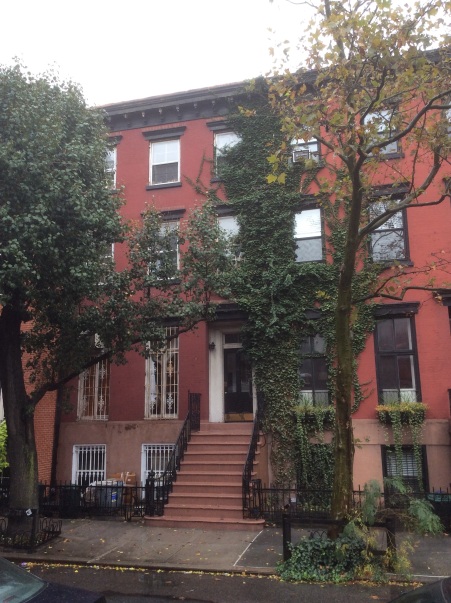
4 Perry St, Manhattan, New York City

4 Perry St, Manhattan, New York City

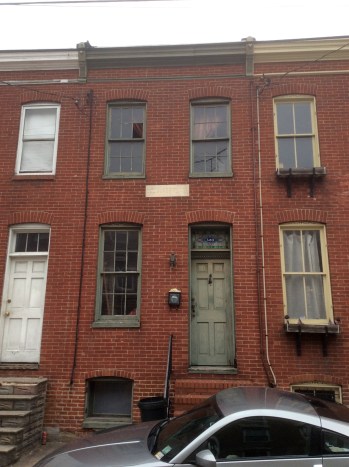
Just around the corner, I arrive at 4 Perry Street, where according to Robin Pokorski of NYU’s Mapping Margaret Sanger project, Sanger lived for a short while in 1914, between Waverly Place and Greenwich Ave in Greenwich Village. A couple of other sources mention this as well. Yet aside from brief statements of this fact in those secondary and tertiary sources, I’m unable to discover anything else about her time here with online research alone, including the exact stretch of time she lived here, but there’s plenty of readily available evidence that shows where Sanger lived elsewhere that same year. Sanger’s correspondence, both to and from, were addressed ’34 Post Ave’ from March to October of that year, and her journal The Woman Rebel directs all inquiries be sent there. She arrived in New York City from Paris in early January 1914. According to her autobiography, she rented the apartment on Post St ‘as soon as possible’ after she arrived, and she left New York for Europe again in late October to flee another obscenity trial for her Woman Rebel publications. That pretty much leaves January and February of 1914 as the time frame in which she could have lived here on Perry St. In these first two months of the year, she was reestablishing herself as an activist, now for birth control. As you many remember, she had just left her husband William behind in Paris to do so.

I duck into an inviting establishment right down the way on Greenwich Ave at Perry, lured by the promise of handmade meatballs and a tasty ale. This is my last day in NYC this trip, and I’m going to slow down and take it easier today. I write notes and linger over my meal, hoping the rain will stop. I like the rain, but it’s very difficult to take photos I require for this project since that requires both hands. I balance my umbrella over my head with the handle tucked under my arm, but it tends to flop over as I move to get the best shots. So I linger until the rainfall lightens, though it doesn’t really stop for awhile.

Carnegie Hall, Manhattan, New York City

Carnegie Hall, Manhattan, New York City

Margaret Sanger, Ethel Byrne, Carnegie Hall, New York Times Jan 29th, 1917, p 1

Margaret Sanger, Ethel Byrne, Carnegie Hall, The New York Times, Jan 29th, 1917, p 1. To see this article continued on p 3, click here

My next destination is another landmark I’ve been wanting to visit: Carnegie Hall. There are three particular Sanger-related occasions which bring me here to 881 Seventh Ave at 56th St.

On the afternoon of Jan 29th, 1917, there was a protest rally and mass meeting here at Carnegie Hall. Sanger’s sister Ethel Byrne had been sentenced to 30 days in jail the week before for running the Brownsville birth control clinic with Sanger. Sanger and nurse Fania Mandeil went on trial on the day of the Carnegie Hall protest; Sanger was certain she would be convicted and imprisoned, outcomes she did nothing to avoid. Byrne and Sanger were both determined to attract as much attention as possible to their cause, be it fame, notoriety, or otherwise. Byrne, tried, convicted, and imprisoned first, went on a hunger strike. She was forcibly fed after several days without food and water left her in terrible shape, even close to death. Sanger, initially supportive of her sister’s decision to hunger strike, changed her mind when she observed its awful toll on her health. She decided not to go on her own planned hunger strike after all, as she was determined to fight tirelessly for her cause. Instead, Sanger passed out copies of the first edition of the Birth Control Review to the attendees of the protest at Carnegie Hall, and announced to the press that there would be five hundred babies and their mothers present to demonstrate that their work was, in fact, pro-baby and pro-family. Sanger, Byrne, and Mandeil certainly had the support of very many mothers, as well as non-mothers, in the Brownsville community they served.

The New York Times published a transcript of the brief speech she delivered here that day. It goes:

‘I come to you tonight from a crowded courtroom, from a vortex of persecution. I come not from the stake at Salem, where women were burned for blasphemy, but from the shadow of Blackwell’s Island, where women are tortured for “obscenity.”

Birth control is the one means by which the working man shall find emancipation. I was one of eleven children. My mother died when I was 17 because she had had too many children and had worked herself to death. I became a nurse to help support my family, and I soon discovered that 75 per cent of the diseases of men and women are due to sex ignorance. I determined that when I was able I would do what I could to solve that problem. I found that the average person was as ignorant of sex matters as our most primitive ancestors. There has been progress in every department of our lives except in the most important–creation. So I came to the conclusion that the greatest good I could do was to help poor women to have fewer children to be brought up in want and poverty. I threw my nurse’s bag away and swore I would take it up no more. I went to Europe and studied the birth control clinics there and came back to America to do what I could.

Colonel Roosevelt goes all about the country telling people to have large families and he is neither arrested nor molested. But can he tell me why I got sixty-three letters in one week from poor mothers in Oyster Bay asking me for birth control information? No woman can call herself free until she can choose the time she will become a mother.

My purpose in life is to arouse sentiment for the repeal of the law, State and Federal. It is we women who have paid for the folly of this law, and it is up to us to repeal it. It is only by birth control that woman can prepare with man, her brother, for the emancipation of the race.’

Margaret Sanger and her son in Japan, 1922, public domain via Library of Congress

Margaret Sanger and her son Grant in Japan, 1922, public domain via Library of Congress

Some years later, on October 11th, 1922, the American Birth Control League hosted a ‘Welcome Back’ event for Sanger here. She had returned in August from a tour of Japan, Korea, China, Hong Kong, Egypt, Yemen, and London that year. She commenced her journey in Japan, setting sail in late February and arriving on March 10th. The Japanese government initially denied her a visa on the grounds that her birth control message was contrary to their official position: strong population growth was necessary for the military and political strength of Japan. But Sanger, ever energetic, and persuasive, forceful, and charming as the circumstances called for, bought passage on a ship bound for China via Japan. During the voyage, she finagled a way in, prevailing upon Japanese officials she met on board to use their influence to get her a visa. Upon arrival, she was welcomed by a large crowd of citizens, reporters, police, and other government officials, many welcoming but some not. In the end, she was able to speak, travel, and tour Japan’s fledgling community of birth control providers as planned, and continued in like vein throughout Asia. While in Japan, she stayed with Shidzue Ishimoto, a fellow feminist, activist, and proponent of birth control, and they would work together throughout the years. While on this world tour, she also attended the Fifth International Neo-Malthusian and Birth Control Conference at Kingsway Hall in London, from July 11th-14th.

Margaret Sanger, Dorothy Bocker, and Anne Kennedy

Margaret Sanger (center), Dorothy Bocker (right), and Anne Kennedy

Sanger also spoke at a birth control meeting held here at Carnegie Hall on December 6th, 1924, introducing many of her friends and fellow activists in the birth control movement. One of the speakers she introduced was her colleague Dr. Dorothy Bocker, who worked with her at the first iteration of the Birth Control Clinical Research Bureau, founded almost two years before. As Sanger often pointed out, much of the opposition to birth control stemmed from ignorance, especially on the part of the medical and scientific community. Strange as it may seem today, this ignorance was mostly born of squeamishness and a fear of offending prevailing views of sexual propriety. Now, we’d think of a physician or scientist’s interest in sex and reproduction as worthy examples of proper scientific and humanitarian interest, but this was rarely the case in Sanger’s time. So she decided that her second birth control clinic needed to be staffed by a licensed physician and that this physician would gather clinical data so thoroughly and systematically that it could be accepted as evidence by the medical and scientific community. Over time, Bocker and Sanger differed in their methods of evidence gathering sufficiently that, according to Sanger, she and Dr. Bocker ‘agreed to part company in December of the second year’, which is the very month this conference was held here at Carnegie Hall. Sanger pushed for far more rigorous record keeping and longer-term patient follow-up than Bocker was willing to undertake. However much they were disagreeing at the time of this Carnegie Hall meeting, Sanger introduced Dr. Bocker warmly, if succinctly. Dr. Hannah Stone, who was rounded up in the raid on the 46 W. 15th Street location in 1929, replaced Dr. Bocker as medical director early the next year.

353 W. 57th Street, formerly the American Women's Association Clubhouse, NYC

353 W. 57th Street, formerly the American Women’s Association Clubhouse, NYC

Margaret Sanger with H.G. Wells (right), 1920

Margaret Sanger with H.G. Wells (right) and Otis Skinner, 1920

I have one site left on my list to visit for my Margaret Sanger journey here in NYC: the former location of the American Women’s Association Clubhouse. There are two occasions which bring me here. The first is an event on November 12, 1931, when Sanger received the Medal of Achievement from the American Women’s Association. According to Pokorski of the Mapping Margaret Sanger project, Eleanor Roosevelt spoke at this event. Roosevelt was a supporter of birth control, and along with her husband Franklin, was a friend of Sanger’s. But when Franklin Roosevelt was running for the presidency and then, once he had won it, neither he nor Eleanor would publicly endorse birth control on the advice of his staff and political supporters. This AWA event was, then, was one of the last occasions where Eleanor would publicly endorse this movement until the Roosevelt presidency was far behind her.

Almost half a year later, on April 20, 1932, the AWA also gave a testimonial dinner here in Sanger’s honor. Sanger was deeply moved as so many of her friends and colleagues extolled her hard work and thanked her for it; her great friend and occasional lover H.G. Wells extolled her as ‘the greatest revolutionary bacteriologist the world has ever known.’

I have now completed this particular journey following the life and ideas of Margaret Sanger in New York City. But I am not done with her life and ideas by any means. Please stay tuned as I continued to explore her ideas and the ways in which they change the world! And thank you for accompanying me thus far…

*Listen to the podcast version here or on Google Play, or subscribe on iTunes

Ordinary Philosophy and its Traveling Philosophy / History of Ideas series is a labor of love and ad-free, supported by patrons and readers like you. Please offer your support today!

~~~~~~~~~~~~~~~~~~~~~~~~~~~

Sources and inspiration: 

Advice to Married Ladies‘, Madame Restell abortion ad in The New York Times, Nov 9th, 1865, via Newspapers.com

Bromley, G.W. and Co. Atlas of the Borough of Manhattan, City of New York. Desk and Library edition, 1916, Plate*** and Plate***. Retrieved from Lionel Pincus and Princess Firyal Map Division Digital Collection, The New York Public Library.

Buhle, Mari Jo. ‘Women & the Socialist PartyRadical America, Feb 1970, Vol, IV, 4F2, via National Progressive Review

Chesler, Ellen. Woman of Valor: Margaret Sanger and the Birth Control Movement in America. New York: Simon & Schuster, 1992

Engelman, Peter C., ““Dangerous Thoughts”? Margaret Sanger’s World Trip Journal, Japan, 1922” (2010). Documentary Editing: Journal of the Association for Documentary Editing (1979-2011). Paper 28.

Eig, Jonathan. The Birth of the Pill: How Four Crusaders Reinvented Sex and Launched a Revolution. W.W. Norton & Company, New York, 2014.

Gray, Christopher. ‘Streetscapes/The Henry Hudson Hotel, 353 West 57th Street; From Women’s Clubhouse to WNET to $75 a Night.’ The New York Times, Jan. 4, 1998

Lizza, Ryan. ‘The Abortion Capital of America: As the Pro-Life Movement Intensifies Nationwide, New York Contemplates its History and Future as a Refuge‘. New York magazine, June 2014

Margaret Sanger and Eleanor Roosevelt – The Burden of Public Life‘, The Margaret Sanger Papers Project Newsletter #11 (Winter 1995)

Margaret Sanger On Trial – Will Hunger Strike‘. The Day Book, Chicago, Jan 29, 1917, last edition, Image 29, via LOC’s Chronicling America

Moran Hajo, Cathy. ‘What Happened Next? A Look at Birth Control Organizing in China Following Margaret Sanger’s 1922 visit’. Jan 9, 2014, The Margaret Sanger Papers Project at NYU

Mrs. Byrne to Have a Feeding Schedule‘, The New York Times, Jan 29th 1917, pp 1, 3, via Newspapers.com

Pokorski, Robin. ‘Mapping Margaret Sanger‘ from The Margaret Sanger Papers Project at NYU

Sanger on Trial: The Brownsville Clinic Testimony‘. Newsletter #25 (Fall 2000) of The Margaret Sanger Papers Project at NYU

Sanger, Margaret. ‘American Women’s Association Testimonial Dinner Address,’ April 20th, 1932. Margaret Sanger Papers, L.O.C., LCM 128:0237B-243A, The Margaret Sanger Papers Project at NYU

Sanger, Margaret. ‘Carnegie Hall Address,’ Jan 29, 1917. Source: Mrs. Sanger Defies Courts Before 3,0000, New York Times, Jan. 30, 1917, via The Margaret Sanger Papers Project at NYU

Sanger, Margaret. ‘Individual and Family Aspects of Birth Control‘, Report of the Fifth International Neo-Malthusian and Birth Control Conference, July 11-14, 1922. From The Margaret Sanger Papers Project at NYU

Sanger, Margaret. Margaret Sanger, an Autobiography. Cooper Square Press: New York 1999, originally published by W.W. Norton & Co: New York, 1938

Sanger, Margaret. ‘Opening Remarks at Carnegie Hall Meeting‘, Dec 6th, 1924. Source: Margaret Sanger Papers, Library of Congress, Microfilm 130:701, via The Margaret Sanger Papers Project at NYU

Sanger, Margaret. The Pivot of Civilization, 1922. Free online version courtesy of Project Gutenberg, 2008, 2013

Sanger, Margaret. Woman and the New Race, 1920. Free online version courtesy of W. W. Norton & Company

Samples from The Margaret Sanger Papers Project for the Model Editions Partnership, eds. Esther Katz, Cathy Moran Hajo and Peter Engelman (Columbia, S.C.: Model Editions Partnership, 1999)

What Every Girl Should Know About Nursing‘. The Truth About Nursing, Oct 15, 2006

Four Days in the Bitterroot Mountains

A view from Lochsa Lodge, Bitterroot Mountains, January 2017

A view from Lochsa Lodge, Bitterroot Mountains, January 2017

For four days and five nights I’ve been at Lochsa Lodge near the northern end of the Bitterroot Mountain range, about 12 miles southwest of the Idaho / Montana border. To celebrate the beginning of my fortieth year, I gave myself the gift of a humanities retreat with about twenty other curious, thinking, engaged people, and I had a wonderful time. The retreat is put on by Clay Jenkinson, a humanities scholar, writer, and speaker who did me the honor of being my first podcast interview guest, and Becky Cawley, a warm, welcoming, all around delightful woman who took great care of us and additionally warmed my heart by reminding me of a favorite auntie of mine. Clay introduced each session with a topic question, quote, or a talk, and then guided the ensuing discussions.

I have few pictures to share with you because I wanted to stay true to the spirit of Henry David Thoreau’s Walden by not mediating the scenery through a screen for awhile. I wanted to keep my immersion in the beautiful natural world around us and in the conversations of my retreat companions as uninterrupted and undistracted as possible. I appreciate technology very much, of course, since I’m writing to you here, but I think it’s good practice to step away and remember it doesn’t need to dominate so many of our waking hours. Walden was one of our books under discussion; as you likely know, it’s about nineteenth-century transcendentalist Thoreau’s experiment of living in a simple home by a lake in the woods for a little over two years. He built the little house mostly by himself, with some trees he cut down and some salvaged lumber from another old house. He also grew some of his own food there. While he didn’t ‘rough it’ as thoroughly as many readers would have liked, he had great insights about, as he called it, living deliberately; the benefits of immersing oneself in nature; the hazards of owning too much stuff; living in unthinking conformity with laws and social mores; and many other things besides. It’s more than a worthwhile read if you can look past the preachiness and even self-righteousness that creeps in now and again.

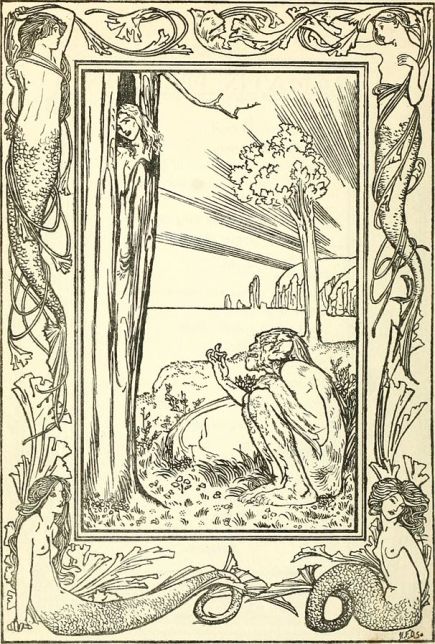
Caliban and Ariel, illustration for The Tempest by Robert Anning Bell, 1901, public domain via Wikimedia Commons

Caliban and Ariel, illustration for The Tempest by Robert Anning Bell, 1901, public domain via Wikimedia Commons

We also discussed Shakespeare’s The Tempest, one of his more difficult plays for a modern reader to take because of the racism inherent in his portrayal of Caliban, the native inhabitant of a lonely island. Born of a witch, he is taken in by Prospero, an exiled duke and self-made wizard of sorts who is marooned there with his daughter after his usurping brother puts them to sea on a ramshackle boat. It’s quite a complicated and convoluted plot with a highly artificial set-up so I won’t go into it here. The artifices, however, are there to set up some interesting conundrums and provoke what-if questions about human nature; power over others; guilt and innocence; crime, punishment, and forgiveness; knowledge, wisdom, and ignorance; and the perils of magic. One of the primary topics of the play that we discussed, however, was the notion of The Other, why and how human beings often feel about and treat others with disdain, disgust, and even cruelty when they are perceived as not being ‘one of us’.

Wooden Leg in 1913, image public domain via Wikimedia Commons

Wooden Leg in 1913, image public domain via Wikimedia Commons

This discussion set us up for the main subject of our readings and discussions: the culture and history of the Native Americans of the Great Plains, their long and disastrous encounter with the expansionist United States and its European-Americans settlers, and how this led to the current protests against the Dakota Access Pipeline at Standing Rock. It was the sort of discussion that should be happening more widely, informed by the history of Native American-United States relations which is marked throughout (on both sides but vastly more on the U.S. one) by bloodshed, racism, injustice, glory-hunting, broken treaties, misunderstandings, greed, short-sightedness, and ignorance, ignorance, ignorance. We read and talked about the tragic story of Crazy Horse, the series of events which led to the Great Sioux War and its sad aftermath, what it was like to live on the Plains (from the biography of the Cheyenne warrior Wooden Leg), and much more. I was quite ignorant myself of this long and complex history, aware only of some of the broad details. What I learned thus far, from the reading, Clay’s talks, and our discussions has made me anxious to learn much more, and to hope others are similarly inspired. I don’t think the protests will be rightly understood or have good outcomes if people don’t have sufficient understanding of how the history of this part of the world brought us to this point.

Besides all this reading, thinking, learning, and discussing, we played too: we cooked together, went on a little hike to the river, ate good food, talked and sang around the campfire, and drank (not too much, or, well, not most of the time) and made merry. One of my favorite things we did was a trip to some natural hot springs by Warm Springs Creek, where we soaked in warm pools among the snow and the tall trees, with the large creek rushing right near and a little below us. There are two pools a little ways up from the creek and one right at the side of it, or rather, forming a part of it, where a hot little waterfall tumbles down. Being the only one foolhardy enough to go down about a hundred extra yards in below-freezing weather in my wet swimsuit, I was rewarded by the exquisite experience of lying across a little rock-edged ledge which forms a shallow pool, barely large enough for one person, as I gazed up at the misty blue sky ringed by soaring snow-topped trees and the dark reddish rocks from which the warmth flowed down and over me. When overheated, I would occasionally cool myself with a shift of an arm or foot into the cold river water, the contrast providing such a delicious sensation. I don’t believe any spa could deliver bliss like this however hard they tried.

So I had a quite a time, enriched in mind and soothed in body. Thank you to all who made this a wonderful week, and I hope against hope I’ll be able to join you this summer for the Lewis and Clark tour!

lochsa-lodge-in-the-bitterroot-mountains-january-2017-amy-cools

Lochsa Lodge in the Bitterroot Mountains, January 2017

Ordinary Philosophy and its Traveling Philosophy / History of Ideas series is a labor of love and ad-free, supported by patrons and readers like you. Please offer your support today!