Happy Birthday, Bertrand Russell!

Betrand Russell in 1938, image public domain via Wikimedia CommonsBertrand Russell lived an extraordinarily long life, in which he did an extraordinary number of extraordinary things.

Encyclopedia Britannica introduces him thusly: ‘Bertrand Russell ….born May 18, 1872, Trelleck, Monmouthshire, Wales- died Feb. 2, 1970, Penrhyndeudraeth, Merioneth, [was a] British philosopher, logician, and social reformer, founding figure in the analytic movement in Anglo-American philosophy, and recipient of the Nobel Prize for Literature in 1950. Russell’s contributions to logic, epistemology, and the philosophy of mathematics established him as one of the foremost philosophers of the 20th century. To the general public, however, he was best known as a campaigner for peace and as a popular writer on social, political, and moral subjects. During a long, productive, and often turbulent life, he published more than 70 books and about 2,000 articles, married four times, became involved in innumerable public controversies, and was honoured and reviled in almost equal measure throughout the world…’

For myself, he was particularly influential to my younger freethinking self, disenchanted with the religion of my youth and seeking new and more satisfying ways of viewing the world. I read his History of Western Philosophy and Why I Am Not a Christian each several times over. I admire his clear, precise thinking and his principled anti-war stance which came at a significant cost, including jail time and loss of a prestigious job at the University of Chicago, and it’s always so enjoyable to watch him speak (you’ll find plenty of videos on YouTube) in his oh-so-aristocratic accent with a pipe often tucked into the corner of his mouth. He was not a perfect man, but he was never a less-than-fascinating one.

Learn more about the brilliant and idiosyncratic Bertrand Russell at:

Bertrand Russell – by Ray Monk for Encyclopedia Britannica

Bertrand Russell – by Andrew David Irvine for The Stanford Encyclopedia of Philosophy

Various pieces on Bertrand Russell – by Maria Popova for Brain Pickings

*A version of this piece was previously published at Ordinary Philosophy

~ Ordinary Philosophy is a labor of love and ad-free, supported by patrons and readers like you. Any support you can offer will be deeply appreciated!

The Bell Tower, Tower of London: Thomas More, Elizabeth I, and Other Histories, Part 1

Bell Tower, Tower of London, England

Saturday, May 4th, 2018

I first visited the Tower of London in January of this year with my friend Steven, a fellow student of history; I at the University of Edinburgh in Scotland, he at King’s College, London. We had great fun, two history nerds running around London for a couple of days! While we were at the Tower, I looked for the cell where Sir Thomas More was imprisoned for over a year before he was executed for treason on July 6th, 1535. Like many brought up in Catholic families after the film was made, I grew up watching the adaptation of Robert Bolt’s Man for All Seasons starring Paul Scofield, seeing it so many times I believe I could have parroted the dialogue from entire scenes from memory with little effort. Going back and watching clips, I still remember just about everything that every character will say and do ahead of time. The tragic story of and Scofield’s compelling characterization of the clever lawyer and saint captured my imagination. Since then, I’ve read more about him over the years and broadened my understanding of this man, who was much more complex than the stellar but somewhat two-dimensional martyr of integrity and righteousness portrayed in the film.

Bell Tower placard, Tower of London, England

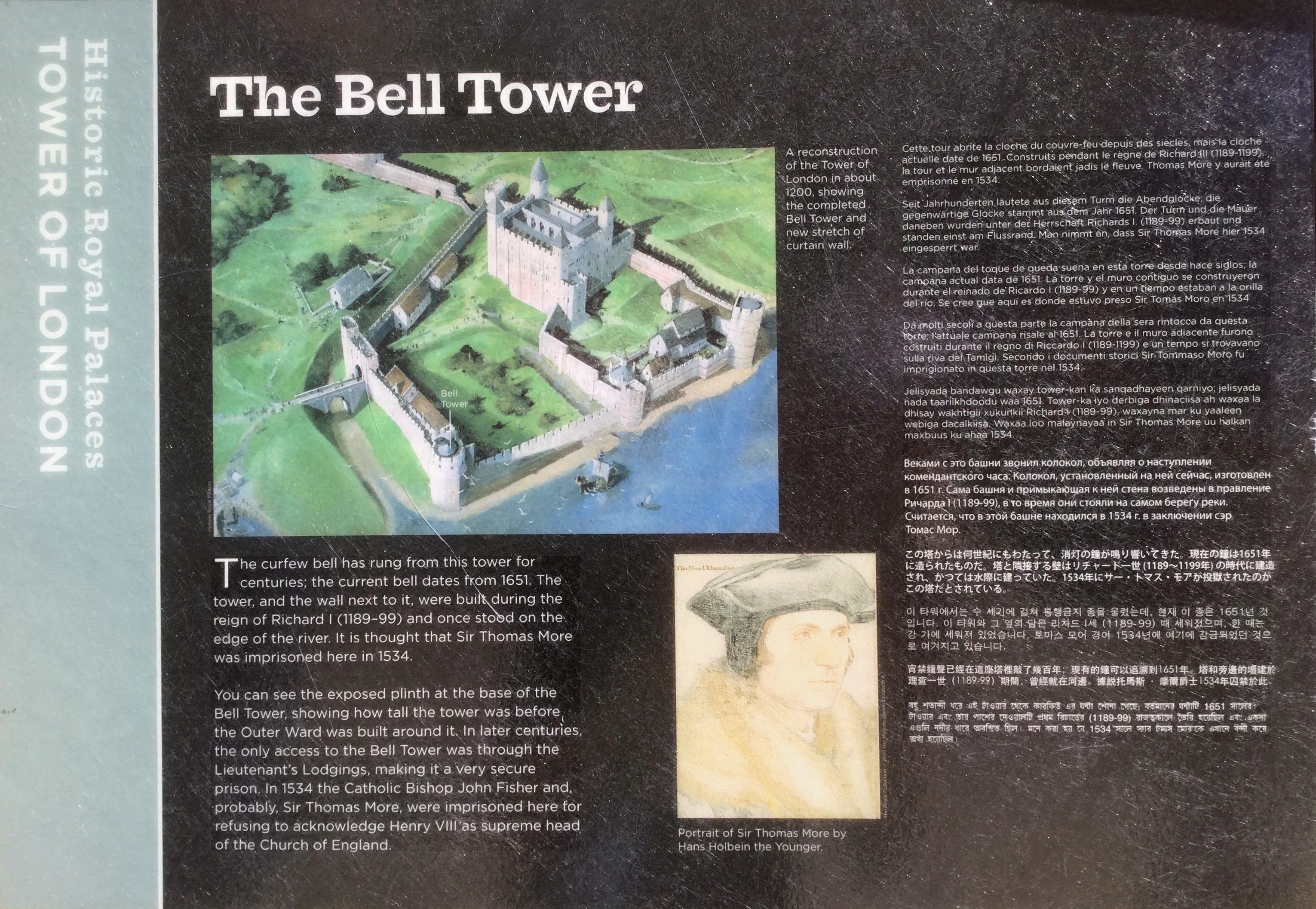
Early on in our Tower visit, I spotted a sign near the base of the Bell Tower, just across and to the left of the place where visitors enter the Tower, which identified the Bell Tower as More’s place of imprisonment. Upon further inquiry, I discovered that it’s not open to the public. It had been for a short while many years back, but wear and tear caused by visitors there and in other especially historically significant places within the Tower caused them to be closed off again. The damage was minor but happened more quickly than expected, even given the very large number of people that pass through every year: almost three million in 2017 alone! I persisted in my inquiries, as my historically nosy self is wont to do, and discovered that historians can and do seek and gain permission to visit. And so I did!

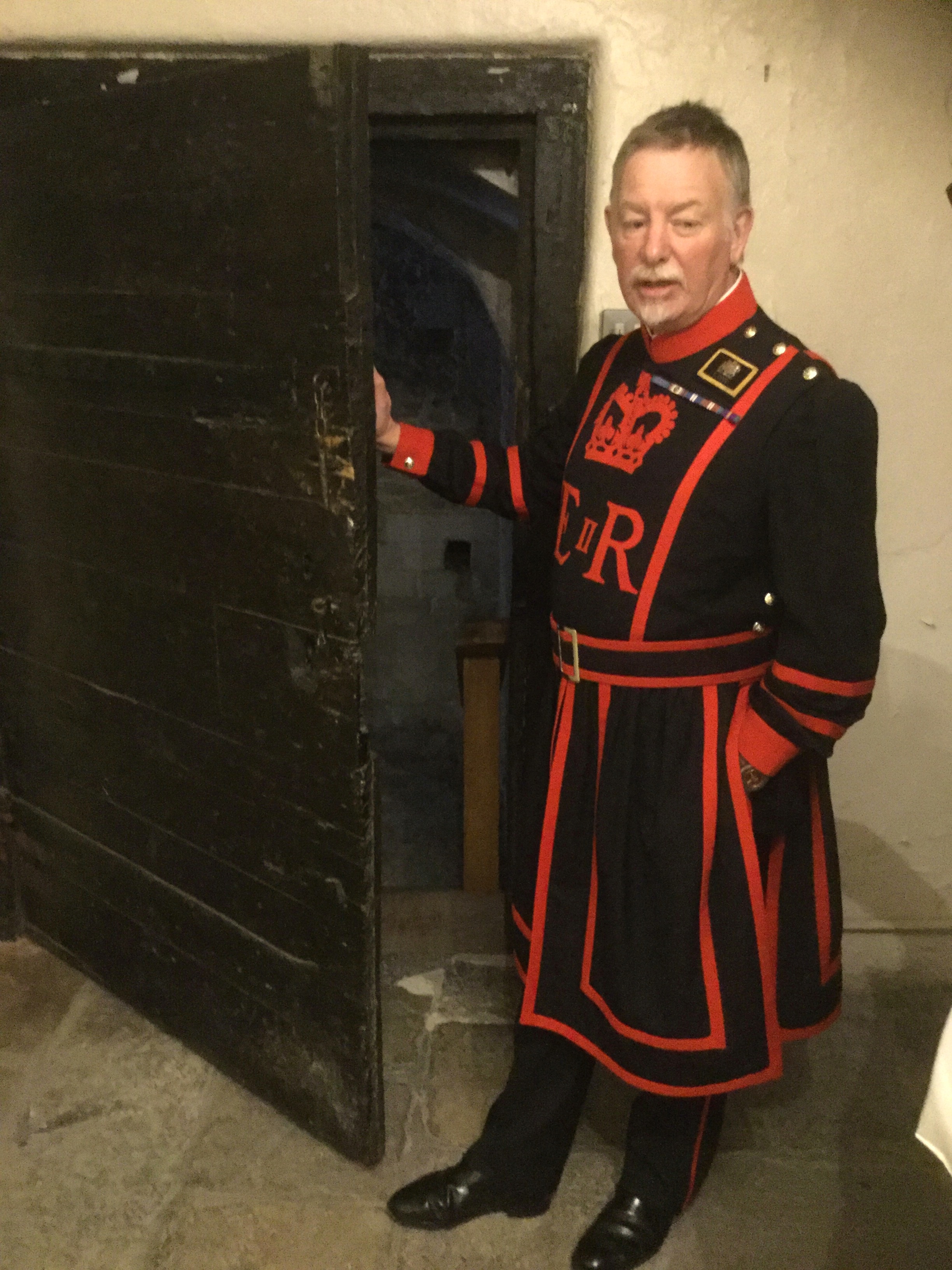
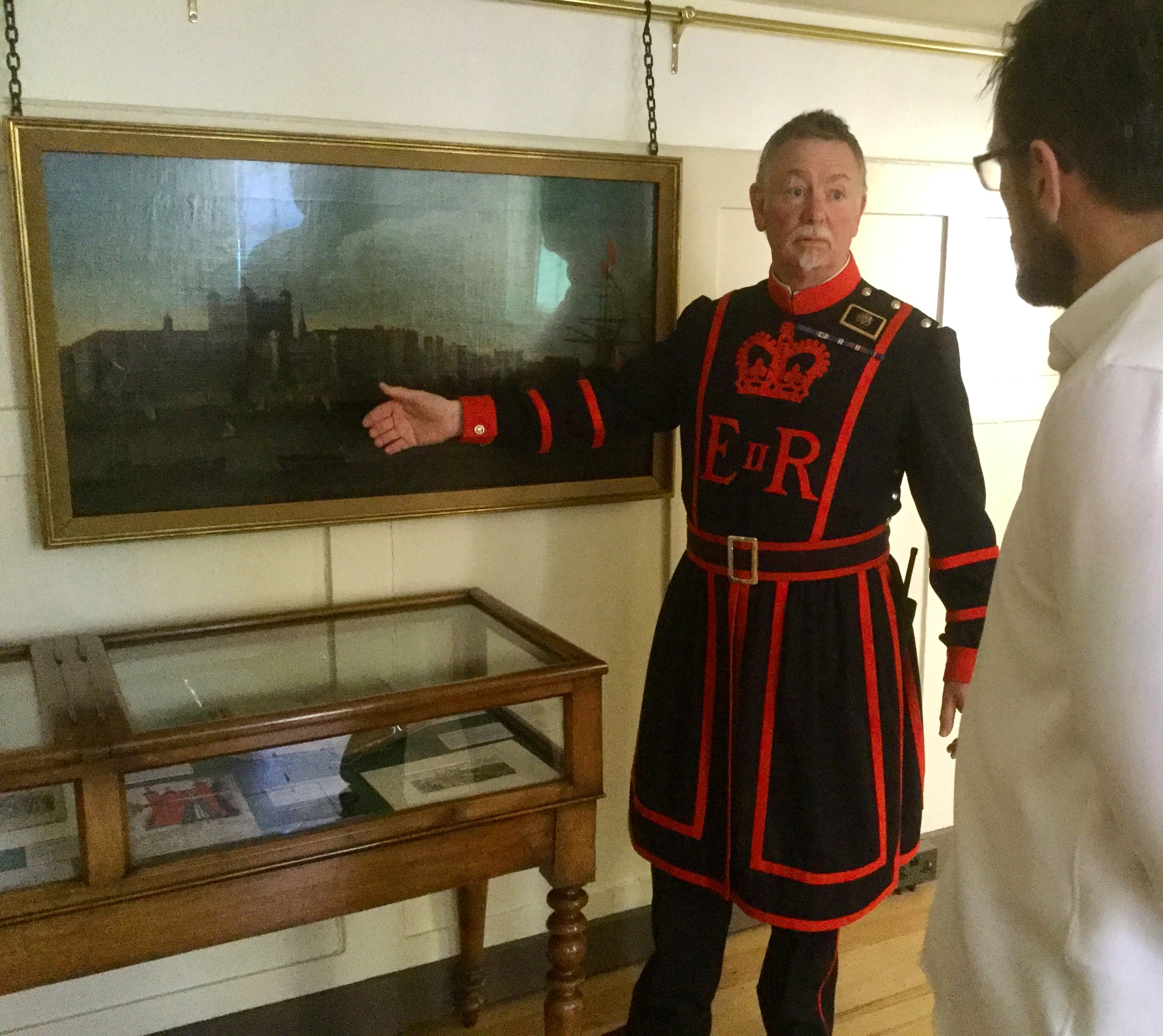
Simon Dodd, Yeoman Warder at the Tower of London

So on the morning of May 4th, 2018, I arrive at the Tower of London’s raven cages, this time with Laurence as my companion (unfortunately, Steven had a prior engagement and couldn’t make it.) We’re a little early for our assigned meeting time of 11 am with a Yeoman Warder of the Tower, one of the ceremonial guardians also commonly known as ‘beefeaters.’ We’re bleary-eyed since we had pulled an all-nighter: I was unable to get the night before off of work so I went straight to the airport after my shift in the very wee hours of the morning. Laurence very kindly met me there to keep me company. Fortunately, his sense of adventure is also strong and his knowledge of efficient travel to London excellent, so here we are, ahead of time. It’s a very sunny day, almost hot, much different than my first visit to the Tower which had been, appropriately, moodily gray and drizzly. As we wait, we watch the ravens. It’s long been a tradition to keep a certain number of these clever birds at the Tower, where they’re fed, groomed, and trained, their wings clipped just enough to keep them from going over the Tower walls but not enough to keep them from their perches. Some of them are roaming freely. Two of the ravens are nuzzling one another on a perch within one of the cages, one ducking regularly and enthusiastically to groom the other’s neck feathers.

Yeoman Warder Simon Dodd arrives and greets us. He proves throughout our time together to be an extremely friendly, knowledgeable, witty, and all-around delightful man, and very generous with his time. I couldn’t have asked for a better host or conversational partner. Laurence is particularly interested and well-read in military history and Simon has had a long and distinguished military career, so, we all have a lot to talk about. I only hope, as we tour and talk, that my sleep-deprived brain can form intelligent questions and process his answers. I take no chances with its ability to successfully retain information: I take plentiful notes as we go. After introductions and a brief chat, we start right in on our tour.

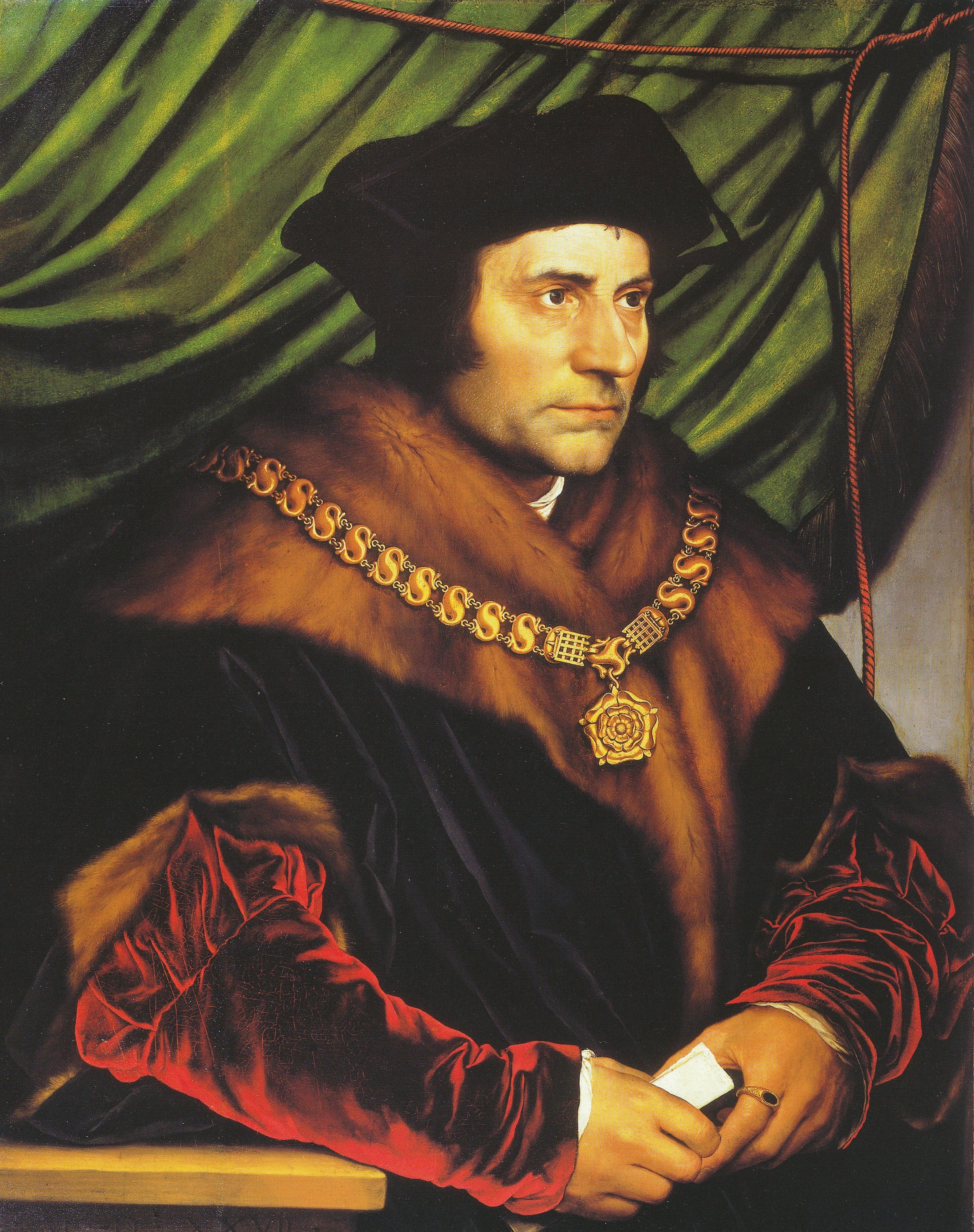
Sir Thomas More by Hans Holbein the Younger, ca. 1527, public domain via Wikimedia Commons

Before I get into the details of the day’s explorations, let me offer a few more details about Thomas More just in case this is your introduction to him, or, just in case it’s been awhile since you read or heard anything about him and your memory is rusty on the subject. Born on February 6th, 1478, he was a lawyer, scholar, writer, statesman, and Lord Chancellor of England from 1529 until he asked King Henry VIII to release him from the post in 1532 when More found himself no longer able to support the King in his power struggle with the Pope. Henry VIII’s first wife, Catherine of Aragon, was the widow of his older brother prior to Henry’s marriage to her. When the marriage failed to produce any living male heirs, Henry VIII sought to have his marriage to her annulled, freeing him to marry his paramour Anne Boleyn. Trouble was, Henry VIII had already sought and won a special dispensation to marry Catherine in the first place from the previous Pope; the new Pope was a virtual prisoner of the Holy Roman Emperor Charles V; and Catherine was the Emperor’s aunt. So, as you can imagine, this whole annulment business was a sticky, tangled religious and political mess. Henry solved the problem in a typically aggressive and self-aggrandizing way: he tore the Church of England away from the Catholic Church and placed himself at the head of it, ruining careers, taking away titles, confiscating lands and property, and chopping off heads along the way.

More and Henry went way back. More first met Henry when the latter was a young prince. In 1499, More’s friend Erasmus brought him along to the palace where the royal family was staying. The bright, athletic, and precocious eight-year-old Henry was second in line to the throne behind his elder brother Arthur. More would become a huge influence on and trusted counselor of King Henry VIII until the King turned against him when More refused to formally acknowledge Henry as supreme head of the Church in England. Erasmus was another central figure in More’s life. He was twelve years older than More, yet the two became very intimate friends very quickly. Erasmus called More ‘sweetest Thomas’ and More called Erasmus ‘my derlynge’ (my darling). These two humanist scholars bonded deeply over books and writing; Erasmus and More were inspirations for one another’s most enduring works, Erasmus’ In Praise of Folly (in fact, the book’s original Latin title Moriae Encomium is a pun on More’s name) and More’s Utopia. When More decided to turn his energies to a life of public service instead of scholarship, Erasmus was disappointed, but they remained friends. Sadly, according to More’s biographer John Guy, Erasmus effectively abandoned him in his troubles with the King, yet More continued to write to him as to a trusted friend up to the end of his life.

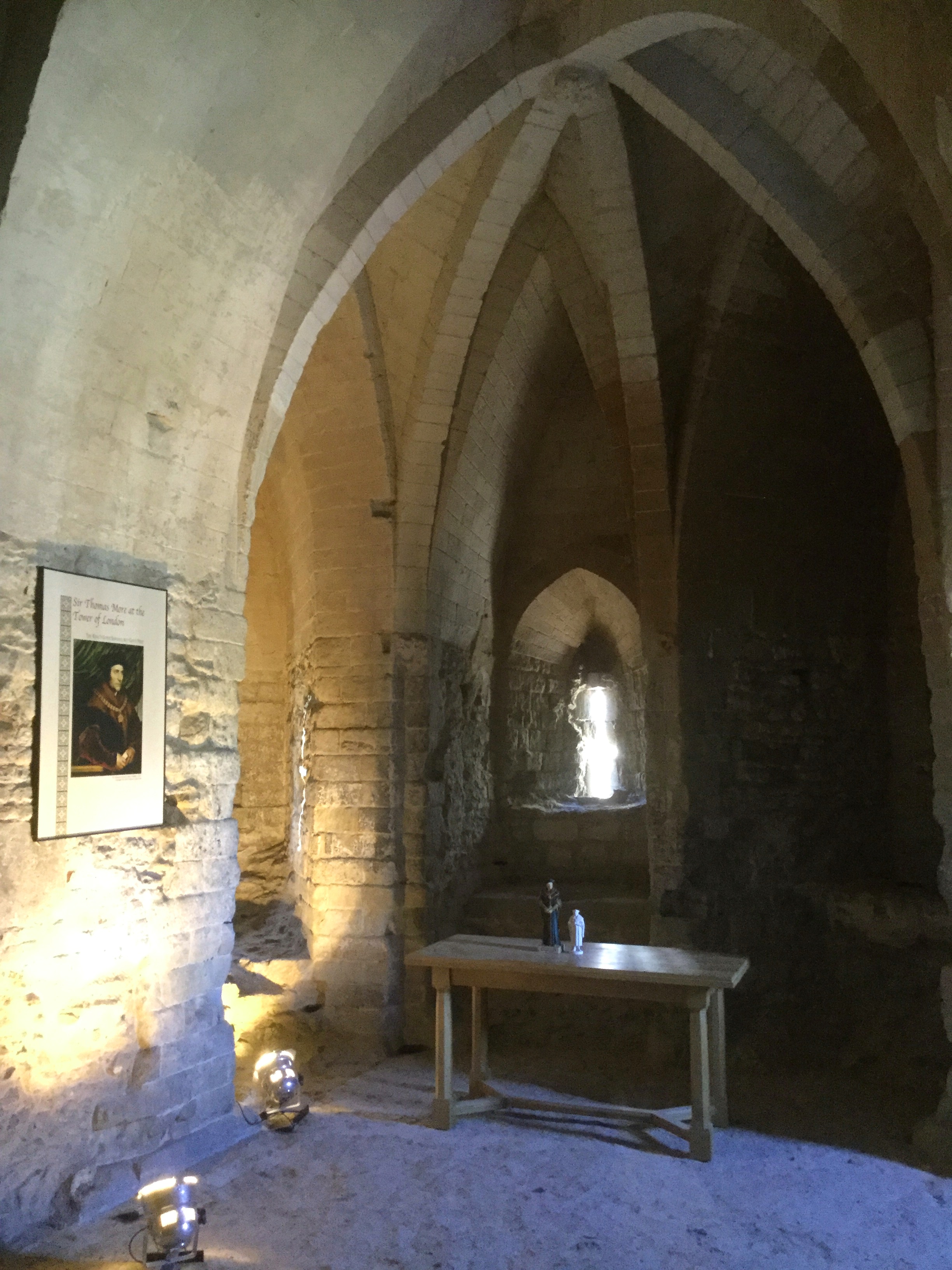
A view of the Thomas More cell in the Bell Tower, Tower of London

The bonds of trust and friendship between More and Henry VIII only went so far, however, at least on Henry’s part. From the beginning, More made it clear to Henry that his beliefs regarding the annulment and the nature and extent of papal authority did not accord with Henry’s actions or with what was included in the final version of the Act of Succession. Henry promised to allow More the freedom to act in accordance with his conscience, but like so many of Henry’s promises, this one turned out not to be worth much. Eventually, Henry (perhaps prodded by Anne Boleyn) demanded that More swear to the Act. More found he could not since the preamble of the Act specified that the monarch was the supreme head of the church in England rather than the Pope; as he told the King’s ministers charged with administering the Oath of Supremacy to him, ‘…it were a very hard thing to compel me to say either precisely with [the Act of Supremacy] against my conscience to the loss of my soul, or precisely against it to the destruction of my body.’

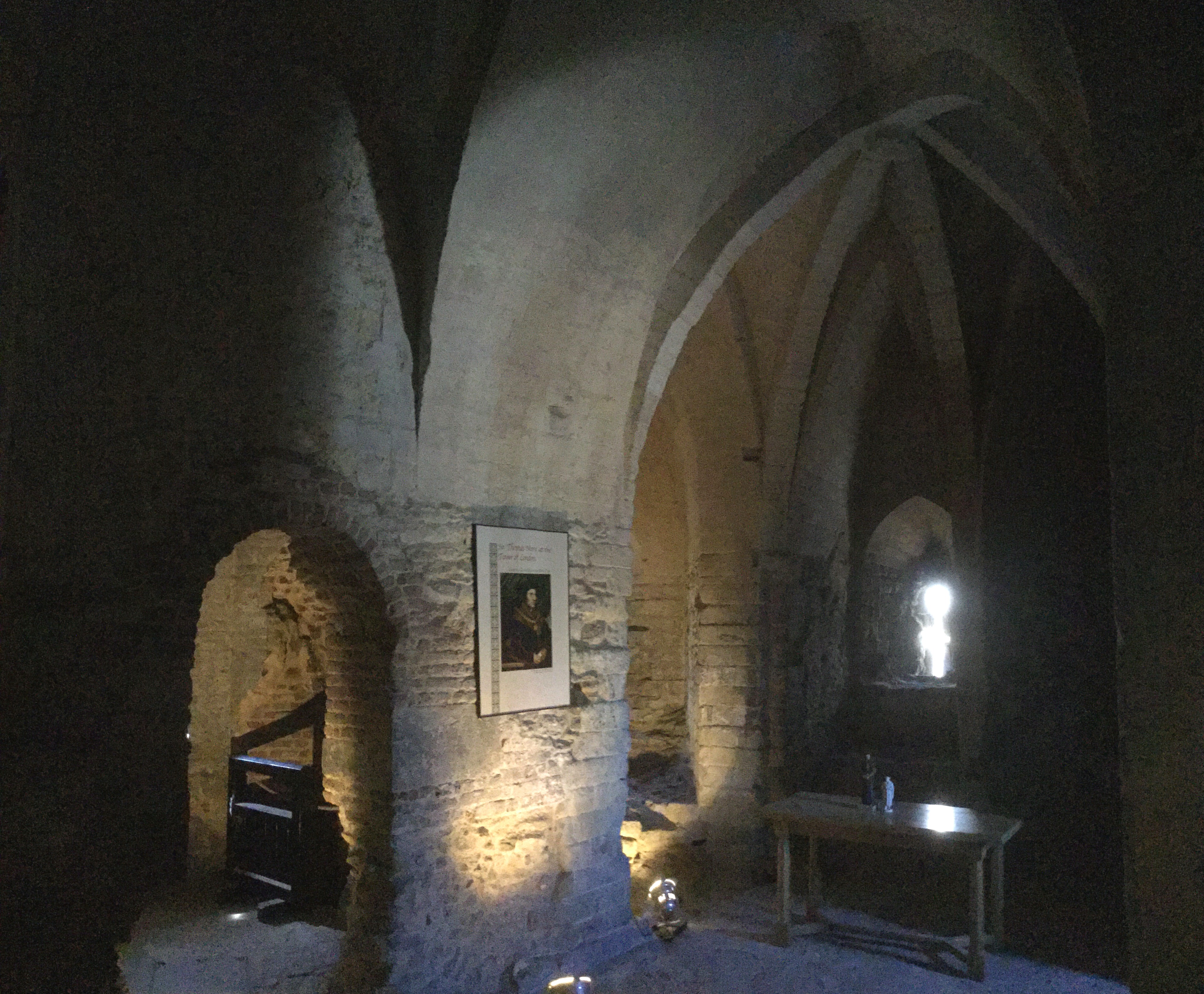
To return to the story of the day… Simon leads us first to the place I first sought: the cell where Sir Thomas More was held. Well, maybe he was held here. There’s plenty of dispute about this: there’s no contemporary written record of where exactly More was held. Historians disagree and their dispute continues in books, newspapers, and elsewhere. The Tower of London’s signage indicates that he was most likely kept in this Bell Tower cell, but Simon responds to my questions regarding this dispute that the chances may even be ‘fifty-fifty’ that he was held here or in the Salt Tower, another very secure cell where politically dangerous but distinguished and influential people like More were held. He goes on to explain that the southwest or southeast tower, the Bell Tower or Salt Tower respectively, were the only two likely candidates for More’s cell. Outside of rooms in the central White Tower, which was not a place of imprisonment at the time, the Bell Tower cell is the most secure, with 11 foot thick stone walls and 30 foot deep stone foundations. The Salt Tower was also pretty secure, though not quite to this degree.

A wider view of Thomas More’s cell, Bell Tower, Tower of London

Another More historian, Peter Ackroyd, believes More might have been held at least for a time in the Beauchamp Tower, where many other religious and political prisoners were held. But those cells were not so secure nor isolated as the Bell or Salt Tower cells. According to the notes for Ackroyd’s biography, Sonja Johnson of the Tower of London described More’s cell as ‘one of those apartments which were reserved for the more influential or privileged “guests” of the lieutenant. His was a pentagonal stone chamber, with a vaulted ceiling; it was some nineteen feet in height, with a floor space of approximately eighteen feet by twenty feet. The walls themselves were between nine and thirteen feet thick, the floor flagged through with rough and uneven stone, the windows merely arrow-slits or “loops”‘. And, it was cold: cold enough that, Simon says, it was used as a larder for a time. In fact, the very cool temperature helped preserve the room, despite the damp. Johnson’s description fits perfectly with this high-ceilinged, chilly stone room we’re in.

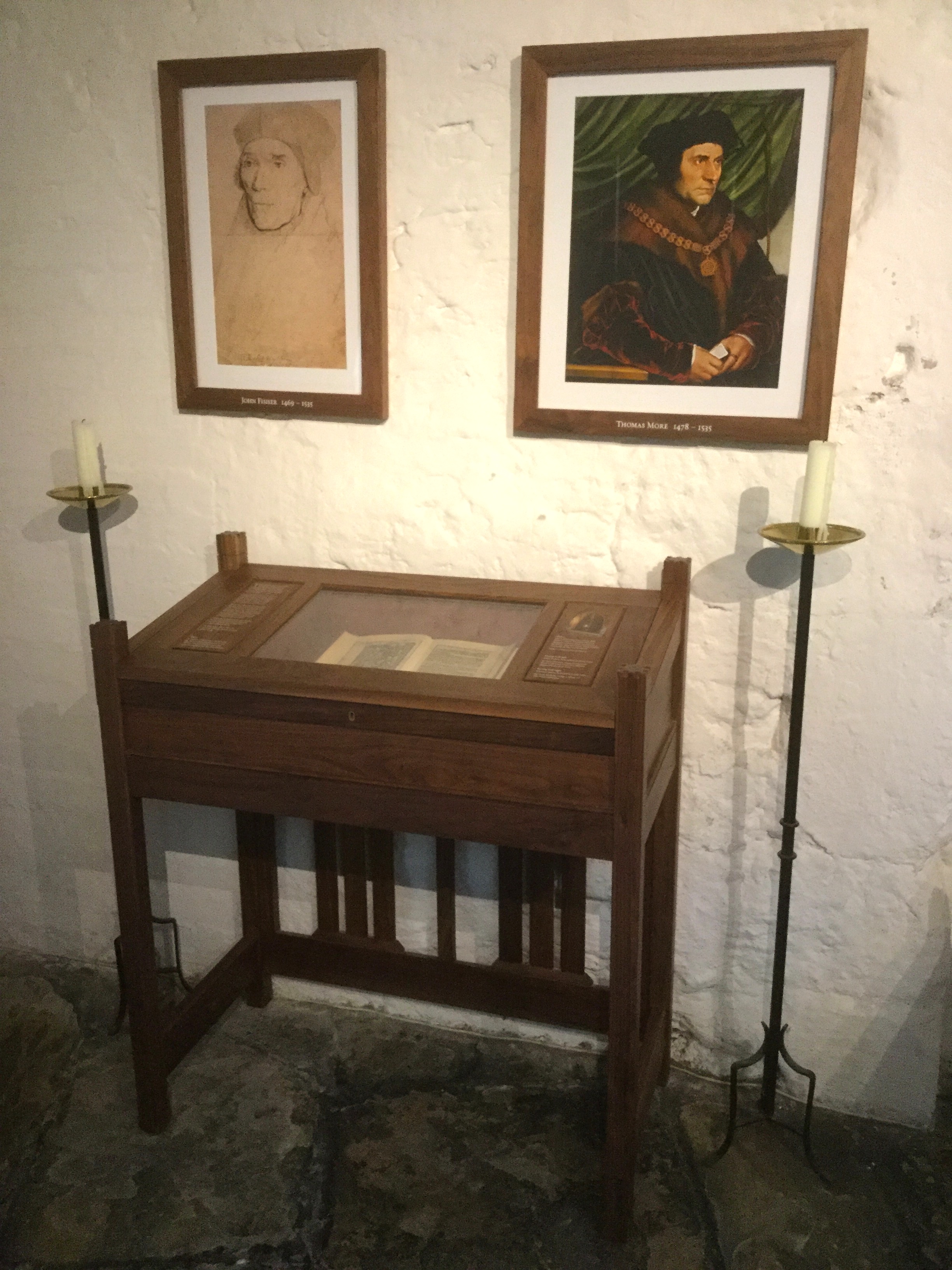
John Fisher and Thomas More portraits in chamber below St Peter ad Vincula, Tower of London

There are other reasons to think More may not have been held in this cell, at least not during the entire time of his imprisonment in the Tower. Historical researcher Stephen Priestley told the Guardian’s Maev Kennedy that Tower authorities tried to break up communication between More and fellow prisoner Bishop John Fisher, who was also opposed to the Act of Succession, much more openly so than More, and also thrown into the Tower for it. The cell above this one in the Bell Tower, which at the time could be reached by a narrow staircase from this one, was the one that held Fisher, or at least, probably did. This leads Priestly to surmise that Fisher and Thomas would have been eventually placed where they could not communicate so easily with one another. I also consider the stories that Simon and others tell of More rapping on the ceiling to get Fisher’s attention in the room above. But, as you can see yourself from the photos and as Simon points out today, this hardly seems possible in the Bell Tower cell, no matter how hard you might pound on the ceiling if you found a way to reach it at all. Perhaps, then, More and Fisher were held, at least for awhile, in neighboring cells where such communication was possible. Or perhaps, the ceiling-rapping stories are apocryphal and More and Fisher communicated only through smuggled notes and letters, as we know for certain they did.

On the way from the Bell Tower’s lower cell to our next destination, we spot Merlin the Raven. Simon Dodd tells us that she was named prior to knowing her sex, which was later determined by DNA. That’s the only way you can tell, he says – other than by such behavior as egg-laying, of course.

Overall, given what I’ve read and heard, I think, like Ackroyd does, that More’s place of imprisonment changed at least once. In one of his letters written in 1534 from his prison cell to his eldest daughter and confidante Margaret Roper, who he called ‘Meg,’ More reports that he was returned to ‘close keeping’ and ‘shut up again.’ Does this mean he was imprisoned more securely, perhaps in a different room, or just not allowed to leave his cell? Ackroyd interprets More’s comments to mean he was held in solitary confinement, but perhaps they could also refer to his being moved to a more isolated, stronger cell away from others where escape or rescue was far less likely.

After spending some time looking closely at the Bell Tower cell, talking over its history, and discussing the likelihood and duration of More’s imprisonment here, Simon, Laurence, and I re-emerge from the dim cell blinking against the bright sun’s light.

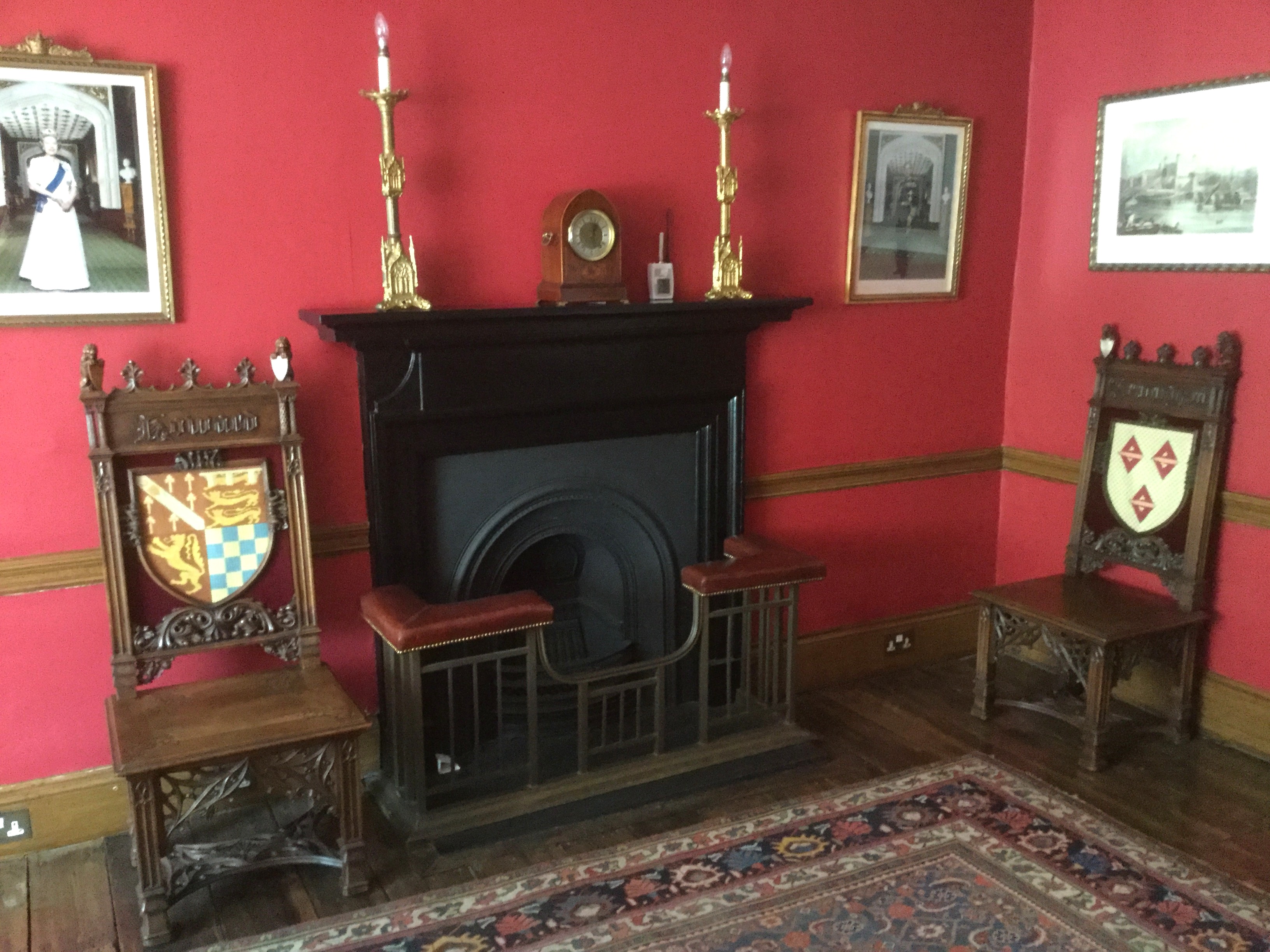
Next, we make a short visit to the Queen’s House. Simon tells us a bit about the history and historians of the Tower and that there have been 160 Constables of the Tower since 1066, the portraits of many of which are hanging here on the Queen’s House wall. He tells us about the early-to-mid 19th century Constable Duke Wellington who worked to make the Tower function better; made it look more like it did in the medieval era; increased its military management; and who was dismayed when tourism to the Tower drastically increased during his tenure there. Simon recommends us to read and watch David Starkey’s, Lucy Worsley’s, and Anna Keay’s books and audiovisual productions to learn more about Tudor history in general. In researching this piece, I recently read a Telegraph article about Starkey’s sharp criticism of the BBC’s historical miniseries Wolf Hall‘s negative portrayal of Thomas More.

A room in the Queen’s House, Tower of London

Simon Dodd telling us history in the Queen’s House, Tower of London

Simon also describes changing features of the Tower over the centuries with reference to a lovely old painting of the Tower hanging on the wall, and indicates the route by which More would have been taken from the gate through which he entered the Tower to his cell in *the Bell Tower.

We will see and talk about many, many more things during our day’s tour of the Tower so I’ve decided to break up this story into multiple parts. Stay tuned for more about our Tower adventure…

*Patron of this Tower of London journey: Laurence Murphy ~ With warmest gratitude, thank you!

Listen to the podcast version here

~ Ordinary Philosophy is a labor of love and ad-free, supported by patrons and readers like you. Any support you can offer will be deeply appreciated!

~~~~~~~~~~~~~~~~~~~~~~

Sources and inspiration:

Ackroyd, Peter. The Life of Thomas More. London: Chatto & Windus, 1998

Annual Survey of Visits to Visitor Attractions: Latest Results.‘ VisitBritain.org

Borman, Tracy. The Story of the Tower of London. London: Merrell Publishers Limited, 2015

Borman, Tracy. ‘The Tudors and the Tower.‘ Tudor Times website, 3 Aug 2015

Camden, William Norton, Robert; Hans and Hanni Kraus. The historie of the most renowned and victorious Princesse Elizabeth, late queen of England. Contayning all the important and remarkeable passages of state both at home and abroad, during her long and prosperous raigne. Composed by way of annals. Neuer heretofore so faithfully and fully published in English.
Sir Francis Drake Collection Library of Congress. London: Printed by N. Okes for B. Fisher; 1630

Collinson, Patrick. ‘Elizabeth I (1533–1603), Queen of England and Ireland.‘ Oxford Dictionary of National Biography.

Davies, C. S. L., and John Edwards. ‘Katherine [Catalina, Catherine, Katherine of Aragon] (1485–1536), Queen of England, First Consort of Henry VIII.’ Oxford Dictionary of National Biography

English Monarchs website: ‘The Bell Tower’ and ‘The Queen’s House

Freeman, Thomas S. (2002). ‘`As true a subiect being prysoner’: John Foxe’s notes on the imprisonment of Princess Elizabeth, 1554-5.‘ (Notes And Documents). The English Historical Review, 117(470), 104-116

Furness, Hannah. ‘Wolf Hall is ‘Deliberate Perversion’ of History, says David Starkey.The Telegraph, 26 Jan 2015

Guy, John. A Daughter’s Love: Thomas and Margaret More. London: Fourth Estate, 2008

Guy, John. ‘For What Did Thomas More So Silently Die?’ Lecture published at Tudors.org

House, Seymour Baker. ‘More, Sir Thomas [St Thomas More] (1478–1535), Lord Chancellor, Humanist, and Martyr.‘ Oxford Dictionary of National Biography.

Ives, Eric William. ‘Henry VIII (1491–1547), King of England and Ireland.’ Oxford Dictionary of National Biography.

Jones, Jonathan. ‘Wolf Hall is Wrong: Thomas More was a Funny, Feminist Renaissance Man.‘ The Guardian, 29 Jan 2015

Kennedy, Maev. ‘Historians Scorn Claims over Thomas More’s Cell.The Guardian, 10 Jan 2000

Marc’hadour, Germain P. ‘Thomas More.’ Encyclopædia Britannica

More, Thomas. The Apology of Sir Thomas More, Knight. from The Complete Works of St. Thomas More, Vol. 9. Yale University Press, published online by The Center for Thomas More Studies

More, Thomas. Conscience Decides: Letters and Prayers from Prison Written Between April 1534 and July 1535. Selected and arranged by Dame Bede Foord; preface by Trevor Huddleston; introduction by Germain Marc’hadour. London: Geoffrey Chapman Ltd, 1971

More, Thomas. The English Correspondence of Sir Thomas More, 1947 Rogers edition, Princeton University Press, published online by The Center for Thomas More Studies

Moynahan. God’s Bestseller: William Tyndale, Thomas More, and the Writing of the English Bible – A Story of Martyrdom and Betrayal. New York: St. Martin’s Press, 2003

Plowden, A. ‘Grey [married name Dudley], Lady Jane (1537–1554), Noblewoman and Claimant to the English Throne.Oxford Dictionary of National Biography.

Roper, William. The Life of Sir Thomas More1556. Ed. Gerard B. Wegemer and Stephen W. Smith. Center for Thomas More Studies, 2003

Stanford, Peter. ‘Sir Thomas More: Saint or Sinner?’ The Telegraph, 20 Jan 2015

Teysko, Heather and Melita Thomas. ‘Tudor Times on Thomas More.’ Renaissance English History Podcast: A Show About the Tudors, episode 55, Sep 16, 2016

Citizenship, Belonging, and the Experiences of Amero-Africans in West Africa: An Analysis of William Innes’ Early History of Liberia

Rev. Dr. William Innes of Edinburgh

In 1831 and again in 1833, Waugh and Innes of Edinburgh published a history of Liberia by ‘Minister of the Gospel’ William Innes.[1]

In his Liberia: Or, The Early History & Signal Preservation of the American Colony of Free Negroes on the Coast of Africa, Innes describes the founding, structure, and struggles of this West African colony, founded in the early 1820’s as a haven for free and previously enslaved people of African descent and for ‘recaptives’[2] rescued from the newly illegal transatlantic slave trade.[3] Innes was an alumnus of the University of Edinburgh, an ‘independent’-minded Presbyterian and then Baptist minister, one-time chaplain of Stirling Castle, missionary, bookseller, and author of over two dozen books and other publications, mostly on religious topics. The titles of his publications, such as Reasons for Separating from the Church of Scotland (Dundee, 1804), Christianity, the Only Effectual Support Under the Afflictions of Life (Edinburgh, 1810), Domestic Religion, or an Exposition of the Precepts of Christianity Regarding the Duties of Domestic Life (Edinburgh, 1822), and Instructions for Young Enquirers (Edinburgh, translated into Gaelic 1827) indicate why this otherwise mostly theological writer decided to write a history of a colony.[4] As we shall see, this reform-minded man viewed Liberia as a worthy project within the larger goal of uplifting lives as well as souls.

Although Innes’ account includes some discussion of the hardships faced by the colonists trying to build a community in and wrest a living from this unfamiliar and somewhat hostile territory, he presents a generally positive view of the experience and prospects of the Liberian colonization project. Indeed, Innes seems anxious to convince his readers that the colony could not only exist and thrive, but that it should. As we shall see, Liberia is, to Innes, a project of community-building in line with ordered nature and with American beliefs in democracy, self-sufficiency, and the sense of social harmony necessary for a united and healthy political community. In interrogating this text, then, we are led to ask: how are ideas about citizenship and belonging implied and described in Innes’ history of Liberia, how do they relate to the lived experiences of Amero-Africans in the United States and Liberia, and how are these ideas challenged?

Innes commences his history with a discussion of the historical conditions in which this colonization movement arose. The American Colonization Society (ACS) was founded in November of 1816 as a benevolent institution dedicated to the long-conceived but as yet unsystematic scheme of colonizing black inhabitants of the United States to Africa, the continent of their ancestral origin.[5] As Innes and many others saw it, including many abolitionists and proslavery advocates alike,[6] black people could never live peacefully side by side with white Americans. Innes writes that all black persons are ‘branded by their colour as an inferior caste.’[7] He argues that so long as they live as an ‘inferior’ class within the general community of free persons, both black and white will suffer the ill effects of living in a mixed-race society, made up as it is of people with necessarily disparate natures and irreconcilable interests.[8] So long as people of African descent live within the mainstream white American community, the majority of the former will remain ‘idle, ignorant, vicious’ as a result of their disfavor, and cites as an example of this that ‘in many cases the free negroes are a great annoyance to the community, often living by pilfering the property of their neighbors.’[9] Therefore, Innes explains, the only way that people of African descent can create communities to which they naturally belong is to form them separately from white communities, and the best place to do so is by establishing their own communities in the continent of their ancestor’s origin. In doing so, they can enjoy the rights and privileges of citizens with others who share their place in the racial hierarchy. [10] In his majority opinion for the United States Supreme Court 1856 decision in the Dred Scott v. John F. A. Sandford case, which exacerbated the divisive political issues of slavery and race that helped spark the United States’ Civil War,[11] Chief Justice Roger Taney agrees with Innes’ theory of natural racial separation. He likewise believes that human beings are manifestly and naturally separated into inferior and superior races that cannot form a united political community.[12] Ideas such as Innes’ and Taney’s permeated political debate and policy in the United States for decades to come, widely disenfranchising black Americans and relegating them to second-class citizenship throughout the nation.

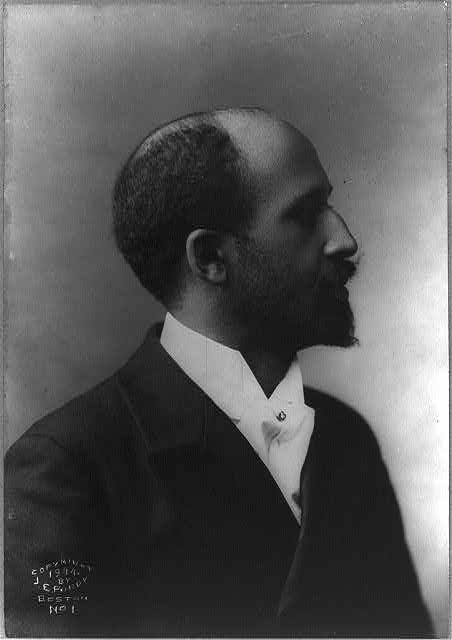
W.E.B. Dubois, Photograph taken by J.E. Purdy in 1904, public domain via Library of Congress

W.E.B. Dubois, Photograph taken by J.E. Purdy in 1904, public domain via Library of Congress

Yet the colonization scheme as described above is a manifestation of paradoxical ideas about belonging and citizenship rather than a straightforward, across the board rejection of the rights or abilities of black persons to enjoy political power, despite Taney’s assertions to the contrary. According to Innes, Taney, many in the ACS, the U.S. government, and so many Americans, people of African origin who were brought to American shores to labor, to raise crops and buildings and in every other way contribute to the economy and to the material well-being of United States citizens nevertheless do not belong within the political community nor could ever be citizens themselves. Yet advocates of colonization such as Innes believed that people of African descent were or could become citizens in Africa even if they were not born there. This was and continued to be believed by many of African descent as well. W.E.B. DuBois, African-American historian, racial theorist, and proponent of the pan-Africanist ‘vision’[13] of Africa as the natural homeland for all people of African descent, describes Africa as ‘fatherland,’ and ‘motherland.’ DuBois concedes that he has only a ‘tenuous’ connection to Africa ‘in culture and race’, like most people colonized to Africa in Innes’ time. African scholar M.B. Akpan points out that Amero-Africans (acculturated Americans of African descent who settled in Africa) who went to Liberia were vastly different from native Africans in about as many ways as they could be, in dress, language, religion, taste in food, clothing, housing, art, and so on.[14] Yet some, like DuBois, perceived themselves as bound to Africa by an essential ‘kinship.’[15] For Innes and others, this kinship is entirely racially based; for DuBois and many pan-Africanists, ‘the real essence of this kinship is its social heritage of slavery; the discrimination and the insult; and this heritage binds [us] together…’[16]

Innes and proponents of Amero-African colonization, Taney and other racial hierarchists, and pan-Africanists like Dubois share a belief that there is something about a common African descent and shared experiences, however combined with ethnic descent and acculturation from elsewhere, which creates a natural community. Such natural communities, in turn, create opportunities for citizenship that cannot be enjoyed at all, or at least not fully, in any other context. These ideas are in tension throughout Innes’ account of how West African colonies came to be and the way they persisted despite significant challenges and hardships. These challenges arose within the colonies themselves and from conflicts between colonists and the ecology, and between colonists and their native African neighbors. Innes’ account of the difficulties faced by the Liberian colonists differs significantly in many respects from later scholarship and from other contemporary accounts. In Innes’ account, these difficulties are relatively minor compared to the benefits the colonists enjoyed as citizens of a new community to which they rightly belonged.[17] The contrast between Innes’ account and other contemporary accounts backed up by later scholarship[18] imply that Innes’ driving concern to use Liberia as a positive example of how racially-based communities are formed biased his very favorable presentation of the colony.

Regarding their prospects for acceptance and inclusion within the mainstream American social and political community, Innes describes his perception of the state in which non-enslaved people of African descent find themselves:

…[T]roughout the non-slaveholding states, the negroes form a distinct race, branded by their color as an inferior caste; regarded with a species of loathing when thought of as companions, and for ever shut out from the privileges of the white men by whom they are surrounded. Be it prejudice, or founded on reason, the feeling of dislike mutually exists… .No matter what may be their industry and sobriety; no matter what their attainments in science, or their character for morality, they can never hope to pass the broad line of demarcation, or assume a station of equality with the other members of the community.[19]
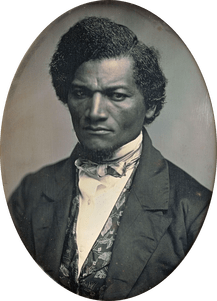
Frederick Douglass ca. 1847-52, Samuel Miller, American 1822-1882, Art Institute of Chicago, public domain via Wikimedia Commons

Racial hierarchists like Taney share the ‘species of loathing’ which Innes describes. Today, Innes’ and Taney’s descriptions of race relations are difficult to read, especially Taney’s. For one, they conflict with contemporary thoughts and sensibilities about race which are, in the main, orders of magnitude more optimistic about the likelihood that people of various races and ethnicities can meaningfully share and participate in communities as social and political equals. For another, they don’t ring true, especially in Taney’s harsh Dred Scott account of the social and political issues of race in America. After all, there were many mixed-race communities in which black Americans lived relatively safely and peacefully alongside their white neighbors even given the national tensions over issues of race. Leading black abolitionist and orator Frederick Douglass settled in one such community, New Bedford, Massachusetts, following his escape from slavery in Maryland in 1838.[20] Taney’s opinion reads very much like a partisan political document and presents a wholly dismal picture of both the capabilities and prospects of people of African descent.[21] Innes’ commentary, on the other hand, presents a more mixed though still racially hierarchical view. On the one hand, he implies in the selection above and makes clearer elsewhere that he believes people of African descent are fully capable of ‘industry and sobriety,’ of morality, of worthy and admirable attainments, of being ‘provident’ and ‘respectable,’ of conducting ‘affairs of empire,’ and so on.[22] Yet Innes does not believe they are capable of this, on the whole, so long as they live in communities among their white racial ‘superiors.’[23] Removal from white society and colonization with others of their own racial heritage, then, is the answer.

Yet all the qualities that Innes enumerates as making people belong within communities and which he characterizes as those of good citizens, he already ascribes to Americans of African descent. We can see this most clearly in the passages in Innes’ history where he describes the contrast between Amero-African colonizers and the beneficial and ‘civilizing’ influence that they exert on their native Africans neighbors. In matters of language, religion, dress, morality, ability, education, and so on, they are in turn, deems Innes, superior to their native African neighbors and the latter, recognizing this, wish to emulate them.[24] We can also recognize Innes’ conflicting views in the terms he chooses to refer to the Amero-African colonists and the native African peoples in their territorial conflicts. When describing the participants and victims of battles, Innes refers to Amero-Africans and their native African allies in such terms as ‘woman’, ‘men,’ ‘persons,’ ‘mother’, ‘the people’, and so on. By contrast, Innes refers to native Africans primarily by terms such as ‘barbarian,’ ‘savage’, ‘enemy’, and ‘wretches’, characterized by ‘moral deformity.’[25] This implies that for Innes, civilization can depend on culture, virtues, religious beliefs, and modes of comportment rather than race. The very qualities that make people belong to a community and become good citizens can and are often held by Amero-Africans whatever side of the Atlantic. As we can see in the selection above, Innes concedes this even as he explains why black people cannot belong within American white communities. He allows that black individuals can and do ‘rise above their degraded brethren’ and exhibit such good-citizenship qualities as ‘character for morality’ and ‘industry and sobriety,’ capable of ‘mak[ing] attainments in science’ and so forth.[26] Innes, then, presents two very distinct conceptions of belonging, citizenship, and race which are, if not in direct conflict, at least in tension with one another.
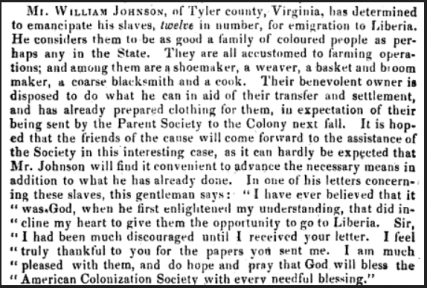
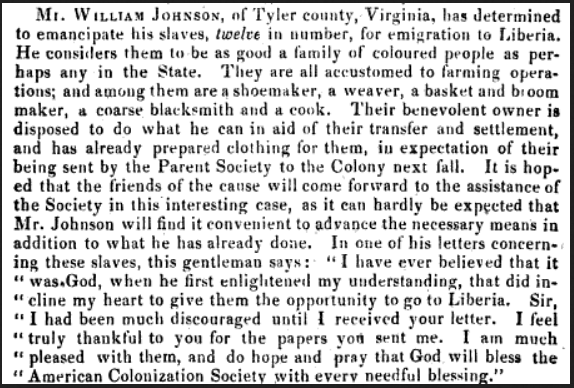
Clipping from The African Repository and Colonial Journal, V. XIII 1837, describing the efforts of William Johnson to settle his former slaves in Liberia, public domain via Wikimedia Commons

Perhaps Innes resolves these conflicting ideas about race and belonging to his own satisfaction through his appeal to divine approval. Innes, as a ‘Minister of the Gospel,’[27] looks for and finds signs of God’s will that the Liberian colony survive. He argues that God must approve of removing black people to Liberia because the preservation of Liberian colonies is unlikely otherwise given the obstacles they faced, which in turn shows divine approbation of this racial separation.[28] The idea of divine arrangement of peoples into natural types and nations which pervades Innes’ history resembles such racially hierarchical theories as Taney’s. However, Innes’ view of racial ordering displays more divine benevolence for the black race even as it is extremely patriarchal. Innes perceives a divine will that all people of African descent be redeemed through their separate political and religious institutions. This will best be brought about first by separating the races into naturally sympathetic racially divided communities, and then locating those communities in places where they can spread the gospel of Christ to others of the same race who have not yet received it through the establishment of colonies. The colonizers were then placed in a position to help bring about the divine will in the world such as providing a Christian example to their African neighbors[29] and helping to end the ‘evil’ and ‘dreadful malady’ of the slave trade.[30]

Yet Innes’ overall sunny take on the lived experience of the Liberian colonists contrasts with contemporary and later accounts of the Liberian experiment. Douglass, for example, is skeptical of the glowing accounts of the colony’s success as well as of its prospects of helping to end the slave trade; he questions the motives and therefore the accuracy of those offering glowing accounts of the colonization effort’s success.[31] Innes’ account is one which invites such skepticism. He considers the ‘signal preservation’ of the colony a sign of God’s approval but does not consider the severe hardships that he chooses to cite such as supply shortages, attacks from neighboring tribes, difficulties raising crops, the fact that they had to wrest the colony’s land concession from Dei ‘King Peter’ at gunpoint, and the high rates of disease and death as signs of God’s disapproval.[32] Innes seems to minimize the hardships in Liberia as he follows every mention of them with an immediate qualification or comparison, such as citing the early American colonies’ struggles or remarking that the Liberian colonies could have suffered worse.[33] He goes so far as to dismiss symptoms of illness as mere climatic adjustment reactions of healthy bodies, though he does admit that many died.[34] According to historian Claude Andrew Clegg, however, the colonists often suffered extremely high rates of hunger, disease, privation, and mortality.[35] Clegg also cites many examples of the colonists’ difficulties, including the telling example of Emily Hooper, a young colonist who, after an extraordinarily difficult and expensive effort on her father’s part to obtain her freedom and fund her journey to Liberia, decided to return to slavery rather than further suffer the hardships of the colony. This episode was a great embarrassment to the ACS.[36]

In addition to the evidence of hardship and mortality in many reports, accounts like Innes’ are roundly challenged by argument and even ridicule. One particularly scornful and influential critic of the colonization scheme was Douglass. Indeed, except for the fact that he actually refers to [news]paper accounts in his ‘Persecution on Account of Faith, Persecution on Account of Color’ address delivered in Rochester, New York in 1851, it would be reasonable to assume that Douglass was referring to Innes’ history when he observed: ‘Papers that never speak of colored men in this country but to abuse and slander them, speak in the most flattering terms of …Liberia.’[37] To Douglass, arguments such as those offered by Innes and American statesman Henry Clay, who recommend the removal of black people from American society due to idleness, lawlessness, and other perceived flaws invite a counter-question: ‘Suppose we should admit… that we are degraded and dissolute, as a class; are there no other degraded and dissolute people?… Who talks of their expatriation?’ to which he answers: ‘No one.’[38] Douglass also mocks the idea that colonization movement will weaken slavery as an institution. It’s the presence of free black people in slave states that help weaken slavery by demonstrating to the enslaved that there is another way they can live in America. Removing free black people to Africa, argues Douglass, removes this constant and substantial threat to slaveholders’ desire to rule unchallenged over a docile, resigned slave population.[39]
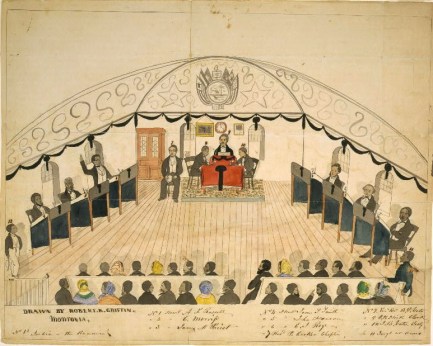
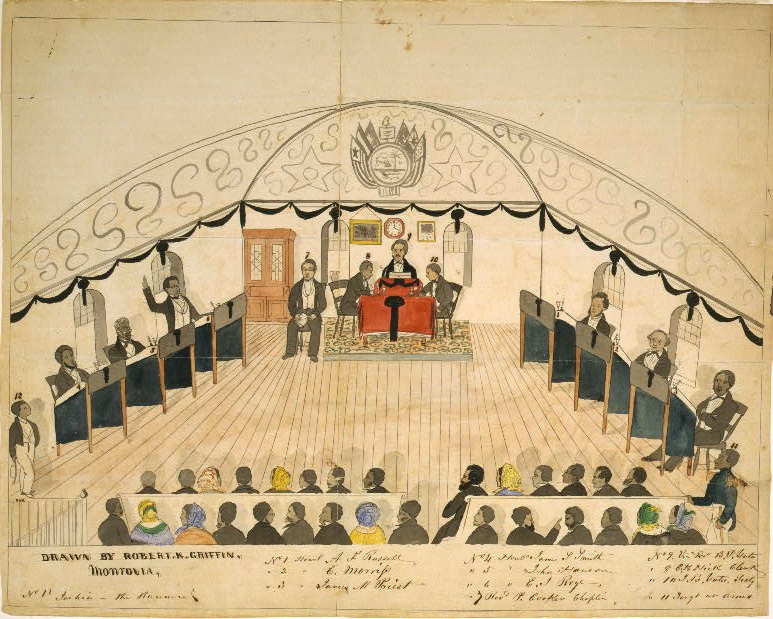
Liberian Senate drawn by Robert K. Griffin, Monrovia, 1856, public domain via the Library of Congress

Throughout his early history of Liberia, Innes wavers but does not stray far from his theme of Liberia as a natural home for Americans of African descent. His explanations for how and why Amero-Africans, acculturated to the United States in language, morals, religion, dress, and overall ways of life nevertheless belong in a land which most have never seen are not, as we have seen, entirely consistent. Why Amero-Africans can only successfully gain a sense of belonging and engage as citizens in a place where they are outsiders in every way except skin color is also not satisfactorily explained; indeed, Innis presents Liberia as if it were the only alternative to black Americans continuing to live in a state of political and social exclusion and oppression in mainstream white American society. Innes offers the ‘signal preservation’ of the Liberian colony as proof of its value to God and humankind as well as of its eventual success, but glosses over any consideration that the terrible hardships and dangers that the colonists had to face were evidence to the contrary. Others such as Douglass, however, perceive the flaws in the explanations and evidence that Innes offers, and presents both counterevidence and counterarguments that helped undermine support for the colonization project over the decades of its existence.[40]

~ Ordinary Philosophy is a labor of love and ad-free, supported by patrons and readers like you. Any support you can offer will be deeply appreciated!

Bibliography

Akpan, M. B. “Black Imperialism: Americo-Liberian Rule over the African Peoples of Liberia, 1841–1964.” Canadian Journal of African Studies/La Revue Canadienne Des études Africaines 7, no. 2 (1973): 217-36.

Clegg, Claude Andrew. The Price of Liberty: African Americans and the Making of Liberia. 2004.

Douglass, Frederick. Autobiographies. New York: Library of America, 1996.

Douglass, Frederick, and John R. McKivigan (project director). Frederick Douglass Papers: Digital Edition. Accessed 20 March 2018 at http://frederickdouglass.infoset.io/

Douglass, Frederick, and John W. Blassingame. The Frederick Douglass Papers. Series 1, Speeches, Debates and Interviews; John W. Blassingame, Editor. Vol.1, 1841-46. New Haven; London: Yale University Press, 1979.

Du Bois, W. E. B., and Herbert Aptheker. Dusk of Dawn. 1975.

Scott, Hew. Fasti Ecclesiae Scoticanae: The Succession of Ministers in the Church of Scotland from the Reformation, Vol. IV: Synods of Argyll, and of Perth and Stirling. Edinburgh: Oliver and Boyd, 1923.

Geiss, Imanuel. The Pan-African Movement. London: Methuen, 1974.

Innes, William. Liberia: Or, The Early History & Signal Preservation of the American Colony of Free Negroes on the Coast of Africa. Waugh & Innes; M. Ogle, etc., 1833. Accessed 20 March 2018 at https://babel.hathitrust.org/cgi/pt?id=hvd.32044051050987

Staudenraus, P. J. The African Colonization Movement, 1816-1865. London: Oxford University Press, 1961.

United States Supreme Court, Roger Brooke Taney, John H Van Evrie, and Samuel A Cartwright. The Dred Scott decision: opinion of Chief Justice Taney. New York: Van Evrie, Horton & Co., 1860. Retrieved from the Library of Congress, Accessed 21 March 21, 2018 at https://www.loc.gov/item/17001543/

West, Richard. Back to Africa: A History of Sierra Leone and Liberia. New York: Holt, Rinehart and Winston, 1971.

[1] Innes, William. Liberia: Or, The Early History & Signal Preservation of the American Colony of Free Negroes on the Coast of Africa. Waugh & Innes; M. Ogle, etc., 1833, frontispiece

[2] Clegg, Claude Andrew. The Price of Liberty: African Americans and the Making of Liberia. 2004 p. 37

[3] Staudenraus, P. J. The African Colonization Movement, 1816-1865. London: Oxford University Press, 1961 p. 51

[4] ‘William Innes’ in Scott, Hew. Fasti Ecclesiae Scoticanae: The Succession of Ministers in the Church of Scotland from the Reformation, Vol. IV: Synods of Argyll, and of Perth and Stirling. Edinburgh: Oliver and Boyd, 1923 pp. 325-326

[5] West, Richard. Back to Africa: A History of Sierra Leone and Liberia. New York: Holt, Rinehart and Winston, 1971 p. 93

[6] Clegg p. 3-4, Staudenraus pp. 2-7

[7] Ibid. p 102

[8] Innes pp. iv-v, 101-103

[9] Ibid. p. iv

[10] Ibid. pp. 102, 106-107

[11] Clegg pp. 174, 195-196

[12] United States Supreme Court, Roger Brooke Taney, John H. Van Evrie, and Samuel A. Cartwright. The Dred Scott decision: opinion of Chief Justice Taney. New York: Van Evrie, Horton & Co., 1860 pp. 18-19

[13] Geiss, Imanuel. The Pan-African Movement. London: Methuen, 1974 p. 5

[14] Akpan, M. B. “Black Imperialism: Americo-Liberian Rule over the African Peoples of Liberia, 1841–1964.” Canadian Journal of African Studies/La Revue Canadienne Des études Africaines 7, no. 2 (1973) p. 219

[15] Du Bois, W. E. B., and Herbert Aptheker. Dusk of Dawn. 1975 pp. 116

[16] Ibid. p. 117

[17] Innes pp. 87-89

[18] Clegg pp. 226-229

[19] Ibid. p. 102

[20] Douglass, Frederick. Autobiographies. New York: Library of America, 1996 pp. 353ff

[21] Taney pp. 17-18

[22] Innes pp. 77, 86-87, 91

[23] Ibid. pp. 101-102, 176

[24] Innes p. 83, 86-89

[25] Ibid. pp. 57-65

[26] Ibid. p 102

[27] Ibid., frontispiece

[28] Ibid. pp. vi-vii, 37-38, 62, 64, 72, 91

[29] Ibid., pp. 112-115

[30] Ibid., pp. 9-10, 108-112

[31] ‘Persecution on Account of Faith, Persecution on Account of Color: An Address Delivered in Rochester, New York, on 26 January 1851,’ North Star, 30 January 1851, in Douglass, Frederick, and John R. McKivigan (project director). Frederick Douglass Papers: Digital Edition, pp. 300-302

[32] Innes, pp. v-vi, 16-21, 38-39, 93-95, 101, 108-111; Clegg, p. 37; West pp. 114-115

[33] Innes., pp. 91-92

[34] Ibid., p. 93

[35] Clegg, see descriptions and figures in chapter 7 of The Price of Liberty, ‘To Live and Die in Liberia,’ pp. 201-248

[36] Ibid., pp. 187-188

[37] Douglass, ‘Persecution,’ p. 302

[38] ‘Henry Clay and Colonization Cant, Sophistry, and Falsehood: An Address Delivered in Rochester, New York, on 2 February 1851, North Star, 6 February 1851, in Douglass, Frederick, and John R. McKivigan (project director). Frederick Douglass Papers: Digital Edition, p. 323

[39] Ibid., p. 322

[40] Staudenraus, pp. 249-250

Remembering Margaret Fell

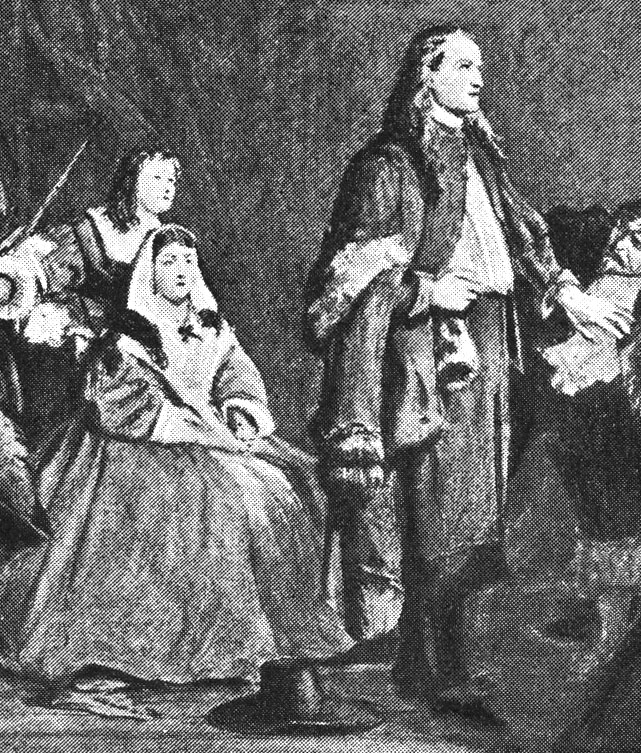
Margaret Fell, with George Fox before the judges, from a painting by J. Pettie 1663, public domain via Wikimedia Commons

Margaret Fell with George Fox before the judges, from a painting by J. Pettie, 1663

Margaret Fell was born on some unknown date in 1614, so let’s take this occasion to remember her on the date of her death, April 23rd, 1702.

Fell’s lived a life as passionate as it was long. She was an unconventional thinker for her time, a zealous and progressive religious activist at times imprisoned for her beliefs, a prolific writer, well-traveled, a mother of eight children and a wife twice.

An early adherent and eloquent promoter of Quakerism, Fell is now considered one of its founders. She converted to Quakerism after hearing a sermon by one of its most charismatic preachers, George Fox, and almost immediately launched into a lifetime of hosting Quaker meetings and speaking out on behalf of her new religion. After her husband died some years later, Fell married Fox, probably more as a co-missionary than as a romantic partner since their work, travels, and imprisonments kept them apart for much of their marriage.

As I’ve had a lifelong fascination with the history of human rights, I’ve long admired the Quakers because, along with Unitarians and Deists, so many have been leaders in the struggle to expand, establish, and promote them. That’s because these faiths emphasize the importance of individual conscience, the primacy of the human mind, God’s rational nature, and the moral equality of all human beings.

Fell believed in the Quaker doctrine of the Inner Light which God has caused to shine equally in the hearts of all beings; all we need do is heed it. Therefore, one does not need ministers, priests, or any other authorities or intercessors to achieve salvation. And because God has created everyone for the same purpose and gave everyone that light, everyone is spiritually equal and capable of understanding and proclaiming the Truth. We can see how this doctrine, central to Quakerism, readily aligns with human rights movements centered on a belief human spiritual and intellectual equality. The right of women to speak in church and write religious texts, in her time limited to men, was a cause particularly dear to Fell’s heart. While Fell’s belief in the equality of women was limited to their role as spiritual beings, Quakerism tended to encourage ever-more progressive beliefs in its adherents. Over time, many Quakers came to be leaders in the abolitionist and pacifist movements, promoting the right of all to receive equal and universal education and for women’s rights in social and political spheres as well.

In light of her achievements as a female religious pioneer, and the human rights advances facilitated by the Quaker faith she helped found, Fell’s contributions should continue to be remembered and celebrated.

*A version of this piece has been previously published at Ordinary Philosophy

~ Ordinary Philosophy is a labor of love and ad-free, supported by patrons and readers like you. Any support you can offer will be deeply appreciated!

~~~~~~~~~~~~~~~~~~~~~~~~~~

Sources and inspiration

Broad, Jacqueline, ‘Margaret Fell‘, The Stanford Encyclopedia of Philosophy, Edward N. Zalta (ed.)

Jacoby, Susan. Strange Gods: A Secular History of Conversion. New York: Pantheon, 2016 (see the chapter on Margaret Fell)
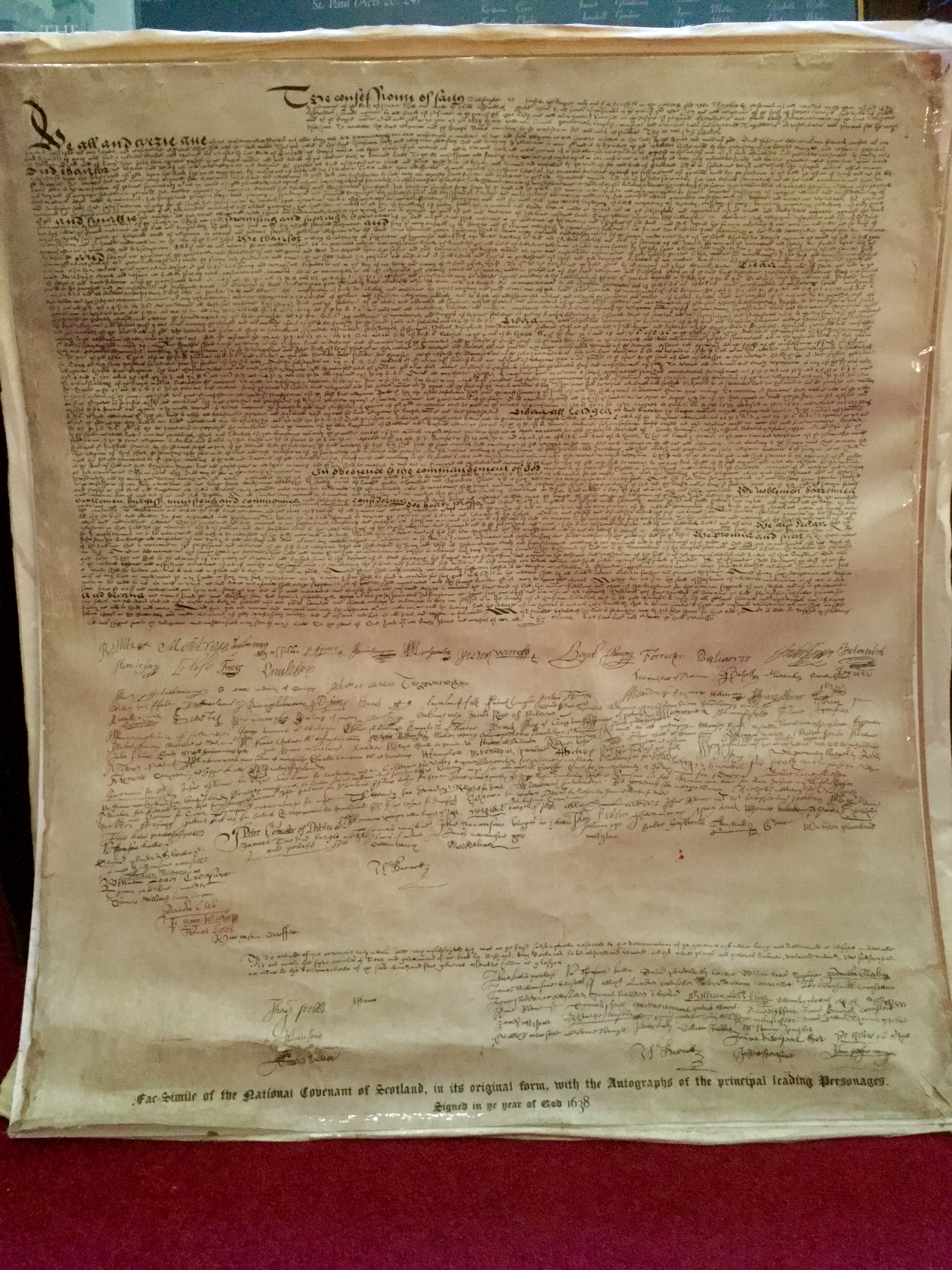
Photobook: Magdalen Chapel, Edinburgh, Scotland

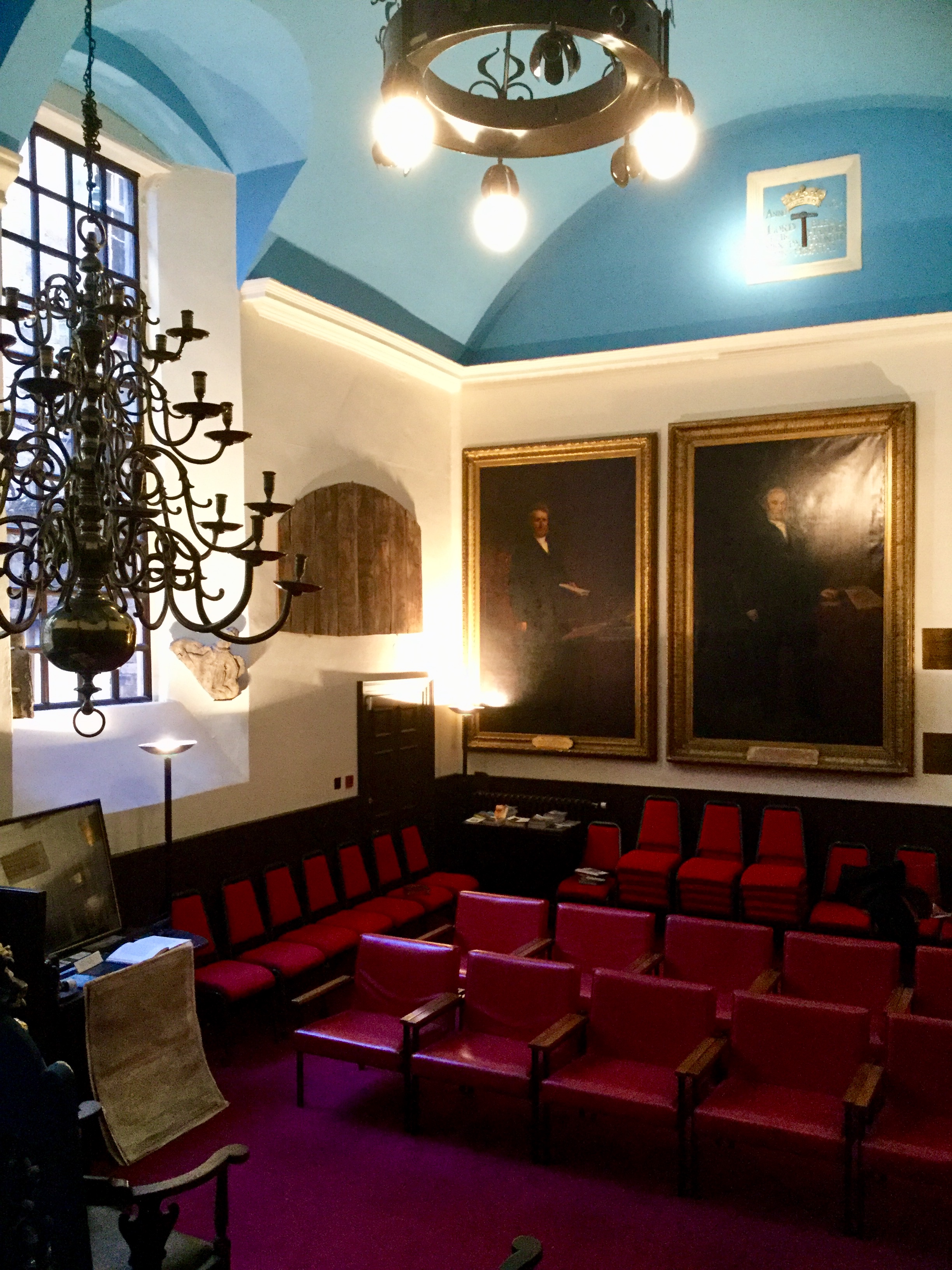
Magdalen Chapel, built in 1541 in the Cowgate, Edinburgh, Scotland. This lovely little church, like so many of the oldest places of worship in Scotland, saw much drama over the centuries, involved as it was as the Catholic and Protestant battle to retain and to win over the hearts and consciences of the people. Covenanters executed nearby in the Grassmarket in the 1680’s were brought here and their bodies prepared for burial. The Chapel now belongs to the Scottish Reformation Society.

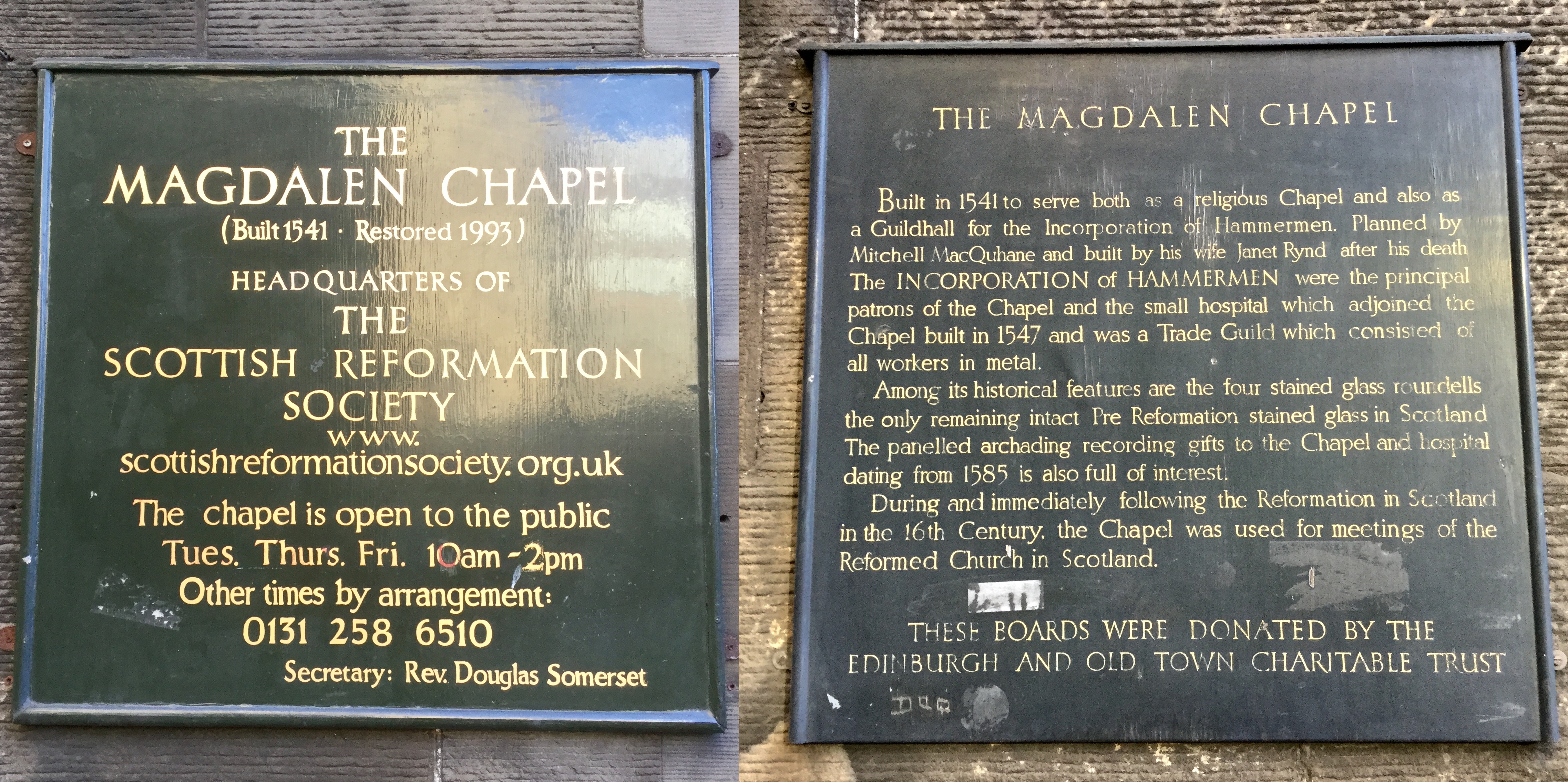
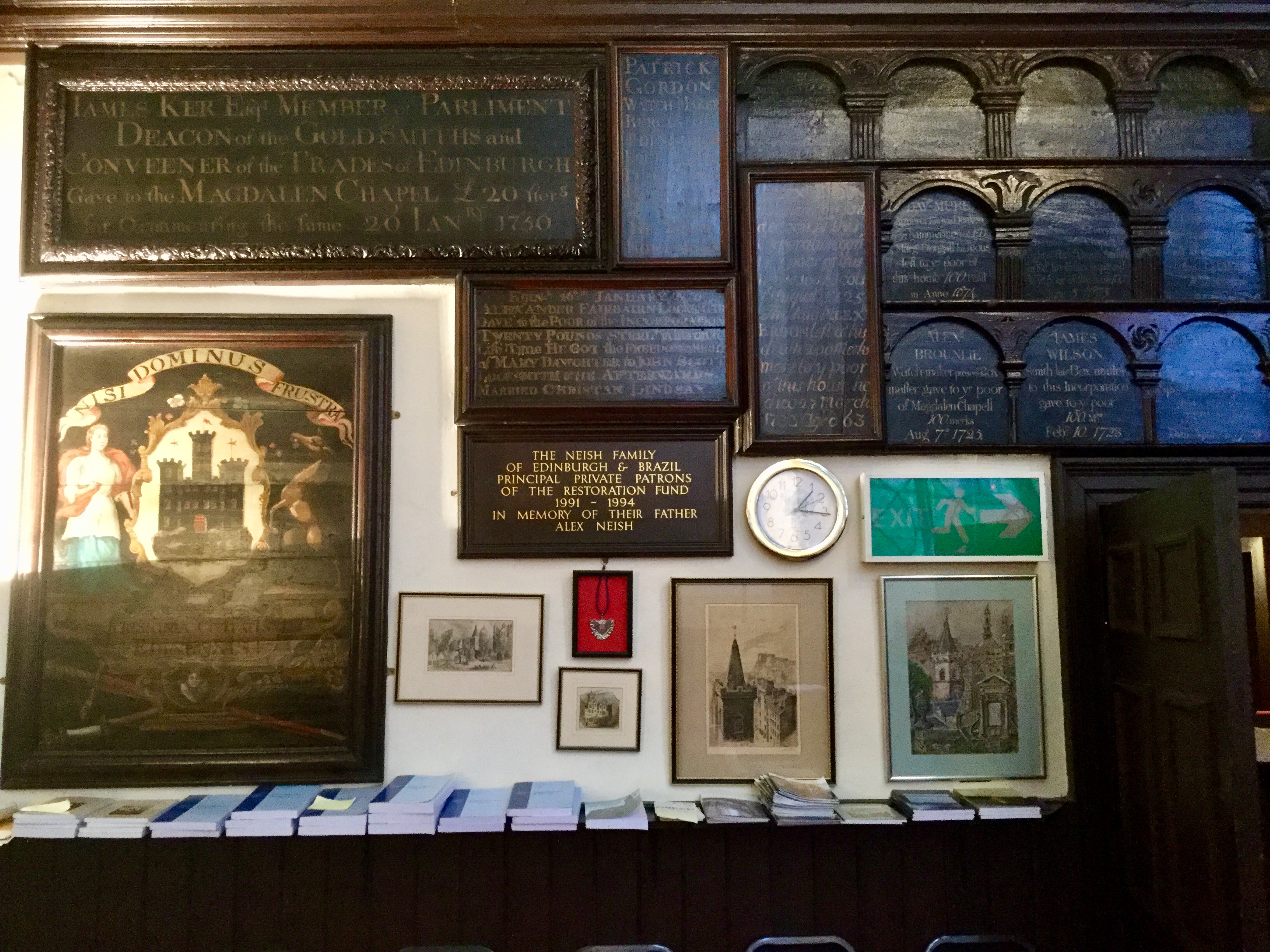
Magdalen Chapel historical plaques, Cowgate, Edinburgh, Scotland

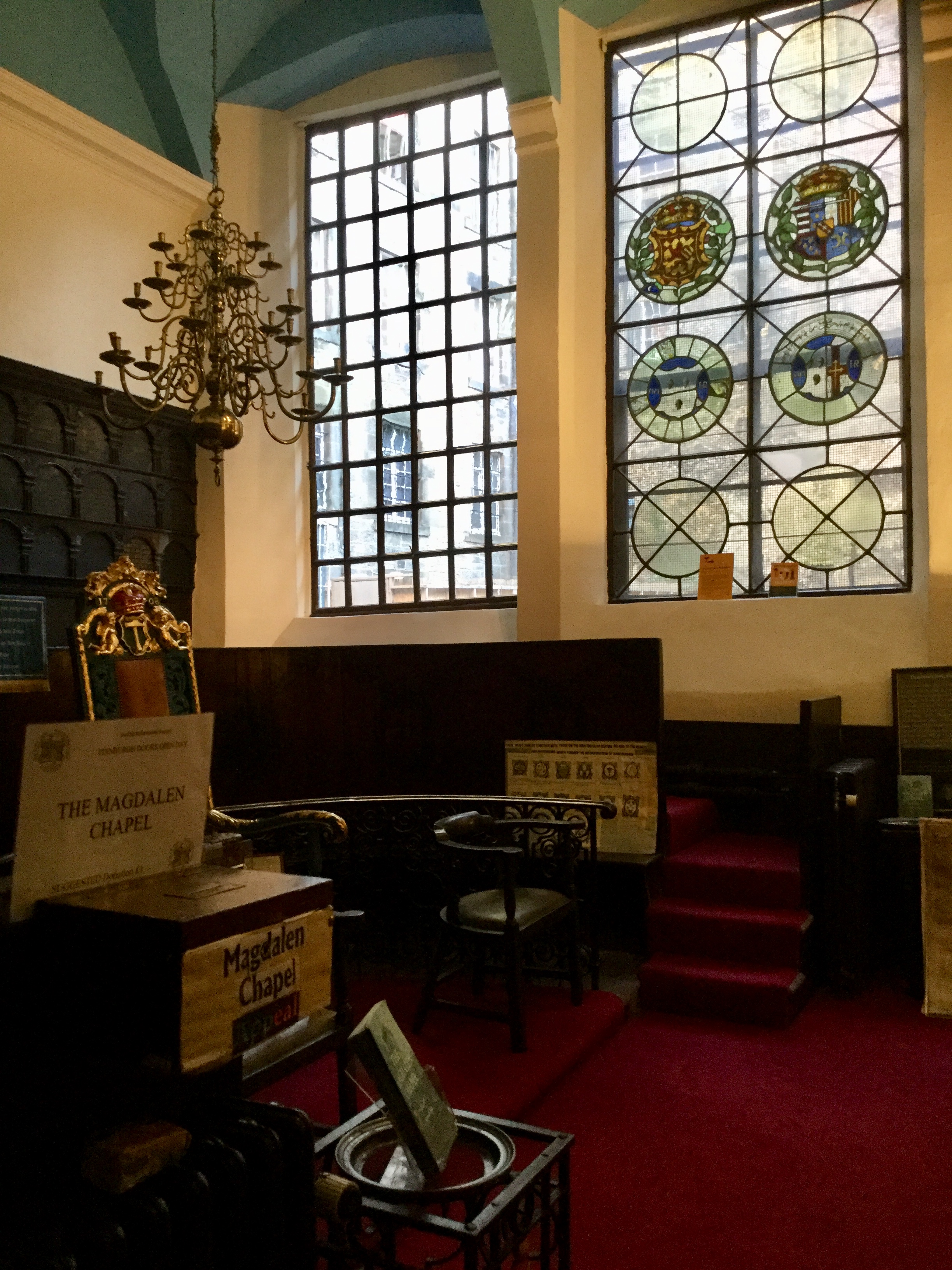
View upon entering the Magdalen Chapel. The four stained glass roundels to the right are, according to Edinburgh.org’s 101 Objects project, ‘the only pre-Reformation stained glass of any importance surviving in-situ in Scotland.’ They ‘depict the coats of arms of Mary of Guise (mother to Mary Queen of Scots), the Scots Lion Rampant, and those of Michael MacQahane and his wife Janet Rynd.’

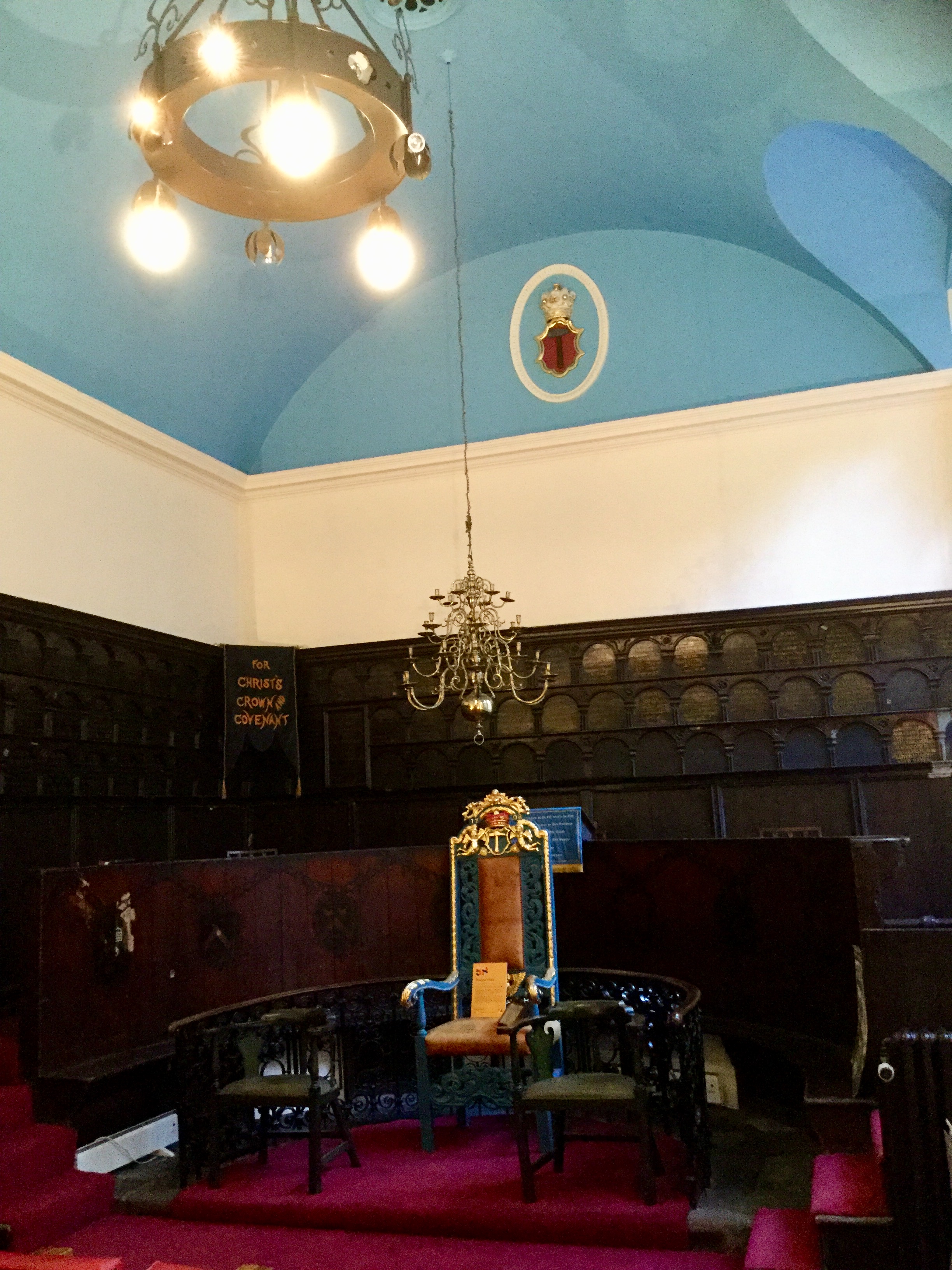
Interior view of the Magdalen Chapel, facing the choir (west) and the 1708 Deacon’s Chair

Interior view of the Magdalen Chapel, facing east. To the left, against which the facsimile of the Covenant of Scotland is leaning, is the small table on which the bodies of executed Covenanters were laid to prepare them for burial

Facsimile of the National Covenant of Scotland, signed in nearby Grayfriar’s Kirkyard in 1638

Mementos, memorials, and more on a wall of the Magdalen Chapel

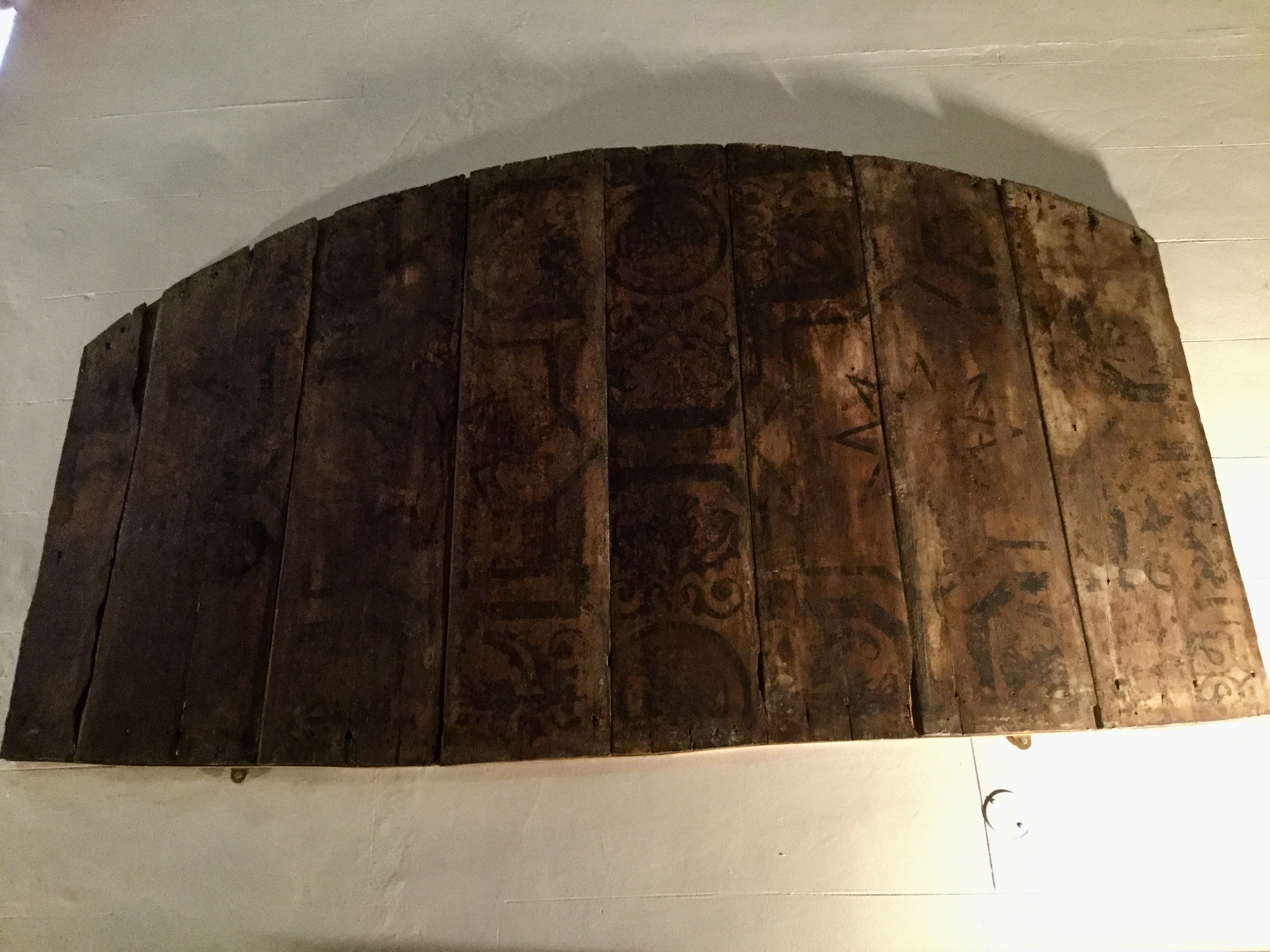
Fragment of the original painted oak ceiling of the Magdalen Chapel

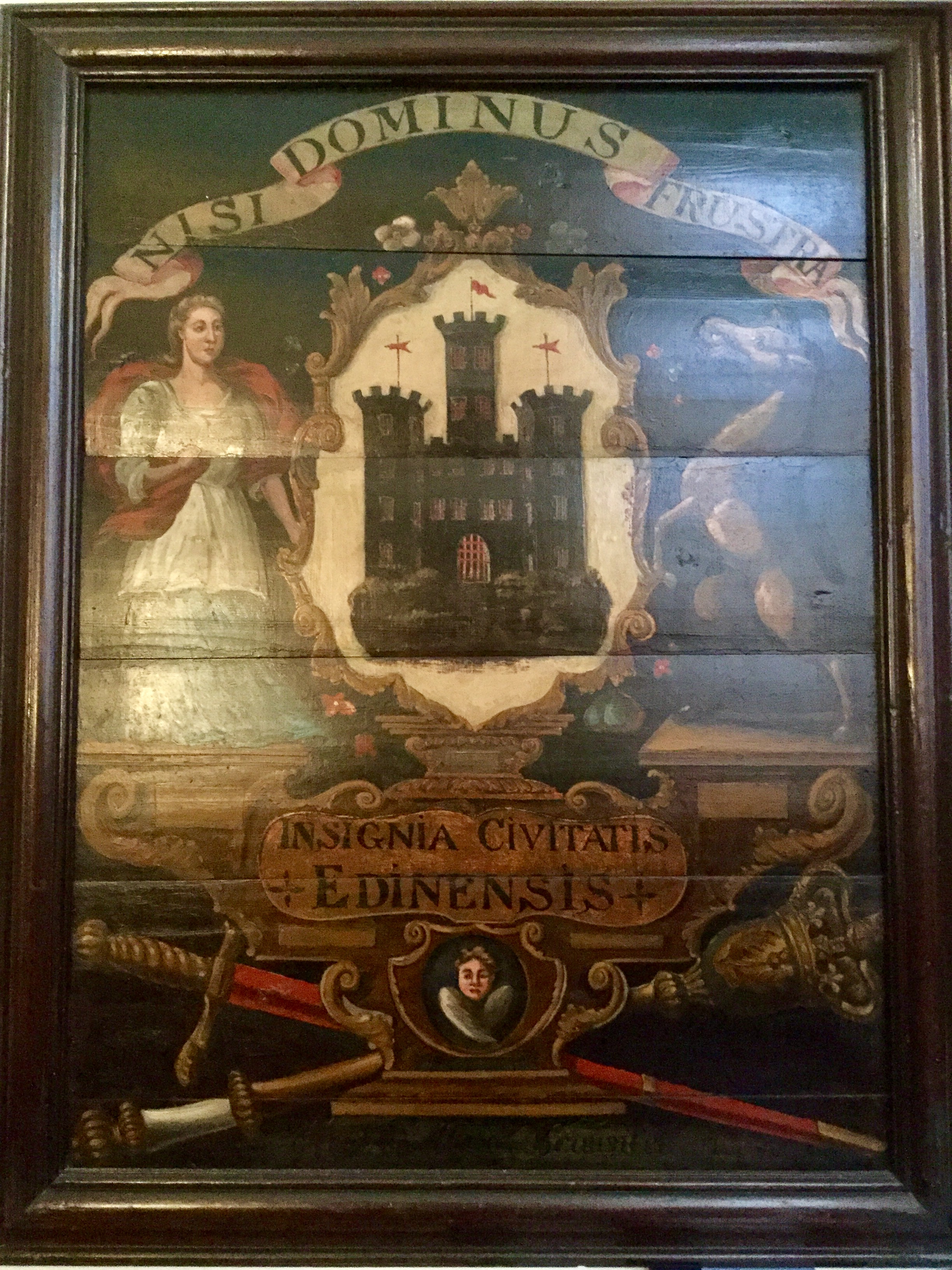
Painted panel with the insignia of the City of Edinburgh and other symbolic images in Edinburgh’s Magdalen Chapel

~ Ordinary Philosophy is a labor of love and ad-free, supported by patrons and readers like you. Any support you can offer will be deeply appreciated!

Christine de Pizan’s Song of Joan of Arc: A Defense of a Political Heroine

Jeanne d’Arc by Albert Lynch, engraving from Figaro Illustre magazine, 1903, public domain

This is a paper I recently submitted for one of my classes at the University of Edinburgh. I was very glad for the opportunity to bring Joan into my studies here!

~~~~~~

Song of Joan of Arc (Ditié de Jehanne d’Arc) is the medieval Italian-French writer Christine de Pizan’s paean to the teenage visionary who led the French army to stunning victories in the Hundred Years War against the English and their French allies. Prior to Song, from about 1399 to 1429, de Pizan authored forty-one works of poetry, prose, and praise and earned her own living doing it, the first European woman to do so.[1] Many of her works are called proto-feminist not because she advocated changing the social and political roles of women, but because she used her pen so often to defend the moral and intellectual worth of women against misogynist literary attacks, notably Jean de Meun’s The Romance of the Rose and Matheolus’ Lamentations.[2] Nadia Margolis describes de Pizan’s magnum opus The Book of the City of Ladies as ‘the first recorded history of women by a woman author, …one of the first deliberate, systematic refutations of male assertions of women’s inferiority ever written.’[3]

De Pizan draws on her canon for her Song of Joan. She marshals her characterizations of great female heroes and saviors of the past from her prolific body of work in celebration of this amazing heroine of her own time. She draws on the Bible and the classics for her Song as well. Nor does de Pizan stop with great women: a mythic and historic, Biblical and Greek array of great male and female figures march triumphantly before Joan in Song. Written in 1429, the year of de Pizan’s death and two years before Joan’s execution by fire, it’s the last of her works. This epic poem is not only a hagiography nor even, as we’ll see, is it interspersed with mere patriotic digs at the English foe and their allies. Like so many of her works, it’s also a defense, not of all women in this case, but of one particular woman. Specifically, it’s a defense of Joan against politically motivated attacks on her personal and religious character. Thus, I argue, de Pizan’s Song is a political work as well.

As the introductory stanzas give way to the main topics of the Song, de Pizan calls on God to help her tell her story well and truthfully.[4] This is reminiscent of the openings of ancient Greek works such as Homer’s Odyssey[5] and Hesiod’s Theogony[6], in which they call on the Muses to do the same. De Pizan draws this classical theme throughout her Song, calling on the ancients as well to help demonstrate the type and significance of Joan’s heroism. This device serves to underscore Joan’s monumental role in history as well as to make the God-ordained nature of her mission more believable: after all, God has called on people to do great things many times before. De Pizan portrays Joan as the fitting culmination for her own time of the great lineage of heroes and saviors from the Bible and the classics. And not only is Joan like them, she is superior to them: “She frees France from its enemies, …not even Hector – Nor Achilles could withstand her.”[7] In stanza XXIII, Joan is a Moses, leading her people out of subjugation.[8] In stanza XXV, Joan is a Joshua, a conqueror. In stanza XXVII, Joan is a Gideon, a simple shepherd called by God to be a warrior. But these were men, de Pizan points out, and Joan was a young girl. Not only did she perform brave and marvelous feats, she did so without the naturally greater physical strength of grown men.[9] Because this rendered her task more difficult, her feats were all the greater.

And de Pizan has no shortage of great female heroines to associate with Joan. Some of these associations are named: Judith, Esther, and Deborah. The exploits of these great heroines of the Bible would have been widely known to her Christian audience: Judith cuts off the head of the general Holofernes before he can destroy her city; Esther risks her life to reveal a plot that would have led her husband-king to destroy her people; and the prophet and judge Deborah arranges a battle to free her people, then cements the victory by hammering a tent pin into the enemy general’s head as he rests in defeat. Some of the women de Pizan associates with Joan, however, are not identified by name. Nevertheless, many of these latter associations would have been readily identifiable for the educated reader and especially for readers of de Pizan’s earlier work since they were drawn from the classics. For example, in stanza XIV, De Pizan attributes Joan’s military success to her intelligence as well as God’s help: “Once it was lost but now it is yours – …And all due to – the intelligence of the Maid who, thanks – to God, most expertly played her part.”[10] In earlier works, such as Letter of Othea to Hector and The Book of the City of Ladies, de Pizan lauds Minerva and Pallas Athena, two aspects of the same Greek goddess. Minerva is associated with war, as the wise woman who invents armor and iron weapons; Pallas is associated with wisdom and knowledge generally. As the wise warrior woman extraordinaire, Joan is Minerva-Pallas, personified.

The clearest and most-repeated association I find between Joan and an unnamed great woman is with the Virgin Mary. In one stanza, de Pizan praises Joan as both virgin and a moral mother “You are virgin, very young, – To whom God grants the strength and power – To be both woman and champion, – Who offers France the gentle breast, – the food of peace…”[11] Later on, de Pizan continues the Marian theme: “Aha!! What honor for the female – Sex! God shows how he loves it, – …By one woman [the nobles and realm] were fortified, No men could do this deed….”[12] If these parallels aren’t clear enough, de Pizan portrays Joan as the vessel through which salvation comes (to France) and through which the king comes to rule his kingdom (Charles’ coronation at Reims). And just as it was in Nazareth, God could have saved France any way he chose, and he chose to save both through women.

Some of de Pizan’s hagiographic characterizations of Joan do not relate to her virtues as a woman, such as those which reflect her earlier works such as City of Ladies and Letter of Othea, or as a savior, such as those which compare her to Old Testament and mythic heroines and heroes. It appears, rather, that they relate to her superiority over her foes. Angus J. Kennedy and Kenneth Varty, in the interpretive essay which accompanies their publication and translations of Song, identify the strong anti-English sentiment found throughout the work.[13] As they point out, de Pizan characterizes the English and their allies as evil, wicked, traitors, and before Joan and her army’s power, helpless as dead dogs.[14] De Pizan also uses the term l’Englecherie, which Kennedy and Varty describe as a pejorative term for the English in that place and time.[15]

Yet this patriotic poem goes beyond ‘heaping scorn’[16] on her foes. De Pizan offers a defense of Joan’s character by offering descriptions of her virtues and intentions that contradict the negative characterizations of her spread by the English and their French allies, the Burgundians. We have a contemporary record of these in the transcripts of her trial in Rouen. Joan was captured on May 23rd, 1430 at Compiègne, and after lengthy negotiations, was handed over to an ecclesiastical court in exchange for 10,000 livres.[17] Despite her being subjected to a purportedly religious trial, she was not, as was customary in those kinds of cases, kept in a religious prison looked after by nuns. Rather, she was kept in an English military prison, chained to a wall, with male guards inside and outside her cell.[18]

The trail at Rouen was widely understood to be both a character and a literal assassination carried out by means of a show trial,[19] carried out with elaborate procedure to make it seem as impartial as possible.[20] Her judges, led by Pierre Cauchon, a French judge in the pay of the English, set out to prove Joan was so depraved, morally and religiously, that she could not have been sent by God. The opening statement of the trial reads: “The reputation of this woman had already gone forth into many parts: how, wholly forgetful of womanly honesty, and having thrown off the bonds of shame, careless of all the modesty of womankind, she wore with an astonishing and monstrous brazenness, immodest garments belonging to the male sex…”.[21] The issue of men’s clothing, which Joan habitually worse since going to war, was a major theme throughout the trial. It was used as evidence not only of her immodesty but her heresy as well, since the Bible forbids women to wear men’s clothing[22]. The judges did not address the fact that imprisoning her in a cell with male guards exposed her to the continual threat of sexual assault and rape[23]; Joan may have found it expedient to wear men’s clothing to preserve her virginity[24], a status which these judges were so intent to undermine. After many sessions of testimony and questioning, twelve formal Articles of Accusation were drawn up and read aloud. One accuses her of staying in a house “with unguarded women” where soldiers liked to hang around[25]. Another accuses her of “having intimate relations” with Captain Robert de Baudricourt and promising to bear him one pope, one emperor, and one king[26].

In defense of Joan’s moral purity, De Pizan refers specifically to Joan’s virginity no less than 13 times in her Song, besides numerous allusions throughout to Joan’s generally virtuous character. De Pizan might have used this description to describe any great woman since de Pizan considers virginity as sacred a designation for women as any Christian of her time[27].

But aside from the sometimes rather startling charges pertaining to her sexual behavior, the imputations of witchcraft and heresy were more serious. The opening statement continues, “her presumptuousness had grown until she was not afraid to perform, to speak, and to disseminate many things contrary to the Catholic faith and hurtful to the articles of the orthodox belief. And by so doing, as well in our diocese as in several other districts of this kingdom, she was said to be guilty of no inconsiderable offenses[28].” Her judges expand on this theme in another statement read over a month later at the first public session[29].

De Pizan goes well beyond defending Joan as personally pious: she presents Joan as a defender of the Christian faith itself. De Pizan writes that not only will Joan defend the faith, but “The Christian faith and Holy Church, – Will both be set to rights through her…”[30] This was one of the passages which alerted me to the political elements in Song. The Hundred Year’s War and de Pizan’s Song long predate England’s schism with the Catholic Church; it so happened that the Pope bestowed the title ‘Defender of the Faith’ nearly one hundred years later on the English monarch Henry VIII before Henry broke England’s ties to the Catholic Church[31]. There were no particular reasons to charge England with being at odds with the Christian faith except as far as they refused to lay down their arms before Joan. Still, even if Joan were on God’s side in the quarrel between the French and the English, this wouldn’t imply that Joan was defender of the Christian faith at large. What, then, explains de Pizan’s remarks here?

The English and their allies certainly did not see themselves as enemies of God or the true faith[32]. They saw themselves as rightful heirs to the throne of France; indeed, as a result of the habit of monarchs creating alliances by marrying their children off to one another only to have these heirs to the crown die off in inconvenient succession, the English monarch did have a real claim to the French throne[33]. It was not in the English interests for their claim to be invalidated as against the will of God. It was in their interests to demonstrate that Joan was not on God’s side. If she had a reputation as indecent, immodest, unwomanly, or a woman of loose morals with a penchant for soldiers, that would weaken Joan’s reputation for holiness. It was even more in their interests that Joan be perceived as a witch, a heretic, or both: if this could be demonstrated, then Joan’s claim to be sent by God could not[34]. Therefore, de Pizan mounts a strong defense of Joan’s godliness, claiming her not only as a pious Christian but as a defender of the faith itself. But the role as a defender of the faith doesn’t seem necessary to add to Joan’s already impressive resume of Christian greatness in Song except as an additional qualifier, a sort of icing on the cake. But de Pizan goes even beyond that: “Yet destroying the English invader – is not, indeed, her primary concern. – For her calling is in preserving – the Faith….”[35]

Once again, we can ask: what impels de Pizan to make the claim that Joan’s primary concern is defending the Christian faith, on behalf of the impressive warrior-saint for whom she’s already claimed so much? When de Pizan mounts her defense of Joan, she could not have known that Joan would be tried by an ecclesiastical court that would seek to officially undermine Joan’ claim that she was doing the will of God on behalf of France. But while de Pizan wrote her Song, Joan was on trial in the court of public opinion. Both trials were political trials, each side out to win the public’s support for their legitimacy to rule. God had chosen a side in this political contest, and Joan said that was France. Therefore, de Pizan added, Joan, as God’s chosen champion of God’s chosen France, was also the champion of the faith itself. In Song, de Pizan places France, France’s king, Joan, God, and the Christian faith itself on one side, the English and their allies on the other. There was only one side, therefore, that the faithful could join, and that was Joan’s. The faithful was transformed, in Song, to the political.

~~~~~~~~~~~~~~~~~~~~~~~~~

[1] Redfern, Jenny. “Christine de Pisan and The Treasure of the City of Ladies: A Medieval Rhetorician and Her Rhetoric” in Reclaiming Rhetorica: Women and in the Rhetorical Tradition, ed. Lunsford, Andrea. Pittsburgh: University of Pittsburgh Press, 1995, p. 74

[2] De Pizan, Christine. Letter of Othea to Hector (1399-1400). Trans., ed., and interpretive essay by Jane Chance. 1997, pp. 8, 14

[3] Margolis, Nadia. “A Feminist-Historical Citadel: Christine de Pizan’s Book of the City of Ladies.” Feminist Moments: Reading Feminist Texts. Ed. Katherine Smits and Susan Bruce.: Bloomsbury Academic, 2016. 11–18. Bloomsbury Collections. Accessed 28 Nov. 2017 at http://dx.doi.org/10.5040/9781474237970.ch-002, paragraph 1

[4] De Pizan, Christine. Ditié de Jehanne d’Arc (1429). Ed. and trans. by Angus J. Kennedy and Kenneth Varty. Oxford: Society for the Study of Mediaeval Languages and Literature, 1977, pp. 41-42

[5] Homer, Odyssey. Perseus Digital Library, Tufts University. Accessed 6 December 2017 at http://www.perseus.tufts.edu/hopper/text?doc=Perseus:text:1999.01.0136, v. 1-10

[6] Hesiod, Theogony. Perseus Digital Library, Tufts University. Accessed 6 December 2017 at www.perseus.tufts.edu/hopper/text?doc=Perseus:text:1999.01.0130, v. 1-5, 20-25

[7] De Pizan, The Song of Joan of Arc. Trans. by Leah Shopkow. Retrieved 20 November 2017 from www.indiana.edu/~dmdhist/joan.htm, stanza XXXVI

[8] Margolis writes that De Pizan sees herself in this role in the City of Ladies as well: ‘First, it echoes the Old Testament (2 Kings 17: 7) in comparing women constrained by misogyny to the Jews enslaved by Pharaoh, thereby likening Christine to Moses (Exod 1; Deut 34). Just as Moses was chosen to lead the Israelites to freedom, so Christine was chosen to lead women to better destinies.’ – paragraph 6

[9] Song, all translations, stanza XXVII

[10] De Pizan, The Song of Joan of Arc. Trans. by Ben D. Kennedy. Retrieved 20 November 2017 from www.maidofheaven.com/joanofarc_song_pisan_contents.asp. Leah Shopkow translates the phrase to ‘wise Joan’, but the Middle French dictionary I consult translates the adjective sensible as closer in meaning to ‘intelligent.’ As Shopkow notes, in some places she sacrifices a little accuracy for overall coherence and poetic rhythm. See the introduction to her translation at www.indiana.edu/~dmdhist/joan.htm

[11] Song, trans. Shopkow, stanza XXIV

[12] Song, trans. Shopkow, stanza XXXIV

[13] Ibid., p. 13

[14] Song, trans. Shopkow, stanzas XXIII, XXIV, XXXIV, XLV, and XXXIII, respectively

[15] Song, Kennedy and Varty, p 87

[16] Ibid., p. 13

[17] The Trial of Jeanne D’Arc. Trans. By W. P. Barrett. Originally published New York: Gotham House, Inc., 1932. From Medieval Sourcebook, Fordham University. Accessed 29 November 2017 at https://sourcebooks.fordham.edu/halsall/basis/joanofarc-trial.asp, p. x

[18] Ibid., p. x

[19] Michelet, J. Joan of Arc: Or, The Maid of Orleans: From Michelet’s History of France. New York: Stanford & Delisser, 1858. Accessed 28 November 2017 from https://babel.hathitrust.org/cgi/pt?id=nyp.33433071375152, pp. 115-116; Robins, P. R. “Discerning Voices in the Trial of Joan of Arc and ‘The Book of Margery Kempe’.” Fifteenth-Century Studies 38, 2013, pp. 177, 187-188

[20] Robins, p. 183

[21] Ibid., p. 2

[22] Bible, King James Version. [online], Accessed 29 November 2017 at: www.bible.com/en-GB/bible, Deuteronomy 22:5

[23] On at least one occasion, though she was in chains, Joan successfully fought off a rape attempt: Michelet, p. 207-208

[24] Men’s clothing was somewhat time-consuming to remove: hose and chausses were laced to a belt and/or the upper garments to hold them in place – Houston, Mary G. Medieval Costume in England and France: The 13th, 14th and 15th Centuries. (1939). New York: Dover, 1996, p. 53, 80-81. Joan’s ability to fight off her would-be rapist may have been aided by her protective covering of laced-together, difficult-to-remove clothing

[25] Trial, Article XIII, p. 154

[26] Ibid., Article XI, p. 159

[27] De Pizan, Christine, The Book of the City of Ladies (1405). Trans. and intro. Brown-Grant, Rosalind. London, Penguin Books, 1999, p. xix, xxiii

[28] Trial, p. 2-3

[29] Ibid., p 34, 36 ‘Since she was appearing in judgment before us we began to explain… how many of her actions, not in our diocese alone but in many other regions also, had injured the orthodox faith, and how common report of them had spread through all the realms of Christendom…. Therefore, considering the public rumor and common report and also certain information already mentioned, after mature consultation with men learned in canon and civil law, we decreed that the said Jeanne should be summoned and cited by letter to answer the interrogations in matters of faith and other points truthfully according to law and reason….’

[30] Song, trans. Shopkow, Stanza XLII

[31] ‘Defender of the Faith’. Ed.s, Encyclopædia Britannica, 2011. Accessed 29 November, 2017 at http://www.britannica.com/topic/defender-of-the-faith

[32] Robins, p. 177

[33] Vale, M. G. A. The Origins of the Hundred Years War: The Angevin Legacy, 1250-1340. Oxford: Clarendon, 1996, pp. 227, 266

[34] Trial, p. xi, Robins, p 177

[35] Song, trans. Kennedy, stanza XLV

Ordinary Philosophy and its Traveling Philosophy / History of Ideas series is a labor of love and ad-free, supported by patrons and readers like you. Please offer your support today!

Happy Birthday, Baruch Spinoza!

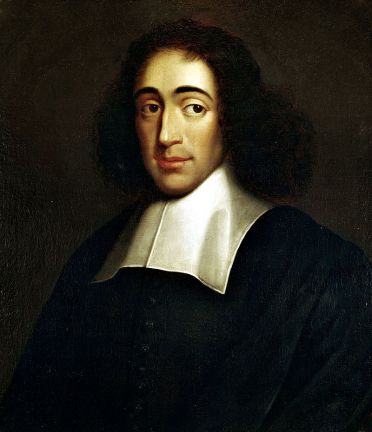
Portrait of Baruch de Spinoza (1632-1677), ca. 1665, by an unknown artist

Baruch Spinoza was born on November 24, 1632, in Amsterdam, the Netherlands. He was the son of Michael and Hannah Spinoza, Portuguese Jews who were forced to convert to Christianity, then imprisoned and tortured by the Inquisition, then fled to relatively tolerant Amsterdam. The Spinozas became successful and respected members of Amsterdam’s Jewish community.

Their son Baruch (also called by his Latinized name Benedicto, also meaning ‘blessed’), was a precocious and brilliant boy who became an intellectually rigorous, curious, and free-thinking man. He wrote prodigiously, profoundly, and often obscurely while earning a humble living as a scientific instrument lens-grinder. He was excommunicated for his unorthodox beliefs (rather surprising still given the relative broad-mindedness of that synagogue), shunned and condemned by his fellow Jews and by Christians alike, and lived the rest of his too-short life in near-solitude, though in rich correspondence with a wide circle of friends and intellectuals.

His idea of God as a unified substance which, in some sense, can be understood as being the same as Nature or the Universe itself, is still widely beloved (the great physicist Albert Einstein and eloquent, outspoken atheist Christopher Hitchens, for example, were among his biggest fans), hated, and debated widely, especially insofar as it can be difficult to grasp the exact nature of Spinoza’s metaphysical and ethical ideas. Spinoza refused to repudiate his ideas despite the intense social pressure he had to deal with for the rest of his life. But however much his correspondents argued, cajoled, threatened with hellfire, or otherwise tried to convince him to abandon his beliefs, Spinoza responded with firmness, constancy, thoroughness, and courtesy.

Learn more about the integrious Baruch Spinoza at:

Baruch Spinoza ~ by Steven Nadler for The Stanford Encyclopedia of Philosophy

Baruch Spinoza (1632 – 1677) ~ in the Jewish Virtual Library

Benedict De Spinoza (1632—1677) ~ by Blake D. Dutton for the Internet Encyclopedia of Philosophy

Betraying Spinoza ~ Rebecca Goldstein on her book Betraying Spinoza: The Renegade Jew Who Gave Us Modernity

Benedict de Spinoza: Dutch-Jewish Philosopher ~ by Richard H. Popkin for the Encyclopædia Britannica

From Baruch to Benedicto! (Spinoza pt. 1) and Spinoza Part 2 ~ by Stephen West for Philosophize This! podcast

God Intoxicated Man – The Life and Times of Benedict Spinoza ~ by Michael Goldfarb for the BBC’s Sunday Feature

Spinoza ~ Melvin Bragg discusses Spinoza’s life and thought with Jonathan Rée, Sarah Hutton, and John Cottingham for In Our Time

The Heretic Jew ~ by Harold Bloom, book review of Rebecca Goldstein’s Betraying Spinoza: The Renegade Jew Who Gave Us Modernity for The New York Times

The Writings of Spinoza ~ at Internet Sacred Text Archive

Ordinary Philosophy and its Traveling Philosophy / History of Ideas series is a labor of love and ad-free, supported by patrons and readers like you. Please offer your support today!

Say What? David Hume on Religion

‘Convulsions in nature, disorders, prodigies, miracles, though the most opposite to the plan of a wise superintendent, impress mankind with the strongest sentiments of religion; the causes of events seeming then the most unknown and unaccountable.’
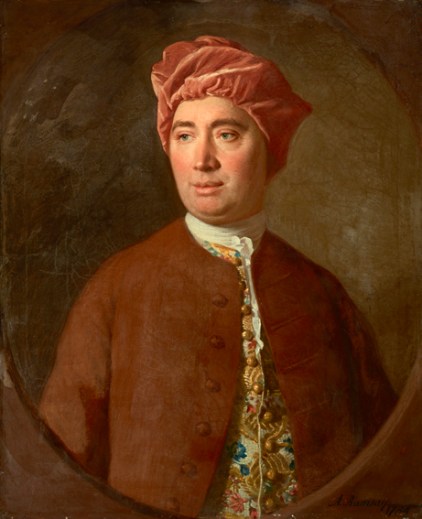
~ David Hume, The Natural History of Religion, Section VI, paragraph 3

Ordinary Philosophy and its Traveling Philosophy / History of Ideas series is a labor of love and ad-free, supported by patrons and readers like you. Please offer your support today!

Rationality and the Origins of Myth: Bayle, Fontanelle, and Toland

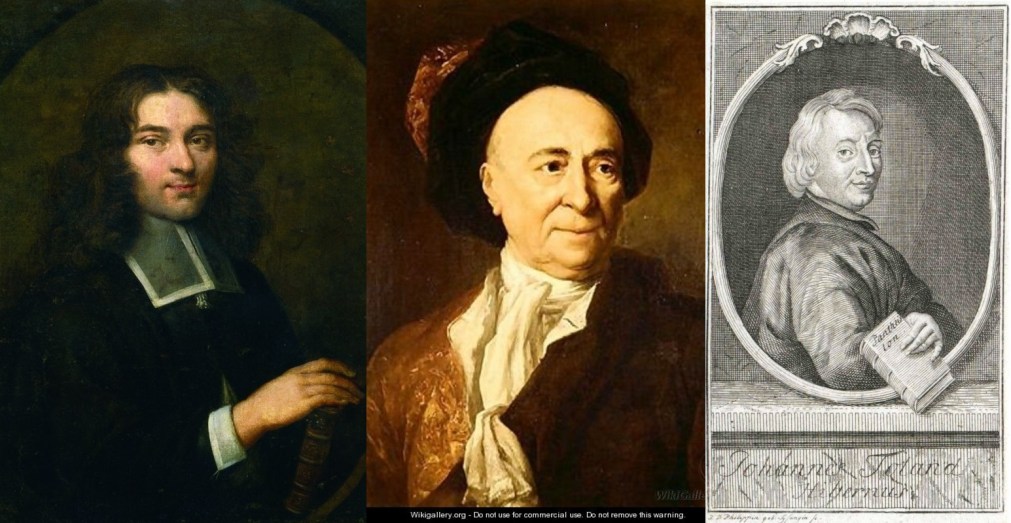
Pierre Bayle, Bernard de Fontanelle, and John Toland; all images in the public domain or free for noncommercial use

This is an extended version of a blog post I recently wrote for my seminar class Myth and the History of Scholarship in Early Modern Europe. I thought I’d share it with you just in case you’re interested in what I’ve been working on at the University of Edinburgh lately ~ Amy

From the ancient philosophers of Greece and Rome to the European Renaissance to early modern Europe in the Age of Discovery, thinkers and scholars attempted to make sense of mythology and the multiplicity of belief from ancient to modern times, in light of their own understanding of the nature of God and the workings of the universe. The Renaissance saw the humanistic attempt to understand mythology as allegories, repositories of ancient wisdom in fable form which conveyed essential religious truths to those discerning enough to perceive them. Then, missionaries to the New World and theologians wrestled with the fact that vast numbers of human beings had no knowledge of the biblical God or of Jesus Christ. They attempted to reconcile this with their beliefs about God’s justice and mercy by recasting pagan myths as expressions of natural theology.

The years leading up to the Enlightenment saw another significant shift in ways of thinking, a rationalist approach that we now associate with the rise of skepticism and the scientific method. In the decades straddling the turn of the 17th century, Huguenot scholar Pierre Bayle, French scientist and writer Bernard de Fontanelle, and British freethinker and religious critic John Toland offered their own critical approaches to the myths of the ancients and of the New World.

‘…People began, in various countries, to write histories in a more reasonable manner and generally with more verisimilitude. So no new fables appear; people are satisfied with preserving the old ones. But can this ever stop those who are infatuated with antiquity? They imagine to themselves that under the fables are hidden secrets of the physical and moral world (Fontanelle 18)’

In On the Origin of Fables, Pierre Bayle (1647–1706) applies ‘natural reason’ and Aristotelian method to myths and ancient philosophy to determine whether they are worthy of belief or useful in promoting a rational understanding of God and the world. Bayle’s approach is to offer critical examinations of particular myths. Through these examples, Bayle intends to demonstrate that mythology is not a vessel of truth, allegorical or otherwise. For one, he considers the ancient Greek philosopher Anaximenes’ idea that the gods were produced by the air, which is the primary and original cause of everything. Bayle rejects this idea as absurd because natural reason doesn’t allow us to believe that a thing’s efficient cause (Aristotle’s term for that which is responsible for another thing’s state of being) to be inferior to that which gave rise to it (Bayle 110). Even more ridiculous, for Bayle, is the idea that a non-thinking thing like air could give rise to a thinking thing like a god (p 113). (I suspect that Bayle would have little use for the theory of evolution.) Other myths such as the birth of Venus, who arose from the foam created when Saturn cut off his father Chaos’ genitalia and threw them into the sea, or that  thunder and lightning is caused by Jupiter’s hurling thunderbolts to earth, aren’t only immoral and brutish, but entirely useless for understanding the rationality of the universe.

Bernard de Fontenelle (1657-1757) sees mythology as the product of the childishness of the human mind at the dawn of reason. When humans observed some amazing or unexpected thing that they couldn’t explain, they naturally embellished it a little so that they could (Fontanelle 11). These embellishments often consisted of positing beings with human-like capacities causing the phenomenon in some recognizable way. Fontanelle, like Bayle, uses the example of thunder and lightning, a mysterious phenomenon that could be explained by imagining a being very like a human but more powerful, who throws arrows of fire like humans do but much larger ones from higher up (p 11-12). He also uses the example of rivers: they originate somewhere, so why not from pitchers like these we use to make water flow? (p 11) But to make rivers, the being(s) who pour the pitchers must have much larger ones, with added power that can keep them flowing plentifully and with force. With each subsequent retelling of these stories, they took on more and more fantastic elements they passed from one person to the other (Consider Michel de Montaigne’s passage about un/reliable testimony in his essay ‘Of Cannibals’), resulting in elaborate and fantastic myths.

But Fontanelle doesn’t judge these almost accidental mythmakers harshly; rather, he makes an interesting and astute observation: it’s actually harder to adhere strictly to the truth than to embellish a tale, especially when it’s about something exciting. It’s harder because 1) ‘our imagination gets heated up with its subject’ (Fontanelle 11) and begins to elaborate the tale all on its own and 2) the more marvelous details you add, the more interest, encouragement, and admiration you arouse in your audience. But though rationality is hard and the imagination is lively (p 15), Fontanelle insists that it’s still essential that we resist ignorance. David Hume would later elaborate on Fontanelle’s idea about myths and miracles, making it one of the centerpieces of his skeptical philosophy in his Enquiry concerning Human Understanding.

John Toland’s (1670-1722) theory also cites human ignorance and frailty in the origins of myth, but he offers a less general account. In his view, myths spring from the honor paid to the dead. Worship of the gods is an extension of the respect, fear, and supplication of powerful rulers, warriors, magicians, and so on (Toland 72). He accepts Euhemerus’ idea that the gods of myth refer to real people but that, over time, their origins were forgotten (p 85). Toland observes that the honor paid to the gods closely resemble the honors paid to dead heroes and princes, so he postulates a common origin for these practices.

Toland further explains that the gods, based on exceptional humans now dead, are also based on human ideas and virtues (p 88). Here, both Toland and Bayle reflect the ancient philosopher Xenophanes, who argues that all gods are devised to resemble their creators. If animals had gods too, they would look, act, and have the same mental features as those animals—at least, the strongest, best, most admired animals among them. Fontanelle also takes a Xenophanean view in his description of how the gods evolve over time: the gods of the earliest, most primitive myths were as irrational, lustful, and brutal as the people themselves. But just as societies became more civilized, more rational, and more virtuous, so did the gods (Fontanelle 13).

Fontanelle, Toland, and Bayle all take a rationalist approach to the subject of myth, as they do to the sciences and all other areas of inquiry. All myths and idolatry are born from irrationality, and if we are to understand the world as it really is, as a rational place created and designed by a rational God, it’s important to demonstrate the irrationality of the myths and remove their power to promote irrationality in the general public. This will result in a more rational, moral, and free society.

Bayle, again, takes the approach of examining particular examples of myths to show that their origins are irrational and that they cannot, even as allegory, be seen to impart anything good or true, or to promote understanding in any way. He continues his exploration of ancient ideas about air, this time the myth that equates the goddess Juno with the air. Despite all attempts to understand this myth as a way of understanding a truth about the workings of the world, it does nothing but confuse and confound. Bayle again invokes Aristotle, who says that if it’s a thinking being, it must have a soul, and if that being is a part of nature and has a soul, it must be an animal. Therefore, if Juno is the air, she’s a sort of animal being constantly being torn and wounded by things passing through her, which he offers as such a patent absurdity that the myth couldn’t possibly promote a rational understanding of nature. (p 117-118)

Fontanelle argues that his time was one of the most intellectually vigorous (p 13), no doubt because he saw it as an age of rationality. He has a progressive view of the human capability for rationality (p 17), and sees it as the way of the world that all human societies will become more rational over time, just as the Greeks did, and just as he suspects that the Native Americans encountered by the Spanish would if given the time to develop their capabilities (p 16). This is consistent with Fontanelle’s view that creation itself is a rational system. It would make sense, then, that the more human beings come to understand it, the more rational they become as well. That’s why it’s a mistake to perpetuate irrationality by continuing to teach the myths through the arts such as poetry, fine arts, and theater (p 17).

Toland argues that a multiplicity of gods and objects of worship, which is characteristic of the less rational belief systems, is correlated with irrationality, less freedom, and more autocracy. The more gods a society creates, the more autocratic and the less free and rational the society – (Toland 98) (Noted scientist and religious skeptic Richard Dawkins would likely point out that in that case, the most free, rational, and democratic societies would have no gods at all.)

‘So [the well-meaning Philosophers] proceeded to explain away the rest of the Gods; and, as Allegorys are as fruitful as our Imaginations, scarce any two Authors cou’d wholly agree in their Opinions. But supposing the Truth of the matter had bin as any or all of ’em wou’d have it, yet their Religion was not a whit the better, and deserv’d to be abolished; since, what ever were the Speculations of a few among the Learned, ‘cis evident that the Vulgar took all these to be very real Gods, of whom they stood in mighty fear, and to whom they paid Divine Adoration…’ (p 122)

So even if the myths could be interpreted as allegories by the learned, their dissemination spread ignorance and irrationality and so did far more harm than good.

‘But if any shou’d wonder how Men cou’d leave the direct and easy Path of Reason ‘ton wander in such inextricable Mazes, let him but consider how in very many and considerable Regions the plain Institution of Jesus Christ cou’d degenerate into the most absurd Doctrins, unintelligible Jargon, ridiculous Practices, and inexplicable Mysterys…’ (p 129)

Bayle goes further than Toland, and believes that myth not only correlates with barbarous societies, but that they promote acceptance of bad behavior. The myth of Jupiter, for example, deifies a being guilty of just about every crime you can think of: murder, rape, incest, lies, and cruelty of every sort (Bayle 107). Fortunately, Bayle observes, most people behave better than the gods of mythology, an observation that extends beyond his close examination of many mythological beliefs.

Fontanelle also observes that belief does not necessarily inform moral convictions or behavior; in fact, they seem to be quite separate:

‘What is strange is that Christians, whose system of religion is so pure, yield almost nothing to the gentiles in respect to engaging in vices. It is a mistake to believe that the moral practice of a religion corresponds to the doctrines of its confession of faith. (p 107)’

People, then as now it seems, accept those religious beliefs that accord with their own principles and moral characters more than the other way around.

~ Thanks to Dr. Felicity Green for inspiration and insight

Bibliography

Bayle, Pierre, ‘Jupiter’, in Historical-Critical Dictionary: Selections [1697], trans. Richard Popkin (Indianapolis, 1991), pp. 107-119.

‘Bernard Le Bovier, sieur de Fontenelle.’ (2017, 25 January), In Encyclopædia Britannica. Retrieved from www.britannica.com/biography/Bernard-Le-Bovier-sieur-de-Fontenelle  ; accessed 09 November, 2017.

Falcon, Andrea, “Aristotle on Causality”, The Stanford Encyclopedia of Philosophy (Spring 2015 Edition), Edward N. Zalta (ed.). Retrieved from https://plato.stanford.edu/archives/spr2015/entries/aristotle-causality/ ; accessed 09 November, 2017.

Fontenelle, Bernard de, De l’origine des fables [wr. c.1691-99, pub. 1724]. English trans. Of the Origin of Fables by Burton Feldman and Robert D. Richardson, The Rise of Modern Mythology 1680-1860 (Indiana, 1972), pp. 10-18.

‘John Toland’. (2017, 17 August), In Encyclopædia Britannica. Retrieved from www.britannica.com/biography/John-Toland ; accessed 09 November, 2017.

Lennon, Thomas M. and Hickson, Michael, ‘Pierre Bayle’, In The Stanford Encyclopedia of Philosophy (Fall 2014 Edition), Edward N. Zalta (ed.), https://plato.stanford.edu/archives/fall2014/entries/bayle/ ; accessed 09 November 2017

Toland, John, Letters to Serena (London, 1704), part III

Ordinary Philosophy and its Traveling Philosophy / History of Ideas series is a labor of love and ad-free, supported by patrons and readers like you. Please offer your support today!

He Died as He Lived: David Hume, Philosopher and Infidel, by Dennis Rasmussen

As the Scottish philosopher David Hume lay on his deathbed in the summer of 1776, his passing became a highly anticipated event. Few people in 18th-century Britain were as forthright in their lack of religious faith as Hume was, and his skepticism had earned him a lifetime of abuse and reproach from the pious, including a concerted effort to excommunicate him from the Church of Scotland. Now everyone wanted to know how the notorious infidel would face his end. Would he show remorse or perhaps even recant his skepticism? Would he die in a state of distress, having none of the usual consolations afforded by belief in an afterlife? In the event, Hume died as he had lived, with remarkable good humour and without religion.

The most famous depiction of Hume’s dying days, at least in our time, comes from James Boswell, who managed to contrive a visit with him on Sunday, 7 July 1776. As his account of their conversation makes plain, the purpose of Boswell’s visit was less to pay his respects to a dying man, or even to gratify a sense of morbid curiosity, than to try to fortify his own religious convictions by confirming that even Hume could not remain a sincere non-believer to the end. In this, he failed utterly.

‘Being too late for church,’ Boswell made his way to Hume’s house, where he was surprised to find him ‘placid and even cheerful … talking of different matters with a tranquility of mind and a clearness of head which few men possess at any time.’ Ever tactful, Boswell immediately brought up the subject of the afterlife, asking if there might not be a future state. Hume replied that ‘it was possible that a piece of coal put upon the fire would not burn; and he added that it was a most unreasonable fancy that we should exist for ever’. Boswell persisted, asking if he was not made uneasy by the thought of annihilation, to which Hume responded that he was no more perturbed by the idea of ceasing to exist than by the idea that he had not existed before he was born. What was more, Hume ‘said flatly that the morality of every religion was bad, and … that when he heard a man was religious, he concluded he was a rascal, though he had known some instances of very good men being religious.’

This interview might show Hume at his brashest, but in the 18th century it remained mostly confined to Boswell’s private notebooks. The most prominent and controversial public account of Hume’s final days came instead from an even more famous pen: that of Adam Smith, Hume’s closest friend. Smith composed a eulogy for Hume soon after the latter’s death in the form of a public letter to their mutual publisher, William Strahan. This letter was effectively the ‘authorised version’ of the story of Hume’s death, as it appeared (with Hume’s advance permission) as a companion piece to his short, posthumously published autobiography, My Own Life (1776).

Smith’s letter contains none of the open impiety that pervades Boswell’s interview, but it does chronicle – even flaunt – the equanimity of Hume’s last days, depicting the philosopher telling jokes, playing cards, and conversing cheerfully with his friends. It also emphasises the excellence of Hume’s character; indeed, Smith concluded the letter by declaring that his unbelieving friend approached ‘as nearly to the idea of a perfectly wise and virtuous man, as perhaps the nature of human frailty will permit’.

Though relatively little known today, in the 18th century Smith’s letter caused an uproar. He later proclaimed that it ‘brought upon me 10 times more abuse than the very violent attack I had made upon the whole commercial system of Great Britain’ – meaning, of course, The Wealth of Nations (1776). Throughout his life, Smith had generally gone to great lengths to avoid revealing much about his religious beliefs – or lack thereof – and to steer clear of confrontations with the devout, but his claim that an avowed skeptic such as Hume was a model of wisdom and virtue ‘gave very great offence’ and ‘shocked every sober Christian’ (as a contemporary commented).

Boswell himself deemed Smith’s letter a piece of ‘daring effrontery’ and an example of the ‘poisonous productions with which this age is infested’. Accordingly, he beseeched Samuel Johnson to ‘step forth’ to ‘knock Hume’s and Smith’s heads together, and make vain and ostentatious infidelity exceedingly ridiculous. Would it not,’ he pleaded, ‘be worth your while to crush such noxious weeds in the moral garden?’

Nor did the controversy subside quickly. Nearly a century later, one prolific author of religious tomes, John Lowrie, was still sufficiently incensed by Smith’s letter to proclaim that he knew ‘no more lamentable evidence of the weakness and folly of irreligion and infidelity’ in ‘all the range of English literature’.

In the 18th century, the idea that it was possible for a skeptic to die well, without undue hopes or fears, clearly haunted many people, including Boswell, who tried to call on Hume twice more after their 7 July conversation in order to press him further, but was turned away. Today, of course, non-believers are still regarded with suspicion and even hatred in some circles, but many die every day with little notice or comment about their lack of faith. It takes a particularly audacious and outspoken form of non-belief – more akin to the Hume of Boswell’s private interview than to the Hume of Smith’s public letter – to arouse much in the way of shock or resentment, of the kind that attended the death of Christopher Hitchens some years ago. (Indeed, there were a number of comparisons drawn between Hitchens and Hume at the time.) The fact that in the 18th century Smith endured vigorous and lasting abuse for merely reporting his friend’s calm and courageous end offers a stark reminder of just how far we have come in this regard.Aeon counter – do not remove

This article was originally published at Aeon and has been republished under Creative Commons.

Dennis Rasmussen is an associate professor in the department of political science at Tufts University in Massachusetts. He is the author of The Infidel and the Professor: David Hume, Adam Smith, and the Friendship That Shaped Modern Thought (2017). (Bio credit: Aeon)

~ Ordinary Philosophy is a labor of love and ad-free, supported by patrons and readers like you. Any support you can offer will be deeply appreciated!

*All views and opinions expressed by guest writers are their own and do not necessarily reflect those of Ordinary Philosophy’s editors and publishers